


By Harry Siemens
Brunel Sabourin, co-founder of Antara Agronomy in St. Jean-Baptiste, MB, has seen plenty of Prairie seasons, but this spring’s wild temperature swings brought new challenges for farmers in the Red River Valley.
“We had record heat, then 48 hours later we’re near freezing,” Sabourin said. “That’s a 40-degree shift, and it’s hard on the crops, especially seedlings that haven’t hardened off yet.”
Despite the erratic weather, producers made strong planting progress. Sabourin estimates seeding is 90% complete or better. However, concerns are growing about the impacts of wind damage, excess moisture, and rapid temperature shifts.
Sabourin said some areas received over an inch of rain; others received as much as three inches. Most of the rain was welcome, but the high winds beforehand damaged young plants. Some canola was sheared off or buried, and growers had to top up seed ahead of the rainfall.
That was just the beginning. Sabourin noted that many fields are now showing stress.

“There’s rough-looking corn out there. It took a hit from the wind, then the cold, and even the moisture played a role. We’re waiting on warmer weather to see how much damage,” he said.
Cold-weather injury in corn is a particular worry.
“It’s called imbibitional chilling injury. If the first water the seed absorbs is too cold, it can hurt germination. You might see corkscrewed growth or seed that never emerges,” said Sabourin.
Field crusting—hard, compacted soil caused by rain pounding down just after seeding adds to the list of worries.
“If the crop can’t push through that crust, we might have to reseed some spots,” Sabourin said.
For now, the key is sunshine and patience.
“We need a few good days to kick-start growth again. Everything is slow right now because it’s just been too cold,” he said. “Even the weeds are taking their time to grow.”
Despite these challenges, farmers planted most crops on time, and many growers stuck to normal rotations.
“There was some delay waiting for the right conditions, but once it got going, it went well. Most cereals are already up,” he said. “Their growing points were still protected underground, so they should be fine.”
Questions have come up about herbicide applications made just before the cold snap.
“Some growers applied
glyphosate, and then it froze. They’re asking if it will still work,” Sabourin said. “It will—it just takes longer because nothing’s growing fast in this cold.”
The key now is vigilance.
“Canola emergence might be uneven, especially with drifting soil burying seed too deep,” he noted. “We’ll have to see how the next few days go.”
Sabourin encourages farmers to walk their fields and keep checking.
“We just need some sun and normal temperatures. Then, we’ll get a clearer picture. But for now, it’s wait and see,” he said.
The spring has been anything but boring, he admits.
“Your job and mine don’t get dull—because nothing stays the same,” said Sabourin.
Even with stress-tested crops and weather whiplash, Sabourin remains optimistic.
“Most of the crop went in at the right time,” he said. “We’re still in decent shape as long as we get some warmth now.”
For Manitoba farmers riding this roller coaster, the forecast may finally offer some relief—and a chance to see what’s truly sprouting beneath the surface.
The Manitoba government, in co-operation with the government of Canada, has extended the enrolment deadline for the 2025 AgriStability program by three months in response to tariffs in the agriculture sector and to allow producers additional time to enrol in the program as they manage the impact of current market disruptions.
AgriStability is a business risk-management program under the Sustainable Canadian Agricultural Partnership (S-CAP) that helps farmers manage income risk by providing financial assistance when their farm business experiences a large margin decline, noted the minister. The deadline was extended from April 30 to July 31 of this year.
Agriculture Minister Ron Kostyshyn is encouraging producers to learn more about the business riskmanagement programs available through the Manitoba Agricultural Services Corporation (MASC).
“These products are excellent tools that allow producers to protect against fluctuating markets and interest rates,” said Kostyshyn. “I encourage all producers to contact their local MASC office and ask which financial management tools will help in making sound production decisions along with which lending and risk-management programs will help safeguard their farm operations and provide long-term success.”
Earlier in April, an additional $10 million in matching funds was announced for potential enhancements to the AgriStability program, along with $140.8 million in Budget 2025 for business riskmanagement programming including AgriInsurance, wildlife damage compensation and AgriInvest.
The Sustainable Canadian Agricultural Partnership is a five-year, $3.5-billion investment by Canada’s federal, provincial and territorial governments to strengthen the competitiveness, innovation and resiliency of the agriculture, agri-food and agri-based products sector. This includes $1 billion in federal programs and activities and a $2.5-billion commitment that is cost-shared 60 per cent federally and 40 per cent provinciallyterritorially for programs that are designed and delivered by provinces and territories.
For more info, visit gov.mb.ca/tariffresponse/ index.html#agricultural-supports.

By Dan Guetre
Canadian agricultural producers are feeling the squeeze as trade tensions with China continue to ripple through the sector, with nearly one in four agri-businesses reporting direct impacts from retaliatory Chinese tariffs. According to new data released by the Canadian Federation of Independent Business (CFIB), 36% of agriculture-related businesses are affected, and many are urging the federal government to step up support.
The CFIB’s findings reveal a sector under pressure, particularly in key export areas like canola oil, canola meal, peas, pork, and seafood, which have been targeted by Chinese tariffs. For a country where agri-food exports to China are a major economic driver, the fallout is beginning to show at the farm gate.
“While the focus has been on trade tensions with the U.S., China’s tariffs have cut deeper for many Canadian producers,” said Juliette Nicolaÿ, CFIB policy ana-
lyst. “The damage goes beyond the headline commodities—it’s hitting everyday farmers and fishers across the country.”
Canola producers, especially in the Prairies, are among the hardest hit, as China and the U.S. together account for over half of Canada’s canola exports. Similarly, fish and seafood producers on the coasts are seeing disrupted access to one of their most important markets—China, Canada’s second-largest seafood export destination.
Despite the gravity of the situation, only 10% of agribusinesses believe governments have done enough to help them weather the impacts. While some businesses have sought to diversify or find alternative markets, 88% say Canada must strengthen trade relationships beyond China and the U.S. to protect future growth and resilience.
The CFIB has formally called on the federal government to reduce tax and regulatory burdens on agri-
businesses and to revamp support programs to more directly address the fallout from trade disputes. It is also urging policymakers to assist producers in navigating and penetrating new markets, helping them recover from lost contracts and avoid excess inventory build-up.
“As producers struggle to manage uncertainty, they need more than vague promises—they need a clear strategy,” said Jasmin Guénette, CFIB’s Vice-President of National Affairs. “It’s time for Ottawa to focus on agriculture, adopt competitive policies, and open new international doors so our farmers can plan for the long term.”
With planting seasons underway and export timelines looming, Canada’s agri-businesses are looking for swift and decisive action. The message from the field is clear: the time to support Canadian agriculture is now.

By Harry Siemens
Cereals Canada is seeking $100 million in shared funding from the federal and Manitoba government and industry stakeholders to build a new facility in downtown Winnipeg. Dubbed “Gate”. The project aims to serve as a central hub for research, education, and global promotion of Canadian cereals. However, while some major producer groups have already committed to support, not all farmers are convinced that the project is worth the cost.
Wheat Growers Association President Gunter Jochum, who farms west of Winnipeg, MB, says his organization remains sceptical due to a lack of transparency and unclear returns for producers.
“They say they have a business case, but we haven’t seen any numbers,” Jochum said. He notes that budget details are marked “internal use only”; leaving many farmers unsure what kind of funds they want.
Jochum questions the need for a downtown hub, pointing out that many grain companies already conduct technical work in their labs.
“They are asking us to foot the bill for something that may not offer direct benefits,” he said. “Most farmers aren’t excited about paying for a building downtown.”
He also raised concerns that the organization hasn’t seriously explored more affordable alternatives, such as repurposing vacant commercial properties in Winnipeg. With federal cuts to variety development, Jochum suggests to instead fund initiatives that directly support yield, disease resistance, and climate resilience.
In response, Dean Dias, CEO at Cereals Canada, says the Gate project design is
to maintain Canada’s competitive edge in international grain markets. The organization emphasizes that it provides services that distinguish Canadian cereals from those of key competitors like the U.S. and Australia.
“We’ve provided worldclass customer support for over 50 years,” Dias said. “Customer satisfaction—and loyalty—comes from ensuring customers are informed, empowered, and confident in our products.”
Cereals Canada says the proposed facility will enhance its ability to engage with international buyers, support trade commissioners and regulators, and demonstrate the quality of Canadian grain to global processors and millers. The organization insists that this technical and promotional support is essential to protecting and growing export markets, especially since over 90% of Canadian grain goes to international buyers.
To date, there is $31.5 million in funding for the project. That includes $18.5 million from Alberta Grains, the Saskatchewan Wheat Development Commission (Sask Wheat), the Manitoba Crop Alliance, the Grain Farmers of Ontario, Quebec Grain Producers, and Cereals Canada. On April 10, 2025, the Province of Manitoba committed $13 million.
To address farmers’ concerns, Cereals Canada says it has attended producer meetings across the country to share information and answer questions. While the business plan has not been made public due to confidentiality agreements, board members and key stakeholders have reviewed it. The organization has published a public FAQ at gate-canada.ca/faq/ to clarify the project’s goals

and details.
For farmers, the organization says Gate is about securing access to markets at a time when loyalty has to be clear.
“Loyal customers are the lifeblood of our cereals industry,” the statement reads.
“Our role is to connect the work being done in variety development with market expectations and keep Canadian grains at the top of the mind in key markets.”
Cereals Canada also stresses that its efforts complement, not compete with, what private companies and public researchers are doing in the development space.
“This project will represent the best interests of the entire grain value chain,” the group said, adding that Gate’s research, technical training, and market development work will ultimately help farmers turn innovation into realworld market success.
The organization concludes that Gate is not just about building—it’s about ensuring Canada retains its place as a global leader in cereals, supported by strong market relationships, technical credibility, and continued customer trust. While debate continues over costs and priorities, Cereals Canada insists its goal is clear: keeping markets open and available for Canadian farmers.

By Harry Siemens
Canada begins a new political chapter with a new government, a new Prime Minister, and a new Agriculture Minister. Farm leaders hope this change brings fresh direction and better results for agriculture. When Donald Trump shook up U.S. trade policy, Canadian farmers felt the pressure. Now we have new Federal leadership under Prime Minister Mark Carney.
Farm leaders nationwide call this moment a wake-up call—not to abandon the U.S. market but to stop relying on it as our only play. Canada must diversify and act strategically. This new government must lead with policy, not partisanship.
Saskatchewan farmer Rob Stone had hoped MP Kody Blois would become Minister of Agriculture, calling him “knowledgeable, hardworking, and unafraid to ask questions.”
Stone now hopes that newly appointed Minister Heath MacDonald will show those traits and listen to the Ag community when shaping policy.
Cam Dahl, General Manager of Manitoba Pork Council, says it’s time to prioritize good policy over politics, especially in agriculture.
“A former Prime Minister
once said, ‘an election is no time to talk about serious issues,’” Dahl recalled. “But when it comes to providing opportunity for Canadians, policy matters far more than politics.”
He says agriculture often gets overlooked in federal planning, even though it contributes seven percent of Canada’s GDP—$150 billion—and supports 2.3 million jobs.
“That’s one in every nine jobs. It’s time the entire cabinet acknowledged that,” said Dahl.
Dahl urged Minister MacDonald to focus on trade. In 2024, Canada’s agri-food exports surpassed $100 billion, but agricultural interests remain sidelined in trade talks.
“Agriculture needs a seat at the table when Canada sets its trade positions,” he said. “A good first step would be explicitly including agriculture in Team Canada trade missions to the U.S.” Dahl said trade problems go beyond the U.S.; Canadian pork and seafood exports to China face 25 percent tariffs. Canola faces 100 percent. Even under the Canada–EU deal, Canadian exporters face non-tariff barriers.
“Protectionism is rising, and so is global instability,” said Dahl. “Canada needs a strate-
By Elmer Heinrichs latest
Agriculture and Agri-Food Canada, in its May outlook, says year-over-year prices for most field crops are projected to experience a significant decline compared to the previous year, with the exception of corn, flax, and sunflower seeds.
For 2025-2026, assuming normal growing conditions and trend yields, overall production is expected to decline slightly from last year. Drought conditions have generally improved since last fall, although abnormally dry to moderate drought conditions continues to impact agricultural regions in the Peace River regions of British Columbia and Alberta, northern Saskatchewan, and much of Manitoba as per the
national agro-climate risk report.
Planting across the Canadian Prairies is well underway and generally ahead of the seasonal average.
Year-over-year, carry-out stocks for all principal field crops are forecasted to increase, driven primarily by higher ending stocks in both grains and oilseeds as well as pulse and special crops. This growth is largely attributed to a decline in export volumes across both segments.
Meanwhile, prices for the majority of field crops are projected to decrease compared to the previous year, with the exception of wheat (excluding durum), canola, flaxseed, dry beans, and mustard seed, which are expected to see price stability or gains.
gy to deal with these threats.”
Dahl urged the government to form a joint industry–government task group focused on agri-food trade.
“We need to answer three questions: How do we mitigate tariffs? How do we eliminate barriers? And how do we diversify our markets?”
The overarching goal is simple. “Preserve the North American market and open up global trade,” said Dahl.
Dahl pointed out that more than 400 farm groups exist in Canada.
“That means government often hears 400 different voices. Without consensus, any action meets opposition, and that gives Ottawa the perfect excuse to do nothing,” he said.
He called on farmers, processors, and farm organizations to unite around clear, export-focused proposals.
“Otherwise, we risk inaction and missed opportunity,” said Dhal.
Dahl stressed that food trade is not just economic—it’s also about national security.
“In today’s unstable geopolitical climate, food security matters. Canada, the U.S., and Mexico must work together through CUSMA to protect supply chains,” he said.
He challenged Ottawa to back Canadian agriculture in
the upcoming CUSMA review and to act on promises made during the election.
“World trade disruptions can be opportunities—but only if we have bold, decisive policy. If we don’t act, we’ll hurt farmers, stall value-added processing, and limit economic growth,” said Dahl.
The Western Canadian Wheat Growers Association also welcomed MacDonald’s appointment and called for swift, practical action.
“We welcome Minister MacDonald to this vital role,” said President Gunter Jochum. “Now is the time to turn campaign promises into action. Farmers need bold regulatory reform, better market access, and the removal of growth-limiting barriers.”
Jochum called for greater investment in infrastructure and better trade performance.
“The government has committed to infrastructure, and
that’s a good start,” he said. “But we must go further. Our ports need expansion and strong Western Canadian representation. Our trade corridors must run efficiently— 24/7, 365 days a year—if we’re going to stay competitive.”
Daryl Fransoo, Chair of the Wheat Growers, echoed the need for urgency.
“We’re optimistic about the Minister’s leadership,” he said. “But it’s time to move from words to action. Canadian agriculture should be a global powerhouse—and that requires immediate steps forward.”
Jochum said the Wheat Growers will work with the Minister to build a strong, globally competitive future.
“We bring practical experience and clear solutions to the table,” said Jochum. “We’re ready to partner with the government to deliver measur-
able results for producers and the agri-food economy.”
This is a defining moment for Canadian agriculture. Farmers stand ready. The solutions are clear. Now the government must act. Bold, practical steps—not politics—must lead the way.


Read the AgriPost online at agripost.ca
Past issues in archive

“For the farmer is the only man in our economy who has to buy everything he buys at retail, sell everything he sells at wholesale, and pay the freight both ways.”
That old saying may sound like a punch line, but it speaks to a hard truth. Farmers hold one of the most unique and vulnerable positions in our economy. They don’t set the price for what they buy or sell, yet they carry the burden of every cost in between. And still—they keep going.
Across the Prairies and beyond, farmers are pushing seed into the ground again this spring. The weather’s been unpredictable. Some
regions are still fighting wet fields while others brace for drought. Input costs—from seed to fuel to fertilizer—remain sky-high.
Meanwhile, prices for crops and livestock remain volatile, swayed by global trade tensions, inflation, and government policies far removed from the field.
And yet, despite all of this, the seeding continues.
This spring also brings a fresh political landscape with a new Liberal government. While some welcome the change, others are cautious, wondering whether this government understands or appreciates the agricultural sector’s pressures. Trade remains a top concern. Ongoing tensions with China and uncertain tariff policies from the United States have left Canadian farmers in limbo. Access to global markets is
critical—especially when over half of our beef, pork, grain, and oilseeds depend on exports.
One misstep in trade negotiations can mean a year of lost revenue on the farm.
That’s the reality for farmers. They don’t get to wait out policy. They plant, raise, harvest—and hope that markets, weather, and politics don’t undo the work of their hands.
Let’s be clear: farming is not just another job. It’s the foundation of every society on earth. Without farmers, there is no food. No bread on the table. No meat in the freezer. No fuel in the tank. No fibre in our clothes. As my mentor Orian Samuelson always said, “If you eat, you’re involved in agriculture.”
Most Canadians benefit daily from the quiet, unrelenting work of farmers—yet few truly understand the pres-
sures they carry. Farmers often absorb the losses unlike other sectors that can pass rising costs onto consumers. They don’t control their own margins. That’s why policy stability, trade predictability, and support in times of crisis matter so much.
Take the current situation: fertilizer costs have doubled or tripled for many. Seed technology and crop protection tools are more advanced than ever—but come at a steep cost. Meanwhile, weather events seem more extreme and less predictable year over year. Risk management tools like crop insurance and AgriStability help, but not enough to offset poor market access or rising tariffs.
Farmers need more than platitudes. They need real support, real policy, and real access to the markets that make their work sustainable.
Despite all this, farmers keep showing up. Before dawn, after dark, rain or shine. They invest thousands—sometimes millions—into a crop with no guarantees. They bet on faith, hard work, and experience. They steward the land not for a season, but for generations. That deserves respect. That deserves protection. It’s time we talk more about agriculture not just as an economic sector, but as a cornerstone of national security and sovereignty. A country that can feed itself is strong. A country that lets its farmers fail is vulnerable.
So whether you’re walking a field this morning or eating toast in the city, take a moment to think about the hands that made that moment possible. The farmer isn’t asking for praise. They’re asking for a fair shot.
Let’s give it to them.
By Harry Siemens
Bartlett, a Savage company, announced it will acquire Ceres Global Ag Corp., expanding its grain and oilseed supply chain across key regions in Canada and the United States.
Based in Golden Valley, Minnesota, Ceres operates 10 locations in Minnesota, Manitoba, and Saskatchewan and holds membership interests in three agricultural joint ventures in Minnesota and North Dakota. The company focuses on farming, energy, industrial merchandising, and supply chain services.
“We’re excited to welcome the Ceres team to Bartlett,” said Jeff Roberts, President and CEO of Savage. “We see incredible potential in combining our networks and growing in new ways with the resources that Ceres brings to our portfolio. With their great team and assets, we’ll build on our robust supply chain for our current and new customers.”
The acquisition will add approximately 45 million bushels of grain and oilseed
storage capacity, including joint venture assets, significantly expanding Bartlett’s infrastructure.
“Ceres assets, relationships, and values are a natural complement to the Bartlett business,” said Bob Knief, Executive Director of Bartlett. “We’re thrilled about combining our resources to grow our networks and better serve our customers.”
Ceres’ leadership supports the acquisition, calling it a validation of the company’s long-term strategy.
“Bartlett’s acquisition of Ceres vindicates the strategy we set out to achieve 12 years ago—to build the company into one of North America’s leading merchandisers of durum, oats, spring wheat, and canola,” said Jim Vanasek, Chairman of Ceres. “Bartlett is a perfect fit in geography, business lines, and culture, and will take Ceres to the next level.”
The deal is subject to court, shareholder, and regulatory approval, and standard closing conditions. Shareholders representing 70% of Ceres’
outstanding shares, including VN Capital Management, LLC, have entered into irrevocable voting and support agreements in favour of the acquisition.
The announcement marks a significant development in Bartlett’s expansion strategy. Founded in 1907 and acquired by Savage in 2018, Bartlett is a leading U.S. grain exporter to Mexico and a major producer of flour and soybean processing products. Its operations span acquisition, storage, transportation, processing, and grain merchandising for the food and renewable fuel industries.
Savage, based in Midvale, Utah, owns and operates Savage Infrastructure, Bartlett, and Texon. It employs over 4,200 team members in nearly 200 U.S., Canada, Mexico, and Saudi Arabia locations.
The acquisition builds on Ceres’ earlier growth moves, notably its 2019 acquisition of Delmar Commodities Ltd., a Winkler, Manitobabased agribusiness. Delmar specializes in grain merchandising, soybean crush-
ing, birdfeed production, and seed distribution, and became a Ceres subsidiary following the deal.
“This combination is an important step for Ceres as we execute our growth strategy,” said then-CEO Robert Day. “We saw great value in Delmar’s assets, market knowledge, and people.”
Delmar’s founder, Martin Harder, who also served as Winkler’s mayor, reflected on the transition.
“It began with a dream. It has become more than a reality for me and many others,” said Harder.
The Delmar acquisition strengthened Ceres’ strategic orientation and diversified its product offerings, especially across Western Canada. As Bartlett integrates Ceres’ assets and talent, that expansion becomes part of the company’s broader North American platform.
As the deal progresses, Bartlett and Ceres will continue working closely with regulators, shareholders, and stakeholders to finalize the transaction and align operations for the future.

Three Manitoba beef producers are stepping into key leadership positions within the Canadian Cattle Association (CCA) following elections at the organization’s Annual General Meeting held earlier this spring in Ottawa, solidifying the province’s influence in national beef industry discussions.
Tyler Fulton of Birtle, Manitoba, a respected cattle producer and former president of Manitoba Beef Producers (MBP), was elected President of the Canadian Cattle Association, taking over from outgoing president Nathan Phinney of Sackville, New Brunswick. Phinney will continue to serve on the board as past president.
Fulton brings years of grassroots industry experience to the national stage. His elevation to the presidency is being viewed as a strong step forward for Manitoba’s presence in the national cattle landscape.
Joining Fulton on the CCA Board is Mike Duguid of Arnes, Manitoba, who was re-elected to his director position. Duguid currently serves as chair of the Manitoba Forage and Grassland Association (MFGA), representing MBP on the MFGA board.
His leadership has also extended nationally as co-chair of the CCA’s Environment Committee, a role in which he has been widely recognized for advancing sustainability and environmental stewardship within the beef sector.
Also newly appointed to the CCA Board is current MBP president Matt Atkinson, who ranches near Neepawa. Atkinson will serve as co-chair of the CCA’s Animal Health Committee, helping steer key conversations on livestock health, biosecurity, and disease prevention—critical areas for the well-being and productivity of Canada’s beef industry.
The appointments mark a significant moment for Manitoba, reflecting the province’s growing leadership role with-

in the national cattle industry. The Canadian Cattle Association represents beef producers across the country, advocating for industry interests in trade, animal health, environmental stewardship, and food safety.

Submitted photos
By Elmer Heinrichs
Rural Manitoba received some much needed precipitation over the past week, and isolated showers brought variable rain accumulations throughout the province.
As a result farmers have seen some rain delays, as they try to complete their spring seeding.
Oilseed specialist Sonia Wilson reports that recent rain events in Manitoba over the past eight days have brought much-needed precipitation to many areas, and she remains hopeful that producers will soon be able to return to

Cleanfarms marks its 15th anniversary as a global leader in agricultural waste management, having collected over 97,000,000 kg of agricultural waste materials from Canadian farms since programming began.
Since inception, Cleanfarms, a Canadian not-forprofit industry stewardship organization has become a global leader in collecting, recycling, and safely disposing of used agricultural plastics, packaging, and products.
Over the past 15 years, Cleanfarms has expanded its programs to offer comprehensive management solutions for agricultural plastics including grain bags, silage plastics, bale wrap, and crop input packaging such as pesticide and fertilizer containers, seed bags,
and large tote bags.
Most recently, it introduced a recycling program for maple tubing, gaining traction across Quebec. This growth stems from strong support from Cleanfarms’ members and the commitment of Canadian farmers embracing sustainable practices. With a 78% three-year recovery rate for its flagship recycling program for agricultural containers under 23L, and a network of more than 1,500 collection sites nationwide, Cleanfarms continues to make responsible agricultural waste management accessible to farmers from coast to coast.
“We are extremely proud of how far Cleanfarms has come in the last 15 years and value our partnerships with industry and farmers across
the country,” said Barry Friesen, Executive Director of Cleanfarms. “But we have a long way to go. We expect soon to see more of the Ag plastics we recycle come right back for use on the farm as we continue to build a strong and resilient circular economy for agricultural plastics in Canada.”
Boyd Bergstrom, Chair of the Cleanfarms Board, added: “This milestone reflects the dedication of Cleanfarms staff, our board members’ vision, our partners, and most importantly, the farmers who participate. These achievements stem from our shared commitment to responsible stewardship. We’re excited to further improve sustainability through our agricultural plastics recycling and recovery programs.”
“We are receiving some warmer weather with winds that are definitely leading to field conditions being workable again,” Wilson said. “But there are some spots for sure that have low-lying water as well.”
This week’s crop report reveals that the eastern and eastern portions of the Interlake have received rainfall accumulations below 70 per cent of normal
In contrast, the southwest and parts of the central regions are reporting more than 150 per cent of the 30-year rainfall average since May 1. Despite the challenges, farmers have successfully planted 57 per cent of the provincial
Wilson notes that while the recent rain will cause a slight delay in seeding activities, most of the cereal acres have already been planted.
Provincially, seeding progress has corn at approximately 50 per cent complete, field peas at 96 per cent, soybeans at 40 per cent, and just a few acres of dry beans seeded to date.
Dry, warm and windy weather conditions early in the week before the rainfall allowed significant progress in field operations across most of central region. The winds made field operations, especially spraying, quite challenging.
The early-seeded cereals are at the two-leaf stage, and producers are in full swing into seeding canola, potatoes, flax, sunflowers, soybeans and edible beans The earliest seeded corn has emerged and is growing well.
Winter wheat and fall rye are growing rapidly, and most producers have completed fertilizer applications on these winter cereals. Winter cereal survival is generally good, with most producers reporting 80-90 per cent survival.
Most of the spring wheat acres have been seeded across the regions. Oats and barley are almost complete in central, eastern, Interlake, northwest regions.
Corn is reported about halfway planted across the province, with the earliest seeded fields emerging and growing quickly. Canola is estimated at 30 per cent seeded across the province. Sunflowers are over 80 per cent complete, with flax also at close to 30 per cent done. Field pea seeding is basically complete, at 96 per cent. Soybeans are 40 per cent done across the province. And a few acres of dry beans have been seeded.
Across eastern region, the rain was quite variable with differing amounts being recorded only miles apart. A smaller amount of rain fell in the further eastern part of the region where it was needed the most. Both the rain and cool temperatures delayed seeding and emergence in much of the region.
Seeding is estimated at 85 per cent complete across the region. Spring wheat, oats, and barley seeding is considered done, with any remaining fields being planted as soon as conditions allow.
Corn planting is on-going with approximately 95 per cent complete. Producers are expected to finish up their corn acres as soon as field conditions allow. Earlier seeded corn has emerged and canola seeding is estimated at 75 per cent complete.
Sunflower planting has also begun with at about 50 per cent of acres already in the ground. Cooler temperatures have delayed forage growth, but some cattle are out in summer pasture.

The Manitoba government is providing $60 million in capital funding and a further $60 million in bridge financing to support Assiniboine College’s new Prairie Innovation Centre for Sustainable Agriculture, which will expand workforce training opportunities and support the future of agriculture in Manitoba.
“Manitoba’s agriculture sector is critical to our province’s economy and to staying resilient against Trump’s tariffs,” said Premier Wab Kinew. “The Prairie Innovation Centre will house new and expanded training, so Manitobans can learn the skills they need to get good, in-demand Ag jobs here in Westman and across the province.”
With Manitoba’s agriculture industry expected to grow substantially, the Prairie Innovation Centre will add hundreds of additional training seats in Westman to meet this demand, noted the premier.
The Manitoba government is providing:
- $60 million in capital funding, with $40 million going to the Prairie Innovation Centre and $20 million for a new 216 seat child-care project within the centre.
- $60 million in approved bridge financing to allow construction to begin immediately.
Assiniboine College has been working to establish the Prairie Innovation Centre as a state-of-the-art learning facility on its North Hill Campus. The centre will foster collaboration with industry, promote cutting-edge research and expand agricultural training capacity to help meet local labour market needs, noted the premier.
“We are pleased the province is providing the financing for the Prairie Innovation Centre,” said Mark Frison, president, Assiniboine College. “It is an important project that will help to improve value-added processing and export development capacity in the agriculture sector. [The] commitment allows us to go tender immediately. We look forward to working with the province to finalize participation of the government of Canada in the project.”
The Manitoba government has identified that this project is an important investment to the government of Canada and is advocating for federal support, said the premier.
In addition to training Manitobans for the agriculture jobs of the future, project construction is expected to create almost 1,000 jobs, added Kinew.

By Harry Siemens
Manitoba Crop Alliance (MCA) has elected its new board executive for 2025-26, reaffirming its commitment to supporting Manitoba farmers and strengthening the province’s agricultural sector. Jonothan Hodson was elected chair, Sally Parsonage elected vicechair, and Doug Martin is the new secretary.
Hodson, a fifth-generation farmer from Lenore, has been an MCA director since 2020 and has served as vice-chair for three years. His farm features a diverse mix of crops, including spring wheat, canola, soybeans, grain corn, barley, yellow peas, and forage crops, alongside a Black Angus cow/calf operation. He previously served on the board of the Manitoba Corn Growers Association before its amalgamation into MCA. He was a director with the Manitoba Angus Association and currently serves on the Valleyview Co-op board.
“It’s an honour to be elected as chair by my peers on the board,” says Hodson. “MCA spearheads valuable work to make Manitoba farmers more productive and sustainable. I look forward to continuing to help guide that work and the organization’s overall direction in my new role.”
Parsonage, who grew up on a farm northeast of Baldur, became president of Parsonage Farms Ltd. in 2014 after she and her siblings took over from their parents. Parsonage Farms operates a six-crop rotation of confectionary sunflowers, barley, beans, canola, oats, and wheat. In addition to farming, she helps run Air Greenway Ltd., an aerial spraying business that operates two spray planes during the fungicide and desiccation season. Before she was elected vice-chair, she served as MCA’s secretary for one year.
Martin, a fourth-generation East Selkirk farmer, co-owns Martin Farms Ltd. with his wife Laurie, cousin Gerry, and Gerry’s wife Kelly. Their farm produces winter wheat, spring wheat, corn, soybeans, oats, and canola. Martin has a long history of lead-
ership in Manitoba’s agriculture sector, having served as past chair of Winter Cereals Manitoba, a board member for the Western Grains Research Foundation, and a Keystone Agricultural Producers advisory council member.
MCA extended its gratitude to outgoing chair Robert Misko for his leadership and dedication during his tenure. Established on August 1, 2020, MCA represents more than 7,700 Manitoba farmers and is committed to enhancing the profitability and competitiveness of wheat, barley, corn, sunflower, and flax production. The organization focuses on four key areas: research and production, market access and development, advocacy, and communications.
MCA stands apart from other Manitoba commodity organizations with its unique governance model, which ensures strong representation across all crop types while maintaining a wholefarm, cross-commodity approach. The organization operates through five cropspecific committees—corn, flax, sunflower, wheat, and barley—each comprised of elected delegates from their respective crop groups. The corn, flax, and sunflower committees have eight delegates, while the wheat and barley committees have ten.
MCA’s board of eleven directors come from within these crop committees. Three directors represent the corn committee, two each from the flax and sunflower committees and four from the wheat and barley committees. This governance model provides a strong voice for each crop while allowing the board to oversee financial matters, stakeholder relationships, risk management, and MCA’s strate-
gic plan implementation.
“Our governance structure allows us to balance crop-specific priorities with a broader vision for the industry,” says Hodson. “The crop committees play a crucial role in setting research and market development strategies, while the board ensures that MCA remains financially responsible and aligned with its long-term goals.”
By integrating research, advocacy, and market development, MCA aims to maximize the value of every levy dollar collected, ensuring Manitoba farmers receive meaningful, independent research, valuable knowledge, and targeted support.
“Our investments focus on making Manitoba farmers more productive and sustainable,” says Hodson. “As an organization, we are committed to driving innovation, improving market access, and ensuring longterm success for our farmer members.”
Since its formation, MCA has fostered a more competitive and resilient agricultural sector in Manitoba. The organization came through the amalgamation of five former commodity groups: Manitoba Wheat and Barley Growers Association, Manitoba Corn Growers Association, Manitoba Winter Cereals, Inc., Manitoba Flax Growers Association, and the National Sunflower Association of Canada. This merger has allowed MCA to take a more unified and strategic approach to advancing Manitoba’s crop sector. As MCA moves forward under the leadership of its new executive, it remains focused on supporting farmers with the tools, knowledge, and advocacy they need to thrive in an evolving industry

By Elmer Heinrichs
For more than two years, the Winnipeg area branch of an international construction equipment dealer has been a construction zone.
Things are getting back to normal at Brandt Tractor Ltd. In the Rural Municipality of Macdonald, now that a $30 million renovation that more than doubled the size of the facility is complete.
When it first opened in 2000, the facility located at 3700 McGillivray Blvd. was 29,450 square feet. Now it spans 65,190 sq. ft., more
than double its showroom, office spaces, parts warehouse and repair shop.
The business has also increased the size of its yard by 73 per cent, for a total of more than 12 acres.
“It’s tough to express what it means to get this done, said Peter Paulic, branch manager. “We’re pretty excited for the whole thing.”
According to the company, which is the world’s largest privately held dealer of John Deere equipment, for the construction and forestry industries, customers
will benefit from increased access to equipment, parts and service as a result of the renovation.
Graders are one of the branch’s best-selling pieces of equipment, but loaders, excavators, dozers and skid steers sell well, too, he said.
“It’s a premium product that customers quite appreciate and love.”
The Brandt Group of Companies has more than 6,000 employees and more than 180 locations in Canada, the United State, Australia and New Zealand.
By Elmer Heinrichs
The University of Manitoba is working with Opaskwayak Cree Nation (OCN) to grow vegetables with enhanced nutritional value as a way to address diet-related diseases in the community.
This is being done through the optimization of a vertical smart farm, which began as a pilot project on OCN in 2016.
“We’re trying to improve the nutritional content and the quality of the produce being grown by modifying growing conditions and conditions post-harvest to hopefully enhance nutrients or medicinal compounds
in the vegetables to make them better at fighting disease, specifically diabetes,” said Breanne Semenko, a registered dietician and PhD student involved in the project.
Semenko explained researchers are using environmental manipulation, not genetic modification, to enhance the nutrients. This includes lighting, water, nutrients, and post-harvest processing and handling.
She noted that OCN is dealing with high rates of diet-related disease, and the project hopes to bring more fresh food sources to the community.
“The soil isn’t as fertile up north, unfortunately, so it isn’t as easy to grow some of the leafy greens and whatnot that we’re growing in the farm currently,” she said. “It’s also just a lot more expensive for communities to be able to afford the produce that’s getting shipped up.”
Cabbage, broccoli, lettuce, kale and brussel sprouts are currently being grown on the farm. Semenko noted that the smart farm produce is even slightly sweeter than traditional veggies.
“The feedback has been overwhelmingly positive,” she said.
By Elmer Heinrichs
Manitoba’s strawberries are off to a strong start, says Anthony Mintenko, Manitoba Agriculture fruit crops specialist.
“For strawberries, all the straw mulch has been taken off,” said Anthony Mintenko, Manitoba Agriculture fruit crops specialist in mid-May. “Especially with this warmer weather we’ve had the last little while. And planting of new strawberries is ongoing.”
Manitoba grows only two per cent of Canada’s strawberries overall, but it’s the largest strawberry producer on the Prairies. In 2024, the province boasted 500 strawberry acres, with 250 of those yielding fruit.
Strawberries draw a crowd, which make them a popular fruit crop for Manitoba UPick operations.
The Prairies had good wintering conditions and Manitoba enjoyed some of the best weather of the three, accord-
By Dan Guetre
The Canadian Industrial Hemp Promotion-Research Agency (CIHPRA), operating as Hemp Canada Chanvre (HCC), has officially announced the formation of its first permanent Board of Directors, marking a major step forward for Canada’s evolving hemp industry. The announcement solidifies the agency’s leadership framework as it ramps up efforts to promote innovation, research, and market growth nationwide.
Of particular note to Manitobans is the appointment of Adam Gregory, a local producer who will represent Manitoba on the national board. Gregory’s presence ensures that Manitoba’s significant role in the hemp sector—and its producers’ voices—remain central in shaping the agency’s priorities.
The nine-member board brings together a range of regional perspectives, with representatives from across Canada’s hempproducing provinces, as well as members representing importers and the supply chain. However, the inclusion of Manitoba voices, including Gregory and Ryan Meade of Manitoba Harvest representing the supply chain, positions the province as a key contributor to the industry’s direction.
HCC was formally proclaimed under the Farm Products Agencies Act in November 2024 and launched operations shortly after with an interim board. The agency was created to coordinate national research and promotion strategies for industrial hemp, a crop with expanding uses in food, fibre, and sustainable materials.
With a permanent board now established, HCC is set to develop governance policies, levy orders, and strategic programming aimed at supporting producers and opening new market opportunities both domestically and internationally.
As the agency transitions from planning to action, Manitoba stakeholders can expect to see increasing opportunities for involvement in shaping the future of hemp in Canada -both as an economic driver and as a contributor to sustainable agriculture.


ing to Mintenko. Stretches of blistering cold may stand out in residents’ memory, but overall, the fruit specialist noted, the winter was mild.
The late fall allowed plants time to go dormant and, although Manitoba didn’t see a lot of snow cover, “We had enough snow on top of the straw that provided pretty good protection,” Mintenko said.
In Manitoba, strawberries are usually ready for picking in late June or early July.


By Harry Siemens operational
A historic wooden grain elevator in Waskada, Manitoba, was destroyed by fire on May 6. Built in 1961 to replace a previous elevator that had burned down that same year, it had become an important landmark for the community.
Danny Vanbeselaere, a longtime local, shared his memories of the elevator’s long history and impact on the area.
“My dad was in grade 12, studying for exams, when the first elevator burned down,” Vanbeselaere recalled. “Manitoba Pool Elevators rebuilt it after a lot of convincing from the community, and I remember attending its opening in the mid-‘70s, probably around 1974 or 1975.”
He described how the elevator played a central role in the community, even as it underwent ownership and
changes over the years. Vanbeselaere served on the elevator board when it reopened and was involved in its closure later.
Brad McKinney, the son of Bill McKinney, a well-known figure in Waskada, owned the elevator.
“Brad had just finished cleaning his wheat seed and had it stored in the elevator when the fire broke out,”
Vanbeselaere explained. “It wasn’t full of grain, but it still caused significant damage.”
The fire started after a lightning strike hit the elevator around 9:30 p.m. on May 5.
“The lightning shook all the windows in my neighbour’s house,” Vanbeselaere said. “It didn’t get reported until five in the morning when someone saw the blaze.”
He added that the north wind made matters worse,
scattering metal shrapnel and charcoal across the park where kids play soccer and ball. “Cleaning up the mess will take a lot of work.”
Vanbeselaere also reflected on the elevator’s earlier history, noting that fire destroyed the original structure in 1961 during high winds that caused widespread damage in the town.
“The south wind caused a lot of fires in Waskada that year,” he said. “The rink roof caught fire, and the church’s steeple was on fire. It was quite a health problem for the town.”
Fortunately, the wind shifted to the north during the fire, which prevented further destruction.
“The fire only damaged the tree and a few picnic tables in the park,” Vanbeselaere said.
“I talked to the elevator
owner, Brad, yesterday while I was in town,” Vanbeselaere continued. “He was there and did a fire inspection that night before it started on fire. He said he checked the ground rods and everything, did a full safety check, and everything was good.”
Vanbeselaere also spoke with a neighbour across the road, an older carpenter around 78 or 80.
“He said there were lightning strikes in town that night.”
Despite the recent tragedy, Vanbeselaere remains optimistic about the grain elevator’s legacy.
“When it reopened, my grandpa and another man were the first to dump grain in it,” he said. We have three generations of history tied to that elevator, and we’ll never forget it.”


By Harry Siemens
For historian Gordon Goldsborough, losing the Waskada grain elevator wasn’t just another fire but a painful blow to the Prairie landscape.
“That one was a terrible loss,” said Goldsborough, president of the Manitoba Historical Society. “Some elevators are neglected and near collapse, so it’s no surprise when they go. But Waskada’s was relatively new, built in 1961, and could have lasted many years.”
As a long-time chronicler of Manitoba’s vanishing wooden elevators, Goldsborough understands their deeper meaning.
“Elevators like the one in Waskada were more than storage bins,” said Goldsborough. “They were landmarks—symbols of our farm-
disappear, we lose a part of our identity.”
He says the Historical Society monitors elevator conditions primarily through visual indicators.
“We look for missing metal siding, structural damage, or tall grass on access roads. If there’s no sign of truck traffic or repairs, we suspect it’s not in use.”
He recently visited the old elevator in Austin.
“Some siding was gone, and the wood had rotted behind it,” he said. “You can’t store grain in a bin with a hole—it would just pour out.”
While many Prairie elevators have disappeared, a few communities have turned them into museums.
“The one in Plum Coulee is a great example,” said Goldsborough. They didn’t just keep the elevator—they

carved rooms into the bins so visitors could walk through and see how the farmers’ grain was stored. It highlights the technology and connects people to that history.”
Goldsborough noted that at the peak in the 1920s, Manitoba had more than 700 wooden elevators.
“Now we’re down to 114 standing,” he said. “But of those, only about 60 are usable. The others are deteriorating or beyond repair.”
Many were torn down not for safety reasons but to eliminate competition.
“Some companies didn’t want them sold to someone who could keep them running. It was about controlling the market,” said Goldsborough.
One success story is the grain elevator at Jordan Corner. Martin Harder bought it
from a local pool board when the Manitoba Pool wouldn’t sell it. He paid $140,000 for it and turned it into a thriving seed business. The elevator is still there and still in use.
Private farm elevators tell another part of the story. There are dozens, maybe more, built by individual producers. They’re smaller but use the same basic design— legs, bins, the works. Organizers moved one of those to the Pembina Threshermen’s Museum west of Winkler.
Despite the decline, Goldsborough hopes that public awareness can spark preservation efforts.
“People in cities often think elevators still dot the landscape. They don’t realize how fast they’re disappearing,” he said. “If we can raise awareness, maybe a few more will be saved as museums or mon-

uments to Prairie heritage.”
Goldsborough said one of his favourite images shows two old elevators in Elva, with a modern mega-elevator looming in the distance.
“It captures the story perfectly,” he said. “Those two were dismantled. One was burned by accident during salvage work. But the photo shows exactly what replaced them—and why.”
As for the Waskada fire, Goldsborough sees it as another wake-up call.
“That elevator was still in good shape. It could’ve lasted decades. Instead, like many others, it’s gone in a flash,” he said. “We can’t save them all, but we can save some— and in doing so, preserve the
story of Prairie agriculture for the next generation.”


By Harry Siemens
Following a stretch of up-anddown weather, Manitoba producers nearly finished planting potatoes by May 22. Growers reported substantial progress despite weather-related delays.
“As of now, we’re about 95 to 97 percent done,” said Dr. Vikram Bisht, a plant pathologist with Manitoba Agriculture who monitors the crop closely. “A few larger growers are still wrapping up, but most have already finished planting.”
Emergence typically occurs around June 1, but earlier planting and warmer soils could speed up development.
“This year, many growers planted ahead of schedule, and with warmer soil temperatures, we may see emergence a bit sooner than usual,” said Bisht.
Potato production requires precise and careful management, especially when planting healthy seed.
“You want seed that’s as diseasefree as possible,” Bisht said. “No rots, no shattering, and low virus levels. That’s the foundation.”
Growers also use seed treatments to protect against soil-borne diseases and insect threats.
“Several seed treatments are available that target both diseases and insects,” he said. “Some help control Colorado potato beetles and aphids right from the start.”
Water management remains another crucial factor in a successful potato crop.
“Timely moisture is essential,” Bisht explained. “At the beginning of the planting season, soil moisture was good. The surface dried
out a bit as planting continued, but there was still enough moisture in the ground not to cause concern.”
Many growers turn to irrigation throughout the growing season, even when it doesn’t appear dry.
“More and more are using soil moisture probes,” Bisht said. “They rely on the data to decide whether to irrigate or not. Typically, they’ll apply about half an inch of water weekly to supplement rainfall.”
He noted that irrigation is almost essential for those under contract with processors.
“To maintain quality and yields, processors usually require irrigation,” he said. “Even in seed production, where some growers operate without irrigation, having that option always pays off.”
Despite good planting conditions early on, this year’s acreage will be lower than in previous years.
“We’re likely to see just under 70,000 acres of potatoes in Manitoba this year,” said Bisht. “That’s down about 11,000 to 12,000 acres from last year.”
He pointed to broader industry cuts across North America.
“Yes, there were reductions across the board, but Manitoba experienced slightly higher cuts than other regions. That’s just how it worked out this season,” he said.
The industry will confirm the final numbers in late June, but the outlook remains positive.
“We’ll get the acreage once everything is counted,” Bisht said. “Right now, we’re working off estimates.”
Spring rains slowed progress for some producers, but most remain on track to finish soon.
“By this time, we’d normally be 100 percent done,” he said. “But the recent rain left some fields too wet for planting. Once those fields dry out, we expect everything to wrap up quickly.”
He remains optimistic about the season ahead.
“Because of the warm soil, I think emergence will happen fast,” said Bisht. “That’s encouraging.”
He also emphasized the growing role of technology in modern potato farming.
“Moisture sensors, disease forecasting tools, and better seed treatment options all help growers manage their crop more precisely,” he said. “These tools give them a real edge.”
Looking ahead, he says irrigation development remains a key issue.
“We have good soils for potato production but limited water supplies in some areas,” said Bisht. “Expanding irrigation infrastructure will be essential to meet the industry’s long-term needs.”
Each season brings its own set of challenges, but Bisht remains impressed with how producers adapt.
“Potato growers in Manitoba are resilient and resourceful,” he said. “They adjust, improve, and keep delivering high-quality crops year after year.”
Weekly updates on the crop’s progress will continue until midOctober.
“We send out a weekly potato report to keep everyone informed,” he said.
With planting nearly complete and favourable soil conditions, Manitoba’s 2025 potato season is starting strong.


by


By Harry Siemens the U.S.
Rick Bergmann of Steinbach, Manitoba, knows a thing or two about navigating harsh agricultural climates.
As president of Buckingham Ag, a Canadian wholesale distributor focused on livestock and poultry production, and as past president of the Canadian Pork Council, he brings a broad view of the industry’s pressures, from farm-gate to global trade tables.
“Things always change to the point where they remain the same,” says Bergmann. “Political parties come and go, and with them, policy changes. But agriculture always requires leadership, vision, and real action—not just talk.”
That comment frames his outlook on recent events affecting the agriculture sector, particularly trade, tariffs, and tensions between Canada and
“Sometimes governments open up corridors for Canadian products,” he says. “But other times, they spend more time talking than doing, and that lack of effort hurts producers.”
He points to the ongoing challenges facing Canada’s canola growers as a prime example.
“There’s a lot of uncertainty, and I honestly don’t know if enough is to fix it,” says Bergmann. “That’s the concern—when government doesn’t respond with the urgency that’s needed, the challenge just continues.”
The same goes for pork. As someone who helped guide the Canadian Pork Council through critical trade discussions, he understands the gravity of disruptions to longstanding trade relationships.
“Manitoba exports a huge
volume of pork and live hogs into the U.S. Midwest,” he says. “That model has worked for decades. Producers built barns on that model. Banks lent money on that model. If politics disrupt something that’s working, producers suffer.”
Bergmann emphasizes that it’s not just about Manitoba.
“We can’t just think provincially. We need leadership at the national level that unites regions. If a disruption happens in one province, it impacts us all,” he says.
From his perspective at Buckingham Ag, which imports and distributes livestock and poultry products worldwide, the tension between Canadian and U.S. policy poses challenges, but not overwhelmingly.
“There’s been angst, for sure,” says Bergmann. “We deal with manufacturers in the
U.S., and I tell them straight: our customers can’t afford nonsense. They won’t pay for tariff-related cost hikes.”
Bergmann describes these negotiations as “productive arm-wrestling.”
“We push back when we need to,” he says. “And so far, we’ve kept most of the impact off our customers.”
Still, he admits the situation has revealed weaknesses.
“Some of our manufacturers need to tighten up their logistics and freight operations,” he says. “In a way, the disruption has been a wake-up call, and that’s not always bad.”
That wake-up call extends beyond suppliers. Bergmann says Canada’s over reliance on the U.S. market has made diversification more urgent than ever.
“We’ve always said we don’t want to cut the U.S. off—it’s not about that,” he

explains. “It’s about expanding. We can’t just put all our eggs in one basket.”
He recalls a conversation with a global trade advisor who said Canadian exporters have finally realized there are other countries worth selling to.
“It took a trade disruption to get us looking outward,” says Bergmann. “Sometimes you need the waves to rise before you can spot a better path.”
Bergmann had just received an email during the interview that drives the point home.
“It’s about a U.S. manufacturer who sources materials from outside the U.S.,” he says. “If they can divert some of that product and ship it directly to Canada from a third country we have strong trade ties with, we can cut freight and avoid tariffs. That’s realtime adaptation.”
Looking at Canada’s broader trade landscape, Bergmann sees both challenge and opportunity.
“There’s no shortage of markets that want Canadian protein,” he says. “The key is ensuring we stay competitive on quality, logistics, and pricing.”
And that takes leadership.
“The farm community is doing its part,” says Bergmann. “Now we need federal leadership that doesn’t just talk about support for agriculture but acts on it. That means ensuring trade corridors stay open, smoothing out logistics,
and investing in long-term relationships beyond the U.S.”
Reflecting on how things have changed—and stayed the same—Bergmann circles back to a common theme.
“The models that worked in the past can still work,” he says. “But they need to be protected, respected, and adapted. We’ve had some disruption, yes. But out of that can come better systems, stronger partnerships, and maybe even new growth.”
As the industry pushes through another cycle of uncertainty, Bergmann believes in the resilience of Canadian producers.
“They’ve been through a lot,” he says. “They know how to pivot. They need the tools and the freedom to do it.”



By Dan Guetre
The Keystone Agricultural Producers (KAP) is urging the Manitoba government to adopt a bold, proactive approach to global agricultural trade, calling for the development of a Manitoba Agriculture Trade Action Plan that addresses both mounting global risks and new opportunities for growth.
In a detailed report submitted to the Province of Manitoba, KAP lays out a comprehensive blueprint to better position the province’s agriculture sector amid a shifting trade landscape marked by geopolitical tensions, protectionist policies, and underperforming trade agreements.
According to KAP General Manager Colin Hornby, the document has been in the works since last summer but was refined in recent weeks to reflect rapidly changing trade dynamics, including the fallout from the U.S. election and heightened tensions with China.
This delay allowed them to ensure the report is relevant to today’s challenges.
At the core of the KAP report is a recommendation for the Province of Manitoba to collaborate more closely with federal counterparts, other provinces, and industry stakeholders to defend and promote the province’s trade interests.
The report emphasizes the importance of active engagement in international trade forums, hosting delegations, and leading trade missions to open new doors for agri-food exports, particularly in emerging markets across Latin America and the Indo-Pacific.
Additionally, KAP calls for investments in infrastructure, regulatory modernization, and skills development to ensure Manitoba’s producers remain competitive. It also advocates for building a strong base of agriculture-specific trade expertise within government.
KAP highlights the province’s strong dependence on the U.S., which accounts for 46% of Manitoba’s agri-food exports and 86% of its imports. Canola oil, live swine, and processed potatoes are among the top exports to American markets. While the U.S. relationship remains strong, the report warns that it must be closely managed, especially as the 2026 review of the Canada-United StatesMexico Agreement (CUSMA) looms.
In contrast, China—once a rapidly growing export market for Manitoba commodities such as soybeans, pork, wheat, and canola—has become increasingly volatile.
The report cites recent restrictions on Canadian canola and broader Chinese trade retaliation as evidence of how easily trade can be weaponized.
KAP points to the 2019 canola ban, which followed Canada’s detention of Huawei CFO Meng Wanzhou, as a prime example of political risk undermining export stability. “These experiences underscore the urgent need for market diversification,” the report states.
Meanwhile, Japan remains a steady customer for Mani-
toba’s pork and grains, but its aging population limits longterm growth potential. Other regions, including South America and Southeast Asia, offer room for expansion—if Manitoba positions itself strategically.
KAP is calling for the development of a formal Agriculture Trade Action Plan, led by the provincial government but designed in collaboration with industry partners. The plan should prioritize clear consultation, cross-jurisdictional alignment, and a commitment to maintaining market access for both export-driven and domestic-focused producers.
The organization suggests benchmarking against other provinces and forging strategic alliances with groups like the Canada West Foundation and Canada-ASEAN Business Council to amplify Manitoba’s influence.
KAP’s report does not shy away from highlighting the political nature of global trade. “We must recognize the reality that agriculture is often caught in the crosshairs of foreign policy disputes,” it warns. “Ignoring these risks will only leave Manitoba’s producers more vulnerable.”
With trade emerging as one of the defining issues for the agri-food sector, KAP asserts that Manitoba must act decisively to secure its place in the global market and protect its producers from escalating geopolitical threats.
By Elmer Heinrichs
Seeding has kicked off across the province. And whether you’re already putting in fertilizer, or still fine-tuning your plan, it’s important to make informed decisions when it comes to your inputs for the season ahead, says Riley Rude, Manitoba crop extension specialist.
New products are everywhere on the market and choosing the right ones can determine profitability and long-term success for your farm. I’m going to talk about one group of products that gets a lot of attention - micronutrient fertilizers, said Rude. Micro-Nutrients Micro-nutrient deficiencies are
less common than macro-nutrient ones, but they can still cause significant yield loss. The key to deciding whether to apply micro-nutrients is to check for deficiencies.
Remember Liebig’s Law of the Minimum – plants are limited by the nutrient in lowest supply. If you’re not deficient in a nutrient, adding more won’t boost yields. To check for deficiencies, work with a local agronomist to do soil or tissue testing.
On-Farm Trials
Another way to assess new products is through on-farm trials. If you’re trying something new, start small. For
foliar products, it can be as simple as tossing in one jug and then recording the GPS line where you made the change. This will help you understand if the product is likely to give you a yield boost before committing large amounts of money. Always check for tank-mixing compatibilities when testing new products.
To summarize, by using soil tests and on-farm trials, you can make smarter decisions on which products to apply. Make sure you’re choosing the right inputs for your farm’s unique needs this growing season.
By Harry Siemens
Tyler Fulton, the president of the Canadian Cattle Association (CCA), has dedicated his career to advocating for the cattle industry across Canada. His leadership journey began with the encouragement of his father, who was deeply involved in the Manitoba Beef Producers and the CCA.
“My father was the past president of Manitoba Beef Producers and served as a director at the Canadian Cattle Association for years,” Tyler said. “He thought I’d enjoy getting involved, and he was right. I love the industry and the issues we face, and I’m proud to advocate for cattle ranchers and farmers across the country.”
Tyler’s passion for agriculture runs deep, and he emphasizes the importance of leadership both on the farm and at the national level. Managing a large cattle operation while leading the CCA is no easy task, especially during the demanding calving season.
“As we speak, we’re in calving season. We’ve got 400 calves on the ground and another 250 left to go,” Fulton shared. “It’s a particularly busy time, but I’m fortunate to have great help. My farm manager, wife, kids, and a few part-time employees provide invaluable support. That support allows me to step away from the farm to attend
meetings and address important issues.”
Fulton’s ability to balance his responsibilities reflects his commitment to his family business and the broader agricultural community. According to Fulton, one of the most pressing issues for Canadian cattle producers is the trade relationship with the United States.
“Fifty percent of all the beef and live cattle produced in Canada are exported, and nearly 75% of that goes to the U.S.,” he explained. “We’re part of an integrated North American market, and it’s crucial to maintain that strong relationship with our U.S. counterparts.”
He emphasized that the challenges in trade with the U.S. must be addressed to rebuild the cattle herd across North America.
“We need to focus on maintaining those trade ties, especially when we experience issues like drought in one region, which can shift production to areas with more feed availability.”
Reflecting on the political landscape, Fulton acknowledged leadership challenges during uncertain times.
“I’m thrilled that the election is over, and now we have a government with the mandate to negotiate and address the ongoing trade issues. Without that mandate, it would have been impossible
to address the cattle industry’s challenges,” he said. “While there are differing opinions on whose best to lead the charge, I believe the government we’ve elected is focused on Canada’s economic future and agricultural priorities.”
Fulton is optimistic about the future of the cattle industry in Canada, despite the struggles other sectors face.
“Despite the struggles in agriculture, the cattle sector— especially the cow-calf industry—has immense potential,” he said. “Globally and domestically, consumers want our product, and the demand is insatiable. After overcoming the long hangover from BSE, the market is in a strong position for young producers to grow their operations.”
Fulton acknowledged the ongoing challenges faced by producers, including regulatory burdens and market volatility. However, he encouraged young producers to remain optimistic, noting that the long-term prospects for the industry are up-andcoming.
“For the next five to ten years, young producers have an incredible opportunity to build their herds and expand their operations. With a demographic shift where many cattle ranchers are exiting the industry, the demand for beef will only increase.”
Fulton also expressed the importance of innovation and
The Keep it Clean 2025 Product Advisory is now available to inform growers and crop advisors about potential market risks tied to certain crop protection products when used on some crops.
Canada’s agricultural exports are significant, with 90 per cent of canola, 80 per cent of wheat, barley, and oats and 85 per cent of pulses heading to international markets.
The annual Product
Advisory equips growers with essential product and crop combination insights to help ensure compliance and safeguard market access.
“As global export standards continue to evolve, staying ahead of potential market risks is now more important than ever,” said Krista Zuzak, Director of Crop Protection and Production at Cereals Canada. “The 2025 Product Advisory gives growers
the latest insights to ensure their crops remain acceptable to both domestic and export customers.”
While preparing for the upcoming growing season, Keep it Clean encourages growers to review the 2025 Product Advisory at keepitclean.ca/tools-resources/product-advisory and discuss any crop protection products that are flagged with an advisory with their grain buyers.
engagement in ensuring the cattle industry’s success.
“I feel fortunate to be able to speak on behalf of cattle farmers and ranchers across Canada,” he said. “Our work is important, and I encourage anyone with questions or concerns to contact me. My job is to represent the interests of cattle producers, and I can only do that if I hear from them.”
As Fulton continues to lead the CCA, his dedication to the Canadian cattle industry and optimism for its future are clear. He remains committed to advocating for policies that support cattle ranchers and ensure the continued success of the beef industry in Canada.




By Harry Siemens
As seeding ramped up across the province, Manitoba Hydro is issuing a critical reminder to farmers: stay alert around power lines. With several recent incidents, including one that toppled a high-voltage tower, Hydro officials are doubling down on safety messaging.
“There’s a great risk of injury or fatality from equipment contacting hydro infrastructure,” said Peter Chura, Media Relations Officer at Manitoba Hydro. “Our main message is safety.”

Farmers have already reported three major contacts in the past week, including one near Oakville and another that caused the loss of a Bipole 1 high-voltage direct current (HVDC) transmission tower in the Interlake. A third incident occurred near Russell, damaging distribution poles and triggering localized outages.
“Thankfully, no one was hurt,” Chura said. “But the risks are real—and the consequences can extend far beyond the farm.”
He explained that staying in the cab likely saved a life in cases like the Oakville incident.
“The farmer’s equipment touched the line, and he stayed inside his tractor from 10 p.m. until 3 a.m.,” Chura said. “The
ground around him was energized. Had he stepped out, it could have been fatal.”
Someone shut off the power, and Manitoba Hydro crews arrived to extract the operator safely. “That’s exactly what farmers should do: stay in the vehicle and call 911,” Chura emphasized.
To help reduce the risk, Manitoba Hydro provides a free Farm Equipment Clearance Permit. Available online, the permit identifies safe travel routes for equipment exceeding 4.8 metres in height—often large air seeders, cultivators, or sprayers.
“It’s a simple application, and the permit is valid until December 31 of the year it’s issued,” Chura said. “While not required by law, it’s strongly recommended. If a contact occurs without it, your insurance may not cover the damages.”
The permit helps operators plan and avoid known hazards, especially when moving equipment along public roads.
Modern machinery is bigger than ever, and more likely to make contact with overhead power lines. “We’ve already recorded 136 incidents of farm equipment contacting hydro gear in 2023 alone,” Chura said. “And we’re only getting started in 2024.”
Cultivators and air spreaders are the most common culprits, followed closely by sprayers and combines. Chura urges farmers to:
- Know the height and width of their machinery.
- Apply for a clearance permit if the equipment exceeds 4.8 metres in height.
- Maintain a minimum clearance of 3 metres (10 feet) from overhead lines when moving under them.
- Train staff, identify hazards ahead of time, and never assume equipment will fit.
“Machine operators can prevent many of these contacts with a little planning,” Chura said.
The consequences go far beyond one farm. A contact can disrupt electrical service to hospitals, fire halls, and other essential services, not to mention thousands of residential and commercial customers.
“Contacting hydro infrastructure isn’t just dangerous—it impacts public safety,” said Chura. “That HVDC tower on Bipole 1? A farm machine downed it. We’ve since replaced it and restored the line, but the situation could have been much worse.”
Even short outages can cause chain reactions, especially during peak agricultural
seasons. “Timing matters,” Chura added. “And power reliability is part of keeping both farms and communities running.”
Distraction or exhaustion causes some incidents.
“We had a farmer recently admit he fell asleep at the wheel and hit a hydro pole.”
One farmer offered this information without attaching a name to it, “I drove straight into a steep ditch with the tractor when seeding. I was on my phone.”
Fortunately, nothing happened to the operator of the airseeder and tractor. The impact and backing out of the ditch removed the big weight from the front of the tractor.
The message is clear: Stay focused, stay rested, and keep phones out of the cab when operating or transporting equipment.
Final Word: “Don’t Assume. Plan.”
Chura concluded with a practical appeal: “Don’t assume everything will clear. Measure your equipment. Get the permit. And most of all, take the time to review safety with your whole team.”
To learn more or apply for a Farm Equipment Clearance Permit, visit hydro.mb.ca/ farmequipment.

By Harry Siemens
Lionel Kaskiw, a long-time Crop Production Extension Specialist with Manitoba Agriculture, continues to provide prairie farmers with timely information, though he’s stepped back from the farm himself these days.
“We rented all our land to our nephew. He’s eager and full of energy like we were 20 years ago,” said Kaskiw from his home base near Minnedosa. “It was the right time to step aside and let the next generation take over.”
Kaskiw’s legacy in agriculture goes beyond hands-on farming. As one of the key voices behind Manitoba Agriculture’s weekly Crop Talk webinar, he actively connects farmers with real-time insights and expert guidance.
“Crop Talk has been growing steadily,” Kaskiw said.
“Over the past four or five years, we’ve had about 60 to 70 people watching live each week, and another 90 to 100 on YouTube. That kind of regular attendance beats most in-person meetings these days.”
The strength of Crop Talk lies in its adaptability.
“We don’t lock in the agenda until Monday or Tuesday each week. That lets us respond to weather, field conditions, and what producers are seeing out there,” he explained.
That timely, relevant focus has made it a go-to resource for farmers.
Kaskiw praised the team of Manitoba Agriculture specialists who help deliver the content.
“We’ve got a great crew— Dr. John Gavloski, Ann Kirk, Allison Sass, Marla Riekman, Dennis Lange, and many others. They’re sharp, reliable, and always ready to step up,” said Kaskiw,
The feedback from farmers has been positive, and so has the reach.
“Often, other major outlets pick up Crop Talk discussions and use them as required,” said Kaskiw.
The evolution of Crop Talk goes back nearly two decades.
“About 17 years ago, my secretary and I started a Growing Concerns program. We were recording updates weekly. It wasn’t as polished, but we learned and built from there,” he said.
Today, Crop Talk is a wellrun, collaborative effort that is a reliable touch point for Manitoba’s agriculture community.
“It’s not a one-person job,” Kaskiw emphasized. “It takes a team. And knowing that we’re helping producers, from updates on winter wheat to insights on market outlook, makes it worth it.”
Beyond the Zoom format, Kaskiw noted how technology has changed and how farmers learn.
“It used to be all in-person meetings. Now, folks can tune in from their office or home. It saves time and travel and still keeps them connected,” he said.
Kaskiw confirmed that producers are making substantial progress as the seeding season unfolds across Manitoba.
He emphasized how fast modern equipment accelerates seeding.
“Once the planters and drills get moving, it doesn’t take long. The scale and speed are way beyond what we were used to,” he laughed, remembering earlier days on the farm. “We were pulling 12-foot drills with 110-horsepower tractors. Now, guys are pulling air drills the size of small buildings.”
Regarding crop choices, Kaskiw says growers are mainly sticking to their rotations.
“Spring wheat, canola, soybeans—they’re all going in. Peas went in early in some areas. Corn has started to grow, especially around Elm Creek, to Starbuck. Some are even talking soybeans starting this week,” he said.
When asked about moisture conditions, Kaskiw said, “It’s not overly wet anymore. That early spring melt and recent heat worked together to dry things out. Soil temperatures are rising, which is key for crops like canola. You don’t want that sitting too long in cold soil.”
He encouraged producers to monitor soil temperatures carefully.
“For cereals, three to five degrees is enough. But for canola, you want closer to ten degrees before planting. And remember, morning temps can be misleading—you want an average of morning and afternoon to get the real picture,” he said.
The spirit of support behind Crop Talk remains strong.
By Elmer Heinrichs River Métis
The Manitoba Métis Federation (MMF) has planted a foundation for farmers to be more environmentally conscious through the On-Farm Climate Action Fund (OFCAF).
The program provides Red River Métis agricultural producers across the national homeland with funding of up to $100,000 per farm to implement eligible on-farm best management practices (BMPs). Eligible BMPs focus on three categories: nitrogen management, cover cropping, and rotational grazing.
Hannah Keenes, the agriculture portfolio lead for the energy, infrastructure and resource management department, explained the importance of this program to Red
farmers and the opportunity it provides to create environmentally considerate farming opportunities.
“The MMF’s On-Farm Climate Action Program provides Red River Métis producers with non-repayable funding to adopt farm management practices that address climate change adaptation and mitigation by sequestering carbon or reducing their greenhouse gas emissions,” said Keenes.
“Simply put, this program provides the financial incentive for our producers to get a little more climate conscious, and to adopt practices they might not be able to otherwise.”
The program is designed to provide short-term relief by providing upfront funding to help cover rising input costs,
“It’s about real-time help. If a farmer types in a question during the webinar, there’s a good chance one of our specialists can give them an answer right away. If not, we’ll follow up. That responsiveness builds trust,” he said.
Looking ahead, Kaskiw hopes Crop Talk continues to grow.
“It’s doing the job the visionaries wanted it to do,” he said. “We’re here to support producers—and as long as that matters, I think the program will keep going.”
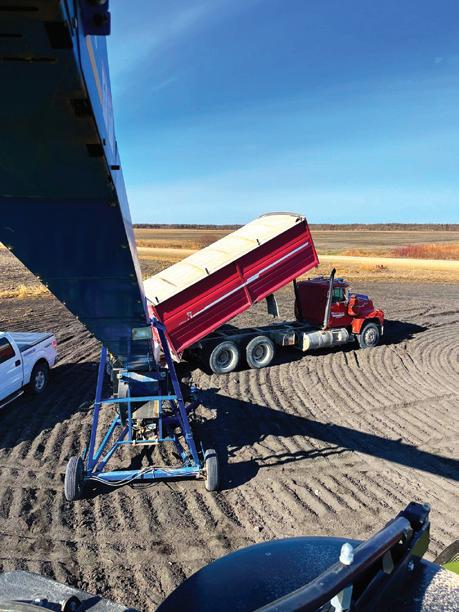
But now, in today’s world, it’s Crop Talk. It’s a Zoom call that anyone can participate in—not just farmers, but anyone interested in what’s happening. Today, Crop Talk is a well-run, collaborative effort that is a reliable touch point for Manitoba’s agriculture community.


while also supporting longterm sustainability of Red River Métis-owned farms - both environmentally and economically.
Keenes hopes to increase awareness of the MMF’s agriculture portfolio and the programming that is offered by the MMF.
“We really want to connect with more of our farmers and ranchers. We often hear that they weren’t aware of the portfolio, nor that the MMF has a presence in the agriculture sector.
“I also think it’s fair to say that the MMF is not shy about its stance on addressing climate change, and I want citizens to know that this commitment extends to the agriculture sector as well,” said Keenes.


By Elmer Heinrichs
Three auctioneers from Gladstone Auction Mart walked away with major accolades at the 2025 Canadian Livestock Auctioneering Championships, held May 9 at Heartland Livestock Services in Virden, MB.
The event brought together 39 of the best auctioneers from across Canada as part of the Livestock Markets Association of Canada’s annual convention.
Tyler Slawinski, head auctioneer at Gladstone Auction Mart and long-time competitor, placed as Reserve Champion—his best finish yet after more than a decade of competing.
“That’s probably my favourite convention that we’ve had,” Slawinski says. “I placed probably the highest that I’ve ranked in the past thirteen years that I’ve attended.”
“It was very, very much more comforting that it was on home ice this year,” he adds. “Being right here in Manitoba… it was a lot more familiar for me to be able to conduct my sale in front of the buyers that I saw through every week.”
“You really got to make sure you bring your ‘A’ game,” he continues. “It’s Canada’s best at work here.”
Blaine Huston, manager at Gladstone Auction Mart, was selected by his peers for the People’s Choice Award—an honour voted on by fellow auctioneers for leadership, professionalism, and support.
“We have such a great crew here,” Huston remarks. “When you can have all three of us go to a contest like that and be recognized that way, it’s just amazing.”
Josh Unrau, who has been with Gladstone Auction Mart for just over three years, placed in the top five in the interview portion of the competition. The interview tests each auctioneer’s industry knowledge and public speaking ability—key qualities for representing the livestock auction profession.
“It’s a neat experience,” Unrau notes. “There’s a lot of good auctioneers there and you kind of get to compete with some of the best.”
“It’s kind of neat that you can kind of do that kind of thing with people you work with every day and to be well represented,” he continues.
“I practiced a lot in my tractor driving up and down the field, cutting hay or whatever,” Unrau says. “You’d sell fence posts or, you know, just a lot of practice.”
All three auctioneers’ credit their teamwork and daily collaboration for helping them succeed at the national level.
“We work as a team at the market and we kind of we stick together when we’re out competing as well,” Slawinski says. “We try to give each other constructive criticism and just try to help one another out, as we always do.”
“It just makes it even better,” Huston remarks. “I’m just so proud of the other two and the runs that they have at the contest.”
With the 2025 championships now wrapped, the trio from Gladstone is already looking ahead to next year’s competition, determined to keep building on their success.
By Harry Siemens
For Brennin Jack, branch manager at Heartland Livestock Services in Virden, Manitoba, hosting the 2025 Canadian Livestock Auctioneer Championships was more than a milestone—it fulfilled a long-standing goal.
“It was a very prestigious event,” Jack says. “I started competing in the Livestock Markets Association in 2007, won the contest in Ontario in 2011, and have been much involved ever since. Hosting the contest was something I’ve always wanted. It was a real honour to bring it to Virden.”
Preparing to host a national-scale event with 39 of the country’s top auctioneers required more than logistics. It demanded experience, vision, and the ability to deliver at a high level.
“I’ve competed in over 60 auctioneer contests worldwide,” Jack says. “So I took the best from each—what worked and didn’t—and used that to shape this event. We wanted to show the quality of Manitoba cattle and impress everyone from the East Coast to British Columbia.”
With over 30 buyers in attendance, Heartland Livestock delivered one of the highest-calibre sales in recent history.
“We had top-tier cattle, displayed properly, and a robust market,” Jack says. “You couldn’t wipe the smile off some of these producers’ faces.”
The championship’s final round featured nearly 2,000 head of cattle, sold in large, one-owner groups by the top 10 auctioneers in Canada. It was broadcast live worldwide on DLMS, the indus-
try’s leading digital auction platform.
“It was a spectacle likely never to be duplicated,” says Jack.
The 2025 champion, Casey Laws from Provost Livestock Exchange in Alberta, stood out.
“Casey co-owns the market there and did an incredible job from start to finish,” Jack says. “He could work for anyone in North America, and they’d all see what we did—he’s a standout.”
For the other contestants, the contest wasn’t just about winning.
“Sometimes, when you don’t win right away, you get better,” Jack explains. “It gives you time to improve. And when you finally do win, it means more. Once you’ve won, you can’t compete again, so you join this very select group of talented auctioneers.”
Jack says the camaraderie among the 38 others—those who didn’t take the top title—is one of the contest’s lasting legacies.
“They’ll all be back next year, supporting each other,” said Jack. “That’s hard to duplicate anywhere else.”
Beyond the competition, the event delivered recordsetting prices for Manitoba cattle producers.
“It was beyond expectation,” Jack says. “When you sort the cattle right, display them right, and bring in the best auctioneers and order buyers, it’s no surprise we achieved incredible results.”
Steers that once fetched $1,200 or $1,400 were now selling for $3,500 to $3,700.
“Some of these animals were bringing almost three times what they were worth five years ago,” Jack says. “It’s been a long two de-


cades since BSE. With input costs skyrocketing, it’s only right producers finally get paid properly for their hard work.”
Jack sees a promising outlook ahead.
“With North America’s cow herd at an all-time low and beef demand at an all-time high, I think we’re in for an excellent few decades,” he says. “Hopefully, this trend continues. The producers in Manitoba and Saskatchewan raise some of the best cattle in the world—it’s their turn to make money.”
He also touched on broader trade issues, including the recent closure of the U.S.Mexico border to livestock due to screwworm concerns.
“If that closure sticks, it could push prices even higher,” Jack says. “We’re already in a strong market. If Mexican cattle stay out,
it adds more pressure and could take things to levels nobody thought possible.”
Jack still seems surprised by the numbers.
“If you’d asked someone a year ago if we’d get $5.30 a pound for a 700-pound steer, they’d say you were crazy,” he says. “But here we are, living it. And for the producers’ sake, I hope it keeps going.”
Jack expressed gratitude to those who made the event a success.
“I want to thank the Manitoba Livestock Markets Association and the Livestock Markets Association of Canada for allowing us to host,” he says. “Thanks to all the buyers, consignors, and everyone who attended the convention. We hope we showed the rest of the country why we are the cattle market.”

By Harry Siemens
The Indo-Pacific region continues to offer major growth opportunities for Canada’s beef and pork industries, as government, industry associations, and trade commissioners collaborate to expand market share and tackle access barriers in Southeast Asia.
During an online market briefing hosted by the IndoPacific Agriculture and Agri-Food Office (IPAAO) on May 13, Canadian officials and trade leaders explored export dynamics and upcoming market priorities in six ASEAN countries: Indonesia, Vietnam, the Philippines, Malaysia, Thailand, and Singapore.
“The Indo-Pacific region is not a homogeneous space. There are real differences in access, consumer demand, pricing expectations, and trade policy,” said Diedrah Kelly, Executive Director of Indo-Pacific Agriculture and Agri-Food Office. “But across the board, we are hearing: they want to do more with Canada.”
The IPAAO, launched late in 2022, is a joint initiative between Agriculture and Agri-Food Canada (AAFC) and the Canadian Food Inspection Agency (CFIA). It is part of an ongoing commitment to bolster ties, advance technical cooperation, assist Canadian exporters in finding new business opportunities, and help position Canada as a preferred supplier in the region.
Kelly said the region is closely watching U.S. tariffs and negotiations with China. While some countries consider new bilateral deals with the U.S., others are considering Canada to diversify supply chains.
Canada Pork and Canada Beef joined the session alongside representatives from the Canadian Meat Council, Canadian Cattle Association, and major processors such as JBS Canada. Representatives emphasized that Southeast Asia remains a critical area of future demand despite logistical and regulatory challenges.
“The Philippines is already an important pork export market for Canada,” said Annie Tremblay from Canada Pork. “But we also see real growth potential in Singapore, Malaysia, and Vietnam.”
Albert Eringfeld, VP, Export Market Development, who leads international market development for Canada Beef, highlighted a busy agenda of trade shows, missions, and promotional campaigns in the region.
“We’re present on the ground in Vietnam, Taiwan, South Korea, and the Philippines,” said Eringfeld.
“Over the next six months, we’re hosting events in Hong Kong, Indonesia, and the Philippines, and plan to bring key buyers to the Calgary Stampede.”
Most of the meeting focused on the importance of branding and building presence. Trade Commissioner Wayne Fan from the IPAAO detailed market data for pork and beef across ASEAN’s six largest economies. He emphasized that the Philippines and Singapore represent the clearest short-term wins.
“We have strong market access in the Philippines and Singapore. It’s not about removing trade barriers anymore – it’s about getting Canadian products in front of buyers,” Fan said.
He presented import data showing that while Canada performs well in the Philippines, it trails competitors like the U.S., Australia, and Brazil in Singapore despite offering comparable or superior product quality. Singapore imports premium chilled cuts, which Canada offers.
“But we’re only capturing 0.5% of their pork imports compared to 18% by the U.S.,” he said. “That’s a market development gap we can close.”
Malaysia was another standout. Canada holds 12% market share of Malaysia’s pork imports and faces no market access restrictions.
Katia-Maud Laflamme from the Canadian High Commission in Kuala Lumpur said the market is ripe for further expansion.
“Local industry is tired of cheap buffalo meat coming in as beef. There’s demand for authentic, premium Canadian meat,” she said. “Canada already has a great brand reputation here. We need to leverage it.”
However, not all markets are open. Thailand remains closed to Canadian pork exports due to
self-sufficiency policies. Indonesia permits beef and pork imports, but the certification and quota systems are complex.
Jasmine Labelle, Counsellor (Agriculture) and Regional Trade Commissioner in Jakarta, explained that Indonesia has regained access to boneless Canadian
beef as of 2025, but challenges remain.
“The market requires facility audits, import quotas, and importer registration. It’s not a simple file. But it’s active, and we’re working on it,” said Labelle.
Kelly added, “Indonesia is talking dairy, dairy, dairy. They want to sup-
ply school milk for millions of children. If we can offer genetics or technical expertise to support that, even if we don’t sell live dairy cows, we become part of the solution.”
Canada Beef and CCA flagged concerns about ongoing delays, especially in processing approvals in
Indonesia.
Trade officials and industry leaders agreed that momentum is building despite these barriers. Martin Sullivan of the IPAAO outlined dozens of upcoming events, including major trade shows and missions where buyers will sample Canadian pork and beef.

By Harry Siemens
Despite ongoing global trade tensions and tariff uncertainty, the North American pork industry remains resilient, according to Florian Possberg, a partner with Polar Pork.
“When the tariff talk started in March, we thought Canadian pork and trade with Mexico would face major disruptions,” Possberg says. “We saw one delay, then another, but in the end, not much really changed in pork or meat trade. That’s a positive outcome.”
While he acknowledges the potential for surprises, he remains cautiously optimistic: “So far, so good.”
Possberg notes that U.S.-China trade tensions resulted in significant tariffs, but a recent 90-day agreement eased some of the pressure. However, Canada continues to face challenges.
“Canada is still dealing with a 25% tariff from China because of our own tariffs on steel, aluminum, and electric vehicles. That’s a problem,” he says.
Nonetheless, Possberg emphasizes the critical importance of ongoing trade between Canada, the U.S., and Mexico.
“Tons of product cross borders daily. It’s vital to our industry,” he says.
He observes a recent dip in trade volume, largely driven by uncertainty.
“I hope we see normalization soon. Confidence in the U.S. economy is returning, and they’re major consumers. Pork demand in Canada is down slightly, but high beef and poultry prices give us a chance to sell more domestically.”
Although exports to China have slowed, Possberg sees a silver lining: “It’s a big relief that North American trade looks stable.”
He credits industry lobbying efforts with helping to maintain trade flows.
“Our producer groups worked hard with American counterparts, and I’m sure Mexico did the same. The Americans continue to trade with us because it’s good business. Their buyers and traders lobbied, too.”
Possberg stresses the need to rebuild trust in the pork trade: “We must restore confidence. It’s good for everyone—north and south of the border.”
On the political front, Possberg views Canada’s recent election as a stabilizing force.
“We now have a Prime Minister with a strong minority. That kind of political stability helps. The first meeting between our PM and the U.S. President went well.”
He anticipates difficult trade talks ahead.
“There will be tough discussions—on everything from lumber to tech. One concern is the Americans pressing on supply management. Our politicians may say it’s non-negotiable, but the U.S. may see it differently. That could impact agriculture during upcoming agreement renegotiations.”
Possberg also notes that China’s role in global pork trade has evolved.
“They used to be our second-largest export market during their ASF outbreak. Now they’ve rebuilt their herds, and their importance has diminished.”
However, China still plays a key role in carcass value. “They buy the offal—livers, feet, tongues—things we don’t consume here. That adds real value.”
But with a 25% tariff on Canadian pork compared to just 10% for U.S. pork, Canadian producers are at a disadvantage. “Their product moves, and that sets our hog price.”
Possberg says Canadian farmers still lack the clarity they need.
“Uncertainty hurts confidence and long-term planning. Tariffs shook that. Still, hog prices stayed reasonable. Good producers were able to make a profit,” says Possberg.
He adds that strength in other protein markets helps.
“Beef prices are near record highs. Overall, the meat industry is doing well right now,” he said.
But sustained investment, he says, depends on long-term stability.
“We build barns to last 20–25 years. Some from the late ’90s are still going strong. Stability builds the confidence to reinvest,” he said.
“We’re taking it one day at a time. A lot has come at us,” Possberg concludes. “Hopefully by fall, things will clear up and the economic outlook will turn positive.”
Nobody predicted that calf milk replacer would cost over $100 per bag (20 kg). Yet, its writing was on the wall with an increased world demand for milk-based food and ingredients. Like most dairy producers, some people acknowledge its skyrocketing cost, but have become advocates to remain on feeding high levels or coined “accelerated” levels of milk replacer. Their end-game is that betterquality calves - make better (high-milk producing) dairy cows.
Consequently, Iowa State University proved over twenty years ago that standard calf milk replacer programs (still practiced today) yield only modest calf growth rates. The researchers at that time fed milk powder at the rate of 1.25 – 1.50% of bodyweight (bw) to groups of pre-weaned calves, which supplied only enough dietary energy and protein to support maintenance requirements with a little left over for nominal growth. Whereas they found that feeding milk replacer at an “accelerated” rate of 2.0 – 2.5% of bw; allowed a matching group of calves to achieve phenomenal “double neonate birth weight” growth.
For example, a 150dairy cow operator that I visited a few years ago; switched up his automatic calf feeding system to feed a reconstituted 1,200 grams of 26 – 26 -18 milk replacer (from a standard 20-20-20 milk replacer of
800 grams) to each of his preweaned calves.
At 56 days (8 weeks of age), he weaned them off the milk replacer and was able to achieve an average weaning weight of 102 kg (1.05 kg/ hd/d). He then put them on a modest-energy heifer grower diet until they were bred at 14 – 15 months of age. He then reduced their dietary energy slightly until they were finally brought onto the milk-line at about two years of age. His first group of accelerated heifers yielded about 15% more milk during their first 305dyear of lactation as compared to past milk-reared animals. It should be mentioned that this producer also introduced a 21% protein texturized oatand corn-based calf starter to all of his pre-weaned calves at 7 days of age. At first, they nibble at it, but by 3 – 4 weeks of age, they were eating about 700 grams, which by nature stimulates good rumen development. By the time, these calves reached 56-days of age; most of them were eating about 1.2 kilos, which is proven to facilitate weaning/ transference onto post-weaning replacement heifer diets.
My case-study dairy producer was always aware of the cost of his accelerated calf milk replacer program in order to achieve its superior benefits. Subsequently, here is a simple 2025 balancesheet of his accelerated milk replacer program as compared to a current conventional feeding option (Table 1 on right).
As a dairy nutritionist, I was reminded of a few things that form the foundation of this comparison:
1. Investment of each program – It costs about $156 or 60% more to feed Holstein dairy calves on an accelerated dairy program. At first glance it seems excessive to spend over $400 per calf that are weaned at 8 weeks of age. However, weaned heifercalves are no longer worth $400 as they once were, but $1,000 – $1.500, depending on health and genetic statute of each weaned calf.
2. Investment in a consistent milk-based program – Investing in an accelerated milk replacer feeding program just lends itself to feeding a wellformulated 26 – 26 -18 milk replacer that now costs about $110 per 20 kg bag. The advocates say that it cannot be substituted by feeding lessexpensive milk replacer or pasteurized whole milk that often causes digestive upsets when fed at higher than conventional milk-feeding levels.
3. Importance of good quality and clean water – All conventional and acceler-
Automatic milk feeder in use. It is a matter of “accelerating” young pre-weaned dairy calves on a better plane of nutrition to meet their full growth potential.

ated milk replacer feeding programs requires high quality water – both free of high total dissolved solids and other contaminants. I recently witnessed a 100-cow dairy that fed milk replacer to their calves. They put in a water-treatment system in their calf barn in 2024 and within a few months, significantly improved calf health and performance.
All three points are valid. It is a matter of “accelerating” young pre-weaned dairy calves on a better plane of nutrition to meet their full growth potential. A full transference of such superiority means more milk produced and thousands of dollars earned in the not-so-far future.


The Soil Health Network (SHN) is calling on Prairie farmers to answer a powerful question: What are the farm’s Soil Health plans and priorities?

In a landscape crowded with outside opinions on how land should be treated, SHN is ensuring farmers – the people who know their soils the best - are the ones driving the adoption of improved soil health practices.
“Every farm knows what it’s like to be told how they should farm,” says Brent VanKoughnet, farmer and lead of the Soil Health Network. “This is about reclaiming farm-based leadership —about listening to producers without the noise and distraction of commercial, political, and outsider
interference. Knowing what matters to farmers should be what guides how we can continue to make meaningful and practical incremental soil health improvements unique to each farm.”
The Soil Health Network, led by Assiniboine College, funded by the Weston Family Foundation and supported by an alliance of western Canadian network partners, is building a new kind of soil health collaborative framework—one that acknowledges the unique circumstances of each farm. The Network doesn’t hand out prescriptions or report cards. It listens. It enables peer-to-peer learning, supports incremental change, and connects service providers to what farmers are really asking for.
That’s what this two-minute survey is about: understanding what matters most to farmers so meaningful practical support can follow suit. Go to soilhealthnetwork.ca/ diggingdeepersurvey or scan the QR code to share your priority. It takes two minutes and will help shape what happens next.
By Elmer Heinrichs
In 2025, seeding for the Manitoba Foodgrains Bank is progressing well, with many projects across the province planting crops like wheat, canola, and soybeans.
Manitoba has approximately 40 grow projects (around 5,000 acres) this year.
Seeding was initially delayed due to cold and wet conditions, but most projects are now underway, says Dale
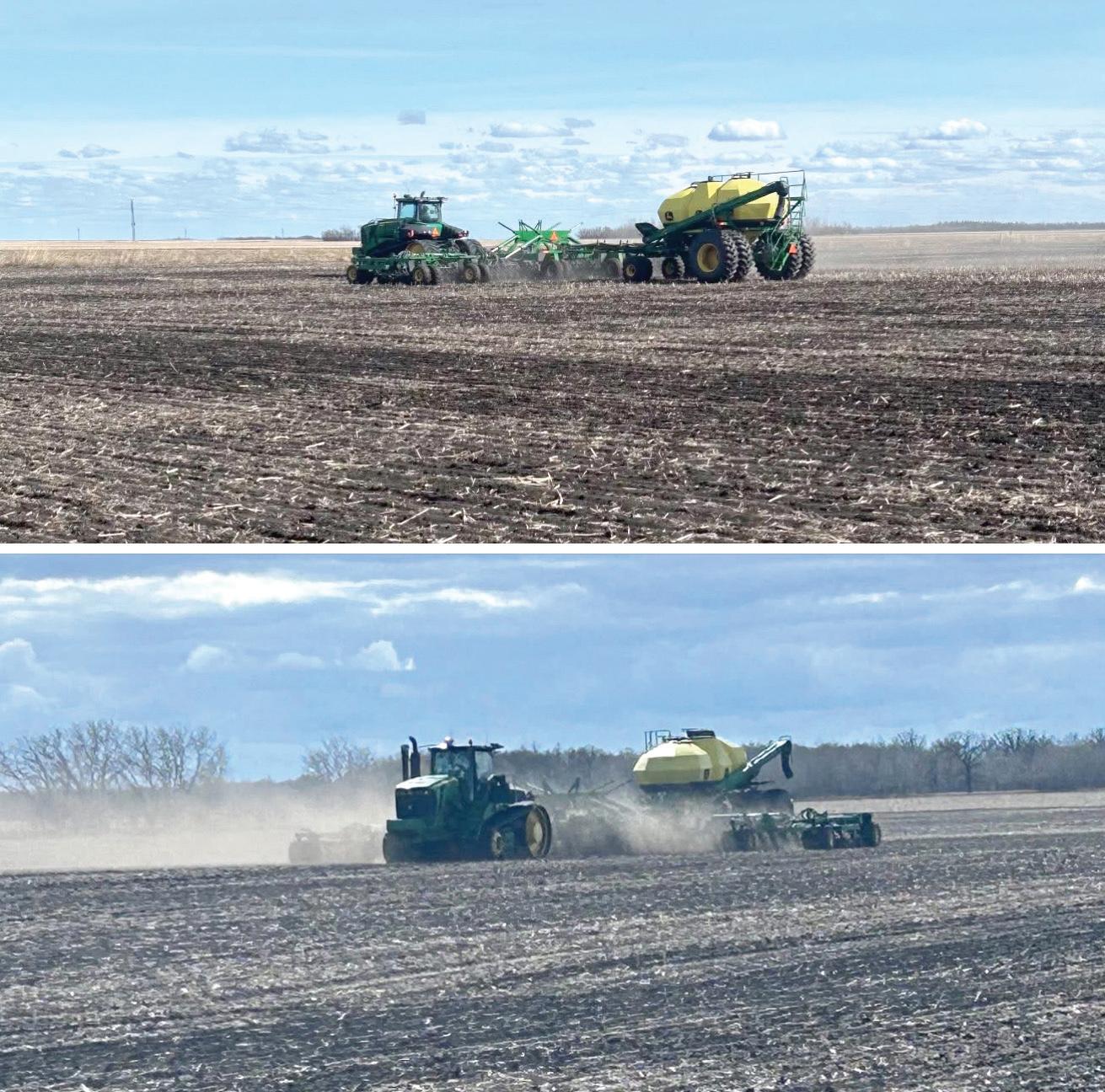


Friesen, Manitoba coordinator of Foodgrains projects.
The SHARE group planted 250 acres of soybeans on May 9, with planting and rolling assistance from the Miami Hutterite colony.
Then on May 10 the BMW crew seeded a field of wheat at Boissevain.
And Betty Sawatzky reports that the Killarney group seeded 140 acres of wheat on May 12.


By Elmer Heinrichs riculture)
The Hanover School Division’s (HSD) Board of Trustees is looking at adding agricultural courses to the division’s curriculum.
Jeff Friesen, the board’s chair, says this would be a benefit to rural communities in the area and serve as an industrial introduction to agriculture, plant sciences, live animal care and more.
“We have a number of trustees that have their (ag-
degrees and have been working on farming, and there’s seems to be enough interest in the community,” he says. “So we’re looking into what kind of curriculum are out there.”
As the largest rural school division in Manitoba, he says it would be fitting to offer agriculture based education.
“We want to go deeper than just a course where you go for a little bit, but
actually have vocational type programming,” Friesen says.
He explains this would likely include project-based learning, visiting farms, and hands-on work.
“Something that prepares people for the farming industry,” he says.
The board chair says this is all still in the brainstorming phase, so there aren’t any details to be shared as far as what grades this would
be offered yet or at which schools. It is, however, something that feels needed in the area, Friesen says, and has been a conversation for multiple years.
“We’ve got to plan into the future, and the future is: ‘People have to eat’,” he says. “There’s people interested in farming that don’t have the opportunity because of being in the city, and this is a way for them to experience farms.”
A Manitoba Forage and Grassland Association-led project “Evaluating climate change impacts on Manitoba’s forage and grassland landscapes” was among projects receiving a combined $2 million funding to help fight climate change as announced by Manitoba’s Environment and Climate Change Minister Mike Moyes.
“Protecting the environment is a priority for our government,” said Moyes. “We know that by working together with organizations and businesses in Manitoba, we can make real change in communities. I look forward to seeing the results of the Manitoba Forage and Grassland Association’s new initiative that will help provide critical information for agricultural producers.”
MFGA’s one-year Climate Action Fund (CAF) $130,000 project will support enhanced resiliency to a changing climate within the Manitoba grassland and forage sector. MFGA will utilize and engage the MFGA Aquanty model in the Pembina Valley Watershed District and the Assiniboine West Watershed District - two Manitoba Watershed Districts where the model has been engaged previously - to quantify the range of potential hydrological climate change impacts to Manitoba’s forage and grasslands and facilitate planning, preparation, and long-term resiliency within the sector.
Climate risk maps will be developed and presented to key stakeholders to inform decision making as sustainability and risk factors for agricultural production and rural communities are core components of the project.
Mike Duguid, MFGA chair, applauded the province’s vision and commitment to focus on Manitoba’s perennial crops and grasslands as a potential solution and action driver around times ahead.
As a mixed farmer who farms grain, forages and cattle with his son Scott and their families north of Gimli, Duguid sees perennials as having the potential to be both a mitigation tool and an affected commodity in changing climates. Duguid believes getting the best scientific guidance as early as possible will help drive planning and awareness.
“We expect our project will further validate and better understand the important role of grasslands and the economic values of perennial forage crops in times ahead for both climate and water challenges,” said Duguid.
The MFGA’s CAF project engages the futuristic scoping and planning expertise of the MFGA Aquanty model, expanding the incredible values that the model can return to Manitoba’s farmers, rural communities and land managers.
Aquanty, the model-builder software company out of Waterloo, Ontario and longtime partner of MFGA, will provide climate and hydrologic future scenarios and risk assessments (8-12 simulated 2050 and 2100 hydrologic assessments for each of: Pembina River, Swan Lake in PVWD and AWWD’s Oak River Watershed) to develop risk maps and assessments for MFGA to share with stakeholders and host on MFGA website. MFGA will also coordinate presentations and all outreach, communications, and webinars.
“The MFGA’s CAF project will be critical to understand how water availability, including groundwater, will be affected in rural areas,” said Dr. Steven Frey, Aquanty’s lead scientist. “The MFGA Aquanty model has unique approach that factors both surface and subsurface resources.”

and Climate Change
By Joan Airey
If you want tomato plants that produce like crazy, here’s a method to try the next time you plant!
A couple of weeks ago I asked Travis Walker, owner of Walker’s Greenhouse east of Rivers what advice he had for gardeners this spring. The following was his advice. What you will need:
Tomato plants (if buying from a nursery, go for tall, leggy ones!)
Shovel
Optional: Crushed Egg Shells, bone/blood meal
Quick Steps:
Dig a trench: 12’ deep/wide, as long as your bed.
Amend soil: Add 1 cup each of blood & bone meal, and eggshells, per 6’ trench. Mix well.
Prep your plant: Strip leaves below the top 2-3 inches. Those fuzzy stalk hairs = future roots!
Plant sideways: Lay in the trench and gently bend the top up.
Remove any flowers before planting — they’ll slow growth.
Water deeply to help them recover and thrive.
Optional: Use cages if dogs are tempted by the amendments!
Happy growing! You’ll be buried in tomatoes before you know it.
Mother’s Day weekend I purchased two hanging baskets of strawberry plants that I couldn’t resist at our local Co-op which come from Walker’s Greenhouse. Our granddaughter Blake loves strawberries, as does her grandpa so I gave them each a basket and told them to see who could have some big juicy strawberries first. Blake’s got the most blooms so far.
I asked Travis via email what advice he would give them to grow some good juicy strawberries and he commented, “For berry baskets, the best way is to trim back the long runners to promote growth in the main plant. This helps to focus energy on berry production. Hitting them with a basic 10-10-10 fertilizer every couple weeks will help as well.
We’ve been enjoying fresh rhubarb from the garden and asparagus.
Grandson Chase and I planted the potato crop a couple of weeks ago but so far, no growth because it’s been really cool the past week. Peas, carrots, and green onions are planted but the rest of the garden is waiting for the rain to quit.
What should you add to your compost bin? Leaves, grass clippings, weeds if not gone to seed, vegetable scraps, eggs, seafood shells, bread, pasta, rice, non greasy pizza boxes, paper plates, napkins, tea bags, tea leaves, coffee grounds, and coffee filters.
Let’s hope for some warm wind free days so we can finish planting our gardens. I’m hoping for a nice sunny day not too hot to visit our two local greenhouses. I always like to have some giant pansies to plant in remembrance of my grandmother.

Never be afraid to ask the greenhouse owner where you shop for advice. It’s their business and they want your purchases to be a success.

By Brenda Hunter
According to rural entrepreneur, Steve Langston of Onanole, MB, mindset is the #1 defining factor as to whether rural communities thrive or dwindle.
“Communities are just like people; sometimes they get depressed, but it doesn’t need to define them. It just means they’re having a bad day.”
Many rural communities in Manitoba have been plagued by rural depopulation while others seemingly have held their own, which would appear to be largely dependent on proximity to urban centres. According to the last census from 2021, rural population in Manitoba has declined by 1.2% while urban population has increased 7.3%, leaving some communities scratching their heads as to how to attract and keep people in their small towns.
According to Langston, that trend could be reversed, if rural residents take some initiative. He has been instrumental in advocating for rural resurgence. Over the last seven years, he has actively been participating in the repurposing of buildings in his home community of Onanole, as well as several other rural communities such as Erickson, Minnedosa and Sandy Lake. He claims if he can do it, so can you.
“In 2017, my wife and I began to recognize that there
was a need for rental properties in our rural communities,” he said about their journey to rural revitalization, “so began purchasing buildings that needed work and rehabilitated them to become important parts of the community. We started with residential homes and have now moved towards commercial and multi-family buildings.”
In Langston’s opinion, there are three main factors working in favour of rural resurgence: housing affordability and cost of living; quality of life and safety; and thirdly, better access to high-speed internet and therefore, the world.
Langston has seven key takeaways for folks to keep in mind when considering rural revitalization:
- Act as an outsider. Look at your community in new and different ways and don’t just accept the status quo. Identify the needs and barriers based on the demographics of the current residents and/or the ones you want to attract and keep. What is your community lacking? Where is it thriving? What could work here that might not work in another community and why?
- Work with council and existing government. Like all successful relationships, communication is key. Langston not only developed a good rapport with local government, but put his money where his
mouth was and became a municipal councillor and Credit Union director. Become involved in your community instead of waiting around for others to take the lead.
- Housing is critical. The cost of purchasing a home in many rural communities is considerably less than purchasing a similar sized home in the city making it an affordable option for families. Also, most small towns have some run down, abandoned or derelict buildings that may actually have good bones. Usually that means renovating what’s already there, thinking outside of the box as to what the community needs and/or what the building would be best suited for.
- Commercial buildings, which ties in with the previous point. Many people in a small town have a side-hustle or are entrepreneurs in their own right. They need a space to conduct their business, but either don’t want the hassle of starting from scratch or don’t have the know-how to do the work to get a commercial store-front up and running.
The foresight of people like Langston has solved this by renovating spaces into turnkey commercial properties.
- Make your banker your friend. Build a good rapport with a trusted financial institution and provide detailed business plans and projected profit and loss statements to

help secure funding to get your revitalization project off the ground.
- Stay positive! There will be setbacks even with the most well thought out plan and it will be tempting to throw in the towel when the going gets tough. Be resilient and remember that Rome was not built in a day.
- Consider a social enterprise as a way to give back and build the community at the same time. One of the Langston’s projects was establishing the SCORE store in Erickson which is a volunteer-run, second-hand store on main street which was opened during the pandemic. It has revitalized the business sector in that town, with 50 per cent of the profits going towards economic development. As a result, it has driven $1 million into the community economy and has had a trickle effect, bringing 100 per cent occupancy to Main Street in Erickson.
Rural revitalization can be achieved. All it takes is the right mindset and determination to make it happen.
BASF is reinforcing its commitment to Canadian agriculture by equipping the next generation of farmers with the tools they need to stay safe. Through its BASF Safety Scouts program, the company is distributing 2,000 free safety kits annually to farm families across Canada, aiming to instil the importance of on-farm safety from a young age.
The initiative offers two interactive kits tailored for different age groups—BASF Safety Scout kits for children ages 3–6 and BASF Safety Captain kits for those 7 and up. Each kit includes a childsized safety vest and engaging activity sheets, helping spark meaningful conversations around farm safety between children and their caregivers.
“Our children’s safety must always come first on the farm, and it is particularly important we keep safety top of mind during busy seasons,” said Leta LaRush, Vice President, Business Management at BASF Agricultural Solutions Canada. “Initiatives like BASF Safety Scouts provide valuable resources that help farm families and communities invest in onfarm safety. By prioritizing these programs, we can work together to shape a safer and brighter tomorrow for Canadian agriculture.”
Available at no cost while supplies last, the kits are part of BASF’s broader commitment to community wellbeing and sustainable agriculture. The program aligns with BASF’s pledge to support the communities where their
customers live and work.
“Safety starts with conversations and awareness,” added Sandra Miller, Executive Director of the Canadian Agricultural Safety Association (CASA). “The BASF Safety Scouts program helps farm families start those important conversations about
safety, giving them the tools and resources to take proactive steps and build a culture of safety on the farm.”
To order a BASF Safety Scout or Safety Captain kit, farm families can visit the BASF Agricultural Solutions Canada website at agriculture.basf.ca.

By Peter Vitti
Zinc plays such a vital role in beef cattle nutrition that it is hard to believe zinc is only required in extreme small amounts. Most of the time, we simply forget that it is present, when we provide loose cattle mineral on pasture. However, when it is not there in the required amounts or somehow gets biologically tied up; we eventually find out. That is why, it is important that cattle are eating a well-balanced zinc fortified mineral in order to prevent any zinc deficiencies.
Most commercial pasture cattle minerals are formulated with about 10,000 mg/ kg zinc to be fed at least 50 grams per head per day. Such predicted intake covers the National Research Council (NRC) recommendations for dietary zinc in most classes of beef cattle. Factors such as age of the animals, growing and production status, stress and disease challenges are taken into account and often call for additional zinc to be added to cattle mineral.
Such Zn-trace amounts compared to other essential nutrients just shows us how powerful that zinc in beef cattle nutrition, really is. For example, an average beef cow requires about 1.0 kg or 2.0 lbs. of crude protein per day to cover biological functions of vital body maintenance, producing milk, growth, immune function and reproduction. On the hand, 500 mg of pure zinc equals 0.7 grams of zinc oxide - gets lost at the bottom of a small teaspoon.
The odd thing about zinc is that it often works sideby-side with crude protein (and other essential nutrients) in the metabolism of beef cattle. That’s because,
be part of over 300 of their enzyme systems (specialized proteins that trigger chemical reactions in the body), and therefore is involved in energy metabolism, protein synthesis, DNA functions and the internal workings of cattle immunity.
Here is what we should expect from feeding zinc at recommended amounts to beef cattle:
Strong Hooves - Because zinc is part of specific enzyme systems involved in epithelial (skin) formation and repair; feeding extra dietary zinc is thought to strengthen cattle hooves, particularly under harsh field and housing conditions.
A few years ago, I was working with a beef producer that calved-out about 150 beef cows. Many of these cows seem to have very soft hooves and had a higher incidence of foot-rot on pasture. Therefore, I formulated a loose-mineral with 4 grams per head of zinc-methionine. It could have been coincidence, but fewer lame cows were treated by the end of that summer.
Good immunity - One particular field study showed that zinc-methionine supplementation in spring calves enhanced their immune response to vaccination. It was conducted during the in-between/grey period of calves, which are no more than two months old - when their colostrum immunity is on the decline and their permanent immunity is short of full development.
In this way, a Colorado study showed that about one-third of pre-conditioned weaned-calves were still getting sick after they were shipped to feedlots. This high incidence of morbidity
was traced back to poorly a formulated cow-herd mineral lacking enough dietary zinc and other important trace-minerals.
Reproduction - Zinc plays an essential role in many of the average cow reproductive functions such as strong oestrus cycles, improved conception rates, normal postpartum uterine involution, and reduction of metritis.
In the bull pen, zinc is essential for sperm production, and circulating male hormones such testosterone. A good study from KSU demonstrated that viable sperm counts in Angus bulls increased by a 1/3 when bio-available chelated zinc was fed.
Such positive responses as outlined were due to feeding more bioavailable organic source of zinc, namely zincmethionine. Subsequently, ruminant scientists will tell you that competitive inorganic zinc sources are still biologically active, but their supplementation in cattle mineral often doesn’t illicit a response due to many compounds that may bind them up in the cattle diets. On the other hand, zinc-methionine retains its high biological activity, because it cannot combine with other systematic compounds.
Regardless as to the zinc source formulated into cattle diets to meet their respective zinc requirements, there is no doubt as to zinc’s large and essential role in beef cattle nutrition. But zinc is only part of any well-balanced cattle diet, because it must also contain other essential nutrients such as energy, protein, other minerals and vitamins. Plus, they must all work together to promote successful health and performance in beef cattle.

By Joan Airey
This Rhubarb Strawberry Compote is a favourite around our house. Last week when I made it, I used a quart of frozen strawberries since my strawberries in the garden are barely blooming.
Rhubarb Strawberry Compote
4 cups rhubarb
1/2 cup orange juice
3/4 cup sugar
2 cups fresh strawberries washed and halved
Directions: Clean and cut the rhubarb into 1/2 inch pieces. Place the orange juice and sugar into a 2-quart casserole dish. Cook uncovered 2 to 3 minutes or until it’s boiling and the sugar is dissolved. Add the rhubarb, stir well cook, uncovered, for 4 to 5 minutes, stirring once. Cool for 10 minutes. Add strawberries. Cool before serving.
This morning, I tried a new rhubarb pie recipe and now it’s sitting on the counter ready for supper.
Adrienne’s Rhubarb Caramel Pie
2 cups of fresh or frozen rhubarb
1 Tablespoon butter
1 1/4 cups brown sugar
2 Tablespoons cornstarch
2 egg yolks
1/4 cup cream
1/8 teaspoon salt
1 cooked pie shell
2 egg whites - for the meringue
1/4 cup sugar
1/8 teaspoon cream of tartar

Directions: Melt butter in a pot, add rhubarb and 1 cup brown sugar and cook for 10 minutes. Combine cornstarch, 1/4 cup brown sugar, egg yolks, cream, and salt. Add to rhubarb and cook for three more minutes.
Pour into pie shell top with meringue. Bake at 350F for about ten minutes until the meringue is browned.
During rhubarb season I freeze rhubarb to use in recipes during the winter. Some recipes don’t turn out well with frozen rhubarb but the Rhubarb Strawberry Compote; I make up several batches and freeze for use over the winter.
Rhubarb Cobbler
3-4 cups chopped rhubarb
1 cup sugar
3 oz. box strawberry gelatine
11/2 cups flour
2 teaspoons baking powder
1/2 teaspoon salt
1/2 cup butter or margarine
A cup sugar
1 egg
3/4 cup milk
1 teaspoon vanilla
1 teaspoon cinnamon
1 Tablespoon sugar
Directions: Wash and cut fresh rhubarb into small pieces. Or drain thawed rhubarb. Mix with 1 cup sugar and strawberry gelatine. Sift flour, baking powder and salt together.
Cream butter or margarine, add 1 cup sugar. Beat in egg. Add dry ingredients alternately with milk and vanilla. Blend until batter is smooth.
In a well-greased baking dish, layer the fruit mixture on the bottom. Spread the batter over the fruit.
Mix cinnamon with 1 Tablespoon sugar and sprinkle over the top. Bake at 350F for 45 t0 50 minutes or until the rhubarb is bubbly and soft. Cut into squares and serve warm with ice cream, whipping cream or pouring cream.
This recipe works well with other fresh fruits like saskatoons, plums, cherries and even apples. Vary the gelatine (Jello) to suit the fruit.
