The AgriPost
May 25, 2018
Government of Canada Strengthens Trade Relationship with China Canadian Hemp Industry Achieves Record Growth
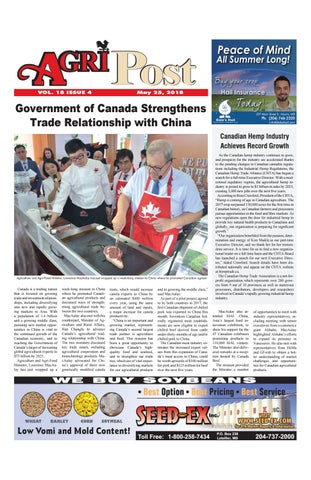
Agriculture and Agri-Food Minister, Lawrence MacAulay has just wrapped up a week-long mission to China where he promoted Canadian agricul-
Canada is a trading nation that is focused on growing trade and investment relationships, including diversifying into new and rapidly growing markets in Asia. With a population of 1.4 billion and a growing middle class, pursuing new market opportunities in China is vital to the continued growth of the Canadian economy, and to reaching the Government of Canada’s target of increasing global agricultural exports to $75 billion by 2025. Agriculture and Agri-Food Minister, Lawrence MacAulay has just wrapped up a
week-long mission to China where he promoted Canadian agricultural products and discussed ways of strengthening agricultural trade between the two countries. MacAulay also met with his counterpart, Minister of Agriculture and Rural Affairs, Han Changfu to advance Canada’s agricultural trading relationship with China. The two ministers discussed key trade issues, including agricultural cooperation and biotechnology products. MacAulay advocated for China’s approval of three new genetically modified canola
traits, which would increase canola exports to China by an estimated $400 million every year, using the same amount of land and inputs, a major increase for canola productivity. “China is an important and growing market, representing Canada’s second largest trade partner is agriculture and food. This mission has been a great opportunity to showcase Canada’s highquality food and seafood, and to strengthen our trade ties, which are of vital importance to diversifying markets for our agricultural products
and to growing the middle class,” said MacAulay. As part of a pilot project agreed to by both countries in 2017, the first Canadian shipment of chilled pork was exported to China this month. Seventeen Canadian federally registered meat establishments are now eligible to export chilled beef derived from cattle under-thirty-months of age and/or chilled pork to China. The Canadian meat industry estimates the increased export values from this expansion of Canada’s meat access to China, could be worth upwards of $100 million for pork and $125 million for beef over the next five years.
As the Canadian hemp industry continues to grow, and prospects for the industry are accelerated thanks to the pending changes in Canadian cannabis regulations including the Industrial Hemp Regulations, the Canadian Hemp Trade Alliance (CHTA) has begun a search for a full-time Executive Director. With a modernized regulatory regime, the agricultural hemp industry is poised to grow to $1 billion in sales by 2023, creating 3,000 new jobs over the next five years. According to Russ Crawford, President of the CHTA, “Hemp is coming of age in Canadian agriculture. The 2017 crop surpassed 130,000 acres for the first time in Canadian history, as Canadian farmers and processors pursue opportunities in the food and fibre markets. As new regulations open the door for industrial hemp to provide key natural health products to Canadians and globally, our organization is preparing for significant growth.” “Our organization benefitted from the passion, determination and energy of Kim Shukla as our part-time Executive Director, and we thank her for her tremendous service. It is time for us to find a new organizational leader on a full time basis and the CHTA Board has launched a search for our next Executive Director,” stated Crawford. Search details have been distributed nationally and appear on the CHTA website at hemptrade.ca. The Canadian Hemp Trade Association is a not-forprofit organization which represents over 260 growers from 9 out of 10 provinces as well as numerous processors, distributors, developers and researchers involved in Canada’s rapidly growing industrial hemp industry. MacAulay also attended SIAL China, Asia’s largest food innovation exhibition, to show his support for the 47 Canadian exhibitors promoting products to 110,000 SIAL visitors. The Minister also delivered remarks at a reception hosted by Canada Beef. The mission provided the Minister a number
of opportunities to meet with industry representatives, including meeting with senior executives from e-commerce giant Alibaba. MacAulay highlighted Alibaba’s efforts to expand its presence in Vancouver. He also met with representatives from HeMa and GFresh to obtain a better understanding of market challenges and opportunities for Canadian agricultural products.
May 25, 2018
The AgriPost
Dry Conditions Cause Slow Germination
By Les Kletke The dry conditions which allowed for seeding to take place at record speed has become too much of a good thing and the dry soil conditions have meant uneven or delayed germination for many crops. Marc Hutlet of Marc Hutlet Seeds reports that many of the fields in his service area of southeastern Manitoba were too dry to provide the moisture required for germination and much of the crop that is emerging is uneven. Jon Thiessen who farms near Niverville reported that his cereals have emerged. “We got the wheat into the ground early and it is coming through nicely,” he said. “We put the beans in later and they have only a few plants emerging but some of the seed is in dry ground and we will need a soaking rain on them before they germinate.”
Thiessen said that most of the land he farms is heavier and that is what had him seeding early. “We don’t always get conditions this good for seeding,” he said. “We did not have to worry about any wet spots and could seed right through corner to corner. When we have these kinds of conditions we want to take advantage of them.” He said that his corn went in last and has not shown any signs of germinating. “We were concerned about seeding to moisture or putting the seed in dry ground. So we might have seeded a bit deeper than we would like to but we wanted to get to moisture.” He is concerned that the dry conditions will make for uneven germination that will cause stages in the crop. “We don’t want that in the wheat,” said Thiessen. “It makes for a tough call at harvest time when most of the crop is ready and the
green kernels keep the moisture up. It certainly does not help your grade.” He is not worried that the crop will be too uneven if the later portion emerges soon. “We need some moisture on it and the sooner the better, we need a soaking rain and with some warm tempera-
tures things could catch up,” he said. “But you hate to have it come out of the ground in stages; you know the big crop is already gone.” Thiessen said the dry conditions have also delayed the emergence of weeds. “We know they are there and will be coming.”
Growing conditions remain dry, in some cases moisture begins at 2.5 inches deep. Emergence appears to be uneven or delayed where seed to moisture contact did not occur or where seed was planted into moisture but soil has since dried out.
One of a Kind Model “A” John Deere
By Les Kletke Cornie Wiebe is quite sure that his 1937 John Deere A is one of a kind. The equivalent tractor term in the hot-rod world would be a Resto Mod as it is an upgraded model. Wiebe who lives at Rhinefeld chose the Model A because he remembers working with one on his father’s farm in Mexico. “I remember working with a tractor like that on my Dad’s farm and I wanted something like it, to remember him,” said Wiebe who has been forced to semiretire because of a disability. When he saw that a model A came up for sale at the dispersal sale of a collector near Carman he knew that this tractor had to be his. “He had died and they were selling off his collection. I bought the A and have done a few things to it.” The sale featured nearly 70 antique tractors but he
came away with just the one, he wanted. One of the tractor upgrades he added was to include a 12 volt electrical system with a Dodge alternator. He has also added a three-point hitch. Originally the tractor was started by spinning the fly wheel he explained. “I am pretty sure there is no other tractor like this,” he said. Wiebe has done all the work himself including the paint job in his own shop at Rhinefeld. He likes working on the two cylinder John Deere’s because of the simplicity. “They’re easy to work on and there is not much that goes wrong with the parts,” he said. “Usually it is just a matter of cleaning them up, a bit of adjustment.” To back up his claims he has 3 other A’s and a John Deere B that is ready to go.
The Model A was introduced in 1934 and came in a variety of configurations, mostly differentiated by wheel width. It was the first true Row Crop offered by John Deere and the narrow front was designated AN, as compared to the row crop which was simply an A. It was listed at 18 hp on the draw bar and 24 on the pulley. It was rated a 2 plow trac-
tor at the time. Wiebe said that he has enough tractors to keep him busy but if something came along that caught his attention he would add it to his collection. He admitted he still goes to auction sales that have antique tractors. Last year’s Tractor Trek was a first for him but he plans to be back this year.
Cornie Wiebe and his one of a kind Model A John Deere tractor said he is looking forward to this year’s Tractor Trek.
Farmer’s Market Marks 30th Anniversary The St. Norbert Farmers’ Market, one of Manitoba’s most popular summer destinations for local food and many other products, celebrated its 30th anniversary and the grand opening of another new improvement for visitors. “The new enclosed canopy at the market will allow producers and processors to connect with their customers year-round, which is a wonderful opportunity for the thousands of Manitobans who want to make a connection with local food and local products,” said Agriculture Minister Ralph Eichler. “Our government is proud to have been a partner in this project, recognizing it will be a special landmark in St. Norbert for many years to come. We’d like to congratulate everyone who has contributed to the longevity of the market and its ongoing success.” The new $550,000 permanent, enclosed canopy and upgraded electrical system will allow 68 vendors to sell at the market year-round. It received financial support from the Manitoba government as well as the Government of Canada, City of Winnipeg and other community partners. It is part of a broader 10-year improvement plan at the market. “We’re incredibly excited to see this project come to fruition,” said Marilyn Firth, Executive Director for the market. “As a non-profit co-operative, it’s our job to provide a place for Manitoba’s small producers to sell their goods and the new canopy will provide a much improved space for the 200 local producers we support.” The St. Norbert Farmers’ Market has grown to include about 200 vendors since it opened in 1988 with eight. About 150,000 visitors are expected to attend throughout the five-month summer season. Items are also available year-round through an online market that launched several years ago. All vendors must make, bake or grow their products. For more information about the market, visit stnorbertfarmersmarket.ca.
The AgriPost
May 25, 2018
Manitoba’s Premier said NAFTA is vital for Manitobans By Harry Siemens Believe it or not the North American Free Trade Agreement (NAFTA) and the discussions surrounding it are still very much alive. Manitoba Premier, Brian Pallister said no one is taking for granted the benefits created on both sides of the Canada-US border by NAFTA. Pallister concluded a visit last Friday to New York where he participated in meetings to promote Manitoba and draw attention to the positive direction in which the province is going. Pallister said Canada’s trading relationship with the US and theirs with us is the stronger of any two nations in the world but sometimes in life people are guilty of taking these blessings for granted. “I think for many people, frankly in the business sector for example, felt pretty happy with the way things were,” he said in a recent interview. “In Manitoba and across Canada we benefited from the NAFTA, not only the program’s terms for trade but also from working dispute resolution mechanisms and things that gave stability to our relationship. Let’s face it the US is an enormous economy and tremendously strong, and so you need rules, and we had rules that gave structure to our trading relationship. We need those rules, and we need rules going forward.” Pallister said it might need some tweaking, some updating, and some chapters that need rewriting and he accepts that. But, what’s happened in the last few months is that people who perhaps were a little bit unappreciative of this trading relationship are starting to
understand how important it is, on both sides of the border. “You’re getting American people speaking up in places like Wisconsin and Minnesota where they have economic benefits and jobs created by Canadians,” said the Premier. “And vice versa we have benefitted from a lot of the work that people in the United States have done regarding our imports.” He said Manitoba imports a lot of goods from the US and the relationship Manitoba may have taken for granted in the past is in most places not being taken for granted now. Pallister said that’s important because Manitoba is a trading province and these negotiations matter and he raised this topic at virtually every meeting he attended. “Our negotiators have a tremendously important job right now. We’ve been cooperatively working with the Federal Government in respect of that by doing our utmost to reach out to American officials, elected, non-elected as well, not just in border states but elsewhere, to emphasize how critical that trading relationship is,” said Premier Pallister. “We don’t just compete against one another as some are trying to portray this. We build things together. That shared marketplace has created jobs in Manitoba. We’re promoting open trade. We’ve received compliments from people, over the last three days of meetings, who have said they appreciate the fact that Manitoba’s been taking the lead on a couple of fronts including the ongoing outreach with US Governors, US Congressmen, and Senators.”
He also said on reducing barriers internally for people who are down here, who are expat Canadians or are working in New York who come from across Canada, they are aware that Manitoba’s position, regarding eliminating inter-provincial trade barriers in Canada, is very vital as Manitoba moves forward. “So that we can do a better job of trading with one another. Recent concerns about pipelines and beer, for example, have raised that awareness of the importance of doing a better job of trading among the Canadian family members, our provinces, and territories,” said Pallister. “We’ve been pushing that, and I’ll continue to push that as a key priority at our next Premiers’ meetings. I think it is essential that while others may threaten our trading relationship for a time, we have to do a better job of supporting one another and our economies across Canada. At the same time, recognizing that we need global markets for things like pork, other agricultural goods, manufactured goods, services, you name it. Manitoba has a growing economy. We’ve moved from near the bottom of most rankings to near the top now in the last two years.”
The AgriPost
May 25, 2018
Where is Mr. Rogers? Every generation needs a Mr. Rogers and I don’t see one for the current group of citizens emerging to take over the world. People question the millenniums and when they have so much trouble in the work place and why so many of them are still living in their Mom’s basement, the reason is simple they don’t have a Mr. Rogers. Someone who offers a bit of guidance and helps them develop a set of values. My father’s generation had Will Rogers, a performer of the Vaudeville era who went on to make nearly 100 movies and lived through the transition from silent movies to talkies. That was change! More of a change than a new model of iPhone with a bigger screen. My generation had Roy Rogers, the cowboy that saved a ranch or family every week on a regular TV show. The Sons of the Pioneers would sing things off with “Happy Trails to You”. It was something you could count on, and the coolest kids in school even had Roy Rogers’s lunch kits. I never quiet made it to that level of cool but I know guys that did and they are probably running giant corporations today. My kid’s generation had Mr. Rogers a guy in a sweater that didn’t even need a first name. He was a stabilizing influence for another generation, and he taught a valuable lesson to our house. That it is okay to have a sweater hanging by the door at your place of work so that you could put on that comfortable sweater and throw yourself into the task at hand. Yes, I have what my kids call my Mr. Rogers sweater hanging by the door to my office. Who is the Mr. Rogers for the millenniums? I don’t think they have one and it shows. They are missing so many of the great life lessons taught by these kindly men over the years. Perhaps the Mr. Rogers of this generation is the electronic communications company, and hence the tie to their electronic devices, that they don’t seem to be able to disconnect. Maybe the Mr. Rogers of this generation has a much greater hold on young people than the Mr. Rogers’ of the past three, I can’t say that it looks like he is having all that great an impact on teaching values and helping kids learn what is right.
Shooting Yourself in the Foot… More Bias Last month’s column dealt with personal biases, mental straitjackets that can muddy one’s thinking and lead to bad decisions. In life and on the farm, the list of potential biases is endless, but consider a couple more. Let’s start with “the endowment effect.” Farms have all kinds of assets that need to be managed and their value is constantly changing. Simply because we own them, we all share a natural bias, to place a higher than market value on these assets. A number of studies show how this works. One randomly gave half the participants either a coffee mug or a chocolate bar, items that had an identical value. The researchers then asked the recipients if they would like to trade what they got for the other prize. Only 10% were willing to do so. Most of the people who received the mugs wanted to keep them, and the same was true of those who got chocolate bars. Another experiment gave away free tickets to an important baseball game via a lottery. After the tickets were handed out, researchers asked the winners what price would make them willing to sell those tickets. They also asked the losers how much they’d be willing to pay for the tickets. The differ-
Penner’s Points
ence was huge! Lottery winners on aver- By Rolf age wanted 14 times more for the tickets Penner than lottery losers were willing to pay. What’s at work here? Two things, loss aversion and ownership. We feel the pain of loss twice as strongly as we feel plea- times to the point where you think sure at an equal gain. We also tend to fall you still got a good deal even though in love with what we already have, and you wound up selling well below the because of this are willing to pay more to price you really wanted. retain it. If that’s the case, we would also Think about “anchoring bias” when be unwilling to trade something we own the transaction involves selling grain. for something else of equal value. Maybe the break-even price for your On the farm, this might mean we hang canola is $10/bushel. After harvest, onto a piece of machinery too long, in- you find that you harvested a few exstead of replacing it when it wears out. Or tra bushels per acre, and that knocks maybe we’re thinking of retiring, but the your breakeven point down to $9.50/ price of farmland and/or rent is declining. bushel. When you check the elevaSo we hang onto it longer, in the hope tor prices you see that you can get that things turn around. This can also be $9.75/bushel, but instead of taking a problem when you leave grain in your the price you tell them to get back to bins too long. You may wait for a price you when it hits $10. Why? Because rally when you really need the cash. $10 is your anchor point. It’s what’s “Anchoring” is another interesting bias. been in your head since before you It’s where someone relies too heavily on put the crop in the ground. Even the first piece of information they hear though the available price is above (the anchor piece) in making a decision. your break-even point and you’re We see this a lot with prices. making money, a nagging feeling in A great example of anchoring is regular- the back of your head tells you it’s ly demonstrated in the TV show, “Pawn not a good price, even though it reStars”. When owners of a pawn shop ally is. make an initial offer on an item someBias is a fascinating subject! A hat one wants to sell, they really lowball the tip to the harvestprofit.com blog for number. This is not just for shock value; pointing all these out and putting it’s to “anchor” the seller to that price. them into some context. Maybe next The price does increase as they haggle month we can look at a few more back and forth, but the initial number possible ways to shoot ourselves in gets stuck in the seller’s head, some- our own feet.
Shoutout to BTHC Staff re Judith’s Care Today as I reflect on sitting by the bedside of my dear wife Judith, who passed into eternity at 12:32 pm May 18, 2018 at the Boundary Trails health Centre near Winkler, a shoutout to all those who are working at the Boundary Trails Health Centre and did their utmost to make Judith comfortable. I know this is a farming and agriculture column and soon, most likely sooner than I like, I will be back to writing that what smacks of farming, ag policy, farm stories and the like. Yet today as I ponder life, death and the life hereafter, I want to focus a little on the BTHC. We never had to use the facility other than some family and friends visits. My wife was the director on the Southern Manitoba Regional Health Board and being a nurse she fully understood BTHC and what it is, does, and stands for. First off the medical staff and the resident doctors
are second to none. I won’t mention many names except one, Dr. Kevin Earl, who is the lead doctor on Judith’s case. Dr. Earl - thank you for your professional expertise, sound and consulting advice, and certainly your caring and passionate care. The technical staff managing the operation taking the images that are so vital to know what step to take. The nursing and support staff again their knowledge, promptness and carrying out of their professional duties, often beyond the call of duty. One of the shining features, pardon the pun, is the cleanliness of the entire facilities from the kitchen and cafeteria, to the rooms, to the washrooms, and imaging areas. As one of the diligent cleaning staff said to me, “It has to start at the top with management, and when management enforces those policies, then things happen.” While all that doesn’t take away the reality of dying, collectively they do make
things easier, more comfortable, and comfort in knowing she received the best care and medical expertise. I’m thankful to the AgriPost for allowing me to share briefly the life-changing activity taking place in my life, our daughters and their families lives, and the lives of our extended family and friends. Judith spent her life serving the healthcare field whether at her clinic at 3M Canada in Morden, or another clinic at the Homestead South. She suffered tremendous pain and is now finally at rest and peace. The rains on Thursday and Friday in parts of southern Manitoba in some places an inch or more and in some areas less I’m sure were timely and very uplifting. Earlier I had penned some thoughts on how dry it was. It was dry to say the least. Abe Friesen, veteran pilot in Reinfeld took his small plane up for a little workout after changing the oil told me after that short flight there is no water to see - It is very dry.
Comments like there is moisture about two inches down, but the seed is in dry ground needing much rain. The next person said I put the seed down a little Judith and Harry Siemens having dinner in Asundeeper and cion, Paraguay in 2015. was able to Editor’s Note: Everyone put it in wet ground, but with forecasts for dry days and at the AgriPost extends their stronger winds at the time of condolences to Harry and this writing there is concern. his family on the passing of Abe Friesen, the flying Judith. She was Harry’s “adfarmer, told me and I re- venture partner.” Whether member his flight from last it was in the literal sense of year, that rains fell on June travelling to northern Mani7, 2017, and farmers grew toba or South America, they mostly a bumper crop. I re- did many trips together. But minded him that last year we we know the most important had a full supply moisture adventure for Harry and reserve which helped sustain Judith was raising a family the crop growth and devel- together and seeing the successes of their children come opment. With more rain in the fore- to fruition fed with patience cast at the time of this writ- and love. Judith will be ing, it is good to know the Harry’s “wingman” in spirit effort farmers are putting in giving that subconscious tug to planting yet another crop towards what is important… family. is off to a good start.
The AgriPost
Lessons Learned Looking Back to 2017 PEDv Outbreak in Manitoba By Harry Siemens Early in 2017, as the swine industry in Manitoba was gearing up for another great year, a PED Virus outbreak hit the industry hard, and it took most of the year get the dreaded disease under control. The Office of Manitoba’s Chief Veterinary Officer said all but three of the 80 swine herds infected during the 2017 PEDv outbreak have now reached presumptive negative or are transitioning to presumptive negative. The first case broke out on April 28, 2017, in southeastern Manitoba and the last case reported October 24, 2017. Dr. Glen Duizer, an Animal Health Surveillance Veterinarian with the Office of Manitoba’s Chief Veterinary Officer, said recently in a meeting all but two of the 80 cases were reported in southeastern Manitoba and included 25 sow herds, 16 nurseries, and 39 finishers. “Our current status is that we have 67 presumptive negative premises of which 19 of the 25 infected sow herds are now presumptive negative and 48 nursery finishers that are presumptive negative,” said Dr. Duizer. “We have three remaining premises that have not moved from the
positive status but essentially there are no clinical or actively shedding pigs on those premises and biocontainment is in place. We have ten transitional premises, five sow herds and five nurseries or finishers. Those are premises that are working their way through to a presumptive negative status.” He said the outbreak peaked in early July followed by a second spike in September which occurred, as many of the previously infected feeder sites began moving pigs to slaughter. In looking back at this terrible, yet controllable event, the need for stepped up biosecurity in the event of an animal disease outbreak was among the lessons learned from Manitoba’s 2017 PEDv outbreak. The industry discussed a PED Lessons Learned Project, conducted by Manitoba Pork, Manitoba Agriculture and the Canadian Animal Health Coalition on a recent PED Telephone Town Hall. Project workers conducted sector-wide interviews with producers, feed companies, transporters, assembly yards, diagnostic labs and representatives of the Manitoba Chief Veterinary Office and Mani-
toba Pork followed by a discussion workshop. Jenelle Hamblin, the Manager of Swine Health Programs with Manitoba Pork, said the report focused on what worked well, what didn’t work and needed to change, and recommendations for future outbreaks. They found the industry practiced a wide range of biosecurity across the sector. While some had very strong biosecurity in place, others were lacking in their protocols. “Others had no biosecurity in place, and this is where we want to strongly encourage going back to basics and talking to these producers about the difference of regular biosecurity versus wartime biosecurity,” said Hamblin. “We’re talking about the practices you can implement that maybe aren’t sustainable for the day-to-day but something that you enact very quickly. Especially if you get a phone call saying that there is a case nearby, you’re able to enhance your biosecurity to that upgraded status in a short period.”
Commodity Groups Renew Commitment Five grower organizations have signed a second Memorandum of Understanding (MOU), with a renewed and focused commitment to delivering more value to Manitoba farmers through working together. Manitoba Corn Growers Association (MCGA), Manitoba Pulse & Soybean Growers Association (MPSG), Manitoba Flax Growers Association (MFGA), National Sunflower Association of Canada (NSAC) and the Manitoba Wheat and Barley Growers Association (MWBGA) signed the MOU recently. The proposal highlights improved farmer-driven research and agronomy and the ability to tackle challenges that are bigger than just one crop. Members from each organization will vote at their AGMs on an amalgamation proposal resolution at their respective AGMs in February 2019. If approved by the over 8,000 farmer members, the target date for implementation of the new organization will be August 1, 2019. “We heard from some farmers, but we want to hear from more of you,” said NSAC President Mark McDonald, referring to the feedback heard during the regional meetings that took place late 2017 and
the comments made during each group’s Annual General Meeting in February. “There were some concerns which was to be expected, some praise and a lot of questions. We’ve got more work to do, but one thing is clear. We think it’s important to continue this process, developing a powerful and specific mandate for delivering more value to Manitoba’s farmers.” The steering committee comprised of farmer-director representatives from each group as well as the executive directors or general managers of each association, will use the feedback it has received from farmers to amend the proposal released in 2017 with the aim of once again hosting regional feedback meeting along the way. It is the mandate of the steering committee to identify and explore opportunities that will benefit the various memberships, such as how working together could increase research and agronomy services for farmers, as well as enhance capacity to leverage grower investment dollars. The group is similarly committed to entertaining other collaborative options, including models that don’t include legal amalgamation. “We share a common goal to
represent the best interests of our members,” reads the new MOU. “Our intention is to develop a future working relationship that is efficient, effective and advantageous to the farmers we represent. Our vision for the duration of this MOU is to further develop a plan for increased collaboration among likeminded grower groups.” The original MOU was signed in May of 2017, the culmination of three years of informal talks surrounding the idea of working together to increase efficiencies. Four of the five involved groups currently share office space in Carman, Manitoba. While MFGA does not have a physical space in the Carman facility, the association is being administered by MPSG. Manitoba farmers who grow the crops represented in this MOU are encouraged to get involved and have their voices heard by reaching out to one of the participating commodity groups or by contacting process facilitator Rob Hannam at rob@ mbcrops.ca. For additional info, visit mbcrops.ca.
May 25, 2018
New Course Offering Makes Agricultural Studies and Future Jobs More Accessible By Les Kletke “So that is a cow? And the pink one is a pig, right?” whispers one student to the other. The conversation may not go quite that way, but the Faculty of Agriculture is hoping a new course offering this July will make students more comfortable with the live portion of livestock. The course’s official name is Agri 3030 Introduction to Experiential Learning will run two afternoons a week and will be followed by Agri 3040 Advanced Experiential Learning which will run through August. The Glenlea Research Station will be the classroom used for the focus on dairy, poultry, and pig industries. Dr. Jared Carlberg, Associate Dean of the Faculty said students who have not been raised on farms or are a part of the agricultural sector wants to learn more on the topic. “An increasing number of students who don’t come from farms, but have a keen interest in how their food is produced are enrolling in our programs,” said Carlberg. He said there are several reasons for students being unfamiliar with livestock. “They may come from and urban or international setting, or a nonlivestock type of farm operation. This course is designed to give those students a personal and interactive experience, that will prepare them for a diverse range of careers in the agrifood industry, and help our students assist in the industry’s commitment to building public trust.” The introductory course will run four weeks in July and will give students an introduction to live animals, cover modern animal production practices and then move to the farm’s feed mill and workshop. The course is designed to give a true hand’s on experience to the workings of a modern Canadian farm with livestock production. Lectures will cover topics such as biosecurity and technology such as robotic milkers. Upon completing the intro-
Students will get a chance for some hands on livestock experience in the Glenlea Research Station new course offerings. Photo courtesy of Glenlea Research Station
ductory course students who want to learn more about the industry will have the option to take the second course which runs through August and offers a more specialized look at the livestock industry. The course is being coordinated by Craig Fisher who is the Agriculture and Food Sci-
ences Experiential Coordinator. The questions may not be as simple as which one is a cow or the pig? However by the end of the course students may be asking questions that would stump a lot of farmers who are not involved in a livestock operation, or have focused on merely their enterprise.
The AgriPost
May 25, 2018
Rain Very Welcome for Manitoba Crops By Elmer Heinrichs Widespread rain across southern Manitoba has brought long-awaited relief from the drought that has been in place through the province this spring. Light rains beginning Thursday leading to the May long week end were welcomed by farmers and most Manitoba residents as it spelled the end of a five-week drought. With most of the crops seeded, the rains are very timely and will allow seed placed in dry soil to germinate, rejuvenate pastures, and boost the outlook for this year’s crops. With the arrival of May, the weather warmed and farmers across central and eastern regions and elsewhere across Manitoba hit the field with a running start and much of the crop is now seeded. It’s been a busy month for Manitoba farmers. After a cold April, spring arrived and with relatively dry soil conditions farmers have been out quick-
ly and amazingly, it’s almost done. Manitoba agriculture in its weekly crop report of May 14 estimated that 55 per cent of Manitoba seeding was complete, with cereals, peas and some early-seeded canola starting to emerge. However it also noted that the majority of the province’s soil is dry and precipitation is needed to aid in crop germination and emergence. Eastern regions are at about 70 per cent seeded, is most advanced with dry conditions being very conducive to uninterrupted seeding. Across central regions, progress is most advanced in eastern and southern parts. A number of producers have wrapped up seeding operations, with more expected to finish shortly. Sunflowers, flax and soybeans are 40 to 60 per cent seeded. Soybean fields are being rolled. Manitoba Farm Production Advisor Dennis Lange
said seeding conditions have been pretty good, with hardly any delays, and seeding has progressed rapidly. “We do need rain for seeded crops but seed germination and growth is surprisingly good. At this point we see cereals, peas and early-seeded canola starting to emerge,” said Lange. He also noted that potato planting continues, with some edible beans going in early, and the majority of acres expected to go in following the Victoria Day week end. In the central region he added that winter damage is a concern on some winter wheat and perennial ryegrass fields, and in eastern areas there are reports of damage on 50 to 75 per cent of winter wheat acres. Crop recovery and re-growth is slow due to the dry field conditions. Lower than normal levels of annual weeds have been noted given the dry field conditions. Pre-emergent
herbicide applications have been limited due to reduced weed growth and windy conditions. Most hay crops are fertil-
ized, pastures are only fair. Recent rains will help but it may take two to three weeks for pastures to be ready for grazing. Livestock on pas-
The Siemens brothers seeding soybeans near Altona.
ture is being fed. Regrowth of winter cereals, pastures, and hayfields continues to be slow due to dry conditions.
Photo by Elmer Heinrichs
The AgriPost
For Some the First Signs of Spring is the Auction By Les Kletke For some the signal of spring is the tweet of the first robin, for others it is the honk of returning geese but the true sign of spring for many rural Manitobans is the chant of an auctioneer at a spring farm sale. The only difference this spring is that a wise cracking auctioneer might include a remark about the Jets still being in the play-offs or that some of the conversation in the crowd might focus on the previous night’s hockey game with a bit more intensity than past years. Farmers and auctioneers have long struggled with picking a date when the weather is warm enough to allow a crowd but it has happen before spring seeding takes over. Sale dates are normally chosen well in
advance and trying to hit the window before the busy time has been a challenge. Technology has changed the process a bit as many auctioneers now take online bids at the sale and a bidder no longer has to make the trip. The acceptance of offsite bids has changed the character of a spring sale by reducing the social interaction somewhat but the argument can be made, those there to socialize did not bring real bids at best of time and were more concerned about the quality of pie being sold at the concession than the top bid on the combine. Grunthal Auction Mart has added a new service to its offerings and held a consignment sale in late April that drew a good crowd. “It is a
Jackpots are selling well at spring sales and seem to have held their value.
good crowd and a sure sign of spring,” said Jake Friesen who farms nearby. “Nice sunny day and guys are looking for something to do.” While he carried a pail of what could best be described as ‘miscellaneous items’ off to his truck he acknowledged that he did not come to the sale with the intention of buying any major items. “No, there was nothing that I needed and it was a chance to get out and see how prices were going,” he said with a chuckle. “The jack-pots seem to be holding steady, not bringing top dollar but not going for free. It seems that things are about where they should be.” While the consignment sale did not feature a full line of larger equipment, Friesen offered that he expected prices would be strong at other farm auctions. “Prices seem to be holding steady,” he said. “We will see at the land sale later in May.” He was referring to a land and equipment sale that will be held later this month that is advertised with no reserve bids. For now it is a wait and see on prices but the chant of the auctioneer means spring has arrived.
At this spring’s Grunthal Auction Mart two attendees seem to be more involved in the social aspect of the auction than placing a bid.
May 25, 2018
Manitoba Farmland Values Continued Steady Climb Manitoba’s average farmland values continued to climb at roughly the same rate as the Canadian average in 2017, a sign of a strong and stable agriculture economy, according to J.P. Gervais, Chief Agricultural Economist for Farm Credit Canada (FCC). The average value of Canadian farmland increased 8.4 per cent in 2017, following a gain of 7.9 per cent in 2016. Although average farmland values have increased every year since 1993, recent increases are less pronounced than the 2011-2015 period that recorded significant average farmland value increases in many different regions. “With the steady climb of farmland values, now is a good time for producers to review and adjust their business plan to reflect variable commodity prices and slightly higher interest rates, assess their overall financial position and focus on increasing productivity,” said Gervais. “It’s also a good idea to have a risk management plan in place to protect your business against unforeseen circumstances and events.” In Manitoba, average farmland values increased by 5% in 2017, following gains of 8.1 % in 2016 and 12.4 % in 2015. While Saskatchewan, Ontario and Nova Scotia reported the largest average increases, four provinces, British Columbia, Alberta, Manitoba and Prince Edward Island saw a smaller increase from the previous year. Quebec and New Brunswick both showed increases that were fairly close to the national average, while Newfound-
land and Labrador didn’t have enough transactions to fully assess farmland values in that province. Some of last year’s average farmland value increase may also be a result of timing as most provinces recorded a faster pace of increase in the first six months of the year while interest rate increases did not occur until the latter half of 2017. Recent increases in borrowing costs and expectations of further increases could cool the farmland market in 2018, according to Gervais. FCC’s Farmland Values Report highlights average changes in farmland values regionally, provincially and nationally. This year’s report describes changes from January 1 to December 31, 2017 and, for the first time, provides a value range in terms of price per acre. “It’s important to remember that farmland prices can vary widely within regions due to many local factors that can influence how much value a buyer and seller attach to a parcel of land,” said Gervais. He also stressed that every farm operation is unique and there may be a strong business case for buying more land, but not without carefully weighing the risks and rewards. “Farm operations need to be cautious in regions where the growth rate of farmland values has exceeded that of farm incomes in recent years,” pointed out Gervais. “The good news is Canadian farms are generally in a strong financial position when it comes to net cash income and their balance sheets.”
The AgriPost
May 25, 2018
Spring Gardening Season is Finally Here! By Joan Airey It seems that everyone in the southern half of Manitoba has been doing yard work and starting to plant their garden. Chase and Blake, my grandchildren, helped plant potatoes on an early Saturday in May. They are seven and five, Chase the oldest dug the holes for three rows of potatoes and Blake planted them. We got a little carried away planting multiplier onions but they will be used in salads over the summer. Yesterday I called on the Eisler’s who plant their garlic in the fall and by the look of the rows they will have a lot for cooking and pickling. They also had planted spinach last fall and it is growing nicely. Like everyone around our area they are enjoying fresh asparagus from the garden. Mine definitely needs watering so ours will produce to its potential. It produces a little later than most varieties and is just starting. Our local hardware had a ladies night recently with lots of gardening and yard ideas, plus many of those attending were sharing ideas with their friends. Everyone
came home with some Morning Glory seeds to plant and mine have germinated so well in the greenhouse I will have extras to share with family and friends. They say gardening is good for your mental health. In our community sharing extra bedding plants and produce is the norm. My petunias this year come from plants Phyllis started from seed she had saved from last year’s flower bed and the list goes on. For those gardeners who like to feed the humming birds Home Hardware has a feeder with a moat on top to deter ants. The more expensive feeder they sell has a deeper moat on top to put water in. When it is 30 degrees like today the water in the smaller moat soon evaporates. I made a stop at Trestle Greenhouse in Rivers to buy a couple of things and the owner Eleanor Beever is always willing to share gardening tips. She mentioned that she slits newspaper up, puts it on the ground to fit around the stem of her cabbage, broccoli and cauliflower when she plants them to prevent flies laying their eggs in the soil to prevent
root maggots in the stems. I certainly could have spent the whole day at her greenhouse which was a mass of blooms. The humming birds were having a heyday. My only disappointment was the photographs I took which did not do her plants justice as they were overexposed, so I can’t share them with readers. Hope it rains so everyone’s garden produces to its potential. 2017 fall planted spinach growing on May 15, 2018.
My neighbours the Eislers planted garlic last fall of 2017 and on May 15, 2018 it shows that the fall planting works great.
Photos by Joan Airey
The AgriPost
May 25, 2018
Roy Rogers Was His Dad… Continuing the Legacy This Crop Year Expect Less Live Performances Coming to Winnipeg and St. Andrews
Roy Rogers Jr.
By Les Kletke Roy Rogers Jr. acknowledges that it was a bit difficult having the King of the Cowboys as a dad. “Whenever we went some place it seemed that every kid wanted to touch him or say “Hi” or wear his hat, but Mom and Dad did a good job of telling us that we had to share them with other kids,” said Rogers who now performs with the Sons of the Pioneers and will be coming to Manitoba. He goes on to tell the story of how one of his brothers was watching the Roy Rogers show and realized the cowboy was his Dad. “Mom and Dad adopted a number of kids and we became quite a large blended family,” he said. “Like every other kid in America we were watching the Roy
Rogers show one Saturday and my little brother look at the TV and up at Dad, back to the tv and back to Dad and suddenly said, ‘You’re Roy Rogers, my dad is Roy Rogers’ it came as a surprise to him. Dusty as he was known in the early years lost his mom to complications following childbirth when he was 4 days old. He said the senior Rogers marriage to Dale Evans provided him with a great Mom. “She did everything she could for us and they took in some other kids, it really was a good time,” he said, “We thought it was normal that your Mom and Dad would go off to work and make tv shows and movies. That was all we ever knew.” While he now performs with the Sons of the Pioneers a group started in 1933 by his father and lead singer Leonard Slye of Cincinnati, who later changed his name to Roy Rogers, Canadian born Bob Nolan, and Tim Spence from Missouri, the younger Rogers did not immediately follow in his father’s footsteps. As a young man he went to Ohio where he met his wife whose father had a construction company. “I had a career in the construction business and was doing some singing in the evenings and on weekends, but I had a good career in the construction business,” he said. The groups he was with stayed true to his Dad’s music and concentrated on the western sound.
When he retired from the construction business he managed the Roy Rogers museum and moved to Branson, Missouri. The museum has since closed and all the artifacts including Trigger and Buttermilk have gone to new homes. “I was retired when I got the call from the Sons of the Pioneers asking me if I would sing with them, I thought about it for a few days and said yes. It is a great way to honour Dad and his music.” The group eventually had nearly 50 members while writing and recording more than 3,000 songs. Roy Rogers Jr. sings with the group and MC’s the show. “We try to keep it informal and answer a lot of questions during the show; we try to interact with the audience. They are the ones that come to see us, and we owe it to them, to give them what they want.” He said the group has one rule about the end of the show, and while Happy Trails may be the last song, “We stay to sign anything the people want and have a picture taken. We stay till the last person in the audience is gone.” Sons of the Pioneers will be performing in Winnipeg at the Franco Manitoba Cultural Centre on June 14 and in St. Andrews at the St. Andrews Community Center on June 15. Tickets are available at 1-800-838-3006 or www.brownpapertickets.com.
Canola and More Wheat
By Elmer Heinrichs Canadian farmers expect to plant 21.4 million acres of canola in 2018, down 7 per cent from a record-high 22.997 million in 2017, while expanding all-wheat seeding to 25.3 million acres, up 12.8 per cent from a year earlier, according to a Statistics Canada survey released recently. In addition the forecast shows that there will be fewer acres of soybeans and canola in 2018 crops that were both at record high levels in 2017 according to Statistics Canada’s principal field crop report for March 2018. Seeding intentions of dry peas and lentils are also expected to decline, potentially due to weaker prices and to exports falling sharply. Meanwhile, most of the acreage not seeded to major oilseeds and pulses this spring compared with 2017 have shifted to cereal grains, since farmers anticipate areas of wheat, barley and corn to rise in 2018. Nationally, farmers reported intend to seed 25.3 million acres of all varieties of wheat in 2018, up 12.8 per cent over 2017. Seeding intentions for spring wheat indicate a 15.4 per cent gain over 2017, to 18.2 million acres, while durum wheat acreage is expected to increase 11 per cent to 5.8 million acres. Farmers in Manitoba intend to plant three million acres of all varieties of wheat, up 13.1 per cent from 2017. The overall expected decrease
in canola seeded area is the result of Saskatchewan and Alberta farmers cutting back on their canola acreage this year. Manitoba producers are expecting canola area to remain unchanged from 2017 at 3.2 million acres. At the national level, farmers intend to seed 6.5 million acres of soybeans in 2018, down 11.4 per cent from the record high in 2017. This is the result of declines expected in most provinces. Producers in Manitoba expect a 14.4 per cent decline to 2.0 million acres of soybeans. This would be the first decrease in the province since 2007. Canadian farmers in almost every province expect to seed more barley in 2018, while acreage seeded to oats will edge down 1.6 per cent to 3.1 million acres. At the national level, corn for grain acreage is anticipated to rise 5.1 per cent to 3.8 million acres. Manitoba farmers are forecast to plant 455,000 acres of corn for grain in 2018, up 11 per cent from 2017, possibly a record high level for the province. Canadian farmers should see a decline in total lentil acreage by 8.1 per cent from 2017, to 4.1 million acres in 2018. Similarly, areas seeded to dry field peas are expected to decrease 5.5 per cent from 2017 to 3.9 million acres in 2018.
10
May 25, 2018
The AgriPost
Manitoba Farm Women’s Conference Scheduled for Winkler
Change in venue for crafters market at 2018 Manitoba Farm Women’s Conference will be held only on the Sunday night of the Conference. The 2017 Focus Africa was a really popular event with Conference goers.
By Joan Airey This year’s Manitoba Farm Women’s Conference will be held November 18 - 20 at the Days Inn in Winkler. Scheduled keynote speaker is Billi J. Miller author of two books, “Farmwives in Profile” and “Farmwives 2”. If you’d like to learn more about the speaker go to farmwivesbook.com. Monday’s lunch speaker Donalee Jones will promote how the ‘Great Tastes of Manitoba’ and similar consumer outreach is an important tool for agriculture industry to build public trust. She has been producing documentary and commercial television projects for over 15 years and her real passion is agriculture. Jones grew up on a farm and after nearly 10 years of city life, she decided it was time to return to the family farm near Cartwright. On Monday you can either select a session on “You can’t have a family farm with the family”, finding bal-
ance with Teresa and Karen, Farmfemmes.com, Climate Change with Matthew Wiens a Land Management Specialist with Stewardship Manitoba. During the second set of presentations attendees can pick sessions that cover “Fair Verses Equal farm transitions” on what is best for your farm with a presenter from Meyers, Norris and Penny, “Another Meeting?” will cover ,making board life easier by Tracey DrabykZirk and Joanne Bake with Manitoba Ag. Tuesday morning Kim Standeven will be speaking on Putting ourselves on our to do list. “Her combined education in Coaching, Psychology and Human Resources along with over fifteen years of mentorship training and hands on experience has enabled her to empower others in their own exploration, so they can discover their authentic self, make empowered decisions and stand in their truth,” said
Tracey Chappell program Chairperson. The Fireside Chat will feature Kim Keller and Leslie Kelly leading a discussion about mental health. Tuesday luncheon speaker will be Women’s Networks in Manitoba and there will be a panel discussion led by Farm Femmes about the importance of working together and developing a network. Pam Baily will be a speaker on behalf of Ag Women Manitoba along with a member from Women’s Institute. Noreen Kolesar will speak on “A Fit Brain is Just as Important as a Fit Body”. Kolesar is a certified Brain Gym instructor and an energetic presenter with many years’ experience in presenting workshops and training sessions. She obtained certification through the Educational Kinesiology Foundation. “Watch our website .manitobafarmwomensconference. com for updates on the conference,” said Chappell.
Seeding Progresses Quickly on Foodgrains Bank Projects By Elmer Heinrichs Seeding of crops on community growing projects to support the Canadian Foodgrains Bank has been progressing rapidly, and is well over half completed, said Gordon Janzen, Regional Coordinator for the church-based-relief agency. He said, “This year we are expecting to have just around 40 growing projects across the province that are producing crops for food aid throughout the world.” We anticipate that just over 5,000 acres across Manitoba will be used by the growing projects,” added Janzen. While precise figures aren’t available yet, Janzen said “Most projects I’ve checked with have
now completed seeding.” Many of growing projects were busy seeding including the CHOICE group near Carman, the CHIPIN projects near Glenlea and Domain, as well as the Anglican Grow Hope project near Manitou. One of the earliest projects to seed this year was the Focus project at Portage la Prairie which seeded 70 acres of wheat on May 2 and another 120 acres the next day. Killarney’s growing project also got an early start by seeding 160 acres of wheat. Janzen said the main crops being planted are wheat, canola and soybeans, adding much of the province could use some rain. While seeding has gone
well for farmers across the province, including our growing projects, before the recent rains, Janzen said, “We are all a bit concerned about the very dry field conditions and praying for a good soaking of rain.” Growing projects such as Grow Hope, a partnership between Mennonite Central Committee (MCC) and the Canadian Foodgrains Bank, raise significant funds that go towards helping farmers in different countries. Janzen noted that key areas being supported by the Canadian Foodgrains Bank are drought stricken regions in Ethiopia and Sudan. Conflict regions in Lebanon and Syria are also receiving support.
The AgriPost
May 25, 2018
11
12
May 25, 2018
The AgriPost
The AgriPost
Gaining Bushel Count and Staying Safe During Harvest
May 25, 2018
First check, scale shows about 8bu/ac harvest loss in oats.
21
Second check, after fine tuning the combine settings the scale shows 0.5bu/ac loss. Compared to 8bu/ac loss this is a huge savings.
Photo shows the drop pan in canola stubble. With the Bushel Plus every farmer gets two different size drop pans, for different stubble conditions and there is the option of dropping or spreading the straw.
With Special Magnets, the main pan attaches to any combine within seconds. The large drop pan is released out of the nesting position from within the main pan, onto the ground. Because of this unique design no kernels or chaff can be collected before the actual measurement.
By Harry Siemens The Bushel Plus is a combine calibration system, designed to quantify a farmer’s harvest loss by determining exactly how accurate the combine is calibrated. Every farmer who drives a combine knows how hard it is to get an accurate sample of not what is going into the hopper but what he or she is leaving on the field and often that’s a guess and always underestimated. Every farmer’s goal is to maximize efficiency and to minimize combine losses during harvest. According to Marcel Kringe of Brandon and Martin Reichelt of Germany they offer the most reliable and robust calibration system for the harvest industry. The Bushel Plus system includes precise, dependable instruments designed to be installed under any combine easily. “With your safety in mind, we decided to make all units remote controlled and portable so that the installer [often the farmer] needs
no wiring or bolts to attach the unit to any combine, or switch it in between combines within seconds,” said Kringe. “The Bushel Plus system comes equipped with our in-house designed, one of a kind separator unit, two different drop pan sizes, smart charger, a custom scale, and a quick reference guide.” Reichelt, a combine consultant said calibrating the combine correctly, using the Bushel Plus system ensures the farmer is not leaving money in the fields during harvest. Kringe, who heads up the marketing in North America, has been working around combines and setting them up all his life in different on-farm jobs around the world said this is the better, more comfortable, safer, and more accurate way to do this and it’s made in Canada. They explained that the remote control drop pan attaches with magnets underneath the combine to the primary pan attached to the combine. The operator releases the bot-
tom pan via remote control and drops it to the ground away from the combine but catches a sample of the chaff released by the combine. Next, the operator dumps the sample of kernels, chaff, and straw into the separator unit, turns it on and in about 15 to 20 seconds depending on how much chaff produces a clean sample and just the kernels stay behind. Next, he or she dumps the seeds into the scale using the formulas by using the cheat sheets provided to figure out within two minutes how much grain the combine sends over the back and how much money is lost. “Where can we make the most money, Harry, is by saving that one or two extra bushels that your combine is throwing out,” said Brian Nadeau of Fannystelle. “This product here catches everything. And I think setting your combine and saving your grain is the biggest improvement you can ever do to your farm’s bottom line.
Doing it the old way by catching it in a pail or cap, the farmer can make one little turn one way or the other, that thing can grab your foot, leg, and you’re in big trouble. I mean, the safety, you can get seriously hurt or killed back there.” Nadeau, who owns Nadeau Seeds, said safety and saving
money are the key features. “Now I drive with the pickup, hit the button, it falls, the combine keeps on going. Then we take the sample, clean it up, use the cheat sheets and charts and set the combine accordingly,” he said. “It’s a little remote control, just like walking up to your car to unlock it, so it’s a little fob you push, and it drops the pan controlled by magnets. It’s very, very convenient. Easy to use and at $2,899, afford-
able. We probably paid for it in one field. It was a canola field, and we thought we were doing an excellent job but throwing out about four bushels an acre.” Nadeau said he could not find those four bushels on the ground thinking his combine was doing a fantastic job, but not according to the Bushel Plus unit. “The cheat sheets. Awesome! Yeah, so then you can just put in the numbers,” he said. For more info check out www.BushelPlus.ca or see BushelPlus on Twitter.
22
May 25, 2018
The AgriPost
Congratulations 2018 Agricultural Grads
Class of 2018 - Diploma in Agriculture
The 111th Agriculture Graduating Class Celebrates Achievements On May 4, 2018 the University of Manitoba, School of Agriculture celebrated the achievements of its 111th graduating class. The two-year Diploma in Agriculture program has a long and rich tradition, dating back to 1906 as the first program offered by the Manitoba Agricultural College. Since that time the Diploma in Agriculture program has adapted to respond to many future opportunities, advancements in technology and embraced scientific principles that underlie modern farm production and agribusiness management practices. In all 65 students plus 2 students who had graduated earlier, were honoured with a diploma at the 2018 spring convocation. Students hailed from small rural towns, cities and rural communities from across Manitoba, Saskatchewan, B.C. and as far away as India. Diplomas with Distinction were presented to students who obtained a Grade Point Average of 3.75 or better out of a possible 4.5.
Diplomas with Distinction: Drew Luhowy from Rossburn was the recipient of the President’s Medal, given annually to a student who combines scholarship with outstanding qualities of leadership.
Dylan L. Loewen from Arborg received the Governor General’s Bronze Medal, an award given to the graduate with the highest academic standing in the two-year Diploma Program in Agriculture.
Brett M Wiebe (Carman) Joel C. Plett (Arborg) Nathalie B de Rocquigny (St. Claude) Brodie J. Erb (Oak Bluff) Carrigan R. George (Virden) Nathan Karlowsky (Brunkild) Carlee A. Milljour (Manitou) Courtney H. Milljour (Manitou)
The AgriPost
May 25, 2018
23
Two year Diplomas: Claude M. Badiou, (Notre Dame de Lourdes) Logan C. Beckman (La Salle) Warren C. Beichter (Carman) Jayden Bergsma (Carman) Cornelus A. Boekhorst (Brunkild) Brent J. Cardy (Minnedosa) Karl L. Conrad (St. Alphonse) Thomas L. Coutts (Plumas) Michael P. De Jong (La Broquerie) Dalton R. Demchuk (Sifton) Katryn Haywood (Dequier) Alexander M. Devloo (Swan Lake) Kristin S. Devloo (Swan Lake) Benjamin Esau (Winkler) Michael C. Fortin (Souris) Tyler J. Friesen (Horndean) Tyler W. Friesen (Grunthal) Reid C. Gillis (Cypress River) Trevor R. Graham (Holland) Carson R. Green (Brandon)
Jackson R. Harris (Delta, BC) Siobhan C. Jackson (Laurier) Hendrik T. Jonk (Bruxelles) Breagen T. Klassen (Grunthal) Meghan M. Kozuska (Winnipeg) Emily C. Laudin (Brunkild) Madison E. Leonard (Winnipeg) Dawson R. Lytle (Swan Lake) Jordan D. Madill (Altamont) Megan K. Major (Somerset) Neelinder Singh Mann (Punjab, India) Kevin M. Martin (East Selkirk) Rebecca J. Maynard (Gimli) Kelly K. McDougall (Wishart SK) Trent C. Mehling (Steinbach) Ty A. Middleton (Carman) Mackenzie N. Miller (Oakville) Chandler V. Musgrave (McCreary) Braden E. Neurenberg (Lac du Bonnet) Kristie L. Roberts (Portage la Prairie)
Mikayla L. Rouire (St. Claude) Florian Schwickart (Roblin) Bryce W. Spencer (St. Claude) Owen B. Stanton (Treherne) Connor D. Thompson (Sanford) Megan L. Tully (Marquette) Taylen C. Van Den Driessche (Ste. Anne) Sarah M. Van Renselaar (Forrest) Spiro N. Verras (Winnipeg) Lindsay E. Verwey (Portage la Prairie) Jordan T. Wall (Winkler) Chad Wallack (Glenlea) Abby E. Wiebe (Winkler) Darryl E. Wiebe (Portage la Prairie) Devon G. Wilson (Rathwell) Justin W. Wilson (Rathwell) Kristen M. Winter (St. Francois Xavier)
Certificates of Merit Recognize U of M Agricultural and Food Sciences Alumni Two alumni of the University of Manitoba’s Faculty of Agricultural and Food Sciences were honoured recently for their outstanding contributions to Manitoba’s agricultural community. Bill Campbell, purebred cattle producer, and Chris Hamblin, former chief commissioner for the Canadian Grain Commission, received Certificates of Merit from the Faculty of Agricultural and Food Sciences at the recent School of Agriculture convocation in recognition of leadership with agricultural organizations and outstand-
ing service to the community at large. Bill Campbell received his Diploma of Agriculture in 1975 from the University of Manitoba. He returned to the family farm northeast of Minto, where today Campbell farms 1,700 acres of wheat, barley, canola, corn, oats and soybeans, and 70 head of purebred Limousin seed stock. Much of Campbell’s career has been dedicated to the improvement of the Limousin cattle breed. He has served on the board of the Manitoba Limousin Association for 41
years, currently as President. At the national level, he has provided leadership to the Canadian Limousin Association, and was a Canadian delegate at International Limousin Congresses in Denmark and Ireland. His contributions to the agricultural community stretch even further, as he has been a member of Keystone Agricultural Producers since its inception and is currently Vice-President. Campbell has also been a 4-H Leader for the Beef Club in Minto, served on the Minto Restaurant Committee, Boissevain,
Area Vet Board, as a coach and volunteer for many sports over the years. In his free time, he has played hockey, baseball and fastball. Chris Hamblin graduated from the University of Manitoba with her Bachelor of Home Economics in 1977 and a Certificate of Education in 1978. In addition to teaching home economics, Hamblin and husband Lorne Hamblin operated a grain and seed farm in the Morris area before passing the farm’s daily operations over to son David in 2012. Hamblin has provided
leadership to the agricultural community in numerous ways, serving on the boards of Keystone Agricultural Producers, Secan, Agriculture in the Classroom and Manitoba Rural Adaptation Council. She was appointed Chief Commissioner of the Canadian Grain Commission from 2002 to 2007. She has also been a tireless community volunteer with organizations such as the Valley Agriculture Society, Morris Curling Club, Band Parents, Cubs and Scouts, Morris Agricultural Marketing Club and Ag Expo.
What she may be most recognized for is their dedication to and love of the sport of curling. Hamblin coached high school, pre-junior and junior curling teams, and offered school curling programs to students from Lowe Farm, Morris, St Jean and Rosenort. Together Hamblin with her husband have coached teams at Manitoba, Canadian and international events including the Europeans, the 2010 Olympics and 2015 Deaflympics. Today, Hamblin is manager and instructor for the state-of-theart Cargill Curling Training Centre located in Morris.
The Teacher of the Year Award was presented to Devin Pouteau in recognition of teaching excellence and contribution to the students’ program of study. This award is selected by the graduating class of Diploma students.
See page 24 for more stories about some of the graduates... Certificate of Merit Winners (L to R): President David Barnard, School of Ag Director Michele Rogalsky, Bill Campbell, Chris Hamblin, Dean Karin Wittenberg
24
The AgriPost
May 25, 2018
Congratulations 2018 Agricultural Grads Back to the Farm for This Award Winning Student
Manitoba Graduate Travels a Long Way from Family Farm to Study
By Les Kletke
By Les Kletke
What was once the expected path for students graduating with a Diploma from the School of Agriculture now seems in the minority still it is the path that Taylen Van Den Driessche is following. There was a time when the Diploma program was viewed as a place for those returning to the farm to gain some technical information to go along with the practical part of the program and the quicker they could get back to the farm the better. That has changed and now the program has most graduates who might see the return to the land as a part of their more distant future. Taylen Van Den Driessche is returning to the farm immediately. “My Dad has a broiler operation at Steinbach,” he said. “I have always been a part of the operation and I am going back to the farm.” He will not miss the workoff-the-farm experience entirely. He is employed by Penner Farm Supply at Blumenort as well. He has in the past worked at a dairy farm in the area while working at the home farm broiler operation. “We also have a grain farm,” he said with a smile. “So there are enough things to keep busy at.” At graduation Van Den Driessche received the award for Leadership in the Indigenous Community. When asked about the highlight of his two years in the Diploma program, he replied quickly. “The friends, I am happy meeting people,” he said. “And there are so many
If the School of Agriculture gave a prize for the student who travelled the furthest, Neelander Sing Mann would have won it hands down. Mann travelled from nearly 11,000 km away from Winnipeg, and his family farm in the Punjab, India. He said that the School of Agriculture was a great choice for him. “My family has farmed for generations and they want me to take over the farm, so they wanted me to learn more modern methods and my uncle had found information about the University of Manitoba, so when we looked into it, it seemed like a good fit.” When asked how did the program of study fit with the farming methods of the Punjab area he said that there were a few differences and some similar to Manitoba. “Some things are very different,” he said. “But surprisingly the soil types are very similar. The pH of our soil at home is almost identical to most of the soils in Manitoba.” Mann did not restrict his learning to the classroom. “I made many friends in the program and had the opportunity to visit many of my classmates’ farms,” he said. “That was tremendous to get the opportunity to see firsthand what they did on their farms and how they dealt with problems.” He took the time to apologize for his English, which would pass for the first language of most North Americans. “It is my third language after Hindi and Punjabi so sometimes I struggle to find a word but now I can read and write in 3
After graduation Taylen Van Den Driessche is returning to the family broiler operation near Steinbach.
friends that I have from this program it is amazing. I know there are some that I will stay in close contact with and others that I can call on when I need information about another sector of the industry.” He is also grateful for the opportunities the out of classroom activities provided. “The opportunity to attend events like the Young Farmers meeting at KAP and some of the other events was really important,” he said. “It let us be a part of the meeting that we might not otherwise attend and just make you so much more aware of organizations that you can be a part of.” He is returning to the farm, he never left. “My Dad is too young to start planning for succession,” he said. “So I will continue to work on the farm while farming with him for a while. We have not made any plans for the future yet, but we will start talking about those things.”
Neelander Singh Mann travelled nearly 11,000 km to attend the School of Agriculture in Manitoba.
languages.” In his studies he also gained practical experience that can be applied to the family farm operations. “I will be looking to treat the soil differently,” he said. “Currently we burn a lot of our fields and I will be looking at different types of weed management and irrigation.” “I will also soil test,” he said. “Most fertilizer is applied in India following a blanket recommendation. I think we can do better with soil testing and applying nutrients more specifically when needed.” Mann said there was a major difference that he noticed right away on Canadian farms. “The size of the operation and the size of the equipment. Our farm is 30 acres and we are considered large. Most farms are 5 or 6 acres and have 20 workers. The technology of air seeders and the size of the equipment is very different here.” Mann plans to spend the summer traveling across Canada to see more farms and work in the agricultural sector before returning to India in the fall where he will put his knowledge to use on the home farm.
The Natural Choice Was Manitoba By Les Kletke Drew Luhowy said it was a natural choice to attend the University of Manitoba his parent’s alma mater. “Both of my parents went here, my Mom has a degree in Animal Science,” said Luhowy. “Taking the two year program and transferring in to the Degree made sense for me. It is the most efficient use of my time here because I get two designations and meet people from different areas of the industry.” If Luhowy seems like a young man with a mission that is because he does. He was awarded the Presidents Medal, as well as the John Roth Memorial Award, and graduated on the Dean’s Honour Roll. Luhowy plans to remain involved with the family operation, a grain and beef farm near Shoal Lake but will spend the summer in the employ of Richardson’s. “I worked for them last summer and am back there for the summer before returning to school in the fall, when I will go into the Degree program,” he said. While his record is strong academically Luhowy values the connections he has made in the School as the high point. “I know that there is group of us that will remain tight down the road,” he said. “I can see that already, we have become really good friends over the two years and these will be the people I can bounce ideas off of in the future.” Luhowy is not closing any doors and plans to gain some work experience and continue to add to his list of contacts
Drew Luhowy plans to head back to school this fall, now in the Faculty of Agriculture.
while looking for the sector of the industry that is the right fit. He uses the example of Saskatoon production. “My parents were involved with a Saskatoon orchard,” he said. “It was something we tried and while the industry did not take off as expected we have maintained the orchard as a good supply of Saskatoons for ourselves. You don’t know what the next crop will be or what part of the industry might take off.” While he does not reveal a plan for his career when speaking to him, one immediately gets the impression he has thought about it and the first decision he has made is to keep as many doors as possible open for the future.
Grad Student to Gain More Farming Experience Far from Home
Lindsay Verway is chairing the National Junior Charlois Show in Brandon this year and plans to head to New Zealand for work experience in the fall.
By Les Kletke Lindsay Verway is not sure about long terms plans following her graduation from the School of Agriculture but she does know that the next year on her calendar is nearly full. She is the President of the Young Charlois Breeders and Chairman of the Young Charlois Breeders National Show that is being held in Manitoba this year. She is also employed by the Coop in Austin. “Our National show will be in Brandon in July,” said Verway. “And
that has been keeping me pretty busy and it will get busier as we get closer to the Show.” Following that she is heading off to New Zealand to work on a dairy farm. Verway concentrated on livestock courses during her two years at the School of Agriculture. “We have a mixed farm with dairy, beef and cereals south of Portage la Prairie, so I want to get some background farming in other areas. To get some more information for when I do return to the farm.” She does not have a definite time
frame for returning to the home farm but said it is an option to consider down the road. Verway spent 10 years in 4-H and lists several beef and heifer projects “and a few others” in her resume. She credits the organization for her comfort with public speaking and ability to deal with people. The choice to attend the School of Agriculture was somewhat of a family tradition, her mother Jill graduated from the School 30 years ago and now serves as
the District 6 representative for Keystone Agricultural Producers (KAP) and is currently Vice President of the organization. In addition, she has a sister who has chosen to peruse a degree in Agriculture at the University of Manitoba. Verway acknowledged that the upcoming National Show has held much of her attention this year and the work experience in New Zealand is something she is looking forward to so she has not made any definite plans for her long term future. “I want
to keep the doors open,” she said. “It made sense to come to the School of Agriculture and I am happy with the people I have met. It was more than I expected. So for right now I am just planning to get out and gain us much experience as I can.” She said that while she has not ruled out the family farm in her future, her parents are a ways from turning over the farm and with 4 brothers she has not made any definite plans for it.
The AgriPost
May 25, 2018
25
26
May 25, 2018
The AgriPost
The AgriPost
Cargill Increases Capacity
At one of its 11 facilities in the Province, new storage and upgrades worth $15 million is being constructed by Cargill at Oakner in the Municipality of Hamiota on the mainline Canadian National Railway south of Hamiota. Farmers are hoping that the new Cargill facility which will have an additional 9,000 metric tonnes of upright grain storage space, faster grain receiving and shipping capabilities and an upgraded 100-plus railcar track system will be ready for fall delivery of crops. Photo by Joan Airey
One Step Closer to CPTPP Reality On May 18 Japan becomes the first country to move the Comprehensive and Progressive Agreement for TransPacific Partnership (CPTPP) agreement closer to a reality by passing legislation in the Lower House. The next stage looks like it could be signed by the end of June 20 in the Upper House. International Trade Minister Francois-Philippe Champagne, reportedly said that Canada will schedule domestic legislation this fall in Parliament. There is an economic advantage to being one of the first countries to domestically pass the CPTPP legislation since the agreement will enter into force 60 days after at least six (or 50%) of the signatories have completed ratification procedures. For subsequent parties that ratify the agreement, the CPTPP will enter into force for that country 60 days after the date of its ratification.
In the May 8 International Trade Committee Parliamentary hearings for the CPTPP, Bruce Christie Associate Assistant Deputy Minister, Trade Policy and Negotiations and Lead Negotiator of the CPTPP with the Department of Foreign Affair responded to Calgary MP Michelle Rempel’s concerns that agricultural producers are worried about losing their first mover advantage in the market. Rempel asked, “Do you have any sense of when the government is going to introduce the implementing legislation?” In response to the timeline question Christie said, “We’re working on the implementing legislation right now. It’s a fairly onerous process. Our Department of Justice lawyers take the lead in drafting the legal bill, working in consultation with their counterparts in all relevant government departments. We’re making good
progress on that work and are hoping to be in a position to table the bill expeditiously.” He went on to say, “It’s very important to Canada to be among the first six or close to the first six countries that ratify this agreement. We are very closely monitoring what other countries are doing, and it looks at this point as though we could be in a position such that this agreement enters into force by January or February of next year with six parties. Canada is aiming for a similar time frame.” The 11 country members include Australia, Brunei, Canada, Chile, Japan, Malaysia, Mexico, New Zealand, Peru, Singapore and Vietnam. Recently Thailand and the US have both signaled that they may join the new free trade pact. The newly crafted agreement covers 13 percent of the world’s gross domestic product.
May 25, 2018
27
Implement the Best Use of Feed Additives in New-Quota Dairy Diets Several changes have been implemented to the Canadian milk supply management system in recent weeks. Quota cuts were made to the 5-province Eastern pool by 1.5% and the number of incentive days in the fall was also decreased. Similar cuts were made in the Western Milk Pool by eliminating planned 1% allotments in April and May as well as cancelling the incentive days starting with this July. The milk board points out that further downward adjustments are still possible in the near future. Within days of this news, many dairy farmers offset this reduction in milk (and component) revenue by struggling to reduce total feed costs of the lactating dairy herd. One common method immediately employed was the unsolicited elimination of specific “feed additives” formulated in diets for high milk performance. Rather than take this impulsive approach, I strongly advise that we should review the benefits of each of these feed additives and their respective feeding cost per milk-cow per day. Therefore, we can determine their individual value and make a realistic judgement as to whether they should remain or be pulled from new quota dairy diets. As part of my new assessment of feed additives in new-quota dairy diets, I believe that their respective benefits to dairy nutrition should at least cover the cost of adding them to the lactating diets. Yet, I am fully aware; my expectation is not always realistic. That’s because many feed additives true “cause and effect” properties are not always tangible nor repeatable in dairy nutrition, given many of them do not directly contribute to the basic nutrient requirements (i.e.: energy, fiber, protein, minerals, vitamins and water) of healthy, reproductive and high milk-producing dairy cows. For example, I often add a commercial yeast-probiotic product at 10 g/head/d into the lactation diet based upon scientific research in order to improve the cow’s TMR digestion and thus milk production. As a result, I have seen in a few cases where milk production increased by about 1.0 kg per head, while similar cases fail to show any response. In the end, this mixed bag demonstrates to me that many feed additives do not necessarily mean guaranteed productivity or profitability. Yet I still have confidence that yeast-probiotics have the potential to improve milk performance in many situations and at a nominal cost of 20 cents per head per day. Thus, I keep it in many contemporary dairy diets. Dairy producers can go through a comparable list of feed ingredients as well. Make a simple benefit/cost assessment similar to my example of formulating yeast-probiotics and determine what feed ingredients that remains in their current dairy lactation rations. Consult the following table (below):
Like a Kid in a Candy Store What is the role of an insurance broker? I started my career in the insurance industry working for a direct writer insurance company. While there were some advantages to that model, I also developed the ability to let my clients down gently. “As much as I’d like to help you, I don’t have an option for you. You are going to have to find a broker to help you with that.” Upon becoming a broker, I felt like a kid walking into a candy store. There were so many options. My pocket change wasn’t going to last long! One of the first lessons I learned as a broker was that I was going to have to learn a new phrase. “I have options and I will find a solution for you. If Abbott & Costello could buy insurance that would pay in the event they split up, or Tom Jones could insure his chest hair, then surely we have an option for you.” This is one of the great ad-
vantages of hiring an insurance broker to work with you. A good broker invests their time to understand the market options and educate their clients on the options that they have to transfer risk by exchanging premium dollars for the peace of mind that comes with buying insurance coverage. Good insurance brokers also invest their time to develop relationships within the industry. These relationships are vital to the role of the broker. This includes building trust and rapport with underwriters, working alongside loss prevention specialists to find solutions for claim prevention, and also walking alongside clients and adjustors to make sure claims are handled fairly. One of my favorite summer activities is to fill my children’s pockets with change and march them down to a local candy store. After reviewing all of their options, they always ask how much can I get with this
money? They are wanting to maximize every cent so that they can to get the most value out of their purchase. As we grow up, our appetites for candy may change, but we are still wanting to maximize the value of the fistful of pocket change we have. Hiring a broker who works with multiple insurers provides leverage, options, and ultimately value for your insurance dollars. Be sure to seek advice and purchase insurance from those who understand your business! David Schmidt is an Account Executive for Rempel Insurance Brokers in Morris, MB, and specializes in insuring farms and businesses across Manitoba and Saskatchewan. David is a member of the Canadian Association of Farm Advisors, Winnipeg Chapter. Office 204-746-2320, Text 204-712-6618, Email davids@ rempelinsurance.com, rempelinsurance.com.
This is a good exercise. I know of many dairy producers that removed palm fat from their new dairy diets in the last few weeks, because their cows’ butterfat production is directly devalued in the new supply management system. Its cost constitutes about 15% of the total dairy diet of $ 8 – 9 per lactating dairy cow, and they could not justify feeding palm fat. In contrast, we should be aware that even though many of these producers could not justify the economics of feeding palm fat and thus pulled it from their cows’ lactation diet, it may not be always so cut and dry to do so. Palm fat is not only a feed source of C16 fatty acids to promote butterfat production but it is a source of dietary energy, which helps alleviate negative energy balance to prevent ketosis in early lactating dairy cows and builds up BCS in skinny late-trimester cows. Therefore, I may tell some producers that they might substitute in a 50:50 tallow/palm bypass fat in order to do these jobs but it can cost as much as palm fat taken out in the first place. In reviewing the other feed additives in the table, mold toxic binders are the next costly feed additive of 0 $ 0.30 – 0.40 per head per day as compared to added palm fat. It has been my experience that mold toxic binders are a necessity rather than a choice on many dairy farms given that they might have only moldy forages, grains and other feedstuffs to feed their lactating dairy herd. Such moldy feeds often contain serious mycotoxins that can cause of host of production, reproduction and health problems amongst these otherwise high producing dairy cows. Last, I listed some specialized trace mineral and vitamin situations, where their costs are relatively nominal, and I have used them successful given their benefits in many lactation situations. For many reasons, dairy producers should always determine the economic value of implementing feed additives into their lactation diet, whether unfavorable quota policies are brought about or not. I believe that even under the best supply management times, some feed additives may not have a place in certain milking situations, while under more dire periods; even the most expensive feed additive might be favorable to use. It’s all a matter of identifying and then implementing the feed additives that best contributes to the profitability of the lactating dairy herd.
28
May 25, 2018
The AgriPost
Always Account for Variable Change If you are a movie fan, you may recognize the headline from the movie “21” where a group goes to Las Vegas to count cards and beat casinos in blackjack. The movie uses the Monty Hall problem (if you don’t know what that is, look it up on YouTube) to illustrate this line, but ultimately the meaning boils down to “be prepared for anything”. Without fail, when we sit down with clients in November or December and put together the first version of the next year’s crop plan, there are always crops that look like real winners and those that look like losers. However, we always have to caution the farmers that these are an early look at things, and that there is a lot that can and will change before the end of winter, through seeding, and into the next harvest. Case in point, take soybeans over the past six months. Every farm budget we did over the winter showed soybeans for 2018 showed an overall loss using $11/bu as a budget price, and a budget yield of 37 bu/ac. This would be a big explanation to the drop in soybean acres in both MB and SK, however we cautioned clients to not jump to rash decisions (like cutting out all soybean acres) as negative as things looked. As always, there
was ample time for things to change, and change they did. Fast forward to February and March, and we saw the weather issues in Argentina ramp up, as drought hit massive areas and started to cut back their soybean production. This in turn, saw soybean prices rally nearly $1/bu and suddenly put soybeans into a profitable position. However, it’s only profitable if you actually take action and price something. New crop soybean prices started to climb to $11.25/bu, then $11.50/bu, $11.75/bu, and finally hit the $12/bu level. All of a sudden, growing beans for 2018 started to look like a good idea again, and arguably the acres could be higher than what Stats Canada came out with in April. However, the long-term picture on soybeans is still negative when you look at all of the US and global fundamentals. There are large carryover stocks in the US from 2017-18, the US/China trade issues are still hanging over the market, Brazil is projecting a record crop to wrap up this harvest, and the current US planted acreage number is in all likelihood too low, therefore adding to the US carryout for 2018-19. What this all boils down to is not jump to conclusions early,
but also to take advantage of opportunities when they present themselves. Don’t get so locked into your ideal crop plan that you ignore other possibilities and scenarios. And always, always, account for variable change in your marketing plan. Brian Voth is the President of IntelliFARM Inc, working with farms to create customized grain marketing plans and carrying them out. For more information visit intellifarm.ca or call 204-324-3669.
Do the Same for Your Body As You Would for Your Field Paul Gregory, 60, is a farmer and President of Interlake Forage Seeds Ltd in Fisher Branch. He is also an avid ski and running marathoner who believes one must condition their body for farming just like for sport. “Lower back pain is a part of long days in the cab of a tractor or truck. I really like stretching and doing some yoga in the offhours, and even for a few minutes while fueling up,” said Gregory. “With beekeeping and chucking seed bags, your wrists really get a work out so I try to stretch them between yards as well.” Gregory also stresses the importance of hydrating. “Always carry a water bottle. You can work when you’re hungry but it’s brutal when you’re thirsty.” As a farmer it is not uncommon to spend hours in the tractor cab, but because the human body is designed to move, if you get out to fix or lift something after sitting for so long the risk of injury increases. While you want to take advantage of good weather to get the job done, your health must not take a back seat. When stopping for meals, or if you get out to fix something take a few minutes to do the following: - For the back: Stand with feet shoulder distance apart facing your tractor tire with your feet slightly back. Cross your arms and lean forward into the tire arching your back. Hold for 20 seconds then straighten up. Repeat 5 times. - For the legs: Stand with one leg out in front, knee straight and toes pointing towards the sky. Slowly
bend forward at waist until you feel a gentle stretch in the back of your leg. Hold for 20 seconds. Do the same to the other leg. Repeat 5 times each leg. While sitting in the tractor: - For shoulders and neck: Tuck your chin in, push your neck forward and shoulders back. Hold both for 10 seconds. Release, look up to the sky for 3 seconds, release again. Repeat 5 times. - For the hips and back: Turn towards an arm rest, take a good grip – pull yourself towards the arm rest. Hold for 20 seconds then come back to centre. Do it on the other side. Repeat 5 times. At minimum adults 18 to 64 should get 20 minutes of sweat-inducing physical activity each day to maintain normal health according to the Canadian guidelines. As daily physical labour decreases on farms because of modern automated farm equipment, farmers may not get the exercise they once did. A 2015 collaborative study by Queens University and the University of Saskatchewan analyzed 2,619 adult farmers and found that 65.1 percent were overweight or obese, which was clearly linked with the use of mechanized equipment for farm work. This finding was particularly apparent on farm operations that produce grain commodities. It is important for you as a farmer to take care of yourself the same way you take care of your livelihood. Make sure you are exercising, resting, staying hydrated and taking healthy food out with you each day.
The AgriPost
The Power of Cooperation and the Cost of Disunity There is a common adage in agriculture, “Wheat is fourteen percent protein and eighty-six percent politics.” This was often applied in the era of debates over marketing, but it can still fit today on many issues in agriculture. This is unfortunate and it comes at a cost. When governments in Canada receive different and conflicting policy positions from different parts of the value chain, they can implement any option that brings the most political gain and still claim industry support. Often the politically expedient course of action is not the best outcome for the industry. Lack of unity also means that governments can justify doing nothing, citing a lack of consensus, when regulatory or legislative changes are required. Multiple and differing views is not just a problem domestically, but can cause issues abroad, impacting Canada’s reputation for reliability. Fortunately, it does not have to be this way. We have examples of the power of cooperation within agricultural value chains. The most recent example is the collective effort of the Canadian grain industry on transportation. Reform to Canadian legislation governing grain transportation has been necessary for many years. The need for these changes was highlighted in the 2013/14 crop year and again last winter when poor rail service limits our ability to service customers. If the grain sector had remained divided the Federal government would have been able to say “there is no consensus in agriculture” and implemented policy tailored to political objectives. But that is not what happened. General farm organizations, commodity value chains, and exporters came together
to deliver a common message to the government on the need to introduce financial accountability for railway non-performance and new competitive tools to mitigate the impact of railway monopoly power. As a united industry, we were able to work with the government in crafting Bill C-49 and work with Members of Parliament and Senators to ensure that the legislation implements a regulatory environment that will allow us to meet growing world demand and ensure that Canada is able to maintain our reputation as a reliable supplier. A unified message from agriculture delivered by many voices has enormous political power. That unity has delivered reform that would not have occurred if agriculture had been divided. The Keep it Clean program jointly delivered by Cereals Canada, the Canola Council of Canada and Pulse Canada is another strong example of industry collaboration at its best. The program has grown from original work carried out by the Canola Council to address the need to move deregistered varieties off of the market. The program has grown to encompass key issues like crop input products that do not have approval in key export markets, the importance of rigorously following the label when applying products (e.g., glyphosate) and best management practices to reduce mycotoxins like Deoxynivalenol or Ochratoxin A. Each commodity organization could have developed their own brand to deliver messages to farmers. It would have been easier for each group to take an individual path. There would have been no need to get agreement from other organizations on messaging.
There would have been only one logo on the individual materials delivered into farmers’ mailboxes. But the individual path would not have been as effective. This joint program is not about protecting the turf or brand of individual associations. The purpose of the program is to ensure that farmers understand the international market impacts of decisions they make in their operations. We can do this more effectively through cooperation. A common message delivered across commodities has a much better chance of reaching through all the white noise directed at farmers every day. I had a boss once who told me something I will never forget. He said, “You often will have a choice of getting credit for trying to get something done or getting something done.” Accomplishing key industry objectives may mean that credit does not always fall where it is due, but a unified effort stands a much better chance of addressing threats like rising protectionism and meeting the challenge of a rapidly evolving marketplace. There is room for improvement on this front. We still see too many cases where the preservation of individual silos seems more important to organizations than the advancement of the industry as a whole. There are still times when people a view other parts of the Canadian value chain as their competitors rather than their partners. We can, and should, do better.
Manitoba Hay Day Scheduled for June On June 20 attend this field day from 9 am to 4 pm at the Friedensfeld Community Centre south of Steinbach and learn how to increase the quality of your valuable hay resources. Watch infield demonstrations of new equipment from manufacturers and learn more about how to harvest high quality hay, make high quality silage, costs of production and hay quality differences. Registration cost is $20 and includes lunch. For more information or to register call Manitoba Agriculture at 204-622-2007. Speakers include John McGregor, MFGA Hay Expert and Green Gold Program Coordinator; Dr. Tim McAllister, Agriculture and Agri-Food Canada - Lethbridge; Ben Hamm, Manitoba Agriculture and Dr. Dan Undersander, University of Wisconsin.
May 25, 2018
29
Summer HeatStress Impacts Reproduction in Breeding Cattle By Peter Vitti I am no stranger to the effects of summer heatstress in cattle. Back when I was working on my Master’s thesis at the University of Manitoba (re: The effect of molybdenum on copper status in beef cattle nutrition, 1983), I had 35 shorthorn/ angus crossbred yearlings on full-feed. During that particular summer after July 1, southern Manitoba cooked for 9 weeks in a row under sunny temperatures often exceeding 35°C. By the end of August, most of my cattle lost about 30 to 50 lbs each. Breeding cattle can suffer from heat-stress in the summer, too. It is well accepted by most local beef producers that air temperatures will often exceed 30 °C during most of our summers. Add in the days of high humidity, not a whisper of breeze and the weeks of expected onslaught of horn and face files, it might be a wonder that cows can get rebred at all. Fortunately, there are a couple of things that we can do in order to reduce heat-stress in breeding cattle. As a result of our efforts, we can help get them through this hot weather and get them successfully into calf. Consequently, heat-stressed cows are less likely to show signs of estrus or heat due to decreased amounts of blood-circulating reproductive hormones. If they do show signs of standing heat and thus acceptance of the bull, it is usually of a shortened duration or not as intense as compared to those activities under more mild weather conditions. Furthermore, in heat-stressed cows, there is also a decrease in other specific hormones in their blood, which otherwise would support normal development of heathy egg shed into the oviduct to be fertilized by the bull’s sperm. Rather, heat-stress causes abnormal follicular waves and undeveloped dominant follicles, which leads to temporarily infertility of the breeding cow. Even if a heat-stressed cow is bred by the bull and is luckily enough to conceive, there might be more bad news to come. That’s because these cows suffer from a high chance of early embryonic deaths at two different times of pregnancy during very hot weather; 0 – 7 days (loss of developing embryo), and from day 25 – 45 (early fetal loss). Cows that experience fetal death much later-on (for similar reasons) can cycle sometimes after the breeding season is over, when the bulls are pulled. That’s assuming that the bulls are active enough to breed the cowherd in the first place. Excessive heat may build up inside their testes, which can cause temporary sterility or damage immature sperm cells to a point where they cannot fertilize the cow’s egg. Bulls that suffer from any extended period of heat-stress do not fully recover for about 60 days after a severe heat incidence, a period which coincides with the natural process of sperm production and maturation. In one particular case, a producer showed me a 20-month old bull that failed to breed 18 replacement heifers during days of 35°C weather and only to later successfully breed them in a fall-calving herd. As the photography that I took at a ranch in last summer shows; beef producers should provide lots of water to all cattle in the summer. Namely, because water is essential to life and thus helps cattle cope with heat stress. Lactating beef cows and bulls usually drink about 40 – 50 litres of water per head per day in comfortable weather and dramatically increase water consumption to 80 – 90 litres per head per day during heat-stressed conditions. Furthermore, some cattle field studies show that water must be cool, because water temperatures over 25°C can actually add to heat-stress in cattle. It should be also mentioned that enough water surface area is provided for a large number of cattle to drink at the same time, and the water flow within the waterers and tanks replenished, quickly. Aside from plenty of water, beef producers can also alleviate some heat-stress in cattle by controlling exploding fly populations that parallel hot summer weather. Three main methods of fly control are: 1. Ear tags - Impregnated with insecticide, one ear tag per season per cow, which is good up to a few months of control (face and horn flies). 2. Back rubbers – the standard recommendation is to set them up to force cattle to pass by them. It’s a good idea to check them on a weekly basis to see if they need recharging. 3. Pour-on insecticide – 30 to 60-day control (re: horn flies). I would buy a commercial brand, because some generic types have had difficulties in proper absorption rates. I cannot stress these couple points of heat-stress relief enough. Lots of clean cool water and good fly control in order to help ease heat-stress in the cowherd during breeding season. I realize that some cattle have some trees on their pastures, so they can get out from under the sun or some cattle quickly move through rotational fields to graze more digestible grass (less internal heat generated). However, I have walked in many beautiful parts of the prairies, where there isn’t a tree in sight and/or covered by a tangle of endless wild prairie. It’s only a good source of water and lower fly populations that will help many of these heat-stressed cowherds get through a brutally hot summer and get most of their cows rebred on time.
30
The AgriPost
May 25, 2018
Cavalia Odysseo Brings a Love of Horses for All Attendees
By Myriam Dyck Cavalia Odysseo, a show currently performing in Winnipeg which features 70 horses and 50 humans interacting, has been touring since 2011 and was last in Manitoba in the fall of 2015. Then, as now, the show is a huge success. As they were choosing which final cities to visit for the last touring performances ever, the show’s creator Normand Latourelle felt that Winnipeg was very appropriate as a repeat destination due to the amount of support it received the first time.
The show is now wrapping up its tour and preparing to settle into a permanent installation in Quebec. In late April, the 70 horses belonging to the touring production were trailered from Scottsdale, Arizona. In order to give the horses a break and let them just be “horses” for 10 days and rest up before starting the Winnipeg performance, they were housed at the Manitoba Horse Council’s Equestrian Facility in Bird’s Hill Provincial Park. Many outdoor pens were constructed so all of the hors-
es could get to spend time outdoors each day, and many of the horses were turned out in groups in the large competition rings to stretch their legs and relax. Once the big top and facility at the corner of Sterling Lyon Parkway and Route 90 were set up and ready, then the horses were moved to their temporary stabling on location and put back into work for the performances. The show uses 70 horses all of which are stallions or geldings, and there are no mares at all. This ensures that the
horses interact well with each other as there is no competition or aggressive behaviour. It takes about six years of training of the dressage and liberty horses for the performance. The trick horses and other special activities require less training and might take only six months to two years to accomplish depending on the horses’ temperament. During the horses’ training, care is taken to keep its natural personality and character intact and to get the horse to participate willingly, not by force. In the show it is nor-
The horses running and playing at Bird’s Hill Park.
mal for a horse to decide to do its own thing at liberty now and then – they are not punished for it - the human partners work to get them back with the program gently and the show goes on. Some horses seem to enjoy the performance so much they don’t want to leave the ring when their turn is up! The majority of the horses used in the show are Spanish or Andalusian with a few Arabians, most of which are white or gray and specialize in the dressage, Roman riding and liberty portions of the performance. There are a few Quarter Horses, Paints and Appaloosas which specialize in the vaulting and trick riding portions of the show. Then there are a few Thoroughbred or Warmblood horses which specialize in the jumping portions. Finally, there is one precocious white miniature stallion, which for the Winnipeg performance embodied the spirit of the Jets hometown pride by coming through wearing a Jets jersey each time! Also specific to the Winnipeg performances is the addition of vocals throughout the show by 17-year old Maria Aragon, who became
an internet singing sensation at the age of 10. Maria sings throughout the performance, either standing in the ring amongst the horses and gymnasts or from the musicians’ balconies. She will be performing through the whole scheduled run of the Winnipeg show. And of course the 50 performing humans are spectacular as well, from the gymnasts flipping across the ring defying gravity, using springs to jump higher than the horses, to the aerialists using poles, hoops and silks to perform high above the horses and the amazing lighting and sound special effects throughout. By the end of the show, a 300,000 litre lake has formed in the lower part of the ring and horses and humans alike perform in the water. Many people report having tears in their eyes from the ethereal beauty of portions of the performance. The tent holds 2,000 people and for those wanting the VIP experience, a dinner is served and stable tour available afterwards. The show goes on to Montreal after June 17th and then to its permanent location in Sutton, Quebec after the end of August 2018.
The ethereal beauty of the silk aerialists above being spun around by the riders below brings a hush to the crowd each time.
Maria Aragon, 17, sings while the gymasts perform on the carousel poles all around her. Photos courtesy of Cavalia Odysseo
The AgriPost
May 25, 2018
31
32
May 25, 2018
The AgriPost