



By Harry Siemens
The 2026 Manitoba Ag Days at the Keystone Centre in Brandon filled every corner. Trucks lined the lots. Crowds packed the aisles. Exhibitors showed off everything from seed tech to livestock gear to heavy farm machinery.
Two speaking areas ran full programs. One stands out — a young finalist with a message worth hearing. William Derksen from Thornhill steps up. He’s 12 years old, a Grade 7 student at Prairie Crossroads School in Morden. He wins first place in the Junior Category of the Manitoba Young Speakers for Agriculture (MYSA). His topic? Raw milk.
William speaks clearly. He builds his case with facts, not emotion. He says, “Most kids in Canada have never been allowed to try raw milk.”
He explains that raw milk — unpasteurized and non-homogenized — hasn’t been legally sold in Canada since 1919.
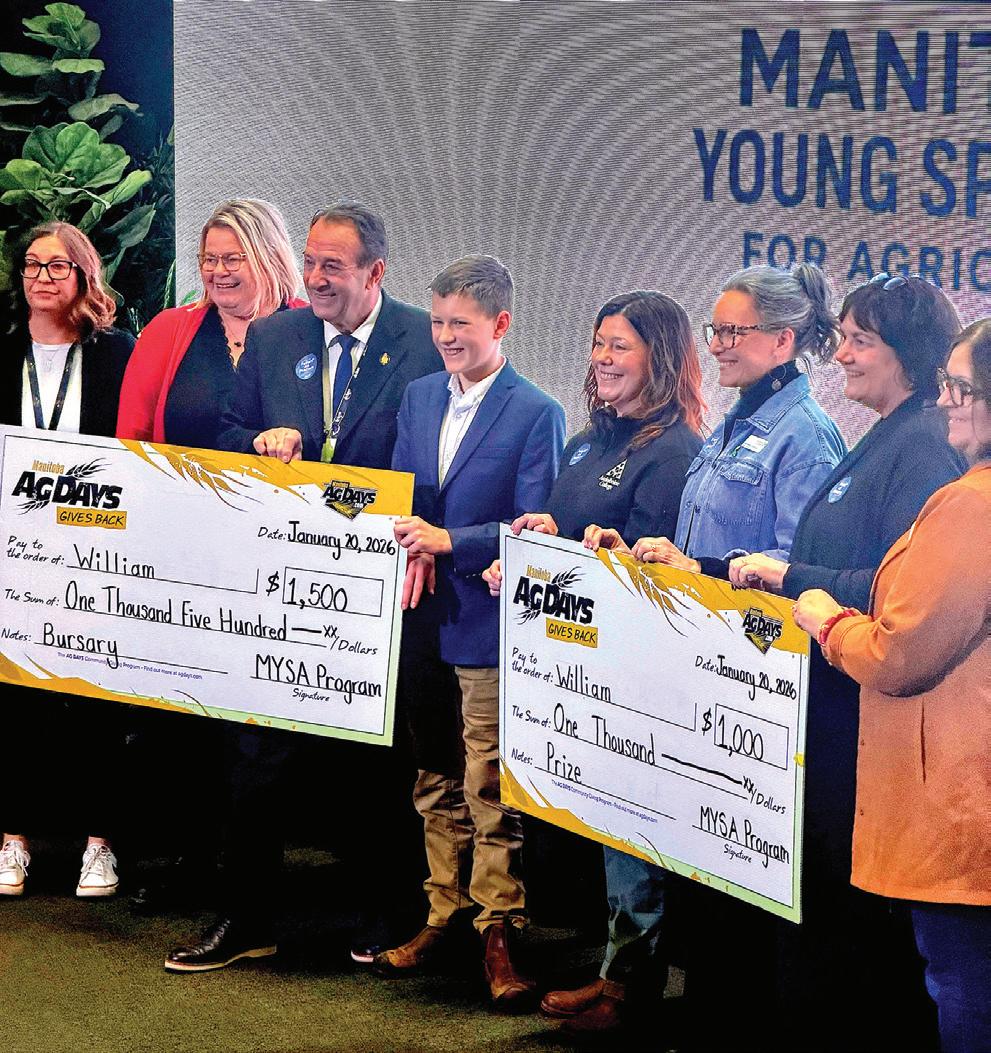
In summation, William Derksen from Thornhill, MB, said, “Don’t let this speech sour your mood. Choose real. Choose Manitoba farms. And keep it rawesome.”
MYSA gives youth ages 11 to 24 a platform. They speak on key agricultural topics. They build confidence, sharpen communication, and learn leadership. Finalists move on to the Royal Agricultural Winter Fair in Toronto this November.
William earns that honour. He opens with a challenge: “Buckle up, buttercup, for some farm-fresh facts.” Then he tackles three myths.
Myth one: Pasteurized milk is healthier. William counters: “Raw milk retains more of its natural nutrients.”
He explains that butterfat helps the body absorb vitamins. Store-bought milk often removes that fat. He cites the Journal of Nutrition, which warns about health concerns when butterfat disappears — especially for youth.
Myth two: Milk needs pasteurization to be safe. William
says, “Raw milk contains naturally occurring beneficial bacteria.”
He understands why pasteurization started — farmers lacked clean tanks, refrigeration, and water treatment. But today’s farms use advanced equipment and strict hygiene. He quotes the Raw Milk Institute: “Pasteurization kills the good bacteria.”
He adds, “Studies show unpasteurized milk supports

healthy gut bacteria.”
He doesn’t push raw milk on everyone. “I’m advocating for choice,” he says. “If a child’s stomach can handle blue candy but not raw milk, what does that say about what we’re feeding kids?”
Myth three: Homogenization is necessary. William explains that homogenization forces milk through filters to keep fat evenly mixed.
He quotes Dairy Nutrition: “It improves stability and appearance.” But he warns that this process alters fat molecules.
The Weston A. Price Foundation links homogenization to allergy risk and possible heart disease.
William then compares Canada and the U.S.
“Thirty states allow some form of raw milk sales,” he says. “Canada bans it in every province.”
He calls that outdated. “Legalizing raw milk could help small farms survive,” he says. “They could sell without expensive industrial processing.”
He wraps up with a call to action. “Talk to your politicians,” he urges. “I contacted Manitoba’s Minister of Agriculture.” He wants others to speak up too.
His summary is simple: raw milk retains more nutrients, raw milk supports healthy bacteria, and consumers need education about homogenization. He closes with a smile: “Choose real. Choose Manitoba farms. And keep it rawesome.” When growing up, raw milk wasn’t a mystery. It was normal with homemade butter, cottage cheese, rich cream from dad’s Jersey cow.
William doesn’t ask for a return to the past. He asks for options. He says kids today should have the same chance — if they choose it. He speaks with clarity, courage, and conviction. And he reminded the audience that agriculture isn’t just about crops and cows. It’s about people. It’s about choice. And it’s about the next generation stepping up to the microphone.

By Harry Siemens Exporters
Pulse growers across Canada gained long-awaited clarity as China announced it will remove the 100-per-cent tariff on Canadian peas effective March 1, 2026. The decision followed the Prime Minister’s meetings in Beijing with Chinese President Xi Jinping and immediately reshaped growers’ outlooks, allowing many to finalize their 2026 cropping plans.
Pulse Canada responded quickly. Chair Terry Youzwa called the announcement “welcome news for growers and the entire value chain.” He said the industry pushed from day one to restore access and predictability. “We worked with the government and our customers to remove this tariff and rebuild confidence in the marketplace,” he said. “This decision shows the value of constructive, proactive engagement.”
The tariff, imposed in March 2025, effectively shut Canadian peas out of China despite strong demand. Buyers wanted Canadian product, but the 100-per-cent rate priced it out of reach. Shipments stalled. Growers faced uncertainty.
scrambled to redirect volumes. Processors adjusted production schedules. The entire value chain carried the weight of a major market suddenly closed.
The January 15 announcement changes that. It reopens a market that purchased roughly $3.7 billion worth of Canadian peas between 2019 and 2024 and restores a key pillar of Canada’s pulse-export strategy. China remains one of the world’s largest buyers of peas for food, feed, and ingredient manufacturing. When China re-enters the market, global trade flows shift.
Pulse Canada president Greg Cherewyk said the outcome demonstrates the value of focused, persistent diplomacy. “High-level engagement works,” he said. “Re-establishing access creates immediate commercial opportunities and strengthens Canada’s position as a trusted supplier of high-quality, nutritious, sustainable food ingredients.”
Growers across the Prairies are now adjusting their plans with renewed confidence. January always brings difficult decisions… rotations, seed orders, fertilizer commitments,
and marketing strategies. Each choice carries risk, and market access uncertainty compounds it. The announcement removes one of the biggest unknowns.
Youzwa said the timing is critical. “Producers are finalizing cropping decisions right now,” he said. “This clarity helps them move forward with confidence.”
The pulse sector plays a major role in Canada’s rural economy, contributing billions of dollars annually and supporting tens of thousands of jobs in farming, transportation, processing, and export logistics. Peas anchor many rotations, improve soil health, and reduce input costs. When markets function, growers benefit. When markets close, the entire system feels the strain.
China’s decision also aligns with global demand trends. Food manufacturers continue expanding their use of plantbased proteins, while ingredient companies rely on peas for starch, fibre, and protein fractions. Consumers increasingly seek sustainable, nutritious foods. Canada supplies peas with consistent quality, traceability, and strong environ-
mental performance. Restored access strengthens Canada’s ability to meet that demand.
The announcement also supports value-added processing. Facilities across the Prairies depend on stable access to global markets. Predictable trade encourages investment in new technology, additional processing lines, and product development. When markets stay open, processors hire, expand, and innovate.
Pulse Canada thanked federal officials for their work on the file, noting the outcome reflects coordinated effort between government and industry. The organization said the decision underscores the importance of maintaining strong relationships with international customers. Canada built its reputation on reliability, and the move reinforces that trust.
The organization now turns its attention to ensuring the tariff removal becomes permanent. The industry wants stable, rules-based trade, predictable access, and long-term certainty for growers and processors. Pulse Canada said it will continue working with government and customers to secure that stability.
Cherewyk said the sector stands ready to deliver. “Canada produces high-quality pulses at scale,” he said. “We can meet demand, support food security, and strengthen commercial relationships when markets stay open.”
Growers now look ahead to spring with renewed optimism. Markets remain vola-
tile. Weather remains unpredictable. Costs remain high. The pulse industry knows the work continues. Trade relationships require constant attention, and market access can shift quickly. But growers have gained something essential: clarity. And clarity helps them plant with confidence.

Farmers and crop advisors across Manitoba, the Prairies, and Ontario are being invited to share their experiences through a new Cover Crop Survey aimed at better understanding how cover cropping is being used, and why it sometimes is not.
Callum Morrison, crop production extension specialist with Manitoba Agriculture explained the survey seeks real-world insights from producers and advisors as cover crops continue to gain attention for their role in soil
health, climate resilience, and regenerative farming systems. Morrison notes that farmers across diverse regions are experimenting with cover crops, adapting them to different rotations, soil types, and business realities.
The initiative is led by researchers including Morrison, Dr. Yvonne Lawley of the University of Manitoba, and the Ontario Cover Crop Steering Committee, and builds on a similar survey conducted in 2020 that established a baseline for cover crop adoption on the
Prairies. Since then, rising input costs, new cost-share programs, erratic weather, and increased interest in livestock integration have changed the landscape, prompting the need for updated data.
Organizations such as the Manitoba Forage and Grassland Association support the project, citing the role cover crops play in improving nutrient cycling, reducing erosion, and enhancing soil biology. When combined with managed grazing, cover crops can also extend
the grazing season and create additional revenue.
The survey is open to farms of all sizes and production types in Manitoba, Saskatchewan, Alberta, and Ontario, including those that have never used cover crops or have stopped using them. A dedicated survey for crop advisors is also included.
The survey is available online at gfo.ca/cover-crop-survey and will remain open until March 31, 2026.
By Harry Siemens
Canadian farmers continue to wait years longer than their competitors for access to proven crop protection tools, and those delays now threaten productivity, investment, and competitiveness across the sector. As the Pest Management Regulatory Agency (PMRA) prepares to release its decision on dicamba, pressure is building for a regulatory system that keeps pace with global peers rather than holding farmers back.
Growers point to repeated examples. Vive Crop Protection, a Canadian company, developed advanced formulation technology that U.S. farmers were able to use years before Canadian approval arrived. More recently, next-generation wireworm control products containing Plinazolin entered the U.S. market but remain unavailable in Canada. These delays leave Canadian farmers with fewer pest-management options while competitors move ahead.
Western Canadian Wheat Growers Association president Gunter Jochim said the impact is felt directly on farms. “When our competitors get better tools sooner, it affects productivity, resistance management, and our ability to compete in global markets,” he said.
The Wheat Growers stress that safety is not the issue. Canada’s science-based framework carries strong international credibility. The problem lies in timelines that stretch unpredictably and routinely run years behind those of the United States. Over the past decade, Canada’s overall competitiveness ranking has dropped five places, and regulatory drag has contributed to that slide.
The federal government has pledged to modernize PMRA, but farm groups say outcomes matter more than promises. Regulatory lag has already weakened Canada’s appeal as a destination for agricultural innovation. Venture capital is increasingly flowing to faster-moving jurisdictions such as the United States and Brazil, taking

technology development and economic growth with it.
“That’s a serious warning sign,” said Darcy Pawlik, executive director of the Wheat Growers. “If we want innovation, investment, and productivity growth in Canadian agriculture, we need a system that delivers timely, science-based decisions and keeps pace with our trading partners.”
Pawlik said the simplest explanation for the delays is system performance. “Canada’s regulatory system no longer supports a competitive economy,” he said. “Intentions may be sound, but outcomes matter, and the outcome today is approvals that take twice as long or more than in the U.S.”
He said the problem extends beyond any single product. Canada now operates within a system that lacks urgency, accountability, and alignment with peer jurisdictions. Process has overtaken performance. Missed timelines have become routine rather than exceptional, sending a clear signal to farmers and investors that competitiveness no longer sits at the centre of decision-making.
On farms, the impact compounds over time. Pawlik said productivity growth depends on access to better tools and rapid adoption of innovation. Delayed approvals limit pest control options, restrict Integrated Pest Management strategies, and reduce flexibility during tight agronomic windows. Yield stability suffers. Input efficiency declines. Over time, Canada’s productivity gap widens relative to competitors that adopt innovation earlier.
That gap carries national consequences. Pawlik pointed to the Barton Report, which warned that countries that fail to translate innovation into real-world adoption fall behind and struggle to recover. Agriculture follows the same pattern. When innovation arrives late, the economic cost

“That’s a serious warning sign,” said Darcy Pawlik, executive director of the Wheat Growers. “If we want innovation, investment, and productivity growth in Canadian agriculture, we need a system that delivers timely, science-based decisions and keeps pace with our trading partners.”
multiplies year after year. Pawlik said PMRA needs structural change. He called for faster review pathways and reforms to re-evaluation models that consume capacity without improving outcomes. He also urged Canada to rely more heavily on trusted international regulators. Mutual recognition with jurisdictions such as the United States, Brazil, and other OECD countries could reduce duplication while maintaining high safety standards. He also said regulatory silos slow decision-making. Better data-sharing between Health Canada, the Canadian Food Inspection Agency, and Agriculture and Agri-Food Canada would improve both speed and quality. Finally, Pawlik said competitiveness must become an explicit part of regulatory governance. A modern system must
protect health and the environment while delivering results that support economic growth.
Wheat Growers are now urging PMRA to ensure its dicamba decision reflects that modern approach. Farmers are not asking for shortcuts. They are asking for timelines that align with science, global standards, and economic reality.
Canada’s challenge no longer centres on scientific credibility… it centres on system performance. When proven technologies reach Canadian farmers years after their competitors, productivity slips, competitiveness weakens, and investment moves elsewhere. Modernizing PMRA has become an economic imperative, not merely a regulatory exercise, if Canada expects its farmers to compete and succeed in global markets.



Canadians do not imagine higher grocery bills. Food costs more, stays expensive, and refuses to come down. At Manitoba Ag Days, food policy analyst Dr. Sylvain Charlebois laid out why. Canada’s food inflation problem runs deeper than store shelves. Government policy built it, reinforced it, and keeps feeding it.
Canada now leads the G7 in food inflation. At 6.2 percent, Canada’s rate doubles that of the United States. That fact alone should stop every policymaker in their tracks. Canada produces food at scale. It exports food. Yet Canadians pay more for it than consumers in peer nations.
“This didn’t start with Trudeau,” Charlebois said. “It didn’t start with the carbon tax or supply management.”
Canada’s food inflation problem began in 2008. During the global financial crisis, food inflation in Canada broke away from general inflation and never reconnected. Other G7 countries recovered. Canada did not.
That failure defines today’s reality.
Charlebois described the problem as structural rather than cyclical. Temporary shocks did not cause it. Long-standing policy choices did.
Ottawa keeps reaching for short-term fixes. Those fixes backfire.
Taxes top the list. Governments apply taxes to food; remove them briefly, then act surprised when prices stay high. The federal GST holiday proved the point. Charlebois and former Bank of Canada governor David Dodge warned senators not to implement it unless it stayed permanent. Government ignored them.
The data now tells the story. Without the GST holiday, food inflation would sit roughly two percentage points lower today. About half came from the tax itself. The rest came from price increases retailers imposed, while consumers focused on tax relief rather than shelf prices.
Once prices rise, they stick.
Canada made the same mistake before. Past GST cuts failed to lower prices. Retailers kept the room. Consumers paid anyway.
Carbon pricing adds pressure across the supply chain. Charle-
bois pushed back against academic claims that carbon costs do not affect food prices. His research showed the opposite. Carbon costs compound. They hit inputs, processing, transportation, and storage. They weaken competitiveness and raise prices.
Protein markets show how fast pressure spreads. Beef prices now sit at record highs. Consumers shift to pork and chicken. That demand surge raises prices across proteins. Canada now imports large volumes of chicken from the United States despite supply management. Most consumers never notice. Supply management itself contributes to the problem. Charlebois argued the system protects stability, not competitiveness. Provinces control quotas independently. That structure locks inefficiencies in place.
One change would matter. Harmonize quota allocation nationally. That step would reward scale and efficiency. Production would move west, where farms already compete globally. Eastern Canada prefers smaller farms and guaranteed prices. Ottawa protects the status quo.
Interprovincial trade barriers compound the damage. Cana-
dian processors struggle to sell food across provincial lines: licensing, inspection, and regulatory costs block scale. Canada behaves like a collection of disconnected markets rather than a single food-producing country.
Ports and logistics add another choke point. Canada relies on three major ports—Halifax, Montreal, and Vancouver. All underperform globally. The federal government’s $118-billion logistics commitment helps, but Charlebois said Canada needs long-term coordination, not one-off announcements.
Public anger often targets grocery chains. Charlebois urged precision. Grocery margins remain thin, typically three to four percent. Large chains earn more from real estate, pharmacies, and non-food sales than they do from groceries.
That does not absolve them. Retailers squeeze suppliers hard. The Grocery Code of Conduct aims to curb that behaviour. Whether it works remains uncertain. New competitors like Aldi avoid Canada because dominant chains control shelf access.
Canada lacks the leverage that the United States enjoys. American retailers switch suppliers quickly when prices rise.
At Manitoba Ag Days, food policy analyst Dr. Sylvain Charlebois said on high food prices, “This didn’t start with Trudeau. It didn’t start with the carbon tax or supply management.” Canada’s food inflation problem began in 2008.
Photo by Harry Siemens

cost.
Charlebois closed with a blunt warning. Canada keeps chasing symptoms while protecting the causes. Short-term political fixes distract voters and deepen long-term damage.
Canada does not suffer from a grocery problem alone. It suffers from policy choices that reward inefficiency, fragment markets, and treat food as a political tool instead of an economic system.
Until those choices change, Canadians will keep paying more—regardless of who sits in power.
By Dan Guetre
Konrad Narth, MLA for La Vérendrye and Manitoba’s Progressive Conservative agriculture critic, is calling for a pause on proposed federal livestock traceability regulations, citing concerns over the federal government’s approach and the potential impact on producers.
In a statement, Narth said he is closely following the regula-
tory changes being advanced by the Canadian Food Inspec
-
tion Agency (CFIA), stressing that traceability itself is not the issue.
“Traceability matters. It matters to animal health, to consumer confidence, and to our access to export markets,” Narth said, referencing his upbringing on a beef farm during the BSE crisis and the lasting impacts market closures had
on rural communities.
Narth acknowledged that many of the traceability improvements under discussion originated within the cattle industry through organizations such as the Canadian Cattle Association and provincial beef groups. However, he argued that the federal government has taken a “top-down, one-size-fits-all approach” with inadequate consultation.
“Effective policy cannot be built without the meaningful involvement of those on the ground. Bureaucrats don’t know best. Farmers do,” he said.
The agriculture critic also pointed to broader pressures facing the beef sector, including historically low herd numbers and uncertainty in key export markets, particularly the United States. He warned

that poorly implemented regulations could introduce additional risk at a time when the industry is already fragile.
Narth further noted that increased regulatory burdens on producers could translate into higher costs for consumers, at a time when grocery prices remain elevated. He said governments should focus on reducing taxes and regulations rather than adding new ones.
Narth said he and the Manitoba Progressive Conservative Party support calls from Manitoba Beef Producers and cattle organizations nationwide to pause implementation of the proposed changes, allowing CFIA to engage more thoroughly with producers.
“We owe it to producers, rural communities, and the next generation of farmers and ranchers to get this right,” he said.
By Elmer Heinrichs
Prairie farm groups are cautiously optimistic following a major shift in Canada–China agricultural relations.
After Prime Minister Mark Carney’s recent mission to Beijing and meetings with President Xi Jinping, China has announced significant tariff reductions affecting canola, canola meal, peas, and other key commodities—changes that many hope will finally bring some stability back to the farm gate.
For producers who have shouldered years of uncertainty, shrinking margins, and volatile markets, the message from across the agricultural sector is clear: This is progress—
but it needs to last.
The Canadian Federation of Agriculture (CFA) welcomed the renewed dialogue and early breakthroughs, calling it an important step toward stabilizing market access for Canadian farmers.
CFA highlighted that the proposed elimination of tariffs on several agricultural products, combined with the significant reduction in canola seed tariffs, will offer immediate and meaningful relief for producers shipping into one of Canada’s most important export markets.
“These advancements are promising, demonstrating significant progress,” said CFA President Keith Currie. He added that this progress “sets the foundation
for continued dialogue to resolve outstanding trade barriers and foster a more predictable trade environment for Canadian farmers.”
For CFA, long-term success depends on continued engagement and follow- through—not just announcements.
Grain Growers of Canada (GGC) echoed that sentiment, stressing that restoring stable, durable access to China is crucial for the grain sector. China remains Canada’s second - largest grain market, and ongoing disruptions have hit farmer revenues, cash flow, and marketing decisions.
With over 70 per cent of Canadian grain exported, GGC has consistently
pushed for balanced, pragmatic engagement with both China and the U.S. to protect tariff-free access and prevent producers from becoming casualties of bigger geopolitical disputes.
GGC’s message to government: Keep agriculture at the centre of negotiations and ensure progress translates into real, reliable market access for farmers.
Manitoba Canola Growers responded positively to China’s commitment to reduce tariffs on canola seed to 15 per cent by March 1, 2026; canola meal, currently facing a 100 per cent tariff, to 0 per cent, with full removal expected to last at least until year-end.
For Manitoba producers staring at tight margins and
large carry-over stocks, this announcement arrives at a critical planning moment.
Much of the 2025 canola crop remains in farm bins, and producers need confidence that markets will be open when they’re ready to sell.
In 2024, Canada shipped approximately $5 billion in canola and related products to China, but that value is expected to fall dramatically this year—a stark reminder of how quickly trade disruptions ripple through rural communities.
Manitoba Canola Growers emphasized the role of coordinated advocacy between provincial groups, national organizations, and government—and stressed that follow- through re -
By Dan Guetre
Preparations for the 2026 review of the Canada–United States–Mexico Agreement (CUSMA) have become a top priority for the Canadian Agri-Food Trade Alliance (CAFTA), as attention grows in Washington around the future of North American trade.
Throughout the fall, CAFTA focused on strengthening relationships with governments and industry partners across Canada, the United States, and Mexico, reinforcing the importance of tariff-free, rules-based agri-food trade. Engage -
ments in Washington, committee appearances, and international discussions are helping lay the groundwork for a review that delivers long-term certainty for Canadian agri-food exporters.
CUSMA requires the three countries to review the agreement by July 1, 2026, and decide whether to extend it for another 16 years.
If no agreement is reached, the deal would remain in force until 2036, after which it could be terminated.
CAFTA is advocating strongly for an extension, arguing that CUSMA’s rules are critical for trade and in -
vestment decisions across the agri-food sector. The organization says U.S. legislators, particularly from agricultural states, are increasingly hearing from constituents about the agreement’s importance.
That support was underscored by a recent open letter sent to the U.S. Trade Representative by a broad coalition of U.S. farm and agri-food organizations. In the letter, the groups stated they “submit this letter of support for a full 16-year renewal” of the agreement, noting that seamless North American integration under
CUSMA has allowed agricultural exports to soar and tripled the value of trilateral agri-food trade between 2005 and 2023.
The U.S. organizations emphasized that Canada and Mexico rank among the top export markets for American agriculture and warned against weakening the agreement. “It is critical not to backslide on the current provisions of USMCA and ensure that trade certainty is maintained and strengthened,” the letter stated, highlighting benefits ranging from science-based sanitary and phytosanitary rules to
zero-tariff market access and dispute settlement protections.
In its submission to the Government of Canada, CAFTA noted that despite heightened political uncertainty in the U.S.; most Canadian agri-food exports continue to enjoy tariff-free access under CUSMA. CAFTA also stressed that successive trade agreements, from the original Canada–U.S. Free Trade Agreement to NAFTA and now CUSMA, have dismantled barriers and created a deeply integrated North American agricultural economy.
mains essential. Farmers, exporters, and governments must stay aligned so decisions made at the kitchen table and in the tractor cab reflect real market conditions.
Canadian grain, oilseed, and pulse producers are among the most reliable suppliers in the world. They have the capacity to meet global demand—what they need from government is consistency, transparency, and a steady commitment to keeping trade flowing. The week’s announcements mark a much - needed step in the right direction. But for farmers planning spring seeding, managing on -farm storage, and navigating tight margins, the real test will be durability.

Farmers participating in the AgriInsurance program in 2026 will see lower premium rates for most insurable crops.
Agriculture Minister Ron Kostyshyn announcing details of the federal/provincial program recently at Manitoba Ag Days.
The 2026 program includes a new pilot program that rewards farmers for adopting sustainable management practices with lower premiums.
Manitoba Agriculture setting the average pre-
mium at $11.46 per acre, down from $13.01 (per acre) in 2025.
The program administered by the Manitoba Agricultural Services Corporation set 2026 crop insurance values at $14.74 for Canola, $7.89 for CWRS and $14.15 for Soybeans.
Manitoba has a high level of participation in the program, with over 90 per cent of annual crop acres and more than 7,300 farms enrolled in the program. Total coverage for 2026 is expected to reach $4.3 billion.

In 2026, MASC is piloting the forage advantage incentive, offering a 15 per cent discount on forage establishment insurance premiums for perennial forage crops grown on designated land. Additional discounts may apply to basic or select hay insurance or forage seed insurance once the forage crop enters production the following year. The 2026 program also includes new coverage for meadow fescue grown for seed.
As well, the list of damaging species will be expanded as part of the wildlife damage com-
pensation program with compensation now available for crop damage caused by blackbirds and raccoons.
There’s also additional compensation available for livestock injury or death caused by vultures, eagles, hawks, ravens and other corvidae species.
Kostyshyn notes that discussions continue around additional compensation needs, such as the large elk population in some areas of the province.
By Joan Airey
During last year’s Manitoba Farm Women’s Conference one speaker I really listened to was Justin Cornett from the Royal Bank speaking on Fraud Has Many Faces. Maybe I’m paranoid because I know a farm woman whose banking info was stolen from her phone and their farm account cleaned out. Personally, I don’t keep any banking info on my phone as I feel it is easy to clone or steal one.
The first thing he told us was never use a phone charger cord of someone you don’t know. I’d never thought about a cord at a charger in an airport may belong to a scammer collecting info. Even the small devices on the ends of that cord could be collecting info from your phone or laptop!
Passwords are like keys as they protect what’s ours by locking out thieves. To make your passwords unique, don’t reuse the same password. To make your passwords unique it should be long, contain upper- and lower-case letters, numbers and special characters, which can include spaces.
He told us to store our password securely as it is critical to protecting your digital life. Use a secure password manager and use multi-factor authentication where possible. This requires two or more-stage processes for logging in and verifying your identity. Attackers will likely find it very hard to fulfill the second condition.
Don’t forget about physical security of devices. Don’t leave them in cars. Ensure screens are locked when you’re not using them.
Visit the website www.rbc.com/cyber ---it lists all the scams that are steered towards seniors and how to help seniors in your family from being taken by them. For your business you can check out www.rbc.com/cyber/business. Banks and credit unions have some excellent speakers on cyber scams if you need a
speaker; they are willing to help you.
Another excellent speaker for young people and the internet is Val Caldwell who lives in the Kenton area. She has spoken at previous MFW Conferences. She speaks at schools on internet safety.
What is Phishing/SMishing (Email-Text)? Fake emails used as bait to lure you into giving out personal information. Its estimated 50-80% of all cyber-attacks involve insiders, most commonly by an email message that asks the user to click a link or open an attachment.
During the Christmas season I learned from my family how easy it is with AI to make something look real that isn’t. A cousin sent a photo of me and my husband sitting surrounded by Charolais cows with horns. It was all fake. None of our cows have horns, especially deer antlers. Another family member showed us how easy it is to change a photo.
Take the time to be educated on how to be safe from scammers. And make sure your children and seniors know what to look out for.

Submitted by Joan Airey



Cleanfarms, the national organization that develops and operates environmental stewardship programs for agricultural plastics and packaging, is pleased to announce the appointment of Bob Lepischak to
its Board of Directors. Lepischak, a grain/oilseeds and beef producer, educator and Director with the Grain Growers of Canada (GGC), who joined the board in late 2025, brings a strong producer perspective
and valuable governance experience from Western Canada to the Cleanfarms board.
Lepischak is a seasoned producer from Neepawa who has dedicated significant time to producer advocacy and orga-
nizational governance, serving also on the boards of the Prairie Oat Growers Association (POGA) and the Manitoba Oat Growers Association (MOGA), experience which he now brings to GGC. His


Cleanfarms welcomes Bob Lepischak, a Director with the Grain Growers of Canada and seasoned producer from Neepawa to its Board of Directors.
deep understanding of the policy and operational issues facing cereal and oilseed farmers across Canada will be instrumental as Cleanfarms continues to expand its recycling and management programs nationwide.
“Plastics are valuable in the business of farming – there’s no getting around it. And at the end of the day – when we’re finished with them, we don’t want them to go to landfills or wind up in the environment,” commented Lepischak. “I’m proud to add my voice to the Cleanfarms Board on behalf of growers so we can find solutions for them – not just for today – but for years to come.”
Cleanfarms works with its members, partners, and provincial regulators to manage agricultural waste and promote circular economy solutions across the country.
“We are pleased to welcome Bob Lepischak to the Cleanfarms Board of Directors,” said Boyd Bergstrom, Cleanfarms Board Chair. “Bob’s wide-ranging expertise as a producer with experience in grain-sector policy will strengthen our work, helping us deliver accessible, producer-driven stewardship solutions for the challenges ahead.”
The Canadian Cattle Association (CCA) is welcoming renewed access to the Chinese market, following the restoration of Canadian beef exports after a halt that began in 2021.
The CCA said the reopening of the market is a positive development for the sector, which had been wrongfully shut out of China for nearly five years. The association noted it will continue working with government officials and industry partners to better understand the details of the restored access, including any potential safeguard measures.
CCA also applauded Prime Minister Mark Carney for prioritizing export-driven agriculture as a key economic driver for Canada and an important component of the country’s trade diversification strategy.
“We are pleased to see renewed access into China, one of the largest export markets for beef,” said CCA President Tyler Fulton.
“Every market matters to Canadian beef farmers and ranchers; it
supports our industry’s resilience and growth. Canadian beef continues to be sought after because it is among the highest quality beef in the world.”
Fulton also thanked Prime Minister Carney and Agriculture and Agri-Food Minister Heath MacDonald for their advocacy on behalf of the sector.
The association said it will continue to push for the removal of non-tariff barriers in existing markets and work with the federal government on new free trade agreements that create meaningful opportunities for beef producers.
China halted imports of Canadian beef in December 2021 following an atypical case of bovine spongiform encephalopathy (BSE) in Canada. Prior to the suspension, Canadian beef exports to China had been steadily growing. CCA says the resumption of trade reinforces its ongoing efforts to expand and secure market access for Canadian beef producers at home and abroad.
By Harry Siemens
Canadian farmers manage risk every day. Weather shifts. Markets move. Input costs rise. Trade rules change. Yet one of the most important risk-management tools available to producers continues to suffer from misunderstanding and outdated assumptions. That reality surfaced clearly during a recent national webinar, AgriStability Unpacked, hosted by Farm Management Canada and sponsored by MNP.
The session focused on explanation, not promotion, and that difference mattered.
Speakers included Matthew Lepari, risk management lead with Farm Management Canada, and AJ Gill, national leader of Ag Risk Management Resources at MNP. Gill brings nearly 25 years of experience in business risk management programs, including close to two decades in government before moving into producer advisory roles.
From the outset, the tone remained practical. Lepari noted that AgriStability today “is more accessible and more useful than it has been for many years,” a statement that challenged what many producers still believe.
Live polling revealed a familiar pattern. About one-third of participants currently use AgriStability. Another group participated years ago but left. A large share never enrolled. These results mirror national participation levels and highlight the program’s core issue: perception lags reality.
AgriStability exists to protect farm viability, not guarantee profit. Gill stated that clearly. “The program protects the viability of Canadian agriculture,” he said. It responds to large margin declines caused by production losses, falling prices, or rising input costs. Drought, disease, floods, fires, trade disruptions, and border closures qualify. Poor management de-

Matthew Lepari of Farm Management Canada says AgriStability works best when farmers understand how it fits into their overall risk-management plan before a crisis hits.
cisions do not.
That distinction matters because AgriStability is not a grant. It functions as margin-based insurance, with triggers tied to margins, not revenue.
Many producers still believe the program only triggers after a 30-percent revenue drop. That belief is incorrect. The trigger occurs after a 30-percent decline in margin. Depending on a farm’s cost structure, that decline can occur with far smaller revenue changes. High-cost operations may trigger sooner, while lower-cost operations require larger swings. The program reflects how individual farms actually operate.
Eligibility also creates confusion. Any Canadian farmer who files farm taxes with the Canada Revenue Agency can participate. New farmers qualify immediately and do not need years of history. A producer can begin farming in January, enroll by April 30, and receive coverage that same year. Even producers who fail to complete a production cycle due to disaster may still qualify.
Gill also addressed the common claim that AgriStability “never pays.” He disagreed. “If a farmer doesn’t receive a payment after a bad year, only two explanations exist,” he said. “Either errors exist in the file, or the loss didn’t occur on an

AJ Gill of MNP says AgriStability protects farm viability by responding to major margin losses caused by production, market, or cost shocks—not poor management.
Submitted photos
accrual basis.”
That issue sits at the centre of many frustrations. AgriStability relies on modified accrual accounting, not cash accounting. While many farmers file taxes on a cash basis—often for sound tax-planning reasons—this can distort how losses appear once inventories, receivables, payables, and timing adjustments are considered. Without understanding accruals, producers may misjudge both losses and outcomes.
Gill outlined four common problem areas that block payments. Structural changes come first; the program must compare like with like. Acreage shifts, herd changes, or production expansions must be accurately reflected. Allocation errors follow, particularly when eligible and non-eligible income or expenses shift between years. Inventory valuation is next, as incorrect values can quickly distort margins. Accrual adjustments round out the list.
“These issues show up often,” Gill said. “When we correct them, payments follow.”
Cost also draws criticism. Some farmers view AgriStability as expensive, but the numbers suggest otherwise. Administration fees average about $315 for every $100,000 of margin protected. Filing costs often range from $800
to $4,500, depending on complexity. Gill noted that reviewed cases frequently return benefits far exceeding those costs. “The value shows up when the program triggers,” he said.
History explains much of the lingering distrust. In 2013, reference margin limiting significantly weakened AgriStability, prompting many producers to exit and participation to fall. Governments later corrected that damage. In 2020, reference margin limiting was removed, and recent changes have further strengthened the program. For 2025, compensation increased from 80 percent to 90 percent on covered margin losses, while payment limits doubled from $3 million to $6 million.
AgriStability does not replace crop insurance; it complements it. Crop insurance protects yield. AgriStability protects whole-farm margins.
Gill closed with a simple message: “AgriStability works best when farmers understand it before they need it.”
AgriStability in 2025 looks very different from what it did a decade ago. Farmers who walked away may want another look—not because the program promises profit, but because it helps protect the ability to farm another year.
By Dan Guetre
A coalition of 14 farmer and seed advocacy organizations is calling on the federal government to abandon proposed changes that would restrict farmers’ ability to save seed, warning the move would increase costs, weaken food security and benefit multinational corporations.
In a letter to Agriculture and Agri-Food Minister Heath MacDonald, the groups urged Ottawa to listen to Canadian farmers rather than global seed companies. Their concerns echo those raised by thousands of Canadians who signed an e-petition opposing proposed regulatory changes that would make it illegal for farmers to save seed from Plant Breeders’ Rights-protected fruit, vegetable, ornamental and hybrid crop varieties, even after royalties have been paid.
The proposed change would remove these crops from the “Farmers’ Privilege” clause of the Plant Breeders’ Rights Act, a provision Parliament deliberately preserved following extensive debate in 2015.
“Parliament made a clear decision to ensure the PBR Act’s farmers’ privilege clause would work for farmers,” said National Farmers Union president Jenn Pfenning. She warned that reinterpreting the law now would narrow farmers’ rights, take money out of producers’ pockets and “ultimately weaken our national food sovereignty.”
Farm organizations who jointly issued a statement with the NFU say ending Farmers’ Privilege would force growers to purchase seed or plants annually, reducing autonomy and limiting the ability to adapt crops to local conditions at a time when farm profitability is already under pressure.
Katie Fettes, director of policy and research with Canadian Organic Growers, said the change would also increase Canada’s reliance on imported seed, as most vegetable seed is bred and sold by foreign corporations.
Advocates note that six multinational companies control nearly two-thirds of the global commercial seed market, and warn that removing Farmers’ Privilege would further concentrate control. Instead, farmers are calling on Ottawa to reinvest in public plant breeding and preserve seed-saving rights to support regionally adapted, climate-resilient crops.



Federal Agriculture and AgriFood Minister Heath MacDonald has launched a new round of consultations to help shape Canada’s next agricultural policy framework, beginning with an in-person stakeholder roundtable held January 20.
The consultations will inform the development of the Next Policy Framework (NPF), a five-year agreement running from 2028 to 2033 that will guide federal, provincial and territorial investments in Canada’s agriculture and agrifood sector. The NPF will succeed the current Sustainable Canadian Agricultural Partnership, which concludes on March 31, 2028.
During the initial roundtable, MacDonald met with representatives from across the agriculture and agri-food sector to discuss current and emerging challenges and opportunities, including competitiveness, sustainability and sector resilience. The minister said early engage-
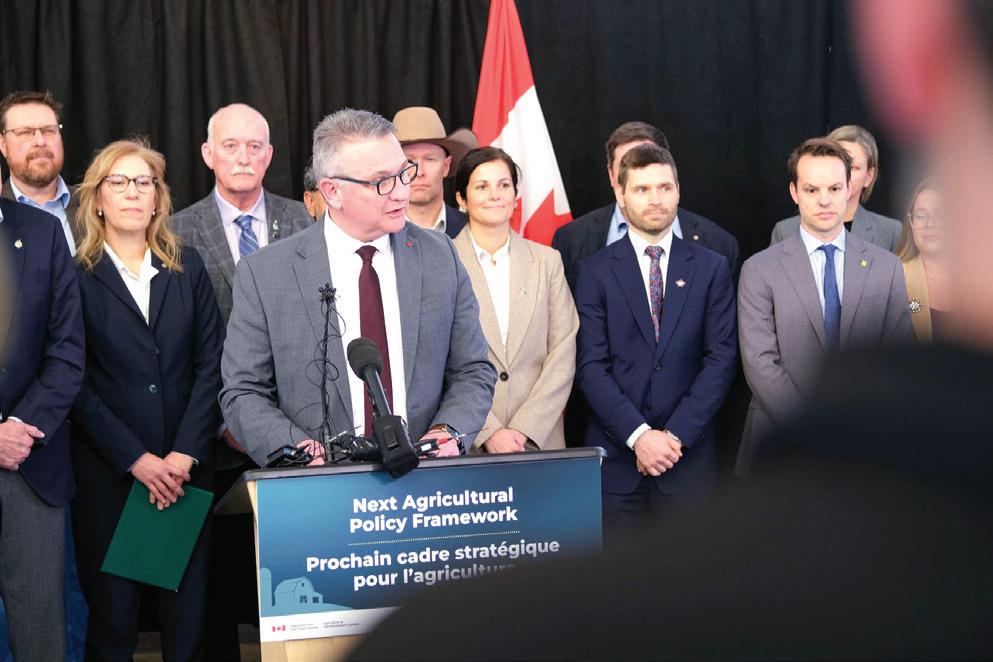
our food security,” MacDonald said. “Meaningful engagement is essential in developing policy, and these consultations will help ensure the Next Policy Framework is grounded in the experiences and perspectives of those who know the sector best.”
Manitoba Beef Producers (MBP) will bring together producers, industry partners, and government representatives for its annual general meeting (AGM) on February 11 and 12.
The AGM offers opportunities for engagement through guest speakers, resolutions debate, a trade show, and the popular President’s Banquet. New this year is a mix-and-mingle networking event on February 11, giving delegates a chance to connect with trade show exhibitors and fellow attendees.

Following the launch event, MacDonald is expected to host additional roundtables across Canada with regional associations, producers and processors. Agriculture and Agri-Food Canada will also conduct national online consultations through the NPF webpage, providing further opportunities for Canadians and stakeholders to share their views.
The event begins at 2 p.m. on February 11 with an industry knowledge session, followed by the networking event. Proceedings continue on February 12 starting at 8 a.m. with national updates and a keynote address. Lunch will precede the business portion of the meeting, including the resolutions debate, with the President’s Banquet closing out the day.
consultations will include farmers, processors, Indigenous communities, women, youth and industry organizations.
ment is critical to ensuring the next framework reflects on-the-ground realities.
“Canada’s agriculture and agri-food sector is a cornerstone of our economy and
The consultations will include farmers, processors, Indigenous communities, women, youth and industry organizations, with the goal of shaping a forward-looking framework that supports a competitive, resilient and sustainable agriculture and agri-food sector in the years ahead.
MBP says the AGM’s strength lies not only in information sharing, but also in the personal interactions that help build relationships and explore opportunities within the beef sector.
The AGM is free to attend, while tickets for the President’s Banquet are $65. Registration details are available at mbbeef.ca.


A new generation of leadership is stepping forward at the Manitoba Forage and Grasslands Association (MFGA), signalling a strong commitment to regenerative agriculture and farmer-led innovation.
MFGA’s newly approved 2026 Board of Directors executive committee is led by chair Zack Koscielny (29) of Strathclair, vice-chair Zach Grossart (30) of the Brandon area, and finance chair Amber McNish (25) of Lyleton. The appointments were approved recently at Manitoba Agriculture’s Food Development Centre in Portage la Prairie and will guide the organization for the next two years.
The trio will be supported by past chair Mike Duguid, a recent MFGA Wall of Fame inductee, who will serve a one-year term in the past chair role, bringing governance experience and institutional knowledge to the executive.
While young in age, all three executives bring hands-on experience in regenerative agriculture through their involvement in
family farm operations across Manitoba. MFGA Executive Director Duncan Morrison said the group’s leadership reflects both readiness and momentum within the organization.
“All three of our new executives are veterans of our board and have been constantly engaged on MFGA issues, business, and ambassadorship,” Morrison said. “This is their time to lead, and they want to make a difference.”
MFGA also acknowledged outgoing finance chair Sean Smith, who stepped down to focus on the Regeneration Canada Dairy Hub project, while remaining on the board as a producer representative.
Two new board members were also welcomed: market economist Brenda Tjaden of Prairie Routes and Andrew Rolfe, an agriculture-focused relationship manager with RBC. In addition, Mark Schram of Cartwright was appointed as the Manitoba Beef Producers’ representative on the MFGA board.
By Elmer Heinrichs
Interest in growing and consuming local Manitoba food is increasing, driven by desires for fresher, more nutritious food, supporting the local economy, and building community resilience.
With resources available through the provincial government, farmer-led groups, and CSAs to help, residents connect with local producers and grow their own produce despite the short growing season.
Manitobans are exploring diverse local options, from berries and grains to heritage foods, using strategies like buying clubs to access wholesale prices and strengthen the local food system.
Manitoba farmers grow and raise some of the highest quality and diverse foods. Despite the shorter growing season in Manitoba, food that is processed here is available all year round at retail outlets – so there is never a time when you can’t find local food.
Eating seasonally is also known to play an important part in consuming a more
complete, nutritious diet. And buying local food directly supports the economic sustainability of Manitoba communities.
When you support local, small businesses thrive and your hard-earned dollars stay in the community. This can help to create healthier food environments, more jobs and strengthen the overall local food system. This is more important than ever, for people, non-human life, and the planet.
Manitoba farmers are held to high environmental sustainability standards. Since 2004, many producers have utilized voluntary assessment tools, like the environmental farm plan, to identify environmental assets and risks, develop an action plan to help mitigate those risks, meet sustainable marketing requirements and access cost-share programming.
Buying local also reduces the environmental cost of transporting goods.
There are many ways for you to interact with local producers, learn about where our food comes from and of course, enjoy delicious, Manitoba-grown food.
By Harry Siemens
Canadian agriculture closed 2025 under pressure from global uncertainty, shifting trade policies, and political risk that extended far beyond the farm gate. Many producers hoped those pressures would ease. They did not.
A year ago, Manitoba Pork general manager Cam Dahl warned that global instability would disrupt markets. He hoped events would prove him wrong. They did not. Trade uncertainty followed Canadian farmers throughout 2025 and now sets the tone for 2026.
The United States remains focused on an “America First” approach, pulling policy away from free and open trade toward domestic protection. Canadian agriculture felt that shift quickly. Short-term tariffs appeared and then eased, largely because the Canada-United States-Mexico Agreement (CUSMA) remains in force. That protection, however, now faces a critical test.
CUSMA comes up for review before the end of 2026, making it the most significant policy file facing Canadian agriculture. About 90 percent of Canadian farmers depend on international markets. The outcome will determine whether the agreement extends through 2032, moves to annual reviews, or ends altogether. Each option carries consequences for farm finances, investment confidence, and long-term viability.
“The outcome will determine the fiscal sustainability of many farms,” Dahl says.
Tariffs remain an obvious risk, but they are no longer the only one. Protection now takes many forms. Country-of-origin labelling threatens to re-emerge in the United States, while individual state measures such as California’s Proposition
12 continue to fracture the North American market. These tools restrict trade without tariffs, but deliver the same result.
Other regions are taking similar approaches. China targeted agricultural commodities in response to Canadian tariffs on electric vehicles. The European Union continues to block Canadian food exports through non-tariff barriers. These actions raise costs, limit access, and inject uncertainty into long-term planning.
Trade instability carries a price. It raises financing costs, delays investment, and forces producers and processors to manage risk instead of pursuing growth. That reality will not disappear in 2026. In fact, uncertainty may intensify as the CUSMA review approaches.
Securing North American market access must rank among the top policy priorities in 2026. Governments also need tools to offset the cost of uncertainty and accelerate trade diversification. Agriculture cannot shoulder this burden alone.
Food and agriculture must sit at every Canadian negotiating table in 2026. Policymakers need constant reminders that food and beverage processing is Canada’s largest manufacturing sector, generating about $175 billion in sales and accounting for more than 20 percent of total manufacturing output. Meat products lead the sector in Manitoba and across Canada.
“If agriculture gets left behind, every region pays the price,” Dahl says.
Manitoba’s hog sector enters 2026 with notable strengths. Producers lead the world in disease prevention and management and work together across the entire value chain. That cooperation often requires short-term sacrifice for long-term gain, but few regions match its level
of coordination.
Producers, processors, veterinarians, trans porters, and regulators share responsibility for animal health. That collaboration protects the entire sector and strengthens Canada’s reputa tion as a reliable supplier.
Disease prevention remains paramount in 2026. Producers continue efforts to prevent and manage Porcine Reproductive and Respiratory Syndrome and Porcine Epidemic Diarrhea vi rus. They also work closely with Manitoba’s Office of the Chief Veterinarian to keep foreign animal diseases out of the province. African Swine Fever and Foot-and-Mouth Disease re main constant threats.
“Collaboration makes the difference,” Dahl says.
The economic picture brought good news in 2025. Hog producers across the sector posted profits. Strong global pork demand, competi tive pricing compared to beef, disease pressure in other regions, and reasonable feed costs all supported margins. Those conditions are expected to carry into the first half of 2026.

The second half of the year will depend on trade. Political decisions, not market fundamentals, may ultimately set the direction.
With current profitability, 2026 should offer an opportunity for renewal and growth. Producers want to reinvest, upgrade barns, and plan for the next generation. Uncertainty makes that difficult. Financing barns with 25-year lifespans becomes harder when market access lacks clarity.
Manitoba’s Economic Development Plan recognizes this challenge. The province acknowledges the need to reduce reliance on U.S. trade and improve investment certainty. In 2026,
Manitoba Young Speakers for Agriculture (MYSA) heard from the top finalists in both the junior and senior categories during this year’s competition held in conjunction with Manitoba Ag Days.
In the junior category, the top four speakers were William Derksen, who placed first, followed by Janelle Gilmore in second, Gabriella Fewings in third, and Leah Phillips in fourth place. The senior category winners included Lillian Seward in first place, Bianca Byers in second, Kaitlyn Hunt-Delaurier in third, and Eve Campbell in fourth.
Each of the top four finishers in both categories received cash prizes of $1,000, $800, $500 and $200 respectively. First-place winners in each age category will also have the opportunity to advance to the Royal Agricultural Winter Fair in Toronto, scheduled for November 6 to 15, 2026. Manitoba Ag Days will provide a $1,500 bursary for each competitor toward participation costs upon registration.
“Each of these individuals has a unique connection to agriculture and public speaking, but they all share a common interest in advancing the next generation of leaders,” said MYSA committee member Leanne Sprung.
MYSA aims to promote youth leadership, strengthen public speaking skills and deepen understanding of agriculture’s role in Manitoba and beyond. The competition is supported by Manitoba Agriculture, Manitoba 4-H Council, Agriculture in the Classroom Manitoba, the University of Manitoba and Assiniboine College.
A year ago, Manitoba Pork General Manager Cam Dahl warned that global instability would disrupt markets. He hoped events would prove him wrong. They did not. Trade uncertainty followed Canadian farmers throughout 2025 and now sets the tone for 2026.
government and industry will need to work together to share risk and support renewal. Looking ahead, 2026 may resemble 2025 in many ways. Trade uncertainty will persist. Market fundamentals will remain strong. Profitability should continue, driven by demand and manageable costs. One question will linger at year’s end:
Did political risk outweigh market opportunity?
The answer will shape Canadian agriculture far beyond 2026.


By Harry Siemens
Harley Shepard shared a message at St. Jean-Baptiste Farm Days that resonated across the room: rural property owners have rights, but those rights come with legal limits that many producers misunderstand.
Shepard practises law in rural Manitoba and has done so for more than a decade. He grew up on a farm near Elkhorn, Manitoba, and understands prairie realities firsthand.
Born in Moosomin, Sas katchewan, Shepard earned his Bachelor of Arts in His tory in 2008 and his law degree in 2011 from the University of Manitoba. He joined the Manitoba Bar in 2012 and now practises with MMJS Law Offices, serving several southern Manito ba communities. His work focuses on family law, real estate, wills, estates, and farm-related legal matters.
Shepard centred his pre sentation on rural crime,

“In Manitoba, trespassing is a provincial offence,” said lawyer Harley Shepard at the recent St. Jean-Baptiste Farm Days. “But the consequences are often far less severe than people expect.”
Submitted Photo

trespassing, and the legal responsibilities landowners carry when people enter property without permis-
“In Manitoba, trespassing is a provincial offence,” Shepard said. “But the consequences are often far less severe than people expect.”
Manitoba’s Trespass Act makes it illegal to enter most agricultural land without permission. That includes fenced land, marked land, farmyards, storage sites, cultivated fields, grazing areas, and land used for agricultural production. In practical terms, Shepard said, nearly all farmland falls under trespass protection.
Signage helps. Fences help. Clear boundaries help. But enforcement remains limited.
“The Act itself doesn’t set strong penalties,” Shepard said. “You have to look to the Provincial Offences Act.”
The maximum fine for trespassing reaches $5,000, but Shepard said courts rarely impose anything close to that. In his experience, enforcement remains rare unless police catch the trespasser in the act and can identify them.
“Trespass law doesn’t have a lot of teeth,” he said.
Shepard then addressed one of the most common fears among rural landowners: liability when a trespasser gets injured.
He cited Manitoba case law involving recreational trespassers injured on farmland. In earlier decades, courts placed almost no responsibility on landowners. That standard has shifted.
Under Manitoba’s Occupiers’ Liability Act, landowners owe a general duty to ensure people on their property remain reasonably safe. However, that duty narrows significantly for trespassers.
“If someone enters agri-
cultural land without permission, your duty is limited,” Shepard said. “You must not deliberately cause harm, and you must not act with reckless disregard for their safety.”
That distinction matters. Courts have ruled against landowners who set traps or created hidden dangers in areas where trespassers commonly travelled. Shepard cited cases in which landowners installed barriers or other obstacles that caused serious injury, leading to successful lawsuits.
“You can’t booby-trap your land,” he said. “Even if someone shouldn’t be there.”
In contrast, courts have also ruled in favour of landowners where trespassers injured themselves through their own actions without interference or negligence from the property owner.
“If the trespasser creates their own misfortune, courts usually hold them responsible,” Shepard said.
The law becomes more complex when criminal activity enters the picture. Even when someone trespasses with criminal intent, landowners still owe a limited duty of care.
“That surprises people,” Shepard said. “But the law still requires restraint.”
Shepard then turned to the Criminal Code of Canada for self-defence and defence of property. These provisions allow individuals to use force in limited circumstances, provided the force remains reasonable.
“Reasonableness decides everything,” Shepard said. He stressed that courts examine each situation closely. Judges consider the nature of the threat, the size and strength of the parties involved, whether weapons were present, and whether other options existed.
Recent Canadian cases
demonstrate how quickly situations can escalate beyond legal protection. Shepard referenced cases where individuals used force to retrieve stolen property or detain suspects, only to face criminal charges when injuries or deaths occurred.
“Force feels justified in the moment,” Shepard said. “But courts analyze it later, calmly, with hindsight.”
He advised producers to avoid physical confrontations whenever possible.
“You don’t want your future decided in a courtroom,” he said.
Shepard also addressed common questions about dogs, signage, and surveillance cameras. Warning signs for aggressive animals can help demonstrate that a trespasser assumed risk. Cameras generally pose no legal problem if they capture events truthfully and remain on private property. Posting false accusations online, however, can lead to defamation claims.
Insurance plays a critical role. Shepard urged landowners to speak with their insurers about coverage for trespass-related incidents.
“Insurance often becomes your real protection,” he said. “Know what your policy covers.”
Shepard closed with a sober reminder.
“We have a legal system, not a justice system,” he said. “What feels fair and what the law allows don’t always line up.”
For rural Manitobans facing rising theft, vandalism, and trespassing, Shepard offered clear guidance: mark property clearly, avoid reckless actions, document incidents, contact authorities when possible, and protect yourself legally before a situation ever arises.
“Being right doesn’t always protect you,” he said. “Being prepared does.”

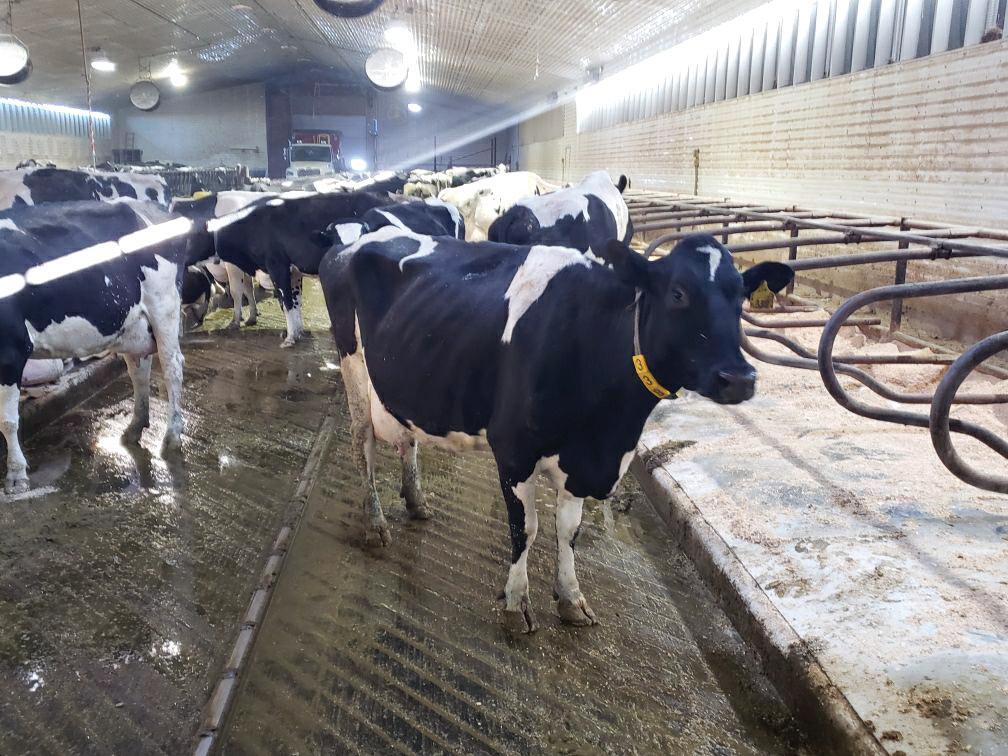
Milk urea nitrogen (MUN) test gives the dairy producers a good tool to evaluate how well that crude proteins fed to lactating dairy cows are being properly digested. Whenever, I evaluate a new MUN bulk-tank test from a dairy, particularly those that fall outside an acceptable range; it is reviewed with other barn performance data. When necessary, I can make quick and effective changes to the current lactation diet to rebalance MUNs in the dairy herd.
A general range of 11 – 16 mg/100 ml milk is considered to be acceptable MUN levels in bulk-tank milk tests, even though, there is no actual official MUN standard. For example, I often visit a 100cow dairy with a rolling herd average of 40 kg per cow, 4.25% BF and 3.43% protein. Its’ bulk-tank MUN is a consistent 8 – 9 mg/100 ml milk. In this case, I am aware, but not concerned. What concerns me and most dairy producers are other cases of bulk-tank MUNs, which exceed 16 mg/100 ml milk.
Cornell University (1996) demonstrated that a concen-
tration of MUN greater than 19 mg/100 ml in the milk of early lactation dairy cows was associated with a 20% decrease in pregnancy rates. The researchers explained that high MUNs can lead to high levels of ammonia levels in the uterus, which cause failure of the fertilized egg to implant on the uterine wall, which we know as early embryonic death.
Such ammonia contamination can be traced back to excessive levels of ammonia collecting in the rumen. To start; rumen microbes digest crude protein (excluding rumen bypass proteins) from the lactation diet into ammonia. Ammonia that does not get entirely drawn up into making microbial-protein forms into pools, which is quickly absorbed across the ruminal walls, transported to the liver, where it is converted into urea. This urea spills back into the cow’s bloodstream. As her blood flows back through uterine capillaries, toxic urea/ammonia diffuses along its own walls. Consequently, there is a linear relationship between MUN levels in the bulk-tank and the size of this ammonia pool created in the rumen.
The dietary factors, which creates free ammonia in rumen is caused by these following conditions:
- Too much dietary protein –4.0 kg of total crude protein (ignoring digestibility and solubility for the moment) is required by the lactating cow to produce 40 kg of milk volume. Some European researchers demonstrated that as we exceed this total crude protein requirement; MUN values increase, urinary nitrogen increase and the efficiency of protein utilization by the rumen microbe population
declines.
- Too much soluble protein –Dietary crude protein is classified on its rumen solubility; meaning the more soluble, the dietary protein is – the easier the rumen microbes digest it into ammonia. For example, a leafy 3rd cut alfalfa hay often has a higher level of soluble-protein compared to a grassy alfalfa-grass forage. Therefore, I would expect that the rate of forage protein
digestion would be faster with this first forage with a greater potential for a large pool of ammonia to be formed in the rumen.
- Lack of available dietary energy – A significant amount of readily available energy drives rate of dietary protein digestion and metabolism in the rumen. When there is a shortage of grain - starch in the dairy diet, it slows the rate that microorganisms’ conver-
sion of ammonia into microbial protein, which helps lactating dairy cows meet their own protein requirements.
- Inadequate effective forage fibre - Dairy cows that are not receiving enough effective forage fibre can lead to subclinical acidosis (SARA). When rumen acidosis occurs, resident microbe functions. This inhibition could lead to unused ammonia pools in the rumen and thus contribute to high MUN values.
These are viable MUN points to me, because I am currently struggling in a 150-dairy cow operation in which the baseline MUN levels in the bulktank ranges between 13 – 14 mg/100 ml milk. In the last month, there has been an occasional flare up that exceeds 16 mg/100 ml milk, since 2.5 kg of greenfeed with a high level of soluble protein (and high nitrates – 0.8%) was introduced into their lactation diet. We also discovered this year’s barley silage contained nearly half of the starch (12.2%) compared to last year (22.1%).
To remedy the situation – the dairy producer pulled all of the greenfeed to be replaced with 2.0 kg of alfalfa-grass forage and 1.0 kg of grain corn. Now, we wait for an updated MUN bulk-tank result in order to see if our diet changes worked to lower its MUN value.
Applications are now open for the 2026–2027 Canadian Cattle Young Leaders (CYL) program, offering young people across Canada the opportunity to develop leadership skills and gain hands-on industry experience within the beef sector. The program is open to individuals aged 18 to 35 who are involved in any aspect of the beef supply chain. Successful applicants will be paired with an experienced industry leader in their specific area of interest for a nine-month mentorship focused on professional growth, networking and sector engagement. In addition to mentorship, the CYL program provides participants with unique learning opportunities, including domestic and international travel to explore the global beef industry and gain broader perspectives on production, processing and market development. Interested applicants are encouraged to apply by March 31, 2026. Application details and forms are available online at canadiancattleyoungleaders.ca.
By Peter Vitti
Overwintered cows and replacement heifers are vulnerable to nitrate-poisoning from contaminated forages. Their gestation and even lactation diets are made up of nearly of all forages. Fortunately, nitrate testing of forage samples is not expensive and if a winter feed inventory is discovered to contain toxic levels of nitrates, effective measures can be taken to correct beef herd feeding programs that reduce most nitrate threats.
I was taught a long time ago that nitrates accumulated in many types of forages usually caused by bad weather, despite a small number of forages that are known as good weather high-nitrate accumulators. Some of those damaging weather conditions/forage combinations are as follows:
- Hailed cornfields, alfalfa and oat crops.
- Drought overshadowing a cornfield.
- Cool, cloudy and wet growing season in alfalfa and other legumes crops.
- Early frost in immature cornfields, alfalfa and other legumes, oats.
- Excessive wind that blows over corn plants and causes severe lodging in cereals.
When sunny weather prevails between timely rain showers; nitrates and other nitrogen compounds are naturally taken up by the plants’ roots and transported through the stems and finally to the leaves. Photosynthesis converts these nitrates into leaf protein.
However, when one of the above bad weather conditions interferes with nature – up taken nitrates have literarily nowhere to go and tend to accumulate to toxic levels in the lower portion of the plant.
Ironically, nitrates do not cause “Nitrate Poisoning” in beef cow. That’s because the real culprit is an intermediate compound, “Nitrite”. When cowherd consume forages with natural low levels of nitrates, the ruminal mi-
Overwintering beef cows and replacement heifers are vulnerable to nitrate-poisoning from contaminated forages.
crobes break down this nitrate into ammonia, which is safely incorporated back into bacterial protein. In contrast, excessive forage nitrates overwhelm the micro organism’s capacity to process the nitrates into ammonia, and a nitrite pool is formed.
These nitrites are absorbed across the rumen wall into the bloodstream, where they bind with the oxygen-carrying compound - haemoglobin present in cow’s red blood cells. Unlike haemoglobin, methemoglobin cannot carry oxygen in the blood. As a result, the oxygen-carrying-capacity of the cows’ blood quickly diminishes to the point, where the tissues of a poisoned cow suffocate to death.
All nitrate-suspected forage (re: a hailedout barley crop or drought-stricken cornfield) should be tested before feeding to cattle as the best assurance for safety. Producers should
The Manitoba Forage and Grasslands Association (MFGA) is setting an energetic course for 2026, aligning its strategic direction with a continued emphasis on regenerative agriculture and early adopter farmers across Manitoba and the Prairies.
toxic nitrate levels for the cowherd, it is a good idea to grind the contaminated forage such as hay and dilute it with other clean hays, straw, and silage. This process often brings the level of nitrates to acceptable safe limits, particularly in a TMR mixer. Note - the alternative of feeding whole high-nitrate bales alternated with low-nitrate bales is not recommended.
Last winter, I dealt with a 250-beef cow-calf operation that tested an overwinter supply of hailed alfalfa-grass hay bales that contained 0.70% NO3 (on a dmi, basis). In order to safely feed it, we diluted it down to under 0.50% NO3 (on a dmi, basis) by putting the following TMR diet, together:
Barley silage (0.34% NO3) --------------200 kg
Alfalfa-grass hay (0.70%, NO3) --------500 kg
Barley straw ------------------------------- 200 kg
Submitted photo By Peter Vitti
collect samples in the field and then collect another set of samples once the crop is harvested. Send in all samples into a reputable laboratory and request a common nitrate test, which should cost no more than $20 per forage sample. It is also recommended that water samples be collected and tested for nitrates, too.
A routine laboratory printout shows forages and other feeds analyzed for nitrate content are commonly reported as Nitrate (NO3) or Nitrate nitrogen (NO3N). Research has proven that mature cattle and replacement heifers can safely consume a total diet containing nitrates that are below 0.5% Nitrate (NO3) or expressed another way; below 0.12% Nitrate nitrogen (NO3N) on a dry matter basis.
I believe that if overwinter forages are sampled and the results show that they contain
Distillers’ grains ----------------------------50 kg
Beef premix -------------------------------- 50 kg -----------
1000 kg
Actual calculated NO3 level of this diet was 0.46% (dm, basis). The producer fed this overwintering diet, when his cowherd was brought home in late-October until the start of the calving season in February. Then a couple of pounds of barley was fed to each fresh cow. No problems associated with the nitrate-contaminated hay appeared.
This story is a good testimonial that feeding high-nitrate forages to overwintering beef cows can be done. This means – suspect forages should be tested for nitrate content. If its nitrate content comes back and it cannot be safely fed - dilute it to a safe feeding level with low nitrate forages in a well-balanced overwintering beef cow diet.
MFGA Executive Director Duncan Morrison likened the organization’s momentum to the Chinese Zodiac’s Year of the Fire Horse, which symbolizes energy, action and enthusiasm. He said those qualities reflect the direction emerging from MFGA’s recent board
strategic planning session, held at Manitoba Agriculture’s Food Development Centre in Portage.
While the association continues to finalize its 2026 strategic plan, Morrison said MFGA will maintain a strong focus on regenerative agriculture, in-
cluding ecosystem goods and services (EGS) markets, enhanced water management, biodiversity, and the retention of natural habitats led by farmers themselves.
MFGA also plans to remain vision-focused and mission-driven; ensuring its network of
producers is at the forefront of projects and proposals related to agricultural land relevance and regenerative practices. At the same time, the organization says it will continue welcoming new farmers interested in learning from MFGA’s members. Morrison
noted that MFGA’s network represents a low-risk, high-return investment opportunity for governments and agencies seeking resilient farms, healthy soils, and sustainable rural communities amid evolving market pressures and global trade uncertainty.
By Dan Guetre
Morningstar DBRS says a newly announced trade agreement between Canada and China is a credit-positive development for Canada’s canola sector, helping restore market access after a year of significant disruption while underscoring the importance of diversification across the supply chain.
In a January 16, 2026 report, the global credit ratings agency noted that Canada, the world’s largest exporter of canola, and China reached an agreement that will substantially reduce Chinese tariffs on Canadian canola imports. The deal follows a period in 2025 when Canadian canola was effectively locked out of
the Chinese market due to retaliatory tariffs.
Under the agreement, effective March 1, 2026, China will reduce its combined tariffs on Canadian canola seed imports from 84 per cent to 15 per cent and fully remove its 100 per cent tariffs on Canadian canola meal until at least the end of the year. Canada, in turn, will alleviate its own 100 per cent tariff on Chinese electric vehicles, which had originally triggered China’s trade response.
Morningstar DBRS said the agreement is positive for Canada’s major grain handlers as well as for the broader canola supply chain. China was Canada’s most important canola export market in 2023 and
2024, with exports in 2024 totalling 5.9 million tonnes of canola seed valued at $4 billion, representing nearly 70 per cent of total seed exports. Canada also exported approximately 2 million tonnes of canola meal worth $920 million to China that year.
The report noted that Chinese tariff actions in 2025 caused Canadian canola seed and meal exports to fall to near zero by September of that year. During that period, Australian canola re-entered the Chinese market, creating additional competition. While Morningstar DBRS said a permanent return of Australian canola could pose a headwind for Canada, it also expects global trade flows
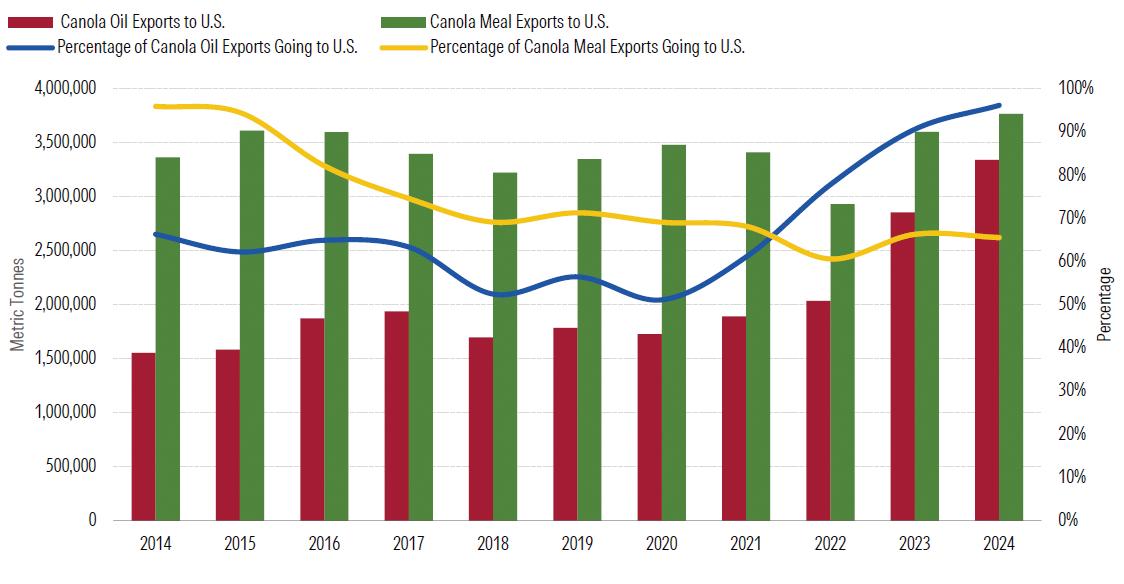
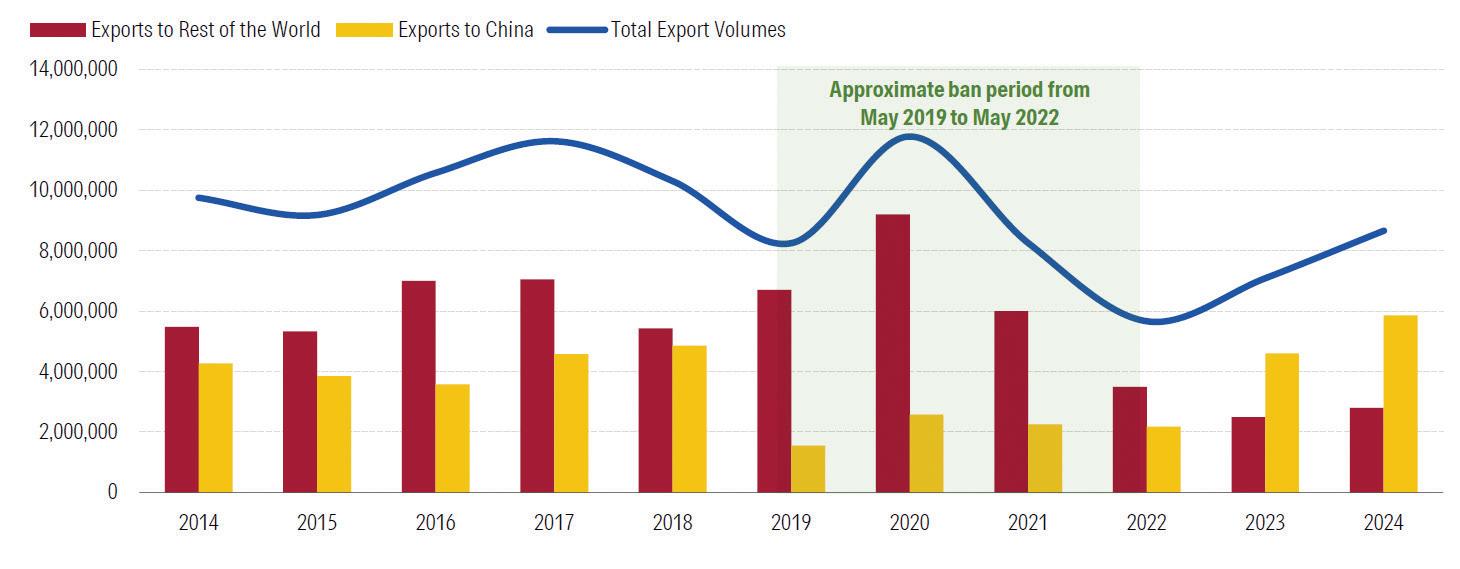
to rebalance, creating new opportunities for Canadian exports in markets such as Europe, Japan and Mexico. The agency also highlighted uncertainty around a potential U.S. response to Canada’s decision to diverge from U.S. policy on Chinese electric vehicle tariffs. The United States remains Canada’s largest export market for canola oil and meal, making
future trade relations a key risk factor.
“While we view the agreement as positive for the canola supply chain, risks and uncertainties continue to linger,” said Moritz Steinbauer, Senior Vice President, Sector Lead, Corporate Ratings.
“These include the evolution of Chinese trade actions over the medium term, a potential U.S. response, and the poten-
tial for increased competition from other markets, like Australia.”
Overall, Morningstar DBRS concluded that while nearterm volatility remains possible, the Canada–China agreement supports longterm credit stability for large, well-diversified Canadian grain handlers with flexible operations and access to multiple export markets.

By Elmer Heinrichs
Soil health has always been important to anyone who wants to grow plants that flourish but never more so than today. Soil degradation due to drought and extreme weather is a global problem that has a direct link to agricultural productivity and food security.
The status of soil health in Canada is not a concern limited to farmers and backyard gardeners. Scientists, policy makers and researchers are recommending urgent action to protect soils to safeguard the future of our food production.
In June 2024, following an 18-month study of soil conditions in Canada, the Standing Senate Committee on Agriculture and Forestry released the report Critical Ground: Why Soil is Essential to Canada’s Economic, Environmental, Human and Social Health.
The report, which is based on testimony from more than 150 experts, concluded that soil in our country is at risk, with implications for food production, climate resilience and biodiversity.
Dale Overton takes soil health and its implications for fertility and food production seriously. His company, Overton Environmental Enterprises, manufactures several microbial products for large-scale agriculture as well as for the home gardener.
Overton is deeply interested in regenerative farming practices and how biological amendments can benefit soil health, carbon sequestration and soil microbiomes, and boost growth rates and crop yields.
A Manitoba success story, Overton Environmental manufactures several products sold under the brand name EcoTea which stands for “engineered compost tea.” This biological amendment consists of an organic blend of humic, fulvic and longchain amino acids, Atlantic kelp extract, simple and complex carbohydrates, and enzymes.
The success of EcoTea in improving soil structure has propelled Overton’s company into involvement
with several major projects. But let’s start at the beginning.
In 2008, Overton was enrolled in a master’s program in biological sciences at the University of Manitoba.
“I was studying quantitative plant ecology with a focus on land reclamation,” he says. “But a few months away from completing the program, I had a major business opportunity to do consulting work. So, I started my business in 2008. At the time, I was primarily identifying insects but my goal for my company was to help reclaim contaminated soils through the use of microbes.”
Today, Overton is a recognized innovator of products using biological solutions — ecological engineering — to improve soil health.
But what exactly is EcoTea and how does it work?
“EcoTea provides specific types of microbes that allow the soil and plants to function better,” says Overton. “When you are transplanting a plant into soil or building a new garden bed, you have disturbed that soil and microbes are needed to repair the soil structure. EcoTea, which is comprised of worm castings, inoculates the soil with beneficial microbes.”
In Manitoba, wholesale plant nurseries such as Aubin Nurseries and Vanderveen’s Greenhouses, both located in Carman, use EcoTea in the soil medium for the plants they supply to their retail customers. Eco-Tea products are also used in the gardens at Clear Lake in Riding Mountain National Park.
For gardeners who are starting their edible and ornamental plants indoors from seed, EcoTea Seed Success is a certified-organic dry-seed inoculant and stimulant that is available at local garden centres. It coats the seed with microbes which help break seedling dormancy. “It’s very simple to use,” says Overton. “Just coat your seeds with a pinch of the product before you plant. EcoTea Seed Success improves germination and results in healthier plants,” concludes Overton.
By Harry Siemens
Agriculture and Agri-Food Canada (AAFC) has begun shutting down major research centres across the country as part of a federal mandate to cut departmental spending by 15 percent over three years.
The closures hit long-standing research hubs in Lacombe, AB; Nappan, NS; Indian Head, SK; Scott, SK; Guelph, ON; and Ste-Foy, QC, along with multiple satellite sites such as the Prairie facilities in Melfort, Saskatoon, Regina, and Swift Current who will also lose staff.
AAFC confirmed the elimination of 665 positions nationwide, with more than 1,000 affected employees already receiving notices.
Deputy Minister Lawrence Hanson called the cuts “difficult but necessary” under the federal budget review.
Notably some of these centres have served farmers for more than a century. The Lacombe Research and Development Centre operated for over 100 years. The Nappan Research Farm in Nova Scotia informed staff this week that operations will shut down. Saskatchewan’s Indian Head and Scott stations face closure. These facilities have delivered results in genetics, forage systems, soil science, disease resistance, crop breeding, and long-term data that private research can never replace.
The worry is that farmers will face climate volatility, shifting disease pressure, evolving pests, market insta-
bility, and rising input costs without regional publicly funded science facilities.
The Canadian Wheat Research Coalition (CWRC) did not mince words.
“These staffing cuts represent a tremendous loss for Canadian agriculture,” said CWRC chair Jocelyn Velestuk. “It’s a loss of people, expertise, and research capacity that fuels innovation and farmer success.”
CWRC backs that claim with investment. Western Canadian farmers commit $19.9 million over three years to AAFC through the coalition’s core breeding agreement.
CWRC also invests more than $9.5 million per year through agreements with the University of Saskatchewan Crop Development Centre, University of Manitoba, and University of Alberta.
CWRC pointed out that the funding does not chase theory. It delivers varieties, resilience, productivity, and competitiveness.
Public research built Canada’s global Ag reputation. It anchored food quality. It supported exports. It created returns for farmers and taxpayers. The concern is in how Ottawa is making its closures, how it is not based on duplication, rather its targeting capacity.
With the removal of scientists and technicians there is a possibility of erasing regional knowledge, breaking up long-term trials and destroying continuity along with decades-long farmer-researcher relationships
and students who may no longer have the pathway into Ag innovations.
Private research will not replace this work. Corporations invest where profits scale. Public research serves regions, systems, and resilience. It serves farmers, not shareholders.
AAFC has not released a full list of affected facilities. Officials cite employee notification processes.
For some, this decision sends a clear signal: fiscal optics matter more than food security. It also contradicts every federal talking point about innovation, sustainability, resilience, and competitiveness. You cannot cut research capacity and claim you support innovation. You cannot dismantle scientific infrastructure and claim you are protecting food security. CWRC continues discussions with AAFC. Producer groups demand transparency. Researchers demand answers. Rural communities demand accountability. These centres did not exist for comfort. They existed because agriculture requires generational science, not election-cycle policy. When focused research disappears, recovery does not follow quickly. Knowledge does not regenerate overnight. Expertise does not reassemble itself. Longterm trials do not resume where they left off. There is mounting concern that Canada chose shortterm savings over long-term strength.
By Joan Airey
Homestyle Beef Stew with Dumplings
Stew Recipe:
4 carrots, thinly sliced
3 potatoes, peeled and cut into ½ cubes
2 onions, thinly sliced
1 bay leaf
¼ cup all purpose flour
1 teaspoon dry mustard
1 teaspoon paprika
½ teaspoon salt
¼ teaspoon fresh ground pepper
2 lbs. stewing beef (1-inch cubes)
1 ½ beef broth
Slow Cooker Method:
In a lightly greased slow cooker combine carrots, potatoes, onions, and Bay leaf.
In a small bowl mix together flour, dry mustard, paprika, salt, and pepper. Coat beef cubes with flour mixture. Add to cooker.
Pour beef broth over beef. Stir well. Cover. Cook on low setting for 7-8 hours or until beef is tender. Remove Bay leaf. Turn setting to high. Drop in dumpling mixture by tablespoonfuls onto hot meat or vegetables. (Do not drop directly onto liquid.) Cover. Cook additional 20-30 minutes or until dumpling are fluffy.
Oven Method:
In lightly greased dish prepare stew as directed above. Cover. Bake at 325F for 2 ½ hours or until beef is tender. Remove Bay leaf. Drop dumpling mixer by tablespoonfuls onto hot meat or vegetables in bubbling stew. Cover. Cook for an additional 20-30 minutes or dumplings are fluffy.
Dumpling Recipe:
1 ½ cups all-purpose flour
2 teaspoons baking powder
½ teaspoon salt
3 tablespoons shortening
¾ cup milk
Directions: In a medium bowl combine flour, baking powder and salt. Cut in shortening thoroughly until mixture resembles coarse meal. Stir in milk. When making this recipe for just two people I use one pound stewing meat and half the dumpling recipe.
Great Pork Chop Bake:
6 pork chops
1 tablespoon canola oil
1 can condensed cream of chicken soup (10oz.)
3 tablespoons ketchup
2 tablespoons Worcestershire sauce
1/2 teaspoon salt
¼ teaspoon pepper
4 medium potatoes cut into ½ inch wedges
1 medium onion sliced in rings
Directions: In skillet brown pork chops in oil. Transfer to a greased 13 by 9 by 2-inch baking dish.
In a bowl, combine soup, ketchup, Worcestershire sauce, salt and pepper. Add potatoes and onion and toss to coat. Pour over the chops. Cover and bake 350F for 55 to 60 minutes until meat juices run clear and potatoes are tender. Yield 6 servings.
This is a great meal for the field or to take to someone’s home. I use a square covered casserole to bake this. When cooking for just two I use the same amount of sauce just cut down on pork chops.
Saskatoon Crisp/Crumble:
1 cup white sugar
2 tablespoons cornstarch
1 cup water
1 teaspoon Almond flavouring
1 teaspoon lemon juice
3 cups Saskatoons fresh or frozen
Directions: In a saucepan combine sugar, cornstarch, and water. Heat to boiling, Cook and stir until thickened. Remove from heat and stir in lemon juice and almond flavouring. Place Saskatoon on the bottom of a 9 x 9 inch pan or casserole dish and drizzle with sauce. Set aside.
Crumble:
¾ cup rolled oats
½ cup brown sugar
½ cup flour
1 teaspoon cinnamon
1 teaspoon butter
Directions: Combine rolled oats, sugar, flour, and cinnamon. Cut in butter until mixture is crumbly. Sprinkle on top of the sauce mixture. Bake at 350Ffor 40-50 minutes or until golden brown. Serve warm or cold with ice cream or whipped cream. Delicious.
All the above recipes have been used in my kitchen too many times to count. Over the holiday season Kaylee, a great young cook I know, made two new recipes that were delicious. I plan to try them in the near future and share them with my readers.

By Harry Siemens
Brian Voth did not walk onto the St. Jean-Baptiste Farm Days stage to hand out price predictions. He came to challenge how farmers think about markets. Voth, a grain marketing advisor and educator, made his point early. A market outlook only matters in the moment it is delivered and emotion often does more damage to farm profitability than poor pricing.
Voth built his career as a grain buyer and marketing advisor before going independent in 2016. He holds a diploma in Agriculture Finance and a degree in Agribusiness Manage-
ment from the University of Manitoba, where he now teaches Ag economics and marketing. His approach stays simple. Take emotion out of marketing. Replace it with planning and discipline.
“What makes a good market outlook?” Voth asked. “Good pricing.”
He followed that with a reality check. If someone tells farmers prices will be good, they feel satisfied. If prices look weak, frustration follows. But markets change constantly. Political decisions, trade headlines, and weather events can shift prices in minutes.
“A market outlook is valid for that day,” Voth

said. “Sometimes not even that long.”
Voth pushed farmers to think about what they actually do with market information. If prices rise, most producers wait. If prices fall, they wait again. Very few act based solely on forecasts. That disconnect, he said, proves forecasts alone do not improve marketing results.
He walked through crop-specific realities, starting with peas. Supplies remain heavy, and export demand from China and India stays uncertain. Without those buyers, peas face pressure.
“We’re swimming in them,” he said.
Soybeans face similar challenges. Manitoba follows U.S. markets closely, and politics drive much of the price direction. Processing plants in North Dakota have improved local marketing flexibility, but U.S. carryout levels still matter more than anything happening locally.
Oats drew blunt honesty.
“Demand has kind of evaporated,” Voth said. He expects better oat prices later in the year but warned producers not to expect miracles. Wheat, despite his well-known dislike for the crop, may surprise.
“I hate wheat,” he said. “But it might suck a little less this year.”
Voth pointed to long-term chart patterns. Wheat markets often move sideways for years before sudden spikes tied to political or weather scares. He warned that any rally should trigger sales, not optimism.
“If you see seven or eight dollar U.S. wheat futures, sell,” he said.
Corn demand remains solid, but Manitoba has too much supply. Record yields created large carryover stocks, forcing corn to move west. Ethanol policy in the United States remains a major risk.
“About 42 percent of U.S. corn goes into ethanol,” Voth said. “That’s a government-driven market.”
Canola, he said, remains one of Western Canada’s most consistent profit crops. Not spectacular, but reliable.
“$12 is too low. $16 is too high,” he said. “$13 to $14.50 is realistic.”
China remains the biggest wild card. Tariffs, politics, and trade negotiations create noise, but China buys when it needs product. Headlines move markets faster than fundamentals.
Voth spent much of his talk on psychology. He walked producers through the March 2025 canola crash, when misleading headlines about Chinese tariffs triggered panic selling.
Cash prices in southern Manitoba dropped nearly $2 per bushel in days.
“Panic is never a good marketing strategy,” he said.

Submitted Photo By Harry Siemens
Prices later rebounded sharply. Farmers who sold in fear felt regret. Those who held based on a plan stayed calmer. Voth said that emotional reactions cost real dollars.
“The market does not care how you feel,” he said.
He urged farmers to question headlines, verify facts, and understand that markets often react to perception before reality. Even incorrect information can move prices. That reality makes planning essential.
Voth stressed the importance of knowing cost of production. Many farms still operate without clear numbers.
“I don’t know how you make decisions without knowing your costs,” he said.
Profitability, not price targets, should drive sales. Selling at a profit remains a good decision even if prices later rise. Selling without a plan creates stress and regret.
Marketing, Voth said, is a battle. So is farming. Winning requires discipline, not prediction.
“Have a plan,” he said. “Set targets. Know your numbers.”
He closed with a broader warning. Western Canada faces rising land, equipment, and input costs. Other countries continue to improve logistics and efficiency. High costs do not mean poor management, but they reduce competitiveness.
“Price is just a number,” Voth said. “What matters is what it does to your bottom line.” His message landed clearly. Farmers cannot control markets, politics, or headlines. They can control preparation, discipline, and emotion. That, Voth said, is how you win the mental side of grain marketing.
By Joan Airey
With the temperature at -32C and with the wind chill at -38C only indoor gardening is feasible here in Manitoba.
Over the past few weeks publishers have sent me four new gardening books to read.
The Essential Guide to Ecological Gardening put out by the American Horticultural Society is full of very interesting gardening info. Information on making leaf mould is contained in the book which is an interesting subject for gardeners.
Leaf mould is a simple ecological gardening task, and it takes care of several challenges you may face. It’s a great use for the fallen leaves in your yard. I have a friend who lives in town who gathers his neighbours’ leaves to mulch for his garden too. He has one of the best gardens in our area.
It’s valuable mulch.
It creates habitat for invertebrates. It’s free.
Leaf mould is also easy to make (much more so than high quality compost). Leaf mould essentially is compost, as fungi work to break down the dead leaves.
You can make leaf mould in place, right in your garden. In this way, you’re providing great insulation over the winter for the plants and roots underneath.
As the weather warms in the spring you may need to clear away some of the leaves that haven’t broken down yet so dormant plants can reinvigorate and those waiting just beneath the soil can emerge.
If you live in a windy area, you might need to
they don’t blow away before they have a chance to do their job. You can remove the fence in the springtime, once the leaves are mostly decomposed.
Another book I found really interesting, Continuous Vegetable Garden by Charlies Nardozzi, tells of Italian storage tomatoes that have a long-storage life as fresh tomatoes.
These winter tomatoes are red and small fruited cherry tomatoes which have a low water content making them good for long time storage. Supposedly, they last up to four to six months as fresh tomatoes. These varieties are now available in the states. I haven’t heard if these are available in Canada.
As a gardener, something that irritates me is when I read a Canadian gardening magazine, they list a great vegetable seed and then I find it is available only in the United States.
One is the Super Sauce Tomato which Burpee’s has, but you cannot buy in Canada. I was given some of the seeds two years in a row and they were extra-large paste tomatoes but my source passed away.
Another seed I’d like to get my hands on is a High Impact Red Pepper. It’s listed as $8.95 USD. Some Burpee Seeds are sold in Canada but these two I have never found.
I do buy most of my seeds from Vesey’s and T&T Seeds. Importantly I try my best to buy Canadian no matter what I’m buying, but some seeds just aren’t available in Canada.
Some garden produce is getting low in my freezer and cold room.
Last evening my cousin and I did some research on Super Sauce Tomatoes which are available from Amazon.
May 2026 be a great gardening year. Goodluck to you all.

By Elmer Heinrichs
An empty Manitoba restaurant has been sold for $1 and will be transformed and used as a cricket farm. The former M&M Café in rural Benito will be converted into Sparrow Farms, a live cricket farm, and the Swan Valley Pet Supply Store.
Cricket farming in Manitoba is a growing niche, led by Prairie Chicken Farms, which produces protein powder and roasted crickets from indoor farms near Miami, MB. It showcases sustainable nutrient-dense food production for humans and pet food.
This industry also sees potential for the cricket frass fertilizer after Canadian Food Inspections’ Agency early 2024 approval as a registered fertilizer.
The Benito MB based agricultural business highlights the diversification in Manitoba’s agriculture sector.