
Opens Innova Canada

Tax Relief for Prairie Livestock Producers Facing the Impacts of Extreme Weather
Canadian farmers are directly impacted by climate change and its effects can be detrimental to sustain ing operations. To provide assurance for producers as they make difficult herd management decisions, the Livestock Tax Deferral has been authorized for 2022 due to extreme weather conditions has been announced for designated regions including parts of Manitoba.
The Livestock Tax Deferral provision allows livestock producers who are forced to sell a signifi cant amount of their breeding herd due to drought or flooding to defer a portion of their income from sales until the following tax year. The income may be at least partially offset by the cost of reacquiring breeding animals, thereby reducing the potential tax burden associated with the original sale.
Under the Livestock Tax Deferral, to defer in come, the breeding herd must have been reduced by at least 15%.
On September 21, Topigs Norsvin officially opened its new nucleus farm Innova Canada which cost about $30 million, near Plumas, MB. The company said the new facility Innova Canada is an impor tant step in developing Topigs Norsvin as a global genetics supplier. The new nucleus farm is part of a bigger plan to upgrade and expand the nucle us capacity in Canada. Innova Canada is the largest invest ment in Topigs Norsvin’s his tory, leading to increased ge netic progress worldwide.

Innova Canada will con tribute to further accelerating genetic progress in the Z-line, one of the lines that form the basis of the TN70 sow.
Canadian sales manager John Sawatzky said swine genetics is what the company Topigs Norsvin does. While based in the Netherlands and Norway they do business in more than 50 countries worldwide.
The new 1,600 Sow Z-line nucleus at Plumas becomes the genetic nucleus to further genetic improvements to the breed, accelerating the genetic progress with a large volume
of pigs. This is in addition to the Delta Canada unit at Woodlands, MB opened in 2018 strictly as a boar-test ing and CT-scanning facility. From here, the best boars get shipped worldwide or to local AI stations in Canada, the US, and worldwide.
It takes about five years be fore the farmer sees the benefit of such a new facility. Howev er, Topigs Norsvin celebrated 100 years in this business last February stemming from the original breeders back in the Netherlands who started a very intensive testing program.

Sawatzky said as the ge netics improve they show up in the tube of semen the farmer buys to make his replacement females on the farm. And getting bet ter means more prolificacy, better females, raising more pigs per sow, increasing the efficiency by reducing the feed consumption they feed to grow to slaughter weight, to go to market. It also re duces the feed intake and the manure produced from these barns to reduce our carbon footprint.

Continued on Page 2...
Eligible regions have been identified based on weather, climate and production data, in consulta tion with industry and provinces. The criteria for identifying regions for Livestock Tax Deferral includes forage shortfalls of 50 per cent or more caused by drought or excess moisture. The Gov ernment of Canada will continue to monitor condi tions across the country to determine whether the addition of other regions throughout the year are required.
In addition to the Livestock Tax Deferral provi sion, producers have access to a comprehensive suite of Business Risk Management (BRM) programs to help them manage significant risks that threaten the viability of their farm and are beyond their capacity to manage. BRM programs are often the first line of support for producers facing disasters and farmers are encouraged to make use of these programs to protect their farming operations.
At the grand opening guests explored the Verijken Pro Dromi free-farrowing system in the farrowing barn. Photo by Harry Siemens By Harry SiemensThe AgriPost
Topigs Norsvin Opens Innova Canada

“We’re probably one of the few that talks about envi ronmental issues and carbon footprints and what we’re do ing to reduce it,” said Sawatz ky. “Not only for ourselves, but our customers as well, be cause we know whether it’s an issue today or not, but it’s an upcoming issue.”
After making the improve ments in genetics at the facil ities the benefits flow to the farmer level.
As the most innovative ge netics company with social responsibility at its heart, Topigs Norsvin built Innova Canada with the highest ani mal welfare standards locat ed in a part of Manitoba with high biosecurity and low pig density.
It has room for 1,600 sows, Z line Genetic Nucleus, part of the Delta Canada blue print with two sites. Site one is sow and nursery and site two for finishing gilts. It has 750 breeding stalls including space for 255 gilts every five weeks. Gestation, small pens with individual feed drops, is a simple system especially with high replacement rate and proven at Paradise Val ley. Three hundred and sixty free farrowing pens, 150 per cent replacement rate. It includes internal trucking, washing and storage for bi osecurity and on-site pond water storage with a water treatment plant and 25 fulltime employees.

Peter van Kemenade, di rector of global supply chain management said, “Innova Canada will be one of the two core locations for creating genetic progress. The other one is in Norway. Both are connected with a Delta test station to rear and test young boars from the nucleus. Our structures in Canada and Nor
way are unique and unprec edented in pork genetics.”
He sad customers of Topigs Norsvin will notice the effect of Innova Canada. Genetic progress will accelerate and this higher progress will be delivered faster.
“Canada’s Ready” Campaign Launched
By Elmer HeinrichsAgriculture groups across Canada have launched a “Canada’s Ready” campaign – a grassroots public aware ness campaign- to show Ca nadians and the world that our farmers, processors and exporters are ready to step up and deliver.

They suggest the fall of 2022 represents the most important harvest in a gen eration.
As they see it, Canada’s farmers, processors and exporters are being called upon by governments and countries around the world

to step up to help alleviate the extreme pressure on the global food supply being caused by the war in Ukraine and other global supplychain challenges.
The campaign encourages anyone working in the agri culture industry to participate by taking a photo on the job and sharing it online with the hashtag “Canada’s Ready”.
To ensure there are no weak links in Canada’s agriculture supply chain, groups are call ing for increased transpar ency throughout Canada’s shipping logistics systems.
Canada’s two major railways
will soon submit to the gov ernment their grain plans for the 2022-23 grain year.
Canada’s agriculture indus try at large has developed a four-point plan to ensure that farmers, processors, export ers, and consumers in Cana da and around the world have confidence not only in these plans but in Canada’s overall ability to deliver.
Groups also committed to continue to play a construc tive role to improve Canada’s overall supply-chain resilien cy and build its international reputation as a reliable ship per of agricultural goods.
 “This will boost the per formance in our customers’ barns, leading to a higher profit,” said van Kemenade. “Reliability will also in crease. Animals and semen will be available in higher numbers and constant flow.”
The Verijken Pro Dromi free farrowing pens.
Dr. Brad Chappell, the Topigs Norsvin veterinarian, explaining the tight bio-security program to maintain the health of the herds.
Officials from the local municipality, provincial government, Manitoba Pork Council, Topigs Norsvin executive and Topigs Norsvin Supervi sory board chairmen from Holland and Norway cut the ribbon to open Innova Canada officially.
Photos by Harry Siemens
“This will boost the per formance in our customers’ barns, leading to a higher profit,” said van Kemenade. “Reliability will also in crease. Animals and semen will be available in higher numbers and constant flow.”
The Verijken Pro Dromi free farrowing pens.
Dr. Brad Chappell, the Topigs Norsvin veterinarian, explaining the tight bio-security program to maintain the health of the herds.
Officials from the local municipality, provincial government, Manitoba Pork Council, Topigs Norsvin executive and Topigs Norsvin Supervi sory board chairmen from Holland and Norway cut the ribbon to open Innova Canada officially.
Photos by Harry Siemens
September 30, 2022 The AgriPost2
Continued from Page 1...
New e-Book Celebrates 150 Years of Agricultural History in Manitoba
The governments of Canada and Manitoba have launched 150 Years of Farming in Manitoba, an e-book developed in part nership with Keystone Ag ricultural Producers (KAP) that shares the 150-year evolution of the agricul ture and agri-food sector in Manitoba.

“The 150 Years of Farm ing in Manitoba e-book ac knowledges the hard work and dedication of our farm ers and is an outstanding tribute to all the farming communities in Manitoba,” said federal Agriculture and Agri-Food Minister MarieClaude Bibeau. “The agri cultural sector is a pillar of
our economy and our farm ers are sustainably produc ing food of internationally recognized quality – a true success story over 150 years in the making.”
The e-book highlights the economic, societal and en vironmental benefits of ag riculture in Manitoba with a particular focus on the inno vations of the last 50 years including those related to animal care, crop produc tion, soil research and food safety.
“Our government is proud to support the province’s dynamic and modern ag riculture sector and to cel ebrate Manitoba’s farmers who work tirelessly to sus
tainably meet the growing local, national and global demands for food in an en vironmentally conscious way,” said Manitoba Ag riculture Minister Derek Johnson. “Our province was founded on agriculture and this e-book provides an important opportunity for our agricultural producers to showcase their ongoing dedication to a safe and reli able food supply.”
Support for the e-book ini tiative has been shared be tween the federal and Mani toba governments using funds through the Canadian Agricultural Partnership, developed in partnership with KAP.

“Agriculture in Manitoba has evolved through the hard work and innovation of those who have come before us and by those who contin ue to lead us today, and be ing able to reflect on the pre vious 150 years gives us an opportunity to bring forward the lessons of history,” said Bill Campbell, president, KAP. “Throughout the past 150 years, agriculture has defined Manitoba’s people and has been the backbone of the province’s economy. This story pays tribute to the voices and forces that have shaped Manitoba itself.”
The e-book can be viewed online at Agricul tureMB150.ca.
Growing Project Harvests Underway
By Elmer HeinrichsHarvest season in Mani toba began much later than most years because of very wet conditions earlier this year that delayed spring seeding, says Manitoba re gional coordinator for Cana dian Foodgrains Bank Gor don Janzen.
But now groups of farmers working in local communities across Manitoba are harvest ing a variety of crops which will be sold and the proceeds donated as a response reduce world hunger.


While two growing proj ects harvested fall rye fields in August, Janzen says the Crossborders project at Kola near the Saskatchewan bor der hosted the first commu nity harvest on September 2.
A community lunch for 150 people was enjoyed be fore the Crossborders group with 16 combines cleared 250 acres of wheat in just a few hours.
“I look forward to join ing growing projects that will be harvesting crops in the coming weeks and even into October,” adds Janzen. They give me an opportu nity to meet the volunteers that have worked all season to grow the crops and to say ‘thank-you’.”
Labour Day found volun
teers at the Heritage Harvest growing project at Austin, MB, harvesting 65 acres of wheat using vintage swathers and combines. There’s a wonderful community spirit at this project which sup ports both the Manitoba Ag ricultural Museum and Ca nadian Foodgrains Bank.
The FOCUS growing proj
ect near Portage la Prairie manages several fields in their project with help from a variety of agricultural busi nesses throughout the season. Airport Hutterite Colony helped the FOCUS project by sending five combines to combine 65 acres of wheat on Labour Day evening.
 The governments of Canada and Manitoba have launched 150 Years of Farming in Manitoba, an e-book developed in partnership with Keystone Agricultural Producers (KAP) that shares the 150-year evolution of the agriculture and agri-food sector in Manitoba. Ebook cover
irport Hutterite Colony helped the FOCUS project by sending five combines to combine 65 acres of wheat on Labour Day evening. Submitted photo
The governments of Canada and Manitoba have launched 150 Years of Farming in Manitoba, an e-book developed in partnership with Keystone Agricultural Producers (KAP) that shares the 150-year evolution of the agriculture and agri-food sector in Manitoba. Ebook cover
irport Hutterite Colony helped the FOCUS project by sending five combines to combine 65 acres of wheat on Labour Day evening. Submitted photo
3September 30, 2022The AgriPost
Take All of the Gratitude, and Find a Way to Make a Difference
to now be at an im passe. Meaning re lationships are on hold or simply say hi in passing. Very tough to be truly thankful when at titudes and heart conditions like that prevail.
he’s going to get.”
So what will you do this year to express your thank fulness not only on Thanks giving Day but all year around?
Yes, it’s October 10 this year when Canadians of ficially mark Thanksgiving Day but my question is what does it mean to you? Over the last three years many people have fallen prey to complain ing and clamouring about this or even getting into spats with long-time friends and family members that seem
“And now abideth faith, hope, charity [love], these three; but the greatest of these is charity [love]”.
I scouted Google for vari ous thoughts on being thank ful. “Be thankful for what you have; you’ll end up hav ing more.” “Thanksgiving is a time of togetherness and gratitude.”
“Gratitude is not only the greatest of virtues but the parent of all the others.”
““If a fellow isn’t thank ful for what he’s got, he isn’t likely to be thankful for what
I came across a list of alter native ways to spend Thanks giving that will embrace the true spirit of the holiday. Also, to help take the focus off the bad and unthankful feelings you may harbour in your mind and heart. When I write these columns espe cially some that reach deep down into my inner being I deal with them first and then write them for others to read.

Take a look at some of the best ways to give thanks on Thanksgiving
1. Volunteer to help make the holiday brighter for someone less fortunate. As I told some one recently the two highest callings for me are to offici ate at weddings and funerals.
That also includes singing in quartets and groups at these functions of course mostly
funerals. (Umpiring fastball games a close second lol.)
Years ago I was laying on our couch in Altona and this man’s face kept flashing through my mind. Finally I yielded to my conscience and drove down to see him in the local personal care home.
Yes, he needed my visit but blessed the preverbal socks right off me. Do something for someone else where you don’t expect anything in re turn.
2. Extend an invitation to someone who would wel come the company.
3. Make an extra meal to share this Thanksgiving sea son.
4. Make a donation.
5. Visit a nursing home or hospital.
6. Share your favourite memories.
7. Help guests express their
thankfulness.
8. Take all of the gratitude, and find a way to make a dif ference.
Let me comment on the last two. Instead of focus ing on yourself and allowing the other person to focus on their trouble and worries, ask them, what are you thank ful for? Help people express their thankfulness.
Take all of the gratitude, and find a way to make a dif ference. Now you may ask what is Harry getting at now.
I wasn’t sure when writing this but it sure came to mind quickly. At first, before list ing those things to be thank ful for, you may not want to make any difference to anyone especially yourself.
Ok. Now take all that bottled thankfulness and find a way to make a difference. You’ll be glad you did.
Teaching Old Farmers New Tricks
By Sheila ElderThe more I learn, the more I realize how much more I have to learn.
I have been a delegate on Manitoba Crop Alli ance’s (MCA) wheat and barley crop committee since 2020. One of the first things I learned about MCA was how wrong my assumptions had been – about what getting in volved would be like, as well as what I could bring to the table.
I did not grow up on a farm, but my husband did. He went to college, worked for Manitoba Hydro for 10 years, and then took a leave to try out farming with his father. That leave eventu ally became permanent and we transitioned into farm ing full-time. Early on, my involvement with the farm was limited. I helped where I could – driving truck, handling the books and payroll, making meals and raising our two kids – but I was very naïve, with little
knowledge about farming or the broader agriculture industry.

About five years ago, I started taking agronomy courses. I have a science degree but assumed that it was not relevant to farm ing. What I came to learn was that farming is a sci ence itself, and my chem istry minor really helped me to understand and ap preciate soil chemistry, nutrients and different soil types.
Some of the other assump tions I had before getting involved with MCA were:
1) I would not have enough knowledge to offer, 2) the time commitment would be too large for our busy farm schedule, and 3) being one of the few female farmers might mean it would take more time to be accepted into the group. I am happy to say I was wrong on all counts.
Everyone has something different to offer and is valued for their unique
contributions. The time commitment has been very manageable, with most meetings held in the late fall, winter or early spring. Finally, everyone is wel come and encouraged to give input, regardless of their gender.
I am extremely grateful for this welcoming atmo sphere and how each dele gate’s input is valued and respected. You also get a voice in where check-off dollars are allocated and there are lots of opportu nities to learn, share and connect with others in the industry.
While serving as a del egate, I have learned so much, and I love that there are so many incred ible ways to keep learning, too. That learning can be passive and quite casual –through visiting with other delegates, board members and staff from MCA at dif ferent events or meetings. It can also be quite active – for example, by taking
part in sub-committees and reading about the many re search projects MCA helps fund.
I am very interested in science, agronomy and re search, so the opportunity to take part in sub-com mittees that encompassed these areas was a huge plus for me. I gained important knowledge about the many projects in the works, as well as those that are look ing for funding. The oppor tunity to read research pro posals may not be a perk to some, but I find it very in teresting to see the years of work in research that goes into helping us grow com petitive crops. I love seeing the many groups and levels of government all working together and I am fortunate to have been able to meet many of these people. We need them all to improve and be successful, both as individual business owners and as an industry.
Each farm is unique, with its own priorities and man
agement style affected by things such as soil type, local climate, topography and how well the specific crops fit into their system. For this reason, each mem ber has their own unique experiences, skills and in formation to bring to the table. Being a part of MCA truly feels like you are on a winning team – they rely on the diverse knowledge and experiences of each director and delegate to create a stronger, unified voice for farmers.
If you pay check-offs on wheat, barley, corn, sun flowers or flax, I urge you to seriously consider put ting your name forward during MCA’s current nomination period. It is an experience I truly feel privileged to be part of, and I think you will too.
Sheila Elder is a delegate on Manitoba Crop Alli ance’s wheat and barley crop committee. She and her husband Jeff farm near Wawanesa, MB.
September 30, 2022 The AgriPost
Farming is Losing to Misguided Urban Politics
By Sylvain CharleboisMost Canadians have never been on a farm, let alone lived on one, which makes more than 98 per cent of our popu lation agriculturally illiterate.
For many Canadians, crop production is an unknown concept. Because of this, it’s relatively easy to use fear to influence public opinion on any food-related issue in volving agriculture. Activists know this well.
Our great rural-urban di vide has always fuelled food politics, and that’s not going to change anytime soon. But now, agri-food policies are increasingly being urbanized by an agenda that’s pushing the entire Western world to ward the precipice of a food security catastrophe.
The Trudeau government wants a 30 per cent reduction in emissions by 2030, which doesn’t necessarily include fertilizer. But producers claim that reducing nitrous oxide emissions can’t be achieved without reducing fertilizer use.
Most common fertilizers contain nitrogen, phospho rus and potassium. Nitrogen is the issue. Surpluses of nitrogen in the atmosphere can produce pollutants such as ammonia and ozone. Too much nitrogen will contami nate soils and waterways and, of course, harm our health.
Policy-makers have every right to be concerned.
But the federal government wants an absolute reduction in emissions, regardless of productivity or efficiency of fertilizer use. For many crops, Canadian farmers’ ability to grow anything will be severely compromised un less they use more land.
This is all happening as food security concerns around the
Crops Looking Good, Stats Canada Ups Size of 2022 Crop
world are rampant. The Neth erlands is witnessing massive protests from farmers as they face similar emission targets, even fertilizer bans, by 2030.
And make no mistake: Can ada could be next to adopting outright fertilizer bans.
It’s unclear how food prices would be impacted. But pro ducing food on a large scale would likely become much less cost-effective. The cor relation between commodity prices and food retail prices is typically not that strong, but a wide-reaching policy impact ing an entire industry all at once could very well make it stronger.
Canada produces food for the world, not just for Cana da. Aggressive emission tar gets will likely lead to more people, not fewer, experi encing famine worldwide, none of whom will be Ca nadian. Since we trade with the rest of the world, mainly with the United States, our crops would likely become less competitive. With lower supplies, input costs for food manufacturers and grocers would likely increase signifi cantly, pushing food prices higher. This is one aspect of the emission reduction issue in farming.
The needs regarding food production vary widely from region to region and between crops. Supply-managed com modities like dairy, eggs and poultry will be spared, receiv ing more for their products no matter what. Most of these commodities are produced in Ontario and Quebec.
Grain production, on the other side, won’t be so pro tected. Suggested emission targets will again transfer more wealth from some sec tors to others by compromis ing the livelihood of many in
By Elmer HeinrichsIn 2022, Canadian farmers are projected to produce more wheat, canola, barley, oats, soybeans and corn for grain, according to recent yield model estimates. Increased production was largely driven by better growing conditions in Western Canada.
In parts of the Prairies, high er-than-average precipitation and more moderate tempera tures have resulted in better crop conditions than in 2021.
Reports from Manitoba pro vincial government indicated that crop conditions in the province were better than in 2021 and that yields are an ticipated to be near normal.
ternationally-focused farming businesses. And those farm ers come from across Canada. Free-market livestock sectors like cattle and hogs are also affected by all of this.
This is all happening for one reason, beyond the focus on emission targets. The gov ernment is already imposing a 35 per cent tariff on Rus sian fertilizer, even if tariffs aren’t actually punishing the Russian regime. This only impacts our farmers as our government wants to discour age the use of fertilizers for its own convenience.
The Canadian fertilizer emission reduction plan also points to how farming is los ing to urban politics. The signals have been there for a while, with “No Mow May,” bees on cereal boxes and city councils ruling on pesticides. Activists are successfully us ing urban-centric artefacts to influence policy issues, which could spill over to ag riculture. Cities essentially want farmers to treat fields like city lawns. But the stakes are much higher for farming.
This has been happening as activism has become institu tionalized in recent years. In terest groups, even academics who have become advocates, will weaponize science to support a narrative that fits with a biased view of what farmers should and shouldn’t do. This is beyond dangerous. It’s a reckless way of dictat ing policy.
Virtue signalling – sup porting ideals over fact – is practised by those who likely see their quality of life being affected. They’re also dead wrong. This goes for all is sues, but food and energy policies are the ones that will be felt most acutely.
The federal government
Dr. Sylvain Charlebois is senior director of the agri-food analytics lab and a professor in food dis tribution and policy at Dalhousie University.

wants to make agriculture greener and more sustain able. There’s nothing wrong with that; the sector can al ways do better. Many are speaking about regenerative agriculture and the circular economy. Those concepts have merit and can help our agri-food sector become more efficient.
But what is not appreciated is how farming has evolved in just the last five years, adopt ing more sustainable practic es. Crop rotation schedules, biodiversity considerations and the no-till approach have all made agriculture more sustainable, helping farmers reduce emissions.
Farming is a business, and cutting costs is part of doing business. Farmers don’t want to overspread expensive fer tilizers since this would make their business less profitable. Most farmers hire soil scien tists to ensure they can rely on reusing natural resources to make a living.
Farmers are the most respon sible environmental stewards in the world. Incentivizing farmers using productivitybased metrics linked to fertil izer would be more appropri ate – and less foolish.
The government can look at other sectors to hit targets but messing around with our food system can be quite perilous.
KAP Urges Safety During Harvest Season
By Elmer HeinrichsWith harvest underway across Manitoba, Keystone Agricultural Producers (KAP) is encouraging all farm ers to make safety a top priority.
“We need to be able to take time to ensure that safety is paramount and uppermost in farmers’ minds,” said KAP president Bill Campbell, adding that the higher stress and list of priorities during this time of year can sometimes lead to accidents and injury.
These accidents, Campbell said, can cause delays and workforce problems that can be avoided by slowing down.
“Sometimes it’s better to take a moment and think about safety and how to accomplish a task rather than just forcing the task and carrying on,” he said.
Some steps Manitobans can take - both on and off the farm - to stay safe during the harvest season include driving respectfully and sharing the road with slowmoving farm equipment, ensuring all lights on equip ment are working properly, being aware of height, length and weight restrictions on farm vehicles and when permits may be required, not operating machin ery when sleepy, and regularly inspecting and main taining equipment.
When it comes to keeping young people safe, it’s im portant to create a separate and supervised play area for children on the farm and identifying which farm tasks may be appropriate for youngsters based on their age and skill levels.
It’s important to be aware of farm machinery and equipment that have a power take-off (PTO) device, which transfers an engine’s mechanical power to an other piece of equipment, such as running a jackham mer using a tractor engine, Campbell added.
“Make sure that you are safe and guards are in place,” Campbell said.
Running behind the harvesting schedule can cause a rise in stress for farmers, which Campbell said can con tribute to accidents on and around the farm. He added that it’s important for farmers who are facing mental health challenges, such as high stress and anxiety, to seek support.
“Reach out to each other … speak to your spouse, speak to your workforce. I think communication is a huge part of being able to handle mental stress.”
KAP safety consultant Morag Marjerison said farm ers need to be aware that even temporary workers are required to undergo a safety orientation.
Safety legislation requiring orientation for new hires applies to all industries, including farms. But farmers may be unaware of those regulations, especially when it comes to short-term harvest hires.
The crop condition assess ment program indicates that overall plant health in the Prairie Provinces was simi lar to higher-than-normal at the end of July, indicating the possibility of normal to much higher-than-normal yields.
Nationally, wheat produc tion is projected to increase by 55.1 per cent year over year to 34.6 million tonnes, largely attributable to higher anticipated yields, which are expected to rise by 41.6 per cent to 51.1 bushels per acre. Harvested area is also ex pected to rise to 24.9 million acres. The increase in expect ed total wheat production is largely attributable to spring
wheat, which is anticipated to rise by 57.3 per cent to 25.6 million tonnes. This increase is a result of higher antici pated yields, 52.7 bushels per acre, and higher harvested area, rising to 17.8 million acres. In Manitoba, wheat harvested area is expected to rise by 11.4 per cent to 3.2 million acres, while yields are anticipated to increase by 20.5 per cent to 57.7 bushels per acre. Total wheat produc tion is anticipated to rise by 34.2 per cent year over year to 5.0 million tonnes.
Nationally, canola produc tion is expected to rise by 41.7 per cent to 19.5 million tonnes in 2022, as growing
conditions in the Prairies improved considerably rela tive to 2021, pushing yields higher, up 47.8 per cent to 40.5 bushels per acre.
In Manitoba, yields are ex pected to rise by 31.5 per cent to 43.0 bushels per acre, off setting an anticipated 3.8 per cent decrease in harvested area to 3.3 million acres, re sulting in an expected 26.5 per cent production increase to 3.2 million tonnes.
Nationally, corn for grain production is projected to in crease by 6.0 per cent to 14.8 million tonnes in 2022, be cause yields are anticipated to rise to 163.9 bushels per acre, and harvested area is expected
to rise to 3.6 million acres.
Soybean production is pro jected to increase by 1.8 per cent year over year to 6.4 mil lion tonnes in 2022. Yields are expected to rise by 3.7 per cent to 45.3 bushels per acre, while harvested area is antici pated to decrease by 1.7 per cent to 5.2 million acres.
In Manitoba, soybean pro duction is projected to in crease by 13.6 per cent to 1.1 million tonnes. Harvested area is projected to decrease by 14.3 per cent to 1.1 mil lion acres. But yields are pro jected to rise by 32.5 per cent to 35.9 bushels per acre since moisture conditions have im proved.
September 30, 2022The AgriPost
New Provincial Apiarist Hired
Crop Production in Primary Agriculture Branch is excited to welcome Derek Michol son who will be starting as the Provincial Apiarist on October 3.

While completing a BSc in Environmental Sciences at the University of Winnipeg, Derek’s beekeeping experience began in 2009 when he started working as a summer stu dent in Dr. Rob Currie’s bee research lab in the Department of Entomology at the Uni versity of Manitoba. After completing his bachelors, Derek continued on as a full-time research technician in the bee lab for 5 years before deciding to pursue an MSc in En tomology (focusing on honey bee grooming behaviour), which he recently completed.
Most recently, Derek was the Program Lead of the Knowledge & Research Transfer Program - Manitoba’s first tech transfer pro gram for apiculture.
Derek has also worked as a provincial honey bee and leafcut ting bee inspector and held the inspection contracts in 2019 and 2020.
In his spare time, Derek is also a hobby beekeeper, having run a small honey business for the last 8 years.
Derek Micholson will be starting as the Provincial Apiarist on October 3.
Canadian Government Announces Enhanced ASF Prevention and Preparedness
The Government of Canada has committed $45.3 million to enhance efforts to prevent African swine fever (ASF) from entering Canada and prepare for a potential out break. The funding will be critical in reducing the risk of introduction and spread of ASF in Canada.
ASF is a fatal swine disease that spreads through both di rect and indirect contact with infected pigs, pork, and pork by-products. Preventing the spread of ASF into Canada requires a collaborative ap proach to protect Canada’s pork industry, while help ing the industry prepare for a timely and coordinated re sponse to limit the potential impact of an outbreak.
To help ensure high lev els of vigilance in the face of the threat of African Swine Fever, they are investing up to $23.4 million to support the pork industry’s preven tion and mitigation efforts. This funding is intended to support critical priorities for preparedness, such as biosecurity assessments, co ordination for wild pig man agement, retrofit of existing abattoirs, sector analysis and ASF-related research projects. Program details are being developed and the
program will be launched as soon as possible.
In addition, up to $19.8 million will be invested in the Canadian Food Inspec tion Agency’s (CFIA) pre vention and preparedness efforts. This is intended to support work such as further enhancing laboratory capac ity, establish zoning arrange ments with additional trading partners, and contributing to international efforts to de velop a safe and effective ASF vaccine that meets the needs of Canadian farms.
Although Canada has never had a case of ASF, the disease continues to spread in several regions around the world. A single case of ASF in Canada would immedi ately result in the closure of Canada’s borders to pork exports, which accounts for 70% of Canadian pork pro duction. With up to $2.1 million in funding dedicated to enhancing the Canada Border Services Agency’s (CBSA) border control ac tivities, the Government of Canada intends to support measures that continue to prevent the entry of highrisk pork and pork products by enhancing public aware ness, improving commercial targeting, and developing
training for border services officers.
“ASF is one of the biggest threats to the Canadian hog sector. More than 70% of our pork is exported, mak ing Canada the third-larg est pork exporting country in the world,” explained Chris White, President and CEO of the Canadian Meat Council. “Prevention is key to avoid the entry of ASF, but preparedness will allow the pork industry to reduce the impact of the disease for a quicker recovery. This funding will provide indus try and government with further resources to continue the development of the ASF Canadian action plan and be prepared for a potential out break.”
“We have seen the negative impact of ASF in other parts of the world which demon strates the need for this col laboration between govern ment and our sector,” stated Rick Bergman, Chair of the Canadian Pork Council.
Through close collabora tion with domestic and inter national partners, the Gov ernment hopes that being proactive will help prevent and mitigate the potential im pact of ASF should it ever be introduced into the country.
Another Option to “Squeal on Pigs”
A new collaboration be tween the Manitoba Invasive Swine Eradication Project, Manitoba Pork, and Farm Health Guardian provides another easy way to report wild pig sightings. Wild pig sightings can now be easily collected and automatically reported to Squeal on Pigs using the free Farm Health Guardian app.
Squeal on Pigs MB was launched earlier this year through the Manitoba Inva sive Swine Eradication Proj ect, a partnership between the Government of Canada, Province of Manitoba, and Manitoba Pork, to get a better understanding of the wild pig population in the province, and to concentrate eradication efforts in the right areas.
Increased wild pig sight ings are causing concern in the North American swine industry, including in Mani toba. It is suspected that the wild pig population in the province is growing, which is a real risk to agriculture because they can be very de structive to crops and are a potential reservoir for feder ally reportable diseases like African Swine Fever (ASF). Given the serious disease threat that wild pigs pose to farm raised pigs, producers and others in the industry are being asked to report sight ings immediately.
“The support of Farm Health Guardian and its tech nology will further improve the Squeal on Pigs initia tive and Manitoba Invasive Swine Eradication Project by
providing quicker and more direct and efficient reporting of locations and movements of invasive pigs,” said Mani toba Agriculture Minister Derek Johnson. “Wild pigs have the potential to cause serious harm to our prov ince’s swine industry, and rapid communication is cru cial for delivering effective responses to control them.”
“Our province is at an eco logical and environmental crossroads when it comes to dealing with the threat of wild pigs,” said Dr. Wayne Lees, project coordinator, Manitoba Invasive Swine Eradication Project. “We are pleased to … establish a new avenue to report wild pig sightings which allows us to better target our eradication efforts.”

September 30, 2022 The AgriPost
Heartland Rodeo Celebrates 25 Years

Strathclair Agricultural Society Receives Funding for “Hometown Roots Family Contest”
By Joan AireyDarren Rozdeba was the Manitoba win ner of the Hometown Roots Family Con test on September 7. As winner he selected Strathclair Ag Society as the recipient of the $5,000.


“I farm with my brother Marcel and we decided we wanted the money to go to an agrelated organization,” said Darren Rozdeba, who farms in the Strathclair area. “The Strathclair Ag Society has been supporting ag-related work in our community for many years, and it’s an organization we felt could use the money.
“The Strathclair Ag Society intends to use the award money to support upgrades to the community fair grounds facility. I’d like to thank both Lallemand and J.S. Henry for giving back to producers and their commu nities.” said Rozdeba.
Contestants had to have purchased Lalle mand inoculants including Lalfix spherical Granule for pulses and soybeans or Lalfix
 Congratulations to all the competitors and board members with Heartland Rodeo As sociation. The 2022 season marked a milestone for the association as it celebrating its 25th anniversary.
The AgriPost and Dawson Trail Dispatch were proud to sponsor the finals bull fighter buckles. Congratulations to Jim Bob Pitura (above) and Northstar Stonechild (below) for the skills you have developed to protect the bull riders!
Submitted photos
Proyield Liquid Soybean or by writing an es say explaining what farming means to them and how they leverage the funds to support their community. A winner was picked in each of the Prairie Provinces.
Strathclair Ag Society was the recipient of the $5,000. Submitted photos
Congratulations to all the competitors and board members with Heartland Rodeo As sociation. The 2022 season marked a milestone for the association as it celebrating its 25th anniversary.
The AgriPost and Dawson Trail Dispatch were proud to sponsor the finals bull fighter buckles. Congratulations to Jim Bob Pitura (above) and Northstar Stonechild (below) for the skills you have developed to protect the bull riders!
Submitted photos
Proyield Liquid Soybean or by writing an es say explaining what farming means to them and how they leverage the funds to support their community. A winner was picked in each of the Prairie Provinces.
Strathclair Ag Society was the recipient of the $5,000. Submitted photos
September 30, 2022The AgriPost
Necessity is the Mother of Invention
By Brenda Hunter in rotor loss.”In agriculture, there is noth ing more motivating than the need for a solution. That’s what prompted Murray Skay man of Hamiota to come up with the idea to build specialty concaves for combines some 17 years ago.

It was 2005 and Skayman was working as a combine specialist for the Case dealer ship, Miller Farm Equipment. It was a hot, dry year and he describes the wheat as “baked right into the heads”. The num ber of unthreshed heads in the combine hopper at one farm near Reston that he visited got him to thinking that there had to be a better way to remove the kernels from the head with out cracking the seed, and the concaves that were standard for the combines, were not designed to do this properly.
There was no similar product on the market at the time, and he saw a need to improve on the system to get better yields without creating more dock age, and decided to build one.
He explained that traditional concaves which are included as standard parts in combines coming from the manufacturer are usually wire concaves.
“A standard concave is wire and the gap is 1/4,” said Skay man. “It worked but resulted
He took the design from those concaves, tightened up the spacings and took the pro totype back down to the farm er to test out. The model was so successful, that the farmer wouldn’t give them back! The concaves had made a signifi cant difference in the farmer’s wheat yield that year without the added dockage, and Skay man knew he was on to some thing big.
He approached his younger brother, Dallas, who owned and operated a welding shop in town. Initially, he was scep tical. But, Skayman convinced him to try and weld together his plans for a concave supe rior to the standard Case ones. That winter they built seven sets of concaves and Skayman took the plunge and booked a booth at Manitoba Ag Days.

“God, I didn’t want to go in there that day,” reminisced Skayman about his feelings of uncertainty leading up to the largest agricultural education al event of the year for farm ers. Even though he thought he had a great idea, and knew the prototype had worked for the fellow in Reston, his pride was at stake. Since he was a farmer himself, all his friends and neighbours were farmers, and he worked in the agricul
ture industry, he had a lot of contacts and knew most of the people who would be in atten dance. Ultimately, the confi dence in his design, won out.
His scepticism was all for naught. “By dinner time the first day I’d sold 70 and it hasn’t slowed up since.”
Skayman and his brother Dallas brought in long-time friend and fellow Case prod uct support specialist, Alan Armstrong, to help with the marketing side of things. And MAD Concaves (Murray, Alan, Dallas) was born.
Designed for farmers, built by farmers is MAD Concaves motto.
According to their web site, ‘we help grain growers increase yields by eliminat ing rotor loss and enhancing overall quality of harvested grain by maximizing combine performance efficiency result ing in reduced dockage and reduced losses.’

“I’d tell Dallas what I want ed and then he’d build it,” said Skayman of he and his brother’s collaborative effort.
“We’d keep working ‘til we got it narrowed down to what we wanted.”
At first, they built concaves only for Case combines, be cause it was the machine they were familiar with. But
as Skayman’s job changed from Case to New Holland, they began to build for those machines, too. Eventually, the John Deere (JD) reps start ing asking why they weren’t building one for their com bines as well, and so concaves for JD were introduced. Ac cording to Skayman, the stan dard New Holland concaves that come with the machines were the heaviest to change out, at roughly 150 pounds.
MAD’s design, a split frame concave with modular inserts makes it easy to change the concaves specific to the crop type in minutes instead of hours once the initial frame is installed. It’s the same for the John Deere combines.
“I made it like the Case (ones); it takes longer to put on your coveralls than it does to change them,” he joked, em phasizing the fact that farmers like a quick and easy solution, especially at harvest time. “It needs to be simple and fast.”
Initially, they focused solely on concaves specific to hard thrash crops like wheat, but soon realized that it was not a one-size-fits-all in the world on concaves. They now design concaves for large seed crops like peas, soybeans, corn and sunflowers, as well as spe cialty concaves for alfalfa and
shatter-resistant canola. They keep changing and evolving to match technological advance ments, new varieties of crops and new models of combines.
“It’s never ending,” said Skayman of the nature of the business. “Every time they change, we have to change. For the new JD combine, the X9, I started designing it in August and didn’t get it done until January. Things are spin ning in there at a very high ve locity, so it’s got to be perfect
or the result is disastrous.”
While there are other similar products on the market, Skay man prides himself on their attention to detail and the fact that they are always tweaking their product to make things better and more efficient for farmers.
“It’s a good feeling to help people,” he said proudly, “that‘s what keeps me going, is helping people. I’m still a farmer at heart so I feel for them.”
Left to right: Alan Armstrong, Dallas Skayman and Murray Skayman. “I’d tell Dallas what I wanted and then he’d build it,” said Skayman of he and his brother’s collaborative effort. Photos by Brenda HunterSeptember 30, 2022 The AgriPost
Manitoba Harvest Now Into the Home Stretch
By Elmer HeinrichsSteady rainfall across the province stalled Manitoba harvest operations in the sec ond full week of September, and farmers are anxiously awaiting drier weather to return to straight-cutting ce real and canola crops, and for breezy days to dry down damp swaths.
Harvest progress to Sep tember 20 sat at 40 per cent completed across Manitoba, approximately three weeks behind the five-year average of 71 per cent by this time in the season.
Spring wheat harvest is ongoing in all regions, and wrapping up in the central region as producers move into canola crops. Good har vesting weather has aided producers, and grain quality remains high. CWRS wheat, is mostly grading No 1, with protein ranging from 13.5 to 14.8 per cent.
Wheat yield averages are reported between 60 to 70 bu/acre across the province. Oat harvest has progressed slowly, with farmers re
porting widespread average yields that are slightly below expectations, generally av eraging 120 to 130 bu/acre, with test weights in the 44 to 48 lb/bu range.
Canola harvest has been slow to ramp up with rain delays, high humidity, and soft fields have prevented the jump in harvesting acres, but some good progress was made in central and eastern.
Remaining oat crops are mostly swathed, but those still standing for direct har vest have seen substantial lodging with straw breakage. Some quality downgrading is expected.
Above normal tempera tures allowed for excellent harvest progress over the past two weeks in Manitoba, with harvest of spring cereal crops nearing completion.
Harvest of canola, flax, edible beans and soybeans continues. Sunflower har vest has also started in the central and eastern regions, and grain corn harvest is expected to start shortly in some areas of the province.
Seeding of winter wheat is almost complete, and the earliest seeded winter wheat has emerged. Acreage seed ed to winter wheat is quite similar to last year and high er in a few places.
Seeding fall rye and winter wheat has started, primarily on canola stubble. Seedbed conditions are good, and recent rains will rapidly ger minate planted crops.
Central region reports har vest operations progressed rapidly finishing off most of the cereals and making a substantial start on the cano la harvest. Harvest comple tion is most advanced in the southern Red River valley and west along PTH No. 3.
Recent rains have made swaths very wet and it will take several days of warm, dry and breezy weather to allow those crops to be com bined. Farmers are anxious ly awaiting drier conditions when fields will support har vest machinery.
Eastern region also re ported plenty of rain with over 55 mm in places. High
humidity and overcast skies prevented crop drydown. Overall, poor weather con ditions prevented progress on haying, harvesting and field operations, including seeding of fall cereals and tillage.
Canola yields in eastern and central regions are between 35 and 50 bu/acre, with av erages in the mid-forties, but Interlake canola yields have been lower and somewhat below expectations.
The field pea harvest is virtually complete with av erage yields varying by soil type and local district, with two common yield bands: 50 to 60 bu/acre, and 70-80 bu/acre.
Dry bean harvest is also well underway in central re gion, with very good yields reported. Many bean classes have yielded 2,000 to 3,000 lbs an acre.
Grass pasture growth has benefitted from cooler con ditions and recent rains, putting on enough growth in many areas to sustain fall grazing.
ASF Vaccine Suspended
Pending Investigation
By Harry SiemensVietnam has temporarily suspended the use of its first African Swine Fever (ASF) vaccine after dozens of pigs inoculated with the shots died this month, according to Reuters.
In reaching out to veteri narian consultant and world lecturer Dr. John Carr he commented, “Yes and I am not surprised - all so predict able.”
Dr. Carr has criticized countries or companies for jumping the gun on releasing the ASF for fanfare and often to get more money.
The Nhan Dan newspaper reported these deceased pigs were part of 600 at several farms in the central prov ince of Phu Yen. They were injected with the Navet-AS FVac vaccine developed by Navetco, a company owned by the agriculture ministry.
Dr. Paul Sundberg, the ex
ecutive director of the Swine Health Information Center, said despite the suspension of a new African Swine Fe ver vaccine in Vietnam, there is still progress in the matter.
The use of the gene-deleted ASF Vaccine, developed by USDA’s Ag Research Ser vice and licensed for further testing to a company in Viet nam was suspended.
However, Dr. Sundberg said initial reports indicated the vaccine’s efficacy was very high and safety studies were also very promising.

As part of the broader use of the vaccine in Vietnam there were 600 pigs that received the vaccine. Within a short time after vaccination, about 100 of the pigs died and an other 400 had what he termed a vaccine reaction.
“Vietnam suspended the vaccine use, and we’re await ing testing and investigation into what happened in that
Viterra and STARS Join Forces on Calendar Campaign Fundraiser
Viterra Canada has announced that it is once again teaming up with STARS to sponsor the non-profit’’ 2023 fundraising calendar. This is the eighth consecu tive year that Viterra has covered the full printing costs of the calendar, representing a cumulative value of more than $1.8 million in sponsorship in support of the charitable air ambulance’s fundraising efforts.
“At Viterra, we’re very proud of our longstanding partnership with STARS and its outstanding team, which continues to make a meaningful impact across western Canada through its focus on providing criti cal medical care in rural communities,” said Kyle Jew orski, Viterra’s CEO for North America. “On top of our corporate contribution, our employees have been actively engaged in selling calendars and merchandise every year to provide additional support to STARS, and I sincerely appreciate their contributions to this important cause.”
Recently, Darcy McKean, a Viterra team member based in Tucker, MB, experienced the profound and positive impact of STARS when his nephew, Brady Brown, was struck by a train. STARS was dispatched to the scene to provide critical care to Brady, then air lifted him to a hospital where he underwent treatment for his injuries. After nearly 100 days in hospital and numerous surgeries, he went home and is doing well today.

“Without STARS, Brady may not be around to tell his story,” said Darcy. “I’m grateful for the important work STARS does every day in rural communities across western Canada to help patients, and I’m proud of the significant and sustained support that Viterra provides to help ensure this valuable service is available for the
The annual STARS calendar campaign is a longstanding and important fundraiser for STARS. The campaign is entering its 30th year and has raised mil
“STARS is so proud to once again partner with Vi terra for this important fundraising initiative,” said Andrea Robertson, president and CEO, STARS. “We truly value this long-term relationship that helps us share very important patient (VIP) stories and ensures we are there to provide world-class, life-saving emer gency medical care to patients across Western Canada
Darcy McKean from Viterra said “I’m grateful for the important work STARS does every day in rural communities across western Canada to help patients, and I’m proud of the significant and sustained support that Viterra provides to help ensure this valu able service is available for the next patient who needs critical
Photo credit Richer Fire Department / Facebook Dr. Paul Sundberg, the executive director of the Swine Health Infor mation Center, said despite the suspension of a new African Swine Fever vaccine in Vietnam, there is still progress in the matter. File photoSeptember 30, 2022The AgriPost

September 30, 2022 The AgriPost0
Benefits of Biosolids Spread Across Decades of Research
For more than four de cades, biosolids have been applied to land and studied by researchers for many use ful purposes. Biosolids are a product of the wastewater treatment process. Yes, that means sewage. However, the sewage is treated carefully to ensure it has beneficial prop erties and is not harmful.

Biosolids are produced by separating liquids from the solids in wastewater. The solids are then treated to produce a semisolid that is nutrient rich. Jim Ippolito, a professor at Colorado State University, is an expert on the years of work on biosol ids and its benefits. He and a colleague, Ken Barbarick, recently reviewed 45 years of biosolids land application research.
“All of this research oc curred in Colorado, which in and of itself is amazing. Most other states don’t have the same level or depth of research history,” Ippolito says. “Regardless, we high light early work where sci entists were using basic soil science knowledge to tackle the use of this product. We also discuss current discov eries where biosolids im prove soil health in various ecosystems.”

When and why did the use of biosolids begin? It can be traced back to the United States Clean Water Act of 1972. The act gave the Envi ronmental Protection Agency a mission to govern potential water pollution. Part of this was setting standards for municipalities to meet when cleaning their wastewater prior to discharge. Cleaning wastewater generates biosol ids, which also have federal regulations.
“As far as I know, there are no other biosolids review ar ticles that span the timeframe between the creation of the Clean Water Act to present,” he said. “This overarching review article is a one-stop shop for anyone interested in the beneficial reuse of biosol ids. Our research highlights the benefits of biosolids land application to raise plants to feed animals, to raise crops to feed people, and to do these things safely.”
Over the years, scientists have found many benefits of biosolids. One is that biosol ids can be applied to semiarid agricultural areas and supply crops, such as wheat and corn, with more of the mineral, zinc. This means that humans and animals can benefit from zinc consump tion by eating these crops. This is particularly use ful while billions of people across the world do not get enough zinc in their diet.
“Micronutrients, like cop per and zinc, found in bio solids actually come from the entire municipal infra structure, such as copper piping and zinc solder,” Ip polito explains. “They are likely also present because they are necessary nutrients for plants, animals, and hu mans. Furthermore, we shed these and other elements when we go to the bathroom. They concentrate in biosol ids along with copper and zinc from the municipal in frastructure.”
Many cities have their own biosolids recycling systems.
Biosolids have been found to improve the health of the soil in semi-arid grazed rangeland settings to allow plant growth as a source of food for cattle. In the face of
a rapidly changing climate, it can make the landscape more resilient. Ippolito said that findings like these are highly valuable because one third of all land in the United States is rangeland or pastureland.
Additionally, biosolids have been tested and found to be useful in other applica tions, such as when a land scape is recovering from a forest fire or when land has been mined. They provide energy for soil microorgan isms which, in turn, improve
nutrient cycling that helps plants thrive across land scapes.
“We’ve done a lot of good for the state of Colorado and other similar states in terms of beneficially reusing this product that would otherwise be landfilled,” Ippolito said. “Why throw away some thing that is beneficial? I’ve essentially modeled my ca reer around ways to use bio solids and other products to improve environmental qual ity in a sound manner.”
Manitoba Celebrates
Food and Farm Awareness
By Elmer HeinrichsManitoba celebrated its eighth annual food and farm awareness week, September 19-23.
Agriculture minister Derek Johnson noted that,
“Manitoba’s agri-food in dustry produces a diverse range of delicious foods.” During the week’s celebra tion Manitobans were able to enjoy activities that provided important op
portunities to learn about and celebrate the diversity of food production in the province. People can also learn about the hard-work ing people in the agri-food industry and the impor
tance of agriculture to the economy.
Nearly 40,000 Mani tobans work in the ag ricultural industry, con tributing significantly to Manitoba’s economy.
Protein Industries Canada Introduces New Artificial Intelligence Program
Through a $30 million commitment under the Government of Canada’s Pan-Canadian Artificial Intelligence Strategy (PCAIS), Protein Industries Canada is launching a new stream of programming that will co-invest in collaborative projects that uti lize artificial intelligence to help grow Canada’s plant-based food, feed and ingredients ecosystem efficiently and sustainably.
“By providing $30 million through our govern ment’s Pan-Canadian Artificial Intelligence Strat egy to the Protein Industries Cluster, we are helping to drive the commercialization and adoption of AI,” said François-Philippe Champagne, Minister of In novation, Science and Industry. “This funding will help to generate new partnerships and create new investments, and it will tap into the potential of AI and digital technologies in a sector that is growing to become a $25 billion industry.”
The adoption of new technology, particularly technology that utilizes artificial intelligence and machine learning, can lead to significant ben efits across Canada’s plant-based ecosystem. New technology allows companies to scale their opera tions, helping Canada’s plant-based sector grow to achieve the goals set out in The Road to $25 Billion and strengthening Canada’s economy. At the same time, the increased use of artificial intelligence technology boosts the already significant environ mental benefits offered by Canada’s plant-based protein sector, helping the country reach its netzero goals.
“Canada’s plant-based processors and manufac turers have proven time and again how innovative they are, as shown by the incredible outcomes of the projects they’ve undertaken through our current programs,” Protein Industries Canada CEO Bill Greuel said. “Providing them with easier access to artificial intelligence technology is the next step in ensuring they have the tools and resources they need to create new healthy and sustainable ingredients and food options. This new program, in combina tion with our existing programs and the dedication of Canada’s trailblazing companies, make Canada a leader in the supply of plant-based protein, and in reaching our goal of $25 billion in global plantbased sales by 2035.”
The potential uses of artificial intelligence tech nology range significantly, from food formulation and recipe development, to food safety analysis and quality assurance, to using consumer data to drive product innovation. By working proactively to de termine how best AI technology can support com panies across Canada’s plant-based ecosystem op timize their operations, Protein Industries Canada can help them scale up their businesses and become more competitive in the plant-based market.
The Artificial Intelligence Program’s first round of project intakes is open from September 14 to Oc tober 26, 2022; a second round of intakes will open in early 2023. For more information, including how to apply, please visit proteinindustriescanada.ca/ar tificial-intelligence.
Biosolids delivered to a field to be spread over the land so they can provide valuable nutrients to soil and plants. Biosolids supply crops, such as wheat and corn, with more of the mineral, zinc. Photos by Jim Ippolito Biosolids are visible on top of the soil in this wheat field during hot, dry, and windy conditions. The biosolids were applied about 10 months prior to the photo taken. Applying biosolids has been found to improve the health of the soil in semi-arid grazed rangeland settings to allow plant growth as a source of food for animals like cattle.September 30, 2022The AgriPost

September 30, 2022 The AgriPost2
Mixed Farm Looks to Elk as Main Source of Income
By Harry SiemensMichael Harms is 42 and farms with his parents Edwin and Janice Harms at Mather, Manitoba near the Canadian/ United States border. It’s a mixed farm under a thousand acres consisting of cash crops and some hay land for their beef and elk cows. He also runs an owner/operator high way tractor to help take him through the rough times on the farm.
Michael decided to break up some pasture land this summer to help with the farm transition from his father.
“Because I have an off-thefarm job trucking during the wintertime the cattle don’t seem to be making enough money compared to what I can do trucking. I love the cattle, but it’s the timeframe that they require,” said Mi chael.
Turning the rougher pasture into cropland makes more sense for him as opposed to taking the chisel plow, cul tivating it up, tearing down some fences, and picking a bunch of rocks.
Michael broke up 17 acres and plans to put in tile. An additional five acres won’t get tile but they also broke up 30 acres of Edwin’s land and planted it into canola in spring.
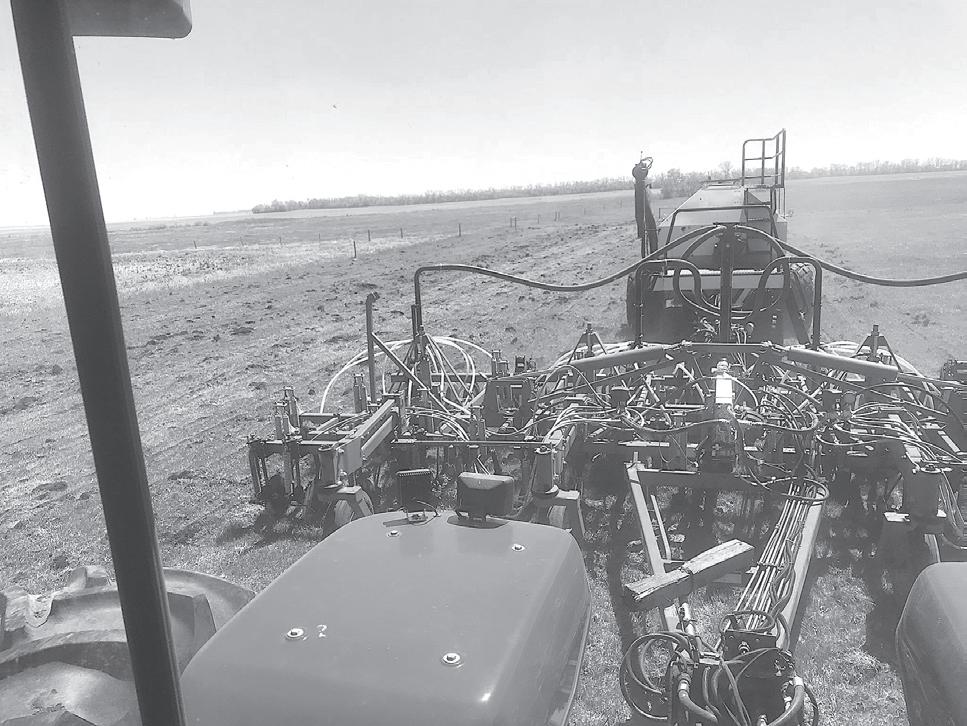
Trucking for Harms started in 2006 post BSE in 2003 which devastated the Cana dian cattle industry making it tough to stay in business. A poor farm economy followed by several bad crop years, and the near future did not shine bright.
“I’m just eating into dad’s equity, just for me to farm, and if I want to farm I had to bring in some extra revenue so I can be at home,” he ex plained. “While considered a young farmer, I don’t feel I’m that young anymore because I’ve already got 20 crop years under my belt.”
With an aging beef cow herd and a growing elk cow herd the decision to reduce or get totally out of the cattle business is in the air.
Trucking, cropping and elk ranching appear to be where young Michael is heading. For now the primary market is the velvet antler market that goes into Asia. However, the farm is in year five of the voluntary herd certification program under the Canadian Food Inspection Agency for the CWD Chronic Wasting Disease.
“So once I have that fiveyear certification, I can ship live animals to the states to hunting preserves [with] three to four thousand acres behind a wire where people can have a five-day hunt, get wined and dined, and have an adventure,” said Michael.
Michael said the plan is to stick with the elk because it took a lot of work to get the elk herd certified. It included a myriad of paperwork and having a CFIA-approved vet erinarian do an annual physi cal herd inventory.
“So they come out, we run all our animals through the squeeze, they verify tags to what our inventory is, and if there is an animal on an in ventory with CWD we’re ac
countable to what happened to the animal.”

Additionally, any animal that dies on their farm gets tested for Chronic Wasting Disease.
“It’s quite the amount of paperwork and extra work to get full accreditation to open up the hunt farm market into the States,” said Michael.
Once the accreditation takes place Michael is hopeful the farm’s main source of income will be coming from the elk.
Michael explained that an elk calf doesn’t require the same maintenance as a beef calf because the elk still has some wild tendencies. They are quite self-sufficient.
“Especially when calving,” added Michael. “We’ve had the elk for many years back in 1998 and we have yet to help a cow calve. We’ve even wit nessed the birth of twins and a breech birth, and we have yet to help one animal. We’ve had probably 200 and some calves born on our farm.”
Today the elk herd consists of 45 cows. Manitoba regu lations dictate one acre for
every two animals on their farm attesting to the fact the amount of regulations in the elk industry in Manitoba is quite significant.
UM Research Chair Dedicated to Integrated Weed Management
Manitoba farmers face many unique challenges when it comes to protecting their crops, particularly from un wanted plant invaders. These battles will soon be made easier with the creation of a new research chair aimed at strengthening agronomic science, decision-making tools and extension in the area of weed management.
The Western Grains Research Foundation (WGRF), along with Manitoba Crop Alliance (MCA), Manitoba Canola Growers Association (MCGA) and Manitoba Pulse & Soybean Growers (MPSG) are funding the Manitoba Crop Protection Chair in Weed Manage ment position at the University of Manitoba (UM). Dr. Dilshan Benaragama started May 1, 2022, as an assis tant professor in the Department of Plant Science in the Faculty of Agricultural and Food Sciences.
“We are excited about the benefits Dr. Benaragama’s work can have for farmers. Having a dedicated research er for integrated weed management will help producers better deal with critical issues including the mitigation and management of herbicide-resistant weeds while maintaining productivity, profitability and sustainabil ity,” said Dr. Keith Degenhardt, Board Chair, WGRF. “WGRF has made it a priority to increase the agronom ic research capacity by establishing several Research Chairs in western Canadian universities.”
The new role is dedicated to excellence in research, innovation and knowledge translation in the area of in tegrated weed management in western Canadian crop ping systems.

“The University of Manitoba’s integrated weed man agement research is critical to solving many current crop production problems and supporting sustainable and resilient cropping systems,” added Pam de Roc quigny, CEO, MCA.
Support for the Chair arose from the recognition of the need for increased communications between re searchers and producers in Manitoba, through more ef ficient research and technology transfer activities that help researchers better understand producers’ needs, and also help producers better understand the options and value of experimentally proven systems strategies for effective crop protection.
“Dr. Benaragama’s work will help farmers get ahead of these trends to ensure they can continue to effec tively protect their crops and maximize productivity of their land,” explained Delaney Ross, Executive Direc tor, MCGA.
Cheaper Meat Cuts Are Tasty When You Plan Ahead
By Joan AireyEating meat raised on our own farm we are lucky to have all cuts of meat available in our freezer. Our grandchildren raise steers for their 4-H proj ects so we are lucky to know where and what the meat is graded at that we consume. Whether you are eating stewing meat, ham burger or steak with a little planning you can have a delicious meat.
Having meat defrosted before cooking it saves time and energy and nor mally you end up with a tender product. Western Barbecued Short Ribs are a dish we really enjoy.
Western Barbecued Short Ribs
½ lbs.
Tablespoons Worcestershire
firmly
Tbsp.
1 lemon sliced or 1 Tbsp.
Place ribs in baking dish. Combine remaining ingredients and pour over ribs. Cover and bake for two hours. Skim off fat.
*You can cook an hour without sauce, drain off fat. Then pour sauce over and cook at least one more hour, ribs will be really tender.
**When barbecuing steak, it’s really important to have it thawed and at room tem perature before you cook it. Personally, I like to have it in a marinade for a few hours before we barbecue. My favourite marinade is 1 cup soy sauce, ½ cup canola oil, 3 minced cloves of garlic, 1 teaspoon of grated ginger and 3 tablespoons of brown sugar. You can use honey instead of brown sugar if you prefer.

Benaragama, who completed his graduate program at the University of Saskatchewan in weed science, has focused his research program on understanding weed adaptations to diverse crop management practices and developing integrated management strategies. He also will be focusing on integrating digital tools in weed re search as well as developing precision weed manage ment and decision-making strategies for producers.
He comes to the UM after serving as a senior lec turer in plant science at the University of Rajarata, Sri Lanka, and as a postdoctoral fellow at the University of Saskatchewan.
 Dr. Dilshan Benaragama
Seeded into 20 plus year pasture/hay this June after grazing it. Sprayed out after seeding.
A one-day-old baby elk calf com pared to a size 12 shoe used for scale.
Michael Harms says he has an off-the-farm job trucking dur ing the wintertime, so the cattle don’t seem to be making enough money compared to what he can make trucking.
Submitted photos
Dr. Dilshan Benaragama
Seeded into 20 plus year pasture/hay this June after grazing it. Sprayed out after seeding.
A one-day-old baby elk calf com pared to a size 12 shoe used for scale.
Michael Harms says he has an off-the-farm job trucking dur ing the wintertime, so the cattle don’t seem to be making enough money compared to what he can make trucking.
Submitted photos
3September 30, 2022The AgriPost
3
short ribs ½ cup water 1 cup ketchup 3
sauce ¼ cup
packed brown sugar ½ cup chopped onion ¾ teaspoon garlic powder 1 teaspoon salt 1
prepared mustard ¼ teaspoon thyme
lemon juice

September 30, 2022 The AgriPost
Livestock Producers Gearing Up to Showcase at Ag-Ex

Canada’s Agri-Food Exporters Mark 5 Years of Free Trade with the EU
Dan Darling, President of the Canadian Agri-Food Trade Alliance (CAFTA), issued a recent statement marking the fifth anniversary of the Canada-EU Eco nomic and Trade Agreement (CETA).
“CAFTA remains a leading supporter of Canada’s land mark agreement with the EU and the opportunities that exist for Canadian agri-food exports to the EU despite the persistence of technical barriers, restrictive rules of origin and other EU measures that have prevented CETA from delivering its full potential.

“What made CETA a gold-standard, 21st century pact was that it went beyond tariffs and secured ambitious outcomes on a wide range of non-tariff issues. For exam ple, CETA included commitments to address areas such as technical barriers to trade, sanitary and phytosanitary issues, regulatory cooperation, and export subsidies.
By Joan AireyThe largest all-breed cattle show in the province returns October 26-28 in Brandon at Manitoba’s Ag-Ex. Live stock producers have been working all year with this year’s show string. Talking to the young people getting ready to participate in the Junior Showmanship or the livestock breeder getting ready for the Junior Jackpot Bull show or their regular show, they all take pride in
bringing out the best to all shows they participate in.
When you work with cattle 24/7 they are an important part of your way of life.
Remember there is no charge to attend Ag-Ex and you will meet some of the best cattle producers in Can ada there. It can be a great learning experience for any one.
Moomana part of the Ag-Ex program educates students in grade 3 to 5 on
the life of a cow including benefits of beef and the beef business. They even get to participate in mock cattle show and auction.
Manitoba Sheep Associa tion is holding a “Jackpot Market Lamb Show” and Pauline Bolay, the world re cord holder for sheep shear ing, will be at Ag-Ex giving a demonstration on her tech nique. Pauline is from Fair ford and set the new world record for sheep shearing in
New Zealand.
In order to improve and maintain the Dome Building the offices of the provincial exhibition every year sell twenty-dollar tickets for the “Maintain The Glory” draw on the last day of Ag-Ex. One lucky person will be ten thousand dollars richer. If you need a ticket they are available at www.provin cialexhibition.com or from any director of the Provincial Exhibition of Manitoba.
“However, after 5 years of provisional implementation, significant non-tariff barriers remain in place that are se verely restricting or threatening to jeopardize the market access CETA promised our sector.
“We are urging Canadian and EU leaders to work in close collaboration with industry so that these issues can be resolved and that future negotiations, such as with the UK, ensure more liberalized trade. We also call on the EU to encourage its member’s states to ratify CETA In their respective legislatures.
“As the world continues to worry about food security and record high inflation, Canada and the EU have an opportunity to show the world that free and open trade is the best way to keep food affordable and plentiful.
“Guided by free and rules-based trade, we’ll continue to do our part to feed families here at home and in mar kets around the world.”
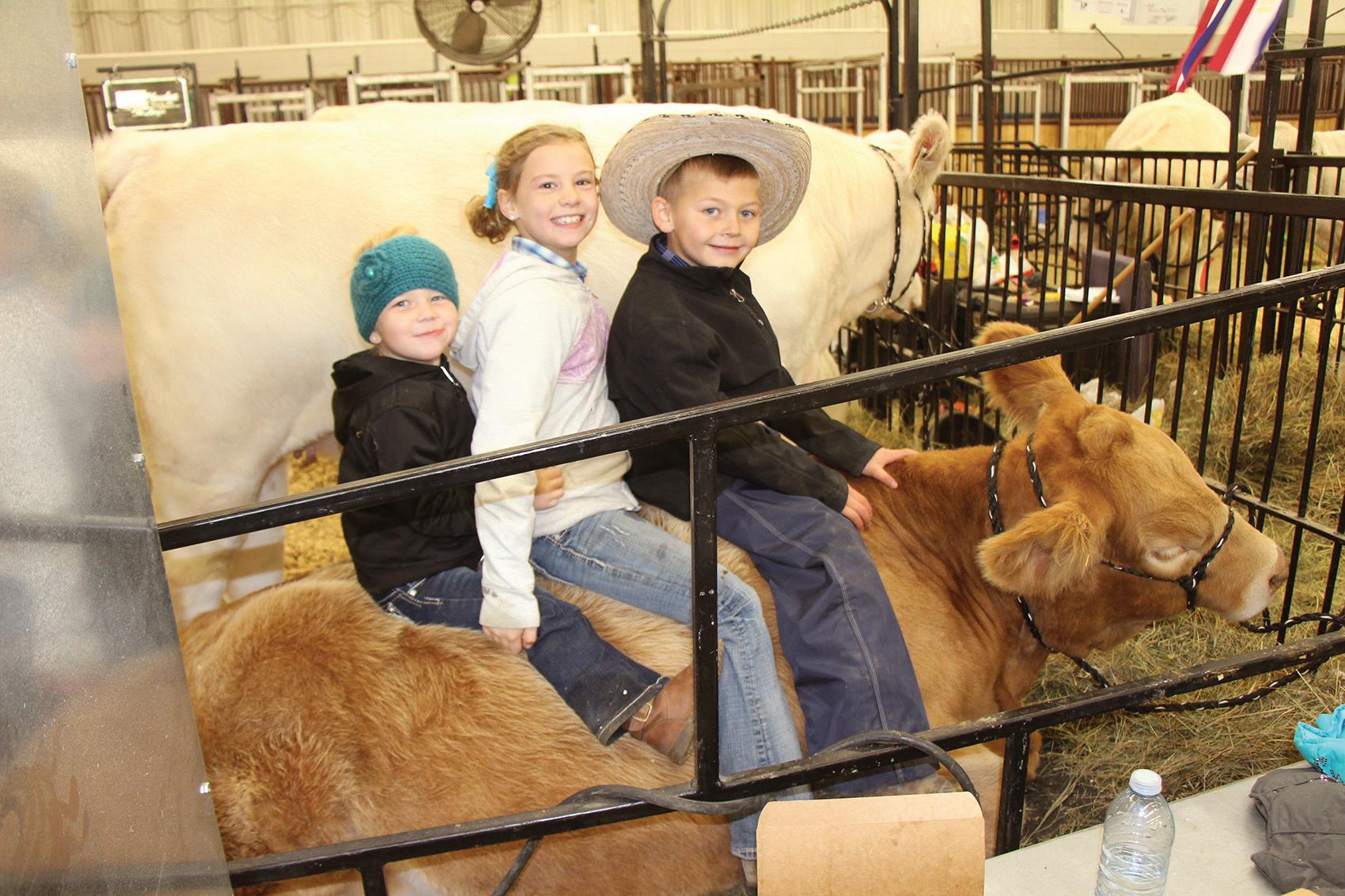
 These young people have been working hard to get ready for this year’s Ag-Ex and their parents are looking for good weather to finished harvest so they can be there. As Michele from the Province said “Determination, commitment and great care of animals brings those who believe in the above out to Ag-Ex.
Photo by Joan Airey
These young people have been working hard to get ready for this year’s Ag-Ex and their parents are looking for good weather to finished harvest so they can be there. As Michele from the Province said “Determination, commitment and great care of animals brings those who believe in the above out to Ag-Ex.
Photo by Joan Airey
The AgriPost

September 30, 2022 The AgriPost
Cleanfarms Adds Bench Strength in the Prairies to Focus on Ag Recycling in Manitoba
Cleanfarms, the national stewardship organization that develops and operates recycling programs for ag ricultural plastics like grain bags has increased its bench strength in the prairies by adding a new program coor dinator in Manitoba.
Serena Klippenstein, a local Manitoban who has roots in the province’s rural farming community, will be respon sible for helping to operate solutions that work in Mani toba to manage used agri cultural products including used grain bags, twine and empty pesticide and fertil izer containers for recycling. These programs are part of the provincial Manitoba Ag Plastic Program, which was approved under the Packag ing and Printed Paper Stew ardship Regulation.
She will also have a hand in implementing programs that recycle silage bags and bale wrap, which are supported in Manitoba by the Dairy Farm ers of Canada “Here for To morrow” project and Clean farms’ “Unwanted Pesticides and Livestock/Equine Medi cations Collection” program that collects old, obsolete and unwanted pesticides and farm animal medications for safe disposal.
Klippenstein said she has always felt a connection to agriculture and appreciates that this position will allow her to work closely with pro ducers.
“As people in the agricultur al community know, a farmer
has to be a jack of all trades to be a successful grower and that includes adapting technology that helps them do more with less,” Klippen stein said. “Farmers who use ag plastic products like grain bags want access to programs that help them manage those materials when they are no longer useful. That’s what I am here to do…help find solutions that make sense in Manitoba but that draw on the depth of experience that is happening across the prai ries.”
Among the responsibili ties high on her “to do” list is to help expand partner ships with ag-retailers to become conveniently-acces sible collection site locations for farmers to return empty plastic pesticide and fertilizer jugs for recycling.
“Helping to transition col lection sites for empty pesti cide jugs from municipalities to ag-retailers in Manitoba over the next three years is a critical part of continuing to offer a convenient and effi cient system for producers to recycle these materials. I’m keen to help make that hap pen,” she added.
Equally important, she is helping to establish agree ments with municipalities to become accessible collection sites for farmers to return grain bags, twine and ag film for recycling.
Klippenstein holds a Bach elor of Science (Agricul ture) from the University of Manitoba with a major
in agronomy and a minor in soil science and a Master of Science (M.Sc.) - Soil Sci ence from the University of Saskatchewan. She has seven years of full-time experience working with agricultural or ganizations including as the manager of corporate pro grams for the Canola Council of Canada and as a seed qual ity assurance lead with DL Seeds Inc.

“Serena’s education and work experience in agricul ture adds to Cleanfarms’ ca pacity to develop and deliver programs for farmers across the prairies that address the way producers farm today,” said Cleanfarms Executive Director Barry Friesen. “Our goal is to create programs that give producers practical options that they can put into play to help keep farm com munities tidy and contribute to a healthy environment. We are proud to have Serena on our Cleanfarms team to help expand relationships in Man itoba that will benefit produc ers and industry stewards.”
Manitoba: October 24 to 28 – 20 single day events
Cleanfarms’ 2022 program includes 81 collection events.
Farmers are encouraged to bring:
- Old or unwanted agricul tural pesticides (identified with a Pest Control Product number on the label)

- Commercial pesticides for golf courses and industrial and commercial pest control products (identified with a Pest Control Product number
Serena Klippenstein, a local Manitoban with roots in the province’s farm community has joined the Cleanfarms team as a project coordinator. She will help implement Cleanfarms programs for Manitoba producers to help them manage used agricultural products including grain bags, twine and empty pesticide and fertilizer containers.
on the label)
- Livestock/equine medica tions that are used on-farm for livestock, poultry or horses (identified with a DIN number, serial number, notification number or Pest Control Product number on the label)
The program does NOT ac cept:
- Fertilizer, diluted solution, large quantities of unopened product, and treated seed
- Full and unopened jugs of adjuvant or surfactant
- Needles or sharps, medicat ed feed, aerosol containers, premises disinfectants and sanitizers, veterinary clinic waste and medications, ear tags, or aerosols
- Domestic pesticides, fertil izers and animal health prod ucts and any other household hazardous waste
A “Chilling” Prediction:
Old Farmer’s Almanac Canadian Edition Predicts “Sneaky Cold” Winter
The 2023 Old Farmer’s Almanac Canadian Edition has arrived with a winter weather warning: Most Ca nadians should be prepared for a typically chilled sea son—but with bouts of “sneaky cold.”
“Frosty, frigid, freezing . . . however you say ‘cold,’ that’s what’s in store for most Canadians this winter,” reports Janice Stillman, editor of The Old Farmer’s Almanac Canadian Edition. “But as an added ‘bonus’, we also expect a number of unusual mini-deep-freezes throughout many parts of the country, which will sneak up and surprise with their intensity.”
For 231 years, The Old Farmer’s Almanac has been helping readers to prepare for the season ahead with its 80 percent–accurate weather forecasts.

Winter will arrive early, with cold temperatures drop ping down from the Yukon and northern Alberta to set tle in across the Prairies and into southern Ontario and southwest Quebec. By mid- to late November 2022, icebox conditions will arrive—to likely worsen as the season progresses. For example, in January, tempera tures on the Prairies according to the Old Farmer’s Al manac will average 7 degrees C below normal.
While temperatures throughout the rest of Canada will be normal or nearly so, this doesn’t mean that these areas will be spared their own winter woes: Several ma jor snowstorms are predicted for southern Quebec and Atlantic Canada, with the first arriving before the end of November!
Much of Ontario will also see increased snow, while the southern portions of the Prairies and most of British Columbia will sometimes be more wet than white, with sleet and freezing rain more prevalent than usual.
In addition to its much-anticipated weather forecasts, The Old Farmer’s Almanac Canadian Edition is known for being “useful, with a pleasant degree of humour.”
Highlights from the 2023 Almanac include:
- Dispatches from family farms: stories from a diverse group of independent farmers taking big risks that pay off personally, in their communities, and for the envi ronment.
- Gardening tips for perfect perennials and chillies for every palate. Also, gardening trends for the coming year (a sneak peek: 54% of young adults would rather go to a garden center than a night club).
- Festive food: delicious dishes (and family traditions) from a Ukrainian Christmas and sweet and savoury winners from the Almanac’s banana recipe contest.
- Practical life advice: a straightforward method for organizing keepsakes and sometime surprising home remedies to handle hay fever.
- Stories as only The Old Farm er’s Alma nac Cana dian Edition can tell: a legendary timekeeper; an ancient grain that’s not just for the birds; a step-bystep guide to hatching chickens; and much, much more!
Photo Courtesy of Cleanfarms Cleanfarms’September 30, 2022The AgriPost
“Unwanted Pesticides and Livestock/Equine Medications Collection” program.
2023
Eat Local on a Budget Part 6 – Buy Meat Direct from the Farm
farm. Free range chickens or even pastured pork may be available at this time of year. Also, when cattle and sheep come off the pasture in fall, they possess all the wonderful benefits and nu trients of being grass-fed. Additionally, small farmers often sell their animals be fore freezing temperatures set in, as feeding and wa tering becomes much more complicated in the winter.
1. Farmers are not gro cery stores.
By Leah BouchardFall is an excellent time of year to fill your freezer with local meat direct from the
If you have never pur chased meat direct from a farm, here’s what you need to know:

You’ll most likely have to order ahead of time and either drive to a pre-ar ranged pick-up location or pick it up on farm. Many small farmers do not have massive amounts of freezer storage so not all meat can be available at all times of year. You may want to purchase your own freezer to store your meat for up to a year until it becomes available again. Also, you may consider trying some cuts you don’t normally
eat. For example, it’s un sustainable for one small farmer to produce masses of chicken breast or lamb chops which use up just a portion of the whole ani mal. Use the opportunity of buying direct from the farm to connect with your food, have a conversation, and make some new hab its.
2. There are regulations on meat sales.
Direct meat sales are regulated in several ways. There is a strict limit to number of poultry one
farmer can direct sell to cus tomers. Although chicken can be sold to the consumer from the farm if it has been pro cessed on-farm, it cannot be sold at a market or public lo cation. Most meat needs to be processed at an inspected facil ity, which can make the addi tional cost and/or distance pro hibitive to the farmer. Many farmers will be willing to sell you a live animal, but then you may have to make the arrange ments for processing yourself. Here is a link to all the detailed regulations you may want to familiarize yourself with: gov. mb.ca/agriculture/food-and-agprocessing/pubs/direct-market ing-your-food-product.pdf.
3. You may need to do re search when you buy a whole or half carcass.
Often buying a whole car cass can be an economical way to purchase meat. Most of the time, you’ll be charged on the hanging weight. That means the weight after the animal is skinned and gutted. So, the final weight you end up with depends on the cuts you get. If you grind all the meat, it will be less than if you keep the bone
in. That said, if you buy meat this way, the waste is on you. So, make sure you order respon sibly. Save the bones for broth. Learn to eat the super-food or gans. Save the lard/tallow for pies or moisturizing products. It’s not difficult to research cuts online and you may learn some interesting ways to cook new dishes.
4. You are investing in your community.
When you buy from local farmers who work hard, use regenerative land management principles, and steward the land well, you’ll be contributing to your community, local econo my, and the future of the planet.
Whether you buy direct from the farm, or just look for local in the grocery store, let’s remem ber to stand by our agriculture sector, encourage and support them. It’s not an easy job but so incredibly important.
To find local farmers selling meat direct from their farm, check out our facebook group: Stuartburn Emerson-Franklin Local Food Initiative.
Brought to you by the Stuart burn Emerson-Franklin Local Food Initiative.
Community Seed Library is Open
While you’re bringing in the garden and preserving your bounty, remember to save some extra seeds to share! Sharing seed is a fun way to increase lo cal food security, preserve heir loom varieties and meet other community members who share a mutual interest in growing food.

Though we’d all prefer to gath er at community seed exchanges (stay tuned for the Roseau River spring seed exchange hosted by the Woodmore Women’s Insti tute), not everyone can attend these annual events. Enter the Stuartburn Emerson-Franklin Community Seed Library.
The seed library operates the same way as our Little Free Li braries, on a take some, leave some principle. Simply label your contributions with the seed type (and variety, if known) and year harvested, and file under the proper letter. To make the library

easier to search, file seeds by type, not variety. For instance, hubbard squash seeds would be placed under S, not H. We sug gest that unusual or heirloom varieties also include your con tact information so people can contact you if they’d like to know more about them.
We are grateful to Reimer Concrete and Building Sup plies in Roseau River for gra ciously hosting our Communi ty Seed Library. As a matter of respect for the business, we ask that users please refrain from contributing common varieties that would normally be sold at the store.
The seed library will be up until the end of October and reappear in January. (Any con tributions made now will re main in the library until then.) So spread the word! The more participation we have the more interesting and fun it will be!
Visit the Communty Seed Library.September 30, 2022 The AgriPost
Reassess Biotin Nutrition in Dairy Lactation Diets
It’s long been recognized that lactating dairy cows have a specific requirement for bio tin, which may not be met by natural synthesis in the cows’ rumen. Much research in the early 2000s demonstrated bi otin supplements to lactating dairy diets yield respectable improvements in hoof-health and better milk production. With the advent of many available feed additives, add ing biotin to lactating dairy diets has been pushed into the background in dairy nutrition. Despite such fade-away, dairy producers should reassess the benefits of adding biotin into their lactating dairy diets.
Despite, no actual biotin requirement in a typical dairy cow has been clearly estab lished, it is speculated that specific biotin-making bac teria in a typical dairy cows’ rumen - produces about 3 – 5 mg of biotin on a daily ba sis. And, together with some natural biotin found in many dairy feeds (re: distillers dried grains); likely takes care cow vital functions, milk produc tion requirements as well as those amounts required by all rumen microbes, including the bugs that produce biotin in the first place.
Some dairy nutritionists point out that this recognized supply is not always a reliable source of essential biotin. First, they point out that the bioavailability of biotin from dairy feed ingredients as well
as synthetic man-made biotin is less than 50% of their re spective concentrations. Fur thermore, natural biotin con centrations found in cows’ rumen fluid decreases as soon as the forage to concen trate ratio decreases, such as found in early lactation dairy diets. A typical American university study of the 1990s showed that biotin rumen synthesis was cut in half in such a lactation diet, when its forage/concentrate ratio was decreased from 80% to 50% forages.

At about the same time, 20 mg per head/day of supple mental biotin was deemed necessary by similar dairy research in order to maintain “adequate biotin status” as found in respective blood lev els in healthy lactating dairy cows.
Since, biotin is a watersoluble B-vitamin, this 20 mg dosage encompasses a wide range of metabolic processes, yet its real and practical po tential in dairy nutrition really comes down to its two main functions in the dairy cow’s body. First, biotin is a co-fac tor in many of her enzyme systems and metabolic pro cesses that drive energy, fat and protein metabolism. Sec ond, it plays a specific role in the process of keratinisation, which transforms epithelial tissue in strong hoof-horn material in cattle.
As a dairy nutritionist, I
have used this 20 mg/head/ day recommendation since it first appeared in main stream dairy nutrition. It has been my experience that it should be added like any other feed additive to a wellbalanced lactation diet with a solid foundation of:
- Effective forage fibre – All my lactation TMRs contain a minimum amount of neutral detergent fibre (NDF) of 27 –28% with 75% - 80% of that coming from the forages. So, a 60% forage to 40% concen trate ratio of the entire TMR is maintained.
- Available energy – I draw upon a healthy rumen mi crobe population to release this dietary energy, largely from the fermentation of for age fibre (nee carbohydrates) and grain-starch energy.
- Non-fibre carbohydrates - NFC portion of the diet (containing starch) should be limited to 35 – 37% of the total diet. Starch, which com prises a significant portion of NFC should be targeted at 21 – 25% of the diet, dm.
With a such good dairy nu trition base in place, it was always my understanding that such biotin supplements may take up to 3 – 4 months to yield a positive milk re sponse. In which I also found was hard to pin-point in most of my lactation feeding pro grams. It may also take up to 8 – 12 months of a similar biotin treatment for a positive

hoof response. I found it was quicker and easier to see pos itive results with other “hoof strengthening” nutrients such as adding organic zinc to dairy diets.
Despite a lack of visibility, I am confident that adding bio tin to my own lactation feed ing programs was successful in contributing an improve ment in hoof heath and bet ter overall milk production of these dairy herds. It’s a matter of having confidence in the available science that dictates: biotin supplements’ primary objective is to meet the dairy cows’ true biotin re quirement, which is often not covered by microbial biotin production. In this way, it is like any other essential nutri ent in a well-balanced lacta tion diet, which promotes good health and optimum performance in high produc ing dairy cows.
Beware When Spreading Manure This Fall
By Harry SiemensThe Canada West Swine Health Intelligence Net work (CWSHIN) advised pork producers in Manitoba to cautiously spread manure this fall due to the high number of manure storages contaminated with Porcine Epidemic Diarrhea (PED) virus.
Digestion syndrome was among the themes of the CWSHIN swine disease surveillance report for the sec ond quarter of 2022. Any disease or condition related to digestion from the stomach to the intestines presents diarrhea as the primary clinical symptom.
CWSHIN manager Dr. Jette Christensen said the PED virus outbreak in Manitoba completely dominated this syndrome. For all the other conditions under that um brella, there were no changes.
This PED virus broke in Manitoba in October 2021 and infected more than 122 premises.
However, the good news is that the last premise tested positive for PED on July 12 and since then no new cases.
“All status changes for PED after July 12 went to an improved status, either recovered to transitional or to presumptive negative which is on the road to being negative so that’s good,” said Dr. Christensen.
Dr. Christensen advises that producers maintain caution even though no new infected premises exist, because there are still many contaminated manure stor ages.
“It’s important to remember that these contaminated manure storages pose a risk for spread of PED when they’re starting to spread the manure,” said Dr. Chris tensen.
The same report showed an increasing number of Coccidiosis cases in Alberta with the usual suspects for other diarrheas, not including the PED virus. However, rotavirus is still high and on the list of concerns for practitioners.
Producers Advised to Lock in Feed Prices
By Harry SiemensTyler Fulton, the director of risk management with HAMS Marketing Services, advises pork producers to lock in their feed costs as they forward contract their hog production.


The North American hog sector has started transition ing from the tight hog sup plies of summer as numbers ramp up and is in line with those of the last year and an average of the past five
years. Nevertheless, North American pork demand re mains the main factor influ encing pork prices.
“One thing to note is China’s diminished effect on North American pricing so it’s more the domestic market that’s driving pric ing now,” said Fulton. We do think that there could be some price pressure.”
The reality is the futures, and the forward market that’s priced off of the fu
tures exceeds any previous year’s forward prices at this time of year.
He thinks there are some good opportunities to secure solid pricing but coupling that with feed purchases because the risk lies in that feeding margin.
“The value of the feed in gredients you need to pur chase relative to the value of the hogs you’re selling,” he explained.
As is so often the case working in the Canadian pork producer’s favour is the weaker Canadian dollar but it’s also impacting the cost side. Because of this it is important to match those pricing decisions on feed and hog prices.
Fulton said the heavier sup plies typically mean pressure on prices but pork cutout values remain firm. All indi cators show pork continues to perform well in this in flationary environment and
is well positioned over the next four or five months to perform reasonably well in the context of the heavier supply.
Fulton said access to labour would be the biggest chal lenge as the pork packing plants gear up for the heavier fall, winter, and hog produc tion. There is some volatility due to holidays, particularly in the US plants, but he does not expect any significant slaughter capacity con straints negatively impacting prices during the heaviest hog run time frames over the next two to three months.
Fulton acknowledged the underlying concern is the de gree to which the plants can run at their rated capacity given the labour issues.
“Labour continues to be a real thorn in the industry as it works to manage through COVID and through these inflationary times,” said Ful ton.
“It’s something they’re dealing with and some chang es in the subtypes of Rotaviruses and how they are oc curring on the farms,” noted Dr. Christensen.
She said some farms started a new vaccine showing promise although it’s too early to confirm the result.
In addition to the PED virus in Manitoba, Coccid iosis is also present. Reports show an uptick over the hot summer months of a little more diarrhea caused by Coccidiosis. Veterinarians are ready to treat it in Mani toba and the new trend in Alberta is rare but cases are beginning to be seen.
Finally, PED has a cousin, a Delta Coronavirus not seen for many months; years. Yet, it’s present in other provinces outside the region and in the US. “It’s still a rare disease but, in Manitoba, one case in that last quarter,” she said.
Dr. Christensen advised Alberta and Saskatchewan producers to look for unexplained diarrhea. It could be Coccidiosis, and she encourages producers to consult their veterinarians if they suspect more diarrhea than usual.
Dr. Jette Christensen said the PED virus outbreak in Manitoba completely dominated this syndrome. For all the other condi tions under that umbrella, there were no changes. Submitted photo Biotin premix. Tyler Fulton advises pork producers to lock in their feed costs as they File photoSeptember 30, 2022The AgriPost

September 30, 2022 The AgriPost20
Good Backgrounding Feed Program a Wise Investment
By Peter VittiAs most of the leaves have fallen, many spring calves are being weaned. It’s also when many people deter mine whether their weaned calves are immediately sold or held back for further feed ing. Regardless of their final choice, backgrounding calves takes a bit of homework and should pay off with in creased revenue, if the goals for backgrounding calves, the spreadsheet and its feeding programs are sound.
Such backgrounding feed ing programs are often tailormade to each beef producer’s situation. Yet its general goals remain the same. So, it’s been my experience that back grounding cattle allows pro ducers to grow their weaned calves by adding 100 – 300 lbs of saleable weight, with out laying down too much fat in: short-45 day, medium-90 day and longer-kept 120-day programs. In addition, pro ducers can add weight onto groups of small to mediumframed calves or those light weight calves often born in a late-spring calving season.
I find that most background ing candidates fall into three categories:
1. Small-framed calves to be overwintered on all-for age diets to gain about 1.0 lb per head per day. They will most likely be returned to pasture during the next grazing season.
2. Lightweight calves that gain 1.0 – 2.0 lbs per head per day on all forage diets, which might be conservatively sup plemented with medium-en ergy by-products or grains. These calves are returned to pasture or go into a feedlot.
3. Medium to large framed calves that gain 2.0 – 2.5 lb
per head that are put on a high-plane of nutrition and are put in a feedlot.
A good demonstration of a practical feeding program (#3) is practiced by a 400 cow-calf operation that I of ten visit. The owner calves out about 400 Angus/Sim mental beef cows at the end of April in which the calves average about 650 lbs and are weaned by mid-November. The owner usually retains all his weaned late-spring calves, and then separates 30 - 35 re placement heifers and back grounds the rest to a target of about 900 lbs until the end of February.
In doing so, these calves gain average 2.5 lb/head/day in 95-days being fed a TMR of 20 – 25 lbs of good quality grass hay (9.0 cents), 3 lbs of 13% crude by-product grain pellets (16 cents), and 100 grams of 2:1 mineral-vitamin premix w sodium monensin (18 cents/head). Calves are not implanted. By using cur rent feed and feeder cattle prices, this is an economic spreadsheet of this producer’s own proposed - 95-day feed ing program as illustrated (see Table 1 below).
This is a very straightfor ward spreadsheet that il lustrates the economically feasibility of backgrounding
spring calves in a cash-mar ket. Subsequently, I am mak ing the assumption that the selling price of 900 lb weight heavy calves will sell at simi lar prices of today in lateFebruary. This producer’s backgrounded steers made an estimated gross profit of $28 per head, while his feederheifers, which sold at an $8 cwt discount, lost $44.
According to these calcula tions, it gives my friend some promising foresight to some flexible marketing options, particularly for his weaned heifer calves. He could choose to retain, overwinter and sell all steer calves at the end of February, while heifer calves are sold immediately after weaning in mid-November. But he might also advertise and sell these latter females as certified pre-conditioned
heifers to be sold at a higher dollar or take advantage of selling more mature cullcows at good present market prices and replace them with bred-heifers of lesser value.


My friend’s story is a good testimony. Because, he is a late calver, I feel that it al most forces him to overwin ter his weaned calves for the next few months in order to add more saleable body weight to them. Furthermore, I don’t think that he has ever lost money on his heifers, be cause he always studies the cash- market beforehand and implements whatever time, feeding programs and mar keting is necessary. In this way, he told me that it simply increases his chances of turn ing his annual backgrounding investment into welcomed profits.
Time for Snowbirds to Fly South
For many farms, this has been a year of unique chal lenges. In a recent discus sion with a
friend, I asked if this year was like others he has ex perienced before. He advised that he has not grown a crop with so many variables and volatility, all teetering on the verge of chaos at the same time. Here, in many parts of Manitoba, excessive moisture, bugs, disease, crop maturing unevenly with the potential for an early frost, mixed with the rise and fall of commodity prices, fertilizer costs being at an all-time high, and if that is not enough, the looming threat and uncertainty of cli mate action requirements for farms and the suggested “voluntary” fertilizer reduction looming in the future. If that does not make you want to take a vacation, you have thick skin!
As I was driving to work this morning, I saw the first motorhome pulling an SUV with two brand new bikes attached; ready to experience warmer temperatures for the winter. I imagine they had their motorhome filled with their Hawaiian shirt collections and a different coloured pair of crocs for each day of the week. I hope they are still reading the Agri Post while on vacation so that they can catch these suggestions on how to protect their property while they are away during the winter.
Insurance policies have requirements on how often your dwelling is checked while you are away during the heating season. For most insurers, this becomes a daily requirement after the first few days of vacancy. This is due to the added risks of your property being unattended while you are away. One common claim that happens all too often is water damage from frozen pipes after a heating system failure or power outage. This is a major concern for insurers when dwellings are left unattended for a period. Because of this expo sure, most insurers require your dwelling be checked daily to ensure that the heating system is still active.
There are exceptions to this requirement, such as shutting off your water and draining all water lines and appliances of water, installing a monitored temperature alarm, or having a competent person stay in your resi dence for the time that you are away. There is also a growing market of businesses that provide home watch services that will check on your residence daily and provide updates for your peace of mind and to satisfy your insurer’s requirements for your dwelling.
Theft and vandalism are also growing concerns when a dwelling is left unattended and obviously vacant for a long period, and while it can be an effective method of stopping unwanted traffic in your yard, having 6-foot snowdrifts across the driveway is not an accepted form of security.
Table 1.
Manitoba Farm Women’s Conference Looks at Online Safety
The line-up for this year’s Manitoba Farm Women’s Conference (MFWC) being held in Brandon at the Vic toria Inn and Keystone Cen tre grounds promises to be topical with “Guilty, Until Proven Innocent” and a se ries of Lightning Talks about home safety, online security, passwords and safety on so
cial media.
The 2-day conference be gins November 15 (Victoria Inn) with registration from 7 - 8 pm, followed by a Meet & Greet and a free Neuro graphic Art activity.
On November 16 at the Keystone Centre grounds registration begins at 8:30 followed by keynote speaker
Michelle Cederberg with Success-Energy Equation, Sherri Pauls with Guilty, Until Proven Innocent. After lunch the Lightning Talks take place with Graeme Kingdon speaking on home safety, Keeping you and your family safe, Fusion Credit Union presenting On line Security and Passwords,
Val Caldwell about safety on social media and Agvocating in 2022 by Adrienne Ivey. Conference registration fee is $100 due by November 1.
Registration forms must be printed and can be scanned and emailed to come2m fwc@gmail.com or mailed in to Kim Holtmann, Box 120, Rosser, MB, R0H 1E0.
So, before you go, double check the insurance re quirements with your broker to make sure that you are doing what is required to maintain your coverage. While you are talking to them, they can likely help you with your travel and rental car insurance requirements as well, leaving you with the peace of mind to forget about the challenges of the crop you have wrestled into the bin and allowing you the Hawaiian shirt time that you have earned after a challenging year.
At Rempel Insurance Brokers, we specialize in farm, commercial and transportation insurance. Our team is also proud to provide you with options and advice for your home and condo insurance, travel insurance and rental car insurance.
David Schmidt is an Account Executive at Rempel Insurance Brokers in Morris, MB, specializing in in suring farms and businesses across Manitoba and Sas katchewan. Call or text 204-746-2320, email davids@ rempelinsurance.com or visit rempelinsurance.com.
 Backgrounding calves takes a bit of homework and should pay off with increased revenue
2September 30, 2022The AgriPost www.agripost.ca
Fellow Gardeners Are a Wealth of Information
By Joan AireyOn Sunday a friend and I walked in the Terry Fox Run. As she walks in town every day she suggested we go down the back alley instead of on the street so we could see some fabulous gardens she had visited earlier.
One such garden belongs to Doug Johannson, a semiretired teacher, and Debbie Johannson, a retired nurse. Doug works during the busy season at Trestle Green house and always has inter esting garden ideas to share

with fellow gardeners. One thing in their garden that re ally interested me was some beautiful cabbages. The cab bages are Storage variety of cabbage that takes 90 days to mature seed can be pur chased at T & T Seeds. Sev eral pots of peppers graced the Johannson’s yard with a large bounty on each plant.

“I use rotted manure in my pots but not in the garden because of weed control. I cut up my carrot tops etc. and till them back into the garden,” said Johannson. “I
never put tomato plants and potato tops back into the soil because they can carry blight.”
There were a few full or ange bags along the sides of the garden that piqued my cu riosity since the Johannson’s garden was so luscious. “I rake up the leaves in our yard and a neighbour’s and bag them up. In the fall I till them into my garden and that is my means of fertilizing the garden. I’ve been doing that since 1976 as my Hungarian uncle told me that is the way to keep nutrients in the gar den.” said Johannson. After walking through their yard, I’m sure going to put more leaves on my garden.
Visiting with other garden ers while waiting to watch our granddaughter barrel racing I heard an interesting idea. Brian Smith was telling me he was taking the tassel off the top of his corn just below the first leaf when the
corn was ripening. A gentle man from the Philippines told him they do that in his home country to stop the corn bore from getting into their corn. I haven’t seen the Smith’s to see if it works.
Since I haven’t had any problems with corn bores I didn’t try that recommenda tion in my garden.
Forecast in our area is for frost tonight so as soon as I can the tomato sauce I have
cooking, I will pick my to matoes and peppers that are still outside. Plus, the grand children plan to pick their pumpkins. They’ll need a half ton to haul their pump kins home.
 Pots of flowers in the Johannson’s garden, they also had pots of peppers throughout their yard with a bounti ful crop of peppers on them.
Storage variety of cabbage available at T & T Seeds.
Photos by Joan Airey
Pots of flowers in the Johannson’s garden, they also had pots of peppers throughout their yard with a bounti ful crop of peppers on them.
Storage variety of cabbage available at T & T Seeds.
Photos by Joan Airey
September 30, 2022 The AgriPost22
Red Mittens for the Queen
By Harry Siemens and Ian Kleinsasser met Queen Elizabeth. Only young people, Diene and Buem, went to see the Queen at the Milltown Colony near Elie, MB.
Ian Kleinsasser is an English teacher at the Col ony Springs Colony near Ste. Agathe. MB and his article Red Mittens for the Queen offers a plausible explanation of how Queen Elizabeth II of England visited a Manitoba Hut terite community as part of her 1970 Manitoba Cen tennial Celebration tour.
This story began in Jan uary or February of 1969, approximately one year before Queen Elizabeth II visited Manitoba.
On a snowy winter day, a middle-aged Hutterite woman known as HansRebecca from the Rainbow Hutterite community was knitting two pairs of red mittens. When people in quired who would receive these mittens, Hans-Re becca replied, “These are not normal mittens. I am knitting these for Queen Elizabeth II.”
When Hans-Rebecca finished the mittens, she packaged them up and, just like that, sent them off across the Atlantic Ocean to Buckingham Palace.
Kleinsasser said HansRebecca’s story offers a plausible account of why Queen Elizabeth II re quested a tour of a Hutter ite community in Mani toba. However, the story doesn’t tell how the visit came about from a politi cal or organizational per spective; who pulled the political strings to make it happen?
One media report in dicated then Manitoba Premier Edward Schreyer played an essential role in facilitating the visit to the Milltown Hutterite com munity.
Kleinsasser said what prompted him to write and post the entire article after seeing all the trib utes people posted about the Queen; it started him thinking about the 1970 visit when Queen Eliza beth visited a Hutterite colony.
“Why on earth did the
that shares stories about Hutterite history in North America asking people what they remembered about the Queen’s visit. Several people responded with anecdotes.
One story focused on Elizabeth and her red mit tens answering the ques tion, “How did the Queen know about Hutterites?” The thought was that something perked her in terest to request a visit.
with Premiere Ed Schrey er’s comment about the Queen’s visit and how her request took them by sur prise. “This is not some thing planned but she sprung this on them.”
A month later, an officiallooking envelope landed on Hans-Rebecca’s table from one of the Queen’s ladies-in-waiting.
The letter said, “Queen Elizabeth normally does not accept personal gifts from people, but this will be an exception.”
The letter went on to say Queen Elizabeth II wanted to visit a Hutterite Com munity in Manitoba in 1970. The lady-in-waiting thanked Hans-Rebecca for the two pairs of mittens and noted that the Queen wanted her to know that she would make great use of them for her children.
So, when Queen Eliza beth II visited Manitoba in 1970, one of the places she requested to see was a Hutterite community in Manitoba. Unfortunately, though Hans-Rebecca may have instigated the Queen’s visit with her thoughtful gift, she never


Queen request to visit a Hutterite colony, espe cially of all the different cultural groups in Mani toba?” questions Klein sasser.
He reached out to several people including a Hutter ite history Telegram group
“That story offered a very plausible premise for making the assumption this most likely prompted her to request a visit when she came here in 1970,” said Kleinsasser.
As Kleinsasser wrote the piece an article appeared
The initial contact ap peared to have occurred with the Rosedale Colony and they couldn’t accom modate it in that short time near Elie, MB. So that’s when they chose the Milltown Colony and showed up with buckets of paint, touched up some of the buildings and made everything look present able.
Initially scheduled as a 20-minute stopover, the visit became 45-minutes with tight security until the Queen waved them off. Then, the security people disappeared into the background, and the Queen relaxed and walked about, chatting with peo ple and touring buildings in the community.
When Queen Elizabeth’s party finally left the Mill town Hutterite community and returned to the Elie train station, many Hut terites followed behind to watch the royal train leave.
Queen Elizabeth II stood
as the train pulled away from the Elie station and waved a final farewell to the cheering crowd gath ered on the Canadian Na tional Railway platform.
“We may never know whether two pairs of home made red mittens brought Queen Elizabeth to request a visit to a Manitoba Hut terite community in 1970, but she came to visit,” said Kleinsasser.
Kleinsasser concluded, “We mourn the passing of a remarkable person, Her Majesty Queen Elizabeth II. God Be with You till We Meet Again.”
Photos supplied by Ian Kleinsasser July 1970 Welcoming Queen Elizabeth II to Milltown are Rev. Michael Waldner and his wife Elisabeth Waldner. The little girl, Dorothy Waldner, is waiting to present flowers to the Queen. Walking about (LtoR) in 1970, Bishop Joseph Kleinsasser, Queen Elizabeth II, Jacob Kleinsasser at the Miltown Colony near Eli, MB.“We may never know wheth er two pairs of homemade red mittens brought Queen Elizabeth to request a visit to a Manitoba Hutterite com munity in 1970, but she came to visit,” said Kleinsasser.The Queen relaxed and walked about, chatting with people and tour ing buildings in the community.
23September 30, 2022The AgriPost

September 30, 2022 The AgriPost2