Resource Ready | North-Western Victoria Energy and Mining Impact and Readiness Strategy
North-Western Victoria Energy & Mining Impact & Readiness Strategy
Resource Ready: North-Western Victoria Energy and Mining Impact and Readiness Strategy
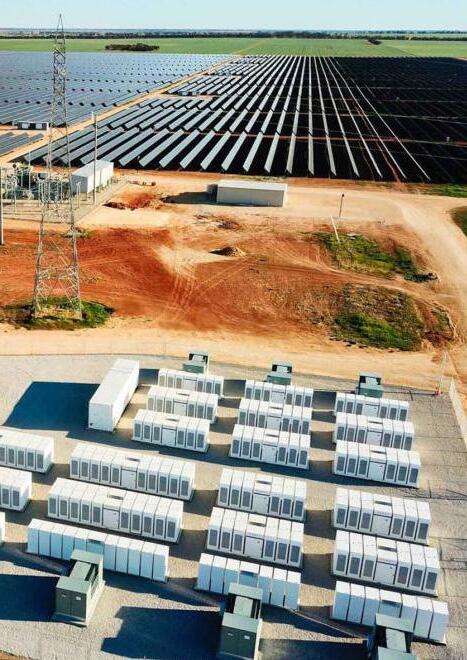
Cover Image Source: Edify Energy. Solar Farm Gannawarra. September 2018.
Issued:
Description:
16 February 2026 Final Report
Acknowledgment of Country:
We acknowledge the traditional custodians of the land on which our work is based and pay our respects to their Elders past and present. We extend that respect to all First Nations people.
Disclaimer:
Neither Urban Enterprise Pty. Ltd. nor any member or employee of Urban Enterprise Pty. Ltd. takes responsibility in any way whatsoever to any person or organisation (other than that for which this report has been prepared) in respect of the information set out in this report, including any errors or omissions therein. In the course of our preparation of this report, projections have been prepared on the basis of assumptions and methodology which have been described in the report. It is possible that some of the assumptions underlying the projections may change. Nevertheless, the professional judgement of the members and employees of Urban Enterprise Pty. Ltd. have been applied in making these assumptions, such that they constitute an understandable basis for estimates and projections. Beyond this, to the extent that the assumptions do not materialise, the estimates and projections of achievable results may vary.
This work is copyright. Apart from any uses permitted under Copyright Act 1963, no part may be reproduced without written permission of Urban Enterprise Pty Ltd.
Gigawatt kv Kilovolt
kw Kilowatt MW Megawatt
NEM National Energy Market PACR Project Assessment Conclusions Report
Regional Development Victoria RIT-T Regulatory Investment Test
Renewable Energy Zone TCV Transmission Company Victoria VNI
Victoria – New South Wales Interconnector (West)
VTP Victorian Transmission Plan WMD Wimmera Mallee Development
WRL Western Renewables Link
Executive Summary
Introduction and Overview
Nine Councils in north-western Victoria (Buloke Shire, Gannawarra Shire, Hindmarsh Shire, Horsham Rural City, Loddon Shire, Northern Grampians Shire, Swan Hill Rural City, West Wimmera Shire and Yarriambiack Shire, collectively referred to in this report as the 'study Councils') engaged Urban Enterprise to prepare this Energy and Mining Impact and Readiness Strategy.
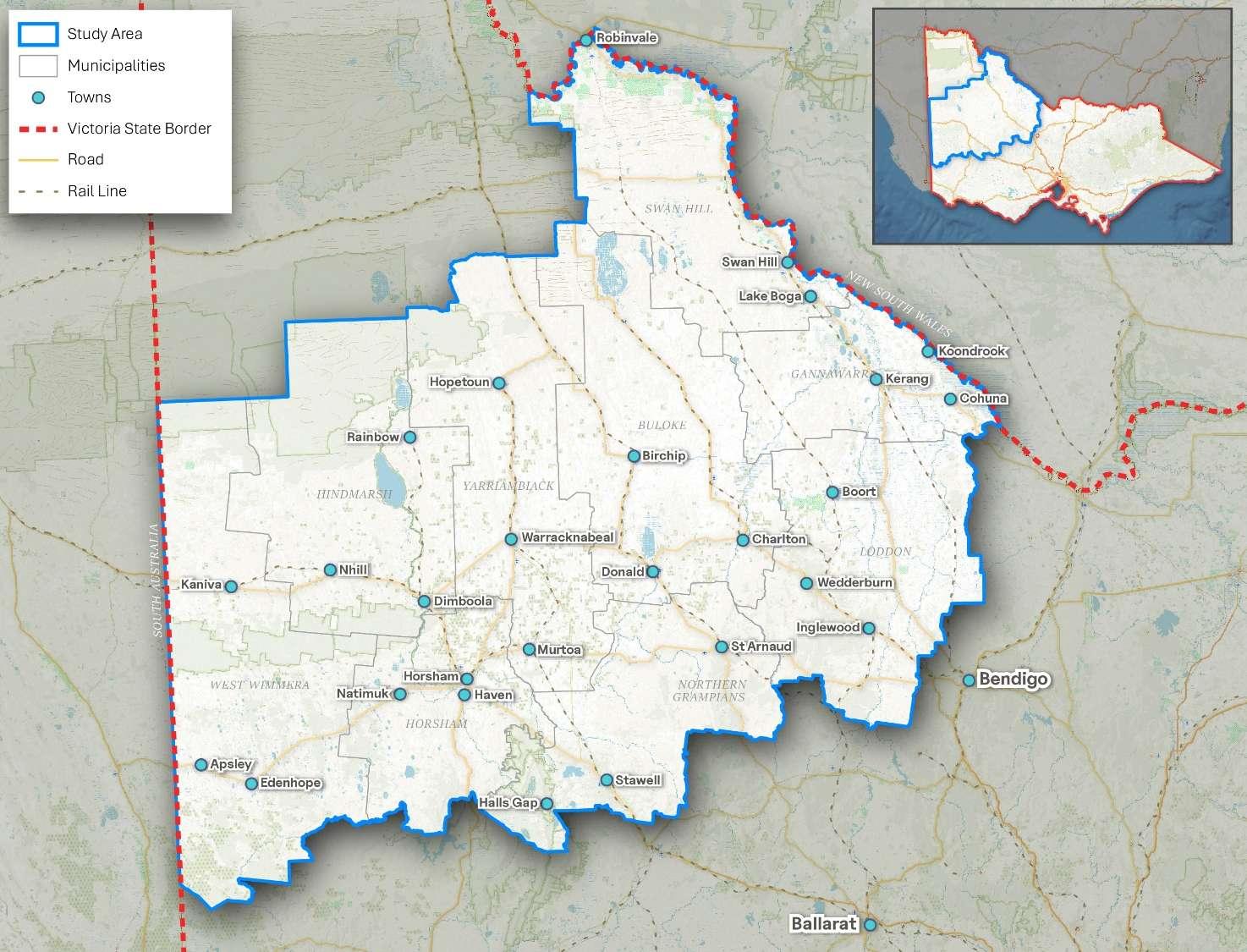
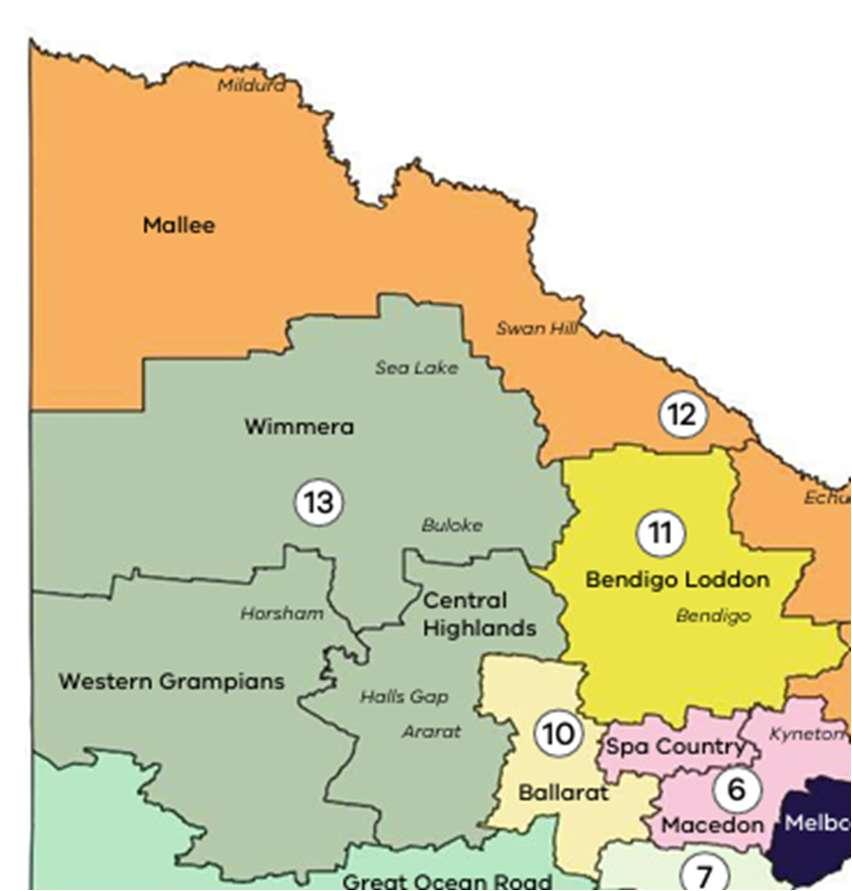
The Study Area for this Strategy comprises the study Council areas and extends from the Murray River and Victorian / New South Wales border in the north east to the South Australian border in the west and the Grampians in the south. The Study Area covers an area of 58,503 sq km, comprising approximately 26% of Victoria.
The scope of this project is to:
Identify the potential impacts and opportunities of renewable energy and mining projects in the region, including VNI West;
Understand the type and nature of economic impacts that could result; and
Identify actions and levers that local governments can apply to ensure ‘readiness’, capture economic opportunities, mitigate issues, and maximise benefits that flow to the community.
The scope is primarily focused on economic issues, however, a broad range of issues are identified throughout the Strategy which extend into related aspects including community readiness, local government resources and the role of settlements and infrastructure.
It is not in scope to undertake a full assessment of the potential impacts of projects on individual industries, properties or locations – this is within the remit of individual approvals processes. This Strategy considers the longer term, regional scale and overarching issues at play. It is also not in scope to consider environmental impacts, social impacts or the costs and benefits of projects.
Transmission Projects
Australia's transmission network requires significant investment and extension to facilitate the ongoing transition to renewable energy generation.
A ecting the Study Area, a total of $3.37bn of construction costs are proposed to upgrade three existing transmission lines, as well as the proposed construction of the new VNI West line between Victoria and New South Wales at a cost of $7.1bn.
Two of Victoria's six Renewable Energy Zones are within the Study Area (the North-west and Western REZs). VNI West will unlock significant transmission transfer capacity for these areas.
The construction of major transmission infrastructure will generate a range of economic, environmental and other impacts, both positive and negative. The process to date of assessing these impacts does not take into account local e ects. Although this may occur for the VNI West EES process, there is a current absence of consideration of the potential impacts of transmission on local communities and economies in the Study Area.
Renewable Energy Projects
There are 33 renewable energy projects planned in the Study Area with the potential to generate more than 12GW of energy through solar and wind. Three planned battery storage projects also have approximately 2GW of storage capacity.
The main spatial concentrations are in Gannawarra Shire (especially near Kerang), Horsham Rural City (especially in the northern part of the municipality) and Northern Grampians Shire (near Stawell). Major wind projects are also being planned across the central parts of the Study Area within Yarriambiack, Buloke and Gannawarra Shire.
The larger towns that are most proximate and therefore most likely to be impacted in terms of demand for labour and services are expected to be Horsham, Kerang and Stawell.
Other renewable energy projects are also proposed in southern New South Wales which will contribute to impacts and opportunities in the northern parts of the Study Area.
The ultimate scale of renewable energy investment in the region could vary significantly, and not all projects identified will proceed to construction and operation. Based on the Victorian Transmission Plan targets, a total of up to 6.4GW may
ultimately be required to be generated within the Study Area REZs. This is approximately half of the amount of generation that is currently proposed in the region.
VNI West and other transmission infrastructure augmentation is important to enable the development of renewable energy projects in the region The first phase of impacts from projects identified in this Strategy will generally relate to transmission projects and the small number of renewable energy projects that can commence without additional transmission capacity.
The second phase of impacts is expected to primarily relate to construction phase impacts and solar projects, while several major wind farm proposals are expected to create longer term impacts.
Mining Projects
Australia is home to the largest mineral sands deposits in the world, and the Study Area has globally significant quantities of titanium, zirconium, and associated rare-earth elements in mineral sand deposits. Critical minerals are a collection of metal and nonmetal resources considered essential for renewable energy infrastructure, modern computing, emerging technologies and sustainable economic development.
Mineral sands and other mineral occurrences are present across a broad band within the Study Area extending from the Horsham area through Yarriambiack, Buloke and Gannawarra to Swan Hill. Mineral Sands and rare earth occurrences also extend into South Australia to the west and into the Southern Grampians area to the south.
Gold occurrences are wide spread near Stawell and across much of Loddon Shire in the east of the Study Area, and exploration and investment into gold mining is increasing strongly across the region.
A total of 22 mining projects are planned in the area, including 11 mineral sands projects and 9 gold projects. The projects expected to generate short term impacts are located near Swan Hill (Goschen), Horsham (Avonbank and Wimmera) and the Donald Project (between Minyip and Donald).
Mineral sands projects are expected to have relatively long mine lives of 25-40 years. Localised impacts and benefits will occur during the construction and operation phases during which activities are relatively labour intensive. Mineral sand resources are planned to be exported for processing via the Port of Portland and Port of Melbourne.
Existing Conditions
The Study Area contributes approximately 6% of Regional Victoria’s annual output and value-added, and 18% of export-value. An estimated 42,300 jobs are located in the Study Area.
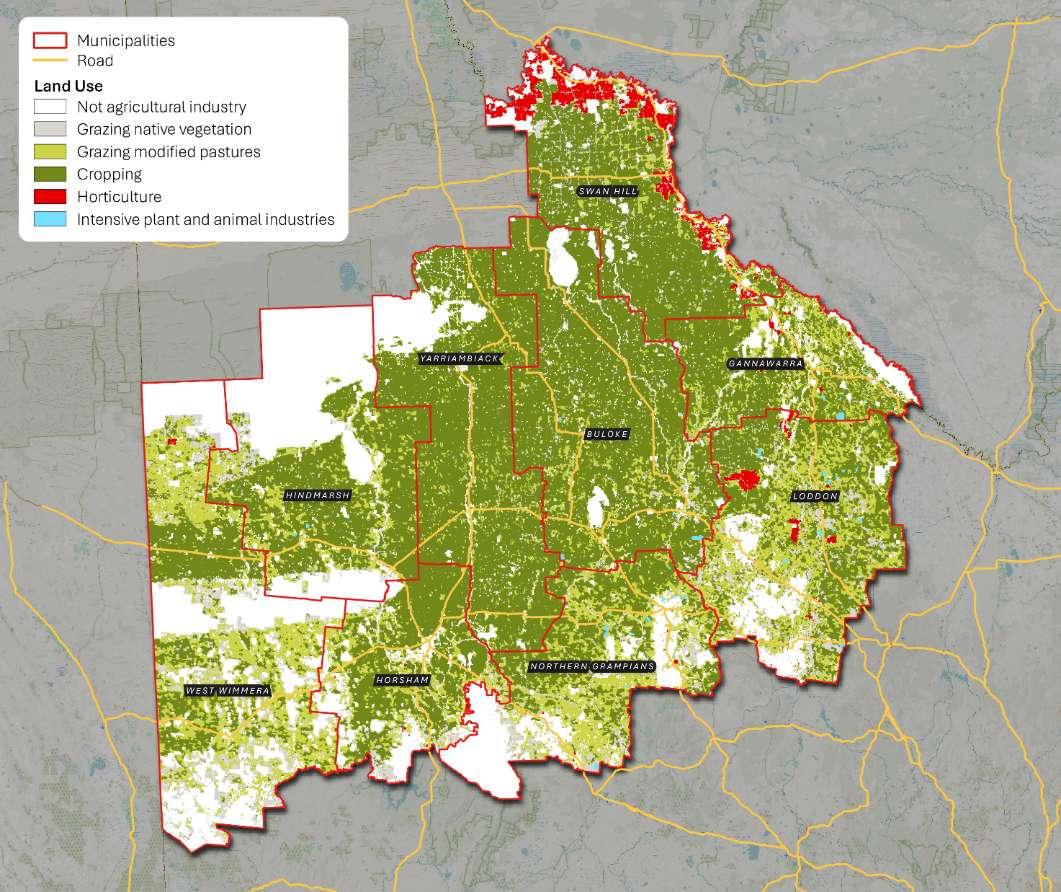
Agriculture is the main driver of the regional economy, and is critically important to economic output, employment, valueadd and export value. Key activities include broadacre cropping (grain, cereal and pulse), livestock farming, dairy farming and horticulture. Existing local and regional economic strengths and priorities are weighted to agriculture, manufacturing, health care and social assistance and construction.
There is a relative lack of diversification in the economy, highlighted by the reliance on agriculture and supply-chain sectors such as food manufacturing, construction and transport.
There are significant existing workforce capacity challenges, labour shortages and skills gaps in the Study Area that are a result of long-term low unemployment, very high labour participation rates, an ageing workforce and areas of overall population decline. These conditions create challenges for a range of existing industries across the region, a key issue raised in consultation with stakeholders for this Strategy.
The Study Area has experienced population decline in some areas, however some communities have remained stable or increased in population. State government projections are for population to decline in the majority of Local Government Areas over the coming years (with the exception of Horsham and Loddon), however o icial projections are unlikely to have taken into account the population growth needed to service proposed major projects in the region.
Within the context of a changing and ageing population and very limited capacity in the labour force, the opportunity to meet the labour requirements for renewable energy and mining projects from within the Study Area is very limited. Therefore, to support the delivery and operation of projects, the following will be needed:
Diversion of workers from other sectors of the economy; and/or
Workers to be sourced from outside of the Study Area, which will have flow-on implications for housing, accommodation and services.
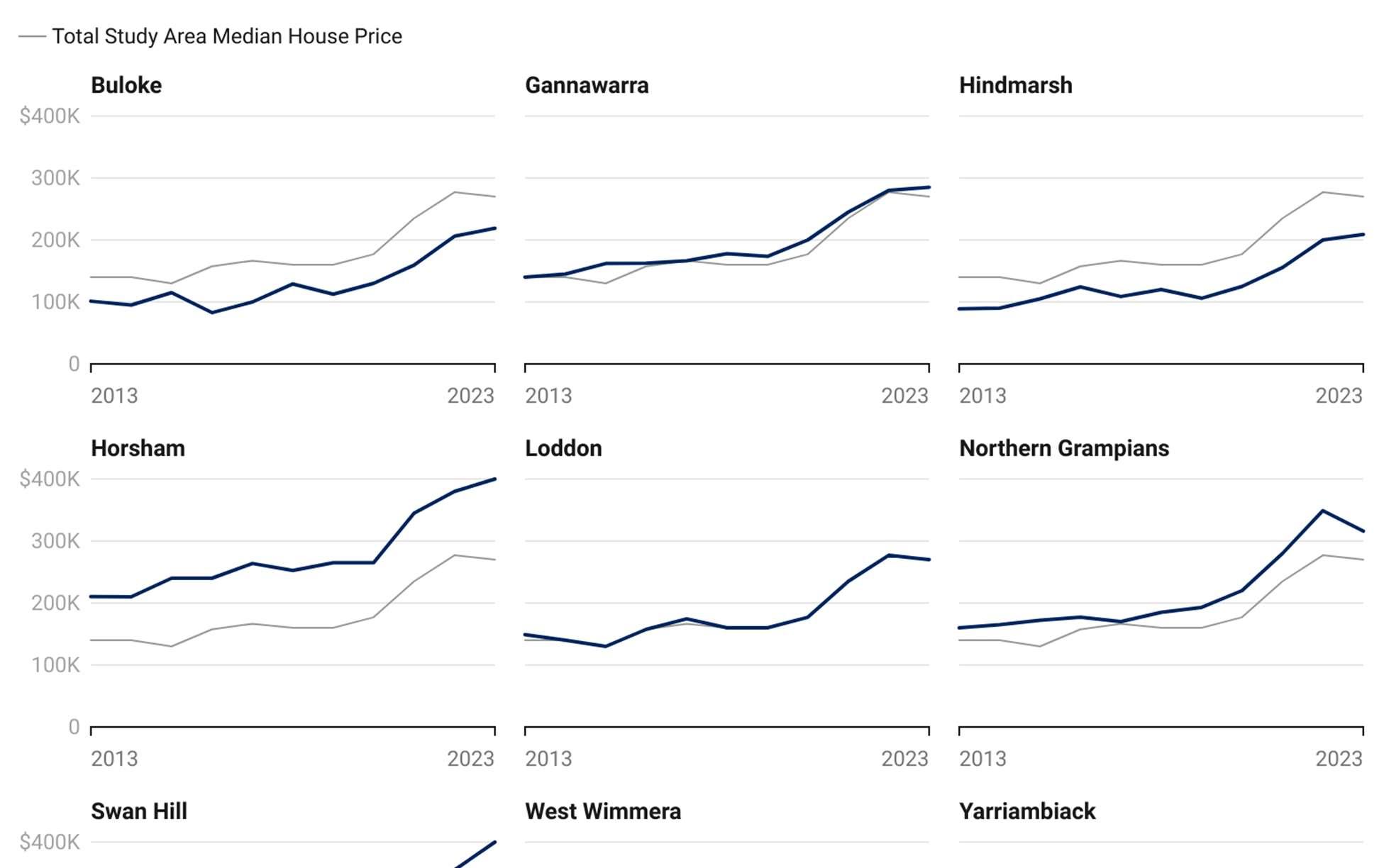
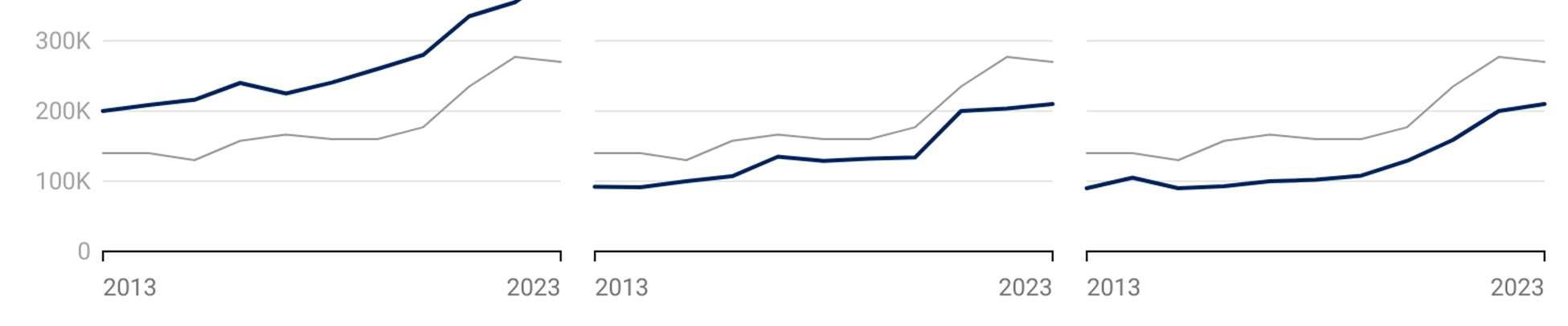
The housing and accommodation markets in the Study Area are characterised by low prices, a lack of diversity of housing types and sizes, extremely low rental vacancy rates, rapid rent price growth, and a low quantity of commercial accommodation. This presents challenges to existing communities as well as limitations for development feasibility, accommodating temporary workers and accommodating an ageing population in the future. The lack of housing availability is already a major constraint to economic activity and service provision across the Study Area.
Existing infrastructure networks are extensive but under pressure, especially local roads, telecommunications, water, wastewater treatment and in some parts of the area, electricity. In addition, existing rail infrastructure requires investment to take pressure o roads and move produce more e iciently across the region.
Local governments in the Study Area generally have very low rates bases and financial sustainability challenges which limit the availability of resources to undertake existing responsibilities.
Economic Impacts and Opportunities
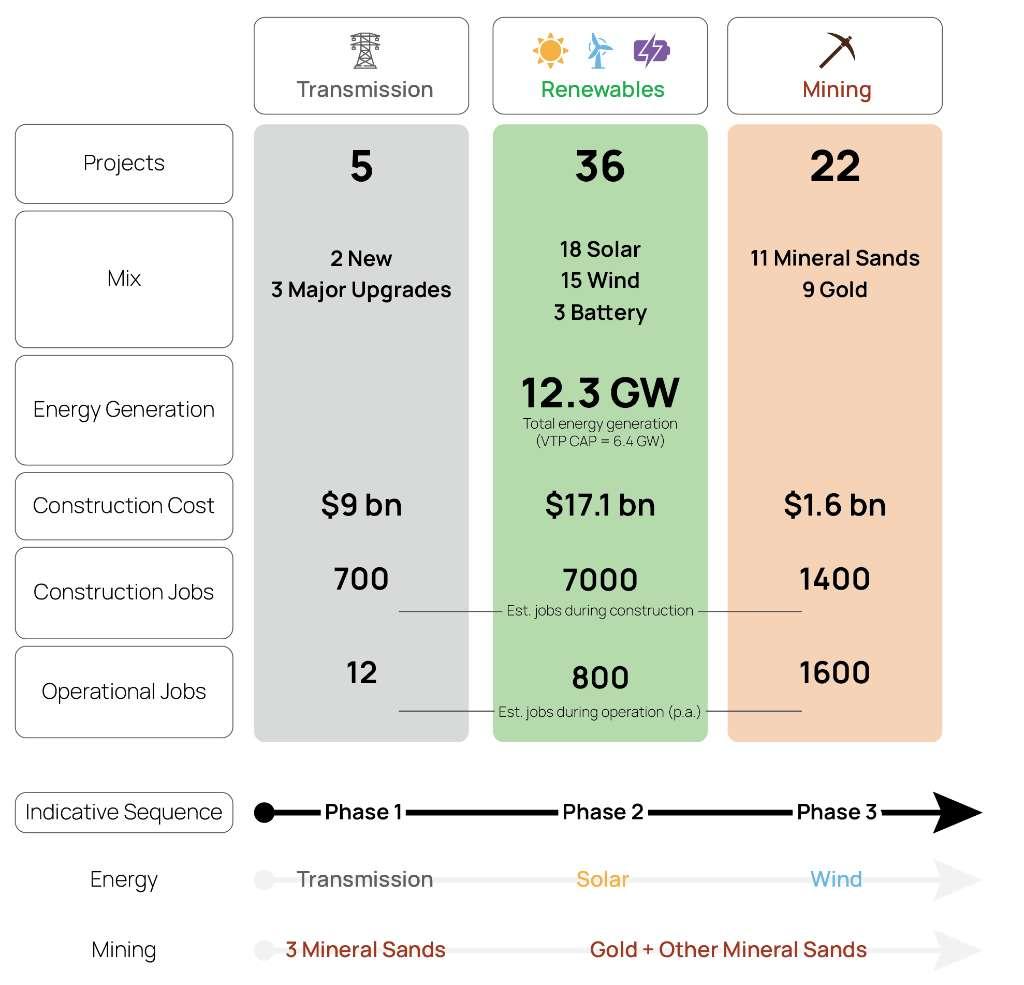
Figure S1 shows a summary of the key scale and employment impact of the proposed projects, with further details provided in Section 6 of the Strategy.
Figure S1 Project and Economic Impact Summary
Source: Urban Enterprise.
Proposed projects in the region have a total capital expenditure estimated at $27.7 billion of which approximately $2.8 billion may be spent locally.1
A total of at least 9,000 full time equivalent jobs would be supported by the proposed projects, with each job lasting an average of 2.5 years (based on the typical construction period of the projects). This employment impact would be phased over a relatively long period.
1 These estimates exclude proposed renewable energy projects beyond the total energy generation potentially required from the region of 6.4GW.
If projects were to occur within the three phases indicatively used for this Strategy, then:
Phase 1 would support 1,700 FTE workers for construction activity;
Phase 2 would support 3,800 FTE workers for construction activity; and
Phase 3 would support 3,700 FTE workers for construction activity.
If the number of workers in the region peaks at around 3,800 during construction phases, this would represent an approximately 9% increase in employment across the Study Area, a significant increase over a sustained period.
Labour will need to include a combination of local and imported workers, highlighting both the significant opportunity for local labour participation as well as the potentially significant impact of existing labour being redirected from current employment in other industries to the major projects. To the extent that labour is imported to service the construction phases of projects, this will have significant impact on local housing and commercial accommodation markets, all else being equal.
Annual operational expenditure associated with the various project types is estimated at $888 million across all phases, with an indicative $590 million (67%) expected to be captured locally. Operational employment across all projects is estimated at 2,300 ongoing jobs, with around 1,900 positions (80%) expected to occur locally. Peak employment will depend on the ultimate timing of the operational phase of projects.
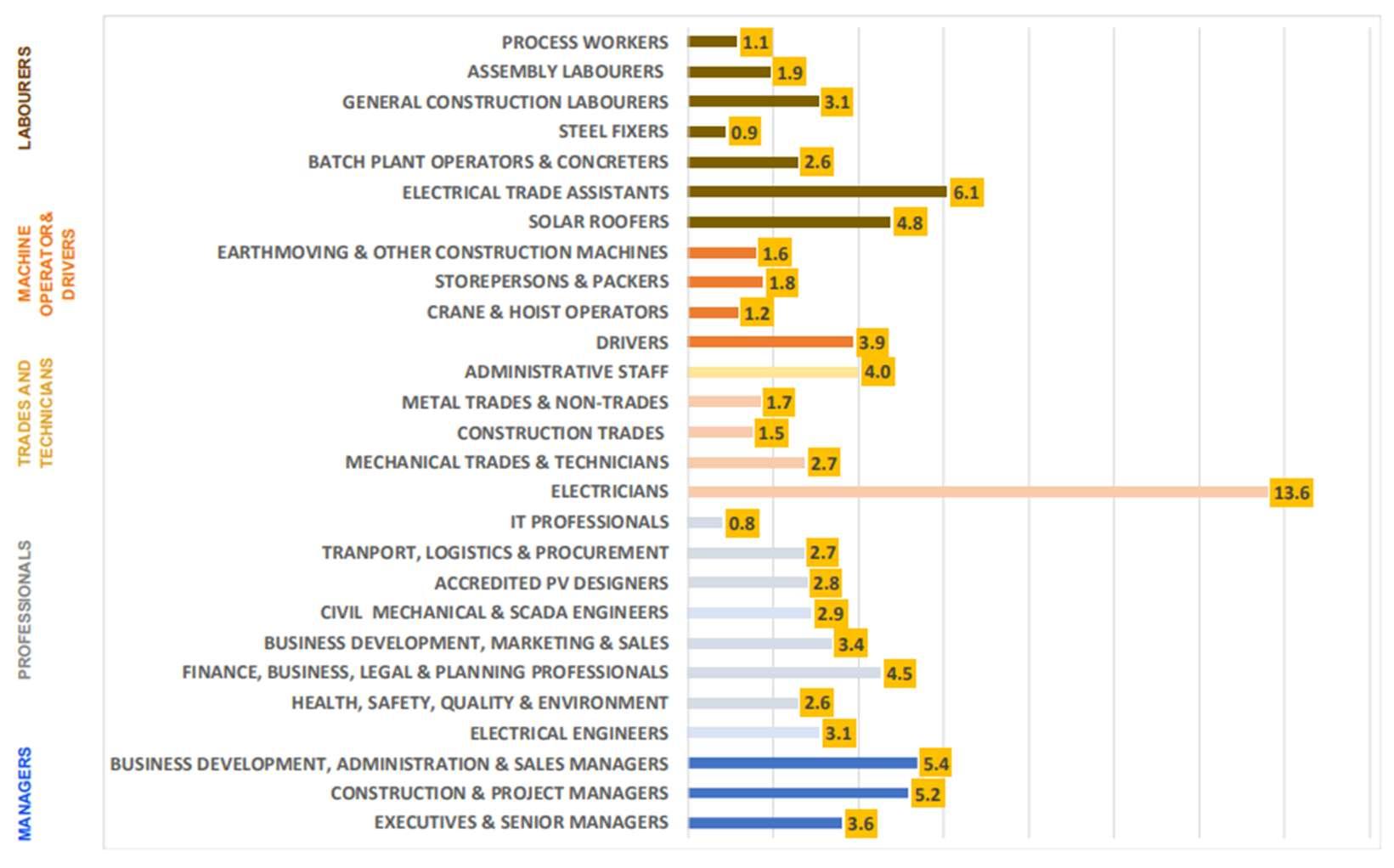
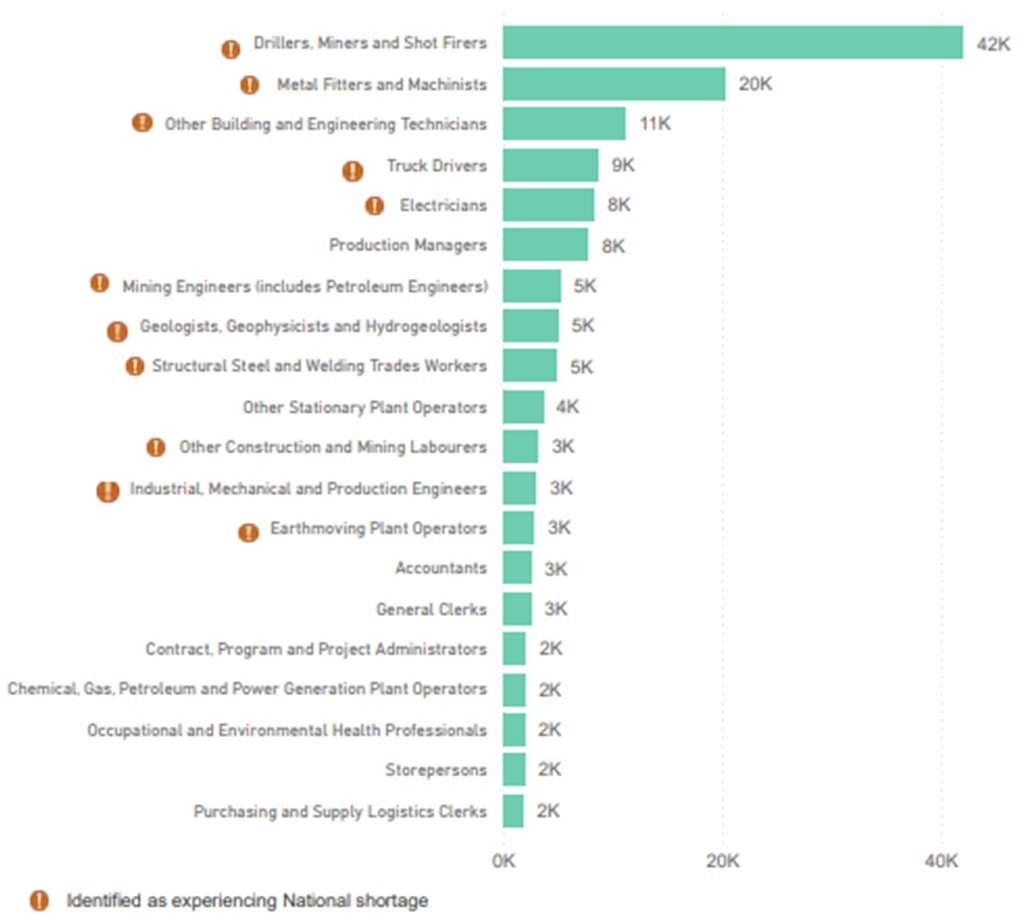
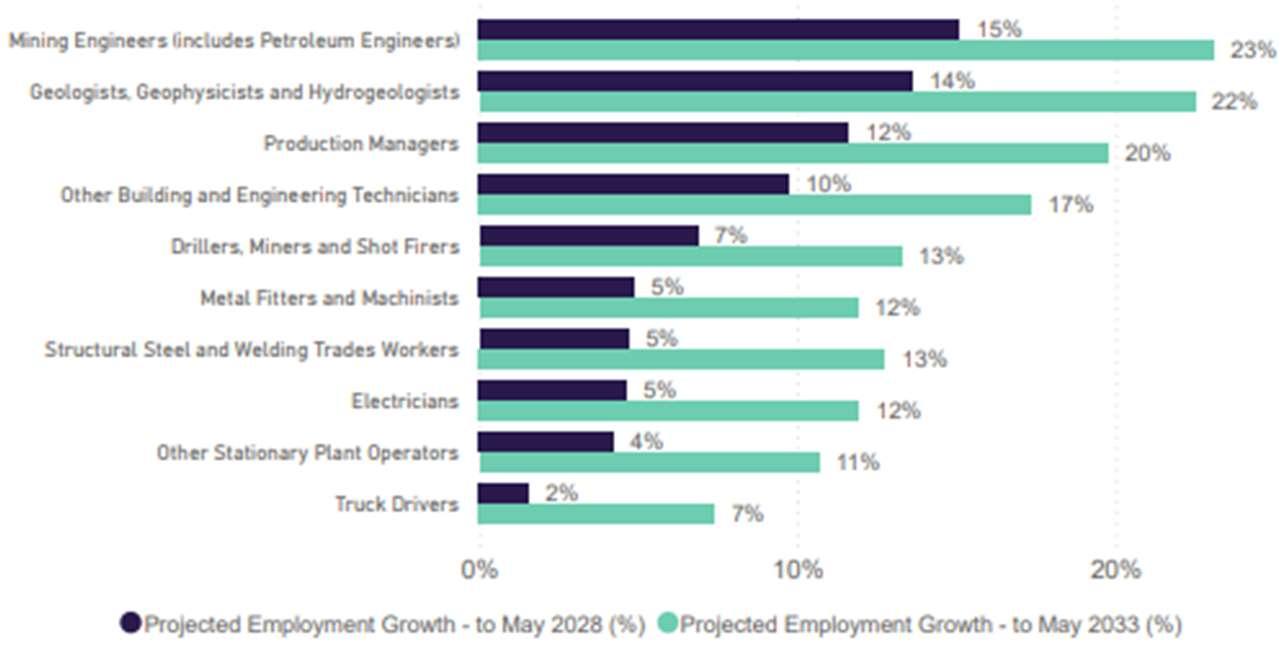
Major renewable energy, transmission, and mining developments generate significant employment and supply chain opportunities within their host regions. The majority of employment demand is concentrated in skilled trades and technical roles, with electricians the single largest occupation group for renewable energy projects. More broadly across transmission and energy projects, key sectors of demand include labourers, drivers, construction and project managers and a range of engineering disciplines.
The ability of local workers to be involved in the development and operation of renewable energy projects is highly dependent on the alignment of workforce skills, training pathways, and industry demand within regional areas. Further, the relatively small size of most businesses in the Study Area creates a challenge for existing businesses to confidently and proficiently participate in the supply chains of major projects.
For mining projects, local workers are well placed to participate in key roles, particularly in trades, machinery operation, transport and logistics, and site administration. However, given very high existing workforce participation and low population growth, there is a clear risk that workers are redirected from current roles to obtain higher paid roles in mining.
There is an opportunity for the north-western region of Victoria to add value to mineral sands extracted in the region through processing and manufacturing activities.
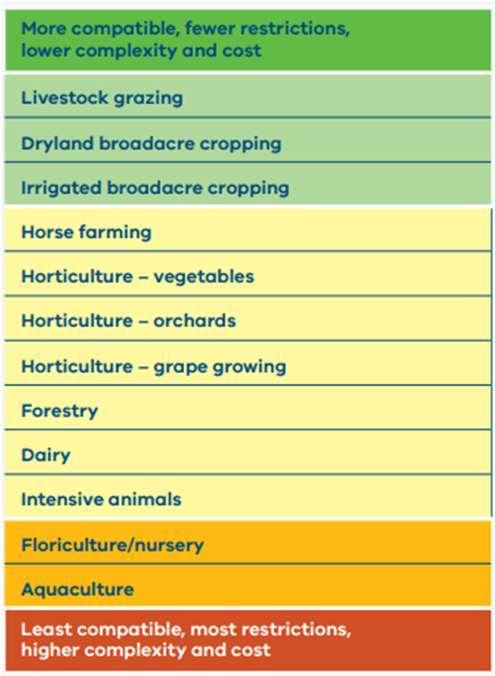
Given the high economic importance of agriculture to the economies of the Study Area and the lack of detailed and localised analysis of the potential impact on the sector, it is critical to more closely understand the specific impacts of mining, transmission and energy projects on agriculture in the Study Area, including:
Considering the potential cumulative impact of these projects on the value and specialisation advantages of key subsectors of the agricultural industry in the area; and
Planning for the expected increase in competition for labour, equipment, materials and water arising from the proposed major projects.
Overall competition for labour is likely to directly impact the agricultural sector and other parts of the economy – competition for labour and resources is the key potential economic disbenefit to mitigate for the region.
Community and Local Government Impacts
Community uncertainty, and in some cases, strong opposition, to proposed transmission infrastructure in the region (as well as some mining and renewables projects) is growing and identified by stakeholders as detrimentally impacting community cohesion. Progressively developing and maintaining social value will be central to achieving positive outcomes for the Study Area.
In addition to strategic investment in infrastructure and housing, community benefit schemes present a key opportunity to achieve legacy outcomes for the region, however schemes can be inconsistent in their application and in some cases fail to achieve meaningful benefits. There is an overall opportunity to improve the consistency, co-ordination and legacy impact of energy project schemes for broader benefit.
Mining projects are presently not required to provide local community benefits or rate payments, with royalties paid only to the State. There is a clear opportunity to increase the local share of benefits from mining projects.
Although local government has limited influence over most key issues and decisions associated with transmission, energy and mining projects, Councils are often the first point of contact for communities, especially in periods of change and uncertainty.
Most local governments in the region are ill-equipped to adequately assess and respond to major project proposals, and any redirection of Council resources to address major project requirements can come at the cost of delivery of existing community services, generating a negative impact for the community overall. Local governments will require assistance well above 'business as usual' to ensure readiness and to adequately fulfil all legislative responsibilities.
Readiness Priorities and Actions
The scale of investment in energy and mining projects in the Study Area is significant and can bring substantial economic opportunities to the region which can assist with overall economic wellbeing in the Study Area, however potential conflicts with existing industries and cumulative impacts need to be considered.
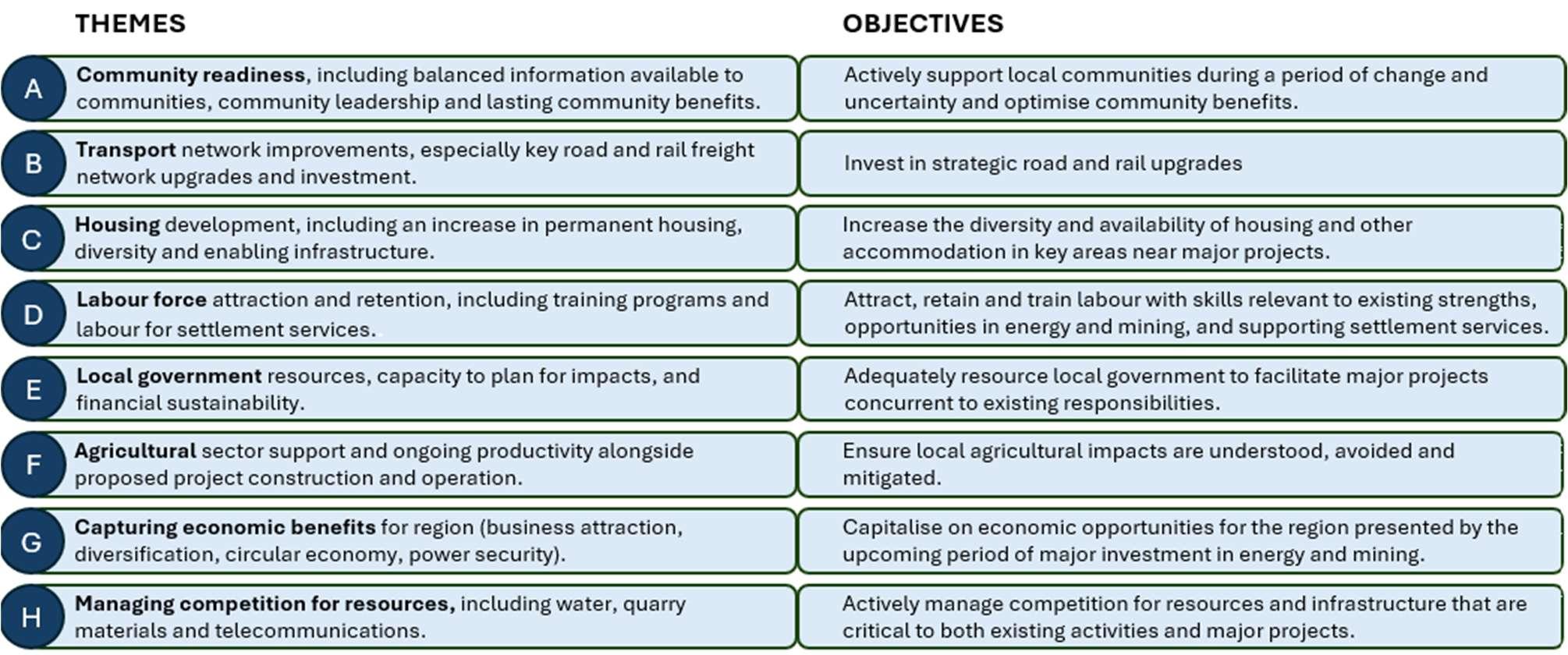
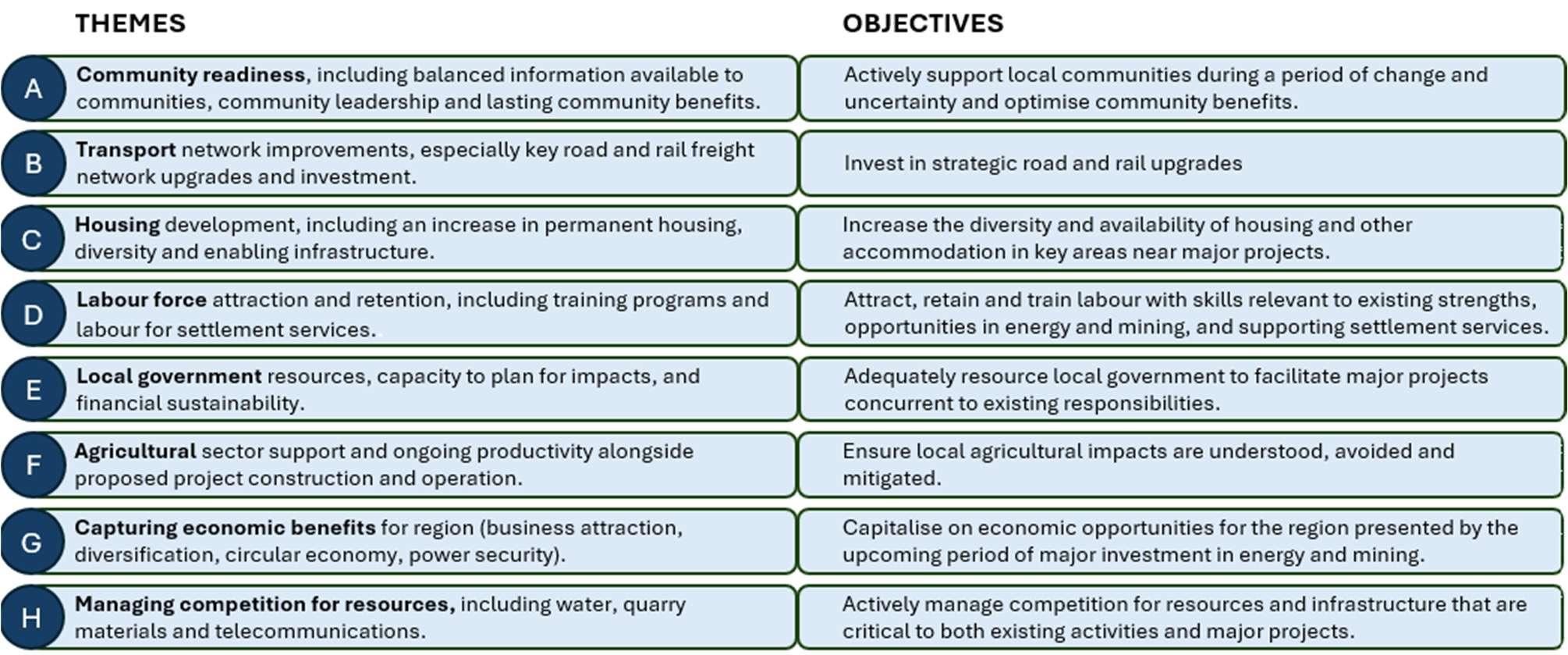
Figure S2 summarises the eight key readiness themes and issues identified, and the strategic objectives of the Strategy relating to each theme. The recommended actions to further the objectives are shown in Table S1.
The actions are designed to identify the next steps that would best assist local governments and communities in the Study Area to mitigate the impacts of proposed projects and to benefit from the opportunities for current and future generations.
Implementation of the recommended actions will be subject to the availability of funding, especially from State and Federal governments, and partnerships and contributions from various agencies, proponents and institutions. Given local government constraints, regional co-ordination and state government leadership will be critical to supporting, funding and implementing this Strategy.
Figure S2 Readiness Themes, Issues and Objectives
Source: Urban Enterprise.
Table S1 Action Plan
1
2
3
Study Councils acknowledge and endorse the objectives of the Strategy and commit to partner with all levels of government on implementation (See Note 1)
Funded roles (such as the Resources Victoria NW Communications expert) and funded community education training programs are needed to raise awareness.
Preparation of place-based communications and explanatory materials for a community audience regarding the context for why major projects are being situated in the north-west region.
Fund a publicly available map and dashboard showing projects, commitments, project status and a centralised portal for government, proponents and community to link and alert public engagement activities in each Critical Minerals Priority Development Zone and REZ area similar to Engage Vic. High State government to fund an independent body
4 Fund the delivery of Leadership Training in the region to ensure there is the ability for active and informed community participation in the land use transition.
5
6
Establish an annual Resource Ready event co-funded by State government and proponents to bring together government, proponents, business and community members to share research, experiences and opportunities.
Formalise and standardise community benefit schemes across the transmission, energy and mining project types in the study area to avoid duplication for community, maximise benefit and legacy for the hosting region and reduce administration overheads.
Encourage any overarching benefits schemes to prioritise:
Consolidation of benefit scheme processes, structure and implementation across the region;
7
1
2
Establishment of an overarching body that manages and administers the community benefit fund in collaboration with and/or on behalf of the proponents consistent with existing strategic regional and local readiness priorities with strong Local Government representation.
Pooling community benefits contributions towards larger capital works projects, including co contributing schemes to enable Councils to access a proportion of the benefit fund for projects planned or underway.
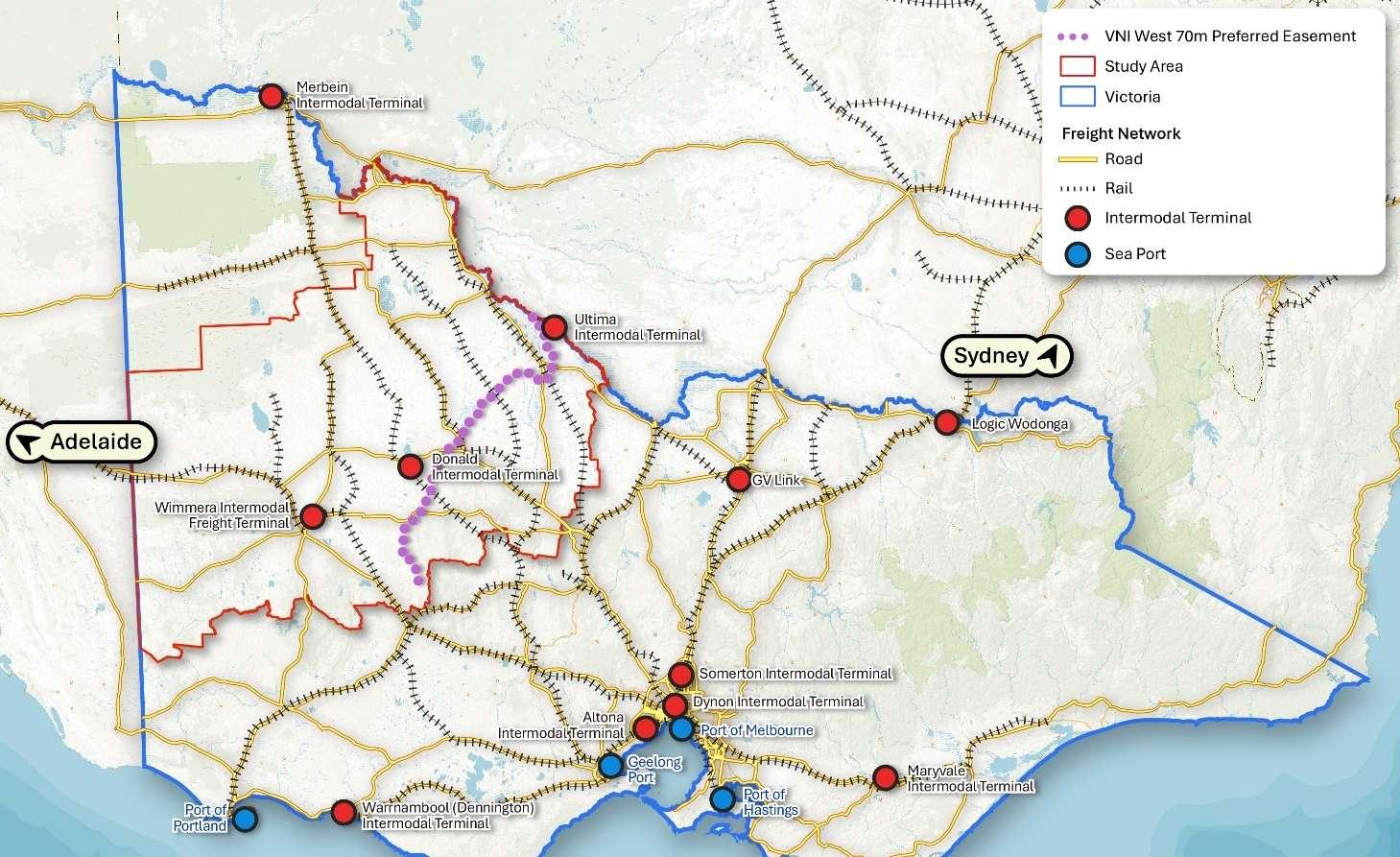
Prioritise and implement a Northwest Rail Freight Plan to enable more agriculture, energy generation & transmission infrastructure, and mining product to be transported by rail.
Building on assessments undertaken for individual energy and mining project approvals processes, drawing on local government intelligence and having regard to agricultural needs, identify key strategic roads a ected by transport demands to enable prioritisation.
3 Identify key intermodal support, port intake and export capacity, and railway line capital works.
High DEECA and VicGrid with proponent, community and local government assistance
1
Prioritise and implement a regional Worker Housing Plan which brings together existing housing studies from the Study Area to identify key locations and forms of housing across the region to service the expected construction periods. The plan should also identify opportunities for legacy in housing in response to the need for a more diverse and age-appropriate housing mix.
2 Plan and prioritise worker accommodation modular work camps that transition to housing estates post construction.
DTP and Local Government
DTP, DEECA, VicGrid and Local Government
and Local Government (RCV, RFA and MAV)
DTP, DEECA, DJSIR, Vicgrid and Local Government
DTP, DEECA, DJSIR Vicgrid, Proponents and Local Government
3
4
5
Co-ordinate and resource a regular housing development forum for the region to bring together developers, major project proponents and government representatives to identify priority issues in delivering housing in the region.
Identify and have State government fund and prioritise key strategic planning work and enabling infrastructure required by Councils to facilitate major project accommodation requirements.
Identify towns and growth fronts for potential housing that are constrained by enabling infrastructure issues and advocate for dedicated funding to unlock housing potential, especially in areas proximate to projects.
6 Recognise the Northwest Study area as a region of major growth with incoming industry in State planning policy.
D Labour Force Development and Settlement Services
1
Prioritise vocational training opportunities in the region in occupations and skills required to support energy and mining projects by underwriting courses, regardless of student numbers.
2 Encourage partnerships between major project proponents and education providers to create a direct training and employment pathway for critical skills.
3
Prioritise and subsidise Apprenticeships and Traineeships in north-west Victoria in priority sectors supporting existing and emerging needs, including manufacturing, mining, energy, construction and care for small and medium enterprises to grow the local supply chain.
4 Investigate opportunities for targeted skilled migration to address labour needs including liveability and settlement services.
5 Investigate innovative ways to deliver vocational training to increase the volume of participants including mapping of existing skills to new skills and retraining.
6 Work closely with schools and Local Learning and Employment Networks (LLENs) to demonstrate the demand for vocation training in the Resource Region through funded programs.
7 Fund Federation and SuniTAFE to ensure their subject matter is fit for industry needs, through consultation and contextualisation.
8
Provide funding to prepare a Childcare Labour Attraction Strategy for the region in partnership with Local Government and Early Childhood Education and Care (ECEC) providers and other relevant co ordinating bodies, with the aim of addressing existing shortages and an ability to respond to future pressures and demand peaks.
9 Identify and provide services for new migrants to the region to assist with attraction, retention and community cohesion, similar to the NSW Orana Welcome Program.
10
1
2
At the Northwest regional level, investigate how to address the potential skills impact to Councils e iciently maintaining local roads during the peak demand for civil workers and road crews with multiple projects.
Establish a dedicated funding and technical resource stream, with a panel of independent providers, including shared labour resources across the Councils, to support in assessing major project applications concurrent to business-as-usual operations and responsibilities.
Develop a suite of standardised and templated documents setting out and explaining the types of information required by Councils from proponents and State government agencies to adequately, e iciently and accurately assess proposals and referrals for comment at each stage of proponent project development.
Medium State Government, DTP, DEECA, RDV, VicGrid, Proponents and Local Government
Medium DTP with Local Government support
Medium DTP, RDV with Local Government support
Medium State Government, DTP with Local Government support
High DJSIR and Proponents with Training Organisations
Medium Proponents with Training Organisations
High DJSIR, Federal Government, Proponents with Training Organisations
Medium DJSIR, Federal Government, DEWR and Department of Home A airs (Immigration), Proponents, Local Government
Medium DJSIR
Medium DET with LLENs and Proponents
Medium DJSIR and DEECA, VicGrid and Proponents
Medium State and Federal DET and Local Government agents
Medium DJSIR and Proponents
Medium
Department of Government Services (LGV) and Local Government
High DEECA and VicGrid
Medium DEECA and VicGrid
3
Advocate for State Government leadership, with well supported Local government representative bodies, to communicate with local communities regarding the role of local governments relevant to major projects and how they can participate in key decision and approvals processes. Medium DEECA and VicGrid
4 Provide dedicated funding for Local Governments to employ FTE commensurate to the requirements imposed by the land use change occurring.
F Agricultural Impacts
1
Prepare an agricultural impact assessment of mining and renewable energy projects bespoke to north-west Victoria, taking into account the advantages and specialisations of the region and the potential for any cumulative impacts of major projects.
High DEECA and VicGrid
High
incorporating Agriculture Victoria, Resources Victoria and VicGrid
2 Identify key skills and occupations that most directly overlap between agriculture, mining and construction of energy projects and prepare a targeted strategy to increase the local supply of this labour. High DJSIR
3 Prioritise and implement the Critical Minerals Roadmap Land Use Co-existence Policy, ensuring the agricultural value and opportunities of the area are protected.
G Economic Opportunities
1 Embed economic development objectives for the energy and mining sector in relevant statutory approvals to facilitate businesses growth and development which capitalises on local opportunities, or enter voluntary codes of commitment to demonstrate place based, fit for purpose responses.
2 Establish a database of businesses providing goods and services relevant to the transmission, energy and mining supply chains as identified in this report and establish a grants program to enable businesses to access funding to expand or invest to participate in major projects or related downstream activities.
3 Contribute to, prioritise and implement work undertaken at the State government level regarding opportunities for mineral sands value-adding in the north-west region.
Medium DEECA
High DEECA and DJSIR
Medium DJSIR with Proponents
Medium DEECA and DJSIR
4 Prepare information, training and support services to enable existing businesses in the region to participate in the supply chain of major projects. High DEECA, DJSIR and Local Government with Proponents
H Competition for Resources
1 Advocate for investment in telecommunications infrastructure to withstand surges in demand expected during construction phases of major projects.
2 Liaise with relevant government agencies to ensure continued availability of water to agricultural and recreation users within the Northwest concurrent to supply being made available for major project requirements.
Medium DJSIR and Proponents
High DEECA
3 Liaise with gypsum and quarry operators and owners in the region and Resources Victoria to identify issues and opportunities regarding the ability to increase supply in response to increased demand. High DEECA
4 Prepare an energy security plan for towns and businesses in the study area that currently experience supply issues, including consideration of opportunities presented by the construction of new transmission infrastructure and renewable energy generation in the area. Medium DEECA
5 Identify and prioritise investments needed to stabilise and increase energy security and fund a business case and construction projects which prioritise outcomes in the host region.
6 Undertake a comprehensive assessment of the Emergency Service settings required during the construction and operation of energy and mining projects to ensure community safety levels remain or increase.
Source: Urban Enterprise with input from project partners.
Note 1: The endorsement of this Strategy by Councils does not mean that any Council supports any transmission, renewable energy or mining proposal in the region.
Medium Independent Body
Medium DEECA, VicGrid and proponents
Background Part A
1. Introduction
1.1. Background
Federal and Victorian State Government policy supports the transition to renewable energy sources, including legislated targets for renewable energy generation and greenhouse emissions reductions. Renewable energy targets, incentives and investments are driving major shifts in the way energy is produced both globally and locally. New sources of energy and forms of production are planned to complement or replace traditional equivalents.
Western Victoria and North-West Victoria are two of six Renewable Energy Zones (REZ) in Victoria. The REZs are priority areas with the greatest potential for renewable energy generation. Consistent with global trends, the Western Victoria and NorthWest Victoria Renewable Energy Zones and surrounding areas are currently the focus of several major renewal energy proposals, including onshore wind farms, solar farms and large-scale battery.
It is within this context that additional transmission infrastructure is needed. The proposed Victoria – New South Wales Interconnector project (known as VNI West) is planned to transmit renewable power from REZs in New South Wales and Victoria to the Australian energy grid, enabling new renewable generation in region; additional electricity export capacity from Victoria to New South Wales; and additional electricity import capacity from New South Wales to Victoria. VNI West has the potential to facilitate the delivery of a substantial pipeline of renewable energy investment across the region, which would have a range of economic impacts and benefits for communities and Councils.
Northern and western Victoria is also the focus of several major mining projects, particularly mineral sands, rare earth and gold projects, which have potential to extract globally significant resources and also generate significant economic and other impacts and benefits.
The sheer scale and number of major projects proposed in north-western Victoria must be considered in the context of a region that has existing strengths and challenges, particularly a strong reliance on agriculture, low population levels and existing shortages of housing, labour and some services and infrastructure.
Local Councils in the region are aware of the wide range of issues and opportunities that the proposed major projects could generate and have partnered to commission an independent strategy to identify and respond to expected impact and readiness considerations.
1.2. Engagement
Urban Enterprise was engaged by the group of nine Councils located in north-western Victoria to prepare this Impact and Readiness Strategy.
The Councils are Buloke Shire, Gannawarra Shire, Hindmarsh Shire, Horsham Rural City, Loddon Shire, Northern Grampians Shire, Swan Hill Rural City, West Wimmera Shire and Yarriambiack Shire. The Councils are collectively referred to in this report as the 'study Councils'
The project is co-sponsored by VicGrid and has been delivered in conjunction with representatives of Regional Development Victoria (RDV) and Wimmera Mallee Development (WMD).
1.3. Role of Local Government
In Victoria, local government is established by an Act of state parliament – the Local Government Act 2020 – which specifies council powers, duties and functions. The role of a Council under the Act is "to provide good governance in its municipal district for the benefit and wellbeing of the municipal community."
Local government enables the economic, social and cultural development of the municipal area it represents; supports individuals and groups; and provides a wide range of services for the wellbeing of the local community. The primary functions of local Councils commonly include the provision of services and facilities (including community and recreation, early childhood and elderly services and waste collection); administering and enforcing State and local laws (such as planning, building, environmental protection, public health, tra ic and animal management); and maintaining a range of assets (including roads, open spaces and others).
2
The role of local governments has evolved and expanded significantly over time beyond their traditional purview of rates, roads, and rubbish. Local governments are increasingly relied upon to provide services and manage complex infrastructure assets.2
Councils do not deliver or regulate major projects such as renewable energy, transmission and mining projects. These projects are generally initiated by the private sector or government agencies, with approval responsibilities normally at the State and Federal government levels. Although Councils have a role to play in contributing to the various permissions required for the projects to proceed, overall, Local Government is not a key decision maker in the approval or otherwise of the major projects that are the subject of this Strategy.
Therefore, it is important to consider that the study Councils are undertaking this project as a means of identifying the potential impacts and opportunities at the local level and advocating for action to ensure overall benefits for the wellbeing of the communities.
A Council’s main opportunities to influence local‘readiness’relate to community engagement and communications, strategic land use planning, economic development initiatives, advocacy to State and Federal government and regional coordination and partnerships.
1.4. Scope
The scope of this project is to:
Identify the potential impacts and opportunities of renewable energy and mining projects in the region, including VNI West;
Understand the type and nature of economic impacts that could result; and
Identify actions and levers that local governments can apply to ensure ‘readiness’, capture economic opportunities, mitigate issues, and maximise benefits that flow to the community.
The scope is primarily focused on economic issues, however a broad range of issues are identified throughout the Strategy which extend into related aspects including community readiness, local government resources and the role of settlements and infrastructure.
It is not in scope to undertake a full assessment of the potential impacts of projects on individual industries, properties or locations – this is within the remit of individual approvals processes. This Strategy considers the longer term, regional scale and overarching issues at play. It is also not in scope to consider environmental impacts, social impacts or the costs and benefits of projects.
1.5. Study Area
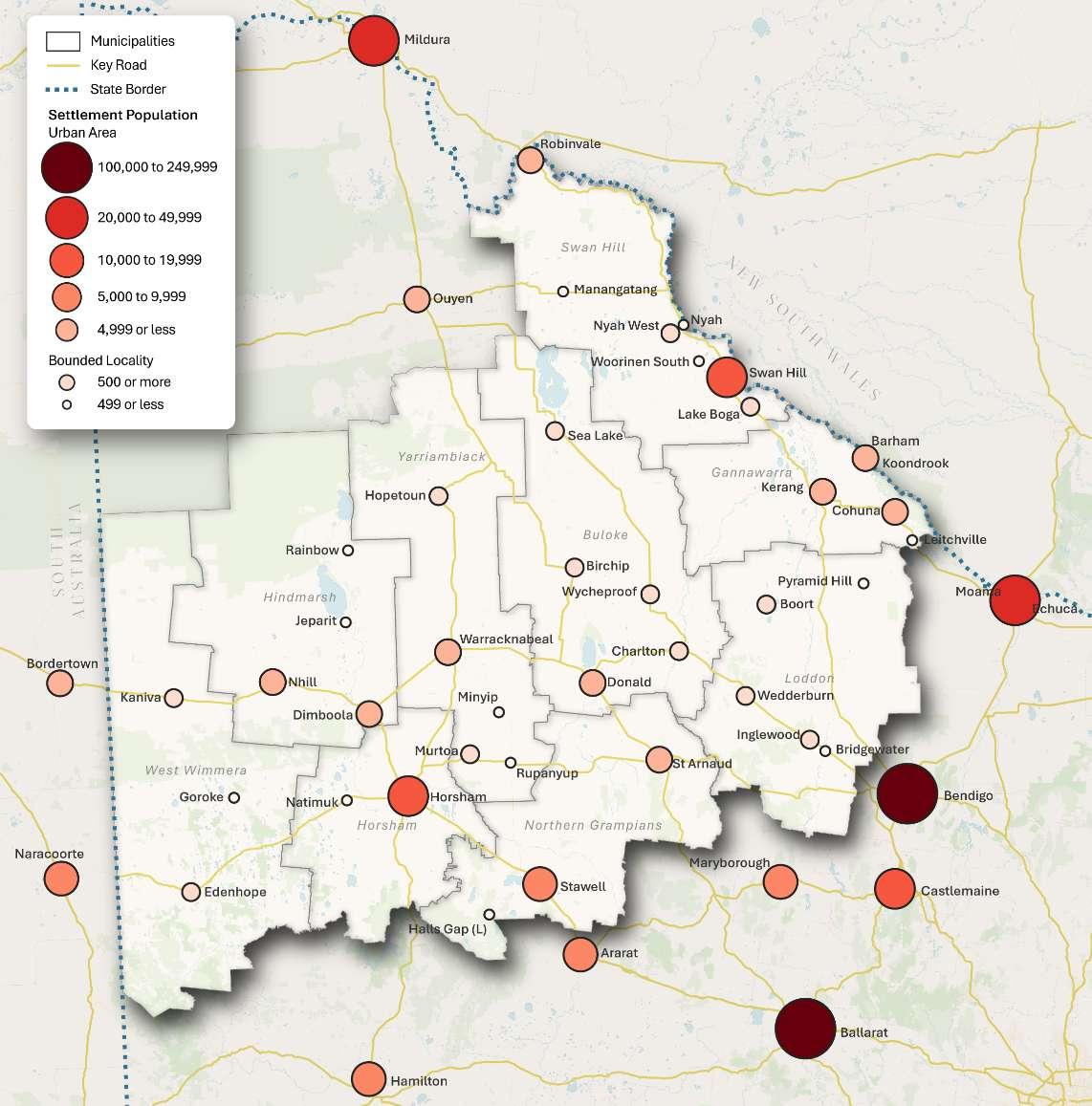
The Study Area is the contiguous area covered by the study Councils as shown in Figure 1.
The Study Area extends from the Murray River and Victorian / New South Wales border in the north-east to the South Australian border in the west and the Grampians to the south. The Study Area covers an area of 58,503 sq km, comprising approximately 26% of Victoria.
Although the Strategy is focused on activity and impacts within this Study Area, it is noted that the area does not function in isolation. Other projects outside the Study Area will also influence the Councils and settlements within the Study Area, and the impacts and benefits of projects located within the Study Area will also flow to other areas across Victoria, Australia and throughout the global supply chain.
Figure 1. Study Area Map
Source: Urban Enterprise. Note: the largest three towns within each Study Council by population are shown on the map.
Project Descriptions Part B
2. Transmission Projects
2.1. Introduction
This section provides an overview of proposed transmission projects in the Study Area.
2.2. Network Planning
2.2.1.
National Energy Market
Australia's National Energy Market (NEM) includes a network of connected transmission infrastructure across the eastern states of Australia managed by the Australian Energy Market Operator (AEMO).
AEMO's Integrated System Plan (ISP3) is a roadmap for the transition of the NEM power system, enabling a shift from coal to renewables and low emissions sources, as well as trebling the capacity of the network to meet future demand, and facilitate a two-way flow of electricity across the networks.
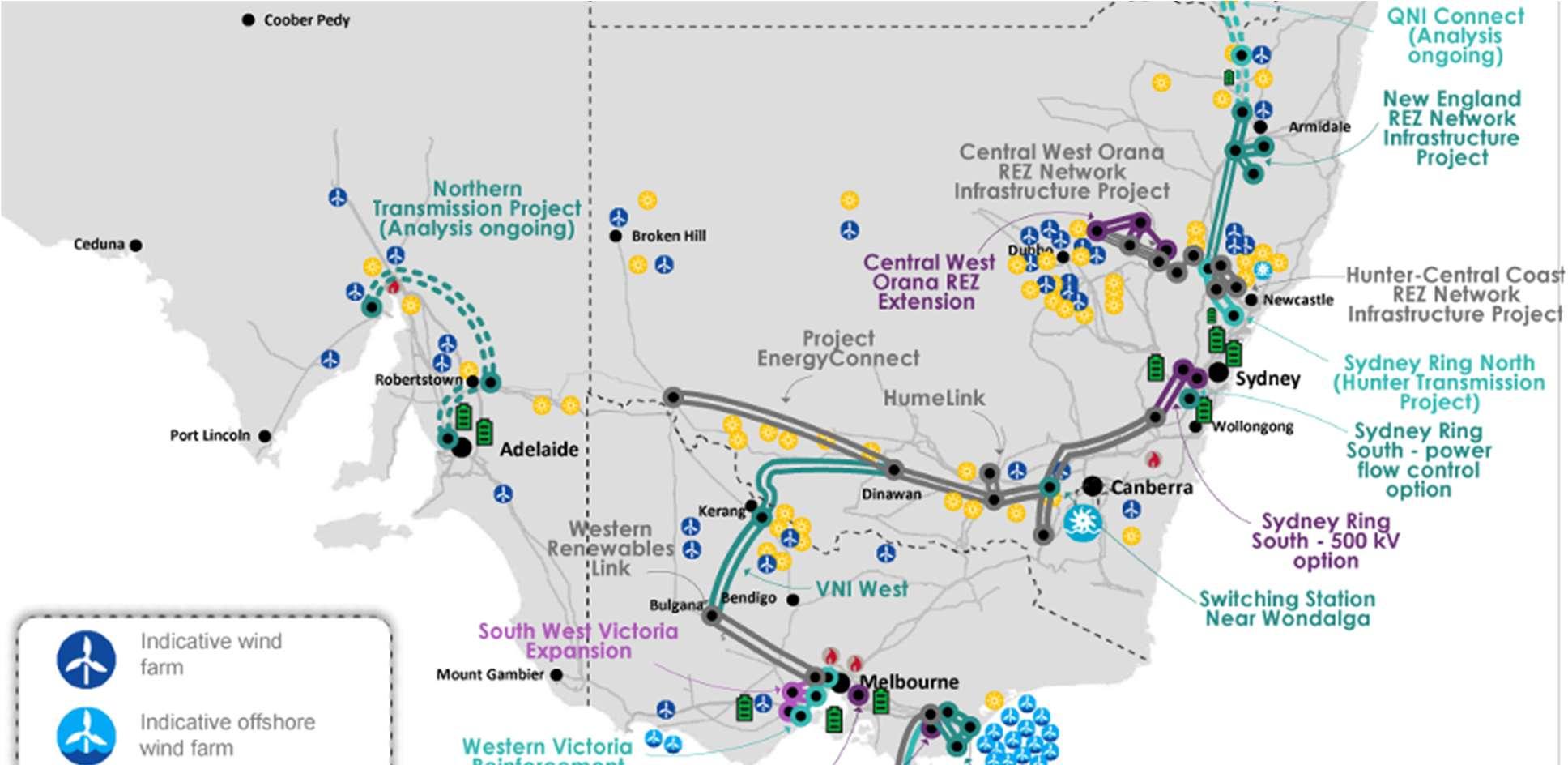
The ISP identifies several new transmission projects that are planned across the network as shown in Figure 2. In Victoria, these include:
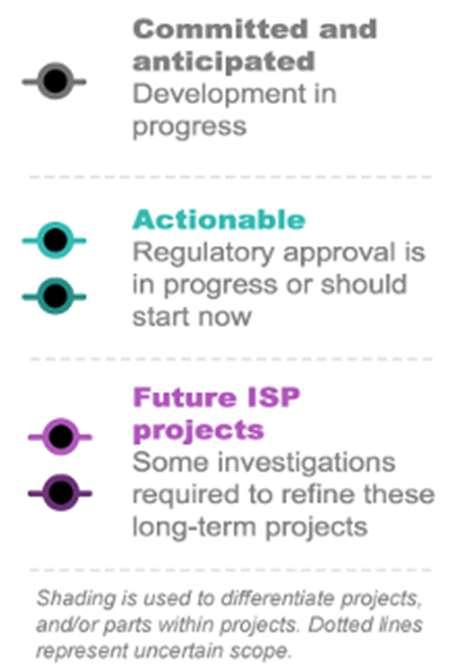
VNI West, categorised as "Actionable" with full capacity expected by November 2031;
Western Renewables Link (WRL), categorised as "committed and anticipated", with full capacity expected by November 2029; and
Of greatest relevance to the Study Area is VNI West, along with Western Renewables Link. It is also relevant that the 'EnergyConnect' transmission project is under development and will enable new renewable projects to connect to the network in southern New South Wales near the northern border of the Study Area.
3 The ISP is updated every two years. The latest published version is the 2024 ISP, while the draft 2026 ISP was released for consultation in December 2025. The material in this section is based on the 2024 ISP, with proposed changes from the draft 2026 ISP noted where relevant.
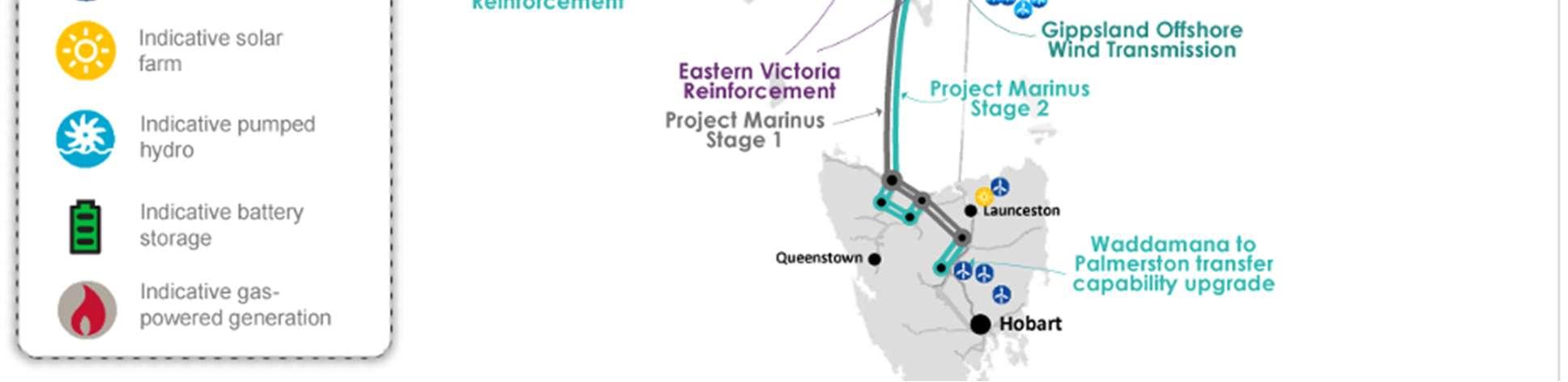
Source: AEMO ISP 2026 (Draft), cropped and adapted by Urban Enterprise for relevance to project.
Figure 2. Map of Planned Transmission Projects
2.2.2. Victorian Transmission Plan
The Victorian Transmission Plan (VTP, August 2025) is a long-term plan prepared by the Victorian State government for renewable energy zones and transmission designed "to ensure we have the right infrastructure in the right place at the right time to support the transition to renewables."
The VTP identifies:
Proposed renewable energy zones, which are areas identified as most suitable to host new onshore renewable generation and storage;
Proposed new transmission investments required in the next 15 years to support renewable energy zone development and deliver network security and reliability; and
A proposed renewable energy zone on Gippsland’s shoreline, which is needed to support o shore wind connection assets.
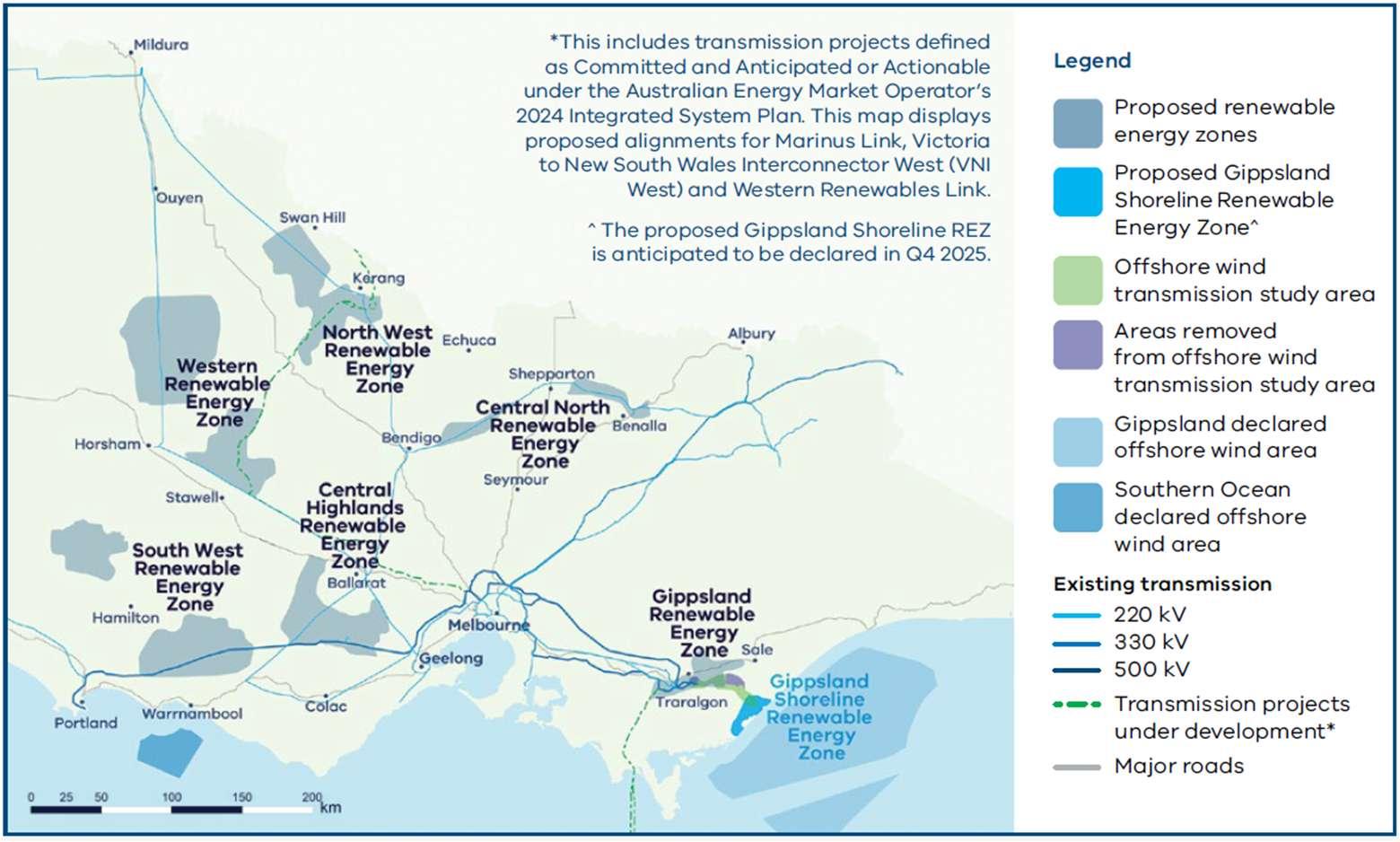
The VTP identifies 6 proposed renewable energy zones for Victoria: Central Highlands, Central North, Gippsland, the North West, the South West and the Western. The North-west and Western REZs are within the Study Area and are shown in Figure
3. A consultation period will inform the preparation of Draft and final (Declared) REZ areas.
Figure 3. Proposed Renewable Energy Zones, Victoria
Source: VTP, p.16.
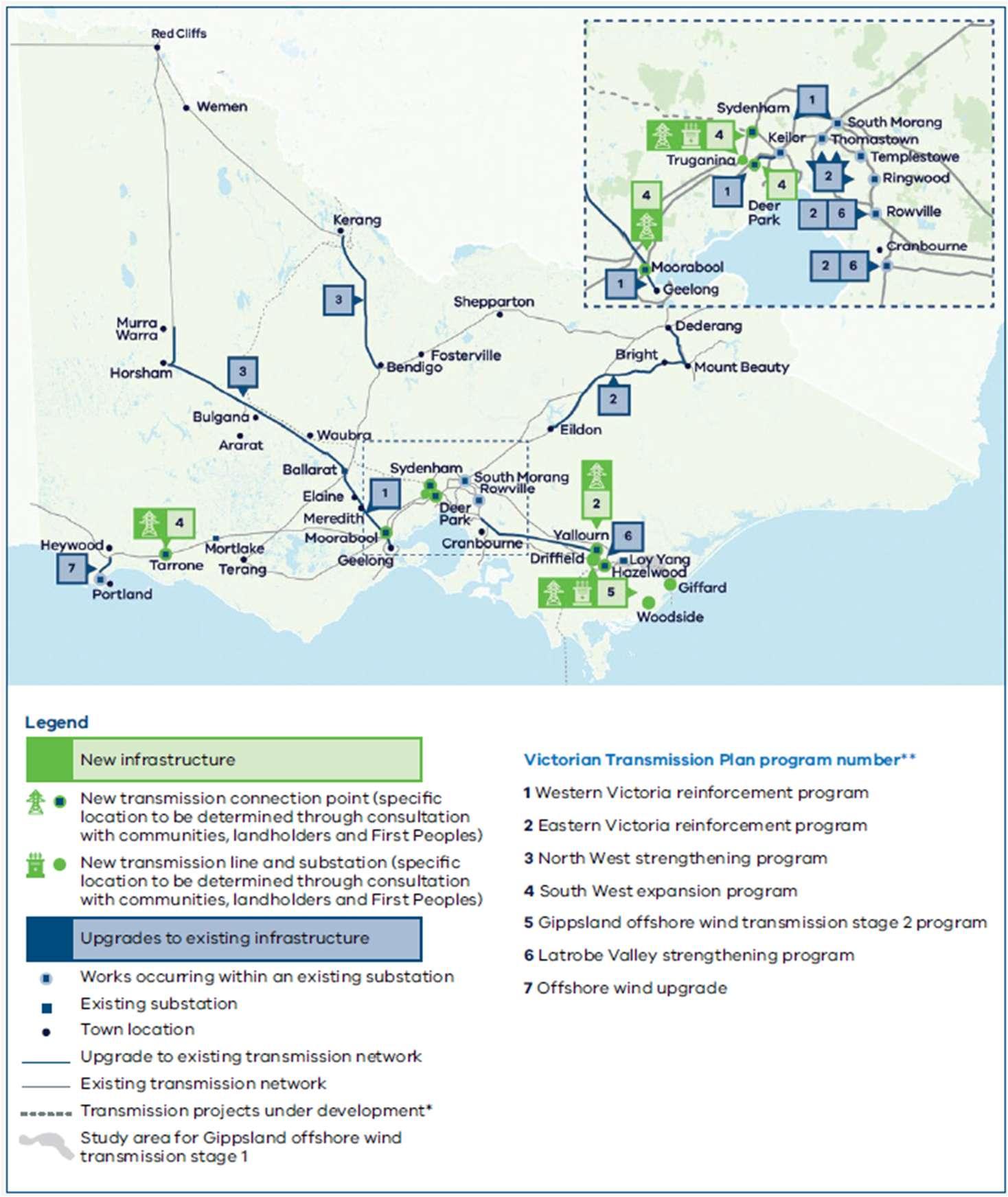
The VTP identifies 7 priority programs of transmission infrastructure investments to be implemented by 2040 to enable the development of renewable energy zones and o shore wind. The priority programs are as follows (Study Area projects in bold):
1. Western Victoria reinforcement program: A collection of network augmentations and upgrades of existing infrastructure.
2. Eastern Victoria reinforcement program: A suite of network augmentations and upgrades of existing infrastructure, as well as an additional line between Hazelwood and Yallourn.
3. North West strengthening program: Replacement of sections of the existing single circuit transmission with a new high capacity double circuit line.
4. South West expansion program: a new double circuit 500 kV line and associated works in South West Victoria.
5. Gippsland o shore wind transmission stage 2 program: a new transmission loop to support o shore wind.
6. Latrobe Valley strengthening program: new power flow controllers and dynamic load rating devices in the Latrobe Valley.
7. O shore wind upgrade: Uprating of existing lines from Heywood to Portland.
These projects are in addition to the major new transmission projects which form part of the NEM, including VNI West and WRL. The overall program of transmission works is shown in Figure 4.
The elements of the North West Strengthening program relevant to the Study Area are shown in Table 1. A total of $3.37bn of construction costs are proposed to upgrade three existing transmission lines in the area.
3.1
3.2
3.3
Rebuild the existing transmission line between Murra Warra, Horsham and Ballarat into a high-capacity double circuit line
Rebuild the existing transmission line between Red Cli s and New Kerang into a high-capacity double circuit line
Rebuild the single circuit line between New Kerang and Bendigo into a high-capacity double circuit line
Total
$1.35bn In service 2034-2035
$1.27bn In service 2034*
$750M In service 2034 - 2035
$3.37bn
Source: VTP, Appendix A. Note: some sections of the projects are located outside the Study Area (connections to Ballarat, Bendigo and Red Cli s (Mildura)). * 3.2 is only required under candidate pathway 2, which relates to Scenario 2 of the VTP and the associated higher renewable energy requirement.
Source: VTP, p.20.
Table 1. North West Strengthening Program
Figure 4. Proposed Transmission Projects, Victoria
2.3. VNI West
2.3.1. Overview
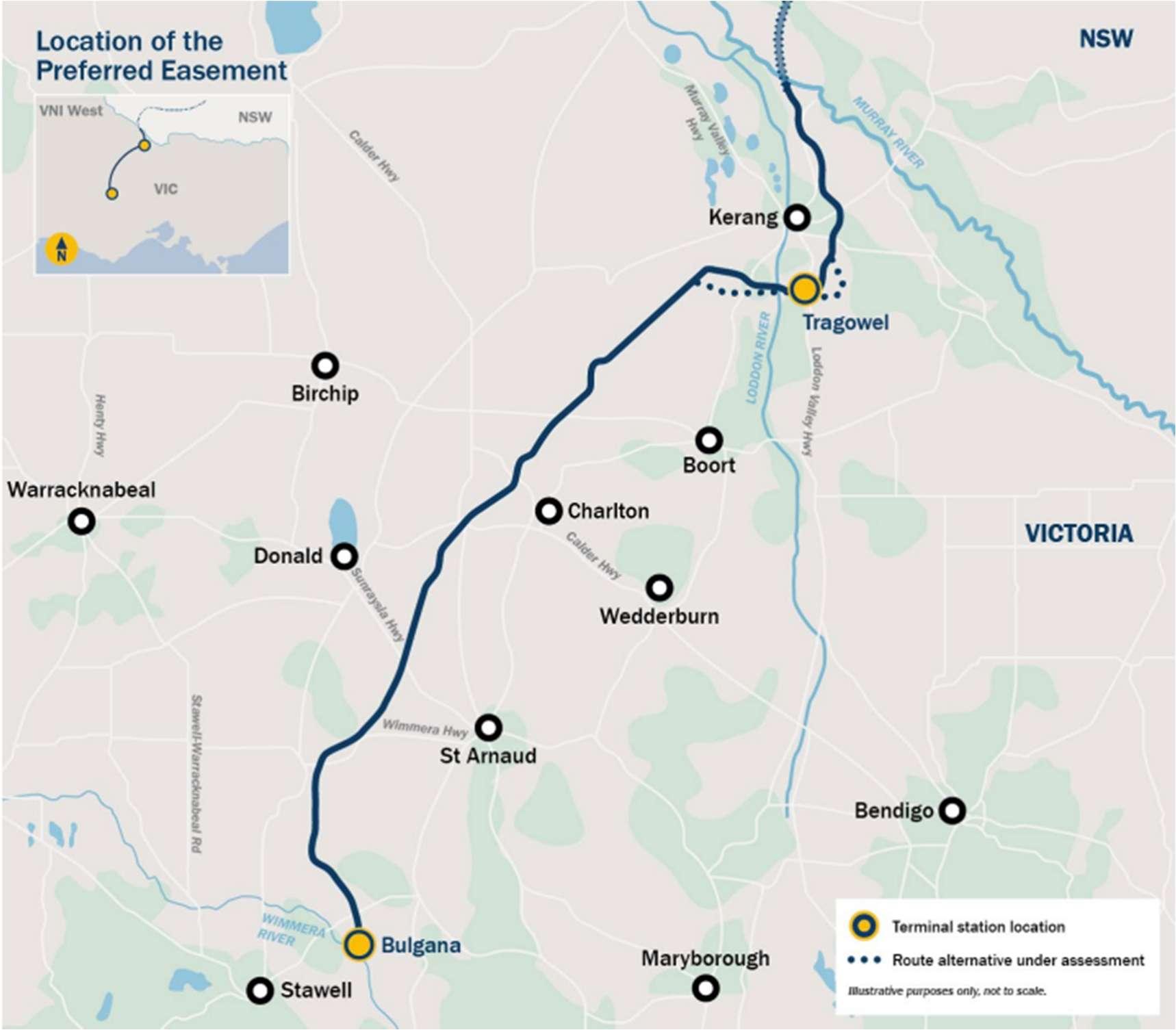
VNI West is a proposed new transmission line between Victoria and New South Wales. The proposed new overhead 500 kV double circuit transmission line will run from the Dinawan substation in New South Wales to Bulgana in Victoria (Northern Grampians Shire), where it will connect to Western Renewables Link via a new terminal station.
The proposed project comprises:
Development, construction and operation of approximately 240 km of new 500 kV overhead double circuit transmission line with steel lattice towers of between 60 m to 80 m in height.
Construction of a terminal station at Tragowel, including both 500 kV and 220 kV equipment.
Modifications to the existing 220 kV transmission line that runs between Kerang and Bendigo at the proposed Tragowel Terminal Station.
A transmission corridor within the Option 5A area of interest which has been identified as having the potential to accommodate the project infrastructure.
The location of the preferred easement within the corridor for the project is shown in Figure 5.
Transmission Company Victoria (TCV) is responsible for developing the Victorian component of the Project.
Source: Transmission Company Victoria, 2025.
Figure 5. Location of Preferred Easement, VNI West
2.3.2. Why is VNI West Needed?
The context and need for the proposed VNI West project is set out as follows:
Australia’s coal-fired generators are planned to exit over time, and the lowest cost and cleanest replacement for coal generation is renewable energy.
Due to the changing geographic locations of generation, existing transmission cannot be relied upon. The project is planned to transmit renewable electricity generated in wind and solar rich energy zones in Victoria and New South Wales and improve the reliability and security of electricity supply.
The project will help to provide strategic protection against the risk of early coal retirement and gas supply scarcity.
The project will unlock significant transmission capacity within the Murray River (now North-West) and Western Victoria REZs and allow transmission to occur between Victoria and New South Wales in the region (both import and export of electricity between the two states).
The project will assist in achieving legislated emissions reduction targets for Australia of 43% below 2005 levels by 2030 and net zero emissions by 2050.
In relation to the Study Area, the project is stated to enable upwards of 3.4 GW of new renewable generation in the Murray River (now North-West) and the Western Victorian REZs; add 1.93 GW of electricity export capacity from Victoria to New South Wales, and 1.67 GW of electricity import capacity from New South Wales to Victoria.
2.3.3.
Timeline
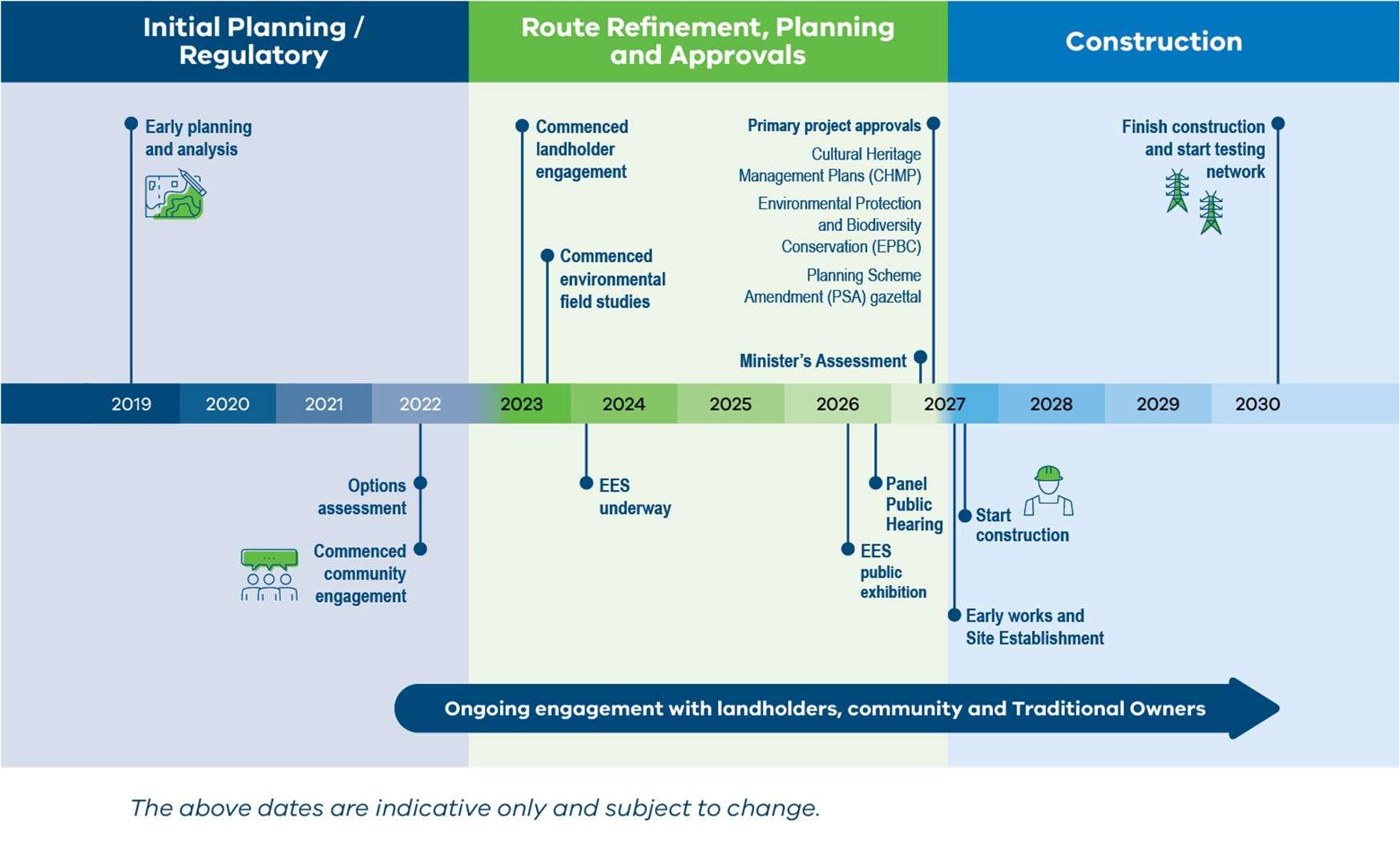
Initial planning for the project commenced in 2019. The Victorian component of the project is currently undergoing an Environmental E ect Statement Process (EES), which was determined by the Minister for Planning under the Environment E ects Act 1978. The EES will provide a detailed description of the project, assess its potential e ects on the environment, and assess alternative project layouts, designs and approaches to avoid and mitigate potential adverse e ects.
The indicative timeline for the project is shown in Figure 6. The project is expected to commence construction in 2027, be completed in late 2030 and fully operational in 2031. Ultimately, the project and its timing will depend on the outcomes of the EES and subsequent State and Commonwealth approvals.
Source: Transmission Company Victoria, 2026.
Figure 6. VNI West Timeline
2.3.4. Cost and Broader Benefits
The initial estimated capital cost of the project (Option 5A) was approximately $3.499bn (June 2021 values), which comprised of $1.755bn within Victoria and $1.744bn within New South Wales. In 2025, an update prepared by AEMO estimated a total capital cost of $7.070bn, approximately twice the original estimate.4
Annual routine operating and maintenance costs are assumed to be 1% of capital costs for transmission assets.
In addition to outlining reasons why the project is needed, the RIT-T prepared for the project5 estimated that the preferred option will deliver approximately $1.4 billion in expected net market benefits to consumers and producers of electricity.6 The net market benefits broadly consist of:
Reduced generation and storage investment costs;
Reductions in total dispatch costs, by enabling lower cost renewable generation to displace higher cost fossil fuel generation; and
Lower or avoided costs associated with intra-regional transmission investment across the REZs.
The RIT-T states that the preferred option will unlock significant transmission transfer capacity for the Murray River (now North-West) REZ and Western Victoria REZ. By 2050, modelling7 estimated that the preferred option would enable:
Between 2.3 GW and 2.9 GW in renewable energy (solar) generation in the Murray River (now North-West) REZ; and
Between 1.1 GW and 1.3 GW in renewable energy (wind) generation in the Western Victoria REZ.
2.3.5. Impacts and Readiness Considerations
The construction of major transmission infrastructure will generate a range of economic, environmental and other impacts. The RIT-T for VNI West does not assess local and indirect benefits, such as those relating to the impact of the project on existing land uses, settlements and economies. Closer assessment of the economic impacts of the project will form part of the Victorian EES process which is currently underway.8
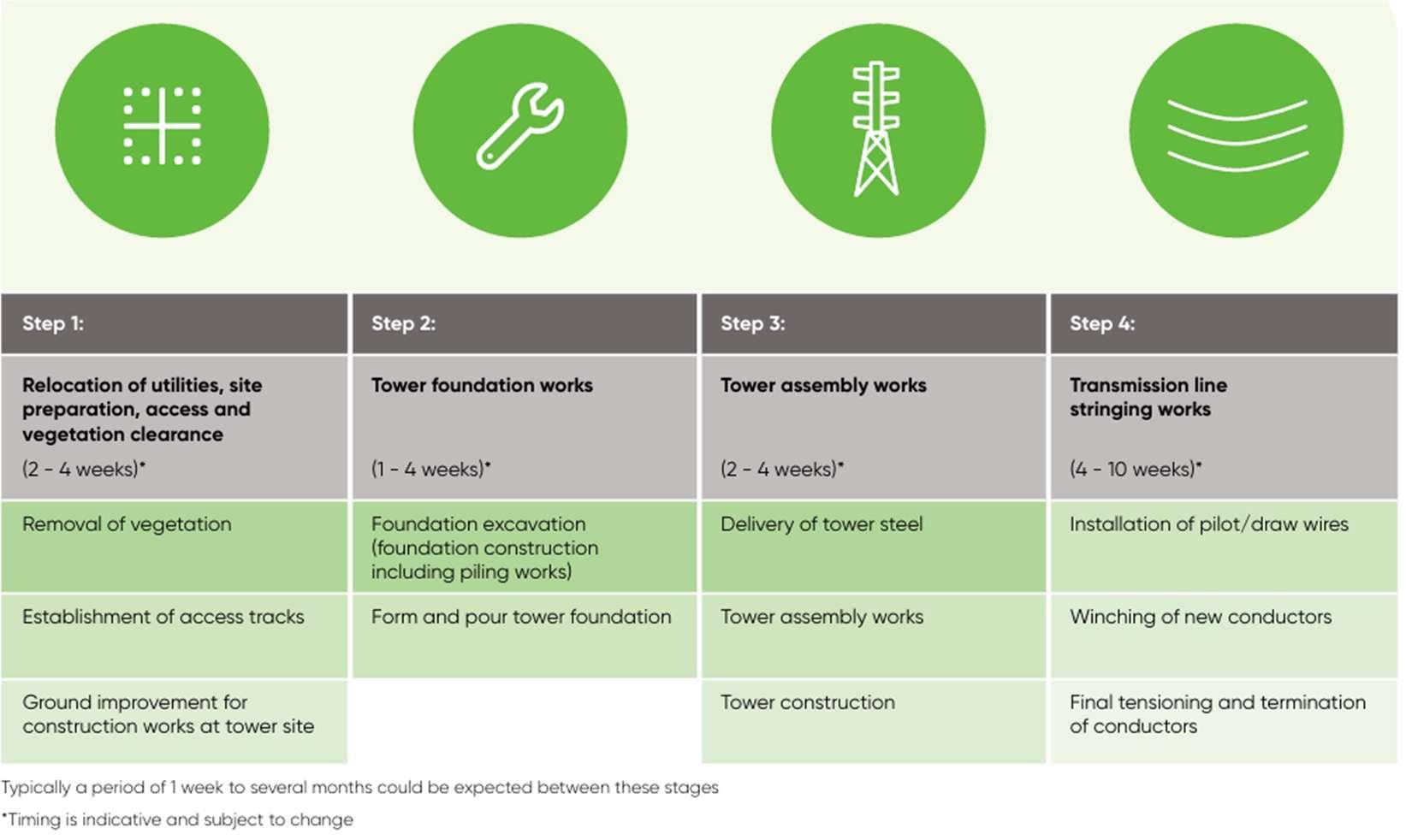
In terms of the construction phase and inputs to the delivery of new transmission infrastructure, Figure 7 summarises the process for construction of new transmission infrastructure.
4 2025 Electricity Network Options Report, July 2025, AEMO (Initial Version, 31 July 2025).
5 VNI West Project Assessment Conclusions Report (PACR), AEMO, 2023.
6 It is noted that the RIT-T was prepared based on the initial cost estimate of $3.499bn which has since materially increased.
7 PACR, p.83.
8 Among other e ects, the scoping requirements for the EES (February 2025) require an assessment of the "Potential adverse economic e ects, including both direct and indirect e ects on employment, farming and agriculture, other businesses, housing and local and regional economy.".
Source: Western Renewables Link, 2024.
The construction of transmission infrastructure has nine key cost components:9
Plant (supply of primary material assets such as steel towers, equipment, conductors, switchgear, cables etc.)
Civil and structural works (supply of civil infrastructure assets and installation works such as earthworks, buildings, foundation, busbar, gantry, clearing, access tracks etc);
Electrical works (supply of electrical installation works such as stringing, fitting, termination, jointing, lighting etc.);
Secondary systems (supply of secondary system material assets such as relays, control panels, protection panels, SCADA, station batteries etc.);
Design & survey (supply of engineering and environmental design and survey works towards the front end of the project life cycle phase);
Testing & commissioning (supply of electrical, civil and structural assurance works towards the back end of the project life cycle prior to operational approval of the constructed assets);
Contractor project management & overheads (supply of the site supervision, resource mobilisation, site set-up, project management and related expenses by the hired contractors);
Easement and property acquisition costs (procurement of easement right of way and land acquisition by the project proponents); and
Environmental o set costs (costs to compensate for unavoidable environmental and biodiversity impacts due to the project works).
9 As identified in the Transmission Cost Database, 20215 GHD for AEMO.
Figure 7. Diagram of Key Construction Phases for New Transmission Infrastructure
Table 2 summarises the potential impacts and readiness considerations associated with transmission projects that are relevant to the Study Area. These are derived from the EES Scoping Requirements for VNI West, a review of literature regarding likely impacts, and our experience in undertaking economic impact assessments. The implications of these impacts are considered in more detail in Section 6 of this report.
Table 2. Transmission Impacts Expected to Accrue in Local Areas
No.
Expected impact
1 Direct construction activity generating employment and demand for goods and services.
2 Construction phase generating demand for housing, population services and infrastructure.
3 Initial and ongoing landowner impacts such as reduced land use productivity (negative), land value impacts (negative) and compensation (positive).
4 Operational phase employment and associated impacts.
5 Broader impacts on areas of economic specialisation, such as loss of productive land and a reduction in the agglomeration value of a specialised sector.
6 Broader impacts such as landscape, visual amenity and tourism role.
Source: Urban Enterprise.
2.4. Key Points
Australia's transmission network requires significant investment and extension to facilitate the ongoing transition to renewable energy generation.
A ecting the Study Area, a total of $3.37bn of construction costs are proposed to upgrade three existing transmission lines, as well as the proposed construction of the new VNI West line between Victoria and New South Wales at a cost of $7.1bn.
Two of Victoria's six Renewable Energy Zones are within the Study Area (the North-west and Western REZs). VNI West will unlock significant transmission transfer capacity for these areas.
The construction of major transmission infrastructure will generate a range of economic, environmental and other impacts, both positive and negative. The process to date of assessing these impacts does not take into account local e ects. Although this may occur for the VNI West EES process, there is a current absence of consideration of the potential impacts of transmission on local communities and economies in the Study Area.
3. Renewable Energy Projects
3.1. Introduction
This section provides a description of the various renewable energy projects planned across the Study Area.
3.2. Location and Status of Projects
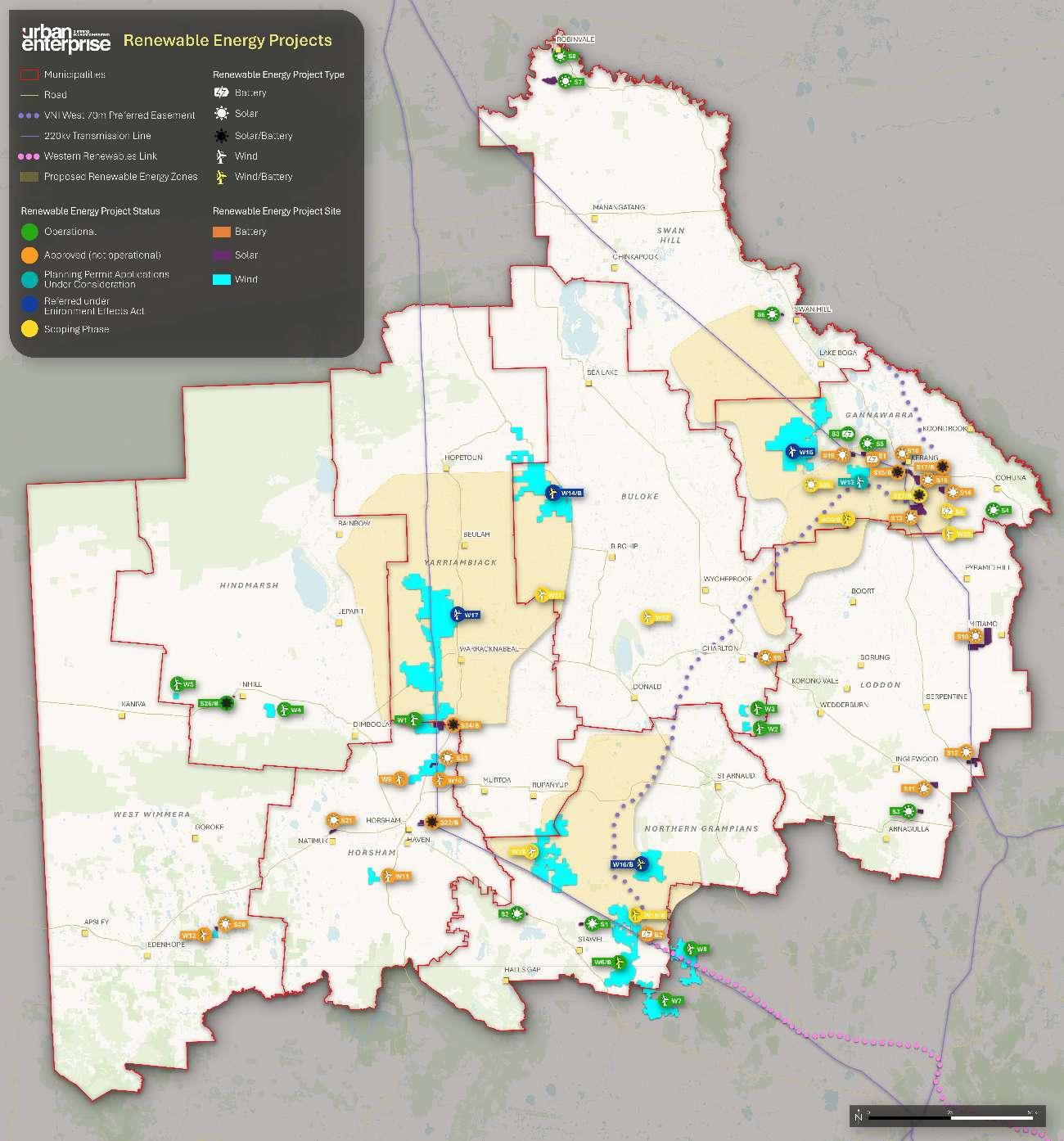
Figure 8 shows the location, status and energy type of renewable energy projects planned in the Study Area, as well as those already operating. There are substantial concentrations of projects proposed in Gannawarra and near Horsham and Stawell.
Figure 8. Map of Renewable Energy Projects
Source: Urban Enterprise, based on Victorian Government data and consultation with project proponents and Study Area councils.
3.3. Number and Scale of Projects
A full list of planned renewable energy projects in the Study Area is provided in Appendix A, including status, location and scale.
The Study Area is expected to accommodate a substantial pipeline of renewable energy projects, with over 13 GW of planned capacity identified across solar and wind projects across 33 projects. Three planned battery storage projects also have approximately 2GW of storage capacity.
Table 3. Existing and Planned Renewable Energy Projects (MW)
Source: Urban Enterprise, 2025 *Note battery capacity relates to storage rather than energy generation.
Priority Projects
The Australian Government has created the National Renewable Energy Priority List, which will provide coordinated support for regulatory planning and environmental approval processes for identified priority renewable energy projects across Australia.
There are 32 generation and storage projects on the Priority List, including 5 in Victoria and 1 in the Study Area (Cannie Wind Farm in Gannawarra Shire).
3.4. Locations and Concentrations
The main spatial concentrations of proposed solar projects are in Gannawarra Shire (especially near Kerang) and Horsham Rural City (especially in the northern part of the municipality). Two solar projects are also proposed in the southern part of Loddon Shire (near Inglewood).
The main spatial concentrations of proposed wind projects are within Northern Grampians Shire (near Stawell), north of Horsham (including Yarriambiack Shire, near Warracknabeal, and Buloke, near Birchip), and Gannawarra Shire (west of Kerang).
When the combined projects across transmission and renewable energy are considered together, the larger towns that are most proximate and therefore most likely to be impacted in terms of demand for labour and services are expected to be Horsham, Stawell and Kerang.
3.5. Timing and Relationship with Transmission Projects
Although there are existing transmission lines in the Study Area, the network is mostly at capacity and new and upgraded transmission is required to enable the planned projects to connect to the network. This will influence the number, type, location and timing of projects that will ultimately be able to proceed.
The VTP provides an indication of the amount of energy generation that is planned to occur in each REZ in addition to current levels – these are shown in Table 4. For the REZs in the Study Area, the planned generation is 0.8GW -4.5GW of new wind and solar in the Western REZ and between 0.4GW -1.9GW of new wind and solar in the North-Western REZ.
It is noted that the amount of renewable energy generated in the Study Area REZs by 2040 (as modelled in the VTP) would be materially higher under Scenario 210 at 6.4GW when compared with Scenario 1, primarily driven by the Western REZ generating significantly more energy than under Scenario 1. Although not stated in the plan, this may reflect the significant
10 Scenario 2 "considers a potential future where new energy-intensive industries are established in regional and central Victoria at scale, such as data centres, hydrogen production and green aluminium. Demand in this scenario is based on AEMO’s national green energy export trends forecast, which models a rapid decarbonisation pathway and the development of low emission energy exports." (VTP, p.32)
additional generation potential of the large number and scale of proposed wind projects in Northern Grampians, Horsham, Yarriambiack and Buloke and also respond to delays in the progress of o shore wind opportunities elsewhere in the State.
Source: VTP, Table 8.
In terms of access limits, the VTP notes that:
"A cap on the new generation that can connect within each REZ – called an access limit – will be released in the REZ declaration and access scheme associated with each REZ."
Access limits are proposed to be set "at the maximum amount of generation capacity that can be connected within the REZ without violating technical constraints or surpassing e icient levels of network curtailment forecast for the REZ." (p.122).
"Projects located inside declared renewable energy zones will have the opportunity to participate in a competitive application process for allocating access to the grid"; and
"Projects located outside of declared renewable energy zones will be subject to a Grid Impact Assessment and will need to demonstrate that their project would not result in generators located within renewable energy zones being‘excessively curtailed.”
Implications for this Strategy
The main implications of the preceding information are:
The ultimate scale of renewable energy investment in the region could vary significantly.
Not all projects identified will proceed to construction and operation.
VNI West and other transmission infrastructure augmentation is important to enabling the development of renewable energy projects in the region, meaning that first phase of impacts will generally relate to transmission projects and the small number of renewable energy projects that can commence without additional transmission.
The ultimate generation within the Study Area is likely to be capped by VicGrid, however the level of the cap is not yet known.
In order to provide an indication of the potential phasing of the renewable energy projects in the region, we have categorised the renewable energy projects into three phases:
Phase 1: Short-term (indicatively 2025-2030, however timing remains uncertain). These projects are either under construction or expected to commence imminently.
Phase 2: Medium term (indicatively 2031-2035, however timing remains uncertain). These are projects that are approved but still require additional design and development work and/or are likely to require connection to VNI West or other upgraded transmission capacity.
Phase 3: Long term. These are projects that have not been approved and still require substantial planning, design and development work.
This phasing is provided as a guide to the potential timeframes over which construction and operational impacts may occur, however the actual timing and phasing of projects subject to ongoing changes and will depend on the approval and timing of transmission projects and broader market and policy conditions.
In order to assess the potential impact of the proposed projects, we have adopted the overall energy generation levels shown in the VTP for the two REZs in the Study Area of 6.4GW as the upper bound. As shown in Figure 9, this is approximately half of the amount of generation that is currently proposed in the region, but is considerably higher than the Scenario 1 generation levels shown in the VTP.
It is noted that 13 of the proposed projects are located outside the current REZ boundaries with a total generation capacity of 2.4GW. This includes 0.67GW of solar in Horsham, Loddon, West Wimmera, Hindmarsh and Buloke Shires, and 1.77GW of wind, primarily in two major proposals in Buloke and Yarriambiack (Wilkur and Curyo).
Table 4. Modelled Renewable Energy in Study Area REZs – New Wind & Solar by 2040 (GW)
Source: Urban Enterprise, based on Victorian Government data and consultation with project proponents and Study Area councils.
3.6. Projects in Adjacent Areas
In addition to the projects within the Study Area, other renewable energy proposals in adjacent areas are likely to create impacts and opportunities in parts of the Study Area.
The main area of relevance to the Study Area is the New South Wales South West REZ which is located to the immediate north of the Study Area.
New South Wales South West REZ
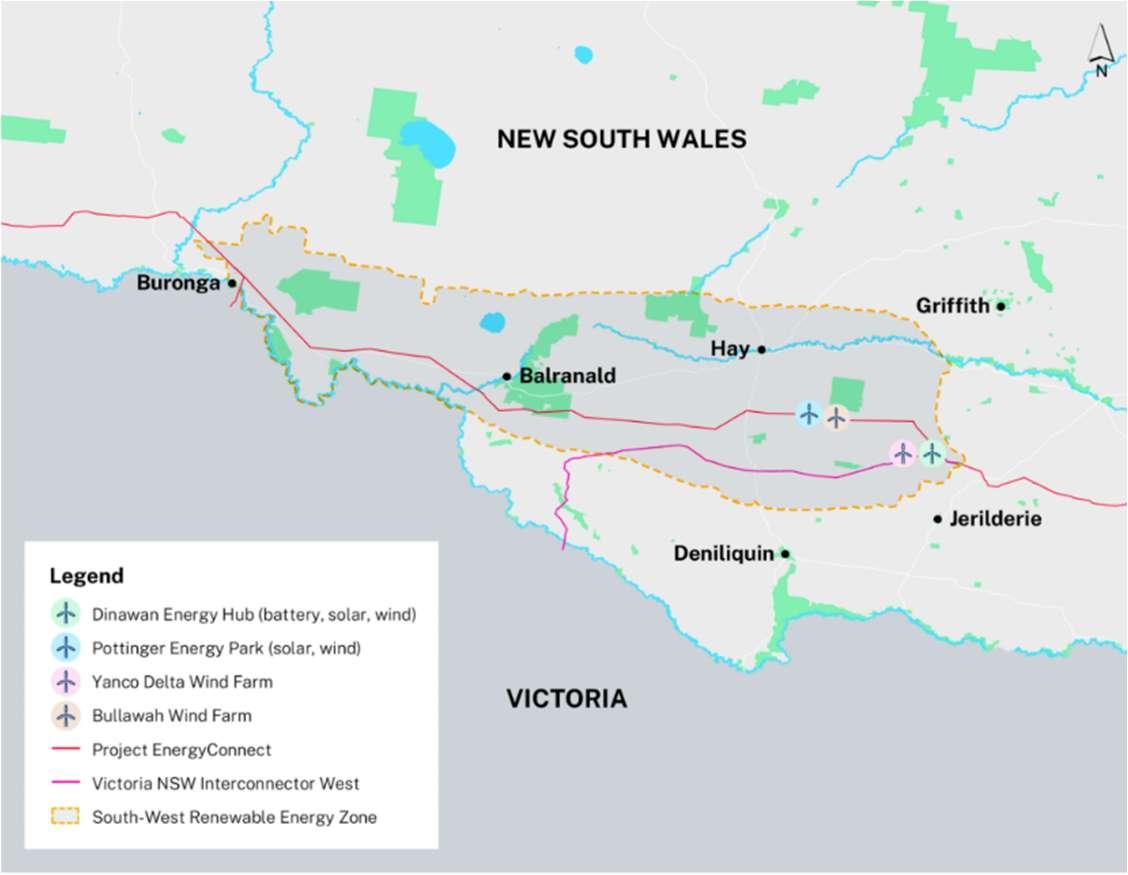
The South West REZ is located across the Victoria-New South Wales border as shown in Figure 10. The closest major towns on the Victorian side of the border near the REZ (from west to east) are Mildura, Robinvale, Swan Hill, Kerang, Cohuna and Echuca.
Figure 10 also highlights the two proposed transmission projects which pass through the REZ, including the New South Wales section of VNI West as well as Project EnergyConnect. Project EnergyConnect is a proposed interconnector stretching between Wagga Wagga (New South Wales) and Robertstown (South Australia), with an added connection to Red Cli s (Victoria, near Mildura). Release of power is expected in mid-2026.
There are two existing operational solar farms within the South West REZ:
The Sunraysia Solar Farm (John Laing, Maoneng) is located 17km south of Balranald and around 70km north of Swan Hill. The farm has a total capacity of 255 MW and construction of the farm was completed in 2019 after a 13-month construction period.11
11 John Laing, 2025, available at: https://www.laing.com/portfolio/sunraysia-solar-farm-australia/ Decmil, 2025, available at: https://decmil.com/project/sunraysia-solar-farm/
The Limondale Solar Farm (RWE Renewables) is one of Australia’s largest solar farms and is located approx. 14km south of Balranald. The project has an installed capacity of 314 MW and began commercial operations in 2021. RWE is building Australia’s first eight-hour battery on the project site. 12
In 2025, four projects were granted access rights to connect to the new transmission infrastructure in the South West REZ –these projects are summarised in Table 5 with indicative locations shown in Figure 10. These projects are at the eastern end of the REZ. The projects are expected to:
Generate a maximum capacity of 3.56 GW along with over 700 MW of battery energy storage;
Support 2,800 jobs at peak construction; and
Commence operation between 2027 and 2030.13
Source: EnergyCo, 2025.
12 RWE Renewables, 2025, available at: https://au.rwe.com/projects/limondale-solar-farm/
13 South West Renewable Energy Zone powers up, EnergyCo, 2025, available at: https://www.energyco.nsw.gov.au/news/south-west-rez-access-rights-holdersannounced
Table 5. Projects Granted Access Rights in the South West REZ
Source: EnergyCo, 2025.
Figure 10. South West REZ, New South Wales
3.7. Key Points
There are 33 renewable energy projects planned in the Study Area with the potential to generate more than 12GW of energy through solar and wind. Three planned battery storage projects also have approximately 2GW of storage capacity.
The main spatial concentrations are in Gannawarra Shire (especially near Kerang), Horsham Rural City (especially in the northern part of the municipality) and Northern Grampians Shire (near Stawell). Major wind projects are in planning across the central parts of the Study Area within Yarriambiack, Buloke and Gannawarra Shire.
The larger towns that are most proximate and therefore most likely to be impacted in terms of demand for labour and services are expected to be Horsham, Stawell and Kerang.
Other renewable energy projects are also proposed in southern New South Wales which will contribute to impacts and opportunities in the northern parts of the Study Area.
The ultimate scale of renewable energy investment in the region could vary significantly, and not all projects identified will proceed to construction and operation. Based on the Victorian Transmission Plan targets, a total of up to 6.4GW may ultimately be required to be generated within the Study Area REZ. This is approximately half of the amount of generation that is currently proposed in the region.
VNI West and other transmission infrastructure augmentation is important to enabling the development of renewable energy projects in the region The first phase of impacts will generally relate to transmission projects and the small number of renewable energy projects that can commence without additional transmission.
The second phase of impacts is expected to primarily relate to construction phase impacts and solar projects, while several major wind farm proposals are expected to create longer term impacts.
4. Mining Projects
4.1.
Introduction
This section provides an overview of the mining projects proposed within the Study Area and the context for the opportunity to undertake ongoing mining activity in the area.
4.2.
Opportunity Context
The Minerals Council of Australia14 has identified that Australia is home to the largest mineral sands deposits in the world, with 32% of the world’s share of ilmenite resources and 62% of rutile resources. As noted in Victorian Critical Minerals Roadmap (Victorian Government, 2024), Victoria’s critical mineral resources include globally significant quantities of titanium, zirconium, and associated rare-earth elements in mineral sand deposits in the northwest of the state.
The Roadmap notes that critical minerals are a collection of metal and nonmetal resources considered essential for renewable energy infrastructure, modern computing, emerging technologies and sustainable economic development. They are described as critical due to their vulnerability to future supply risks because of geological scarcity or geopolitical factors.
The following key facts are provided in the Roadmap:
Victoria has 39% of Australia's zircon and approximately 27% of world reserves, with an estimated 33 million tonnes (Mt) of economic reserves.
Victoria has 51% of Australia's rutile and 22% of its ilmenite – key titanium bearing minerals – estimated at over 19 Mt and 63 Mt, or approximately 32% and 7% of world reserves respectively.
In addition to these critical minerals, Victoria has a long history of gold mining. Resources Victoria notes that Victoria has 13 goldfields that have each produced more than 1 Moz of gold, including one field of 22 Moz (Bendigo) and another of 12 Moz (Ballarat). Many of these old goldfields o er opportunities to reopen mines or find totally new deposits through modern exploration techniques, with Victoria described as a "world class gold production province".15
Exploration and investment in gold mining is increasing, including within the Study Area near Stawell where significant deposits exist.
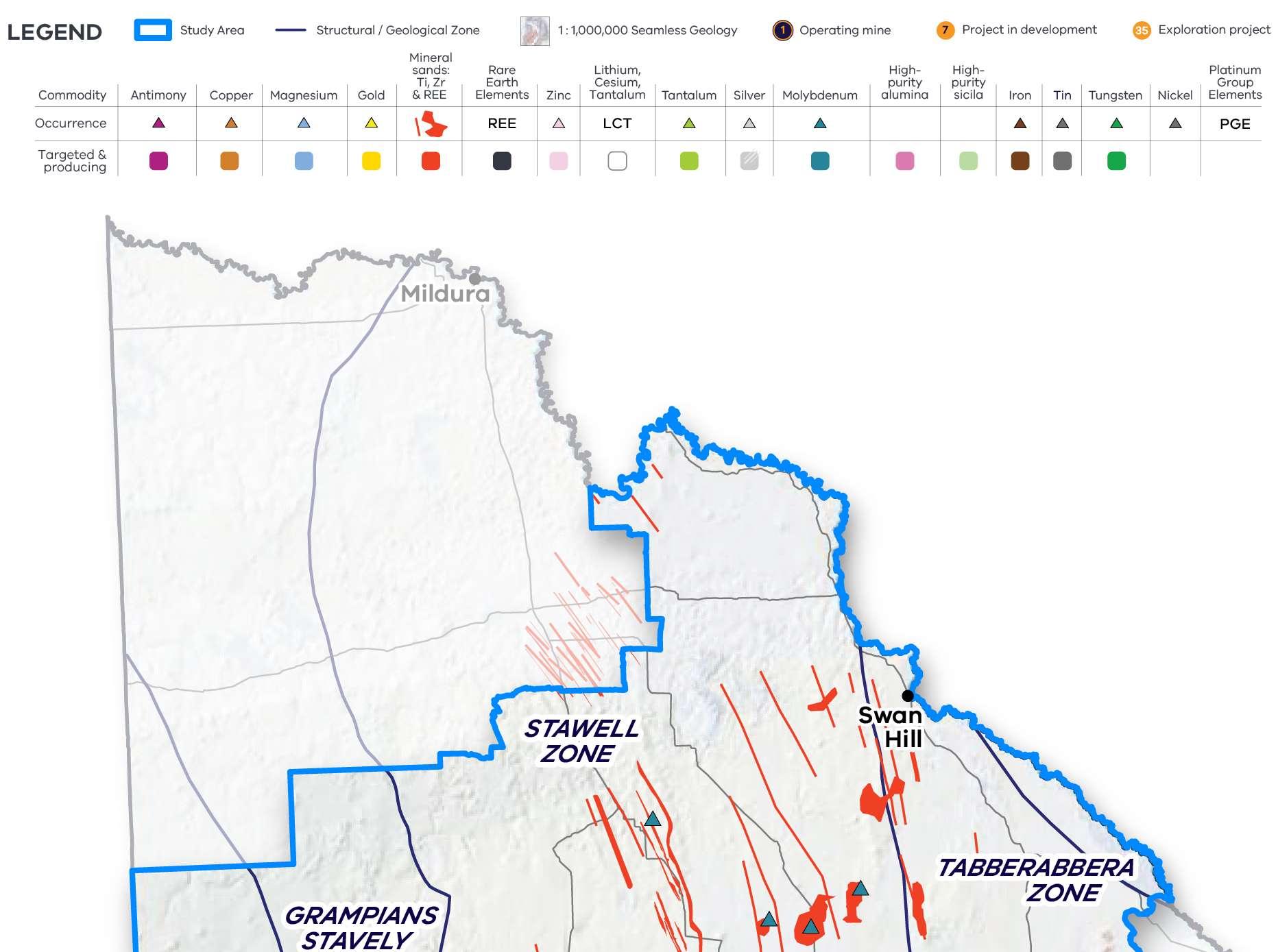
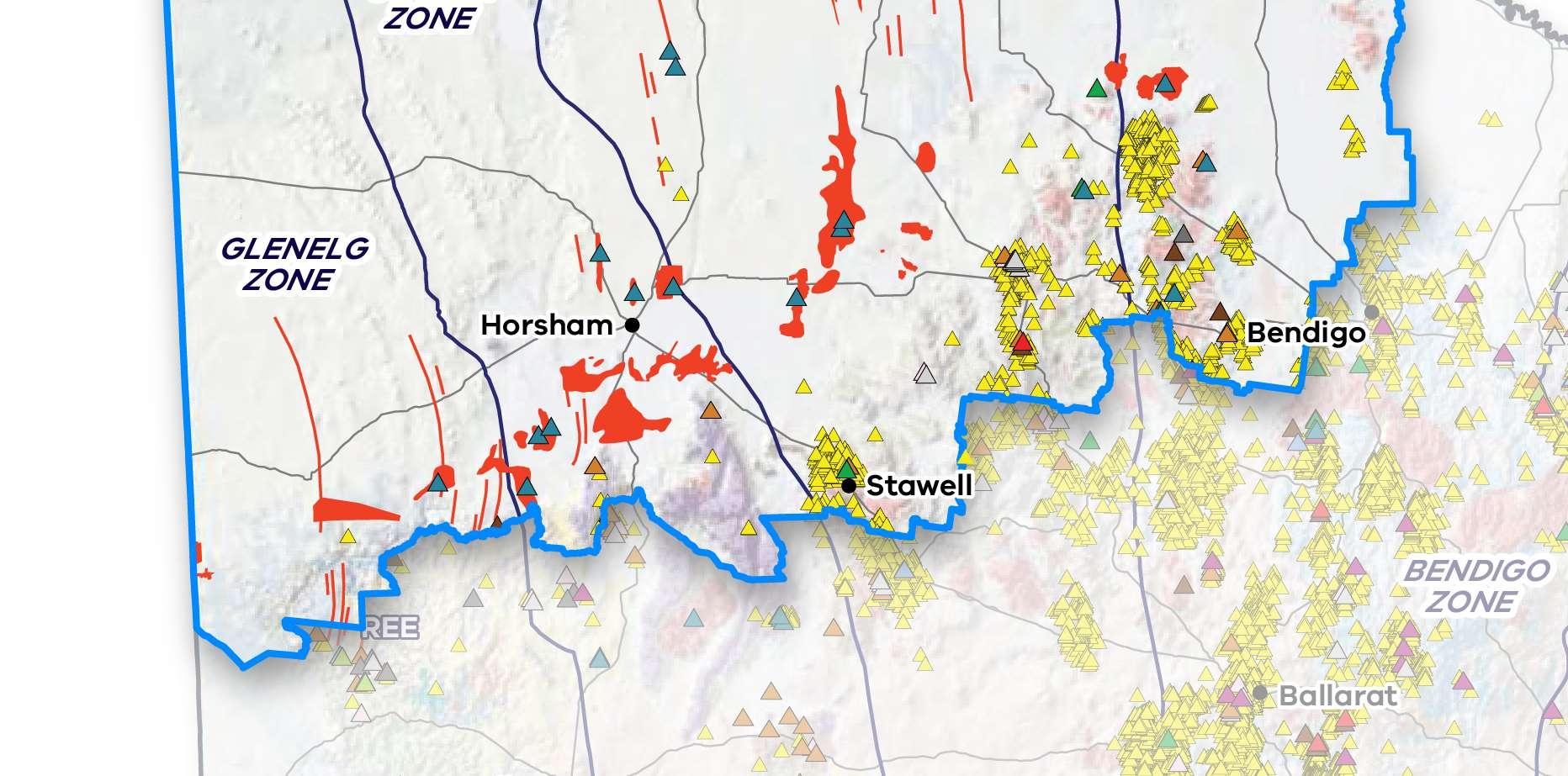
Figure 11 shows the location of key resources and minerals across the Study Area. Gold occurrences are widespread near Stawell and across much of Loddon Shire in the east of the Study Area, while mineral sands and other mineral occurrences are present across a broad band covering the central areas of the Study Area, including around Horsham, through Yarriambiack, Buloke and Gannawarra to Swan Hill.
It is noted that Mineral Sands and rare earth occurrences extend into South Australia to the west and into other parts of Victoria to the south (particularly into Southern Grampians Shire).
14 Mineral Sands, May 2020, Minerals Council of Australia. 15 https://resources.vic.gov.au/geology-exploration/industry-investment
Source: Resources Victoria, 17 July 2025, adapted and annotated by Urban Enterprise.
Figure 11. Location of Mineral Resource Opportunities in North-West Victoria
4.3. Projects
Existing and planned mining projects identified in the Study Area are summarised in Table 66.
A total of 22 projects have been identified. Half of these projects (11) are mineral sands, highlighting the region’s major opportunity. Gold (9) and rare earths (2) projects are also present, although though these are primarily longer-term opportunities.
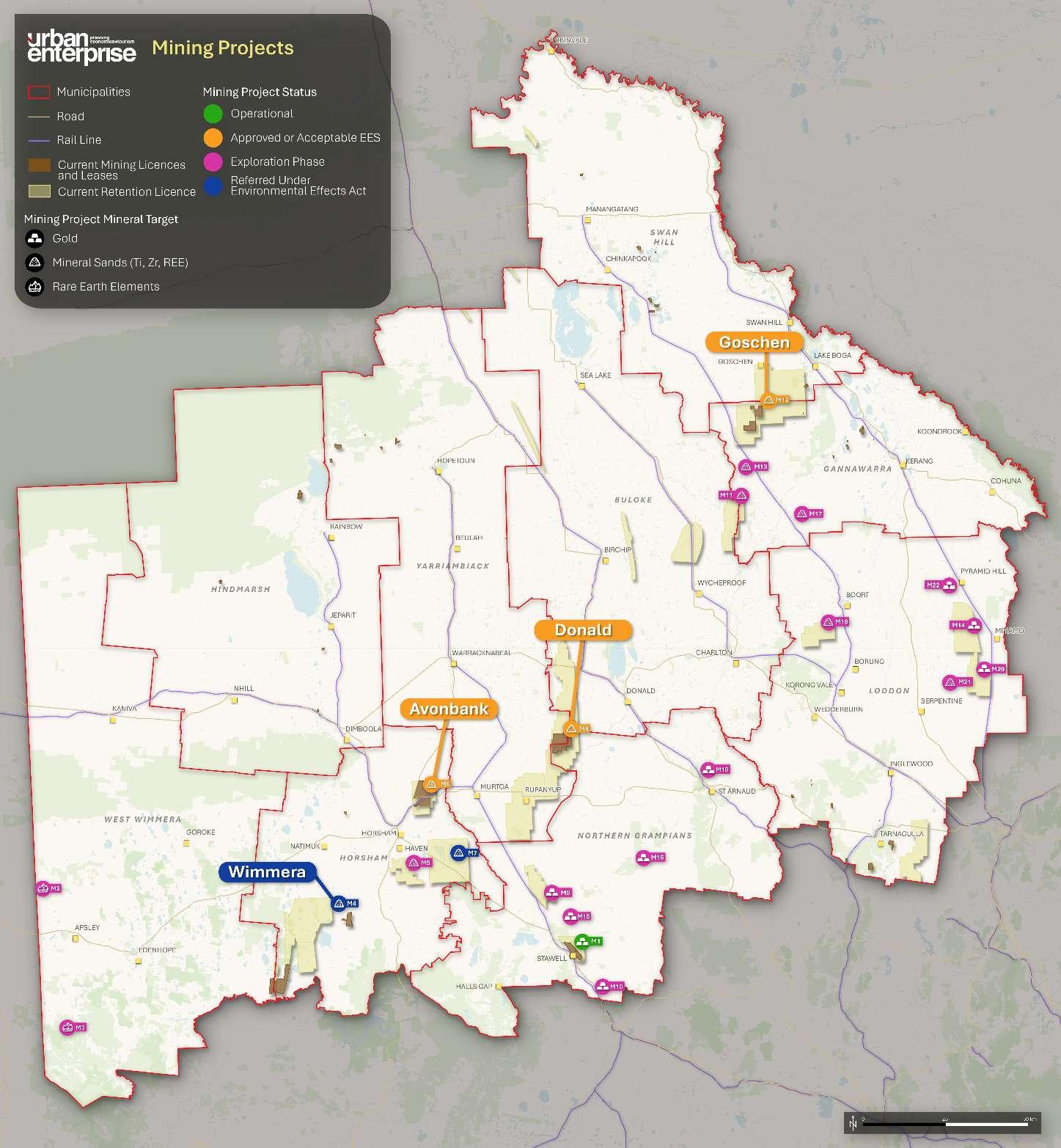
In terms of timing, three major mineral sands projects are approved or have received an acceptable Ministers Assessment for the Environment E ects Statement process. These projects (Donald, Avonbank and Goschen) have the potential to be operational in the short term (i.e. Phase 1). Subject to the EES process outcomes, Wimmera also has potential to generate short term impacts. A brief profile of each of these projects is shown in Table 7.
The location of all known mining projects is shown in Figure 12. Mining projects are primarily concentrated near Horsham and Stawell, as well as in the rural areas of Gannawarra, Loddon and West Wimmera Shires. The major shorter-term projects are located near Swan Hill (Goschen) and Horsham (Avonbank and Wimmera), while the Donald Project is proximate to other rural service centres including St Arnaud and Warracknabeal.
Table 6. Existing & Planned Mining Projects
Source: Urban Enterprise, 2025.
Table 7. Key Mineral Sands Project Profiles
Avonbank
Donald
15km north of Horsham, 5km northeast of Dooen.
15 km east of Minyip and 50km from Horsham.
EES received acceptable Ministers Assessment. Mining application lodged and decision pending.
36 year project life (1 year construction, 30 year operation, 6 years decommission).
All required approvals from Federal, State and local government have been received.
Phase 1 will support an operational life of approximately 35 years. Construction is planned for late 2025, with operations planned for late 2027.
The deposit contains approximately 300 million tonnes of ore and is proposed to produce a heavy mineral concentrate containing zircon, titanium-rich mineral concentrate and minor amounts of rare earth products.
The proposed mining methods involve open-pit mining to extract approximately 11 million tonnes of ore per year over a projected mine life of 30 years to produce approximately 12.75 million tonnes of heavy mineral concentrate over the life of mine.
The total Donald deposit contains approximately 2.4 billion tonnes of ore, hosting commercial quantities of zircon, titanium and associated rare earth elements.
Under the approved work plan, the mine will process 7.5 million tonnes of mineral sands annually over 19 years. Mine products will be transported to the Port of Portland for export overseas.
$183m construction phase investment, $210m in OPEX per annum.
$480m CAPEX
$165m per annum OPEX
Estimated total of $4.3bn in OPEX and sustaining CAPEX to operate the mine.
Project Location
35 km southwest of Swan Hill.
Goschen
Largest settlements in proximity are Swan Hill and Kerang.
Expected Timing and Mine Life
EES received acceptable Ministers Assessment.
Mining License application has been approved and work plan approval lodged and a decision is pending.
Stage 1 construction 2025-2026. Stage 2 construction 2028-29.
20-25 year mine life.
Referred under Environment E ects Act.
Description
The Project will involve mining and processing heavy mineral sands and rare earths into mixed heavy mineral concentrate (HMC), zircon concentrate, rutile product, leucoxene products, ilmenite product and rare earth mineral products.
The products generated from processing the ore will be transported in sealed sea containers via road to the Ultima intermodal terminal and railed to the Port of Melbourne for overseas export.
Indicative Scale of Capital and OperatingExpenditure
Wimmera
35km southwest of Horsham
Iluka expects to submit the EES to the Victorian Government in 2026. Subject to government and internal approvals, pre-construction activities are planned to commence in early 2028 and mining would take place from early 2030.
Expected mine life of 23 years.
The WIM100 deposit contains approximately 200 million tonnes (Mt) of heavy mineral sands ore which is proposed to be extracted and refined onsite to produce zircon, titanium oxide and rare earth products.
Stage 1: $160m
Stage 2: $85-$90m CAPEX.
Stage 1: $77m p.a. OPEX
Stage 2
$175m p.a. OPEX.
$2.8bn operational and sustaining capital expenditure overall.
Not currently available.
Source: Urban Enterprise, compiled based on information provided by proponents and accompanying planning approvals processes. Project status current as at October 2025.
(Iluka WIM100)
Source: Urban Enterprise, based on mining licence data published by DEECA.
Note 1: Retention Licence areas shown are not indicative of the ultimate area of proposed resource extraction activity. Investigations within these licence areas result in the identification of considerably smaller spatial areas that are then subject to mining licences.
Figure 12. Map of Mining Projects Proposed in the Study Area
4.4. Timing and Approvals Process
Mining projects generally have extensive timeframes involved with exploration, planning and approvals before commencing construction and operation. Mine lives can then vary widely and conclude with a decommissioning and rehabilitation period.
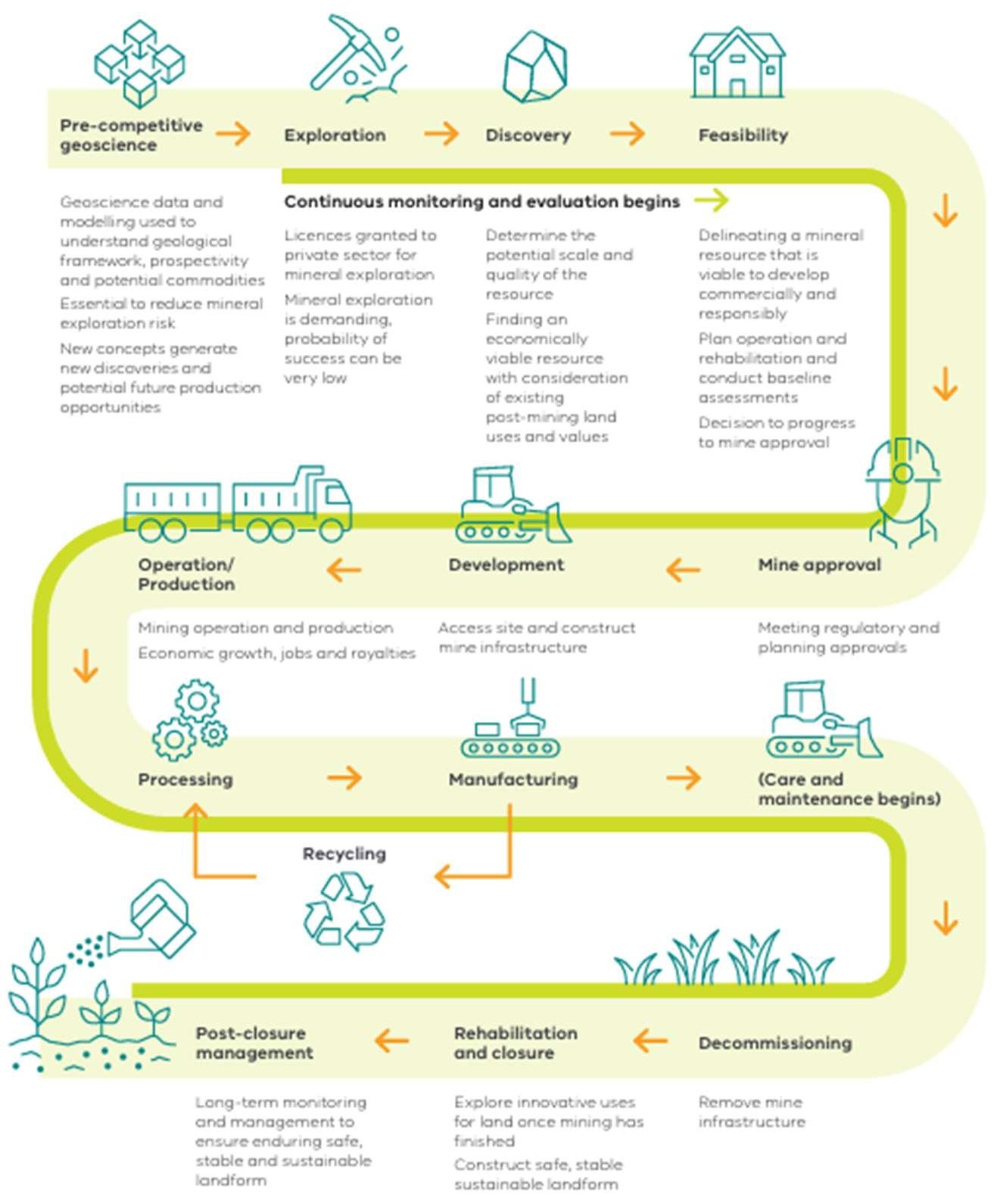
Figure 13 shows an overview of the mining process. The implications for this project are that:
Projects are often in planning and feasibility stages for many years before commencing an often lengthy approvals process. This means that the projects that have not yet commenced an approvals process are unlikely to begin generating economic impacts and benefits until the medium to long term. This means that the main projects expected to impact the region in the foreseeable future are the three mineral sands projects with acceptable Ministers Assessments for their EES (Goschen, Avonbank and the Donald Project) and one project currently preparing an EES (Wimmera Mineral Sands).
Localised impacts and benefits will mostly occur during the construction and operation phases. In the case of the mining projects proposed in the Study Area, this period is generally expected to last between 25 and 40 years. Mining activity is fundamentally di erent from transmission and renewable energy projects in that operations are relatively labour intensive, generating ongoing demand for services and creating localised impacts and benefits throughout the operating periods.
Land used for mining, especially minerals sands mining, can be rehabilitated and reused for agricultural purposes, limiting the long-term impact on land productivity.
Figure 13. Mining Process Flow Chart
Source: Critical Minerals Roadmap, 2024.
4.5. Key Points
Australia is home to the largest mineral sands deposits in the world, and the Study Area has globally significant quantities of titanium, zirconium, and associated rare-earth elements in mineral sand deposits.
Critical minerals are a collection of metal and nonmetal resources considered essential for renewable energy infrastructure, modern computing, emerging technologies and sustainable economic development.
Mineral sands and other mineral occurrences are present across a broad band within the Study Area extending from the Horsham area through Yarriambiack, Buloke and Gannawarra to Swan Hill. Mineral Sands and rare earth occurrences also extend into South Australia to the west and into the Southern Grampians area to the south.
Gold occurrences are wide spread near Stawell and across much of Loddon Shire in the east of the Study Area, and exploration and investment into gold mining is increasing strongly across the region.
A total of 22 mining projects are planned in the area, including 11 mineral sands projects and 9 gold projects. The projects expected to generate short term impacts are located near Swan Hill (Goschen) and Horsham (Avonbank and Wimmera) and the Donald Project (between Minyip and Donald).
Mineral sands projects are expected to have relatively long mine lives of 25-40 years. Localised impacts and benefits will mostly occur during the construction and operation phases during which activities are relatively labour intensive.
Mineral sand resources are planned to be exported for processing via the Port of Portland and Port of Melbourne.
Existing Conditions & Impacts Part
C
5. Existing Conditions
5.1. Introduction
This section provides a profile of the economy, labour force, housing and demographics within the Study Area; independent of proposed renewable energy and mining projects and investment. The analysis is compiled from existing data and Strategies and complemented by consultation with Councils and State government agencies.
The analysis and findings in this section provide further evaluation of some of the existing issues, challenges and opportunities that will influence regional readiness relevant to transmission, renewable energy and mining projects.
5.2. Economy
In 2024, it is estimated that the Study Area generated approximately $16.8 billion in economic output, $7.4 billion in export value, $7.7 billion in value-add. The Study Area contributes approximately 6% of Regional Victoria’s annual output and valueadded, and 18% of export-value.
An estimated 42,300 jobs are located in the Study Area. Agriculture, forestry & fishing is the most economically important industry sector, directly representing 28% of output, 22% of jobs, 52% of export-value and 28% of value-added. This does not include the indirect impact of this primary sector, such as the flows to other sectors including retail, services and other related industries.
Other industry sectors that drive the economy of the Study Area include manufacturing, construction, health care and social assistance.
Source: REMPLAN, 2025.
Table 8. Economic Profile by Industry, Study Area, 2024
Economic Importance: Industry Sectors
The relative importance of each industry to the Study Area’s economy is illustrated in Figure 14. Each cell represents the relative contribution of each industry according to a composite index prepared by Urban Enterprise. The index compares output, employment, exports and value-added of all industries against each other in relative terms.16 A larger cell indicates a larger contribution to economy across all metrics, and thus has a higher relative importance to the regional economy.
The top five industry sectors that are of the highest importance to the Study Area’s economy, and underpin the role and productivity of the economy are:
Agriculture, Forestry and Fishing;
Health Care and Social Assistance;
Manufacturing;
Construction; and
Education and Training.
Source: REMPLAN, 2025. Analysed by Urban Enterprise, 2025.
Note: Other Industries includes Other Services; Professional, Scientific & Technical Services; Financial & Insurance Services; Administrative & Support Services; Information, Media & Telecommunications; and Arts & Recreation Services.
A review of local and regional economic development strategies was undertaken to identify economic strengths and priority industries for growth.
Figure 15 provides a summary of strengths and priorities across key economic activities and industry sectors, noting whether they are primary, secondary and emerging/growth sectors.
Strategic directions for the local and regional economies confirms that strengths and priorities are weighted to agriculture, manufacturing, health care and social assistance and construction. Importantly, there are several emerging and growth industry sectors that are prioritised across di erent parts of the Study Area, including renewable energy, mining, tourism, transport and logistics.
Many of these priority sectors seek to leverage identified advantages in agriculture, nature-based and rural areas, as well as respond to policy and macroeconomic opportunities (e.g. energy transition).
Agricultural activities that are economic specialisations and economically important to the Study Area include broadacre cropping (grain, cereal and pulse production), livestock farming, dairy farming and horticulture. The agriculture sector is embedded in the regional economy, with well-established supply chains that have developed to support agricultural production, processing and exports. These include food manufacturing and rural service industries such as construction, storage and warehousing, transport, logistics and retail.
16 The composite index was calculated by normalising the four metrics of interest such that each industry’s output, employment, exports and value added figure can be scaled to a value between 0 and 1. The composite index was then assigned by calculating the average across the four normalised scores for each industry.
Figure 14. Relative Economic Importance by Industry, Study Area, 2024
Table 9 summarises the localised industry strengths and opportunities identified in each Council and Regional Economic Development Strategy. These have been used to compile the summary in Figure 15.
Figure 15. Summary of economic strengths and priority industries
Health Care &Social Assistance
Construction
Education & training
Trasport & Logistics
Retail Trade
Renewable Energy
Mining
Tourism
Source: Urban Enterprise, 2025, derived from Economic and Regional Economic Development Strategies.
Table 9. Industry Strengths and Opportunities
Regional Economic Development Strategies (REDS)
Agriculture
Healthcare
Manufacturing (food products)
Wimmera Southern Mallee REDS
Mallee REDS
Loddon Campaspe REDS
Construction
Retail
Motion Picture and Sound Recording
Manufacturing (food products)
Healthcare & Social Assistance
Mining (metal ore)
Manufacturing (food products)
Manufacturing (food products)
Tourism
Health and Social Services
Renewable Energy
Mineral Sands Mining
Agriculture
Manufacturing (food products)
Renewable Energy
Mineral Sands Mining
Tourism
Manufacturing (food products)
Food & Beverage Services
Accommodation & Food Services
Interim Economic Development and Tourism Strategy 20222023
Gannawarra Economic Development Strategy 2019-2024
Healthcare & Social Assistance
Education and Training
Retail Trade
Construction
Healthcare & Social Assistance
Retail Trade
Manufacturing
Government Services
Circular Economy
Hindmarsh
Economic Development Strategy 2024-2028
Horsham
Horsham Economic Development Strategy 2017-2021
Loddon
Loddon Shire Economic Development Strategy 2025-2029
Northern Grampians Economic Development Strategy and Action Plan 2021-2031
Swan Hill
Economic Development Strategy 2024-2030
West Wimmera
West Wimmera Economic Development Strategy 2024-2029
Yarriambiack Economic Development Strategy 2023-2027
Agriculture - Manufacturing - Healthcare & Social Assistance - Agriculture - Renewable Energy - Healthcare & Social Assistance - Tourism - Education and Training
Agriculture
Manufacturing - Construction - Public Sector and Community (including healthcare, education, public administration & safety)
Retail Trade
Agriculture
Agriculture - Mining - Transport & Logistics
Agriculture
Manufacturing
Healthcare & Social Assistance
Retail Trade
Construction
Agriculture
Agriculture - Healthcare & Social Assistance
Agriculture
Manufacturing
Renewable Energy - Mineral Sands Mining - Healthcare & Social Assistance
Education
Tourism
Transport and Logistics
Agriculture
Renewable Energy
Telecommunications
Agriculture
Mining
Manufacturing - Healthcare & Social Assistance - Sectors association with tourism
Renewable energy - Professional, Scientific & Technical Services (associated with Stawell Underground Physics Lab)
Renewable Energy
Mineral Sands Mining - Transport and Logistics
Education and Training
Agriculture - Tourism - Renewable Energy - Healthcare & Social Assistance - Public Administration & Safety
Renewable Energy - Mineral Sands Mining - Agriculture - Healthcare & Social Assistance - Professional, Scientific & Technical Services - Information, Media & Telecommunications - Accommodation & Food Services
Source: Urban Enterprise, 2025, based on review and synthesis of documents sourced in the table.
5.3. Labour & Skills
This section provides an assessment of the labour force across the Study Area, including participation and unemployment rate, labour shortages, skills gaps and employment projections.
Some datasets presented in this section are unavailable at the municipal level, and therefore the North West SA4 is referenced, which generally aligns with the Study Area but excludes Loddon Shire and includes Mildura and Ararat.
Labour Force Participation & Unemployment Rate
As at 2024, labour force participation across the region was approximately 63%, and a fluctuating but generally decreasing trend is evident (66% in 2014). The labour force participation rate in the region is now materially lower than for Victoria overall (68%).
Importantly, as shown in Figure 17 the labour force participation of adults in the region aged between 25 and 54 has been increasing and is now at very high levels (92% - 97%), indicating no capacity for participation increase. Although youth and older adult participation is lower, the nature of work in the region (with many occupations being labour intensive) means that many jobs are not suited to older workers, leaving increasing youth participation and the remaining participation opportunity within the existing labour force.
The Study Area is also characterised by persistently low unemployment. As shown in Figure 18, unemployment rates in 2024 across the nine LGAs were all below 4.5%, with six out of nine LGAs recording an unemployment rate below 3%. Seven out of nine LGAs observed a general decreasing trend in unemployment from 2014 to 2024.
Figure 16. Average Annual Participation & Unemployment Rate Trend, North West SA4, 2014-2024
20142015201620172018201920202021202220232024
Source: ABS Labour Force Survey (Detailed), 2025; Urban Enterprise.
Figure 17. Workforce Participation by Age, North West SA4, 2015-2025
Source: ABS Labour Force Survey, 2025. Compiled and analysed by Urban Enterprise.
Figure 18. Average Annual Unemployment Rate by LGA, 2014-2024
Source: Small Area Labour Markets, Department of Employee and Workplace Relations, 2024.
Regional Labour and Skills Challenges
The Wimmera Mallee Employment Region Local Jobs Plan (2024) summarises the employment challenges and priorities for the region, along with strategies to address these challenges.
The following labour market challenges are relevant to the Study Area:
There are labour shortages in industries such as construction, transport and logistics, manufacturing and processing, mining and agriculture.
Occupations such as technicians and trades workers, labourers, machinery operators and drivers are in high demand.
Workforce shortages for skilled workers including managers and professionals in various occupations also remains high for the region.
Youth unemployment remains high compared with the overall unemployment rate for the region.17
Mature age workers experience multiple challenges to securing and retaining employment opportunities in a competitive market and are more likely to experience long-term unemployment if challenges are not addressed. Challenges include low digital literacy, identifying and promoting transferrable skills, di iculty accessing training and arranging flexible work opportunities compatible with individual’s needs and family dynamics.
17 It is noted that the consultation undertaken for this project identified that youth over-employment is actually observed in the region. This is supported by reference to youth unemployment in Wimmera Mallee in 2025 (7.4%) being materially lower than the average across Victoria (10.6%) (Wimmera Mallee Employment Region Labour Market Dashboard, Jobs and Skills Australia, 2025).
There is a lack of employees entering or remaining in vital roles such as early childhood education and care, aged care, personal care and disability services.
Rural towns in the region are disproportionately a ected compared with the rest of the state.
A portion of principal carers are unable to return to work due to the shortages of childcare placements.
The Regional Skills Demand Profiles published by the Victorian Skills Authority (VSA) also notes the following challenges that are relevant to the Study Area:18
Labour supply and growth is constrained by low unemployment, high participation rates for persons of working age, an ageing workforce, and historically low population growth.
Labour supply considered inadequate to meet the projected growth in workforce demand.
Workforce attraction and retention is a challenge given a lack of available and a ordable housing, inaccessibility of childcare and insu icient digital and physical infrastructure.
5.3.1. Consultation Findings on Economy, Labour and Skills
Consultation identified the following key issues relating to existing conditions and economy, labour and skills:
A range of comments regarding economic strengths and weaknesses were made across the region. Several councils identified that existing economies could benefit from greater diversification, while others noted the significant levels of innovation, export value and opportunity to increase production, especially in agricultural research and development, grains, horticulture and intensive agriculture.
Agricultural land use is generally becoming more intensive, resulting in some cases in excess land that can be used for other purposes, including energy production. More intensive agricultural practices can be more water e icient which is beneficial given strong competition for water.
Drought across much of the region is causing challenging agricultural conditions and is highlighting the exposure of many parts of the economy and communities to agricultural sector performance, including associated mental health consequences.
Some parts of the region have been a ected by major floods in recent years, impacting agricultural businesses through loss of livestock and infrastructure, weakening resilience to further challenges.
Most Councils identified persistent workforce shortages in construction, childcare, health and education and agriculture. Government representatives noted that actual job vacancies in the region are generally considerably higher than advertised vacancies (up to 8 times).
Childcare labour shortages were particularly frequently mentioned, along with the flow on economic e ects caused by a lack of available childcare sta and places.
The seasonality of the required workforce was identified as a challenge, especially for agriculture. Many agricultural businesses are facing di icult changing labour conditions, whereby the salaries demanded by farm hands and other workers are increasing substantially, impacting overall business costs.
The existing labour force in most parts of the region is ageing, resulting in challenges sustaining existing positions and labour levels. A high proportion of jobs undertaken in the region are vocational, meaning that it is di icult to remain working into older age due to physical requirements.
Persistently low unemployment was referred to as a challenge in supporting existing business activity and growth, let alone responding to any additional demand. Over-employment is evident in many parts of the labour force, including youth.
Councils and government representatives identified that there is a relative lack of higher education and training options in the region, limiting the potential to upskill or reskill the existing population base. Councils noted that this contributes to outmigration, particularly among youth.
Other projects are proposed in the area which will generate activity and the need for labour and suppliers, including:
Farm Frites plant, a proposed 24-hour production facility at the Wimmera Agriculture and Logistics (WAL) Hub in Dooen near Horsham. The project is a $452 million investment which targets the creation of 250 local jobs and has recently received Ministerial approval.
An expansion to the Thomas Foods Abattoir in Stawell to double lamb production and increase employment by 250 FTE.
Quality Australian (QA) Hay establishing a new plant in Warracknabeal which will create over 75 FTE.
18 Wimmera Southern Mallee Regional Skills Demand Profile, VSA 2023.
5.4.
Housing
5.4.1. Settlement Hierarchy
The Study Area includes a broad network of settlements across a large geographic area; ranging from rural settlements, small towns, regional service centres, regional cities and major regional cities. The existing settlement hierarchy within and surrounding the Study Area is shown in Figure 19, with further detail provided in Table 10. Existing settlements have been categorised according to a combination of Plan for Victoria designations and population thresholds.
The settlement hierarchy in the Study Area includes one Regional City (Horsham) and one Regional Service Centre (Swan Hill), along with a network of Small Towns (including Dimboola, Donald, Kerang, St Arnauld, Stawell and others) and Rural Settlements (e.g. Koondrook, Hopetoun, Wedderburn and others).
Horsham and Swan Hill are the only towns in the Study Area with a population of exceeding 10,000 residents in 2024 (based on the SA2 area). The Study Area is also surrounded by a mix of settlements that may be drawn on to assist with supplychain, housing and labour needs to support transmission, renewable energy and mining readiness, most notably:
Bendigo (Major Regional City) that is located on the south eastern boundary of Loddon Shire.
Echuca (Regional City) situated in Campaspe Shire, adjoining Gannawarra and Loddon Shires.
Mildura and Ballarat are also substantial regional cities that are proximate to the Study Area.
Figure 19. Settlements Map, Study Area and Surrounds
Source: Urban Enterprise, 2025. Population as at 2021 based on ABS township definitions.
Hierarchy Role
Major Regional City (100,000+ population)
Regional City (15,000+)
Regional Service Centre (6,000 -14,999)
Small Town (1,000-5,999)
Rural Settlement (<1,000)
Study Area
A regional city with more than 100,000 people. (None)
A city other than a major regional city that serves as a hub for its region. Locations for homes, employment, economic activity and investment, delivering public transport, facilities and services to residents of the city and surrounding areas.
A pivotal town in Victoria’s regional development, fostering economic activity and providing a key network of service hubs. Provide a service role for rural hinterland, smaller towns and settlements.
Service centres for rural communities. Provide community services, employment and recreation services. Can include specialist functions such as tourism-centred retailing.
Minor rural settlements and service centres.
Stawell, Kerang, Robinvale, Warracknabeal, St Arnaud, Nhill, Cohuna, Donald, Dimboola
The housing stock is relatively homogenous with limited diversity of housing typologies. Separate houses are the most prevalent dwelling typology (91%).
Owner occupiers are the most common type of housing tenure. 69% of households own their property, and 20% rent.
The Study Area has an older demographic and smaller household sizes, evidenced by a high proportion of lone person and couple households, and a high proportion of semi-retirees, retirees and seniors.
Table 11. Housing & Household Snapshot, Study Area
Source: Census of population and housing, ABS 2021
Lone person: 30%
Couples with no children: 28%
Couples with children: 21%
One parent families: 8%
60-64 years: 7.8%
55-59 years: 7.3%
65-69 years: 7.1%
50-54 years: 6.5%
70-74 years: 6.4%
Owned outright: 44%
Owned with a mortgage: 25%
Rented: 20%
Table 10. Settlement Hierarchy, Wimmera Southern Mallee and Surrounds
Horsham
Mildura
Swan Hill
Figure 20 shows the distribution of socio-economic advantage and disadvantage across the Study Area. All regions of the Study Area are defined as having relative socio-economic disadvantage except Horsham Surrounds.
In many areas such as Nhill, Stawell, St Arnaud, Loddon and Yarriambiack, the SEIFA index is at 950 or lower, and in the towns of Kerang and especially Robinvale, levels of socio-disadvantage are particularly acute.
Figure 20. SEIFA, Study Area by SA2s, 2021
Source: Socio-Economic Indexes for Areas (SEIFA), ABS, 2021.
*The SEIFA index measures the relative level of socio-economic disadvantage based on a range of Census characteristics. The index is derived from attributes that reflect disadvantage such as low income, low educational attainment, high unemployment, and jobs in relatively unskilled occupations. The national average index score is 1,000, with a score below 1,000 on the index indicating that area has a higher level of disadvantage relative to the national average.
5.4.3. Property Market
House Prices
House prices in the Study Area are relatively low compared with the Victorian context overall. As shown in Figure 21, median house prices generally range from $200,000 to $400,000, with the highest medians in Horsham and Swan Hill. House prices at these levels (especially in areas with medians in the lower parts of the range) typically present challenges to the financial feasibility of developing new housing.
This is a key consideration for towns needed to accommodate additional workers associated with major projects given that the construction of new housing under traditional build to sell models may not be a viable proposition.
Figure 21. Median House Prices by LGA, 2013-2023
Source: Victorian Valuer General, 2023; Urban Enterprise.
Rental Market
Figures 22 and 23 show the rental vacancy rate for Regional Victoria and for key towns in the Study Area, and Figure 24 shows the ten-year trend in median rents and active bonds in the Study Area. The following points are relevant:
The rental vacancy rate in Regional Victoria is currently at very low levels of around 2.2%, and has remained consistently low since 2014, ranging between 1% and 3% over the past decade.
All key towns in the Study Area e ectively have no rental vacancy taking into account natural vacancy and handover periods, with vacancy rates in August 2025 ranging from 0% (Dimboola) to 1.2% (Horsham).
The number of active rental bonds in the Study Area has steadily declined since reaching a peak of 5,480 in 2020 and is now 5,099. This is the lowest number of active bonds recorded since 2015-16, indicating a net reduction of rental properties in the region.
The median rent price in the Study Area is $320. Median rents have increased at an average of 7.3% per annum since 2019.
The rental market in the Study Area is experiencing ongoing capacity issues, evidenced by increasing rents alongside a declining availability of rental properties. Rental market conditions in the Study Area indicate that any potential uplift in demand for rental tenure associated with renewable energy or mining will be extremely challenging to service.
Source: Rental Report, Department of Families, Fairness and Housing, December 2024.
Commercial Accommodation
The Study Area has a relatively limited supply of commercial accommodation. Table 12 provides a snapshot of accommodation across the tourism regions which comprise the Study Area in 2022/2023. Although the tourism regions do not fully match the Study Area, the information provides a sense of scale and vacancy levels.
The only locations with a significant supply of commercial accommodation in the region are Horsham and Swan Hill, with nearby accommodation provided in Bendigo and Mildura. Where data is available, occupancy rates were most recently at between 68% and 73%, indicating some capacity to accommodate additional demand from temporary workers in the area, however when seasonality and day of week variations are taken into account, the level of capacity is likely to be limited.
Further, existing accommodation normally plays an important role in the region in supporting the tourism industry as well as the functions of government, health, and private enterprise by accommodating business travellers given the distance to major urban centres. To the extent that existing accommodation rooms are utilised by workers for transmission, energy and mining projects, this role could be disrupted in terms of availability and price impacts.
Source: Australian Accommodation Monitor, 2023. * unavailable data.
Source: Victorian Tourism and Events Resource Unit, 2024.
Figure 24. Active Bonds and Median Rent, Study Area, 2014-2024
Table 12. Accommodation Summary, FY23
Figure 25. Tourism Regions Map
5.4.4. Growth Context
In 2024, the total population of the Study Area was estimated at approximately 93,100. Over the past decade, the population of the Study Area has declined at an average rate of 0.57% per annum (-54 residents p.a.).
O icial State government population projections forecast a further decrease of the population between 2024 and 2036, with a forecast decline of approximately 1,400 residents. However, projected population changes vary across the Study Area as shown in Figure 27. The population in the Horsham and Loddon Local Government Areas is projected to increase, while a loss of population is projected for the remaining seven Local Government Areas in the Study Area, especially in Swan Hill and Yarriambiack.
It is noted that the State projections, along with many forms of economic and demographic projections, rely heavily on past patterns of growth to inform forecasts. Although all assumptions are not disclosed, it is unlikely that the population projections for the Study Area take into account the substantial scale of investment and labour required in the region to service the proposed transmission, energy and mining projects identified in this report.
If the underlying population (i.e. excluding the impact of major projects) does decline as projected, this will limit the availability of new labour and housing. This is likely to result in the need to divert workers from the existing pool of Study Area labour (from other sectors and activities); and/or attract workers from outside of the Study Area, which will have implications for housing and accommodation demand.
A further challenge, as demonstrated by Figure 28, is that age projections indicate there will be a net reduction in residents of working age in the Study Area over the period 2021 to 2036 (decrease of 5,461 residents aged 20-64 years), alongside an increase in older residents (increase of 5,576 residents aged over 70 over the same period). This will present additional challenges in terms of local labour availability for 'business as usual' activities as well as the ability to service major projects.
Figure 26. Estimated Resident Population, Study Area, 2014-2036
Source: Victoria in Future, 2023; ABS Regional Population, 2024.
Figure 27. Forecast Population Change by LGA, 2024-2036
Consultation with stakeholders for this report identified the following key issues to do with housing:
All Councils noted that existing housing availability is poor - housing shortages exist across all LGAs to di erent extents and supply pressures are likely to be exacerbated by proposed major projects.
Some Councils noted that there is inadequate developable land supply within their Shires. Councils pointed in particular to challenges associated with obtaining resources to undertake settlement planning and structure plans, along with the di iculty in demonstrating demand for housing to the State government when historical population growth levels (and o icial government projections) are low or in some cases negative. The unsuitability of historically based population projections was also identified by state government agencies as an issue.
More common than a lack of zoned land, were references to other constraints to the delivery of new housing within zoned land, such as:
High trunk infrastructure extension costs (especially sewer and power) associated with developing existing zoned land which has prevented delivery of new housing in existing zoned areas; and
Lack of availability of builders and the need to import materials, leading to high construction costs and slow delivery.
In many parts of the region, greenfield development is not viable due to the costs of development and low achievable house sale prices.
Several Councils noted that tight rental markets are a ecting housing availability and economic activity as a result. The experience of Moyne Shire was noted, where the rental market was strongly impacted during construction phases of renewable energy projects, which increased rental prices and resulted in some motels being booked out and used for worker accommodation during project construction phases.
Several councils identified that the existing housing stock is not su iciently diverse to accommodate the diverse range of housing needed by existing communities, especially older residents, and that the ageing housing stock is not appealing to those looking to move into the region.
5.5. Infrastructure
Consultation with stakeholders identified the following issues with existing infrastructure networks:
Local road networks are extensive and often in poor condition. Councils have di iculty maintaining roads within a ratecapped budget environment. Many are not fit for purpose for heavy vehicle usage, and no state funding has been available for local road projects since 2018. Some Councils noted that even with the improvements to road networks project proponents are expected to contribute, road networks will still be unsatisfactory.
Rail infrastructure and corridors are prevalent in the region, however many parts of the network require investment to capitalise on freight and passenger opportunities. Upgrades to rail sidings were consistently referenced as needed to move greater existing freight movements in the region o roads. The importance of the existing Ultima Freight Terminal was noted.
Water availability is a key challenge. Reduced irrigation volumes to do with Murray Darling Basin and Federal government water buybacks are a ecting agricultural production which is critical to existing economies and supply chains. Water prices have increased strongly as a result of intensifying competition for water in the region. Mining projects also need substantial water supply.
Telecommunications infrastructure and digital connectivity is weak across many parts of the region. Mobile networks across the region are already strained, which a ects both temporary and permanent populations. Mobile devices in use by construction workers on major sites place existing networks under further strain, which can take away service from small communities and townships which share networks with project site areas.
In some parts of the region, electricity supply is weak. Several towns and businesses regularly experience blackouts and brownouts. Major investment is required in Charlton, for example, to build a new sub-station given the existing infrastructure is at capacity.
The existing transport infrastructure networks across the Study Area are shown in Figure 29 for reference.
Figure 29. Existing Major Freight Networks, Study Area and Key Export Locations
Source: Urban Enterprise, based on Principal Freight Network.
5.6. Local Government
Existing Council Conditions
Largely, the Study Area councils have low revenues, small rates bases and significant asset responsibilities, especially roads. In 2024, 6 of the 9 Councils with the lowest rates revenue in Victoria were in the Study Area, being West Wimmera, Hindmarsh, Loddon, Yarriambiack, Buloke and Gannawarra.19
As shown in Figure 30, a Parliamentary Inquiry into the sustainability and operational challenges of local government20 noted that all study Councils except Horsham and Swan Hill were categorised in the group of“least sustainable Councils” in Victoria. The Parliamentary Inquiry also identified that the combined e ects of legislative and policy changes (including rate capping) had increased the overall financial challenges faced by Councils over the period 2013-2018.
Following this theme, a report by the Victorian Auditor General in 2025 found that "key financial indicators for most councils are trending down" and that "there are increasing risks that some councils, particularly the small shires, may not meet their future obligations to their communities if they do not take action."21
Source: Parliament of Victoria, 2018
Consultation Findings
Consultation with stakeholders identified that the provision of services by local governments is generally constrained by financial issues such as small rates bases (most councils in Study Area), lack of population growth in many areas, rates capping legislation and strongly increasing costs of maintaining the substantial network of existing assets, especially roads. Many councils and communities have experienced particular challenges in recent years due to natural disasters, including floods, which limit the ability to Councils to then fund other programs.
19 Victorian Auditor General; Urban Enterprise.
20 Inquiry into the sustainability and operational challenges of Victoria’s rural and regional councils, Final Report, 2018. Parliament of Victoria.
21 Victorian Auditor General, Financial Management of Local Councils August 2025, p.3. All Study Area Councils are defined by the VAG as 'Small shires' except Horsham and Swan Hill.
Figure 30. Least Sustainable Councils
5.7. Key Points
The Study Area contributes approximately 6% of Regional Victoria’s annual output and value-added, and 18% of export-value. An estimated 42,300 jobs are located in the Study Area.
The agriculture industry is the main driver of the regional economy, and is critically important to economic output, employment, value-add and export value. Key activities include broadacre cropping (grain, cereal and pulse), livestock farming, dairy farming and horticulture.
Strategic directions for the local and regional economies confirms that strengths and priorities are weighted to agriculture, manufacturing, health care and social assistance and construction.
There is a relative lack of diversification in the economy, highlighted by the reliance on agriculture and supply-chain sectors such as food manufacturing, construction and transport.
There are significant existing workforce capacity challenges, labour shortages and skills gaps in the Study Area that are a result of long-term low unemployment, very high labour participation, an ageing workforce and overall population decline. These conditions create challenges for a range of existing industries across the region as raised in consultation with stakeholders.
The Study Area has recorded areas and periods of population decline. This trend is projected to continue in the majority of Local Government Areas (with the exception of Horsham and Loddon), however o icial projections are unlikely to have taken into account the population growth needed to service proposed major projects in the region.
Within the context of a changing and ageing population and very limited capacity in the labour force, the opportunity to meet the labour requirements for renewable energy and mining projects from within the Study Area is very limited. Therefore, to support the delivery and operation of projects, the following will be needed:
o Diversion of workers from other sectors of the economy; and/or
o Workers to be sourced from outside of the Study Area, which will have flow-on implications for housing, accommodation and services.
The housing and accommodation markets in the Study Area are characterised by low prices, a lack of diversity of housing types and sizes, extremely low rental vacancy rates, rapid rent price growth, and a low quantity of commercial accommodation. This presents challenges to existing communities as well as limitations for development feasibility, accommodating temporary workers and accommodating an ageing population in the future.
The lack of housing availability is already a major constraint to economic activity and service provision across the Study Area.
Existing infrastructure networks are extensive but under pressure, especially local roads, telecommunications, water, wastewater treatment and in some parts of the area, electricity. In addition, existing rail infrastructure requires investment to take pressure o roads and move produce more e iciently across the region.
Local governments in the Study Area generally have very low rates bases and financial sustainability challenges which limit the availability of resources to undertake existing responsibilities.
6. Economic Impacts and Opportunities
6.1.
Introduction
This section describes the range of economic impacts that may arise from major infrastructure and resource developments across the region, including the VNI West transmission project, large-scale renewable energy investments, and emerging mineral sands mining operations. A summary of key methodology elements and assumptions is provided in Appendix C.
6.2. Economic Impacts
Economic impacts of projects are categorised and expressed in the following ways:
Project type: Renewable Energy (solar, wind, battery), transmission, and mining.
Construction expenditure and employment separated from ongoing (operational) expenditure and employment.
Local employment separated from other employment impacts, where:
Local employment indicates jobs expected to be located on site or within 100km, an indication of potential number of people undertaking work in the Study Area or immediate surrounds as a result of the projects.
Phases:
Phase 1, being projects with relevant approvals (or an acceptable Ministers Assessments for an EES) in place and/or expected to commence in the short term;
Phase 2, being projects under assessment for approval, and/or expected to occur in the medium term (including energy projects relying on catalyst transmission infrastructure); and
Phase 3, being less certain and longer-term projects yet to commence an approvals process.
6.2.1. Capital Expenditure (Construction)
The total capital expenditure across all identified projects in the Study Area is estimated at $40.4 billion. Wind energy accounts for the largest share ($25.9 billion), reflecting several large-scale proposals, particularly in Phase 3. Transmission CAPEX is associated with the VNI West and WIRES projects, while mining contributes a further $1.6 billion.
It is noted that data shown for mining projects is limited to the three advanced mineral sands projects due to the lack of information available for other projects and variability in construction costs by location, mineral type and so on.
Source: Urban Enterprise, 2025. Transmission projects exclude VTP north-west upgrade projects. * Mining limited to 3 advanced mineral sands project being Donald, Avonbank and Goschen.
Note: renewable energy projects include all proposed projects, noting that not all with proceed to development and that this energy generation well exceeds VTP targets.
Given that total planned renewable capacity substantially exceeds the REZ capacity targets shown in the VTP, it is unlikely that all projects will proceed. For this reason, the following analysis applies the maximum capacity requirement of the VTP for solar and wind as the planned level of renewable energy investment. This approach indicates a more realistic estimate of potential economic impacts by limiting the analysis to a scale of development consistent with network requirements.
Table 13. Total Construction Phase Capital Expenditure ($M)
Construction
Phase Expenditure and Employment
Table 14 shows the capital expenditure results for the refined analysis, including an estimate of the potential local impacts. Based on the refined analysis, total capital expenditure across all phases is estimated at $24.3 billion of which approximately $2.8 billion may be spent locally.22
It should be noted that local capital expenditure for renewable energy projects typically represents only a small proportion of total project costs, as specialised equipment is often sourced from overseas, and key components such as turbines, panels, and battery systems are rarely manufactured domestically.
A total of at least 9,000 full time equivalent jobs would be supported by the proposed projects, with each job lasting an average of 2.5 years (based on the typical construction period of the projects).
This employment impact would be phased over a relatively long period. If projects were to occur within the three phases indicatively used for this Strategy, then:
Phase 1 would support approximately 1,700 FTE workers for construction activity;
Phase 2 would support approximately 3,800 FTE workers for construction activity; and
Phase 3 would support approximately 3,700 FTE workers for construction activity.
As shown in the table, it is estimated that approximately half of these workers may be able to be sourced locally, with the remaining workers imported from outside the region, however this will depend on a range of factors and may vary considerably, including over time.
This highlights both the significant opportunity for local labour participation as well as the potentially significant impact of existing labour being redirected from current employment in other industries to the major projects, particularly in Phases 2 and 3 when renewable energy projects have increased transmission capacity available and more projects in the pipeline across mining and renewables can occur concurrently.
To the extent that labour is imported to service the construction phases of projects, this will have significant impact on local housing and commercial accommodation markets, all else being equal.
Source: Urban Enterprise.
Table 14. Capital Expenditure ($M) and Employment, Construction Phase
Operational Expenditure and Employment
Annual operational expenditure is estimated at $888 million across all phases, with an indicative $590 million (67%) expected to be captured locally. It should be noted that mining projects account for a substantial share of total OPEX due to their labour-intensive on-site operational requirements, which are significantly higher than those of renewable energy projects.
Expenditure is highest in Phase 1, reflecting the larger scale of mining projects expected to commence operation in the short term. The high level of locally captured expenditure highlights the enduring economic contribution of mining operations to the host region over the life of these projects.
Operational employment across all projects is estimated at 2,300 ongoing jobs, with around 1,900 positions (80%) expected to be potentially sourced locally. Employment is highest in Phase 1, reflecting the commencement of large-scale mining projects, which are typically more labour-intensive than renewable energy operations.
Table 15. Operational Phase Expenditure and Employment
Source: Urban Enterprise, 2025.
6.3. Jobs & Skills
Major infrastructure projects such as renewable energy, transmission, and mining developments generate significant employment and skills opportunities within their host regions. These opportunities extend across both the construction and operational phases, ranging from short-term project-based roles to long-term operational positions.
This section outlines the potential local workforce opportunities for the Study Area, drawing on Australian and international research to identify the types of jobs and skill levels most likely to be required for each project type. The analysis is intended to complement the quantitative estimates presented earlier, providing context for the potential nature and distribution of jobs, and the potential for local workers to benefit from future project pipelines.
6.3.1.
Renewables
Overview
Figure 31 summarises the breadth of career pathways across the large-scale renewable energy sector. Jobs span the full project lifecycle, from early planning and design through to construction and installation, and ultimately operation and maintenance.23 A summary of the project lifecycle is provided below:
In the planning and design phase, engineers, planners, legal, finance and commercial specialists play key roles in scoping, approvals, and feasibility.
During construction and installation, workforce needs peak, with civil workers, trades and technicians, machine operators and project engineers required to deliver large, complex infrastructure.
Once operational, projects rely on ongoing roles in engineering and technical maintenance, ensuring assets remain e icient and safe over their 25–30 year lifespan.
This highlights that renewable energy development is not confined to a single occupational group; rather, it draws on a diverse mix of professional, technical, and trade skills. It also underscores the significant opportunity for workers from regional areas to transition into long-term, skilled careers in the clean energy economy.
23 Skilling the Energy Transition, Clean Energy Council, 2022.
Source: Skilling the Energy Transition, Clean Energy Council, 2022.
Project Phases
Figure 32 highlights the distribution of current renewable energy jobs across di erent stages of the project lifecycle. Most jobs (72%) are concentrated in development, construction and installation, reflecting the labour-intensive nature of building large-scale renewable energy projects. A smaller share of jobs is in the operation and maintenance phase (21%), which will grow steadily as more projects come online, while manufacturing currently accounts for just 7% of total employment. This demonstrates that, at present, construction activity is the primary driver of renewable energy workforce demand, but over time the balance will shift towards long-term operations as Australia’s renewable capacity expands.
Figure 32. Renewable Energy Current Employment Breakdown by Phase
Source: Clean Energy at Work, Clean Energy Council, 2020.
Occupations
Analysis by the University of Technology Sydney (UTS) estimates the occupational profile of renewable energy jobs between 2020 and 2035, as shown in Figure 33. The data highlights the breadth of roles required, ranging from labourers and machine operators through to technicians, professionals, and senior managers.24
The majority of demand is concentrated in skilled trades and technical roles, with electricians standing out as the single largest occupation group at an estimated 13.6% of the renewable energy workforce. Other relevant significant areas of demand include electrical trade assistants, labourers, drivers, construction and project managers, and a range of engineering disciplines.
The profile underscores that while renewable energy projects create employment across the full occupational spectrum, the industry is particularly reliant on technically skilled and licensed roles.
24 Renewable Energy Jobs in Australia: Stage One, Clean Energy Council/UTS, 2020
Figure 31. Careers in Large Scale Renewable Energy
Figure 33. Renewable Energy Occupational Composition (2020-2035 average under Step Change Scenario)
Source: Renewable Energy Jobs in Australia: Stage One, Clean Energy Council/UTS, 2020.
Critical Occupations
Skilling the Energy Transition (Clean Energy Council, 2022) highlights the occupations where skills shortages are most acute, identifying critical roles across wind, solar and battery projects that are consistently di icult to source and therefore present a risk to the timely delivery of Australia’s renewable energy pipeline.25
Table 16 highlights the breadth of critical occupations required for the clean energy transition, spanning both universityqualified professionals and vocationally trained roles. On the professional side, demand is strongest for engineers (electrical, grid, HV, power systems and structural) and development managers, while on the vocational side there are persistent shortages of operational and technical roles such as wind and solar technicians, control room operators, and operation and maintenance managers.
Table 16. Critical Occupations
Electrical engineer
Grid connection engineer
HV engineer
Power systems engineer
Quality engineer
Structural engineer
Development manager
Control room operator
Material and procurement specialist
Wind technician
Solar technician
Operation and maintenance manager
superintendent
Source: Skilling the Energy Transition, Clean Energy Council, 2022.
25 Skilling the Energy Transition, Clean Energy Council, 2022
Local Opportunities
Analysis of the origin of renewable energy jobs was also undertaken as part of the UTS analysis. Large-scale wind and solar project proponents were asked to estimate the proportion of jobs that were sourced‘local’to the project (defined as within 100 kilometres). The results of this analysis are summarised in Table 17 and highlight the significant role that local workers can potentially play in renewable energy projects.
For construction, regional employment accounts for 67% of wind farm jobs and 69% of solar farm jobs, with the strongest regional contributions coming from drivers, machine operators and labourers (100%), site administrators (100%), electrical trades (90%), and mechanical trades (90%).26
In the operations and maintenance phase, regional participation is even more pronounced for wind at 73%, while solar records 55%. Key roles with high regional representation include electrical technicians (100%), mechanical technicians (100%), and Scada technicians (100%), alongside significant regional engagement in health and safety and operations management roles.
A post-construction assessment of the construction activities for the Murra Warra Wind Farm identified that 45% of the construction workforce was‘local’(i.e. residents in the Wimmera region), while the remaining 55% originated from other parts of Victoria and Interstate. Key observations from the local and non-local workforce profile are summarised below:
The majority of local employees undertook technician or civil works roles. Some local employees were involved in technical advisory and administrative roles; and
Main projects roles for non-local workers were electrician/technician, Machinery Operator (specialist crane crews) and Site Supervisor. A higher number of non-local workers were employed in supervisor or management roles.
It is noted that the ability of local workers to be involved in the development and operation of renewable energy projects is highly dependent on the alignment of workforce skills, training pathways, and industry demand within regional areas.
Source: Renewable Energy Jobs in Australia Clean Energy Council/UTS, 2020. *Local = within 100km of project (classified as "regional" by UTS).
26 Renewable Energy Jobs in Australia: Stage One, Clean Energy Council/UTS, 2020
Table 17. Regional Job Profile
6.3.2. Mining
Overview
The mining industry workforce spans the full project lifecycle, with di erent occupations in demand at each stage. Employment requirements shift significantly from the specialist professional skills needed in exploration, to the surge in construction trades and operators during mine development, and then to the long-term operational roles that sustain production over decades. Finally, closure and rehabilitation phases create demand for environmental and land management expertise.
Table 18 summarises the key occupations associated with each stage of the mining lifecycle, highlighting the breadth of professional, technical and trade skills that underpin the sector.
Exploration & Planning
Construction & Development
Operations (Production & Processing)
Early stage resource identification, feasibility and approvals. Small, specialised workforce.
Building mine site, processing plant, and associated infrastructure. Labour-intensive, short-term peak demand.
Long-term phase, sustaining workforce for decades. Core production and maintenance activities.
End of mine life. Decommissioning and land restoration.
Source: Urban Enterprise, based on a range of literature reviewed.
Workforce Insights
- Geotechnical engineers, hydrologists
- Civil and earthworks crews
- Demolition specialists
- Water management and monitoring technicians
Recent Jobs and Skills Australia (JSA) data highlights the occupational profile and future employment trajectory of the Australian mining workforce. As shown in Figure 34, the largest employing roles are drillers, miners and shot firers, followed by metal fitters and machinists, and building and engineering technicians. These roles, alongside truck drivers, electricians, and production managers, form the backbone of operational mining employment. Importantly, many of these occupations are currently flagged as experiencing national skill shortages, underscoring persistent workforce pressures.
Employment projections point to continued growth across professional and technical roles. Mining engineers, geoscientists, and production managers are forecast to record some of the strongest gains, with projected growth of 20–23% by 2033. Demand for trades and operator roles such as drillers, fitters, and electricians is also expected to rise steadily, though at a slower pace. Overall, the mining workforce is projected to expand from around 275,000 workers in 2024 to over 320,000 by 2033, reflecting both the sustained strength of Australia’s resource sector and the growing importance of critical minerals.
Table 18. Mining Lifecyle & Key Occupations
Although the construction phase of mining projects often employs two to three times more workers than the operational phase, this surge is temporary, usually lasting only a few years.27 In contrast to renewable energy projects, the operational phase of mining projects generate significant employment due to the labour-intensive nature of the work.
34. Top 20 ANZSCO Occupations by Workforce Numbers
Source: ABS Table Builder 2021 Census - employment, income and education | JSA Skills Priority List 2023. 4-dig SPL (ANZSCO 2013).
Figure 35. Employment Projections by ANZSCO Occupations
Source: Employment Projections produced by VU for JSA (May 2023 to May 2033).
Local Opportunities
The mining workforce in Australia is heavily concentrated in regional and remote areas, and this pattern holds true for prospective developments in regional Victoria.
Evidence from comparable mining operations across the country suggests that local workers are well placed to participate in key roles, particularly in trades, machinery operation, transport and logistics, and site administration. These occupations align with existing skillsets in many regional communities, which often have strong employment bases in agriculture, construction and manufacturing. With targeted training and workforce development, there is considerable potential for a high proportion of construction and operational jobs in mining projects to be filled by local residents.
27 Doyle, M-A. 2014,“Labour Movements during the Resources Boom,” RBA Bulletin, December, Reserve Bank of Australia.
Figure
However, given very high existing workforce participation and low population growth, there is a clear risk that workers are redirected from current roles to obtain higher paid roles in mining. At the same time, experience from established mining regions highlights the challenges of balancing local employment with fly-in, fly-out (FIFO) labour models. Specialist professional roles, such as mining engineers, geologists and metallurgists, are in national shortage and are frequently sourced from interstate or metropolitan centres.
6.4. Supply Chain
In addition to employment and skills, major infrastructure projects such as renewable energy, transmission, and mining developments also generate substantial supply chain opportunities for local businesses. These opportunities arise in both the construction and operational phases and extend across a wide range of industries.
This section provides an assessment of the potential local supply chain opportunities for the Study Area, drawing on Australian and international research to identify the types of businesses and services most likely to benefit. This represents a similar approach to the preceding jobs and skills analysis, with the aim of contextualising the quantitative economic impacts presented earlier in this section.
6.4.1. Transmission
Transmission infrastructure projects are a critical part of the energy transition currently underway. These large transmission projects, while di erent in nature from generation projects, also generate local supply chain opportunities in host regions. Building a transmission line requires extensive on-the-ground work over a wide area, and once built, the line and substations need periodic maintenance.
Construction
The construction of high-voltage transmission lines is a major engineering undertaking that can create a significant temporary workforce and demand for diverse local services. Key areas where local businesses can be involved in transmission construction include:
Civil Construction and Site Preparation: Much like renewables, transmission projects need significant civil works. Local civil contractors can be engaged to build access tracks to tower sites, clear right-of-way corridors, and construct tower foundations (including excavation and concrete pouring). Earthmoving and fencing companies in the region are often needed to prepare sites and secure them. Substation construction involves work such as earthworks, concrete foundations, trenching for cables, and building control rooms – tasks that local construction firms or tradespeople can assist with.28
Labour and Trade Services: Transmission line builders hire a range of trades. General labourers, equipment operators, and trades assistants from the local workforce can find employment or subcontracting opportunities on the project. There is also demand for specialised trades: for instance, electricians to install substation equipment or wire up components, and possibly steelworkers or riggers to assemble towers.28
Vegetation Management and Environmental Services: A major part of transmission line construction is vegetation clearing along the corridor and ongoing environmental management. Local arborists and land management services are often contracted to remove or trim trees along the right-of-way during construction. They may also handle disposal of green waste and later revegetation or o set planting. Additionally, cultural heritage consultants (potentially local indigenous groups or archaeologists) might be hired to monitor works if heritage sites are present, providing another avenue for local specialist engagement. 28
Transport and Logistics: Transmission projects involve moving vast amounts of materials – steel tower segments, conductor cables (often on large spools), poles, insulators, and heavy machinery – into often remote or rural locations. This provides business for local trucking and logistics companies to haul equipment from manufacturing sites or ports to staging areas and tower sites. An interesting case is tower components: even if towers are manufactured elsewhere (often overseas), there are local opportunities in handling them. This means local businesses can win contracts to manage the warehousing of tower parts, transport them to sites, and even pre-assemble sections, despite the steel fabrication being
28 Hunter New Energy (2024), Hunter Region businesses invited to register interest in Hunter Transmission Project, available at: https://hunternewenergy.com.au/hunter-region-businesses-invited-to-register-interest-in-hunter-transmission-project
imported. Such logistics, inventory, and assembly services are valuable roles that regional companies can play in transmission builds.29
Equipment and Materials Supply: There are also opportunities for suppliers of construction materials: e.g. local quarries might provide gravel for access roads or backfill, concrete batch plants in the region could supply concrete for tower footings, and local hardware or industrial suppliers might provide bolts, tools, fuel, and other consumables. These are often procured as close to the project as possible for cost e iciency, thus supporting regional businesses.
Operational
The local opportunities during the operational phase of transmission projects include:
Line Maintenance and Inspection: High-voltage lines and towers need periodic inspections, hardware tightening, and repairs (e.g. after storms or as components age). Utilities frequently use regional maintenance crews or contract local companies to assist with these tasks.
Vegetation Management: Even after construction, vegetation control under transmission lines is a continual requirement for safety and reliability. This is often outsourced to vegetation management firms. For regional transmission routes, local arborist companies or land care contractors can secure multi-year contracts to periodically clear regrowth and maintain the right-of-way (e.g. keeping trees at a safe distance from wires on a set cycle). This provides steady work for local crews skilled in tree trimming and land management.30
Substation Operations and Services: New transmission lines often come with new or expanded substations. Operating a substation may require electrical maintenance services (for transformers, switchgear, etc.) which can sometimes be provided by local engineering firms under contract. Additionally, substations need upkeep such as equipment testing, fence repairs, cleaning, and landscaping. These needs can be opportunities for local maintenance contractors, cleaners, and gardeners. For security, some substations in remote areas use local security companies for alarm response or routine patrols. Though much of substation monitoring is remote/digital, the support services (grounds maintenance, occasional technical checks) can be locally sourced.
6.4.2. Renewable Energy
Renewable energy developments have the potential to inject targeted economic activity into regional communities. These projects involve large capital works and ongoing operations that can leverage local suppliers and labour. Research focused on Australia’s clean energy expansion highlights substantial local benefits if regional businesses are included in the supply chain.
Construction
Construction is the most labour- and resource-intensive stage for renewables, and it o ers the greatest number of economic opportunities for the local economy. Key local opportunities during renewable construction include:
Civil Engineering and Construction Services: Building the project’s foundations, access roads, and supporting infrastructure relies on earthmoving, excavation, concreting, and construction crews. These tasks can often be contracted to local civil engineering firms, earthworks contractors, and concreters. For example, wind farm construction requires laying turbine foundations and access tracks, which has involved local contractors for civil works and cement supply in Victorian projects.31
Building Materials and Manufacturing: Projects need bulk materials like cement, steel rebar, gravel, and other building supplies. Local quarries and materials suppliers can benefit by providing these inputs. In some cases, regional manufacturing businesses may contribute components or services – for instance, assembling mounting frames or precasting concrete elements locally. While major equipment (turbines, solar panels, battery units) is typically sourced globally, ancillary components (cables, brackets, fencing) or secondary fabrication work can be done by host region businesses if capabilities exist.32
29 Hughes et al. 2023, Case Study: SecureEnergy Local Industry Engagement and Procurement Initiative, available at: https://www.hughesetal.com.au/casestudy-secureenergy-local-industry-engagement-and-procurement-initiative
30 Hughes et al. 2023, Case Study: SecureEnergy Local Industry Engagement and Procurement Initiative, available at: https://www.hughesetal.com.au/casestudy-secureenergy-local-industry-engagement-and-procurement-initiative
32 Fact Sheet – Renewable Energy: powering jobs and regional communities, Clean Energy Council, 2025.
Transport and Logistics: Moving large components (turbine blades, transformers, battery modules) and materials creates demand for regional transport companies and logistics providers. Local trucking businesses may be contracted to haul equipment from ports to the site, and crane operators or heavy haulage specialists in the area can assist with lifting and installing large units. Research shows transport is a notable beneficiary; for instance, the Clean Energy Council highlights that local transport businesses see increased procurement opportunities delivering components to renewable project sites.33
Electrical and Technical Services: The installation of wind turbines, solar arrays and battery systems requires skilled electrical work (laying cables, grid connection, instrumentation). This creates openings for local electrical contractors, engineers, and technicians to subcontract on the project. Large projects often bring in principal engineering firms, but those firms may hire regional subcontractors for electrical installation and testing if available. A fact sheet on renewables notes roles like electricians and technicians are pivotal during construction – local professionals in these fields can be engaged through subcontracting or labour hire.
These construction-phase opportunities are typically the most substantial in terms of local economic impact. They last for the construction period of a project but can leave a legacy of enhanced skills and capacity in local businesses.
Operational
Once operational, renewable energy projects generate smaller but long-term economic benefits in the local area. A wind or solar farm typically employs a core team of technicians and support sta for operations and maintenance over its 20–30-year lifespan. Although far fewer people are needed compared to construction, the operational phase still provides steady jobs and business opportunities for the host community.
Equipment Maintenance and Servicing Contracts: Operating a wind or solar farm involves regular maintenance such as servicing turbines, cleaning solar panels, replacing inverters or battery components. While original equipment manufacturers often handle major maintenance under contract, there are opportunities for local service providers to be involved. For instance, local mechanical or electrical firms might be contracted for certain repairs or preventive maintenance tasks (such as servicing vehicle fleets, maintaining transformers, or providing tools and hardware). Panel cleaning services and vegetation management around solar farms can also be sourced locally. Similarly, groundskeeping and land management (weed control, road upkeep on the site) can be awarded to local agricultural service businesses.
Supply of Consumables and Materials: Over decades of operation, renewable plants consume various materials –everything from lubricants and spare parts to o ice supplies. Local suppliers and retailers can provide some of these needs. For example, a wind farm will regularly purchase small replacement components, tools, and safety gear, which nearby hardware or industrial supply stores can stock. Fuel supply for backup generators or maintenance vehicles is another opportunity (local fuel distributors may deliver diesel for backup power units or work trucks).
Although the majority of clean energy jobs are concentrated in the construction phase the operational phase still represents decades of stable economic activity for the community. Each project creates a set of long-term local employment positions and supplier relationships. Though smaller in number, these operational opportunities ensure that local businesses continue to benefit well after construction crews depart.
33
6.4.3. Mining
Mining projects have long been significant economic drivers in regional Australia. A new mining development or expansion typically involves a significant construction phase followed by a decades-long operational phase of extracting, transporting and potentially processing minerals.
Construction
The construction or development phase of a mining project is a substantial undertaking involving many contractors, typically over several years. Some key areas where regional businesses benefit include:
Bulk Earthworks and Site Preparation: Establishing a mine involves large-scale earthmoving – clearing overburden, constructing haul roads, preparing processing plant sites, etc. Big mining contractors often lead these works, but they commonly hire or subcontract local earthmoving and construction firms for portions of the job. Local civil contractors might be tasked with smaller earthworks, road construction, or quarrying materials (like supplying gravel).34
Construction of Facilities and Infrastructure: Mines require extensive infrastructure: process plants, conveyor systems, workshops, o ices, camps, power supply, water and sewage systems, etc. Local construction and engineering firms can secure contracts to build non-specialised structures (such as o ice buildings, warehouses, accommodation units) and to install utilities (power lines from the grid, water pipelines, communication networks). Regional electricians, plumbers, and general builders can be employed as part of this work.
Equipment and Machinery Supply: During mine development, there is demand for heavy machinery (dozers, excavators, trucks) and other equipment. While large mining companies bring in their own fleets or lease from big suppliers, local equipment hire companies may be used for secondary machinery or vehicles. Additionally, local dealerships and distributors can supply smaller equipment (generators, pumps, light vehicles) and tools.
Transport and Logistics: The logistics of moving construction materials, modules (e.g. prefabricated plant sections), and equipment to the mine site can benefit local transport firms. Nearby trucking companies may be contracted for hauling duties – from transporting oversized loads on regional roads to daily freight runs.35
Operational
Local businesses can integrate into a mine’s supply chain in numerous ways during operations:
Ongoing Supply of Goods: Mines require a constant stream of supplies and consumables. This includes fuel (diesel for mining trucks, power generators), explosives and drilling supplies, spare parts for machinery (e.g. tires, engines, drill bits), chemicals for processing, and general maintenance materials (lubricants, filters, etc.). While some of these are obtained from large national suppliers, there is often a local distributor or agent. Local hardware and industrial supply companies can also provide everyday items (tools, fasteners, safety equipment).36
Maintenance and Technical Services: Mining operations involve continuous maintenance of heavy equipment (haul trucks, shovels, processing plant machinery, etc.) and infrastructure. Mines often have on-site maintenance crews, but they also rely on external local services for certain tasks. For example, large mine trucks may have tires replaced by a local tyre service or require outside machine shop work (engine reconditioning, hydraulics repairs) that a local engineering workshop can perform.
On-Site Services: Catering, Cleaning, and Facilities: If the mine has an on-site accommodation camp or even just a canteen at the processing plant, those facilities need to be operated daily. It is common for local catering companies or national caterers with local sta to run mine canteens and mess halls, providing meals for the workforce. Cleaning services are required for o ices, camps, and common areas – local cleaning businesses may hold these contracts long-term. Site security might also be outsourced to a local firm to manage gate access, especially for 24/7 operations.37
Transport and Logistics: During operations, mines transport their product (ore, coal, concentrate) to ports or customers. In some cases, this is via rail or conveyor, but often road haulage or short-distance trucking is needed (e.g. from mine to rail load-out). Local haulage contractors can be involved in these logistics.
34 T & R Contracting, 2025, available at: https://tandrcontracting.com.au
35 Quarry Mining Haulage, 2025, available at: https://quarrymininghaulage.com.au
36 Rapid Supply, 2025, available at: https://rapidsupply.com.au
The Regional Economic Development Strategies (REDS) for Wimmera Southern Mallee and Mallee highlight the significant economic opportunities associated with the planned growth of renewable energy and mining industries in the region. These strategies aim to ensure that local communities capture the benefits of this investment by strengthening local supply chains, preparing the workforce for emerging industries, and creating an environment that supports sustainable and socially responsible development.
Key priorities identified in the strategies in relation to renewable energy and mining include:
Maximising local benefits by sourcing resident labour and local inputs, encouraging social responsibility contributions from industry, and leveraging existing infrastructure to support compatible developments;
Improving coordination and facilitation of investment through streamlined processes, reduced regulatory barriers, and strong advocacy for enabling infrastructure such as transmission upgrades;
Building workforce capacity by fostering partnerships between industry and training providers, proactively identifying future jobs and skill needs, and coordinating upskilling programs across renewable energy and mining sectors;
Supporting community-led initiatives and social license by strengthening the capacity of Aboriginal organisations to deliver community-owned renewable energy projects and addressing potential land use conflicts early; and
Identifying and addressing gaps in enabling infrastructure and business support, including funding models and other mechanisms to drive growth in renewable energy and mining activities.
The Critical Minerals Roadmap identifies the opportunity for the north-western region of Victoria to add value to mineral sands extracted in the region through processing and manufacturing activities. This would represent a substantial step change in the capability of the regional economy.
6.4.4. Consultation
Consultation with stakeholders identified the following challenges and opportunities associated with servicing major energy and mining projects in the Study Area:
Competition for labour created by mining and energy projects was raised as a key issue which could a ect existing businesses. Mining and renewable energy projects (during construction phases) will draw labour away from existing jobs, which is likely to exacerbate existing labour shortages in townships across the region, especially in low skilled occupations, construction and agriculture. O icers noted previous experience that it is often agricultural workers that are re-directed to major projects.
Some Councils noted that there are existing skills gaps across the region and referred to work being undertaken by RDV and others on workforce plans, skills gap analyses and training need analyses which are designed to address concerns and needs.
An important readiness consideration is the availability of local training opportunities to upskill existing local populations, particularly through TAFE and VET programs. Support is required to align education and training institutions with anticipated surges in demand for labour relating to energy and mining projects.
The State government has identified 6 critical education areas for the region which should all be prioritised concurrently, rather than focusing solely on reskilling programs. Any skills overlapping several of these areas are particularly important for funding priority:
Agriculture;
Mining;
Construction;
Manufacturing;
Energy; and
Care.
Several Councils also noted that the competition for labour is likely to also directly impact Councils themselves, based on past experience and sta movements in other parts of the state a ected by major renewable energy projects. Opportunities to increase resources for local government would assist readiness.
Several Councils discussed both positive and negative impacts on existing businesses expected as a result of major projects, including:
Positive impacts on hospitality, accommodation, retail and construction businesses in particular.
Potential negative impacts on agricultural businesses due to competition for labour, potential disruption to agricultural activities and potential loss of productive land. Several councils emphasised the importance of the agricultural sectors to both the region overall and local economies in terms of supporting employment, business income, supply chains and local communities as a result.
An inability for small businesses to confidently and proficiently participate in the sophisticated contractor and supply chain processes of major projects was identified. Businesses will require guidance, training and support to enable them to negotiate and participate. Businesses will also need assistance to quickly ramp up and ramp down to respond to peaks and troughs in demand.
Increased competition for and price of inputs such as water (needed in large quantities by mining projects) and quarry materials (for construction, especially transmission and wind projects) was identified as a key expected impact on existing businesses in the area to be managed.
A small number of individual businesses were identified as potentially benefitting directly from involvement in the supply chain of transmission and energy projects, such as electrical businesses in Horsham, however very few existing businesses were identified as direct supply chain participation candidates.
Inadequate remediation and reinstatement of land following mining activity was identified as having potential to impact the agricultural productivity of a ected land.
This commentary firmly points to the challenges and potential economic conflicts which could emerge during the upcoming periods of major project construction and operation and the breadth of economic impacts that could occur.
6.4.5. Summary
A summary of the local supply chain opportunities for renewable energy, transmission and mining projects in both the construction and operational phases is summarised in Table 19.
Table 19. Local Supply Chain Summary
- Civil works & site prep: Earthmoving, concreting, road construction contractors
- Materialssupply: Quarries, cement and steel suppliers for foundations and structures
Construction
Operational
- Transport & logistics: Trucking and crane companies delivering turbines, panels, batteries
- Electrical installation: Electrical and engineering firms for cabling, grid connection, testing
- Workforce & O&M: Skilled technicians, electricians, and maintenance sta hired locally to operate wind/solar farms
- Maintenance services: Local firms contracted for turbine/solar panel maintenance, inverter or battery servicing, and periodic repairs
- Vegetation& cleaning: Local contractors managing vegetation around assets and cleaning facilities
Source: Urban Enterprise.
- Civil construction: Contractors for access roads, tower footings, and site clearing
- Trades& labour: Labourers, surveyors, electricians, arborists hired for line and substation works.
- Transport & logistics: Transport companies hauling towers, cables; assembly yards for tower components
- Materialssupply: Nearby quarries and concrete suppliers providing aggregate and concrete for foundations.
- Line maintenance: Local electrical or lines work contractors engaged for routine inspections, repairs, and emergency fixes on lines and towers.
- Vegetation management: Regional arborist or land care companies on multi-year contracts to clear and maintain transmission corridors.
- Substationupkeep: Local firms providing maintenance of substation equipment, plus cleaning and groundskeeping at substation sites.
- Site construction: Local civil firms for earthworks, road building, and laying foundations for mine infrastructure
- Facility build: Regional construction trades building o ices, workshops, camps and installing utilities (electrical, plumbing)
- Equipment& parts: Local equipment hire and machinery dealers supplying vehicles, tools, and parts during buildout.
- Transport: Local haulage companies moving heavy equipment and modules to site; pilot/escort vehicle services for oversized loads.
- Procurement of goods: Mine buys fuel, explosives, chemicals, and spare parts regularly, often via local suppliers or distributors (e.g. local fuel depots, equipment part dealers)
- Equipmentmaintenance: Local engineering workshops and technicians service and repair mining equipment, providing fabrication, machining, tyre changes, etc., on contract.
- Site services: Ongoing catering at mine canteens, cleaning of facilities, and security – frequently outsourced to local businesses on long-term contracts
- Transport & logistics: Local trucking firms transporting product to rail or port (if by road), and bus companies shuttling workers from town to mine
6.5. Other Economic Effects
Indirect Effects
Major infrastructure projects generate important indirect benefits for regional economies, particularly through increased spending in hospitality, accommodation, and local retail services. While these impacts are temporary during construction, they can provide a significant economic boost for smaller towns near project sites.
Hospitality and accommodation businesses often experience a surge in demand as non-local construction workers require short-term housing and meals. Local hotels, motels, pubs, and cafes benefit directly, while catering firms may secure contracts to service construction camps.
Retail and local service businesses also see higher turnover as workers and contractors spend on fuel, groceries, hardware, and personal items. Service stations, supermarkets, and equipment suppliers in particular record increased patronage.
Collectively, these impacts not only inject short-term expenditure into regional economies but can also strengthen the viability of local businesses and services, leaving a lasting legacy beyond the construction phase.
Conversely, competition for services and infrastructure can cause challenges during periods of high demand. Examples raised in consultation include childcare services and telecommunications infrastructure. A demand-supply imbalance in core services can cause flow-on economic disbenefits which need to be considered as part of planning for readiness.
Potential Agricultural Sector Effects
As identified in previous sections, the agricultural sector is critical to the economies of the Study Area. Any material disruption or disadvantage to agricultural activity caused by transmission, energy and mining projects has the potential to cause flow on disbenefits to the broader economy and communities of the region.
Direct e ects of major projects are often considered at the planning approvals stage. For example, Economic impact assessments for mineral sands projects have typically found that the projects will result in a temporary reduction in agricultural production, but that this is relatively minor.38 The Critical Minerals Roadmap suggests that productive agricultural land use can also occur post-rehabilitation.
There is an important distinction to be made between di erent types of agriculture and di erent quality of land. The Victorian Transmission Plan was informed by an assessment of compatibility between renewable energy activity and agriculture.39 The assessment found that compatibility ranges depending on the type of agricultural activity as shown in Figure 36, with livestock grazing and broadacre cropping most compatible and more intensive forms of agriculture (including horticulture, dairy, floriculture and aquaculture) less compatible.
Figure 36. Agricultural Land Compatibility with Renewable Energy
Source: RMCG, 2025.
38 For example, the Economic Impact Assessment prepared for the Avonbank mine identified that the "temporary disturbance to agricultural land due to mining activity is estimated to see a fall in agriculture revenue generated of -$306,850 per annum."
39 Agricultural Land and Renewables: Assessing Compatibility and Production Potential – Report, RMCG for VicGrid, 2025.
Overall, the study found that "with practical design and agreed mutual operational protocols, the majority of farmland can support renewables infrastructure with limited disruption to farm operations."
As shown in Figure 37, the vast majority of agricultural activity in the Study Area is in the form of cropping and grazing. Some sections of the Study Area, for example in Swan Hill, Gannawarra and Loddon, have a horticultural role, supported by irrigation infrastructure in the Goulburn Murray Irrigation District.
Cropping and grazing activity is identified as the agricultural land uses most compatible with renewable energy projects. As shown in Figure 38, these areas comprise the majority of the Study Area and as identified in the RMCG report as areas of relatively low agricultural performance and high compatibility with renewable energy projects. By contrast, large sections of Gannawarra, Swan Hill and Loddon Shires are identified as having higher agricultural performance potential and lower compatibility with energy projects.
Although the findings of the RMCG report are clear, the report also acknowledges that "there has been limited research into the constraints and benefits of large-scale renewable energy infrastructure on agricultural production, particularly in the Australian context."
Given the high economic importance of agriculture to the economies of the Study Area and the lack of detailed and localised analysis of the potential impact on the sector, it is critical to more closely understand the specific impacts of mining, transmission and energy projects on agriculture in the Study Area. This includes:
Considering the potential cumulative impact of these projects on the value and specialisation advantage of key subsectors of the agricultural industry in the area; and
Planning for the expected increase in competition for labour, equipment, materials and water arising from the proposed major projects.
The Critical Minerals Roadmap identifies the potential need for a land use co-existence policy for earth resources, renewable energy industries and agriculture. To the extent that this policy protects ongoing agricultural operations and value, this type of policy would complement the above steps recommended.
Figure 37. Agricultural Land Use within Study Area
Source: Urban Enterprise, based on ABARES (2024)“Land use of Australia 2010–11 to 2020–21 (NLUM v7)”.
Source: RMCG, 2025. Cropped to northern sections of Victoria relevant to the Study Area.
6.6. Key Points
Proposed projects in the region have a total capital expenditure estimated at $27.7 billion of which approximately $2.8 billion may be spent locally.
Construction employment will average approximately 1,700 workers during early phases, 3,800 in the medium term and 3,700 in the longer term. If a peak of 3,800 workers associated with construction occurs in the region, this would represent a 9% increase in the employment levels across the whole Study Area, a significant and step change increase over a sustained period.
Labour will need to include a combination of local and imported workers, highlighting both the significant opportunity for local labour participation as well as the potentially significant impact of existing labour being redirected from current employment in other industries to the major projects.
To the extent that labour is imported to service the construction phases of projects, this will have significant impact on local housing and commercial accommodation markets all else equal.
Annual operational expenditure is estimated at $888 million across all phases, with an indicative $590 million (67%) expected to be captured locally. Operational employment across all projects is estimated at 2,300 ongoing jobs, with around 1,900 positions (80%) expected to occur locally.
Major renewable energy, transmission, and mining developments generate significant employment and supply chain opportunities within their host regions.
The majority of employment demand is concentrated in skilled trades and technical roles, with electricians standing out as the single largest occupation group for renewable energy. More broadly across transmission and energy projects, key sectors of demand include labourers, drivers, construction and project managers and a range of engineering disciplines.
The ability of local workers to be involved in the development and operation of renewable energy projects is highly dependent on the alignment of workforce skills, training pathways, and industry demand within regional areas. Further, the relatively small size of most businesses in the Study Area creates a challenge for existing businesses to confidently and proficiently participate in the supply chains of major projects.
For mining projects, local workers are well placed to participate in key roles, particularly in trades, machinery operation, transport and logistics, and site administration. However, given very high existing workforce participation
and low population growth, there is a clear risk that workers are redirected from current roles to obtain higher paid roles in mining.
There is an opportunity for the north-western region of Victoria to add value to mineral sands extracted in the region through processing and manufacturing activities.
Given the high economic importance of agriculture to the economies of the Study Area and the lack of detailed and localised analysis of the potential impact on the sector, it is critical to more closely understand the specific impacts of mining, transmission and energy projects on agriculture in the Study Area, including:
o Considering the potential cumulative impact of these projects on the value and specialisation advantage of key sub-sectors of the agricultural industry in the area; and
o Planning for the expected increase in competition for labour, equipment, materials and water arising from the proposed major projects.
Overall competition for labour is likely to directly impact the agricultural sector and other parts of the economy –competition for labour and resources is the key potential economic disbenefit to mitigate for the region.
7. Local Government and Community Impacts
7.1. Introduction
This section outlines considerations for impacts on local governments and communities. Although these are not directly economic issues, community value and e ective local governance are foundational to the achievement of the overarching benefits of the proposed projects and to the achievement of net community benefit in the Study Area.
7.2. Community Impacts and Social Value
Although this Strategy does not include a social impact assessment, it was consistently raised in consultation by a range of stakeholders that community support and social value is critical to the successful implementation of the proposed projects but that support is very uncertain in the area at present.
The following issues were raised regarding community impacts and social value:
Community readiness was identified as a high priority by several councils. Community uncertainty, and in some cases, strong opposition, to proposed transmission infrastructure in the region (as well as some mining and renewables projects) is growing and detrimentally impacting community cohesion.
Opposition groups can be influential in a ecting broader community sentiment, often through social media. The potential for misinformation, conflation of issues and erosion of community support can be serious challenges for community readiness and timely delivery of important major projects.
Mental health impacts, community cohesion issues and perceived inequities in benefit distributions were all noted as key risks associated with the current community readiness challenges.
In some parts of the Study Area, communities are broadly supportive of renewable energy and other major projects. These are generally in locations where projects are already operational and generating investment and economic activity and are therefore further along the process of community acceptance.
Several councils have developed and published local government position statements which outline the Council's advocacy stance (or alternatively, a balanced view) on renewable energy, mining and transmission lines that can be provided to the community. Councils also spoke of the importance of trusted local leaders in maintaining accurate information and balanced commentary within a ected communities.
Community benefit schemes were raised by all Councils as a key element of social value and opportunity to generate positive impacts, however the common view was that benefit schemes can be inconsistent in their application and in some cases fail to achieve meaningful benefits. Some councils identified concerns that proponents do or may rescind initial commitments once projects are completed.
The overwhelming view of stakeholders consulted was that community readiness is of high importance to this Strategy.
7.3. Community Benefits
Community benefits include a mix of direct payments or funding that is provided to a ected communities, landowners, neighbours and Local Government Areas who host new energy and transmission projects. Community funds are typically directed to support initiatives, programs and projects that generate positive social and economic outcomes.
Australia’s Clean Energy Council (CEC) defines community benefit sharing as“sharing the rewards of renewable energy development with local communities.”
This section outlines the existing and proposed circumstances for community benefits and benefit sharing relevant to renewable energy, transmission and mining projects.
Renewable Energy & Transmission
There are several existing benefit arrangements in place for a ected landowners, neighbour landowners, communities, traditional owners and local governments; and are a mix of obligatory requirements and voluntary.
It is important to note that community benefits and neighbour benefits are di erent:40
Community benefits under a benefit sharing scheme or strategy typically relate to a Local Government, locality or geographic radius from the project; and
Neighbour benefits are typically o ered directly to landowners that are within a certain proximity or radius of the infrastructure.
Table 20. Summary of Existing Benefit Arrangements, Renewable Energy and Transmission Projects
Compensation payments to landholders under the Land Acquisition and Compensation Act 1986 (LACA), which makes available compensation for the acquisition of, or impact on, property due to infrastructure development. The LACA is designed to fully compensate landholders for the establishment of easements on their land, including the impact on farming and business operations.
Voluntary agreements are o ered to landowners within proximity of a renewable energy project, and include an annual payment to compensate for potential amenity impacts associated with the construction and operation of the project. The scale of annual payments will vary based on the distance and proximity of the property from the infrastructure. Payments are typically scaled based on distance from the project.
Discretionary payments by energy generation, storage and transmission developers as part of their community benefit sharing initiatives, often directed to supporting local community projects, initiatives and programs that encourage positive economic and social benefits.
Traditional Owners Compensation arrangements for Traditional Owners under the Traditional Owner Settlement Act 2010 and the Native Title Act 1993 (Cth).
Established under section 94 of the Electricity Industry Act 2000, the payment in lieu of rates (PiLoR) framework allows electricity generators to negotiate payments made to local councils.
Renewable energy & transmission Obligatory
Renewable energy & transmission* Voluntary
Renewable energy & transmission Voluntary
Renewable energy & transmission Obligatory
Local Government
A methodology currently exists under section 94(6A) of the EI Act for estimating payments and applies to all coal, gas, hydro, and wind generators. The methodology combines a fixed charge with a variable charge based on the energy capacity of the project.
Coal, gas, hydro, and wind projects Obligatory
Source: Community Engagement and Benefit Sharing in Renewable Energy Development in Victoria, DELWP, 2021 / Draft Renewable Energy Zone Community Benefits Plan, VicGrid, 2024. * The Victorian Transmission Plan indicates that“transmission companies will make benefits available to” significantly impacted neighbours, however full details are not yet published.
For renewable energy and transmission projects, VicGrid’s Draft Renewable Energy Zone Community Benefit Plan (2024) proposes formalisation of existing benefits arrangements and additional benefits above existing arrangements. These are shown in Figure 39 and include the following proposals:
Landholders who host new electricity transmission infrastructure will receive payments of $8,000 per kilometre of typical easement area per year for 25 years. These payments are over and above existing compensation arrangements.
Significantly impacted neighbours will be eligible for benefits if their land is near a significant impacted by new transmission infrastructure.
REZ Community Energy Funds will fund projects that improve energy outcomes, or create benefits from the energy transition, for communities in regions hosting REZs and new transmission infrastructure.
Traditional Owners within a REZ and related transmission corridors will be eligible for benefits.
40 Community Engagement and Benefit Sharing in Renewable Energy Development in Victoria, DEWLP, 2021
39. Proposed community benefits, transmission & renewable energy projects
Mining
For mining projects in Victoria, proponents are required to pay royalties to the State Government based on the resource that is extracted. Under the Mineral Resources (Sustainable Development) Act 1990, licence holders are required to pay royalties on the value of extracted minerals or extractives.
If a mining licence or work plan a ects private landholders, proponents may need to negotiate compensation or access agreements with them; typically as a result of access, disturbances and/or amenity impacts.
Currently, there are no obligations for proponents to provide payments or deliver benefits to a ected Local Governments or local communities where mining projects are located.
The Critical Minerals Roadmap notes that the "the Victorian Government will develop and deliver a community benefits sharing model. This will include consultation on the proposed model to map and understand the various interests of communities, landholders and industry to ensure a balanced and equitable approach." Of relevance to this Strategy, the benefits of this sharing model are expected to include:
Government: "Equitable outcomes – benefits flow to local area and Traditional Owners"; and
Community: "Economic benefits flowing to community from mining operations in local area".
Consultation Findings
Community benefit schemes were raised by stakeholders consulted as a key element of social value and opportunity to generate positive impacts for the region, however a common view was that benefit schemes can be inconsistent in their application and in some cases fail to achieve meaningful benefits. Some councils identified concerns that proponents do or may rescind initial commitments once projects are completed.
Community benefit schemes were identified as a key opportunity and positive impact of projects. However, consensus was that there is an opportunity to improve the consistency, co-ordination and legacy impact of schemes for broader benefit.
The following issues and opportunities were identified:
Most Councils advocated for longer-term community benefit projects that can leave more significant legacies. Many community benefit projects have focused on short term and relatively narrow projects, such as sponsoring local sporting clubs, equipment and apparel purchase and so on. While this assists with demonstrating initial social value, there is an opportunity to direct community benefit funds towards projects which can deliver enduring infrastructure, such as health and care facilities, education and network infrastructure.
Some Councils also suggested revisions to how community benefit schemes operate in order to address the gap between their current focus on smaller sums and local expenditure and more enduring projects. To secure long-term benefits, Councils suggested:
Establishing an organisational body that manages and administers community benefit funds in collaboration with and/or on behalf of proponents.
Pooling community benefits scheme contributions towards larger capital works projects.
Figure
Source: Draft Renewable Energy Zone Community Benefit Plan, VicGrid, 2024.
Co-contributions schemes so that Councils can access some of the funding for projects already planned in the region and identified as needed by communities, rather than Councils role at present which is generally limited to administering funds on behalf of proponents. This would enable Councils to deliver strategic projects, including those which support readiness, as well as addressing existing funding gaps to deliver essential capital projects in the region.
Consolidation of benefit scheme processes, structure and implementation across the region would be useful in ensuring alignment between Councils, proponents and communities about how benefit schemes can operate and the legacy impacts that can be targeted.
Councils noted that a key opportunity for the region is to address existing financial challenges through capturing a combination of Payment in Lieu of Rates (PiLOR), community benefits contributions and other government funding to address the widening funding gap faced by Councils with low rates bases, low growth and broad asset networks (especially roads) requiring increasing costly maintenance and renewal.
Several Councils noted the clear di erence between the opportunity presented by renewable energy and transmission projects to reinvest in communities in the region (through PiLOR and benefits schemes) and mining projects. This is because mining projects are not required to pay rates, but rather pay royalties to the State government. Although economic benefits of mining may be greater in terms of operational employment, the lack of direct funding to councils and communities was identified as a significant shortcoming in terms of opportunities and impacts expected in the region. The opportunity to allocate a proportion of royalties to the region or local governments / communities was identified.
7.4. Potential Local Government Impacts
The following issues were identified in consultation with stakeholders regarding impacts experienced by local Councils. These impacts have been experienced during initial periods where the level of development activity is considerably lower than the scale of activity expected over the coming years, indicating the importance of adequately resourcing Councils.
It is also noted that any redirection of Council resources to address major project requirements could potentially come at the cost of delivery of existing community services, generating a negative impact for the community overall.
The following issues and opportunities were raised:
Several Councils identified current and expected planning, coordination and resourcing challenges associated with the role of local government in the regulatory approvals and compliance process.
Planning and other approvals generally occur at the State government / Ministerial level, which limits the ability of Councils to understand and participate in all aspects of proposals. Some Councils likened themselves to a referral agency and noted their inability to collect important income such as planning permit fees despite being required to dedicate significant resources to assessing local project impacts, conditions, compliance and so on.
Councils noted that State Government agencies and departments cannot always accurately assess local impacts, and councils are often the subject of community dissatisfaction despite not being able to influence project outcomes. Communities also regularly enquire with Councils regarding the status of projects, but this information is often not held by or readily available to Council o icers.
Some major projects when referred to Councils have unclear, insu icient and/or inconsistent information. This lack of project-level detail can lead to di iculties in estimating and anticipating infrastructure and community impacts. A regional approach to information consistency and minimum information was raised as a potential opportunity, which could involve a set of minimum standards or templates for project information shared with Councils.
Some Councils reported di iculty in navigating state and federal systems regarding funding, infrastructure approvals and strategic alignment.
Several Councils suggested that additional information and resources will need to be made available to their o icer teams well above 'business as usual' to ensure readiness to adequately fulfil their legislative responsibilities.
Government agencies identified that local councils have limited influence of many of the key issues and decisions associated with major projects, however they are usually the first point of contact with communities, especially those seeking information or wishing to express concerns.
7.5. Key Points
Community uncertainty, and in some cases, strong opposition, to proposed transmission infrastructure in the region (as well as some mining and renewables projects) is growing and detrimentally impacting community cohesion. Progressively developing and maintaining social value will be central to achieving positive outcomes for the Study Area.
Community benefit schemes present a key opportunity to achieve legacy outcomes of the region, however schemes can be inconsistent in their application and in some cases fail to achieve meaningful benefits. There is an overall opportunity to improve the consistency, co-ordination and legacy impact of energy project schemes for broader benefit.
Mining projects are presently not required to provide local community benefits or rate payments, with royalties paid only to the State. There is a clear opportunity to increase the local share of benefits from mining projects as identified by Resources Victoria.
Although local government has limited influence over most key issues and decisions associated with major transmission, energy and mining projects, Councils are usually the first point of contact for communities, especially in periods of change and uncertainty.
Most local governments in the region are ill-equipped to adequately assess and respond to major project proposals, and any redirection of Council resources to address major project requirements can come at the cost of delivery of existing community services, generating a negative impact for the community overall.
Local governments will require assistance well above 'business as usual' to ensure readiness and to adequately fulfil all legislative responsibilities.
Local Government Readiness Part
8. Readiness Issues, Objectives and Actions
8.1.
Introduction
This section summarises the key issues identified as part of this Strategy regarding local readiness to respond to and capitalise on the major energy and mining projects proposed in the region. This is followed by objectives and recommended actions to implement the Strategy.
8.2.
Issues and Objectives
It is clear from the preceding research and analysis that existing conditions present significant challenges to accommodating and creating local economic benefit from the major project proposed. The scale of investment is significant and can bring substantial economic opportunities to the region which can assist with overall economic wellbeing in the Study Area, however potential conflict with existing industries and cumulative impacts need to be considered.
Figure 40 summarises the eight key readiness themes and issues based on the preceding analysis. For each issue, an objective has been established. The objectives are designed to identify the ways in which the Study Area can benefit from local outcomes which respond to the challenges and opportunities faced.
The objectives take into account that many the communities of north-west region of Victoria are experiencing an initial phase of uncertainty regarding the benefits and disbenefits of major projects and that local governments do not have adequate resources to address the range of issues required to respond to all issues.
Figure 40. Themes, Issues and Objectives
Source: Urban Enterprise.
8.3. Actions
Table 21 shows recommended actions to achieve each objective.
The actions are designed to identify the next steps that would best assist local governments and communities in the Study Area to mitigate the impacts of proposed projects and to benefit from the opportunities for current and future generations. In developing actions, focus has been placed on establishing foundations which help to ready Councils and communities for a relatively long period of change and opportunity.
Implementation of the recommended actions will be subject to the availability of funding, especially from State and Federal governments, and partnerships and contributions from various agencies, proponents and institutions. Given local government constraints, regional co-ordination and state government leadership will be critical to supporting, funding and implementing this Strategy.
It is noted that a several projects and investigations are already underway across the region in response to the issues identified in this report, including projects led by State government and agencies, Wimmera Mallee Development and others. The actions identified in this report aim to establish an overarching framework within which to continue to deliver existing projects, reinforce the need for projects already underway, and identify other supporting actions.
Preparation of place-based communications and explanatory materials for a community audience regarding the context for why major projects are being situated in the north-west region.
Fund a publicly available map and dashboard showing projects, commitments, project status and a centralised portal for government, proponents and community to link and alert public engagement activities in each Critical Minerals Priority Development Zone and REZ area similar to Engage Vic.
4 Fund the delivery of Leadership Training in the region to ensure there is the ability for active and informed community participation in the land use transition.
5 Establish an annual Resource Ready event co-funded by State government and proponents to bring together government, proponents, business and community members to share research, experiences and opportunities.
Formalise and standardise community benefit schemes across the transmission, energy and mining project types in the study area to avoid duplication for community, maximise benefit and legacy for the hosting region and reduce administration overheads.
Encourage any overarching benefits schemes to prioritise:
Consolidation of benefit scheme processes, structure and implementation across the region;
to fund an independent
DEECA and VicGrid with proponent, community and local government assistance
7
Establishment of an overarching body that manages and administers the community benefit fund in collaboration with and/or on behalf of the proponents consistent with existing strategic regional and local readiness priorities with strong Local Government representation.
Pooling community benefits contributions towards larger capital works projects, including co contributing schemes to enable Councils to access a proportion of the benefit fund for projects planned or underway.
B Strategic Road and Rail Upgrades
1
Prioritise and implement a Northwest Rail Freight Plan to enable more agriculture, energy generation & transmission infrastructure, and mining product to be transported by rail. High DTP and Local Government
Table 21. Action Plan
2
3
1
2
3
4
Building on assessments undertaken for individual energy and mining project approvals processes, drawing on local government intelligence and having regard to agricultural needs, identify key strategic roads a ected by transport demands to enable prioritisation.
Identify key intermodal support, port intake and export capacity, and railway line capital works.
DTP, DEECA, VicGrid and Local Government
Medium DTP and Local Government (RCV, RFA and MAV)
Prioritise and implement a regional Worker Housing Plan which brings together existing housing studies from the Study Area to identify key locations and forms of housing across the region to service the expected construction periods. The plan should also identify opportunities for legacy in housing in response to the need for a more diverse and age-appropriate housing mix. High DTP, DEECA, DJSIR, Vicgrid and Local Government
Plan and prioritise worker accommodation modular work camps that transition to housing estates post construction.
Co-ordinate and resource a regular housing development forum for the region to bring together developers, major project proponents and government representatives to identify priority issues in delivering housing in the region.
Identify and have State government fund and prioritise key strategic planning work and enabling infrastructure required by Councils to facilitate major project accommodation requirements.
5 Identify towns and growth fronts for potential housing that are constrained by enabling infrastructure issues and advocate for dedicated funding to unlock housing potential, especially in areas proximate to projects.
6 Recognise the Northwest Study area as a region of major growth with incoming industry in State planning policy.
D Labour Force Development and Settlement Services
1 Prioritise vocational training opportunities in the region in occupations and skills required to support energy and mining projects by underwriting courses, regardless of student numbers.
2 Encourage partnerships between major project proponents and education providers to create a direct training and employment pathway for critical skills.
3
Prioritise and subsidise Apprenticeships and Traineeships in north-west Victoria in priority sectors supporting existing and emerging needs, including manufacturing, mining, energy, construction and care for small and medium enterprises to grow the local supply chain.
4 Investigate opportunities for targeted skilled migration to address labour needs including liveability and settlement services.
5 Investigate innovative ways to deliver vocational training to increase the volume of participants including mapping of existing skills to new skills and retraining.
6 Work closely with schools and Local Learning and Employment Networks (LLENs) to demonstrate the demand for vocation training in the Resource Region through funded programs.
7 Fund Federation and SuniTAFE to ensure their subject matter is fit for industry needs, through consultation and contextualisation.
8 Provide funding to prepare a Childcare Labour Attraction Strategy for the region in partnership with Local Government and Early Childhood Education and Care (ECEC) providers and other relevant co ordinating bodies, with the aim of addressing existing shortages and an ability to respond to future pressures and demand peaks.
9 Identify and provide services for new migrants to the region to assist with attraction, retention and community cohesion, similar to the NSW Orana Welcome Program.
High DTP, DEECA, DJSIR Vicgrid, Proponents and Local Government
Medium
State Government, DTP, DEECA, RDV, VicGrid, Proponents and Local Government
Medium DTP with Local Government support
Medium DTP, RDV with Local Government support
Medium State Government, DTP with Local Government support
High
DJSIR and Proponents with Training Organisations
Medium Proponents with Training Organisations
High DJSIR, Federal Government, Proponents with Training Organisations
Medium
DJSIR, Federal Government, DEWR and Department of Home A airs (Immigration), Proponents, Local Government
Medium DJSIR
Medium DET with LLENs and Proponents
Medium DJSIR and DEECA, VicGrid and Proponents
Medium State and Federal DET and Local Government agents
Medium DJSIR and Proponents
10
At the Northwest regional level, investigate how to address the potential skills impact to Councils e iciently maintaining local roads during the peak demand for civil workers and road crews with multiple projects.
E Local Government Resources
1
2
3
Establish a dedicated funding and technical resource stream, with a panel of independent providers, including shared labour resources across the Councils, to support in assessing major project applications concurrent to business-as-usual operations and responsibilities.
Develop a suite of standardised and templated documents setting out and explaining the types of information required by Councils from proponents and State government agencies to adequately, e iciently and accurately assess proposals and referrals for comment at each stage of proponent project development.
Advocate for State Government leadership, with well supported Local government representative bodies, to communicate with local communities regarding the role of local governments relevant to major projects and how they can participate in key decision and approvals processes.
4 Provide dedicated funding for Local Governments to employ FTE commensurate to the requirements imposed by the land use change occurring.
F Agricultural Impacts
1 Prepare an agricultural impact assessment of mining and renewable energy projects bespoke to north-west Victoria, taking into account the advantages and specialisations of the region and the potential for any cumulative impacts of major projects.
2
Identify key skills and occupations that most directly overlap between agriculture, mining and construction of energy projects and prepare a targeted strategy to increase the local supply of this labour.
3 Prioritise and implement the Critical Minerals Roadmap Land Use Co-existence Policy, ensuring the agricultural value and opportunities of the area are protected.
G Economic Opportunities
1 Embed economic development objectives for the energy and mining sector in relevant statutory approvals to facilitate businesses growth and development which capitalises on local opportunities, or enter voluntary codes of commitment to demonstrate place based, fit for purpose responses.
2
Establish a database of businesses providing goods and services relevant to the transmission, energy and mining supply chains as identified in this report and establish a grants program to enable businesses to access funding to expand or invest to participate in major projects or related downstream activities.
3 Contribute to, prioritise and implement work undertaken at the State government level regarding opportunities for mineral sands value-adding in the north-west region.
Medium Department of Government Services (LGV) and Local Government
High DEECA and VicGrid
Medium DEECA and VicGrid
Medium DEECA and VicGrid
High DEECA and VicGrid
High DEECA incorporating Agriculture Victoria, Resources Victoria and VicGrid
High DJSIR
Medium DEECA
High DEECA and DJSIR
Medium DJSIR with Proponents
Medium DEECA and DJSIR
4 Prepare information, training and support services to enable existing businesses in the region to participate in the supply chain of major projects. High
H Competition for Resources
1 Advocate for investment in telecommunications infrastructure to withstand surges in demand expected during construction phases of major projects.
2 Liaise with relevant government agencies to ensure continued availability of water to agricultural and recreation users within the Northwest concurrent to supply being made available for major project requirements.
3 Liaise with gypsum and quarry operators and owners in the region and Resources Victoria to identify issues and opportunities regarding the ability to increase supply in response to increased demand.
DEECA, DJSIR and Local Government with Proponents
Medium DJSIR and Proponents
High DEECA
High DEECA
4
5
6
Prepare an energy security plan for towns and businesses in the study area that currently experience supply issues, including consideration of opportunities presented by the construction of new transmission infrastructure and renewable energy generation in the area.
Identify and prioritise investments needed to stabilise and increase energy security and fund a business case and construction projects which prioritise outcomes in the host region.
Undertake a comprehensive assessment of the Emergency Service settings required during the construction and operation of energy and mining projects to ensure community safety levels remain or increase.
Source: Urban Enterprise with input from project partners
Medium DEECA
Medium Independent Body
Medium DEECA, VicGrid and proponents
Note 1: The endorsement of this Strategy by Councils does not mean that any Council supports any transmission, renewable energy or mining proposal in the region.
Appendix A: Renewables Audit
For this project, information about operational and proposed renewable energy projects across the study area was collected, summarised and mapped.
Audit Methodology
The audit was compiled based on the following method:
Desktop research was conducted to form an initial audit of all operational and proposed renewable energy projects within the study area. The Victorian Department of Transport and Planning’s Summary of Renewable Energy Projects online portal was used as the foundation for this initial audit along with independent research. Desktop information was gathered from a combination of proponent websites, project information fact sheets, State Government resources and Council websites. Desktop research occurred during the period February to June 2025.
In May 2025, Urban Enterprise facilitated nine workshops, one with each of the Councils which comprise the study area. Before and during the workshops, a preliminary map and list was provided to attendees which illustrated the location, status and details of all projects captured in the initial audit. Councils were invited to review and comment on the initial audit and identify any changes required based on their current information.
In April and May 2025, consultation also occurred with other stakeholders, including several renewable energy project proponents. Information provided by stakeholders was used to verify (and update) the audit information.
All project data was then compiled to form the final version of the Renewable Energy Projects Map and audit tables.
The Project Map places each project based on the GIS co-ordinates of the project within the State Government Summary of Renewable Energy Projects dataset, or modified to reflect information provided by stakeholders.
The status categories of renewable energy projects are described in Table 22.
Table 22. Renewable Energy Project Status Definitions
Project Status
Operational
Under Construction
Approved (Not operational)
PlanningPermit Application Under Consideration
Referred Under Environmental E ects Act
Scoping Phase
The project is already in operation at the time of the audit and is generating energy.
The project has begun construction but is not yet operational.
A planning permit application for a project has been approved but construction has not yet commenced.
A planning permit application for a given project has been submitted to the Department of Transport and Planning for consideration but not yet approved.
The project has been referred to the Minister for Planning for a decision on whether an EES is required or is currently the subject of an EES process.
The project is not yet captured on any State government register (i.e. not yet the subject of a planning permit application or EES process), but is advertised by proponents or known to local or state government as a well-defined proposal currently under investigation, feasibility studies, etc.
Source: Urban Enterprise, 2025. Note: Status categories are derived from State Government status labels. Definitions are based on Urban Enterprise’s interpretations of State Government status labels and independent research.
Detailed Projects Table and Notes
Itemised projects are shown in Table 23. The following notes relate to the table:
Project codes are used to identify projects on the Renewable Energy Projects Map shown in the body of the Strategy.
Capacity in MW for each project is largely obtained through desktop research from information available in the public realm. The expected capacity for some projects was provided by proponents.
For any projects with a stated capacity range, the midpoint of the range is shown.
For solar/battery and wind/battery projects, the capacity (MW) for the solar or wind component of the project is recorded in the rows where solar or wind appears first (i.e. solar/battery shows the solar capacity).
If the capacity of a battery component of a project is published in terms of MW, then this figure is shown. If capacity is published in MWh and there is no further information available regarding the hourly storage capacity, then it is assumed the system is a two-hour BESS and MW capacity is derived accordingly.
with the Murra Warra Wind Farm, approx. 25 km north of Horsham.
(KESS)
S15/B Kerang Solar &BESS Hybrid
15km directly east of Kerang
State Electricity Commission (SEC) Immediately east of Horsham
S24/B MurraWarra Solar and Storage Project RES Australia Co-located with the Murra Warra Wind Farm, approx. 25 km north of Horsham. Horsham Battery/Solar 235 Approved (Not operational)
S26/B Nhill Solar Farm Vibe Energy Nhill Hindmarsh Battery/Solar 2.75 Operational
S27/B Newsky Solar & Battery Unknown South of Kerang Gannawarra
W6/B Bulgana Green Power Hub Neoen Joel South, 11km east of Stawell
Unknown Unknown
20 Operational
W14/B Curyo WindFarm and Battery Project Cubico Sustainable Investments Between Curyo and Woomelang. Buloke/ Yarriambiack Battery/Wind Unknown Referred under Environment E ects Act
W16/B Navarre Green Power Hub Neoen Navarre Northern Grampians Battery/Wind Unknown Referred under Environment E ects Act
W19/B Watta Wella Battery Energy Storage Facility (part of W19) RES Australia 16km north of Stawell, adjacent to Bulgana Substation. Northern Grampians Battery/Wind 400 Scoping Phase
W20/B Meering West WindFarm Virya Energy Meering West, 25km south of Kerang Gannawarra/ Loddon Battery/Wind 500 Scoping Phase
Source: Urban Enterprise, 2025. Compiled from various State Government and proponent website sources, and discussions with proponents and Councils.
M1 WiRES Transmission Project Virya Energy Warracknabeal to Bulgana Gannawarra/ Loddon Transmission 1500 Scoping Phase
M2 Horsham Energy Hub Energy Transition Solutions 7km south-east of Horsham along the Western Highway Horsham Firming Station 80 Scoping Phase
Appendix B: Mining Audit
Information about operational and proposed projects across the study area was collected by Urban Enterprise.
The Mining Projects Map shown in the body of the Strategy shows the location of mineral sands, Rare Earth Elements (REE) and gold mining projects within the study area along with their status as of June 2025. Mining licences and retention licences have been included on the map where relevant. The Mining Projects Map allows for spatial visualisation of the pipeline of current and potential mining projects across the region.
Audit Methodology
The audit of mining projects in the Study Area was compiled based on the following method:
Desktop research was conducted to form an initial audit of all operational and proposed mining projects within the study area. The foundational source used for the initial audit was Resources Victoria’s map of current mineral projects and selected occurrences in Victoria, which was supplemented by independent research. Information was gathered from a combination of proponent websites, project information fact sheets, State Government resources and Council websites. Desktop research occurred over the period February to June 2025.
In May 2025, Urban Enterprise facilitated nine workshops, one with each of the Councils which comprise the study area. Before and during the workshops, a preliminary map and list was provided to attendees which illustrated the location, status and details of all projects captured in the initial audit. Councils were invited to review and comment on the initial audit and identify any changes required based on their current information
In April and May 2025, consultation also occurred with other stakeholders, including several mining project proponents. Information provided by stakeholders was used to verify (and update) the audit information.
The audit tables and Mining Projects Map was the updated to show all available information. The placement of each project was verified against Resources Victoria’s map of current mineral projects as well as GIS data locations of mining licences and retention licences.
Mining projects are classed into one of four categories which are defined in Table 24.
Table 24. Mining Project Status Definitions
Operational
Approved OR EES Received Acceptable Minister’s Assessment (Not operational)
Referred Under Environment E ects Act
Mining activity can occur at the time of the audit.
Approvals are in place or an EES has received acceptable Minister’s assessment. The project is not yet operational.
The project has been referred to the Minister for Planning for a decision on whether an EES is required. This status also captures projects which are currently within an EES process.
A project is in any preliminary stage of development such that it has not yet been referred for an EES or made a planning permit application. This includes projects which may be engaging in scoping activities, preliminary drilling and/or planning and feasibility study stages, among other activities.
Source: Urban Enterprise 2025. Note: Status categories are derived from State Government status labels. Definitions are based on Urban Enterprise’s interpretations of State Government status labels and independent research.
Detailed Projects Table and Notes
Table 25 contains the overall audit of mining projects. Project codes are used to identify projects on the Mining Projects Map.
Exploration Phase
M1 Stawell Gold Mine Arete Capital Partners Stawell
Grampians
Operational M2 Koppamurra Project Australian Rare Earths Ltd
SA/VIC border near Koppamurra
M3 Mitre Hill REE Project Resource Base Ltd Across SA/VIC border near Koppamurra Project
M4 Wimmera Project (WIM100 &WIM 50) Iluka Resources Jallumba, 40km southwest of Horsham and 35km north-east of Balmoral. Southern Wimmera region. Horsham
M5 Bungalally Project WIM Resource Bungalally, 10km south of Horsham Horsham Mineral Sands Exploration Phase
M6 Avonbank Project WIM Resource 15km north of Horsham, 5km northeast of Dooen.
M8 Donald Mineral Sands Project Astron 15km east of Minyip
E
Appendix C: Impact Assessment Detail
Approach
The following outlines the approach used to estimate economic impacts of planned projects across the Study Area.
1. Project Identification: The project audit describes key project details including type, scale, status, cost and timing of projects where available.
2. Application of Economic Benchmarks: Economic metrics were applied to each renewable energy project to estimate construction and operational impacts. These benchmarks, primarily based on MW capacity, include:
Capital expenditure per MW;
Construction employment (FTEs per MW);
Operational employment and expenditure per MW; and
Local economic capture rates.
Benchmarks were tailored by technology type (e.g. solar, wind) using data from sources including CSIRO, Clean Energy Council, International Renewable Energy Agency (IRENA) and industry case studies. Adopted local economic capture rates reflect likely regional benefits.
3. For mining and transmission projects planned for the region, publicly available information setting out investment value, timing and expected employment and other economic impacts have been adopted.
4. Aggregation of Impacts: Individual project impacts were aggregated to estimate the total regional economic contribution over time. This includes capital investment, construction employment, operational expenditure and employment. Results are summarised by project type, timing, and geography to inform broader analysis of regional economic opportunities and challenges. Impacts are phased depending on project status, with timeframes highly variable and subject to change. Employment impacts for renewable energy projects are limited to the upper bound of the overall generation requirements stated in the VTP.
Key Definitions
The following definitions and descriptions apply to and explain key terms used in the impact assessment:
General
Local: The host region of a project within an approximately 100km radius. When aggregated, the local metrics represent economic activity expected to occur within the Study Area. It should be noted that due to this definition, the local metrics may include a small proportion of economic activity that will occur outside the Study Area (e.g. if a project is located close to the border of the Study Area the 100km radius would extend beyond the Study Area).
Construction
Capital Expenditure: This relates to the capital expenditure related to the supply of major equipment as well as site construction, installation and commissioning works.
Employment: Overall full-time equivalent (FTE) construction employment was estimated for each project. This was then divided by the assumed construction period, providing an estimate of the average number of workers required per project. This approach provides an estimate of the average number of FTE jobs on each project at any given time. When aggregated, the figures represent the average workforce required at any point.
Local employment: Jobs held by workers who live in the host region (i.e. within 100km of the project) and as such do not require housing.
Imported employment; Jobs held by workers residing outside the host region and likely to require housing/accommodation.
Operational
Operational Expenditure: This relates to the fixed operating costs of the facility including plant, O&M sta , insurance, minor contract work, and miscellaneous fixed charges such as service contracts, overheads, and licences.
Employment: Operational employment was estimated by applying a jobs per MW benchmark to each project’s capacity. This provides an estimate of the number of ongoing operational jobs required for each project. When aggregated, the figures represent the total number of workers required at any point during each phase.
Local employment: Jobs held by workers who live in the host region (within 100km of a project) not requiring housing.
Imported employment; Jobs held by workers who live outside the host region and as such will require housing/accommodation.