This Waste Management Strategy sets out how Northern Grampians Shire Council will manage waste and recycling services across the shire through to 2030.
This document is a revision of Northern Grampians Shire Council’s Waste Management Strategy 2020-2030 which was originally published in 2020. The January 2026 revision comes after a mid-implementation review of our progress to date, what we have delivered so far, where there have been shifts in external drivers, adjusts our actions where required and confirms what remains to be achieved. It explains what is changing, why change is required, and how council will introduce new recycling services in a way that is practical, affordable and aligned with local conditions.
Waste management is an essential council service. Every household and business relies on it, and the way waste is managed affects our environment, public spaces, community health and household costs. Northern Grampians Shire has significant natural landscapes, strong agricultural activity and dispersed rural communities, therefore getting waste services right matters.
Waste and recycling services are changing across Victoria. New state laws and reforms require councils to reduce waste sent to landfill and improve the recovery of valuable materials. Under the Circular Economy (Waste Reduction and Recycling) Act 2021, councils must provide access to Food Organics and Garden Organics (FOGO) recycling and glass recycling by 2027
These changes will affect how waste and recycling services are delivered across Northern Grampians Shire.
Since the original strategy was adopted in 2020, council has already made progress. This includes introducing FOGO services in St Arnaud, expanding public place recycling, supporting container deposit and product stewardship schemes and improving service data and performance monitoring.
This strategy focuses on how council will prepare for and introduce new kerbside and drop-off recycling services guided from the feedback received from the Kerbside Waste and Recycling Services Survey 2025 and the aspirations of our Council and Municipal Public Health and Wellbeing Plan 2025-29 with regards to Goal 4 – Clean it Up. Rather than applying a single model across the shire, council will use a combination of kerbside services in urban areas and public drop-off services for rural residents. This approach reflects community feedback, local conditions and the need to balance service levels with affordability.
Over the next four years, council will:
• Introduce new kerbside and drop-off recycling services in a staged and supported way;
• Align collection and processing arrangements with the new waste management contractor; and
• Provide clear information and education to households on better recycling techniques.
Once the new kerbside and drop-off recycling services are in place, council will focus on improving performance, reducing contamination and supporting the community to reduce waste and recycle more effectively.
This strategy is implemented via the Waste Action Plan 2020-2030 (WAP) which was originally a separate document with detailed information on the actions required to achieve our strategic goals and objectives. Given these activities are now delivered as part of our overarching council plan and this strategy, there will be no stand-alone WAP in future and progress reporting will be included in standard council reporting processes. Please refer to Appendix: Tasks and WAP traceability matrix to find the outcome of the originally committed scope of work.
This strategy was originally developed in 2020 in response to the State Government publishing its Circular Economy Policy. The January 2026 revision comes after a mid-implementation review of our progress to date, what we have delivered so far, where there have been shifts in external drivers, adjusts our actions where required and confirms what remains to be achieved.
This strategy review started with an examination of the relevant legislation and guidance published by partner organisations such as Department Climate Change, Energy, Environment and Water (DCCEEW), Recycling Victoria, Department of Energy, Environment and Climate Action (DEECA), EPA Victoria and Sustainability Victoria. In addition to the literature review, council reached out to other local governments to learn from their experiences, adopt what worked well and avoid known pitfalls.
To support the review, council collected and analysed data from its kerbside and transfer station services. To ensure alignment of the strategy with community expectations, council also conducted a community survey in September 2025 (findings published in the 2025 Kerbside Waste & Recycling Survey – Findings Report) to help shape future waste and recycling services beyond 2027.
Waste is part of everyday life. Every household, businesses and visitor within Northern Grampians Shire generates waste, and how it is managed affects our environment, public spaces, health and the cost of services paid for by the community.
For many years, waste services focused mainly on collection and disposal to landfill. This approach is becoming less sustainable. Landfill space is limited, disposal costs are rising and valuable materials are lost when waste is not properly separated and recovered.
At the same time, expectations are changing. Communities want waste services that reduce environmental harm, recover useful materials and are fair and affordable. The Victorina State Governments and its partners are responding by introducing reforms that require councils to change how waste and recycling services are delivered. For Northern Grampians Shire Council, these reforms are especially important.
In practical terms, the traditional approach of treating unwanted items simply as waste to be sent to landfill is no longer sustainable. Over time, changes in regulation, knowledge and technology have shifted how waste is viewed. Many materials that were once discarded can now be reused or recovered for other purposes.
This shift is commonly described as moving towards a circular economy.
A circular economy seeks to reduce the environmental impact of waste while enabling economic growth through better design and more effective recovery of materials. Rather than a “take, use and dispose” approach, a circular economy focuses on keeping resources in use for as long as possible and getting the most value from them before disposal.
Victoria’s transition to a circular economy is guided by four goals that span the life cycle of materials, from how products are made and used, through to how they are recycled or managed at the end of their life. Each goal is designed to maximise value and minimise waste.
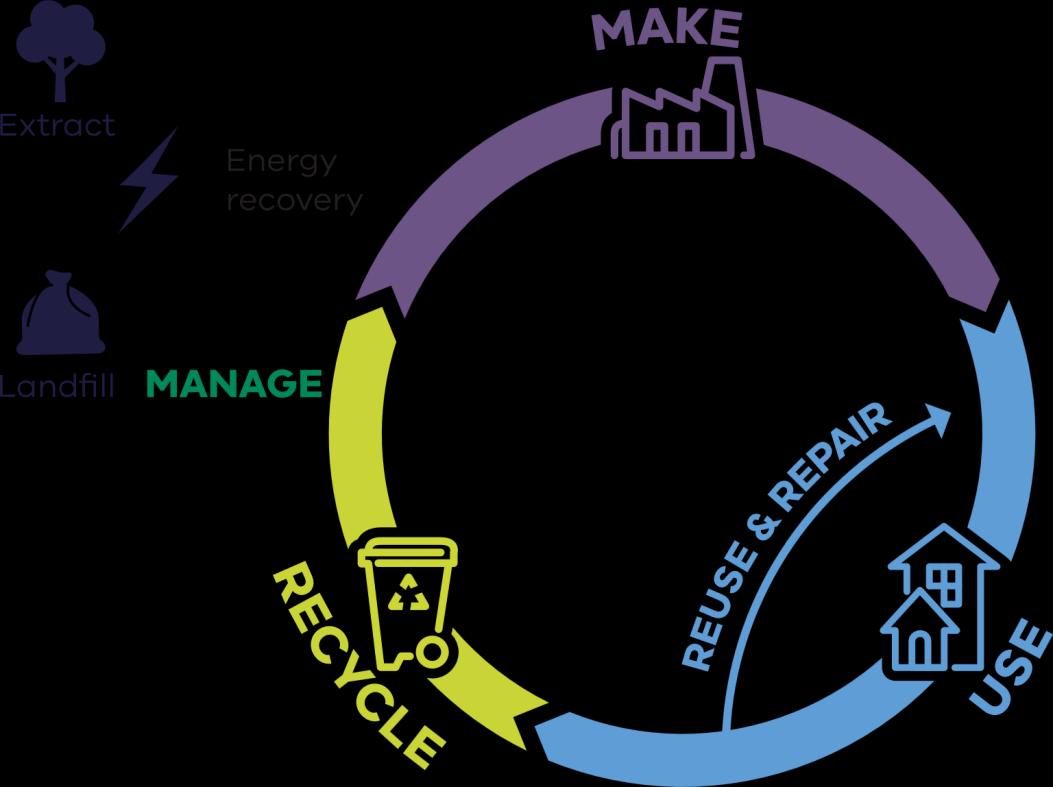
The four circular economy goals are:
• Goal 1 – Design to last, repair and recycle.
Reduce waste through better design and innovation, increase the use of recycled materials, consider impacts across product life cycles and support businesses to explore new circular economy business models.
• Goal 2 – Use products to create more value.
Help people make informed purchasing decisions, extend the life of products, support reuse and repair, and reduce unnecessary consumption.
• Goal 3 – Recycle more resources.
Reform kerbside collections to recover more value from waste, improve separation of recyclable materials, develop markets for recovered materials, invest in recycling infrastructure, embed the waste hierarchy and support appropriate waste-to-energy solutions.
• Goal 4 – Reduce harm from waste and pollution.
Protect communities and the environment from high-risk and hazardous wastes.
At a local level, this Waste Management Strategy explains how Northern Grampians Shire Council will contribute to these goals through the way waste and recycling services are planned, delivered and improved locally, while recognising the different needs of urban and rural areas across the shire
At a state level, Northern Grampians Shire Council waste management goals are aligned to the statewide circular economy goals. Council’s continued work to educate our community and influence businesses will support the CE Act’s Goal 1 – Design to last, repair and recycle and Goal 2 – Use products to create more value, and given council’s core responsibilities and level of influence, our immediate efforts will contribute to Goal 3 – recycle more resources.
Responsible waste management and resource recovery are built on the principles of ecologically sustainable development and the waste management hierarchy. The waste management hierarchy is internationally recognised as the way to achieve sustainable waste management practices. It positions the option of disposing of waste to landfill as least sustainable and progresses to recycling, reusing and reducing as better alternatives. The best option is to avoid generating waste while disposing to landfill is a last resort option. The waste management hierarchy is one of the underlying principles universally adopted in national and state legislation.
Northern Grampians Shire Council acts within a wider policy framework for waste management. National, state and regional policies, plans and regulations informed the development of this strategy.
Federal
• National Waste Policy 2018
• National Waste Policy Action Plan 2024
• National Food Waste Strategy 2017
• Product Stewardship Act 2011
State
• Recycling Victoria ‘A new economy’ 2020
• Environmental Protection Act 2017
• Victorian Recycling Infrastructure Plan 2024
• Victorian Waste Education Strategy 2016
• Victorian Organics Resource Recovery Strategy 2015
• Victorian Market Development Strategy for Resource Recovery 2016
• Local Government Act 2020
Regional / Local
• Grampians Central West Waste and Resource Recovery Implementation Plan 2017
• NGSC 2041 Community Vision
• NGSC Core Values
• NGSC Council Plan
Council continues to work in conjunction with a range of partners, both state and regional.
Environment Protection Authority (EPA)
Victoria’s independent environmental regulator. The EPA protects the health of our community and environment from pollution and waste. The EPA gets its powers from the Environment Protection Act 2017 and collaborates closely with the Department for Energy, Environment and Climate Action (DEECA), Sustainability Victoria (SV) and Recycling Victoria (RV).
Sustainability Victoria (SV)
Sustainability Victoria was established by the Sustainability Victoria Act 2005. Sustainability Victoria partners across industry and the community as a transition broker for the circular economy with the intent of reducing or stopping waste before it starts, in every part of the system.
Recycling Victoria (RV)
Recycling Victoria's was established by the Circular Economy Act 2021 with the purpose of strengthening Victoria's waste and recycling system. It aims to increase the reliability and transparency of the sector and maximise the ongoing use of products and materials that would otherwise be waste.
Since 2020, council has worked closely with both SV and RV. Following their announced dissolution, we remain dedicated to collaborating with the Victorian State Government departments that will take the coordination role in the future
The Victorian Government announced its response to the Independent Review of the Victorian Public Service: Final Report produced by Helen Silver AO in December 2025. This response includes a rationalisation of the Victorian Government departments and authorities resulting in SV ceasing operations in 2026 and RV’s powers transitioning to EPA Victoria.
Waste management is an essential service provided by Northern Grampians Shire Council and includes:
• Kerbside waste and recycling collection service for households (and some businesses).
• Operating Transfer Stations and manage legacy landfill sites
• Provide bins in public places to avoid littering.
• Responding to Illegal dumping on council land
• Educating our community on waste management and responsible consumption
• Supporting good waste management practices at events
• Monitor and report our performance to State Government
• Support our business to take steps towards making our economy more circular
• Advocate on behalf of our community in state and national forums
• Model responsible waste management behaviours at council managed facilities Council will deliver services listed above in conjunction with our core values, including:
Accountable
• Monitor internal team and contractor performance to drive continuous improvement
• Use data and analytics to inform decision making.
• Transparently communicate how decisions are made progress on our committed actions.
• Holistically manage service continuity risks.
Responsive and respectful
• Collect community feedback and evaluate patterns to continually improve our services.
• Genuinely engage our community on key decisions and ensure the full range of views are represented
Fair and sustainable
• Allow for flexibility in service delivery to cater for special circumstances (e.g. smaller bins for individuals with mobility issues, business exemptions for those who use commercial waste services)
• Procure goods and services considering social and environmental responsibility
• Stay across of:
o Regulatory changes to identify any gaps and actions required to maintain compliance.
o Industry best practice to identify opportunities as they emerge (leverage product stewardship schemes as they emerge)
• Participate in collaborative procurement contract with other councils in the region to share investments and realise economies of scale.
• Review waste procedures to maximise efficiency in delivering services and reports for relevant agencies
• Maintain list of project proposals to leverage ad-hoc funding when available
Based on financial year 2024-25 data, council provided:
• Kerbside collections to 6095 properties.
o General rubbish (weekly): ~317,000 collections, ~2323t
o Mixed recycling (fortnightly): ~158,000 collections, ~938t
o FOGO (St Arnaud only - fortnightly): ~30,000 collections, ~268t
• 209 public place bins.
o General rubbish: 127 bins, collected ~14,000 times
o Mixed recycling: 82 bins, collected ~5,800 times
• Transfer stations in St Arnaud and Halls Gap.
o General rubbish: ~145t
o Green waste: ~15t
o DrumMuster: 1,727 containers collected
o eWaste: 13.5t
Compared to 2020, these figures reflect:
• A marginal increase in properties serviced and similar transfer stations service offered;
• The introduction of kerbside FOGO collections in St Arnaud (1,172 properties);
• A marked increase in the volume of eWaste collected; and
• The introduction of public place recycling bins (Council gratefully acknowledges the funding received via SV grant RV Councils Fund - Round 2 - Stream 2: Introduce Public Place Recycling Implementation - RVCouncilsR2S200019.)
Council also continued to participate in Drum Muster, Mobile Muster, battery recycling and collection of Ewaste. In addition, council provided free drop-off of wind-blown litter for Clean-up Australia and trialled wildlife bin latches to reduce littering caused by wind and wildlife in Halls Gap.
Figure 2. VLGAS FY2023-24 total waste generation per person
Total waste generation (i.e. combined tonnage for all waste streams) for FY 23/24 is shown above in Figure 2 Northern Grampians Shire Council’s residents are producing waste in line with our regional average and slightly below the Victorian state average. While this is an encouraging result we need to stay mindful as this is at least partly explained by the general cost of living pressures our residents are experiencing
Furthermore, one of the many side-effects of the COVID pandemic, has been to increase our online purchasing. This shift in behaviour is generally associated with higher production of packaging waste often involving problematic single-use plastics. On balance, this means we should remain vigilant and continue the education work required to reinforce desirable waste management behaviours to ensure the trend does not reverse when economic conditions improve.
Northern Grampians Shire Council is part of the Grampians Central West region and shares the opportunities and challenges identified in our Regional Circular Economy Plan.
While regional challenges are common across western Victoria, they affect Northern Grampians Shire and how we respond is shaped by our local geography, population, and service costs. Delivering waste and recycling services across a large rural area presents different pressures to that faced by metropolitan councils. Our services are impacted by longer travel distances, lower waste volumes and limited regional processing options, all influencing the cost, design and practicality of services provided to ratepayers.
8.1 Service footprint, transport, waste volumes
Challenges
• Geographically dispersed population, extended travel distances, for collection, staging and transport to process waste and recycled materials.
• Low population density.
• Lower waste produced.
• Scale for local processing.
• Work with regional partners, including Ballarat’s Circular Economy Precinct to access shared processing facility.
• Consider whether suitable land in the shire could support organics stagging and processing in the future.
• Use the agricultural base to reuse processed organics locally where appropriate.
• Since this strategy was first adopted in 2020, council has re-tendered its kerbside collection services. The new contract, awarded in September 2025, has resulted in higher service costs. Council must manage these increased costs while maintaining reliable and affordable waste services.
• The state waste levy, administered by EPA Victoria, has increased over recent years. Higher landfill disposal costs directly affect council budgets, making waste reduction and recycling participation increasingly important to control future cost increases.
• The limited number of waste collection and transport providers operating in regional areas reduces competition and limits council’s ability to drive down costs through procurement.
Opportunities
• The Victorian Government investing in developing and establishing a stronger market to provide more waste diversion options for regional councils reducing landfill volumes.
• Improving communication and education can help reduce contamination, improve recycling outcomes and limit unnecessary disposal costs.
• Reviewing how transfer stations are managed may improve the quality of recyclable materials and create opportunities for reuse and resale, reducing the amount of waste sent to landfill.
Northern Grampians Shire Council’s approach to waste management is guided by the priorities set out in the Council and Municipal Public Health and Wellbeing Plan 2025–29.
Goal 4 – Clean it Up
• Strategy 4.2, Cut waste and recycle properly groups the actions relevant to improving our waste management services.
• Action 42101 covers this review of the Waste Management Strategy.
Improving waste and recycling services directly supports goal 4, particularly the commitment to cut waste and recycle properly. This strategy gives effect to that commitment by setting a clear direction for how waste services will be delivered and improved across the shire.
Through this strategy and alignment with goal 4, council’s efforts will contribute to:
• Recycling more resources, by improving kerbside and drop-off services and reducing contamination.
• Reducing harm from waste and pollution, by limiting landfill disposal and managing waste safely.
Council will also support broader circular economy outcomes by educating the community, targeting household waste and recycling behaviours and working with businesses and partners to reduce waste and promote reuse where possible.
Council will track progress against this Strategy through the following targets:
• Divert 50% of food and garden organics from landfill.
• Reduce waste generated per person by 5%
• Reduce general waste received at transfer stations by 15%. Increase the recovery of recyclable materials by 20%.
Progress will be monitored and reported through the WAP traceability matrix and the council annual reporting framework.
Any work originally committed to in the original Waste Management Strategy that is still relevant and not currently included in the council plan has been captured and put forward as additional actions
This Waste Management Strategy is aligned with the Northern Grampians Shire Council Plan and Municipal Public Health and Wellbeing Plan 2025–2029, ensuring waste and recycling priorities are integrated into council’s broader planning and reporting framework.
This strategy will be reviewed on a biennial (two-year) basis to inform of our progress, respond to changes in legislation, policy and market conditions, and ensure the overall direction remains appropriate for our community.
Actions under this strategy are delivered and tracked through the WAP traceability matrix, which will be reviewed and updated annually to reflect delivery status, capture emerging priorities and line up with council plan reporting requirements.
The objective of this approach will provide a stable long-term strategy for waste services beyond 2030, while we maintain the flexibility needed to manage delivery
As part of Victoria’s waste and recycling reforms, a standardised four-stream waste and recycling system will be in effect from July 2027. These streams are:
• General rubbish residual waste (red lid).
• Mixed recycling (yellow lid).
• Food and Garden Organics (lime green lid)
• Glass recycling (purple lid).
Council is committed in providing the FOGO and glass recycling services in line with state reforms by July 2027. Following the Kerbside Waste and Recycling Survey 2025, participants shared their feedback from a range of options that helped shape the ‘proposed’ kerbside and drop-off services.
The proposed service is tailored for our community and is intended to reach both rural and urban households, offering flexibility to households in rural collection zones to either drop off their recyclables at an approved public location, and or manage their organics at home.
The proposed kerbside service includes changes with the frequency of general rubbish collections. This idea was reached to allow for future service improvements and address the challenges and opportunities with servicing a geographically dispersed population.
Urban (compulsory collection zone)
• Kerbside 240L general rubbish collected fortnightly (red lid)
• Kerbside 240L mixed recycling collected fortnightly (yellow lid)
• Kerbside 240L FOGO recycling collected fortnightly (lime green lid)
• Kerbside 120L glass recycling collected bi-monthly (8-weekly) (purple lid)
• Drop-off for glass recycling (public places)
Rural (no-compulsory collection zone)
• Kerbside 240L general rubbish collected fortnightly (red lid)
• Kerbside 240L mixed recycling collected fortnightly (yellow lid)
• Drop-off for FOGO recycling (at approved transfer station facility)
• Drop-off for glass recycling (public places)
This approach allows council to commit to state requirements while responding to local conditions, managing costs and providing fair access to these services across the shire.
To deliver this Waste Management Strategy, council will focus on the following actions. These actions were formed as party of the WAP (referred to as ‘objectives’) to represent the areas where change, improvement or new delivery is required and where progress will be reported to the community.
Many activities that support good waste management are already part of council’s day-to-day operations. During the review of the Strategy, these business-as-usual activities were thoughtfully removed from the list of reportable actions so the Strategy can focus on what is changing, what still needs to be delivered, and where progress matters most to the community.
Actions will be tracked through council’s WAP traceability matrix and council plan reporting processes.
WAP Objective 1: Improve resource recovery (former)
WMS Action: Improve resource recovery
Council will improve how materials are recovered from waste to reduce the amount sent to landfill and increase the value of recyclable resources.
This includes aligning waste services with state reforms, improving separation of materials at the source, and working with regional partners, other councils and industry to strengthen recycling and recovery outcomes.
WAP Objective 2: Community-focused waste management systems (former)
WMS Action: Community-focused waste management systems
Council will design and deliver waste and recycling services that reflect the needs of the community and the diverse conditions across the shire.
This includes considering different service models for township and rural areas, balancing service levels with affordability, and supporting the community through clear information and education to reduce contamination and improve outcomes.
WAP Objective 3: Adaptive infrastructure and operations (former)
WMS Action: Stronger local waste industry
Council will ensure waste infrastructure and operations are flexible and able to respond to change.
This includes improving the performance of existing services and facilities, responding to new technologies and markets, and managing risks to ensure waste services remain reliable and effective over time.
WAP Objective 4: Sustainable strategic planning (former)
WMS Action: Business-as-usual commitment
In the original 2020 Waste Action Plan, Sustainable Strategic Planning was included as objective 4 with several supporting actions.
As part of this review, objective 4 was reassessed. Most actions were already embedded in council’s ongoing operational planning, budgeting, procurement and reporting processes, and aligned with council’s commitment to delivering the principles for waste management.
For this reason, no standalone tasks under Sustainable Strategic Planning are carried forward for separate reporting under this strategy or the WAP traceability matrix.
This does not represent a reduction in council’s commitment to sustainable planning. Strategic planning for waste services continues as a core part of council’s business-as-usual operations, including:
• Long-term service and infrastructure planning;
• Financial and risk management;
• Contract management and procurement;
• Performance monitoring and reporting; and
• Alignment with council plan and State Government priorities.
The objective of embedding these activities into council’s everyday operations allows the strategy to focus on the actions that drive change and improvement, while ensuring sustainable planning remains a constant and ongoing responsibility.
This appendix provides a full list of the tasks identified to date. For those originally included in the Waste Action Plan, we provide a status update. For the outstanding tasks we also provide a mapping to know where to expect updates in the council plan reports.
Action ID Task ID Task Notes
42101
Deliver a review of the Waste Strategy and Action Plan to meet Circular Economy legislation, reduce waste, boost resource recovery and support local circular economy partnerships.
42103 Investigate feasibility and affordability for hard rubbish collection services across the shire and determine next steps
42104 Investigate placement of more public bins in parks and high-traffic areas with a view to divert recycling away from landfill and determine next steps.
42105 Deliver a review of waste transfer station services across the shire, including fees, free metal and green waste drop-off and FOGO incentives
42106 Advocate for more container deposit facilities in central locations.
42107 Investigate solutions to address litter created by kerbside bins being tipped over by animals and determine next steps
42108 Investigate providing recycling services for industrial and commercial items and determine next steps
42109 Investigate for garden mulch to be provided from processed green waste in St Arnaud and determine next steps.
42110 Deliver communication on current waste management practices (e.g. what is recycled, where it goes), including clearer recycling instructions and determine next steps
In the following we will use Objective ID and Action ID in the meaning of the original Waste Management Strategy and Waste Action Plan to help with traceability. If the outstanding actions and related tasks are approved for inclusion in the council plan, they will be assigned updated IDs.
Completed
Objective
1 1.1 a) Participate and assist in implementation of the Container Deposit scheme (CDS)unknown design as of (March 2021). Dependent on the Victorian Government’s implementation scheme.
1 1.1 c) Glass contract for collection and transportation.
1 1.1 e) FOGO contract for kerbside collection and transportation
Notes
Included as an option in the renewed kerbside collection and transport contract.
Included as an option in the renewed kerbside collection and transport contract.
1 1.2 b) Investigate opportunity for a resale/reuse area at the St Arnaud Transfer Station. St Arnaud transfer station reuse shed operational.
3 3.3 a) Undertake waste bin audit to ascertain volumes, concentrate on seasonal timesHalls Gap.
3 3.3 b) Introduce public place recycling at Halls Gap - high tourist area.
3 3.3 c) Develop implementation plan for the introduction of public place recycling for other high use areas.
3 3.3 d) Amendment to recycling collection and disposal budget to accommodate public place recycling.
3 3.4 c) Undertake feasibility study of in-vessel / windrow composting facility set up and operation.
Completed during the project to introduce public place bin recycling
Completed during the project to introduce public place bin recycling.
Completed during the project to introduce public place bin recycling
4 4.4 b) Develop an Action Plan aligning with Waste Management Strategy and seek approval.
Local composting St Arnaud transfer station via:
- In-vessel solution not viable due to significant costs of facility establishment.
- Windrowing not viable due to insufficient know-how from local waste operators and council staff.
1 1.2 a) Conduct review of Transfer station design for potential development of a streamline service delivery model to improve and provide greater opportunities for increase in reuse and diversion from landfill.
1 1.2 d) Work with Business Transformation to investigate data collection and potential electronic payments options for customers.
1 1.3 c) Monitor Council offices and depotscollect baseline data. Seek to improve recycling practices.
2 2.1 a) Update community on recycling, waste initiatives and alternatives by means newsletter and social media posts.
2 2.1 d) Review website content and improve the presentation of information available. Simplify linkages and coherence for users.
2 2.2 c) Promote community recycling trailers for all events.
2 2.2 d) Attend events and promote and advertise waste recycling initiatives and provide general waste information.
Work item captured as Council Plan task 42105.
2 2.3 b) Conduct business waste and packaging audits to assist in reducing waste, seek alternative packaging to increase recycling, and give recommendations on ways to reduce costs in waste management.
2 2.4 a) Actively listen to the community’s ideas and investigate alternative practices/initiatives to deliver best services for the community.
2 2.4 b) Provide efficient and timely response to customer enquiries.
2 2.4 c) Continue to provide options such as business exemptions and downsizing bins for mobility issues. Continually investigate other options to improve customer satisfaction such as bin sizes, scheduling and other.
2 2.4 d) Monitor contractor performance (ensure best service for the community).
After consultation with transfer station operator decided, this is of marginal benefit and not worth pursuing.
Consolidated with task 1.3 a
Managed as part of business-asusual process and not significant enough to single out for tracking.
Managed as part of business-asusual process and not significant enough to single out for tracking
Managed as part of business-asusual process and not significant enough to single out for tracking.
Face to face engagement will not be treated as a stand-alone activity, rather this will be an approach to be employed during the engagement activities for each project/decision.
Consolidated with task 2.3 a
This is covered by the way council values guide our work.
Managed as part of business-asusual process and not significant enough to single out for tracking
This is covered by the way council values guide our work.
This is covered by the way council values guide our work.
3 3.1 a) Research new technology and innovations such as Waste to energy, Biochar, Biodigesters, composting options and other innovations to support waste management to suit Northern Grampians Shire Council.
3 3.2 a) Conduct audits at Transfer Stations to ensure compliance to safety industry standards & EPA legislation for storage of waste and management. Yearly safety audit to verify all safety equipment is compliant.
3 3.2 b) Develop a report and replacement plans for bin assets.
3 3.2 c) Continue to monitor and maintain closed landfill sites to EPA standards and regulations.
3 3.2 d) Initiate maintenance promptly on any faulty public place bins to ensure adequate assets for public use.
3 3.4 a) Work and collaborate with the Engagement team to design communication methods to introduce ideas for waste management to the agricultural sector.
3 3.4 b) Explore market demand in conjunction with GCWWRRG for potential local agriculture for “closed loop” and “close to source” organic processors.
Managed as part of business-asusual process and not significant enough to single out for tracking
This is covered by: - Council’s core value of innovation to develop internal expertise - Supporting the development of our local waste market.
Managed as part of business-asusual process NB: the level of ownership varies for services delivered internally vs outsourced.
Managed as part of business-asusual process and not significant enough to single out for tracking.
Managed as part of business-asusual process and not significant enough to single out for tracking
Managed as part of business-asusual process and not significant enough to single out for tracking.
Work item captured as Council Plan task 42108
Work item captured as Council Plan task 42108
4 4.1 a) Attend Technical Advisors Reference Group (TARG) and other relevant state and regional agencies meetings, forums and workshops to ensure up to date knowledge of the waste industry. TARG no longer running. Maintaining adequate knowledge to act as a subject matter expert will be managed as part of business-as-usual process.
4 4.1 b) Collaborate with Sustainability Victoria in developing education and implementation of Victoria Recycling reform.
4 4.2 a) Develop project proposals from feasibility studies, waste audit and community survey to be project ready for available grants.
4 4.2 b) Proactively seek funding opportunities from a range of external sources.
4 4.3 a) Analysis merit data to ascertain information on bin asset, customer satisfaction and report.
Managed as part of business-asusual process and not significant enough to single out for tracking
Managed as part of business-asusual process and not significant enough to single out for tracking.
Managed as part of business-asusual process and not significant enough to single out for tracking.
Managed as part of business-asusual process and not significant enough to single out for tracking
4 4.3 b) Analysis volume and weights of transfer stations and action approximate measures to minimise.
4 4.3 c) Ensure staff are adequately trained and informed to provide best services within the Waste department.
4 4.3 d) Review waste procedures to maximise efficiency in delivering services and reports for relevant agencies.
Managed as part of business-asusual process and not significant enough to single out for tracking
Managed as part of business-asusual process and not significant enough to single out for tracking
Managed as part of business-asusual process and not significant enough to single out for tracking
4 4.3 e) Complete Local Government Performance Reporting Framework (LGPRF). Managed as part of business-asusual process and not significant enough to single out for tracking
4 4.3 f) Review annually the Waste Rate levy. Managed as part of business-asusual process and not significant enough to single out for tracking.
4 4.3 g) Participate in collaborative procurement contract with regional councilsestablish new kerbside contract
New kerbside contract delivered and collaboration with other councils managed as a businessas-usual process.
4 4.4 a) Prepare a report on the progress of the Waste Management Strategy to confirm objectives are met. This will be done as part of the council plan reporting process.
4 4.4 c) Review the Waste Management Strategy every two years to ensure objectives are met.
4 4.4 d) Review the Waste Action Plan budget every financial year.
Review cycle aligned with council plan development cycle
Progress update cycle aligned with council plan progress reporting cycle
1 1.1 b) Implement public place glass collection point plan as part of the glass waste stream roll-out.
1 1.1 d) Introduction and implementation of kerbside Food Organic and Garden Organic (FOGO) and glass in compulsory zones with possible extension to noncompulsory areas. Develop implementation plan.
1 1.2 c) Investigate Shared Service opportunities for aggregation of stored materials to reduce transportation costs.
1 1.3 a) Investigate separation/recycling options are available at all facilities. Includes collecting data to establish baseline and monitor performance.
1 1.3 b) Partner with council’s Procurement department to explore recyclable options to create a more sustainable workplace.
2 2.1 b) Develop a school education campaign, delivering information on a range of waste reduction and initiatives such as composting, recycling, avoiding waste and buying recyclable sustainable products.
2 2.1 c) Educate the community on illegal littering/dumping on council land and how it affects our environment, communicate through monthly newsletter and weekly social media posts and enforcement by Local Laws.
2 2.1 e) Engage a Waste Education Officer (parttime) role to ensure effective and targeted communication with the community.
2 2.2 a) Develop and provide a checklist for event organisers to consider ways to reduce waste, increase recycling and procure recyclable products for events.
2 2.2 b) Develop and provide information on recyclable/ compostable products to encourage sustainable procurement.
2 2.2 e) Investigate options for introduction of FOGO bins at events to encourage recycling of food waste
2 2.3 a) Develop and provide brochures on alternative packaging which can be recycled or composted, new technology and local contractors to assist in waste management.
2 2.4 e) Undertake kerbside and transfer station waste audits to ascertain volume and composition of waste streams.
Reworded from original WAP to reflect outstanding scope after partial delivery.
This task addresses planning the transition as opposed to delivering it. Extended to include glass waste stream.
This complements council plan task 42110 to target the content develop to a young audience and deliver it in a school setting.
This extends to council plan task 42110 to develop community education to address illegal dumping.
Within the boundaries of financial sustainability we will investigate the need and feasibility of a dedicated role.
Investigate feasibility and openness of the business sector to be guided towards better circular outcomes.
Research to inform advice to businesses may include auditing of business waste streams
This activity is instrumental to establish baseline before introducing the FOGO/glass waste
3 3.1 b) Proactively engage with the Planning department and relevant agencies through workshops, meetings and forums and encourage and support new waste industries into the Northern Grampians Shire and regional area.
Added actions for delivery
Objective ID
1 1.1 g) Introduction and implementation of kerbside collection and public place drop off glass services.
1 1.1 m) Introduction and implementation of kerbside FOGO collection services within compulsory zones
streams and after embedding the change to evaluate impacts. Furthermore, it provides the evidence base required to target education campaigns.
This activity includes all aspects required for service commencement.
This activity includes all aspects required for service commencement
1 1.1 o) Investigate kerbside service improvements for general rubbish and mixed recycling. This activity is applied to continuous improvement and financial service sustainability.