Northern Grampians Shire Council Traditional Owner Acknowledgement Guidelines 2026
1.Purpose
This guide provides detailed direction about how council will implement its Traditional Owner Acknowledgement Policy 2026. It is not intended to represent formal recognition under state law.
The guide supports Northern Grampians Shire Council representatives - including councillors, employees, contractors and volunteers - to understand and deliver appropriate and respectful acknowledgement of the Traditional Owners connected to the lands we call Northern Grampians. It applies to all areas across the municipality, which encompasses the lands of the people of the Wotjobaluk Nations (Wotjobaluk, Jaadwa, Jadawadjali, Wergaia and Jupagulk); the Dja Dja Wurrung (Djaara) people, and the Djab Wurrung people.
The guide provides direction on spoken and written Acknowledgements, Welcome to Country, Smoking Ceremonies, cultural services, signage and plaques, and flag flying. It is intended to ensure council representatives can meaningfully and consistently embed acknowledgement and recognition practices across all council functions, services, and places.
For the purpose of this guide, the term “First Nations” refers to both Aboriginal and Torres Strait Islander peoples.
2.Using the guidelines
Use this guide as a practical reference, selecting the section that is relevant to the activity you are undertaking. It is not intended to be read cover to cover in every instance.
The guide includes
• Council’s role in working with Traditional Owners
• When and how to deliver an Acknowledgement of Country
• Specific text for spoken and written acknowledgement
• When and how to arrange a Welcome to Country, Smoking Ceremony or cultural service.
• When Aboriginal and Torres Strait Islander flags will be flown by council.
• Supporting links and references.
When and how to use the guide
This guide should be used when you are:
• Identifying which Traditional Owners are recognised across the shire.
• Preparing for a meeting, event, forum or ceremony that may require a Welcome to Country.
• Drafting or reviewing written materials (e.g. reports, policies, signage).
• Planning public art projects, capital works, or opening a new facility.
• Organising cultural training for your team.
To use this guide effectively
• Start with the ‘Background and Context’ and ‘Council’s role in Recognition and Acknowledgement’ sections to understand the broader framework.
• Then refer to relevant topic section (e.g. Spoken Acknowledgement of Country, Welcome to Country) for specific guidance
• Follow the instructions provided to ensure consistent and culturally appropriate practice across council activities.
• Always confirm the correct Traditional Owner group for the relevant location as part of respectful practice.
If you are unsure
• Seek advice from internal colleagues (e.g. Community Development); or
• Contact the relevant Traditional Owner Group Entity/Registered Aboriginal Party.
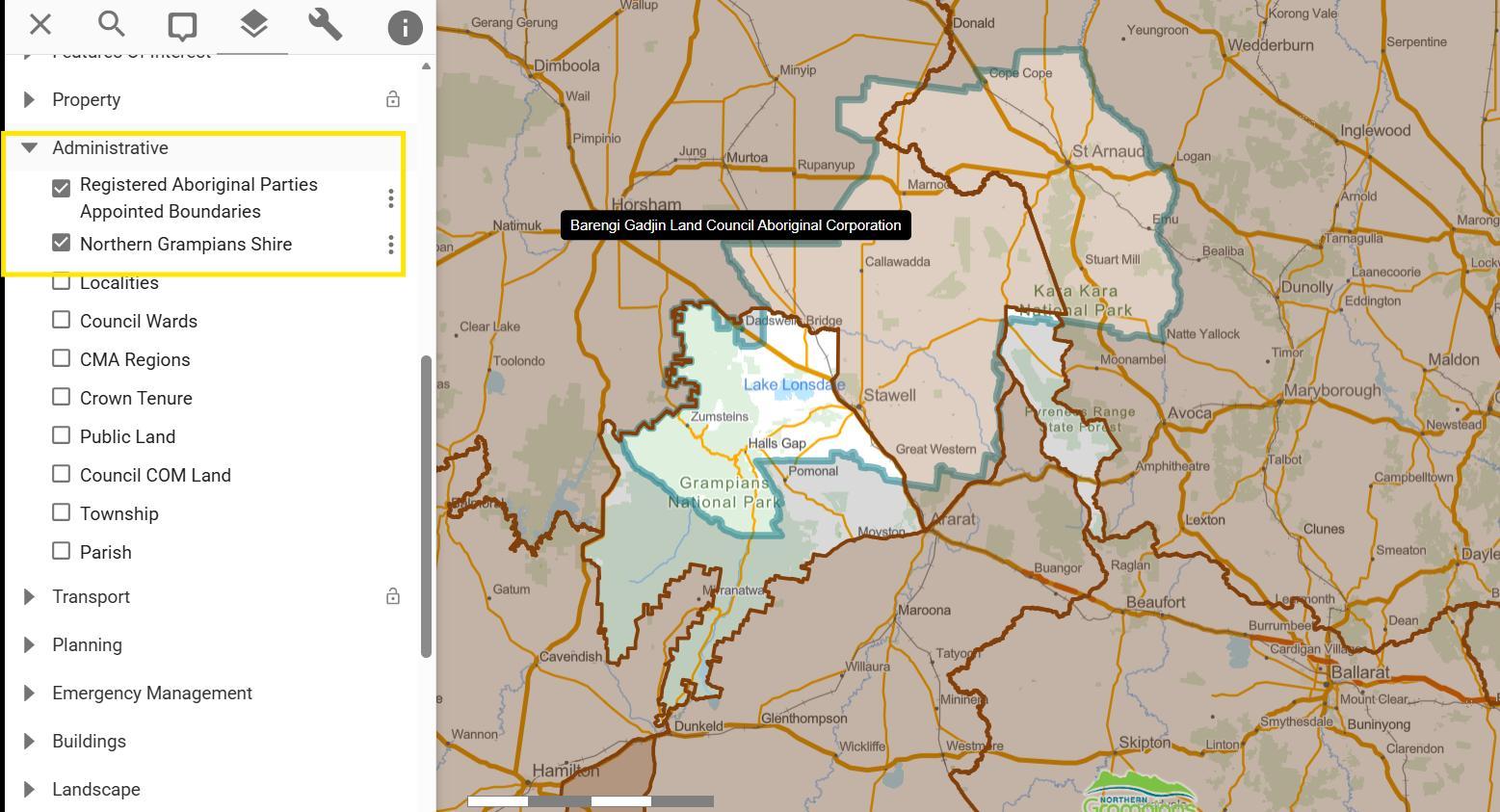
For a quick guide on the lands of each Traditional Owner group, refer to the map on page 14 of this guide or use POZI. Instructions to access this information in POZI are located in Appendix 2 of this guide
Key principles to keep in mind
• Acknowledgement of Traditional Owners is not just about protocol; it is an act of respect and truth-telling.
• Adhering to these guidelines is mandatory for all staff, councillors and volunteers and reflects council’s commitment to genuine recognition and acknowledgement.
• Acknowledgements can be adapted to suit the context and ensure authenticity, provided they remain respectful, accurate and aligned with local practice.
3.Glossary of terms and abbreviations
Acronym / Term Full Name / Description
AHA Aboriginal Heritage Act 2006 (Vic)
BGLC Barengi Gadjin Land Council Aboriginal Corporation - a which represents the Wotjobaluk, Jaadwa, Jadawadjali, Wergaia and Jupagulk People.
LGES Local Government Engagement Strategy (Schedule to an RSA)
NGSC Northern Grampians Shire Council
RAP Registered Aboriginal Party. RAPs are the primary authority for Aboriginal cultural heritage management within a defined area of Victoria. RAP status is granted by the Victorian Aboriginal Heritage Council. Both BGLC and DJAARA are RAPs in the Northern Grampians Shire.
RSA Recognition and Settlement Agreement - a legal agreement under the Traditional Owner Settlement Act 2010 that formally recognises Traditional Owners and sets out land, rights, and partnership arrangements with the State.
TO Traditional Owner - person or group with ancestral and ongoing cultural, spiritual, and custodial connections to a particular area of land or waters.
TOGE Traditional Owner Group Entity - a formal entity that represents a Traditional Owner group and is recognized under the Traditional Owner Settlement Act 2010. Both DJAARA and BGLC are TOGEs in the Northern Grampians shire.
TOSA Traditional Owner Settlement Act 2010 (Vic)
Traditional Owner group Defined by the Traditional Owner Settlement Act: a ‘group that has a traditional relationship with a defined area of land in Victoria’ . For example, the Wotjobaluk, Jaadwa, Jadawadjali, Wergaia and Jupagulk People, the Dja Dja Wurrung people, or the Djab Wurrung people.
Acknowledgement
4. Message from the CEO
As the Chief Executive Officer of Northern Grampians Shire Council, I am proud to introduce this Traditional Owner Acknowledgement: Guidelines for Northern Grampians Shire councillors, staff and volunteers developed in consultation with Barengi Gadjin Land Council and DJAARA. This guide reflects our ongoing commitment to truth-telling, cultural respect, and meaningful engagement with the Traditional Owners of the lands on which we live and work.
Acknowledging Traditional Owners is more than a protocol, it is a powerful act of recognition and respect. It honours the enduring connection of First Nations people to Country and affirms their custodianship, culture and sovereignty. Through this guide, we aim to support our staff, councillors and community partners in making acknowledgements that are informed, authentic and locally grounded.
We are privileged to work alongside the People of the Wotjobaluk Nations - the Wotjobaluk, Jaadwa, Jadawadjali, Wergaia and Jupagulk, the Dja Dja Wurrung peoples, and the Djab Wurrung peoples, whose wisdom and leadership continue to shape our shared future. I encourage everyone to use this guide not only as a resource, but as a step towards deeper understanding and reconciliation.
Together, let us walk forward with respect, humility and a commitment to strengthening relationships with Traditional Owners across our region.
Brent McAlister Chief Executive Officer
5.Background and context
First Nations peoples have long lived on and cared for the lands now known as Victoria, maintaining deep spiritual and cultural connections to Country. Knowledge systems, land management practices and cultural traditions have been passed down through generations, reflecting a continuous relationship with Country understood not only as land, but as a living system encompassing people, waters, skies, plants, animals and ancestral beings.
Since colonisation, First Nations peoples have experienced significant disruption, including dispossession from land, suppression of culture and language, and exclusion from decision-making about their Country. While these impacts continue to be felt today, First Nations communities have maintained strong and enduring connections to Country, culture and community.
These historical and ongoing impacts highlight the importance of formal recognition and protection mechanisms in Victoria, which provide avenues for acknowledging Traditional Owners’ rights, interests, and ongoing custodianship of Country. This context also reinforces the role of everyday practices that recognise and respect these enduring connections.
5.1 The role of acknowledgement
Acknowledgements of Country are an important expression of this recognition, as they acknowledge and respect the enduring presence, custodianship and cultural authority of Traditional Owners. In the context of colonisation - where Traditional Owners and First Nations peoples were displaced from their lands and excluded from civic, political and social life - acknowledgements contribute to redressing that history by affirming that Traditional Owners have maintained an unbroken connection to their Country for thousands of years.
An Acknowledgement is not about defining who belongs to a community or who can identify with a place. Rather, it is a respectful practice that recognises that all activities in a municipality take place on the Country of a specific Traditional Owner group, whose cultural rights and responsibilities continue today. This approach is further supported by legislative framework, which provides formal mechanisms for recognition and protection.
5.2 Legislative protections
In Victoria, the rights, interests, and cultural authority of Traditional Owners are recognised and protected through a combination of legislation, agreements, and formal frameworks. These mechanisms provide avenues for acknowledgement, consultation, and participation in decisionmaking about Country, ensuring that First Nations peoples have a say in how their land and cultural heritage are managed.
Key legislative and policy instruments include the:
• Aboriginal Heritage Act 2006 (Vic), which establishes Registered Aboriginal Parties (RAPs) with statutory responsibilities for the protection and management of cultural heritage.
• Native Title Act 1993 (Cth), which recognises ongoing rights and interests in land and waters for First Nations people.
• Traditional Owner Settlement Act 2010 (Vic), which provides a framework for Recognition and Settlement Agreements (RSAs) between the State and Traditional Owner groups, formalising recognition and supporting co-management and other collaborative arrangements.
Through these frameworks, acknowledgement of Traditional Owners becomes more than a symbolic act - it is a meaningful recognition of their ongoing connection to Country, authority over cultural heritage, and role in land management.
Further information can be found on the First Peoples -State Relations Group website First PeoplesState Relations | firstpeoplesrelations.vic.gov.au
5.3 Who are the formally recognised traditional owners in Northern Grampians Shire?
The People of the Wotjobaluk Nations (the Wotjobaluk, Jaadwa, Jadawadjali, Wergaia and Jupagulk people) and the Dja Dja Wurrung people are recognised as the Traditional Owners of parts of the Northern Grampians Shire Council (NGSC) Local Government Area.
People of the Wotjobaluk Nations (WJJWJ)
• In 2005 the Federal Court determined that native title exists for the Wotjobaluk, Jaadwa, Jadawadjali, Wergaia and Jupagulk peoples in parts of the Wimmera and southern Mallee. This was the first successful native title determination in Victoria and south-eastern Australia. This determination also included an ILUA (Indigenous Land Use Agreement), recognising close ties to traditional lands and agreements to transfer culturally significant land parcels.
• 2008 saw BGLC appointed as the Registered Aboriginal Party (RAP). RAP status means Barengi Gadjin Land Council (BGLC) is the legally recognised body responsible for cultural heritage in their area.
• In 2022 the Victorian Government and BGLC (representing the Wotjobaluk, Jaadwa, Jadawadjali, Wergaia and Jupagulk People of the Wotjobaluk Nations (WJJWJ People)), signed a Recognition and Settlement Agreement under the Traditional Owner Settlement Act 2010 (Vic) and related legislation.
Acknowledgement of Traditional Owners
Guidelines for Northern Grampians Shire councillors, staff and volunteers
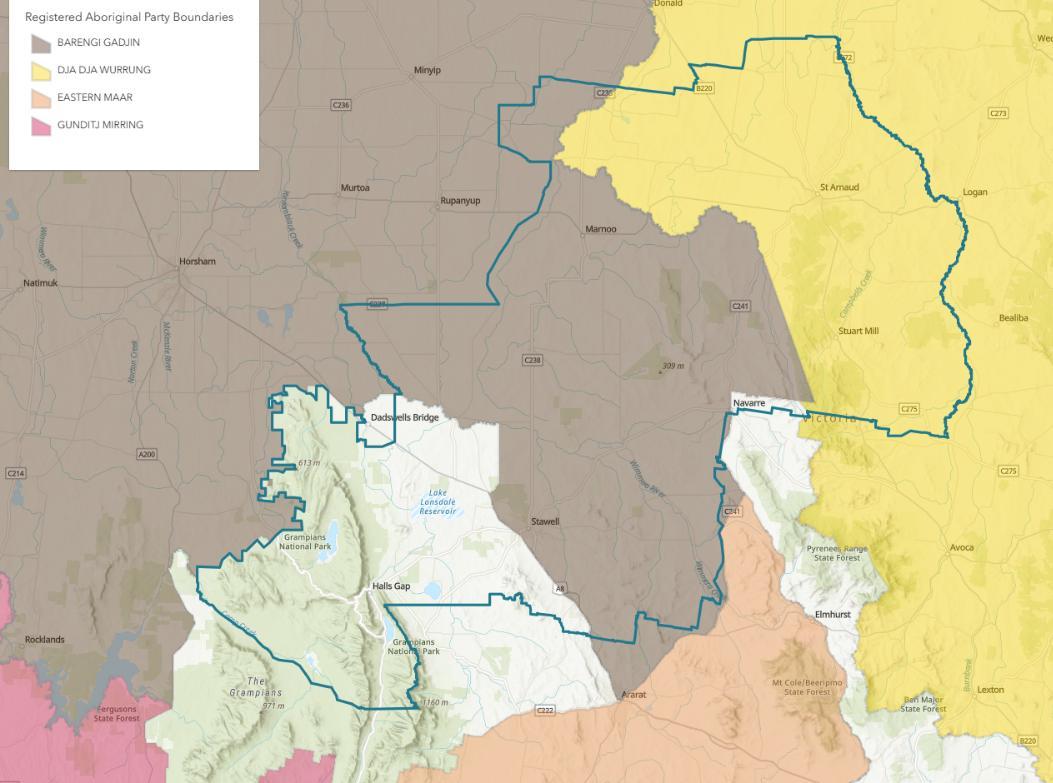
Barengi Gadjin Land Council is the RAP/TOGE that represents the Wotjobaluk, Jaadwa, Jadawadjali, Wergaia and Jupagulk peoples as the Traditional Owners of the area shaded in brown on the map on page 13. Within the Northern Grampians Shire the townships of Stawell (north of the Western Hwy), Navarre (west of St Arnaud-Ararat Road) and Marnoo sit within the boundary of the RSA.
Dja Dja Wurrung Peoples
• In 2013 the Dja Dja Wurrung Clans Aboriginal Corporation (known as DJAARA) entered into a Recognition and Settlement Agreement with the State of Victoria.
• The RSA has been negotiated to encompass a bundle of rights including;
o Rights to natural resources under the Natural Resource Agreement and Traditional Owner Land Natural Resource Agreement
o Native Title – settling four claims in the Federal Court dating back to 1998.
o A LUAA under the Traditional Owner Settlement Act to manage activities on public land that may have an impact on the rights of the Dja Dja Wurrung people.
o Joint management of several parks and reserves by the State and the Dja Dja Wurrung through the Dhelkunya Dja Land Management Board.
o Culturally significant land returned to the Dja Dja Wurrung as freehold title.
o RAP status to be legally responsible for cultural heritage within the nominated RSA boundary
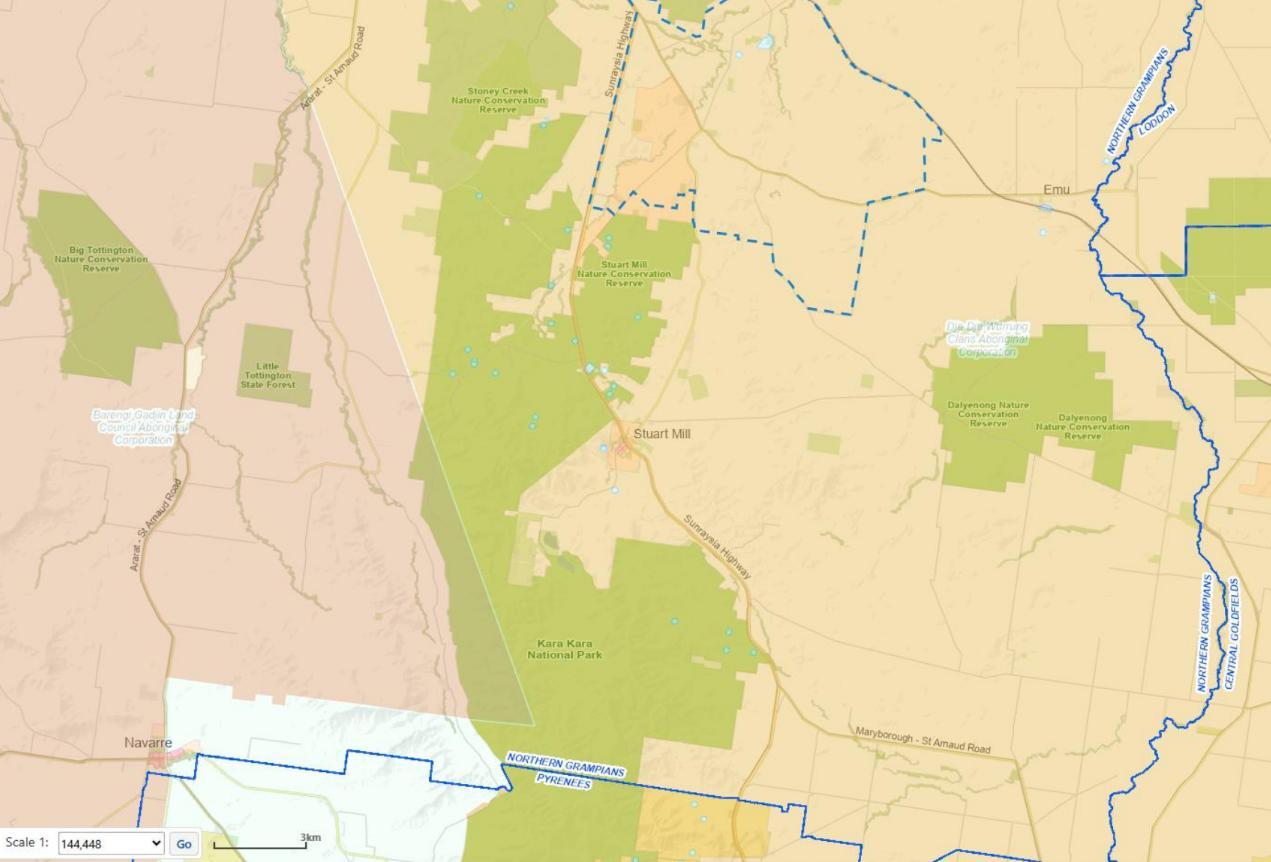
The RSA recognises the Dja Dja Wurrung people as the Traditional Owners of Dja Dja Wurrung Country in central Victoria, which encompasses all locations shaded in yellow on the below map, including St Arnaud, Stuart Mill, and the Kara Kara National Park which is held under Aboriginal Title and jointly managed by DJAARA and Parks Victoria. It is important to highlight that the overwhelming majority of Kara Kara NP is on Djandak (Dja Dja Wurrung County), and a small part is within the BGLC RSA area (see Appendix 1).
Acknowledgement of Traditional Owners Guidelines for Northern Grampians Shire councillors, staff and volunteers
5.4 Traditional owners where there are no RAPS or RSAS in place
There are several sections of land within the NGSC where there is no RAP recognised by the State, nor any RSAs in place. This includes Great Western (south of the Western Highway), and the lands around Lake Londsdale and Lake Fyans and Navarre (East of Ararat-St Arnaud Road through to, but not including, Kara Kara National Park).
The northern section of Gariwerd (Grampians National Park) which sits within the southwest boundary of Northern Grampians Shire also has no RSA in place. Gariwerd (Grampians National Park) connects Northern Grampians Shire to Traditional Owners in the south, being the Gunditjmara people (shaded pink on map on page 14) and Djab Wurrung people (shaded orange).The RAPs that represent these Traditional Owners- Gunditj Mirring Traditional Owners Aboriginal Corporation and Eastern Marr Aboriginal Corporation - along with BGLC (shaded brown), are party to a Land Use Agreement for Gariwerd (Non Extinguishment Principle Indigenous Land Use Agreement (ILUA), Area Agreement). These three groups work in partnership with Parks Victoria for the management of Grampians (Gariwerd) National Park.
Halls Gap, (Budja Budja) a township within Gariwerd, is a culturally significant place to Traditional Owners across the region, where the Djab Wurrung and Jardwadjali people are recognised as having a continuing cultural connection to the land.
Specific guidance on acknowledging Traditional Owners in locations that don’t have a RAP, nor an RSA in place is provided in relevant topic areas throughout this guide
Northern Grampians Shire map – RSA and RAP boundaries
Identifying and understanding the areas over which Traditional Owner groups are formally recognised under RSAs and/or the Aboriginal Heritage Act (as a RAP) is an important step in the process of acknowledgement. This map can be used as a quick reference guide by council representatives.
Guidelines for Northern Grampians Shire councillors, staff and volunteers
6.Council’s role in recognition and acknowledgement
Local government works closely with Traditional Owners through the Aboriginal Heritage Act (AHA) and Recognition and Settlement Agreements (RSAs)
The RSAs apply in a range of ways and include schedules that set out a Local Government Engagement Strategy (LGES). The LGES outlines a set of actions outlining how councils can build effective working relationships with Traditional Owner groups, and support implementation across council functions such as planning, public land management, procurement, cultural heritage protection and recognition.
Traditional Owner recognition is an important starting point within the LGES, and shows a commitment to reconciliation, respect and cultural awareness across all council activities. Council has reaffirmed its commitment to this work, via inclusion of the following priority action in the Council and Municipal Public Health and Wellbeing Plan 2025-29:
“Recognise and respect First Nations and Traditional Owners by supporting self-determination, strengthening partnerships and ensuring they have a meaningful voice in decision-making.”
These guidelines give effect to this commitment by providing a clear and consistent approach to acknowledging Traditional Owners across all council activities. They support councillors, staff and volunteers to fulfil their responsibilities towards reconciliation in a way that is respectful, meaningful and culturally appropriate, and grounded in an understanding of the enduring connection of First Nations peoples to Country.
The following sections build on this foundation by providing detailed, practical guidance on how to deliver Acknowledgements, ensuring they are undertaken with consistency, confidence and respect in a range of settings.
7.Acknowledgement of Country - Spoken
What is an Acknowledgement of Country?
An Acknowledgement of Country is a simple way of showing recognition of, and respect for, the Traditional Owners of the land on which a meeting or event is being held.
When is an Acknowledgement of Country required?
An Acknowledgement of Country should be given at the beginning of both in-person and online external meetings, formal events, forums and functions such as government and local government meetings, conferences, concerts, board meetings, and official openings. Giving an acknowledgement for internal council meetings is required for formal meetings at the discretion of the meeting organiser, giving consideration to the size, purpose and scope of the meeting
Who should deliver an Acknowledgment of Country?
The first speaker at an event (following a Welcome or in the absence of a Welcome) should give an Acknowledgement of Country. Subsequent speakers may also give an Acknowledgement.
When a Traditional Owner has provided a Welcome to Country ceremony at a function, event, formal gathering or meeting (either in-person or online) the council representative should respond with an Acknowledgement of Country at the first opportunity immediately following the Welcome to Country.
What do I need to do?
It is important to note that different areas of the shire are represented by different Traditional Owner groups. Follow these steps to ensure you are acknowledging the correct Traditional Owner:
• Confirm the location of your meeting or event.
• Select the relevant Spoken Acknowledgment text, based on the location.
• Consider these key points in delivering the acknowledgement:
o Avoid saying “Before we start, I would like to acknowledge….”. The acknowledgement is the start of the meeting/event, not something to be done prior to the start.
o Text may be read as written or adapted for context
o When adapting, ensure wording remains respectful and accurate.
o For online meetings involving representatives from multiple locations, you may wish to select the text that covers the whole shire, and reference specific Traditional Owners relevant to where you are based.
Acknowledgement of Traditional Owners
Whole of shire
I would like to acknowledge the Traditional Owners of the lands we call Northern Grampians: the Wotjobaluk (Wot-jo-ba-lak), Jaadwa (Jard-wah), Jadawadjali (Jard-a-wa-ja-li), Wergaia (Wuh-guyya) and Jupagulk (Ja-pa-galk) people of the Wotjobaluk (Watch-a-balkuk) Nations, the Dja Dja Wurrung, and the Djab Wurrung peoples. I would also like to pay my respect to Elders both past and present and extend that respect to any other First Nations People who may be here today.
St Arnaud, Stuart Mill, Carapooee, Kara Kara National Park and Dalyenong
I would like to acknowledge and extend my appreciation for the Dja Dja Wurrung People, the Traditional Owners of the land that we are standing on today.
Today, we pay our respects to leaders and Elders past, present and emerging for they hold the memories, the traditions, the culture and the hopes of all Dja Dja Wurrung People.
We express our gratitude in the sharing of this land and our hope that we may walk forward together in harmony and in the spirit of healing
Stawell, Great Western (north of the Western Highway), Glenorchy, Marnoo, Callawadda, Beazleys Bridge (south of Avon River), Paradise
I would like to acknowledge the Traditional Owners of the lands on which we are meeting today, the Wotjobaluk (Wot-jo-ba-lak), Jaadwa (Jard-wah), Jadawadjali (Jard-a-wa-ja-li), Wergaia (Wuh-guyya) and Jupagulk (Ja-pa-galk) peoples of the Wotjobaluk (Wot-jo-ba-lak) Nations. I would also like to pay my respects to their Elders, past and present, and any other First Nations people who may be here today.
Navarre, west of Ararat-St Arnaud Road (for other locations in Navarre please check the map)
I would like to acknowledge the Traditional Owners of the lands on which we are meeting today, the Wotjobaluk (Wot-jo-ba-lak), Jaadwa (Jard-wah), Jadawadjali (Jard-a-wa-ja-li), Wergaia (Wuh-guyya) and Jupagulk (Ja-pa-galk) peoples of the Wotjobaluk (Wot-jo-ba-lak) Nations. I would also like to pay my respects to their Elders, past and present, and any other First Nations people who may be here today.
Acknowledgement of Traditional Owners
for Northern Grampians Shire councillors, staff and volunteers
Acknowledgement of traditional owners where no RAPS or RSAS are in place
Halls Gap
Halls Gap (Budja Budja) is a township in Gariwerd (Grampians) National Park, which is recognised as a culturally significant place to Traditional Owners across the area. While there is presently no RSA or RAP for this area, the Djab Wurrung and Jardwadjali people are recognised as having a continuing cultural connection to the land.
I would like to pay my respects to the Djab Wurrung and the Jardwadjali (Jard-a-wa-ja-li) people who have lived on these traditional lands for thousands of years. I also recognise the continuing cultural connection to Gariwerd of other neighbouring Traditional Owners.
I pay my respects to their Elders, past and present, and any other First Nations people who may be here today.
Great Western (south of the Western Highway), the lands around Lake Londsdale, Lake Fyans and Navarre (east of Ararat-St Arnaud Road through to, but not including, Kara Kara National Park)
There are no current Recognition and Settlement Agreements with the Victorian Government in these areas of the shire. The acknowledgement is therefore kept generic, without reference to any specific Traditional Owner group.
I would like to acknowledge the Traditional Owners of the lands on which we are meeting today, and to pay my respects to their Elders, past and present, and any other First Nations people who may be here today.
Acknowledgement of Traditional Owners
for Northern Grampians Shire councillors, staff and volunteers
8.Acknowledgement of Country - Written
Council will implement the following written acknowledgements across the highlighted channels.
Council website
We acknowledge the Traditional Owners of the lands on which we live and work, the Wotjobaluk, Jaadwa, Jadawadjali, Wergaia, Jupagalk, Dja Dja Wurrung, and Djab Wurrung peoples.
We pay our respects to their Elders past and present and extend that respect to other First Nations people who have connection to these lands
We express our gratitude in the sharing of this land and our hope that we may walk forward together in harmony and in the spirit of healing.
Council email signatures
We acknowledge the Traditional Owners of the lands on which we live and work, the Wotjobaluk, Jaadwa, Jadawadjali, Wergaia, Jupagalk, Dja Dja Wurrung, and Djab Wurrung peoples. We pay our respects to their Elders past and present and extend that respect to other First Nations people who have connection to these lands, expressing hope that we can walk forward together in the spirit of healing.
Official council documents
Which council documents require an acknowledgement?
The following acknowledgement must be included in all official council documents including but not limited to:
• Policies (new and revised)
• Guidelines
• Reports
• Strategies
• Plans
• Newsletters
We acknowledge the Traditional Owners of the lands on which we live and work, the Wotjobaluk, Jaadwa, Jadawadjali, Wergaia, Jupagalk, Dja Dja Wurrung, and Djab Wurrung peoples
We pay our respects to the Elders both past and present and extend that respect to other First Nations people who have connections to these lands.
We express our gratitude in the sharing of this land and our hope that we may walk forward together in harmony and in the spirit of healing.
Plaques at council buildings
Which council buildings require a plaque?
Plaques provide a permanent acknowledgement of Traditional Owners connected to the country on which the organisation or building sits and reinforces the acknowledgement that is often spoken at meetings and events. Plaques are typically used where the purpose is a formal institutional acknowledgement rather than interpretation of place.
Council will seek to implement plaques at the following locations as a priority:
• Stawell Town Hall
• St Arnaud Shire Offices
• Stawell and St Arnaud Libraries
• Stawell Council Chambers
Signage
Which council signage requires an acknowledgement?
Signage is used to provide public, place-based acknowledgement and education about Traditional Owners, their ongoing connection to Country, and the cultural and historical significance of specific locations. All new council-initiated signage requires a written acknowledgment. Examples include, but are not limited to:
• Public art signage
• Tourism signage
• Building signage
• Community engagement signage (e.g. corflute boards)
• Event flyers
• Town Signage
The only exception to this is where signage is too small or is required to confirm to an externally prescribed template, for instance, to meet funding obligations.
What do I need to do?
Like spoken acknowledgements, it is important to identify whether the location of your project has a recognised Traditional Owner group. This will determine the wording used on signage.
Where a location has an RSA/RAP in place, the signage text should reference the project/location, and both the Traditional Owner group and the representative Traditional Owner Group Entity.
In locations not covered by RSAs or RAPs, signage should include a general acknowledgement of Traditional Owners.
Acknowledgement of Traditional Owners
for Northern Grampians Shire
Follow these steps to identify the relevant text:
• Confirm the location of your proposed sign.
• Select the relevant signage text based on the location. Two examples are provided for reference on the following page.
• Consider these key points:
o All signage should be delivered in consultation with the relevant council departments and teams (e.g. Parks and Gardens, Infrastructure, Tourism) depending on the nature of the project.
o Branding advice should be sought from relevant teams (e.g. Media and Communications, Tourism, Community Development, Open Space Planning) prior to the engagement of a graphic design consultant.
Where an RSA/RAP is in place, and otherwise where possible, officers should consult with, or engage, the relevant Traditional Owner Group Entity or Registered Aboriginal Party to undertake the design or signage work, subject to council’s Procurement Policy.
Contact the relevant Traditional Owner Group Entity using the links below.
Barengi Gadjin Land Council Aboriginal Corporation: Barengi Gadjin Land Council
for Northern Grampians Shire councillors, staff and volunteers
General signage requirements
Stawell, Great Western (north of the Western Highway), Glenorchy, Marnoo, Callawadda, Beazleys Bridge (south of Avon River), Paradise
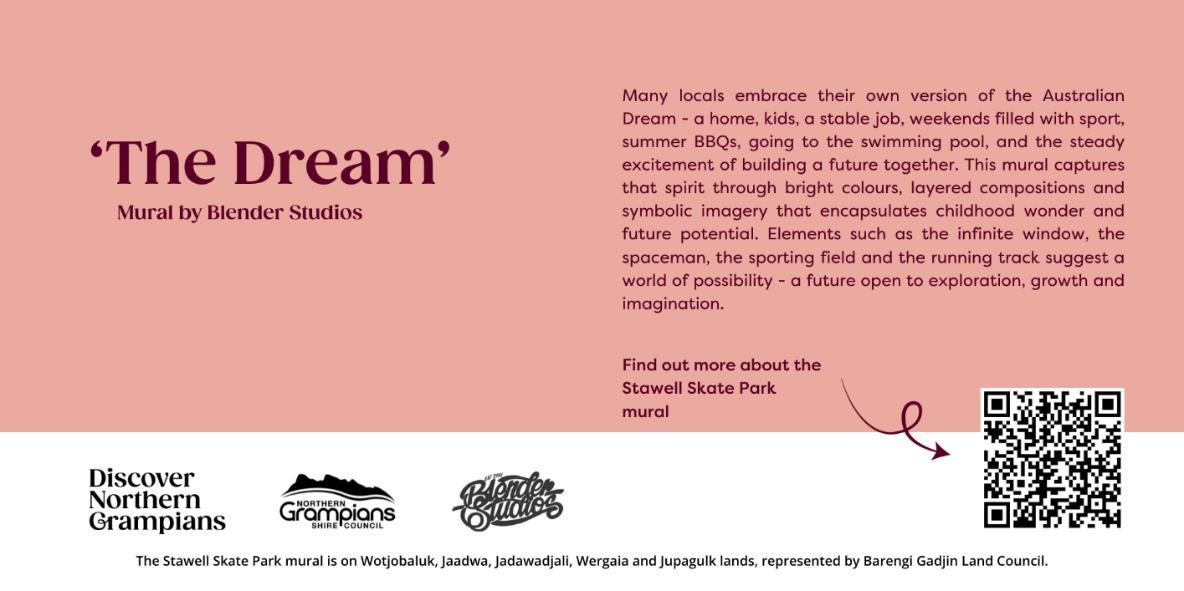
The (insert location or project) is on the lands of the Wotjobaluk, Jaadwa, Jadawadjali, Wergaia and Jupagulk peoples, represented by Barengi Gadjin Land Council.
Example: Stawell Skate Park Mural Signage
St Arnaud, Stuart Mill and Carapooee
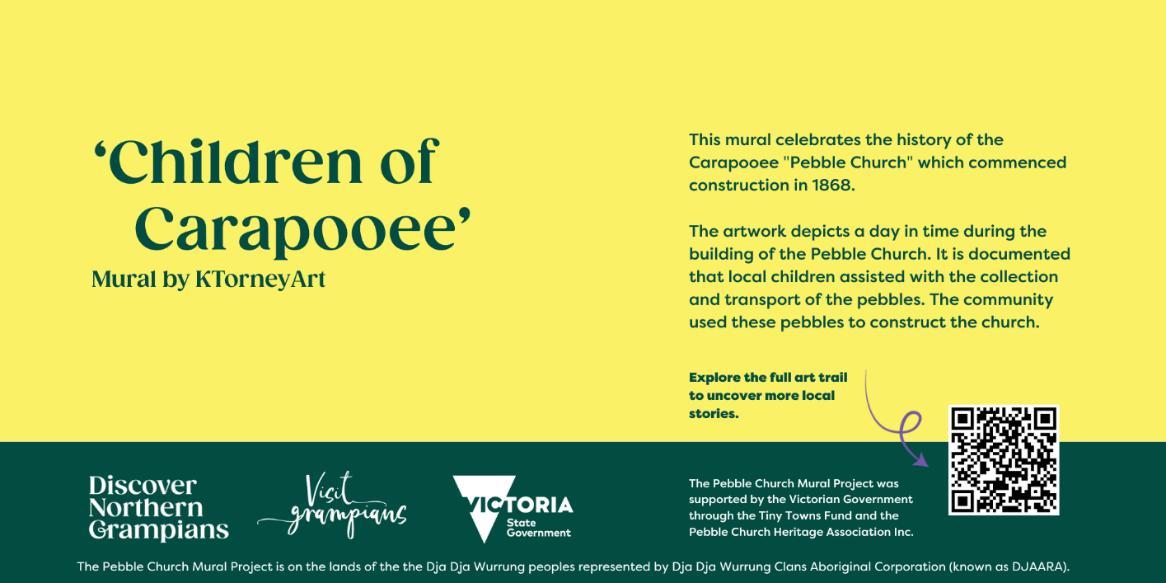
(Insert location or project) is on the lands of the Dja Dja Wurrung peoples, represented by the Dja Dja Wurrung Clans Aboriginal Corporation (known as DJAARA).
Example: Pebble Church Mural Signage, Carapooee
Navarre, west of Ararat-St Arnaud Road (for other locations in Navarre please check the map)
The (insert location or project)) is on the lands of the Wotjobaluk, Jaadwa, Jadawadjali, Wergaia and Jupagulk peoples, represented by Barengi Gadjin Land Council.
There are no RSAs or RAPs covering the following locations and as such the text includes a general acknowledgement only.
Great Western (south of the Western Highway), Navarre (East of Ararat-St Arnaud Road through to but not including Kara Kara National Park), Halls Gap (Budja Budja).
We respectfully acknowledge the Traditional Owners of the lands we call Northern Grampians. We pay our respects to Elders past and present.
Town entry signage requirements
Relevant RAPs must be consulted on the design and acknowledgment text for town entry signage. Consideration should also be given to engagement of RAPs for the design and delivery process.
Please also review the Signage Style Guide Discover Northern Grampians 2026 prior to the development of any new signage.
Acknowledgement of Traditional Owners Guidelines for Northern Grampians Shire councillors, staff and volunteers
9.Welcome to Country and other cultural services
9.1 Welcome to Country
What is a Welcome to Country?
A Welcome to Country is a ceremony conducted by First Nations people who are the Traditional Owners of the land on which the meeting, forum, event, is being held. It formally welcomes welcome people and visitors onto their traditional land and acknowledges the continuing connection of Traditional Owners to that place. Welcome to Country ceremonies can vary in format from speeches, traditional dances and Smoking Ceremonies.
When is a Welcome to Country required?
A Welcome to Country ceremony should be arranged for major public events, forums and functions in locations where Traditional Owners have been formally recognised. A Welcome ceremony is also required if the event has broad impact on, or is significant to, First Nations people.
Examples of such events and activities include:
• launches of projects or initiatives conducted in partnership with Traditional Owners.
• Commemorations and festivals.
• Openings of new facilities.
• Major launches of government policies and programs.
• Conferences held or sponsored by the Northern Grampians Shire Council or the Victorian Government
• International events of which Northern Grampians Shire Council or the Victorian Government is an organiser or sponsor.
• Citizenship ceremonies.
Where a State agency or authority is primarily responsible for a major official event in the Agreement area, that agency is expected to consult with Traditional Owners about the inclusion of a Welcome to Country.
Who should perform a Welcome to Country?
A Welcome to Country must always be conducted by a Traditional Owner.
Acknowledgement of Traditional Owners
9.2 Cultural services
What is a cultural service?
A cultural service may include (but is not limited to) traditional ceremonies, music and dance performances, cultural awareness training and education. A Welcome to Country would always precede a cultural service.
When should I include a cultural service?
Cultural services are optional and should be arranged in consultation with the relevant Traditional Owner group.
A cultural service may be arranged for major public events, forums and functions in locations where Traditional Owners have been formally recognised. A cultural service may also be relevant if the event has broad impact on, or is significant to, First Nations people. Cultural awareness training can be provided to council representatives, including councillors, employees, contractors and volunteers, to strengthen cultural capacity.
Who should deliver a cultural service?
A cultural service should always be performed/delivered by a recognised Traditional Owner of the relevant location, if there is one.
9.3 Other considerations
Is there a fee for a Welcome to Country or cultural service?
Most Traditional Owners will require at least a nominal fee to cover costs. A Welcome to Country, and Smoking Ceremony will generally involve a more substantial payment. Fees should be discussed and agreed upon with the Traditional Owner Corporation early in your planning process and accounted for accordingly in your budget. Costs vary for a Welcome to Country but can range from $400 to $1000.
How do I organise a Welcome to Country or cultural service?
Follow these steps:
• Determine the location of your event.
• Based on this location contact the relevant corporation from the list below, to discuss the service required and associated costs
Stawell, Great Western, Glenorchy, Marnoo, Callawadda, Beazleys Bridge (south of Avon River), Paradise, Navarre (west of Ararat-St Arnaud Road)
Barengi Gadjin Land Council Aboriginal Corporation: Barengi Gadjin Land Council
Barengi Gadjin Land Council Aboriginal Corporation: Barengi Gadjin Land Council or Eastern Marr Aboriginal Corporation: Services - Eastern Maar Aboriginal Corporation
For locations within the shire not covered by a RSA or RAP, availability of cultural services and ceremonies may be limited. Please consult with internal council staff (Community Development) if you are unsure
Acknowledgement of Traditional Owners
Guidelines for Northern Grampians Shire councillors, staff and volunteers
10. Flying the Aboriginal and Torres Strait Islander flags
When does council fly the Aboriginal and Torres Strait Islander flags?
Northern Grampians Shire Council will fly the Aboriginal and Torres Strait Islander flags as a symbolic sign of respect for Aboriginal Australians, where current council infrastructure allows.
How will council fly the flags?
Council will fly the flags in accordance with the Australian Flags booklet – Part 2: The protocols for the appropriate use and the flying of the flag, which determines how Australian and other flags can and should be flown.
Where infrastructure does not currently enable flying of the Aboriginal and Torres Strait Islander flags alongside the Australian flag, Council will actively seek opportunities to
• prominently display these flags elsewhere (such as through sourcing and using tri-flag stands for Council meetings, civic and media events); and
• to develop the necessary infrastructure.
Who is responsible for flying the Aboriginal and Torres Strait Islander flags?
Staff from the Community Development team are responsible for initiating flag-raising on nationally recognised days, supported by Facilities Officers, in alignment with annual recognition day activities undertaken by council
Responsibility for procurement, display and maintenance of all flags, including the Aboriginal and Torres Strait Islander flags, throughout the year sits with Governance.
Eastern Marr Aboriginal Corporation: Home - Eastern Maar Aboriginal Corporation
Relevant council strategies and plans
Council and Municipal Public Health and Wellbeing Plan 2025-29: https://www.ngshire.vic.gov.au/Council/Governance-and-transparency/Councilpublications/Council-Plan
Guidelines for Northern Grampians Shire councillors, staff and volunteers
Appendix 1
Kara Kara National Park with RSA areas depicted (areas on Djandak are held by DJAARA under Aboriginal Title and jointly managed)
Beyond Kara Kara National Park , DJAARA work in partnership with Bush Heritage under the Wurreka Galkangu Shared Strategic Landscape Plan , the scope of which extends to a range of reserves between Kara Kara National Park and Dalyenong.
Acknowledgement
Appendix 2
To identify the relevant Traditional Owner for a specific area in POZI ensure the following boxes under Administrative are ticked. This will show the appointed boundaries of the relevant Registered Aboriginal Party.