About the Council Plan
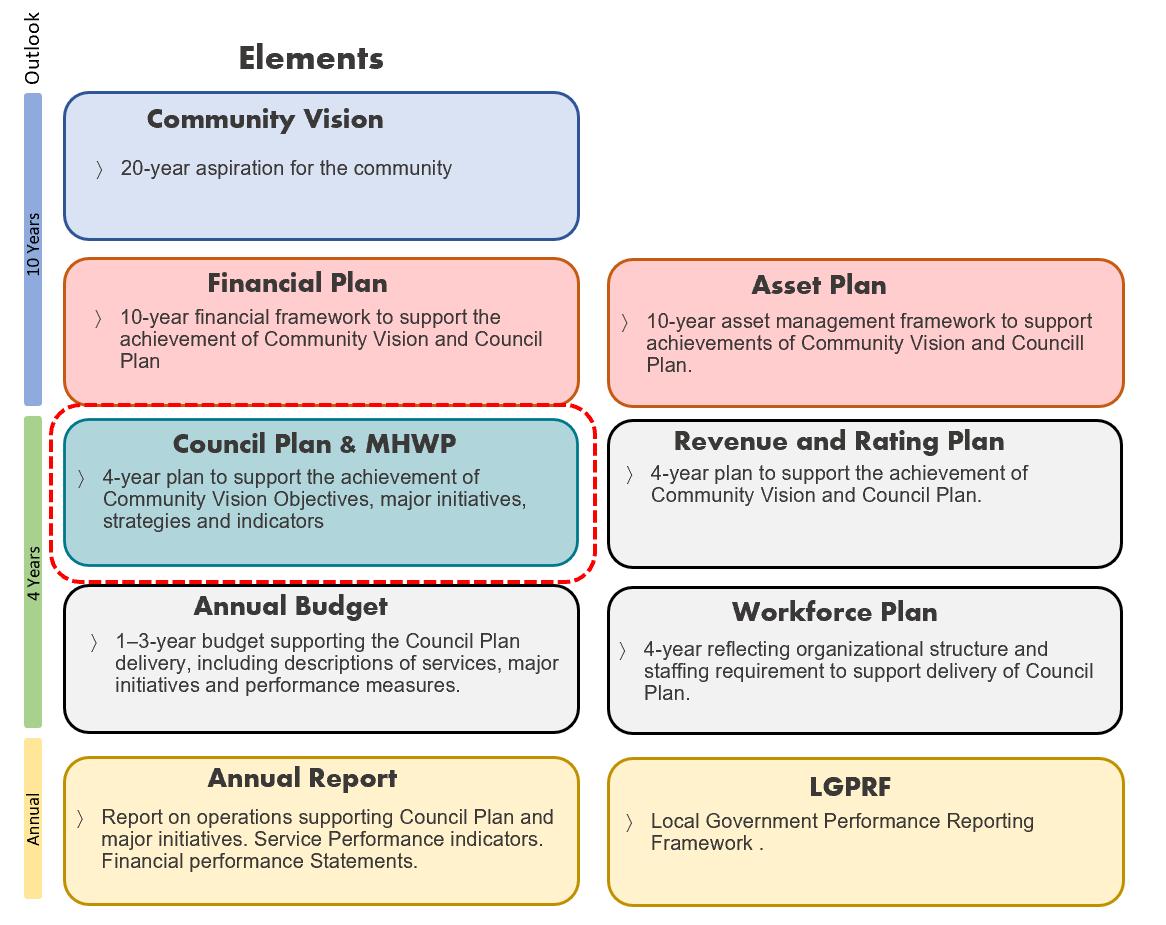
At the highest level, the Council Plan is a four-year roadmap for how the Council will contribute to achieving the Northern Grampians Community Vision 2041. The Northern Grampians Community Vision 2041, "To love where we live," was developed with the community in 2021. The Vision reflects the community's hopes for the next 10-20 years and guides decision-making and collective action.
The Council Plan is a ‘peak’ plan that identifies what the Council plans to achieve in the next four years, considering key challenges and opportunities the community faces. These considerations will be informed by community engagement, current data, long-term documents such as the 10-year Economic Development Strategy, township framework plans, and other strategies that may have been developed within the Council or regionally (e.g., the Regional Waste Strategy). The Council Plan will then inform short-term planning documents such as the annual budget and department business plans.
The Council Plan aligns with the Local Government Act 2020, which requires councils to work with the community to set clear priorities.
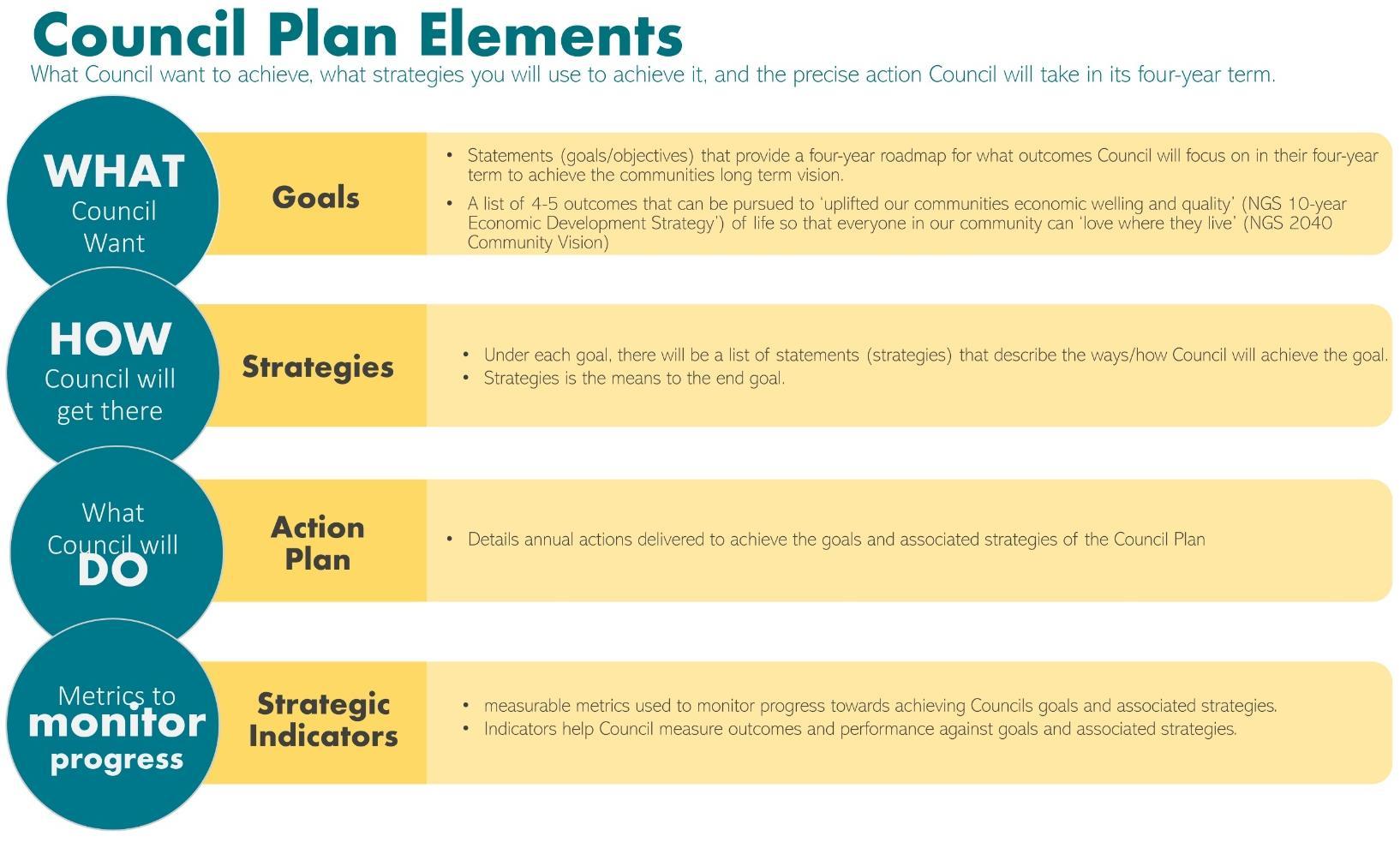
The Council Plan must include:
• the Council’s goals for the next four years
• strategies to achieve these goals
• strategic indicators to monitor progress
• a Strategic Resource Plan
• any other regulatory requirements
When creating the Council Plan, the Council must:
• follow an integrated approach to planning, tracking, and reporting
• align with the Community's Vision
• ensure the right resources are in place
• identify and manage risks
• provide ongoing monitoring and regular reviews
Reporting
The Council Plan will be reviewed annually and adjusted to maintain relevance, respond to changing circumstances, seize new opportunities, and reflect completed actions. The community will receive regular updates on progress through various reporting mechanisms, including the quarterly Council Action Plan report and the Council’s Annual Report.
3: Key components to developing a Council Plan document.
Figure
About the Municipal Public Health and Wellbeing Plan
Local Government plays a vital role in promoting community health and well-being. Councils do this by creating safe environments, ensuring access to essential services, and fostering inclusive communities where everyone can participate in education, economic activities, and community life. Local governments, being the closest to the community, are essential in creating environments that support the community's health and well-being.
In addition to the four-year Council Plan, the Council must prepare a four-year Municipal Health and Wellbeing Plan (MPHWP), which is required under the Victorian Public Health and Wellbeing Act 2008. The MPHWP will set the direction for Council policies, partnerships, and actions, focusing on collaboration, place-based approaches, and health equity.
The Public Health and Wellbeing Act 2008 requires that the MPHWP Plan must:
• Be prepared within 12 months of the council election
• Examine data about local health status and health determinants
• Identify strategies based on evidence for creating maximum health and well-being
• Involve the local community in the development and evaluation of the plan
• Specify how the council will work with the Department of Health and other agencies
• Be consistent with the Council Plan and Municipal Strategic Statement
• Regarding the key priorities in the Victorian Health and Wellbeing Plan
The Victorian Public Health and Wellbeing Plan, 2023-27, is the state-wide framework for improving health. As noted above, the Public Health and Wellbeing Act requires councils to have regard to the ten critical priorities in the Victorian Public Health and Wellbeing Plan in developing the MPHWP, including:
1. Improving sexual and reproductive health
2. Reducing harm from alcohol and drug use
3. Tackling climate change and its impacts on health
4. Preventing all forms of violence
5. Decreasing antimicrobial resistance across human and animal health
6. Reducing injury
7. Increasing active living
8. Increasing healthy eating
9. Improving wellbeing
10. Reducing harm from tobacco and e-cigarette use
The above ten priority areas address significant contributors to health inequities and emerging public health challenges.
Policy Context
A range of other Legislation underpins the Municipal Public Health and Wellbeing Plan and must be considered in its development, including:
• Public Health and Wellbeing Act 2008
• Disability Act 2006
• Local Government Act 2020
• Planning and Environment Act 1987
• Climate Change Act 2017
• Emergency Management Act 2013
• Gender Equality Act 2021
The Victorian Public Health and Wellbeing Plan 2023-27 (of which the Council MPHWP must align) acknowledges that health extends beyond the absence of illness. It defines health as a complete state of physical, mental, and social well-being, emphasising its importance as a human right that requires action across sectors.
Major Contributors to Health and Wellbeing
Research highlights several key factors affecting health:
• Social inequality: Those facing more significant social and economic disadvantage often experience poorer health outcomes.
• Rural and remote living: Residents outside major cities face higher hospitalization rates, death, and injury.
• Health systems: Timely and affordable healthcare access is critical, particularly in rural areas with limited access.
• Public health crises: Events like COVID-19 and environmental disasters impact health, though some long-term effects remain unclear.
• Healthy, liveable communities: Walkability, green spaces, public transport, clean water, and affordable housing contribute to public health.
• Social connectedness: Strong social networks positively impact physical and mental health.
• Climate change: Affects health, food security, and water access.
• Employment: Joblessness can lead to psychosocial stress, impacting wellbeing.
• Education: A robust education system supports health and wellbeing across all life stages.
• Positive start in life: Early childhood development influences long-term health and success.
Determinants of Health
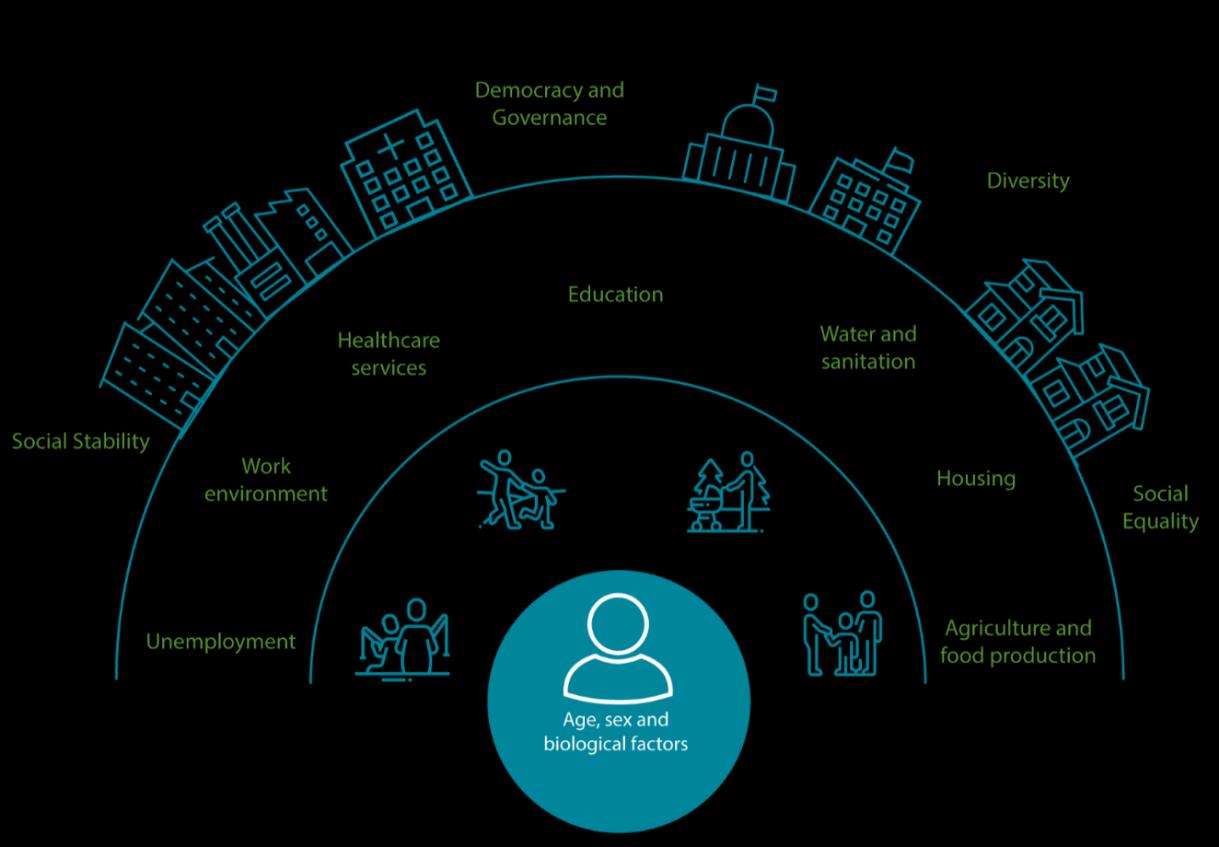
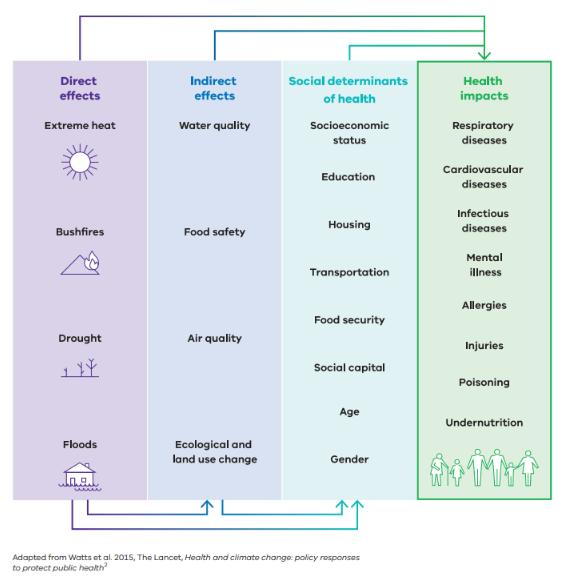
Whilst local government does not directly provide health services, Figure 4 describes the determinants of health, demonstrating the significant role and influence Local Government can have in keeping communities healthy and thriving and reducing the demand for primary health services.
Figure 4: Determinants of Health (Source: Adapted from Victorian Public Health and Wellbeing Plan)
About Financial and Resource Plans
The Council Plan is supported by a ten-year Asset Plan and a ten-year Financial Plan (as described earlier). These plans outline the financial and non-financial resources and technical elements required for managing assets to achieve the objectives set out in the Council Plan.
Financial and resource plans are prepared to show how the council will fund everything, including longterm financial planning, asset plans, annual budgets, and revenue strategies.
Financial Plan
A Council must create, adopt, and maintain a Financial Plan in line with its deliberative engagement practices. The Financial Plan must cover at least the next 10 financial years, ensuring long-term financial viability and alignment with the Council's strategic objectives.
The Financial Plan must include several key elements outlined by the Local Government Act 2020. These include statements that describe the financial resources needed to implement the Council Plan and other strategic plans, as well as information about the decisions and assumptions that support the forecasts in these statements. Additionally, the plan should include statements detailing any other resource needs the Council deems important and any other matters required by the regulations.
A Council must either develop or review its Financial Plan according to its deliberative engagement practices, and the plan must be adopted by 31 October in the year following a general election. Once adopted, the Financial Plan will take effect from 1 July in the year following the election.
Asset Plan
Subject to subsection (6), a Council must create, approve, and maintain an Asset Plan up to date. The plan must cover at least the next 10 financial years to ensure proper long-term planning for managing the Council's infrastructure assets. The Asset Plan needs to include key details about the maintenance, renewal, purchase, expansion, upgrade, disposal, and decommissioning of each type of infrastructure asset the Council controls. It must also cover any other requirements outlined by the regulations.
The Council must either create or review the Asset Plan in line with its community engagement practices and approve the plan by 31 October in the year after a general election, except for the first election held under section 257(1)(a). Once approved, the plan will take effect starting from 1 July in the year following the election. Council must create and approve an Asset Plan based on its community engagement policy after the first general election under section 257(1)(a). This plan will take effect from 1 July 2025.
Revenue and Rating Plan (for at least the next 4 financial years)
Section 93 of the Local Government Act requires each council to prepare a Revenue and Rating Plan to cover a minimum period of four years following each Council election.
The Revenue and Rating Plan establishes the revenue-raising framework within which the Council proposes to work. The purpose of the Revenue and Rating Plan is to determine the most appropriate and affordable revenue and rating approach for Northern Grampians Shire Council which in conjunction with other income sources will adequately finance the objectives in the Council Plan.
The Revenue and Rating Plan is an important part of Council’s integrated planning framework, all of which is created to help Council achieve its vision and that of the communities. Strategies outlined in this plan align with the objectives contained in the Council Plan and will integrate into Council’s budgeting and long-term financial planning documents, as well as other strategic planning documents under Council’s strategic planning framework.
Types of action identified in the Council document
The Council Plan, Municipal Public Health and Wellbeing Plan, Financial Plan, Asset Plan, and Revenue and Rating Plan (ISPRF) specify the Council's actions. The Council can take several types of actions to support outcomes related to things like economic development, community well-being, and partnerships within their regions. Council actions are typically carried out in collaboration with key stakeholders, including community members, businesses, and higher levels of government.
The main types of actions the Council can take are listed below. Each ensures that local governments play a proactive role in shaping the Shire's economic and social future.
Advocate - Local governments can advocate for their region's needs and priorities by promoting regional interests to higher levels of government and decision-makers. This can include lobbying for funding, policy changes, or infrastructure investments to benefit the community.
Facilitate - Governments act as facilitators by providing critical resources such as information, marketing, and incentives to stimulate community involvement and partnerships. This may also include local regulations to support community goals and sustainable economic growth.
Attract Investment - Local governments work to create an appealing environment for potential investors. This can involve promoting the area’s economic potential, tourism initiatives, business support programs, developing business-friendly policies, and improving infrastructure to attract businesses and capital.
Investigate - Conducting detailed studies, including due diligence, feasibility studies, and risk assessments, to prepare the groundwork for future investments. Local governments help mitigate investment risks for private entities by identifying potential risks and opportunities
Plan - Local governments lead the planning process to ensure the region's vision aligns with broader local and regional plans. This includes land use planning, zoning, and long-term development strategies that cater to economic growth and community needs.
Provide Services - Local governments provide traditional and new services essential for supporting liveability and economic prosperity. This could include infrastructure development like roads, bridges, parks and gardens and the provision of other necessary services that help businesses and residents.
Process of preparing critical documents in the ISPRF
The council must prepare strategic documents through its deliberative engagement practices. Deliberative engagement practices refer to those outlined in the Council’s community engagement
policy. The community engagement policy gives effect to the community engagement principles set out in the Local Government Act, along with addressing a range of other matters.1 .
The Council’s community engagement policy outlines how Council employees, Councillors, contractors, or any other representative Council provide the community of Northern Grampians Shire with opportunities for engagement in Council planning and decision-making. The policy aims to increase community members' participation in Council planning and decision-making. You can access the Council’s Community Engagement Policy here: Community Engagement Policy
While each document within ISPRF has different time horizons and deadlines, we will engage with the community and prepare these documents in an integrated way.
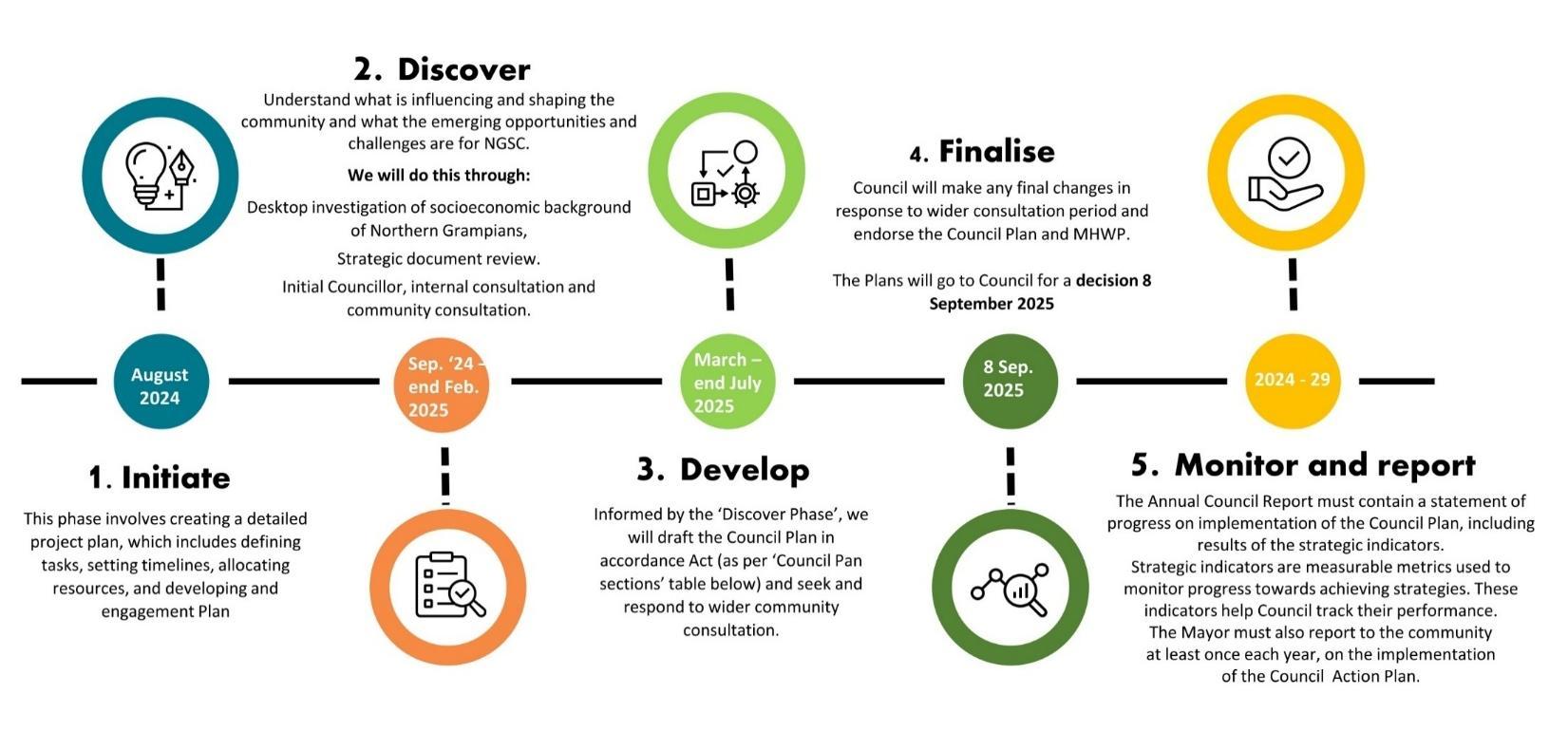
Documents within ISPRF will be prepared over four phases as outlined below.
Figure 5: ISPRF preparation phases
1 Local Government Act 2020, Part B, Division 1, 55 and 56.
3.Shire Profile
Council must give effect to the overarching governance principles2 when delivering the Integrated Planning Framework This includes promoting the economic, social and environmental sustainability of the municipality, including mitigation and planning for climate change risks.
The following section provides an overview of the demographic, economic, social and environmental conditions shaping the Northern Grampians Shire, supporting informed decisions. Drawing on data and strategic work developed through extensive community consultation, this section offers valuable context on the factors influencing the Shire.
Northern Grampians Shire is located in the northwestern region of Victoria, approximately 230 km from Melbourne. The Shire shares its boundaries with Yarriambiack Shire and Buloke Shire to the north, the Loddon Shire, Central Goldfields Shire, and Pyrenees Shire to the east, the Rural City of Ararat and Southern Grampians Shire to the south and the Rural City of Horsham to the west.
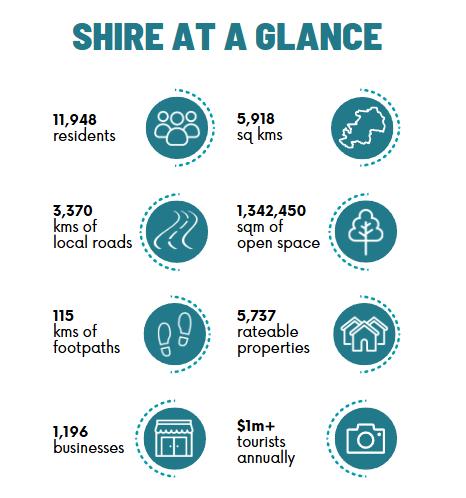
The Shire covers 5,918 square kilometers of land and contains several natural features, including the Grampian Ranges in the south, the foothills of the Pyrenees Mountains in the northeast, and the Wimmera Plains in the northwest. The Grampians are a mountainous landscape of national significance consisting of rugged landscape ridges and escarpments. The surrounding farming country is attractive, containing mature river red gums and other native trees in paddocks and along roads and streams.
The Avoca, Avon, Richardson and Wimmera Rivers are all within the shire. The upper catchment of the Wimmera River supplies a secure water supply to thousands of farms and over fifty towns in the Wimmera and Mallee regions. Stawell and St Arnaud townships are supplied water from Lake Fyans, Lake Bellfield and the area known as the Volcano.
Other major environmental assets of the shire include Lake Lonsdale, Lake Fyans, Teddington Reservoir, Lake Batyo Catyo and the Kara Kara State Forest.
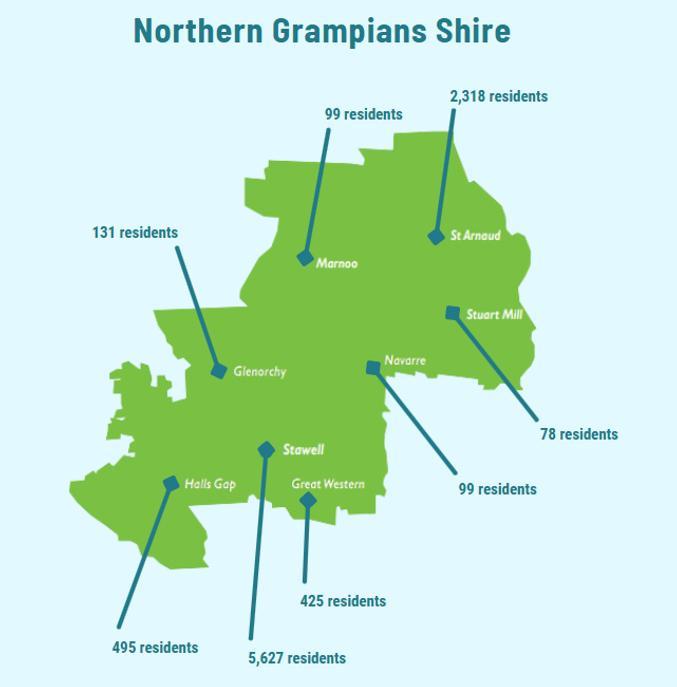
Northern Grampians Shire has a population of 11,948 residents, with the majority (70%) residing in the major towns of Stawell and St Arnaud3 . Halls Gap is a significant regional town and the small settlements of Great Western, Navarre, Stuart Mill, Marnoo and Glenorchy provide important focal points for local communities (Figures 5 and 6).
2 Local Government Act 2020, Part 2 – Councils, Division 1
3 Australian Bureau of Statistics (2021) Northern Grampians
Figure 6: Geographical dispersion of key towns and their population
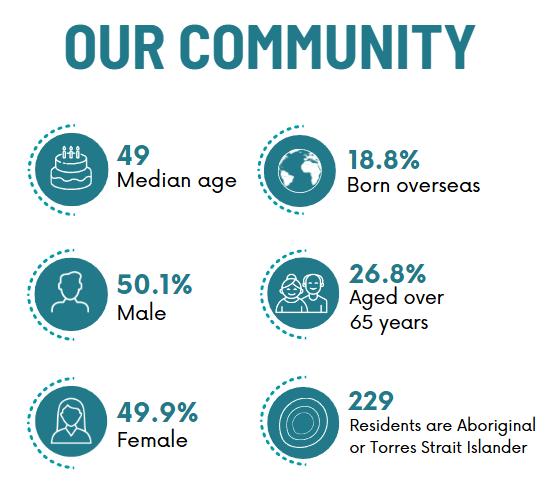
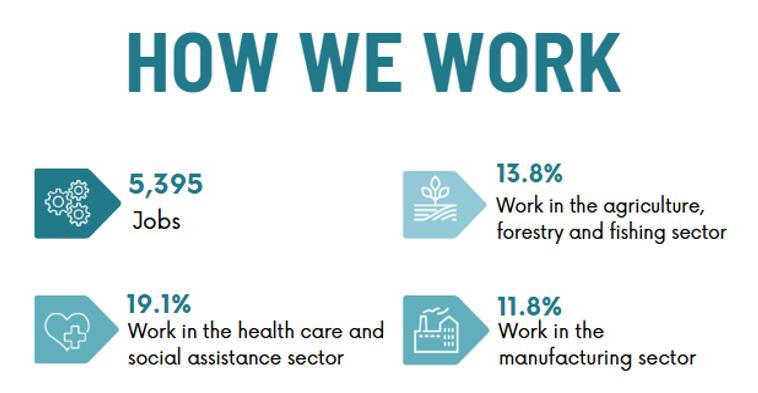
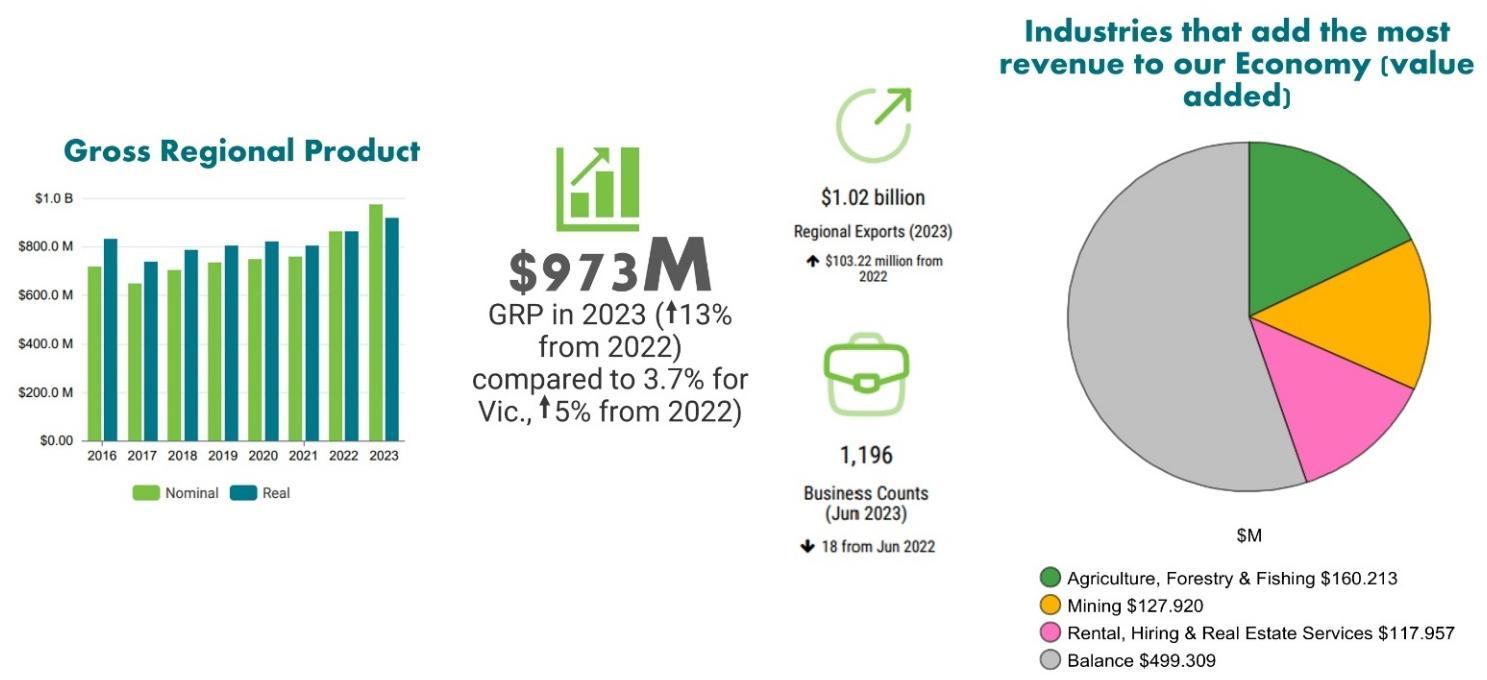
Figure 7: Our shire at a glance. Figure 8: Our community at a glance. Figure 9: Our economy at a glance.
Demographic and Socioeconomic Profile
Ageing Population
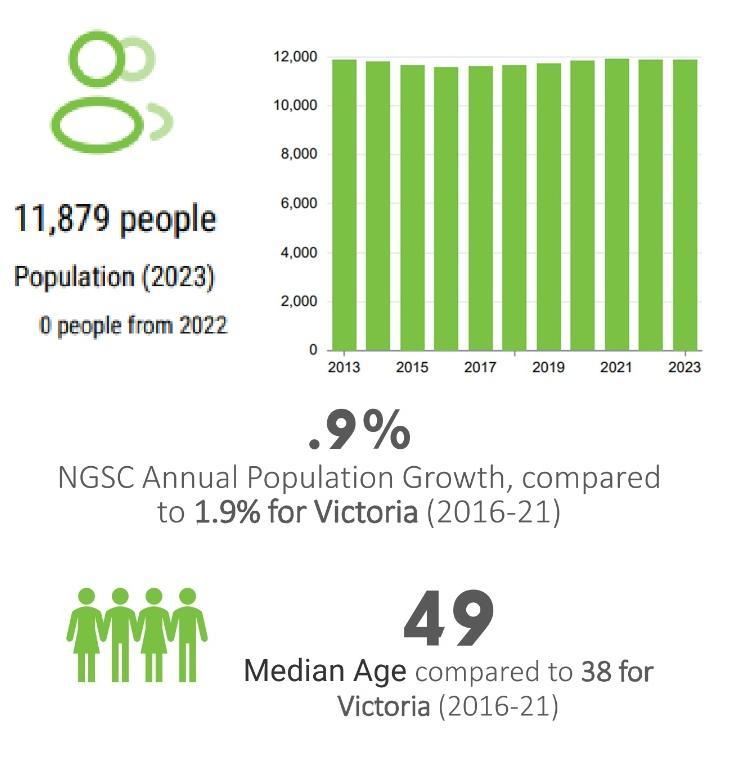
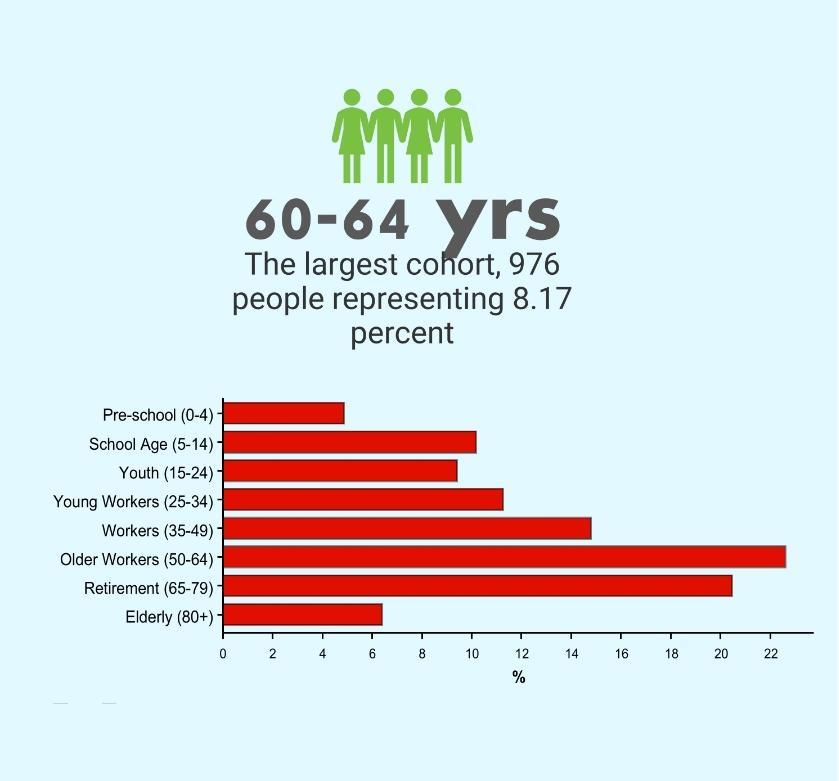
Northern Grampians has a significantly older population compared to the state, with 26.8% of the population aged 65 or older, up from 21% in 20113 4 . This contrasts with Victoria, which has 16.8% of the population aged 65 or older3 . This older population in reflected in a median age of 49 within the Shire, which is significantly higher than the Victorian median of 38.
There are 1,736 young people (aged 10 to 24) in Northern Grampians Shire, making up almost 15% of the population in our municipality3 . Based on population forecasting, this is predicted to decline to 1,320 by 20365 . The declining young people population is due to declining fertility rates and young people moving outside of the Shire for employment and education. This places increased pressure on the workforce and skills shortages.
Despite declining fertility rates, the total fertility rate is 1.81, which remains higher than the Victorian rate of 1.523 .
Figure 10: Our shire’s population overview 1.
Figure 11: Our shire’s population overview 2.
Health and Disability
The Western Victoria Primary Health Network (WVPHN) is a Commonwealth Government entity that plans for, and financially supports, initiatives to promote best practice in primary health care. It covers 21 Local Government Areas (LGAs) and a population of around 618,000, including the Northern Grampians Shire and the large towns of Horsham, Ballarat, Geelong, and Warrnambool.
Data from WVPHN show that the Northern Grampians shire has an ageing population that is reducing over time; higher levels of chronic disease and obesity, alcohol-related incidents, self-reported fair or poor health, higher rates of psychological distress and lower levels of psychology services than either the Western Victorian region or Victoria as a whole6 .
Key stats for Northern Grampians Shire include:
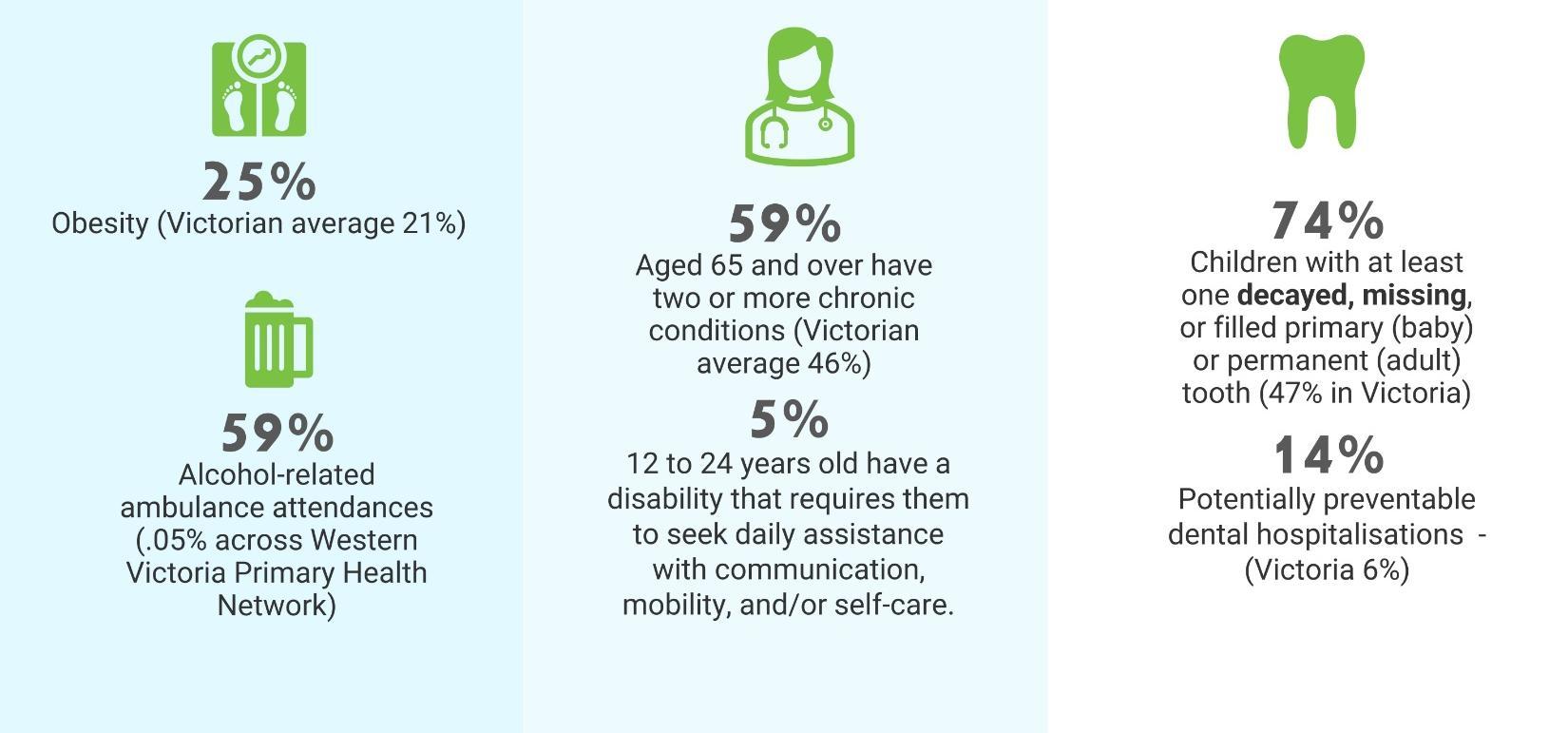
• A higher percentage of people who are obese – 30% compared to 25% in WVPHN, and 21% in Victoria
• Higher rates of drug related incidents – 1.5% of alcohol-related ambulance attendances compared to 0.5% in WVPHN; and 0.8% of alcohol-related family violence incidences compared to 0.1% in WVPHN
• Higher rates of unmet need for assistance – 6.2% compared to 4.5% in the WVPHN, and 4.2% in Australia
• Higher rates of self-reported fair/poor health – 23% compared to 21% in WVPHN and Victoria
• High rates of high or very high psychological distress – 26% compared to 24% in Victoria
• Low rates of psychology services – 0.6% compared to 5% in the WVPHN, 6% in Victoria and Australia
• High rates of potentially preventable dental hospitalisations - 14% compared to 6% in Victoria
• High proportion of children with at least one decayed, missing, or filled primary (baby) or permanent (adult) tooth – 74% compared to 47% in Victoria
• 31 people were identified as being homeless in Northern Grampians Shire in the 2021 Census. A rate of 26 per 10,000 persons, compared to Greater Dandenong LGA, which was 148 per 10,000 persons.
Northern Grampians faces a high burden of chronic health conditions, particularly among its older residents. Nearly 59% of residents aged 65 and over have two or more chronic conditions, significantly higher than the state average.
The prevalence of specific health issues is notably higher compared to statewide figures, with arthritis affecting 14%, diabetes 6.4%, and heart disease 5.5% of individuals3 . Avoidable deaths from heart disease in the Northern Grampians Shire are twice that of the Victorian average7
6 Western Victoria Primary Health Network (2023)
7 Western Victoria Primary Health Network (2024) Needs Assessment Update
Fifty-five young people (4.7 percent) aged from 12 to 24 have a disability that required them to seek daily assistance with communication, mobility and/or self-care.
The region also experiences higher rates of potentially preventable hospitalisations and avoidable mortality, placing pressure on nearby healthcare services and increasing wait times for treatments.
Mental Health
Similar to other outer regional areas, there is an increased risk of mental ill-health in the Shire, with 43% of people in the Grampians Wimmera Southern Mallee LPHU region diagnosed with depression or anxiety, compared to a state average of 34.2%8 . This survey further identified that 25% of residents were experiencing high or very high levels of psychological distress. Amongst young people in the Shire, mental health is the leading chronic health issue, with 14.7% having a diagnosed mental health condition.
Social isolation, alongside reduced access to educational and economic opportunities, are likely contributors to poor mental health outcomes in our region. Relatively low access to mental health services is also noted, which is a risk factor for mental ill-health. For instance, residents in Wimmera Grampians are more likely to report access to mental health services as poor than those across Victoria and Australia7 .
8 Victorian Population Health Survey (2022)
Figure 12: Our shire’s health and disability overview.
Homelessness and Family Violence
Homelessness, while less pronounced than in metropolitan areas like Melbourne, is still a concern. The homelessness rate in Northern Grampians is 26 per 10,000 people, with 31 homeless persons recorded9 . Family violence rates are significantly higher than the state average, with 3,010.2 incidents per 100,000 people, compared to 1,921.8 across Victoria10 .
Figure 13: Our shire’s homelessness and family violence overview.
Multicultural Community
Northern Grampians has a less culturally diverse population with 18.8% born overseas, compared to 35% for Victoria3 Whilst lower than the Victoria average, Northern Grampians has a culturally diverse community with over 40 nationalities living and working within the Shire. Mandarin, Tagalog, Filipino, Punjabi, and Spanish are the most common languages (other than English) spoken at home in Northern Grampians Shire3 A significant portion of this population has been drawn to the Shire by employment opportunities.
Northern Grampians has a higher Aboriginal and/or Torres Strait Islander population of 1.9% compared to 1% for Victoria as a whole3 .
Socioeconomic Disadvantage
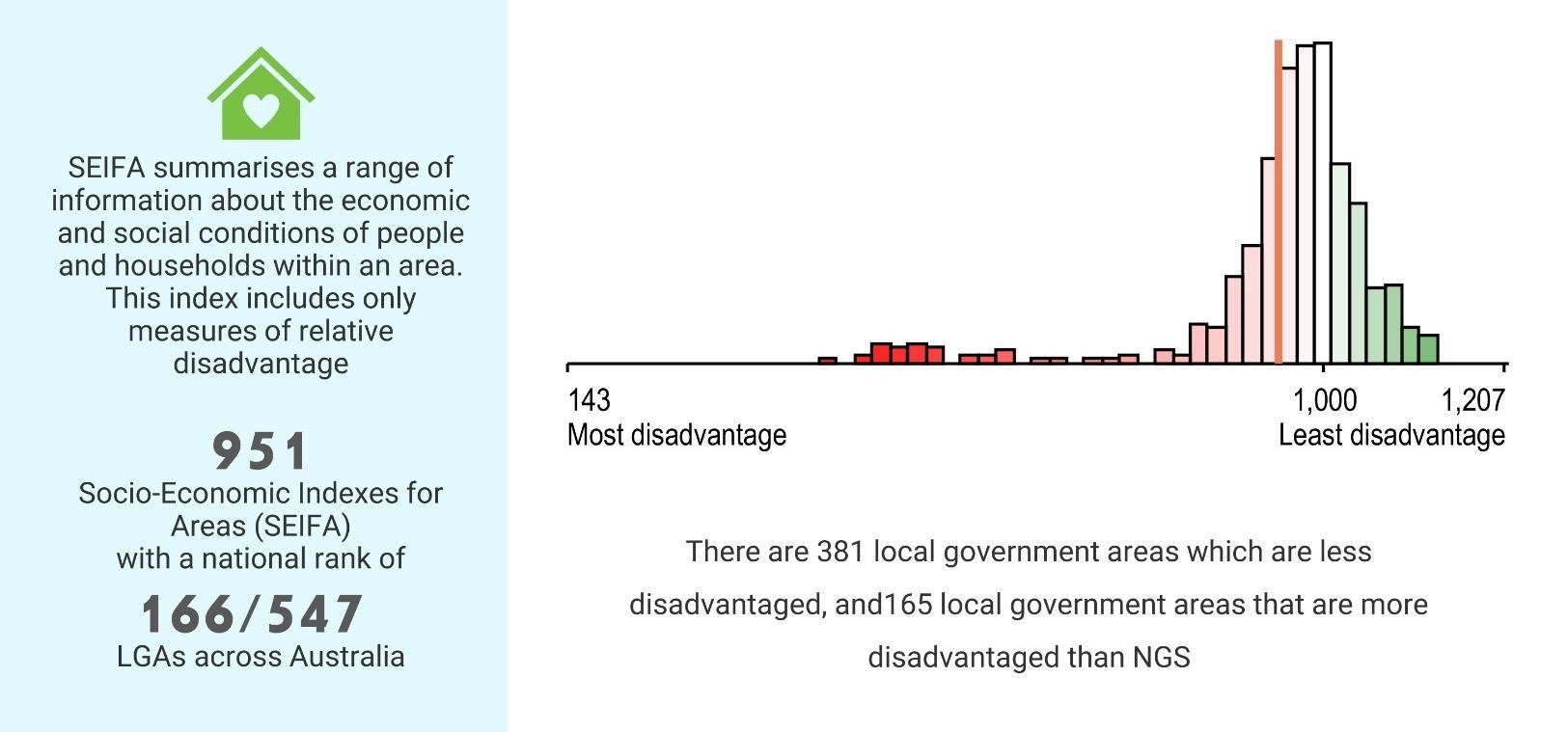
The Australian Bureau of Statistics Social and Economic Indices for Areas (SEIFA) Relative Index of Social Advantage and Disadvantage has Northern Grampians Shire as the sixth most disadvantaged Local Government Area in Victoria.
The SEIFA index shows that relative disadvantage is concentrated within small rural towns and larger centres such as Stawell. In Northern Grampians Shire approximately 55% of the population live in areas that are within the lowest two deciles of relative disadvantage in Australia11
Significant portions of the population live in areas of disadvantage, especially in Stawell and St Arnaud. These communities experience low median weekly household incomes, with an average of $1,124, well below the state average of $1,759, and 26.8% of households with incomes below $650 per week3 .
11 Australian Bureau of Statistics, (2021) Socio-Economic Indexes for Areas (SEIFA), Australia
Figure 14: Our shire’s socioeconomic overview 1
Early Years
Early years data for Northern Grampians presents several important insights when compared with Victoria12 Overall, the data reflects several areas of concern for Northern Grampians, particularly regarding developmental vulnerability, speech and language difficulties, and behavioral/emotional wellbeing Northern Grampian performs better in terms of maternal health check attendance and physical health and wellbeing domains.
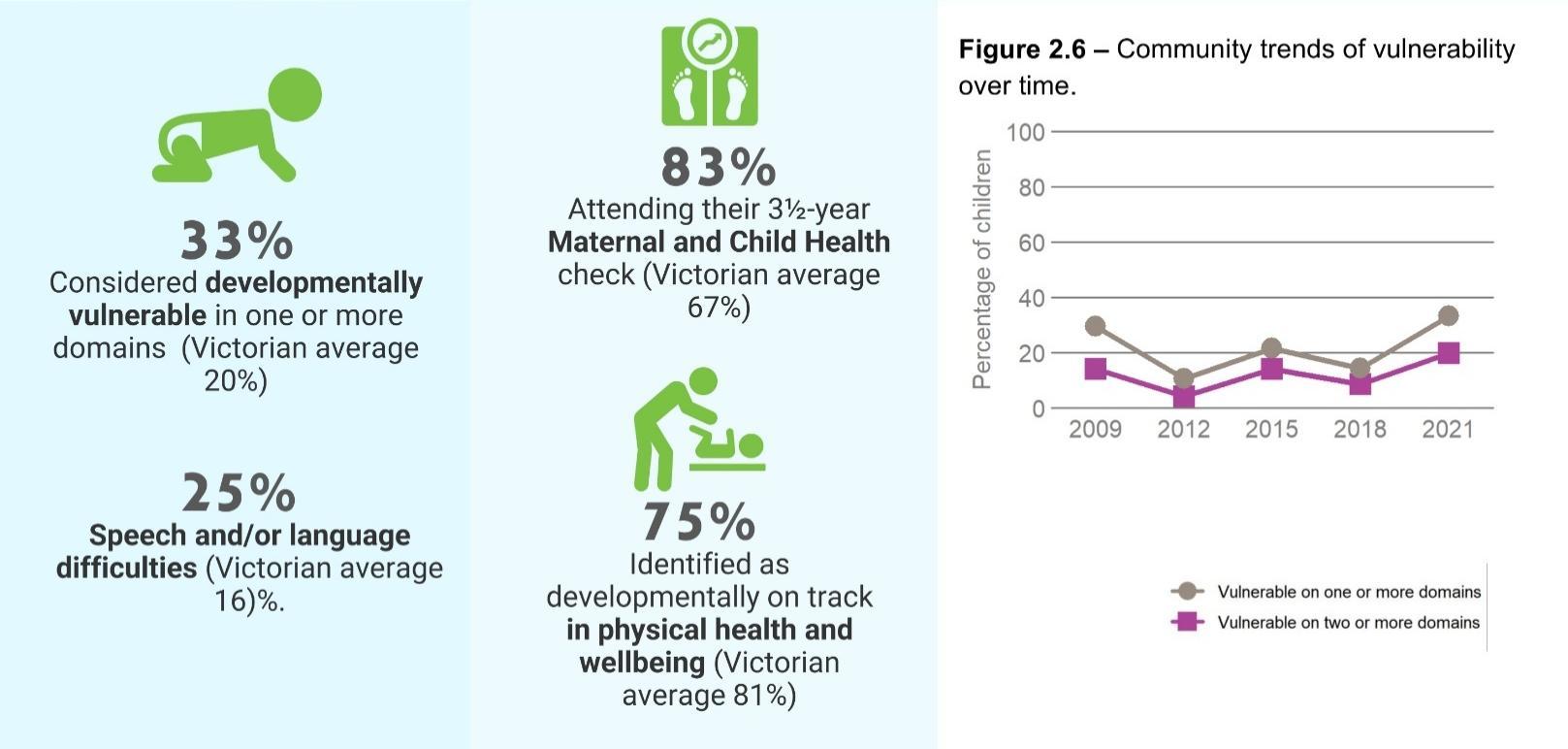
In 2021, 33.3% of children in Northern Grampians were considered developmentally vulnerable in one or more domains, with an even higher rate of 55% amongst children in St Arnaud12 . Both figures are significantly higher than the Victorian average of 19.9%.
The percentage of children attending preschool programs in Northern Grampians is high, 89.6% attendance in 2021, however it is lower than the Victoria average of 96.1%.
Northern Grampians Shire also recorded higher incident rates of behavioral and emotional well-being, with 21.9% of Northern Grampians parents expressing concerns about their child’s behavior in 2021, compared to the Victorian average of 15.7%. Additionally, 24.8% of children were identified with speech and/or language difficulties, higher than the state average of 16.4%. Despite this, only 23.1% of children were seeing a speech pathologist, compared to 28.4% across Victoria.
Positively, Maternal and Child Health Check data suggests high levels of engagement, as evidenced by 82.8% of children in Northern Grampians attending their 3½-year Maternal and Child Health Check, outperforming the state average of 69.9%. Further to this, 76.5% of children were identified as being developmentally on track in the domain of physical health and wellbeing, only slightly lower than the state average of 81.1%.
12 Australian Early Development Census (2021) Community Profile 2021 Northern Grampians VIC
Figure 15: Our shire’s socioeconomic overview 2.
16: Our shire’s early years overview.
Youth
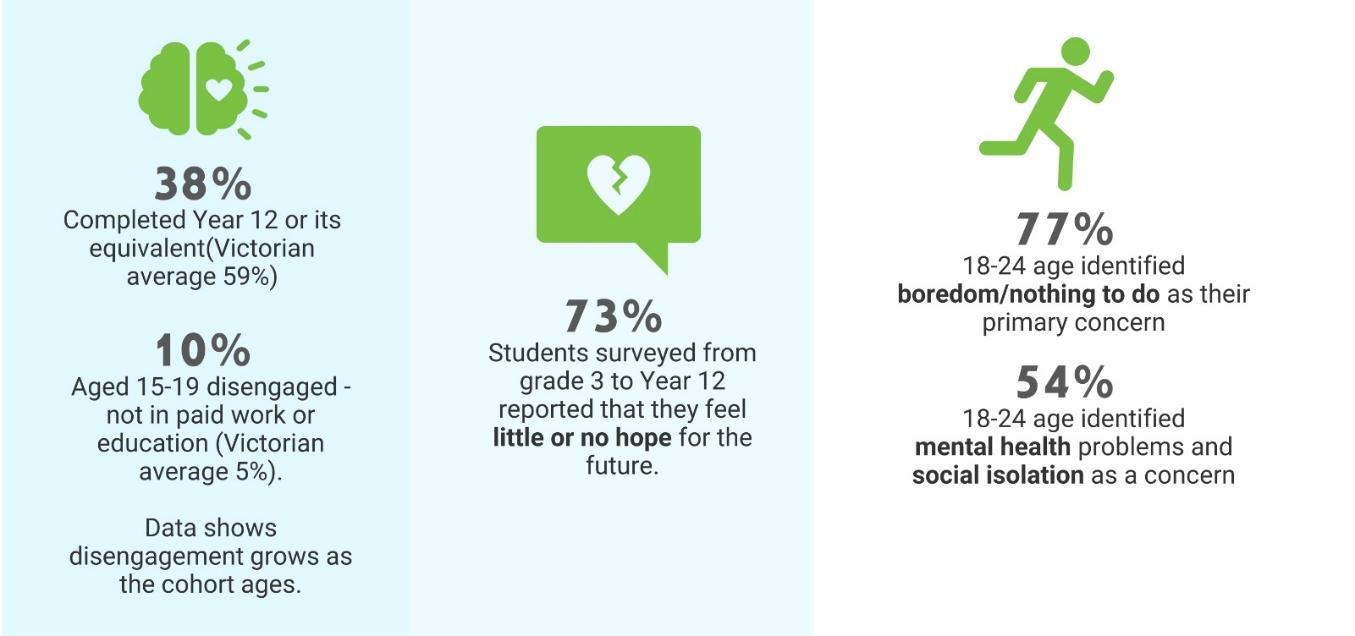
Educational attainment in Northern Grampians lags behind the state average, with only 37.9% of the population having completed Year 12 or its equivalent, compared to 59.5% in Victoria3 The number of Northern Grampians young people who are not in paid work or enrolled in any education is almost double the Victorian average for 15-19-year-olds3 .
The proportion of young people aged 15-19 not in paid work or education is 9.7%, almost double the Victorian average of 4.9%. This number increases as the cohort ages, with 14% of people aged 15-24 not working or studying. Those aged 20-24 were also more than twice as likely to leave school early, with 16.3% not completing Year 11, compared to the Victorian average of 7.8%3 . To be considered ‘fully engaged,’ a young person must be studying or working full-time or both studying part-time and working part-time. A ‘partially engaged’ young person either works or studies part-time.
Data collected in the Resilient Youth Australia 2021 survey provided concerning insights into the wellbeing of young people in the Shire, with 73% of students surveyed from grade 3 to Year 12 reporting that they feel little, or no hope, for the future13 .
Target youth engagement conducted in 2023 for the development of the Council's Youth Strategy revealed further insights into the demographics, concerns, and opportunities for our young people. Of the 250 young people in the Shire surveyed within this process, 14% identified as LGBTQIA, 5% as having a disability, and 5% as being Aboriginal or Torres Strait Islander.
Of the 18-24 age cohort in this survey, 77% identified boredom/nothing to do as their primary concern, followed by mental health problems and social isolation, both at 54%. Across all age cohorts in the
13 Resilience Project (2021) Stawell & St Arnaud Cluster 2021: Hope
Figure
survey, young people identified several opportunities to improve their experience in the Shire, including suggestions to improve the local environment and open spaces, hold more youth events, establish youth-dedicated spaces, provide youth-focused mentoring and guidance opportunities, and whole of community events.
Further Data Insights
Further information on the Demographic and Socioeconomic Profile of the Shire can be found here Northern Grampians Demographic and Community Insights | Summary | REMPLAN
Economy and Employment
Economy
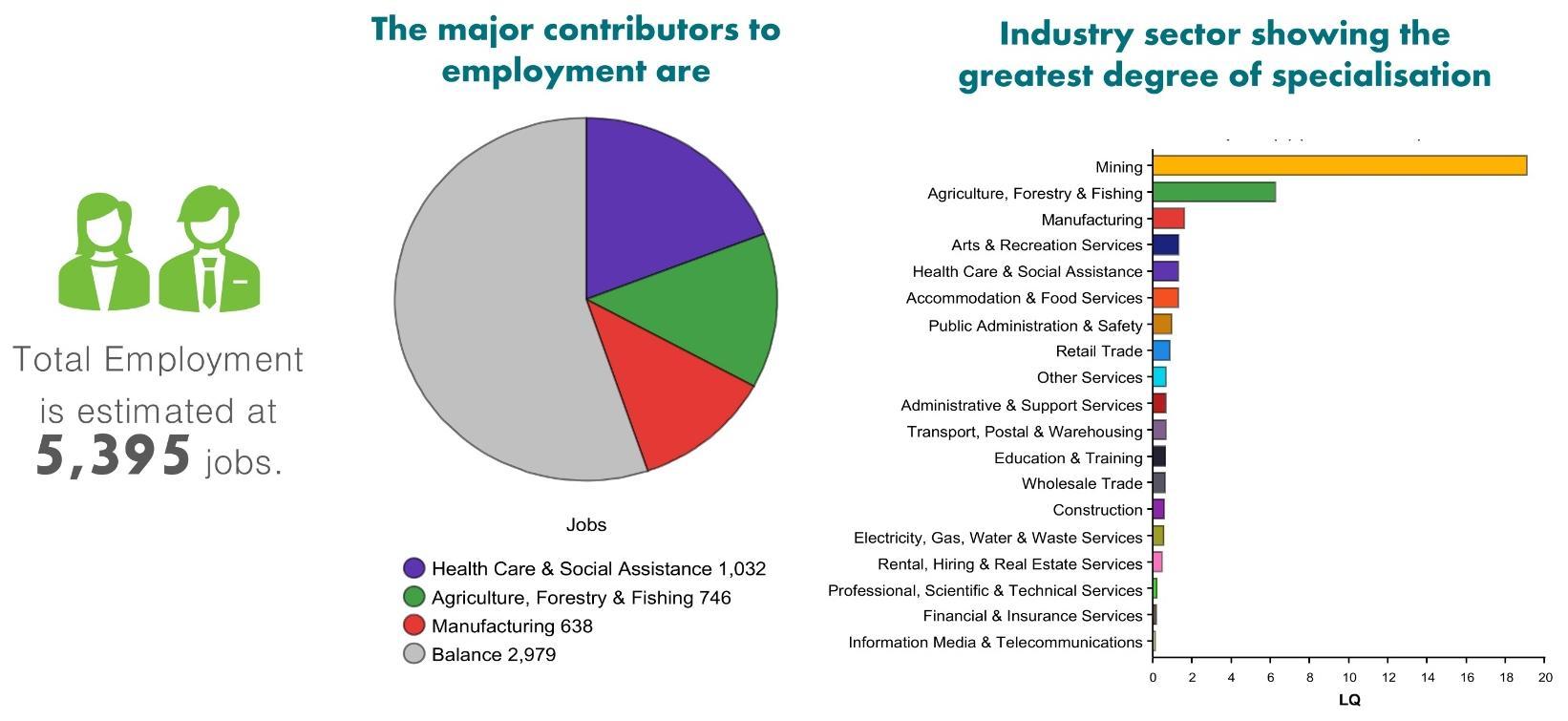
Northern Grampians Shire’s economy is heavily influenced by traditional industries, with the top three employment sectors being health care and social assistance at 19.1%, agriculture at 13.8%, and manufacturing at 11.8%14
These three employment sectors reflect the region’s dependence on service- and resource-based industries. The Shire’s gross regional product is $0.97 billion, growing at an annual rate of 4.5%, and annual economic output is $2.2 billion. The top three industries for economic output are mining at $448.2 million, manufacturing at $433.8 million, and agriculture at $341.7 million14 .
While healthcare, social assistance, agriculture, and mining are significant, the local economy needs continued diversification to ensure long-term sustainability and job creation. Compared to Victoria,
14
Figure 17: Our shire’s youth overview.
REMPLAN (2023) Northern Grampians Economy, Jobs, and Business Insights
where economic output is more diverse, Northern Grampians’ economy is more vulnerable to fluctuations in global commodity prices and climate conditions affecting agriculture. Industry is generally concentrated in the towns of Stawell and St Arnaud and includes activities such as brick making, meat processing, steel fabrication, feed production, supply and service of farm machinery and small service industry. The Shire’s main retail and commercial concentrations are of a local service nature and are located in Stawell and St Arnaud. The Shire’s residents obtain higher-order goods and services from Melbourne and the regional cities of Bendigo, Ballarat, and Horsham.
Employment
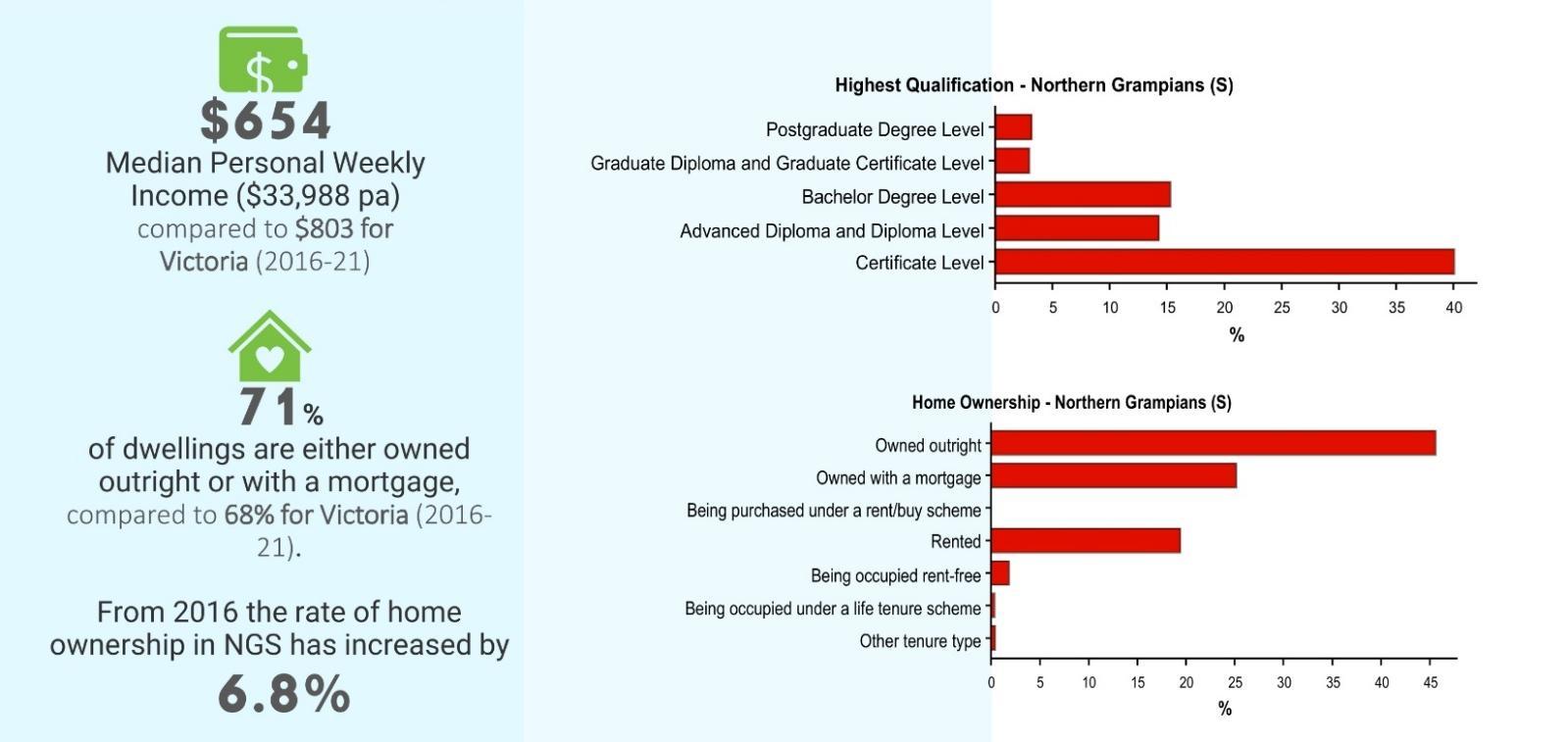
The Shire has a lower unemployment rate of 3.7%, slightly better than the state average, which speaks to relatively stable job markets within these industries However, there are lower levels of educational attainment in Northern Grampians, with only 12% having a Bachelor’s degree or higher, compared to 29.2% across Victoria Suggesting that limited access to high-skilled employment opportunities contributes to economic constraints3 .
Figure 18: Our shire’s economic overview.
Further Data Insights
You can view further Northern Grampians Economy, Jobs, and Business Insights by going to Northern Grampians Economy, Jobs, and Business Insights | Summary | REMPLAN
Figure 19: Our shire’s employment overview 1.
Figure 20: Our shire’s employment overview 2
Traditional Owners
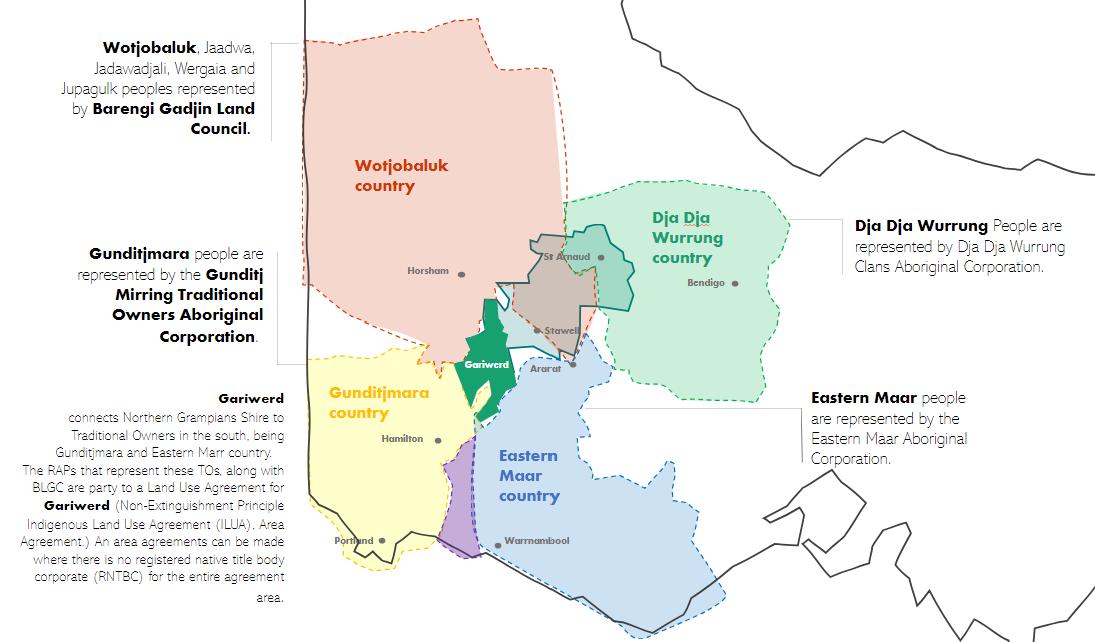
The Traditional Owners of Country for the area today known as the Northern Grampians Shire, and recognised as Registered Aboriginal Parties are the Barengji Gadjin (the Wotjobaluk, Jaadwa, Jadawadjali, Wergaia and Jupagulk peoples) and the Dja Dja Wurrung peoples. Northern Grampians Shire is also connected to Traditional Owners to the south through the Grampians (Gariwerd), these being the Gunditj Mirring and the Eastern Maar peoples (Figure 10).
Aboriginal people have had an association with the Grampians for more than 30,000 years, with the land being at the centre of creation stories for many of the Aboriginal communities in south-western Victoria. The region has the largest number of significant and ancient Aboriginal rock art paintings and shelters in southern Australia – more than 80% of Victoria's rock art sites. Approximately 60 art sites, containing more than 4,000 different motifs have been identified within the national park. Bunjils Shelter is home to the only known rock art depiction of the Aboriginal creator spirit Bunjil (Black Range Scenic Reserve). It is one of the most significant cultural places in south-eastern Australia.
Legislation
In working with the Traditional Owners of the land, Council is subject to the following legislation:
• Local Government Act 2020 (Vic)
• Native Title Act 1993 (Cth) and Land Use Agreement (ILUA)
• Aboriginal Heritage Act 2016
Figure 21: Location of Traditional Owners within and surrounding Northern Grampians Shire.
• Aboriginal Heritage Regulations 2018 and the planning permit process. A number of other Acts and agreements influence Council’s responsibilities with Traditional Owners including the Traditional Owner Settlement Act 201015 , which provides a framework for the recognition of Traditional Owner rights and settlement of native title claims in Victoria, and Recognition and Settlement Agreements, which apply to public land and waters with some exceptions and are negotiated by Traditional Owners with the Victorian Government. These agreements provide recognition and a financial and land management package. Local Government is not a party to the agreement, however under the Local Government Strategy (Schedule 6, Clause 3.6), local councils are required to work towards recommended actions under the following themes:
• recognition
• education and relationship building
• engagement in strategic planning
• business support
• employment
• management of council-owned or controlled land
• participation in planning scheme processes
• funding
15 Traditional Owner Settlement Act 2010
4.Challenges and Opportunities
There are a range of challenges and opportunities facing Northern Grampians Shire, many of which are influenced by the Shires profile, as outlined earlier in this report. These challenges and opportunities are discussed in further detail below.
Housing
One of the most significant issues affecting NGS is housing.
Overview of the Housing Crisis
Northern Grampians Shire (NGS) faces a critical housing shortage, significantly impacting businesses' ability to attract and retain workers, particularly in sectors like healthcare, manufacturing, and agriculture. The region's low housing vacancy rate (0.17%) forces many workers to commute from neighboring areas, hindering economic and population growth and contributing to an aging demographic and limiting regional economic growth. Increasing housing supply and diversifying housing stock are essential to making the Shire an attractive place to live and work.
Housing Demand and Projections
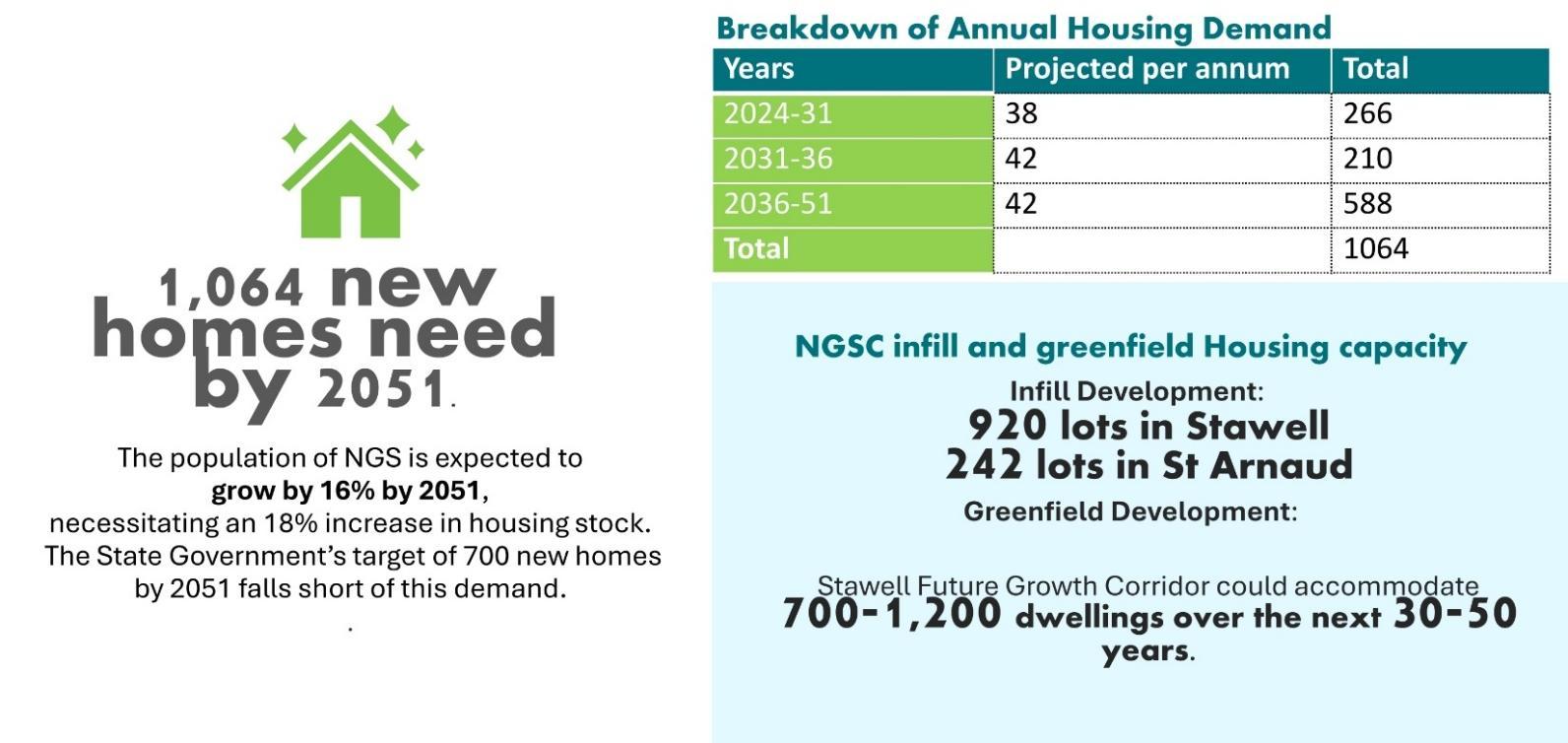
The population of NGS is expected to grow by 16% by 205116, necessitating 1,064 new homes an 18% increase in housing stock. However, the State Government’s target of 700 new homes by 2051 falls short of this demand.
(The Housing Blueprint, Wimmera Development Association, 2021)
Current and Future Housing Initiatives
• Residential Development: Council assessments (2021-2024) identified significant infill and greenfield capacity:
• Infill Development:
• 920 lots in Stawell
• 242 lots in St Arnaud
16 Residential Land Supply and Demand Assessment (2023) Hansen Partnership
17 Wimmera Development Association (2021) The Housing Blueprint
Table 1: Breakdown of Annual Housing Demand17
• Greenfield Development:
• The Stawell Future Growth Area Masterplan estimates the Sloane Street growth corridor could accommodate 700-1,200 dwellings over the next 30-50 years18
Impacts of Housing Shortages
• Workforce Challenges: Inadequate housing directly affects businesses’ capacity to attract a workforce, limiting employment growth opportunities.
• Population Demographics: A lack of housing diversity and availability discourages younger residents and exacerbates the aging population trend.
• Mismatch in Housing Stock: Current housing is predominantly three- to four-bedroom detached homes, mismatched with the increasing demand for smaller, more diverse housing types suited to an aging population and smaller household sizes.
Strategic Housing Initiatives
• Infill Development: Over 900 lots in Stawell and 240 in St Arnaud have been identified for redevelopment to increase housing availability without expanding into greenfield areas.
• Greenfield Development: The Stawell Future Growth Area Masterplan identifies the Sloane Street growth corridor, capable of accommodating 700-1,200 dwellings over the next 30-50 years.
• Medium-Density Development: Guidelines are being developed to encourage medium-density housing in historic centers of Stawell and St Arnaud19
Challenges in Housing Diversity
Mismatch with Market Demand: Most housing (94.4%) in NGS consists of detached single dwellings, which conflicts with the growing prevalence of smaller households:
• Household Composition (2021) 20:
Single-person households: 35.2%
Family households: 62% (of which 50.3% are couples without children)
Group households: 2.8%
Average household size: 2.2 persons (down from 2.3 in 2011)
Thin Housing Market and the Windfall Gain Tax: Many rural Councils are concerned that the introduction of the windfall gain tax will further impact the viability and feasibility of developing and rezoning land in regional Victoria.
18 Northern Grampians Shire (2021) Stawell Structure Plan
19 Northern Grampians Shire Council (2024) St Arnaud, Halls Gap & Great Western Housing Supply Mapping [Draft] (March 2024)
20 Australian Bureau of Statistics (2006) Northern Grampians
Developers already face significant barriers to developing in regional Victoria, including increased costs of construction (costs of materials and staff are higher in regional areas), infrastructure costs, and lower land values. With significant barriers already existing, and the State Government seeking to increase provision of housing in regional areas, consideration needs to be had to the impacts that this tax will have on housing targets.
Advocacy and Policy Alignment
• State Targets vs. Local Demand: The Victorian Government’s housing target for NGS is inadequate compared to projected needs. The Council is actively advocating for an increase to align with actual demand.
• Integration with Transport: Inadequate public transport further exacerbates the housing crisis by limiting accessibility. Aligning housing development with transport infrastructure is critical to resolving this issue.
Figure 22: Summary of housing demand in our shire 1.
Figure 23: Summary of housing demand in our shire 2.
Ageing and Declining Population
Like many rural areas, Northern Grampians Shire faces challenges related to an aging population and the outmigration of younger residents to larger cities for education and employment opportunities. Northern Grampians has a relatively stable population with 0.9% Annual Population Growth, compared to 1.9% for Victoria (2016-21).
An ageing population places higher demands on healthcare and aged care services. In rural and remote areas, access to healthcare and aged care services are often limited. Many elderly residents live alone, contributing to concerns about isolation and loneliness, which are exacerbated by unmet needs for formal assistance. In-home care is preferred, but the challenge lies in accessibility to suitable care facilities.
This demographic shift is shaping local priorities, such as health care, social services, and accessible community infrastructure, particularly given the growing prevalence of age-related health conditions. This demographic shift is also impacting on workforce and skills shortages due to a declining, aging population, and growing levels of social and economic disadvantage.
Renewable Energy and Mineral Resources
Transition to Renewable Energy in Victoria
The State Government is committed to transitioning from coal-generated power to renewable energy. To support this, it has legislated renewable energy targets under the Renewable Energy (Jobs and Investment) Act 2017.
These targets include:
• 40% renewable energy generation by 2025
• 65% by 2030
• 95% by 2035
VicGrid is responsible for coordinating the planning and development of Victoria’s Renewable Energy Zones (REZs) and transmission infrastructure to facilitate this transition. Given the region's strong wind and solar resources, parts of the Northern Grampians Shire are likely to be included in a REZ (see Figure X for details).
Renewable Energy in the Northern Grampians Shire
The Northern Grampians Shire lies within the Australian Energy Market Operator (AEMO)-identified Western Victorian Renewable Energy Zone. It hosts several existing renewable energy projects, including:
• Bulgana Wind Farm and Battery Storage
• Ararat Wind Farm
• Stawell Solar Farm
• Ledcourt Solar Farm
Proposed projects within the Shire include:
• VNI West Link
• Western Renewable Link
• Watta Wella Wind and Solar Farm
• Campbells Bridge Wind Farm
• Navarre Green Energy Hub
• WiRES transmission line
Proposed VNI West and Western Renewables Link transmission projects are proposed to traverse the Shire. In total, ten renewable energy or transmission infrastructure projects are either operational or proposed within the region.
Figure 24: Status of Renewable Energy Project across NGS.
Community Impact and Concerns
These projects have significant impacts on the community, particularly the farming sector. Challenges include:
• Inadequate Consultation: Engagement with the community has been insufficient, exacerbating concerns.
• Cumulative Impacts: The overlapping effects of multiple projects have heightened community tensions.
Figure 25: Renewable Energy Stakeholders in Victoria.
• Agriculture at Risk: The Shire’s agricultural land, covering 361,237 hectares, underpins a key industry with a gross agricultural production value of $311.4 million (ABS 2021). Farming practices are predominantly broad-acre, dryland cropping systems, producing wheat, cereals, oilseeds, and legumes.
Farmers fear renewable projects threaten agricultural land viability. While the State Government’s Planning for Melbourne’s Green Wedges and Agricultural Land Action Plan 2024 focuses on protecting agricultural land within 100 km of Melbourne, it is crucial to extend this commitment statewide to secure food production and employment.
Balancing Renewable Energy and Agriculture
The designation of REZs must align with future land-use planning in regional Victoria. The influx of renewable projects may significantly alter regional economies, requiring:
• Additional housing and infrastructure investment
• New workforce provisions for the renewable energy sector
• Mitigation of long-term impacts on agriculture and liveability
Council urges the State Government to prioritize agricultural land protection and establish criteria for renewable projects to address cumulative impacts and community concerns.
Council’s Advocacy and Role
The Northern Grampians Shire Council (NGSC) is committed to advocating for its communities, ensuring that renewable energy impacts are mitigated, and equitably sharing benefits.
NGSC Commitments:
1. Advocate for the protection of agricultural industries and natural values.
2. Promote meaningful, early engagement between stakeholders and communities.
3. Ensure community impacts are identified and mitigated.
4. Advocate for community-aligned benefit-sharing arrangements.
NGSC Responsibilities:
• Policy Development: Explore local policies for setbacks, complaints handling, and project approvals.
• Stakeholder Coordination: Act as the key contact for communities, governments, and renewable energy proponents.
• Communication: Maintain transparency through updates, briefings, and a dedicated community resource platform.
• Oversight and Compliance: Monitor project adherence to conditions, manage complaints, and enforce rectification measures when necessary.
• Advocacy: Push for greater oversight of cumulative impacts and alignment of projects with community needs.
Challenges and Opportunities
Victoria’s renewable energy transition presents opportunities to attract regional investment, catalyze economic development, and diversify local economies. However, balancing these opportunities with the protection of agriculture and community well-being remains a critical challenge. NGSC calls on the State Government to:
• Strengthen protections for agricultural land statewide.
• Develop a strategic plan to address the cumulative impact of REZs.
• Invest in necessary infrastructure to support renewable projects and the communities hosting them
NGSC Submission to Priority Renewable Energy Zones.docx
NGSC_Submission_Draft Renewable Energy Zone Community Benefits Plan_June 2024.docx
Councils Current Role Statement
NGSC's role is to strongly advocate on behalf of our communities and towns within Council's regulatory and legislative responsibilities. Council will act to ensure any renewable energy related impacts are mitigated, and benefits are captured and shared. Council will achieve this by acting as a vital link between our community, renewable energy proponents and government.
Northern Grampians Shire Council commits to:
1. Strongly support our farming communities and advocate to protect our agricultural industry and unique natural values
2. Set expectations for industry and other levels of government to meaningfully engage our community early, with clarity and respect.
3. Engage early and meaningfully with and Industry and Government on projects in the Shire
4. Advocate for community impacts to be clearly identified and mitigated
5. Advocate for benefit sharing and alignment with community needs
Council role and responsibility in Renewable Energy
• Respond to State Government plans – VicGrid – draft REZ community fund, draft transmission plan guidelines.
• Advocacy – to State Government, local members etc…
• Central point of contact –Key contact for the community, state government, industry
• Coordination and Liaison with various players – VicGrid, AEMO, Ausnet, TCV, Project proponents, community groups e.g. SWRRA.
• Communication - Regular ELR and Cr Briefings, Key contact for the community, Communication channels – website with information and resources for the community, various projects and their contacts.
• Liaison with other Councils - Build networks, sharing of information – submissions, info from meetings etc… Potential for resourcing sharing e.g. a number of Councils have a MOU for cost sharing for the WRL.
• (potential) Creation of policy e.g. Moorabool transmission setback policy, windfarms complaint policy
Financial Sustainability
As a rural Council we have always been in a challenging situation primarily because of the large footprint we take up of the Victorian landscape, our disperse population across the shire, our distance from major population centres, and the large amount of assets that we are required to maintain, replace and upgrade.
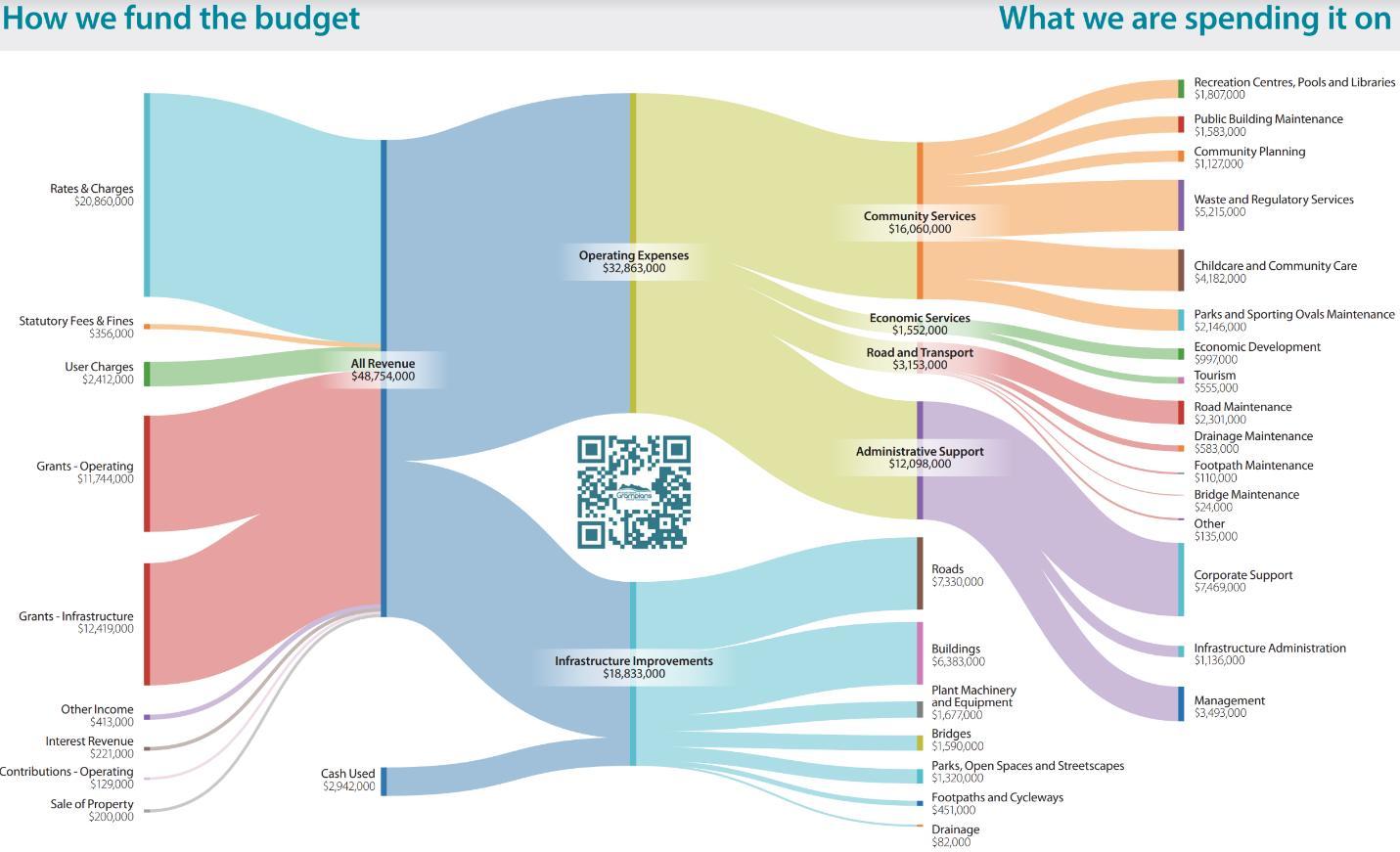
As a result, we are very dependent on grant funding not only to help maintain, replace and upgrade the infrastructure we have but to provide the level of services to the community they want or require. The level of grant dependance can be seen on the Sankey diagram below. To see a bigger version of this diagram and an explanation of how to read it click here.
Figure 26: 2023/2024 budget expenditure summary.
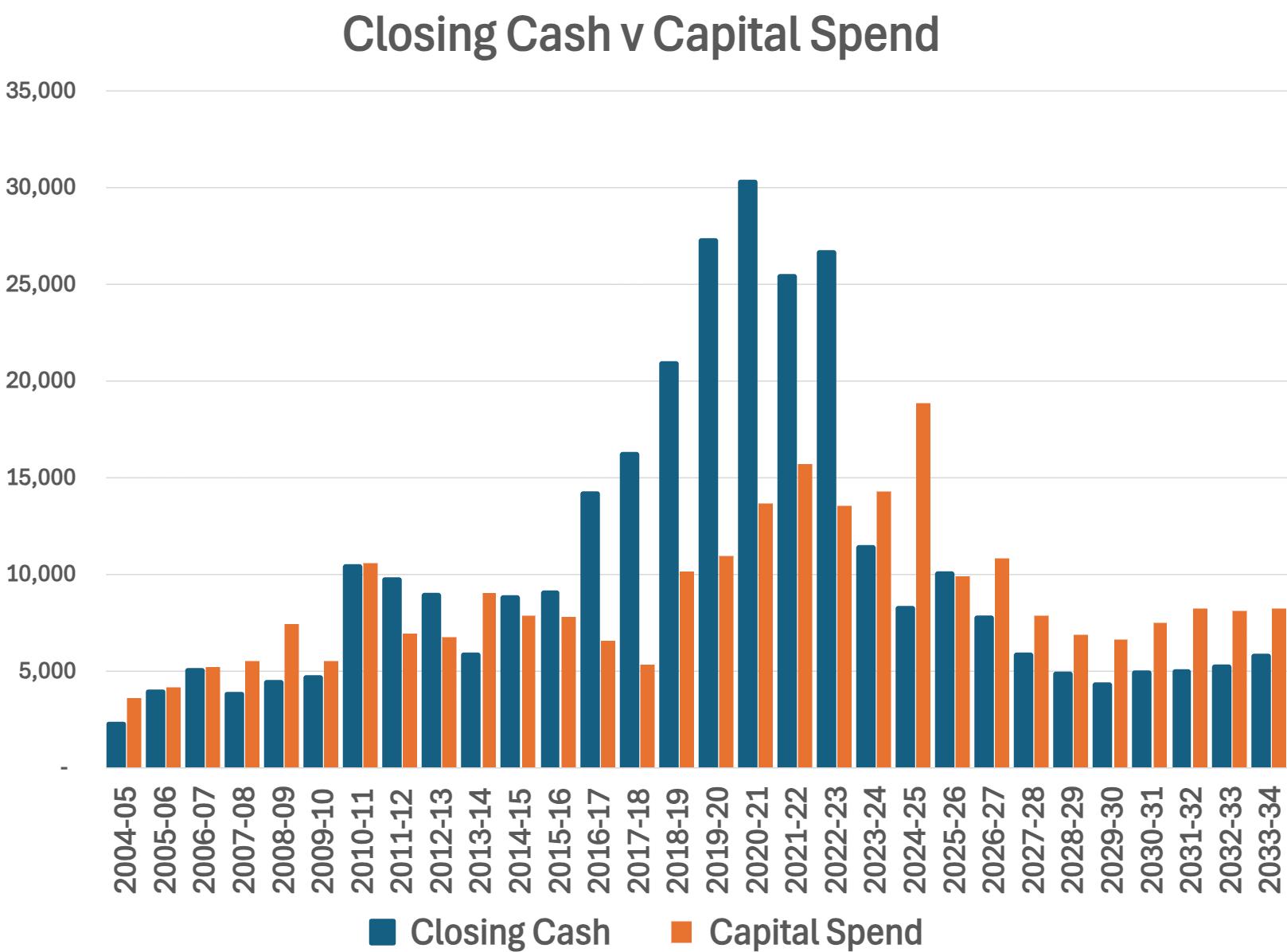
As you can see from the diagram above the level of capital expenditure on infrastructure improvements is $18.8m. Over the last 14 years we have had a bonanza of grant funding through flood recovery, and a number of State and Federal grants which have enabled us to do restore many roads in our shire, undertake streetscape works in Stawell, St Arnaud andHalls Gap, build new sporting facilities in North Park, Lord Neilson Park, Great Western and starting this year Navarre. This heightened capital spending can be clearly illustrated in the below diagram we had been calling the Manhattan Skyline.
Our prediction is that future grant funding is not likely to be high as it has been in past years because both the State and Federal Governments are not as flush with cash as they have been. As can be seen in the graph we are presuming that we will settle at a lower level of capital spending from 2025-26.
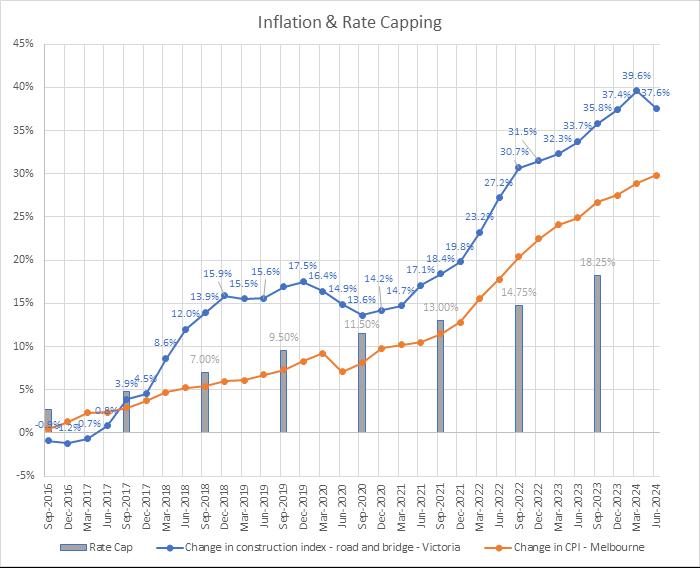
A big factor that needs to be taken into consideration is rate capping. Rate capping was introduced in 2016 and limits the extent of rate revenue increases to a prescribed amount set by the Local Government Minister. The issue with rate capping is that it is set at a level below our inflationary experience.
Figure 27: Cash Vs expenditure summary by financial years.
The rate cap impacts our capacity to deliver services and maintain our assets and will be a continuing challenge moving forward.
There are several things we are doing to contain costs. These include looking for operational savings in the current financial year, minimising unfavourable variations from budget, reviewing future capital works, undertaking some services reviews, reviewing the Reserve Policy, and scrutinising all recruitment. Our borrowings are at a very low level, $1m, and are scheduled to be repaid next year. This does mean that we have a very low loan interest burden currently and does give us the option to borrow going forward if council has an appetite for it.
In the next few years, it is anticipated that a number of renewable energy generation projects will take place. If they occur and once completed council will receive over $3m additional dollars every year. The payments are called Payment In Lieu of Rates (PILOR) and are mandated charges. These projects will give our income a boost in years to come and provide opportunities for council to improve our sustainability.
Infrastructure and Services
Council owns a diverse asset portfolio that is critical to its service delivery and the community. To ensure appropriate infrastructure and services are in place for current and future generations, the Asset Plan is established. It provides a framework for how the Council intends to manage its assets, achieve the objectives outlined in the Shire Vision, and support the Council Plan.
Council's Infrastructure assets include roads, bridges, major culverts, kerbs and channels, footpaths, open spaces, stormwater drainage, and public buildings. Each asset class is valued, and the quantities of the networks are provided in the table below.
Council has a large asset base. The extent of Council’s asset base, in comparison to the other Councils can be compared by weighing up the proportion of asset value per head of pollution in Figure 28.
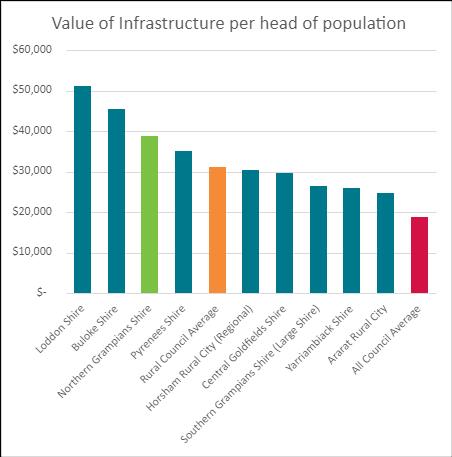
The Nothern Grampians Shire Council has $38,960 worth of assets per population. This is 106% more than the average Victorian Council and 25% more than the average Rural Council. This indicates that Council residents are burdened with a larger asset base than average, and it is not uncommon for rural residents to pay higher rates than their urban counterparts due to this. Roads, Bridges and Major Culverts make up 67% of Council asset base The municipality sits at the top of the catchment of the Wimmera, Richardson, Avon and Avoca Rivers, with rainfall flowing out of the Grampians, Black, Pyrenees and Kara Kara ranges via drains, creeks and rivers. Farmland has been developed amongst the terrain, to meet the needs of the day with roads built to ensure product is moved reliably to and from the farm. This evolution created an extensive road network of over 3,300km of road and over 424 major structures (Bridges & Major Culverts) allowing transport to transverse waterways without delay. While large road networks are not uncommon for rural council’s, the no. of major structures in our road network is unusually high in the Wimmera Southern Mallee region.
Figure 28: 2024 Council asset base comparison
The regions rich history has influenced the very nature of the urban landscape within the municipality The urban layouts have evolved from the original discovery of gold in the mid 1850s to today, establishing roads, dams, civic centres, housing in and around the goldfields. Drainage infrastructure was built following the natural creeks and waterways. Council’s civic buildings make significant architectural, visual and cultural contribution to the townships. Council’s legacy infrastructure proves difficult to manage, limiting capacity and functionality. Council’s Sport and Recreation Strategy found that in terms of infrastructure there is a sufficient number and distribution of sport and active recreation facilities across the shire. There is a general high level of satisfaction with facilities and identified areas for improvement are minor in nature. Sporting facilities have been subject to a ‘once-in-a-generation’ investment over the last 5 years, resulting in significant expenditure in buildings, paths and open space assets. Despite this investment, the service potential for buildings has continued to decrease and generally building assets remain significantly older than the average council, indicating that future investment in buildings may be warranted. Walking remains the most participated in physical activity, safe and comfortable walking and cycling options are known point of improvement for Council, in creating liveable communities.
The estimated total lifecycle cost (be it maintenance, renewal, upgrade or building new) of Council’s asset base over the next ten years is currently estimated to be significantly more than the available budget. With every iteration of the lifecycle cost model, numbers change but what has been the consistent finding is that budget available for maintenance, renewal, upgrades or building new is approximately 60% of predicted budget required to meet the current demands. This is the underpinning issue of council’s unsustainability. Roads and road infrastructure being the largest component of the asset base, makes up 85% of the modelled funding shortfall.
Evidence and benchmarking indicate that infrastructure is largely old but in relatively good condition compared to other councils. Survey results from the last Asset Plan preparation indicates that road infrastructure, doesn’t meet the expectations of community in terms of function and capacity, particularly for the use of heavy vehicles. This indicates that while Council struggle to fund the ongoing demands on infrastructure, thedemand for new and improved assets remains high.
Finally, the inflation in the construction industry is a growing problem. The road and bridge construction industries arecurrently increasing at about twice the rate cap (see Figure 29), meaning that while revenue slowly increases, the delivery on the ground will slowly reduce due the disproportionate increase in costs to revenue. Therefore, council’s ability to maintain current level of service will eventually decline under the current status quo.
The ongoing demands and restriction on the management of infrastructure will ultimately lead to the accelerated deterioration of aging assets. It is important to establish the community essential needs to ensure that assets can attain the best possible outcomes with what the community can afford.
To ensure assets continue to enable liveability and prosperity within the community in the medium to long-term outlook, it is essential toensure operations and maintenance of existing assets remain at sustainable levels whilst monitoring and responding to demand and growth challenges as they occur.
Figure 29: Inflation compared to Rate Capping
Key Strategies and Plans
Drawing on existing strategic plans and documents to prepare the council plan, MHWP, and other key documents, supports data-driven decisions, including insight gained through extensive community consultation. The following documents have either been endorsed by Council or used to guide decision making based on State Government policy.
State and Regional Strategies and Plans
Plan for Victoria (under preparation)
The Plan for Victoria is a proposed state-wide plan aiming to shape the growth and development of the state's cities, suburbs, and regions through to 2050. It aims to address key challenges, such as population growth, housing shortages, environmental sustainability, and infrastructure development.
Plan for Victoria Engagement Portal (Engage Victoria)
Wimmera Southern Mallee Regional Partnership Roadmap
The Wimmera Southern Mallee Regional Partnership Roadmap outlines the long term environmental, economic, social and cultural outcomes for the Wimmera Southern Mallee region. It describes the challenges the region faces in achieving these objectives, the actions being taken, and the measures of success.
Wimmera Southern Mallee Regional Partnership Roadmap
Wimmera Southern Mallee, Regional Economic Development Strategy
The Wimmera Southern Mallee, Regional Economic Development Strategy identifies key strategic directions to drive economic growth for the region, these include:
• Strengthen agriculture and food product manufacturing through diversification.
• Promote growth and development of the visitor economy, leveraging natural assets and Aboriginal heritage.
• Support and expand economic opportunities in growing sectors (health and social services).
• Position the region to benefit from emerging growth opportunities in natural resources.
Regional Economic Development Strategies (REDS) - Regional Development Victoria (rdv.vic.gov.au)
Wimmera Southern Mallee Development - The Housing Blueprint 2022
The Housing Blueprint for Wimmera Southern Mallee outlines strategies to tackle the region's significant housing challenges over the coming years. It focuses on seven key foundations:
• Short-Term Housing: Create more short-term accommodation options for new and seasonal employees.
• Medium Density Housing: Support fit-for-purpose medium-density housing to meet the needs of residents and encourage discussions on changing housing mixes in townships.
• Employment Opportunities: Promote stable and diverse employment opportunities to align with the growing population and skill requirements.
• Attracting Trades & Skill Development: Attract more tradespeople and support skill development in the region.
• Land Availability: Ensure greater access to appropriately zoned residential land and facilitate residential subdivision markets.
• Social & Affordable Housing: Deliver community housing to meet the demand for affordable homes.
• For Profit Housing: Develop housing models attractive to investors for building or purchasing properties within the region.
Wimmera Southern Mallee Development – The Housing Blueprint (wsm.org.au)
Activate Plan 2020-2030 (Central Highlands and Grampians Pyrenees region)
Activate 2020–2030 is a 10-year regional strategic plan designed to foster a coordinated and collaborative effort to boost participation in sport and active recreation, enhancing liveability, health, and wellbeing across the Central Highlands and Grampians Pyrenees region.
Activate Plan 2020-2030 (ngshire.vic.gov.au)
Grampians Region Population Health Plan 2023-2029
The Grampians Region Population Health Plan 2023-2029 is focused on improving the health and wellbeing of communities in the Grampians region. The plan is built on extensive consultations with over 200 community members, health professionals, and organisations to identify local health priorities.
Grampians Region Population Health Plan 2023-2029
Wimmera Sothern Mallee Regional Transport Strategy 2014
The Wimmera Southern Mallee Regional Transport Strategy is an evidence-based strategy which identifies priority transport projects of regional significance and seeks to ensure that the Wimmera Southern Mallee’s transport directions are aligned with state, regional and local policy. The strategy is owned by the Wimmera Southern Mallee councils, comprising of Buloke, Hindmarsh, Horsham, Northern Grampians, West Wimmera and Yarriambiack. It was prepared with assistance and input from State Government authorities.
Wimmera Southern Mallee Regional Transport Strategy 2014
Regional Floodplain Management Strategy
The Victorian Flood Management Strategy sets out policies, accountabilities, and actions. These will help implement the Victorian Government’s response to the Victorian Flood Review and Victorian Parliament Environment and Natural Resources Committee inquiry into Flood Management Infrastructure of the 2010-11 floods. It also clarifies organisational roles and accountabilities to ensure continual improvement in all aspects of floodplain management to ensure Victoria is better protected.
The purpose of the Regional (Wimmera and North Central) Floodplain Management Strategy (FMS) is to provide regional planning documents for floodplain management, and a regional work program to assist with future investment priorities.
The key aim of the regional strategies is for all agencies with flood emergency management functions to align their priorities in an agreed three year rolling regional work plan.
Wimmera Floodplain Management Strategy (wcma.vic.gov.au)
North Central Floodplain Management Strategy (nccma.vic.gov.au)
Grampians Region Climate Adaption Strategy
The Strategy was developed collaboratively over two years by members of Regional Climate Adaptation Groups representing state government, agencies, local government, universities, farmers, business and community in close consultation with key stakeholders throughout the Grampians Region. It is intended that everyone involved can see their own climate adaptation aspirations reflected and efforts across the Region can be better coordinated, leading to improved outcomes for communities and the environment.
Grampians Region Climate Adaption Strategy
Council Strategies and Plans
Council Wide
Overarching Plans
Community Vision 2041
The Northern Grampians Shire Community Vision 2041 outlines the community’s key priorities for the next two decades, guiding strategic planning and future decision making
Community Vision 2041 (ngshire.vic.gov.au)
Economic Development Strategy and Action Plan 2021-31
The Economic Development Strategy and Action Plan 2021-31 outlines the Council’s vision to enhance the region’s economic prosperity and resilience over the next decade. It identifies the region’s key strengths and opportunities, in addition to the challenges that pose a threat to the region’s economic growth. These challenges are workforce and skill shortages, vulnerability to natural disasters and global market events, and investment preparedness, signalling priorities and ensuring investment competitiveness. The benefits of addressing these challenges are defined as the long term objectives, which include; increased productivity and a prosperous future for all, sustained economic growth, and investment in enabling infrastructure. Additionally, the strategy outlines the following ten-year strategic directions:
• To be the rural region of choice.
• To grow the economic capacity and of our own people.
• To develop iconic destinations and healthy environments.
• To be a magnet for innovation and investment.
• To attract investment in enabling infrastructure.
Economic Development Strategy and Action Plan 2021-31 (ngshire.vic.gov.au)
Northern Grampians Planning Scheme
The Northern Grampians Planning Scheme is a statutory document that sets out objectives, policies and provisions relating to the use, development, protection and conservation of land. A planning scheme regulates the use and development of land through planning provisions to achieve those objectives and policies. It applies to all land within Northern Grampians Shire.
Northern Grampians Planning Scheme - Ordinance
Assets, Waste and Community Safety Planning
Asset Plan 2022-32
The Asset Plan 2022-32 recognises the important role public assets have in the day to day functioning of the region’s communities. This Plan establishes a framework on how Council aims to effectively manage its diverse asset portfolio to meet the current and future needs of the shire, while also meeting the objectives set out in the Shire Vision and Council Plan. It also ensures asset management planning is aligned with other key documents like the Council Plan, Financial Plan and the Council budget.
Asset Plan 2022-32 (ngshire.vic.gov.au)
Financial Plan 2021-31
The Financial Plan 2021-31 offers a financial outlook for the next 10 years, detailing what actions Council plan to take, the costs involved, and the funding sources. This provides a roadmap for service provision, maintaining and renewing existing assets, and building new infrastructure. The Financial Plan also provides an outline on how the directions set in the Council Plan can be funded to achieve the Community Vision.
Financial Plan 2021-31 (ngshire.vic.gov.au)
Municipal Emergency Management Plan 2023-26
The Municipal Emergency Management Plan 2023-26 aims to inform emergency services, responsible authorities, organisations and the community on how risks are managed and responded to, and to promote community safety and resilience. The plan details risk-specific response and recovery strategies, identifies potential hazards impacting the municipality, and outlines the roles of organizations in managing emergency situations.
Municipal Emergency Management Plan 2023-26 (ngshire.vic.gov.au)
Sustainable Assets Management Strategy
The Sustainable Assets Management Strategy outlines how Council will manage its infrastructure assets to provide high-quality, sustainable services for the community, businesses, and visitors. The strategy aligns with the Council's long-term financial planning and integrates with the Local Government Act 2020. Key aspects include managing a wide range of assets (roads, footpaths, drainage, parks, etc.), setting service levels, and addressing challenges like ageing infrastructure, financial sustainability, and climate change impacts. The strategy emphasises asset maintenance, renewal, and upgrades, ensuring that assets are managed cost-effectively to support future community needs.
Sustainable Assets Management Strategy (ngshire.vic.gov.au)
Road Management Plan 2021-25
The Road Management Plan 2021-25 outlines the methods and systems for maintaining the council's road and footpath network, ensuring safety, efficiency, and accessibility for the community. It aims to provide information that helps both the Council, and the community understand the value of road assets and the measures in place to manage risks across the road network.
Road Management Plan 2021-25 (ngshire.vic.gov.au)
Rural Road Safety Plan
The Rural Road Safety Plan aims to enhance road safety in the Northern Grampians Shire by addressing key issues such as road conditions, signage, speed management, and specific risk areas like intersections, school zones, and tourist routes. The Rural Road Safety Plan links with the Council Plan through the strategic visions; Enhance Lifestyle and the Community and Provide Sustainable Infrastructure.
Rural Road Safety Plan (ngshire.vic.gov.au)
Tree and Nature Strip Management Plan
The Tree and Nature Strip Management Plan recognises the importance of healthy, attractive streetscapes, and trees has on the urban environment. This plan outlines Council's approach to managing trees and nature strips. Providing guidelines for the effective and sustainable maintenance of street and open space trees, ensuring they offer aesthetic, environmental, and community benefits. The key components of the plan include:
• tree protection and management
• risk identification and mitigation
• tree selection, planting, and removal
• nature strip management
• significant trees register
Tree and Nature Strip Management Plan (ngshire.vic.gov.au)
General Local Law
The General Local Law 2022 is a Local Law made under Division 3 of Part 3 of the Local Government Act 2020 and section 42 of the Domestic Animals Act 1994. Councils use local laws to respond to issues and community needs and complement the council's responsibilities and powers under both state and federal laws. Where appropriate, councils may adopt local laws to protect public health, safety and amenity in a municipality and to govern the use of the Common Seal.
Local laws passed by councils are designed to ensure the actions of an individual or group do not have an adverse impact on the rest of the community and only apply within the municipality in which they are passed.
The Objectives of this Local Law are to provide for –
• the peace, order, and good governance of the municipality;
• a safe and healthy environment so that the community within the municipality can enjoy a quality of life that meets expectations;
• the safe and fair use and enjoyment of municipal places;
• the protection and enhancement of the amenity and environment of the municipality;
• the fair and reasonable enjoyment of private land;
• the protection of assets vested in Council; and
• the uniform and fair administration of this General Local Law 2022.
General Local Law (ngshire.vic.gov.au)
Waste Management Strategy 2020-30
The Waste Management Strategy 2020-30 outlines the strategic direction for Council’s waste management program, aiming to ensure effective delivery. It is informed by the Recycling Victoria Reform and developed in collaboration with partners such as DELWP, Recycling Victoria and Sustainability Victoria. This strategy outlines how Council will work towards achieving these four following goals:
1. Divert 50% of Food Organic and Garden Organic (FOGO) from landfill.
2. Reduce per person waste by 5%.
3. Reduce transfer station general waste by 15%.
4. Increase recyclables by 20%.
Waste Management Strategy 2020-30 (ngshire.vic.gov.au)
Waste Action Plan 2020-30
The Waste Action Plan 2020-30 provides detail about the actions that will be undertaken over the next 10 years to achieve the waste management strategy objectives. Key objectives of this plan are to: improve resource recovery, fostering community-focused waste management, adaptive infrastructure and operations, and sustainable strategic planning.
Waste Action Plan 2020-30 (ngshire.vic.gov.au)
Domestic Animal Management Plan
A Domestic Animal Management Plan (DAMP) is a statutory requirement for all Victorian councils, prescribed by the Domestic Animals Act 1994. It is intended to provide Council with a strategic framework that delivers policy direction and management plan for dogs, cats, and domestic animal businesses.
Domestic Animal Management Plan (ngshire.vic.gov.au)
Municipal Domestic Wastewater Management Plan
Domestic wastewater management is one of the public health functions delegated to local government under the Environment Protection Act 2017. Poorly treated wastewater from onsite systems is a major pollutant, which threatens public health, the environmental value of surface and groundwater, and local amenity. Poorly managed domestic wastewater presents a threat to public health and the environment in addition to the associated economic and legal risks to councils.
The Municipal Domestic Wastewater Management Plan (MDWMP) outlines the management strategies and actions planned by Council to address identified issues with wastewater management across our communities. Municipal Domestic Wastewater Management Plan (ngshire.vic.gov.au)
Prosperity, Health and Wellbeing Plans
Youth Strategy 2024-28
The Youth Strategy 2024-28 recognises that young people are the future of the Northern Grampians community and seeks to empower them by ensuring they have a role in decision-making and that their diverse needs are acknowledged and addressed. This strategy provides a clear plan to support and empower young people in the region, aiming to give them opportunities to have a strong voice and thrive within the community. The strategy is structured around three key themes, each supported by specific objectives and actions. The three themes are; young people are connected and have a voice, young people are safe and well, and young people achieve in education, training, and employment.
Youth Strategy 2024-28 (ngshire.vic.gov.au)
Arts and Culture Strategy 2020-24
The Arts and Culture Strategy 2020-24 recognises the contribution of our creative community and identifies key action areas to expand social, economic and wellbeing outcomes through the development of arts and culture locally. Council recognises that arts and culture enrich communities, assists in the economic development of the shire and helps drive visitation to the region. The Strategy was informed by the Northern Grampians Shire Council Arts and Culture Audit and Opportunities Report 2016, which identified three emergent themes:
• Increase participation in and collaboration of the arts in the Northern Grampians Shire.
• Improve the profile of the arts.
• Capitalise on the unique place where art is created.
Arts and Culture Strategy 2020-24 (ngshire.vic.gov.au)
Northern Grampians Event Strategy 2023-33
The Northern Grampians Event Strategy 2023-33 recognises the part that events play in supporting economic wellbeing and quality of life within our community. The strategy aims to grow tourism by expanding the event calendar and increasing visitor stay. It focuses on offering diverse, high-quality experiences, preserving natural and cultural assets, and providing access to a wide range of attractions, including arts and entertainment. This strategy has been created to deliver on the Council Plan 2021-25 objectives, and the directions and KPIs in the Economic Development Strategy and Action Plan 2021-31.
Northern Grampians Event Strategy 2023-33 (ngshire.vic.gov.au)
Community Resilience Strategy (draft) 2024
The Community Resilience Strategy 2024 recognises that strengthening community resilience requires an integrated approach. This strategy outlines how the Council will collaborate with and support the community to build and enhance resilience. Key objectives of the strategy include:
• Build from previous consultation and feedback on emergency preparedness, response, and recovery
• Develop a shared understanding of community resilience within Council
• Identify opportunities for Council on how to build and strengthen community resilience to adversity, including chronic stresses and acute shocks.
Community Resilience Strategy Draft
Sport and Active Recreation Strategy 2024-34
The Sport and Active Recreation Strategy 2024-34 recognises the significant contribution of sport and active recreation to community wellbeing and outlines key actions to enhance social, economic, and health outcomes across the Northern Grampians Shire. It will be drawn upon as a mechanism to prioritise future development and investment of hard and soft sport, as well as recreation infrastructure across the Shire. This strategy has been developed alongside the complementary Open Space and Active Transport Strategy.
Sport and Active Recreation Strategy 2024-34 (ngshire.vic.gov.au)
Open Space and Active Transport Strategy 2024-34
The Open Space and Active Transport Strategy 2024-34 recognises the importance high-quality open space and active transport provisions have on enhancing the quality of life for both the local community and visitors to the Northern Grampians. This strategy seeks to enhance the quality of life and create a connected community within the Council area by guiding the development and standards for public open spaces and active transport
infrastructure, ensuring they align with the community’s needs. Through this strategy, the following objectives have been established:
• Increase participation opportunities through the provision and activation of open space and active transport infrastructure.
• Improve participation of under-represented groups and improve physical and mental health and wellbeing in communities.
• Support strategic planning to ensure infrastructure investment is sustainable and identified early.
• Ensure efficient and sustainable infrastructure is planned and delivered.
• Consider shared outcomes with five key themes of the NGSC Municipal Health and Wellbeing Strategy Open Space and Active Transport Strategy 2024-34 (ngshire.vic.gov.au)
Northern Grampians Shire Heritage Study 2024
The Heritage Study is an ongoing project that describes the post-settlement history of the Shire through focussing on the contribution of key precincts of high heritage value. The 2024 study comprises the Interim Thematic and Environmental History (April 2024) and the Citations and Statements of Significance for the commercial precincts of Stawell and St Arnaud, along with the St Arnaud Old Civic Precinct. The adoption of the heritage study by Council represents a critical step toward establishing protection measures and clear guidelines for development for the remarkable heritage areas of the Northern Grampians Shire.
The Northern Grampians Shire Heritage Study 2024 (ngshire.vic.gov.au)
Corporate Services Plans
Strategic Workforce Plan 2021-25 and Gender Equality Action
Plan 2021-25
The Strategic Workforce Plan 2021-25 and Gender Equality Action Plan 2021-25 presents the current staffing structure and skill sets within the Council, identifies gaps, and proposes strategies to position the Council effectively to deliver its services. The Gender Equality Action Plan outlines the findings from the Gender Audit and sets out goals to achieve improved gender equity.
Strategic Workforce Plan 2021-25 and Gender Equality Action Plan 2021-25 (ngshire.vic.gov.au)
10 Year Financial Plan Policy
The 10-Year Financial Plan Policy outlines key principles for managing the long-term financial planning outside of the annual budget cycle. It provides a framework for recognising capital and operational projects or service level changes within the 10-year financial plan, allowing projects to be considered throughout the year.
10 Year Financial Plan Policy (ngshire.vic.gov.au)
Revenue and Rating Plan 2021-24
The Local Government Act 2020 requires each Council to prepare a Revenue and Rating Plan (the Plan) to cover a minimum period of four years following each Council election. The purpose of the Revenue and Rating Plan is to determine the most appropriate and affordable revenue and rating approach for Northern Grampians Shire Council which in conjunction with other income sources will adequately finance the objectives in the Council plan.
Revenue and Rating Plan 2021-24
Township and Area Plans
St Arnaud
St Arnaud Community Plan 2020-30
St Arnaud Community Plan 2020-30 outlines activities and actions to guide community-led initiatives, ensuring alignment with the council’s strategic plans. It provides direction for decision-making related to infrastructure, community programs, and service delivery. The key areas of focus include:
• Our Place: Enhancing public spaces such as parks, green spaces, and the streetscape, with a focus on preserving local history and arts.
• Our Community, Services & Facilities: Improving community facilities like health services, educational support, and sporting amenities.
• Our Economy: Supporting local businesses and tourism by fostering economic growth through branding strategies, business networks, and the promotion of local agricultural and tourism assets.
• Our Environment: Promoting sustainability through projects like the St Arnaud Water Harvesting System extension, waste innovation strategies, and supporting local food production.
St Arnaud Community Plan (ngshire.vic.gov.au)
St Arnaud Framework Plan 2023
The St Arnaud Framework Plan 2023 is a key document that provides guidance for the future growth and development of St Arnaud for the next 20-30 years, identifying opportunities and constraints to help shape the town’s future growth in line with the Northern Grampians Shire Community Vision 2041.
St Arnaud Framework Plan (ngshire.vic.gov.au)
St Arnaud Tourism Strategy and Action Plan 2022-32
The St Arnaud Tourism Strategy and Action Plan 2022-32 outlines a roadmap for the next decade, aimed at enhancing the town’s visitor economy and building resilience in the Northern Grampians economy. The strategy focuses on leveraging St Arnaud's rich heritage, artisan culture, and its proximity to nature-based attractions to drive tourism growth. The objectives are to diversify the visitor experience to reduce the impact of park closures, enhance its competitiveness as a destination, foster job growth and visitor spending, and attract private sector investment, all through a coordinated vision for tourism development.
St Arnaud Tourism Strategy and Action Plan 2022-32 (ngshire.vic.gov.au)
Walkers Lake Management Plan and Action Plan
The Walkers Lake Management Plan seeks to offer direction on the future management of the Reserve, this includes a focus on:
• Aiding council to think strategically on the management of the Walkers Lake Reserve over a long period of time.
• Strengthening community engagement through the development of this plan.
• Improving collaboration between key stakeholders to reach agreed objectives; and
• Monitoring and reporting of biodiversity, environmental conditions, and projects through the life of the plan.
Walkers Lake Management Plan 2019-29 (ngshire.vic.gov.au)
Stawell
Stawell Structure Plan (2021)
The Stawell Structure Plan sets out a long-term vision for the township, providing a guide for future planning of the area over the next 20-30 years. This plan outlines key opportunities and directions for future growth.
Stawell Structure Plan (ngshire.vic.gov.au)
North Park Master Plan 2022-32
The North Park Master Plan 2022-32 offers an understanding of the current and future uses of the site in Stawell. This plan has established the following:
• Identified active and passive opportunities, including those linked to Central and Cato Park.
• Identified existing and future capability and design options to ensure sustainable recreation provision.
• Develop a plan to support investment at North Park to transform the current ‘siloed’ infrastructure into an integrated and well-connected precinct for active and passive recreation.
North Park Master Plan 2022-32 (ngshire.vic.gov.au)
Stawell Tourism Strategy and Action Plan 2022-32
Outlines a ten-year vision to strengthen Stawell's visitor economy, positioning the town as a key gateway to the Grampians National Park. The objectives are to diversify the visitor experience to mitigate the impact of park closures, enhance Stawell's competitiveness as a destination, foster job growth and increase visitor spending, while facilitating private sector investment and creating a shared vision for coordinated tourism development.
Stawell Tourism Strategy and Action Plan 2022-32 (ngshire.vic.gov.au)
Great Western
Great Western Memorial Park Masterplan 2024
The Great Western Memorial Park Masterplan 2024 engaged Laimiga Design Studio to prepare a plan to direct the park’s future development. It focuses on the functional design, as well as reflecting the community’s vision. The Masterplan explores opportunities to enhance recreational and sporting activities, while honouring the cultural and historical significance.
Great Western Memorial Park Masterplan (ngshire.vic.gov.au)
The Great Western Future Plan 2014-24
The Great Western Future Plan 2014-24 outlines key initiatives for enhancing Great Western’s social, economic, and tourism development over the next decade, with a focus on preserving its village character, heritage, and natural assets.
Key areas of focus include:
• Tourism and Economic Development: Building on the town’s wine-making heritage, attracting tourism linked to the Grampians National Park, and improving marketing and visitor experiences.
• Gateway and Streetscape Enhancements: Redefining the town's gateways, improving streetscapes, and developing a cohesive village identity.
• Community Assets and Services: Enhancing recreational and community facilities such as the Memorial Park and sports reserves and supporting local services for residents and visitors.
• Living and Lifestyle: Encouraging sustainable residential development within the town’s core to maintain the village atmosphere.
• Governance and Advocacy: Establishing a committee to oversee the implementation of the plan and advocate for the community’s needs.
Great Western Future Plan 2014-24 (ngshire.vic.gov.au)
Halls Gap
Halls Gap Action Plan – Stage One
The Halls Gap Action Plan: Stage One is designed to implement aspects of the Halls Gap Master Plan, focusing on enhancing public amenities, improving pedestrian access, increasing the use of commercial land, and the identification of Grampians Peaks Trailhead location and departure experience. The aims of Stage One are to:
• Collaborate with key stakeholders.
• Develop a vision and strategic plan for the Halls Gap Village Centre.
• Assess current conditions, identify urban design limitations, and explore opportunities for enhancing connectivity between the Village Centre and Grampians Peaks Trailhead, including parking and pedestrian access.
• Provide strategic solutions to address identified constraints and opportunities.
Halls Gap Action Plan – Stage One (ngshire.vic.gov.au)
Marnoo
Marnoo Community Action Plan 2021-25
The Marnoo Community Action Plan 2021-25 sets out activities and actions to guide community-led initiatives, ensuring alignment with the council’s strategic plans. It provides direction for decision-making related to infrastructure, community programs, and service delivery over four years. The actions outlined in this plan aim to encourage families to stay in the area, attract and retain new families, and retain and grow local job opportunities
Marnoo Community Action Plan 2021-25 (ngshire.vic.gov.au)
Navarre
Navarre Community Planning Strategy 2021-25
The Navarre Community Planning Strategy 2021-25 outlines activities and actions to guide community-led initiatives, ensuring alignment with the council’s strategic plans. It provides direction for decision-making related to infrastructure, community programs, and service delivery over four years. It builds on the 2017-21 plan and community feedback, with the themes for the current plan aiming to help the community stay connected and continue to grow the towns vibrancy. Key areas for further development were determined:
• community strengthening
• economy, business and tourism
• infrastructure and facilities
Navarre Community Planning Strategy 2021-25 (ngshire.vic.gov.au)
Stuart Mill
Stuart Mill Community Plan
The Stuart Mill Community Plan outlines ideas and actions to guide community-led initiatives, ensuring alignment with the council’s strategic plans. It provides direction for decision-making related to infrastructure, community programs, and service delivery. The strategies and actions outlined in this plan aim to:
• enhance culture and tourism
• increase or improve recreational opportunities
• upgrade and maintain town facilities
• improve community safety
Stuart Mill Community Plan (ngshire.vic.gov.au)
Appendix
Appendix 1: Council Plan Sections
The following table provides an overview (contents) for the Council Plan to ensure its prepared in accordance with the Local Government Act 2020 The Council Plan will consist of the following contents.
Heading Act Reference Subheading Description
Acknowledgment of Country
Mayor’s message Executive summary. Max 500 works
Introduction to the Councillors Images with name, ward and phone number of each Councillor
• Role of the Council Plan (125-150 words)
About this plan
Introduction
Any other matters prescribed by the regulations27
Regional context28
How the Council Plan fit in with Council’s Strategic Planning29
• How the Council Plan was developed. Describe the process, with a focus on how the community were engaged (200-250 works). Attached a ‘Engagement outcomes report’ as a reference document.
Describe in words and graphics how the Council Plan links and integrates with other documents and the process of preparing the plan, including community engagement.
Draft text
Northern Grampians Shire Community Vision 2041 is ‘To love where we live’.
The Community Vision is a shared hope of how our community see life here in the next 15 years. It's all about what the community want and hope for people living in the Northern Grampians. It serves as a guide for collective action and decision-making to make that vision a reality.
The Council Plan 2025-29 details the overarching four-year goals, the measurable steps that Council take the achieve those goals, approaches, methods, or plans of action that Council will use to achieve its strategic objectives, designed to meet the community vision of Northern Grampians 2041.
The Council Plan is supported by a ten-year Asset Plan and a ten-year Financial Plan. These plans outline the financial and non-financial resources and technical elements required for managing assets to achieve the objectives set out in the Council Plan.
Additionally, the Council Plan provides direction for the four-year Northern Grampians Municipal Public Health and Wellbeing Plan, 2025-29.
Any other matters prescribed by the regulations
The Shire at a glance
Description
Northern Grampians Health and Wellbeing Plan, 2025-29 aims to equip the Council and community with a strategic framework to integrate health and wellbeing priorities into our work. Within the Council Plan, key initiatives linked to Northern Grampians Health and Wellbeing Plan, 2025-29 will be marked with a specific icon.
The Council will collaborate with the community of Northern Grampians Shire to implement the Council Plan 2025-29. Regular updates on progress will be provided to the community through various reporting mechanisms, including the Council’s Annual Report.
The Council Plan will be reviewed annually and adjusted to maintain its relevance, respond to changing circumstances, seize new opportunities, and reflect completed actions.
Socioeconomic Data
• It will encompass a range of elements including income, education, occupation, and social status, all of which contribute to the communities access to resources and opportunities.
• Use sources including the SGS Cities and Regions Index Microsoft Power BI to provide the socio-economic background for our region. Describing the data is intended to provide insight into what is happing in Northern Grampians, compared to other areas. The data will tell a story of risks and benefits of living in Northern Grampians.
• The SGS Cities and Regions Index will highlights what the Council plan should/could focus its interventions on. This section will provide the context to support where council focus its efforts.
• The data may also be used as strategic indicators, and will serves as a baseline for evaluation over the four year period
and
• Identify and address changing circumstances33
• Document review - Research emerging opportunities and challenges facing NGS.
• Summaries Council endorsed strategies and plans
• Summaries key regional plans – e.g. Wimmera Southern Mallee, Regional Economic Development Strategy
GOALS – What council want to achieve in their four-year term - outcome focused.
• The Council Plan goals will be a list of 4-5 outcomes that can be pursued to ‘uplifted our communities economic welling and quality’ (NGS 10-year Economic Development Strategy’) of life so that everyone in our community can ‘love where they live’ (NGS 2040 Community Vision)
• The goals provide a four-year roadmap for what outcomes Council will focus on in their four-year term to achieve the communities long term vision.
• Council’s goals will guide council's strategies and therefore actions and decisions for their four-year council term.
Action Plan
Strategic objectives for achieving the strategic direction35
Strategic indicators for monitoring the achievement of the objectives36 Key Indicators
Express objectives clearly
• An effective Council plan relies on clear goals (same meaning as objectives), and it is important that they are well constructed.
• Express goals (objectives) in a consistent way – and frame them as outcomes.
• Make sure objective are outcomes focused and express what Council broadly want to achieve
• Don’t confuse goals/objectives (the ‘what’), with strategies (the ‘how’)
• Don’t use actions (specific) in place of goals/objectives.
STRATEGIES - HOW Council will deliver on its Goals
• Under each goal, there will be a list of Strategies that describe the ways/how Council will achieve the goal.
• Strategies is the means to the end goal.
• To identify strategies for each goal, ask ‘how’ – what high level action will council take?
• If you think you have a good strategy (high level action), but not sure what goal/objectives its linked to, ask ‘why’
STRATEGIC INDICATORS
Strategic indicators are measurable metrics used to monitor progress towards achieving strategies. These indicators help Council track their performance.
Key aspects to consider when articulating strategic indicators for monitoring the achievement of objectives include:
• Measurable: Quantifiable metrics that provide clear, objective data.
• Relevant: Directly related to the goals and supporting strategies
• Timely: Able to be measured and reported in the four year timeframe that allows for meaningful reporting, analysis and action.
• Actionable: Provide insights that can lead to specific actions or adjustments
• Consistent: Measured in a consistent manner over time to allow for comparison and trend analysis.
1 Local Government Act 2020, Section 98, Annual Report,
1 Local Government Act 2020, Section 18, Role of the Mayor, (d) Monitoring and Reporting
Strategies for achieving the objectives for a Action Plan, DATE
• Dashboards: Utilise business intelligence tools to create dashboards that display real-time data on strategic indicators.
• Regular Reports: Generate weekly, monthly, or quarterly reports summarizing progress towards strategic objectives. Do this by reporting on Action Plan and associated indicators.
• Review Meetings: Conduct regular meetings with key stakeholders to review indicator data and discuss necessary adjustments.
ACTION PLAN - What Council WILL DO to implement the strategy.
• Details annual actions delivered to achieve the goals and associated strategies of the Council Plan
Heading Act Reference Subheading Description
period of at least the next 4 financial years37
A description of the Council's initiatives and priorities for services, infrastructure, and amenity38
• Flexible and Adaptive: They can be adjusted as needed based on changes in the internal or external environment.
• Resource Allocation: Often detail how resources (time, money, personnel) will be allocated and utilised.
Described within the Action Plan ‘Strategies for achieving the objectives’
Supporting information/appendix
Regional, state and national plans and policies are to be considered in strategic planning and decision making39
Strategies and plans
Strategic reference documents