4 When It Was All About The Cattle Railroad expansion threatened farmland in the 1800s
Doug Tibbetts
7 Ellsworth’s John F. Whitcomb
He left his mark on the business scene
Brian Swartz
11 Bangor’s Maine Air Museum
History takes flight
Brian Swartz
14 Bangor’s Margherita Hamm
One of the first female war correspondents
James Nalley
18 Edville Gerhardt Abbott
Pioneer in scoliosis treatment
James Nalley
23 Bar Harbor’s Luere B. Deasy
Preserving Acadia National Park
Brian Swartz
27 Dover-Foxcroft’s Ninetta May Runnals
The women’s advocate at Colby College
James Nalley
31 The Legendary Lombard Log Hauler Innovations in the north woods Charles Francis
36 Patten’s Lore Alford Rogers
Unselfish devotion and untiring loyalty
James Nalley
40 Greenville’s Fred C.N. Parke
Respected taxidermist with famous ties
Sean and Johanna Billings
Publisher Jim Burch
Editor
Dennis Burch
Design & Layout
Liana Merdan
Contributing Writers
Sean and Johanna Billings
Charles Francis
James Nalley
Brian Swartz
Doug Tibbetts
IIt Makes No Never Mind
by James Nalley
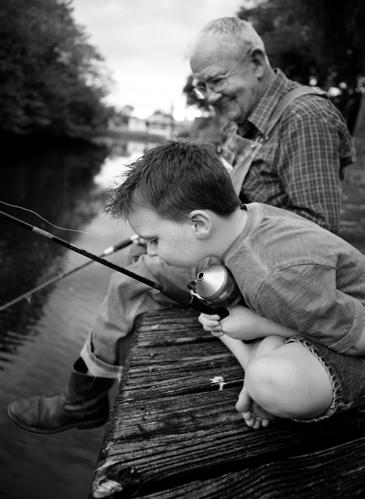
n light of this month’s edition, many outdoor activities come to mind for those who can brave the cold, including snowmobiling, cross-country skiing, and snowshoeing. However, ice fishing is one of the most beloved winter traditions, combining outdoor adventure, camaraderie, and the chance to catch some impressive cold-water fish, all while enjoying the state’s snowy beauty. Here are some facts about this iconic winter tradition.
First, the season typically runs from mid-December through March, with early February as the peak time when ice is thick, fish are active, and community derbies abound across the state. In this case, anglers target a wide range of cold-water species, including brook, brown, and lake trout, salmon, pickerel, pike, perch, and bass. The two main fishing methods are tip-ups, which use a flag system to signal a bite so several lines can be fished at once, and jigging, where a short rod is used to actively move bait through the hole. Many people fish inside heated portable shacks, while others prefer open-air setups with campfires and friends gathered around.
Second, Maine’s lakes offer countless prime spots. In Penobscot County, Pushaw Lake near Orono and Cold Stream Pond in Enfield are popular for salmon and trout, while Piscataquis
County boasts Sebec and Moosehead Lakes, both known for large salmon and lake trout. As for Hancock County, there is Green Lake and Toddy Pond, which provide excellent action for trout and salmon, all with scenic coastal backdrops.
Third, of course, safety is essential on the ice. Always verify thickness: at least four inches for walking; six to eight for snowmobiles; and twelve or more for vehicles. Avoid areas with moving water or visible cracks and carry ice picks and a throw rope. Anglers must hold a valid Maine fishing license (available online or from local vendors). Regulations, such as the number of lines allowed or species limits, vary by lake, so checking current rules with the Maine Department of Inland Fisheries and Wildlife (IFW) is important.
Fourth, winter in Maine brings a festive side to the sport. Dozens of ice-fishing derbies draw families and competitors alike, offering food, prizes, and community fun. Notable events include the Sebec Lake and Schoodic Lake Derbies in Piscataquis County and the Moosehead Lake Togue Derby in Greenville. These gatherings turn the frozen landscape into a social hub, celebrating the resilience and outdoor spirit of Mainers.
Finally, ice fishing in Maine is more
than catching fish. It is about connection. On a clear February morning, when sunlight glints off the frozen lake and a red flag snaps up to signal a bite, you experience both the solitude of the wild and the warmth of shared tradition. Whether you are a first timer drilling your first hole, or a seasoned angler chasing trophy trout, ice fishing captures the essence of a Maine winter: peacefulness, ruggedness, and camaraderie.
On this note, let me close with the following jest: A man gets an opportunity to go ice fishing for the first time. He gets to the river, drills the hole, drops in his line…but has no luck. Meanwhile, another guy upstream is catching fish after fish. “Hey, what’s your secret?” asks the first man. The second man replies, “Mmm mm-mm mmm mmm mmmm mm.” “What was that?” Then, the second man says, “Mmm mm-mm mmm mmm mmmm mm.” The first man walks closer. “Sorry, it’s a bit windy and I still couldn’t hear you. You’re catching fish like crazy…what’s your secret?” The second man cups his hands, puts them to his mouth, spits, and says, “You gotta keep your worms warm!!”
When It Was All About The Cattle
Railroad expansion threatened farmland in the 1800s
by Doug Tibbetts
In 1800s Maine, the most valued possessions for many families were their cattle.
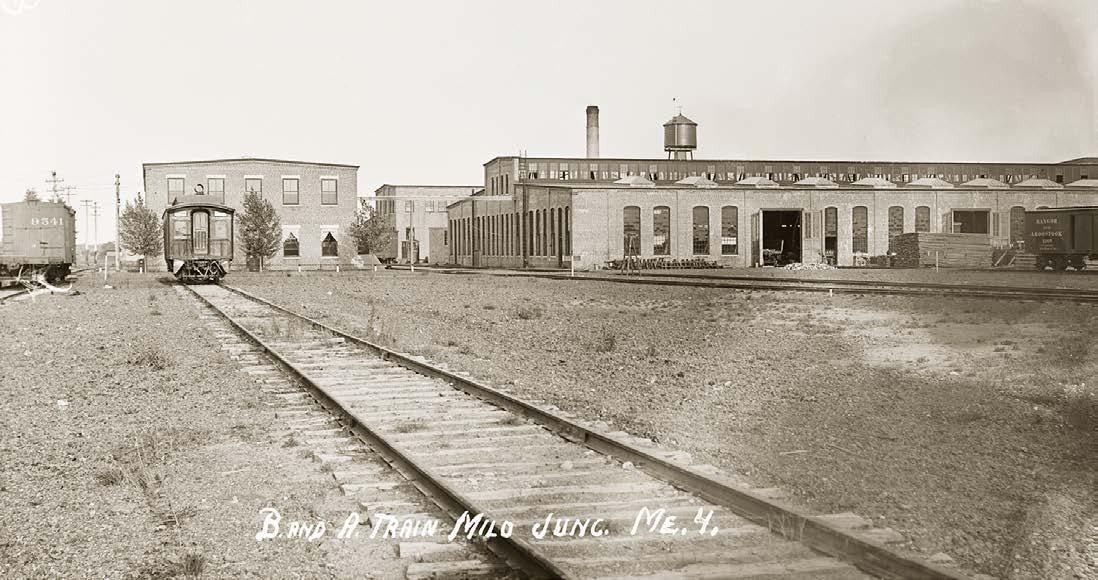
Around the middle of the nineteenth century the railroad was expanding across the state. Nowadays, it is difficult to imagine the excitement that the prospect of having a local railroad stirred in the people of Maine. The railroad would change lives more than anything else, since the Europeans settled into the vast wilderness of Maine. The first railroad constructed in the state was the Bangor, Old Town and Milford under the title of The Bangor and Piscataquis Canal and Railroad Company. It was chartered in 1833, with the line open-
ing from Bangor to Old Town in 1836. That very first line was nothing more than a stagecoach pulled by horses on wooden rails. Later, its first locomotive came from the Stephenson Locomotive Works in England and was called the Pioneer. It weighed 7.5 tons, was 18 feet long and could reach a speed of 12 miles per hour. I would guess that it was delivered by a schooner up the Penobscot River to Bangor and likely in separate pieces.
There were many challenges involved in the herculean task of laying track across the landscape. There would be rivers and streams needing bridges, swamps and hills to navigate through
Anthony V. Bowers,
and around, plus the competition from various areas that wanted the railroad to come directly to their town. Also, easements had to be obtained to cross private property but likely, in most cases, the landowners were agreeable due to the advantage of having a rail line, literally, at their doorstep. However, with the easements there arose an issue for some landowners. The rail line was going to affect the grazing of cattle as some of their land would be cut off from access. As a result of this problem a law was passed by the Maine Legislature that allowed the County Commissioners from their respective counties to require that the railroad must create either a crossing or an underpass for cattle owners to access their pastureland. In later years, as major highways were built, the same problem arose and was addressed in similar ways.
From 1833 to 1900 the construction of rail lines in Maine boomed to around 1400 miles, that included 200 miles of
narrow-gauge tracks in Western Maine. During that time, due to consolidation, Maine Central and Bangor & Aroostook became the major rail lines in Maine. While this was bringing new prosperity and opportunity to many parts of Maine one can only imagine the negotiations that took place regarding the proposed track routes.
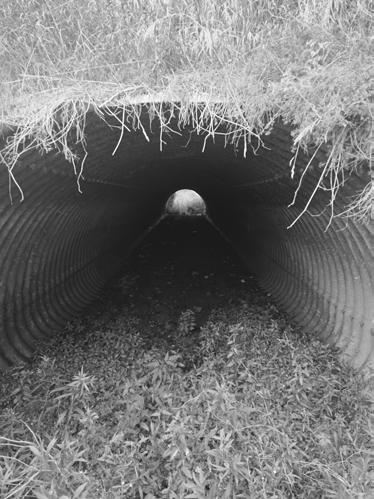
In today’s world we give little notice to these, but back in the day, when Maine was about farming, cattle and logging, access to the opposite side of the tracks was tremendously important and if the railroad was going to keep peace with the local citizenry it had to make concessions and one of these that I find fascinating was the establishment of cow passes. Finding one of these on an active rail line or on an abandoned line is exciting to explore as you can let your imagination re-create how it looked when cattle were traversing back and forth through that little tunnel. I have found a few with one being
just a mile from my residence on active tracks in North Bangor, currently being used by the Canadian Pacific Railroad. The farm that needed this cow pass was once owned by Harold Smith and in later years by Asbury Thomas. The cows are long gone but my neighbor, the late Larry Smith, could remember when it was in use. In reminiscing about this he would always mention that the pass was quite narrow and on rare occasions a cow would enter from opposite ends at the same time but there was not enough room for them to pass each other. As a result, cows being cows, they would just stand looking at each other until someone discovered the problem and got one of them to back up.
The cow passes are all still there, no longer in use except for a very few. They are overgrown with vegetation and hard to find but a reminder of times gone by when it was, “about the cattle”.
Ellsworth’s John F. Whitcomb
by Brian Swartz
When Ellsworth businessman John F. Whitcomb died, the city shut down to mourn him. Born to Eleazer and Abigail Whitcomb on September 1, 1838, Whitcomb apprenticed with his father (a well-known blacksmith) and worked as a blacksmith as war clouds darkened the American horizon. Whitcomb married Madeline G. Haynes on November 29, 1860, and the couple’s first child, Laura Maud, was born in 1861. She died that same year.
Standing 5-10¾, the 24-year-old Whitcomb had blue eyes, brown hair, and a light complexion when he enlisted in the 26th Maine Infantry Regiment on September 10, 1862. One among
many such “nine month” regiments recruited to boost Union troop numbers, the 26th Maine was about as locally created as a military unit could be.
Recruited almost exclusively in Hancock County, the members of the “Ellsworth company” elected Jasper N. Gray, a 27-year-old Ellsworth mechanic (also Whitcomb’s occupation according to his enlistment papers) as their captain and Whitcomb as their first lieutenant. The War Department officially designated the local unit as Co. C, 26th Maine, and off to Louisiana Whitcomb went.
He fought at the battle of Irish Bend on April 14, 1863. Jasper Gray lost one man killed and several wounded in that
bloody fight, but soon caught a “fever” and died at Berwick City on May 10. John Whitcomb immediately took over Co. C; although the War Department never promoted him to captain, he capably led his men during the messy siege of Port Hudson.
The 26th Maine lads left Port Hudson on a steamboat on July 26 and transferred to a train at Cairo, Illinois. They reached Bangor on Sunday, August 9 and mustered out there in mid-August. Whitcomb brought his men home to Ellsworth on August 20. Ellsworth residents organized a grand reception to honor their heroes.
Enduring local dignitaries’ requisite “welcome home” speeches, Whitcomb (cont. on page 8)
(cont. from page 7)
succinctly thanked everyone who had pulled the reception together. Then his men pitched into the food, filled their bellies, and went home; John Whitcomb headed home with Madeline, who probably found her husband much thinner than when she had last seen him in October 1862.
Commanding an infantry company and participating in several battles and skirmishes had apparently honed inherent leadership skills in John Whitcomb. That October he opened an Ellsworth Falls general store and ran it profitably. Developing a sharp eye business-wise, Whitcomb partnered with Charles H. Haynes (a brother-in-law) in May 1865. The men named their new venture Whitcomb & Haynes.
The Grant Administration appointed Whitcomb Ellsworth’s postmaster from 1867 to 1871. A son, Benjamin, was born to the Whitcombs in 1872; he would survive to adulthood. Elected to the Maine Legislature in ’72, John
Whitcomb headed to Augusta knowing that his business was in Haynes’ capable hands.
Buying timberland in Hancock and Washington counties, the company opened lumbering camps from which loggers ventured to cut trees in winter and stack logs on lake and river ice. With spring “ice out,” loggers moved log drives down the major rivers (including the Union River above Ellsworth).
According to the Penobscot Marine Museum, Whitcomb & Haynes ran a sawmill and a barrel-stave factory in Ellsworth Falls. Men loaded bundled barrel staves and lumber onto horsedrawn wagons that transported those products along State Street to the Ellsworth wharves. An Ellsworth newspaper claimed that Whitcomb & Haynes had become the largest barrel-stave manufacturer in Maine by 1900.
The company owned coastal schooners that carried the lumber and staves
to Boston, New York City, and destinations in Canada and the West Indies. Whitcomb & Haynes even owned a tugboat, the Round Top, that towed schooners and other ships up the narrow, winding Union River to Ellsworth.
Whitcomb’s nephew, John O. Whitney, joined the company in November 1875. Becoming Whitcomb, Haynes & Whitney, the company also harvested blueberries and eels and ventured into mining and, by the 1880s or so, became “the largest industry in Ellsworth,” a newspaper reported.
John Whitcomb was active in the Masons and the Ellsworth-based William H.H. Rice Post, Grand Army of the Republic. He was a major presence in Ellsworth and “filled a large place” in the city’s “affairs of business and social life.
“His was, to a marked degree, one of those kindly natures which makes itself felt in any community,” the press reported.
Plagued by ill health the last three years of his life, Whitcomb died on Wednesday afternoon, August 13, 1913. His family held his funeral in their home on Saturday, August 16. With the day being “one of general mourning in Ellsworth, all business places were closed,” the press noted. Philadelphia banker Edward B. Robinette later purchased Whitcomb, Haynes & Whitney, along with its 85,000-plus acres of prime Hancock County timberland, in “one of the biggest transactions ever made” in Hancock County, reported The New York Times. Long familiar with Hancock County from spending summers at his cottages in Eastbrook and Northeast Harbor, Robinette acquired Whitcomb’s company on October 23, 1929, and renamed it the Ellsworth Forest Products Corporation.
Bangor’s Maine Air Museum History takes flight
by Brian Swartz
History takes flight at the Maine Aviation Museum at 98 Maine Avenue, the main artery through Bangor International Airport.
From two helicopters and an aircraft displayed outside to more than 120 displays spread across three large interior rooms; the Maine Air Museum brings to life Maine’s rich aviation history dating back more than 110 years. Visitors “are amazed as to how much there is in relation directly to Maine,” said Don Albert-Ames, the museum’s president. “We’re not (just) an air museum; we’re a Maine air museum.”
The museum was an offshoot of the Maine Aviation Historical Society, started more than 50 years ago by “a
group of individuals that loved aviation and wanted to preserve its history,” said long-time member John Miller, a private pilot.
While meeting monthly at various cities and town around Maine, MAHS members were also “collecting stories, photographs, and aircraft artifacts dealing with Maine’s long flight history for a number of years,” reported the society’s June 1997 newsletter. “In the last two years, we have reached the point where a central location for this collection is clearly needed.”
A committee studied possible sites in Bangor, Sanford, Lewiston, Brunswick, Trenton, and Limestone. Bangor was chosen as the site for a new air
museum that would highlight Maine’s civilian and military aviation history from the 1910s to the modern era.
Negotiations led Bangor municipal officials to offer the MAHS Building 98, a former Air Force air-to-air missile-assembly facility. The city and society signed a lease in summer 1999, and MAHS members immediately undertook the herculean task of converting the 7,000-square-foot building into a modern museum.
“It was basically a sand pit, just a storage building,” recalled Les Shaw, the museum’s vice president. He and other volunteers cleaned up Building 98; painted it inside and out; updated its electrical and plumbing systems; plus (cont. on page 12)
(cont. from page 11)
installed a new furnace, FAA-required fencing, and a new sign. Members created exhibits, and the museum acquired a Bell UH-1H helicopter, a Luscombe 8A high-wing monoplane, a home-built RotorWay Scorpion II helicopter, and a Stinson 10A flown by the Civil Air Patrol.
The Maine Air Museum officially opened to the public on Saturday, June 14, 2003. Today the museum is open 10 a.m. to 4 p.m. on Saturdays and 12 noon to 4 p.m. on Sundays, from Memorial Day to Labor Day weekends. Admission is $10 per adult and free for children and active-duty military personnel and their families.
Located next to the BIA flight line, the museum is readily visible from Maine Avenue. Visitors entering the grounds through an open gate can check out the UH-1H, Luscombe 8A, and RotorWay Scorpion II on static display outside the museum.
Just inside its entrance are the gift shop and main display area, which highlights Maine’s early aviation history. Among other topics, the displays cover the popularity of Old Orchard Beach as a landing strip, float planes and airlines in Maine, Maine game
wardens, and Bangor’s aviation history. There are displays about Belfast native Captain Albert W. Stevens, who made a world-record balloon ascent in November 1935, and Madison native General Robert A. Rushworth, Maine’s first astronaut. Particularly intriguing among
The Pratt & Whitney J57 turbojet engine that once powered a Maine Air National Guard KC-135A Stratotanker is displayed at the Maine Air Museum in Bangor. (Courtesy of the Maine Air Museum)
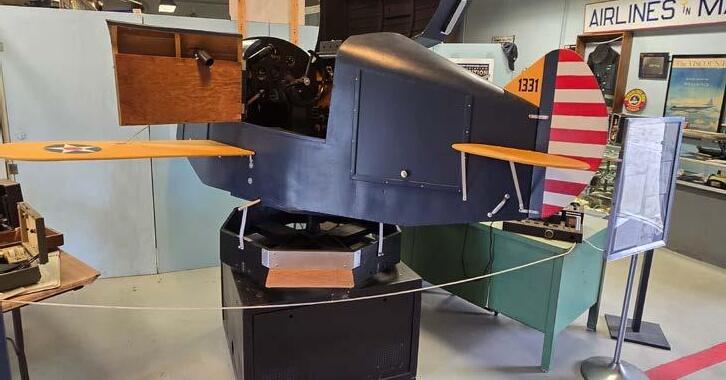
the other displays in this room are a 1920s’ aircraft mechanic’s shop and a World War II-era Link trainer. A door leads to the rear display area, home to the Kids Airport, cockpit simulators, the frame of the Stinson 10-A, and other displays.
Focused on military aviation in Maine, the displays in Bay 1 extensively highlight Brunswick Naval Air Station, Dow Air Force Base, Loring AFB, and Presque Isle AFB. The largest display in this bay is a Pratt & Whitney J57 turbojet engine that once powered a Maine Air Guard KC-135A Stratotanker.
The static displays in Bay 2 include a 1944 International crash truck used at Dow during World War II; aircraft drop tanks, engines and boarding ladders; a B-52 ejection seat; an F-101B Voodoo ejection seat; aviation art; detailed information and maps about military crash sites in Maine; and information about the 1947 fall forest fires that
swept Maine.
Attached to the rear of the museum is “a platform where you can get up above the sight line at the (BIA security) fence so that you can get a good photo” of aircraft taxiing past the museum or landing or taking off at the
airport, said Sarah Littlefield, the museum’s corresponding secretary. Through its well-designed and informative displays, the Maine Air Museum packs a lot of history within its walls. For more information, visit www.maineairmuseum.com
Creative Options is looking for Shared Living Providers for our Adult Foster Care program: We need Shared Living Providers in Penobscot, Piscataquis and Hancock county to provide a home and support to an adult with intellectual disabilities. Shared Living is similar to adult foster care, wherein, you would provide someone with an opportunity to become part of your home and your family while providing them with care and support for their everyday needs. In turn, you will receive a generous, daily, tax-free stipend, paid out bi-weekly, plus training, respite, and room & board from the individual, which covers their rent and food while living with you in your home. Call us today if you are interested in making a difference in someone’s life, as well as your own!
Displayed at the Maine Air Museum in Bangor is a Link Trainer used to train American pilots on instrument flying during World War II. (Courtesy of the Maine Air Museum)
Bangor’s Margherita Hamm
One of the first female war correspondents
by James Nalley
Around the turn of the 20th century, a Canadian-born, Bangor-raised woman moved to New York, where she worked as a freelance reporter for various newspapers. On one assignment, she visited the lavish apartments of more than two dozen Broadway and West End stars. With only a notebook in hand, she shared fine details, such as the choices of wallpaper and curtains, in addition to focusing on the actors themselves. It was this attention to detail that set her apart from her peers. However, unbeknownst to many of her interviewees, she was one of the earliest female war correspondents to cover the fighting from the front lines.
Margherita Arlina Hamm was born in St. Stephen, New Brunswick (Canada), on April 29, 1867. She attended elementary school at the Convent of the Sacred Heart in Carleton, New Brunswick, after which her family moved to Bangor, where her father established a successful lumber business. After graduating from high school, she moved to Boston, with aspirations to become a journalist and reporter. There, she was immediately hired by the Boston Herald for her keen literary and communication skills. However, after several years in the field, she found that there were more opportunities and consistent work as a freelance reporter in
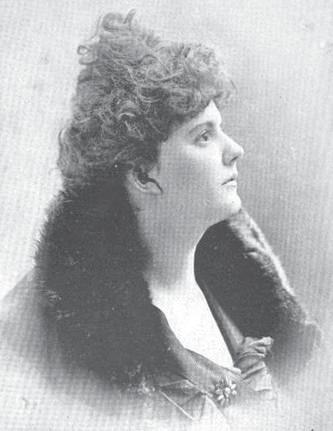
Margherita Hamm in 1893
New York. Thus, in 1890, she moved to the city and took various special assignments from daily newspapers and weekly/monthly magazines.
Over the next three years, Hamm remained busy, traveling throughout the country as a correspondent for several major New York newspapers. She further established her reputation by conducting high-profile interviews with Grover Cleveland (the 22nd and 24th President of the United States) and James Blaine (statesmen and former speaker of the U.S. House of Representatives).
In 1893, Hamm married William Fales, the U.S. vice-consul in Amoy, China, after which the couple traveled throughout Asia. When the First Sino-Japanese War (the conflict between China and Japan over the influence in Korea) broke out in 1894, Hamm and her husband were coincidentally in Korea. According to the book Nota-
ble American Women (1971) by Cutler Andrews, “She used the opportunity to establish herself as a foreign correspondent for New York newspapers. In June 1894, she wrote various reports about the attempted assassination of the Queen of Korea and the attack on the palace of Seoul.” At the same time, she assisted with nursing activities and was even commended by Clara Barton (founder of the American Red Cross).
After the war, Hamm and her husband returned to the United States and settled in Brooklyn, New York, where she remained incredibly busy. For example, she presented a series of lectures in different cities on topics such as “Irrigation in the Far East” and “Chinese Jurisprudence.” She also contributed numerous magazines articles on Asia, eventually becoming the editor of the Journalist (a trade weekly) from 1894 to 1895. Additionally, she was active in the National American Woman (cont. on page 16)
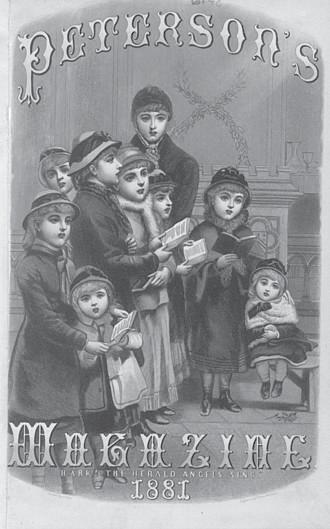
An 1881 cover of Peterson’s Magazine
(cont. from page 15)
Suffrage Association, while serving as the head of the women’s department for both the Evening Mail in New York and Peterson’s Magazine in Philadelphia. Due to her widespread reputation, the Boston Daily Globe published an article titled “If Women Were Members of Congress” (1895) and included her name along with Susan B. Anthony and Elizabeth Cady Stanton.
In April 1898, the Spanish-American War broke out, due to Spain’s brutal suppression of a rebellion that occurred in Cuba. Beginning with the sinking of the USS Maine in Cuba, it resulted in the U.S. acquiring sovereignty over Puerto Rico, Guam, and the Philippines. This war brought an end to almost four centuries of Spanish presence in the Americas, Asia, and the Pacific. Like most Americans, Hamm sympathized with the Cuban uprising against Spain. She then left her job at
the Evening Mail to cover the war. She also volunteered as a nurse for the national guard and was even recognized by the Cuban president Tomas Estrada Palma for her efforts. Meanwhile, she became Chairman of the Women’s Congress of Patriotism and Independence in New York, and followed the troops to Puerto Rico, where she sent back dispatches direct from the front lines.
When the war ended in December 1898, Hamm returned home and continued to write for various publications. Over the next several years, she not only wrote articles about the war and its aftermath, but also published related books, including Manila and the Philippines (1898), America’s New Possessions and Spheres of Influence (1899), and Dewey the Defender: A Life Sketch of America’s Great Admiral (1899). She also traveled abroad for
certain high-profile events. For example, she reported on the coronation of King Edward VII of England in 1901. Eventually, her dedication to work and constant travels took a toll on her marriage, which ended in divorce in 1902. However, according to her biographical article in Wilshire’s Magazine (June 1907), “Her second marriage to fellow journalist John McMahon occurred just two days after the final decree.”
Although Hamm mainly focused on patriotic themes and openly shared her stance as a defender of overseas imperialism/colonialism, she also enjoyed writing about the New York elite, as seen in the books Builders of the Republic (1902), Famous Families of New York (1902), and Eminent Actors in Their Homes (1902). As Mitchell Owens stated in the article “Peek Practitioner” (2025) in World of Interiors magazine, “Hamm trained
as a news correspondent during the First Sino-Japanese War of 1894 and the Spanish-American War of 1898. It gave her an eagle eye, which she applied to the homeowners’ collections.” For example, regarding one collection, Hamm wrote, “The theatrical profession is one which calls for mental rather than physical exercise, and involves study, knowledge, and training. These become matters of habit, so that an actor in vacation time is usually prone to adopt modes of recreation that involve intellectual effort.” She continued, “In this regard, upon viewing rows of dolls in one home, it is understood that a doll may be a lesson in ethnology, history, and the development of costumes.”
Although Hamm had plans to continue writing more books and articles, she became ill in early December 1907 and was admitted to the Women’s Hospital of New York. On December 17, she
died of pneumonia and was survived by her second husband and her four-yearold daughter. She was only 40 years of age. As for her legacy, she has garnered awards from dignitaries and shared her experiences as a journalist in her numerous books and articles. However, she also left a long-lasting impression during her humanitarian services. For instance, according to the Hellraisers Journal (1908): “Her work in Idaho last summer was deeply appreciated by all the friends of Haywood and the working class. She had a magnetic personality that attracted everyone whom she met. Her dauntless stand, her loving spirit, her unquenchable ardor for the cause of social justice are a sufficient monument to her memory.”
coliosis is a medical condition in which a person’s spine includes a sideways curve in an “S” or “C” shape. Mild scoliosis does not typically cause problems, but more severe cases can affect breathing, movement, and life expectancy. Although there are more modern methods of treating this condition today, in 1917, a Hancock-born man created the first effective method using a series of plaster jackets in conjunction with the application of external force. At that time, he was called a “Genius of Orthopedics” by his international colleagues.
Edville Gerhardt Abbott was born in Hancock on November 6, 1871.
The second child of Alonzo and Maria Abbott, he attended public schools in Hancock and went on to East Maine Conference Seminary (a Methodist seminary and preparatory school) in Bucksport, where he graduated in 1889. Unlike most of his classmates, Abbott did not continue his education and worked with his father and brother in the granite business, supervising their quarries on Mt. Desert Island. However, in 1895, Abbott entered medical school at Bowdoin College, which would completely change his life.
Upon graduation in 1898, he was appointed house physician at the Maine General Hospital in Portland, where he
served for one year. In 1899, he studied orthopedic surgery in Boston and New York, after which he spent one year studying orthopedics at the Friedrich-Wilhelms-Universitat in Berlin, Germany. Upon his return to the United States in 1901, Abbott opened an office in Portland to solely focus on orthopedic surgery. During this time, he re-entered Bowdoin College to obtain a Bachelor of Arts degree, after which he received a Master of Arts degree two years later.
As stated earlier, Abbott pioneered a non-surgical treatment for the lateral curvature of the spine (scoliosis). In 1913, he successfully demonstrated
the results of his method at an orthopedic congress in Germany and England, respectively. Called “Abbott’s Method,” this treatment included lateral pulling and counter-pulling on the spinal column by means of wide bandages and pads, until the deformity was over-corrected. Then, a plaster jacket was applied to produce pressure, counter-pressure, and fixation of the spine in its correct position. In 1917, he upgraded his method and created the first effective modern plastic scoliosis brace from celluloid. He also published numerous papers on the subject, including “The Physiological Postures of the Spine and Their Relations to Scoliosis” in The Journal of Bone and Joint Surgery (1917).
Naturally, his international accolade as a “Genius of Orthopedics” earned him some of Maine’s highest positions, including Surgeon-in-Chief at the Children’s Hospital, orthopedic surgeon at the Maine General Hospital, visiting surgeon at St. Barnabas Hospital, con-
sulting surgeon at the Sisters’ Hospital, and instructor in orthopedic surgery at the Maine Medical School, Bowdoin College. Meanwhile, as a staunch Republican, Abbott was extremely active in the political circles. For example, he served as Assistant Secretary of the Maine Association Opposed to Suffrage for Women and was a member of several Greek letter fraternities.
On August 27, 1938, Abbott died in Portland and was subsequently buried at Evergreen Cemetery in the Deering neighborhood of the city. He was 66 years of age. As for his legacy, Abbott, Harold Pingree, and Frank Lamb founded the Children’s Hospital for Crippled Children in 1908. When it closed in 1948, its 56 patients were transferred to Maine General Hospital, which was later renamed the Maine Medical Center. Moreover, although his breakthrough treatment for scoliosis is no longer used, it inspired more modern approaches to bracing such as the Boston brace (a corset-like brace
that fits from the armpits to hips and is custom-made from fiberglass or plastic) and the Milwaukee brace (consisting of a neck ring with a chin pad).
Come experience a timeless railroad journey on board the Downeast Scenic Railroad. Enjoy a ride on restored passenger cars, pulled by a vintage locomotive, on a rail line completed in 1884. Learn about the history of rail travel from a time gone by. Trains depart Saturdays and Sundays from Washington Junction for this excursion of approximately one hour and thirty minutes.
MachiasSavings Bank
Bar Harbor’s Luere B. Deasy
Preserving Acadia National Park
by Brian Swartz
The first lawyer to open a law office in Bar Harbor played a critical role in preserving the heart of future Acadia National Park.
Luere Babson Deasy was born to Captain Daniel and Emma (Moore) Deasy in Prospect Harbor (a Gouldsboro village) on February 8, 1859. After earning an education degree at Eastern State Normal School in Castine in 1881, Luere B. Deasy decided to become a lawyer. Reading law at Hale & Emery in Ellsworth and then graduating from the Boston University Law School in 1883, he passed the Maine bar early the next year.
The January 17, 1884 edition of The Mount Desert Herald contained an ad
announcing that “L. B. Deasy, Esq. has opened a law office in the Hamor Block.” The office was the first in Bar Harbor, the largest village in the town of Eden, home to a growing summer colony. Business developed so quickly that attorney John T. Higgins joined the practice in 1885.
Deasy capably represented residents under pressure to sell homesteads and land to wealthy summerfolk; a Northeast Harbor-related land dispute brought him into contact with Harvard University President Charles W. Eliot for the first time in 1886.
The next year, Deasy and four Hancock County businessmen established the Bar Harbor Banking and
Trust Company, still in operation as Bar Harbor Bank & Trust. The bank served year-round residents and summerfolk alike; Deasy great-grandson and biographer Bill Horner wrote that “although a number of issues divided the two groups, Deasy believed that a community of interests outweighed the differences.” Deasy would serve as the bank’s president from 1893 to 1929.
He and his wife, the former Emma Moore Handy, lived in Bar Harbor with their daughters, Blanche and Inez. Deasy was involved with various local organizations, including the American Red Cross, the Bar Harbor Board of Trade, and the Bar Harbor YMCA. In the latter 19th century, summer(cont. on page 24)
(cont. from page 23)
folk-populated villages like Bar Harbor and Northeast Harbor each had a “village improvement society” dedicated, among other aspects, to improving access to the lakes, ponds, mountains, and valleys that gave Mount Desert Island its beauty. Deasy was active in the Bar Harbor Village Improvement Association (he would serve as its president).
On August 12, 1901, Charles Eliot wrote a letter to George B. Dorr proposing that the local village improvement societies meet and organize “a board of trustees or commission” that could purchase “points of interest on this Island, for the perpetual use of the public.” Out of that meeting held at Eliot’s summer cottage in Northeast Harbor came the high-powered Hancock County Trustees of Public Reservations. Among the organization’s incorporators was Deasy, by then in practice with attorney Albert H. Lynam. Deasy was the second person to sign the August 29,
1901 letter asking a justice of the peace to set in motion the legal wheels to get the HCTPR incorporated.
Serving as the organization’s counsel, Deasy navigated the legal complexities involved in creating a land-preservation group and helping it acquire properties on MDI. He loved the island’s natural beauty; saving it from development became a passion.
Running for the Maine State Senate as a Republican, Deasy won election in 1906 and re-election in 1908. He succeeded Fred J. Allen as the senate president. According to Horner, Deasy considered running for governor, but “chose to return to the Island he loved and his law practice and responsibilities at the bank.”
Deasy remained active with the HCTPR as it acquired land on Mount Desert Island from 1908 onwards. After Congress authorized the Sieur de Monts National Monument in 1916, he
was among the five men who addressed the official opening ceremony held in Bar Harbor on August 22. Crediting Eliot and Dorr for their instrumental roles in creating the national monument (which became Acadia National Park in 1929), Deasy said that “the establishment of this Park guarantees that it will be perpetually open for the use of the public, not as a matter of sufferance but as a matter of right.”
During his legal career, Deasy served as president of the Hancock County Bar and the Maine State Bar. Maine Governor Carl Milliken appointed him to the Maine Supreme Judicial Court. Taking his seat on September 25, 1918, Judge Deasy later served as Maine’s chief justice; he stepped down from the court in February 1930. He died in Bar Harbor at age 81 on March 13, 1940. The state supreme court held a memorial service for him in June 1941.
Ninetta May Runnals
The women’s advocate at Colby College
by James Nalley
In the early 20th century, many of New England’s universities/colleges were not coeducational. Meanwhile, the Board of Trustees at Colby College in Waterville, was seriously considering splitting the institution into a men’s and women’s school. However, the Dean of Women (and an alumna herself) fought against this proposed change, since she knew that coordinate colleges would result in depleted, inferior resources for women. After declaring victory, she went on to make numerous changes, which not only impacted the education and well-being of women at the college,
but also their representation in society as a whole.
Ninetta May “Nettie” Runnals was born on January 14, 1885, in Dover-Foxcroft, where her father, William Runnals, was a machinist in a nearby mill. After attending public schools, Runnals entered Colby College and received a bachelor’s degree in mathematics in 1908. Upon graduation, she was immediately hired to teach mathematics and languages at Foxcroft Academy. She remained in this position until 1911, when she was offered a position as the Dean of Girls at the Maine Cen(cont. on page 28)
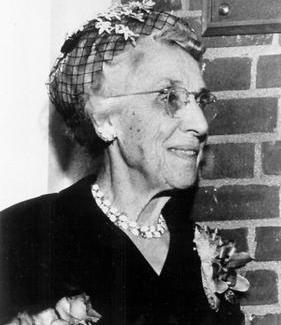
Ninetta May Runnals (Courtesy of Maine Women’s Hall of Fame)
(cont. from page 27)
tral Institute (MCI) in Pittsfield. When Colby College created the position of Dean of Women, Runnals was its first choice. As stated in the article “A People’s History of Colby College: Activism and Social Justice Since 1813” by Samantha Eddy, “President Arthur Roberts sent Runnals a proposal stating: ‘I am writing to inquire if you would be at all interested in the deanship of women here for the coming year and the rest of your life.’” Runnals initially turned down the offer, instead choosing to complete her M.A. degree at Columbia University in 1920. Afterward, and to establish equal footing on the faculty, she told Roberts that she would only accept his offer if it included a full faculty membership and more latitude than the original job description. Roberts agreed to her terms and Runnals became the Dean of Women and Assistant Professor of Mathematics in 1920.
Well aware of the challenges of being a woman at Colby College, Runnals immediately advocated for her female students. According to Anestes Fotiades in the book Colby College, Maine: A Venture of Faith (1994), Runnals pushed for “equal support of the women’s division.” She also opposed the division of Colby College into men’s and women’s campuses, arguing that women would be slighted in terms of the allocation of resources.
Within a year of her arrival, she had eliminated the former health and physical education program for women. In this case, Eddy wrote, this program “primarily consisted of a part-time, low-paid supervisor for gymnastic activities. In its place, Runnals instituted a full-time nurse, equipped a women’s infirmary, and organized the Women’s Health League, all of which were in place by the fall of 1921.” Additionally, she lobbied for equal pay for women at
the faculty level.
In 1926, Runnals became the Dean of Women and Associate Professor of Education at Hillsdale College in Michigan. However, her love of Maine was too strong, and she returned to Colby College just two years later, as Dean of Women and Professor of Mathematics and Education. Without hesitation, she continued to advocate on behalf of her female students. For instance, she led a campaign and successfully raised $100,000 from more than 1,200 alumni, for the purpose of establishing a Women’s Union on the new Mayflower Hill campus (later named Runnals Union in 1959). In 1929, Colby College awarded her an honorary doctorate, recognizing her importance.
In 1938, Runnals became the first female faculty member to be honored by the senior class, dedicating the college yearbook (the Colby Oracle) “in hearty appreciation of her enthusiastic
participation in and cooperation with the academic, administrative, and social life of Colby.” Approximately four years later, Runnals oversaw the plans for women’s dormitories on the Mayflower Hill campus. According to the article “A Brief History of Colby College” (2016) by the Maine Historical Society, she consulted with the staff at other colleges, “comparing measurements of everything, down to closets as needed to accommodate ‘modern party dresses.”
Although she retired in September 1949, Runnals remained active at Colby College, sitting on the Board of Trustees for six years and continuing to focus on campus affairs, especially those regarding gender equality. As for other activities, she established the Waterville branch of the American Association of University Women (AAUW). This was an important achievement for her, since she had been frustrated with
the fact that Colby women were not admitted into this association.
Following a lengthy illness, Runnals died on June 1, 1980. She was 95 years of age. She was subsequently buried in her family’s plot at the Gray Cemetery in Dover-Foxcroft. As for her legacy, the list is extensive. First, Runnals was interviewed for her recollections of growing up in the late 19th century,
her years as a Colby student, and the types of employment available to women in the early 20th century. This was conducted on October 23, 1974, by the Women in Maine Project. The tape and transcript of this interview are housed at the Maine Folklife Center in Orono. Second, the Maine Women’s Hall of Fame was created in 1990 to honor the achievements of women associated with the state of Maine. Naturally, Runnals was inducted in 1992. Finally, in 2014, the Department of Mathematics and Statistics fittingly established the Ninetta Runnals Celebration for Women in Mathematics to honor her and celebrate the contributions of women in the mathematical sciences. Since 2015, the after-dinner speech has been given by a distinguished woman mathematician, speaking on her journey through the field of mathematics.
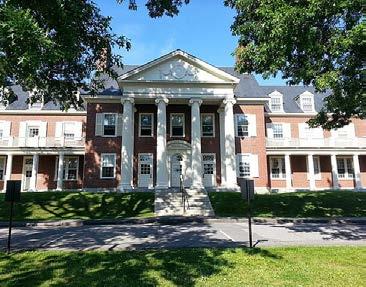
Runnals Hall at Colby College (Courtesy of Nick Kline)
The Legendary Lombard Log Hauler
Innovations in the north woods
Iby Charles Francis
n 1900 Alvin O. Lombard began building a steam-powered log hauler in his machine shop in Waterville. Today that log hauler and the name Lombard are part of the mythos of the great north woods. One story has it that just prior to World War I, British military engineers visited Maine to see a Lombard hauler in action. Out of that visit came the first tanks ever used on the battlefield. Another tale credits the log hauler as providing the inspiration for the snowmobile. Then, too, there are stories about the origin and longevity of the company itself.
Generally, only Alvin Lombard’s name has come down through the years as the driving force behind the legendary Maine company. Yet the Lombard company was in fact a family enterprise. Alvin’s brother Samuel was as much involved in the company as Alvin. In addition, there was a third Lombard, Louis, Samuel’s son. It was Louis who kept the company alive producing farm equipment when trucks supplanted the need for log haulers deep in the north woods in the late 1920s.
Some of the tales involving the Lombard Log Hauler have to do with
how Alvin Lombard acquired the inspiration for his revolutionary vehicle. One story has it that Lombard got the idea from the equally legendary Peavey family of Bangor. As that story goes, the Peaveys, Ira and James, had a prototype log hauler that served as Alvin Lombard’s model. (The prototype was actually demonstrated in the 1890s.) Another has it that Lombard got the idea while working as a millwright for Great Northern in Millinocket. There he met a man named Woodbury who was also working on a prototype log hauler. Lombard’s idea is said to have (cont. on page 32)
(cont. from page 31)
come from a conversation with Woodbury. Still another has it that Lombard met an unnamed lumber company official in Waterville who complained about the expense of using horses and oxen in the woods to haul logs. After hearing the official’s tale of woe, Lombard went to his shop and within a matter of a few days had the first prototype of a working Lombard Log Hauler.
Other stories from the early days of the Lombard Log Hauler involve patent infringements from the equally legendary Caterpillar Company. That tale has Alvin and Samuel Lombard traveling to Stockton, California to try and get royalties from Benjamin Holt, the Caterpillar founder. Holt supposedly admitted to infringing on Lombard’s patents and agreed to pay royalties but never did. One wonders how the Lombard company might have fared if it was getting infusions of capital from that manufacturing giant.
At the time Alvin Lombard came up with his first log hauler, he was already a recognized inventor. He held patents for a machine for barking pulpwood and a governor for water-driven turbines. Therefore, he recognized that a successful log hauler could net a substantial profit for its developer.
Alvin Lombard built the prototype of his log hauler early in 1900. Later that same year the Waterville Iron Works constructed the first functional hauler. In November, Lombard patented it. Lombard’s patent read, in part, as follows: The machine provides “traction in which the engine is supported on two pairs of geared wheels over which runs a track made of lugs belted together in such a manner to make the track flexible and geared to mesh with the wheels. The weight of the engine holds the lugs on the ground. The power is applied to the tracks which, as they turn, move a lug forward and place it on
the ground to extend the track forward. The rear wheels, as they move forward, pick up the last lug off the ground and move it forward. By this arrangement the engine rolls on a track held firmly on the ground or loose snow by its own weight with sections of the track laid down in front of the drive wheels as it moves forward.” This patent marked the founding of the Lombard Traction and Engine Company. It also marked the beginning of the modern era of logging. According to Alvin and Samuel Lombard, it was this patent that Benjamin Holt of the future Caterpillar Company infringed on.
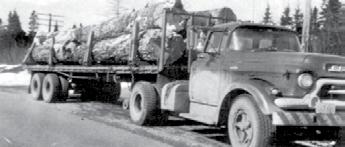
The first Lombard log haulers were steam driven. They could haul a dozen sleds of logs easily if road conditions allowed. The steam-driven haulers required a crew of three men. One was responsible for steering, one fed fuel to the firebox, which kept the pressure up in the boiler, and one acted as a conduc-
tor, to make sure the loads on the sleds were secure.
The first log haulers did not have an enclosed cab. The driver sat in front of the boiler, which kept his backside warm. His front, however, was assailed by wind, snow, and freezing rain, a condition which must have been exceptionally uncomfortable as he couldn’t move around. Driving a hauler required intense concentration as it could veer off course or speed out of control on a downgrade.
One early device used to control a hauler on a downgrade was a trig chain. This was a heavy chain wound around the sled runners so that when the sled started downhill the chain was drawn under the iron runners, cutting into the ground and slowing the sled. Most loggers consider the trig chain the greatest advance in logging safety in the early 1900s. However, there was always the possibility of a chain snapping as it
went over a rock and then flailing about until it hit someone. Moreover, trig chains tore up roads.
In 1909 Louis Lombard joined the Lombard Traction and Engine Company. He was born in Lincoln where his mother Ella (Snow) Lombard had been born and brought up. Louis Lombard’s preparation to join the company included attending Morgan’s Business College. Although the younger Lombard’s major interest was mechanical due to having spent a good deal of time working in his uncle’s machine shop, he brought marketing perspectives with him and ideas on how to modernize the company.
With Louis Lombard’s influence the company would license a plant in Wisconsin to manufacture the log hauler. The company also experimented with other sources of power besides steam. Electricity proved a disaster because power lines shorted out in wet snow.
Gas was somewhat more successful, but gas engines couldn’t haul the loads that steam could. The company then went to diesel, but only produced one diesel hauler. By this time, trucks were making inroads into the north woods and the days of the log hauler were numbered.
In 1927 the company name was changed to the Lombard Tractor and Truck Corporation. At this point Louis Lombard was vice president, and the company concentrated on developing a line of tractors and bulldozers. The tractors proved extremely successful for woods operations, replacing oxen, and found a ready market among farmers. The bulldozers totally changed the face of logging. The largest were so big that they could plow a swath through the woods pushing trees, stumps, and rocks to the side while grading a road at the same time.
The heyday of the Lombard Log (cont. on page 34)
(cont. from page 33)
Hauler lasted almost thirty years, until 1930. The construction of gravel roads through the north woods, like the Golden Road, and the advent of trucks, spelled the end of the hauler. The last vehicles bearing the Lombard name were produced in the 1950s and were intended for small woodlot owners to twitch a single log out of the woods. The few still in existence today are highly valued by their owners. Originally selling for a thousand to twelve hundred dollars, they are now resold for thirty-five hundred dollars or more. Ironically, the company experimented with a passenger snow vehicle. It had skis on the front and a lag traction belt on the rear. It failed to catch on. People simply weren’t ready for a recreational snow vehicle. One wonders, though, how well the Lombard name would be known today had they been.
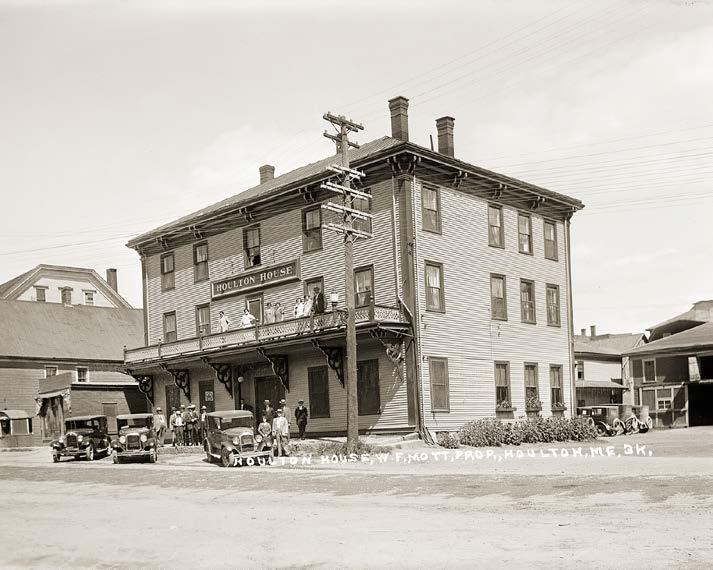
Houlton House, W.F. Mott in Houlton. Item
Illustrating
Patten’s Lore Alford Rogers
Unselfish devotion and untiring loyalty
by James Nalley
In today’s grocery stores, an overwhelming number of dairy products line the shelves, making it difficult to select which product is the best, both in quality and in taste. However, it is important to remember the pioneering work of certain individuals that primarily focused on improving such products for the better good. In this regard, there was an American bacteriologist and dairy scientist from Patten, who not only discovered that butter made from pasteurized sweet cream remained fresher than that made from sour ripened cream, but also refined the steps to manufacture high-quality Swiss and Roquefort cheese for the public. His
work was even adopted by the U.S. Army for vaccines during World War I. Born in Patten on February 7, 1875, Lore Alford Rogers was the second of seven children raised by his lumberman-father and Civil War veteran Lou Rogers and his mother Elizabeth Rogers. According to her unpublished autobiography, she stated, “Lore, though he loved to fish, called for a camera rather than a gun, and I believe a camera and a fishhook have always remained his only weapons. He developed a liking for research, which eventually became his specialty.” After attending Patten Academy, Rogers entered the University of Maine, joined its first football
Lore Alford Rogers in 1922
team, and became a member of the Kappa Sigma fraternity. In 1896, he received his bachelor’s degree in agriculture, with recognition in bacteriology.
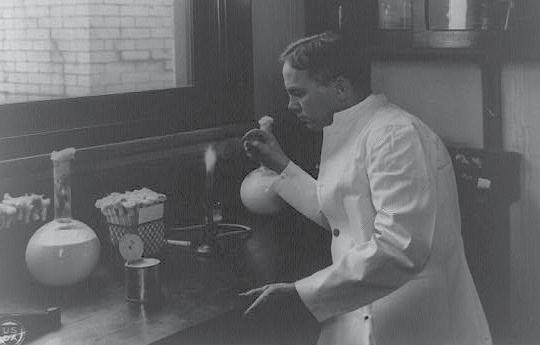
After graduation, he took some time off to work as a clerk and assistant at Ayers and Rogers, his father’s lumbering operation. During that season, he used his photography skills to capture the everyday lives of woodsmen. Within the following year, Rogers pursued his interest in bacteriology and selected the University of Wisconsin, which was the first American school of dairy science in the country. From 1897 to 1898, he studied with renowned bacteriologist H. L. Russell, who furthered research on the pasteurization of milk and demonstrated that canned vegetables could be preserved without harm by simply cooking them within the can, which is still the canning process used today.
In 1899, Rogers accepted a position
as assistant bacteriologist at the New York State Agricultural Experiment Station in Geneva, after which he collaborated on several studies regarding milk and cheese such as “The Efficiency of a Continuous Pasteurizer at Different Temperatures” (1899) and “Note on Some Dairy Troubles” (1900). His work at the experiment station helped him land a government position with the newly formed U.S. Department of Agriculture (USDA) in 1902. Over the next two decades, Rogers was extremely active. First, he set up the first dairy product research laboratory in Washington D.C., where, as stated earlier, he discovered that pasteurized sweet cream butter remained fresher than sour ripened cream. Second, in 1911, he was selected as an official delegate representing the United States at the International Dairy Congress in Stockholm, Sweden. Third, and most importantly, he developed a procedure for preserv-
ing bacterial cultures by removing gas, while in their frozen state. According to the article titled, 125 Maine Alumni Who Have Made a Difference by Maine magazine, “Several years later, the U.S. Army adopted the technique in the preparation of typhoid vaccines during World War I.”
In 1923, after serving approximately two decades as Chief of the Research Laboratories at the USDA, Rogers continued to be active, when others might have contemplated retirement. In this regard, he served as the President of the Society of American Bacteriologists and the Associate Editor of the Journal of Bacteriology, while receiving accolades such as honorary degrees from the University of Maryland and the University of Maine. In the early 1930s, Rogers began focusing on cheese, including refining the steps for the manufacture of high-quality Swiss and Roquefort, the latter of which was new (cont. on page 38)
(cont. from page 37)
to the United States. In the mid-1930s, the Borden Company announced that it would offer cash awards and medals for “meritorious work in science, as it is related to the dairy industry.” Naturally, Rogers was one of the two recipients. As mentioned in the Journal of Dairy Science by R. B. Stoltz, “Rogers was praised for his numerous contributions in the field, noting ‘There is not a branch in our industry that has not felt the helping hand of his genius.’” In his acceptance speech, Rogers modestly stated, “The earlier investigations that seem so simple and obvious in the light of our present knowledge, so easy with the equipment now available, were anything but simple and obvious the first time they were done.”
Finally, in 1942, after more than four decades of service, Rogers retired at the age of 67. By that time, he had had published 86 papers in scientific journals and pioneered many advancements in the field. As not one to rest on his
laurels, Rogers and his wife, Beatrice, returned to Patten, where he opened a successful dairy business. According to the article Pioneers in the Dairy Industry by the Journal of Dairy Science, his venture, the Katahdin Creamery, “grew to such an extent that he opened another milk plant in Caribou. The whole business then became so large that his son, John, a Harvard Law School graduate, gave up his successful law practice to take over the management of the company. Meanwhile, Dr. Rogers continued to make all of the bacterial counts and run the quality control tests at both plants.”
In 1953, following his wife’s death, Rogers proposed the idea of building a museum to honor the history of lumbering in the region, after which a Patten Academy graduate and long-time resident Caleb Scribner joined him as co-founder. In 1963, after a decade of collecting artifacts and photographs as well as making the museum a real-
ity, the Patten Lumbermen’s Museum officially opened. As stated on Lumbermensmuseum.org, “The museum houses some of Maine’s most notable contributions to the early mechanization of logging, including the Lombard Steam Hauler, Lombard Gas Hauler, and the Peavy Cant Dog.” The museum is open on limited days from late-May through mid-October.
In 1974, at the age of 99, Rogers became increasingly impatient about his physical frailty. According to his interview in the Maine Sunday Telegram, he stated the following: “I am so handicapped by my advancing years that I am obliged to spend many days in a comfortable chair before an open fire.” On March 21, 1975, Rogers died at the age of 100 and was buried at the Patten Cemetery.
As for his legacy, perhaps the dedication of the 1928 book titled Fundamentals of Dairy Science by 21 contributing authors stated it the best: “To
Lore Alford Rogers: In recognition of his quarter-century service in the advancement of knowledge, embracing important contributions in pure science as well as its applications to industry; and because he embodies in the highest
degree their ideal of unselfish devotion and untiring loyalty, alike to his work and to his fellow workers—this volume is dedicated, with admiration and affection, by those who have been privileged to serve under his leadership.”
Lore Alford Rogers at the USDA Laboratory
Greenville’s Fred C.N. Parke
Respected taxidermist with famous ties
by Sean and Johanna Billings
The town of Greenville Junction has a connection to author Ernest Hemingway.
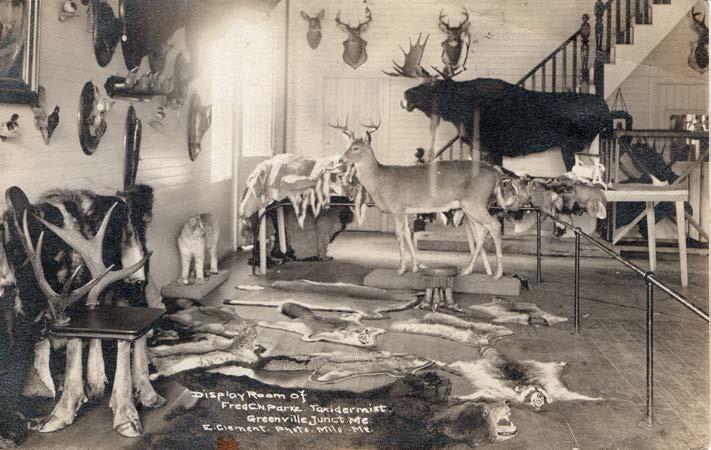
In 1935, taxidermist Fred C.N. Parke mounted a 12-foot marlin which Hemingway had caught. The fish ended up at the L.C. Bates Museum in Hinckley. Although Hemingway’s marlin was probably Parke’s most famous mount, it is not the only one to end up in a museum. A relatively well known and respected taxidermist, Parke lived in Greenville Junction from around 1902 to 1919.
Fred Clinton Nicholas Parke was born on December 12, 1881, in Searsport. A son of Captain Joseph H. Parke
and Eva Clifford Parke, he had four siblings, Ernest M., Arther F., Beatrice Mae and Bernice Mitchell. Unfortunately, both Ernest and Arther died as tots — Ernest at age 2 and Arthur at age 1. Fred’s father died May 15, 1901, after becoming ill while captaining the Thomas A. Goddard out of Portland. The ship was a bark, which is the name given to a sailing vessel with three or more masts.
About a year before his father died, Parke managed to get himself counted twice in the 1900 census. He appears in the counts for Bangor, taken on June 4 that year, and was listed as boarder in the home of Fanny Richards on French
Street. As expected, his occupation was listed as taxidermist. Two days later, on June 6, he managed to be counted again in Searsport, where his parents lived. Once again, his occupation was listed as a taxidermist.
Around 1902, Fred moved to Greenville Junction and started a taxidermy store. He may have done so to secure a greater share of the taxidermy market by being closer to the area’s hunting camps. On June 15, 1904, he married Sadie Ella Eastman of East Exeter. The marriage license lists Fred’s residence as Greenville Junction. Records show Sadie was born August 14, 1878 in Exeter, to Charles Hammond Eastman and
Arianna Andrews Eastman. Fred’s mother and sisters followed him to Greenville and put down roots. On July 17, 1907, his sister Beatrice married Blaine Potter of Greenville. On March 6, 1910, his sister Bernice mar-
ried George Washington McEachern of Greenville. His mother married Amos H. Walker of Greenville on December 16, 1909.
The 1910 census for Greenville shows Fred, 28, living on West Street in (cont. on page 42)
(cont. from page 41)
Greenville with his wife, Sadie, 30, and their child, Doris, who had been born in Greenville on September 29, 1908.
Fred and Sadie eventually had five children. In addition to Doris were Frances T., born in Exeter on November 4, 1910; Eva Arianna, born in Greenville on September 3, 1912; Frederick Clinton Nicholas Jr., born in Greenville on April 28, 1914, and Clifford Hammond born in Bangor on May 16, 1920.
The 1920 census for Bangor, taken on January 9, 1920, shows Fred, 38, was living at 130 West Broadway with Sadie, 40; Doris, 11; Frances, 9; Frederick Jr., 5; and Fred’s mother, Eva, 66. Shortly after the census was taken, on Feb. 7 of the same year, Fred and Sadie’s oldest son, Frederick Jr., died from typhoid. Their second son, Clifford, was born that spring, on May 16, 1920.
The 1930 census for Bangor indicates the household included Fred, 47;
Sometime between 1930 and 1935, Fred, Sadie and Clifford moved to Florida. The 1935 census for Palm Beach County in Florida indicates taxidermist Fred C.N. Parke, 54, was living at 315 Mango Promenade with his wife Sadie, 56, and son, Clifford, 14. It was during this time in Florida that he mounted Hemingway’s marlin.
In 1940, the census for West Palm Beach, Florida, shows Fred at age 58 living with Sadie, 60, and Clifford, 19. Both Fred and Clifford are listed as being taxidermists.
Around 1946, Fred and Sadie moved back to Maine and purchased a house in Bangor. Sadie died August 3, 1947, and Fred died April 13, 1968. Both are buried in the Mount Hope Cemetery in Bangor.