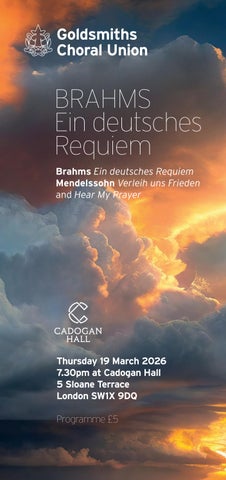
Brahms Requiem Programme

Page 1


Brahms Ein deutsches Requiem Mendelssohn Verleih uns Frieden and Hear My Prayer

Thursday 19 March 2026

7.30pm at Cadogan Hall

5 Sloane Terrace

London SW1X 9DQ

Programme £5

Goldsmiths Choral Union is one of London’s leading choirs, giving quality performances of great choral works and contemporary music in London’s major venues, and rehearsing in central London.

Goldsmiths Choral Union has brought the finest classical music to London since 1932. We’re a friendly choir with around 100 members, based in South Kensington. GCU promotes at least four concerts a year with professional soloists and orchestras and joins together with other choirs for special events.

GCU’s performances of works from the traditional choral repertoire, ranging from Handel’s Messiah, Haydn’s The Creation and Bach’s B Minor Mass to Elgar’s The Dream of Gerontius, have been praised for their freshness, clarity and emotional commitment.

Equally, GCU has performed less familiar works, such as Franz Liszt’s oratorio Christus and Sir Michael Tippett’s The Mask of Time. British premieres given over the years include Stravinsky’s Les Noces and Mahler’s Das Klagende Lied, and the first UK broadcast of Carl Orff’s Carmina Burana.

Founded in South London by Frederick Haggis at Goldsmiths College, University of London, at the outbreak of World War II the college was evacuated, but while other choirs disbanded, GCU continued to rehearse and perform in central London. Since then we have built up an enviable reputation, first under the baton of Frederick Haggis, later under Brian Wright and, since 2022, with Jack Apperley.

Patrons: Simon Halsey CBE, Neil Jenkins, The Worshipful Company of Goldsmiths

Music Director: Jack Apperley

Accompanist: Stephen Jones

Please see the back cover for future Goldsmiths Choral Union concert dates.

This concert brings together two great romantic German composers, Mendelssohn and Brahms. The works are both rousing and comforting in nature, two Mendelssohn favourites and the very well-loved Ein deutsches Requiem, which Brahms referred to as a ‘human requiem’, written to console the living and explore grief in its many forms, rather than to accompany the dead.

BRAHMS Ein deutsches Requiem

Mendelssohn Verleih uns

Frieden & Hear my Prayer

Brahms Ein deutsches

Requiem

Jack Apperley Conductor

April Fredrick Soprano

Alex Ashworth Baritone

Goldsmiths Choral Union

London Mozart Players

Jack Apperley Conductor

Originally from Stourbridge, Jack grew up playing the piano and the viola, and singing. After studying at the University of Birmingham under Simon Halsey CBE, he then completed his Masters at the Royal Academy of Music with Professor Patrick Russill, graduating with distinction, and winning the Sir Thomas Armstrong Leadership Prize. In 2025 he was made an Associate of the Royal Academy of Music.

As the Associate Chorus Director of the London Symphony Chorus, Assistant Conductor of the NFM Choir in Wroclaw, Music Director of Goldsmiths Choral Union and Concordia Voices, and Conductor of Epsom Chamber Choir, Jack has established a reputation for thorough rehearsals filled with energy, humour and precision, as well as compelling concerts, championing new works alongside classical mainstays.

He is increasingly in demand as a choral director both in the UK and abroad. Recently, Jack has worked with the London Symphony Chorus, the City of Birmingham Symphony Chorus, BBC Symphony Chorus, Brighton Festival Chorus, University of Birmingham Voices and Royal College of Music Chorus. He has been engaged by some of the best choirs in Europe including le Choeur de Radio France, Gothenburg Symphony Chorus and Vocal Ensemble, and the Hungarian National Choir.

Jack is a prize-winner in several choral conducting competitions in Hong Kong, Latvia, Slovenia and London. He has also participated in several masterclasses with the BBC Singers, Berliner Rundfunkchor, Stuttgart Kammerchor, Hungarian National Choir and St Jacob’s Kammerchor.

April Fredrick Soprano

Hailed as ‘astonishing and luminous’ (Bachtracks), soprano April Fredrick loves words and stories and the way that they fire composers’ imaginations and the audience’s imagination in turn, connecting us with those who have come before. She is a frequent soloist with orchestras across the UK and a champion of new work on both the concert and opera stage.

She is an Associate Artist with the English Symphony Orchestra and frequent soloist with the Nottingham Harmonic Choir, treasuring both the deeper connection and level of music-making that frequent collaboration allows. Recent work includes the soprano solos in new recordings of Grace Williams’ Missa Cambrensis with the BBC National Orchestra of Wales under Adrian Partington and Donald Fraser’s Ancient Chinese Lyrics with the English Chamber Orchestra, Mendelssohn’s Elijah with the Nottingham Harmonic Choir, Britten’s vibrant Les Illuminations with the Academy of St Thomas under Philip Ellis, Strauss’ Four Last Songs and Kurt Weill cabaret songs with the ESO, and Mahler’s monumental Symphony No. 8 with the Bach Choir and the Philharmonia Orchestra under David Hill at St Paul’s Cathedral.

Upcoming work includes This Fragile Beauty, a multi-media concert with narrator for the Elgar Festival exploring the effect of World War I on that generation of composers, Mahler’s version of Beethoven’s Symphony no. 9 with the Colorado MahlerFest, Vaughan Williams’ Dona Nobis Pacem and Golijov’s How Slow the Wind with the Leicester Bach Choir, and the world premiere of a new work by Carl Rütti with the Nottingham Harmonic Choir.

Alex Ashworth Baritone

Alex Ashworth is a concert and opera singer working across Europe and the United Kingdom. He began singing at Lichfield Cathedral, continued as a choral scholar at St John’s College, Cambridge, and then studied at the Royal Academy of Music in London. In the quarter-century since leaving the RAM, Alex has sung opera, concert, and recital in many of the world’s leading venues.

His recordings include Œdipus Rex, Stravinsky, with the London Symphony Orchestra, Monteverdi’s Vespers with both the Orchestra of the Age of Enlightenment and the Monteverdi Choir, Bach’s Mass in B Minor, St Matthew Passion and St John Passion for Sir John Eliot Gardiner and the English Baroque Soloists, and Bach’s Magnificat with Solomon’s Knot (“if one could bottle gravitas, this would be it” - Gramophone Magazine).

Recent performance highlights include the New Year’s Eve concert of Beethoven’s Symphony No. 9 in Zürich’s Tonhalle, Bach’s Mass in B Minor and Handel’s L’allegro, Il peneroso ed il Moderato at New York’s Carnegie Hall. (“Ashworth was buttery in the Bach, commanding in the Handel” - New York Times), and the role of Haman in Handel’s Esther at London’s Wigmore Hall (“sterling singing”The Times).

Future performances include Bach’s solo cantata for bass, Ich will den Kreuzstab, in Leipzig and Versailles, his Mass in B Minor in Antwerp, Leipzig, Hong Kong and Seoul, and a tour of Asia in his St Matthew Passion with the Leipzig Gewandhaus Orchestra and Thomanerchor. Alex lives in East London with his wife and four children.

London Mozart Players

London Mozart Players are the oldest, freshest and most adventurous chamber orchestra in the UK. Set up over 75 years ago by Harry Blech to perform the works of Mozart and Haydn, LMP’s mission has evolved into creating bold, ambitious and accessible musical experiences for all. LMP are proud to be at the forefront of embedding arts and culture into the life of communities across the UK and beyond, performing both new works and music that stays true to their roots.

LMP work with schools and music hubs around the UK and beyond to inspire the next generation of musicians and music lovers. They’re continuing their long tradition of promoting young talent: Nicola Benedetti, Jacqueline du Pré and Yan Pascal Tortelier are just three of many young musical virtuosi championed early in their careers by them.

LMP are based at Fairfield Halls in Croydon and have residencies at St John’s, Upper Norwood, Thaxted Festival and Grayshott Concerts. Jonathan Bloxham has served as their Principal Conductor and Artistic Advisor since July 2025. Ruth Rogers is the Leader of the orchestra. Collaborating with many of the world’s greatest soloists and conductors, LMP’s work is made in Croydon and celebrated across the globe.

Photo credit: Kaupo Kikkas

Goldsmiths Choral Union

POETRY IN MOTION

Ola Gjeilo: The Rose

George Shearing: Songs and Sonnets

Martin Palmeri: Misatango

Poetry in motion brings together choral works that blend poetry, rhythm and melody in unexpected ways. From Gjeilo’s The Rose, which shimmers with luminous harmonies, to Shearing’s Songs & Sonnets setting Shakespeare’s words in a joyful jazz-infused style, to the electrifying Misatango, where the traditional Latin Mass meets the passion and pulse of Argentine tango. A vibrant, uplifting evening not to be missed!

Tuesday 16 June 2026

7.30pm at Holy Trinity Sloane Square, 146 Sloane Street, London, SW1X 9BZ

Tickets available from choir members, ordered from tickets.gcu@gmail.com or via Eventbrite (booking fees apply)

Introduction

Whilst at university, I first sang Ein deutsches Requiem with the CBSO Chorus, and my understanding and love of the piece has deepened over the years with every subsequent performance. For me, it is music without any full stops - just questions with immeasurable, unquantifiable answers. From the choir, a performance requires great vocal discipline and stamina, whilst also demanding an emotional maturity and clarity to transmit the meaning of Brahms’ text to an audience. Since taking over as Music Director of GCU, this is the piece I most wanted to perform with them, and joining with the London Mozart Players it is my privilege tonight to be able to conduct this work for the first time.

Mendelssohn’s Hear my Prayer paints a turbulent picture of the soul’s journey, and its inclusion in this programme enables us to hear more from our soprano soloist, April Fredrick, who interacts with the chorus and orchestra throughout. The orchestration we are using this evening was written by Mendelssohn, but he died before he heard it performed.

Together with Mendelssohn’s Verleih uns Frieden (Grant us peace), these works have in common a search for rest and shelter from the mental and physical challenges in the world, and I hope that performers and listeners, alike, will be uplifted and find solace in the music.

Felix Mendelssohn 1809 - 1847

Verleih uns Frieden (1831)

Hear my Prayer (1844)

Mendelssohn was born in Hamburg, where his father Abraham had become a powerful banking presence. When he was three, the family moved to Berlin. He was encouraged throughout his life by his parents, who had the money and ambition for their gifted child to flourish. His mother Leah was an established artist, and could read Latin and speak French, German and Italian. Felix and his older sister, Fanny, were exceptionally talented, studying violin, piano, languages and drawing from an early age. When Fanny was born her mother looked at the baby’s hands and declared ‘Bach fugue fingers!’ Abraham and Leah decided to convert the family from the Jewish faith to Protestantism - a pragmatic step, for many paths in the musical world were closed to Jews.

By the age of nine, Mendelssohn was playing the piano in public. By twelve, he had composed several string symphonies, two operas, fugues for string quartet and other works. He knew and could play all nine Beethoven symphonies by heart. It was said he could hear a piece of music once and never forget it.

An astonishing prodigy, he wrote mature chamber music at 16 (The String Octet) and at 17, The Overture to A Midsummer Night’s Dream. Even though still an adolescent, his adult graceful ‘voice’ - light, poetic fantasy, fairy touches - was a delight to his audiences.

The Mendelssohns moved in 1825 to a palatial mansion in Berlin of 40 rooms set in seven acres of parkland. The garden house seated 200-300 people, where Sunday morning concerts were held, with an orchestra engaged by his parents, and all four children playing instruments or singing, for a distinguished and influential group of visitors. Other composers and poets experienced Mendelssohn at the piano or conducting, trying out his new compositions. He developed into a flawless technician.

At the age of 20 while studying at Berlin University, he conducted a performance of Bach’s St. Matthew Passion at the Berlin Singakademie and decided upon a chorus of 400 singers and a greatly augmented orchestra, cutting some sections of the work and ‘improving’ others. It was the first time it had been performed in public since Bach’s death in 1750 (it is said that 1,000 people had to be turned away) and it led to a general revival of interest in Bach’s music.

At Mendelssohn’s first (of many) visits to Britain, he gave the first English performance of Beethoven’s ‘Emperor’ Concerto. From London he travelled to Scotland, a visit during which he met Sir Walter Scott, and which inspired him to write Fingal’s Cave (Hebrides) Overture and the ‘Scottish’ Symphony.

Like all wealthy young men, in May 1830 Mendelssohn embarked on the Grand Tour of Europe which lasted three years. In Paris he met Liszt, Chopin, and Berlioz. Of the six countries visited, Italy impressed him the most, giving rise to one of his most popular works, the Italian Symphony. Whilst staying in Rome, Mendelssohn composed Verleih uns Frieden inspired by a desire for peace. It was published posthumously.

After a brief spell as music director of the Lower Rhine Festival in Düsseldorf, in 1835 Mendelssohn was made conductor of the prestigious Leipzig Gewandhaus Orchestra. Over the next five years he turned the orchestra into the world’s finest. His care over preparation and interpretation proved to be a turning point in the evolution of conducting, and he was one of the earliest conductors to use a baton.

Mendelssohn was a most eligible bachelor, a handsome, highspirited young man, with an aristocratic bearing, high forehead and curly black hair. In Leipzig he met and fell in love with Cécile Jeanrenaud, the 17-year-old daughter of a French Protestant clergyman. They married in 1837 (his sister Fanny could hardly conceal her jealousy and neither she nor their mother Leah attended the wedding). It was a happy marriage and the couple went on to have five children.

In 1843 Mendelssohn fulfilled a long-held ambition by founding a new conservatory of music in Leipzig, a project in which he was assisted by Robert and Clara Schumann. All this time he had been working at a furious pace, composing, conducting, teaching, giving concerts and raising a family. His health began to decline, and he suffered headaches and recurrent bouts of abnormal fatigue.

Mendelssohn composed Hear my Prayer (Hör’ mein Bitten) in 1844, and the first performance was sung in English in London, being remembered specially for the soprano or treble solo ‘O for the Wings of a Dove’.

In August 1846 he visited Birmingham for the triumphant premiere of his oratorio Elijah. He returned to England the following year to conduct four performances in London, one in Birmingham and another in Manchester. It was in May 1847 that he received news that his beloved sister Fanny had died from a stroke whilst rehearsing one of his works. Fanny’s loss had a devastating effect on him, causing him to faint and rupturing a blood vessel in the brain. On doctors’ advice, Mendelssohn moved his entire family to Switzerland in an attempt to stabilise his physical and mental health. Suffering terrible depressions and agonising pain, he returned to Leipzig in late September, determined to retire from public life and concentrate on composing. But he never recovered and died in November at the age of 38.

Following a massive funeral service in Berlin, Mendelssohn was laid to rest in the family plot next to his sister, Memorial services were held not only in most of the major cities of Germany but also in London, Manchester, Birmingham and Paris.

SUMMER SINGS 2026

Come and sing with us. All are welcome!

Two enjoyable evenings conducted by our Music Director, Jack Apperley at Queen’s Gate House in London.

Wednesday 1 JULY 2026

HAYDN: The Creation

Wednesday 8 JULY 2026

MOZART: Requiem (Süssmayr version, Novello, Peters or Barenreiter editions)

Tickets available from choir members or via Eventbrite (booking fees apply)

Johannes Brahms 1833 - 1897

Ein deutsches Requiem (1865 - 1868)

The port of Hamburg in northern Germany was the birthplace of ‘Hannes’, the middle child of jobbing musician Johann Jakob and his wife Christiane - seventeen years his senior. The family’s poverty required the ten year old Brahms to play piano in the bars and brothels of the Animierlokale district. A voracious reader but easily bored, he often set a book on the music stand to read whilst playing the old German dance tunes from memory. The Singing Girls of the brothels poured drink down the throat of this fair-haired, blue-eyed, rather feminine young boy. He later recounted how ‘these half-clad girls would try to drive the visiting sailors even wilder, so they used to take me on their laps between dances, kiss, caress and excite me. That was my first impression of the love of women’. Perhaps these youthful experiences explain why Brahms, who loved women to excess, never married, prefering to pay for uncomplicated, uncommitted relationships.

Even as a boy, he would walk with head thrust forwards, his hands clasped behind him, humming to himself. Often shy and antisocial, he could be harsh, unpredictable and abrasive with close friends. He loved the music of Bach, Beethoven, Handel and Haydn, the folk songs and dances of his native land, and gypsy music. With piano lessons and some basic composing directives from his teacher Eduard Marxsen, who gave him a heavy diet of Bach, Brahms began writing music.

Living with his family, he led an aimless existence, teaching piano, composing simple pieces, giving the occasional virtuoso piano performance - although he never regarded his ability to match the heights of a truly great performer. He met and became close (life-long) friends with the supremely talented young violinist, Joseph Joachim. It was at Joachim’s urging that the young Brahms made a short detour on a walking holiday to present himself in Düsseldorf to ring the doorbell of the house of Robert and Clara Schumann.

A great friendship developed between Brahms and the Schumann family. Robert pronounced Brahms a genius, calling him ‘a young eagle’ and introduced him to the publisher Breitkopf & Härtel who published his early works. The Schumanns insisted the young man move into their house where most days the three musicians played and created music. Clara, a virtuoso pianist and composer in her own right, became a muse and inspiration for Brahms. As Robert’s mental health deteriorated, which included a foiled suicide attempt when he flung himself into the River Rhine, Brahms was a great support to Clara and the seven young children. The handsome blond youth with piercing blue eyes would always be in the house, working at the piano or reading in the library or playing with the children - he was made godfather to baby Felix and taught the older ones to somersault. Clara needed him; he had no money,

no career and no public. He idolised Clara - the greatest female musician he ever knew. He was at her side after Robert died in 1856, but shortly afterwards returned to Hamburg unable to resolve his feelings. As Jan Swafford states in his biography Johannes Brahms, ‘Their lives together and apart would be mingled in a creative and spiritual communion of a high order, and at the same time in a continual swing between mutual affection and mutual torture.’

He attempted to re-start his piano-playing career in chamber and orchestral concerts, frequenting second-hand bookshops, ferreting out old scores and theoretical works on fugue and double counterpoint, smoking one cigar after another. He exchanged letters and compositions regularly with both Joachim and Clara for their comments. Both Brahms and Clara plus the children were invited in the summer of 1858 by their friend Julius Grimm to Göttingen, where Julius was the conductor of the Cäcelienverein and associated women’s chorus. An enchanted time of singing, composing, having fun in a young sociable group his own age, Brahms found himself a girlfriendAgathe von Siebold. She had long dark hair, was intelligent and funny, with a soprano voice like an Amati violin, and Brahms had fun composing songs for her. One day he stepped behind some bushes to embrace her and was seen by Clara, who packed up her family and left Göttingen the next day. A few weeks later the young couple became engaged.

In January 1859 Brahms went to play in the premiere of his Piano Concerto No. 1 in Hanover – neither a success nor a disaster – followed by a second performance in the Gewandhaus in Leipzig. Too many minor keys, too long, too tragic, as unMendelssohn as possible, and he was hissed off the stage. After this fiasco, Brahms worried how he would be able to support a family on his earnings without compromises that threatened his work. He wrote to Agathe saying ‘I love you! I must see you again! But I cannot wear fetters!’. She wrote back to him returning his ring and never saw him again.

In 1864 Brahms was living in Vienna when his mother, Christiane, died aged 76. His old singing teacher Gänsbacher visited him and found Brahms seated at his piano playing Bach’s Goldberg Variations. As Brahms spoke of his mother’s death, tears streamed down his face, but he never stopped playing. His mother’s death was the catalyst for the composition of the Requiem but the idea for the first movement went back to the crisis of Robert Schumann when he plunged into the Rhine. Brahms sent Clara sketches for ‘a so-called deutsches Requiem’ with words from Luther’s German Bible and the Apocrypha.

He took a working vacation of four months in rooms near the Schumann family in Baden-Baden. His daily schedule was to rise at dawn, make strong coffee, take a long walk to mull over the day’s work, return to his rooms and compose for four hours. Then, lunch either with Clara and family or at an inn in town, until four o’clock coffee and talk or walk with the Schumanns, back to their house for dinner where his place was always set at Clara’s right hand.

He revisited the Requiem, spent a few weeks in Hamburg with his father, then lodged in Karlsruhe where he finished the second and third movements. The first three movements were deposited with Biederman who would publish the piece, and Brahms went on to find inspiration in the mountains, forests and open sky of the Bernese Oberland, where he rented a house and wrote the fourth and sixth movements.

Brahms made a piano reduction for the purposes of showing the work around, and then returned to Vienna. Clara’s warning that

a thirty-six measure fugue over a sustained D in the bass might not please an audience became a reality in the summer of 1867 when the first three under-rehearsed movements were met by a mixed audience reception.

On 10 April 1868, at a Good Friday performance at Bremen Cathedral, following three months of rehearsals, with a chorus of 200 singers and a large orchestra, Brahms escorted Clara up the nave and then took the conductor’s rostrum himself. Many of the listeners were in tears - certainly Clara.

The next year it was performed 20 times across Germany, then Russia, England and Paris and finally choral groups around the world. The fifth movement for soprano solo in memory of his mother was suggested by his old teacher Eduard Marxsen, and the first full seven-movement performance was in 1869.

After the success of the Requiem, Brahms stopped touring as a pianist, and rarely conducted unless it was to perform his own music. Opera did not interest him, but finally in 1876 came his Symphony No. 1 and another the following year. Masterpiece after masterpiece followed. His waistline expanded, he grew an enormous beard, he became more difficult and sarcastic as he got older, pushing several friends away like Hans von Bülow and even Joseph Joachim.

Clara Schumann died in 1896. It was a great blow to Brahms, who expressed his sorrow in the noble and brooding Vier Ernste Gesänge, and shortly afterwards he developed cancer of the liver, taking to his bed and wasting away. He dragged himself out of bed on 7 March 1897 to hear Hans Richter conduct his Symphony No. 4 and received a great ovation. Brahms died the following month, and is buried in Vienna’s central cemetery.

Felix Mendelssohn

Hear my Prayer

Hear my prayer, O God, incline Thine ear! Thyself from my petition do not hide Take heed to me! Hear how in prayer I mourn to Thee Without Thee all is dark, I have no guide

The enemy shouteth, the godless come fast! Iniquity, hatred, upon me they cast! The wicked oppress me, Ah where shall I fly? Perplexed and bewildered, O God, hear my cry!

My heart is sorely pained within my breast My soul with deathly terror is oppressed Trembling and fearfulness upon me fall With horror overwhelmed, Lord, hear me call!

O for the wings, for the wings of a dove! Far away, far away would I rove! In the wilderness build me a nest And remain there for ever at rest.

English words adapted from Psalm 55 by William Bartholomew

Felix Mendelssohn Verleih uns Frieden

Verleih uns Frieden gnädiglich, Herr Gott, zu unsern Zeiten. Es ist doch ja kein andrer nicht, Der für uns könnte streiten, Denn du, unser Gott, alleine.

Mercifully grant us peace, Lord God, in our times. For there is no other Who could fight for us But you alone, our God.

by Martin Luther

INTERVAL 20 MINUTES

1 2 3 4 5

Johannes Brahms

Ein deutsches Requiem

Selig sind, die da Leid tragen, denn sie sollen getröstet werden. Die mit Tränen säen, werden mit Freuden ernten. Sie gehen hin und weinen und tragen edlen Samen und kommen mit Freuden und bringen ihre Garben.

Denn alles Fleisch es ist wie Gras, und alle Herrlichkeit des Menschen wie des Grases Blumen. Das Gras ist verdorret und die Blume abgefallen.

So seid nun geduldig, lieben Brüder, bis auf die Zukunft des Herrn. Siehe ein Ackermann wartet auf die köstliche Frucht der Erde und ist geduldig darüber, bis er empfahe den Morgenregen und Abendregen.

Aber des Herrn Wort bleibet in Ewigkeit. Die Erlöseten des Herrn werden wieder kommen und gen Zion kommen mit Jauchzen; ewige Freude wird über ihrem Haupte sein; Freude und Wonne werden sie ergreifen, und Schmerz und Seufzen wird weg müssen.

Herr, lehre doch mich, dass ein Ende mit mir haben muss und mein Leben ein Ziel hat, und ich davon muss.

Siehe, meine Tage sind einer Handbriet vor dir, und mien Leben ist wie nights vor dir. Ach, wie gar nights sind alle Menschen, die doch so sicher leben. Sie gehen daher wie ein Schemen und machen ihnen viel vergebliche Unruhe; sie sammeln und wissen nicht, wer es kriegen wird.

Nun, Herr, wes soll ich mich trösten? Ich hoffe auf dich.

Der Gerechten Seelen sind in Gottes Hand, und keine Qual rühret sie an.

Wie lieblich sind deine Wohnungen, Herr Zebaoth!

Meine Seele verlanget und sehnet sich nach den Vorhöfen des Herrn; mein Leib und Seele freuen sich in dem lebendigen Gott.

Wohl denen, die in deinem Hause wohnen, die loben dich immerdar.

Ihr habt nun Traurigkeit; aber ich will euch wiedersehen, und euer Herz soll sich freuen, und eure Freude soll niemand von euch nehmen.

Sehet mich an:

Ich habe eine kleine Zeit Mühe und Arbeit gehabt und habe grossen Trost funden. Ich will euch trösten, wie eien seine Mutter tröstet.

Denn wir haben hie keine bleibende Statt, sondern die zukünftige suchen wir. Siehe, ich sage euch ein Geheimnis: Wir werden nicht alle entschlafen, wir werden aber alle verwandelt werden; und dasselbige plötzlich, in einem Augenblick, zu der Zeit der letzten Posaune. Denn es wird die Posaune schallen, und die Toten werden auferstehen unverweslich, und wir werden verwandelt werden. Dann wird erfüllet werden das Wort, das geschrieben steht; Der Tod ist verschlungen in den Sieg. Tod, wo ist dein Stachel?

Hölle, wo ist dein Sieg?

Herr, du bist würdig, zu nehmen Preis und Ehre und Kraft, denn du hast alle Dinge erschaffen, und durch deinen Willen habe sie das Wesen und sind geschaffen.

Selig sind die Toten, die in dem Herren sterben von nun an. Ja, der Geist spricht, dass sie ruhen von ihrer Arbeit, denn ihre Werke folgen ihnen nach.

ENGLISH TRANSLATION

Selected passages translated from the King James Bible

Blessed are they that mourn; for they shall be comforted. They that sow in tears shall reap in joy. He that goeth forth and weepeth, bearing precious seed, shall doubtless come again with rejoicing, bringing his sheaves with him.

For all flesh is as grass, and all the glory of man as the flower of grass. The grass withereth, and the flower there of falleth away. Be patient therefore, brethren, unto the coming of the Lord. Behold, the husbandmen waiteth for the precious fruit of the earth, and hath long patience for it, until he receive the early and latter rain. But the word of the Lord endureth for ever. And the ransomed of the Lord shall return, and come to Zion with songs and everlasting joy upon their heads: they shall obtain joy and gladness, and sorrow and sighing shall flee away.

Lord, make me to know mine end, and the measure of my days, what it is: that I may know how frail I am. Behold thou hast made my days as an handbreadth; and mine age is as nothing before thee. Surely every man walketh in a vain show, surely they are disquieted in vain; he heapeth up riches, and knoweth not who shall gather them. And now, Lord, what wait I for?

My hope is in thee.

But the souls of the righteous are in the hand of God and there shall no torment touch them.

How amiable are thy tablernacles, O Lord of hosts! My soul longeth, yea, even fainteth for the courts of the Lord: my heart and my flesh crieth out for the living God. Blessed are they that dwell in thy house: they will be still praising thee.

And ye now therefore have sorrow; but I will see you again, and your heart shall rejoice, and your joy no man taketh from you.

Ye see how for a little while I labour and toil, yet have I found much rest.

As one whom his mother comforteth, so will I comfort you.

For here have we no continuing city, but we seek one to come.

Behold, I show you a mystery; We shall not all sleep, but we shall all be changed. In a moment, in the twinkling of an eye, at the last trumpet, for the trumpet shall sound, and the dead shall be raised incorruptible, and we shall be changed. …. then shall be brought to pass the saying that is written, Death is swallowed up in victory. O death, where is thy sting? O grave, where is thy victory?

Blessed are the dead which die in the Lord from henceforth: Yea, saith the Spirit, that they may rest from their labours; and their works do follow them. 4 5 6 7

Thou art worthy, O Lord, to receive glory and honour and power: for thou has created all things, and for thy pleasure they are and were created.

Goldsmiths Choral Union

SOPRANOS

Margaret BEELS

Alison BUCKLEY

Irene CLUGSTON

Catherine COOKE

Jane CORKILL

Helen CRISP

Tiara DE MEL

Camille DU BUISSON

Elizabeth EDWARDS

Inez GALLAGHER

Julie HOLT

Siobhan HOMBARUME

Tanya HUEHNS

Paula JONES

Brenda LARGE

Jenny LEACH

Hilary LINES

Olivia MEARS

Margaret MOORES

Michiyo NAGOSHI

Rachel NICHOLSON

Sarah NYAKAZINGO

Corinne PIGNARD

Anne RANDALL

Jennifer RUHLE

Sarah SAYSELL

Celia SIMPSON

Tracey SZWAGRZAK

Arisa TURNER

Katherine TYRRELL

Nancy WOOD

Barbara WRIGHT

Jenny WU

CONTRALTOS

Emily BAILEY

Mary BOSWORTH-SMITH

Rosemary BURKE

Hester COLEY

Liz ELLAWAY

Hazel ELLIS

Mariana FARAH

Sherry HUTCHINSON

Irene ILIAS

Elin JONES

Alison LEGGATT

Sue LUSH

Sue MILLAR

Selina MILLS

Kelly MORGAN

Betty NEWBURY

Sharon PIERSON

Heather RAYNER

Silvia RESEGHETTI

Jess REYNOLD

Judith SIMPSON

Arabella STUART

Margaret THOMAS

Anna WALTON

Victoria WARE

Polly WATTS

Naomi WEBER

Lizzy WHEELER

Jenny YOUNG

TENORS

Erik AZZOPARDI

Daniel BERNEY

Sam CLIFTON

Cameron DI LEO

Alex DIXON*

Robin HAPPÉ

Chris HOUGH

John LARNER

David WILLINGHAM

Michael WOODS

* denotes Tenor

Choral Scholar

BASSES

John ALLINSON

Simon BRANDES

Nicholas BUCKLEY

Charles DU BUISSON

Lewis DAVIES

Mike DAY

Gabriel DIAZ-EMPARANZA

Matthew GREENWAY

Oscar HEALY

Stephen LAI

Mark PAKIANATHAN

James PIERCY

Clive RICHARDS

Brian ROSEN

Philip SAYER

Ian STEPHENSON

JOIN US

Goldsmiths Choral Union is a high-quality choir that is still small enough to feel welcoming and inclusive.

We’re looking for singers with good voices and reasonable sight reading, who would relish the opportunity to perform wonderful music with top orchestras in fantastic venues. We’re welcoming new singers (all parts) or those who just want to give us a try and see if we might be the choir for you.

Being part of Goldsmiths is a great way to continue your passion for music after you leave college or university, and an opportunity to meet like-minded people from across London and the South-east.

www.goldsmithschoralunion.org/join-us

FRIENDS OF GCU

Can you ever have too many friends? We don’t think so. At GCU we have Honorary Life Friends, Gold Friends, Silver Friends and Friends. To be supported by these generous people means a lot to the choir - thank you!

HONORARY LIFE FRIENDS:

Sarah Dorin, William Gould, David Hayes, Dinah Nichols, Mike Lock, Jan Lowy.

FRIENDS, SILVER FRIENDS, GOLD FRIENDS: Hamish Donaldson, Caroline Green, Elizabeth Grimsey, Joanna Kenny, Margaret Kingsley, Julian Kirwan-Taylor, Carole Lewis, Rebecca Rawlings, The Late Godfrey Rock, Jane Sawyer, Marylin Smith, Leonore Stuart, Deb Tanner, Charles Thomson, Frances Walton and all those who wish to remain anonymous.

Annual donations of a minimum of £50 (Friend), £130 (Silver Friend), £260 (Gold Friend)

In return, Friends receive a Newsletter and their name (if wished) in programmes for all four GCU-promoted concerts. Silver Friends’ additional benefits are ONE FREE TICKET and one free programme for every GCU-promoted concert, Gold Friends’ additional benefits are TWO FREE TICKETS and two free programmes per GCU-promoted concert and access to a rehearsal once a term.

For details about how to become a Friend, please visit our website: goldsmithschoralunion.org

or contact the Friends Membership Secretary email: gcufriends@btopenworld.com

TENOR SCHOLARSHIPS

We have an annual programme to support two young choral students. Our main recruitment is in May, but we are always interested to hear from applicants at any time. More information on our website: goldsmithschoralunion.org

Please contact secretary@goldsmithschoral.org.uk

Goldsmiths Choral Union

FUTURE CONCERTS

POETRY IN MOTION

OLA GJEILO The Rose

GEORGE SHEARING Songs and Sonnets

MARTIN PALMERI Misatango

Holy Trinity Sloane Square

Tuesday 16 June 2026 at 7.30 pm

Tickets available from choir members, on the door, or via Eventbrite (booking fees apply)

TWO FUTURE EVENTS

SUMMER SING

HAYDN The Creation

Wednesday 1 July 2026

6.30 - 9.00 pm

SUMMER SING

MOZART Requiem (Süssmayr version)

Wednesday 8 July 2026

6.30 - 9.00 pm

Conducted by our Music Director, Jack Apperley, and accompanied by Stephen Jones.

Tickets available from choir members, or via Eventbrite (booking fees apply)

For more information about Goldsmiths Choral Union please visit our website at goldsmithschoralunion.org

directdesign.co.uk

Turn static files into dynamic content formats.

Create a flipbook