
Another
The COURIER

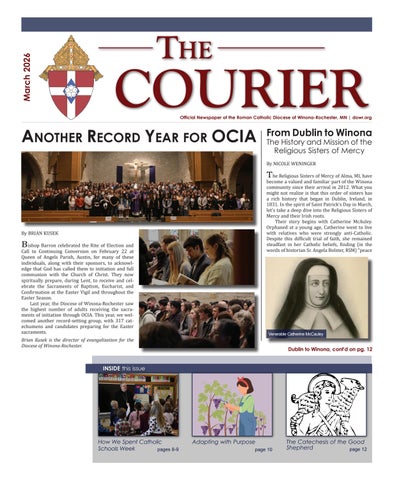
By BRIAN KUSEK
�ishop Barron celebrated the Rite of Election and Call to Continuing Conversion on February 22 at Queen of Angels Parish, Austin, for many of these individuals, along with their sponsors, to acknowledge that God has called them to initiation and full communion with the Church of Christ. They now spiritually prepare, during Lent, to receive and celebrate the Sacraments of Baptism, Eucharist, and Confirmation at the Easter Vigil and throughout the Easter Season.
Last year, the Diocese of Winona-Rochester saw the highest number of adults receiving the sacraments of initiation through OCIA. This year, we welcomed another record-setting group, with 317 catechumens and candidates preparing for the Easter sacraments.
Brian Kusek is the director of evangelization for the Diocese of Winona-Rochester.


From Dublin to Winona The History and Mission of the Religious Sisters of Mercy
By NICOLE WENINGER
�he Religious Sisters of Mercy of Alma, MI, have become a valued and familiar part of the Winona community since their arrival in 2012. What you might not realize is that this order of sisters has a rich history that began in Dublin, Ireland, in 1831. In the spirit of Saint Patrick’s Day in March, let’s take a deep dive into the Religious Sisters of Mercy and their Irish roots.
Their story begins with Catherine McAuley. Orphaned at a young age, Catherine went to live with relatives who were strongly anti-Catholic. Despite this difficult trial of faith, she remained steadfast in her Catholic beliefs, finding (in the words of historian Sr. Angela Bolster, RSM) “peace


Official Newspaper of the Roman Catholic Diocese of Winona-Rochester, MN | dowr.org
Dublin to Winona, cont'd on
Venerable Catherine McCauley
St. Peter's Basilica Unveils
New Stations of the Cross
By VICTORIA CARDIEL, EWTN News
VATICAN CITY, Feb. 24, 2026 - St. Peter’s Basilica has inaugurated new Stations of the Cross - 14 large oil paintings by Swiss painter Manuel Dürr - for Lent as part of celebrations marking the 400th anniversary of the church’s 1626 consecration.
The basilica first built at Emperor Constantine’s order in 326 over the tomb of the Apostle Peter stood for 12 centuries. In 1506, Pope Julius II ordered its demolition to raise a new church from the ground up.
The St. Peter’s Basilica known today was consecrated on Nov. 18, 1626, by Pope Urban VIII, capping a long project that drew on the genius of artists and architects including Michelangelo Buonarroti, Gian Lorenzo Bernini, and Carlo Maderno.
Four centuries later, the largest church in Christendom is commemorating the anniversary with a new artistic Stations of the Cross, inaugurated Feb. 20, featuring 14 paintings installed for Lent.
The proposal by Dürr, 36, was selected from more than 1,000 submissions representing 80 countries after an international competition launched in December 2023. A Vatican commission of art historians and liturgists chose the project, awarding it a 120,000-euro ($141,390) prize.
The result is a fresh spiritual perspective on the passion of Christ, depicting Jesus’ final moments from condemnation to burial in 14 oil paintings, each measuring about 51 by 51 inches.
The jury cited the proposal’s “balance and expressive power” and praised its “powerful and immediate” pictorial language, which the Vatican said evokes both the Renaissance and certain elements of the avant-garde.
A Monumental Commission Completed in 8 Months
In an interview during the inauguration, Dürr said that, given the magnitude of the commission, he had to “draw a bit of confidence” from within himself.
“Painting Jesus is very, very difficult,” the artist said, “because he’s not someone I’m presenting for the first time; he’s someone about whom billions of people already have an image and a relationship.”
Now that the works are installed around Bernini’s baldachin, Dürr said he feels serene: “I’m very happy to see that the context for which these paintings were conceived … I think they work well.”
Over eight months, Dürr produced the 14

canvases that are now incorporated into the basilica’s central nave during Lent.
From the start, he said he understood he was not working for a contemporary gallery but for a liturgical space with a living tradition. The works were meant “to dialogue with a specific context, with an already existing symbolic universe,” he explained.
Technically, he drew inspiration from “the colors that already exist in the floor mosaics” of St. Peter’s; spiritually, he wanted to insert himself humbly into “a very long and very rich tradition of images that have approached this mystery of the Incarnation and the Passion.”
‘Theologically Quite Close to the Catholic Faith’
Although Dürr is not Catholic, he described himself as “theologically quite close to the Catholic faith.” He belongs to the Jahu community - about 600 people worldwide - linked to the Swiss Reformed Church and marked by a strongly ecumenical character.
Two of his brothers hold doctorates in theology from Catholic universities, which, he joked, helped him get to know the tradition “from the kitchen table.”
Dürr said he hopes the Stations of the Cross can help people find a helpful way to enter more deeply into the mystery they contemplate.
He also recalled how his first visit to St. Peter’s Basilica expanded his horizons and left a mark on his creative process: “My church back home feels very provincial when I see here people of all ages, from all continents and all social classes, gathered around shared expressions of faith.”
He acknowledged the decisive influence of Fra Angelico, especially the frescoes at the
Most Reverend Robert E. Barron, Publisher
Nick Reller, Associate Editor
Telephone: 507-361-3068 E-mail: nreller@dowr.org
Publishing Schedule: Monthly - Deadline for advertising & articles is the 10th of the month prior. (ISSN 0744-5490)
Where to Find The Courier
• Hard copies are distributed at DOW-R parishes on the first or second weekend of each month.
• An online version may be viewed at www.dowr.org/offices/courier/index.html
• To be added to the home delivery list free of charge, readers should send their names and addresses to:
Diocese of Winona-Rochester The Courier 2907 Jeremiah Lane NW Rochester, MN 55901 or nreller@dowr.org
Convent of San Marco in Florence where, he said, there is an exemplary synthesis of artistic innovation and spiritual depth.
The Crucifixion as the Centerpiece
For Dürr, the Crucifixion became the axis of the entire series: It was the first canvas he began and the last he finished.
“This story has shaped Christian art and European culture - perhaps world culture - like no other,” he reflected.
“The cross, conceived as an instrument of terror to instill fear in the Roman Empire, has been transformed into a symbol of hope that we wear around our neck,” he said.
He expressed hope that the series might offer “a small doorway” into this central mystery of the Christian faith for those who contemplate the new Via Crucis during Lent.
Even so, the most special station for him, he said, was Veronica.
“She holds a cloth with the image of Christ, and in a way that’s what I’m trying to do: paint on a canvas and offer a trace, a mark that allows something deeper to be experienced,” Dürr said.
He added: “That is the great mystery of the Incarnation. Why would God leave a trace on a cloth?”
Four centuries after its consecration, St. Peter’s Basilica is thus preparing to commemorate its history not only through architectural memory but with a renewed invitation to contemplate the Passion of Christ.
This story was first published by ACI Prensa, the Spanish-language sister service of EWTN News, and has been translated and adapted by EWTN News English. See more pictures of the stations at ewtnnews.com
Child Abuse Policy Information
The Diocese of Winona-Rochester will provide a prompt, appropriate and compassionate response to reporters of sexual abuse of a child by any diocesan agent (employees, volunteers, vendors, religious or clergy). Anyone wishing to make a report of an allegation of sexual abuse should call the Victim Assistance Coordinator at 507-454-2270, Extension 255. A caller will be asked to provide his or her name and telephone number. Individuals are also encouraged to take their reports directly to civil authorities. The Diocese of Winona-Rochester is committed to protecting children, young people and other vulnerable people in our schools, parishes and ministries. The diocesan policy is available on the diocesan web site at www.dow.org under the Safe Environment Program. If you have any questions about the Diocese of Winona-Rochester’s implementation of the Charter for the Protection of Children and Young People, please contact Michael Gerard at 507-361-3377, or mgerard@dowr.org.
The Courier is the official publication of the Diocese of Winona-Rochester 2907 Jeremiah Lane NW, Rochester, MN, 55901 Vol 117 - 3
Credit: Victoria Cardiel/EWTN News
March Saint St. Oscar Romero Feast Day:
A Difficult Hour
March 24
A “Safe” Choice
In El Salvador, a country ruled by a wealthy oligarchy and populated mostly by the landless poor, simmering with economic instability and political unrest, Oscar Arnulfo Romero y Galdamez (b. 1917) was trained as a carpenter. At age 13, the quiet, studious youth declared that he wanted to be a priest. Oscar entered seminary and a few years later set off for studies in Rome, where he was ordained in 1942. Back home, Fr. Romero became a parish priest, then a seminary rector, then an auxiliary bishop, while El Salvador’s political landscape grew increasingly fraught. Government forces, paramilitary groups and guerillas became increasingly violent. Masses of the oppressed poor began to organize, speaking out against the misery in which they lived. In this climate, Romero was installed Archbishop of San Salvador in 1977. He was considered a “safe” choice. How could a conservative intellectual who talked about holiness bother anyone?

The Holy Father's Intention for March 2026
For Disarmament and Peace
Let us pray that nations move toward effective disarmament, particularly nuclear disarmament, and that world leaders choose the path of dialogue and diplomacy instead of violence.

On Saturday Morning, February 10, a parishioner entering Crucifixion Church in La Crescent was astonished to see daylight pouring through the ceiling and illuminating a pile of frozen rubble which had buried the pews. The roof, weakened by tons of accumulated snow and ice, had collapsed. Fortunately, the event had occurred either late Friday night or early that morning, when the church was empty. [...]
[...S]tructural engineers have determined that the rest of the building is sound. Damages, however, are estimated at well over $200,000, most of which will be covered by insurance.
Reprinted from March 2001.
Three weeks after his installation, Bishop Romero’s friend, Fr. Rutilio Grande, who worked with impoverished farmworkers, was assassinated together with an elderly peasant and a boy. The bodies lay in state at the cathedral. Romero would later say, “When I looked at Rutilio lying there dead, I thought… I, too, have to walk the same path.” In the new bishop, a flicker of resolve stirred. He began to see what the holiness he had desired as a young man would entail.
Fr. Rutilio was not the only person unjustly killed in El Salvador. Every day, people disappeared; peasants were terrorized; priests and church workers who attempted to aid the poor were tortured or killed. The quiet Archbishop found a voice. He denounced the right-wing government and the leftwing guerillas. He denounced even the government of the United States for supplying the weapons by which his people were killed. His homilies, which gave a weekly list of disappearances, tortures and killings, had a larger audi ence than any other radio program in the country.
This was a difficult hour, and as the Archbishop said, “A Christian’s authentic ity is shown in difficult hours…. Blessed be God for this difficult hour in our arch diocese. Let us be worthy of it!”
Courage
Msgr. Romero took his own words at face value. And perhaps, God took him at his word. In the Gospel, this bishop found a courage greater than human courage, and words more eloquent than any inspired by man. He preached the
“one Church,” of rich and poor alike, “the Church that Christ preached … to which we should give our whole hearts.”
He advocated a “supernatural, interior reform” that does not translate into armed struggle, and that nevertheless, like the Gospel, has uncomfortably concrete repercussions for man.
The Archbishop was painfully aware that the soldiers torturing and killing his people were mostly baptized Christians. He was their shepherd, too, and so he could speak to them with the authority of the Lord. On March 23, 1980, he gave a radio sermon in which he appealed directly to them: “No soldier is obliged to obey an order contrary to the law of God…. It is time now for you to recover your conscience…. Therefore, in the name of God, and in the name of this long-suffering people, whose cries rise to heaven more loudly each day, I beseech you, I beg you, I command you! In the name of God: stop

He must have known that he could not speak those words and live.
A Grain of Wheat
The Archbishop spent March 24 at a priests’ retreat. At a Mass he celebrated that evening, he preached a homily, saying, “Those who surrender to the service of the poor through love of Christ, will live like the grain of wheat that dies…”. After the homily, he approached the altar. A gunman entered the church and fired.
Oscar Romero became that grain of wheat, offering his blood for the “redemption and resurrection” of his people. In 2018, wearing the bloodstained belt that Romero had on at his last Mass, Pope Francis declared this martyred bishop a saint.

All Saints School, Madison Lake, went all out for Guatemala. Here they give Sister Eunice [Silkey, School Sisters of Notre Dame provincial coordinator,] their offerings for the missions in Guatemala [following an earthquake in the country].
[...Sister Eunice] spoke with great gratitude of the many contributions made to the Guatemalan Emergency Fund set up at Good Counsel in Mankato.
Reprinted from March 26, 1976.

Pictured above is the first place winner in the Home Beautification Contest sponsored by the Diocesan Rural Life Conference. It is the farm of Mr. and Mrs. Melvin Thamert of St. Joseph's Parish, Owatonna. Father William Schimek, diocesan director of the Rural Life Conference, is happy to announce the three year contest. Among honors and awards will be the $100.00 cash first prize by the R.L.C. [...]
Particular attention is called to the arrangement of the buildings. By their placement snow and wind case a minimum of trouble and reduce the fire hazard. The most difficult part of the project was the mowing of the large lawn. [...] The beautified home grounds are used as a picnic spot with the children loving to eat outdoors during the summer.
Reprinted from March 18, 1951.
The following is adapted from a homily for the Third Sunday of Lent.
From the Bishop
� he Gospels that we are privileged to read this time of year are masterpieces of the spiritual tradition. The one featuring the Woman at the Well has stirred hearts and beguiled minds up and down the centuries and around the world. It is one of the very finest presentations of the dynamics of conversion and evangelization anywhere in the Bible.
Notice, first, that as the woman seeks, she has already been found. She comes to the well, but Jesus is there to meet her. It is not you who have chosen me, but I who have chosen you. If only we would surrender to the God who is always already looking for us! If only we’d clear the ground and let the helicopter land!
The well to which she comes is evocative, St. Augustine said, of concupiscent desire, that is
*indicates event open to public
Sunday, March 1
*2 p.m. - Young Adult MassResurrection, Rochester
Tuesday, March 3
12 p.m. - Deans Meeting - The Chancery, Rochester
2:30 p.m. - Clergy Personnel Committee - The Chancery, Rochester
Thursday, March 5
5 p.m. - Maritain LectureNotre Dame, IN
Sunday, March 8
*10:30 a.m. - Pastor
Installation Mass - St. Ignatius, Spring Valley
Tuesday, March 10
10:30 a.m. - Anointing MassMadonna Towers, Rochester
12 p.m. - Presbyteral CouncilThe Chancery, Rochester
A Master Class in Evangelization
to say, errant desire. We try, in vain, to satisfy the deepest longing of the heart with something less than God, but it can never work. In fact, it will make us frustrated and addicted. Waking up to this fact can be indispensable for the process of conversion - something like “hitting bottom” in the context of the twelve step programs.
Now what does Jesus say?
“Everyone who drinks this water will be thirsty again; but whoever drinks the water I shall give will never thirst; the water I shall give will become in him a spring of water welling up to eternal life.” If we have ears to hear, the whole spiritual life is in these words!
If you drink from the well of wealth, you will get thirsty; if you drink from the well of power, you will get thirsty again; if you drink from the well of approval, you will get thirsty again; if you drink from the well of sexual pleasure, you will get thirsty again. All of these good things fade away, wear off, run out.
What is the one reality that never runs out? What is the one fountain that never runs dry? The divine lifewhich is precisely what Jesus offers. Think of this water as a symbol of the Church in its fullness: its teaching, its preaching, its sacraments, its saints. Drink from this well!
Wednesday, March 11
Real Presence Live Interview
- St. James Coffee, Rochester
Thursday, March 12
10:30 a.m. - College of Consultors - The Chancery, Rochester
Friday, March 13
TV Easter Mass RecordingThe Chancery, Rochester
Saturday, March 14
9:30 a.m. - Diocesan Pastoral Council - The Chancery, Rochester
Monday, March 16
Religious Liberty Commission - Washington, DC
Wednesday, March 18
Minnesota Catholic Conference Board MeetingSt. Paul
But before the water can really flow into one’s life, one has to remove some of the obstacles. For many people, the spiritual life does not get off the ground, because certain moral issues are ignored. How beautifully Jesus addresses the moral issues in the woman’s life. Notice, please, that he didn’t start with this. He didn’t begin with condemnation. But he is also not indifferent to it.
In her case, it is her somewhat disordered relationships. “Go call your husband.” “I have no husband.”
“You are right in saying, ‘I have no husband.’ For you have had five and the one you have now is not your husband.” She has evidently been returning to that well over and again, looking for love in all the wrong places.
What is disordered right now in your own moral life? It has to be dealt with before the water that Jesus offers can truly flow. Moral clarity is essential for successful evangelization. Though he is the very model of pastoral engagement, Jesus does not represent an “anything goes” approach to moral discernment!
Beguiled, intrigued, attracted, the woman then engages Jesus in a theological conversation. This in itself is not surprising at this stage of the process. Once the offer has been made, and once one has
Thursday, March 19
Legislative Visits - State Capitol, St. Paul
Friday, March 20
2 p.m. - Bishop's Cabinet - The Chancery, Rochester
Saturday, March 21
Council of Catholic Women Retreat - St. Theodore, Albert Lea
Sunday, March 22
*11:15 a.m. - MassCo-Cathedral of St. John the Evangelist, Rochester
Sunday, March 29
*8 a.m. - Palm Sunday MassAll Saints, New Richland
Monday, March 30
*2 p.m. - Chrism Mass - Sts. Peter and Paul, Mankato
arrived at a certain moral clarity, people naturally take an interest in the things of God.
The woman’s particular concern is liturgy and right worship, whether the Jews are right in worshipping God on Mt. Zion or whether her Samaritan people are right in worshipping God on Mt. Gerazim. But Jesus cuts through the dispute and thereby brings her to the whole point of evangelization: “Believe me, woman, the hour is coming when you will worship the Father neither on this mountain nor in Jerusalem… but in Spirit and in truth.”
We must recall at this point that in the previous chapter of John’s Gospel, Jesus had enunciated judgment on the Temple and declared that he would rebuild it in three days. Where does true worship take place? In him. Through him. In his body. Now we get it. It is not just a matter of meeting Jesus. It is not just a matter of accepting the divine life. It is not just a matter of getting one’s moral life in order. It is finally a matter of communing with him, in and through right worship.

Once all this has taken place, then one is ready to become an evangelist. One never keeps Christ to oneself. Having put down her bucketsymbolic of the abandonment of her old life - she goes into the village and declares him to everyone. So effective is she that “many of the Samaritans of that town began to believe in him.”

Non Nisi Te Domine
Bishop Robert Barron
Bishop's Calendar
Una clase magistral sobre evangelización
Por EL OBISPO ROBERT BARRON
Lo siguiente es una adaptación de una homilía para el tercer domingo de Cuaresma.
�os Evangelios que tenemos el privilegio de leer en esta época del año son obras maestras de la tradición espiritual. El que presenta a la mujer en el pozo ha conmovido los corazones y cautivado las mentes a lo largo de los siglos y en todo el mundo. Es una de las mejores presentaciones de la dinámica de la conversión y la evangelización que se encuentran en toda la Biblia.
Obsérvese, en primer lugar, que mientras la mujer busca, ya ha sido encontrada. Ella acude al pozo, pero Jesús está allí para recibirla. No eres tú quien me has elegido, sino yo quien te he elegido. ¡Ojalá nos rindiéramos al Dios que siempre nos está buscando! ¡Ojalá despejáramos el terreno y dejáramos aterrizar al helicóptero!
El pozo al que ella acude evoca, según san Agustín, el deseo concupiscente, es decir,
el deseo errante. Intentamos, en vano, satisfacer el anhelo más profundo del corazón con algo menos que Dios, pero eso nunca puede funcionar. De hecho, nos frustra y nos vuelve adictos. Darnos cuenta de este hecho puede ser indispensable para el proceso de conversión, algo así como «tocar fondo» en el contexto de los programas de doce pasos.
Ahora bien, ¿qué dice Jesús? «Todo el que beba de esta agua volverá a tener sed; pero el que beba del agua que yo le daré, nunca volverá a tener sed; el agua que yo le daré se convertirá en él en una fuente de agua que brota para la vida eterna». Si tenemos oídos para oír, ¡toda la vida espiritual está en estas palabras!
Si bebes del pozo de la riqueza, tendrás sed; si bebes del pozo del poder, volverás a tener sed; si bebes del pozo de la aprobación, volverás a tener sed; si bebes del pozo del placer sexual, volverás a tener sed. Todas estas cosas buenas se desvanecen, se agotan, se acaban.
Bishop Barron ce�e�ra�ed Ash Wednesday Mass with the students and staff of St. Peter's School in Hokah this year. After Mass, he visited classrooms, had lunch with some of the students, and played some baseball at recess time.
Photos and caption by EMILY SMITHLEY, media specialist for the Diocese of Winona-Rochester.

¿Cuál es la única realidad que nunca se agota? ¿Cuál es la única fuente que nunca se seca? La vida divina, que es precisamente lo que Jesús ofrece. Piensa en esta agua como un símbolo de la Iglesia en su plenitud: su enseñanza, su predicación, sus sacramentos, sus santos. ¡Bebe de este pozo!
Pero antes de que el agua pueda fluir realmente en la vida de uno, hay que eliminar algunos obstáculos. Para muchas personas, la vida espiritual no despega porque se ignoran ciertas cuestiones morales. Qué hermosamente aborda Jesús las cuestiones morales en la vida de la mujer. Nótese, por favor, que no empezó con esto. No comenzó con la condena. Pero tampoco es indiferente a ello.
En su caso, se trata de sus relaciones algo desordenadas. «Ve, llama a tu marido». «No tengo marido». «Tienes razón al decir que no tienes marido, porque has tenido cinco, y el que ahora tienes no es tu marido». Es evidente que ella ha vuelto a ese pozo una y otra vez, buscando el amor en los lugares equivocados.
¿Qué es lo que está desordenado en este momento en tu propia vida moral? Hay que abordarlo antes de que el agua que Jesús ofrece pueda fluir verdaderamente. La claridad moral es esencial para una evangelización exitosa. ¡Aunque es el modelo mismo del compromiso pastoral, Jesús no representa un enfoque de «todo vale» en el discernimiento moral!
Seducida, intrigada, atraída, la mujer entabla entonces una conversación teológica con Jesús. Esto en sí mismo no es sorprendente en esta etapa del proceso. Una vez que se ha hecho la oferta y se ha llegado a una cierta claridad moral, es natural que las personas se interesen por las cosas de Dios.
La preocupación particular de la mujer es la liturgia y el culto correcto, si los judíos tienen razón al adorar a Dios en el monte Sión o si su pueblo samaritano tiene razón al adorar a Dios en el monte Gerizim. Pero Jesús pone fin a la disputa y, con ello, la lleva al punto central de la evangelización: «Créeme, mujer, se
acerca la hora en que no adorarán al Padre ni en este monte ni en Jerusalén... sino enEspíritu y en verdad». Debemos recordar en este punto que en el capítulo anterior del Evangelio de Juan, Jesús había pronunciado juicio sobre el Templo y declarado que lo reconstruiría en tres días. ¿Dónde tiene lugar la verdadera adoración? En él. A través de él. En su cuerpo. Ahora lo entendemos. No se trata solo de encontrarse con Jesús. No se trata solo de aceptar la vida divina. No se trata solo de poner en orden la propia vida moral. Se trata, en definitiva, de tener una comunión con él, en y a través de la adoración correcta.
Una vez que todo esto ha tenido lugar, entonces uno está listo para convertirse en evangelista. Uno nunca se queda con Cristo para sí mismo. Después de dejar su cántaro, símbolo del abandono de su antigua vida, ella entra en la aldea y lo proclama a todos. Es tan eficaz que «muchos de los samaritanos de aquella ciudad comenzaron a creer en él».


MN Bishops Issue Joint Statement on Ethical and Religious Directives for Catholic Health Care
By MINNESOTA CATHOLIC CONFERENCE
The following statement was released by the bishops of Minnesota's six Catholic dioceses on February 11, 2026, World Day of the Sick and Memorial of Our Lady of Lourdes.
i
n November 2025, the plenary assembly of the United States Conference of Catholic Bishops (USCCB) approved the Seventh Edition of the Ethical and Religious Directives for Catholic Health Care Services (ERDs). The ERDs outline the moral principles that govern the provision of health care services in Catholic health care ministries such as hospitals, regional clinics, and long-term-care settings. Today, on the World Day of the Sick 2026, the ERDs are being promulgated by individual canonical decree as particular law in each of Minnesota's six dioceses. In promulgating these directives, the bishops seek to serve their collaborators and fellow disciples in health care ministry by clearly articulating the ethical and spiritual standards of care in this important work of the Church.
Christ the Healer
In his earthly ministry, Jesus healed people in body and soul. He "came so that they might have life and have it more abundantly" (Jn 10:10). Serving as his hands and feet throughout history, the Church continues that healing ministry. As the ERDs' General Introduction states: "The mystery of Christ casts light on every facet of Catholic health care: to see Christian love as the animating principle of health care; to see healing and compassion as a continuation of Christ's mission; to see suffering as a participation in the redemptive power of Christ's passion, death, and resurrection; and to see death, transformed by the resurrection, as an opportunity for a final act of communion with Christ."
The purpose of the ERDs is to help Catholic health care ministries live their mission to its fullest in accordance with the dignity of the human person, made in the image of God. They also distinguish Catholic health care as a positive contribution to the mission of competent care of the sick in a just
society, and as an irreplaceable witness to human solidarity.
In promulgating the ERDs in his diocese, the diocesan bishop plays a unique pastoral role in ensuring that the important work of Catholic health care ministry reveals the face of Christ to the sick and attends to each person's authentic good - both those in need and those who minister to them. Accordingly, "[a]s teacher, the diocesan bishop ensures the moral and religious identity of the health care ministry in whatever setting it is carried out in the diocese. As priest, the diocesan bishop oversees the sacramental care of the sick." (Id.)
Notable Updates in the Seventh Edition
The ERDs draw upon centuries of moral reflection upon difficult ethical questions. Through that reflection and experience, a body of moral principles has emerged that can be applied to new circumstances. Those principles are illuminated by faith but can also be known by reason and are accessible to all. It would be a mistake to consider them merely Catholic religious values; they are truths applicable to all people because of our common human origin, nature, and destiny. The fact that some people might not understand or formally accept the natural law does not in any way render void the important truths communicated therein. By God's design, we all can participate in the truths of God's creation and providence and find in them true happiness and fulfillment.
As technology advances and cultural values shift, the ERDs must address new circumstances, including developments that would have been unthinkable even a generation ago (see no. 2, below). That is why bishops work with Catholic health care ministries and other experts to apply the principles in the ERDs to concerning new procedures and practices in health care.
Among the important matters addressed in the Seventh Edition of the ERDs, we wish to highlight two in particular: 1) the prohibition on the voluntary stopping of eating and drinking by a patient (VSED) as a form of suicide; and 2) the prohibition on Catholic health care providers offering what is
commonly called "gender-affirming care."
1. Voluntary stopping of eating and drinking (VSED) is suicide, which is always impermissible.
The ERDs state that the Church respects patients' decisions about life-sustaining treatments when done so in accord with Catholic teaching. A patient may forgo extraordinary interventions or treatments for which the benefits are disproportionately low vis-a-vis the burden of those interventions. But as the ERDs also make clear, there is a presumption of providing (and receiving) nutrition and hydration as an ordinary means of care-again, assuming the benefit is not outweighed by the burden (ERD 58).
According to the ERDs (60), the voluntary stopping of eating and drinking (VSED)-starving oneself to hasten death, a practice being increasingly promoted today-is fundamentally different than forgoing interventions such as a feeding tube, when overly burdensome, or the natural loss of appetite that can accompany the dying process. VSED instead intentionally introduces a cause of death apart from the underlying illness and, therefore, constitutes a form of suicide in which health care providers are enlisted to facilitate. Such an action would be contrary to the healing profession and deny the stewardship of life God entrusts to us. Hospice and palliative care are encouraged by the ERDs as proven alternatives in such situations (61-63).
Catholic health care provider institutions and practitioners should not encourage, condone, or cooperate with a patient's decision to resort to VSED.
2. Treatments attempting to alter a person's sex are not sound science nor consistent with the nature and dignity of the human person.
The new ERDs remind practitioners that we should care for any individual who is sick-no matter his or her identity. Such care includes "mitigat[ing] the suffering of those who experience gender incongruence or gender dysphoria .... " (ERD 29). But this treatment must be done in accordance with the true nature and dignity of the human person, acknowledging that each person, upon creation, receives a given sex, which must be "accept[ed]
Health Care, cont'd on pg. 11

Minnesota Catholic Conference Inside the Capitol
Minnesota Should Opt Into the Federal Scholarship Tax Credit
i
magine a federal government program that could generate hundreds of millions of dollars in scholarships for educational achievement each year and does not cost the state one penny.
Well, it’s real, and it’s time to urge legislators and Governor Tim Walz to make this opportunity a reality for Minnesota’s kids and their future.
Congress recently passed the first ever Federal Scholarship Tax Credit, which will provide millions of dollars for students across the United States by stimulating donations to scholarship granting orga-
nizations (SGOs). But for Minnesota students to benefit, the state needs to opt into the program by Jan. 1, 2027. Walz can opt in unilaterally or the Legislature can direct the executive branch to do so by passing a bill that the governor must sign.
The Minnesota Catholic Conference (MCC) urges Governor Walz and the Legislature to join the growing list of states taking advantage of this opportunity. Not doing so puts politics ahead of people and allows millions in charitable contributions to leave our state.

How It Works and Why Minnesota Should Opt In
The Federal Scholarship Tax Credit program enables individual taxpayers to receive a dollar-for-dollar tax credit against their federal tax liability for donations (up to $1,700 per year) made to K-12 SGOs. These organizations must use authorized donations to provide scholarships for tuition, tutoring, special needs, supplies/technology and other education expenses. Students in public and private schools, as well as homeschoolers, could be eligible for scholarships.
Opting into the tax credit would not cost our state anything because it is a federal tax credit. A state’s only obligation is to decide to opt in and submit the list of eligible scholarship organizations by Jan. 1, 2027, and by Jan. 1 of each subsequent year.
Keeps Dollars in State
Failure to opt in leaves Minnesota kids behind. It will cause local dollars to leave our state through donations made by Minnesota taxpayers to SGOs in opt-in states where they are eligible for the tax credit. This will cause our state’s kids to lose out on scholarship opportunities for their educational achievement. We should keep these scholarship dollars here for our kids.
This program will help public and private school students. Local nonprofit SGOs and public-school foundations can receive donations to fund tuition, tutors and other supplemental learning opportunities, potentially generating hundreds of millions of dollars to strengthen educational achievement. By one estimate, even 30 percent of eligible filers taking advantage of the credit could generate almost $500 million in scholarships. In a state with plummeting test scores and rising achievement gaps, it should be unimaginable that Minnesota would not opt in.
Tell Governor Walz to opt into the Federal Scholarship Tax Credit. Thousands of Minnesotans have already made their voices heard. You can use the Catholic Advocacy Network to contact the governor and legislators, urging them to opt Minnesota into this exciting opportunity to change the educational trajectory of so many students. Learn more and take action at mncatholic.org/federalscholarshiptaxcredit.

How We Spent Catholic Schools Week
January 25-31, 2026


Pacelli, Austin
Crucifixion, La Crescent


St. Mary’s, Worthington
St. Theodore, Albert Lea
St. Mary’s, Owatonna
Cotter, Winona
Adapting with Purpose
How the Catholic Foundation Is Preparing for the Future Needs of Southern Minnesota
By ELIZABETH WILLIAMS
�
ou’ve probably heard me say this already: The Catholic Foundation of Southern Minnesota is entering a new chapter. But let me elaborate. This chapter will be one shaped not only by the needs we see today, but by the needs we anticipate for tomorrow. Across our diocese, parishes are navigating demographic shifts, financial pressures, pastoral transitions, and the changing realities of family and community life. These shifts are not abstract trends; they are shaping the daily experience of Catholic life in Southern Minnesota.
As a community foundation, our responsibility is to respond with clarity, creativity, and faith. And that begins with two commitments: strategic planning and adapting our programs to meet emerging needs.
1. Strategic Planning: Discerning Our Mission for the Next Decade
This year, our Board of Directors began a strategic-planning process to discern how the Foundation can best serve the Church in a time of rapid change. The questions guiding this work are simple but profound:
• What does Southern Minnesota need from a Catholic community foundation today?
• How can we strengthen parishes, schools, and ministries in a sustainable way?
• Where can philanthropy make the greatest difference for the mission of the Church?
• How do we honor our Catholic identity while adapting to new realities?
This process is grounded in prayer, data, and the experiences of parish leaders and families across the diocese. It is also informed by the listening we’ve done over the past year. Not as a standalone report, but as one input among many helping us understand the landscape.
The goal is not to reinvent the Foundation, but to focus our efforts where they can have the greatest impact: granting, connecting philanthropy with real needs, and providing community leadership rooted in the pastoral priorities of our bishop.
2. Adapting Through New Programs for 2026
While the Board continues its long planning, we are already taking practi cal steps to respond to the needs we’re hearing. In 2026, the Foundation is launching several new initiatives designed to strengthen stewardship, support parish leaders, and build long-term stability for our Catholic community.
Donor Advised Funds tool for individuals and families who want to align their giving with their faith and long-term financial planning.
Collective Parish Endowments. no-cost toolkit for any parish to begin building a permanent, community ported fund for long-
Legacy Planning Seminars. Free, co-hosted sessions that help parishioners plan faithfully for their legacy through estate planning and Catholic teaching.
Parish Stewardship Educational Program. A low-cost, pastor-partnered series that strengthens stewardship spirituality and encourages consistent giving.
Fundraising & Development Services. Expanded professional support for parishes discerning capital campaigns, major gifts, or long-term development strategies.
Catholic Stewardship Panels. A new diocesan-wide series launching in March 2026 to equip parish financial leaders with practical insights on investing, money management, philanthropy, and fundraising. We encourage you to mark your calendars. Visit our website for more information. The first two panels are:
• Wednesday, March 18, at 5 p.m. at Pax Christi Catholic Church, Rochester. Leading Through Complexity: Mission, Money, and Strategic Decision Making in a Rapidly Changing Cultural Landscape. No cost to attend.
• Thursday, March 19, at 5 p.m. at St. Augustine Catholic Church, Austin. Managing Parish Resources Wisely in Turbulent Times: Investing Simply with Confidence and Why Donors Are Hesitating. No cost to attend. These programs are early expressions of the Foundation’s evolving mission. They reflect what we are learning about the needs of our parishes and the opportunities before us.
3. Looking Ahead With Hope
As we look toward 2026 and beyond, our commitment remains steady: to listen, to serve, and to walk alongside the people and parishes of Southern Minnesota.
The Church in our diocese is facing real challenges, but it is also filled with extraordinary hope: hope rooted in the Eucharist, in the dedication of our priests and parish leaders, and in the generosity of the faithful who want to see their parishes thrive. Our role is to help create the conditions where that hope can grow.

We invite you to stay connected as we continue this journey, through strategic planning, through new programs, and through ongoing collaboration with the people we serve. Your insights, your feedback, and your partnership will help shape the future of stewardship in the Diocese of Rochester. Contact Elizabeth to join the conversation at 507-218-4098.
Elizabeth Williams is the executive director of the Catholic Foundation of Southern Minnesota.
The annua� Bishops and Rec�or Dinner is only a few short weeks away, and, this year, we are pleased to welcome University of Mary President Monsignor James Patrick Shea as our Immaculate Heart of Mary Award recipient.

Inaugurated in 2009 as the University of Mary’s sixth presi dent, Monsignor Shea made national headlines at the age of 34 by becoming the youngest college or university president in the United States. He succeeded Sister Thomas Welder, who had guided the university for 31 years and left a lasting legacy of leadership and growth.
Monsignor Shea began his undergraduate studies at Jamestown College, majoring in English and history, before entering the seminary for the Diocese of Bismarck. His academic journey spans some of the world’s most respected institutions: He earned bachelor’s and pontifical master’s degrees in philosophy from The Catholic University of America in Washington, D.C., studied classical Greek at the University of Texas at Austin, and pursued theological studies at the Gregorian and Lateran universities in Rome while residing at the Vatican’s North American College. He later studied management at the University of Chicago’s Graduate School of Business and is an alumnus of the Institutes for Higher Education at Harvard University’s Graduate School of Education.
Alongside his academic pursuits, Monsignor Shea has dedicated himself to pastoral and humanitarian service. In Washington, D.C., he served with Mother Teresa’s Missionaries of Charity at the Gift of Peace AIDS Hospice while teaching religion in two inner-city schools. In Rome, he worked as a chaplain at Bambino Gesù Children’s Hospital and served the Rome campus of the Center for Catholic Studies at the University of Saint Thomas.
Monsignor Shea will be giving this year’s keynote address at the annual Bishops and Rector Dinner. If you are interested in hearing more about his life or meeting him and the Immaculate Heart of Mary seminarians, please consider attending this year’s dinner by registering at catholicfsmn.org/B&R. Questions? Contact me at nweninger@catholicfsmn.org or 507-858-1275.
Don’t miss your opportunity to attend such a spiritually enriching and faith-filled event - all to benefit our seminarians!
Submitted by NICOLE WENINGER, a marketing and communications associate for Immaculate Heart of Mary Seminary and the Catholic Foundation of Southern Minnesota.
What Happens When a Parish Ignores the Budget?
By BREANNE SCHEID
a parish budget is not merely a spreadsheet of projected income and expenses. It is a reflection of mission priorities, stewardship responsibilities, and accountability to the faithful. When a parish consistently spends outside of its approved budget, the consequences reach far beyond the numbers. What may feel like a harmless exception in the moment can gradually weaken financial stability, erode trust, and limit the Church’s ability to serve its people.
Cash Flow Problems Develop Quickly
Unplanned spending reduces the operating funds available for essential expenses. Even modest overages accumulate over time, creating difficulty in meeting payroll, paying vendors, or covering routine obligations. When expenses outpace income, parish leadership shifts from proactive planning to crisis management, a stressful and unsustainable pattern.
Deferred Maintenance Becomes a Costly Crisis
When funds are overspent in one area, necessary maintenance is often postponed. Roof repairs, HVAC servicing, and parking lot upkeep may be delayed to compensate for unplanned purchases. Eventually, these postponements lead to emergencies that are far more expensive than timely repairs would have been. What could have been a manageable maintenance item becomes a financial burden requiring loans or emergency appeals.
Ministry and Evangelization Suffer
Every dollar spent outside the budget must come from somewhere. Frequently, the impact is felt in ministry programming. Faith formation, youth
Health Care,
programs, outreach efforts, and evangelization initiatives may be scaled back to cover overspending. Without financial discipline, the parish risks undermining the very mission it exists to serve.
Staff Receive Mixed Messages
When budgets are approved but not enforced, staff and ministry leaders may interpret spending limits as optional. Planning becomes less intentional, and requests for exceptions become routine. Clear expectations provide structure and reduce confusion. Consistent accountability fosters collaboration, fairness, and responsible decision-making.
When Administrators Must Enforce Rules Without Pastoral Support
Parish bookkeepers and administrators are often responsible for upholding financial policies and budget limits. This role becomes especially difficult when enforcement lacks visible support from the pastor. Without unified leadership:
• staff may bypass procedures and seek informal approval
• administrators are placed in uncomfortable gatekeeping roles
• tensions grow between ministry leaders and parish staff
• policies appear optional rather than binding When pastors clearly support and reinforce budget expectations, administrators are empowered to apply policies consistently and fairly. United leadership prevents conflict and fosters a culture of shared responsibility.
cont'd from pg. 6
... and respect[ed] ... as it was created." Authentic health care respects the truth of the human person and is ordered toward healing, not harm. Therefore, ERD 28 prohibits Catholic health care providers and practitioners from administering "medical interventions, whether surgical, hormonal, or genetic, that aim not to restore but rather to alter the fundamental order of the body in its form or function ... [including those] that aim to transform sexual characteristics of a human body into those of the opposite sex or to nullify sexual characteristics of a human body."
A fuller explanation of the "why" behind the guidance found in ERDs 28-29 can be found in the 2023 DOCTRINAL NOTE ON THE MORAL LIMITS TO TECHNOLOGICAL MANIPULATION OF THE HUMAN BODY published by the USCCB Committee on Doctrine, and from which these ERDs were developed in part.
Stewards of the Gift of Life
As the new edition of the ERDs remind us, quoting Pope Francis, "creation is prior to us and must be received as a gift" (ERD 28). We are stewards of that
gift, which seeks to understand and be attentive to the totality of the human person created body and soul in the image and likeness of God with an eternal destiny. Human beings are not merely bodily machines that can be manipulated at will, and health care is not merely 'science' in the limited sense of the mechanistic diagnosis and treatment, through chemicals and surgeries, of merely corporeal creatures.
Likewise, patients should not see themselves merely as consumers of health care services who can demand at will from health care professionals treatments and procedures that violate clear ethical principles to do good and avoid evil or that in some cases violate the very nature of medicine itself, which is to heal and not harm - to be stewards of the gift of life not merchants of death (cf. ERD 26).
The ERDs call on patients and health care professionals to reflect on their roles as stewards of the gift of life, respecting their mutual rights and responsibilities as the Church seeks to bring the healing power of Christ into the world through the provision of health care services. Likewise, civil authorities should respect the mission of non-profit Catholic
M� name is BreAnne Scheid, and I live on a farm outside of Easton with my husband Nate and our four children.

I’m the owner of Veritas Financial Solutions, a business dedicated to helping Catholic par ishes, schools, and cemeteries strengthen their financial management and stewardship.
In addition to my work with Veritas, I also write articles on my LinkedIn page that highlight the bookkeeping and accounting topics I most often see within our parishes. My goal is to make these articles both educational and relatablesometimes even adding a little humor to the dayto-day realities of parish financial life.
Parishioner Trust Can Erode
Parishioners give sacrificially out of faith and commitment to their parish community. They trust that their contributions will be used responsibly to support ministry and maintain parish facilities. When financial discipline appears lacking, confidence in leadership may decline. Transparency and faithful stewardship strengthen generosity; poor accountability can diminish it.
Budget Discipline Supports the Mission
Budget discipline is not about restriction; it is about stewardship. It ensures fairness, supports ministries, maintains facilities, and protects the trust of the faithful.
A parish budget reflects prayerful discernment and shared priorities. Respecting it strengthens the parish’s ability to serve both present and future generations.
Faithful stewardship today ensures a vibrant parish tomorrow.
health care because of the value it provides to the community as a whole and respect the freedom to serve in a manner that is consistent with our principles, which, again, are not unique to Catholics but promote the good of all people.
To be sure, providing health care is a challenging endeavor, and patients, families, and health care professionals need to exercise prudential judgment in every clinical encounter. The bishops of Minnesota, therefore, reiterate their encouragement to Catholic providers to put in place training and practice protocols, including sound ethics boards, that can help with these decisions and, in difficult circumstances, consult with their diocesan bishop. Similarly, organizations such as the National Catholic Bioethics Center and the Catholic Health Association of the United States have robust resources to guide Catholic health care provider institutions and practitioners in their ministry.
With gratitude to each and every person engaged in this work, the diocesan bishops of Minnesota promulgate the Seventh Edition of the ERDs on this, the Memorial of Our Lady of Lourdes, praying that the Blessed Virgin Mary will intercede for the people of our State and cover them with the mantle of her maternal protection as they protect and care for others, seeing in each person the presence of her Son.
The Catechesis of the Good Shepherd An Invitation to Knowledge and Love
By SISTER MARY FRANCES FARLEY, RSM
“is there anything you would like to sing or say to Jesus, our Good Shepherd?” I ask the three-year-old girl.
With a gentle smile, she quietly responds, "I have a very special song. .... Jesus, I love you! I love you! You give your sheep everything they need, the grass and water and food. I love you!"
The atrium of the Catechesis of the Good Shepherd (CGS) is a place where the Good Shepherd meets his sheep, continuing to call, “Let the children come to me, and do not hinder them; for to such belongs the kingdom of heaven” (Mt. 19:14). The first time I entered an atrium during my training, I was amazed at the room’s order, beauty, and simplicity. With such wisdom and generosity, it was built for the children of the Church.
CGS is a Montessori-based religious formation program for children ages 3-12. It was originally developed in Rome in the 1950s by Sofia Cavaletti and Gianna Gobbi and has since spread worldwide. The atrium is prepared to create a sacred, handson space for children and their catechists to hear, ponder, and celebrate the most essential mysteries of the Catholic faith as revealed in the Scriptures and the liturgy. Its method embodies Montessori’s view that “If God is presented to the child through tangible and meaningful activities, it will do more
for the child than just arouse interest; it will create in the child a sense of joy, admiration, and wonder.”
The materials in the atrium include small figures of Jesus and the disciples used to meditate on the Last Supper, Jerusalem mustard seeds and beautiful pearls to ponder the Gospel parables, a Paschal Candle to celebrate the Paschal Mystery and Baptism, a detailed timeline of the history of the kingdom of God to wonder at the gifts of creation, redemption, and parousia [Second Coming], and many others used throughout all age levels.
From their early childhood into their early middle school years, CGS offers students a broad scope and impressive depth of religious formation. The works in the atrium grow in complexity to meet the children’s growing needs, yet maintain their integrity of truth within the Catholic tradition. From learning the names of the articles used at Mass and praying to Jesus at the “model altar” in Level 1, to pondering the scriptural roots of the Mass in Level 2, to studying the Old Testament to New Testament typologies of Christ in Level 3, CGS forms children to know and love God and the Church.

Dublin to Winona, cont'd from pg. 1
in the Cross, joy in suffering, prayer in action and action in prayer."
In her mid-twenties, Catherine began caring for a retired Quaker couple. Before their deaths, the couple converted to Catholicism and left their entire estate to her. With these resources, Catherine built the Home of Mercy, a home for impoverished women in Dublin. The Home was formally opened on the Feast of Our Lady of Mercy in 1827. Later, in 1831, she professed her vows to devote her life fully to God and started the Institute of the Religious Sisters of Mercy.
The sisters quickly became known as the “walking nuns” for their active ministry among the sick and poor on the streets. From there, the order grew rapidly, and by 1841, there were ten foundations across Ireland and England, and 100 Sisters of Mercy (almamercy.org/our-history).
The Religious Sisters of Mercy provided many services to their communities, including free schools and “houses of mercy,” places where youth and women could find shelter, safety, and comfort. They also nursed those with cholera during several major epidemics. As their mission expanded, the sisters established foundations abroad, including Newfoundland, Australia, and, in 1851, the first house in the United States, in Pittsburgh, PA. The Religious Sisters of Mercy of Alma, MI, have continued this spiritual and apostolic tradition since their re-foundation in 1973.
The love and dedication that guided Catherine McAuley nearly two centuries ago continue to shape
Our community of the Religious Sisters of Mercy of Alma has had the privilege to serve in the CGS atrium located at Cotter Schools in Winona for several years, inviting children at the various age levels. I am edified by the children’s responses of gratitude, praise, and generosity to
God throughout their time in CGS. From the littlest ones gathered for prayer, there is an ocean of praise: "Thank you, Jesus, for your Light! For the trees and grass that grow! For Mommy and Daddy! For the Bible! For the Church! And the atrium! For good food and water! For everything!" From the older ones, praise takes the form of intricate illustrations of prayers from the Scripture and liturgy or communal pondering of these texts. These responses prepare the children to participate more actively in Mass and other ways of prayer, forming the foundation for their spiritual lives.
Witnessing fruits like these from CGS in parishes and schools already, many priests, families, catechists, teachers, and other members of the faithful hope to see CGS grow throughout the Diocese of Winona-Rochester. As such, I have a special invitation for catechists, parents, youth ministers, and anyone else invested in religious education: From June 1-6, 2026, a Level 1A training for those desiring to begin working with CGS will be hosted at Saint Luke Hall of Cotter Schools in Winona! For more information and registration, visit: cotterschools.org/ together-in-community/ the-catechesis-of-the-goodshepherd
Sister Mary Frances Farley, RSM, is a Religious Sister of Mercy of Alma, MI, serving the Diocese of Winona-Rochester at Cotter Schools in Winona.


the Religious Sisters of Mercy of Alma today. Rooted in deep devotion to Christ and a commitment to mercy, the sisters focus on education, healthcare, evangelization, and service to the poor, both materially and spiritually. The sisters emphasize fidelity to the teachings of the Catholic Church and a joyful witness to religious life. Whether teaching, assisting in parish life, offering spiritual guidance, or simply being a prayerful witness in the community, the sisters in Winona embody the same “prayer in action” that defined their foundress. Many community members know the sisters by their distinctive habits and warm demeanor, often encountering them at school programs, retreats, or parish gatherings.
The Irish roots of the Sisters of Mercy remain an important part of their identity. Catherine McAuley’s courage, trust in Divine Providence, and compassion for the vulnerable continue to inspire the sisters. As March invites reflection on Irish heritage and faith, the story of the Religious Sisters of Mercy serves as a reminder that the fruits of one woman’s faith in 19th-century Dublin still bless communities like
Winona generations later.
From the streets of Ireland to the heart of southeastern Minnesota, the mission of mercy lives on faithfully and with enduring impact.
If you would like to help support their mission, please consider donating to the Heart of Mary Convent Campaign. This expansion project will provide additional bedrooms for current, visiting, and hopefully future Sisters and create a space for gatherings and community events while also enlarging Seminary workspace.
Donors who contribute $1,000 or more by April 30, 2026, will be recognized on a plaque within the convent as a lasting sign of gratitude. Upon completion of the project later this spring, all are invited to attend an open house and blessing of the new space. To donate or request mailing materials, visit catholicfsmn.org/convent-expansion-project or call 507-858-1275.
Nicole Weninger is the marketing and communications associate for the Catholic Foundation of Southern Minnesota.
Religious Sisters of Mercy in front of their motherhouse in Alma, MI, with the Most Rev. Robert Gruss, Bishop of Saginaw.
God Heals the Broken-Hearted
By SHELLY HOLT
i write because of what I’ve been through the last few months: acute grief. I share from The Grief Table website by Jamie Herzog (thegrieftable.com) with her permission.
After experiencing the loss of several family members in the past few months and having all areas of my life affected, I found this resource. It is helpful both personally and in my profession as a therapist. I hope it resonates with you. It is comforting to know God is in the healing and he understands completely.
When {insert your loved one’s name here} died, there was a kind of grief that arrived immediately. It was loud. Physical. Disorienting. And honestly, terrifying at times. I didn’t have language for it then. I just knew my body felt like it had been dropped into a world that no longer made sense, even though everything around me looked the same.
This is what we often call acute grief. Acute grief is the early, intense response to loss. It is what happens when someone you love is gone, and your nervous system has not yet caught up. Your mind may understand the facts, but your body is still reaching for them. Still expecting them. Still bracing for their voice, their presence, their place in your life.
After {insert loved one’s name} died, I remember feeling shock…moments of deep numbness followed by waves of pain that took my breath away. Sleep
felt disrupted. Eating felt strange. Concentrating felt nearly impossible. Some days it felt like I was watching my life from the outside, like everything was happening to someone else.
I share this because so many people in acute grief worry that something is wrong with them.
There isn’t.
Acute grief is not a problem to solve. It is a system responding to rupture. Your brain and body are trying to make sense of an absence that runs counter to everything they expect. When someone is deeply woven into your daily life, their loss creates a shock that takes time to settle.
[My] body was not ready for forward. It was still orienting. Still catching up to a reality it did not choose.
Acute grief also does not follow a clean timeline. For some people, the intensity softens over months. For others, especially after sudden, traumatic, or layered loss, it can last much longer. That does not mean you are stuck. It means the love was deep.
I still get thrown back into acute grief. It can come out of nowhere. A memory. A date. A song. A moment when my nervous system remembers before my mind does. I understand the tasks of grief. I know this backand-forth is part of how grief moves and revisits us. And still, when it hits, it is brutal.
What has helped me survive those moments is not forcing myself out of them. It is recognizing what they are. Naming them. Saying to myself, this is acute grief again. This is my body responding to love and loss.
Letting Go
By DEACON ROBERT YERHOT, MSW
� e must let go, my friends; we simply must let go.
St. Therese of Lisieux summed it up by saying she chose only one thing in life, which was the will of God for her. She let go of everything else. She sought nothing more.
Yes, we must let go, my friends, of all our attachments to things of this world. We must let go and accept the Cross. There is no other way. There is no other path, only the way of the Cross.
Letting go is vital if we are to survive and thrive in this world. In this life we will be confronted with daunting challenges, and, in those challenges, we must renounce our selfish plans. We must be willing to let it go and put it in the hands of God, who is far more powerful and wise than us.
There is no other way, and we must do it now. We must not fall into the trap of presumption, assuming we have untold months and years to ignore God’s plan for us. We must let go and surrender to God. Now is the time. If we don’t do it now, we ultimately risk being alone with the
world to which we cling.
Letting go will mean we are always ready for the Lord to come.
Not tomorrow, not in ten years, but now. Can we detach from worldly things that burden us? Why do we hang on to such things? Can we accept whatever God asks of us, even if it is always carrying his Cross? Why do we refuse? Can we let go of our sins? Why are we so addicted to them? Will we begin by confessing our sins? O, if only we would accept God’s will!
What I am talking about is what we call conversion. It’s hanging on to Jesus, clinging to him, choosing him.
My prayer for all of us is that starting today, we let go of our pride, our ego, our selfishness, our foolishness, and our sins, and grab on to Jesus.
Let go and let God. Surrender to his will. Do it now. Grab on to Jesus Christ, found in the sacraments, found in the Church, found in prayer and on the Cross.
May God be with you!
Deacon Robert Yerhot is the director of the diaconate for the Diocese of WinonaRochester.
Naming it does not make it disappear, but it does soften the fear. It reminds me I am not broken or backsliding. I am moving through something incredibly human.
During acute grief, support is not about fixing how you feel or finding meaning right away. It is about safety. Presence. Reducing pressure. Rest when you can. Eat what feels tolerable. Let the grief come and go without judging yourself for how it shows up. If you are in acute grief right now, or if it has resurfaced again, I want you to hear this clearly. You are not supposed to feel okay yet. You are not failing grief. You are surviving it. Sometimes, moment by moment. Sometimes breath by breath. And that counts.
• Psalm 34:18 (NIV): "The Lord is close to the brokenhearted and saves those who are crushed in spirit".
• Matthew 5:4 (NIV): "Blessed are those who mourn, for they will be comforted".
• Psalm 147:3 (NIV): "He heals the brokenhearted and binds up their wounds".
• 2 Corinthians 1:3-4 (NIV): Describes God as the "Father of compassion and the God of all comfort, who comforts us in all our troubles.”
Shelly Holt is the president of the Winona-Rochester Diocesan Council of Catholic Women.
Be ��� Fischer was awarded the Thomas P. Coughlan Award at St. Felix Church, Wabasha, on February 15, in recognition of her faith-filled service for priestly and religious vocations.
The presentation was made by Serra Club Disctrict Governor Cathy Ahren (pictured in gray), along with St. Felix Pastor Fr. Tom Loomis. Betty (pictured in red) expressed her heartfelt thanks after Mass to all the parishioners and friends who joined her efforts. Many joined her for fellowship in the gym.

Betty told Cathy Ahern that she was very happy that three special seminarians she prayed for are now priests: Fr. Patrick Arens, Fr. Jason Kern and Fr. Thé Hoang. She still prays for them each day, along with all the Immaculate Heart of Mary seminarians.
The Thomas Coughlan Award was developed to honor the work and accomplishments of Serrans in District 7S in 1999. Thomas was a Mankato Serra charter member in 1955. He held many positions in the Mankato club and went on to serve as the president of Serra International. He was instrumental in chartering clubs in Davenport and Dubuque in Iowa, and in Rochester and South Minneapolis in Minnesota.
He traveled the world promoting Serra and presented a charter to the first club in South America: Lima, Peru.
Photo and caption submitted by PAT KOLB, president of the Serra Club of Wabasha County.
Obituaries
Sister Maris Simon, SSND, 94, died January 19, 2026, in Shakopee. She served as an educator, musician and missionary for more than 73 years as a School Sister of Notre Dame. Her funeral Mass was celebrated February 5 at the Windermere chapel in Shakopee with Fr. John Kunz as presider. Burial followed in the Good Counsel Cemetery, Mankato.

Sister Maris (Regina Simon) was born in Altura in 1931 and baptized at the Church of St. Anthony in Altura. She attended the local public school for eight years and then enrolled at Good Counsel Academy in Mankato for high school. She entered the School Sisters of Notre Dame in Mankato in 1949 and professed first vows in 1952. She then began her teaching ministry, a combination of classroom teaching, giving private piano and organ lessons, directing church choirs and leading parish music at several Minnesota Catholic schools, including the diocesan schools of Crucifixion, La Crescent; All Saints, Madison Lake; and St. Casimir, Winona. In 1966, Sister Maris became the Good Counsel liturgist and taught postulants, novices and young sisters as well. This was the period immediately following the promulgation of the Vatican II document on Sacred Liturgy, and she was instrumental in the implementation of the document on Good Counsel Hill.

From the early days of her life as a School Sister of Notre Dame, Sister Maris had a strong interest in serving in missions outside the United States. This became a reality in 1974 when she and two other School Sisters of Notre Dame formed the first group of SSNDs to minister in Kenya, East Africa. They taught at a school for African sisters in Kisii, Kenya. This was the beginning of several of Sister Maris’ ministries in Africa that were interspersed with time back in the United States. In Africa, she served in various roles in the countries of Kenya, Nigeria and Ghana, often working directly with young African women who had joined SSND. In the US, she became the liturgist at St. Stanislaus Parish in Winona in the late 1980s while her mother resided at St. Ann’s Hospice.
In 2015, Sister Maris returned to Good Counsel Hill in Mankato and continued sharing her musical skills while reconnecting with family, friends and former students. She moved with other School Sisters of Notre Dame to Shakopee in 2022.
Sister Maris is survived by her sisters in community, the School Sisters of Notre Dame and SSND Associates; her brother Donald; and her nieces and nephews and their families. She was preceded in death by her parents, Edward and Beulah (Steffen) Simon; and her brother Robert.
A longer obituary and a recording of her funeral are available at www.ssndcp.org/obituaries Memorials may be directed to the School Sisters of Notre Dame; 11 Civic Center Plaza, Suite 310; Mankato, MN 56001.
The Televised Mass Is Offered Every Sunday
Sioux Falls - ODLT Channel 7 at 7 a.m.
Mankato - KEYC Channel 12 at 7:30 a.m.
Digital Channel 12.2 or Charter Channel 19 NEYC at 9:30 a.m.
Digital Channel 7 (DirecTV) or Channel 11 (DISH) KMNF at 9 a.m.
Rochester/Austin/Mason City
KIMT Channel 3 at 7:30 a.m.
MyTV 3.2 at 9 a.m.
Twin Cities - WFTC Digital Channel 29 or Channel 9.2 at 11:30 a.m.
Southeastern MN - HBC Channel 20 at 3 p.m. (repeated Wed. at 3:30 p.m.)
Winona/La Crosse/Eau Claire - WLAX/ WEUX Channel 25/48 at 7:30 a.m. and on our website, dowr.org (click "Weekly Mass")
Sister Jane Thibault, SSND, 90, died January 24, 2026, in Shakopee. She served as an educator, community administrator, administrative assistant, and mentor for young adults with disabilities in her 70 years of SSND life. Her funeral Mass was celebrated February 16 at the Windermere chapel in Shakopee with Fr. Joe Fogal as presider. Burial followed in the Good Counsel Cemetery, Mankato.

Sister Jane was born in St. Paul in 1935 and, along with her twin brother, was baptized at St. Andrew Church in St. Paul. School Sisters of Notre Dame were her teachers at St. Andrew and Holy Childhood schools; however, she attended St. Joseph Academy for high school and was taught by the Sisters of St. Joseph. She especially enjoyed her business classes. After a year in the workforce, she entered the School Sisters of Notre Dame in Mankato in 1954. She professed first vows in 1956 and taught at Ss. Peter & Paul School, Mankato (where she was known as Sister Francis Mary) until 1963. She then taught business courses and other high school subjects in several Catholic high schools, including Good Counsel Academy (1966-71), until 1987. From 1987 through 1995, she was the administrative assistant for the Provincial Leader on Good Counsel Hill. At that time, she was active in several Mankato civic
organizations, including the ECHO Food Shelf Board. Beginning in 1995, for seven years she was a mentor for young adults with disabilities in Dallas, TX. Sister Jane returned to Good Counsel Hill in 2002 and served as one of the community leaders until 2008. She completed her SSND service as a volunteer and a tutor in St. Paul until 2019 and then moved back to Good Counsel. Along with other School Sisters of Notre Dame, she moved to Shakopee in 2022.
Sister Jane is survived by her sisters in community, the School Sisters of Notre Dame and SSND Associates; her brother Bill; and nieces and nephews. She was preceded in death by her parents, Francis and Mary (Horan) Thibault; her sisters, Margaret Cade and Mary Ellen Mullaney; and her brothers Jim, Frank, Harold and Joe Thibault.
A longer obituary and a recording of her funeral are available at www.ssndcp.org/obituaries Memorials may be directed to the School Sisters of Notre Dame; 11 Civic Center Plaza, Suite 310; Mankato, MN 56001.
Sister Jacqueline Jost, SSND, 80, died January 26, 2026, in Shakopee. Her educational service was directed toward young children from age three through grade three. Sister Jacqueline’s funeral Mass was celebrated February 6 at the Windermere chapel in Shakopee with Fr. John Kunz as presider. Burial followed in the Good Counsel Cemetery, Mankato.

Sister Jacqueline was born in St. Paul and attended Sacred Heart elementary school. Her high school years, from 1959 through 1963, were spent at Good Counsel Academy in Mankato. She entered the School Sisters of Notre Dame postulate in 1963, was received into the novitiate in 1964 and professed first vows in 1965. She began her teaching ministry at St. Agnes School in St. Paul, and then from 1969 through 1972 she taught primary grades at Crucifixion School in La Crescent. Later on, she taught kindergarten students at Shakopee Area Catholic School and St. Michael School in St. Michael. In 1992, following the devastation of parts of Florida by Hurricane Andrew, Sister Jacqueline responded to a call for assistance with the children of migrant workers employed by Florida’s agriculture industry. She served in several capacities at Redlands Christian Migrant Association in Homestead, FL, dealing mainly with pre-K children and their teachers. She returned to Good Counsel in 1999 and joined the Good Counsel Learning Center staff, a position she held until shortly before moving to Shakopee in 2022 with other School Sisters of Notre Dame.
Sister Jacqueline is survived by her sisters in community, the School Sisters of Notre Dame and SSND Associates; her sister Linda Gordy; and nephews and a niece. She was preceded in death by her mother, Dolores Molitor; and her sisters Sandy McClaine and Carol Smith.
A longer obituary and a recording of her funeral are available at www.ssndcp.org/obituaries Memorials may be directed to the School Sisters of Notre Dame; 11 Civic Center Plaza, Suite 310; Mankato, MN 56001.
Divine Mercy Sunday

Events
March 6-27, Fridays
in the Diocese of Winona-Rochester
April 12, 2026
Adams Sacred Heart (507) 582-3120 - 2:30 Divine Mercy Service - Eucharistic Adoration - Confession - Rosary - Chaplet of Divine Mercy - Litany of Divine Mercy
Austin Queen of Angels (507) 433-1888 - 2:00 - Divine Mercy prayer service
Caledonia St. Mary (507) 725-3804 - 3:00 Holy Hour - Confession available - Divine Mercy Chaplet
Fairmont Saint John Vianney (507) 235-5535 - 2:30-4:00 Holy Hour - ExpositionAdoration - Chaplet - Confession
Lake City St. Mary of the Lake (651) 345-4134 - 3:00 Holy Hour - Confession available - Divine Mercy Chaplet
Mankato Saints Peter and Paul (507) 388-2995 - Beverly (507) 594-9076 - 2:30- 3:30 Exposition of the Blessed Sacrament and Adoration - Confession throughout - Chaplet of Divine Mercy - Messages from Saint Faustina’s Diary - Holy Rosary - Consecration to the Divine Mercy - Benediction
Mankato St. Thomas More Newman Center - For more info, contact Rachel Hambrook, Campus Minister at (507) 387-4154 - 10:00 AM Mass (Fr. Brian Mulligan and Fr. Ben Peters) - 1502 Warren St., Mankato, MN 56001 - www.catholicmavs. org - 18 college students will be entering the Church.
Owatonna Sacred Heart (507) 451-1588 - 3:00-6:30 Divine Mercy Service - (Exposition of the Blessed Sacrament and Divine Mercy Chaplet 3:00 - Adoration and Confessions 3:30-5:45 - Solemn Vespers and Benediction 6:00)
Plainview St. Joachim (507)-534-3321 - 2:30 Divine Mercy Service - Exposition of the Blessed Sacrament & Confession 2:30 - Chaplet 3:00 - Benediction & Veneration of the Divine Mercy Image 3:30
Rochester Resurrection (507) 288-5528 - 2:00-4:00 Adoration and Confession (2:00 Rosary - 3:00 Chaplet of Divine Mercy)
Slayton St. Ann - (507) 836-8030 - 2:00-3:15 - Exposition of the Blessed Sacrament - Confessions 2:00-3:00 - Chaplet of Divine Mercy 3:00 - Benediction
Wabasha St. Felix (651) 565-3931- Pat (651-274-6702) - Exposition & Divine Mercy Chaplet (3:00) - Confession (after chaplet) - Vespers & Benediction (4:30)
Waseca Sacred Heart (507) 835-1222 - 2:00 Divine Mercy Devotional Service - 2:00 Exposition - 2:10 Sacrament of Reconciliation & Eucharistic Adoration - 3:00 Chaplet prayers & music - 3:30 Benediction
Winona Cathedral of the Sacred Heart - Lynn Kujak (507)-450-0112 - 2:30-4:00 - Exposition of the Blessed Sacrament - short Divine Mercy exhortationConfession throughout the Service - Chaplet 3:00 - Litany of Divine Mercy - Benediction 4:00, with refreshments and fellowship afterward, continuing confessions if needed.
Worthington St. Mary (507) 376-6005 - 2:30 Exposition of the Blessed Sacrament - 3:00 Sung Chaplet of Divine Mercy (Bilingual) - 3:30 More Silent Prayer - 3:55 Solemn Blessing with the Blessed Sacrament
My daughter, tell the whole world about my inconceivable mercy. I desire that the Feast of Mercy be a refuge and shelter for all souls, and especially for poor sinners. On that day the very depths of my tender mercy are open. I pour out a whole ocean of graces upon those souls who approach the fount of my mercy. The soul that will go to Confession and receive Holy Communion shall obtain complete forgiveness of sins and punishment. On that day are open all the divine floodgates through which graces flow. Let no soul fear to draw near to me, even though its sins be as scarlet. My mercy is so great that no mind, be it of man or of angel, will be able to fathom throughout all eternity. Everything that exists has come forth from the very depths of my most tender mercy.
-Jesus, in a vision to St. Faustina Kowalska
Christ the King Parish, Byron, invites you to all-you-caneat Fish Fry Fridays, each Friday from February 27 through March 27, at the church (202 4th St. NW in Byron). Served 5-7 p.m. Fish baked or fried, coleslaw, potatoes, green beans, St. John's bread, beverage and famous homemade desserts. Dine in (all you can eat) $19 adults, $17 seniors, $11 kids. $160 punch cards available for 10 fish fry meals. Adult mac & cheese meal $10. Kids mac & cheese or pb&j $5. OR drive-up service for $17 fish meal (3 pieces baked or 2 pieces fried) or $10 mac & cheese or pb&j. Add two extra pieces of fish to drive-up meal for $5 more. Plastic utensils available on request.
March 13, Friday
St. Mary's Parish, Caledonia, will host its annual Fish Fry & Raffles in the school gym. Carry out 4-7 p.m. Dine in 5-7 p.m. Call 507-725-3355 for local deliveries. $16 per fish dinner. Music by Simply Sis starts at 5 p.m. Also, basket raffles and desserts. The Spring Raffle Drawing has been moved to May 6.
St. Mary's Parish, Worthington, Knights of Columbus will serve a Lenten Dinner with the Knights from 5:30 - 8 p.m. at the Elks Lodge (1105 2nd Ave in Worthington). Choice of French fried shrimp or walleye, served with baked potato, green beans, salad bar, bun, coffee and water. $25.
March 15, Sunday
St. Patrick Parish, LeRoy, will host its annual Irish Festival/Mulligan Stew from 11 a.m. to 2 p.m. at the church (436 Main St in LeRoy). All-you-can-eat Mulligan Stew Dinner $12. Hamburger & chips $6. Hot dog & chips $3. Silent auction, bake sale, crafts, Bingo with final game payout of $100, and games for all ages. Carry-outs available.
March 18, Wednesday
Pax Christi Parish, Rochester, will host a Catholic Foundation of Southern Minnesota panel event at the church, entitled Leading Through Complexity: Mission, Money, and Strategic Decision Making in a Rapidly Changing Cultural Landscape, at 5 p.m. No cost to attend.
March 19, Thursday
St. Augustine Parish, Austin, will host a Catholic Foundation of Southern Minnesota panel event at the church, entitled Managing Parish Resources Wisely in Turbulent Times: Investing Simply with Confidence and Why Donors Are Hesitating, at 5 p.m. No cost to attend.
March 29, Sunday
St. Ann's Parish, Slayton, will serve its Spring Dinner at the church (2747 29th St in Slayton) from 11 a.m. to 1 p.m. Ham, mashed potatoes & gravy, corn, coleslaw, desserts and beverage. Adults & take-out $15. Kids 10 & younger $10. Raffle prizes drawing at 12:45 p.m.
April 17, Friday
Immaculate Heart of Mary Seminary will hold its annual Bishops & Rector Dinner at the Rochester International Event Center. Get tickets online at CatholicFSMN.org/B&R
April 26, Sunday
St. Patrick's Parish, West Albany, will host their annual Spring Chicken BBQ with Silent Auction at the church (30932 Highway 60 in West Albany). Dinner served 11 a.m. to 1 p.m., or until chicken is gone. Silent auction runs from 10:30 a.m. to 1 p.m.

