The Courier - February 2026

Page 1


The COURIER

Man of God

Diocesan Men's conference in Mankato this Month

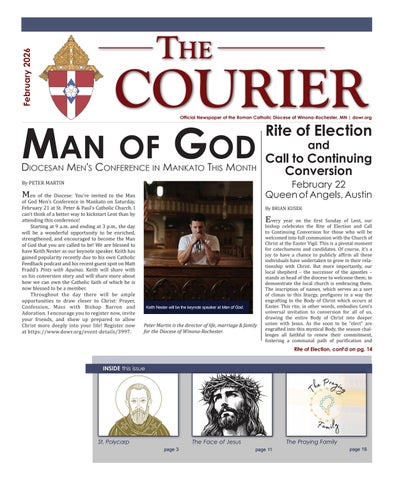
en of the Diocese: You’re invited to the Man of God Men’s Conference in Mankato on Saturday, February 21 at St. Peter & Paul’s Catholic Church. I can’t think of a better way to kickstart Lent than by attending this conference!

Starting at 9 a.m. and ending at 3 p.m., the day will be a wonderful opportunity to be enriched, strengthened, and encouraged to become the Man of God that you are called to be! We are blessed to have Keith Nester as our keynote speaker. Keith has gained popularity recently due to his own Catholic Feedback podcast and his recent guest spot on Matt Fradd’s Pints with Aquinas. Keith will share with us his conversion story and will share more about how we can own the Catholic faith of which he is now blessed to be a member.

Throughout the day there will be ample opportunities to draw closer to Christ: Prayer, Confession, Mass with Bishop Barron and Adoration. I encourage you to register now, invite your friends, and show up prepared to allow Christ more deeply into your life! Register now at https://www.dowr.org/event-details/3997.

Rite of Election and Call to Continuing Conversion February 22

Queen of Angels, Austin

�very year on the first Sunday of Lent, our bishop celebrates the Rite of Election and Call to Continuing Conversion for those who will be welcomed into full communion with the Church of Christ at the Easter Vigil. This is a pivotal moment for catechumens and candidates. Of course, it’s a joy to have a chance to publicly affirm all these individuals have undertaken to grow in their relationship with Christ. But more importantly, our local shepherd – the successor of the apostles –stands as head of the diocese to welcome them; to demonstrate the local church is embracing them. The inscription of names, which serves as a sort of climax to this liturgy, prefigures in a way the engrafting to the Body of Christ which occurs at Easter. This rite, in other words, embodies Lent’s universal invitation to conversion for all of us, drawing the entire Body of Christ into deeper union with Jesus. As the soon to be “elect” are engrafted into this mystical Body, the season challenges all faithful to renew their commitment, fostering a communal path of purification and

Peter Martin is the director of life, marriage & family for the Diocese of Winona-Rochester.
Keith Nester will be the keynote speaker at Man of God

Pope Leo XIV Calls on Catholics to Rediscover Vatican II Teachings

VATICAN CITY, Jan. 7, 2025 (CNS) - The teachings of the Second Vatican Council are still "the guiding star" the Catholic Church is meant to follow, Pope Leo XIV said.

Rereading all of its teachings "is a valuable opportunity to rediscover the beauty and the importance of this ecclesial event," he said Jan. 7, and because its work remains "a guiding principle for us today."

"We have yet to achieve ecclesial reform more fully in a ministerial sense and, in the face of today's challenges, we are called to continue to be vigilant interpreters of the signs of the times, joyful proclaimers of the Gospel, courageous witnesses of justice and peace," he said.

Speaking to visitors gathered in the Paul VI Audience Hall for his weekly general audience, the pope said that with the conclusion of the Holy Year Jan. 6, he was beginning a new series of talks dedicated to the Second Vatican Council.

The council, which convened for four sessions from 1962 to 1965, produced 16 documents, addressing everything from liturgy to Scripture, missionary activity to ecumenism and interfaith relationships, and the functions of clergy and laity to religious freedom.

"Vatican Council II rediscovered the face of God as the Father who, in Christ, calls us to be his children," he said in his talk.

The council looked at the Catholic Church "as a mystery of communion and sacrament of unity between God and his people; it initiated important liturgical reform, placing at its center the mystery of salvation and the active and conscious participation of the entire people of God," he said.

"At the same time, it helped us to open up to the world and to embrace the changes and challenges of the modern age in dialogue and co-responsibility, as a Church that wishes to open her arms to humanity, to echo the hopes and anxieties of peoples, and to collaborate in building a more just and fraternal society," he said.

For the past six decades, the popes have repeatedly underlined the importance of Vatican II, its teachings and its fuller implementation.

However, since the council was held so long ago, that means that "the generation of bishops, theologians and believers of Vatican II is no longer with us," said the pope, who would have been 10 years old when the council ended in December of 1965.

"It will be important to get to know it again closely, and to do so not through 'hearsay' or interpretations that have been given, but by rereading its documents and reflecting on their content" directly, he said.

"Indeed, it is the Magisterium that still constitutes the guiding star of the Church's journey today," he said.

Catholic News Service produced a significant documentary in 2015 called, "Voices of Vatican II," in which 12 men who took part in the Second Vatican Council (1962-65) look back at that historic event. It features abundant archival footage of the council, much of it rarely seen, and exclusive interviews with those who recount the history they witnessed and helped to make.

All the voices heard in this film are of bishops and priests - including the latePope Benedict XVI - who participated in Vatican II and who, in most cases, have played important roles in the life of the Catholic Church over the subsequent decades.

[The 49-minute film can be viewed online, free of charge, on the Catholic News Service YouTube channel.]

2907 Jeremiah Lane NW, Rochester, MN, 55901 Vol 117 - 2

Most Reverend Robert E. Barron, Publisher

Nick Reller, Associate Editor

Telephone: 507-361-3068 E-mail: nreller@dowr.org

Publishing Schedule: Monthly - Deadline for advertising & articles is the 10th of the month prior. (ISSN 0744-5490)

• Hard copies are distributed at DOW-R parishes on the first or second weekend of each month.

• An online version may be viewed at www.dowr.org/offices/courier/index.html

• To be added to the home delivery list free of charge, readers should send their names and addresses to:

Diocese of Winona-Rochester

The Courier 2907 Jeremiah Lane NW Rochester, MN 55901 or nreller@dowr.org

Child Abuse Policy Information

The Diocese of Winona-Rochester will provide a prompt, appropriate and compassionate response to reporters of sexual abuse of a child by any diocesan agent (employees, volunteers, vendors, religious or clergy). Anyone wishing to make a report of an allegation of sexual abuse should call the Victim Assistance Coordinator at 507-454-2270, Extension 255. A caller will be asked to provide his or her name and telephone number. Individuals are also encouraged to take their reports directly to civil authorities. The Diocese of Winona-Rochester is committed to protecting children, young people and other vulnerable people in our schools, parishes and ministries. The diocesan policy is available on the diocesan web site at www.dow.org under the Safe Environment Program. If you have any questions about the Diocese of Winona-Rochester’s implementation of the Charter for the Protection of Children and Young People, please contact Michael Gerard at 507-361-3377, or mgerard@dowr.org.

The Courier is the official publication of the Diocese of Winona-Rochester

February Saint St. Polycarp

Feast Day: February 23

[T]o Polycarp, bishop of the church of the Smyrnaeans - rather, the one who has God the Father and the Lord Jesus Christ as his bishop - warmest greetings”

-St. Ignatius of Antioch, in his Letter to St. Polycarp

�here are many saints of the Catholic Church, but arguably there are none whose name sounds more Pokémon-like than St. Polycarp. For the record, any readers who are die-hard fans of the Pokémon card game, TV shows, or movies, I am not “pulling your leg,” so to speak. There, indeed, existed a St. Polycarp, and his feast day is celebrated by the Church every February 23. Yet, for many Catholics, St. Polycarp is likely an obscure saint. This is unfortunate because, when you study St. Polycarp’s life story, you quickly realize his invaluable role and impact on the Church. My hope, in writing this article, is not only to lessen St. Polycarp’s obscurity among Catholics, but also to encourage them to develop a newfound appreciation

The Holy Father's Intention for February 2026

For Children with Incurable Diseases

Let us pray that children suffering from incurable diseases and their families receive the necessary medical care and support, never losing strength and hope.

Father Jim Berning blessed his new car following a Sunday morning Mass at St. Katherine Church in Truman early in January. Some of his parishioners suggested he name the new vehicle "Trinity Run" in recognition of his time spent traveling among the three parishes for which he serves as pastor - the other two being St. James of St. James and St. Mary's of Madelia. After blessing his own, Father Berning blessed the cars of others attending Mass.

Reprinted from February 2001.

and spiritual devotion to this saint.

So, who is St. Polycarp? He is one of the earliest saints of the Catholic Church. He resided in the city of Smyrna, which was located near the Aegean Sea in what is now called Izmir in modern-day western Turkey. St. Polycarp’s life spanned from circa 68 to circa 155 A.D., so his earthly pilgrimage was a long one. Aside from this, there are very few details (e.g. early childhood, life experiences, etc.) concerning St. Polycarp’s life that have survived to this day. Much of what can be known about him is gleaned either from his own writing or from the writings of other Church leaders and communities who personally knew him. These still offer a beautiful portrait of St. Polycarp; from this portrait, I recognize four overarching descriptors that give Catholics both a clear sense of who this man was and an opportunity to grow in admira tion of him.

The first descriptor I would ascribe to St. Polycarp is Bridge to the Apostolic Age . He is considered an “Apostolic Father;” in his book Apostolic Fathers Clayton N. Jefford defines an Apostolic Father as “... [a man] who knew one or more of the first-century apostles (the first followers of Jesus of Nazareth) or who at least had received instruc tion from the disciples of the apostles” (pg. xviii). In other words, an Apostolic Father is a man who has a close, personal relationship with or connection to Jesus’ apostles. We know this to be the case for St. Polycarp because his

SS Peter and Paul School, Mankato, is the oldest school in the Diocese. It is 111 years old. To celebrate Catholic Schools Week and the Bicentennial, the faculty and children planned a Mass and invited all former teachers, students and present friends. In the picture are two School Sisters of Notre Dame who were in first grade at SS Peter and Paul 75 and 74 years ago with four of today's first graders. Left to right: Tracy Goetll, Sister Robertine Lamm, Sister Alberta Janda, John Oberle, Dan Fallenstein and John Mettler.

Reprinted from February 13, 1976.

disciple, Irenaeus of Lyon (circa 140circa 202 A.D.), identifies him in this way. In one of his works, Irenaeus mentions that St. Polycarp was in close relationship with the Apostle John (Fragment 2). Additionally, Irenaeus writes, “But Polycarp also was not only instructed by apostles, and conversed with many who had seen Christ, but was also, by apostles in Asia, appointed bishop of the Church in Smyrna, whom I also saw in my early youth” (Against Heresies, Bk. 3, Ch. 3, Para. 4). So, according to Irenaeus, St. Polycarp was more than just a disciple of the Apostles; he was, in fact, chosen by them to be one of their many successors (i.e. bishops) who led and oversaw the churches that they founded. I consider this to be a very significant feature of St. Polycarp because he, of all people, had the surest ability to confirm the validity of the Catholic faith that was being taught and handed on to future Christian generations. This quality of St. Polycarp would eventually become a vital need to the early Church once all of Jesus’ apostles and earliest followers had died. Later Christian generations, who never knew the apostles, depended upon St. Polycarp, and other Church leaders like him, to faithfully teach them the Gospel and how to be Christ-like in the world.

A second descriptor I would give to St. Polycarp is Humble Leader of the Early Church . The fact that St. Polycarp was a very early successor of the

St. Polycarp, cont'd on pg. 14

Rochester - Eagle Scout Bob Vanderveer, iron lung patient, beams happily as Dr. C.W. Mayo presents him with the Eagle Scout badge at ceremonies held in St. Mary's hospital here Feb. 6. Bob, who has been confined to the iron lung for four years, is 27 years old and a Navy veteran. At right is his mother, Mrs. R.W. Vanderveer and on the extreme left is Sister Mary Brigh, superintendent of the hospital. (Post-Bulletin photo by John R. Finnegan.)

Reprinted from February 25, 1951.

The following is adapted from a homily for the First Sunday of Lent.

From the Bishop

� t the beginning of a football or baseball season, the coach will bring his players back to basics. They will cover the three-point stance, the mechanics of taking a handoff, the timing of a swing, keeping your eye on the ball, etc. Before we can do spectacular things in a sport, we must make sure we are doing the simple and elemental things well.

So it is in the spiritual life. Lent is a time to get tuned up, to get back to basics, to remember the fundamentals. This is why, on the First Sunday of Lent, the Church is asking us to look at the beginning of the book of Genesis, the story of the creation and the fall. We’ve heard it often, and it’s probably emblazoned in our minds - but we need to hear it again.

“The Lord God formed man out of the clay of the ground and blew into

Officials

The Most Rev. Robert Barron, Bishop of the Diocese of Winona-Rochester, announces the following:

Ecumenical Officer

Rev. Glenn Frerichs: appointed to a three-year term as Ecumenical Officer for the Diocese of Winona-Rochester, effective January 1, 2026. Incardination

Rev. M. Paul Weberg: originally a Benedictine priest of Marmion Abbey in Illinois; incardinated into the Diocese of Winona-Rochester, effective November 20, 2025. Pastoral Council

Deacon Randy Horlocker: appointed to a three-year term on the Pastoral Council of the

Reversing the Momentum of Eden

his nostrils the breath of life, and so man became a living being.” Our very existence comes from God and we are owed nothing. Every breath we take is a reminder of our dependency upon God; every beat of our heart is a reminder that God is the Lord.

God made us to be alive. St. Irenaeus famously said, Gloria Dei homo vivens - the glory of God is man fully alive. Our God is a living God, and he wants us to share his life. “I have come that you might have life and have it to the full.” (John 10:10) Surrender to God means fullness of life, not a compromise of our freedom.

Now enter the serpent. Notice please that the serpent is a creature of God. He does not stand as a co-equal rival to God. Christianity has always resisted Manichaeism and dualism - the view that matter is bad - in all of its forms. Evil is parasitic on the good, not a substantive opponent.

Lent is a time to get tuned up, to get back to basics, to remember the fundamentals.

This is why “God planted a garden in Eden…and he placed there the man he had formed.” Our near total freedom in the garden of Eden is a sign of God’s good will in our regard, and his desire that we realize ourselves in every direction. Politics, art, science, literature, philosophy, music, sports, entertainment - all of it is good, all that conduces to human flourishing is desired by God.

Diocese of Winona-Rochester, effective December 1, 2025.

Sr. Mary Micaela Hoffman, RSM: appointed to a threeyear term on the Pastoral Council of the Diocese of Winona-Rochester, effective December 1, 2025.

Mr. Joe Bakken: appointed to a three-year term on the Pastoral Council of the Diocese of Winona-Rochester, effective December 1, 2025.

Mrs. Olivia Gonzalez: appointed to a three-year term on the Pastoral Council of the Diocese of Winona-Rochester, effective December 1, 2025.

Mrs. Jessica Kaufman: appointed to a three-year term on the Pastoral Council of the

life and being into us, so he breathes moral and spiritual purpose. When we convince ourselves that we live on our own terms and that we choose on our own terms, we cease to be really free and really alive. This is the fault line, the turning-point.

The serpent forces Eve to wonder about the prohibition: “Did God really tell you not to eat from any of the trees in the garden?” He continues with his cunning persuasion, “You certainly will not die! God knows well that the moment you eat of it you will be like gods knowing good and evil.” This is the great temptation and the great lie. The serpent places in Adam and Eve’s minds the conviction that unless and until they determine the meaning and purpose of their own lives, they will not be free or live up to their full potential. The knowledge of good and evil is the godlike prerogative to set the agenda for one’s life, to determine the difference between right and wrong.

But this belongs to God alone. Just as he breathed

Diocese of Winona-Rochester, effective December 1, 2025.

Mr. Matthew Meeks: appointed to a three-year term on the Pastoral Council of the Diocese of Winona-Rochester, effective December 1, 2025.

Mrs. Tina Marie Monosmith: appointed to a three-year term on the Pastoral Council of the Diocese of Winona-Rochester, effective December 1, 2025.

Mr. Joe Mytych: appointed to a three-year term on the Pastoral Council of the Diocese of Winona-Rochester, effective December 1, 2025.

Mrs. Tina Mytych: appointed to a three-year term on the Pastoral Council of the Diocese of Winona-Rochester, effective December 1, 2025.

When Adam and Eve grasp at this knowledge, they lose it; they were expelled from the garden - and not because God is vindictive. It is the natural consequence of making oneself into God: one makes the world around one cold and lifeless. When we grasp at divinity, whatever life we have dries up. We become small souls, locked in the prison of our egotism.

But watch how, at every turn, Jesus undoes the damage of Eden. The devil tempts him to make pleasure the center of his life, to measure good and evil by what sensually satisfies him. And Jesus reverses the momentum: “Not on bread alone is man to live but on every utterance that comes from the mouth of God.”

Next the devil takes him to the parapet of the temple and tempts him to make his ego the center of his life, to make his own glory the measure of good and evil. But Jesus reverses the momentum: “You shall not put the Lord your God to the test.” We don’t measure

Mr. Daniel Noterman: appointed to a three-year term on the Pastoral Council of the Diocese of Winona-Rochester, effective December 1, 2025.

Mrs. Sandra Pineda: appointed to a three-year term on the Pastoral Council of the Diocese of Winona-Rochester, effective December 1, 2025.

Mrs. Dawn Rasmussen: appointed to a three-year term on the Pastoral Council of the Diocese of Winona-Rochester, effective December 1, 2025.

Dr. Sidna Tulledge-Scheitel: appointed to a three-year term on the Pastoral Council of the Diocese of Winona-Rochester, effective December 1, 2025.

God; God measures us - and in that we find our joy.

Then he tempts him a third and final time, taking him to a high mountain and showing him all the kingdoms of the world: “All these I will bestow on you if you prostrate yourself in homage before me.” The temptation is to make power the center of his life, to make of his own authority the measure of good and evil. But Jesus reverses the momentum: “You shall do homage to the Lord your God; him alone shall you adore.”

Don’t be afraid to surrender to God. Think of it as taking a deep breath of fresh air.

Ms. Katherine Smith: appointed to a three-year term on the Pastoral Council of the Diocese of Winona-Rochester, effective December 1, 2025. Censor Librorum

Rev. Gregory Parrott: appointed Censor Librorum for the Diocese of WinonaRochester, effective January 15, 2026.

Parochial Administrator

Very Rev. Jeffrey Dobbs: appointed Parochial Administrator of St. James Parish in St. James and St. Mary Parish in Madelia, effective January 5, 2026.

Non Nisi Te Domine
Bishop
Robert Barron

Revertir el Impulso del Edén 5

Lo siguiente es una adaptación de una homilía para el primer domingo de Cuaresma.

�l comienzo de una temporada de fútbol americano o béisbol, el entrenador vuelve a enseñar a sus jugadores los fundamentos básicos. Repasan la postura de tres puntos, la mecánica de recibir un pase, el momento adecuado para batear, mantener la vista en la pelota, etc. Antes de poder hacer cosas espectaculares en un deporte, debemos asegurarnos de que hacemos bien las cosas sencillas y elementales. Lo mismo ocurre en la vida espiritual. La Cuaresma es un tiempo para ponerse a punto, para volver a lo básico, para recordar los fundamentos. Por eso, el primer domingo de Cuaresma, la Iglesia nos pide que leamos el comienzo del libro del Génesis, la historia de la creación y la caída. La hemos oído muchas veces y probablemente esté grabada en nuestra mente, pero necesitamos volver a escucharla.

Bishop's Calendar

*indicates event open to public

February 1, Sunday

5 p.m. - Neuhaus LectureSarasota, FL

February 5, Thursday

8:45 a.m. - Q&A with Upperclassmen - Lourdes High School, Rochester

9:45 a.m. - School MassLourdes High School, Rochester

«El Señor Dios formó al hombre del barro de la tierra y sopló en su nariz aliento de vida, y así el hombre se convirtió en un ser viviente». Nuestra propia existencia proviene de Dios y no se nos debe nada. Cada respiro que tomamos es un recordatorio de nuestra dependencia de Dios; cada latido de nuestro corazón es un recordatorio de que Dios es el Señor.

Dios nos creó para estar vivos. San Ireneo dijo la famosa frase: Gloria Dei homo vivens, la gloria de Dios es el hombre plenamente vivo. Nuestro Dios es un Dios vivo y quiere que compartamos su vida. «Yo he venido para que tengan vida y la tengan en abundancia» (Juan 10;10). Rendirse a Dios significa plenitud de vida, no una renuncia a nuestra libertad. Por eso «Dios plantó un jardín en Edén... y allí colocó al hombre que había formado». Nuestra libertad casi total en el jardín del Edén es una señal de la buena voluntad de Dios hacia nosotros y de su deseo de que nos realicemos en todos los aspectos. La política, el arte, la ciencia, la literatura, la filosofía, la música, los

1 p.m. - Clergy Personnel Committee - The Chancery, Rochester

February 6, Friday

*8:30 a.m. - Staff Mass - The Chancery, Rochester

2 p.m. - Bishop's Cabinet - The Chancery, Rochester

February 7, Saturday Institute of Lay Formation - Pax Christi, Rochester

On J�nu�ry 16, homeschooling families gathered at the Church of St. Pius X in Rochester for a homeschool Mass celebrated by Bishop Barron, joined by their pastor, Fr. Joachim Anumba. Homeschool students served as musicians, altar servers, and lectors, helping lead the prayer of the assembly. The evening highlighted families coming together to support their children's formation in faith through prayer, service, and shared worship. Following Mass, families stayed to share dinner together, continuing the evening in fellowship.

Photos and caption by EMILY SMITHLEY, media specialist for the Diocese of Winona-Rochester.

deportes, el entretenimiento... todo ello es bueno, todo lo que contribuye al florecimiento humano es deseado por Dios. Ahora entra en escena la serpiente. Obsérvese que la serpiente es una criatura de Dios. No es un rival igualitario de Dios. El cristianismo siempre se ha opuesto al maniqueísmo y al dualismo, la visión de que la materia es mala en todas sus formas. El mal es un parásito del bien, no un oponente sustantivo.

La serpiente obliga a Eva a cuestionarse la prohibición: «¿De verdad Dios les dijo que no comieran de ningún árbol del jardín?» Ella continúa con su astuta persuasión: «¡Por supuesto que no morirán! Dios sabe bien que en el momento en que coman de él serán como dioses, conocedores del bien y del mal». Ésta es la gran tentación y la gran mentira. La serpiente inculca en la mente de Adán y Eva la convicción de que, a menos que determinen el significado y el propósito de sus propias vidas, no serán libres ni alcanzarán su pleno potencial. El conocimiento del bien y del mal es la prerrogativa divina

February 8, Sunday

*11 a.m. - Mass for Consecrated Life - Assisi Heights, Rochester

February 8-13, Sunday-Friday

Diocesan Priest RetreatBuffalo, MN

February 17, Tuesday

1 p.m. - IHM Seminary Finance Council - IHM Seminary, Winona

5 p.m. - Mass - IHM Seminary, Winona

de establecer la agenda de la propia vida, de determinar la diferencia entre lo correcto y lo incorrecto.

Pero esto le pertenece solo a Dios. Así como él nos insufló vida y existencia, también nos insufló un propósito moral y espiritual. Cuando nos convencemos de que vivimos según nuestros propios términos y que elegimos según nuestros propios términos, dejamos de ser realmente libres y realmente vivos. Esta es la línea divisoria, el punto de inflexión.

Cuando Adán y Eva se aferran a este conocimiento, lo pierden; fueron expulsados del jardín, y no porque Dios sea vengativo. Es la consecuencia natural de convertirse en Dios: uno hace que el mundo que le rodea sea frío y sin vida. Cuando nos aferramos a la divinidad, cualquier vida que tengamos se seca. Nos convertimos en almas pequeñas, encerradas en la prisión de nuestra arrogancia.

Pero fíjense en cómo, a cada paso, Jesús repara el daño del Edén. El diablo lo tienta para que haga del placer el centro de su vida, para que mida el bien y el mal por lo que le

February 18, Wednesday

9:30 a.m. - School Ash

Wednesday Mass - St. Peter, Hokah

February 19, Thursday

*8:30 a.m. - Staff Mass - The Chancery, Rochester

February 21, Saturday

Diocesan Men's ConferenceSts. Peter and Paul, Mankato

satisface sensualmente. Y Jesús invierte el impulso: “No solo de pan vive el hombre, sino de cada palabra que sale de la boca de Dios.”

A continuación, el diablo lo lleva al parapeto del templo y lo tienta para que convierta su ego en el centro de su vida, para que haga de su propia gloria la medida del bien y del mal. Pero Jesús invierte el impulso: “No pondrás a prueba al Señor tu Dios.” Nosotros no medimos a Dios; Dios nos mide a nosotros, y en eso encontramos nuestra alegría.

Luego lo tienta por tercera y última vez, llevándolo a una montaña alta y mostrándole todos los reinos del mundo.: “Te daré todo esto, si te postras para adorarme.” La tentación es convertir el poder en el centro de su vida, hacer de su propia autoridad la medida del bien y del mal. Pero Jesús invierte el impulso: “Rendirás homenaje al Señor tu Dios; solo a él adorarás.”

No tengas miedo de entregarte a Dios. Piensa en ello como en tomarse un respiro profundo de aire fresco.

February 22, Sunday

*3 p.m. - Rite of Election MassQueen of Angels, Austin

February 24, Tuesday

Upper Room - The Chancery, Rochester

February 28, Saturday

Diocesan Marriage RetreatAlverna Center, Winona

Comprehensive Immigration Reform Now' Archbishop Hebda: 'We Need

The following op-ed by Archbishop of St. Paul & Minneapolis MOST. REV. BERNARD HEBDA was published by the Wall Street Journal on January 20.

�f recent events in Minnesota have clarified anything, it’s that we can no longer put off the hard work of immigration reform. Each year of inaction has made the debate louder, angrier and less humane. A difficult policy discussion has hardened into a cultural and political battleground. It’s playing out on the streets here, where federal immigration officers are clashing with protesters.

We had a chance in 2013, when a bipartisan bill passed the Senate. It was a strong bill that provided billions for border security and a 12-year path to citizenship for law-abiding undocumented immigrants. The House never took it up.

The longer Washington waits, the worse the problem gets. Communities are strained and millions live in a constant state of uncertainty. This serves neither justice nor the common good.

As a bishop entrusted with the care of souls, I want to reiterate the consistent call of Catholic bishops around the U.S. for true statesmen to step forward, set aside partisan calculations and enact meaningful federal immigration reform.

Recent failures can’t be ignored. The nation was poorly served by those who threw the border open. The flood of migrants overwhelmed local communities, eroded public trust and weakened the rule of law. Compassion divorced from order isn’t compassion at all; it’s negligence.

At the same time, it’s wrong to blame undocumented immigrants themselves, many of whom came here seeking safety, work or family reunification. Solidarity can’t be selective. We must stand with citizens and undocumented immigrants together as human beings created in God’s image.

The Catholic tradition insists on holding together truths that politicians prefer to separate. Nations have the right and duty to secure their borders and enforce their laws. Immigrants are human beings with natural rights that must be respected. Authentic justice requires both the rule of law and mercy, both accountability and hospitality.

In this light, it is right to respect the efforts of Immigration and Customs Enforcement officers when they are fulfilling their mission to identify and detain serious criminals who have illegally entered the country. The removal of dangerous people serves the common good. Protecting the innocent is a moral obligation.

Yet the current environment is untenable. Even law-abiding immigrants are living in fear that any interaction with authorities could separate parents from children or unravel years of honest work.

What’s required is a comprehensive, longterm solution that reflects reality rather than ideology. That solution must include the granting of a lawful status for those who have put down roots, contributed to their communities and lived here for years. A workable solution would also have to

Bishop Barron: 'There Is a Way Out'

The following statement was posted to social media by Bishop of Winona-Rochester MOST. REV. ROBERT BARRON on January 18.

�s a resident of Minnesota and as bishop of the Diocese of Winona-Rochester, my heart is breaking over the situation in my home state. Violence, retribution, threats, protests, deep suspicion of one another, political unrest, fear - all of it swirling

Sister Tierney Trueman: 'Live Our Minnesota Nice'

Congregational Minister/President SISTER TIERNEY TRUEMAN, OSF, on January 14.

� ask this question: is this not the time for us to lay aside our bipartisan differences, and focus our thoughts and actions on the common life we share as human beings, regardless of our culture, the language we speak, the customs we live or the

color of our skin?

How do we begin to see how these differences mutually enrich us, and do NOT divide us? Is this not the moment to reclaim our moral center, to be able to distinguish what is morally right for me, as I value my dignity as a human being, while equally valuing and respecting that same human dignity in all my brothers/sisters?

What actions might this invite me to take? I

acknowledge that some people will be deported. Mercy doesn’t negate consequences, and compassion doesn’t mean wide-open borders.

The 2013 Senate bill offered a glimpse of what responsible governance can look like: bipartisan engagement, attention to enforcement and legal pathways and a recognition that widespread irregularity benefits no one. That effort sadly failed, not because the problem was unsolvable, but because political will collapsed under pressure from the extremes. We have paid the price for that failure ever since.

As a pastor, I see the human cost on all sides. I minister to immigrant parishioners who are fearful of driving their children to school or shopping for groceries, regardless of their legal status. I also serve those who feel abandoned by leaders who have seemed more interested in political posturing than in protecting their communities. The church can’t choose one flock over another. Neither should the nation.

Immigration reform isn’t about erasing borders or demonizing newcomers. It’s about restoring moral order, strengthening families and promoting the common good. That work demands courage, humility, and a willingness to compromise - virtues that define proper statesmanship. If we continue to delay, the debate will only grow more bitter and the solutions more elusive. The moment to act is now.

around all the time. May I make a modest proposal for exiting this unbearable state of affairs?

The Trump Administration and ICE should limit themselves, at least for the time being, to rounding up undocumented people who have committed serious crimes. Political leaders should stop stirring up resentment against officers who are endeavoring to enforce the laws of the country. And protestors should cease interfering with the work of ICE. And everyone on all sides must stop shouting at one another and demonizing their opponents. Where we are now is untenable. There is a way out.

suggest two. First, to participate and/or support peaceful protests against the incendiary, brutal, cruel actions of the ICE agents who move among us masked and in unmarked cars; and to refuse to accept that our immigrant neighbors are “garbage” or “vermin.” Secondly, to gather together as neighbors in our local communities to provide whatever services are needed by our immigrant neighbors who fear for their lives if they leave their homes.

Let’s empower one another to live our Minnesota Nice!

The following letter was released by Rochester Franciscan

The Face of Jesus 7

n inner urge rose up within me, telling me to go to a nursing home. I went, and, upon entering it, the first room I passed was that of a dying woman with her husband next to her.

Though unable to speak - and barely breathing - the woman looked at me. Her eyes pierced mine. I froze. Then, I realized I was seeing the face of Jesus. It was his face as he hung on the cross. I had no doubt. It is seared in my memory. It is unforgettable.

We just silently looked at each other for a few minutes. Then I prayed for her and sent for a priest.

As I was driving home, I realized what St. Teresa of Calcutta must have seen when she saw the face of Jesus in the poorest of the poor. I was filled with a sense of grace and of being loved by him whose face was the face of a dying woman.

Once you encounter Jesus, you change. Once you look at him, you are never the same. Meeting Jesus in the flesh is always a call to conversion, repentance, and healing. In Scripture, we read how Mary Magdalene unexpectedly met Jesus one day, and he looked at her and called her to repentance, conversion, and healing. Her life completely changed.

I too will change after seeing him in that dying woman. What will happen now in my life? From what must I turn away? What healing do I need?

My friends, the wonderful thing is that Jesus comes to us every day, at every hour, at every moment. He never fails to come, looking at us and wanting to pierce our souls with his love. Every moment is a time for conversion and healing. Jesus comes at those times in our lives when we most need him. He comes to those areas of our lives that are most broken and unhealed. He wants to go to those places of sin in our lives to forgive us and call us to turn from sin. Sometimes he does this in very evident ways; other times he is mysterious.

Yes, Jesus looks at us. If only our hearts were truly prepared to receive him, pre pared to change, to repent, and to be healed, to allow his eyes to pierce ours.

Have you seen the face of Jesus? Have you recognized him? He comes to you in the face of the parishioner next to you, in the faces the poor, the sick, and the dying. Will you go to the places where you will find him?

Finally, this thought: I hope I revealed the face of Jesus to that woman as she lived her final hours on earth. I hope she recognized Jesus in me when she most needed him. I hope that Jesus used me to show himself to her. It was Jesus who called me that day to go to that nursing home.

He had something important he wanted to do for her through me, and for me through her. It was him. His work was accomplished.

Deacon Robert Yerhot is the director of the diaconate for the Diocese of Winona-Rochester.

Seminarians March for Life

ach school year, Immaculate Heart of Mary seminarians participate in the annual March for Life prayer rally, which takes place near the capitol building in St. Paul, on the anniversary of the Supreme Court decision of Roe vs Wade in 1973, which argued that all women have the fundamental right to an abortion procedure, ultimately ending the life of the child in the womb.

The event begins with a prayer service inside the Cathedral of St. Paul, allowing the faithful to reflect on the beauty and gift of human life and call to mind

our Lord in gratitude. The prayer service is led by one of the Minnesota diocesan bishops and includes readings and psalms from scripture, a homily on the dignity of human life, and hymns of praise directed to our God.

After the prayer service concludes, the faithful are invited to march together to the capitol in a spirit of peacefulness and prayer, lifting up their prayers in intercession for the souls of the unborn children of God, along with mothers, fathers, and all persons affected by the pain and loss surrounding abortion.

The rosary is a common prayer that seminarians will pray as they march alongside the people of God, as it is an especially beautiful and powerful prayer. The mother of all peoples, our Blessed Mother Mary, delights in her children and brings our prayers to her Son with deep care and longing. The title “Mother of the Unborn” has also been given to our Blessed Mother, as she is deeply saddened by the loss of her children due to abortion. As we reflect on the mysteries of Jesus and Mary in the holy rosary, we can be sure that our mother is listening and is working alongside her Son, healing and answering our prayers.

After a period of time marching, the faithful gather at the steps of the capitol building, alongside state representatives and other local leaders, and listen to various speeches emphasizing the dignity of human life from the moment of conception to natural death,

with a continued effort to one day eliminate the act of abortion in the state, nation, and world.

Immaculate Heart of Mary seminarians took part in this annual March for Life on January 22. We are grateful to everyone who took part in the prayer service and march. Let us continue to direct our prayers up to the souls of all those lost to abortion and for all affected by this act. May our Immaculate Mother protect and care for us all!

Joseph Bartosh is a seminarian for the Diocese of Winona-Rochester at Immaculate Heart of Mary Seminary.

Human Trafficking and Major Sporting Events

The following appeared in the January 2026 issue of Hidden in Plain Sight: a USCCB Anti-trafficking Newsletter

uman trafficking and major sporting events have become increasingly linked in public discourse. Around the world, large-scale sporting events have been associated with documented cases of forced labor, fraudulent recruitment practices, and labor exploitation. High-profile awareness campaigns have drawn public attention to these concerns across events such as the Olympic Games, Formula 1, the Super Bowl, and the FIFA World Cup.

A stark example of labor exploitation emerged during the most recent World Cup hosted in Qatar. Large numbers of migrant workers, particularly from India and other parts of Asia, were recruited to construct stadiums and related infrastructure. Many workers reported deceptive recruitment practices, unpaid or underpaid wages, excessive and dangerous working conditions, and, in some cases, loss of life. These injustices sparked global outrage and widespread scrutiny, while organizations such as FIFA faced criticism for their limited response and accountability.

It is important to note that sporting events themselves do not directly cause human trafficking. However, the surge in tourism, temporary employment, and demand for low-wage labor surrounding major events can create conditions that increase vulnerability to exploitation. The rapid movement of people and the need for short-term workers in construction, hospitality, transportation, and service industries can be exploited by traffickers and unscrupulous labor brokers.

This year, Super Bowl Sunday and the feast day of the patron saint of victims of human trafficking share the same date. The Super Bowl coincides with the Feast Day of St. Josephine Bakhita on February 8, a powerful symbol of resilience, faith, and hope for survivors of human trafficking. This year, we are presented with a meaningful opportunity for collective action: uniting prayer, awareness, and education to affirm the dignity of every human person and to stand in solidarity with those affected by exploitation.

As part of this effort, we invite you to participate in the events listed below as we come together to raise awareness, deepen understanding, and reaffirm our shared commitment to preventing human trafficking.

Saint Josephine Bakhita

Patroness of Victims of Human Trafficking

�he little girl had never worn a dress until the day two scowling men appeared in the fields, blocking her path and holding a knife to her side, kidnapping her much as one might snatch a hen from its coop. The day when her life turned into a nightmare, that terrified 9-year-old girl forgot everything, even her name and the names of her parents, with whom she had had a happy life.

A Slave

Arab slave merchants took care, not to clothe her, but to give her a new name. “Bakhita,” they called her, Arabic for “fortunate one,” a horrible joke of a name for the child born in 1869 in a village of Darfur, in South Sudan. She became human merchandise passed from hand to hand in the markets of El Obeid and Khartoum. One day, while serving her master, a Turkish general, she was “tattooed” with 114 strokes of a knife, the wounds covered in salt so that the scars would remain visible.

The Light

Bakhita survived, and one day, a ray of light entered her hell. Callisto Legnami, the Italian Vice-Consul, bought her from some traffickers at Khartoum. Bakhita put on a dress for the first time and entered a house. The door closed behind her on ten years of unspeakable brutality. The respite lasted for two years when the Italian functionary, who treated her kindly, was obliged to return to Italy because of the Mahdist wars in Sudan. Bakhita remembered the moment: “I dared to ask him to take me with him to Italy.” Callisto Legnami agreed, and in 1884, Bakhita

landed in the country where an unimagined destiny awaited the former slave. She became the nanny of Alice, the daughter of the Michieli family, who were friends of the Legnamis and lived in Zianigo, near Mirano in the province of Veneto.

The “Little Brown Sister”

In 1888, the couple she worked for had to leave for Africa, and for nine months, Bakhita and Alice were left in the care of the Canossian Sisters of Venice. Now that her body was clothed, Bakhita began to clothe her soul. She came to know Jesus, learned the faith, and on January 9, 1890, she received the sacraments of Baptism, Confirmation and First Communion from the Patriarch of Venice, along with the name Josephine Margaret Fortunata (the latter is the Italian translation of the Arabic “Bakhita”). In 1893 she entered the novitiate of the Canossian Sisters. Three years later she professed her vows and spent the following 45 years as the cook, sacristan, and especially, the doorkeeper of the convent at Schio. There she got to know the people of the town, and the people in turn learned to appreciate the gentle smile, the goodness and faith of the moretta, the “little brown sister.”

“I would kiss their hands…”

All Schio was in mourning when Sr. Josephine Bakhita died of pneumonia on February 8, 1947. Her life had truly become “fortunate,” as she said herself: “If I were to meet those men who abducted me, or even those who tortured me, I would kneel and kiss their hands, for it that hadn’t happened, I would not be a Christian and a religious today.”

To learn more about the United States Conference of Catholic Bishops' AntiTrafficking Program, contact AntiTrafficking Education and Outreach Coordinator Felicitas Brugo Onetti at FOnetti@usccb.org or 202-541-3064.

A Prayer to St. Josephine Bakhita

S�. Jos�p��n� B�k����, you were sold into slavery as a child and endured untold hardship and suffering.

Once liberated from your physical enslavement, you found proper redemption in your encounter with Christ and his Church.

O St. Bakhita, assist all those trapped in a state of slavery; intercede with God on their behalf so that they will be released from their chains of captivity. Those whom man enslaves, let God set free.

Provide comfort to survivors of slavery and let them look to you as an example of hope and faith. Help all survivors find healing from their wounds. We ask for your prayers and intercessions for those enslaved among us.

Amen.

Text copyright © 2022, United States Conference of Catholic Bishops, Washington, D.C. All rights reserved.

Supporting Future Priests Bishops and Rector Dinner Registration Now Open

t’s February, which means registration is now open for the Bishops and Rector Dinner! This annual benefit dinner brings donors and seminarians together for faith, fellowship, and fun while raising essential funds for priestly formation. We are excited to invite all who are interested to attend, support our seminarians, and hear from our guest keynote speaker, Msgr. James Shea.

During the event, one individual is honored with the Immaculate Heart of Mary Award in recognition of outstanding service to the Catholic Church. This year, we are pleased to present this award to Monsignor James Shea, president of the University of Mary in Bismarck, North Dakota. According to his biography, “Monsignor Shea was inaugurated in 2009 as the sixth president of the university and, at the age of 34, became the youngest college or university president in the United States. He succeeded Sister Thomas Welder, who served as president for 31 years… [and he is] deeply committed to the education and formation of young people.” Prior to his inauguration, Msgr. Shea studied at seven universities, with academic concentrations in philosophy, classical Greek, theology, and management.

The evening will be emceed by the Very Reverend Jason Kern, rector of Immaculate Heart of Mary

Seminary (IHMS), and the Most Reverend Robert Barron, bishop of the Diocese of Winona–Rochester. Guests will enjoy a social hour, dinner catered by the Rochester Event Center, music performed by IHMS seminarians, and a keynote address by Msgr. Shea.

Proceeds from the Bishops and Rector Dinner directly support the formation of the seminarians at Immaculate Heart of Mary Seminary. Guests may participate in a variety of ways, including attending the dinner, making a donation, sponsoring a seminarian’s meal, or placing an advertisement in the event booklet. New this year is the opportunity to sponsor a floral arrangement. For $300, sponsors may

include their name and/or logo with the arrangement, support seminarians in a meaningful way, and take home a beautiful floral display at the conclusion of the evening.

Your contribution through our annual event brings benefactors like you together to support the ongoing formation of the seminarians throughout the year. Join us for drinks, dinner, and engaging conversation. To register, visit the Catholic Foundation website at catholicfsmn.org/bishops-and-rectorevent or call 507-858-1275.

Nicole Weninger is the marketing and communications associate for Immaculate Heart of Mary Seminary.

Last year's dinner featured music by the seminarian band Immaculate Jazz.

11 Finding Peace in Troubled Times

s I write this article on January 3, it’s the common practice in our society to evaluate the past year and set resolutions, do goal planning, choose a word of the year, and other “start over/ improve self” kind of thinking. There is nothing wrong with those practices. However, I woke up today with fear and panic, feeling like I was already “behind” since I don’t even have the 2026 calendar up yet and all the year’s planning has begun! As one who experiences seasonal affective disorder, buying into the cultural norms can be upsetting. I ask myself, is it really a “disorder” when our human biology dictates we slow down and hibernate in our deep Midwestern winter season, and we are fighting against the slowdown, darkness, and soul renewal? I personally continue the journey through deep grief. Grief colors my world as nature does this time of year in grays, blacks, browns and white. I am practicing radical acceptance of what is in the here and now and living with the darkness.

In God there is no time. He loves us no matter what and is always waiting with love and in love. It is through his deep kindness he gave us the seasons, rituals, practices, words, people around us as gifts. Darkness is a gift. Hibernation is a gift. Silence is a gift. I am a learner, information seeker, and in my profession as a psychotherapist I use these gifts plus the gift of deep listening. God reminded me this morning as I read through Philippians 4:8-9 where to place my thoughts. By meditating on these words this month and the rest of the year, I will make St. Paul’s thoughts my own.

Finally, brothers and sisters, whatever is true, whatever is honorable, whatever is just, whatever is pure, whatever is lovely, whatever is commendable, if there is any excellence, if there is anything worthy of praise, think about these things, What you have learned and received and heard and seen in me - practice these things, and the God of peace will be with you.

I give you this gift of Scripture and wish for God's peace during these tumultuous times. As Fr. Swamy, my priest, reminded us on January 1, the Solemnity of Mary, Mother of God, world peace begins in our own heart and needs to be pondered there - intentionally choosing to live in peace, to make amends, to pray for the good of one another. By making that intentional choice for oneself, it will ripple through our family, neighborhood, community and world.

The Diocesan Council of Catholic Women were represented by Province Director, Dianne Vangness and Diocesan President, Shelly Holt at the National March for Life, preceding the NCCW January Board meeting in Washington, D.C.

Our DCCW is sponsoring a Lenten Retreat, Made for More, on Saturday, March 21, with Elizabeth Leon at St. Theodore in Albert Lea. This day of reflection will run from 9 a.m. - 3 p.m. and will include Mass, Reconciliation, and refreshments.

As always, you can reach me at 507-381-2842 or shellyholttotalwellness@gmail.com if you have questions, concerns or comments.

Shelly Holt is the president of the Winona-Rochester Diocesan Council of Catholic Women.

Work, Dignity, and the Call to Local Catholic Leadership

he role of a community foundation is to keep a pulse on the needs of its people and to collaborate toward solutions that strengthen the common good. Over the past year, as I’ve traveled across Southern Minnesota, one concern has surfaced again and again: families are struggling to find work that pays enough to put food on the table. At the same time, employers tell me they can’t fill open positions. These two realities seem contradictory, yet both are true.

Even before the headlines about automation and mass layoffs, employers across the country were reporting difficulty filling roles. Meanwhile, many workers, especially in rural communities, have been unable to find jobs that offer a living wage. So, what’s really happening?

Recent economic analyses from the Society of HR Management among others, point to a structural mismatch. A significant share of open jobs cannot be filled by immediately available unemployed workers because of skill gaps, geographic barriers, or other obstacles such as childcare or transportation. This “friction” means that automation can coexist with labor shortages in certain occupations. Employers then face a crossroads: recruit and train local workers, rely on remote or migrant labor, or automate tasks entirely.

This mismatch is precisely the kind of challenge that local partnerships can address. Coordinated training pipelines, apprenticeships, and employer-led reskilling programs can convert open jobs into filled jobs - and do so in ways that uphold human dignity.

Why This Matters for the Church

Work is not just an economic issue. It is a spiritual one.

Catholic Social Teaching reminds us that work is a participation in God’s ongoing creation. When families cannot find stable, dignified employment, the effects ripple through every part of parish life:

How the Witness of Hope Grant Works

�ow do you share a story you’re grateful for without sounding boastful? Scripture reminds us that humility is essential (Philippians 2:3), yet it also teaches that when we serve those in need, we serve Christ himself (Matthew 25:40). Holding both truths together, we want to share something important about the work unfolding at the Catholic Foundation.

Today, the Foundation stewards more than $50 million in assets on behalf of parishes, schools, cemeteries, and ministries across the Diocese of WinonaRochester. These funds, ranging from scholarship endowments to permanent care accounts to parish agency funds, are managed faithfully under Catholic Responsible Investing guidelines. By God’s grace, this past year brought strong market returns, and we are grateful for the growth entrusted to us.

So when we hear stories about a single mother suddenly unable to cover Catholic school tuition after an unexpected medical bill, or a parish facing a costly boiler replacement they didn’t budget for, our instinct is always the same - we want to help.

• Fewer families in the pews

• Increased food insecurity

• Stress on Catholic schools

• Fewer volunteers

• Reduced giving capacity

The Church cannot solve the labor market alone, but it can be a convener, a listener, and a bridge-builder. Parishes are often the most trusted institutions in their communities. They are uniquely positioned to bring people together. Together, employers, educators, families, civic leaders can discern what dignified work looks like in their town and how to support it.

The Opportunity Before Us

The good news is that solutions exist, and they work best when they are local.

Communities across the country have seen success through:

• Training pipelines that connect employers with community colleges and local organizations

• Apprenticeships that allow workers to earn while they learn

• Employer-led reskilling that prepares workers for new roles rather than replacing them

• Wraparound supports like childcare, transportation and emergency assistance that make training possible

These are not just workforce strategies. They are acts of unity. They honor the dignity of work and the dignity of the worker.

The Foundation’s Role

At the Catholic Foundation, our mission is to steward resources faithfully and to strengthen the Church for generations to come. That includes listening deeply to the economic realities facing families and parishes.

But here’s the truth: most of the money we steward is not ours. It belongs to the people and ministries we serve. Our role is to safeguard it, grow it, and help it reach the needs it was intended to support. Still, when the market performs well, the fees that sustain our operating budget also rise; because the more funds we manage, the more resources we have to serve you. And fiscal year 2025 was, indeed, a strong year.

Ability Requires Responsibility

With the blessings entrusted to us this past fiscal year, we recognize a responsibility to give. Therefore, in December, we introduced the inaugural Witness of Hope Grant. Its name draws inspiration from Bishop Barron and Word on Fire’s call for all disciples to be witnesses in the world. The word hope reflects the heart of this initiative: to support the most urgent and impactful needs across our local communities, sowing hope where it is needed most.

First Peter 3:15 tells us, “Always be ready to give an explanation to anyone who asks you for a reason for your hope.” This passage beautifully echoes the spirit of the grant: a public witness to the hope we hold in Christ, expressed through concrete acts of generosity in Southern Minnesota.

We are not trying to “fix the economy.” But we can convene conversations, share data and insights, support parish-level initiatives, connect donors to workforce-related needs and help fund pilot programs or partnerships that promote dignified work

Our goal is simple: to support the people who make up the Body of Christ in Southern Minnesota.

A Call to Reflect, Pray, and Act Locally

This moment invites all of us, pastors, parish leaders, families, and employers, to take a next faithful step. Reflect

• Where do you see families struggling with work or wages in your community?

• What gifts or resources does your parish already have that could help? Pray

• For those seeking work that honors their dignity

• For employers striving to balance economic pressures with care for workers

• For wisdom in building partnerships that serve the common good Start Conversations

• Talk with local employers about their needs

• Invite parishioners who work in HR, education, or business to share insights

• Ask: What would it look like for our parish to support dignified work in our town?

This is not about solving every problem. It is about taking the next step, together, in faith, with hope for the future of our communities.

Is this topic of interest to you? I'd love to take you to out coffee to discuss. Reach out anytime: Elizabeth 507-218-4098, ewilliams@catholicfsmn.org

Elizabeth Williams is the executive director of the Catholic Foundation of Southern Minnesota.

How the Witness of Hope Grant Works

For our annual Witness of Hope Grant, you will not find us circulating applications or inviting parishes and ministries to compete for funding. Nor will you see us publicizing the individual stories of those who receive support. This grant was intentionally designed to be a quiet, hope-filled act of service - an exercise in humility that keeps the focus on those in need rather than on the Foundation.

Each December, we will review our operating budget and discern how much we are able to give based on the resources available. From there, we will seek the wisdom of local leaders or simply wait in prayerful attentiveness for God to reveal an urgent need. We’re so happy to celebrate with you that we did launch this grant in December, sharing gifts with seven families this Christmas season with a simple goal: to respond faithfully, generously, and without fanfare wherever hope is needed most.

We are grateful for the countless ways you support your parishes, schools, and ministries. The Witness of Hope Grant is our way of joining you in that work - quietly, prayerfully, and with deep respect for the dignity of every person we serve. Together, may we continue to build a community where hope is not just spoken but lived.

Elizabeth Williams is the executive director of the Catholic Foundation of Southern Minnesota.

What a Parish Should Expect from a Third-Party Bookkeeper

s parishes work to be faithful stewards of their financial resources, many consider partnering with a third-party bookkeeper. When a vendor actively seeks your business and says, in effect, “pick me,” it is reasonable and appropriate for a parish to expect a higher level of expertise and accountability than what might be available internally.

Many parishes rely on dedicated volunteers or staff members who are generous with their time and may have experience in corporate or small business bookkeeping. While that support is often invaluable, parish accounting carries unique diocesan requirements, internal controls, and compliance expectations. A third-party vendor should bring specialized parish knowledge and standardized processes that go beyond what even a capable internal bookkeeper can reasonably be expected to provide.

This article outlines what a parish should expect from a third-party bookkeeper, the questions that should be asked before signing any agreement, how payroll and benefits responsibilities should be addressed, and why diocesan trainings and webinars must be treated as mandatory.

Core Expectations

A parish should expect a thirdparty bookkeeper to clearly define the scope of services being provided. From the beginning, it should be clear which tasks the bookkeeper will perform such as posting transactions, reconciling accounts, preparing financial reports, or processing payroll, and which responsibilities remain with the parish. Approvals, purchasing decisions, and the timely submission of accurate documentation typically remain parish responsibilities. Nothing should be assumed. Clarity at

the beginning prevents confusion later.

The bookkeeper should operate with standardized processes and strong internal controls. These procedures are essential safeguards that protect the parish, the pastor, and parishioners. While standardization can sometimes feel restrictive, it promotes consistency, accuracy, and accountability, especially when there are staff changes or leadership transitions.

Parishes should also expect transparency and communication. Parish leadership should always know what work has been completed, what is still pending, and what information or approvals are needed to move forward.

Diocesan Trainings and Webinars

Diocesan bookkeeping trainings and webinars play an essential role in maintaining consistent financial practices

My n��� �s Br�Ann� Sc���d, and I live on a farm outside of Easton with my husband Nate and our four children.

I’m the owner of Veritas Financial Solutions, a business dedicated to helping Catholic parishes, schools, and cemeteries strengthen their financial management and stewardship.

In addition to my work with Veritas, I also write articles on my LinkedIn page that highlight the bookkeeping and accounting topics I most often see within our parishes. My goal is to make these articles both educational and relatable - sometimes even adding a little humor to the day-to-day realities of parish financial life.

and compliance across parishes. These sessions communicate policy updates, clarify expectations, and help reduce financial and legal risk.

A parish should expect that any third-party bookkeeper will attend all required diocesan trainings and webinars. When attendance is not possible, detailed notes or official updates must be reviewed to ensure the bookkeeper remains fully informed of current diocesan policies. This expectation should be explicitly stated in the service agreement and reinforced during onboarding.

Participation in diocesan training is not optional.

Alignment with diocesan standards is a fundamental requirement of responsible stewardship.

Payroll and Benefits Expectations

Payroll and benefits are common areas of misunderstanding when working with a third-party bookkeeper. Parishes should never assume these services are automatically included. Before signing an agreement, the parish should clearly understand whether the bookkeeper is responsible for payroll processing, tax withholdings, benefit deductions, and related reporting.

It should also be clarified who is responsible for benefit setup, annual rate changes, and communication with benefit providers. Even when payroll is outsourced, final approvals, employee changes, and benefit elections typically remain parish responsibilities. Clearly defining these roles helps prevent errors, delays, and compliance issues.

In closing, hiring a thirdparty bookkeeper does not remove responsibility from the parish. Effective financial stewardship requires engagement from pastors, administrators, finance councils, and diocesan offices. A thirdparty bookkeeper supports this structure but does not replace it.

When expectations are clear, questions are asked early, and diocesan standards are respected, a third-party bookkeeper can be a valuable partner in supporting the parish’s mission.

Sacred Heart
St. John Baptist de la Salle
St. Thomas More Newman Center

St. Polycarp, cont'd from pg. 3

apostles is certainly noteworthy. Yet when I read his Letter to the Philippians (ca. 120-135 A.D.), I see a man who is not focused on spotlighting his personal apostolic connections and accolades, nor does he assert his legitimate authority. Rather, St. Polycarp leads and teaches the early Christians with utmost humility. The Church at Philippi had asked St. Polycarp for instruction on the topic of righteousness. St. Polycarp, however, only makes a few remarks about righteousness at the outset of his letter, and then writes the following to the Philippians:

“I am writing these things about righteousness, brothers, not on my initiative but at your request. For neither I nor anyone like me is able to replicate the wisdom of the blessed and glorious Paul. When he was with you he accurately and reliably taught the word of truth to those who were there at the time. And when he was absent he wrote you letters. If you carefully peer into them, you will be able to be built up in the faith that was given you (Pol. Phil. 3.1-2).

In writing these words, St. Polycarp informs the Christians at Philippi that the one who can best teach them about righteousness is not himself, but rather his predecessor in the faith, St. Paul, whose writings on the subject they already possess. Thus, St. Polycarp encourages them to rely on these writings, that is the writings of Sacred Scripture, to deepen their knowledge and understanding about the Catholic faith. Indeed, St. Polycarp himself practices what he teaches because elsewhere in his letter to the Philippians, we see that his way of instructing them in the Christian life is by frequently quoting from the writings of the New Testament. To put it simply, St. Polycarp chooses consistently to instruct the Christian faithful not from his own limited understanding, but instead from the perfect and everlasting wisdom of God. This, truly, is the mark of a humble man.

I think a third descriptor for St. Polycarp is Refuter of Heresy. During St. Polycarp’s lifetime, the early Church had to confront various individuals who held and promoted teachings that were erroneous and contrary to the Catholic faith. One such figure was Marcion of Sinope (now Sinop, Turkey). In the words of Jimmy Akin, “[Marcion] accepted

the idea that the world was created by a Demiurge, a subordinate god identified with the God of the Old Testament, but who was distinct from the supreme, good God who he held to be the Father of Jesus Christ” (The Fathers Know Best, 2010, pg. 88). This belief, later coined “Marcionism,” resulted in Marcion’s complete rejection of Christianity’s Jewish heritage and consequently, his deconstruction and reconfiguration of Christianity’s Sacred Scriptures. This involved the removal of the entire Old Testament and any biblical text that viewed Judaism in a favorable light. Marcion’s beliefs and actions, however, were severely criticized by Church leaders, including St. Polycarp. We know this from Irenaeus, who recounts in his writings an actual encounter that St. Polycarp had with the heretic, Marcion. Irenaeus states, “And Polycarp himself replied to Marcion, who met him on one occasion, and said, ‘Dost thou know me?’ ‘I do know thee, the first-born of Satan.’ Such was the horror which the apostles and their disciples had against holding even verbal communication with any corrupters of the truth” (Against Heresies, Bk. 3, Ch. 3, Para. 4). I think this interaction perfectly exemplifies St. Polycarp’s guardianship of the deposit of the Catholic faith. The Bishop of Smyrna, a successor of the apostles, knew the true Catholic faith. Therefore, he could readily identify and critique those teachings that distorted it, and, likewise, their adherents who were misleading the Christian faithful. In short, St. Polycarp was a true shepherd of Christ’s flock - a man who protected the Lord’s sheep by warding off the heretical wolves.

The fourth and final descriptor that I bestow upon St. Polycarp is Unwavering Martyr for Christianity St. Polycarp experienced martyrdom in Smyrna on February 23 in 155 or 156 A.D. The details of this profound event are recorded in The Martyrdom of Polycarp, a treatise which was composed by an eyewitness(es) to his death shortly after (ca. 155160 A.D.) it had occurred (Reading the Apostolic Fathers, pgs. 90-91). According to the account, St. Polycarp’s executioners sought to burn him on a wooden pyre, but, miraculously, the flames could never burn his body. Ultimately, the executioners had to stab St. Polycarp with a dagger to kill him; upon doing this, “...a dove came forth [from St. Polycarp], along with such a quantity of blood that it extin-

Rite of Election, cont'd

enlightenment.

The Rite of Election, also known as the Enrollment of Names, concludes the catechumenate period and initiates the final phase of preparation for the sacraments of initiation known as “Purification and Enlightenment.” During this liturgy, the catechumens are presented to the bishop by their godparents or catechists, who testify to their spiritual growth and fidelity to the Gospel. The rite is more than a formality or a nice ceremony – it is an act of ecclesial judgement, where the Church, informed by godparents, catechists, and community, determines whether the catechumens possess the illuminated faith and deliberate will needed to receive the sacraments. Their names are inscribed in a book, symbolizing their official entry into the order of the elect, which again mirrors the entire assembly’s ongoing conver-

sion and our journey toward the Paschal mystery.

At the heart of the Rite of Election is the elect’s engrafting into Christ’s Body, a profound incorporation that begins in anticipation and culminates at the Easter Vigil. Baptism, the gateway to all other sacraments, unites us to Christ’s death and resurrection, stripping away the old self and clothing us in the new (Rom. 6:3-5; Gal. 3:27). Through Baptism, we become members of the Body of Christ, transcending human divisions to form one People of God (1 Cor. 12:13).

For the elect, Lent’s scrutinies exorcise evil influences and instill faith, hope, and charity, preparing them to participate fully in Christ’s resurrected glory. The gradual integration of those seeking full communion and conversion enriches the whole Body as they witness God’s transformative grace. As we

guished the fire” (Mart. Pol. 16.1). These miraculous signs that coincide with St. Polycarp’s martyrdom sure are intriguing, but what I consider more heartmoving and spiritually uplifting is what occurs prior to his actual death. Before executing him, Statius Quadratus, the Roman proconsul of Smyrna, gave St. Polycarp multiple chances to recant his Christian faith. If he did so, then he would be spared of the gruesome death that awaited him. St. Polycarp, however, refused, saying, “For 86 years I have served him [Jesus Christ], and he has done me no wrong. How can I blaspheme my king who has saved me” (Mart. Pol. 9.3)? This bold and courageous reply demonstrates St. Polycarp's steadfast fidelity to Jesus Christ and his Gospel. Here is a man who truly knew, loved, and was of service to the Lord throughout his life. Nothing, not even the fear of impending death, could make the Bishop of Smyrna forfeit his relationship with and faith in Jesus.

Hopefully, by the end of this article, readers will agree with me when I say that St. Polycarp is truly a remarkable saint. Like all saints of the Catholic Church, his devotion to our Lord Jesus is inspiring. This devotion is expressed in his willingness to serve as a successor to the apostles and in his humble way of teaching new generations of Christians. Similarly, it is demonstrated in his admonishment of those propagating heresy and in his acceptance of death rather than denying Jesus. I encourage all Catholics to read, in their entirety, any of the works either by or about St. Polycarp that I referenced earlier. I believe that doing so will surely increase your appreciation and devotion of this ancient saint of the Church. Who knows; perhaps your appreciation and devotion to St. Polycarp will one day surpass that of St. Valentine (No offense to all you Valentine’s Day devotees.)? St. Polycarp, pray for us!

Brian Hansen is the coordinator of adult and lay formation for the Diocese of Winona-Rochester.

prepare to celebrate this rite of embracing seekers, we can reflect on our own Lenten practices: Are we praying with renewed fervor? Sharing generously with the needy? Fasting from worldly goods to make more room for spiritual ones?

We give thanks to God for all those seeking to turn towards Him in the Sacraments of Initiation. Pope Saint Paul VI said “the Church evangelizes when she seeks to convert” (Evangelii Nuntiandi, 18). May all of us continually renew our own daily efforts to convert - to turn toward the Lord - especially as we enter the Lenten season.

Please consider joining us for the Rite of Election and Call to Continuing Conversion on February 22 at 3 p.m. at Queen of Angels in Austin. This year’s rite will take place during Mass, celebrated by Bishop Barron. Please pray for those receiving the sacraments, and know that all of us at the Chancery are praying for you.

Brian Kusek is the director of evangelization for the Diocese of Winona-Rochester.

The martyrdom of St. Polycarp

Events

February 13, Friday

St. John Baptist de la Salle Parish, Dodge Center, will host a Pre-Lent Fish Fry 4-7 p.m. at the American Legion (401 W Highway St. in Dodge Center). Adults $15. Kids $6. 5 & younger free. All-you-can-eat fried or baked fish, scalloped potatoes, hot vegetable, salads, dessert, coffee and milk.

February 14, Saturday

Resurrection Parish, Rochester, parishioners, with the support of their pastor, Fr. Jim Steffes, will host a 30+ Catholic Singles Event from 5:30 p.m. to 9 p.m. at the Hilton Hotel in downtown Rochester. For more information, contact Mary (mrm.runnergirl@gmail.com / 507-269-2979) or Regina (rboehmke@yahoo.com / 507-398-7059).

February 20, Friday

Holy Family Parish, Kasson, will host its annual Lenten Fish Fry & Bake Sale at the church (1904 N Mantorville Ave. in Kasson). Served 4-7 p.m. All-you-care-to-eat hand-battered fish, baked potato, coleslaw, green beans, bread & butter, dessert and beverage. Adults (12+) $19, Kids 6-12 $12, 5 & younger free. Take-outs available. Bake sale features home-baked goods.

February 27, Friday

Christ the King Parish, Byron, invites you to all-you-can-eat Fish Fry Fridays, each Friday from February 27 through March 27, at the church (202 4th St. NW in Byron). Served 5-7 p.m. Fish baked or fried, coleslaw, potatoes, green beans, St. John's bread, beverage and famous homemade desserts. Dine in (all you can eat) $19 adults, $17 seniors, $11 kids. $160 punch cards available for 10 fish fry meals. Adult mac & cheese meal $10. Kids mac & cheese or pb&j $5. OR drive-up service for $17 fish meal (3 pieces baked or 2 pieces fried) or $10 mac & cheese or pb&j. Add two extra pieces of fish to drive-up meal for $5 more. Plastic utensils available on request.

March 13, Friday

St. Mary's Parish, Caledonia, will host its annual Fish Fry & Raffles in the school gym. Carry out 4-7 p.m. Dine in 5-7 p.m. Call 507-725-3355 for local deliveries. $16 per fish dinner. Music by Simply Sis starts at 5 p.m. Also, basket raffles and desserts. The Spring Raffle Drawing has been moved to May 6.

The Televised Mass Is Offered Every Sunday

Sioux Falls - ODLT Channel 7 at 7 a.m.

Mankato - KEYC Channel 12 at 7:30 a.m.

Digital Channel 12.2 or Charter Channel 19 NEYC at 9:30 a.m.

Digital Channel 7 (DirecTV) or Channel 11 (DISH) KMNF at 9 a.m.

Rochester/Austin/Mason City KIMT Channel 3 at 7:30 a.m.

MyTV 3.2 at 9 a.m.

Twin Cities - WFTC Digital Channel 29 or Channel 9.2 at 11:30 a.m.

Southeastern MN - HBC Channel 20 at 3 p.m. (repeated Wed. at 3:30 p.m.)

Winona/La Crosse/Eau Claire - WLAX/WEUX Channel 25/48 at 7:30 a.m. and on our website, dowr.org (click "Weekly Mass")

Obituary

Sister Wanda Mettes, OSF, 79, a Franciscan Sister of the Congregation of Our Lady of Lourdes, Rochester, died at Assisi Heights on Monday, December 29, 2025.

Wanda Marie Mettes was born on January 4, 1946, in Shelbina, MO, to Herman and Carolina (Shoaf) Mettes. She entered the Sisters of St. Francis in 1988, and made perpetual vows in 1994.

Sister Wanda Mettes devoted her life to compassionate ministry and dedicated service. From 1989-91, she served in the Novitiate Volunteer Ministry, including work with the Archdiocese of St. Paul and Minneapolis AIDS Ministry. She continued her pastoral commitment at Immaculate Conception Parish in Columbia Heights from 1991-98, where she was engaged in pastoral ministry and justice outreach. From 1998 to 2002, Sister Wanda ministered at Assisi Heights in Rochester, serving on the Congregational Incorporation Team and as central minister for the Rochester Franciscan Life Teams. Following a 2003–04 sabbatical, she provided administrative support as a receptionist at Experience Works and later at Rochester Community and Technical College. In 2018, she returned to Assisi Heights as secretary to the director of residential life. Sister Wanda officially retired in 2022, continuing to serve as a volunteer.

Survivors of Sister Wanda Mettes include her Franciscan Sisters, with whom she shared life for 37 years; sisters Charlene Waddell, Sue Hoschek, and Wilma Yarrington; and lifelong friends. She was preceded in death by her parents.

A Resurrection Liturgy was held at Assisi Heights on Wednesday, January 14, 2026, followed by burial at Calvary Cemetery.

Online condolences are welcome at www.mackenfuneralhome. com.

Memorials are suggested to the Sisters of St. Francis, Office of Donor Relations, Assisi Heights, 1001 14th St. NW, Rochester, MN 55901

(such as the Rice Bowl)

Turn static files into dynamic content formats.

Create a flipbook