The Courier - April 2026

Page 1


The COURIER

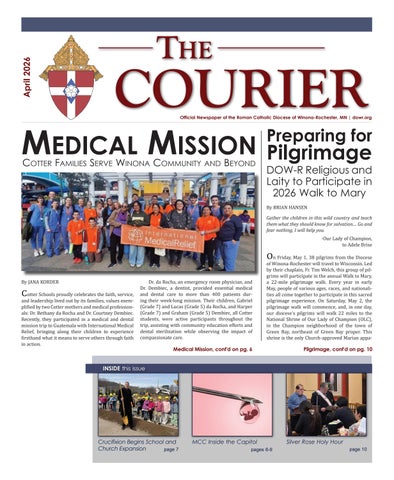
Medical Mission

Cotter Families serve Winona Community and Beyond

�otter Schools proudly celebrates the faith, service, and leadership lived out by its families, values exemplified by two Cotter mothers and medical professionals: Dr. Bethany da Rocha and Dr. Courtney Dembiec. Recently, they participated in a medical and dental mission trip to Guatemala with International Medical Relief, bringing along their children to experience firsthand what it means to serve others through faith in action.

Dr. da Rocha, an emergency room physician, and Dr. Dembiec, a dentist, provided essential medical and dental care to more than 400 patients during their week-long mission. Their children, Gabriel (Grade 7) and Lucas (Grade 5) da Rocha, and Harper (Grade 7) and Graham (Grade 5) Dembiec, all Cotter students, were active participants throughout the trip, assisting with community education efforts and dental sterilization while observing the impact of compassionate care.

Preparing for Pilgrimage

DOW-R Religious and Laity to Participate in 2026 Walk to Mary

Gather the children in this wild country and teach them what they should know for salvation.... Go and fear nothing, I will help you.

-Our Lady of Champion, to Adele Brise

�n Friday, May 1, 38 pilgrims from the Diocese of Winona-Rochester will travel to Wisconsin. Led by their chaplain, Fr. Tim Welch, this group of pilgrims will participate in the annual Walk to Mary, a 22-mile pilgrimage walk. Every year in early May, people of various ages, races, and nationalities all come together to participate in this sacred pilgrimage experience. On Saturday, May 2, the pilgrimage walk will commence, and, in one day, our diocese’s pilgrims will walk 22 miles to the National Shrine of Our Lady of Champion (OLC), in the Champion neighborhood of the town of Green Bay, northeast of Green Bay proper. This shrine is the only Church-approved Marian appa-

Official Newspaper of the Roman Catholic Diocese of Winona-Rochester, MN | dowr.org

Pope Leo XIV Reunites with His Eighth Grade Classmates

VATICAN CITY, March 23, 2026 - On the steps of St. Peter’s Basilica in Rome, Pope Leo XIV met last week with some of his eighth grade classmates from St. Mary of the Assumption lower school in south Chicago, where he grew up.

Of the 82 eighth graders with whom he attended St. Mary’s in 1969, 10 greeted him after the general audience on March 18, exchanging laughs, gifts, and warm handshakes.

During the meeting, his former classmates gave him a photograph of the class of 1969, which he held up as he posed for another group shot more than 50 years later.

Jerome Clemens pointed out the young Robert Prevost standing among his classmates to the L’Osservatore Romano, the Vatican newspaper: “Here he is, our friend, the pope,” showing the back of the photo with Prevost’s old autograph and his new one, which he signed, “Leo XIV.”

Another former classmate, Sherry Stone (née Blue), dropped a sign she held that read “God bless you Pope Leo” when the pope approached her.

“Sorry! I’m nervous!” she said, laughing, as he shook her hand.

Last spring, Stone told the Lansing Journal: “When he was in the conclave, I thought, ‘Could it be him? Could Bob be the new pope? No, probably not.’ When I saw that it was him, I was just amazed. I was crying tears of joy.”

“He was a super nice guy, but not nerdy,” she said.

finishing eighth grade at St. Mary’s, Prevost attended boarding school at St. Augustine Seminary High School in Michigan, graduating in 1973. He then attended another Augustinian school, Villanova University, where he earned a bachelor’s degree in mathematics in 1977 before entering the Augustinian novitiate that September.

He was ordained a priest in 1982, earning a master of divinity degree from the Catholic Theological Union in Chicago that same year. He earned a licentiate in canon law (JCL) in 1984 and completed a doctorate in canon law (JCD) in 1987, both from the Pontifical University of St. Thomas Aquinas in Rome.

St. Mary’s Church and School on Chicago’s ‘Most Endangered List’

St. Mary of the Assumption Church and School, where a young Prevost served as an altar boy and his mother, Mildred Prevost, worked as a librarian, was at the center of a vibrant Catholic community in the Riverdale neighborhood on Chicago’s South Side in the 1960s.

The property, which has been vacant since 2011 and is now privately owned, is located just a few blocks from the pope’s childhood home in Dolton, Illinois, but within Chicago city limits.

The neighborhood has seen significant decline since the pope’s childhood. Ward Miller of Preservation Chicago told EWTN News that

Telephone: 507-361-3068 E-mail: nreller@dowr.org

Publishing Schedule: Monthly - Deadline for advertising & articles is the 10th of the month prior. (ISSN 0744-5490)

• Hard copies are distributed at DOW-R parishes on the first or second weekend of each month.

• An online version may be viewed at www.dowr.org/offices/courier/index.html

• To be added to the home delivery list free of charge, readers should send their names and addresses to:

Diocese of Winona-Rochester The Courier 2907 Jeremiah Lane NW Rochester, MN 55901 or nreller@dowr.org

St. Mary’s, which has a hole in the roof of the church building, broken windows, graffiti, and many other issues, was listed on Preservation Chicago’s 2026 “7 Most Endangered List" as of March 4.

“We at Preservation Chicago are of the opinion that the church and school buildings of St. Mary’s are in need of immediate attention in order to secure temporary repairs, with a longterm goal of a full restoration of the campus of buildings, before everything is lost to deterioration,” Miller said.

The property’s current owner, Joel Hall, said last year he is open to a landmark designation by the city, according to Miller.

Preservation Chicago, a nonprofit advocacy organization dedicated to preserving historic sites in Chicago and encouraging landmark designations in the city, presented its case to designate it as such at a meeting in May 2025 of the Commission of Chicago Landmarks.

Classmates, cont'd on pg. 14

Child Abuse Policy Information

The Diocese of Winona-Rochester will provide a prompt, appropriate and compassionate response to reporters of sexual abuse of a child by any diocesan agent (employees, volunteers, vendors, religious or clergy). Anyone wishing to make a report of an allegation of sexual abuse should call the Victim Assistance Coordinator at 507-454-2270, Extension 255. A caller will be asked to provide his or her name and telephone number. Individuals are also encouraged to take their reports directly to civil authorities. The Diocese of Winona-Rochester is committed to protecting children, young people and other vulnerable people in our schools, parishes and ministries. The diocesan policy is available on the diocesan web site at www.dow.org under the Safe Environment Program. If you have any questions about the Diocese of Winona-Rochester’s implementation of the Charter for the Protection of Children and Young People, please contact Michael Gerard at 507-361-3377, or mgerard@dowr.org.

After
The Courier is the official publication of the Diocese of Winona-Rochester
Credit: Vatican Media

April Saint St. Casilda of Toledo

Feast Day: April 9

t. Casilda of Toledo is remembered as a woman whose life was transformed by compassion and grace during a time of religious division in medi eval Spain. Born into a wealthy Muslim family in eleventh-century Toledo, St. Casilda was the daugh ter of a Moorish ruler. Though raised in a privileged environment, she showed an early concern for those who suffered unjustly.

At the time, many Christians were imprisoned for their faith. Moved by mercy, St. Casilda secretly brought food to the prisoners, hiding bread beneath her garments. When her father and his Muslim sol diers questioned her about what she was carrying, the bread was miraculously changed into roses. This event, later known as the “Miracle of the Roses,” spared her from being punished for her actions.

As a young woman, St. Casilda developed a

The Holy Father's Intention for April 2026

For Priests in Crisis

Let us pray for priests going through moments of crisis in their vocation, that they may find the accompaniment they need and that communities may support them with understanding and prayer.

serious illness. Lacking faith in local physicians, she traveled to a healing spring at the shrine of St. Vincent in Briviesca, located in Christian territory. There, she experienced a miraculous recovery. As a result, St. Casilda underwent an interior conversion to Christianity and was baptized, leaving behind her former life of wealth and status.

After her conversion, St. Casilda chose a life of prayer, penance, and solitude. She lived as a hermit near Briviesca, devoting herself to contemplation and works of mercy. She lived a peaceful life and died at the age of 100. She is highly venerated in Burgos, Spain, where she was baptized, and in Toledo.

What Is the Miracle of Roses?

captives by hiding bread in her clothing. Suspecting her curious and frequent visits to the prisoners, she was confronted by her father and his guards, who demanded to know what she was carrying. She claimed it was flowers. Upon investigation, the bread had turned into a bouquet of roses, saving her from punishment. St. Casilda did not continue feeding the prisoners. She fell ill with a serious illness, which later led to her conversion to Christianity.

From What Illness Was St. Casilda Cured?

St. Casilda of Toledo was cured of a severe, lingering hemorrhagic fever or uncontrolled, chronic bleeding that caused great weakness. As an eleventh-century Muslim princess who secretly helped Christian prisoners, she lacked faith in local doctors and refused their treatment. She traveled to the shrine of San Vicente in Briviesca, near Burgos in northern Spain, where a well-known healing spring was located. When she was miraculously healed by its waters, she converted to Christianity, was baptized, and lived as a hermitess near the healing spring. St. Casilda is often invoked for help by those suffering

Where Is St. Casilda Venerated Today?

Today, St. Casilda is especially venerated in Briviesca, Spain, where a church and shrine were built near the site of her hermitage. Her relics are preserved there, and she is honored with an annual pilgrimage. She is particularly invoked by those seeking healing and by parents praying for sick children. St. Casilda was initially venerated in Burgos, where she was baptized, and is still venerated there, as well as in Toledo, Spain, which named her its patron saint. She is remembered for her conversion from Islam to Christianity, her life of penance and holiness, and the legend of the “Miracle of

"Thank you, Lord..." sings Jesse Manibusan with the help of volunteers from his audience of over 700 at the diocesan Youth Rally in Austin on March 25. For nearly two hours, the singer, songwriter, musician and storyteller kept his young audience enthralled with his message that everyone - regardless of age or status - is a minister in the church and called to live out their baptism in everything they do.

Reprinted from April 2001.

Here they are shown at the new Courier office.

[...]

Students from Fulda, Currie, Dundee, Iona, Lake Wilson and Avoca travelled by bus to Assisi Heights Thursday, Apr. 1, and visited St. Marys Hospital, IBM, and the Mayo Clinic on Friday.

Friday evening, the seventh graders stayed at St. Marys Parish, Winona. Saturday morning, the group visited the Chancery office, Catholic Charities, the College of St. Theresa, Immaculate Heart of Mary Seminary, and the Courier office. [...]

Reprinted from April 9, 1976.

Pictured above is Sharon Braun, nine-yearold fourth grader from St. John's School, Rochester, as she received her heroism award from the William T. McCoy post of the American Legion [April 11 in the Lourdes auditorium]. [...] Sharon, the fourth to win the award, pulled her seven-year-old playmate, Christopher Saam, from a deep water-filled hole last summer. The little lad had already gone down twice when rescued by Sharon. [...]

Reprinted from April 22, 1951.

Students from the Slayton Area made a tour of the Winona Diocese.

The following is adapted from a homily for Easter.

� like to visit the graves of famous people. I don’t know why precisely; maybe it’s a sense of history, of connection across the ages. Or maybe it’s a form of paying tribute, an honoring of their memory. Whatever it is, something draws me to these places.

Wherever

I’ve travelled around the world, whenever I’ve come into a new place or new city, my first question is usually “who is buried here?” And then I make a bee-line to those places.

When I was a student in Washington, D.C., I used to visit the little ridge just below the Custis-Lee mansion where the Kennedy brothers are buried. I loved the peacefulness of the place, the wonderful view of the city, and the connection to these figures.

When I was a student in Paris, I loved to go to the Montparnasse cemetery which was just behind the house where I lived. There Samuel

Bishop's Calendar

*indicates event open to public

April 2, Thursday

*7 p.m. - Mass of the Lord's Supper - Basilica of St. Stanislaus Kostka, Winona

April 3, Friday

*12 p.m. - Passion of the Lord - Basilica of St. Stanislaus Kostka, Winona

April 4, Saturday

*8 p.m. - Easter Vigil - Basilica of St. Stanislaus Kostka, Winona

April 5, Sunday

*10 a.m. - Easter Day MassCathedral of the Sacred Heart, Winona

April 10, Friday

7 p.m. - Confirmation - St. Francis Xavier, Windom

April 11, Saturday

10:30 a.m. - Confirmation - St. Leo, Pipestone

The Frightening Empty Grave

Beckett, the Irish playwright, was buried, as was Jean-Paul Sartre. But the treasure-trove of Parisian burial grounds is the Pere Lachaise cemetery, a place I visited frequently. There are the graves of Abelard and Eloise, of Jim Morrison, of Chopin, of Oscar Wilde.

When I went to Rome, I said Mass at the tomb of Pope Paul VI and prayed at the graves of Pius XII, John XXIII, and John Paul I. And just around the corner from those tombs is the grave of St. Peter, the very reason for the basilica itself. Everyone who visits St. Peter’s is basically visiting a grave monument.

At Mt. Vernon, you can visit the tomb of George Washington, and if you press inland a bit, you can find the little grave where Thomas Jefferson lies. And if you wander a bit further in Virginia, you come to Washington-Lee university where the tomb of General Robert E. Lee is to be found. What is it about these graves? Why are we drawn to them? Some of the reasons I offered above, but also and above all, the sense of peace, of something ended, brought

to fulfillment. This is why we love to meditate, to muse, and ponder at graves. The one thing you would never expect in a cemetery or at a grave is action and novelty.

Then there is the grave that is at the center of the Gospels of Easter. The three women come as we might expect any visitor to any grave to come: they have their spices with them, and they intend to honor the body of Jesus. We might imagine them sitting in reverential silence afterward, reflecting on the life and words of their friend, expressing their admiration for him and the tragedy of his death.

Ordinary graves are places of finality and inevitability; this grave is a place of novelty so shocking that it frightens the wits out of people.

But this is no ordinary grave. The first thing they notice is the stone rolled away. Now this could have been the result of grave-robbers, of someone trying to break in and desecrate the tomb. But then it begins to dawn on them that it is the result of someone breaking out.

They look in and see a young man - and they are frightened out of their wits. Can you imagine: you walk into a tomb, fully expecting to see a dead body, and you

2 p.m. - Confirmation - St. Adrian, Adrian

April 13, Monday Religious Liberty Commission - Washington, D.C.

April 15, Wednesday

7 p.m. - ConfirmationCo-Cathedral of St. John the Evangelist, Rochester

April 16, Thursday

1 p.m. - Catholic School Administrators FormationZoom

April 17, Friday

Bishops and Rector Dinner - International Event Center, Rochester

April 18, Saturday

10:30 a.m. - ConfirmationQueen of Angels, Austin

2 p.m. - Confirmation - St. Mary, Chatfield

see instead someone alive and well. But that is not the end of their surprise. He announces that the Jesus whom they seek is not there, that he has been raised up and will go ahead of them into Galilee.

Then it says, “They made their way out and fled from the tomb bewildered and trembling, and because of their great fear, they said nothing to anyone.” This grave is not the source of peace and rest, calm and thoughtful meditation. This grave is the source of terror and upheaval.

Ordinary graves are places of finality and inevitability; this grave is a place of novelty so shocking that it frightens the wits out of people. From this grave of Jesus we learn that everything we took to be the case is not the case, that the supposed laws of nature aren’t laws after all, that what always moved this way, now moves that way.

God is the enemy of death, and he has shown us his power over death in the most unambiguous way; our lives oughtn’t to be dominated by the fear of death, and we see the proof of this in the most vivid way imaginable.

Some people think that they will make the resurrection more intelligible,

April 19, Sunday

2 p.m. - Confirmation - Sts. Peter and Paul, Mankato

April 22, Wednesday

7 p.m. - Confirmation - St. Joseph, Owatonna

April 24, Friday

1 p.m. - Clergy Personnel Committee - The Chancery, Rochester

7 p.m. - Confirmation - St. Augustine, Austin

April 25, Saturday

9:30 a.m. - Diocesan Pastoral Council - The Chancery, Rochester

April 30, Thursday

10 a.m. - Q&A with Upperclassmen - Cotter Schools, Winona

11:20 a.m. - School MassCotter Schools, Winona

more acceptable, to modern people if they allegorize it away, turning it into a vague symbol of the perdurance of Jesus’ cause. But then his grave wouldn’t be frightening; it would be, like the grave of any ordinary hero, sad, wistful, reassuring. Notice that no cult of Jesus’ tomb ever developed in Christianity; we don’t look back with easy wistfulness. Rather, we allow ourselves to be surprised, shocked out of our wits, turned upside-down by it.

Bishop Barron present from 9-10 a.m.!

Non Nisi Te Domine
Bishop Robert Barron

La aterradora tumba vacía 5

Lo siguiente es una adaptación de una homilía para la Pascua. �e gusta visitar las tumbas de personajes famosos. No sé muy bien por qué; quizá sea por un sentido de la historia, de conexión a través de los siglos. O quizá sea una forma de rendirles homenaje, de honrar su memoria. Sea lo que sea, hay algo que me atrae hacia esos lugares.

Dondequiera que haya viajado por el mundo, cada vez que llego a un lugar nuevo o a una ciudad nueva, mi primera pregunta suele ser «¿quién está enterrado aquí?». Y luego me dirijo directamente a esos lugares.

Cuando era estudiante en Washington, D.C., solía visitar la pequeña loma justo debajo de la mansión Custis-Lee, donde están enterrados los hermanos Kennedy. Me encantaba la tranquilidad del lugar, las maravillosas vistas de la ciudad y la conexión con estas figuras.

Cuando era estudiante

en París, me encantaba ir al cementerio de Montparnasse, que estaba justo detrás de la casa donde vivía. Allí estaban enterrados Samuel Beckett, el dramaturgo irlandés, y JeanPaul Sartre. Pero el tesoro de los cementerios parisinos es el cementerio de Père Lachaise, un lugar que visitaba con frecuencia. Allí se encuentran las tumbas de Abelardo y Eloísa, de Jim Morrison, de Chopin y de Oscar Wilde.

Cuando fui a Roma, celebré misa en la tumba del papa Pablo VI y recé ante las tumbas de Pío XII, Juan XXIII y Juan Pablo I. Y justo a la vuelta de la esquina de esas tumbas se encuentra la tumba de San Pedro, la razón misma de ser de la basílica. Todo el que visita San Pedro está, en el fondo, visitando un monumento funerario.

En Mt. Vernon se puede visitar la tumba de George Washington, y si uno se adentra un poco más hacia el interior, encuentra la pequeña tumba donde yace Thomas Jefferson.

Y si uno se desplaza un poco más allá, en Virginia, llega a la Universidad Washington-Lee,

On February 28, B��h�p Barr�n celebrated Mass with attendees of the Diocesan Marriage Retreat (pictured below) in the Chapel of the Angels at St. Mary's University's Alverna Center in Winona, followed by lunch.

On Mar�h 1, he celebrated the annual diocesan Young Adult Mass at Church of the Resurrection in Rochester (pictured near right), followed by a Q&A session with participants.

On Mar�h 29, he kicked off Holy Week with the celebration of Palm Sunday Mass at All Saints Church in New Richland (pictured far right).

donde se encuentra la tumba del general Robert E. Lee.

¿Qué tienen estas tumbas? ¿Por qué nos atraen? Algunas de las razones las he mencionado anteriormente, pero también, y sobre todo, la sensación de paz, de algo que ha concluido, que ha llegado a su plenitud. Por eso nos encanta meditar, reflexionar y cavilar ante las tumbas. Lo único que nunca esperarías encontrar en un cementerio o ante una tumba es acción y novedad.

Luego está la tumba que ocupa el centro de los Evangelios de Pascua. Las tres mujeres llegan como cabría esperar de cualquier visitante de una tumba: llevan consigo sus especias y pretenden honrar el cuerpo de Jesús. Podríamos imaginarlas sentadas en reverente silencio después, reflexionando sobre la vida y las palabras de su amigo, expresando su admiración por él y la tragedia de su muerte.

Pero esta no es una tumba cualquiera. Lo primero que ven es que la piedra ha sido removida. Esto podría haber sido obra de ladrones de tum-

bas, de alguien que intentara entrar y profanar la tumba. Pero entonces empiezan a darse cuenta de que es el resultado de que alguien haya salido de allí.

Miran dentro y ven a un joven, y se asustan muchísimo. ¿Te lo imaginas?: entras en una tumba, esperando encontrar un cadáver, y en cambio ves a alguien vivo y sano. Pero ahí no acaba la sorpresa. Él les anuncia que el Jesús al que buscan no está allí, que ha resucitado y que se les adelantará a Galilea.

A continuación, dice: «Salieron y huyeron del sepulcro, desconcertadas y temblorosas, y, debido a su gran temor, no dijeron nada a nadie». Esta tumba no es fuente de paz y descanso, ni de calma y meditación reflexiva. Esta tumba es fuente de terror y conmoción.

Las tumbas comunes son lugares de definitividad e inevitabilidad; esta tumba es un lugar de novedad tan impactante que deja a la gente atónita. De esta tumba de Jesús aprendemos que todo lo que dábamos por sentado no es así,

que las supuestas leyes de la naturaleza no son leyes después de todo, que lo que siempre se movía de una manera, ahora se mueve de otra.

Dios es el enemigo de la muerte, y nos ha mostrado su poder sobre ella de la manera más inequívoca; nuestras vidas no deberían estar dominadas por el miedo a la muerte, y vemos la prueba de ello de la forma más vívida que se pueda imaginar.

Hay quien piensa que hará la resurrección más comprensible, más aceptable, para la gente moderna si la alegoriza, convirtiéndola en un símbolo vago de la perdurabilidad de la causa de Jesús. Pero entonces su tumba no daría miedo; sería, como la tumba de cualquier héroe corriente, triste, melancólica, tranquilizadora.

Fíjense que en el cristianismo nunca se desarrolló ningún culto a la tumba de Jesús; no miramos atrás con una melancolía tranquila. Más bien, nos dejamos sorprender, nos quedamos atónitos, nos sentimos trastornados por ella.

Medical Mission, cont'd from pg. 1

“It was such a great experience for all of us,” Dr. Dembiec shared. “It left us feeling thankful for what we have and for the opportunity to give to others.”

For the families, the mission trip was a natural extension of the faith and service values emphasized at Cotter. Dr. da Rocha reflected on how closely the experience aligned with what her children learn each day at school. “Faith and service are core parts of the education and environment at Cotter,” she said. “Cotter reminds us that Jesus teaches us to be servant leaders, to care for the needs of others, and reflect God’s love in our actions. During our mission trip, we traveled to underserved areas of Guatemala and had the opportunity to help meet some of the basic medical and dental needs of the people there. By assisting doctors and dentists and participating in education, our kids were able to see the benefits of service firsthand. They all helped and participated with great attitudes, and we hope this experience continues to encourage them to live generously.”

Dr. Dembiec echoed that hope, emphasizing how the experience helped her children better understand their responsibility to others. “I hope this experience showed our children how they can use their resources and talents to help people who are less fortunate,” she said. “Not everyone’s basic needs are automatically met, and those who have more have the ability to assist those who are in need. Serving others is central to who we are as humans. Seeing our children witness the gratitude and appreciation of the people of Guatemala was invaluable, and I hope they recognize and act on opportunities to serve others in our own community as well.”

For the children, the trip brought classroom lessons to life in powerful ways. Lucas da Rocha shared, “We learn at school and at church that God wants us to help everyone.” His brother Gabriel connected the experience to what he hears at Mass each week. “The priest often talks about sharing our time, treasures, and talents,” he said. “I think we did that when we spent time fitting patients with reading glasses and helping teach little kids how to brush models of teeth. I hope those things will make a difference for them.”

By witnessing faith in action and participating in service together, the children gained a deeper understanding of compassion, responsibility, and generosity; values that are central to Cotter's mission.

Harper Dembiec recalled a moment that made the meaning of service especially clear. “I was helping my mom in dentistry, and a girl came up to us after we were done, hugged us, and said, ‘God bless you,’” she said. “It made me so happy to see how thankful she was. It showed me that something we can easily do can really help others who don’t normally get this kind of care. I want to look for opportunities where I can help and possibly improve someone’s life.”

The living conditions the children encountered also left a lasting impression. Gabriel noted, “Some of the houses we saw didn’t have electricity or water. It made me realize how poor some of the people were and how much help they needed.” Lucas added that he was surprised by how many people came to the clinics seeking care. “I helped teach people how to wash their hands well and brush their teeth,” he said. “I was surprised that a lot of people didn’t know how to do these things.”

Graham Dembiec shared how the experience changed his perspective and how he hopes to carry it forward. “I learned that people have much less than what we have at home,” he said. “I want to help

my friends be understanding of other people’s lives and remind them that we can help if someone needs something.”

The mission trip provided meaningful, lasting lessons for the entire families involved. By witnessing faith in action and participating in service together, the children gained a deeper understanding of compassion, responsibility, and generosity; values that are central to Cotter’s mission. These experiences will continue to shape how they engage with their school community and live out Cotter’s call to serve, both at school and at home. In a world often filled with discouraging news, stories like this serve as a reminder of the good that can happen when faith, skill, and service come together.ts.

Jana Korder is the director of marketing and communications for Cotter Schools.

Immaculate Heart of Mary Convent Construction Nears Completion

� he construction of the Immaculate Heart of Mary Convent expansion continues to move forward as a visible sign of faith in action, with the sisters announcing that the project remains on schedule for completion in April.

What began as a prayerful hope has steadily

taken shape in wood, stone, and sacrifice. Thanks to the extraordinary generosity of benefactors and friends of the community, the building will be a home for the sisters to live, pray, and serve in for generations to come.

Inside the convent, workers have recently laid tile throughout the interior, carefully setting each piece in place as the rooms take on their final form. Painting and electrical work have largely been completed, filling the halls and living spaces with light and warmth, bringing the practical necessities that will quietly support the sisters’ daily rhythm of prayer and apostolic work.

Several of the exterior and interior doors have arrived, with some already installed and the remaining doors scheduled to be put in place this week. Each new addition marks another step toward completion, enclosing a space that will soon become a sanctuary of silence, community life, hospitality, and devotion.

As the building nears its finish, the sisters grow daily in gratitude for all who have contributed through prayer, sacrifice, and financial support of

the Heart of Mary Convent Campaign. The Convent stands not only as a structure of brick and mortar, but as a living testament to the faith of a community united in love for Christ and His Church.

The completion of the convent will be celebrated with an open house on April 25. Call 507-858-1275 for more information.

Donations will be collected until June 1. If you are interested in supporting the sisters, please visit our website at catholicfsmn.org/convent or contact us at 507-858-1275.

May God bless you in these warm spring days and remember that the sisters are keeping you in their daily prayers.

Nicole Weninger is the marketing and communications associate for Immaculate Heart of Mary Seminary and the Catholic Foundation of Southern Minnesota.

Crucifixion Parish, La Crescent Begins School and Church Expansion

�here was a chill in the air, and some hard hats went blowing in the wind, but there was definitely excitement in the crowd as Crucifixion Parish, in La Crescent, held a groundbreaking ceremony for an addition to the school which will house an expanding daycare facility and faith formation program! On Tuesday, March 10, the school children and daycare children, with shovels and bright yellow hard hats, joined in the ceremonial “first dig!”

After extensive needs assessments, not only for the parish but for the La Crescent community, the

parish launched and exceeded a $3.2 million capital campaign. This 7,700-square-foot addition will accommodate 110 children, including infant care, which is a great need in the community. The plan is for this facility to be ready to open for the 2026-27 school year.

After the completion of this project, the construction moves across the street to build an addition to the church of a 9,000-square-foot gathering space and parish office complex. This addition will comfortably host funeral lunches, parish gatherings, and much more! With these two new additions, Crucifixion Parish is truly Building for Our Future!

Rebecca Schumacher is the director of faith formation and youth ministry for the parishes of Crucifixion in La Crescent and St. Peter in Hokah.
Pastor Fr. John Evans (center) and parish trustees placed blessed items in the cornerstone of the school addition.
Crucifixion students broke ground for their school's construction project.

Minnesota Catholic Conference Inside the Capitol

How the Minnesota Catholic Conference Prioritizes Advocacy Resources

ne of the biggest complaints that MCC staff receives, from both the public and legislators, about our public policy work is that “we are not doing enough” about a particular issue, usually the most cherished issue for that person at that moment.

The complaint is implicitly a compliment because it speaks to our effectiveness in moving the needle on a variety of issues, which is genuinely unique at the Capitol. Last year, for example, we helped protect non-public pupil aid for Catholic schools and played a significant role in stopping the legalization of predatory online gambling, among other things.

But the complaint also has merit, because we do not and cannot do enough on many issues. Advocacy is a grit and hustle, high-contact sport. Until you have won the day, you can almost always “do more” - more legislative conversations, more

may suffer setbacks, but matters of justice demand perseverance.

There is no religious community in Minnesota that puts more organizational resources into the work of public policy advocacy. Yes, there are faith-based advocacy organizations that may expend more resources, but in terms of a specific faith community or church, the Catholic Church has a dedicated public policy apparatus, which is why faith communities of all stripes look to us as an organizer and leader.

And yet, our office is still very small with only one truly full-time employee and a handful of dedicated part-time staff. For context, there have been nearly 8,000 bills introduced at the Capitol this biennium, and from which our small team must identify what is truly pressing.

When working with our state’s bishops to develop our limited legislative agenda, we evaluate issues based on their direct impact on human dignity and the common good, their urgency in terms of their place in the legislative process, and how many other organizations are weighing in on them. Often, our office must devote limited resources and provide leadership on important matters for which there are very few other people or organizations engaged. Many of those issues are related to direct attacks on human life and public support programs that go directly to citizens (instead of special interest groups) - issues like assistedsuicide legalization, school-choice programs, and anti-poverty programs like the child tax credit and the Minnesota Family Investment Program.

The purpose of the Church is not to fight against legal abortion or for immigration reform. It is to make Jesus Christ known and loved and incorporate more people into the kingdom and fellowship of the Church.

Increasingly, the Church also faces religious liberty threats against our ministries in the forms of discriminatory mandates, funding cuts, and litigation. It’s not uncommon that our limited bandwidth gets diverted to those matters as well.

The reality, however, is that it is not the purpose of the institutional Church and the bishops to win the day in the public arena. The purpose of the Church is not to fight against legal abortion or for immigration reform. It is to make Jesus Christ known and loved and incorporate more people into the kingdom and fellowship of the Church. While the work of politics is one way we do that, we ultimately do so out of our love of neighbor. We organize, in a limited way, public policy efforts which, much like the Church’s anti-poverty, healthcare, and educational ministries, are an exercise of true charity in the hope of building a more just social order.

As Pope Benedict XVI stated in his encyclical Deus Caritas Est:

The Church cannot and must not take upon herself the political battle to bring about the most just society possible. She cannot and must not replace the State. Yet at the same time she cannot and must not remain on the sidelines in the fight for justice. She has

to play her part through rational argument and she has to reawaken the spiritual energy without which justice, which always demands sacrifice, cannot prevail and prosper. A just society must be the achievement of politics, not of the Church. Yet the promotion of justice through efforts to bring about openness of mind and will to the demands of the common good is something which concerns the Church deeply.

Final Note: We Need Your Help

Political engagement is primarily the responsibility of the laity. We encourage the lay faithful to be involved in the Church’s work through MCC’s Catholic Advocacy Network (CAN) to bring attention to important issues that the media sometimes ignore; be bridge builders and voices of conscience; and elevate the debate. Joining CAN is a great place to start. If you are dissatisfied with the level of engagement by the bishops and their staff on a particular issue, feel free to let us know - but recognize that the just ordering of society is a responsibility we all share, which is why the Church calls us to be faithful citizens. The next step is up to you.

Why Assisted Reproductive Technology Is Not the Answer to Infertility

�hen a couple marries and is hoping to have children, but find themselves struggling with infertility, they can feel devastated and desperate for a solution to the problem. Fortunately, there are increasingly effective and ethical avenues to treat the underlying causes of their infertility. Turning to assisted reproductive technology, such as in vitro fertilization (IVF), is not the answer.

An insurance mandate (S.F. 1961) that would require employers to cover IVF and similar technologies is moving at the state Capitol. If IVF becomes covered in state and private health plans, more people will turn to this option, which is fraught with ethical dilemmas amidst low success rates. There are better solutions than making taxpayers and insurance payers cover expensive assisted reproduction.

The False Hope of IVF

Although the fertility industry suggests the assured outcome of IVF is a healthy baby, many families either do not achieve a viable pregnancy or must

To determine which embryos will have the best chance at life, preimplantation genetic testing (PGT) is often used. In 2020, this was about 50 percent of the time. PGT is problematic as it can lead to modern day eugenics - we can now create designer babies with the characteristics and sex desired by their parents.

products.

In 2024, Pope Francis raised concerns about surrogacy, stating, “I deem deplorable the practice of so-called surrogate motherhood, which represents a grave violation of the dignity of the woman and the child . . . A child is always a gift and never the basis of a commercial contract.”

Surrogacy exploits women and intentionally separates a child from the only mother he or she has known for nine months. This has detrimental effects for all involved. Unlike the adoption process, the surrogacy industry faces little safeguards. Prospective parents and their homes are often unvetted, for example.

The Church, in her wisdom, teaches that there are ethical bounds regarding the conception of a child that must be safeguarded, and the scientific ability to create a child through various technological means does not make it just for the parents, child, or society.

Families Deserve Better

Women and couples deserve better than being funneled down a technological path with low success rates and high moral and financial costs.

Engaging restorative reproductive medicine (RRM) is a better path forward.

When discussing infertility, it is important to remember that infertility is not a disease in and of itself. It is a symptom of underlying conditions such as hormonal imbalances, blocked fallopian tubes, or endometriosis. When we pursue RRM - or more simply, sound women’s (and men’s) healthcarepatients receive tailored care to understand what may be inhibiting their infertility.

We acknowledge that every child born, regardless of the way they were conceived, is a gift and has dignity, but the reality is, just because we can do something, does not mean that we should. The human body is complex, and couples do not deserve to be pushed into a one-size-fits-all approach that intentionally eliminates human life in the process of bringing about new life.

Rather than pushing for an IVF insurance mandate, the state should expand education around RRM in their public health programs, as is being promoted in S.F. 4166 / H.F. 4154.

Please urge your legislators to oppose an IVF mandate and to support real care through RRM: https://www.mncatholic.org/notoivf

The Minnesota Catholic Conference has been the public policy voice of the Catholic Church in Minnesota since 1967. The voting members of the MCC's board of directors are Minnesota's Catholic bishops.

Owatonna Knights of Columbus Hold Silver Rose Holy Hour

� nights of Columbus Council 945 in Owatonna held a Silver Rose Holy Hour on Sunday March 8 at Sacred Heart Parish.

The Silver Rose program is a core Faith in Action program of the Knights of Columbus and is part of the “Life” category respecting life from conception to natural death.

[From kofc.org: "Each year, from early March through mid-December, Silver Roses are stewarded by Knights of Columbus councils along routes from Canada to Mexico. Every stop the Silver Rose makes throughout the pilgrimage is a rosarycentered occasion for Knights, parishioners and community members to pray for respect for life, for the spiritual renewal of each nation, and for the advancement of the message of Our Lady of Guadalupe."]

Council 945 enhanced the program, with the support of Monsignor Cook, the pastor of Sacred Heart, to include Exposition and Adoration of the Blessed Sacrament. The Council also converted the program to a combination of English and Spanish to embrace the full Catholic community in Owatonna.

This was a wonderful time to focus in prayer to Our Mother in support of life. We need all the prayers for life we can get! The turnout was good for a beautiful Holy Hour on a Sunday afternoon. We had a beautiful opportunity to spend a few minutes raising our voices in prayer to Our Lady of Guadalupe and adoration of the Blessed Sacrament in Exposition. Monsignor Cook delivered a great message about Our Holy Mother related to our Lenten journey. Please carve out a little time in your busy lives to spend some time in adoration and prayer. We encourage other councils in the diocese to investigate the Silver Rose program and plan to include this in your calendar for next year’s program cycle.

Our Lady told Juan Diego, "Am I not here, I, who am your Mother? Are you not under my shadow and protection? Am I not the source of your joy? Are you not in the hollow of my mantle? In the crossing of my arms? Do you need anything more? Let nothing else worry you."

Our Lady of Guadalupe is the patroness of the Knights of Columbus. The Knights of Columbus starts eight Silver Roses celebrating Our Lady of Gaudalupe all across Canada at the beginning of every year. The Silver Roses travel down through Canada and through the United States making stops at Councils/Parishes along the way for the Silver Rose prayer service. Then the Silver Roses cross into Mexico and make their way to Tepeyac, Mexico for the December 12 celebration of the Feast Day Mass at the Basilica of Our Lady of Guadalupe. The intentions and prayers for life that are gathered during the services are presented at the Feast Day Mass.

Thank you to Program Leader Lee Jardine, Monsignor Thomas Cook, Lauro Zuniga, Jose Lopez, Dan Sawyer, the 4th Degree Honor Guard, the KC Choir, and Altar Servers Cole and Westin Trom. And of course, to those that attended and raised their voices in praise to Our Lady - God bless you! Please make time for prayer to Our Holy Mother; she is listening!

Lee Jardine is a member of Owatonna Council 945 of the Knights of Columbus.

Pilgrimage, cont'd

rition site in the United States of America.

In 1859, Mary appeared to a young woman named Adele Brise and instructed her to teach the Catholic faith to the children of the land. On this pilgrimage, pilgrims not only remember this beautifully simple Marian apparition, but they also journey spiritually with Joseph and Mary to witness their love and fidelity to Jesus Christ. Upon arriving at the OLC Shrine, our diocese’s pilgrims will then join other pilgrims in the celebration of a Vigil Mass. The next day (Sunday, May 3), our pilgrims will then travel back to the diocese from their pilgrimage. Please join us in praying for these pilgrims by praying the following Novena to Our Lady of Champion with the specific intention included. Thank you and God bless! Brian Hansen is the coordinator of adult and lay formation for the Diocese of Winona-Rochester.

Novena to

Our Lady of Champion

� dear Lady of Champion, you revealed yourself as the Queen of Heaven to your servant Adele. You gave her a mission to pray for the conversion of sinners, to bring the Good News of Jesus Christ to others and to prepare children for the reception of the sacraments.

I trust that, as you called Adele to holiness, you are calling me, in my station in life, to live a holy life, devoted to Jesus Christ, with the help of your maternal love. I bring before you now my worries and anxieties. I abandon my attachments to them and place them at your feet. I ask you to hear the deepest longings of my heart as I pray most earnestly for (mention request here...). Dear Lady, you told Adele, and you say to all of us, “Go and fear nothing. I will help you.” Help me now as I place this intention with complete confidence and trust. Amen.

(April 23 – May 1): For the 38 DOW-R pilgrims participating in the 2026 Walk to Mary Pilgrimage, that these pilgrims may have a safe, joy-filled, and spiritually fruitful pilgrimage to the National Shrine of Our Lady of Champion. As these pilgrims witness their Catholic faith, may they have profound and loving encounters with the Lord Jesus Christ while growing in deeper relationship with Him through greater devotion to His earthly father, St. Joseph, and His Immaculate Mother, St. Mary. May this pilgrimage be a transformative experience for these pilgrims that leaves a lasting impact on their lives.

Made for More!

�n Saturday, March 21, 2026, Elizabeth Leon, writer, speaker, and wounded healer, was the CCW Lenten Retreat presenter at St. Theodore Catholic Church in

Calling Catholic Women!

We have ���e ��p�r�an� r�le� to fill within our organization. We know there are qualified women whom God is calling! Is it you? You will be joining a group called together by the United States Bishops in 1921 who through the years has provided individuals opportunity to grow in spirituality, leadership and service. We make a difference in the world!

1. Diocesan Treasurer – someone with a financial or accounting background and who can navigate an excel spreadsheet is desired. Training is provided.

2. Webmaster/Social Media – someone to develop a website and manage social media presence for our DCCW. The rewards of belonging and serving are priceless.

Albert Lea, with over 120 women in attendance.

During the day, we learned of God's great promise to each of us, what the enemy does to convince us of our unworthiness, who Jesus is and how he redeems us. Furthermore, Elizabeth described the necessary process of our surrender to let Jesus into our hidden wounds, and how we are called to take our giftedness into the world. For more information about Elizabeth and her ministry, you can go to her website www.elizabethleon.com.

We were graced with Bishop Barron's presence at Mass and lunch.

We also collected $1,046 in donations for the Catholic Charities of Southern Minnesota Child and Family Services!

Our quarterly DCCW gathering will be at St. Teresa Church in Mapleton on Saturday, April 11. See announcement with details to the right. As always, questions and comments can be directed to Shelly Holt, president, at 507-3812842 or shellyholttotalwellness@gmail.com.

Shelly Holt is the president of the Winona-Rochester Diocesan Council of Catholic Women.

We d�d ��! Over the last 18 months, the Winona-Rochester Diocesan Council of Catholic Women has raised money to sponsor two pro-life billboards - one in Rochester and one in Mankato! The image above appears on the Rochester billboard.

Building Long-Term Stability Part 1: Grants for Catholic Parishes, Schools, and Ministries

atholic parishes, schools, and cemeteries carry out extraordinary work every day: forming disciples, preserving sacred spaces, educating children, and serving those in need. But as every leader knows, mission requires resources. And in a moment when budgets feel tight and needs continue to grow, it’s more important than ever to think creatively about how we sustain the work God has entrusted to us.

That’s why I’m launching a series on “Building Long Term Stability.” Over the next several months, we’ll explore practical, mission aligned strategies that help Catholic institutions strengthen their financial footing without adding unnecessary burden to staff or volunteers.

This first installment focuses on one of the most underused tools available to Catholic organizations: grants. From historic preservation to Catholic specific formation programs, from school improvement to community outreach, there are far more opportunities available than most leaders realize. Below is a curated list to help you begin.

Historic Building Preservation Grants

Many Catholic parishes worship in buildings that are not only spiritually significant but historically important. Preservation grants can help fund major repairs, structural stabilization, and restoration work that would otherwise be out of reach for local budgets. These programs often support projects

Organizations offering preservation support include:

• National Fund for Sacred Places

• Save America’s Treasures (National Park Service)

• DAR Historic Preservation Grants

• Minnesota Historical Society Legacy Grants

Catholic Specific Grants

Some funding sources are designed specifically for Catholic ministries. These programs strengthen parish life, support Catholic education, and expand formation opportunities for clergy, staff, and volunteers. They can help with tuition assistance, evangelization initiatives, leadership development, and parish revitalization.

Organizations offering Catholic specific support include:

• Catholic Foundation of Southern Minnesota

• Our Sunday Visitor Institute

• Catholic Extension Society

Education and School Focused Grants

Catholic schools face rising costs and increasing demand for financial aid, facility improvements, and leadership development. Education focused grants can help schools expand access, strengthen curriculum, and invest in the long term vitality of Catholic

Organizations offering education support

Ambassador’s Fund for Catholic Education Cisco Technology Grant Program

Security and Emergency Preparedness

In today’s environment, many parishes and schools must consider security upgrades and emergency preparedness. Several state and federal programs provide funding for improvements such as reinforced doors, surveillance systems, lighting, and staff training.

Organizations offering security support include:

• FEMA Nonprofit Security Grant Program

• Minnesota Nonprofit Security Grant Program

• Catholic Charities Disaster Relief

• DHS Homeland Security Grant Programs

Community Outreach and Ministry Grants

Catholic ministries serve the broader community through food programs, youth outreach, social services, and pastoral care. Community focused grants can help expand these efforts, especially in areas where needs are growing.

Organizations offering community outreach support include:

• Versacare Foundation

• Trinity Church Wall Street

• Walmart Spark Good Local Grants

Facilities, Infrastructure, and Operations Grants

Many Catholic institutions face ongoing challenges with aging buildings, deferred maintenance, and limited capital budgets. Facilities focused grants can support renovation, repairs, accessibility improvements, and upgrades that make ministry spaces safer and more welcoming.

Organizations offering facilities support include:

• Home Depot Foundation Community Impact Grants

• Lowe’s Hometowns Grants

• Bank of America Charitable Foundation

• AARP Community Challenge Grants

• USDA Community Facilities Grants

Grants are just one piece of a much larger picture. When used well, they can help parishes, schools, and cemeteries take meaningful steps forward: restoring buildings, expanding ministries, strengthening safety, or supporting families. To get links and more information about each grant, visit our website: Catholicfsmn.org/grant/list.

Grants are only one of several creative strategies available to Catholic leaders today. In the next parts of this series, we’ll explore additional ways to build long term stability, including planned giving, endowment building, investment stewardship, and parish partnerships. Each approach offers its own strengths, and together they form a sustainable, mission driven path forward.

If you’re unsure where to begin or need help discerning which opportunities fit your organization, the Catholic Foundation of Southern Minnesota is here to support you. Let’s continue building a future where our Catholic institutions are not only surviving, but thriving.

Elizabeth Williams is the executive director of the Catholic Foundation of Southern Minnesota.

Things that Make Make Us Catholic Bookkeepers Laugh (and Pray a Little Harder)

�orking as a virtual bookkeeper for Catholic churches is a unique calling. You get to support the mission of the Church, help parishes steward their resources, and occasionally witness situations that make you laugh… after you finish reconciling the bank account.

Over time, certain patterns appear across parishes. None of them come from bad intentions, just the reality that church staff wear many hats. Still, these moments become familiar to anyone working in parish finance.

Here are a few classics.

The Timecard That Is Always One Day Late

Every payroll cycle, there is at least one employee who turns in their timecard a day late. Not occasionally. Not once in a while. Every. Single. Payroll.

Payroll deadlines are explained. Reminders are sent. Calendars are shared. Yet somehow the timecard appears exactly one day after payroll has already been processed.

At this point, virtual bookkeepers start to suspect there might be a liturgical feast day somewhere for St. Procrastinatus, Patron of Late Timecards.

I �an� �� �han� every�ne in the Diocese of Winona-Rochester for his or her continued generosity to the Society of the Propagation of the Faith (SPOF). These monies are put together with gifts from all the dioceses of the world and make up the General Fund. Pope Leo XIV works in consultation with the national directors of the SPOF from around the world to divide and share with over 1,000 dioceses that need assistance. Each diocese will receive about $40,000 to use for the spread of the Gospel through their missionary work! In addition to the donations sent to the SPOF for the years of 2024-2025, $258,345 was sent to the various missionary groups who did appeals in our diocese the past two summers as part of the Missionary Cooperative Program!

As a reminder, Bequests/Legacies for the

When Department Budgets Are… More Like Suggestions

Bookkeepers spend weeks carefully preparing the annual parish budget.

The numbers are approved. The plan is set. Everyone is in agreement.

Then three months later the youth ministry budget is exceeded, the music ministry ordered new equipment, and the parish picnic somehow doubled in cost.

When asked about the overages, the explanation is often simple: “Well, Father said it was fine.”

Priests carry enormous pastoral responsibilities, and enforcing department budgets rarely ranks high on the list. Unfortunately, financials do not recognize pastoral exemptions.

“We’re

Just Going to Restrict This Fund”

Occasionally a parish staff member will say: “We’ve decided this money should be restricted for the youth program.”

This is where the bookkeeper gently explains a key rule of nonprofit accounting:

Only donors can restrict funds.

Staff cannot restrict money after the fact simply because they think it would be nice if it stayed in a certain ministry. That’s not restriction - it’s budgeting.

This usually leads to a quiet moment while everyone processes the difference.

The Finance Council Interrogation

Finance council meetings are meant to promote transparency and accountability.

But sometimes they feel a bit like a courtroom.

Questions might include:

“Why did we spend this much on building repairs?”

“Who approved this expense?”

“Why did the youth retreat cost so much?”

We record the spending. We don’t create it.

My na�e �� BreAnne S�he�d, and I live on a farm outside of Easton with my husband Nate and our four children.

I’m the owner of Veritas Financial Solutions, a business dedicated to helping Catholic parishes, schools, and cemeteries strengthen their financial management and stewardship.

In addition to my work with Veritas, I also write articles on my LinkedIn page that highlight the bookkeeping and accounting topics I most often see within our parishes. My goal is to make these articles both educational and relatablesometimes even adding a little humor to the dayto-day realities of parish financial life.

The Mystery of the Missing IRA Donation

Every year, someone asks why their IRA charitable distribution isn’t listed on their contribution statement. The answer is simple but surprising: the funds go directly from the financial institution to the parish. Because the donor never technically sends the money, it isn’t recorded in the same way as a normal donation on a giving statement. Until it’s explained, it remains one of the great mysteries of parish finance.

The Legendary Missing W-9

And finally, the parish classic: paying a musician without a W-9. It usually goes like this:

“We’ve been paying the piano player for years and never needed one before.”

That may be true, but the IRS still expects a W-9 for vendors, whether they’re a large contractor or someone who plays “Here I Am, Lord” beautifully every Sunday.

Why We Still Love This Work

Despite the quirks, working with Catholic parishes is incredibly rewarding.

Behind every spreadsheet is something meaningful: ministries, sacraments, and communities trying to serve others. And if along the way we occasionally explain restricted funds, request one more W-9, or remind someone about payroll deadlines, well, that’s just part of parish life.

Propagation of the Faith remain one of the main sources of income for the missionaries in the needy dioceses. Please continue to pray for the missions and to help the missions financially. I would especially ask you to remember “The Society for the Propagation of the Faith” in your wills and in estate planning. There is certainly peace of mind and heart knowing that we can leave a lasting legacy to

support missionary activity throughout the world. Thank you for providing that blessing!

On behalf of all the missionaries serving around the world – Thank you!

Submitted by FR. MARREDDY POTHIREDDY, director of the Society for the Propagation of the Faith in the Diocese of Winona-Rochester.

Obituary

Sister Marguerite Churilla, SSND, 94, died March 4, 2026, in Shakopee. She served as an educator, priests’ housekeeper, foster grandparent, and parish and school volunteer. Her funeral Mass was celebrated March 9 at the Windermere chapel in Shakopee with Fr. Michael Becker as presider. Burial followed in the Good Counsel Cemetery, Mankato.

Sister Marguerite was born in Minneapolis in 1931 and was baptized at St. Cyril Church in Northeast Minneapolis. School Sisters of Notre Dame were her teachers at SS. Cyril and Methodius School for grades one through nine. Sisters of St. Joseph staffed her high school, St. Anthony, also in Northeast Minneapolis. She entered the School Sisters of Notre

Dame in Mankato in 1949 and was received into the novitiate in 1951. At that time she was known as Sister M. Georgiann; she later returned to her baptismal name. She professed First Vows in 1952. As an educator of primary and intermediate grade students, she taught at several Catholic Schools, including SS. Peter & Paul, Mankato, SS. Peter & Paul, Blue Earth, and St. Mary, Worthington. She spent 33 years in the St. Cloud area, providing a variety of service to parish, school and the St. Cloud community.

An avid “crafter,” she specialized in creating stocking caps, scarves and mittens that were often donated to organizations that served the needy. She retired in 2014 and then moved back to Mankato, where she joined the staff of Good Counsel’s Ceramic Haven. Along with other School Sisters of Notre Dame, she moved to Shakopee in 2022.

Sister Marguerite is survived by her sisters in community, the School Sisters of Notre Dame,

All Good Things Come from the Heart of Jesus

� ’d like to let you in on something that motivates me and my diaconal ministry. It is this: I hope every one of you becomes contemplative, that is, I hope that you will begin to see God in the daily events of your lives and I hope that you remember this: “All good things come from the Heart of Jesus.”

Yes, all good things come from the Heart of Jesus; every dollar in your pocket, every breath you take, every beautiful sunset you see, the house you live in, the car you drive, the spouse you have, the children you have been given, every beat of your heart, the beautiful stained glass of this church, everything good comes from the Heart of Jesus.

The beginning of the Gospel of John tells us that all things were created through by God’s Word who is the second Person of the Trinity. In Genesis we read how God created the world and he found it all “very good.”

All good things are from the Sacred Heart of Jesus and if we are to become contemplatives in the world, then we must begin to recognize his heart in all good things, recognize his love for us in the goodness of our lives.

St Paul said we are to boast in the Lord. Yes, boast of his love for us. We are to boast by telling others of the goodness of the Lord who is among us. St. Paul says that most of us are weak and lowly, maybe even despised in some ways, but none-theless we are to boast of God’s goodness to us. We must joyfully tell others that God is with us, that he has done won derous deeds, and that he has given us many very good things.

The prophet Zephaniah tells us that it is the humble who will recognize him. The proud fail to see him because they think the good things come from themselves, while the poor and the humble rejoice and praise God

for them. I recall a book I read about the Jewish experience in the concentration camps. One thing they did was every night was to look for a good thing that happened that day and give thanks to God for it. Each missionary I have heard speak said the same thing: the poor rejoice in the small, good things of life. Maybe the best way to work on humility is to admit that all good things come from the Heart of Jesus.

The Beatitudes is perhaps the most beautiful of all New Testament readings. There is something about them that resonates with us, something beautiful that naturally attracts us. I think the reason for this is the Beatitudes are a window into the Heart of Jesus. There is something about the Beatitudes that is so good, so attractive, that we pay attention. Who among us does not want to be poor in spirit, comforted in our mourning, meek and merciful, seeking peace, not conflict, and rewarded for our faith, especially when people persecute us for living out our beliefs? The Beatitudes are a window into the Sacred Heart of Jesus. They are a glimpse of God’s love. They are a list of good things that are given to us: the Kingdom of Heaven, comfort, satisfaction, mercy, seeing God, being a child of God, receiving an inheritance. Indeed, they are a description of good things given to us from the

My challenge to each of you this month is to consciously try to recognize the good things in your life and to remember that all those good things come from God, and in those good things, you can find a glimpse of God. I want you to try this month to see God in all the good things that come your way. In doing so, you will begin to become the contemplative you are meant to be.

Deacon Robert Yerhot is the director of the diaconate for the Diocese of WinonaRochester.

SSND Associates; her sister-in-law, Loretta Churilla; and nieces and nephews. She was preceded in death by her parents, John and Margaret (Selinsky) Churilla; her sister, Mary Ann McCulloch; and her brothers, Donald and Robert, as well as a brother who died in infancy.

A longer obituary and a recording of her funeral are available at www.ssndcp.org/obituaries Memorials may be directed to the School Sisters of Notre Dame; 11 Civic Center Plaza, Suite 310; Mankato, MN 56001.

Classmates, cont'd from pg. 2

No decision has been made yet regarding the landmark designation, but Preservation Chicago has created an online petition to the city of Chicago to “Save the Pope’s Church!”

“This complex should become a visitors site, an oratory or shrine, as this is our first American popea world leader, and from Chicago!” Miller told EWTN News.

“We would very much like to see a partnership form to save these buildings and tell the story of this world leader,” reads an article on Preservation Chicago’s website. “An initial step in this process would be to consider a Chicago landmark designation of the buildings of this campus, with a plan to methodically restore and repurpose each of the buildings.”

Miller told EWTN News he would like to see the property “prepared [in time] for the pope’s return visits to Chicago!”

The pope does not yet have plans to visit the United States.

St. Mary of the Assumption School, presently. Credit: Matthew Kaplan
St. Mary of the Assumption Church, presently. Credit: Ward Miller / Preservation Chicago

Divine Mercy Sunday

Events

April 19, Sunday

in the Diocese of Winona-Rochester

April 12, 2026

Adams Sacred Heart (507) 582-3120 - 2:30 Divine Mercy Service - Eucharistic Adoration - Confession - Rosary - Chaplet of Divine Mercy - Litany of Divine Mercy

Austin Queen of Angels (507) 433-1888 - 2:00 Divine Mercy prayer service

Caledonia St. Mary (507) 725-3804 - 3:00 Holy Hour - Confession available - Divine Mercy Chaplet

Fairmont Saint John Vianney (507) 235-5535 - 2:30-4:00 Holy Hour - ExpositionAdoration - Chaplet - Confession

Lake City St. Mary of the Lake (651) 345-4134 - 3:00 Holy Hour - Confession available - Divine Mercy Chaplet

Mankato Saints Peter and Paul (507) 388-2995 - Contact Beverly (507) 594-90762:30-3:30 Exposition of the Blessed Sacrament and Adoration - Confession throughout - Chaplet of Divine Mercy - Messages from Saint Faustina’s Diary - Holy Rosary - Consecration to the Divine Mercy - Benediction

Mankato St. Thomas More Newman Center - Contact Rachel Hambrook, Campus Minister, (507) 387-4154 - 10:00 AM Mass - 1502 Warren St., Mankato, MN 56001 - www.catholicmavs.org - 18 college students will be entering the Church.

Owatonna Sacred Heart (507) 451-1588 - 3:00-6:30 Divine Mercy Service - (3:00 Exposition of the Blessed Sacrament and Divine Mercy Chaplet - 3:30-5:45 Adoration and Confessions - 6:00 Solemn Vespers and Benediction)

Plainview St. Joachim (507)-534-3321 - Divine Mercy Service - 2:30 Exposition of the Blessed Sacrament & Confession - 3:00 Chaplet - 3:30 Benediction & Veneration of the Divine Mercy Image

Rochester Resurrection (507) 288-5528 - 2:00-4:00 Adoration and Confession (2:00 Rosary - 3:00 Chaplet of Divine Mercy)

Slayton St. Ann (507) 836-8030 - 2:00-3:15 Exposition of the Blessed Sacrament2:00-3:00 Confessions - 3:00 Chaplet of Divine Mercy - Benediction

Wabasha St. Felix (651) 565-3931- Contact Pat (651) 274-6702 - 3:00 Exposition & Divine Mercy Chaplet - Confession after Chaplet - 4:30 Vespers & Benediction

Waseca Sacred Heart (507) 835-1222 - 2:00 Divine Mercy Devotional Service - 2:00 Exposition - 2:10 Sacrament of Reconciliation & Eucharistic Adoration - 3:00 Chaplet prayers & music - 3:30 Benediction

Winona Cathedral of the Sacred Heart - Contact Lynn Kujak (507) 450-0112 - 2:304:00 - Exposition of the Blessed Sacrament - short Divine Mercy exhortation - Confession throughout the Service - 3:00 Chaplet - Litany of Divine Mercy - 4:00 Benediction, with refreshments and fellowship afterward, continuing confessions if needed.

Worthington St. Mary (507) 376-6005 - 2:30 Exposition of the Blessed Sacrament - 3:00 Sung Chaplet of Divine Mercy (Bilingual) - 3:55 Solemn Blessing with the Blessed Sacrament

My daughter, tell the whole world about my inconceivable mercy. I desire that the Feast of Mercy be a refuge and shelter for all souls, and especially for poor sinners. On that day the very depths of my tender mercy are open. I pour out a whole ocean of graces upon those souls who approach the fount of my mercy. The soul that will go to Confession and receive Holy Communion shall obtain complete forgiveness of sins and punishment. On that day are open all the divine floodgates through which graces flow. Let no soul fear to draw near to me, even though its sins be as scarlet. My mercy is so great that no mind, be it of man or of angel, will be able to fathom it throughout all eternity. Everything that exists has come forth from the very depths of my most tender mercy.

-Jesus, in a vision to St. Faustina Kowalska

St. Patrick's Parish, Brownsville , will host a Spring Fling at the church (604 Adams St. in Brownsville) from 9 a.m. to noon. Breakfast, raffles (Big Ticket, quilt and basket), silent auction, bake sale, kids' games. Raffle drawings at 1 p.m. Menu: egg bake, sausage, pancakes, fruit, juice, coffee. $13 adults. $8 kids 6-12. Free 5 & younger. Dine in or carry out. More information at stpatrickschurchbrownsvillemn.org or St. Patrick's Parish on Facebook.

April 26, Sunday

St. Patrick's Parish, West Albany, will host their annual Spring Chicken BBQ with Silent Auction at the church (30932 Highway 60 in West Albany). Dinner served 11 a.m. to 1 p.m., or until chicken is gone. Silent auction runs from 10:30 a.m. to 1 p.m.

May 19, Tuesday

Our Lady of Good Counsel Parish, Wilmont, will host the Catholic Foundation of Southern MN for an Investment & Philanthropy Seminar for Catholic Leaders at the church (605 4th Ave in Wilmont). 5 p.m. meal followed by 5:30 p.m. seminar. Contact Elizabeth Williams for info: 507-218-4098.

May 20, Wednesday

St. John the Baptist Parish, Mankato, will host the Catholic Foundation of Southern MN for an Investment & Philanthropy Seminar for Catholic Leaders at the church (632 S Broad St in Mankato). 5 p.m. meal followed by 5:30 p.m. seminar. Contact Elizabeth Williams for info: 507-218-4098.

The Televised Mass Is Offered Every Sunday

Sioux Falls - ODLT Channel 7 at 7 a.m.

Mankato - KEYC Channel 12 at 7:30 a.m.

Digital Channel 12.2 or Charter Channel 19 NEYC at 9:30 a.m.

Digital Channel 7 (DirecTV) or Channel 11 (DISH) KMNF at 9 a.m.

Rochester/Austin/Mason City

KIMT Channel 3 at 7:30 a.m.

MyTV 3.2 at 9 a.m.

Twin Cities - WFTC Digital Channel 29 or Channel 9.2 at 11:30 a.m.

Southeastern MN - HBC Channel 20 at 3 p.m. (repeated Wed. at 3:30 p.m.)

Winona/La Crosse/Eau Claire - WLAX/WEUX Channel 25/48 at 7:30 a.m.

and on our website, dowr.org (click "Weekly Mass")

Turn static files into dynamic content formats.

Create a flipbook
The Courier - April 2026 by Diocese of Winona-Rochester - Issuu