
ARCHDEACONS’ VISITATION NEWS
A MESSAGE FROM YOUR ARCHDEACONS
If you watched ‘The Traitors’ or have taken part in one of those chaotic team-building challenges involving string, cardboard tubes and a ticking clock, you’ll know that working with limited resources can bring out unexpected gifts. People discover skills they didn’t know they had and pull together in surprising ways.
It is a bit like being a churchwarden – I remember the congregation which conjured up a pancake party in a church without a kitchen, loo, or even running water! As Archdeacons, we see remarkable things happening across the Diocese, both in churches that are well resourced and those that seem to have little. Thank you for all that you offer in your ministry as churchwardens.
When Jesus sent his disciples out in Mark 6:7-13, he told them to travel light: no money, no spare coat, not even a bag. He wanted them to learn to trust God. This was actually a gift: giving them the opportunity to find out how God provides. They would find skills they didn’t know they had – and how often churchwardens say to us that they have grown through their ministry! By receiving help from those around them, the disciples would grow community – like the church that built links with volunteers helping at Living Churchyard. Most of all, the disciples discovered the power of the Holy Spirit, who sustains each of us day by day.


Limited resources rarely feel like a blessing. Rightly, we want to increase resources to grow what the church can do. An example is the coffee cup campaign: if every person attending our churches gave as a weekly extra donation the price of a cup of coffee, we could cover the cost of ministry. Yet we can also be alert to the ways in which God might be calling us to depend on him: to discover the gifts within, to receive help in unexpected forms and to be blessed by the Holy Spirit. Wherever your parish sits on the spectrum of resources, God is already present and active.
‘Lord, help us to look at our situations with your eyes and to see where you are at work.’

Ven Becky Waring Archdeacon of Bristol becky.waring@ bristoldiocese.org
Ven Christopher Bryan Archdeacon of Malmesbury christopher.bryan @bristoldiocese.org
Revd Adam Beaumont
Associate Archdeacon adam.beaumont@ bristoldiocese.org
Rachel Stewart EA to the Archdeacons rachel.stewart@ bristoldiocese.org
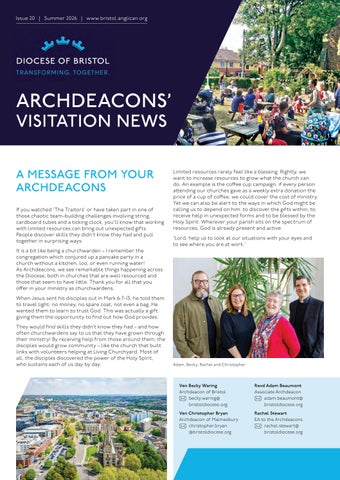
Adam, Becky, Rachel and Christopher
FRESH EXPRESSIONS OF CHURCH
The role of New Christian Communities

New Christian Communities (NCCs) are creative, exciting and different ways of serving those who do not currently engage with a church community. An NCC is a new congregation or gathering that ‘has as its purpose the worship of Jesus Christ and helping people to grow in their faith. Its practices will include two or more of: prayer, scripture, praise, sacrament, and ‘acts of service’. In doing so, they align with our Diocesan strategic objective to ‘have a form of church in every community, and a church in which all can participate, thrive, and belong’. They meet at least once a month, in-person or online, and are connected with the wider Church through their parish church, deanery, or diocese. They are often led by lay leaders supported by ordained ministers in their parish. A New Christian Community may meet where people already meet each other or in an existing
BUILDING A CULTURE WHERE EVERYONE CAN FLOURISH
Over the past year, the Diocesan Racial Justice team has continued its commitment to helping our Diocese become a place where everyone can belong, lead, and flourish. One strand of this work has been our ‘Listening to Learn’ conversations with Global Majority Heritage (GMH) ministers. Their reflections have offered honest insight into the opportunities and challenges within our current systems and have helped us understand where change is needed. Their experiences are already informing our priorities as we continue this journey together.
As we look ahead, we want to broaden this work and strengthen collaboration across the Diocese. Culture change does not sit with one group – it is shared work that involves all of us. As 1 Corinthians 12:26 reminds us, ‘If one part suffers, every part suffers with it; if one part is honoured, every part rejoices with it.’ This vision of shared flourishing underpins our commitment to building systems where every person is valued and supported.
We know that GMH churchwardens, lay ministers, and volunteers hold valuable perspectives on what helps people thrive and where our structures may unintentionally create barriers. We welcome reflections from anyone who feels able
church building; the venue is not the priority, it must work for the people gathering. In other words, they are:
• N ew – for people not previously engaged with Church and the Christian faith.
• Christian – focused on helping people to be formed and to grow in their Christian faith.
• Community – built by meeting regularly to develop relationships and belonging.
NCCs are not better or more important than any existing expression of Christian community, such as the parish church. They are not in competition with each other; they are companions who complement the mission of God together. Both are needed and vital. Together they can affirm and support each other – this is sometimes referred to as a mixed-ecology of church. One of the priorities of the national strategy of the Church of England is ‘to be a church where mixed ecology is the norm – where every person in England has access to an enriching and compelling community of faith by adding new churches and new forms of Church’.
New Christian Communities have many names. You may hear them called Fresh Expressions of Church, Messy Church, Cafe Church, Bubble Church, new monastic communities, missional communities, forest church, gatherings –almost anything! Rowan Williams, a former Archbishop of Canterbury, said, ‘Church starts where Jesus is with others.’
If you want to start a New Christian Community or are wanting to discuss this as a church, PCC, or leadership team, please contact Lee Barnes at Lee.Barnes@bristoldiocese.org
to share their experiences, whether they relate to inclusion, leadership, belonging, or the practical realities of parish life.
We also recognise that many churchwardens may be seeking confidence and clarity about how they can contribute to creating fairer, more welcoming environments for GMH colleagues and parishioners. Racial justice is not an additional task but part of building healthy, safe, and flourishing churches. If you have questions, ideas, or reflections about this wider work of culture and systems change, we would be glad to hear from you at racialjustice@bristoldiocese.org
Together, we can continue shaping a Diocesan culture where every person is valued, supported, and able to offer their gifts fully.

Hazelnut community farm

BECOME AN ECO CHAMPION
We have a thriving network of Eco Champions, who share practical ideas and hope for caring for creation at parish level, across the Diocese. With friendly bimonthly meetings and a monthly newsletter, it’s an easy, supportive way to stay inspired and connected. Joining the network can help your church take meaningful, manageable steps toward sustainability, allowing for connection with others on the same journey. If you would like to join the network, please email environment@bristoldiocese.org
SUPPORTING ALL CHURCHES ON THE ECO CHURCH JOURNEY

Across the Diocese, three churches have achieved the Gold A Rocha Eco Church award and 30 have achieved Silver, with many more taking steps to progress. To support churches, the Diocese is supporting initiatives such as Climate Cafés, Church Building Roadshows, Repair Cafes and local sustainability projects, providing advice, inspiration, and practical help. These efforts aim to empower churches at every stage to care for creation, reduce our carbon footprints and engage local communities, making our Diocese a leader in environmental action.
One of the many success stories comes from St Bartholomew’s, Wick (pictured), who have transformed their grounds for biodiversity. They planted a mini orchard, created wildlife homes with bat, bird and hedgehog boxes and involved the community in planting bulbs, hedgerows, and a wildflower patch. Alongside this, they reduced their carbon footprint by installing air-to-air heat pumps and LED lighting. Their story is an inspiring example of faith in action and environmental stewardship.
NET ZERO

The Diocese of Bristol’s commitment to environmental action arises not simply from contemporary concern, but from the heart of Christian faith. ‘The earth is the Lord’s, and everything in it’ (Psalm 24:1). We believe that creation is not a resource to be exploited, but a gift entrusted to humanity’s care.
We have already made significant progress towards our net zero ambition and change is happening across the Diocese. From individual buildings to Diocesan-wide planning, it is important to recognise how far we have come in a relatively short period of time. Through practical action, advice and shared learning, the Diocese is caring for creation in ways that benefit both the environment and local communities.
In 2023, £2 million was allocated from reserves by Diocesan Synod to support our journey to carbon net zero. This fund has now been fully invested in impactful, community-driven projects across the Diocese, including:
• Energy efficiency and decarbonisation plans for 93% of our churches.
• Energy efficiency works in 56 churches. Shining examples of local action reducing carbon and caring for creation.
• Retrofit projects on clergy homes to save energy. There have been 80 solar installations, 17 heat pump installations and 35 fabric upgrades.
The Energy Footprint Tool allows us to monitor success and is an annual requirement for all of our churches. Last year there was a 97% completion rate and this year we are aiming for 99%.
Alongside reducing carbon emissions, we are actively working to increase biodiversity across our churchyards and glebe land.
The focus for 2026 – 2028 is building on this progress and sustaining momentum. Over the next few years, our approach will be to continue strengthening what is already working well, embedding good practice and supporting churches and communities at different stages of their journeys.

All Saints Lydiard Millicent
Christ Church Swindon Eco Group
St Bartholomew’s, Wick
A MESSAGE...
From your Giving and Resources Advisor, James Morrey
You may be feeling overwhelmed or excited in your role as churchwarden. You may be new to it or have been doing it for years. No matter what, thank you for your service! Without your sacrificial generosity and faithful service, many of our churches wouldn’t be able to function.
Jesus called on everyone who feels burdened and heavyladen to come to Him so that He can give them rest, with the promise that if we take His yoke upon us and learn from Him, we will find rest for our souls (Matthew 11:28-30).
If you are feeling burdened or overwhelmed about your church’s finances or fundraising capacity, the Generosity and Giving team (formerly the Fundraising Support team) would love to work alongside you. We can help you with a range of giving and stewardship resources, the Parish Giving Scheme, digital or contactless giving and advice on fundraising support for larger projects. We can work alongside you as you seek to grow and diversify your giving and generate more income to fund your church’s vital mission and ministry.
If your church or parish are struggling financially or have questions, please do contact me by emailing: james.morrey@bristoldiocese.org
FINDING PARTNERSHIP OPPORTUNITIES FOR FUNDRAISING AND SOCIAL ACTION

Our team can also assist you with any questions or concerns you may have about Parish Share.
Thank you for the generosity of your churches in paying Parish Share in 2025 and 2026. Parish Share embodies our shared belief that God has blessed us and so enabled us to give generously towards the work of Christ. Through contributions to the common fund through Parish Share, we have been able to continue to provide, support, and enable parish ministry across the whole Diocese.
Thank you for being generous with your time and skills, for your hard work, devotion, and service of Christ, His people, and your communities. I look forward to supporting you in your ministries.

church. Over £2m has been raised for churches and religious groups across the country so far and within the Diocese, churches have already raised over £1,300.
Peter, Churchwarden at St Oswald’s Bedminster, emphasised how ‘setting easyfundraising up was astonishingly simple’ after they raised £100 in their first month!
You can sign up to easyfundraising now by going to easyfundraising.org.uk/diocese-of-bristol
I’m Naomi Jervis, Partnerships & Campaigns Officer for the Diocese.
I’m here to help by providing you with partnership opportunities around fundraising and social action.
We’ve partnered with ‘easyfundraising’ to give churches a free, easy, and secure way to get their entire congregation raising funds at no extra cost.
Registering your church is free and once you have done this, you can ask your congregation to sign up. Once an individual is signed up, any shopping they do online will produce a cashback donation to your
Social Action
Thank you so much to everyone who took the time to complete our Social Action Audit. We are truly grateful and it has enabled us to build a clear image of the social action taking place across the Diocese. The audit revealed a network of churches deeply embedded in their communities, offering practical help, relational support and consistent places of welcome to thousands of people each year. The report found that:
• In the past 12 months, 418 activities were delivered by local churches across the Diocese.
• These activities supported 40,773 people.
• 1,634 volunteers contributed 121,660 hours of service.
If you’d like to find out more about the Social Action Audit, you can find the report on our website.
If you would like support setting up a social action activity, partnership or to find out more about easyfundraising, you can get in touch with me at naomi.jervis@bristoldiocese.org
Photo Anita Dobson

NEURODIVERSITY TRAINING AND ANNA CHAPLAINCY
Across the Diocese, we are continuing to deepen our commitment to helping churches be somewhere where every person can belong, participate and flourish. One of the ways we are supporting this vision is through neurodiversity training sessions. These focus on building knowledge and understanding of neurodivergent experiences and growing confidence in how best to support those who need it.
The sessions offer an overview of the breadth of neurodiversity, exploring how people perceive, process and navigate the world in different ways. We introduce key concepts, share lived experience, and offer practical insights for parish life, pastoral care and everyday interactions.
Feedback from several participants has highlighted how, for many, these sessions have been their first opportunity to explore what neurodivergence really means and how small changes in awareness can make a significant difference. One attendee shared that: ‘It was a very interesting course, well run, funny and insightful. I particularly valued the personal stories and meta -analysis of what was going on in the room.’
We would be delighted to offer this training either at the Diocesan Office or in your parish. If you would like to host a session or attend one of our office -based gatherings, please contact the Inclusion team at inclusion@bristoldiocese.org
Alongside this, we have launched Anna Chaplaincy in the Diocese. Anna Chaplains focus on supporting older people and take their name from the widow, Anna, who appears with Simeon in Luke’s Gospel and is a wonderful role model of a faithful older person. Our first cohort of chaplains were commissioned in October 2025 (pictured), and we are now recruiting the next group. The training equips individuals and churches to offer care for older people with or without faith in their homes, care settings and within the wider community and complements, rather than replaces, the pastoral work already happening in parishes.
Anna Chaplains can be lay or ordained, experienced or new to ministry. If you are interested in exploring this calling, please visit annachaplaincy.org.uk and contact Leanne Parkes at
leanne.parkes@bristoldiocese.org
IMPROVING THE ACCESSIBILITY AND INCLUSIVITY OF YOUR CHURCH BUILDING

In January 2026, the Diocesan Church Buildings team attended ‘Inclusive Design and Built Environment’ training, provided by the Centre for Accessible Environments. The course provided insight into principles, legislation and regulations, with other design guidance on accessibility and inclusivity. Staff valued the experience of the access consultant who discussed several examples of works to historic buildings and environments throughout the country. Various activities were carried out during the training relating to access audits, options appraisals and identifying challenges and opportunities. Examples of completed and new projects within the Diocese were used as part of the discussions.
The attendees found the training to be very informative, and it will assist them in supporting parishes with their access and inclusion projects. The Church Buildings team will be developing the self-assessment resources for accessibility audits for parishes to use in the early stages of reviewing access and inclusivity within churches.
church.buildings@bristoldiocese.org
HUMAN RESOURCES ADVICE AND GUIDANCE
The Human Resources team are dedicated to supporting all aspects of people management. Whether you have questions about recruitment, employment contracts or general HR matters, we’re here to help. We have produced resources to provide you with the key information you need to be a responsible and legally compliant employer, and these can be found under the Support Services section of the website. Feel free to contact us with any questions you have at
humanresources@bristoldiocese.org

Cotham Parish Church
Anna Chaplain commissioning

SAFEGUARDING IN THE DIOCESE
Safeguarding is at the heart of our life together as a church, and the Diocesan Safeguarding team play a vital role in helping every parish create a safe and welcoming environment for all. Our work supports clergy, Parish Safeguarding Officers, volunteers, and congregations as we seek to care for children, young people, and adults who may be vulnerable.
The team provide expert advice whenever safeguarding questions or concerns arise. Whether a parish needs guidance on how to respond to a disclosure, support with a complex situation, or reassurance about best practice, the team are available to help. They work closely with statutory agencies when needed and ensure that concerns are handled sensitively, promptly, and in line with national Church of England safeguarding standards.
Training is another key part of our work. The team offer a range of courses designed to equip everyone involved in church life; from clergy, churchwardens and PCC members to volunteers and youth leaders, with the knowledge and confidence to recognise concerns and respond appropriately. This training helps build a culture where safeguarding is understood as everyone’s responsibility. Parishes also receive practical support with safer recruitment, including DBS checks, and guidance on appointing staff and volunteers safely. The team provides policies, templates and resources that make it easier for churches to meet their safeguarding obligations and maintain good governance.
Importantly, the Safeguarding team is committed to supporting survivors of abuse. They ensure that anyone who comes forward is listened to, taken seriously and offered appropriate pastoral and practical support. Through all of this, the Diocesan Safeguarding team work to help churches be places of trust, care, safety and communities where everyone can flourish.
CHURCH TEAMS DAY
Church Teams Day 2025 was a huge success, filled with inspiring talks, networking opportunities and valuable resources to support your work in your parishes. Following the popularity of previous years, we will be holding another Church Teams Day on Saturday, 7 November at Central Church Bristol, BS2 0ET.
Please save the date in your diaries and, if you came along last year, invite more people from your PCC and bring a group this year. As always, it promises to be an inspiring and resource-packed event, and we would be delighted to welcome you and others from your parish.
The theme this year will be Generosity, as we appreciate the work you all do as Parish Officers.
As Diocesan Support Services, we want to support and provide you with the resources you need to serve your Church as best you can. Thank you for the time you give in service to your parish.
If you have any questions or feedback, please don’t hesitate to reach out to us via TCTProgrammeOffice@bristoldiocese.org
We’re always happy to listen and help you.

GOVERNANCE
Stone King online training and videos
Stone King (the Diocesan Registrar’s Office) offer online training sessions for charity trustees on a range of topics and have some videos on specifics such as tips for applying for a faculty or for managing a churchyard. These sessions are open to all PCC members. You can find out more and sign up by visiting the Stone King website. www.stoneking.co.uk
Photo Chris Dobson
FUNDRAISING CASE STUDY
St Andrew’s Avonmouth
St Andrew’s Church (pictured) and the Bristol North West Social Justice Hub continually pray, plan and dream of new ways to serve their community. Recently, thanks in part to help from the Diocesan Generosity team, they successfully secured £245,000 of grant funding. This has allowed them to expand their building and, in turn, their missional presence and support for the local community.
Their most recent plan to expand the support they provided to the area is to establish a ‘Spear Centre’. Spear is a national programme for 16–24-year-olds not in employment, helping them to realise their potential by coaching them to develop the mindset and skills they need to both get into work and thrive once they’re there. Thanks to generous support from local companies, it will be launched in Avonmouth in the coming months.
Funding the vision
A barrier to launching the programme was that it would need a new space in which to operate. The church developed a plan to build a mezzanine floor in the main building; however, the building costs for this project represented a significant fundraising need. Julie Cole, project manager at the Social Justice Hub, stepped up to the challenge and decided to pursue external grants to fund the project.
Julie reached out to Lydia Nash, Generosity and Giving Manager at the Diocese, to seek guidance on suitable funders and grant- making bodies. Lydia was able to recommend a range of relevant funders, enabling Julie to move ahead with drafting multiple applications for the mezzanine project. Lydia then proofread some of the applications, offering feedback to strengthen the case for funding.
After several months, Julie was hugely successful with many of the applications, and the Church has now raised its target of £245,000, with building works set to commence soon.
Speaking about
the
fundraising process, Julie said:
“Grant writing is often a slow and demanding process, with success usually coming after multiple rejections. Each Trust has its own timelines and requirements, and with rising application numbers, many are tightening their funding criteria. For these reasons, Lydia’s advice was invaluable, especially when potential leads seemed to dry up.”
How Spear will transform lives
The funding and subsequent building of the mezzanine floor means that the Spear Bristol West programme will be able to launch and serve the local community.
Those joining the programme will meet with qualified coaches on weekday afternoons in groups of 10-12 for 4 weeks. They will cover topics including interview preparation, CV and cover letter advice, presentation skills, confidence and mindset. They will also be able to access follow-up career support for up to 6 months.

How the Diocese can support with fundraising for your project
If you are looking at fundraising for a specific project, you can get support and advice from the Generosity team at the Diocese. Lydia can provide advice and resources on how to identify grant funders and create strong proposals, as well as how to set up online giving platforms, run community fundraising events and talk to your congregation and wider community about supporting the project.
Our church buildings team are also available to support you through the process of developing a project, from an initial vision through to the point of being ready to seek funding.
Get in touch with the teams by emailing fundraising@bristoldiocese.org or church.buildings@bristoldiocese.org
SUPPORTING VOLUNTEERS ACROSS THE DIOCESE

Our Volunteering team, Alex Green and Megan Christo, are working with churchwardens, PCC members and volunteers as part of the Transforming Church Together strategy. They are meeting with a diverse group of parishes across the Diocese to understand what support is most needed and to develop resources that work for all.
There will also be a half-day conference for PCC Treasurers, taking place on the morning of Saturday, 5 September at St Michael’s, Stoke Gifford. This is open to all PCC members. Please alert your Treasurer to this, they will also receive an invitation via email nearer the time.


