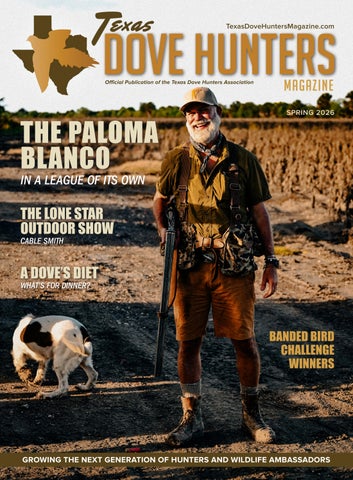
Texas Dove Hunters Magazine - Spring 2026

Page 1


BLANCO

A DOVE’S DIET WHAT’S FOR DINNER?

Dove | Quail | Whitetail | Exotics

LOCATION:

LODGING:

MEALS: 45 min Southwest of San Antonio, Texas

15,000 sq/ft lodge that comfortably sleeps 30

5-star meals including breakfast, lunch and dinner

THE PALOMA BLANCO

ANNUAL DOVE HUNT

Get a glimpse of the exclusive Paloma Blanco hunt, or as its creator, John Dunaway, more commonly refers to it, a South Texas “food and drink festival with a hunting problem.”

MEMBER SPOTLIGHT

Meet TDHA member, Rusty Reed, the most consistent and dedicated dove hunter we’ve ever met.

Publisher

TEXAS

Editor

CHARLOTTE SCHUSTER

Contributing

ANNDRIA FLORES, EMERALD MARKETING LLC

Graphic Design

STUDIO SYKES

Contributing Photographers

LEFTY RAY CHAPA

HOLLY HEARN

BILL WEEKLEY

TEXAS PARKS & WILDLIFE DEPARTMENT

AARON DAVIS

WADE SHOEMAKER

CHRIS MCGEE

HOUSTON BEAL, ONE MORE RIDGE

PRODUCTIONS

NICO MORENO

JAY SCHWISOW

Contributors

NATE SKINNER

MEREDITH KAY

OWEN FITZSIMMONS

HOLLY HEARN

LEON MCNEIL

TDHA STAFF

Advertising Sales TDHA STAFF

Printing SHWEIKI MEDIA, SAN ANTONIO, TX On the Cover: Pete Kuhn from Connecticut, Paloma Blanco hunter Photo by Chris McGee FOR ADVERTISING INFORMATION CALL 210-764-1189 EMAIL info@texasdovehunters.com

TEXAS DOVE HUNTERS MAGAZINE is published bi-annually by Texas Dove Hunters, LLC (Publisher). Reproduction in any manner in whole or part is prohibited without the express written consent of the Publisher. Material contained herein does not necessarily reflect the opinion of the publisher or its staff. TEXAS DOVE HUNTERS MAGAZINE reserves the right to edit materials for clarity and space and assumes no responsibility for accuracy, errors or omissions. TEXAS DOVE HUNTERS MAGAZINE does not knowingly accept false or misleading advertisements or editorial, nor does the Publisher assume responsibility should such advertising or editorial appear. Articles and photographs are welcome and may be submitted to our office to be used subject to the discretion and review of the publisher. Printed in the U.S.A. © 2026 Texas Dove Hunters, LLC.

2395 Bulverde Rd., Suite 104 | Bulverde, TX 78163 210-764-1189 | texasdovehunters.com

Joshua Creek Ranch

Texas Hill Country

“Every stay at Joshua Creek Ranch is excellent from start to finish. The lodging is always top notch—comfortable, spotless, and designed with a perfect blend of Texas charm and modern convenience. The food is consistently fantastic, with every meal tasting fresh, generous, and clearly prepared with care. The hunting is outstanding every time. The guides are true experts who know the land well, and the dogs are incredibly skilled, making each outing both fun and highly productive. Joshua Creek Ranch remains one of my favorite destinations, and I always look forward to returning. I strongly recommend it to anyone wanting great lodging, great food, and world-class hunting. It’s a place that delivers unforgettable experiences every single visit.”

C. R. | Orvis.com Review

In 2012 when Susan and I first started TDHA we wanted a tag line to help set the tone for the organization. We started talking about how we introduced our two boys to dove hunting. Through our conversation, we came up with Growing the Next Generation of Hunters and Wildlife Ambassadors. For almost 14 years, that phrase has been the embodiment of everything done at Texas Dove Hunters Association. When Charlotte and Cameron acquired the organization in 2024, they promised to continue that, and they have.

Looking back, we introduced our boys to hunting by taking them on dove hunts before they were old enough to shoot. Everything I said and did involved safety and proper gun handling because kids need to understand the danger of firearms and learn a healthy respect for them before they ever pull a trigger. Proper gun handling needs to be engrained in their subconscious whenever they pick up any type of firearm or even a toy representing a firearm.

We took the boys to the field with us, so they got to see me shoot a bird, pick it up and handle it. The next step was letting them touch the birds and watch me clean them. Then they became bird dogs and ran out to the field to pick up downed birds. After that, they helped clean them and learned field etiquette.

As they each got old enough, we gave them a Red RyderTM BB gun. One on one, I took each of the boys to the field with their new BB gun where they were expected to handle it just like I handled my shotgun. The next step that they had been waiting for was letting them shoot a shotgun. Shooting their first dove is a memory that will be etched in their brains forever.

The age you introduce your children to guns will be different for each of you and your evaluation of your own child’s behavior around guns and harvested animals (and of course blood). Getting your child comfortable and teaching them safety is an important factor in any outdoor sport, whether it be deer or hog hunting, or even fishing.

Once Susan saw how much fun the guys were having in the field, she decided to join in on the fun too. Then it was truly a family affair. The best life lesson for any child or adult is the experience of a hunt and the satisfaction of the harvest. It truly is a life lesson and can be one of the most educational things your child will ever experience. Then you will be part of growing the next generation of hunters and wildlife ambassadors.

Take a kid hunting, Bobby Thornton

MISSION STATEMENT

Texas Dove Hunters Association promotes strong family unity through hunting and outdoor programs. We are committed to research, education and habitat conservation.

The 2025-26 dove hunting season is in the books, and it did not disappoint. Last season proved very successful for hunters in most of the state. The August 2025 Dove Population Status report from the Texas Parks & Wildlife Department predicted a 5% increase in mourning doves statewide compared to 2024 and 28% above the long-term average. The data projected white-winged dove numbers would be 15% above the long-term average.

The season wasn’t perfect, though, and presented consistent “hit-or-miss” scenarios. Some areas were lights out, while other nearby popular areas struggled at times. The North Zone opener was hot and heavy, while the South Zone took a few weeks to really get going — many outfitters observed birds arriving much later than normal and in intermittent waves. Outfitters had to work hard to put hunters on good fields or birds from week to week. While bird numbers were up and hunters achieved their limits, hunting wasn’t always easy, depending on the area of the state.

The second season ranked among the best Texas has experienced in at least the last five years, if not longer, in our opinion. Late-season rains, the season split alleviating pressure on fields and birds, and delayed migration all contributed to a stellar winter season. Outfitters who booked that part of the season and hunters who stuck around to enjoy December and January dove hunting enjoyed plentiful birds and cooler temperatures. We always encourage hunters to go beyond opening weekend. Dove season is open for a total of 90 days, but many hunters experience only one or two days of it. Some of my favorite dove hunting happens in October.

Another busy and exciting year is taking shape for TDHA. We’re gearing up for our sporting clay shoot in May and look forward to presenting scholarships at that event to two high school students who are passionate about the outdoors and preserving conservation and hunting heritage for future generations. Join us at that event or come say hello during this summer’s trade shows.

This issue covers so many interesting people and topics that we had to keep adding pages. The cover story describes one heck of a hunt in Brownsville, the Paloma Blanco. This yearly meeting of the minds and “field fiesta” has caught my eye the last few years on social media, and I knew I wanted to share its uniqueness with our members when I had the chance.

Also in this issue, you’ll read about what makes up a dove’s diet, how the Lone Star Outdoor Show got its start, the 2025 Texas Banded Bird Challenge results, leucistic doves, and more.

I want to sincerely thank our members and industry partners for allowing TDHA to serve its mission each day, one that is near and dear to my heart and my family. It is my intent and hope that through our work with the association, and through raising our own children, we are increasing dove hunting education and resources and Growing the Next Generation of Hunters and Wildlife Ambassadors.

Take the shot,

THE PALOMA BLANCO A South Texas Rendezvous Like No Other

The Paloma Blanco isn’t your average group hunt.

The yearly fiesta is organized by El Capitan Hunt Club ringleader and Houston native John Dunaway, who somehow finds a way to tactfully up the stakes each year. What began nine years ago as a modest dove hunt with a small circle of close friends has organically grown into an eccentric meeting of minds in Brownsville, Texas, every October. Paloma Blanco (PB) takes place at White Wing Fields, a family-run outfitter that has booked dove hunts along the historic Rio Grande River for more than 25 years.

So, what makes the PB hunt so special?

It’d be easy to credit the obvious reasons: plentiful white wings, caviar bumps post-hunt, a local Rio Grande Valley (RGV) mariachi band serenading the field before that became a “thing,” big-name brand partners, catering from sunup to sundown, curated bartending experiences after the hunt, custom PB swag, and more. But if you asked outdoor enthusiast and ship captain John Dunaway why the event stands in a league of its own, he simply says, it’s the people.

Get enough interesting people together in a dove field, and you’ll have an interesting event. And the crowd, handpicked and personally invited by Dunaway and his closest compadres, fit the bill. Representing all walks of life and regions of the United States, the 100 attendees who flock to the Texas-Mexico border each year infuse this event with a one-of-a-kind flavor. Dunaway’s maritime career and background in hunting and traveling have allowed him to meet interesting people from around the world, and that unique blend of perspectives and characters makes PB, PB. The event draws participants from multiple states, including Montana, Nebraska, Rhode Island, the Carolinas, Florida, Connecticut, Arkansas, Oklahoma, Texas and Louisiana, and even Mexico, representing diverse professions from lawyers and airline pilots to fishing guides.

Staying True to Its Simple Start

While the weekend is a well-oiled machine with all the bells and whistles a dove hunter could want, that wasn’t always the case. PB has humble beginnings.

“We never set out to make it this big thing or fancy hunt,” Dunaway said. “It happened naturally over the years, with our buddies adding their close friends, and it just expanded that way. Now it’s my favorite time of the year, because I know I’m going to meet at least a few new people that end up becoming life-long connections.”

Even though the hunt could easily become commercialized and larger than life, Dunaway said he and the El Capitan Hunt Club make it a priority to keep it rooted in its humble beginnings and grounded in what matters — the friendships they form in the white wing fields.

“I think it’s more important now than ever, that we prioritize face-to-face interaction with people,” he said. “Something that makes me happy each year is watching people who were strangers at the start of the hunt, walk away with new connections. I’ll look on social media long after dove season and see a few guys who attended PB on a hunt together somewhere else in the U.S., and I think that’s the whole point.”

Dunaway recalled the early beginnings of PB in 2016, a dove hunt with him, his wife and then-newborn daughter, and four buddies. The hunt didn’t have a name or any social media coverage. It was just them, a small grill, one cooler, and a pop-up tent. During that hunt, Dunaway heard a mariachi band playing and assumed it was on a neighboring group’s speaker. When they realized it was a live mariachi performance, an idea sparked that would be the catalyst for creating the Paloma Blanco experience. The next year, the group grew to about 15 hunters, developed a name, and had mariachis greet them with a performance after the hunt.

Dunaway is adamant Paloma Blanco remains invite-only and highly curated. While more hunters want a taste of the secret sauce that is PB, the reality is that every event has a limited capacity, especially hunts. Only so many people can safely hunt a field, and Dunaway says keeping the event’s integrity intact is key. Even as attendance has grown to 100 in recent years, he wants it to always feel like an intimate gathering of close friends — just like it did in the beginning, when it was only he and PB veterans Morgan Weber, Kansas Sartin, Shawn Schmidt, Mike Marek and Andrew Klein, hunting together in South Texas.

In those early years, nothing else like it was happening, so there was nothing to duplicate. Dunaway drew inspiration from a Garden & Gun article that featured a sophisticated tablescape in the field.

“They had a chef cooking for them right there in the field, and I thought man, what a cool way to celebrate after the hunt,” Dunaway said. “I love cooking, our whole group does. We’re already cooking anyway after the hunt, so we thought elevating the food experience would really add to our event.”

Some say Paloma Blanco has inspired similar intimate hunts that have popped up in recent years, and it’s easy to understand why. Dunaway’s built a model that not only stands out and intrigues people, but one that’s carefully crafted and rooted in authenticity. When asked what advice he would give someone wanting to create a similar experience, Dunaway said there’s always room for more.

“You can do the exact same thing we are. Find a couple of people who are important to you. Add some intriguing items. You don’t have to have a chef cook a meal, and maybe you don’t even drink, that’s perfectly fine. But do something that makes the moment a little bit special, and that will make it more memorable in the long run,” he said.

Above: PB creator John Dunaway (left)

Guns, Golden Tickets, and Good Causes

The PB crowd knows how to have a good time, that’s no secret. But the hunt also leaves a deeper impact. Dunaway is a Texas Parks & Wildlife Foundation (TPWF) Ambassador, and through that relationship, they established a raffle that provides a way for new participants to join PB while supporting conservation.

TPWF runs a Golden Ticket system for PB, letting hunters who join the foundation within a certain timeframe automatically enter for a chance to attend PB. TPWF selects one winner, who may bring a guest to the hunt. These membership sales directly support TPWF’s work to conserve the lands, waters and wildlife that support Texas’ proud outdoor traditions.

“We’re batting a thousand so far on the TPWF Golden Ticket winners,” Dunaway said. “That drawing is completely random, and we don’t handle the raffle or the funds raised, but the people who have showed up through that lottery system have fit in perfectly with our crew.”

The PB team opened a second Golden Ticket opportunity a few years ago, raising money directly for Hogs for the Cause, a Louisiana-based nonprofit supporting pediatric brain cancer research. Through both the TPWF and Hogs for the Cause Golden Tickets, more than $50,000 has been raised in the last two years for those non-profits.

Additional fundraising comes from on-site raffles held on Saturday evenings. “That money goes directly to the professional chefs who show up and work their butts off, and to individuals fighting cancer,” Dunaway said.

Last year, they raised $15,000 for the chefs and a few families near and dear to Dunaway and the group, including a member of the Loop family, who owns White Wing Fields, and Owen Gayler, a local Texas fly-fishing guide and hunting enthusiast.

Regular invite-only ticket prices are kept just a touch over costs to cover expenses and generate some operating capital for the following year’s logistics. “We’re not trying to make a cent here for ourselves,” Dunaway said. “That’s never what it will be about.”

A Food and Drink Festival with a Hunting Problem

PB has evolved significantly since its simple start. Dunaway likes to add something each year, without putting unrealistic expectations on himself. “I like to play around with stuff and get creative,” he admitted. “But I also think how it’s set up is perfect and works, so I don’t want to change too much. Each year we like to add a little surprise for our guests, to always keep them guessing.”

Dove hunting remains at the core of the event. Every person who travels to Brownsville enjoys hunting and the outdoors, especially dove hunting. After the hunt, guests enjoy specially curated field-side food and beverage experiences — a highlight which recently earned the hunt the nickname “a food and drink festival with a hunting problem.”

Attendees can expect to eat like kings in the fields at PB. The food scene has grown over the years, and some people now come just for that. Dunaway joked, “Some people hardly get their shotguns out of their scabs. They’re more interested in trying the foods and cocktails that we break out after hunting.”

PB boasts a standout culinary lineup, including Uvalde native Ernest Servantes, who is the founder of Burnt Bean Co. and winner of Food Network’s 2012 “Chopped Grill Masters.” Servantes and the Burnt Bean Co. crew took home the number one spot on Texas Monthly’s 2025 Best BBQ Joints in Texas list. Grant Pinkerton, founder of Houston-based restaurant, Pinkerton’s Barbecue, also shares his talents and savory dishes with the PB crew.

Big names in the Texas culinary world such as Seth Siegel-Gardner, Patrick Feges, and Levi Goode, plus the YETI® and Mill Scale crews, all show up with their giant trailer pit rigs and show out. The PB food scene was elevated to an entirely new level when Siegel-Gardner joined the picture in 2023. He told Dunaway and crew they were crazy for cooking themselves and then proceeded to make a seafood paella over a ground fire for nearly 80 people. As the guest list has grown and more chefs have joined, each chef now handles one meal. That way, they can focus on their one meal and then enjoy the rest of the weekend.

Dunaway said it wasn’t until year five that they had brands attend and support that weren’t some of his buddies who had been coming since the beginning. He’s kept a small group of core, loyal brands attached to the event, such as Twisted X Brewing, Turtlebox®, PAK Mule, Duck Camp, and Ball and Buck®.

White Wing Fields: A Family Affair

Dunaway grew up traveling to Brownsville with his dad to hunt at White Wing Fields. He has hunted in those same fields since he was 13, becoming close with the Loop family, who own the farm. “PB is special because they celebrate friendship and fellowship and also work together to support good causes and people in need,” said Bonnie Elbert, of the Loop family.

“It doesn’t get better than that.” Dunaway recalled one year at PB when his dad attended — the first time he had returned to White Wing Fields in years and his first time at PB since it became a larger-scale event. While in the field, they received a call that Dunaway’s grandmother passed away.

“That was a sad and special moment at the same time, that we were able to receive the news while together on the hunt,” Dunaway said. That moment led to a sentimental speech Dunaway gave on top of a Polaris® Ranger one evening, a speech that would become a signature part of the event. “When I or other organizers get up there to give a speech, it’s always to thank the participants, sponsors, and people who help make it what it is,” Dunaway said. “We’ll say a prayer to bless the food. We’ll celebrate the money raised. It’s never to toot our own horns.”

The adventure isn’t limited to White Wing Fields. Another aspect that makes PB unique is the “choose-your-own-adventure” weekend guests can build. Most of the group stays in a few houses on South Padre Island. The proximity of White Wing Fields to the coast is every hunter’s and angler’s dream. Some hunters squeeze in fishing and beach activities while they’re there. Golf cart tours of the island, and liquid intravenous (IV) treatments to help people feel their best, have become PB staples.

As attendees have grown up together and started families, Dunaway said it’s special to see the next generation in the fields with their dads. About 10 youth hunters now join PB and the number grows each year.

Purposefully Crafted for the Long Haul

Though the attendee list, PB swag, and social media coverage have grown over the years, Paloma Blanco began with a few hunting buddies and what they could fit in one YETI® cooler. They didn’t have fancy cooking or posthunt cocktail stations. There was no official name or sponsorships.

Far down the road, Dunaway joked that it will probably end up that way again, and he’d be fine with it. He never set out to put on a show or see how flamboyant he could make a dove hunt. It has always been about the people he shared the field with and the special memories made at White Wing Fields.

THE MAN BEHIND THE MICROPHONE CABLE SMITH — LONE STAR OUTDOOR SHOW

Cable Smith is the founder and host of the Lone Star Outdoor Show – a radio show and podcast known for its captivating content and interesting guest interviews. The show encompasses all things outdoors, including current events and issues related to hunting, conservation, the Second Amendment, and other topics of interest to sportsmen and women.

The Trailhead

Smith grew up in Dallas, and he recalls making some of his earliest outdoor memories while camping and fishing with his dad and brother. His father was an avid bass angler, and he credits him with instilling his passion and appreciation for the outdoors and its beautiful God-given resources. These experiences would continue to shape his life choices.

After earning a degree in radio, television, and film from the University of North Texas, Smith set out to build a career in sports talk radio. He took a job at a radio station in Texarkana, Texas, where one of his responsibilities was hosting an outdoors show.

“The outdoors show was only a small portion of my job,” Smith said. “My main responsibility was sports talk radio, but I really fell in love with hosting the outdoors show and the topics, people, and conversations that transpired from that.”

Smith fondly recalls how, back then, he could easily contact big names in the outdoor industry — like the late Duck Commander founder Phil Robertson — at their home phone numbers and interview them.

“I’d call Robertson at his house, and often his wife would answer and tell me that he was out duck hunting,” Smith said. “She would always tell me to call back in the early afternoon, and sure enough, he would answer, and I would record an interview with him.”

The Turning Point

Just as Smith was finding his stride, the 2008 economic downturn cut his time in Texarkana short. After only eight months, the company let him go. Though the setback was difficult, it proved to be a positive turning point leading him to something bigger. During his short time working at the radio station in Texarkana, Smith realized that people in the outdoor industry, and those passionate about the outdoors, were generally much nicer and more approachable than folks in the sports radio world. He decided to focus all his time and energy on creating and hosting his own outdoors show, and hasn’t looked back since.

He and his wife, Erin, packed up and returned to the Dallas area, where a new chapter began with the launch of the Lone Star Outdoor Show.

“The show literally started at my in-laws’ dining room table,” Smith said. “We lived with them for a few months when we moved back to the Dallas area after I got laid off.”

Lone Star Outdoor Show originated in 2009 as an outdoors radio show, at a time when podcasts had yet to become part of the media landscape. Smith began buying the airtime and broadcasting on KHYI 95.3 FM, “The Range,” a Dallas-Fort Worth radio station known for Texas country and alternative country music.

“I was selling sponsorship and commercial spots for the show to pay for the airtime,” Smith said. “It was a slow-going grind at first. Back

then, I was simply trying to break even and give Lone Star Outdoor Show a chance to really gain some traction. I don’t think I made a profit during the first year of the show.”

Looking for new ways to expand his audience, Smith began uploading each episode to iTunes®, even though podcasts hadn’t yet entered the mainstream.

“The show essentially became a podcast before anyone knew what the term ‘podcast’ was,” Smith said. “And I still do the same thing today. I produce it as a radio show and then publish it as a podcast on all major apps and platforms where you can stream and listen to podcasts.”

Smith then set his sights higher, with the goal of expanding the show to more stations and developing his own radio network. He’s come a long way since the show started back in 2009. Today, the show airs on 20-25 radio stations across Texas, and averages 180,000 podcast downloads per episode.

“The content of the show has shifted a lot over the years, since it began,” Smith said. “When I first started Lone Star Outdoor Show, my hunting experience was limited to Texas, so the majority of the topics covered were Texas-based. Nowadays, I very rarely focus on just a Texas-specific topic.”

A Mission Fueled by Authenticity

Smith’s mission has always been to produce a show that is entertaining, educational, conservation-driven, and rooted in his Christian beliefs and values.

Topics on the show range from outdoor related current events, newsworthy or notable conservation topics, political issues, anything and everything that encompasses hunting, fishing, the Second Amendment, and the outdoors as a whole. Smith’s commitment to authenticity also extends into his business dealings. He is upfront with potential

sponsors, tells them exactly where he stands, and makes it clear he won’t compromise his values for commercial interests.

“I tell potential sponsors from the very beginning, if they are squeamish on the Second Amendment, or if they are going to have a problem with the beliefs and views that I express on the show, then they don’t need to work with me,” Smith said. “I’m not going to sacrifice my beliefs or views for a sponsorship or business deal.”

Moments That Defined the Season

Smith’s unwavering approach has helped him cultivate an audience that appreciates the topics he presents on his show. It has also attracted a wide range of guests, giving Smith the opportunity to sit down with some interesting figures in the industry. When he reflects on his time behind the microphone, an interview with Jeff Foxworthy stands out as one of his favorites.

During this particular interview, Smith recalled asking Foxworthy about his favorite deer camp prank. The question prompted Foxworthy to share a memorable story about a gorilla suit that somehow ended up at a deer camp.

“They had a guy there with them that had never been deer hunting before,” Smith said. “One of Foxworthy’s buddies put on the gorilla suit, and when the guy stepped out of the deer blind in the dark, he ran up to him in the gorilla suit and scared him.”

The prank had lasting effects.

“The poor guy refused to hunt for the rest of the trip,” Smith said. “He didn’t want to be out in the woods in the dark anymore, even after they told him it was just supposed to be a funny prank.”

Beyond entertaining and educational hunting stories, Smith’s show is also shaped by his love of music, especially Texas country. He has had numerous Texas country artists on the show over the years to promote their music and talk hunting and fishing.

“Music has always been a big part of my life, and it has always been an important aspect of the show,” Smith said. “Texas country music just goes hand in hand with the outdoor lifestyle.”

Smith said his kids often get hooked on the songs he plays while driving in his truck with them.

“A lot of times, they’ll memorize the words to a song before I do,” he said. “Several years ago, they had a favorite song by the band, Micky & the Motorcars, and knew all the words. So when I had members of the band, Micky and Gary Braun, in the studio for a show, I had my wife bring the kids and they played their favorite song for them in person.

Seeing his children singing along, starstruck that their musical heroes were right there in the studio, is a memory Smith treasures. It’s moments like these, when music, family, and a love for the outdoors come together, that truly capture the spirit of the Lone Star Outdoor Show.

Big Game Partners

As the show has grown, so have its sponsors. Smith’s passion has connected him with like-minded enthusiasts and led him to partner with organizations like Safari Club International (SCI), a title sponsor for show. Smith voices strong support for their work, both domestically and internationally.

“I don’t think there is a more influential organization out there that is as invested in protecting our rights as sportsmen and women as SCI is,” he said. “I think everyone needs to be plugged in to some kind of conservation organization. You don’t necessarily have to join a local chapter, but at minimum, you should get on some sort of email list and stay informed with current events and what is going on in the world that affects our rights as hunters and anglers.”

Open Seasons Require an Open Book

Above all, Smith operates as an open book. He isn’t afraid of people disagreeing with his opinions; he uses his platform to ensure his voice is heard. He speaks candidly about his views and does not shy away from addressing issues head-on, especially when he believes someone or something threatens the hunting or outdoor community.

When it comes to challenges facing hunters today, Smith is particularly outspoken about divisions within the community itself.

“Our largest enemy as a hunting community, in my opinion, are folks or individuals who claim they are hunters, but are against certain aspects, means, or traditions of the sport of hunting,” Smith said. “For example, someone may claim they are a hunter, but they are against trapping, or against hunting certain species that are legal to hunt.”

Smith believes those kinds of contradicting stances from within the hunting community pose a growing challenge for hunters, particularly when opposition to legal practices or species is driven by emotion rather than science. For him, preserving the future of hunting means

defending its traditions while keeping conservation and evidencebased practices at the forefront.

Smith uses Lone Star Outdoors Show as the mouthpiece to spread his passion for the outdoors and conservation, and the truth about issues that affect our rights and future generation’s rights as sportsmen and women.

“As a father of three kids who love to hunt and enjoy the outdoors, a lot of what I’m striving to accomplish through the Lone Star Outdoor Show is for them,” Smith said. “I’m going to fight for their right to enjoy the things that I have enjoyed as a hunter in the United States of America.”

The First Chase

Unlike his children, Smith didn’t start hunting until he was in college, thanks to his chocolate lab Maverick, and a friend’s invitation to go duck hunting.

“Maverick was afraid of fireworks and thunder,” Smith recalled. “I honestly thought there was absolutely no way my dog would enjoy hunting, but my buddy persuaded me to go. He told me I was the only one in our friend group with a retriever, and that the dog would do just fine. So, I decided to give it a shot.”

He remembers that first hunt vividly.

“I had to tie the dog to the blind so he wouldn’t run off,” Smith said. “Finally, we knocked down a green head, and I let Maverick off his leash. He swam out in the water and retrieved the duck, brought it back, and dropped it at my feet, almost as if he had just fulfilled his purpose in life. From then on, anytime I grabbed my shotgun to get ready for a hunt, that dog was excited and ready to go.”

Smith’s passion for duck hunting with his lab grew from there. The following season, he expanded into dove hunting and soon found himself pursuing just about any type of bird he could hunt with his dog. As the Lone Star Outdoor Show grew, so did Smith’s experiences, eventually leading him to pursue deer and big game. He has pursued game birds, waterfowl, and big game across the United States and in Mexico, Canada, Argentina, and Africa.

To this day, hunting birds with his lab remains his favorite style. Since college, gun dogs have remained a part of his family, and he is currently on his third chocolate lab, Jojo.

His other favorite? Archery elk hunting.

“Just thinking about calling elk and hearing a bull screaming inside 40 yards makes the hair on my arms stand up,” Smith said. “Harvesting my first bull elk on public land in New Mexico is definitely my proudest moment and memory as a hunter.”

Rewards You Can Taste

While there’s nothing like the thrill of an elk hunt, dove hunting has become a popular family tradition for Smith and his wife, Erin, their son, Henry, and their twin daughters, Frankie and Stella.

“September first is my family’s favorite day of the year, at least as far as the outdoors are concerned,” Smith said. “My kids don’t go to school on the opening day of dove season. We all go dove hunting instead. We haven’t missed an opening day since they started going to school, and we love being out in the field together.”

For Smith’s family, the rewards of hunting go beyond the field.

“My kids love to help clean the birds after a dove hunt, and their favorite wild game snack is smoked dove hearts,” Smith said. His family enjoys all forms of hunting, including deer and hog hunting, and sharing the harvest is more than just a hobby — it is an integral part of their daily life.

“My kids know where their food comes from,” Smith said. “To them, it would be abnormal not to have a freezer full of meat that was the result of successful hunts. They also won’t hesitate to tell you if they think you overcooked a piece of backstrap or venison steak, if you serve it to them medium-well or well done.”

A Voice for Tradition

Cable Smith is, above all, a passionate outdoorsman, conservationist, hunter, husband, and father. Through the Lone Star Outdoor Show, he champions the future of hunting and its traditions for the next generation — and hopes to motivate others to do the same.

Take the time to give the show a listen. You just might learn something and find yourself inspired to help preserve our hunting heritage, too.

A DOVE’S DIET WHAT’S ON THE MENU?

Photos courtesy of TPWD

Ask the average hunter what doves eat, and they’ll probably mention sunflowers or maybe croton, also known as doveweed. That’s not a bad answer, but many hunters are unaware that doves have been documented feeding on nearly 1,000 different species. Doves require high daily nutrition, and as a result, often eat what is most readily available, like a healthy ripe sunflower field. However, research indicates that doves are actually very selective eaters when they have a choice. Learning the common natural dove foods in your area will undoubtedly help you become a better dove hunter, especially during the late season when crop fields are bare.

Understanding how doves feed is important to understanding what they eat. Doves require a lot of food, up to 10% to 12% of their body weight daily. Typically, they feed in the morning and evening hours and prefer to loaf in the shade during the heat of the day. However, during migration or in colder weather when they are burning more calories, doves may feed at any time throughout the day. Mourning doves are ground-feeders, and 99% of their diet is small seeds. Due to their light build and short stature, they are limited to pulling seeds from plant stalks or, more commonly, picking seeds off the ground. Their legs are too delicate to scratch through the dirt like pheasants or push their way through dense vegetation like quail. Thick, rank pastures do not suit mourning doves. They need bare or semi-bare ground where they can easily walk and search for food. The beefier white-winged dove, which evolved in the dense forests of Latin America, is adept at feeding on the ground or while perched, as anyone who has seen one clinging onto the head of a sunflower or the side of a backyard bird feeder can attest. While much of their diet overlaps with mourning doves, their perching ability allows white-wings to feed on fruit and mast, and they can handle much larger food items than mourning doves.

Bader Ranch is conveniently located in Hondo and has 875+ acres of prime hunting. With irrigated sunflower fields and strategically placed ponds, the ranch is managed year-round for white winged dove hunting— providing a mecca for white winged doves every year. With a limited amount of hunters in the fields each day, Bader Ranch offers a more exclusive and enjoyable hunting experience.

• Group, individual and corporate hunts

• Hunting and lodging packages available

• All ages are welcome

• Premier French Chateau-style luxury hunting lodge + other private lodging options

• Resort-style pool and hot tub

Cultivated crops such as sorghum, corn, wheat, sesame and the ever-popular black oil sunflower are all known to attract doves, especially in the fall when birds congregate. While it may seem like doves prefer these agricultural foods, it’s likely that they concentrate on crops because of the sheer amount and availability of seed in a field, rather than for the taste or nutritional value. A cultivated food plot provides easy calories for a few thousand birds looking for their next meal. However, research indicates that doves prefer native seeds, which are much more nutrient-dense. A game warden once told me a story about busting a group of poachers who baited with bags of corn and shot well over their daily bag limits. After issuing citations, the warden opened all the dove crops and found hardly a single kernel of corn. The birds had been gorging themselves on native seeds. The poachers didn’t realize they were already in the perfect spot, a fallow field chock full of native croton and pigweed.

Preferred native foods include early successional herbaceous plants (also called forbs), grasses and some tree and shrub seeds. The more common forb species include Croton or doveweed (Croton spp.), common sunflower (Helianthus annuus), spurges (Euphorbia spp.), ragweeds (Ambrosia spp.), and pigweeds (Amaranthus spp.). Common native grasses include signal grasses (Brachiaria spp.), bristlegrasses (Setaria spp.), bluegrasses (Poa spp.), paspalums (Paspalum spp.) and panic grasses (Panicum spp.), to name just a few. White-winged doves often key on chittamwood, or gum bumelia (Bumelia lanuginose), and even exotic Chinese tallow (Sapium sebiferum) when they are fruiting in late summer and early fall. Naming all the species a dove might eat is almost impossible, but the ones mentioned above are common across much of Texas.

Texas offers a diverse landscape, and each ecoregion provides unique plants that serve as dove fodder throughout the year. In South Texas, watch for doves feeding on anacua (Ehretia anacua), coma (Bumelia celastrina), leatherstem (Jatropha dioica) and granjeño, or spiny hackberry (Celtis ehrenbergiana). From San Antonio north through the Interstate 35 corridor, doves often key on pigeonberry (Rivina humilis), sugarberry (Celtis laevigata), snow on the prairie (Euphorbia spp.), and partridge pea (Chamaecrista fasciculata). East Texas provides pine nuts (Pinus spp.), of course, along with sweetgum (Liquidambar styraciflua) and hackberry (Celtis occidentalis) seeds. In the plains of North and West Texas you may find doves eating prickly poppy (Argemone spp.), plains sunflower (Helianthus petiolaris), bundleflower (Desmanthus pp.), and four-wing saltbush (Atriplex canescens).

Learn to recognize some of these plants and their seeds, and there’s a good chance you will see some the next time you open a dove crop. You don’t need to learn all the species. If you can learn to identify the general characteristics of a few of these plant families, you will gain a distinct advantage over other hunters when scouting your next spot this fall. As every good bird hunter knows, if you can figure out what they’re eating, you can figure out where they’ll be.

Documented crop contents, various bird species
Gum bumelia seeds and fruits from a white wing crop
Croton milo

T2025 TEXAS BANDED BIRD CHALLENGE

he 2025 Texas Banded Bird Challenge (TBBC) yielded the third-highest number of reported banded Eurasian collared doves at 54, and the most winners in the program’s history (12). The ninth year of data collection supports previous years’ expectations and further supports our two main observations about Eurasian collared doves’ movement tendencies. The data continues to suggest that these birds have a stronger homing instinct than true migratory habits. The last few years of data have predominantly shown they are largely staying near their release locations, usually within a 10-mile radius.

The increasing number of reported bands is a positive sign for the field study, yielding more extensive data on this invasive species in Texas. Forty-four of the 54 reported birds were 2025 bands. Six were 2024 bands, one was a 2023 band, two were 2022 bands, and one was a 2021 band.

Of the 54 birds reported by hunters, 12 were registered in the Banded Bird Challenge, making them eligible to win one of the impressive prizes donated by our sponsors. Not only were there more winners this year, but there were more people calling in birds who knew of the program, knew someone who had previously harvested a banded Eurasian in the past or even meant to enter but forgot. Participation and awareness continue to grow each year by word of mouth, as hunters learn about the TBBC when they harvest a Eurasian with an orange band on its leg.

The current record for days afield is 2,260 days on a 2018 band that was harvested in 2024 in Alice, Texas. In that timeframe, the bird traveled only 88 miles generally south, averaging 0.04 miles per day. The previous record for days afield was 1,225 days on a 2020 banded bird that was harvested in 2023.

As the program matures, more hunters are harvesting multiple banded Eurasian collared doves. This may be because these birds tend to stay in a homing location and do not travel much or truly migrate like mourning or white-winged doves. They also tend to stick together. When TDHA’s Release Team travels across Texas to disperse birds, they typically band and release 10 birds at a time, before moving to a new location. One aspect we have yet to discover in this ongoing field study is exactly where they go between being released and harvested. Hopefully, one day TDHA will be able to use GPS beacons small enough to attach to the birds, with batteries that last long enough, so we can study their precise travel patterns.

The 2021 Polaris Ranger winner harvested another banded bird during the 2025 season. Both birds were harvested in the Pearsall area. Clayton Wickel, one of our 2025 winners, harvested his first banded bird in 2024, a 2024 band, but was not entered in the TBBC. Both the 2024 and 2025 birds he harvested were in the Dime Box area. Back-to-back band harvests like Wickel’s have occurred a few times in the near decade of the TBBC but are extremely rare.

The TDHA Release Team works hard to ensure they release birds in good locations across the state where they can easily transition and thrive. This usually means areas directly near a water source and mature trees, where the birds feel comfortable and have adequate shelter as they adjust to new surroundings. As a best practice, they avoid releasing the birds in urban areas or too close to feed stores or grain lots, especially since

Eurasians are known to be more of a “city dwelling” bird, like pigeons. With more data showing harvested birds have not been traveling far from the release location, we’re curious if that is partly because they’re released near hospitable natural resources, with a handful of other Eurasians, and have few reasons to stray far in search of food or water.

A 2021 band reported during the 2025 season was harvested by one of our winners, Spiner Burger, in Cat Spring. The bird traveled 19.86 miles in 1,506 days.

One of the 2022 bands reported during the 2025 season was also harvested by one of our winners, Ricky Bomnskie, in Hearne. The bird traveled 3.56 miles in 1,082 days.

The 2023 band reported during the 2025 season was harvested by Jose Lopez Jr. in San Juan, Texas, located in the Rio Grande Valley (RGV). The bird traveled 18.35 miles in 745 days.

Another interesting takeaway in this year’s data is that only one bird was reported from the RGV. There’s a misconception that TDHA “doesn’t go that far south” to release birds, which is misinformation we try to correct any time we receive the question. Although release routes change slightly each year to achieve a fair scatter plot across Texas, the RGV route has been part of the program since its inception. TDHA conducted a large RGV release trip in August 2025, which is why we were surprised there weren’t more birds reported, since it is a heavily hunted region. One theory our team is considering is that birds released on the Texas-Mexico border are flying a few miles south and ending up in Mexico, though we can’t scientifically prove that until a banded bird is reported outside of Texas.

The TBBC is a field study on this invasive species, which continues to arrive in Texas in large numbers. TDHA has built a database showing where the birds are trapped, banded, and released, compared to where they are found or harvested. We study habitat in all three locations, examining directional travel, age and distance over time.

Since their introduction into Florida in the early 1980s, Eurasian collared doves have spread rapidly, with their population growing more than 13% per year, according to the North American Breeding Bird Survey. Each year, TDHA’s Release Team safely traps, bands and releases 800 Eurasian collared doves across Texas. As of 2025, approximately 6,400 birds have been released, and that number will grow to 7,200 this summer. The orange bands do not expire from one year to the next, increasing the odds of winning and expanding the program’s reach each year.

This year’s Early Bird Contest opens April 1 and runs through July 15. Everyone who enters the TBBC between April 1 and May 31 will double their chances of winning a shotgun in the Early Bird Contest. The TBBC contest runs each year from Sept. 1 to Dec. 31. You must be entered by Aug. 31 and willing to submit to a polygraph if asked. Everyone who calls in a banded bird will receive an official certificate with information about their bird, along with a free one-year Standard membership to TDHA.

Each season, hunters call in banded birds but were not entered in the TBBC, making them ineligible to win any of the prizes. Don’t let that be you this season! Enter today at bandedbirdchallenge.com.

CONGRATULATIONS TO OUR 2025 TBBC WINNERS

Wes Oliver

Georgetown

Polaris Ranger, donated by Hoffpauir Polaris Outdoor Superstore

Lee Shetler

Arlington

Early Bird Winner: Rizzini

BR100 Sporter shotgun donated by Rizzini

Ricky Bomnskie

Bryan Argentina dove hunt, donated by David Denies

Spiner Burger

Cat Spring

Prize package donated by Los Cazadores, including Leupold binoculars, Bex sunglasses, and a Turtlebox speaker

Colt Broyles

Cherokee

Spring turkey hunt, donated by Landings Ranch

Cris Crocker

Brookshire

Leather prize package donated by Blake Jones Designs, including a custom bird bag, leather shotgun case, and shell holder

Jeff Lewey

Uvalde

Texas Dove Hunters Association

lifetime membership donated by TDHA, and two Poncho shirts donated by Poncho

Derrick Matlock

Cedar Park

Trophy Ram hunt, donated by Triple Play Outfitters

Kris Shawver

Alvin

The Feed Ball feeder, donated by Forager Outdoor Products

Kris Shawver (left), with his new Feed Ball feeder, pictured with John Noska of Forager Outdoor Products

David Sagebiel

Bulverde

Scimitar Oryx hunt, donated by RecordBuck Ranch

Destiney Tucker

Carrizo Springs

Prize package includes a $500 gift card to Murdoch’s donated by TDHA, a Dove Wrangler and Duck Wrangler donated by 8 Gauge Outdoors, and two Poncho shirts donated by Poncho

Wayne Voges

Hondo

Trophy trout fishing trip, donated by Baffin Bay Rod and Gun

Clayton Wickel

Burton

Prize package donated by Bird Down Brand, including their Ultimate Shotgun Rest, Ultimate Rifle Rest, Waterfowl Gun Rest, waxed canvas range bag, and a bird bag

Each prize winner also received a Cowboy’s Game Washer donated by Cowboy’s Wild Game Washers, and a Dove Cord donated by The Dove Cord.

FAMILIES IN THE FIELD

RARE LEUCISTIC DOVES HARVESTED DURING THE 2025-2026 SEASON

Every now and then, Texas Dove Hunters Association will have a hunter send in photos of a rare or unusual-looking dove — but it’s hardly ever more than one per season. This season was a rarity, with four hunters each harvesting a unique dove and sending us photos.

So, what makes these doves so distinctive? Although the four birds vary slightly, they all share the same condition.

They are examples of leucism — one of several conditions that cause color abnormalities in animals and is usually expressed as splotches or patches of white on a bird. Leucism is not a genetic mutation but rather describes defects in pigment cells that are caused during development. Leucistic birds may experience irregular patches of white — referred to as partial leucism and often labeled as “pied” or “piebald.” Because eye development occurs separately from other parts of the body, eye color in leucistic animals is unaffected.

The opposite would be melanism, which usually results in dark or even black feathers. It’s often misinterpreted that doves with similar white markings are albino. Pure albino birds are extremely rare. These whitened doves are often questioned as potential hybrids — a mix of two species or subspecies. The reality is that hybridization across species is extremely rare and occurs mostly in captivity. It’s much more likely for a uniquely colored dove to simply be leucistic or melanistic.

How common are they?

TDHA spoke with the Webless Migratory Game Bird Program division at Texas Parks & Wildlife, and they said that while they get a few pictures of leucistic doves, ducks, grackles, etc., sent to them every year, harvesting one is a rare feat. Most hunters who bag one of these unique birds won’t get another one in their lifetime — making it a memorable (and sometimes taxidermy-worthy) hunt and harvest.

James Jahanara harvested this leucistic or “piebald” mourning dove in Uvalde.
Scotty Reynolds harvested this heavily pigmented mourning dove in October 2025 in George West (Katzfey Ranches).
Mikey Nolan
Dubbed the “ultimate white wing” on social media, this rare-colored mourning dove was harvested in September 2025 near George West.
TDHA member Frank Messina harvested this “speckled” mourning dove in September 2025 near Encinal.

ROOTED IN THE FIELD:

HOW MADISON RAMSEY IS SHAPING THE FUTURE OF GAME BIRD CONSERVATION

On a quiet stretch of farmland just outside Lubbock, Madison Ramsey starts most mornings the same way, checking water lines, monitoring feed, and listening closely for the subtle signs that tell her whether a bird is thriving or struggling. It is hands-on work, often dirty, rarely glamorous, but absolutely essential for the health and well-being of the game birds that she has been entrusted to care for. Ramsey doesn’t just consider this her job; it is her passion. It allows her to honor what she truly believes in: conservation, game bird science, and hunting tradition.

At just 26 years old, Ramsey is already deeply embedded in a world that many hunters only see from the field. Ramsey is currently working for T&T Game Birds and Hunting Preserve, a Lubbock area game bird producer and hunting preserve. Here, Ramsey helps raise pheasants, quail, and chukar from hatch to release, and diagnoses and cares for sick birds when needed. She is also busy completing her master’s degree in wildlife management at Texas Tech University, where her research focuses on the effects of agricultural insecticides on pheasant health, research that could have lasting implications for bird populations and the hunting industry alike. She works closely with her professor, Warren Conway, Ph.D., a Bricker Endowed Chair in Wildlife Management, and the Senior Director of Outstate Research, Engagement and Outreach Stations at the Davis College of Agricultural Sciences and Natural Resources.

Ramsey’s path into wildlife science was not linear, but it was inevitable. Raised in Portland, Texas, she grew up in a household where dove season was a fixture of fall. Her father, Chris Ramsey, is well known

in hunting circles as the founder of The Dove Cord, a hand-woven, 15-bird limit holder with hooks that can hang just about anywhere, keeping the birds off the ground. He spent years in the field, eventually leading him to create a simple but creative solution to keep harvested birds clean and accounted for. Though Madison does not consider herself a hunter, she absorbed the culture, values, and respect for wildlife that come from being raised around people who care deeply about the outdoors.

“Madison has always had a heart for animals,” Chris Ramsey said. “But seeing her turn that passion into real-world research that can help both wildlife and hunters makes me incredibly proud. She is doing something that matters.”

That sense of purpose shows in her work. At T&T Game Birds, Ramsey focuses primarily on young birds and hatchery operations, overseeing incubation, chick care, feeding protocols, and health management. She is quick to explain that successful hunts start long before a hunter and dog ever hit the field.

“If birds are not healthy from the beginning, nothing else matters,” she said. “Good conservation and successful hunting both depend on that foundation.”

That philosophy carries over into her graduate research, where her current study examines the effects of the widely used agricultural insecticide imidacloprid, a neonicotinoid, on pen-reared pheasants. Neonicotinoids became popular in the 1980s, a timeline that closely mirrors the dramatic decline of pheasant populations across much of Texas and the Southern Plains. Ramsey’s work aims to determine whether exposure to these chemicals affects bird health in measur-

able ways, including body mass, blood chemistry, and toxin concentration levels. Her approach is deliberate and careful, designed to produce data that can inform farmers, landowners, wildlife managers, and hunters.

Ramsey said, “What I really want is awareness. A lot of farmers genuinely care about having pheasants on their land. For many of them, those birds are indicators of land health. If something they are using could be impacting that, they want to know.”

That message resonated when Ramsey presented her research at Pheasant Fest and Quail Classic, a national gathering of hunters, conservationists, and agricultural producers. Rather than defensiveness, she encountered curiosity and concern. Several farmers photographed the insecticide label she was studying, eager to check their own products.

For hunters, the implications are just as significant. Wild pheasants have all but disappeared from much of Texas, with survey routes that once averaged more than 100 birds now reporting fewer than two. While preserveraised birds help sustain hunting opportunities, long-term success depends on habitat quality, responsible land management, and science-backed conservation. Her research underscores a truth that many hunters already understand — protecting game species does not weaken hunting, but ensures its future.

Her academic background gives her a rare dual perspective. She earned her undergraduate degree in Animal Science from Sam Houston State University, originally planning to pursue veterinary school. Instead, internships and hands-on wildlife work pulled her toward production and management. While she briefly considered a doctorate, Ramsey knows her place is closer to the birds themselves, than in the lab or the classroom full-time.

“My goal is to stay in the game bird or deer production space, raising animals, managing health, and supporting hunting operations that do things the right way,” she said.

In a field still largely dominated by men, Ramsey is proving her value by digging in and doing the work. She is often one of the only women in the room at industry conferences, yet her knowledge and credibility speak for themselves. She represents a new generation of conservation professionals, people who understand that hunting, science, and stewardship are not competing interests, but interconnected responsibilities.

As Ramsey prepares to complete her master’s degree in 2026, she is grateful for the support from her family. Her mom, Theresa, and her twin sister, Kerstyn, cheer her on from Corpus Christi, Texas, and her brother, Brayden, is a sophomore at Texas Tech University. She hopes her research will open the door to expanded studies, including less inva-

sive testing methods that could eventually be used on wild pheasant populations. It is careful, incremental progress, the kind that lasts. She knows that every healthy bird raised, every data point collected, and every conversation sparked brings the hunting community one step closer to sustainability, and for hunters who care about the future of the sport, that is something worth paying attention to.

TDHA Member Spotlight: RUSTY REED

usty Reed harvested around 800 mourning doves during the 2025-26 season; he says the best dove season he’s ever experienced. Hunting six days most weeks during season, Reed is perhaps the most dedicated and consistent dove hunter we’ve ever met or interviewed. And he does it at 84 years old, with Parkinson’s disease, no less.

“I go every day that I can,” Reed said. “I love to watch my dog (Maggie) work.”

Everyone carries a unique story. Rarely, though, does someone stand out as much as Texas Dove Hunters Association member Rusty Reed, both for his interesting life and his shotgun skills in a dove field.

For frame of reference, 25 years of Texas Parks & Wildlife Department harvest survey data show the average harvest per season is 16 birds, with an average number of days hunted between four and five. Reed’s story isn’t about the volume of birds he harvests, though. That is simply a byproduct of his love to be in the field with Maggie, and his impressive aim.

Growing Roots in Alaska

Rusty has lived in Bandera for the last 18 years. However, unlike most Texas dove hunters, he is not a Texas native. He was born and spent his childhood years in Michigan before moving to California with his family. When asked how his love for hunting came about, Reed said it was something that interested him as a young boy.

“I really became active in the outdoors around age 15,” he said. “My dad did a little fishing with me, but he wasn’t an avid hunter, so I taught myself. I just loved the outdoors.”

Each morning before school as a teenager, he’d grab his six-cell flashlight, call his dog, and set out to check his trap lines. After school, he headed straight back to the woods, spending every evening there until darkness signaled it was time for dinner.

In his mid-20s, facing adulthood and shrinking opportunities in Monterey, California, he seized the chance to chase a wild dream. He set out for Alaska with a friend, a leap of faith that would quickly become one of the best decisions of his life.

“It wasn’t long after arriving in Alaska that I had roots growing out of the bottom of my feet,” Reed said, describing his immediate connection to the cold frontier he would call home for the next 40 years.

Reed has dyslexia so severe that he couldn’t read or write at the age of 25. But that didn’t stop him from creating successful businesses and a busy life in Alaska. He used his photographic memory every day to sidestep the challenge, especially in his construction company, which built everything from housing developments and restaurants to highrise buildings and condominiums.

“I could memorize 50-sheet blueprints in a few hours,” he said.

He worked hard, running on a little sleep, and a lot of ambition.

“For about 30 years, I only slept three hours a night, which left room for other opportunities and business ventures.”

Reed drew on his passion for the outdoors and hunting, becoming a bush pilot, guiding hunters, and running an African safari booking agency. Those chilly days were filled with halibut and salmon fishing, hunting on Kodiak Island, and flying hunters into remote hunts of a lifetime. While Reed lights up when he talks about his wild Alaskan outdoor adventures, his face shines most when he recalls meeting the love of

“I hunt every day but Sunday. That’s the Lord’s day,” he said.

One of the most unique things about Reed’s hunting habits is his meticulous record-keeping. He doesn’t need any fancy hunting apps or the latest technology to keep expert logs. He records every detail of his hunting season — from shells fired per bird and dollars spent to birds hit and more — with good old-fashioned pencil and paper.

Despite having Parkinson’s disease, which affects his balance, and recently recovering from a mini-stroke that temporarily affected his vision, he continues to hunt every morning during dove season when he can. Reed says he only hunts in the mornings to avoid too-warm temperatures for Maggie on hot afternoons. Reed primarily books hunts with dove outfitters in the Uvalde, Knippa, Devine, and Hondo areas.

A Heart for African Safaris

Reed has traveled the world in pursuit of his passion, hunting on all six huntable continents, excluding only Antarctica.

During his years in Alaska, Reed journeyed to Africa more than 15 times for largegame safaris. From his home in Alaska, he sold safari hunts while showcasing his African safari trophies in his custom-built 30x40 foot trophy game room. He hosted catered safari shows in this room, which displayed more than 135 different species. The collection included shoulder-mounted rhinos, life-sized leopards and lions, and nearly every eligible game species on the planet.

If you met Reed today, you might assume dove hunting has always been his passion. Contrarily, he didn’t hunt many bird species growing up, and Alaska’s frigid climate pushed him toward big game and fishing, with ptarmigan the only bird he pursued there.

So, what is his favorite animal to hunt?

“I don’t have an answer — I like them all,” he said.

Put simply, he enjoys the pursuit and thrives when he’s outdoors. Sheep hunting remains among his favorites. Reed holds card #324 of the North American Grand Slam Club. He also once held the Safari Club world record moose.

Welcome to Texas and Dove Hunting

You could say Reed has had quite the journey over the past 84 years. But how did life take him from forging a long career in Alaska to becoming one of the most prolific dove hunters in Texas?

After retiring in September 2008, he and Barbara moved to Bandera, where they’ve resided for 18 years. In Texas, he discovered dove hunting and quickly became immersed in it with his dogs.

Over the years, Reed has had two black Labrador retrievers, both female, who have been his loyal hunting partners. His first, Bella, was with him in Alaska, retrieving ptarmigan and riding calmly as his co-pilot in the airplane. Once Bella passed away in 2019, he and Barbara got their current lab, Maggie.

“It’s really not about shooting the birds myself — that’s not why I love to dove hunt so much,” Reed said. “It’s about her,” he said, pointing to Maggie, “and watching her work. That’s why I do it.”

Reed’s dedication to hunting six days a week, during the main and winter seasons, is remarkable.

Although Parkinson’s has caused him to shoot while sitting in a swivel chair, it hasn’t compromised his aim. Shooting while sitting isn’t easy for most hunters, but Reed has mastered it, averaging about 2.7 shells per bird.

“As long as there are birds flying, Maggie and I will have our limit of 15 in an hour, max. Usually takes me about 30 minutes, honestly,” he said.

“Hardest job is finding birds, not killing them,” he said, laughing.

Reed shoots a Browning 20-gauge Silver with Muller chokes and uses nine-shot, focusing on Maggie’s retrieves rather than giving himself the credit.

“I wouldn’t dove hunt if I didn’t have a dog,” he said. “And I’d rather break a wing than kill one outright, so I can watch Maggie work.”

Maggie, a 45-pound Labrador retriever, has retrieved about 1,700 doves in three years and can carry up to three birds in her mouth at once. Her predecessor, Bella, worked for 11 years alongside Reed and was equally skilled, never losing a bird in her final hunting season, when she retrieved around 400 doves.

Reed takes all aspects of hunting seriously, and does things the right, responsible way. He is an outfitter’s dream client, leaving the field cleaner than he found it, keeping track of his limit, and disposing of the birds properly. While his heavy harvest counts can sometimes be a challenge to consume in entirety, he and Barbara are diligent about cooking the meat he harvests and sharing it with their friends and family.

A Quiet Strength Rooted in Resilience and Humility

Reed’s life exemplifies resilience. Despite his health challenges, he continues to pursue what he loves, adapting to new limitations without losing his skill or enthusiasm. His approach to hunting — valuing the experience, the companionship, and the joy of watching Maggie’s work over personal achievement — reflects humility and an appreciation for life’s simple, meaningful moments. It’s our hope that Reed’s story might inspire younger hunters to follow their pursuits and dreams, especially when those dreams are calling you outdoors.

PHOTOS FROM THE FIELD

DOVE ANTICUCHOS

INGREDIENTS

15 doves, breasted

Aji Panca Dupe

2 roasted red bell peppers

½ tablespoon smoked paprika

1 chipotle pepper in adobo

Marinade

6 garlic cloves

½ cup red wine vinegar

1½ tablespoons achiote paste

3 tablespoons avocado oil

Salt to taste

Bamboo skewers, soaked in water

Note: Aji panca can be difficult to find. If you have access to it, substitute a few tablespoons of aji panca paste for the roasted red pepper mixture and skip Step 1.

INSTRUCTIONS

1. Prepare the Pepper Base: Preheat the oven to 450°F. Roast the red bell peppers for about 30 minutes, or until the skins are blistered and lightly charred. Once cool enough to handle, blend the roasted peppers with the chipotle pepper and smoked paprika until smooth.

2. Make the Marinade: Add the garlic, red wine vinegar, achiote paste, avocado oil, and salt to the blender. Blend until fully smooth and well combined.

3. Marinate the Dove: Thread the dove breasts onto the soaked bamboo skewers. Place the skewers in a shallow dish and pour the marinade over the top, turning to coat evenly. Cover and marinate for at least 1 hour and up to 24 hours.

4. Grill: Prepare a charcoal fire and bring it to high heat. Grill the skewers for 2–3 minutes per side, basting lightly with the marinade as they cook, until just cooked through.

5. Serve: Remove from the grill and serve immediately.

10TH ANNUAL

HUNT WITH HEART DOVE HUNT

Alittle rainy weather couldn’t spoil the fun of this day, one that the Texas Dove Hunters Association (TDHA) and the Hunt with Heart (HwH) crews look forward to all year. Daniel and Valerie Hernandez of Double H Outfitters in Lytle once again graciously donated their fields and guides to make this dove hunt happen. Around 12 young adults, along with their parents or guardians, gathered for lunch before heading to the field for one last October hunt before the season split. Although heavy rains right before the hunt scattered the birds, the group still had a great day and took time to reflect on the bigger picture.

“Everyone was so optimistic about just being outside and enjoying the awesome weather, even though the birds weren’t flying like they had been or like we hoped,” said TDHA President Charlotte Schuster. “I was talking with Joe Drescher (head HwH guide) about how much of a blessing these kids and their parents are, and how the ‘harder hunts’ are sometimes the ones that teach us the most valuable lessons.”

The slow flying birds gave the group a unique opportunity to really talk and get to know one another, allowing the guides to gain a more valuable appreciation for the health struggles these brave kids have gone through and continue to battle, and how the outdoors is an important healing component in their journey.

HwH and TDHA volunteers show up each year to guide the kids and families in the field and without their continued support, this event would not be possible. Thank you to the HwH team, HH Outfitters, Chad Waligura of Able Outdoors, and the friends and family of TDHA for donating their time and resources for these resilient kids. The partnership between TDHA and HwH has provided many years of positive dove hunting experiences, and we look forward to many more like it in the future.

Hunt with Heart is a non-profit organization that serves kids battling severe, life-threatening illnesses (mainly congenital heart defects) through impactful outdoor activities and experiences. To learn more about the organization and how to support their mission, visit huntwithheart.org.

CITY KIDS ADVENTURES

Building Character, Confidence, and Conservation Through the Outdoors

Photos courtesy of City Kids Adventures

City Kids Adventures (CKA) was founded on a simple but powerful belief: access to the outdoors can change the trajectory of a young person’s life.

Founded in 1996 by Leon and Leticia McNeil, CKA is a Texas-based nonprofit dedicated to introducing inner-city youth to a variety of outdoor adventures, including hunting, fishing, camping, traveling, hiking, college visits, museum trips, shooting sports, and more. What began as a small effort to expose a handful of boys and girls to the outdoors has grown into a year-round mentorship and character-development program, serving hundreds of kids who might otherwise never have the opportunity to set foot on a ranch, fish offshore, travel, or tour college campuses.

Why InnerCity Kids?

Many CKA youth come from environments with limited access to green space, positive mentorship, or constructive outlets. Most of them don’t have opportunities in their daily lives to learn about the tools and equipment needed for outdoor activities and to practice them in a safe, mentored environment. For these kids, the outdoors is not just recreational, it is transformational. Hunting and outdoor activities create structure, discipline, and a sense of earned accomplishment. They require patience, preparation, respect for rules, and accountability qualities that directly translate into success in school, work, and life.

Transforming Lives

For the last 30 years, CKA has been committed to developing disciplined, confident, purpose-driven youth through outdoor experiences that teach leadership, accountability, respect, and conservation ethics.

Every trip is a hands-on outdoor experience paired with consistent adult mentorship and intentionally designed to teach more than just how to pull a trigger or cast a line — it’s about preparation, teamwork, responsibility, and gratitude.

One of the most powerful moments is when a young child harvests their first animal, often after months of preparation and instruction. The pride, humility, and respect shown in that moment are something many of them have never experienced.

Some participants arrive shy, angry, or disengaged. Over time, they transform into leaders — helping younger participants, asking thoughtful questions about conservation, and taking ownership of their actions. For some, their first outdoor experience is also their first time leaving the city, seeing the stars without light pollution, or sitting quietly with a mentor who believes in them.

Impact in Their Words

“This program taught me patience and discipline. I learned that nothing is given — you earn it.” – Athena, 8th grade

“Hunting taught me respect — for animals, for the land, and for myself.” – Jedediah, 6th grade

“Before City Kids Adventures, I never thought about college or my future. Now I know I want more out of life.” – Athina, 12th grade

The Bigger Picture

CKA is about more than producing hunters — it’s about fostering productive members of society. CKA’s vision is to inspire young people to become responsible outdoorsmen and women, wildlife ambassadors, community leaders, and stewards who value hard work and giving back. Conservation begins with connection. Giving kids meaningful outdoor access fosters respect and a desire to protect wildlife for future generations.

By partnering with organizations like Texas Parks & Wildlife Department and the broader hunting community, CKA helps ensure a diverse, responsible, and strong future for hunting, conservation, and outdoor heritage.

Photo by Wild Bill Photography
Seafoam TDHA Sunflower Field Shirt... $29.95
Brown/Khaki
Loden/Black
Caramel Richardson 112... $25.00
Gray/Black Richardson 112... $25.00
Duck Camo Hat (3 colorways)... $30.00
Off-white TDHA Father & Son shirt... $26.95

Turn static files into dynamic content formats.

Create a flipbook