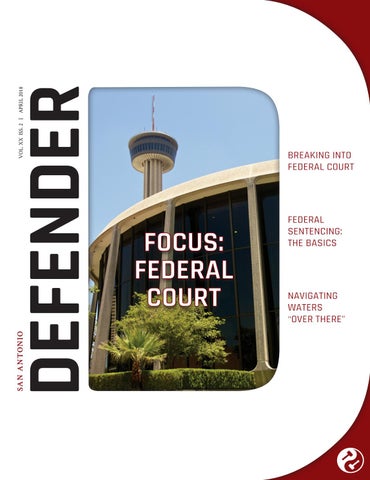
DEFENDER VOL. XX ISS. 2 | APRIL 2018
SAN ANTONIO
BREAKING INTO FEDERAL COURT
FOCUS: FEDERAL COURT
FEDERAL SENTENCING: THE BASICS
NAVIGATING WATERS “OVER THERE”
SACDLA OFFICERS
Michael McCrum
Loraine Efron
Trisha Morales Padia
President
Secretary
Editor-in-Chief, DEFENDER
Don Flanary
Christine Del Prado
Jennifer Zarka
Vice President
Treasurer
Executive Director
John “Bud” Ritenour Adam Kobs George Taylor Stephanie Stevens Jim Greenfeld Michael S. Raign John A. Convery
Ernest Acevedo, III Ronald P. Guyer Mark Stevens George Scharmen Cynthia Hujar-Orr
Joseph Esparza Justin Fischer John Fox Ray Fuchs Roland J. Garcia Paul Goeke Juan Carlos Hernandez John Hunter Blakely Mohr
Angela Moore Kristen Mulliner Miguel Najera Trisha Morales Padia Joel Perez Christopher Simpkins Robin Teague Chad Van Brunt Michael Young
PAST PRESIDENTS Patricia Jay Warren Wolf Robert Featherston Jorge Aristotelidis Jay Norton Michael Gross Jeff Mulliner
BOARD OF DIRECTORS Matthew Allen Robert Barrera Philip Bozzo Anne Burnham John Carroll Karen Corby Adam Crawshaw Andrew del Cueto Mario Del Prado
DIRECTORS EMERITUS Charles Butts (Deceased)
Anthony Nicholas (Deceased)
EDITOR-IN-CHIEF, DEFENDER Trisha Morales Padia
If you would like to submit an article to be considered for publication in The Defender, or see about how you can help or become involved with and contribute as an Associate Editor, please email Padia.Trisha@gmail.com.
DEFENDER SAN ANTONIO
04 06
LETTER FROM THE PRESIDENT Michael McCrum
BREAKING INTO FEDERAL COURT John A. Convery with Jonathan “Chavy” Chavez
09 14
FEDERAL SENTENCING: THE BASICS Kevin Collins
NAVIGATING WATERS “OVER THERE” Michael McCrum
ASSOCIATE EDITORS, DEFENDER Matthew Allen Cathy Compton Adrian Flores John Fox Roland Garcia Arlene Gay
Steven Gilmore Sean Henricksen John Hunter Thomas Lane Linda Molina Angela Moore
RC Pate Charles Peters Jodi Soyars Robin Teague Chad Van Brunt
The San Antonio Criminal Defense Lawyers Association P.O. Box 831 206, San Antonio, Texas 78283 210.501.2916 | sacdla.com
Letter From the President Michael McCrum
We had just finished our fourth week of trial when I was set back by the opening line of an article in The New Yorker: “Citizens are innocent until proven guilty, but Prime Ministers are not mere citizens.” Eerily, these words mirrored the words of several on our jury panel weeks before when asked whether they would presume my client innocent: “No, I don’t think I can— an elected official and lawyer should be held to a higher standard.” Can someone tell me where I can find in our law library the book on double standards? This and other events this past year have served to remind me that our work as criminal defense lawyers is not close to being done. Even more importantly, they serve to remind me that our work is indispensable to preserving the notion that justice and fairness still live and breathe. As I wind up my tour as president of this esteemed organization, I reflect on events which have stirred our souls and raised our ire. A district attorney finding himself on a witness stand seeking to explain and justify his conduct. A judge shedding her black robe to recant the disturbing back-and-forth of lawyers in her chambers. Defense attorneys understandably expressing angst and anger about the late disclosure of hidden evidence, the inexplicable obstructions imposed by jail guards, and the sad revelation that law “en-
4
forcement” officers still choose in this 21st century to testify contrary to their own written reports. I witness judges who are elected or appointed on the premise they will be objective, unswervingly make it obvious in their demeanor and rulings that they have tossed their judicial blindfold into the trash. Did things get better while I was president? Have they gotten worse? What did I do to improve things? These are only a few of the questions I ruminate on as I prepare to turn over the gavel. I would imagine someone living outside our criminal defense world would find all or some of these things rather depressing. I know many of my clients facing their predicaments find them so. But I’m guessing that for you and me, these events just serve to inspire us even more. We are called, you and I. Called to represent all that our forefathers dreamed about when daring to think we could do all of this on our own. A dream that the dignity of an individual should supersede even the worthy and respectable notion that crime should not exist in our communities. Dignity and justice and mercy above all. A dream that we would always hold dear truths that should be self-evident—that we are equal, and that we have unalienable rights.
Frances Ellen Watkins Harper dreamed that dream. In 1851, she opened her home as a stop along the Underground Railroad. In a time when a woman was not allowed to vote and a person of color had been considered 3/5th a human, Frances risked her life talking and writing about a person’s basic right to be treated fairly and equally. Her courage is not unlike the courage I see in each of your eyes, hear in each of your voices, and see in each of your actions. I am proud to be part of our effort, and I have been proud to be president of you, an outstanding group of people.
When you so coldly crushed me down And then excused the man? ... I’m glad God’s ways are not our ways He does not see as man; Within His love I know there’s room For those whom others ban.
I love one of Frances’s poems entitled “Double Standard.” Facially, it appears to be a message of the double standard that exists between a man and woman. What resonates in my soul, however, is what I see as an underlying message about the current state of our criminal justice system. A system that our citizens laud as the best in the world, even though the dark cloud of double standard continues to cast its heavy shadow upon an accused and his accuser. Here is a portion of the poem:
That I who fell, and he who sinned, Shall reap as we have sown; That each the burden of his loss Must bear and bear alone.
Do you blame me that I loved him? If when standing all alone I cried for bread a careless world Pressed to my lips a stone. ... Would you blame the world if it should press On him a civic crown; And see me struggling in the depth Then harshly press me down? Crime has no sex and yet today I wear the brand of shame; Whilst he amid the gay and proud Still bears an honored name. Can you blame me if I’ve learned to think Your hate of vice a sham,
I think before His great white throne, His throne of spotless light, That whited sepulchers shall wear The hue of endless night.
No golden weights can turn the scale Of justice in His sight; And what is wrong in woman’s life In man’s cannot be right. If my words offer a sense of impatience, then let them ring out so! For may we ever be impatient to hear the bells of justice ringing in our courthouses! May we ever be impatient with the winds that push against our trek toward dignity! Let oppression, bias and double standard continue to inspire us, my sisters and brothers! Let us never allow dark clouds to darken our dream for a better day. Let us continue to stand tall and firm for justice—continue to stand for equality and fairness. Our fight is not for naught. Thank you for the opportunity and blessing to have been your president. I will treasure the experience for the balance of my days. See you in court, Mike
5
Breaking Into Federal Court John A. Convery with Jonathan “Chavy” Chavez
M
any state practitioners claim they want to stay away from, not break in to federal court.
“State lawyers” often consider federal court an alien environment. It’s too formal and too unforgiving for litigators accustomed to overcrowded (lawyer friendly) state court dockets. Federal Court is not the rough and tumble trench warfare of a state court criminal trial. Others, including some very successful Texas trial lawyers, claim to avoid federal court because they believe that in criminal cases in federal court, the deck is stacked in the government’s favor. In federal court, they say, neither the lawyer nor the client can win. How does a lawyer break in to federal court? State criminal defense lawyers and state prosecutors ask this question all the time. As in many issues involving federal courts, no one likes the answer.
6
You don’t break in to federal court. At best you ease into federal court practice as prepared, collegial and graciously as possible. The keys for a lawyer to unlock the doors to federal court practice are experience, credibility, and reputation. You may become licensed to practice in federal court rather easily, but how often a lawyer may get to use that license in a federal criminal case is not so easy. It often appears to me the majority of lawyers actually practicing criminal law in federal court are government lawyers and court appointed lawyers. For a young lawyer licensed 1 to 7 years, government service has served as the fast track to federal practice, and this trend is expected to continue in the future. New lawyers should make a file early to keep track of federal criminal case experience by case name, cause number, and note activity; pretrial release, detention, investigation, discovery, pretrial
motions, trial, plea and sentencing. Collecting and updating this information will simplify the task of applying for admission to the court appointment panel and State Bar of Texas Board Certification in criminal law. To be considered for admission to the Federal Courts of the Western District of Texas, applicants must show “good standing” in the State Bar, submit character references from attorneys licensed in the district, and complete an approved course in federal court practice and procedure. (Local Rule AT-1, Admission and Discipline of Attorneys—http:// www.txwd.uscourts.gov/for-attorneys/attorneyadmission). After approval by the Admissions Committee, admission is formally accomplished at a ceremony where the new lawyer is presented to a federal judge, swears an oath to defend the Constitution, and obtains a certificate of admission— suitable for framing. For many lawyers, civil and criminal, this admission ceremony may be their last contact with the federal courts. The majority of criminal defense cases in federal court are handled by the appointment of either the Federal Public Defender’s Office or a CJA Panel lawyer. In 2017, there were 5,832 criminal cases filed in the federal District Court and Magistrate Courts in the Western District of Texas, 685 of those in the San Antonio Division.The Federal Public Defender’s Office represented just over 60% and the Criminal Justice Act Panel lawyers represented about 35%. The Federal Public Defender for the Western District of Texas has offices in Austin, Del Rio, El Paso, Pecos, San Antonio, Waco and Midland/Odessa. The office consists of 50 lawyers engaged in trials and appeals (10 lawyers in the San Antonio office) together with administrative staff in the district of 45, which includes and 14 investigators. Maureen Franco is the current Federal Public
Defender for the Western District of Texas, and Donna Coltharp is the Deputy Federal Public Defender. The San Antonio Federal Public Defender’s office is located at 727 E. Cesar E Chavez, Suite B-207, San Antonio, Texas 78205. The phone number is (210) 472-6700, and the website is https://txw.fd.org.The Federal Public Defender’s Office is a great resource for criminal defense lawyers, particularly court appointed CJA counsel. Throughout the country the Chief Judge of each District appoints a CJA Panel Representative to assist the Courts, the Defender Services staff of the Administrative Office of the U.S. Courts (AO), the Federal Public Defenders Office (FPD) and CJA Panel lawyers with the management, training and operation of the CJA Panel. The current CJA Representative for the Fifth Circuit and the Western District of Texas is John A. Convery, Hasdorff & Convery, P.C., 1007 S. Alamo, San Antonio, Texas 78210, (210) 738-9060, hasconpc@aol.com. It’s an unpaid volunteer position. The Criminal Justice Act Plan for the selection of court appointed lawyers is at http://www. txwd.uscourts.gov/criminal-justice-act/cjapanel-standing-order. The San Antonio Division plan requires applying lawyers to have at least five (5) years experience. The CJA Plan for San Antonio Division permits the selection committee some leeway to accept different types of practice experience in certain instances. It also provides that the District Judges retain their discretion to make exceptions to the requirements outlined in the plan. Generally, however, a lawyer admitted to practice but not selected for inclusion in one or more of the plan categories will not receive court appointments. Currently there are a total of 117 panel attorneys. Of the 117 panel attorneys 103 are in the general felony category, 48 in the complex case category, 25 in the appellate category, 15 in the non-capital habeas category, 34 in the auxiliary (misdemeanor)
7
category, and 10 in the material witness category. The “general felony category” requires five (5) years or more experience in state or federal criminal practice, or three (3) years experience as an Assistant United States Attorney or Assistant Federal Public Defender. An applicant for the general felony category must have five (5) felony trials as lead counsel, and at least three (3) of these must be felony federal jury trials. The “complex-case category” is comprised of attorneys qualified for the general felony category who additionally have experience or expertise in complex or multi-defendant criminal cases. Attorneys assigned to the “auxiliary category” provide representation primarily in misdemeanor or petty-offense cases. The “appellate category” and “non-capital habeas category” require appellate and habeas practice experience comparable to the trial experience required for the general felony panel category. Attorneys assigned to the “Material Witness Category” will handle representation of material witnesses detained under 18 U.S.C. § 3144. Each CJA Panel member must attend 5 or more hours of continuing legal education concerning federal criminal practice each year. The current hourly rate for non-capital cases is $132 per hour. An important addition to the CJA Plan for the San Antonio Division is the “mentor program” (Order Adopting Amended CJA Plan ¶ K). The purpose of this program is to use experienced attorneys from the CJA panel as mentors to assist less experienced panel applicants to obtain the experience necessary for selection to the general felony and appellate categories. There are currently 8 mentees and 12 entors. There have been a total of 65 mentoring files open since 2011, which make the program a great success. The panel applicants selected for the program are randomly assigned to the appointed cases of the mentor. Both mentors and applicants selected to participate in the program do so on a
8
voluntary basis, although the mentee panel applicant may seek reimbursement under the Standing Order Regarding Reimbursement of Attorneys in the CJA Mentoring Program. In an era of dwindling numbers of jury trials in federal criminal cases, this program provides an opportunity for the CJA Panel and the courts to select, train, and provide necessary experience to future members of the local CJA Panel. The final group of practitioners in federal court— retained counsel. Depending on your perspective, lawyers with a retained federal criminal practice are either our most skilled experienced practitioners, rainmakers with extensive social contacts, the last dinosaurs of a bygone era, or at least one or more of the three. A common vehicle for a lawyer to gain experience and establish a reputation in federal court is to work for or with a law firm with a successful retained federal criminal practice. My observation is that clients usually select from a pool of around 25 local lawyers for most of the retained business of legal representation in federal criminal cases. Why? Prospective clients often mention the reputation of the lawyers as an important consideration in their selection process. The other common denominator of the lawyers most often retained: experience. Winning certainly doesn’t hurt either, and helps tremendously.
Federal Sentencing: The Basics Kevin Collins
I.
The Plea Negotiation Process
The statistics are that 98% plus of federal cases end in pleas of guilty. The other 2% includes cases dismissed, and cases that go to trial. Only a small percentage of those that go to trial, result in acquittals. Federal Court practice clearly requires a good working knowledge of federal sentencing procedures. The sentencing procedure begins with the plea bargaining process. This can be very intricate depending on the case and the factors unique to it. Counsel must have a firm grasp of the evidence-can the Defendant be connected to criminal activity at all? Is the client a fact witness, a subject of interest, or a target? There may be cases where multiple Defendants negotiate a global settlement. More often, each Defendant independently negotiates for him/herself.
All of these different scenarios can result in Defendants receiving various sentencing considerations, such as cooperation agreements, limited immunity, or even full immunity. The varieties are myriad-is the immunity formal or informal? Is the cooperation before or after Indictment? Can the cooperation result in no Indictment? Or does the Queen for a Day debrief merely result in a sentencing reduction for substantial assistance, and/or a safety valve reduction for Defendants with little or no criminal history. Does the Defendant have to testify at trial to receive credit? These are all questions that must be answered before Defense Counsel engages in a particular course of action. II. Calculating the Advisory United States Sentencing Guidelines If a formal plea is to be entered, Defense Counsel
9
must carefully scrutinize the language of the plea bargain. Things to be cognizant of are appellate waivers, relevant conduct, and enhancements based on quantity and/or quality of the subject matter. For example, the advisory United States Sentencing Guidelines (“USSG”) base offense levels are based on the quantity of the child porn, drug, or theft, involved. Next specific offense characteristics must be calculated, which are aggravating or mitigating factors relating to a particular offense type. In child porn, this could be for possession or distribution of violent or sadistic material. In theft cases, the characteristic could be abuse of trust, or use of sophisticated means. Relevant conduct can come into play here as well, so it very important that the plea agreement reflect the understanding of the parties. A plea to conspiracy without relevant conduct clarification can be disastrous for the Defendant (and Defense Counsel). Clarify in an email to the Assistant United States Attorney (“AUSA”) what the understandings are with regard to the plea bargain language before signing, and make sure these understandings are memorialized in the plea bargain language. I frequently email the AUSAs in my cases to prevent misunderstandings, and document the intent of the parties. A thorough federal lawyer must next determine what adjustments might apply. Role reductions or increases can come into play, adding or subtracting levels of the basic USSG calculations. Increased levels mean increased prison time. There may also be adjustments based on multiple counts of conviction in certain cases, and this must be calculated in determining the base offense level. The criminal history of the Defendant must then be scored because if the Defendant has more than one criminal history point, the advisory USSG sentence increases. It can also limit or negate the application of safety valve and other USSG reductions. Crimi-
10
nal history can be difficult to accurately score, but for purposes of this paper be aware that many offenses scored as crimes of violence by USPO may not be, so carefully scrutinize all criminal history. The total USSG calculation is then based on the vertical “Offense Level” and where it intersects with the horizontal “Criminal History Category.”1 Finally, secure an agreement that the AUSA will recommend the bottom of the applicable USSG range. III. Federal Sentencing Statute 18 U.S.C. § 3553 The Federal sentencing statutes trump the USSG, and often carry mandatory minimums. Without cooperation or safety valve, Courts are powerless to sentence below these mandatory minimums. This again highlights the importance of a favorable plea agreement. The federal sentencing statute found at 18 U.S.C. § 35532 is actually a helpful statute for Defense Counsel. This statute has become primary in federal sentencing since the US Supreme Court held in United States v. Booker3 that the USSG system violated the US Constitution. The USSG permitted 1 USSG Table: Appendix A 2 Seven Factors For Consideration at Sentencing: (1) The nature and circumstances of the offense and the history and characteristics of the defendant; (2) the need for the sentence imposed to reflect the four primary purposes of sentencing, i.e., retribution, deterrence, incapacitation, and rehabilitation; (3) the kinds of sentences available (e.g., whether probation is prohibited or a mandatory minimum term of imprisonment is required by statute); (4) the sentencing range established through application of the sentencing guidelines and the types of sentences available under the guidelines; (5) any relevant “policy statements” promulgated by the Commission; (6) the need to avoid unwarranted sentencing dispartities among defendants with similar records who have been found guilty of similar conduct; and (7) the need to provide restitution to any victims of the offense. 3 United States v. Booker, 543 U.S. 220 (2005).
Judges to find facts that raised punishment ranges by a preponderance of the evidence, rather than juries determining those facts beyond a reasonable doubt. Now all the factors enumerated in this statute must be considered after calculating the advisory USSG range. IV. The Pre-Sentence Investigation Every Pre-Sentence Investigation (“PSI “) should be attended by Defense Counsel. The US Supreme Court has held that this is a critical stage of the proceedings for 6th amendment puposes. The interview process can be crucial to conveying factors not otherwise clear to the United States Probation Officer (“USPO”). Emphasize helpful language in the plea bargain and highlight positive attributes of the Defendant. The family and social history portion of the interview can help reinforce Counsel’s understanding of the Defendant’s background as well. This may assist in arguing departures/variance based on mental health, medical and other issues. If the USPO documents in the presentence report (“PSR”) a substance abuse issue with the defendant, the Court may recommend the 500 Community Restitution Course (“CSR”). This can also aid in advancing the statutory §3553(a) arguments with the Court. Another critical part of the PSI is ensuring the Client accepts responsibility. This can result in up to a three level USSG reduction. There are different ways of handling this but I have the Defendant verbalize his/her acceptance to the USPO. I do not generally let the Defendant speak more broadly to the facts, just make it clear that they accept their guilt, and are remorseful. Another practice pointer, the Court will usually take away the acceptance level reduction if the Defendant violates conditions of release after pleading guilty.
V. Presentencing Report Objections Once the Probation Officer has prepared a PSR, both sides are given the opportunity to object. The best practice is to do so in writing and do it well in advance of the actual sentencing date. There may be local rules that speak to this, and individual judges may issue a scheduling order concerning the submission of objections. The objections are served on the USPO and the Government but are not filed with the Court. The objections should point out legal inaccuracies, and also factual errors and issues. These objections are then considered by the USPO, who may issue a revised PSR. If the PSR reflects corrections the entire USSG calculation may change. If the PSR is not revised, then the objecting party will need to argue the basis for the objection at the time of sentencing. Sustained objections can greatly reduce the advisory USSG levels, resulting in a much reduced advisory sentence. VI. Sentencing Memorandum Most cases are greatly assisted by a sentencing memorandum. Counsel can highlight factors about the client that are not known to the Court. This may help with USSG departures, but also may secure variances under the §3553 factors as well. The advisory USSG, when calculated after ruling on all objections by the Court, must be considered, but the Court will then evaluate departure requests, and §3553 requests. A detailed, thoughtful sentencing memorandum allows the Court to consider many factors that the USSG do not, and may result in a much lower sentence than the advisory guidelines suggest. I always file these memorandums under seal because of the confidential information they contain about my Defendant’s background. They may also be sensitive because they seek to shift blame to a co-defendant or address cooperation issues.
11
VII. Miscellaneous Issues Family members often attend the sentencing hearings but rarely testify. It is best to proffer the testimony unless it is a specialized expert or fact witness. Creative sentence requests can include home confinement, and even requests for probation, depending on the unique factors of the case. Federal law does give 15% credit towards the Defendant’s sentence for each year served with good conduct. One caveat is that the sentence must be at least 12 months and a day in duration, so it is best to request this at sentencing, if relevant, to ensure the good conduct time credit. Self-surrender following sentencing is an option, but usually only if the Defendant has done well on pretrial release, and is not already in custody. Counsel can also ask the Court to recommend a particular Bureau Of Prison (“BOP”) placement, and the BOP 500 hour CSR. These recommendations are not binding but are often followed by the BOP. Also, the 500 hour CSR can reduce as much as 12 months from a sentence depending on the length of the sentence imposed. The Court will only recommend the 500 hour CSR, if the PSR documents the substance abuse issue. Other sentencing factors include restitution, fines, asset forfeitures, and supervised release terms. These are beyond the scope of this paper but Counsel must be familiar with the consequences of a plea in connection to all of these topics. VII. Conclusion Federal practice requires a thorough understanding of the entire process to ensure sentencing counsel is effective. Charge-bargaining, Discovery, Rules
12
of Evidence, Cooperation Agreements, Immunity, PSI’s, Substantive Statutes, Sentencing Statutes, and the USSG must all be effectively understood and employed to obtain the best possible sentence for a Defendant. Once Counsel has command of the interaction of all the moving parts, the sentencing procedure should result in a sentence that is sufficient but no more than necessary. Born in 1961 and raised on a farm in the Maryville, Missouri area, Kevin L. Collins has been practicing law for over 30 years. A former federal law clerk and state prosecutor, his practice includes federal white-collar litigation, driving while intoxicated, and juvenile defense. One of a handful in the State of Texas, Mr. Collins is Board Certified in both Criminal Law and Juvenile Law. He is passionate about his practice and his clients, with exoneration the goal in every case. Collins frequently appears on TV and radio, as well as lectures and publishes, on criminal and juvenile law issues. Mr. Collins enjoys spending his free time with his wife, Heather, Official Court Reporter, 175th District Court, and their three boys, Liam, 15, Colman, 13, and Rowan, 7.
13
Navigating Waters “Over There” Scott McCrum
Image: Alan Cordova
W
hen I was asked to write an article on federal criminal practice for this issue, I was given carte blanche to choose the topic. My desire was to offer all of you something of value; something that could possibly make a difference to at least one of you, even if for the benefit of a single client. I tried to recall the conversations I’ve had with other lawyers about federal court matters, and whether there were any recurring issues or topics. Sentencing guideline calculation issues? For sure ... a morass of nuances that seem to be way more complicated than it needs to be. White collar fraud issues? Brutal ... pitfalls along a path of darkness. Bond matters; 924(c) gun enhancements; minimum mandatory traps; child porn offenses ... all carrying traps for the unwary. All of these are complexities that federal practitioners struggle with regularly, and each deserves attention. But the one topic that seems to come up more than any other when casually talking shop around the courthouse,
14
is from the younger attorneys just asking how things are done “over there” in the round courthouse. All too often and understandably so, articles focus on complex areas of practice. What seems to be missing, however, is a go-to guide of the basic steps and procedures of representing a client in federal court. My thought is that a basic nuts and bolts guide could be worthwhile to a bunch of folks. In that light, this article was born. While this may not be of much assistance to experienced federal practitioners, my hope, is that it will offer inexperienced fighters some insight and perhaps confidence to venture over. It really is not that much different or complex. 1. Taking the Case. Alright, so you get a call about a federal case and you’re thinking, should I take it? Where would I start? What are the steps? How much do I charge? As with all cases, it is important to first evaluate its complexity.
With all new cases, however, there will be limited case information for you to review initially. There are two ways a person can be charged in federal court: the filing of a criminal complaint by the U.S. Attorney’s Office, and/or the filing of an indictment that has been issued by a federal grand jury. A complaint must be supported by a sworn affidavit by an agent outlining facts sufficient to establish probable cause that the charged offense was committed. An indictment, however, typically does not offer as much information.
case. On the other hand, a decision to refuse to interview can detrimentally affect your client’s chance for a bond. Call the district clerk to find out which magistrate judge is assigned to the case, and then call his/her courtroom deputy (federal equivalent of state court coordinators). They are all pretty helpful and will sometimes fax/email a copy of the complaint or indictment. Of course, these deputies are much like all the courts’ staff that we’ve come to love over the years; the less they know of you, the nicer your approach will have to be.
I get as much information as I can from the defendant and family, but there are also a few other methods. First, you can check the PACER online information database. PACER is a public access cite that provides electronic data on all federal court filings. There is no charge to register, but a document retrieval of .10 cents is charged per page. The client’s case will show up by searching the name under which he/she was charged. Often there are publically filed documents that you can quickly review and that will give you an idea of the complexity of the matter. For example, if your client was charged by complaint, the agent’s sworn statement will give a short description of the initial charge. Or, sometimes there are detention orders entered as to your client and/or co-defendants, and such orders will include information about the underlying case.
It’s also a good idea to call the Assistant U.S. Attorney (the prosecutor assigned to the case) for some insight about the case and the government’s position on bond (PACER may identify the assigned prosecutor, or the district clerk will let you know which AUSA is assigned). Tell the AUSA you may be retained, and are just trying to get an idea of what you’ll be dealing with. If the AUSA is not opposed to your client’s release on bond, it’s like found money; the magistrate judge will almost always agree to an unopposed bond. If they’re not agreeable to bond, try to solicit the grounds they’ll be arguing in opposition.
Other sources of information include the federal district clerk’s office and the federal pretrial services office (the office that helps the magistrate court evaluate whether a bond should be granted). New arrests are set immediately in one of the magistrate courts for initial appearance, and the pretrial services office will attempt an interview with the defendant. The interview will not touch upon the facts of the case, but rather is to obtain information about employment, residence, and other factors important to bond determination. Care should be taken with respect to these interviews, as a client’s admission of property ownership, place of residence, and assets and liabilities can be used by the prosecutor later in the
At present, most federal criminal case filings are either narcotics or immigration related. Nationally, criminal narcotics charges in 2017 comprised 32% of total criminal filings, while immigration-related criminal offenses comprised 27%.1 In the Western District of Texas, these types of cases comprised 32% and 59% of all criminal filings, respectively.2 Because most cases involve drugs or immigration, I will address some of the basic considerations for these cases. The basic concepts of process and procedure in federal court that I will try to cover, however, are fairly common to all cases. 1 Administrative Office of the United States Courts report of statistical information on the caseload of the federal courts for the 12-month period ending March 31, 2017. 2 United States Sentencing Commission statistical report for fiscal year 2017.
15
The drug and immigration cases are fairly straightforward, when compared to other filings for offenses such as white collar cases, child pornography, RICO cases, etc. However, I always look for a few specific things when initially evaluating drug and immigration cases at intake. a. Drug Cases When a new drug case comes in, one important fact I quickly try to figure out is the length of the investigation and whether it involved a court-authorized “Title III” wiretap. These types of cases typically involve more complex discovery review, motion practice, and strategical analysis and work. Most of the drug cases in federal court are multi-defendant “conspiracy” indictments. The charged conspiracy usually will encompass an extended period of time, and charge multiple substantive drug trafficking crimes along with the conspiracy count. The substantive counts include, but typically are not limited by, specific incidents of trafficking. The charged time period, number of defendants, number of substantive counts, and charged locations (sometimes involving different districts and/ or states) will offer clues as to the complexity of the case. What is not evident from the face of the indictment is whether a case involved wiretaps or other forms of court-authorized interceptions of communications. This is an important thing to know, because wiretap cases can be extremely time consuming to defend, and pose unique statutory and organizational challenges. If your case involves a wiretap, I encourage you to consult with someone who has a lot of experience in knowing what to look for and how to approach it. Even though the prosecutor will ultimately point out the limited number of conversations/recordings to which your client was a party, a comprehensive defense requires a review of all the parties’ recorded conversations, when possible. This can require hours upon hours of review, depending on the extent of the investigation.
16
All that being said, the most basic drug trafficking cases are those one-off, lucky strikes. These cases usually do not include complex investigative work, with law enforcement getting lucky on a kilo or multi-kilo arrest. These cases typically are not much different than state drug cases, with the exception of sentencing guideline matters. Even so, be careful, as some cases may appear to be relatively simple cases, when in actuality are part of a much larger investigation. How you handle these situations, therefore, could have a more significant impact on your client than you may initially perceive. b. Immigration Cases Criminal immigration cases typically fall within one of two basic charges: Reentry into the United States after having been Deported (8 U.S.C. § 1326 violations), and Human Smuggling (8 U.S.C. § 1324). My initial concern with the § 1326 (“Reentry”) cases is whether the defendant has or had any viable path or claim to legal status in the U.S. On the rare occasion that the defendant does have a reasonable claim and expectation to someday achieve legal status, a conviction in the instant case will most likely eliminate any such hope. This is no different than the scenario we often face in state court; the case must be tried. Here, the method of attack is to research the client’s “A file” (the client’s immigration file), to search for any possible attack on the legality of the previous deportation. This is cumbersome, however, as the A-file will not be provided to you in discovery. You will have to set an appointment to review the file at the ICE offices, and expect to be supervised by an ICE employee throughout your file review. It is also time consuming; if you are not proficient in immigration law, reviewing the A-file will be like reviewing an article on statistical thermodynamics: there will be a lot there that looks important, but it’s relevance sure won’t jump out at you. Sadly, most Reentry defendants have no legitimate hope
of ever obtaining legal status, and want to just get out of custody as fast as possible. The goal, therefore, becomes limiting their ultimate sentence and helping expedite the process.3 Smuggling cases typically rest heavily on the testimony of “material witnesses” (several of the allegedly smuggled aliens) who have been detained without bond. Often depositions will be set up for you to interrogate these witnesses. Again, contacting the AUSA early on will help with respect to several issues of analysis. The most important thing I can share about whether to take a case or not is an encouragement to call someone with federal experience and run the case by them. I’m always willing to give whatever insight I may have to offer, as is my brother Mike. 2.
Initial Appearance
The defendant’s initial appearance is governed by Rule 5, Federal Rules of Criminal Procedure. This typically occurs “without unnecessary delay” on the day of the arrest, or the next business day, and occurs before a federal magistrate judge (even though a district judge may already be assigned to the case). The magistrate courtrooms are on the fourth floor of San Antonio’s federal courthouse. The magistrate judge informs the defendant of the charge(s), inquires as to whether he/ she will be hiring counsel, and makes an initial bond determination. If you are on board at this point, your role at this hearing will be to address the initial determination of whether your client will be released on bond. Often, the government will seek to “detain” your client without bond, and will make a verbal motion to detain at this initial hearing. If this happens, the bond hearing 3 The legal elements of a reentry case are basic, and thus overwhelmingly difficult to overcome: 1) was the person previously legally deported; and 2) did the person thereafter reenter without lawful permission. For this reason, most reentry defendants will accept the inevitable early on.
does not happen on that day; it will be continued for 3 business days, or 10 business days, depending on a couple of factors. In scheduling the detention hearing, the government is allowed three days to prepare for those cases which involve drug dealing, child sex offenses, violent offenses, or when the government alleges that the defendant is a flight risk or a danger to the community. The defense can ask for up to five days for preparation, for good cause. In those cases where the defendant already is on bond for another state or federal offense, parole, probation, or potentially subject to any jurisdiction’s “claim of custody”, including immigration matters, the government will be given ten days to prepare. Bond issues are governed by the Bail Reform Act of 1984, codified at 18 U.S.C. §§ 3141-3156. At the defendant’s initial appearance, the judge is required to consider release on personal recognizance, an unsecured appearance bond, or under “a condition or combinations of conditions.” The use of bondsmen and the posting of property as security is not an option in our division. If security is required, it will be cash and/or personal sureties who will sign on the bond (family or friends). The judge will set a bond after hearing from the government (and counsel, if you are there), unless doing so will not “reasonably assure” the defendant’s appearance or will “endanger the safety of any other person or the community.” As stated, the government will move for detention in most cases and request a hearing; the rare instances that result in a bond at this early stage are limited to when the AUSA consents, the case does not involve drug dealing, violence or immigration issues, or when the charges are relatively minor. Thus, the court will typically detain the defendant and set the matter for hearing; To be clear, the AUSA’s position on initial bond consideration is governed by 18 U.S.C. 3142(f). This section allows the government to move for detention in any case that involves:
17
a. a crime of violence; b. an offense with a maximum sentence of life imprisonment or death; c. drug offenses with a maximum sentence of ten or more years (i.e., all drug trafficking charges); d. any felony, if the defendant has been convicted of two or more statutorilyenumerated offenses; e. a serious risk of flight; or f. a serious risk that the defendant will obstruct justice or threaten a witness. Note that the government cannot assert “danger to the community” as a ground in virtually all white collar cases (i.e., those that do not fit within sections a. through d., above), though sometimes the government will try. A motion to detain in those types of cases must be grounded on a “serious risk of flight” or obstruction of justice, which may be a hard standard to reach if the defendant is a long-term resident with substantial ties to the community. In any event, do not be surprised in most cases if you see that the AUSA will move for detention, at least initially. It is not necessary for counsel to be present with the defendant at the initial appearance, but if you have been hired you should be present. It may not change the outcome or the proceedings (unless you can convince the AUSA to agree to a bond), but the defendant still needs advice on his/her interview with the pretrial services officer. Your presence also will offer you the opportunity to speak with the federal pretrial officer who will be assigned to the case and whose bond/detention recommendation to the court could be important.
18
3. Pretrial Services Interview On every case, an interview of your client and a family point of contact is conducted by a pretrial officer with U.S. Probation and Pretrial Services Office. I cannot overemphasize the importance of this step in securing a bond for your client. It is imperative to prepare your client for this interview, which will likely be conducted after the initial appearance hearing or the next day. First and foremost, the client and family contact must be open and honest. All too often I’ve been hired after these first few days, and found that the client and/or family member refused to answer questions or be interviewed, or gave false or unverifiable information. A refusal to interview is understandable, as most defendants will (should) be wise enough to no longer talk to anyone at this point without an attorney. However, without the necessary information upon which to base an order granting release, the court will most likely ultimately detain your client. If there is any hope for your client being released, he/she must cooperate fully with the pretrial officer. You do not need to be present for the pretrial interview, and I have found that it is very seldom the case that the attorney is present for these interviews. The pretrial officer will not ask any questions related to the offense, as they are limited to background information upon which to determine whether they will recommend release. The officer will ask about the person’s living arrangements, employment status, substance or alcohol use, health and other basic information. As I mentioned above, answers regarding a defendant’s assets and your client’s substance abuse could have impact on other aspects of the case, so it’s very important you quickly analyze the case to the extent possible so as to properly advise your client. It may be that a refusal to answer some questions is the most prudent route, particularly if pretrial detention appears inevitable.
As noted above, your client needs to know that the pretrial officer will ask for contact persons to verify your information, and those persons will be contacted. This is one area that the attorney should help coordinate, as family/friends are often apprehensive about talking to the government about their loved one at this stage, for fear of messing something up. It is critical, however, that the ultimate pretrial report not reflect “information unverified.” If your client decides to talk truthfully about his/her substance abuse, expect that he/she will be required to submit to a urinalysis test. I’ve had clients released on bond after positive UA’s, with conditions requiring frequent testing, drug classes, and even on occasion requiring inpatient treatment. But those cases were limited to when the person was honest about their drug use. On the other hand, when the defendant claims no drug use, followed by a positive or refused UA, the prospect of pretrial detention increases. Your client needs to understand that being dishonest with the officer can also result in greater consequences at a later stage. I have witnessed countless situations where the client’s alleged dishonesty during a pretrial services interview was raised at the time of sentencing, to influence a higher sentence. Also, in many cases where a sentenced defendant may otherwise qualify for the Bureau of Prisons drug rehab program (“RDAP”), which reduces a sentence for persons who are in need of, and participate in, intensive substance abuse counseling while in custody. This program can be recommended by the court at sentencing, when requested. However, good luck requesting this if your client denied any substance abuse issues at the pretrial interview. Equally important as preparing your client and his/ her family is yourself communicating with the pretrial officer. The pretrial officer’s responsibility is to gather and report information, and also to recommend whether the defendant should be released on bond. If the officer
recommends bond, the report typically also recommends a condition or conditions upon which released should be granted. The issue is not only whether a bond will be granted, or the amount of security that will be required. Often there are issues of travel restrictions, work restrictions, restrictions on associating with certain people, curfews, imposition of ankle monitoring devices, and/or participation in drug treatment programs. If not addressed, these restrictions often are imposed and they cause difficulty with trial preparation and your client’s sanity. As a result, I frequently contact the officer to see if they are having any issues verifying information, or with fashioning an acceptable recommendation for release with conditions. I’m not convinced that I’ve ever swayed an otherwise negative recommendation, but I feel that this serves to at least engage the officer in considering release. A critically important step of this process that is not often the practice in state court is to contact the AUSA. Most often the government will go along with the pretrial officer’s recommendation, but don’t count on it; the government may still fight to detain your client, notwithstanding a pretrial report recommending release. If you can’t sway the AUSA, at least you will know that you’ve still got a fight on your hands. 4. Bond/Detention Hearing. The issues you will face at a detention hearing are no different than in state court bond matters. Basically, prepare to show that your client will show up for court, and refrain from committing new offenses. Prepare witnesses to show where he/she will work and live. If possible, also line up persons who will sign on as sureties for the client, both financial and custodial. It is important to be familiar with the legal and procedural burdens associated with these hearings. Detention hearings in federal court are considered informal hearings, and so most of the Federal Rules of
19
Evidence, including hearsay, do not apply. Thus, you may introduce your case by way of proffer. This means that you do not have to actually put witnesses on the stand, or introduce any documentary evidence, as a prerequisite to presenting it for the court’s consideration. You proffer evidence by simply stating, for example, “Your Honor, I’d like to proffer that Mrs. Doubtfire is present in the courtroom. She is (client’s) mother, and is willing to serve as a custodial surety. She is employed at ____________, and owns her home. I’d also like to proffer that I’ve got two months of recent paychecks in my possession showing (client) is gainfully employed at …).
federal court, your questioning of witnesses will be done standing at a podium. Get used to this, as it is required every time you address a judge or jury in federal court. At the conclusion of testimony, the court will take the following considerations into account, regarding the eligibility of a defendant for release: a. The nature and circumstances of the offense; b. The weight of the evidence against the person; c. The history and characteristics of the person;
Proffering evidence and testimony is done to save the time of painstaking testimony, which the judges always appreciate. However, make sure that you can back up your proffered claims. I typically proffer witness testimony only when they are available in the courtroom, and proffer evidence only when I have it in hand. On the other hand, if the witnesses are exceptionally impressive, it’s better to put them on the stand than to proffer. The government will usually only present its case-agent to raise issues related to the charged offense. Remember that hearsay evidence is admissible at this hearing, but you can argue the weight it should be given. The different magistrate judges will allow varying degrees of crossexamination, as they are aware that the hearings aren’t meant for discovery and/or locking in agents’ testimony. It doesn’t hurt to try, though, so be prepared to try to quickly get where you want to go with their testimony. Often the government will proffer the case agent’s testimony. In these instances, I choose to nevertheless call the agent to the stand for cross examination on the matters raised in his/her proffer and/or your grounds for pretrial release. Under the rules, you have the right prior to the commencement of cross examination to receive any report that the agent wrote or read which relates to his/her testimony. Throughout the hearing, as with every hearing in
20
d. Whether the person is a flight risk; and e. The nature and seriousness of the danger to any person or to the community that would be posed by the person’s release.4 Use this as a guide to outline your argument for release, addressing each factor in your client’s favor, if possible. Be prepared, however, that in certain “presumption” cases, it is your burden to overcome a presumption that your client should not be released. There are certain types of alleged crimes described in 18 U.S.C. 3142(e) where there exists a statutory presumption that the defendant is a risk of flight and a danger to the community (yea, I know ... so much for presumption of innocence!!!).5 If your case includes one of these charges, the burden has shifted to you to overcome the presumption that favor pretrial detention. 5. Preliminary Examination Hearing. As I noted above, there are two ways your client can be charged and arrested: the filing of criminal complaint 4 18 U.S.C. 3142(g). 5 Title 21 felony drug trafficking offenses that carry a maximum term of imprisonment of at least 10 years, and other delineated firearm and violent crimes.
and the return of a grand jury’s indictment. If your client is charged by complaint, the charge will be good only for thirty days, at which time it will expire if an indictment is not returned by the grand jury. If charged by complaint, the rules require a preliminary examination hearing to determine whether probable cause exists to charge your client. Most often the prosecutors will obtain an indictment prior to the scheduled preliminary examination, which cancels the right/need for a hearing. Or, if the prosecutors know that an indictment will not be returned prior to the scheduled hearing, they will often communicate that they will be more lenient in agreeing to a bond if the hearing is waived. I believe agreements to waive are too easily given in these situations, but that’s a strategical choice for the defense attorney. A preliminary examination hearing is required to be held within 14 days if the person is in custody, or 21 days if on bond. If not waived, the hearing is usually conducted with the detention hearing, but can be conducted independently if there is no hearing on detention. As with the detention hearing, the government will typically only present the testimony of the case-agent, as the standard hearsay rules of evidence do not apply. 6. Arraignment. Once your client is charged by indictment, you will next be set for arraignment. In the San Antonio Division, this hearing is usually waived by returning a signed waiver of arraignment with your and your client’s signature. Some other divisions and districts do not allow waivers. 7.
Working the Case.
The process of working your federal client’s case is not much different than what you do for every state criminal matter. If you are not already familiar with the type of offense charged, research the federal codes to discover the government’s burden as to each required element.
Familiarize yourself with the federal conspiracy law, as that is a common weapon of prosecutors. Conspiracy counts are tough, as your client may be charged, however tenuously, with some other person’s criminal conduct, of which your client had no participation. Indeed, your client can be found guilty even if he does not know all of the facts of the conspiracy, joins late and/or leaves early, and participates at a very minor level. Drug and health care fraud conspiracies do not require proof of an overt act (i.e., proof merely of an agreement to commit a crime is sufficient), while most non-drug trafficking conspiracies require proof of such an act. If it’s not obvious from the discovery or indictment, talk to the AUSA about what the government is alleging insofar as your client’s role in the charged conspiracy. The San Antonio Division AUSAs always have been very approachable in discussing their cases. Other districts, however, not always so much. Obtaining discovery from AUSAs in the San Antonio Division has been fairly straight-forward. The AUSAs will give you a disck with the entire discovery, unless the discovery is so voluminous that they will set up a discovery room at their offices for review. Be careful, however, to not give your clients copies of the discovery, as it’s prohibited just as with state court discovery. You may or may not receive exposure to agent reports (much less copies). The federal rules do not require production pre-trial; it’s at the prosecutor’s discretion. The AUSA will tell you whether you are being allowed to read and/or copy all reports, some of them, or none at all. Brady/Giglio disclosure is as big a problem in federal court as in state court. Prosecutors simply do not interpret “exculpatory” and “impeachment” (whether by choice, ignorance or lack of experience) as we do. There are strategic ways, however, to force their hand, but it requires careful thought on your part and tactical experience in what will and will not work. Counsel with experienced federal lawyers in this area is the best route I take. The next important step is evaluating your client’s exposure. As most know, sentencing in federal court
21
is driven by the sentencing guidelines. This aspect of a federal case carries the practitioner’s highest potential for problems, in my opinion. It is again beyond the scope of this article to address the sentencing guidelines, but there are some basic ideas I can share. First, it is important to note that it is not impossible to grasp the relevant sentencing issues you may face with any given case, if you seek some help. The guidelines will give a recommended sentencing range for any federal offense, taking into account the offense charged, any aggravating or mitigating factors, as well as your client’s criminal history. These factors are all organized by topic in the guideline book. Upon a focused review, it is not difficult to get a general idea of the base offense level for the charged offense; there is an index which gives a starting point to find the sentencing chapter assigned to each individual offense. You then search for any possible upward or downward adjustments that may apply, which are found in two places, generally: (1) within the same chapter of the corresponding offense type, and (2) within a different section of the guidelines that addresses aggravating and mitigating factors. For example, you will want to address the role adjustment chapter, to see if your client may be looking at an increase in his/her guideline level for a leadership role adjustment, or a decrease for minimal role adjustment. After applying the adjustments, including whether your client will qualify for acceptance of responsibility (separate chapter), you will have an estimated adjusted offense level. Finally, you will calculate your client’s criminal history, to determine the applicable criminal history category. Once you feel comfortable that you’ve estimated the proper adjusted offense level and criminal history category, you can determine the applicable sentencing range your client is facing. All of these factors are the subject of negotiation with
22
the prosecutor. But bear in mind that depending on how a plea agreement is drafted, an agreement with the prosecutor may still face hurdles with the probation office and court, which will conduct their own calculations. What makes this process even more challenging is that the sentencing guidelines are now only “advisory,” leaving it open for counsel and the court to “depart” and/ or “vary” from the recommended guideline range (yes, there is a distinct differenct between “departures” and “variances”). This explanation of the guidelines is admittedly oversimplified, as the guidelines can be very challenging to grasp. But for those of you who have no experience working with the guidelines, I have two thoughts. First, once you’ve done it a couple times, it’s not near as intimidating and confusing as it is getting started. Secondly, know in advance that you’re probably never going to master the guidelines, and so don’t create unreasonable expectations. I know most seasoned federal practitioners, including the AUSAs, often miscalculate the guidelines. Fortunately, these errors are usually limited to overlooking a minor adjustment that may affect the guideline range by only a few months. Yes, a few months is BIG to your client who has to do the time. The important thing to remember is that sometimes, despite your best efforts, it happens. In order to avoid any miscalculations (big or small), I recommend consulting with an experienced colleague. I’ve got no problem sitting down with anyone to go over a guideline case, and I’m sure there are many others willing to do the same. I strongly urge that you do this, however, as I’ve witnessed cases where the attorney miscalculated the potential sentence by several years. Not good. Once you have a feel for the evidentiary issues and relevant sentencing issues, it’s time to negotiate. You should know in advance that negotiating federal cases with AUSAs is very different than negotiating state cases.
The biggest difference is that AUSAs will not negotiate a specific sentence. We all deal every day with trying to get state prosecutors to consider probation, for example, or work at chipping down the months or years of a plea bargain sentence. This won’t happen in a federal case. Because the federal sentence is determined after a plea, using the sentencing guidelines, prosecutors will not discuss plea bargains in terms of the length of sentence. There does exist a scenario by which a determinate sentence can be negotiated,6 but this is seldom done in practice. Not only are “11(c)(1)(C)” pleas discouraged by many courts, often the biggest obstacle is that it is very unlikely that you will get an AUSA to consider one. Even in those rare situations that the line AUSA may feel inclined, supervisor approval is required, and seldom given. Plea negotiations are typically restricted to negotiating the count to which your client will plead, hopefully eliminating the counts with higher maximum sentencing exposure, and/or limiting the exposure to relevant conduct. “Relevant conduct” is the conduct to which your client will be held accountable. In drug cases, it is the total amount of drug quantities that your client will be held accountable for, as well as other alleged, related conduct that may result in upward or downward adjustments. For example, whether your client will be enhanced as a leader, reduced as a minimal participant, or the possession or ready access to a weapon. Other adjustments that may be negotiated are the applicability of adjustments for the use of a child in the offense or obstruction of justice (running from the officers or struggling with them). The extent of the terms that may be negotiated are again beyond the scope of this article. The point here is to have an idea of the relevant sentencing factors and issues in order to engage in reasonable plea negotiations. How a plea agreement is drafted can make significant impact on the applicability of adjustments that can dramatically affect your client’s exposure. There are ways to address this 6 Federal Rule Criminal Procedure 11(c)(1)(C).
in the negotiation, so consultation with an experienced federal lawyer is critical prior to accepting a proposed plea agreement that appears safe. Sadly enough, many times you will gain nothing from plea negotiations with the government. AUSAs generally prefer to not make any concessions on relevant conduct, requiring you to wait until sentencing to argue these factors to the court. In those situations, you are left with deciding whether to plead guilty (with or without a plea agreement), with only the benefit of acceptance of responsibility points to gain. “Acceptance of responsibility” is a specific legal concept that allows for a reduction of your client’s sentence, merely for not putting the government to trial. Often times, this benefit is all you can hope for. Nevertheless, I encourage the review all potential sentencing factors early on, and to make these factors the subject of negotiation. Regarding the “Reentry after Deportation” cases filed under 8 U.S.C. § 1326, the approach is very different. As stated earlier, these cases are typically indefensible. Your client will want to get through the process as quickly as possible in order to be sentenced and deported quickly. If your §1326 client has relatively no criminal history, he/she will be facing a sentence of 0-6 months. They cannot plead and be sentenced, however, until they’ve been indicted and set for hearing. It is upon you, then, to expedite the process by waiving preliminary/detention hearings and advise the court that your client wishes to plead guilty as soon as the case is indicted. There is also no benefit to receive by plea bargain with the government, since you are already at the lowest range of 0-6 months. Just get these set as quickly as possible for plea and sentencing by advising the assigned courtroom deputy that your client is ready to plead without an agreement. 8. Trial/Plea. There are significant differences in the processes and procedure of a federal trial. First, be careful to
23
comply with the deadlines you receive per the standing discovery order provided by the court early in the case. This standing discovery order will set the deadlines for designation of experts, reciprocal discovery, designation of exhibits, etc. These deadlines are strictly enforced by some courts, so do not be caught off guard and lose the right to use an expert at trial, or to introduce exhibits. Another significant difference is jury selection. Although federal courts are beginning to allow attorneys some time to do their own examination of potential jurors, voir dire is usually conducted by the court. This greatly affects your strategy, as you won’t be able to establish your theories in voir dire as we do in state court. My approach is to ask in advance of trial, usually at docket call, whether the court will allow attorneys time to address the panel in voir dire. AUSAs are usually loathe to do this, since they’re not accustomed to it. Try to get as much time as possible. The order of trial is conducted as in state court, with the only exception being that any time you speak it is from the podium, standing. This may not seem like much of an adjustment, but be prepared to have your materials organized in a manner that you can easily take them to/ from the podium. If your case is resolved by plea agreement, have the agreement signed by all parties and filed with the court. Usually, the AUSA will ask you and your client to sign, and the AUSA will file it. Regardless, try to have the agreement filed by the deadline given. Keep in mind that it may be prudent to have your client plead guilty without a plea agreement. This is a common tactic by experienced federal lawyers, particularly because the government requires waiver of appellate rights in any written plea agreement. You may be concerned with a suppression ruling, or that the court will make adjustments at sentencing that may not be supported by the law and/or facts, and you will want to be able to appeal these decisions. Often, pleading without a plea
24
agreement is the only way to do so. But this means that your client may have to plead open to all of the multiple counts of the indictment. Obviously, this requires tactical decisions on your part and full discussion with your client. At the plea hearing, the court will not take up any issues other than admonishing the defendant and receiving the guilty plea. The client is required to stand next to you at the podium. If your client has been on bond and has no violations, he/she will be allowed to remain on bond pending sentencing. 9.
Presentence Interview.
At the conclusion of the plea hearing, you will be asked by an officer with U.S. Probation and Pretrial Services whether you would like to be present for the defendant’s presentence report (“PSR”) interview. Although not required, I feel that it is critical to be present for the presentence interview. What your client says during this interview can be critical to the ultimate sentence determination. Your preparation of your client and attendance at this interview is very important. The presentence interview will be conducted within a couple of weeks after the plea. The “PSR” is much like the PSI report in state court. It will provide the court with all relevant matters regarding the offense, the defendant’s role, the defendant’s personal history (education, finances, employment, family, housing, substance/ alcohol exposure), criminal history, and statement of responsibility. Your client’s statement of responsibility is given orally during the presentence interview and/ or in writing (if so permitted by the court in your case). The defendant will be asked to provide a release of information authorization for education, finance, and health information. The one distinction between the PSR and the state court’s PSI, is that the PSR will recommend to the
court what the defendant’s recommended sentencing guideline range should be. The report is critical, and so any influence you can exert over the process should be valued and strategically taken advantage of. The PSR officer will start with talking to the AUSA and obtaining reports to determine what the offense was, and what the defendant’s role was. The officer will also ask the AUSA if they have any input on applicable adjustments. I have found most often that the PSR officers will include a recommendation for enhancements to increase the defendant’s sentence any time there is even the slightest evidence in support. Whether having that mindset is proper or not is subject to another discussion. But be prepared to face a PSR that recommends upward adjustments that you don’t agree with. As noted above, because the PSR is so critical, you need to be present at the interview. In order to receive a reduction of the sentence based on your client’s acceptance of responsibility, the client is required to tell the PSR officer that he/she did commit all of the “relevant conduct” as alleged in the factual basis of the plea agreement. The client is also required to express that he/she is remorseful of said conduct. Unfortunately, it is often the case that PSR officers have used the interview to have the defendant answer questions reaching outside of the plea agreement factual basis in order to support an upward adjustment that would otherwise be tenuous. Obviously, such an admission forecloses your opportunity to argue at sentencing that your client should not be held responsible for certain alleged “relevant conduct.” Being present at the interview will allow you to keep the interviewer from leading your client down these paths. It is also prudent to advise your client to be present in the moment at these interviews. I understand that this should go without mentioning, but have them appear presentable in dress and speech; there may be a situation that the officer is on the fence regarding the application
of an adjustment, in which case it doesn’t hurt if your client is likable. Have them prepared to answer questions regarding their substance use. Lastly, if they are going to want the BOP RDAP class, then it behooves them to discuss their substance issues openly. It is important to get a feel from the officer whether there are any sentencing issues that are going to arise, such as disputed adjustments for relevant conduct. Many times, the officer will form an opinion merely by a notation in one of the officer reports. Staying involved with the process will allow you to catch this early, to offer information that rebuts the notation/adjustment. It’s obviously better to convince the officer to not recommend the adjustment, than to have to object at a later time. There are times as well that the officer will recommend an adjustment without consulting with the AUSA, which can be cleared up by notifying the AUSA. Again, it is better to catch this early, than to have a final PSR in dispute. 10.
The Presentence Report.
Upon completion of the PSR, a final copy is filed with the court and sent to both parties. Once received, do not delay in reviewing the PSR for objections. The most impactful issue of your client’s case will be the recommended sentencing guideline range. Review the officer’s calculation of offense level, adjustments, and criminal history, for errors in calculation or applicability. If there is an error that is clear on its face, contact the officer directly. For those errors that are subject to interpretation and application, I find that it’s still worth trying to contact the officer, as well contacting the AUSA to resolve the issue by agreement. For those errors that remain unresolved, you must draft written objections to the PSR and submit the objections to the officer and to the AUSA, as a prerequisite to raising the objections with the court at sentencing. Be mindful of the deadlines given for submitting objections.
25
Clients are free to submit letters of support from friends and family for the court to consider at sentencing. These are properly submitted to the PSR officer, although I’ve seen others file these directly with the court. I find its most effective to have the client collect all the support letters possible, and submit them to me. I then review the letters, and then forward the best, appropriate ones to the officer. 11.
Sentencing Memorandum.
A sentencing memorandum is not required, but I feel that it’s almost necessary to present a comprehensive argument to the court, stating why your client should be given a reduced sentence, probation, downward departure and/or variance, or whatever your sentencing goal may be. There are no guidelines regulating the content of a sentencing memorandum; this is just a means of reducing your argument to writing, and giving the court advance notice of your request. Basically, I will try to highlight anything extraordinary about the defendant’s history, characteristics, or role in the offense that merit consideration. Often, these are issues that won’t be addressed in the PSR, such as an exceptionally rough childhood or background, or perhaps some fantastic good deed in the defendant’s past. Anything that sets the person apart, I feel, is subject matter for the sentencing memorandum. Many attorneys do not file memorandums, and wait until sentencing to request what they seek. I do see the benefit in waiting, in that it doesn’t give the government advance notice of your intentions. However, federal judges don’t typically like to depart from what’s recommended in the PSR, and they don’t appreciate venturing into the weeds on new issues raised for the first time in the middle of a sentencing docket. I don’t feel that they consider extraordinary relief as seriously if not briefed in advance.
26
12. Sentencing. At sentencing, you and your client will be called to the podium. The court will first take up any objections to the PSR, where you will argue the objections that you raised. Be prepared to address the objection with a firm grasp of the relevant facts, as well as your authority. Copies of pertinent case law is welcomed by the court, with those portions helpful to you highlighted. The court will ask how this affects the calculation of the adjusted offense level, and so be prepared with that information, as well. Part of your objections argument should consist of whether your client is entitled to a departure or variance. The sentencing guidelines contain a section relating to departures, both upward and downward, that the court can consider. If the PSR fails to recommend one of the applicable departures, this should be raised as an objection. Variances, on the other hand, are requests to sentence below the recommended offense level and can be considered by the court to sentence someone outside of the applicable guideline range, even if not supported by the relevant departure provisions of the guidelines. Variances are most often granted after considering 18 U.S.C. 3553(a) factors, including the nature and circumstances of the offense, the history and characteristics of the defendant, defendant’s health problems, family circumstances, cooperation with the government, etc. After addressing the objections, you will be asked if you have allocution, which is when you raise the points and argument that you made in your sentencing memorandum. This is distinguishable from the objections, in that you are not arguing that the guideline calculation is incorrect. Here, you are typically arguing for a variance, which is a request for a reduction from the guidelines not based on a legal departure. The court will then ask if the defendant wishes to
address the court. This is when every defendant is given the opportunity to express remorse, explain his/her criminal acts, and assure the court that he/she will not engage in criminal conduct. Make sure before finishing that you request any recommendations from the court your client desires. This is the time to request that the court recommend the RDAP program, or specific BOP locations to be sent to.
hopefully offer a roadmap into the practice; if any of you are like I am, frequently it’s hard just getting started on a task or endeavor if you’re unsure of yourself. Although there are some areas that will be difficult to grasp initially, it is nothing that cannot be overcome with a little just do it mentality, as well as with the guidance of a mentor. I am certainly always available for questions big or small.
13. Conclusion. I hope that this article offers a glimpse into federal criminal practice for those who are interested, but have little or no experience in federal court. I’ve generalized the procedural steps and methods outlined, above, to
LIFE IS
BETTE R
IN COLOR
let us take care of all your printing needs
MAGAZINES | CATALOGS | POSTCARDS CALENDARS & BROCHURES
4954 Space Center Dr., San Antonio, TX 78218 210.804.0390 | www.shweiki.com
27