DIGITAL BANKING IN AFRICA A VENTURE CAPITAL’S PERSPECTIVE
Payment
a
The Quest for ‘true financial inclusion’
COVID Kairos Creates Opportunity for PWD Digital Accessibility in Kenya
Welcome to the winter edition of
DBA 2021!
We start the year with an exciting edition packed full of insightful opinion pieces. You’ll find contributions from leaders within the digital finance industry reflecting on the rapid changes in 2020 which have inadvertently sped up the implementation of digital banking across the globe. Imran Sumra discusses the technology behind many of these advances whilst also noting the challenges that lie ahead in creating a more consistent and secure digital banking service.
While Nuru Mugambi provides a highly thought-provoking piece on the impact of digital banking for customers with disabilities. During the last couple of months digital currency has seen an upward trend with Bitcoin reaching all time highs, making headlines on a daily basis and driving up the prices of other cryptocurrencies at the same time. However the volatility of the crypto market means cryptocurrency still remains a concern for many investors.
Despite the uncertainty and loss experienced across the globe during 2020 there are some unforeseen positive outcomes being witnessed across Africa for both customers and financial services themselves. However, there is still more to do. What we have seen is a reactive consequence to a totally new and unexpected situation. The readjustment period has now begun and what is evident is that we are on the cusp of a new era.
THANK YOU TO OUR CONTRIBUTING WRITERS IN DBA WINTER 21
DR. ADESOLA ADEDUNTAN
Chief Executive Officer at First Bank of Nigeria Limited
GUSTAVE SUGIRA
Commercial Director of the Finbank Innovation Conference & Expo
ADEDEJI OLOWE
Trustee of Open Banking Nigeria and CEO at Trium Networks
IMRAN SUMRA
Chief Executive Officer at FinSense Africa
HERBERT WIGWE
Chief Executive Officer at Access Bank PLC
JACQUELINE JUMAH
Head, Digital Financial Services
Enhancing Financial Innovation and Access (EFInA)
NURU MUGAMBI
Public affairs director at Kenya Bankers Association
SHURU M. KABIRU
DM Payments System Compliance
The Central Bank of Nigeria
OLU OYINSAN MBA
Managing Partner at Oui Capital
JOHN MUSHAYAVANHU
Group Chief Executive of FBC Bank
WEBSTER RUSERE
Managing Director of FBC BANK
Editor:
Anthony Bempong
Executive Editor:
Noel Morrison
Deputy Editor: Henry Scott
Art Director: Pritesh Patel
Layout Designer
Abdhesh Kumar Jha
Chief Sub:
Kwabena Mensah Bonsu
Head of Online Development: Lee-Anne Doughlin
Online Development:
Gerald Hutchfull, Paulette Davidson
Subscription Manager: Stephen Rock
Marketing Manager: Siobhan Copland
Marketing Assistant
Jason Hall
Circulation manager:
Nathan Asare
Head of Sales: Michael Scott
Production Editor: Rebecca Mcglynn
Business Development: James Walters, Lloyd Quansah, Paul Da
Associate Producer: Dean Kirby
Head of Accounts: Wayne Sykes
Publisher:
Percival Marshall
ISSN 2752-4485 www.digitalbankerafrica.com
Images by www.istock.com
All information contained in this publication has been obtained from sources the proprietors believe to be correct, however no legal liability can be accepted for any errors. No part of this publication can be reproduced without prior consent from the publisher.
THE TOP 10 DIGITAL BANKING TRENDS FOR 2021
As we all know this is the era of science and technology, our young generation enter into a new digital world that speeds up the process of the traditional banking industry to branchless banking. Digital banking can be defined as moving online all traditional banking activities using technology and innovation that will allow customers to join a bank and handle their banking activities without physically ever entering a bank.
Customers have quickly shifted to online and mobile devices and banks have had to invest in their digital transformation as customer requirements now include paying bills, mobile payments and loan
applications online.
With this said, banks must continue to stay abreast of digital banking trends that are all necessary to improve their customers’ digital experience.
Let’s see the digital banking trends for the year 2021:
CHATBOTS:
Many banks started testing bots to automate customer service and make it available 24/7 on customer-preferred channels such as Facebook Messenger or WhatsApp. This will be beneficial both for the bank and for its end customers. Customers do not want to search through FAQs, or wait for the primary customer
service representative. In the past bots in the banking system were a low-cost alternative to humanbased customer service that help customers to locate the nearest branch or ATM, get information on exchange rates and banking products or monitor their latest transactions.
SMALL AND MEDIUM ENTERPRISES:
Banks also have to consider the small and medium enterprise (SME) segment. In the past, business customers have been divided into product based customisation according to the needs of customers and due to complexity of each business.
However, banks have come to know the potential of such a market. They are slowly moving to standardised value-added services offerings. Banks can increase their revenues by increasing their traditional customers and retaining them. Banks have started offering their business customers products and services like business financial management (BFM) solutions, as well as digital transformation like ecommerce set up or digital marketing campaign management.
DIGITALISE THE WORKFORCE:
Banks should invest in intelligent tools to digitise its workforce. Artificial intelligence (AI) is the key technology behind the
evolution of working processes, and the challenge of integrating human work with AI applications is a paramount concern for the industry. The good news, however, is that structured applications and pilots are starting to produce interesting results, both in terms of savings in eliminating repetitive tasks and in sharpening the focus on customer service.
SELECT A NICHE:
Banks have to select a niche and identify and approach niche customers with a dedicated value proposition. In the last few years the most forward-looking customers have joined the banks that use innovative technologies to shape niche-specific products and services. These banks are developing new customer touchpoints and relationship models in a cost-effective way, something that was always difficult
to do in a physical-first distribution model.
Many banks have initiatives aimed at targeting demographic-based clusters such as young people, Millennials or older people, but some banks are now targeting customers based on lifestyles, values, aspirations, mindsets and underserved needs.
USE OF API’s FOR THE TRANSFORMATION TO AN OPEN BANKING PLATFORM:
Application programming interface (API) is the most important topic in the banking industry today, and many people believe it will become even more important with the introduction of the Payment service directive. API’s change the way banks open their boundaries to deal with changes in technology and demand.
BUILDING PARTNERSHIP
BETWEEN BANKING AND FINTECH:
Fintech companies provide the technology that enables financial institutions to automatically process their financial services, using specialised software and algorithms that are used on computers and smartphones. People want to conduct transactions via mobile, and these activities include managing their financial needs for example applying for a loan, or optimising their investment strategies. Fintech companies provide both individuals and businesses the digital tools which give innovative ideas and software solutions.
ADVANCED TECHNOLOGIES MONEY AND PERSONAL FINANCE MANAGEMENT (PFM) TOOLS:
Customer-focused banks are changing their way of banking. They are now concentrating on the next phase in the evolution of personal finance. The potential benefits of the strategy include enhancing customer engagement and retention through ongoing “non-sales-only” interactions with the brand, and opening new feebased revenue streams by charging for certain types of high-value alerts, such as overdraft probability notification and management.
EXPANSION OF DIGITAL PAYMENTS:
Cash is not king and banks are focusing more on digital payments in 2021. All the banking processes are automated and real-time
updates are used for many services while customers are offered support via in-app chat.
BLOCKCHAIN:
Bank executives believe that new technologies such as blockchain and artificial intelligence (AI) will have the greatest impact on the banking sector.
TECHNOLOGY HAS CHANGED THE GLOBAL FINANCE SYSTEM, BLOCKCHAIN
CAN BRING NEW TECHNOLOGY AND CAN ELIMINATE THE THREAT OR THE RISK OF FRAUD IN ALL AREAS OF BANKING, THIS COULD EQUALLY APPLY TO A TRADING PLATFORM. ALSO, BLOCKCHAIN SOLVES PROBLEMS RELATED TO BANKS
SUCH
HUMANISING DIGITAL EXPERIENCE:
Digital Interaction means banks are on the spot to provide interactive experiences, on demand tailored and consistent with each individual’s unique needs. Most customers still depend on human interactions to solve their problems.
Financial institutions that learn how to blend human touch with digital interactions can be successful in building trust and emotional connections with customers.
CONCLUSION:
Over the last few years, traditional banking shifted to become more intelligent and experiential. Banks have to find new ways to satisfy their customer needs and emerging technologies support the financial institutions to survive in these critical times.
Open platforms are becoming more popular and some banks are offering nonfinancial services to their customers. Banks can transform their product and services to gain new clients and retain them. More than ever, banks realise the importance of flexibility, adaptability, self-sufficiency and teamwork during the pandemic. Banks have to offer customised products and services to their customers while being innovative, that will be the most demanding trend in the future.
Africa’s mobile money and the digital banking future: Re-starting the journey
“You said I didn’t need to wear a tie,” muttered Nelson, a tinge of betrayal in his voice. Slightly apologetic in my body language, it is my lucky tie after all; I sat down for one of my increasinglyrare 2020 interviews. Nelson is part of the new generation of entrepreneurs in Africa who eschew traditional formality and are hyper-focused on optimised sales and customer streamlined experiences. I had first interacted with Nelson via his Social Media business page when he was selling mobile phone and laptop accessories. My purchase experience had been fully digital, right from negotiation to order payment and delivery. Although Nelson’s page offered links to an online payment gateway, he preferred to get paid via M-pesa, citing predictable transaction fees and instantaneous settlement. The delivery, dispatched via a trackable ride-sharing motorbike service took 2 hours and all price points were visible to me as the buyer. When I subsequently probed Nelson on his avoidance of online payment gateway providers, he merely pointed out that he can complete an almost frictionless sale using MPESA, without the need for training or re-assuring customers
as is common with other payment methods.
In Kenya, a key African Fintech hub, the payment ecosystem has in large part been shaped by Safaricom’s M-pesa mobile money system. With 22 million mobile money accounts out of a population of 47 million, M-pesa’s network effects are so significant that traditional banks have been left scrambling to play catch up. In 2017, Kenyan banks finally launched a mobilefriendly solution called PesaLink. This longoverdue innovation allowed bank customers to transfer money to both bank accounts and mobile money wallets within minutes. However, the M-pesa payment channel has remained the main option. Three years on, Nelson’s question, “What’s PesaLink?” When I first offered this as a payment option, reinforced my conviction of the uphill task facing traditional banks seeking to provide financial services to the average African consumer. This challenge for banks is even
My purchase experience had been fully digital, right from negotiation to order payment and delivery. Although Nelson’s page offered links to an online payment gateway, he preferred to get paid via M-pesa, citing predictable transaction fees and instantaneous settlement.
more acute in West Africa. Nigeria’s estimated population of 206 million currently had about 15 million mobile money accounts in 2019 according to recent estimates by Statista. This is an almost doubling of the 2018 estimate, but still only accounts for less than 10% of Nigeria’s 172 million active mobile
numbers. Kenya’s Telco-led approach has not taken root in many attractive digital money growth markets, with one of the reasons being the decision by regulators to only license bankled mobile money solutions. The Central Bank of Nigeria had indicated its intent to allow non-bank financial players into the mobile money space in 2018. However, this has not materialised in a meaningful way, leaving Nigeria’s 60% unbankedpopulation dependent on cash for handling payments. However, numerous Fintech players have built solutions that leverage their own banking relationships and a 60,000+ agent network to create a mobile-money equivalent to their end users.
Based in Abuja, Chioma effusively narrates how she established and grew her bakery business. She received a co-investment in two tranches in 2018 from her aunt based in Luton, England. She has recently formally hired her only sibling to help with bookkeeping and other administrative tasks. Chioma was a beneficiary of Nigeria’s significant annual diaspora inflows ($22 billion in 2017) and was fortunate enough to establish a successful business with the proceeds. Her aunt’s initial 1,500,000 Naira investment supplemented her savings and, with her new hire, will enable her focus on product differentiation and expansion beyond the pastries (mainly bread) that she currently offers.
Both Chioma and Nelson have narrated the business shocks that hit them with the onset of the COVID19 pandemic. With the characteristic optimism of Africa’s burgeoning entrepreneurial class, they both told of their unfolding disbelief as international and local lock-downs brought their businesses to a grinding halt by mid-2020. They have both weathered the storm, but not without significant income reductions. In some ways, however, the benefits of governmental drives to eliminate physical cash, as well as a consumer-driven dash to cash helped reduce transactional friction for their businesses. In Nelson’s case, client preferences shifted almost overnight towards online shopping; and a professional online presence supplemented the need to pay for expensive store space. Chioma, on the other hand, had to engage in protracted, but ultimately successful, rent negotiations. Fortunately, she managed to retain her core customer base and managed to eliminate the need for frequent cash agent or banking hall visits. During interviews, both Nelson and Chioma evidenced a low level of interest in any electronic payment channel alternatives. In particular, certain payment options such as contactless debit/credit card seemed to elicit little consumer or merchant enthusiasm. Perhaps most interestingly, both merchants seemed not to mind relatively high mobile money transaction costs, even when lower digital payment options were highlighted. Convenience and consumer
preference drove both of their thought processes in terms of their preferred payment channels.
Like many of their counterparts across Africa the economic knock on effects from the COVID19 shutdown also led to a sharp rise in social fundraising requests from friends and relatives. Whether it was for medical expenses or to help the recently-unemployed meet basic living costs, the appeals kept coming. At a governmental and International donor level, the existence of digital payment infrastructure aided social protection distribution. As a case in point, Kenya’s government was able to create a temporary employment drive and make weekly payments to approximately 130,000 recipients, as well as provide full reconciliation by close of business. Separately, the United Kingdom, in partnership with GiveDirectly, was able to effect direct cash transfers to 50,000 participants. With a well-developed national identification system and an
established Unemployment insurance fund, South Africa was also able to disburse existing and enhanced social protection payments to over 17 million recipients via a range of bank account and cash-based channels. Overall, ensuing studies on the benefits, and lessons to be learned from various payment channels should provide a rich source of information for organisations formulating their 2021 digital strategies.
Statista estimates that, close to 300 million Africa’s 1.3 Billion population held bank accounts in 2017. Although this number is likely to continue growing significantly, the growth rate will pale in comparison to that of the growth in mobile money accounts. With countries such as Ethiopia now seeking to further liberalise digital payment
channels, mobile money is bound to lead the growth in both financial inclusion and sophistication of financial products via digital channels. The GSMA’s 2018 listing of 3 sleeping mobile money giants includes Ethiopia, Nigeria and Egypt, all countries with populations exceeding 100 million. However, latent demand and regulatory enablement may drive faster growth in relatively smaller, but more nimble markets in 2021 and beyond.
As for the likes of Nelson and Chioma, the prospects of building back their own futures and those of their compatriots and neighbouring countries remain as bright as they ever were. Organisations with the right focus on Africa’s digital future will be around long enough to support this growth journey and benefit from its outcomes.
The GSMA’s 2018 listing of 3 sleeping mobile money giants includes Ethiopia, Nigeria and Egypt, all countries with populations exceeding 100 million.
PAYMENT TECHNOLOGY FROM A
REGULATORY AND COMPLIANCE PERSPECTIVE:
EXPERIENCE FROM NIGERIA
The mobile payment industry in Nigeria is expected to record a CAGR of 25.6% to reach US$ 73,871.9 million by 2025, understanding the regulatory demands in an ever growing sector will be key, Mohammed Kabiru shares his expertise and insight with Digital Banker Africa
The regulation of the payments system and its participants generally involves four (4) functions by the regulator:
Development of regulations
Issuance of licences
Oversight of the payments system; and
Consumer protection
Regulations define the rules and standards that govern the various payments system operations, including granting powers to the regulator to licence companies. The licence grants legitimacy to a company to play in the payments system space in a jurisdiction. Routine oversight of the payments system by the regulator ensures that participants play by the rules and consumers are protected against the failures of these licensed companies.
There have been a lot of promotions for fintech and disruption as the panacea for financial exclusion and liberation of the consumer from the shackles of conventional banking, but little is highlighted about the enormity of the burden that comes with such disruption, particularly
Shuru M. Kabiru
DM Payments System
The Central Bank of Nigeria
from the perspective of regulation and compliance. Without regulation and compliance, the so-called disruption could do more harm than good to the banking and payments industry.
While global standards and best practices have since been achieved for the banking industry, with the Basel Committee for Banking Supervision, issuing Guidelines and Standards, such has not been for financial technology operations, leaving a lot of room for arbitrage and systemic risks.
Let us look at 7 crucial areas of concern to the regulator on fintech operations.
Fintech is still a Buzzword
Let us start with the term Fintech. The term is still a buzzword that is yet to have a meaning that is generally accepted and uniformly understood across jurisdictions.
Fintechs scope of operations and measures vary among companies. I have seen the implication of this in developing standards and licensing requirements in Nigeria. It is common to find 2 or more payment technology companies holding similar licences but providing different payment services. It is easy to group them as payment system service providers (PSPs), but it is crucial for policy and licensing to be clear about common expectations among holders of the same licences, to hold them to an equal standard.
Technological delimitation of fintech makes them defy regulatory boundaries
As regulators, our greater interest is to ensure a safe, stable, sustainable, and reliable payment system that does not hurt financial system stability. One way of ensuring this is by setting boundaries for operations under a particular licence. But because the technology systems being used by fintech are often omnibus and scalable. it is easy to find a company licensed to provide gateway service, for example, doing card processing, acquiring, switching, issuing, or
wallets not approved for it. In the interest of a safe and sustainable payment system, the regulator is concerned that a company, which had been prequalified to offer a specified payment service would end up providing other critical services for which the regulator had not assessed its capability to do.
What amount of capital is adequate for fintech operations
Fintech business is highly risky. An ultimate concern to the regulator is the potential loss of customer’s funds and confidential data due to corporate failures or data breaches. Deposit liabilities need to be matched with capital adequacy so that the business has sufficient funds to withstand a financial crisis. Payment companies also provide third-party services to banks based on service level agreements with liability claims for losses that may arise due to system failures. These liabilities are sometimes huge enough to sink a fintech that does not have adequate capital if such risk crystallises.
The
absence of deposit insurance on fintech customers’ funds is a key concern
Bank deposits are insured by the deposit insurance authority of the government. This relieves the regulator of concerns around the fate of depositor funds when a bank goes bankrupt. In some jurisdictions, fintechs tend to also roll out products that require them to take deposits from customers in one form or the other, except that these deposits are not
captured under the regulatory deposit insurance scheme. Hence, customers risk losing their lifesavings if a fintech goes bankrupt. The wider economic implication of such an adverse event is usually catastrophic. In Nigeria, the Nigeria Deposit Insurance Corporation (NDIC) has a pass-through deposit insurance coverage for deposits being held by mobile money operators (MMOs) only.
Absence of international standards for fintech regulation
Unlike banks that have the Basel Accords, which provide a series of prudential guidance, fintech is not so guided. The Principles for Financial Market Infrastructures (PFMI) does not help, as it is focused on the wholesale aspect of the payments system, whereas the fintech operations focus on retail payments. An important aspect that I have concern about is the treatment of deposit liability in the balance sheet. In Nigeria, MMOs
are not required by regulation to recognise depositor funds in their balance sheet as a component of current liabilities, which is required of banks.
Legal versus Regulatory Framework for the operations of fintech
Banking regulations are issued on the bedrock of banking laws, which grants power and strength to the application of the regulations made by appropriate authorities. Enabling laws, necessary to lay down the legal frameworks for fintech operations have not been enacted in many countries. This has left room for arguing the legality of fintech operations and the powers of the regulator to approve such or not, in certain situations.
It’s harder to fight Money Laundering and counter the Financing of Terrorism
The KYC requirements for fintech customer’s sign-up are minimal, compared to banks. Wallet deposits
are normally held in a pool account domiciled in a bank. A single pool account holds funds belonging to thousands of wallet holders, which makes it challenging for the bank to screen the funds against money laundering. The bank will not be able to trace deposited funds to an individual and determine its source, leaving an exploit for money laundering.
My take
The fintech phenomenon is a game-changer and a veritable tool for financial inclusion, poverty alleviation, and economic development. However, global implementation and adoption currently vary and therefore leave a lack of international best practices for guidance and regulation. Financial regulators have had to play catch-up to understand the system and determine what fairplay rules should be developed and applied. Where operation precedes regulation, the regulator tends to have problems dealing with unprecedented issues that do arise.
It is high time that global stakeholders in general, and regulators in particular, formed an international working group on this fintech phenomenon and issue a white paper on what could be considered best practices with the view to:
protecting customers funds mitigating systemic risks; and appropriating a definition for the term
In essence, fintech operations need to be categorised according
to the specific payment services they intend to offer. Such services should be captured from incorporation into the objects of the company.
Operation licences should be granted based on the company’s incorporation documents, which specify its registered business activities. This marks the first stage of legitimacy to operate as a payment company. Payments services should be categorised, and licensed to companies according to their lines of service. This is important for developing regulations according to operations and will help to keep oversight and compliance functions of the regulator within scope per company. It also makes it easier for the regulator to determine and set the appropriate capital that should be required of a payment company based on its category of operation. This is the current licensing regime for Nigeria.
The fintech phenomenon is a game-changer and a veritable tool for financial inclusion, poverty alleviation, and economic development.
In this regard, the financial statements of a fintech need to factor-in and recognise banking elements such as deposit liabilities and cash reserves in arriving at the true and fair view of their financial position as at the reporting date. A special audit must be conducted on the pool account balances and
reconciled with the e-float balance to verify the existence of the depositor’s funds at all times.
A framework for deposit insurance needs to be developed and required of licensed deposittaking fintech. Although MMO wallets do have coverage in Nigeria under the NDIC pass-through deposit insurance policy, there are payment companies other than MMOs that offer certain services involving deposit-taking, which are not so covered. This is risky and dangerous for the customers.
It is time to put the focus of AML/ CFT on fintech as done to banks across the globe. International remittances are fast-moving through fintech systems, making money laundering easier, faster, and more anonymous. Fintechs can move funds across borders, using technology without an appropriate licence from the regulator. It is common to see a remittance company operate in a jurisdiction without being present as a locally registered company. In such cases, local regulators become handicapped in ensuring that such a company plays by the rules.
Appreciating payment technology from a regulatory and compliance perspective has best been demonstrated recently with the events of the Wirecard demise which was largely blamed on accounting and regulatory laxity on the parts of EY and the German Federal Financial Supervisory Authority (BaFin), respectively.
DIGITAL BANKING IN AFRICA
A VENTURE CAPITAL’S PERSPECTIVE
Connectivity in Africa is becoming ubiquitous, with mobile and other technologies facilitating efficient and secure means of doing business. Furthermore, a rising smartphone penetration rate; a vibrant, youthful population and regulatory attempts at financial inclusion and a cashless society are creating a watershed moment for banking with many stepping up to develop improved propositions across the value chain.
In Nigeria alone, the total number of FinTech companies and solutions (offered by banks and telcos) is over 200. Between Q1 and Q2 of 2020, The African FinTech scene raised over $250 million in funding, attracting 60% of the $480m million raised by African tech startups in 2020. This traction cannot come at a better time, as Africa needs its Digital banks.
A tale of low competitive intensity: The use of cash is still considerably prevalent in most African economies as people and SMEs grapple with access — to remittance, financing and other value-added banking services. Nigeria makes an immediate and compelling illustration, with a population of 200 million — A whopping 40% of Africa’s largest economy — is financially excluded.
Looking past this “low hanging fruit” case in point, There are opportunities across multiple product ranges and user segments, to address known pain points of the banked, unbanked and underbanked. Consumer lending — and, all forms of insurance — are strong focal points for FinTech activity. Activity is also expanding into flexible savings, asset management and investments as users look for more profitable returns on investment, locally and internationally.
REALISING AFRICA’S
DIGITAL BANKING POTENTIAL
Drawing from global research, along with real-world examples from across Africa’s banking sector, increased FinTech activity has the potential to stimulate economic activity and drive progress towards development goals. This economic impact will fundamentally come from growing revenue pools and inviting foreign direct investment to the continent. The sector can also stimulate the digital economy by providing business-to-consumer (B2C) marketplace tools and enabling the African e-commerce industry.
This, however, is only possible if all stakeholders work together, to unhitch the full potential of Africa’s Digital Banking Economy.
For FinTech Startups :
The vast majority of FinTechs have existed for less than a decade, and only a few are profitable. This could either make them vulnerable or serve to strengthen them depending on the strategy employed.
Startups with limited access to resources should always adjust their business models to account for market dynamism. It requires a focus on solutions, a clear path towards revenue and certainty on the goals and objectives that lead to results. For example micromobility platform Awabike was hard-hit during the pandemic. All
its 13 locations in Nigeria were closed due to the lockdown. As a result, the team had to pivot into food deliveries to withstand the lockdown.
Olu Oyinsan MBA managing partner
To Legacy Banks :
An uptick in FinTech activity and the COVID-19 pandemic is driving many legacy banks to embrace new tactics to remain competitive. At this time, banks should consider not just competing in concentrated areas, but should leverage existing assets to collaborate with other smaller, more agile players. Notably in new market areas, such as agent banking, SME lending, and digital loans at ‘point of sale’..
To serve these emerging revenue pools and compete effectively with industry peers, legacy banks will need to acquire new talent and tools; and follow local and global examples of banks that adopted the lean startup culture and the use emerging technology to evolve and remain relevant.
Leveraging trusted partnership:
FinTechs and banks are the most common for a symbiotic relationship, through which they can provide banking services without the hassle of meeting many regulatory requirements. Open banking and APIs have made it so much easier to offer banking services like loans, remittances
and payments on mobile.
Creating new opportunities for collaboration in sub-Saharan Africa where FinTechs and Banks can enter into value-added partnerships with Telcos. Telcos can now provide regulated services like quick credit, money transfers, and banks/FinTechs can extend their reach to a broader market by offering their services on mobile phones.
FUELLING DIGITAL BANKING IN AFRICA
Traditionally, FinTech investments have gone to FinTechs, but there are opportunities outside these prospects to be considered. Such as a logistics company or any other non-financial firm looking to addon financial services.
Investors must also be willing to look beyond capital injection at a broader landscape, at investments that facilitate infrastructure for FinTechs and the acceleration of the digital economy.
Finally, investors need a practical outlook on the market headwinds, to plan and adjust their expectations and investments. This ambidexterity will make it easier to deliver smart capital, when and where it’s needed to fuel the FinTech space. Ultimately plugging a gap and creating value that is notably greater than the sum of its parts.
FIRST BANK OF NIGERIA: A BANK FOR TODAY AND TOMORROW
Established in 1894 and offering a comprehensive range of services through more than 57,000 business outlets to over 17 million customers, First Bank of Nigeria’s impact is woven into the fabric of West African society. FirstBank’s adaptation to a digital economy has seen them lead the way in Nigeria as the first bank to issue over 10 million cards. FirstBank’s financial inclusion and cashless transaction drive has also resulted in some impressive figures with over 228 million users on its USSD banking service through the nationally acclaimed *894# banking service and over 3.4 million users on its Firstmobile platform FirstBank’s management team is made up of seasonal professionals led by Dr Adesola Adeduntan, the Chief Executive Officer of First Bank of Nigeria Limited. Here Digital Banker Africa speaks with Dr Adesola Adeduntan about the importance of adapting to the changes in the banking industry with ever evolving technologies, along with what we can expect from First Bank of Nigeria in the future.
HOW HAS FIRSTBANK’S BUSINESS MODEL AND STRATEGY CHANGED TO ADAPT TO DIGITALISATION, AS WELL AS TO TAKE ADVANTAGE OF ITS BENEFITS?
FirstBank’s business model for the current strategic business cycle remains the same as the bank has continued to play the role of a dynamic financial services provider with a strong focus on delivering unique value propositions and excellent customer experience. At FirstBank, we have
always been very deliberate in developing a strategy that is focused on building a bank for today and tomorrow. As such, our investments in digital technologies have been with a strong emphasis on building a future-proof digital bank. As such, the bank’s strategy is anchored on a robust multi-year digital transformation programme.
Over the last one year, in response to the impact of the Covid-19 pandemic on how we engage and interact with customers as well as collaborate internally to deliver services, the bank accelerated its responses to the various trends (particularly digitalisation) that were already reshaping the banking industry, through rapid execution of initiatives that deliver world-class innovative digital capabilities.
Specifically, the key strategy execution changes made by the bank include:
• Accelerating the deployment of capabilities that enable: end-to-end digital customer acquisition and onboarding across different customer segments, virtual customer relationship management and interaction leveraging collaboration tools to improve customer experience, remote work model for employees, lean operating model through robotic process automation (RPA), and artificial intelligence (AI), digital and virtual training delivery, amongst others.
• Significant investments to improve
the resilience and capacity of the bank’s technology and cyber security infrastructure.
The bank has continued to reap significant benefits from its deliberate investments in digital innovation. Specifically, over the last one year, we:
Recorded significantly improved uptime and service availability on our digital channels, providing increased value to the bank and improved experience to our customers. This is evidenced in the fact that the bank has the highest volume and value of transactions on the digital platforms in the industry.
Reduced the overall cost of operations and increased the bank’s operational efficiency.
Recorded nearly zero successful cyberattacks on our IT infrastructure.
As a future-focused bank, we will continue to make the required investments that deliver innovative digital capabilities that will make us the most dominant and efficient digital bank in the markets where we operate.
HOW DID THESE CHANGES HELP TO BOOST FIRSTBANK’S BUSINESS PERFORMANCE IN 2019 AND 2020?
The accelerated execution of various digital initiatives as well as the additional strategic investments in digital innovation has helped to enhance the bank’s digital capabilities, leading to an appreciable improvement in the performance of the bank across relevant indices. Specifically, the bank has recorded the following performance improvements over the last one year:
Grew the most expansive digitallydriven Agent Banking Network in Nigeria to over 86,000 agents, the largest in the industry
Increased customer account base
(including wallets) to over 30 million
• Maintained the dominant digital banking capability rating in Nigeria with over 20% market share of electronic banking transaction volumes; over 11 million issued cards; more than 11 million USSD banking platform users; and over 4 million mobile banking App users
The above achievements have had a positive impact on the bank’s overall profitability.
HOW HAS COVID -19 IMPACTED FIRSTBANK?
Generally, the Covid-19 pandemic presented an opportunity for most organisations, including banks, to drive and accelerate the execution of disruptive digital initiatives –forcing organisations to realign their strategies to navigate the challenges of the new ways of engaging and serving customers.
For us at FirstBank, I would say that it has been generally positive. FirstBank’s strategy was developed from a forward-looking perspective with a strong digital focus. As such, the pandemic created opportunities for us to accelerate our responses to the many trends already reshaping the banking industry. Therefore, the pandemic has helped us to accelerate the implementation of digital and innovation initiatives in our strategic plan; ensuring that we quickly and seamlessly adapt to the dynamic operating and competitive environment.
Overall, I would say that the implementation of the various changes, in response to the
Covid-19 pandemic, has had a positive impact on the bank as we grew our customer numbers, increased our market share of customers’ businesses, increased operational efficiency and profitability.
Access to financial services is a major enabler in personal and national economic growth, especially in Africa’s biggest economy. In a bid to enhance the access of micro-entrepreneurs and low income households to financial services, financial sector stakeholders led by the Central Bank of Nigeria (CBN) in 2012 introduced the National Financial Inclusion Strategy (NFIS) with the overall target of reducing the percentage of adult Nigerians that do not have access to formal financial services from 46% in 2010 to 20% in 2020. In 2019, the CBN Governor announced a target of 95% financial inclusion rate to be achieved in 2024.
WITH THE PANDEMIC BRINGING FINANCIAL INCLUSION
INCREASINGLY FURTHER UNDER THE SPOTLIGHT, PLEASE TELL US ABOUT FIRSTBANK’S FINANCIAL INCLUSION STRATEGIES.
In the same vein, FirstBank recognised the need to provide affordable, accessible, and easy to use formal financial services to the bottom of the pyramid market segment and subsequently launched the revamped Firstmonie Agent Banking in 2018.
Right from the beginning, we were very clear and deliberate. We wanted an Agent Banking service that would expand reach to the mass market, mostly
the underserved and unbanked population segment comprising of micro-entrepreneurs, salaried workers, and farmers; and extend product offerings to new geographies by leveraging technology-based service delivery channels, and decongesting the branches in the process.
I must say that this strategic move has had a very strong social impact as well as set an enviable
pace in the industry. Through the Firstmonie agents, we have offered banking services to our customers, other banks’ customers, and even non-account holders. Such services include Cash Deposit, Fund Transfer, Cash Withdrawal, Airtime purchase, Bill Payments, Account opening and BVN enrollment. It is still growing.
The recent negative impact of the pandemic on the global economy
further amplified the need for financial inclusion. Generally, access to financial services through the traditional banking system was further reduced. However, we continued to provide financial services through our Firstmonie agents throughout the period, with over 295m transactions (96%YoY growth), worth over 6.6trn Naira (165% YoY growth) recorded in the course of the year.
To further deepen the Financial Inclusion drive, FirstBank also developed another product called the Firstmonie Wallet. It is a bank gnostic and telco agnostic product that provides opportunity for those at the bottom of the pyramid to access financial services with minimum KYC requirements. By implication, such customers do not need to have a Bank Verification Number (BVN) / existing bank account, nor a smartphone, to register / transact, and could easily register via multiple channels like USSD, Agent location, APP download and web.
WITH NEW PLAYERS LIKE FINTECH COMPANIES AND START-UPS ENTERING THE MARKET, CONSUMERS WILL HAVE MORE OPTIONS TO CHOOSE FROM. WHAT IS FIRSTBANK’S APPROACH TO FACING NEW DIGITAL COMPETITORS?
I believe the emergence of fintech companies and start-ups in the financial services industry is an exciting occurrence. This is because it promotes a culture of innovation across the financial industry, and emphasises the need to put the customers first and satisfy their needs. For us at FirstBank, our customers remain the first in all that we do. In over the 126 years of our journey as a leading financial institution in Nigeria, this has been our approach which is why we keep re-inventing ourselves in a dynamic manner, irrespective of the demand of the times.
In specific terms, our approach is to stay ahead by being the bank of first choice for whatever financial services our customers can think of. Innovation is at the core of what we
do and that is why in 2017 FirstBank established the Digital Innovations Lab to serve as a hub for creativity and implementation of digital solutions that will greatly improve our customers’ experience on our digital platforms.
Again, at FirstBank we believe in what I can call co-opetition. We understand the need for strategic partnerships within the financial services industry to foster the collective growth of the Nigerian Financial System. Like every other thing we do, we are equally deliberate about this. For example, in order to create the right ambience to drive these key strategic partnerships, FirstBank in 2016 commenced an annual convention of the finest and most innovative top-level experts in the digital innovations space called “The FirstBank Fintech Summit”. We have held four editions of this summit and several groundbreaking ideas, digital solutions and partnerships have emerged from there. Knowledge is the wheel of innovation and sharing knowledge can only magnify the benefits.
The good thing is that leading Fintechs want to collaborate with FirstBank, both in the local and in the international space. We are currently responsible for about 20% of the industry’s interbank transactions nationwide, and over 25% of the card transactions. In 2020, our mobile banking App, FirstMobile, won the Best Mobile Banking App award in the Global Finance Best Digital Bank Awards and the BusinessDay Banks and Other Financial Institutions Awards respectively.
Overall, I would say that the implementation of the various changes, in response to the Covid-19 pandemic, has had a positive impact on the bank as we grew our customer numbers, increased our market share of customers’ businesses, increased operational efficiency and profitability.
WHAT ADVICE WOULD YOU GIVE TO START-UPS WANTING TO PARTNER WITH BIG BANKS?
Strategic partnership in most cases is beneficial to the parties involved. Start-ups need to realise this and pursue it. They are nimbler and don’t have to deal with legacy technology issues. There are benefits to glean from such partnerships; they get to leverage the wide market size of big banks which gives access to a huge customer base to drive their products and innovation and also stand tall on the trust customers
repose in big banks to keep their money safe.
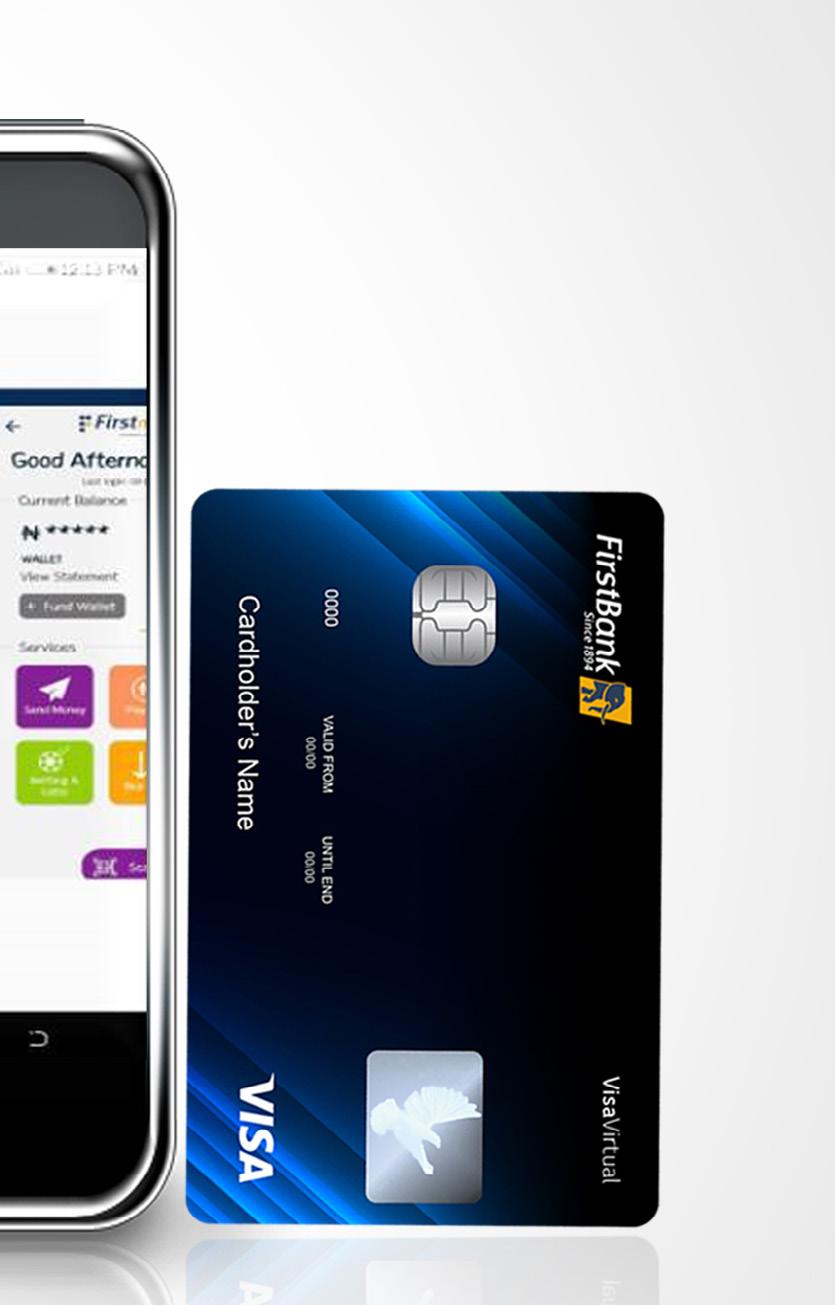
THE BANK HAS STARTED 2021 ON A POSITIVE NOTE RELEASING THE FIRSTBANK VIRTUAL PAYMENT CARD, TELL US A LITTLE MORE ABOUT THIS.
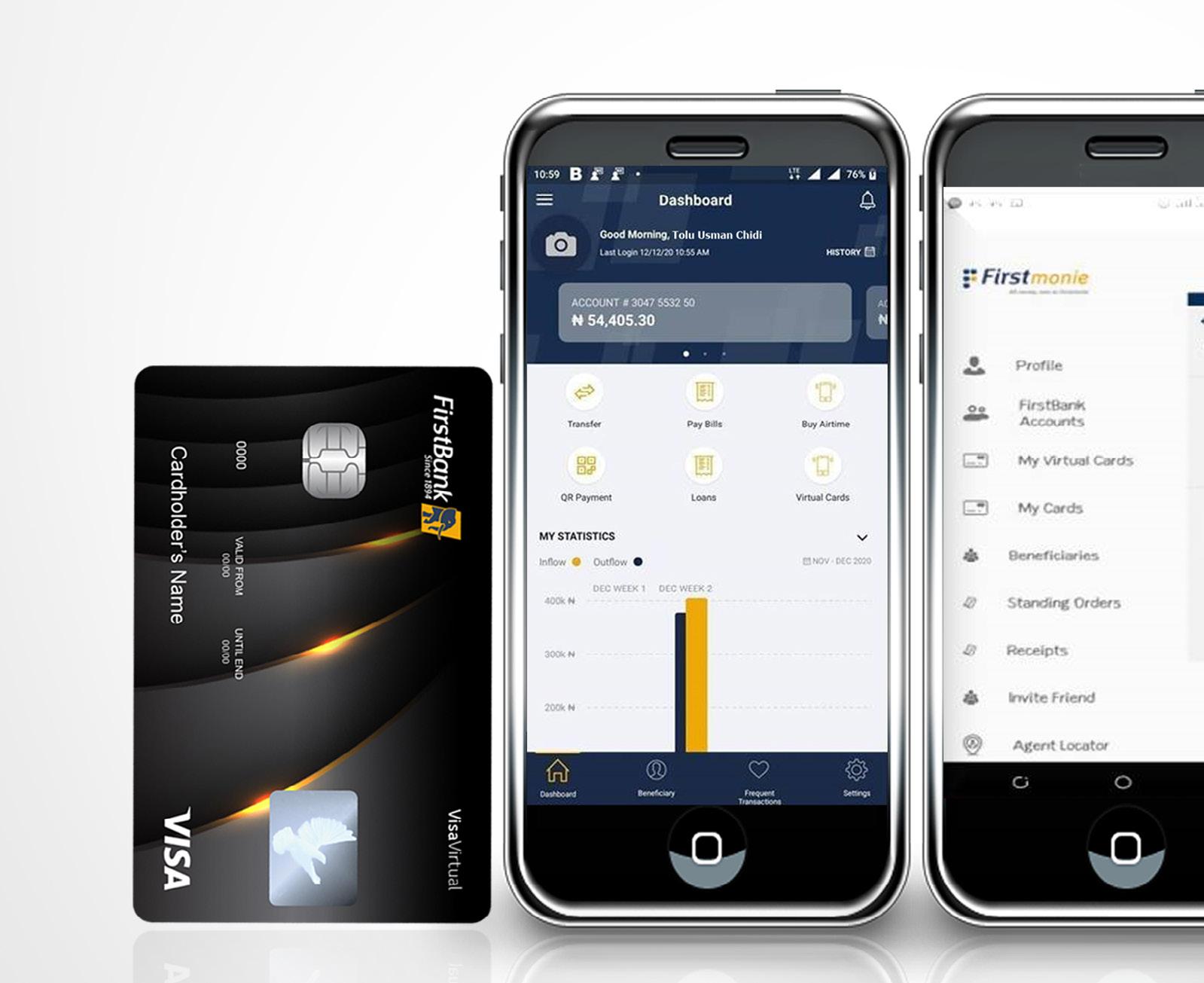
Yes, we are excited to serve our customers with this innovative product. The FirstBank Virtual Payment Card is a non-physical digital representation of the holder’s payment card, linked to either the customer’s operative account or wallet account. It is an innovation that allows our customers to create a Naira or Dollar denominated debit card from the comfort of their home using their FirstBank Mobile App or FirstMonie Wallet. This card can be created in less than a minute and customers can immediately begin to transact with the card without having to visit any physical FirstBank branch.
FirstBank Virtual Payment Card offers a convenient alternative to the use of cash and cheques by giving direct access to funds in customer operative or wallet accounts. It allows customers to perform seamless card not present (CNP) transactions on the Web. More so, through its contactless features, it will allow customers to carry out transactions on contactless acquiring devices such as POS and ATM via NFC-enabled mobile devices.
This innovation is also one of our responses to the COVID-19 pandemic and a reassurance of our “You First” commitment to our esteemed customers by providing convenient and seamless
ways of meeting our customers’ dynamic lifestyle needs. It is widely acknowledged that the Coronavirus can be better contained by adopting a minimum touch interaction approach, thus FirstBank Virtual Payment Card ensures customer safety and an improved convenience in requesting and transacting with a card. The time spent in requesting a Physical Card is eliminated, the risk of exposure to the COVID-19 virus is reduced as well as providing a new and exciting user experience for our customers.
THE
MASK UP, STAY SAFE
DIGITAL
CAMPAIGN PROVED TO BE VERY EFFECTIVE; IS SOCIAL MEDIA SEEN AS A KEY AREA WHERE FIRSTBANK CAN INTERACT WITH CURRENT AND FUTURE CUSTOMERS?
That’s a very interesting question. The #MaskUpStaySafe was the first ever digital campaign using Instagram filter virtual facemask designed with FirstBank bespoke Ankara fabric. It was a 12-hour takeover campaign to drive advocacy in a fun way on the use of masks to stay safe from the COVID-19 pandemic. It was indeed a success having staff of FirstBank, family and friends join by uploading the IG virtual mask and uploading on their social media pages, as well as used as display pictures on WhatsApp and Telegram.
Externally, we deployed the campaign on Instagram, Facebook, Twitter and LinkedIn. Facebook, reputed as one of the top social media platforms in the world, accorded FirstBank a new milestone global recognition of FirstBank
Facemask vybes shown over 10,000 times in less than 12 hours. The campaign generated over 41,000 Impressions and reached virtually 25,000 people that interacted with the post and took action within 12 hours. On Twitter with 187 million users, #FirstBankMaskUp was trending on Twitter dashboard as No 2 giving the brand top visibility, share of voice, positive sentiments and youth appeal as a matter of course.
Social media is certainly a key platform where FirstBank interacts with current and future customers. This is one of the reasons we have a social media presence, which enables us to build relations. Besides, the effective management of these channels is an essential element of the brand’s success. Social media can positively influence sales and to a large extent brand loyalty and connection. With the development, improvement of functionalities and growing popularity, social media has become a valuable tool to build a community for the FirstBank brand. We use social media for customer service – to communicate our products, service and initiatives as well as manage customers to continually put them first in our business. The mutual benefits of easy brand accessibility via Twitter, Facebook, YouTube, and others allow easy customer contact and engaging social interaction, providing brand building and wide scale contact through multiple channels. Indeed, the use of social networking sites enables FirstBank to reach a much wider group of customers and prospects compared to traditional methods.
THE QUEST FOR ‘TRUE FINANCIAL INCLUSION’
Over the years, financial inclusion efforts in emerging economies have predominantly been about expanding the access and usage of formal financial services, to improve the quality of life of people in low-income segments. Sub-Saharan Africa has been a trailblazer in the use of technology to bring financial services to people who still have no financial accounts although also facing some challenges that may be hindering development in the region. According to the Global Findex database(1), 515 million adults worldwide opened an account (at a financial institution or through a mobile money provider) between 2014 and 2017. This means that 69% of adults now have an account, up from 62% in 2014. Account penetration is at 94% and 63% of adults in developed and emerging economies respectively.
GSMA’s 2019 State of the Industry Report on Mobile Money(2) highlights that in Sub-Saharan Africa, there was an increase in 50 million new mobile money accounts in 2019, and that this region remains at the epicenter of the mobile money global movement, with digital transactions representing the majority - 57% of mobile money interactions and more value is circulating in the mobile money system than ever before. The report also forecasts that account adoption across Sub-Saharan Africa will remain strong and the region will surpass the half-billion mark by the end of 2020.
Although increased usage of accounts is important, account dormancy is not a problem to people in the low- income segments because living on very low-income levels forces them to opt-out from services that are perceived to be expensive and not suited to their needs
Jacqueline Jumah Head, Digital Financial Services
EFInA
(Enhancing Financial Innovation & Access)
So far this is impressive, but is it enough?
From these figures, the progress in access to finance seems remarkable, thanks to digital financial services. However, active usage of financial services remains very low, and today’s leading financial inclusion challenge. From the Global Findex database, about one in five account owners has an account that is currently inactive, without any form of transactions within the past year, while about two-thirds of the global mobile money accounts are dormant. The implication here is that the commercial viability of digital financial services is questionable and many financial service providers may struggle to achieve scale, where profitability is attainable. This also means a struggle to improve the quality of life of people in low-income segments, considering the financial inclusion objectives.
Although increased usage of accounts is important, account dormancy is not a problem to people in the low-income segments because living on very low income levels forces them to opt-out from services that are perceived to be expensive and not suited to their needs. A significant number of people in Sub-Saharan Africa (about 340 million adults) still have no accounts at financial institutions. 3 in 4 of these unbanked adults say they have too little money for account ownership according to the Global Findex study(3) , and almost 30% cite lack of funds as the sole reason for not having an account. So, how can financial inclusion improve their quality of life? Does greater usage mean greater impact?
Adults without a financial intitution account reporting barrier as a reason for not having one(%), 2017
Source: Findex Note 1: SUB-SAHARAN
The impact of financial inclusion is debatable, there have been several studies that have shown how financial inclusion improves lives, however, these studies tended to focus on the impact of single use cases, e.g. microcredit, resulting in the industry being product-focused. Improved lives cannot directly be achieved from only owning and using accounts, but through the ability to be resilient and financially healthy.
Rethinking financial inclusion: From the linear narrative of access, usage and impact, to resilience and financial health
We all now have the understanding that the usage of financial services does not always equate to positive impact(4) , and that increasingly, customer needs are to be at the core of all efforts for driving
commercially viable financial inclusion. So, to be successful and impactful, the industry needs to shift away from the product-focused approach to consider other essential variables like building financial knowledge and aligning with behavior, robust infrastructure and ecosystems, etc. that enable the customers’ journeys to build resilience and financial health.
Building the resilience of people refers to how financial services allow them to prepare and deal with shocks when they occur and recover. Financial health refers to opportunities for individuals to improve their livelihoods through access and usage of relevant financial services. The resilience and financial health outcomes constitute the empowerment necessary for the impact of financial services.
3 Findex Note 1: SUB-SAHARAN AFRICA SERIES: MOBILE MONEY AND DIGITAL FINANCIAL INCLUSION, World Bank, 2019 4How Useful Is “Usage” in Measuring Financial Inclusion’s Impact? CGAP, 2019
This empowerment is fueled by financial resources (assets and liabilities), human capability (skills and ability) and physical capability (physical mobility and health.(5) Finding the best approaches to improving the lives of people therefore involves the development of these three catalysts as in the below examples derived from the CGAP theory of change for impact and evidence:
FINANCIAL RESOURCES (ASSETS AND LIABILITIES)
• Fostering the growth of entrepreneurial ecosystems and income stability for example through favourable policies that encourage growth across all industry sectors and improved access to credit leveraging digital financial services
• Leveraging digital financial services to support the MSMEs for instance through exploring innovative and alternative financing options
HUMAN CAPABILITY (SKILLS AND ABILITY)
• The use of financial services/ investments to improve access to skills development.
• Use of government subsidies to facilitate more innovation and risk-taking in financing education and skills development
PHYSICAL CAPABILITY (MOBILITY AND HEALTH)
• Facilitating financial access to health and WASH i.e. water, sanitation, and hygiene, etc.
• Government-led approaches to expanding the reach of WASH services
Exploring ‘true financial inclusion’
There are immense opportunities to explore linkages between digital financial services and other sectors, spreading digitisation, and enabling usage through financial tools such as payments, beyond the financial services industry. This calls for collaborations across sectors and stakeholders to leverage technology for cost-friendly business models, exploring and expanding the use cases for the unbanked and underbanked. By so doing, a lot can be achieved in terms of achieving ‘true financial inclusion’ for improved lives
COVID KAIROS CREATES OPPORTUNITY FOR PWD DIGITAL ACCESSIBILITY IN KENYA
If the Coronavirus (COVID-19) pandemic has taught us anything, it is that we don’t know a lot about many things. Over the past 10 months, we have stretched our capabilities and imaginations to adjust to this historic moment, which has put all governments to task while reshaping every sector, and every home. The COVID narrative has largely centered around the economy but the core issue is social wellbeing. This is the first time in over a century that a social crisis has sparked such widespread disruption. Typically, when we in the financial services sector speak of sustainability from a development perspective, we often focus more on the economic and environmental dimensions of sustainable finance; rarely do we factor in social aspects as output risks. But we have learned from COVID that we need to pay more attention to human beings -how they live, interact and create opportunities for others.
They say every cloud has a silver lining; and the “COVID cloud” we are weathering has several, which is why I coined the phrase “COVID Kairos.” Kairos is a Greek word for opportune moment. As such, a window has opened up for the financial sector, leveraging on fintech, to better design human-centered solutions that ideally promote inclusivity while bridging the gaps that create social risks within an economy. The social risks unmasked by COVID that policymakers and the private sector need to address is transitioning a critical mass out of the informal economy — especially women and small business owners who typically operate informally— and the other, is financial inclusion of persons living with disabilities (PWDs).
Nuru Mugambi
Kenya Bankers Association Sustainable finance expert and public affairs director
When stay safe, stay home protocols were announced and essential services were defined, banks, insurers and other financial institutions came into focus due to the critical twin peak role of intermediation and risk management they play in the economy. As financial institutions worked closely with governments to cushion the impact, they found new ways to operate through digitalfirst business models that facilitate efficiency and continuity. Unfortunately, there has been paucity in financial sector discourse on COVID as it pertains to customers with disabilities
(CWDs). And if you are not a PWD, or live with or know someone with a disability, chances are you may not relate with their lived experiences. For example, we were all wearing surgical and fabric face masks before plastic face shields came into the market; and those who rely on lipreading had the effect of their impairment exacerbated overnight.
Promoting Digitally Inclusive Finance
People living with a disability have just the same aspirations and require the same, if not more, from financial service providers. In a pilot project by the Kenya Bankers Association (KBA) together with inAble and Financial Sector Deepening (FSD) Kenya, seven banks volunteered to have their mobile banking systems (mobile application and USSD) and websites tested for accessibility according to international best practices. More than 130 clients with visual, hearing
and mobility impairment were also surveyed and common financial goals such as home ownership, starting a business, and education were their primary concerns. When it came to general expectations from financial service providers, what came out clearly from user experience testing was CWDs expect independent, fast and frictionless digital transactions. Privacy of their data is particularly an area of interest within the branch and agent environment, as well as, customer call centers in the case for clients with speech and hearing impairments.
From previous analysis, it takes two to three years to get to the “next normal” after a pandemic. Therefore, as much as vaccines are making their way into health systems, we still have to navigate a complex and highly-dynamic environment. Financial institutions have played a critical role, in partnership with the government, to support as many businesses and households as commercially possible. For the next two years, the actions these financial institutions invest in to bridge the digital inclusion gap will make a difference for 15 percent of the world’s population, which is living with either a temporary or permanent disability. In Africa, where financial inclusion has been demonstrated to directly contribute to economic growth, this translates to more than 180 million CWDs (or approximately the population of Nigeria) who can more actively participate in the formal economy and thus mitigate social risks.
IN THE KBA DIGITAL ACCESSIBILITY FOR CWDS STUDY, THE MAJORITY OF RESPONDENTS OPENED THEIR ACCOUNTS IN PERSON AND MORE THAN 90 PERCENT INDICATED THAT THEY VISIT THE BANK IN PERSON. THE BANK BRANCH WAS THE FIRST TRANSACTION POINT, FOLLOWED BY AUTOMATED TELLER MACHINES, AND BANK PHONE CONTACT CENTERS. THERE WAS A MATERIAL GAP IN HOW CWDS UTILISE MOBILE BANKING APPLICATIONS AND WEBSITES, WHICH IS A CRITICAL AREA IN THIS FOURTH INDUSTRIAL REVOLUTION (4IR) ERA.
There are several learnings from the KBA project. One key lesson is that financial service providers should design products knowing that there certainly (not possibly) will be clients with hearing, visual, speech, mobility or learning impairments using those products. Having an inclusive, assistive
technology-based organisational culture will spur greater innovation as firms race to be the gold standard of fully automated, intuitive and frictionless payments.
The second key learning is that financial institutions should partner with technology firms to leverage on artificial intelligence, and robotics to serve this segment. To do so, it’s important to ensure customer relationship management systems are able to identify those with both permanent or temporary disabilities. Finally and most importantly, we learned that people make all the difference. In Kenya, security guards are the first point of contact for CWDs in the physical environment. However, they only assist if they are able to decipher that the customer needs help, which means those with not-so-obvious impairments often struggle. The bright spark in this scenario is that the PWDs interviewed recognised alacrity in security and branch staff once they recognised the clients’ limitations.
Bank employees also indicated that they wanted to learn sign language and be more sensitive and inclusive, which indicates that banks should engage and train their staff and suppliers for better PWD user experiences. While it may not be practical to teach an entire workforce how to conduct their duties using sign, use of wearable technology, such as sign language gloves which are an invention of the 1980s but have yet to be mainstream, can be utilised to eliminate communication and access barriers for all clients.
The good news from Kenya is that banks recognise they have been blinkered in the area of digital accessibility for PWDS and have agreed to develop roadmaps to be fully disability inclusive. It’s a step in the right direction and we hope more follow suit.
The writer is a sustainable finance expert and public affairs director at Kenya Bankers Association
HOW OPEN APIS CAN
SOLVE NIGERIA’S
FINANCIAL INCLUSION PROBLEM
Every time we use an app like Facebook, send an instant message, or check the weather on our phones, we’re using an API. Open APIs have great potential to advance financial inclusion across Africa. Adedeji Olowe from Open Banking Nigeria provides us with a fascinating insight.
Could Open APIs be the solution to Africa’s financial inclusion problems?
With an estimated 422M of its population living below the global poverty line, proponents of financial inclusion in Africa need to engineer processes that do not rely on the technology that has made banking the middle-class easy. Since mobile, internet and social media banking are out of the question because this stratum of Africans are unable to afford smartphones, are often illiterate and expectedly poor, financial services providers are forced to innovate differently to ensure the specific commitments made at the Maya Declaration come to fruition.
Open APIs could be the catalyst that makes this possible.
The state of financial inclusion in Africa
For financial inclusion to reach a group of people, most of its population, especially the economically vulnerable, should have access to an affordable transaction account which serves as a gateway to broader financial services such as credit, insurance, payments, and savings. But according to the World Bank, 75% of poor people in the world do
Adedeji Olowe Trustee
Open Banking Nigeria
not have a bank account, and 2.5B people do not use formal financial services. Account ownership is usually more ubiquitous in highincome countries, therefore these numbers are disproportionately based in developing countries.
A 2018 survey by Enhancing Financial Innovation and Access (EFInA), revealed that nearly 40M Nigerians adults (39.7% of the 99.6M people surveyed) had bank accounts, and 63.2% of Nigerian adults were financially included.
The World Bank in its Findex survey (2017) estimates this number for the broader continent, putting financial inclusion in Sub-Saharan Africa at 43%.
The Consultative Group to Assist the Poor (CGAP) affirms that much of the progress made in the last decade has been broad but shallow. As most of the innovation around the Bottom of the Pyramid (BoP) market has focused on payments and transactions, the core functionalities of savings, credit and insurance have barely gained
traction even though 1.2B adults gained access to formal accounts between 2011 and 2017.
Many of these accounts have also suffered low use and dormancy as financial illiteracy remains prevalent in the developing world. Nearly half of India’s 80% banked population are yet to perform a withdrawal or transaction and many of its payments banks are not allowed to lend.
Banks and fintechs have only scratched the surface There is a consensus that financial inclusion processes are impossible without banks. It is for this reason that banks facilitate these processes in rural areas. In many developing countries where mobile money isn’t prevalent, banks are expected to build capacity to propel the growth of financial inclusion. This includes establishing offices, upskilling staff, and introducing financial products tailored to these rural areas.
By itself, this model cannot scale as banks are not incentivised enough to bank those that are financially less fortunate. While it seems like there is an enormous market opportunity in serving people at the (BoP), the challenge remains how to combine low cost and good quality with sustainability and profitability. Because of this, banks have turned their focus to public sector/government-run organisations, large corporates, and middle-to-high income individuals, often prioritising margins over volume.
Over the years, agency banking and BoP-focused fintechs like Kenya’s mPesa, Nigeria’s Paga, MTN and Orange South Africa’s co-venture Mowali, have risen to the challenge, chipping away at the financial inclusion gaps left by banks, and scaling significantly.
Banks need all the help they can get.
4Open APIs allow fintechs be the last mile for financial services
In Africa, fintechs have adopted the use of agents and super agents. Since these communities are untrusting of “outsiders”, these agents are usually owners of mom-and-pop shops who have deep ties in the community and are authorised by financial institutions to carry out transactions on their behalf.
Fintechs and banks often partner to get these transaction accounts running. Typically, the fintechs will create and manage the agent and super agent networks and operations, acting as the last mile for customer delivery. Since banks are unenthusiastic about the grunt work, they act as the point of account domiciliation and hold customer balances as allowed by regulatory provisions. To achieve this, fintechs and banks have to seek each other out, complete months of grueling integrations before launching at agent locations. This process is then repeated for each bank or fintech partner.
Adopting a common standard for open APIs eliminates this headache, translating to a faster time to market. When applied to a data analytics perspective, providers are able to get a more accurate picture of a customer’s financials. This allows them to provide better loan offers that help the eligible take care of their families and grow their businesses. A clear pathway to save and invest may then be created following further analysis of the customer’s deposit and spending patterns. Uniformity in API standards also connote a better
future for enhanced credit scoring for the poor. The key ingredients for this will be customers’ account transaction and loan repayment histories.
Fintechs can also use open APIs to help the financially excluded build and retain wealth. Since rural communities operate on a trust system, building contributory thrift savings products (locally termed ajo and esusu) which allow them to save with friends, family and coworkers could help them achieve financial goals, potentially lifting them out of poverty.
It is faster and less painful for banks to aid the creation of a deeper financial inclusion network by adhering to a common standard than it is for them to work on changing their default monolithic standpoint.
Across Africa, financial service providers are starting to take up the initiative of adopting open APIs. Equity Bank in Kenya, for instance, has invested up to $10M in Finserve, one of its subsidiaries, to offer a suite of open transactional, Know Your Customer (KYC), and account APIs.
It is only a matter of time before other African banks follow suit. To make this happen, the Central Banks would need to take on a three-pronged role of innovator, enforcer and regulator. By doing this, they will drive a common standard with traditional banks and simultaneously provide the guard rails to ensure that customers are adequately protected.
THE EMERGENCE AND RISE OF OPEN BANKING
Although no African country has implemented a clear regime or legislative framework for Open Banking, there are promising developments in a number of countries. Imran Sumra takes a closer look at the Open Banking journey and what it might mean for the future.
Open banking emerged from the EU with the PSD2 regulation. The original intent was to spur innovation and competition in the financial services sector. PSD2 forces banks to routinely and securely share their customers financial data for the purposes of account aggregation and payment initiation via APIs.
Open banking has long been hailed as one of the major trends shaping the future of banking. Although adoption rates have been sluggish over the last two years, 2020 has exponentially fast-tracked digital transformation and the push for open banking has come of age. However, many countries have their own maturity cycles. As much as others are ahead of the curve in adoption, there are some countries which are not aware of the potential open banking brings to the wider financial spectrum.
In Africa, the open banking regulation has not landed yet, however, should it appear, it will help bank the unbanked population. Telcos with their Mobile Money (Mpesa) offering have been the front runners in the race to open banking, open APIs and financial inclusion. With the introduction of Mobile Money, over 10 years ago, payment by mobile has not
Imran Sumra CEO FinSense Africa
only become a convenient means of trade, but also helped boost cashless business transactions. With its convenience, continuous innovation and reach of the agent network, it has made it a de facto means of trade currency with the SMEs and the unbanked market.
turn has led various industries and institutions to revisit how their customers access their systems and has culminated in the buildup of various mobile-based app businesses.
So, what can you do with open banking? The opportunities are aplenty. Here’s touching on a few:
FINTECH
Mobile smart phone and internet access in Africa, enabled a new breed of the younger population to adopt technology. In Kenya, 75% of the population is under 35 years of age. Access to the internet on an affordable smartphone introduced a new wave of technology enthusiasts who started solving problems for themselves or their communities; this created a new breed of technology-savvy individuals who were creating access rails to financial services for the unbanked in Africa. With the COVID19 pandemic came the avoidance of cash and the adoption of these digital services. This in
API
For businesses to thrive in the new age connected world, exchange of data in real-time was a key component for the success of various digital businesses. The challenge that emerged was how to access the financial information data being hoarded by various narrow-minded financial institutions. However, some digitally enlightened banks saw an opportunity to expose such data and enable secure payment channels via the API rails. This immediately made them the
Real-time was a key
component for the success of various digital businesses. The challengethat emerged was how to access - the financial information data being hoarded by various narrow-minded financial institutions.
favourite of the fintech players who wanted to connect their apps to the banks and businesses who wished to get real-time updates on their transactions and account data to make real-time decisions. This opened up a new revenue model and acquisition of customers through fintechs which the banks could not have gotten through the usual walk-in account opening model.
DATA
Today, banks hold an insurmountable amount of data, but it all sits somewhere catching dust either in files or disks in silos. The potential of that data has been realised by fintechs and big techs who wish to have the transactions passing through their app such that they could analyse the spending patterns of the customer and guide them on their next purchase or monetise their data to a willing buyer, who would then target relevant ads to the customer. Not surprisingly Google has partnered with a US bank to provide checking accounts to its clients in order to understand their spending habits.
SKILLSET
The success of this new API banking method by one of the largest banks in Kenya (Equity Bank), was immediately noticed by wider East African and West African banks who started easing their thinking away from hoarding customers to sharing their customers, enabling collaboration between different entities and organisations.
LEGACY
Many bricks and mortar banks have had challenges and have been pushed to adopt digital transformation. They have had a huge and outdated stack of technology that is not agile, thus adapting fast to the changing needs of the customer is a painful journey.
A major blocker for organisations across Africa is the lack of institutions able to nurture specialised talent in our educational institutions. This will create a huge shortage for key capabilities especially in fintech security.
UNITED NATIONS
CAPITAL DEVELOPMENT FUND - UNCDF
International organisations have seen great success and the capability of how PSD2 regulation has profited customers in the EU. The next step of that is now pushing for open banking in Africa (Uganda for a start), to help reach the unbanked faster, improve their lifestyle and help spur economic growth. This would be a win win for all sides involved.
INFRASTRUCTURE
Investment – Money flowing into African Fintechs has been rather slow and selective in the African market. There is a huge opportunity for growth to support local developers and solutions for the local governments and private sectors to jump into this new technology enabled world.
Regulation – many countries in Africa have not yet understood the potential of startups, whereas most governments outside of Africa are creating and enabling environments and funding to help spur the growth into becoming billion dollar ideas. Enabling regulation focused on the technology needed to adapt faster to help Africa be in the forefront of technology would be advantageous.
Cyber Security – With digital transformation comes cyber security threats. You cannot escape them, you just need to plan for mitigating them. The constant adoption of new skills and tools is extremely important now more than ever before. This is a huge area of concern for many organisations in Africa, in both the technology front as well as in regulation to help fight and prosecute cyber crime. Many industries lack the budget and vision to understand and invest in the future survival of their businesses.
Internet – The cost of internet connectivity is still relatively high in Africa. If the price of internet connections can be made further affordable with a wider reach inside Africa, more economic growth will follow. We are now in an internet economy, the greater the connectivity and reach the more growth a country will have. This has been proven by various research, with the penetration of the internet.
Open Source – Adoption of open source technology is still lacking across Africa. This is primarily due to a lack of awareness and knowledge of such revolutionary technology available in the market. The big techs have for a long while pushed the expensive, rigid software blinding the corporates from taking advantage of the open source solutions. If everyday people understood how to use such technology and be able to support it, there could be new tools and solutions coming out for the market affordably. A lot of big techs run on open source software.
IN CLOSING
When Covid hit China’s ground zero, banks were closed for weeks and no one realised. This was a wake-up call for many banks that had not adapted to the new ways of the customer. Today you need to be relevant and necessary as a company in your customers’ journey or else you will be outdated.
As a Microsoft boss said once, ‘banking is necessary, but banks are not’. That was proved by the pandemic. It’s time financial institutions think of becoming technology companies, be mobile first in all their thinking and data first in all their actions.
HOPE FOR AFRICA: -
With Africa opening its borders to its fellow Africans and the world at large, this will be a trillion-dollar opportunity for trade. This in turn will spur adoption of technology and skill migration, helping countries which were previously devoid of such technology now being able to easily adapt and get support. This will further open opportunities to a huge market that currently remains widely untapped. Africa is home to the youngest population in the world and by 2050, Africa will have doubled its population to more than 2 billion people, most of whom will be young and hungry for technology. With an enabling environment, affordable infrastructure, investment in education, research and technology, this continent is a superpower awaiting takeoff!
FINSENSE AFRICA:
Works with its customers to bring solutions that help bring about successful, technologydriven business transformation. We are the interface between the old IT and the new IT, simplifying the complexity of your infrastructure, bringing agile capabilities into your organisation.
Access Bank: Helping customers access more
From its headquarters in Nigeria’s largest city of Lagos, Access Bank has grown exceptionally, following on from the merger with Diamond Bank in 2019 it has become the largest retail bank in Africa. As one of the first banks in Africa to dedicate lines of credit to finance women-owned businesses, Access Bank has always prided itself on financial innovation. With the growth of digital banking it has been imperative that the traditional banks have been able to make the transition, as younger generations put their trust into tech, Herbert Wigwe explains how Access Bank have been able to deliver what’s expected while helping customers access even more.
Globally, banking has moved from the traditional method of physical branches to performing banking transactions from the comfort of our living rooms. Payment methods are becoming more advanced as innovative payment methods such as contactless and biometric payments are on the rise. This transformation has increased financial inclusion, making it easier for customers to access banking services even during uncertain times like we are witnessing with the recent COVID-19 pandemic.
The pandemic threw the global socioeconomic environment into turmoil. Social distancing and significant restrictions to movement have also hampered social and economic activities. It is now certain that the world, post COVID-19, will be significantly different. As such, one of the enduring responses to the pandemic is going digital.
Access Bank has grown exceptionally, following on from the merger with
Diamond Bank in 2019, it has become the largest retail bank in Africa, and cloud computing enabled by super-fast mobile network and internet technologies. These technologies reduce the investment threshold for banks and help to create new services. These services have lighter terminals, a smarter network and the capacity for various intelligent sensors, from 3D structured light cameras and NFC readers to fingerprint scanners and GPS.
The COVID-19 pandemic brought a drastic and dynamic change to banking, introducing a rapid uptake in digital banking according to the World Economic Forum, as a result of the pandemic, user sign up on digital platforms increased by 70%, usage of mobile pay applications went up by over 80%, and usage of contactless payments went up by over 30%.
Being a digital banker entails accepting and adapting to the changes coming into the banking
industry. Over the years, Access Bank has embraced these changes and made the most out of them. The bank has been a leader in the
Herbert Wigwe CEO Access Bank PLC
digitisation of banking and building technology-based strategies with a clear-cut vision for the future of banking.
The bank’s merger with Diamond Bank PLC in 2019 birthed the largest retail bank in Africa with over 40 million customers. The majority of these customers were acquired through our digital platforms. We have also delivered an omni-channel experience across all platforms to enhance customer experience. Access Bank has migrated customers to self-service channels on its digital platforms such as USSD (*901#), Chatbot (Tamada), Access More mobile application and Quick Bucks amongst others.
established innovation and digital transformation at the core of its five-year strategy from 2018-2022.
We have seized and utilised external innovation through our accelerator hub known as Africa Fintech Foundry. The Foundry is a Pan-African accelerator that finds and invests in start-ups with a global outlook but with a focus on Africa.
Our customers have chosen Access Bank on the basis of smooth and user-friendly digital experiences. The one thing that is constantly on our minds is our customers and how we can ensure we give them an unmatched end-to-end digital experience. We are aware that a compromise in the quality of service will result in significant business loss.
Access Bank has grown exceptionally, following on from the merger with Diamond Bank in 2019, it has become the largest retail bank in Africa
Access Bank has continued to lead financial innovation in the banking industry from the rate of digitisation of banking products and channels, to the promotion of financial inclusion and technology. The bank has firmly
In line with our strategy to provide an all-inclusive platform that delivers value to the smartphone users in Africa, we launched a revamped super mobile banking application called Access More in March 2020. Access More is focused on delivering experiences beyond traditional mobile banking and this requires understanding and integrating customers’ needs and lifestyle to banking.
This next generation mobile app delivers an unparalleled mobile banking experience to our
40 million plus customers, with deep integration to lifestyle features, advanced analytics and future proof technologies. As the name implies, the platform provides ‘more’ than regular mobile banking services.
The features include but are not limited to:
• Nearby payments (QR, FacePay and contactless).
• Instant loans (no documentation, no collateral)
• Access Africa - transfer to our African subsidiaries
• Account services including instant account opening, bill payments, funds transfer, investments, cheque management, etc
Facepay is the first of its kind payment solution in Africa built by Access Bank
With the aim of providing a contactless payment avenue, FacePay was created. It is the first of its kind face recognition payment solution in Africa. It leverages artificial intelligence and machine learning, to enable users consummate transactions across our branches. Facepay is the first of it’s kind payment solution in Africa built by Access Bank. As at the end of November, we have achieved over 5,000,000,000 naira in transaction
value. This novel solution digitally automates in-branch transactions and allows customers to carry out transactions within banking halls as a self-service function.
As a digitally-led bank, we created Africa’s Payment Gateway – Access Africa which is a funds transfer product designed to simplify global payments by Person-to-Person (P2P), Business-to-Business (B2B), Person-to-Business (P2B), Government-to-Person (G2P) and any other payment activities/ flows. Alongside instant transfer to countries where we have subsidiaries, we have leveraged our extensive partner network to reach about 15 countries including UK, France, Germany, China, Benin etc. This makes Africa look like a country by rapidly enabling instant Pan-African payments. Also intercontinent transfers can be made using Access Africa.
PayDay Loan is a digital loan product of the Bank that avails loans to employees that are Access Bank and non-Access Bank customers for a maximum of 30 days or salary payment day (whichever comes first). Loan eligibility is based on a percentage of the applicant’s average monthly salary. The payday loan product can be accessed through various digital channels such as USSD, mobile banking, internet banking, ATM and QuickBucks loan app. We have also partnered with salary processors to extend the solution to over 2 million employees.
Also, there is PrimusPlus, a webbased enterprise suite of payment and collection solutions that offers organisations a secure, simple and cost-effective alternative to cash and cheque payments across multiple banks. The platform grants corporate users access to view and initiate transactions on their account online real-time. Users also have access to customs duty payments, FX bidding, local and foreign payments (both single and bulk), account statements, cheque services and payroll amongst others.
Lastly, our Artificial Intelligence Personal Banker ‘Tamada’ offers an extended set of features, ranging from standard banking services (opening accounts, paying bills, performing intra and inter-bank transfers etc) to weather forecasts, sports updates, traffic updates, investment advice, cash out services, news updates, live chat with customer care etc.
We constantly seek to build on our achievements of previous years, by providing world-class innovative solutions to meet our customers’ dynamic needs. We consolidate our winnings by expanding the scale of our products and platforms and heavily leveraging various technologies such as Data Analytics, Cloud Computing, Artificial Intelligence and Robotics Process Automation, to deliver unparalleled value to our customers and stakeholders.
The digital effect
In this age of innovation digital technologies are providing the solutions to our problems. Digital banking is bridging the gap between financial institutions and their customers. The banking sector has revolutionised its interactions with customers by allowing them to use social media for basic banking transactions or activities on the go. People can easily open new accounts, ask general queries, and request mini statements which result in boosting the efficiency of the firms. Digital apps are capable of keeping track of transferred money and complaints from customers, while people have access to their money 24/7 eliminating the need to wait in long queues at bank branches for small tasks.
EFFECT OF DIGITAL BANKING ON BANKING STAFF
Although digital banking is proving to be greatly helpful for consumers, it has had an effect on employees at banks. Millions of workers are predicted to lose their jobs in the next decade as artificial intelligence takes over.
According to a report by Citigroup, there is a prediction that banks will cut millions of jobs in the coming years as financial technology companies look for profitable growth. Due to the increase in usage of digital technologies around 37%
of jobs will change dramatically or become redundant. Around 30% of the currently employed staff at banks will lose their jobs. According to the research of the open university, almost 12 million workers will lose their jobs as a result of digital automation in the fintech industry.
DIGITAL AUTOMATION / FINTECH INDUSTRY AND ITS CURRENT MARKET SHARE
Fintech is a term that covers a wide range of companies that are providing financial services by using software and technology. It includes online banks, asset management firms, mobile payment firms, online lenders, and online remittance firms.
Over the past decade, fintech has removed the lines between the finance industry and technology. Investment in fintech is increasing around the globe. According to research, the finance industry received an investment of 17.4 billion dollars in 2016. In 2017 it reached 31 billion dollars with the increase in several venture capital transactions and private equity deals. Fintech platforms are used by 64% of customers. 60% of consumers make transactions with banks who provide single platforms via social media or mobile banking apps. Surprisingly, 96% of global consumers are already well aware of fintech companies
DIGITAL AUTOMATION; A THREAT OR NEW OPPORTUNITY FOR INCUMBENTS?
Digital technologies have the potential to maintain and improve human skills rather than making jobs obsolete and as a result,
opening up new opportunities for businesses. People have only focused on the problem that fintech disruption might lead to, including job cuts of banking staff. The fact is that fintech is not going to remove the traditional financial firms completely from the industry. The influence of this fintech could bring a positive change for the incumbents. Workers who are ready to learn new skills can take their place in the industry with their passion. Workers can thrive in a disrupted world by adapting to new roles. Being proactive in managing the change could help banking staff to grow, as opposed to being passive participants. Before taking the advantage fintech offers, workers need to understand how it is going to affect them.
The World Economic Forum developed the framework for ‘Future of financial services”. It includes information about how disruptive digital innovations are reshaping the structure and consumption of financial services.
businesses and jobs, the unique capabilities of humans will never be lost and firms will need them to adjust their talent strategies. These innovations will help the staff to upgrade their skills and knowledge so that they can serve in a better way.
LACK OF DIGITAL SKILLS CAUSING THE LOSS OF JOBS
Lack of digitally skilled staff affects the innovation process. It creates a huge gap between demand and supply within the labour market. 88% of institutions are claiming that this gap is affecting the innovation and production processes. There are predictions that the gap between digitally skilled staff and innovation will gradually increase with the increase in technology adoption. Although digitisations have already disrupted the whole industry, organisations are continuously underestimating the importance of building digital skills. Staff must learn new digital skills to adapt to the change in the entire industry.
IN DEMAND SKILLS TO ELIMINATE THE THREAT OF JOB LOSSES
With technological advancements, traditional ways will be removed but it will also open up new markets and opportunities to develop new potential gains. Banking staff can provide the consultancy services or answer queries from customers in less time by using social media. Although new technology will continue to emerge and give rise to different paths of managing
Here are some in-demand skills which one should learn to become a professional to thrive in the Fintech industry. These skills include blockchain and distributed ledger experts, programming skills, machine learning, and artificial intelligence, cybersecurity expertise, and soft skills. These are the skills for the professionals but banking staff should be able to adapt the following trends or techniques to survive in the industry.
• CONSUMER ENGAGEMENT
Being able to engage with customers in the most effective way is the key to success. With the increase in the adoption of mobile banking, consumers are seeking support on online platforms. According to Accenture, 66% of customers do their transactions on digital apps and 71% are seeking automated support. They said that future-ready banks are incorporating the know your customer approach into their apps for continued engagement with customers.
• DIGITAL AWARENESS
Employees must have basic knowledge about digital banking and its applications. In the modern world banking services are provided through digital marketing so an employee must know the basics of digital marketing.
• AGILE THINKING
Banking staff must have an adaptable mindset for the innovations in the industry. It will encourage the innovation
and upskilling of talent to meet the needs of the era. When digital disruptors are offering better quality products and services, nonagile banks as well as employees will lose their place. If someone needs to remain competitive then having an open mindset is the key.
• RISK GOVERNANCE
Banks need to mitigate the risk of fraudsters opening new accounts with stolen data using digital platforms. With the increase in the utilisation of new technology, cyber risk has also been increasing. Therefore, employees must be capable of understanding and managing such kinds of risks in the digitisation process.
• HUMAN-CENTERED DESIGN
When banks design their products and services they should incorporate their customers into it and those products will hold more value to the customer. For the employees, it is necessary that they can communicate with customers about their general queries. In this
way, customers are able to feel their importance to the bank.
• WHAT SHOULD BE THE ROLE OF BANKS TO COPE WITH THE PROBLEM?
In a technology-driven world, technical talent is crucial for the success of the bank. There is a need to value human skills so that banks can grow in the long run with the help of their staff. Retraining and upskilling are key for banks to work efficiently in a digital environment. According to research, 78% of banks believed that providing training to the existing staff will help to overcome the obstacle. Many firms said that hiring the new digitally skilled staff was more effective and less costly. To cope with digital automation, banks started retraining their employees. This step increased the average training budget by 13 % over last year. In the future, all jobs will likely require some basic digital skills. Banks can help in building up the skills of their employees and become resilient and adaptable in the future.
MOBILE PAYMENTS ON THE RISE AS KENYANS GO CASHLESS
OO
ver the years, the use of cash as a means of payment has been on a slow, steady decline in Kenya but it has managed to hold up, until recently. It is gradually becoming more common in Kenya to see shops with signs saying “No cash.” Previously, such shop policies could only be found in European countries, and even there, it was very uncommon. Digital-only payment policies have emerged in Kenya since the outbreak of the pandemic and are gradually becoming very popular.
Kenya has been at the forefront of digital transactions in Africa. Even during the Moi era in the past years, Visa and MasterCard were accepted for payment in many
shops, supermarkets, upscale restaurants, and just about every hotel. During this same period, Ethiopia had just a single bank outlet in the entire country where cash withdrawals could be made with a credit card.
When M-Pesa was introduced in 2007, Kenya became a global forerunner in mobile payments. This led to an overhaul of the dynamics of the country’s economy by eliminating the reliance on
physical cash and promoting financial inclusion. As a result of the use of mobile money, the percentage of the population with access to financial services has increased from 14% to over 80% between 2006 and today.
The M-Pesa technology has also spread out into more than six countries in Africa, Asia, and Eastern Europe. Business schools all over the world use M-Pesa as a case study and mobile money has become the primary method of payment for smallscale transactions in Kenya. Many developed countries are yet to catch up with Kenya’s level in mobile money application. As of 2019, the total volume of mobile transactions was equal to nearly half of Kenya’s GDP.
Kenya has left most other African countries behind in the use of digital payments. For instance, Nigeria still strongly prefers the use of banknotes, so much so that cash is the first choice even in some international hotels. It is almost impossible to pay bills with an international card in any restaurant in Lagos. To make things worse, the dispensing limit of most ATMs is NGN 10,000 (USD 25) or NGN 20,000 (USD 50) per withdrawal.
With the high prices of goods and services in Lagos, you will tend to spend a lot of time at the ATMs and move around with huge amounts of cash. Even though mobile money has been in existence in Nigeria since 2009, its impact has been insignificant until the last few months. With the implementation of updated policies towards the end of 2019, mobile money is now finally seeing some growth in Africa’s biggest economy. However, the use of physical cash still remains widespread unlike Kenya.
As a matter of fact, coins and banknotes are an oddity in modern society, with hand to hand payment seen by some as unhygienic. Cash payments pose a serious health risk amidst the Covid-19 pandemic. Making payments with the use of physical tokens that will change hands often should be avoided by all means at this time.
Since the beginning of the pandemic, the Kenyan government has encouraged citizens to make use of digital transactions instead of cash. Mobile operators have been spurred on by the government’s support and have increased transaction limits for money payments, while temporarily removing most transaction fees. The Central Bank of Kenya released data
showing that usage rose from 3.6 billion dollars in June 2019 to 4.18 billion dollars in July 2019, which is the biggest month to month increase to date.
Banks also followed suit by removing their transaction fees on bankto-mobile account payments. Though these fees will definitely be introduced again after the pandemic, people who have abandoned the use of cash due to the pandemic are unlikely to take it up again.
In Kenya, cash as a payment method is now so rare that cashiers express displeasure when a customer tries to make payments with cash. It appears that we are now in a time where handling cash may not be part of the new normal.
In 2019, a new, contemporary, and visually pleasing set of the Kenyan Shilling was introduced by the Central Bank of Kenya. This set is likely to be the last of the Kenyan banknotes and coins, and by all indications could be in circulation for just a short time.
Cash leaves room for crime and is a potential security risk because it is easy to steal. Not only that, it is expensive at bank and merchant levels due to the cost of keeping cash secure in transit. It would be of great benefit to everyone if Kenya does go into digital payments fully, and it appears that the coronavirus pandemic may be the trigger for a complete transition.
As the world gradually recovers from the effects of the pandemic, certain new habits will be hard to let go of. There are speculations about the fate of video conferences and home offices, but cash seems to be ending up as one major casualty of the Covid-19 crisis in Kenya.
FBC Transformation DELIVERS RESULTS
It was the year 2018 and the FBC Group had just ended their annual strategy conference FBC. The team was excited about the journey ahead, having resolved to begin a transformation process that would take the Group to a new position in the global marketplace.
Having initially commenced operations in 1997 as First Banking Corporation Limited, the entity has evolved from being one of the first locally owned commercial banks in Zimbabwe to becoming FBC Bank- one of the leading financial institutions in the country to-date. The bank is part of FBC Holdings, which also incorporates FBC Building Society, FBC Insurance, FBC Reinsurance, FBC Securities and Microplan which is a microfinance entity.
The world as we know it is changing at such a rapid pace and large established corporate entities are faced with the reality of stiff competition emanating from new and smaller start-ups, which possess a vastly different, energy-infused, agile mind set. In addition to this dynamism in the operating environment, the COVID 19 pandemic erupted towards the end of 2019, galvanising companies into either quickly adapting to the “New Normal” or risking extinction. Many companies fell into the latter category
and were forced to contract their operations abruptly and indefinitely. Fortunately for the FBC group, the process of transforming the organisation had already commenced in the previous year, thus giving it the platform to have the desired impact.
value adding relationships, simplified processes and relevant technologies.
collaboratively develops products in an iterative fashion, with speed, ahead of competition.
III Our Promise
You Matter Most
FBC Group has long understood that to survive in the new world order of digitalisation and innovation, it was imperative that they take the necessary steps to “future-fit” the organisation. Strategic initiatives were put in place to begin the transformation process. In line with the new digital thrust of the Group, FBC created a new Vision/ Mission/ Promise and a set of Business Principles. This venture was a key driver in beginning the communication exercise in positioning the brand of the” FBC of the Future”. The new Vision and Mission statements are as follows:
I. Vision Statement Nurture sustainable solutions that enable the financial wellbeing of the communities we serve
II. Mission Statement
Deliver a unique customer experience through
Employees, customers and other stakeholders were involved in the co-creation of the transformation and accompanying artefacts, an approach which has instilled a sense of ownership and palpable involvement. For a digital business to become well established and to truly embrace “digital”, the new Vision/Mission statement is underpinned by a set of business principles which are the guardrails for effective decision making within the “FBC of the Future”. The principles ensure that the digital DNA pervades the entire business’ decision-making process and way of working, such as being ‘insights-driven’, ‘customerobsessed’, ‘lowering the cost to serve’, ‘driving simplicity’ and consistently disrupting the status quo. More importantly we cocreated these principles and are now making a consistent effort to ingrain it into our way of working. FBC embarked on a radical shift in its project management approach by adopting the agile methodology in line with modern global trends. Projects are now implemented through collaborative, crossfunctional project teams whilst ensuring consistent alignment to the new FBC principles. FBC applies design outside-in thinking in the design of its products and services, involving customers to ensure ‘product of one’ and ‘customer obsession’ principles are fulfilled amongst others. With an internal fintech capability, FBC
FBC has launched a digital insurance and account opening app that allows customers to digitally insure and license vehicles as well as open different types of bank accounts instantly using one application. This single app allows access to different products and services, from banking to insurance, from one touch point, consistent with the “Product of One” business principle.
The application enables end-toend full KYC account opening in less than 5 minutes after autonomously doing an APIbased background check process, including identity, in real time. At the same time, the bank has launched a digital assistant named Noku, which supports and interacts with clients using the Whatsapp platform.
So in essence, FBC has enabled digital account opening through 3 different platforms:
Unstructured Supplementary Service Data(USSD) for KYClite wallet and account
Whatsapp banking for KYClite wallet and account
IOS and Google Playstore – for full KYC account
By enabling customers to open accounts on the different platforms, FBC Bank has enabled all segments, including the base of the pyramid, to access financial services easily, thereby accelerating financial inclusion.
FBC has brought within its leadership and management structures, digitally competent team members to drive the digitisation agenda. It has established a fintech company, Xarani, to spearhead the digitalisation and innovation drive within the FBC Group. This fintech
FBC’s indirect monetisation frontier as competitive pressure on traditional business escalates.
To ensure end to end support for all clients that on-board virtually FBC has established “FBC Virtual” which is among other things, also responsible for the following:
Operational and risk management
Anti-Money Laundering(AML)
Know-Your-Customer(KYC)
Managing Director of FBC BANK
Business development - Cross and Upselling to the digital customer
Relationship Management
Product & Client Support for clients utilising our digital platforms. Distribution of physical products to clients who opt for delivery (e.g cards delivery & PIN issuance
benchmark of 0.15% whilst their click to conversion ratio for 2020 has been 2.14% versus the world average of 1%. FBC participated in the worldwide lockdown-inspired #JerusalemaChallenge which incorporated elements of its repositioning and digitalisation. Some of the digital marketing initiatives that have been used include the
African economy where 70% of the population is rural and lowincome, there is much work which is required to uplift the lives of the majority.
paid social media strategies to shift
FBC has enabled a wallet and lowKYC account bank account on the USSD platform which allows every Zimbabwean with a basic feature phone to open a bank account remotely from anywhere within Zimbabwe. Zimbabwe has extensive mobile network coverage and the feature phone penetration is high, covering previously marginalised sections of society in remote rural communities. Their USSD account opening platform allows previously excluded communities to open a formal bank account and transact easily and instantly without having to travel to urban centres.
relevant customers using key words
resultantly, increasing our share of
FBC has a deliberate solutionist and data-driven strategy that is geared towards financially including the base-of-the pyramid beyond payments in support of the United Nations’ sustainable development goals (SDGs). A collaborative ecosystem approach underlies FBC’s approach in working with banks, fintechs, vendors and other regulators in creating value.
John Mushayavanhu, the FBC Group CE summed it up perfectly. “Winning the Digital Banker Africa 2021 Awards is a fitting testimony to the transformation journey that FBC has embarked on. Having won numerous other awards in the past year, FBC Bank and other business units are poised to become true trailblazers in the digitalisation and innovation space.”
HOW BANKS ARE TURNING TO SOCIAL MEDIA TO ATTRACT CUSTOMERS IN AFRICA
n the current century, there has been economic changes, technological developments, increased market competition, and changes in the buying behavior of consumers. Social media has proved to be very effective in catering to all these challenges faced by financial institutions. Studies have found that the usage of social media in South Africa is growing with a rapid increase of 6.8 million to 9.4 million Facebook users between 2013 and 2014. Internet penetration in Africa stands out at a population of 1.3b which is 36% of the total population. People using social media through mobile phones are 216 million which covers 17 % of the population. About 40% of Africans prefer social media for their banking transactions. The use of social media has increased prominently among the young generation. Social media has changed the structure of information along with its availability.
The importance of social media has also been increased due to Covid 19 which affected all sectors of the economy including banking. The role of social media has also increased more due to this pandemic leading customers to find online solutions for their financial needs. Financial institutions understand the power of digital banking to attract younger customers. Banks are communicating with their customers through social media channels hence building credibility while providing several products and services. Africa has become the second-fastest-growing market for electronic payments in the world. More than 50% of the adult population in Africa has access to mobile phones. Banks are recognising that by using mobile banking they can reach millions of potential customers, especially in the rural areas. Digital banking helps in bridging the gap between financial institutions and their prospective customers. Tailoring customer’s needs and providing efficient solutions can be done efficiently by digital banking within Africa.
An analysis by Mckinsey suggested that between 2019 and 2021, African banking revenue could fall by 23 to 33 percent. While the return on equity of the bank could fall driven by the increasing risk cost and decreasing margins. It is expected that 30% of the African consumers will use online banking more than post-crisis. This ratio means that increasing social media usage for financial services can help the banks to reach a larger and younger audience.
ROLE OF SOCIAL MEDIA TO ATTRACT YOUNG CUSTOMERS IN AFRICA
Social media is offering many functional benefits to financial institutions. With advancement in technology, firms are trying to adjust and adapt new techniques so that they can attain a competitive advantage over their competitors. In order to improve their performance firms are improving their strategies to capture the major share in the market. Involvement in social media usage is one of the strategies that could be used by the banking sector in Africa to attract young customers for their rapid growth. Social media is providing the following functional benefits to the banking industry allowing them to increase their number of customers.
CONSUMER ENGAGEMENT
Banks are using social media to connect with their customers in the easiest way. In this way, they can communicate and reach a greater number of customers in less time and cost. Building a relationship with customers through social media, enables the banks to respond to customer’s queries in less time. With this method, banks are able to manage a large number of consumers while maintaining accuracy of information at the same time.
RELATIONSHIP BANKING
Banks are also forming different types of bonds with their customers by using social media. These include financial bonds and
relational bonds. A well-structured campaign by banks on social media contributes towards the growth of banker customer relationships. Financial bonds could be made by showing the customers how they can get benefit from a long term deposit. Likewise, gaining an understanding of the customer’s requirements and providing adequate solutions can help to make relational bonds stronger. African banks are using this relationship banking to attract more customers.
CREATING A BRAND IDENTITY FOR THE BANKS
Banks are using social media to reflect their firm as a thoughtful and caring entity that can help consumers to achieve their goals. Highlighting their functional aspects which are differentiating them from their competitors can help in the generation of a loyal consumer base. Building trust among young customers by using social media is helping the banking sector of Africa.
CUSTOMER’S CONFIDENCE
Well, structured social media campaigns about banking products and policies are helping to better position the banks. A better strategy can help in enhancing the customer’s confidence in the bank’s ability to provide financial support.
SEGMENTATION AND TARGETING
Social media is being used as a marketing tool by the banks in Africa to create customer satisfaction.
Consumers are divided into different groups depending upon their financial needs. Content for
older age groups is subjected to the investigation about lifetime saving plans. While youngsters may need good deals related to their educational and entertainment purposes.
Customers looking for a vehicle or home loan need information about reduced monthly installments. Well designed strategies are helping in identifying and tailoring the needs of the targeted audience
CUSTOMER ACQUISITION THROUGH ADVERTISING
Banks are getting customer acquisition by showing the positive attributes of their financial products and services. Customers are persuaded to open new accounts with the banks by advertising through different channels of social media.
CUSTOMER INTERACTION, CO-CREATION, AND RETENTION
The banking sector is using social media in the most effective way for the interaction and retention of their customers. When a customer is using different products from a bank it tends to prevent them from wanting to switch to another bank.
BUILDING TRUST AMONG YOUNG CUSTOMERS
Banks are using social media to
show off their performance in the banking sector. Showing the revenue reports and history of the bank’s performance helps in building trust among the young customers. Banks can provide different loans for educational purposes as well as microfinancing. Many online platforms like Facebook, Twitter, Instagram, etc can be used by the banks to attract young customers. Using these tools is creating excellent new opportunities for the banking sector to communicate more effectively with their clientele. By using social media, banks can offer direct value to the customers looking for a financial solution online. Social media allows the banks to target their posts and ads more specifically. This will result in better engagement with young customers by saving their time in searching.
Digital banking is the key to financial inclusion within Africa. Broadening the usage and penetration of the products and services by the banks in Africa through social media in real time becomes possible with digital banking.
FINBANK INNOVATION CONFERENCE: WHERE BANKING MEETS TECHNOLOGY
2020 saw an abrupt interruption of the hospitality industry due to Covid 19. This created new ways for people to get together for conferences and events, with virtual meetings becoming the new normal. Stepping into 2021 with the emergence of vaccines and new methods of controlling the Coronavirus, there is an expectation that we will once again be able to attend our favourite conferences and events. Digital Banker Africa caught up with Gustave Sugira to discuss the up and coming Finbank Innovation Conference & Expo taking place in Rwanda.
FinBank Innovation Conference & Expo 2021 takes place in February, give us some detail on what can be expected by those that attend?
FinBank Innovation Conference & Expo is taking place in February in Kigali, we are hosting financial institution executives from
Gustave Sugira Commercial Director
FinBank Innovation Conference & Expo
Africa and those from financial technology companies. Attendees can expect to meet new clients as well as discover new trends and technologies in the financial industry. Financial intermediaries can adopt new solutions to help them improve their digital operations and transformations while fintech companies in attendance have opportunities to launch their new solutions to the African market.
Fintech startups are now redefining banking. What opportunities are created by fintech in terms of developing a truly digital financial service market across Africa?
Sure. Fintech startups are redefining banking, there are still unbanked and non-accessible banking markets in Africa where fintech companies are offering the best solutions and modes of access to such markets. Technical examples include providing biometrics solutions in the regions where customers don’t have access to the internet. Fintech companies are helping banks escape traditional banking and move towards digital banking where clients have access to their own accounts on their own smartphones, tablets and PC’s and transact without queuing at branches etc.
What can regulators, supervisors and legislators do to facilitate the adoption of fintech in Africa?
Regulators, supervisors and legislators should work together to identify top quality solutions in fintech to adopt, as there are technologies which don’t work well or don’t work at all. By testing and evaluating those new solutions,
we understand their impacts to financial institutions and what those solutions really solve. Providing a license or certificate of good quality also should be key, it will help financial institutions to select nice solutions for their customers or employees who will use the technologies adopted at the end.
Africa’s banks will benefit from financial technologies even more than other continents because African economy is improving on all sides and regulators are passionate to build a cashless economy.
How can Africa’s banks benefit from financial technologies compared to other markets such as America or Asia?
Africa’s banks will benefit from financial technologies even more than other continents because African economy is improving on all sides and regulators are passionate to build a cashless economy. While citizens keep their money in the banks they will also need to make transactions, payments and access their accounts seamlessly. As now Africa’s banks operate traditionally by having their customers come into the branches, there are also branchless solutions which are being adopted in other markets on the other side of the continent which is not yet adopted here in Africa. This will reduce cost on branches for banks and other financial institutions as well. There are still lots to do here and there is still a long way to go to digitise the financial industry in Africa. Africa’s banks need financial technologies now more than ever before.
We’ve seen many events go virtual due to this pandemic, how did you adapt to this situation?
Physical events make magic on the ground, however due to the pandemic they were not possible to make. So far with collaboration with governments, venues and other partners, we are coming back live. There are still participants interested in participating but not yet ready to travel, that’s why we prepared the FinBank Innovation Conference & Expo 2021 in a hybrid format. It means it will be live with virtual participation options.
FinBank Innovation Conference & Expo reaches out to tech companies to come and launch their new
technologies. What can companies expect from the event?
Yes, we are calling up all fintech companies willing to launch their new technologies on the African Market to work with us. We will provide launching time where financial executives will attend and assist with the event. We believe this will be of value to both fintech companies and financial institutions as there will be time for networking, arranged meetings and discussions on partnerships.
A simple demo and presentation should be available to help participants quickly understand the product.
FinBank Innovation Conference & Expo 2021 takes place at Kigali Convention Centre, Kigali, Rwanda on February 24th to 25th 2021. Tickets will be available from www. finbankinnovation.com
Regional KYC Utilities: The Start of Global Partnerships on a Common Compliance Platform
The protocols surrounding KYC (Know Your Customer) involves multiple repetitive documentation, rigorous managerial undertakings and heavy costs to abide by industry regulations. The bureaucratic process for harmonising customer data for KYC is fragmented and lacking uniformity for financial institutions. There have been continuous deliberations amidst industry players in the financial sector. The constraints of creating and maintaining databases to keep track of customers have been a top the agenda. KYC protocols are expensive and especially tasking for financial organisations, so there have been attempts to leverage cooperation to reduce the monetary and time costs involved.
One of such alliances was forged in 2014. It was entered into by five organisations: Depository Trust and Clearing Corporation, Markit/ Genpact KYC Services, Swift KYC Registry and Accelus Org ID, a service run by Thomas Reuters. The alliance birthed Clarient Entity Hub. It was focused on running a
singular reserve for KYC data and offered their services to interested financial institutions as well.
Clarient Entity Hub was meant to offer her services to a variety of customer segment over a vast business landscape. This left a disjointed KYC terrain with several exploitable gaps.
National KYC Initiatives
Today countries are beginning to tow the same line to homogenise customer data and optimise collation processes for efficient KYC operations in financial institutions, but the very first of such efforts was done by India in 2016. They planned to condense documentation and verification processes for all regulated financial industry players in the country. This they did by inaugurating a KYC registry to centralise all of these data.
Benefits of the central registry include eradication of multiple data collection for customers and a reduction in data collection costs due to shared responsibility. Notably, India did not achieve total homogeneity of KYC collaborations as a few organisations remained isolated from the system.
As recently as 2018, France saw
the launch of CordaKYC through a consolidation of five of its banks on a unified platform. During the period, 21 corporate organisations opted to work with CordaKYC and operations have been positive.
For the Baltic States, the rising suspicion of the complicity of its financial institutions in money laundering, expressly violation regulations in place, have been the major driver of conversations geared towards developing national and regional KYC registries. Lithuania started to move in this direction in November 2018. Latvia and Estonia will have to collaborate with Lithuania to dispel current scepticism about the Baltics by developing KYC protocols that observe world-class standards.
It is expected that many more countries will learn from those who have adopted a centralised KYC registry and improve on their implementation processes, as very recently we have seen Australia and Hong Kong approaching the final stages for adoption.
The Advent of Regional KYC Partnerships
The benefits of operating KYC registries have seen interests of various governments rise in the last couple of years in Africa. The
evolution of these collaborations took a different trajectory when corporate and financial institutions began to examine the prospects of partnering to share customer data and other forms of vital information.
With the launch of “Mansa”, African organisations had finally surmounted the major hindrance to attracting funding from some of world’s largest financial institutions.
In Africa, sharing a KYC registry on a singular platform has not advanced without its challenges. Known for its difficult business terrain and high risk of doing business, the odds were more or less stacked against her. Interested organisations grappled with
meeting the demands for risk-based compliance from global financial institutions in the face of limitations to accessing cheap finance for trade. This was how Mansa, Africa’s first KYC platform was born in July 2018.
This first platform came into existence largely as a result of the efforts of the Africa Export Import Bank, Afreximbank, collaborating with other willing
institutions to give credence to customer verification and reputable assessment of risk on the Continent.
With the launch of “Mansa”, African organisations had finally surmounted the major hindrance to attracting funding from some of the world’s largest financial institutions.
Elsewhere, countries in Northern Europe and around the North Atlantic saw six of their banks get approval by the European Commission to run Nordic KYC Utility, a novel KYC registry. After gaining approval which was just in July 2019, plans were fixed to
launch fully in 2020. Willing banks can now take advantage of the platform to unify customer duediligence protocols and maintain uniform KYC standards in the region.
Are We Ready For Global KYC Platforms?
We have seen national KYC collaborations; we have seen regional partnerships but the jury is out on whether a Global KYC platform is in the offing. The contradistinctions that dote the governing landscape for KYC compliance pose serious challenges for any Global KYC initiatives though. Yes, a few KYC protocols share similarities across the globe, but where disparities exist in risk categorisation, documentation, customer data collection and other procedures, there needs to be harmonisation for any major uniformity to be attained in KYC collection globally. Stakeholders believe collaborations between financial institutions across continents will bode well for the development of global KYC utilities.
One of the often ignored bottlenecks to global KYC adoption is the breakdown of the juxtaposition between the cost/benefit of powering a functional KYC platform and the advantages for participating banks respectively. Setting up the right infrastructure across the different financial institutions to enhance efficiency in managing the massive data proportions involved is another serious challenge that requires pragmatic solutions for the financial institutions involved. Whilst ensuring that the platform
would improve efficiency and save cost for participating banks, it must protect customer data as the platform will be a target for hackers and other criminals. These risks for each country’s citizen’s data mean that they will play hardball, especially in allowing such data go beyond their borders except if they are assured of the highest standards in safeguarding their data.
the often ignored bottlenecks to global KYC adoption is the breakdown of the juxtaposition between the cost/benefit of powering a functional KYC platform and the advantages for participating banks respectively.
One cannot deny, however, that if we are to see a global collaboration, we must learn our lessons from challenges encountered in running regional KYC platforms and maintain the standards that have made regional collaboration so successful in recent times. Although the data management for any global partnerships will be on an unprecedented scale, interested participants will also be excited by the margins of cost savings, realising that with the right technology, we will realise interesting results.
Technology comes with its own evolved solutions and unexpected disruptions for the world’s problems. This is exemplified by the proliferation of blockchain technology in the world of financial transactions today. There are discussions about using blockchain to facilitate a global KYC platform, and CordaKYC, France’s first KYC platform has adopted the use of
blockchain. Blockchain technology is secure, built from the outside in, to create no avenue for cybercriminals to work around any backdoors into the system. This has made its currency, Bitcoin to be fairly adopted as a legal virtual tender for goods and services around the world. With its verified processes and transparent documentation system for every transaction, financial institutions are contemplating taking advantage of blockchain technology for secure and transparent documenting and sharing of customer data amongst would-be collaborators.
The use of blockchain’s secure database will provide the financial industry with the same standards of durability that Bitcoin has enjoyed, and improve operational efficiency for participators. This is why some stakeholders believe that blockchain may play a pivotal role in the setting up of global KYC platforms in the future.
As industry players continue to leverage partnerships to cut cost and meet constantly evolving financial regulations, and secure customers from data and fund theft, it might only be a matter of time before business circumstances line up for a global KYC platform to be created.
CRYPTOCURRENCY SIGNALS
A NEW DAWN IN AFRICAN FINANCE
Africa is going through an economic reformation that is independent of the banking industry or government. Mobile money has been accepted across the continent already and virtual currency provides more opportunities for young, tech-savvy Africans. Consequently, Africa is witnessing an increase in the volume of cryptocurrency dealings.
From less than $10,000, the monthly transfer of cryptocurrencies to and from Africa increased by 55% last year, reaching its climax in June at $316 million. These figures are sourced from the US Blockchain research firm Chainalysis and are projected to rise. Cryptocurrency is used mainly for commerce in Africa especially in Nigeria, Kenya, and South Africa.
About cryptocurrency
Cryptocurrency is simply virtual money that individuals can make transactions with in the same way they do with real money. Complex cryptography is used to create the currency and record transactions.
It’s much more than money on the internet. Cryptocurrency takes the value of money and makes it more transparent and centralised through technology so that everyone has a say in the prospects of finance. Cryptocurrencies leave out middlemen like banks to make transactions cheaper and are independent of any central body or government.
Africa is the new territory for development and global economic growth and crypto is being widely accepted like mobile money services such as M-Pesa.
In 2008, Bitcoin, the first and most popular cryptocurrency, was created by an unidentified person(s) under the pseudonym Satoshi Nakamoto. Over 6000 other cryptocurrencies have been created since that time, like widely held options such as Litecoin and Ethereum.
A perfect environment for virtual currencies to thrive
The unemployment situation in many African countries leaves the population of young people in search of new money-making ventures.
Consequently, digital money has gotten the attention of young people due to a lack of jobs. Cryptocurrency provides people with the opportunity to start their own businesses and gain patronage from outside their home country.
Cryptocurrency works just like mobile money so Africans should be able to understand and benefit from it better than people in the West who were never exposed to systems other than their banking systems.
Avoiding
currency volatility
Cryptocurrency is seen as an alternative to the unreliable government-controlled currencies. It is set to develop economies eventually because the competition with government currencies will make the economies more resilient.
The cryptocurrency boom has been boosted in a way by inconsistent local currencies and hyperinflation like when the Zimbabwean dollar rose sharply in 2015.
A boon for remittances
Africa’s growing diaspora is also taking advantage of cryptocurrency as a cheap way to send remittances abroad. The cost of bank transfers across borders is extremely high but with cryptocurrency, it can be free. For instance, the Kenyan
remittance company BitPesa performs international money transfers using Bitcoin. This eliminates both bank fees and the cost of changing money to different currencies.
A gamble?
Africa’s delving into Bitcoin does come with some dangers. By nature, cryptocurrency prices are volatile. Since virtual currencies are unchecked and have no legal status in many African countries, there is a high risk of loss of funds, especially for short-term investors.
Anyone thinking about trading cryptocurrency should be discerning and seek information first. People with no information fall into schemes that disguise as crypto.
People with little exposure to new technologies tend to fall victim to the rising number of crypto scams or misguided investments. Educated people will understand cryptocurrency and blockchain technology more easily than older or unexposed people. The seemingly
complex crypto is actually simple if you spend time studying it well.
What lies ahead?
Nigeria, Africa’s biggest economy, is at the forefront of countries working on new regulations in preparation for a cryptobased future. This is happening through the recent legalisation of cryptocurrency and new regulatory guidelines for virtual currencies and crypto-based firms or startups.
The major financial regulators in South Africa published a policy paper in April advocating for the regulation of cryptocurrency. Kenya is also testing the waters with a digital tax from January 2021.
Though it is too soon to measure the future rate of acceptance of cryptocurrency in Africa, it is worth the attention of young Africans because that is where finance is headed. Cryptocurrency has previously been dismissed as a flash in the pan, however, more than ten years later, it has continued to grow.
CAN AI PROVE TO BE THE PERFECT FRAUD DETECTOR?
The banking industry has come a long way from the time of the manual filling system and ledger cards to the current computer age. Our standard of living has changed over the past 3 decades with the invention of computers. Adopting information and communication technology (ICT) has enhanced our way of life and human interaction. As a result of the implication of technology in business, the world has become a global village. Electronic commerce has proved to be very helpful for people around the globe, but it does give rise to different legal and socio-economic issues. The development of the internet converted the traditional banking system into digital banking. The adoption of digital banking is growing at a greater speed. With the help of digital banking, millions of transactions are processed every year resulting in an inflow of digital currency and electronic data. Due to the access to sensitive information that helps consumers to withdraw their money, the payments infrastructure has become a target for hackers.
Digital banking fraud
In the 1970s, computerisation was introduced in the African banking industry for the first time by Society General Bank Limited. With time, banks not only adopted computerisation but also converted their basic banking transactions like cash withdrawal and deposits into sophisticated products.
Due to increased customer demand, innovation and modernisation in the banking system, time has been needed to ensure convenience as well as improved service delivery.
Digital banking proved to be a convenient way to manage finances and carry out different types of transactions. The dependence on technology in the present time increased the ease of access to digital banking but it also has given rise to the increased number of cases of fraud and other exploitations in the African banking industry.
Types of fraud
The following are different types of fraud that have been on the increase in the African banking industry
Hacking:
Different kinds of hackers get unauthorised access to the digital platforms of banking systems for money laundering and as a result, many customers lose their moneymaking the bank liable for the losses.
Online fraud:
With the help of stolen card information, fraudsters make online purchases by showing someone else’s identity.
Account takeover fraud:
Whenever any hacker obtains personal information about a legitimate account holder and takes control of the account, it is called an account takeover fraud.
Money laundering:
Money can be easily debited or credited from a mobile wallet. Transacting the amount from one individual account to another individual’s account could be a source of laundering unaccounted money.
Unauthorised text messages/ emails
This type of fraud arises when a customer is asked about their account information by fraudulent messages and emails. Details of customers are then used by fraudsters for misappropriating funds.
Lost/stolen card
If an account holder loses their card and hasn’t informed the bank about the stolen card, then any unauthorised person can make a transaction with the help of that stolen card.
Debit card skimming:
This is a type of fraud that is done by installing a machine or camera at the ATMs to pick up PINs and account information of the account holder.
Mobile banking application against incorrect mobile number:
Employees at the bank can attach a mobile number to the account holders who do not use mobile banking and as a result, the account is compromised by the associate’s number.
Creating fake and non-existent users on a mobile platform:
Banks appoint web developers to develop a mobile application for them. The designer can create two unauthorised users with rights to verify the transactions and transfer of funds.
Major channels for electronic frauds
Most fraud cases recorded in banks are related to computers. Due to increased electronic fund transfers and computer manipulation in the banking industry, there has been an increase in the number of cases of fraud. These are the major channels through which frauds are committed in most of the African banks.
Smart Card:
Cards issued by the banks are provided to the customers to provide aid in their financial transactions. These smart cards become a major channel for fraud whenever any unauthorised person makes transactions in case of theft or loss.
Electronic Fund Transfer (EFT)
EFT is an electronic payment mechanism classified into basic elements of the clearing network, remote point of sales, etc. EFT allows accounts to be credited within 24 hours electronically.
Automated Teller Machine (ATM)
These are the electronic machines installed countrywide to facilitate banking customers providing them the ease of accessing money 24/7. These ATMs have also become a major channel of fraud when targeted by hackers using methods to breach into the bank’s electronic data.
Fraud cases in the past few years
According to South African banking risk information center statistics, there has been a 75% increase in bank app fraud cases within African banking. It was reported that there were 4790 cases reported in 2017 costing R57.5m. while 7445 fraud cases costing R104.8 were recorded in 2018. There was a
total loss of R250.5m because of fraud cases in digital banking in 2017. SABRIC reported that there R262.8m was lost due to the digital frauds in 2018. They reported that there has been a huge increase of 18% in fraud cases every year. The operational effects and magnitude of losses, result in a decline in an investor or depositor’s confidence in the operational activities of the banking industry
Fintech companies helping banks in the
detection
of fraud
Banks are joining hands with fintech companies to find solutions for the timely detection of fraud. Here are some key points in this regard.
Fraud Detection is a continuous learning process
With the advancements in technology, fraudsters also find new ways to fool the fraud detection systems created by the banks. Banks have joined hands with Fintech companies to solve this problem. Fintech companies need to create better algorithms that can help in the identification of new methods of fraud in the digital banking industry. These Fintech companies use machine learning and reinforcement learning to make collaboration and take feedback from humans constantly.
Exploration-Exploitation
It is an approach in reinforcement learning in which the algorithm keeps exploring new methods through which fraud could be done. After the detection of fraud, the algorithm sends it to experts for validation. Based on the expert’s response algorithms categorise which cases are true and which are false positives. This continuous learning method helps in making fraud detection systems robust and updated for future fraudulent activities.
Artificial intelligence
Artificial intelligence is being used by banks for the detection of digital banking fraud. It could prove to be a perfect fraud detector for institutions, by helping the experts to counter different kinds of fraud. Thus keeping their platform safe for users making financial transactions.
The traditional rule-based approach is being converted to MLbased fraud detection, as banks and Fintech companies collaborate to resolve the issues being faced.