BLOCKCHAIN BEYOND THE BARN: MASTERCARD’S PROVENANCE SOLUTION IS CULTIVATING MULTIPLE WINS FOR INNOVATION AND INCLUSION IN AFRICA
POTENTIAL OF MOBILE TRANSACTIONS IN
AFRICA
IS A COMMON APPROACH TO DATA PROTECTION WITHIN THE FINANCIAL SECTOR IN AFRICA POSSIBLE? A PLAYBOOK FOR ACHIEVING NATIONAL REAL-TIME PAYMENTS MODERNISATION
ACROSS AFRICA THE RISE
OF CRYPTOCURRENCY
INCLUSION
Learning from experience as we ride the digital waves! A fast track to financial inclusion in Africa
Blockchain beyond the barn: Mastercard’s Provenance Solution is cultivating multiple wins for innovation and inclusion in Africa
How business can harness the power of blockchain
Competitive Dynamics in the African payment industry.
A playbook for achieving national real-time payments modernisation
Are African Capital Markets a weak link to Africa’s prosperity?
Is a common approach to data protection within the financial sector in Africa possible?
Hacking humans: How social engineering exploits business vulnerabilities
Intelligent Solutions
Welcome to the Autumn edition of
DBA 2021!
The final edition of Digital Banker Africa for the year serves as a reminder of how digitalisation is revolutionising Africa in a short space of time. From Biometric identification to chatbots, technology is rapidly reshaping the African banking industry.
Financial inclusion still remains a topic to be addressed but as we come to the end of 2021 and enter 2022 there is no longer anything unusual about customers paying for items with the tap of an app, or checking their balance on smartphones while on the move. Traditional banks have had to evolve with customer preferences, incorporating the latest technology into their operations. While cryptocurrency continues to aid a network of users across a decentralised network.
In this edition we take a closer look at the relationship between cryptocurrency and Africa along with how Mastercards use of blockchain technology is aiding inclusion. Also on the topic of inclusion this edition features Abhinav Nehra who discusses buy now pay later and the potential it brings to a younger generation with an introduction to alternative financing. While Richard Amafoye lends his experience on digital transformation. We hope our readers enjoy this edition and look forward to bringing you more in depth analysis of the digital banking sector across Africa in 2022.
As always send us your thoughts and what you would like to see in future editions!
ABHINAV NEHRA
Executive Vice President and Head of partnerships NSSA - Network International
BENARD ONDORO
Co-Founder, Black Coffee Limited
IFUNANYA
CHIEGBOKA
Director, Global Business Development OPay
MUGAMBI LAIBUTA
Partner at Partner Premier LC-ADR Consultants mugambi@laibuta.com
REGINALD KADZUTU
Chief Executive Officer, Amana Capital Limited
RICHARD AMAFONYE
Chief Information Officer at Wema Bank
Richard Amafonye [FBCS]
ANDREA TUCKER
Head of Research & Development and Strategic Projects at e4
MARK ELLIOTT
Division President at Mastercard, Southern Africa
SEUN OWOEYE
Chief Operating Officer of Integrated Payment Services Ltd (IPSL)
Editor:
Anthony Bempong
Executive Editor:
Noel Morrison
Deputy Editor: Henry Scott
Art Director: Pritesh Patel
Layout Designer
Abdhesh Kumar Jha
Chief Sub:
Kwabena Mensah Bonsu
Head of Online Development: Lee-Anne Doughlin
Online Development:
Gerald Hutchfull, Paulette Davidson
Subscription Manager:
Stephen Rock
Marketing Manager: Siobhan Copland
Marketing Assistant
Jason Hall, Nikki Jadine
Circulation manager:
Nathan Asare
Head of Sales:
Michael Scott
Production Editor:
Rebecca Mcglynn
Business Development: James Walters, Lloyd Quansah, Paul Da
All information contained in this publication has been obtained from sources the proprietors believe to be correct, however no legal liability can be accepted for any errors. No part of this publication can be reproduced without prior consent from the publisher.
Learning from experience as we ride the digital waves!
Let me start with an inconvenient truth –technology does not deliver business benefits. Business benefits accrue only through business changes by infusing technology into core business processes, workflows, and customer journeys to optimise operations and decision making. The hype around digital transformation, hence, will seemingly appear overdone, recognising that many of the milestones today are rather combinations, re-combinations, and applications of the past decades of breakthroughs.
Buffeted by such modern-day trends as the Cloud, Internet of Things (IoT), Machine Learning (ML), Artificial Intelligence (AI), Robotics Process Automation (RPA), Blockchain technology, Big Data and Analytics etc albeit disruptive in nature, nevertheless, they pale in comparison to the impact of the inventions of the General Purpose Technologies (GPTs) of the 18th and 19th centuries – electricity, steam engine and the computer/Internet – all game changers that extended their reach into many frontiers of the economy and dramatically altered
the way and manner in which we live and work.
While industry boundaries and traditional lines are blurring –retailers becoming tech companies and tech companies becoming Financial Service Providers (FSPs)with customers across all verticals becoming demanding as their needs evolve and new entrants challenge incumbents by raising expectations with new services, the fundamental rules of the game have not changed but what we must do to win in today’s digital ecosystem has!
Here are my other two picks of learnings from experience:
Richard Amafonye (FBCS) Chief Information Officer at Wema Bank
Expectedly, technologists often get too enamoured by the instrumental aspects of technology and revel in the complexities of shiny new objects. But strip the digital fashionistas of their hype and focus on the help and we realise that it is still same same – customer centricity, improving effectiveness of decision making, growth, market share, profitability, becoming more socially and environmentally responsible etc
Learning from experience, therefore, is a most important aspect of strategic management. And, if there is an overall lesson that business experience of the last couple of decades has taught us, it is that new technologies continually come and go and the pursuit of opportunities through digital technologies must be driven not only by what is technologically feasible but by what is strategically desirable and economically viable.
Capability does not equal value –history finds a way of repeating itself as we seem to have forgotten too soon the tragedies of the dot.com bubble – the rapid technological advances of the mid 90’s when all comers started exploring the boundless frontiers of the internet and caught the attention of hordes of speculative investors. A wave of new internet companies sprang up with all sorts of unproven value propositions and skyrocketed stock prices while the companies had no real chance of making money in the long run. As time went on, more and more investors jumped on the bandwagon to fund new internet companies as they watched the huge successes of those that had pulled off successful Initial Public Offers (IPOs). With the euphoria of the successes, caution was thrown to the wind as more and more people looking to cash in on the emerging opportunities dived in headlong. As 1999 changed to 2000 and the Y2k computer programming bug that was expected to cause widespread havoc to many systems passed largely unnoticed, the bubble busted, and a host of the internet companies with no customers and no revenues and provided no efficiencies by being online folded up. The key takeaways from this: we must
respect what already works and only deploy technology where it does really make a difference. Do not buy into the hype, separate the help from the hype. The fact that something can be done technically speaking does not mean that there is any value in it. It is the end user utility that COUNTs and not the bells and whistles of the underlying technology.
Thoughtless reliance on technology is a liability and not an asset. The wide difference in economic benefits that organisations gain from investments in technology rests not in technical difference but in management difference. Technology needs to be linked to a simple, clear, and coherent concept that reflects understanding for it to become an essential driver in accelerating forward momentum. In our new era, processes trump productsproducts will become processes and services.
Overall, enterprises must embrace digital transformation as an evolutionary process. Technology fulfils a strategic role in almost every business today - business processes are increasingly dependent on technology, products and services have become more digital and distribution channels are more electronic.
Therefore, to remain relevant and thrive, every enterprise must develop and maintain a high level of competence in how it manages and leverages contemporary technology.
BNPL A fast track to financial inclusion in Africa
Financial inclusion in Africa has always been the hot topic with banks and development institutions alike but unfortunately, very little progress has been made on this for over two decades since I have watched this space except in smaller pockets in Kenya and maybe Rwanda.
Africa was never a brick and mortar branch story with its massive costs of real estate, construction, cash management, networks, people, generators, etc. ATM downtimes have always been a huge challenge on the continent due to various infrastructure issues.
The first decade of this century saw the big daddies of African banking loaded with commodity dollars go on a frenzy to expand into brick and mortar distribution which was not to make money from day one. A new country license would be obtained; a new branch would be opened, customers would be acquired to open accounts but the lack of service and value added, aided by high service charges would make these accounts dormant and the branch unviable with the focus shifting on a few big corporates leaving the core retail customer unbanked or underbanked and accounts falling dormant.
Any successful retail banking model has to be based on managing
Abhinav Nehra Executive Vice President and Head of partnerships NSSA - Network International
the customer lifecycle and creating a customer value proposition to create stickiness through credit and other cross-selling methods which has been missing in Africa due to lack of credit data and skepticism on part of larger institutions to get into consumer lending, unlike the leap Citibank took in 90’s in India and other similar emerging markets.
Digital banking and AI tools have been a boon for Africa as alternative data sources can provide rich and credible insights into customer behaviour enabling financial service providers to build powerful lending models.
BNPL with its mix of credit and e-commerce features is the perfect combination for a financial inclusion revolution in the youngest and most under-banked continent. BNPL with its smallticket e-commerce offering helps build a two-way trust between a customer and provider where the customer can receive and touch the product and pay in small amounts over the next few cycles.
Africa will overshoot the credit card era as BNPL is something that will always appeal to the interest wary
youth and BNPL is always touted as a perfect antithesis to high-interest rate credit cards. BNPL makes it easier to offer loans to those who are outside the traditional financial ecosystem and - that’s what Africa is and that’s what Africa needs.
The current pandemic has accelerated the emerging markets e-commerce penetration which is supposed to grow exponentially and as the demand grows many seek alternative payment methods and loans to make purchases especially the unbanked living in these markets.
BNPL has huge potential to introduce a younger generation to alternative financing in these markets while providing a valuable service to markets with low credit card penetration and limited access to formal financial services among all age brackets. As many retailers move online for the first time across markets in Africa, brand loyalty and fuelled digital transformation can translate into more inclusive financial onboarding.
Due to the absence of credit data and almost nonexistent credit card penetration across markets in Africa, BNPL providers have a massive competitive advantage with the technology to gather alternative data and assess
creditworthiness, but they have faced challenges concerning capital requirements and building credible infrastructure.
Nevertheless, there is technology available to build robust models in countries like India, Indonesia, Mexico, and Brazil which have successfully built substantial loan book sizes at low delinquency levels and are very profitable with low burn capital. This is the niche we at Finnafrica/Brazza transactions bring to African markets with our tested technology and rich emerging market delivery expertise.
Regulators in Africa need to be aware and beware and ensure that consumer protection and education are essential to building trust which in any case remains an area of concern and one of the biggest hurdles to financial inclusion in the continent. Hence, integrating consumer education principles into the BNPL model can help with financial literacy. There are very good examples like Plentina, a fintech startup in the Philippines which uses a gamification model on the introductory screen of their BNPL module to educate customers. This kind of responsible lending approach is essential in African markets.
Traditionally, the BNPL kind of offering was available on big-ticket items like televisions, other highend electronics and household items - including two-wheelers, financing which is a massive opportunity by itself in Africa and other emerging markets. These models can be very powerfully used to test customer credit in
thin file markets and gather very valuable data to build credit scores and subsequently cross-sell multiple products to the customers through their life cycle. Pletina in the Philippines has been able to generate 10 million credit scores which is very valuable to offer a whole range of lending and credit products to customers.
With increased digitisation and smartphone penetration across their target markets, customers are hungry for solutions that enable online purchasing through no-interest alternative financing options. BNPL providers are wellpositioned in this space, as they have access to the technology and data to onboard and facilitate customers without formal financial services access. Instead of battling for market share in heavily competitive developed markets, these companies can provide BNPL to the middle 20% - 30% of the population and find themselves as market leaders – attracting retail partnerships, investor interest, and funds, as well as speedy consumer uptake.
As more players jump on the BNPL bandwagon, the space will
continue to become increasingly crowded in developed markets. The pandemic has fast-tracked digital financing and as demand increases, consumers are likely to continue to use digital payment methods as long as they are available, convenient, and affordable – in both developed and emerging markets. Companies that can take advantage of the opportunity to capture underserved segments in emerging markets across Africa will be best positioned to outpace the international competition.
Emerging markets represent a massive chunk of this opportunity, but not without challenges. Tailored marketspecific approaches to financial education and credit scoring require investment and patience, but both are necessary to ensure BNPL offerings are marketed and introduced responsibly. If this can be achieved, those investing in emerging markets can capture a rapidly growing market with the potential to graduate beyond retail purchases to more advanced financial services and deeper financial inclusion.
MOBILE POTENTIAL OF IN AFRICA TRANSACTIONS
Mobile transactions have brought a revolution in Kenya. A paper from 2016 indicates that mobile transfer has lifted 194000 households out of poverty. More accessible money allows for families to send money back to their families. Not only is the money safer to transfer, but families are less likely to be left starving because of mobile money transfers.
An estimate of a potential market for banks in Sub-Saharan Africa is around $500 billion.
Mobile transactions have allowed families to save money, helped liberate them from being victims of crime, and allowed them to take more risks. A 2019 study has also indicated that remittances and selfemployments have also increased due to mobile transactions.
Benard Ondoro Co-Founder, Black Coffee Limited
Mobile money also allows for better health care. Having the disposal of money enables them to reach medical treatments and urgent situations. Easier access also allows them to reach their relatives in an emergency.
M-Pesa has been a life-saver in Kenya, and although it hasn’t had the same impact in the rest of Africa, there are benefits that are still quantifiable. There are 42 million active customers and 400,000 agents across the world for M-Pesa.
The success of M-Pesa can be attributed to the lacklustre performance of commercial banks. Not having access to banks has allowed the M-Pesa to capitalise and bring the people out of poverty.
But where to go after Mobile Transactions,
This breakaway from cash-based transactions has managed to transform the landscape of the African economy. But, this must not be the end. Africa cannot afford stagnation. They must find ways to build on top of this achievement.
Here are some ways that mobile banking can be improved:
Personalised Experience
Targeted offerings are expected by customers these days. The use of data can help make predictions about how consumers are interacting with the app and use analytics to offer better experiences to the consumer. Every person has a different need as a person approaching retirement will have dissimilar interests to a person who is about to graduate. Leveraging personalised experiences will help improve engagement and customer experience.
Simplified Methods
A survey has resulted in the finding that millennials find it more difficult to figure out complex products of banking. This is evident from the fact that they are calling for help 1.7 times more than people aged 15 years or more. Simplified products will help increase more customers on the younger side. Making use of natural language can also help customers. Usually, banking apps that have a higher rating are ones that allow the customer to look for transactions using common language and filters.
Banking processes are quite complex and have detailed intricacies. For example, a loan approval seems like a simple transaction to the client, but in reality, it has to move from different departments and interfaces.
Customers demand a smooth flow of transactions and data throughout all of their accounts. Mobile apps offer opportunities such as digital wallets and easy availability of information regarding customers’ assets and liabilities, all in one place. Apps should allow all the accounts to sync into one place and get a superior understanding of their spending and also allow for broader money transfers.
The best feature of mobile banking is the ability to maneuver payments across the board. Allowing for transfer in more channels might be the next thing to consider. Using social media IDs to transfer to new payees
could change the landscape of mobile banking.
Even though there has been a long period of inaction in the growth of mobile banking, it is still far ahead in satisfying customers than retail banks.
Publicising demonstrations of methods of completing transactions can also help for the easier adoption of mobile banking. Exhibitions of advanced features, incentives, and their methods are also a very good way for marketing and for driving better adoption.
AI-driven mobile banking
A very big reason for the success of mobile banking has been the possibility of customisation. Mobile apps offer client-specific information, data usage patterns and allow for related services, benefits, and offerings.
Mobile banking services around the world have been using Artificial Intelligence, Predictive Analytics, and Machine Learning to provide fancy features such as consumption analysis, bill reminders, and recommendations on how to save money, and how to manage balances of credit, and, recently, investment opportunities.
Better-timed offers can help mobile banking gain 25 to 51 percent more secondary products from banks. Predictive analytics and Artificial Intelligence can help with personalisation within apps while also taking into account the financial history and behaviour of the customer.
More Secure Process
Hackers and security breaches are at an all-time high these days. This makes the need for better authentication, security settings, and monitoring crucial. Touch IDs and Biometrics are the answer to this problem.
Having an alert feature will allow customers to manage security and finances in realtime. Having alert capabilities will help banks to reach their customers wherever they are with instant alerts. This will allow for protection against fraud and will safeguard their banking activity. Also, having alerts on spending above a certain amount will allow customers to have a deep look on their spending habits.
Seamlessness
Traditional banking is unpopular because of its “Traditional” aspects, such as waiting in queues and going for a long drive to get to a branch. Phone calls are also getting out of favour with today’s customers.
Giving the customer the ease to manage their own accounts and handle their transaction on their own without having to approach a company representative will help them be independent, exhibit cutting-edge technology, and add comfort to their lives.
Better customer service and communication
It is past time that banks move away from click-to-dial. This method is frustrating and timeconsuming for customers who want to troubleshoot issues.
Live chats are the way forward to achieve better customer service. Adding the Tap, Talk, Done feature will help app users to specify the nature of their call and then receive direct communication with a specialised operator. It should be the top priority for institutions to resolve issues in-channel for the consumer.
Customer service tools can also enhance customer loyalty. Even though having a live human is well enough, mobile banking apps can experiment with conversational AI assistants. This will allow customers to have better relationships with their banking apps and, thus, in turn, boost retention rates.
In-app financial management capabilities
Outside the app, budgeting is
Prospects for growth In Africa
often subjected to adverts and cross-sellings, which sways the customer away from the app. This is a very lucrative opportunity for banks, and ones that are not offering this service are missing out. Mobile banking should have budgeting, financial goal making, transaction categorisation, and management of finances within the websites and mobile apps.
Personalised Insights
This feature of mobile banking encourages users to cut spending and increase their savings. The ability to set spending limits and view recurring costs can help customers identify potential leakages in their overall financial health.
Lesser Friction Points
Mobile banking apps need to be developed while having a userfocused mindset. This will help
Kenya and Ghana are next-in-line to China in terms of overall mobile financial services market penetration. Kenya and Ghana have 87% and 82% of GDP, respectively, coming from transactions with mobile wallets and phones.
These figures, though, are strong but are inconsistent across Africa. In most other countries in Africa, less than 50% of transactions take place through mobile payments. More than 400 million consumers partake in the flow of $300billion of cash transactions, generating $200 billion mobile banking fee charges, in Sub-Saharan Africa.
By 2025, the market size of Africa will reach nearly 850 million customers. If this figure becomes a reality, the market transaction volume will rise from $3.5 trillion to about $25 to $30 trillion. This means $30 billion in yearly revenue.
eliminate friction points within the overall customer experience. This actually makes economic sense, along with providing convenience for customers. Allowing tasks to be done in a modern way without making the customer travel to a branch location or troubling them for a call makes the lives of your customer easier. It also helps reduce operational costs.
Features like Mobile bill payments are part of the success of removing friction points, but there is still room for improvement in this area. Customer experience can be enhanced by adding special promotions, biometric log-ins, digital wallets, and the ability to deactivate accounts when exposed or vulnerable. Not only new features should be added but the features already available must be enhanced too.
Mobile Banking after COVID,
Covid has changed the horizons of financial services and has allowed mobile banking to take charge at a time of need. Even before the pandemic, African consumers were already leaning towards their digital devices. COVID, however, has accelerated the process. Online Banking Usages have increased from 30 to 40 percent due to physical separations. Mckinsey’s survey reveals that after the pandemic, 30 to 40 percent of consumers are going to increase the use of digital channels. Banking revenues are also falling between 23 and 33 percent, according to McKinsey.
Covid-19 has increased people’s interest in contactless transactions. If banks don’t provide these services, tech-driven competitors will jump on board to provide these services from around the globe to capitalise on this opportunity.
NEWS FROM WEST AFRICA
A LOOK AT WAYA MONEY, A FREE TRANSFER PLATFORM
WayaMoney, a digital banking platform, was launched back in 2019 in Ghana. It was founded by Delali Anku, who is also the CEO, and Carol Cherotich, who also serves as Waya’s COO. Waya supports free cash transfers within its app, which is available for both Android and iOS mobile operating systems. For the moment, Waya is only available in Kenya and Ghana. However, it will soon start operations in Nigeria as it seeks regulatory approval from the country’s Central Bank.
The company also plans to launch the product in additional African countries, including Uganda and Tanzania.
Currently, WayaMoney allows Kenyan customers to send cash to their friends and family in Ghana, and vice versa.
However, while Kenyans can send cash to each other using the app free of charge, crossborder transfers are not free. WayaMoney however assures clients of the best transfer rates in the market.
Similarly, a Kenyan sending money to Ghana will have to load his or her mobile wallet in Kenya Shillings. The recipient in Ghana receives funds in
Ghanaian Cedis. Basically, it converts cash to the recipient’s local currency.
Kenyan customers also do not incur any cost when they deposit cash to their WayaMoney wallets. Local withdrawals are also free, which is a welcome idea for many customers.
Unlike other mobile money products, customers can send cash to other customers who do not have the app on their phone. All they need is an MPESA number, and they will receive the money in their mobile money wallet, free of charge.
According to Waya Money Growth Marketer Mary Idomo, Kenyans send more money to Ghana than they receive. In the same line, Waya plans to appeal to merchants, who mostly use such services to pay for goods and services.
There are no currently no cash limits when sending or withdrawing money on WayaMoney. However, you can only load up to Ksh. 100,000 to your WayaMoney wallet per transaction. You can also only withdraw Ksh. 50,000 per transaction.
ACCESS BANK TO UNVEIL MORE CENTERS TO ENHANCE SELF-SERVICE BANKING
Access Bank Plc, has announced that it plans to expand its AccessX Experience Centers in the next few years in a bid to enhance customer’s experience especially for digital complaints and resolution.
The AccessX experience centered esthetics offers customers full-on digital experience with an array of smartphones for customers to conduct banking services and technology savvy personnel to attend to customers’ needs in prompt time.
The Group Head, Retail operations at the bank, Mr. Abraham Aziegbe, disclosed this recently at the unveiling of the AccessX Experience Centre at Maryland, Lagos.
Aziegbe explained that the new experience centre will act as a one-stop Digital hub where its customers can truly experience the bank’s digital capabilities and get opportunities to experience fast and quality services which would include an extended banking time and days.
He noted that the centres are the bank's attempt to show customers related to digital channels and a place to demonstrate the best of its innovative solutions through selfservice banking as well as meeting the needs of its existing and potential customers.
He said: “With over 90 per cent of the transactions done digitally and when our customers have a need on these digital platforms, they should be able to go to a place where those needs can be fixed promptly. You have issues like profile management, mobile app activation,
online registration and other transactions that a customer needs to do on our digital platforms.
“So far we have 6 experience centers. The first was opened in Victoria Island a couple of months ago and we have just opened 3 more centers within Lagos in Maryland, Surulere and Ikota with additional locations in Port Harcourt and Abuja. Beyond these, we will create more experience centers and the whole idea is to get our customers across the country visit these centers to experience our digital solutions to their everyday banking needs.”
Also speaking at the unveiling, the Customer Experience Manager, Access Bank, Nellie Oghenekohwo, said that the newly launched experience center will cater to many other things that customers want or seek on their accounts from a digital perspective.
He added, “Here we have onboarding on our digital channels and issue resolution for customers who may experience issues while using the Access More app, internet banking platform, card transactions and other digital transactions. We are also building on the scale of activities that can happen here as we are an actively digital bank operating in a world that is going digital.”
NEWS FROM WEST AFRICA
CBN URGES NIGERIANS TO EMBRACE ENAIRA
AMID BITCOIN SURGE
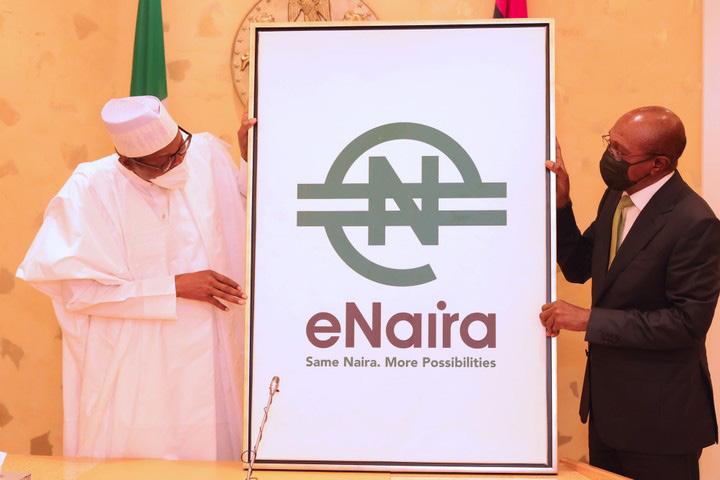
The Central Bank of Nigeria has continued to encourage Nigerians to embrace the eNaira, Africa’s first Central Bank Digital Currency (CBDC).
The appeal was made by the Director of the Corporate Communications Department of the CBN, Osita Nwanisobi at the Lagos International Trade Fair.
After inflation data from the United States further strengthened the notion that Bitcoin is a hedge against rising cost pressures, Bitcoin hit another record high and is currently weaving around the $64,000 range. However, the CBN’s ban on cryptocurrency transactions will not enable Nigeria to benefit from the fast-booming crypto market.
The CBN is introducing the eNaira to give the country’s citizens a secure option and satisfy those who have a high appetite for blockchain technology.
Nwanisobi highlighted some of the benefits of the new digital currency, stating that it is expected to “deepen financial inclusion” by bringing more Nigerians into the financial space, support a payment ecosystem with recognisable resilience, reduce the cost of processing cash in the country, enable direct intervention to the welfare of citizens while being completely transparent in dealings, increase transparency in the collection of tax collections and
revenue, and reduce the cost of financial transactions.
Nwanisobi also mentioned that the digital currency will facilitate remittances concerning the diaspora, and improve the efficacy of regular payments.
Nwanisobi also acknowledged the positive responses to the launch of the digital currency. He said that customers who download the eNaira Speed Wallet App will be able to create a wallet, fund said wallet from their own bank accounts, transfer eNaira from their wallet to another eNaira wallet, and make payments for purchases at some registered locations. Nwanisobi referred to the naira (physical) as the pride of the nation, urging citizens to embrace the eNaira the way the naira is being embraced.
The CBN’s stance on cryptocurrency has since been known to be negative, as Nwanisobi himself once stated in an email that the Nigerian financial system lacks adequate space for cryptocurrency.
NEWS FROM WEST AFRICA
GHANA: REPUBLIC BANK LAUNCHES DIGITAL SUITE MOBILE PLATFORM
Republic Bank has launched the Digital Suite platform which provides unique mobile services for customers to perform all financial transactions.
The digital suite, which combines the use of a mobile application (Republic App), an SMS or USSD *414# platform(Republic SMS)and internet banking services (Republic Online), would ensure that all banking services, insurance and other financial transactions were performed on the platforms.
Speaking at the launch in Accra, the Managing Director of Republic Bank, Mr Farid Antar, said the
platform was a masterpiece as far as digital services in the country were concerned.
“This is a very unique and robust platform which provides access to all services provided by the bank. Customers could do everything in the comfort of their homes,” he said.
He said, they took time to develop the platform to make it the best on the Ghanaian market with the needs of customers in mind.
“All financial transactions including buying stocks, opening an account, paying bills and treasury
bills could be done with ease on the platform,” he stressed.
“The new and improved digital service is the best in the market, made with robust security systems and with a wide range of services for both customers and noncustomers,” he added.
He added that they were confident that the digital suite would take the lead in the digital space in no time.
He urged customers and noncustomers to utilise the platform to perform their transactions with ease and comfort.
GOOGLE TO INVEST $1 BILLION IN AFRICA OVER THE NEXT 5 YEARS
Google has announced that it will invest USD One billion in Africa, over the next 5 years to boost internet access and support entrepreneurship across the continent. The U.S tech base company announced this plan at a virtual event where it launched an Africa Investment Fund, through which it will invest USD 50 million in startups, providing them with access to its employees, network and technologies. According to Nitin Gajria, the managing director for Google in Africa, this investment made by the company will be targeting fintech, e-commerce and local content. “We are looking for
areas that may have some strategic overlap with Google and where Google could potentially add value in partnering with some of these startups,” Gajria stated. Google in collaboration with Kiva, a not for profit organisation, will also provide $10 million in low-interest loans to help small businesses and entrepreneurs in Ghana, Kenya, Nigeria and South Africa so they can get through the economic hardship created by COVID-19. Small businesses in Africa often struggle to get capital because they lack the necessary collateral required by banks in case they default. When credit is available, interest rates are
usually too high. Google states that a programme was pioneered last year in Kenya in partnership with Safaricom that allows customers to pay for 4G-enabled phones in instalments that would be expanded across the continent with mobile operators such as MTN, Orange and Vodacom. Gajria said an undersea cable being built by Google to link Africa and Europe should come into service in the second half of next year and is expected to increase internet speeds by five times and lower data costs by up to 21% in countries like South Africa and Nigeria.
THE
RISE OF
CRYPTOCURRENCY ACROSS AFRICA
Cryptocurrencies have taken the entire world by storm. Across the globe, investors are on the lookout for trending cryptocurrencies to invest in and earn maximum returns. The crypto run is on the rise in different countries and continents, and Africa is no exception.
If you look at the stats, Africa doesn’t have a large share in the global value of cryptocurrencies received and sent. In fact, it amounts to only two percent in total, making us wonder whether Africa is really warming up to cryptocurrencies like the rest of the world.
But these numbers have seen a stark transition in the pandemic phase. Between July 2020 and June 2021, when the world was reeling under the Covid-19 pandemic, we had some good news in terms of crypto investment from Africa. Cryptocurrency adoption shot up by 1200% in the span of less than a year in Africa - making it the fastest adoption rate in the world. For the financial year ending June 2021, Africa amassed a whopping $105.6bn worth of cryptocurrencies.
Specific African countries such as Kenya, Nigeria, South Africa, and Tanzania topped the grass-root adoption rate, ranking in the top 20 Global Crypto Adoption Index.
Thanks to the active involvement of these markets, the volume of retail-sized cryptocurrency transfers in Africa alone was 7%, while the rest of the world stood at a global average of 5.5%.
For a long time, African countries have struggled with infrastructure issues. This has only made access to financial services all the more difficult. Not all Africans aren’t able to bank on traditional banking systems, which also explains why cryptocurrencies come in as a breather. Cryptocurrencies are seamless, easy to use, and hassle-free - all investors need is a smartphone and internet connection, and they can get started with their investments.
REASONS BEHIND THE RISE OF CRYPTO IN AFRICA
The inflation rate in South Sudan in 2017 was 102%, according to the World Bank. Other African countries such as Ghana, Egypt, Malawi, Mozambique, Zambia, and Nigeria were struggling with double-digit inflation rates.
Considering these high inflation numbers, the rise of crypto in Africa is no surprise. In fact, these are the countries leading the march in terms of crypto investments in Africa. Along with the above-mentioned African countries, Botswana, Kenya, South Africa, Zimbabwe, and South Africa too are showing a rise in crypto investments. In Zimbabwe, the inflation situation was worrying - so much so, the authorities pumped in $100 trillion notes, each worth $40and this was the point where the people of Zimbabwe turned to cryptocurrencies.
Diaspora bonds were extremely popular in Africa, but with the country’s fiscal and monetary mismanagement, the bonds have only turned out to be an unsustainable and unappealing investment option. Africans typically tend to invest in safer, high-yielding investment alternatives. But over the years, the bonds are yielding a decreasingly lower rate of interest. This is also one of the reasons why the African population is now drawn to new, high-yielding, and dynamic investment options such as cryptocurrencies.
By 2020, the expected number of Africans investing in crypto was expected to touch 725 million. As crypto trading is accessible by smartphones, this number is only set to rise with the passing years.
WHO IS LEADING THE GROWTH OF FINTECH IN AFRICA?
None other than the founder of Twitter and Square - Jack Dorsey. Dorsey’s fondness for Africa in terms of investment is no secretand he is always on the lookout to make bigger, better investments in the continent. The lockdown proved to hinder Dorsey from continuing with his investment plans for Africa, but now that things are getting better, the focus is back on investments in the African continent.
Dorsey is currently in talks with CcHub’s CEO, Bosun Tijani. CcHub also happens to be Africa’s largest tech incubator for startups. We’re hoping this collaboration would lead to something concrete that would boost the growing crypto market in Africa. Dorsey even went a step ahead to tweet that a Lightning Wallet would be attached to every Twitter account in Africa.
Native African Fintech companies, too, are showing promising results in the field of digital payment platforms. There’s Andela and Flutterwave, which are Nigerian-based companies paving the way for the growth of crypto in Africa.
STRUGGLES
OF AFRICA’S VERY OWN ‘AFRO’ CRYPTOCURRENCY
Afro was introduced in Africa way back in 2018, with the intention of making it one of the most popular cryptocurrencies on the continent. The idea was to introduce a cryptocurrency that would reduce transaction costs to every corner of the African continent.
While Afro started off on a good note, it’s been three years since its inception, and the cryptocurrency has not exactly caught on the way it was expected to. It did promise lower transaction fees, but of 54 African countries, only one country has actually inked a deal with the founding company of Afro - the Afro Foundation.
The foundation is still working towards making Afro the bitcoin of Africa - and is not ready to give up. The founders of Afro are banking on the increasing popularity of cryptocurrencies worldwide and hope to see Afro become an instant hit in the continent soon.
Currently, the Afro Foundation boasts of 3000 uses and 10000 Afro transactions per month. But if you compare these figures with the 1.3 billion population of Africa, these numbers aren’t really impressive.
And yes, Afro isn’t the only cryptocurrency trying to make its way through Africa. It has competitors like A Coin - which is the dreamchild of popular singer Akon. However, top economists say that these cryptocurrencies are still in their nascent phases and would need quite some time to gain the popularity and exposure they’re aiming for.
NIGERIA - THE CRYPTO HAVEN
OF AFRICA
Every African country responds differently to cryptocurrencies. There are blockchain-friendly markets like South Africa, Kenya, and most importantly, Nigeria. Nigeria is quite literally the bitcoin paradise of Africa. With almost 13 million bitcoin users as of 2021, it ranks 3rd after India and the USA for trading volumes of the most popular cryptocurrency in the world - bitcoin.
Statistics say that more than a third of Africa’s bitcoin users are Africans. The popularity of reputed cryptocurrencies such as bitcoins is so widespread that it is difficult for Africa’s native cryptocurrencies (Afro and Akon) to sustain in the market. The young, tech-savvy African population is looking for interesting investment options that are also safe to bet on- and popular cryptocurrencies such as bitcoins are something they can easily rely on.
The fall in official remittance numbers (up to $6 billion) is no doubt an alarming number. But the simultaneous surge in crypto trading only indicates that in the young African population this money is instead being rerouted to crypto trades - which, again, is a positive sign for the crypto market in Africa.
REASONS TO INVEST IN CRYPTOCURRENCIES
For those hesitating to invest in cryptocurrencies, here are some reasons you need to consider investing in crypto right away:
Transparent and Secure Investment
Cryptocurrencies are powered by blockchain technology. Blockchain is nothing but an open, transparent, secure ledger that lists all the details regarding cryptocurrencies and investors. This ledger is publicly viewable and verifiable, making cryptocurrency platforms a safe, secure mode of trading.
A Good Choice for Long Term Investment
The crypto market is subject to frequent changes, ups and downs, making investors wary of the whole concept of cryptocurrencies. But despite this volatility and fluctuations, crypto investments are beneficial in the long run. In fact, cryptocurrencies can be a great way to accumulate a good enough retirement fund.
Crypto is also a good option for those looking to invest their surplus amount, that is, the amount you have in hand after you have invested in safer, more reliable investment options. The corpus you accumulate by investing in cryptocurrencies can prove to be a great buffer emergency fund over time.
Flexible Trading
Crypto isn’t regulated yet, which makes it all the more interesting to trade in. Also, you have 24/7 access to crypto trading, making it one of the most flexible trading options you can find out there. Any part of the day, you can log in and transact in different types of cryptocurrencies.
Deflationary Assets
Cryptocurrencies are assets with limited supply, making them deflationary assets. Each type of cryptocurrency is regulated by an algorithm, which puts a cap on the total supply. As these are deflationary assets, their purchasing power increases over time.
Decentralized Investment Platform
Crypto trading platforms are decentralized, ensuring you have control over all your assets. There’s no involvement of any third party and middlemen, which means you have no extra charges to pay. As the exchange does not determine the value of the cryptocurrencies, traders and investors can avail maximum profits from the existing exchange rates.
CHALLENGES FOR CRYPTOCURRENCIES IN AFRICA
While we are definitely seeing a rise in cryptocurrency users in Africa, we cannot deny the fact that the crypto trade in Africa faces some challenges, like:
Lack of Trust
The first and foremost is the lack of trust in new-age investment options such as crypto. Understanding cryptocurrencies is important before we make a call on whether to invest in them
or not. But being totally unaware, branding something as ‘risky,’ ‘not worth it’ or even ‘illegal’ isn’t really right.
The people in Africa need to learn more about this amazing investment option that can actually yield them high returns if done right. Building wealth is possible with the right investments, and crypto is one of those investment options we all need to be open to exploring.
Language Barrier
The language barrier is another challenge that comes in the way.
Breaking down complex crypto concepts into simpler, more understandable bite-sized versions is key if we want the majority of the African population to know, understand, and invest in crypto.
There are quite a few people, like Roselyn Wanjiru, whose efforts for crypto content are now available in Kiswahili. But there are hundreds of languages and dialects in this vast, diverse continent, which makes the translation process all the more difficult and time-consuming. So a lot still needs to be done to ensure that the essential knowledge reaches the Africans in the right way. Translation of material would also ensure that the rural and senior population too would get to know more about cryptocurrencies and how they work.
Lack of Regulation
The crypto world is dynamic and ever-evolving. There’s something new coming up every other day, which makes it challenging to keep track and monitor the crypto market. The industry needs to be regulated to ensure stability so that more people are actually incentivised to sign up for the crypto trade.
Currently, there’s no regulationthe only policies for banks to check the crypto trade are transaction limits and minimum capitalwhich aren’t really enough to regulate such dynamic trading platforms. Regulation would help build the trust of people who would show interest in investing in cryptocurrencies.
Along with this, some other challenges may seem small but are actually crucial for the functioning of the crypto trade. One of the major challenges faced by some parts of Africa is the lack of stable internet connectivity. This is a huge obstacle for those who wish to invest in crypto but cannot do so because of the lack of technological infrastructure.
FUTURE OF CRYPTOCURRENCIES IN AFRICA
Africa is densely populated, with almost 1.3 billion people residing in the country. The history of the country was full of struggles, wars, colonialism, and issues due to harsh terrains, leaving almost 57% of the population with virtually no access to financial services.
The underdeveloped infrastructure of Africa is what is making it the crypto hotspot. Nigeria has topped the crypto adoption list of the entire world, and this only explains that the future of crypto is super bright in African countries.
Currently, cryptocurrency is not regulated by the African government - which adds to the ease of crypto transactions. There are no middlemen, no unnecessary laws and regulations, and the transactions happen purely over the internet. While the top cryptocurrencies worldwide are Bitcoin, Litecoin, XRP, Lisk, Monero, and Lisk, Bitcoin is the most popular cryptocurrency in Africa. Currently, Africa may not be mentioned as one of the largest cryptocurrency markets, but stats and figures show positive signs. In a couple of years, Africa is sure to take over the cryptocurrency world in no time.
Very recently, South Africa introduced strict rules for crypto traders, and it has caused quite a commotion in the African crypto world. Regulating crypto has been the need of the hour for a long time now, but these new regulations are causing problems for crypto traders, who did not have to deal with any rules or regulations until today.
Anonymity, freedom, and flexibility are the crux of cryptocurrencies. The new regulating rules are curated, keeping in mind these elements of cryptocurrencies while aiming to regulate the volatility they bring in. The regulation of the crypto market has many positives - it would help the overall economy
while protecting people from the potential dangers and volatility of the crypto world.
These regulations came into place after numerous scams were reported, severely affecting South Africa’s crypto trade credibility. After the MTI Holdings scam, many others followed, calling for immediate rules to regulate crypto trading.
The South African Reserve Bank is enforcing strict rules on banks, which has led to ‘overregulation’ of the crypto space. The rules have only led to confusion among both banks and traders. The new regulations introduced are the first attempt to regulate the crypto trade and have their set of loopholes, leaving scope for confusion. As the South African Reserve Bank is looking to modify the rules and adapt them as required, crypto investors are expected to stick to the set of rules published.
The fact that the South African authorities have made efforts to develop regulations to monitor the crypto market shows that the countries in Africa are slowly and steadily accepting cryptocurrencies. This only reinforces the fact that the future of crypto in Africa is bright.
Blockchain
beyond the barn:
Mastercard’s Provenance Solution is cultivating multiple wins for innovation and inclusion in Africa
With its vast plains, fertile land and many rural communities that – by necessity – must strive to largely be self-sufficient, Africa has a long tradition of making livelihoods in agriculture and tending livestock. In Southern Africa, cattle farms have enjoyed periods of great success, and also spells of distressing setbacks.
Even though the quality of Zimbabwean beef is well renowned, the act of selling their product isn’t always straightforward for farmers. In 2018, more than 50,000 cows died of a tick-borne disease that spread through Zimbabwe that year. Disease not only decimated herds of cattle, but also eroded trust in product quality.
Furthermore, it severely impacted the incomes of smallholder farmers. Importers needed transparency, but the lack of a traceability system has meant Zimbabwean farmers were unable to export beef to lucrative markets in Europe and the Middle East. This vastly reduced export earnings from beef, which are important to the country’s economy.
Though the details might differ from industry to industry, and from one location to another, the challenge is broadly the same in many markets. Greater complexity and a lack of visibility across modern supply chains makes it increasingly challenging for companies to reduce costly inefficiencies. The supply chain ecosystem, notably for B2B payments, suffers as disparate legacy systems don’t link with largely manual inputs, which leads to costly human error, disputes, long reconciliation times and low trust. Clarity is limited. In research by EY, only 6% of global companies were confident they have supply chain visibility.
Blockchain builds back trust
But now, blockchain technology is brightening the outlook and fertilising the realm of possibility. It’s bringing new hope, exciting
prospects, and better visibility to both farmers and the wider supply chain. Regular health checks and vaccinations – and secure tamperproof records of medical dipping events – would go a long way in building back credibility and fostering renewed trust among importers, as well as boosting the confidence of Zimbabwe’s smallholder farmers.
And this is exactly what the Mastercard Provenance Solution does: enable farmers to prove the extent of their efforts, the origin of their cattle, and the integrity of their health records, while also offering access to a mechanism that reduces the risk for buyers.
Mark Elliott
Division President at Mastercard, Southern Africa
By leveraging the power of blockchain, this innovative solution is delivering real-time traceability that bridges the gap between data silos, allowing for decisions to be made based on a shared, immutable record that drives trust and accountability between supply chain parties.
Building trust in industries is essential for a functioning and reliable value chain. Seamless supply chain transparency can help convey authenticity, expand inclusion, share sustainability practices and improve back-office efficiencies.
A first for the region
In a first for the Middle East and Africa, the Mastercard Provenance Solution made its debut in Zimbabwe, when E-Livestock Global launched a first-of-its-kind application in 2021, powered by Mastercard’s innovative blockchain technology solution.
It has transformed the landscape, bringing end-to-end visibility to the cattle supply chain in a way that also addresses pain points, enhances convenience, and simplifies commercial deals.
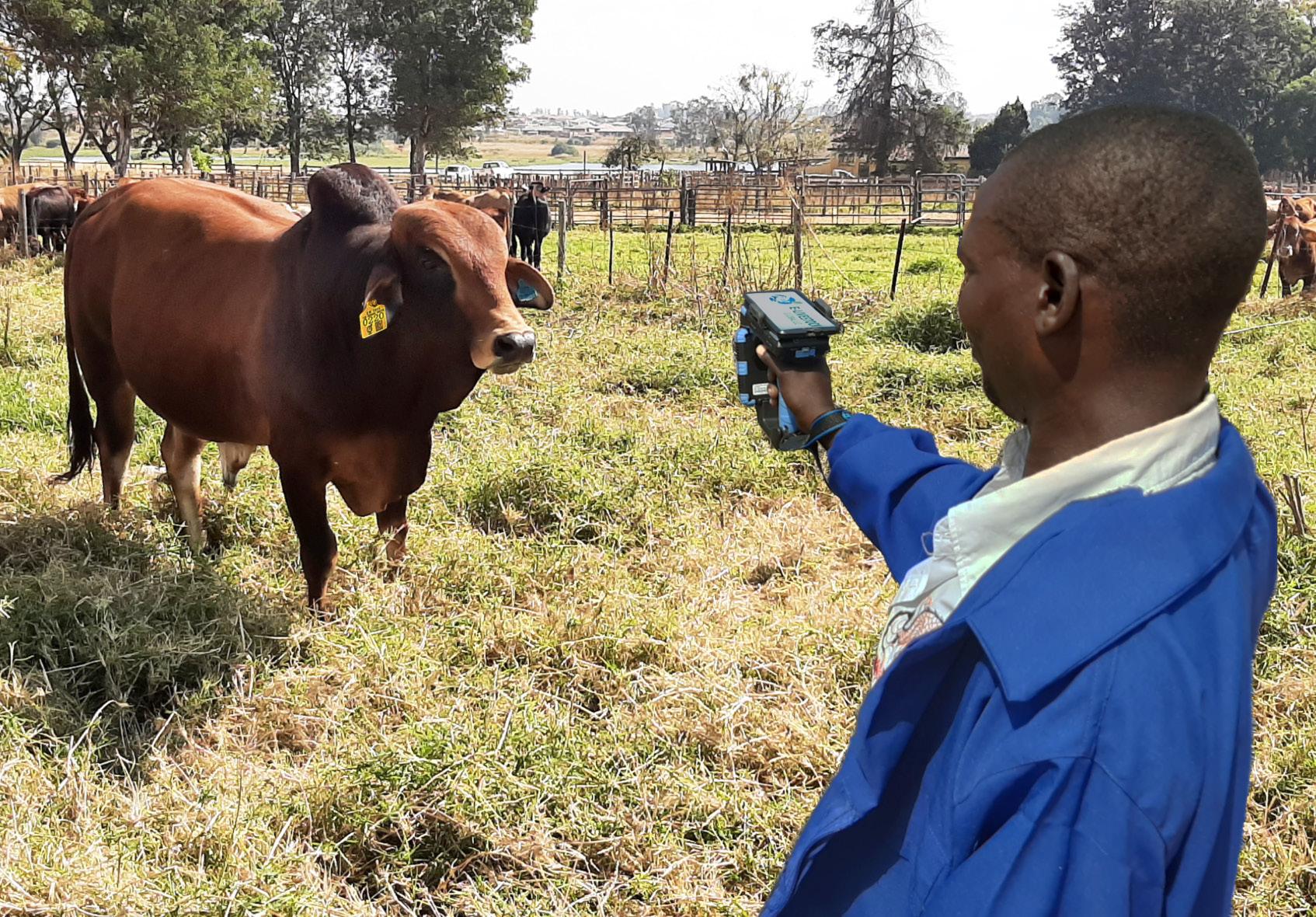
With the E-Livestock Global solution, commercial farmers and dipping officers tag each head of cattle with a unique, ultra-high frequency RFID tag - as mandated by the Ministry of Agricultureand register it and its owner onto the solution. Each time the animal gets dipped, vaccinated or receives medical treatment, the tag is scanned to record the event onto the traceability system.
Leveraging Mastercard’s awardwinning Provenance solution, E-Livestock Global records these events to maintain a secure and tamper-proof trail of each animal’s
E-Livestock Global’s innovative traceability system, which is powered by the Mastercard Provenance blockchain based solution, empowers Zimbabwean farmers to prove the origin and health records of their cattle, while reducing risks to buyers.
history. This, in turn, supports the entire supply chain with trusted, transparent and verifiable data.
Far-reaching results
The results are far-reaching, driving end-to-end visibility, reduced costs and scalable efficiencies across supply chains throughout the product journey, and enabling inclusion of all players, whatever their size.
For farmers, it provides an irrefutable record that proves ownership, supports sales, and enables exports. It also gives them the opportunity to access credit facilities and obtain a loan, using their cattle as collateral. This is a major benefit for smallholder farmers especially, who often face difficulties in securing financing to scale or diversify farming operations, in lieu of documentation that can prove ownership and management.
For buyers, it enables smarter buying decisions, efficient management of their operations, seamless B2B transactions, and the ability to guarantee product quality to their customers. In a growing and competitive global marketplace, being able to count on this peace of mind and effective quality control, are great advantages.
For countries, it offers an opportunity to tap into the power of digital transformation to drive forward citizen wellbeing and economic recovery, which has taken on renewed importance since the COVID-19 pandemic. In Zimbabwe’s case, it will not only enable the country to regain
access to its lucrative beef export market, but also position it well for diversification and applications in other industries.
Beyond cattle
Because the Mastercard Provenance Solution is both industry and data agnostic, it can bring transparency and traceability to food systems of many different kinds.
Mastercard has already integrated its blockchain provenance solution with other companies, subsequently enhancing the food supply chains for Australian avocados, Californian shrimp, and commodities like coffee and grains in the Americas. It doesn’t stop there. Just think of the prospects for cosmetics, electronics and freight, among others. Retailers certainly are. As a result of COVID-19, roughly six in 10 retail respondents are planning to increase investments in digitisation of their supply chains for enhanced visibility.
Moving forward on multiple rails
By applying its capabilities to the field of provenance and enabling seamless multi-rail B2B payments, Mastercard continues to show the diversity, scope, scale and potential of how it’s enabling commerce through multiple rails.
Cards are just one way of how this technology company connects people and businesses to the benefits of the digital economy. It is through technology, innovation and partnership, that Mastercard is accelerating financial inclusion,
contributing to the development of a thriving world beyond cash, and doing well by doing good.
The next frontier
With every new use case, more possibilities come to the fore. For every country that adopts an exciting digital solution that adds value to multiple stakeholders, another country grows in confidence as it prepares to embrace the possibilities of digitisation and technologies of the Fourth Industrial Revolution. For Africa especially, this kind of momentum has the potential to positively transform both agriculture and inclusive economic growth.
Awards have followed too, the latest being Digital Banker Africa’s Best Blockchain Solution award.
But the true measure of success for the Mastercard Provenance Solution, is how it empowers real people in real communities to pursue a better, more prosperous life. In this respect, the smallholder farmers who have shared their experiences and progress, are the ultimate stars. This is innovating for good. And innovating for impact.
As for blockchain, the sky’s the limit. A firm believer in the transformative power of blockchain technology, Mastercard continues to explore its applications across the entire business ecosystem, while staying true to its mission to expand financial inclusion and boost global prosperity.
How business of blockchain can harness the power
In today’s digital world, where faxes have all but been replaced by email and landlines by smartphones, doesn’t it seem strange that we’re still signing contracts in person? That we’re driving hours to do so, creating mountains of paper trails, and storing them in lever arch files to gather dust, when the technology exists to eliminate this physical burden?
Blockchain has been proven to solve this problem, yet its business adoption has been slow. The technology at the heart of bitcoin and other virtual currencies, blockchain is an open, distributed ledger that can record transactions between two parties efficiently and in a verifiable and permanent way. It’s time for the way we do administration to change.
Why so slow?
It’s no longer a question of whether the technology works –it does. But several other factors are hampering its widespread adoption.
Locally, blockchain is mostly being used in the cryptocurrency space, where there is significant energy and enthusiasm for it. But outside these circles, growth is slow.
One of the main challenges is the lack of regulation. This may seem counter-intuitive, since there is severe distrust of government institutions and those in power due to abject corruption – not only in SA, but worldwide. Even in crypto circles, enthusiasts are torn between the benefits
of regulation and the potential drawbacks.
But the technology itself addresses these concerns: transactions on the block are transparent and traceable, significantly reducing the opportunities for fraud and corruption - if scoped and implemented correctly. Regulation could furthermore address risks such as scams.
Lack of knowledge is the second challenge – not only in government, where regulation needs to happen, but also among the wider public. There is still a lack of awareness and understanding, as well as user experience and education –especially when it comes to security and privacy challenges.
Gathering speed
Most of the blockchain projects we see in SA are in the pilot phase to prove the business case that blockchain is secure, tamperproof, and transparent. The biggest adopters are in the crypto space, such as trading platforms, Bitcoin wallets, and Bitcoin exchange platforms.
One exciting non-crypto example is De Beers’ use of blockchain paired with other technologies to trace and authenticate the movement of natural diamonds. They created digital assets to represent the physical assets (diamonds) and multiple parties can now update and share data.
Such processes and transactions are a perfect example of how blockchain can change how we do business. The property market, for example, could benefit greatly. Buyers and sellers, multiple banks and attorneys, as well as the agent and the deeds office, could all access the transaction in one place. Verifications and legal requirements can be added to a master transaction viewable by all, drastically simplifying the process and reducing transaction times and paperwork, while creating an immutable, transparent transaction record.
While the benefits could be similar in the financial services industry in general, there would need to be more coordination and collaboration between banks to harness the power of this technology. The South African
Reserve Bank is, however, assisting with the drive to rapidly mature the technology, allowing banks to position themselves in new and novel ways within their traditional ecosystems.
Building the business case for blockchain
As mind-bending as blockchain is, it’s not the most sensible solution for every business problem. It most benefits industries and businesses where there’s a true need for information sharing and collaboration between stakeholders, and where there is an industry body that requires standardisation and collective consensus.
Any organisation looking to invest in blockchain must ensure that they have a knowledgeable team of experts to call on. The technology itself is still immature, with no clear implementation success recipe, and as such certainly requires expertise.
Understanding the misconceptions and true benefits of blockchain is essential before embarking on a costly path to implement this technology when another could suffice. This team should also put thought into how the implementation can be quickly and easily scaled, and how it can integrate into legacy systems.
Blockchain is a complex technology, but when applied correctly, it can disrupt many aspects of business and
government processes - for the immense benefit of our economy and society.
Andrea Tucker
Head of Research & Development and Strategic Projects at e4
About e4
e4 is a technology company specialising in digitalisation. By understanding the complexity of a digital journey, e4 partners with its clients to provide innovative solutions that suit their unique needs. Using an omni-channel platform approach, e4 offers a range of digitally-inspired services as well as solutions.
Working across financial services, data and the legal sector, e4 understands the intricate requirements in these sectors, and uses its expertise to assist clients in effectively managing their businesses through digitalisation.
NEWS FROM SOUTHERN AFRICA
ZIMBABWE DENIES REPORTS OF ADOPTING CRYPTOCURRENCY AS LEGAL TENDER
Zimbabwe has no plans of adopting cryptocurrency as a legal tender, according to Information Minister Monica Mutsvangwa.
Mutsvangwa, who spoke following a cabinet meeting, was reacting to reports in a section of the local media that Zimbabwe was planning to introduce another currency.
“Our local currency is the Zimbabwe dollar, and not cryptocurrency. Like most countries in the world, the Government of Zimbabwe, through its Financial Technology Group, is studying Central Banking Digital Currency as opposed to cryptocurrencies, bitcoins or any form of derivatives,” Mutsvangwa said.
Zimbabwe’s Finance minister Mthuli Ncube in September already ruled out any possible use of cryptocurrencies, including Bitcoin and ether, as legal tender due to their volatility. Ncube, however, said the government was exploring how cryptocurrencies and digital assets could be ranked as another asset class.
Countries all over the world, including those in Africa, are struggling with how to regulate cryptocurrencies which have grown in popularity.
However, a number of emerging markets have banked on digital money to reduce transaction costs and improve participation in the formal financial system.
Some African nations such as Ghana and South Africa are testing digital forms of their legal tender to enable quicker and affordable money transactions without losing control over their monetary systems.
Nigeria’s central bank, on the other hand, rolled out its national digital currency, the eNaira, in October. The eNaira will have the same value as the physical Naira and always exchange at one naira to one eNaira, according to the central bank.
In June, Central American nation El Salvador became the first country to adopt bitcoin as legal tender with lawmakers voting by a “supermajority” in favor of the Bitcoin Law.
STANDARD BANK ENABLES UNIONPAY CONTACTLESS PAYMENTS ACROSS SOUTH AFRICA
Standard Bank South Africa (SBSA) and UnionPay International (UPI) jointly announced that Standard Bank pointof-sale devices have been enabled for UnionPay contactless payment.
The cooperation is a strategic move from UPI that follows the surging trend of the global contactless payment industry and accelerates the development of international mobile payment services.
According to a survey conducted by RTI[1], around 30% of the respondents have started to use contactless payments since the pandemic began. And 70% of those users are likely to continue using contactless payments post-COVID-19. Contactless payments have emerged as an essential solution for all the businesses as it enables them to drive their business forward along with ensuring safety to combat the coronavirus pandemic.
“At Standard Bank, we continue to be at the forefront of providing our clients with a variety of innovative digital and contactless payment solutions,” says Nelisa Zulu, Head of Card and Payments at Standard Bank South Africa
“We have seen contactless payment spend grow by 272% year-on-year, as we see our clients’ preferences shift towards digital alternatives for payment, especially during the COVID-19 pandemic. Through our relationships with UnionPay, we continue to offer easy and convenient payment solutions for our clients, including simply tapping their cards,” comments Zulu.
“We are grateful to further extend our cooperation with Standard Bank”, said Luping Zhang, General Manager at UnionPay International Africa.
“We encourage UnionPay cardholders to use contactless payments to minimise the impact of the pandemic on their daily life”.
Standard Bank is the largest banking group on the African continent by assets offering universal financial services across sub-Saharan Africa. With a deep understanding of emerging markets and evolving consumer demands, Standard Bank is working to support and grow the number of transactions through partnerships.
At present, UnionPay cards are widely accepted in South Africa in all sectors, effectively meeting the diverse purchasing needs of UnionPay cardholders living and visiting South Africa. UnionPay’s acceptance network has expanded to 180 countries and regions in recent years, with cards issued in 70 countries and regions, including over 10 African countries. The Nilson Report (Issue 1154) shows that UnionPay ranks first among all card schemes in terms of card issuance and transaction volume worldwide. UnionPay has launched various innovative payment products in Africa in response to the worldwide digital transformation and financial inclusion.
NEWS FROM SOUTHERN AFRICA
SOUTH AFRICA’S OZOW RAKES IN $48M SERIES B INVESTMENT
South African payment gateway Ozow has raised $48m in a Series B funding round to expand the availability of alternative payment solutions across the country.
The financing round, led by Tencent, also had participation from Endeavor Catalyst and Endeavor Harvest Fund.
Founded in 2014 by CEO Thomas Pays, Ozow was rebranded from i-Pay in April 2019. The firm provides alternative payment methods, including QR codes, point of sale, e-commerce, e-billing and peer-to-peer (P2P) payments across South Africa.
The fresh infusion will enable Ozow to expand its product offering to drive financial inclusion in the country.
The firm is also eyeing strategic investments, including mergers and acquisitions, to support the development of new products, as well as its expansion into Africa.
Ozow co-founder and CEO Thomas Pays said: “It’s an honour to bring on board Tencent, Endeavor Catalyst and Endeavor Harvest Fund. This is a validation of our role in transforming the banking industry through the development of innovative, convenient, and more inclusive payment solutions for everyone.”
The latest round follows Ozow’s Series A funding in 2019. The firm is said to have witnessed 100% year-on-year growth since then.
According to the firm, it processes more than $100m in transaction volumes monthly across its merchant network.
It also claims that over 120,000 users join its platform on a monthly basis.
In July this year, South African payments and software platform Yoco raised $83m in Series C funding to accelerate the development of its financial ecosystem for small businesses.
Recently, Australian fintech Zip signed a deal to buy South African buy now, pay later (BNPL) firm Payflex.
NEWS FROM SOUTHERN AFRICA
AVO APP REACHES 500 000 CUSTOMER MILESTONE IN RECORD TIME, SAYS NEDBANK
Lender Nedbank have revealed that its Avo super app had achieved the 500 000-customer milestone in record time.
Helping South African consumers and businesses go digital is the underlying proposition of Avo by Nedbank.
Nedbank said Avo had scaled massively in the 17 months since launch, with the lift in both customers and businesses continuing to grow at unprecedented rates.
It said more than 20 000 merchants had now signed up on Avo.
“The milestone comes as Avo launches its ‘Green is the New Black’ campaign for the hotly anticipated Black Friday season. With incredible up to 70 percent off deals in shopping, to R1 shock takeaway deals, Avo has something for everyone this month.”
Ciko Thomas, the managing executive: Retail and Business Banking at Nedbank Group, said, “The growth we have seen on Avo has not only been exponential, but inspiring in terms of how hungry South Africans are for the convenience of digitisation.”
Nedbank said looking forward to the Avo app, and with an eye on enabling even more businesses, the launch of a business-to-business platform was imminent.
AFRICA DATA CENTRES TO INCREASE CAPACITY IN JOHANNESBURG, SOUTH AFRICA TO 100MW
ADC to add third campus in the city
Africa Data Centres is to more than double its footprint in Johannesburg, South Africa.
ADC said it plans to expand capacity in the region to 100MW; its existing two campuses in the city will total 20MW each upon full build- out.
The company aims to expand in both Midrand and Samrand and is securing land for a third location.
“The announcement by Africa Data Centres and our expansion plans, highlights our commitment to accelerating digital transformation in Africa. Growing our data center footprint is a key part of delivering on our vision of a digitally connected future that leaves no African behind ” said Hardy Pemhiwa the President & CEO of ADC’s parent company, Cassava Technologies.
ADC completed a 6,000 sq m (64,500 sq ft), 10MW data center at its Midrand campus in September. The company currently has or is developing data centers in Lagos, Nigeria; Lomé, Togo; Samrand and Midrand, South Africa; and Nairobi, Kenya. It announced plans for two more data centers in Nairobi earlier this month.
Earlier this year the company announced a $500 million goal to build 10 data centers across 10 African countries over the next two years. The company plans to double its footprint and build facilities in the likes of Morocco, Tunisia, and Egypt.
ADC’s parent company Econet recently announced a new company, Cassava Technologies, to hold both ADC and Liquid Intelligent Technologies (formerly Liquid Telecom). ADC previously sat underneath Liquid Intelligent Technologies, but Cassava will hold both as well as other units such as Liquid Cloud, Sasai Fintech, Vaya Technologies, and Distributed Power Technologies.
COMPETITIVE DYNAMICS IN THE AFRICAN PAYMENT INDUSTRY.
COVID-19 related lock down reinforced the need for digital payment, driving significant changes in commerce and payments behaviour, boosting P2P, B2B and B2C digital payments. The growing trend towards consolidation in merchant payment enables acquirers to scale across geographies and offer multi-geography solutions. For the merchants, their needs revolve around the following; optimise payments in digital channels, approve the most transactions for the least cost, achieve geographical scale without multiple integration, further provide industry specific value propositions addressing market needs and risk levels. For the Payment technology (Paytech) companies,
their needs revolve around improving system stability, reducing fraud/chargebacks, reducing merchant churn, growing the merchant base, and expanding their service offering to increase revenue.
Many Paytechs are providing targeted value propositions specific to industries, additional financial services like investment and trading, cryptocurrency transactions and debit card offerings or/and becoming commerce marketplaces. As digital payment becomes commoditised, helping merchants receive non-cash payment faster and safer, Paytechs grow and increase in number and size in Africa. To succeed, what are they doing to ensure that they remain competitive and relevant?
State of digital payment in Africa 1
Paytechs in Africa are thriving and this is best exemplified by the increasing ticket sizes of funds raised from global venture capitals (VCs); Cellulant, Flutterwave, Interswitch, OPay, Wapi Pay, warranting acquisitions by foreign Paytechs; Paystack, DPO group, getting new licensed players; PesaPal and global players with operations in multiple African countries; PayU, Ingenico. Paytechs abound and this work would not cover all of them, though it is important to mention Flocash, Fawry, Kopo Kopo of course the Telcos digital money services like M-Pesa, Orange money and MTN mobile money.
Ifunanya Chiegboka Director, Global Business Development OPay
Africa is an emerging hotbed of entrepreneurial activities. The continent has 54 countries, and an estimated population of 1.3 billion people. With a young, fastgrowing and increasingly urbanised population, the rapid adoption of technology makes the African continent a fertile ground for innovation. Yet for payment, cash is still king and Paytech’s major competition besides themselves is cash. Although the market is big enough for all players, what are the competitive dynamics deployed by these Paytechs to remain relevant?
Competitive dynamics refers to a series of actions and reactions of companies taking
part in a competitive business environment in an industry. Here, each company continuously makes choices, takes actions and chooses their responses to rival activities in order to strengthen its competitive position relatively and remain relevant in the market. Based on my experience, below are some instances of competitive dynamics in the African payment industry.
Basically, most of the Paytech companies have a user-friendly interface both for the software developers integrating the APIs and for direct consumers–i.e., merchants (who have dashboard access to view transaction reports and analytics in real time) and payers on the merchant website during their checkout experience. But these are the basics. Beyond accessibility, what are other games deployed to keep merchants hooked on Paytech’s services? Remember that surface integration is easy to replicate, and, because of redundancy, most merchants use over one payment provider. Below, I have highlighted some of the key ways/strategies Paytechs leverage to engage and provide niche/top-notch services to merchants, whilst continually improving their reach and overall value.
Multi payment channel acquiring and payment tokens
In recent times, the lines between offline and online transactions have blurred. It’s almost predictable that most retail chains with offline stores also have an online presence. COVID further pushed traditional businesses like restaurants to have an online presence. Paytechs that can serve merchants online and offline payment service needs using a single integration appeal more to merchants. Also offering multiple payment tokens such as alternative payment methodsBank account, mobile money wallets and other electronic wallet options facilitate high conversion rate as they provide buyers with convenience and choice. Lately, Paytech like Flutterwave plugging in international payment options, such as PayPal and Alipay and Paystack plugging in Apple Pay, has differentiated both players. Local merchants with international consumers are having more options to receive payment, just as regional merchants can receive payment through mobile money wallets. These capabilities give Paytechs a competitive edge.
2
Some Paytechs have differentiated themselves by providing industryfocused services/expertise. Industry verticals such as airline and aviation, travel and tours, hotels, ecommerce, betting, medical and education require focused services.
Paytechs such as DPO group, Cellulant and Flocash are popular for their airline collections. Cellulant built this expertise by partnering with Kenya Airways in 2017 to provide a variety of mobile and bank payment options to their customers paying for bookings online. DPO group first foray into Payment was in 2006, when Kenya Airways requested the company to develop an online booking system that would cater to the needs of foreign travelers and tourists. Since then, they now serve over 50 airlines.
inventory (e.g. number of hotel rooms available, number of flight seats available, or number of cars available) from the service providers. Integration with the GDS enables these payment companies to build other value add that then makes them attractive to other airlines.
Some Paytechs, like Remita and Xpresspayment, are popular for government/public sector collections in Nigeria.
3
Industryfocused value propositions/ Vertical expertise Global affiliations through Partnerships or acquisitions Platform/ Marketplace Play
4
Although most Paytech serve domestic airlines digital collection in their local market, the implication of getting partnership invitations from international/ regional airlines is that they expose the payment companies to Global Distribution System (GDS) integration, a computerised network system that enables transactions between travel industry service providers; airlines, hotels, car rental companies, and travel agencies using real-time
Global affiliations through partnerships or acquisition also set aside some payment companies because of the service standard, access and infrastructures of the global partners being passed on to the partnering payment companies. Examples of such partnerships include Intouch partnership with Worldline & Total, WorldPay (FIS) and Flutterwave partnership, Stripe acquisition of Paystack, Cellulant and Adyen partnership, etc. These global partners, by the virtue of these partnerships, transfer brand recognition, global clients or third party (mostly consultants) referrals to the partnering
Cellulant’s Agrikore is also a digital marketplace connecting actors across the agricultural value chain for farmers, traders and processors. Cellulant facilitates payments resulting from transactions within its platform. This capacity to transform from a payment gateway to a company. There was an instance where a local payment company affiliated through partnership with an European payment company won a bid for an international airline collection. Affiliations with global Paytech make domestic or regional Paytechs appealing, hence more competitive, to global merchants.
Alongside having plugins to all the e-commerce enabling platforms such as Magneto, WooCommerce, Shopify, Wix, OpenCart, Ecshop, some payment companies create store fronts enabling anyone to sell physical and digital products online. Examples include Flutterwave store, Paystack storefront, Quickteller store, etc. Going a step further, Paytechs like Flutterwave are creating a marketplace aggregating stores all over the world and creating huge global exposure to merchants on their network. By creating an ecosystem that connects buyers with sellers, it fulfills its core function of collecting digital payment.
platform, bringing together buyers and sellers, makes Paytech more appealing to merchants seeking to grow their market.
Geographical coverage and compliance peculiarity
Some categorise the African continent using the hemisphereSouth Africa, East Africa, West Africa, North African and Central Africa. Others categorise it by language- Francophone and Anglophone Africa. These categorisations have political and economic implications, resulting in policies that guide business conduct.
5 Summary
PesaPal is positioned as the gateway to East Africa. This makes regional coverage one of its competitive advantages. Meanwhile, some payment companies such as Intouch, CinetPay, Paydunya are positioned as Francophone payment gateway.
Twenty-one out of the fifty-four countries in Africa speak French either as their sole official language or second official language. This is because of their colonial heritage in France. While the Economic and Monetary Community of Central Africa (CEMAC), comprising Cameroon, Republic of Congo, Gabon, Equatorial Guinea, Central African Republic and Chad use the Central African CFA franc (XAF), the West African Economic and Monetary Union (UEMOA), comprising Benin, Burkina Faso, Ivory Coast, Guinea Bissau, Mali,
Niger, Senegal and Togo use the West African CFA franc (XOF). These two CFA franc currencies have a fixed exchange rate fixed to the Euro and though they have always been at parity, are effectively interchangeable.
Based on the currency peculiarity, these Francophone countries share similar monetary and compliance policies that make cross-border transfers with one another easier than other African countries that are not members of CEMAC and UEMOA. When a business wants to scale the Francophone region or a geographical region, Paytechs that have aggregated payment channels in the region have competitive advantage over others that do not.
To grow merchant acquisition in a competitive environment, African Paytechs are being creative with their offerings, harmonising offline and online collection, aggregating multiple payment channels, integrating international payment wallets and tokens. Some are focusing on niche markets by providing industry focused payment while others are becoming a marketplacepivoting from a payment gateway to a platform that connects buyers and sellers of product and service while facilitating payment in the ecosystem. Others are differentiating themselves through affiliations with global Paytechs, either through partnerships or by being acquired. Some are using geographical or language privilege to dominate segments of regions
with uniformity in compliance and currency. By adopting these positions, African Paytechs ensure their offerings remain relevant to merchants. Ifunanya has over ten years of experience in Business Development, Partnerships, Strategy and Operations in Africa. She currently leads Group strategy and development at OPay, a digital payment company with a focus on the frontier markets. Prior to that, she led web acquiring business at Interswitch Group, an Africa-focused integrated digital payments, and commerce company. She was also a pioneer staff of Flutterwave Inc, a Pan African payment company. Before venturing into payment, she worked at Guaranty Trust Bank and Access Bank in the retail, commercial and corporate banking divisions.
Ifunanya is highly passionate about Financial Technology and Digital Innovation in the Payment Space. She demonstrates her passion by working and writing periodically about the happenings in the industry. Solving the “how” of Strategic implementation/vision challenges related to businesses, products or partnerships is of utmost interest to her.
Ifunanya has a Master’s Degree in Industrial Relations and Managing Human Resources from Warwick University, United Kingdom, and a Post Graduate Diploma in Digital Business at Emeritus, Singapore.
THE DIGITAL BANKER 2021 AFRICA AWARDS AFRICA AWARDS
After a year of upheaval and transformation in 2020, the year 2021 continued along the pathway toward progress with even more innovation in digital banking across Africa and the entire world. We are proud to recognise the forwardmoving winners of the 2021 Digital Banker Africa awards. Advancing technology is changing how we bank, and the Digital Banker Africa awards aim to highlight organisations who are driving financial inclusion through technological innovation.
As a digitally native generation begins to take the reins, the traditional banking industry has evolved to meet the world’s new demands. Digital banking involves moving all traditionally in-person banking activities online. Customers may be able to join a bank and engage in all banking activities without ever entering a bank’s physical location.
The shift from in-person to online banking was hastened by the COVID-19 pandemic. Nowadays, customers’ demands require that banks offer bill payment, mobile payments, and loan applications online, among other services. The convenience of online banking makes it difficult to justify a trip
to a brick-and-mortar bank. Why leave the house when you can accomplish everything you need to accomplish online?
Innovations that have allowed banks to meet customer needs in online banking include chatbots that provide 24/7 customer service, an increasingly digitised workforce where as many tasks as possible are automated, niching down to provide specific services to specific groups, and the expansion of digital payments. Key innovations also include blockchain and artificial intelligence as well as the humanisation of digital experiences. Banks that are expanding their digital services are focusing on how they can preserve excellent customer service while building up their technological capabilities.
The organisations honoured in the 2021 Digital Banker Africa awards have set themselves apart from their peer organisations with incredible transformation in infrastructure, development, and pioneering technology, all in support of the people they aim to serve.
Africa
MasterCard - Best blockchain
solution (Agriculture)
Botswana
Standard chartered Bank (Botswana)
- Best Digital Bank
Standard chartered Bank (Botswana)
- Best mobile banking app
Kenya
Standard chartered bank Kenya - Best
Digital Bank
Stanbic Bank - Best mobile banking app
Carbon - Most innovative Digital Bank
South Africa
Capitec - Best Digital Bank
Standard Bank - Best mobile banking app
TymeBank - Most innovative Digital
Bank
Ethiopia
Amole (Moneta technology)- Best digital payment platform
Egypt
Abu Dhabi Islamic Bank (Egypt) - Best
Digital Bank
Emirates NBD (Egypt) - Best mobile banking app
Gambia
Eco Bank (Gambia) - Best Digital Bank
Guaranty Trust Bank - Best mobile banking app
Ghana
Guaranty Trust Bank - Best Digital Bank
Fidelity Bank - Best mobile banking app
Carbon - Most innovative Digital Bank
Morocco
Attijariwafa Bank - Best Digital Bank
CFG Bank - Best mobile banking app
Mozambique
Absa Bank - Best Digital Bank
Access Bank Mozambique- Best mobile banking app
Nigeria
First Bank - Best Digital Bank
Access Bank - Best mobile banking app
Wema Bank - Most innovative Digital Bank
Tanzania
CRDB Bank - Best Digital Bank
United Bank for Africa (Tanzania)Best mobile banking app
Tunisia
Bank ABC Tunisie - Best Digital Bank
Union Internationale de BanquesBest mobile banking app
Sierra Leone
Ecobank Sierra Leone - Best Digital Bank
UBA Sierra Leone - Best mobile banking app
Zambia
Standard chartered bank(Zambia)Best Digital Bank
Absa Bank Zambia - Best mobile banking app
Zimbabwe
FBC Bank - Best Digital Bank
FBC Bank - Best mobile banking app
Steward Bank - Best Internet banking platform
A playbook for achieving national real-time payments modernisation
Technology innovation and digitisation of banking services have created opportunities for new players in financial payments to emerge. It has also catalysed the emergence of real-time payment platforms which underpins a ‘real-time economy’ and ‘closed cross-border ecosystems’. In today’s world, moving money in real-time has become the global de facto method for payments; not only for P2P or P2B or B2P or B2B via a bank’s network, but with alternative Payment Service Providers (PSPs). Payment systems like Zelle and Venmo provide real-time payment services that enable instant money
transfer within seconds between consumers on the same network. These systems work efficiently in-country but they are often mis-aligned with national realtime payments strategy as we have witnessed in countries like India (Unified Payment Interface of- NPCI) and Australia’s New Payments Platform (NPP). Just as we have seen this evolution happening in other sectors of the global economy, the inclusion of mobile network operators, fintechs and big tech firms as participants in Africa’s banking ecosystem has contributed immensely to the continent’s payments revolution.
In a report by Volante technologies, instant payments jumped 41% to 70.3 billion transactions globally in 2020 and mid-tier bank connections to The Clearing House RTP® network in the US are expected to triple within the next year. Europe is experiencing similar growth in the adoption of SEPA instant payments. The COVID-19 pandemic also contributed significantly to the movement of cash & checks to faster and instant payment rails. Despite
global recognition of payments innovation in Africa with two leading countries in Sub-Saharan Africa with ground-breaking real-time payment systems implementation, the narrative around modernisation of national real-time payments systems is fraught with illusions.
What do I mean by this?
For many years, through the aegis of government-backed acts, central banks in Sub-Saharan Africa have assumed a pivotal role in the modernisation and transformation of payments; creating safe, affordable, accessible, secured, reliable and efficient national payments systems that facilitate poverty reduction, expand financial inclusion, foster development and support the financial stability of a country (World Bank Payment System Report, 2020). While some countries with the Central Bank-led model have witnessed a high quantum of success, some countries with the bank coalition model have also witnessed varying degrees of success and failures. These two scenarios are contexts prevalent in the top three fintech hubs in Africa championing modernised real-time payments services.
What has revolutionised payments in African markets?
It will be incorrect to assume that central banks drive all national payment systems in African countries (I stand to be corrected). Payments system experts have opined that Africa has a different landscape considering the mix of a central bank’s led strategy execution by proxy (as seen with NIBSS in Nigeria and BankServe in South Africa) and direct regulation of payment innovations (like the case of Safaricom Mpesa in Kenya directly regulated by the central bank of Kenya) used to drive national payments and financial inclusion agenda. However, with banks playing a dominant role in
driving the cashless Africa prospect and controlling its payments transformation and modernisation initiatives, the continent’s top telecoms operators have also become a force to reckon with, thanks to their “mobile money” networks making them gatekeepers to the Fintech revolution.
In addition, the low cost of smartphones and feature phones has led to the leapfrogging of technology and internet penetration, resulting in an explosion of fintechs targeting Africa’s emerging markets. Because of these capabilities, telcos have successfully developed real-time payment platforms and built sustainable agent networks which facilitate multiple streams of income and are relatively close to all consumers. A popular
success story is M-Pesa in Kenya, developed by Vodacom with tangible contributions from great minds from Cambridge University.
Let me provide some statistical insights.
In the ACI Worldwide report on global real-time payments for 2021, Nigeria ranked 6th in daily real-time inter-bank transactions in the world, thanks to the NIBSS Instant Payment (NIP) system which facilitates A2A-Wallet payments. The Nigeria Interbank Settlement System Plc (NIBSS) is owned by banks but executes a central bank-led national payments modernisation agenda by proxy.
Source: ACI Worldwide March 2021
Kenya was ranked amongst countries with potential growth for real-time payments by ACI Worldwide in March 2021. M-Pesa provides a realtime mobile wallet/ payment platform with intra-system daily transactions in Kenya, similar to Nigeria’s NIP.
Seun Owoeye Chief Operating Officer of Integrated Payment Services Ltd (IPSL)
The real-time payment platform (PesaLink) operated by the Kenya Bankers Association also contributed to this ranking.
However, given the usage of a real-time mobile/wallet payment platform in a country having the same transaction trend as NIP, why was Kenya categorised as a growth market for real-time payments? Could it be because the Central Bank of Kenya doesn’t directly
influence PesaLink’s operations to make it the de facto national payment platform? All these could be pointers as to why Kenya is seen as ‘late to the party’ in implementing a real-time payment platform that drives national payments agenda. Nonetheless, Kenya’s success story for Mpesa’s real-time mobile payment service is globally recognised for its innovation.
Are the realtime payments modernisation in Africa relevant in a global context?
The answer is both a yes and a no. However, my contribution to
varying degrees of thoughts will focus more on contexts peculiar to Nigeria, South Africa and Kenya.
In Nigeria, the NIBSS Instant Payment (NIP) system currently offers instant interbank A2AWallet payments. While this payment system is real-time and globally recognised, it still operates an open-loop system running on proprietary XML messaging which isn’t of global standard, and doesn’t offer cross-border payment options.
In South Africa, BankservAfrica (also known as the South African Bankers Services Company Proprietary Limited) is the national payments platform that offers realtime A2A interbank payments. It is powered by the Real-Time Clearing (RTC) mechanism that still runs on the ISO 8583 format.
In February 2021, Tata Consultancy Services (TCS) announced that TCS BaNCS™ has been selected by South Africa’s BankservAfrica to drive the Rapid Payments Program (RPP) and introduce a real-time retail payments system. Although yet to be released, the same announcement stated that the new payment rails will have complete support for ISO 20022 messaging format.
Based on information currently available to the general public, BankServ aspires to facilitate cross-border payments in SADC using these new payment rails. However, the release of TCS BaNCS™ will reveal how expansive
Conclusion
Banks can no longer keep up with the current pace of change in banking while using payments systems that were deployed in the 1980s. It is a known fact that systems that were designed for cards, point of sale, and ATMs are not dependable in a non-physical world. While there is still time to counter the competitive threats, incumbent banks around the world should act with urgency to protect their advantages, which are under direct attack by these new providers. They must also build new business models capable of satisfying today’s consumer needs and evolve to meet future needs and catch up with market developments.
We can say that the rapid modernisation of real-time
the capacity of real-time payments in South Africa has been upgraded.
Safaricom’s M-Pesa and IPSL’s PesaLink are the national platforms that provide real-time payment services in Kenya. M-Pesa’s wallet-to-wallet system is predominantly used for intranetwork transactions, and offers cross-border payment options to a list of African countries (having shutdown operations in India and Eastern-Europe).
PesaLink recently launched a modernised real-time payment system based on the new global messaging standard- ISO 20022, placing Kenya on the global map of
modernised real-time payments adopters on the continent, ahead of Nigeria and South Africa.
IPSL achieved this milestone by applying the five pillars of realtime payments modernisation. These pillars include alignment with global messaging standards, open-loop system (A2A-Wallet) capability, catalyst for digital transformation across banks, support for open banking and open APIs agnostic.
Besides inter-bank payments, it is currently enabling payments to telcos on the ISO 20022 messaging standard - a first in Africa.
payments in Africa, following the developments in her top three fintech hubs, was because of the successful implementation of various local payments use cases, active regulatory involvement, mobile payment innovations and successful bank-led initiatives.
Countries looking to modernise their national real-time payment system(s) should look inwards and ensure that they implement the local use cases for payments to meet the needs of stakeholders. Activities of regulatory bodies like central banks need to be at the same pace as market developments, where modernisation initiatives were executed in alliance with banks and payment service providers, in a way that gives them ownership.
For countries that are struggling to improve interoperability among payment service providers, execution of strategic moves like real-time payment modernisation can do without central bank-led direct or proxy initiatives.
Implementation and modernisation of nationally enabled real-time payment systems are of different constructs, and any country seeking to achieve it needs to know that there is no ‘one-sizefits-all’ strategy. They need to take into consideration their unique national contexts while contemplating the pointers I have shared.
NEWS FROM EAST AFRICA
INTERSWITCH GROUP TARGETS TEACHERS WITH A
DIGITAL PAYMENT
CARD
Digital payment and e-commerce company, Interswitch Group Monday launched a pin payment card that would allow teachers in the country to make seamless digital money transactions through a highly secure chip and pin payment card.
In a statement, the firm said that the Interswitch Verve debit Card would allow individuals to transact from 185 countries across Africa, and is accepted in more than 2,000 ATMs and over 10,000 merchant Points of sale (POS) stores countrywide.
The card was unveiled in partnership with Gusii Mwalimu Sacco in order to reach teachers on a county and national level and boost local transactions over a secure platform.
Speaking during the launch of the card, Interswitch Group General Manager for Kenya, Romana Rajput, said the card would give users the ability to regulate and monitor their expenses and be able to complete their transactions anywhere, at an affordable rate.
ETHIOPIA’S HIJRA BANK SELECTS PATH SOLUTIONS’ CORE BANKING PLATFORM
After receiving the green light from the National Bank of Ethiopia (NBE), Hijra Bank, the second fully-fledged interest-free bank in the country has engaged in a highly competitive bidding and selection process which resulted in the selection and signing of an agreement with Path Solutions for the implementation of its AAOIFIcertified core banking platform.
Hijra Bank will be providing interest-free financial services – a strategy to capture the growing market share of the tech savvy devout customers wishing to comply with the principles of Islamic law, as well as those who prefer ethical and socially responsible banking services.
After over a decade of Ethiopians petitioning for Islamic banking products, Africa’s second most populous nation saw this year its second Islamic bank, increasing the
people’s confidence in the sector and boosting the country’s financial inclusion plans. Additionally, with Ethiopia’s proximity to Middle Eastern countries and major Islamic finance jurisdictions, and with the support of IsDB, the introduction of Islamic banking is expected to attract much-needed foreign investment and drive the government’s plan to liberalise its financial sector.
Mohammed Kateeb, Path Solutions’ Group Chairman & CEO said that the synergy of the partnership with Hijra Bank empowers them to deliver impactful technology solutions. “We are excited to collaborate with Hijra Bank and to support them in realising their vision of bringing Islamic finance to Ethiopia through advanced technology and great customer experience. Hijra Bank will be able to utilise a flexible, scalable
and highly customisable core banking platform catering to the diverse needs of their individual and corporate customer segments across Ethiopia. We look forward to the successful implementation and to enabling Hijra Bank to effectively compete on innovation in the new open banking era”, he said in a statement.
As a newly established bank, Hijra Bank will have the advantage of capitalising on the latest version of iMAL from Path Solutions and reap the benefits of the robust growth opportunities of digital banking since more customers in the country are becoming literate of the digital services. The bank believes it is now the perfect timing for their incorporation to gain a foothold in an ever-growing financial market space by meeting the demands of more knowledgeable and sophisticated customers.
NEWS FROM EAST AFRICA
CREDIT BANK PLC A
SME BASED BANK IN KENYA LAUNCHED A WOMEN-BASED PRODUCT DUBBED ELEVATEHER.
ElevateHer is a transformative program designed to unlock the potential of women entrepreneurs in Kenya.
The Program aims to equip women with business skills, offer them mentoring, expose them to networks, provide them with access to capital and equip them with the tools they need to succeed.
Speaking at the Launch the CEO of Credit Bank Betty Korir, affirmed that Women entrepreneurs through the elevateHER proposition truly have something that will boost their businesses, mitigate against business and household risks, have access to information both for their business and overall welfare.
“….one of the main hurdles to access formal financing for most women is the required documentation right from business registration, PIN among others that are now accessed digitally-through e-citizen. Our digital literacy program is aimed at addressing this hurdle, specifically equipping them with the required skills to access services digitally” Mrs. Korir Said
The digital literacy will literacy program will also make it easier for digital and remote onboarding for women entrepreneurs, making access to finance much easier Credit Bank will support over 10,000 women to develop their business management skills through access to a micro-learning portal. The Bank also aims to provide business management and financial literacy training to 500 women entrepreneurs using a bespoke blended learning approach. This will give women the knowledge, skills, and tools they need to gain better access to finance and move their business to the next level of growth.
The institution will provide intensive business support to 100 of the 500 women entrepreneurs through tailored business advisory sessions, advanced business workshops, mentoring, networking and links to financial services, investment, and markets.
TANZANIA: GOVT VOWS TO IMPLEMENT PROJECT TO UP DIGITALISATION
THE government has assured of implementation of the Digital Tanzania Project funded by the World Bank (WB) with a loan of US dollars150 million.
Permanent Secretary in the Ministry of Information, Communication and Information Technology, Dr Zainab Chaula said they have trained and appointed qualified people to take up the project.
She gave the assurance here that the WB team visited the country to see how the country is prepared for the project, which was signed mid this year to start implementation.
Speaking during the visit, Deputy Minister Eng Andrew Kundo said the project will enhance economic transformation.
In June 2021, the WB approved the Digital Tanzania Project with the financing from its soft loans window, the International Development Association (IDA).
Speaking to reporters shortly after the two parties had discussion, Eng Kundo said he had talked with Dr Tim Kelly, head of a visiting team from the bank’s headquarter, noting that implementation of the project will spearhead the country to harness its digital potential.
The project will help to ensure that people across the country and businesses access highquality internet and low-cost connectivity, he stated.
Dr Kelly is a lead ICT policy specialist with the global lender’s ICT sector department and information development, leading programmes on creating sustainable businesses with the use of ICT in Africa and elsewhere in the world.
NEWS FROM EAST AFRICA
TERRAPAY-MTN UGANDA PARTNERSHIP TO OFFER “DIGITAL MOBILITY”
The Dutch payments infrastructure company TerraPay has joined forces with MTN Mobile Money Uganda Limited to power speedy transfers to beneficiaries in places like China and India.
“Since 2020, TerraPay has been offering inbound remittances to MTN Mobile Money Uganda Limited’s mobile wallets,” the companies said in a news release Monday (Nov. 15).
“In its drive to build global payments highways that interconnect mobile wallets and banks across the world, TerraPay
aims to cultivate inclusivity, independence, digital mobility and empowerment amongst everyone, with the additional outbound remittance channels now opened up,” the companies wrote.
Willie Kanyeki, regional director, East and Southern Africa, TerraPay, said the partnership will help friends and families of migrants across these countries access “assured access to assured, real time and convenient, small value ticket remittances channels,” connected to a global network of more than 4 billion bank accounts
and 1.5 billion mobile wallets.
And Stephen Mutana, CEO of MTN, said the partnership exemplifies the company’s belief that “everyone deserves the benefits of a modern connected life.”
We further believe that mobile money transfers should not be limited to borders and the winner in all this, is the MTN Mobile Money customer who will experience a seamless user experience sending and receiving money from China and India, directly on their mobile phones he said.
DP WORLD LAUNCHES E-COMMERCE PLATFORM DUBUY.COM IN KENYA
Backed by leading global logistics provider DP World, DUBUY.com opens a new digital trade corridor for Kenya and the East Africa region. The wholesale platform brings efficient, reliable B2B e-commerce to Kenya, enabling market access for businesses of all sizes. In addition, the platform will add new digital trading corridors to the physical corridors DP World has built across the African continent with its investment in ports, terminals and logistics operations.
Trade enabler, DP World, recently announced the launch of its global wholesale e-commerce platform DUBUY.com in Kenya. This latest expansion of DUBUY. com follows its successful launch in Rwanda earlier this year, where
the platform has become a major gateway for trade in the East Africa region.
DUBUY.com is an innovative online marketplace that will help unlock access to global markets for Kenyan businesses, with fulfilment through DP World’s worldwide ports and logistics network. With eight existing terminals on the African continent and three more in development, DP World is creating a strategic trading gateway into East Africa.
Whether looking to trade internationally, regionally or within the domestic market, the combination of DUBUY.com’s advanced technology and DP World’s physical infrastructure
offers a secure and reliable way for organisations in Kenya to develop, expand and crucially, improve supply chain connectivity and resilience as the country recovers from the COVID-19 pandemic. It will also solve some of the key challenges facing the growth of e-commerce in Africa, including reliable fulfilment, secure financial transactions and the movement of goods.
The move into Kenya demonstrates DUBUY.com’s commitment to supporting the country’s Vision 2030, working in strategic partnership with the Kenyan Government to expand the economy.
Are African Capital Markets a weak link to Africa’s prosperity?
The growth of an economy, regardless of the measure used, is the ultimate goal of government policy. It follows logic that, if an economy grows, then the population will be engaged in income-generating activities and live decent lives with access to healthcare, humane sanitation, food, education, and social freedoms.
One major component and driver of economic growth is a functioning financial system. A little background will help form the basis of our latter discussion. In any country or economic system, you have two main players; those that have excess money i.e. money over and above their needs, and those that don’t have money for additional expenditure. The formal terms for these are savers and
borrowers. These groups of people run into thousands or even millions in a given country. This presents a serious problem in an economy:
How does a borrower find a saver?
How does the saver trust that the borrower will pay back?
How does the borrower find enough savers to lend to him?
How do the two or more parties agree on what would be fair compensation?
How does the borrower find savers willing to lend at the tenor they need the money for?
The problems above are not exhaustive but paint a basic picture of why a financial system is needed. In basic terms, a financial
system is a system that aggregates savings and can match the needs of borrowers and savers. Without a functioning financial system, businesses and entrepreneurs would not get money to invest in their new ideas and expand while savers would not earn on their savings leading to no economic growth.
A financial system has several players including banks, stockbrokers, stock exchanges, insurance companies, fund managers, borrowers, and lenders who all interact to make the above questions answerable as shown in the diagram below.
The hallmarks of a financial system could then be summarised as: Ability to aggregate savings
Ability to transform savings into loans
Ability to manage duration risk
Ability to price
The two largest components of the financial system are capital markets and money markets. The difference between the two is that money markets primarily match short-term excess money to short-term borrowers while capital markets match longterm excess money with long-term borrowers. Both of them have to exhibit the hallmarks summarised above.
Reginald Kadzutu Chief Executive Officer Amana
Looking at Africa financial systems, especially the capital markets, there are two main questions: Is it a lack of savings or a lack of innovation by the players? Are the capital markets structured for the typical African economy?
Africa’s average saving rate to GDP is 18%.
There are times when a local financial system does not have enough savers to meet the demand of borrowers either in the quantum amounts needed, risk, or duration. It, therefore, has to open up to money flows and into excess savers from outside its ecosystem.
An examination of a cross-section of African countries from the data seems to show that Africa generally does not have a saving problem. For example, Zambia’s saving rate is 40%, Algeria’s is 38%, and Nigeria’s is 22%. Some countries have low saving rates like Kenya’s 8%.
From the above, we can say that saving is not a major issue. Failure to aggregate savings in a manner that meets demand seems to be the biggest problem. This statement
reduces our two questions above to a single statement problem.
The largest aggregator of savings in the continent is the banking sector. However, on average, around 66% of the bankable population is not banked. The large saving rates seen above arise from people saving in informal circles like chama’s in Kenya, Stokvel in South Africa, and Ajo’s in Nigeria. This shows that there is a huge lack of affordable aggregating vehicles such as Collective Investment Schemes to tap into this pool. As long as these savings are out of the formal financial system, they are not aggregated. The borrowers’ needs can therefore not be met leading to an artificial deficit in the local financial system.
Africa can be defined by its predominantly informal economy and a majority of its people being based in rural areas. This presents an opportunity for low-cost digital penetration to these people that offers, not only transaction
Capital Limited
mechanisms such as mobile money (MPESA) but also formal banking accounts for longer-term saving. Banks should then use their trust factor to introduce mutual fundlike products for the low income persons to tap into the large pool of informal savings in a Stokvel or Chama-like fashion i.e banking groups digitally.
Without innovative aggregation of savings, there will be no deposit transformation to meet the local demand for capital without opening up the local financial system to inflows from excess savings from outside.
Assuming that the aggregation of savings problems are surmounted, we remain with one more question: are the capital markets structured for Africa? For this, I would answer NO. Do we have functional capital markets in Africa? Yes, but functional by whose definition? We define functional when an investor
can come in to buy their equities or debt instruments, make their return, and go (in the case of a foreigner, repatriate their funds). However, the correct definition is, the main role of a capital market is to be able to transform aggregated savings into solutions or products for the sector that needs those savings to apply them into new ideas or expand existing ones.
Capital markets are a tool that should lead to growth of private enterprise. However, in Africa they seem not to play that role. Why? Because of this unique feature that, on average 80% of Africa’s economy is MSME to SME. The major need for this sector is patient, long-term capital which, unfortunately, is not catered for with the right solution by the largest aggregator of savings on the continent.
If players in the African capital markets are not able to transform
the aggregated savings into longterm, patient capital, then the capital markets fail their primary role of being a driver of economic growth. One major concern for aggregated saving vehicles (using this instead of providers of capital as it is not their capital) is the risk of MSMEs or SMEs. True MSMEs do need capacity building and access to markets as key ingredients for their growth. However, through digital innovation, aggregators of savings can use fund of funds structures and crowdfunding structures which effectively disaggregate concentration risk, credit risk, and liquidity risk.
The challenge presented is how players in the African capital markets can effectively and efficiently aggregate savings and transform them to the needs of the demand as presented by the MSME and SME space.
IS A COMMON APPROACH TO DATA PROTECTION WITHIN THE FINANCIAL SECTOR IN AFRICA POSSIBLE?
Innovations in fintech attract scepticism and jubilation in equal measure. Jubilation because fintech has revolutionised provision of and access to financial services; there is deepening of financial inclusion and the cost of financial transactions has arguably reduced through the adoption of technology. Scepticism is brought about by fintech’s real, imagined, and potential challenges. Cybersecurity threats, unreliable/ unstable technology, threats to privacy and threats of algorithm bias and discrimination to mention but a few. The threat to privacy and data protection has in the recent past necessitated legislative reforms around the world on how application of technology, any public or private operations for that matter make an incursion into an individual’s fundamental rights and freedoms. The discussion below focuses on the threat to the right to privacy and data protection.
31 African countries have enacted data protection laws; many of which are said to borrow heavily from the text of the European General Data Protection Regulation (GDPR) that came into operation in 2018. The EU GDPR demands an overhaul of how public and private
enterprises process personal data. The overhaul includes restructuring that ensures organisational and technical measures to comply with the GDPR. Under the GDPR, processing of personal data is to be done for clearly set out legitimate purposes, taking into consideration an individual’s data protection rights
Partner at Partner Premier LC-ADR Consultants mugambi@laibuta.com
and paying attention to universal principles of data protection. Breach of the GDPR attracts stiff financial and administrative penalties.
Data protection principles include lawfulness, fairness and transparency, purpose limitation, data minimisation, accuracy, storage limitation, integrity and confidentiality, and accountability
Mugambi Laibuta
when processing an individual’s personal data. An individual’s data protection rights include a right to information, right of access, right of erasure, restriction in processing, right of rectification, right of data portability, and right not to be subjected to decisions solely based on automatic decision making. The EU being one of the largest trading partners for African States has been on a mission to ensure that countries around the world adopt the GDPR model in the hope that these countries will be beneficiaries of an ‘adequacy decision’ from the EU which in effect would ensure unfettered data flows.
Recently, China, arguably Africa’s biggest trading partner, has enacted the Personal Information Protection Law (PIPL). Several
States in the US have also set out data protection laws. It is apparent that enacting data protection laws is gaining notoriety across the globe. Nonetheless, it is the GDPR that is somewhat being used as the ‘gold standard’.
Borrowing from the EU is however not reflected in the implementation of these laws in African countries. While the EU has a robust common approach to data protection regulation, African countries are disjointed in how they wish these laws implemented. For example, some countries have data protection authorities while some don’t, and even some with data protection authorities do not provide for adequate independence or funding to them. This is not to say that all EU data protection authorities are well funded but they at the very least enjoy some measure of independence. Another example of a disjointed African approach is South Africa requiring the registration of information officers/data protection officers with the regulator, while in Kenya an institution only needs to publish contact details of the data protection officer on their website and communicate the details to the regulator. The Kenyan law assumes that all institutions have a website.
A disjointed approach towards regulation of data protection in the continent poses great challenges in the regulation of personal data protection in all sectors both public and private. It is disadvantageous for business and crucially provides a weak protection mechanism for individuals around the continent who must contend with the
different regulatory frameworks in different countries. The cost of doing business escalates and the speed of innovation slows down as businesses seek to comply with different regulatory frameworks on the same issue. To illustrate, an innovation in fintech would have to be tweaked depending on the regulatory regime it needs to comply with. Were a common continental regulatory framework in place, the interoperability of these laws would be somewhat seamless and ease the cost of doing business.
While challenges relating to data protection regulation may cut across different sectors, the discussion below delves into the financial sector generally, the challenges faced in the industry and proposals to overcome them. What is instructive from the onset is that a common continental approach towards data protection may not be forthcoming anytime soon.
One challenge is the lack of public education and awareness on privacy and data protection rights. While data protection authorities have a primary role to ensure that the citizenry are well educated on their privacy rights, these authorities lack the resources and technical know-how to execute countrywide public education schemes. Often, institutions would have to borrow a leaf from the EU GDPR compliance mechanism to decide how to comply with data protection regulations within their home countries. In view of the need for interoperability of data protection laws, it is instructive that data protection authorities
provide a step-by-step framework for full compliance with data protection regulations. However, the focus should also be in making certain that a large portion of the population is well versed with their privacy and data protection rights. This is especially crucial in the financial sector where ignorant customers fall prey to cybersecurity and financial fraud scams.
Two, another challenge to the financial sector is that with the enactment of data protection laws, banks must contend with multiple regulators. To illustrate, in Kenya, while the Data Protection Act, 2019 provides for protection of the right to privacy of a data subject or the bank customer in this case, the Central Bank of Kenya Prudential Guidelines for Institutions Licensed Under the Banking Act provides that “directors, chief executive officers and management must take precaution to protect the confidentiality of customer information and transactions”. Thus, the question arises whether breach of confidentiality of a customer’s information would be handled by both the Central Bank and the Office of the Data Protection Commissioner or one of them.
Secondly, on multiple regulators, the question arises on the collaboration or lack thereof between data protection authorities and competition authorities. Where processing of personal information/data is a cause for unfair business practices, would both the data protection regulator and competition authority be involved? What about during
merger and acquisition processes where data protection impact assessments ought to be carried out, what would be the roles of the two regulators? These are questions that are not addressed by any of the data protection statutory frameworks around the continent.
Thirdly is the need for formulation of industry specific guidelines. Different data protection laws around the continent empower the data protection authorities to work with different sectors to craft data protection guidelines that would be specific to a sector. For example, data protection guidelines for the financial industry and guidelines for fintech innovations. Sector/industry specific guidelines pay attention to the nuanced approaches each sector adopts when processing personal data.
The fourth challenge is how to deal with international data transfers. Without a uniform approach to data protection regulation across the continent, institutions wishing to engage in transfer of personal data across jurisdictions are faced with different regulatory frameworks. This also creates a risk of being cited for being in violation of data protection laws when carrying out international data transfers. No African country is yet to issue an ‘adequacy decision’ in favour of another African state to ensure free flow of personal data. Also, are institutions using standard contractual clauses or binding corporate rules in the absence of ‘adequacy decisions’?
The fifth challenge is how to deal with different vendors across the
continent and more specifically cloud service providers. Africa is yet to have the capacity to adequately host cloud services exclusively within the continent. This means that institutions have to mostly rely on public cloud services that may as a matter of fact not be compliant to country specific data protection laws, a potential legal risk to these institutions. Hence, this is both an infrastructure and legal issue.
Lastly, many institutions are facing the challenge of insurers within the continent being hesitant to insure against data protection risk. For one, insurers indicate that they do not understand the risk to ably carry out an actuarial audit. Two, the insurers themselves may not be compliant with data protection regulations.
While this article’s aim was not to provide concrete solutions to challenges in data protection regulation around the continent, it does raise pertinent issues on the need for a common approach. As we await this common approach, fintech providers and the financial industry should ensure that they are well versed with data protection laws in the countries they operate and have put in place organisational and technical measures to comply with the said laws.
Hacking humans: How
social engineering exploits business vulnerabilities
With the growing number of online transactions taking place each day comes a marked rise in cyber-attacks and security events. According to Ryan Mer, Managing Director, eftsure Africa, a Know Your Payee™ (KYP) platform provider, fraudsters are constantly finding new ways to exploit vulnerabilities and attack corporate payment systems. “Many scams, hacks and security breaches begin with social engineering, a term used to describe the act of convincing someone to divulge information that they shouldn’t share or take an action that’s not in their or the organisations best interests, such as clicking a suspicious link, or changing a supplier’s banking details” says Mer.
What makes social engineering so effective is that scammers rely on human impulses to be helpful, avoid conflict, and problemsolve quickly and effectively, in order to extract information or manipulate targets into taking action. Cybercriminals routinely rely on creating a sense of urgency in their victims. Mer says phishing messages and business email compromise (BEC) scams are designed to make employees more likely comply with a potential threat that they know they should report.
A recent INTERPOL report on the impact of Covid-19 on cybercrime has shown a significant target shift from individuals and small businesses to major corporations, governments, and even critical infrastructure. According to the report, cybercriminals are developing and boosting their attacks at an alarming pace, exploiting the fear and uncertainty caused by the unstable social and economic situation created by the pandemic. “The general consensus among information security experts is that eliciting a strong emotional response, like fear or uncertainty, makes people more
Ryan Mer Position Managing Director eftsure
susceptible to a social engineering attack. Without robust internal controls, there is a greater likelihood that your organisation will face potentially costly human error”, notes Mer.
He adds that in many organisations there is a concerning disconnect between the theoretical controls in place and what actually happens in everyday business contexts. “Technology can help to close the gap and improve controls over key processes, like the collection of payment information and verification thereof. Internal accounting systems rely heavily on the integrity of the information inputted into the system which makes them vulnerable to error. Even with stringent sign-off procedures and appropriate segregation of duties, all amendments to information should be checked. Although business ERP systems have user rights and controls it doesn’t prevent a business from being exposed to potential internal fraud or an external hack.”
eftsure’s SaaS platform is making a big difference in businesses of all sizes by automating key checks and processes that would otherwise be vulnerable to manual, human error or manipulation. The fintech company provides verification of payee and payment data software to businesses to protect against payment fraud in the B2B sector: “We provide a platform to digitise and automate the verification of payees and eft payment data, on a continuous basis through our KYP technology. eftsure protects companies against fraud and error made through incorrect, fraudulently changed or maliciously altered payee information,” says Mer.
ESET’S INTELLIGENT SOLUTIONS
UPDATED FOR GREATER ONLINE PROTECTION
Heading into the festive season, it is more important than ever to ensure that computer and smartphone users are protected from increases in brute force attacks, instances of banking malware, and cryptocurrency threats.
ESET, the global cybersecurity leader, has launched a new version of its consumer security lineup, which does just that along with its brand new ESET HOME feature. This web or Android-based platform is placed at the centre of the suite of ESET consumer solutions – allowing users to manage the security of all their Windows and Android devices from one seamless and convenient interface.
Smartphones are central to people’s lives, with multiple internet-connected devices in their homes. Simple and efficient protection and management of these devices is critical amidst a steadily increasing tide of cyberattacks.
This updated consumer offering from ESET includes ESET NOD32 Antivirus, ESET Internet Security, and ESET Smart Security Premium,
which can all now be centrally managed from a single point by ESET HOME.
The ESET HOME’s on-thego security management and oversight functions allow users to add, manage, and share licenses with family and friends, as well as manage Anti-Theft, Parental Control and Password Manager via the web portal.
Booming cryptocurrencies have brought out the cybercriminals
Banking and cryptocurrency threats have continued to grow.
This malware category has
experienced an increase of 18.6%, according to the ESET Threat Report T1 2021. Beyond stealing cryptocurrency or gaining access to crypto-wallets, cybercriminals use malware to gain access to users’ computer resources without them knowing, opening the door to many potentially unwanted applications.
Additional features in the ESET suite of products have improved its Banking & Payment Protection with extra security for customers accessing web-based cryptocurrency wallets and banking websites. Android banking malware is a growing threat for users to be aware of and protect themselves against.
Steve Flynn, Director of Sales and Marketing at ESET South Africa, says:
The rise of Android banking malware apps is worrisome because these are not just some annoying ad display apps; their victims can actually lose their savings, with little to no chance of ever recovering them. For users, mobile phone protection is as important as protecting their computers, and this is a critical driver.
Other key updates in the new product suite include:
Protection improvements: Banking & Payment Protection will now have the option to run by default, protecting any supported browser with a hardened mode. Ransomware Shield has been bolstered with enhanced behaviour-based detection techniques. Exploit Blocker has been improved to cover additional malicious techniques.
ESET HOME : Parents can use ESET HOME to share licenses with family and friends or to monitor their children’s online activity and control their screen time in Parental Control (via the ESET HOME web portal).
LiveGuard: Integrated with ESET Smart Security Premium, LiveGuard provides an additional proactive layer of protection against never-before-seen types of threats, shielding users from the malware before its code executes. This service, personalised for each user, analyses suspicious files, including documents, scripts, installers and executable files, in a safe sandbox environment.
Password Manager: Available with ESET Smart Security Premium, Password Manager has been completely redesigned for improved security and ease of use. Password Manager is available in all major browsers as a browser extension and on Android and iOS devices as a native application. New features include support for KeePass and Microsoft Authenticator.
Carey
van
Vlaanderen, Chief Executive Officer
at ESET Southern Africa, affirms that online security is non-negotiable nowadays, not only for protecting users’ devices but all of those at home, too. “The updated product suite, including our new LiveGuard feature and the unique ESET HOME platform, puts users firmly in control of their home cybersecurity needs and installs them with the confidence needed to manage multiple devices on the go,” she explains.
She concludes, “After more than a year and a half of being heavily reliant on technology and more connected than ever, and with the threat landscape constantly evolving, it is vital that our consumer users are protected with cutting-edge solutions that are easily accessible and provide the best in class user experience.”
About ESET
For more than 30 years, ESET has been developing industryleading IT security software and services to protect businesses, critical infrastructure and consumers worldwide from increasingly sophisticated digital threats. From endpoint and mobile security to endpoint detection and response, as well as encryption and multifactor authentication, ESET’s highperforming, easy-to-use solutions unobtrusively protect and monitor 24/7, updating defenses in real-time to keep users safe and businesses running without interruption. Evolving threats require an evolving IT security company that enables the safe use of technology. This is backed by ESET’s R&D centers worldwide, working in support of our shared future.
Carey van Vlaanderen
Chief Executive Officer ESET
Towards a cashless future
New digital payment trends are ushering in the dawn of a cashless future – and a more inclusive financial landscape.
South African e-commerce saw unprecedented advancement last year, outpacing all estimates with a growth spurt of 66%, according to a study by tech research giant World Wide Worx. And, with that, payment technology grew in leaps and bounds, says Andrew Springate, CEO of tech and financial gateway service provider PAYM8. “South Africans resisted digital payments in the past because the existing system was so well-entrenched – familiarity, after all, breeds trust. But the pandemic meant more people stayed home and avoided physical retail spaces. Necessity prevailed and they embraced e-commerce, becoming more comfortable with digital payments and financial services.”
And things will never be the same again. “The acceptance of digital transactions will be a permanent shift after the pandemic – it’s safer, contactless and
more convenient. We’ve seen mainstream institutions and traditional banks accelerating their digital offering, and the race is on to push forward with innovation.”
Payment trends to come
While cash is still the preferred payment method for the majority of South Africans, digital payments are booming, says Springate. “With the increase in online sales, we’re seeing greater uptake of mobile, QR and contactless payments as well as pre-authorised debit order payments (known as DebiCheck, where debit orders must be authorised by the debtor before processing). We’re inching our way towards a cashless economy – PwC’s Payments 2025 & Beyond report, published this year, says global cashless payment volumes are set to almost double from 2020 to 2025, and triple by 2030.”
The use of social media as a carrier for mobile payment transactions will be especially popular in South Africa, where WhatsApp dominates as the most popular app with 23 million users, according to the latest Statista estimates.
Next year will also likely see the launch of South Africa’s Rapid Payment Programme (RPP), which will allow people to make realtime bank account-to-account payments using an identifier like a cell phone number or email address, without having to wait for the funds to clear.
“Though the pandemic accelerated the digital shift, other reasons will give it staying power in the local landscape. Digital’s contactless nature allows for faster payments and reduced queues – with zero pin exposure or cash-related security risk at checkout. QR code accuracy is also vastly improving.
“When it comes to DebiCheck, consumers were in near-uproar that banks, the custodians of their money, weren’t participating in securing debit orders when abuse of the EFT ecosystem has been such a significant concern in South Africa. DebiCheck pre authorisation will soon be the norm.
“Lastly, but by no means least significant, the ability of messaging platforms like WhatsApp to offer in-app purchasing is making the buying process seamless, with customers no longer requiring a redirect to a web site to complete a payment,” explains Springate.
Towards an inclusive future
Fintech companies are setting the trends in the race to the digital, cashless future. “Non-bank payment providers are often able to adapt faster to specific customer
Andrew Springate PayM8 Chief Executive Officer
needs rather than trying to be everything to everyone as banks tend to do,” says Springate. PAYM8, for example, is leading the race in DebiCheck implementation, Enhanced Debit Orders (EnDO), and WhatsApp payments. “DebiCheck will completely replace EDO (AEDO & NAEDO) from 1 November 2021, causing a significant change in the payments collections industry.”
Still, there will likely be some challenges along the way, he adds. “There will be early adopter challenges, while trust in new payment channels is not a given and has to be earned. None of these new solutions will be without regulatory involvement either, with the majority driven by the South African Reserve Bank and Payments Industry Management Body.”
Of course, regulation is essential, and will drive vaster change among South Africa’s diverse population and rural/ urban landscape. “Including the unbanked or underbanked and increasing competition amongst financial services providers will be critical to the economic growth the country needs. This financial inclusion will be driven by mobile devices and access to affordable, convenient payment mechanisms, according to the PwC report, with mobile leading the way in the cashless transformation.
“Though any change comes with its challenges, the drive towards a cashless future will form part of the road to inclusivity – and a more equal country.”
PayM8
PayM8 is a technology and financial gateway service provider. With its intelligent and integrated payments platform, PayM8 provides a centralised system for the management of payments. It enables merchants to accept payments via various payment options (e-commerce, mobile payments, card transactions etc.) without an individual merchant account with a bank, payment service provider or card company. It has real-time, self-service functionality, allowing you to select transaction types seamlessly.
NEWS FROM NORTH AFRICA
FAWRY INVESTS IN SUDAN-BASED CLASSIFIEDS
Fawry (the “Company”, FWRY.CA on the Egyptian Exchange), Egypt’s leading provider of e- payments solutions and digital banking services, announced that it has finalised an investment in alsoug.com, Sudan’s largest online classifieds platform and marketplace, to help build out alsoug’s new fintech platform, Cashi. Fawry has acquired a strategic minority stake in the alsoug.com/Cashi holding company, marking the Company’s first venture capital investment outside of its Egyptian home market. The investment comes as part of Sudan’s first announced venture capital funding round. Fawry played a leading role in ensuring the success of the USD 5m round, with the Company’s presence catalysing involvement from other strategic Western VC players. As a strategic investor in alsoug, Fawry intends to leverage its long track record with white label technology solutions to help the platform expand in scale, enhancing the platform’s merchant acquisition operation, refining its go-to-market approach, and providing valuable insights that inform high-level strategy across all segments of the business.
Founded in 2016 by a world-class team of technology entrepreneurs, alsoug is now Sudan’s leading consumer internet platform and its largest digital marketplace. Alsoug is one of Sudan’s most downloaded apps on the Google Play app store with two million downloads and is a platform where sellers can list everything from real estate and cars to services and commodities.
Despite the political and economic headwinds experienced by Sudan as it goes through a transformative political transition, the platform has grown rapidly since 2016, reflecting alsoug’s highly skilled team of in-house developers, comprehensive coverage by its on-the-ground teams, as well as Sudan’s promising economic fundamentals. Moving forward, and building on the strategic partnership with Fawry, alsoug will significantly expand its service offering by building a new payments network capable of serving customers across Sudan, one of the largest countries on the African continent.
LAUNCH OF MASTERCARD IN SUDAN ‘A MILESTONE FOR FINANCIAL SERVICES’
The launch of Mastercard payment services in Sudan by Faisal Islamic Bank (FIB)* has been heralded as an important milestone as Sudan re-joins the international financial community. FIB will issue Mastercard-branded debit, credit, and prepaid payment cards in Sudan for use online, in-store, and at ATMs. FIB will also connect local businesses to the Mastercard network.
The launch follows an announcement in February that FIB has become the first indigenous Sudanese bank to obtain a card issuing and acquiring license from Mastercard.
Addressing the launch, the CEO of FIB, Moawia Ahmed Elamin highlighted that the bank, which was founded in 1978 and provides financial products that are Sharia-compliant, is a pioneer in technology operations, and strives to provide distinguished banking services.
He pointed out that there are additional cards that will be launched successively, adding that the launch of the service represents a precedent for the bank, after great effort and overcoming several challenges.
NEWS FROM NORTH AFRICA
MISR DIGITAL INNOVATION PARTNERS WITH MASTERCARD FOR CARD ISSUANCE PROGRAMME
In a step to drive the evolution of financial services in Egypt, Misr Digital Innovation (MDI) has signed a seven-year partnership deal with Mastercard.
As part of the partnership, Mastercard is set to support MDI with the issuance of debit, credit, and prepaid cards, as well as offering advisory, marketing, and product innovation support; at a pivotal moment when an increasing number of Egyptians are turning
to financial services to shop for products and services.
A recent survey by Mastercard highlighted how 72% of Egyptians are shopping more online since the onset of the Covid-19 pandemic, and a further 57% also said they also started banking online.
To cater to the growth of e-commerce, the Digital Bank will offer customers access to banking services via mobile, desktop, and other internet-enabled devices,
TUNISIAN AND LIBYAN CENTRAL BANKS TRIAL CLEARING OPERATIONS, TO REVIVE JOINT CREDIT CARDS
The Governor of the Central Bank of Tunisia, Marouane El Abassi, stressed the importance of cooperation with the Central Bank of Libya (CBL) to establish a suitable work environment for investment and innovation in the field of financial technologies in both countries.
Abassi was speaking at the “Building Digital Libya” conference held in Tunis 26-28 October, organised by the Arab Organisation for Communication and Information Technologies in cooperation with the General Authority for Communications and Informatics in Libya.
He pointed to the need for cooperation between the two banks and the exchange of experiences in the field of the pilot regulatory environment.
El Abbasi said that they agreed on the participation of the Central Bank of Tunisia in establishing an experimental control environment at the CBL by transferring expertise in this field and agreeing to test an application to facilitate cross-border clearing operations between central banks.
eliminating the need to visit traditional and physical banking branches.
MDI was established in 2020 to launch the first digital bank in Egypt in line with the Central Bank of Egypt (CBE) rules and regulations, MDI will launch a variety of banking solutions that aim to provide access to the digital economy and drive financial inclusion for the Egyptian community.
MOROCCAN FINTECH STARTUP
LACAISSE RAISES FUNDING ROUND TO HELP IT SCALE
Morocco-based startup Lacaisse, which offers a digital solution for the management of physical points of sale (POS), has raised an undisclosed amount of funding to help it scale.
Founded in 2016 by Said Belkhayat and Rim Benboubker, Lacaisse has established a base of more than 250 points of sale in the Casablanca catering market, and now hopes to expand.
It plans to do this having secured funding from WitaMax, a company founded by Southbridge A&I and the Axxam Family Office, with Lacaisse aiming to deploy across Morocco.
“During the COVID-19 period, we focused on developing a solution to help our physical customers switch to a delivery model, by launching an aggregation platform for restaurateurs,” said Benboubker.
NEWS FROM NORTH AFRICA
EGYPT FINTECH KIWE RECEIVES FIRST FINANCING FROM DIGITAL FINANCE HOLDING (DFIN)
KIWE is working to create a cashless ecosystem through a comprehensive merchant network
Egypt fintech KIWE, a peer-to-peer money exchange app has closed its first investment round led by Digital Finance Holding (dfin) alongside participation from EFG Hermes, Marakez for Development, and a group of angel investors. KIWE was founded in March 2021 by Fatma Khalifa (CEO), Mohamed Khalifa (COO), and Omar Kamel (CBO).
This strategic consortium of investors will catapult the growth of KIWE by deploying dfins’ tech-based financial services portfolio that utilises EFGs’ Value as one key payment method while rolling out across Marakez’s portfolio of commercial and residential projects. This is a perfect fit that helps drive the mission toward a future of strong E-payments future alongside EFG EV Fintech.
KIWE is working to create a cashless ecosystem through a comprehensive merchant network, providing customers with the safest, simplest, and fun-filled payment experience. KIWE intends to empower freelancers and business owners by helping them identify their key targets, level up customer experience, and accept online/offline payments.
KIWE’s payments vision will adhere to the Central Bank of Egypt’s (CBE) regulations and the country’s digital transformation policies. CBE’s efforts to E-payments are unprecedented as they enable startups to support the overall fintech infrastructure while facilitating communication with key financial institutions.
Digital Finance Holding is a tech-based financial service platform. EFG Hermes is among MENA’s largest financial service companies. Marakez is a leading mixed-used developer in Egypt with a portfolio of commercial/residential projects.
HATIF LIBYA SEALS DEAL WITH RETELIT MED IN DIGITAL TRANSFORMATION FIELD
Hatif Libya signed a partnership contract with the ItalianLibyan Retelit Med, aimed at promoting comprehensive digital transformation in the country and building capabilities in this area.
The company said in a statement that the step is part of its efforts to drive the country towards digital transformation, with hopes it would reflect positively on diversifying the sources of national income.
Chairman of the Board of Directors of Hatif Libya Mohamed Balras Ali and CEO of Retelit Med Mario Bacchini signed the contract in the presence of Faisal Karkab, Chairman of the Libyan Telecommunication holding company (LPTIC).
The contract consists of four sub-contracts, including a geographical documentation system (GIS) that would allow quick response to malfunctions and technical problems.
The new systems will also deal with calculating costs, diversifying the list of services, maintenance and operations, and building capacities of Libyan elements.
Karkab said that the contract is a digital transformation program adopted by the Holding Company to develop the infrastructure in Libya and ensure the delivery of secure, reliable, and advanced services.
“The deal will contribute to diversifying the sources of national income and creating a new working environment far from dependence on the state and the oil sector, Karkab said.
For his part, Bacchini expressed readiness to work with Hatif Libya to develop the national ICT network, encouraged by the fact that Libya is experiencing an environment of stability that is increasing day by day.
It may be worth noting that Retelit Med, established jointly by the Retelit and Libyan Post Telecommunications & Information Technology Company (LPTIC), is a leading firm in fiber-optic infrastructure and digital transformation projects.