CAN AFRICA BE THE LEADING MARKET FOR CRYPTOCURRENCY
HOW COVID-19 IS ACCELERATING DIGITAL FINANCE
EXAMINING THE IMPACT OF DIGITAL BANKING ON FINANCIAL INCLUSION IN AFRICA
SANDBOXES AND OPEN BANKING: SOLUTIONS TO FINANCIAL INCLUSION IN NIGERIA?
BANKS CONSIDER NEW DIGITAL PLAN TO BOOST SERVICE
DELIVERY POST COVID-19
DIGITAL BANKER AFRICA
INTERVIEW WITH
AUSTIN OKERE
BANKING INCLUSIVITY: FINTECH OPENS
DOORS TRADITIONAL BANKS COULD NOT
GREETINGS!!
AUTUMN 2020
Editor:
Anthony Bempong
Executive Editor:
Noel Morrison
Deputy Editor:
Henry Scott
Art Director:
Pritesh Patel
Chief Sub:
Kwabena Mensah Bonsu
Head of Online Development:
Lee-Anne Doughlin
Online Development:
Wayne Sykes, Gerald Hutchfull, Paulette Davidson
Subscription Manager:
Stephen Rock
Marketing Manager: Siobhan Copland
Marketing Assistant
Jason Hall
Circulation manager: Nathan Asare
Head of Sales:
Michael Scott
Production Editor: Rebecca Mcglynn
Business Development:
James Walters, Lloyd Quansah, Paul Da
Associate Producer: Dean Kirby
Head of Accounts:
Elizabeth Gordon
Publisher: Percival Marshall
Images by www.istock.com
All information contained in this publication has been obtained from sources the proprietors believe to be correct, however no legal liability can be accepted for any errors. No part of this publication can be reproduced without prior consent from the publisher.
We are pleased to present to you Digital Banker Africa......Africa’s Digital Financial Footprint.
In this edition you will find a plethora of information on what’s new and current within the digital banking sector in Africa
Featured on the front cover is Mr Austin Okere, Founder of CWG Plc and the Ausso Leadership Academy. Digital Banker Africa recently had the opportunity to interview Mr Austin Okere about a wide array of subjects including financial inclusion and what is next for the future of Digital Banking in Africa.
We enjoy bringing the latest activity from within the African Digital Banking community to our offline and online readership. We strive to capture the breaking news about Africa’s digital economy, digital finance events and digital banking game changers from prominent leaders in the industry and public viewpoints with an intention to serve a holistic outlook.
We have gone the extra mile to ensure we give you the best of Digital Banking in Africa.
Send us your thoughts on how we can continue to improve and what you’d like to see in the future.
Happy reading!
$6 Billion City: Akon’s Cryptocurrency City Set to commence
Construction
Africa is Fast Becoming a Hotbed for Fintechs
Banks Consider New Digital Plan to Boost Service
Delivery Post Covid - 19
Blockchain Can Be the Panacea for for High Inflation-Ravaged African Economies
Can Africa Be The Leading Market for Cryptocurrency?
Can Digital Banking Boost Financial Inclusion in Africa ?
Digital Banker exclusive interview with Austin Okere: Banking Inclusivity: Fintech opens doors traditional banks could not
How Covid-19 is Digital Finance Accelerating
Why Every Nigerian Should Embrace Digital Financial Literacy in the Post-COVID-19 Era 08 10 12 16 20 28 24 36 40 44 48 52 54 58 60 62 64 66 70 72
Origins and Growth Outlook of Digital Banking in Africa
Sandboxes and Open Banking: Solutions to Financial inclusion in Nigeria?
Sierra Leone’s Thumbprint Innovation Means Unbanked Can Now Sign Up For Bank Accounts
Sparkle The New Digital Ecosystem Aimed at Redefining the Lives of Nigerians the World Over
Standard Bank Improves Digital Drive with Cloud Collaborations
A Look at the Four African Cities Evolving As Fintech Hubs
Covid-19 Are Rwandan Banks Ready As The Country Moves Swiftly Towards A Cashless Society?
Digital Banking
Nigerian Banks Want a Piece of the Action
Evolution of African Finance
Examining the Impact of Digital Banking on Financial Inclusion in Africa
Thousands of Zambian Farmers Get Access to Digital Banking through AgriPay
$6 Billion City: Akon’s
Cryptocurrency City Set to
commence Construction
The famous singer, Akon, has conceptualized a “Futuristic cryptocurrency themed city” which is set to commence construction in a short time. Akon City will incorporate road networks, hospitals, malls, hotels and a school. The currency to be used in the city will exclusively be the cryptocurrency “akoin.” The city will also incorporate universities, parks, a stadium and an industrial complex.
Construction Plans for Akon City Revealed
The Senegalese-American music star, Akon, has awarded the contract for the erection of his six billion-dollar “Futuristic cryptocurrency themed city” to KE International. The construction contract awarded to the U.S based engineering firm was announced earlier this month, by the singer and philanthropist, Akon.
The first phase of Akon City is likely to be completed by the end of 2023 and will include several particulars; like the construction of roads, a Hamptons Mall, a Hamptons Hospital Campus, residences, a police station, hotels, a waste facility, a school, and a solar power plant.
According to the project website;
The singer whose full name is
Thiam has achieved worldwide renown having sold over 35million records worldwide. He has been nominated five times for the Grammy awards for his songs Bartender, The Sweet Escape, Konvicted, Smack That, and I Wanna Love You. Though he is most popular for his sensational vocals, he is also an actor, songwriter and record producer. The announcement stated;
Akoin is a cryptocurrency powered by a marketplace of tools and services fueling the dreams of entrepreneurs, business owners and social activists as they connect and engage across the rising economies of Africa and beyond.
“Akon City Phase 2 will run from 2024 to 2029 and will end with a complete cryptocurrency city running exclusively on akoin currency”
Aliaume Damala Badara Akon
The investors have already handed KE International $4million to commence the first and second phases of construction. The architectural plans for Akon City will be drawn up by the Dubai based firm, Bakri & Associates under the guidance of KE International.
Akoin
Akon City aims to utilize the cryptocurrency akoin, built on the stellar network, exclusively. The cryptocurrency is also going to be put to use in Mwale Medical and Technology City (MMTC), a green city being constructed by KE International in western Kenya since 2014. The MMTC project which is 85% close to completion is expected to be
ready by December this year. The MMTC project recently partnered with the cryptocurrency akoin in other to utilize its blockchainbased digital transactions. The singer has high hopes that his cryptocurrency will soon be used all over Africa. Africa has a lot of its citizens unbanked and lots more using smartphones.
Information on Akon City
iAkon City will be a tourist’s haven with an exclusive cryptocurrency-based economy. It will be located at a small coastal village located in the western axis of Senegal known as Mbodieme. Mbodieme is
only less than an hour’s ride south of the new Blaise Diagne International airport in Dakar. Akon’s proposed tourist city will include universities, parks, a stadium, schools, hotels, and an industrial complex all of which he aims to complete by 2030. The plan for the construction of Akon City was revealed by the singer himself in 2018, when he revealed at the time that it is being done in conjunction with the Senegalese government.
Africa is Fast Becoming a Hotbed for Fintechs
The IMF opines that startups find Africa’s low financial inclusion penetration to be a sweet spot for business
The IMF opines that Africa’s low financial inclusion penetration is a sweet spot for startups doing business on the continent
Africa is witnessing a significant rise in its status as a hub for financial technology companies. There has been a sparked increase in the number of digital banking platforms and tech start-ups. The International Monetary Fund has identified this development to be
as a result of the size of Africa’s informal economy.
The major hubs for Financial Technology on the continent are currently nestled in Lagos, Capetown, Nairobi, and Johannesburg. In 2018, Africa’s Venture Capital funding was more than a billion US dollars, and start-ups have been able to attract this much funding taking advantage of the potential of Africa’s large number of unbanked citizens’
The growth of Kenya’s hub continues to be fuelled by the government’s recognition and development of her fintech infrastructure. In 2019, the Central Bank of Kenya signed a memorandum of understanding to facilitate the cooperation of financial technology with the M.A.S (Monetary Authority of Singapore).
“Nairobi is Africa’s secondlargest fintech hub, with an estimated 20 percent of African fintechs and an emerging ecosystem of local investors and venture capital firms complemented by a steady rise of international investors and growing interest from global technology firm,” says a report titled Findexable Global Fintech Rankings 2020.
Elsewhere in Johannesburg, financial technology hubs enjoy the presence of many established financial services companies. The likes of Absa Group, Investec, and Standard Bank group continue to play a major role in that budding hub.
Africa’s encouragement of public and private sector partnerships seems to have created an enabling environment for fintechs to thrive and the IMF believes that SMEs can also benefit from this.
Banks Consider New Digital Plan to Boost Service Delivery Post
NETinfo, an innovative technology company, conducted a survey which revealed that around 93 percent of banking institutions plan to implement omnichannel technologies post Covid-19. Omnichannel technology leverages Big Data to enable clients to shop or carry out
transactions with a bank via multiple channels such as desktop or mobile devices, in a brick-and-mortar store, and through telephone banking.
For the financial institutions, adopting omnichannel capabilities ties-in with their digital strategy drive.
According to the report; “Omnichannel makes sense on so many levels and it is true to say
that financial institutions that do not embrace this motion will be left behind. Digital onboarding is joint second and this technology has shown just how important it is to obtain new customers without having them visit a branch.”
It went on to say; “Open banking is the other second-place technology and further proves how forward-thinking African banks are.”
The coronavirus pandemic has caused a schism in the banking industry and the way customers interact with financial institutions. People have visited bank branches less frequently, and this has occasioned a shift to apps, and a reduction in footfalls, especially in April and May.
Globally, Kenya is ranked as the country with the largest share of internet usage on mobile phones, when compared to desktops. However, even with Kenya’s 91 percent penetration in the use of mobile technology and the resultant explosion in mobile banking, there is still a big difference between tier-one banking institutions and other financial institutions.
Digital Banking
Thomas Yieke, the business development manager at NETinfo, reckons that the absence of tier-one banks from the digital space in the period since the start of the pandemic has seriously affected them.
According to him; “However, most tier-one institutions and banks have adopted the online and open banking and therefore have been advantaged because they were able to offer same banking services to their customers.”
The survey, focusing on accepting change and the digital transformation drive of banks, was released in June. It revealed that just 54 percent of Africa’s financial institutions had been able to provide 360 degrees customer visibility by implementing the omnichannel solution previously. While around 46 percent were still dependent on silos, using separate systems for mobile banking and internet banking.
omnichannel will become a necessity going forward and it seems some African banks must re-think their current silo approach.”
The poll has revealed that a majority of the banks have mapped out different digital channels to drive their omnichannel strategies following the recent experiences they’ve had with the coronavirus situation.
Mobile banking channel app takes the biggest chunk of the plans at 92 percent, followed by Internet and Open banking (Open APIs) at 77 percent and 69 percent respectively. Automated Teller Machines (ATMs) take 54 percent, agency banking 38 percent, kiosks 23 percent, and wearable technology channels take 15 percent respectively.
With the recourse to virtual meeting apps such as Zoom, Google Hangouts, and GoToWebinar for employee training, engagement, and information sharing, resulting from the pandemic, around 54 percent of institutions surveyed are set to include provisions for video conferencing or chat in their plans.
According to the report; “This shows us that from our participant banks while many have embraced the omnichannel motion there are still those running silos. We believe
The report stated that “As expected, financial institutions in Africa are planning to embrace the full set of digital channels going forward. In a world where the mobile phone is king it is not surprising that most banks
plan to have mobile as part of their strategy going forward with Internet banking a close second.”
“Forward-thinking banks in Africa are also trying to replicate the success of open banking in other parts of the world and see the motion as an opportunity to be grasped early, without the need for legislation to impose this,” it continued.
It is obvious that over the last couple of years, bank customers have already become used to the changes that have been implemented by the transforming banks.
Measures to Reduce Cost
For instance, in its 2019 financial statement, the KCB group reported growth in digital transactions from 88 percent to 97 percent, an increase of 9 percent from 2018. KCB Group, which acquired an erstwhile tier-two lender, the National Bank of Kenya, said it is working to restore the subsidiary’s digital banking offerings according to the lender’s strategic goal of becoming a leader in the digital banking space.
According to the KCB Group’s financial statement; “This is aimed at delivering competitive financial solutions as well as meeting the changing needs of
banking, and agency banking channels.
“This is in addition to optimising the branch network bolstered by the opening of four new branches post-acquisition, as guided by an ongoing mapping and audit exercise.”
On the other hand, Equity Group, in its investor briefing for the year ended December 2019, revealed that 93 percent of all loan transactions go through the mobile channel while 97 percent of all transactions take place outside the branch.
The bank has continued to operate on a business model
Blockchain Can Be the Panacea for for High Inflation-Ravaged African Economies
Economies of countries like South Africa, Zimbabwe, and Venezuela have been afflicted by hyperinflation of enormous proportions in the last couple of years. With their economies in dire straits, it’s been a sorry sight to see how citizens of these countries have been desperately trying to hold on to the last vestiges of value that they can. Notably, fears of ever-
rising inflation have led to a breed of techsavvy non-conformists trying to come up with innovative ideas, such as the drive towards a growing demand for unconventional blockchain-based solutions. Indeed, advocates of cryptocurrency have been touting blockchain as the silver lining for tackling inflation across Africa.
A Departure from the Permitted
It is an absurdity that citizens of countries like Zimbabwe, Kenya, and Nigeria have been unfortunate bystanders in the cryptocurrency boom because their governments have decided to discountenance crypto assets. This is because there is a lot of potential benefit in the adoption of bitcoin for these countries. For instance, with the issue of risk, bitcoin is transparent, absolute, and totally unlike other financial assets – it is the opposite of permitted currencies that dictatorial leaders tend to debase at will through their profligate printing. Besides, its public record information
cannot be inaccurate, erased, or destroyed.
Indeed, there are other real plusses to be gained from the uptake of cryptocurrencies, especially for African economies, as well as economies of countries on other continents struggling with high inflation. Blockchain-based monetary systems have shown uncommon ease in their improvement of e-commerce, and this has been proven to be true within and outside the African shores. For instance, South Africa has been one of the foremost African countries to adopt digital currency-based trades, payments, and investments, contributing considerably to a thriving monetary system.
South Africans have been taking advantage of the local exchanges to trade the permitted currency for cryptocurrencies like bitcoin at the prevailing market rates.
With Africa and other developing markets having been tipped, albeit for the first time, to overtake the mature markets – they have been predicted to be in charge of 50% of all noncash transactions across the world by 2021, this seems to be the best time to give blockchain reasonable latitude to succeed.
It’s been a Decade Coming
Africans should be more interested in the fact that it is possible to securely store, manage, and access cryptocurrencies from anywhere in the world. Besides, these types of non-cash transactions offer quantifiable advantages to African society, specifically by dealing with the perennial bane of corruption. The inherent benefits in replacing the current setup where central banks have a self-given right to make and regulate money with a system that is more organised and transparent can only be imagined. With Blockchain technology being often referred to as the expected response to years of dishonest and excessive financial mismanagement in Africa, you can hardly think of a better use case.
Certainly, in the last couple of years, bitcoin has shown beyond a shadow of any doubts that it is perfectly capable of outdoing other assets as both a store of value and an investment channel. In addition to providing the people with an avenue to transfer funds into and out of the country, a case in point is the 2015 Greek bank shut down. Cryptocurrency has ridden through a decade-long storm of antagonistic testing while it progressively gained the trust of people who were initially disbelieving.
A new study conducted by Digital Assets Data shows the uptake of bitcoin as a repository of value and alternative to permitted currencies in high-inflation countries. Actually, bitcoin is traded more in countries ravaged by inflation and unstable banking systems even when there is a drop in its price. A case in point is the impulsive price drop of December 2017 – December 2018 which saw trade volumes drop by 70% in low inflation nations while it rose by 60% in high inflation countries.
Blockchain: One invention, multiple applications
Increased competition resulting from the explosion of digital currencies is another noteworthy benefit of a wider adoption of blockchain in Africa. Apart from stimulating the currency market, and the larger financial
markets, this competition is poised to make everyday citizens and consumers more powerful. Therefore, traditional banks that want to remain relevant or stay in business, must face the reality that they’d have to better serve their customers by adopting innovative and forward-thinking reforms.
Naturally, despite growing interest from the populace, there is pushback from the power brokers in the global financial system, notably governments, regulators, and central banks who are understandably unwilling to dismantle a long-standing currency-issuing monopoly that is favourable to them. However, there is only one truth in all of this; blockchain technology portends the best and most convincing chance of a more optimistic future for
African countries ravaged by hyperinflation.
Blockchains can be employed to streamline the requirement for national fiats but can also take into consideration, the complexity of local economies. This is probably why there have been 15 cryptocurrency-related efforts established in Africa within the last 12 months.
In a recent speech, Mark Carney, Governor of the Bank of England, talked about the potential of digital currencies to upset the applecart of US dollar domination. He noted that the hoarding of dollars has become a huge barrier to world trade. The most likely outcome of this is that Africa can avoid being constrained when it comes to imports and exports in US dollars.
Blockchains can be employed to streamline the requirement for national fiats but can also take into consideration, the complexity of local economies. This is probably why there have been 15 cryptocurrency-related efforts established in Africa within the last 12 months.
According to Carney “reducing the
influence of the US on the global financial cycle…would help reduce the volatility of capital flows to emerging market economies.”
Carney did not foresee the launch of the digital Yuan when he made that statement. Digital Yuan is expected to protect China’s foreign exchange autonomy. And when combined with the country’s “Belt and Road” economic growth and investment program, it is expected to sidestep and rule the dollar.
Currently, a lot of African citizens have zero confidence in the conventional banking system and are earnestly waiting for the day when financial autonomy and safety become basic human rights rather than a luxury meant for only the elite. Even though a lot more needs to be done for blockchain to reach its full potential on the African continent, however, as the economic crises deepen across the continent of 1.2 billion people and currencies become weaker, the case for cryptocurrencies becomes even more convincing.
Can Africa Be The Leading Market for Cryptocurrency?
Globally, the big names in cryptocurrency are Bitcoin, Litecoin, Dash, Monero, Lisk, and XRP. But when it comes to the African market, Bitcoin is the clear leader. Bitcoin was created in 2009 by Satoshi Nakamoto. And since then, it has grown into a strong global brand, more so in Africa where economists think it’s a disruptive innovation that is set to create new markets and value networks on the continent.
Indeed, cryptocurrency is not limited by geography as it is internet-based. And for that reason, transactions involving cryptocurrencies can happen in any part of the world. Its transactions are stored in blockchains – a database running on a cluster of connected computers that electronically record transactions onto a ledger. They are not regulated by the government, and they don’t need middlemen.
African investors are hoping that Bitcoin will become the new method of financial transactions in the digital era. According to business and technology analyst Rakesh Sharma, “Africa is rarely mentioned among the largest markets for cryptocurrency, but
it may be set to steal a march over other markets,”
Mr. Sharma believes that citizens of countries ravaged by high inflation are more likely to adopt cryptocurrency because “with their paradigm of decentralization, cryptocurrencies offer an alternative to disastrous central bank policies.”
Stealthily Gaining an Advantage
When Zimbabwe was in the throes of hyperinflation in 2015 and the country’s authorities
were forced to print $100 trillion notes (each one valued at just $40), some Zimbabweans decided to turn to Bitcoin. Doubledigit inflation rates in some other African countries have also led to the huge adoption of Bitcoin in those countries. According to gobitcoin.io, a website dedicated to reporting Bitcoin news in Africa, countries like Ghana, Botswana, Nigeria, Kenya, Zimbabwe, and South Africa are some of Africa’s main bitcoin economies. Bitcoin is also seeing serious uptake in Uganda, according to the BBC.
Tokunbo Darko, marketing vice president for ICOWatchlist.
com, a platform that houses cryptocurrency tokens, says that citizens of these African countries deal in Bitcoin “as opposed to their local currencies, which are plagued with hyperinflation.”
Africa has been predicted by the GSM Association to have 725 million mobile phone subscribers by 2020. This, according to Mr. Sharma, means that Africans will have the right tools to connect to the cryptocurrency ecosystem.
Peace Akware, a millennial from Uganda, in an interview with the BBC said, “I check my Bitcoin every day [on my mobile phone] and any chance I can get. Any minute, any hour, anytime, as often as I can,”
Bitcoin’s Pervasiveness
Going by indications from the Nigerian Central Bank, it appears as if governments have no control or regulatory powers over cryptocurrency. Currently battling the country’s high inflation rate, Nigeria’s apex bank announced that it could not regulate or control Bitcoin, “just the same way no one is going to control or regulate the internet. We don’t own it,” the apex bank said. Essentially, it’s not a case of ‘not wanting to’ do it, it’s more of ‘not being able to’ do it.
The fact that African governments have no regulatory powers over cryptocurrency may be making it more attractive on the continent. The fear of a disintegration of the banking industry and the arbitrary allocation of
money by the government has fuelled an increased interest in cryptocurrency from unbanked Africans living in politically unstable countries. Mr. Darko explains, “Bitcoin transactions help to eliminate the procedural bottlenecks that plague traditional banking and financial services.”
However, some African governments have decided to join the virtual currency movement with the Tunisian government launching eDinar, a governmentissued digital currency. West African country Senegal has also launched eCFA, a digital currency that could eventually be introduced by other African countries.
Africa has seen the establishment of 15 cryptocurrency-related operations within a short period, says Mr. Sharma. The first in Africa, South Africa’s Luno Exchange, was founded in 2013 and now has over 1.5 million customers in more than 40
countries globally.
Besides, some cryptocurrencybased remittance services providers have also popped up in several African countries, such as, Abra, which has operational bases in Morocco and Malawi, BitMari in Zimbabwe, GeoPay in South Africa, and London-based Kobocoin.
“I started mining Bitcoin [in Nairobi, Kenya] in September 2017 and, so far, this is the best business I have ever tried,” Gladys Laboi informed Africa Renewal, adding: “Under six months, I earned $800 after investing in $700.”
In the agriculture sector, a mobile app known as Plaas helps farmers to supervise their stock on the blockchain.
BitPesa was launched in Kenya in 2013. With BitPesa, individuals can transfer virtual remittances to African and international locations from their mobile wallets which stores the cryptocurrency.
Kenya’s localbitcoins.com announced trading volumes of over $1.8 million in December 2017 proving how lucrative the business can be.
“I started mining Bitcoin [in Nairobi, Kenya] in September 2017 and, so far, this is the best business I have ever tried,” Gladys Laboi informed Africa Renewal, adding: “Under six months, I earned $800 after investing in $700.”
CEO of Liquid Crypto-Money, Shireen Ramjoo, predicts the emergence of government-issued cryptocurrencies in Africa in the not too distant future. Liquid Crypto-Money is a cryptocurrency consulting firm based in South Africa.
The consensus among industry experts is that cryptocurrency will be around for a long time. The fact that Bitcoin users can, with comparatively small fees and no third-party interference, transfer money to just about anywhere in the world as long as there is an internet connection is an advantage that regular government-issued currencies cannot match.
According to Mr. Darko, “Every single computer device on the
surface of the planet with an internet connection can access information on the blockchain and make ‘transactional’ inputs onto it. The information cannot be distorted, deleted, modified or destroyed, and [the] computer device has the same information as everybody.”
In December 2017, the worldwide demand for cryptocurrencies increased to a point where a Bitcoin was sold for $20,000. It was $1000 just a year before.
As a result of the possibility of identity theft, which is common with all digital forms of payment, there have been suggestions that regulations should be put in place to ensure transactions are anonymous and information of users kept private and safe.
In the absence of regulations, cryptocurrency is at best a double-edged sword. There will be periodic gains, but it could all be wiped out in one volcanic price crash leaving investors without an escape route. This is akin to what happened when the value of Bitcoin crashed to $8,700 in February 2018, from the highs of $20,000 in December 2017.
The reality is that a lot of Africans are still investing in Bitcoin and cryptocurrencies. And according to Mr. Darko, Africa should embrace the innovation with open arms. “Truth be told, Africa needs blockchain technology and its resultant cryptocurrencies more than any part of the world,” he stated.
Can Digital Banking Boost Financial Inclusion in Africa?
Digital banking start-ups are giving the conventional banking system a run for their money, literally outmuscling them in the race for consumer share in Africa. The term financial inclusion is often used within media circles when the topic of discourse is accessible finance in Africa.
The financial services sector is faced with the challenge of broadening penetration and usage of their products and services in Africa. What does financial inclusion mean to the average businessman on the street? This is a puzzle that needs to be solved by investors and developers of solutions for African businesses because it envelopes a lot of crucial hurdles for the continent.
Are we closer to the goal of financial inclusion in Africa?
Small and medium enterprises (SMEs) bolster the economies of many African countries. Products and services developed must be easily accessed by SMEs, for these African countries to prosper.
Access to credit is vital to the prosperity of any economy. Financial inclusion, therefore, means everyone interested has access to credit regardless of where they live, and the kind of business they run. Businesses depend on access to credit to multiply scale and the prosperity of SMEs tells a story of a vigorous economy.
99.9% of all businesses in the private sector, only 0.1% of companies in the country employ more than 250 people, and about 96% do not have as much as 10 members of staff. SMEs generate close to half of the Government’s tax income and account for 51% of the turnover. Developed countries have similar numbers for SMEs, but the numbers are different for countries in sub-Saharan Africa.
Why the challenges in Africa are different
Unregistered companies are often included in workforce figures across Africa. In Zambia, for example, 90% of their SMEs are unregistered. Although 73% of the workforce is employed by SMEs, they contribute only 11% to the nation’s GDP. These figures are quite significant when you consider the fact that Zambia’s population has risen from 8million to 18 million in the last 25 years. Generally, Africa has recorded rapid population growth. In 2017, sub-Saharan Africa’s (SSA) total population was recorded as 1.1 billion, with youths under 24 accounting for two-thirds of this figure.
Africa is in dire need of infrastructure to cater to her large population. With subSaharan Africa expected to reach 2.3 billion people by the year 2050, this infrastructure needs to be put in place now, to cater to already high levels of poverty and unemployment which can only be
expected to rise. For the immense deficit of employment that Africa is faced with, financial inclusion is of paramount importance, if she is to record anywhere near the contributions by SMEs in developed countries.
There is a pressing need for financial services to reduce the amount of bureaucracy and regulations that have held back a fraction of Africa’s population from getting onboard with current breakthroughs in financial technology. This is why we must cast our sights on investing in African fintech.
Africa’s small businesses need access to reliable, affordable credit
Access to credit is a major determinant of success in business. There cannot be expansion or job creation without it. That only 6% of small businesses in Ghana have access to credit, and we have as much as a $330 billion financial gap, is a source of concern. How do African SMEs grow when only 15% of the 95% of them that have accounts qualify for credit facilities?
Africa’s many digital products and services are the results of the foresight of fintech companies who are willing to tailor their products and services to the needs of SMEs, however, true financial inclusion is a long way ahead.
Access to credit is a major determinant of success in business. There cannot be expansion or job creation without it. That only 6% of small businesses in Ghana have access to credit, and we have as much as a $330 billion financial gap, is a source of concern. How do African SMEs grow when only 15% of the 95% of them that have accounts qualify for credit facilities?
These lenders are constantly embattled by cyclic regulations that only create more hurdles for SMEs, not to mention that credit comes with high interest and short tenure.
Traditional banks reluctant to grant SMEs credit
The business terrain of small businesses is too erratic for conventional financial institutions, so they are reluctant to provide SMEs with credit. They are more willing to release funds to more stable businesses to minimize their risk. The reluctance of traditional banks to embrace digital banking is not unique to Africa alone, and so unpredictability of SMEs’ business space in Africa does not account for this alone.
Although digital banks make a good case for financial inclusion
in Africa, traditional banks are not embracing it quickly enough to increase competition and ensure improved products and services with better interest rates and more flexible tenures are available for SMEs.
Africa needs a comprehensive strategy to solve the challenge of financial inclusion. Such solutions must involve governments, banks, policymakers, and investors for the effective transformation of existing lending structures. No short fix will do the job of tackling the attendant problems. Such a strategy requires finance from investors to make funds available for any game-changing solutions to be introduced into the fintech space.
Why digital banking is key to financial inclusion in Africa
At the heart of digital banking is the need of the customer. Tailoring financial products to meet the needs of a diverse customer base is the future for financial inclusion in Africa. To ensure a seamless adoption of digital banking, relevant bodies must also improve regulation to weed out fraudulent lenders that seek
to exploit unsuspecting customers with dubious offers.
A successful model for retail banking in Africa would have to offer long term loans with low-interest rates to stimulate business growth. Such loans can be used to scale up, expand the organizational structure, and hire more people, with increased tax payments for state governments.
We can take a lot of positives from the positive outlook of stakeholders on the opportunities in the African fintech space as well as the adoption rates of the populace.
There is an increasing number of mobile banking solutions in several countries in Africa, traceable to combined efforts of the public and private sectors. The implementation of such selfdeveloped solutions is evidence that digital banking will stimulate financial interruption and will spread over time but it’s a marathon, not a sprint.
According to the Global Findex financial inclusion data from the World Bank, 34.2% of adults in sub-Sahara Africa own bank accounts. This is only 50% of the global average of 62%. While an average of 2% uses mobile money accounts around the world, SSA excels with adoption rates of 50% of the same 34.2%. It is this adoption rate that holds the potential to transform Africa’s economy.
DIGITAL BANKER EXCLUSIVE INTERVIEW WITH
AUSTIN OKERE:
BANKING INCLUSIVITY: FINTECH OPENS DOORS
TRADITIONAL BANKS COULD NOT
The coronavirus pandemic has brought financial inclusion in Africa under the spotlight, we caught up with Austin Okere to get his thoughts on the lessons that have been learned and the best way forward
As the vice chairman of CWG you will have bared witness to the growth of the fintech space in Nigeria, you have spoken excitedly in the past about the future of fintech in Nigeria and how it can help with financial inclusion. With the recent events of Covid-19, it has been highlighted that financial inclusion still has more work to be done. What are your thoughts?
The Haves and Have Nots
In most emerging markets and developing countries, the current formal financial system only reaches a minority of the working-age adult population. Smallholder farmers, selfemployed households, and microentrepreneurs have to rely on the age-old informal financial mechanisms such as rotating savings clubs. These mechanisms
can be unreliable and very expensive.
While society in the past was split between the haves and have nots, society today is split more along the lines of those who are included and those left behind. This inequality is most heavily felt in emerging markets, where 80% of the world resides. The one sector where exclusion is most rife is the financial sector.
In Nigeria for instance 84.6m people, accounting for 47% of the population are unbanked. In sharp contrast, mobile phone penetration is very high at 94.5 per cent. The digitization of retail payment systems and financial services has become an important economic development priority. It offers the prospect of reaching far more people at far lower costs with the broader range of financial services they need to build resilience and capture opportunities. This speaks to inclusiveness; an area that does not seem to hold any attraction for traditional banks.
Should Banks be changing?
The biggest threat to the banks has been precisely their seeming success. Centuries of relatively significant higher returns, even during economic downturns that adversely affect the real sectors, has engendered an attitude of invincibility and pomposity, characterized by a loss of touch with their customers. Considered too big to fail, they take it for granted that they will be bailed out with
taxpayers’ money in the event of any missteps – this is a perfect set-up for disruption.
After centuries of conservatism in receiving deposits and making loans, there are two main issues stirring the yearning for change in the banking sector:
The first being that it is a very difficult Club to join as a customer, and hence the large population of unbanked adults.
Secondly, even for the members of this elite club, the relationship is acutely skewed in favour of the banks
Early experimentation with Fintechs show that they are able to provide financial services to the bottom of the pyramid in a cost-effective manner and at scale, by leveraging existing telecoms infrastructure and the proliferation of mobile phones over a technology known as Blockchain. For instance MPESA, one of the pioneer Fintech companies in Kenya has made it possible for a large swathe of the population to gain financial inclusion on a continent where typically 70% of the population is unbanked. MPESA today has
more than 60% of Kenya’s 33 million mobile users and in 2015 transacted $28m on her platform. Similar applications have metamorphosed across Africa, and Mobile Money services are today generating 6.7% of Africa’s GDP. Nigeria is no exception, with Fintechs such as Interswitch, CWG Plc, Paystack and Flutterwave holding sway. Take for instance, Diamond bank (now merged with Access Bank) with 7m accounts after 23 years was able to add an another significant 6m accounts in just one year after the launch of the Diamond Yello Account in collaboration with CWG and MTN.
The rather slow progress in Fintech uptake on the continent outside of Kenya starkly revealed the soft underbelly of Financial
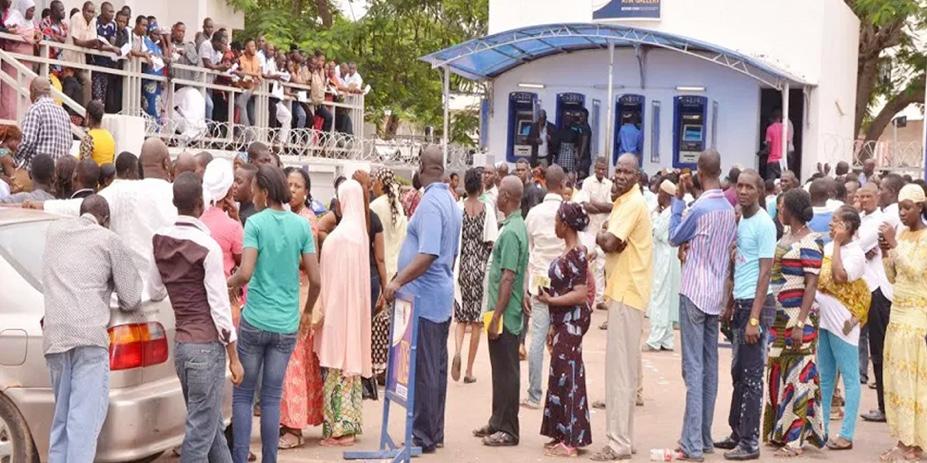
Exclusion during the Covid-19 lockdown. With pent-up demand and no opportunity to access financial services online and remotely, people swarmed the banks immediately the lockdown was eased to try desperately to put themselves on the inclusion ladder.
Twitter was filled with many posts warning Nigerians about the risks of visiting any bank branch due to the mammoth crowd “Customers besiege banks on first day of partial lifting of COVID-19 lockdown” was one of the screaming headlines on social media.
Even though a lot has been achieved by leveraging Fintechs for Financial Inclusion, a lot more must be done to tip the scales. According to Sofie Blakstad, chief executive of Hiveonline, “Banks just aren’t set up to understand small businesses.” There is an estimated $2tn gap between SME funding needs and what banks will provide.
Mpesa Agent in Kenya
Scenes outside bank branches in Nigeria on the first day after lockdown
China is the undisputed World leader in Fintech
For years, emerging economies have looked up to developed countries for ideas about how to manage their financial systems. When it comes to Fintech though, the rest of the world will be studying the experience of the emerging markets, especially China. By just about any measure of size, China is the world’s leader in Fintech. It is by far the biggest market for digital payments, accounting for half of the global market, according to the Economist Magazine. A ranking of the world’s most innovative Fintech firms gave Chinese companies four of the five top slots in 2016. The largest Chinese Fintech company, Ant Financial, and affiliate of the Alibaba Group, has been valued at about $60b, at par with UBS which is Switzerland’s biggest bank.
Today, digital payments account for nearly two-thirds of non-cash
payments in China, far surpassing debit and credit cards. Peer-toPeer (P2P) lenders in China grew from 214 to over 3,000 in 2015, and P2P loans increased 28-fold from 30b yuan in 2014 to 850b yuan in 2016. This shows what is possible in Africa.
The Ausso Leadership Academy (ALA) has been running for the past couple of years now, how does it help to make an impact on the financial technology sector?
The Ausso Leadership Academy was set up to mentor entrepreneurs and business leaders to optimize the jobs they create to enable shared prosperity, through institutionalizing and scaling their businesses geometrically. The goal is to create an Expanding Oasis of Outstanding Businesses through impacting at least 200 Entrepreneurs each year.
There is a huge leadership gap between the visionary entrepreneur cadre and the next management layer required for the journey of sustainable business in Africa. The Ausso Leadership Academy fills this huge vacuum by making practical and democratizing entrepreneurial and business mentorship through experiential skill transfer, emphasizing what
has worked and the pitfalls to avoid. The huge success of the technology entrepreneurial ecosystem in Silicon Valley is largely due to such deep mentorship regime. This is the model that the Ausso Leadership Academy is replicating in our environment. The need for resourcefulness and an innovative mindset to reinvent oneself when disruption knocks is a key skill every business needs to survive present market realities. A lot of the Delegates to the Ausso Leadership Academy are from the Financial Sector including Companies seeking to test out innovative ideas in the fledging Fintech sector.
The Ausso Leadership Academy has had remarkable success in the past two years with over 65 “Champions of Business” with proven track record, sharing experiences and mentoring over 150 Business Leaders and Entrepreneurs across 15 Local and International MNCs and 54 Entrepreneurial Businesses.
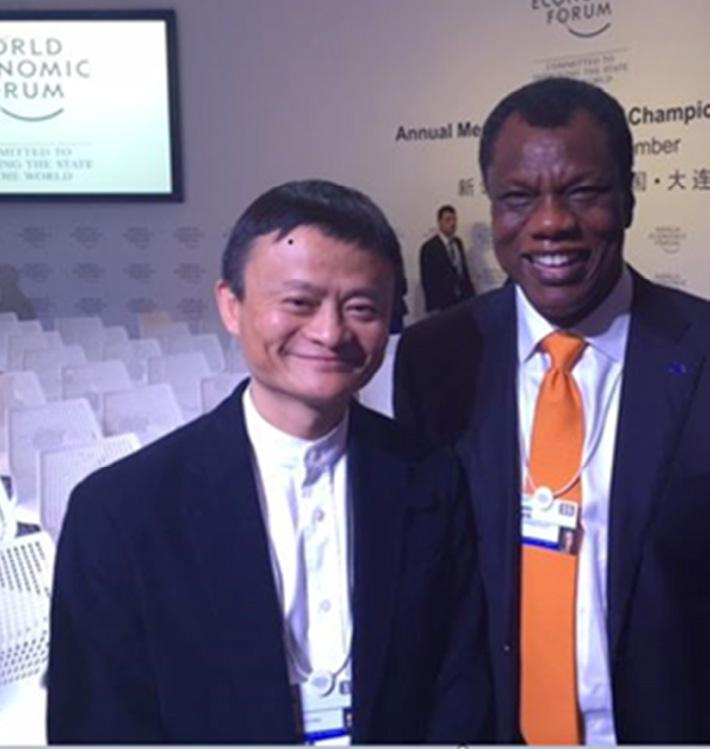
Jack Ma, Founder of Alibaba and Austin Okere
What are your thoughts on the current digital banking environment and suggestions for improvement?
Regulatory gaps and security concerns
Security has been a major concern in the Fintech space. Last week Wirecard, a German Fintech company disclosed that some of its cash was missing, eventually admitting “that there is a prevailing likelihood that the bank trust account balances in the amount of 1.9 billion EUR do not exist.” Wirecard announced on June 22, 2020 that they would file for insolvency. Freelancers around the world are unable to access their money from their prepaid Payoneer card. Despite the security challenges, Regulators cannot wish away the coming disruption by Fintechs and so have to find proactive ways in which to remain relevant in policing the sector. The Central Bank of Nigeria (CBN) is finally wading in to create a form of oversight by releasing a draft framework for regulatory sandbox operations aimed at controlling innovation in the Fintech sector. The new sandbox will contain a formal process for firms and startups to conduct live tests of all-new, innovative products, services, delivery channels or business models. With the new system,
all fintech innovation will have to go through a controlled environment with regulatory oversight, subject to appropriate conditions and safeguards set by the CBN. The sandbox application process is open to both existing CBN licensees such as financial institutions and other companies, including technology and telecom companies intending to test innovative payments products they want to be licensed. The regulatory body claims that the new framework will reduce time-to-market for innovative products, services, and business models. However, with the CBN having full control over innovation in the sector, there is a palpable concern that innovation could be stifled. It may seem however, that this an acceptable trade-off to ensure security and peace of mind for customers.
Where
do you see the future of digital banking
in Africa?
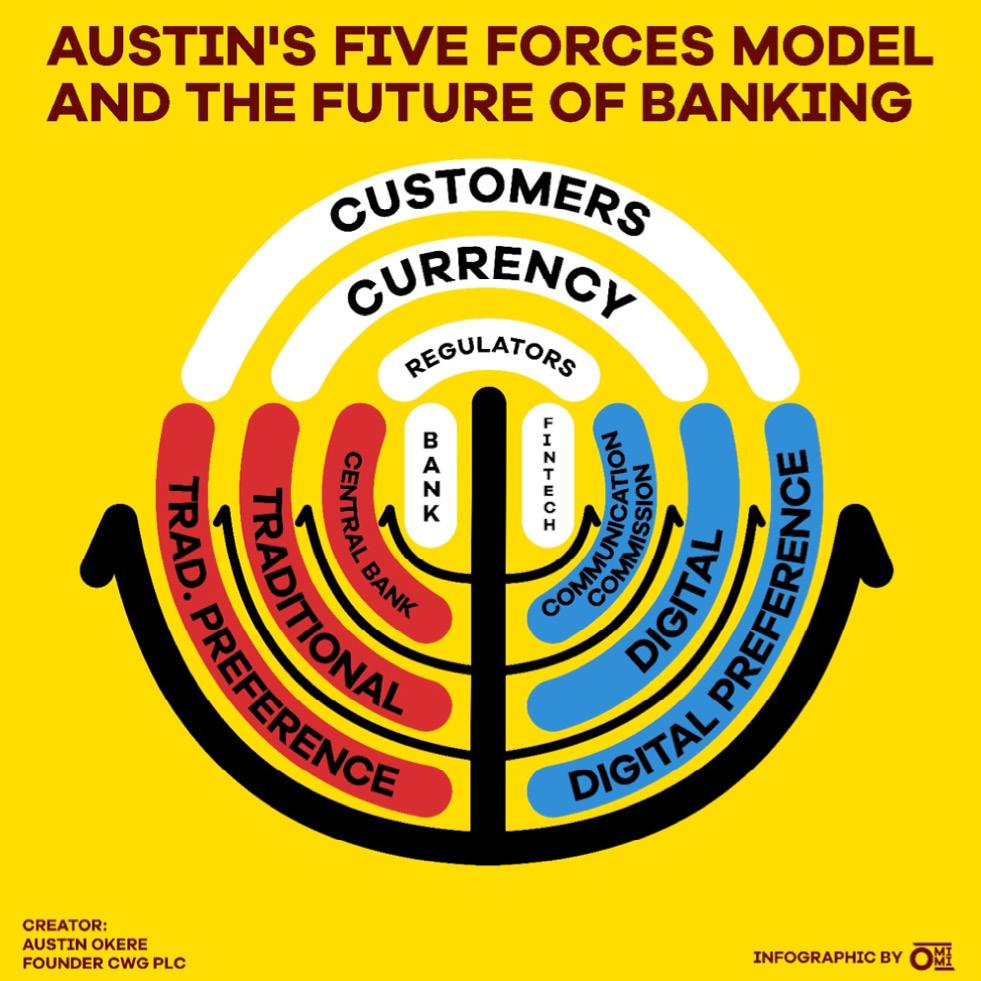
Austin’s Five Forces Model and the future of Banking
In the face of the fierce challenge facing banks, I developed a model for analyzing the future of banking called the Austin’s Five Forces Model. There are indeed five major forces at play here:
The Austin’s five forces model provides an experiential way to analyze the future of banking (as against banks)
The banks: traditional and established, best with cash and ancillary instruments
Fintechs: the new kid on the block, disrupter, mostly telecom roots, best with digital currencies and mobile services
Regulators: Central Banks, regulating traditional banks; and Communication Commissions, responsible for telecoms regulation
Currencies : traditional, such as cash and cheques; or Digital, including Bitcoin or other cryptocurrencies
Customers, and the weight of their new-found voice. Typically, they clamour for whatever will give them convenience, security and lower costs.
Customers are the most significant force, represented by the outermost sector of the concentric circles. As they tend more towards a preference for digital currencies, the Fintechs will tend to assume a more prominent role in the new face of banking, and the Regulatory regime will inadvertently tend towards the Communication Commissions under whose purview the Fintechs fall. This will introduce a regulatory imbroglio, as future ‘Huge Banks’ may fall outside the regulatory ambit of Central Banks as seems to be the case with MPESA. Safaricom, the telecoms promoter of MPESA ironically falls under the regulation of the Communications Authority of Kenya rather than the Kenyan Central Bank.
If the customers, however, maintain a strong appetite for traditional instruments
of financial transactions such as notes & coins, cheques etc. then the current status quo will remain. The face of banking will thus be more of the same, and the regulatory authority will continue to be Central Banks. Between these two positions is a wide spectrum, depending on the appetite and preferences of customers, and the pace at which they are willing to embrace change.
Will Retailers jumping into Financial Services help Financial Inclusion?
Fintechs are not the only ones challenging traditional banks for turf. Retailers are also jumping into the financial services fray. For instance, Amazon has launched Amazon Cash, a way to shop its site without a bank card. This product is meant to appeal
to the those who get paid in cash, don’t have a bank account or debit card, and who don’t use credit cards.
Google is also rolling out a new integration on mobile called Google Tez, which allows audio QR Codes and thus opens the door for more basic phones other than smartphones. Users of the Gmail app on Android will be able to send or request money with anyone, including those who don’t have a Gmail address, with just a tap. Facebook has also launched WhatsApp Banking. Considering that WhatsApp reaches more than 1.5 billion people in over 180 countries, this could transcend many regulatory jurisdictions in one fell swoop. Unfortunately for Facebook, Brazil’s Central Bank and antitrust regulator suspended her WhatsApp messenger payment features in the country, the app’s
second-biggest market with more than 120 million users; ostensibly to preserve an adequate competitive environment. Bank authorities requested that Mastercard Inc. and Visa Inc. stop payment and money transfer activities through the app. This headwind has considerably reduced the pace of advancement in the Fintech community.
The future of Fintechs
The future of Fintech seems bright. Accenture recently released a report which found that investment in Fintech around the world has increased dramatically from $930 million in 2008 to more than $12 billion by early 2015. Fintechs employ Artificial Intelligence, Big Data and Machine Learning to glean the credit habits of customers from their mobile usage, and so have mitigated against the risk of default. The homepage of LendingClub (NYSE: LC) advertises personal loans of up to $40,000. You can “apply online in minutes” and “get funded in as little as a few days,”. Another prominent Fintech lender Funding Circle claims that small businesses can get loans from between $25,000 and $500,000 in as little as 10 days. These innovative services seek to fill important niches in credit markets. They enable people who have historically been shunned by banks to get loans in order to expand their businesses.
Fintechs are now getting a lot of support from Governments,
believing that Fintech firms are small enough for any problems to be manageable, and on the other hand, might produce useful innovation. The intention is to lower market entry barriers for fintech companies. For instance, France’s Central Bank has announced opening up a new innovation lab, aiming to collaborate with blockchain startups. In December 2015, Nasdaq executed its first trade on a blockchain, through its Linq ledger. The exchange said blockchain promises to expedite trade clearing and settlement, reducing all the steps needed to transfer the asset from seller to buyer including recording the transaction from three days to as little as 10 minutes. That’s because the trades remove many manual processes and bypass third parties. As such, “settlement risk exposure can be reduced by over 99%, dramatically lowering capital costs and systemic risk,”. Other stock exchanges tinkering with blockchain include Australia, Germany, Japan, Korea, London, Toronto and Myanmar.
The changes coming with Fintech and the underlining Blockchain technology will be as large as the original invention of the internet. Who would have imagined a decade ago that e-commerce, championed by Amazon and Alibaba will be displacing high street retailers, or that ridehailing will be dominated by UBER, a technology platform? The corona virus pandemic has made the question of Financial Inclusion a more pressing imperative, and Fintech seems to be our best shot at it.
Austin Okere is the Founder of CWG Plc, the largest security in the technology sector of the Nigerian Stock Exchange, and Entrepreneur-in-Residence at CBS, New York. Austin also serves on the Advisory Board of the Global Business School Network, and on the World Economic Forum Global Agenda Council on Innovation and Intrapreneurship. Austin, a NonExecutive Director of Globus Bank now runs the Ausso Leadership Academy focused on Business and Entrepreneurial Mentorship
Covid-19 Are Rwandan Banks Ready
As The Country Moves Swiftly Towards A Cashless Society?
Over the past couple of years, a lot of Rwandan banks have had to alter the way they do business so they can keep up with the pressures from mobile operators and the ever-changing demands of their customers.
The advent of Covid-19 has led to governments in many countries enforcing lockdowns which have made it even more difficult to access cash. However, as things have taken a different turn, Rwandan banks now need to move faster towards aligning with the rest of the world is going cashless, but are they ready?
Indeed, as a safety strategy resulting from the fears of catching the virus by touching infected surfaces, most local banks in Rwanda have been making intensive efforts targeted at encouraging their customers to go cashless. Is this the end of cash as we know it?
Who Won’t Be Carried Along?
Right now, Rwanda’s younger generation, the affluent, and tech-savvy are leading the uptake of cashless systems. Also, a lot of service providers are increasingly encouraging their customers to use digital channels more often. Some banks have invested resources in customer education. Sensitising the customer on how to use banking technologies securely. However, a lot still needs to be done to help small business owners who still prefer to accept payments in cash because they find the new payment terminals convoluted, unreliable, and a costlier way of doing business in low-profit margin areas.
Most customers prefer the ‘cash on delivery’ option as they get to pay only after receiving a product or service but the seller bears the risk in these types of transactions and would be better served by electronic payment options.
Ideally, a cashless society does not give room for errors. Banks have to ensure that their systems are resilient enough to handle new technologies and upgrades as well as secure their channels against fraudsters.
In general, businesses selling products or services at a fairly low cost, such as motorcyclists, minimarkets, fast food vendors, cabs, and a lot of others are more likely to reap the benefits of installing POS (Point of Sale) terminals that allow cashless payments which have been discovered to be suitable for most customers and the elderly.
Ultimately, there are fears that removing cash from circulation is bound to negatively affect numerous groups in the society especially customers with learning disabilities, the less well-off who keep tabs of their spending by using a cash budget, customers who can’t make purchases on their own, and those who live in remote areas where the internet is less reliable.
Banks Now Know Why E-Payments Is the Way to Go
The current banking infrastructure was built to handle a high cash society but is no longer
viable to cater to a cashless one. The irony.
With cashless systems, banks no longer need to store and distribute cash. This lessens the need for ATMs and physical branches. That saves money. Also, transactions can be carried out faster and at a reduced cost too, with fewer employees to handle them and fewer mistakes. That again saves money.
Can We Completely Move Away From Cash With The Current Banking Technology?
There have been noteworthy technology failures in several banks over the last couple of years which the affected
customers won’t forget in a hurry. So, there is a bit of scepticism about whether the existing banking infrastructure is robust enough to drive a cashless banking system, especially when the technology fails. From the look of things, not every customer is ready for the transition to cashless systems.
Ideally, a cashless society does not give room for errors. Banks have to ensure that their systems are resilient enough to handle new technologies and upgrades as well as secure their channels against fraudsters.
Priming for Digital Banking
Mobile operators have an extensive network of resellers which they have managed to increase significantly over a couple of years. A sign of
success. However, it’s been a different story with the traditional banks. Their efforts have largely been unsuccessful, with studies revealing extremely high rates of failure – close to 84% – of their digitalisation projects.
The reasons for these failures are many-fold, ranging from intricacies of their current IT systems and infrastructure to a lack of expertise to run digitalisation projects, as well as bank workers slowing down the progress of digitalisation drives due to the fear that they may lose their jobs if the industry goes fully digital.
The only way some banks have managed to record successes is by partnering with FinTech companies that are more adept and technically skilled than they are. The result is a blend of brand name, experience, trust, and reputation of the bank with the
skills and technical know-how of the FinTech company.
There’s Still A Lot to Be Done
Even though the requisite infrastructure for cashless systems is now ready, banks need to make sure their systems are secure and robust enough to handle the extra volumes of digital payments that will be coming their way.
For each bank, there has to be a concerted effort to train and educate people in the society who are reliant on cash so that they can be carried along. This is necessary because there is now a plethora of viable options to traditional card payments as an alternative to cash payments. These are digital wallets, open banking, payments made within apps, internet banking, and mobile banking.
Even though the requisite infrastructure for cashless systems is now ready, banks need to make sure their systems are secure and robust enough to handle the extra volumes of digital payments that will be coming their way.
Financial services providers should assess their physical locations to make sure that branches that have been kept open still have an effective way of contributing to their host communities. Also bank staffs need to lay less emphasis on processing and focus more on human interactions that are most important to a banking relationship.
The Heads of Digital & Technology along with the Customer Experience Officers of banks should be charged with channelling the focus of the banks in the right direction. Definitely, open banking together with instant payments has strong benefits over card transactions. Merchants who decide to opt-in to this service will without a doubt feel these benefits. However, Technology & Digital officers in banks need to be aware that in a situation where there is no Plan B, Plan A is all they’ve got, and they need to make it work.
Digital Banking Nigerian Banks Want a Piece of the Action
As part of a strategy to attract new customers, Nigeria’s traditional banks roll out a variety of products to announce their incursion into the world of digital banking
Recently, some traditional banks in Nigeria announced that they will be competing with their e-banking counterparts with the launch of a range of digital banking services.
Over the last couple of years, an increasing number of Nigerians have embraced digital banking because of the higher fees charged at traditional banks. Customers in the smaller cities have also been keen on taking up online banking because it provides stress-free access to financial services.
Previously, traditional banking institutions in Nigeria had stood by and watched as online financial institutions built successful and profitable businesses. Now they want a slice of the pie and online banks are getting jittery about the prospects of losing out to physical banks because the latter has bigger financial muscle and more experience.
A bit of Context
The capacity of Nigerians to save has been impeded by a rise in inflation and one of the worst recessions that the country has ever faced, and which it has been slow to come out of. This has given rise to the launch of some FinTechs to encourage young Nigerians to embrace a culture of saving and investing.
The strategy from Nigeria’s digital banks was to target semi-urban and rural customers in places where traditional banks had little or no presence. Customers were encouraged to receive or withdraw funds through their digital platforms. To chronicle the chain of events;
PiggyVest (previously known as PiggyBank) started offering financial education and banking services to clients in 2016. While CowryWise, in 2017, began offering a range of services such as digital savings, wealth management, and investments.
By 2019, a digital-only bank known as Kuda Bank entered the fray, offering free debit cards, cheap inter-bank transfers, and a pledge to always provide improved customer service. With Kuda, you can make 25 free bank transfers each month.
Carbon is another digital bank that has done great things
in the Nigerian market. The founder of Carbon plan to “become a pan-African digital bank”. Their forays have driven them into the Kenyan market.
Tagged the ‘golden age of FinTech’, the digital banking craze has gotten to the whole of Africa in a frenzy.
Indeed, in sub-Saharan Africa, digital banking services like mobile money had grown to 43% in 2017 from 23% in 2011. Kenya has been the leader of this digital banking revolution. With more than 60% of Kenyans owning a
The capacity of Nigerians to save has been impeded by a rise in inflation and one of the worst recessions that the country has ever faced, and which it has been slow to come out of. This has given rise to the launch of some FinTechs to encourage young Nigerians to embrace a culture of saving and investing.
mobile phone, 9 out of 10 people in the East African country have a mobile money account. And 27% have taken an online loan.
The Counter
Brick-and mortar banks are fighting back, with some observers having the belief that the digital-only banks can only come out second-best when the gloves really come off.
In 2017, Wema Bank launched ALAT in Nigeria. It is Africa’s first fully digital bank. Also, Sterling bank has introduced a new digital-only banking platform known as GoMoney.
Standard Chartered Bank also has a new offering, a digital bank targeted at the youth market. The
bank is dangling several carrots; unlimited free bank transfers and Zero fees on ATM withdrawals.
According to Mide Akinduko, a Nigerian student, “Standard Chartered Bank comes with years of experience and a global reputation and it can easily kick Kuda out of the market.”
However, no matter how hard the traditional banks try, they are still a bit short of offering benefits close to what their digital banking counterparts are offering.
Mutual funds and loans were not available from my bank the way they were available in other apps like Carbon and Cowrywise,” says Akinduko.
However, experts still believe that at the end of the day, cash and brick-and-mortar banking institutions will remain the leaders in Nigeria.
Oluwaseun Oyajumo, an investment and venture analyst, explains; “People unfairly assumed that low transfer fees were the main value proposition of these fintech platforms, however, some have had higher charges than the banks. Their main value is in their nimble approach and ease of use.”
A few of the digital banks have welcomed the competition, saying it can only help everyone improve.
According to a brand engagement strategist at Cowrywise, Ajetomobi Feranmi: “At Cowrywise, we decided to work beyond trying to own a market, to become the underlying technology for old legacy financial institutions to meet with the new younger demographic.”
A lot of consumers have nothing but praise for digital-only FinTechs and the way they have addressed their apprehensions at a time of tough regulations.
In my opinion, the FinTech startups have done a lot about the distribution of their products and easing customer pains in the past few years of existence. Their main obstacle to doing more has been relatively onerous regulations,” said Oyajumo.
However, it’s highly likely that Nigeria’s smaller e-banks will be consumed by the traditional banks. Oyajumo
says: It’s inevitable that some of these startups will get acquired in the next 5 years as the banks rather than organically build innovation, buys them to acquire a new demographic of customers and technical and business innovation at the same time.”
Final Thoughts
The advent of digital banking and the rise of e-banks mean traditional banks have no other choice but to deliver improved services at a reduced cost to consumers. Only time will tell if some of the fledgling e-banks will end up in the bellies of their bigger rivals. However, as we already know; when a bigger elephant and a smaller elephant fight, there can only be one winner; the customer.
African Finance Evolution of
Digital Banking is the new trend across Africa as Financial Institutions compete for the Continent’s Young and Tech-Savvy
Financial institutions in Africa are evolving at a very fast pace with the expansion of digital banking platforms targeted at the growing population of smart and tech-savvy youths. With services such as digital wallets, branchless banking, and financial transactions on mobile gadgets, customers of these institutions are enjoying a transformation never seen before on the continent.
to some much-needed confidence within the industry. While speaking about Africa’s move toward digital banking, CEO of EQIBank, Jason Blick, said “Africa is benefiting from an unexpected advantage: its historically modest telco infrastructure”. He continued, “It’s a perfect storm of opportunity for forward-thinking digital banks, many of whom see Africa as the world’s No.
profitability. Africa gives us the opportunity to help address some of the continent’s historic economic challenges while also driving expansion in our digitalbanking products and services.” EQIBank is a global digital-only bank serving both private and corporate clients.
The increasing acceptance of digital banking platforms across the industry is all-encompassing with digital startups and existing banks all jostling for space.
For instance, one institution that is making its way through the digital transformation is Standard Chartered Bank which launched its first fully digital bank in Côte d’Ivoire in 2018, according to Jaydeep Gupta, Chartered Bank’s Africa and Middle East head of Retail Banking. This year, the bank has rolled out more digital-only banks across
Africa covering Tanzania, Botswana, Uganda, Zimbabwe, Ghana, Zambia, and Kenya. And there’s more to come.
According to McKinsey, the main business driver across these digital banking platforms is a plan to reduce costs through the use of endto-end automation and getting rid of branches.
Gupta said; “We will launch the digital bank in Nigeria” before year-end, says Gupta, “and we are keen to maintain our momentum and expand across the region with the digital-bank solution where it is needed most.”
The mobile application from Standard Chartered allows customers access to a range of banking solutions without needing to visit a physical branch. “Demand for digital banking services is coming directly from consumers,” says Gupta, “particularly in sub-Saharan Africa, because of a high mobile penetration and a digitally savvy, young population” who are hungry for digital experiences across sectors.
Another institution, WEMA Bank, a 75-year-old Nigerian bank, launched Nigeria’s first fully digital bank in 2018, offering branchless customer service.
Ecobank, another front-runner, has successfully rolled out its digital banking platform known as Xpress, a platform that garnered 3 million customers all over Africa within six months.
Africa’s emerging digital models consist of fintechs, startups, and Telcos trying to make it into banking, according to strategy company, McKinsey.
These include South Africabased banks Tyme Bank and Bank Zero. Patrick Motsepe’s African Rainbow Capital controls Tyme Bank which became the first fully digital bank in South Africa after launching branchless operations in August. It runs mobile and online platforms in addition to kiosks inside retail outlets like Boxer stores and Pick n Pay supermarkets, which provide a kind of physical presence to customers. To open an account, customers need an ID number and a South African mobilenetwork number that will prompt some additional questions and confirmations.
According to McKinsey, the main business driver across these digital banking platforms is a plan to reduce costs through the use of end-to-end automation and getting rid of branches. The strategy experts also point to “increased cross-sell through advanced analytics to identify relevant offerings for customers that they can purchase directly on digital channels” as a significant business driver.
Investing in Youth
Chijioke Dozie, CEO and cofounder of the Lagos-based financial services company, Carbon, affirms that South Africa, Kenya, and Nigeria have remarkably high prospects for digital banking, especially among the youth.
According to Dozie, “Many people under 30 have largely been underserved by the traditional banking system. For many of these consumers, financial inclusion is about having access to the necessary advisory and business management services to enable their businesses to thrive and expand anywhere. Africa is a mobile-first market—and in some cases mobile-only—and most people are used to accessing a wide range of services primarily via their mobile phones. Adding banking to this range of services will not be too much of a challenge.”
As well as extensive smartphone use, sub-Saharan Africa is a key market for mobile money. In 2018, the region recorded a 14% yearly growth of registered mobile wallets to 396 million, according to GSMA, a trade group. Telecoms companies are seizing the opportunity to launch digital banking services in places like Nigeria, Tanzania, Zimbabwe, and Kenya, either in collaboration with banks or as part of mobile money solutions connected to banks and available through mobile phones.
McKinsey reports that more than 40% of banking users in Africa prefer digital channels for their financial requirements. The preference is stronger at Standard Chartered Bank, where about 96% of its digital banking customers “prefer to transact outside the physical branch network.” Standard Chartered’s elite customers follow the same trend. “Today, half of our Priority Banking clients use our digital channels, and close to 40% of our Private Banking clients use their mobiles to manage their banking needs,” says Gupta. “We fully expect these numbers to grow as we continue to introduce new features to bring greater ease and convenience for our clients. Additionally, our digital banks in Africa are serving over 85,000 new registered users.”
Despite facing limitations such as regulatory holdbacks, high data costs, and the dearth of skilled technologists to drive the deployment of the platforms, digital banks will introduce the much-needed competition into banking in Africa, and this should help cut fees, says Joanne Kumire, a market research analyst at 11:FS, a fintech consultancy.
its sister bank, for a lot of support with both banks having left the aegis of Econet Wireless, the mobile telecoms giant.
McKinsey warns that despite the early success recorded with digital-only banking platforms, some countries are more open to change than others. For instance, some North African countries like Morocco and Tunisia, with deeprooted banking infrastructure, might not be as ambitious for branchless services as lowbanking-penetration countries such as Egypt.
Creating the Perfect Environment
Zimbabwe’s mobile money platform – EcoCash, now provides a service where diaspora remittances are converted into local currency. This is done in collaboration with moneytransfer partners like Western Union. EcoCash also offers crossdigital financial services such as payments, microloans, and transfers with Steward Bank and other partner banks. EcoCash has relied heavily on Steward Bank,
Confidence in financial innovations can only be increased by regulations that are better and more consistent. According to a World Bank report, governments in sub-Saharan African countries have started to develop regulatory policies in response to the advances in digital banking and financial services. They are fine-tuning current legal and regulatory frameworks to tackle challenges relating to Anti-Money Laundering and Combating the Financing of Terrorism methods, consumer protection,
competition, and data privacy issues. However, the World Bank warns that a lot still needs to be done.
Despite facing limitations such as regulatory holdbacks, high data costs, and the dearth of skilled technologists to drive the deployment of the platforms, digital banks will introduce the much-needed competition into banking in Africa, and this should help cut fees, says Joanne Kumire, a market research analyst at 11:FS, a fintech consultancy.
According to a World Bank spokesperson, “In addition to creating an enabling legal and regulatory environment, many developing economies, including in the Africa region, can play an active role in facilitating digital financial services by supporting the development of critical financial infrastructure that would support the interoperability of payment instruments or integration of digital data into credit reporting systems.”
Unlocking the prospects of digital banking in Africa depends largely on how solutions and platforms are tailored to suit the local markets and their specific features, especially incessant power outages. However, the fastpaced adoption of these services so far suggests that there is a high level of bullishness that the industry will maintain its current momentum.
Examining the Impact of Digital Banking on Financial Inclusion
Even though 800 million people in the subSaharan region of Africa don’t have access to mobile internet, mobile money solutions from mainstream banks have recorded successes in African countries with large populations of the unbanked, prompting a shift towards the growth of digital banking Africa strategies across the continent.
in Africa
Africa’s young population, the large numbers of smartphone users, and the dearth of access to commercial banking services has created a situation that favours the rapid growth of digital banking solutions across the SubSaharan region of the continent. In a bid to take advantage of existing telecoms infrastructure, Africa’s banking industry has decided to go mobile-first, and this seems to be a smart move as
mobile broadband networks serve over 70 percent of the population, indicating a great chance of success for digital banking Africa.
Besides, because digital accounts can bring down transaction costs by close to 90 percent, financial institutions could be raking in huge profits while maintaining low expenses for customers.
According to Thairu Ndungu, Consolidated Bank of Ghana’s Deputy Managing Director, the biggest drivers of digital banking are the young and tech-savvy, who prefer to check their bank balance on a smartphone rather than visit a bank branch or ATM hundreds of miles away, especially in the rural areas.
Ndungu, speaking in The Hague while attending the Temenos Community Forum 2019 said: “The biggest opportunity [for digital banking] is the young demography across Africa, People between the age of 20 to 35, who are very technologically conscious, are looking at ways of banking like it’s social media... and as such, banks have now the opportunity to attract those kind of clients by moving more and more to the digital side of banking.”
This new breed of young banking customers expects to have 24/7 access to services, whether it’s sending money to family via international transfer or being able to access Twitter.
For Standard Chartered, the British Multinational bank, the latest trend is a result of a retail banking sector, which, in trying to respond to low levels of banking uptake and significant reliance on cash in sub-Saharan Africa, has come up with innovative business models.
All the same, this drive for digital transformation does not signal a halt to investing in the physical infrastructure of banks, what it means is that the strategy has changed from an operationsbased one to a customer-centric strategy. Reaching clients more extensively and serving them practical products takes precedence over every day processes.
In an interview with CIO Africa, Michael Gorriz, Standard Chartered Bank’s Group Chief Information Officer, said “A digital delivery model can bring affordable banking to many more people than a traditional physical branches-only model,”
This does not mean we are downplaying the importance of our physical network. Our branches still have a role to play, but it is moving away from being transactions-focused and instead used as a means for us to educate our clients on digital, as well as advising them on more complex wealth and investment matters.
Mobile Money Pioneers
A paper on banking in subSaharan Africa by the European Investment Bank reports that by 2014, 11 percent of sub-Saharan Africans had mobile money accounts – the highest globally. This had grown to 21 percent of adults by 2017.
The ‘mobile money’ payment system is quite popular in subSaharan Africa. It involves the use of a mobile device to send, receive, spend, and store money without recourse to the banks or needing to open an account. The service is also useful for the payment of products and services at restaurants and shops in a way that’s fast and secure.
Mobile money is a handy and lowcost solution in less-developed or rural areas, where the customary banking and financial services are non-existent, and not viable for small businesses and low-income households.
In sub-Saharan Africa, the number of mobile money accounts exceeds that of traditional bank accounts, confirming the region as number one in the world when it comes to using mobile money services, according to Chris Skinner, a financial markets commentator.
M-Pesa, launched in 2007 by Safaricom, a Kenyan telecommunications company affiliated with Vodafone, is the most popular mobile money
service. M-Pesa (M for mobile and ‘pesa’ means money in Swahili) is a phone-based payment service where users can convert messages into cash at authorised agents and shops across the country.
Currently, about three-quarters of Kenya’s adult population (22 million people) are using M-Pesa and the company has extended its services to other African, Eastern European, and Asian markets.
Go Digital or Face Extinction: Banks Urged to Adopt Digital Banking Africa Solutions to Remain Relevant In the African Market
Traditional banks and financial institutions, after seeing the unparalled demands for mobile money services, have decided to take a chance on digital banking solutions to avoid going extinct in the market.
Uganda, Botswana, Ghana, Zimbabwe, and Kenya, have access to more than 70 banking services, including account opening, without going to a physical bank.
Analysts and economists at the BMCE Bank of Africa and the Institute of Africa agree on the advancement of digitalised services for the deposit, withdrawal, and transfer of money as well as applying for loans, as being vital to overcoming the challenges of financial inclusion in West and Central Africa. Two regions with high levels of mobile penetration that will likely ease the adoption of digital banking Africa.
Currently, about threequarters of Kenya’s adult population (22 million people) are using M-Pesa and the company has extended its services to other African, Eastern European, and Asian markets.
“The demographics of the clients
sourced to date are also good indicators that our digital proposition is truly meeting the needs of the customers,” explained Gorriz, “71 percent of our clients are under the age of 35; 96 percent of their transactions are conducted outside of our branches; the accounts are also highly transactional with usage of up to four times a week.”
Digital banking Africa may present an opportunity for financial institutions to attract rural and underbanked populations. If the digitalisation of banking services can maintain its current momentum in subSaharan Africa, the continent’s countries with the lowest banking penetration levels will possibly enjoy a better-quality and allencompassing access to banking services, promoting financial inclusion within these markets.
Earlier in the year, Standard Chartered launched the second stage of its digital-only retail bank in key African markets resulting from the success of the first phase in Côte d’Ivoire (CDI) in 2018.
Now, Standard Chartered Bank customers in Tanzania, Zambia,
How Covid-19 is Digital Finance Accelerating
Before Covid-19, digital finance was already changing at a fast pace. And since the start of the crisis, there has been an increase in government financial interventions and this is expected to continue post-the-pandemic. A changing attitude towards data is also expected to have a big effect on finance.
Over the past couple of months, Covid-19 has had a big impact on the global economy, and in turn digital finance. These are what to expect at the end of the crisis.
Changing attitudes towards Data
Data debates have always been about issues of privacy and if people are happy with using their data for platform services. Now, the discourse is changing. Various European governments are presently looking at the possibility of tracking health, location, and other personal data for monitoring, control, and personalised health advice on Covid-19. There are other instances where data sharing could be beneficial during a lockdown. Serious liquidity issues
arising from the lockdown have shown the need for quick credit checks. Therefore, platform data may prove to be valuable where financial data is not readily available.
Considering the challenges we’re facing, extensive data sharing may be the norm for now, even though data protection and usage are vital ultimately. It is also possible that, after the pandemic, people may see data in a new light by reconsidering its value, the likely benefits of sharing it, and the need to protect us all from data abuse. This may give rise to new business models, for instance, data guardians (a role banks are clearly in a great position to carry out). The acceleration of the creation of legal standards to regulate data sharing and protection is another likely outcome.
Cybersecurity
As more people work from home, there is an increased reliance on national and corporate network infrastructures. With a lot of resources reassigned to get things moving, businesses, and the health care sector, are at growing risks of cyber-security incidents like data leaks and ransomeware attacks, as well as the spread of fake news. Maybe it is all about creating security gaps that can be exploited later, but to guard against this threat, it is expected that cybersecurity will move to the top of the agenda for policymakers. And as this is a borderless crime, at the international level is where it’s best to fight it. The EU might set up an agency at its own level but the cooperation won’t be as deep
as what we have in finance and the markets.
Inequality and Financial Inclusion in Focus
The pandemic has revealed the disparity in society. Digital financial institutions will probably be asked to strengthen their drive towards financial inclusion by making it easier for temporary workers, the self-employed, as well as SMEs (Small and Medium-sized Enterprises), to access financial products. Limited availability of financial data coupled with the huge costs of processing them contributes to delaying access for these groups. Supplementing financial data with an array of non-financial data sources could be a solution to this problem.
Less Foreign Dependence
Covid-19 has shown how fragile governments can be, so both the authorities and businesses will be looking for less cumbersome cross-border supply lines and reduced foreign dependencies. However, with governments now realising the importance of highquality telecoms infrastructure to enable workers to work from home, countries like China; leaders in the required 5G technology, will know they are in a good position to negotiate.
Finance is now a complex crossborder business with connections ranging from financial ties to supervision and IT outsourcing. Authorities were already studying
these connections, which may yet come under intense scrutiny postCovid-19. Whether bigtech will continue to play a role in finance remains unclear with Europe’s growing criticism of bigtech before the pandemic. However, one thing is clear; Europe’s realisation that major digital platforms have become an integral part of daily life especially in this period of lockdowns.
More government involvement
To a certain degree, the involvement of government in the economy, as well as the financial sector, will most likely continue. With changes in the geopolitical scene before Covid-19, policymakers were already coming to terms with the strategic role of essential domestic infrastructures such as payments and communications. And since the European Commission has already identified data as a strategic priority, governments are finally waking up to the importance of data. In finance, governments have once again solidified their roles with the setting up of large guarantee schemes to help businesses survive the crisis.
The reality is, it will take a long time for governments to start reducing their levels of intervention in finance and the economy at large. And this will probably bring back the debates about the division of labour in finance with regards to private and public sectors, once this crisis ends.
Faster adoption in Retail
The retail sector is expected to adopt digital finance technologies at a fast pace after the pandemic. Many people have been left with no other option but to become used to doing business digitally, for instance, through video conferencing and using contactless modes of payment.
There is an expectation of rapid acceptance of identity verification via video calls which might be a boost for digital-only financial institutions, and probably be the death knell for brick-and-mortar financial institutions.
Final Thoughts
We have to be proactive in thought and our actions. The coronavirus pandemic is a massive shock that caught us all napping. However, we’ve started to notice a change in the way we collaborate; the public and private sector partnership in finance, the changes to worldwide interconnectivity, the importance of improved cybersecurity collaboration, fast-paced digitisation, better focus on financial inclusion, and a change in the way we see data. Indeed, policymakers and financial institutions need to start thinking about these all-important factors.
Origins and Growth Outlook of Digital Banking in Africa
While the banking sector is experiencing poor performances and slow growth in most parts of the world, Africa’s banking sector is growing at a fast pace, recording profits double the global average.
According to a study conducted by McKinsey consulting and made public in February 2018, Africa is now the
world’s second-largest banking market in terms of development and profitability.
And it’s all thanks to digital technology.
McKinsey reports that more Africans now have bank accounts with the numbers increasing from 170 million in 2012 to almost 300 million in 2017, and estimated to reach 450 million within the next five years. On the continental level, revenues are expected to grow from $86 billion to $129 billion between 2017 and 2019.
Yet, this performance is not evenly distributed across the different regions and countries within the continent with just five African countries namely Nigeria, Angola, Morocco, South Africa, and Egypt, currently accounting for 68% of the total banking revenues on the continent. This explains the emergence of innovative business models to solve the myriad of challenges bedevilling
Africa’s retail banking sector, especially low level of bank access, weakness of ATMs and branch networks, and the massive dependence on cash.
Even though traditional banking services are yet to be extensively adopted by Africans, the continent’s reliance on mobile and digital offerings is on the increase. With 5 branches per 100,000 African residents compared to 13 branches per 100,000 in emerging Asian markets, the rapid growth of digital banking is hardly surprising.
Indeed, between 2014 and 2016, the volume of digital banking transactions went up by 13% per annum in Africa, as a result of improved reliability, security, and availability of electronic channels. Africa is now the second-fastest developing market in the world in terms of electronic payments behind the Asia-Pacific region. Besides, using digital channels for banking transactions is now the preferred option for around 40% of Africans.
The Conception of Africa’s Digital Banks
Mobile money has grown from transactional operations such as salary payments, cash in and cash out, bank to mobile transfers, and bill payments to advanced financial services consisting of a complete ecosystem such as microfinance and insurance, and aided by a progressively developing digitalisation. Africa had around 346 million registered mobile money accounts in 2018 compared to 120 million bank accounts.
Kenya’s Safaricom, a subsidiary of Vodafone, started the digital revolution with the introduction of its mobile banking service known as the M-Pesa System. In a world that was hitherto very poorly banked, with a 5 to 15% banking rate in African countries, except for the Maghreb region and South Africa, mobile telecom companies took advantage of their closeness to customers to make use of mobile terminals, either through the use of basic phones known as ‘Feature phones’ on the USSD protocol or smartphones to provide an array of mobile banking services.
From Competitors to Partners: Mobile Telecommunications Operators and FinTech
The autonomous rise of FinTech has caused disruptions to the organised banking market for many years. As new innovative
players, FinTech is subjecting banks to a new type of competition in a market where the competition is already tough. Banks already have mobile telecoms operators and other companies specialising in money transfer and payments to contend with. These competitors now hold a huge market share courtesy of their innovations on mobile payment and mobile money transfer solutions. This leading position is only possible because they created awareness and educated people, particularly those with limited bank access who realise the benefits of dematerialised money compared to the customary bank account.
Traditional banks, faced with the latest innovations from operators and new players, and in the backgrounds of a booming market, have to adapt to stay competitive. Consequently, new partnerships have been formed between telecom operators and banks on the one hand, and FinTech on the other, to deliver online/mobile financial services to consumers while profiting from a lower cost than the branch network of the bank.
Digital Banking: The Morocco Angle
Many years after the M-Pesa application was rolled out, banking institutions are in the grips of a digital frenzy. They are increasing their investments in hopes of catching up in the areas of online financial services and mobile payments. For instance,
in Morocco and its Maghreb neigbours, where the central bank regulations are more stringent, banks have started to realise the importance of digital technology to their continued existence.
Recently, in September 2019, Inwi rolled out a mobile payment solution known as ‘inwi money,’ thereby becoming Morocco’s first telecom operator to deliver this kind of solution to the Moroccan public after getting approval from the Moroccan Central Bank; Bank Al-Maghrib to set up the payment institution. Inwi money will allow every mobile phone owner to have a mobile wallet linked to his phone number irrespective of his telecom operator. The customer can then fund his wallet or withdraw money from it using the various points of sale authorised by the telecom operator, or by using other means like a bank transfer.
Digital Banking: Solving Africa’s Problems on Financial
Inclusion
Sub-Saharan Africa’s high acceptance levels for digital banking solutions have turned the region into a beacon of light for the other regions of the world. In Africa, the limited level of banking coverage along with the proliferation of mobile phones has generated a powerful leverage effect, but in Europe and other developed regions of the world, the market is mature with a high population of banked individuals.
This is coupled with a denser and more qualitative banking system with broad banking networks that do not allow operators to take the place of banks. The expansion of 3G coupled with the rise in the number of people who use smartphones in Africa is opening new vistas and promoting access to banking services.
When it comes to disruptive innovation, the vastness of the systems required is always a difficult hurdle
The paucity of existing systems in Africa relieves the banks of this burden and allows them to forge ahead with their financial inclusion projects.
for banks to scale. The paucity of existing systems in Africa relieves the banks of this burden and allows them to forge ahead with their financial inclusion projects. Deploying digital banking solutions to serve the new population of users is a technological leap of faith. Therefore, digital banking provides an alternative to traditional banking that ensures banks can overcome the deficiencies in banking infrastructures to drive Africa’s financial inclusion project.
Sandboxes and Open Banking: Solutions to Financial inclusion in Nigeria?
Efforts by fintech companies, commercial banks, and the Central Bank of Nigeria (CBN) have been instrumental to the rising awareness of financial inclusion in Nigeria. Several products, solutions, and regulations have driven this buzz. One of such is the Central Bank of Nigeria making it compulsory for players in the agency banking sector to prioritise banking in rural areas to be awarded operational licences. These places must have had the minimal presence of banks and banking activities.
Commercial banks have responded to these affordable and easily accessible products by fintechs, not willing to lose ground in the financial sector, to the delight of customers who are spoilt
for choice. The recent flag-off of fintech sandboxes and open banking initiatives could spell good news for financial inclusion if their objectives are realised.
In 2018, the Open Technology Foundation launched Open Banking Nigeria to open up access to financial services via the harmonisation of Application Programming Interfaces (APIs) of Nigerian banks. The launch will integrate all innovations by third party providers to build financial solutions. The development of customised solutions will result from the seamless sharing of customer-permitted data.
The first innovation sandbox the financial technology industry has seen in Nigeria was launched
in December 2019 by Financial Services Innovators (FSI) in collaboration with the CBN and the Nigerian Inter-Bank Settlement System (NIBSS). One feature of the launch was a release of the NIBSS’ API in. One of the objectives of this sandbox was to create a safe testing environment for innovative ideas whilst gaining knowledge of industry licences and regulations.
Ecobank recently launched a similar product as part of its efforts to foster financial innovation. The pan-African sandbox, which will feature Kenya’s “Africa’s Talking” and Nigeria’s Flutterwave will flag-off in 33 African countries.
Financial Inclusion: A case for its relevance and sustenance.
According to reports, open banking is not expected to become widely known outside the financial sector but its work will benefit the consumer a great deal. Open banking will allow for seamless connection of a customer’s bank account with regulated third parties that could build up their credit ratings, offer automatic savings, discounts, and other products/services.
Damola Yusuf, Technology Advisory partner with PriceWater Coopers (PwC) in Nigeria and Adedeji Olowe, Trustee at the Open Technology Foundation, and the CEO of Trium networks suggest in their study that sharing of data and standardised APIs with third parties will enable financial institutions to reach underserved markets with a wider array of products than currently exist. Olowe opines that just as the establishment of a framework for card payments brought about the use of ATMs the world over, the creation of an API standard for all banks will usher a similar revolution in Nigeria.
A market survey carried out by a fintech in Kenya revealed that if a simple hotline, or an innovation office that is readily accessible is set up by the regulator, this could provide solutions to a lot of regulatory questions that a lot of startups encounter.
Investments at Flourish, believes that sandboxes can go a step further from lowering the barrier of entry for fintech companies to saving them a lot in time and cost of developing new products. He believes that some startups fail because of how much time and money goes into developing and conveying your product to the market, and ensuring they are well received by the market. “For example, the know-yourcustomer or KYC process is a huge problem for many fintech companies in Nigeria. Even though the bank verification number exists, to access the data behind the BVN of any customer, I need a licence, but if I’m a young startup, and I’m building a solution that requires KYC, I won’t have the money to get the licence, and most investor demand a startup has such a licence before putting in funds, but with a sandbox, startups can access existing APIs of established bodies and reduce the cost and time it will take to purchase a KYC licence” he adds.
Her Majesty, Queen Máxima of Netherlands, in a study of over 50 countries (Nigeria included), pointed out that although a sandbox has its merits, one could not ignore the cost and complexity that comes along with their usage. According to the report, sandboxes may not be as invaluable as they have been touted to be and may be insufficient to deepen financial inclusion not to mention the fact that there might be cheaper unexplored alternatives.
A market survey carried out by a fintech in Kenya revealed that if a simple hotline, or an innovation office that is readily accessible is set up by the regulator, this could provide solutions to a lot of regulatory questions that a lot of startups encounter. Another report suggests that comparative or risk-based licencing systems and regulations could help reduce the costs fintech startups incur to comply with regulations.
The story remains different for fintech startups in Nigeria as they grapple with insufficient financial firepower and the barrier of entry has remained high.
Ameya Upadhyay, CEO of
According to the United Nations, studies show that there are still some reservations despite the obvious benefits. A Special Advocate for Inclusive Finance and Development to the United Nations Secretary-General,
Olowe, in his 2020 forecast, predicts that CBN will kickoff open banking. His financial predictions leave us with this question: will the regulators’ catch-up game with innovation work apace with the sandbox to extend the current boundaries of financial inclusion that exist today?
Sierra Leone’s Thumbprint Innovation Means Unbanked Can Now Sign Up For Bank Accounts Sierra Leone’s Thumbprint Innovation Means Unbanked Can Now Sign Up For Bank Accounts
Other African countries can now look to Sierra Leone’s blockchainbased financial inclusion program for inspiration.
Several African countries with a large base of the unbanked population can look to Sierra Leone for inspiration as their recently launched blockchainbased financial Inclusion program allows citizens to sign up for a bank account with a simple press of their thumbs.
The Sierra Leonean government in collaboration with Kiva, a Silicon Valley microloan company introduced the Kiva protocol on Wednesday. The Kiva protocol is a biometric system designed to connect or recognize a person with their thumbprint.
This innovation offers a myriad of benefits; it will help the country generate a comprehensive credit bureau hitherto unimagined, supporters of the program hope that it will encourage reluctant banks to give loans to persons without credit histories, it will likely enable government services to get to those who need it most, it will help mobile operators and start-ups minimize costs and also help several businesses to come into a more formal economy.
“From the individual, to the start-up, to the government, to the business…the proof of ID becomes instantaneous, meaning
more access services for Sierra Leoneans” states Sierra Leone’s chief innovation officer, David Sengeh. “This is a great step that a small country is taking”
A report from Sierra Leone’s civil registration authority states that about 5.1m persons have registered for the program. Mr. Sengeh, assuring the citizens of the safety of their information indicated that the government helped Kiva to draft the data protection segment of the agreement, ergo, there should be no worries as regards the security of data.
Of the total number of adults in Sierra Leone, only about 20% have Bank accounts which can be linked to their per capita GDP of $500 per year. The government of Sierra Leone appraising the need for financial inclusion has made this a particular item of serious interest as it will likely help citizens climb out of poverty.
The current development is not unconnected with Technology; mobile money has brought an innovative system that has changed payments as we have come to know it thereby changing the landscape of business and savings all over Africa.
After the government launched a biometric, digital ID system in India, the number of her citizens with a bank account has climbed up to 80%. Several countries are switching to the budding blockchain technology which enables most companies or groups to maintain a stable information base. Facebook plans to create its blockchain network. The proposed blockchain network which was announced in June is aimed at providing free or very low-cost international money transfers through mobile phones for the large number of people who exist without a bank account.
Despite the obvious forward strides, certain challenges remain. According to the World Bank, around 1 billion people all over the world – a greater percentage of which can be found in SubSaharan Africa – do not possess primary credentials while a larger number possess inconsistent
or unverifiable means of identification.
According to the McKinsey Global Institute, about 3.4billion people possess some form of identification but are impotent to use it in the digital sphere. Less than 50% of children aged 5 or under have their births registered in most of Sub-Saharan Africa.
The World Bank also states that the group less likely to have any form of official identification are the poor, the women, refugees, disabled and those living in the rural parts of the countries. “This invisibility has significant implications” for individuals attempting to gain access to services, the World Bank said in a report published the previous week.
It went on to say “without a secure and trusted way to prove their identity, people…will often find themselves unable to access critical healthcare and social services, enrol in school, open a bank account, obtain a mobile phone, get a job, vote in an election, or register a business in the formal sector.”
Sierra Leone’s government aims to change all of that; Kiva avows that it aims to extend the scheme to other countries with the announcement due to be made later in the year.
Sparkle
The New Digital Ecosystem Aimed at Redefining the Lives of Nigerians the World Over
Sparkle, a digital ecosystem, was recently launched in Lagos. It aims to offer an allinclusive service to Nigerians in sectors such as lifestyle, financial, and business support.
The Central Bank of Nigeria has granted Sparkle the license it needs to provide banking operations to Nigerians. It promises the opportunity to experience a world driven by data. Its founder is none other than Tech Investor and former Chief Executive Officer of Diamond Bank, Uzoma Dozie. Mr. Dozie has always been involved in conversations about the use of technology in broadening the reach of the financial sector.
Before Sparkle, he launched TechFest in 2018 and is the brain behind Tech Turks, his online TV show that spotlights entrepreneurs.
Sparkle promises a data-driven platform that offers extensible
payment options and savings which will give its users control of their finances and will complement their lifestyle. With the launch of the mobile app which is available on android and iOS platforms, Sparkle emerges at a very advantageous time in Nigeria with data showing that 79% of the population has access to mobile services.
A large part of Nigeria’s closeto-200-million citizens are young, tech-savvy, and very active on social media. Businesses rely on social media to market their products and services to Nigerians, and Sparkle can take advantage of the current state of things with government restrictions on economic activities
forcing a rapid adoption of digital banking platforms.
Mr. Dozie had this to say on the day Sparkle was launched:
“Sparkle will be transformational for Nigerians across the globe and I am hugely excited to be launching it today. Sparkle is redefining Nigerian commerce by merging financial services with a seamless lifestyle solution. We are removing barriers using technology and data, driving inclusion at scale. In doing so, we are empowering Nigerians to fulfil their potential, democratizing access to valuable solutions for both business and personal needs. We are working with global partners to unleash freedom, flexibility and transparency in
services rendered, including public utilities. Sending and saving money can be done between sparkle users with or without their local bank accounts. The app comes with a tool called Sparkle stash which will assist users to improve their savings culture.
Adhering to the principles of financial inclusion, Sparkle has become a part of Women’s World Banking and will be championing the cause for all people groups in the world’s developing markets. Sparkle is also a member of Open Banking Nigeria in its bid to increase financial inclusion and forge partnerships in the financial services sector.
Mr. Dozie had this to say on the day Sparkle was launched:
“Sparkle will be transformational for Nigerians across the globe and I am hugely excited to be launching it today.
Nigeria. We are helping to drive forward the growth of Nigeria’s budding entrepreneurs and individuals. Join us to make history as we enter the future of commerce and look towards this exciting phase of growth.”
Sparkle’s users will enjoy a oneaccount multiple-wallet system. They will be able to monitor their spending trends section by section. Sparkle users will enjoy a 24-hour support from Indy, a chatbot developed for that purpose. Other services include split payments for products and
At Sparkle, the core values are transparency, freedom, simplicity, inclusivity, and personalisation. Customers will benefit from Sparkle’s partnerships with Microsoft, Price Waterhouse Coopers Nigeria, and VISA to revolutionise business and put back control in the customers’ own hands. The partnership aims to provide expert support in cloud computing, APIs, machine learning, data science, as well as tax and financial advisory services.
Standard Bank Improves Digital Drive with Cloud Collaborations
The financial services sector continues to welcome new entrants, increasing competition for the more traditional banking institutions, including older, more established players like Standard Bank.
The Journey so far….
Founded in 1862, Standard Bank prides itself as a top industry player in South Africa with longstanding interests across Africa. Reports for the first half of 2018 showed active customer strength of 11.8 million across Africa, with over 68% of that number in South Africa alone. As the world gravitates to a more platform-based business model, Standard Bank Group has been taking steps to offer nimble mobile banking solutions that customers can operate by themselves.
2019 was pivotal to the digitisation agenda of Standard
Bank. She contracted Amazon Web Services in March, to facilitate migration to the cloud alongside the launch of an AWS Cloud Centre of Excellence. As part of the deal, AWS was going to equip employees with training programmes that came with certification. They went further to revamp corporate functions on the roadmap to digital transformation in its bid to stay ahead of the competition.
Signing an accord with Microsoft in April of 2019 expanded their already fruitful relationship, upgrading their finance, treasury, and productivity functions with cloud services. This meant migrating their SAP S/4HANA
modules and SAP Enterprise Resource Planning to Microsoft Azure allowing Standard Bank to offer a new and improved customer experience.
Mr. Dozie had this to say on the day Sparkle was launched: “Sparkle will be transformational for Nigerians across the globe and I am hugely excited to be launching it today.
More than a hundred of its branches were shut down as the bank rolled out its remote banking strategy, partnering with iiDENTIFii in October of 2019. The tech company, based in CapeTown, added remote onboarding for digital biometric authentication to the Bank’s list of capabilities.
The deal with Salesforce
In June 2020, Standard Bank signed a contract that sees Salesforce take responsibility for running her Digital Platform which in effect allows Salesforce to be the oil in the wheels of her operational ecosystem. Existing deals with AWS and Microsoft Azure were vital on the path to signing a deal with the software solutions’ giants.
CEO of Standard Bank Group, Sim Tshabalala in an interview said the deal with Salesforce is the first of many more to come and it shows their resolve to give
customers as much freedom as they create customercentred products and services.
He stated thus: “Our extended agreement with Salesforce is a major step towards transforming the Standard Bank Group into a client-centred platform business that delivers a range of individualised, instantly available solutions, services and opportunities, enabled by modern digital technologies and delivered in whatever way a client prefers. Our goal is to use our data capabilities to build deeper, better and more enduring relationships with our clients.”
“With the Salesforce Customer 360 platform, Standard Bank will be able to build a single source of truth across the entire customer journey and respond quickly to changing customer needs” opines Gavin Patterson who doubles as Salesforce’s President and Chief Revenue Officer. He goes further to say: “Recent events have accelerated the digital transformation of all aspects of our society and a digital customer strategy is now imperative to the very survival of a business.”
One can see that Standard Bank Group has no plans to be left behind in the world of digital banking. By signing this agreement, they have bolstered their switch from a primarily offline-focused business model to a digitally run platform. Clientele can be assured of a more customer-centred approach based on data that will deliver products and services that will transform the business ecosystem.
Tshabalala had this to say: “In order to defend our markets and to grow new ones, we have to become a platform provider. And to do that, we have partnered with Salesforce, and also with Microsoft and AWS.”
“We don’t want to be the shop; we want to be the mall. We want to provide both our own services and the services of our partners in the Standard Bank Group ecosystem.”
Upgrading to cloud services has saved Standard Bank Group millions in the cost of product creation and dissemination, and with this changeover to a platform-based business model, the bank stays ahead of the competition, moving into the future of financial services whilst maintaining a long, rich history of driving business growth in Africa. Clients can now come on board the platform and create products and services that suit their businesses.
A Look at the Four African Cities Evolving As Fintech Hubs
Africa continues to take giant strides towards the pinnacle of development where most of the advanced countries have already pitched their tents. This advancement does not exclude the wider tech community and Fintech. In several articles ranking cities noted to be on the growth path, emergent cities, including those from Africa, are beginning to stand up and demand notice. The economic benefits of growing Africa’s Fintech ecosystem cannot be overemphasised because growth in the Fintech sector will cause an avalanche of innovations to sweep through the continent, not only that, it will also encourage home-grown talent and promote intellectual property.
According to the estimates of several reputable platforms, Africa remains home to the biggest population of unbanked and underbanked people. The International Monetary Fund (IMF) concurs with this assessment whilst asserting that Africa’s informal economy is one of the largest in the world. This landscape presents Fintech start-ups and Small and Medium Enterprises (SMEs) with the perfect platform to key in and utilise this reservoir of underbanked and unbanked citizens. The statistics emerging out of Africa in 2018 showed that Africa amassed more than $1 billion in Venture Capital funding for start-ups and much of the capital and deal-flow from this funding went to Fintech.
Below are four of the emergent Fintech hubs in Africa;
Lagos: Nigeria, the most populous country in Africa has Lagos as her commercial hub with a population of more than 20 million inhabiting the megacity. Several of the country’s financial institutions are domiciled in Lagos with institutions like First Bank of Nigeria, Access Bank, First City Monument Bank, and Ecobank. Close to these Nigerian banks are some international establishments like Citibank. The 2017 Global Findex report published by the World Bank stated that, as at 2017, 40% of Nigerian adults operated a bank account, 6% owned an online account while more than two-thirds of adults had a mobile phone. These statistics show that Nigeria’s relatively young and digital native population presents a fertile ground for Fintech to flourish.
The megacity has several startup incubators like LeadPath, Passion incubator, Co-creation, and Wennovation Hub domiciled within her borders thus proving its readiness to help Fintech flourish in all aspects.
Johannesburg: Some of Africa’s leading banks and financial institutions are domiciled in Johannesburg, the largest city in South Africa. These banks and institutions include Standard Bank Group, FirstRand, Absa Group, Nedbank Group, and Investec making Johannesburg a melting pot of Fintech opportunities for Africa. Utilising its position as South Africa’s primary financial hub, it has created an ecosystem that supports the growth of Fintech.
ProjectKhoka and the intergovernmental Fintech working group overseen by the South African Reserve bank has made a direct contribution to the development of Fintech. The city is fast becoming the hub of attraction for the banking needs of lowincome customers, insurance, and financial inclusion Fintech. Over 220 programs in the city of Johannesburg provided support to start-ups. 30% of the 450 startups projected to exist in the city are Fintech related.
Nigeria, the most populous country in Africa has Lagos as her commercial hub with a population of more than 20 million inhabiting the megacity. Several of the country’s financial institutions are domiciled in Lagos with institutions like First Bank of Nigeria, Access Bank, First City Monument Bank, and Ecobank.
The Fintech Association of Nigeria is a component in the ecosystem attempting to get Fintech thriving. The first African Fintech summit held in 2018 was hosted by Lagos.
Capetown: Another big player in Africa’s Fintech game is South Africa’s second-largest city, Capetown. Major tech industries, about 47% of them start-ups, can be found in the western cape of the country, where the city of Capetown is located. Gauteng, where Johannesburg is located, has 44% of start-ups.
Besides being home to most of the county’s tech start-ups, Capetown also provides 75% of
the nation’s venture capital deals. 20% of the over 500 entrepreneurial companies located in Capetown are e-commerce companies while 15% are Fintech companies. The oldest tech incubator in Africa can also be found in Capetown; The Cape Innovation and Technology Initiative (CiTi). “Capetown has an international pool of talent, a growing ecosystem of support and a relatively low cost of living, helping promote not just Fintech but tech in general.” Reports the CiTi website.
Many of South Africa’s rules are Fintech-friendly. To help Fintech thrive, the South African Reserve Bank created the Financial Technology Programme; this program is aimed at assessing the growth of Fintech and the consideration of the regulatory implications of
its emergence. Several papers on crypto assets have been released by the Financial Intelligence sector, Conduct Authority, National Treasury, South African Revenue Service, and the South African Reserve Bank to enable a wider range of understanding of Fintech offerings.
Nairobi: Kenya’s capital city was ranked second after Johannesburg as Africa’s largest Fintech hub. The Findexable Global Fintech ranking published in 2020 by Findexable Limited states; “Nairobi is Africa’s second-largest Fintech hubs, with an estimated 20 percent of Africa’s Fintechs and an emerging ecosystem of local investors and venture capital firms complemented by a steady rise of international investors and growing interest from global firms.” In Nairobi, the Fintech companies have
The four cities presented above made it into the global top 100 Fintech Ecosystem list on the inaugural edition of the Global Fintech index city rankings. To achieve a perfect ranking, the following factors and more were taken into account; the number of Fintech start-ups and hubs in the city, the scale of investment, and the regulatory environment.
hinged their major operations on the provision of payments, remittances, banking, and lending technologies.
The four cities presented above made it into the global top 100 Fintech Ecosystem list on the inaugural edition of the Global Fintech index city rankings. To achieve a perfect ranking, the following factors and more were taken into account; the number of Fintech start-ups and hubs in the city, the scale of investment, and the regulatory environment.
Several other African cities did not make it into the first 100 but they are making giant advancements in the Fintech sector. These cities include; Ghana’s capital city, Accra, Rwanda’s capital, Kigali, and Egypt’s capital, Cairo which was not recorded here because Egypt is often placed in the same box as Middle Eastern countries.
Fintech offers Africa enormous opportunities and will help fill up certain gaps and proffer innovative solutions that will have global ramifications.
Thousands of Zambian Farmers Get Access to Digital Banking through AgriPay
Zambia has more than two million smallholder farmers alongside a rural population of almost 9.7 million. About 40% of these are financially excluded
Zambia has a rural population of about 9.7million people, 40% of which do not operate any bank account. Paying for goods and services is difficult for this set of people. They cannot receive payment for goods and services via online payment portals, so a lot of productive hours are lost trying to go about their economic activities.
The average farmer lives many kilometres away from his closest neighbour, and even farther away from agro-dealers and banks. With over two million small-holder farmers, sending and receiving money conventionally is difficult not to mention it significantly reduces their productivity. Being unable to make and receive digital payments hurts the planning and easy flow of goods and services. Where banking services are available, they are sometimes limited and can further take time to process transactions.
Farmers are vulnerable to too many avoidable risks with the status quo, and so getting rid of these inconveniences will have far-reaching effects on rural communities. Reduced downtimes as a result of payment transactions and confirmations will improve the
flow of goods and services.
Zanaco Bank identified this bottleneck and has partnered with Mercy Corps/Agrifin Accelerate (AFA) and the UNCDF (UN Capital Development Fund) to develop and test their strategy to reach farmers directly and avail them of the opportunity to send, save and receive money with ease. Features like agronomic information and financial literacy will be added to accelerate the financial inclusion of farmers in the Zambian economy.
How AgriPay was conceived and introduced
Before AgriPay was released by its partners, AFA conducted market research to understand the needs of farmers and what their distinct financial challenges were. This formed Zanaco’s customer-centric design process for the development of the product.
When the product was fully developed, the team set out to design strategies for its release to its rural customer target. This strategy involved using the Booster Team model - a model modified from UNCDF’s work with a coffee value chain in Uganda. UNCDF
championed the use of the Booster Team to bring in agents that would enhance last-mile service delivery and build a strong, self-sustaining ecosystem around the use of the AgriPay account. The Booster Team also got smallholder farmers involved.
The developing partners (Zanaco, AFA, and UNCDF) identified the need to collaborate with other actors in the value chain to encourage easy adoption by agribusinesses. This collaboration was supposed to help AgriPay leverage on their customer base to bring in other customers that may be outside the rural farmer target market. Several agents offering banking services sprang up, as a result, offering banking services closer to farmers.
The bank channelled the product in six provinces, with the Booster Teams comprising 15 – 20 youths, who had received sufficient training in sales and had appreciable knowledge of the product. These teams were equipped to demonstrate the product to potential customers.
By the end of the pilot phase, a partnership with Musika (a non-
profit organisation that aims to support private sector development in small-scale agriculture) had already yielded about 50% of Xpress agents and members of the Cotton Association of Zambia had already contributed 60% of activated farmers’ accounts.
Who opened AgriPay accounts?
In May 2019, Zanaco and UNCDF the Booster Teams were deployed to begin their awareness and onboarding activities. Beginning in Central and Lusaka Provinces, and going on to Copperbelt, Luapula, Eastern, and Southern, each Booster Team responded to smallholder farmers’ questions and addressed concerns promptly.
This direct system of support boosted customer confidence, put them at ease with the new accounts, and was responsible for signing up 307 Xpress agents to the AgriPay ecosystem.
Around September 2019, AgriPay had signed up 3,030 customers, 31% youth and 53% female, and farmers were pleased to embrace the account because they were custommade to their needs.
Brillian Handondo, a farmer in Southern Province said, “This account has really helped me. Once I receive money, I’m able to easily transact, such as sending money to my child in college.” This simple transaction was previously difficult to do.
What were the contributing factors to AgriPay’s success?
The AgriPay pilot achieved what it aimed to do –increase access and usage of digital financial services by underserved sections of the population.
This direct system of support boosted customer confidence, put them at ease with the new accounts, and was responsible for signing up 307 Xpress agents to the AgriPay ecosystem.
Many decisions were pivotal to the success of AgriPay, one of which was the decision to unveil the product in stages and learning from challenges encountered in each phase to ensure smooth implementation and upscaling. Pre-sensitization efforts also meant Booster Teams were very familiar with the product and could disseminate the right information to farmers. Key partners like the Cotton Association of Zambia, Dairy Association of Zambia, and Vitalite Zambia helped build trust in the product. Other partnerships with various non-profit organizations and farmers’ associations gave them the mandate to be ambassadors of AgriPay and present the product to farmers.
Cotton Association savings groups and Vitalite traders became agents, as AgriPay leveraged on the strength of these organizations to reach potential customers.
The Booster Team’s success was driven by the inherent trust customers and agribusinesses have in the partner or the agribusinesses they are used to working with. This is an immense success factor for AgriPay.
For the successful extension of AgriPay to other provinces in Zambia, sales teams have to understand the culture of target communities. It is important to learn the type of farming carried out in a locale and carry out sensitization based on their schedules. Flexibility and learning from each phase also mean where necessary, the bank may engage floating agents who could better reach farmers in certain areas rather than fixed agents.
AgriPay is successful because it provides a platform to increase financial inclusion for farmers, and the account also allows digital expansion for the smallholder farmer and their communities. This digital ecosystem of services significantly enhances the quality of life in these rural communities and everyone can contribute more to the economy.
Why Every Nigerian Should Embrace Digital Financial Literacy in the Post-COVID-19 Era
In a bid to increase the contribution of the ICT sector to its economy, Nigeria sets a 95% digital literacy target over the next ten years under the Digital Economy Strategy.
In a bid to increase the contribution of the ICT sector to its economy, Nigeria sets a 95% digital literacy target over the next ten years under the Digital Economy Strategy.
Digital literacy has become more important for the growth of Nigeria’s developing economy, more so in these times that the country’s economy is being ravaged by the COVID-19 pandemic and a slump in oil prices.
Since the start of the pandemic, the Lagos State Government has kicked off a partnership with Microsoft Office to provide training in digital literacy for 18,000 secondary school teachers. The program aims to equip, engage, and train them on how to leverage technology to deliver classes during the lockdown.
On the other hand, and as a result of the obvious digital literacy gaps in the country, digital financial literacy is yet to see the uptake that it deserves. Companies like NetPlusDotCom have been organising webinars to sensitise Nigerians on the significance of an unavoidable transformation to digital payments and financing after COVID-19.
The fact is, there is an abundance of talent training outlets in Nigeria, such as Learn Factory and Decagon. These outlets offer training programs covering an array of specialised and advanced digital literacy skills in fields like Artificial Intelligence, Machine Learning, and Software development.
With the hope of tapping into the services provided by these outlets, the country has come up
with a Digital Economy Strategy aimed at meeting a 95% digital literacy target within the next ten years. The goal is to make the ICT sector more active in the Nigerian economy. Last year, the ICT sector generated 13.8% of the country’s GDP, higher than the contribution from the Oil and Gas sector, which had hitherto been the country’s cash cow.
Unfortunately, the development of digital financial literacy in Nigeria is bedevilled by certain challenges including;
Policy Implementation: existing regulations aimed at promoting digital literacy are not implemented.
Difficulty in Conceptualisation: digital literacy is considered to be too difficult to theorise, so it is assumed that the layman will find
understanding the process a bit difficult.
Resistance to Change: most times people resist change. Having the same attitude towards digital literacy hurts the promotion of digital financial literacy.
High Infrastructure Costs: power and access to the internet are quite costly, and they are important for promoting digital financial literacy.
Digital Divide: some unreached communities are unaware of the concept of digital literacy.
Scepticism: there are pockets of Nigerians who are sceptical about the digital literacy program.
School Curriculum: there is no component of digital literacy in
the regular curriculum. This is necessary for the future.
Recommended Solutions
Government and other institutions should invest in research and development to help Nigerians become more acquainted with international standards of promoting digital literacy.
Tax incentives/reliefs for telecoms companies to enable them to reduce data costs. While the telecoms companies can in turn provide ICT parks for free internet access.
Create awareness and engage citizens more on existing and new digital literacy policies.
Organisations with works
centered on digital literacy should partner with schools to come up with a more robust curriculum.
To stop the resistance to change, orientation programs should be developed to emphasise the need for digital literacy using a bottomtop approach in reaching out to people in rural communities.
Partnerships between Government, civil society groups, and multilateral organisations should be considered. This provides an avenue for reaching underserved communities in the local language to avoid indifference due to language barriers.