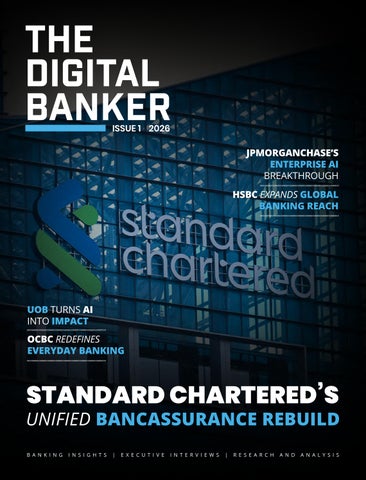
TDB 2025 - Issue 1 - SC 05022026-compressed

Page 1


THE DIGITAL BANKER

UOB TURNS AI INTO IMPACT

OCBC REDEFINES EVERYDAY BANKING

The shift from reactive servicing to predictive, real-time engagement marks a fundamental change in how banks and insurers use data.

8

11

A unified bancassurance platform: Standard Chartered’s largest digital rebuild in a decade

Standard Chartered unified bancassurance on a cloud-native platform, enhancing scalability, compliance and integrated digital insurance experiences across global markets.

20

JPMorganChase’s LLM Suite drives AI transformation across the enterprise

JPMorganChase’s LLM Suite embeds secure generative AI into daily workflows, boosting productivity, governance and enterprise-wide innovation at scale.

14

AI in action: How UOB is turning intelligence into impact

UOB applies AI across credit, risk, compliance, and operations to deliver fairer decisions, stronger governance, and measurable customer impact.

22 NBC advances responsible AI innovation across risk, operations, and research

National Bank of Canada applies responsible AI across fraud, operations and research to strengthen trust, efficiency and employee experience.

17

HSBC Hong Kong expands wealth-client offering with launch of invitation-only Privé credit card

HSBC Hong Kong launched Privé, an invitation-only card delivering bespoke lifestyle privileges and personalised services for ultra-high-net-worth clients.

HSBC Hong Kong applies AI and analytics to enhance customer engagement and digital banking

HSBC Hong Kong leverages analytics and generative AI to turn customer signals into personalised engagement while embedding responsible, well-governed innovation.

24

Standard Chartered launches AI Factory to unify innovation and governance

Standard Chartered’s AI Factory centralises AI development and governance, accelerating innovation while ensuring secure, responsible enterprisewide deployment.

26

29

Security is an innovation enabler, not a constraint: Cezary Piekarski of Standard Chartered

Standard Chartered embeds security-bydesign, automation, and responsible AI to protect clients while accelerating digital banking innovation.

36

32

QBE Asia advances claims management with ‘Solution in a BoX’

QBE Asia’s unified digital claims platform automates processing, accelerates payouts and elevates customer trust through seamless, data-driven experiences.

Generative AI powers a new era of efficiency for Bank of China (Hong Kong)

BOCHK leverages generative AI to enhance relationship management, accelerate decision-making, and foster an AI-first culture across enterprise operations.

38 HSBC expands global reach with Global Money

HSBC’s Global Money platform enables seamless multi-currency banking, strengthening borderless wealth and transactional experiences for global customers.

34

Hua Nan Commercial Bank drives digital transformation via a customer-centric business model

Hua Nan Commercial Bank leverages AIdriven, customer-centric models to boost engagement, conversion and sustainable growth across digital finance.

Standard Chartered’s AI journey accelerates with research, safety-first integration and governance

Standard Chartered advances enterprise AI through research partnerships, secure generative tools, and robust governance to scale responsible innovation across the bank.

40

Finastra embeds generative AI to resolve trade finance’s expertise crisis

Finastra embeds generative AI into trade and lending platforms to close skills gaps, boost efficiency, and preserve institutional expertise.

42 “Corporates need to be at the forefront of change” —

HSBC’s Manoj Dugar

HSBC outlines how instant payments, tokenisation, and AI are reshaping Asia’s payment landscape and redefining cross-border treasury operations.

46 HSBC Hong Kong pioneers remote account opening for international customers

HSBC Hong Kong enables fully remote international account opening, simplifying cross-border onboarding and strengthening its position in global retail banking.

54

Emirates NBD modernises core pricing with Zafin to enhance agility and customer experience

Emirates NBD modernises pricing through a cloud-native platform, enabling faster innovation, personalised offers, and stronger governance across banking segments.

56 Talos builds a stronger unified digital asset platform

Talos unifies data, execution, and portfolio management to deliver institutional-grade digital asset trading with transparency, liquidity, and regulatory resilience.

49

52

Juris Access cuts loan approval time from days to less than 10 minutes

Juris Access uses AI orchestration to streamline onboarding, cut approval times to minutes, and improve risk-controlled lending at scale.

59

Standard Chartered strengthens digital wealth offering with upgraded mobile app and AI advisory

Standard Chartered enhances digital wealth through mobile-first investing, automated advisory, and AI-powered insights to deliver personalised, scalable client experiences.

BMO leverages AI at scale to deliver smarter, faster banking experiences

BMO deploys AI across forecasting, personalisation, and employee tools to enhance efficiency, governance, and customer engagement.

62 Innovation meets efficiency: How HSBC is simplifying the banking experience for its customers

HSBC simplifies authentication with Mobile Approve, delivering secure, onetap identity verification and frictionless customer experiences across all banking channels.

64 J.P. Morgan Payments recognised for advancing AI in Payments software delivery

J.P. Morgan Payments uses AI-powered testing to accelerate software delivery, improve reliability, and scale innovation across global payment systems.

67 The role of the treasurer has really evolved: BMO’s Konstantin Goushin

BMO empowers treasurers with AIdriven insights, real-time payments, and embedded finance to transform treasury into a strategic growth function.

70 Raising the bar: How OCBC is redefining everyday banking in Singapore and beyondy

OCBC elevates everyday banking through AI-driven personalisation, inclusive products, and seamless omnichannel experiences across Singapore and the region.

73 A digital blueprint for the future: How FAB reinvented the national housing loan experience

FAB digitised national housing loans end-to-end, delivering faster approvals, transparent construction management, and inclusive, customer-centric public banking services.

76 NTT DATA redefines enterprise automation with Agentic AI platform DICE

NTT DATA’s DICE platform orchestrates agentic AI and human oversight to deliver scalable, ethical automation across regulated enterprise environments.

78

FactorEvo: Building the cognitive infrastructure of modern finance

FactorEvo introduces cognitive finance infrastructure, using generative AI to embed real-time audit, governance, and intelligence into capital workflows.

A unified bancassurance platform: Standard Chartered’s largest digital rebuild in a decade

Standard Chartered has completed a sweeping overhaul of its technology platform underpinning its bancassurance offering, replacing fragmented legacy systems with a unified, cloud-native platform that supports multi-market delivery and integrated wealth insurance journeys.

Standard Chartered has finalised one of its most extensive technological transformations in recent years, completing the decommissioning of its Global Banca Platform (GBP) and shifting eight major markets to a unified Online Banca System (OBS). The upgrade strengthens the bank’s wealth and retail banking proposition by embedding digital protection capabilities directly into client-facing channels, creating a more consistent and secure experience for affluent clients across Asia, Africa and the Middle East.

Building one platform for a multimarket footprint

Bancassurance is a key component of Standard Chartered’s Wealth and Retail Business, providing services to affluent clients throughout its international network. The bank offers life, health, and general insurance solutions in collaboration with Prudential, Allianz, and MSIG, utilising both advisory and digital channels to deliver comprehensive support.

As a multi-year programme, the bank rebuilt the technology foundation underpinning these services. In 2024, Standard Chartered fully retired its GBP, and completed a global migration to the cloudnative OBS. The transition brought major markets such as Singapore, Hong Kong, India, Malaysia and the UAE onto a standardised digital infrastructure hosted on Microsoft Azure and AWS.

The rebuild also enabled the next stage of omnichannel insurance delivery. The bank’s myInsure platform, which facilitates digital insurance journeys, was upgraded to support remote advisory, e-applications and self-service tools. These enhancements allowed clients to review their portfolios, identify protection gaps and complete fulfilment processes on mobile and desktop channels without friction.

Regulatory compliance formed a core part of the redesign. Across all markets, Standard Chartered strengthened its risk posture through enhanced Internal Control Standards and proactive vulnerability remediation, tightening cybersecurity and operational safeguards as digital volumes continued to grow. In particular in China, the bank introduced automated regulatory workflows integrated with SC Mobile, ensuring real-time adherence to evolving requirements.

What distinguishes the project from peers is the decision to deploy a single platform across diverse markets, rather than operating market-specific systems. This multi-jurisdictional architecture was designed to accommodate local regulatory constraints while maintaining consistency in technology performance, client experience and risk controls. According to the bank, the approach

Global Head, Bancassurance, Wealth and Retail Banking

Standard Chartered

provides greater scalability, reduces duplication and accelerates the rollout of new features.

Enhancing resilience, compliance and client engagement

Gautam Duggal, Global Head, Bancassurance, Wealth and Retail Banking at Standard Chartered, stated: “The transformation has generated benefits for both client experience and internal operations. For clients, our unified digital architecture provides faster onboarding, more precise insurance gap analysis, and seamless access to protection products through a blend of remote advisory and self-service options. By integrating wealth and insurance journeys, our advisers are able to leverage consolidated data to deliver more personalised recommendations to clients.”

The transformation also saw improvements in operational efficiency. The decommissioning of the legacy platform removed system redundancy and reduced IT maintenance costs, while cloud adoption enhanced scalability and system resilience. With all markets running on the same infrastructure, updates and product enhancements can now be deployed more quickly and consistently. The improved setup also supports frontline teams with more reliable tools, reducing friction in client engagement.

Internal risk management strengthened as well. The enhanced cybersecurity framework and cloudbased security measures reduced operational and regulatory risk exposure, addressing vulnerabilities that were common in legacy infrastructures.

Standard Chartered is preparing for the next phase of development. Planned enhancements include AI-driven protection recommendations within its digital banking channels, embedded claims servicing with real-time visibility, expansion of OBS capabilities to additional markets and new integrations with health, lifestyle and retirement ecosystems. These additions are expected to further streamline processes for both clients and advisers while deepening the bank’s digital wealth proposition.

“By

integrating wealth and insurance journeys, our advisers

are

able to leverage consolidated data to deliver more personalised recommendations to clients.”

- Gautam DuggalGlobal Head, Bancassurance, Wealth and Retail Banking Standard Chartered

The programme earned the bank the ‘Best Digital Transformation Program – Bancassurance’ award, and also ‘Outstanding IT Transformation by a Retail Bank’ award for consolidating other legacy systems into a scalable, multi-market platforms and or delivering a cloud-ready, omnichannel experience for affluent clients at The Digital Banker’s Global Retail Banking Innovation Awards 2025.

In addition to these accolades, Standard Chartered has also been recognised with:

• Best Digital Insurance Platform

• Best Digital Transformation Program

• Best Digital Bank – Brunei

These awards underscore the bank’s ongoing leadership in delivering digital solutions that enhance client experience, operational efficiency and multi-market scalability.

By consolidating bancassurance operations onto a unified, cloud-native platform, Standard Chartered has laid the groundwork for more scalable and client-centred insurance delivery. The transformation marks a significant milestone in the bank’s broader strategy to modernise its digital infrastructure and strengthen its wealth and retail offerings across its global footprint.

AI in action: How UOB is turning intelligence into impact

UOB is setting a new benchmark for intelligent banking through its deployment of artificial intelligence (AI) across the bank. From faster, fairer credit decisions to riskaware private banking and next-gen compliance, UOB is proving that AI can drive innovation beyond financial services, enhancing risk management, compliance, and controls for a smarter and safer future. Reaffirming this, UOB won five major awards for its use of AI at The Digital Banker’s inaugural Global AI Innovation Awards 2025.

Beyond operations, its predictive analytics are improving client experiences — including predicting wait times at branches. Alongside these efforts, the Bank has partnered with National University of Singapore (NUS) and Infocomm Media Development Authority (IMDA), to launch the Artificial Intelligence Data Analytics (AIDA) Centre of Excellence (CoE), to

cultivate an AI talent pipeline embedded directly into its innovation engine.

Revolutionising credit decisioning

UOB implemented the B-Score 2.0 initiative to enhance its internal risk monitoring capabilities

within the Singapore Commercial Banking (CMB) portfolio. The original B-Score model was designed to predict non-performing loans (NPLs) over a 12-month horizon.

B-Score 2.0 was developed with a broader and more proactive strategy. It expanded the scope of risk detection to include accounts showing early signs of payment delay (about a month late) and other accounts flagged for potential risk, in addition to non-performing loans (NPLs). The model also shortened the prediction horizon from 12 months to nine months, enabling earlier intervention.

B-Score 2.0 incorporates several AI-driven innovations that distinguish it from traditional credit risk models and competitors. At its core, the model uses XGBoost — a reliable powerful machine learning tool known for its prediction accuracy. It analyses over 3,100 data points collected from various sources, helping the model identify subtle risk patterns more effectively. The model ensures that high-risk cases are flagged for intensive review and includes embedded explainability, enabling transparent investigations and informed decisionmaking.

This tool has delivered significant benefits for UOB, with the model showing strong predictive performance and supporting more effective credit risk management for the Commercial Banking team. UOB was recognised for this achievement by winning ‘Outstanding Use of AI in Credit Decisioning’ at the Global AI Innovation Awards 2025.

Boosting regulatory confidence

UOB Private Bank (PB) launched Project Magnet to strengthen customer trust and safeguard their interests. This initiative is a key enhancement to manage conduct risk and anti-financial crime risks.

Unlike traditional sampling methods, Project Magnet leverages a scalable, data-driven solution to monitor transactions comprehensively and detect potential risks. Its unsupervised machine learning models enable nuanced, real-time insights, ensuring early intervention and 100% transaction coverage.

Unlike traditional sampling methods, Project Magnet leverages a

scalable, data-driven solution to monitor transactions comprehensively and detect potential risks.

Beyond safeguarding client interests, Project Magnet distinguishes itself by delivering advanced insights that go beyond traditional methods, ensuring more robust and reliable safeguard for customers. For setting a new benchmark in responsible AI deployment within financial risk management, UOB was recognised with the award for ‘Outstanding Use of AI in Risk Management – Private Banking’.

Similarly, UOB launched the ‘Mystery Shopper Compliance Monitoring’ programme – a groundbreaking initiative built from scratch. It revolutionises risk management by harnessing Voice-to-Text and Large Language Models to analyse sales calls. This AI-powered solution transforms unstructured voice data into actionable insights – boosting compliance, transparency, operational efficiency and customer trust across the bank – and setting a new benchmark in AI-driven governance. This initiative was recognised by The Digital Banker as an ‘Outstanding Use of AI in Risk Management –Compliance’.

Reinventing the branch experience

For UOB Group Channels & Digitalisation (GCD), embedding AI into operational workflows has been a continuously evolving process. One of its most visible deployments can be seen in the Branch Wait Time Prediction Model, which enhances customer experience through data-driven insights. It leverages machine learning to estimate individual customer wait durations at the point of registration, using historical and real-time queue data to

provide customers with real-time visibility into their expected wait times. The model enhances transparency and reduces uncertainty and helps customers better plan their visits, leading to a smoother and more predictable branch experience while reinforcing the bank’s reputation for reliable and customer-first service.

This deployment reflects a pragmatic approach to AI and demonstrates UOB’s commitment to its customers, for which it was awarded ‘Outstanding Predictive Analytics Initiative – Branch’.

Nurturing talent

In a bid to promote responsible AI adoption and develop talent in this growing field, UOB set up the AIDA Centre of Excellence (CoE), a first-of-itskind structured AI and Data Analytics programme co-developed with Infocomm Media Development Authority (IMDA) and the National University of Singapore (NUS). It is aligned with Singapore’s National AI Strategy 2.0, and provides a talent pipeline for outstanding university graduates within

the AIDA field to join UOB’s workforce.

As part of the talent development programme, in their first year, AIDA CoE associates will be embedded within UOB’s Innovation Group, with the goal of building strong AIDA foundational knowledge and will also pursue a Graduate Certificate in Business Analytics Practice from NUS-Institute of System Science (ISS). In their second year, they will progress to UOB’s core business units such as Private Banking, Group Retail (Personal Financial Services, UOB TMRW), Group Finance, Innovation Group, Group Wholesale Banking, (incl. Group Business Banking) to apply their skills and AI capabilities, alongside experienced practitioners, to deliver business impact and drive AI solutions and adoption throughout the business.

UOB was awarded ‘Best AI Strategic Partnership’ by The Digital Banker for its AIDA CoE. This is a pioneering initiative that embeds exceptional graduates into innovation and core business units to drive real-world impact through AI and data analytics across the spectrum of banking operations.

HSBC Hong Kong expands wealth-client offering with launch of invitation-only Privé credit card

HSBC Hong Kong debuts its most prestigious credit card - HSBC Privé for its private bank clients, an invitation-only credit card aimed at ultra-high-net-worth and high-net-worth clients seeking tailoured wealth and lifestyle services.

HSBC Hong Kong has strengthened its wealthclient strategy with the introduction of HSBC Privé, an invitation-only credit card launched in late October 2024 for ultra-high-net-worth and high-net-worth clients. Developed in-house by the bank’s Cards and Unsecured Lending team, the card is positioned as an extension of the bank’s private banking proposition, catering to clients with high

discretionary spending needs and internationally mobile lifestyles. Beyond payments, HSBC Privé intends to serve as gateway to bespoke lifestyle experiences, exclusive privileges, and ehanced servicing standards, reflecting growing demand among Asia’s wealthiest clients for personalised benefits that sit alongside traditional wealth management.

HSBC Privé launch gala event at The Henderson in 2024

Privé sits above HSBC’s existing Premier credit card and was designed to match the expectations of private bank clients who previously lacked a dedicated product tailoured to their unique spending patterns.

A tailored proposition for ultra-high-networth and high-net-worth clients

Privé sits above HSBC’s existing Premier credit card and was designed to match the expectations of private bank clients who previously lacked a dedicated product tailoured to their unique spending patterns. According to Mastercard’s Asia Pacific consumer spend insights 2023 credit card spending by ultrahigh-net-worth and high-net-worth clients in Asia Pacific nearly doubled between 2022 and 2023, highlighting the significant opportunity for top-tier propositions.

The card was designed following in-depth research into the lifestyles and spending behaviours of prestigious clients. According to the bank’s statement, a strong preference for exclusive access, personalised experiences, and bespoke services that reflect status and convenience. Privé therefore positions itself as a gateway to “Open Unparalleled Worlds”, delivering exceptional privileges across travel, dining, shopping, and leisure.

The suite of benefits includes access to more than 150 private clubs worldwide, bespoke dining privileges such as tasting menus at Michelin-starred restaurants, VIP shopping experience, and golf course benefits. Exclusive travel privileges extend to companion firstor business-class tickets, premium airport lounge access, and airport buggy services. Each cardholder is supported by a dedicated lifestyle relationship manager ensuring seamless experiences tailoured to their individual travel and lifestyle preferences.

Strong early engagement and a highprofile market debut

Early feedback from Privé cardholders has been positive. Clients have praised personalised services, including bespoke arrangements for family experiences and curated travel itineraries. HSBC reports that Privé cardholders exhibit an average monthly spend nearly ten times higher than other HSBC cards, with some clients doubling total card spending within three months. Exclusive events associated with the card have also generated new wealth management opportunities, demonstrating the product’s cross-business impact.

HSBC launched the card in Hong Kong with a prestigious event at The Henderson, featuring a fine-dining experience crafted by Chef Lee YukLam, a special appearance by actress Carina Lau and

performance by Korean superstar Rain. The event was further elevated by a multimedia spectacle, including a stunning drone display and mesmerising magic acts.

Currently, Privé is available by invitation only to selected HSBC Private Bank clients in Hong Kong, India, and Singapore. The card has generated interest from prominent business figures and celebrities, strengthening the bank’s engagement with its clientele while solidifying its competitive standing in Hong Kong’s credit card market.

HSBC Privé won ‘Best New Product Launch of the Year’ at The Digital Banker’s Global Retail Banking Innovation Awards 2025, recognised for delivering a highly tailoured proposition that combines exclusive privileges, personalised service, and exceptional client engagement.

HSBC Privé Anniversary dinner at Chatham Maison, a Grade II historic building in Hong Kong.

HSBC Hong Kong applies AI and analytics to enhance customer engagement and digital banking

HSBC Hong Kong’s 2024 technology programmes — from generative AI tools to data-driven platforms for marketing, operations, and wealth — show how the bank is turning customer signals into intelligence and embedding responsible innovation across its business.

In 2024, HSBC Hong Kong advanced its digital agenda with a suite of in-house technology initiatives spanning generative AI, analytics, digital investment platforms, and productivity tools for frontline staff.

A pillar of this work is the bank’s analytics capability, which converts signals from more than six million customers into intelligence that informs decisions, strengthens internal visibility, and enables more

HSBC Hong Kong Retail Banking and Wealth launched Smart Performance Management to provide industrialised, datadriven insight for frontline teams.

personalised engagement. Beyond supporting business performance, analytics is now embedded directly into frontline interactions, helping teams deliver more relevant conversations and tailored experiences across touchpoints.

Alex Chen, Head of Data and Analytics at HSBC Hong Kong, said: “If data is the new oil, our team are the master prospectors and refiners, turning raw potential into pure value. We don’t just process numbers; we build intelligence that creates real-world impact for our customers and strengthens our business. These innovation awards wins underscore our mission to make every customer interaction intuitive, valuable, and deeply personal.”

This focus on responsible innovation is reinforced by in-house development, cross-functional collaboration, and governance frameworks covering regulatory, privacy, and operational requirements. Across marketing, operations, and wealth, these systems demonstrate how HSBC is modernising its processes while maintaining rigorous control standards.

Communication Amplifier brings generative AI to marketing

HSBC Hong Kong introduced Communication Amplifier in late 2024 to bring generative AI into its marketing and customer engagement activities. Designed internally, the platform produces content aligned with the bank’s tone, compliance rules, and business objectives. It reduces manual drafting time, improves consistency, and allows teams to

Alex Chen Head of Data and Analytics
HSBC Hong Kong

scale content production without compromising governance.

The system operates under more than 30 risk and control measures covering regulatory compliance, traceability, data handling, and model governance, with input from cybersecurity, risk, data science, business teams, and IT. This controlled design distinguishes Communication Amplifier from consumer-grade AI tools and anchors it to the bank’s standards for trustworthy AI.

The initiative received ‘Best Gen-AI Initiative’ at The Digital Banker’s Global Retail Banking Innovations Awards 2025, recognising its secure, business-specific deployment of generative AI.

Smart Performance Management enhances operational insight

HSBC Hong Kong Retail Banking and Wealth launched Smart Performance Management in early 2024 to provide industrialised, data-driven insight for frontline teams. Built on a cloud-based analytics framework, it replaces manual reporting with dashboards that give sales managers and relationship managers immediate visibility of performance indicators.

Its low-code structure allows business teams to adjust KPIs, role settings, and dashboard layouts independently, supporting faster decision-making and improved operational control. HSBC Hong Kong reports efficiency gains of more than 300%, alongside an uplift in new customer acquisition and stronger frontline engagement.

The programme won ‘Best Data Analytics Initiative’, recognising how automated, user-driven insights are supporting the transition to data-led operations.

Cloud-based intelligence enhancing pricing decisions

HSBC Hong Kong has introduced the Unit Trusts Pricing Management Tool, a cloud-based platform designed to optimise customer-centric pricing for one of its most significant retail investment products. The tool provides timely, actionable insights, allowing

product and frontline teams to monitor and adjust pricing strategies at granular levels, including by branch, relationship manager, client segment, and individual trades.

Automated alerts and AI-driven detection of under- or overpriced cases enhance decision-making, ensuring customers receive appropriate pricing. By improving operational efficiency and aligning pricing with client needs, the platform strengthens engagement and revenue. HSBC Hong Kong won the ‘Best Funds/Unit Trust Platform’ for this initiative.

WealthSignal Engine empowers relationship managers

HSBC Hong Kong’s WealthSignal Engine uses big data and advanced analytics to deepen how relationship managers engage with clients. Drawing around 2,000 data points, the platform generates actionable insights that help RMs identify opportunities, structure personalised conversations, and support acquisition, deepening, and retention.

Enhancements in 2024 extended its coverage across the full customer base and introduced generative AI capabilities for more precise and relevant engagement. Its impact on frontline productivity and client understanding earned it the Innovator of the Year award.

HSBC Hong Kong’s 2024 data & analytics programmes demonstrate a coordinated shift toward responsible, analytics-led innovation. The combination of in-house engineering, cross-functional collaboration, and disciplined data management continues to position HSBC at the forefront of digitally empowered banking in Hong Kong.

JPMorganChase’s LLM Suite drives AI transformation across the enterprise

JPMorganChase is advancing its artificial intelligence (AI) agenda across multiple fronts, deploying proprietary platforms that are redefining how financial institutions use AI to enhance productivity, resilience, and innovation.

LLM Suite, the firm’s internal generative AI tool, forms a cornerstone of its transformation strategy, enhancing creativity, collaboration and efficiency for more than 230,000 employees globally Developed entirely in-house, LLM Suite provides secure, scalable access to advanced large language models from multiple providers, operating within a tightly controlled environment that prioritises data protection and regulatory compliance. It allows

employees to engage with AI tools confidently, knowing the technology aligns with the bank’s stringent governance and ethical standards. Since its initial rollout, LLM Suite has undergone eight major upgrades, each expanding functionality to meet the evolving needs of its workforce. Recent enhancements include custom AI assistants, advanced document analysis, data visualisation tools, mobile access, and personalised accessibility features such

Skyline view of JPMorganChase’s world headquarters in New York City. Photo credit: Max Touhey for JPMorganChase.

as dark mode and adaptive communication settings for neurodivergent users. Employees use the platform to generate client-ready presentations, analyse corporate earnings transcripts, compare financial documents, and synthesise data insights—saving an estimated three to six hours per week.

In addition to providing safe access to external knowledge sources, the platform is increasingly connected to the firm’s data and systems, enabling teams to access a unified AI resource that drives consistency, faster decision-making and improved productivity.

JPMorganChase plans to introduce a new layer of customisation, including the development of AI “agents” capable of executing complex workflows and connecting seamlessly with internal systems. The next phase of the platform’s evolution will focus on deeper personalisation, enhanced connectivity, and audio-enabled interfaces, reflecting the bank’s ambition to make AI an intuitive, everyday utility for all employees.

LLM Suite underscores the bank’s conviction that AI, when applied responsibly, can advance both efficiency and trust in financial services. As regulatory frameworks continue to evolve, JPMorganChase’s emphasis on explainability, security, and data governance positions it at the forefront of institutional AI adoption.

In recognition of its industry-leading approach to embedding generative AI into daily workflows, The Digital Banker named LLM Suite ‘Best AI Powered Platform’ and ‘World’s Best Application of AI’ at the publication’s Global AI Innovation Awards 2025.

LLM Suite underscores the bank’s conviction that AI, when applied responsibly, can advance both efficiency and trust in financial services.

NBC advances responsible AI innovation across risk, operations, and research

National Bank of Canada is leveraging responsible AI across its operations, risk management, and research to enhance client trust and employee performance. It has successfully deployed an AI-powered fraud detection system, earning recognition for its multi-model architecture, and launched an intelligent employee portal that personalises knowledge access.

Founded in 1859 and headquartered in Montréal, National Bank of Canada (NBC) is one of the country’s six systemically important banks, serving 2.9 million clients worldwide With $553 billion in assets as of 31 July 2025. The Bank has approximately 34,000 employees in knowledge-intensive positions and operates through three business segments in Canada: Personal and Commercial Banking, Wealth Management and Financial Markets. A fourth segment, US Specialty Finance and International, complements the growth of its domestic operations. Its securities are listed on the Toronto Stock Exchange (TSX: NA).

National Bank Place, Montreal, Canada

AI strengthens fraud detection and trust

In response to rising deposit cheque fraud, NBC launched an AI-powered fraud detection initiative to strengthen operational accuracy and efficiency. The project aimed to enhance existing review processes by introducing a scalable, datadriven approach to proactively identify highrisk transactions. At its core is a multi-score AI architecture that generates three distinct fraud risk indicators — each trained on different behavioural and transactional patterns — to deliver more precise and interpretable assessments.

By combining machine learning with human oversight, the system enables fraud analysts to prioritise investigations more effectively, reducing false positives and improving resource allocation. Key outcomes include enhanced detection accuracy, faster case resolution, and fewer service disruptions for clients, reinforcing trust and confidence in the bank’s fraud prevention framework.

The initiative was recognised as the ‘Outstanding Use of AI in Risk Management – Canada’ at The Digital Banker ’s Global AI Innovation Awards for its innovative application of multi-model AI architecture, which improved fraud detection while maintaining transparency and client experience.

Intelligent portal enhances employee experience

NBC also launched the NB Portal, an AI-powered intranet designed to unify enterprise knowledge and enhance employee performance, autonomy, and satisfaction. The initiative aimed to improve the performance of internal information sharing. By unifying all knowledge management platforms into a single point of entry and by improving content quality through knowledge management, the portal provides employees with fast, relevant, and context-aware information tailored to their role and preferences.

Built on Coveo’s enterprise AI search platform, the NB Portal interprets user intent through semantic embeddings and machine learning

models, delivering highly accurate, multilingual, and personalised search results. Its user-centric design was developed with input from more than 400 employees and validated by HEC Montréal’s Tech3Lab through data-driven UX testing.

Since launch, the platform has improved content reliability by 15%, boosted user satisfaction to 84%, and reduced simple support centre inquiries by nearly 15%. NBC won the ‘Best AI-Powered Platform — Canada’ award at The Digital Banker ’s Global AI Innovations Awards 2025 for seamlessly integrating advanced AI search technology to deliver a personalised, scalable, and efficient employee experience.

R&D drives ethical, scalable AI

Driving these advancements is the bank’s R&D and Innovation Team, which has advanced NBC’s AI agenda through a structured five-pillar strategy centred on literacy, thought leadership, partnerships, applied research, and talent development. The team established a dedicated R&D governance framework to align projects with strategic objectives, streamline decision-making, and measure performance across efficiency, cost, and customer outcomes.

Key initiatives included the development of the DITO platform, which automates the anonymisation of sensitive data for testing environments, and a collaboration with Tech3Lab to create the AI-powered NB Portal. The team also launched a five-year research partnership with Concordia University focused on trustworthy AI and software reliability, while continuing to support academic ecosystems through longterm collaborations with IVADO, HEC Montréal, Concordia University and Polytechnique Montréal.

Through its applied research and ecosystem engagement, the team strengthened NBC’s leadership in responsible, human-centred AI innovation. The bank was recognised with the ‘Best AI Research and Development Team’ award at The Digital Banker ’s Global AI Innovation Awards for advancing scalable, ethical, and scientifically validated AI solutions across the organisation.

Standard Chartered launches

AI Factory to unify innovation and governance

Standard Chartered has introduced its centralised enterprise artificial intelligence platform, AI Factory, designed to streamline the development, deployment and governance of client-centric and responsible AI solutions across the bank. Launched in July 2025, the platform brings together data scientists, engineers and business teams within a unified environment, aiming to accelerate innovation while maintaining regulatory and security standards.

The initiative was developed in response to growing fragmentation in AI projects across the organisation. By consolidating tools, infrastructure and governance under a single framework, the bank seeks to eliminate inefficiencies, reduce duplication of effort and enhance oversight of AI initiatives. The platform also builds in regulatory alignment with frameworks which not only ensures our adherence to high ethical and regulatory guidelines but also positions us well for future industry developments.

Centralising tools and governance

AI Factory standardises functions such as governance, infrastructure management, architectural design and security control implementation. It introduces a development workspace, central model registry and secure deployment pipeline, enabling faster transition from experimentation to production. These components are supported by a dedicated Responsible AI team within the Chief Data Office, ensuring consistent oversight and adherence to ethical practices.

Standard Chartered has also embedded advanced capabilities into the platform. Enterprise-grade generative AI tools are integrated with bankingspecific guardrails, allowing for experimentation and deployment within a secure framework. Machine learning operations (MLOps) features provide full

lifecycle management of AI models, including monitoring, retraining and optimisation. Pre-built accelerators and reusable components further reduce the time required to deliver solutions.

Impact on customers and operations

From a practical standpoint, AI Factory is expected to support a range of banking functions. Risk assessment tools will enhance credit, market and operational risk analysis, while customer insight engines will allow for deeper personalisation and segmentation. Intelligent document processing, powered by natural language processing and computer vision, is set to automate financial document handling.

The bank says the platform also improves personalisation for clients. Applications such as digital wealth tools can now provide tailored recommendations, while customer interactions across web, mobile and branch channels benefit from unified behavioural insights. Features that once took months to deploy are now achievable in weeks, supported by a single customer view that draws from previously siloed data.

For internal users, particularly data scientists and engineers, the platform’s standardisation creates a more efficient development cycle. With shared

resources and version-controlled models, teams can collaborate more effectively and reduce duplication. The secure deployment pipeline ensures that solutions moving into production undergo rigorous governance checks, balancing speed with compliance.

Roadmap for expansion

Standard Chartered has outlined a roadmap for AI Factory’s evolution. In the near term, it plans to expand generative AI capabilities with enhanced reasoning and domain knowledge, while offering nocode and low-code development tools to business users. Longer-term initiatives include federated learning, secure partner integration and the creation of an AI ecosystem that connects workflows across previously siloed banking functions.

By 2026, the bank envisions the platform underpinning advanced capabilities such as ambient intelligence — anticipating customer needs before they arise — and cognitive banking services focused on financial wellness. Sustainable AI practices,

Enterprise-grade generative AI tools are integrated with banking-specific guardrails, allowing for experimentation and deployment within a secure framework.

including optimising resource consumption, are also part of the agenda.

Standard Chartered’s AI Factory won the award for Best AI Powered Platform – Asia at The Digital Banker’s Global AI Innovations Awards 2025. It was recognised for creating a unified and secure environment that accelerates AI innovation while embedding responsible governance across the bank.

Chief Architect for AI team at Standard Chartered

Security is an innovation enabler, not a constraint: Cezary Piekarski of Standard Chartered

In an age of rapid digital transformation, where banking innovation is driven by new technologies such as artificial intelligence, the tension between security and speed has never been more acute. For Standard Chartered, a bank that operates across some of the world’s most dynamic and digitally complex markets, security isn’t a barrier to innovation but the foundation of it.

In this exclusive interview with The Digital Banker, Cezary Piekarski, Group Chief Information Security Officer at Standard Chartered, walks us through the bank’s forward-thinking approach to cybersecurity — from embedding CISOs into business teams and automating threat detection, to preparing for the quantum future and using AI to fight financial crime.

As October marks Cybersecurity Awareness Month, we also explore how Standard Chartered is turning its people, including employees and clients, into powerful partners in security.

The Digital Banker: As the financial services sector continues to digitalise, how are you ensuring security at Standard Chartered, without compromising on innovation?

Cezary Piekarski, Group CISO, Standard Chartered: Our priority is to embed security into innovation rather than add it as an afterthought. We are building secure-by-design platforms, where controls and vulnerability detection are integrated into the software development lifecycle, and standardising security processes to reduce complexity and create consistency, allowing teams to innovate safely and at scale. We have also embedded CISOs into our business teams, which has aligned

the understanding of cybersecurity risk across the Bank, and allows us to be an early mover in areas such as digital assets. This approach of designing security controls as business enablers, rather than constraints, extends beyond internal development to the wider ecosystem, including how we manage third parties and vendors.

In an era of AI, cloud adoption and API-led services, what are currently the biggest tech security challenges and how are you tackling them?

Our biggest challenges lie in balancing robust security with seamless client experience and faster time-to-market. Both are necessary to earn and maintain our clients’ trust. Overly strict controls can create friction and slow down innovation. We are tackling this by embedding security into the design from the start, automating vulnerability detection and controls into the software development lifecycle, and adopting solutions that scale dynamically with business needs. Through close collaboration with the business and technology teams, we build security that enables innovation rather than restricting it, protecting our clients while supporting growth and delivering safe, frictionless services at speed.

With sophisticated cyberattacks on the rise, how is Standard Chartered strengthening its capabilities to detect and respond to such threats in real-time?

Our approach to strengthening our defences against faster and more sophisticated cyberattacks continues to be automation and collaboration. With the help of automation, we are driving real-time detection, containment and response to attacks. Through our cross-functional, integrated fusion approach, we have brought together risk signals from across the organisation enabling and end-to-end view of potential criminal activity, enabling seamless coordination and rapid decision-making. This combination of automation and human expertise not only strengthens our security and resilience, but also benefits our clients through a safer and smoother experience.

What new anti-fraud strategies and technologies are you deploying to safeguard customers and payment ecosystems?

AI plays a role and will play an even more critical role in the way we combat fraud and cyber incidents, and we are actively incorporating use cases to improve cyber and fraud detection rates and reduce false positives. This includes using machine learning for anomaly detection, behavioural analysis and fraud pattern recognition, as well as AI-assisted alert triage. All implementations follow the Bank’s AI safety and governance framework to ensure they are explainable, unbiased, and aligned with regulatory expectations. This allows us to adopt AI safely and responsibly –ultimately helping our analysts focus on the most critical threats while maintaining transparency and client trust.

October is Cybersecurity Awareness Month. How do you make sure employees as well as customers become strong partners in security?

The majority of cyber incidents involve a human element and exploit human behaviours, rather than purely technical weaknesses. Therefore, we put a lot of emphasis on engaging, informing and empowering our employees and clients, who are our first line of defence.

Specifically for Cybersecurity Awareness Month this year, we are running ‘CyberFEST’, a month-long event with over 40 live sessions, games, activities and resources, run across three different tracks for all employees, cybersecurity and technology teams, and risk managers.

While cyber awareness and education happen yearround for all our employees, we focus on building a strong cybersecurity culture by making security simple, relevant and embedded into daily behaviours at all levels, including our management team and the Board. We are also actively measuring our cybersecurity culture and using those insights to drive continuous improvement.

Our clients are our key partners in security through their vigilance in identifying and responding to cybersecurity and fraud incidents.

Last year, we set up a new team – Client & ThirdParty Intelligence – which provides a part-security and part-business development role, proactively identifying security threats to third parties that may impact the Group, as well as providing impactful threat intelligence and briefings to strategic clients to strengthen and enhance the banking-client relationship. Through this capability, we drive a unique service offering within the banking industry.

Looking ahead, what do you think will be the biggest cybersecurity challenge for banks — and how can the industry start preparing now?

Quantum computing poses significant cyber risks by potentially breaking current encryption methods, impacting data security, and enabling new attack vectors. Quantum computers will be able to efficiently solve the hard mathematical problems that asymmetric public key cryptography (PKC) relies on to protect our networks today. In essence, quantum computing presents a paradigm shift in cyber security, requiring a fundamental rethinking of how we protect data and systems. These risks only manifest once viable PQC computers exist, so they are potential future, not current, risks.

However, organisations need to prepare for this

shift by adopting quantum-resistant cryptography and developing strategies to mitigate potential vulnerabilities, before they manifest. We have taken a proactive approach to prepare for the quantum threat. This includes having a resilient cryptography preparedness strategy that balances Group agility and long-term security and establishing a multi-year initiative to meet the challenges of the emerging threat and address associated risks.

Besides proactively preparing for the risks posed by quantum computing, we are also contributing to accelerating the practical application of quantum technologies through our recent collaboration with Fujitsu via SC Ventures. The project will enable corporates to develop and explore quantum computing and quantum-inspired applications, with an initial focus on financial services use cases such as fraud detection, risk simulations, derivative pricing, algorithmic trading, and credit decisioning algorithms.

Another cybersecurity challenge for banks is securing usage of AI at scale. AI is no longer a distant

possibility, we are already embracing it across the industry, and at Standard Chartered specifically, for use cases across risk management, productivity, and client experience. But as adoption accelerates, so does the attack surface, and adversaries will try to exploit vulnerabilities in AI model and data pipelines while at the same time using AI themselves for faster more sophisticated attacks like deepfakes and social engineering.

Banks must carefully manage ethical considerations when scaling use of AI, particularly around access to sensitive data, ensuring unbiased and fair outcomes, and where accountability of decisions made by AI sits. We are managing this with strong safeguards and governance (including a data risk committee reporting to the Board), and applying secure-bydesign AI practices, validation, and testing to uncover weaknesses early (as with traditional software).

At an industry level, collaboration, intelligence sharing, and development of standardised frameworks will help in setting strong ethical guardrails.

QBE Asia advances claims management with ‘Solution in a Box’

QBE Asia provides general insurance solutions across business, personal, and specialty lines in multiple markets across the region. Its portfolio covers a broad spectrum of customer needs, from individual protection to complex commercial risks.

In 2024, QBE Asia took a bold step forward by expanding its digital capabilities through “Solution in a Box” – an award-winning claims initiative designed to transform its claims operations and elevate the

customer experience. What makes this solution stand out is its unified platform that integrates a suite of innovative tools, advanced technologies and streamlined processes. The result? A seamless,

QBE Asia’s all in one claims solution

customer-centric approach that addresses pain points for both QBE customers and claims executives.

Solving longstanding challenges

‘Solution in a Box’ was developed to address two persistent pain points in the insurance industry:

• Stressful, paper-heavy processes – Completing hardcopy forms has long been a time-consuming and frustrating experience for customers.

• Operational inefficiencies – Manual claims handling, triaging and prioritising manual processing often take precedence over meaningful customer interactions, slowing down the entire claims process.

Technology that delivers

With “Solution in a Box”, QBE customers enjoy an effortless, personalised, end-to-end digital journey. QBE eClaims’ intelligent workflows are powered by sophisticated analytics-driven rules engine and GenAI, enabling straight-through processing for faster claims resolutions. Real-time payment integration with banks ensures instant payouts, turning what was once a lengthy process into a seamless experience.

With the majority of claims now fully automated, QBE shifted its strategic focus to strengthening customer relationships and personalising the experience. Recognising that customers often feel anxious about their claim status, QBE introduced 24/7 real-time updates via automated WhatsApp notifications, keeping customers informed throughout the claim lifecycle. Video claims assessment speeds up evaluation, while live chat support offers immediate assistance wherever needed.

“Everything we do at QBE is built on one thing: customer trust. We earn that trust through strong client servicing outcomes. That’s why we continue to invest in transforming our claims solutions – to support our customers so they can bounce back faster and stronger, with less friction and greater confidence. At the heart of it, it’s all about being there when it matters the most”, said Vick Rajaswaran, Head of Claims, QBE Asia.

Measurable impact on efficiency

Since its launch, QBE Asia’s customers have enjoyed a significantly enhanced claims journey, and the platform has delivered clear, tangible results. QBE reports a Net Promoter Score (NPS) of 68 for retail claims, reflecting high satisfaction amongst customers, with partner Customer Satisfaction Score (CSAT) at 3.9, recognising improved services and scaled technical capabilities. Around 65% of simple claims are now processed automatically, and overall turnaround times have improved by up to 80%, thanks to instant payment capabilities. The registration of claims has also accelerated, with 97% completed within two days, compared with 95% within seven days previously.

Operationally, the initiative has saved more than 1,000 man-hours annually through robotic process automation. Claims handlers now process 10% more cases within the same six-hour window, and 99% of claims are acknowledged within 48 hours. Cost efficiencies have also been realised, including a 10% reduction in claims-related expenses and improved loss ratios supported by fraud detection and supplier rate checks.

Strategy and outlook

QBE’s vision is to be the most consistent and innovative risk partner by creating new and innovative experiences that make it easier to do business. Claims represent a critical moment of truth for customers, “Solution in a Box” truly delivers on QBE’s brand promise – keeping customers at the heart of everything they do. This positions QBE to deliver a digitally unified, customer-first experience that is both scalable and future-ready.

Looking ahead, QBE plans to deepen the platform’s capabilities with predictive analytics, innovate using unique, hyper-personalised claims experience and extend transformation to wholesale and non-retail portfolios.

QBE Asia was recognised as the ‘Best Claims Management System’ and ‘Excellence in Claims Service Management’ at The Digital Banker’s Global Insurance Innovation Awards for setting a new benchmark in operational efficiency and customer experience in claims handling.

“Everything we do at QBE is built on one thing: customer trust. That’s why we’re transforming our claims solutions – to make life simpler and faster for customers, and seamless for partners. At the heart of it all, it’s about being there when it matters most.”

Hua Nan Commercial Bank drives digital transformation via a customer-centric business model

Taiwan’s Hua Nan Commercial Bank has vigorously promoted digital transformation in recent years, with artificial intelligence (AI) playing a key role in it. The bank has completely rebuilt its IT systems, adopted agile development, and built an AI application platform and data governance framework. Its AI adoption is not just technical, but a comprehensive, strategic deployment covering risk management, customer service, operational efficiency and innovation culture – making it a leading name in digital finance.

A dual-pronged approach

In response to the wave of digital transformation in the financial industry, Hua Nan Commercial Bank launched an innovative customer engagement business model centred around customer-centricity, data-driven decision-making, and AI empowerment.

To further this, it deployed a dual-track strategy in its application of AI technologies – integrating both traditional machine learning and generative AI –across multiple domains such as risk control, customer service, knowledge management, translation, and software development.

To enhance operational efficiency and customer experience, the bank built a business model that would help facilitate the transition from a traditional product-centric, one-way sales model to a needsbased, precision-driven approach. This includes integrating data models, 360-degree customer profiles, channel preferences, and financial behaviour tags to establish a multi-layered segmentation strategy and differentiated marketing model.

This business model significantly improved conversion rates and product penetration in wealth management for the bank. It also strengthened customer retention

and cross-selling performance. To support this, the bank built a customer engagement management platform that advances customers from initial contact to deepened relationships. Leveraging AI insights, predictive models, and online-to-offline marketing journey designs, the bank carries out multi-wave, thematic campaigns for different strategic customer segments. This is combined with a dual-track coverage strategy involving both relationship managers and various sales channels to maximise cross-channel synergy.

Leveraging AI insights, predictive models, and online-to-offline marketing journey designs, the bank carries out multi-wave, thematic campaigns for different strategic customer segments.

Creating lasting impact

Since its implementation in 2024, Hua Nan Commercial Bank’s customer engagement business model has demonstrated remarkable operational results, particularly in areas of revenue growth, conversion efficiency and customer satisfaction.

The bank’s wealth management revenue surpassed NT$ 8 billion in 2024. Overall conversion rate for potential customers reached 2.05% - over 90% higher than non-model lists. Through institutionalised list-based campaigns, the bank was able to expand to four key product lines –insurance, consumer loans, foreign exchange, and mortgages – forming a scalable business model. There was also a marked improvement in customer satisfaction. Following the integration between app

push notifications and branch activities, satisfaction scores from 912,000 customer responses rose from 3.42 to 4.8 (out of 5).

Recognising these benefits, The Digital Banker presented Hua Nan Commercial Bank with the award for ‘Best AI-Centric Business Model’ at its inaugural Global AI Innovation Awards 2025.

The bank aims to embed its customer engagement strategy into organisational operations, aiming to achieve four goals – strategic institutionalisation, platform-based operations, precise segmentation, and digitalised services. With these, the bank will look to strengthen its core competitiveness in digital finance and establish a new paradigm for sustainable growth.

The bank’s wealth management revenue surpassed NT$ 8 billion in 2024. Overall conversion rate for potential customers reached 2.05% - over 90% higher than non-model lists.

Standard Chartered’s AI journey accelerates with research, safety-first integration and governance

From deepening its collaboration with Singapore’s Agency for Science and Technology (A*STAR) to deploying its in-house generative AI assistant, SC GPT, Standard Chartered is expanding its AI capabilities through disciplined experimentation, enterprise integration and strengthened governance frameworks.

Grounded on executing the Group’s strategy focused on cross-border and affluent banking, Standard Chartered is expanding its artificial intelligence (AI) agenda through research partnerships and scaling its enterprise deployment of more personalised, efficient and impactful AI solutions for clients and colleagues.

A recent deepening collaboration with Singapore’s Agency for Science and Technology (A*STAR) is strengthening the bank’s technical, operational, and governance capabilities in AI. Separately, the bank has rolled this year an in-house generative AI assistant, SC GPT, as part of ongoing efforts to democratise access to AI while enhancing operations and productivity.

Research-driven innovation through SC Ventures

Through SC Ventures, Standard Chartered partnered with A*STAR’s Institute of High Performance Computing to collaborate on applying AI and machine learning to banking and financial services. The partnership, formalised through a Memorandum of Understanding, focuses on developing proprietary AI models, strengthening deeptech capabilities, and creating opportunities to generate intellectual property and patents.

The collaboration has produced early outcomes including research in areas of improved model

accuracy, reduced bias, and the design of governance metrics to evaluate AI performance. These research results are being tested for potential commercial use in corporate lending, data interpretation, and client analytics. Beyond technical development, the partnership promotes academic exchange and knowledge transfer between data scientists and financial engineers, bridging scientific research with financial problem-solving.

Standard Chartered received the ‘Best AI Innovation Lab’ award at The Digital Banker’s 2025 Global AI Innovation Awards for this initiative, which demonstrated the bank’s ongoing commitment to research-led AI and its willingness to invest in longterm experimentation. The recognition also highlights the growing role of SC Ventures as a catalyst for technology partnerships across the bank’s global network of 54 markets.

Scaling enterprise adoption with SC GPT

Alongside its research efforts, Standard Chartered has been building internal tools to support everyday productivity and innovation. Its Chief Data Office introduced SC GPT, a secure, enterprise-grade AI assistant aimed to empower over 80,000 global employees in improving research, coding, translation, and summarisation tasks. The system was developed

with built-in compliance and privacy controls, ensuring adherence to internal policies and data governance standards.

Since its initial rollout, SC GPT has reached around 20,000 active users across multiple business functions, from operations and technology to risk and communications. Employees use the tool to draft reports and streamline programming work from unstructured data within a secure environment that aligns with the bank’s information security framework.

To ensure responsible adoption, the launch was supported by global training sessions, internal roadshows, and the establishment of an AI Learning Hub. This internal platform dovetails with initiatives to advance AI literacy by providing access to all colleagues to immersive AI learning opportunities, best practices and ways of working with AI, as well as future-focused skills on AI fundamentals. These efforts have helped employees be cognizant of both the potential and limitations of generative models to cultivate the safe and ethical use of AI in their daily work.

The programme was recognised as the ‘Outstanding Contribution by an AI Team to an Institution’ at The Digital Banker’s Global AI Innovation Awards for this initiative, acknowledging the bank’s ability to scale AI responsibly and embed it within existing workflows without compromising oversight.

Strengthening responsible AI and fairness frameworks

Responsible AI remains a central component of Standard Chartered’s strategy. As part of the partnership with A*STAR, the Chief Data Office’s Responsible AI and AI Safety teams collaborated with A*STAR researchers on a six-month study examining fairness in large language models used in financial services. The project explored how factors such as geography, culture, and linguistic context can shape model outputs and potentially influence decisionmaking outcomes.

The research went beyond conventional bias detection, developing frameworks that integrate fairness into both technical design and governance

processes. These frameworks now inform internal model evaluation, policy development, and training modules for data teams across the organisation. Findings from the study have been shared across the bank’s markets to improve transparency in how AI systems are tested and monitored.

For these efforts, the team received the ‘Outstanding Contribution by an AI Team to Responsible AI’ award at The Digital Banker’s Global AI Innovation Awards, recognising its contribution to industry understanding of fairness and accountability in generative AI. The study reinforces the bank’s dedication to maintaining transparency and ethical standards in emerging technologies, particularly as AI becomes more embedded in client-facing and operational systems.

Building an integrated AI ecosystem

Across these initiatives, Standard Chartered centres research and experimentation, robust platforms and infrastructure, as well as strong governance as key pillars of its AI strategy. SC Ventures drives innovation and wider ecosystem partnerships; the Chief Data Office leads operational deployment through tools like SC GPT; and the Responsible AI teams ensure that ethical and technical standards remain aligned with regulatory expectations and industry benchmarks.

With over 300 colleagues worldwide working directly on AI-related projects, the bank continues to expand its internal expertise and collaboration frameworks. This structured and holistic approach to AI allows teams to leverage cutting-edge research, develop in-house AI capabilities and scale AI integration with strong governance and accountability.

SCB teams driving innovation

Generative AI powers a new era of efficiency for Bank of China (Hong Kong)

As a leading commercial bank in the Southeast Asian region, Bank of China (Hong Kong) (BOCHK) has consistently balanced sustainable growth with high-quality financial services. In line with industry evolution, BOCHK has embraced innovation and new technologies to elevate its customer experiences while also to strengthen operational resilience.

In its bid to provide superior services, BOCHK has leveraged the power of Generative AI to create significant business value, provide intelligent financial services, and respond quickly to evolving customer needs. With a proactive approach, the bank set up an AI Committee for all things AIleading over 100 use cases and driving adoption across the bank.

A pioneering leap into AI-powered relationship management

Corporate banking staffs traditionally spend significant time analyzing complex financial documents to assess corporate relationships and risks – a process that slows decisions and erodes efficiency. To address this, BOCHK developed a strategy that leverages GenAI to drive corporate transformation and automate financial processes.

BOCHK GenAI Assistant is a GenAI-powered tool that delivers instant, contextual insights through a conversational interface. For internal employees, this translates into enhanced efficiency and improved client insights. Following a successful proof of concept, the project was brought into full production to support corporate banking staffs at scale. With this initiative, BOCHK aims to cultivate an AI-first mindset across the bank, paving the way for broader adoption and innovation. It also demonstrates BOCHK’s commitment to staying at the forefront of

technological advancement and AI transformation.

As BOCHK’s first GenAI project, it marked a major milestone in the bank’s digital transformation journey and served as a proof of concept to showease the value GenAI can bring to banking operations.

Catalysing bank-wide transformation

The success of the BOCHK GenAI Assistant has created a positive ripple effect across the bank, inspiring other departments to explore how GenAI can transform their own business processes. More importantly, this initiative has accelerated corporate cultural shift within the bank, fostering cross-functional collaboration between business and technology teams, thus laying the groundwork for an AI-driven innovation mindset. Building on this momentum, the bank is launching an AI Center for Enablement that will empower business users to design workflows, orchestrate processes, and embed domain expertise directly into AI-powered solutions.

For pioneering an AI-powered solution that not only boosts efficiency but also aligns with a broader vision for driving AI innovation in the banking sector, BOCHK was awarded ‘Best AI Transformation Initiative’ at the inaugural Global AI Innovation Awards 2025, hosted by The Digital Banker

The success of the BOCHK GenAI Assistant has created a positive ripple effect across the bank, inspiring other departments to explore how GenAI can transform their own business processes.

HSBC expands global reach with Global Money

The bank’s Global Money platform continues to scale rapidly, offering customers an integrated way to manage, transfer and spend in multiple currencies across markets.

HSBC’s Global Money Account has quickly become a cornerstone of its international wealth strategy. Built to meet the needs of globally mobile clients, the platform brings together multi-currency management, payments, and spending under a single digital ecosystem. It strengthens HSBC’s position as one of the few banks capable of offering a truly borderless banking experience across its international network.

Building a global foundation

Launched in 2019 after an internal brainstorming session, the Global Money Account (GMA) began as a travel-focused wallet. It has since evolved into a fully fledged multi-currency platform that allows users to hold and convert up to 20 currencies, spend and withdraw globally without fees using the Global Money Debit Card, and send money instantly in more than 65 currencies to anywhere around the world — all within the HSBC mobile app.

The service has grown rapidly, reaching more than two million customers in under four years and has become a stable revenue stream. Available in 10 markets including Australia, Hong Kong, India, Malaysia, Singapore, the United States, the United Arab Emirates, and the United Kingdom and Global Money sits within HSBC’s International Wealth and Premier Banking (IWPB) division, which caters to domestic and internationally connected clients.

Enhancing customer experience and efficiency

A key strength of Global Money lies in HSBC’s global footprint and established infrastructure. By

building the platform in-house, the bank has been able to deliver real-time, secure, and cost-efficient cross-border transactions while maintaining the compliance and safeguards expected of a global institution. “We are opening up a world of opportunity by delivering borderless transactional banking and world-class wealth management through best-in-class capabilities and exceptional people,” the bank stated.

The product continues to evolve in response to client feedback. In 2024, HSBC introduced an “auto topup” feature that allows customers to maintain a set balance by automatically transferring funds when their account falls below a predefined threshold. The bank said this functionality enhances convenience and gives customers more autonomy over how they manage their money.

Operationally, the service has also improved HSBC’s efficiency by centralising foreign exchange operations and connecting transfers to faster

Built to meet the

needs of

globally mobile clients, the platform brings together multi-currency management, payments, and spending under a single digital ecosystem.

payment networks in destination markets. This has saved customers millions of dollars in fees, while its digital onboarding journey ranks among the highest in the bank’s internal satisfaction scores.

Integrating wealth and transactional banking

Following a review of customer needs in 2024, HSBC identified the demand for more unified banking and wealth experiences across borders. Our International Wealth & Premier Banking Strategy is focused on becoming the world’s leading international wealth manager, particularly in Asia and the Middle East. Global Money is a clear strategic enabler to deliver on this strategy.

An estimated population of 300 million people are living outside the country they were born in. When analysing with the bank’s proprietary and industry data, there is a clear demand for the bank’s customer base, who often require current account capabilities spanning multiple jurisdictions.

These internationally minded customers have cash management requirements anywhere from Singapore to UAE, from the US to Malaysia. To use an analogy, Global Money is the door that clients open before entering the broader HSBC wealth house.

“We have made great progress, but we are cognisant there is more to do across the HSBC Wealth and Premier Solutions portfolio beyond Global Money. Stay tuned, it will be an exciting few years ahead!” commented Lavanya Chari, Head of Wealth and Premier Solutions, HSBC.

Industry recognition

At The Digital Banker’s Global Retail Banking Innovations Award Digital Wealth Awards, HSBC’s Global Money Account was named ‘Best Multicurrency Account’ for enabling seamless, borderless multi-currency banking through an integrated account and payment ecosystem. The accolade reflects the bank’s continued progress in aligning its global reach with digital innovation to meet the evolving needs of international customers.

HSBC Wealth & Premier Solutions Department

Finastra embeds generative AI to resolve trade finance’s expertise crisis

From intelligent chatbots and virtual assistants to predictive insights and content generation, Generative AI has unlocked new levels of efficiency and innovation — pushing the boundaries of what’s possible in modern banking.

The foundation of modern corporate banking — handling complex trade finance and syndicated lending — is facing an unexpected headwind: a critical shortage of specialised, deeply embedded knowledge. As transaction complexity rises, relying on siloed expertise or manual intervention is no longer tenable. Finastra, a software leader servicing over 8,000 institutions, has responded by fundamentally altering the user experience across its lending and trade platforms through two new, high-impact AI solutions.

Conversational support: Assist.AI cuts through complexity

The first major shift is the introduction of Assist.AI, an AI assistant woven directly into Finasta’s Trade Innovation solution, leveraging Microsoft Azure OpenAI Service. This tool moves beyond simple keyword search; it functions as a real-time operational expert. By employing advanced retrieval methods like vector databases and context-aware prompt engineering, Assist.AI delivers precise answers drawn from complex documentation, directly within the user’s workflow.

The objective is to eliminate the time banks spend on internal support escalations. Early client feedback reflects success in this area, noting that the system is generating a 30–40% reduction in support tickets for standard queries. This enhancement accelerates transaction processing and improves overall operational velocity for banks managing international trade flows.

Anastasia McAlpine, Head of Trade and Supply Chain Finance Product Management, Finastra says: “Trade finance is the backbone of global commerce, yet it’s often slowed by complexity and fragmented expertise. Assist.AI changes that by putting real-time intelligence at every user’s fingertips. We’re helping banks move faster, reduce operational bottlenecks, and deliver a seamless experience for clients engaged in international trade”.

Tackling skills gaps with Academy.AI

While Assist.AI manages real-time queries, Academy. AI targets the systemic problem of skill development. The goal is to swiftly equip users of Finastra’s flagship products, Loan IQ and Trade Innovation, with the necessary domain and product knowledge.

Academy.AI evolves the traditional, slower model of in-person training by offering a flexible mix of selfpaced learning supported by a GenAI chatbot, trained specifically on the curriculum. This system not only standardises competency assessment across large user bases but also minimises the “key person” risk associated with over-reliance on a few senior subject matter experts within an organisation.

“Loan IQ’s integration with AI-driven learning tools addresses the critical challenge of institutional knowledge loss. By embedding generative AI into training and support, we enable scalable onboarding and standardised competency across large teams. This approach mitigates key-person risk and ensures operational resilience in syndicated lending”, explains Simon Thorogood, Senior Director, Product

Management, Corporate and Syndicated Lending, Finastra.

Deeper intelligence integration

Finastra’s approximately 200 dedicated AI and R&D staff are focused on transitioning these tools from reactive support to proactive intelligence. The roadmap for 2025 signals a deeper integration of intelligence. Future enhancements will reportedly focus on enabling voice-to-action capabilities and implementing deeper predictive analytics within trade risk and compliance modules. The overarching vision is to create a self-optimising environment where the software anticipates user needs and potential risks based on transactional history, solidifying the firm’s leadership in digitising complex corporate finance.

For successfully simplifying trade finance and lending through its innovative blend of AI and cloud technology, the Corporate Banking and Lending business unit was recently honoured with the ‘Best AI Supply Chain Solution’ award at The Digital Banker’s Global AI Innovation Awards 2025.

Finastra’s approximately 200 dedicated AI and R&D staff are focused on transitioning these tools from reactive support to proactive intelligence.

“Corporates need to be at the forefront of change” — HSBC’s Manoj Dugar

From instant payment schemes to emerging cross-border corridors, Asia Pacific is reshaping the future of payments at a remarkable speed. In this interview, The Digital Banker sat down for a chat with Manoj Dugar, Regional Co-Head, Asia, Global Payment Solutions, HSBC, wherein he shares his perspective on the region’s most meaningful shifts, the innovations shaping client experience, and what corporates should prepare for in the next phase of treasury transformation.

Shruti Khairnar, The Digital Banker: Asia Pacific has a fast-evolving payments ecosystem. From your perspective, what are some of the most significant shifts or trends that you’ve observed in cross-border and domestic payments in the last couple of years?

Manoj Dugar, HSBC: Asia is a combination of multiple markets, making the regulatory landscape quite varying. Over the last three to four years, we’ve seen many of these geographies simplify or digitise cross-border processes. To give an example: what India has done through the Import Data Processing and Monitoring System (IDPMS) or what China has done to digitise the cross-border process as now you don’t need to necessarily submit physical documentation. This is a significant step forward as you think about corporate traders. For them, operating in Asia is challenging as it is, so these simplification measures are really helping digitise their treasury processes. Even the recent guidelines around an RQC licence in Thailand is a good example of how you could potentially extract liquidity away from Thailand, because trapped cash is an important consideration for many corporate treasurers. Hence, I would say this is one space which has evolved significantly.

The second is the overall payment infrastructure

in Asia itself. It’s partly linked to the demographics in this part of the world: smartphone and internet penetration. You’ve seen evolution of numerous instant payment schemes across various markets. This is the only geography where you have around 17 markets live on real-time payments across Asia – and it’s not just about instant payments, it’s about the various types of payment channels prevalent across markets. You have UPI in India, wallets in China, and direct debits and QR codes in many ASEAN markets. There is a significant shift in terms of how payments are becoming much more instant and real time.

Third, at both the industry level and the client end, we’ve seen significant investment in deploying or upgrading ERP and TMS systems. As a result, the interface with the banking industry has become a lot more seamless and interconnected through various channels. Whether you call it host-to-host or API, channels have become quite prevalent, leveraging technology to drive transformation in the treasury space.

You mentioned cross-border payments and how it is a bit of a challenge even now for corporates. With respect to that, how is HSBC working towards solving this for its clients?

I wouldn’t necessarily say challenge. I would say the experience built out in the domestic infrastructure with real-time instant payments has not yet evolved in the cross-border space. But there are many measures taken by SWIFT to make these payment processes a lot faster. If you look at SWIFT statistics, they highlight what percentage of volumes now go in less than two hours or less than 24 hours on a cross-border basis – meaning there has been significant evolution. But the real-time instant experience in domestic space is not yet visible in the cross-border space.

There are pockets of development with bilateral arrangements by some banks to make workflows more seamless. You see UPI trying to become international, and how Thailand–Singapore or Malaysia–Singapore government landscapes are evolving. Those are initial developments. But we still believe it requires an industry solution. Hence, we are working actively on Project Nexus,

an initiative by the Bank of International Settlements to bring most of the ASEAN markets, including India, together to develop real-time cross-border settlement processes. It’s early days, but we are actively helping frame operating guidelines and considerations as we internationalise real-time instant rails across ASEAN. If launched for key ASEAN and India markets, it could scale to Europe and other geographies as well.

From a client perspective, given the current lay of the land and the globality of HSBC’s reach, we can support clients across multiple geographies and currencies in the most efficient way. Some clients may want to make multiple payments into multiple geographies through a single hub location. That’s where our solution becomes relevant: debiting them in one currency, making payments across multiple currencies and geographies in the most cost-efficient way.

There has also been excitement around what blockchain or stablecoin could accomplish in the treasury process. From our perspective, we’ve been bullish on tokenised deposits, which we launched in Hong Kong, Singapore, the UK and Luxembourg over the last month or so, for both domestic and cross-border use cases. We have a client use case where we deployed it to help move money much faster in a real-time way. The solution itself, complemented with blockchain features in the future, can make it a lot more seamless.

So yes, there are solutions. Cross-border payments have evolved, though not yet at the same level as digital domestic rails given complexities around foreign exchange (FX) and money-launderingrelated regimes. But with SWIFT’s work, our payment and cross-border capabilities, including tokenised deposits, and industry initiatives such as Project Nexus, we are working to help shape the infrastructure as it comes together.

There’s also a lot of talk around generative AI, and people expect more impact in the coming years. How is HSBC leveraging these technologies to deliver innovative payment solutions and manage client expectations, especially in APAC?

It is a hot topic right now. The AI space is top of mind, alongside stablecoin, in many corporate board discussions. In our ‘Redefining Treasury in Asia Pacific: Voices of Treasury 2025’ report, almost 50% of clients are very bullish on AI use cases evolving in the treasury space over the next three years. Right now, probably only around 8% find it extremely useful, but they see the potential. From our perspective, we are super bullish on this space.

We’ve deployed AI in a couple of areas. First is enhancing our operational processes at the back end – making payment processes faster, especially around sanction screening or identifying changes in trends and patterns to detect potential fraudulent transactions – that is where we’ve invested.

Second is client experience: using natural language processing to read queries, go into

Cross-border payments have evolved, though not yet at the same level as digital domestic rails given complexities around foreign exchange (FX) and moneylaundering-related regimes.

backend systems, pull out information, and help draft responses. This makes interactions more impactful and accelerates turnaround times. We’ve now deployed this across almost all our markets in Asia.

Third is our technology side, especially coding. I’m not an expert on that, but I’ve seen real cases where our coders use AI tools for backend coding work, helping accelerate some of the buildout in our investment programme.

And lastly, AI is enhancing product capability. A great example is FX Prompt. It uses payment predictions to inform clients of the beneficiary account currency for cross-border payments. So, if a client is making a payment in X currency, but the AI tool and payment pattern suggest the currency is Y, we prompt the customer to consider paying in Y instead. It’s a strong example of AI enhancing our capabilities.

We are still in early days, and we have more work ahead, especially understanding the scope of these tools and what can happen in the agentic AI space. We will continue to build use cases for 2026 and beyond.

With a growing focus on sustainability and ESG, how is this topic evolving in the payments and transaction space? Are people asking for more sustainable solutions?

If you look at the top priorities of our clients, we touch on many aspects: new technology, capital efficiency, digital tools – and one component has been sustainability. It’s more active in the asset financing spaces, whether you look at trade colleagues supporting sustainability-linked financing solutions or some of our working capital solutions. It’s relatively less prevalent in the payment space, but depending on client needs, we do have solutions where we help enhance yield on balances based on sustainability KPIs. Those are relevant when it comes to sustainability.

But equally important is the ‘social’ aspect of ESG. Given the work we do in the payment space and the evolution of payments in Asia, our ability to bring more clients into the banking space has accelerated through new payment channels. We can now reach the end mile digitally through various solutions –that’s the social aspect we support within our payments processes.

What do you envision for the future of crossborder payments and transaction banking in APAC, and what should corporates and financial institutions prepare for?

The landscape continues to develop and evolve significantly. We’ve seen the move from physical to electronic to digital to virtual solutions. I would recommend our clients be at the forefront of change. It’s critical to be ready for the future. As technology evolves, you sometimes must take bets on some technologies. Some may evolve with relevant use cases; some may not move at the same pace. But it’s important to engage with partners and stakeholders to drive change in the business.

As you think about the payment landscape, I would want to see the experiences we provide in the domestic space become applicable globally. On the cross-border side, it has to be frictionless and seamless, even for cross-border transactions. That will be the next wave of growth – and there are solutions in progress and industry developments under way.

HSBC Hong Kong pioneers remote account opening for international customers

One of the Hong Kong’s largest bank has accelerated its push into international digital banking with a fully remote onboarding journey for Mainland Chinese and overseas customers.

HSBC Hong Kong has strengthened its position in cross-border retail banking with the rollout of a fully digital international account opening journey, shortening what was once an hour-long in-branch process into a 15-minute mobile experience.

The bank, which marks 160 years in the city, says the initiative reflects its ambition to support customers

with increasingly international financial needs and to set a benchmark for remote onboarding in Hong Kong. It is also the first and only bank in Hong Kong that enables non-resident Chinese (NRC) to submit their application from China and activate their account in Hong Kong without an in-person branch visit, “As one of the leading international bank, HSBC is passionately committed to delivering

a seamless, secure, and intuitive onboarding experience for our customers worldwide,” said Deolinda Tam, Head of International Propositions and GBA at HSBC Hong Kong. “We have transformed what used to be an hour-long, in-branch procedure into a market-first, 15-minute account opening journey on your mobile phone. This innovative solution is now serving not just our local customers, but also Mainland Chinese and international passport holders who need an HSBC HK account.”

Expanding

remote access for crossborder clients

HSBC Hong Kong’s digital onboarding platform enables NRC customers holding exit-entry permits (EEP) and individuals from 15 passport types and 43 jurisdictions to open accounts remotely when located in Hong Kong or other designated corridors.

The service includes two digital pathways: a straight-through “on-arrival” onboarding for

customers already in the city, and a “pre-departure” submission journey allowing Mainland applicants to begin their application before travelling. Accounts can be activated within 90 days upon arrival in Hong Kong.

The bank has introduced continuous enhancements since the platform’s launch in late 2024, including improved address submission in Chinese characters, a referral-tracking QR mechanism for external partners, and a feature allowing customers to select their preferred branch of domicile. HSBC also evaluates applicants’ banking needs—such as assets and fund-in potential—to recommend the most suitable account type, an approach it says is uncommon among competing digital solutions.

Strengthening growth in international banking

Demand for offshore accounts among Mainland customers has continued to grow, particularly

HSBC Hong Kong International Propositions and GBA Deaprtment

after borders reopened in 2023. Before digitisation, NRC clients faced extended wait times at branches, driven by verification and documentation requirements. The mobile-based onboarding journey, supported by location detection and enhanced electronic identification and verification of EEP documents, has eased operational pressure while improving regulatory compliance.

HSBC views the initiative as central to capturing internationally mobile and affluent clients seeking cross-border wealth and banking services. By simplifying onboarding and expanding remote access, the bank aims to accelerate new-tobank acquisition and reinforce its position as one of the Hong Kong’s leading international institutions.

HSBC Hong Kong received ‘Best Digital Account Opening Solution – Overall’ at The Digital Banker’s Global Retail Banking Innovation Awards 2025 for this initiative, recognised for delivering a pioneering fully remote international onboarding service.

“We have transformed what used to be an hour-long, in-branch procedure into a marketfirst, 15-minute account opening journey on your mobile phone. This innovative solution is now serving not just our local customers, but also Mainland Chinese and international passport holders who need an HSBC HK account.”

HSBC Hong

Juris Access cuts loan approval time from days to less than 10 minutes

JurisTech has significantly expanded its AI capabilities in 2024, notably enhancing its Juris Access AI-powered onboarding platform with new features like real-time scoring and dealer assistance, to improve end-to-end efficiency for financial institutions.

Juris Access, an AI-powered onboarding platform, enables customers to apply, verify, and get approved in minutes, anytime and across any channel. This results in faster acquisition, lower cost-to-serve, improved risk control, and quicker product rollout.

One leading Southeast Asian bank, for example, reduced turnaround time from days to under 10 minutes, secured 2,000 qualified leads, and attracted 13,000 portal visits within months of launch.

JurisTech rolled out more improvements in 2024

JurisTech, a global provider of enterprise-class lending

and recovery solutions, specialising in enterprise-class software, has continued to expand its AI capabilities with several major initiatives in 2024.

The launch of Juris.AI introduced an enterprise AI suite that integrates predictive, generative, and decisioning AI to transform lending, onboarding, and collections. Alongside this, the company unveiled Juris AICraft, an agentic AI platform that combines robotic process automation, large language models, document classification, and generative AI to automate complex workflows and enhance personalisation.

Juris Access has also been enhanced with new features, including dealer-assisted onboarding that

How Juris Access fits into JurisTech’s broader end-to-end lending ecosystem by anchoring the application stage.

Juris Access unifies electronic know-yourcustomer, document handling, credit checks, and decisioning into one seamless experience.

enables seamless handoff between dealers and customers, a scoring machine via Juris DecisionCraft that supports real-time applicant scoring and instant pre-approvals, and STP Smart Capture that automates the ingestion and validation of bank and EPF statements. The platform now also includes an integrated payment gateway for in-journey payment collection and optimised microcopy across the customer journey to improve clarity, reduce dropoffs, and enhance conversion.

JurisTech’s also partnered with CTOS Digital Berhad, an ASEAN credit bureau, to strengthen Juris Access by integrating CTOS’ credit, identity, fraud, and corporate registry data, along with advanced analytics such as the CTOS Consumer Score, Affordability Insight, and Credit Insight.

Improving end-to-end efficiency with AI Juris Access unifies electronic know-your-customer (eKYC), document handling, credit checks, and decisioning into one seamless experience, while its

low-code configurability allows business teams to design and deploy personalised workflows without developer dependency.

Embedded intelligence ensures higher decision accuracy through built-in scoring and recommendation engines. Unlike competitors that focus on automation alone, Juris Access provides true AI orchestration, combining advanced document parsing, real-time validation, and intelligent decision engines to eliminate manual bottlenecks. Its modular, API-first architecture supports rapid integration with credit bureaus, core systems, and third-party tools, while its composable design enables onboarding from lead capture to approval within a single, scalable platform.

Financial institutions deploying Juris Access experience accelerated customer onboarding to under 10 minutes, significantly reducing drop-offs and increasing conversion rates. The platform lowers cost-to-serve by automating identity verification, document classification, and credit

checks, reducing reliance on manual operations and back-office support.

Risk management is strengthened through realtime credit insights, configurable scoring rules, and auto-decisioning, ensuring consistent and policyaligned approvals.

A leading Southeast Asian bank deployed the platform to digitise its rent-to-own home financing product, replacing manual onboarding with a Juris Access. Within months of launch, the bank reduced application turnaround from several days to under 10 minutes, generated 13,000 portal visits, secured 2,000 qualified leads, and achieved 70% of applicants within the target demographic.

More improvements in the pipeline Juris Access is set to deepen its AI-driven orchestration with a series of enhancements planned for 2025 and 2026. These include a realtime calculator that empowers applicants to simulate loan scenarios instantly, digital signing that enables secure and seamless e-signatures, and credit insights delivered through CTOS integration

for more accurate and policy-aligned approvals.

Since its launch in 2017, Juris Access has evolved into a market-leading AI-powered onboarding platform. By combining orchestration, intelligence, and configurability, it enables financial institutions to modernise onboarding without compromising compliance or customer experience. With all of these improvements and their achievements, Juris Access was awarded the ‘Service Provider of the Year – Digital Onboarding’, and ‘Best RPA / Intelligent Automation Service Provider’ at The Digital Banker’s Global Retail Innovation Awards 2025.

“Trusted by 70% of local banks and backed by decades of expertise, we’ve redefined what onboarding means for the lending ecosystem. At JurisTech, we believe AI should deliver clarity, not complexity, and the success of Juris Access demonstrates how precision-driven intelligence can turn onboarding into a seamless experience without compromising accuracy or control. This recognition reinforces our commitment to disciplined, impactdriven innovation and to setting the benchmark for the future of financial services.” - See Wai Hun, Chief Executive Officer and Co-Founder of JurisTech

Juris Access streamlines application submission, review, and decisioning across all channels with seamless integration to financial institutions and third-party data sources.

BMO leverages AI at scale to deliver smarter, faster banking experiences

Over the last two years, BMO, the seventh largest bank in North America by assets, has rolled out a suite of AI-powered solutions that reflect the bank’s maturity in handling and deploying new technologies such as AI and machine learning at scale. At The Digital Banker’s inaugural Global AI Innovation Awards this year, BMO was recognised for its achievements in this sector, picking up four awards for its AI initiatives.

Enhancing business operations

With the housing market in Canada experiencing significant volatility since the Covid-19 pandemic, predicting mortgage volumes manually became difficult, with forecasts becoming less reliable. To enhance its business planning, BMO developed a 12-month forecasting model for mortgage applications using a hybrid of traditional time series methods and deep learning techniques.

The resulting suite of forecasting models has helped BMO achieve a significant reduction in prediction errors. Piloted in 2024, this initiative is projected to deliver substantial annual business benefits by optimising resource allocation with market fluctuation over time. It aligns closely with BMO’s strategic priorities of driving value through enhanced efficiency and leverages AI modelling to empower business operations, while also setting itself apart from peers.

For developing a hybrid AI solution that ensures interpretability, transparency and scalability, BMO took home the award for ‘Outstanding Predictive Analytics Initiative’ at The Digital Banker’s inaugural Global AI Innovation Awards 2025.

Driving AI-powered personalisation

Operating at a vast level with a variety of products and services, BMO’s clients are often eligible for

multiple offers at any given time. This became challenging in terms of managing campaigns and delivering a consistent customer experience.

To address this, BMO launched the Next Best Offer –a solution that significantly enhances the customer journey and engagement. Harnessing AI, the solution considers each customer’s unique needs, financial and credit profile to determine the most relevant, personalised offer at any moment.

The Next Best Offer models were first implemented as a pilot in a retail banking customer engagement campaign. Over the nine-week pilot, the models drove stronger customer engagement across all nine

A solution built inhouse, Lumi goes beyond traditional search tools by understanding natural language, providing contextual guidance, and ensuring responses align with internal policies and procedures.

key retail banking product categories, achieving a substantial lift in revenue through personalisation compared to the existing strategy. Following this success, BMO is now deploying the solution across digital campaigns, with further test-andlearn initiatives planned to continue tracking and optimising performance.

Recognising BMO’s efforts in delivering AI-led personalisation to clients, The Digital Banker lauded the initiative with two top awards – ‘Outstanding Use of AI in Customer Personalisation’ and ‘Best New AI Product Launch of the Year’.

Information on the frontline

Among the numerous AI-led initiatives launched by the bank, one of its flagship offerings is the BMO Lumi Assistant, a generative AI-powered digital assistant for the bank’s employees that provides real-time, conversational banking support through both mobile

and online platforms. It enhances customer experience by delivering to employees instant, intelligent responses to a wide range of banking inquiries.

A solution built in-house, Lumi goes beyond traditional search tools by understanding natural language, providing contextual guidance, and ensuring responses align with internal policies and procedures. This empowers employees to act faster and more accurately.

Since its launch, Lumi has helped BMO improve operational efficiency by reducing time spent searching for information, lower risk by ensuring policy-aligned answers, and enhance governance through traceable interactions.

Lumi serves as a clear example of how innovation translates into tangible business value – thus being named as the ‘Best AI Virtual Assistant’ by The Digital Banker

Emirates NBD modernises core pricing with Zafin to enhance agility and customer experience

Emirates NBD, one of the MENAT region’s leading financial institutions, has accelerated its digital transformation by modernising its core pricing infrastructure in partnership with Zafin.

Emirates NBD has adopted the cloud-native, Software-as-a-Service (SaaS) Zafin platform powered by Microsoft Azure, to unlockgreater agility, personalisation, and operational governance to meet the evolving demands of modern banking. This milestone marks the completion of Emirates NBD’s migration of product and pricing management systems from on-premise environments to a SaaSbased model. The move establishes a resilient, innovation-ready foundation that enables the bank to move beyond incremental digital upgrades toward continuous, enterprise-wide transformation.

At the core of this initiative is Zafin’s SaaS-based product and pricing platform, built on Microsoft Azure infrastructure. By decoupling pricing from legacy systems, Emirates NBD has gained the ability to accelerate product innovation, reduce time-to-market, and ensure consistent governance across pricing and billing operations. For a global organisation of more than 10,000 employees, the ability to scale quickly and respond to dynamic customer and market needs has become a key competitive advantage.

“Our partnership with Emirates NBD is built on a foundation of trust, co-innovation, and a shared vision for the future of banking. This transformation is about far more than technology; it’s about empowering agility, scalability, and sustainable growth across the enterprise. We congratulate the Emirates NBD leadership team for their forwardthinking approach and collaborative spirit, which

continue to set new benchmarks for digital excellence in the region”, says Anugopal Venugopalan, cofounder and CRO of Zafin.

Redefining customer value through centralisation

The value proposition of the implemented platform distinguishes Emirates NBD from many regional peers by shifting focus from product-centric pricing to a holistic, relationship-based architecture. Traditional competitor approaches often rely on siloed, manual, or rule-based pricing structures. In contrast, Emirates NBD now leverages a centralised product & pricing

Left to right: Craig Bennett, Head of Sales, APAC, Zafin; Hong Lip Fah, SIN operations, Emirates NBD; Anugopal Venugopalan, Co-founder and CRO, Zafin

repository, providing a single source of truth for all fee structures across its diverse segments, including retail, wealth management, and SME banking. Key functional features of the new system include a dynamic pricing engine capable of real-time calculations based on a customer’s profile and behaviour. Furthermore, the platform empowers non-IT business users with self-service tools, allowing them to configure, simulate, and launch pricing changes rapidly, eliminating previous dependencies on lengthy IT development cycles. This agility is projected to result in significant operational efficiencies, including preliminary indications of a 20–40% reduction in time-to-market for new pricing initiatives and a marked improvement in revenue assurance through tighter governance and leakage control. The result is a personalised, transparent, and consistent pricing experience for the bank’s clientele.

Platform architecture and future scaling

The underlying technology is designed for flexibility and security, adhering to modern financial standards. Built as a cloud-native SaaS platform leveraging microservices, the architecture facilitates agility and fault tolerance, allowing discrete functions to be updated independently.

Security protocols are robust, employing TLS v1.1 / v1.2 for communications, protected by a Web Application Firewall (WAF) and anti-DDoS measures at the perimeter, with data secured at rest on Azure infrastructure. The system’s composable nature also means it aligns with Banking Industry Architecture Network (BIAN) standards, enhancing interoperability.

The customisation capability is focused on business configuration rather than core development, allowing for workflow customisation tailoured to the bank’s governance model and configurable pricing models based on customer attributes. This setup provides the necessary feature scalability to absorb new product lines and pricing logics without requiring fundamental architectural rework.

Charting the course for 2025 and beyond

The successful migration represents the foundation for Emirates NBD’s continued digital evolution. In 2025,

the bank plans to extend the platform’s capabilities to enhance customer engagement and accelerate innovation. A key initiative will be the deployment of Zafin’s Proposition Manager, empowering business teams to design and orchestrate cross-product bundles and dynamic campaigns at speed.

Additionally, real-time API enablement will allow pricing and billing decisions to be executed dynamically at the point of interaction; whether through mobile, online, or branch channels. The bank also plans to extend the platform to its commercial and institutional banking divisions, unifying pricing and governance across the enterprise

This transformation has earned Emirates NBD the ‘Best Technology Implementation by a Retail Bank’ award at The Digital Banker’s Global Retail Banking Innovation Awards. The recognition underscores how strategic collaboration with Zafin has accelerated Emirates NBD’s ability to advance digital transformation and set new standards for cloud banking across the Middle East.

Zafin’s SaaS-based platform enables banks to decouple pricing from legacy systems, delivering faster innovation and consistent governance across all lines of business. Emirates NBD’s adoption of the platform has already driven measurable improvements in timeto-market and customer personalisation, establishing a scalable foundation for continued growth.

Talos builds a stronger unified digital asset platform

Talos is redefining institutional digital asset trading by uniting data, execution and portfolio management into a single, integrated platform that meets the highest standards of performance, transparency and compliance.

In 2025, Talos made a landmark move by acquiring Coin Metrics, a globally recognised provider of crypto financial intelligence. This merger combined Coin Metrics’ market data, blockchain analytics and benchmark indexes with Talos’s order and execution management system and portfolio management tools. The result is the industry’s first integrated data and investment management platform, designed to bring transparency and precision to every stage of institutional trading.

The integration of Coin Metrics has reinforced Talos’s data capabilities, embedding trusted datasets

directly into client workflows. With data at the centre of investment decisions, the integration ensures institutions can navigate complex markets with confidence.

Multiple upgrades were made to strengthen its platform

Aside from the acquisition of Coin Metrics, Talos has also extended its reach to almost 100 digital asset service providers, including exchanges, OTC desks, custodians, prime brokers and DeFi protocols. Recent integrations with firms such as D2X, Crypto Finance,

The full-trade life cycle powered by Talos
Through its unified liquidity model, Talos offers deeper access to markets across stablecoins, perpetual futures and CFDs.

Bitget and Rulematch have strengthened its liquidity network, allowing institutions to access diverse markets while trading efficiently through a single interface.

It has also strengthened its capabilities and offerings in the following:

CeFi and DeFi

Decentralised finance continues to reshape capital markets, and Talos has moved quickly to make this space accessible to institutions. Through its integration with Uniswap and 1inch, the platform now provides professional access to decentralised liquidity pools. By reconstituting pool depth into a central limit order book format, Talos enables clients to use advanced smart order routing and algorithmic tools across both centralised and decentralised venues.

Risk and portfolio management

Following its acquisition of Cloudwall, Talos launched a fully integrated portfolio management system that complements its execution tools. Institutions can now manage portfolios from construction and rebalancing to risk analysis and reporting within one platform. New features include reconciliation, on-chain monitoring, staking balance tracking and margin monitoring dashboards. Enhanced risk tools provide a consolidated view of exposures across spot and derivatives markets.

Innovation in execution

Talos has introduced execution innovations that highlight its commitment to efficiency. These include a VWAP algorithm powered by predictive modelling, scaled order strategies and automated hedging. The firm has also unified liquidity across spot, CFD and perpetual markets, with support for collateral in stablecoins and native tokens. Its “Fast Lane” service reduces latency through cloud-based colocation, while multi-leg algorithms have shown significant improvements in slippage, delivering cost savings for clients.

Anton Katz, Talos Co-Founder and CEO said: “When my co-founder Ethan Feldman and I started Talos 7 years ago, our goal was simple: to build the kind of institutional infrastructure that could make digital

assets trading as rigorous and as sophisticated as it is in traditional markets. Today, Talos powers the full digital assets investment lifecycle: from portfolio construction, portfolio management, execution to risk, treasury, settlement and reporting – underpinned by the leading data platform through our acquisition of Coin Metrics. We’re building towards a future where all assets are digital assets.”

Regulatory standards

Talos’s platform is built to meet the strict operational and regulatory standards of global institutions. Following a SOC 2 Type 2 audit, the system provides risk managers with full transparency and compliance teams with auditable reporting. Even during periods of extreme volatility, when volumes surged far above 2024 averages, Talos maintained stability with no service disruptions.

Liquidity and precision

Through its unified liquidity model, Talos offers deeper access to markets across stablecoins,

perpetual futures and CFDs. This structure helps deliver tighter spreads and improved execution quality. Multi-leg strategies allow traders to execute complex relative value trades while reducing risk, and synthetic liquidity ensures that almost any trading pair can be made available, even if not listed on an exchange.

A platform for the entire lifecycle

With Coin Metrics now integrated, Talos is focused on building the first unified data and investment management platform for digital assets. Its roadmap includes advanced portfolio tools, expanded DeFi functionality and continued infrastructure improvements.

For uniting data, execution and intelligence, the platform has gained more trust and users in the financial community. For these reasons, Talos was awarded the ‘Best Technology Solution Provider for Digital Assets - Institutional Trading & Investment Infrastructure’ at the Digital Asset Awards 2025 by The Digital Banker

The Talos Team in 2025

Standard Chartered strengthens digital wealth offering with upgraded mobile app and AI advisory

Standard Chartered has enhanced its mobile-first wealth proposition in Singapore and Hong Kong through SC Mobile, a new self-directed investment journey and AI-powered advisory tools. The bank’s upgrades aim to improve accessibility, personalisation and engagement for clients across wealth segments.

In 2024, Standard Chartered’s Wealth and Retail Banking division took a step in digital transformation with a series of enhancements across its mobile and advisory platforms. The SC Mobile app received a comprehensive redesign of its Invest Tab, consolidating portfolio views, personalised insights and direct access to trading across equities, unit trusts,

foreign exchange and insurance products. At the same time, the bank introduced SC Invest, a mobile-only investment journey targeting mass affluent clients and expanded its myWealth Direct platform with automated advisory features.

The bank also integrated a generative AI assistant

Dominic Goh, Digital Product Owner, Standard Chartered; Sushil Anand, Hive Lead, Wealth Advisory & Engagement, Standard Chartered.

into its myWealth Advisor platform, enabling relationship managers to deliver timely, datadriven guidance. Together, these initiatives reflect the bank’s drive to combine operational efficiency with client-centric digital experiences, earning recognition across multiple categories in wealth management innovation.

A mobile-first upgrade to the Invest Tab

The redesigned Invest Tab within SC Mobile offers a unified interface for clients in Singapore and Hong Kong, integrating portfolio tracking, personalised insights and trading access across multiple asset classes. Navigation has been simplified, and curated investment ideas and market commentary provide actionable guidance.

The 2024 enhancements support the bank’s broader strategy to expand digital adoption, improve operational efficiency, and offer a more personalised wealth experience. SC Mobile won ‘Best Mobile Banking App – Wealth Management’ at The Digital Banker’s Global Retail Banking Innovation Awards 2025 for delivering a unified, client-focused mobile wealth experience that enhances usability and access to investment services.

SC Invest simplifies the investment journey

SC Invest, launched in 2024, provides a mobileonly, self-directed platform for mass affluent clients. Portfolios are built around the bank’s CIO house views and classified by client needs, offering ring-fenced, low-risk investment options. Simplified onboarding removes lengthy Investment Profile questionnaires, allowing automated account opening for first-time investors.

The solution was developed in response to high drop-off rates and unclear entry points during the investment journey which were identified through analytics and user research. Since launch, SC Invest has contributed to an increase in digital fund subscriptions and attracted new-to-investment clients, boosting subscriptions. The platform

won ‘Best Digital Wealth Offering’ for delivering a streamlined, client-led investment experience. Automated advisory with myWealth Direct myWealth Direct uses proprietary algorithms to analyse client risk profiles, holdings and preferences, benchmarking portfolios against CIOled asset allocation models. The platform highlights concentration risks, sustainable investment exposure, and personalised buy or sell ideas.

In 2024, enhancements included hybrid cart execution linking relationship manager recommendations directly to the mobile app, dynamic fund pricing, and a micro-journey guiding new investors through fundamentals. myWealth Direct won Best Automated Advisory Service at The Digital Banker’s Global Retail Banking Innovation Awards 2025 for delivering scalable, personalised guidance while preserving client decision-making control.

Generative AI transforms advisory efficiency

Standard Chartered introduced a generative AI assistant into the myWealth Advisor platform in September 2024. The tool helps relationship managers identify clients with actionable portfolio insights and generate multilingual, compliance-reviewed messages and investment ideas in seconds.

Built on a modular, scalable architecture and linked to the bank’s analytics and research systems, the AI assistant reduces manual drafting time from an average of 30 minutes to seconds, allowing advisors to focus on high-value client engagement. For its measurable impact on advisory efficiency and client interaction, the initiative won ‘Best Gen-AI Initiative – Wealth Management’ and ‘Best Gen-AI Personalised Assistant Initiative’ at The Digital Banker’s Global Retail Banking Innovation Awards 2025.

myWealth

Direct uses proprietary algorithms to analyse client risk profiles, holdings and preferences, benchmarking portfolios against CIO-led asset allocation models.

Innovation meets efficiency: How HSBC is simplifying the banking experience for its customers

To address one of retail banking’s most pressing issues, HSBC set out to build a solution that would unify and simplify verification across all of the bank’s channels, while delivering a fast and secure experience.

The result: HSBC pioneered an authentication tool that allows customers to verify their identity with a single tap within the HSBC mobile app. Called Mobile Approve, this breakthrough solution removes the need for multiple passwords, security questions, or devices, reducing authentication from minutes to seconds.

By unifying security across all channels, Mobile Approve has transformed the customer experience from a fragmented process into a consistent, frictionfree journey – leading to it winning the ‘Best Digital Banking Initiative’ award at The Digital Banker’s Global Retail Banking Innovation Awards 2025.

When technology meets convenience HSBC’s Mobile Approve has redefined how people verify their identity with the bank. Before this solution was rolled out, customers faced different processes depending on how they interacted with HSBC – be it multiple passwords, security questions, or separate devices – which ultimately led to inconsistency, frustration and time-consuming checks. Mobile Approve removes all of that.

Solving a major pain point in the customer journey, Mobile Approve makes authentication intuitive and accessible across every channel – whether in

Andrew Boote, Global Head of Digital Authentication, HSBC collecting the award

branch, online, via Interactive Voice Response (IVR) or through the contact centre. Setting a new benchmark in authentication, this solution has demonstrated HSBC’s ability to combine worldclass security with a customer-first design, bringing value to both customers and the business.

While many competitors limit biometric verification to digital logins, Mobile Approve integrates secure, device-bound biometric authentication into both face-to-face and assisted interactions. This means customers can enjoy a fast, seamless authentication process no matter where they are banking – making this solution unique.

Creating a positive impact

With Mobile Approve, the authentication process has become quick, intuitive and reliable across channels. On average, verification takes just 22 seconds, saving around 60 seconds per interaction and significantly reducing the time customers spend on routine security steps. In branches,

over 10,000 monthly signature checks have been eliminated, leading to overwhelmingly positive customer feedback.

Subsequently, with Mobile Approve reducing the time needed to complete identity verification, contact centres and branches have seen average handling times fall, unlocking capacity for colleagues to focus on higher-value customer needs.

In the UK, HSBC noted a 40% drop in identity and verification (ID&V)-related complaints. In Hong Kong, where the solution is also live, over 320,000 requests have been processed since launch, delivering a 60-second efficiency uplift per call and a 31% reduction in ID&V-related complaints.

Looking ahead, HSBC aims for Mobile Approve to become the default verification method for millions of interactions every month. With this, the bank will look to further reduce costs, improve efficiency, and strengthen itself as an innovator in secure, seamless and customer-focused banking.

HSBC’s Mobile Approve

J.P. Morgan Payments recognised for advancing AI in payments software delivery

The bank’s Payments team has been honoured with three awards for its AI-powered software delivery platform called Turbo, which is transforming how payments systems are delivered across global markets.

J.P. Morgan Payments has received three distinctions at The Digital Banker’s Global AI Innovation Awards 2025: ‘Best AI Payments Initiative’, ‘Best AI-powered Platform – Payments’, and ‘Best AI Transformation Initiative – Payments’. The awards recognise Turbo, an artificial intelligence (AI) platform developed by the bank’s Payments technology team, for transforming the way financial institutions deliver

software for their fast paced and dynamic payments business which is 24/7 and 365 days a year.

Transforming delivery powered by AI

The J.P Morgan Payments business processes more than USD 10 trillion transactions daily across 160 countries and over 120 currencies. The Test

J.P. Morgan Payments Team

Integration and Implementation (TII) organisation at J.P. Morgan Payments is responsible for testing architecture, design and delivery of Payments products and services provided to our clients and ensuring security and reliability of systems in an environment of continuous money movement, fast paced change and business growth.

As part of this remit, TII built Turbo, an internally developed, AI-powered platform that transforms payments testing.

Through Turbo, TII embeds intelligent automation into the testing lifecycle by leveraging large language models to convert natural language requirements into precise test scenarios, reducing testing cycles and elevating quality at scale.

Turbo serves as an AIpowered operating system for software delivery - integrating data and infrastructure with continuous delivery pipelines to enable autonomous execution and real-time validation.

Turbo was developed in 2024 to address the growing complexity of payment validation, where the traditional models and frameworks could not match the volume, speed, agility, accuracy and user experience requirements, while creating scale and building efficiency in delivery. By harnessing large language models (LLMs), the platform translates natural language requirements, such as those from Jira tickets, into structured, executable components for development, validation and implementation. This innovation enables faster, more precise, and scalable validation of complex products and payment flows, ensuring compliance and resilience while cutting time-to-market.

Turbo combines production-derived data transformation, multi-model AI pipelines, and a retrieval-augmented generation (RAG) store that provides contextual business knowledge. This design enhances accuracy, traceability, and collaboration across distributed teams. Its modular, federated structure also supports scalability across business lines, ensuring logical and secure adaptation and reuse across areas.

Setting a new benchmark for reliability

Turbo’s impact has been substantial. Business acceptance tests that once took weeks can now be completed in hours, with improved consistency and reduced manual intervention. The platform tracks key software lifecycle metrics providing data-driven measures enhancing stability and reliability.

Faster bug identification, automated triage, and selfhealing environments have accelerated the delivery of new payment features. Clients benefit from quicker onboarding, smoother upgrades, migrations and fewer downstream issues. Developers internally benefit from toil reduction and efficiency gain while being able to assure and maintain robustness of systems.

J.P. Morgan Payments plans to continue focusing on in AI-powered software delivery, refining requirements quality, unifying workflows between design and execution, embedding predictive analytics, and applying industry-specific rules for compliance validation. These priorities form part of a wider ambition to shift from reactive to proactive, autonomous, secure and scalable models in driving this transformation.

Turbo combines production-derived data transformation, multimodel AI pipelines, and a retrieval-augmented generation (RAG) store that provides contextual business knowledge.

“The role of the treasurer has really evolved” — BMO’s Konstantin Goushin

In a market known for its stability and prudence, Canada is undergoing a quiet transformation, and BMO, one of Canada’s longstanding banks, is empowering treasurers to move in that direction. From AI-driven analytics to seamless ERP integrations, BMO is helping treasurers chart their path in a dynamic global environment, enabling them to create strategic impact.

In this interview with The Digital Banker, Konstantin Goushin, Head, Treasury & Payment Solutions – Client Service and Implementation, BMO, sits down to discuss how the bank is redefining treasury management through a blend of technological innovation and a human approach to banking.

Shruti Khairnar, The Digital Banker: How would you describe the current state of transaction banking in Canada — what sets it apart from other markets?

Konstantin Goushin, BMO: Canada’s transaction banking market is unique because it’s highly stable and lower risk in comparison to the US or Europe. That said, we’re continuing to drive our adoption of advanced digital technologies like real-time payments, AI-driven analytics, and embedded finance.

At BMO, we’re building tools that make a treasurer’s day-to-day easier. One example I’m really proud of is BMO Sync – it’s the first solution of its kind in Canada that connects Online Banking for Business directly into popular ERP and accounting systems like QuickBooks Online and Sage Intacct®. That means less manual work, fewer logins, and more time back in your day.

We’ve also created award-winning digital platforms and an API developer portal that gives clients the

flexibility to build what works best for them. But what really sets us apart is how we combine all this innovation with personalised, human support. It’s that mix of smart technology and strong relationships that makes BMO stand out in Canadian transaction banking and helps treasurers work more efficiently.

What are the most pressing challenges Canadian corporates face in treasury and cash management today, and how is BMO addressing them?

Treasurers in Canada are facing a dynamic environment right now. Between global volatility, economic uncertainty, and rising expectations from their organisations, the role has really evolved. It’s no longer just about managing liquidity and risk, they’re being asked to step into more strategic roles, helping drive growth and unlock new value across the business. At the same time, the pace of digital transformation is accelerating. Technologies like AI and data analytics offer huge potential but implementing them quickly and effectively is a real

challenge, especially when teams are stretched thin.

Add to that the pressure to stay compliant with changing regulations and improve transparency, and it’s clear that treasurers are juggling a lot. But it’s also an exciting time, because the impact we can have is bigger than ever.

At BMO, we’re focused on helping treasurers tackle these challenges head-on. We’re also making it easier to work by embedding our finance solutions directly into ERP and Treasury Management Systems, so clients can manage their cash and operations more efficiently, right from the platforms they already use. But it’s not just about the tech. We take a one-client mindset seriously, making sure our service feels seamless across borders and business lines. And we pair those digital tools with thoughtful, strategic advice, the kind that helps clients unlock working capital faster and make smarter decisions. At the end of the day, our goal is simple: make banking less complex and more impactful.

With geopolitical tensions and shifting trade flows, how is BMO supporting clients’ global treasury and liquidity management?

We know how challenging it is for clients to manage liquidity while navigating today’s environment. That’s why we focus on combining strategic planning with technology and risk mitigation. For example, we launched the Tariff Hub on our Online Banking for Business to support clients with a wide range of events, resources and tips. We also offer multicurrency pooling and automated FX management for real-time control, plus global ERP/TMS integrations that embed treasury into day-to-day operations. Whether clients are expanding internationally or focusing on local operations, we make sure they have the tools and insights to stay ahead with confidence.

Digital transformation is reshaping transaction banking globally. Can you share how your bank is using technologies like AI, real-time payments,

or data analytics to reinvent the client experience?

Digital transformation isn’t a nice-to-have anymore, it’s the foundation of modern banking. At BMO, we’re reimagining transaction banking by building AI-powered tools that help automate reconciliation, detect fraud, deliver predictive insights, and streamline workflows. We’re also building AI-assisted experiences for both clients and front-line teams, which means faster answers and smarter advice.

We’ve invested in real-time payments infrastructure for instant settlement and better liquidity, and we’re using advanced analytics to spot inefficiencies and benchmark performance. And while a lot of companies are innovating in this space, what sets us apart is how we combine cutting-edge tech with personalised onboarding and white-glove service.

Do you see demand for sustainable transaction banking products increasing among Canadian corporates?

Absolutely. At BMO, we’re committed to helping clients make meaningful progress toward a net-zero future, and we’re seeing more demand than ever for sustainable solutions. Whether it’s financing projects that cut emissions, linking loans and bonds to ESG performance, or offering tailored advice through our Energy Transition and Sustainable Finance teams, our goal is to help clients turn their sustainability ambitions into action.

We also offer investment options that align with ESG goals, like the BMO Sustainable Opportunities Global Equity Fund, so clients can grow their portfolios while supporting a more sustainable economy.

At BMO, we’re reimagining transaction banking by building AIpowered tools that help automate reconciliation, detect fraud, deliver predictive

insights, and streamline workflows.

Looking ahead, what do you believe will define the next chapter of transaction banking in Canada — and what role will BMO play in that future?

We see the future of transaction banking as one where clients are fully in control, able to manage things on their own terms, with tools that fit seamlessly into how they already work. That means digital-first, self-serve options, embedded banking features, and smart capabilities powered by AI, APIs, and real-time data. Clients will be able to build the solutions they need, when they need them and banking will become a true strategic advantage.

At BMO, we’re leading that shift by creating innovative treasury solutions, building scalable embedded banking and API capabilities, and using AI to deliver insights that help clients make better decisions. And just as importantly, we’re pairing all of that with trusted, human support because even in a digital world, having the right, trusted people by your side still makes all the difference.

Raising the bar: How OCBC is redefining everyday banking in Singapore and beyond

In a year marked by rapid technological shifts and rising customer expectations, OCBC has reaffirmed its leadership in customer-centric banking and digital innovation. Recognised as the ‘Best Retail Bank in Singapore’, the institution also earned honours for its compliance initiative, next-generation ATM innovation, and a thoughtfully designed savings account for minors. Taken together, these wins reveal a bank that isn’t just keeping pace with change but also shaping the future of everyday banking through intelligence, accessibility and a commitment to financial inclusion.

Smart, seamless banking

As a leading bank in Singapore, OCBC continues to empower its customers with a full suite of omnichannel solutions that enable seamless banking domestically and across borders. With a focus on purposeful innovation, the bank is deploying new digital ecosystems and accessible green solutions across client journeys, future-proofing the banking experience for all.

To deliver a seamless customer experience and integrate its services, OCBC has built a comprehensive mobile banking platform that also integrates wealth management, payments, product applications and rewards. Its cross-border payment ecosystem leverages partnerships with leading players such as Ant International and Visa Direct, as well as in-house development, to facilitate near-instant, secure cross-

border transfers and payments to over 50 million merchants and digital wallets.

Embracing new technologies, OCBC has also utilised artificial intelligence (AI) to provide hyperpersonalised recommendations, insights and tailored financial solutions across various touchpoints. OCBC’s physical branches have also undergone transformation with a 100% paperless, touchscreen guided transaction platform for interactions, improving productivity and security.

For customers, all these initiatives have translated into seamless, completely digital onboarding –making banking more accessible to a wider audience. The refreshed OCBC app, powered by AI, has helped enhance customer engagement by delivering tailored content. Other significant benefits include effortless,

As a leading bank in Singapore, OCBC continues to empower its customers with a full suite of omnichannel solutions that enable seamless banking domestically and across borders.

paperless transactions, instant access to services and new products, empowered decision-making and frictionless cross-border payments – making OCBC the standout winner for the ‘Best Retail Bank – Singapore’ award at the at the Global Retail Banking Innovation Awards 2025, hosted by The Digital Banker.

Fostering financial literacy

A brand-new initiative that was launched in 2024, the OCBC MyOwn Account is a first-of-its-kind savings account that introduces safe and easy banking for children between the ages of seven and fifteen. This product forms part of OCBC’s long-term strategy of crafting a lifelong journey for its customers, helping them manage and grow their savings independently.

The OCBC MyOwn Account received positive response even before its official launch, with parents showing keen interest to open accounts for 8,000 children. With this product, OCBC aims to introduce Gen Alpha (those born after 2009) into the world of digital payments and equip them with the necessary tools to navigate it, while also encouraging financial literacy from a young age.

This account offers a high level of security through numerous parental controls. Accessible through the OCBC mobile app, parents can keep track of their children’s account transactions in real time, send pocket money and set daily transaction limits, building a safe environment for their children as they develop money management skills. Moreover, the bank’s five-year collaboration with Disney across Singapore, Malaysia and Indonesia, means children get access to exclusive Disney-themed debit cards and pins, and engage in financial literacy content inspired by popular Disney stories and characters, making this product truly unique.

For providing a best-in-class product and banking experience for children, OCBC won the award for ‘Best Savings Account – Minors’.

No card, no fuss

Each year, Chinese New Year sees long queues at ATMs for new and fit notes. One recurring feedback was that customers were frustrated when they forgot their

bank card and had to start the queue all over again. To fix this pain point, OCBC came up with a simple, yet powerful, solution.

The CNY QR Cardless Withdrawal is an industry-first innovation that enables customers to collect festive notes directly from ATMs, no card required. Using just the OCBC app, customers enjoy a seamless experience that cuts down transaction time by half, reduces queues and brings convenience to one of Singapore’s most anticipated banking traditions.

To make this feature even more unique, OCBC integrated the joy of Chinese New Year into every touchpoint. From festive visuals on ATMs to app features designed for the season, this solution offers something no other bank does: a culturally tuned, end-to-end cardless ATM experience crafted specially for one of Singapore’s most cherished festivals, while also walking away with the award for ‘Best ATM Innovation’.

Revolutionising compliance

To optimise and enhance review capabilities of call logs and ensure that the highest ethical standards are upheld during customer interactions, OCBC launched ‘Project Verbalog’ – a solution built inhouse leveraging artificial intelligence (AI) and large language models (LLM) to enhance its risk surveillance efficiency.

With 95% accuracy and intelligent validation, ‘Project Verbalog’ has significantly improved the efficiency and prioritisation of cases selected for surveillance reviews. This in turn has enabled more strategic resource allocation, allowing timely follow-up actions on cases that require immediate attention, due to which OCBC has achieved a savings of approximately seven days annually. This has helped OCBC reinforce its commitment to high ethical standards, while strengthening customer trust – ultimately leading to it winning the award for ‘Best Data Analytics Initiative –South East Asia’.

A digital blueprint for the future: How FAB reinvented the national housing loan experience

When First Abu Dhabi Bank (FAB) pledged to pursue a ‘Digital First’ vision, it wasn’t merely embracing a trend — it was preparing to reshape how essential financial services are delivered across the UAE. Today, the results of that commitment are unmistakable.

At the 2025 Middle East & Africa Innovation Awards hosted by The Digital Banker, FAB earned two of the year’s most coveted honours: ‘Excellence in Digital Innovation’ and ‘Outstanding Client Onboarding & Account Opening’.

These awards celebrate and validate not just a technological achievement, but a transformation that has quietly yet decisively improved the overall experience of many NHL customers.

Reimagining a national priority

For decades, the National Housing Loans (NHL) program, in partnership with the Abu Dhabi Housing Authority (ADHA), has been central to the UAE’s

mission to support citizens with interest-free housing loans for construction, renovation, expansion, or home purchase. But like many legacy processes, the experience was once slowed by manual paperwork, repeated branch visits, and long timelines. FAB saw an opportunity not simply to digitise a service, but to redesign an entire ecosystem. The result is one of the region’s most comprehensive financial transformation stories — an end-to-end digital journey now powered by the NHL Mobile App, a supporting Branch Portal,

and the sophisticated FAB Building Management System (FBMS).

Together, they form a seamless, fully digital pipeline — from the moment a customer is approved for a loan to the day the house is handed over after completion.

A

fully digital journey, built around real customer

needs

The NHL Mobile App has become the centerpiece of the new experience. Entirely paperless and designed with automation at its core such as:

• Automated KYC and back-end screening

• Digital generation of all loan-related documentation, such as loan agreements and mortgage documents

• Real-time project milestone tracking

• Selection of project consultants from a preapproved list graded by FAB’s Engineering Department.

• Easy updates to personal information via UAE Pass.

• Access to 20 service requests

• Comprehensive Loan Disbursement & Repayment Tracker.

What was once a long and tedious process can now happen in less than a day. Customers can be verified, profiled, onboarded, and equipped with repayment arrangements without stepping into a branch. This shift has not only made the process more efficient, it has also aligned closely with FAB’s sustainability commitments through its Go Green initiative, eliminating paper use at every stage.

Technology that works together, not separately

Behind the simplicity of the customer journey lies a network of powerful system integrations that ensure accuracy, security, and speed. FAB’s digital platforms are integrated directly with major government and internal partners, including:

• UAE Pass for secure digital identity and authentication

• FAB’s internal credit engine for instant eligibility checks (Debit Burden Ratio) and All Etihad Credit Bureau (AECB) reports

• Department of Municipality & Transport’s DARI platform for automated plot verification, Mortgage Registration, Amendment and Release fulfilment digitally.

• The UAE Central Bank’s Fund Transfer System for bank-statement retrieval

These connections eliminate friction and provide a true one-click experience, something rarely seen in a digital journey of this scale.

FBMS: The backbone of digital construction banking

The FAB Building Management System is the powerhouse running the entire construction lifecycle, linking thousands of Emirati homeowners with consultants, contractors, and suppliers. Its impact speaks for itself:

• 85,000+ active construction projects managed

• 6,000+ approved vendors

• Digital tendering, awarding, and document approvals

• Milestone-based disbursements with stringent financial governance

• Real-time analytics providing visibility, risk flags, and performance insights

• Enterprise-grade security with full auditability

FBMS is a scalable, secure, and customer-centric platform that accelerates housing-loan processing, improves transparency, and supports the UAE’s vision for smart government services. The platform has introduced an end-to-end constructionmanagement workflow that covers everything from vendor registration to final handover to end users

FAB’s reinvention of the National Housing Loans experience is more than a technology rollout. It is a success story that blends innovation, purpose, and public service.

— namely, the project owner (NHL customers). Few platforms in the region match its scale or the degree of transparency it brings to construction banking.

Innovation that leads the region

In 2025, FAB introduced several regional firsts, notably:

• End-to-end digital joint-account onboarding — multiple family members can now manage a single loan application independently through the app

• Integration with DARI’s DMT for instant plot details validation, digitalisation of Mortgage Registration, Amendment & Release.

• A dedicated online service workflow for senior citizens and people of determination, reinforcing FAB’s social responsibility

These enhancements reflect a program not only driven by technology but grounded in empathy and accessibility.

A shift in customer behaviour and confidence Following the transformation, the results have been decisive:

• Digital account openings have surged to neartotal adoption

• Digital service requests have reached near-total adoption

• App registrations have climbed sharply

These trends collectively signal a profound shift in customer behavior. NHL customers choose digital channels not because they must, but because the experience is simply better, faster, and more efficient.

A

model for the region

FAB’s reinvention of the National Housing Loans experience is more than a technology rollout. It is a success story that blends innovation, purpose, and public service. By aligning with the UAE’s broader digital agenda and delivering housing support with unprecedented efficiency, FAB has set a new benchmark in government-linked financial services.

The awards FAB received this year are a recognition of digital excellence — yes — but they are equally a celebration of impact: faster approvals, clearer processes, stronger governance, and ultimately, thousands of Emirati families moving one step closer to the homes they have dreamed of.

A digital transformation is most powerful when it changes real lives. FAB’s NHL journey is doing exactly that — and redefining what banking can be in the process.

NTT DATA redefines enterprise automation with Agentic AI platform DICE

NTT DATA, Inc., part of the Tokyo-headquartered NTT DATA Group Corporation, is stepping up its role in intelligent automation with DICE, a new Agentic AI platform designed to orchestrate how digital workers and humans collaborate. Listed on the Tokyo Stock Exchange (9613) and operating in 50 countries, the company delivers technology and business process services spanning consulting, cloud, data analytics, cybersecurity and automation—serving sectors from finance and insurance to healthcare and the public sector.

Reimagining automation through Agentic AI

NTT DATA has developed the Digital Crew Engine (DICE), a next-generation Agentic AI orchestration platform that redefines how intelligent agents, bots, and human oversight work together. The system is designed to manage and coordinate a digital workforce that can autonomously execute complex business processes, offering enterprises a unified, scalable framework for automation.

DICE functions as a collaborative chamber where “invisible” Agentic AI agents, robotic process automation (RPA) bots, and human reviewers interact seamlessly. Its architecture is inspired by nature — specifically, the adaptive intelligence of bee colonies — allowing decentralised coordination between agents that can sense, decide, and act in real time. The result is a system that delivers adaptive automation and continuous learning across industries such as insurance, healthcare, and finance.

DICE has patented pluggable AI technology that upgrades legacy RPA bots into intelligent, contextaware agents, preserving prior investments while expanding their capabilities. Its low-code design environment, called the Agent Factory, allows enterprises to build and clone digital agents

quickly, much like assembling components on an industrial production line. Meanwhile, DICE’s Human-in-the-Loop (HITL) feature ensures that sensitive workflows maintain compliance and ethical oversight.

Driving measurable impact across industries

For the insurance sector, DICE has already demonstrated measurable results. A partial withdrawal use case automated policy verification, eligibility checks, and tax calculations—cutting processing times by 70% and raising customer satisfaction to 91%. Another deployment involving address change automation reduced turnaround time by over 60% and improved data accuracy by nearly eliminating manual errors.

Beyond efficiency, DICE delivers strategic and financial benefits. It helps organisations unify fragmented automation systems, improve resource utilisation, and optimise full-time equivalent (FTE) capacity. NTT DATA reports up to 70% productivity gains, a 60–70% reduction in development and testing costs, and faster turnaround across critical workflows. The platform also embeds privacy checks, ethical frameworks, and auditability—making it well suited for regulated industries.

A model for responsible AI innovation

DICE supports the company’s broader goal of driving intelligent automation at scale. It underpins efforts to expand business process management revenue and deepen automation across verticals such as banking, financial services, insurance, and healthcare. The platform’s roadmap includes enhanced integration with generative AI modules, expansion into new industry verticals, and broader adoption of its real-time collaboration features such as Agent MindVoice, which allows users to converse directly with AI agents and view live decision flows.

By transforming how automation ecosystem’s function, DICE positions NTT DATA as a leader in ethical and scalable AI orchestration. Its combination of patented technology, governance by design, and human oversight offers a model for responsible innovation in enterprise operations.

NTT DATA received the ‘Excellence in Digital

NTT DATA has developed the Digital Crew Engine (DICE), a next-generation Agentic AI orchestration platform that redefines how intelligent agents, bots, and human oversight work together.

Innovation – By a Vendor’ award at The Digital Banker’s Global Insurance Innovations Awards for its DICE platform, recognised for redefining automation with Agentic AI that combines efficiency, scalability, and human-centered governance.

FactorEvo: Building the cognitive infrastructure of modern finance

As financial institutions accelerate their digital transformation agendas, the conversation has shifted from automation to cognition. FactorEvo stands at the centre of that shift as the first cognitive finance system designed to think, reason, and govern capital movement through built-in intelligence.

The company’s AI-native operating system unites banks and specialty finance companies on a single self-auditing network, transforming manual workflows into cognitive processes that verify every transaction in real time. The results have been measurable and consistent with operating expense reduced by more than 80%, fraud detection accuracy exceeding 95%, and a fivefold increase in client retention across its network.

FactorEvo’s foundation is a breakthrough technology called Cognitive Audit. Unlike automation or OCR systems that extract and compare data, Cognitive Audit reads and reasons through documentation to verify authenticity, enforce compliance, and confirm accuracy before funding. Every receivable, advance, and payment is analysed by Generative AI at the point of submission, replacing post-event reconciliation with proactive intelligence that builds trust at the source.

This approach redefines the role of audit itself. For decades, financial operators have spent more than 70% of their time reconciling data and reviewing documents. FactorEvo has eliminated that inefficiency entirely, allowing institutions to scale volume without adding staff or cost. Cognitive Audit brings intelligence to the core of specialty finance, transforming operations into a real-time verification system that is self-learning, self-auditing, and continuously improving.

FactorEvo is powered by two decades of operational experience through FactorFox Software, one of the

most recognised and trusted names in specialty finance technology. FactorFox’s established expertise, client base, and deep industry understanding provide the proven foundation for FactorEvo’s modern cognitive infrastructure. Together they deliver continuity, innovation, and confidence for finance companies transitioning to an AI-native environment.

Beyond its legacy and technology, FactorEvo functions as infrastructure, the layer where modern finance now operates. Built on Microsoft Azure and strengthened by a full stack of best-in-class specialist partners, the company powers a global ecosystem of finance solutions. Each partner contributes verified data signals that enhance risk modeling, compliance logic, and fraud detection precision across the network.

By integrating document intelligence, behavioral scoring, and policy enforcement into one framework, FactorEvo provides complete visibility from document ingestion to debtor payment. Banks using the system report shorter funding cycles, higher confidence in underwriting, and reduced exposure to bad debt. Finance companies gain operational leverage, accuracy, and scalability that legacy systems cannot replicate.

What distinguishes FactorEvo is not just its performance metrics but its architecture. Compliance, accuracy, and governance are built in, not bolted on. The company’s cognitive layer continuously interprets, validates, and governs every

By integrating document intelligence, behavioural scoring, and policy enforcement into one framework, FactorEvo provides complete visibility from document ingestion to debtor payment.

receivable flowing through the network, creating a living infrastructure where capital moves with intelligence rather than instruction.

Looking forward, FactorEvo continues to expand its cognitive capabilities into predictive delinquency modeling, liquidity optimisation, and networklevel intelligence for banks and lenders. These advancements are designed to strengthen the entire financial ecosystem by providing decision-ready insight before exposure occurs.

FactorEvo’s recognition at The Digital Banker Global Retail Banking Innovation Awards 2025 where it received ‘Best AI Initiative’ and ‘Outstanding Machine Learning Initiative’ reflects both its technology leadership and its vision for the future. The company has proven that Generative AI, when engineered as infrastructure, can lower cost, reduce risk, and elevate trust across the global financial landscape.

“Finance has reached the point where automation is no longer enough,” said Robert Vasquez, Founder and CEO of FactorEvo Group Holdings. “We built an operating system that thinks. Cognitive Audit brings intelligence directly into the transaction flow, giving banks and finance companies complete visibility, accuracy, and control. It is the foundation for how modern finance will operate going forward.” FactorEvo continues to define the standard for cognitive finance systems worldwide, a future where every receivable verifies itself, every transaction is trusted, and every institution operates on a shared layer of intelligence.

Robert Vasquez Founder and CEO
FactorEvo Group Holdings

Turn static files into dynamic content formats.

Create a flipbook