Merchant-Initiated Transactions (MITs)
Today, nearly every bank and fintech encounters the same dilemma: how to reduce fraud risk while providing merchants and customers with faster, smoother payment experiences One solution lies in a payment method often overlooked: the Merchant-Initiated Transaction (MIT).
Though largely invisible to cardholders, MITs are critical for recurring payments and subscription-based services They power streaming subscriptions, hotel reservations, ride-hailing apps, and more. Payment networks also categorize MITs as low-risk transactions, which makes them attractive for financial institutions
In this article, we’ll explore what MITs are, how they differ from Customer-Initiated Transactions (CITs), and why they are important for banks and fintechs We’ll also cover how compliance frameworks like PSD2 and SCA exemptions for MITs reduce friction while maintaining security
What is a Merchant-Initiated Transaction (MIT)?
A Merchant-Initiated Transaction is a payment triggered by the merchant rather than the customer, following prior authorization.
In practical terms:
1 The customer first completes a Cardholder-Initiated Transaction (CIT), which requires strong authentication
2 The merchant securely stores the payment credentials, often using tokenization
3. For subsequent scheduled or event-driven payments, the merchant can charge the card without the customer re-entering information
This flow minimizes friction while remaining compliant with regulatory and network rules Networks like Visa and Mastercard recognize MITs separately from customer-initiated payments because the authentication and risk processes differ.
How Merchant-Initiated Transactions Work
The MIT process follows a structured sequence:
1 Customer Setup: The customer completes an initial CIT, authenticating via PIN, OTP, biometrics, or another Strong Customer Authentication (SCA) method.
2 Consent Capture: The merchant receives permission to store credentials for future charges
3. Secure Storage: Card details are safely stored, often tokenized in line with PCI DSS standards
4 Merchant Initiates Payment: At the scheduled time or event, the merchant triggers the payment
5. Authorization: The payment is processed without requiring the customer to re-authenticate
Because the cardholder authenticates once and the merchant manages subsequent charges, MITs are commonly referred to as card-on-file payments.
CIT vs MIT: Key Differences
Understanding the distinction between CIT and MIT is crucial for managing fraud risk, chargebacks, and compliance
Aspect
Initiator
Cardholder-Initiated Transaction (CIT)
Customer triggers each payment
Merchant-Initiated Transaction (MIT)
Merchant charges after prior consent
Authentication Strong authentication for every transaction
Authentication only required at initial setup
Use Cases Online checkout, POS payments Subscriptions, recurring billing, hotel charges
Risk Level
Higher fraud and chargeback risk
Lower, more predictable risk
Customer Experience Must repeatedly input card details
Common MIT Use Cases
Seamless, no repeated card entry
MITs are widely used across industries that banks and fintechs support:
● Subscriptions: Music streaming, SaaS platforms, cloud storage.
● Hospitality & Travel: Hotels billing for late checkouts, minibar usage, or no-shows
● Mobility & Transport: Ride-hailing or delivery services charging automatically after trips.
● E-commerce: Installment plans or repeat orders using stored card information
These examples show how MITs enable recurring payments and enhance the customer experience.
Why MITs Are Lower Risk Compared to CITs
Although both flow through the same payment networks, their risk profiles differ significantly
1. Prior Consent vs Real-Time Authorization
CITs require authentication for every payment, increasing opportunities for fraud MITs rely on pre-approved, strongly authenticated consent, reducing dispute risk.
2. Exposure of Payment Data
CITs involve repeated exposure of sensitive card details MITs store credentials securely (tokenized), minimizing fraud risk and reducing compliance burdens.
3. Predictable Transaction Patterns
MITs usually follow regular schedules, such as monthly subscriptions or installment payments, which align with fraud detection models and improve approval rates.
4. Chargeback & Dispute Risk
MITs have clear audit trails linking back to the original consent, making disputes easier to resolve and lowering operational costs
5. Regulatory Treatment
Under PSD2, CITs require SCA for every transaction, adding friction MITs require SCA only at initial setup, benefiting both security and user experience
Compliance and Security Benefits of MITs
MITs not only reduce risk but also support compliance and operational efficiency:
1 PSD2 & SCA Exemptions: MITs qualify for exemptions, ensuring regulatory compliance while minimizing friction
2 Reduced Data Leakage: Tokenization and secure storage limit exposure of sensitive card data.
3 Audit Trails: Every MIT link to the original authenticated transaction, simplifying dispute resolution
4. Higher Approval Rates: Predictable billing patterns result in fewer declines and more successful transactions
5 Ongoing Monitoring: Continuous monitoring ensures anomalies are detected, protecting both the institution and merchants
Business Advantages of MITs for Banks and Fintechs
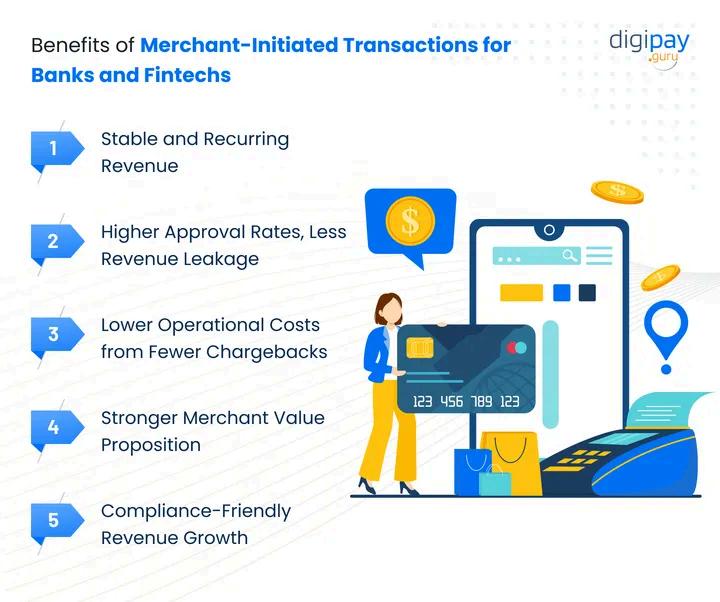
Supporting MITs offers tangible benefits:
1 Stable Recurring Revenue: Subscription-based merchants provide predictable monthly transactions, improving revenue forecasts
2. Higher Approval Rates & Reduced Revenue Leakage: Pre-authorized transactions reduce false declines and lost revenue
3 Lower Operational Costs: Clear audit trails and fewer chargebacks decrease back-office overhead.
4. Enhanced Merchant Value: Merchants enjoy predictable cash flows and smoother recurring billing
5 Compliance-Friendly Growth: MIT support demonstrates secure, regulated payment handling, giving your business a competitive edge.
Why MIT Support Should Be Part of Your Strategy
1. Attract High-Value Merchants: Platforms that rely on subscriptions and recurring billing prefer MIT-capable acquirers
2 Increase Transaction Volumes: Predictable payment flows boost overall processed transaction volumes.
3 Reduce Risk Exposure: Prior consent and SCA exemptions lower fraud and dispute rates.
4. Improve Merchant Satisfaction: Seamless, low-friction payments encourage repeat usage and loyalty
5 Future-Proof Operations: As recurring payments grow, MIT support ensures competitiveness.
Conclusion
Recurring payments and subscription billing are now the backbone of digital commerce. For banks and fintechs, Merchant-Initiated Transactions (MITs) offer a low-risk, secure, and frictionless way to handle payments
By supporting MITs, your business benefits from:
● Reduced fraud risk through prior consent
● Higher approval rates due to predictable patterns
● Fewer disputes with verifiable audit trails
● Lower operational pressure while scaling transactions
With solutions like DigiPay.Guru’s merchant acquiring platform, MITs can be supported securely and at scale, helping you onboard high-value merchants, grow transaction volumes, and future-proof your payment strategy