Financial Inclusion in Developing African Nations
Financial inclusion has become a central priority for banks, fintechs, and financial institutions across Africa.
Despite the continent’s economic potential, millions of people still depend heavily on cash because they lack access to formal financial services
The World Bank reports that nearly 45% of adults in Sub-Saharan Africa remain unbanked, highlighting how essential digital financial services are for long-term development
Yet, Africa is also home to one of the most rapidly advancing fintech landscapes worldwide Mobile money usage is accelerating, digital payments are spreading, and financial technologies are gradually reaching communities that were once excluded Progress is unfolding just not evenly.
For institutions like yours, this moment presents both a responsibility and an opportunity: to broaden access, address long-standing service gaps, and contribute to building an inclusive financial ecosystem across the continent
This blog explores the key challenges, emerging opportunities, and practical solutions shaping the future of financial inclusion in Africa.
What Is Financial Inclusion and Why It Matters for Africa’s Development
Financial inclusion refers to the ability of individuals and businesses to access affordable, convenient, and safe financial services such as:
● Credit
● Insurance
● Digital financial tools
When people can reliably use these services, their financial stability improves and so does national economic growth.
Across Africa, many people still rely on informal systems simply because formal financial channels feel distant or difficult to access Limited documentation, long travel distances to branches, and weak digital infrastructure widen the gap further.
This is why expanding financial inclusion has become a priority for governments, fintechs, development partners, and private institutions.
How Enhanced Access Drives Impact
When financial services become accessible, people can:
● Open bank or mobile money accounts
● Receive secure government transfers
● Make digital payments
● Improve financial planning and security
Small businesses manage cash flow better, households strengthen resilience, and communities become more economically empowered
For organizations like yours, greater financial inclusion leads to trust, market expansion, and long-term economic growth
The Current State of Financial Inclusion in Africa (Regional Overview)
Financial inclusion across Africa shows a blend of meaningful progress and major challenges
A quick regional breakdown offers valuable insights: Regional
of Financial Inclusion
East Africa Rural access gaps, fewer physical branches High High (mobile money pioneer)
West Africa Regulatory hurdles, financial literacy issues Very High Medium
Central Africa Political instability, weak connectivity Highest Low
Southern Africa Inequality, uneven access to banking Medium Medium–High
East Africa leads in mobile money penetration, with Kenya, Tanzania, and Uganda showcasing how agent networks + mobile payments can transform access
West Africa has high demand but struggles with regulatory inconsistencies and limited literacy
Central Africa continues to face connectivity and stability challenges, slowing digital adoption
Southern Africa benefits from relatively mature systems, yet exclusion persists due to inequality.
Major Challenges Hindering Financial Inclusion in Africa
Despite progress, several structural and socioeconomic factors continue to limit financial inclusion.
Here are the continent’s biggest barriers:
1. Limited Access to Formal Financial Services
Millions of Africans live far from banks or financial service providers
In Sub-Saharan Africa:
● 105 million adults lack both a bank account and formal ID
● Over 350 million adults rely entirely on cash
Remote locations, high operational costs, and lack of viable banking infrastructure keep people tied to informal systems
2. Socioeconomic Barriers
Poverty remains one of the strongest contributors to financial exclusion
Around 431 million Africans live under extreme poverty, and many rely on irregular income
Daily wage earners and small traders often prioritize immediate needs over financial planning making it difficult to maintain steady banking relationships.
Low income + instability = limited participation in formal financial systems
3. Low Financial Literacy Levels
Financial literacy across Africa is significantly low less than 40% of adults understand basic concepts such as interest, savings, or fraud safety.
This leads to:
● Hesitation to use digital services
● Higher vulnerability to fraud
● Misuse of financial tools
● Deepened distrust of formal institutions
Rural and semi-urban populations are most affected
4. Inadequate Infrastructure
Digital finance requires reliable electricity, mobile networks, and internet connectivity yet large areas still lack consistent infrastructure
Deloitte reports that poor infrastructure has:
● Slowed economic growth by 2 percentage points every year
● Reduced business productivity by 40%
Without foundational infrastructure, digital finance faces major limitations
5. Regulatory Fragmentation
Africa’s regulatory environment is improving but still inconsistent across borders.
Common regulatory barriers include:
● Strict KYC/AML requirements
● Limitations on agent banking
● Restrictions on mobile money innovation
● Fragmented licensing across markets
● High minimum balance and fee structures
This makes it difficult for providers to scale solutions regionally
Key Opportunities to Expand Financial Inclusion in Africa
Despite the challenges, Africa holds immense opportunity for financial growth and innovation
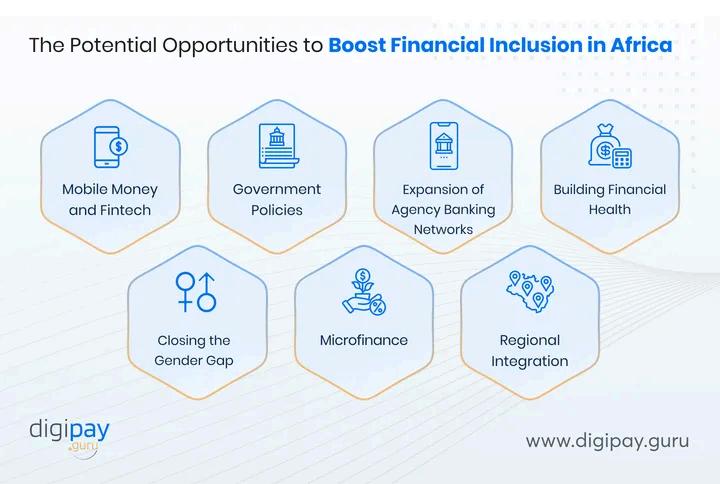
1. Rise of Mobile Money and Fintech Innovation
Mobile money remains Africa’s strongest tool for expanding financial access.
Fintechs are building low-cost, scalable fintech payment solutions and banking solutions tailored to underserved communities
For your institution, this means:
● Faster onboarding
● Lower operational costs
● Expanded reach to rural populations
● Safer cash alternatives
Digital wallets, QR payments, and micro-transactions have the potential to unlock inclusive financial ecosystems
2. Supportive Government Policies
Government efforts can significantly accelerate inclusion through:
● Investment in digital infrastructure
● Reforming KYC and regulatory frameworks
● National digital ID systems
● Incentives for mobile and fintech adoption
When regulations support innovation, institutions like yours can expand faster with lower compliance friction
3. Growth of Agent Banking Networks
Agency banking allows financial institutions to serve rural customers without opening branches.
Benefits include:
● Lower operational costs
● Increased community trust
● Wider coverage in remote areas
● Simplified onboarding
Agents act as the first point of contact for people entering the formal financial system