![]()


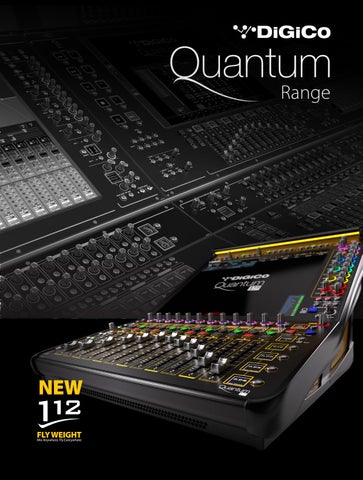
The Quantum range is more than just a family of advanced mixing consoles, it is DiGiCo fulfilling our promise to always look after the best interests of engineers.
The complexities demanded by modern live shows mean that you need more than ever before from your desk. However, the pressures of life on the road mean that you often don’t have the time to learn a new system. The Quantum family removes this challenge completely to give you a huge performance upgrade with no learning curve.
The Quantum engine is at the heart of the new family. It can transport up to 2,000 channels across 458 processing paths at 96kHz. New GTX ports run at 6.6GHz while simple two wire connections ensure the fastest possible data speeds to reach a new pinnacle in mixing capability. Fully scalable and designed to communicate seamlessly with the next generation of FPGAs, the Quantum engine is a uniquely formidable platform for an ambitious industry.
Whether it is a new engine for your existing SD7 or SD5 frame, or completely new hardware you want, the Quantum range gives you the power to deliver the ultimate performance.
DiGiCo Quantum Designed To Grow With You!


These neat components have been around almost as long as DSP. Historically, due to their small size, they played the role of the glue logic in larger applications, allowing multiple DSP chips to communicate. As the technology has grown, so have the FPGAs. Much larger and smarter components are now available, with the latest generation chips providing our Quantum engines with huge processing capabilities, surpassing even the most advanced DSP engines.
Quantum brings an unprecedented level of power and connectivity, by harnessing the latest developments in processor technology and system design. We are now using up to five FPGAs as opposed to one, which simply wasn’t possible before. New GTX ports have been introduced, running at 6.6GHz, with multiple 6.6GHz links between, interconnected with pairs of wires; and each pair of wires can transport up to 2,000 channels at 96kHz. This means the board rate is much faster. Before Quantum, devices would be connected up with parallel ports, and it was very difficult to lay the boards out, but with this new technology, it’s just two wires as a differential pair, so the data speed is phenomenal.
The fast interconnectivity has allowed us to make several FPGAs behave as one: this means you can share the workload of a device, and makes the device scalable; it can also communicate with next generation FPGAs as and when they come out. Stealth technology was the first FPGA-based audio processor of any large scale in this industry. Now it’s Quantum’s turn: four generations on.
The engine can now automatically allocate devices to run different parts of the console: one device deals purely with the bussing and the combining of signals; another does channel processing and nodal processing together. This means you’re able to take your workload, and allocate it to multiple devices.
More power. More speed. More flexibility. And it’ll allow the product to grow, as well.
The introduction of Quantum delivers a raft of new features, thanks to the implementation of the latest technology:
There is an ARM processor, which handles all the communications between the host PC and the FPGA core; it’s the translator that communicates all the work surface flow to the core processor.
There are now up to five fourth-generation SHARCs controlling the interpolation algorithms in the FPGA to produce that warm analogue feel, which will make a significant difference to any engineer.


The patented Nodal Processing appreciates the demands on monitor engineers and sound designers to be able to provide creativity not only on the channels but actually on each channel aux send. A full complement of DiGiCo channel processing (including multiband compression and dynamic EQ) can be allocated to each aux send allowing a unique mix tailored for the artist or the audience. Using Nodal Processing essentially turns your Quantum console into a mixing console on the aux busses; users can now drop a whole channel’s worth of processing on each one of those sends, literally turning an aux send into its own channel.
Nodal Processing opens engineers up to a new world of creative mixing possibilities. And Nodal Processing could even replace the requirement of a small monitor console in a West End or Broadway production.


Quantum True Solo builds on Nodal Processing, focusing on the needs of the monitor engineer. With True Solo, users have the option of emulating output processing options into the solo buss; when inputs are soloed, selecting your artist’s output buss in the True Solo panel emulates the output processing and you hear the signal exactly as the artist hears it. No guessing on how it will sound; just accurate true monitoring of your inputs. When combined with Nodal Processing, True Solo and Quantum deliver the ultimate set of tools for every monitor engineer.


Making use of the Quantum engine’s seventh generation FPGA infrastructure, we’ve introduced Mustard processing – a brand new set of channel processing strips to work alongside your standard channel processing. Each Mustard processing strip provides a choice of two pre-amp modellers, a 4-band EQ (including all-pass filters), 4 different boutique style compressor models and a gate/ducker. What is more, Mustard processing strips can be used on any channel type.


The Spice Rack is a new processing rack that supports plugin style native processing options, allowing you to build a rack of insertable processors. To kick things off, we launched the Chilli 6 – a 6-band multi-band compressor/ expander. Allowing full control over all parameters, including our unique release shape control, the Chilli 6 is perfect for shaping vocals and instruments with all the control you need. Following the Chilli 6 came the Naga 6 - a 6-band dynamic EQ. Designed for precision work, the Naga 6 is a must-have for taming problem frequencies.
It is often a requirement in broadcast and corporate settings to provide a copy of a mix without a particular input, for example a remote guest listening to the main mix but without their own input. Mix Minus Busses, once a feature only available with DiGiCo Broadcast software, are now available on any Quantum console free of charge, allowing you to achieve this with a single button press. Every single mono channel can have its own mix minus output and these can be routed on-the-go, making them available whenever and wherever you need them.


Banks in blocks of 12 DiGiCo Quantum consoles are designed with banks of 12 faders plus master faders, all of which are assignable. Unlike the more common 8 fader banks that are found on the majority of digital consoles today, these provide the user with a much stronger platform from which to mix their audio palette. A good example of an application that really benefits from a 12 fader bank is working with a full drum kit: often, 8 channels just won’t cut it, and it can lead to limitations; having 12 faders in one bank means there is literally more room to play with, which adds more flexibility in your mix. The same can be said for larger orchestral sessions, where more channels are needed in the same bank to get the job done properly.


HTL - The Guiding Light
Find what you need at the speed of light. When it comes to operating a console in a live, or other high pressure environment, it is fundamentally important that the desk works with the operator to provide the fastest and simplest way to create the mix you want.
Fast access to channels, easy control of gain and quick intuitive management of all of the sends, dynamics, effects and EQ is where HTL comes into its own. Even operators with little or no experience of digital consoles will instantly be able to see which control on the desk alters which parameter, as HTL dynamically colour codes each rotary encoder to reflect the colour scheme of EQ, processing, effects or sends currently displayed on the screen.
These RGB HTL rings can be found around all encoders on the hardware channel strips for quick adjustment of each EQ band and dynamics controls. They can also be found on every single row of assignable encoders on all Quantum consoles so that you can immediately find the controls you need.
HTL - The guiding light


Dynamic EQs are the holy grail of audio mixing; it allows the audio level to dynamically control the amount of EQ being applied to the signal. To perform these calculations in realtime requires a serious processing resource, which many of today’s standard DSP systems simply cannot deliver, but DiGiCo’s FPGA based processing easily handles the processing with all Quantum consoles having Dynamic EQ available on every input and output channel and Nodal Processor.

All Quantum consoles offer the option of multiband compression on every channel, inputs and outputs, plus every Nodal Processor. Nice and simple.


The Quantum range provides users with an FX rack to host high quality internal effects processors. With a selection of delay based and reverb effects to choose from, DiGiCo’s FX provide a wide range of tools for every situation. Depending on the model of the Quantum console, the number of internal FX varies between 12 and 48 stereo FX where up to 16 of these can be DiGiCo’s stereo floating point reverbs.


There are two different methods of buss panning available:
Option 1 - Allows for a finer control to more centrally panned sources.
Option 2 - Studio sine-cosine buss pan law gives equal control of the pan across the full stereo field, and provides a fuller dynamic mix across a stereo buss, sounding “fuller & wider” with more space in the centre of the mix.


This is an external DVI digital output that provides a complete overview of your console channels and metering; see all your channels, groups, auxes, matrices, control groups, metering, sub groups, and your master, all in an easy-to-navigate format.

DiGiCo’s Quantum App allows you to control any of the major parameters of your Quantum console over WiFi with an iPad. Better still, the iPad is not only a remote control surface, but also an expansion of the control surface. The iPad Quantum App allows you to add an extra 256 Macro buttons so you can have your quick access go-tos in one hand (literally), while the console remains clear to mix the show on.


The 48x6 Monitor Matrix allows operators to monitor up to 8 full 5.1 surround sources through up to 3 different speaker setups. The Monitor Matrix also offers speaker inserts, delays, level calibration, quick select buttons and the ability to completely customise the upmixing and downmixing rules.


Another important software feature that DiGiCo’s Broadcast software adds is Backstop PFL / Overpress. Any channel can be sent to the PFL buss simply by pulling back the fader to preview the audio before it goes live. There are also options for auto solo on a per channel basis and dual AFL/ PFL, allowing you to sculpt your workflow to suit every application.


DiGiCo’s Theatre software offers the most sophisticated and advanced auto-update cue system on the market. Users can choose exactly which parameters are updated throughout the cue list and apply separate rules for custom groups of channels. This means that Principals could follow one set of rules and the band channels follow another. It also offers exclusions for those instances where different settings need to be recalled only for one cue, and a comprehensive system for keeping track of all these changes throughout the cue list and making changes as and when they are needed.


When programming Theatre shows the assignment of CG members is a vital part of a smoothly running show. The Control Group Cues panel allows for quick assignment of CG members throughout the cue list with its spreadsheet style workflow.


During many Theatre productions, Sound Designers are faced with the challenge of costume changes throughout the show that may require changes to a channel’s processing. For this, DiGiCo’s Theatre software offers the Aliases feature. Custom, unique parameters can be stored and recalled in every scene where this costume change appears, and these also follow the same auto-update rules as standard channels.
Another hurdle faced by Sound Designers is the accomodation of different actors playing the same role but requiring different processing. That is where Players comes in. Each input channel can have multiple Players with unique settings for each actor playing the role. What is more, these can be recalled at any time during the show in the event of an actor being taken ill mid show.


Another valuable addition that comes with DiGiCo’s Theatre software is individual delays on each of the cross point matrix points. This allows sound designers to position sound and provide localisation cues based on level and timing data, allowing full creativity and flexibility. Matrices also benefit from Matrix Aliases, allowing them to be repurposed and reused throughout the show with custom auto-update rules.


In addition to the Quantum’s superb internal processing, you can also access all the plugins you know and love from the studio thanks to Waves SoundGrid®. Quantum consoles can connect to Waves SoundGrid devices through the built in SoundGrid Port or the optional SoundGrid Interface card providing 64 I/O channels. When using Waves SuperRack or MultiRack, there is also the built in DiGiCo integration that can be utilised to get quick access to the plugins you need, when you need to alter them.


A necessary component for a DiGiCo system with Waves integration is a server to run your plugins on. DiGiGrid have got you covered. The DGS-XL and the IOS-XL offer low latency real-time processing for all of your favourite Waves plugins at sample rates up to 96kHz. Their powerful i7 Extreme servers allow you to run as many plugins as you want, on as many channels as you’ve got, meaning they can handle even your heaviest sessions.


An easy recording and playback solution, the MGB and MBO SoundGrid interfaces offer up to 128 channels at 48kHz or 64 channels at 96kHz with either coaxial connectivity or optical MADI conenctivity. Perfect for virtual soundcheck or even being able to get more channels of audio into your server for processing.
And if that’s not enough, the MGR offers twice the number of inputs and outputs in a compact 1U unit. That’s 128 channels at 96kHz or 256 channels at 48kHz.


DMI-MADI-B
This card can be used to connect a Standard MADI stream (64 channels in and out) at 48KHz or 96KHz or a DiGiCo Rack with the appropriate connector (D2-Rack, SD-Rack, SD-MINI Rack)

DMI-AVIOM
This card provides 16 output channels at 48kHz (with SRC) and supports Aviom’s proprietary A-Net Pro16 protocol. It has 1 CAT5E connection and faceplate DIP switched for Stereo output selection.

DMI-DANTE 64@96
This card provides 64 input and 64 output channels at both 48KHz and 96KHz. It is provided with Primary and Secondary (backup) Gigabit Ethernet ports for connection to the Dante network.
DiGiCo brought its DMI (Digital Multichannel Interface) into the pro-audio world via the Orange Box, and then to the S21 & S31, SD12 and Quantum Range of consoles.

DMI-KLANG
This card provides ultra low latency KLANG immersive processing for up to 16 2-channel mixes with 64 inputs at 48kHz or 96kHz.

DMI-HYDRA 2
This card will provide 56 input and 56 output channels at 48kHz with Primary and Secondary (backup) optical connections.

DMI-WAVES
This card will provide 64 input and 64 output channels at 48kHz or 96kHz to the SoundGrid™ Network with 2 CAT5E connections.

DMI-AVB
This Milan certified card provides 64 input and 64 output channels at both 48kHz and 96kHz. It is provided with a Primary and a Secondary port which can be run in Bridged or Redundant mode.

DMI-AMM
This card offers Quantum, SD-Range and S-Series consoles up to 64 channels of automatic microphone mixing which can be used on any console input channel.

DMI-ADC
This card provides 16 analogue inputs on 2 x 25 way “D” connectors. The ADC card is a line card only. There is no microphone amplifier or phantom power available. There is no gain control function for these inputs (only digital trim).

DMI-AES
This card provides 16 inputs (8 pairs) and 16 outputs (8 pairs) on 2 x 25 way “D” connectors. All AES inputs are provided with sample rate conversion (SRC) by default. All AES outputs are synchronised to the mixer system clock.

DMI-MIC
This card provides 8 microphone preamp inputs on 1 x 25 way “D” connector. Each channel has individual, low noise gain control and phantom power. User interface is through a normal channel strip on your console.

DMI-MADI-C
This card can be used to connect to the DiGiCo D-Rack or D2-Rack, or another DiGiCo console with the RJ45 MADI connector.

DMI-DAC
This card provides 16 analogue outputs on 2 x 25 way “D” connectors. The DAC card is line level only. Maximum output level +22dBu (Digital Full Scale).
DMI-ME


This card offers a 40 output interface to Allen & Heath ME-1 or ME-500 Personal Mixers. Multiple Personal Mixers can be connected to the DMI ME via the ME-U Hub.


Optional Aviom, AES and or Analogue Output cards


The 9U D2-Rack has a fixed format 48 inputs with 16 outputs fitted as standard. The output count can be increased to 32 by populating the 2 spare output slots with one or more of the 3 option modules – Line out or AES out or Aviom.
The 48 inputs can be specified as either 48 mic in or 24 mic/24 AES in.
As standard, there are 2 MADI Ports, available either as BNC or DiGiCo CAT5E connections that are available on the SD9 and SD11. These ports allow rack sharing between two DiGiCo consoles or digital splits for recording. When running at 96K, these 2 ports combine to create a single high definition 96K MADI connection with no reduction in I/O.


The D2-Rack has dual redundant power supplies as standard with LED indicators on the front panel.
The SD-Rack Style menu system allows for customised rack settings and the control and activation the D2-Rack’s internal oscillator.
At the smallest end of the spectrum is the SD-NANO Rack. This 2U stage box works almost exactly the same way as the MINI, except it is half the size and therefore can only handle half the amount of inputs and outputs. The NANO is only available with optical connectivity.
The SD-Rack is the finest I/O rack available, capable of delivering up to 192kHz high resolution analogue I/O converters and multiple digital formats simultaneously, be it MADI, AES/EBU, Dante, AES-42, ADAT, or Aviom.
It’s also based around the same Stealth FPGA technology present in the SD and Quantum console engines, so it can run the optical loop at 96KHz, while providing a downsampled 48KHz feed to any additional console from one of the MADI output streams. This is industry-leading A/D conversion, and complete with DiGiCo’s famous Gain Tracking™, all consoles benefit from +/-40dB of digital gain.
The gain can be set independently on a channel-bychannel basis: once it’s set, each of the consoles on the loop can then Gain Track their own mixes; and if you do need to tweak any analogue gain settings, each Gain Tracked channel will automatically compensate, ensuring your mix stays the same. And what’s really cool is, any of those 5 consoles on the loop can then take control


of an analogue gain should clipping occur, safe in the knowledge that everyone else’s mix will be unaffected.
There are 14 slots on the SD-Rack, which amounts to 56 ins and outs, and it comes with or without optics. When running at 48kHz, the two MADI ins and outs provide 56 fully redundant input and output connections via a duplicate MADI aux; and if you need to run at 96kHz, you can get a full complement of 56 channels of MADI (in and out).
Each interface card is hot swappable, so the SD-Rack will automatically identify and configure each card for you; and because the power supplies are located at the top of the rack (also hot swappable, by the way), you won’t find yourself battling through mountains of cable to get to them!
The SD-MINI is a 4U rack and can accept SD input and output cards, be they analogue or digital, including AES/EBU, Dante, AES-42, ADAT, HD-SDI and Aviom. Running purely digital, the MINI can run up to 32 ins and outs. Or if it’s all analogue, you can have a maximum of 32 ins or outs or any combination in banks of 8 (8 in and 24 out for example). The MINI has MADI connectivity as standard, with optical as an option.
There is also the ability to run the Gain Tracking™ split outputs at other sample rates to te rack for compatibly with external devices.
The DQ-Rack and MQ-Rack are the latest in addition to the range of high sample rate racks.

The MQ-Rack is exactly the same as the DQRack except it has BNC MADI connectivity.
It features 2 BNC MADI ports to allow rack sharing between two DiGiCo consoles or digital splits for recording at 48kHz. When running at 96kHz, these 2 ports combine to create a single high definition 96kHz MADI connection with no reduction in I/O.
The MQ-Rack gives the familiar MADI connectivity for your touring infrastructure allowing it to integrate with your existing DiGiCo infrastructure.

The compact 6U MQ-Rack features 48 mic/line inputs with up to 24 line outputs and up to 8 AES channels out. Clever audio design allows the user to reconfigure 4 of the analogue line outputs to be either analogue outputs or dual AES outputs. This I/O flexibility and other configuration changes are managed from the racks very own TFT Configuration screen.
The DQ-Rack comes with dual PSU and can operate at 48kHz or 96kHz. It also features 2 locking EtherCON ports. This includes a Primary and a Secondary Dante connection just like many familiar Dante devices. The DQ-Rack still benefits from the SD-Rack style menu system, but with an updated TFT LCD screen as first seen on the Quantum338 console. This allows for customised rack settings including control over the protocol used in the 4 flexible output XLRs and control and activation the DQ-Rack’s internal oscillator.
The DQ-Rack with integrated Dante is perfect for AV installation and the demands of an AoIP networking environment.


DiGiCo is proud to announce the launch of the next generation of large format live audio production mixing consoles. As you would expect from a brand-new console from DiGiCo, it has been designed from the ground up. Familiar, yet different, and with improved audio quality via enhanced algorithms, Quantum852 delivers a massive leap forward in processing power. It is neatly packaged with 1000 nit LCD screens for full daylight operation and a newly designed worksurface, giving users the confidence that, true to the DiGiCo ethos, Quantum852 has been designed not just for now, but for the future.
Quantum852 is powered by five of the latest 7th generation FPGA’s and next generation SHARC DSP processors, delivering a massive leap forward in performance. It’s familiar design and workflow makes it instantly familiar as a DiGiCo, but its increase in power and speed will provide users with more possibilities in the mix.
Quantum852. Same species. Different beast.

Quantum852 offers three 21.3” Touchscreens, super high-resolution, touch-sensitive TFT LCD backlit screens. These super large touch 1000 nit screens are one of the defining features of the DiGiCo Quantum852, bringing all of the information and control to where you need it, quickly and easily.
The high-resolution screens are the hub of the user interface, and for realtime information, act as the primary command centre. They also work completely intuitively with every other control within the console, automatically displaying functions that are relevant to what the operator is working on there and then.
It’s all about ease-of-use and speed with the Quantum852


Designed for the rigours of touring, the Quantum852 features dual redundant quick release 1000W power supplies. With gold global 12V power bussing and local point-of-load architecture, Quantum852s power bussing ensures your Quantum852 performs flawlessly at every gig.


The Quantum852 has local I/O in abundance. The Quantum852 includes 12 Ultimate ‘Stadius’ 32 bit analogue inputs, 12 Stadius 32 bit analogue outputs, and 12 bit Perfect AES I/O (6 stereo).

Quadruple redundant MADI in/out (which can also be configured as 8 MADI I/O at 48kHz), dual DMI card slots, support for dual 2nd generation Optocore loops, 32 GPIO, MIDI In Out and through, 5 switched network ports, USB 2.0 and USB 3.0, and a digital Overview Monitor Output. Plus as standard there is a built in Waves SoundGrid Interface card giving you an extra 64 I/O for connecting to the SoundGrid Network.


Weights and Dimensions
1767 (w) x 1075 (d) x 607 (h) mm


Weights and Dimensions
1896 x 1397 x 708mm | 74.65 x5 5 x 27.88 in 155Kgs


When DiGiCo built the SD7, we never thought anyone would fill the console. However, with the constant rise in production values, and audiences demanding more and more from their favourite artists, tours are now regularly pushing multiple SD7s to maximum capacity. Shows are significantly bigger than they used to be and as a result, engineers are needing to handle many more inputs, outputs and channels. To address this issue, we have developed Quantum7, a newer, smarter engine which offers so much more to users on so many levels, and provides engineers with a major upgrade to new generation technology with no learning curve whatsoever. In creating Quantum7, we wanted to guarantee that our customer base could maintain a return on their historical investment by providing them an affordable engine upgrade for their existing work surface. We needed to make the next major technological step forward, and by using seventh generation FPGA technology, that’s what Quantum has done.
Quantum7 makes shows easier to manage with plenty of room for growth; it’s a more flexible system, four generations newer in processing capability, and a formidable platform for future development. Faster, more efficient, future-proof, and way more powerful.

15” Touchscreens, super high-resolution, touch-sensitive TFT LCD backlit display. Quantum7 offers three screens. These large touch screens are one of the defining features of the DiGiCo Quantum7, bringing all of the information and control to where you need it, quickly and easily.
The high-resolution screens are the hub of the user interface, and for realtime information, act as the primary command centre. They also work completely intuitively with every other control within the console, automatically displaying functions that are relevant to what the operator is working on there and then.
It’s all about ease-of-use and speed with the Quantum7.


Designed for the rigours of touring, the Quantum7 features dual redundant quick release 500W power supplies. With gold global 12V power bussing and local point-of-load architecture, Quantum7 reinvents power busses for touring consoles and ensures your Quantum7 performs flawlessly at every gig.


The Quantum7 has local I/O in abundance. The Quantum7 includes 12 analogue inputs, 12 analogue outputs, and 12 AES I/O (6 stereo); 4 redundant MADI ports per engine (which can also be configured as 8 MADI ports at 48kHz), and 1 Optocore loop (with an optional second if required).
Quadruple redundant MADI in/out (which can also be configured as 8 MADI I/O at 48kHz), dual DMI card slots, support for dual 2nd generation Optocore loops, built-in UB MADI USB interface, 16 GPIO, MIDI, 4 switched network ports, USB, and a digital Overview Monitor Output. Plus as standard there is a built in Waves SoundGrid Interface card giving you an extra 64 I/O for connecting to the SoundGrid Network.


Weights and Dimensions
1496(w) x 875(d) x 503(h). 112kg
58.9(w) x 34.45(d) x 19.8(h). 247lbs
502.21mm (19.77”)
874.60mm (34.43”)
Quick Reference
Max no of Input Processing Channels 256*
Max aux / sub-group busses 128 (full processing**)
Matrix (in addition to aux / sub - group) 48 x 48 (full processing**)
Solo busses 2 (with True Solo)
Max no. of inputs - Non optic consoles N/A
Max no. of inputs - 1 console on optic loop 1281
Local I/O spec 12x mic/line, 12x line outputs, 12x AES/EBU I/O (mono streams)
Max no. of outputs 1280
Max no. of faders 52 (plus 48 if used with 2 x EX-007)
Screen 3 x 15"
Ext. overview screen Yes
I/O expandability Yes
Insert points / channel 2
Mustard Processing Strips 80
On Board FX 48 + 16 Spice Rack
Graphic Eqs (32-Band) 48
Dynamic EQ 694
Buss 8-band Parametric EQ Yes
Multiband Compression 694
DiGiTuBes 438
Multi-channels Yes
VCA - style control groups / Mute Groups 36
Nodal Processing Points 256
Set Spill Yes
Reorder Busses Yes
Multi-operator Yes
Surround Yes
MADI connectivity
8 x ports or 4 x Redundant ports @ 48k 4 x ports @ 96k
Optocore Yes (including Dual Loop)
Snapshot Offline Yes
Snapshot Auto-Update Yes
Sampling rates 48kHz / 96kHz
Signal processing FPGA, up to 40-bit floating-point
Audio processing and OS location Surface
Redundant Processing and Computer Standard
Redundant PSUs Yes
Stage Rack spec
Up to 56 in / 56 out / MADI split x2 (@ 48kHz) D2-Rack (42-32), D-Rack (32-16), DQ-Rack (4828), MQ-Rack (48-28)
Max no of Racks 24. On 2 loops = 38
Rack Interface MADI / Optocore / RJ45 CAT5E / Dante (with optional DMI card)
Connector type for racks
BNC / HMA optics / ST / OpticalCON / RJ45 CAT5E (With Optional DMI Card)
Rack sharing FOH/MON Gain TrackingTM
Offline Software Yes
DMI Slots 2
UB MADI (48 ch) Yes
Optional Software Extensions Theatre & Broadcast
Dimensions (mm) and Weight (kg) 1496(w) x 875(d) x 503(h) 112kgs
Dimensions (inches) and Weights (Ibs) 58.9(w) x 34.45(d) x 19.8(h) 247lbs
* Full Processing - Includes Delay, DiGiTuBe, HP/LP Filters, 4 Band EQ, Dynamics 1 and Dynamics 2.
** Full Processing - Includes Delay, DiGiTuBe, HP/LP Filters, 8 Band EQ, Dynamics 1 and Dynamics 2.
General Specifications
Faders 38 x 100mm touch-sensitive, motorised + 14 x 60mm touch sensitive, motorised
Screens 3 x 15” LCD high - resolution touch screens
Meterbridge 3 x Custom Mounted LCD highresolution TFT-LCD screens
Input Channels 256
Busses Up to 128 plus masters Aux / Group busses with full processing Mono / Stereo / LCR / LCRS / 5.1
Matrix Up to 48 Input / 48 Outputs with full processing
Control Groups Up to 36, selectable for VCAstyle, Moving fader, Mute Group
Graphic Eq 48 x 32-band, Gain +/- 12dB
Internal FX Up to 48 stereo effects comprising of reverbs and delay/chorus/pitch/enhancer
Spice Rack 16 mono / 8 stereo Rack Slots
Mustard Proc 64 Processing Strips
Nodal Proc 256 Nodal Processors
Local I/O 12 x mic/line I/O, 12 x AES I/O
MADI interface 4 Interfaces, BNC connectivity
Optic interface Yes (including dual loop)
Sampling rates 48kHz / 96kHz
GPI/GPO 16 (expandable to 32)
Ext Sync Wordclock, AES, Video, MADI, Optocore
Physical 1496mm (w) x 875mm (d) x
Dimensions 503mm (h)
Weight 112kg (250Kg with flightcase)
Power 90V-260V, 50-60Hz, 600VA
Requirements
Audio Specification
Sample rate 96kHz / 48kHz
Processing delay 1ms Typical (channel, SD Rack input through L-R buss to stage output @96kHz)
Internal processing Up to 40-bit, floating point
AD/DA Conversion 24-bit Converter Bit Depth
Frequency response +/- 0.6dB (20Hz – 20kHz)
THD <0.05% @ unity gain, 10dB input @ 1kHz
Channel Seperation Better than 90dB (40Hz –15kHz)
Residual output noise <90dBu Typical (20Hz20kHz)
Microphone Input Better than -126 dB Equivalent Noise
Maximum Output Level +22dBu
Maximum Input Level +22dBu
Processing Channel Specification
Input Channel
Name User-defined / Presets
Channel Selection Mono / Stereo / Multi
Input Routing Main & Alternate Input
Analogue Gain -20 to +60dB
Phase Normal / Reverse
Digital Trim -40 to +40dB
Delay Up to 1.3 sec
DiGiTuBe Drive 0.01 - 50.0
Bias 0 - 6
LPF 20 – 20kHz, 24dB / Oct
HPF 20 – 20kHz, 24dB / Oct
Insert A (pre eq/dyn) On/off
Equalisation 4 band EQ: Parametric or Dynamic (low/lowshelf, lower-mid/ lowshelf, upper-mid/hishelf, hi/ hishelf) on/off
Freq; 20 – 20kHz
Gain; +/- 18dB
Q: 0.1 -20 (parametric) / 0.100.85 (shelf)
Dynamic Eq on/off
Over/under Band on/off
Threshold; -60 – 0dB
Attack; 500us – 100ms Release; 10ms – 10s Ratio; 1:1 – 50:1
Dynamics 1 Single or multiband (3-band)
Compressor on / off
Threshold; -60 – 0dB
Attack; 500us – 100ms Release; 10ms – 10s
Ratio; 1:1 – 50:1
Gain; 0 to +40dB with Autogain option
Link; any channel / buss Hi crossover; 20Hz – 20kHz Lo crossover; 20Hz – 20kHz Knee : hard, med, soft
De-Esser
Threshold : 20us – 20ms
Release : 1ms – 100ms Ratio : 1:1 – 50:1
Ess-band : Listen on/off
Ess-band filter freq / width: 20Hz – 20kHz
Dynamics 2 on/off
Gate / Ducker Threshold; -60 – 0dB
Attack; 50us – 100ms
Hold; 2ms – 2s
Release; 5ms – 5s
Range; 0 - 90dB
Key; Any source
Key listen
Freq/width; 20 – 20kHz
Compressor on / off
Threshold; -60 – 0dB
Attack; 500us – 100ms
Release; 10ms – 10s
Ratio; 1:1 – 50:1
Gain; 0 to +40dB with Autogain option
Link; any channel / buss
Hi crossover; 20Hz – 20kHz Lo crossover; 20Hz – 20kHz
s/c source : Any source
s/c listen : on/off
s/c filter freq / width: 20Hz –20kHz
Insert B (post eq/dyn) On/off
EQ/Dyn order EQ/Dyn or Dyn/EQ
Mute Channel mute / hard mute
Solo Solo Buss 1 / Solo Buss 2 / Both, Auto solo
Channel Safe Input, eq, dyn, aux, pan, fade/ mute, inserts, buss, directs, full safe
Output Routing Buss, Insert A, Insert B, FX
Direct: on/off, pre-mute / prefade / post-fade, level +/- 18dB
Fader 100mm motorised fader ∞ to +10dB
Processing Channel Specification
Aux / Group / Matrix Output
Name User-defined / Presets
Phase Normal / Reverse
Digital Trim -20 to +60dB
Delay Up to 1.3 sec
DiGiTuBe Drive 0.01 - 50.0
Bias 0 - 6
LPF 20 – 20kHz, 24dB / Oct
HPF 20 – 20kHz, 24dB / Oct
Insert A (pre eq/dyn) On/off
Equalisation 8 band EQ: Parametric or Dynamic
4 band EQ: Parametric Only (low/lowshelf, lower-mid/ lowshelf, upper-mid/hishelf, hi/ hishelf) on/off
Freq; 20 – 20kHz Gain; +/- 18dB
Q: 0.1 -20 (parametric) / 0.100.85 (shelf)
Dynamic Eq on/off Over/under Band on/off
Threshold; -60 – 0dB Attack; 500us – 100ms Release; 10ms – 10s Ratio; 1:1 – 50:1
Dynamics 1 Single or multiband (3-band)
Compressor on / off
Threshold; -60 – 0dB
Attack; 500us – 100ms
Release; 10ms – 10s Ratio; 1:1 – 50:1
Gain; 0 to +40dB with Autogain option
Link; any channel / buss
Hi crossover; 20Hz – 20kHz Lo crossover; 20Hz – 20kHz
De-Esser
Knee : hard, med, soft
Threshold : 20us – 20ms
Release : 1ms – 100ms
Ratio : 1:1 – 50:1
Ess-band : Listen on/off
Ess-band filter freq / width: 20Hz – 20kHz
Dynamics 2 on/off
Gate / Ducker
Threshold; -60 – 0dB
Attack; 50us – 100ms
Hold; 2ms – 2s
Release; 5ms – 5s
Range; 0 - 90dB
Key; Any source
Key listen
Freq/width; 20 – 20kHz
Compressor on / off
Threshold; -60 – 0dB
Attack; 500us – 100ms
Release; 10ms – 10s
Ratio; 1:1 – 50:1
Gain; 0 to +40dB with Autogain option
Link; any channel / buss Hi crossover; 20Hz – 20kHz Lo crossover; 20Hz – 20kHz
s/c source : Any source
s/c listen : on/off
s/c filter freq / width: 20Hz –20kHz
Insert B (post eq/dyn) On/off
EQ/Dyn order
EQ/Dyn or Dyn/EQ
Mute Channel mute / hard mute
Solo Solo Buss 1 / Solo Buss 2 / Both, Auto solo
Channel Safe trim, eq, dyn, fade/mute, inserts, outputs, full safe
Output Routing Outputs, Insert A, Insert B, FX
Fader 100mm motorised fader ∞ to + 10dB
Preamplifier Tubes Variable Drive
Odd / Even / Overdrive / Distortion / Crunch / Hi Distortion Presets
Variable Output Gain
Preamplifier Amp Variable Drive
Odd/Even 1st stage Harmonics
Bias & Saturate control
Off/Odd/Even 2nd stage harm Variable HF Boost
Variable Output Gain
Equalisation 4 band EQ: Parametric
(lowshelf / bell, lower-mid bell /all-pass, upper-mid bell / allpass, hishelf / bell)
HPF & LPF 4th order filters
Dynamics 1 Classic VCA Compressor
Vintage VCA Compressor
Optical Compressor
FET Limiter
Dynamics 2 Gate / Ducker


With first the SD5 and then the Quantum7, DiGiCo broke new ground with what you can achieve with a mixing console. Now Quantum5 is here to take on that baton and help you accomplish even more.
Just as with Quantum7, Quantum5 has been designed to slot neatly into the existing frame of your SD5, meaning an engine upgrade is all that you need to deliver next generation processing from your current fleet. With three large-scale seventh generation FPGAs working in unison you will have unrivalled flexibility.
We wanted Quantum5 to be more than a simple upgrade – it represents a revolutionary step forward for engineers. Under the hood you will find the kind of power you have been longing for. Quantum5 offers more than 450 processing paths at 96kHz, including 288 processing channels configurable as up to 256 input channels and up to 128 busses, plus a 36 x 36 matrix.
When you add in our patented Nodal Processing, Mustard Processing, Spice Rack and True Solo, the Quantum5 becomes the tool you need to excel.
With Quantum5, you own the stage.


15” Touchscreens, super high-resolution, touch-sensitive TFT LCD backlit display. Quantum5 offers three screens. These large touch screens are one of the defining features of the DiGiCo Quantum5, bringing all of the information and control to where you need it, quickly and easily.
The high-resolution screens are the hub of the user interface, and for realtime information, act as the primary command centre. They also work completely intuitively with every other control within the console, automatically displaying functions that are relevant to what the operator is working on there and then.
It’s all about ease-of-use and speed with the Quantum5.


Local I/O is never an issue with the Quantum5. It includes 8 analogue inputs, 8 analogue outputs, and 8 AES I/O (4 stereo); 4 redundant MADI ports per engine (which can also be configured as 8 MADI ports at 48kHz), and 1 Optocore loop (with an optional second if required).

Like the Quantum7, the Quantum5 provides quadruple redundant MADI in/out (also configurable as 8 MADI I/O at 48kHz), dual DMI card slots, support for dual 2nd generation Optocore loops, built-in UB MADI USB interface, 16 GPIO, MIDI, 4 switched network ports, USB, and a digital Overview Monitor Output. Plus as standard there is a built in Waves SoundGrid Interface card giving you an extra 64 I/O for connecting to the SoundGrid Network.


Weights and Dimensions
1595(w) x 805(d) x 482(h). 70Kg
62.80(w) x 31.70(d) x 18.98(h). 154lbs
1208 mm [47,57 in]
1617 mm [63,66 in]
579 mm [22,80 in]
245 mm [9,65 in]
831 mm [32,72 in]
408 mm [16,06 in]
171 mm [6,73 in]
Quick Reference
Max no of Input Processing Channels 256*
Max aux / sub-group busses 128 (full processing**)
Matrix (in addition to aux / sub - group) 36 x 36 (full processing**)
Solo busses 2 (with True Solo)
Max no. of inputs - Non optic consoles N/A
Max no. of inputs - 1 console on optic loop 1272
Local I/O spec 8x mic/line, 8x line outputs, 8x AES/EBU I/O (mono streams)
Max no. of outputs 1272
Max no. of faders 37
Screen 3 x 15"
Ext. overview screen Yes
I/O expandability Yes
Insert points / channel 2
Mustard Processing Strips 64
On Board FX 36 + 12 Spice Rack
Graphic Eqs (32-Band) 32
Dynamic EQ 458
Buss 8-band Parametric EQ Yes
Multiband Compression 458
DiGiTuBes 330
Multi-channels Yes
VCA - style control groups / Mute Groups 36
Nodal Processing Points 128
Set Spill Yes
Reorder Busses Yes
Multi-operator Yes
Surround Yes
MADI connectivity
8 x ports or 4 x Redundant ports @ 48k 4 x ports @ 96k
Optocore Yes (including Dual Loop)
Snapshot Offline Yes
Snapshot Auto-Update Yes
Sampling rates 48kHz / 96kHz
Signal processing FPGA, up to 40-bit floating-point
Audio processing and OS location Surface
Redundant Processing and Computer Yes (Dual Surface)
Redundant PSUs Yes
Stage Rack spec
Up to 56 in / 56 out / MADI split x2 (@ 48kHz) D2-Rack (42-32), D-Rack (32-16), DQ-Rack (4828), MQ-Rack (48-28)
Max no of Racks 24. On 2 loops = 38
Rack Interface MADI / Optocore / RJ45 CAT5E / Dante (with optional DMI card)
Connector type for racks
BNC / HMA optics / ST / OpticalCON / RJ45 CAT5E (With Optional DMI Card)
Rack sharing FOH/MON Gain Tracking
Offline Software Yes
DMI Slots 2
UB MADI (48 ch) Yes
Optional Software Extensions Broadcast
Dimensions (mm) and Weight (kg) 1465(w) x 838(d) x 458(h). 116Kg
Dimensions (inches) and Weights (Ibs) 57.68(w) x 32.99(d) x 18.03(h). 256lbs
* Full Processing - Includes Delay, DiGiTuBe, HP/LP Filters, 4 Band EQ, Dynamics 1 and Dynamics 2.
** Full Processing - Includes Delay, DiGiTuBe, HP/LP Filters, 8 Band EQ, Dynamics 1 and Dynamics 2.
General Specifications
Faders 37 x 100mm touch-sensitive, motorised
Screens 3 x 15” LCD high - resolution touch screens
Input Channels Up to 256
Busses Up to 128 plus masters Aux / Group busses with full processing Mono / Stereo / LCR
Matrix Up to 36 Input / 36 Outputs with full processing
Control Groups Up to 36, selectable for VCAstyle, Moving fader, Mute Group
Graphic Eq 32 x 32-band, Gain +/- 12dB
Internal FX Up to 36 stereo effects comprising of reverbs and delay/chorus/pitch/enhancer
Spice Rack 12 mono / 6 stereo Rack Slots
Mustard Proc 48 Processing Strips
Nodal Proc 128 Nodal Processors
Local I/O 8 x mic/line I/O 8 x AES I/O
MADI interface 4 Interfaces, BNC connectivity
Optic interface Yes (including dual loop)
Sampling rates 48kHz / 96kHz
GPI/GPO 16
Ext Sync Wordclock, AES, Video, MADI, Optics
Physical 1465 mm (w) x 838mm (d) x
Dimensions 458mm (h)
Weight 116Kg (235Kg with flightcase)
Power 100V-240V, 50-60Hz, 790VA
Requirements
Audio Specification
Sample rate 96kHz / 48kHz
Processing delay 1ms Typical (channel, SD Rack input through L-R buss to stage output @96kHz)
Internal processing Up to 40-bit, floating point
AD/DA Conversion 24-bit Converter Bit Depth
Frequency response +/- 0.6dB (20Hz – 20kHz)
THD <0.05% @ unity gain, 10dB input @ 1kHz
Channel Seperation Better than 90dB (40Hz –15kHz)
Residual output noise <90 dBu Typical (20Hz20kHz)
Microphone Input Better than -126 dB Equivalent Noise
Maximum Output Level +22dBu
Maximum Input Level +22dBu
Processing Channel Specification
Input Channel
Name User-defined / Presets
Channel Selection Mono / Stereo / Multi
Input Routing Main & Alternate Input
Analogue Gain -20 to +60dB
Phase Normal / Reverse
Digital Trim -40 to +40dB
Delay Up to 1.3 sec
DiGiTuBe Drive 0.01 - 50.0
Bias 0 - 6
LPF 20 – 20kHz, 24dB / Oct
HPF 20 – 20kHz, 24dB / Oct
Insert A (pre eq/dyn) On/off
Equalisation 4 band EQ: Parametric or Dynamic
(low/lowshelf, lower-mid/ lowshelf, upper-mid/hishelf, hi/ hishelf) on/off
Freq; 20 – 20kHz
Gain; +/- 18dB
Q: 0.1 -20 (parametric) / 0.100.85 (shelf)
Dynamic Eq on/off
Over/under Band on/off
Threshold; -60 – 0dB
Attack; 500us – 100ms
Release; 10ms – 10s
Ratio; 1:1 – 50:1
Dynamics 1 Single or multiband (3-band)
Compressor on / off
Threshold; -60 – 0dB
Attack; 500us – 100ms
Release; 10ms – 10s
Ratio; 1:1 – 50:1
Gain; 0 to +40dB with Autogain option
Link; any channel / buss
Hi crossover; 20Hz – 20kHz
Lo crossover; 20Hz – 20kHz
Knee : hard, med, soft
De-Esser
Threshold : 20us – 20ms
Release : 1ms – 100ms
Ratio : 1:1 – 50:1
Ess-band : Listen on/off
Ess-band filter freq / width: 20Hz – 20kHz
Dynamics 2 on/off
Gate / Ducker
Threshold; -60 – 0dB Attack; 50us – 100ms
Hold; 2ms – 2s
Release; 5ms – 5s
Range; 0 - 90dB
Key; Any source
Key listen
Freq/width; 20 – 20kHz
Compressor on / off
Threshold; -60 – 0dB
Attack; 500us – 100ms
Release; 10ms – 10s
Ratio; 1:1 – 50:1
Gain; 0 to +40dB with Autogain option
Link; any channel / buss
Hi crossover; 20Hz – 20kHz
Lo crossover; 20Hz – 20kHz
s/c source : Any source
s/c listen : on/off
s/c filter freq / width: 20Hz –20kHz
Insert B (post eq/dyn) On/off
EQ/Dyn order EQ/Dyn or Dyn/EQ
Mute Channel mute / hard mute
Solo Solo Buss 1 / Solo Buss 2 / Both, Auto solo
Channel Safe Input, eq, dyn, aux, pan, fade/ mute, inserts, buss, directs, full safe
Output Routing Buss, Insert A, Insert B, FX
Direct: on/off, pre-mute / prefade / post-fade, level +/- 18dB
Fader 100mm motorised fader ∞ to +10dB
Processing Channel Specification
Aux / Group / Matrix Output
Name User-defined / Presets
Phase Normal / Reverse
Digital Trim -20 to +60dB
Delay Up to 1.3 sec
DiGiTuBe Drive 0.01 - 50.0
Bias 0 - 6
LPF 20 – 20kHz, 24dB / Oct
HPF 20 – 20kHz, 24dB / Oct
Insert A (pre eq/dyn) On/off
Equalisation
8 band EQ: Parametric or Dynamic
4 band EQ: Parametric Only (low/lowshelf, lower-mid/ lowshelf, upper-mid/hishelf, hi/ hishelf) on/off
Freq; 20 – 20kHz
Gain; +/- 18dB
Q: 0.1 -20 (parametric) / 0.100.85 (shelf)
Dynamic Eq on/off Over/under Band on/off
Threshold; -60 – 0dB
Attack; 500us – 100ms
Release; 10ms – 10s
Ratio; 1:1 – 50:1
Dynamics 1 Single or multiband (3-band)
Compressor on / off
Threshold; -60 – 0dB
Attack; 500us – 100ms
Release; 10ms – 10s
Ratio; 1:1 – 50:1
Gain; 0 to +40dB with Autogain option
Link; any channel / buss
Hi crossover; 20Hz – 20kHz
Lo crossover; 20Hz – 20kHz
Knee : hard, med, soft
De-Esser
Threshold : 20us – 20ms
Release : 1ms – 100ms
Ratio : 1:1 – 50:1
Ess-band : Listen on/off
Ess-band filter freq / width: 20Hz – 20kHz
Dynamics 2 on/off
Gate / Ducker
Threshold; -60 – 0dB
Attack; 50us – 100ms
Hold; 2ms – 2s
Release; 5ms – 5s
Range; 0 - 90dB
Key; Any source Key listen
Freq/width; 20 – 20kHz
Compressor on / off
Threshold; -60 – 0dB
Attack; 500us – 100ms
Release; 10ms – 10s
Ratio; 1:1 – 50:1
Gain; 0 to +40dB with Autogain option
Link; any channel / buss
Hi crossover; 20Hz – 20kHz
Lo crossover; 20Hz – 20kHz
s/c source : Any source
s/c listen : on/off
s/c filter freq / width: 20Hz –20kHz
Insert B (post eq/dyn) On/off
EQ/Dyn order
EQ/Dyn or Dyn/EQ
Mute Channel mute / hard mute
Solo Solo Buss 1 / Solo Buss 2 / Both, Auto solo
Channel Safe trim, eq, dyn, fade/mute, inserts, outputs, full safe
Output Routing Outputs, Insert A, Insert B, FX Fader 100mm motorised fader ∞ to + 10dB
Mustard Processing
Preamplifier Tubes Variable Drive
Odd / Even / Overdrive / Distortion / Crunch / Hi Distortion Presets
Variable Output Gain
Preamplifier Amp Variable Drive
Odd/Even 1st stage Harmonics
Bias & Saturate control
Off/Odd/Even 2nd stage harm Variable HF Boost
Variable Output Gain
Equalisation 4 band EQ: Parametric (lowshelf / bell, lower-mid bell
/all-pass, upper-mid bell / allpass, hishelf / bell)
HPF & LPF 4th order filters
Dynamics 1 Classic VCA Compressor
Vintage VCA Compressor
Optical Compressor FET Limiter
Dynamics 2 Gate / Ducker


The DiGiCo Quantum338 builds on the Quantum7 in a mid format console, adding new design features and enhancements for a truly unique experience.
Quantum338 is the next step in the DiGiCo Quantum range of consoles. Delivering 128 Input channels into 64 busses, with additional processing for Master busses and Matrices, Quantum338 brings advanced processing functions and an ultimately flexible workflow to a wider user base.
Quantum338 incorporates an all new design with built-in keyboard lighting, 17” high brightness displays and individual TFT channel displays. The floating Quantum chassis features 36 channel faders plus 2 dedicated Master faders complete with high resolution metering.
Featuring our patented Nodal Processing, Mustard Processing, Spice Rack and True Solo, Quantum338 has all the features needed for every scale of production. And with built-in 32bit I/O, triple redundant MADI and Optocore it’s equipped with all the connectivity you need.
Quantum338 delivers on every level.


For applications that require the power of Quantum338 but need a smaller form factor, Quantum326 is the perfect solution.
The DiGiCo Quantum326 features the same internal processing, same connectivity and the same channel counts as Quantum338, but is only 2/3 of the size.
Just like the Quantum338, the Quantum326 represents a dramatic leap forward in power and connectivity. Delivering 128 input channels with 64 busses and a 24×24 matrix, all with full channel processing. Twenty-six 100mm touch-sensitive faders are laid out in two blocks of 12 fader banks, plus two dedicated user-assignable faders, each complete with high resolution metering. The desk also features a pair of 17-inch, 1000-nit high-brightness multi-touch screens, and much more.
Featuring our patented Nodal Processing, Mustard Processing, Spice Rack and True Solo, Quantum326 has all the features needed for every scale of production. And with built-in 32bit I/O, triple redundant MADI and Optocore it’s equipped with all the connectivity you need.
Quantum326 compact and delivers on every level.
One of the defining features of the DiGiCo range of consoles is the large touch screens, bringing all of the information and control to where you need it, quickly and easily. Quantum338 and Quantum326 are no exception, and feature three and two 17” 1000 nit high-brightness PCAP (Projected capacitive touch ) TFT screens respectively, one for each section of the console.
The new high-resolution screens give an expansive view of the new Quantum Dark Application, with the extra screen real-estate providing room for on-screen quick select buttons and a full on screen meter-bridge.
Access to the channel strip and all of its features is just a touch away. Simply select your channel and use the Hidden Till Lit rotaries or Quick Select buttons to select or alter your required parameters. As you change fader banks, access Set Spills or fold and unfold multi-channel faders the information on the screens changes instantaneously to reflect the channel setup.


Quantum3s also feature TFT displays providing users with even more visual feedback. 70 on the Quantum338 and 51 on the Quantum326. That’s one for every channel, every row of assignable encoders, every fader bank and layer button, every macro, and one for snapshots.
Featuring channel and bank names, channel meters, channel colour coding, macro and snapshot info, the 96x96 resolution TFT’s take surface feedback to a new level.
Furthermore, these channel meters aren’t just for mono or stereo input channels. Even when working with busses up to 5.1, all of your metering information is right at your fingertips.
Quantum338 and Quantum326 don’t stop there when it comes to visual feedback. Every hardware channel strip also benefits from new Dynamics metering, and both master faders feature extra bright responsive meters next to the faders.

Quantum3 Pulse is the next step in the DiGiCo Quantum range of consoles.
Delivering an increase in the number of input channels:
156 Input channels (from 128)
72 busses (from 64) , with additional processing for Master busses and Matrices.
Mix Minus Functionality
Larger matrix 36x36 on the T Software (from 24x24)
Quantum3 Pulse brings advanced processing functions and an ultimately flexible workflow to a wider user base.


Quantum338 features the latest in DiGiCo software including the new DiGiCo HOME. Designed to make operation, configuration and routine maintenance easier, DiGiCo HOME is a new launcher portal that incorporates quick links to console applications and configuration setups.


The sleek dark mode application with its flat high contrast graphics refreshes the look of the Quantum application while helping to reduce eye fatigue and improve readability.

DiGiCo have always designed consoles with speed of use in mind, and Quantum338 is no exception to that. The larger screens on the Quantum338 have allowed on screen Quick Select buttons to be added for immediate reassignment of the underscreen rotary controls. Quickly reach all of the controls you need, when you need them.


32 bit local I/O
Quantum338 takes the built in console I/O to new levels of performance. The 8 local mic/line inputs and 8 local line outputs all feature the latest 32 bit “Ultimate Stadius” converters for our best sound yet. Plus there’s 4 stereo AES/EBU in/out.


Triple redundant MADI I/O (which can also be configured as 6 MADI I/O at 48kHz), dual DMI card slots, support for dual 2nd generation Optocore loops, built-in UB MADI USB interface, 16 GPIO, MIDI, 4 switched network ports, USB, and a digital Overview Monitor Output. Plus you can add a Waves SoundGrid Interface card giving you an extra 64 I/O for connecting to the SoundGrid Network.


Designed for the rigours of touring, the Quantum338 features dual redundant quick release 500W power supplies. With gold global 12V power bussing and local point-of-load architecture, Quantum338 reinvents power busses for touring consoles and ensures your Quantum338 performs flawlessly at every gig.
Quantum Hood
On Screen Meter Bridge
On Screen Quick Select Function Buttons
Dedicated Quick Access Encoders and Buttons
TFT LCD Displays

Headphone Output 5V Power Only USB Fader Bank Assign


Quantum Hood
On Screen Quick Select Function Buttons On Screen Meter Bridge
Dedicated Quick Access Encoders and Buttons
TFT LCD Displays
Quantum Lighting Bar
Headphone Output 5V Power Only USB
17” High-Brightness Touch Screens

Faders
Bank Assign

Channel Controls
USB Connection

Touch Turn Encoder and Button
Headphone Output Keyboard Lighting Bar

Channel Lighting Bar
10 x 4 User Defined Macros
Two Solo Busses
Snapshot Recall, Update
Master Screen Assign
Previous and Next
Assignable Master Faders
Optional Waves or Fourier Interface
Console USB
1595mm/62.80”
1014mm/39.92”
482mm/19.00”
546mm/21.50”
805mm/31.70”
Weights and Dimensions
1595(w) x 805(d) x 482(h). 70Kg
62.80(w) x 31.70(d) x 18.98(h). 154lbs
642mm/25.3”
236mm/9.3”
776mm/30.5”
495mm/19.5”
Quick Reference
Max no of Input Processing Channels 128* / 156*
Max aux / sub-group busses 64 /72 (full processing**)
Matrix (in addition to aux / sub - group) 24x24 /36x36 Theatre Option (full processing**)
Solo busses 2 (with True Solo)
Max no. of inputs - Non optic consoles 640
Max no. of inputs - 1 console on optic loop 1136
Local I/O spec
8x 32bit mic/line, 8x 32bit line outputs, 8x AES/ EBU I/O (mono streams)
Max no. of outputs 1136
Max no. of faders 38 (26 for Q326)
Screen 3 x 17" (2x 17” for Q326) capacitive touch
Ext. overview screen Yes
I/O expandability Yes
Insert points / channel 2
Mustard Processing Strips 36 / 48
On Board FX 24 + 8 Spice Rack
Graphic Eqs (32-Band) 24
Dynamic EQ 286 / 330
Buss 8-band Parametric EQ Yes
Multiband Compression 286 / 330
DiGiTuBes 222 / 258
Multi-channels Yes
VCA - style control groups / Mute Groups 24
Nodal Processing Points 64 / 72
Set Spill Yes
Reorder Busses Yes
Multi-operator Yes
Surround Yes
MADI connectivity
6 x ports or 3 x Redundant ports @ 48k 3 x ports @ 96k
Optocore Optional (Dual Loop)
Snapshot Offline Yes
Snapshot Auto-Update Yes
Sampling rates 48kHz / 96kHz
Signal processing FPGA, up to 40-bit floating-point
Audio processing and OS location Surface
Redundant Processing and Computer Yes (Dual Surface)
Redundant PSUs Yes
Stage Rack spec
Up to 56 in / 56 out / MADI split x2 (@ 48kHz) D2-Rack (42-32), D-Rack (32-16), DQ-Rack (48-28), MQ-Rack (48-28)
Max no of Racks 22. On 2 loops = 36
Rack Interface MADI / Optocore / RJ45 CAT5E (with optional DMI card)
Connector type for racks
BNC / HMA optics / ST / OpticalCON / RJ45 CAT5E (With Optional DMI Card)
Rack sharing FOH/MON Gain Tracking
Offline Software Yes
DMI Slots 2
UB MADI (48 ch) Yes
Optional Software Extensions Theatre & Pulse
Dimensions (mm) and Weight (kg) Q338 1595(w) x 805(d) x 482(h). 70Kg
Dimensions (mm) and Weight (kg) Q326 1124(w) x 805(d) x 482(h). 52Kg
* Full Processing - Includes Delay, DiGiTuBe, HP/LP Filters, 4 Band EQ, Dynamics 1 and Dynamics 2.
** Full Processing - Includes Delay, DiGiTuBe, HP/LP Filters, 8 Band EQ, Dynamics 1 and Dynamics 2.
General Specifications
Faders 38(26 for Q326) x 100mm touch-sensitive, motorised
Screens 3 x (2x 17” for Q326) 17” LCD high - resolution touch screens
Input Channels 128 / 156
Busses Up to 64 / 72 plus masters Aux / Group busses with full processing Mono / Stereo / LCR
Matrix Up to 24 Input / 24 Outputs / 36 x 36 on theatre option with full processing
Control Groups Up to 24, selectable for VCAstyle, Moving fader, Mute Group
Graphic Eq 24 x 32-band, Gain +/- 12dB
Internal FX Up to 24 stereo effects comprising of reverbs and delay/chorus/pitch/enhancer
Spice Rack 8 mono / 4 stereo Rack Slots
Mustard Proc 36 / 48 Processing Strips
Nodal Proc 64 / 72 Nodal Processors
Local I/O 8 x 32bit mic/line I/O 8 x AES I/O
MADI interface 3 Interfaces, BNC connectivity
Optic interface Optional dual loop
Sampling rates 48kHz / 96kHz
GPI/GPO 16
Ext Sync Wordclock, AES, MADI, Optics
Physical 1595 mm (w) x 805mm (d) x
Dimensions 482mm (h)
Weight - Q338 70Kg (198Kg with flightcase)
Weight - Q326 52Kg (150Kg with flightcase)
Power 100V-240V, 50-60Hz, 295VA
Requirements
Sample rate 96kHz / 48kHz
Processing delay 1ms Typical (channel, SD Rack input through L-R buss to stage output @96kHz)
Internal processing Up to 40-bit, floating point
AD/DA Conversion 32-bit Converter Bit Depth
Frequency response +/- 0.15dB (20Hz – 20kHz)
THD <0.002% @ unity gain, 0dB input @ 1kHz
Channel Seperation Better than 120dB (40Hz –15kHz)
Residual output noise <100 dBu Typical (20Hz20kHz)
Microphone Input Better than -128 dB
Equivalent Noise
Maximum Output Level +22dBu
Maximum Input Level +22dBu
Processing Channel Specification
Input Channel
Name User-defined / Presets
Channel Selection Mono / Stereo / Multi
Input Routing Main & Alternate Input
Analogue Gain -20 to +60dB
Phase Normal / Reverse
Digital Trim -40 to +40dB
Delay Up to 1.3 sec
DiGiTuBe Drive 0.01 - 50.0
Bias 0 - 6
LPF 20 – 20kHz, 24dB / Oct
HPF 20 – 20kHz, 24dB / Oct
Insert A (pre eq/dyn) On/off
Equalisation 4 band EQ: Parametric or Dynamic
(low/lowshelf, lower-mid/ lowshelf, upper-mid/hishelf, hi/ hishelf) on/off
Freq; 20 – 20kHz
Gain; +/- 18dB
Q: 0.1 -20 (parametric) / 0.100.85 (shelf)
Dynamic Eq on/off
Over/under Band on/off
Threshold; -60 – 0dB
Attack; 500us – 100ms
Release; 10ms – 10s Ratio; 1:1 – 50:1
Dynamics 1 Single or multiband (3-band)
Compressor on / off
Threshold; -60 – 0dB
Attack; 500us – 100ms Release; 10ms – 10s Ratio; 1:1 – 50:1
Gain; 0 to +40dB with Autogain option
Link; any channel / buss Hi crossover; 20Hz – 20kHz Lo crossover; 20Hz – 20kHz Knee : hard, med, soft
De-Esser
Threshold : 20us – 20ms
Release : 1ms – 100ms Ratio : 1:1 – 50:1
Ess-band : Listen on/off
Ess-band filter freq / width: 20Hz – 20kHz
Dynamics 2 on/off
Gate / Ducker Threshold; -60 – 0dB
Attack; 50us – 100ms
Hold; 2ms – 2s
Release; 5ms – 5s
Range; 0 - 90dB
Key; Any source
Key listen
Freq/width; 20 – 20kHz
Compressor on / off
Threshold; -60 – 0dB
Attack; 500us – 100ms
Release; 10ms – 10s
Ratio; 1:1 – 50:1
Gain; 0 to +40dB with Autogain option
Link; any channel / buss
Hi crossover; 20Hz – 20kHz
Lo crossover; 20Hz – 20kHz
s/c source : Any source
s/c listen : on/off
s/c filter freq / width: 20Hz –20kHz
Insert B (post eq/dyn) On/off
EQ/Dyn order EQ/Dyn or Dyn/EQ
Mute Channel mute / hard mute
Solo Solo Buss 1 / Solo Buss 2 / Both, Auto solo
Channel Safe Input, eq, dyn, aux, pan, fade/ mute, inserts, buss, directs, full safe
Output Routing Buss, Insert A, Insert B, FX
Direct: on/off, pre-mute / prefade / post-fade, level +/- 18dB
Fader 100mm motorised fader ∞ to +10dB
Processing Channel Specification
Aux / Group / Matrix Output
Name User-defined / Presets
Phase Normal / Reverse
Digital Trim -20 to +60dB
Delay Up to 1.3 sec
DiGiTuBe Drive 0.01 - 50.0
Bias 0 - 6
LPF 20 – 20kHz, 24dB / Oct
HPF 20 – 20kHz, 24dB / Oct
Insert A (pre eq/dyn) On/off
Equalisation 8 band EQ: Parametric or Dynamic
4 band EQ: Parametric Only (low/lowshelf, lower-mid/ lowshelf, upper-mid/hishelf, hi/ hishelf) on/off
Freq; 20 – 20kHz Gain; +/- 18dB
Q: 0.1 -20 (parametric) / 0.100.85 (shelf)
Dynamic Eq on/off Over/under Band on/off
Threshold; -60 – 0dB Attack; 500us – 100ms Release; 10ms – 10s Ratio; 1:1 – 50:1
Dynamics 1 Single or multiband (3-band)
Compressor on / off
Threshold; -60 – 0dB Attack; 500us – 100ms
Release; 10ms – 10s Ratio; 1:1 – 50:1
Gain; 0 to +40dB with Autogain option
Link; any channel / buss Hi crossover; 20Hz – 20kHz
De-Esser
Lo crossover; 20Hz – 20kHz
Knee : hard, med, soft
Threshold : 20us – 20ms
Release : 1ms – 100ms
Ratio : 1:1 – 50:1
Ess-band : Listen on/off
Ess-band filter freq / width: 20Hz – 20kHz
Dynamics 2 on/off
Gate / Ducker Threshold; -60 – 0dB
Attack; 50us – 100ms
Hold; 2ms – 2s
Release; 5ms – 5s
Range; 0 - 90dB
Key; Any source Key listen
Freq/width; 20 – 20kHz
Compressor on / off
Threshold; -60 – 0dB
Attack; 500us – 100ms
Release; 10ms – 10s
Ratio; 1:1 – 50:1
Gain; 0 to +40dB with Autogain option
Link; any channel / buss Hi crossover; 20Hz – 20kHz Lo crossover; 20Hz – 20kHz
s/c source : Any source
s/c listen : on/off
s/c filter freq / width: 20Hz –20kHz
Insert B (post eq/dyn) On/off
EQ/Dyn order EQ/Dyn or Dyn/EQ
Mute Channel mute / hard mute
Solo Solo Buss 1 / Solo Buss 2 / Both, Auto solo
Channel Safe trim, eq, dyn, fade/mute, inserts, outputs, full safe
Output Routing Outputs, Insert A, Insert B, FX Fader 100mm motorised fader ∞ to + 10dB
Mustard Processing
Preamplifier Tubes Variable Drive
Odd / Even / Overdrive / Distortion / Crunch / Hi Distortion Presets
Variable Output Gain
Preamplifier Amp Variable Drive
Odd/Even 1st stage Harmonics
Bias & Saturate control
Off/Odd/Even 2nd stage harm Variable HF Boost
Variable Output Gain
Equalisation 4 band EQ: Parametric (lowshelf / bell, lower-mid bell /all-pass, upper-mid bell / allpass, hishelf / bell)
HPF & LPF 4th order filters
Dynamics 1 Classic VCA Compressor
Vintage VCA Compressor
Optical Compressor
FET Limiter
Dynamics 2 Gate / Ducker


The DiGiCo Quantum225 takes the now familiar Quantum features and brings the power of Quantum in a compact and robust worksurface.
Quantum225 is the next step in the DiGiCo Quantum range of consoles. Delivering 72 Input channels into 36 busses, with additional processing for Master busses and Matrices, Quantum225 brings advanced processing functions and an ultimately flexible workflow to a wider user base.
Quantum225 incorporates the successful design features found on the Quantum338 with built-in keyboard lighting, a 17” high brightness display and individual TFT channel displays. The worksurface also features 24 channel faders plus a dedicated Master faders complete with high resolution metering.
With all of the Quantum features seen in its larger counterparts, including our patented Nodal Processing, Mustard Processing, Spice Rack and True Solo, Quantum225 provides you with all the tools you need.
Quantum225. Ready when you are.
The unique feature of the Quantum225 is its custom designed, multi-purpose mounting bracket that attaches quickly and easily to the left-hand panel of the console. Mount a screen* to transform the console into a dual screen console, or a KLANG:kontroller for the perfect monitoring solution with all of the immersive control you need. You could even mount a laptop/script tray to add creative control and make your work station even more compact.
The skillfully designed mounting bracket securely attaches to your console with a quick release rigging pin. It can also be mounted at 2 heights and 2 angles, ensuring complete adaptability for any situation.

*Recommended screen is the Planar® Helium™ PCT2235


The DiGiCo Quantum 225DS brings the power of Quantum in a compact and robust worksurface.
Quantum 225DS is the next step in the DiGiCo Quantum range of consoles. Delivering 72 Input channels into 36 busses, with additional processing for Master busses and Matrices, Quantum 225DS brings advanced processing functions and an ultimately flexible workflow to a wider user base.
Quantum 225DS brings two 17-inch, 1000 nit, high brightness multitouch screens with both a meter bridge and soft quick select buttons for quick and intuitive operation. 41 individual TFT LCDs displaying channel information and metering, bank information, macros and more guide you immediately to the controls you need.
With all of the Quantum features seen in its larger counterparts, including our patented Nodal Processing, Mustard Processing, Spice Rack and True Solo, Quantum 225DS provides you with all the tools you need.
Quantum 225DS. Dual Screen . Total Control . Faster Workflows


The DiGiCo Quantum225 & Quantum 225DS Pulse takes the now familiar Quantum features and brings the power of Quantum in a compact and robust worksurface.
Quantum225 & Quantum 225DS Pulse is the next step in the DiGiCo Quantum range of consoles. Delivering 96 Input channels into 48 busses, with additional processing for Master busses and Matrices, Quantum225 & Quantum 225DS Pulse brings advanced processing functions and an ultimately flexible workflow to a wider user base.
Quantum225 & Quantum 225DS Pulse incorporates the successful design features found on the Quantum338 with built-in keyboard lighting, a 17” high brightness display and individual TFT channel displays. The worksurface also features 24 channel faders plus a dedicated Master faders complete with high resolution metering.
With all of the Quantum features seen in its larger counterparts, including our patented Nodal Processing, Mustard Processing, Spice Rack and True Solo, Quantum225 & Quantum 225DS Pulse provides you with all the tools you need.
Just like Quantum338, Quantum225 features DiGiCo HOME. Designed to make operation, configuration and routine maintenance easier, DiGiCo HOME is a launcher portal that incorporates quick links to console applications and configuration setups.


The sleek dark mode application with its flat high contrast graphics refreshes the look of the Quantum application while helping to reduce eye fatigue and improve readability.

DiGiCo have always designed consoles with speed of use in mind, and Quantum225 is no exception to that. By making use of the newer 17” super bright touchscreens seen on Quantum338, Quantum225 is also able to benefit from the on screen Quick Select buttons immediate reassignment of the underscreen rotary controls. Quickly reach all of the controls you need, when you need them.


Double redundant MADI I/O (which can also be configured as 4 MADI I/O at 48kHz), dual DMI card slots, support for dual 2nd generation Optocore loops, built-in UB MADI USB interface, 2 GPIO, MIDI, 4 switched network ports, USB, and a digital Overview Monitor Output. Plus you can add a Waves SoundGrid Interface card giving you an extra 64 I/O for connecting to the SoundGrid Network. And that’s not all. The Quantum225 offers 8 analogue mic inputs, 8 analogue line outputs and 2 AES I/O (4 channels).


Designed for the rigours of touring, the Quantum225 features dual redundant 500W power supplies. With gold global 12V power bussing and local point-ofreinvents power busses for touring consoles and performs flawlessly at every gig.


Dedicated Quick Access Encoders and Buttons


Q225 - Weights and Dimensions


Quick Reference
Max no of Input Processing Channels 72* / 96*
Max aux / sub-group busses 36 /48 (full processing**)
Matrix (in addition to aux / sub - group) 12x12 (full processing**) 24 x 24 on theatre option
Solo busses 2 (with True Solo)
Max no. of inputs - Non optic consoles 508
Max no. of inputs - 1 console on optic loop 1012
Local I/O spec 8 x mic/line I/O, 2 x AES i/O (4 channels)
Max no. of outputs 1012
Max no. of faders 25
Screen 1 x 17" (2x 17” for Q225DS) capacitive touch
Ext. overview screen Yes
I/O expandability Yes
Insert points / channel 2
Mustard Processing Strips 24 / 36
On Board FX 12 + 6 Spice Rack
Graphic Eqs (32-Band) 16
Dynamic EQ 155 / 207
Buss 8-band Parametric EQ Yes
Multiband Compression 155 / 207
DiGiTuBes 123 / 159
Multi-channels Yes
VCA - style control groups / Mute Groups 12
Nodal Processing Points 32/ 48
Set Spill Yes
Reorder Busses Yes
Multi-operator Yes
Surround Yes
MADI connectivity 4 x ports or 2 x Redundant ports @ 48k 2 x ports @ 96k
Optocore Optional (Dual Loop)
Snapshot Offline Yes
Snapshot Auto-Update Yes
Sampling rates 48kHz / 96kHz
Signal processing FPGA, up to 40-bit floating-point
Audio processing and OS location Surface
Redundant Processing and Computer Yes (Dual Surface)
Redundant PSUs Yes
Stage Rack spec
Up to 56 in / 56 out / MADI split x2 (@ 48kHz) D2-Rack (42-32), D-Rack (32-16)
Max no of Racks 20. On 2 loops = 34
Rack Interface MADI / Optocore / RJ45 CAT5E (with optional DMI card)
Connector type for racks BNC / HMA optics / ST / OpticalCON / RJ45 CAT5E (With Optional DMI Card)
Rack sharing FOH/MON Gain Tracking
Offline Software Yes
DMI Slots 2
UB MADI (48 ch) Yes
Optional Software Extensions Theatre & Pulse
Dimensions (mm) and Weight (kg) Q225 1124(w) x 801(d) x 436(h). 43Kg
Dimensions (mm) and Weight (kg) Q225DS 1124(w) x 801(d) x 436(h). 45Kg
* Full Processing - Includes Delay, DiGiTuBe, HP/LP Filters, 4 Band EQ, Dynamics 1 and Dynamics 2.
** Full Processing - Includes Delay, DiGiTuBe, HP/LP Filters, 8 Band EQ, Dynamics 1 and Dynamics 2.
General Specifications
Faders 25x 100mm touch-sensitive, motorised
Screens 1 x 17” (2 x 17” for Q225DS)LCD high - resolution touch screens
Input Channels 72/ 96
Busses Up to 36 / 48 plus masters
Aux / Group busses with full processing Mono / Stereo / LCR
Matrix Up to 12 Input / 12 Outputs / 24 x 24 on theatre option with full processing
Control Groups Up to 12, selectable for VCAstyle, Moving fader, Mute Group
Graphic Eq 16 x 32-band, Gain +/- 12dB
Internal FX Up to 12 stereo effects comprising of reverbs and delay/chorus/pitch/enhancer
Spice Rack 6 mono / 3 stereo Rack Slots
Mustard Proc 24 / 36 Processing Strips
Nodal Proc 32 / 48 Nodal Processors
Local I/O 8 x 32bit mic/line I/O 8 x AES I/O
MADI interface 2 Interfaces, BNC connectivity
Optic interface Optional dual loop
Sampling rates 48kHz / 96kHz
GPI/GPO 2
Ext Sync Wordclock, MADI, Optics
Physical 1124mm (w) x 801mm (d) x
Dimensions 436mm (h)
Weight - Q225 43Kg (138Kg with flightcase)
Weight - Q225DS 45Kg (140Kg with flightcase)
Power 100V-240V, 50-60Hz, 295VA
Requirements
Sample rate 96kHz / 48kHz
Processing delay 2ms @48kHz, 1ms @96KHz
Internal processing Up to 40-bit, floating point
AD/DA Conversion 32-bit Converter Bit Depth
Frequency response +/- 0.25dB (20Hz – 20kHz)
THD+N (Mic \ AES Out) <0.003% (-10dBFS out, 0dB gain, 22Hz-20kHz
THD+N (AES/Line Out) <0.003% (+16dBu out, 22Hz-20kHz)
Channel Seperation >100dB @ 10Hz
Residual output noise <-94dBu (22Hz-20kHz, A-weighted)
Microphone Input Better than -128 dB Equivalent Noise
Maximum Output Level +22dBu
Maximum Input Level +22dBu
Processing Channel Specification
Input Channel
Name User-defined / Presets
Channel Selection Mono / Stereo / Multi
Input Routing Main & Alternate Input
Analogue Gain -20 to +60dB
Phase Normal / Reverse
Digital Trim -40 to +40dB
Delay Up to 1.3 sec
DiGiTuBe Drive 0.01 - 50.0
Bias 0 - 6
LPF 20 – 20kHz, 24dB / Oct
HPF 20 – 20kHz, 24dB / Oct
Insert A (pre eq/dyn) On/off
Equalisation 4 band EQ: Parametric or Dynamic
(low/lowshelf, lower-mid/ lowshelf, upper-mid/hishelf, hi/ hishelf) on/off
Freq; 20 – 20kHz
Gain; +/- 18dB
Q: 0.1 -20 (parametric) / 0.100.85 (shelf)
Dynamic Eq on/off
Over/under
Band on/off
Threshold; -60 – 0dB
Attack; 500us – 100ms
Release; 10ms – 10s
Ratio; 1:1 – 50:1
Dynamics 1 Single or multiband (3-band)
Compressor on / off
Threshold; -60 – 0dB
Attack; 500us – 100ms
Release; 10ms – 10s
Ratio; 1:1 – 50:1
Gain; 0 to +40dB with Autogain option
Link; any channel / buss
Hi crossover; 20Hz – 20kHz
Lo crossover; 20Hz – 20kHz
Knee : hard, med, soft
De-Esser
Threshold : 20us – 20ms
Release : 1ms – 100ms
Ratio : 1:1 – 50:1
Ess-band : Listen on/off
Ess-band filter freq / width: 20Hz – 20kHz
Dynamics 2 on/off
Gate / Ducker
Threshold; -60 – 0dB
Attack; 50us – 100ms
Hold; 2ms – 2s
Release; 5ms – 5s
Range; 0 - 90dB
Key; Any source
Key listen
Freq/width; 20 – 20kHz
Compressor on / off
Threshold; -60 – 0dB
Attack; 500us – 100ms
Release; 10ms – 10s
Ratio; 1:1 – 50:1
Gain; 0 to +40dB with Autogain option
Link; any channel / buss
Hi crossover; 20Hz – 20kHz
Lo crossover; 20Hz – 20kHz
s/c source : Any source
s/c listen : on/off
s/c filter freq / width: 20Hz –20kHz
Insert B (post eq/dyn) On/off
EQ/Dyn order EQ/Dyn or Dyn/EQ
Mute Channel mute / hard mute
Solo Solo Buss 1 / Solo Buss 2 / Both, Auto solo
Channel Safe Input, eq, dyn, aux, pan, fade/ mute, inserts, buss, directs, full safe
Output Routing Buss, Insert A, Insert B, FX
Direct: on/off, pre-mute / prefade / post-fade, level +/- 18dB
Fader 100mm motorised fader ∞ to +10dB
Processing Channel Specification
Aux / Group / Matrix Output
Name User-defined / Presets
Phase Normal / Reverse
Digital Trim -20 to +60dB
Delay Up to 1.3 sec
DiGiTuBe Drive 0.01 - 50.0
Bias 0 - 6
LPF 20 – 20kHz, 24dB / Oct
HPF 20 – 20kHz, 24dB / Oct
Insert A (pre eq/dyn) On/off
Equalisation 8 band EQ: Parametric or Dynamic
4 band EQ: Parametric Only (low/lowshelf, lower-mid/ lowshelf, upper-mid/hishelf, hi/ hishelf) on/off
Freq; 20 – 20kHz
Gain; +/- 18dB
Q: 0.1 -20 (parametric) / 0.100.85 (shelf)
Dynamic Eq on/off
Over/under Band on/off
Threshold; -60 – 0dB
Attack; 500us – 100ms Release; 10ms – 10s Ratio; 1:1 – 50:1
Dynamics 1 Single or multiband (3-band)
Compressor on / off
Threshold; -60 – 0dB Attack; 500us – 100ms
Release; 10ms – 10s Ratio; 1:1 – 50:1
Gain; 0 to +40dB with Autogain option
Link; any channel / buss Hi crossover; 20Hz – 20kHz Lo crossover; 20Hz – 20kHz
De-Esser
Knee : hard, med, soft
Threshold : 20us – 20ms
Release : 1ms – 100ms
Ratio : 1:1 – 50:1
Ess-band : Listen on/off
Ess-band filter freq / width: 20Hz – 20kHz
Dynamics 2 on/off
Gate / Ducker Threshold; -60 – 0dB
Attack; 50us – 100ms
Hold; 2ms – 2s
Release; 5ms – 5s
Range; 0 - 90dB
Key; Any source
Key listen
Freq/width; 20 – 20kHz
Compressor on / off
Threshold; -60 – 0dB
Attack; 500us – 100ms
Release; 10ms – 10s Ratio; 1:1 – 50:1
Gain; 0 to +40dB with Autogain option
Link; any channel / buss Hi crossover; 20Hz – 20kHz Lo crossover; 20Hz – 20kHz
s/c source : Any source
s/c listen : on/off
s/c filter freq / width: 20Hz –20kHz
Insert B (post eq/dyn) On/off
EQ/Dyn order
EQ/Dyn or Dyn/EQ
Mute Channel mute / hard mute
Solo Solo Buss 1 / Solo Buss 2 / Both, Auto solo
Channel Safe trim, eq, dyn, fade/mute, inserts, outputs, full safe
Output Routing Outputs, Insert A, Insert B, FX
Fader 100mm motorised fader ∞ to + 10dB
Preamplifier Tubes Variable Drive
Odd / Even / Overdrive / Distortion / Crunch / Hi Distortion Presets
Variable Output Gain
Preamplifier Amp Variable Drive
Odd/Even 1st stage Harmonics
Bias & Saturate control
Off/Odd/Even 2nd stage harm Variable HF Boost
Variable Output Gain
Equalisation 4 band EQ: Parametric
(lowshelf / bell, lower-mid bell /all-pass, upper-mid bell / allpass, hishelf / bell)
HPF & LPF 4th order filters
Dynamics 1 Classic VCA Compressor
Vintage VCA Compressor
Optical Compressor
FET Limiter
Dynamics 2 Gate / Ducker


DiGiCo is proud to announce the launch of its first Flypack live audio production mixing console. Weighing only 23kg/50lbs when housed in a custom Peli case, DiGiCo’s newest and smallest desk brings Quantum Range features and performance to productions anywhere.
As you would expect from a brand-new console from DiGiCo, it has been designed from the ground up. Designed to fit within a rugged and robust Pelican™ Air 1637 case, the console, when packed, weighs only 23 kilograms – a perfect 50 pounds – qualifying it as a standard checked bag option on most flights.
But despite its ultra-compact form factor, the Quantum112 is still a giant on features and functionality, every bit a Quantum, incorporating all the successful design features, a 17” high brightness display and individual TFT channel displays. The worksurface also features 12 channel faders and all the Quantum features seen in its larger counterparts, including our patented Nodal Processing, Mustard Processing, Spice Rack and True Solo, Quantum112 provides you with all the tools you need.
Quantum112. Fly Weight . Mix Anywhere . Fly Everywhere
Just like Quantum range, Quantum112 features DiGiCo HOME. Designed to make operation, configuration and routine maintenance easier, DiGiCo HOME is a launcher portal that incorporates quick links to console applications and configuration setups.


The sleek dark mode application with its flat high contrast graphics refreshes the look of the Quantum application while helping to reduce eye fatigue and improve readability.

DiGiCo have always designed consoles with speed of use in mind, and Quantum112 is no exception to that. By making use of the newer 17” super bright touchscreens seen on Quantum338, Quantum112 is also able to benefit from the on screen Quick Select buttons immediate reassignment of the underscreen rotary controls. Quickly reach all of the controls you need, when you need them.


Connectivity Top
16 x XLR Mic/Line Inputs (32-Bit Stadius ADCs), 8 x XLR Line Outputs (32-Bit Stadius DACs), 1 x XLR AES/EBU Input (2 x channels) , 1 x XLR AES/EBU Outputs (2 x channels), 2 GPIO, and MIDI in/thru/out.


Double redundant MADI I/O (which can also be configured as 4 MADI I/O at 48kHz, 2 interfaces at 96k), dual DMI card slots, on board dante sockets (primary & secondary), 2 redundant PSUs, support for optional Optocore loop, built-in UB MADI, USB interface, 4 switched network ports, USB, word clock, and a digital Overview Monitor Output.

Designed for the rigours of touring, the Quantum112 features dual redundant 500W power supplies. With gold global 12V power bussing and local point-of-load architecture, Quantum112 reinvents power busses for touring consoles and ensures your Quantum112 performs flawlessly at every gig.


Fly Weight . Mix Anywhere . Fly Everywhere


The unique feature of the Quantum112 is its custom designed, Pelican™ Air 1637 case. Pelican™ , are the pioneers of protective cases.
When packed in Pelican™ Air 1637 case, the Quantum112 weighs only 23 kilograms, a perfect 50 pound, qualifying it as a standard checked bag option on most flights.
The Quantum112 brings Quantum Range features and performance to productions anywhere, a true flypack console.


Weights and Dimensions 440(w) x 575(d) x 324(h). 14.7Kg 17.33(w) x 22.64(d) x 12.76(h). 32.4lbs
440mm (17.3”)
414mm (16.3”)
414mm
676mm (26.6”)
546mm (21.49”)
546mm (21.49”)
487mm (19.17”)
487mm (19.17”)
Quick Reference
Max no of Input Processing Channels 80
Max aux / sub-group busses 24 (full processing**)
Matrix (in addition to aux / sub - group) 12x8 (full processing**)
Solo busses 2 (with True Solo)
Max no. of inputs - Non optic consoles 498
Max no. of inputs - 1 console on optic loop 1002
Local I/O spec 16x mic/line, 8x line outputs, 2x AES/EBU I/O (mono streams)
Max no. of outputs- Non Optic consoles 492
Max no. of outputs - 1 console on optic loop 996
Max no. of faders 12
Screen 1 x 17" capacitive touch
Ext. overview screen Yes
I/O expandability Yes
Insert points / channel 2
Mustard Processing Strips 20
On Board FX 8 + 6 Spice Rack
Graphic Eqs (32-Band) 12
Dynamic EQ 139
Buss 8-band Parametric EQ Yes
Multiband Compression 155
DiGiTuBes 123
Multi-channels Yes
VCA - style control groups / Mute Groups 12
Nodal Processing Points 24
Set Spill Yes
Reorder Busses Yes
Multi-operator Yes
Surround No
MADI connectivity
4 x ports or 2 x Redundant ports @ 48k 2 x ports @ 96k
Optocore Optional
Snapshot Offline Yes
Snapshot Auto-Update Yes
Sampling rates 48kHz / 96kHz
Signal processing FPGA, up to 40-bit floating-point
Audio processing and OS location Surface
Redundant Processing and Computer Yes (Dual Surface)
Redundant PSUs Yes
Stage Rack spec Up to 56 in / 56 out / MADI split x2 (@ 48kHz) D2-Rack (42-32), D-Rack (32-16), DQ-Rack (4828), MQ-Rack (48-28)
Max no of Racks 20. On 2 loops = 34
Rack Interface MADI / Optocore / RJ45 CAT5E / Dante (with optional DMI card)
Connector type for racks BNC / HMA optics / ST / OpticalCON / RJ45 CAT5E (With Optional DMI Card)
Rack sharing FOH/MON Gain Tracking
Offline Software Yes
DMI Slots 2
UB MADI (32 ch) Yes
Optional Software Extensions No
Dimensions (mm) and Weight (kg) 440mm(w) x 575mm(d) x 324mm(h). 14.7Kg
Dimensions (inches) and Weights (Ibs) 17.33”(w) x 22.64”(d) x 12.76”(h). 32.41lbs
* Full Processing - Includes Delay, DiGiTuBe, HP/LP Filters, 4 Band EQ, Dynamics 1 and Dynamics 2.
** Full Processing - Includes Delay, DiGiTuBe, HP/LP Filters, 8 Band EQ, Dynamics 1 and Dynamics 2.
General Specifications
Faders 12 x 100mm touch-sensitive, motorised
Screens 1 x 17” LCD high - resolution touch screens
Input Channels 80
Busses Up to 24 plus masters Aux / Group busses with full processing Mono / Stereo / LCR
Matrix Up to 12 Input / 8 Outputs with full processing
Control Groups Up to 12, selectable for VCAstyle, Moving fader, Mute Group
Graphic Eq 12 x 32-band, Gain +/- 12dB
Internal FX Up to 8 stereo effects comprising of reverbs and delay/chorus/pitch/enhancer
Spice Rack 6 mono / 3 stereo Rack Slots
Mustard Proc 20 Processing Strips
Nodal Proc 24 Nodal Processors
Local I/O 16 x mic/line I/O 2 x AES I/O
MADI interface 4 Interfaces, BNC connectivity
Optic interface Optional
Sampling rates 48kHz / 96kHz
GPI/GPO 2
Ext Sync Wordclock, MADI, Optics, AES/ EBU, Dante
Physical 440mm (w) x 575mm (d) x
Dimensions 324mm (h)
Weight 14.7Kg (23Kg with PeliCase)
Power 100V-240V, 50-60Hz, 255VA
Requirements
Audio Specification
Sample rate 96kHz / 48kHz
Processing delay 0.5 Typical - mic in to line out, no channel processing
Internal processing Up to 40-bit, floating point
AD/DA Conversion 32-bit Converter Bit Depth
Frequency response +/-0.2dB (20Hz-20kHz)
THD+N (mic in to AES out): 0.002% @ 1kHz, 0dB gain, - 10dBFS out , 22Hz-20kHz
THD+N (AESin to Lineout): 0.002% @ 1kHz, +16dBu +out, 22Hz-20kHz
Channel Seperation Crosstalk Mic in to Line Out): >100dB @ 10kHz
Residual output noise <93dBu Typical (20Hz-20kHz)
Equivalent Input noise <-127.5dBu A-weighted, 22Hz-20kHz
Maximum Output Level +22dBu
Maximum Input Level +22dBu
Processing Channel Specification
Input Channel
Name User-defined / Presets
Channel Selection Mono / Stereo / Multi
Input Routing Main & Alternate Input
Analogue Gain -20 to +60dB
Phase Normal / Reverse
Digital Trim -40 to +40dB
Delay Up to 1.3 sec
DiGiTuBe Drive 0.01 - 50.0
Bias 0 - 6
LPF 20 – 20kHz, 24dB / Oct
HPF 20 – 20kHz, 24dB / Oct
Insert A (pre eq/dyn) On/off
Equalisation 4 band EQ: Parametric or Dynamic
(low/lowshelf, lower-mid/ lowshelf, upper-mid/hishelf, hi/ hishelf) on/off
Freq; 20 – 20kHz
Gain; +/- 18dB
Q: 0.1 -20 (parametric) / 0.100.85 (shelf)
Dynamic Eq on/off
Over/under Band on/off
Threshold; -60 – 0dB
Attack; 500us – 100ms
Release; 10ms – 10s
Ratio; 1:1 – 50:1
Dynamics 1 Single or multiband (3-band)
Compressor on / off
Threshold; -60 – 0dB
Attack; 500us – 100ms
Release; 10ms – 10s
Ratio; 1:1 – 50:1
Gain; 0 to +40dB with Autogain option
Link; any channel / buss
Hi crossover; 20Hz – 20kHz
Lo crossover; 20Hz – 20kHz
Knee : hard, med, soft
De-Esser
Threshold : 20us – 20ms
Release : 1ms – 100ms
Ratio : 1:1 – 50:1
Ess-band : Listen on/off
Ess-band filter freq / width: 20Hz – 20kHz
Dynamics 2 on/off
Gate / Ducker
Threshold; -60 – 0dB Attack; 50us – 100ms
Hold; 2ms – 2s
Release; 5ms – 5s
Range; 0 - 90dB
Key; Any source
Key listen
Freq/width; 20 – 20kHz
Compressor on / off
Threshold; -60 – 0dB
Attack; 500us – 100ms
Release; 10ms – 10s
Ratio; 1:1 – 50:1
Gain; 0 to +40dB with Autogain option
Link; any channel / buss
Hi crossover; 20Hz – 20kHz
Lo crossover; 20Hz – 20kHz
s/c source : Any source
s/c listen : on/off
s/c filter freq / width: 20Hz –20kHz
Insert B (post eq/dyn) On/off
EQ/Dyn order EQ/Dyn or Dyn/EQ
Mute Channel mute / hard mute
Solo Solo Buss 1 / Solo Buss 2 / Both, Auto solo
Channel Safe Input, eq, dyn, aux, pan, fade/ mute, inserts, buss, directs, full safe
Output Routing Buss, Insert A, Insert B, FX
Direct: on/off, pre-mute / prefade / post-fade, level +/- 18dB
Fader 100mm motorised fader ∞ to +10dB
Processing Channel Specification
Aux / Group / Matrix Output
Name User-defined / Presets
Phase Normal / Reverse
Digital Trim -20 to +60dB
Delay Up to 1.3 sec
DiGiTuBe Drive 0.01 - 50.0
Bias 0 - 6
LPF 20 – 20kHz, 24dB / Oct
HPF 20 – 20kHz, 24dB / Oct
Insert A (pre eq/dyn) On/off
Equalisation
8 band EQ: Parametric or Dynamic
4 band EQ: Parametric Only (low/lowshelf, lower-mid/ lowshelf, upper-mid/hishelf, hi/ hishelf) on/off
Freq; 20 – 20kHz
Gain; +/- 18dB
Q: 0.1 -20 (parametric) / 0.100.85 (shelf)
Dynamic Eq on/off Over/under Band on/off
Threshold; -60 – 0dB
Attack; 500us – 100ms
Release; 10ms – 10s
Ratio; 1:1 – 50:1
Dynamics 1 Single or multiband (3-band)
Compressor on / off
Threshold; -60 – 0dB
Attack; 500us – 100ms
Release; 10ms – 10s
Ratio; 1:1 – 50:1
Gain; 0 to +40dB with Autogain option
Link; any channel / buss
Hi crossover; 20Hz – 20kHz
Lo crossover; 20Hz – 20kHz
Knee : hard, med, soft
De-Esser
Threshold : 20us – 20ms
Release : 1ms – 100ms
Ratio : 1:1 – 50:1
Ess-band : Listen on/off
Ess-band filter freq / width: 20Hz – 20kHz
Dynamics 2 on/off
Gate / Ducker
Threshold; -60 – 0dB
Attack; 50us – 100ms
Hold; 2ms – 2s
Release; 5ms – 5s
Range; 0 - 90dB
Key; Any source Key listen
Freq/width; 20 – 20kHz
Compressor on / off
Threshold; -60 – 0dB
Attack; 500us – 100ms
Release; 10ms – 10s
Ratio; 1:1 – 50:1
Gain; 0 to +40dB with Autogain option
Link; any channel / buss
Hi crossover; 20Hz – 20kHz
Lo crossover; 20Hz – 20kHz
s/c source : Any source
s/c listen : on/off
s/c filter freq / width: 20Hz –20kHz
Insert B (post eq/dyn) On/off
EQ/Dyn order
EQ/Dyn or Dyn/EQ
Mute Channel mute / hard mute
Solo Solo Buss 1 / Solo Buss 2 / Both, Auto solo
Channel Safe trim, eq, dyn, fade/mute, inserts, outputs, full safe
Output Routing Outputs, Insert A, Insert B, FX Fader 100mm motorised fader ∞ to + 10dB
Mustard Processing
Preamplifier Tubes Variable Drive
Odd / Even / Overdrive / Distortion / Crunch / Hi Distortion Presets
Variable Output Gain
Preamplifier Amp Variable Drive
Odd/Even 1st stage Harmonics
Bias & Saturate control
Off/Odd/Even 2nd stage harm Variable HF Boost
Variable Output Gain
Equalisation 4 band EQ: Parametric (lowshelf / bell, lower-mid bell
/all-pass, upper-mid bell / allpass, hishelf / bell)
HPF & LPF 4th order filters
Dynamics 1 Classic VCA Compressor
Vintage VCA Compressor
Optical Compressor FET Limiter
Dynamics 2 Gate / Ducker


24. On 2 loops = 38
On 2 loops = 38
Rack Interface MADI / Optocore / RJ45 CAT5E / Dante (with optional DMI card) MADI / Optocore / RJ45 CAT5E / Dante (with optional DMI card)
Connector type for racks
/ HMA optics / ST / Opticalcon / CAT5E (with optional DMI card)
On 2 loops = 38
/ Optocore / RJ45 CAT5E / Dante (with optional DMI card)


up to 40-bit floating-point Surface
Yes (Dual Surface)
(Dual Surface)
(Dual Surface)
(Dual Surface)
48kHz) Up to 56 in / 56 out / MADI split x2 (@ 48kHz) Up to 56 in / 56 out / MADI split x2 (@ 48kHz) Up to 56 in / 56 out / MADI split x2 (@ 48kHz) Up to 56 in / 56 out / MADI split x2 (@ 48kHz) 22. On 2 loops = 36 22. On 2 loops = 36 20. On 2 loops = 34
CAT5E
MADI / Optocore / RJ45 CAT5E / Dante (with optional DMI card)
BNC / HMA optics / ST / Opticalcon / CAT5E (with optional DMI card)
Gain Tracking™
MADI / Optocore / RJ45 CAT5E / Dante (with optional DMI card)
BNC / HMA optics / ST / Opticalcon / CAT5E (with optional DMI card)
MADI / Optocore / RJ45 CAT5E / Dante (with optional DMI card)
BNC / HMA optics / ST / Opticalcon / CAT5E (with optional DMI card)
MADI / Optocore / RJ45 CAT5E / Dante (with optional DMI card)
BNC / HMA optics / ST / Opticalcon / CAT5E (with optional DMI card)
(32 Channel) 1595(w) x 805(d) x 482(h) - 70kgs 1124 (w) x 805 (d) x 482 (h) - 52kgs 1124(w) x 801(d) x 436(h) - 43kgs
x 575(d) x 324(h). 14.7Kgs.
x 31.70(d) x 19.00(h) - 154Ibs
x 31.70(d) x19.00(h) - 115Ibs

From a mixing perspective, theatre is a notoriously tough sector to work in, as so much is going on all of the time. With this in mind, we designed a theatre (T) extension to the standard Quantum software, which opens more doors for operators working in that environment, and provides more flexibility. Many theatre operators still like to mix hands-on, so we’ve added some cool additional elements that allow the console to take care of more of the ‘behind the scenes work’ for you: a more powerful cue list automation and editing, and the ability to alter your cues on the fly, are prime examples.
The Quantum7T and Quantum338T are everything their standard counterparts are but with a theatrical twist, adding the most advanced set of cue processing tools known to man (or should that be machine?). For this reason, DiGiCo Theatre software is the standard in theatre mixing worldwide. There are several key benefits for theatre operators to get excited about: DiGiCo’s Advanced Cue Update system, Channel Aliases, and Matrix Nodal Delays. The Nodal Delays can add more than 2,000 individually recordable delay settings, which are super-crucial in theatre world when it comes to aligning groups of speakers, and getting your positioning spot-on within the sound field.


As with everything DiGiCo, the Cue Update programming tools have been developed in conjunction with some of the world’s leading sound designers, which has resulted in an Auto Update System which offers precise control over the update and recall of channel settings in every single cue. The Aliases come into play when an actor needs to change costume or character: channel settings will change, but the actor won’t, so this cool function populates the show with that person’s unique channel settings (EQ, dynamics, etc.), so all the programming and cue-to-cue changes are retained, they’re just updated with new actor specific settings.
Many of today’s leading international theatre productions incoporate child actors, who are limited by law in terms of how many working hours they are allowed to put in, so several child actors will often be assigned the same role, and they’ll alternate shows. This also means different tonal and dynamic qualities will appear in their respective voices, and from the operator’s point of view, much like when an understudy is taking the lead for a performance, they’re not always sure until the last minute who is going to play that character on the night. This is where the DiGiCo Players tool comes in: operators are able to apply settings for numerous actors under the same character name, and then choose which actor is playing a particular role; the production is then automatically updated with all of the correct settings (EQ, dynamics, filters, etc.) but without destroying the specific cue-to-cue programming you’ve made.
Another neat little tweak is the addition of a VCA programming map, which allows the operator to see (and plan) changes throughout the show. Poor programming can make the life of a theatre operator pretty hellish, especially as the shows are so cue-heavy, but a function like this helps alleviate all that stress, and stops the operator from losing his or her mind when trying to keep up!

Broadcast applications can be particularly demanding to mix, which led to us designing a bespoke broadcast (B) extention to the standard Quantum software, which goes that stage further. As well as extra facilities the console’s routing flexibility has rocketed, to allow for LCRS and 5.1 mixes as well as the usual stereo and LCR. And that’s just for starters.

The Quantum7 and Quantum5 always include surround capability, of course, but the B software also adds solo options, Backstop PFL, Dual AFL and PFL, Auto Fader PFL, and Surround Solo Busses. The Solo options integrate with a fully customisable monitor matrix, where you can make multiple speaker selections, catering for up to 5.1.
Furthermore, we’ve included Mix Minus busses, which are also perfect for applications such as radio phone-ins, or remote satellite feeds; and any mono busses can be used as a Mix Minus.
What’s really great and unique about these application-specific enhancements is, there is no hardware change, so from a rental company’s point of view, for example, it’s perfect: to turn your existing Quantum console into an QuantumT or a QuantumB all you need to do is get a software extension, which takes just a few seconds; and in a few more seconds, you can return it back to its live self, as a regular Quantum7 or Quantum5. There is no need to add to your inventory, because the Quantum Range is the gift that keeps on giving.
“I’ve had the opportunity to collaborate with and deploy DiGiCo on a number of large scale Broadcast events and truly appreciate the performance, flexibility and reliability of both the product and the support team.”
Kevin Cleary Broadcast Audio Producer

“The console is the most powerful, problem-free device in the whole truck!”
Rodney
Kobayakawa, GM, NEP Hawaii

“A lot of our events are setup, shoot and strike and in a single, 10-hour day and I’ve got to give individuals that have never operated the console before a generic overview in less than an hour. I believe I’m able to do that rather well because the console is very easy to use. And DiGiCo’s training and customer service in that area is exceptional.”
Kory Loy, Engineer in Charge, Sure Shot Transmissions


The trusted choice of the world’s most respected sound engineers
From sold out stadiums to intimate live performance venues, sound engineers agree on one thing – for the best digital mixing consoles for live sound, the only name that matters is DiGiCo.
As the recognised worldwide standard for live audio mixing, DiGiCo consoles are renowned for their industry leading sound quality and ease of use. From the compact and affordable S21 all the way up to the pioneering power of Quantum7, DiGiCo delivers the workflow, the feature-set and the absolute reliability that the world’s biggest tours rely upon.

Advanced, versatile and robust solutions for installed sound
When today’s permanent audio installations require versatility and reliability in equal measure, DiGiCo has the answer.

Since the arrival of the seminal D5 Live, DiGiCo has stood at the forefront of the digital mixing revolution, transforming the world of touring sound with a succession of innovations. With the launch of the SD7 console came Stealth Digital Processing and vast new reserves of power, functionality and flexibility. Now the DiGiCo legacy is continuing with Quantum7 – a digital mixing platform that’s designed to exceed the ambitions of tomorrow’s touring productions.
No matter how big the show or ambitious your vision, for live sound there is only one choice – DiGiCo.

With 4REA4, DiGiCo is pushing the boundaries of commercial audio and simplifying the most complex multi-stage and multi-space venues. The 4REA4 Processing Engine combines with a range of external I/O and multi-layer, programmable controllers to form an expandable, easy-to-operate solution for installed sound. Drawing on DiGiCo’s vast experience in the creation of industry standard user interfaces and workflows, 4REA4 is highly intuitive for end-users, combining the highest quality audio performance with total flexibility of deployment.
From 4REA4 to the EX-007 fader expansion unit, bringing 100m remote operation over CAT5 to the Quantum7…
DiGiCo continues to innovate the solutions that systems integrators need.


Feature-packed, intuitive digital mixing for worship

For every house of worship audio team, the decision to invest in a professional digital console is not just about choosing the best mixer for church sound, it’s an opportunity to transform how you deliver the message to your congregation.
From compact and affordable digital mixing consoles such as the S21 up to the immense power of the Quantum7, the most trusted large format mixing desk for live sound, DiGiCo has the solution you need to raise up your service to the next level. Professional and volunteer sound teams alike trust in DiGiCo to deliver deep functionality and ease of use – no matter whether you’re an experienced audio technician or a newcomer to the church sound team.
From dynamic worship bands and intimate spoken word sermons, when Sunday arrives, you need to know that your digital mixer won’t let you down.
For thousands of houses of worship worldwide as well as the world’s most respected sound engineers, there is only one choice – DiGiCo.
Dedicated world-class digital mixing for theatre sound design
From plays on the fringe to Broadway musicals and West End spectaculars, the world’s most successful theatre sound designers and producers agree on one thing –for the best digital mixing consoles for theatre sound, the only name that matters is DiGiCo.
As sound design in theatre becomes ever more ambitious, DiGiCo continues to lead the way forward with its easy-to-use and efficient workflow, rock solid reliability and pioneering adoption of new technologies. No matter whether your sound design features the latest in immersive audio and sound localisation or makes a star of the simple spoken word, DiGiCo has the solution you need to raise your technical production to the next level.
With a bespoke feature-set designed to suit the unique demands of theatre-sound, the DiGiCo SD9T, SD10T, SD7T, SD12T, Quantum7T and Quantum 338T represent a range of industry-leading solutions for every size of show.
For world-class theatre sound, there is only one choice – DiGiCo.


DiGiCo’s digital evolution really began with the release of the D5 Live – a breakthrough console that turned the pro-audio world on its head, and raised eyebrows across the industry. A super-powerful and slick piece of kit, with a massive feature set, which would set the standard for years to come.
Fast-forward 5 years, and the first of the SD-Range was born – another real trend setter, combining a quick and intuitive user interface, and sonic capabilities that are still yet to be beaten. Each console in the range retains that classic analogue feel, with the ultimate in digital processing.
The SD-Range raised the bar in many ways: not only in terms of power and flexibility, but creativity; never before had engineers experienced Super FPGA technology, which allowed for massive I/O capabilities, and the ultimate dynamic toolbox, easily accessible at the press of a button or via the touch screen.
From the rackmount SD11, all the way up to the flagship SD7, and everything in between, there is an SD console suited to every possible audio application - and they all pack a similar punch. Be it a bar or club gig, a stadium world tour, or a massive broadcast event such as The Grammys or The Oscars, the SD-Range s is so often the go-to.
In 2015, DiGiCo launched the S-Series: S21 and S31, which brought serious power in a super-small package; and in 2016, Stealth Core 2 software multiplied the power of the SD-Range.
In 2017, DiGiCo released the SD12; a small footprint, powerful, and highly advanced console, with all the functionality and processing power you’d expect from an SD console, but at an unbelievable pricepoint. Suited to any application, from live touring to broadcast, it brought industry firsts, as well as dual 15-inch touchscreens, that familiar DiGiCo workflow, and advanced connectivity.
In 2018, DiGiCo delivered the first in a new generation of console, Quantum7. Once again turning the pro-audio world on its head, Quantum7 showed the immense power that can be provided with three seventh generation FPGAs working in unison. With huge channel counts and all new features like Nodal Processing and True Solo, the start of the Quantum range gave a dramatic leap forward in power and connectivity.
Following on from the huge success of Quantum7, 2020 saw the expansion of the Quantum range with Quantum5 and Quantum338 Providing all of the Quantum features, Quantum338 gives all new hardware features such as “Ultimate Stadius” 32bit local I/O and the three huge 17” super bright, high resolution, PCAP touchscreens, making sure that you won’t miss a thing.
Now in 2021, the new Quantum225 unleashes the power of Quantum on all new markets due to its compact and robust worksurface. Designed to be agile and flexible, the Quantum225 is able to adapt to the demands of our changing world.