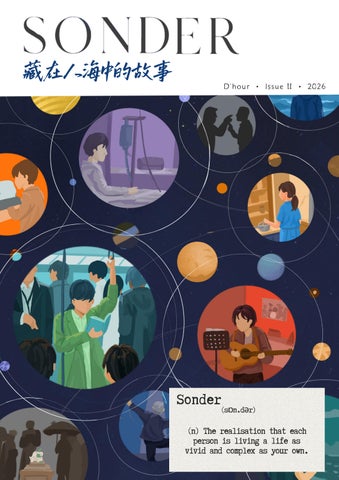
藏在人海中的故事
Sonder(sɒn.dər) (n) The realisation that each person is living a life as vivid and complex as your own.
Walter
Breed: Eurasian Eagle Owl Date of Birth: 14 October 1956 Country of Birth: Singapore Place of Birth: Dunman High Forest ID Card: D19561014HS Social Media Handle: @thedunmanlingo Social life: Has a crush that frequents the Ban Mian store
Editor’s Note 如果用数学打比方,每个人的人生轨迹如 同坐标上的一道曲线。有些人的曲线会相交、 分开,然后等待下次相交。学业、考试、成绩 似乎在我们身边建起了一堵高墙,把我们与外 界隔离开来,让我们看不到人生曲线的相遇。 此次主题《藏在人海中的故事》便旨在引导各 位读者观察其他人的“曲线”,一窥校园内外 其他人身上的悲欢离合,探索新的视角。我们 希望大家能以此作为一个思考开端,反思人生 与世界复杂的本质,从更多元的角度理解社 会,最后再回过头看清自己的内心。
~吴语晨(5C12)
Every person we pass by is carrying a story just as vivid as ours. In this collection, we invite you to realise this reality through a collection of articles, poems, and short stories — all centred around our theme, "Sonder." Whether by capturing the moment of recognising another's hidden inner world, uncovering the lives behind familiar faces, or finding significance in the quiet moments that often go unnoticed, each piece offers a glimpse into the richness and complexity of the worlds we so often overlook. Together, they remind us that every encounter, no matter how fleeting, is shaped by a story we may never fully know. Thank you to everyone who contributed their voice to this issue. We invite you to turn the page, slow down, and discover the extraordinary hidden within the ordinary.
~Shannon Seng (5C11)
CON TE NTS
Page Page
01 15 ⼈ 海 03 17 当⽼师与玩偶 05 擦出⽕花 20 ⼈海藏章 07 ⼈⽣中的 那⾯镜⼦ 21 09 他仍在起舞 23 那位陌⽣⼈ 11 11 25 13 The The Copernican Copernican Revolution Revolution (But (But Smaller) Smaller)
··
Conversations Conversations with with Mr Mr Phuah Phuah
we need we need to to talk talk about "fatties" "fatties" about and "skinny and "skinny legends" legends"
Singularity Singularity
Thirty Frames Thirty Frames Human Human
Convergence, Convergence, Divergence Divergence
Crossword & Crossword & Minute Minute Cryptics Cryptics
The Copernican Revolution (But Smaller)
Lim yue han (5C34)
It's 7a.m. on the MRT. The train is packed. Across from you, a man in his fifties has his eyes closed, not sleeping, just resting them, his tie slightly loose, a faint ring of fatigue under each eye. Beside him, another student is leaning against a pole, visibly tired as he grinds through Pokemon Champions. For a moment, you let yourself wonder: What is the man with the loose tie walking into today? What rating is that guy on Pokemon Champions?
Except, that doesn't really happen anymore, does it?
Let’s reframe the scene. It’s 7a.m. on the MRT. The train is a massive sea of bodies. You shuffle onto the train, earphones blasting the audio of whatever reels hit your FYP lately. You feel something and turn back, only to see that it was a woman, back turned, who accidentally nudged you. You instantly judge her and wonder what kind of inconsiderate person would do that and still not apologise. Just as quickly, you lose interest and return to scrolling on Instagram.
There's a word for what should have happened on that train: sonder, coined by John Koenig in his Dictionary of Obscure Sorrows. It describes the moment you realise that every passerby is living a life as vivid and complicated as your own. The man with the loose tie is more than just a detail in your commute. He has a marriage, a mortgage, a meeting he's dreading. Similarly, the woman who bumped into you isn't just an inconvenience. She has a whole morning behind her that you'll never see: a missed alarm, a sick kid, an anxious rush to work.
So, what changed?
1
It’s not that we no longer notice strangers; we still do: the baby crying the entire time on a 6 hour flight, the noisy neighbour practising the guitar at 7am on a weekend, the person walking in front of you moving at a snail’s pace. Yet, instead of wondering about the circumstances that led to it, we immediately condemn them as rude and inconsiderate. That's still a type of contemplation about others, but instead of realising their lives extend beyond this single moment, we reduce them into a one-dimensional characteristic.
It's easy to blame this on being too busy, or shrinking attention spans. But the truth is simpler and less flattering: we're missing effort. Judgement is easy. We can just hand out a verdict in a matter of milliseconds and go about our day thinking that we are morally superior to the stranger that slightly antagonised you on the train. We're never this harsh with ourselves. When you bump into someone, you're just tired, or distracted, or rushing to catch the train. Never inconsiderate, never rude. But when someone else does the exact same thing, the benefit of doubt disappears. They're not having a difficult morning, they're just a bad person. And that's the real cost. Not that we become unkind to strangers, but that we lose the one quiet reminder, several times a day. Sonder was never really about the stranger at all. It was about you. It is the moment you realise your bad morning is not any more real than anyone else's, and that your inconvenience does not outrank a stranger's entire life. There's an old idea we've long outgrown: that the sun and stars revolved around the Earth, that we sat at the centre of everything else's motion. We laugh at that now, but most of us are still living some smaller version of it; certain that everyone else is the backdrop, and we're the only one anything is actually happening to. Sonder is the Copernicus moment for your morning commute, and your demotion from the centre of the universe to just one of eight billion people trying to get through life. Tomorrow, you'll be back on the same train, at the same hour, surrounded by the same sea of strangers. Someone's elbow will catch your bag. Someone will stand just a little too close. Someone will take too long getting off at your stop while you're already late. And for half a second, before you've even decided to, you'll have your verdict ready.
Maybe, just once, let it wait. Let the thought stay open a beat longer than it wants to. Be aware that somewhere behind every tired face on this train is a whole life you are not the centre of, a person who's blissfully unaware of your existence. The doors open. The sea of bodies shuffles forward, already reaching for their phones, already half-gone into their own feeds. Somewhere in that crowd, someone is deciding exactly who you are, in half a second, based on nothing at all. You'd probably want them to wonder a little longer too.
2
Conversations with
Mr Phuah
Vice Principal, Dunman High School
Goh Yu Chen, Elise 吴语晨 (5C12) & Shannon Seng Dian Hui (5C11)
樑
潘家 副校长今年初刚刚进入德明,或许许多同学对他还不甚熟悉。因此, 我们撰写了这篇采访文,希望同学们可以通过这篇文章,对这位刚进入德明大家 庭的新成员有更多了解。 每个人多少都有压力,潘副校长说,他平时解压的方式与我们差不多,不外乎 看Netflix、刷YouTube。除此以外,他也通过与家人、朋友一起吃饭,放松身心。 他在上学时便习惯留在学校与朋友一起写作业,然后再相约出去吃晚饭。朋 友的陪伴对他来说就是疏解压力的渠道之一。到A水准前,他一直保持着这样的生 活方式。对于学习,他认为学生们不应该为了成绩太钻牛角尖,否则会“精疲力 竭”。他建议同学们一定要保持良好的学习节奏,也不要为了学习牺牲社交,多 与老师同学交流,拓宽视野,这样更能提高成绩。 与朋友一起学习的经历也鼓励了潘副校长进入教育行业。他坦言,在初级学 院的时候,他并不知道以后想从事什么行业,只知道要进入公共服务领域,因为 父母从小就教育他,如果有余力帮助别人,就一定要义无反顾地这么做。在申请 公共服务奖学金的时候,他开始考虑自己喜欢学什么。当时他发现自己在学英文 理解与写作(GP)的时候喜欢引用时政类事例,甚至只写时政相关的题目。于是, 他便尝试申请外交部 (MFA) 的奖学金,结果在面试时一问三不知,铩羽而归。后 来,他又重整旗鼓,申请教育部奖学金,凭借当初与朋友复习时,常为朋友答疑 解惑的经历,最终顺利被教育部录取,荣获教育部奖学金。 或许,我们会发现,虽然我们与副校长不是在一个时代成长的人,但其实大 家休闲放松的方式都大同小异。压力大了,都会找家人、朋友倾诉,向他们寻求 慰藉。时代不同,但亲情、友谊,还有人与人之间的连接,依然是亘古不变的。在 人生的道路上他也曾迷茫,也曾有过“多歧路,今安在”的焦虑和困惑,但是只要 不轻易言败,不向困难妥协,继续努力前行,下一个路口,可能就是成就你未来 的通路。
3
Studying in the United Kingdom was the first time Mr Phuah had lived overseas for an extended period of time. Hearing different perspectives abroad, both in class and in day-to-day life, challenged many of the assumptions he had grown up with. That made him realise just how much bigger the world was than Singapore. National Service was a similar experience as his comrades came from all walks of life. "Some of my peers, 20 years old at the time, already had children!" he recalls. That encounter, among many, broadened his worldview of Singapore’s society. Another turning point was his first year as an Economics teacher. It was, in his own words, "a blur." Although he had completed prior teaching internships—including one at Dunman High years earlier—nothing quite prepared him for full-time teaching. "It involved a lot of learning through mistakes, a lot of trial and error," Mr Phuah recalls. "Students would ask questions I'd never think of." Despite the challenges, the warmth of his first cohort and the support of his colleagues made those early years memorable. More importantly, they shaped a belief that continues to guide him today: to give students the space to be themselves. "It's very powerful to see how students grow into their roles," he says. While mistakes are inevitable, he believes school is the best place to make them. After all, "that's what teachers are for"—to guide students through those moments. “What we try to do as teachers, and a school, is prepare students for the next stage of life,” he says. For Mr Phuah, that naturally led to a broader question: "How can we create a system that works towards the common goal of education?" The desire to contribute to that goal was the reason why he took up the role of Vice-Principal. To him, his role is about helping teachers do the best they can for their students. “After all,” he says, “Teachers join the profession because they care and want to make a difference to students. My role as a VP is to support our teachers to realise their meaningful goals.” Looking back, he finds it remarkable how people continue to grow beyond their school years. He still keeps in touch with many of his former students and has seen even those who struggled in school blossom into adulthood. Of course, not everything about Mr Phuah revolves around education. One thing most students may not know is that he has trypophobia. The artificial lotus plant outside his office, he jokingly admits, is something he avoids whenever he can.
4
玩偶 师 老 出火 与
当
擦
吴语晨(5C12)王詩婷(5C11)
花
不知道大家对老师的印象是什么?是诲人不倦,严肃不拘?还是苦口婆 心,慈眉善目?对许多同学来说,老师可能是那个上课喋喋不休,催交作 业,下课试图从某个未设防的学生那里“抢”走手机的 “死对头”。 但是,他们的生活难道仅限于此吗? 答案当然是否定的。作为有血有肉的人, 他们也有由爱好砌起的趣味生活。其中,我 们将要介绍的,就是有些同学可能与老师们 同样感兴趣的的玩偶收集。 高中母语部的洪澜老师之前对 Jellycat 了 解不深,后来因为女儿喜欢,带着她去买, 才激起了她的兴趣。洪老师追寻Jellycat的足 迹遍布世界各地。在采访前,她刚在上海寻 得一只在纽约卖断货的鸽子。不知有没有同 学也会如洪老师一样,为了自己喜欢的玩偶 而行遍大江南北呢?
5
不同于洪老师,高中母语部的刘志 强老师则从小就喜欢玩偶,也有收集玩 偶的爱好,至今已有超过100只毛绒玩 具。如果关注了刘老师的IG,可能就会 注意到,他所发布的内容中玩偶的出镜 率奇高,尤其是那只丑鱼——汉顿。
刘老师大概有60多只汉顿, 而图中的汉顿是他人生中第一条丑鱼。 他强调自己把丑鱼摆在中间是因为他的疯狂喜爱。这条信息我们翻译班 的学生都能认证,毕竟他可是专门设计了关于汉顿的作业,并为它在三 丽鸥家庭排名中拉票。不仅如此,他还有个汉顿的迷你电风扇呢! 由此,我们或许会意识到,或许老师 们的生活中不仅只有成绩和考卷。但换个 角度细想,那些不被我们看见的日常、不 被课堂记录的爱好,拼凑出的是褪去老师 这个身份后一个个鲜活而真实的灵魂。他 们在自己的人生中,何尝不是各自的主角 呢?他们在校园以外,也和你我一样有收 集玩偶的爱好,有自己偏爱的卡通人物, 有一样平凡又生动的日常生活。 在茫茫人海中,那些与我们擦肩而过 的人身上都藏着许多值得细细品味的趣 事,而只要花心思挖掘这些故事,就能从 一个全新的视角,看到一个全新的世界。
6
Singularity
*
Shannon Seng Dian Hui (5C11)
time spills upwards, downwards, collecting in the rafters of thought
i find myself in a maze of doors and i find they are mirrors
a thousand versions of me standing where passages would be
the privilege of an eye refractured; scattering into spectra, fractal-light
like shattered prism veils splitting one eye into a crowd of seeing
i see a hand in a window but the window is also a memory of skin
a dog runs through me leaving pawprints, tearing through paper-me
a laugh, a sigh, a cry echoing through me in a tongue not yet invented
7
i answered from inside a different century of my own mouth beckoning hands, palms nailed to wood a mouth of blood, a gleeful giggle
in the brief moment in-between there is no distinction all evil, all good done onto yourself gazing upon these thousand reflections and only i am the interval between one shape and another the origin and beyond, the end and before at the edge of becoming i must unbecome and every life is mine and every life believes it is alone *Inspired by the Egg Theory, which proposes that every human who ever lived or will live is the exact same soul, with the entire universe being an "egg" for this soul to mature, ultimately evolving into a god once it has experienced every human life.
8
THIRTY FRAMES HUMAN Koh Tien Ya (5C31 )
Tuesday 23 June, 00:08
The monitors flicker, switching from train timings to colourful advertisements that bathe the empty station in a cold, iridescent glow. Outside, the headlights of the last few commuters sweep across the Victorian brickwork, casting long shifting shadows that vanish as quickly as they appear. A cleaner moves to the centre of the frame, his presence the default of the night shift. He mops with mechanical effort, staring vacantly at nothing in particular. He pushes the trail of water over the surface of the same tile, until it reflects the neon above like a dark mirror. For a moment, his posture stiffens. He blinks, the silence weighing on him until he sighs and props his mop against a pillar. He reaches into his pocket and pulls out his phone. The screen lights up with a little girl staring back at him, illuminating his face. He swipes up to an empty notification centre, waiting for a text that will never arrive. The screen times out, and his face disappears back into the shadows. He pockets the device, his movements slower as he grips the mop and resumes his path across the damp floor. The monitors cycle to a new display. He continues his work, The tape rewinds.
9
)
Monday 18 July, 05:47
In a corner of the concourse where the spaces between lines are measured in stacks of pulp, a stationary voyager observes the build-up of the morning rush. His thumbs smooth down the creases of the day’s papers as he sips his coffee without spilling a drop. The ink on his fingers is dark against the synthetic lights of the phones that rush past in a blur, barrelling ahead too quickly to remember that we live in a physical world. He watches the crowd detachedly, standing in someplace he’s always known but somewhere he’s never been. The clean, digital landscape that does not wait for the turn of a page. His stand has stopped being part of people’s morning rituals and has been relegated to an invisible convenience that people no longer effortlessly go to. An elderly man approaches the stand. The man’s lips curl up in quiet recognition as he picks up an issue in a practiced motion. With a polished tip of his head, the eloquent exchange is over, and the man blends back into the crowd. Yet another group swarms past. The coffee continues to steam, The tape rewinds.
Friday 4 September, 10:29 A student sits hunched over on a weathered green bench. The station around her is a blur. But she exists in a heavier stillness, stretching every second into something unrecognizable. Her fingers fly across her keyboard with practiced ease, her eyes scanning the screen with careless indifference. Yet, she betrays her confidence with another nervous swipe of her palm against her jeans.
Friday 20 November, 13:53
The bustle of the typical lunch hour crowd grinds to a halting stop. A cohesive circle forms like the vortex of a whirlpool, providing momentary respite in the stifling heat of social friction. A violinist lifts his arm and begins to carve a breath into the frantic momentum, bow slicing through the air.
The first note ripples outwards. While most eyes see only the spectacle and glowing screens rise to trap the melody, one pair of eyes simply watch. Near the circle’s edge, tucked away from the jostle of younger shoulders, an old woman listens. She lets the music wash over her, fingers instinctively twitching to the melody. Her wrist moves with silent familiarity–absent-minded, but never forgetting its master. A weary smile softens her face, a fleeting bridge to a version of herself left in the past.
As she waits, the screen dims. The light on her face recedes before snapping back with sharp intensity. She freezes. Her thumb hovers over the touchpad, delaying the notification as if she might somehow change what it says. With a jagged breath, she clicks. The screen doesn't respond; she clicks again with more force. Her eyes dart across the text, then abruptly stop. Tiny black letters against sterile white have delivered her fate, sealed with a finality she can’t undo. Her hands move to shield her face as moisture seeps between her fingers. She fumbles to shut the laptop. For one last second, her reflection stares back from the dark glass before the device is stuffed into her bag with clumsy hands. Getting up with a wobble, she stands, but is still unsteady on her feet. She takes another tentative step forward. The world continues restlessly, The tape rewinds.
Holding her hands up to the light, her face falls. They tremble, rebellious to her age, unable to find the stillness they once possessed. Her breath hitches, a small sound that dissolves into the crowd. Unprompted and unseen, a quiet shame takes hold. Quickly, she hides her hands back in the pockets of her cardigan and turns to go, head hung low against the rising tide of the city. The song ends, the spell breaks, the crowd erupts. The applause continues to roar, The tape rewinds.
10
那位陌生人 孙浩哲 (5C33)
人来人往的城市里,每个人都像一滴水,匆匆流过街道和车站。直到那一 天,我才明白,每一个普通的陌生人背后,都可能藏着一段不为人知的故事。 那天傍晚,我因为学校测验没考好,心情十分低落。天空下着小 雨,灰蒙蒙的云仿佛也在诉说我的失落与烦闷。 我站在角落里,背着沉重的书包,心里越来越烦躁。 这时,一位中年男人急匆匆地走来。他穿 着旧外套,裤脚被雨水打湿,背上还背着一个 大包。他一边看手机,一边往站台里挤,不小 心撞到我身旁的一位阿姨。阿姨手里的饮料洒 了出来,也溅到了我的鞋子上。 我看着鞋面上的污渍,心情更加烦闷。 阿姨不满地说:“你走路怎么这么不小 心?”男人立刻停下,连连弯腰道歉:“对 不起,我真的不是故意的。” 可那时,我只觉得他冒冒失失,给别人添了麻 烦。 男人没有争辩,只是慌忙拿出纸巾。可是他的手有些发抖,纸巾也被雨水打 湿。就在他弯腰时,怀里的塑料袋突然破了,里面的东西散落一地。 我低头望去,发现地上是一袋药、几张缴费单,还有一张医院单据。我的目 光无意间落在单子上,“儿童病房”几个字像针一样刺进我的眼里。 这时,他的手机忽然响了。男人慌忙把药和单据塞回袋里,走到站台边接起 电话。雨声中,我断断续续地听见他说:“别怕,我马上到医院了……钱的事我 再想办法……孩子的药,不能停。”
11
他的声音很轻,却像压着千斤重担。 原来,他并不是故意撞到别人,只是太着急,急着赶去医院;也太疲 惫,疲惫到脚步都变得慌乱。那一刻,我忽然明白,他背上的大包里,装 着的不只是生活用品,更是一个父亲沉甸甸的责任; 他护在怀里的那袋 药,牵系的是孩子的健康与一家人的希望。那些低声的道歉背后,藏着的 不是软弱,而是一个普通人在生活重压下仍努力支撑的坚强。 我望着他,心里涌上一阵羞愧。刚才的我,只看见自己被弄脏的鞋,却 没有看见他湿透的裤脚、发抖的双手和疲惫的眼神;只看见他的失误,却没 有想过他正承受着难以言说的压力。我常因考试失利、作业繁重而觉得委 屈。可那一刻我才明白,在这座城市里,还有许多人正在负重前行。他们没 有诉苦,却依然为了家人和责任,咬着牙往前走。 公交车缓缓驶来。男人小心地把药和单据放好,又把破了的袋 口紧紧攥在手里,仿佛攥住的是孩子的希望。他背起大包,匆匆上 了车。很快,他的身影被人群淹没,可那个微微弯着腰、却仍努力 向前的背影,却久久留在我的心里。 从那以后,我开始学着多观察身边的人。公交车上疲 惫地闭着眼睛的人,也许正在为家庭奔波;深夜送餐的外 卖员,也许正努力承担生活的开支。如今我明白,他们每 个人都有自己的故事。 那位陌生人让我学会了理解。善良不一定是做惊天 动地的大事,它有时只是少一点抱怨,多一点体谅;少 一点冷漠,多一点耐心。我也许还不能改变别人的生 活,但可以从改变自己的态度开始,学会尊重每一个普 通人。 人海虽然拥挤,却并不冰冷。那些平凡的陌生人背 后,藏着不为人知的辛苦,也藏着温暖的故事。只要我们 愿意多看一眼,多想一步,就能看见人性的坚强与善良。
12
Convergence,
Jin Zihan (5C38)
Divergence
The first time he saw her, she was framed by a train window, sketching the city as it shattered past in fractured pieces — apartment blocks, traffic lights, cranes stitched into the rust of the evening sky. Her pencil moved in quick, unbroken strokes, as if she could pin the city down before it slipped past. He found himself staring. Perhaps it was her beauty — the delicate curve of her features, the way the fading sunlight softened the contours of her face. Perhaps it was the quiet concentration in her eyes. Or perhaps it was simply the mystery of her. She looked like a story midway through its pages. A story he would never read. The realization embarrassed him. What was he doing? Building entire narratives from a stranger sitting three rows away? Then the train shuddered to a halt and the carriage emptied around her seat. When he looked up again, she had vanished, as instantly and completely as warm breath off glass.
He didn't think of her often, but he began thinking of strangers more. A woman gripping her phone as if it might, if held tightly enough, explain something. A man rereading the same paragraph on a bus, his eyes snagging on it like a needle skipping a groove. He began, without quite meaning to, cataloguing them: the courier who paused at the same shuttered shopfront before continuing his round, the schoolgirl practising smiles in every reflective surface she passed. Then, years later, it was the habit that caught his eye before the face did. In a bookstore, a woman paused over a stranger near the register, watching him with the same quiet, cataloguing attention he'd spent years learning to recognize in himself. He knew her before he knew her, — and only then noticed the sketchbook wedged beneath her arm, like an old habit she'd never bothered to break. "Train line?" she asked, before he could feign forgetting. "You weren't very subtle." "I thought you hadn't noticed." "I was sketching. I’m not blind." She laughed and extended a hand as though the intervening years were a formality. "I suppose we should properly meet this time."
13
She confessed that as a child she'd ride buses inventing lives for the other passengers, convinced there was something faulty in her for caring so much about people she'd never address. He told her he'd done the very same, and had never once said it aloud before her. Her pencil arresting mid-stroke at a stranger's face. His memory hoarding the small stories she told him until he could return them to her, intact, a week later. It felt less like falling than like waking to a truth that had been patient, all along, waiting to be noticed.
The last time they saw each other was at a train station — an irony neither remarked upon. Beyond the platform, the tracks receded into the dark, parallel and immaculate, never once permitted to touch. “Do you regret it?" she asked. "No," he said, meaning it with a force that surprised him. "Never." She nodded, as though that answer would have wounded her less as a lie. Then she was gone.
She kept a map pinned above her desk, cities ringed in red for the places she meant to go next. When he asked how many she'd already crossed off, she said none — the ringing was the point, not the crossing off.
That would be their final goodbye.
Perhaps, then, he should have known what was to come.
Time did what time does. The ache dulled to something almost fond.
Though that was not his only clue.
And still, he catches himself composing lives out of a glance — a boy with a split knuckle, an old woman rereading a letter as though rereading might resurrect its sender.
Once, at the airport where they'd gone to see off a friend, she had watched the departures board a beat too long. "Come with me," she said, half joking. He watched it and let the quiet be his answer. She didn’t ask again. She never asked again.
The platform closed over the space she'd occupied, the way a pond would close over a dropped stone — briefly disturbed, then unbroken again.
He never received the ending he'd wanted with her. What he inherited instead was quieter and stranger: the memory of two lines that had just intersected once, and kept going. When we touch a life, are we not only ever in transit through it? He supposes that has to be enough. Most days, it very nearly is.
14
人·海 徐望舒 (5C22)
你要听故事吗?放心,不是什么王子拯救公主,也不是什么外星 人毁灭地球。这只是一个没人在意的老哑巴的自传。 你可以叫我“星期五”。 说实话,我没想到我会落到这般田地。我以前是个唱歌的。小有 名气,饿不死。白天写歌,晚上驻唱。虽然寡淡,但也挺好的。只要 我肯努力,未来总会有出头的一天,不是吗?年轻人,心高气傲,刚 愎自用。 我还记得那天下午。台下的人并没有发现什么,他们依旧聊天, 依旧等着下一首歌。我却站在台上,一遍又一遍地试图找回那个熟悉 的声音。以前闭着眼都能唱出来的旋律,那天却像隔着一堵墙。我越 是用力,声音就越是陌生。下台以后,我甚至还安慰自己,也许只是 太累了,也许睡一觉就好了。可第二天没有好起来,第三天也没有。 后来我去了医院。医生说了很多专业名词,我没记住。只记住了一句 话——以后唱不了了。
世界真吵啊。成就,功名,冷 眼,戏谑。人海像涨潮时的海面,总 有人拼命往前游,也总有人被浪头拍 进水里。欲望的漩涡无时无刻不在吞 噬海水。那时候我以为,人这一辈 子,大概都逃不开这些声音,人海令 人陶醉的潮汐。 *注:“星期五”,源自鲁滨逊漂流记中的野人,代表主 人公哑了以后与世脱节,在社会中没有了容身的地方,相 较他人来说就是一个野人
15
父母留下的那间小屋已经很久没人住了。墙上的油漆有些剥 落,窗框也被海风吹得发白。我把行李放进去的时候,屋子里几 乎什么都没有,只有一张旧桌子和一台已经坏掉的收音机。每天 早上,我推开窗,就能看见海。刚开始我很讨厌那里。城市里至 少还有声音,还有人,还有事情等着我去做。可在这里,一天可 以很长,长到让我不知道该怎么打发。于是我开始坐在窗边听 海。 直到有一天,我听见一种奇怪的声音。它很远,却又很清 晰。像一把被埋进深海多年的旧吉他。我花了一个星期才找到它 的来源。那是一段鲸歌,而唱歌的,是一头总独自出现的鲸鱼。 她一直歌唱,却从未得到回应。爱丽丝——我这么叫她。后来我 才知道,她或许就是人们口中的52赫兹鲸鱼。没有鲸鱼听得见她 的歌声。于是,她成了鲸群里唯一的独唱家——人们称她为世界 上最孤独的鲸鱼。 可有时候我也会想,既然无人回应,为什么还要唱呢?她明 明可以沉默。明明可以像礁石一样,把所有声音埋进海底。可她 没有。她还是唱着。日复一日地唱着。 或许歌唱本身就是意义。不为谁听见,不为谁鼓掌。只是因 为心里还有歌,所以便唱了。那一刻,那些曾经嘈杂的声音渐 远。功名也好,掌声也罢,人海里那些催着人向前奔跑的喧嚣, 忽然都没那么重要了。人海依旧翻涌。人海终归沉寂。 我再也没有见过爱丽丝。或许她去了更远的海域,或许她一 直在那里。谁知道呢?人海依旧,每天都有人为掌声奔跑,为名 利驻足,为得失难眠。海浪也依旧拍打着礁石。世界从未改变, 世界一直在变。歌声如果没有听众,意义何在?如果无人聆听, 歌声就不存在了吗?因为存在,所以歌唱。因为唱歌,所以存 在。而这,就是我的故事,一个藏在人海中的故事。 唱吧,孩子。尽情地唱吧!不为观众,只为自己。
16
We Need to Talk About “Fatties” and “Skinny Legends” Elisha Pang Myn En (5C12)
No one knows exactly where these words came from. They first sprang up, like weeds after rain, on social media platforms, then slowly started appearing in our daily interactions. Quite suddenly, anyone caught eating anything was a “big back” or “fatty”. No longer were we “legends”, but “skinny legends”. Despite the size-related nature of these slang terms, they are generally used playfully among friends and are not meant to reflect a person’s actual appearance. The widespread adoption of this language, however, coincides with recent controversy surrounding weight-loss drugs and the troubling comeback of the “ultra-thin” trend in media and fashion. Do we, as a teenage society, really understand the words we use and their impact?
The Skinny Legend Initially used by fans of celebrities like Mariah Carey and Raini Rodriguez, the term “skinny legend” or “skinny queen” was popularised in 2018 to describe anyone who was considered iconic or praiseworthy, regardless of their body size. Various memes of celebrities edited into comical stick-figures with the caption “skinny legend” spawned all over Twitter and Instagram.
17
There is no consensus on what the phrase implies about being “skinny”. Some have criticised the term for inherently equating thinness with admirability, emphasising unhealthy body standards. Others have argued that “skinny legend” was never meant to compliment someone’s thinness but only used ironically to parody the glorification of “skinny”. While this may have been the case in 2018, the definition of “skinny” remains unchanged, and the context behind “skinny legend” has been largely forgotten. The perception of the term nowadays is very much associated with commending physical thinness — in our community it is usually used in jest, with regard to being able to fit into a size XS or pass through narrow passageways. Nonetheless, the positive connotation of “skinny” has been renewed, which does not bode well in light of “ultra-thin” glory returning to the media.
The Big Back There were several definitions of “big back” before it solidified as an internet slang referring to an overweight person. However, social media posts popularising the term usually feature average-weight people who are cooking or eating large amounts of food — termed “big back behaviour”. Despite its popularity, “big back” has received backlash from netizens and experts, with psychologists arguing that even if used jokingly, the term can be triggering for some, especially since body image struggles are typically hidden. Others have pointed out that labelling certain activities as “big back behaviour”, even if self-deprecatingly, ultimately mocks and perpetuates stereotypes about overweight people. The use of “big back” was popular in our school community last year, only dying down with the rise of newer slang. Most did not use it with ill-intent, but this reflects how as a community we are too easily infected by the latest trends without considering their larger impact.
18
Fatty? The comeback of “fatty” came with the rise of “big back”, and the two are often used interchangeably. Whereas “big back” was a relatively new term, “fatty” was an established slur, newly made acceptable by virtue of being a joke. Previously, it was considered an incredibly rude — and dead — label. Today, like “big back”, it is used to playfully call out someone for eating a lot. But the rise of “fatty” is not a reclamation of “fat”, which the body positivity movement sought to do in the late 2010s by using “fat” as a neutral descriptor equivalent to “tall” or “blonde”. “Fatty” retains its nature as an insult, and draws attention to someone’s weight.
What's The Deal? Most people with good sense would not call anyone a “big back” or “fatty” in front of an overweight person, and only say it to those they believe are comfortable with the term. However, using such language in our daily interactions forces us to constantly categorise others by their weight. There is also always a chance that even our close friends will be hurt by such vocabulary — body image issues are a prominent problem among adolescents, especially girls, with eating disorder diagnoses more than doubling among Singaporean teenagers over the past decade. By perpetually using body-related slang, we slowly internalise the idea that bodily appearance is a decisive factor in determining someone’s worth, which should never be the case.
19
The best way to avoid harming others through our language is to actively practice empathy in our interactions. By understanding that everyone around us leads a life just as important to them as ours is to us, that they ruminate on hurtful remarks in the same way that we do, that they are able to pretend something does not trigger them just as well as we can, and that they ultimately also want to be loved respected; we can make the best decisions about what we and those around us need to hear in our daily lives.
人海藏章
翁佳仪 (5C12)
久居书案伴诗行,错认庭隅是世疆。 辞校登台凭远望,站台为镜照尘光。 往来行客向殊方,各载悲欢各带伤。 少年愁缚功名卷,中年奔走觅粮仓。 白头静数旧时光,咫尺相邻意隔江。 方悟吾身沧海粟,一怀忧喜尽微茫。
莫拘方寸得失量,细品人间冷暖肠。 烟火寻常藏百态,抛开书卷见穹苍。 众生皆踏世间霜,风雨肩头自砥刚。 阅遍人潮心渐敞,常怀善念担柔肠。 微躯亦纳山河广,持盏心灯赴岁长。 20
人生中的那面镜子 黄芮琪 (1E)
人生如镜。他人的际遇百态,都是映照自我的明镜。成长,不仅是亲身 经历,更是在别人的故事里,看见藏在心底的自己。 有一次校园演讲大赛,整个礼堂坐满了人,我坐在观众席上,看着同班 的林默从容地走上舞台,他为这场比赛,准备了整整一个月。课间休息时, 总能看见他捧着稿子低声背诵,就连走路都在琢磨抑扬顿挫。他的举动让所 有人都觉得——这次比赛他必定夺冠。 但意外总是来得猝不及防。当林默讲到关键段落时,他忽然顿住,原本 流畅的话语戛然而止,话筒里只剩下急促的呼吸声。,他攥紧话筒,指尖泛 白,眼神慌乱地扫过台下,脑子里彻底空白。台下逐渐响起细碎的议论,僵 持十几秒后,林默低声说了句抱歉,深深鞠躬,快步离开舞台。
21
虽然我从未有过登台演讲时当众忘稿的经历,从 来不用承受在无数目光聚焦下出错时的难堪,可看着 他落寞的背影,心底猛地涌上一阵熟悉的酸涩。
旁人都在替他惋惜那付诸东流的长久努力,但我却读懂了他藏在 要强外表下的惶恐。即便我不需要像林默一样,面对几百人的尴 散场后,我在走廊角落遇见了林默。他背靠着墙壁, 尬注视,可每逢大型测验、课堂汇报,我总会提前陷入无尽的焦 一遍遍地抚平皱巴巴的演讲稿,眼眶通红,却死死忍住泪 水,不让它流出来,嘴里还在小声梳理刚才出错的段落, 虑。明明知识点早就反复温习妥当,但心底却总不断幻想自己突 没有半句抱怨,只剩浓浓的不甘和对自己的失望。 然失误、搞砸一切的画面。我同样被失败的恐惧牢牢束缚,表面 装作镇定自若,内心却早已忐忑不安。虽然我们经历的事情不 旁人都在替他惋惜那付诸东流的长久努力,但我却读懂了他藏在要强 同,可那份害怕辜负努力、畏惧失态难堪的心境一模一样。那一 外表下的惶恐。即便我不需要像林默一样,面对几百人的尴尬注视,可每 刻,我仿佛在林默的遭遇里,看见了胆怯又好强的自己。 逢大型测验、课堂汇报,我总会提前陷入无尽的焦虑。明明知识点早就反 复温习妥当,但心底却总不断幻想自己突然失误、搞砸一切的画面。我同 样被失败的恐惧牢牢束缚,表面装作镇定自若,内心却早已忐忑不安。虽 然我们经历的事情不同,可那份害怕辜负努力、畏惧失态难堪的心境一模 一样。那一刻,我仿佛在林默的遭遇里,看见了胆怯又好强的自己。 我原本以为他经过这次比赛中的意外,会消沉许久。没想到第二天 一早,林默就拿着修改后的稿件去找老师复盘。在复盘的过程中,他认真 记下所有不足,并在复盘后主动报名了下月的校园演讲复赛。阳光落在他 提笔批注的手上。他的眼睛里没有丝毫逃避,只剩重新出发的坚定。 望着林默专注的模样,我茅塞顿开。原来,想要认清自己,未必需要 亲身经历所有坎坷。他人的故事就如同一面镜子,即便境遇不同,相通的 情绪和想法也能让我们寻到自身的倒影。林默直面挫折的勇气告诉了我, 不该始终困在对失败的担忧里。与其害怕跌倒,不如坦然向前。 古人曰“观人亦是观己,共情使人成长。”这,便是共情带给我昀珍 贵的成长。
22
他仍在起舞 张琪 (4C) 夜晚,清晨。 平常的一天,我走在回家路上,听到一阵微弱的音乐。路灯昏 黄,我微微眯着眼睛,看到了一位男士穿着笔挺的西装,独自起 舞,优雅的舞姿和谐地融入周围的静谧。 我不由停下脚步。当那位男士转过来时,我愣了一下,竟是和 我合租的邻居! 在我的印象里,邻居似乎永远身着笔挺的西装,清晨出门如 此,深夜回来也如此。和大多数上班族一样,他似乎被固定在某种 规律里面。今天的发现令我愈发好奇邻居的秘密——谁会想到一个 程序员竟然会跳舞呢? 接下来的几天,我开始留意观察邻居的一举一动。 有时是在电梯里,他低头看着手机,神情平静,与普通上班族 并无不同。有时是在地铁站,人群拥挤,他安静地站在角落,戴着 耳机,手指轻轻敲打节拍。还有一次是在深夜,我起床倒水,透过 客厅窗户看见他刚刚回来。昏黄的灯光下,他微微喘着气,额角挂 着细密的汗珠,像是刚完成一场漫长的奔跑。而第二天清晨,他依 旧准时出现在门口,穿戴整齐,准备上班。 几天后的傍晚,我又一次路过湖边,听到熟悉的音乐,看到熟 悉的身影时,我决定上前寻求答案。一曲终,我鼓掌。 邻居愣了一下。 “你怎么在这里?”
23
“我还想问你呢!没想到你会跳舞。” 湖面倒映着粼粼灯光,晚风轻拂,他说:“其实我以前想当舞蹈 家。” 我怔住了。 “后来发现,梦想不能帮我付房租,” 他笑了笑,语气很轻很轻, “大学毕业以后找工作、赚钱、生活,然后就慢慢变成现在这样了。” “那你为什么还坚持来这里跳舞?” 我忍不住问,他没有立刻回答。 过了许久才开口:“因为我喜欢。白天工作已经够累了,如果连喜欢的 东西都放弃,那生活未免太无聊了。” 说完,他重新站起身,路灯将他的影子拉得很长,“而且我也没完 全放弃梦想。” 我困惑地抬头看向他,但他只是再次把自己投入音乐,翩翩起舞。 他问我,“你的梦想是什么?“ 我便笑着和他说,小时候希望自己 长大能成为话剧演员,只是后来,我选择了一个容易就业,薪水稳定的 工作。他笑着调侃了一句:”为什么不考虑重新尝试?反正上了几年 班,也累积了一定的经验。你会失去什么呢?”
后来,我决定从零开始,慢慢朝着再次登上舞台 的梦想努力。为此,我搬离了公寓,和邻居告别。 过程并非容易,但,我做到了。话剧谢幕时, 台下掌声如潮。灯光扫过观众席的那一刻,我忽然 想起邻居,一个人在空旷的湖岸边起舞。没有观 众。没有掌声,却比我见过的任何演员都更投入。 人这一生未必能成为梦想中的自己,但总有人会 在无人喝彩的地方,为自己的热爱跳完一支舞。
24
Crossword By Lim Yue Han (5C34) and Oon Cheaung Qi (5C44) ACROSS 1 Type of milk alternative 4 Mental health condition, for short 7 Outlet centre? 9 "Queen of Jazz" Fitzgerald 10 Feminine suffix 11 Close by 12 What might be said during New Year's Eve, or what is happening in this puzzle for a Spaniard 14 Toilette fluid 15 Mousepad, for one 21 A4 maker 22 Foxtrot preceder 23 Online attack, for short 24 Doctor’s prescription 25 Electric fish 26 Shout in a card game 1
2
DOWN 1 Oil grp. 2 Choir voice 3 "Swan Lake" attire 4 Butter substitute 5 Quick item in Pokemon 6 Euphemism for damn 8 Book with a notable world premiere 9 Stood the test of time 13 Tit for ___ 15 Walk in shallow waters 16 Inconsiderate 17 “Survivor” immunity object 18 Neutral shade 19 Ostracise 20 Food not for here?
3
7
4
5
6
18
19
20
9
8
10
11
12
13 14
15
17
21
22
23
24
25
25
16
26
Minute Cryptics By Elisha Pang Myn En (5C12) and Melissa Poh Shi Ying (5C37) Guidelines Every cryptic clue is a tiny puzzle with two parts: a definition - a direct hint at the answer. and wordplay - a clever way to build the answer using some mix of letterplay and language tricks. The wordplay usually involves two ingredients: Fodder - the letters and words you’ll be messing with. Indicators - words that tell you what to do with the fodder (like mix it up, reverse it, take initials...) Example Monkey with no cigar, as nature intended (7) Indicator: monkey with — implies you need to rearrange order of letters Fodder: no cigar — these are the letters that form the answer Definition: as nature intended Answer: organic Source: Minute Cryptic
Clue 1:
Stepping aside, last twins of Grandpa fuss over baby (8)
Clue 2:
Elvis, discombobulated, still breathes (5)
_ _ _ _ _ _ _ _
_ _ _ _ _
Hints: Fodder – Grandpa fuss over baby Indicator – last twins Explanation: ‘twins’ implies that we should take two letters beside each other from each word, while ‘last’ refers to the ending letters of each word Definition – stepping aside
Hints: Fodder – Elvis Indicator – discombobulated Explanation: ‘discombobulated’ implies that the word is in disorder, meaning it must be rearranged Definition – still breathes
Answers: Clue 1 - PASSERBY; Clue 2 - LIVES
26
Our Team English Department: Shannon Seng Dian Hui Lim Yue Han Elisha Pang Myn En Jin Zihan Koh Tien Ya Maisy Tan Chao Jing Xuan Darolyn Chinese Department: Ong Sze Ting Evelyn Oon Cheaung Qi Ang Jiayee Goh Yu Chen, Elise Xu Wangshu Yang Huilin Sun Haozhe Liu Yiwei
Design Department: Chen Jing Chen Huixuan Low Yu Tong Lau Yu Han Melissa Poh Shi Ying Mok Chin Yee Edna
Special thanks to (JH): Rachel Ten Si Ru Zhang Qi Huang Lexi Dawn Felicia Ng Rui Qi Goh Yu Tong Germaine Cheong Toh Kia Ern Gwyneth
Proudly brought to you by: DHS Publications (Senior High) 德明政府中学出版社 (高中部)