Test Bank for Personal Finance 3
Edition by Bajtelsmit
ISBN: 9781394162550
Personal Finance, 3e (Bajtelsmit)
Chapter 1 The Financial Planning Process
1) Personal finance is a specialized area of study that focuses
A) exclusively on investments and retirement planning.
B) on financial management, household budgets, and investments.
C) exclusively on investment management and household budgets.
D) on individual and household financial decisions, such as budgeting, saving, spending, tax planning, insurance, and investments.
Answer: D
Explanation: Personal finance is a specialized area of study that focuses on individual and household financial decisions, such as budgeting, saving, spending, tax-planning, insurance, and investments.
Diff: 1 Var: 1
Section: 1.1 What Is Personal Financial Planning?
Learning Objective: 1.1 Describe the personal financial planning process, and explain how the elements of a comprehensive financial plan fit together.
Bloomcode: Knowledge
AACSB: Knowledge
Expected Time to Complete: 1 minute
2) Critical to the success of building a comprehensive financial plan is that you approach its creation in a logical order. The proper steps in creating a successful financial plan fall in this order:
A) Secure basic needs, build and protect wealth, and establish a firm foundation.
B) Secure basic needs, establish a firm foundation, and build and protect wealth.
C) Build and protect wealth, establish a firm foundation, and secure basic needs.
D) Establish a firm foundation, secure basic needs, and build and protect wealth.
Answer: D
Explanation: Critical to the success of building a comprehensive financial plan is that you approach its creation in a logical order. The steps to success are: establish a firm foundation, secure basic needs, and build and protect wealth.
Diff: 2 Var: 1
Section: 1.1 What Is Personal Financial Planning?
Learning Objective: 1.1 Describe the personal financial planning process, and explain how the elements of a comprehensive financial plan fit together.
Bloomcode: Comprehension
AACSB: Comprehension
Expected Time to Complete: 2 minutes
3) The financial planning process includes five steps. Four of the steps are listed next:
• Analyze your current financial status.
• Implement your financial plan.
• Monitor your progress and revise your plan as needed.
• Organize your financial information and set short-term and long-term goals.
What is the missing step?
A) Identify and evaluate alternative strategies for meeting your goals.
B) Understand the personal financial planning process.
C) Acquire the necessary decision-making skills and tools.
D) Build wealth and protection against emergencies.
Answer: A
Explanation: The five steps in the financial planning process are as follows:
1. Organize your financial information and set short-term and long-term goals.
2. Analyze your current financial status.
3. Identify and evaluate alternative strategies for achieving your goals.
4. Implement your financial plan.
5. Monitor your progress and revise your plan as needed.
Diff: 2 Var: 1
Section: 1.1 What Is Personal Financial Planning?
Learning Objective: 1.1 Describe the personal financial planning process, and explain how the elements of a comprehensive financial plan fit together.
Bloomcode: Comprehension
AACSB: Comprehension
Expected Time to Complete: 2 minutes
4) An effective financial plan must be adaptable to changing circumstances. Which would not be a reason to take you back to Step 1 of the financial planning process?
A) Changes in economic conditions
B) Birth of a child
C) Purchase of life insurance
D) Marriage
Answer: C
Explanation: Many changes will occur over the course of your life. Not only will changes in your personal circumstances (a new job, marriage, and children) affect your financial planning objectives and strategies but also may changes in economic conditions necessitate a revision of your comprehensive financial plan. Thus, revising your plan takes you continually back to the beginning of the process again. Life insurance is a result of changing a financial plan.
Diff: 2 Var: 1
Section: 1.1 What Is Personal Financial Planning?
Learning Objective: 1.1 Describe the personal financial planning process, and explain how the elements of a comprehensive financial plan fit together.
Bloomcode: Application
AACSB: Reflective Thinking
Expected Time to Complete: 1 minute
5) Personal financial planning does not include which of the following?
A) Buying insurance
B) Deciding which make and model of car to buy
C) Budgeting
D) Assessing attitude toward risk
Answer: B
Explanation: Personal financial planning includes budgeting, savings, buying insurance, and assessing attitudes toward risk. While determining the cheapest form of financing and the opportunity cost associated with purchasing a car is part of financial planning, the qualitative factors involved in the make and model of a vehicle is not.
Diff: 2 Var: 1
Section: 1.1 What Is Personal Financial Planning?
Learning Objective: 1.1 Describe the personal financial planning process, and explain how the elements of a comprehensive financial plan fit together.
Bloomcode: Comprehension
AACSB: Comprehension
Expected Time to Complete: 1 minute
6) Which is not a necessary activity in securing your basic needs?
A) Making purchase and credit decisions
B) Managing cash for liquidity and emergencies
C) Selecting financial institutions for checking and savings accounts
D) Investing to achieve long-term goals
Answer: D
Explanation: Securing your basic needs is the second element of a comprehensive financial plan. Making purchase and credit decisions, managing cash for liquidity and emergencies, and selecting financial institutions for checking and savings accounts are all activities necessary to completing this part of your plan, not long-term investments.
Diff: 2 Var: 1
Section: 1.1 What Is Personal Financial Planning?
Learning Objective: 1.1 Describe the personal financial planning process, and explain how the elements of a comprehensive financial plan fit together.
Bloomcode: Comprehension
AACSB: Comprehension
Expected Time to Complete: 1 minute
7) Which is not a necessary activity in establishing a firm foundation?
A) Protecting income and wealth from losses
B) Acquiring necessary decision-making skills and tools
C) Understanding the personal financial planning process
D) Setting short-term and long-term goals
Answer: A
Explanation: Establishing a firm foundation is the first element of a comprehensive financial plan. Acquiring necessary decision-making skills and tools, understanding the personal financial planning process, and setting short-term and long-term goals are all activities necessary to completing this part of your plan, not insurance protection.
Diff: 2 Var: 1
Section: 1.1 What Is Personal Financial Planning?
Learning Objective: 1.1 Describe the personal financial planning process, and explain how the elements of a comprehensive financial plan fit together.
Bloomcode: Comprehension
AACSB: Reflective Thinking
Expected Time to Complete: 1 minute
8) Which is not a necessary activity in building and protecting wealth?
A) Writing a will
B) Investing to achieve long-term goals
C) Buying property and liability insurance
D) Managing cash for liquidity and emergencies
Answer: D
Explanation: Writing a will, investing to achieve long-term goals, protecting income and wealth from losses, and buying property and liability insurance are all activities necessary to completing this part of your plan, not cash/liquidity management.
Diff: 2 Var: 1
Section: 1.1 What Is Personal Financial Planning?
Learning Objective: 1.1 Describe the personal financial planning process, and explain how the elements of a comprehensive financial plan fit together.
Bloomcode: Comprehension
AACSB: Reflective Thinking
Expected Time to Complete: 1 minute
9) As you build your financial plan, you'll need to consider the unique characteristics of your household that may influence spending and saving. Which of these factors is not unique to your household?
A) Life cycle stage
B) Family makeup
C) Inflation and interest rates
D) Values and attitudes
Answer: C
Explanation: Factors unique to your household are your life cycle stage, family makeup, and values and attitudes. While economic factors, such as inflation and interest rates, are important considerations for everyone who is developing and implementing financial plans.
Diff: 2 Var: 1
Section: 1.2 Factors That Influence Financial Planning Decisions
Learning Objective: 1.2 Describe how individual characteristics and economic factors influence personal financial planning.
Bloomcode: Comprehension
AACSB: Comprehension
Expected Time to Complete: 1 minute
10) If your ________ are larger than your ________, your wealth is negative.
A) expenses; debts
B) debts; assets
C) assets; debts
D) assets; income
Answer: B
Explanation: If your debts are larger than your assets, your wealth is negative.
Diff: 2 Var: 1
Section: 1.2 Factors That Influence Financial Planning Decisions
Learning Objective: 1.2 Describe how individual characteristics and economic factors influence personal financial planning.
Bloomcode: Comprehension
AACSB: Reflective Thinking
Expected Time to Complete: 1 minute
11) A person's fundamental beliefs concerning what is important in life are referred to as A) judgments.
B) values.
C) attitudes.
D) opinions.
Answer: B
Explanation: Values are fundamental beliefs about what is important in life.
Diff: 1 Var: 1
Section: 1.2 Factors That Influence Financial Planning Decisions
Learning Objective: 1.2 Describe how individual characteristics and economic factors influence personal financial planning.
Bloomcode: Knowledge
AACSB: Knowledge
Expected Time to Complete: 1 minute
12) When the consumer price index (CPI) increases,
A) you can buy goods and services cheaper.
B) the prices of goods and services are more expensive.
C) the value of the dollar is high.
D) you will earn less on your investments.
Answer: B
Explanation: In the United States, inflation is typically measured by the change in the CPI, which is a representative basket of more than 400 goods and services used by urban households, including food, housing, consumer goods, gasoline, and clothing. When the consumer price index (CPI) increases, the prices of goods and services become more expensive.
Diff: 2 Var: 1
Section: 1.2 Factors That Influence Financial Planning Decisions
Learning Objective: 1.2 Describe how individual characteristics and economic factors influence personal financial planning.
Bloomcode: Application
AACSB: Analytic
Expected Time to Complete: 1 minute
13) As inflation ________, the spending power of money ________. A) increases; increases B) decreases; decreases C) increases; decreases D) decreases; remains the same
Answer: C
Explanation: Inflation refers to an increase in prices. As prices of goods and services go up, the spending power of your money goes down; thus, a dollar will not purchase as much as it previously did.
Diff: 2 Var: 1
Section: 1.2 Factors That Influence Financial Planning Decisions
Learning Objective: 1.2 Describe how individual characteristics and economic factors influence personal financial planning.
Bloomcode: Application
AACSB: Analytic
Expected Time to Complete: 1 minute
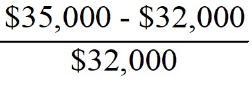
14) Your salary was $32,000 in 2019. It increased to $35,000 in 2020. What was the percentage increase in your salary from 2019 to 2020?
A) 8.57%
B) 9.14%
C) 9.38%
D) 33.5%
Answer: C
Explanation: Percent change =
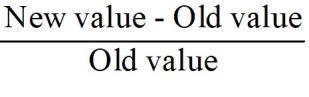
Percent change = = 0.0938, or 9.38%
Diff: 2 Var: 1
Section: 1.2 Factors That Influence Financial Planning Decisions
Learning Objective: 1.2 Describe how individual characteristics and economic factors influence personal financial planning.
Bloomcode: Analysis
AACSB: Analytic
Expected Time to Complete: 2 minutes
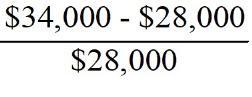
15) Your salary was $28,000 in 2018 and $30,000 in 2019. In 2020, your salary was $34,000. What was the percentage increase in your salary from 2018 to 2020?
A) 7.14%
B) 11.76%
C) 14.29%
D) 21.43%
Answer: D
Explanation: Percent change =
Percent change = = 0.2143, or 21.43%
Diff: 2 Var: 1
Section: 1.2 Factors That Influence Financial Planning Decisions
Learning Objective: 1.2 Describe how individual characteristics and economic factors influence personal financial planning.
Bloomcode: Analysis
AACSB: Analytic
Expected Time to Complete: 2 minutes
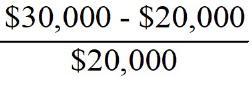
16) Your salary increased from $20,000 to $30,000 in five years. What is the percentage increase?
A) 33%
B) 50%
C) 100%
D) 150%
Answer: B
Explanation: Percent change =
Percent change = = 0.50, or 50%
Diff: 2 Var: 1
Section: 1.2 Factors That Influence Financial Planning Decisions
Learning Objective: 1.2 Describe how individual characteristics and economic factors influence personal financial planning.
Bloomcode: Analysis
AACSB: Analytic
Expected Time to Complete: 2 minutes
17) Your salary has increased 50% in 5 years. What is the annual percentage increase?
A) 8.5%
B) 8.7%
C) 10%
D) 11.2%
Answer: A
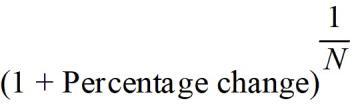
Explanation: Annual percentage change = - 1, where N = number of years.
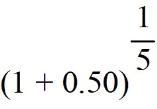
Annual percentage change = - 1 = 0.085, or 8.5%
Diff: 2 Var: 1
Section: 1.2 Factors That Influence Financial Planning Decisions
Learning Objective: 1.2 Describe how individual characteristics and economic factors influence personal financial planning.
Bloomcode: Analysis
AACSB: Analytic
Expected Time to Complete: 2 minutes
18) The Federal Reserve often ________ the ________ rate to stimulate the economy.
A) lowers; prime
B) lowers; federal funds
C) raises; federal funds
D) raises; prime
Answer: B
Explanation: The Federal Reserve (commonly called the Fed) controls the money supply in the economy in order to manipulate the rate of interest. The Fed lowers the federal funds rate to stimulate the economy and raises the federal funds rate to slow down the economy.
Diff: 2 Var: 1
Section: 1.2 Factors That Influence Financial Planning Decisions
Learning Objective: 1.2 Describe how individual characteristics and economic factors influence personal financial planning.
Bloomcode: Application
AACSB: Analytic
Expected Time to Complete: 1 minute
19) Why do interest rates on different types of borrowing, such as federal funds and mortgages, tend to track each other and the inflation rate?
A) They are all long-term maturities.
B) They are all short-term maturities.
C) They are all affected similarly by economic conditions.
D) They all have the same risks.
Answer: C
Explanation: The interest rates on different types of borrowing, such as Federal Funds and mortgages, tend to track each other, and the inflation rate, because they are all affected similarly by economic conditions.
Diff: 2 Var: 1
Section: 1.2 Factors That Influence Financial Planning Decisions
Learning Objective: 1.2 Describe how individual characteristics and economic factors influence personal financial planning.
Bloomcode: Comprehension
AACSB: Reflective Thinking
Expected Time to Complete: 1 minute
20) The federal funds rate is the rate that
A) banks charge customers for short-term loans.
B) the Federal Reserve charges banks for short-term loans.
C) banks charge each other for short-term loans.
D) credit card issuers use as the teaser rate.
Answer: C
Explanation: The federal funds rate is the interest rate that banks charge each other for shortterm loans.
Diff: 1 Var: 1
Section: 1.2 Factors That Influence Financial Planning Decisions
Learning Objective: 1.2 Describe how individual characteristics and economic factors influence personal financial planning.
Bloomcode: Knowledge
AACSB: Knowledge
Expected Time to Complete: 1 minute
21) An expansion is a phase in the economic cycle that is characterized by ________ business investment and ________ employment opportunities.
A) decreasing; decreasing
B) increasing; increasing
C) decreasing; increasing
D) increasing; decreasing
Answer: B
Explanation: An expansion is the growth phase in the economic cycle that is characterized by increasing business investment and increasing employment opportunities. In times of growth and low unemployment, salaries tend to rise more quickly, and there are better opportunities for advancement.
Diff: 2 Var: 1
Section: 1.2 Factors That Influence Financial Planning Decisions
Learning Objective: 1.2 Describe how individual characteristics and economic factors influence personal financial planning.
Bloomcode: Comprehension
AACSB: Reflective Thinking
Expected Time to Complete: 1 minute
22) Which of the following are parts of the economic cycle? (Select any two.)
A) Expansion
B) Extension
C) Decline
D) Inflation
E) Recession
F) Unemployment
Answer: A, E
Explanation: The economy experiences a pattern of ups and downs, commonly referred to as the economic cycle, or business cycle. A low point in the cycle is called a recession (or, in the extreme, a depression) and the high point is called an expansion.
Diff: 2 Var: 1
Section: 1.2 Factors That Influence Financial Planning Decisions
Learning Objective: 1.2 Describe how individual characteristics and economic factors influence personal financial planning.
Bloomcode: Comprehension
AACSB: Comprehension
Expected Time to Complete: 1 minute
23) Which of the following is not one of the recommended SMART guidelines for personal financial goals?
A) Realistic
B) Attainable
C) Manageable
D) Specific
Answer: C
Explanation: The key to setting effective financial goals is to make them SMART: specific, measurable, attainable, realistic, and time-specific.
Diff: 1 Var: 1
Section: 1.3 Setting Short‐Term and Long‐Term Financial Goals
Learning Objective: 1.3 Create a prioritized list of short-term and long-term personal financial goals.
Bloomcode: Knowledge
AACSB: Knowledge
Expected Time to Complete: 1 minute
24) Rosa graduated at the top of her high school class, and has set the following goal as part of her financial plan: "graduate from college with a B.S. in Business Management." Which aspect of the SMART goal model is missing from her goal?
A) The goal is not specific.
B) The goal is not measurable.
C) The goal is not attainable.
D) The goal is not time-specific.
Answer: D
Explanation: When you set SMART goals, it must be with specific due dates, as they are much more effective. Our natural inclination is to put off difficult tasks, so we need to set near-term and long-term targets to be sure we stay on track.
Diff: 2 Var: 1
Section: 1.3 Setting Short‐Term and Long‐Term Financial Goals
Learning Objective: 1.3 Create a prioritized list of short-term and long-term personal financial goals.
Bloomcode: Application
AACSB: Reflective Thinking
Expected Time to Complete: 1 minute
25) Andre graduated from college this year and obtained a well-paid job with a large accounting firm. Andre has developed the following goal: "save for retirement." This goal meets which criteria of the SMART goal model?
A) Specific
B) Measurable
C) Time-Specific
D) None Answer: D
Explanation: "Save for retirement" does not meet any of the criteria listed as a SMART goal. A specific goal must clearly identify what you want to achieve: how much and at what interval will you save, such as "save $400 per month until 65 years." A measurable goal must be accounted to show progress, such as "having your monthly saving automatically deposited to a retirement saving account." A time-specific goal must be set with specific due dates, to be effective, such as "direct-depositing $400 from your biweekly paycheck into your IRA until you reach 65 years old."
Diff: 2 Var: 1
Section: 1.3 Setting Short‐Term and Long‐Term Financial Goals
Learning Objective: 1.3 Create a prioritized list of short-term and long-term personal financial goals.
Bloomcode: Application
AACSB: Reflective Thinking
Expected Time to Complete: 1 minute
26) Your goals will differ depending on your stage in the life cycle and your family makeup. Which is not an appropriate short-term savings goal?
A) Spring break vacation
B) Emergency fund
C) Down payment on a home
D) Life insurance
Answer: C
Explanation: Short-term goals should be reasonably accomplished within the next year, such as buying life insurance, taking a vacation, or setting aside an emergency fund. Estimating the costs of attaining the financial objectives is necessary in establishing a reasonable time frame for the respective goals.
Diff: 2 Var: 1
Section: 1.3 Setting Short‐Term and Long‐Term Financial Goals
Learning Objective: 1.3 Create a prioritized list of short-term and long-term personal financial goals.
Bloomcode: Application
AACSB: Analytic
Expected Time to Complete: 1 minute
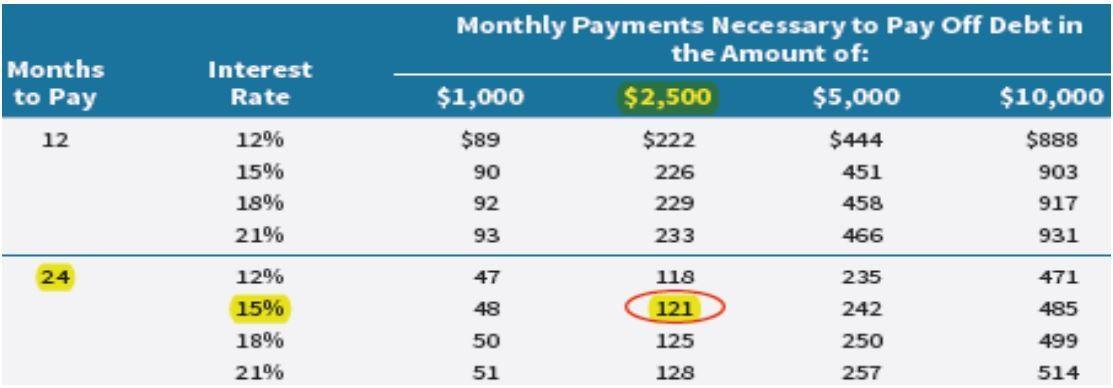
27) For many households, repayment of high-interest debt is an important financial goal. Using the following table, estimate the payments necessary to pay off $2,500 in credit card debt in two years at 15% APR.
Payments Necessary to Pay Off Debt in the Amount
A) $113
B) $121
C) $226
D) $242
Answer: B
Explanation:
Diff: 2 Var: 1
Section: 1.3 Setting Short‐Term and Long‐Term Financial Goals
Learning Objective: 1.3 Create a prioritized list of short-term and long-term personal financial goals.
Bloomcode: Application
AACSB: Analytic
Expected Time to Complete: 1 minute
28) Financial planners must have a
A) college degree with an emphasis or major in business.
B) college degree and two years of experience in finance.
C) securities license from the state of federal government.
D) willingness to provide financial advice.
Answer: D
Explanation: Because virtually anyone can claim to be a financial planner, you'll need to carefully evaluate the educational credentials and certifications of any professional you are considering hiring.
Diff: 2 Var: 1
Section: 1.4 Selecting Qualified Financial Planning Professionals
Learning Objective: 1.4 Know when and how to find qualified financial planning professionals.
Bloomcode: Comprehension
AACSB: Reflective Thinking
Expected Time to Complete: 1 minute
29) Which of the following should not be a major factor when choosing a personal financial planner?
A) Affiliation
B) Certification
C) Education
D) Reputation
Answer: A
Explanation: In choosing a professional to help you with your personal finances, you should consider education, certification, experience, reputation, and fees.
Diff: 2 Var: 1
Section: 1.4 Selecting Qualified Financial Planning Professionals
Learning Objective: 1.4 Know when and how to find qualified financial planning professionals.
Bloomcode: Application
AACSB: Reflective Thinking
Expected Time to Complete: 1 minute
30) Which of the following has passed a comprehensive examination covering all the topic areas considered necessary in the practice of consumer financial planning and has at least three years of work experience in the field?
A) Accredited Financial Planner (AFC)
B) Certified Public Accountant (CPA)
C) Certified Financial Planner (CFP®)
D) Chartered Financial Consultant (ChFC)
Answer: C
Explanation: Planners who are Certified Financial Planners (CFP®) have passed a comprehensive examination covering all the topics considered necessary in the practice of financial planning, and they have at least three years' work experience in the field.
Diff: 1 Var: 1
Section: 1.4 Selecting Qualified Financial Planning Professionals
Learning Objective: 1.4 Know when and how to find qualified financial planning professionals.
Bloomcode: Knowledge
AACSB: Knowledge
Expected Time to Complete: 1 minute
31) Integrity of the profession is essential to its long-term success. Which professional is not required to pass a comprehensive exam and adhere to a rigorous code of ethics?
A) Certified Public Accountants (CPAs)
B) Attorneys
C) Certified Financial Planner (CFP®)
D) All these professionals are required.
Answer: D
Explanation: Because the integrity of the profession is essential to its long-term success, the Certified Financial Planner Board of Standards adheres to a stringent code of ethics to promote the highest principles and standards for certified financial planners. Similar standards are required of Certified Public Accountants (CPAs) and attorneys.
Diff: 1 Var: 1
Section: 1.4 Selecting Qualified Financial Planning Professionals
Learning Objective: 1.4 Know when and how to find qualified financial planning professionals.
Bloomcode: Knowledge
AACSB: Knowledge
Expected Time to Complete: 1 minute
32) In a ________ arrangement, the planner is compensated for every financial product sold but does not receive any payment for developing a personal financial plan.
A) fee-only
B) commission-only
C) fee plus commission
D) fee offset by commission
Answer: B
Explanation: In a commission-only arrangement, the planner receives no payment for helping you develop your financial plan or managing your portfolio but receives a commission when you buy or sell a financial product, such as mutual fund shares or an insurance policy.
Diff: 2 Var: 1
Section: 1.4 Selecting Qualified Financial Planning Professionals
Learning Objective: 1.4 Know when and how to find qualified financial planning professionals.
Bloomcode: Comprehension
AACSB: Reflective Thinking
Expected Time to Complete: 1 minute
33) In a fee-only arrangement, the planner is typically compensated with an annual fee that is based on the
A) number of financial products purchased.
B) value of financial products purchased.
C) number of meetings with the client.
D) value of the client's assets being managed.
Answer: D
Explanation: In a fee-only arrangement, the planner is typically compensated with an annual fee that is based on the value of the client's assets being managed, such as one percent per year of your investment portfolio or an hourly free for services.
Diff: 2 Var: 1
Section: 1.4 Selecting Qualified Financial Planning Professionals
Learning Objective: 1.4 Know when and how to find qualified financial planning professionals.
Bloomcode: Comprehension
AACSB: Comprehension
Expected Time to Complete: 1 minute
34) Dolores's purchased 1,000 shares of the S&P 500 index (SPY) at $300 per share, inside her $1.1 million fee-only account this year. The planner's firm charges commissions of $0.27 per share and 1% on fee-based accounts. How much does her planner charge this year?
A) $270
B) $3,000
C) $11,000
D) $11,270
Answer: C
Explanation: Although the firm can charge both commissions and fees in a fee-based account, Dolores' account is a fee-only account. The planner charges a percentage fee of the assets in the respective account (1%per year of your investment portfolio). Hence, $1,100,000 × 0.01 = $11,000.
Diff: 2 Var: 1
Section: 1.4 Selecting Qualified Financial Planning Professionals
Learning Objective: 1.4 Know when and how to find qualified financial planning professionals.
Bloomcode: Analysis
AACSB: Analytic
Expected Time to Complete: 2 minutes
35) Henry pays his financial planner a one percent fee based on the value of the assets in his investment account. He noticed on his year-end statement that the firm rebated a $1,200 credit to his account. His planner said that was because the firm made $1,200 in dealer concessions from an IPO that he purchased. What type of fee arrangement is this?
A) Fee-based
B) Fee-only
C) Fee plus commission
D) Fee offset by commission
Answer: D
Explanation: In a fee offset by commission arrangement, the planner charges a fee for services, as in a fee-only arrangement, but reduces the fee if commissions are later earned on products purchased by the client. This reduces the conflict of interest inherent in the commission-only arrangement, because the planner does not make extra money by selling you the financial products. In a fee-only arrangement, the planner would be prohibited from selling any investment that includes additional compensation.
Diff: 2 Var: 1
Section: 1.4 Selecting Qualified Financial Planning Professionals
Learning Objective: 1.4 Know when and how to find qualified financial planning professionals.
Bloomcode: Application
AACSB: Analytic
Expected Time to Complete: 1 minute
36) One of the biggest mistakes people make in their finances is that they are too ________ in their assumptions.
A) specific
B) optimistic
C) pessimistic
D) conservative
Answer: B
Explanation: One of the biggest mistakes people make in their finances is that they are too optimistic in their assumptions. Being able to make reasonable assumptions is a critical component of successful decision making.
Diff: 2 Var: 1
Section: 1.5 Making Effective Decisions
Learning Objective: 1.5 Consider opportunity costs and marginal effects in making personal finance decisions.
Bloomcode: Comprehension
AACSB: Reflective Thinking
Expected Time to Complete: 1 minute
37) If you are considering working part-time at a second job in addition to your regular one, you should only consider
A) total costs and benefits of both jobs.
B) total costs and benefits of each job.
C) marginal costs and marginal benefits.
D) marginal costs of each job and total benefits.
Answer: C
Explanation: If you are considering working part-time at a second job in addition to your regular one, you should only consider marginal costs and marginal benefits and not the total costs and benefits of both jobs. The term "marginal" refers to the change in outcome, or the additional benefit or cost, that will result from the decision you make. In choosing between two possible jobs, you'll consider how much extra benefit you would get from the additional job and balance that against the extra financial and human cost.
Diff: 3 Var: 1
Section: 1.5 Making Effective Decisions
Learning Objective: 1.5 Consider opportunity costs and marginal effects in making personal finance decisions.
Bloomcode: Application
AACSB: Reflective Thinking
Expected Time to Complete: 2 minutes
38) You are considering adding a wood shop to your home. You enjoy woodworking and could make some items for sale. In considering this addition, you only look at the extra cost of the shop and the potential benefits of having the shop. This is an example of
A) opportunity cost consideration.
B) sensitivity analysis.
C) marginal reasoning.
D) reasonable assumptions.
Answer: C
Explanation: The term "marginal" refers to the change in outcome, or the additional benefit or cost, that will result from the decision you make. In applying marginal reasoning, you will consider only the additional benefits that the shop brings and not the general benefits of having the addition in the first place. In choosing the addition, you'll consider how much extra benefit you would get from the shop and balance that against the extra financial cost and burden.
Diff: 2 Var: 1
Section: 1.5 Making Effective Decisions
Learning Objective: 1.5 Consider opportunity costs and marginal effects in making personal finance decisions.
Bloomcode: Application
AACSB: Reflective Thinking
Expected Time to Complete: 1 minute
39) In deciding whether to attend graduate school full-time, estimating your lost earnings while you are in school is an example of
A) marginal reasoning.
B) sensitivity analysis.
C) future value.
D) opportunity cost.
Answer: D
Explanation: Every financial decision you make has an opportunity cost, a measure of what you have to give up in order to take a particular action. You must decide whether the costs of attending graduate school and giving up the earnings from your job will be worth the net increase in earnings after graduation.
Diff: 2 Var: 1
Section: 1.5 Making Effective Decisions
Learning Objective: 1.5 Consider opportunity costs and marginal effects in making personal finance decisions.
Bloomcode: Application
AACSB: Reflective Thinking
Expected Time to Complete: 1 minute
40) Desiree currently works as a manager of an electronics store earning an annual salary of $50,000. She noticed an internal job opening for a regional manager that pays $100,000 salary, but an MBA is required for consideration. The cost for a full-time MBA program in two years is $60,000. What is her opportunity cost for attending graduate school, without consideration for time value of money?
A) $100,000
B) $120,000
C) $160,000
D) $220,000
Answer: C
Explanation: $60,000 cost of MBA program + $100,000 two years of missed earnings = $160,000
Diff: 2 Var: 1
Section: 1.5 Making Effective Decisions
Learning Objective: 1.5 Consider opportunity costs and marginal effects in making personal finance decisions.
Bloomcode: Analysis
AACSB: Analytic
Expected Time to Complete: 2 minutes
41) Which type of decision maker is spontaneous and often makes "gut" decisions?
A) Rational decision maker
B) External decision maker
C) Internal decision maker
D) Intuitive decision maker
Answer: D
Explanation: An intuitive decision maker is spontaneous and often makes "gut" decisions. Diff: 2 Var: 1
Section: 1.5 Making Effective Decisions
Learning Objective: 1.5 Consider opportunity costs and marginal effects in making personal finance decisions.
Bloomcode: Comprehension
AACSB: Reflective Thinking
Expected Time to Complete: 1 minute
42) Holly is uncomfortable with change. She spends a lot of time thinking over alternatives, even for relatively inconsequential decisions. She is a typical
A) agonizer.
B) antagonizer.
C) intuitive decision maker.
D) analytical decision maker.
Answer: A
Explanation: An agonizer puts off making decisions as long as possible, spends a lot of time thinking over alternatives, even for relatively inconsequential decisions, and is uncomfortable with change.
Diff: 2 Var: 1
Section: 1.5 Making Effective Decisions
Learning Objective: 1.5 Consider opportunity costs and marginal effects in making personal finance decisions.
Bloomcode: Comprehension
AACSB: Reflective Thinking
Expected Time to Complete: 1 minute
43) You are calculating your potential return on your stock investments. If you calculate different possible returns based on assuming a variety of interest rates and stock market conditions, this is an example of
A) reasonable assumptions.
B) sensitivity analysis.
C) marginal analysis.
D) opportunity cost.
Answer: B
Explanation: Sensitivity analysis asks the question, "What effect would it have on my personal finances if my assumptions turn out to be wrong?" By considering the outcomes under different assumptions, you can reduce the risk that your plan will have an unexpected impact on your finances.
Diff: 2 Var: 1
Section: 1.5 Making Effective Decisions
Learning Objective: 1.5 Consider opportunity costs and marginal effects in making personal finance decisions.
Bloomcode: Application
AACSB: Analytic
Expected Time to Complete: 1 minute
44) You have estimated that, if your investments earn 10 percent per year, you can retire at age 65. If you then estimate your retirement date assuming a lower investment return, you are using A) average reasoning.
B) sensitivity analysis.
C) marginal reasoning.
D) opportunity cost.
Answer: B
Explanation: Sensitivity analysis asks the question, "What effect would it have on my personal finances if my assumptions turn out to be wrong?" By reconsidering the expected investment returns, you are reducing the risk that your plan will not reach your goal.
Diff: 2 Var: 1
Section: 1.5 Making Effective Decisions
Learning Objective: 1.5 Consider opportunity costs and marginal effects in making personal finance decisions.
Bloomcode: Application
AACSB: Reflective Thinking
Expected Time to Complete: 1 minute
45) If you must seek advice from a number of people before making a decision, you would be considered a (an)
A) rational decision maker.
B) intuitive decision maker.
C) external decision maker.
D) internal decision maker.
Answer: C
Explanation: External decision makers must obtain opinions and confirmation from others before making decisions, because they have trouble making decisions independently. Diff: 2 Var: 1
Section: 1.5 Making Effective Decisions
Learning Objective: 1.5 Consider opportunity costs and marginal effects in making personal finance decisions.
Bloomcode: Comprehension
AACSB: Reflective Thinking
Expected Time to Complete: 1 minute
46) Which of the following is a possible negative consequence for overly rational decision makers?
A) Reduced investment returns
B) Difficulty staying on a budget
C) Too much debt
D) Avoiding professional help
Answer: A
Explanation: If you're an overly "rational" decision maker, you may suffer negative consequences, such as taking too long to make a decision, which can result in reduced or missed investment returns.
Diff: 2 Var: 1
Section: 1.5 Making Effective Decisions
Learning Objective: 1.5 Consider opportunity costs and marginal effects in making personal finance decisions.
Bloomcode: Application
AACSB: Reflective Thinking
Expected Time to Complete: 2 minutes
47) Which type of decision maker is most likely to have trouble sticking to a budget and, as a result, may fall into debt?
A) Rational decision maker
B) External decision maker
C) Intuitive decision maker
D) Internal decision maker
Answer: C
Explanation: If you're overly spontaneous in making financial decisions, you may have trouble sticking to a budget, have too much debt, pay too much for major purchases, or incur personal costs from taking too many wrong turns in life.
Diff: 2 Var: 1
Section: 1.5 Making Effective Decisions
Learning Objective: 1.5 Consider opportunity costs and marginal effects in making personal finance decisions.
Bloomcode: Comprehension
AACSB: Reflective Thinking
Expected Time to Complete: 1 minute
48) Inflation is typically measured by changes in the
A) median household income.
B) Consumer Price Index (CPI).
C) market interest rates.
D) Gross Domestic Product (GDP).
Answer: B
Explanation: In the United States, inflation is typically measured by the change in the Consumer Price Index (CPI), which is a representative basket of more than 400 goods and services used by urban households, including food, housing, consumer goods, gasoline, and clothing. When the CPI increases, the prices of goods and services become more expensive.
Diff: 1 Var: 1
Section: 1.2 Factors That Influence Financial Planning Decisions
Learning Objective: 1.2 Describe how individual characteristics and economic factors influence personal financial planning.
Bloomcode: Knowledge
AACSB: Knowledge
Expected Time to Complete: 1 minute
49) Which of the following is an indicator of economic recession?
A) High unemployment
B) Decreased business investment
C) Negative GDP
D) All of these answers are correct
Answer: D
Explanation: The economy experiences a pattern of ups and downs, commonly referred to as the economic cycle, or business cycle. A low point in the cycle is called a recession (or, in the extreme, a depression) and the high point is called an expansion. The economy in recession will typically experience high unemployment and decrease business investment in response to a slowdown in demand, and is reflected in a decline in the Gross Domestic Product (GDP).
Diff: 2 Var: 1
Section: 1.2 Factors That Influence Financial Planning Decisions
Learning Objective: 1.2 Describe how individual characteristics and economic factors influence personal financial planning.
Bloomcode: Comprehension
AACSB: Comprehension
Expected Time to Complete: 1 minute
50) A severe recession that takes much longer to return to a period of economic growth and has more extreme characteristics than a typical recession is called a
A) Deficient Market.
B) Depression.
C) Bull Market.
D) Stagnating Economy.
Answer: B
Explanation: The economy experiences a pattern of ups and downs, commonly referred to as the economic cycle, or business cycle. A low point in the cycle is called a recession (or, in the extreme, a depression) and the high point is called an expansion.
Diff: 1 Var: 1
Section: 1.2 Factors That Influence Financial Planning Decisions
Learning Objective: 1.2 Describe how individual characteristics and economic factors influence personal financial planning.
Bloomcode: Knowledge
AACSB: Knowledge
Expected Time to Complete: 1 minute
51) Celeste is at the grocery store deciding between the branded peanut butter and the generic peanut butter. After comparing them along the metrics of price, quantity, ingredients, and aesthetic packaging appeal, she is uncertain if the branded peanut butter is worth the additional cost. She decides to finish the rest of her shopping and then comes back to grab generic peanut butter. While waiting in the checkout line she anxiously reflects on the choice she made.
Celeste's decision-making style would be a(n)
A) avoider.
B) intuitive decision maker.
C) rational decision maker.
D) agonizer.
E) external decision maker.
Answer: D
Explanation: An agonizer puts off making decisions as long as possible, spends a lot of time thinking over alternatives for items that may even be relatively inconsequential decisions, and they are uncomfortable with change.
Diff: 2 Var: 1
Section: 1.5 Making Effective Decisions
Learning Objective: 1.5 Consider opportunity costs and marginal effects in making personal finance decisions.
Bloomcode: Application
AACSB: Analytic
Expected Time to Complete: 3 minutes
52) Venetia hopes that setting the goal of surpassing a $1,000,0000 net worth by the age of 40 will help her reduce unnecessary expenses and save more. Which requirement of SMART Goals does this not satisfy?
A) Specific
B) Measurable
C) Realistic
D) All of these answers are correct
Answer: C
Explanation: The key to setting effective financial goals is to make them SMART: specific, measurable, attainable, realistic, and time-specific. "$1,000,0000 net worth by the age of 40" may be measured and specific, but without more detail, is not realistic.
Diff: 2 Var: 1
Section: 1.3 Setting Short‐Term and Long‐Term Financial Goals
Learning Objective: 1.3 Create a prioritized list of short-term and long-term personal financial goals.
Bloomcode: Application
AACSB: Analytic
Expected Time to Complete: 1 minute
© John Wiley & Sons, Inc. or the author, all rights reserved. No part of this publication may be reproduced, stored in a retrieval system, or transmitted, in any form or by any means, electronic, mechanical, photocopying, recording or otherwise, except as permitted by law. Advice on how to obtain permission to reuse this material is available at http://www.wiley.com/go/permissions