Solutions Manual for Personal Finance
3rd Edition by Bajtelsmit
ISBN: 9781394162550
ISBN: 9781394162550
LO 10.1 Estimate your retirement income needs, and develop savings goals.
LO 10.2 Explain how employer-sponsored retirement plans and Social Security can help you meet your retirement goals.
LO 10.3 Explain why individual retirement accounts (IRAs) offer advantages over taxable savings accounts and annuities.
LO 10.4 Develop a plan for funding current or future education costs.
This chapter will require 2 – 3 class sessions. You may want to spread the retirement topics over two sessions and spend a third one on education funding.
1
DP = Demonstration Problem Video; IF = Interactive Figure; PFP = Personal Financial Planner Excel Worksheet; RQ = Reflection Question; OCDV: Online Calculator Demonstration Video; BV= Bloomberg Video; MP = Money Psychology
LO 10.1 Estimate your retirement income needs, and develop savings goals.
I. WHAT ARE YOUR RETIREMENT GOALS?
II. HOW MUCH WILL YOU NEED TO SAVE FOR RETIREMENT?
A. Step 1: Estimating Retirement Expenses
B. Steps 2, 3, and 4: Estimating Expected Income and Income Shortfall
C. Step 5: Estimating Retirement Wealth Needed
D. Steps 6 and 7: Estimating Monthly Savings Target
CASE STUDY 10.1 CAMILLA HARDIN DEVELOPS A PLAN FOR RETIREMENT SAVING
III. WHY DO SO MANY PEOPLE AVOID RETIREMENT PLANNING?
A. Myopia
B. Ignoring Inflation
C. Focusing on Averages
D. It Won’t Happen to Me
LO10.2 Explain how employer-sponsored retirement plans and Social Security can help you meet your retirement goals.
I. INCOME FROM EMPLOYER-SPONSORED PLANS
A. Income from DB Plans
B. Income from DC Plans
II. INCOME FROM SOCIAL SECURITY
A. What Is Social Security, and How Is It Funded?
B. Who Is Eligible and When Can You Receive Benefits?
C. How Much Will Social Security Pay Me?
D. Will Social Security Be Around When You Retire?
E. Causes of Projected Insolvency
F. Prospects for Reform
III. ETHICS IN ACTION: COST OF LIVING INCREASES FOR SOCIAL SECURITY BENEFICIARIES
LO 10.3 Explain why individual retirement accounts (IRAs) offer advantages over taxable savings accounts and annuities.
I. INDIVIDUAL RETIREMENT ACCOUNTS
A. Traditional IRAs
B. Roth IRAs
C. Taxes on Benefits Received
II. TAXABLE ACCOUNTS
A. The Importance of Starting Early
B. Earnings on Investment Make a Big Difference
III. ANNUITIES
A. Key Features of Annuities
B. Taxes and Expenses
C. Health and Life Expectancy
D. Home Equity Loans and Reverse Annuity Mortgages
IV. NOT ON TRACK TO RETIRE?
LO 10.4 Develop a plan for funding current or future education costs.
I. HOW MUCH WILL FUTURE EDUCATION COST?
II. HOW MUCH WILL YOU NEED TO SAVE?
CASE STUDY 10.2 FUNDING JAKE JOHNSON’S COLLEGE EDUCATION
III. FINANCING HIGHER EDUCATION WITH STUDENT LOANS
A. Federal Student Loans
B. Private Student Loans
IV. GOVERNMENT PROGRAMS TO HELP FUND EDUCATION EXPENSES
A. Tax-Preferred Education Savings Plans
B. Tax Credits for Education Expenses
C. Other Education-Related Tax Breaks
1. Begin the discussion of retirement planning by citing the results of the “Retirement Confidence Survey.” This annual survey asks Americans questions about whether they are planning for retirement, how prepared they feel, and what specific steps they are taking. Since the survey has been in place, it has been clear that many people are not very confident that they will have enough to retire comfortably. Women are generally less confident than men. Ask students to identify some of the reasons for these results.
2. Have students talk to one or more people who are retired to find out what if anything, they wish they had done differently in preparing for retirement.
3. Have students write down a list of the things they would like to be able to do in retirement. At what age would they like to retire?
4. The evidence suggests that the poorest elderly are single, divorced, or widowed. Discuss how being married can improve your standard of living. Ask students to consider how much a woman’s expenses will decrease when her husband dies.
5. Have students calculate the amount of income they can receive from a $1 million nest egg, assuming that it earns 6 percent per year after taxes. If inflation erodes the purchasing power of this annual income by 4% per year and he/she has to dip into the principal, how much will remain after five years? Do this calculation on the board and use it to illustrate the importance of planning for inflation.
6. Take a poll of the class to determine how many think Social Security will be around when they retire. Usually much less than half of the class will think it will be, if your class primarily traditional-aged students. Use this to motivate a discussion of the fiscal imbalance driven by changing demographics and the difficulties Congress faces in reforming a program on which so many people rely. Although the retirement program might be easier to reform, it is difficult to find private market solutions to replace the disability and survivors benefits programs.
7. Have the students break into groups to discuss Social Security reform. Ask the groups to identify one possible reform and to make a list of arguments both for and against that reform. Alternatively, you can assign particular reform ideas to each group depending on the current political climate (e.g. increase the retirement age, increase the payroll tax rate, increase the maximum wages that are subject to tax, allow some of the payroll taxes to be diverted to individual accounts, reduce benefit promises). Once the groups have discussed this on their own, have them each present their conclusions to the class.
8. Have the class consider the pros and cons of retirees returning to work after retirement. Why would any retiree want to go back to work? With the proportion of retirees increasing, will there be a shortage of younger workers in the future, particularly in the service sector? What will employers need to do to attract and retain these workers?
9. Ask the class to identify the ways in which planning for a child’s education costs is similar to planning for retirement and the ways in which they are different. Similarities include: relatively long period of time to save, costs increase over time, investment risk exposure. Differences include: retirement income needs are more uncertain (e.g. could have health issues or long-term care needs); length of the retirement period is more uncertain versus 4-5 years for college; much longer period to save for retirement (if you start early) versus 18 years for each child.
10. Discuss the pros and cons of the following strategy for higher education funding: each generation pays for the second generation to follow your grandparents pay for you, your parents pay for your children, and so on.
11. Assign the class to watch the Bloomberg Video that suggests the following as a potential solution to the retirement crisis: give every child $10,000 at birth to be set aside for retirement. Discuss whether this would work, how much it would cost, and potential problems that would have to be overcome.
1. In what ways should you take inflation into account in your retirement planning?
Answer: After estimating your retirement needs or expenses in current (or today's) dollars, you should apply the expected inflation rate to calculate the inflation-adjusted amount needed in the future. You can adjust each year's needs for inflation by calculating the future value at the appropriate inflation rate. If you do not plan for the loss of future purchasing power, you will not save enough to maintain your current standard of living
Sec 10.1; LO 10.1; BT: Ap; Difficulty: E; TOT: 1 min; AACSB: Reflective Thinking
2. In what ways should you take income taxes into account in your retirement planning?
Answer: Your forecasts should always be done on an after-tax basis, since you are interested in ensuring that you have enough cash flow to cover your expenses. If you know how much you need to cover expenses, you can divide the needed income by (1 – Tax rate) to find the required retirement income. You should also consider tax rules in deciding how to invest for retirement. Tax-deferred and tax-free accounts will result in a larger wealth accumulation than taxable accounts. Some of your income in retirement may be taxable if withdrawn from tax-deferred accounts. Some of it may be tax-free, for example, if you withdraw from a Roth IRA.
Sec 10.1; LO 10.1; BT: C; Difficulty: E; TOT: 1 min; AACSB: Reflective Thinking
3. What is meant by the “three-legged stool of retirement income”?
Answer: This phrase refers to the combination of three potential sources of retirement income: (1) employer-sponsored plans, (2) Social Security, and (3) personal savings. Personal savings may include savings accounts, stock and bond investments, real property, and business assets/income. The analogy of a three-legged stool is intended to emphasize that a person’s retirement will be more stable if the person has somewhat equivalent amounts of income from each source.
Sec 10.1; LO 10.1; BT: C; Difficulty: E; TOT: 1 min; AACSB:
4. Do most retirees receive income from all three sources of the “three-legged stool of retirement income”? Why or why not? Are there any other sources of income in retirement?
Answer: Many retirees do not receive income from all three sources. While Social Security contributes about one-third of retirement income in the aggregate, on an individual basis, over one-third of retirees receive 90 percent of their income from Social Security. People who have not saved enough, do not receive pension income or have not contributed sufficient amounts to employer-sponsored retirement plans, need to supplement their retirement income in other ways. Many retirees choose to work, either full-time or part-time, to make up the shortfall, and this source represents about 33 percent of retirement income overall. Public assistance makes up a miniscule part (4 percent) of retirement income. Income from assets represents about 11 percent.
Sec 10.1; LO 10.1; BT: K; Difficulty: E; TOT: 2 min; AACSB: Reflective Thinking
5. How can you estimate the income you’ll receive from an employer-sponsored definedbenefit plan?
Answer: A defined-benefit plan usually prescribes a formula for calculating retirement benefits up to a maximum amount. In the simplest case, it may be based on a percentage of the employee’s salary at the time of retirement (or average of highest three years' salary) multiplied by the number of years of employment. This estimation requires projecting future salary based on growth and
promotion assumptions. For example, if the plan provides for 1.25 percent of salary for every year of employment, a retiree earning $60,000 at the time of retirement with 30 years of service would be entitled to an annual benefit of $22,500 (= 0.0125 × 30 × $60,000).
Sec 10.1; LO 10.1; BT: C; Difficulty: M; TOT: 2 min; AACSB:
6. How can you estimate how much income you’ll receive from an employer-sponsored defined-contribution plan?
Answer: Projecting income from a defined-contribution plan is difficult because a person needs to project future contributions during working years, the rate of return earned during those years, and finally the return that will be earned during retirement years. A person may withdraw variable amounts during retirement or opt for a fixed or inflation-adjusted annuity. Rates prevailing at the time of retirement will determine the amount of annuity you can purchase with the account balance. If you know the value of the portfolio at the retirement date, you can estimate the income you can receive based on one of three strategies: (1) assume you will only spend the interest and dividends earned on the account balance, in which case you can simply multiply your average rate of return times the account balance to determine the income; (2) estimate the fixed amount you can withdraw, assuming you will also spend the principal during retirement, using the PMT function on your calculator; or (3) estimate an inflation-adjusted annuity amount that you can withdraw, assuming your withdrawals will increase with inflation each year and you will deplete the account balance over time. For the latter calculation, you will also use the PMT function on the calculator but will use an inflation-adjusted rate of return as the interest rate. If you assume that the inflation rate and your investment return will be approximately equal, you can simply divide the account balance by the number of years you expect to be in retirement to arrive at the amount you can withdraw each year.
Sec 10.2; LO 10.2; BT: C; Difficulty: M; TOT: 2 min; AACSB: Reflective Thinking
7. What financial problems are projected for the Social Security system, and what are the causes of these problems?
Answer: The Social Security system was designed as a pay-as-you-go system in which the benefits paid to retirees were paid out of taxes currently collected from participating workers. Although taxes collected have exceeded benefits paid for many years, accumulating in the Social Security Trust Fund, demographic changes will cause future problems. With the retirement of the baby boomers, Social Security will soon be in the position of taking in less than it is paying out. Long-term actuarial calculations show that the system is in imbalance, such that expected benefits to be paid out exceed the expected taxes that will be collected. The accumulated funds in the Trust Fund will cover some of the deficit, but unfortunately, these assets represent IOUs of the U.S. government. The government will need to come up with the funds to pay back to the Social Security Trust Fund, most likely by raising taxes. Furthermore, retirees are living longer and putting an additional burden on the system. Congress, in order to appease its voting constituency, has increased benefits instead of decreasing them and has been unwilling to increase taxes or raise the retirement age substantially.
Sec 10.2; LO 10.2; BT: C; Difficulty: M; TOT: 2 min; AACSB: Reflective Thinking
8. Explain the similarities and differences between a traditional deductible IRA and a Roth IRA.
Answer: Similarities: (1) both were created to provide incentives to save in order to accumulate funds for retirement and supplement other sources of income; (2) both provide tax advantages; (3) both impose penalties for early withdrawals; (4) both impose limits on the amount of contribution. Differences: (1) traditional IRA contributions are tax deductible when made, but withdrawals are fully taxable in the future; (2) Roth IRA contributions are made from after-tax dollars, and all future withdrawals are not taxed; (3) traditional IRA contribution is affected by employer-sponsored qualified retirement plans; (4) income limits are higher under Roth.
Sec 10.3; LO 10.3; BT: C; Difficulty: M; TOT: 2 min; AACSB:
9. What is the penalty for withdrawing your money from a tax-deferred retirement account prior to retirement age? Are there any exceptions to this rule?
Answer: The penalty for early withdrawals (before age 59½) is 10 percent of the amount withdrawn in addition to payment of applicable income taxes. The penalty is, however, waived if funds are used for qualified educational, medical, or first-time home purchase expenses.
Sec 10.3; LO 10.3; BT: C; Difficulty: M; TOT: 2 min; AACSB:
10. Use an example to illustrate how investing in a tax-deferred account can give you a better outcome than investing in a taxable account.
Answer: Examples will differ but should show that the tax-deferred account results in higher accumulation. Suppose you invest in a fund that offers 8 percent annual return and the investment horizon is 20 years. Assume that you start with $1,000 in pretax income, and your marginal tax rate is 30 percent. You can invest the full $1,000 in the tax-deferred account but will only be able to invest $700 per year in the taxable account ($1,000 × (1 - 0.30) = $700). Similarly, your rate of return for tax-deferred account will be the full 8 percent whereas the annual return on the taxable account will be 5.6% after taxes (= 8% × (1 - 0.30)). After 20 years, the taxable account will grow to $24,669.64 despite paying 30% taxes on income earned and income received from interest. The tax-deferred account will grow to $32,033.38, after paying the 30% tax at the end of 20 years to compare after-tax balances.
Calculator: Taxable account: Input PMT=-700, I/Y=5.6, N=20, and solve for FV = $24,669.64
Tax-deferred account: Input PMT=-1000, I/Y=8, N=20, and solve for FV = $45,761.96 Net from tax-deferred account after taxes paid: $45,761.96 × (1 - 0.30) = $32,033.38 Excel Spreadsheet: TVM Function is =FV(rate,nper,pmt,pv,type)
Taxable account: =FV(0.056, 20, -700, 0) ➔ $24,669.64
Tax-deferred account: =FV(0.08, 20, -1000, 0) ➔ $45,761.96
TVM Equation: FVA=PMT × (1+��)�� -1 ��
Taxable account: FVA=700 × (1056)20 -1 0056 = $24,669.64
Tax-deferred account: FVA=1000 × (108)20 -1 008 = $45,761.96
Sec 10.3; LO 10.3; BT: Ap; Difficulty: M; TOT: 2 min; AACSB: Analytic
11. Comment on the validity of the following statement: “Once I retire, I won’t have to worry about my investments anymore.”
Answer: This statement is incorrect. Most people will be retired for twenty to thirty years. They will need to continue to manage their money during that period to ensure that their income keeps up with their increasing expenses. A small number of people may have only annuity income from pensions and Social Security, in which case they may not have much wealth to manage.
Sec 10.1; LO 10.1; BT: C; Difficulty: E; TOT: 2 min; AACSB: Reflective Thinking
12. Describe the planning process for funding your children’s education. How is this similar to the retirement planning process?
Answer: Funding for your child's education is very similar to retirement planning, except that you generally have less time to save (18 years or less). The process involves projecting college costs at a realistic rate of inflation and calculating the future value of required savings (after adjusting for other sources of education funds). This future target account value is then used to estimate the amount of annual or monthly savings required to meet the funding goal. After implementing the savings plan, it must be monitored, and adjusted over time to reach target values.
Sec 10.4; LO 10.4; BT: C; Difficulty: E; TOT: 2 min; AACSB:
13. Explain the similarities and differences between Roth IRAs and Coverdell Education Savings Accounts.
Answer: Coverdell Education Savings Accounts (ESA) plans are similar to Roth IRAs in that contributions are made from after-tax dollars, and withdrawals for qualified purposes, such as K12 and college tuition, board, and books, are not taxed. Withdrawals for nonqualified purposes are subject to a 10 percent penalty, and there are income limits that apply. ESA contributions are limited to $2,000 per year per child, whereas Roth IRA contributions in 2023 are limited to $6,500 ($7,500 for those aged 50 or over). Maximum ESA contribution amount is phased out if a contributor’s modified adjusted gross income (MAGI) is between $95,000 and $100,000 for individual filers, and $190,000 and $220,000 for joint filers. No contributions can be made if the beneficiary is age 18 or older. Roth IRA contribution amount is phased out if a contributor’s MAGI is between $138,000 and $153,000 for individual filers, and $218,000 and $228,000 for joint filers.
Sec 10.4; LO 10.4; BT: C; Difficulty: M; TOT: 2 min; AACSB:
14. What types of tax incentives are offered for funding higher education?
Answer: Three types of tax incentives for funding higher education are: (1) American Opportunity Tax credit, which allows a taxpayer to claim up to $2,500 for a dependent's education expenses in the first four years of college if the student is enrolled at least half-time; (2) Lifetime Learning tax credit, which allows a taxpayer to claim 20 percent of the first $10,000 of tuition and fees, including graduate school, with a maximum of $2,000 per year per person; and (3) a tax deduction of up to $2,500, whereby people who have taken out student loans may be eligible to deduct the interest from their taxable income, lowering the overall cost of their education. This is not a tax credit, which directly reduces taxes by the amount of the tax credit. The tax credits are phased out between $80,000 and $90,000 for individual filers, and $160,000 and $180,000 for joint filers. Student loan interest deduction is phased out between $75,000 and $90,000 for individual filers, and $155,000 and $185,000 for joint filers.
Sec 10.4; LO 10.4; BT: C; Difficulty: M; TOT: 2 min; AACSB:
15. When is the best time to begin planning for your children’s education? Explain.
Answer: As the adage goes, it is never too early to save. The earlier you start, the lower the payments will be. Education planning should start as soon as the child is born, and couples can even start saving earlier if their finances allow them to do so. If savings have a longer period to accumulate, any unforeseen events, such as a market crash or an employment disruption, can be handled more easily, with enough time available to recover from the financial setback. Taxadvantaged plans such as Coverdell Education Savings Accounts and 529 plans can be started only after the child is born, however.
Sec 10.4; LO 10.4; BT: C; Difficulty: E; TOT: 1 min; AACSB: Reflective Thinking
16. Al and Janet Fernandez have two alternatives for financing their son Joel‘s college costs an unsubsidized federal student loan with a variable rate of 5.05 percent or a fixed-rate home equity loan at 6 percent. Assume that both loans will have 10-year terms for repayment. What factors should they consider in deciding between these two alternatives?
Answer: The answer to this question depends on expectations of interest rates over the 10-year period. Although the 6% home equity loan rate is higher than the 5.05% student loan, future loans for the same student may be at higher rates, so locking in the home equity rate at 6 may end up being better. Some student loan interest is tax deductible, but these rules are subject to change by Congress, so are not guaranteed to apply throughout the loan period.
Sec 10.4; LO 10.4; BT: Ap; Difficulty: M; TOT: 2 min; AACSB: Reflective Thinking
17. What are the differences and similarities between subsidized and unsubsidized federal direct student loans?
Answer: Both types of loans are disbursements from the federal government and the rates are set annually. Subsidized student loans, which are based on financial need, do not accrue interest until after graduation, whereas the unsubsidized loans begin to accrue interest upon disbursement.
Sec 10.4; LO 10.4; BT: C; Difficulty: E; TOT: 1 min; AACSB:
1. Retirement Income Needs. Alonzo plans to retire at age 67. His current expenses are $40,000, and he expects 3 percent inflation from now until retirement. Use the replacement ratio method to estimate Alonzo’s pretax retirement income needs in the first year of retirement, assuming that he is now 22 years old and will need to replace 80 percent of his final salary. Round to the nearest dollar.
Answer: $121,011
Solution: Alonzo will retire in 45 years (67 – 22). His pre-retirement annual expenses will be $151,264, based on the future value of $40,000 (PV) over 45 years at 3% APY. His annual expenses in his first year of retirement will need to be $121,011 (80% of pre-retirement expenses).
Calculation of the FV of $40,000 pre-tax annual expenses over 45 years @ 3% inflation.
Financial Calculator: Input PV=-40,000, I/Y=3, N=45, and solve for FV = $151,263.83
Excel Spreadsheet: TVM Function is =FV(rate,nper,pmt,pv,type) =FV(0.03, 45, 0, -40000, 0) ➔ $151,263.83
TVM Equation: FV = PV × (1+i )n FV = $40,000 × (1.03)45 = $151,263.83
* Expenses for 1st year of retirement = $151,263.83 pre-retirement × 0.80 adjustment = $121,011.06
Sec 10.1; LO 10.1; BT: Ap; Difficulty: M; TOT: 2 min; AACSB: Analytic
2. Retirement Income Needs. Sophia plans to retire at age 67 and she expects 3 percent inflation from now until retirement. Her current expenses are $40,000. Use the adjusted expense method to estimate Sophia’s pretax retirement income needs in the first year of retirement (in future dollars), assuming she is currently 22 years old. Assume that the reduction in expenses for employment costs and mortgage payments will save her $15,000 per year in current dollars and that her additional costs for insurance and vacations will be $10,000.
Answer: $132,356
Solution: To find Sophia’s expenses in retirement, adjust her current annual expenses ($40,000) by reducing it for the lower employment costs and mortgage payments (-$15,000) and adding her additional costs for insurance and vacations (+$10,000). Expected expenses in retirement are: $40,000 current expenses - $15,000 employment expenses + $10,000 insurance and vacations = $35,000. Then calculate the FV of her expected expenses in retirement for 45 years at 3% inflation.
Calculation of the FV of $35,000 over 45 years @ 3% inflation.
Financial Calculator: Input PV=-35,000, I/Y=3, N=45, and solve for FV = $132,355.85
Excel Spreadsheet: TVM Function is =FV(rate,nper,pmt,pv,type) =FV(0.03, 45, 0, -35000, 0) ➔ $132,355.85
TVM Equation: FV = PV × (1+i )n FV = $35,000 × (1.03)45 = $132,355.85
Sec 10.1; LO 10.1; BT: Ap; Difficulty: M; TOT: 2 min; AACSB: Analytic
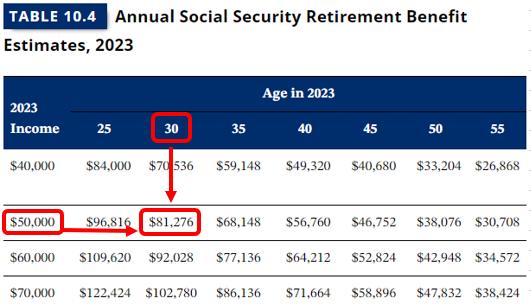
3. Social Security Benefits. Mark is a 30-year-old professional who earns $50,000 per year and will retire at the normal Social Security retirement age for his birth date (67). Use Table 10.4 to estimate Mark’s first-year Social Security benefit in future dollars.
Answer: $81,276
Solution: Use Table 10.4 (Annual Social Security Benefit Estimates, 2023). The table estimates Social Security retirement benefits beginning at 67 years old (NRA). Look at the intersection of $50,000 (2023 income) and 30 (age in 2023): $81,276. This can also be estimated using the Social Security Quick Calculator, although exact answers may differ slightly from the table: https://www.ssa.gov/OACT/quickcalc/index.html.
10.2; LO 10.2; BT: Ap; Difficulty: E; TOT: 1 min; AACSB: Analytic
4. Social Security Spousal Benefits. Larissa worked as a homemaker until she was 50. Since then, she has worked part-time as a retail clerk, and she is now ready to retire at age 65. Based on their earnings records, her husband’s Social Security PIA is $2,000, and hers is $500. What will Larissa’s Social Security benefit be?
A. $1,000
B. $1,250
C. $500
D. $0
Answer: $1,000