ISBN: 9781036207441
Organizational Leadership (3rd)
ISBN 9781036207441 | Chapter 1
Total Questions: 6
Multiple Choice (2)
Q1. [Multiple Choice]
According to the advice of Prime Minister Boris Johnson given in the video, citizens should protect themselves against the COVID-19 virus by exercising a high degree of ______.
a) isolation
b) personal responsibility ✓ correct
Q2. [Multiple Choice]
In explaining the leadership phenomenon, context means ______.
a) questioning the abilities of followers
b) sharing ideas with capable others
c) considering socio-economic, political, technological and cultural factors ✓ correct
d) considering the ability of followers and technology
True/False (3)
Q3. [True/False]
By August 2022, the U.S. accounted for 4.25% of the total world population but suffered the highest figure of any nation, with about 15% of the 6.4 million known COVID-related deaths. True or false.
a) true ✓ correct
b) false
Correct answer: True
Q4. [True/False]
According to research, the pandemic underscored fissures of structural inequality. True or false
a) true ✓ correct
b) false
Correct answer: True
Q5. [True/False]
A common feature amongst the otherwise diverse nations better managing the virus had female leaders. True or false
a) true ✓ correct
b) false
Correct answer: True
Essay (1)
Q6. [Essay]
Context-centred theory helps to explain the behaviour of Johnson and his ministers during the pandemic. Discuss.
Suggested answer: ● libertarianism, a doctrine that is centred on the sovereign self
● a culture of exceptionalism
● preoccupied with the effects of a ‘no-deal Brexit’
● the ideology of popularism and tendency to put ‘faith in his own instincts’.
Bratton, Organizational Leadership, 3e
SAGE Publishing, 2026
Teaching guide
Contents
Foreword
Chapter 1: Introduction: Lessons from the COVID-19 Pandemic and Why Leadership Matters
Chapter 2: The Nature of Leadership
Chapter 3: Power and Leadership
Chapter 4: Culture and Leadership
Chapter 5: Strategic Management, Innovation and Leadership
Chapter 6: Trait, Behaviour and Contingency Theories of Leadership
Chapter 7: Charismatic and Transformational Leadership
Chapter 8: Relational and Collaborative Leadership
Chapter 9: Dark Leadership
Chapter 10: Followership
Chapter 11: Ethics and Leadership
Chapter 12: Human Resource Management and Leadership
Chapter 13: Leadership Development
Chapter 14: Gender and Diversity in Leadership
Chapter 15: Teams and Team Leadership
Chapter 16: Artificial Intelligence and Leadership
Chapter 17: Leading Organizational Change for Environmental Sustainability
Chapter 18: Leadership in Unstable and Extreme Contexts
Chapter 19: Public Leadership
Chapter 20: Place Leadership
Bratton, Organizational Leadership, 3e
SAGE Publishing, 2026
Foreword
JOHN BRATTON
Introduction
The aim of this Guide is to illustrate how the learning features in Organizational Leadership 3e – Pause & Reflect, Leadership in Action, Researching Leadership, Ethical Spotlight, Review Questions and the Case Study – can be used in class, synchronously or as pre- or homework, asynchronously. The learning features are designed to encourage students to think critically about the extant literature and to interrogate the data and different viewpoints. Data from student evaluations of modules tend to show that students can be critical of lecturers if they do not use the recommended textbook. Therefore, it is important that lecturers demonstrate the added value of Organizational Leadership 3e by directly referring to the pedagogical features, the figures, tables and further readings so that students are more actively engaged during lectures. By doing so, they perceive that the textbook is of value.
Assessment
It is outside the scope of this Guide to offer a detailed discussion of assessment methods. Suffice to say, the primary purpose of assessment is to improve student learning. Assessment information is used to demonstrate that learners have read and understood the assigned readings, including the textbook. Importantly, assessment information is used to ascertain whether the learning objectives of the module have been achieved. Also, to improve the learning experience for students and to assure students that the module is meeting the outcomes of the programme.
In a generative AI-augmented world, AI is changing how students learn and are assessed. But in a fast-changing environment, many students are already well versed in AI, and there are concerns about exams and academic integrity. In this context, academic institutions are having to update academic integrity policies and rethink their modes of assessment with pace. Some institutions are pivoting from open-book online examinations back to traditional in-person examinations that are invigilated. Others recognize using GenAI and ChatGPT is
Bratton, Organizational Leadership, 3e
SAGE Publishing, 2026
going to be a life skill that staff will have to teach in every module (Weale, 2025).1 In many cases educators are mitigating the risks of AI by implementing new tools for detecting its inappropriate use, specifying on what grounds it can be used, for example, only for ‘brainstorming’, and by building assessment methods that prioritize critical thinking, creativity, and professional and lifelong skills.
The assessment techniques used in an academic institution will reflect its teaching and learning culture and the personal preferences of the lecturer. Therefore, this Guide is just that, it offers suggestions that we trust will help those educators who have adopted Organizational Leadership, 3e to determine whether the learning objectives of the leadership module have been achieved The assessment techniques offered by the text and online sources include:
1. Researching leadership
2. Ethical Spotlight
3. Chapter case study
4. GenAI Assignment
5. Write a blog.
6. Quizzes
The role of critique in leadership studies
In Anglo-American business schools, the hegemonic approach to studying management and leadership is the unitarist perspective, which frames organizations as harmonious, cooperative entities, and assumes a commonality of interests between managers, individuals and teams (Bratton et al., 2022: 298). Despite setting up social relations as harmonious,
1 Weale, S. (2025) ‘It’s going to be a life skill’: educators discuss the impact of AI on university education’ , The Guardian, 13 September. Available: https://www.theguardian.com/education/2025/sep/13/its-going-to-be-a-life-skilleducators-discuss-the-impact-of-ai-on-university-education. Accessed: 23 September 2025.
Bratton, Organizational Leadership, 3e
SAGE Publishing, 2026 management orthodoxy deems it necessary that the behaviour of those being managed be monitored and measured to achieve efficiency and performance. In non-Anglo-American countries that still retain employer-union negotiated collective agreements, the unitary perspective is at odds with the need for compromise and negotiation between competing stakeholder interests (Brandl et al., 2025).2
Explain to students that Organizational Leadership, in contrast to the unitary approach, adopts a critical perspective and frames the organization through a theoretical lens centring on exploitation, conflict, social injustice, as well as cooperation between the different stakeholders. A thread running throughout the text and reflected in the pedagogical features is the belief that organizational leadership can only be fully comprehended through a socioeconomic lens; one that incorporates into the analysis of organizational life competing stakeholder interests and wider sociocultural, political and economic factors that profoundly influence leaders and organizational members. As an introduction to the text, explain to students that whether scholars perceive the world through an individual and psychological prism or a societal and sociological one has profound implications for how they conduct their research and understand organizational life, and how they comprehend management and leadership action.
But what does it mean for scholars and students to think critically? John Mingersi outlines a framework for explaining what it is to be critical including: to critique common assumptions, rhetoric, tradition, authority and simple cause-and-effect thinking (see Chapter 13). In the age of far-right populism, where knowledge and methods for validating knowledge claims are downplayed or ridiculed by social elites and by those in power,ii these features of critical thinking can provide students with an intellectual toolbox to use throughout their studies and beyond.
2 Brandl, Julia, Michael Schiffinger, Sabine Boesl, and Lisa M. Marchl. 2025. “The Place Makes the Teaching! Linking Institutional Settings to Unitarist HRM Education in Austria.” Human Resource Management Journal: 1–13. https://doi.org/10.1111/17488583.70009.
Bratton, Organizational Leadership, 3e
SAGE Publishing, 2026
A body of critical organizational sociology starts by asking, as the ancient Romans did, ‘Cui bono? –‘Who benefits and how?’ For the past 40 years, critical scholars point out, the dominant mainstream academic focus has been on organizational performance outcomes and maximizing share value at the expense of finding pathways to employee well-beingiii. In an age of extreme inequality, there is a growing consensus for a need to give less priority to the needs of shareholders and greater priority to employee well-being.iv It is the absence of concern for employee/follower well-being, equitable rewards, degradation of the ecosystem and climate change that has catapulted radical critiques of organizational leadership.
The intellectual roots of critical management and leadership studies (CMLS) are most obviously found in Marxist, Weberian, feminist theories and post-colonial critiques of capitalism.v A growing intellectual influence on critical management research and scholarship is the feminist paradigm, what some refer to as, ‘a critique of critique’vi. Feminist writers provide a sophisticated understanding of pervasive gender-based injustices that women experience through entrenched social processes, such as patriarchal strategies and sexism (Williamson et al., 2025).3 Such a perspective has encouraged studies that examine the association between gender and leader.vii Another stream of intellectual influence on critical scholarship is the post-colonial discourse. Post-colonialists’ scholars have interrogated and challenged Anglo-American and west European theorizing about organizational life. A perspective that underscores both the need for, and importance of postcolonial critique of organizations, including leadership (Ladkin, 2025).4 Interrogating underlying assumptions and values that inform Western disciplinary knowledge and garnering insights from indigenous voices are at the centre of the post-colonial critique.
3 Williamson, J., Parker, J., Donnelly, N., and Ressia, S. (2025) ‘Introduction: travelling the twisting and turning road of gender, work and employment relations’, (pp. 1–17) in S. Williamson, Parker, J., Donnelly, N., and Ressia, S. (eds), Research Handbook on Gender, Work and Employment Relations. Cheltenham, UK: Edward Elgar.
4 Ladkin, D. (2025) Challenging Colonizing Logics within Management Research. Cheltenham, UK: Edward Elgar.
Bratton, Organizational Leadership, 3e
SAGE Publishing, 2026
In the current political context, it is ever more important to explain to students that the core value of universities is academic freedom and that entails critique. At a discipline level, critique is central to improving the management of work and people, and, ultimately, organizational leadership. Capitalism ‘needs’ its detractors, ‘to find the moral supports it lacks and to incorporate mechanisms of justice whose relevance it would otherwise have no reason to acknowledge’ . viii Thus, critique serves to improve capitalism and, by extension, organizations and leadership. The potential effects of critique on organizational leadership are of at least three kinds.
First, by testing various propositions about leadership, e.g., transformative or collaborative, critique can divest them of their effectiveness. Critique unmasks the hypocrisy of moral pretentions – rhetorical assertions that ‘With unity we can do great things’ or ‘Our people are our greatest asset’ – that hide the reality of exploitation, alienation and the harms caused by the abuse of power. Second, evidence-based critique, in exposing inhuman or poor management practices, can compel organizational leaders to justify those actions. And the more convincing the critique, the more the justifications advanced in response will have to be combined with robust processes that guarantee a positive improvement in terms of well-being or social justice. For example, during the COVID-19 pandemic, policymakers and health executives were heavily criticized for failing to supply adequate PPE to health and social care staff.ix When an organization is obligated to respond positively to the points raised by critique, to maintain support of employees or customers, by the same gesture it incorporates some of the values shared by the critics.
The third effect of critique is that it rests upon a less optimistic analysis of the reactions of neoliberal capitalism. The old way of doing business: it condemns changes or perishes. Thus, critique acts as a catalyst hastening the transformation of new modes of work and management, which, in turn, create new tension because of labour-wage expectations shaped on their experience of previous management architecture. At its heart, therefore, the dynamic effect of critique is to challenge, renegotiate or even rescind prior to emerging anew.x
There is a growing focus on climate leadership involving the development and implementation of strategies which are environmentally sustainable and socially just.
Bratton, Organizational Leadership, 3e
SAGE Publishing, 2026
Therefore, a reflexive, critical analysis of leadership and management practices is increasingly important to understanding how organizations can become more environmentally sustainable. In Organizational Leadership Third Edition, we are concerned with developing a context-sensitive understanding of leadership. We emphasize that paradox and antagonism are structured into the employment relationship. That different organizational strategies and leadership behaviours are best understood in the context of the wider cultural-political economy, and market forces that direct or influence organizational leaders, managers, and follower–leader dynamics.
Finally, in an era of ‘fake news’, quick takes and easy outrage, perhaps in the first lecture or seminar, it’s important to point out to your students the need to critique knowledge and that knowledge, including this text, is never value-free and objective. Organizational Leadership is political in the sense that it orients students to the field of leadership and its defining areas of theory and research and thereby, like all textbooks, it performs a political function. By that, textbooks ‘advance narratives of collective identity, which invite students to internalize a particular map of central and marginal issues of legitimate and dubious projects’ (Ashcroft and Allen 2003:28). As suggested above, knowledge is not neutral, shaping our understanding of it in particular ways. The ‘map’ we wish to lay out to students will, we hope, enable your students to navigate through competing narratives and counter narratives on organizational leadership. That it will encourage students to engage with the failures and injustices of the current neoliberal model, with the inherent exploitation of people and planet that capitalism depends on, and that it fosters a more holistic and nuanced awareness of the forces and processes shaping the behaviour of people in the contemporary workplace. It is the commitment to educate, not simply to ‘train’ employable skills, which further differentiates Organizational Leadership Third Edition from mainstream leadership texts.
We aim specifically to introduce students to more critical accounts of the realities of organizations in capitalist societies, one that encourages a deeper comprehension and sensitivity with respect to management and leadership-related issues. In so doing, we hope this Guide to teaching and assessment, along with Organizational Leadership, will help
Bratton, Organizational Leadership, 3e
SAGE Publishing, 2026
lecturers sharpen students’ critical faculties, encourage students to question assumptions, and to seek multicausality when analysing both the theory and practice of contemporary leadership.
©John Bratton October 2025
Chapter 1: Introduction: Lessons from the COVID-19 pandemic and why leadership matters
Teaching tips
1. Chapter overview and aims
The chapter begins the students’ study of leadership by examining political leadership during the pandemic. The author considers this appropriate for three reasons. First, in terms of the sheer scale of the crisis, COVID-19 impacted all members of society, as well as every workplace. Second, the way national leaders responded to the pandemic provides a case study of leadership that facilitates theory building. And third, cataloguing what happened consolidates the opinion that leadership does matter.
After completing chapter 1, students should be able to:
• explain the relevance of the COVID-19 pandemic to understanding leadership theories.
• recognize the book’s distinctive approach to studying leadership.
• explain leadership as an interconnected process.
2. Content and teaching tips
2.1. Origins and spread of COVID-19 pandemic
Teaching Tip: Questions could go from the global to the personal. For example, before examining the origins, spread and death rates, stimulate student interest by going to the Pause and Reflect Question: How did the COVID-19 pandemic in 2020 upend the world economy and employment?
Bratton, Organizational Leadership, 3e
SAGE Publishing, 2026
Also – How did the COVID-19 pandemic impact you specifically? (for example, your education, physical and psychological well-being, family finances, employment prospects, etc. Responses may help to underscore how the decisions of national and regional leaders influence their lives)
Teaching Tip: Ask students to look at Table 1.1. What countries had the highest/lowest confirmed deaths? Ask for possible reasons for the variation – health inequalities, lack of investment in public health, leadership?
2.2. Failures of leadership
Teaching Tip: Before examining this section, start by posing the Pause and Reflect question: To what extent, if at all, did personality traits help explain Johnson’s (or a leader from a different jurisdiction) inept leadership during the COVID crisis?
Teaching Tip: In tutorials, students could be placed in small groups to discuss other factors to explain different death rates other than personal traits and incompetence – followers, a culture of exceptionalism, unpreparedness.
Teaching Tip: In the lecture/tutorial/seminar, pose the Pause & Reflect question: How did ideology and followers – members of Johnson’s cabinet and Conservative MPs – affect Johnson’s leadership over the first 24 months of the pandemic?
2.3. The author’s approach to studying leadership
Teaching Tip: The book aims to review and critically evaluate both the theory and practice of organizational leadership. Consider how this broad aim links to the aims of the module. Ask students: What is the significance of the author’s statement that ‘Organizations are the ‘architects’ of employment relations’, and what is the significance for understanding leadership?
Teaching tip: Critical insight: Leadership and the employment relationship (p. xx) The author takes it as self-evident that HRM practices can help to mediate the positive effect of leaders’ influence over individual and team outcomes. The activity asks students to read Budd, J. W. (2020). The psychologization of employment relations, alternative models of the
Bratton, Organizational Leadership, 3e
SAGE Publishing, 2026
employment relationship, and the OB turn. Human Resource Management Journal, 30(1), 73-83. The question:
‘How does this article help us to understand the importance of the employment relationship when considering leader-follower dynamics? – can be addressed by students in a tutorial, synchronously or as pre- or homework, asynchronously.
2.4. A framework for studying leadership
Emphasize a core point of the book; that leadership is not simply a position but a process, a dynamic relational phenomenon residing in a specific organizational context.
Figure 1.1 Leadership as an interconnected process
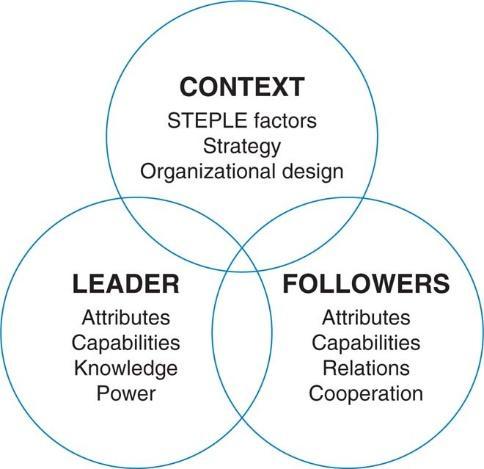
Teaching Tip: Explain that the context part of the model refers to those external drivers of change – social, technological, economic, political, legal, ecological (STEPLE) – as well as the organizational design and strategy considerations inside the organization. Elicit examples of STEPLE from students.
The leader part of the model highlights a cluster of lasting themes found in the extant literature, specifically what the leader contributes as an individual to the leadership process. Recap Prime Minister Boris Johnson’s leadership performance during the pandemic. Can Johnson be described as an effective leader? Why/why not?
Explain that the followers’ part of the model refers to those employees’ leaders seek to influence. The emergent opinion is that followers are a critical component of the leadership process. Follower-centric theories and the followership process focus on follower attributes relevant to the leadership process, including the importance of values, attitudes and self-
Bratton, Organizational Leadership, 3e
SAGE Publishing, 2026
identity. There is a discussion on millennials and Gen Z (followers under 42). Hence, scope to ask intergenerational questions – values, self-identity.
Teaching tip: Leadership in action: Climate leadership in India The activity asks students to read Tiffany H. Morrison et al., (2022) Radical interventions for climate-impacted systems, Nature Climate Change. The questions posed can be addressed by students in a tutorial, synchronously or as pre- or homework, asynchronously.
3. Conclusion and wrap-up
Teaching Tip: Review lecture/chapter learning objectives.
Teaching Tip: Chapter Review Question: These can be posed in the lecture as part of the wrap-up or as a pre-tutorial assignment with small group presentations addressing the questions.
1. What contribution does critical analysis make to our understanding of leadership?
2. What lessons does the COVID pandemic provide for leadership theory and practice?
3. Bearing in mind the discussion on context, what kind of problems do you think organizational leaders today and in the future should respond to?
4. Further reading Hallett, H. (2024) UK Covid-19 Inquiry Module 1: The resilience and preparedness of the United Kingdom. 18 July. London: House of Commons. Bowleg, L. (2020). We’re not all in this together: On COVID-19, intersectionality, and structural inequality. American Journal of Public Health, 110(7), 917–917.
Wilson, S., & Newstead, T. (2022). The virtues of effective crisis leadership: What managers can learn from how women heads of state led in the first wave of COVID19. Organizational Dynamics, 51(2), 100910. https://doi.org/10.1016/j.orgdyn.2022.100910;
Assessment tips
As John Bratton explains in the Foreword, the assessment techniques used in an institution will reflect its teaching and learning culture and the personal preferences of the lecturer. This
Bratton, Organizational Leadership, 3e
SAGE Publishing, 2026
Guide is therefore just that, suggestions that will help adopters of Organizational Leadership, 3e.
The assessment techniques offered throughout the chapters include:
• Researching leadership
• Ethical Spotlight
• Chapter case study
• GenAI Assignment
• Write a blog
• Quizzes
1. Researching leadership: Research designs
This activity is designed to explore how the ontological stance and research designs produce different insights about leader-follower dynamics. It explains research designs are broad structures that guide the gathering and analysis of data and contrasts quantitative and qualitative methods. The set activity in the text asks students to read the section on methodology in the following two articles:
[1] Guerrero, E., Frimpong, J., Kong, Y., Fenwick, K., & Aarons, G. A. (2020)
Advancing theory on the multilevel role of leadership in the implementation of evidence-based health care practices Health Care Management Review, 45(2), 151–161.
[2] Idelji-Tehrani, S., & Al-Jawad, M. (2019) Exploring gendered leadership stereotypes in a shared leadership model in healthcare: A case study. Medical Humanities, 45(4), 388–398.
The questions posed can be addressed by students working in small groups in a tutorial/seminar, or as a formal individual written assignment.
2. Ethical spotlight: Is it ethical to use surveillance in the home?
This activity examines ‘algorithmic surveillance’ and suggests that surveillance is one of the most ethically challenging concepts in AI as it could impact leader-follower relationships. The question, is it reasonable for employers to deploy AI-enabling surveillance technology to