S:1-9 (Learning Objective 3)
The balanced scorecard perspective that emphasizes the process businesses put in place to meet customer requests is the
a. learning and growth perspective.
b. internal business perspective.
c. customer value perspective
d. financial perspective.
S:1-10 (Learning Objective 3)
The balanced scorecard culminates in which perspective?
a. The learning and growth perspective
b. The internal business perspective
c. The customer value perspective
d. The financial perspective
S:1-11 (Learning Objective 4)
Which types of technologies are likely to disrupt the managerial accounting profession in the future?
a. Machine learning
b. Artificial intelligence
c. Automation
d. All of these technologies will disrupt the managerial accounting profession.
S:1-12 (Learning Objective 4)
A computer program that incorporates new data to become progressively more accurate would be an example of
a. data analytics.
b. machine learning.
c. artificial intelligence.
d. automation.
S:1-13 (Learning Objective 4)
Today’s managerial accounting job includes which function(s)?
a. Accounting
b. Data Analysis
c. Communication
d. All of these are part of a managerial accountant’s job.
Exercises
E:1-14 (Learning Objective 1)
Consider the following managerial accounting activities:
a. Preparing a financial statement
b. Comparing budget and actual results
c. Implementing a reward system for production employees
d. Preparing a budget
e. Implementing a new accounting system
f. Evaluating bids from suppliers
Requirement
Drop the activities under the correct functional category.
Planning
d. Preparing a budget
Facilitating Controlling
c. Implementing a Reward system for production employees
e. Implementing a new accounting system
f. Evaluating bids from suppliers
a. Preparing a financial statement.
b. Comparing budget and actual results.
E:1-15 (Learning Objective 2)
Consider the following accounting characteristics:
a. Provides information for external decision-makers
b. Aggregates and communicates detailed financial, nonfinancial, operational, and other information
c. Provides information for internal decision-makers
d. Does not verify reports with outside parties
e. Relies on auditors to verify reports for faithful representation
f. Prepares unstructured reports related to operational, investing, and other ad hoc decisions
g. Aggregates and communicates financial information related to accounting events
h. Prepares regular financial reports, including the income statement, balance sheet, and statement of cash flows
Requirement
Drop the characteristics under the correct column to indicate if they are financial or managerial accounting characteristics.
a. Provides information for external decision-makers
b. Aggregates and communicates detailed financial, nonfinancial, operational, and other information
e. Relies on auditors to verify reports for faithful representation
g. Aggregates and communicates financial information related to accounting events
h. Prepares regular financial reports, including the income statement, balance sheet, and statement of cash flows
E:1-16 (Learning Objective 3)
Consider the following performance indicators:
a. Return on investment
b. Employee turnover rate
c. Customer satisfaction
d. On-time delivery
e. Cycle time
f. Net income
g. Order return rates
h. Employee ownership percentage Requirement
c. Provides information for internal decision-makers
d. Does not verify reports with outside parties
f. Prepares unstructured reports related to operational, investing, and other ad hoc decisions
Drop the performance indicators under the correct balance scorecard perspective.
h. Employee ownership percentage
Employee turnover rate d. On-time
e. Cycle time
E:1-17 (Learning Objective 4)
Consider the following business tasks:
Customer satisfaction
Order return rates
on investment f. Net income
a. Detecting potential nonpaying customers
b. Matching invoices with purchase orders
c. Predicting sales
d. Interacting with customers reporting defective products
e. Selecting samples of data to analyze
Requirement
Drop the business task with the new technology that will help make that task more efficient.
Machine Learning Artificial Intelligence Process Automation
a. Detecting potential nonpaying customers
c. Predicting sales
d. Interacting with customers reporting defective products
b. Matching invoices with purchase orders
e. Selecting samples of data to analyze
Technology, Applications, and AI
T:1-18 Use GenAI for data analysis
Managerial accountants can use large language models (LLMs), such as ChatGPT, Google Bard, or Microsoft Copilot, to do their jobs more efficiently. LLMs are a form of generative AI that can generate content based on a prompt. In this exercise, you will learn some basic prompting techniques and see how changing the prompts will provide better information.
Part 1
• Login to ChatGPT or any other LLM of your choice. You may need to create an account to use these tools. For this exercise, the free version of the tool is sufficient.
• Enter the following simple prompt.
What is the difference between managerial and financial accounting?
Questions to answer:
• Based on what you learned in the chapter, is everything correct in the response?
• What additional information should be included?
Solution:
The output from ChatGPT will change as the model evolves. Generally, the tool will answer the question correctly, but it may be missing some expected details and add others. There may be a better way to format the answer to make it more readable.
Part 2
Although the simple prompt above provided a reasonably complete response, writing better prompts will get the user better information.
Users should consider adding the following to the prompt for a better response:
• Define the Role specify the role or area of expertise you want the LLM to possess.
• Provide Context provide any background information
• Clearly write the task give specific information on what you want ChatGPT to provide
• Set any parameters or restrictions if there is specific information to include or exclude, add this to the prompt
• Define the format specify any particular format you want the output, such as tabular, paragraph, or bullet points
Using the guidance above, write a more complete prompt. Consider what information the first prompt was missing and ask ChatGPT to include it in this prompt. Limit the output to 500 words.
Questions to answer:
• Did the second prompt improve the answer? What changed?
Solution:
The answers will vary depending on how the student changes the prompt. Here are some sample prompts If you prefer, give the different prompts to various students and have them compare results.
SAMPLE PROMPT 1: You are an accounting professor, and I am a beginning accounting student. Explain to me the difference between managerial accounting and financial accounting. Include the different roles of each, the types of information they prepare, who they work with, and the tasks they perform. Keep to 500 words or less.
SAMPLE PROMPT 2: You are an accounting professor. Explain to a beginning accounting student in 500 words or less the difference between managerial and financial accounting. Include the different functions of each and the typical information they prepare.
SAMPLE PROMPT 3: You are an accounting professor. Explain to a beginning accounting student the difference between managerial and financial accounting. Include the different functions of each the typical information they prepare and any other necessary details. Put in a tabular format.
Part 3 (Optional)
Use an alternate GenAI tool to complete the same exercise. How do the results differ? Which one provided more complete answers? Which response do you prefer?
Solution: Answers will vary depending on the GenAI tool used and the prompt.
T:1-19 Use GenAI for data analysis Solution using ChatGPT-4o
Accountants can use generative AI tools to analyze data. In this exercise, use the recent free version of ChatGPT and upload the provided file Office_Supply_Sales_Data_2025.csv.
Write prompts in GenAI to answer the following questions:
NOTE: The responses from ChatGPT will vary in format, but the numbers should remain consistent.
1. Which store sold the most bookshelves?
Dubuque sold the most bookshelves with 6,870 units.
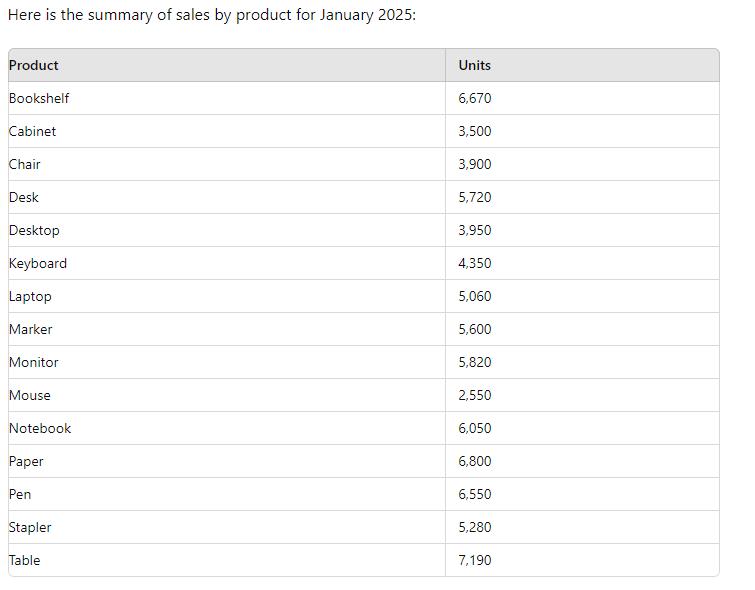
2. Summarize the sales by Product for January 2025. The prompt may need to be revised to have ChatGPT understand January 2025. The dates in the file are the ending date for each month (e.g., 1/31/2025). The prompt will either need to be rewritten to ask for the summary for 1/31/2025 or the following prompt may be used:
Update the data by converting the date column to month. Summarize by product for January 2025.
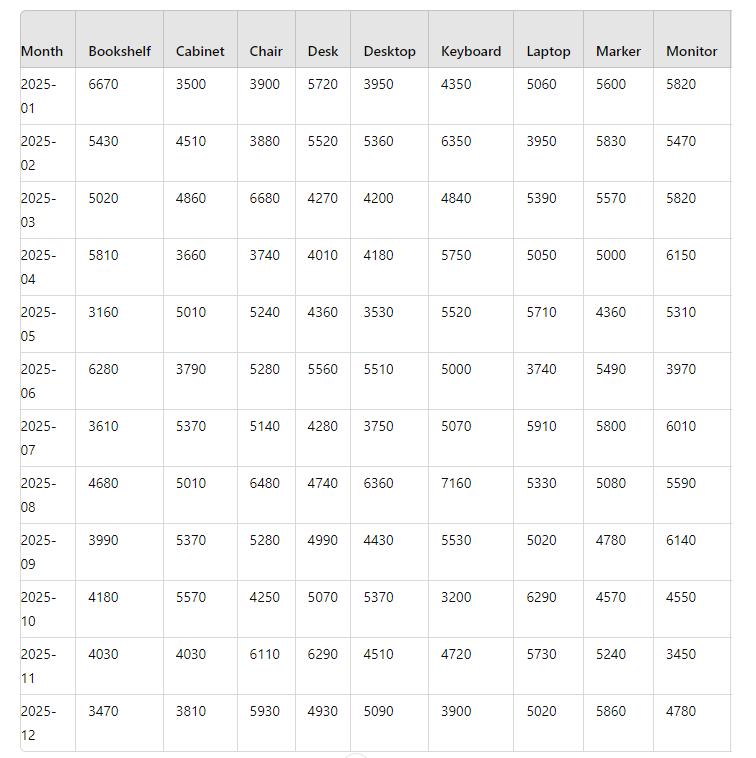
3. Compare January Sales with other months.
If the GenAI tool does not give you the data formatted in the format you would like, revise the prompts or ask for it to be generated again.
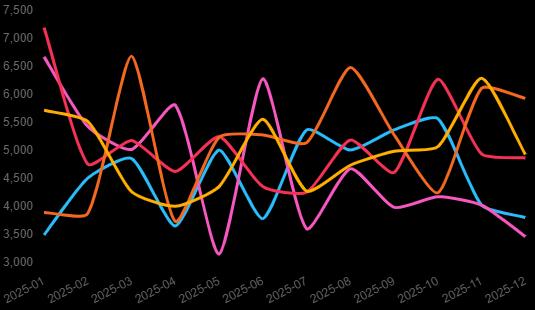
4. Visualize monthly sales trends for furniture.
As the tool constantly evolves, how your results are displayed may vary. You can continue to add prompts to change the output.