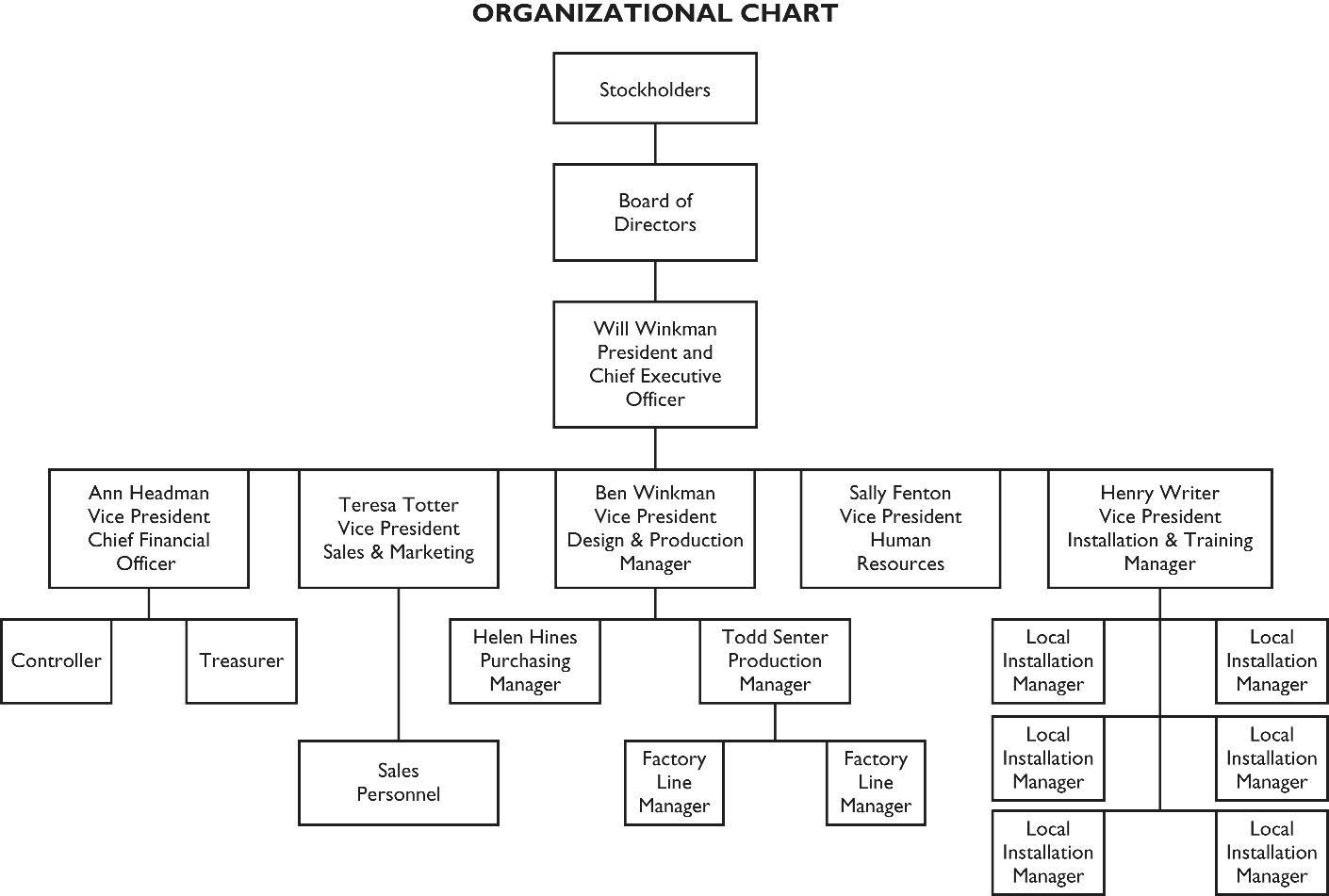
6. Employees with line positions are directly involved in the company’s primary revenue generating operating activities. Examples would include factory managers and supervisors, and the vice president of operations. In contrast, employees with staff positions are not directly involved in revenue-generating operating activities, but rather serve in a support capacity to line employees. Examples include employees in finance, legal, and human resources.
LO1 BT: C Difficulty: Easy TOT: 3 min. AACSB: Knowledge AICPA AC: Measurement, Analysis and Interpretation IMA: Reporting & Control: Cost Accounting
7. The difference in balance sheets pertains to the presentation of inventories in the current asset section. In a merchandising company, only inventory is shown. In a manufacturing company, three inventory accounts are shown: finished goods, work in process, and raw materials.
LO3 BT: C Difficulty: Easy TOT: 2 min. AACSB: Knowledge AICPA AC: Measurement, Analysis and Interpretation IMA: Reporting & Control: Cost Accounting
8. Manufacturing costs are classified as either direct materials, direct labor, or manufacturing overhead.
LO2 BT: C Difficulty: Easy TOT: 1 min. AACSB: Knowledge AICPA AC: Measurement, Analysis and Interpretation IMA: Reporting & Control: Cost Accounting
9. No, Mel is not correct. The distinction between direct and indirect materials is based on two criteria: (1) physical association and (2) the convenience of making the physical association. Materials which cannot be easily associated with the finished product are considered indirect materials.
LO2 BT: C Difficulty: Easy TOT: 2 min. AACSB: Knowledge AICPA AC: Measurement, Analysis and Interpretation IMA: Reporting & Control: Cost Accounting
10. Product costs, or inventoriable costs, are costs that are a necessary and integral part of producing the finished product, they are classified as manufacturing costs. Period costs are costs that are identified with a specific time period rather than with a salable product. These costs relate to nonmanufacturing activities and therefore are not inventoriable costs, they are expensed as incurred
LO2 BT: K Difficulty: Easy TOT: 2 min. AACSB: Knowledge AICPA AC: Measurement, Analysis and Interpretation IMA: Reporting & Control: Cost Accounting
11. A merchandising company that uses the periodic inventory system reports beginning inventory, cost of goods purchased, and ending inventory in the cost of goods section of the income statement. A manufacturing company reports beginning finished goods inventory, cost of goods manufactured, and ending finished goods inventory in its determination of cost of goods sold
LO3 BT: C Difficulty: Easy TOT: 5 min. AACSB: Knowledge AICPA AC: Measurement, Analysis and Interpretation IMA: Reporting & Control: Cost Accounting
12. (a) X = total cost of work in process. (b) X = cost of goods manufactured.
LO3 BT: C Difficulty: Easy TOT: 2 min. AACSB: Knowledge AICPA AC: Measurement, Analysis and Interpretation IMA: Reporting & Control: Cost Accounting
LO3 BT: AP Difficulty: Easy TOT: 3 min. AACSB: Analytic AICPA AC: Measurement, Analysis and Interpretation IMA: Reporting & Control: Cost Accounting
16. The order of reporting is finished goods inventory, work in process inventory, and raw materials inventory.
LO3 BT: K Difficulty: Easy TOT: 1 min. AACSB: Knowledge AICPA AC: Measurement, Analysis and Interpretation IMA: Reporting & Control: Cost Accounting
17. The products differ in how each are consumed by the customer. Services are consumed as they are provided; and not capitalized into inventory. Meals at a restaurant are the best example where they are consumed immediately by the customer. There could be a long lead time before the product is sold to a customer in a manufacturing environment.
LO4 BT: C Difficulty: Easy TOT: 3 min. AACSB: Knowledge AICPA AC: Measurement, Analysis and Interpretation IMA: Reporting & Control: Cost Accounting
18. The product costing techniques apply equally well to manufacturers and service companies. Each needs to keep track of the cost of production or services in order to know whether it is generating a profit. The techniques shown in this chapter, to accumulate manufacturing costs to determine manufacturing inventory, are equally useful for determining the cost of services.
LO4 BT: K Difficulty: Easy TOT: 3 min. AACSB: Knowledge AICPA AC: Measurement, Analysis and Interpretation IMA: Reporting & Control: Cost Accounting
19. The value chain refers to all activities associated with providing a product or service. For a manufacturer, these include research and development, product design, acquisition of raw materials, production, sales and marketing, delivery, customer relations, and subsequent service. The value chain includes both manufacturing and nonmanufacturing activities and costs.
LO4 BT: C Difficulty: Easy TOT: 3 min. AACSB: Knowledge AICPA AC: Systems & Process Management IMA: Reporting & Control: Cost Accounting
20. An enterprise resource planning (ERP) system is an integrated software system that provides a comprehensive, centralized resource for information. Its primary benefits are that it replaces the many individual systems typically used for receivables, payables, inventory, human resources, etc. Also, it can be used to get information from, and provide information to, the company’s customers and suppliers.
LO4 BT: C Difficulty: Easy TOT: 3 min. AACSB: Knowledge AICPA AC: System and Process Management IMA: Strategy Planning & Performance: Strategic and Tactical Planning
21. In a just-in-time inventory system, the company has no extra inventory stored. Consequently, if some units that are produced are defective, the company will not have enough units to deliver to customers.
LO4 BT: C Difficulty: Easy TOT: 2 min. AACSB: Knowledge AICPA AC: System and Process Management IMA: Strategy Planning & Performance: Strategic and Tactical Planning
22. The balanced scorecard is called “balanced” because it strives to not over emphasize any one performance measure, but rather uses both financial and non-financial measures to evaluate all aspects of a company’s operations in an integrated fashion.
LO4 BT: C Difficulty: Easy TOT: 3 min. AACSB: Knowledge AICPA AC: System and Process Management IMA: Strategy Planning & Performance: Strategic and Tactical Planning
23. Budgets are prepared by companies to provide future direction. Because the budget is also used as an evaluation tool, some managers may try to game the budgeting process by underestimating their division’s predicted performance so that it will be easier to meet their performance targets. On the other hand, if the budget is set at unattainable levels, managers sometimes take unethical actions to meet targets to receive higher compensation or in some cases to keep their jobs.
LO4 BT: C Difficulty: Easy TOT: 3 min. AACSB: Ethics AICPA PC: Ethical Conduct IMA: Professional Ethics & Values: Recognizing and Resolving Unethical Behavior
24. According to the Sarbanes-Oxley Act of 2002, CEOs and CFOs must now certify that financial statements give a fair presentation of the company’s operating results and its financial condition and that the company maintains an adequate system of internal controls. In addition, the composition of the board of directors and audit committees receives more scrutiny, and penalties for misconduct have increased.
LO4 BT: C Difficulty: Easy TOT: 3 min. AACSB: Ethics AICPA AC: Measurement, Analysis and Interpretation AICPA PC: Ethical Conduct IMA: Reporting & Control: Internal Controls
25. Activity-based costing is an approach used to allocate overhead based on each product’s relative use of activities in making the product. Activity-based costing is beneficial because it results in more accurate product costing and in more careful scrutiny of all activities in the value chain.
LO4 BT: C Difficulty: Easy TOT: 3 min. AACSB: Knowledge AICPA AC: Measurement, Analysis and Interpretation IMA: Reporting & Control: Cost Accounting
SOLUTIONS TO BRIEF EXERCISES
BRIEF EXERCISE 1.1
Financial Accounting Managerial Accounting
Primary users External users
Internal users
Types of reports Financial statements Quarterly and annually Internal reports As frequently as needed
Frequency of reports Quarterly and annually As frequently as needed
Purpose of reports General-purpose
Content of reports
Pertains to business as a whole. Highly aggregated. Limited to accrual accounting and cost data. Generally accepted accounting principles
Special-purpose information for specific decisions
Pertains to subunits of the business. Very detailed. Extends beyond accrual accounting to any relevant data. Evaluated based on relevance to decisions
Verification process Annual audit by certified public accountant No independent audits
LO1 BT: C Difficulty: Easy TOT: 3 min. AACSB: Knowledge AICPA AC: Measurement, Analysis and Interpretation IMA: Reporting & Control: Cost Accounting
BRIEF EXERCISE 1.9 Direct Materials Used Direct Labor Manufacturing Overhead Total Manufacturing Costs (1) (2) (3) $81,000(b) $144,000(c)
$151,000(a)
LO3 BT: AP Difficulty: Easy TOT: 2 min. AACSB: Analytic AICPA AC: Measurement, Analysis and Interpretation IMA: Reporting & Control: Cost Accounting
(a) $40,000 + $61,000 + $50,000 = $151,000
(b) $296,000 - $140,000 - $75,000 = $81,000
(c) $310,000 - $55,000 - $111,000 = $144,000
BRIEF EXERCISE 1.10 Total Manufacturing Costs Work in Process (January 1) Work in Process (December 31)
(b)
*$40,000 + $61,000 + $50,000 (data from BE 1.9)
(c) $189,000(a)
LO3 BT: AP Difficulty: Easy TOT: 5 min. AACSB: Analytic AICPA AC: Measurement, Analysis and Interpretation IMA: Reporting & Control: Cost Accounting
(a) $151,000 + $120,000 - $82,000 = $189,000
(b) $331,000 + $98,000 - $296,000 = $133,000
(c) ($310,000 + $463,000) - $715,000 = $58,000
One implication of Sarbanes-Oxley Act of 2002 (SOX) was to clarify top management’s responsibility for the company’s financial statements. CEOs and CFOs must certify that financial statements give a fair presentation of the company’s operating results and its financial condition. In addition, top managers must certify that the company maintains an adequate system of internal controls to ensure accurate financial reports. Also, more attention is now paid to the composition of the company’s board of directors. In particular, the audit committee of the board of directors must be comprised entirely of independent members (that is, non-employees) and must contain at least one financial expert. Finally, to increase the likelihood of compliance with these and other new rules, the penalties for misconduct were substantially increased to include not only fines but also incarceration.
LO4 BT: C Difficulty: Easy TOT: 6 min. AACSB: Ethics, Communication AICPA PC: Ethical Conduct, Communication IMA: Reporting & Control: Internal Controls
DO IT! 1.1
SOLUTIONS FOR DO IT! EXERCISES
1. False. The board of directors’ primary responsibility is to formulate the operating policies of the company.
2. False. Financial accounting reports pertain to the business as a whole and are highly aggregated (condensed).
3. False. Managerial account reports do not have to follow GAAP and are not audited by CPAs.
4. True
LO1 BT: C Difficulty: Easy TOT: 4 min. AACSB: Knowledge AICPA AC: Measurement, Analysis and Interpretation IMA: Reporting & Control: Cost Accounting
DO IT! 1.2
Period costs:
Advertising
Salaries of sales representatives
Product costs:
Blank CDs (DM)
Depreciation of CD image burner (MO)
Salary of factory manager (MO)
Factory supplies used (MO)
Paper inserts for CD cases (DM)
CD plastic cases (DM)
Salaries of factory maintenance employees (MO)
Salaries of employees who burn music onto CDs (DL)
LO2 BT: C Difficulty: Easy TOT: 4 min. AACSB: Knowledge AICPA AC: Measurement, Analysis and Interpretation IMA: Reporting & Control: Cost Accounting
TOMLIN COMPANY
Cost of Goods Manufactured Schedule For the Month Ended April 30, 2027 Work in process, April 1 ................................ $
LO4 BT: C Difficulty: Easy TOT: 4 min. AACSB: Knowledge AICPA AC: None IMA: Reporting & Control: Cost Accounting
SOLUTIONS TO EXERCISES
EXERCISE 1.1
1. False. Financial accounting focuses on providing information to external users.
2. False. Line positions are directly involved in the company's primary revenue-generating operating activities.
3. False. Preparation of budgets is part of managerial accounting.
4. False. Managerial accounting applies to service, merchandising and manufacturing companies.
5. True.
6. False. Managerial accounting reports are prepared as frequently as needed.
7. True.
8. True.
9. False. Financial accounting reports must comply with generally accepted accounting principles.
10. False. The company treasurer reports directly to the vice president of finance/chief financial officer.
LO1 BT: C Difficulty: Easy TOT: 6 min. AACSB: Knowledge AICPA AC: Measurement, Analysis and Interpretation IMA: Reporting & Control: Cost Accounting
EXERCISE 1.2
1. (c) Manufacturing overhead.
2. (c) Manufacturing overhead.
3. (c) Manufacturing overhead.
4. (c) Manufacturing overhead.
5. (a) Direct materials.
6. (b) Direct labor.
7. (c) Manufacturing overhead.
8. (c) Manufacturing overhead.
9. (c) Manufacturing overhead.
10. (a) Direct materials.
LO2 BT: C Difficulty: Easy TOT: 6 min. AACSB: Knowledge AICPA AC: Measurement, Analysis and Interpretation IMA: Reporting & Control: Cost Accounting
(b) Product costs are recorded as a part of the cost of inventory because they are an integral part of the cost of producing the bicycles. Product costs are not expensed until the bicycles are sold. Period costs are recognized as an expense when incurred. LO2 BT: C Difficulty: Easy TOT: 8 min. AACSB: Knowledge AICPA AC: Measurement, Analysis and Interpretation IMA: Reporting & Control: Cost Accounting
1.4
(a)
MOH)
($3,800 + $46,400 + $1,300 + $15,000 + $2,640 = $69,140) (Depr. on del. trks. + Sales sal. + Repairs on off. equip. + Advert. + Off. sup. used = Period costs) LO2 BT: AP Difficulty: Easy TOT: 10 min. AACSB: Analytic AICPA AC: Measurement, Analysis and Interpretation IMA: Reporting & Control: Cost Accounting
EXERCISE 1.5
1.
LO2 BT: C Difficulty: Easy TOT: 5 min. AACSB: Knowledge AICPA AC: Measurement, Analysis and Interpretation IMA: Reporting & Control: Cost Accounting
EXERCISE 1.6
1. (b)
2. (c)
3. (a)
4. (c) (Only for the portion that applies to the X-ray department)
5. (c)
6. (c)
7. (c)
8. (c)
9. (c)
10. (c) (Only for the portion that applies to the X-ray department)
LO2 BT: C Difficulty: Easy TOT: 5 min. AACSB: Knowledge AICPA AC: Measurement, Analysis and Interpretation IMA: Reporting & Control: Cost Accounting
EXERCISE 1.7 (a) Delivery
(product) costs:
($6,400 + $11,200 + $5,000 + $2,200 + $16,000 + $300 = $41,100) (Ind. mat. + Depr. on del. equip. + Dispatch. sal. + Gas & oil for del. trks. + Drivers’ sal. + Del. equip. repairs = Tot. product costs)
(b) Period costs:
LO2 BT: AP Difficulty: Easy TOT: 6 min. AACSB: Analytic AICPA AC: Measurement, Analysis and Interpretation IMA: Reporting & Control: Cost Accounting
1.9
(a) Work in process, January 1....................
(c) The costs not include in either the Schedule of Cost of Goods Manufactured or the Schedule of Cost of Goods sold are: Property taxes on store, Advertising expense, Delivery expense, Sales commissions, and Salaries paid to sales clerks. They would all be classified as period costs, and as such, would be reported on the income statement under operating expenses.
LO3 BT: AP Difficulty: Easy TOT: 5 min. AACSB: Analytic AICPA AC: Reporting IMA: Reporting & Control: Cost Accounting
EXERCISE 1.10
Total raw materials available for use: Direct materials used ....................................................... $180,000 Add: Raw materials inventory, Dec. 31......................... 22,500 Total raw materials available for use .............................. $202,500
($180,000 + $22,500 = $202,500) (DM used + End. raw mat. = Tot. raw mat. avail. for use)
Raw materials inventory (Jan. 1):
Total raw materials available for use:
($180,000 + $22,500 - $158,000 = $44,500) (DM used + End. raw mat. – Raw mat. purch. = Beg. raw mat.)
Schedule of Cost of Contract Services Performed For the Month Ended August 31, 2027
$21,100 [$1,700 + $15,600 + ($1,400 + $900 + $800 + $700) = $21,100] [Supp. used + Sal. of profs. + (Util. on contract oper. + Contract equip. depr. + Ins. on contract oper. + Jan. srvs. for prof. off.) = $21,100]
EXERCISE 1.14 (Continued)
(b) The costs not included in the Schedule of Cost of Contract Services Performed are: Supplies used in administrative offices, Depreciation used on administrative office equipment, Salaries of administrative office personnel, Janitorial services for administrative offices, Insurance on administrative operations, and Utilities for administrative offices. They would all be classified as period costs, and as such, they would be reported on the income statement under administrative expenses. LO2, 3 BT: AP Difficulty: Easy TOT: 6 min. AACSB: Analytic AICPA AC: Reporting IMA: Reporting & Control: Financial Statement Preparation
EXERCISE 1.15
(a) Work in process, Jan. 1 ........................ $ 13,500 Direct materials Raw materials inventory, Jan. 1 ..... $ 21,000 Raw
(d) In a merchandising company’s income statement (using the periodic inventory system), the only difference would be in the computation of cost of goods sold. Beginning and ending finished goods inventory would be replaced by beginning and ending inventory, and cost of goods manufactured would be replaced by purchases. In a merchandising company’s balance sheet, there would be one inventory account (inventory) instead of three. LO3 BT: AP Difficulty: Easy TOT: 15 min. AACSB: Analytic AICPA AC: Reporting IMA: Reporting & Control: Financial Statement Preparation
1. (a) 9. (a)
2. (a) 10. (a), (b)
3. (a), (c) 11. (b)
4. (b) 12. (b)
5. (a) 13. (a)
6. (a) 14. (a)
7. (a) 15. (a)
8. (b), (c) 16. (a)
LO3 BT: C Difficulty: Easy TOT: 8 min. AACSB: None AICPA AC: Reporting IMA: Reporting & Control: Financial Statement Preparation EXERCISE 1.17 (a) ROBERTS COMPANY Cost of Goods Manufactured Schedule For the Month Ended June 30, 2027
(b) ROBERTS COMPANY Balance Sheet (Partial) June 30, 2027
ASSETS
Current assets Inventories
$28,100
LO3 BT: AP Difficulty: Easy TOT: 8 min. AACSB: Analytic AICPA AC: Reporting IMA: Reporting & Control: Financial Statement Preparation
EXERCISE 1.18
(a) Raw Materials account: (5,000 – 4,650) x $15 = $5,250 Work in Process account: (4,600 x 10%) x $15 = $6,900
Finished Goods account: (4,600 x 90% x 30%) x $15 = $18,630
Cost of Goods Sold account: (4,600 x 90% x 70%) x $15 = $43,470
Selling Expenses account: 50 x $15 = $750
Proof of cost of head lamps allocated (5,000 x $15 = $75,000)
[(Raw mat.: (5,000 – 4,650) x $15 = $5,250); (WIP: 4,600 x 10% x $15 = $6,900); (Fin. gds.: (4,600 x 90% x 30%) x $15 = $18,630); (CGS: (4,600 x 90% x 70%) x $15 = $43,470); (Sell. exp.: 50 x $15 = $750)] [(Raw mat.: (Lamps purch. – Lamps withdrawn) x Unit cost = Acct. bal.); (WIP: (Lamps issued to production x % still in production) x Unit cost = Acct. bal.); (Fin. Gds.: (Lamps in production x % completed x % not sold) x Unit cost = Acct. bal.); (CGS: Lamps in production x % completed x % sold) x Unit cost = Acct. bal.); (Sell. exp.: Lamps in sales staff cars x Unit cost = Acct. bal.)]
(b) To: Chief Accountant
From: Student
Subject: Statement Presentation of Accounts
Two accounts will appear in the income statement. Cost of goods sold will be deducted from net sales in determining gross profit. Selling expenses will be shown under operating expenses and will be deducted from gross profit in determining net income. Sometimes, the calculation for cost of goods sold is shown on the income statement. In these cases, the balance in Finished Goods inventory would also be reported on the income statement.
The other accounts associated with the head lamps are inventory accounts which contain end-of-period balances. Thus, they would be reported under inventories in the current assets section of the balance sheet in the following order: finished goods, work in process, and raw materials.
LO3 BT: AP Difficulty: Moderate TOT: 15 min. AACSB: Analytic AICPA AC: Measurement, Analysis and Interpretation IMA: Reporting & Control: Cost Accounting
EXERCISE 1.19
(a) 3. Balanced scorecard
(b) 4. Value chain
(c) 2. Just-in-time inventory
(d) 1. Activity-based costing
LO4 BT: C Difficulty: Easy TOT: 2 min. AACSB: Knowledge AICPA AC: System and Process Management IMA: Strategy Planning & Performance: Strategic and Tactical Planning
Cost of Goods Manufactured Schedule For the Month Ended October 31, 2027
Work in process, October 1 .............. $ 20,000
Direct materials Raw materials inventory, October 1 ................................ $ 18,000 Raw materials purchases............................... 264,000
575,800 Total cost of
in
........... 595,800 Less: Work in process, October 31. 14,000 Cost
The answers to parts (a) and (b) may vary from student to student.
(a) What are the primary information needs of each manager?
Mike Cichanowski, CEO, needs to know the overall financial picture of the company. He also needs to have a general picture of sales by territory and product line, and of cost per unit by product line.
Diane Buswell, Controller, needs all accounting-related information.
Deb Welch, Purchasing Manager, needs to know the costs of the components for each product.
Bill Johnson, Sales Manager, needs to know sales by territory and product line.
Dave Thill, Kayak Factory Manager, needs to know all the costs of producing each type of kayak.
Rick Thrune, Production Manager for Composite Kayaks, needs to know the costs related to the composite kayak production.
(b) Name one special-purpose management accounting report that could be designed for each manager. Include the name of the report, the information it would contain, and how frequently it should be issued. Manager
Name of report
Information report would contain
Mike Cichanowski
Diane Buswell
Analysis of proposed new product line
Projected revenues and expenses for a possible new product line
How frequently should it be issued?
Deb Welch
Companywide budget analysis
Purchasing History
Bill Johnson Sales Summary
Dave Thill
Rick Thrune
Cost of Production Report
Cost of Production Report for Composite Kayaks
As needed and requested
Revenues, expenses, and net income compared to the budgeted amounts for each Monthly
List of items purchased and most recent cost for each item
Monthly or available online
Sales by product line and by customer Monthly or weekly
Direct materials, direct labor, and manufacturing overhead costs assigned to each product line Monthly or weekly
Detailed direct material and direct labor costs for the composite kayaks Weekly
(c) When Diane Buswell, controller for Current Designs, reviewed the accounting records for a recent period, she noted the following items. Classify each item as a product cost or a period cost. If a cost is a product cost, note if it is a direct materials, direct labor, or manufacturing overhead item.
WATERWAYS CORPORATION
Cost of Goods Manufactured Schedule For the Month Ended November 30, 2027
$
CORPORATION
1,020,150
$ 523,150 WATERWAYS CORPORATION
SOLUTIONS TO DATA ANALYTICS IN ACTION
The solutions for the Data Analytics in Action problems are available in Excel. See the file Solutions: Excel Templates in the Instructor Resources.
Ending Raw Materials Inventory
Beginning raw materials + Raw materials purchased = Raw materials available for use = $19,000 + $365,000 = $384,000
Raw materials available for use – Ending raw materials inventory = Direct materials used
$384,000 – Ending raw materials inventory = $350,000
Ending raw materials inventory = $384,000 – $350,000 = $34,000
($19,000 + $365,000 - $350,000 = $34,000)
(Beg. raw mat. + Raw mat. purch. – DM used = End. raw mat.)
Ending Work in Process Inventory
Direct materials used + Direct labor + Manufacturing overhead = Total manufacturing costs = $350,000 + $250,000 + ($250,000 x 60%) = $750,000
Beginning work in process inventory + Total manufacturing costs = Total cost of work in process = $25,000 + $750,000 = $775,000
Cost of goods manufactured + Beginning finished goods inventory = Cost of goods available for sale
Cost of goods manufactured + $38,000 = $770,000
Cost of goods manufactured = $770,000 – $38,000 = $732,000
Total cost of work in process – Ending work in process inventory = Cost of goods manufactured
$775,000 – Ending work in process inventory = $732,000
Ending work in process inventory = $775,000 – $732,000 = $43,000
LO3 BT: AN Difficulty: Moderate TOT: 40 min. AACSB: Analytic AICPA AC: Reporting IMA: Reporting & Control: Financial Statement Preparation
Since the questions were fairly open-ended, the following are only suggested results. The class may be able to think of others, or of more items for each one.
(a) Jason Dennis Needs information on sales, perhaps by salesperson and by territory.
Peggy Groneman Needs cost information for her department.
Dave Marley Needs all manufacturing accounting information.
Kevin Carson Needs product cost information.
Sally Renner Needs information on component costs and costs for her department.
(b) Jason Dennis Income statement.
Peggy Groneman None.
Dave Marley All.
Kevin Carson Income statement and cost of goods manufactured schedule.
Sally Renner None.
(c) Jason Dennis Sales by Territory—Detailed information, possibly by product line, issued daily or weekly.
Peggy Groneman
Dave Marley
Cost of Computer Programs—Accumulated cost incurred for each major program used including maintenance and updates of program, issued monthly.
Cost of Preparing Reports—Detailed analysis of all reports provided, their frequency, time, and estimated cost to prepare, issued monthly.
Kevin Carson Cost of Product Detailed cost by product line, including a comparison with estimated costs for that product. Issued as each batch of production is completed.
Sally Renner
Cost of Product Design—Accumulated total costs of each new product, issued at end of each project.
(c) The answer to this question will vary by school.
LO N/A BT: K Difficulty: Easy TOT: 20 min. AACSB: Technology AICPA PC: Communication IMA: None
Ms. Shelly Phillips President Phillips Company
Dear
Shelly:
As you requested, I corrected the income statement for October from the information you gave me. The corrected statement is enclosed and it shows that you actually earned net income of $2,000 for October. I also noticed that you did not have a cost of goods manufactured schedule, so I prepared one for you.
The income statement your assistant accountant prepared was not correct for two primary reasons. First, product costs were not separated from selling and administrative expenses. Second, and more importantly, the reported net loss did not reflect changes in inventories. This had the effect of treating these costs as expenses rather than assets. A reconciliation of the reported net loss of $23,000 to net income of $2,000 is as follows:
The changes in raw materials and work in process inventories are reported in the cost of goods manufactured schedule. You will see, for example, that the cost of direct materials used was $253,000, not $264,000 as reported by your accountant in the income statement. The difference is the change in raw materials inventories. Similarly, you will see that the $6,000 decrease in work in process inventories increases total manufacturing costs of $575,800 to produce cost of goods manufactured of $581,800.
The change in finished goods inventories is reported in the income statement. Notice that the change of $20,000 is subtracted from cost of goods manufactured of $581,800 to produce cost of goods sold of $561,800.
I have also modified the form of the income statement to recognize the distinction between product costs (cost of goods sold) and period costs (operating expenses) as required by generally accepted accounting principles.
Thanks for letting me help. If I can be of further assistance, don’t hesitate to call. I hope you find a replacement for your controller soon.
Sincerely,
LO3 BT: AN Difficulty: Moderate TOT: 15 min. AACSB: Analytic AICPA AC: Reporting AICPA PC: Communication IMA: Reporting & Control: Financial Statement Preparation
(a) The stakeholders in this situation are:
• The users of Newton Industries’ financial statements.
• Steve Morgan, controller.
• The vice-president of finance.
• The president of Newton Industries.
(b) The ethical issues in this situation pertain to the adherence to sound and acceptable accounting principles. Intentional violation of generally accepted accounting principles in order to satisfy a practical shortterm personal or company need and thus create misleading financial statements would be unethical. Selecting one acceptable method of accounting and reporting among other acceptable methods is not necessarily unethical.
(c) Ethically, the management of Newton Industries should be trying to report the financial condition and results of operations as fairly as possible; that is, in accordance with GAAP. Steve should inform management what is acceptable accounting and what is not. The basic concept to be supported in this advertising cost transaction is matching costs and revenues. Normally, advertising costs are expensed in the period in which they are incurred because it is very difficult to associate them with specific revenues.
LO2, 3 BT: E Difficulty: Moderate TOT: 20 min. AACSB: Ethics AICPA AC: Reporting AICPA PC: Ethical Conduct, Communication IMA: Professional Ethics & Values: Recognizing and Resolving Unethical Behavior, Reporting & Control: Financial Statement Preparation
Student responses will vary. We have provided some basic examples that may represent common responses.
(a) Individuals must often make purchase decisions which involve choosing between an item that has a more expensive initial purchase price, but is expected to either last longer, or provides some form of cost savings. The question that the individual faces is whether the cost savings or additional benefit justifies the additional initial cost. For example, more expensive dishwashers and refrigerators also tend to be more energy efficient. The labels on these appliances provide information regarding the energy savings which can be used to make a break-even evaluation. (Chapter 18)
(b) In order to increase control over their financial situation and reduce the probability of financial hardship, all people should prepare personal budgets. Preparation of a personal budget requires the individual to plan for the future and to prioritize expenditures. (Chapter 22)
(c) Companies employ the balanced scorecard as a mechanism to ensure that their financial goals are consistent with their efforts. Use of the balanced scorecard requires clear articulation of goals, priorities, and strategies. By employing these same techniques in their everyday life, individuals can be better assured that they will expend effort on those things that really matter to them, rather than wasting efforts on less important distractions. (Chapter 24)
(d) Capital budgeting involves financial evaluation of long-term assets. Companies routinely make capital budgeting decisions, but so do individuals. The purchase of a home or car is a decision that has implications for your finances for many subsequent years. Buying a house or car is a very personal decision, influenced by many personal, nonfinancial, preferences. However, these decisions should also be subjected to a financial evaluation using capital budgeting techniques to ensure that the choice makes good economic sense. (Chapter 25) LO N/A BT: C Difficulty: Moderate TOT: 25 min. AACSB: Communication AICPA AC: Measurement, Analysis and Interpretation IMA: Reporting & Control: Cost Accounting, Strategy, Planning & Performance: Budgeting & Forecasting, Strategy, Planning & Performance: Performance Measurement
Discussion guide: This is a difficult decision. While the direct costs of outsourced tax return preparation may in fact be lower, you must also consider other issues: Will the accuracy of the returns be as high? Will your relationships with your customers suffer due to the loss of direct contact? Will customers resent having their personal information shipped overseas? While you may not want to lay off six employees, you also don’t want to put your firm at risk by not remaining competitive. Perhaps one solution would be to outsource the most basic tasks, and then provide training to the six employees so they can perform higher-skilled services such as tax planning. Many of the techniques that you learn in the remaining chapters of this text will help you evaluate the merits of your various options.
LO2 BT: E Difficulty: Moderate TOT: 25 min. AACSB: Analytic AICPA AC: Measurement, Analysis and Interpretation AICPA PC: Communication IMA: Reporting & Control: Cost Accounting
Chapter 1 – Weygandt Managerial 9e Challenge Exercises Solutions
Solution
CE 1-1
(a) Option A:
(a) Direct materials used = $175,575 – 46,500 – 47,000 = $82,075
(b) Work in process 1/1/20 = $197,075 – 175,575 = $21,500
(c) Work in process 12/31/20 = $197,075 – 162,844 = $34,231
(b) Option A results in the lowest cost of goods manufactured by using moderately priced materials and reasonable labor and manufacturing overhead charges. However, the materials’ supplier does not guarantee that the materials will always be available in the quantities needed by Banta Company. This could result in slowdowns in production and missed deadlines nullifying any savings.
Option B has the highest quality materials but incurs some savings in labor and manufacturing overhead charges due to fewer quality related problems. While the cost of goods manufactured is slightly higher than Option A, the materials can be purchased locally and are readily available. This will help to ensure that there will not be production slowdowns or any missed deadlines.
Option C has the highest cost of goods manufactured. It does have significantly lower materials costs but the savings is more than negated by the significantly higher labor and slightly higher manufacturing overhead costs Materials are available locally but the questionable quality could cause problems.
Based on the information, Option B is the best choice. While incurring a slightly higher cost of goods manufactured, the company ensures good quality products and timely production These benefits more than overcome the slightly higher costs
Part b:
Williams Co. Balance Sheet Presentation (partial) September 30, 2020
CE 1-2 (cont.)
Part c: (1)
of Goods Manufacturing Schedule For Month Ending September 30, 2020
Direct labor = 51,000 x 60% = 30,600
(2) The purchase of the new automated assembly line lowers cost of goods manufactured by $17,300 (142,350-125,050) The purchase appears to be worth the investment based on the cost of goods manufactured statement, however there are other factors that should be considered
(3) These include (but are not limited to):
• overall cost savings to the company
• possible expansion of production due to the new equipment
• morale of employees due to the decrease in labor
• potential alternative jobs for displaced employees either inside of or outside of the company
• community considerations due to possible unemployment and environmental considerations
The factors above should be carefully reviewed prior to making this decision.
1-5B
$221,500 – C = $180,725 $273,700 + H = $335,000 C = $40,775 H = $61,300
$72,330 + $86,500 + $81,600 = D $335,000 – $90,000 = I D = $240,430 I = $245,000
Cost of Goods Manufactured Schedule For the Year Ended December 31, 2020
(a) TART CORPORATION
Cost
(b) TART CORPORATION
Income
EXERCISE 1-8B
(a)
PARE, ASH, AND TOCY
Schedule of Cost of Contract Services Provided For the Month Ended August 31, 2020
(b) The costs not included in the cost of contract services provided would all be classified as period costs. As such, they would be reported on the income statement under administrative expenses.
EXERCISE 1-9B
(a)
EXERCISE 1-9B (Continued)
(c) Current assets
(d) In a merchandising company’s income statement, the only difference would be in the computation of cost of goods sold. Beginning and ending finished goods would be replaced by beginning and ending merchandise inventory, and cost of goods manufactured would be replaced by purchases. In a merchandising company’s balance sheet, there would be one inventory account (merchandise inventory) instead of three.
EXERCISE 1-10B (a) MARKUS MANUFACTURING
Cost
EXERCISE 1-10B (Continued)
(b)
MARKUS MANUFACTURING
(Partial) Balance Sheet June 30, 2020
EXERCISE 1-11B
(a) Raw Materials account: (5,200 – 4,650) X $8 = $4,400
Work in Process account: (4,550 X 10%) X $8 = $3,640
Finished Goods account: (4,550 X 90% X 25%) X $8 = $8,190
Cost of Goods Sold account: (4,550 X 90% X 75%) X $8 = $24,570
Selling Expenses account: 100 X $8 = $800
Proof of cost of head lamps allocated (5,200 X $8 = $41,600)
(b) To: Chief Accountant
From:
Student
Subject: Statement Presentation of Accounts
Two accounts will appear in the income statement. Cost of Goods Sold will be deducted from net sales in determining gross profit. Selling expenses will be shown under operating expenses and will be deducted from gross profit in determining net income. Sometimes, the calculation for Cost of Good Sold is shown on the income statement. In these cases, the beginning and ending balances in Finished Goods inventory would also be shown on the income statement as part of the cost of goods sold calculation.
The other accounts associated with the head lamps are inventory accounts which contain end-of-period balances. Thus, they will be reported under inventories in the current assets section of the balance sheet in the following order: finished goods, work in process, and raw materials.
(a) Product Costs
Maintenance costs on factory building
Factory manager’s salary
Advertising for helmets
Sales commissions
Depreciation on factory building
Rent on factory equipment
Insurance on factory building
Raw materials
Utility costs for factory
Supplies for general office
Wages for assembly line workers Depreciation on office equipment
(b) Total production costs
(a) Product Costs
Raw materials (1)
Wages for workers (2)
Rent on equipment
Indirect materials (3)
Factory supervisor’s salary
Janitorial costs
Advertising
Depreciation on factory building (4)
Property taxes on factory building (5)
(1) $23 × 2,500 = 57,500.
(2) $15 × 2 × 2,500 = $75,000.
(3) $3 × 2,500 = $7,500.
(4) $8,400 ÷12 = $700.
(5) $9,600 ÷12 = $800.
(b) Total production costs
PROBLEM 1-3B
(a) Case A
A = $6,300 + $3,000 + $6,000 = $15,300
$15,300 + $1,000 – B = $15,800
B = $15,300 + $1,000 – $15,800 = $500
$15,800 + C = $18,300
C = $18,300 – $15,800 = $2,500
D = $18,300 – $1,200 = $17,100
E = ($22,500 – $1,500) – $17,100 = $3,900
F = $3,900 – $2,700 = $1,200
Case B
G + $4,000 + $5,000 = $16,000
G = $16,000 – $4,000 – $5,000 = $7,000
$16,000 + H – $2,000 = $20,000
H = $20,000 + $2,000 – $16,000 = $6,000
(I – $1,200) – K = $6,000
(I – $1,200) – $22,500 = $6,000
I = $1,200 + $22,500 + $6,000 = $29,700
(Note: Item I can only be solved after item K is solved.)
J = $20,000 + $5,000 = $25,000
K = $25,000 – $2,500 = $22,500
$6,000 – L = $2,200
L = $3,800
(a) MOXIE COMPANY
Cost of Goods Manufactured Schedule For the Year Ended December 31, 2020
(b) MOXIE COMPANY (Partial) Income Statement For the Year Ended December
(c) MOXIE COMPANY (Partial) Balance Sheet December 31, 2020
PROBLEM 1-5B (a) ORTIZ COMPANY
Cost of Goods Manufactured Schedule For the Month Ended August 31, 2020
(Note: Item I can only be solved after item K is solved.)
J = $20,000 + $4,000 = $24,000
K = $24,000 – $2,500 = $21,500
$6,000 – L = $1,895
L = $4,105
(b) CASE A Cost of Goods Manufactured Schedule
(c) CASE A Income Statement
(a) FALCON MANUFACTURING COMPANY
Cost of Goods Manufactured Schedule For the Year Ended December 31, 2020
(b) FALCON
MANUFACTURING
COMPANY (Partial) Income Statement For the Year Ended December 31, 2020
(c) FALCON MANUFACTURING COMPANY (Partial) Balance Sheet December
(a)
FATHOM COMPANY
Cost of Goods Manufactured Schedule For the Month Ended August 31, 2020
(b) FATHOM COMPANY
Data Analysis Technology Bootcamp: Instructor Guide
Table of Contents
I. How to Use This Guide
II. How to Get the Technologies for Your Course
III. General Bootcamp Format
IV. Where to Find and How to Assign
a. Preset from Wiley Library
b. Editing
c. A la Carte (customizability of Interactive tutorial)
V. Excel
a. TOC & Estimated time to completion
VI. Power BI
a. TOC & Estimated time to completion
VII. Tableau
a. TOC & Estimated time to completion
VIII. Alteryx
a. TOC & Estimated time to completion
IX. Grading
X. Use Cases
a. Set it and forget it
b. Module by Module
c. As needed
I. How to Use this Guide
This document has been created to provide information and guidance pertaining to the Data Analysis Technology Bootcamps. We provide instructions on how to view and assign the bootcamps in a few different ways, ideas to consider for how to use the bootcamps, as well as a detailed list of the topics covered for each technology tool and the estimated time it would take a student to complete each module. Additionally, we know that technology is ever evolving and that there are limitations when it comes to usage on specific device types. Therefore, we have provided a section dedicated to information on how you and your students go about gaining access to these tools. Please note that as a publisher, Wiley cannot provide any technology licenses.
For additional questions about WileyPLUS, please reach out to your local Digital Learning Executive and Customer Success Manager.
II. How to Access these Technologies
We recommend that you consider asking your college’s IT staff for guidance and to know what functionalities are included in their virtual servers as well as when virtual server updates will happen.
A. Excel
Most students have all the functionalities needed through Office 365. To use the Power Query Excel tool, MAC users will need to use the Boot Camp Assistant to install the Microsoft Windows operating system. While operating in the Microsoft Windows operating system, they will have all the Power Query functionality. If they do not have Boot Camp, they will need access to a virtual server or a PC computer in the university computer labs.
Check your virtual server to make sure that it has Excel Pro 2019 or the current Office 365 version. These versions provide the needed Power Query functionality for viewing column statistics.
B. Power BI Desktop
It can be downloaded for free by both instructors and students, no license is required. Power BI Desktop runs in a Microsoft Windows operating system. MAC users will need to use the Boot Camp Assistant to install the Microsoft Windows operating system and then Power BI Desktop. An alternative is to have access to a virtual server or a PC computer in the university computer labs.
C. Tableau
Instructors can apply for a semester license and then pass the codes to their students, or students individually can apply for a license on their own for a year license. Instructors need to clarify which approach will be used in their syllabus Getting the approval may take a few days, so start early, and work with your IT staff if it will be on a virtual server.
It is a possible solution but has the following significant restrictions: students’ work is publicly shared, and they will not be able to download their solutions (they could take a screenshot which they could submit as evidence of their work). Tableau Online (now called Tableau Cloud) does not have the same functionality as a downloaded Tableau student license or a university server license.
E. Alteryx
Can be downloaded for free by both instructors and students. Like Power BI, Alteryx runs on a Windows Operating system. MAC users will need to have an alternative solution if they do
not have Bootcamp to be able to run Alteryx, such as a college server, or a PC computer in a computer lab. Alteryx works great on a virtual server, and they are willing to work with your IT department to help with the installation. Alteryx is planning to trial a cloud version of their academic access to Alteryx within the next year.
The Power Query functionalities in Excel and using Power BI Desktop may be a challenge if you do not have a dual operating system (both Mac OS and Microsoft Windows). If your college has this software loaded on a virtual server or on PCs in the university labs, you will be able to access both the Power Query tools in Excel and Power BI Desktop. Another option for Mac users is to join Microsoft’s Insider or Beta channel for access to the same Power Query functionality as Windows users.
III. General Bootcamp Format
Each of the data analysis technology bootcamps follow the same general structure:
• Overview Video
• 10+ Topics
o 1 How-To Video per Topic
o 5-10 Multiple Choice questions per topic
o 1 Application Exercise per topic
o 1-2 Follow up Questions to the Application Exercise
o 1 Solution Walkthrough video per topic:
The solution walkthrough videos will only automatically appear to students as question feedback to the 1-2 follow up questions of the Application Exercise. If these questions are removed, the solution walkthrough videos will not be available to students without manual grading.
IV. Where to Find and How to Assign
Wiley’s Data Analysis Technology Bootcamps live within WileyPLUS. They can be found in the following US courses:
• Dzuranin, Data and Analytics in Accounting 1e
• Savage, Accounting Information Systems 1e
• Farmer, Cost Accounting 1e
• Carnes, Taxation for Individuals 2023
• Johnson, Auditing 2e
• Kieso, Intermediate Accounting 18e
• Weygandt, Managerial 9e
• Weygandt, Financial 12e
• Weygandt, Financial and Managerial Accounting 4e
• Weygandt, Accounting Principles 14e
• Kimmel, Financial Accounting 10e
• Kimmel, Accounting 8e
• Kimmel, Survey of Accounting 3e
• Kimmel, Financial Accounting for Managers 1e
• Rainer, Introduction to Information Systems 9e
They can be found in the following Canadian courses:
• Moroney, Auditing 4CE
• Kieso, Intermediate Accounting 13CE
• Burnley, Financial Accounting 3CE
• Weygandt, Managerial Accounting 6CE
• Kimmel, Financial Accounting 9CE
• Weygandt, Principles 9CE
• Rainer, Introduction to Information Systems 5CE
• Weygandt Managerial 6CE with Burnley, Understanding Financial Accounting 3CE
There are three ways you can access and assign the data analysis technology bootcamps. The following sections outline each of the three ways in detail.
A. Preset from Wiley Library
Within the Wiley Library of assignments, you can easily assign the full bootcamp. To access the Wiley Library, follow the steps below
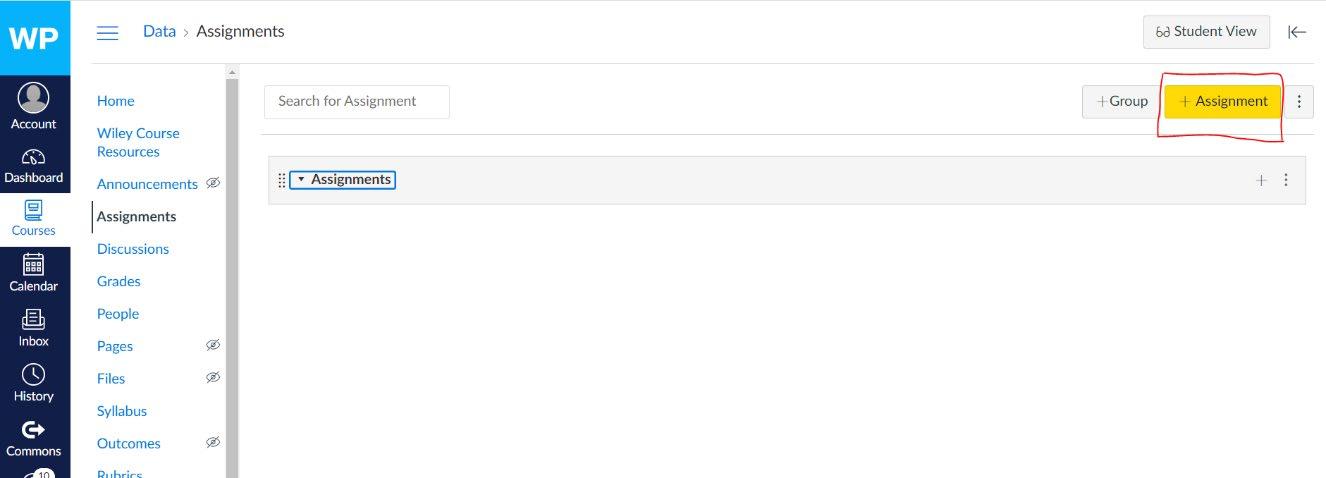
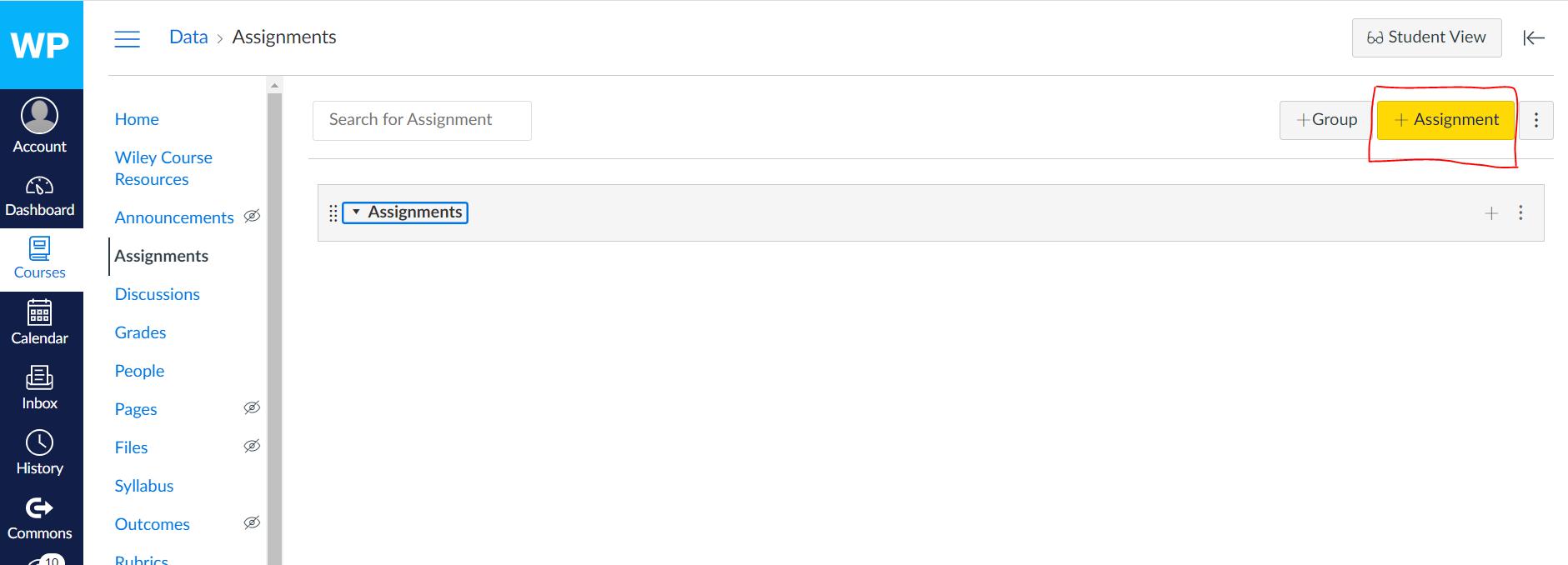
Step 1: Click on the “+ Assignments” button.
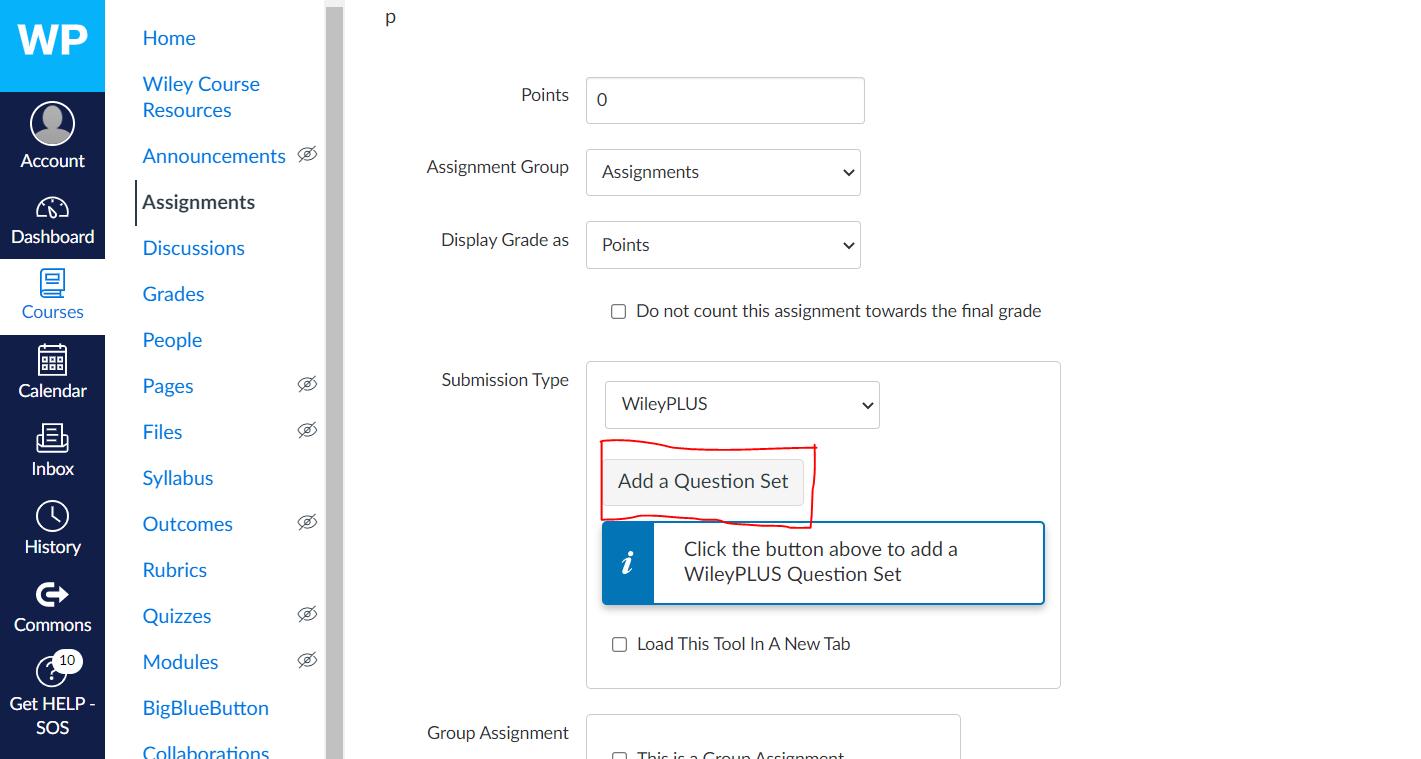
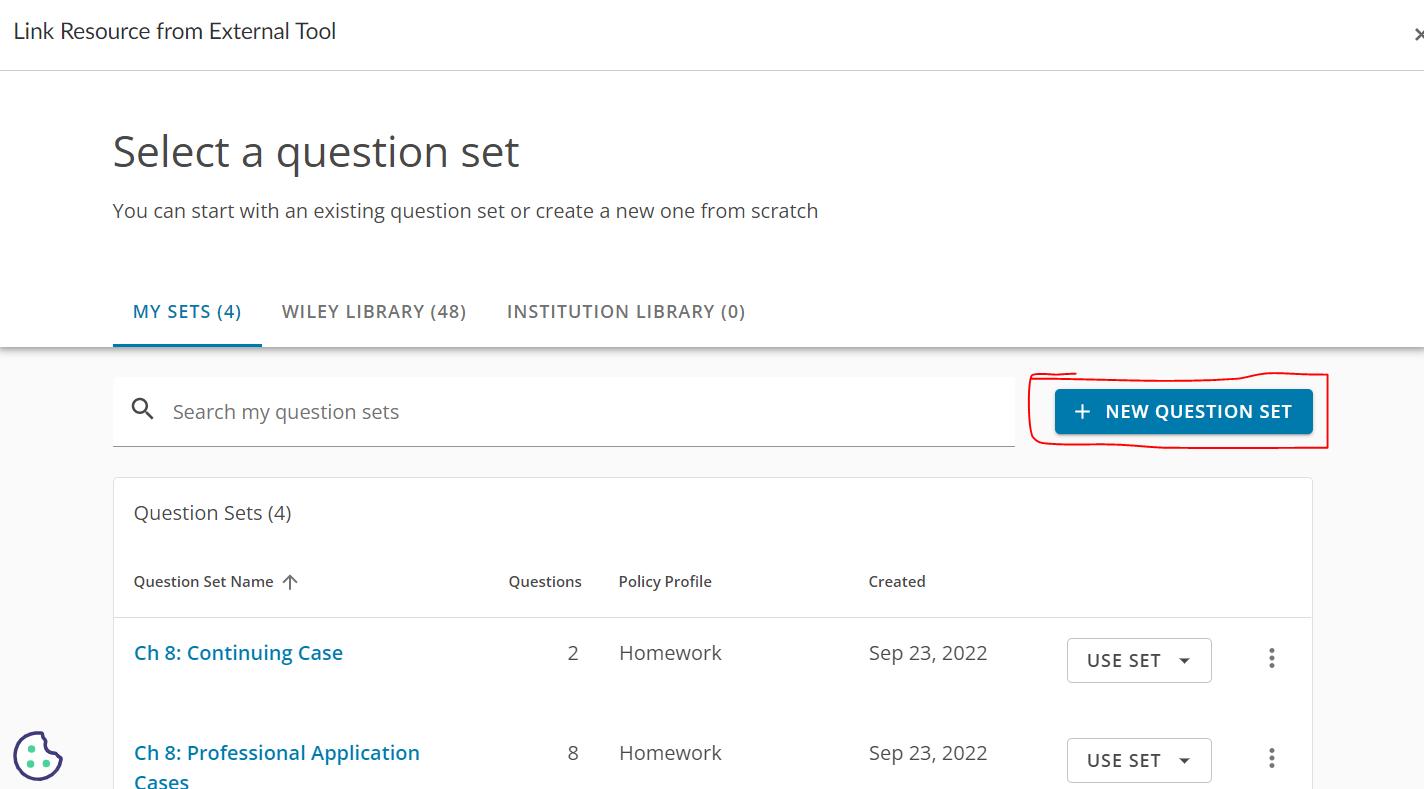
Step 2: Click on “Add a Question Set. “
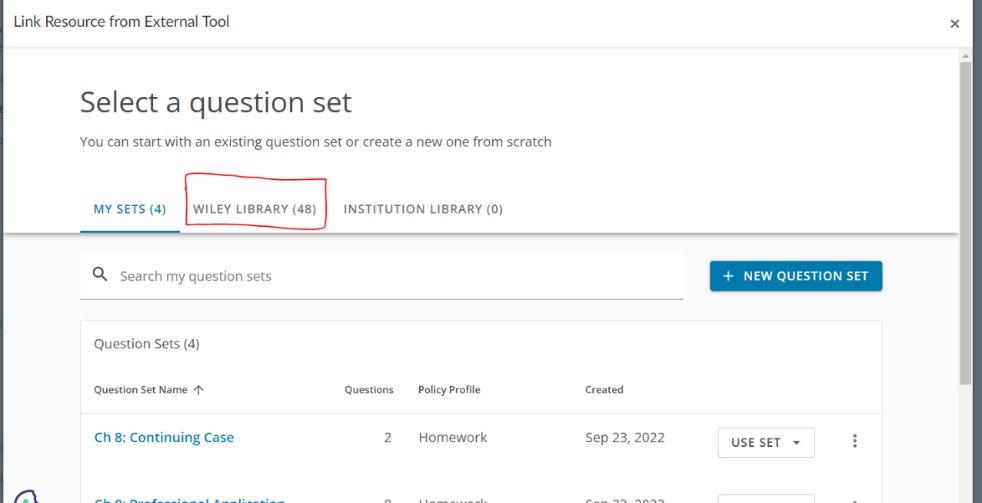
Step 3: Click on “Wiley Library”
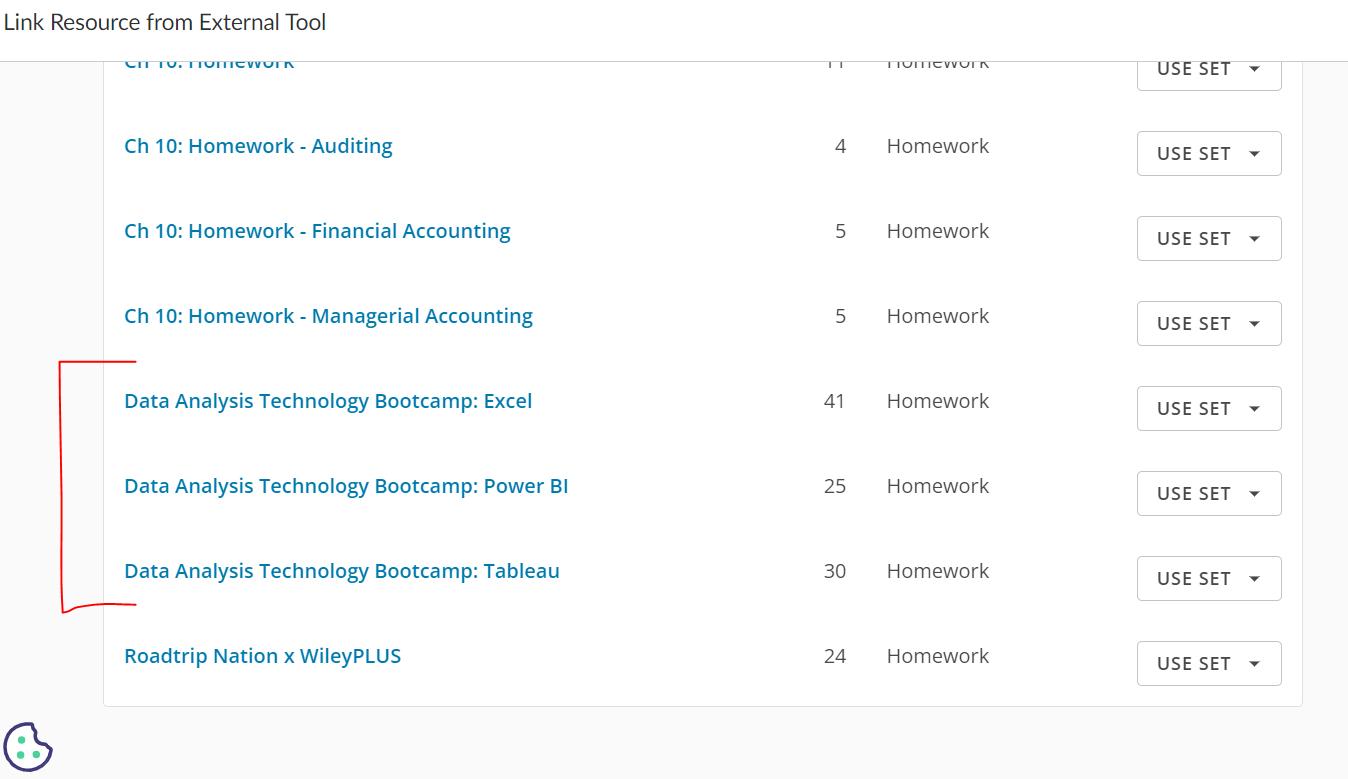
Step 4: Locate the Data Analysis Technology Bootcamps by scrolling all the way to the end of the list.
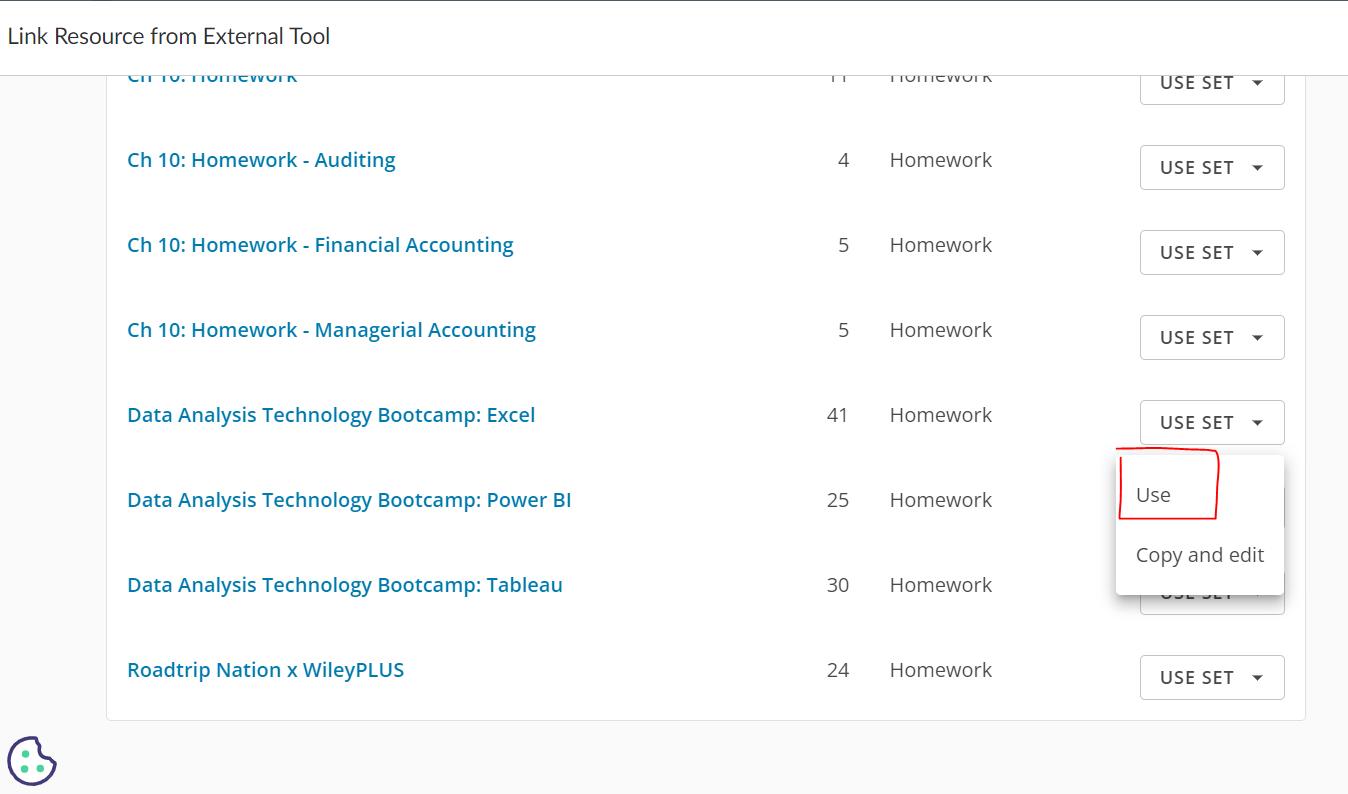
Step 5: Click on “Use Set” and select “Use.” This allows you to assign the full bootcamp and make your typical assignment adjustments like due dates, making it available and visible to your students, etc.
B. Editing
You may also want to use the Data Analysis Technology Bootcamps, but edit portions or parts to more align with your course objectives. Just like any other pre-created assignment in the Wiley Library, you are able to copy and edit the bootcamps as well following the steps below
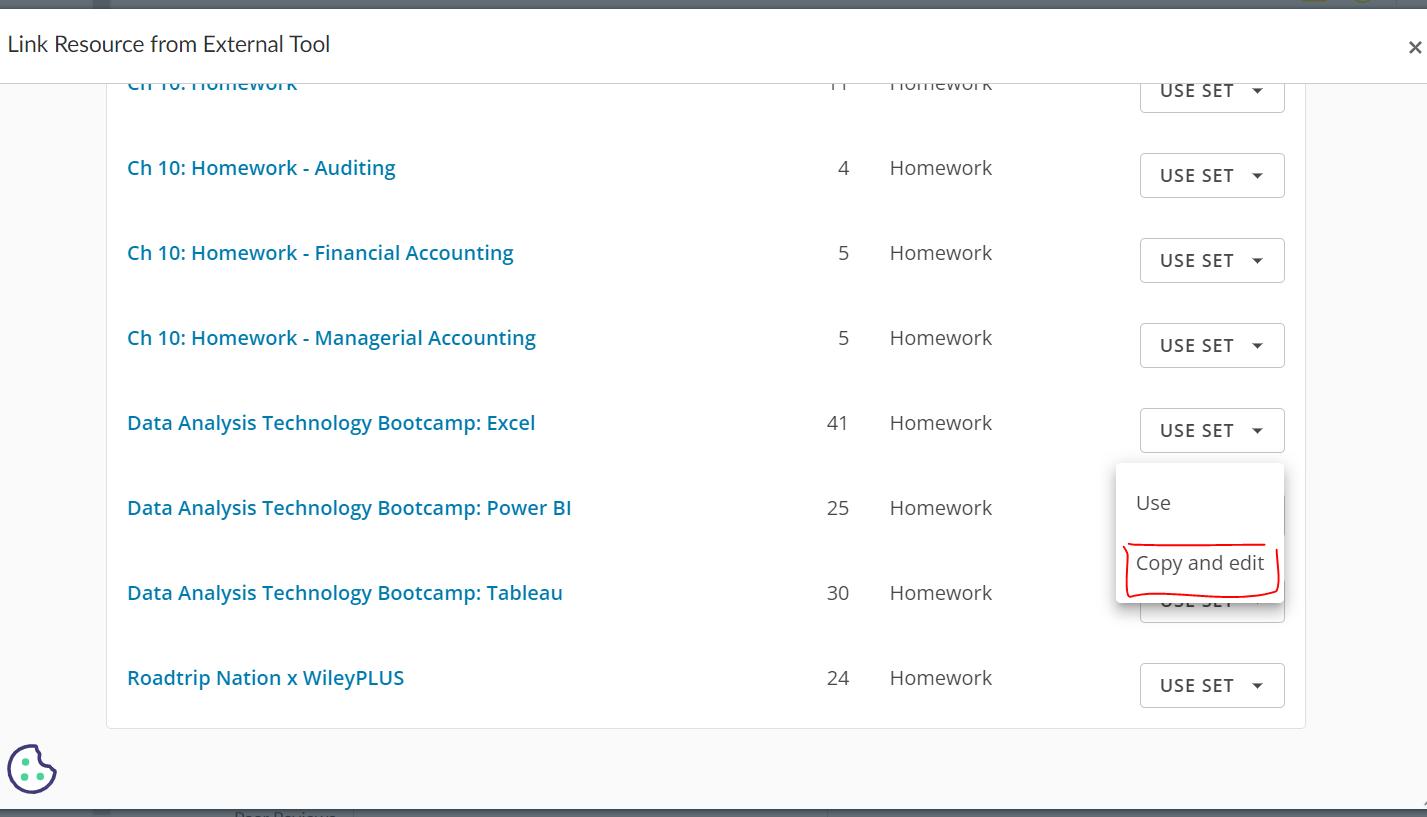
Step 1: When in the Wiley Library, after locating the Data Analysis Technology Bootcamp you want to assign, click on “Use Set” and “Copy and edit.”
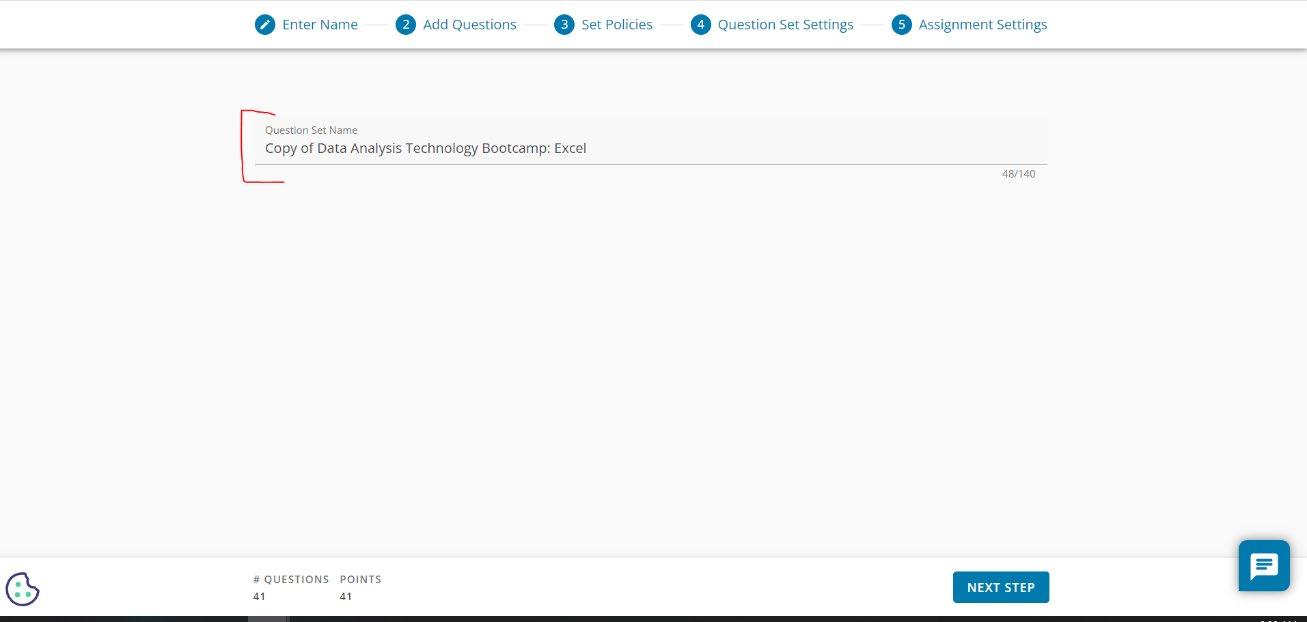
Step 2: You will be prompted to edit the name of the assignment if you choose and then click on “Next Step.”
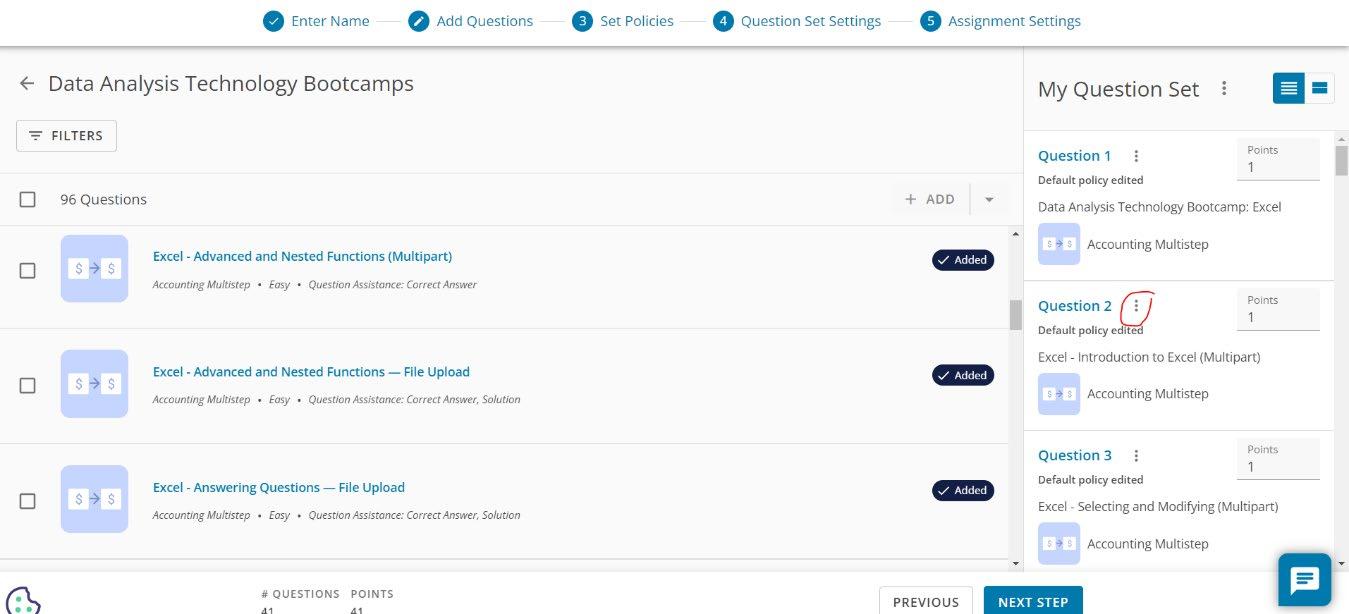
Step 3: Click on the three dots to access the question settings.
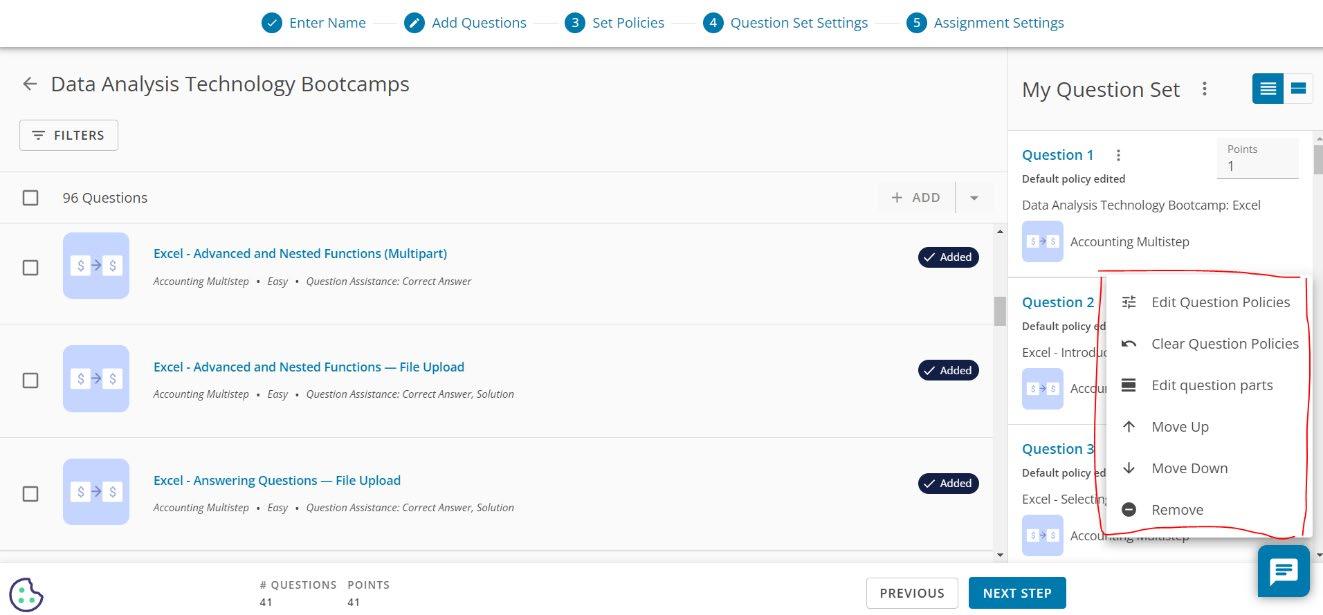
Step 4: Upon clicking on the three dots, you will see a menu of options to further edit the question. You can edit question policies, clear policies, edit specific question parts (like removing specific multiple-choice questions within that set), move the questions, or completely remove the question altogether.
C. A la Carte (customizability of Interactive tutorial)
There may be instances where you want to assign a specific module (topic) within the bootcamp as opposed to assigning the full bootcamp. To do this, you would set up the bootcamp like any other assignment. Use the following steps as a guide.