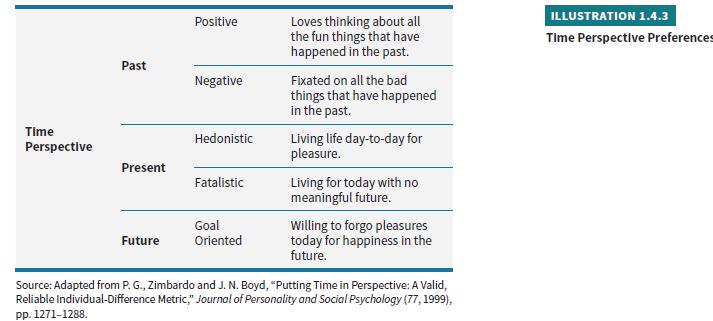
Solution: Most people view the world primarily from one of three time perspectives or lenses:
• Past-oriented: based on memories, whether good or bad. Those who view past events negatively have the most trouble staying on their financial path. Diego is past-oriented.
• Present-oriented: based on either (a) a hedonistic perspective (doing things for pleasure, experience, and excitement of the action) or (b) a fatalistic perspective (unable to visualize a meaningful future). Understandably, those with a fatalistic outlook sometimes have a hard time reaching their long-term financial goals.
• Future-oriented: based on a calculation of the consequences of actions in terms of a future payoff. Those with a future orientation tend to be very goal-oriented. As such, they might do a better job of managing their personal financial situation in the long run but may miss out on some opportunities along the way.
Solution: Most people view the world primarily from one of three time perspectives or lenses:
• Past-oriented: based on memories, whether good or bad. Those who view past events negatively have the most trouble staying on their financial path.
• Present-oriented: based on either (a) a hedonistic perspective (doing things for pleasure, experience, and excitement of the action) or (b) a fatalistic perspective (unable to visualize a meaningful future). Understandably, those with a fatalistic
outlook sometimes have a hard time reaching their long-term financial goals. Arnold has a present-hedonistic orientation.
• Future-oriented: based on a calculation of the consequences of actions in terms of a future payoff. Those with a future orientation tend to be very goal-oriented. As such, they might do a better job of managing their personal financial situation in the long run but may miss out on some opportunities along the way.
Answer: c; Section: 1.4; LO: 1.4; BT: Ap; Diff: M; TOT: 2 min; AACSB: K
Solution: The marshmallow experiment was first undertaken by Walter Mischel, a Columbia University faculty member, in the 1960s. Mischel was tempting young children with an almost irresistible treat. At the core of the temptation is the notion of time perspective. Mischel wanted to determine who was willing to forgo immediate rewards for a larger payoff in the future: It turns out that two-thirds of the children ate the marshmallow before the researcher returned. Subsequent research indicates that about 70% of Americans both children and adults fall prey to temptation. They tend to be impulsive and quick acting.
Answer: High-quality responses should include two SMART goals that address all the areas of a SMART goal. Please refer to the sample writing assignment rubric in the solutions manual.
Section: 1.4; LO: 1.4; BT: Ap; Diff: M; TOT: 15 min; AACSB: RT, C
3 Answer: High-quality responses should include a list of strategies for altering time perspectives. Please refer to the sample writing assignment rubric in the solutions manual.
4. Answer: High-quality responses should address each of the points (a)–(d) posed in the question. Please refer to the sample writing assignment rubric in the solutions manual.
Section: 1.4; LO: 1.4; BT: An; Diff: M; TOT: 20 min; AACSB: RT, C
Explore
1. Answer: High-quality responses should include a discussion of the advantages and disadvantages of SMART goals. Please refer to the sample writing assignment rubric in the solutions manual.
Section: 1.4; LO: 1.4; BT: An; Diff: M; TOT: 40 min; AACSB: A, C
2. Answer: High-quality responses should include two lists: (1) students’ top 10 goals and (2) top 10 most common goals from the Internet. Students should also discuss these goals to determine how many of the goals are financial. Please refer to the sample writing assignment rubric in the solutions manual.
Section: 1.4; LO: 1.4; BT: An; Diff: M; TOT: 20 min; AACSB: RT, C, A
3. Answer: High-quality responses should include a discussion of the student’s score on the inventory and the student’s response to the score. Please refer to the sample writing assignment rubric in the solutions manual.
Section: 1.4; LO: 1.4; BT: An; Diff: M; TOT: 45 min; AACSB: RT, C, A
Answer: High-quality responses should include a discussion of the student’s childhood, paying special attention to the way they made choices and how they were rewarded for those choices, and a discussion of how or whether they want that to change. Please refer to the sample writing assignment rubric in the solutions manual.
Section: 1.4; LO: 1.4; BT: Ap; Diff: M; TOT: 30 min; AACSB: RT, C, A
1.4 Practice Questions
(The Practice Questions do not appear in the printed textbook. Autogradable version is available in your Wiley course, with algorithmically changing values when applicable.)
3. Kaylee has been dreaming of a grand vacation for several years. Last year, she started to save for this once-in-a-lifetime event. So far, she has saved $2,000 toward a goal of $25,000. Her plan is to travel in 6 years. What is Kaylee’s goal time horizon?
4. Which of the following time orientations is most closely associated with a lack of goal orientation, a general feeling of hopelessness, and general pessimism?
Solution: The status quo bias is your personal preference for keeping things just like they currently are. This bias is prevalent because most people are usually comfortable with their current situation, even when much better options are available. Melinda would not be changing her situation, regardless of which payment option she elects to take. Hyperbolic discounting is a form of procrastination, where a person places a greater value on the immediate option, while discounting a future greater benefit further away. However, if both benefits are not immediate, the greater benefit regardless of time will be of greater value. The choice of taking the money today over a greater sum in the future is a form of loss aversion: the feeling “. . . that the likelihood of getting the full $550 is less than getting a guaranteed $515.”
2. b. Never buy stocks on a Monday.
Answer: b; Section: 1.5; LO: 1.5; BT: Ap; Diff: M; TOT: 2 min; AACSB: K
Solution: Heuristics are based on past experiences or learning that the mind applies to new situations. Most heuristics are automatic and rarely used with forethought. Although heuristics can help you make quick decisions, they sometimes lead to problematic choices and outcomes because of behavioral biases. “Never buy stocks on a Monday” is an example of confirmation bias, where past negative outcomes of purchasing stocks on a Monday lead to a belief that it’s bad luck to do it.
Solution: The status quo bias is your personal preference for keeping things just like they currently are. This bias is prevalent because most people are usually comfortable with their current situation, even when much better options are available.
Solution: Loss aversion is a behavioral bias toward losing money. Behavioral economists have concluded that if you lose, your emotional pain your feelings of loss and the regret associated with making a bad decision will also be two times as great as the joy of winning. As a result, people generally focus much of their attention on avoiding losses because the joy of a gain is smothered by the pain of a loss.
Solution: Optimism bias is a behavioral bias toward having overconfidence and a lack of risk averseness. A history of taking risks without negative consequence builds this bias.
7. c. confirmatory bias.
Answer: c; Section: 1.5; LO: 1.5; BT: Ap; Diff: M; TOT: 2 min; AACSB: K
Solution: Confirmation bias is a behavioral bias where one wrongly believes that acts of skill lead toward successful outcomes rather than coincidence and chance. Rationalizing acts of expertise to confirm the assessments of successful outcomes will lead to overconfidence in future decisions.
2. Answer: High-quality responses should include a list of three tasks and action steps to prevent procrastination on those tasks. Please refer to the sample writing assignment rubric in the solutions manual.
3 Answer: High-quality responses should include a discussion of past experiences when overconfidence or optimism bias led to unwise decisions. Please refer to the sample writing assignment rubric in the solutions manual.
4. Answer: High-quality responses should include a discussion of how a clear picture of your future financial goals influences or would influence current choices and whether a longterm goal or a clear picture of the future would be most impactful in reaching future goals. Please refer to the sample writing assignment rubric in the solutions manual.
1. Answer: High-quality responses should describe the video that was watched, what the video was teaching, and the student’s reaction to the video. Please refer to the sample writing assignment rubric in the solutions manual.
2. Answer: High-quality responses should include a discussion of how automating bill payments will benefit the student. Please refer to the sample writing assignment rubric in the solutions manual.
Section: 1.5; LO: 1.5; BT: Ap; Diff: M; TOT: 20 min; AACSB: RT, T, C
Expanded Learning Activity
Answer: High-quality responses should include a summary of findings, a “to-do” list for saving, and a discussion of any techniques that you find unethical or manipulative. Please refer to the sample writing assignment rubric in the solutions manual.
Section: 1.5; LO: 1.5; BT: Ap; Diff: M; TOT: 40 min; AACSB: RT, C, A
1.5 Practice Questions
(The Practice Questions do not appear in the printed textbook. Autogradable version is available in your Wiley course, with algorithmically changing values when applicable.)
1. Which of the following best describes a procrastinator?
a. Answer: Tarek most likely has a future time perspective. The answer is based on the following guidelines: Question 1 If you “agree” or “strongly agree” with this statement, you probably have a present perspective. Question 2 If you answered “agree” or “strongly agree” to this one, it means that you are likely directed by a future goal perspective. Question 3 Answering “agree” or “strongly agree” to this item means that you probably see the world using a past perspective.
Section: 1.5; LO: 1.5; BT: An; Diff: M; TOT: 5 min; AACSB: A
b Answer: In general, those who hold a future perspective, particularly those who are goal-oriented, do a better job of managing their personal financial situation. This bodes well for Tarek as he attempts to reach his life and financial goals.
Section: 1.5; LO: 1.5; BT: Ap; Diff: M; TOT: 5 min; AACSB: A
c. Answer: 96 years.
Solution: Her two primary expenses include a lost income of $66,000 and educational expenses of $126,000. Combined, the cost of the master’s degree will be $192,000. However, she is expecting to earn only $2,000 more per year. As such, her payback period is 96 years ($192,000/$2,000).
Section: 1.5; LO: 1.5; BT: An; Diff: M; TOT: 20 min; AACSB: A
d. Answer: It will take her approximately 96 years to break even on the costs associated with obtaining this particular degree. So, no, it does not make sense to invest in this master’s degree at this time. An alternative is to obtain a master’s degree from a less expensive college or university or work toward her degree on a part-time basis. Another alternative is to change her degree to something that offers a quicker payback period.
Section: 1.5; LO: 1.5; BT: Ap; Diff: M; TOT: 10 min; AACSB: A
Solution: Calculate the interest earned each year on the beginning balance, and add to your balance to calculate the ending balance. This calculation will compute the compound interest you earn every year.
Solution: Calculate the interest earned each year on the beginning balance, and add to your balance to calculate the ending balance. This calculation will compute the compound interest you earn every year. After 5 years, the balance will be greater than $102, because it’s $104.04 after 2 years.
Solution: Inflation reduces purchasing power, whereas earning interest increases purchasing power. Since the inflation rate of 2% is greater than the 1% interest rate you can earn, you will lose purchasing power in this scenario by 1% per year.
Solution: By owning one stock, you will risk your entire fortune on the stock. By diversifying your fortune by holding more than one stock, such as in a mutual fund, you are diversifying the business risk of any individual company that you own.
a. Answer: Retirement is a long-term goal, purchasing the pickup truck is a short-term goal, and going back to college is a short–intermediate-term goal.
b. Answer: (1) Purchasing a new vehicle is important because having reliable transportation is essential to generating income and reducing maintenance expenses; (2) investing in human capital is also important as a way to increase earnings and assets; and (3) while retirement is very important, retiring this young is aspirational. Implementation of the other two goals will help Edmond achieve this retirement goal.
Section: 1.5; LO: 1.5; BT: Ap; Diff: M; TOT: 5 min; AACSB: A
c. Answer: High-quality answers will answer all elements and clearly identify assumptions. For example, a student might assume that Edmond’s new pickup truck will cost $46,000 in 2 years. This type of assumption will be critical for the SMART elements.
Section: 1.5; LO: 1.5; BT: Ap; Diff: M; TOT: 10 min; AACSB: A