Solutions Manual for Elements of Chemical Reaction Engineering 7th
Edition
by
Fogler, Goldsmith, Nikolla, Singh
ISBN: 9780135337554
Edition
Fogler, Goldsmith, Nikolla, Singh
ISBN: 9780135337554
Seventh Edition
H.Scott Fogler
Ame and Catherine Vennema Professor of Chemical Engineering and the Arthur F. Thurnau Professor
Bryan R. Goldsmith
Associate Professor of Chemical Engineering
Eranda Nikolla Professor of Chemical Engineering
Nirala Singh
Associate Professor of Chemical Engineering
University of Michigan, Ann Arbor
May 2025
Hoboken, New Jersey
The author and publisher have taken care in the preparation of this work but make no expressed or implied warranty of any kind and assume no responsibility for errors or omissions. No liability is assumed for incidental or consequential damages in connection with or arising out of the use of the information or programs contained herein.
Visit us on the Web: informit.com
Copyright © 2025 Pearson Education, Inc.
This work is protected by United States copyright laws and is provided solely for the use of instructors in teaching their courses and assessing student learning. Dissemination or sale of any part of this work (including on the World Wide Web) will destroy the integrity of the work and is not permitted. The work and materials from it should never be made available to students except by instructors using the accompanying text in their classes. All recipients of this work are expected to abide by these restrictions and to honor the intended pedagogical purposes and the needs of other instructors who rely on these materials.
ISBN-13: 978-0-13-534732-4
ISBN-10: 0-13-534732-7
Version 1, May 2025
The following students participated in the solutions to the end of chapter problems of the Elements of Chemical Reaction Engineering, editions 1 through 6:
Max Nori
Brian Vicente
Sombudda Ghosh
Nihat Gürman
Yongzhong Lui
Duc Ahn Nguyen
Vishal Chaudhary
Ravi Kapoor
Manosij Basu
Arpit Gupta
Sneh Shriyansh
Utkarsh Prasad
Darshan Shah
Anamika Singh
Sravya Jangareddy
Fan Zhang
Keyvan Edrisi
Richa Motwani
Prafful Bhansali
Maithri Venkat
Yimeng Lyu
Sheng Mark Zheng
Mayur Tikmani
Ayush Agarwal
Vaibhav Jain
Devosmita Sen
Manjeet Singh
Jnana Sai Jagana
While many, many students contributed to the Elements of Chemical Reaction Engineering Solutions Manual, special mention is necessary to Mayur Tikmani who after graduating from IIT Guwahati spent 6 months in Ann Arbor working with Prof. Fogler, before he joined Reliance Industries Limited, to prepare all the Wolfram and Python LEPs.
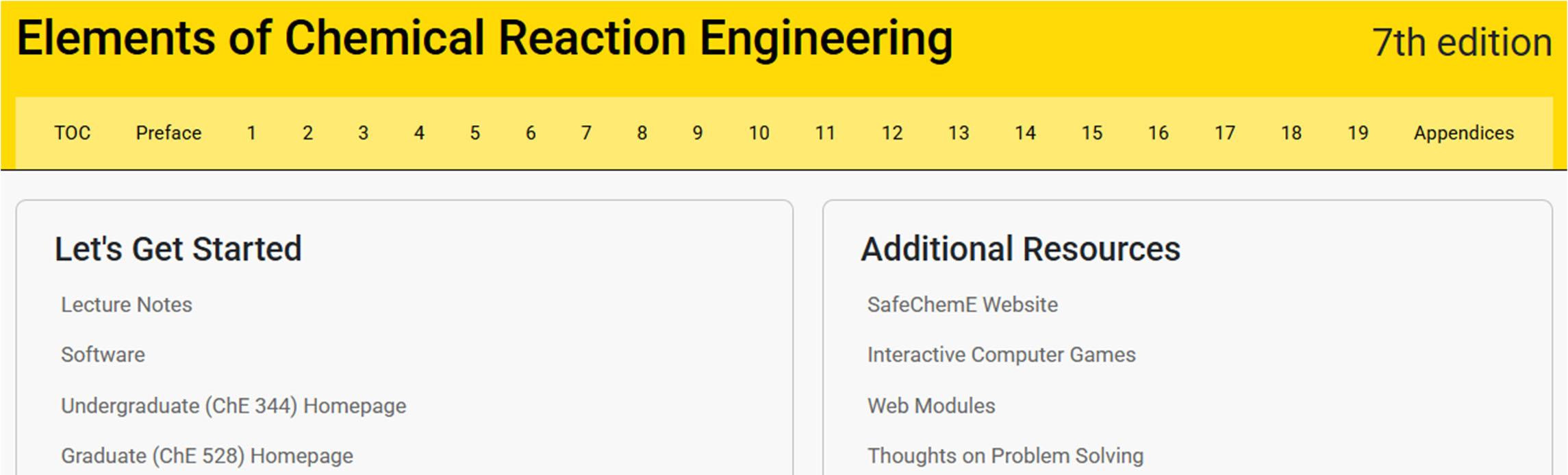
Screen Shot of Web Home Page ..........................................................................................
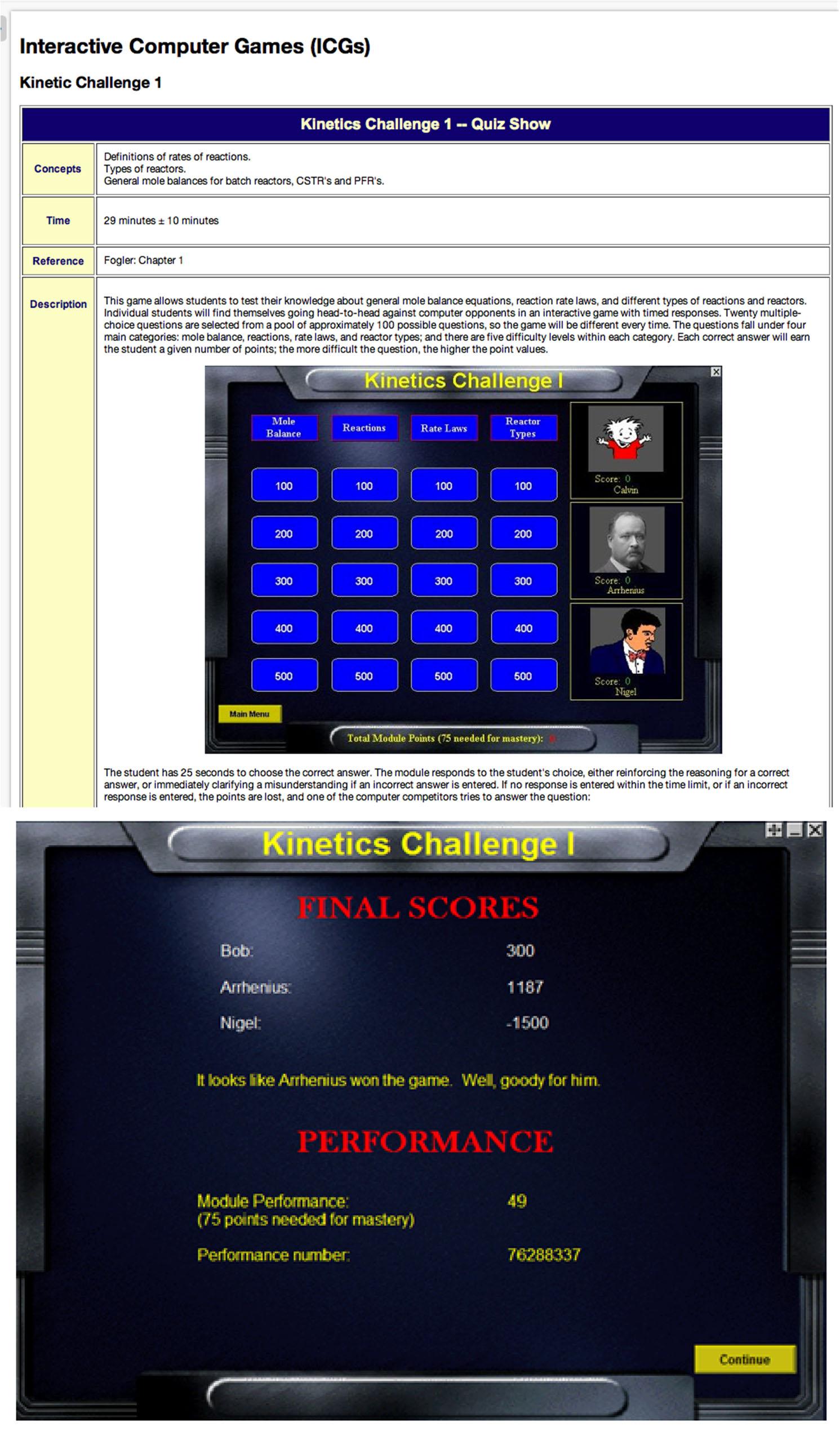
Screen Shot of Interactive Computer Games (ICGs) .......................................................... ii
Screen Shot of Polymath Living Example Problems (LEPs) ............................................. iv
Algorithm to Decode ICGs..................................................................................................
Sample Course Syllabus .....................................................................................................
Solutions to Chapter 1 – Mole Balances
Questions Q1-1 through Q1-12
Problems P1-1 through P1-8
Solutions to Chapter 2 – Conversion and Reactor Sizing
Questions Q2-1 through Q2-6
Problems P2-1 through P2-11
Solutions to Chapter 3 – Rate Laws
Questions Q3-1 through Q3-7
Problems P3-1 through P3-16
Solutions to Chapter 4 – Stoichiometry
Questions Q4-1 through Q4-9
Problems P4-1 through P4-13
Solutions to Chapter 5 – Isothermal Reactor Design: Conversion
Questions Q5-1 through Q5-13
Problems P5-1 through P5-26
Solutions to Chapter 6 – Isothermal Reactor Design: Moles and Molar Flow Rates
Questions Q6-1 through Q6-7
Problems P6-1 through P6-13
Solutions to Chapter 7 – Collection and Analysis of Rate Data
Questions Q7-1 through Q7-7
Problems P7-1 through P7-12
Solutions to Chapter 8 – Multiple Reactions
Questions Q8-1 through Q8-5
Problems P8-1 through P8-18
Solutions to Chapter 9 – Reaction Mechanisms, Pathways, Bioreactions and Bioreactors
Questions Q9-1 through Q9-4
Problems P9-1 through P9-23
Solutions to Chapter 10 – Catalysis and Catalytic Reactors
Questions Q10-1 through Q10-9
Problems P10-1 through P10-23
Solutions to Chapter 11 – Nonisothermal Reactor Design: The Steady-State Energy Balance and Adiabatic PFR Applications
Questions Q11-1 through Q11-14
Problems P11-1 through P11-10
Solutions to Chapter 12 – Steady-State Nonisothermal Reactor Design: Flow Reactors with Heat Exchange
Questions Q12-1 through Q12-6
Problems P12-1 through P12-27
Solutions to Chapter 13 – Unsteady State Nonisothermal Reactor Design
Questions Q13-1 through Q13-5
Problems P13-1 through P13-11
Solutions to Chapter 14 – Mass Transfer Limitations in Reacting Systems
Questions Q14-1 through Q14-8
Problems P14-1 through P14-17
Solutions to Chapter 15 – Diffusion and Reaction
Questions Q15-1 through Q15-8
Problems P15-1 through P15-17
Solutions to Chapter 16 – Residence Time Distributions of Chemical Reactors
Questions Q16-1 through Q16-5
Problems P16-1 through P16-13
Solutions to Chapter 17 – Predicting Conversion Directly from the Residence Time Distribution
Questions Q17-1 through Q17-4
Problems P17-1 through P17-18
Solutions to Chapter 18 – Models for Nonideal Reactors
Questions Q18-1 through Q18-6
Problems P18-1 through P18-20
Solutions to Chapter 19 – Electrochemical Reactor Design
Questions Q19-1 through Q19-8
Problems P19-1 through P19-11

The Interactive Computer Games (ICGs) listed below arecontained on thewebsite below Game players can click on the Run from the website link to begin play each ICG title Note that there will be a pa.Jsewhlle the game is loaded tromour servers Alternately, one can use the Install to PC link to install each g.:rne on the PC This installation will typically instaJl an icon on the desktop Please take the default location 1orthe Installation files. Detailed instructions for installing and using the ICGs are available
As these interactive games are played, the player will t>e asked a number of questions related to thecorresponding material in the textbook, The computer will keep track of all the correct answers and at the end of the game will displaYa roded performance number that reflects how well the player mastered the materiaJin the text Instructors will havea manual to decode the perforrre,ce number.
Note: The Interactive Computer Games may NOT work onoximately 10% of Windows machines. We can't find a specific reason, so if it doesn't work, pleasetry th911on a different Windows computer.
Kinetics Challenge I ( lnstaJI to PC, lnstaJlatlon Instructions)
Oul2 Show Introduction to Kinetics
DescriP-tion of the Module
Ol>lectlves for Chapter One
Staging ( Install to PC1 Installation Instructions)
Reactor Sequencing Optimization
Descrigtlonof the Module
Oofectlves tor Chapter Two
Kinetics Challenge II ( Install to PG Installation Instructions)
Oul2Show
Stoichiometry and Rate Laws
DescriP-t on of the Module
Obfectlves for Chapter Four
r-h..Jrder Mystery(Install to PC, Installation Instructions)
CSTR Volume Algorithm
Descriptionof the Module
Oofectlves for.G.b_gpter Five
Tic Tac Toe( Install to PC, Installation Instructions)
Isothermal Reactor Design: Ergun, Arrhenius, and Van t Hoff Equations
DescrlP-tlonof the Module
Oofectlves for Chapter Six
Ecology A Wetlands Protllem ( Install to PC Installation Instructions)
Collection and Analysis of Rate Date: Ecological Engineering
DescriP-tion of the Module
Oofectlves for Chapter Seven
Great Race ( Install to PC, Installation Instructions)
Multiple Reactions
DescriP-tionof the Module
Oofectlves for ChaP!.§!::_fj_Q.O!
Enzyme Man ( Install to PC Installation Instructions I
Enzyme Kinetics
DescrlP-tlonof the Module
Ol>lectlves for Chapter Nine

Heterogeneous Catalysis [ lnstaJIto PC, lnstaJlatlon Instructions)
Catalytic Rate
Equatlons,Status:Alpha Release
Warning: This module is not tullytested You may encounter abnormal behavior
Descriptionof the Module
Ol>lectlves for Chaoter Ten
Heat Effects 1 ( Install to PC lnstallatlon Instructions)
Basketbal Challenge
Mole and Energy Balances In a CSTR
DescrlP-tlonof the Module
Oofectlves for Chapter Thirteen
Heat Effects 2 ( Install to PC, Installation Instructions)
Effect of Parameter Variation on a PFR
Mole end Energy Balances In e PFR,Stetus: Alpha Release
Warning: This module is not tullytested You may encounter abnormal behavior
Descrigtlonof the Module
Oofectlves tor chapter ThIrteen
Wolfram and Python can be downloaded and installed on your computer free of charge
UNIVERSITY OF MICHIGAN
INTERACTIVE COMPUTER MODULES FOR CHEMICAL ENGINEERING CHEMICAL REACTION ENGINEERING MODULES
H. Scott Fogler, Project Director
M. Nihat Gürmen, Project Manager (2002-2004) Susan Montgomery, Project Manager (1991-1993)
Department of Chemical Engineering University of Michigan Ann Arbor, MI 48109-2136
©2005
Regents of the University of Michigan - All Rights Reserved -
Students should record their Performance Number for each program, along with the name of the program, and turn it in to the instructor. The Performance Number for each program is decoded as described in the following pages.
Please report problems to icm.support@umich.edu.
Module Format Interpretation
KINETIC CHALLENGE I
CzBzzAzz
KINETIC CHALLENGE II
CzBzzAzz
MURDER MYSTERY
zzAzz
TIC TAC TOE
zDzCzBzA
Score = 1.5 * AB.C z = random numbers
Note: 75% constitutes mastery.
Score = 2.0 * AB.C z = random numbers
Note: 75% constitutes mastery.
A even: Killer and victim correctly identified
A odd: Killer and victim not identified z = random numbers
Perf. No. = 75241692
Score = 1.5*(62.7) = 94 %
Perf. No. = 03776467
Score = 2.0*(47.0) = 94 %
Perf. No. = 50732
Score: No credit
Note: An even number for the middle digit constitutes mastery.
Score = 4.0 * AB.C
Perf. No. = 77803581 z = random numbers
Configurations
Score = 4*(15.0) = 60 configuration 7 completed
Note: Student receives 20 points for every square answered correctly. A score of 60 is needed for mastery of this module.
zzzCzABz
Score = 6.0 * AB.C
Perf. No. = 77738078 z = random numbers
Score = 6*(07.3) = 44
Note: A score of 40 is needed for mastery of this module.
AzBCzaaD z = random numbers a = random characters
A gives info on r^2 value of the student’s linearized plot
A=Y if r^2 >= 0.9
A=A if 0.9 > r^2 >= 0.8
A=X if 0.8 > r^2 >= 0.7
A=F if 0.7 > r^2
A=Q if Wetland Analysis/Simulator portion has not been completed
B gives info on alpha
B=1 to 4 => student's alpha < (simulator's alpha 0.5)
B=5 to 9 => student's alpha > (simulator's alpha 0.5)
B=X if Wetland Analysis/Simulator portion has not been completed
C indicates number of data points deactivated during analysis
C=number of deactivated data points if at least 1 point has been deactivated
C=a randomly generated letter from A to Y if 0 points deactivated
C=Z if Wetland Analysis/Simulator portion has not been completed
D gives info on solution method used by student
D=1 if polynomial regression was used
D=2 if differential formulas were used
D=3 if graphical differentiation was used
D=4 to 9 if Wetland Analysis/Simulator portion has not been completed
Perf No. = A7213DF2
1) A => 0.9 > r^2 >= 0.8
2) 2 => student’s alpha < (simulator’s alpha 0.5)
3) 1 => one data point was deactivated
4) 2 => differential formulas were used
STAGING
Final conversion = 2*AB.C
Final flow rate = 2*DE.F flow rate = 2*31.2 = 62.4
Please make a pass/fail criterion based on these values.
HETCAT
zzABzCD
A=2,3,5,7: interaction done
B=2,3,5,7: intro done
C=2,3,5,7: review done
D denotes how much they
Perf. No. = 8027435
A: Worked on interaction
B: Looked at intro
C: Looked at review did in the interaction:
D<2
2 < D:5 4
4 < D:5 6
6<D
z = random numbers
HEATFX1
zzAzz
HEATFX2
zzzAzz
D: found parameter values, didn’t find mechanism
Not done
Dependences
Parameter values
Mechanism
Note: Performance number given only if student goes through the interaction portion of the module
A even: score > 85 %
z = random numbers
Perf. No. = 53607
Score > 85 %
Note: Student told they have achieved mastery if their score is greater than 85%
A even: completed interaction
z = random numbers
Perf. No. = 407582
Interaction not completed
Note: Performance number given only if student goes through the interaction portion of the module.
ChE 344: CHEMICAL REACTION ENGINEERING
Fundamentals of chemical reaction engineering. Rate laws, kinetics, and mechanisms of homogeneous and heterogeneous reactions. Analysis of rate data, multiple reactions, heat effects, bioreactors. Design of industrial reactors.
Prerequisite: ChE 330, ChE 342
Fall
Lectures: M,W 8:40 (Sharp) to 10:30 (not so sharp) – Room: 1013 Dow
Instructor:
Professor Bryan R. Goldsmith 3168 Dow, bgoldsm@umich.edu
Office Hours: M,W 10:30a to 11:30a
Course assistants include: Instructional aids, tutor, proctors, and graders
Text Required
Elements of Chemical Reaction Engineering, 7th edition, H. Scott Fogler
Web sites: Chemical Reaction Engineering, http://www.umich.edu/~elements/7e/index.html
Process Safety Across the Chemical Engineering Curriculum, http://umich.edu/~safeche/
Recommended Reading List
• Problem Solving in Chemical and Biochemical Engineering with POLYMATH, Excel, and MATLAB, 2nd Edition 2008, Cutlip & Shacham
• The Elements of Style, Strunk and White
• Strategies for Creative Problem Solving, 3rd Edition 2014, Fogler, LeBlanc & Rizzo (for OEP’s)
Schedule
*Note - all ICGs (Interactive Computer Games) are Individual*
1) Wednesday, September 9
Topic:
Lecture 1 – Chapter 1, Introduction, POLYMATH, MATLAB, Wolfram and Polymath, Mole balances
Intro to LearnChemE – view one LearnChemE video of your choice
Read: Introduction, Appendix B
In-Class Problem: No In-Class Problem
2) Monday, September 14
Topic: Lecture 2 – Chapter 2, Design equations, Levenspiel plots, Reactor staging Read: Chapter 1, P1-9A, Appendix A, from the Web Chapter 2, Sections 2.1, 2.2, and 2.3
Hand In: Problem Set 1: Q1-1A, Q1-2 A Do five i>clicker questions, P1-1A only use Wolfram or Python, P1-3B, P1-5A, Q2-1A, Q2-2 A
In-Class Problem: 1
Study Problems: P1-6A (a) and (c), P1-8A
Note: Study problems have found their way many times on exams
3) Wednesday, September 16
Topic: Lecture 3 – Chapter 3, Rate laws
Read: Chapter 2, Chapter 3
Hand In: Problem Set 2: P2-2A (a), (d) and (g), Q3-1A, Q3-2 A Do five i>clicker questions.
In-Class Problem: 2, P3-9B (Hint: Viewing the University of Alabama YouTube video “The Black Widow” may help you with today’s in class problem)
Study Problems: P2-7A
4) Monday, September 21
Topic: Lecture 4 – Chapter 4, Stoichiometry Batch Systems
Read: Chapter 4 Section 4.1
Hand In: Problem Set 3: P2-10B, P3-6A, P3-12B, P3-14A, Q4-1A, Q4-2 A Do five i>clicker questions
In-Class Problem: 3 - Bring i>clickers (tentative)
Study Problems: P3-15A
5) Wednesday, September 23
Topic: Lecture 5 – Chapter 4, Stoichiometry Flow Systems
Read: Chapter 4, Section 4.1
Hand In: Problem Set 4: P4-2A (ICG)
In-Class Problem: 4
Study Problems: Q4-3A, Q4-4B, Q4-5B, Q4-6A, Q4-9A
6) Monday, September 28
Topic: Lecture 6 – Chapter 5, Isothermal reactor design
Read: Chapter 5, Chapter 5 Summary Notes on the Web site
Hand In: Problem Set 5: P4-1A (a) and (b) only use Wolfram or Python, P4-3A, P4-4B, P4-5B
In-Class Problem: 5
Study Problems: P4-9B, P4-10B, P4-13C
7) Wednesday, September 30
Topic: Lecture 7 – Chapter 5, California Registration Exam Problem
Hand In: Problem Set 6: Q5-1A, Q5-2 A Do five i>clicker questions, Q5-10A, Q5-11A, Q5-12A, Q5-13A; P5-2A, What are you asked to find P5-18B? What is the Ergun Equation?
In-Class Problem: 6
Study Problems: P5-1B (a) only use Wolfram or Python
8) Monday, October 5
Topic:
Lecture 8 – Chapter 5, Pressure drop
Read: Chapter 5, Sections 5.4 and 5.5
Hand In: Problem Set 7: P5-1A (b), (c) only use Wolfram or Python, P5-3A, P5-4B, P5-5A, P5-8B, P5-13B, P5-16B
In-Class Problem: 7 – Bring Laptops Study Problems: P5-9A, P5-10B
9) Wednesday, October 7
Topic: Lecture 9 – Chapter 6, Membrane Reactors
Read: Chapter 6
Hand In: Problem Set 8: P5-22A, Q6-1A, Q6-2 A Do five i>clicker questions
In-Class Problem: 8 – Bring Laptops
Study Problems: P5-21B
10) Monday, October 12
Topic: Lecture 10 – Chapter 6, Semibatch Reactors
Read: Chapter 6
Hand In: Problem Set 9: P5-1A (d), (e) and (f) only use Wolfram or Python, P5-11B, P6-4B, P6-5B
In-Class Problem: 9 – Bring Laptops to carry out Polymath ODE Solver Study Problems: P6-7B
x
11) Wednesday, October 14
Topic:
Lecture 11 – Chapter 7, Analysis of Rate Data/Chapter 9, Pseudo Steady State Read: Chapter 7, Chapter 9, Section 9.1 and the cobra web module
Hand In: Problem Set 10: P6-1B (a) and (b) only use Wolfram or Python, P6-2B (ICG), P6-11B omit part (c), Q7-1A, Q7-2 A Do five i>clicker questions
In-Class Problem: 10 – Bring Laptops to carry out Polymath Regression Study Problems: P7-7B
12) Monday, October 19
Topic: No Classes – Fall Study Break
13) Wednesday, October 21
Topic:
Lecture 12 – Chapter 8, Multiple Reactions
Read: Chapter 8, Sections 8.1, 8.2, 8.3 and 8.4
Hand In: Problem Set 11: P7-6A, P7-9A, Q8-1A, Q8-2 A Do five i>clicker questions
In-Class Problem: 11 Study Problems P7-11A
14) Monday, October 26
Topic:
Lecture 13 – EXAM I – Covers Chapters 1 through 7 Closed book, web, notes, in-class problems and home problems
15) Wednesday, October 28
Topic:
Lecture 14 – Chapter 8: Multiple Reactions
Read: Chapter 8, Sections 8.5, 8.6, 8.7 and 8.8
In-Class Problem: 12 – Bring Laptops
Hand In: Problem Set 12: P8-1A (a), (b) and (c) only use Wolfram or Python, P8-2B (ICG), P8-5B, P8-6B, P8-7C (a), (b) and (c), P8-16B (a) and (b) Study Problems P8-10B
16) Monday, November 2
Topic: Lecture 15 – Derivation of Energy Balance
Read: Chapter 11, Sections 11.1, 11.2 and 11.3
Hand In: Problem Set 13: P8-12B Comprehensive Problem, Q11-1A Do five i>clicker questions, Q11-7A, Q11-13A
In-Class Problem: 13 – Bring Laptops Study Problems: P8-17B
17) Wednesday, November 4
Topic: Lecture 16 – Chapter 11: Adiabatic Equilibrium Conversion and Reactor Staging
Read: Finish Reading Chapter 11, Equilibrium conversion appendix
In-Class Problem: 14 Study Problems P11-6B
18) Monday, November 9
Topic: Lecture 17 – Heat Exchange, Adiabatic Reactors ICPs
Read: Chapter 12, Sections 12.1 through 12.2
Hand In: Problem Set 14: P11-1A (a), (b) and (d) only use Wolfram or Python, P11-3B, P11-4A, Q12-1A, Q12-2 A Do five i>clicker questions
In-Class Problem: 15 Study Problem: P12-6A
19) Wednesday, November 11
Topic:
Lecture 18 – Trends in Conversion and Temperature Profiles Applications of the Energy Balance to PFRs
Read: Chapter 12, Section 12.3 and 12.4
Hand In: Problem Set 15: P12-1 B (a), (b) and (c) LEP only use Wolfram or Python
In-Class Problem: 16 – Bring Laptops
20) Monday, November 16
Topic:
Lecture 19 – Multiple Reactions with Heat Effects
This topic is a major goal of this course, to carry out calculations for nonisothermal multiple reactions Applications of the Energy Balance to PFRs
Hand In: Problem Set 16: P12-4A (a) and (b), P12-14B, P12-17B, P12-21B
In-Class Problem: 17 – Bring Laptops
Study Problem: P12-20B, i>clicker questions handed out in class
21) Wednesday, November 18
Topic:
Lecture 20 – CSTR and Review for Exam II Study Problem: P12-5C
22) Monday, November 23
Topic:
Lecture 21 – EXAM II – Chapters 8, 11 and 12 Book and notecard are the only materials allowed
Hand In: Problem Set 17: P12-26C Term Comprehensive Problem
23) Wednesday, November 25
Topic:
Lecture 22 – Multiple Steady States (MSS)
Multiple Reactions with Heat Effects
Hand In: Problem Set 18: P12-1B (e), (f) and (g) only use Wolfram or Python, Q13-1A, Q13-2 A Do five i>clicker questions
Read: Chapter 12, Sections 12.6 and 12.7
In-Class Problem: 18 – Bring a Ruler/Straight Edge Study Problems: P13-4B
24) Monday, November 30
Topic: Lecture 23 – Safety (CSI)
Read: Chapter 13, Sections 13.1 through 13.3
Hand In: Problem Set 19: P13-1B (b) and (f) only use Wolfram or Python, P13-9B
In-Class Problem: 19 – Bring Laptops
Study Problems: P13-2B
25) Wednesday, December 2
Topic: Lecture 24 –Catalysis Reactor Safety
Read: Chapter 13, Section 13.5
Hand In: Problem Set 20: Q10-1A, Q10-2 A Do five i>clicker questions, P10-2A (ICG –only do the review – extra credit if you do the game), P10-4B
In-Class Problem: 20 Study Problems: P12-16B, P13-11B
26) Monday, December 7
Topic: Lecture 25 – Catalysis
Read: Chapter 10, Sections 10.1 through 10.2.2
Hand In: Problem Set 21: P10-3A, P10-8B, P10-10B
In-Class Problem: 21
Study Problems: P10-7B, P10-9B
27) Wednesday, December 9
Topic: Lecture 23 – PSSH and Enzyme
Read Chapter 9
Hand In: Problem Set 22: Q9-1A, Q9-2 A Do five i>clicker questions, P9-2A (ICG), P9-5B parts (b) and (c), P9-9B, P9-14B P9-20A
In-Class Problem: 22
Study Problems: P9-12B, P9-17B, P9-23A
28) FINAL EXAM
Page intentionally blank
Mole balances are the first building block of the chemical reaction engineering algorithm. General: The goal of these problems are to reinforce the definitions and provide an understanding of the mole balances of the different types of reactors. It lays the foundation for step 1 of the algorithm in Chapter 5.
Key to Nomenclature
AA = Always assign one from the group of alternates
O = Often assigned
I = Infrequently assigned
S = Seldom assigned
G = Graduate level
N = Never assigned
E.g., means problem P1-3B will be assigned every time I teach the course, problem AA P1-8 means that this problem or one of the other problems with the prefix AA is always assigned for this chapter, Problem l P1-2 will be infrequently assigned, Problem O P1-6B will often be assigned, and Problem S P3-16B is seldom assigned.
Alternates: In problems that have a dot in conjunction with AA means that one of the problems, either the problem with a dot or any one of the alternates are always assigned.
Time: Approximate time in minutes it would take a B student to solve the problem.
Q1-1A (9 seconds) Questions Before Reading (QBR).
(a) John Falconer at the University of Colorado gives workshops on Teaching in which he points out that students have a better comprehension if they ask themselves a question before reading the text. The first question of each chapter, Q1, is just such a question.
(b) The students are asked, at a minimum read through the Questions to help put the chapter and their studies in perspective.
(c) I encourage using the i>Clicker questions.
Q1-2A (8-10 min) i>Clicker
Q1-5A (5-75 min) through Q1-12A. To get a “feel” of the resources available, the students should spend a total of about 50-75 minutes on these questions.
Computer Simulations and Experiments (5-15 minutes per simulation)
These problems are interactive and are a minor paradigm shift in the way we use homework problems. Here the students are asked to explore the reaction and the reactor in which they occur to get an intuitive feel and understanding of the reactor system. This procedure is called Inquiry Based Learning (IBL).
P1-1A (10-15 min) Good introduction to the use of Wolfram and Python.
Problems
I P1-2B (60 min) Problem reinforces wide range of applications of CRE and problem is given in the web module which can be accessed from the Web Home Page (www.umich.edu/~elements). Many students like this straight forward problem because they see how CRE principles can be applied to
an everyday example. It is often assigned as an in-class problem where parts (a) through (f) are printed out from the web and given to the students in class. Part (g) is usually omitted.
P1-3B (45 min) I always assign this problem so that the students will learn how to use Polymath/MATLAB, Wolfram and Python before needing it for chemical reaction engineering problems. Most problems will use either Polymath or MATLAB to solve the end of chapter problems.
P1-4A (30 min) The Interactive Computer Games (ICGs) have been found to be a great motivation for this material. This ICG will help student AIChE chapters prepare for the Jeopardy Competition at the Annual AIChE Meeting.
O
P1-5A (10 min) Old Exam Question (OEQ) to reinforce the convention and stoichiometry in mole balances.
P1-6B (30 min) A hint of things to come on sizing reactors. Fairly straight forward problem to make a calculation. Uses Example 1-1 to calculate a CSTR volume. It is straight forward and gives the student an idea of things to come in terms of sizing reactors in chapter 4.
I P1-7A (30 min) Helps develop critical thinking and analysis.
AA P1-8A (20 min) Puzzle problem to identify errors in the solution. Many students especially those who enjoy working Sudoku or crossword puzzl es enjoy working these types of problems.
Useful Links:
1. Click on the link given below to download Wolfram/python codes for Ch-1 http://umich.edu/~elements/5e/01chap/obj.html#/
2. Click on the link given below to view Wolfram tutorial (for running Wolfram Codes) http://umich.edu/~elements/5e/software/Wolfram_LEP_tutorial.pdf
3. Click on the link given below to view Polymath tutorial (for running Polymath Codes) http://umich.edu/~elements/5e/tutorials/Polymath_LEP_tutorial.pdf
Q1-1 Individualized solution.
Q1-2 Individualized solution.
Q1-3 For CSTR:
Q1-4 Individualized solution.
Q1-5 Individualized solution
Q1-6 Individualized solution
Q1-7 (a)
The assumptions made in deriving the design equation of a batch reactor are: - Closed system: no streams carrying mass enter or leave the system - Well mixed, no spatial variation in system properties - Constant Volume or constant pressure
Q1-7 (b)
The assumptions made in deriving the design equation of CSTR, are: - Steady state
- No spatial variation in concentration, temperature, or reaction rate throughout the vessel
Q1-7 (c)
The assumptions made in deriving the design equation of PFR are: - Steady state
- No radial variation in properties of the system
Q1-7 (d)
The assumptions made in deriving the design equation of PBR are: - Steady state
- No radial variation in properties of the system
Q1-7 (e)
For a reaction
A➔ B
-rA is the number of moles of A reacting (disappearing) per unit time per unit volume [=] moles/ (dm3.s).
-rA’ is the rate of disappearance of species A per unit mass (or area) of catalyst [=] moles/ (time. mass of catalyst).
rA’ is the rate of formation (generation) of species A per unit mass (or area) of catalyst [=] moles/ (time. mass catalyst).
-rA is an intensive property, that is, it is a function of concentration, temperature, pressure, and the type of catalyst (if any), and is defined at any point (location) within the system. It is independent of amount. On the other hand, an extensive property is obtained by summing up the properties of individual subsystems within the total system; in this sense, -rA is independent of the ‘extent’ of the system.
Q1-8 Individualized solution.
Q1-9 Individualized solution.
Q1-10 Individualized solution.
Q1-11 Individualized solution.
Q1-12 Individualized solution.
P1-1 (a) Example 1-3
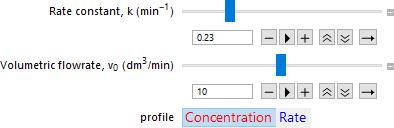
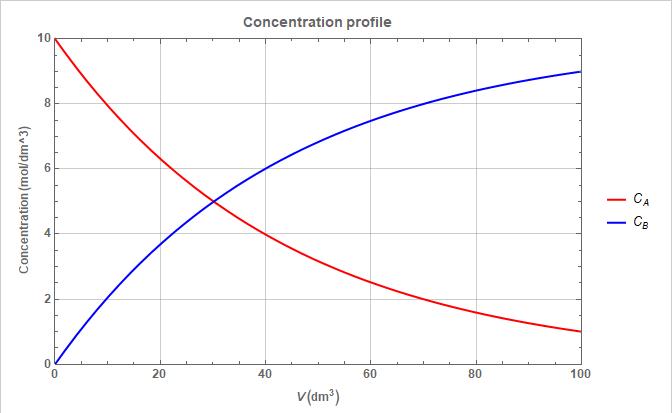
The above graph represents intial Ca and Cb profiles for k=0.23 and v0 = 10.
(i) With an increase in k (lets take k =0.35) for same volume and v0 , Ca decreases and Cb increases
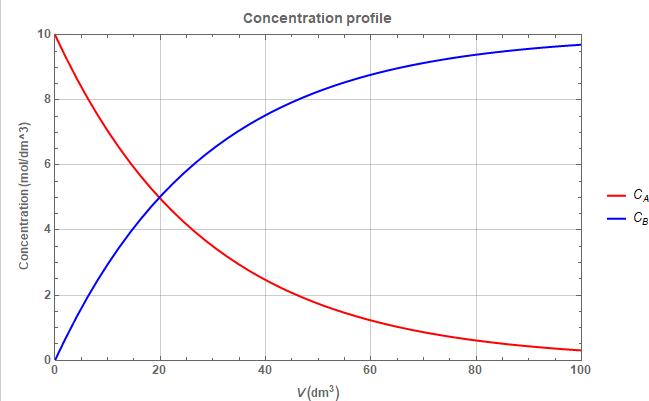
Now lets make k=0.23(initial value) and make an increase in v0 (change from 10 to 15) for same volume. We notice that now Ca increases and Cb decreases. All of these graphs of concentration profiles are ta ken from Wolfram player by shifting the sliders.
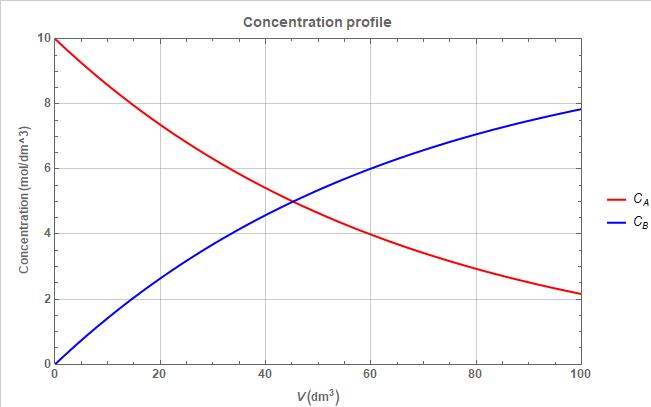
We can observe that varying rate constant has more effect on concentration profiles as compared to varying volumetric flow rate.
(ii) CA decreases and CB increases with an increase in k and Ke, and a decrease in v0 for the same volume.
(iii) Individualized solution
(iv) See the following polymath code:
Polymath Code:
d(Ca)/d(V) = ra / v0
d(Cb)/d(V) = rb / v0
k = 0 23
Ke=3
ra = -k * (Ca-Cb/Ke)
rb = -ra
v0 = 10
V(0)=0
V(f)=100
Ca(0)=10
Cb(0)=0
Output:
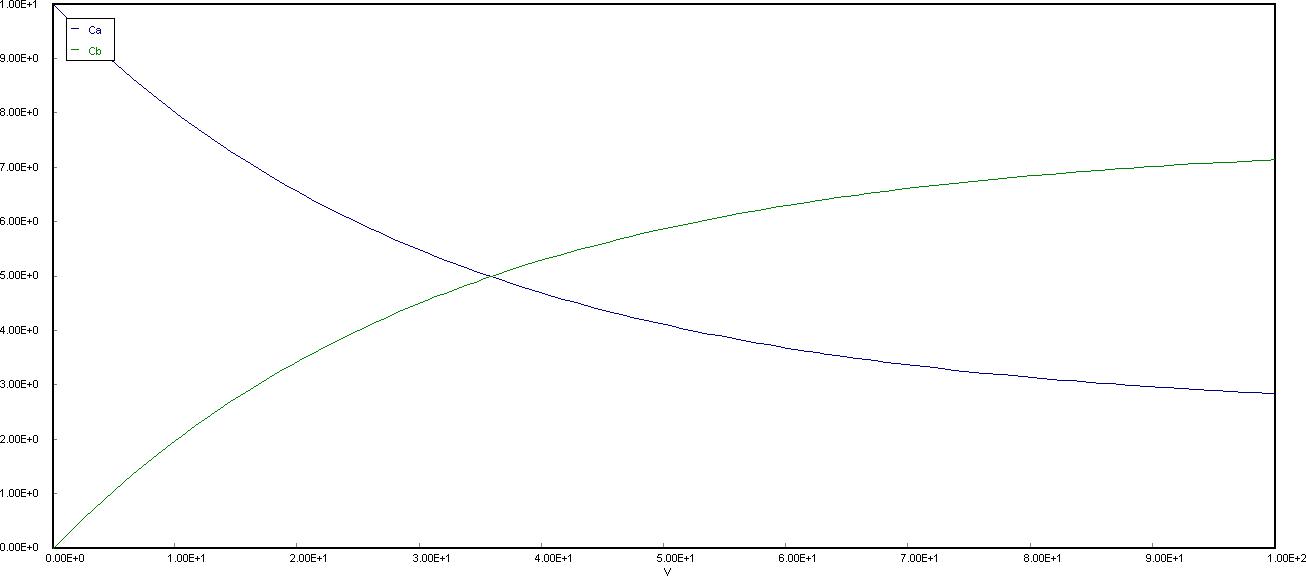
POLYMATH Report
Ordinary Differential Equations
Calculated values of DEQ variables
3
Differential equations
d(Ca)/d(V) = ra / v0
d(Cb)/d(V) = rb / v0
Explicit equations
1 k = 0.23
Ke = 3
ra = -k * (Ca-Cb/Ke)
rb = -ra
v0 = 10
P1-2 Given A 2*1010 ft2 TSTP 491.69R
*1013 ft3
R atm ft
FS = CO in Santa Ana winds FA = CO emission from autos vA 3000 ft3 hr per car at STP
P1-2 (a)
Total number of lb moles gas in the system:
N P0V RT
N = 1atm(4 1013 ft3) atm. ft3
= 1.025 x 10¹¹ lb mol
P1-2 (b)
Molar flowrate of CO into L.A. Basin by cars. • no. of cars
FA yAFT yA vA CT STP F 3000 ft3 1lbmol
T hrcar 359 ft3 400000 cars (See appendix B)
FA = 6.685 x 10⁴ lb mol/hr
P1-2 (c)
Wind speed through corridor is U = 15mph W = 20 miles
The volumetric flowrate in the corridor is vO = U.W.H = (15x5280)(20x5280)(2000) ft3/hr = 1.673 x 1013 ft3/hr
P1-2 (d)
Molar flowrate of CO into basin from Santa Ana wind.
FS : v0 CS = 1.673 x 1013 ft3/hr 2.04 10 10 lbmol/ft3 = 3.412 x 10³lbmol/hr
Rate of emission of CO by cars + Rate of CO in Wind - Rate of removal of CO = dNCO dt
P1-2 (f)
P1-2 (g)
Time for concentration to reach
Now solving this equation using POLYMATH we get plot between Cco vs. t
See the following polymath code:
Polymath Code:
v0 = 1 67*10^12
A= 35000
B = 30000
F = 341 23
V = 4*10^13
d(C)/d(t) = (A+B*sin(3.14*t/6)+F-v0*C)/V
C(0)=2 0e-10
t(0)=0
t(f)=72
Output:
Report
Calculated values of DEQ variables
3 C
4 F
5 t 0 0
6
7
Differential equations
1 d(C)/d(t) = (A+B*sin(3.14*t/6)+F-v0*C)/V
Explicit equations
v0 = 1.67*10^12
A = 35000
B = 30000
F = 341.23
V = 4*10^13
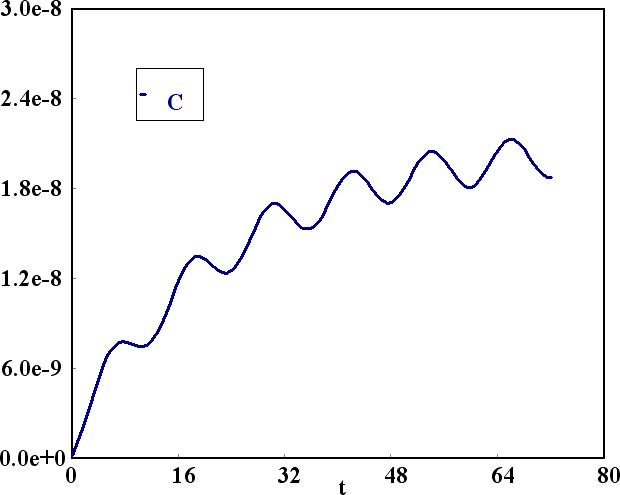
Polymath Code:
v0 = 1 67*10^12
A= 35000
B = 30000
F = 341 23
V = 4*10^13
d(C)/d(t) = (A+B*sin(3 14*t/6)+F-v0*C)/V
C(0)=2 0e-10
t(0)=0
t(f)=48
Output:
POLYMATH Report
Ordinary Differential Equations
Calculated values of DEQ variables
3
4 F
5 t 0 0
6 V
7
Differential equations
1 d(C)/d(t) = (A+B*sin(3.14*t/6)+F-v0*C)/V
Explicit equations
1 v0 = 1.67*10^12
A = 35000
B = 30000 F = 341.23
V = 4*10^13 2 3 4 5
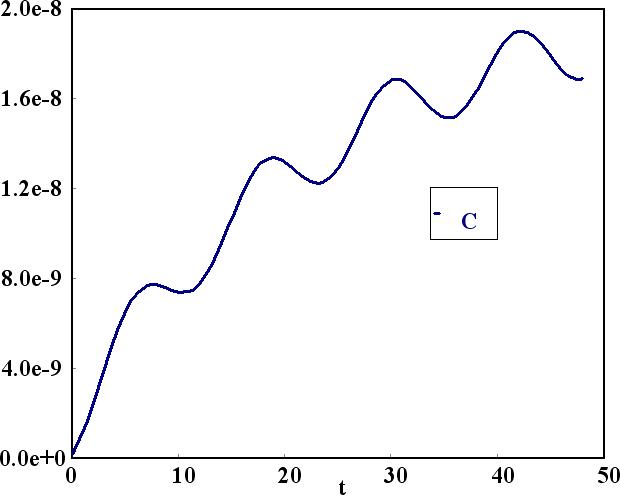
P1-2 (i)
Changing a -+ Increasing ‘a’ reduces the amplitude of ripples in graph. It reduces the effect of the sine function by adding to the baseline.
Changing b -+ The amplitude of ripples is directly proportional to ‘b’. As b decreases amplitude decreases and graph becomes smooth.
Changing v0 -+ As the value of v0 is increased the graph changes to a “shifted sin-curve”. And as v 0 is decreased graph changes to a smooth increasing curve.
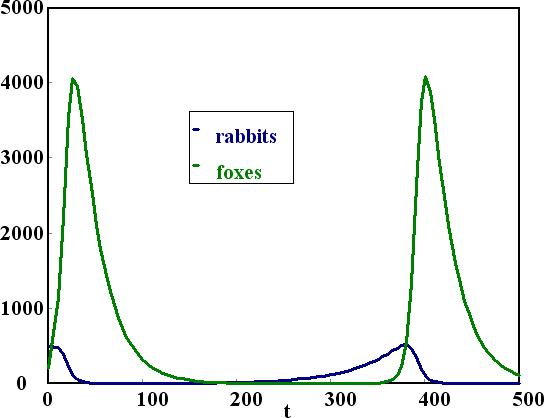
Initial number of rabbits, x(0) = 500
Initial number of foxes, y(0) = 200
Number of days = 500
dt k1x k2xy................................ (1)
dy k xy k y ............................... (2)
3 4
dt
Given,
k1 0.02day 1
k2 0.00004 / (day foxes)
k3 0.0004 / (day rabbits)
k4 0.04day 1
See the following polymath code:
Polymath Code:
d(x)/d(t) = (k1*x)-(k2*x*y)
d(y)/d(t) = (k3*x*y)-(k4*y)
k1 = 0 02
k2 = 0 00004
k3 = 0 0004
k4 = 0 04
t(0)=0
t(f)=500
x(0)=500
y(0)=200
Output:
POLYMATH Report
Ordinary Differential Equations
Calculated values of DEQ variables
4
5
Differential equations
1 2
d(x)/d(t) = (k1*x)-(k2*x*y)
d(y)/d(t) = (k3*x*y)-(k4*y)
Explicit equations
1 k1 = 0.02
2 k2 = 0.00004
3 k3 = 0.0004
4 k4 = 0.04
When, tfinal = 800 and k3 0.00004 /(day rabbits)
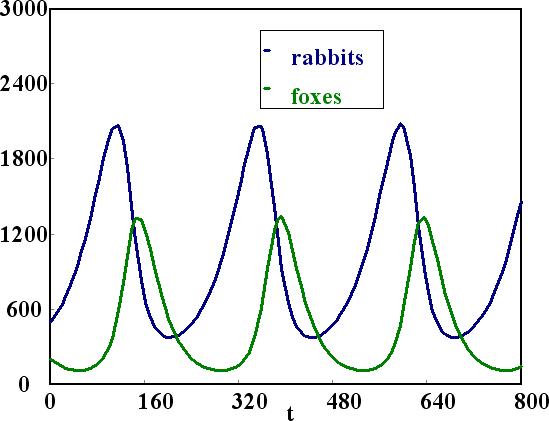
POLYMATH Report
Ordinary Differential Equations
Calculated values of DEQ variables
1
4
5 t 0 0 800. 800.
7 y
Differential equations
1 d(x)/d(t) = (k1*x)-(k2*x*y) d(y)/d(t) = (k3*x*y)-(k4*y) 2
Explicit equations
1 k1 = 0.02
2 k2 = 0.00004
3 k3 = 0.00004
4 k4 = 0.04
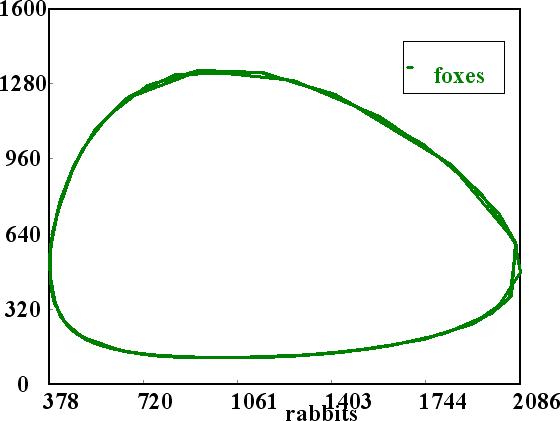
Plotting rabbits vs. foxes
P1-3 (b)
By increasing k4 and decreasing k2, foxes verses rabbits plot tends to become circular
P1-3 (c)
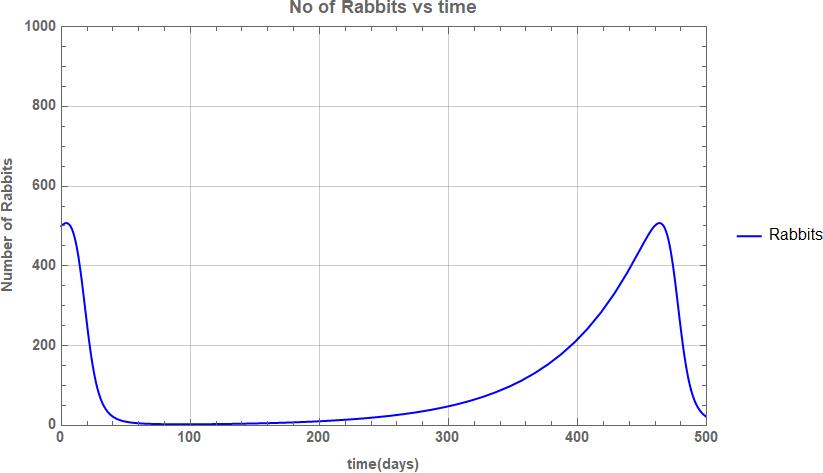
Below are the graphs when death rate is taken in to account
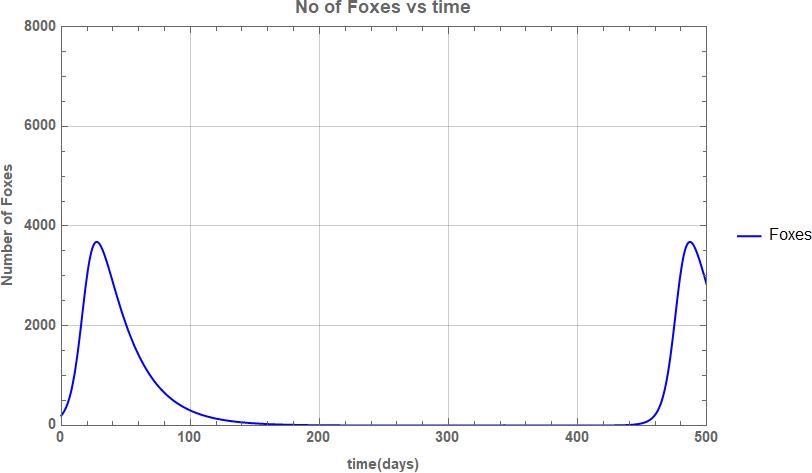
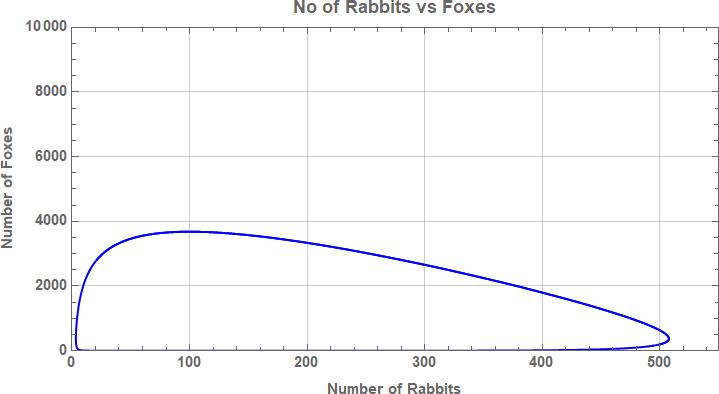
P1-3 (d)
To solve the system of equation, we can use Polymath Nonlinear Equation Solver
Polymath Code:
f(x) = (x^3)*y-4*y^2+3*x-1
x(0) = 2
f(y) = 6*y^2-9*x*y-5
y(0) = 2
Polymath Output:
Calculated values of NLE variables
Variable Value f(x) Initial Guess
1 x 2.385039 2.53E-11 2. y 3.797028 1.72E-12 2.
2
Nonlinear equations
f(x) = (x^3)*y-4*y^2+3*x-1 = 0 f(y) = 6*y^2-9*x*y-5 = 0
P1-4 Individualized solution
P1-5
P1-6 (a)
– rA = k with k = 0.05 mol/h dm3
CSTR: The general equation is V FA0 FA rA
Here CA = 0.01CA0 , v0 = 10 dm3/min, FA = 5.0 mol/hr Also, we know that FA = CAv0 and FA0 = CA0v0, CA0 = FA0/ v0 = 0.5 mol/dm3
Substituting the values in the above equation we get, V CA0v0 CAv0 (0.5)10 0.01(0.5)10 k 0.05
➔ V = 99 dm3 1 2
PFR: The general equation is
Integrating the above equation, we get
v0 CA V dCA dV => V v0 (C C ) k k
CA0 0
Hence V = 99 dm3
Volume of PFR is same as the volume for a CSTR since the rate is constant and independent of concentration.
P1-6 (b)
–rA = kCA with k = 0.0001 s-1
CSTR:
We have already derived that V CA0v0 CAv0 rA v0CA0(1 0.01) kCA
k = 0.0001s-1 = 0.0001 x 3600 hr-1= 0.36 hr-1
PFR: ➔ V (10dm3 / hr)(0.5mol / dm3)(0.99) (0.36hr 1)(0.01*0.5mol / dm3) => V = 2750 dm3
From above we already know that for a PFR dCAv0 r kC dV A A
Integrating v CA dC V 0 A dV k C CA0 0 v0 ln CA0 V k CA
Again k = 0.0001s-1 = 0.0001 x 3600 hr-1= 0.36 hr-1
Substituting the values in above equation we get V = 127.9 dm3
P1-6 (c)
–rA = kC 2 with k = 300 dm3/mol.hr
CSTR: V CA0v0 CAv0 rA v0CA0(1 0.01) kC2
A0 A A A A dFA r k , Now FA = CAv0 and FA0 = CA0v0 => dCAv0 k dV A dV
Substituting all the values we get
Integrating
(d)
Second order:
P1-7 Enrico Fermi Problem
P1-7 (a)Population of Chicago = 4,000,000
Size of Households = 4
Number of Households = 1,000,000
Fraction of Households that own a piano = 1/5
Number of Pianos = 200,000
Number of Tunes/year per Piano = 1
Number of Tunes Needed Per Year = 200,000 Tunes per day = 2
250 days 2
Tunes per year per tuner = yr day 500/yr/tuner
200,000 tunes 1 yr 500 tunes / yr / tuner 400 Tuners
P1-7(b) Assume that each student eats 2 slices of pizza per week. Also, assume that it is a 14” pizza, with 8 pieces. Hence, the area of 1 slice of pizza = 19.242 inch2 = 0.012414 m2 Thus, a population of 20000, over a span of 4 months, eats 20000 * 2 slices * 4 months * 4 weeks/month = 640000 slices of pizza, with a total area of 640000 * 0.012414 m2 = 7945 m2 of pizza in the fall semester.
P1-7(c) Assume you drink 1L/day
Assume you live 75 years*365days/year = 27375 days 1L/day*27375 days = 27375 L drank in life
Bathtub dimensions: 1m*0.7m*0.5m = 0.35m3 = 350L/tub
Bathtubs drunk = 27375L*1tub/350L = 78 tubs
P1-7(d) Jean Valjean, Les Misérables.
P1-8 Mole Balance: V = FA0 FA rA Rate Law : rA kC2 Combine: V = FA0 FA kC2

(6 0.3)
1900dm3
V = s 19000 dm3 (0.03 dm3 )(0.1 mol )2 mol s dm3
The incorrect part is in step 6, where the initial concentration has been used instead of the exit concentration.
Page intentionally blank