Solutions Manual for Electronics with Discrete Components 2nd Edition by Galvez
ISBN: 9781119913139
ISBN: 9781119913139
EnriqueJ.Galvez DepartmentofPhysicsandAstronomy ColgateUniversity
2025
1.Twocapacitors C1 and C2 areconnectedinseries,withapotential V0 across them.
(a)Ifthechargesonthetwocapacitorsarethesame,withavalue q,findthe voltages V1 and V2 acrosseachcapacitorintermsofthevariablesgiven.
Solution: V1 = q/C1 and V2 = q/C2 .
(b)Findarelationbetweenand V0 , V1 ,and V2 .
Solution:Becausetheareinseries, V0 = V1 + V2
(c)Nowconsiderreplacingthetwocapacitorsinseriesbyonecapacitor C0 andconnectittothesupplywithvoltage V0 .If C0 drawsthesamecharge q fromthesupply,findarelationbetween C0 , C1 ,and C2 . Solution:From(b), V0 = q(1/C1 +1/C2 )= q/C0 .Therefore,1/C0 = 1/C1 +1/C2
2.Twocapacitorswithcapacitances3 µFand2 µFareinitiallydischarged.They areconnectedinseries,andthenthetwoendsofthecombinationareconnected toa10-Vbattery,asshowninFigure1.34.
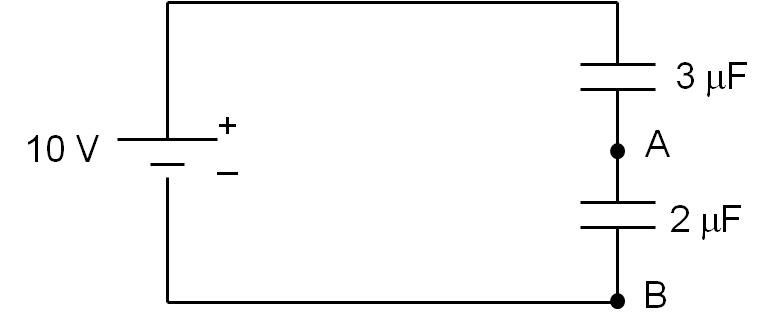
(a)Ifweconnectasinglecapacitortothesamebattery,whatwouldbethe capacitanceofthecapacitorsothatitdrawsthesamechargefromthe 3
battery?
Solution:Sincethecapacitorsareinseriesthen C =(1/3+1/2) 1 = 6/5=1 2 µF.
(b)Howmuchchargedoesthebatterydeliver?
Solution:Becausethetwocapacitorsareinseries,theyhavethesame charge Q.Thesourcedelivers Q.Thevoltagesacrosseachcapacitoradd uptothesourcevoltage V0 =10V.Therefore Q/C = V0 ,or Q =12 µC.
(c)Findthechargesoneachcapacitor.
Solution:Thechargeoneachcapacitoris Q =12 µC.
(d)Findthevoltageacrosseachcapacitor.
Solution:Forthetopcapacitor: Vtop = Q/Ctop =4V;andforthebottom capacitor, Vbot = Q/Cbot =6V.
(e)IfpointBisatzeropotential,whatisthepotentialatpoint A between thetwocapacitors?
Solution: VA = VB +6V=6V.
3.Abatterywithpotential V0 isconnectedtoacapacitor C.Welabelthecharge inthetopplateas q1 andthechargeinthebottomplateas q2 .Whichstatement iscorrect?
(a) q1 = q2 = CV0
(b) q1 = q2 = CV0
(c) q1 + q2 = CV0
(d) q1 = q2 =2CV0
(e) q1 = q2 = CV0 /2
Solution:Answeris(b),becausethecapacitor’stopplatehasacharge Q,and thebottomplatehasacharge Q.Theirabsolutevalueisequalto CV0 .
4.Supposethatwehavetwocapacitorswithcapacitances0.1 µFand0.2 µF.We connecttheminparallelandapplyavoltageof10Vtotheirends.
(a)Whatisthechargeoneachcapacitor?
Solution:Becausethecapacitorsareinparallel,thevoltageacrossthem isthesame.If C1 =0.1 µFand C2 =0.2 µF,then q1 = C1 V0 =1 µCand q2 = C2 V0 =2 µC.
weconnectanuncharged1-µFcapacitorinparallelwiththeothercapacitor. Findthechargeonthe1-µFcapacitor.(Notethatthevoltageacrossitisnot 1.2V.)
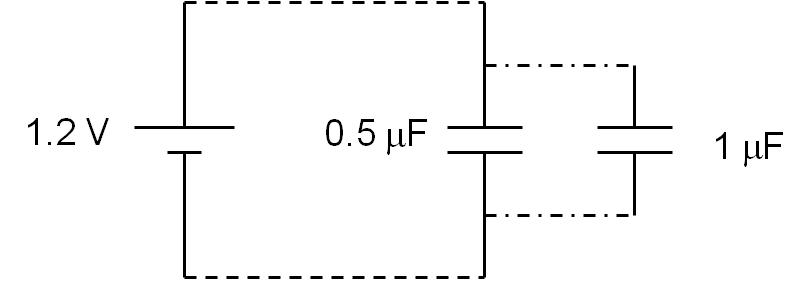
Solution:Whenweconnectthesupplytothefirstcapacitor,itgetsacharge q1 =(0.5µF)(1.2V)=0.6 µC.Wethendisconnectitfromthesupplyand connectittothesecondcapacitor.Thechargesrearrangesothatthetwo capacitorshavethesamevoltageacrossthem.Wecanalsothinkthatthetwo capacitorsnowactasasinglecapacitorofcapacitance C ′ = C1 + C2 =1 5 µF. Thechargeonitistheinitialone,sothenewvoltageacrossthecapacitorsis
V ′ = q1 /C ′ =0.4V.Thechargesoneachcapacitorarethen q′ 1 = C1 V ′ =0.2 µC and q2 = C2 V ′ =0 4 µC.Check:Thetwochargesindeedaddtotheoriginal charge.
7.ThepotentialofpointAinFigure1.37(inthetextbook,shownbelow)is0V. FindthepotentialofpointB.
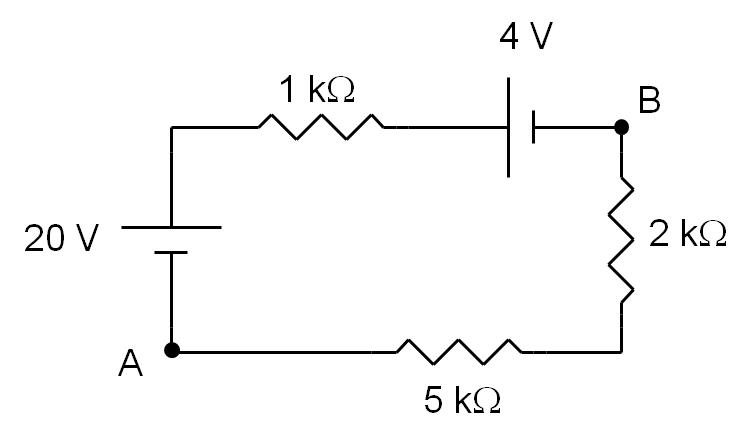
Solution:Wehaveasingleloop.Thesumofvoltagesmustaddtozero.The totalsupplyvoltageis20V 4V=16V.Thevoltagedropsacrosstheresistors, theirvaluetimesthecurrent,mustbeequaltothisvoltage.Sincetheresistors areinseriesintheloop,thentheircombinedresistanceis8kΩ.Thecurrentis then I =(16V)/(8kΩ)=2mA.ThepotentialofBisthepotentialonAplusthe dropsonthe5-kΩand2-kΩresistors,(5kΩ)(2mA)=10Vand(2kΩ)(2mA)=4 V,respectively.Therefore VB =14V.
8.ThecolorsofthebandsoftheresistorsofFigure1.7(inthetextbook,shown
next)are:(a)Orange,orange,red,white;(b)Brown,black,red,gold;(c) Brown,red,blue,orange,green.

(a)Determinetheirvalueandtolerance.
Solution:(a)33 × 102 Ω=3.3kΩ,20%;(b)10 × 102 Ω=1kΩ,5%;and(c) 126 × 103 Ω=126kΩ,0.5%.
(b)Ameasurementoftheactualresistanceof(b)gave992Ω.Shouldwe returnitasdefective?Explain.
Solution:No,becausethedifferencebetweentheexpectedandmeasured is0.8%,whichiswithinthe5%toleranceoftheresistor.
9.CalculatetheequivalentresistanceofthenetworkinFigure1.38(inthetextbook,shownbelow).
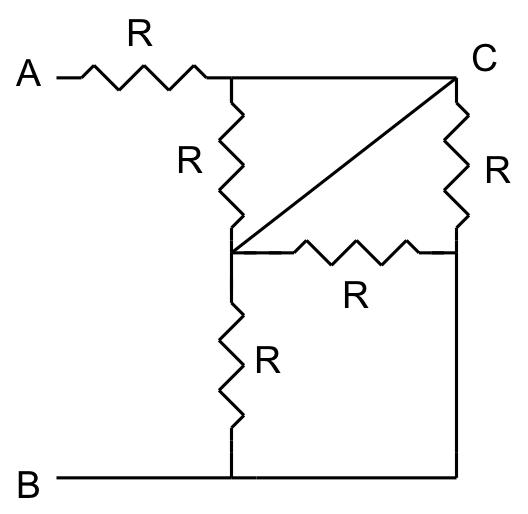
Solution:Intheupper-rightsideofthecircuitisawireorienteddiagonally. Noticethatitmeetswithanotherwiretoshortaresistor.Thepotentialofthat wireisthesame.Letuscallthispotential, VC .Betweenthewireatpotential A andtheoneat C thereisonlyoneresistor.Between C and B therearethree resistorsinparallel.Thereforewecanreducethearrangementastworesistors inseries: R between A and C,and R/3between C and B.Theequivalent resistancebetween A and B is4R/3.
10.IfpointAisatzeropotentialinFigure1.39(inthetextbook,shownnext), whatisthepotentialatpointsBandC?
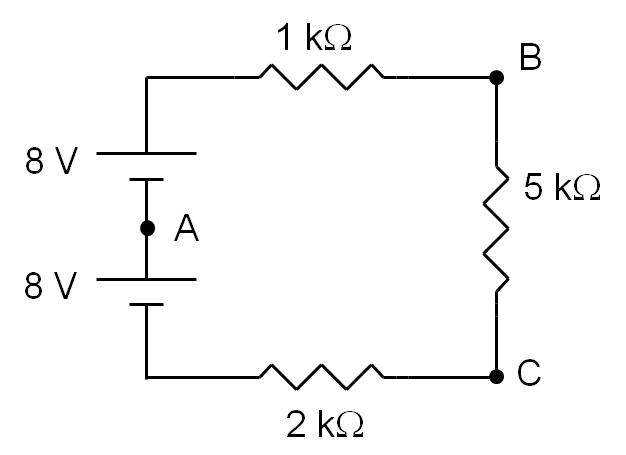
Solution:Wecancalculatethecurrentflowingthroughtheloopbyaddingthe voltagesources,16V,anddividingthatbytheequivalentresistanceofthree resistorsinseries,or8kΩ.Weget I =2mA.Thepotentialofthepositive sideofthebatteryabove A is8V.Thepotentialofpoint B isoneresistordrop below: VB =8V (1kΩ)(2mA)=6V.Point C isanotherresistordropbelow B: VC = VB (5kΩ)(2mA)= 4V.Check:Thepotentialofthenegativeside ofthebatterybelow A is 8V.Thepotentialofpoint C isoneresistordrop above this: VC = 8V+(2kΩ)(2mA)= 4V.
11.Manyofthecircuitsthatyouwilluseinthelabwillbepoweredby+12V powersupplies.Whatisthesmallestvalue1/8-Wresistorthatwecanapply thefullvoltageofthepowersupplywithoutburningit?
Solution:Givenare: V0 =12V,and Pmax =0.125W.Weknowthat P = V 2 /R, so Rmin = V 2 /Pmax =1152Ω.
12.Beawareofthedangersofelectricity.Humanskincanexhibitlargevariations inelectricalresistance.Althoughdryskinmayhavearesistanceof100kΩ,wet andtenderskinmayhaveresistancesaslowas1kΩ.Ifelectrocutioniscaused bycurrentsabove50mA,whatappliedvoltageswouldcauseelectrocutionfor (a)dryand(b)wetskin?
Solution:Lethalcurrentis Ileth =50mA.(a)Fordryskin Vleth =(50mA)(100kΩ)= 5000V.(b)Forwetskin Vleth =(50mA)(1kΩ)=50V.
13.Using only theconceptsofequivalentresistanceandvoltagedivider,calculate thevoltagebetweenpointsAandBofFigure1.40(inthetextbook,shown below).Hint:Firstfindthevoltagedropacrossthe8kresistor,butdonot ignoretheresistorladdertotherightofit.
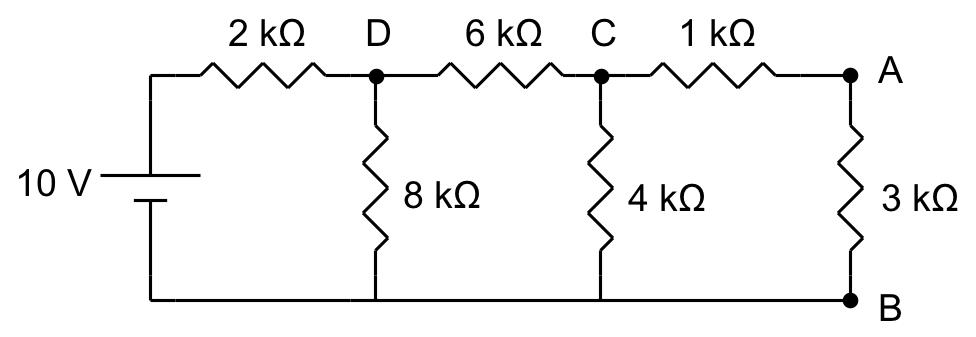
Solution:Thetworesistorsofbranch CAB areinparallelwiththe4kΩresistor, sotheresistancebetween C and B is RCB =2kΩ(seethefigurebelow).
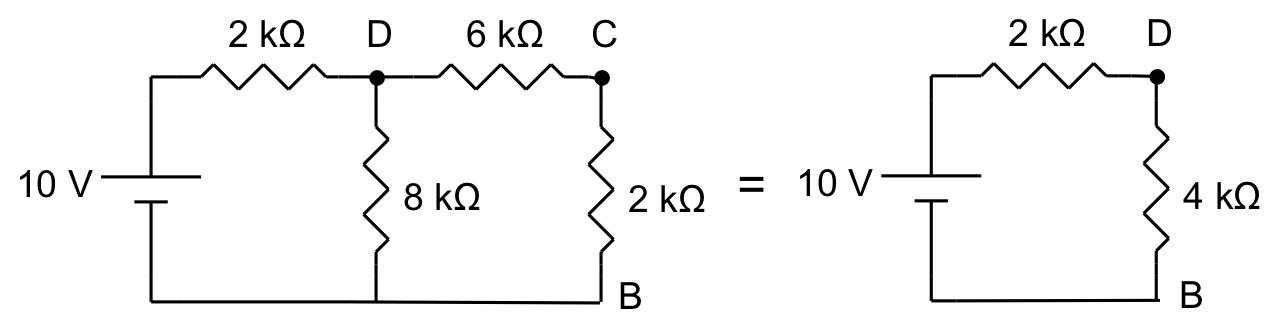
Theresistancebetween D and B istheresistanceinthebranch DCB inparallel withthe8kΩresistor.Theequivalentresistancebetween D and B isthen RDB =4kΩ(seethefigureabove).Applyingthevoltagedividerargumentinthe reducedone-loopcircuit,weget VDB =(4/6)V0 =6 67V.Applyingthevoltage dividerargumentbetween D and B,weget VCB =(2/8)VDB =(1/6)V0 =1.67 V.Finally,Applyingthevoltagedividerargumentbetween C and B,weget VAB =(3/4)VCB =(1/8)V0 =1 25V.
14.Findthevalueof R inthecircuitofFigure1.31(inthetextbook,shownbelow) ifpoints A and B areatthesamepotential.
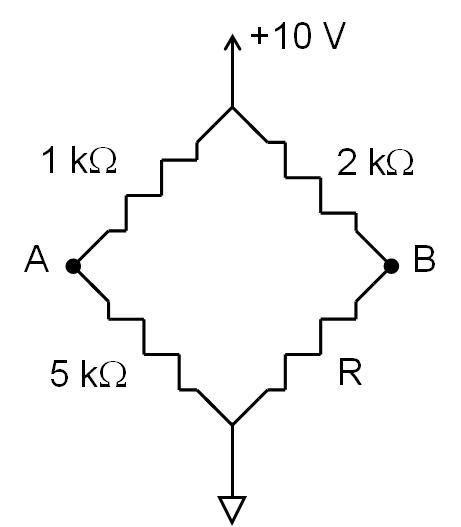
Solution:Theratiooftheresistanceonthetwobranchesmustbethesame: 1kΩ 5kΩ = 2kΩ R
or R =10kΩ.
15.Tworesistorsareconnectedinseriestoa20-Vbattery.Theratiooftheir resistancesis1:4.
(a)Findthevoltageacrossthelargerresistor.
Solution:Ifoneresistorhasaresistance R andtheotherone4R,thenthe voltageacrossthelargeroneis V =(4R/5R)(20V)=16V.
(b)Ifthetotalcurrentflowingthroughtheresistorsis10mA,whatisthe valueofthesmallerresistor?
Solution:Thevoltageacrossthesmallerresistor(ofresistance R)is4V. Then R =(4V)/(10mA)=400Ω.
16.Findthecurrentflowingthrougheachresistor,andthevoltagedropacrossthe resistorinthemiddlebranchofthecircuitofFigure1.42(inthetextbook, shownontheleftbelow).
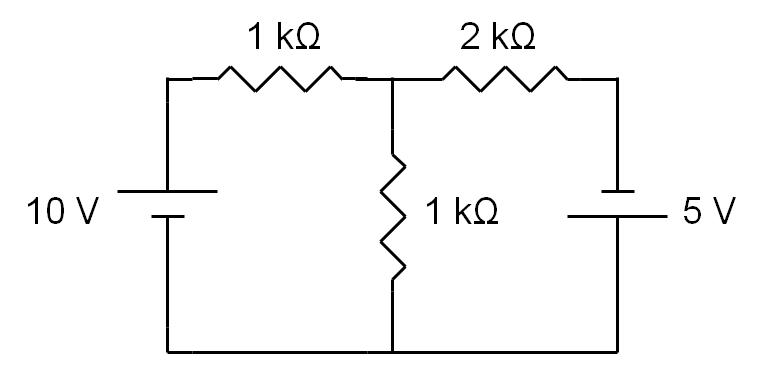
Solution:LetusassumethatthecurrentsaregiveninmA,resistancesinkΩ andvoltagesinV.Weassumedirectionsforthecurrents,andlabelthepolarity ofthepotentialdrops:
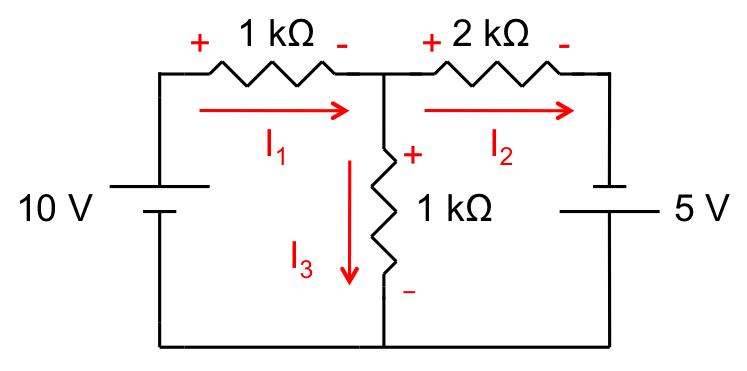
Theequationsfortheleft-handandright-handloopsarerespectively:
and 5 I3 2I2 =0
Theequationforthecurrentsis
I1 = I2 + I3
Solvingthesystemofequations,weget I1 =7mA, I2 =4mAand I3 =3mA. Thevoltagedropsacrossthemiddleresistoris(1kΩ)(3mA)=3V.
17.Findthecurrentflowingthroughthe4-kΩresistorinFigure1.43(inthetextbook,shownbelow).
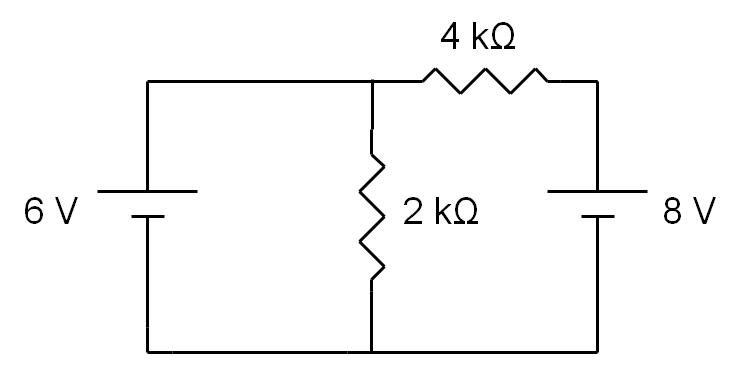
Solution:The6-Vsupplyisstraightacrossthe2-kΩresistor,sothevoltage acrossthe4-kΩresistoris2V.Thecurrentisthen(2V)/(4kΩ)=0 5mA.
18.Findthevalueoftheresistors R1 and R2 inFigure1.44(inthetextbook,shown belowwithsolution).
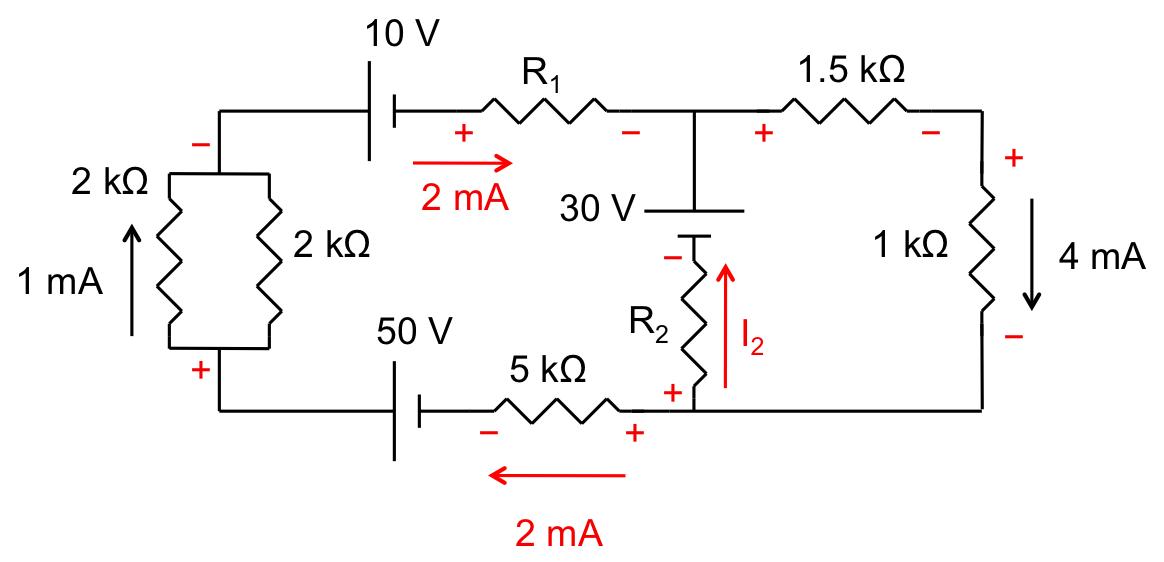
Solution:Wecancalculatethevoltageacrosstherightbranch(oftotalresistance2.5kΩ):(4mA)(2.5kΩ)=10V.Nextwefocusonthetworesistorsin parallelintheleft-mostverticalbranch.Theresistorshavethesameresistance, soifthecurrentontheleftresistoris1mA,thentherightresistorcarriesthe
samecurrent.Thevoltagedropacrossthemis2V.Uptothispointweknow allthedropsontheleftloop,sowecanfindthevoltageacross R2 :18V.Its valueisthen R1 =9kΩ.Fromthesumofcurrentsatthejointswegetthat I2 =2mA.Thevoltageacross R2 is20V,so R2 =10kΩ.
19.ThecapacitorinthecircuitofFigure1.45(inthetextbook,shownbelow)is discharged.
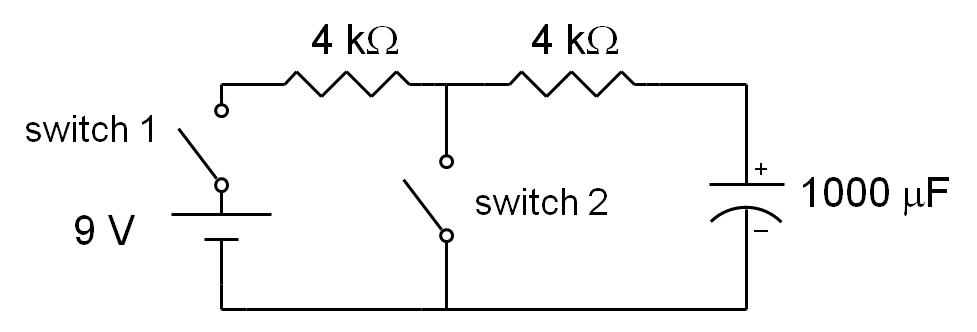
(a)Switch1isclosedat t =0.Atwhattimewillthevoltageacrossthe capacitorreach6V?
Solution:Theequationforchargingthecapacitoris: VC =(9V)(1 e t/RC ),where RC =(8kΩ)(1000µF)=8s.Wesolvefor t when VC =6 V: t = (8s)ln(1 6/9)=8 8s.
(b)Switch1isopenedwhenthevoltageacrossthecapacitorreaches6V. Whatwasthecurrentflowingthroughthecircuitbeforetheswitchwas opened?
Solution:Thedropacrosseachresistoris1.5V,sothecurrentflowing throughthemis I =(1.5V)/(4kΩ)=0.375mA.
(c)Wecloseswitch2.Atwhattimeafterclosingtheswitchisthevoltage acrossthecapacitorequalto3V?
Solution:Thetimeconstantforthedischargeofthecapacitoris4s.The timeis: t = (4s)ln(3/6)=2 8s.
20.At t =0,theswitchofFigure1.46(inthetextbook,shownbelow)isclosed. At t =80ms,thevoltageacrossthecapacitoris5V.Calculate V0