Chapter 4 Extensions of Demand and Supply Analysis
◼
Overview
The chapter begins by presenting an overview of the price system. There is a discussion of exchange and markets, transaction costs, and the role of intermediaries. The examination of supply and demand analysis begins by first identifying what happens to equilibrium price and quantity when demand changes with supply held constant and then when supply changes with demand held constant. The analysis is pursued further by examining the effects of simultaneous changes in supply and demand. The fact that changes in equilibrium usually take time, in practice, is addressed, and why prices may not reach equilibrium for quite some time in a free market is explained. The concepts of rationing by price, waiting, lotteries, and coupons are discussed. Supply and demand analysis is used to show the consequences of government price controls both in an abstract sense and in the specific cases of black markets, rent controls, price supports, and the minimum wage. Finally, the fact that the government places quantity restrictions on a market, by banning goods or imposing import quotas, is discussed.
◼ Learning Objectives
After studying this chapter, students should be able to:
4.1 Discuss the essential features of the price system
4.2 Evaluate the effects of changes in demand and supply on the market price and equilibrium quantity
4.3 Understand the rationing function of prices
4.4 Explain the effects of price ceilings
4.5 Explain the effects of price floors and government-imposed quantity restrictions
◼
Outline
I. The Price System and Markets: An economic system in which relative prices are constantly changing to reflect changes in demand and supply for different commodities. Prices act as signals to everyone within the system as to what is relatively scarce and what is relatively abundant
A. Exchange and Markets: Exchanges in markets are voluntary. Voluntary exchange is the act of trading between individuals on a mutually agreed basis, making both parties subjectively better off. The prices paid for exchanges are determined by supply and demand.
B. Transaction Costs: All the costs associated with exchange, including the informational costs of finding out the price and quality, service record, and durability of a product, plus the costs of contracting and enforcing the contract.
C. The Role of Intermediaries: Intermediaries specialize in lowering transaction costs by bringing buyers and sellers together. In our increasingly networked economy, companies called platform firms have been thriving by offering services that connect individuals to others with similar interests or those who seek to buy their products.
II. Changes in Demand and Supply: Market equilibrium can change when there is a shock caused by a change in the ceteris paribus conditions for demand or supply. A shock can be represented by a shift in the supply curve, the demand curve, or both curves.
A. Effects of Changes in Either Demand or Supply: Whenever one curve shifts and the other does not, it is possible to determine what will happen to both price and quantity. When there is an increase in demand with supply stable, equilibrium price and quantity increase. When there is a decrease in demand with supply stable, equilibrium price and quantity decrease. When there is an increase in supply with demand stable, equilibrium price falls, and the equilibrium quantity rises. When there is a decrease in supply with demand stable, equilibrium price rises, and the equilibrium quantity falls. (See Figure 41.)
B. Situations in Which Both Demand and Supply Shift: When both supply and demand curves shift, the outcome is indeterminate for either equilibrium price or equilibrium quantity.
1. Changes of Demand and Supply in the Same Direction: When there is an increase in supply and demand, equilibrium quantity will rise, and when there is a decrease in supply and demand, equilibrium quantity will fall. Price can increase, decrease, or remain the same depending on relative changes in supply and demand.
2. Changes of Demand and Supply in Opposite Directions: When there is a decrease in demand and increase in supply, equilibrium price will fall. An increase in demand and a decrease in supply will cause the equilibrium price to rise. Quantity can increase, decrease, or remain unchanged depending on the relative changes in supply and demand.
C. Price Flexibility and Adjustment Speed: When demand increases in a market, a shortage develops and price rises. The shortage can be eliminated quickly or slowly, depending on the characteristics of the market. There are markets where price flexibility may take the form of indirect adjustments, such as by way of hidden payments or quality changes.
III. The Rationing Function of Prices: The synchronization of decisions by buyers and sellers that creates equilibrium is called the rationing function of prices. In the market, prices are indicators of relative scarcity and ration goods to those who are willing to pay the most. First come, first served: political power: physical force; and cultural, religious, and physical differences have been and are being used as rationing methods throughout the world.
1. Rationing by Waiting: For first come, first served, also called rationing by queues, whoever is willing to wait in line the longest obtains the good that is being sold at less than the market clearing price. To calculate the total price of the good, we must add the price paid plus the opportunity cost of the time spent waiting.
2. Rationing by Random Assignment or Coupons: For random assignment, the good or service is given out by some random selection process. Coupons can be used to limit purchases by requiring the consumer to pay a price and give up a coupon.
A. The Essential Role of Rationing: Because of scarcity, it is not possible for everyone to have everything they want. There must be some method of rationing. Rationing by a freely functioning price system is the most efficient because all gains from mutually beneficial trade will be captured.
IV. Price Ceilings: The rationing function of prices is often not allowed to operate when the government sets price controls such as price ceilings (maximum legal prices).
A. Price Ceilings and Black Markets: When a price ceiling is below the marketclearing price, a shortage occurs. The result is fewer exchanges.
1. Nonprice Rationing Devices: Whenever price controls are set, nonprice rationing devices will develop to ration the affected goods and services. An obvious example is queuing in the event of a shortage (See Figure 4-3.)
2. Black Markets: Typically, an effective price ceiling leads to a black market in which the price-controlled good is sold above the legal maximum price.
B. The Policy of Rent Ceilings: Rent control is the placement of price ceilings on rents in communities to keep rents below levels that would be observed in a freely competitive market.
1. The Functions of Rental Prices: Rental prices serve three functions: (1) to promote the efficient maintenance of existing housing and to stimulate construction of new housing, (2) to allocate existing scarce housing among competing claimants, and (3) to ration the use of existing housing by current demanders. Rent controls interfere with all of these functions.
a. Rent Controls and Construction: Rent controls discourage the construction of new rental units by depressing the most important longterm determinant of profitability rent.
b. Effects on the Existing Supply of Housing: When rental rates are held below equilibrium levels, owners cannot recover costs of maintenance, repairs, and capital improvements through rents, so owners curtail these
activities and quality declines. In some cases, buildings are abandoned or destroyed through arson so the owners can collect insurance.
c. Rationing the Current Use of Housing: Rent controls restrict tenant mobility and can cause housing gridlock.
2. Attempts to Evade Rent Ceilings: Because rents can only be increased when a tenant leaves, property owners will make life unpleasant for tenants or evict them on the slightest pretense. Tenants try to sublet apartments at fees above their rental payments. Rent courts have been created to prevent or restrict these activities.
3. Who Loses and Who Gains from Rent Ceilings? Property owners are the biggest losers. Other losers are low-income individuals, especially single mothers, who are unable to find apartments.
4. Why Both Landlords and Some Tenants Lose: Low-income persons lose because they cannot afford to pay “key money,” an illegal payment charged up front by some landlords. Landlords have little incentive to take any risk on low-income individuals as tenants.
5. Beneficiaries of Rent Controls: Upper-income tenants who occupy rentcontrolled housing gain the most as they can use their mastery of bureaucracy and their large network of friends and connections to exploit the rent ceilings.
V. Price Floors and Quantity Restrictions: The rationing function of prices is often not allowed to operate when the government sets price controls such as price floors (minimum legal prices).
A. Price Floors and Price Supports in Agriculture: In 1933, the federal government established a system of price supports for many agricultural products, including wheat, feed grains, cotton, rice, soybeans, sorghum, and dairy products.
1. Implementing Agricultural Price Supports: The government chooses a support price of an agricultural product and then ensures that its price never falls below the support level. (See Figure 4-4.)
2. An Effective Agricultural Price Floor: When the government sets the support price above the market clearing price, a surplus develops. The government then buys the surplus and stores it or sells it to foreign countries at a reduced price. (See Figure 4-4.)
3. Who Benefits from Agricultural Price Supports? Owners of big farms that produce more output get a large percentage of subsidies. All the benefits derived from price support subsidies ultimately accrue to landowners on whose land price-support crops can be grown.
a. Keeping Price Supports Alive under a New Name: In the early 1990s, Congress indicated an intention to end agricultural subsidies by the early 2000s. However, governments have continued to support prices through “marketing loans” or advancements to farmers to help them finance the storage of some or all of their crops.
b. The Main Beneficiaries of Agricultural Subsidies: The government seeks to cap the annual subsidy payment at $125,000 per year for an individual farmer, but some farmers are able to obtain higher amounts by engaging in conservative programs that provide high subsidies. Today, 10 percent of U.S. farmers receive more than 70 percent of farm subsidies.
B. Price Floors in the Labor Market: The minimum wage, a wage floor legislated by government, sets the lowest hourly rate that firms may legally pay workers. The effect is to cause unemployment for some low-skill workers and depressed wages in areas not covered by the minimum wage. (See Figure 4-5.)
1. Minimum Wages in the United States: The federal minimum wage began in 1938 at 25 cents per hour, was raised to $5.15 in 1997, and eventually rose to $7.25 in 2009. Many states have minimum wages or “living wages” that exceed the federal minimum wage.
2. Economic Effects of a Minimum Wage: When the minimum wage exceeds the market-clearing wage, the quantity of labor supplied exceeds the quantity of labor demanded. Some workers will become unemployed, and some will move to sectors where minimum wage laws do not apply. Wages will be pushed down in these uncovered sectors (See Figure 4-5.)
a. Explaining the Overall Decrease in Employment: At the minimum wage, the overall decrease in employment is smaller than the excess quantity of labor supplied because additional workers would like to work more hours at the new, higher minimum wage.
b. Your Summer Plans If the Minimum Wage Were, Say, $25 an Hour: A higher minimum wage increases the number of job seekers who would otherwise not have worked at the lower equilibrium wage. Thus, the labor supply curve is upward sloping.
C. Quantity Restrictions: Governments can impose quantity restrictions on a market such as a ban on ownership or trading of goods (human organs and certain psychoactive drugs). The most common quantity restrictions in international trade are import quotas. An import quota is a quantity restriction that prohibits the importation of more than a specified quantity of a particular good in a one-year period. The United States has had import quotas on tobacco, sugar, and automobiles. The beneficiaries of quotas are importers who get the quota rights and the domestic producers of the restricted goods
◼ Points to Emphasize
EQUILIBRIUM PRICE AND QUANTITY CHANGES WHEN THERE ARE CHANGES IN SUPPLY AND DEMAND
When one curve shifts and the other is stable, it is possible to predict what will happen to both equilibrium price and quantity. For example, the effect of an increase in demand is to raise equilibrium price and quantity.
When both curves shift, the effect on either price or quantity is a priori indeterminate. An increase in supply and demand, for example, leads to an increase in equilibrium quantity.
The effect on price, however, depends on the increase in demand relative to the increase in supply. If supply increases more than demand, price will fall and vice versa. If both curves shift by the same amount, price will not change at all. Because real-world markets are constantly experiencing changes in the nonprice determinants of both supply and demand, both curves are constantly shifting.
ADJUSTMENT SPEED
The graphic presentation of changes in supply and demand often leads to the conclusion that price and quantity adjustments are relatively smooth and rapid. Although this sometimes happens, it is often true that some markets do not get back into equilibrium immediately. The analysis shows what equilibrium price and quantity will ultimately be, given a demand curve and a supply curve. An analysis of skilled labor shortages illustrates a situation in which a shortage can persist for a significant time. Because skilled labor is relatively fixed in supply in the short run, an increase in demand and the resulting increased wage do not immediately attract qualified new workers. It takes time to train or educate new workers. Because the wage must first rise to attract additional persons, the adjustment time period may be longer than the training period.
RATIONING
Different methods exist to ration or allocate an available good or service to people. Pick a scarce good or service generally viewed as a necessity and ask students how it should be allocated. Considerable controversy has arisen over how to allocate human organs for transplanting. The current allocation method is essentially a first-come, first-served rationing, or queuing system, which uses donated organs from relatives or from people who die. Some living individuals have been willing to sell an organ to the highest bidder. Supply and demand in a free market would ensure a price for organs that would clear the market; that is, a price that measures the relative scarcity of organs would be established. This is called the rationing function of price. It is important to realize that some people are going to die for lack of organs no matter which system is used because the number of people needing organs greatly exceeds the number of organs available.
In some situations, rationing by waiting coexists with price as an allocation device. Price may be deliberately kept below equilibrium, in which case those who are willing to wait the longest and pay the below equilibrium price get the good. Emphasize that the actual price paid should include the opportunity cost of time. Queuing is used when there are large or unpredictable changes in demand and high costs of satisfying demand in the short run, such as at the opening night at a movie theater that is showing a hit movie.
PRICE CEILINGS
Price controls are maximum legal prices (price ceilings) and minimum legal prices (price floors) that can be charged for goods and services
Price ceilings are created to protect buyers from high prices. One example is rent control, in which some local governments tell landlords the maximum rent they can charge. According to proponents, keeping rents low (price ceiling) helps low-income persons. However, the opposite actually happens. The number of existing rental units declines, and the remaining units are poorly maintained. Fewer low-rent units are constructed because their future profitability is questionable. In addition, illegal “key money” to get into a rent-controlled unit is often too high for the poor. In addition, price ceilings may
create black markets. A black market is a market in which the price-controlled good is sold at an illegally high price. The price paid above the controlled price may be in the form of money, favors to the seller by the buyer, or other nonmonetary consideration. The ultimate effects of a price ceiling or a price floor are often not the ones intended.
PRICE FLOORS
An example of a price floor is the minimum wage. In addition to increasing the unemployment rate among those subject to the minimum wage, the minimum wage results in those unemployed workers losing opportunities to increase their human capital from on-the-job training and work experience. Thus, the minimum wage has the effect of preventing some low-productivity workers from increasing their human capital by enough to qualify for a minimum-wage job.
◼ For Those Who Wish to Stress Theory
THE PROCESS OF ADJUSTMENT
The adjustment process from one equilibrium price and quantity to another can be interesting. The method in the text is one in which a change in supply or demand occurs, and then the final equilibrium is shown and compared to the initial one.
A dynamic adjustment process may be more interesting. The Cobweb Model proposes that sellers respond in the current period to the previous period’s price. The model shows how a market can converge on equilibrium after a series of surpluses and shortages. When a good’s price is set below equilibrium or is distributed for free, much (perhaps all of it) will be distributed by queuing. Yoram Barzel (see Selected References) argues that with price below equilibrium and with no other formal rationing system, equilibrium will be established by people paying the money price and by expending enough resources on getting the good so that the marginal person neither gains nor loses from getting it. Because queuing is the usual method for acquiring this type of good, time is the resource expended. The amount of time spent in the queue is directly related to the size and number of units in a batch being distributed. The actual price paid rises to an equilibrium level equal to the money price paid plus the value of time spent waiting. For the marginal individual, the waiting time plus any price paid uses up the benefits of the lower money price (even a zero price). An important implication of this analysis is that when income redistribution through provision of free or belowequilibrium priced goods is tried, the cost of the good increases through an increase in time needed to get the good.
◼ Further Questions for Class Discussion
1. Many developing countries have been lobbying at recent meetings of the World Trade Organization for an end to agricultural subsidies by developed countries. Why would these developing countries, who also produce many of these same agricultural products, wish to put an end to these subsidies? When the U.S. government makes up the difference between the world market price and the price in the United States, then U.S. farmers can sell their crops on the world market and still enjoy a profit from the sales. These subsidies also provide an
incentive to farmers to produce more than they would in a free market. The increase in supply in world markets causes the world market price to fall. In many cases, the price falls by enough to make raising these commodities unprofitable in third-world countries because their farmers’ production costs are too high to sell the products at a competitive price in the world market.
2. A major issue in the 2008 presidential campaign in the United States was the high price of gasoline and crude oil. The price of crude oil rose rapidly in 2007 and 2008, despite increases in production by the Organization of Petroleum Exporting Countries (OPEC). Part of the reason is that the Chinese and Indian economies had been growing at very high rates. This growth has fueled demand for energy for industry and transportation. In addition, the rising incomes in these countries have increased the demand for automobiles and gasoline as more people in these countries can afford them. Republicans argue that increased drilling in offshore areas of the United States would increase the supply of oil and bring the price down. The price of gasoline would decrease as a result. Using supply and demand analysis, explain whether it is certain that the price of oil and, therefore, gasoline would fall if there were successful offshore drilling for oil in U.S. waters.
No. The increase in production by OPEC increased supply in 2007 and 2008, and the prices of oil and gasoline did not fall to 2006 levels. Increases in oil supply from offshore drilling can only be counted on to decrease the price of oil and gasoline if it causes the global supply of oil to increase by more than global demand increases.
3. Opponents of legalized marijuana argue that legalizing the drug would result in more marijuana being consumed. Is this result predicted by the supply and demand model?
Yes. Buyers and sellers of marijuana face costs that buyers and sellers of legal products do not. They face the cost of going to jail and possible fines with resulting loss of income. Transaction costs are higher for buyers because sellers cannot advertise and cannot legally enforce contracts. Both the demand for and supply curves of marijuana are further to the left (less) than they would be than if marijuana was legal. Thus, if marijuana was legalized, both the supply and demand curves would shift to the right (increase), which result in an increase in the equilibrium quantity of marijuana.
4. The text argues that economists can analyze and compare the efficiency of different rationing systems but cannot say which one is best. Does it seem reasonable to accept that the most efficient system, the price system, is the best?
No. As economists, we can analyze the operation of rationing systems and say something about how efficient they are relative to each other. To say that one rationing system is the “best” because it is the most efficient requires that a value judgment be made that efficiency is the criterion for determining what is best. Economic analysis uses positive analysis, which identifies “what is.” A determination of “best” is an exercise in positive economics, which identifies what “ought to be.”
5. In 1974, the cutback in oil production by OPEC created shortages of oil in the world market. In the United States, price controls prevented oil and gasoline prices from rising to world market levels. In Europe and Canada, however, oil and gasoline prices rose to world market levels. In the United States, lines of cars formed at service stations, while there were no lines in Canada. Why?
In the United States, price was held below the market-clearing level, and queuing occurred. The actual cost of gasoline rose to equilibrium levels if the price paid plus the value of time waiting in line was counted as the total cost of gasoline. The Canadians voluntarily cut back on consumption at the higher money price of gasoline by enough to eliminate the shortage, and no lines formed.
◼ Answers to Questions for Critical Analysis
AI:THE FUTURE IS NOW:ACOMPANY TRIES TO REINVENT ITSELF AS AN INTERMEDIARY BETWEEN AIS AND HUMANS (PP. 75–76)
For Critical Thinking
Why do you suppose that some observers are predicting that eventually AI applications will serve as accurate intermediaries between AIs and humans or even between AIs and other AIs?
Over time, AI applications will get better at processing and returning information. These AI applications will make it easier, quicker, and cheaper for people to access information (lowering transaction costs) and new AI applications will develop for different purposes, such as to act as intermediaries.
EXAMPLE:THE EFFECTS OF A SIMULTANEOUS DECREASE IN THE SUPPLY OF AND AN INCREASE IN THE DEMAND FOR GROUND BEEF (PP.77–78)
For Critical Thinking
If many cattle farmers were to exit the market, what would happen to the market clearing price and equilibrium quantity? Explain briefly.
Cattle farmers exiting market would decrease supply, shifting it to the left, so the market clearing price of beef would rise further, and the equilibrium quantity would decrease.
INTERNATIONAL EXAMPLE:TUITION PRICE CONTROLS GENERATE REDUCTIONS IN QUANTITIES OF SERVICES SUPPLIED BY BRITISH UNIVERSITIES (P.81)
For Critical Thinking
The British government has only rarely raised the tuition prices that universities charge over the past three decades, so inflation has reduced inflation-adjusted tuition rates by more about one-third since 2012. How might this fact help to explain why British universities typically reduce service quantities each year that inflation occurs?
Increases in inflation without increases in tuition prices further reduce inflation-adjusted prices. This is effectively the same as lowering the price ceiling each year if tuition prices rose accordingly with inflation. As the inflation-adjusted prices fall, fewer universities are willing and able to supply services, thus service quantities fall.
POLICY EXAMPLE:ASSESSING THE NON-WAGE-RATE EFFECTS OF A HIGHER MINIMUM WAGE RATE IN MINNEAPOLIS (P. 86)
For Critical Thinking
How can a Minneapolis worker’s total annual wage income decline on net even if the worker’s hourly wage rate increases? (Hint: How did the higher minimum wage rate in Minneapolis affect the total number of hours that firms employed workers?) A worker’s total annual wage income equals the worker’s hourly wage rate times the number of hours worked. If the hourly wage rate increases, but the number of hours worked falls by a greater proportion, then the total annual wage income falls.
DIVERSITY TRENDS:HOW A HIGHER MINIMUM WAGE CAN BENEFIT BLACK WORKERS BY INDUCING THEM TO COMMUTE (PP. 86–87)
For Critical Thinking
Even though minimum-wage increases might have different effects across various identifiable groups, why do you think that most economists conclude that such increases nonetheless typically generate lower employment overall, other things being equal?
Explain briefly. (Hint: Recall the law of demand.)
If the minimum wage is set above the equilibrium rate, the quantity of workers supplied (people willing to work) is greater than the quantity of workers demanded (firms hiring). This means there is excess supply or unemployment. If the minimum wage is increased, this leads to an even lower level of quantity demanded (from firms) for labor, thus resulting in lower employment overall.
◼ Economics in Your Life
METEORITE INTERMEDIARIES LINK FINDERS OF “SHOOTING STARS” TO PEOPLE WHO
PLACE A HIGH VALUE ON SPACE ROCKS (PP.87–88)
Critical Thinking
Questions
What do economists call the expenses that those who witness meteorite falls do not wish to incur to locate others who might place dollar values on recovery of space rocks?
Transaction costs or all the costs associated with exchange like locating buyers of meteorites.
How might the number of active meteorite intermediaries change in response to a recent increase in the amounts some collectors of space rocks have been willing to pay, such as a recent $25,000 reward offered by a Maine museum for a meteorite weighing more than about 2 pounds?
An increase in the price of transactions (like an increase in the price of any good) will entice more meteorite intermediaries to enter the market, thus increasing quantity supplied of meteorite intermediaries.
Real Application
There are many other potentially valuable objects that are either on the surface of the earth or located a few inches below the surface. How would you determine whether it’s worth your while to search for those items?
You would compare the costs of searching for those items (like purchasing the equipment, training in locating and recognizing items, and the time it takes to find
those items) with the benefits of selling those items (the money you receive for the objects or the value you gain from finding something previously hidden).
◼ Issues & Applications
THE ECONOMICS BEHIND “CHEMOTHERAPY RATIONING” FOR U.S. CANCER PATIENTS (PP. 88–89)
Critical Thinking Questions
Why do you suppose that physicians have resorted to chemotherapy rationing as described above rather than the rationing-by-waiting approach?
Some cancer patients may not be able to wait as long as others. By spreading out the treatments and cutting back the dosage, more people are able to get some of the chemotherapy drugs than if patients were given full doses.
What do you think motivates suggestions by some medical professionals to contemplate random-assignment rationing across patients with similarly acute cancers when shortages of certain anti-cancer drugs have become particularly constraining?
Randomly assigning rationing to patients with acute cancers will ensure that patients that need the medicine the most are receiving it, instead of giving the treatment to all patients.
Real Application
A person who is undergoing treatment for cancer often simply accepts what the oncologist prescribes. How might that person verify that the drug or drugs prescribed and the length of treatment with them are optimal? (Hint: Think artificial intelligence sites.)
A person can do research online (or talk to other medical professionals) to determine if the drugs prescribed and the length of treatment are optimal.
◼ Answers to End-of-Chapter Questions
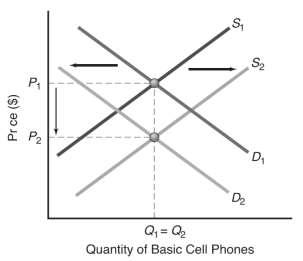
4-1. In recent years, technological improvements have greatly reduced the costs of producing smartphones, and a number of new firms have entered the smartphone industry. At the same time, prices of substitutes for smartphones, such as various tablet devices, have declined considerably. Construct a supply and demand diagram of the market for smartphones. Illustrate the impacts of these developments, and evaluate the effects on the market price and equilibrium quantity.
The ability to produce smartphones at lower cost and the entry of additional producers shift the supply curve rightward, from S1 to S2. At the same time, reduced prices of substitute devices result in a leftward shift in the demand for smartphones, from D1 to D2. Consequently, the equilibrium price of basic smartphones declines, from P1 to P2. The equilibrium quantity may rise, fall, or, as shown in the diagram, remain unchanged.
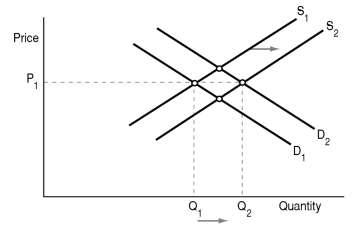
4-2. Advances in research and development in the pharmaceutical industry have enabled manufacturers to identify potential cures more quickly and therefore at lower cost. At the same time, the aging of our society has increased the demand for new drugs. Construct a supply and demand diagram of the market for pharmaceutical drugs. Illustrate the impacts of these developments, and evaluate the effects on the market price and the equilibrium quantity.
The ability to produce drugs at lower cost leads to an increase in the market supply of drugs, so the supply curve shifts rightward (from S1 to S2). At the same time, the increased demand for drugs by an aging population shifts the market demand curve rightward (from D1 to D2). Thus, the equilibrium quantity of drugs increases (from Q1 to Q2), but the market clearing price may rise, fall, or remain unchanged (as shown).
4-3. There are simultaneous changes in the demand for and supply of global-positioningsystem (GPS) devices, with the consequences being an unambiguous increase in the market clearing price of these devices but no change in the equilibrium quantity. What changes in the demand for and supply of GPS devices could have generated these outcomes? Explain.
Quantity of Smartphones