Test Bank for Economics and the Environment 10th Edition by Goodstein, Wong, Polasky
ISBN: 9781394307951
Student Review Questions
Chapter 1: Four Economic Questions About Climate Change
1. CO2 is a/n _____ a compound that traps reflected heat from the earth’s surface and contributes to global warming.
Answer: greenhouse gas
2. Increased warming beyond that would have steadily greater and greater costs and also could result in truly catastrophic outcomes from so-called _____ in the earth’s systems.
Answer: tipping points
3. This book focuses on the economic issues at stake in cases such as global warming, where human actions substantially alter the natural environment. In the process, this book examine the following four questions:
1.
2.
3.
4.
Answer
1. How much pollution is too much?
2. Is government up to the job?
3. How can we do better?
4. Can we resolve global issues?
4. Positive feedbacks in the environment have led some researchers to believe that at some point, global warming will trigger a _____, in which the initial warming will feed on itself.
Answer: runaway greenhouse effect
5. At a UN-sponsored meeting in France in 2015, almost all the countries in the world agreed to the _____, a set of voluntary commitments to cut global warming pollution.
Answer: Paris ClimateAgreement
6. Weighing benefits against costs is called _____.
Answer: benefit–cost analysis
7. _____ is a dollar measure of all the costs imposed on society of a ton of carbon dioxide released into the atmosphere today.
Answer: The social cost of carbon (SCC).
8. The _____ requires reducing pollution to (socially defined) “safe” levels, unless the costs of doing so are prohibitive.
Answer: safety standard
9. The _____ standard generally requires protecting major natural ecosystems from significant disruptions unless the costs of doing so are prohibitive.
Answer: sustainability
10. There are two obstacles to effective government action. What are they? 1. 2. Answer 1. Inperfect information
2. Opportunity for political influence
Chapter 1
Four Economic Issues about Global Warming
1.1 Introduction
1.2 How Much Pollution is Too Much?
1.3 Is Government Up to the Job?
1.4 How Can We Do Better?
1.5 How Can We Resolve Global Issues?
1.6 Summary
SUGGESTIONS AND SHORTCUTS
Dwelling on the benefit-cost or scientific details of climate change would eat up the whole term. The students should be looking at the big picture here.
WHAT’S NEW
The efficiency approach to climate change goals is now described through recent work estimating that the Social Cost of Carbon (SCC) is around $185. Students can grasp that from a benefit-cost perspective, actions to reduce emissions that cost less than $185 per ton make sense, those that cost more, do not. (Recognizing uncertainty around that estimate of course.) Trump’s withdrawals from the Climate Paris Agreement in 2025 starkly highlights differences in policy goals on climate.
Discussion Prompt, quick Student research in class: Does my state have any regulations on the emissions of greenhouse gas pollution? What sector is the biggest source of greenhouse gasses in my state? What economic sectors are most at risk from climate change in my state?
This chapter provides an introduction to the scientific issues surrounding the build-up of greenhouse gases in our atmosphere and the reality of significant global warming. However, the focus is not on specific environmental concerns arising from our economic activity. Instead, the point is to illustrate the framework that economists use for approaching pollution problems. For any such concern, from landfill siting, to chemical regulation, to loss of species diversity, three general questions must be answered:
1. How much pollution is too much?
2. Is government up to the job?
3. How can we do better?
When, as is increasingly common, the issue is an international one, a fourth question must also be addressed:
4. How can we resolve global issues?
The chapter outlines the questions raised and provided a sketch of the answers that arise when one grapples with the economics of environmental protection. As indicated, there is often lively debate among economists regarding the right answers. But what we do agree on is the centrality of these four questions.
Application 1.1 Setting Goals for Greenhouse Gas Pollution, Take One
Through UN treaties, countries have agreed that greenhouse gases be stabilized at a level that prevents “dangerous anthropogenic inter- ference” with the climate system. In an effort to help define what these means, O’Neil and Oppenheimer (2002) relate certain physical effects to rising temperature:
● At 2○ F, we can expect “large-scale eradication of coral reef systems” on a global basis.
● At 4○ F, an irreversible process leading to the collapse of the West Antarctic Ice Sheet and a sea-level rise of 25 feet becomes significantly more likely.
● At 6○ F, the shutdown of the Gulf Stream leading to sudden, dramatic cooling in Northern Europe and accelerated warming in the South Atlantic becomes significantly more likely.
The authors conclude that it is impossible to prevent a 2 degree warming. Based on the relationships above, they call for holding global temperature increases to less than 4 degrees.
a. Is this an efficiency, ecological sustainability, or safety standard? Why?
Answer
1. The 4 degree target is an ecological goal. The target is set only with reference to preventing significant ecological damage to our descendants, with no reference to the costs of achieving the goals.
Application 1.2 Setting Goals for Greenhouse Gas Pollution, Take Two
In 2018, the U.S. government released a study that estimated the costs to the country of two different global warming scenarios: one in which temperatures rose 9 degrees F above preindustrial levels, and another with a temperature increase of 4.3 degrees F. Table 1.1 estimates some of the increased costs Americans will bear as a consequence of this planetary warming.
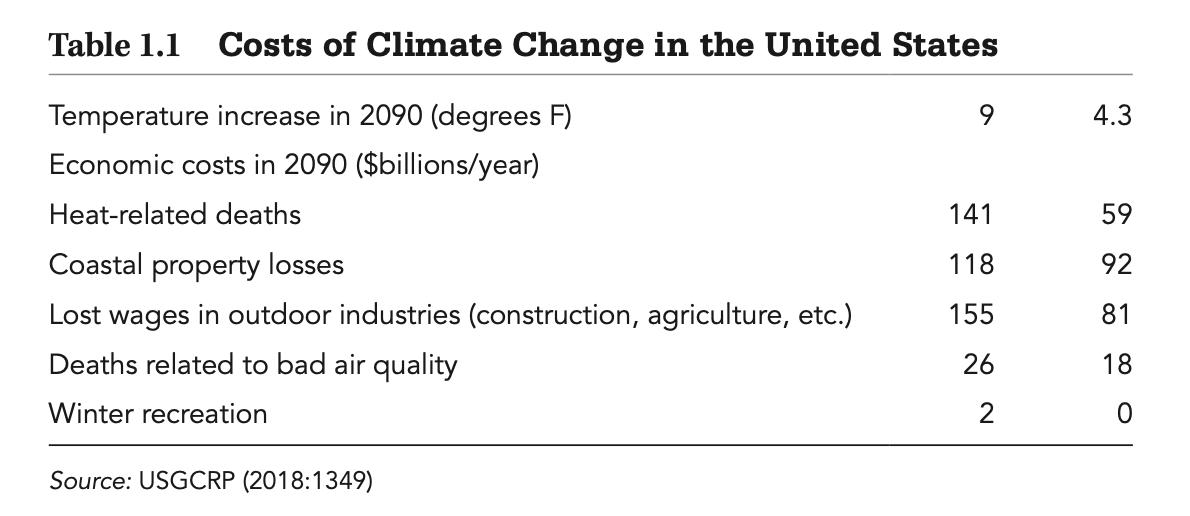
1. For these four categories, what are the estimated benefits in the year 2090 of holding global warming to 4.3 degrees F?
2. If we compared the monetary costs of reducing warming versus the monetary benefits of the kind you identified in part (a) to decide whether or not to reduce warming to 4.3 degrees, would our goal be efficiency, safety, or sustainability?
3. Consider the category related to winter recreation. The study projects a $2 billion per year decline in this sector by 2090 under the 9 degree F warming. Curiously, there is no predicted decline under the 4.3 degree scenario. The reason: with milder winters, more people are assumed to move north, and so more people recreate during the shorter season! Looking at outdoor recreation as a whole, William Nordhaus (discussed earlier in this chapter) argued that by 2100 there would actually be cumulative “net benefits” adding up all the yearly benefits and subtracting the yearly costs from now until 2100 of +$17 billion to outdoor recreation in the United States from a 4.3 degree warmer planet. How is this possible?
(Hint: what might happen to outdoor recreation in the medium term, as winter gets shorter? Consider golf for example.)
4. Digging deeper: in thinking about the costs of the planet heating up, is it fair to compare the losses to skiers and sledders of shorter seasons against the gains of golfers of longer seasons? Is it fair to compare the benefits gained in say the next 30 years when overall outdoor recreation may increase because winters are shorter, to the next thousand years,
when overall outdoor recreation will decrease because summers are too hot? If not, how do we decide what the overall costs of global warming will be?
Answers
1. The total damage costs from all four categories with 4.3 degrees of warming is $250 billion. The damages from 9 degrees of warming are $442 billion. The benefits of holding warming to 4.3 degrees rather then letting it rise to 9 degrees would be the reduction in damages: $442$250=$192.
2. Deciding goals based on a cost-benefit comparison implies an efficiency goal.
3. The answer would be: As the planet heats up, winters will be shorter, meaning there will be increased time for spring and fall outdoor recreation. At the same time, there would be a reduction in winter recreation (less snow) and mid-summer recreation (too hot). Initially, the first effect outweighs the second, leading to an overall increase in outdoor recreation.
4. This question has no clear answer. What is fair is socially determined on a case-by-case basis. The point here is that simply adding up overall costs and benefits does not address questions of who loses and who wins, and whether these outcomes are fair.
Multiple Choices
1. In 2020, most climate scientists believed that
a. the evidence for global warming remained somewhat flimsy.
b. carbon dioxide was the only human made source of the greenhouse effect.
c. the earth was likely to warm over the next 50 years as a consequence of greenhouse gas pollution.
d. belly button lint caused cancer.
e. atmospheric carbon dioxide levels were likely to stabilize naturally within 20 years.
2. Negative feedback effects on global warming
a. include exposure of dark earth as polar ice caps melt.
b. would accelerate the warming trend.
c. would slow down the warming trend.
d. would result if higher CO2 levels reduced the capacity of the ocean to absorb CO2.
e. are likely if the melting of frozen tundra increases the emission of methane gas into the atmosphere.
3. If global warming does occur, economic costs include
a. enhanced agricultural productivity in cold climates.
b. sea-level rise.
c. enhanced agricultural productivity, especially in poor countries.
d. a likely increase in the diversity of natural ecosystems, as warmer climates emerge.
e. b and d.
4. Benefit-cost analysis of global warming
a. has proven to be relatively uncontroversial.
b. suggests that on net, controlling CO2 emissions will generate higher costs than benefits.
c. is a scientific process, free of ethical decisions.
d. calls for at least moderate reductions in greenhouse gas emissions.
e. has created a consensus view among economists as to how fast new technologies can be developed.
5. Given that government regulators operate in a world of poor information, and are subject to political influence,
a. conservatives nevertheless concede that government intervention to protect the environment is generally socially beneficial.
b. conservatives seek an absolute minimum of government intervention.
c. progressives have faith that a laissez-faire attitude is best for the environment.
d. progressives view active government as both effective and necessary.
e. b and d.
6. Incentive-based regulatory approaches, such as pollution taxes
a. are viewed positively by most economists-- both progressive and conservative- as a way to control pollution.
b. provide less flexibility than traditional technology-based regulation.
c. tend to hurt wealthier people more than poor people.
d. would be sufficient, in the eyes of progressive economists, to control global warming.
e. require that the government specify certain types of pollution control technology that firms must adopt.
Answers to Multiple Choice: c,c,b,d,e,a.