Solutions Manual for Accounting Principles 15th Edition by Weygandt, Kimmel, Mitchell
ISBN: 9781394254798
ISBN: 9781394254798
1. Identify the activities and users associated with accounting.
2. Explain the building blocks of accounting: ethics, principles, and assumptions.
3. State the accounting equation, and define its components.
4. Analyze the effects of business transactions on the accounting equation.
5. Describe the four financial statements and how they are prepared.
*6. Explain the career opportunities in accounting.
*Note: All asterisked Questions, Brief Exercises, Exercises, and Problems relate to material contained in the appendix*to the chapter.
1. This is true. Virtually every organization and person in our society uses accounting information. Businesses, investors, creditors, government agencies, and not-for-profit organizations must use accounting information to operate effectively.
LO1 BT: C Difficulty: Easy TOT: 2 min. AACSB: None AICPA FC: Reporting
2. Accounting is the process of identifying, recording, and communicating the economic events of an organization to interested users of the information. The first activity of the accounting process is to identify economic events that are relevant to a particular business. Once identified and measured, the events are recorded to provide a history of the financial activities of the organization. Recording consists of keeping a chronological diary of these measured events in an orderly and systematic manner. The information is communicated through the preparation and distribution of accounting reports, the most common of which are called financial statements. A vital element in the communication process is the accountant’s ability and responsibility to analyze and interpret the reported information.
LO1 BT: C Difficulty: Easy TOT: 4 min. AACSB: None AICPA FC: Reporting
3. (a) Internal users are those who plan, organize, and run the business and therefore are officers and other decision makers.
(b) To assist management, managerial accounting provides internal reports. Examples include financial comparisons of operating alternatives, projections of income from new sales campaigns, and forecasts of cash needs for the next year.
LO1 BT: C Difficulty: Easy TOT: 2 min. AACSB: None AICPA FC: Reporting
4. (a) Investors (owners) use accounting information to make decisions to buy, hold, or sell ownership shares of a company.
(b) Creditors use accounting information to evaluate the risks of granting credit or lending money.
LO1 BT: C Difficulty: Easy TOT: 2 min. AACSB: None AICPA FC: Reporting
5. This is false. Bookkeeping usually involves only the recording of economic events and therefore is just one part of the entire accounting process. Accounting, on the other hand, involves the entire process of identifying, recording, and communicating economic events.
LO1 BT: C Difficulty: Easy TOT: 2 min. AACSB: None AICPA FC: Reporting
6. Benton Travel Agency should report the land at $90,000 on its December 31, 2027 balance sheet. This is true not only at the time the land is purchased, but also over the time the land is held. In determining which measurement principle to use (historical cost or fair value) companies weigh the factual nature of cost figures versus the relevance of fair value. In general, companies use historical cost. Only in situations where assets are actively traded do companies apply the fair value principle.
LO2 BT: C Difficulty: Easy TOT: 4 min. AACSB: None AICPA FC: Reporting
7. The monetary unit assumption requires that only transaction data that can be expressed in terms of money be included in the accounting records. This assumption enables accounting to quantify (measure) economic events.
LO2 BT: K Difficulty: Easy TOT: 2 min. AACSB: None AICPA FC: Reporting
8. The economic entity assumption requires that the activities of the entity be kept separate and distinct from the activities of its owners and all other economic entities.
LO2 BT: K Difficulty: Easy TOT: 2 min. AACSB: None AICPA FC: Reporting
9. The three basic forms of business organizations are: (1) proprietorship, (2) partnership, and (3) corporation.
LO2 BT: K Difficulty: Easy TOT:1 min. AACSB: None AICPA FC: Reporting
10. One of the advantages Helen Rupp would enjoy is that ownership of a corporation is represented by transferable shares of stock. This would allow Helen to raise money easily by selling a part of her ownership in the company. Another advantage is that because holders of the shares (stockholders) enjoy limited liability; they are not personally liable for the debts of the corporate entity. Also, because ownership can be transferred without dissolving the corporation, the corporation enjoys an unlimited life.
LO2 BT: K Difficulty: Easy TOT: 4 min. AACSB: None AICPA FC: Reporting
11. The basic accounting equation is Assets = Liabilities + Owner’s Equity.
LO3 BT: K Difficulty: Easy TOT: 1 min. AACSB: None AICPA FC: Measurement
12. (a) Assets are resources owned by a business. Liabilities are creditor claims against assets. Put more simply, liabilities are existing debts and obligations. Owner’s equity is the ownership claim on total assets.
(b) Owner’s equity is affected by owner’s investments, drawings, revenues, and expenses.
LO3 BT: C Difficulty: Easy TOT: 2 min. AACSB: None AICPA FC: Reporting
13. The liabilities are: (b) Accounts payable and (g) Salaries and wages payable.
LO3 BT: C Difficulty: Easy TOT: 1 min. AACSB: None AICPA FC: Reporting
14. Yes, a business can enter into a transaction in which only the left side of the accounting equation is affected. An example would be a transaction where an increase in one asset is offset by a decrease in another asset. An increase in the Equipment account which is offset by a decrease in the Cash account is a specific example.
LO4 BT: C Difficulty: Moderate TOT: 3 min. AACSB: None AICPA FC: Reporting
15. Business transactions are the economic events of the enterprise recorded by accountants because they affect the basic accounting equation.
(a) The death of the owner of the company is not a business transaction as it does not affect of the components of the basic accounting equation.
(b) Supplies purchased on account is a business transaction as it affects the basic accounting equation.
(c) An employee being fired is not a business transaction as it does not affect any of the components of the basic accounting equation.
(d) A withdrawal of cash by the owner from the business is a business transaction as it affects the basic accounting equation.
LO4 BT: C Difficulty: Moderate TOT: 4 min. AACSB: None AICPA FC: Reporting
16. (a) Decrease assets and decrease owner’s equity.
(b) Increase assets and decrease assets.
(c) Increase assets and increase owner’s equity.
(d) Decrease assets and decrease liabilities.
LO4 BT: C Difficulty: Moderate TOT: 3 min. AACSB: None AICPA FC: Reporting
17. (a) Income statement. (d) Balance sheet. (b) Balance sheet. (e) Balance sheet and owner’s equity statement. (c) Income statement. (f) Balance sheet.
LO5 BT: C Difficulty: Easy TOT: 2 min. AACSB: None AICPA FC: Reporting
18. No, this treatment is not proper. While the transaction does involve a receipt of cash, it does not represent revenues. Revenues are the gross increase in owner’s equity resulting from business activities entered into for the purpose of earning income. This transaction is simply an additional investment made by the owner in the business; it increases Cash and Owner’s Capital.
LO4 BT: C Difficulty: Moderate TOT: 3 min. AACSB: None AICPA FC: Reporting
19. Yes. Net income does appear on the income statement it is the result of subtracting expenses from revenues. In addition, net income appears in the owner’s equity statement it is shown as an addition to the beginning-of-period capital. Indirectly, the net income of a company is also included in the balance sheet. It is included in the end-of-period capital which appears in the owner’s equity section of the balance sheet.
LO5 BT: C Difficulty: Moderate TOT: 4 min. AACSB: None AICPA FC: Reporting
20. (a)
($189,000 – $186,000 = $3,000) (End. cap. bal. – Beg. cap. bal. = Net inc.)
($189,000 – $186,000 – $13,000 = ($10,000)) (End. cap. bal. – Beg. cap. bal. – Invest. = Net. loss)
LO5 BT: AP Difficulty: Moderate TOT: 4 min. AACSB: Analytic AICPA FC: Reporting
21. (a) Total revenues ($20,000 + $70,000) ................................................................ $90,000
($20,000 + $70,000 = $90,000) (Cash rev. + Rev. on acct. = Tot. rev.)
(b) Total expenses ($26,000 + $40,000) $66,000
($26,000 + $40,000 = $66,000) (Cash exp. + Exp. on acct. = Tot. exp.)
(c) Total revenues $90,000 Total expenses................................................................................................. 66,000 Net income $24,000
($90,000 – $66,000 = $24,000) (Tot. rev. – Tot. exp. = Net inc.)
LO5 BT: AP Difficulty: Moderate TOT: 4 min. AACSB: Analytic AICPA FC: Reporting
22. Apple’s accounting equation (in millions) at September 28, 2019 was $338,516 = $248,028 + $90,488
($338,516 = $248,028+ $90,488) (Tot. assets = Tot. liabl. + Tot. stkhldrs. equity)
LO3 BT: AP Difficulty: Moderate TOT: 3 min. AACSB: Analytic AICPA FC: Reporting
(a) $90,000 – $50,000 = $40,000 (Owner’s Equity).
($90,000 - $50,000 = $40,000)
(Assets – Liabl. = Owner’s equity)
(b) $44,000 + $70,000 = $114,000 (Assets).
($44,000 + $70,000 = $114,000)
(Liabl. + Owner’s equity = Assets)
(c) $94,000 – $53,000 = $41,000 (Liabilities).
($94,000 - $53,000 = $41,000)
(Assets – Owner’s equity = Liabl.)
LO3 BT: AP Difficulty: Easy TOT: 3 min. AACSB: Analytic AICPA FC: Reporting
(a) $120,000 + $230,000 = $350,000 (Total assets).
($120,000 + $230,000 = $350,000)
(Liabl. + Owner’s equity = Assets)
(b) $190,000 – $89,000 = $101,000 (Total liabilities).
($190,000 - $89,000 = $101,000)
(Assets – Owner’s equity = Liabl.)
(c) $900,000 – 0.5($900,000) = $450,000 (Owner’s equity).
[$900,000 – ($900,000 x .5) = $450,000]
[Assets – (Assets x .5) = Owner’s equity]
LO3 BT: AP Difficulty: Easy TOT: 3 min. AACSB: Analytic AICPA FC: Reporting
BRIEF EXERCISE 1.3
(a) ($800,000 + $150,000) – ($300,000 – $60,000) = $710,000 (Owner’s equity).
[($800,000 + $150,000) – ($300,000 - $60,000) = $710,000]
[(Beg. assets + Incr. in assets) – (Beg. liabl. – Decr. in liabl) = End. owner’s equity]
(b) ($300,000 + $100,000) + ($800,000 – $300,000 – $70,000) = $830,000 (Assets).
[($300,000 + $100,000) + ($800,000 - $300,000 - $70,000) = $830,000]
[(Beg. liabl. + Incr. in liabl.) + (Beg. assets – Beg. liabl. – Decr. in owner’s equity) = End. assets]
(c) ($800,000 – $80,000) – ($800,000 – $300,000 + $120,000) = $100,000 (Liabilities).
[($800,000 - $80,000) – ($800,000 - $300,000 + $120,000) = $100,000]
[(Beg. assets – Decr. in assets) – (Beg. assets – Beg. liabl. + Incr. in owner’s equity) = End. liabl.]
LO3 BT: AP Difficulty: Moderate TOT: 4 min. AACSB: Analytic AICPA FC: Reporting
(a)
Owner’s Equity
Assets = Liabilities + Owner’s Capital –Owner’s Drawings + Revenues – Expenses
X = $90,000 + $150,000 – $40,000 + $450,000 – $340,000
X = $90,000 + $220,000
X = $310,000
(Assets = $90,000 + $150,000 - $40,000 + $450,000 - $340,000)
(Assets = Liabl. + Owner’s cap. – Owner’s draw. + Rev. – Exp.)
(b)
$57,000 = X + $35,000 – $7,000 + $52,000 – $35,000
$57,000 = X + $45,000
X = $12,000
($57,000 = Liabl. + $35,000 - $7,000 + $52,000 - $35,000)
(Assets = Liabl. + Owner’s cap. – Owner’s draw. + Rev. – Exp.)
(c) $660,000 = ($660,000 x 2/3) + X (Owner’s equity)
$660,000 = $440,000 + X
X = $220,000
[$660,000 = ($660,000 x 2/3) + Owner’s equity]
[Assets = (Assets x 2/3) + Owner’s equity]
LO3 BT: AP Difficulty: Moderate TOT: 5 min. AACSB: Analytic AICPA FC: Reporting
BRIEF EXERCISE 1.5 A (a) Accounts receivable
Supplies L (b) Salaries and wages payable
(c) Equipment
(e) Owner’s capital
(f) Notes payable
BT: C Difficulty: Easy TOT: 2 min. AACSB: None AICPA FC: Reporting
BRIEF EXERCISE 1.6
E (a) Advertising expense D (e) Owner’s drawings R (b) Service revenue R (f) Rent revenue
E (c) Insurance expense E (g) Utilities expense E (d) Salaries and wages expense
LO3 BT: C Difficulty: Easy TOT: 3 min. AACSB: None AICPA FC: Reporting
BRIEF EXERCISE 1.7
LO4 BT: C Difficulty: Easy TOT: 3 min. AACSB: None AICPA FC: Reporting
BRIEF EXERCISE 1.8
*Cash increased and Accounts Receivable decreased; total Assets were unchanged.
LO4 BT: C Difficulty: Easy TOT: 3 min. AACSB: None AICPA FC: Reporting
BRIEF EXERCISE 1.9
R (a) Received cash for services performed. NOE (b) Paid cash to purchase equipment. E (c) Paid employee salaries.
LO4 BT: C Difficulty: Easy TOT: 1 min. AACSB: None AICPA FC: Reporting
[($49,000 + $62,500) = $90,000 + $21,500] [(Cash + Accts. rec.) = Accts. pay. + Owner’s cap.]
LO5 BT: AP Difficulty: Easy TOT: 4 min. AACSB: Analytic AICPA FC: Reporting
BRIEF EXERCISE 1.11
BS (a) Notes payable IS (b) Advertising expense
OE, BS (c) Owner’s capital BS (d) Cash IS (e) Service revenue
LO5 BT: C Difficulty: Easy TOT: 3 min. AACSB: None AICPA FC: Reporting
DO IT! 1.1
1. False. The three steps in the accounting process are identification, recording, and communication.
2. True.
3. False. Financial accounting provides reports to help investors and creditors evaluate a company.
4. True.
5. True.
LO1 BT: K Difficulty: Easy TOT: 3 min. AACSB: None AICPA FC: Reporting
DO IT! 1.2
1. False. Congress passed the Sarbanes-Oxley Act to reduce unethical behavior and decrease the likelihood of future corporate scandals.
2. False. The standards of conduct by which actions are judged as right or wrong, honest or dishonest, fair or not fair, are ethics.
3. False. The primary accounting standard-setting body in the United States is the Financial Accounting Standards Board (FASB).
4. True.
5. True.
LO2 BT: K Difficulty: Easy TOT: 4 min. ACSB: None AICPA FC: Reporting
DO IT! 1.3
1. Drawings is owner’s drawings (D); it decreases owner’s equity.
2. Rent revenue is revenue (R); it increases owner’s equity.
3. Advertising expense is an expense (E); it decreases owner’s equity.
4. When the owner puts personal assets into the business, it is investment by owner (I); it increases owner’s equity.
LO3 BT: AP Difficulty: Easy TOT: 6 min. AACSB: None AICPA FC: Reporting
(a) The total assets are $49,000, comprised of Cash $6,500, Accounts Receivable $13,500, and Equipment $29,000.
($6,500 + $13,500 + $29,000 = $49,000)
(Cash + Accts. rec. + Equip. = Tot. assets)
(b) Net income is $20,500, computed as follows:
[$53,500 – ($16,500 + $10,500 + $6,000) = $20,500]
[Serv. rev. – (Sal. & wages exp. + Rent exp. + Advert. exp) = Net inc.]
(c) The ending owner’s equity balance of Kirby Company is $21,000. By rewriting the accounting equation, we can compute Owner’s Equity as Assets minus Liabilities, as follows:
[as computed in (a)] ............................. $49,000
Note that it is not possible to determine the company’s owner’s equity in any other way, because the beginning balance for owner’s equity is not provided.
[$49,000 – ($25,000 + $3,000) = $21,000]
[Tot. assets – (Notes pay. + Accts. pay.) = Owner’s equity] LO 5 BT: AP Difficulty: Moderate TOT: 10 min. AACSB: Analytic AICPA FC: Reporting
EXERCISE 1.1
C Analyzing and interpreting information.
R Classifying economic events.
C Explaining uses, meaning, and limitations of data.
R Keeping a systematic chronological diary of events.
R Measuring events in dollars and cents.
C Preparing accounting reports.
C Reporting information in a standard format.
I Selecting economic activities relevant to the company.
R Summarizing economic events.
LO1 BT: C Difficulty: Moderate TOT: 6 min. AACSB: None
EXERCISE 1.2
(a) Internal users
Marketing manager
Production supervisor
Store manager
Vice-president of finance
External users
Customers
Internal Revenue Service
Labor unions
Securities and Exchange Commission
Suppliers
Reporting
(b) I Can we afford to give our employees a pay raise?
E Did the company earn a satisfactory income?
I Do we need to borrow in the near future?
E How does the company’s profitability compare to other companies?
I What does it cost us to manufacture each unit produced?
I Which product should we emphasize?
E Will the company be able to pay its short-term debts?
LO1 BT: C Difficulty: Simple TOT: 6 min. AACSB: None AICPA FC: Reporting
Angela Duffy, president of Duffy Company, instructed Jana Barth, the head of the accounting department, to report the company’s land in its accounting reports at its fair value of $170,000 instead of its cost of $100,000, in an effort to make the company appear to be a better investment. The historical cost principle requires that assets be recorded and reported at their cost, because cost is faithfully representative and can be objectively measured and verified. In this case, the historical cost principle should be used and Land reported at $100,000, not $170,000.
The stakeholders include stockholders and creditors of Duffy Company, potential stockholders and creditors, other users of Duffy’s accounting reports, Angela Duffy, and Jana Barth. All users of Duffy’s accounting reports could be harmed by relying on information that may be unreliable. Angela Duffy could benefit if the company is able to attract more investors but would be harmed if the inappropriate reporting is discovered. Similarly, Jana Barth could benefit by pleasing her boss, but would be harmed if the inappropriate reporting is discovered.
Jana’s alternatives are to report the land at $100,000 or to report it at $170,000. Reporting the land at $170,000 is not appropriate since it may mislead many people who rely on Duffy’s accounting reports to make financial decisions. Jana should report the land at its cost of $100,000. She should try to convince Angela Duffy that this is the appropriate course of action, but be prepared to resign her position if Duffy insists.
LO2 BT: C Difficulty: Moderate TOT: 8 min. AACSB: None AICPA FC: Reporting
1. Incorrect. The historical cost principle requires that assets (such as buildings) be recorded and reported at their cost.
2. Correct. The monetary unit assumption requires that companies include in the accounting records only transaction data that can be expressed in terms of money.
3. Incorrect. The economic entity assumption requires that the activities of the entity be kept separate and distinct from the activities of its owner and all other economic entities.
LO2 BT: C Difficulty: Moderate TOT: 6 min. AACSB: None AICPA FC: Reporting
Cash Accounts payable
Equipment
Supplies
Accounts receivable
Notes payable
Salaries and wages payable
Owner’s capital
LO3 BT: C Difficulty: Easy TOT: 4 min. AACSB: None AICPA FC: Reporting EXERCISE 1.6
1.
2.
3.
4.
Increase in assets and increase in owner’s equity.
Decrease in assets and decrease in owner’s equity.
Increase in assets and increase in liabilities.
Increase in assets and increase in owner’s equity.
5. Decrease in assets and decrease in owner’s equity.
6. Increase in assets and decrease in assets.
7. Increase in liabilities and decrease in owner’s equity.
8. Increase in assets and decrease in assets.
9.
Increase in assets and increase in owner’s equity.
LO4 BT: C Difficulty: Easy TOT: 7 min. AACSB: None AICPA FC: Reporting
EXERCISE 1.7
1. (c) 5. (d)
2. (d) 6. (b)
3. (a) 7. (e) 4. (b) 8. (f) LO4 BT: C Difficulty: Easy TOT: 5 min. AACSB: None AICPA FC: Reporting EXERCISE 1.8
(a)
1. Owner invested $15,000 cash in the business.
2. Purchased equipment for $5,000, paying $2,000 in cash and the balance of $3,000 on credit.
3. Paid $750 cash for supplies.
4. Performed $8,500 of services, receiving $4,000 cash and $4,500 on account.
5. Paid $1,500 cash on accounts payable.
6. Owner withdrew $2,000 cash for personal use.
7. Paid $560 cash for rent.
8. Collected $450 cash from customers on account.
9. Paid salaries and wages of $4,800.
10. Incurred $400 of utilities expense on account.
+ Util. exp.) = Net inc.] LO4 BT: AP Difficulty: Moderate TOT: 15 min. AACSB: Analytic AICPA FC: Reporting
1.9
– ($4,800 + $560 + $400) = $2,740] [Serv. rev. – (Sal. & wages exp. + Rent exp. + Util. exp.) = Net inc.]
[$0 + ($15,000 + $2,740) - $2,000 = $15,740] [Beg. owner’s cap. + (Invest. + Net inc.) – Owner’s draw. = End. owner’s cap.]
[($7,840 + $4,050 + $750 + $5,000) = ($1,900 + $15,740)] [(Cash + Accts. rec. + Supp. + Equip.) = Accts. pay. + Owner’s cap.] LO5 BT: AP Difficulty: Easy TOT: 15 min. AACSB: Analytic AICPA FC: Reporting
[($400,000 - $250,000) - $100,000 + $12,000 = $62,000] [(End. assets – End. liabl.) – Owner’s invest. + Owner’s draw. = Net inc.]
[($460,000 - $300,000) - $150,000 - $34,000 = $(24,000)
($110,000 - $85,000 = $25,000) (Beg. tot. assets – Beg. tot. liabl. = Beg. owner’s equity)
($40,000 - $25,000 = $15,000); ($220,000 - $175,000 = $45,000); [$15,000 – ($45,000 - $37,000) = $7,000] (End. tot. owner’s equity – Beg. tot. owner’s equity = Incr. in owner’s equity); (Tot. rev. – Tot. exp. = Net inc.); [Incr. in owner’s equity – (Net inc. – Owner’s draw.) = Addl. invest.]
(beginning of
($129,000 - $80,000 = $49,000) (Beg. tot. assets – Beg. tot. owner’s equity = Beg. tot. liabl.)
15,000 ($130,000 - $80,000 = $50,000); ($100,000 - $60,000 = $40,000); [$50,000 – ($40,000 + $25,000) = $15,000] (End. owner’s equity – Beg. owner’s equity = Incr. in owner’s equity); (Tot. rev. – Tot. exp. = Net inc.); (Incr. in owner’s equity – (Net inc. + Addl. invest.) = Owner’s draw.] LO5 BT: AN Difficulty: Moderate TOT: 8 min. AACSB: Analytic AICPA FC: Reporting
FLEETE CO. Owner’s Equity Statement For the Year Ended December 31, 2027
($42,000 + $18,100 - $6,000 = $54,100) (Beg. owner’s cap. + Net inc. – Owner’s draw. = End. owner’s cap.) LO5 BT: AP Difficulty: Moderate TOT: 10 min. AACSB: Analytic AICPA FC: Reporting
CHENG COMPANY
1.13
Liabilities and Owner’s Equity
[($15,000 + $6,500 + $8,000 + $46,000) = $21,000 + ($67,500 - $13,000)} [(Cash + Accts. rec. + Supp. + Equip.) = Accts. pay. + (Owner’s cap. – Owner’s draw.)]
LO5 BT: AN Difficulty: Easy TOT: 10 min. AACSB: Analytic AICPA FC: Reporting
1.14 (a)
[($140,000 + $65,000) - $160,000 = $45,000] [(Camp. fee rev. + Gen. store rev.) – Exp. = Net inc.]
[($23,000 + $17,500 + $115,500) = ($60,000 + $11,000) + ($156,000 - $71,000)] [(Cash + Accts. rec. + Equip.) = (Notes pay. + Accts. pay.) + Owner’s cap.)] LO5 BT: AP Difficulty: Easy TOT: 12 min. AACSB: Analytic AICPA FC: Reporting
(c) Assets, December 31, 2027................................................... $168,000 Less: Liabilities, December 31, 2027.................................... 100,000 Capital, December 31, 2027................................................... $ 68,000
[($98,000 - $62,000) + ($330,000 - $211,000) - $87,000 = $68,000]
[(Beg. assets – Beg. liabl.) + (Legal serv. rev. – Tot. exp.) – Owner’s draw. = End. owner’s cap.]
LO5 BT: AP Difficulty: Moderate TOT: 8 min. AACSB: Analytic AICPA FC: Reporting
EXERCISE 1.17
Statement of Cash Flows For the Year Ended December 31, 2027
Cash
from operating activities
LO5 BT: AP Difficulty: Moderate TOT: 6 min. AACSB: Analytic AICPA FC: Reporting
EXERCISE 1.18
Transactions 4, 5, and 7 are operating activities. Transaction 3 is an investing activity.
Transactions 1, 2, and 6 are financing activities.
LO5 BT: C Difficulty: Easy TOT: 4 min. AACSB: None AICPA FC: Reporting
..............................................
[$10,000 – ($2,500 + $700 + $600) = $6,200] [Serv. rev. – (Sal. & wages exp. + Advert. exp. + Rent exp.) = Net inc. LO 3, 4 BT: AP Difficulty: Moderate TOT: 45 min. AACSB: Analytic AICPA FC: Reporting
SONYA JARED, ATTORNEY AT LAW Income Statement For the Month Ended August 31, 2027
[$7,500 – ($2,800 + $900 + $400 + $270) = $3,130] [Serv. rev. – (Sal. & wages exp. + Rent exp. + Advert. exp. + Util. exp.) = Net inc.] SONYA JARED, ATTORNEY AT LAW Owner’s Equity Statement For the Month Ended August 31, 2027
($8,800 + $3,130 - $700 = $11,230) (Beg. owner’s cap. + Net inc. – Owner’s draw. = End. owner’s cap.)
[($4,200 + $3,800 + $500 + $8,000) = ($2,000 + $3,270) + $11,230] [(Cash + Accts. rec. + Supp. + Equip.) = (Notes pay. + Accts. pay) + Owner’s cap.] LO 4, 5 BT: AP Difficulty: Moderate TOT: 55 min. AACSB: Analytic AICPA FC: Reporting
[$6,500 – ($1,600 + $500 + $200 + $150) = $4,050] [Serv. rev. – (Rent exp. + Advert. exp. + Gas. exp. + Util. exp.) = Net inc.]
[$0 + ($12,000 + $4,050) – $1,300 = $14,750] [Beg. owner’s cap. + (Invest. + Net inc.) – Owner’s draw. = End. owner’s cap.]
[($6,500 + $900) – ($1,600 + $500 + ($200 + $150) + $150) = $4,800] [Serv. rev. – (Rent exp. + Advert. exp. + Gas. exp. + Util. exp.) = Net inc.]
Owner’s Equity Statement For the Month Ended June 30, 2027
Owner’s capital, June 1 ...................................... $ 0 Add:
16,800 Less: Drawings .................................................. 1,300
Owner’s capital, June 30 .................................... $15,500 [$0 + ($12,000 + $4,800) - $1,300 = $15,500] [Beg. owner;s cap. + (Invest. + Net inc.) – Owner’s draw. = End. owner’s cap.] LO5 BT: AP Difficulty: Moderate TOT: 55 min. AACSB: Analytic AICPA FC: Reporting
(b) MAISIE
Income Statement For the Month Ended May 31, 2027
[$10,400 – ($2,500 + $900 + $275 + $125) = $6,600] [Serv. rev. – (Sal. & wages exp. + Rent exp. + Util. exp. + Advert. exp.) = Net inc.] (c) MAISIE CONSULTING Balance Sheet May 31, 2027
*($7,000 + $6,600 – $1,000)
[($14,600 + $2,400 +$800 + $4,200) = ($5,000 + $4,400) + ($7,000 + $6,600 - $1,000)] [(Cash + Accts. rec. + Supp. + Equip.) = (Notes pay. + Accts. pay.) + Owner’s cap.] LO4, 5 BT: AP Difficulty: Moderate TOT: 45 min. AACSB: Analytic AICPA FC: Reporting
(a) ($80,000 - $41,000 = $39,000); (1/1/27 Assets – 1/1/27 Liabl. = 1/1/27 Owner’s equity)
(b) ($60,000 + $50,000 = $110,000); (12/31/27 Liabl. + 12/31/27 Owner’s equity = 12/31/27 Assets)
(c) [$50,000 – ($39,000 + ($350,000 - $333,000) - $15,000) = $9,000]; [End. owner’s equity – (Beg. owner’s equity + (Rev. – Exp.) – Draw. = Add’l invest.]
(d) ($90,000 - $40,000 = $50,000); (1/1/27 Assets – 1/1/27 Owner’s equity = 1/1/27 Liabl.)
(e) ($112,000 - $72,000 = $40,000); (12/31/27 Assets – 12/31/27 Liabl. = 12/31/27 Owner’s equity)
(f) [$40,000 – ($40,000 + ($410,000 - $385,000) + $8,000) = $33,000]; [12/31/27 Owner’s equity – (Beg. owner’s equity + (Rev. – Exp.) + Invest.) = Draw.]
(g) ($80,000 + $49,000 = $129,000); (1/1/27 Liabl. + 1/1/27 Owner’s equity = 1/1/27 Assets)
(h) ($170,000 - $82,000 = $88,000); (12/31/27 Assets – 12/31/27 Owner’s equity = 12/31/27 Liabl.)
(i) [($82,000 - $49,000) + $350,000 - $10,000 + $12,000 = $385,000]; [(12/31/27 Owner’s equity – 1/1/27 Owner’s equity) + Exp. – Add’l. invest. + Draw. = Rev.]
(j) ($150,000 - $90,000 = $60,000); (1/1/27 Assets – 1/1/27 Owner’s equity = 1/1/27 Liabl.)
(k) ($100,000 + $151,000 = $251,000); (12/31/27 Liabl. + 12/31/27 Owner’s equity = 12/31/27 Assets)
(l) ($90,000 - $151,000 + $15,000 - $10,000 + $500,000 = $444,000); (1/1/27 Owner’s equity – 12/31/27 Owner’s equity + Add’l. invest. – Draw. + Rev. = Exp.)
(b)
Owner’s capital, December 31 ............................ $50,000
[$39,000 + ($9,000 + $17,000) - $15,000 = $50,000] [Beg. owner’s cap. + (Invest. + Net inc.) – Owner’s draw. = End. owner’s cap ]
(c) TO:
The sequence of preparing financial statements is income statement, owner’s equity statement, and balance sheet. The interrelationship of the owner’s equity statement to the other financial statements results from the fact that net income from the income statement is reported in the owner’s equity statement and ending capital reported in the owner’s equity statement is the amount reported for owner’s equity on the balance sheet.
LO4, 5 BT: AP Difficulty: Moderate TOT: 45 min. AACSB: Analytic AICPA FC: Reporting AICPA PC: Communication
(a) Natalie has a choice between a sole proprietorship and a corporation. A partnership is not an option since she is the sole owner of the business.
A proprietorship is the easiest to create and operate because there are no formal procedures involved in creating the proprietorship. However, if she operates the business as a proprietorship she will personally have unlimited liability for the debts of the business. Operating the business as a corporation would limit her liability to her investment in the business. Natalie will in all likelihood require the services of a lawyer to incorporate. Costs to incorporate as well as additional ongoing costs to administrate and operate the business as a corporation may be costly.
My recommendation is that Natalie choose the proprietorship form of business organization. This is a very small business where the cost of incorporating outweighs the benefits of incorporating at this point in time. Furthermore, it will be easier to stop operating the business if Natalie decides not to continue with it once she has finished college.
(b) Yes, Natalie will need accounting information to help her operate her business. She will need information on her cash balance on a daily or weekly basis to help her determine if she can pay her bills. She will need to know the cost of her services so she can establish her prices. She will need to know revenue and expenses so she can report her net income for income tax purposes, on an annual basis. If she borrows money, she will need financial statements so lenders can assess the liquidity, solvency, and profitability of the business. Natalie would also find financial statements useful to better understand her business and identify any financial issues as early as possible. Monthly financial statements would be best because they are timelier, but they are also more work to prepare.
(c) Assets: Cash, Accounts Receivable, Supplies, Equipment, Prepaid Insurance
Liabilities: Accounts Payable, Notes Payable
Owner’s Equity: Owner’s Capital, Owner’s Drawings
Revenue: Service Revenue
Expenses: Advertising Expense, Rent Expense, Utilities Expense
(d) Natalie should have a separate bank account. This will make it easier to prepare financial statements for her business. The business is a separate entity from Natalie and must be accounted for separately. LO1 BT: C Difficulty: Moderate TOT: 45 min. AACSB: None AICPA FC: Reporting AICPA PC: Communication
(a) The students should identify all of the stakeholders in the case; that is, all the parties that are affected, either beneficially or negatively, by the action or decision described in the case. The list of stakeholders in this case is:
Travis Chase, interviewee.
Both Baltimore firms.
Great Northern College.
(b) The students should identify the ethical issues, dilemmas, or other considerations pertinent to the situation described in the case. In this case the ethical issues are:
Is it proper that Travis charged both firms for the total travel costs rather than split the actual amount of $296 between the two firms?
Is collecting $592 as reimbursement for total costs of $296 ethical behavior?
Did Travis deceive both firms or neither firm?
(c) Each student must answer the question for himself/herself. Would you want to start your first job having deceived your employer before your first day of work? Would you be embarrassed if either firm found out that you double-charged? Would your school be embarrassed if your act was uncovered? Would you be proud to tell your professor that you collected your expenses twice?
LO2 BT: E Difficulty: Easy TOT: 12 min. AACSB: Ethics AICPA FC: Reporting AICPA PC: Ethical conduct, Communication
(a) Apple’s total assets at September 28, 2019 were $338,516 million and at September 29, 2018 were $365,725 million.
(b) Apple had $48,844 million of cash and cash equivalents at September 28, 2019.
(c) Apple had accounts payable totaling $46,236 million on September 28, 2019 and $55,888 million on September 29, 2018.
(d) Apple reports net sales for three consecutive years as follows:
2017 $229,234 million
2018 $265,595 million
2019 $260,174 million
(e) From 2018 to 2019, Apple’s net income decreased $4,275 million from $59,531 million to $55,256 million.
LO5 BT: AN Difficulty: Easy TOT: 12 min. AACSB: Analytic AICPA FC: Reporting
(a) (in millions)
1.
2.
3.
4.
(b) Coca-Cola’s total assets were approximately 10% greater than PepsiCo’s total assets, but PepsiCo’s net revenues were 80% greater than Coca-Cola’s net revenues. PepsiCo’s accounts receivable were 97% greater than Coca-Cola’s and represent 12% of its net revenues. Coca-Cola’s accounts receivable amount to 11% of its net revenues. This is an indication that both companies are doing equally well at managing their accounts receivable
Coca-Cola’s net income is 22% greater than PepsiCo’s. It appears that these two companies’ operations are comparable in some ways, with Coca-Cola’s operations slightly more profitable.
LO5 BT: E Difficulty: Easy TOT: 15 min. AACSB: Analytic AICPA FC: Reporting AICPA PC: Communication
(a) (in millions) Amazon Walmart
1. Total assets $225,248 $236,495
2. Accounts receivable (net) $ 20,816 $ 6,284
3. Net sales (product only) $160,408 $519,926
4. Net income (loss) $ 11,588 $ 15,201
(b) Walmart’s total assets were approximately 5% greater than Amazon’s total assets, and Walmart’s net sales were over 324% greater than Amazon’s net product sales. Walmart’s accounts receivable were roughly 3.3 times less than Amazon’s and represent 1% of its net sales. Amazon’s accounts receivable amount to approximately 13% of its net product sales. It appears that Amazon does a significantly larger volume of credit sales that Walmart and does not collect these receivables as efficiently as Walmart.
Finally, Walmart’s net income is 31% higher than Amazon’s. This indicates that even though these companies are relatively the same size in terms of total assets, Walmart is the more profitable of the two. LO5 BT: E Difficulty: Easy TOT: 15 min. AACSB: Analytic AICPA FC: Reporting AICPA PC: Communication
(a) The four skill sets are: Strong leadership, Communication skills, Tech know-how, and Business savvy.
(b) These skill sets are useful for the following reasons:
Strong leadership: Being a good leader is a major plus in the business world. After all, strong leadership is critical to the success of any organization, whether it is a football team, movie production company, international accounting firm or locally owned restaurant.
Communication skills: In business and accounting there’s demand for employees who don’t just have technical skills, but strong people skills too. Speaking and listening abilities go a long way in a business career.
Tech know-how: Nearly every industry is computerized in some way, and computers are probably second nature to you. As a CPA, you’ll need to know about existing and emerging technologies in business environments and understand how to use them effectively.
Business savvy: Being business savvy means mastering your creative problem-solving skills. You should know how to examine information, interpret it and find creative solutions. Innovative answers are what will get you respect in the business world – and so will responsibility, ethics and honesty.
LO6 BT: C Difficulty: Easy TOT: 20 min. AACSB: Technology, Communication AICPA FC: Reporting AICPA PC: Communication
(a) The estimate of the $6,100 loss was based on the difference between the $25,000 invested in the driving range and the bank balance of $18,900 at March 31. This is not a valid basis for determining income because it only shows the change in cash between two points in time.
(b) The balance sheet at March 31 is as follows:
2027
and Owner’s
[($18,900 + $8,000 + $800) = ($100 + $120) + ($27,700 - $220)] [(Cash + Bldgs. + Equip.) = Accts. pay. + Owner’s cap.]
As shown in the balance sheet, the owner’s capital at March 31 is $27,480. The estimate of $2,480 of net income is the difference between the initial investment of $25,000 and $27,480. This was not a valid basis for determining net income because changes in owner’s equity between two points in time may have been caused by factors unrelated to net income. For example, there may be drawings and/or additional capital investments by the owner(s).
(c) Actual net income for March can be determined by adding owner’s drawings to the change in owner’s capital during the month as shown below:
Owner’s capital, March 31, per balance
($27,480 - $25,000 + $1,000 = $3,480)
(End. owner’s cap. – Beg. owner’s cap. + Owner’s draw. = Net inc.)
Alternatively, net income can be found by first determining the revenues earned [described in (d) below] and then subtracting expenses.
(d) Revenues earned can be determined by adding expenses incurred during the month to net income. March expenses were Rent, $1,000; Wages, $400; Advertising, $750; and Utilities, $120 for a total of $2,270. Revenues earned, therefore, were $5,750 ($2,270 + $3,480). Alternatively, since all revenues are received in cash, revenues earned can be computed from an analysis of the changes in cash as follows:
[$25,000 – ($8,000 + $800 + $1,000 + $650 + $400 + $1,000) = $13,150]; ($18,900 - $13,150 = $5,750)
[Beg. cash bal. – (Caddy shack + Golf balls & clubs + Rent + Advert. + Wages + Drawings) = Cash bal. before rev.]; (End. cash bal. – Cash bal. before rev. = Rev. earned)
LO4 BT: AN Difficulty: Moderate TOT: 20 min. AACSB: Analytic, Communication AICPA FC: Reporting AICPA PC: Communication
To: Amy Sawyer
From:
Student
I have received the balance sheet of New Hampshire Company as of December 31, 2027. A number of items on this balance sheet are not properly reported. A corrected balance sheet is attached. Listed below is a summary of the corrections.
1. The balance sheet should be dated as of a specific date, not for a period of time. Therefore, it should be dated “December 31, 2027.”
2. Equipment should be shown below Supplies on the balance sheet.
3. Accounts receivable should be shown as an asset, not a liability, and without parentheses. It should be reported between Cash and Supplies on the balance sheet.
4. Accounts payable should be shown as a liability, not an asset, and without parentheses. The Notes payable should be reported above Accounts payable.
5. Liabilities and owner’s equity are different classifications of accounts and should be reported separately on the balance sheet.
6. Owner’s capital and Owner’s drawings are part of owner’s equity. The drawings account is not reported on the balance sheet but is subtracted from Owner’s capital to arrive at Owner’s capital balance at the end of the period.
[($9,000 + $5,000 + $3,000 + $25,500) = ($10,500 + $8,000) + ($26,000 - $2,000)] [(Cash + Accts. rec. + Supp. + Equip.) = (Notes pay. + Accts. pay) + Owner’s cap.] LO5 BT: AN Difficulty: Moderate TOT: 20 min. AACSB: Analytic, Communication AICPA FC: Reporting AICPA PC: Communication
(a) Answers to the following will vary depending on students’ opinions.
(1) This does not represent the hiding of assets, but rather a choice as to the order of use of assets. This would seem to be ethical.
(2) This does not represent the hiding of assets, but rather is a change in the nature of assets. Since the expenditure was necessary, although perhaps accelerated, it would seem to be ethical.
(3) This represents an intentional attempt to deceive the financial aid office. It would therefore appear to be both unethical and potentially illegal.
(4) This is a difficult issue. By taking the leave, actual net income would be reduced. The form asks the applicant to report actual net income. However, it is potentially deceptive since you do not intend on taking unpaid absences in the future, thus future income would be higher than reported income.
(b) Companies might want to overstate net income in order to potentially increase the stock price by improving investors’ perceptions of the company. Also, a higher net income would make it easier to receive debt financing. Finally, managers would want a higher net income to increase the size of their bonuses.
(c) Sometimes companies want to report a lower net income if they are negotiating with employees. For example, professional sports teams frequently argue that they cannot increase salaries because they aren’t making enough money. This also occurs in negotiations with unions. For tax accounting (as opposed to the financial accounting in this course) companies frequently try to minimize the amount of reported taxable income, in order to minimize tax payments.
(d) Unfortunately, many times people who are otherwise very ethical will make unethical decisions regarding financial reporting. They might be driven to do this because of greed. Frequently it is because their superiors have put pressure on them to take an unethical action, and they are afraid not to follow directions because they might lose their job. Also, in some instances top managers will tell subordinates that they should be a team player, and do the unethical action because it would help the company, and therefore would help fellow employees.
The 5 aspirations relate to sustaining its business, its brands, its people, its community and the planet.
LO N/A BT: C Difficulty: Easy TOT: 10 min. AACSB: Communication AICPA FC: Reporting AICPA PC: Communication
No solution necessary
LO N/A BT: AP Difficulty: Moderate TOT: 20 min. AACSB: Technology AICPA FC: None
IFRS1.1
The International Accounting Standards Board, IASB, and the Financial Accounting Standards Board, FASB, are two key players in developing international accounting standards. The IASB releases international standards known as International Financial Reporting Standards (IFRS). The FASB releases U.S. standards, referred to a Generally Accepted Accounting Principles or GAAP.
LO7 BT: K Difficulty: Easy TOT: 4 min. AACSB: Diversity AICPA FC: Measurement analysis and interpretation
AICPA BB: Global/Industry Perspective
IFRS1.2
A single set of high-quality accounting standards is needed because of increases in multinational corporations, mergers and acquisitions, use of information technology, and international financial markets.
LO7 BT: K Difficulty: Easy TOT: 2 min. AACSB: Diversity AICPA FC: Measurement analysis and interpretation
AICPA BB: Global/Industry Perspective
(a) Mazars and Ernst & Young (b) LVMH, 22, avenue Montaigne 75008 Paris- France (c) The company reports in Euros.
LO7 BT: AN Difficulty: Easy TOT: 5 min. AACSB: Diversity AICPA FC: Reporting AICPA BB: Global/Industry Perspective
1. a. January 1 owner’s equity = $76,000 - $26,000 = $50,000. December 31 owner’s equity = $112,000 - $28,800 = $83,200. The change in owner’s equity = $83,200 - $50,000 = $33,200.
$33,200 = Net income + investment by owner – drawings
$33,200 = NI + $0 - $10,800.
NI = $44,000.
b. Revenues – expenses = net income.
$110,000 – expenses = $44,000. Expenses = $66,000.
2. a. January 1 owner’s equity = $76,000 - $26,000 = $50,000. December 31 owner’s equity = $112,000 - $28,800 = $83,200. The change in owner’s equity = $83,200 - $50,000 = $33,200.
$33,200 = Net income + investment by owners – drawings
$33,200 = NI + $4,800 - $0.
NI = $28,400.
b. Revenues – expenses = net income.
Revenues – $42,000 = $28,400.
Revenues = $70,400.
3. January 1 owner’s equity = $76,000 - $26,000 = $50,000. December 31 owner’s equity = $112,000 - $28,800 = $83,200. The change in owner’s equity = $83,200 - $50,000 = $33,200.
$33,200 = Net income + investment by owners – drawings.
$33,200 = NI + $62,000 - $15,600. NI = ($13,200). (a net loss).
4. January 1 owner’s equity = $76,000 - $26,000 = $50,000. December 31 owner’s equity = $112,000 - $28,800 = $83,200. The change in owner’s equity = $83,200 - $50,000 = $33,200.
$33,200 = Net income + investment by owners – drawings
$33,200 = $51,000 + $6,000 - drawings Drawings = $23,800.
Seattle Service Income Statement For the Year Ended December 31, 2020
Seattle Service
Seattle Service Balance Sheet December 31, 2020
I. How to Use This Guide
II. How to Get the Technologies for Your Course
III. General Bootcamp Format
IV. Where to Find and How to Assign
a. Preset from Wiley Library
b. Editing
c. A la Carte (customizability of Interactive tutorial)
V. Excel
a. TOC & Estimated time to completion
VI. Power BI
a. TOC & Estimated time to completion
VII. Tableau
a. TOC & Estimated time to completion
VIII. Alteryx
a. TOC & Estimated time to completion
IX. Grading
X. Use Cases
a. Set it and forget it
b. Module by Module
c. As needed
This document has been created to provide information and guidance pertaining to the Data Analysis Technology Bootcamps. We provide instructions on how to view and assign the bootcamps in a few different ways, ideas to consider for how to use the bootcamps, as well as a detailed list of the topics covered for each technology tool and the estimated time it would take a student to complete each module. Additionally, we know that technology is ever evolving and that there are limitations when it comes to usage on specific device types. Therefore, we have provided a section dedicated to information on how you and your students go about gaining access to these tools. Please note that as a publisher, Wiley cannot provide any technology licenses.
For additional questions about WileyPLUS, please reach out to your local Digital Learning Executive and Customer Success Manager.
We recommend that you consider asking your college’s IT staff for guidance and to know what functionalities are included in their virtual servers as well as when virtual server updates will happen.
A. Excel
Most students have all the functionalities needed through Office 365. To use the Power Query Excel tool, MAC users will need to use the Boot Camp Assistant to install the Microsoft Windows operating system. While operating in the Microsoft Windows operating system, they will have all the Power Query functionality. If they do not have Boot Camp, they will need access to a virtual server or a PC computer in the university computer labs.
Check your virtual server to make sure that it has Excel Pro 2019 or the current Office 365 version. These versions provide the needed Power Query functionality for viewing column statistics.
B. Power BI Desktop
It can be downloaded for free by both instructors and students, no license is required. Power BI Desktop runs in a Microsoft Windows operating system. MAC users will need to use the Boot Camp Assistant to install the Microsoft Windows operating system and then Power BI Desktop. An alternative is to have access to a virtual server or a PC computer in the university computer labs.
C. Tableau
Instructors can apply for a semester license and then pass the codes to their students, or students individually can apply for a license on their own for a year license. Instructors need to clarify which approach will be used in their syllabus Getting the approval may take a few days, so start early, and work with your IT staff if it will be on a virtual server.
• Tableau: https://www.tableau.com/academic/teaching
D. Tableau Public
It is a possible solution but has the following significant restrictions: students’ work is publicly shared, and they will not be able to download their solutions (they could take a screenshot which they could submit as evidence of their work). Tableau Online (now called Tableau Cloud) does not have the same functionality as a downloaded Tableau student license or a university server license.
E. Alteryx
Can be downloaded for free by both instructors and students. Like Power BI, Alteryx runs on a Windows Operating system. MAC users will need to have an alternative solution if they do
not have Bootcamp to be able to run Alteryx, such as a college server, or a PC computer in a computer lab. Alteryx works great on a virtual server, and they are willing to work with your IT department to help with the installation. Alteryx is planning to trial a cloud version of their academic access to Alteryx within the next year.
• Alteryx: https://www.alteryx.com/sparked/educators
The Power Query functionalities in Excel and using Power BI Desktop may be a challenge if you do not have a dual operating system (both Mac OS and Microsoft Windows). If your college has this software loaded on a virtual server or on PCs in the university labs, you will be able to access both the Power Query tools in Excel and Power BI Desktop. Another option for Mac users is to join Microsoft’s Insider or Beta channel for access to the same Power Query functionality as Windows users.
Each of the data analysis technology bootcamps follow the same general structure:
• Overview Video
• 10+ Topics
o 1 How-To Video per Topic
o 5-10 Multiple Choice questions per topic
o 1 Application Exercise per topic
o 1-2 Follow up Questions to the Application Exercise
o 1 Solution Walkthrough video per topic:
The solution walkthrough videos will only automatically appear to students as question feedback to the 1-2 follow up questions of the Application Exercise. If these questions are removed, the solution walkthrough videos will not be available to students without manual grading.
Wiley’s Data Analysis Technology Bootcamps live within WileyPLUS. They can be found in the following US courses:
• Dzuranin, Data and Analytics in Accounting 1e
• Savage, Accounting Information Systems 1e
• Farmer, Cost Accounting 1e
• Carnes, Taxation for Individuals 2023
• Johnson, Auditing 2e
• Kieso, Intermediate Accounting 18e
• Weygandt, Managerial 9e
• Weygandt, Financial 12e
• Weygandt, Financial and Managerial Accounting 4e
• Weygandt, Accounting Principles 14e
• Kimmel, Financial Accounting 10e
• Kimmel, Accounting 8e
• Kimmel, Survey of Accounting 3e
• Kimmel, Financial Accounting for Managers 1e
• Rainer, Introduction to Information Systems 9e
They can be found in the following Canadian courses:
• Moroney, Auditing 4CE
• Kieso, Intermediate Accounting 13CE
• Burnley, Financial Accounting 3CE
• Weygandt, Managerial Accounting 6CE
• Kimmel, Financial Accounting 9CE
• Weygandt, Principles 9CE
• Rainer, Introduction to Information Systems 5CE
• Weygandt Managerial 6CE with Burnley, Understanding Financial Accounting 3CE
There are three ways you can access and assign the data analysis technology bootcamps. The following sections outline each of the three ways in detail.
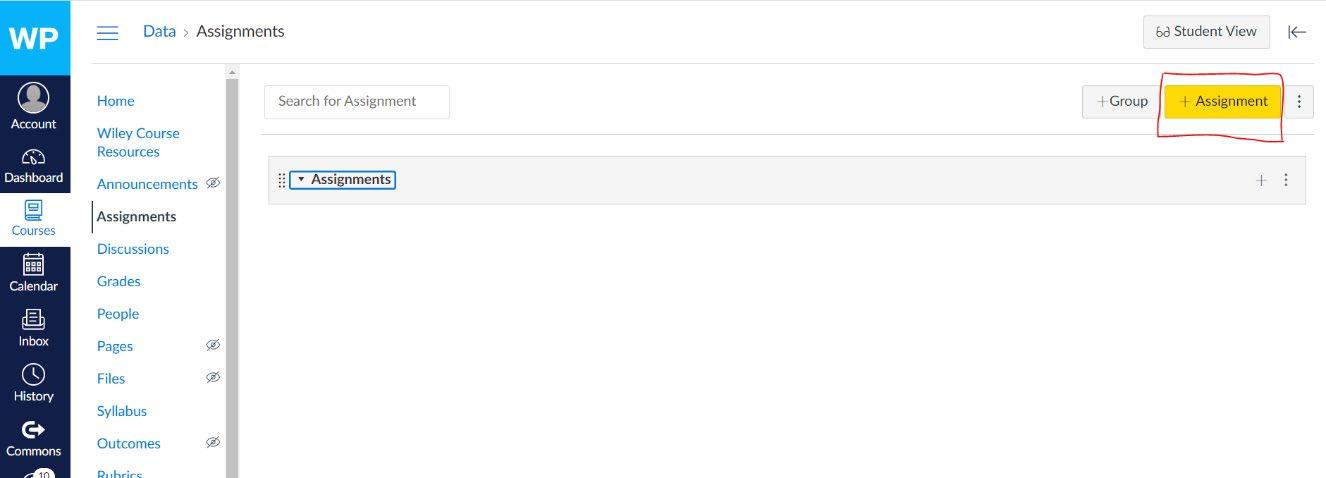
Within the Wiley Library of assignments, you can easily assign the full bootcamp. To access the Wiley Library, follow the steps below
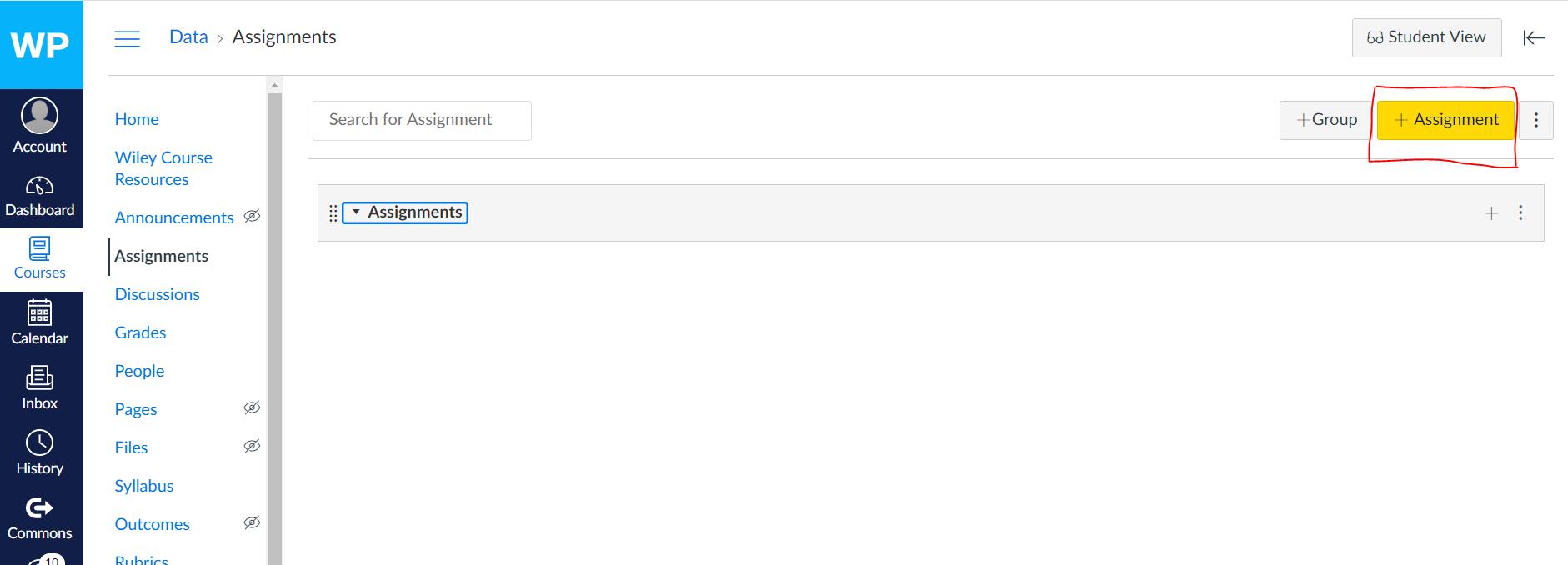
Step 1: Click on the “+ Assignments” button.
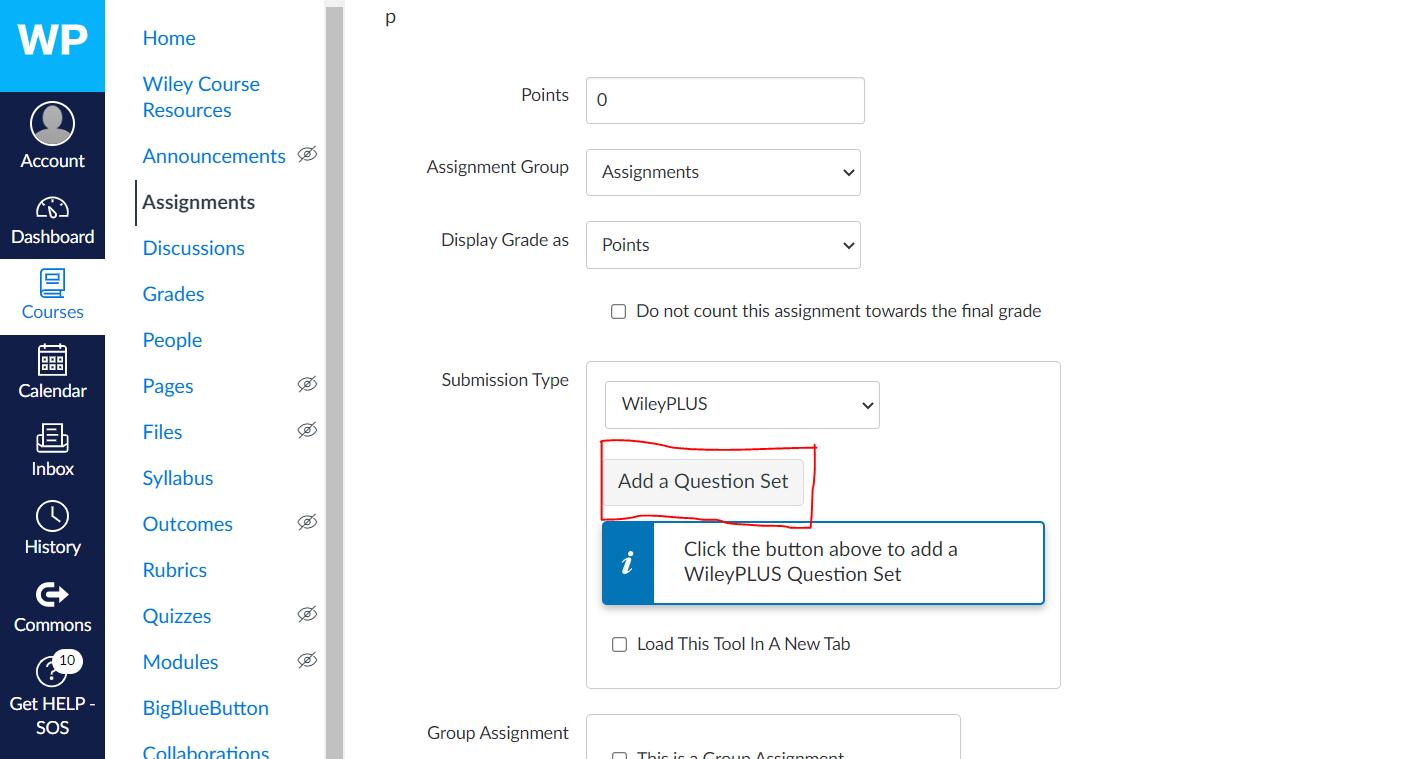
Step 2: Click on “Add a Question Set. “
Step 3: Click on “Wiley Library”
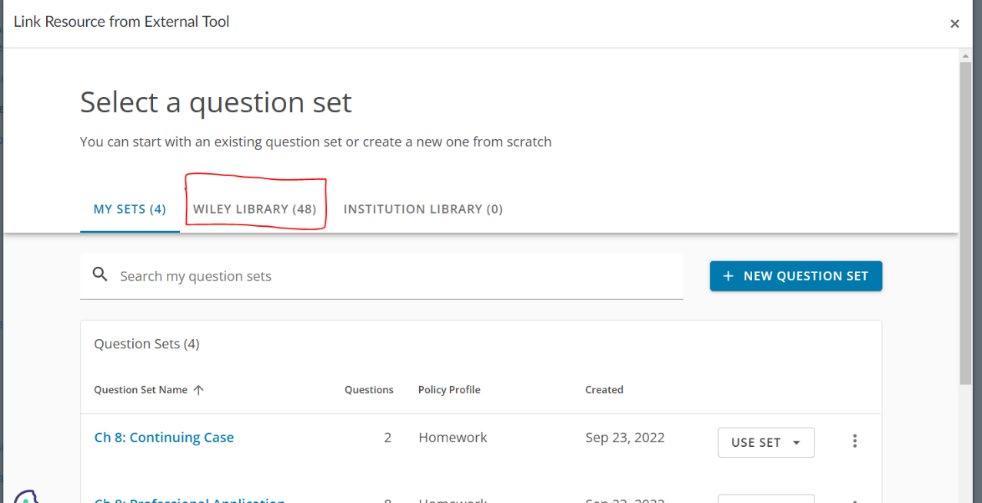
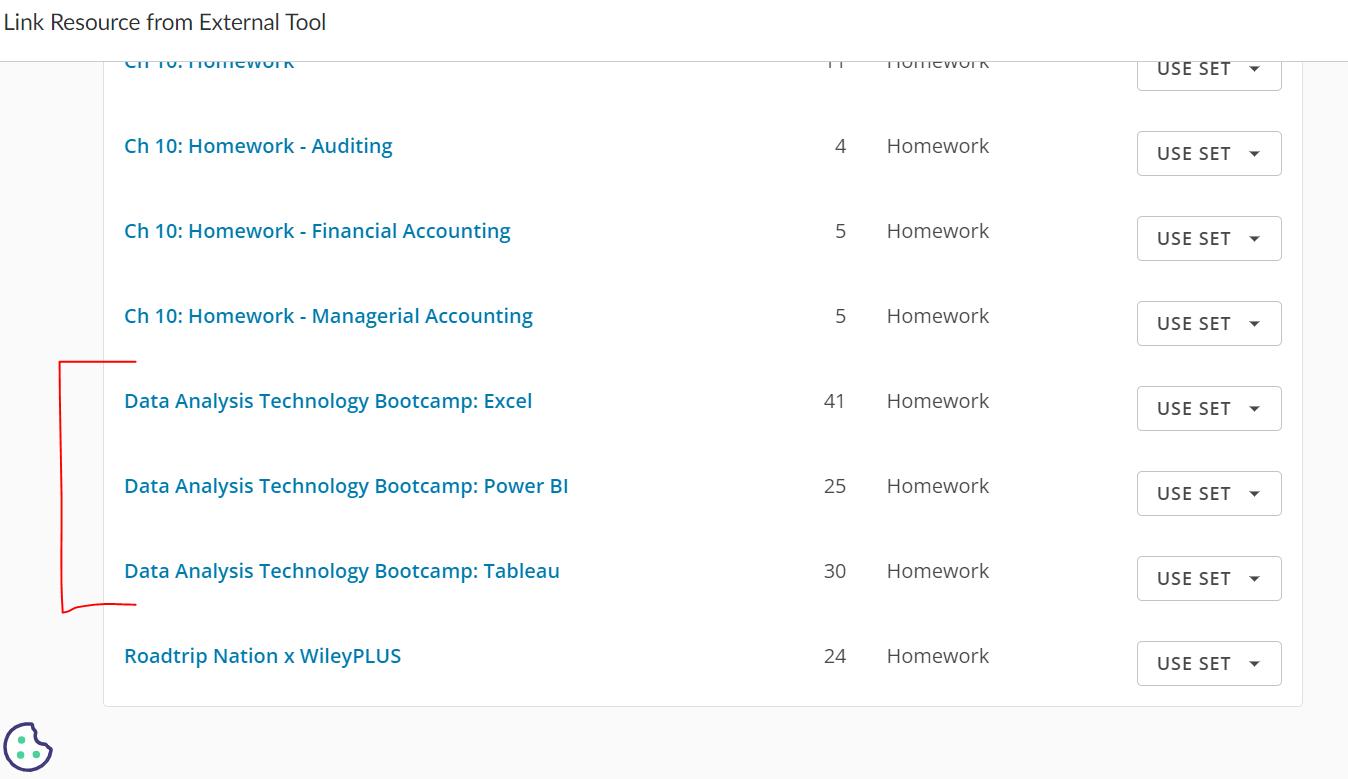
Step 4: Locate the Data Analysis Technology Bootcamps by scrolling all the way to the end of the list.
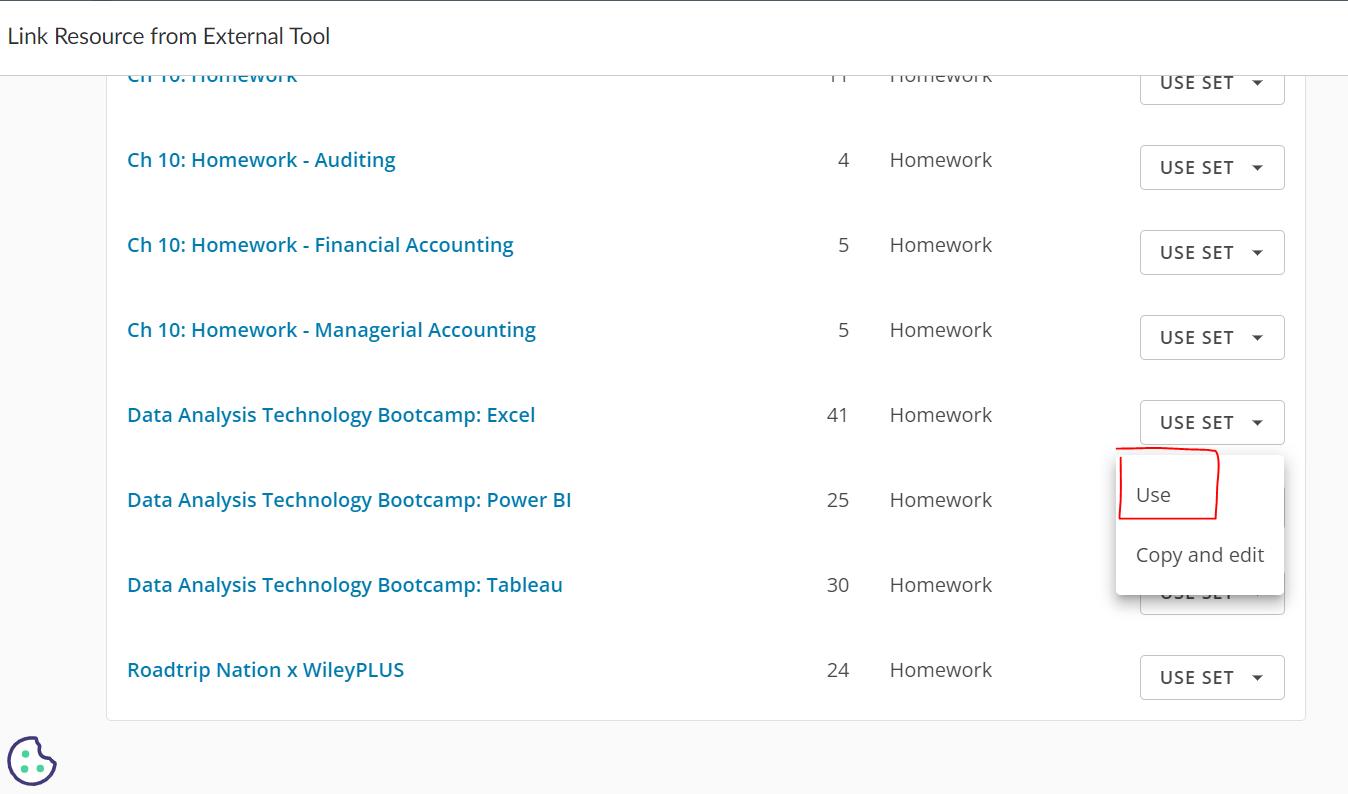
Step 5: Click on “Use Set” and select “Use.” This allows you to assign the full bootcamp and make your typical assignment adjustments like due dates, making it available and visible to your students, etc.
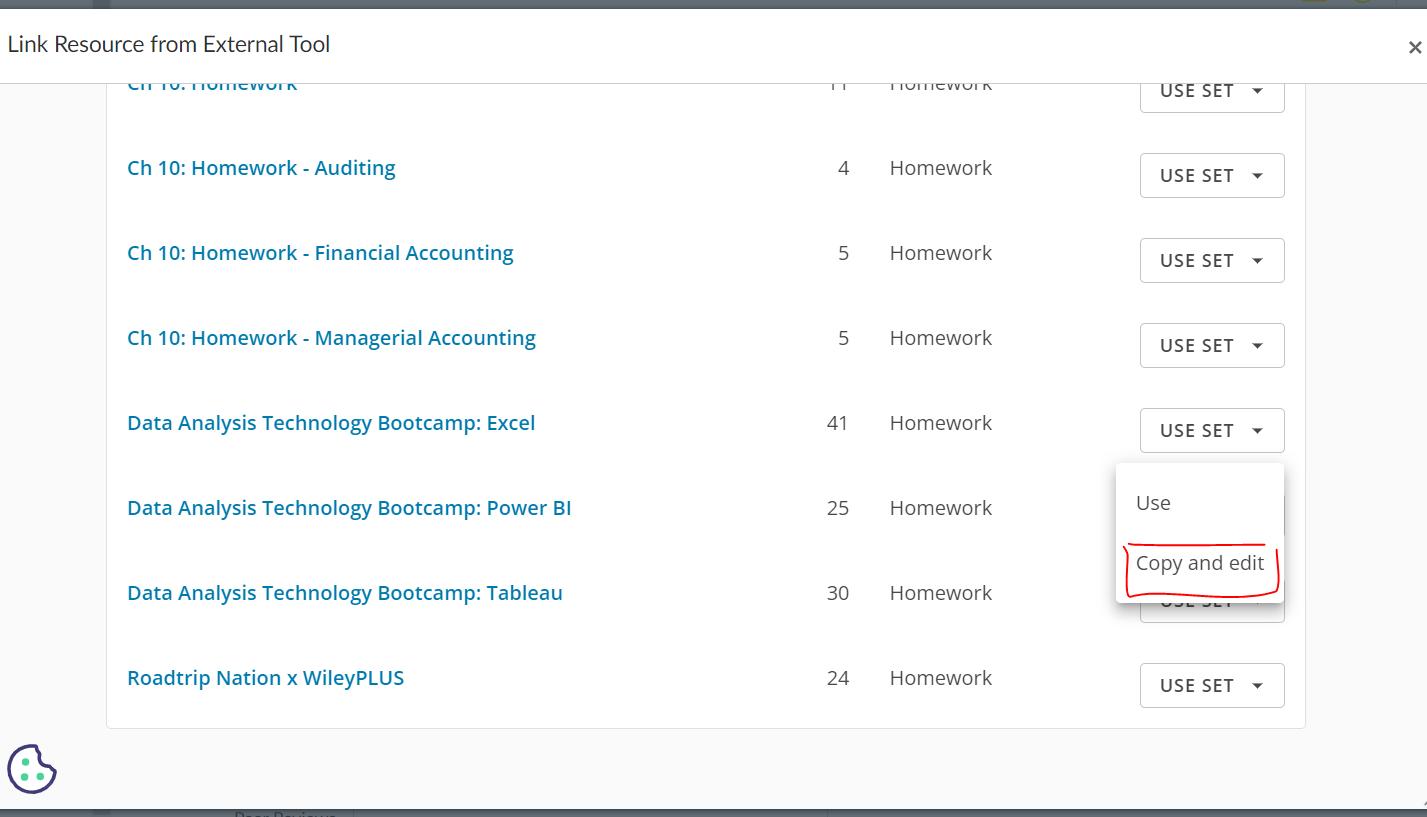
You may also want to use the Data Analysis Technology Bootcamps, but edit portions or parts to more align with your course objectives. Just like any other pre-created assignment in the Wiley Library, you are able to copy and edit the bootcamps as well following the steps below
Step 1: When in the Wiley Library, after locating the Data Analysis Technology Bootcamp you want to assign, click on “Use Set” and “Copy and edit.”
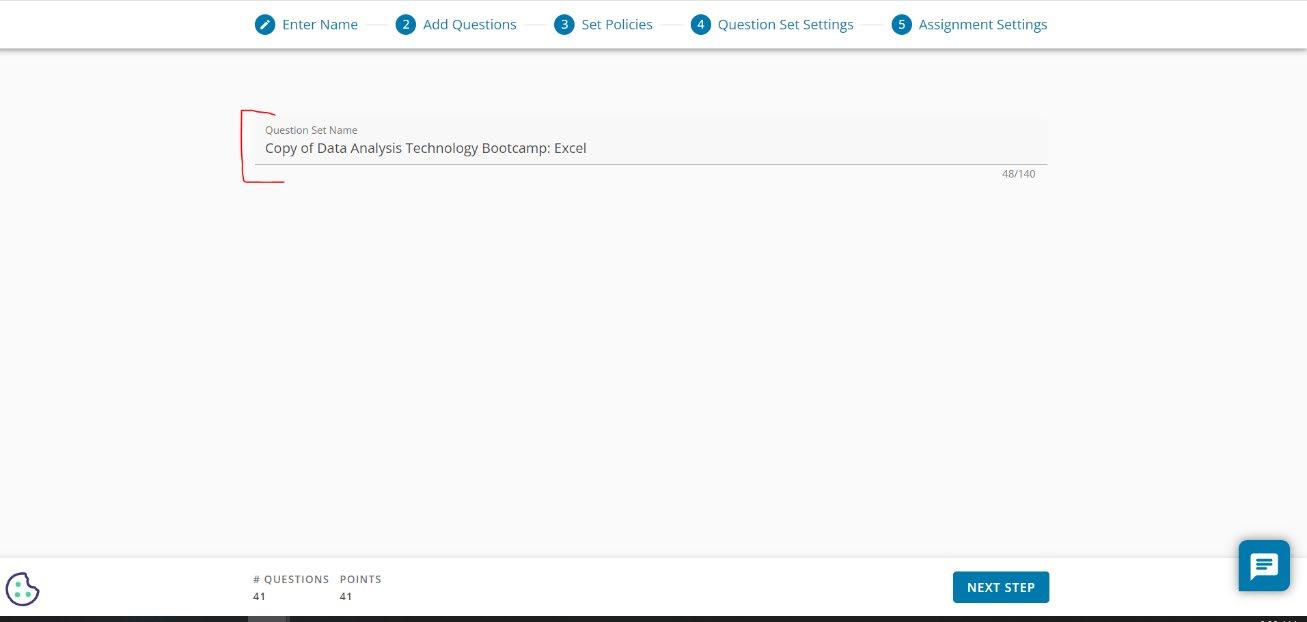
Step 2: You will be prompted to edit the name of the assignment if you choose and then click on “Next Step.”
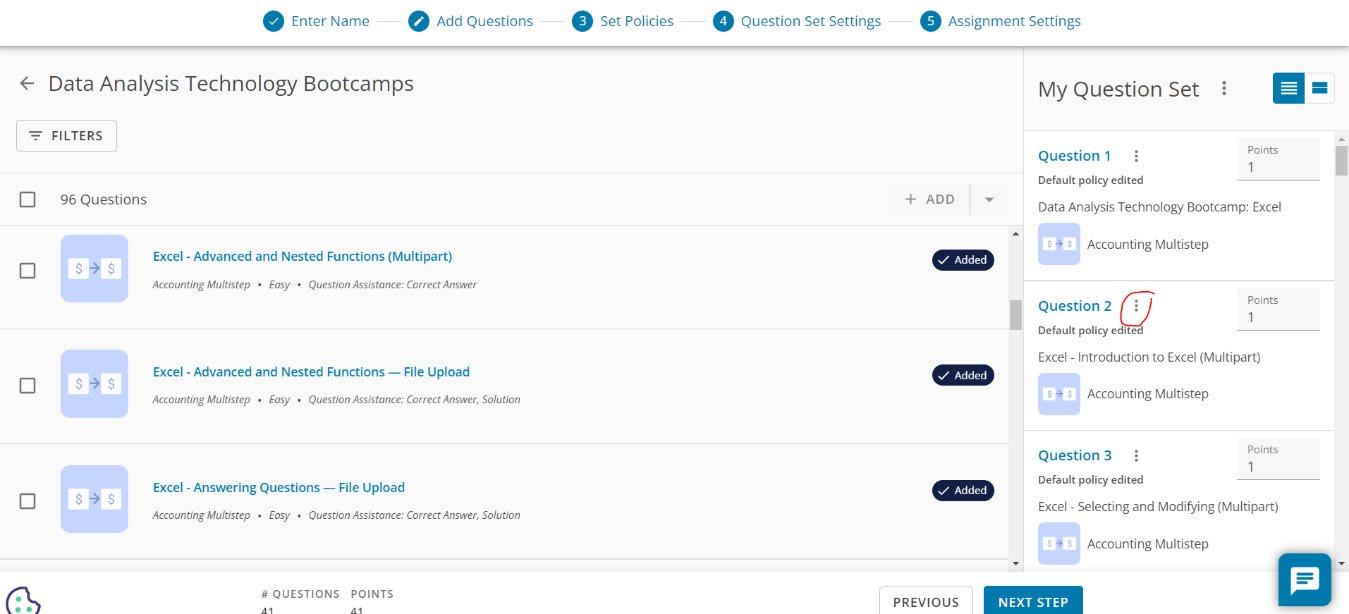
Step 3: Click on the three dots to access the question settings.
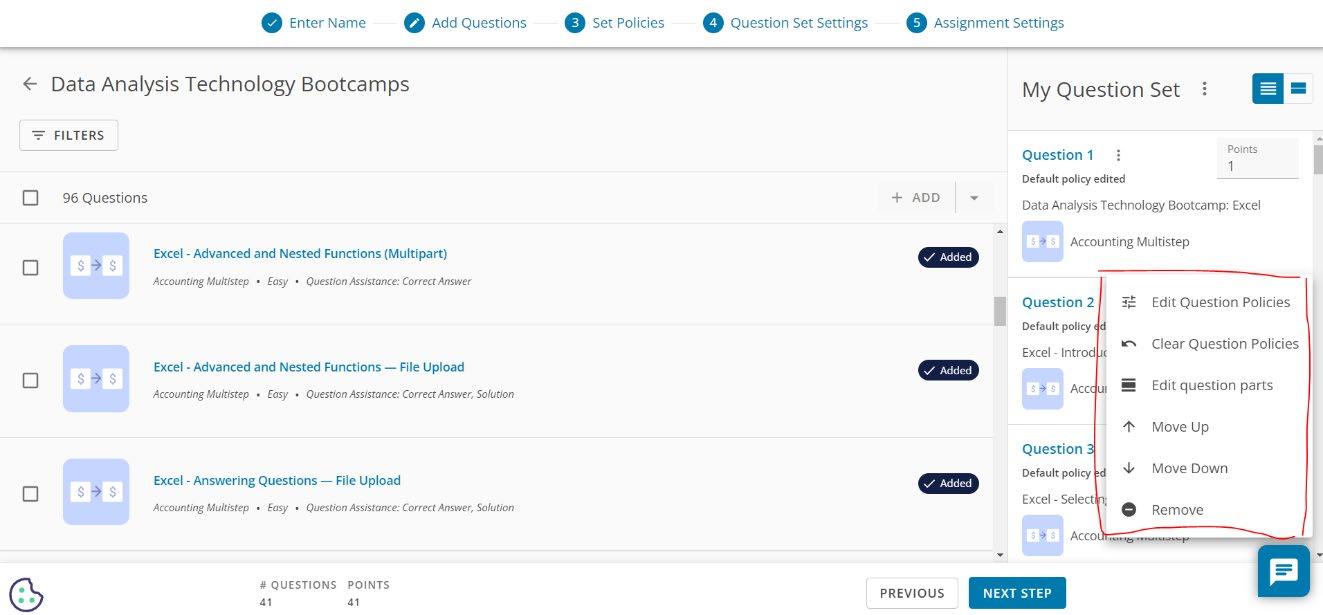
Step 4: Upon clicking on the three dots, you will see a menu of options to further edit the question. You can edit question policies, clear policies, edit specific question parts (like removing specific multiple-choice questions within that set), move the questions, or completely remove the question altogether.
There may be instances where you want to assign a specific module (topic) within the bootcamp as opposed to assigning the full bootcamp. To do this, you would set up the bootcamp like any other assignment. Use the following steps as a guide.
Step 1: Click on the “+ Assignments” button.
Step 2: Click on “Add a Question Set. “
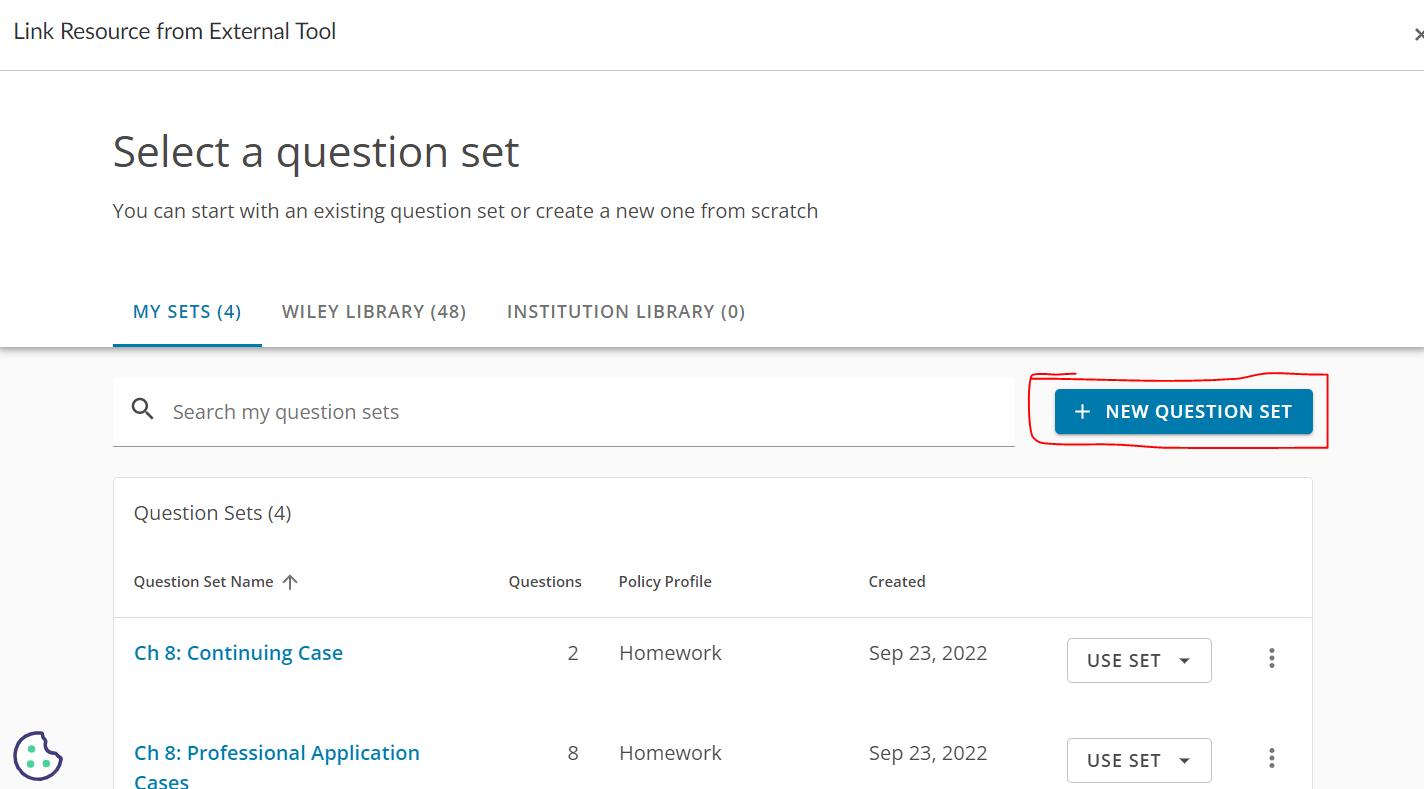
Step 3: Click on “+ New Question Set.”