ISBN: 9781394327119
Data and Analytics in Accounting, 1e (Dzuranin)
Chapter 1 Data and Analytics in the Accounting Profession
1) One key feature of self-service business intelligence (SSBI) software is that
A) it is easy to use.
B) it costs less to implement.
C) it connects to multiple data sources.
D) it provides dashboarding capabilities.
Answer: A
Explanation: There are two key features of SSBI software: it provides extended data processing capabilities for preparing data, analyzing data, and reporting data analysis results; and it is easy to use.
Diff: 1
LO: 1-1
Bloom: C
Min.: 1
AACSB: Analytic
AICPA: FC: Measurement, Analysis, and Interpretation
2) Alteryx is an example of SSBI software that can
A) replace Excel since it can provide more complex functions.
B) replace a database since it can store transactional data.
C) replace the data warehouse.
D) be used to clean data by removing null values or removing leading or trailing spaces.
Answer: D
Explanation: There are two key features of SSBI software: it provides extended data processing capabilities for preparing data, analyzing data, and reporting data analysis results; and it is easy to use.
Diff: 1
LO: 1-1
Bloom: C
Min.: 1
AACSB: Analytic
AICPA: FC: Measurement, Analysis, and Interpretation
3) How has data analytics changed the audit profession?
A) The cost of audit engagements has increased due to the growing data volume that needs to be validated.
B) The cost of audit engagements has decreased since the data that is received from clients are more trustworthy.
C) An auditor can now analyze the entire population of audit-relevant data for exceptions or outliers.
D) There is a greater assurance that financial statements do not have material misstatement since the data is more timely and complete.
Answer: C
Explanation: Self-service business intelligence tools has empowered accountants to use data and analytics to provide value-added services to their clients and employers.
Diff: 2
LO: 1-1
Bloom: AP
Min.: 1
AACSB: Analytic
AICPA: FC: Measurement, Analysis, and Interpretation
4) Data analytics is
A) the process of analyzing raw data to answer questions or provide insights.
B) the process of storing relevant raw data so that data can be analyzed.
C) the process of cleaning data so that data can be more trustworthy.
D) the process of using machine learning and predictive modeling.
Answer: A
Explanation: Data analytics is the process of analyzing raw data to answer questions or provide insights.
Diff: 1
LO: 1-1
Bloom: C
Min.: 1
AACSB: Analytic
AICPA: FC: Measurement, Analysis, and Interpretation
5) Robotic process automation (RPA) software is being used to
A) build artificial intelligence models to eliminate manual audit tasks.
B) analyze auditing data and performing substantive tests.
C) audit sample-based testing so that auditors can focus on analysis and provide valuable insights.
D) automate manual tasks so that auditors can focus on more strategic tasks.
Answer: D
Explanation: RPA can be used to perform routine financial accounting functions such as recording journal entries, creating trial balances, doing preliminary account analyses, and creating financial statements to let accountants spend more time analyzing data for insights.
Diff: 1
LO: 1-1
Bloom: C
Min.: 1
AACSB: Analytic
AICPA: FC: Measurement, Analysis, and Interpretation
6) Robotic process automation (RPA)software can be used by financial accountants
A) to perform routine financial accounting functions such as recording journal entries and creating trial balances.
B) to perform non-routine financial accounting functions such as analyzing potential mergers and acquisitions.
C) to perform routine financial accounting functions such as determining revenue recognition on complex construction projects.
D) to make predictions within financial capital markets.
Answer: A
Explanation: RPA can be used to perform routine financial accounting functions such as recording journal entries, creating trial balances, doing preliminary account analyses, and creating financial statements to let accountants spend more time analyzing data for insights.
Diff: 2
LO: 1-1
Bloom: AP
Min.: 1
AACSB: Analytic
AICPA: FC: Measurement, Analysis, and Interpretation
7) Robotic process automation (RPA) software can be used by management accountants
A) to create automatic financial performance reports for department managers.
B) to evaluate return on investments on capital projects.
C) to evaluate strategic sourcing opportunities with vendors.
D) to identify the cost drivers for activity-based costing models.
Answer: A
Explanation: RPA can be used to perform routine financial accounting functions such as recording journal entries, creating trial balances, doing preliminary account analyses, and creating financial statements to let accountants spend more time analyzing data for insights.
Diff: 2
LO: 1-1
Bloom: AP
Min.: 1
AACSB: Analytic
AICPA: FC: Measurement, Analysis, and Interpretation
8) Robotic process automation software (RPA) can be used by tax accountants
A) to analyze potential saving opportunities for the client.
B) to extract data from the client's financial statements and automatically populate the data into the tax preparation software.
C) to assess the client's residency for tax purposes.
D) to respond to IRS inquiries.
Answer: B
Explanation: RPA can be used to perform routine financial accounting functions such as recording journal entries, creating trial balances, doing preliminary account analyses, and creating financial statements to let accountants spend more time analyzing data for insights.
Diff: 2
LO: 1-1
Bloom: AP
Min.: 1
AACSB: Analytic
AICPA: FC: Measurement, Analysis, and Interpretation
9) With SSBI software, management accountants can use data to A) automate non-routine tasks.
B) identify and manage risks.
C) store transactional data in a central repository.
D) None of the answer choices are correct.
Answer: B
Explanation: With SSBI software, management accountants can more easily use data to help: identify and manage risks; improve budgeting and forecasting by incorporating more data; automate internal reporting; identify operational improvements; and create dashboards of key performance indicators (KPI).
Diff: 2
LO: 1-1
Bloom: AP
Min.: 1
AACSB: Analytic
AICPA: FC: Measurement, Analysis, and Interpretation
10) The stages in the data analysis process are
A) Analyze, Report, and Reflection.
B) Strategize, Plan, and Analyze.
C) Plan, Analyze, and Report
D) Plan, Report, and Reflection.
Answer: C
Explanation: The data analysis process is comprised of three equally important stages: Plan, Analyze, and Report.
Diff: 1
LO: 1-2
Bloom: C
Min.: 1
AACSB: Analytic
AICPA: FC: Measurement, Analysis, and Interpretation
11) In the Planning stage of the data analysis process, the Planning stage involves
A) identifying the problem, selecting the data sources, and creating an implementation plan.
B) selecting the data, evaluating alternatives, and creating a strategy to perform the analysis.
C) identifying the motivation, determining the objective, and creating a strategy to perform the analysis.
D) exploring the data, preparing the data, and building information models.
Answer: C
Explanation: Planning includes identifying the motivation for the analysis, determining the objective and questions to answer, and devising a strategy to perform the analysis.
Diff: 1
LO: 1-2
Bloom: C
Min.: 1
AACSB: Analytic
AICPA: FC: Measurement, Analysis, and Interpretation
12) In a data analysis process, motivation
A) is the reason the analysis is being performed or why we are doing the analysis.
B) is the project's goals.
C) is the desired outcome of the analysis.
D) is the objective of the analysis.
Answer: A
Explanation: Motivation is the reason the analysis is being performed.
Diff: 1
LO: 1-2
Bloom: C
Min.: 1
AACSB: Analytic
AICPA: FC: Measurement, Analysis, and Interpretation
13) You are a management accountant within the finance department. An example of an external motivation in a data analysis project is
A) when your manager asks you to analyze variances between budgeted and actual values for the last fiscal year.
B) an analysis of vendor performance so that strategic vendors can be selected to improve the supply chain.
C) an analysis of accounts receivables to determine allowance of doubtful accounts.
D) when the marketing department requests for an analysis of sales projections for all sales channels.
Answer: D
Explanation: External motivation: The project originates from a request or requirement by another party, such as external stakeholders like investors, creditors, supply chain partners, industry regulators, or government agencies.
Diff: 2
LO: 1-2
Bloom: AP
Min.: 1
AACSB: Analytic
AICPA: FC: Measurement, Analysis, and Interpretation
14) You are an internal auditor within the internal auditing department. An example of an internal motivation in a data analysis project is
A) when your manager asks you to analyze the compliance of segregation of duties for cash deposits.
B) when the external auditor requests an analysis of inventory balances at all warehouse locations.
C) when the creditor requests a report on the cash flow activity through the year.
D) when the marketing department requests for an analysis of sales projections for all sales channels.
Answer: A
Explanation: Internal motivation is when the project is motivated by a desire to better serve a client, better understand phenomena to gain business intelligence, or perform job responsibilities.
Diff: 2
LO: 1-2
Bloom: AP
Min.: 1
AACSB: Analytic
AICPA: FC: Measurement, Analysis, and Interpretation
15) In a data analysis process, the objective
A) is why we are doing the analysis.
B) is the project's goals.
C) is the desired outcome of the analysis.
D) is the reason the analysis is being performed.
Answer: B
Explanation: The objective is the goal of the project. To identify the objective, form specific questions to guide the analysis.
Diff: 1
LO: 1-2
Bloom: C
Min.: 1
AACSB: Analytic
AICPA: FC: Measurement, Analysis, and Interpretation
16) When designing a strategy within a data analysis process, the two parts of strategy are to
A) determine what data is necessary to answer questions and decide the type of analysis is appropriate.
B) determine what data is necessary to generate the desired outcome and decide what type of analysis is appropriate.
C) determine what data is necessary to answer questions and decide which stakeholders should be involved in the analysis.
D) determine what data is reliable for the analysis and decide which stakeholders should be involved in the analysis.
Answer: A
Explanation: There are two aspects to strategy–a data strategy and an analysis strategy.
Diff: 2
LO: 1-2
Bloom: C
Min.: 1
AACSB: Analytic
AICPA: FC: Measurement, Analysis, and Interpretation
17) A descriptive analysis
A) assesses what is happening currently and in the past.
B) identifies a problem to understand why an outcome occurred.
C) predicts what might happen in the future.
D) helps determine what should happen to meet goals or objectives.
Answer: A
Explanation: Descriptive analytics are used to understand what is currently happening or has happened in the past.
Diff: 2
LO: 1-2
Bloom: C
Min.: 1
AACSB: Analytic
AICPA: FC: Measurement, Analysis, and Interpretation
18) A diagnostic analysis
A) assesses what is happening currently and in the past.
B) identifies a problem to understand why an outcome occurred.
C) predicts what might happen in the future.
D) helps determine what should happen to meet goals or objectives.
Answer: B
Explanation: Diagnostic analytics help reveal why something has happened.
Diff: 2
LO: 1-2
Bloom: C
Min.: 1
AACSB: Analytic
AICPA: FC: Measurement, Analysis, and Interpretation
19) A predictive analysis
A) assesses what is happening currently and in the past.
B) identifies a problem to understand why an outcome occurred.
C) forecasts what might happen in the future.
D) helps determine what should happen to meet goals or objectives.
Answer: C
Explanation: Predictive analytics help predict what might happen in the future.
Diff: 2
LO: 1-2
Bloom: C
Min.: 1
AACSB: Analytic
AICPA: FC: Measurement, Analysis, and Interpretation
20) A prescriptive analysis
A) assesses what is happening currently and in the past.
B) identifies a problem to understand why an outcome occurred.
C) predicts what might happen in the future.
D) helps determine what should happen to meet goals or objectives.
Answer: D
Explanation: Prescriptive analytics can tell us what we should do to meet a specific objective.
Diff: 2
LO: 1-2
Bloom: C
Min.: 1
AACSB: Analytic
AICPA: FC: Measurement, Analysis, and Interpretation
21) Bridgeport Tax is a tax accounting firm. The firm focuses on personal tax of high-net worth individuals. A descriptive analysis would answer which question?
A) How are investment accounts trending over the year?
B) Which investments caused the highest taxable gains?
C) What tax liabilities are projected for next year given the projected tax rate increase?
D) What needs to happen to reduce tax liabilities for future years?
Answer: A
Explanation: Descriptive analytics are used to understand what is currently happening or has happened in the past.
Diff: 2
LO: 1-2
Bloom: AP
Min.: 1
AACSB: Analytic
AICPA: FC: Measurement, Analysis, and Interpretation
22) Bridgeport Tax is a tax accounting firm. The firm focuses on personal tax of high-net worth individuals. A diagnostic analysis would answer which question?
A) How are investment accounts trending over the year?
B) Which investments caused the highest taxable gains?
C) What tax liabilities are projected for next year given the projected tax rate increase?
D) What needs to happen to reduce tax liabilities for future years?
Answer: B
Explanation: Diagnostic analytics help reveal why something has happened.
Diff: 2
LO: 1-3
Bloom: AP
Min.: 1
AACSB: Analytic
AICPA: FC: Measurement, Analysis, and Interpretation
23) Vermont Mountain Creamery produces three types of organic ice cream: maple walnut, bourbon cherry, and hazelnut chocolate. A predictive analysis would answer which question?
A) What are the historic sales trends for each type of ice cream?
B) What is causing the profitability to decline within the bourbon cherry line?
C) If the company created the new product, dark chocolate espresso, what would be the projected profitability of this new product line?
D) What is the optimal mix of production output to maximize profit?
Answer: C
Explanation: Predictive analytics help predict what might happen in the future.
Diff: 2
LO: 1-3
Bloom: AP
Min.: 1
AACSB: Analytic
AICPA: FC: Measurement, Analysis, and Interpretation
24) Vermont Mountain Creamery produces three types of organic ice cream: maple walnut, bourbon cherry, and hazelnut chocolate. A prescriptive analysis would answer which question?
A) What are the historic sales trends for each type of ice cream?
B) What is causing the profitability to decline within the bourbon cherry line?
C) If the company created the new product, dark chocolate espresso, what would be the projected profitability of this new product line?
D) What is the optimal mix of production output to maximize profit?
Answer: D
Explanation: Prescriptive analytics can tell us what we should do to meet a specific objective.
Diff: 2
LO: 1-3
Bloom: AP
Min.: 1
AACSB: Analytic
AICPA: FC: Measurement, Analysis, and Interpretation
25) Smart Hawk develops video conferencing equipment. Demand for their products have been increasing due to COVID-19 pandemic work environments. A descriptive analysis would answer which question?
A) What is the count of products that were sold in the last quarter?
B) Are there any spikes in sales during the fiscal year?
C) Is there a correlation between products sold and variances in pricing?
D) To increase profitability by 15%, what price should be charged for each unit?
Answer: A
Explanation: Descriptive analytics are used to understand what is currently happening or has happened in the past.
Diff: 2
LO: 1-3
Bloom: AP
Min.: 1
AACSB: Analytic
AICPA: FC: Measurement, Analysis, and Interpretation
26) Smart Hawk develops video conferencing equipment. Demand for their products have been increasing due to COVID-19 pandemic work environments. A prescriptive analysis would answer which question?
A) What is the count of products that were sold in the last quarter?
B) Are there any spikes in sales during the fiscal year?
C) Is there a correlation between products sold and variances in pricing?
D) To increase profitability by 15%, what price should be charged for each unit?
Answer: D
Explanation: Prescriptive analytics can tell us what we should do to meet a specific objective.
Diff: 2
LO: 1-3
Bloom: AP
Min.: 1
AACSB: Analytic
AICPA: FC: Measurement, Analysis, and Interpretation
27) Bicycle Coffee Shop is a local chain of coffee shops. With increased competition, they are analyzing the financial impacts of closing an existing location. A diagnostic analysis would answer which question?
A) What is the total net revenue for the fiscal year for the location slated to be closed?
B) Are sales trending downwards for the location slated to be closed?
C) If the location is closed, what is the forecasted net income for the Bicycle Coffee shop?
D) What sales revenue is needed for the location to be financially sustainable?
Answer: B
Explanation: Diagnostic analytics help reveal why something has happened.
Diff: 2
LO: 1-1
Bloom: AP
Min.: 1
AACSB: Analytic
AICPA: FC: Measurement, Analysis, and Interpretation
28) Bicycle Coffee Shop is a local chain of coffee shops. With increased competition, they are analyzing the financial impacts of closing an existing location. A prescriptive analysis would answer which question?
A) What is the total net revenue for the fiscal year for the location slated to be closed?
B) Are sales trending downwards for the location slated to be closed?
C) If the location is closed, what is the forecasted net income for the Bicycle Coffee shop?
D) What sales revenue is needed for the location to be financially sustainable?
Answer: B
Explanation: Prescriptive analytics can tell us what we should do to meet a specific objective.
Diff: 2
LO: 1-1
Bloom: AP
Min.: 1
AACSB: Analytic
AICPA: FC: Measurement, Analysis, and Interpretation
29) During the Prepare Data stage of a data analysis project, an example of Extracting within the ETL process is
A) downloading the comma separated values (CSV) file from the ERP system.
B) restructuring the data prior to using it for analysis.
C) removing trailing blank spaces in text fields prior to importing it into an analysis software.
D) merging two data sources into a single data repository.
Answer: A
Explanation: Extracting is the process by which data are retrieved from a source. This could be downloading an Excel file or extracting data from a database or a data warehouse.
Diff: 1
LO: 1-1
Bloom: AP
Min.: 1
AACSB: Analytic
AICPA: FC: Measurement, Analysis, and Interpretation
30) During the Prepare Data stage of a data analysis project, an example of Transforming within ETL is
A) downloading the Excel file from the ERP system.
B) converting sales dollar values from Euro to US dollar prior to using the data for analysis.
C) integrating the data into the data analysis software.
D) merging two data sources into a single data repository.
Answer: B
Explanation: Transforming the data occurs when data are cleaned, restructured, and/or integrated with other data prior to using it for analysis.
Diff: 1
LO: 1-1
Bloom: AP
Min.: 1
AACSB: Analytic
AICPA: FC: Measurement, Analysis, and Interpretation
31) During the Prepare Data stage of a data analysis project, an example of Loading within ETL is
A) downloading the Excel file from the ERP system.
B) filtering out null values prior to using the data for analysis.
C) cleaning the data prior to importing it into the analysis software.
D) executing nightly batch jobs which copies data from the ERP system to the data warehouse.
Answer: D
Explanation: Loading is the process of importing transformed data into the software used to perform analyses.
Diff: 1
LO: 1-1
Bloom: AP
Min.: 1
AACSB: Analytic
AICPA: FC: Measurement, Analysis, and Interpretation
32) An example of an information model is
A) calculating the breakeven point in sales dollars.
B) creating a regression analysis.
C) creating one dataset from multiple data sources.
D) designing a database to track sales orders.
Answer: A
Explanation: Information modeling is the creation of the information needed for analysis purposes, starting from the data collected. Examples of information models from accounting concepts are calculations such as net income, profit margin, total assets, or even breakeven point in sales dollars.
Diff: 1
LO: 1-1
Bloom: AP
Min.: 1
AACSB: Analytic
AICPA: FC: Measurement, Analysis, and Interpretation
33) The Analyze stage of the data analysis process involves
A) preparing the data, building information models, and exploring the data.
B) building information models, exploring the data, and interpreting the results.
C) exploring the data and interpreting the results.
D) preparing the data, building information models, and selecting the data sources.
Answer: A
Explanation: The Analyze stage of the data analysis process involves preparing the data, building information models, and exploring the data.
Diff: 1
LO: 1-1
Bloom: AP
Min.: 1
AACSB: Analytic
AICPA: FC: Measurement, Analysis, and Interpretation
34) The Report stage of the data analysis process involves
A) exploring the data, interpreting the results, and communicating the results.
B) exploring the data, formulating insights, and communicating the results.
C) validating results, formulating insights, and communicating the results.
D) interpreting the results and communicating the results.
Answer: D
Explanation: The Report stage includes interpreting the results to be sure the results address the objective of the analysis and make sense; and communicating the results by choosing the best presentation and method of communication.
Diff: 1
LO: 1-1
Bloom: AP
Min.: 1
AACSB: Analytic
AICPA: FC: Measurement, Analysis, and Interpretation
35) You are a data analyst, and the CFO has asked you to analyze the payroll data to inform decisions on next year's payroll budget. You follow the Analyze stage of the data analysis process. Your activities include
A) creating a strategy on what data needs to be used for the analysis; extracting payroll data from the ERP system; and cleaning the data to remove employees that were not employees throughout the full year.
B) identifying the stakeholders involved in the analysis; extracting payroll data from the ERP system and filtering for only active employees; and summarizing results and reviewing the analysis for accuracy.
C) calculating total payments for each year for each employee; removing any data anomalies in the data; and communicating results to the CFO.
D) extracting the payroll data from the ERP system; calculating total payments for each year for each employee; and exploring the data for payments that are lower or higher than expected.
Answer: D
Explanation: The Analyze stage of the data analysis process involves preparing the data, building information models, and exploring the data.
Diff: 3
LO: 1-1
Bloom: AP
Min.: 1
AACSB: Analytic
AICPA: FC: Measurement, Analysis, and Interpretation
36) You are a data analyst, and the CFO has asked you to analyze the payroll data so that variances can be shown between actual and budgeted values. You follow the Plan stage of the data analysis process. Your activities include
A) determining the purpose of performing a variance analysis; identifying the project goals; and determining what data sources need to be used in the analysis.
B) determining the motivation and objective of the analysis; creating a strategy to analyze the data; and preparing the data for upload into the analysis tools.
C) identifying if the project goal is to determine if actuals were higher than budgeted values; determining what data sources need to be used in the analysis; and extracting the payroll data from the ERP system.
D) determining the motivation and objective of the analysis; extracting the payroll data from the ERP system; and preparing the data for upload into the analysis tools.
Answer: A
Explanation: The Plan stage include determining the motivation and objective, and defining the strategy.
Diff: 3
LO: 1-3
Bloom: AP
Min.: 1
AACSB: Analytic
AICPA: FC: Measurement, Analysis, and Interpretation
37) You are a data analyst, and the CFO has asked you to analyze the payroll data to inform decisions on next year's payroll budget. You follow the Reporting stage of the data analysis process. Your activities include
A) exploring payroll data for any trends; reviewing the results to ensure that they make sense; and preparing a memo to the CFO to communicate the results.
B) reviewing the results to make sure they are accurate and confirming that the results help inform decisions on next year's payroll budget; and creating a dashboard to show the results and preparing a presentation for the CFO.
C) calculating total payments for the years for each employee; reviewing analyses to be sure that the data can answer the questions being asked; and creating a dashboard to showcase the results.
D) extracting the payroll data from the ERP system; exploring the data for any trends; and writing a memo to the CFO to communicate the results.
Answer: B
Explanation: The Report stage includes interpreting the results to be sure the results address the objective of the analysis and make sense; and communicating the results by choosing the best presentation and method of communication.
Diff: 2
LO: 1-3
Bloom: AP
Min.: 1
AACSB: Analytic
AICPA: FC: Measurement, Analysis, and Interpretation
38) A data analytics mindset is
A) the habit of adhering to accounting principles during the planning, analysis, and interpretation of data results before making and communicating a professional choice or decision.
B) the habit of using professional judgement during the planning, analysis, and interpretation of data results before making and communicating a professional choice or decision.
C) the professional habit of using critical thinking during the planning, analysis, and interpretation of data results before making and communicating a professional choice or decision.
D) the habit of applying best practices during the planning, analysis, and interpretation of data results before making and communicating a professional choice or decision.
Answer: C
Explanation: A data analytics mindset is the professional habit of critically thinking through the planning, analysis, and interpretation of data results before communicating a professional choice or decision.
Diff: 2
LO: 1-3
Bloom: K
Min.: 1
AACSB: Analytic
AICPA: FC: Measurement, Analysis, and Interpretation
39) Accountants with critical thinking skills will
A) use professional judgement to investigate, understand, and evaluate an event, opportunity, or an issue.
B) use best practices to investigate, understand, and evaluate an event, opportunity, or an issue.
C) use disciplined reasoning to investigate, understand, and evaluate an event, opportunity, or an issue.
D) seek expert advice to investigate, understand, and evaluate an event, opportunity, or an issue.
Answer: C
Explanation: Critical thinking is disciplined reasoning used to investigate, understand, and evaluate an event, opportunity, or an issue.
Diff: 2
LO: 1-3
Bloom: C
Min.: 1
AACSB: Analytic
AICPA: FC: Measurement, Analysis, and Interpretation
40) Data literacy is best described as the
A) ability to read, write and communicate data, including an understanding of data sources and analytical methods.
B) ability to understand and analyze data using a variety of analytical techniques.
C) ability to effectively communicate data results to stakeholders
D) ability to apply analytical methods to explore insights.
Answer: A
Explanation: Data literacy is the ability to read, write, and communicate data in context.
Diff: 1
LO: 1-3
Bloom: C
Min.: 1
AACSB: Analytic
AICPA: FC: Measurement, Analysis, and Interpretation
41) Technological agility is
A) being competent in the latest technological developments.
B) being able to quickly adopt and adapt to the latest technological developments.
C) the ability to take advantage of technological software and tools.
D) being aware of the latest technological developments and being willing to try new technology.
Answer: D
Explanation: Technological agility is a mindset of being aware of the latest technological developments and being willing to try new things.
Diff: 1
LO: 1-3
Bloom: K
Min.: 1
AACSB: Analytic
AICPA: FC: Measurement, Analysis, and Interpretation
42) More banks have been hit with ransomware attacks. You are a data analyst at Riverdale Trust, and senior management has requested data analysis of cyber-attack trends. The stakeholders in this analysis from highest to lowest are
A) senior management, customers, and chief information officer.
B) chief information officer, senior management, and customers.
C) customers, chief information officer, and senior management.
D) senior management, chief information officer, and customers.
Answer: D
Explanation: Senior management is the highest since they need to be aware of financial risks. Customers are the lowest compared to other internal stakeholders since they need to take action first.
Diff: 2
LO: 1-4
Bloom: AP
Min.: 1
AACSB: Analytic
AICPA: FC: Measurement, Analysis, and Interpretation
43) Lynx Scooters manufactures electric scooters. You are a cost accountant and need to use data analytics to evaluate product costing. The stakeholders in this analysis from highest to lowest are
A) financial controller, production manager, production staff, suppliers.
B) financial controller, production manager, investors, customers.
C) customers, investors, controller, production manager.
D) investors, controller, customer, production manager.
Answer: B
Explanation: The financial controller is the highest since they oversee product costing. Customers are the lowest compared to other internal stakeholders since they need to take action first.
Diff: 2
LO: 1-4
Bloom: AP
Min.: 1
AACSB: Analytic
AICPA: FC: Measurement, Analysis, and Interpretation
44) You are a tax accountant who prepares corporate tax returns. An example of an internal stakeholder and an external stakeholder are
A) tax clients and the Securities and Exchange Commission (SEC), respectively.
B) partners of the tax firm and competing tax firms, respectively.
C) partners of the tax firm and tax regulators, respectively.
D) tax clients and investors of the tax clients, respectively.
Answer: C
Explanation: Internal stakeholders are individuals or groups involved in a businesses' operations. For example, your chief information officer will be a stakeholder since they would be the most interested in the results. External stakeholders are individuals or groups outside the company. For example, your tax client is an external stakeholder since the privacy of their financial information is at risk.
Diff: 2
LO: 1-4
Bloom: AP
Min.: 1
AACSB: Analytic
AICPA: FC: Measurement, Analysis, and Interpretation
45) You are an internal auditor at BTE Food Services. You are using auditing data analytics to test segregation of duty controls. An example of an internal stakeholder and external stakeholders are
A) internal audit manager and investors, respectively.
B) internal audit committee and food service staff, respectively.
C) internal audit manager and external auditors, respectively.
D) internal audit committee and external auditors, respectively.
Answer: A
Explanation: Internal stakeholders are individuals or groups involved in a businesses' operations. For example, your chief information officer will be a stakeholder since they would be the most interested in the results. External stakeholders are individuals or groups outside the company. For example, your tax client is an external stakeholder since the privacy of their financial information is at risk.
Diff: 2
LO: 1-4
Bloom: AP
Min.: 1
AACSB: Analytic
AICPA: FC: Measurement, Analysis, and Interpretation
46) Choosing irrelevant data in an analysis is an example of A) bias risk.
B) analysis risk.
C) data risk.
D) assumption risk.
Answer: C
Explanation: A data risk is choosing inappropriate data, or data is incomplete or incorrect. Diff: 1
LO: 1-1
Bloom: C
Min.: 1
AACSB: Analytic
AICPA: FC: Measurement, Analysis, and Interpretation
47) Choosing to apply a data analysis method incorrectly is an example of A) bias risk.
B) analysis risk.
C) data risk.
D) assumption risk.
Answer: B
Explanation: Analysis risk is choosing an inappropriate method of applying a data analysis method incorrectly.
Diff: 1
LO: 1-2
Bloom: K
Min.: 1
AACSB: Analytic
AICPA: FC: Measurement, Analysis, and Interpretation
48) Mental shortcuts that can affect decisions are examples of A) bias risk.
B) analysis risk.
C) data risk.
D) assumption risk.
Answer: A
Explanation: Bias risk is a mental shortcut that can affect decisions.
Diff: 1
LO: 1-2
Bloom: K
Min.: 1
AACSB: Analytic
AICPA: FC: Measurement, Analysis, and Interpretation
49) In a data analysis, potential risks that can affect decisions can be classified into four areas. The risk areas are
A) data, analyses, assumptions, and biases.
B) financial, assumption, selection, and data.
C) analysis, interpretation, selection, and financial.
D) process, biases, selection, and data.
Answer: A
Explanation: The four risk areas are data, analyses, assumptions, and biases.
Diff: 1
LO: 1-2
Bloom: K
Min.: 1
AACSB: Analytic
AICPA: FC: Measurement, Analysis, and Interpretation
50) You are an accountant for Radiant Roofs, a manufacturer of solar roofs. Some states are offering tax incentives for homeowners wanting to install solar roofs. Data analysis is required to determine how tax incentives will affect the company's sales. What additional knowledge areas will need to be obtained to successfully carry out this data analysis project?
A) Climate change trends
B) Solar power technology
C) State tax laws
D) Federal tax laws
Answer: C
Explanation: Knowledge of state laws is needed to calculate state tax liability for the client.
Diff: 2
LO: 1-2
Bloom: AP
Min.: 1
AACSB: Analytic
AICPA: FC: Measurement, Analysis, and Interpretation
51) You are an accountant for Mountain View Hospital. The hospital imports supplies and equipment from foreign vendors. You are looking to use a custom broker to handle the importing of goods. A data analysis is required to evaluate the cost benefit of using a customs broker. What additional knowledge areas will need to be obtained to successfully carry out this data analysis project?
A) Knowledge of federal requirements governing imports and exports
B) Financial Accounting Standards Board (FASB)
C) Financial analysis of cash flow
D) The hospital Industry
Answer: A
Explanation: Knowledge of federal requirements governing imports and exports is required to remove any incorrect assumptions in the analysis.
Diff: 2
LO: 1-2
Bloom: AP
Min.: 1
AACSB: Analytic
AICPA: FC: Measurement, Analysis, and Interpretation
52) The six elements of critical thinking to consider when performing data analytics are
A) stakeholders, purpose, analysis, reflection, knowledge, and self-reflection.
B) stakeholders, purpose, alternatives, risks, knowledge, and self-reflection.
C) supports, purpose, analysis, risk, knowledge, support.
D) plan, analyze, and report
Answer: B
Explanation: SPARKS is the acronym for stakeholders, purpose, alternatives, risks, knowledge, and self-reflection.
Diff: 1
LO: 1-2
Bloom: K
Min.: 1
AACSB: Analytic
AICPA: FC: Measurement, Analysis, and Interpretation
53) Within the SPARKS framework, the self-reflection stage
A) focuses your prior experience or apply this experience to future analyses for yourself not for your team.
B) should be used to validate if the results of the analysis are correct.
C) should be used to determine if the results answer that original question of the analysis.
D) should be used to learn from the success, struggles or failures from prior experience or apply this experience to future analyses.
Answer: D
Explanation: Self-reflection is the final critical thinking element at the end of a data analysis project to determine and reflect on what worked well and what did not.
Diff: 1
LO: 1-2
Bloom: K
Min.: 1
AACSB: Analytic
AICPA: FC: Measurement, Analysis, and Interpretation
54) Within the SPARKS framework, the purpose stage
A) determines what additional knowledge is necessary to complete the analysis.
B) identifies individuals or groups with an interest in the outcome of a data analysis project.
C) identifies which questions to evaluate, what data is needed, which method to use, and how to best communicate the results.
D) articulates specific questions to maintain focus on the data and analyses steps that will help us achieve objectives.
Answer: D
Explanation: The purpose stage articulates specific questions to maintain focus on the data and analyses steps that will help us achieve objectives.
Diff: 1
LO: 1-2
Bloom: K
Min.: 1
AACSB: Analytic
AICPA: FC: Measurement, Analysis, and Interpretation
55) Within the SPARKS framework, the stakeholders stage
A) determines if the results of the analysis answers the objectives of the stakeholders.
B) identifies what additional knowledge is necessary to obtain from the stakeholders.
C) identifies individuals or groups with an interest in the outcome of a data analysis project.
D) identifies what questions to evaluate, what data is needed, which method to use, and how to best communicate the results to the stakeholders.
Answer: C
Explanation: Stakeholders are those individuals or groups with an interest in the outcome of a data analysis project.
Diff: 1
LO: 1-2
Bloom: K
Min.: 1
AACSB: Analytic
AICPA: FC: Measurement, Analysis, and Interpretation
56) You are a financial accountant at Valleyview Hospital. You would like to analyze how changing the inventory method from FIFO method to the weighted-average method will affect the balance sheet. What would be the motivation and the objective for the data analysis?
A) The motivation is to determine if changing the inventory method affects the hospital profits. The objective is to determine the inventory value using the FIFO method and the weightedaverage method.
B) The motivation is to determine how using the two inventory costing methods will affect the balance sheet. The objective is to calculate the inventory balance for each inventory costing method.
C) The motivation is to determine if using the weighted-average method is a better reflection of inventory values. The objective is to calculate the inventory balance for each inventory costing method.
D) The motivation is to understand how using the two inventory costing methods will affect the balance sheet. The objective is to calculate which inventory method generates a lower inventory balance.
Answer: B
Explanation: Motivation is the reason the analysis is performed. The objective is the goal of the project.
Diff: 3
LO: 1-1
Bloom: AP
Min.: 1
AACSB: Analytic
AICPA: FC: Measurement, Analysis, and Interpretation
57) During the COVID-19 pandemic, the inflation rate increased dramatically. Businesses experienced increases in their expenses. You are an accountant, and you are using data analysis to look at how inflation is going to affect next year's budget. The objective of the data analysis is to
A) look at cost-saving opportunities for next year.
B) have a realistic budget that accounts for cost increases.
C) minimize expenses for next year.
D) determine financial metrics for next year.
Answer: B
Explanation: The objective is the goal of the project.
Diff: 2
LO: 1-1
Bloom: AP
Min.: 1
AACSB: Analytic
AICPA: FC: Measurement, Analysis, and Interpretation
58) You are an internal auditor looking at fraud related to vendor payment. You look at possible approaches for analyzing the data such as analyzing vendor addresses that match payroll addresses, vendors with similar vendor names, or duplicated vendor payments. What is the data analysis stage and MOSIAC step of this activity?
A) The data analysis stage is Plan and the MOSIAC step is Strategy.
B) The data analysis stage is Analyze and the MOSIAC step is Analysis-Build Information Models.
C) The data analysis stage is Plan and the MOSIAC step is Analysis-Build Information Models.
D) The data analysis stage is Analyze and the MOSIAC step is Analysis-Prepare the Data.
Answer: A
Explanation: Strategy is in the Plan stage. There are two aspects to strategy–a data strategy and an analysis strategy.
Diff: 2
LO: 1-4
Bloom: AP
Min.: 1
AACSB: Analytic
AICPA: FC: Measurement, Analysis, and Interpretation
59) New tax legislations are looking to include cryptocurrency taxation. You are a tax accountant, and you are using data analytics to determine how these changes will affect your current corporate clients and how additional reporting of cryptocurrency will impact staffing resources at the firm. What is the data analysis stage and the MOSIAC step of this activity?
A) The data analysis stage is Plan and the MOSIAC step is Motivation.
B) The data analysis stage is Plan and the MOSIAC step is Strategy.
C) The data analysis stage is Analyze and the MOSIAC step is Analysis-Prepare the Data.
D) The data analysis stage is Analyze and the MOSIAC step is Stakeholders.
Answer: A
Explanation: Motivation is in the Plan stage. Motivation is the reason the analysis is performed. Diff: 2
LO: 1-4
Bloom: AP Min.: 1
AACSB: Analytic
AICPA: FC: Measurement, Analysis, and Interpretation
60) Circuit Town is a reseller of consumer electronic products. Sales have been increasing; however, sales returns and allowances have also been increasing. A data analysis is needed to investigate if there are specific products causing sales returns and allowances to be high. The motivation of the data analysis is to
A) identify opportunities for increasing sales.
B) assess if the store's sales returns need to be revised.
C) determine how sales and sales returns and allowances trends are affecting the company's profits.
D) determine what's causing sales returns and allowances to increase.
Answer: D
Explanation: Motivation is the reason the analysis is performed. Diff: 2
LO: 1-1
Bloom: AP
Min.: 1
AACSB: Analytic
AICPA: FC: Measurement, Analysis, and Interpretation
61) Green Beanery is a wholesaler of organic coffee for independent coffee shops. A visualization was created to show sales values and operating profit by month. The visualization can be used to answer which diagnostic question?
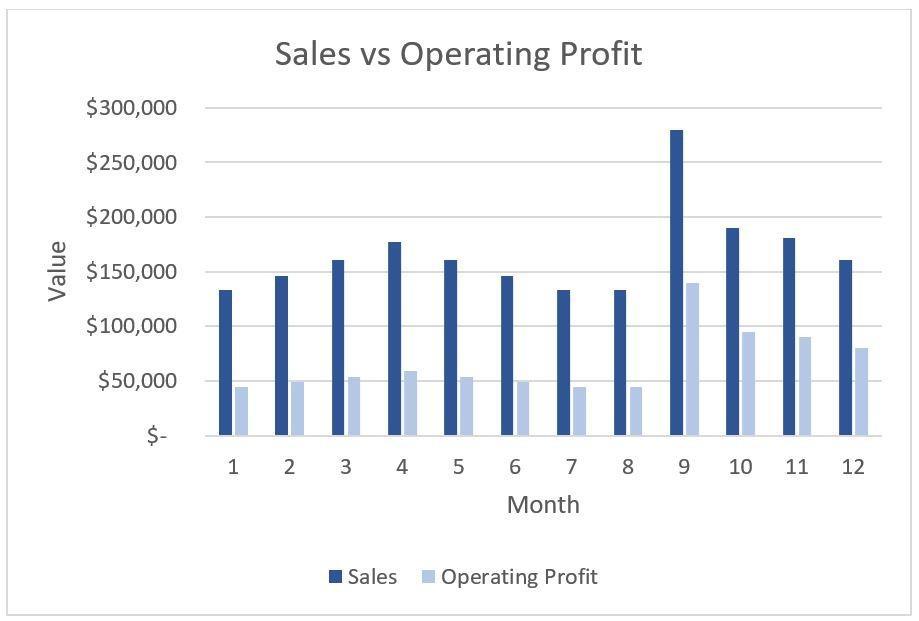
A) Are there any months that have unusual sales?
B) What sales value is required to obtain an operating profit margin of 30%?
C) What is the expected operating profit for next year given this year's trends?
D) What is the average operating profit for the year?
Answer: A
Explanation: Diagnostic analytics help reveal why something has happened.
Diff: 2
LO: 1-2
Bloom: AP
Min.: 1
AACSB: Analytic
AICPA: FC: Measurement, Analysis, and Interpretation
62) Green Beanery is a wholesaler of organic coffee for independent coffee shops. A visualization was created to show sales values and operating profit by month. The visualization can be used to answer which predictive question?
A) Are there any identifiable trends in sales throughout the year?
B) What sales value is required to obtain an operating profit margin of 30%?
C) What is the expected operating profit for next year given this year's trends?
D) Is there a correlation between sales and operating profit?
Answer: C
Explanation: Predictive analytics help predict what might happen in the future.
Diff: 2
LO: 1-2
Bloom: AP
Min.: 1
AACSB: Analytic
AICPA: FC: Measurement, Analysis, and Interpretation
63) Green Beanery is a wholesaler of organic coffee for independent coffee shops. A visualization was created to show sales values and operating profit by month. The visualization can be used to answer which prescriptive question?
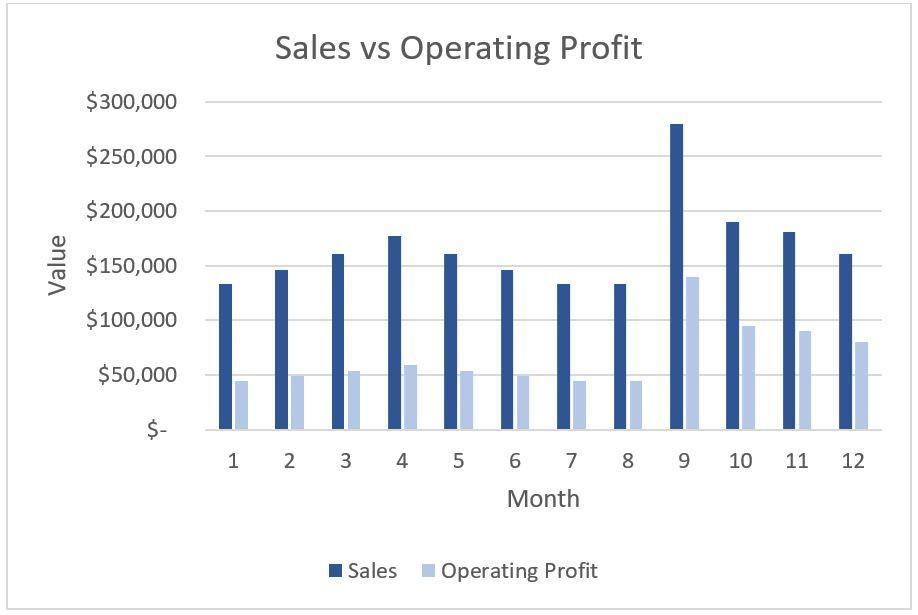
A) Are there any identifiable trends in sales throughout the year?
B) What sales value is required to obtain an operating profit margin of 25%?
C) What is the expected operating profit for next year given this year's trends?
D) Is there a correlation between sales and operating profit?
Answer: B
Explanation: Prescriptive analytics can tell us what we should do to meet a specific objective.
Diff: 2
LO: 1-2
Bloom: AP
Min.: 1
AACSB: Analytic
AICPA: FC: Measurement, Analysis, and Interpretation
64) Green Beanery is a wholesaler of organic coffee for independent coffee shops. A visualization was created to show sales values and operating profit by month. The visualization can be used to answer which descriptive question?
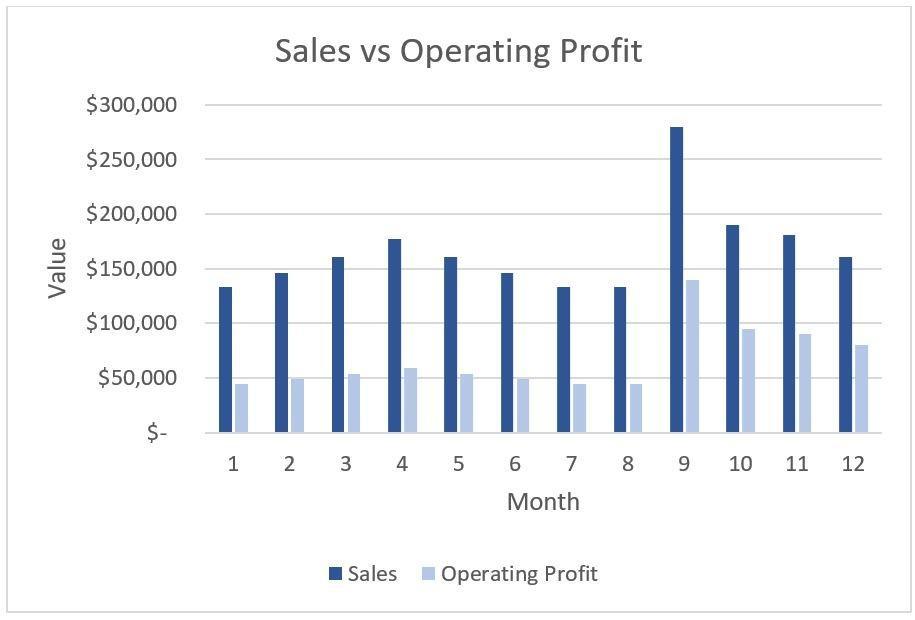
A) Are there any anomalies in sales during the year?
B) What sales value is required to obtain an operating profit margin of 20%?
C) Is there a correlation between sales and operating profit?
D) What is the average operating profit for the year?
Answer: D
Explanation: Descriptive analytics are used to understand what is currently happening or has happened in the past.
Diff: 2
LO: 1-3
Bloom: AP
Min.: 1
AACSB: Analytic
AICPA: FC: Measurement, Analysis, and Interpretation
65) Yoga Sanctuary is an online service offering customized yoga sessions. Its growth has been driven by social media. A data visualization has been created to show the count of social media mentions and the count of new subscribers. What is a predictive question that can be asked based on the results of this data analysis?
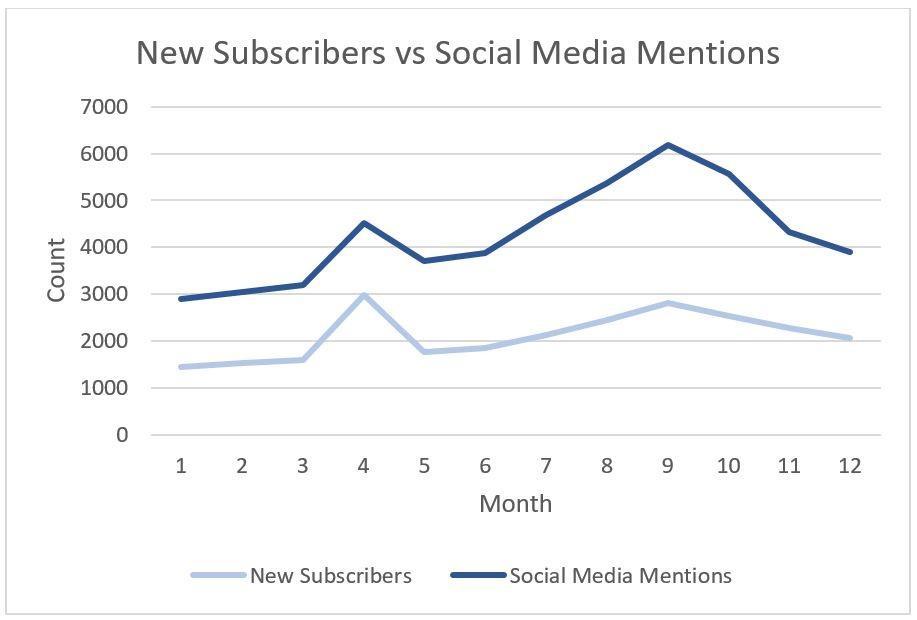
A) Based on the current trends, should we expect the number of subscribers to increase next year?
B) What if the number of social media mentions doubled, how would it affect the number of new subscribers?
C) What caused the number of social media mentions to increase in the fourth month?
D) What is the average number of social media mentions?
Answer: A
Explanation: Predictive analytics help predict what might happen in the future.
Diff: 2
LO: 1-2
Bloom: AP
Min.: 1
AACSB: Analytic
AICPA: FC: Measurement, Analysis, and Interpretation
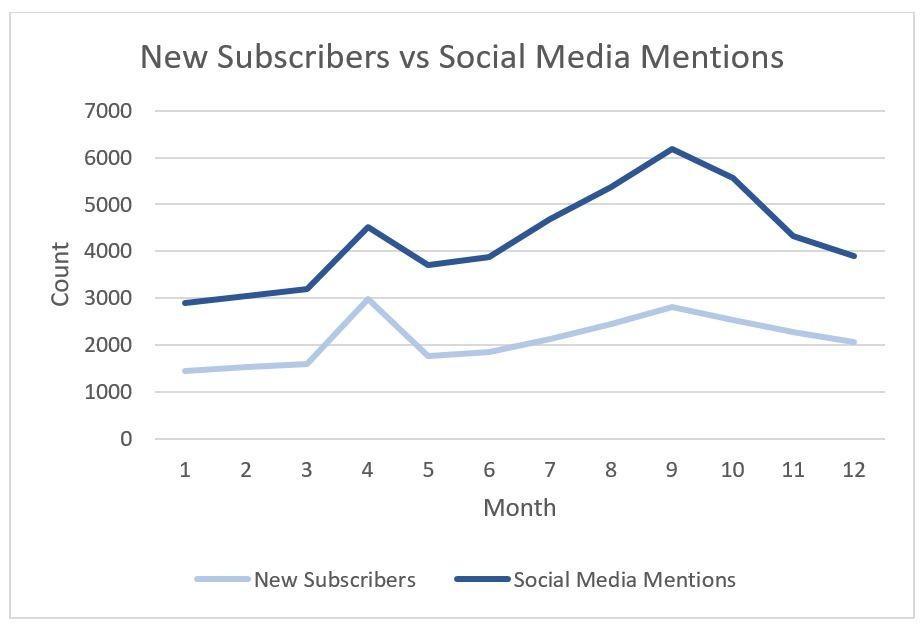
66) Yoga Sanctuary is an online service offering customized yoga sessions. Its growth has been driven by social media. A data visualization has been created to show the count of social media mentions and the count of new subscribers. What is a diagnostic question that can be asked based on the results of this data analysis?
A) What are the monthly average counts of social media mentions?
B) What if the number of social media mentions doubled, how would it affect the number of new subscribers?
C) What caused the number of new subscribers to increase in the fourth month?
D) Is there a correlation between the number of social media mentions and the number of new subscribers?
Answer: C
Explanation: Diagnostic analytics help reveal why something has happened. Diff: 2
LO: 1-2
Bloom: AP
Min.: 1
AACSB: Analytic
AICPA: FC: Measurement, Analysis, and Interpretation
67) You are an auditor and have completed analytical procedures for comparing your client's financial ratios with industry ratios. When communicating the findings to the client you need to be sure you are using the correct visualizations to help reduce the risk of someone misinterpreting the results. What is the data analysis stage and the MOSIAC step of this activity?
A) The data analysis stage is Report and the MOSIAC step is Communicate.
B) The data analysis stage is Report and the MOSIAC step is Interpret.
C) The data analysis stage is Strategy and the MOSIAC step is Communicate.
D) The data analysis stage is Strategy and the MOSIAC step is Interpret.
Answer: A
Explanation: Communicate is in the Report Stage. Communicate the results involves choosing the best presentation and method of communication.
Diff: 2
LO: 1-4
Bloom: AP
Min.: 1
AACSB: Analytic
AICPA: FC: Measurement, Analysis, and Interpretation
68) Select all that apply. The key features of self-service business intelligence (SSBI) software are that
A) it is easy to use.
B) it provides extended data processing capabilities for preparing data, analyzing data, and reporting data analysis results.
C) it connects to an online data source.
D) it provides dashboarding capabilities.
Answer: A, B
Explanation: There are two key features of SSBI software: it provides extended data processing capabilities for preparing data, analyzing data, and reporting data analysis results; and it is easy to use.
Diff: 1
LO: 1-1
Bloom: C
Min.: 1
AACSB: Analytic
AICPA: FC: Measurement, Analysis, and Interpretation
69) Select all that apply. A dashboard is a graphical user interface that can A) show key performance indicators of financial ratios for a company.
B) monitor performance against company goals.
C) show information at a glance.
D) identify historical trends and discover insights.
Answer: A, B, C, D
Explanation: A dashboard is a graphical user interface that shows key performance indicators for an organization.
Diff: 2
LO: 1-1
Bloom: C
Min.: 1
AACSB: Analytic
AICPA: FC: Measurement, Analysis, and Interpretation
70) Select all that apply. Management accountants can use SSBI software to A) create dashboards to track key performance.
B) extract data from various sources for analyzing operational performance.
C) store raw data in a central repository.
D) automate internal reporting.
Answer: A, B, D
Explanation: With SSBI software, management accountants can more easily use data to help: identify and manage risks; improve budgeting and forecasting by incorporating more data; automate internal reporting; identify operational improvements; and create dashboards of key performance indicators (KPI).
Diff: 1
LO: 1-2
Bloom: C
Min.: 1
AACSB: Analytic
AICPA: FC: Measurement, Analysis, and Interpretation
71) Accountants can use which of the following in predictive analysis? Select all that apply.
A) forecasting
B) regression analysis
C) time-series analysis
D) historic trend analysis
Answer: A, B, C
Explanation: Forecasting, regression analysis, and time-series analysis are a few of the predictive analytics used in accounting.
Diff: 3
LO: 1-2
Bloom: AP
Min.: 1
AACSB: Analytic
AICPA: FC: Measurement, Analysis, and Interpretation
72) To help understand data in descriptive analysis, which of the following can be used? Select all that apply.
A) Count of record
B) Average of measure
C) Standard deviation
D) Outlier detection
Answer: A, B, C
Explanation: Outlier detection is an example of diagnostic analytics. Diff: 1
LO: 1-2
Bloom: C
Min.: 1
AACSB: Analytic
AICPA: FC: Measurement, Analysis, and Interpretation
73) Diagnostic analytics can use which of the following to help understand why something has happened? Select all that apply.
A) Standard deviation
B) Outlier detection
C) Trend analysis
D) Pattern recognition
Answer: B, C, D
Explanation: Standard deviation is an example of a descriptive analytics. Diff: 2
LO: 1-2
Bloom: AP
Min.: 1
AACSB: Analytic
AICPA: FC: Measurement, Analysis, and Interpretation
74) Accountants can use which of the following in prescriptive analysis? Select all that apply.
A) What-if analysis
B) Outlier detection
C) Time-series analysis
D) Trend analysis
Answer: A
Explanation: Prescriptive analytics include optimization and what-if analyses. Diff: 3
LO: 1-2
Bloom: AP
Min.: 1
AACSB: Analytic
AICPA: FC: Measurement, Analysis, and Interpretation
75) Select all that apply. When preparing data, Transforming of the ETL process can include
A) Filtering, cleansing and removing duplicated data.
B) Summarizing sales invoices by total value.
C) Converting units of measurement such as kilogram to pounds.
D) Merging multiple data sources into one database table.
Answer: A, B, C
Explanation: Transforming the data occurs when data are cleaned, restructured, and/or integrated with other data prior to using it for analysis.
Diff: 1
LO: 1-2
Bloom: AP
Min.: 1
AACSB: Analytic
AICPA: FC: Measurement, Analysis, and Interpretation
76) Select all that apply. An example of an information model is
A) calculation of gross profit margin by sales divisions.
B) identification of correlations between supplier credit ratings and their accounts receivables. C) creation of what-if analysis such as what production mix is required to increase net income by 10%.
D) calculation of the acid test ratios by fiscal quarters.
Answer: A, D
Explanation: Information modeling is the creation of the information needed for analysis purposes, starting from the data collected. Examples of information models from accounting concepts are calculations.
Diff: 1
LO: 1-3
Bloom: C
Min.: 1
AACSB: Analytic
AICPA: FC: Measurement, Analysis, and Interpretation
77) Select all that apply. Accountants with a data analytics mindset A) are inquisitive.
B) ask "What?" when interpreting results.
C) are open to learning new technologies.
D) take the time to evaluate their own thinking.
Answer: A, C, D
Explanation: Individuals with a data analytics mindset are inquisitive. They always ask "why" when interpreting results, are open to learning new technologies, and take the time to evaluate their own thinking.
Diff: 1
LO: 1-3
Bloom: C
Min.: 1
AACSB: Analytic
AICPA: FC: Measurement, Analysis, and Interpretation
78) Select all that apply. Communicating data analysis results involve
A) writing clear and effective memos and reports.
B) presenting results to a group of senior leaders.
C) telling compelling data stories.
D) documenting analysis steps.
Answer: A, B, C
Explanation: Communicating data analysis results requires specific skills: writing clear and effective memos and reports; preparing successful presentations; creating meaningful data visualizations; and telling compelling data stories.
Diff: 1
LO: 1-3
Bloom: C
Min.: 1
AACSB: Analytic
AICPA: FC: Measurement, Analysis, and Interpretation
79) Data analytics need to be applied to accounts receivables. What are the differences between descriptive analytics and diagnostic analytics? What are examples of descriptive analysis and diagnostic analysis in this scenario?
Answer: Descriptive analytics helps us to better understand the data underlying the analysis that you are interpreting whereas diagnostic analytics helps us to understand why something has occurred. A descriptive analysis can look at the total accounts receivable value or the average accounts receivable turnover. A diagnostic analysis can look at anomalies in the accounts receivables such as abnormal high dollar amounts.
Diff: 2
LO: 1-2
Bloom: C
Min.: 5
AACSB: Analytic
AICPA: FC: Risk Assessment, Analysis, and Management
80) You are an accountant for a logistics company. What are the differences between predictive analytics and prescriptive analytics? Data analysis is needed to help determine if trucks should be leased or purchased. What are examples of predictive analysis and prescriptive analysis?
Answer: Predictive analytics help predict what might happen in the future. Prescriptive analytics can tell us what we should do to meet a specific objective. Predictive analysis can be what is the projected total cash outflow if trucks are leased over 5 years. A prescriptive analysis can determine what price should be paid for trucks to achieve a return on investment of 15%.
Diff: 2
LO: 1-2
Bloom: C
Min.: 5
AACSB: Analytic
AICPA: FC: Risk Assessment, Analysis, and Management
81) Discuss the five elements of critical thinking in the SPARKS framework.
Answer: Stakeholders Parties impacted by the data analysis results.
Purpose The reason driving the questions for the analysis.
Alternatives Every choice should be the best option available.
Risks Consider all risks related to data, strategy, biases, and assumptions.
Knowledge Proper analysis strategy and interpretation of results often depends on accounting, economics, industry, statistics, and technology knowledge.
Self-reflection Reviewing each choice throughout the data analysis process (MOSAIC) reveals what worked best.
Diff: 2
LO: 1-4
Bloom: K
Min.: 5
AACSB: Analytic
AICPA: FC: Risk Assessment, Analysis, and Management
82) How has data analytics impacted the audit profession? List three impact areas.
Answer:
1) Audits have expanded to include analyses of entire populations of audit-relevant data rather than use traditional sample-based testing.
2) Auditors can review entire data sets to identify all exceptions, anomalies, and outliers.
3) Data driven audits reduce the time that clients spend gathering and analyzing data in audit engagements.
4) Auditors need to have a data analytics mindset which is the professional habit of critical thinking through the planning, analysis, and interpretation of data results before making and communicating a professional choice or decision.
Diff: 2
LO: 1-1
Bloom: AP
Min.: 5
AACSB: Analytic
AICPA: FC: Risk Assessment, Analysis, and Management
83) Define what is meant by a data analytics mindset. Identify the four data analytics skills that are part of the data analytics mindset.
Answer: A data analytics mindset is the professional habit of critically thinking through the planning, analysis, and interpretation of data results before communicating a professional choice or decision. The four data analytics skills that are part of the data analytics mindset are critical thinking, data literacy, technological agility, and communication skills.
Diff: 2
LO: 1-3
Bloom: C
Min.: 5
AACSB: Analytic
AICPA: FC: Risk Assessment, Analysis, and Management
84) Identify and discuss two data analysis skills that are currently in demand by employers.
Answer:
1. Critical Thinking: is disciplined reasoning used to investigate, understand, and evaluate an event, opportunity, or an issue.
2. Data Literacy: is the ability to understand and communicate data. Accounting graduates should be able to read, write, and communicate data in context.
3. Technology Agility: is a mindset of being aware of the latest technological developments and being willing to try new things.
4. Communication: accounting graduates must have strong written, oral, and visual communication skills so they can effectively communicate the results of data analyses.
Diff: 2
LO: 1-3
Bloom: K
Min.: 5
AACSB: Analytic
AICPA: FC: Risk Assessment, Analysis, and Management
85) You are a tax accountant, and you want to perform data analysis on capital gains on your client's investment accounts. What is the difference between data risk and analysis risk? Provide examples of data risk and analysis risk in this example.
Answer: A data risk is choosing inappropriate data, or data is incomplete or incorrect. An analysis risk is choosing an inappropriate method of applying a data analysis method incorrectly. An example of data risk is only selecting capital gain data and not including capital loss data. An example of an analysis risk is using diagnostic analysis when descriptive analysis should be used.
Diff: 2
LO: 1-4
Bloom: C
Min.: 5
AACSB: Analytic
AICPA: FC: Risk Assessment, Analysis, and Management
86) Explain what is meant by a bias risk in a data analysis. Provide an example of how bias risk can affect a data analysis. What can help reduce bias risks?
Answer: Bias risk is a mental shortcut that can affect decisions. Assumptions about the cause of sales increase can influence how the data is interpreted or presented. Increasing our knowledge in the subject matter (e.g., accounting area or industry) of data analysis will help reduce incorrect assumptions and biases.
Diff: 2
LO: 1-4
Bloom: C
Min.: 5
AACSB: Analytic
AICPA: FC: Risk Assessment, Analysis, and Management
87) Name and discuss the two types of stakeholders in a data analysis. Assume that you need to perform a data analysis on phishing attempts at your tax firm. For each type of stakeholder, provide an example of a stakeholder.
Answer: Internal stakeholders are individuals or groups involved in a businesses' operations. For example, your chief information officer will be a stakeholder since they would be most interested in the results.
External stakeholders are individuals or groups outside the company. For example, your tax client is an external stakeholder since the privacy of their financial information is at risk.
Diff: 2
LO: 1-4
Bloom: C
Min.: 5
AACSB: Analytic
AICPA: FC: Risk Assessment, Analysis, and Management
88) You are a new accounting graduate and have been hired to perform data analysis on how online advertising has impacted company sales. The company uses Google AdWords to track how many clicks are on the company's ads. During the data preparation stage, you need to perform the ETL process. Define what ETL represents. For each stage of the process, provide a data preparation example.
Answer: ETL stands for extract, transform, and load.
Extracting is the process by which data is retrieved from a source. For example, sales data can be extracted from the ERP system.
Transforming the data occurs when data is cleaned, restructured, and/or integrated with other data prior to using it for analysis. For example, the data extract from Google AdWords can be integrated with sales data from the ERP system.
Loading is the process of importing transformed data into the software used to perform analyses. For example, the combined data from sales and Google AdWords can be loaded into Tableau so that the data can be visualized and presented to stakeholders.
Diff: 2
LO: 1-2
Bloom: AP
Min.: 10
AACSB: Analytic
AICPA: FC: Risk Assessment, Analysis, and Management
89) You are an accountant for All Worlds Records, an on-line music streaming service with worldwide operations. You need to perform data analysis on the company's financial performance. You can extract financial data from the accounting information system and build accounting information models with the data. Define accounting information models. Provide three examples of information models that can be applied to the financial data.
Answer: Information modeling is the creation of the information needed for analysis purposes, starting from the data collected.
Examples of information models for analyzing the financial performance:
1) calculation profit margin of each sales region so that each region can be compared, 2) calculation of total cash from all sales regions so that liquidity analysis can be done, and 3) calculation of total sales for each sales region to determine which region had the highest sales growth.
Diff: 2
LO: 1-2
Bloom: AP
Min.: 10
AACSB: Analytic
AICPA: FC: Risk Assessment, Analysis, and Management
90) Electro Wheels is a manufacturer of electric scooters. You are a management accountant at the company and would like to do data analysis on manufacturing waste to reduce the overall product costs of the scooters. A data visualization has been created to show the number of manufacturing output and number of defective units by fiscal quarters. There are two manufacturing plants, and each plant has three manufacturing assembly lines. You extract data from the manufacturing module of the ERP system and need to explore the data. What is the goal of Exploring in the data analysis process? Provide three examples of how the data can be explored.
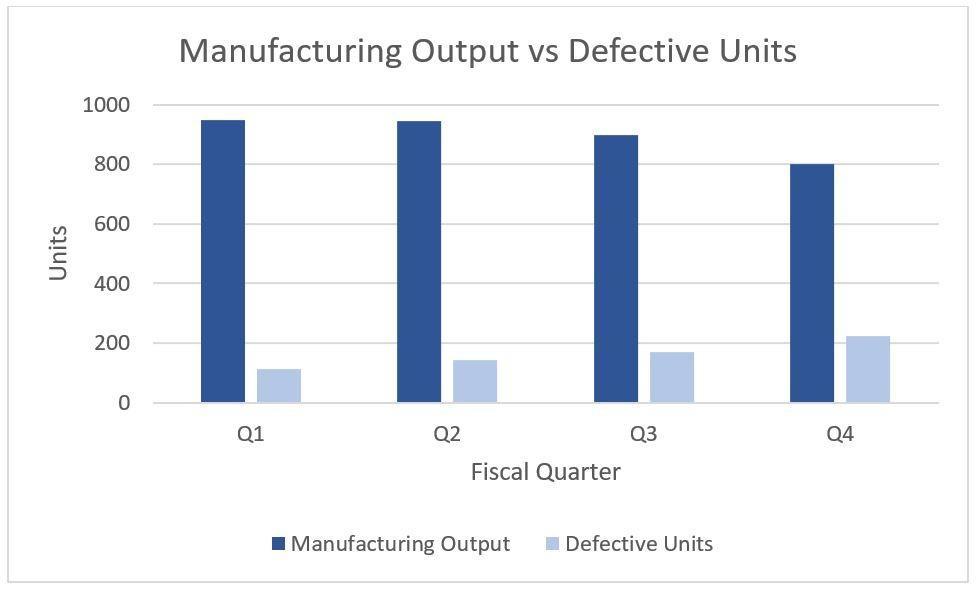
Answer: The core goal of data analysis is to explore data to identify patterns, trends, or unusual observations. Exploring data lets us discover, question, and investigate data relationships to successfully execute data analysis objectives.
Three examples of how the data can be explored:
1. Calculate the defective units as a percentage of total manufacturing output units for each quarter to see which quarter had a higher rate of defective units.
2. Analyze manufacturing output and defective units counts by manufacturing assembly lines to see if there is an assembly line that has a staffing problem.
3. Analyze manufacturing output and defective units counts based on each manufacturing plant to see if there is a problem with machinery at a specific plant.
Diff: 2
LO: 1-2
Bloom: AP
Min.: 10
AACSB: Analytic
AICPA: FC: Risk Assessment, Analysis, and Management
91) Brown's College is looking to modernize their payment process by using an optical character recognition (OCR) system to automate and digitalize their invoices. A data analysis is required to determine which invoice automation system on the market will provide the best return on investment. What is the difference between motivation and objective in a data analysis? Discuss motivation and objective for this data analysis example.
Answer: Motivation is the reason the analysis is performed. The objective is the goal of the project. The motivation for the project is to determine the return on investment with each invoice automation system option. The objective is to determine which invoice automation system has the best return on investment.
Diff: 2
LO: 1-2
Bloom: AP Min.: 10
AACSB: Analytic
AICPA: FC: Risk Assessment, Analysis, and Management
92) Ridgeway Hospital is forming strategic partnerships with their suppliers to streamline their supply chain. A data analysis is required to review existing suppliers using various performance metrics. Discuss three stakeholders of this data analysis and explain why they are a stakeholder. Answer: The director of procurement is a stakeholder since they will need to take action on new strategic partnership contracts with the suppliers. Chief financial officers are stakeholders since they need to ensure that strategic partnerships have a positive impact on the financial performance. Suppliers are stakeholders since business with some suppliers will be lost due to the strategic realignment.
Diff: 2
LO: 1-2
Bloom: AP
Min.: 10
AACSB: Analytic
AICPA: FC: Risk Assessment, Analysis, and Management
93) Panther Motor Company is a startup manufacturer of electric vehicles. Significant cash investment was needed for research and development and capital assets such as building and equipment. Data analysis was performed on cash flows. The results concluded that additional cash flow from financing activities will still be required over the next two years. The data analysis is complete, and you are now performing self-reflection. Define self-reflection in a data analysis. Discuss three benefits for doing self-reflection.
Answer: Self-reflection is the final critical thinking element at the end of a data analysis project to determine and reflect on what worked well and what did not.
Benefits:
1. The lessons learned can help improve future analyses.
2. You can track your performance by assessing your current skills.
3. You can track your knowledge in various subject domains or industries.
4. You can identify technical skills that should be acquired for future analyses.
Diff: 2
LO: 1-4
Bloom: AP
Min.: 10
AACSB: Analytic
AICPA: FC: Risk Assessment, Analysis, and Management
94) Yellowstone Consulting is an IT consulting firm with offices across the country. A data analysis is required to review employee salaries. Base salaries are standardized but bonuses and cost of living adjustments vary and are also part of a consultant's overall compensation. Data analysis is needed to help plan for next year's compensation adjustments. Provide an example of each of the four types of analysis risk related to this analysis.
Answer: Data Risk Should housing costs data be included when determining cost of living adjustments?
Analysis Risk Should predictive analysis be used to account for inflation?
Assumptions Can we automatically assume that the cost of living has increased for all metropolitan areas?
Biases Are you biased in thinking that the metropolitan area that you are living in has a higher cost of living compared to other areas?
Diff: 2
LO: 1-4
Bloom: AP
Min.: 10
AACSB: Analytic
AICPA: FC: Risk Assessment, Analysis, and Management
95) Crispy Buds is a startup bakery that specializes in warm cookies. They have expanded to multiple locations. Their data volume has increased, and their current inhouse data infrastructure is not scalable, so cloud data services are being investigated. A data analysis is required to project their data needs and help determine the type of cloud data service that is required.
For each step in the data analysis (MOSAIC) process, apply the critical thinking framework by describing at least two critical thinking considerations.
Answer: Data Analysis Process (MOSAIC)
Stage 1: Plan
Motivation
Objective
Strategy
Stage 2: Analyze
Prepare data
Build models
Explore data
Stage 3: Report
Interpret
Communicate
Diff: 3
LO: 1-1, 1-2, 1-3, 1-4
Bloom: S
Min.: 15
AACSB: Analytic
Critical Thinking Elements (SPARKS)
• The motivation is to understand future data needs.
• The main stakeholder is the chief information officer.
• The objective is to determine which data cloud service is needed and when.
• Ask articulating objective questions such as "At what rate is the data volume increasing?"
• Obtain additional knowledge in cloud data services, which is an emerging technology.
• Include descriptive analysis of the company's historic data volume trends so that predictive analysis can be done on the anticipated data volume.
• Ensure that all company data is considered in the analysis, including data volume of unstructured data (customer online comments, images, etc.)
• Determine which self-service business intelligence software that will best analyze the data.
• Calculate the rate of data volume growth.
• Calculate the costs involved given the projected data volume.
• Determine if there is a correlation between sales volume and data volume.
• Determine the trends in social media data and its effect on data volume.
• Do the results show the costs required for using cloud data services?
• Do the results determine which cloud data service should be used?
• A presentation and data visualization will be done to communicate the results to the chief information officer.
• The data visualization should show the correlation between the cost projections and the data volume projections.
AICPA: FC: Risk Assessment, Analysis, and Management
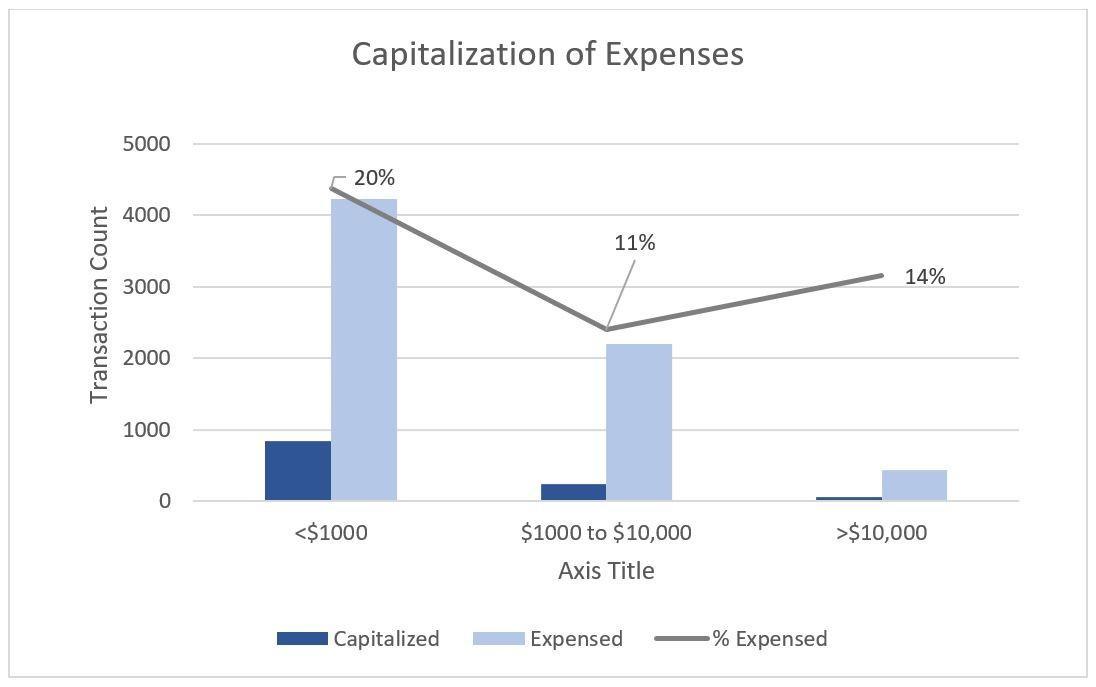
96) You are an auditor at Donlands Accounting. Your client is a public company and has been charged with fraud by the Securities and Exchange Commission in the past due to material misstatements in their financial statements. Specifically, low value expenses were not being audited so they were being capitalized as fixed assets, rather than classifying the transactions as expenses. You are testing the key assertions for expenses: occurrence, completeness, cut-off, classification and accuracy. Audit analytical procedures were applied to the accounting data to test the assertions, and you are now performing data analytics on the transactions.
For each step in the data analysis (MOSAIC) process, apply the critical thinking framework by describing at least two critical thinking considerations.
Answer: Data Analysis Process (MOSAIC)
Stage 1: Plan
Motivation
Objective
Strategy
Stage 2: Analyze
Prepare data
Build models
Explore data
Critical Thinking Elements (SPARKS)
• The motivation is to assess if recording of expense transactions is free of fraud.
• The external stakeholder is the SEC.
• The objective is to determine the expense balances are free from material misstatements.
• Ask articulating objective questions such as
• Are there any other fraud scenarios relating to expenses that should be analyzed?
• Should external data such invoices sourced from the supplier be analyzed?
• Conduct both prescriptive analysis (e.g., what is the percentage of expense being capitalize and diagnostics analysis (e.g., is there specific accounting staff capitalizing expense more than others).
• Use all transactional data rather than a sampling of transactions to test the auditing assertions.
• Extract the data from the accounting information system and request invoice data from suppliers.
• Calculate the total invoice amount rather than individual invoice lines.
• Calculate the total count of transactions that are capitalized by each accounting staff.
• Determine if there is a correlation between transaction amounts and capitalizing the transaction.
• Determine the historic trends of capital expenditures to see if there are patterns.
Stage 3: Report
Interpret
Communicate
• Does it make sense that there is a high percentage of lower dollar transactions being capitalized?
• Does the expense balance satisfy the assertions: occurrence, completeness, cut-off, classification, and accuracy?
• Self-reflection will include using the same analysis approach to test expense transactions for the next audit engagement.
• A memo and a report with selected data visualizations will be used to communicate audit results to the client.
• Create a data visualization that will summarize the transactions that are potentially classified incorrectly.
Diff: 3
LO: 1-1, 1-2, 1-3, 1-4
Bloom: S
Min.: 15
AACSB: Analytic
AICPA: FC: Risk Assessment, Analysis, and Management
97) Dream Home Builders is a builder of custom homes. You are a financial accountant for the company and would like to analyze the financial impacts of changing the revenue recognition policy. The company is currently using the completed-contract method where all revenues and costs are deferred until the project is completed. GAAP also allows for the percentage-ofcompletion method, where revenues and costs are recognized in each accounting period as costs were incurred as a percentage of the total estimated cost. The company would like to use the revenue recognition method to give investors and lenders more confidence in their financial performance.
For each step in the data analysis (MOSAIC) process, apply the critical thinking framework by describing at least two critical thinking considerations.
Answer: Data Analysis Process (MOSAIC)
Stage 1: Plan
Motivation
Critical Thinking Elements (SPARKS)
• The motivation is to use a revenue recognition method that best reflects their financial performance.
• The main stakeholder is the chief financial officer who will be interested in the results.
Objective
Strategy
Stage 2: Analyze
Prepare data
Build models
Explore data
• The objective is to determine if they should switch to the percentage-of-completion method or continue to use the completed-contract method.
• Ask articulating objective questions such as "What is the projected profitability trend in the next three years if the percentage-of-completion method is used?"
• Internal data show the contract details (transaction price, construction time, etc.).
• Use descriptive analysis of the company's historic contract data so that predictive analysis can be done to project profitability over the next few years.
• Extract contract data from smart contracts (a blockchain technology used to automate the execution of the contract).
• Merge historic data with housing projections to create revenue projections.
• Calculation of total cost of each construction project.
• Calculation of revenue allocated to each accounting period based on the percentage completion method.
• Determine if the current data collected is reliable or if inflationary effects on costs should be explored.
• Determine how labor costs and material costs will affect profitability.
Stage 3: Report
Interpret
Communicate
• Does the percentage-of-completion method better reflect their financial performance given the length of the contracts?
• Are the financial projections valid and reliable given assumptions made on contract demands?
• A memo should be prepared to outline the project's motivation, objectives, results, interpretation, and recommendations.
• A dashboard can be created to show differences in revenue for both revenue recognition methods for past and projected financial statements.
Diff: 3
LO: 1-1, 1-2, 1-3, 1-4
Bloom: S
Min.: 15
AACSB: Analytic
AICPA: FC: Risk Assessment, Analysis, and Management
98) You are a tax accountant at Bay Street Partners. In the next federal budget, the government is proposing changes to tax rules for certain individuals, estates and trusts. The proposed changes include increasing the top tax rate for individuals and imposing a minimum tax on wealthy individuals. You perform a data analysis to understand how these proposed changes will affect the tax liability of your clients. Briefly describe what you would suggest for each step in the data analysis (MOSAIC) process, then apply two critical thinking elements for each step listed.
Answer:
Data Analysis Process (MOSAIC)
Stage 1: Plan
Motivation
Brief Description Critical Thinking Elements (SPARKS)
• understand impacts of proposed tax changes
Objective
Strategy
• determine the value of the client's tax liability
• The motivation is to understand impacts of proposed tax changes to your clients.
• The external stakeholder is the tax client who would be affected by the tax changes.
• The objective is to determine the value of the client's tax liability given the proposed changes.
• Ask articulating objective questions such as "What income levels will trigger the minimum tax of wealthy individuals?"
• Extract external data (tax rate) and internal data (client information)
• External data should include proposed tax rates and taxable income brackets.
• Client tax data can be extracted from the tax preparation software.
Stage 2: Analyze
Prepare data
Build models
Explore data
• Merge external data with internal data
• Merge proposed tax rules with client data.
• Filter out clients who are not affected by the proposed tax changes.
• Calculation of total taxable income and determine the applicable tax rate
• Explore different visualizations that will help clients understand the proposed tax impacts
• Calculation of total taxable income.
• Calculation of tax rate based on taxable income.
• Determine if historical data trends can help predict future tax liability.
• Explore data for capital losses that can be carried forward.
Stage 3: Report
Interpret
• Self-reflection of knowledge gained and determine if the results of the analysis address the objectives of the analysis.
Communicate • Communication should be sent to clients and internal tax partners.
• Take inventory of tax knowledge gained so that it can be applied for future analyses.
• Do the results of the analysis provide answers to client's questions such as "What would be my expected tax liability?"
• A memo should be sent to clients informing them of the proposed tax changes and impacts to their tax liability.
• A dashboard can be created for senior tax partners to show the scale of impacts that the proposed tax changes will have on existing clients.
Diff: 3
LO: 1-1, 1-2, 1-3, 1-4
Bloom: S
Min.: 15
AACSB: Analytic
AICPA: FC: Risk Assessment, Analysis, and Management
99) Weekday Fresh is an online meal-kit and grocery delivery business. Revenue relies heavily on repeat customers. They know that specific demographics have higher demand for particular products and that sales are growing within specific age groups, income levels and other market segments. You are a management accountant for the company, and you have been asked by the VP of marketing to analyze website activity from Google Analytics and analyze demographic data. The results of the analysis will help form targeted marketing campaigns to acquire new customers and retain existing customers. For each step in the data analysis (MOSAIC) process, apply the critical thinking framework by describing at least two critical thinking considerations.
Answer: Data Analysis Process (MOSAIC) Critical Thinking Elements (SPARKS)
Stage 1: Plan
Motivation
Objective
Strategy
Stage 2: Analyze
Prepare data
Build models
Explore data
• The motivation is to use website activity and demographic data to inform decisions around marketing campaigns.
• The main stakeholder is the VP of marketing who will use the results to target specific customer groups.
• The objective is to identify demographic groups that will drive sales growth.
• Ask articulating objective questions such as "Are sales growth from specific geographic areas or age groups?"
• Internal data include existing customer profile data and their customer sales history.
• External data should include data extracts from Google Analytics of website activity and website audience reports.
• Extract data from Google Analytics into a comma separated values file.
• Filter data for a data range and merge customer historic data into Alteryx for analysis.
• Calculation of total customers counts based on age or regions.
• Calculation of average order value based on customer income levels.
• Explore data of sales trends on specialty foods.
• Explore data to assess if the data can be used to build artificial intelligence models for suggesting products to repeat customers.
Stage 3: Report
Interpret
Communicate
• Consider the risks in the analysis. For example, is the data selected complete and reliable?
• Do the results of the analysis identify a target market for marketing campaigns?
• A presentation to the marketing team should be done to outline the project's motivation, objectives, results, interpretation, and recommendations.
• A dashboard can be created to allow the marketing team to explore data and drill into specific demographic groups.
Diff: 3
LO: 1-1, 1-2, 1-3, 1-4
Bloom: S
Min.: 15
AACSB: Analytic
AICPA: FC: Risk Assessment, Analysis, and Management
100) At Baycrest University, credit cards (PCards) have been issued to staff and faculty. The PCard program outlines dollar thresholds and allowable uses. For example, single transactions should not exceed $10,000. Purchases must be for business purchases. Department managers must review transactions on a monthly basis for compliance. PCards have offered convenience and reduced procurement costs, but there is a high risk of fraud and abuse. You are an internal auditor for the university, and you are tasked to perform an operational review of the program.
Briefly describe what you would suggest for each step in the data analysis (MOSAIC) process, then apply two critical thinking elements for each step listed.
Answer:
Data Analysis Process (MOSAIC)
Stage 1: Plan
Motivation
Brief Description Critical Thinking Elements (SPARKS)
• Assess PCard users' compliance to the program.
• The motivation is to assess the level of compliance within the PCard program.
• The Chief Financial Officer is a stakeholder since they will be responsible for any financial risk that the university has.
Objective
Strategy
• Determine any risk areas within the PCard program
• The objective is to determine any risk areas within the PCard program.
• Ask articulating objective questions such as "Are PCard holders splitting transactions to circumvent the $10,000 transaction limit?"
• Determine what data needs to be used in the analysis.
• Determine what PCard transactional data needs to be used for analysis.
• Extract supporting purchasing data such as receipt of purchases.
Stage 2: Analyze
Prepare data
• Perform ETL of the data.
Build models
• Calculation of totals from the data collected will allow the data to be analyzed more efficiently.
• Download PCard transactions into Excel.
• Filter transactions based on dates and load data into Tableau so that data can be visualized for anomalies and trends. Tableau allows for analysis of large amounts of data.
• Calculation of total number of transactions by PCard.
• Calculation of total value of transactions based on the merchant category code (every credit card transaction has a category of the merchant, for example, hardware store, airlines, etc.).
Explore data
• Explore data for any relationships, patterns, or anomalies.
• Are there transactions that appear to be anomalies that should be investigated?
• Are there product categories purchased that are considered to be a nonbusiness expense?
Stage 3: Report
Interpret
• Self-reflection of knowledge gained; determine if analysis meets the objective.
• Take inventory of the knowledge that you gained from the PCard program and apply it for future analyses.
• Do the results of the analysis determine if split transactions are occurring?
Communicate
• Communication should be sent to clients and internal partners
• A written report should be sent to the PCard program manager to outline the project's motivation, objectives, results, interpretation, and recommendations.
• If there are instances of fraud, a report of these instances should be sent to the director of internal audit.
Diff: 3
LO: 1-1, 1-2, 1-3, 1-4
Bloom: S
Min.: 15
AACSB: Analytic
AICPA: FC: Risk Assessment, Analysis, and Management
© 2023 John Wiley & Sons, Inc. All rights reserved. Instructors who are authorized users of this course are permitted to download these materials and use them in connection with the course. Except as permitted herein or by law, no part of these materials should be reproduced, stored in a retrieval system, or transmitted, in any form or by any means, electronic, mechanical, photocopying, recording or otherwise.
Accounting Information Systems, 2e (Savage)
Chapter 1 Accounting as Information
MULTIPLE CHOICE
1) The accounting information communicates to stakeholders
A) minimally required public financial data.
B) the financial outcomes of operating, investing, and financing activities.
C) the sales strategy for the operating, marketing, and sales activities.
D) black and white details about the economics of operating activities.
Answer: B
Diff: 1
Learning Objective: 1.1 Explain how accounting affects both the demand for and supply of information.
Section Reference: Why Is Accounting Information Important?
AACSB: Communication
Bloom's: Comprehension
AICPA: AC: Reporting
2) Accounting communicates the financial outcomes of a business's activities for A) operating.
B) investing.
C) financing.
D) All of these answer choices are correct.
Answer: D
Diff: 1
Learning Objective: 1.1 Explain how accounting affects both the demand for and supply of information.
Section Reference: Why Is Accounting Information Important?
AACSB: Communication
Bloom's: Comprehension
AICPA: AC: Reporting
3) In what way do management teams use accounting data?
A) Management teams use accounting data to make business decisions.
B) Management teams use accounting data to make and execute plans.
C) Management teams use economic and accounting data together to make decisions.
D) All of these answer choices are correct.
Answer: D
Diff: 1
Learning Objective: 1.1 Explain how accounting affects both the demand for and supply of information.
Section Reference: Why Is Accounting Information Important?
AACSB: Analytic
Bloom's: Comprehension
AICPA: AC: Risk Assessment, Analysis, and Management
4) Which statement is TRUE?
A) Accounting only consists of rigid black and white rules.
B) Accountants crunch numbers, not make decisions.
C) Accounting helps support a prosperous society.
D) Accountants focus on debits and credits, not business activities.
Answer: C Diff: 1
Learning Objective: 1.1 Explain how accounting affects both the demand for and supply of information.
Section Reference: Why Is Accounting Information Important?
AACSB: Analytic
Bloom's: Comprehension
AICPA: N/A
5) Which of the following is NOT a component of an information system?
A) Hardware
B) Software
C) Input
D) Network
Answer: C Diff: 1
Learning Objective: 1.1 Explain how accounting affects both the demand for and supply of information.
Section Reference: Why Is Accounting Information Important?
AACSB: Analytic
Bloom's: Knowledge
AICPA: AC: Systems and Process Management
6) Which is an example of an input to an accounting information system?
A) raw and unorganized data.
B) hardware and software.
C) reported information.
D) processed data.
Answer: A Diff: 1
Learning Objective: 1.1 Explain how accounting affects both the demand for and supply of information.
Section Reference: Why Is Accounting Information Important?
AACSB: Analytic
Bloom's: Knowledge
AICPA: AC: Systems and Process Management
7) Output can be identified as
A) raw and unorganized data.
B) information that is produced by processing data.
C) database facts and figures.
D) information collected from survey of users.
Answer: B
Diff: 1
Learning Objective: 1.1 Explain how accounting affects both the demand for and supply of information.
Section Reference: Why Is Accounting Information Important?
AACSB: Analytic
Bloom's: Comprehension
AICPA: AC: Systems and Process Management
8) Which statement concerning data is FALSE?
A) Data is useful to a business when transformed into information.
B) Data is the only output from an information system.
C) Data should be organized into understandable formats.
D) Data is processed before being input into the information system.
Answer: B
Diff: 1
Learning Objective: 1.1 Explain how accounting affects both the demand for and supply of information.
Section Reference: Why Is Accounting Information Important?
AACSB: Analytic
Bloom's: Comprehension
AICPA: AC: Systems and Process Management
9) Which of the following activities would NOT result in an economic transaction in an accounting information system?
A) Sell goods to a customer on account
B) Purchase supplies on credit
C) Prepay for six months of insurance
D) Prepare a marketing flyer
Answer: D
Diff: 2
Learning Objective: 1.1 Explain how accounting affects both the demand for and supply of information.
Section Reference: Why Is Accounting Information Important?
AACSB: Analytic
Bloom's: Application
AICPA: AC: Systems and Process Management
10) Which of the following activities results in an economic transaction in an accounting information system?
A) Sell goods to a customer
B) Submit an order to a vendor
C) Create estimates for a customer
D) Receive a customer order
Answer: A
Diff: 2
Learning Objective: 1.1 Explain how accounting affects both the demand for and supply of information.
Section Reference: Why Is Accounting Information Important?
AACSB: Analytic
Bloom's: Application
AICPA: AC: Systems and Process Management
11) An accounting information system captures data that is
A) easy to capture for the business.
B) of interest to the business.
C) not useful to the business.
D) available to the business.
Answer: B
Diff: 1
Learning Objective: 1.1 Explain how accounting affects both the demand for and supply of information.
Section Reference: Why Is Accounting Information Important?
AACSB: Analytic
Bloom's: Knowledge
AICPA: AC: Systems and Process Management
12) A business model is
A) a company's plan for operations.
B) a company's plan for making a profit.
C) a company's plan for identifying customers.
D) a company's plan for production.
Answer: A Diff: 1
Learning Objective: 1.1 Explain how accounting affects both the demand for and supply of information.
Section Reference: Why Is Accounting Information Important?
AACSB: Analytic
Bloom's: Knowledge
AICPA: AC: Systems and Process Management
13) What kind of business model should an entrepreneurial application developer consider for a new smartphone application that will allow users to access some features for free and pay for additional capabilities?
A) Franchise
B) Subscription
C) Freemium
D) Peer-to-peer
Answer: C
Diff: 2
Learning Objective: 1.1 Explain how accounting affects both the demand for and supply of information.
Section Reference: Why Is Accounting Information Important?
AACSB: Analytic
Bloom's: Application
AICPA: AC: Systems and Process Management
14) Samantha's Soy Candles has built a retail location in a seasonally busy tourist town. Samantha has developed a scent of the month that she plans to market to customers as a once per month shipment. The monthly shipment of these candles could help Samantha during the slow months at her retail store. What kind of business model would Samantha employ for her new seasonal candle shipment business line?
A) Franchise
B) Subscription
C) Freemium
D) Peer-to-peer
Answer: B
Diff: 2
Learning Objective: 1.1 Explain how accounting affects both the demand for and supply of information.
Section Reference: Why Is Accounting Information Important?
AACSB: Analytic
Bloom's: Application
AICPA: AC: Systems and Process Management
15) PizzaIbiza, a local pizza shop, developed an app to order pizza directly to the customer instead of using a third-party app like Uber Eats or DoorDash. What is the business model of Netflix?
A) Franchise
B) Subscription
C) Freemium
D) Direct-to-consumer
Answer: D
Diff: 2
Learning Objective: 1.1 Explain how accounting affects both the demand for and supply of information.
Section Reference: Why Is Accounting Information Important?
AACSB: Analytic
Bloom's: Application
AICPA: AC: Systems and Process Management
16) Fast-food chains that allow individuals to purchase and operate a location for that chain are operating under what kind of business model?
A) Franchise
B) Subscription
C) Freemium
D) Peer-to-peer
Answer: A
Diff: 2
Learning Objective: 1.1 Explain how accounting affects both the demand for and supply of information.
Section Reference: Why Is Accounting Information Important?
AACSB: Analytic
Bloom's: Application
AICPA: AC: Systems and Process Management
17) Zuzu toys employs strategies to benefit the local community and the environment. What part of the business model is this identified with?
A) Profit-making
B) Social responsibility
C) Problem Solving
D) Peer-to-peer
Answer: B
Diff: 2
Learning Objective: 1.1 Explain how accounting affects both the demand for and supply of information.
Section Reference: Why Is Accounting Information Important?
AACSB: Analytic
Bloom's: Application
AICPA: AC: Systems and Process Management
18) A ________ is a group of related business events designed to accomplish the business's strategic objectives.
A) business model
B) business operations
C) business process
D) conversion process
Answer: C
Diff: 1
Learning Objective: 1.1 Explain how accounting affects both the demand for and supply of information.
Section Reference: Why Is Accounting Information Important?
AACSB: Analytic
Bloom's: Knowledge
AICPA: AC: Systems and Process Management
19) What are the primary types of business processes in a basic business model?
A) Acquisition and Payment Processes
B) Conversion Processes
C) Marketing, Sales, and Collections Processes
D) All of these answer choices are correct.
Answer: D
Diff: 1
Learning Objective: 1.1 Explain how accounting affects both the demand for and supply of information.
Section Reference: Why Is Accounting Information Important?
AACSB: Analytic
Bloom's: Comprehension
AICPA: AC: Systems and Process Management
20) During what processes does a business add value by converting the raw resources into goods and services that a customer might want to purchase?
A) Acquisition and Payment Processes
B) Conversion Processes
C) Marketing, Sales, and Collections Processes
D) All of these answer choices are correct.
Answer: B
Diff: 1
Learning Objective: 1.1 Explain how accounting affects both the demand for and supply of information.
Section Reference: Why Is Accounting Information Important?
AACSB: Analytic
Bloom's: Comprehension
AICPA: AC: Systems and Process Management
21) Tina, Tammy, and Toni opened a Pizza Hut franchise in the suburbs of a major metropolitan area. Tina manages the team that handles making the pizzas. What process area demands the most of Tina's focus?
A) Acquisition and Payment
B) Conversion
C) Marketing, Sales, and Collections
D) All of these answer choices are correct.
Answer: B
Diff: 2
Learning Objective: 1.1 Explain how accounting affects both the demand for and supply of information.
Section Reference: Why Is Accounting Information Important?
AACSB: Analytic
Bloom's: Application
AICPA: AC: Systems and Process Management
22) Tina, Tammy, and Toni opened a Pizza Hut franchise in the suburbs of a major metropolitan area. Tammy manages the cash drawer, credit card reconciliation, and payroll. Which of the following type of business event is Tammy's to manage?
A) Operating events
B) Financing events
C) Investing events
D) All of these answer choices are correct.
Answer: A
Diff: 2
Learning Objective: 1.1 Explain how accounting affects both the demand for and supply of information.
Section Reference: Why Is Accounting Information Important?
AACSB: Analytic
Bloom's: Application
AICPA: AC: Systems and Process Management
23) Which type of business event includes paying dividends and paying loan installments?
A) Operating events
B) Financing events
C) Investing events
D) Information events
Answer: B
Diff: 2
Learning Objective: 1.1 Explain how accounting affects both the demand for and supply of information.
Section Reference: Why Is Accounting Information Important?
AACSB: Analytic
Bloom's: Application
AICPA: AC: Systems and Process Management
24) Which one of these business events does not result in an exchange of economic resources?
A) Operating events
B) Financing events
C) Investing events
D) Information events
Answer: D
Diff: 2
Learning Objective: 1.1 Explain how accounting affects both the demand for and supply of information.
Section Reference: Why Is Accounting Information Important?
AACSB: Analytic
Bloom's: Application
AICPA: AC: Systems and Process Management
25) Which type of business event includes acquiring a new factory warehouse that will handle packaging operations for a soap manufacturer?
A) Operating events
B) Financing events
C) Investing events
D) Information events
Answer: C
Diff: 2
Learning Objective: 1.1 Explain how accounting affects both the demand for and supply of information.
Section Reference: Why Is Accounting Information Important?
AACSB: Analytic
Bloom's: Application
AICPA: AC: Systems and Process Management
26) Which of the following statements is FALSE?
A) Transaction-based accounting information systems record only accounting transactions.
B) Transaction-based accounting information systems ignore nonfinancial data.
C) Transaction-based accounting information systems are no longer used in business settings.
D) Transaction-based accounting information systems ignore the relationships between business events and processes.
Answer: C
Diff: 2
Learning Objective: 1.2 Compare traditional transaction-based accounting systems to processbased information systems.
Section Reference: How Have Accounting Information Systems Evolved?
AACSB: Analytic
Bloom's: Analysis
AICPA: AC: Systems and Process Management
27) Transaction-based accounting systems typically capture only
A) nonfinancial data.
B) accounting business events.
C) relationships between business events and processes.
D) key performance indicators.
Answer: B
Diff: 1
Learning Objective: 1.2 Compare traditional transaction-based accounting systems to processbased information systems.
Section Reference: How Have Accounting Information Systems Evolved?
AACSB: Analytic
Bloom's: Knowledge
AICPA: AC: Systems and Process Management
28) What should be management's first task before a business can begin operations?
A) Produce products
B) Create a marketing plan
C) Obtain needed resources
D) All of these answer choices are correct.
Answer: C
Diff: 1
Learning Objective: 1.2 Compare traditional transaction-based accounting systems to processbased information systems.
Section Reference: How Have Accounting Information Systems Evolved?
AACSB: Analytic
Bloom's: Knowledge
AICPA: AC: Systems and Process Management
29) Which of the following is an input for a business that manufactures ceiling fans?
A) Raw materials
B) Production line employees
C) Manufacturing equipment
D) All of these answer choices are correct.
Answer: D
Diff: 1
Learning Objective: 1.2 Compare traditional transaction-based accounting systems to processbased information systems.
Section Reference: How Have Accounting Information Systems Evolved?
AACSB: Analytic
Bloom's: Comprehension
AICPA: AC: Systems and Process Management
30) Which transaction would be recorded in a transaction-based accounting information system?
A) Ordering raw materials
B) Hiring an employee
C) Obtaining a loan
D) Receiving goods
Answer: D
Diff: 2
Learning Objective: 1.2 Compare traditional transaction-based accounting systems to processbased information systems.
Section Reference: How Have Accounting Information Systems Evolved?
AACSB: Analytic
Bloom's: Application
AICPA: AC: Systems and Process Management
31) Which transaction would NOT be recorded in a transaction-based accounting information system?
A) Ordering raw materials from a vendor
B) Purchasing office supplies online
C) Selling goods to a customer
D) Paying employee salaries via direct deposit
Answer: A
Diff: 2
Learning Objective: 1.2 Compare traditional transaction-based accounting systems to processbased information systems.
Section Reference: How Have Accounting Information Systems Evolved?
AACSB: Analytic
Bloom's: Application
AICPA: AC: Systems and Process Management
32) Which of the following accounting data components is an acquisition and payment process?
A) Expenditures
B) Payroll
C) Financing
D) All of these answer choices are correct.
Answer: D
Diff: 1
Learning Objective: 1.2 Compare traditional transaction-based accounting systems to processbased information systems.
Section Reference: How Have Accounting Information Systems Evolved?
AACSB: Analytic
Bloom's: Knowledge
AICPA: AC: Systems and Process Management
33) Which of the following accounting data components is an acquisition and payment process?
A) Production
B) Revenue
C) Financing
D) All of these answer choices are correct.
Answer: C
Diff: 1
Learning Objective: 1.2 Compare traditional transaction-based accounting systems to processbased information systems.
Section Reference: How Have Accounting Information Systems Evolved?
AACSB: Analytic
Bloom's: Knowledge
AICPA: AC: Systems and Process Management
34) Which statement about the conversion process is FALSE?
A) Businesses create value by combining and converting resources to goods and/or services.
B) The conversion process includes the acquisition of resources.
C) The conversion process can also include capturing ESG data to measure a company's carbon footprint.
D) Businesses create value by being innovative and efficient in their processing.
Answer: B
Diff: 2
Learning Objective: 1.2 Compare traditional transaction-based accounting systems to processbased information systems.
Section Reference: How Have Accounting Information Systems Evolved?
AACSB: Analytic
Bloom's: Application
AICPA: AC: Systems and Process Management
35) A popular fast-food chicken restaurant currently offers only fried chicken tenders and chicken sandwiches made from chicken tenders. The only sides available are bread, slaw, and fries. If the chain were to consider offering grilled chicken on its menu, what would you recommend before considering the change for a national roll-out?
A) Test the market need for this change by introducing it as a "special" menu item.
B) Test the new product on customers in a small group of restaurants.
C) Plan and test the new production process.
D) All of these answer choices are correct.
Answer: D
Diff: 2
Learning Objective: 1.2 Compare traditional transaction-based accounting systems to processbased information systems.
Section Reference: How Have Accounting Information Systems Evolved?
AACSB: Analytic
Bloom's: Application
AICPA: AC: Systems and Process Management
36) What additional data could be captured during the conversion processes to help corporate management improve business efficiency or effectiveness?
A) Quality testing data
B) Downtime data
C) Waste data
D) All of these answer choices are correct.
Answer: D
Diff: 1
Learning Objective: 1.2 Compare traditional transaction-based accounting systems to processbased information systems.
Section Reference: How Have Accounting Information Systems Evolved?
AACSB: Analytic
Bloom's: Knowledge
AICPA: AC: Systems and Process Management
37) Which of the following may not be a benefit arising from management evaluating conversion process data captured by a process-based accounting information system?
A) Reduced downtime
B) Better ESG performance
C) Increased customer satisfaction
D) Increased customer engagement
Answer: D
Diff: 1
Learning Objective: 1.2 Compare traditional transaction-based accounting systems to processbased information systems.
Section Reference: How Have Accounting Information Systems Evolved?
AACSB: Analytic
Bloom's: Knowledge
AICPA: AC: Systems and Process Management
38) Juan is opening a sushi truck. Juan has asked that you review his plans and provide recommendations. Regarding Juan's conversion process, which of the following would you recommend to gain a competitive advantage?
A) Juan should make sure to offer the same menu items as the other sushi truck in town.
B) Juan should have unique product offerings and more efficient processes than the other sushi truck in town.
C) Juan should follow the same service routes as the other sushi truck in town.
D) Juan should make sure to serve his food in a manner that is like other food trucks in town.
Answer: B
Diff: 3
Learning Objective: 1.2 Compare traditional transaction-based accounting systems to processbased information systems.
Section Reference: How Have Accounting Information Systems Evolved?
AACSB: Analytic
Bloom's: Synthesis
AICPA: AC: Systems and Process Management
39) Which of the following activities is an additional data capture opportunity during the conversion process?
A) Compliance with regulations
B) Resource acquisition
C) Monitor employee performance
D) Monitor cash flow
Answer: A
Diff: 2
Learning Objective: 1.2 Compare traditional transaction-based accounting systems to processbased information systems.
Section Reference: How Have Accounting Information Systems Evolved?
AACSB: Analytic
Bloom's: Analysis
AICPA: AC: Systems and Process Management
40) During the acquisition and payment process, which areas are opportunities for additional data capture in the process approach for information systems?
A) Monitor supplier performance
B) Monitor employee performance
C) Monitor cash flow
D) All of these answer choices are correct.
Answer: D
Diff: 1
Learning Objective: 1.2 Compare traditional transaction-based accounting systems to processbased information systems.
Section Reference: How Have Accounting Information Systems Evolved?
AACSB: Analytic
Bloom's: Knowledge
AICPA: AC: Systems and Process Management
41) Which of the following social responsibility and sustainability data points can be captured through the conversion processes?
A) Water usage
B) Energy consumption
C) Carbon footprint
D) All of these answer choices are correct.
Answer: D
Diff: 1
Learning Objective: 1.2 Compare traditional transaction-based accounting systems to processbased information systems.
Section Reference: How Have Accounting Information Systems Evolved?
AACSB: Analytic
Bloom's: Knowledge
AICPA: AC: Systems and Process Management
42) Which of the following is not captured through the conversion processes in the information system?
A) Design product
B) Production plan
C) Cost of goods manufactured
D) Package product
Answer: C
Diff: 1
Learning Objective: 1.2 Compare traditional transaction-based accounting systems to processbased information systems.
Section Reference: How Have Accounting Information Systems Evolved?
AACSB: Analytic
Bloom's: Comprehension
AICPA: AC: Systems and Process Management
43) After converting resources into products and/or services, the business generates revenue by
A) marketing and selling its products or services.
B) scheduling production.
C) acquiring resources.
D) monitoring employee performance.
Answer: A
Diff: 1
Learning Objective: 1.2 Compare traditional transaction-based accounting systems to processbased information systems.
Section Reference: How Have Accounting Information Systems Evolved?
AACSB: Analytic
Bloom's: Knowledge
AICPA: AC: Systems and Process Management
44) Which business event data would not be captured in a traditional accounting information system?
A) Produce product
B) Take customer order
C) Deliver goods to a customer
D) Collect payment from customer
Answer: B
Diff: 1
Learning Objective: 1.2 Compare traditional transaction-based accounting systems to processbased information systems.
Section Reference: How Have Accounting Information Systems Evolved?
AACSB: Analytic
Bloom's: Knowledge
AICPA: AC: Systems and Process Management
45) In which of the following process categories would processing a vendor payment be recorded?
A) Acquisition and Payment
B) Marketing, Sales, and Collection
C) Conversion
D) Transaction Answer: A
Diff: 2
Learning Objective: 1.2 Compare traditional transaction-based accounting systems to processbased information systems.
Section Reference: How Have Accounting Information Systems Evolved?
AACSB: Analytic
Bloom's: Application
AICPA: AC: Systems and Process Management
46) In which of the following process categories would the product recycling rate be captured?
A) Acquisition and Payment
B) Marketing, Sales, and Collection
C) Conversion
D) Transaction Answer: C
Diff: 2
Learning Objective: 1.2 Compare traditional transaction-based accounting systems to processbased information systems.
Section Reference: How Have Accounting Information Systems Evolved?
AACSB: Analytic
Bloom's: Application
AICPA: AC: Systems and Process Management
47) Online search engine rankings will be captured in which of the following processes?
A) Acquisition and Payment
B) Marketing, Sales, and Collection
C) Conversion
D) Transaction Answer: B
Diff: 2
Learning Objective: 1.2 Compare traditional transaction-based accounting systems to processbased information systems.
Section Reference: How Have Accounting Information Systems Evolved?
AACSB: Analytic
Bloom's: Application
AICPA: AC: Systems and Process Management
48) The accounting information system provides financial and other metrics that A) determine how well management is implementing business processes.
B) are used by management for making decisions concerning business processes.
C) allow management to assess key performance indicators.
D) All of these answer choices are correct.
Answer: D
Diff: 1
Learning Objective: 1.3 Explain management's relationship to information and information systems.
Section Reference: How Does Management Use Information?
AACSB: Reflective Thinking
Bloom's: Comprehension
AICPA: AC: Reporting
49) Which of the following management responsibility areas includes assigning onboarding and training tasks to employees?
A) Planning
B) Implementing
C) Monitoring
D) Changing and Improving
Answer: B
Diff: 1
Learning Objective: 1.3 Explain management's relationship to information and information systems.
Section Reference: How Does Management Use Information?
AACSB: Analytic
Bloom's: Comprehension
AICPA: AC: Systems and Process Management
50) Which of the following management responsibility areas includes developing a strategic plan?
A) Planning
B) Implementing
C) Monitoring
D) Changing and Improving
Answer: A
Diff: 1
Learning Objective: 1.3 Explain management's relationship to information and information systems.
Section Reference: How Does Management Use Information?
AACSB: Analytic
Bloom's: Comprehension
AICPA: AC: Systems and Process Management
51) Which of the following management responsibility areas includes analyzing accounting data and financial statements?
A) Planning
B) Implementing
C) Monitoring
D) Changing and Improving Answer: C
Diff: 1
Learning Objective: 1.3 Explain management's relationship to information and information systems.
Section Reference: How Does Management Use Information?
AACSB: Analytic
Bloom's: Comprehension
AICPA: AC: Systems and Process Management
52) Which of the following management responsibility areas includes identifying opportunities and assessing risk?
A) Planning
B) Implementing
C) Monitoring
D) Changing and Improving Answer: A
Diff: 1
Learning Objective: 1.3 Explain management's relationship to information and information systems.
Section Reference: How Does Management Use Information?
AACSB: Analytic
Bloom's: Comprehension
AICPA: AC: Systems and Process Management
53) Kobe manages a real estate company. Recently, Kobe modified the process by agents in the organization to meet company expectations. In which management responsibility area was Kobe operating?
A) Planning
B) Implementing
C) Monitoring
D) Changing and Improving Answer: D
Diff: 2
Learning Objective: 1.3 Explain management's relationship to information and information systems.
Section Reference: How Does Management Use Information?
AACSB: Analytic
Bloom's: Application
AICPA: AC: Systems and Process Management
54) Amy, an assistant manager at a credit union, added functionality to the deposit software used by tellers in the credit union to detect fraudulent activity before the deposit goes into a customer's account. In which management responsibility area was Amy acting in when she added this functionality?
A) Planning
B) Implementing
C) Monitoring
D) Changing and Improving Answer: B
Diff: 2
Learning Objective: 1.3 Explain management's relationship to information and information systems.
Section Reference: How Does Management Use Information?
AACSB: Analytic
Bloom's: Application
AICPA: AC: Systems and Process Management
55) Dembe started and manages a transportation company in Kampala, Uganda. Dembe hired an accounting firm to perform an audit of corporate financials. In which management responsibility area was Dembe acting by requesting an audit?
A) Planning
B) Implementing
C) Monitoring
D) Changing and Improving Answer: C
Diff: 2
Learning Objective: 1.3 Explain management's relationship to information and information systems.
Section Reference: How Does Management Use Information?
AACSB: Analytic
Bloom's: Application
AICPA: AC: Systems and Process Management
56) Alicia compared the actual performance of a unit with other units. Which business process does this represent?
A) Planning
B) Implementing
C) Monitoring
D) Changing and Improving Answer: C
Diff: 2
Learning Objective: 1.3 Explain management's relationship to information and information systems.
Section Reference: How Does Management Use Information?
AACSB: Analytic
Bloom's: Application
AICPA: AC: Systems and Process Management
57) Quantifiable metrics used to measure and evaluate the success of an organization based on its objectives are known as
A) data integration metrics.
B) business event indicators.
C) key performance indicators.
D) data quality points.
Answer: C
Diff: 1
Learning Objective: 1.3 Explain management's relationship to information and information systems.
Section Reference: How Does Management Use Information?
AACSB: Analytic
Bloom's: Knowledge
AICPA: AC: Reporting
58) Select which statement concerning key performance indicators (KPIs) is NOT true.
A) KPIs for a business are often compared to benchmarks for the industry.
B) KPIs include accounting ratios, like net profit, market and return on investment.
C) KPIs data comes from the accounting information system for a business.
D) KPIs include qualitative data from multiple sources.
Answer: D
Diff: 2
Learning Objective: 1.3 Explain management's relationship to information and information systems.
Section Reference: How Does Management Use Information?
AACSB: Analytic
Bloom's: Analysis
AICPA: AC: Reporting
59) Which of these situations best represents benchmarking for Skittles, Inc., which manufactures candy?
A) Skittles, Inc. looked at prior year marketing analytics to develop strategies for next year.
B) Skittles, Inc. issues a bonus to the CEO for extraordinary growth in the current quarter.
C) Skittles, Inc. prepared an industry-wide detailed study analyzing the quantifiable performance of competitors.
D) Skittles, Inc. did a feasibility study for producing a new candy.
Answer: C
Diff: 2
Learning Objective: 1.3 Explain management's relationship to information and information systems.
Section Reference: How Does Management Use Information?
AACSB: Analytic
Bloom's: Analysis
AICPA: AC: Reporting
60) Which characteristic refers to the suitability of the information for a particular purpose in a specific task?
A) Information integrity
B) Information quality
C) Data integrity
D) Data quality
Answer: B
Diff: 1
Learning Objective: 1.3 Explain management's relationship to information and information systems.
Section Reference: How Does Management Use Information?
AACSB: Analytic
Bloom's: Knowledge
AICPA: AC: Reporting
61) Data Integrity refers to
A) reliability.
B) completeness, accuracy, and reliability.
C) completeness, accuracy, reliability, and consistency of data.
D) completeness and accuracy.
Answer: C
Diff: 1
Learning Objective: 1.3 Explain management's relationship to information and information systems.
Section Reference: How Does Management Use Information?
AACSB: Analytic
Bloom's: Knowledge
AICPA: AC: Reporting
62) Which statement is NOT true?
A) Business events create decisions.
B) Business events create data.
C) Accounting information systems transform data into information.
D) Accounting information systems store purchasing and sales data.
Answer: A
Diff: 2
Learning Objective: 1.3 Explain management's relationship to information and information systems.
Section Reference: How Does Management Use Information?
AACSB: Analytic
Bloom's: Analysis
AICPA: AC: Reporting
63) To be useful for decision making, information must have which two fundamental characteristics?
A) Relevance and Actionability
B) Relevance and Faithful Representation
C) Reality and Faithful Representation
D) Reality and Actionability
Answer: B
Diff: 1
Learning Objective: 1.3 Explain management's relationship to information and information systems.
Section Reference: How Does Management Use Information?
AACSB: Analytic
Bloom's: Knowledge
AICPA: AC: Reporting
64) Which enhancing characteristic of useful information includes the ability for auditors to reach the same conclusions from the same information?
A) Verifiability
B) Timeliness
C) Understandability
D) Comparability Answer: A
Diff: 1
Learning Objective: 1.3 Explain management's relationship to information and information systems.
Section Reference: How Does Management Use Information?
AACSB: Analytic
Bloom's: Knowledge
AICPA: AC: Reporting
65) Your organization has been reviewing information from the accounting information system based on weekly reports. You are tasked with designing a digital dashboard to display key performance indicators (KPIs) to management. Which enhancing characteristic of useful information are you improving by creating a dashboard that is updated in real-time with KPIs?
A) Verifiability
B) Timeliness
C) Understandability
D) Comparability Answer: B
Diff: 2
Learning Objective: 1.3 Explain management's relationship to information and information systems.
Section Reference: How Does Management Use Information?
AACSB: Analytic
Bloom's: Application
AICPA: AC: Reporting
66) At Jonex Corporation, each location has been responsible for reporting its key performance indicators (KPIs) via email to the home office. As an intern in the home office, you are tasked with compiling the information in the emails into a report for your manager. After performing the process once, you develop a query for the information system that allows you to pull the information directly from the system and present it in a format that presents the data in a way that makes the different locations KPIs much easier to compare. Which enhancing characteristic of information have you improved for Jonex?
A) Verifiability
B) Timeliness
C) Understandability
D) Comparability
Answer: D
Diff: 2
Learning Objective: 1.3 Explain management's relationship to information and information systems.
Section Reference: How Does Management Use Information?
AACSB: Analytic
Bloom's: Application
AICPA: AC: Reporting
67) Aiko recently joined the Hondo organization. Aiko's area of responsibility is generating visual representations of data for Hondo. Currently, Hondo only has someone creating reports, with numerical data presented in tables. Which enhancing characteristic of data will be improved for Hondo with Aiko's data visualization skills?
A) Verifiability
B) Timeliness
C) Understandability
D) Comparability
Answer: C
Diff: 2
Learning Objective: 1.3 Explain management's relationship to information and information systems.
Section Reference: How Does Management Use Information?
AACSB: Analytic
Bloom's: Application
AICPA: AC: Reporting
68) Juan, a manager for JK Enterprises, is considering hiring your consulting company to evaluate the usefulness of purchasing software for JK that will improve their information reporting capabilities. The software is complex and would require that JK hire someone knowledgeable or send a current employee for additional training. What kind of analysis will your consulting company perform for Juan to determine if the software is a good purchase?
A) Decision context analysis
B) Information quality analysis
C) Data integrity analysis
D) Cost-benefit analysis
Answer: D
Diff: 3
Learning Objective: 1.3 Explain management's relationship to information and information systems.
Section Reference: How Does Management Use Information?
AACSB: Analytic
Bloom's: Evaluation
AICPA: AC: Risk Assessment, Analysis, and Management
69) Which of these statements most clearly defines decision context?
A) Decision context considers the preferences and constraints that affect how a decision is made.
B) Decision context considers the fundamental and enhancing characteristics of data.
C) Decision context refers to the relevance and faithful representation of information.
D) Decision context refers to the information quality and data integrity of a decision.
Answer: A
Diff: 2
Learning Objective: 1.3 Explain management's relationship to information and information systems.
Section Reference: How Does Management Use Information?
AACSB: Analytic
Bloom's: Analysis
AICPA: AC: Risk Assessment, Analysis, and Management
70) Which questions lead to determining the decision context?
A) How fast and what format is the information needed?
B) Who will use it, and why is the information needed?
C) Who requested the information, and what formatting is needed?
D) What comparability and understandability characteristics of the information are needed?
Answer: B
Diff: 2
Learning Objective: 1.3 Explain management's relationship to information and information systems.
Section Reference: How Does Management Use Information?
AACSB: Analytic
Bloom's: Analysis
AICPA: AC: Risk Assessment, Analysis, and Management
71) Relevant information must A) apply to future events.
B) have confirmatory value.
C) have a significant impact on the decision.
D) All of these statements are correct.
Answer: D
Diff: 2
Learning Objective: 1.3 Explain management's relationship to information and information systems.
Section Reference: How Does Management Use Information?
AACSB: Analytic
Bloom's: Analysis
AICPA: AC: Reporting
72) Faithfully represented data includes the characteristics of
A) being unbiased and accurate.
B) having predictive and confirmatory value.
C) being classified and presented clearly.
D) having comparability and verifiability.
Answer: A
Diff: 2
Learning Objective: 1.3 Explain management's relationship to information and information systems.
Section Reference: How Does Management Use Information?
AACSB: Analytic
Bloom's: Analysis
AICPA: AC: Reporting
73) Which of these characteristics relates to information that is error-free?
A) Faithful representation
B) Relevance
C) Timeliness
D) Comparability
Answer: A
Diff: 1
Learning Objective: 1.3 Explain management's relationship to information and information systems.
Section Reference: How Does Management Use Information?
AACSB: Analytic
Bloom's: Knowledge
AICPA: AC: Reporting
74) Maria is asked to create a document at the end of each month that displays that month's sales data across divisions. What type of output will Maria need to obtain from the information system to obtain this information?
A) Reporting
B) Data analytics
C) Key performance indicators
D) Management insight
Answer: A
Diff: 2
Learning Objective: 1.4 Describe the relationship between accounting and data analytics.
Section Reference: What Is the Relationship between Accounting and Data Analytics?
AACSB: Analytic
Bloom's: Analysis
AICPA: AC: Reporting
75) Walter, works for an accounting firm that is in the process of improving how to use data from their information system. Walter is asked to use Tableau for creating visualizations that will allow the firm to transform data into useful information. What kind of output will Walter be generating?
A) Reporting
B) Data analytics
C) Key performance indicators
D) Management insight Answer: B
Diff: 2
Learning Objective: 1.4 Describe the relationship between accounting and data analytics.
Section Reference: What Is the Relationship between Accounting and Data Analytics?
AACSB: Analytic
Bloom's: Analysis
AICPA: AC: Reporting
76) Where does the data originate for data analytics purposes?
A) Reports from the information system
B) Raw data from the information system
C) Business event results
D) All of these answer choices are correct.
Answer: D
Diff: 2
Learning Objective: 1.4 Describe the relationship between accounting and data analytics.
Section Reference: What Is the Relationship between Accounting and Data Analytics?
AACSB: Analytic
Bloom's: Analysis
AICPA: AC: Reporting
77) In what way is reporting different from data analytics?
A) Reporting does not seek insight into reasons behind data.
B) Reporting uses data from the information system, while data analytics uses data from reports.
C) Reporting does not include any calculations like data analytics does.
D) Reporting and data analytics are two terms for the same thing.
Answer: A
Diff: 2
Learning Objective: 1.4 Describe the relationship between accounting and data analytics.
Section Reference: What Is the Relationship between Accounting and Data Analytics?
AACSB: Analytic
Bloom's: Analysis
AICPA: AC: Reporting
78) Which statement is TRUE?
A) Management uses data from data analytics to make decisions and from reporting to publish to stakeholders.
B) Management uses their experience to make data-driven decisions without regard to reporting or data analytics.
C) Management uses historical reports and data analytics insights to understand reasons and context to make decisions.
D) Management uses data analytics to calculate historical performance data without regard to the reason or context.
Answer: C
Diff: 2
Learning Objective: 1.4 Describe the relationship between accounting and data analytics.
Section Reference: What Is the Relationship between Accounting and Data Analytics?
AACSB: Analytic
Bloom's: Analysis
AICPA: AC: Reporting
79) Which statement is FALSE?
A) Data analytics is becoming commonplace and even mandated in many industries.
B) Accountants have been calculating some of the same information that is now calculated using data analytics manually for years.
C) Data analytics allows accountants to generate information more efficiently and effectively.
D) Accounting data analytics does not include the vertical analysis of financial statements.
Answer: D
Diff: 2
Learning Objective: 1.4 Describe the relationship between accounting and data analytics.
Section Reference: What Is the Relationship between Accounting and Data Analytics?
AACSB: Analytic
Bloom's: Analysis
AICPA: AC: Systems and Process Management
80) Data analytics uses technology to transform A) data into information.
B) information into data.
C) event processes into data.
D) business processes into information.
Answer: A
Diff: 2
Learning Objective: 1.4 Describe the relationship between accounting and data analytics.
Section Reference: What Is the Relationship between Accounting and Data Analytics?
AACSB: Analytic
Bloom's: Application
AICPA: AC: Systems and Process Management
81) In what ways do accounting professionals use accounting ratios to compare a company's performance?
A) Across time
B) To other companies
C) To industry benchmarks
D) All of these answer choices are correct.
Answer: D
Diff: 2
Learning Objective: 1.4 Describe the relationship between accounting and data analytics.
Section Reference: What Is the Relationship between Accounting and Data Analytics?
AACSB: Analytic
Bloom's: Analysis
AICPA: AC: Reporting
82) Accountants using technology to analyze financial statements rather than using a manual process are performing
A) data reporting.
B) data quality.
C) data analytics.
D) data capture.
Answer: C
Diff: 2
Learning Objective: 1.4 Describe the relationship between accounting and data analytics.
Section Reference: What Is the Relationship between Accounting and Data Analytics?
AACSB: Analytic
Bloom's: Application
AICPA: AC: Systems and Process Management
83) Which of the following statements about the way accountants use data analytics is FALSE?
A) Accountants can use data analytics to get more comprehensive results.
B) Accountants can use data analytics without technology.
C) Accountants can use data analytics to improve operations.
D) Accountants can use data analytics to achieve competitive advantage.
Answer: B
Diff: 2
Learning Objective: 1.4 Describe the relationship between accounting and data analytics.
Section Reference: What Is the Relationship between Accounting and Data Analytics?
AACSB: Analytic
Bloom's: Application
AICPA: AC: Systems and Process Management
84) Which of the following is NOT an accurate statement about how an accountant can use data analytics?
A) Accountants can use data analytics to compare inputs to outputs to identify waste and ordering issues.
B) Accountants can use data analytics to calculate the time to pay invoices to determine if the company is missing out on possible discounts.
C) Accountants can use data analytics to perform a three-way match between purchase orders, goods received into inventory, and invoices to verify accuracy.
D) Accountants can use data analytics to perform vertical analysis of financial statements with either technology or pen and paper.
Answer: D
Diff: 2
Learning Objective: 1.4 Describe the relationship between accounting and data analytics.
Section Reference: What Is the Relationship between Accounting and Data Analytics?
AACSB: Analytic
Bloom's: Analysis
AICPA: AC: Systems and Process Management
85) Employers in the accounting profession, and other professions, look for candidates who are data-minded. What soft skills show an employer that the candidate is data-minded?
A) Curiosity
B) Creative thinking
C) Communicate results
D) All of these answer choices are correct.
Answer: D
Diff: 2
Learning Objective: 1.4 Describe the relationship between accounting and data analytics.
Section Reference: What Is the Relationship between Accounting and Data Analytics?
AACSB: Analytic
Bloom's: Application
AICPA: AC: Systems and Process Management
86) Which statement about data analytics is TRUE?
A) Data analytics is not relevant to the accounting profession.
B) Data analytics terminology is not relevant to most accountants.
C) Data analytics skills are not necessary unless you work in IT.
D) Data analytics knowledge is important in accounting.
Answer: D
Diff: 2
Learning Objective: 1.4 Describe the relationship between accounting and data analytics.
Section Reference: What Is the Relationship between Accounting and Data Analytics?
AACSB: Analytic
Bloom's: Analysis
AICPA: AC: Systems and Process Management
87) Which of the following is NOT a data analytics skill?
A) Clean data
B) Store data
C) Report data
D) Perform data visualization
Answer: C
Diff: 2
Learning Objective: 1.4 Describe the relationship between accounting and data analytics.
Section Reference: What Is the Relationship between Accounting and Data Analytics?
AACSB: Analytic
Bloom's: Application
AICPA: AC: Systems and Process Management
88) One of the most important data analytics skills for all new graduates is the ability to
A) identify what data can be used to answer a business question.
B) code advanced predictive analytics algorithms.
C) manually calculate financial ratios from financial statements.
D) identify and categorize accounting reports.
Answer: A
Diff: 2
Learning Objective: 1.4 Describe the relationship between accounting and data analytics.
Section Reference: What Is the Relationship between Accounting and Data Analytics?
AACSB: Analytic
Bloom's: Analysis
AICPA: AC: Systems and Process Management
89) What kind of information do managers use to make decisions?
A) Historical performance information
B) Data analytics insights
C) Key performance indicators
D) All of these answer choices are correct.
Answer: D
Diff: 2
Learning Objective: 1.4 Describe the relationship between accounting and data analytics.
Section Reference: What Is the Relationship between Accounting and Data Analytics?
AACSB: Analytic
Bloom's: Application
AICPA: AC: Systems and Process Management
90) Concerning data analytics skills that new accounting professionals should learn, which statement is FALSE?
A) New accounting professionals should be able to identify data and use case for data analysis.
B) New accounting professionals should be able to recognize data quality issues.
C) New accounting professionals should be able to code in data analytic languages.
D) New accounting professionals should be able to perform data analysis in Excel.
Answer: C
Diff: 2
Learning Objective: 1.4 Describe the relationship between accounting and data analytics.
Section Reference: What Is the Relationship between Accounting and Data Analytics?
AACSB: Analytic
Bloom's: Application
AICPA: AC: Systems and Process Management
91) While each of the skills in the statements below are used in data analytics, which is FALSE regarding what is expected of new accounting professionals?
A) New accounting professionals should not utilize artificial intelligence.
B) New accounting professionals should be able to perform predictive modeling.
C) New accounting professionals should be able to understand data analytic tools.
D) New accounting professionals should be able to perform data analysis in Excel.
Answer: A
Diff: 2
Learning Objective: 1.4 Describe the relationship between accounting and data analytics.
Section Reference: What Is the Relationship between Accounting and Data Analytics?
AACSB: Analytic
Bloom's: Application
AICPA: AC: Systems and Process Management
92) While all new accounting professionals should be able to perform data analysis in Excel, what skill related to advanced data analysis is necessary for all new accounting professionals?
A) New accounting professionals should be able to utilize artificial intelligence.
B) New accounting professionals should be able to recognize when advanced tools are needed.
C) New accounting professionals should be able to code in data analytic languages.
D) New accounting professionals should be able to perform predictive modeling.
Answer: B
Diff: 2
Learning Objective: 1.4 Describe the relationship between accounting and data analytics.
Section Reference: What Is the Relationship between Accounting and Data Analytics?
AACSB: Analytic
Bloom's: Application
AICPA: AC: Systems and Process Management
93) Joy is preparing to begin college with plans to become an accountant. As an accounting student, what essential data analytics skills will Joy need to learn during her college career?
A) How to identify what data can be used to answer a business question.
B) How to collect, clean, and prepare data for analysis.
C) How to perform data visualization and reporting.
D) All of these answer choices are correct.
Answer: D
Diff: 2
Learning Objective: 1.4 Describe the relationship between accounting and data analytics.
Section Reference: What Is the Relationship between Accounting and Data Analytics?
AACSB: Analytic
Bloom's: Application
AICPA: AC: Systems and Process Management
94) Which of the following is the most appropriate definition of data analytics?
A) Data analytics is performed by accountants when they compare financial statements and ratios.
B) Data analytics is the science of writing code to calculate financial ratios for accounting audits.
C) Data analytics is the process of using technology to convert raw data into useful information.
D) Data analytics is the process of using technology to report data into information summaries.
Answer: C
Diff: 2
Learning Objective: 1.4 Describe the relationship between accounting and data analytics.
Section Reference: What Is the Relationship between Accounting and Data Analytics?
AACSB: Analytic
Bloom's: Analysis
AICPA: AC: Systems and Process Management
95) Which of the following statements most accurately reflects the relationship between reporting and data analytics?
A) Data analytics uses reports and raw data to transform into useful information.
B) Reports and data analytics use an information system but are not related.
C) Reports are structured displays of the information produced using data analytics.
D) Data analytics and reporting both require specialized software to perform similar results.
Answer: A
Diff: 2
Learning Objective: 1.4 Describe the relationship between accounting and data analytics.
Section Reference: What Is the Relationship between Accounting and Data Analytics?
AACSB: Analytic
Bloom's: Application
AICPA: AC: Systems and Process Management
BRIEF EXERCISES
96) Explain why and how a company might support social responsibility as part of its business model.
Answer: Organizations sponsor social initiatives using their profits. Social responsibility helps a company improve or maintain a positive reputation among stakeholders, including the general public, customers, and employees.
Diff: 2
Learning Objective: 1.1 Explain how accounting affects both the demand for and supply of information.
Section Reference: Why Is Accounting Information Important?
AACSB: Analytic
Bloom's: Analysis
AICPA: AC: Systems and Process Management
97) A Pizza Hut franchise owner wants to categorize business events that occur. As assistant manager, the owner has asked you to list each category of business events and categorize the following events appropriately:
Apply for a loan for the business
Purchase a business location
Purchase ingredients
Interview candidates for employment
Hire and pay employees
Take customer orders
Make and bake pizzas
Deliver pizzas
Collect payment from customers
Answer: Operating events: Purchase ingredients, Hire and pay employees, Make and bake pizzas, Delivery Pizzas, and Collect payment from customers
Financing event: Apply for a loan for the business
Investing event: Purchase business location
Information events: Interview candidates for employment, Take customer orders Diff: 3
Learning Objective: 1.1 Explain how accounting affects both the demand for and supply of information.
Section Reference: Why Is Accounting Information Important?
AACSB: Analytic
Bloom's: Evaluation
AICPA: AC: Systems and Process Management
98) The regional operations manager of Uber, a ride-sharing app, wants to categorize the different business events within their service model. As a business analyst, you have been asked to identify key categories of business events and appropriately classify the following Uberrelated events into those categories:
Apply for a business expansion loan
Lease or purchase office space for local operations
Interview and onboard potential drivers
Process driver payments and fees
Receive ride requests from customers
Match drivers with ride requests
Complete ride services
Collect fares from riders
Answer: Operating events: Receive ride requests from customers, Match drivers with ride requests, Complete ride services, Collect fares from riders, Process driver payments and fees
Financing event: Apply for a business expansion loan
Investing event: Lease or purchase office space for local operations
Information events: Interview and onboard potential drivers,
Diff: 3
Learning Objective: 1.1 Explain how accounting affects both the demand for and supply of information.
Section Reference: Why Is Accounting Information Important?
AACSB: Analytic
Bloom's: Evaluation
AICPA: AC: Systems and Process Management
99) Compare and contrast transaction-based accounting systems with process-based information systems.
Answer: Both types of information systems are widely used by accounting professionals to record business transactions. Traditional transaction-based accounting information systems only record accounting transactions that involve an economic exchange of resources. Process-based accounting information systems will record transactions and other business events, such as customer relationship management, employee data, and order data.
Diff: 3
Learning Objective: 1.2 Compare traditional transaction-based accounting systems to processbased information systems.
Section Reference: How Have Accounting Information Systems Evolved?
AACSB: Analytic
Bloom's: Evaluation
AICPA: AC: Systems and Process Management
100) Jimin, a manager for an online retailer named BTZ, is developing additional data capture points in BTZ's information systems to help the company measure customer satisfaction. BTZ understands that if they lose their customers, they will lose its source of revenue. What types of data might Jimin want to capture for BTZ and why?
Answer: Jimin should capture search engine rankings to determine how search engines rank BTZ to potential customers. Jimin could also capture the conversion rate of website visitors who become customers. Jimin could also capture customer satisfaction survey data. Other measures of customer satisfaction that should be monitored include customer retention, customer complaints, and customer engagement. Each of these measures will help BTZ understand their customers better which will lead to better customer retention.
Diff: 3
Learning Objective: 1.2 Compare traditional transaction-based accounting systems to processbased information systems.
Section Reference: How Have Accounting Information Systems Evolved?
AACSB: Analytic
Bloom's: Synthesis
AICPA: AC: Systems and Process Management
101) The information system for WKRP, Inc., a radio station, is very basic. WKRP management had a former employee with limited accounting knowledge build a report in the information system that generated only key performance indicators (KPIs) from numbers on the balance sheet. WKRP would like to use KPIs to compare its profitability to other radio stations in similar markets. Determine the issues with the current KPIs and propose how to improve the situation. Answer: WKRP's KPIs from the balance sheet do not include any KPIs that explain profitability. WKRP will need to find a way to extract numbers from the income statement to create KPIs that reflect profitability measurements. These KPIs can be compared to KPIs from stations in other markets.
Diff: 3
Learning Objective: 1.3 Explain management's relationship to information and information systems.
Section Reference: How Does Management Use Information?
AACSB: Analytic
Bloom's: Synthesis
AICPA: AC: Systems and Process Management
102) The information system for WKRP, Inc. is very basic. WKRP management had a former employee with limited accounting knowledge build a report in the information system that generated key performance indicators (KPIs). WKRP's debt-to-equity ratio continues to be generated erroneously because the equation used for the ratio was programmed into the system incorrectly. Explain what key characteristic of data is violated with the error, and how this error might affect WKRP?
Answer: The WKRP KPI report lacks data integrity, which can negatively impact the business. Managers use KPIs and other metrics to make decisions that affect business processes. With incorrect data, management could make an unnecessary or incorrect decision that negatively impacts the business.
Diff: 2
Learning Objective: 1.3 Explain management's relationship to information and information systems.
Section Reference: How Does Management Use Information?
AACSB: Analytic
Bloom's: Analysis
AICPA: AC: Systems and Process Management
103) Kwan purchased a coffee shop franchise that was barely profitable from an owner who had chosen not to use any information systems to assist with managerial decision making. The coffee shop franchise brand is strong nationwide. Kwan predicts that with some modifications to some business processes, he can turn the coffee shop into a thriving business. Explain how Kwan might use the key performance indicators (KPIs) that he generates from his information system to help him improve business processes.
Answer: Kwan could generate KPIs for the business and compare them to industry benchmarks to determine where improvements are needed. Kwan could also compare the KPIs he generates over time to monitor how the process changes affect business results.
Diff: 3
Learning Objective: 1.4 Describe the relationship between accounting and data analytics.
Section Reference: What Is the Relationship between Accounting and Data Analytics?
AACSB: Analytic
Bloom's: Synthesis
AICPA: AC: Systems and Process Management
104) Compare and contrast reporting and data analytics.
Answer: Reporting pulls data together into summaries that provide a descriptive view of historic company performance. Reports may be generated using technology or created manually. Like reporting, data analytics uses technology to pull data from the information system. However, data analytics goes beyond summarizing historic data by transforming data into useful information for decision making.
Diff: 3
Learning Objective: 1.4 Describe the relationship between accounting and data analytics.
Section Reference: What Is the Relationship between Accounting and Data Analytics?
AACSB: Analytic
Bloom's: Evaluation
AICPA: AC: Systems and Process Management
105) Discuss how technology can supplement management processes with analytics. Give an example.
Answer: Analytics is at the core of every business function, whether it is hiring, marketing, financing, or operating activities. Management can elevate decision-making through increased use of analytical tools, as data tells a story. For example, the use of accounts receivable aging analytics can help supplement the efficiency of collections and customer relationship management.
Diff: 3
Learning Objective: 1.4 Describe the relationship between accounting and data analytics. Section Reference: What Is the Relationship between Accounting and Data Analytics?
AACSB: Analytic
Bloom's: Evaluation
AICPA: AC: Systems and Process Management
© (2026) John Wiley & Sons, Inc. All rights reserved. Instructors who are authorized users of this course are permitted to download these materials and use them in connection with the course. Except as permitted herein or by law, no part of these materials should be reproduced, stored in a retrieval system, or transmitted, in any form or by any means, electronic, mechanical, photocopying, recording or otherwise.