Auction | Melbourne | 25 March 2026
Auction | Melbourne | 25 March 2026
Lots 1 – 76
Auction | Melbourne | 25 March 2026
Lots 1 – 76
Wednesday 25 March 7:00 pm 105 Commercial Road South Yarra, VIC telephone: 03 9865 6333
Tuesday 10 – Sunday 15 March 11:00 am – 6:00 pm 36 Gosbell Street Paddington, NSW telephone: 02 9287 0600
Thursday 19 – Tuesday 24 March 11:00 am – 6:00 pm
105 Commercial Road South Yarra, VIC telephone: 03 9865 6333
email bids to: info@deutscherandhackett.com telephone: 03 9865 6333 fax: 03 9865 6344 telephone bid form – p. 156 absentee bid form – p. 157
www.deutscherandhackett.com/watch-live-auction
www.deutscherandhackett.com | info@deutscherandhackett.com





Chris Deutscher
Executive Director — Melbourne
Chris is a graduate of Melbourne University and has over 40 years art dealing, auction and valuation experience as Director of Deutscher Fine Art and subsequently as co-founder and Executive Director of Deutscher~Menzies. He has extensively advised private, corporate and museum art collections and been responsible for numerous Australian art publications and landmark exhibitions. He is also an approved valuer under the Cultural Gifts Program.
Crispin Gutteridge
Head of Indigenous Art and Senior Art Specialist
Crispin holds a Bachelor of Arts (Visual Arts and History) from Monash University. In 1995, he began working for Sotheby’s Australia, where he became the representative for Aboriginal art in Melbourne. In 2006 Crispin joined Joel Fine Art as head of Aboriginal and Contemporary Art and later was appointed head of the Sydney office. He possesses extensive knowledge of Aboriginal art and has over 30 years’ experience in the Australian fine art auction market.
Veronica Angelatos
Art Specialist and Senior Researcher
Veronica has a Master of Arts (Art Curatorship and Museum Management), together with a Bachelor of Arts/Law (Honours) and Diploma of Modern Languages from the University of Melbourne. She has strong curatorial and research expertise, having worked at various art museums including the Peggy Guggenheim Collection, Venice and National Gallery of Victoria, and more recently, in the commercial sphere as Senior Art Specialist at Deutscher~Menzies. She is also the author of numerous articles and publications on Australian and International Art.
Alex Creswick
Managing Director / Head of Finance
With a Bachelor of Business Accounting at RMIT, Alex has almost 30 years’ experience within financial management roles. He has spent much of his early years within the corporate sector with companies such as IBM, Macquarie Bank and ANZ. With a strong passion for the arts Alex became the Financial Controller for Ross Mollison Group, a leading provider of marketing services to the performing arts, before joining D+H in 2011.
Jennifer Terace
Front of House Manager – Melbourne
Jennifer holds a Bachelor of Visual Arts from Edith Cowan University and has experience across event management, retail operations, and community arts program coordination. She has worked as a practicing artist, artist’s assistant, and gallery assistant, gaining valuable insight into both the creative and logistical aspects of the visual arts sector.





Damian Hackett
Executive Director — Sydney
Damian has over 30 years’ experience in public and commercial galleries and the fine art auction market. After completing a BA (Visual Arts) at the University of New England, he was Assistant Director of the Gold Coast City Art Gallery and in 1993 joined Rex Irwin Art Dealer, a leading commercial gallery in Sydney. In 2001, Damian moved into the fine art auction market as Head of Australian and International art for Phillips de Pury and Luxembourg, and from 2002 – 2006 was National Director of Deutscher~Menzies.
Henry Mulholland
Senior Art Specialist
Henry Mulholland is a graduate of the National Art School in Sydney, and has had a successful career as an exhibiting artist. Since 2000, Henry has also been a regular art critic on ABC Radio 702. He was artistic advisor to the Sydney Cricket Ground Trust Basil Sellers Sculpture Project, and since 2007 a regular feature of Sculpture by the Sea, leading tours for corporate stakeholders and conducting artist talks in Sydney, Tasmania and New Zealand. Prior to joining Deutscher and Hackett in 2013, Henry’s fine art consultancy provided a range of services, with a particular focus on collection management and acquiring artworks for clients on the secondary market.
Ella Perrottet
Senior Registrar
Ella has a Masters of Arts and Cultural Management (Collections and Curatorship) from Deakin University together with a Bachelor of Fine Art (Visual Art) from Monash University, and studied in both Melbourne and Italy. From 2014, Ella worked at Leonard Joel, Melbourne as an Art Assistant, researcher, writer and auctioneer, where she developed a particular interest in Australian women artists.
Eliza Burton
Registrar
Eliza has a Bachelor of Arts (English and Cultural Studies and History of Art) from the University of Western Australia and a Master of Art Curatorship from the University of Melbourne. She has experience in exhibition management, commercial sales, and arts writing through her work for Sculpture by the Sea and The Sheila Foundation.
Poppy Thomson
Gallery Manager, Sydney
Poppy holds a Bachelor of Art History and Curatorship (Honours) from the Australian National University and has professional experience as a curator and research assistant. Prior to this role, she spent time in Paris after winning the 2023 Eloquence Art Prize, and now sits on the board of Culture Plus.
Crispin Gutteridge Henry Mulholland 0411 883 052 0424 487 738
Chris Deutscher Damian Hackett 0411 350 150 0422 811 034
Veronica Angelatos 0409 963 094
Administration and Accounts
Megan Mac Sweeney Poppy Thomson (Melbourne) (Sydney) 03 9865 6333 02 9287 0600
Jennifer Terace 03 9865 6333
Shipping
Ella Perrottet 03 9865 6333


Scott Livesey
Auctioneer
Scott Livesey began his career in fine art with Leonard Joel Auctions from 1988 to 1994 before moving to Sotheby’s Australia in 1994, as auctioneer and specialist in Australian Art. Scott founded his eponymous gallery in 2000, which represents both emerging and established contemporary Australian artists, and includes a regular exhibition program of indigenous Art. Along with running his contemporary art gallery, Scott has been an auctioneer for Deutscher and Hackett since 2010.
Ella Perrottet
Auctioneer / Senior Registrar
Ella has a Masters of Arts and Cultural Management (Collections and Curatorship) from Deakin University together with a Bachelor of Fine Art (Visual Art) from Monash University, and studied in both Melbourne and Italy. From 2014, Ella worked at Leonard Joel, Melbourne as an Art Assistant, researcher, writer and auctioneer, where she developed a particular interest in Australian women artists.
Lots 1 – 76 page 14
Prospective buyers and sellers guide page 152
Conditions of auction and sale page 154
Telephone bid form page 156
Absentee bid form page 157
Attendee pre-registration form page 158
Index page 171
Aboriginal and Torres Strait Islander people are advised that this catalogue contains names and images of deceased persons.
Some imagery on bark and early western desert paintings in this catalogue may be deemed unsuitable for viewing by women, children or uninitiated men. We suggest art co-ordinators at Aboriginal communities show this catalogue to community elders for approval before distributing the catalogue for general viewing. Co-ordinators may wish to mask or remove certain images prior to circulation. The English spelling of Aboriginal names has evolved over the years. In this catalogue every effort has been made to use the current linguistic form. However original information from certificates has been transcribed as written with the result that there are different spellings of the same name, title, language group and story.
Under the provisions of the Protection of Movable Cultural Heritage Act, 1986, buyers may be required to obtain an export permit for certain categories of items in this sale from the Cultural Property Section:
Department of Communications and the Arts
GPO Box 2154
Canberra ACT 2601
Email: movable.heritage@arts.gov.au
Phone: 1800 819 461
Under the Convention on International Trade in Endangered Species of Wild Fauna and Flora (CITES), permits are required for the movement of wildlife, wildlife specimens and products made or derived from wildlife. This includes species on the endangered species list. Buyers may be required to obtain an export permit for certain categories of items offered at auction. Permits must be obtained from:
Wildlife Trade Regulation Section
Environment Australia
GPO Box 787
Canberra ACT 2601
Email: wildlifetrade@environment.gov.au
Phone: (02) 6274 1900
Under the provisions of the Wildlife and Protection (Regulation of Exports and Imports) Act, 1982, buyers may be required to obtain an export permit for certain categories of items offered at auction (including plant or animal products derived from an Australian native species such as: ivory, tortoise shell, feathers, etc). Permits must be obtained from the Wildlife Protection Section, Environment Australia-Biodiversity Group at the address above, prior to items being export from Australia.
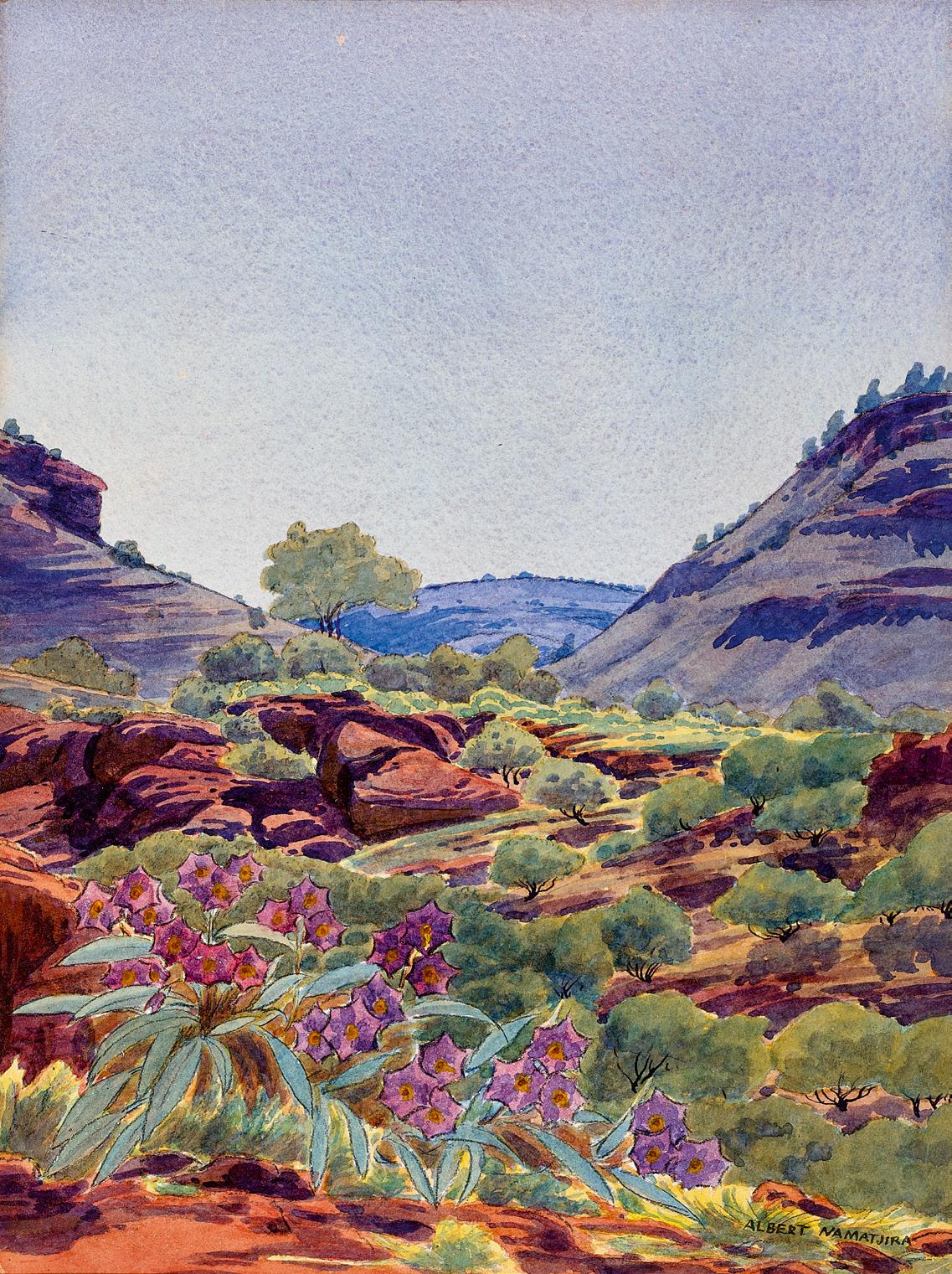
watercolour on paper on card
38.0 x 28.0 cm
signed lower right: ALBERT NAMATJIRA
Estimate: $30,000 – 40,000
Provenance
Private collection, South Australia, acquired at Hermannsburg Mission in August 1944 by the vendor’s grandfather while travelling through the Northern Territory on return from military service on Thursday Island in the Torres Strait Thence by descent Private collection, Melbourne
By 1944, the year in which this artwork was purchased at Hermannsburg Missio n, in Central Australia, Albert Namatjira had experienced a swift rise to national prominence. He had been included in the 1944 Who’s Who in Australia and was honoured with the publication of a monograph, the first of its kind devoted to an Indigenous artist, and which would be published in 8 successive editions between 1944 – 1955. An accomplished craftsman of pokerwork woomeras, boomerangs and wooden plaques, Namatjira had only adopted the methods and materials of Western landscape painting in earnest in 1936, stimulated by exchanges with Victorian artists Rex Battarbee and John Gardner visiting the Hermannsburg Mission. Namatjira would go on to present his first solo exhibition of watercolour paintings in Melbourne only two years later in 1938.
Taught by Battarbee to sketch the landscape en plein air, many of Namatjira’s landscapes depicted the topography of the region around his hometown of Hermannsburg (Ntaria) and, in particular, the many peaks of the surrounding MacDonnell, Krichauff and James Ranges. Namatjira also employed modern tools, such as a camera’s viewfinder, to isolate dramatic aspects of the larger landscape. With it he could condense vast distances into cropped vistas, often framed by contrapuntal ghost gums in the foreground. Here, the landscape view is compacted to focus on the gap between two peaks, through which we glimpse a distant blue mountain and a lone tall tree. By comparison to the rocky mountains, whose organic contours are balanced ‘between the pyramid and the circle’, to use Hans Heysen’s phrase, the middle ground is quite d ensely
vegetated. While Namatjira’s style was one of pictorial realism, h is simplified forms and heightened colours show suggestions of modernism. His naturalistic palette was dominated by sonorous reds, ochres and deep browns, enlivened here with highlights of lime-green vegetation and in the foreground – a group of purple flowering bush tomatoes (merne akatyerre). As autumn rain swept across the plains of central Australia, the bush tomato would break out of the soil for the first time in months. Patiently waiting as seeds or tubers, they would take advantage of the sudden moisture to bloom with startling vibrancy against the arid, ochre-rich backdrop of mountain ranges.
Each painting by Namatjira was specific in its location, containing precise geographic and cultural reference points. Throughout the 1940s, he mainly painted the country around Hermannsburg and the Finke River Mission where he grew up – a parcel of land in Central Australia nestled between three groups of mountains. Beyond introducing the ‘Red Centre’ of Australia in an easily readable and digestible format to white urban audiences in the latter half of the 20th century, Namatjira’s luminous watercolours provided the artists with a continued patrilineal connection to Arrernte country north of Glen Helen (Yalpalpe) and of the Finke River (Lherre pirntea), a location of deep and continued significance to the artist. While communicating layered cultural meanings for the First Nations audiences who could interpret them, Albert Namatjira sought to convey to a broad audience the spiritual link existing between Abori ginal peoples and the land. Lucie Reeves-Smith
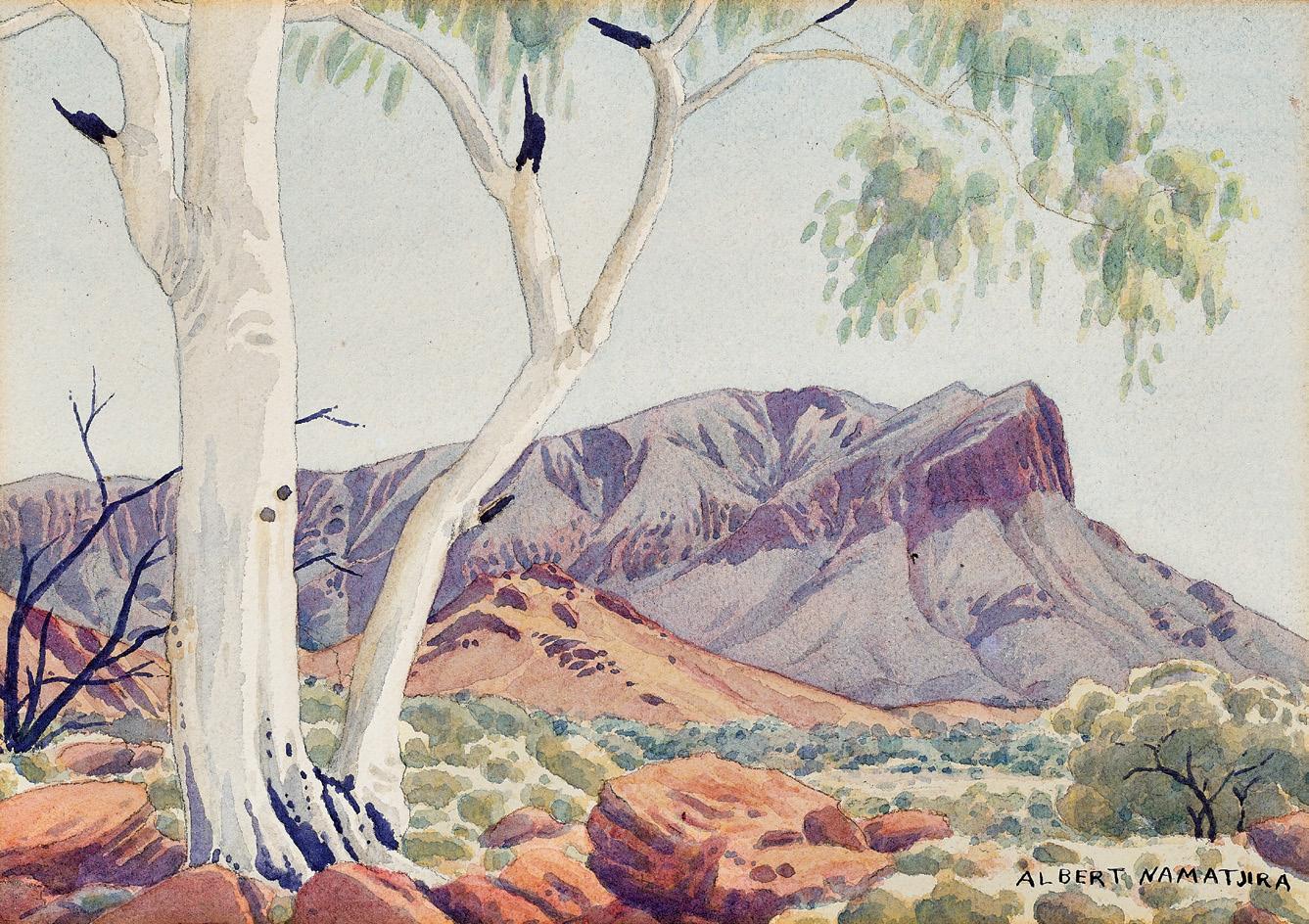
watercolour on paper on card
26.0 x 37.0 cm (image)
28.5 x 39.5 cm (sheet)
signed lower right: ALBERT NAMATJIRA bears inscription verso: Mt Gillen
Estimate: $25,000 – 35,000
Claude Hotchin Art Galleries, Perth (label attached verso)
Private collection, Perth, acquired from the above in the 1950s
Thence by descent
Private collection, Perth
‘Albert Namatjira was a phenomenon… a patient and observant man… who became a watercolourist of real distinction… who recorded what was familiar to him not only as something of sublime beauty, but as a repository of beliefs, laws and legends.’ 1
A household name by the 1950s, Albert Namatjira set the foundations for the Indigenous art movement that emerged thirty years later and still flourishes today. ‘In skilfully adopting the methods and materials of Western landscape painting he challenged the relegation of Aboriginal art to the realm of archaeology and ethnography.’ 2 His bright watercolours of central Australia contained an unprecedented richness, and his depiction of the vivid and exuberant colours of Arrente country transported a mythical and predominantly unknown world into the lounge rooms of White Australians living in cities that hugged the coastal fringe.
Painted in the final decade of the artist’s life, and replete with the artist’s recurring motifs, Ghost gum (Mount Gillen), c.1950 epitomises Namatjira’s finest work. Located in the foreground, a majestic ghost gum, (Eucalyptus papuana), known as ilwempe to the Western Arrernte, is used as an animated object to frame the carefully controlled viewpoint from which the artist directs the viewer to the distant purple peaks through the intervening
slopes in the middle distance. Namatjira’s familiarity with this country is evident in these views where ‘trees, peaks and monoliths provide a rich range of possibilities and responses that arise from constantly re-engaging with the same subject.’ 3
Namatjira’s dramatic entry into the Australian art world was groundbreaking. Despite his personal vicissitudes, he not only inspired his own and subsequent generations of Aboriginal people and artists across Australia through his art, but he also sought to educate White Australians about the spiritual link between Indigenous people and land. As Brenda Croft contends, the artist’s gift to Indigenous and non-Indigenous people is ‘more than the sum parts of watercolour paints on paper. It is an essence that resides in the strength of Namatjira’s work – his courage, his sorrow, his spirituality… where the enduring influence of this one man upon the entire indigenous arts and culture industry continues to be felt.’4
1. Lynn, E., ‘Introduction’ in Byrnes, M., Albert Namatjira, Araluen Art Centre, Alice Springs 1984, p. 2
2. Watson, K., ‘Poetic Justice: an overview of Indigenous Art’, in Perkins, H., One Sun, One Moon: Aboriginal Art in Australia, Art Gallery of New South Wales, Sydney, 2007, p. 20
3. French, A., Seeing the Centre: The Art of Albert Namatjira 1902 – 1959, National Gallery of Australia, Canberra, 2002, p. 97
4. Croft, B., ‘Albert’s Gift’, in French, A., Seeing the Centre: The Art of Albert Namatjira, 1902 – 1959, National Gallery of Australia, Canberra, 2002, p. 148 Crispin Gutteridge
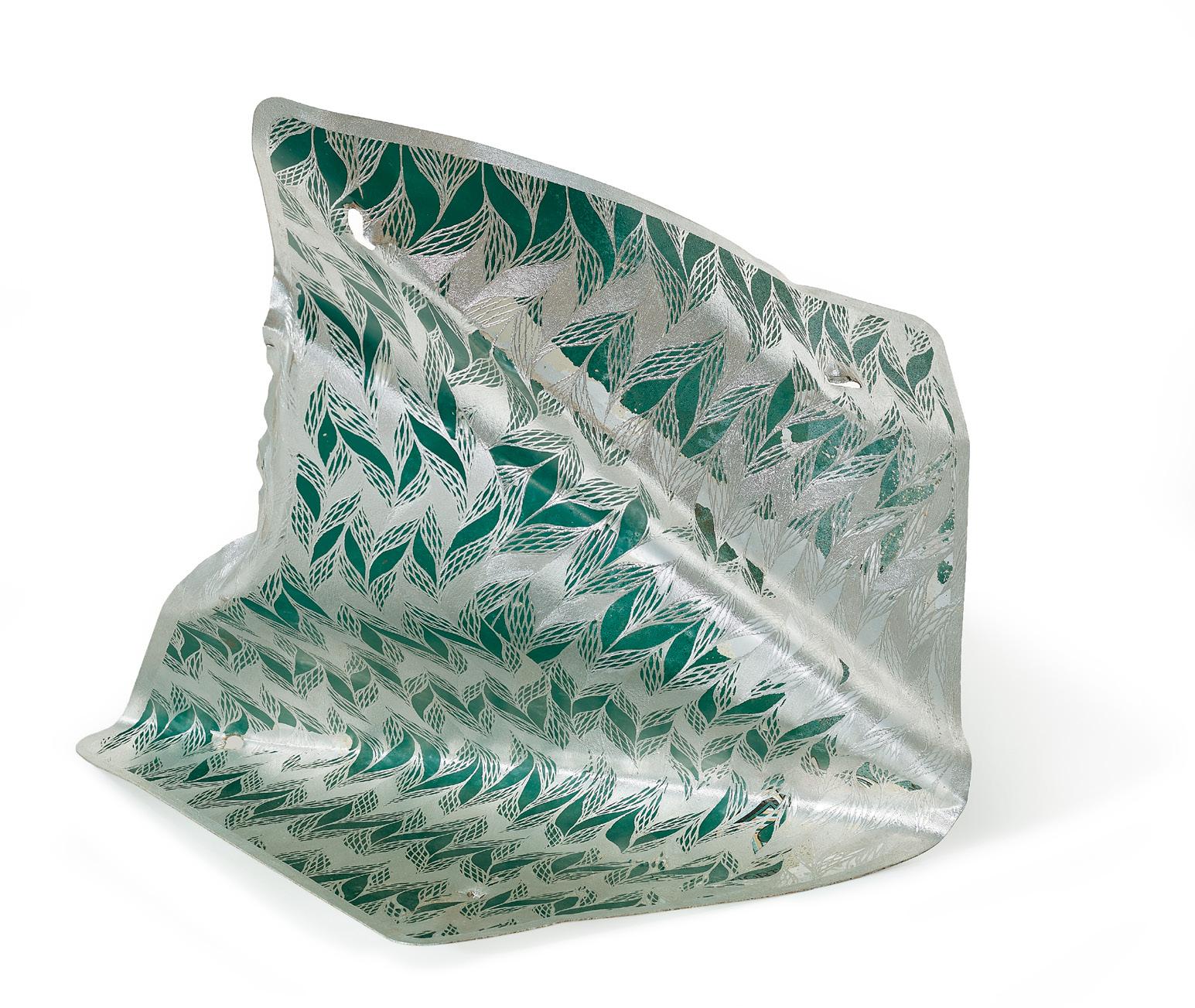
Milŋurr, 2021
etched found aluminium road sign and aerosol paint
75.0 x 56.0 x 60.0 cm (irregular)
Estimate: $20,000 – 30,000
Provenance
Buku–Larrŋgay Mulka Centre, Yirrkala, Northern Territory (cat. 1985–21) SALON Art Projects, Darwin Private collection, Melbourne
Exhibited
Murrŋiny: A story of metal from the east, Buku–Larrŋgay Mulka Centre, Yirrkala, Northern Territory, Salon Art Projects, Darwin and Northern Centre of Contemporary Art, Parap, Northern Territory, 7 August – 25 September 2021 (illus. in exhibition catalogue, p. 16)
This work is accompanied by a certificate of authenticity from Buku–Larrŋgay Mulka Centre which states:
‘This piece was first exhibited in the groundbreaking exhibition ‘Murrŋiny -stories of metal from the east’. This exhibition was held in conjunction with SALON Art Projects at the Northern Centre for Contemporary Art in Darwin in August 2021. It sold out and received national media exposure. Yolŋu have repurposed found metal since first contact with Makassans. Balanda outsiders first knew them as the Murrŋiny a name given to them by neighbouring groups which references their steel spearheads. The Found movement was originated by Gunybi Ganambarr around 2011 when the elders endorsed recycled materials as acceptable to render sacred designs. This is a repurposed sign.
This work identifies the reservoirs of the Ŋaymil/Datiwuy clan. Ŋalkan is an area on Ŋaymil land and sea between the Gurrumuru and Cato Rivers that run into the Arnhem Bay. Within this area is another watercourse that leads up into a sacred area of a freshwater spring or Milngurr with special qualities called Balawurru. Dhangultji or Brolga are dancing here. Here Djanda the sacred goanna also swim in the lagoon created by the spring, their actions as they swim causing rippling patterns to be made on the surface that is covered by the totemic water weed Ḏarra. Similarly the force of the water surging from under the ground ripples the surface. Ḻurr’yun is a Yolŋu word for the rippling flow of water.
This plant forms floating forests in only a few very sacred locations. It is a broad leaf emergent plant that sits within the water and flowers in September with a vibrant yellow flower mass. Dhangultji or Guḏurrku (Brolga) inhabit the adjacent floodplains in huge numbers during the late Dry. They drink from subterranean springs which emerge in the vast flat plains. A safe place to rest, mate and nest. In their avian form they are a manifestation of the Djaŋ’kawu Sisters’ party which travel throughout the Eastern top end, shape shifting and giving birth to the various clans of the Dhuwa moiety. In this case the Ŋaymil.
Others inhabit these waters. Warrukay or Murrukula the Barracuda, the power totem for the Ŋaymil. It spends most of its time in the salt waters. At certain times Warrukay will make its way up to Balawurru bringing the ‘contamination’ of muddied water with it. This has connotations of fertility. It is a place of fertility. Souls of Ŋaymil are both delivered to and from this point between worlds real and spiritual. As the sacred songs used in mortuary are cyclic, narrating the Ancestral Events of the original Creator Beings, so is the journey of the Yolŋu soul. This place is also shared with Dhudi Djapu clan.
Gunybi is the author of the Found movement in NE Arnhem. Pioneering the use of reclaimed industrial materials. This seemed in breach of the dictum, “If you paint the land you use the land” from the elders. But it was subsequently ratified that recycled junk taken from the land was allowable as a material to depict the land.’
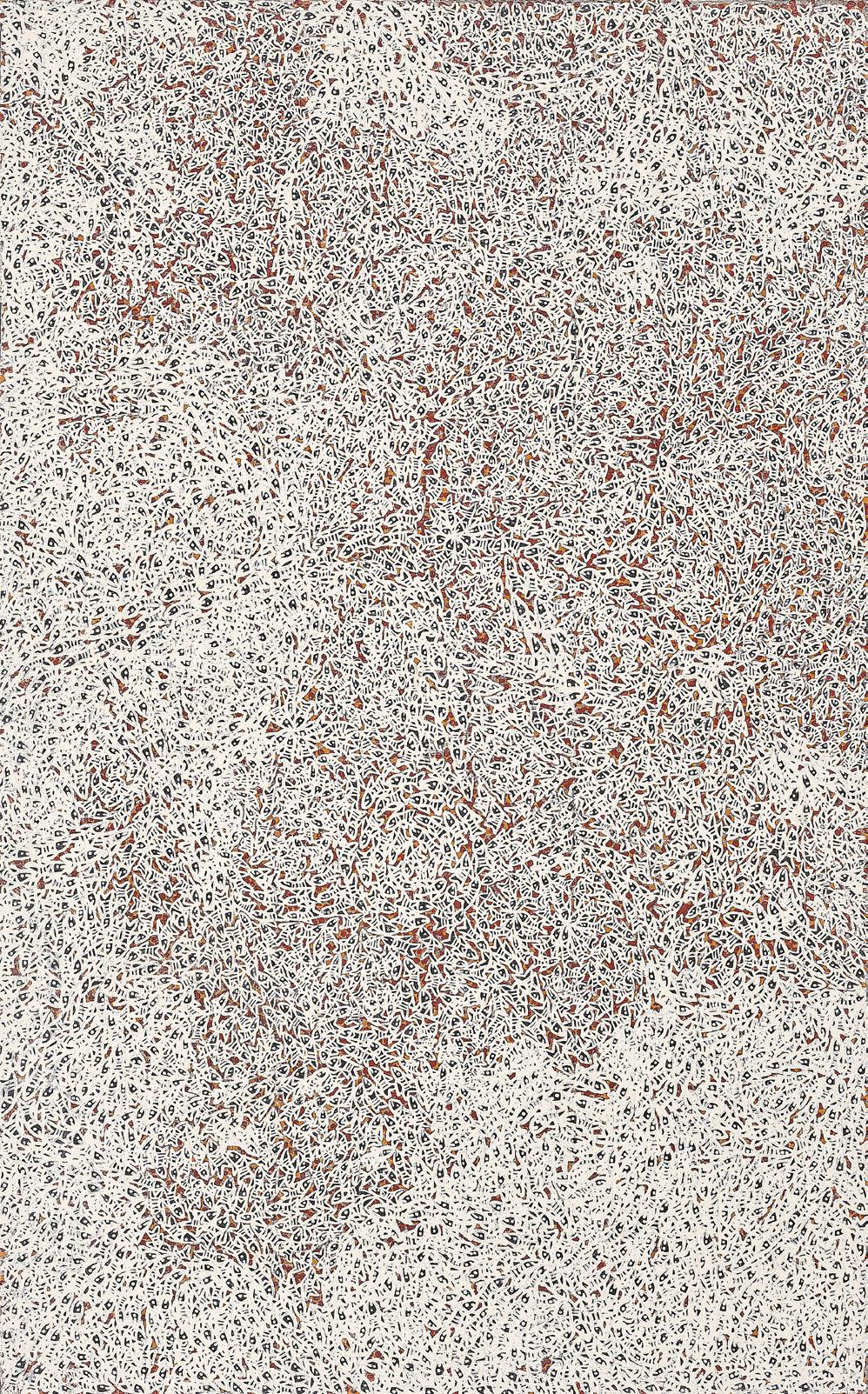
natural earth pigments on aluminium foil industrial insulation 125.0 x 78.0 cm
Estimate: $10,000 – 15,000
Provenance
Buku–Larrŋgay Mulka Centre, Yirrkala, Northern Territory (cat. 4640V) Private collection, Melbourne, acquired from the above in August 2015
Exhibited
32nd Telstra NATSIAA, Museum and Art Galleries of the Northern Territory, Darwin, opened 7 August 2015 (illus. in exhibition catalogue, n.p.)
This work is accompanied by a certificate of authenticity from Buku–Larrŋgay Mulka Centre which states in part:
‘This painting refers to Bamurruŋu, a sacred and solitary rock in Trial Bay. It is a white dome in the Bay - a round lump of granite its top coloured white by roosting birds, in the painting by the molmulpa or white sea foam associated with turbulent and agitating waters created by particular tide and wind.
The fish swim up to Bamurruŋu and referred to as Marparrarr or milk fish, somewhat like a large mullet. According to the artist these were once people of the stone country behind where the Marrakulu have now settled close the mouth of the Gurka’wuy river. They turned to Marparrarr on reaching the shore and following the feathered stringto Bamurruŋu. The Beings of Marparrarr were the ‘same’ as the original inhabitants of Gurka’wuy, in this manifestation, populating Marrakulu sea country as land totems do in this area. Yolŋu of this area speak of a hole submerged under the rock, from where bubbles are seen rising to the surface, sometimes bursting forth with a rush. The bubbles are seen as a life force and a direct Ancestral connection for the Marrakulu. The Marparrarr have knowledge of this special phenomenon as do the law men. The artist explained that here was a ‘statue’ for Mali Djuluwa Makaratjpi.
When the Marrakulu perform ritual dance for the events depicted in this painting participants move towards a held spear representing the steadfastness of the rock, splitting the dancers who then surround Bamurruŋu moving as does the sea to song and rhythm of Yidaki and Bilma.
Bamurrungu is seen as part of a set of three rocks which stand in the mouth of Trial Bay submerged either completely or partially within its waters. The waters of Gurka’wuy River flow out through Trial Bay past these rocks conflicting and clashing in a turbulent unity with the incoming tidal waters from the deep ocean. Their names rarely spoken are Dundiwuy, Bamurrungu and Yilpirr. In sacred song, Bamurruŋu, a sacred and monolithic rock in the mouth of Trial Bay lies submerged within its waters surrounded by these fish; Buku-Duŋgulmirri or Wawurritjpal, Sea Mullet. As the Marrakulu dance they are the schools of fish. When their soul’s progress is momentarily barred by the obstacle of the rock (mortality) they act as these fish do and leave the dimension they know and leap into the air before returning to the familiar dimension of water. This mirrors the cyclical nature of Yolngu spiritual progress.
This work depicts the water clashing as it plays and mingles with that of the Djapu and Dhapuyŋu clans. This Balamumu oceanic salt water rushing into the bay creates eddies, currents and patterns that delineate the relationship between the Djapu and Marrakulu clans. This relationship is referred to as Märi-Gutharra. The maternal grandmother clan and its granddaughter. These waters are in this relationship as well. This is known as the ‘backbone’. One of the key relationships in a complex kinship system whose reciprocal duties are most powerful. These clans are both Dhuwa and share responsibilities for circumcising and burying each others clan members. A matriarchal analysis of the world that governs the behaviour of both sexes equally.’
Big river at My Father’s Country, 2006
synthetic polymer paint on canvas
137.5 x 91.5 cm
bears inscription verso: artist’s name, title, medium, Mornington Island Arts and Crafts cat. 1639–L–SG–0906 and Alcaston Gallery cat. AK13102
Estimate: $30,000 – 40,000
Provenance
Mornington Island Arts and Crafts, Mornington Island, Queensland (stamped verso)
Alcaston Gallery, Melbourne (stamped verso)
Private collection, Melbourne, acquired from the above in January 2007
Exhibited
Dibirdibi Country, Alcaston Gallery, Melbourne, 9 January – 3 February 2007
This work is accompanied by a certificate of authenticity from Mornington Island Arts and Crafts which states:
‘My Father’s country has a big river that runs through it. This is the river.’
Born beside a creek in one of Australia’s most remote regions, Mirdidingkingathi Juwarnda Sally Gabori grew up on Bentinck Island in northern Queensland. She was a member of the Kaiadilt people, whose lives were sustained almost entirely by marine resources and who had minimal contact with the outside world. Following a devastating drought and tidal surge that rendered the island uninhabitable, Gabori, then aged 24, was persuaded to relocate with her family to Mornington Island – a move that resulted in profound dislocation and loss for the Kaiadilt community.
Her names reflect her deep connection to place and ancestry: Mirdidingkingathi refers to being born at the Mirdidingki River, while Juwarnda is her totem, the dolphin. Remarkably, Gabori only began painting at the age of 85, and Judith Ryan of the National Gallery of Victoria has compared her extraordinary innovation and meteoric rise to that of other celebrated late starters, including Emily Kam Kngwarreye and Lorna Fencer Napurrula.1 Yet unlike many other Aboriginal language groups, the Kaiadilt had no established tradition of mark-making on tools, objects, or bark. Given this cultural background, Gabori’s visual language was thus entirely self-fashioned – conjured from the mental maps she carried of Bentinck Island and the Country she loved.
Big river at My Father’s Country, 2006 is a vibrant, gestural homage to the landscape and history of Thundi, located at the northern tip of Bentinck Island – her father’s Country. Much of this terrain is low-lying, marked by a river that flows into a vast saltpan that fills during the wet season and is bordered by mangroves. Nearby, a ridge of tall sandhills traces the island’s north-eastern edge. 2
Gabori is renowned for her luminous, brightly coloured canvases, of which the present is a stunning example. Set against a soft pink ground, expansive fields of crimson, orange, red, and yellow imbue the composition with a palpable vitality - each intuitive, gestural brushstroke boldly executed and purposeful. When Gabori paints her country, the meanings layer in multitudes – she is at once painting the saltpans of the land, the Ancestor Dreamings of Country, and finally, her own longing, loss and me mory.
1. Ryan, J., ‘Broken Colour and Unbounded Space’, Mirdidingkingathi Juwarnda Sally Gabori: dulka warngiid: Land of All, Queensland Art Gallery I Gallery of Modern Art, Brisbane, 2016, pp. 33 – 34
2. McLean, B., ‘Dulka Warngiid; The Whole World’ in Mirdidingkingathi Juwarnda Sally Gabori Dulka Warngiid: Land of All, ibid., p. 22 Crispin Gutteridge
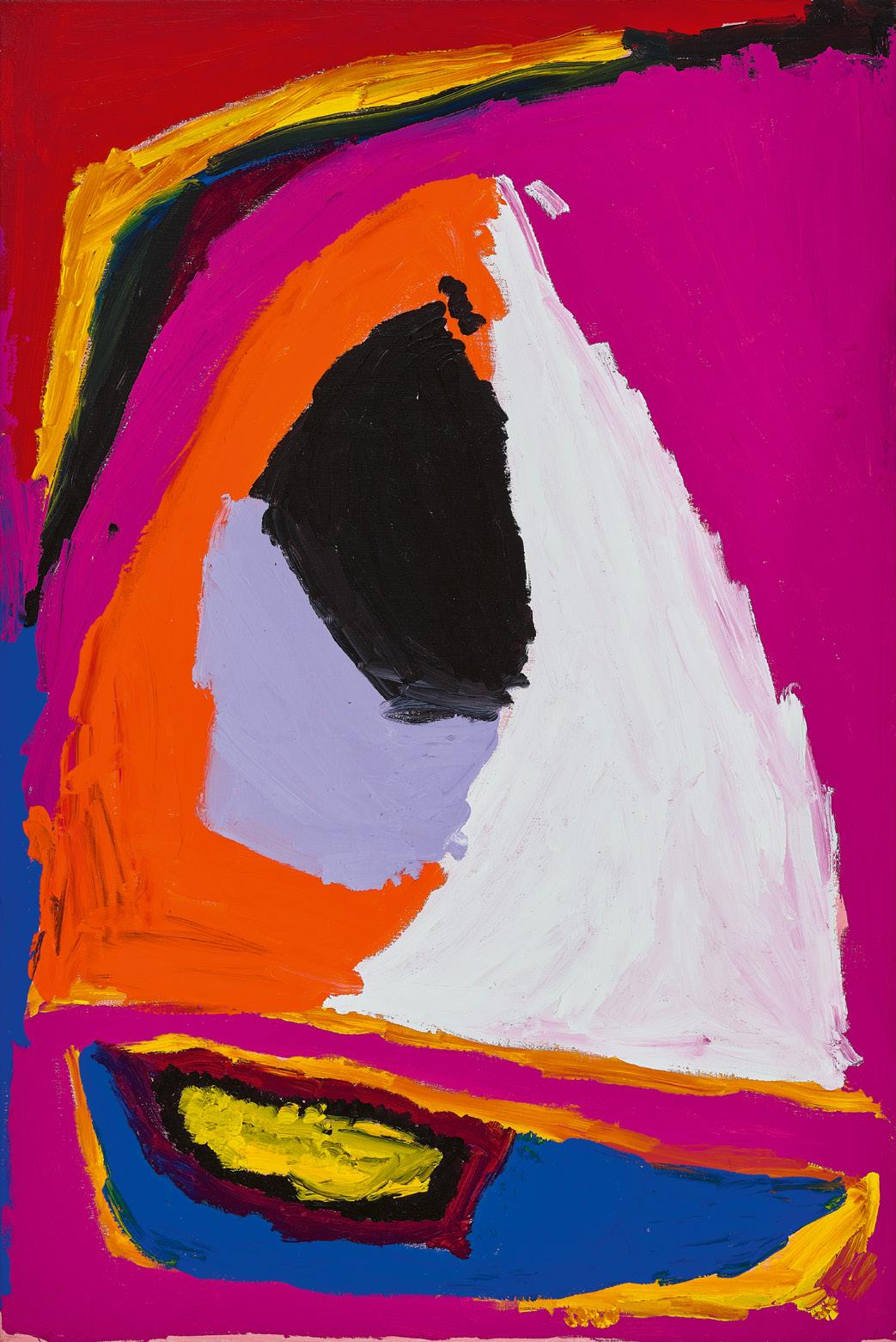
synthetic polymer paint on linen 152.5 x 101.5 cm
bears inscription verso: artist’s name, title, medium, Mornington Island Arts and Crafts cat. 2645–L–SG–1007 and Alcaston Gallery cat. AK14010
Estimate: $28,000 – 35,000
Mornington Island Arts and Crafts, Mornington Island, Queensland (stamped verso)
Alcaston Gallery, Melbourne
Private collection, Melbourne, acquired from the above Mossgreen, Melbourne, 21 July 2015, lot 81
Private collection, Melbourne
This work is accompanied by a copy of the certificate of authenticity from Mornington Island Arts and Crafts which states:
‘My painting shows the big river at Thundi on Bentinck Island. This is my Father’s country.’
Almost sixty years after a series of natural disasters forced Sally Gabo ri, along with the other inhabitants of Bentinck Island, to relocate to Gununa on nearby Mornington Island, she was invited – then in her early eighties – to participate with other Kaiadilt people in an art workshop at the Mornington Island Art Centre.
After only a few visits, it became clear that her early paintings – often bold, seemingly crude abstract depictions of the myriad fish found in the surrounding estuaries and sea – offered a unique and vibrant expression of her personal and family histories, drawn from memories of her early years on Bentinck Island.
Gabori’s expressive application of paint, laid down in thick brushstrokes and layered fields of colour, highlights both the immediacy of her process and the evident pleasure she took in mark-making. In Thundi (Big river), 2007, she eliminates superfluous detail – the geometric forms that dominated her early work dissolve, and subtle variations of colour and texture become the primary focus. The result is a luminous and expressive tribute to the landscape and history of her father’s
Country, Thundi, on Bentinck Island. Like much of th e island, this area – flanking its north-eastern tip – is characterised by lowlying terrain, with a river that runs into a large salt pan that fills during the wet season and is bordered by mangroves. Nearby, a ridge of tall sandhills lines the island’s edge. Overpainted in white, the work evokes the ripple patterns of the sandflats, the frothing waters at the river mouth, the small waves lapping the shore, and the inundation of the area during extreme weather.
As Cara Pinchbeck observes, ‘Gabori’s works are a celebration of her homeland and illustrate a deep connection to country that has not diminished through separation. From her very earliest works, she has depicted aspects of her own beloved country as well as that of her brother, father and husband – including both geographical aspects of the landscape as well as the wildlife, specifically sea-life which is central to the landscape.’ 2
1. McLean, B., ‘Dulka Warngiid; The Whole World’ in Mirdidingkingathi Juwarnda Sally Gabori Dulka Warngiid; Land of All, Queensland Art Gallery I Gallery of Modern Art, Brisbane, 2016, p. 22
2. Pinchbeck, C., ‘Mirdidingkingathi Juwarnda Sally Gabori’ in unDisclosed, 2nd National Indigenous Art Triennial, National Gallery of Australia, Canberra, 2012, p. 64
Crispin Gutteridge
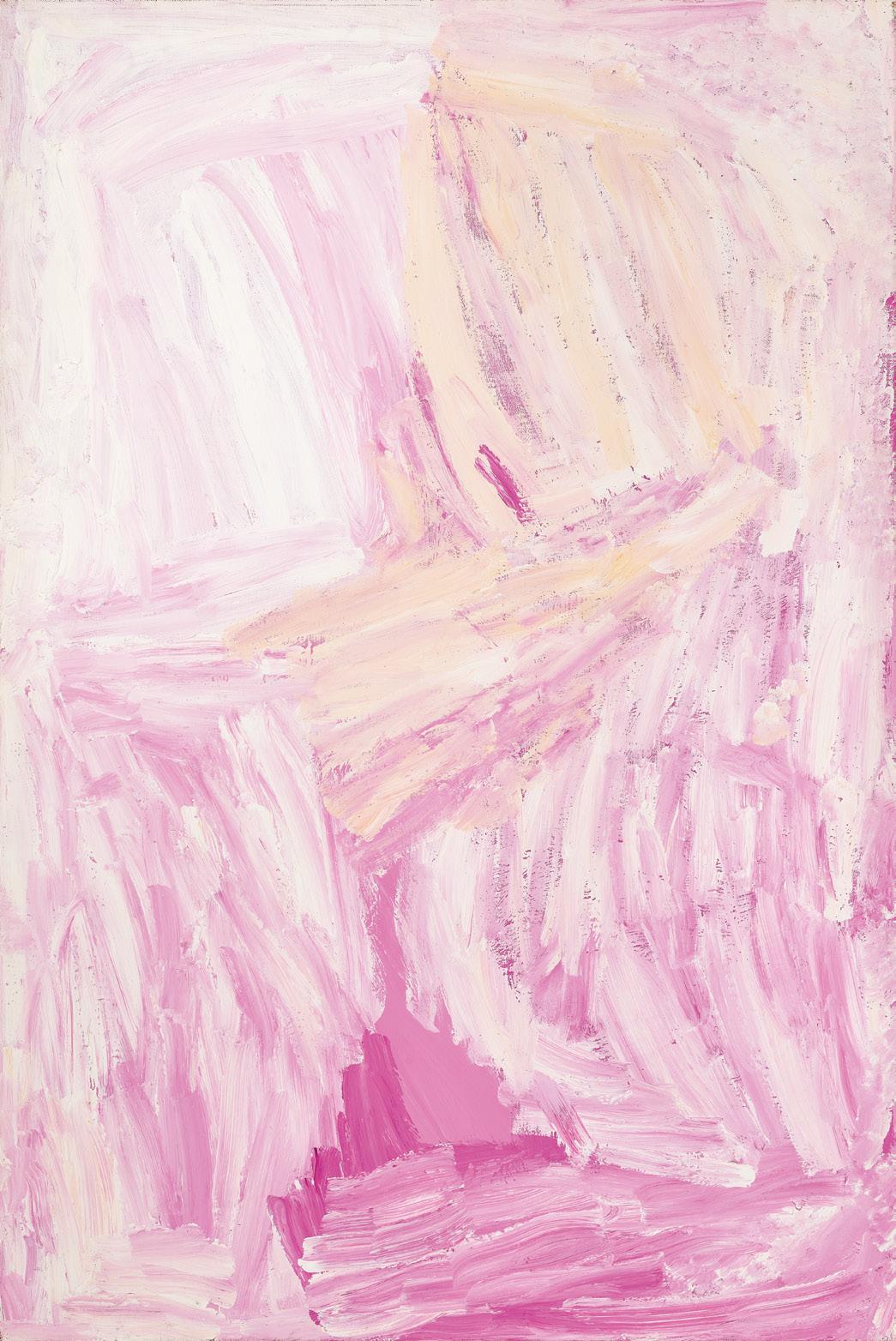
The wet, 1994
synthetic polymer paint on canvas
145.0 x 149.0 cm
signed lower left centre: GINGER RILEY
bears inscription verso: artist’s name, date and Alcaston Gallery cat. AK2436
Estimate: $30,000 – 40,000
Provenance
Alcaston Gallery, Melbourne (stamped verso)
Private collection, Melbourne, acquired from the above in July 1995
This work is accompanied by a copy of the certificate of authenticity from Alcaston Gallery which states in part:
‘After the long wet comes the rainbow and with it vigorous new life and energy which is most apparent in this vibrant painting.’
‘My mother’s country is in my mind.’ 1
Distinguished by their daring palette, dynamic energy and strongly flattened forms, Riley’s bold, brilliantly coloured depictions celebrating the landscape and mythology of his mother’s country are admired among the finest in contemporary Indigenous art. Emerging at a time when barks were the familiar output for his Arnhem Land country and Papunya Tula paintings were considered the norm, his striking interpretations not only challenged, but irrevocably changed, preconceived notions of Indigenous art – thus earning him the moniker ‘the boss of colour’ by artist David Larwill. Notably influential upon such idiom was Riley’s chance encounter during his adolescence with celebrated watercolourist Albert Namatjira, whose non-traditional aesthetic and concept of ‘colour country’ left an indelible impression upon the young artist. Although encouraged by ‘… the idea that the colours of the land as seen in his imagination could be captured in art with munanga (white fella) paints’ 2 , it was not until three decades later that Riley would have the opportunity to fully explore his talent when the Northern Territory Open College of TAFE established a printmaking workshop in the Ngukurr Aboriginal Community (formerly known as the Roper River Mission). Notwithstanding his mature age of 50, Riley rapidly developed his own highly sophisticated style and distinct iconography and, after initially exhibiting with the other Ngukurr-based painters, soon established an independent career at Alcaston Gallery. Enjoying tremendous success both locally and abroad over the following sixteen years before his untimely death in 2002, Riley received a plethora of awards including the inaugural National Heritage Commission Aboriginal and Torres Strait Islander Art Award in
1993 and an Australia Council Fellowship in 1997 – 98, and in 1997, was the first living indigenous artist to be honoured with a retrospective at the National Gallery of Victoria, Melbourne.
Capturing the saltwater area extending from the coast of the Gulf of Carpentaria along the Limmen Bight River to the weatherworn rocky outcrops known as the ‘Four Arches’, The wet, 1994 offers a stunning example of Riley’s heroic landscapes. Pivotal to the composition is Garimala, the mythological Taipan who, according to the ancestral dreaming, created the Four Arches –an area regarded as ‘…the centre of the earth, where all things start and finish’ 3 – and lives in the waterhole featured in the foreground. Here Garimala is depicted as a pair of snakes (a convention to denote him travelling) yet also manifests as the ‘Rainbow Serpent’ associated with the life-giving properties of fresh water, the monsoon season and the continuing cycle of life. Presiding over the landscape on the horizon is the totemic, white-breasted sea eagle, Ngak Ngak, who fulfils the role of a sentinel or guardian protecting the country, while above, heavy, rain-filled clouds not only herald the fertile abundance of the wet season but poignantly symbolise the artist’s mother. As typical of Riley’s oeuvre, the landscape offers an aerial overview informed by the artist’s strong sense of place; as he observes, he often paints ‘…on a cloud, on top of the world looking down… In my mind, I have to go up to the top and look down to see where I’ve come from, not very easy for somebody else, but all right for me. I just think in my mind and paint from top to bottom, I like that’.4
A vibrant celebration of the joy of belonging to the saltwater country of the Mara people, indeed the work embodies Riley’s powerful vision of his mother’s country as a mythic space – a mindscape whose kaleidoscope of dazzling colours and symbols continually evoke wonder and mystery in the viewer with each new encounter.
1. Riley cited in Ryan, J., Ginger Riley, National Gallery of Victoria, Melbourne, 1997, p. 15
2. Riley cited ibid.
3. ibid., p. 29
4. ibid., p. 27
Veronica Angelatos
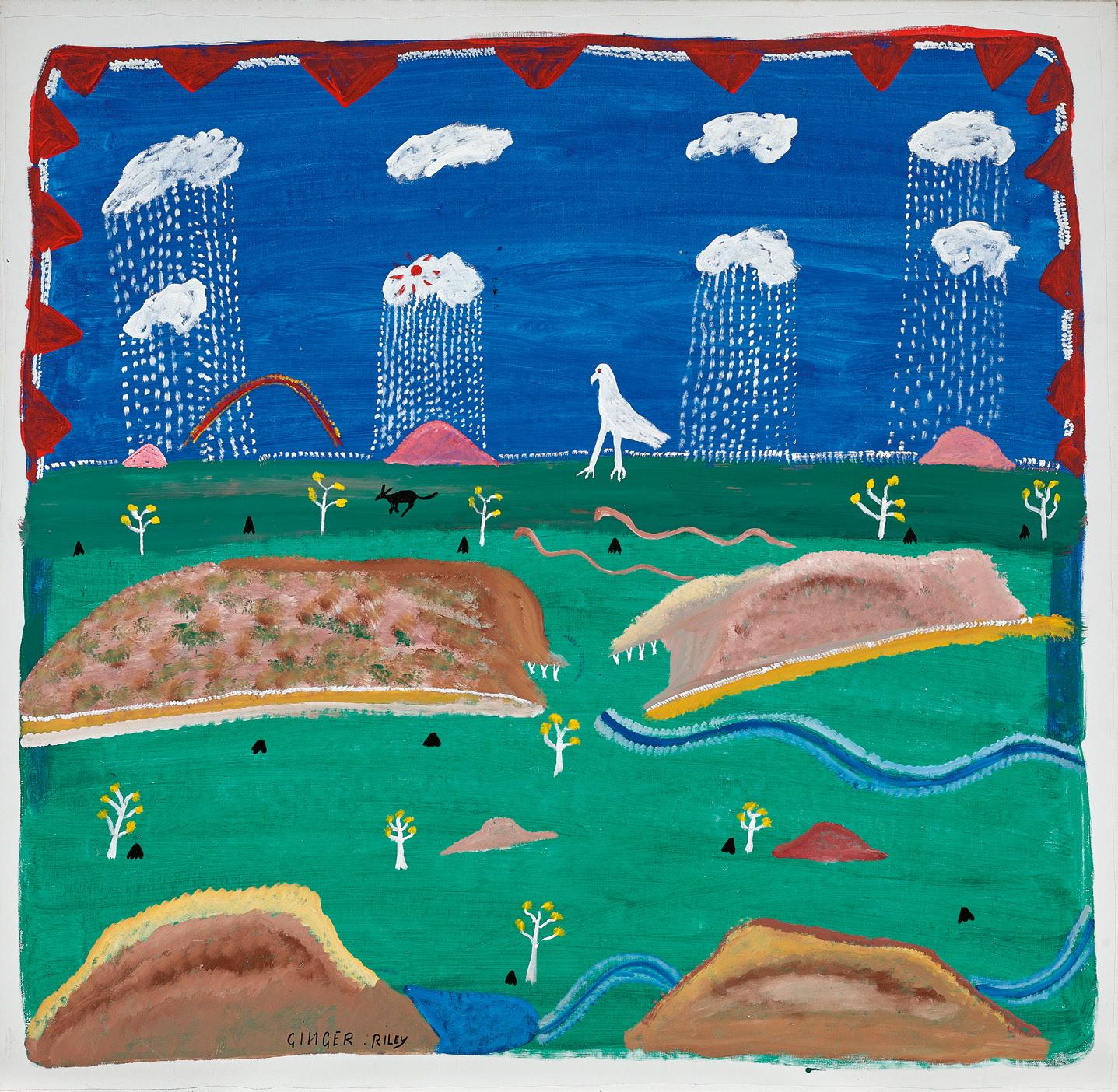
synthetic polymer paint on linen 122.0 x 122.0 cm
bears inscription verso: artist’s name, size and Papunya Tula Artists cat. MN980530
Estimate: $40,000 – 50,000
Provenance
Commissioned by Papunya Tula Artists, Alice Springs, Northern Territory in May 1998
Framed Gallery, Darwin Palya Art, Darwin Private collection, France
Exhibited
Luminous: Contemporary Art from The Australian Desert – Travelling Exhibition, Manly Art Gallery & Museum, Sydney, 17 June – 24 July 2005, and touring regionally to Victoria, New South Wales and South Australia, cat. 17 (illus. in exhibition catalogue, front cover, p. 28)
Luminous: Desert Masterpieces from the Helen Read Collection, The Australian Embassy, Paris, 10 October 2012 – 6 May 2013
brush, fingers, or hands. 3 The result was a series of evocative depictions of her Country and its potent sites: her birthplace of Magarri, south-west of Kintore; the rockhole site of Lupulnga; the salt lake of Karrkurutintja (Lake MacDonald); and Lampintja on its southern side – each overlaid with ancestral women’s stories. Even when her eyesight deteriorated due to debilitating cataracts, Napanangka’s enthusiasm for painting remained undiminished.
The history of Papunya Tula Artists can be understood as two intertwined narratives: first, that of the men, which emerged from the settlement of Papunya in the early 1970s – its genesis all the more remarkable for its humble beginnings – and, more than a decade later, that of the women. This second chapter developed following a series of workshops attended by women artists from Kintore and Haast’s Bluff, supported by the Ikuntji Women’s Centre in 1994 – 95. Initiated by the women themselves, the Minyma Tjukurrpa Kintore/Haast’s Bluff canvas project resulted in the production of three largescale collaborative canvases1, but more importantly, paved the way for women artists to introduce a new and distinctly painterly interpretation of both daily life and ancestral narratives, free from the ritual constraints and schematic formalism that had influenced many of the male artists of Papunya Tula.
Even among this collective – many of whom would later become renowned in their own right – the work of Makinti Napanangka stood out. From 1996, when she began painting for the company, she was a familiar presence at the Papunya Tula art centre in Walungurru. Often the first to arrive, led by the hand to the studio by one of her daughters and accompanied by her pack of camp dogs, she was ready to begin a day of intense painting. 2 From her earliest, initially small-scale canvases, Makinti’s intuitive connection to her medium was evident. Unlike many of the other women, who adopted dotting techniques observed and learned from the company’s founding male artists, Makinti applied thick layers of paint in a fluid and highly individual manner, using
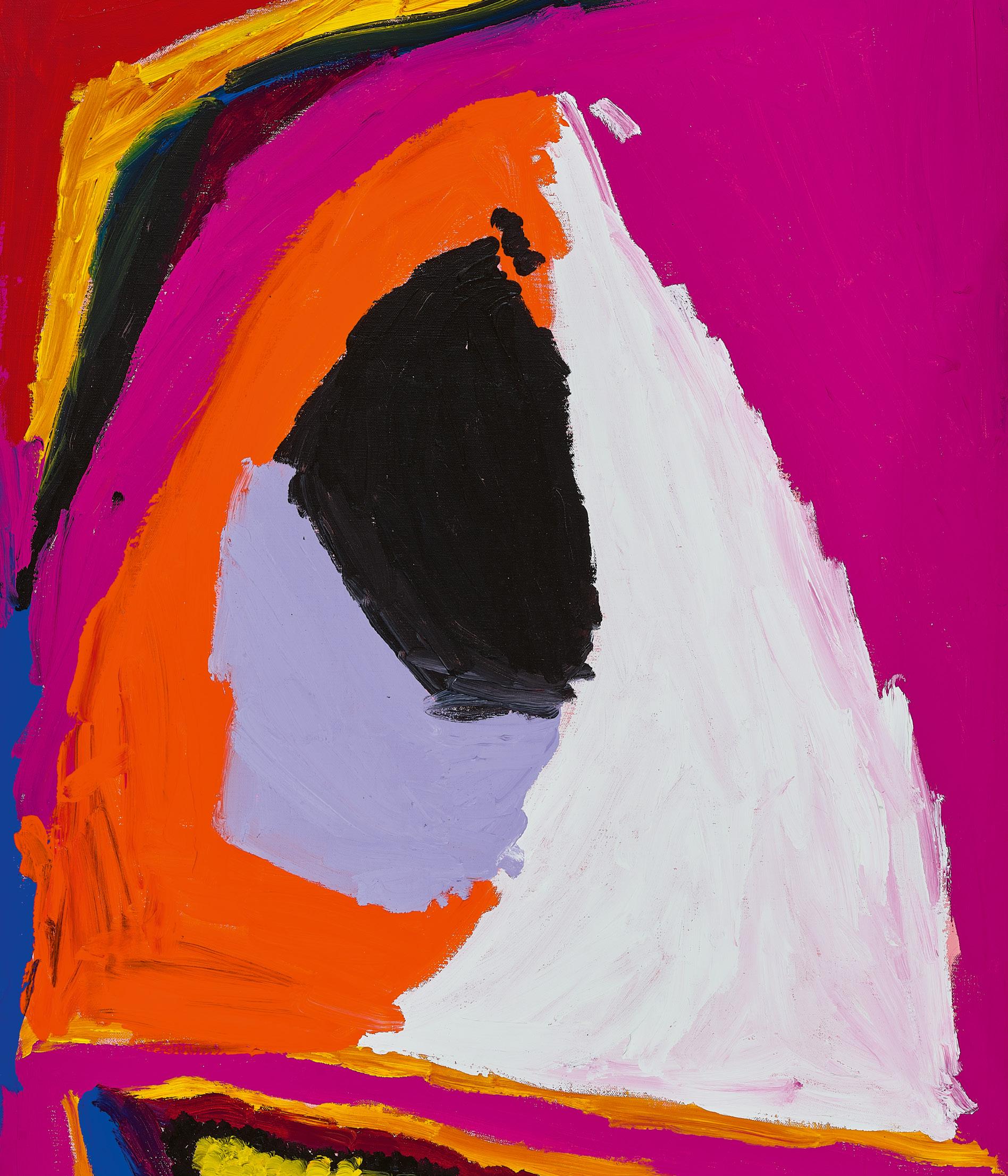
A poetic and painterly evocation of the Kungka Kujarra (Two Women) story, Untitled (Kungka Kujarra – Two Women), 1998 chronicles an episode in which two ancestral women – one older, one younger – travel through the artist’s Country on a vast journey stretching across the Central Deserts of Australia, pausing at the southern side of Karrkurutintja (Lake MacDonald). Along their travels, the women shaped the landscape and embedded valuable knowledge within it, encoded in their story for countless generations to follow. Widely exhibited and reproduced on the cover of the catalogue for Luminous: Contemporary Art from the Australian Desert – a travelling exhibition that toured regional galleries in New South Wales, Victoria, and South Australia in 2005 – 6 – the painting is layered with colour and texture and bears all the hallmarks of Napanangka’s style, owing much to the gestural application of ochre onto the body during women’s ceremonies.
Following cataract surgery in 2000 which restored her sight, Makinti produced a series of celebrated, luminous canvases characterised by free, expressive brushwork, strong saturated colour, and richly textured surfaces. She remained one of the most senior women painting with Papunya Tula until her death in 2011. In 2000, her innovative and energetic work was included in the major retrospective Papunya Tula: Genesis and Genius at the Art Gallery of New South Wales, Sydney; in 2003, she was featured in the Clemenger Contemporary Art Award at the National Gallery of Victoria. In 2008, Napanangka won the National Aboriginal and Torres Strait Islander Art Award for her untitled painting of Lupulnga, which judge Judy Watson praised for its ‘inner light’ that ‘outshines everything else.’4
1. Exhibited together with smaller paintings at Tandanya [National Aboriginal Cultural Institute], Adelaide in June 1995 where two of these canvases are acquired for the collection of National Gallery of Victoria, Melbourne.
2. Perkins H., ‘Makinti Napanangka’ in Tradition Today: Indigenous Art in Australia, Art Gallery of New South Wales, Sydney, 2014, p. 98
3. Johnson, V., Lives of the Papunya Tula Artists, IAD Press, Alice Springs, 2008, p. 153
4. The Courier Mail, Brisbane, 17 August 2008
Crispin Gutteridge
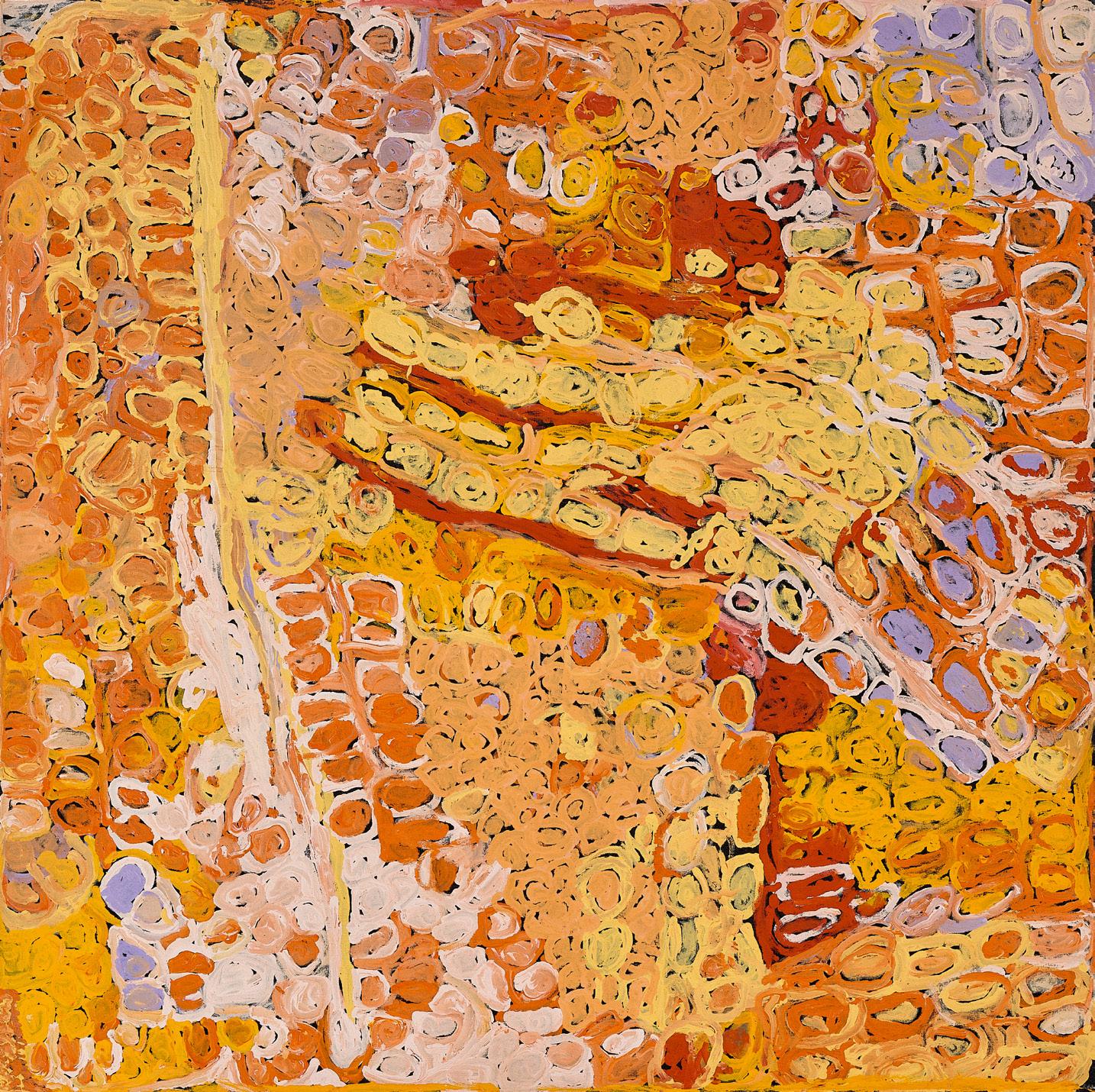
synthetic polymer paint on canvas
151.0 x 121.0 cm
bears inscription verso: artist’s name and Delmore Gallery cat. 95K036
Estimate: $150,000 – 250,000
Provenance
Commissioned by Delmore Gallery, Alice Springs, Northern Territory Chapman Gallery, Canberra (inscribed verso)
The Laverty Collection, Sydney, acquired from the above in December 1996
Bonhams, Sydney, 24 March 2013, lot 118
Private collection, Hong Kong
Deutscher and Hackett, Melbourne, 25 May 2016, lot 17
Private collection, Indonesia
Exhibited
Southern Reflections – Ten Contemporary Australian Artists, Art Gallery of New South Wales, Sydney, 1998; Kulturhuset (Cultural Centre) Stockholm, Sweden, 1998, and touring to: Stenersen Museum, Oslo, Norway, 1999; Goteborgs Konsthall, Gothenberg, Sweden, 1999
Literature
Cross, E., Southern Reflections – Ten Contemporary Australian Artists, Art Gallery of New South Wales, Sydney, 1998, cat. 11, p. 10 (illus.)
Laverty, C., ‘Diversity and Strength: Contemporary Australian Aboriginal Art – A Private Collection’, Arts of Asia, November - December 2003, cat. 17, p. 88 (illus.)
Larkin, A., ‘Perspectives - Hunters and Collectors’, Arco Contemporary Art Magazine, Number 33, Spring 2005, p. 18 (illus.)
Laverty, C. and Laverty, E., Beyond Sacred: Recent Painting from Australia’s Remote Aboriginal Communities - The Collection of Colin and Elizabeth Laverty, Hardie Grant Books, Melbourne, 2008, p. 94 (illus.)
Laverty, C. and Laverty, E., Beyond Sacred: Australian Aboriginal Art - The Collection of Colin and Elizabeth Laverty, Edition II, Kleimeyer Industries, Melbourne, 2011, p. 101 (illus.)
changing landscape of her traditional homelands at Alhalker (Alalgura). Her keen observations detail the shifting fluctuations of the flora and landscape that surrounded her, while her technique of covering the canvas with fluid dots or blobs of colour to form pulsating layers powerfully embodies her sense of the ever-changing, yet ordered, rhythms of the natural world.
For all her fame as an artist, remarkably, Emily Kngwarreye did not begin painting until she was 80 years old. Her creative career began as a founding member of the Utopia Women’s Batik Group, established in 1977, and significantly, her earliest paintings retain elements of her early batik work. Yet although Emily’s painting career spanned only seven years, she became one of the most outstanding and successful contemporary Indigenous artists. She is known for her use of vivid colours, lines, and dots that captivate the viewer. These stunning works are her individual response, rendered in acrylic, to the ever-
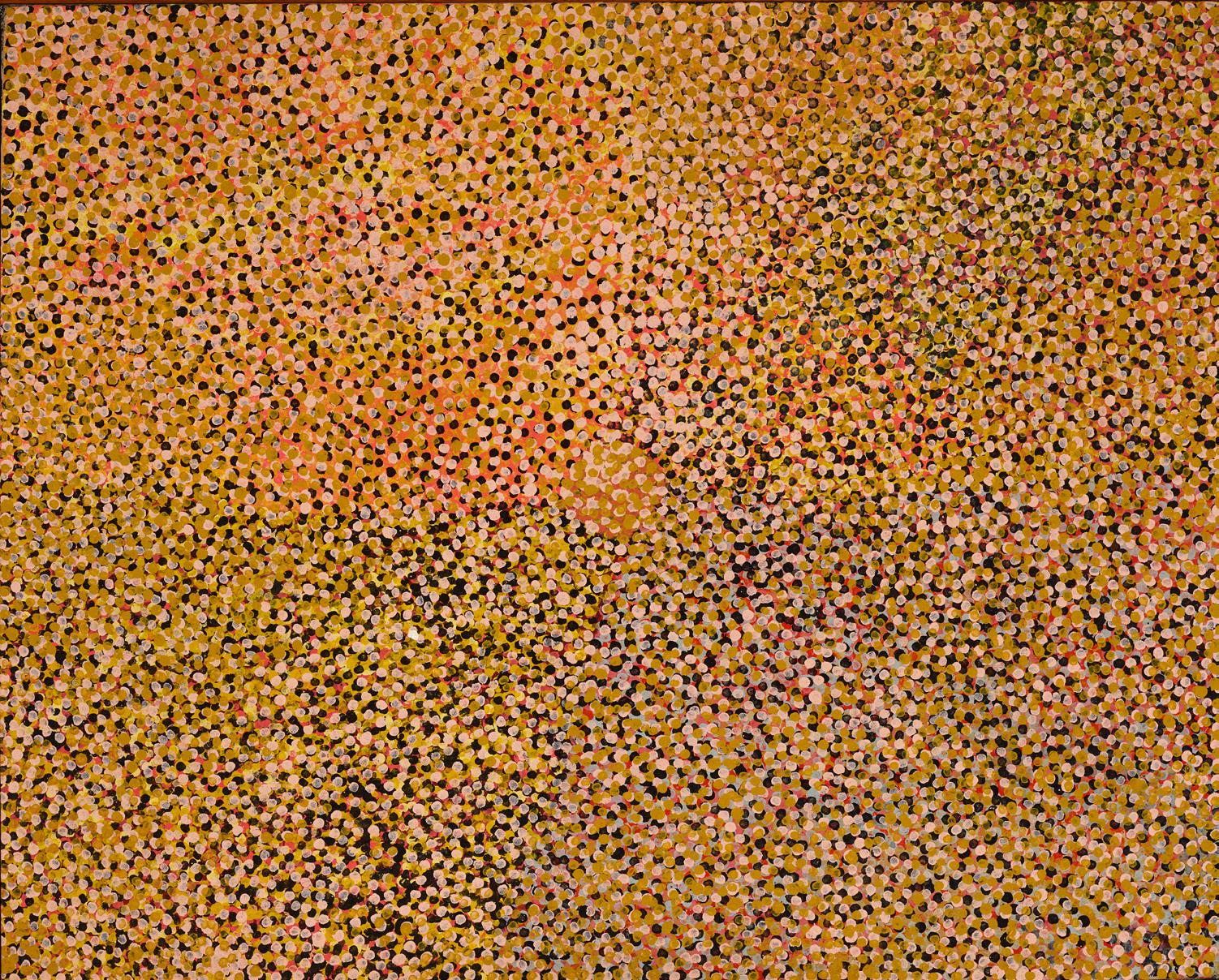
Painted in November 1995, Untitled (Alalgura Landscape/ Yam Flowers) derives from the period critics often refer to as her ‘spiritual’ phase. A mixture of warm background colours is overlaid with cascading white fluid dots, varying in size and density. As discussed by Hetti Perkins, ‘literal interpretations of these works describe an idiosyncratic and microcosmic view of the desert floor, grass seeds and flowers overlaying the organic subterranean networks that lie below the surface of the land.’ 1 The sweeping lines and arcs of painted white dots in this work – intersecting, overlaying, and crossing in a series of gestural strokes – mirror the subject of her painting: the flowers and meandering rhizomatic edible roots of the Arlatyeye plant (the Desert Pencil Yam, Vigna lanceolata), as well as the cracks that form in the ground when the yam ripens. At the same time, they highlight the intimate process between artist and canvas: ‘Kngwarreye’s paintings of place are better understood as threshold objects that create openings into Anmatyerr lands, lifeways, life cycles, and life forces… Her wish to paint her country in all its contours was a devotional exercise that energised the places she was connected to and would ultimately return to.’ 2
1. Perkins, H., Fluent: Emily Kame Kngwarreye, Yvonne Koolmatrie, Judy Watson: XLVII esposizione internazionale d’arte La Biennale di Venezia, Art Gallery of New South Wales, Sydney, 1997, pp. 14 – 16
2. Gilchrist, S., ‘I am Kam’, in Cole, K. et al., Emily Kam Kngwarreye, National Gallery of Australia, Canberra, 2023, p. 169
Crispin Gutteridge
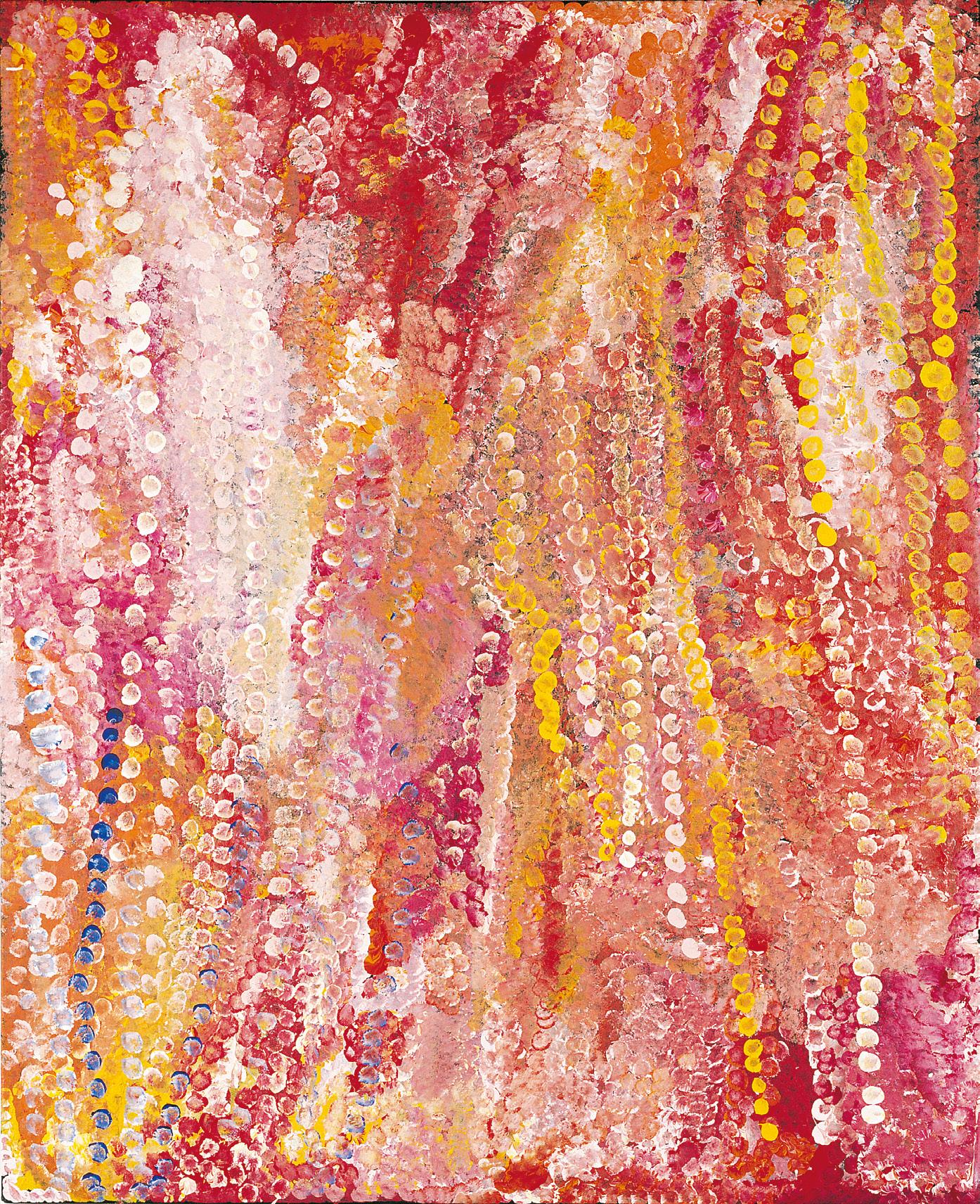
synthetic polymer paint on linen 122.0 x 152.5 cm
bears inscription verso: artist’s name and Delmore Gallery cat. 92L69
Estimate: $180,000 – 250,000
Provenance
Commissioned by Delmore Gallery, via Alice Springs in December 1992 Chapman Gallery, Canberra Lin Bloomfield, New South Wales, acquired from the above on 26 August 1994 Thence by descent Private collection, New South Wales
Exhibited
Emily Kame Kngwarreye, Chapman Gallery, Canberra, 26 August – 19 September 1994
A dense and radiant veil of finely dotted pink, orange, yellow, blue, and burnt umber flowers and seeds, Emily Kam Kngwarreye’s Alalgura – Emu C ountry, 1992 is a joyous and lyrical explosion of high-key colour signifying a bountiful harvest in Alhalker Country, the site of the artist’s birth. In 1992, although only three years into her brief, yet prolific, professional painting practice, the diminutive 80-year-old Kngwarreye received from Paul Keating an Australian Artists Creative Fellowship – an award affectionately known as a ‘Keating’, recognising the cultural contributions of twelve leading contemporary artists. Noted in the press as a ‘surprise’ recipient, having won without an application, she was the first Aboriginal Australian to be recognised for this honour.1
A master colourist, Kngwarreye was in full flight, poetically mapping her country at the unique intersection of ancient Aboriginal cultural traditions and Western abstract formalism. In contrast to the established narrative traditions of contemporary painting practiced by male elders at Papunya, Kngwarreye painted an intimate view of country, focussing on its specific phenomena. She painted totemic elements of flora and fauna over which she held special custodial rights on Alhalker C ountry in Central Australia. A leading figure in eastern Anmatyerr ceremony, and the caretaker of important religious cultural knowledge,
Kngwarreye presided over women’s ceremonies (awelye) in which she danced, making reference to the emu travelling along and bending down to eat the fan flower and desert raisin fruits.
Following on from Kngwarreye’s astounding first painting, dense with underlying skeletal frameworks and body painting designs, Emu woman, 1989 (The Holmes à Court Collection, Heytesbury), the emu subject appeared frequently in the first few years of her painting practice, evidencing the special role of the emu (ankerr) in awelye songs. Many of her earliest paintings featured an underlying linear web of cracked earth and emu tracks, with arrow symbols signifying the animal’s footprints in the sand. Emu fat was mixed in with local ochres to create the ceremonial body paint placed on the breasts, upper chest and shoulders of dancers; the fluency and rapidity of this paintwork was later directly translated by Kngwarreye onto her canvas works. 2
Only reaching artistic maturity in her 70s, Emily Kam Kngwarreye’s decades of experience in ceremonial painting provided the bedrock of her painting practice, giving her, amongst others, the codified songlines of the emu and its movement through the landscape to find suitable grazing locations and nesting sites. Terry Smith noted that while the Emu dreaming was
primarily a male dreaming, Emily held custodial responsibility over the anwerlarr p encil yam, a creeping plant with edible roots and yellow flowers, on which the emu fed. 3 ‘The emu he likes that kame (flower)... that flower is mainly white, sometimes a little bit yellow, pink too… it changes colour a bit’, explained Kngwarreye’s kinswoman Lindsay Bird.4 Another food source favoured by the emu is the yellow, ovalshaped fruit of the intekw (the camel-weed, fan-flower), significant to the cultural context of Alhalker Country.
Alhalker C ountry is characterised by ridges of sandstone and quartzite concealing a sanctuary of springs beyond which extend spinifex sand plains punctuated by soakages and desert country where the emu roam and hardy plants spring into bloom after rains. Alalgura – Emu C ountry is a painting of great seasonal change, when the contours of Alhalker C ountry are suddenly carpeted with flowering yam according to the natural rhythms of indigenous agriculture crucial to livelihood of local peoples.
The paintings produced by Kngwarreye between 1990 and 1992 featured finely stippled, shimmering clouds of dots, each individually painted with a small brush in clearly delineated colours – an extraordinarily concentrated effort for an elderly painter. This was soon to change, the artist’s imminent adoption of larger brushes and broader brushstrokes driven by the need to accommodate reducing levels of energy and diminishing eyesight. 5 In Alalgura – Emu C ountry, the fastidious all-over dotting of uniform size, submerges the underlying tracery of dreaming lines. Instead, successive waves of overlaid dots provide tonal variations, with colours coalescing in streaks
and patches beneath the dots, providing a sense of depth. Th e increasing reductionism in her painted works coincided with Kngwarreye’s reticence to provide explanations for her artworks – a reductive story incapable of encapsulating the ineffable interconnectedness of land, natural energies and cultural expression found in her practice. While certain hues refer to specific natural phenomena, such as the changing ripeness of yam seeds, the whole composition of Kngwarreye’s artworks is more expansive, representing on one plane the flux of seasons, the land and the sky. Hers was an art of multiplicities, of a ‘wholeness of experience.’ 6
In the final prolific years of her life, Kngwarreye spent time at Delmore Downs Station in a remote north-western corner of the Simpson Desert south of Utopia where this painting was produced. In association with Delmore, it was then exhibited at Chapman Galleries in Canberra in 1994, where it was purchased by Lin Bloomfield, respected author, gallerist and arts advocate, in whose family it has since remained. Never previously offered to the market and not seen in public for over three decades, indeed Alalgura – Emu C ountry is a rare example of the artist at the peak of her power s.
1. Neale, M. (ed.) Utopia: The Genius of Emily Kame Kngwarreye, National Museum of Australia Press, Canberra, 2008, p. 259, and Maklin, R. ‘Keatings give focus’, Canberra Times, 8 October 1992, p. 1
2. Perkins, H., and Cole, K., Emily Kam Kngwarray, National Gallery of Australia, Canberra, 2023, p. 184
3. Smith, T., ‘Kngwarreye Woman Abstract Painter’ in Isaacs, J. (et al.), Emily Kngwarreye Paintings, Craftsman House, Sydney, 1998, p. 29
4. ibid., p. 16
5. ibid., p. 21
6. Hart, D., Emily Kame Kngwarreye. Paintings from 1989 – 1995. Works from the Delmore Collection, Parliament House Publishing, Canberra, 1995, n. p.
Lucie Reeves-Smith
natural earth pigments and bush gum on canvas
121.5 x 181.0 cm
bears inscription verso: 5
Estimate: $250,000 – 350,000
Provenance
Commissioned by Mary Macha, Perth in 1991
Aboriginal Dreamings Gallery, Canberra
Private collection, Canberra
Thence by descent
Private collection, Canberra
This work is accompanied by a copy of the original cataloguing note from Mary Macha.
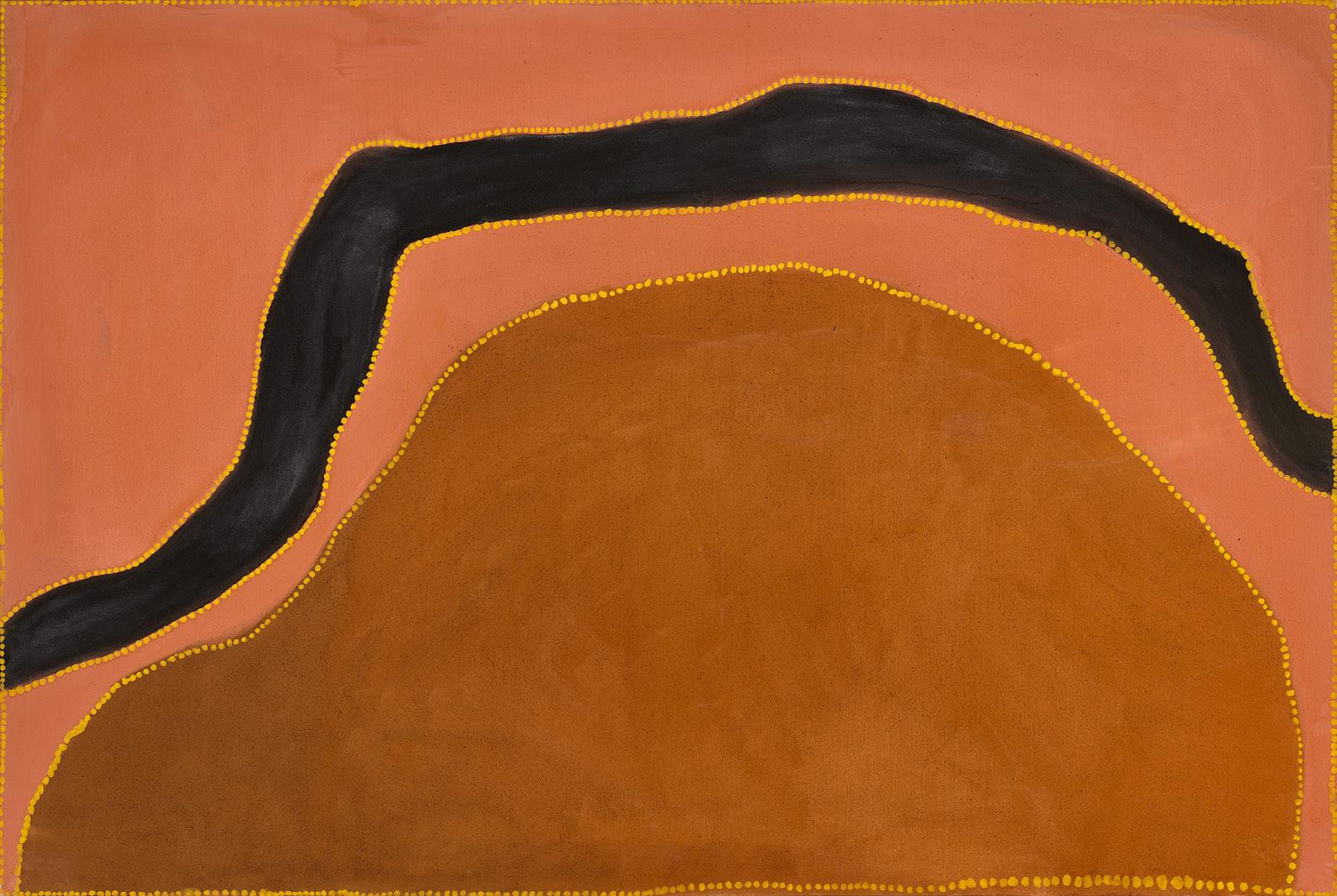
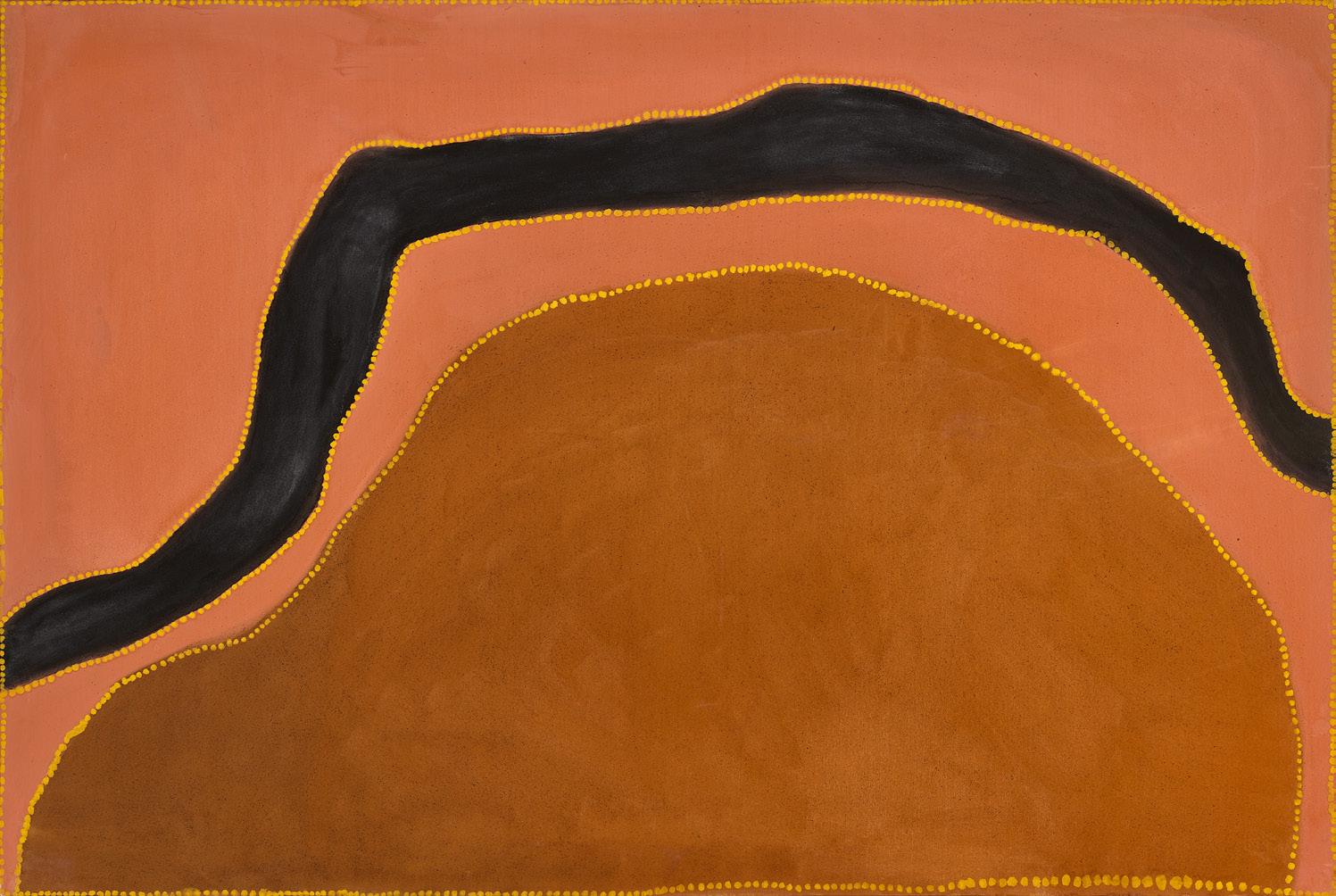
Fresh from his acclaimed presentation in Future Directions at the 44th Venice Biennale in 1991 1, Rover Thomas embarked upon a series of major canvases including Cyclone Tracy (National Gallery of Australia); Paruku (Lake Gregory) (Art Gallery of South Australia); and Djugamerri and Bolgumerri (both formerly in the Laverty Collection). To this significant group of works, all completed in 1991, may be added Langurr (The Rainbow Serpent) making the river, 1991 offered here. In these paintings, Julama’s [sic] palette remains consistent with his earlier works, yet the handling of paint shifts noticeably. The layers are thinner and more fluid, applied in soft, flat strokes or delicate dots, by contrast to the thick impasto surfaces that characterised his previous canvases.
Rover Thomas was born at Kunawarritji (Well 33) on the Canning Stock Route but was taken to the Kimberley as a youth. There he spent decades working on cattle stations, as did many young Aboriginal men of his generation. Adopted into
the traditional cultural milieu of the Kimberley, he developed an intimate knowledge of the region – an understanding that became central to the map-like quality of his paintings. Rather than directly depicting ancestral or historical events, Julama painted the landscapes that bore witness to them.
Although widely travelled within the Kimberley and the Northern Territory – and a regular visitor to his friend and agent Mary Macha in Perth – Thomas had never journeyed beyond Australia until his visit to Venice for the Biennale vernissage in May 1990. In preparation, Macha took him to Canberra for a fortnight at the National Gallery of Australia, where he encountered, firsthand, a major international art institution and its collections. There Thomas showed a lively curiosity about diverse artistic traditions and styles, yet he was particularly struck by Mark Rothko’s No. 20, 1957 about which he reportedly exclaimed in astonishment, ‘Who’s this bugger who paints like me?’ 2
In works produced after his return from Venice, Thomas’ application of thin, even layers of pigment – soaking into the canvas support – bears a certain resemblance to Rothko’s technique of building colour through successive washes. The extent to which this encounter influenced Julama’s subsequent practice, however, remains open to conjecture.
The title of this painting refers to Langurr (or Wungurr), the ancestral Snake invoked by Thomas to describe the force that, in the form of Cyclone Tracy, devastated Darwin in 1974 before sweeping across the eastern Kimberley. In the months following the disaster, Thomas experienced a series of revelations communicated by the spirit of his classificatory mother’s sister, who had perished in the cyclone. These visionary experiences led to the creation of the Gurirr Gurirr (Krill Krill) ceremony, of which Thomas was custodian.
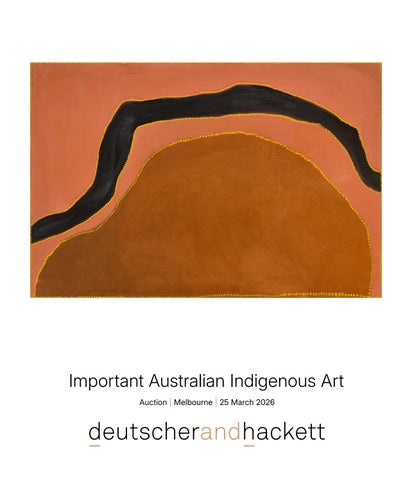
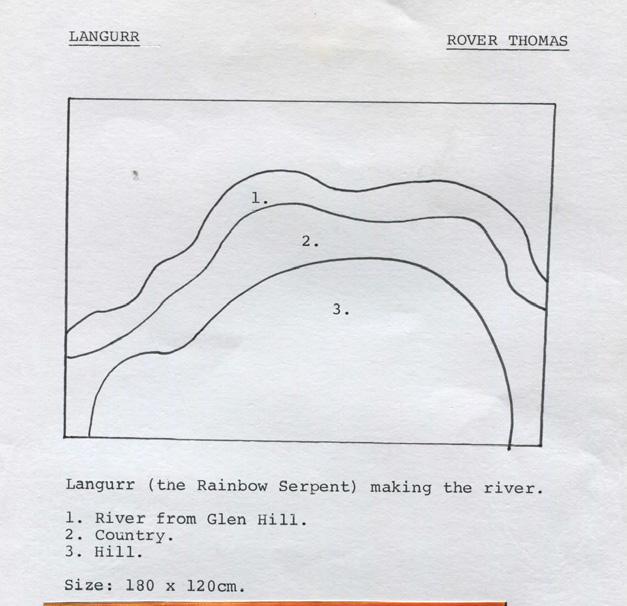
According to Mary Macha’s annotated diagram of the composition, the black serpentine line represents the river flowing from Glen Hill, north of Thomas’ home at Warmun (Turkey Creek), as it is formed by the Rainbow Serpent. The large, rounded form dominating the canvas signifies the hill itself, while the intervening space is described by the artist simply as ‘Country’. The setting appears to evoke the area where Thomas’ aunt was fatally injured in a car accident caused by floodwaters from the cyclone.
1. Along with Trevor Nickolls (1949 – 2012), Rover Thomas was the first Aboriginal artist to represent Australia at the Biennale of Venice. Their exhibition was curated by Michael O’Ferrall from the Art Gallery of Western Australia.
2. Rex Butler describes Rover Thomas’ reaction as the recognition of a type of ‘lyricism’ where the artist’s ‘voice or viewpoint [is] uninterrupted’ by any form of verbal description or interpretation. See Butler, R., ‘What was Abstract Expressionism? Abstract Expressionism after Aboriginal Art’, Australian and New Zealand Journal of Art, vol. 14 (1), 2014, pp. 76 – 91 at: https://www.tandfonline.com/doi/full/10.1080/14434318.2014.93 6529 (accessed 18 February 2026)
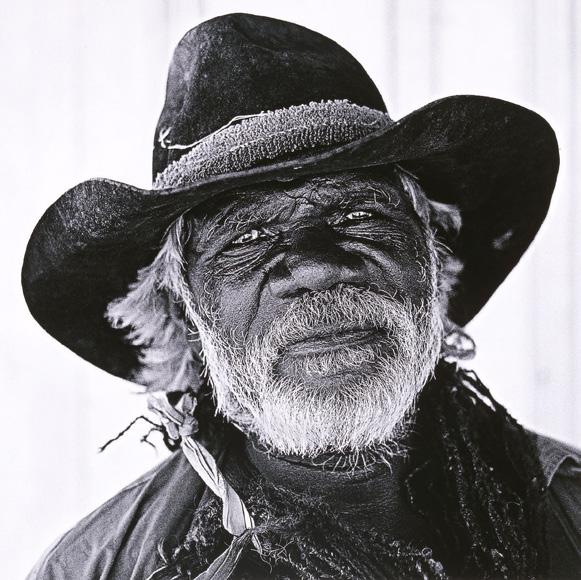
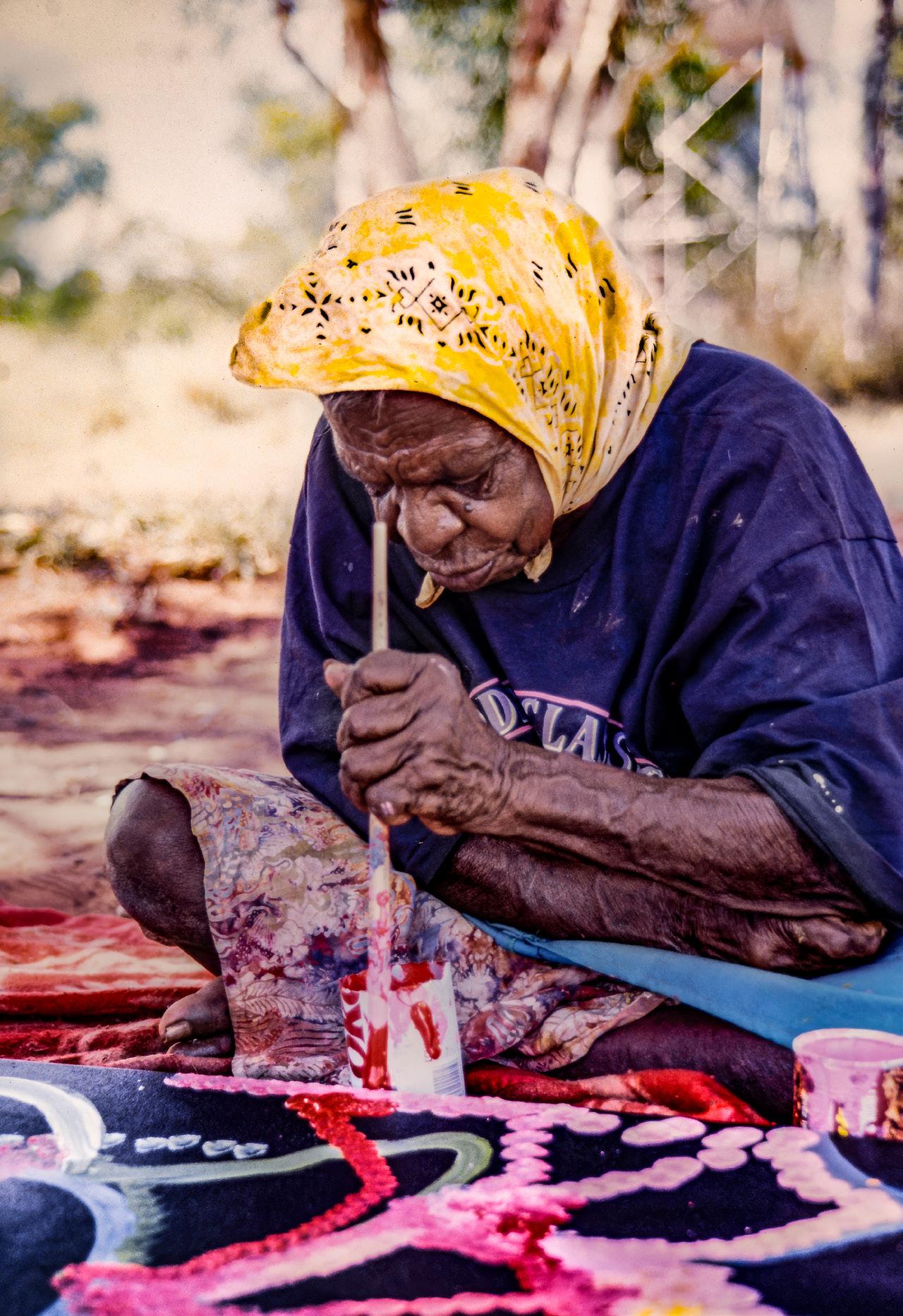
Rover Thomas, 1986 photographer: Martin van de Wal
National Portrait Gallery, Canberra
© Martin van der Wal
– 2007)
Fig tree hole, 2005
ochres and pigments with synthetic binder on linen
150.0 x 180.0 cm
signed with initials verso: PB bears inscription verso: date and Jirrawun Arts cat. PB 8 2005.235
Estimate: $150,000 – 200,000
Provenance
Jirrawun Arts, Wyndham, Western Australia
Gene and Brian Sherman collection, Sydney Deutscher and Hackett, Melbourne, 25 May 2016, lot 21
Private collection, Indonesia
Literature
Storer, R., Paddy Bedford, Museum of Contemporary Art, Sydney, 2006, p. 158 (illus.)
Paddy Bedford played a pivotal role in what can rightly be described as an aesthetic revolution in contemporary Indigenous art. A leading figure among a group of artists from Warmun in the Kimberley region of Western Australia, Bedford was often referred to as the ‘new’ Rover Thomas, and significantly, only began painting on canvas after fellow artist Freddie Timms established the Jirrawun Aboriginal Art group at Rugun (Crocodile Hole) in north-east Western Australia in 1997.
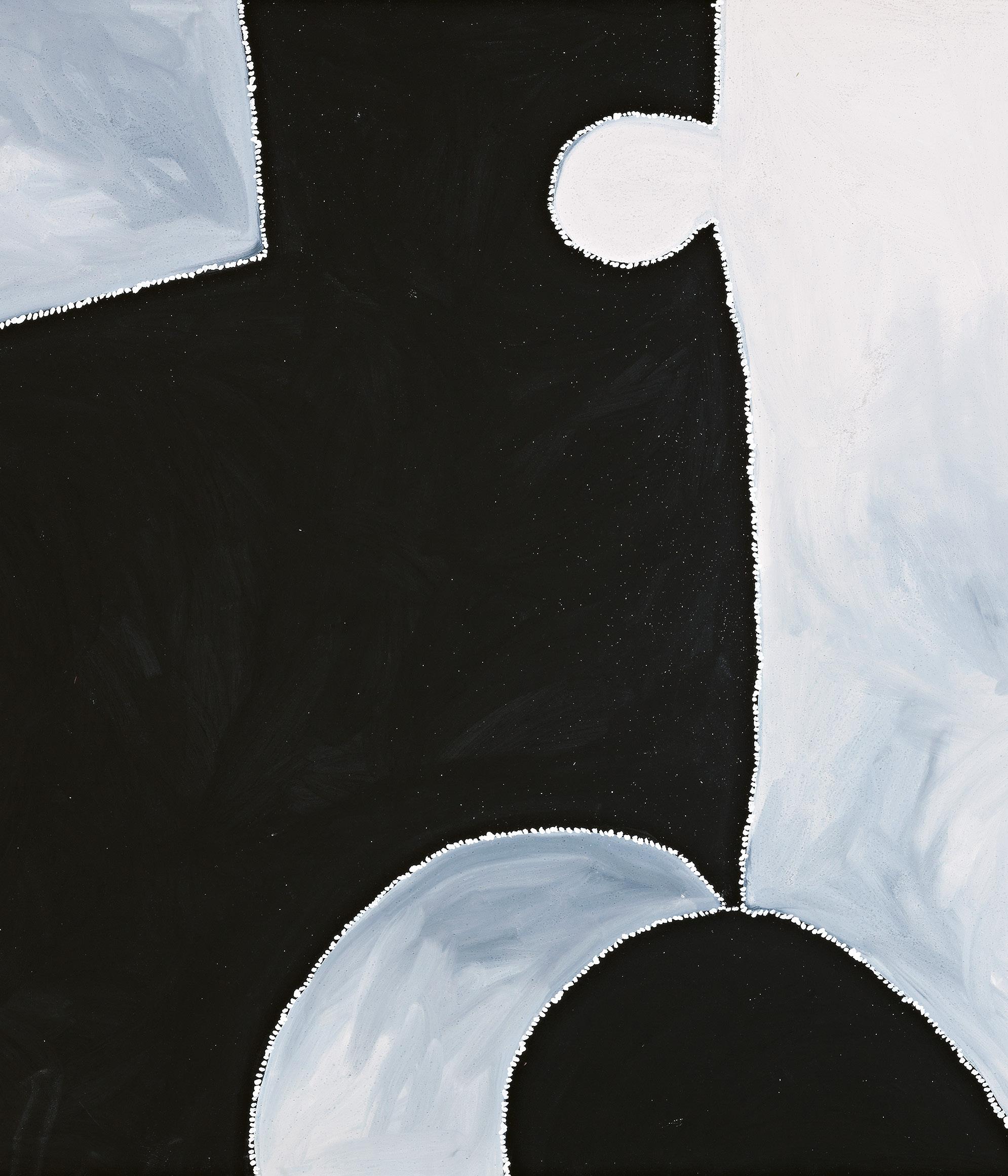
Catalogued as PB 8–2005.235 in Bedford’s chronological index, this painting on linen was executed in 2005 and depicts the country of Jamelayigoon (Fig Tree Hole). An archetypal example of Bedford’s practice, the work features dramatic monochromatic contrasts with subtle suggestions of figuration. His pared-back, minimalist approach – combined with wet-on-wet techniques and expressive gestural mark-making – propelled his work into a distinctly contemporary arena. At the same time, as a senior lawman, Bedford recorded the history of his country and the narratives of three major sites for which he was custodian: Emu Dreaming, Bush Turkey Dreaming and Cockatoo Dreaming.
Jamelayigoon (Fig Tree Hole) lies north-east of Bedford Downs and further north of Lerdijwaneman (Lightning Creek). The site is characterised by a river running between high cliffs, with a large cave set into the rock face. It is the Dreaming place of
Woonyjoorroony (the Rock Wallaby), and the river’s waterholes are associated wi th Birlinji (the red river gum). The area is closely connected to Bedford’s father, who was born nearby at Wirndoowoon. Bedford’s personal Dreaming of Minjiwarrany (black plum), inherited from his father, is also linked to this place.
Stylistically, this painting marks Bedford’s departure from the more familiar conventions of earlier East Kimberley painters, as he forged a highly personal vision of country. The introduction of a stark black-and-white ground signals his evolution from a purely ochre palette. Solid forms assert themselves within the composition, while washes of soft pink and bluegrey temper the surface through a wet-on-wet process first seen in his canvases in 2003. By suspending white and coloured pigments in an acrylic medium, Bedford achieved a distinctive luminosity and depth across the painted surface.
During his lifetime, Bedford received numerous honours. His work was exhibited widely in major museums in Australia and internationally, including a retrospective at the Museum of Contemporary Art Australia, Sydney, in 2006. That same year, he was notably also included among a select group of artists commissioned to produce a major work for the collection of the Musée du Quai Branly i n Paris.
Crispin Gutteridge
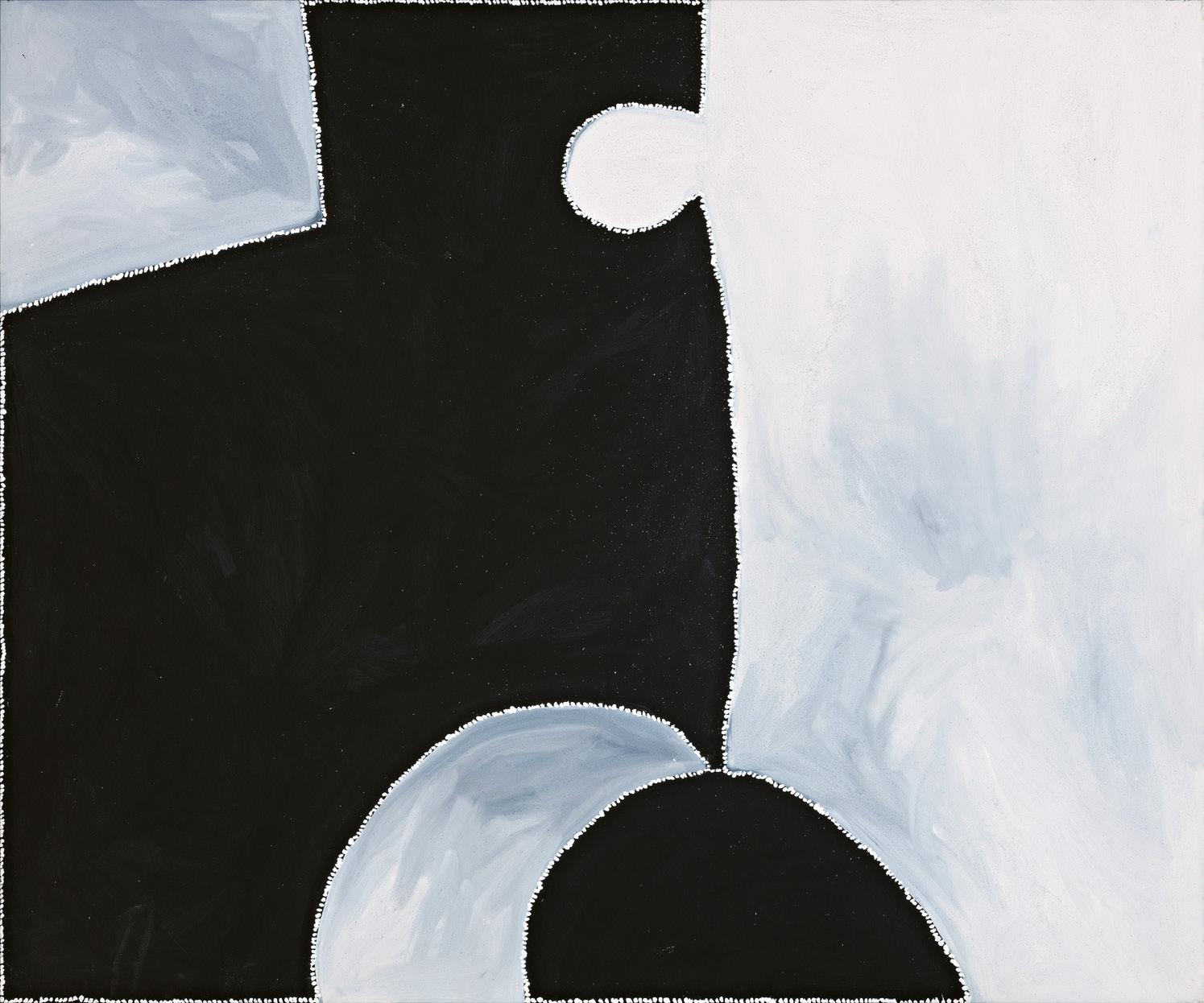
Lake Baker, 2021
synthetic polymer paint on linen
200.0 x 230.0 cm
bears inscription verso: artist’s name, date and Spinifex Arts Project cat. SAPTH 21-355
Estimate: $30,000 – 40,000
Provenance
Spinifex Arts Project, Tjuntjuntjara, Western Australia SALON Art Projects at Tarnanthi, Art Gallery of South Australia, Adelaide Private collection, Melbourne, acquired from the above
Exhibited
Tarnanthi – Timo Hogan: Kumpilpa Ngaranyi – Unseen, Light Square Gallery, Adelaide, 20 – 27 October 2023
Related works
Lake Baker, 2021, synthetic polymer paint on linen, 290.0 x 600.0 cm, Museum of Contemporary Art Australia, Sydney
Lake Baker, 2021, synthetic polymer paint on canvas, 290.0 x 198.8 cm, National Gallery of Victoria, Melbourne
Lake Baker, 2021, synthetic polymer paint on linen, 200.0 x 137.0, Queensland Art Gallery | Gallery of Modern Art, Brisbane
This work is accompanied by a copy of the certificate of authenticity from Spinifex Arts Project which states:
‘Timo Hogan depicts the changing forms of his ancestral home of Lake Baker with the confidence of someone who knows their place in the landscape. Here he weaves the Wati Kitjara (Two Men Creation Line) into the contour of the large expanse that encapsulates the lake. The Two Men watch as the ever present and dangerous Wanampi (Water Serpent) defines the edges of the lake as he wanders in search of food. These are the lakes inhabitants that bring alive the creation narrative that forms the very landscape it speaks of. The characters are the creation beings, those first beings, who not only shaped the immediate environment with their actions but left a moral compass intertwined within the mapped habitat for all to follow.’
– 2017)
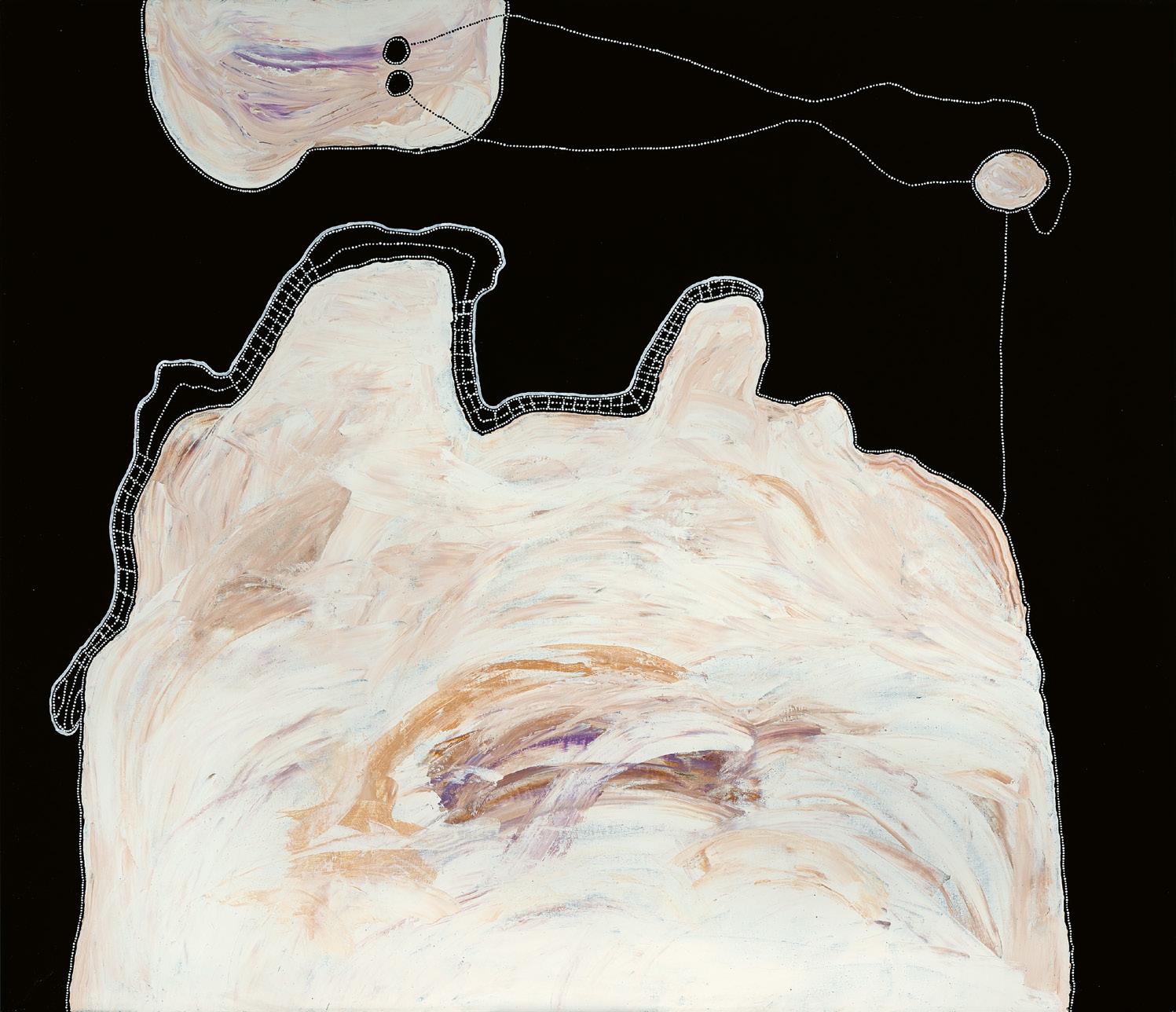
Mandangala, north of Turkey Creek, 1990
ochres and pigment with synthetic binder on canvas
120.0 x 160.0 cm
bears inscription on backing verso: artist’s name, size and Waringarri Aboriginal Arts cat. S2700 and AP33200
Estimate: $50,000 – 70,000
Provenance
Painted for Waringarri Aboriginal Arts, Kununurra, Western Australia in 1990 Gallery Gabrielle Pizzi, Melbourne (labels attached verso) Private collection, USA
Sotheby’s, Melbourne, 25 July 2005, lot 45 (as ‘Mandangala, North Turkey Creek’) Private collection, Sydney
Exhibited
Aratjara Art of the First Australians, Kunstsammlung Nordrhein–Westfalen, Düsseldorf, Germany, 24 April – 4 July 1993; The Hayward Gallery, London, 23 July – 10 October 1993; Louisiana Museum, Humlebaek, Denmark, 11 February –23 May 1994; National Gallery of Victoria, Melbourne, 23 June – 15 August 1994, cat. 76 (label attached verso)
Literature
Luthi, B. (ed.), Aratjara Art of the First Australians: Traditional and Contemporary Works by Aboriginal and Torres Strait Islander Artists, DuMont Buchverlag, Cologne, 1993, cat. 76, pp. 218 (illus.), 343
The accompanying catalogue entry for the Aratjara exhibition notes that this painting shows country in the area of Glen Hill (Mandangala) and the Argyle diamond mine to the north of Turkey Creek.
The dramatic landscape of Gija Country in the East Kimberley was parcelled by white pastoral settlements in the early 20th century. Large swathes of this land were later submerged with the Ord River Irrigation Scheme, which, in 1971, created Lake Argyle, Australia’s largest man-made freshwater reservoir. Painted in the same year that Thomas and Trevor Nickolls (1949 – 2012) became the first Aboriginal artists to represent Australia at the Venice Biennale, Mandangala, north of Turkey Creek, 1990, is an acclaimed early work by Freddie Timms painted in specific local ochres, depicting from memory the landscape of Mandangala, a remote area north-east of Warmun flooded beneath Lake Argyle.
Contemporary Kimberley artists Paddy Jaminji, Rover Thomas, Queenie MacKenzie and Freddie Timms all came to artmaking relatively late in life, following many decades of outdoor labour and travelling across vast tracts of Kimberley country enclosed in Texas Downs and Bedford Downs. Employment as stockmen and drovers on these great Kimberley cattle stations and pastoral properties, although entailing hard physical labour, allowed the artists to remain close to ancestral lands and able to travel for ceremonial purposes. ‘I think about the country where I was walking and camping, all the main waterholes, all the camping areas. I remember the places where I used to go mustering and I follow them up with my painting’, Timms explained of his artworks. 3
While the first forms of modern, transportable art from the Kimberley region of Western Australia were paintings of Wandjina spirits derived from local and ancient rock art, the emergence of a contemporary painting practice of ochre-on-canvas at Warmun (Turkey Creek) was inextricably linked to the development the Goorirr Goorirr (Kurrirr-Kurrirr/Gurrir Gurrir/Krill Krill/Kuril Kuril) narrative ceremonial cycle in the 1970s.1 Male Gija elders painted the first hand-held wooden boards used in the corroboree, including Jack Britten, George Mung Mung and Paddy Jaminji, a classificatory uncle of Joolama Rover Thomas (the dreamer and owner of the Gorrir Gorrir cycle) and, who subsequently became a classificatory father-in-law to Ngarrmaliny Freddie Timms (who danced in early Goorrir Goorrir performances). 2 Both of these artists, who settled in Warmun and started painting in 1983 and 1986 respectively, would become internationally known artists and powerful advocates for representation of Indigenous artists and cross-cultural relationships.
A detailed and intimate working knowledge of the land combined with recollections of distant ancestral places provided the foundation for Timms’ radically stylised artworks. His textural chalky surface of local ochres, carefully contoured with ‘the ubiquitous East Kimberley line of white dots’, contain the soft traces of his lived experience.4 Aged in his early forties, Timms took to painting at the point when Paddy Jaminji’s career was ending, becoming a generational bridge within the Turkey Creek school of painters, and following in Rover Thomas’ stylistic lineage. Like the elder artist, Timms’ early paintings are characterised by a certain graphic austerity: a reduced palette and clearly outlined shapes far removed from human scale. The wide areas of delicately modulated solid colour in hues of brown, ochre and chalk are spare of ornament or detail. They convey with precision an aerial view of this spacious and significant site for the artist, an organic real-world structure which provides a symbolic rhythm to the painted surface.
1. Stanton, J., ‘Ceremonial Art of the East Kimberley’, in Perkins, H. et al., One Sun One Moon: Aboriginal Art in Australia, Art Gallery of New South Wales, Sydney, 2007, pp. 240 – 241
2. McLean, I., Rattling Spears. A History of Australian Indigenous Art, Reaktion Books, London, 2016 p. 190
3. Freddie Timms cited in Kofod, F., ‘Freddie Timms’ in Kleinert, S., and Neale, M. (eds.), The Oxford Companion to Aboriginal Art and Culture, Oxford University Press, Melbourne, 2000, p. 716
4. Mclean, op. cit., p. 191
Lucie Reeves-Smith
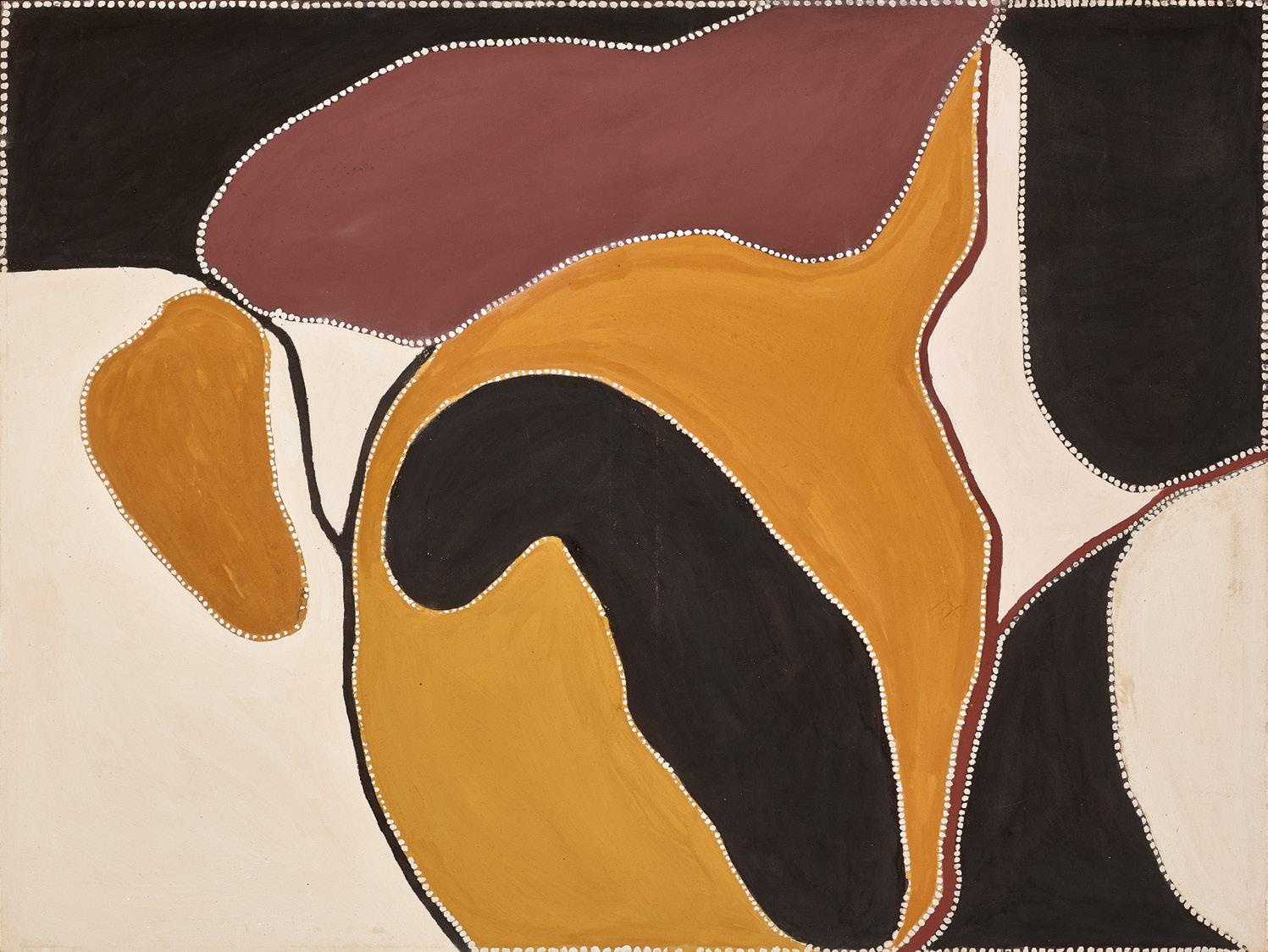
All the jila, 2007
synthetic polymer paint on linen
120.0 x 160.0 cm
bears inscription verso: artist’s name, date, medium, size and Short Street Gallery cat. 24318
Estimate: $60,000 – 80,000
Provenance
Short Street Gallery, Broome AP Bond Gallery, Adelaide
The Luczo Family Collection, USA
Deutscher and Hackett, Melbourne, 19 October 2016, lot 2 Private collection, Indonesia
This painting is accompanied by a copy of the certificate of authenticity from Short Street Gallery that states:
‘This is all the jila in my country including Larrparti, Kawarr, Jurntiwa and Wirrguja jila (living water). This Yulparija country is in the Great Sandy Desert in Western Australia near the Percival Lakes.’
In 2007, Daniel Walbidi travelled with a group of Yulparitja elders, including his father Harry Bullen (Nabiru), from Bidyadanga back to their ancestral lands around Winpa and Kirriwirri in the Great Sandy Desert. The journey sought to renew the Yulparitja people’s enduring connections to Country and proved a formative experience for the young artist. It was also the first time Walbidi had seen his homeland from the air – an encounter that would profoundly shape his painterly vision.
Completed later that same year, All the jila, 2007 maps the network of freshwater sites at Karrparti, Kawarr, Jurntiwa and Wirrguja, rendered in a vibrant tapestry of colour and form that would become a hallmark of Walbidi’s practice.
Studying art at school and university, Walbidi drew inspiration from leading Aboriginal artists including Albert Namatjira, Emily Kam Kngwarreye, Clifford Possum
Tjapaltjarri, and, closer to home, Rover Thomas, whose customary lands neighbour those of the Yulparitja.
In 2008, Walbidi was selected for the Xstrata Emerging Indigenous Art Award at the Gallery of Modern Art in Brisbane. The following year, his work was included in Contemporary Aboriginal Painting from Australia, the first exhibition of modern Aboriginal art presented at the Metropolitan Museum of Art, New York. In 2012, he was selected for unDisclosed, the second National Indigenous Art Triennial at the National Gallery of Australia in Canberra.
1. The Australian Broadcasting Commission (ABC) produced Desert Heart, a documentary film on the journey narrated by Walbidi, which was screened in March 2008.
Wally Caruana
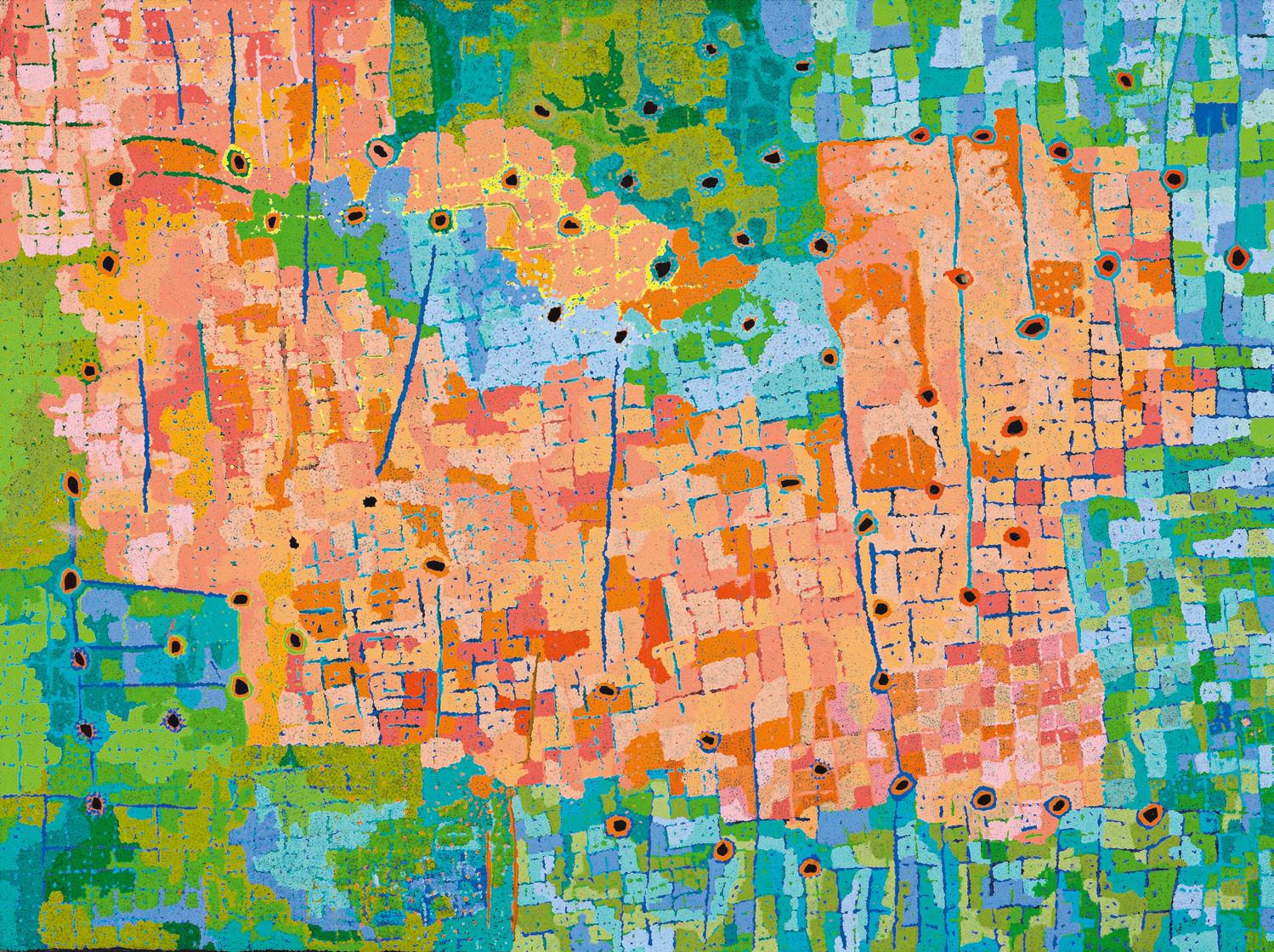
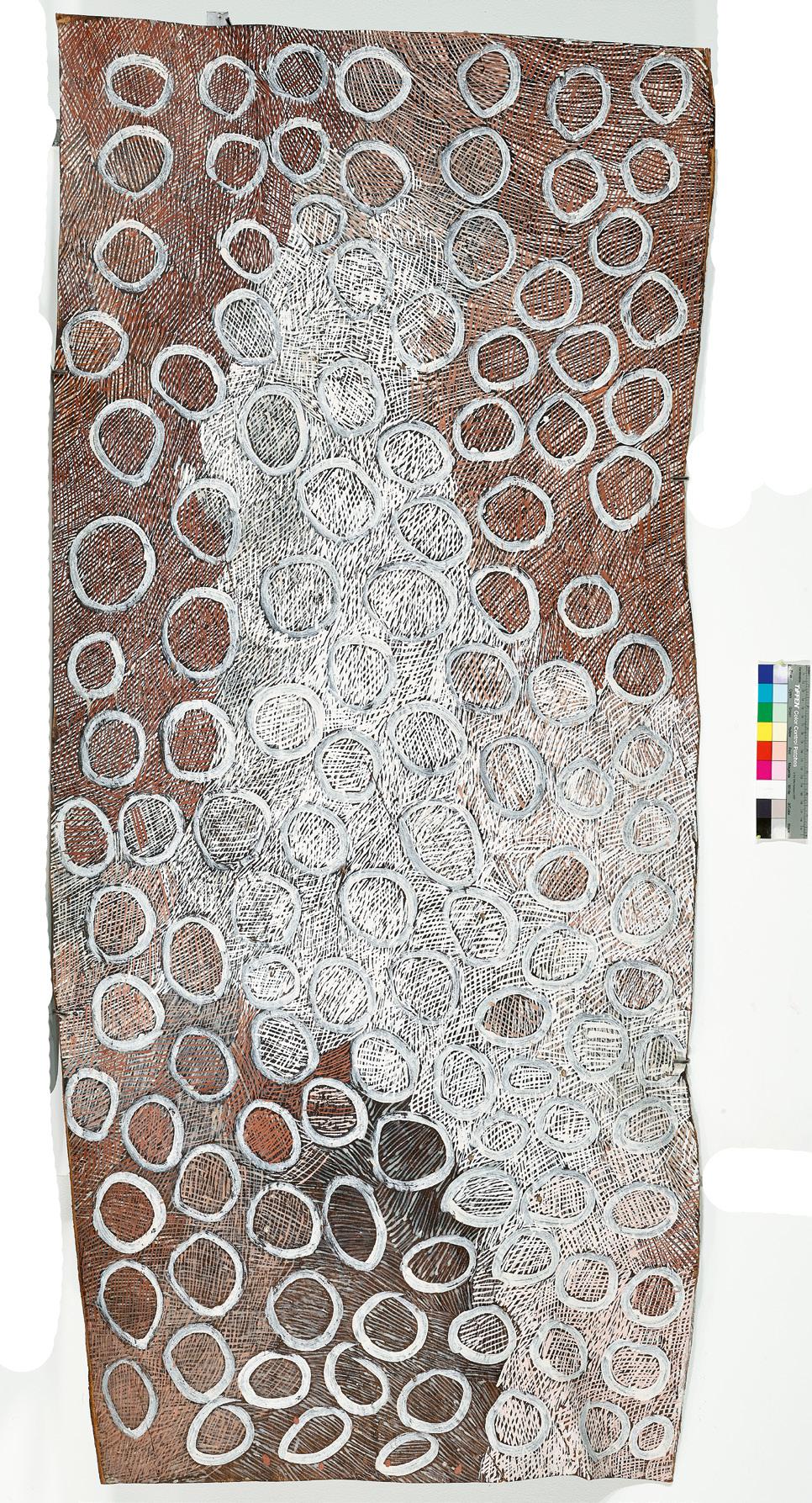
natural earth pigments on Stringybark
168.0 x 77.0 cm (irregular)
bears inscription on Buku–Larrŋgay Mulka Centre label verso: cat. 1064–18
Estimate: $35,000 – 45,000
Provenance
Buku–Larrŋgay Mulka Centre, Yirrkala, Northern Territory (label attached verso)
Roslyn Oxley9 Gallery, Sydney
Private collection, Victoria, acquired from the above
Exhibited
Nyapanyapa Yunupiŋu: Ganyu, Roslyn Oxley9 Gallery, Sydney, 31 January – 16 February 2019, cat. 12
Significant, D’Lan Contemporary, Melbourne, 7 May –3 July 2025 (illus. in exhibition catalogue, p. 195)
Related work
Circles, 2015, natural earth pigments on stringybark, 135.0 x 77.0 cm, private collection, illus. in Scholes, L., et. al., The Moment Eternal: Nyapanyapa Yunupiŋu, Museum and Art Gallery of Northern Territory, Darwin, 2020, p. 35
This work is accompanied by a certificate of authenticity from Buku–Larrŋgay Mulka Centre.
Working outside established Yolŋu conventions, the art of Nyapanyapa Yunupiŋu was distinctive and strikingly independent of Arnhem Land bark painting traditions. Celebrated for the spontaneity, texture, and freedom of her mark-making, she did not depict ancestral Dreaming narratives or traditional clan designs like many other Yolŋu artists. Instead, she created birrka ‘mirri’ – ‘anything paintings.’ 1 Her work is deeply personal, recalling episodes from her own life or capturing an immediate, intuitive response to the moment.
‘Yolŋu bark painting and sculpture traditionally conveys a temporal union between prehistory, the present and the distant future where all these time zones are happening simultaneously! This is the tense in which the creation events happened/are happening/will happen. All Yolngu art until this point was either sacred and in this tense or decorative. Decorative paintings were expressly ‘ordinary’ and without meaning or story of any kind.’ 2
However, in 2008, when she was prompted to paint the story of her near-fatal goring by a buffalo in the 1970s, Nyapanyapa departed decisively from such convention. From this point, she developed a unique body of autobiographical paintings centred on
her own lived experiences. 3 Her early story paintings thus quickly evolved into an idiosyncratic method of mark making combining individual free flowing elements such as circles, squares and thick lines with underlying and rhythmic cross-hatching.
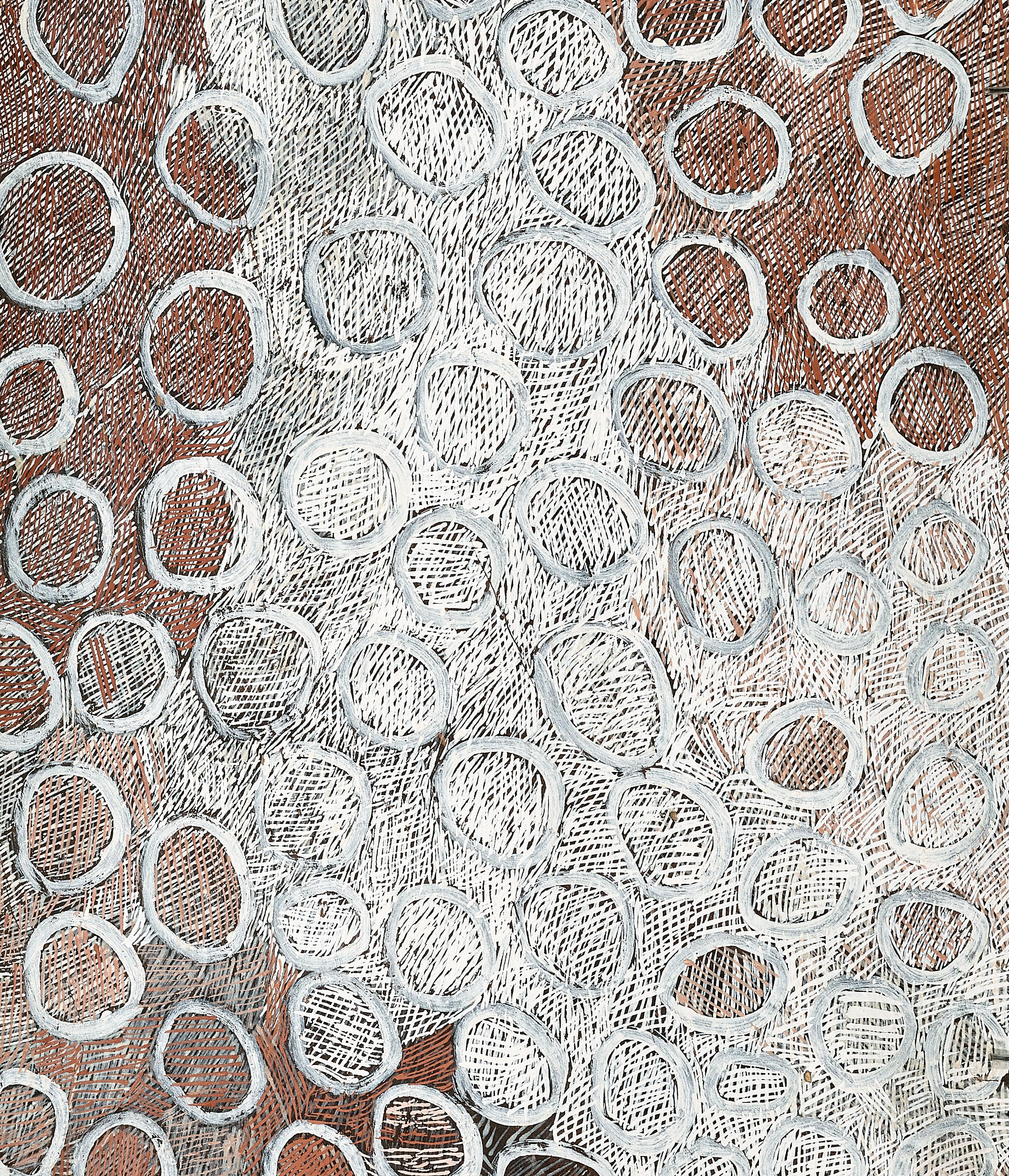
Untitled (Circles), 2018 exemplifies this approach – featuring a loose constellation of white circles hovering above a dynamic ground of patterned, multihued cross-hatching. Yunupiŋu’s paintings unfold as rhythmic compositions mapped in bold gestures, employing both traditional and non-traditional materials. The looseness of her hand and her particular emphasis upon form and line lend the work an immediacy and vitality by contrast to the tightly structured geometry characteristic of many contemporary Yirrkala artists. As curator Luke Scholes observes, she ‘painted for the pure, gleeful pleasure of it. There is no ego, no desire; she instinctively and unreservedly gives herself to each mark.’4
1. Will Stubbs, cited in Scholes, L., ‘Anyhow in the everywhen’ in Luke Scholes (ed.), The Moment Eternal, Nyapanyapa Yunupiŋu, Museum and Art Gallery of the Northern Territory, Darwin, 2020 p. 133
2. Buku–Larrŋgay Mulka Centre certificate of authenticity
3. Stubbs, W., ‘The Little Things’, cited in Scholes, op. cit., p. 98
4. ibid p. 103
Crispin G utteridge
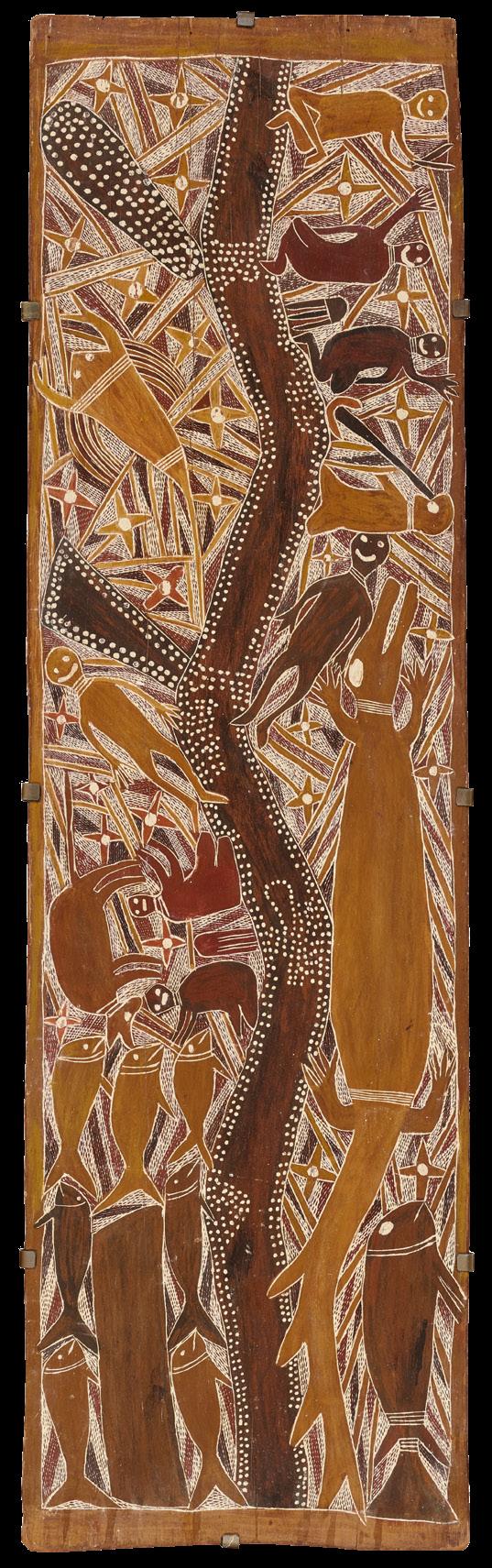
Phil Noble
natural earth pigments on eucalyptus bark
140.0 x 39.5 cm (irregular)
bears inscription verso: artist’s name bears inscription on obscured label attached verso: artist’s name, date, location and story
Estimate: $20,000 – 30,000
Painted at Yirrkala, North–East Arnhem Land, Northern Territory, c.1958
Private collection, Melbourne
Sotheby’s, Sydney, 13 May 2010, lot 86
Private collection, Melbourne
Related work
Milŋiyawuy; The Milky Way, pre. 1966, natural earth pigments on eucalyptus bark, 92.0 x 35.5 cm, Kluge-Ruhe Aboriginal Art Collection at the University of Virginia, USA, illus. in: Wanambi, W., Skerritt H., and McDonald, K., (eds.), Madayin: Eight Decades of Aboriginal Australian Bark Painting from Yirrkala, Kluge-Ruhe Aboriginal Art Collection of the University of Virginia and DelMonico books, Virginia and New York, 2022, p. 171
The patriarch of a distinguished artistic dynasty – including his brother Mathaman, his son Wandjuk, his daughters Banduk and Dhuwarrwarr (notably, Mawalan broke with convention as one of the first Indigenous artists to teach his daughters to paint), and his brother-in-law Munggurrawuy Yunupiŋu – Mawalan Marika was the senior Rirratjingu ceremonial and community leader of the Dhuwa moiety clans of the Yolŋu people in north-east Arnhem Land.
A steadfast advocate for Yolŋu law and cultural continuity, particularly in the wake of expanding European influence following the establishment of the Yirrkala Mission in 1935, Mawalan played a instrumental role in several significant negotiations between the Yolŋu and the broader Australian community. In the 1940s, he produced a remarkable series of 365 crayon drawings for the anthropologists, Ronald Berndt and Catherine Berndt, who were researching Yolŋu culture and society. He was also a signatory to the landmark Yirrkala bark petitions presented to Federal Parliament in August 1963, and the leading Dhuwa moiety artist responsible for the painting of the Yirrkala Church Panels that same year. In 1959 and 1960, after being approached by the deputy director of the Art Gallery of New South Wales, Tony Tuckson, and Dr Stuart Scougall, Mawalan oversaw the production of a series of large-scale bark paintings for the Gallery.
A rare monumental example of his work, Milŋiyawuy; The Milky Way, c.1958, carries a dual meaning. It depicts the mayaŋ’ (river) of stars that stretches across the night sky –
known in English as ‘the Milky Way’ – while also referring to a mayaŋ’ on earth that flows into northern Blue Mud Bay.1 The constellations of Milŋiyawuy form a pathway for ancestral spirits and a celestial reflection of terrestrial life, encompassing ceremonies, canoes, and waters teeming with fish and other creatures. Thus, the painting simultaneously references earthly places and their parallel existence in the sky.
According to the traditions of the Rirratjingu and related Dhuwa clans, the composition illustrates the story of two brothers who were fishing in their bark canoe when it capsized in a strong wind. One brother’s body washed ashore, while the other sank beneath the water (lower left). The crocodile Baru, searching for food, detected the scent of the brother on the beach. Ultimately, the two brothers and Baru ascended into the night sky, becoming constellations (centre right).
Nearby, a group of Possum ancestors conducting a ceremony – men playing the didjeridu and clapsticks as women danced – saw the newly formed stars and likewise ascended into the heavens (top right). They were joined by the ancestral Native Cat, the submerged canoe, and the Scorpion, who was once a man. All were transformed into constellations. In the upper left, two star-filled bags extending from the Milky Way are known as Djulpan: the triangular bag is male, and the elliptical bag female.
1. Morphy, H. et al., ‘Milŋiyawuy; The Milky Way’ in Wanambi, W., Skerritt, H., and McDonald, K. (eds.), Madayin: Eight Decades of Aboriginal Australian Bark Painting from Yirrkala, Delmonico Books/Kluge-Ruhe Aboriginal Art Collection, Virginia, 2022, p. 168 Crispin Gutteridge
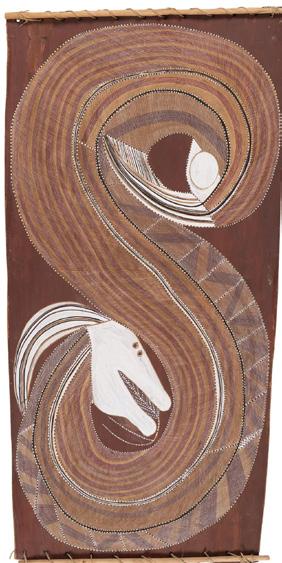
Ngalyod, Rainbow Serpent, 1979
natural earth pigments on eucalyptus bark
128.0 x 48.0 cm (irregular)
bears inscription verso: artist’s name, Maningrida Arts and Culture cat. M444 and cat. C767/USR 12.79
Estimate: $25,000 – 35,000
Maningrida Arts and Culture, Maningrida, Northern Territory Company collection, Sydney
Private collection, Sydney, acquired from the above in 2025
Original and uniquely Australian, the art of John Mawurndjul represents the culmination of decades of learning and the careful refinement of his craft. Over time, he developed a distinctive visual language – an enduring record of Country and an individual mode of storytelling – subtly embedded within his intricate and luminous bark paintings.
Since he began painting in the late 1970s, Mawurndjul has quietly transformed the tradition of Kuningku bark painting. His early depictions of figures and creatures from Kuningku mythology gradually evolved into more metaphysical representations of specific sites, events and landscapes, articulating the vital connection between the spiritual and human worlds. This evolution is most tangibly evidenced in his portrayals of Ngalyod, the Rainbow Serpent. An omnipotent and central being in Kuninjku cosmology, Ngalyod is associated with the creation of sacred sites, or djang, across Kuninjku clan lands.
Ngalyod appears in Mawurndjul’s earliest works; however, as his cultural knowledge deepened – guided by his late elder brother Jimmy Njiminjuma and through his participation
John Mawurndjul
Ngalyod, c.1981 natural pigments on eucalyptus bark
120.0 x 61.5 cm
Berndt Museum Collection, The University of Western Australia, Perth © Balang Nakurulk
(Mr Mawurndjul)/Copyright Agency
in ritual ceremonies – his representations of the serpent became increasingly complex and powerful. His paintings began to convey not only Ngalyod’s creative force but also its destructive potential. As one commentator has observed, ‘many of his works, particularly the Ngalyod paintings, act as definitive warnings to family, friends and visitors alike, illustrating the vengeful capacity of beings to punish transgressors or those who do not have ritual authority.’ 1
‘Rainbow Serpents are found in many places in both dua and yirridjdja moiety. They live in the earth under the ground or in bodies of water at places such as Dilebang or Benedjangngarlwend. The white clay in the ground at Kudjarnngal is the faeces of the serpent. Waterlilies at certain places tell us that the Rainbow Serpent lives there. When the wet season storms come, we can see her in the sky as a rainbow. She makes the rain. When the floodwaters of the wet season rise, we say the Rainbow Serpent is creating the electrical storms of the monsoon. Rainbow Serpents are dangerous, like crocodiles; they can kill people and other animals.’ 2
The potency of Ngalyod is powerfully expressed in Ngalyod, Rainbow Serpent, 1979. The serpent’s head, shown in profile at the upper left of the bark, is bordered by fields of ochre rarrk; its teeth are reduced to a rhythmic series of chevrons, while its body twists and coils toward the edges of the bark surface. Energy radiates throughout the composition, signalling a presence imbued with immense power - life-giving in the regenerative rains of the annual monsoon, yet equally threatening in the destructive force of storm and flood.
Mawurndjul’s paintings have pioneered a renewed interpretation of Kuningku clan sites and djang, inspiring subsequent generations of bark painters. Constantly seeking new ways to articulate his relationship to Country, he has expanded both the conceptual and aesthetic possibilities of the tradition. As curator Hetti Perkins writes, ‘His works, lovingly crafted and sculpted depictions of flora and fauna, ancestral events, supernatural beings, significant sites and encrypted ceremonial designs, are at once Country and mnemonic of Country.’ 3
1. Perkins H., ‘Mardayin Maestro’ in John Mawurndjul, I am the Old and the New, Art Gallery of South Australia, Adelaide, 2018, p. 26
2. John Mawurndjul, cited in John Mawurndjul, ibid., p. 200
3. Perkins, op. cit., p. 21
Crispin Gutteridge
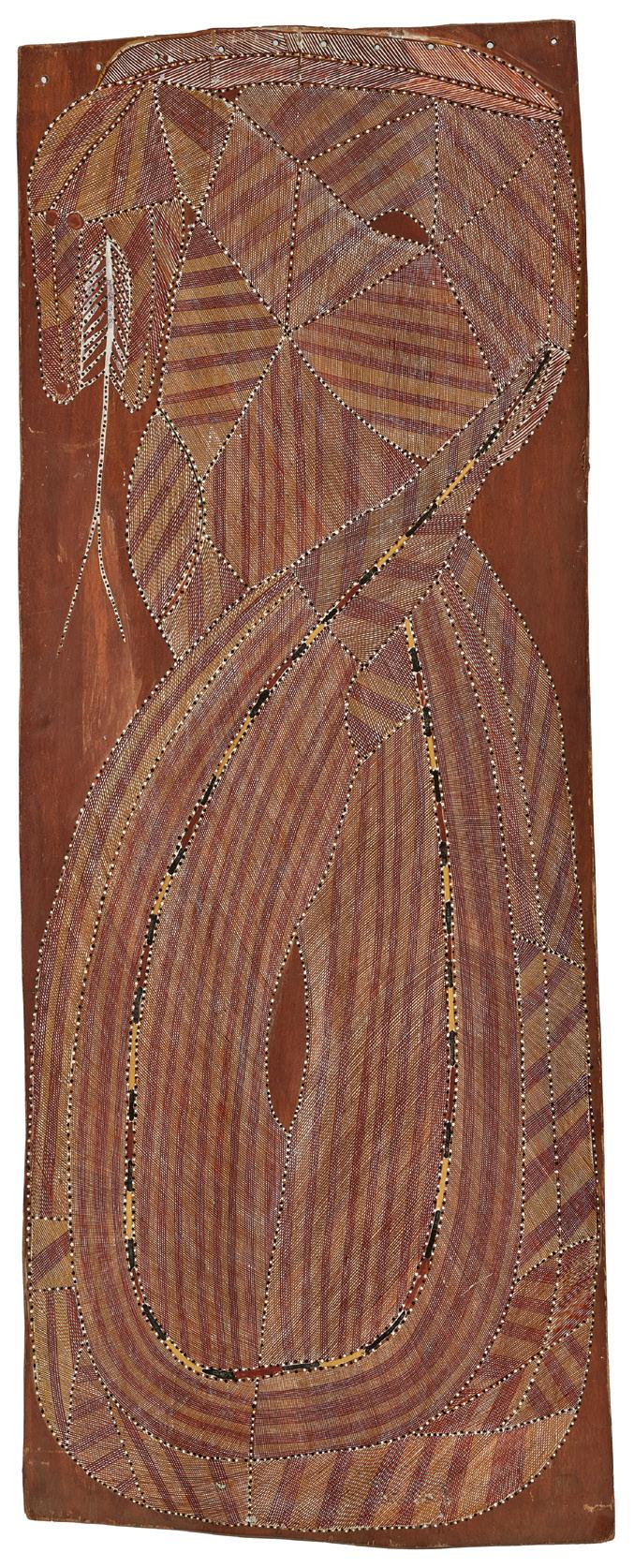
Milmilngkan site, 2007
natural earth pigments on eucalyptus bark
124.0 x 72.0 cm (irregular)
bears inscription on label attached verso: artist’s name, subject, medium, size, language group and Maningrida Arts and Culture cat. 3025–07
Estimate: $30,000 – 40,000
Provenance
Maningrida Arts and Culture, Maningrida, Northern Territory (label attached verso)
Annandale Galleries, Sydney (label attached verso)
Private collection, Victoria
This work is accompanied by a certificate of authenticity from Maningrida Arts and Culture attached verso which states:
‘On this particular bark painting, John Mawurndjul has depicted sacred sites at Milmilngkan.
JM: Yoh Milmilngkan maneh yina kunronj manekke mane yi–na. Ka–bo–bebme. Djai njamed ‘spring’. Yes, this is the site at Milmilngkan and these represent water, you can see here. The water comes out [the little round dots are water/springs]. They are springs.
Kam–borrolkan Milmilngkan kunred but manekke njamed ka–karrme man–djirndjim spring kunronj kam–bobebme. Ngalyod might be kanjdji mayh ka–yo ngalyod. Mani rarrk ngabimbom. Kunred manekke. Kuning ka–yime bonj ka–borrohdolkan nga–nang boyen. The water comes out at Milmilngkan and there are springs there surrounded by water pandanus (Pandanus aquaticus) where the water comes out of the ground. This might be caused by rainbow serpents which live under the ground there. This is all cross–hatched here. The cross–hatching represents the country there. That’s what happens there, I’ve recently seen the water coming up out of the ground there.’
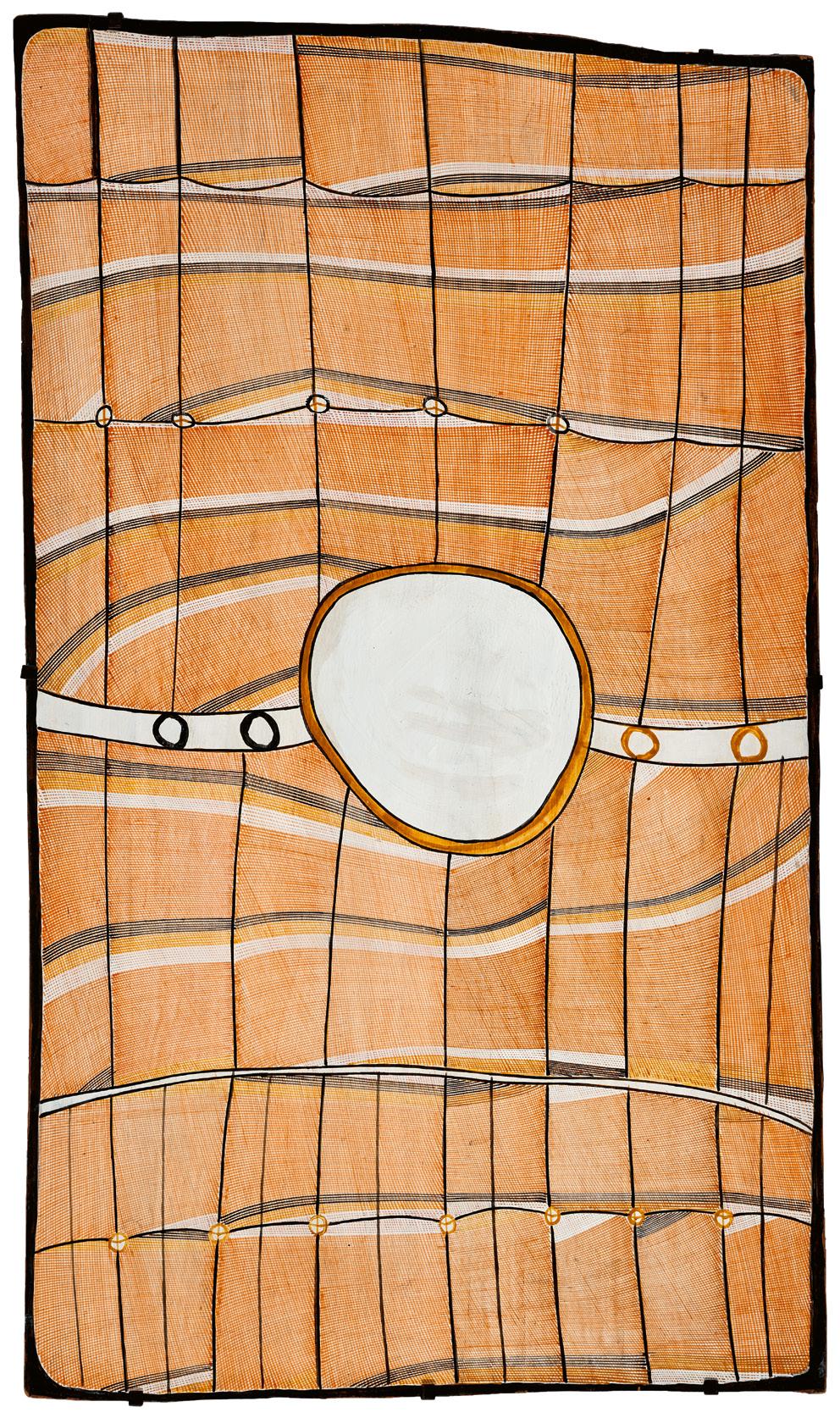
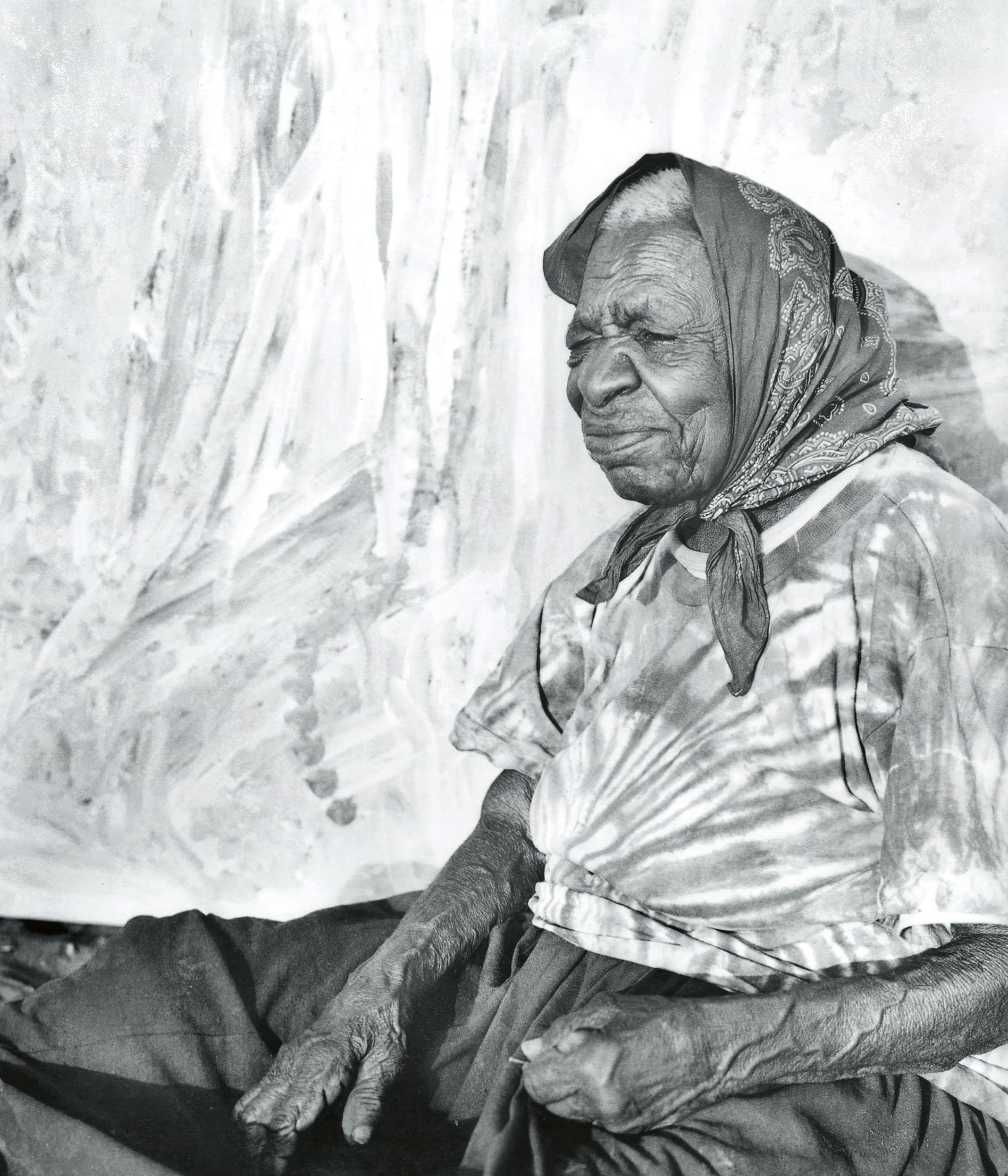
Lots 20 – 26
Emily Kam Kngwarreye (c.1910 – 1996), known amongst her community simply as ‘the old woman’, was a unique figure in Australian art, today heralded as one of the world’s leading artists. Although she only started painting on canvas around 1988 – 89, aged in her late 70s, Kngwarreye’s extraordinarily passionate and prolific painting practice over the next eight years received immediate acclaim, catapulting the diminutive artist on to the world stage. She posthumously represented Australia at the 47th Venice Biennale in 1997 in Fluent: Emily Kame Kngwarreye, Yvonne Koolmatrie, Judy Watson, and again in Okwui Enwezor’s international pavilion, All the World’s Futures, at the 56th Venice Biennale in 2015. In 2025, she became the first Australian artist to be honoured with a solo retrospective exhibition at London’s Tate Modern gallery.
Kngwarreye’s story and art are inextricably linked to her Country, Alhalkere, in a remote desert region of Central Australia, 230 kilometres north-east of Alice Springs. It was here, on the lands of her people, the Anmatyerre, and those of neighbouring peoples, the Alyawarre and the Eastern Arrernte, that she was born and grew up in the traditional way, in an extended family group. The creation beliefs of Anmatyerre people are common to most desert communities and involve the Altyerre, the creative past that continues in the present, usually called the Dreaming, or in other parts of Australia the Tjukurrpa 1 Traditional Aboriginal culture uses visual and performative communication modes to transmit this dreaming, and in desert regions in particular, visual designs drawn in the sand are a key part of ceremony. 2 Awelye, the women’s ceremonies, which Kngwarreye learnt from female elders and later performed as a ceremonial leader herself, include within their ritual dances and song cycles, ochre patterns of great cultural significance painted on the body and on dancing boards.
Anmatyerre women had intermittent contact with white people in pastoral h omesteads after the first wave of station owners arrived in the 1920s and 1930s, and Kngwarreye spent most of her adult life working on these properties, as a shepherd and cameleer. She nevertheless continued elements of traditional life as it had been prior to European presence, including finding and hunting wild foods according to a deep understanding of seasonal changes.
From her earliest encounters with Western forms of art, as a founding member of the Utopia Women’s Batik Group, to her later canvases painted quickly and with supreme confidence, the altyerre was expressed in Kngwarreye’s art through the motifs of awelye body paint designs and sand stories, the tracks of animals, abundance of plants and patterns of seasonal changes, characteristically summed up by the artist as the ‘whole lot’. In the same way that notions of individualism are antithetical to Indigenous culture –tradition demands reciprocal rights and obligations in all matters concerning the group or clan – Kngwarreye’s art expresses her entire body of knowledge, acquired over a lifetime from elders connected to an unbroken culture tens of thousands of years old. The complex interrelationships of these many designs and stories are played out within each of her works and throughout her oeuv re as a whole. 3
1. Isaacs, J. et al., Emily Kngwarreye Paintings, Craftsman House, 1998, p. 14
2. Smith, T., ‘Kngwarreye Woman. Abstract Painter’, in Isaacs, ibid., p. 24
3. Emily Kam Kngwarray Alhalkere, Paintings from Utopia, National Gallery of Australia, 1999 at: https://nga.gov.au/exhibitions/emily-kam-kngwarray-paintings-from-utopia/ (accessed 19 February 2026)
Lucie Reeves-Smith
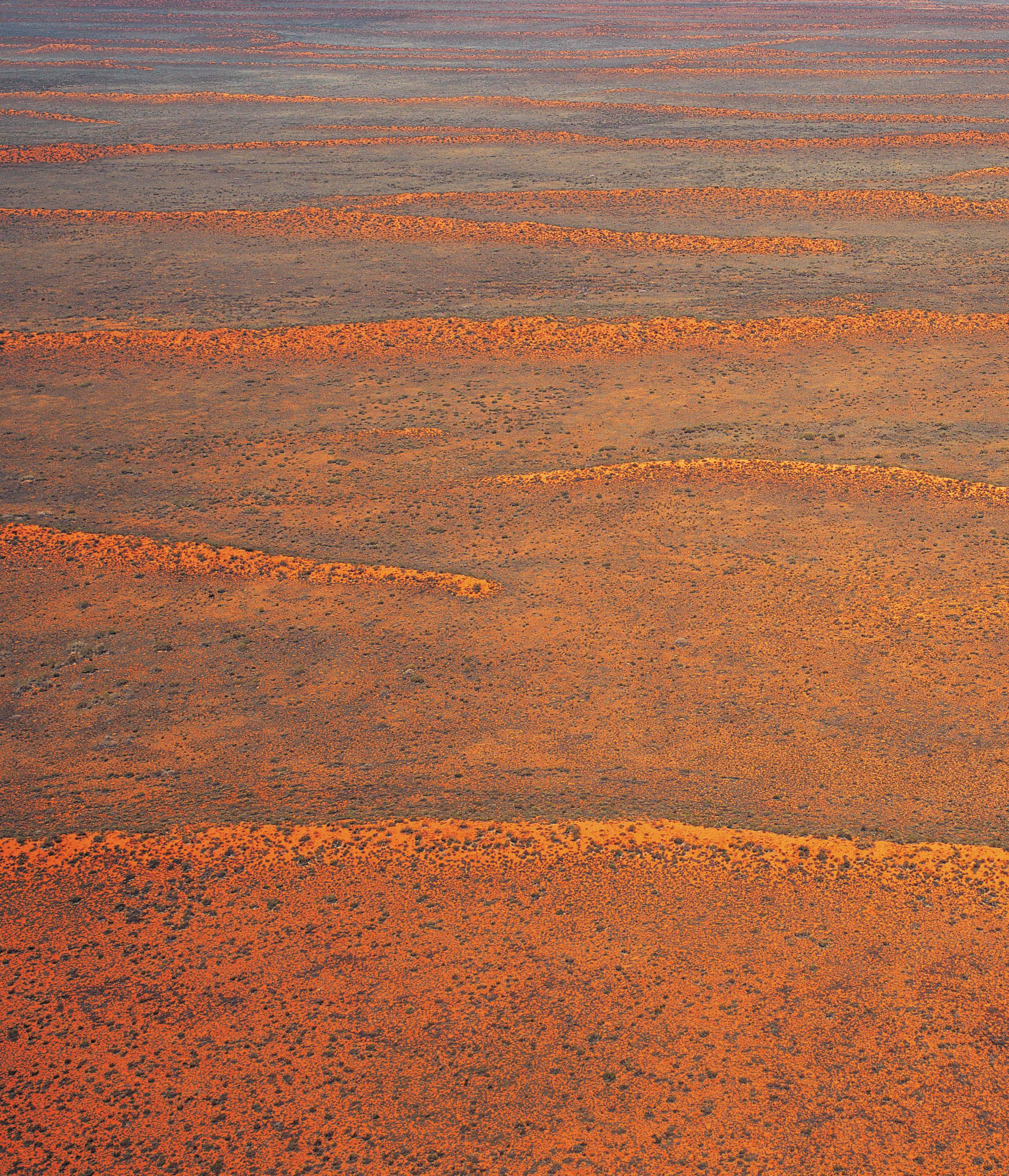
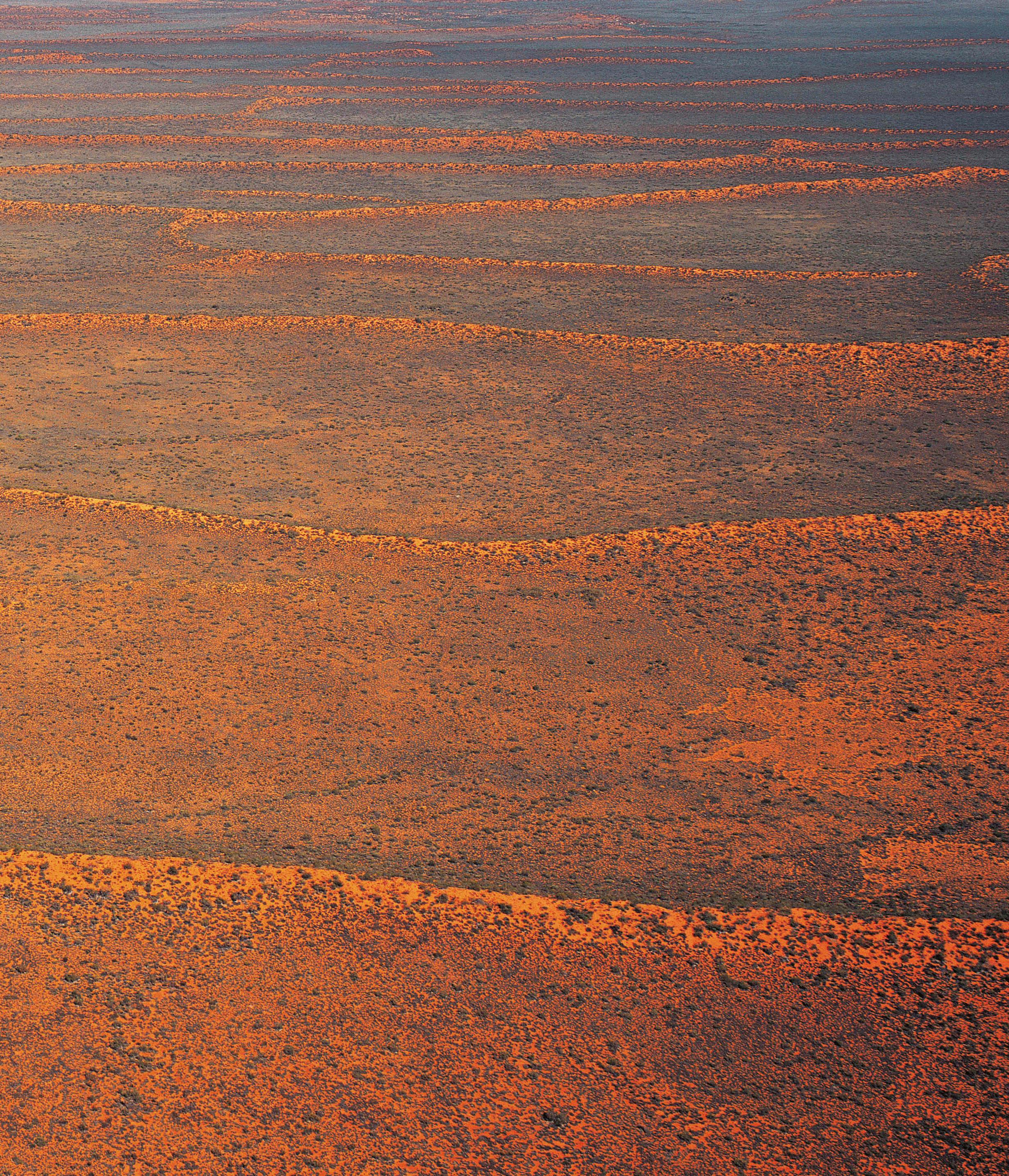
(c.1910 – 1996)
My Country, 1992
synthetic polymer paint on canvas
152.0 x 122.0 cm
bears inscription verso: artist’s name and Delmore Gallery cat. 92HO21
Estimate: $180,000 – 250,000
Provenance
Commissioned by Delmore Gallery, via Alice Springs, Northern Territory in 1992
Barry Stern Galleries, Sydney Private collection, Sydney, acquired from the above c.1996
Related work
Summer Storm, 1992, synthetic polymer paint on canvas, 151.0 x 122.5 cm, Newcastle Art Gallery, New South Wales
‘For Indigenous people, art is not something removed and separate from everyday life; It is enfolded in it. The production of art gives meaning, beauty and function to life.’ 1
Emily Kame Kngwarreye’s individual response in acrylic paint to the ever-changing desert country of her traditional homelands at Alhalker (Alalgura) chronicles the shifting fluctuations of the flora and landscape that surrounded her. Situated on the western edge of Utopia, this triangular tract of country was where Emily was born and where she lived according to the traditional lifeways of the eastern Anmatyerre – continuing cultural practices that long predated European settlement. Her mark-making captures the seasonal variations of the desert environment – at times subtle, at others dramatic –and the extraordinary bursts of growth that follow rain.
In her relatively short career as a painter, Kngwarreye astonished audiences by moving, seemingly effortlessly, from one distinct style to another, each emerging with remarkable assurance and completeness. This vibrant painting belongs to a group
of works produced between early 1992 and late 1993, often described as her ‘high-colourist period.’ 2 Characterised by intensely luminous palettes, this phase saw the creation of successive paintings in brilliant, multi-hued compositions. Painted for Delmore Gallery in August 1992, this work features billowing clouds of white, pink and yellow compressed into irregular shapes and oblong forms, overlaid with sweeping lines of vivid golden and white dots that guide the viewer’s eye across the canvas. These blocks of colour are constructed through densely layered dots, creating solid, cohesive forms – a departure from her earlier, more overtly pointillist approach, in which individual layers of dots remained distinctly visible.
My Country, 1992 evokes the cycles of renewal that follow unexpected winter rains, when the desert bursts into bloom, and stands as a celebration of nature at its most vital and abundant.
1. Gilchrist, S., ‘I am Kam’, in Cole, K. et al., Emily Kam Kngwarreye, National Gallery of Australia, Canberra, 2023, p. 167
2. Neale, M. (ed.), Utopia: The Genius of Emily Kame Kngwarreye, National Museum of Australia and the National Museum of Art, Osaka, 2008, p. 149
Crispin G utteridge
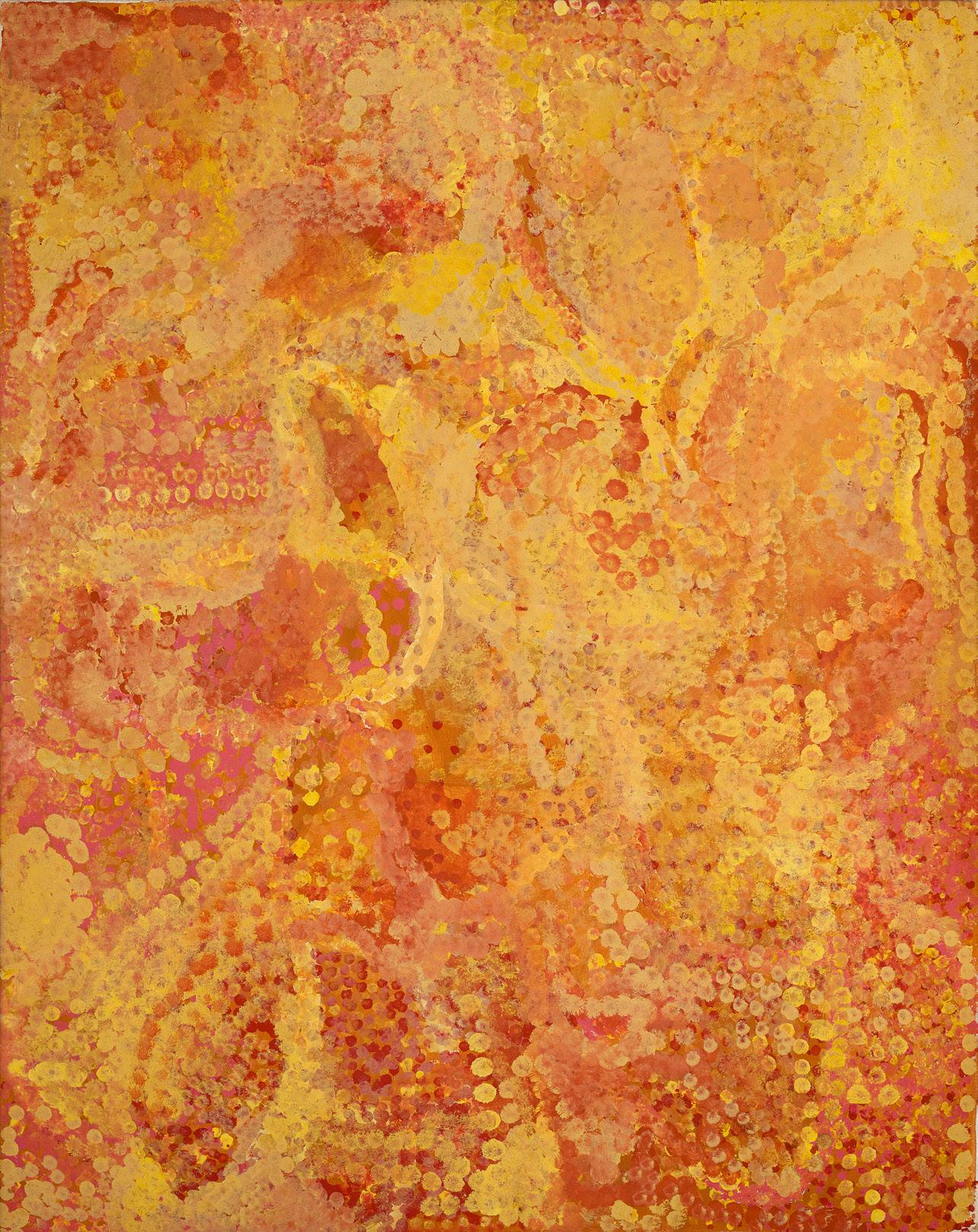
– 1996)
synthetic polymer paint on canvas
i. 202.0 x 60.0 cm
ii. 202.0 x 61.0 cm
iii. 203.0 x 62.0 cm
iv. 203.0 x 62.0 cm
203.0 x 245.0 cm (overall)
bears inscription on each verso: artist’s name, date and Rodney Gooch cats. 7.1096, 8.1096, 9.1096, 10.1096
Estimate: $400,000 – 600,000 (4)
Provenance
Commissioned by Rodney Gooch, Alice Springs in October 1995
Aboriginal Dreamings Gallery, Canberra
Private collection, Canberra
Thence by descent
Private collection, Canberra
Related work
Utopia Panels, 1996, synthetic polymer paint on canvas, 263.0 x 87.0 cm (each), Queensland Art Gallery | Gallery of Modern Art, Brisbane, illus. in Neale, M. (ed.), Utopia: The Genius of Emily Kame Kngwarreye, National Museum of Australia, Canberra and the National Museum of Art, Osaka, Japan, 2008, cat. B-15, pp. 180 – 181
In the summer of 1988 – 89, Rodney Gooch, under the auspices of the Central Australian Aboriginal Media Association, provided to the women of Utopia, already endowed with a decades’ experience of wax batik painting, 100 small canvases and boards and acrylic paints on which to translate their designs. It was as part of this ‘Summer Project’ that Emily Kam Kngwarreye, the eldest member of the Utopia Women’s Batik Group, painted her first painting on a twodimensional support, Awely, 1989 (National Gallery of Victoria), featuring a design of women’s ceremonial breast markings, painted spontaneously with an urgent confidence.
Responding to a commission from Gooch in October 1995, Kngwarreye, now aged in her mid-80s, painted the present Awelye, 1995, an immersive polyptych of rhythmic crosshatched body paint marks. Radically departing from the veils of shimmering dots for which she had found rapid fame, here she has returned to her beginnings in applying the ochre arkleny (body painting markings) to the chest and upper arms for the awleye (women’s ceremony), covering this series of canvases with a complex weave. Kngwarreye’s major custodial responsibility for the dreaming of the pencil yam, the Arlatyeye plant (Vigna lanceolata), whose meandering subterranean roots became the prime motif of her awelye designs and a constant central theme within her art, energetically reinvented throughout her career.
‘The stripe is mobile, moving forward and backward, up and down, spontaneous, forceful and gestural. It is a mark that is globally occurring, like a word in a language we can all understand’, wrote Hetti Perkins in 1997, in the catalogue of Fluent, accompanying Kngwarreye’s posthumous representation of Australia at the Venice Biennale.1 While Emily Kam Kngwarreye’s bold abstract markings happened to transcend cultural boundaries to resonate with broader international modernism predicated on the grid, her lines remained inseparable from the sacred cultural context of Anmatyerre dreaming ceremonies thousands of years old. As is the case for many Indigenous artists, authorised collective cultural knowledge formed the basis of her artistic repertoire, and particularly, the strong, unbroken thread of matrilineal knowledge in the striped painted body designs and dances of the awelye became, in 1995, the dominant theme of her artistic practice. Margo Neale explained this radical change ‘was the result of an accumulation of similar experiences related to her age, her exposure to the art market and her personal development.’ 2
One of the last great stylistic innovations of Emily Kam Kngwarreye’s brief and prolific career, the beginnings of body line works can be traced to late 1993, when the artist was supplied with paper as an alternative painting support requiring less physical exertion. A drastically simplified gesture of parallel horizontal lines, simply and organically placed against a monochrome background characterised the first examples of Kngwarreye’s body paint works. By 1995, and this Awelye, however, the minimal austerity and mesmerising monochromatic palette had been abandoned, the artist now working her way back to the dense and complex layers that had been found in her most sophisticated dotted works.
In the present polyptych, the surface of each panel is covered in crossing horizontal and vertical lines, painted in an extraordinary variety of colours. Body paint lines of the awleye span the chest horizontally, while those on the breasts and arms were often vertical; here they are combined. With a poetry of association common in Kngwarreye’s practice, the cross-hatched lines refer to the rhizomatic subterranean systems of the yam roots and to the animal that eats it, the emu. Kngwarreye’s early dotted works incorporated an underlying skeletal structure of a grid
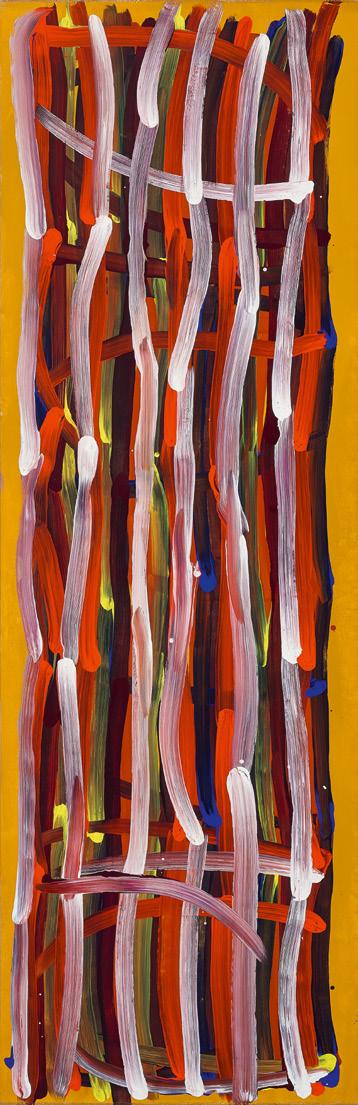
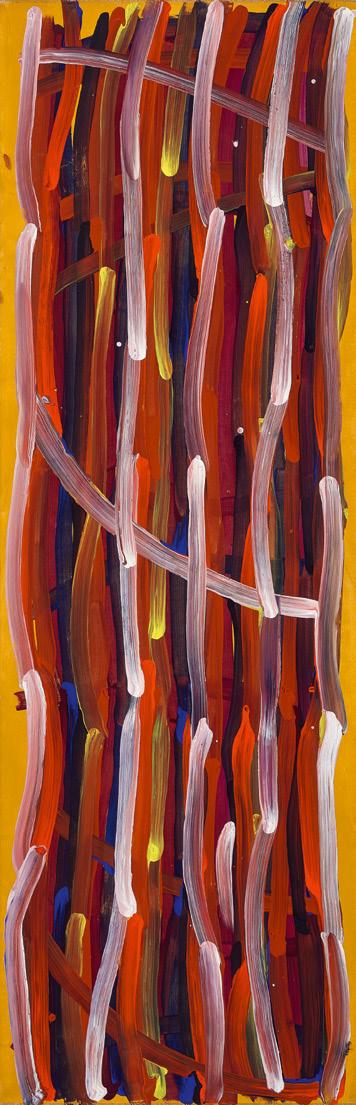
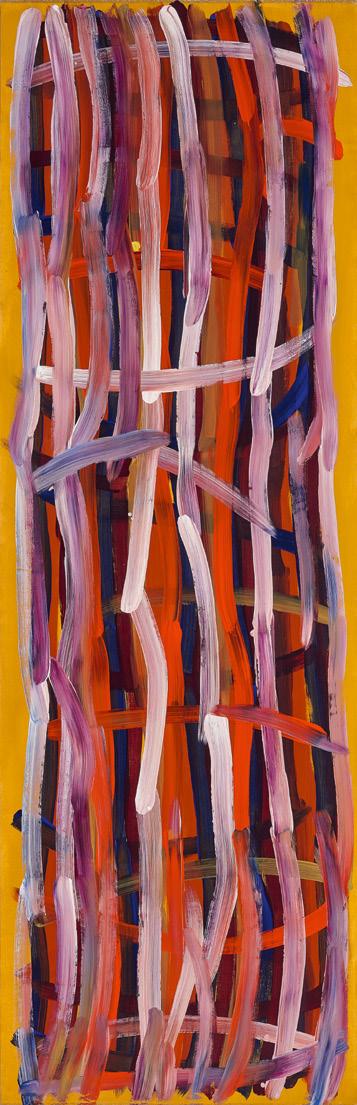
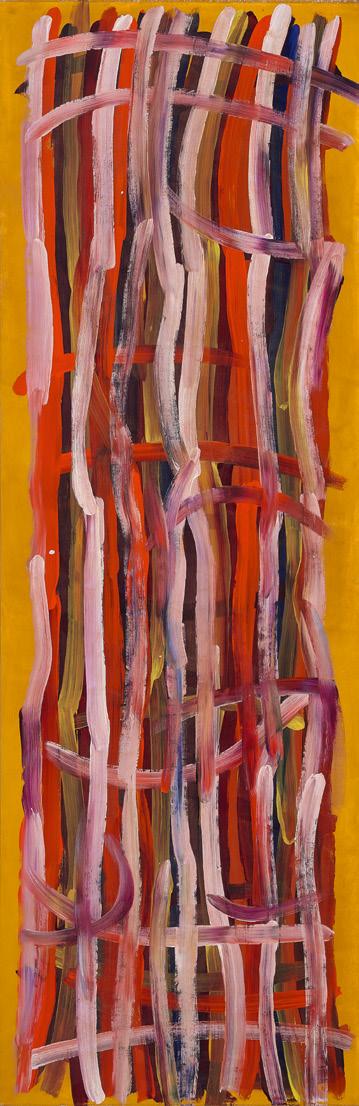
to evoke the connection between the yam and the emu. Here, the regular and rhythmic cross hatching is also suggestive of weaving practice, Indigenous Australia being home to the longest continuous weaving traditions in the world. The ladder motif also appeared in Kngwarreye’s earliest painted batiks.
The expansive scale and serial sequence of the four panels of Awelye creates an immersive and captivating screen of layered marks. The rapidly applied colourful stripes merge and cross over each other, reverberating with light and colour. With the paint applied wet-on-wet and never revised, Kngwarreye’s pigments are opaque at the start of each brushstroke, becoming transparent and colour-mixed as they join other strokes. This creates an effect of flickering dashes of pure colour, appearing intermittently throughout the dense, netted weave. The metrewide slender panels allowed the artist to work easily from either side of the canvas, the full, monumental effect created when the panels are joined into one panoramic sequence. In this, Awelye, joins other major monumental yam paintings all painted in 1995, with lines increasingly gesturally tangled, including the monumental 8-metre Anwerlarr Anganenty (Big Yam Dreaming) (National Gallery of Victoria), the almost five metre long Yam Awely (National Gallery of Australia), and Wild Yam V (Hassall collection, New South Wales).
The surface of Kngwarreye’s canvas can be likened to the ceremonial ground on which she performed the awelye, where rhythmic patterns of danced footprints are left in the sand. A collective term for women’s songs and ceremonies, Awelye are performed to ‘look after Country’, with knowledge transmitted from mother to daughter. In 1976, it formed an important part of cultural evidence submitted for the Utopia Land Claim, which successfully returned the lease of Utopia station to the traditional owners of Alyawarre and Kaytetye country, also benefiting the people of Alhalker. Emily recalled the celebrations ‘The Judge gave the Country back after everybody had shown it to him. Then we painted ourselves with the designs from the Country. After that we danced, ‘This is the Country.’’ 3
1. Perkins, H., Fluent: Emily Kame Kngwarreye, Yvonne Koolmatrie, Judy Watson: XLVII esposizione internazionale d’arte La Biennale di Venezia, Art Gallery of New South Wales, Sydney, 1997, unpaginated
2. Neale, M., Utopia: the genius of Emily Kame Kngwarreye, National Museum of Australia Press, Canberra, 2008, p. 39
3. Emily Kam Kngwarreye, cited in Cole, K., Green, J., and Perkins, H. (eds.), Emily Kam Kngwarray, National Gallery of Australia, Canberra, 2023, p. 145
Lucie Reeves-Smith
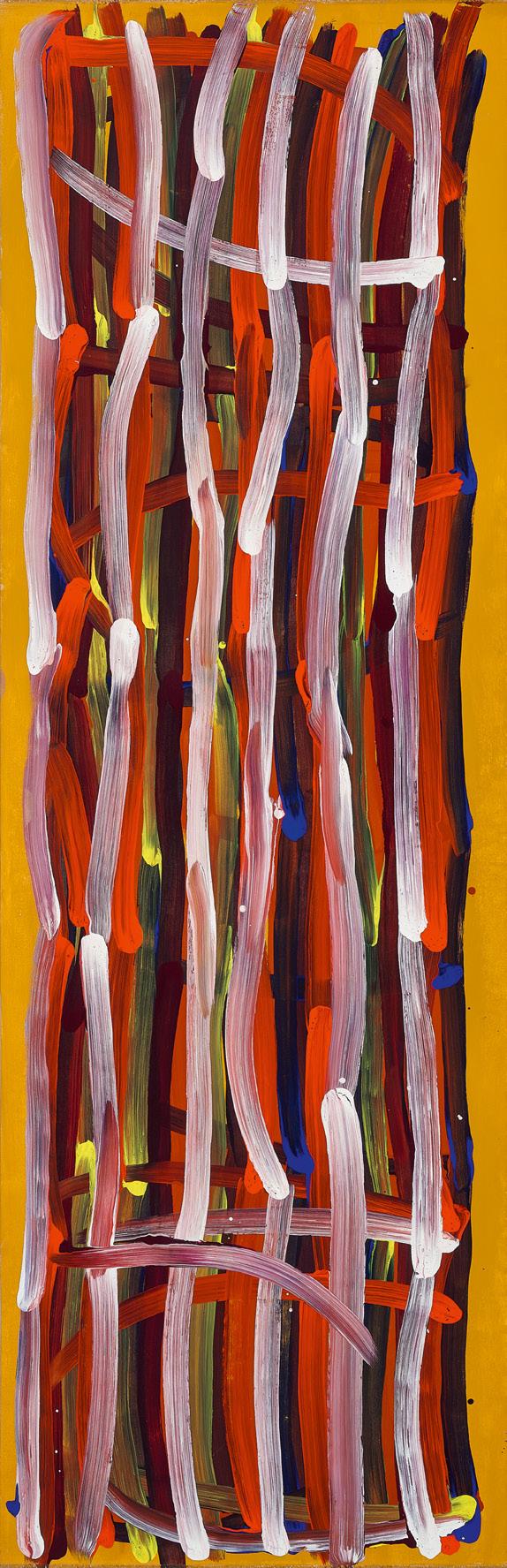
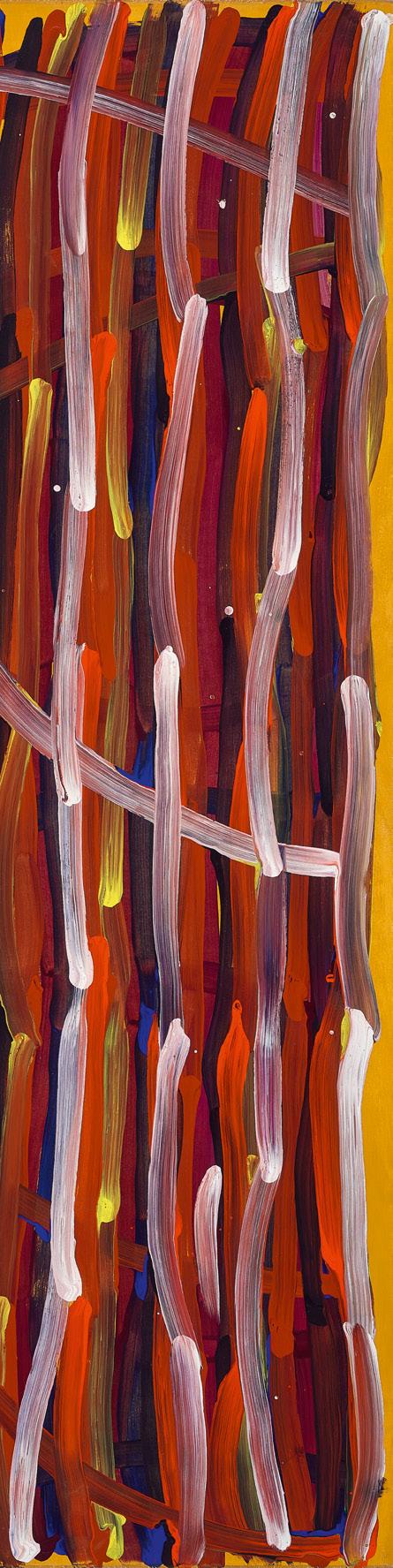
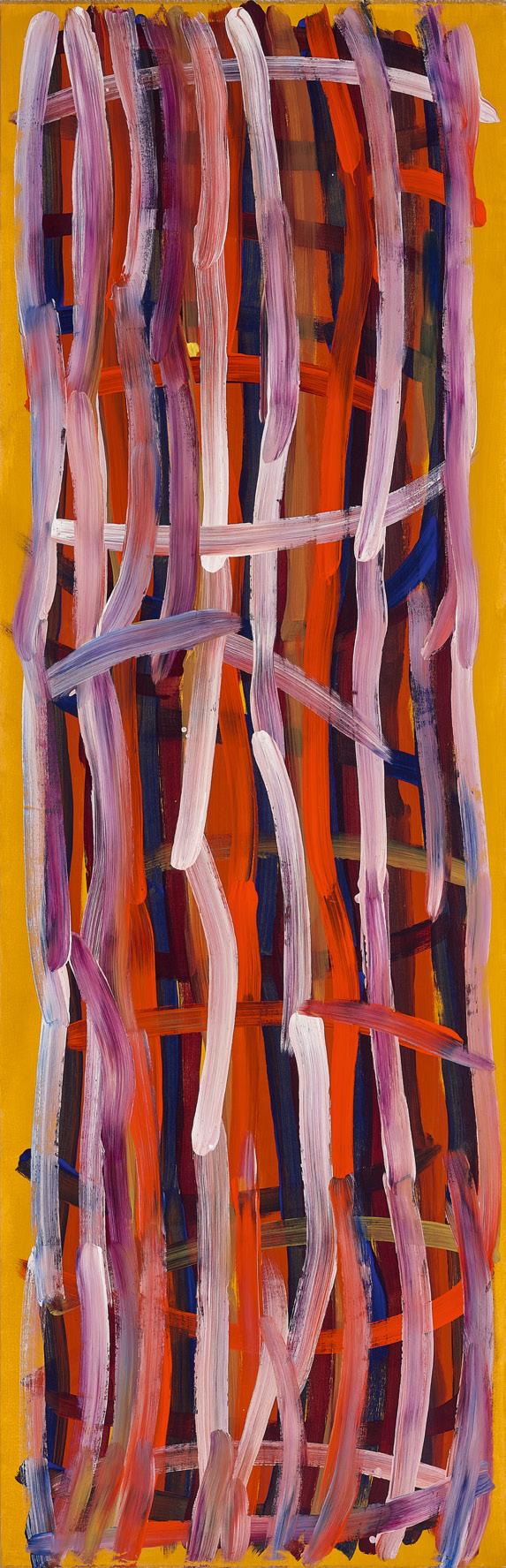
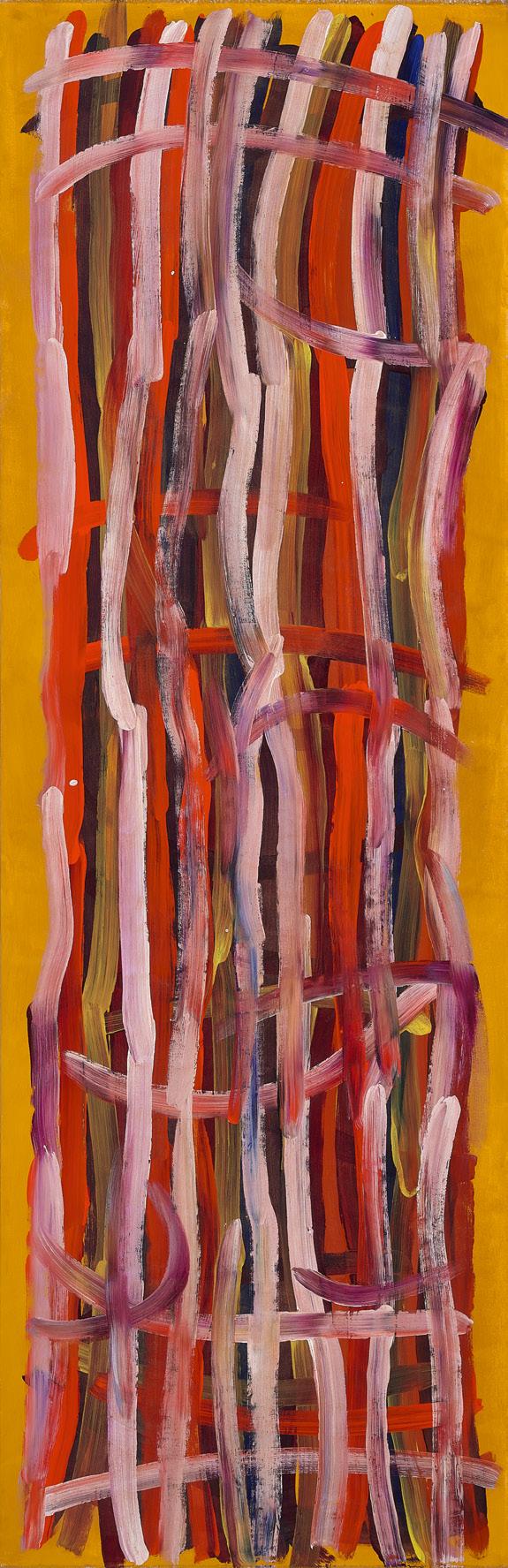
(c.1910 – 1996)
Summer flowers I, 1991
synthetic polymer paint on canvas
150.0 x 90.0 cm
bears inscription verso: artist’s name and Delmore Gallery cat. 1T47
Estimate: $100,000 – 140,000
Provenance
Commissioned by Delmore Gallery, Alice Springs, Northern Territory in March 1991 Don Holt, Northern Territory Private collection, France, acquired from the above in June 2019
This work is accompanied by a certificate of authenticity from Delmore Gallery.
Using a rare and striking palette of aqua blues and lime green, Emily Kam Kngwarreye’s Summer flowers I was painted at the end of summer in 1991, at a point of extreme seasonal shift, bringing brief rains to desert Alhalker country. As Deborah Hart noted, reflecting on the continuous threads within Kngwarreye’s oeuvre, her Anmatyerr dreaming stories and their related paintings are about ‘being alive to weather patterns and seasons; to bush food that is raw or ripe, below or above ground; to light, wind and the desert earth. They are about a lifetime’s experience of her land, her country.’ 1
Painted on the cusp of Kngwarreye’s transition to large, uncontained brushstrokes, Summer flowers I features an allover dotting of uniform sized daubs, layered from burnt sienna to canary yellow, duck-egg blue, vibrant green and topped with dark navy blue. While each colour is contained within separate dots, the complex layering of successive waves of colours creates a dense cloud of verdant, botanical explosion, with no discernible pictorial space such as background or foreground. The application of pure colour in patterns on the planar surface, Kngwarreye’s mixing of adjacent colours as an optical effect in the viewer’s eye inadvertently and organically replicates pointillist and op art techniques. The effect is one of full-frontal, abstract immersion.
Summer flowers I belongs to a sequence of major works painted by Kngwarreye at the Delmore Downs S tation adjoining Utopia Aboriginal land, over the summer of 1990 – 91, just two years into her painting career. The sequence includes Ntang Altyerr (seeds of abundance) (National Gallery of Australia, Canberra), painted in October 1990, and Early summer flowers (private collection), painted in December 1990 – each containing the
powerful punchy combination of yellow, green and ochre hues evoki ng what the artist called the ‘green time’ of botanical abundance after a period of dormancy. 2 Prior to this point, much of Kngwarreye’s oeuvre had been in subtler earthy tones, and henceforth the artist began to move into her ‘high-colourist phase.’ The swirling palette of blues, greens and yellow was later reprised by the artist to great effect, for her massive 6-metre masterpiece, The Earth’s creation, 1994 (private collection) which was exhibited in the 2015 Venice Biennale.
Like most of Emily Kam Kngwarreye’s paintings, working together as a cohesive interrelated continuum referring to the same lands and stories, Summer flowers I is an exaltation of rhythms of the natural world, and the sustenance they provide for the Anmatyerr people and their neighbours. Her choice of colours contains metaphysical associations with important ancestral beings, such as the emu, and plants over which Kngwarrreye held custodianship. With verve and creative boldness, Kngwarrye’s profusion of dots emphasises the varied colours of bush tucker, obscuring the linear tracery that previously underpinned her compositions. Summer flowers I expresses the tender feeling the artist had towards her country, and the continued link the Anmatyerr people had cultivated with Alhalker over tens of thousands of years. It is a testament to the rights and responsibilities Kngwarreye and her people had towards the sustainable use and care of the land, an issue of particular political importance in the mid -1990s.
1. Hart, D., Emily Kame Kngwarreye. Paintings from 1989 – 1995. Works from the Delmore Collection, Parliament House Publishing, Canberra, 1995, n. p.
2. Isaacs, J., ‘Amatyerre Woman’ in Isaacs, J. (et al.), Emily Kame Kngwarreye Paintings, Craftsman House, Sydney, 1998, p. 13
Lucie Reeves-Smith
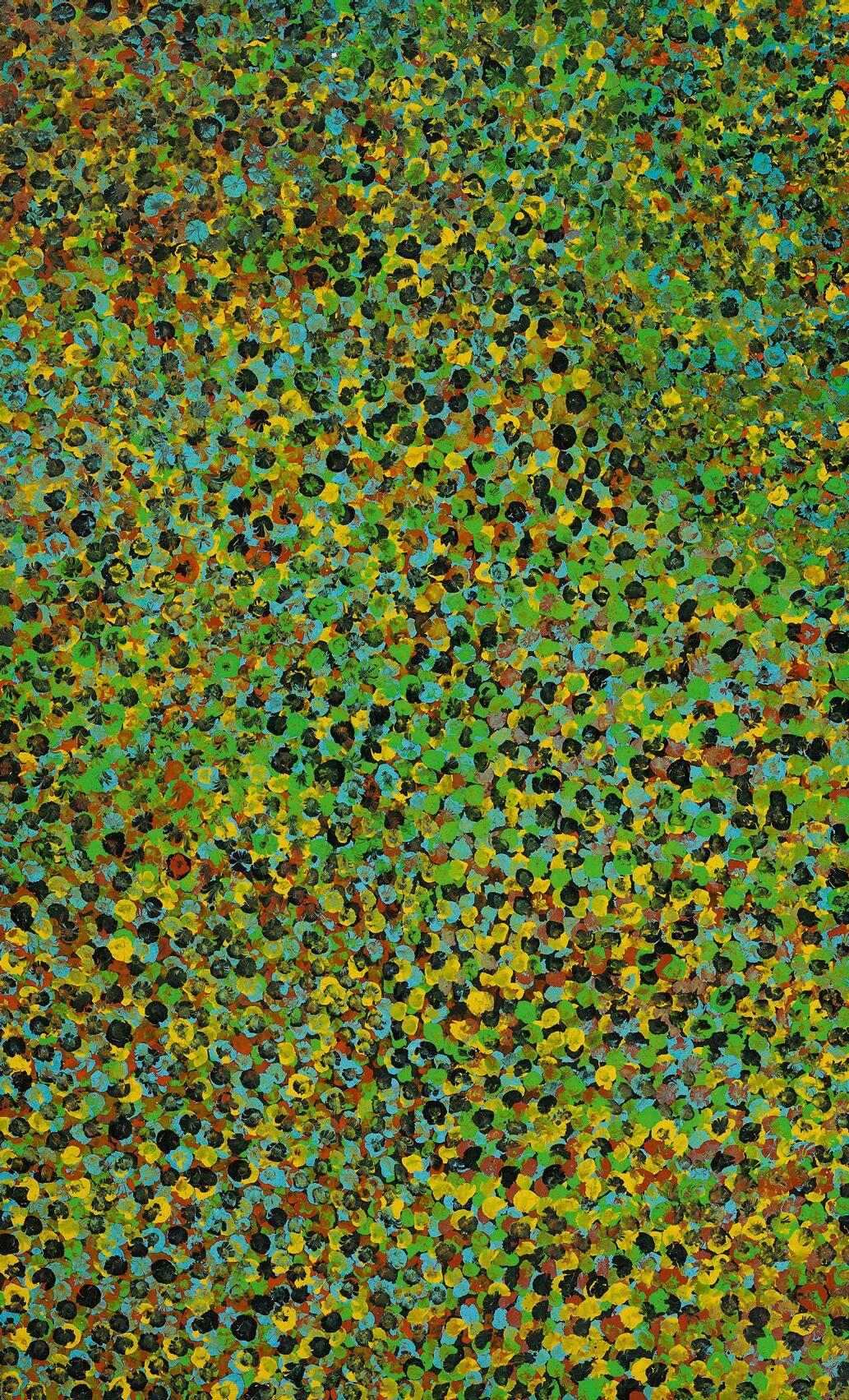
synthetic polymer paint on linen
121.0 x 90.0 cm
signed verso: Emily bears inscription verso: artist's name and Delmore Gallery cat. 94A049
Estimate: $80,000 – 120,000
Provenance
Commissioned by Delmore Gallery, via Alice Springs in January 1994
Private collection, Victoria
Renowned for her vibrant evocations of the ever-shifting desert landscape of Alhalker – her father’s and grandfather’s Country – Emily Kam Kngwarreye translated her custodial responsibilities for the Yam and the Emu into powerful painted forms. Her canvases reflect a profound connection to Country and to women’s ceremonial practices, expressed through body painting and dance. Located on the western edge of Utopia, this triangular tract of land was both her birthplace and her lifelong home where she lived according to the traditional lifeways of the eastern Anmatyerr people, maintaining cultural practices that had endured for countless generations prior to European settlement. Through her distinctive mark-making, she recorded the desert’s seasonal rhythms – at times subtle, at others dramatic – and the astonishing bursts of growth that followed rainfall.
With her distinctive command of pattern and colour, Kngwarreye drew upon seemingly inexhaustible variations in her depictions of Country. Her compositions often dissolve into expansive fields of layered pigment, achieved through accumulations of dot upon dot. In the present Untitled (Awelye), 1994, luminous yellow, red, and soft pink dots hover over a deep black ground, creating a sense of movement and vitality. Through such works, Kngwarreye bears witness to the abundance that blankets the earth after rain, while also expressing the spiritual significance of the women’s ceremonies known as Awelye. As curator Stephen Gilchrist notes, many of her paintings comprise ‘densely layered fields of dots within chords of colour harmonies. Layering is also an important conceptual part of Kngwarreye’s cultural practice. What can be seen is only half the world; the ancestral power beneath the ground gives meaning to what is above. It is the surfacing of these unseen forces, latent in the ground, moving through the body and onto the canvas, that gives the work its cultural signification.’ 1
1.
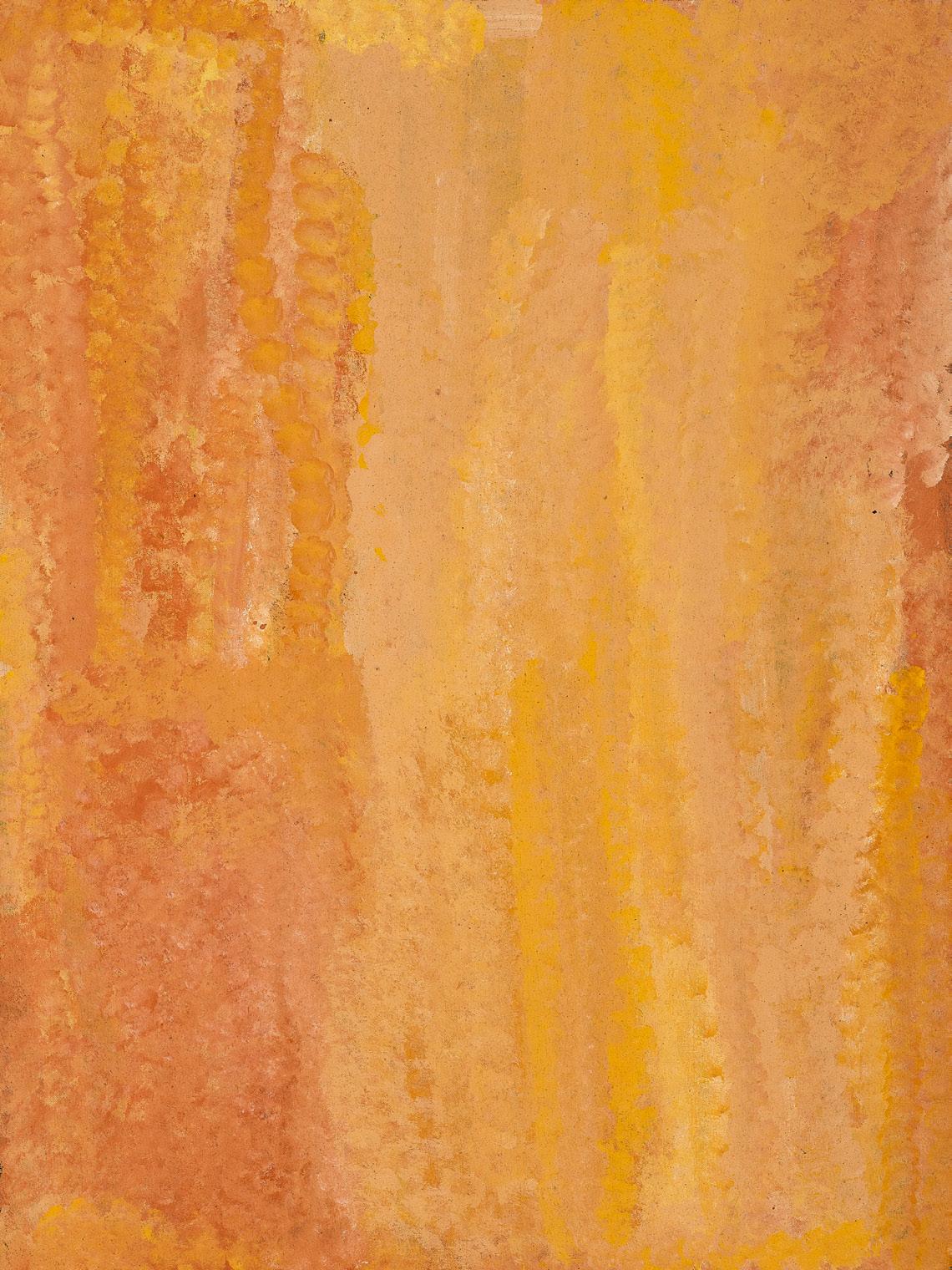
synthetic polymer paint on canvas
91.0 x 61.0 cm (each)
91.0 x 183.0 cm (overall)
bears inscription on each verso: artist’s name and Delmore Gallery cat. 94G013, 94G014 and 94G015
Estimate: $60,000 – 80,000 (3)
Commissioned by Delmore Gallery, Alice Springs, Northern Territory in July 1994 Chapman Gallery, Canberra Private collection, Canberra, acquired from the above in September 1994
This work is accompanied by a copy of the certificate of authenticity from Delmore Gallery
Emily Kam Kngwarreye was a strong woman, painting well into her ninth decade with extraordinary speed and confidence, in addition to fostering a consistent exhibition presence as one of Australia’s foremost contemporary artists. In these twilight years of her life, she continued to paint sitting on the ground, in the same way she did to source and prepare food, tell dreaming stories with designs in the sand and apply body paint for the awelye women’s ceremonies over which Kngwarreye had presided as a community elder.
1994 was a year characterised by below-average rainfall and shortage of water across the country, keenly felt in the Simpson desert and across central Australia. Kngwarreye’s works were built on a foundation of deep botanical and ecological knowledge that she, and the Anmatyerr people, had refined over the local, lived experience of countless generations. Life cycle, I, II & III, 1994 with its audacious colour combinations of orange, blue, white and red, replicates the saturated hues of desert plants as they emerge from the muddy sand of Alhaker country, and the changes in colour as they ripen. Yellow represented the anwerlarr, the hardy yam plant with its seed-bearing kam flower, Kngwarreye’s namesake and the most important plant in the artist’s custodianship. The kam change colour, moving from white, then yellow, and then reddish brown as they age, inviting metaphorical comparisons with the three life stages of people—the white ones are ampa akely (babies), the yellow ones awenk (teenage girls), and the brown ones are arelh ampwa (old women).1 The luminescent blue/ purple refers to nterkwe, the bush plum, and the vital presence of rain in stimulating the burgeoning of these plants. Alhalker
country was Emily Kam Kngwarreye’s raison d’être and beyond celebrating the life-giving forces of nature, paintings such as this Life cycle triptych become metaphorical self-portraits and declarations of her people’s sovereignty over their ancestral lands.
The Anmatyerre have a culture that is visual and performative, and the visual designs of lines traced in the sand and painted on the body in awelye ceremonies found another form of expression in Kngwarreye’s fluid later works, with ‘her whole body moving and travelling with the brush as though dancing.’ 2 Stylistically distinct from the finely dotted clouds of her works from the early 1990s, Life cycle presents an immersive curtain of chains of large blotches, quickly worked with wet-on-wet paint, Kngwarreye’s paintbrush fluttering and skidding across the picture plane. To conserve energy, Kngwarreye adopted a new method of painting in 1992, pressing her paintbrush vertically on to the canvas, creating blooming florets of colour, capable of covering a large surface area when repeated in overlapping striations as in the Life cycle triptych. Responding to the urgency of her advancing years, Kngwarreye traded a loss of definition in her brushstrokes for a greater expressive quality and baroque exuberance. Expansive in its scale, Life cycle displays the nimble inventiveness of Kngwarreye’s mark making and the dynamism with which it was put to the service of expressing her ancient and enduring connection to country.
1. Perkins, H. and Cole, K., Emily Kam Kngwarray, National Gallery of Australia, Canberra, 2023, p. 153
2. Isaacs, J., ‘Amatyerre Woman’ in Isaacs, J. (et al.), Emily Kame Kngwarreye Paintings, Craftsman House, Sydney, 1998, p. 21
Lucie Reeves-Smith
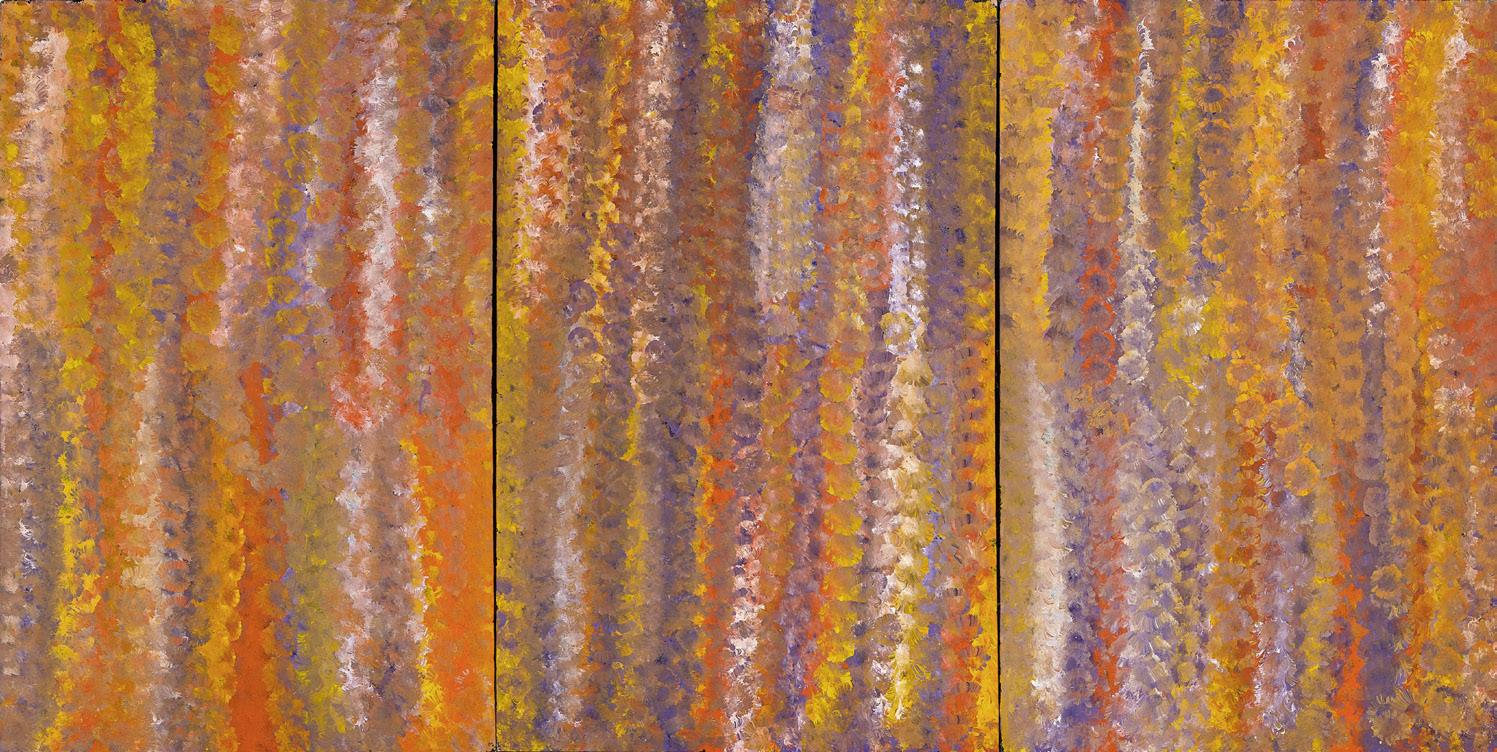
synthetic polymer paint on linen
61.5 x 51.0 cm
signed verso: Emily bears inscription verso: artist's name and Delmore Gallery cat. 95D033
Estimate: $50,000 – 70,000
Provenance
Delmore Gallery, Alice Springs, Northern Territory Private collection, Victoria
Commissioned by Delmore Gallery in April 1995, Untitled (Yam) was painted just a few months prior to the iconic Big Yam Dreaming, 1995, now in the collection of the National Gallery of Victoria, and belongs to a small group of powerful, dynamic, monochromatic gestural paintings produced between early 1995 and early 1996. Executed using a dry-brush technique and a palette restricted to reds, whites, and occasionally blues set against either a black or white ground, this phase of her practice is characterised by bold, meandering lines, and such works stand as masterpieces of strength and restraint.
In Untitled (Yam), a single inky black tone is applied with deliberation, sweeping arcs of paint moving energetically across the modestly scaled canvas. These arcs evoke the painting’s subject: the meandering, rhizomatic roots of the Arlatyeye plant (pencil yam, Vigna lanceolata) and the fissures that appear in the earth as the yam ripens. At the same time, the gestural marks emphasise the immediacy and intimacy of the exchange between artist and canvas.
The imagery recalls the dry season, when the root lies dormant beneath the surface, awaiting harvest by local people who dig through the cracked earth, or renewal through rain. The linear surface of the painting ‘lays bare’ the underlying structure that informs much of her work, suggesting the veins, sinews, and contours visible in the body of the land when seen from above.
Crispin Gutteridge
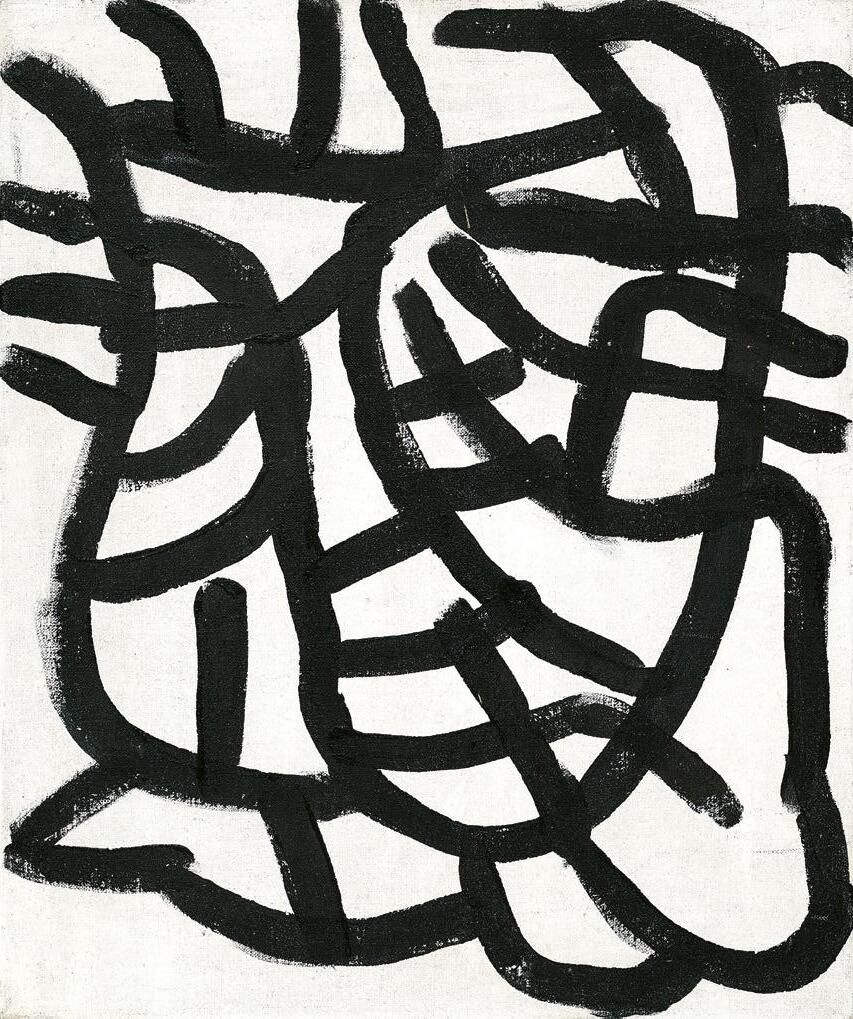
synthetic polymer paint on canvas 61.0 x 90.5 cm
bears inscription verso: artist’s name, date, and Mulga Bore Artists –Rodney Gooch cat. EK 1
Estimate: $30,000 – 40,000
Provenance
Commissioned by Rodney Gooch, Mulga Bore Artists, Alice Springs, Northern Territory in July 1992 Utopia Art, Sydney (label attached verso) Private collection, Sydney, acquired from the above Estate of the above, Sydney
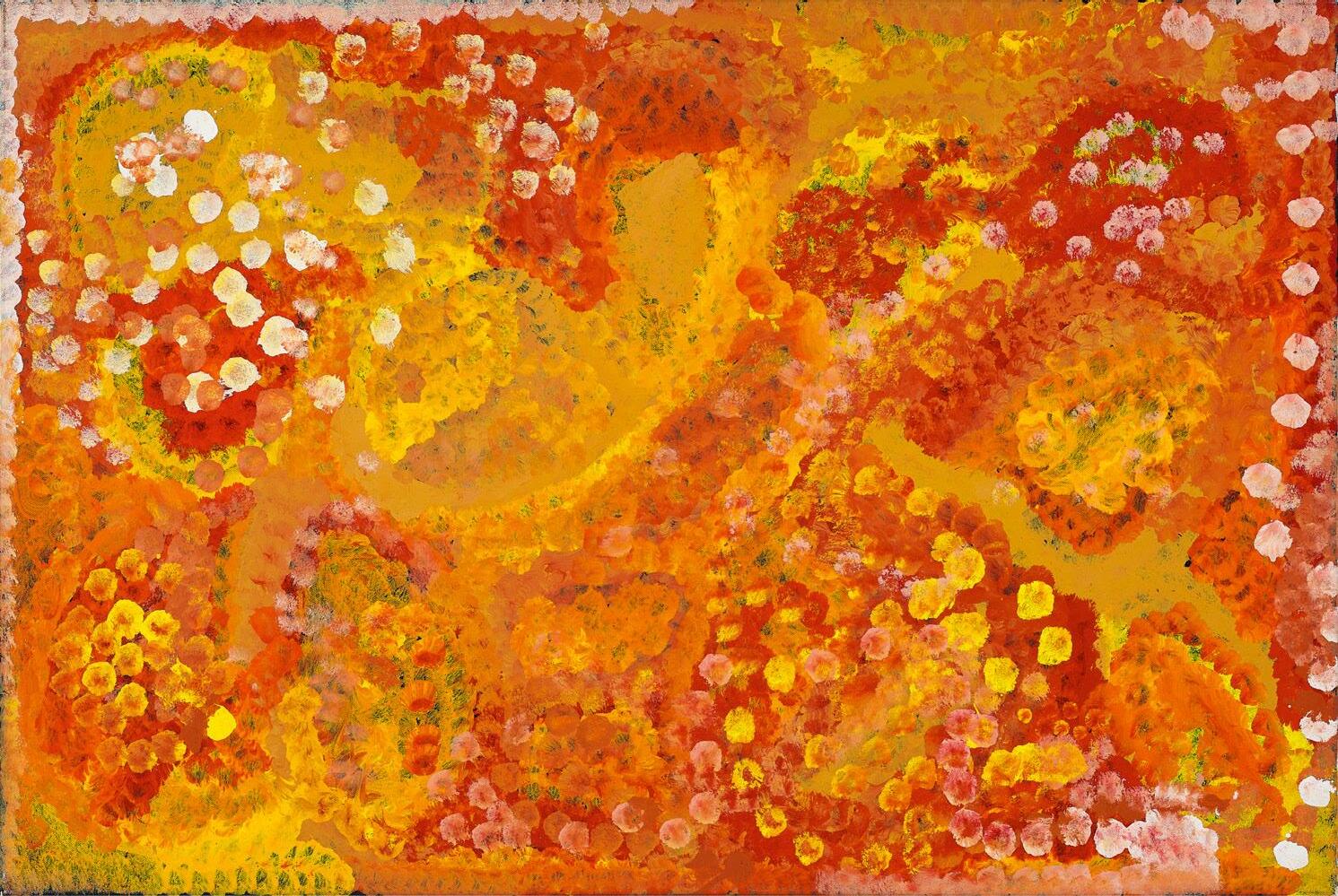
c.1946
Anookitja (Bush Plum), 1998
synthetic polymer paint on linen 120.5 x 90.0 cm
bears inscription verso: artist's name and Delmore Gallery cat. 98L042
Estimate: $15,000 – 20,000
Provenance
Delmore Gallery, Alice Springs, Northern Territory Private collection, Victoria
Angelina Pwerle (Ngale) creates methodically executed, exquisitely detailed paintings centred on Anookitja (Bush Plum Dreaming) – a subject of profound cultural, social and ceremonial significance to Alyawarre women of the Eastern Desert region of the Northern Territory. Her works often evoke the plant’s seasonal transformations, celebrating both its physical sustenance and its spiritual resonance within community life. Over time, her practice has become increasingly pared back. Working with a restrained palette, Pwerle builds dense areas of minute dots and fine marks across dark grounds to produce surfaces that shimmer with vitality and subtle movement.
Like many of the Utopia women artists, Pwerle began her artistic career in 1986 through the CAAMA Batik program. Shortly thereafter, canvas and acrylic were introduced to her community – media through which she would achieve national and international prominence. Painted in December 1998, Anookitja (Bush Plum) exemplifies her earlier style: a meticulous composition distinguished by concentrated, multicoloured fields of tiny, pointillist dots layered over a dark ground, forming a luminous, cloud-like expanse of intricate markings.

(c.1926 – 1998)
Baragu Country, 1989
natural earth pigments and bush gum on canvas
110.0 x 70.0 cm
bears inscription verso: artist’s name, size, Waringarri Arts cat. S–1988 and AP1971
Estimate: $120,000 – 160,000
Provenance
Waringarri Arts, Kununurra, Western Australia (label attached verso)
Deutscher Gertrude Street, Melbourne (label attached verso)
Peter and Renate Nahum, London, acquired from the above in 1989
Deutscher and Hackett, Melbourne, 15 July 2020, lot 76 Private collection, Sydney
Exhibited
Turkey Creek: Recent Work: Rover Thomas/Paddy Jaminji/ George Mung Mung/Jack Britten/Freddy Timms, Deutscher Gertrude Street, Melbourne, 25 October – 17 November 1989, cat. 4 (illus. exhibition catalogue front cover)
The art of Rover Thomas is synonymous with East Kimberley painting, but his origins lie further south in the Great Sandy Desert. Born at Yalta, a soak just north of Kunawarritji (Well 33) on the Canning Stock Route, after the death of his parents at the age of ten, he travelled north following stockmen along the Canning to Billiluna and beyond into the Kimberley. Rover eventually became a stockman himself and his travels across vast swathes of country infuse his later art practice.
Painted for Waringarri Arts in Kununurra in 1989, the year before Rover Thomas was selected as one of the first two Aboriginal artists (together with Trevor Nickolls), to represent Australia at the Venice Biennale, Baragu Country, 1989 exemplifies the best of his paintings. Layers of natural pigments affixed with a synthetic binder are outlined by a tracery of white dots painted with huntite, a white chalky pigment used in ceremony and rock art. The canvas, lightly infused with the natural pigments, develops a unique velvety surface. The work shows an aerial view of the landscape where two large irregular forms infilled with light sandy brown and light red/dusky pink pigments are bisected and surrounded by a narrow band of black charcoal.
The subject of this painting is Lake Gregory, now known by its Walmajarri name Paruku, which is a declared Indigenous Protected Area (IPA) that covers around 430,000 hectares on the borders of the Great Sandy Desert and Tanami regions, 200 kilometres south of the township of Halls Creek in Western Australia. An area of spectacular wetlands that is internationally renowned as a haven for large numbers of birds and other
animals, it includes an extensive lake system, the only one in the region with a reliable source of fresh water. Primarily sourced from Tjurabalan (Sturt Creek) which flow into Lake Gregory from its beginnings some 800 kilometres north-east across the border in the Northern Territory, it is an important site for the local Indigenous people. The traditional owners believe it was formed when a star fell from the sky into the lake and transformed itself into a man, becoming the very first traditional owner of this place. A breeding ground for budgerigars, Lake Gregory is also the home of the Billiluna rainbow snake.
Rover Thomas articulated a highly personal way of telling stories and establishing connection to the land and its related ceremonies. Idiosyncratic in style, his paintings established a new typology and visual language distinct to the east Kimberley region of Western Australia. Both planar and aerial views of land are united in his compositions, where the past and the present also converge. They map tracts of country whilst exploring the regional history and ancestral tales of these same locations.
Thomas’ compositions carefully balance the landscape and the narrative in natural harmony – executed in earth pigments and natural resins, his canvases are characterised by the interaction between large open expanses and bold forms.
In August 2001, the High Court of Australia formally recognised that the traditional owners of this area held native title over the land. The handover ceremony was conducted on the shores of Paruku, symbolising the significance of this place to local Aboriginal people.
Crispin Gutteridge
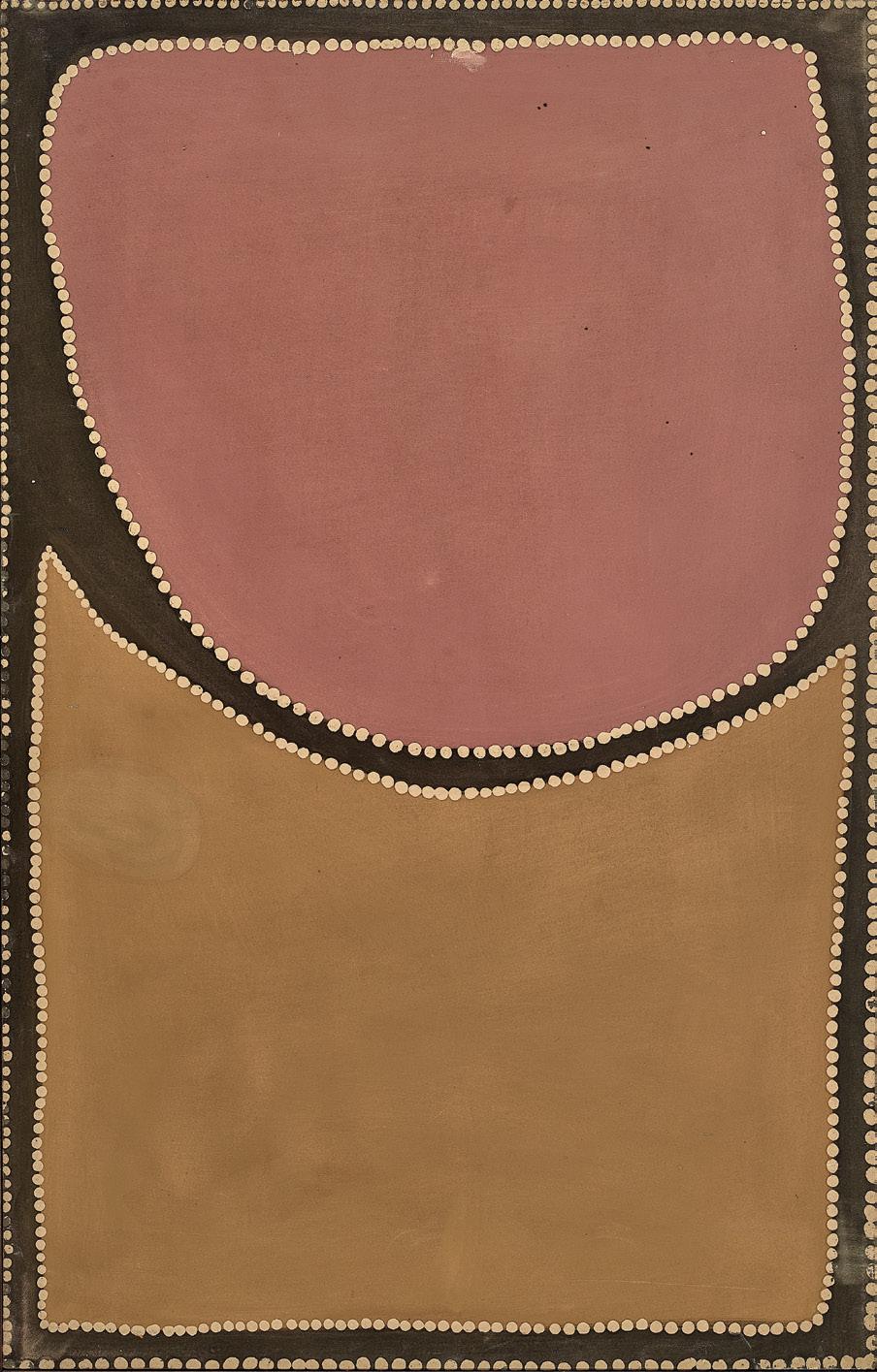
2007)
Biriyalji – Fish Hole, 1999
natural earth pigments and synthetic binder on Belgian linen
122.5 x 134.5 cm
signed with initials verso: PB bears inscription verso: title and date
Estimate: $100,000 – 140,000
Provenance
Jirrawun Arts, Kununurra, Western Australia (cat. PB 5 1999–41)
Framed Gallery, Darwin Private collection, Canberra, acquired from the above in July 2001
Exhibited
Crocodile Hole: Paddy Bedford, Freddie Timms, Phylis Thomas and Goody Barrett, Framed Gallery, Darwin, 1 – 18 September 2000 (illus. on gallery invitation)
Literature
Michael, L. (ed.), Paddy Bedford, Museum of Contemporary Art, Sydney, 2006, p. 145 (illus. as ‘Red Bucket (Red Pocket) [sic] 1999, PB 5 1999.41’)
‘Paddy Bedford’s paintings articulate a complex dialectic between modern materials and traditional pictorial conventions, contemporary experience and ancient belief systems.’ 1
Drawing on two distinct sources of knowledge, and painting with a profound sense of history and cultural responsibility, Bedford mapped the rich narratives of the East Kimberley through stories from his father’s, mother’s and uncle’s Country. Within his canvases, historical events and everyday accounts of life on cattle stations coexist with a lyrical and deeply informed understanding of the land and its creation stories. While recounting significant episodes from the region’s past, Bedford simultaneously painted the ‘bones’ of the landscape – its waterholes, stockyards and roads – tracing the sites he traversed throughout his life.
‘Fish Hole’, known to the local Gija people as Biriyalji (or Piriyalji), is one of two waterholes of that name depicted by the artist. Located a few kilometres south of the SpringvaleLansdowne Road, south-west of Bedford Downs Station on the Little Gold River in his mother’s Country, it is the Dreaming place of Biriyalji, the konkerberry (Carissa lanceolata) – a small, edible black fruit that ripens in the wet season and is also valued for its medicinal properties.
Painted in 1999, the second year of Bedford’s painting career, Biriyalji – Fish Hole, 1999 marks a significant evolution in his style. Moving beyond the familiar ochre-based representations of Country associated with earlier East Kimberley artists, he adopts a stark black-and-white palette. Dense monochromatic fields of black are pressed against the edges and corners of the canvas, while painterly passages of white flow between them. The composition evokes a compelling interplay of presence and absence, space and emptiness. As Michiel Dolk observes, this approach suggests an ‘acceptance of absence, of emptiness as a positive term, and is also an assertion of the material presence of painting as a surface and object.’ 2
Bedford’s early exploration of a monochromatic palette here heightens the tension between positive and negative space, foreground and background, through strong vertical and horizontal divisions within the composition. In doing so, it anticipates the further innovations in palette and technique that would come to define his mature practice.
1. Michael Dolk, cited in Storer, R., ‘Paddy Bedford’ in Michael, L., Paddy Bedford, Museum of Contemporary Art, Sydney, 2006, p. 11
2. ibid., p. 39
Crispin Gutteridge
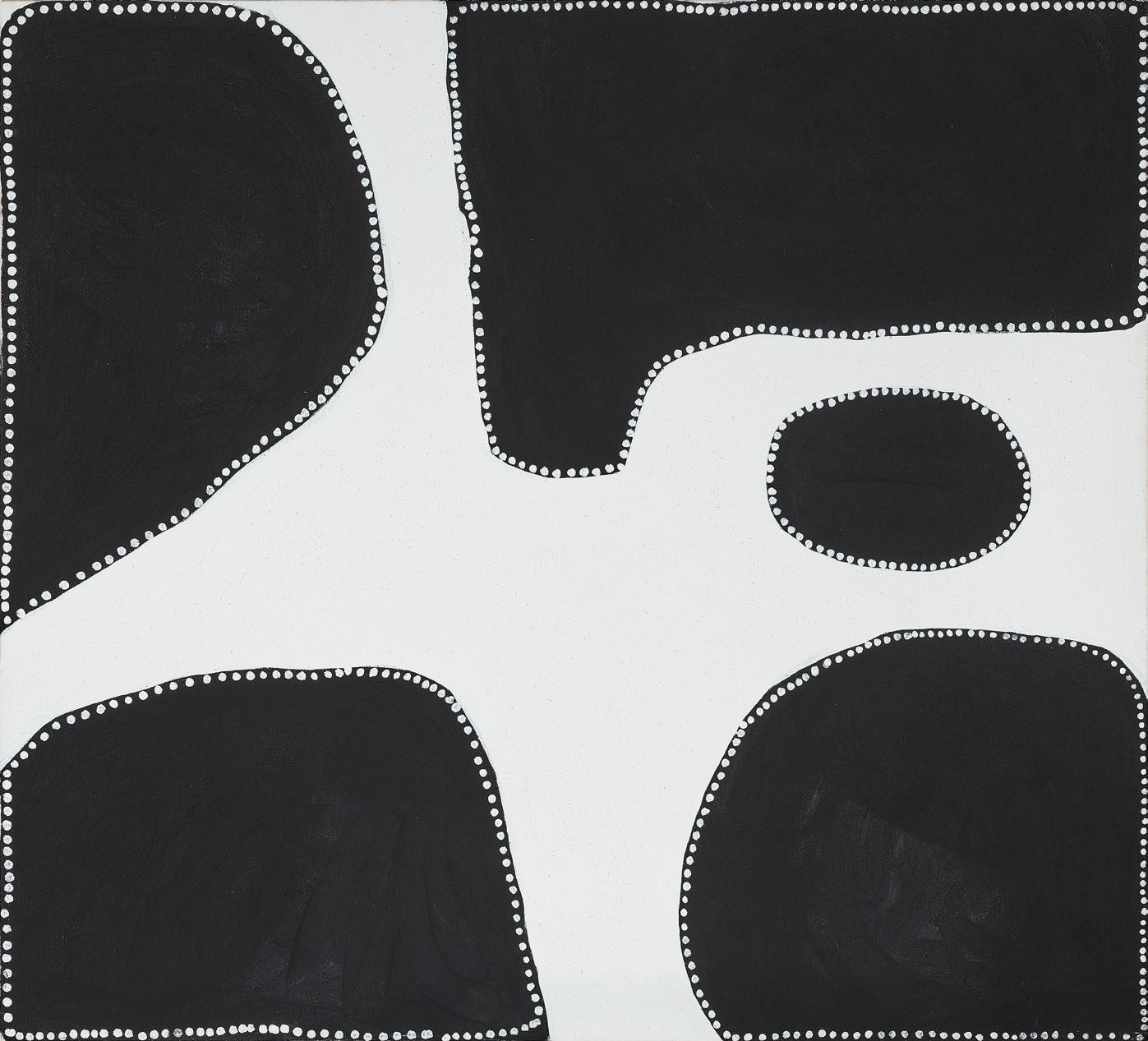
natural earth pigments with bush gum on plywood 66.0 x 94.0 cm (irregular)
Estimate: $30,000 – 40,000
Provenance
Mary Macha, Perth Colin and Elizabeth Laverty, Sydney, acquired in July 1987 Deutscher and Hackett, Sydney, 8 March 2015, lot 32 Private collection, Sydney
Paddy Jaminji was a pioneer of the East Kimberley style of painting, developed in the nascent community of Warmun (Turkey Creek), Western Australia, throughout the late 1970s and 1980s. Jaminji’s Gija people had established the Warmun Aboriginal community, south of Kununurra, after government changes to pastoral wages (intended to instigate equal pay) forced stock workers, including Jaminji who was employed as a stockman on Bedford Downs Stations, off stations and reserves.1
Around this time, the destructive impact of Cyclone Tracy in the Northern Territory in 1974, was interpreted as a spiritual warning – instructions from the Rainbow Serpent to the Gija people to adhere to and strengthen their cultural practices. 2 Paddy Jaminji’s nephew, Rover Thomas, experienced this warning as a series of dream visitations following the sudden death of elderly female relative (a classificatory mother, a Gija Wula speaker) in a car accident near Warmun on a road flooded following the cyclone. The episodes of Thomas’ dreaming acted as the catalyst for the efflorescence of the school of painting in the East Kimberly, codified by Thomas, Paddy Jaminji and George Mung Mung into an extraordinary contemporary corroboree song cycle accompanied by painted boards, known as the Goorirr Goorirr (Kurrirr-Kurrirr/Gurrir Gurrir/Krill Krill/ Kuril Kuril) Ceremony. 3 This new dreaming spoke of the old woman’s spirit taking an epic journey through the lands of East and Central Kimberley, linking sites of sacred and historical importance to several different language groups of the area.
Elgee cliff, half kangaroo – Krilkril Country, 1985 features the single icon motif of painted boards held aloft during the ritual ceremony, painted with the solid textured blocks of natural earth pigments bound with natural resins and outlined with a single line of white dotting – features which later became the hallmarks of East Kimberley painting. This painted board depicts song #14 in the cycle, Kularrta-ura Kawurru Kampani, described as ‘the old woman ‘finds’ the half kangaroo, the legendary inhabitant of this place. She sees the metamorphosed remains and blood inside the cave.’4 The remains of Tawurr, the ancestral kangaroo, rest in a cave in these cliffs, visited by the woman’s spirit. Alongside Galiru, the rainbow serpent and a crocodile, Tawurr also appears in rock art painted on this cave’s walls, the lower half of which has been eroded. The concentric forms surrounding the half-kangaroo within this painted board depict the sandstone Elgee Cliffs (Kunmanturr), on Bedford Downs Station, a geological formation aged over 1.7 billion years old, of great cultural importance to the Gija people.
1. McCulloch, S., and McCulloch Childs, E., McCulloch’s Contemporary Aboriginal Art: The Complete Guide, McCulloch & McCulloch Art Books, Melbourne, 2012, p. 155
2. Cubillo, F. and Reynolds, A. J., ‘Rusty Peters’, in Defying Empire. 3rd National Indigenous Art Triennial, National Gallery of Australia, Canberra, 2017, p. 102
3. Thomas, R. et al., Roads Cross, The Paintings of Rover Thomas, National Gallery of Australia, Canberra, 1994, p. 22
4. ibid., p. 26
Lucie Reeves-Smith
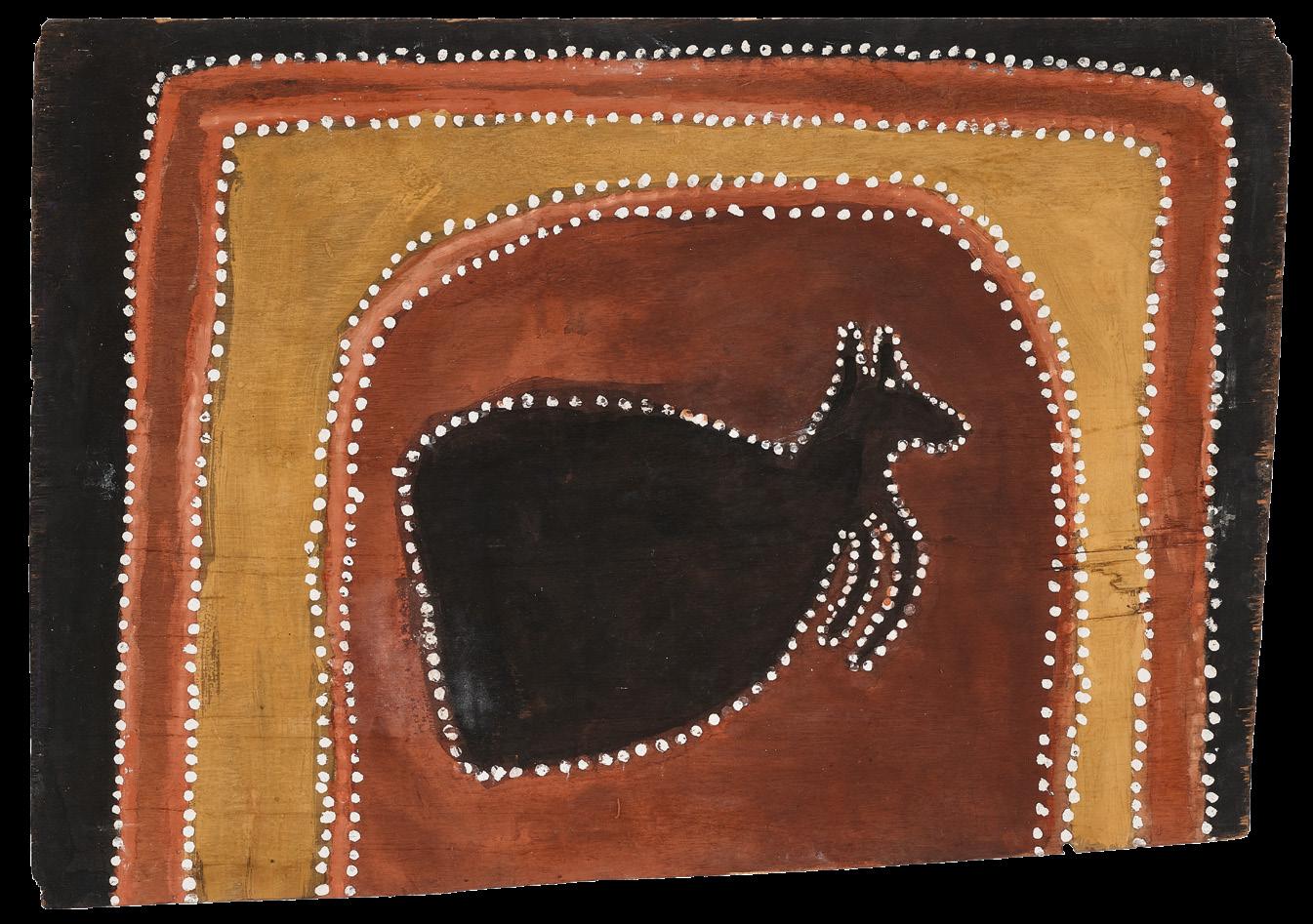
Queensland creek, 1998
ochres and natural earth pigment with synthetic binder on Belgian linen
122.0 x 134.0 cm
signed with initials verso: PB bears inscription verso: artist’s name, title, date and Jirrawun Arts cat. P.B.98.22 and cat. AM755/03
Estimate: $80,000 – 120,000
Provenance
Jirrawun Arts, Kununurra, Western Australia
William Mora Galleries, Melbourne (stamped verso)
Ray Foley, Tasmania
Art Mob, Tasmania
Grant Smith, Melbourne
D’lan Contemporary, Melbourne (label attached verso)
Private collection, Brisbane, acquired from the above in 2022
Exhibited
Paddy Bedford: My Country, William Mora Galleries, Melbourne, 18 November – 12 December 1998
Reverence, D’lan Contemporary, Melbourne, 28 October –3 December 2022 (illus. in exhibition catalogue, p. 84)
Literature
Michael, L. (ed.), Paddy Bedford, Museum of Contemporary Art, Sydney, 2006, pp. 144 (illus.)
A fundamental purpose of the paintings of Paddy Bedford was to transmit knowledge of the features, geography and sacred narratives connected to his Country. His works also recount the more everyday experiences of life on cattle stations in the Kimberley. As one commentator notes, they are ‘drawn from the artist’s two very different sources of knowledge: historical events and the Ngarranggarni, the parallel timedimension in which all things were created and the laws of human behaviour were laid down.’ 1 These dual sources underpin an evolving repertoire of designs and motifs.
Bedford frequently revisited particular themes and subjects, returning repeatedly to the stories entrusted to him by his family. His paintings can be understood as variations on a theme – an approach Tony Oliver compares to that of a jazz musician: ‘The artist revisits the same themes in his paintings, creating new arrangements, but their underlying narrative does not alter.’ 2
Located north-east of Bedford Downs, the site of Queensland Creek lies adjacent to the Wilson River. The area is characterised by creeks and watercourses traversing open country, with the Durack Range rising to the east and an
enclosed escarpment to the south-west. It was from the topographical features and cultural significance of this landscape that Bedford drew profound inspiration.
This striking early canvas, produced in 1998 – his first year of painting – and executed in a characteristic Kimberley ochre palette, reveals the artist’s initial exploration of the tension between graphic form and the rectangular edge of the canvas, a dynamic developed more fully in later works. Here, Bedford positions the principal motifs close to the corners and edges of the frame, evoking a compelling interplay of presence and absence, density and space. Inspired by rocks and other amorphous forms in the Kimberley landscape, he creates a symbiosis between bold, powerful shapes and a carefully balanced composition. Dominant forms in red and black ochre anchor the corners, while the open spaces between them are lightly infilled with yellow ochre pigment, producing a surface that emanates a soft, resonant luminosity.
1. Petitjean, G., Paddy Bedford – Crossing Frontiers, AAMU, Museum of Contemporary Aboriginal Art, Utrecht, 2010, p. 35
2. Oliver, T., et al., Rhapsodies in Country, Grant Pirrie, Sydney, 2002, unpaginated Crispin Gutteridge
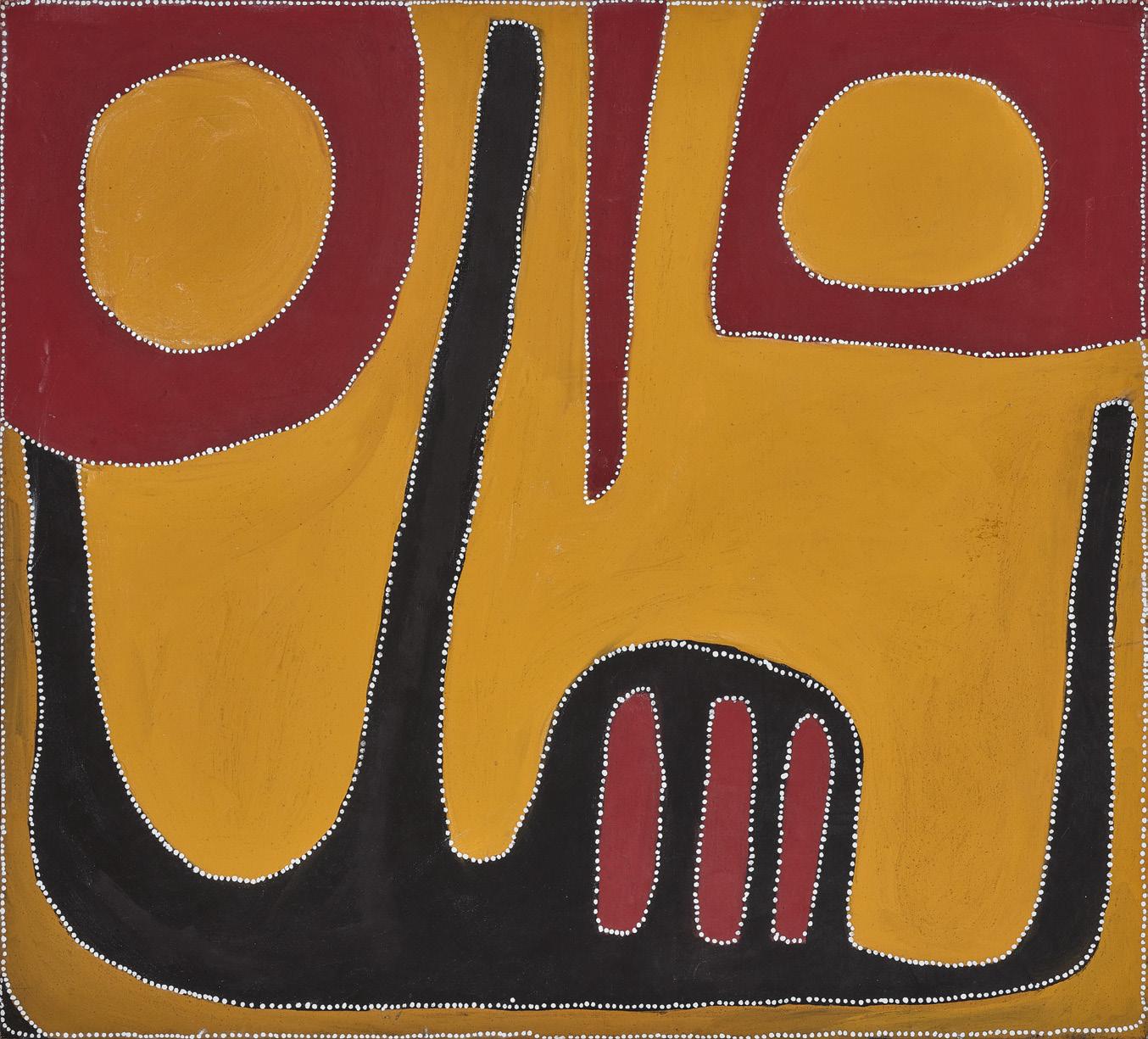
Body marks, 2000
synthetic polymer paint on linen 114.5 x 114.5 cm
bears inscription verso: artist’s name, date, size and Karen Brown Gallery cat. POW 3
Estimate: $18,000 – 25,000
Provenance
Commissioned by Karen Brown Gallery, Darwin Private collection, Adelaide, acquired from the above in December 2004
In Larrakia people culture, the traditional landowners and leaders of ceremonies and dances are referred to as ‘King’. Around 1935, Prince of Wales was born Midpul to Larrakia leader Imabul (also known as King George) at Cullen, or Kahlin Beach – then a pristine bay along the Darwin coastline. After both of his parents passed away when he was very young, Midpul was raised by his mother’s family and trained to become a Law and Song Man.
His ceremonial skills became legendary, and he led many public corroborees for international visitors. As lead dancer for his people, he performed the ceremonial dance for Queen Elizabeth II during her Commonwealth visit to the Northern Territory in the 1970s. Following this occasion, he became widely known as Prince of Wales.
After suffering an untimely stroke, his ceremonial responsibilities were curtailed. He subsequently turned to painting on canvas to ensure that the ceremonial body decorations associated
with his dance and song traditions would endure. In 2001, his stature as a Larrakia painter was formally recognised when he won the Telstra National Aboriginal and Torres Strait Islander Art Award in the Open Painting category.
Painted on his preferred white ground, Body marks, 2000 celebrates the ceremonial body designs that Prince of Wales sought to preserve through painting. In this work, alternating coloured dots surround and overlay an ochre rectangular body motif, framing it with subtle tones of tomato red and arctic white. The result is an intense visual energy that animates the surface. These markings were originally painted onto the bodies of his clansmen prior to ceremonial dances; here, they are translated into a permanent record for posterity. As curator Hetti Perkins observed, ‘His paintings have a musicality imparted by the lively staccato effect of dots and intermittent bars, reading like the sheet music for an important symphony.’ 2
1. Prince of Wales, cited in Perkins, H. and Pinchbeck, C., Tradition today: Indigenous art in Australia, Art Gallery of New South Wales, Sydney, 2004, p. 166
2. ibid.
Crispin Gutteridge
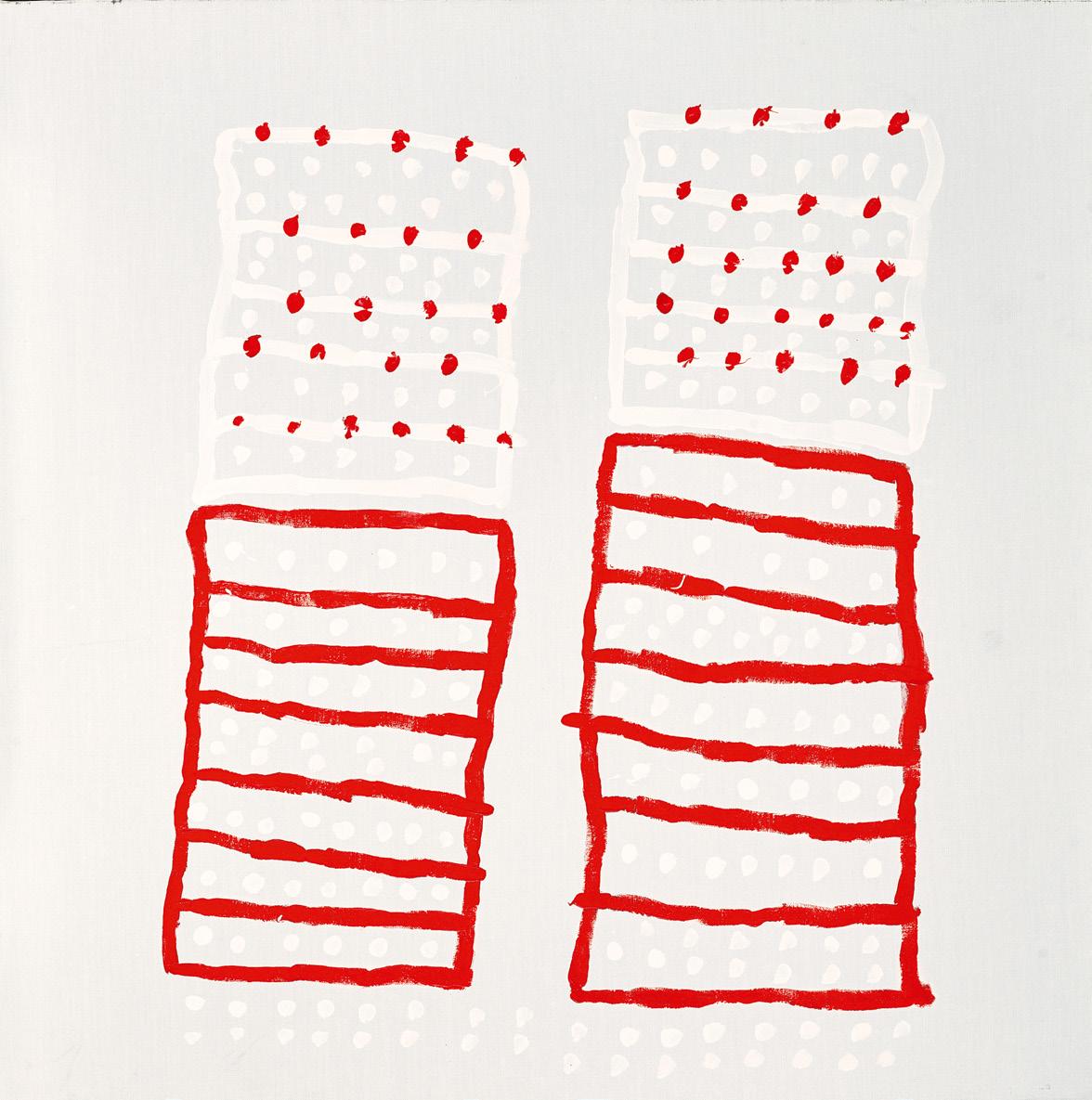
Body marks, 1999
synthetic polymer paint on linen 126.5 x 71.0 cm bears inscription verso: artist’s name, date, medium, size and Karen Brown Gallery cat. KB0242
Estimate: $14,000 – 18,000
Provenance
Commissioned by Karen Brown Gallery, Darwin Private collection, Adelaide, acquired from the above in 2004
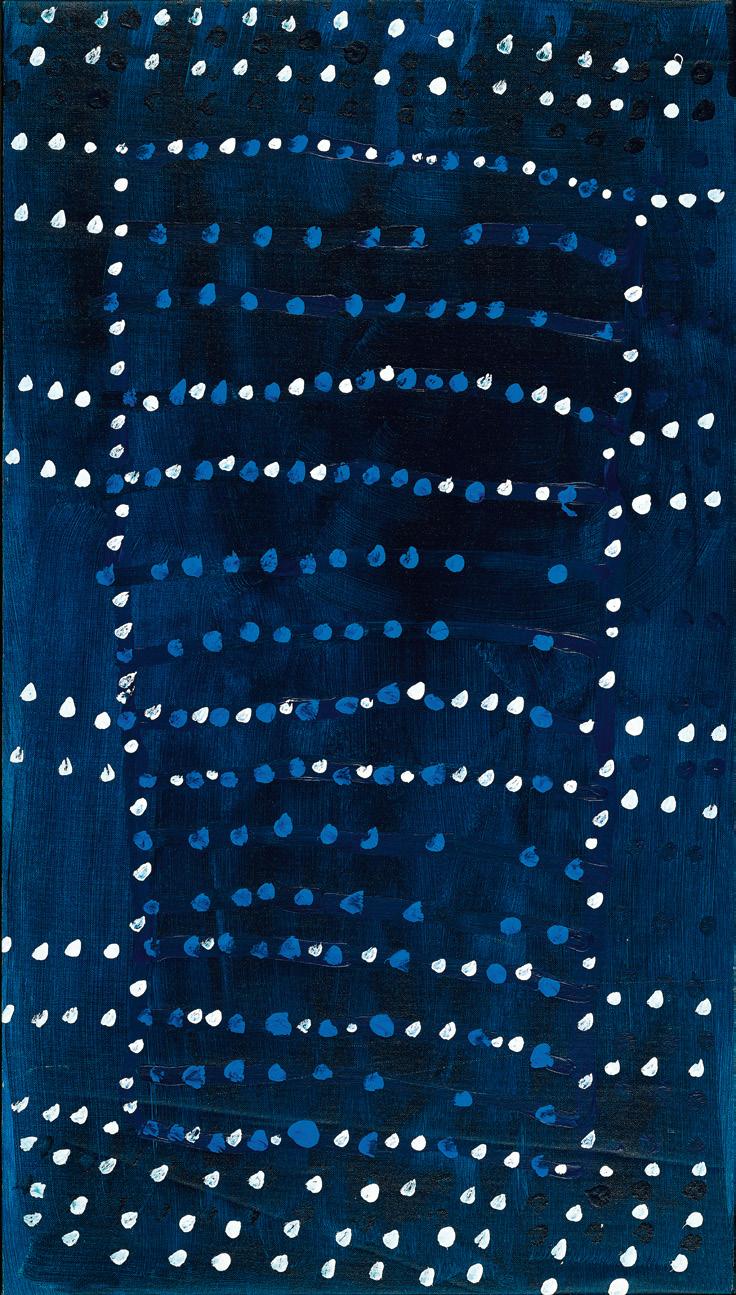
– 2002)
synthetic polymer paint on linen
182.0 x 120.0 cm
bears inscription verso: cat. RG2483
Estimate: $70,000 – 90,000
Provenance
Commissioned by Hinton Lowe and painted at Mbunghara (50 kilometres east of Papunya) in 1983
The Holmes à Court Collection, Perth Sotheby’s, Melbourne, 30 June 1997, lot 56
Private collection, Sydney Sotheby’s, Sydney, 25 November 2007, lot 54
Private collection, Melbourne
Literature
Johnson, V., The Art of Clifford Possum Tjapaltjarri, Gordon and Breach International, Craftsman House, Sydney, 1994, p. 94, pl. 35 (illus.)
Related work
Bush Fire Dreaming, 1982, synthetic polymer paint on canvas, 82.0 x 102.5 cm, Art Gallery of South Australia, Adelaide
This painting was originally sold with accompanying documentation that read:
'This painting tells of the flight of two brothers (Tjampitjinpa) from a fire raised by an elder relative Tjangala in punishment for a transgression of law. A willy-willy drove the fire in pursuit of the young men through country around Karinyarra (Mt. Wedge) and eventually consumed them. This fate is not depicted in this painting because it did not occur in the area represented. Tracks of wallaby and possum dreaming paths traverse the flight path of the young men. Black and grey areas represent charred vegetation and smoke; red and yellow depict the fire and spinifex respectively.'
Born at Napperby Station, north-west of Alice Springs, Clifford Possum Tjapaltjarri did not attend school and worked as a stockman from late boyhood. He began carving in his late teens and had already established a reputation as a highly skilled craftsman when the Papunya painting movement emerged in 1971. One of the last artists to join Geoffrey Bardon’s group of painters, he enrolled in February 1972 under the encouragement of Tim Leura Tjapaltjarri.
An innovative artist, Clifford Possum experimented with combining traditional iconography and Western European pictorial perspectives, as demonstrated in this deceptively literal painting. Story of Two Brothers, 1983 depicts part of the first episode of the great Fire Dreaming, which he
represented in its entirety in Warlugulong, 1977, now held in the collection of the National Gallery of Australia. The story recounts how two brothers of the Tjampitjinpa skin group are punished by their father, Lungkata – the Blue-Tongue Lizard – for failing to share their kangaroo catch. In anger, Lungkata sets fire to the land, and the flames pursue the young men to Kerrinyarra (Mt Wedge), where they are ultimately overcome.
This work traces the brothers’ footprints as they flee the advancing fire, alongside the tracks of the Wallaby and Possum ancestors whose Dreaming paths they cross. The landscape is rendered as a patchwork of red and yellow cluster – symbolising fire and spinifex – encircled by black and grey areas that evoke scorched earth and smoke. This patchwork composition became a defining feature of Clifford Possum’s later practice and influenced many of his contemporaries.
Crispin Gutteridge
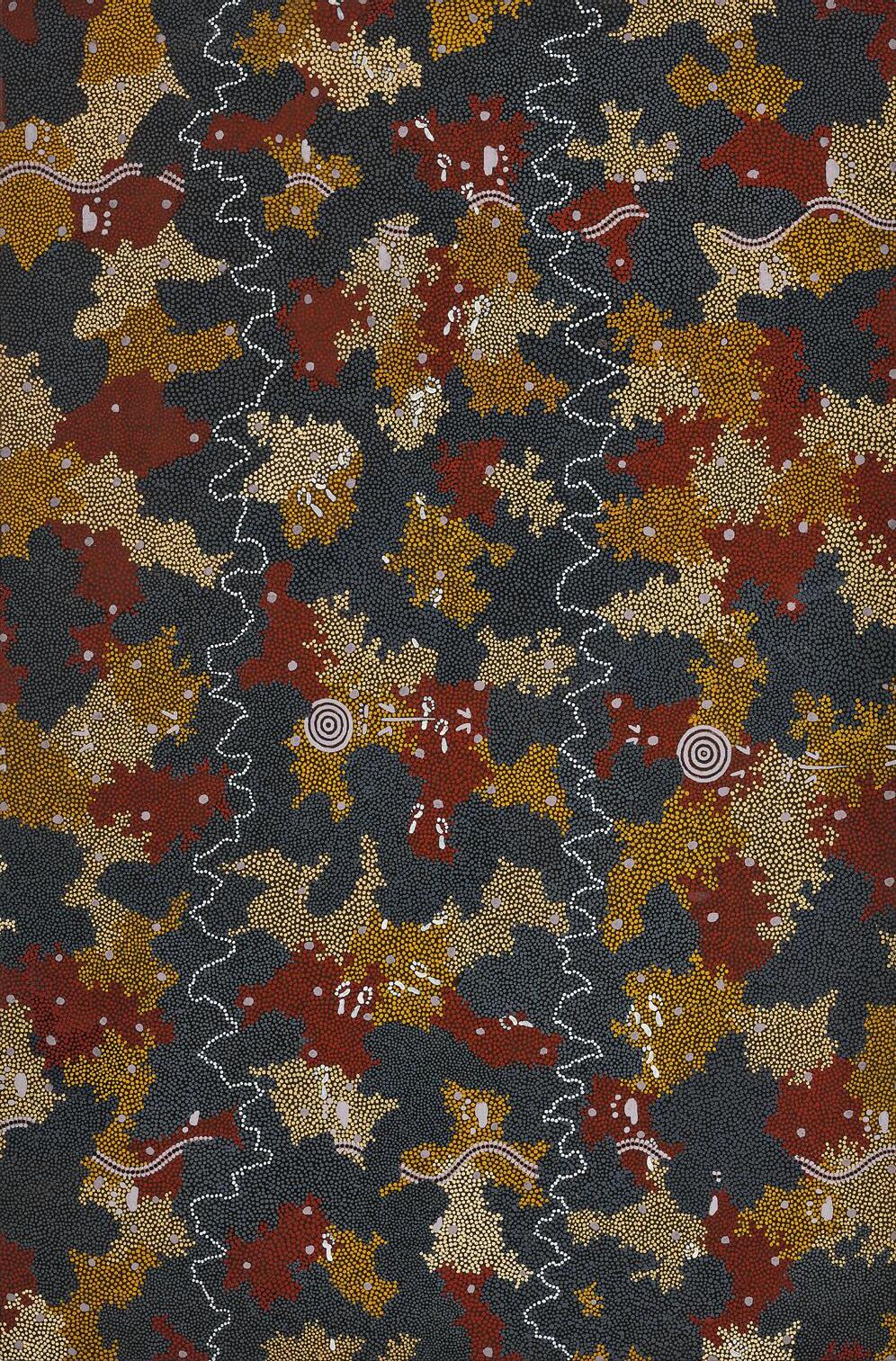
synthetic polymer paint on linen 182.0 x 122.0 cm
bears inscription verso: artist’s name, size and Papunya Tula Artists cat. DC900767
Estimate: $8,000 – 12,000
Provenance
Painted at Kintore for Papunya Tula Artists, Alice Springs in 1990 Private collection, Melbourne
This work is accompanied by a certificate of authenticity from Papunya Tula Artists which states:
‘The subject of this painting is titled Tingari Cycle and relates to Men’s Business at a site known as Tjintapa west of Jupiter Well in Western Australia. The roundels represent the many rockholes in the area and the sinuous lines to the periphery of the painting depict the vast sand dunes of the region. Because of the sacred and secret nature of the Tingari Cycle no further information was revealed. Generally, the Tingari are a group of mythical characters of the Dreaming, who travelled over vast stretches of the country, performing rituals and creating and shaping particular sites. The Tingari men were usually followed by Tingari women and accompanied by novices and their travels and adventures are enshrined in a number of song cycles. These mythologies form part of the teachings of the post initiatory youths today as well as providing explanations for contemporary customs.’
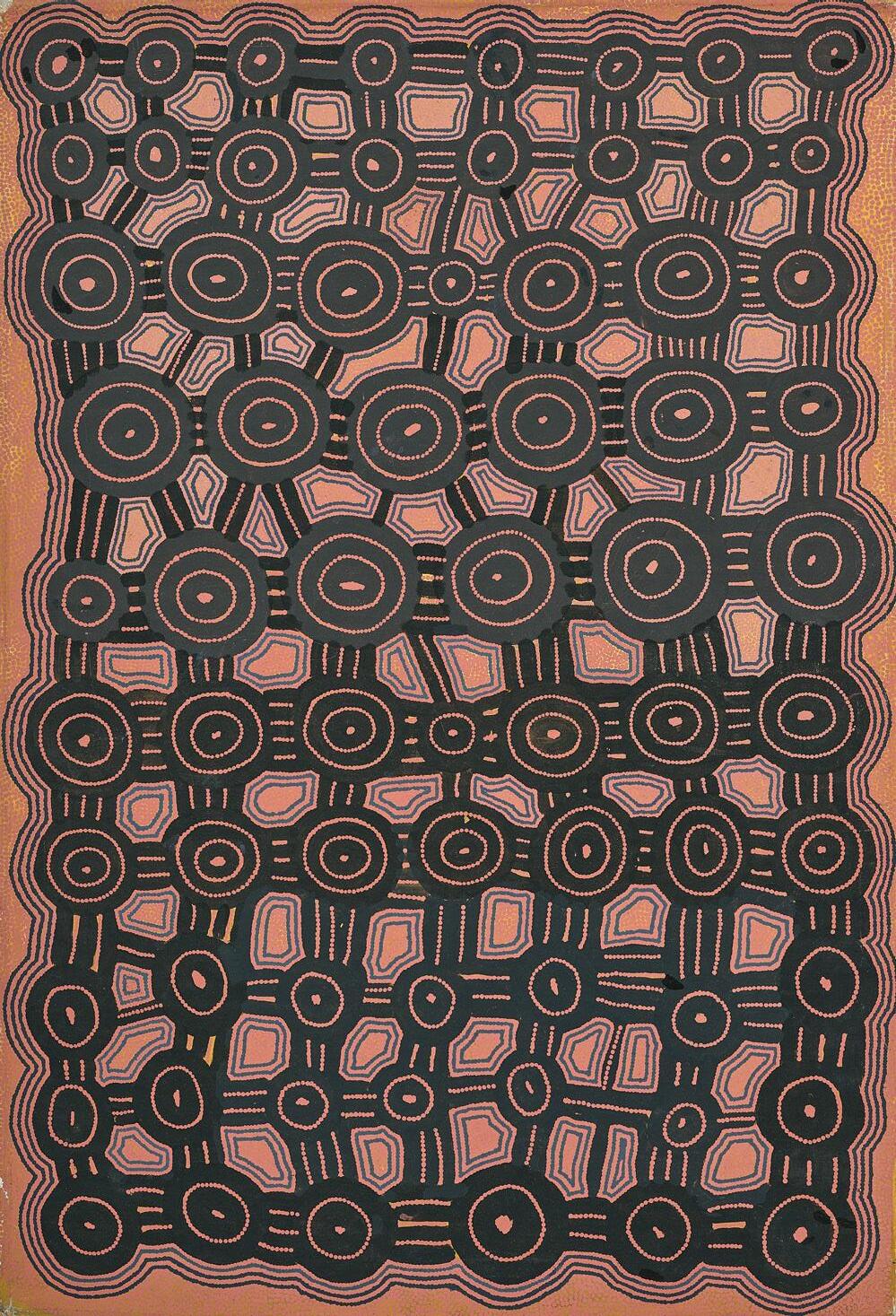
synthetic polymer paint on linen 121.0 x 150.5 cm
bears inscription verso: artist’s name, size and Papunya Tula Artists cat. RT980610
Estimate: $30,000 – 40,000
Provenance
Painted at Kintore, Northern Territory, in 1998 Papunya Tula Artists, Alice Springs, Northern Territory Chapman Gallery, Canberra
Private collection Canberra, acquired from the above in January 2000
This work is accompanied by a copy of the certificate of authenticity from Papunya Tula Artists which states:
‘This painting depicts designed associated with the travels of one old Tingari Man. He camped at Kampurarrpa, north of the Ehrenberg Range and applied body paint in preparation for a solo ceremony. He later travelled west to Winparrku (Mt. Webb) and then south–east to Lake MacDonald. Since events associated with the Tingari Cycle are of a secret nature no further detail was given.
Generally, the Tingari are a group of mythical characters of the Dreaming who travelled over vast stretches of the country, performing rituals and creating and shaping particular sites. The Tingari Men were usually followed by Tingari Women and accompanied by novices and their travels and adventures are enshrined in a number of song cycles. These mythologies form part of the teachings of the post initiatory youths today as well as providing explanations for contemporary customs.’
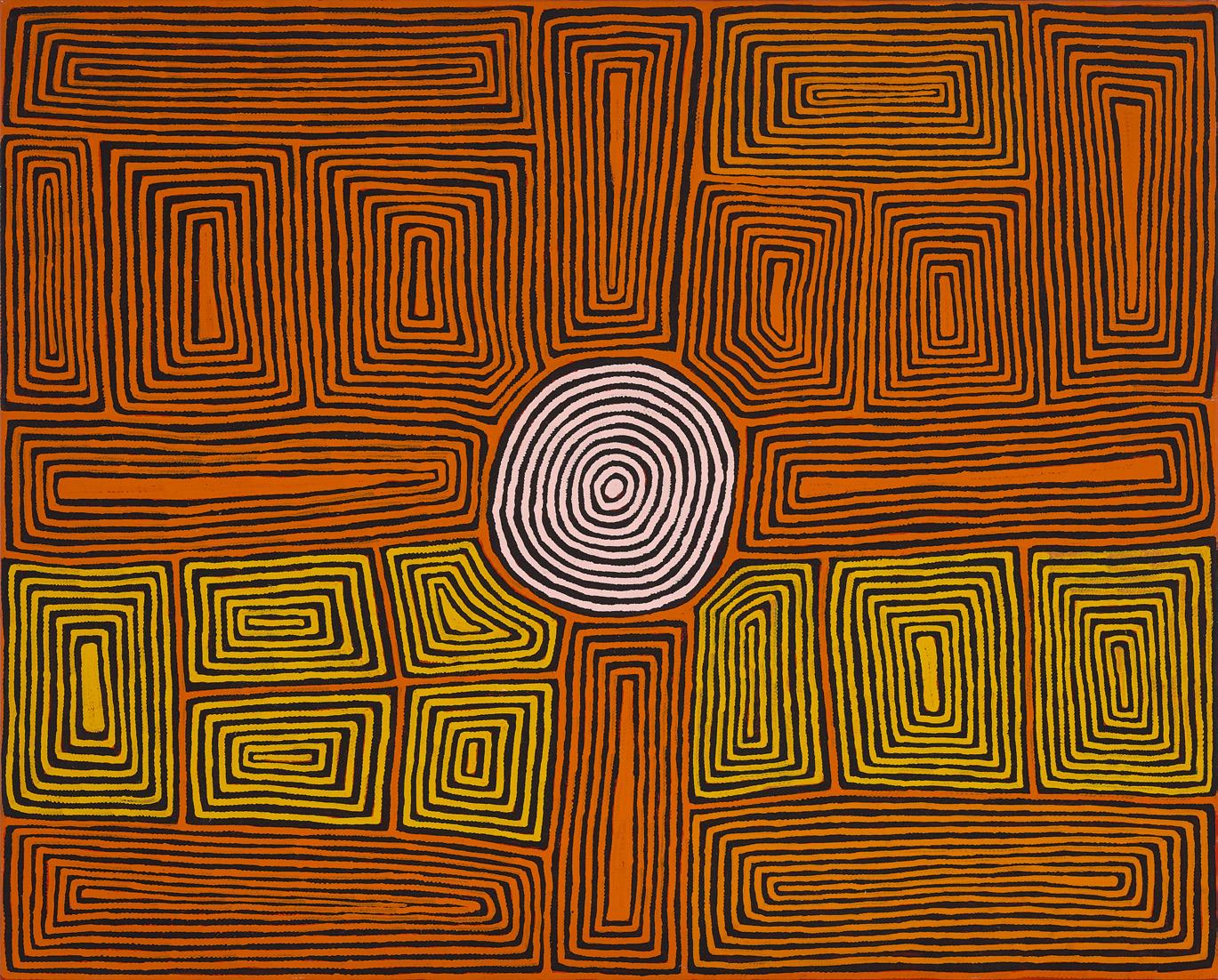
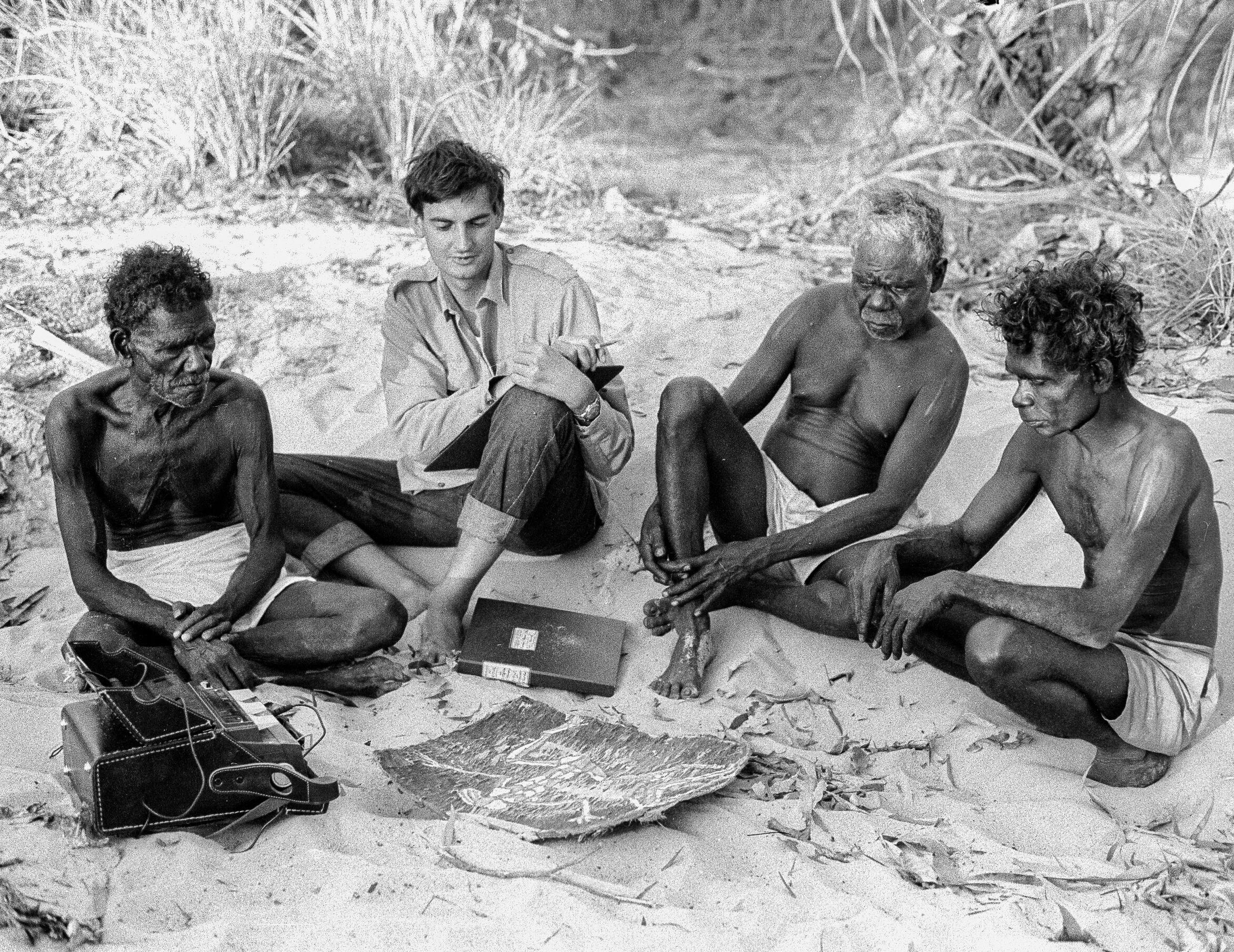
Lots 37 – 43
These extraordinary bark paintings were assembled in 1966 by the famous collector and interlocutor Lance Bennett (1938 –2013) at the Mudjinbardi community in Arnhem Land, Northern Territory. During this time Bennett was making regular visits, sometimes with his mother, Dorothy, to remote areas of the Northern Territory to collect paintings, sculptures and objects from various Aboriginal groups. During the 1950s, Dorothy travelled widely in this region while she was medical secretary to the orthopaedic surgeon Dr Stuart Scougall. Scougall had a deep interest in Aboriginal art and advocated for the Art Gallery of New South Wales in Sydney to start collecting. Scougall and Bennett developed a relationship with the then deputy director of the AGNSW, Tony Tuckson, that resulted in joint collecting visits to north Australia and active collecting by the gallery. Prior to this, bark paintings were considered ethnographic curiosities belonging in museums as opposed to galleries.
The Mudjinbardi community developed in response to the establishment of a pastoral lease between the East Alligator and South Alligator Rivers. Much of the population had arrived from across the extended region of central Arnhem Land and the Alligator Rivers, seeking employment. Many of the men, including all the artists who painted for Bennett, had extensive knowledge of the spectacular rock art galleries of the region. It is likely that a number of these artists had produced rock paintings in their own lands prior to relocating to Mudjinbardi.1
Writing about these works previously, anthropologist Dr Luke Taylor explains how the lived experience of these men and the legacy of rock art in this region informed the unique aesthetic of the barks they created:
‘This particular art heritage provides an explanation for the characteristic style of these works. Many of the paintings have a pronounced use of white paint roughly applied as the background of the imagery. This kind of painting is called rungkalno and it is common in the rock art of central Arnhem Land where images can be displayed as a simple white silhouette without any interior infill. Also in central Arnhem Land, contrasting coloured dotting was occasionally used to modify such images. A number of central Arnhem Land artists have stated that they were most familiar with these techniques and used them in their early bark paintings. The use of detailed x-ray infill and multicoloured crosshatched banding are later influences.’ 2
Of course, the subjects and ancestral themes the men painted are common in rock art in Arnhem Land as well. Namarnde, a ghost-like being of the human dead, features strongly in the rock art galleries of the sandstone escarpments of central and western Arnhem Land. So too in the bark paintings of Baimunungbi, Diidja and Lanyirrda from 1966. Baimunungbi alluded to the sexual exploits of male and female Namarnde. Taylor asserts that ‘some special rock paintings were produced as a form of ‘love magic’’, suggesting that their depiction might conjure ‘a desired outcome for the artist and his secret beau.’ 3
Baimunungbi’s tall figures are painted in a style characteristic of southern Arnhem Land. Each figure is carefully decorated with gentle lines of yellow ochre. Some are shown naked as the male makes love to his wives; other figures have small pubic aprons, worn from the waist. Baimunungbi remained in Mudjinbardi for many years prior to returning to Maningrida in the 1980s, where he became well known for exquisite geometric works that drew upon his knowledge of body paintings of the Mardayin ceremony.
Diidja’s Namarnde figures, with elongated arms and fingers, have talon-like forms trailing from the back of the head. His gestural dotting provides form and substance to their white silhouetted bodies. Diidja, too, emphasises the Namarnde’s sexual activity, with exposed genitalia and descriptions provided to Bennett of them ‘making love’. Bennett described Diidja as ‘a good-natured friendly man with a boyish engaging grin and a keen enthusiasm for ritual life’.4
Lanyirrda’s depictions of Namarnde share a similar appearance to those of both Baimunungbi and Diidja. Fine yellow ochre outlines his figures. According to Bennett’s annotation of Namarnde circa 1965, ‘The long feather which the male spirit is wearing as decoration is a typical feature of paintings of spirits in the rock and bark art of West Arnhem Land.’
1. Haskovec, I. and Sullivan, H., ‘Nadjombolmi: reflections and rejections of an Aboriginal artist’, in Morphy, H., (ed.), Animals into Art, Unwin Hyman, London, 1989, pp. 57–74
2. Taylor, L., ‘The Lance Bennett Collection of Bark Paintings’, in Aboriginal Art, Sotheby’s, London, 10 June 2015
3. ibid.
4. Appel, M. (ed.), Inspired by Country: Bark Paintings from Northern Australia: the Gerd and Helga Plewig Collection, Hirmer Publishers, Munich, Germany, 2022, p. 357 Luke Scholes
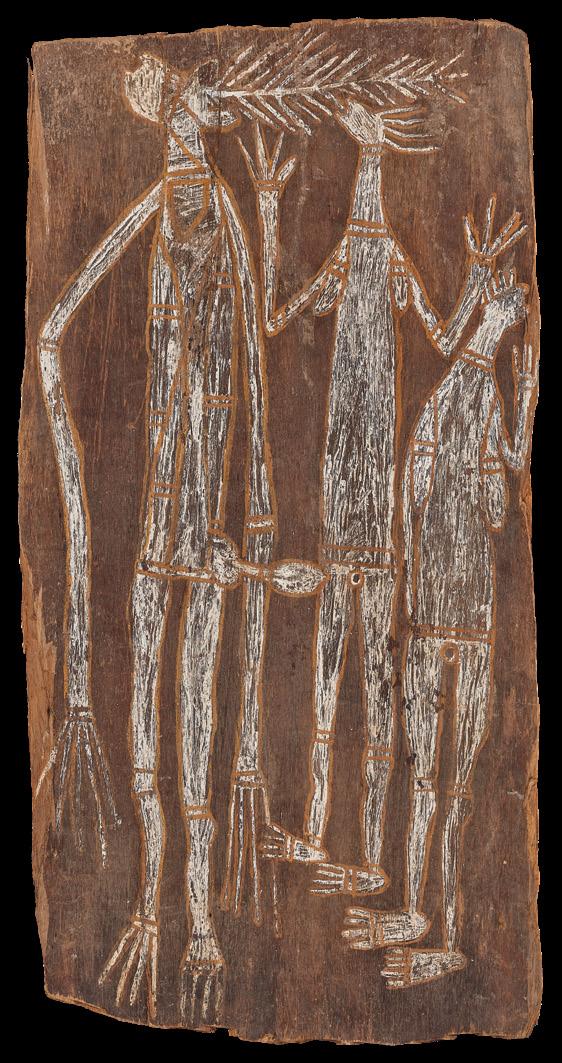
Lanyirrda (Billy) (1925 – 1975)
Namarnde, c.1965
natural earth pigments on eucalyptus bark
126.0 x 65.0 cm (irregular)
Estimate: $12,000 – 16,000
Provenance
Painted at Mudjinberri (Mudjinbardi), Northern Territory
Lance Bennett, Darwin, acquired from the artist in 1966
The Thomas Vroom Collection, The Netherlands Sotheby’s, London, 10 June 2015, lot 28
Private collection, Melbourne
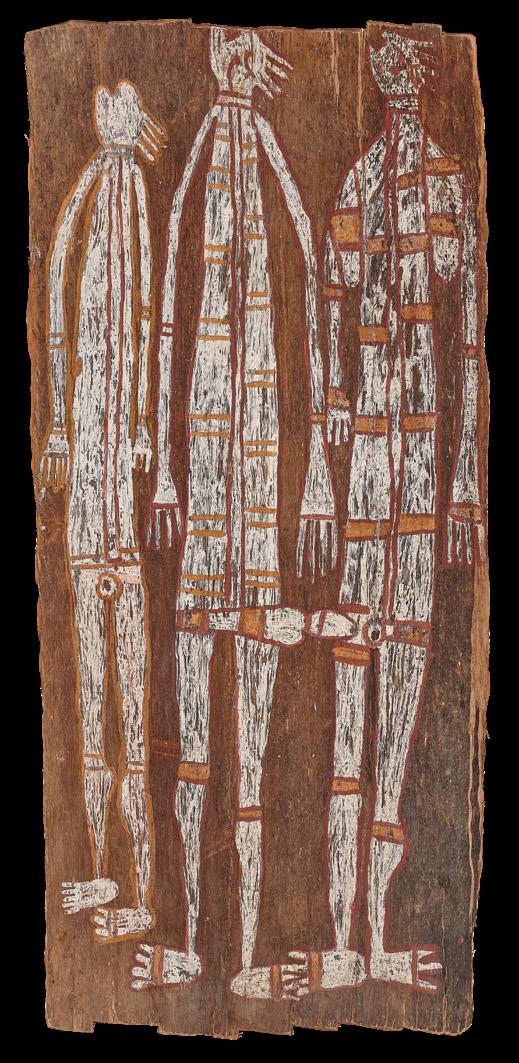
Lanyirrda (Billy) (1925 – 1975)
A Namarnde spirit making love with his two wives, 1966
earth pigments on eucalyptus bark
107.0 x 49.0 cm (irregular)
Estimate: $10,000 – 15,000
Provenance
Painted at Mudjinberri (Mudjinbardi), Northern Territory
Lance Bennett, Darwin, acquired from the artist in 1966
The Thomas Vroom Collection, The Netherlands
Sotheby’s, London, 10 June 2015, lot 24
Private collection, Melbourne
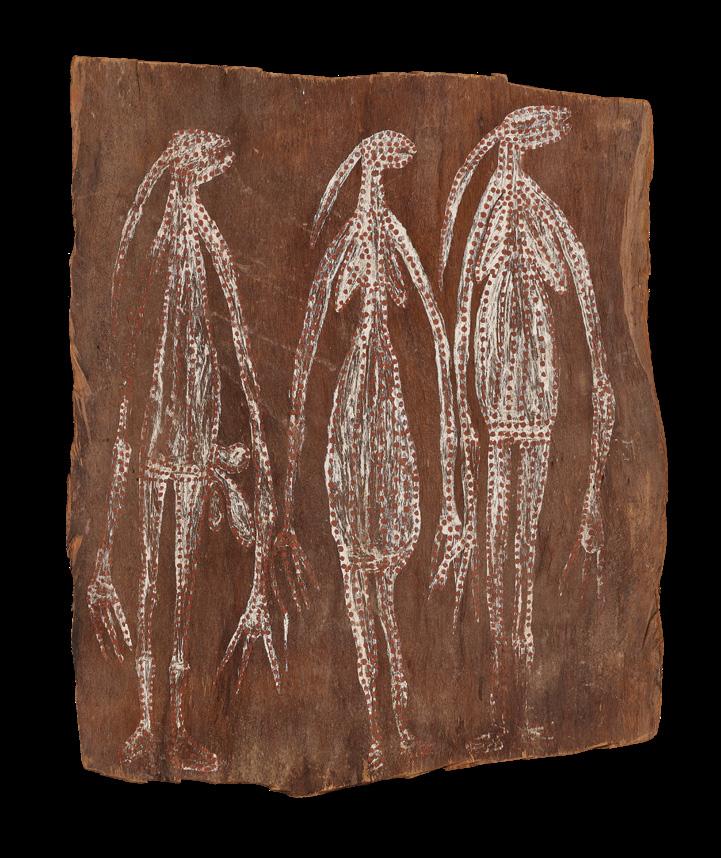
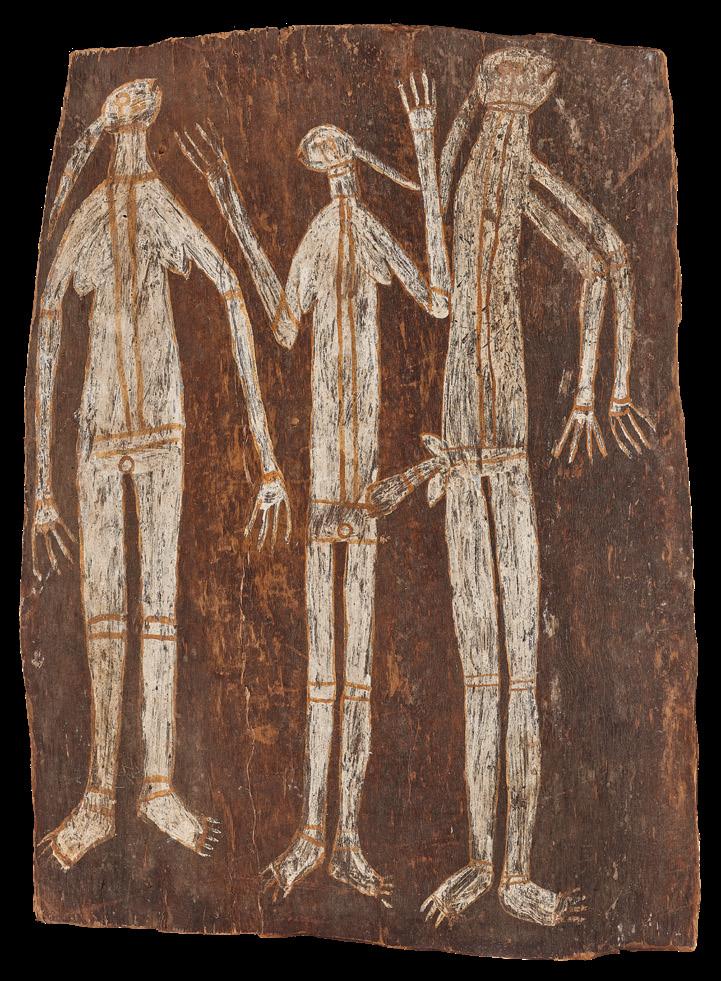
Diidja (c.1900 – 1982)
Namarnde with two wives, 1966
natural earth pigments on eucalyptus bark
77.0 x 64.0 cm (irregular)
Estimate: $8,000 – 12,000
Provenance
Painted at Mudjinberri (Mudjinbardi), Northern Territory
Lance Bennett, Darwin, acquired from the artist in 1966
The Thomas Vroom Collection, The Netherlands Sotheby’s, London, 10 June 2015, lot 36
Private collection, Melbourne
(1925 – 1979)
Namarnde making love with two wives, 1966
natural earth pigments on eucalyptus bark
97.0 x 73.0 cm (irregular)
Estimate: $14,000 – 18,000
Provenance
Painted at Mudjinberri (Mudjinbardi), Northern Territory
Lance Bennett, Darwin, acquired from the artist in 1966
The Thomas Vroom Collection, The Netherlands
Sotheby’s, London, 10 June 2015, lot 23
Private collection, Melbourne
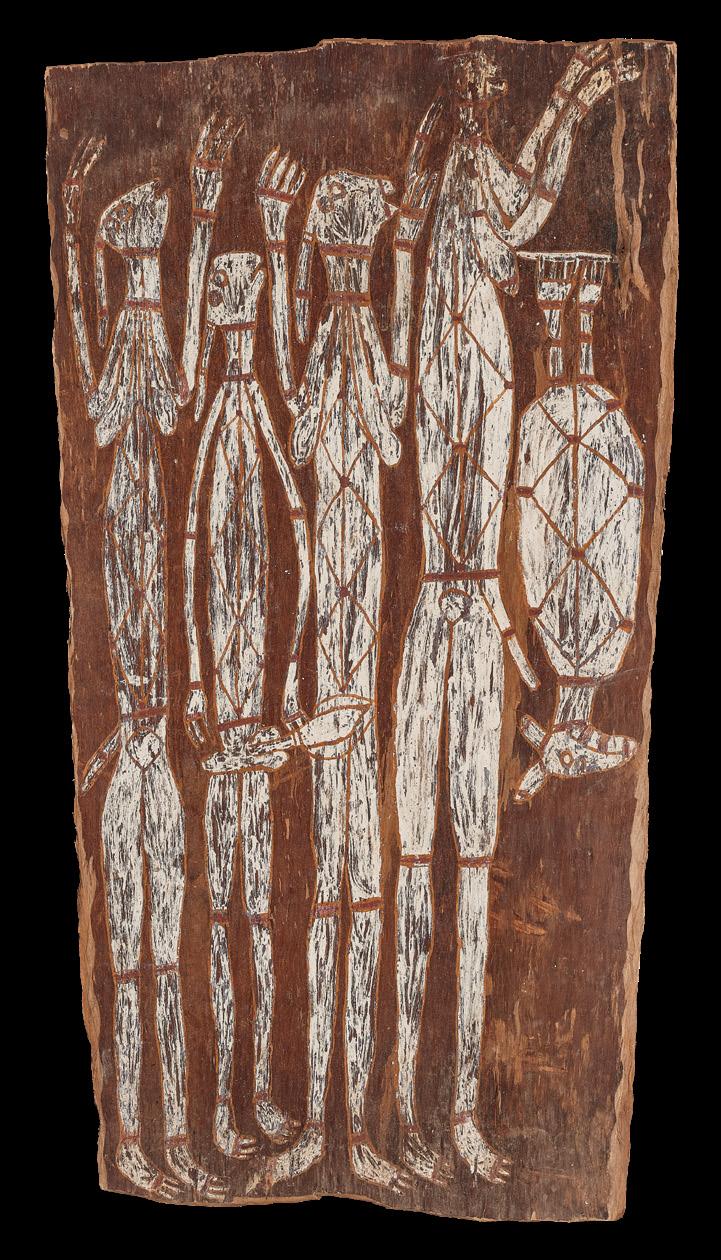
(1925 – 1979)
Family of Namarnde spirits hunting for flying fox, 1966
natural earth pigments on eucalyptus bark 92.0 x 50.0 cm (irregular)
Estimate: $15,000 – 20,000
Provenance
Painted at Mudjinberri (Mudjinbardi), Northern Territory
Lance Bennett, Darwin, acquired from the artist in 1966
The Thomas Vroom Collection, The Netherlands Sotheby’s, London, 10 June 2015, lot 30
Private collection, Melbourne
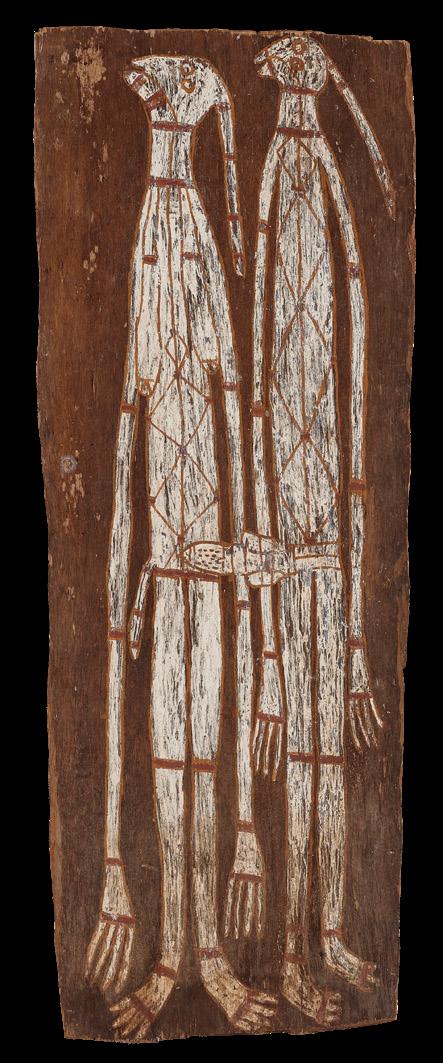
(1925 – 1979)
Male and female Namarnde spirits of the Rock Country, 1966
natural earth pigments on eucalyptus bark
97.0 x 37.0 cm (irregular)
Estimate: $10,000 – 15,000
Provenance
Painted at Mudjinberri (Mudjinbardi), Northern Territory
Lance Bennett, Darwin, acquired from the artist in1966
The Thomas Vroom Collection, The Netherlands
Sotheby’s, London, 10 June 2015, lot 14
Private collection, Melbourne
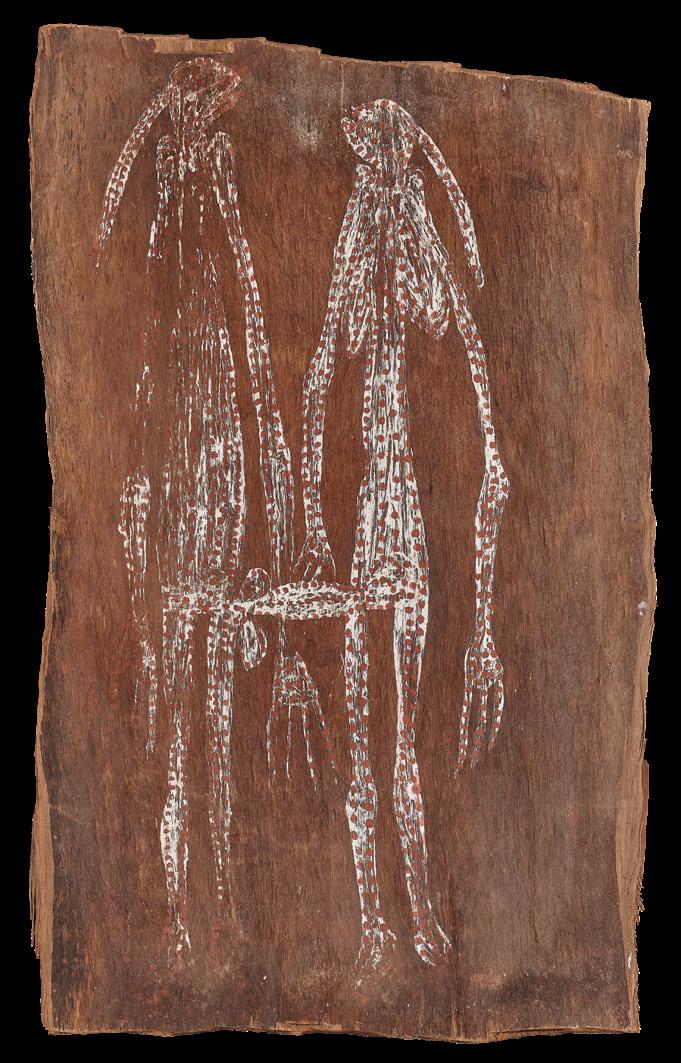
Diidja (c.1900 – 1982)
Male and female Namarnde making love, 1966
natural earth pigments on eucalyptus bark
94.0 x 54.0 cm (irregular)
Estimate: $8,000 – 12,000
Provenance
Painted at Mudjinberri (Mudjinbardi), Northern Territory
Lance Bennett, Darwin, acquired from the artist in 1966
The Thomas Vroom Collection, The Netherlands
Sotheby’s, London, 10 June 2015, lot 37
Private collection, Melbourne
suite of 8 inkjet prints on 310 gsm paper
81.0 x 122.0 cm (each)
edition: AP 1/2 aside from an edition of 10 each bear artist’s thumbprint, signed, numbered, dated and inscribed with title on artist’s label verso
Estimate: $45,000 – 65,000 (8)
Provenance
Collection of the artist, Brisbane Private collection, Brisbane
Exhibited
Invasion, Andrew Baker Art Dealer, Brisbane, 2018; This is no Fantasy + Dianne Tanzer Gallery, Melbourne, 26 July – 18 August 2018 (another example)
Literature
Martin-Chew, L., ‘Michael Cook talks about staging an Indigenous invasion of London’, Art Guide, 25 July 2018, https:// artguide.com.au/michael-cook-talks-about-staging-anindigenous-invasion-of-london/ [accessed February 2026]
Related work
Other examples of three images from this suite are held in the collection of the National Gallery of Victoria, Melbourne Another example of an image from this suite is held in the collection of the Benalla Art Gallery, Victoria



Brisbane-based Bidjara artist Michael Cook’s photographic works, always sumptuously presented and carefully staged, address personal and socio-political issues of post-colonial identity in Australia. His choice of medium, historically linked to the ethnographic othering of First Nations people, allows for a reimagining and rewriting of history, cinematically illustrating alternative perspectives of familiar historical narratives. The figurative works which brought Cook critical acclaim early in his career – Undiscovered, 2010; Civilised, 2013; Majority Rule, 2014; Object, 2014, and the present suite, Invasion, 2017 – oscillate between different cultural perspectives and introduce surreal imagery to disarm and amuse viewers. Invasion, throughout its sequence of eight story-board tableaux, again takes as subject Australian colonial history – this time imaginatively inverting its power structures within the stylistic framework of 1960s popular cinema. As a time of crucial advances in land and civil rights for Indigenous Australians, this historical setting thus also adds a superlative dimension to Cook’s speculative images.
With a characteristically post-modern practice, Cook is a bricoleur (to use French anthropologist Claude Levi-Strauss’ term), taking inspiration and techniques from diverse sources, and applying them to a composite visual representation of cultural collision and intertwined histories. Replicating the terror of colonial ‘first contact’, Invasion is set in iconic locations around the city of London – the heart of the British Empire – and presents dramatic scenes of a sudden, violent arrival of aliens taking the form of oversized Australian fauna (lorikeets and cockatoos, possums, lizards, and witchetty grubs) and bronzed cyborg warriors. This invasion disrupts the everyday life of London residents, who, dressed in period 1960s fashions, appear within the still photographs thrown into silent states of melodramatic panic. At the time, Invasion was Cook’s most ambitious project to date, the technically complex series requiring eight months of production, shot on location in London and requiring a cast of fifty actors.
Cook came to art relatively late in life, using his extensive technical experience in commercial photography to his advantage in these complex photographic tableaux. Each of Cook’s images is dense with dozens of layers of visual details, creating an immersive density. Further editioned prints based on the newspaper, The Evening Standard, provide a satirical
metanarrative for the interpretation of the photographic series, exp laining in its newsprint: ‘England has a lot to answer for, and the attack on London this week proved that a lot of people in the world have an axe to grind when it comes to ye olde Empire.’ 1
Cook’s photomontages present a pastiche of grainy textures and unsophisticated special effects inspired by B-grade scifi movies. Cut-out flying saucers hover in Cook’s grey English sky, carrying large possums, or depositing the various invaders on shore with luminescent tractor-beams. Laser-beams shot from the bellies of these spaceships create massive explosions on land, clouds of smoke and fire emanating from the roofs of Big Ben and Somerset House, mimicking the action-movie trope of an explosive Armageddon finale and uncomfortably evoking the ‘Blitz’. While the artist has explained that the kernel of inspiration came from Alfred Hitchcock’s seminal 1963 film, The Birds, and initially intended to include swarms of birds in every frame, the popular culture references and the strong relationships they have to real-life historical events can be traced to much earlier foundational texts. 2
Writing in the Memo review in October 2023, in a review of the presentation of the Invasion suite at the National Gallery of Victoria’s Ian Potter Centre, art historian and critic Rex Butler noted the strong links, both stylistically and historically, between Cook’s series and H. G. Wells’ foundation science fiction novel, The War of the Worlds (1898). 3 Codifying the genre of the alien invasion, the War of the Worlds told the story of a Martian invasion of Earth, the aliens colonising the planet only to be eventually destroyed by a simple microbe. Coincidentally, both the works of both Cook and Wells were inspired by stories of the British colonisation of Tasmania in the early 19th century – the most violent chapter of Australian colonial history – with each author empathising through their work with the tragic consequences wrought on the Palawa first na tions people of the island.
1. INVASION (EVENING STANDARD) 2017, inkjet print, 43 x 55 cm, edition of 100
2. Martin - Chew, L., ‘Michael Cook talks about staging an Indigenous invasion of London’, Art Guide, 25 July 2018 at: https://artguide.com.au/michael-cook-talks-about-stagingan-indigenous-invasion-of-london/ (accessed 18 February 2026)
3. Butler, R., ‘Michael Cook’s Invasion’, Memo Review, 14 October 2023 at: https://www. memoreview.net/reviews/michael-cooks-invasion-by-rex-butler (accessed 18 February 2026)
Lucie Reeves-Smith
Dibirdibi Country, 2010
synthetic polymer paint on linen 151.0 x 101.0 cm
bears inscription verso: artist’s name, title, medium and Mornington Island Arts and Crafts cat. 5741–L–SG–0410
Estimate: $25,000 – 35,000
Provenance
Mornington Island Arts and Crafts, Mornington Island, Queensland (stamped verso)
Private collection, Queensland, acquired from the above in 2010
This painting is accompanied by a certificate of authenticity from Mornington Island Arts and Crafts which states:
‘This is the big saltpan that covers part of my husband’s country on Bentinck Island.’
Gabori began her art career late in life, aged 85, however, unlike many other Aboriginal language groups, the Kaiadilt did not have a tradition of mark making, whether on tools, objects or bark. Taking this cultural background into consideration, Gabori’s style is completely self-made, conjured from maps in her mind of Bentinck Island and the country she loved. From her very earliest works, she has depicted aspects of her own beloved country as well as that of her brother, father and husband – including both geographical aspects of the landscape as well as the wildlife, specifically sea-life which is central to the landscape.’ 1
Dibirdibi Country, 2010 depicts a subject painted more often by the artist than any other and is a powerful recollection of the country of her husband, Kabarrarjingathi Bulthuku Pat Gabori, a rival of her brother King Alfred, and whose relationship with Gabori created intense friction within Kaiadilt society eventually resulting in the death of her brother. 2 As Gabori suggests on
the certificate of authenticity from Mornington Island Arts and Crafts which accompanies the work, the painting recalls the country of her husband and the Rock Cod Ancestor, depicting the big mangrove swamp on the edge of a large saltpan that covers part of her husband’s country close to the site where the liver of Dibirdibi, the Rock Cod Ancestor, was thrown into the sea, creating a permanent fresh water well. Known primarily for her brightly coloured canvases, with vital, intuitive and boldly executed brushstrokes, when Gabori paints Dibirdibi, the meanings layer in multitudes; she is at once painting the saltpans of the land, the Rock Cod Ancestor Dreaming of Dibirdibi Country, a portrait of her late husband in connection to his country, and finally, her own longing, loss and memory.
1. Pinchbeck, C., ‘Mirdidingkingathi Juwarnda Sally Gabori’ in unDisclosed, 2nd National Indigenous Art Triennial, National Gallery of Australia, Canberra, 2012, p. 64
2. McLean, B., ‘Dulka Warngiid; The Whole World’ in Mirdidingkingathi Juwarnda Sally Gabori Dulka Warngiid; Land of All, Queensland Art Gallery I Gallery of Modern Art, Brisbane, 2016, p. 16
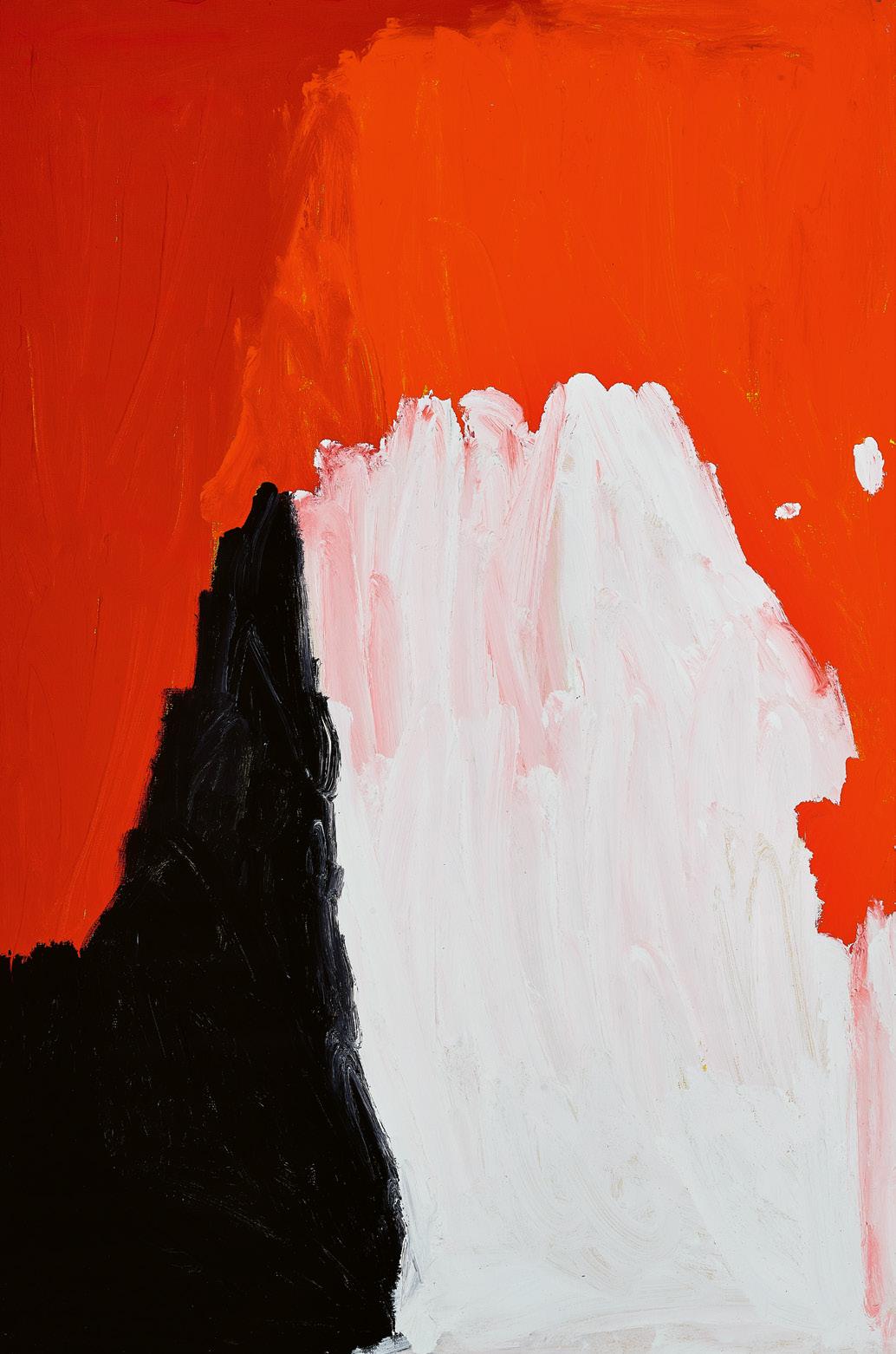
Dibirdibi Country, 2010
synthetic polymer paint on linen 151.0 x 101.0 cm
bears inscription verso: artist’s name, title, medium and Mornington Island Arts and Crafts cat. 5745–L–SG–0410
Estimate: $25,000 – 35,000
Provenance
Mornington Island Arts and Crafts, Mornington Island, Queensland (stamped verso)
Private collection, Queensland, acquired from the above in 2010
This painting is accompanied by a certificate of authenticity from Mornington Island Arts and Crafts which states:
‘This is my husband’s country on Bentinck Island. It’s where the mangroves meet the saltpan. This is good hunting ground for crab and mudshell.’
In 1948, following a series of natural disasters, Sally Gabori along with the other inhabitants of Bentinck Island were forced to relocate to Gununa on nearby Mornington Island. Gabori had spent the first few decades of her long life on Bentinck Island, the island of her birth, living off the natural resources of the surrounding ocean and estuaries in the traditions of the Kaiadilt. Although Gabori resided on Mornington Island for the remainder of her long life, her connection to Bentinck Island life and culture was innate, and her success as an artist enabled her to return to country through her paintings.
Dibirdibi Country, 2010 evokes one of Sally Gabori’s favourite subjects, the country of her husband, Kabarrarjingathi Bulthuku Pat Gabori – a subject and location painted more often by the artist than any other. The country of her husband and the Rock Cod Ancestor, this painting shows a large saltpan that runs across her husband’s country close to the site where the liver of Dibirdibi, the Rock Cod Ancestor, was thrown at the sea’s edge, creating a permanent fresh-water spring. For Gabori, Dibirdibi is also personal, her husband Pat Gabori was also called Dibirdibi and was custodian of the story, songs and sites associated with Dibirdibi. Her canvases are an expression of both her love for her husband and the landscape of her country.
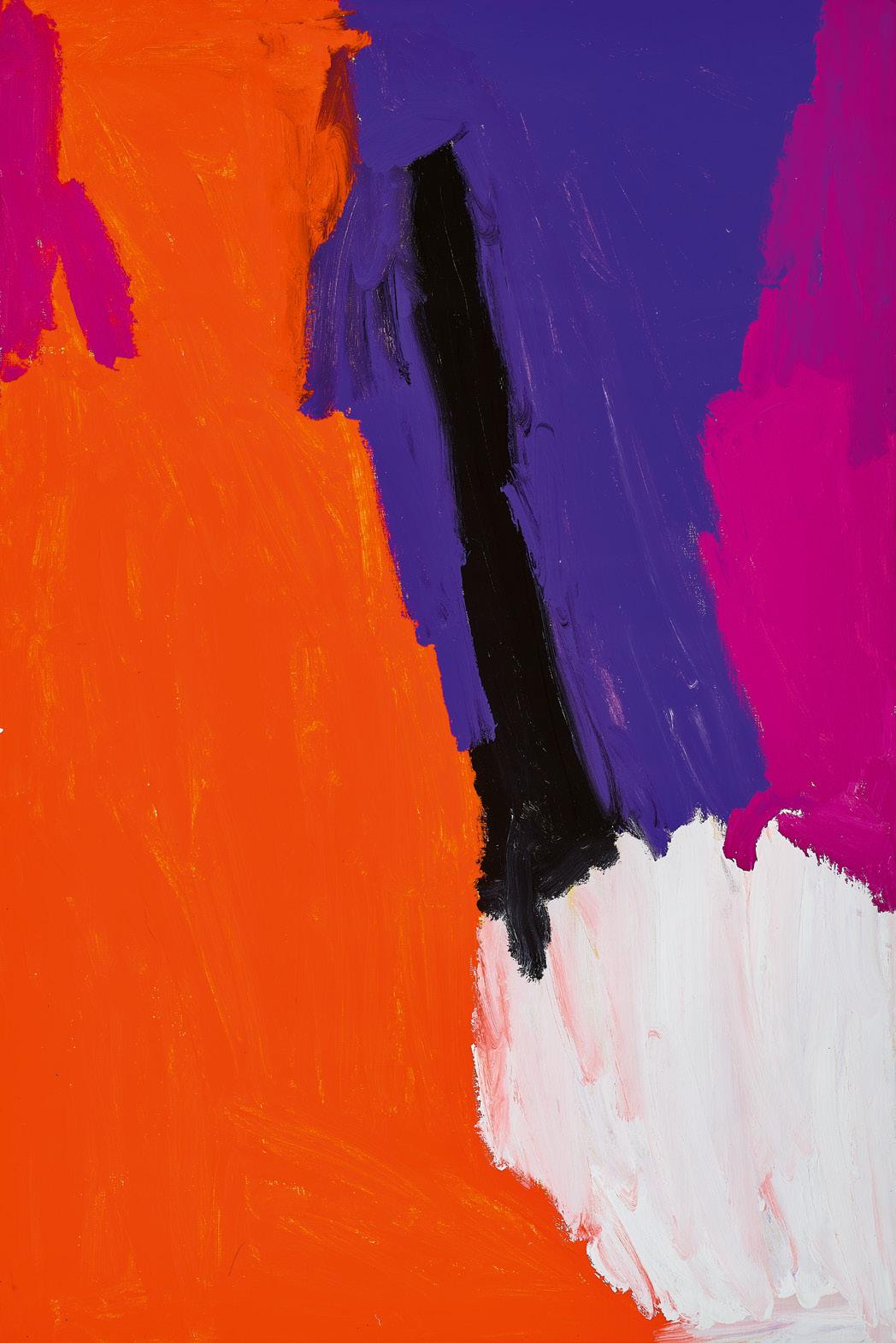
born c.1959
Marawa, 2003
synthetic polymer paint on Belgian linen 122.0 x 122.0 cm
bears inscription verso: artist’s name, size and Papunya Tula Artists cat. WT0305142
Estimate: $15,000 – 20,000
Provenance
Papunya Tula Artists, Alice Springs, Northern Territory Private collection, Paris, acquired from the above
This work is accompanied by a copy of the certificate of authenticity from Papunya Tula Artists which states:
‘This painting depicts designs associated with Marawa, a swamp with rockhole and soakage water, on the west side of Lake Mackay. In mythological times a large group of Tingari Men travelled to this site from the west and after arriving they went underground. Since events associated with the Tingari Cycle are of a secret nature, no further detail was given. Generally, the Tingari are a group of mythical characters of the Dreaming who travelled over vast stretches of the country, performing rituals and creating and shaping particular sites. The Tingari Men were usually followed by Tingari Women and accompanied by novices and their travels and adventures are enshrined in a number of song cycles. These mythologies form part of the teachings of the post initiatory youths today as well as providing explanations for contemporary customs.’
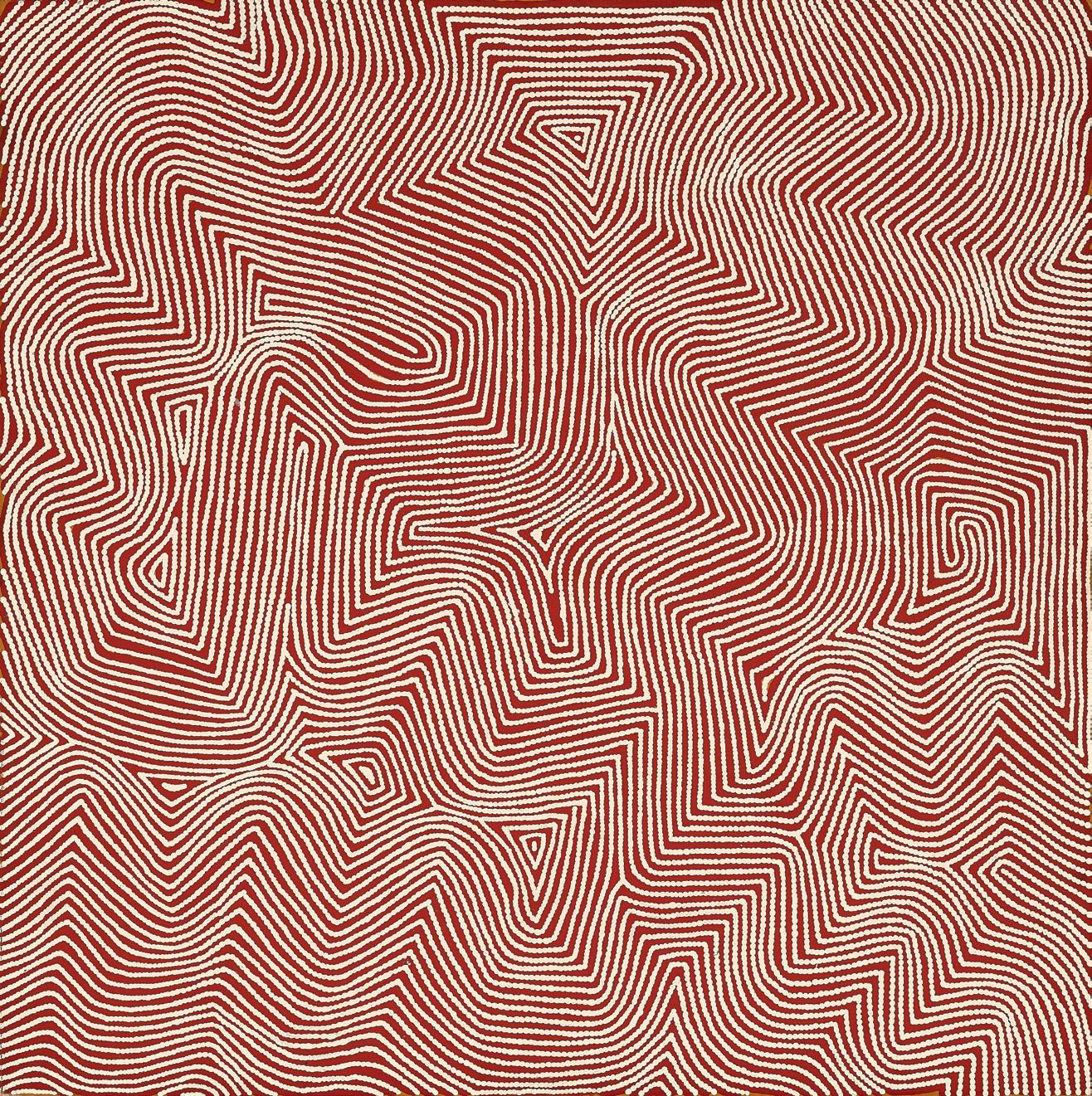
(c.1938 – 2013)
synthetic polymer paint on canvas 121.5 x 121.0 cm
bears inscription verso: artist’s name, size and Papunya Tula Artists cat. NN0609115
Estimate: $10,000 – 15,000
Papunya Tula Artists, Alice Springs, Northern Territory
Private collection, Adelaide Deutscher and Hackett, Melbourne, 6 October 2010, lot 41 Private collection, Melbourne
This work is accompanied by a copy of the certificate of authenticity from Papunya Tula Artists which states:
‘The large roundel in this painting depicts Wirrulnga, a rockhole site in a small rocky outcrop east of the Kiwirrkura Community in Westem Australia. In ancestral times a group of women of the Napaltjarri and Napurrula kinship subsections camped at this site, after travelling from the rockhole site of Ngaminya further west. The women are represented in the painting by the many arc shapes. Wirrulnga is a site which is associated with birth and the lines adjacent to the central roundel symbolises the extended shape of a pregnant woman of the Napaltjarri kinship subsection who gave birth at the site. While at Wirrulnga the women also made spun hair-string with which to make nyimparra (hair-string skirts), which are worn during ceremonies. The comb like shapes in this painting depict the nyimparra. From Wirrulnga the women continued their travels north east to Wilkinkarra (Lake Mackay). As they travelled, they gathered large quantities of the bush food known as kampurarrpa or desert raisin from the plant Solanum centrale. These berries can be eaten straight from the bush but are sometimes ground into a paste and cooked in the coals to form a type of damper. The small circles in this painting depict the kampurarrpa.’
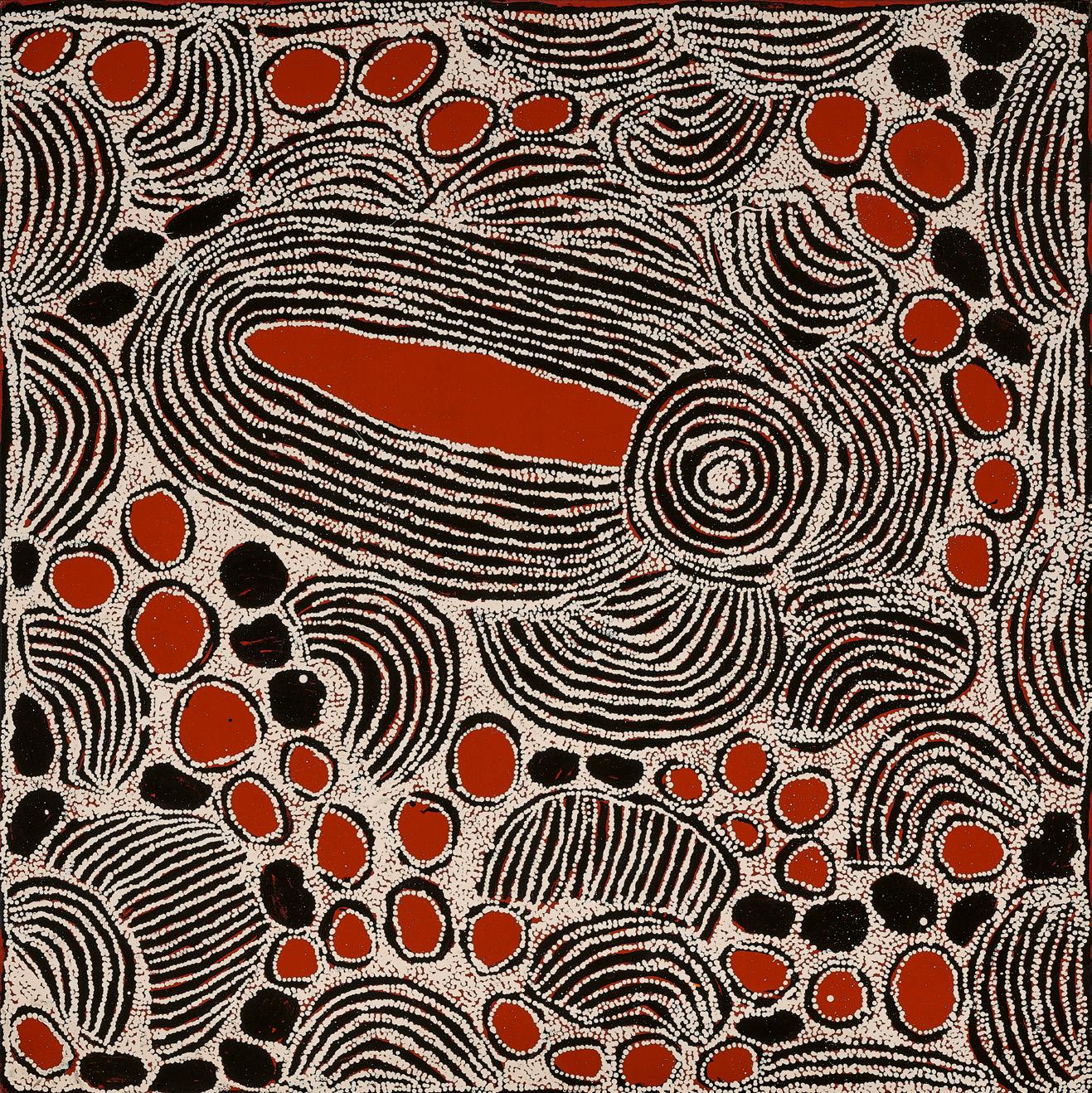
2011)
synthetic polymer paint on linen 91.0 x 122.0 cm
bears inscription verso: artist’s name, size and Papunya Tula Artists cat. MN0503156
Estimate: $15,000 – 20,000
Provenance
Papunya Tula Artists, Alice Springs, Northern Territory Private collection, Paris, acquired from the above
This work is accompanied by a copy of the certificate of authenticity from Papunya Tula Artists which states:
‘This painting depicts designs associated with the site of Lupulnga, a rockhole situated south of the Kintore Community. The Peewee (small bird) Dreaming is associated with this site, as well as the Kungka Kutjarra or Two Travelling Women Dreaming. During mythological times a group of ancestral women visited this site north to Kaakuratintja (Lake MacDonald) and later the Kintore area. The lines in the painting represent spun hair-string which is used in the making of nyimparra (hair-belts), which are worn by both men and women during ceremonies.’
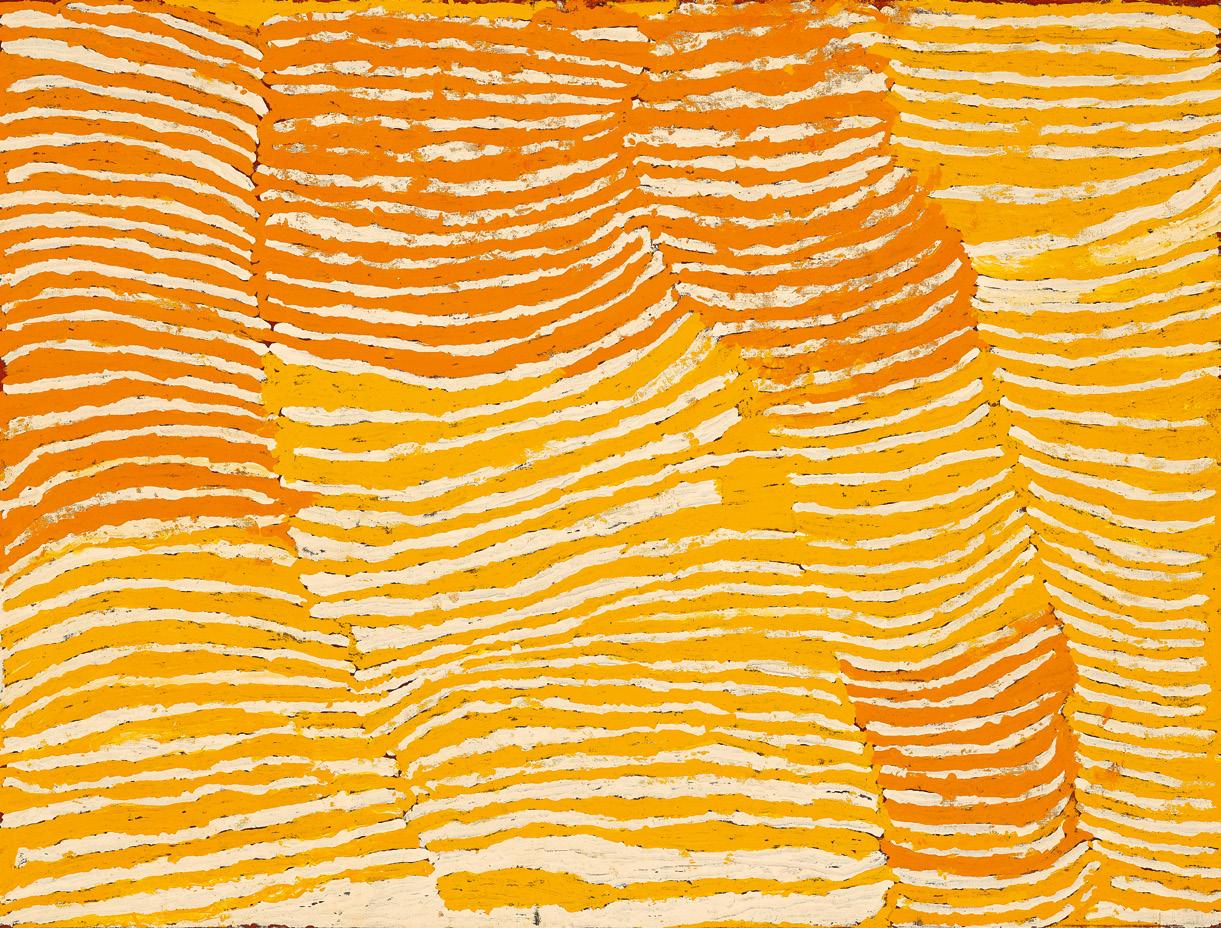
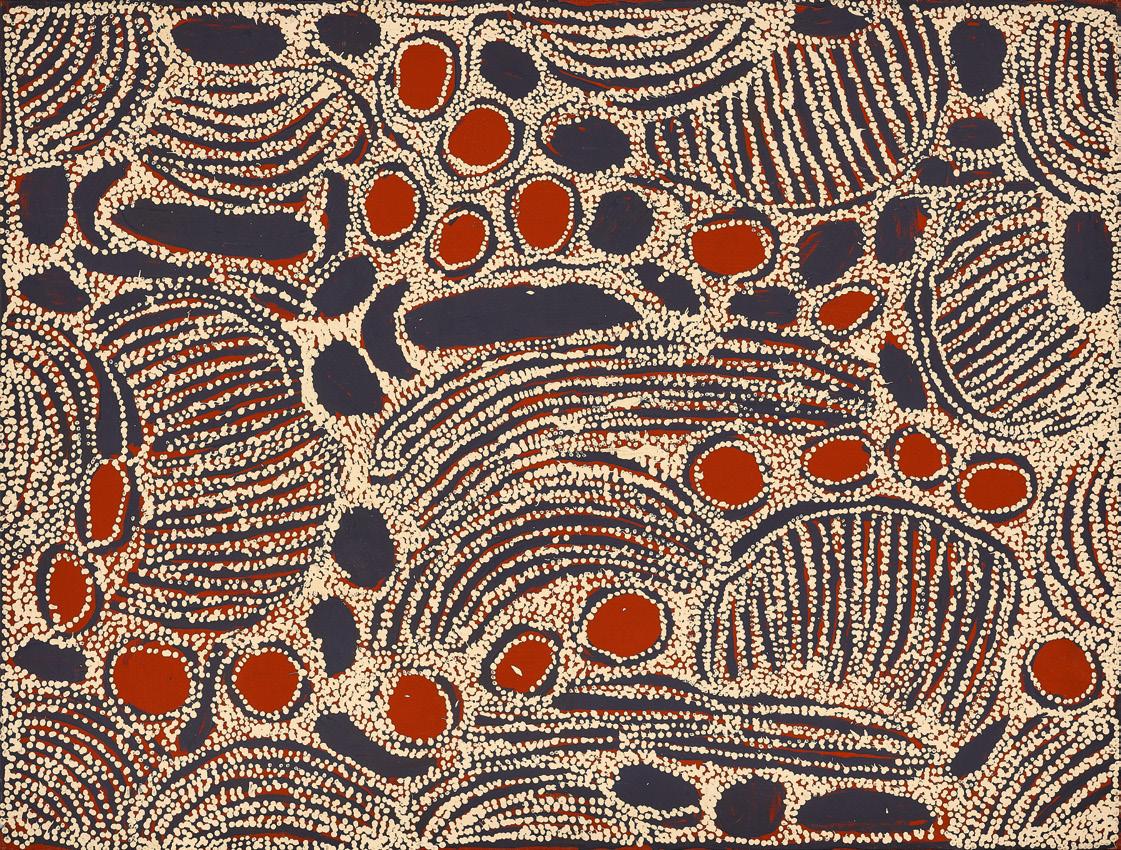
50 Ningura Napurrula (c.1938 – 2013)
Women’s ceremonies at Ngaminya, 2006
synthetic polymer paint on linen
91.5 x 120.0 cm
bears inscription verso: artist’s name, size and Papunya Tula Artists cat. NN0610031
Estimate: $6,000 – 8,000
Provenance
Commissioned by Papunya Tula Artists, Alice Springs, Northern Territory
Private collection, Queensland
Deutscher and Hackett, Sydney, 2 December 2015, lot 185
Private collection, Melbourne
This work is accompanied by a copy of the certificate of authenticity from Papunya Tula Artists which states:
‘This painting depicts designs associated with Womens Ceremonies at the rockhole and soakage water site of Ngaminya, slightly south–west of the Kiwirrkura Community in Western Australia.
In ancestral times a group of women, represented by the small ‘U’ shapes, gathered at this site after travelling from further west. The women visited Ngaminya to perform the dances and sing the songs associated with the area. They also spun hair–string with which to make nyimparra (hair–string skirts), which are worn during these ceremonies. The comb–like shapes in this painting depict the nyimparra, while the elongated bar shapes depict the women’s nulla–nullas (digging sticks).
While at the site the women also gathered the edible berries known as kampurarrpa or desert raisin from the small shrub Solanum centrale. These berries can be eaten straight from the bush but are sometimes ground into a paste and cooked in the coals to form a type of damper. The small circles in this painting represent these kampurarrpa.
The ladies later continued their travels north east to Wirrul, Walkalkarra and Wilkinkarra (Lake Mackay).’
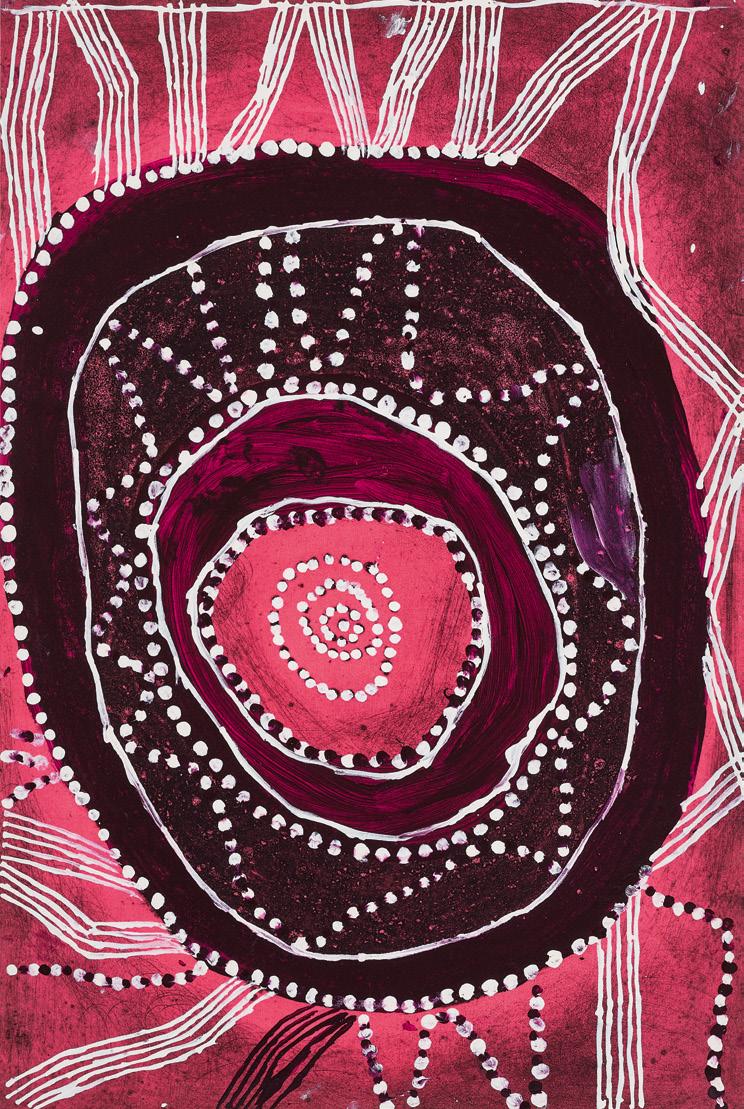
Noŋgirrŋa Marawili (c.1939 – 2023)
Lightning and the rock, 2019
earth pigments and recycled print toner on paper
87.0 x 58.0 cm
Estimate: $8,000 – 12,000
Provenance
Buku–Larrŋgay Mulka Centre, Yirrkala, Northern Territory
Private collection, Sydney, acquired from the above
This work is accompanied by a certificate of authenticity from Buku–Larrŋgay Mulka Centre.
etched galvanised steel
180.0 x 120.0 cm
Estimate: $15,000 – 20,000
Provenance
Buku–Larrŋgay Mulka Centre, Yirrkala, Northern Territory (cat. 4581G)
Private collection, Victoria, acquired from the above
This work is accompanied by a certificate of authenticity from Buku–Larrŋgay Mulka Centre which states in part:
‘This work ... was made at Gangan when Gunybi noticed a discarded Galvanised water tank. It came about through Gunybi’s incessant desire to experiment with materials. He obeys the longterm stricture from Buku–elders “if you are going to paint the land use the land” but stretches it to use items that he finds on the land. In this case a discarded watertank at Gangan stimulated him to learn how to weld and to attach the feet. He painted it with an oil based paint and ground and scratched the–surface. After it was brought into the art centre it was epoxied by Arnhem ush taxis and teh weld [sic] strengthened by Bunuwal Industrial.
This work identifies the reservoirs of the Naymil/Datiwuy clan. Alkan is an area on Naymil land and sea between the Gurrumuru and Cato Rivers that run into the Arnhem Bay. Within this area is another watercourse that leads up into a sacred area of a freshwater spring or Millŋurr with special qualities called Balawurru. Dhangultji or Brolga are dancing here. Here Djanda the sacred goanna also swim in the lagoon created by the spring, their actions as they swim causing patterns to be made on the surface that is covered by the totemic waterweed Darra.’
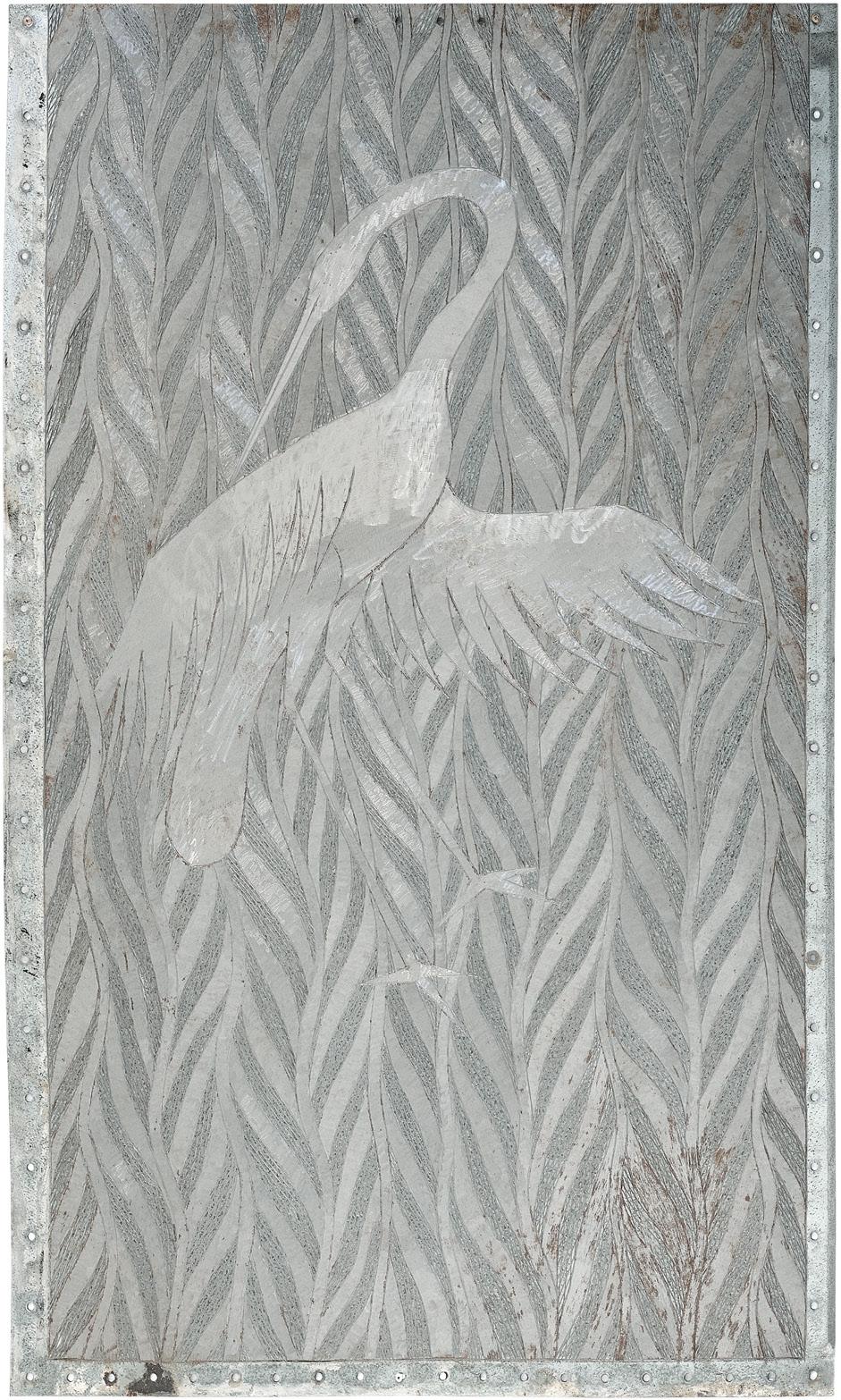
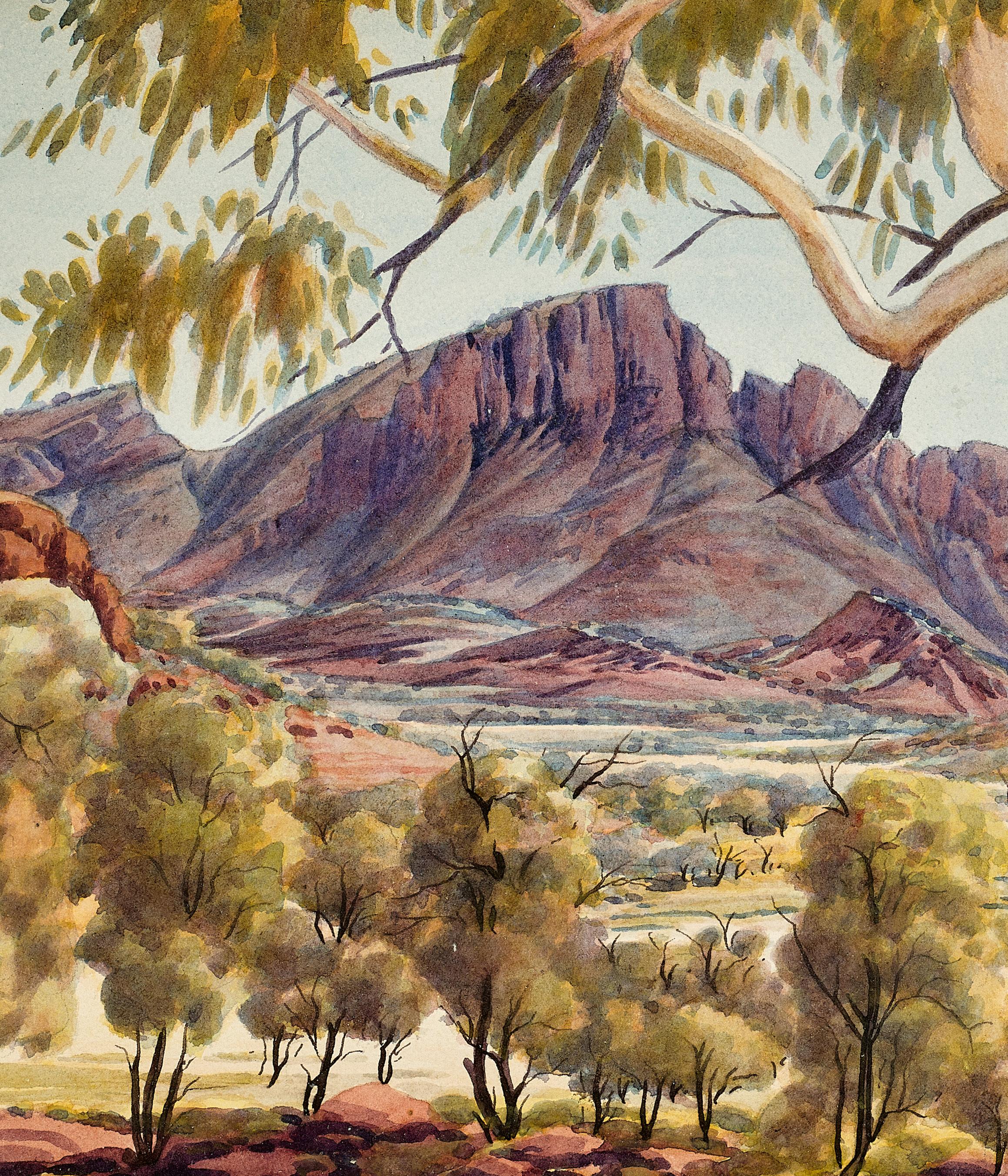
Lots 53 – 57
‘…Many years ago, an Aboriginal man from central Australia, Albert Nam atjira, became very famous as a painter. Using Western watercolour techniques he painted many landscapes. But what non-aboriginal people didn’t understand, or chose not to understand, was that he was painting his country, the land of the Arrernte people. He was demonstrating to the rest of the world the living title held by his people to the lands they had been on for thousands of years.’ 1
Although an accomplished craftsman producing poker work decorated woomeras, boomerangs and wooden plaques, it was not until viewing an exhibition of watercolours by Victorian artists Rex Battarbee and John Gardner at the Hermannsburg Mission in 1934, that Albert Namatjira truly embarked upon painting as a profession. Immediately captivated by the medium, he pleaded to be taught watercolour techniques and eventually Battarbee agreed to Namatjira accompanying him on two month-long expeditions in 1936 through the Palm Valley and MacDonnell Range areas. And thus began the cultural exchange that was to become a defining feature of their long relationship; Battarbee instructing Namatjira about the Western technique of watercolour painting, and in turn, Namatjira imparting his sacred knowledge about the subjects they were to paint, namely the land of the Western Arrente people, his ‘Dreaming’ place. So impressive was Namatjira’s skill that Battarbee remarked after only a brief period, ‘I felt he had done so well that he had no more to learn from me about colour.’ 2 Success and recognition soon followed and Namatjira was launched into the spotlight as a cultural ‘icon’ – internationally acclaimed and admired for his innovative, vibrantly coloured desert landscapes that encouraged ‘new ways of seeing the Centre.’
If today synonymous with our vision of the Australian outback, Namatjira’s art nevertheless suffered various vicissitudes over the course of the last century. Although his first solo exhibition in 1938 at the Fine Arts Society in Melbourne was a sell-out success, with popularity and fame continuing throughout his lifetime, praise for Namatjira’s skilful adaptation of a Western medium was inevitably
Opposite:
Lot 53
Albert Namatjira (1902 – 1959)
Mount Gillen, MacDonnell Ranges, 1956 (detail)
accompanied by a bitter twist; his paintings ‘…were appreciated because of their aesthetic appeal, but they were at the same time a curiosity and sign that Aborigines could be civilised.’ 3 Ironically such perceived ‘assimilation’ would later bring his art into disrepute with Namatjira virtually ignored by the Australian art establishment during the 1960s and 70s. Fortunately, the Papunya Tula Aboriginal art ‘renaissance’ and cultural politics of reconciliation during the 80s prompted long overdue reassessment of Namatjira’s unique contribution, and more recently, he has received the recognition he so deserves with three biographies published, and three major exhibitions mounted by public galleries, including a retrospective at the National Gallery of Australia in 2002 to celebrate the centenary of his birth, Seeing the Centre: The Art of Albert Namatjira 1902 – 1959
Capturing the landscape west of Alice Springs – and specifically, his favoured western Arrernte sites of the MacDonnell Ranges (Tjoritja) and Glen Helen Gorge (Yapalpe) – indeed the following five lots offer superb examples of Namatjira’s achievements in their brilliantly-coloured palette and distinctive, Westernstyle topographical format. Beyond their striking aesthetic appeal however, such works also resonate with important personal symbolism as statements of belonging – coded expressions embodying the memory and sacred knowledge of a traditional ancestral site, Namatjira’s ‘dreaming’ or totem place. As such, they encapsulate the unique vision that has subsequently inspired generations of Indigenous and nonIndigenous people alike across Australia – ‘Albert’s Gift’ which was more far-reaching than simply the tangible legacy of his art, ‘…more than the sum parts of watercolour paints on paper.’
As Brenda Croft elucidates, ‘It is an essence that resides in the strength of Namatjira’s work – his courage, his sorrow, his spirituality – in these days of ‘reconciliation’, but most of all, in the spiritual heritage of every indigenous person in Australia.’4
1. Galarrwuy Yunupingu cited in ‘The black/white conflict’ in Caruana, W. (ed.), Windows on the Dreaming, Australian National Gallery, Canberra, Ellsyd Press, Sydney, 1989, p. 14
2. Morphy, H., Aboriginal Art, Phaidon Press, London, 1998, p. 268
3. ibid., p. 270
4. Croft, B., ‘Albert’s Gift’ in French, A., Seeing the Centre: The Art of Albert Namatjira, 1902 – 1959, National Gallery of Australia, Canberra, 2002, p. 148
Veronica Angelatos
watercolour on paper on card
28.0 x 39.5 cm
signed lower right: ALBERT NAMATJIRA
bears inscription on old label verso: Mount Gillan [sic] – MacDonnell Range [sic], “Central Australia” / Original watercolour, by Albert Namatjira (Aranta [sic] Tribe) / Painted for Pearl Stephens, Oct 21st to Oct 28th 1956. / near Albert Namatjira Camp – consisting of a / shelter made of boughs of gums–, his wife, / sons, grandchildren shared the camp.
Estimate: $30,000 – 40,000
Provenance
Pearl Stephens, Western Australia, acquired directly from the artist in 1956
Thence by descent
Private collection, Sydney
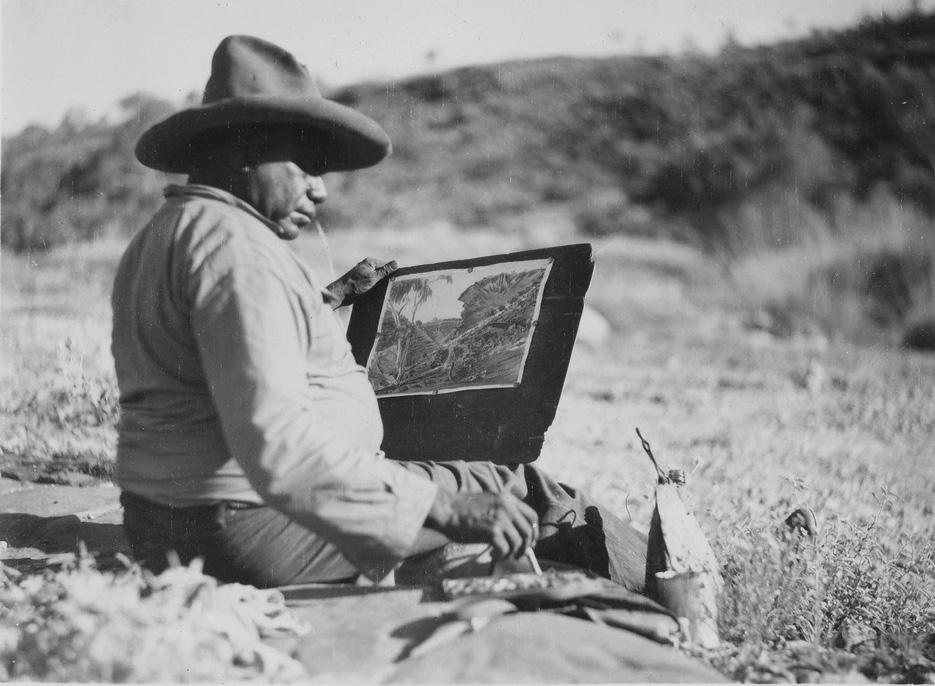
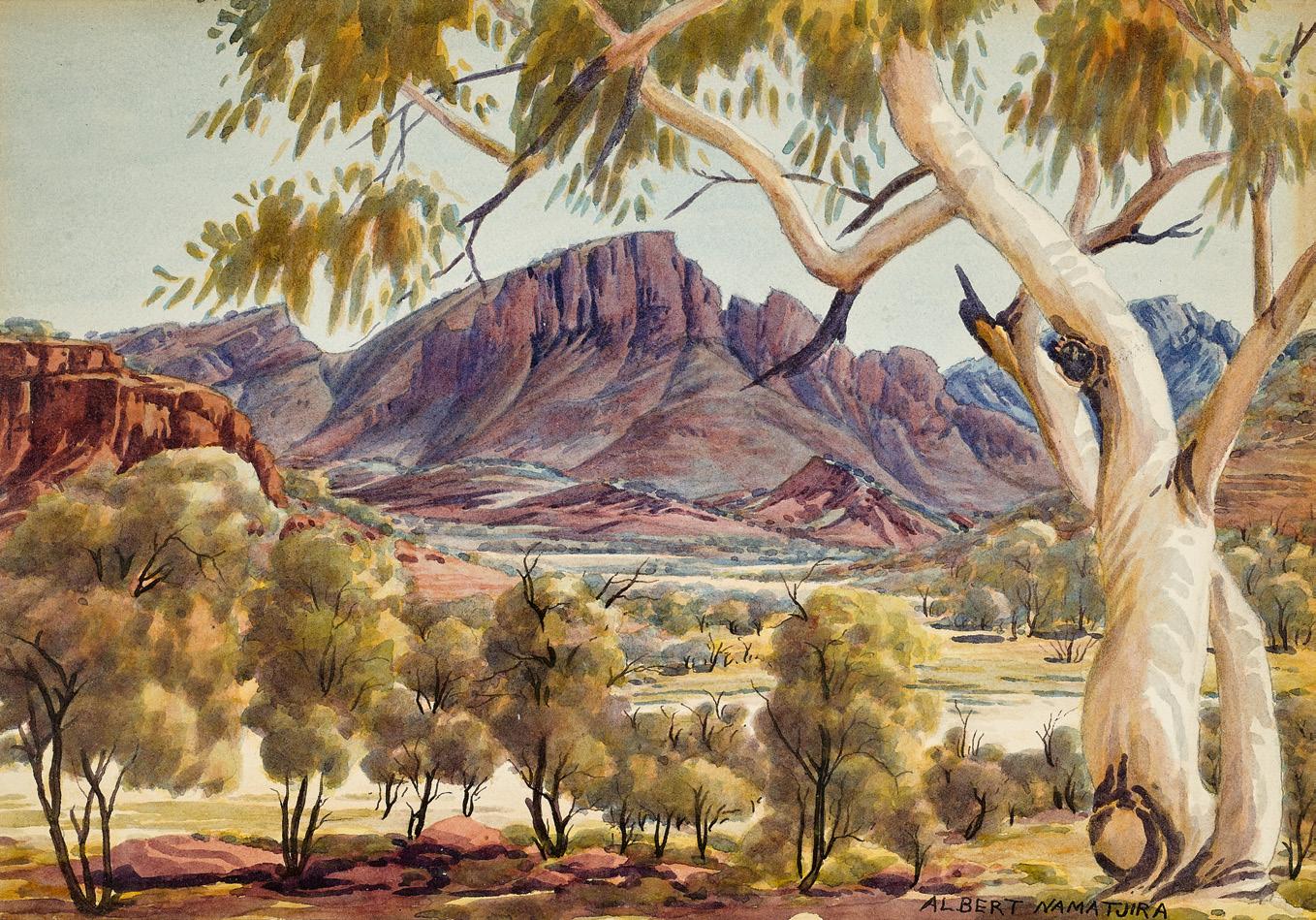
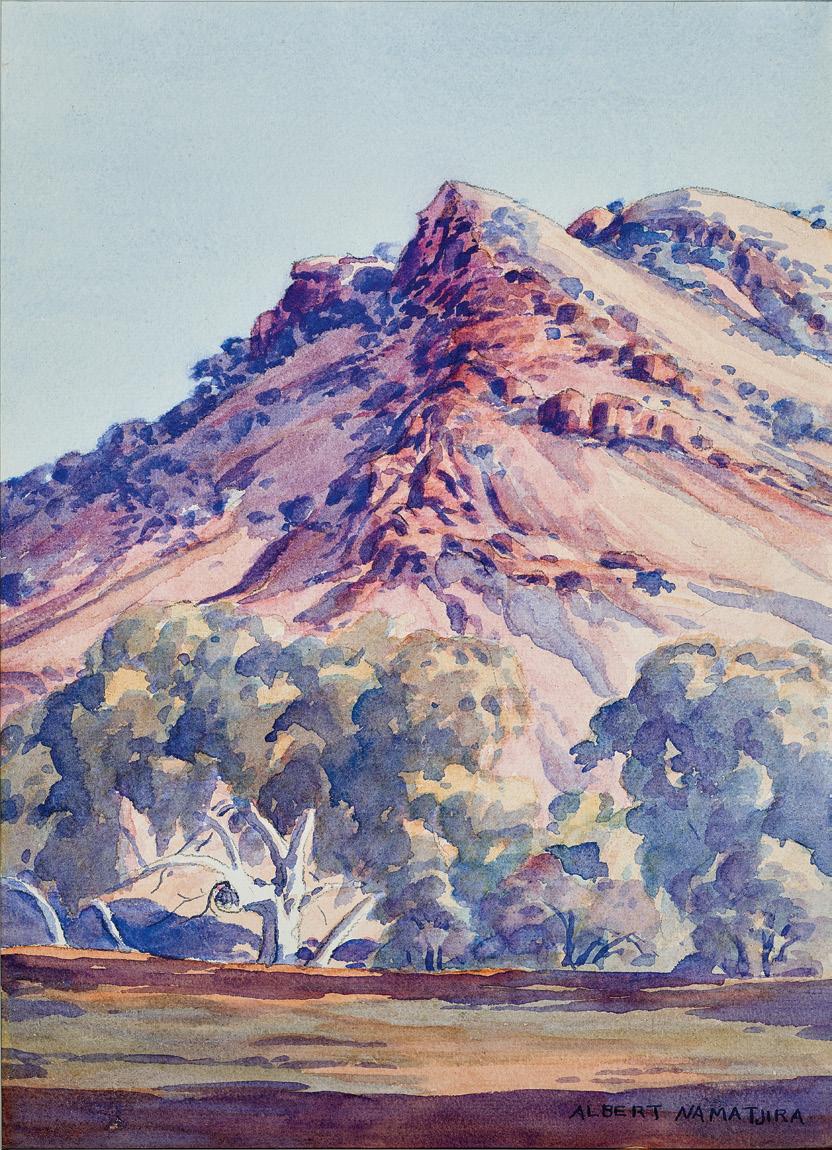
watercolour on paper
36.5 x 27.0 cm (image)
38.0 x 28.0 cm (sheet)
signed lower right: ALBERT NAMATJIRA
Estimate: $30,000 – 40,000
Private collection
Christies, Melbourne, 26 November 1996, lot 6
Private collection
Christies, Sydney, 28 August 2001, lot 363
Private collection
Sotheby's, Melbourne, 26 November 2002, lot 76 (as 'Central Australian Landscape')
Private collection, New South Wales
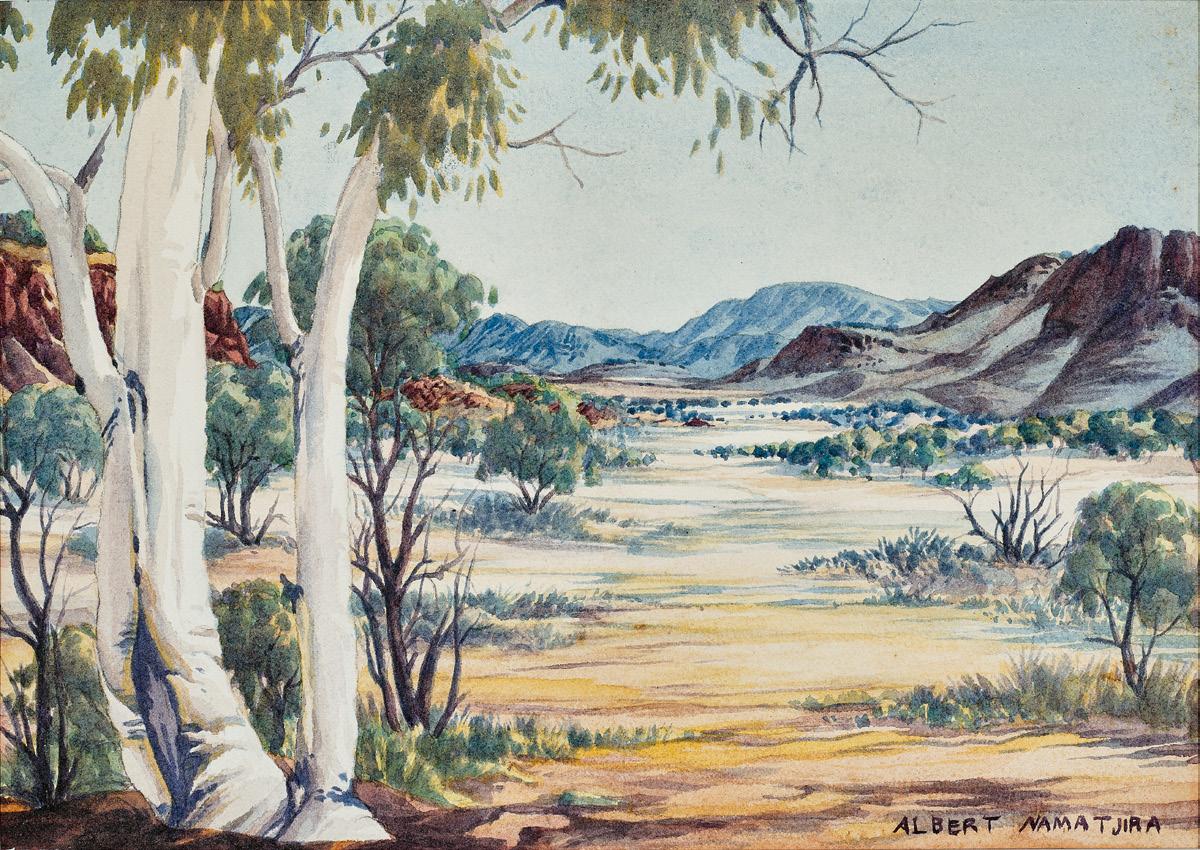
Albert Namatjira (1902 – 1959)
Glen Helen, MacDonnell Ranges, c.1944
watercolour on paper on card
26.5 x 37.5 cm (image)
27.5 x 38.0 cm (sheet)
signed lower right: ALBERT NAMATJIRA
bears inscription verso: ALBERT NAMATJIRA / “GLEN HELEN”
MACDONNELL RANGES C.A
Estimate: $25,000 – 35,000
Provenance
Private collection, Tasmania, acquired directly from the artist Thence by descent
Private collection, Tasmania
Private collection, New South Wales, acquired from the above c.2002
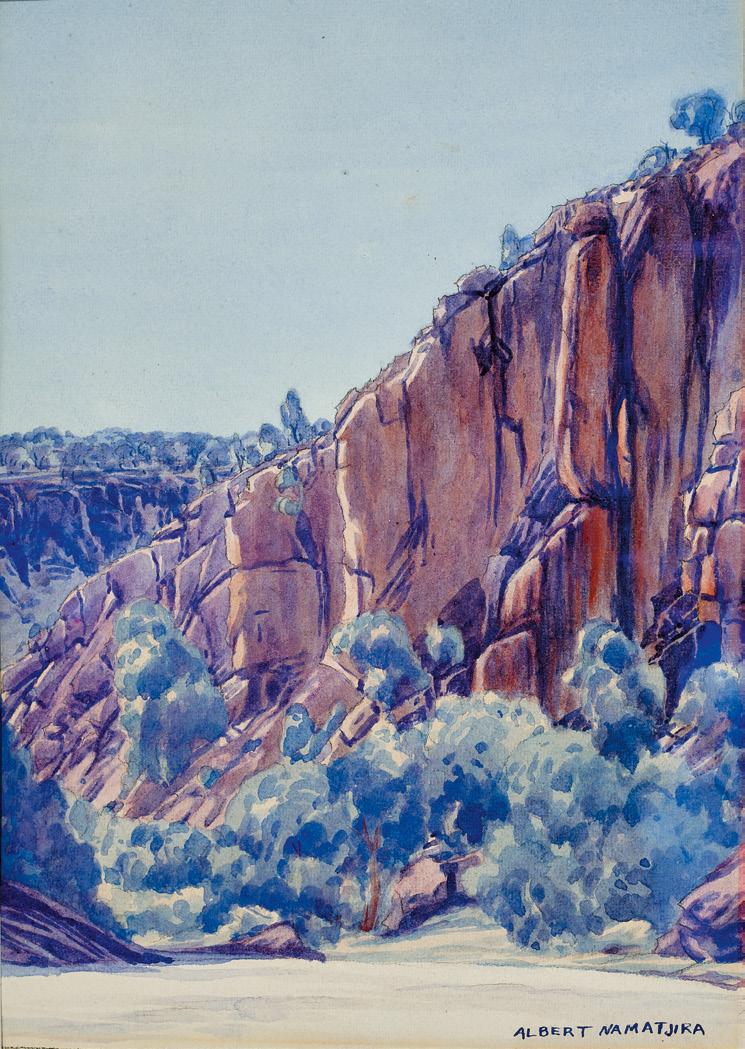
Albert Namatjira (1902 – 1959)
Glen Helen Gorge (two man), c.1944
watercolour on paper
37.0 x 26.0 cm (image)
39.0 x 28.5 cm (sheet)
signed lower right: ALBERT NAMATJIRA
signed and inscribed with title verso: Glen Helen Gorge (Two Man) / Albert Namatjira
bears inscription in margin lower left: 1 bears inscription on typed label verso: GLEN HELEN GORGE (TWO MAN) / ALBERT NAMATJIRA
Estimate: $25,000 – 35,000
Boronia Art Gallery, Sydney
Private collection, New South Wales, acquired from the above c.2004
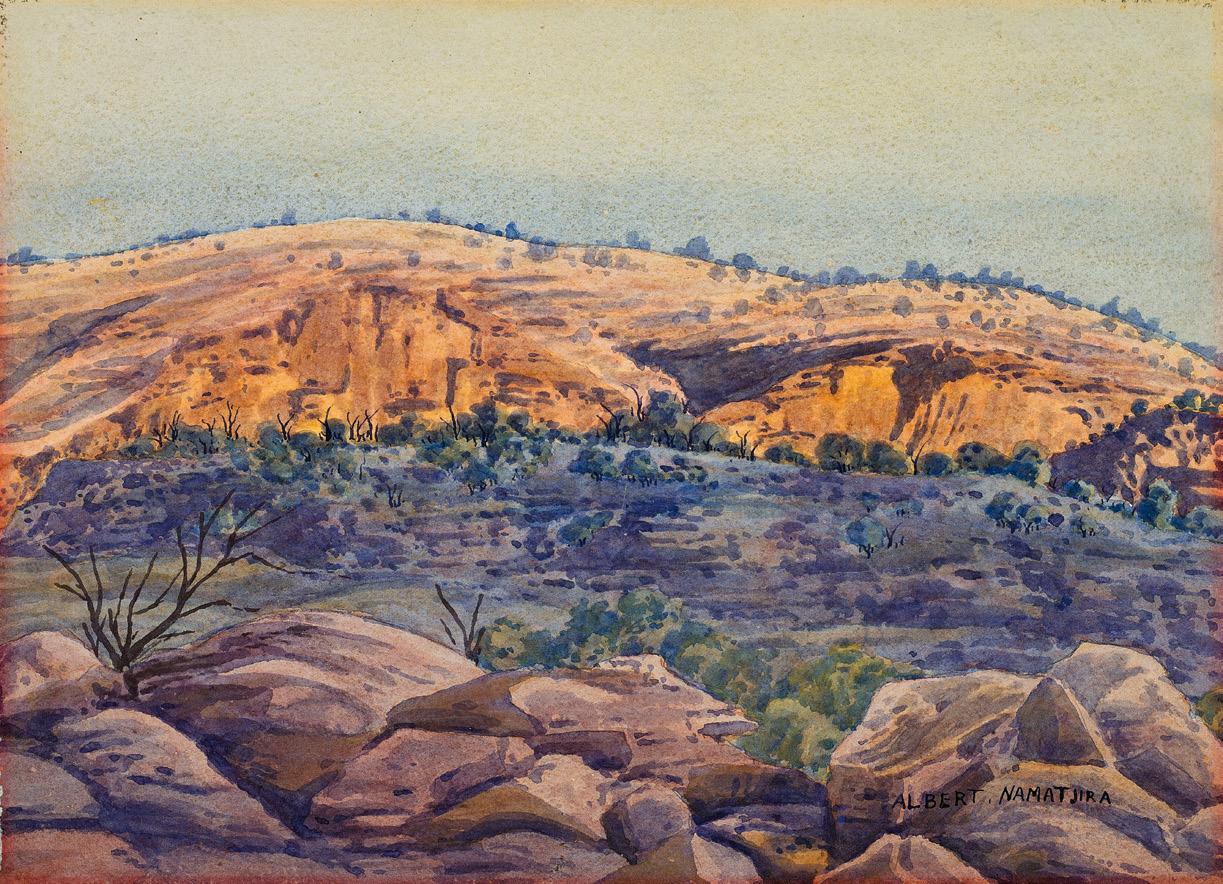
Albert Namatjira (1902 – 1959)
Central Australian landscape
watercolour on paper on card
28.5 x 39.0 cm (sheet)
signed lower right: ALBERT NAMATJIRA
Estimate: $20,000 – 30,000
Provenance
Boronia Art Gallery, Sydney
Private collection, New South Wales, acquired from the above c.2007
synthetic polymer paint on canvas
101.0 x 148.0 cm
bears inscription verso: artist’s name, date, size and Ernabella Arts cat. 20–14
Estimate: $20,000 – 30,000
Provenance
Ernabella Arts, Ernabella, South Australia
SALON Art Projects, Darwin Private collection, Melbourne, acquired from the above in 2014
Exhibited
SALON des Refusés, SALON Art Projects, Stokes Hill Warf, Darwin, 9 – 24 August 2014, cat. SAL14 (illus. in exhibition catalogue, p. 16)
I paint my father's country, Ilpili, west of Mt Liebig, east of Kintore. A site beside the road heading towards Kintore. There are huge sandhills and two claypans.
There is a creek, Wanampi tjara, guarded by a rainbow serpent. The Wanampi, rainbow serpent, is chasing a trouble maker, cutting a track through the sandhills.
The Wanampi is looking for that man. He did the wrong thing and he is running into sand hill country. The Wanampi made that road and he brought the water with him. There was no water here before, but it is still there now. Little bit to the east are the Kungka Kutjara, the Two Women Tjukurpa. They are sitting and talking. Wati Nyiru, the man, is a big rock on the hill looking down at them. The women were cleaning out the soak, digging to find water. They made the rockhole there.
I was born in Haasts Bluff. I went to see my father's country when I was a young man, my hair was still black.1
1. Exhibition text from the artist and SALON Art Projects, 2014, p. 17
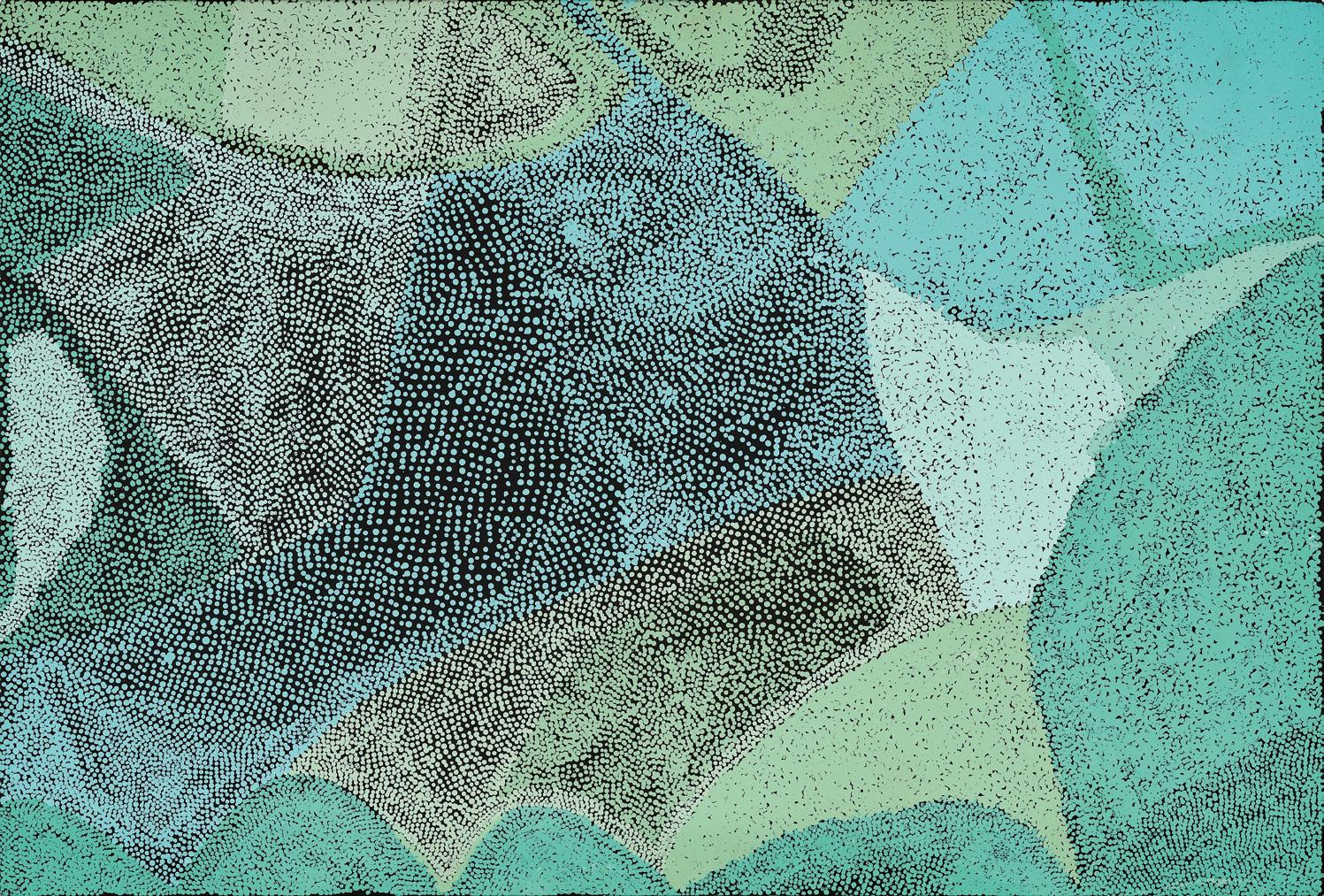
Warlawoon Country, 2006
natural earth pigment with synthetic binder on linen
180.0 x 149.5 cm
Estimate: $15,000 – 20,000
Provenance
Jirrawun Arts, Wyndham, Western Australia Private collection, Melbourne, acquired from the above in 2007
Text supplied from Ken Watson (co-ordinator) at Jirrawun Arts to the vendor at the time of purchase in 2007:
During 2004 – 05 Rammey Ramsey completed a large body of work relating to the flat country in the area near Elgee Cliffs south of Bedford Downs. This area has the same Gija name as the artist, Warlawoon. It was always his family’s country. Both parents belonged there. They used to muster cattle there for the now abandoned Elgee Cliffs Station. The artist spent a lifetime working as a stockman and was a talented horseman. He remembers galloping over the land chasing cattle there.
Ramsey lives most of the time with his family at Bow River Station. He comes to the Jirrawun studio several times a year for periods of three to six weeks. He watched Paddy Bedford working with ‘wet on wet’ paint on his canvases and said to Artistic Director Tony Oliver “I want to paint that ngarranggarni (dream time) way like that’. Also while painting he talked with Tony Oliver about the country, about the dust, the wind, the clouds, the smoke, living, mustering cattle, the water holes. Ramsey developed the painting style seen in these works through experimentation with the paint and through these conversations about the country and his feeling for the country.
Ramsey spoke about the Warlawoon Country paintings.
‘This is my country that I painted here. When the strong wind comes blowing from the east it throws dust everywhere. The dust floats when the wind blows from the east. They used to walk along in the hot sun long ago. When they had been walking in the hot sun, never mind, they would bathe in the water and start off again in the cool time of the day.
It is a place for the rainbow snake, the dangerous one. In olden days just anyone could not go there.
In early days if strange people went there the people who belonged there had to perform a welcoming ceremony, putting water from the country on them (the strangers). Lots of people would come to dance Joonba style song and dance. Then they would split up and leave. Those two (my parents) used to go around there. They lived there.’
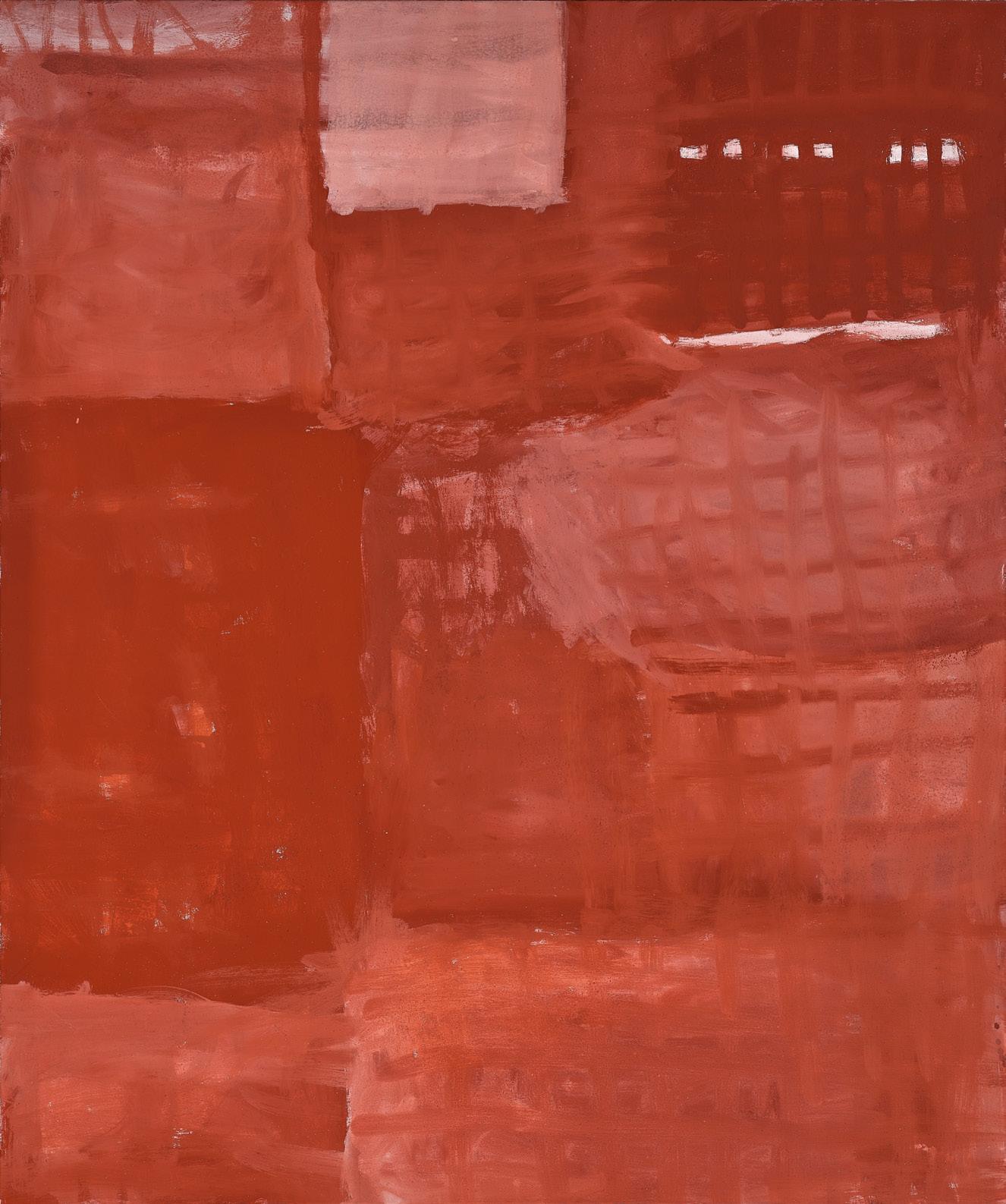
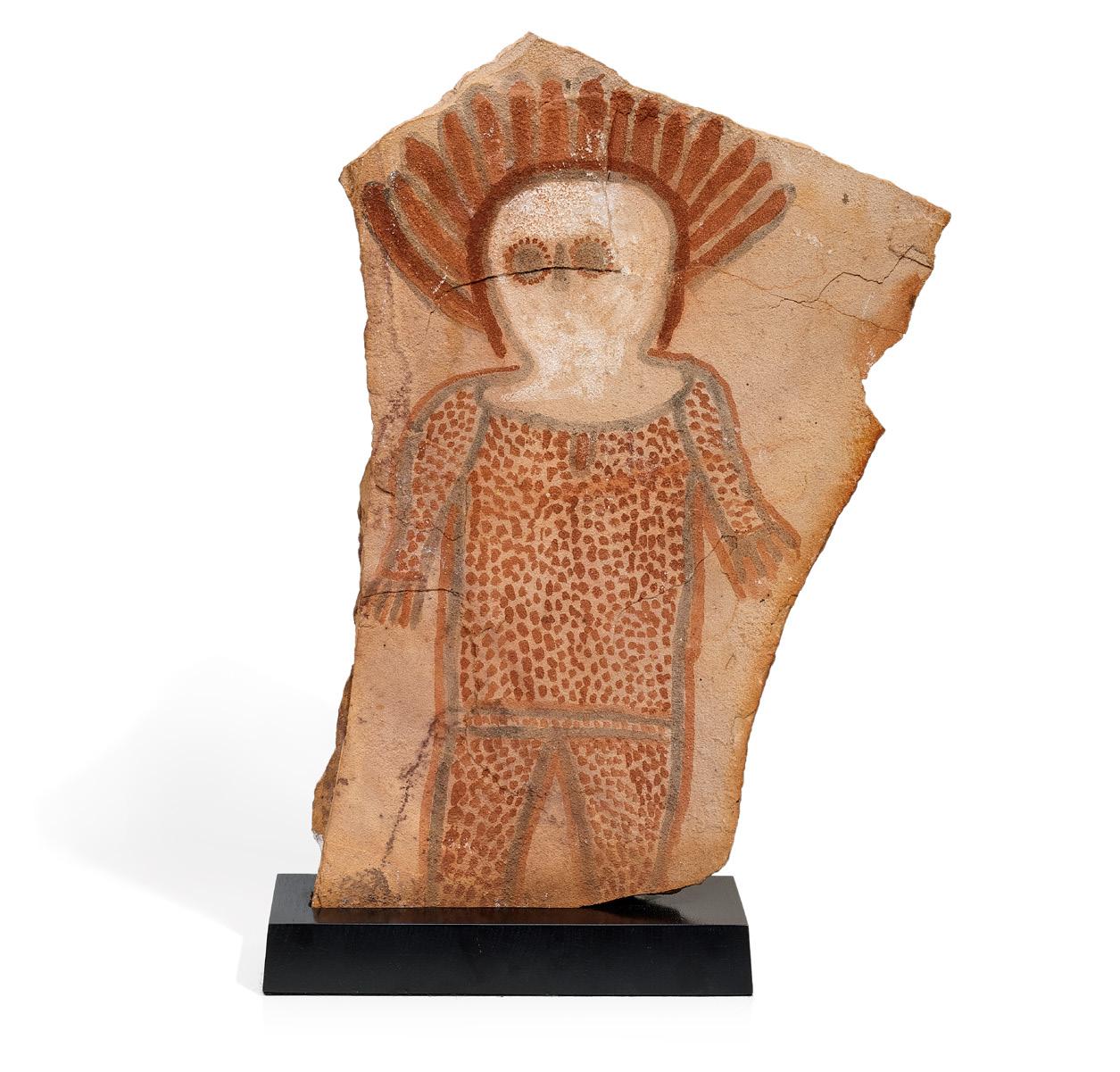
Wattie Karrawara (c.1910 – 1983)
Wandjina Kalerungari, 1975
natural earth pigments on sandstone
50.0 x 35.0 cm (irregular)
Estimate: $12,000 – 16,000
Provenance
Painted at Mowanjum, Kimberley Region, Western Australia in April 1975
Lord Alistair McAlpine of West Green, UK
Private collection, Broome
Private collection, Brisbane
Sotheby’s, Sydney, 31 October 2006, lot 63
Private collection, Melbourne
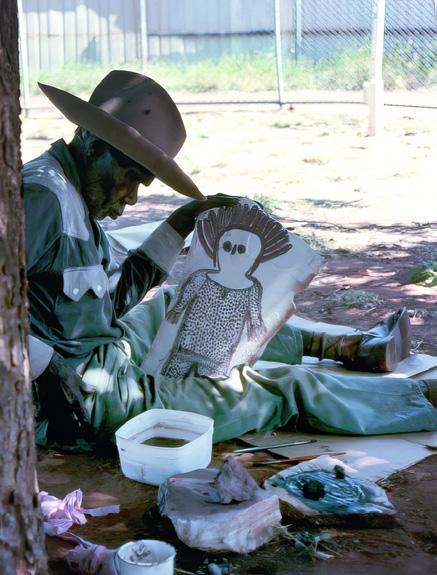
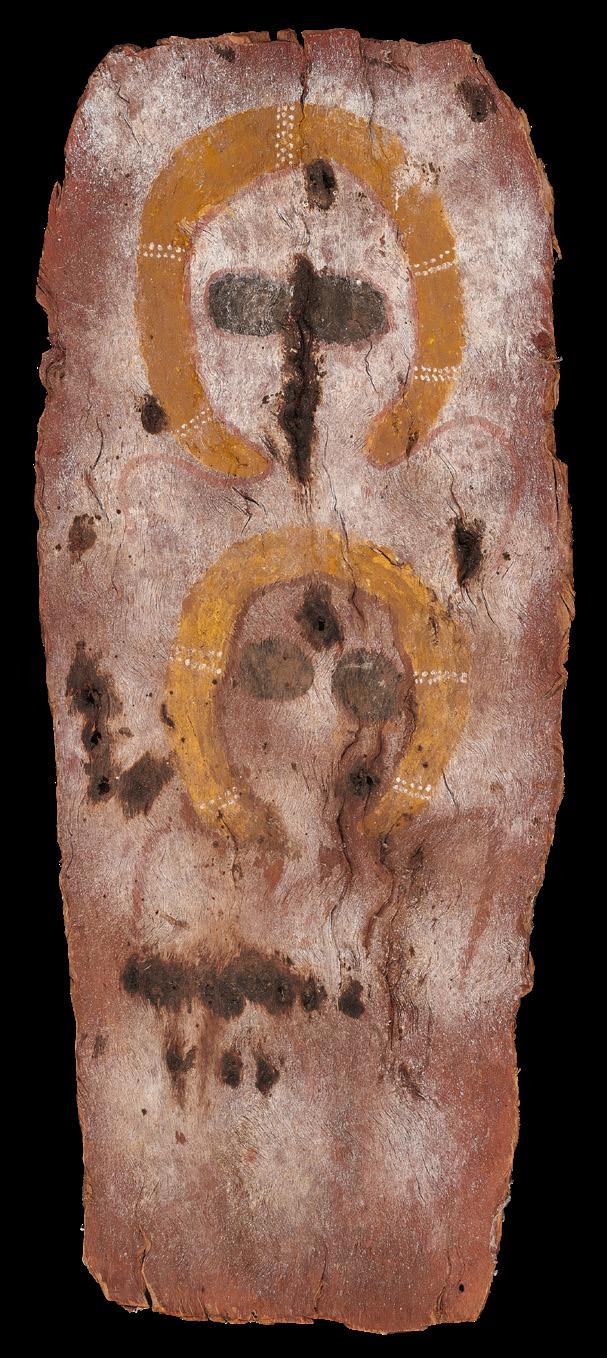
natural earth pigments on eucalyptus bark
92.0 x 40.0 cm (irregular)
Estimate: $12,000 – 18,000
Provenance
Painted at Mowanjum, Western Australia
Kim Akerman, Hobart
Mary Macha, Perth
The Thomas Vroom Collection, The Netherlands
Sotheby’s, London, 10 June 2015, lot 53
Private collection, Melbourne
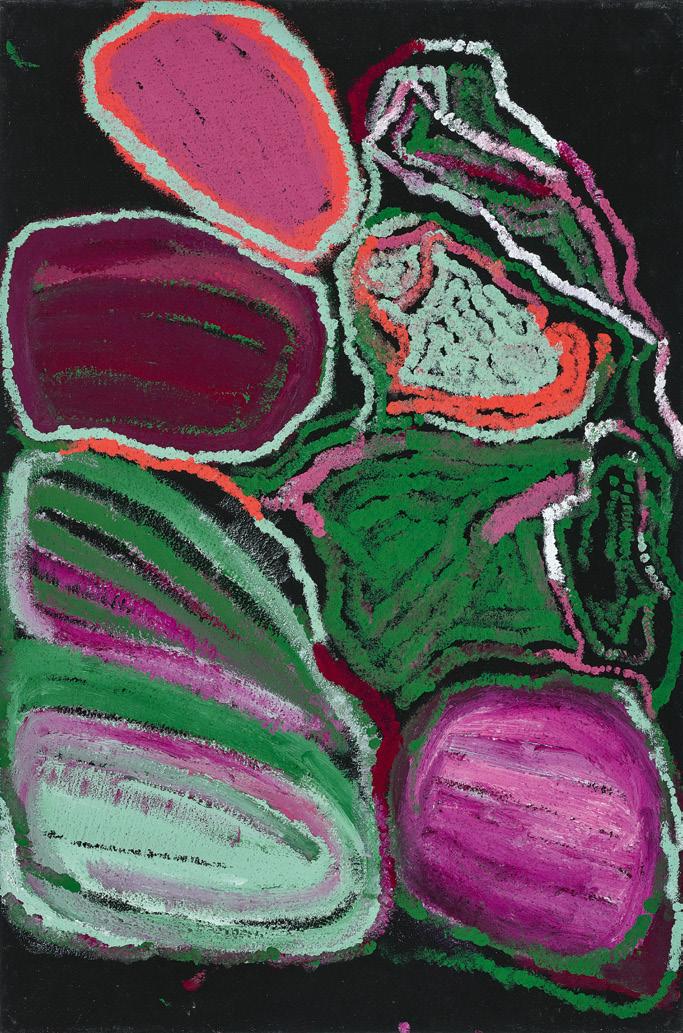
(c.1930 – 2015)
natural earth pigments and synthetic polymer paint on linen
89.0 x 59.0 cm
bears inscription verso: artist’s name, date, medium, size and Short Street Gallery cat. 23559
Estimate: $5,000 – 7,000
Short Street Gallery, Broome, Western Australia
Chapman Gallery, Canberra
The Alan Boxer Collection, Canberra, acquired from the above in November 2007
Mossgreen, Melbourne, 17 March 2015, lot 1
Private collection, Melbourne
New Paintings from Bidyadanga, Chapman Gallery, Canberra, 2 – 25 November 2007, cat. 12
This work is accompanied by a certificate from Short Street Gallery which states:
‘”This place is the birth place of my father’s clan. Our clan is also named Kirriwirri, and call each individual members of this clan Kirriwirri. There is a a big warla (mud flat) at this place. This is what this painting is about.” Kirriwirri is in the Great Sandy Desert close to and west of Well 33 on the Canning Stock Route. It is the birth place of Jan and her family. This work shows tali (sand dunes) and jila (living water).’
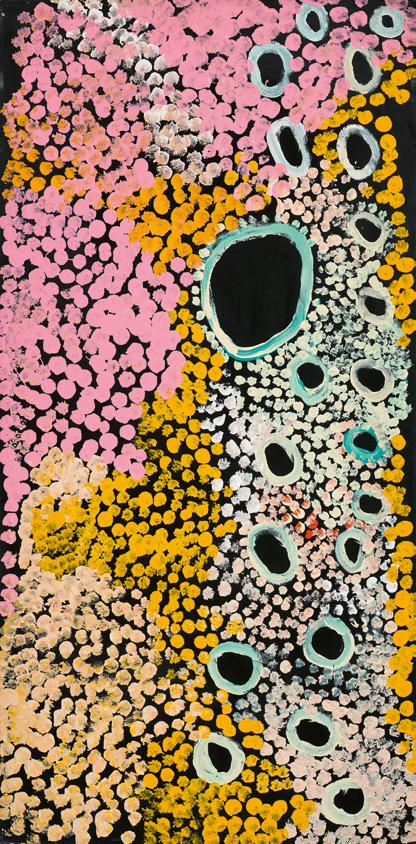
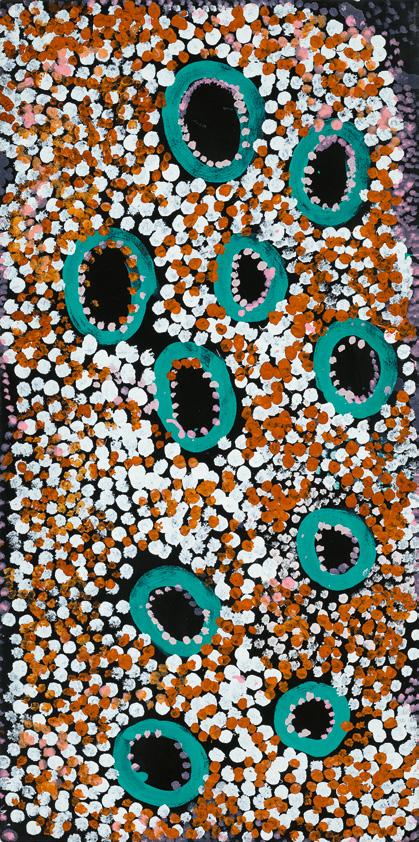
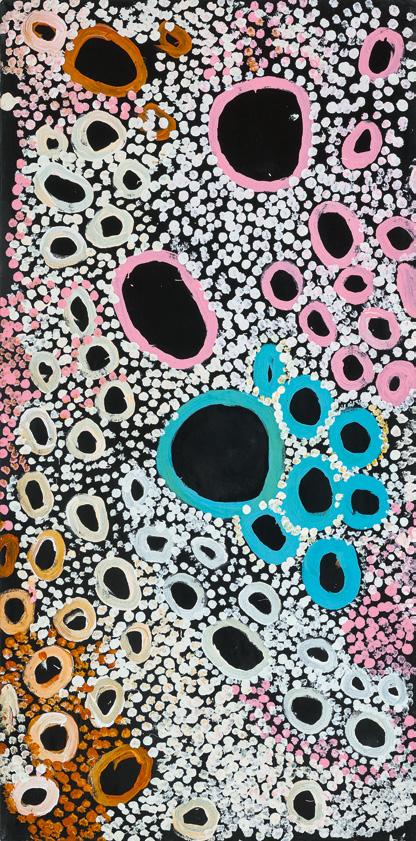
The seven sisters, 2009
synthetic polymer paint on canvas
122.0 x 61.0 cm (each)
122.0 x 183.0 (overall)
bears inscription verso: Papulankutja Artists cats. 09-1199, 09-1200 and 09-1201
Estimate: $6,000 – 8,000 (3)
Provenance
Papulankutja Artists, Western Australia
Chapman Gallery, Canberra
The Alan Boxer Collection, Canberra Mossgreen Auctions, Melbourne, 17 March 2015, lot 142
Private collection, Melbourne
This work is accompanied by copies of certificates from Papulankutja Artists which state:
‘This is a popular dreamtime story of seven ladies being chased through the desert by one man. There are numerous scenarios as these ladies travel around. Eventually they rise up into the sky and form the Peliades, a group of seven stars seen in the southern skies. There are many variations of this story.’
synthetic polymer paint on canvas 152.0 x 76.0 cm
bears inscription verso: artist’s name and Warakurna Artists cat. 700–10
Estimate: $10,000 – 15,000
Provenance
Warakurna Artists, Warakurna, Western Australia Aboriginal & Pacific Art, Sydney Private collection, Melbourne, acquired from the above in 2010
Exhibited
2010 Paintings from Warakurna and Wanarn, Aboriginal & Pacific Art, Sydney, in association with Warakurna Artists, Western Australia, 13 – 27 November 2010
This work is accompanied by a certificate of authenticity from Warakurna Artists which states:
‘Tommy Mitchell was born in the desert the Warakurna side of Papulankutja.
Tommy’s father’s country is called Nganturn. This painting depicts an important story from the area called Walu. There were two men and one little boy camping at the Walu rockhole.
The Uncles used to go out hunting and leave the little boy behind. He was a naughty boy! He used to sneak into the Owl people’s camps and steal their meat.
One day the families went to see the uncles. They said “your nephew has been stealing our meat!”. The Uncles asked the boy if this was true but he lied and said no, he didn’t steal the meat from the Owl people. The Uncles then got wild at the Owl people and a big tornado swept them away. They must have finished?
One day the men went hunting and left the little boy behind again. This time the men returned with an emu. They were cutting up the emu for dinner and the greedy little boy pulled out its heart. The boy was holding the heart and blood spilt onto the rocks. He ran away with the heart and turned into wind. The emu’s blood trail stained the rocks and can still be seen there today. Tommy explains, ‘this is a really sorry one, a really sorry story’.
Tommy’s talks about his early childhood experiences of travelling around tali country (sandhills) with his family, ‘We lived in the bush, there was no hospital and no clothes and we were naked and it was cold. I hunted marlu, rabbit, tirnka (small goanna) and pussycat, it was good meat. We also collected tjarnmarta (bush onions), maku (bardi grubs) and kampurarrpa (bush raisins)’.’
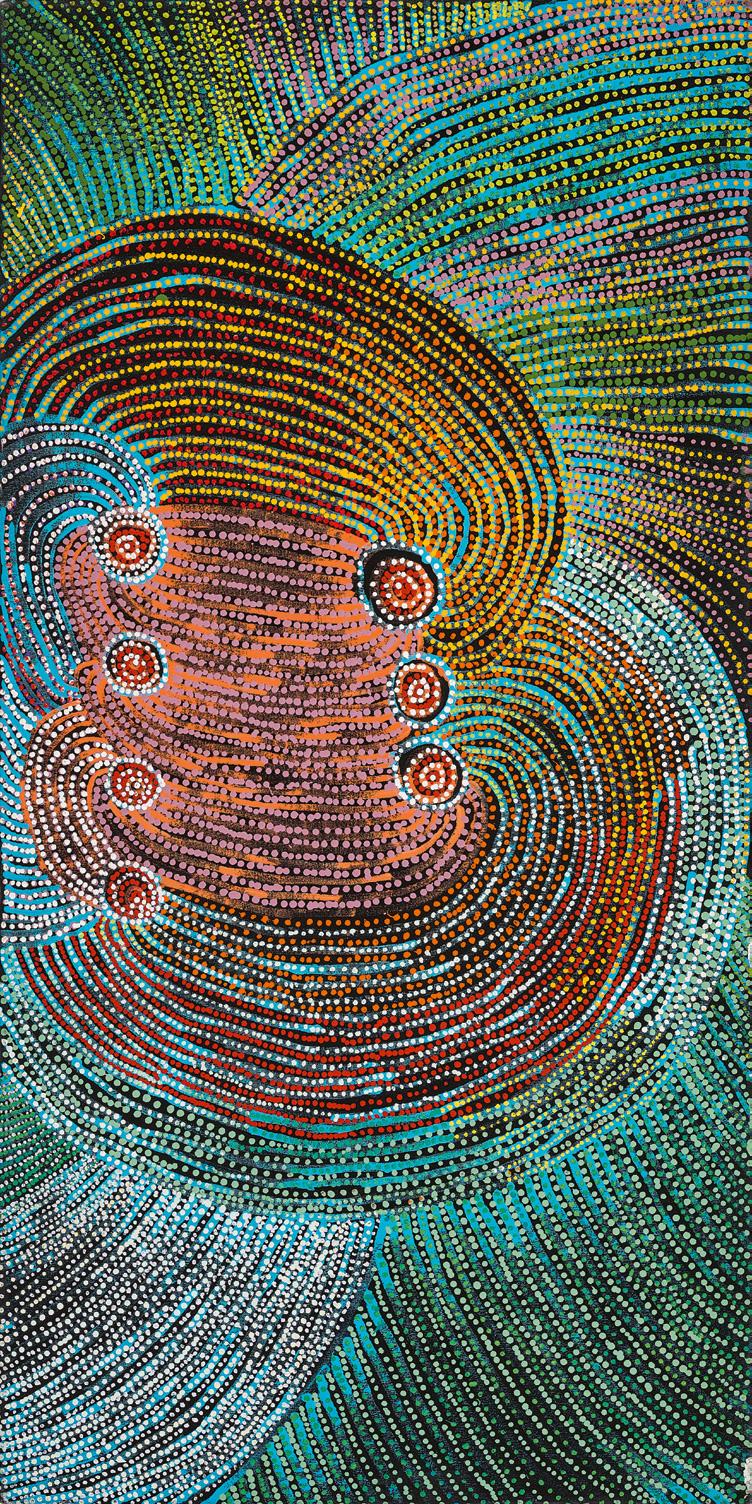
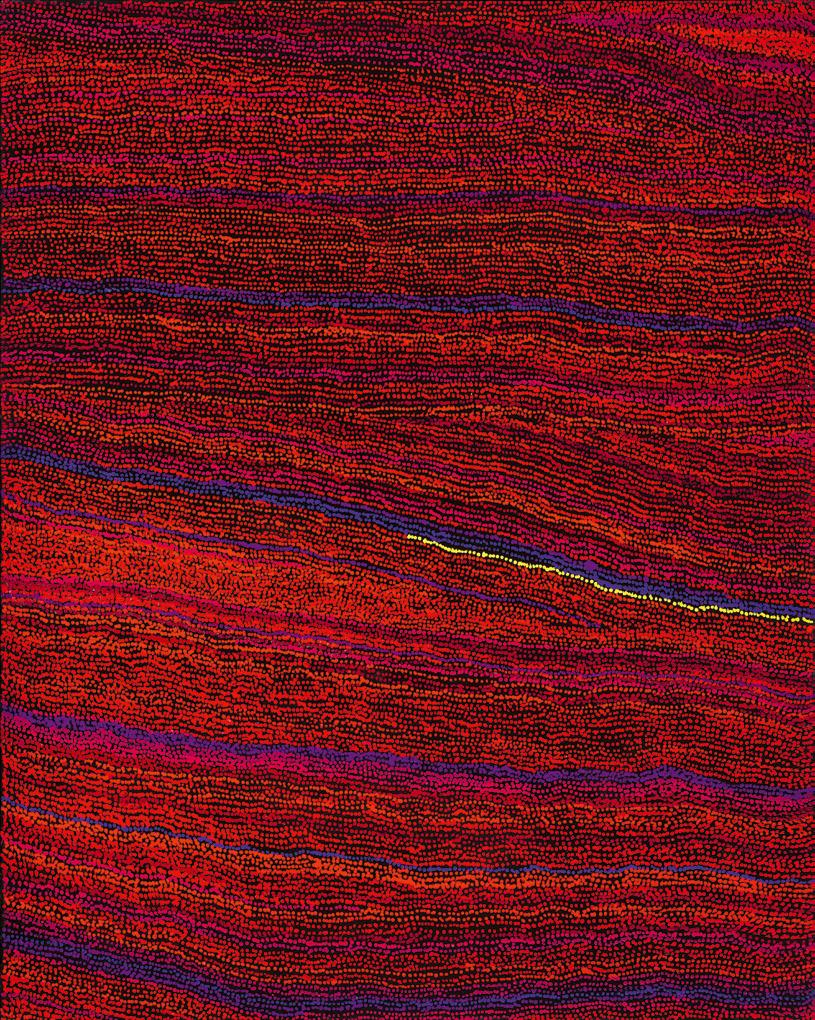
Kuta Ala, 2015
synthetic polymer paint on canvas
151.5 x 121.0 cm
bears inscription verso: artist’s name, size and Tjungu Palya cat. 15–088
Estimate: $8,000 – 12,000
Provenance
Tjungu Palya Artists, Nyapari, South Australia
Paul Johnstone Gallery, Melbourne
Private collection, Melbourne, acquired from the above in 2016
SALON des Refusés, SALON Art Projects, Stokes Hill Wharf, Darwin, 7 – 23 August 2015, cat. SDR–02 (illus. in exhibition catalogue, n.p.)
This work is accompanied by a copy of the certificate of authenticity from Tjungu Palya Artists which states:
‘Kata Ala Is my country near lrrunytju in Western Australia. Tjukurpa tjuta (there are many creation stories) which cross over close to this place. Mlnyma mutu mutu, nyii nyii tjuta (the creation story for all the small bird women, zebra finches) and the man wati Nyiiru (from the Seven Sister’s Tjukurpa) is close by and Wati Kutjara, the two serpent men from Pukara came here. At Kata Ala there are three places where we dig to find water just below the surface. I spent a lot of time In this country when I was a child.’
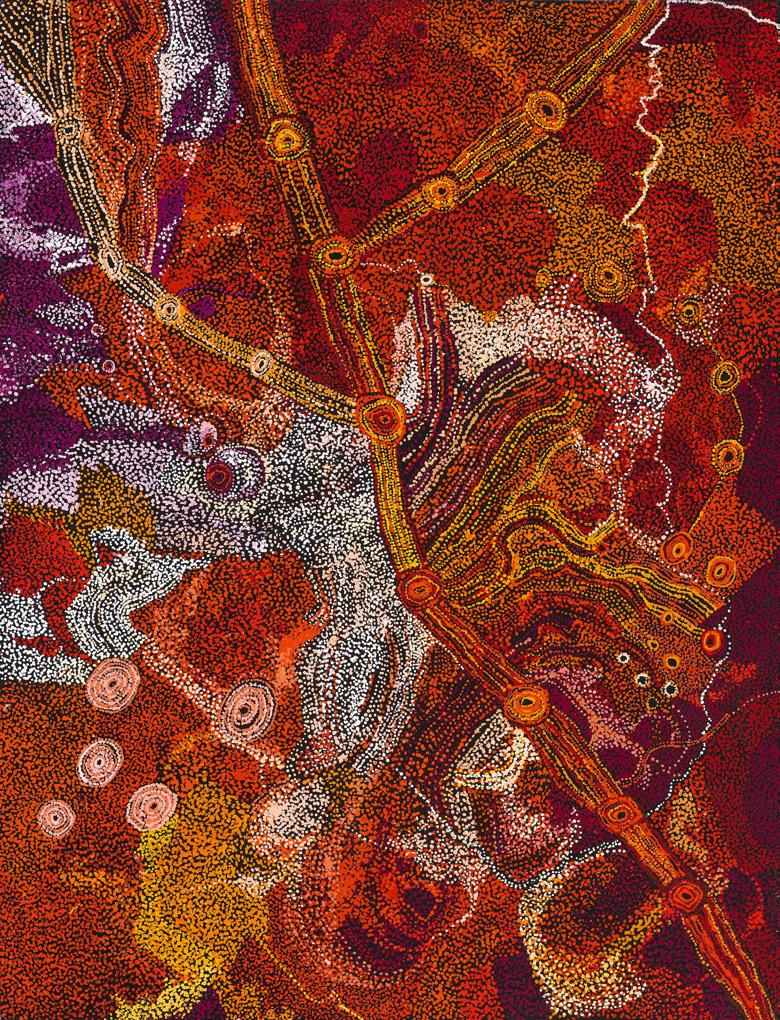
1965
synthetic polymer paint on Belgian linen 198.0 x 152.5 cm bears inscription verso: artist’s name and Tjala Arts cat. 463–16
Estimate: $8,000 – 12,000
Provenance
Tjala Arts, Amata, South Australia Private collection, Sydney
This work is accompanied by a copy of the certificate of authenticity from Tjala Arts which states:
‘Sylvia has depicted the Seven Sisters Story. This is a Tjukurpa Story (Creation Story) about the constellations of Pleiades and Orion. The sisters are the constellation of Pleiades and the other star Orion is
said to be Nyiru or Nyirunya (described as a lusty or bad man). Nyiru is forever chasing the sisters known as the Kunkarunkara women as it is said he wants to marry the eldest sister. The seven sisters travel again and again from the sky to the earth to escape Nyiru’s unwanted attentions. They turn into their human form to escape from the persistent Nyiru, but he always finds them and they flee back to the sky. As Nyiru is chasing the sisters he tries to catch them by using magic to turn into the most tempting kampurarpra (bush tomatoes) for the sisters to eat and the most beautiful Iii (fig) tree for them to camp under. However, the sisters are too clever for Nyiru and outwit him as they are knowledgeable about his magic. They go hungry and run through the night rather than be caught by Nyiru. Every now and again one of the women fall victim to his ways. It is said that he eventually captures the youngest sister, but with the help of the oldest sister, she escapes back to her sisters who are waiting for her. Eventually the sisters fly back into the sky to escape Nyiru, reforming the constellation. (In some cases the artist will secretly depict sexual elements as Nyiru is really only after one thing – sex).’
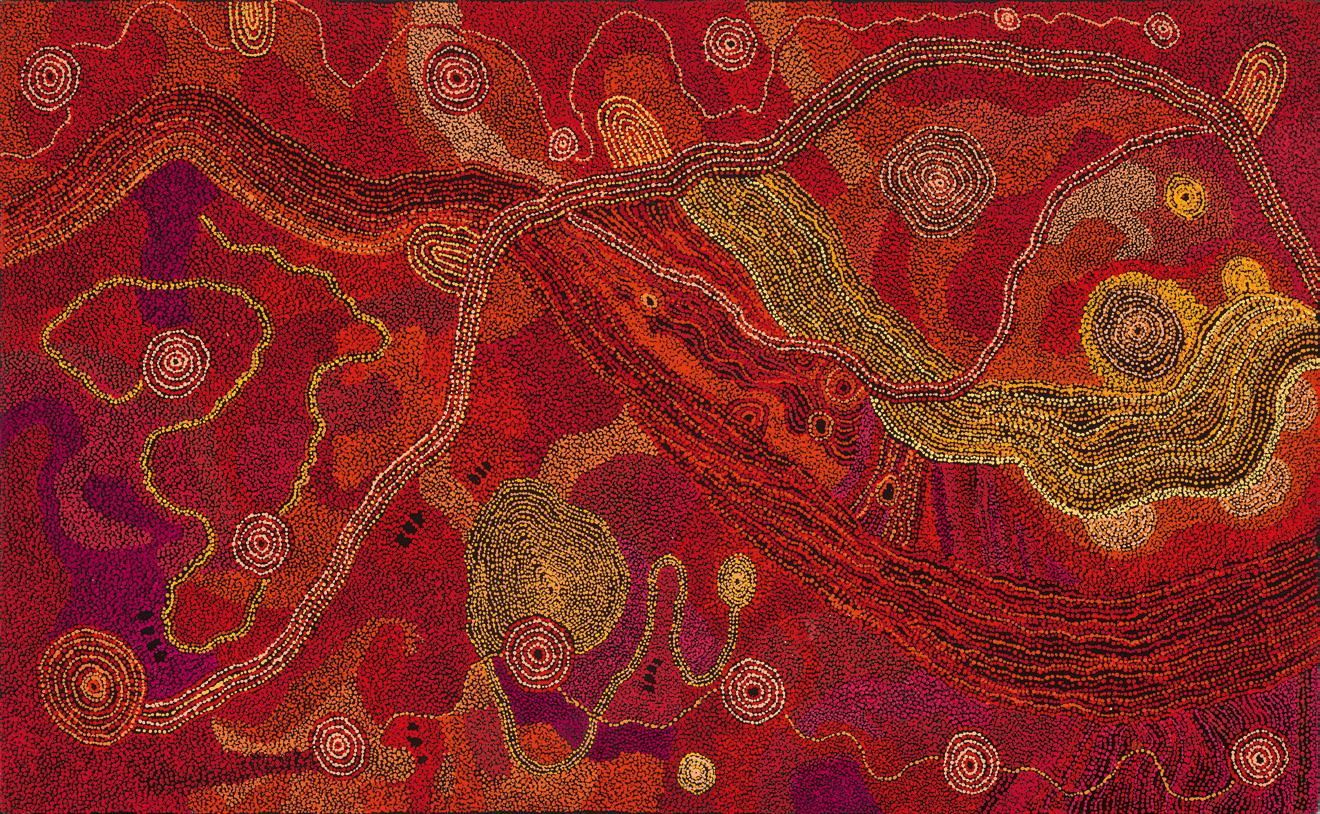
born 1969
synthetic polymer paint on linen
122.5 x 198.0 cm
bears inscription verso: artist’s name and Tjala Arts cat. 303–15
Estimate: $8,000 – 12,000
Provenance
Tjala Arts, Amata, South Australia
Outstation Gallery, Darwin
Private collection, Melbourne, acquired from the above in 2015
This work is accompanied by a certificate of authenticity from Tjala Arts which states:
‘Tjungkara Ken has depicted the Seven Sisters Story. This is a Tjukurpa Story (Creation Story) about the constellations of Pleiades and Orion. The sisters are the constellation of Pleiades and the other star Orion is said to be Nyiru or Nyirunya
(described as a lusty or bad man). Nyiru is forever chasing the sisters known as the Kunkarunkara women as it is said he wants to marry the eldest sister.The seven sisters travel again and again from the sky to the earth to escape Nyiru’s unwanted attentions. They turn into their human form to escape from the persistent Nyiru, but he always finds them and they flee back to the sky. As Nyiru is chasing the sisters he tries to catch them by using magic to turn into the most tempting kampurarpra (bush tomatoes) for the sisters to eat and the most beautiful Ili (fig) tree for them to camp under. However, the sisters are too clever for Nyiru and outwit him as they are knowledgeable about his magic. They go hungry and run through the night rather than be caught by Nyiru. Every now and again one of the women fall victim to his ways. It is said that he eventually captures the youngest sister, but with the help of the oldest sister, she escapes back to her sisters who are waiting for her. Eventually the sisters fly back into the sky to escape Nyiru, reforming the constellation. (In some cases the artist will secretly depict sexual elements as Nyiru is really only after one thing – sex).’
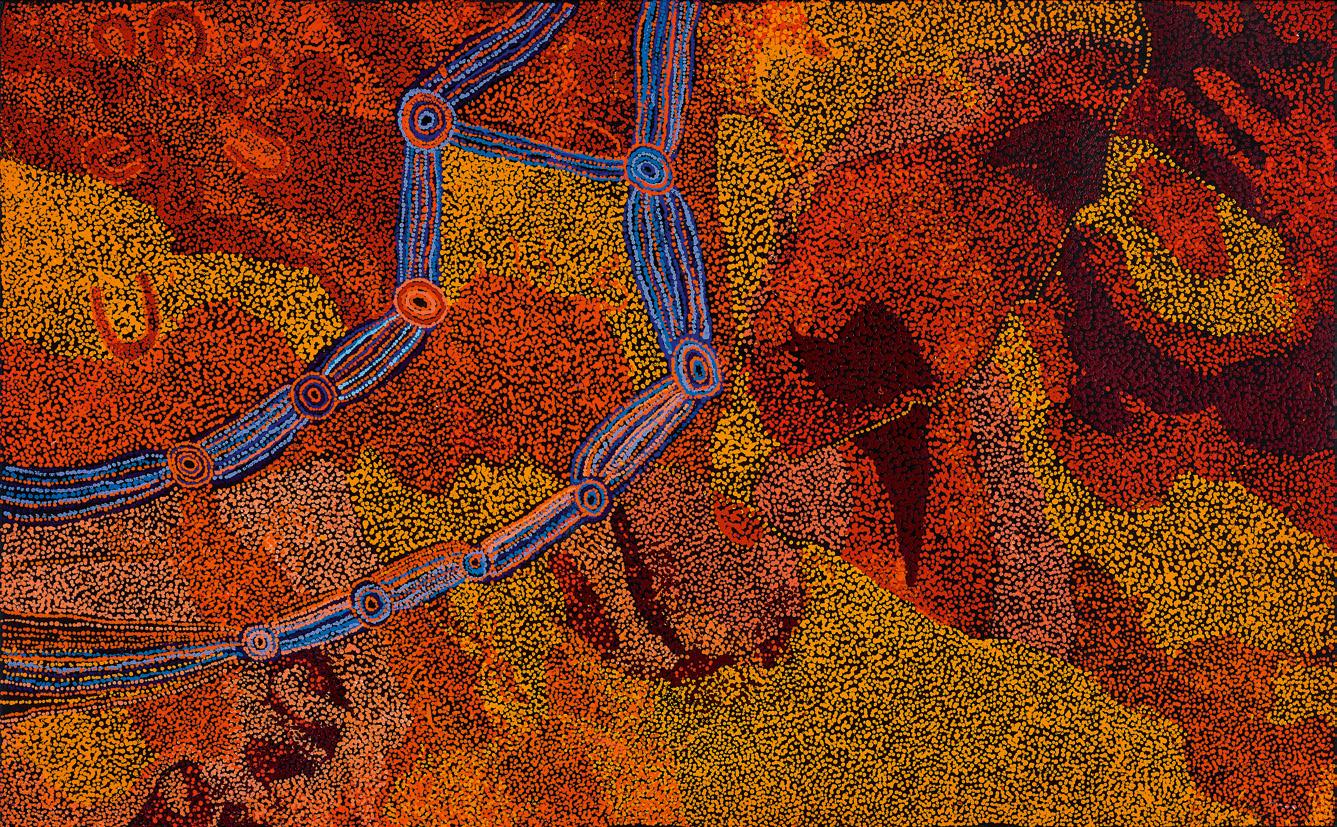
Seven sisters, 2010
synthetic polymer paint on Belgian linen 122.0 x 198.0 cm
bears inscription verso: artist's name and Tjala Arts cat. 594-10
Estimate: $8,000 – 12,000
Provenance
Tjala Arts, Amata, South Australia
Aboriginal and Pacific Art, Sydney Maclean collection, Melbourne, acquired from the above in June 2011
Deutscher and Hackett, Melbourne, 18 March 2020, lot 49
Private collection, Melbourne
Exhibited
Ngura wiru mulapa – Beautiful Country, Aboriginal and Pacific Art in association with Tjala Arts, Sydney, 28 May – 18 June 2011, cat. 9
This work is accompanied by a certificate of authenticity from Tjala Arts which states:
‘Sylvia has depicted the Seven Sisters Story. This is a Tjukurpa Story (Creation Story) about the constellations of Pleiades and Orion. The sisters are the constellation of Pleiades and the other star Orion is said to be Nyiru or Nyirunya (described as a lusty or bad man). Nyiru is forever chasing the sisters known as the Kunkarunkara women as it is said he wants to marry the eldest sister. The seven sisters travel again and again from the sky to the earth to escape Nyiru’s unwanted attentions. They turn into their human form to escape from the persistent Nyiru, but he always finds them and they flee back to the sky. As Nyiru is chasing the sisters he tries to catch them by using magic to turn into the most tempting kampurarpra (bush tomatoes) for the sisters to eat and the most beautiful Iii (fig) tree for them to camp under. However, the sisters are too clever for Nyiru and outwit him as they are knowledgeable about his magic. They go hungry and run through the night rather than be caught by Nyiru. Every now and again one of the women fall victim to his ways. It is said that he eventually captures the youngest sister, but with the help of the oldest sister, she escapes back to her sisters who are waiting for her. Eventually the sisters fly back into the sky to escape Nyiru, reforming the constellation. (In some cases the artist will secretly depict sexual elements as Nyiru is really only after one thing – sex).’
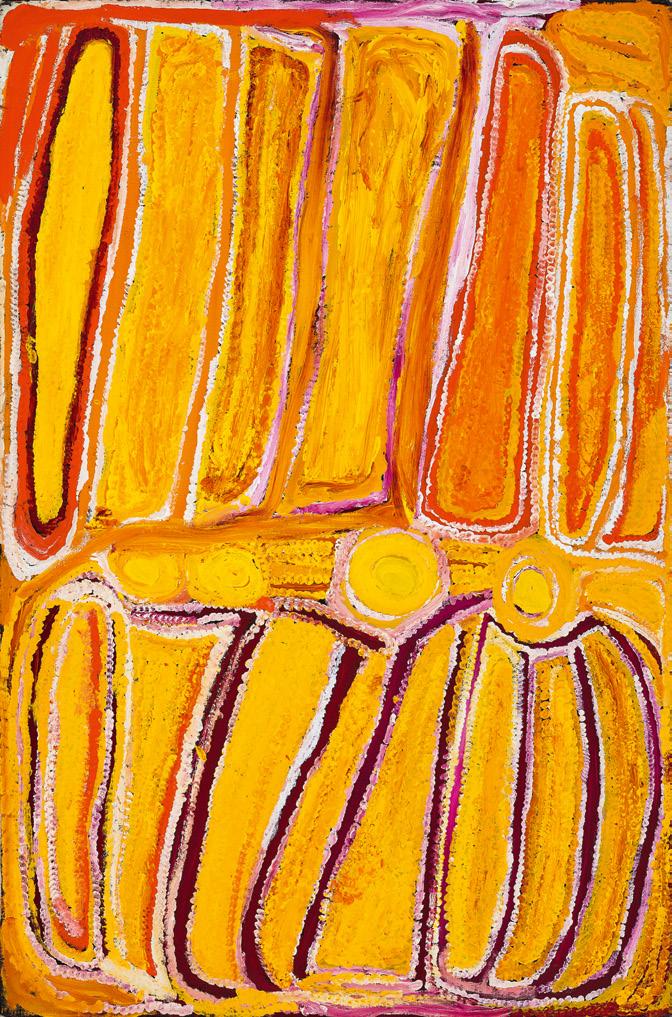
Inyaroo, 2001
synthetic polymer paint on canvas
120.0 x 80.0 cm
bears inscription verso: artist’s name, size, Warlayirti Artists cat. 710/01 and Alcaston Gallery cat. AK7778
Estimate: $8,000 – 12,000
Provenance
Warlayirti Artists, Balgo Hills, Western Australia
Alcaston Gallery, Melbourne (stamped verso)
Private collection, Melbourne, acquired from the above
Exhibited
Eubena Nampitijin, Alcaston Gallery, Melbourne, 31 May – 21 June 2002, cat. 14 (label attached verso, illus. in exhibition catalogue, p. 23)
All about Art, Alcaston Gallery, Melbourne, 18 September – 26 October 2002 (illus. in exhibition catalogue, n.p.)
This work is accompanied by a certificate of authenticity from Warlayirti Artists which states:
‘lnyaroo is the name of a large tjurrnu, or soakwater, found in Eubena’s traditional country, far to the south west of Balgo, in The Great Sandy Desert. Some other, smaller, nearby soakwaters are also shown, including Pati and Nganyu. This is a men’s place, where, during the Tjurkurrpa (Dreamtime) men camped and slept on their epic journey. Tali, or sand dunes, dominate the rest of the painting.’
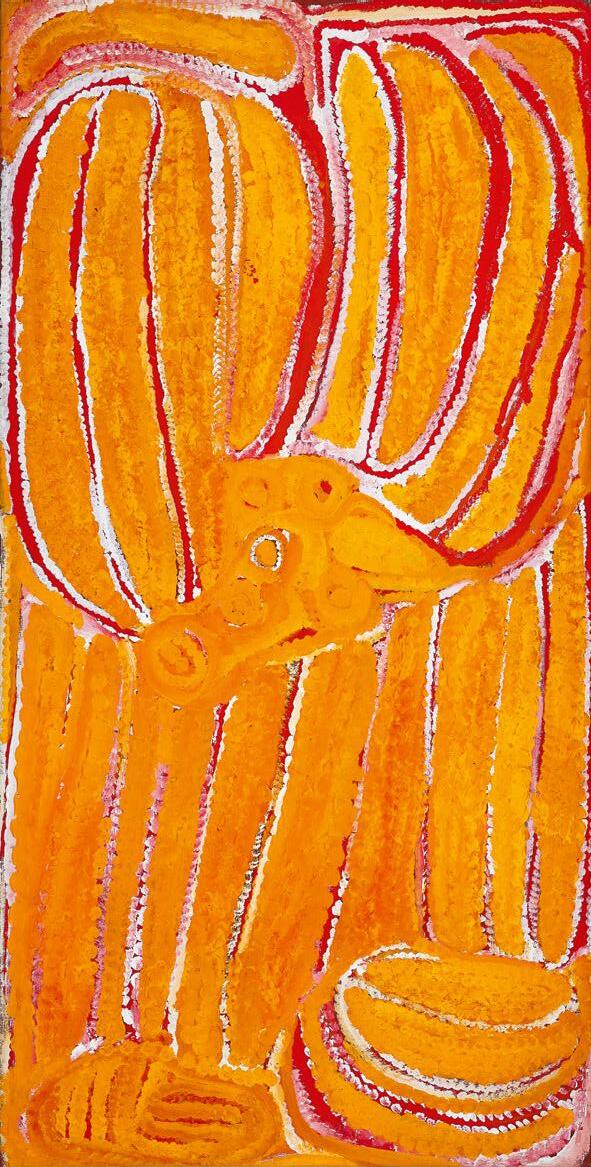
synthetic polymer paint on linen 148.0 x 74.5 cm
bears inscription verso: artist’s name, size and Warlayirti Artists cat. 108/05
Estimate: $7,000 – 9,000
Provenance
Warlayirti Artists, Balgo Hills, Western Australia Private collection, Melbourne
This work is accompanied by a certificate of authenticity from Warlayirti Artists which states:
‘Eubena has painted some of her country south west of Balgo. This country is located along the middle stretches of the Canning Stock Route near Well 33. The central circles depict a number of warniri (rockholes), the upper two are named Tjareeyatu, below these are Wadamaree and Yalta. The lowest two circles are warniri named Wati Kutjarra after the two goanna men who travelled throughout the desert region during the Tjukurrpa (Dreaming). They camped here and made spears. Surrounding the wanirri and dominating this country are tali (sandhills).’
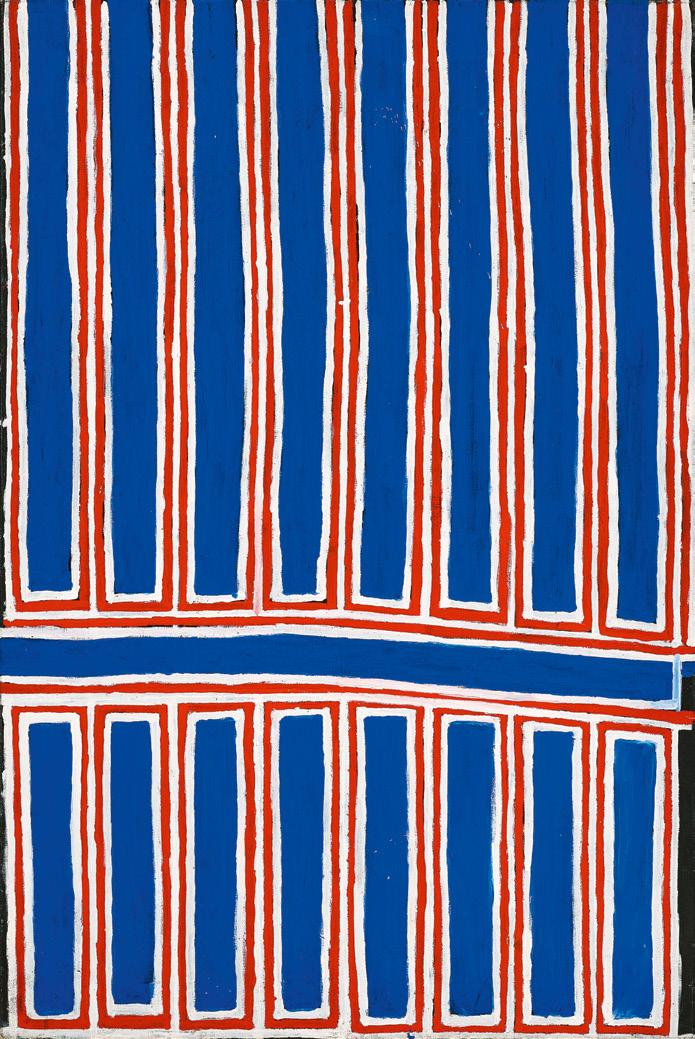
Boxer Milner Tjampitjin (c.1934 – 2009)
, 2003
synthetic polymer paint on linen 120.0 x 80.0 cm
bears inscription verso: artist's name, size and Warlayirti Artists cat. 650/03
Estimate: $8,000 – 12,000
Provenance
Warlayirti Artists, Balgo Hills, Western Australia Private collection, New South Wales
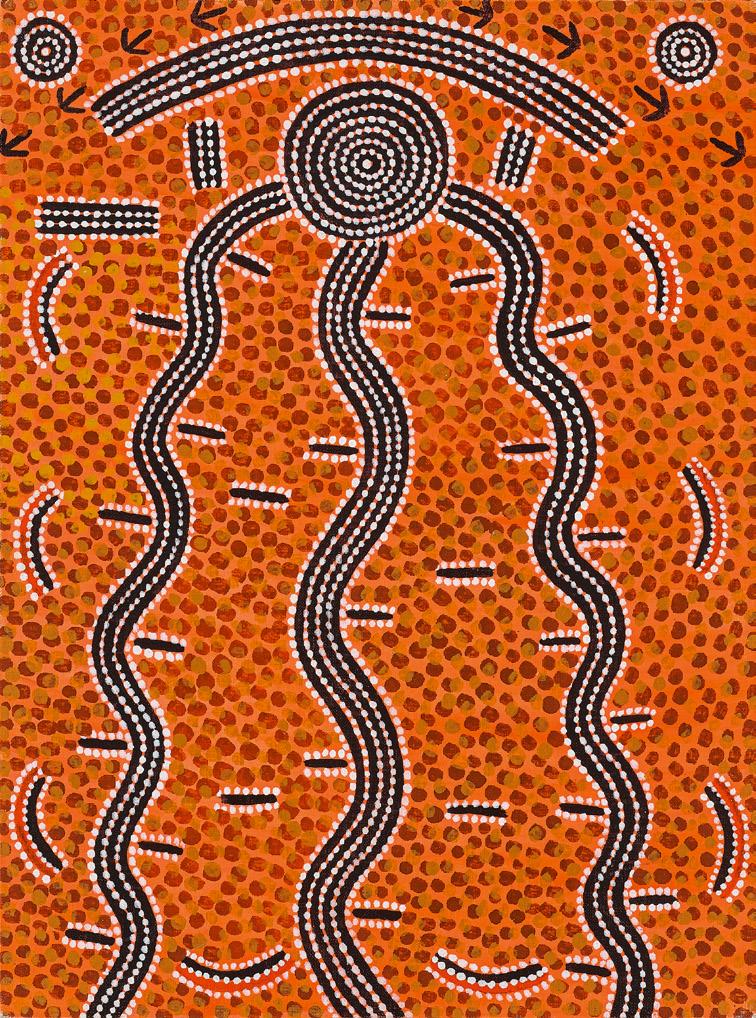
Dinny Nolan Tjampitjinpa born c.1928
Water story, c.1972 – 74
synthetic polymer paint on canvas board
61.0 x 45.5 cm
bears inscription verso: artist’s name and title
Estimate: $8,000 – 12,000
Provenance
Painted at Papunya, Northern Territory, c.1973 – 74
Margaret Carnegie collection, Victoria Lauraine Diggins Fine Art, Melbourne (labels attached verso)
Museum Art International, Adelaide
The John W. Kluge Collection, USA, acquired in 1995
Thence by descent
Private collection, USA
Sotheby’s, Sydney, 13 May 2014, lot 54
Private collection, Melbourne
Exhibited
A Myriad of Dreaming: Twentieth Century Aboriginal Art, Lauraine Diggins Gallery, Melbourne, 18 September – 1 October 1989, Westpac Gallery, Melbourne, 4 – 22 October 1989 (illus. in exhibition catalogue, p. 62)
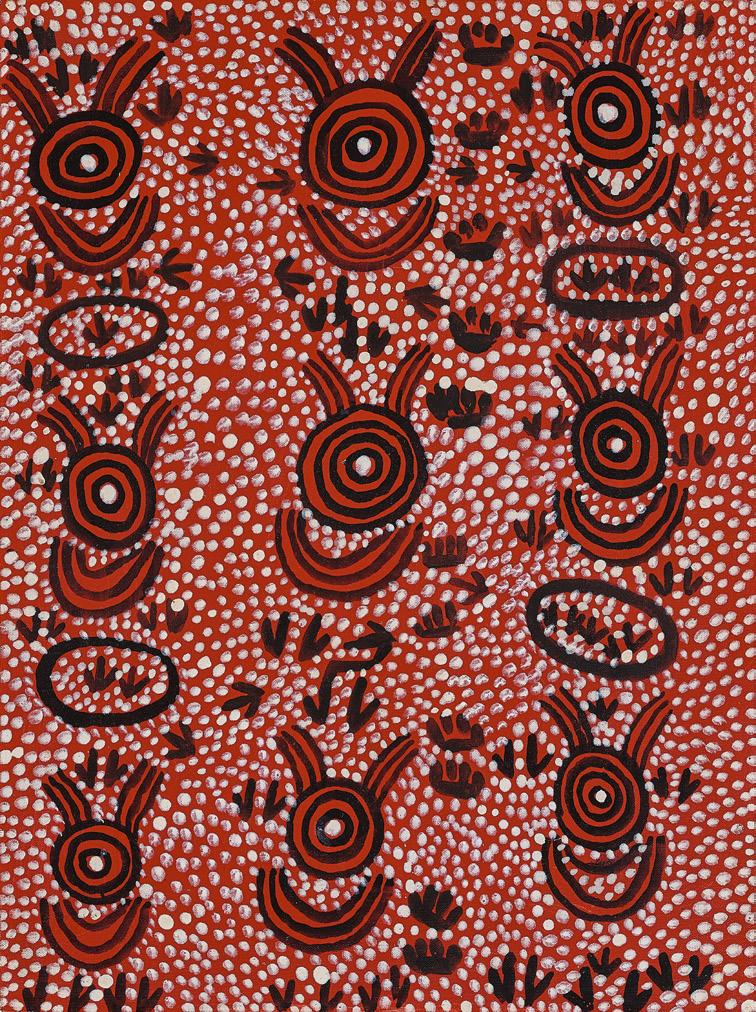
(c.1932 – 2020)
Kangaroo man and possum man ancestors travelling to Tjakari, Matingpilangu and Lurrnpa, c.1974
synthetic polymer paint on canvas board
61.0 x 45.5 cm
bears inscription verso: artist’s name, title, date and cat. 94 009
Estimate: $10,000 – 15,000
Painted at Papunya, Northern Territory, c.1974
Museum Art International, Adelaide
The John W. Kluge Collection, USA, acquired in 1995
Thence by descent
Private collection, USA
Sotheby’s, Sydney, 13 May 2014, lot 52
Private collection, Melbourne
74
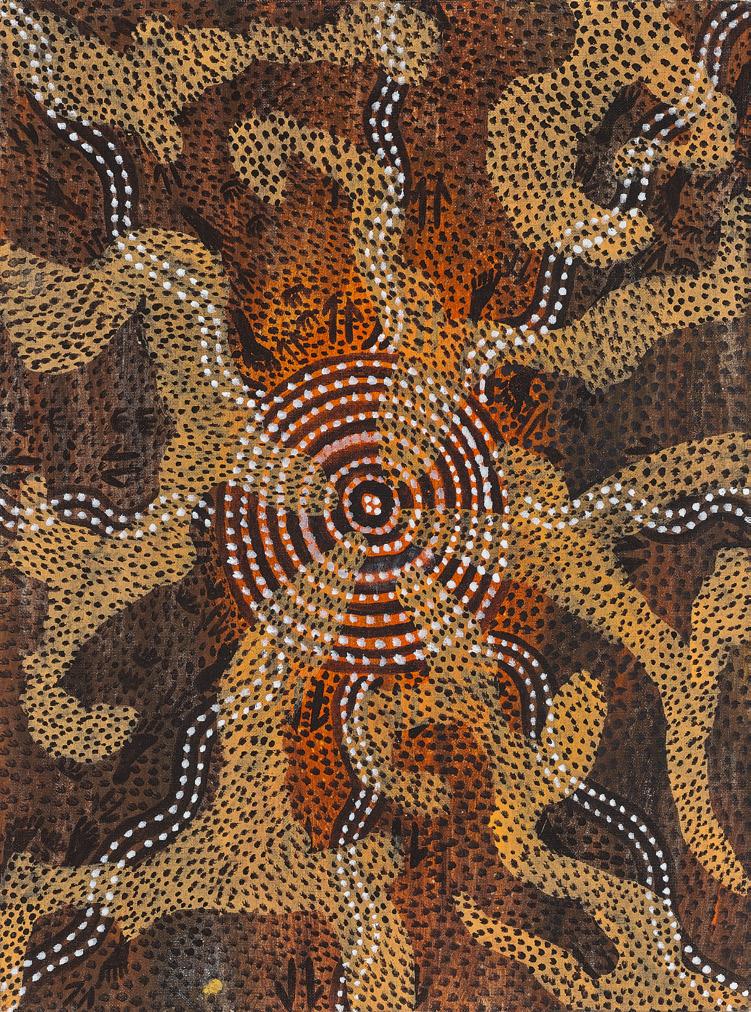
Leura Tjapaltjarri (c.1929 – 1984)
Euro dreaming, c.1973 – 74
synthetic polymer paint on canvas board
61.0 x 45.5 cm
bears inscription verso: artist’s name and title
Estimate: $12,000 – 18,000
Provenance
Painted at Papunya, Northern Territory, c.1973 – 74
Robert Bruce McElroy, Northern Territory
Bortignon’s Kalamunda Gallery of Man, Perth (label attached verso)
Margaret Carnegie, Victoria
Lauraine Diggins Fine Art, Melbourne (partial label attached verso)
Museum Art International, Adelaide
The John W. Kluge Collection, USA, acquired in 1995
Thence by descent
Private collection, USA
Sotheby’s, Sydney, 13 May 2014, lot 53
Private collection, Melbourne
natural earth pigments and PVA fixative on carved kurrajong
207.0 cm (height)
Estimate: $4,000 – 6,000
Provenance
Maningrida Arts and Culture, Maningrida, Northern Territory (cat. 4390–03) Short Street Gallery, Broome, Western Australia Private collection, Melbourne
This work is accompanied by a certificate of authenticity from Short Street Gallery.
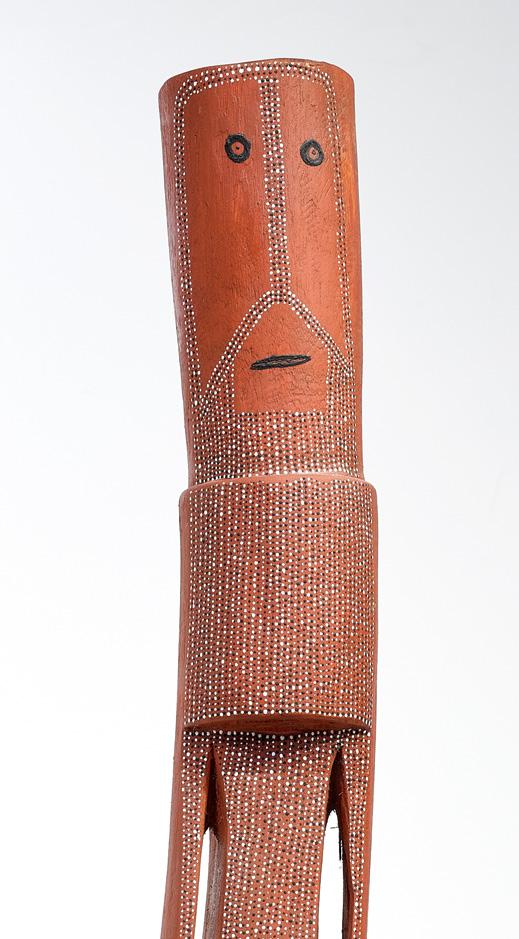
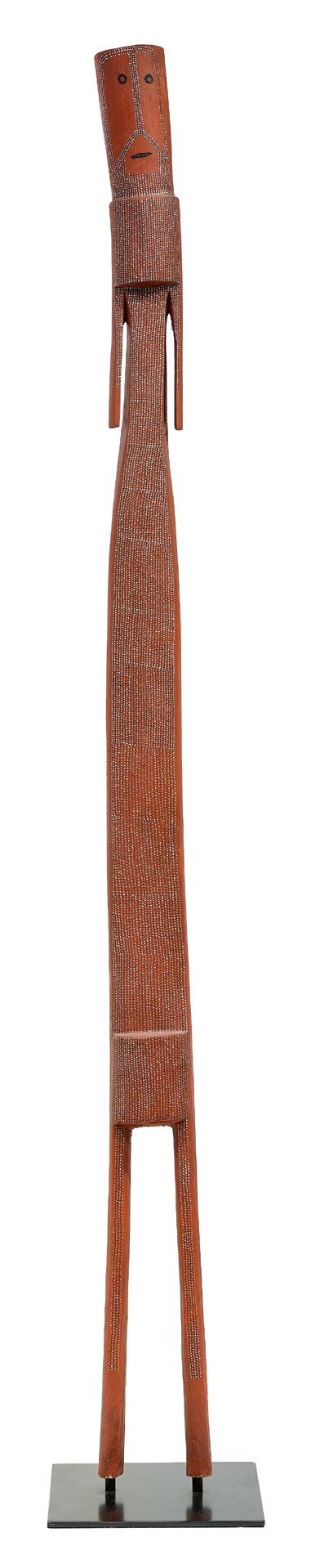
1960
Yawkyawk, 2000
natural earth pigments with synthetic binder on carved kurrajong 214.0 cm (height)
Estimate: $5,000 – 7,000
Provenance
Maningrida Arts and Culture, Maningrida, Northern Territory Redback Art Gallery, Brisbane Private collection, Queensland, acquired from the above in November 2000
Exhibited
Spirit Figures from Maningrida, Redback Art Gallery, Brisbane, November 2000
Related work
Yawkyawk, 2007, natural earth pigment and PVA fixative on kurrajong wood, 212.0 x 16.0 x 40.0 cm, private collection, illus. in Clark, D., and Jenkins, S., (eds), Culture Warriors, National Indigenous Art Triennial 07, National Gallery of Australia, Canberra, 2007, p. 182
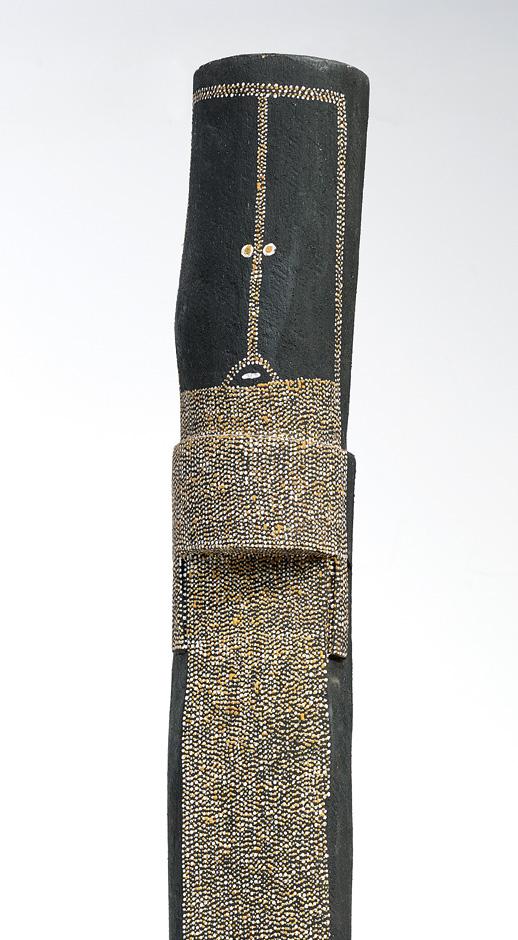
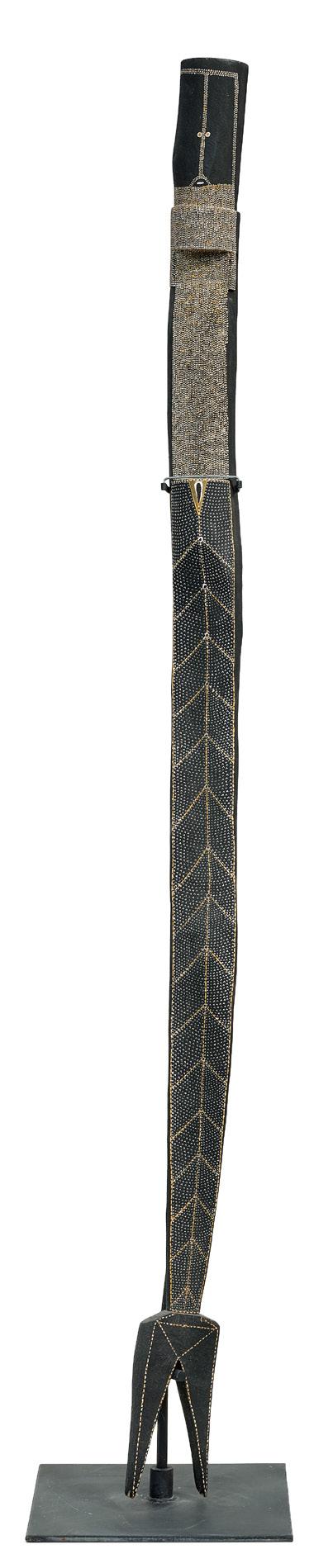

While we are ever grateful and respectful of our past, it’s our future that excites us the most. And always has done. Any business that has managed to flourish across three centuries won’t ever be accused of resting on its laurels or wishing for yesteryear. We stand on the shoulders of those who went before us and in doing so, we have a clearer view of what lies ahead.
And while it rests with the fifth and sixth generations of the Hill-Smith family to guide the ship, it’s all those who make up the wider Yalumba family today we are most grateful for. From our staff to our suppliers, trade partners and supporters. Every one of them has an undying passion for fine wines and great quality in all they do. They inspire us and push us to greater heights, and we look forward to further collaboration with them, as well as new partners, in the years ahead.
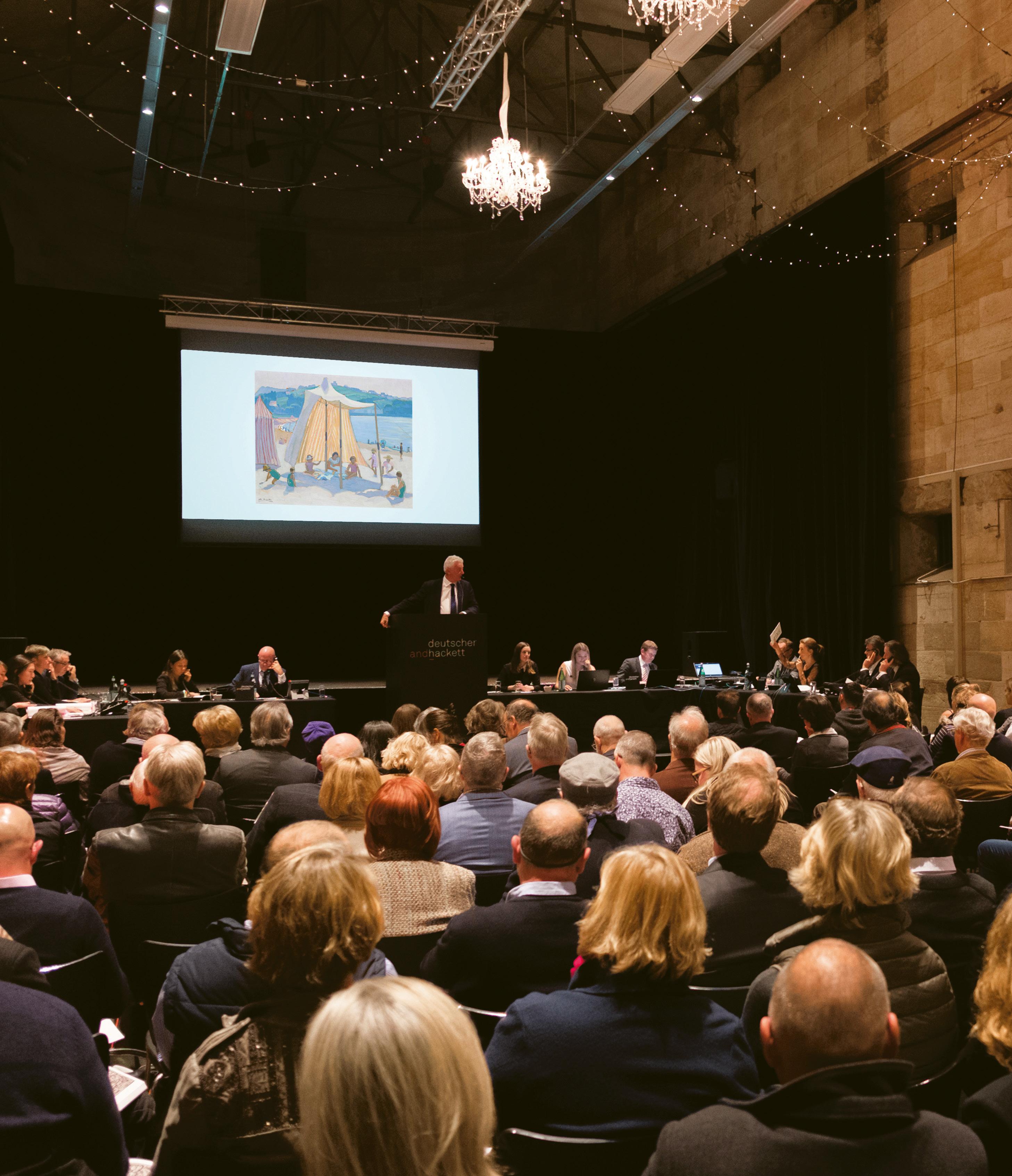
ALL PARTIES ARE STRONGLY URGED TO READ THE CONDITIONS OF AUCTION AND SALE INCLUDED IN THIS CATALOGUE
CATALOGUE SUBSCRIPTIONS
Catalogues can be obtained at Deutscher and Hackett offices or by subscription (see the Catalogue Subscription Form at the back of this catalogue or online for more information).
PRE-SALE ESTIMATES
The price range estimated against each lot reflects the opinion of our art specialists as to the hammer price expected for the lot at auction and is informed by realised prices for comparable works as well as the particularities of each lot including condition, quality, provenance and rarity. While presale estimates are intended as a guide for prospective buyers, lots can be sold outside of these ranges. Pre-sale estimates include GST (if any) on a lot but do not include the buyer’s premium or other charges where applicable.
The reserve is the minimum price including GST (if any) that the vendor will accept for a lot and below which the lot will not normally be sold.
PRE-AUCTION VIEWINGS
In both Sydney and Melbourne pre-auction viewings are scheduled for several days in advance of each auction. Deutscher and Hackett specialists are available to give obligation free advice at viewings or by appointment and prospective buyers are strongly encouraged to thoroughly examine and request condition reports for potential purchases. Pre-auction viewings are open to the public and are free to attend.
SYMBOL KEY
▲ Unless ownership is clearly stated in the provenance, this symbol is used where a lot is offered which Deutscher and Hackett owns in whole or in part. In these instances, Deutscher and Hackett has a direct financial interest in the property or means that Deutscher and Hackett has guaranteed a minimum price.
● Used to indicate lots for sale without a reserve.
EXPLANATION OF CATALOGUING PRACTICE AND TERMS
All information published in Deutscher and Hackett catalogues represent statements of opinion and should not be relied upon as fact. All dimensions are listed in centimetres, height before width and are approximate. All prices are in Australian dollars.
All reference to artists make use of common and not full names in accordance with the standards outlined in the National Gallery of Australia reference publication Australian Art: Artist’s working names authority list. For instance, John Brack rather than Cecil John Brack; Roy de Maistre rather than Leroy Leveson Laurent De Maistre; Rosalie Gascoigne rather than Rosalie Norah Gascoigne.
Terms used in this catalogue have the meanings ascribed to them below:
a. NICHOLAS CHEVALIER: in the opinion of Deutscher and Hackett, a work by the artist.
b. Attributed to NICHOLAS CHEVALIER: in the opinion of Deutscher and Hackett, probably a work by the artist, in whole or in part.
c. Circle of NICHOLAS CHEVALIER: in the opinion of Deutscher and Hackett, a work showing the influence and style of the artist and of the artist’s period.
d. Studio/Workshop of NICHOLAS CHEVALIER: in the opinion of Deutscher and Hackett, a work possibly executed under the supervision of the artist.
e. School of NICHOLAS CHEVALIER: in the opinion of Deutscher and Hackett, a work by a follower or student of the artist.
f. Manner of NICHOLAS CHEVALIER: in the opinion of Deutscher and Hackett, a work created in the style, but not necessarily in the period, of the artist.
g. After NICHOLAS CHEVALIER: in the opinion of Deutscher and Hackett, a copy of a work by the artist.
h. “signed” / “dated” in the opinion of Deutscher and Hackett, the work has been signed/ dated by the artist.
i. “bears signature” / “bears date” in the opinion of Deutscher and Hackett, the work has possibly been signed/dated by someone other than the artist.
Where appropriate, Deutscher and Hackett will include the known provenance, or history of ownership of lots. Non disclosure may indicate that prior owners are unknown or that the seller wishes to maintain confidentiality.
Auctions are open to the public and are free to attend. Deutscher and Hackett may exclude any person at any time in its discretion.
Bidders must register to bid prior to the commencement of an auction. Deutscher and Hackett may impose other obligations on the registration of bidders in its discretion.
Lots are offered for sale on a consecutive basis. Deutscher and Hackett will determine the conduct of the auction in its absolute discretion, including the regulation of bidding. Consecutive or responsive bids may be placed by the auctioneer on behalf of the vendor up to the reserve.
As a courtesy service, Deutscher and Hackett will make reasonable efforts to place bids for prospective buyers in absentia provided written or verbal instructions (as indicated on absentee bid forms included at the back of this catalogue or online) are received 24 hours prior to auction. Where successful, lots will be purchased at the lowest possible bid and in the event of identical absentee bids, the bid received earliest will take precedence. Deutscher and Hackett accepts no responsibility for errors and omissions in relation to this courtesy service and reserves the right to record telephone bids.
Unless indicated otherwise, all lots are subject to a confidential reserve price determined by the vendor. Deutscher and Hackett or the auctioneer may place any number of bids on behalf of the vendor below the reserve price and is not obliged to identify that the bids are being placed on behalf of the vendor.
Bidding usually opens below the listed pre-sale estimate and proceeds in the following increments (the auctioneer may vary the bidding increments at his or her discretion):
$500 – 1,000 by $50
$1,000 – 2,000 by $100
$2,000 – 3,000 by $200
$3,000 – 5,000 by $200 / $500 / $800
$5,000 – 10,000 by $500
$10,000 – 20,000 by $1,000
$20,000 – 30,000 by $2,000
$30,000 – 50,000 by $2,000 / $5,000 / $8,000
$50,000 – 100,000 by $5,000
$100,000 – 200,000 by $10,000
$200,000 – 300,000 by $20,000
$300,000 – 500,000 by $20,000 / $50,000 / $80,000
$500,000 – 1,000,000 by $50,000
$1,000,000+ by $100,000
The fall of the auctioneer’s hammer indicates the final bid and the buyer assumes full responsibility for the lot from this time.
Where a lot is unsold, the auctioneer will announce that the lot is “bought in”, “passed”, “withdrawn” or “returned to owner”.
Payment must be made within seven days of the date of sale in Australian dollars by cash, cheque, direct deposit, approved credit cards or electronic funds transfer. If payment is made by credit card the price will increase by any merchant fees payable by Deutscher and Hackett (1.15% (including GST) for Visa and Mastercard and 1.65% (including GST) for American Express). In certain circumstances, extension of payment may be granted at the discretion of Deutscher and Hackett. Cleared funds will be held in an interest bearing trust account by Deutscher and Hackett until remitted to the vendor. Deutscher and Hackett will be entitled to retain any interest earned during this period. Payment by the vendor of any charge to Deutscher and Hackett is to be made within fourteen days of invoice.
The purchase price will be the sum of the final bid price (including any GST) plus a buyer’s premium set at 25% (inclusive of GST) of the final bid price. Buyers may be liable for other charges reasonably incurred once ownership has passed.
Buyers are required to pay a 10% G.S.T which sum is:
a. included in the final bid prices where buying from a GST registered vendor; and b. included in any additional fees charged by Deutscher and Hackett; and c. included in the buyer’s premium.
Where GST applies to some lots the final bid price will be inclusive of the applicable GST. If a buyer is classified as a “non-resident” for the purpose of GST, the buyer may be able to recover GST paid on the final purchase price if certain conditions are met.
Lots paid for in full may be collected from Deutscher and Hackett premises the day after the auction occurs but lots paid for by cheque may not be collected until all funds have cleared. Proof of identification is required upon collection and lots not collected within seven days of the sale may incur costs associated with external storage and freight.
Risk in the lot, including risk of loss or damage, will pass to the buyer on either the date payment is due, whether or not it has been made, or on collection by the buyer, whichever is earlier. The buyer is therefore encouraged to make arrangements to ensure comprehensive cover is maintained from the payment due date.
Deutscher and Hackett directly offers services including storage, hanging and display, appraisals and valuations, collection management and research and in all instances will endeavour to coordinate or advise upon shipping and handling, insurance, transport, framing and conservation at the request and expense of the client. Deutscher and Hackett does not accept liability for the acts or omissions of contracted third parties.
Prospective bidders are advised to enquire about export licences — including endangered species licences and cultural heritage permits, where relevant — prior to bidding at auction. Telephone the Cultural Property and Gifts Section, Museums Section, Ministry for the Arts, on 1800 819 461 for further information. The delay or denial of such a licence will not be grounds for a rescission of sale.
The copyright in the images and illustrations contained in this catalogue may be owned by third parties and used under licence by Deutscher and Hackett. As between Deutscher and Hackett and the buyer, Deutscher and Hackett retains all rights in the images and illustrations. Deutscher and Hackett retains copyright in the text contained in this catalogue. The buyer must not reproduce or otherwise use the images, illustrations or text without prior written consent.
ALL PARTIES ARE STRONGLY URGED TO READ THE CONDITIONS OF AUCTION AND SALE INCLUDED IN THIS CATALOGUE
The terms and conditions of business set forth below are subject to amendment by verbal or written notice prior to and during the auction and sale. They constitute the entire contractual agreement with the buyer in respect to any lot offered at auction. By bidding at auction in any manner compliant with bidding procedures, the buyer and all bidders agree to be bound by these terms and conditions and the terms of the prospective buyers and sellers guide contained in this catalogue, as amended. To the extent that an agent acts on behalf of the buyer, liability for obligations arising from these conditions of business will pass to the buyer. Multiple buyers are jointly and severally liable for obligations arising from this agreement.
1. Definition of terms:
a. The ‘buyer’ refers to the party with the highest accepted bid for any lot at auction and/or such party’s principal where bidding as agent.
b. The ‘vendor’ refers to the party consigning property for sale and/or such party’s principal where acting as agent.
c. ‘Deutscher and Hackett’ refers to Deutscher and Hackett Pty Ltd ACN 123 119 022, its subsidiaries, officers, employees and agents.
d. The ‘hammer price’ refers to the final bid price (including any GST) accepted by the auctioneer, or in the case of a post-auction sale, the agreed sale price (including any GST).
e. The ‘buyer’s premium’ refers to the 25% (inclusive of GST) payable by the buyer calculated as a percentage of the hammer price.
f. ‘GST’ refers to the goods and services tax imposed by the A New Tax System (Goods and Services) Act 1999 as amended.
g. The ‘lot’ refers to the item(s) described against any lot number in the catalogue.
h. The ‘reserve’ refers to the minimum price (including any GST) the consignor will accept for a lot.
2. Agency: Deutscher and Hackett acts as agent for the vendor and the contract of sale for the lot will be between the buyer and the vendor.
3. Property is sold ‘as is’: To the extent permitted by law:
a. no guarantees, warranties or representations are made (express or implied) by Deutscher and Hackett or the vendor in relation to the nature and condition of any lot; and
b. Deutscher and Hackett disclaims liability for any misrepresentations, errors or omissions, whether verbal or in writing, in the catalogue or any supplemental material.
All factual information provided by the vendor is merely passed on by Deutscher and Hackett from the vendor or other source. Deutscher and Hackett has made no attempt to verify this information. All additional statements of opinion represent the specialist opinions of Deutscher and Hackett employees and should not be relied upon as statements of fact.
4. Responsibility to inspect: Responsibility remains with the buyer to satisfy its, his or her self by inspection and evaluation prior to purchase as to the nature and condition of any property.
5. Registration: Bidders must register to bid and obtain a bidder’s paddle prior to the commencement of the auction. Registration requires that bidders provide proof of identity and Deutscher and Hackett may impose other obligations on the registration of bidders in its discretion.
6. Auctioneer’s discretion: Deutscher and Hackett reserves the right to absolute discretion over the conduct of the auction including the regulation of bidding and its increments. This discretion extends to the challenge or rejection of any bid, the right to withdraw any lot and the right to determine the successful bidder or reoffer a lot in the event of a dispute. The prospective buyers and sellers guide details an indicative process for the conduct of auctions. All parties are strongly urged to read the prospective buyers and sellers guide included in this catalogue.
7. Bidding: Deutscher and Hackett may sell each lot to the highest bidder at auction provided the reserve price has been met or where the net amount accounted to the vendor is at least equivalent to the net amount that would have been achieved for a sale at the reserve price. The fall of the auctioneer’s hammer marks the acceptance of the highest bid and the conclusion of a contract for sale between the vendor and the buyer. Unless otherwise agreed in writing with Deutscher and Hackett, the individual physically present at the auction who signals the bid accepts personal liability to pay the purchase price, including the buyer’s premium and all additional fees, taxes and charges.
8. Amounts inclusive of GST: Unless otherwise specified, all amounts specified in this section as payable by the buyer, or otherwise used to calculate payment to Deutscher and Hackett, are inclusive of any GST component. Deutscher and Hackett will provide buyers with a tax invoice that meets the requirements of the Australian Taxation Office.
9. Application of GST to buyers: Buyers are required to pay a 10% GST which sum is:
a. included in the final bid prices where buying from a GST registered vendor; and
b. included in any additional fees charged by Deutscher and Hackett; and
c. included in the buyer’s premium.
If a buyer is classified as a “non-resident” for the purpose of GST, the buyer may be able to recover GST paid on the final purchase price if certain conditions are met.
10. Post auction private sale: Should the lot fail to sell at auction, Deutscher and Hackett is authorised to sell the lot privately for a period of seven days in which event this agreement shall apply to the relevant buyer to the full extent of its provisions.
11. Payment: The buyer will not acquire title until payment has cleared in full. Interest at a rate of 17.5% p.a. will be charged over outstanding accounts where no extension of terms has been granted. Interest will be payable from the payment due date. With respect to each lot purchased, the buyer agrees to make the following payments within seven days from the date of sale:
a. The hammer price.
b. In exchange for services rendered by Deutscher and Hackett, a buyer’s premium calculated at 25% (inclusive of GST) of the hammer price.
c. Post sale packing, handling, shipping and storage where applicable.
d. If payment is made via Visa, Mastercard or American Express, any merchant fees payable by Deutscher and Hackett on the transaction as indicated in the prospective buyers and sellers guide.
Payment must be made within seven days of the date of sale in Australian dollars by cash, cheque, direct deposit, approved credit cards or electronic funds transfer using the form and/or trust account details provided at the back of this catalogue. In certain circumstances, extension of payment may be granted at the discretion of Deutscher and Hackett. Once funds have cleared, the proceeds of the sale less the buyer’s Premium, GST and any commission or costs charged as agreed will be remitted to the vendor within thirty-five days of the date of sale provided payment has been received in full. Funds will be held in an interest bearing account by Deutscher and Hackett until remitted to the vendor. Deutscher and Hackett will be entitled to any interest earned during this period. Application for a cultural heritage export licence or any other licence in no way affects the buyer’s obligation to make payment or collection within the periods specified in sections 10 and 13a.
12. Risk and Title: Risk in the lot, including risk of loss or damage, will pass to the buyer on the earlier of:
a. the date payment is due, whether or not it has been made; and b. collection by the buyer.
The buyer assumes risk for the property in all respects from this date and neither Deutscher and Hackett nor the vendor will be liable for loss or damage occurring after the payment due date. The buyer is encouraged to make arrangements to ensure comprehensive cover is maintained from this date. Title in the lot does not pass to the buyer, even if the lot is released to the buyer, until the buyer has paid all sums owing to Deutscher and Hackett. If a buyer makes a claim against Deutscher and Hackett for damage or loss after sale, the buyer’s premium and the final bid price shall be payable notwithstanding.
13. Freight:
a. The buyer may only remove a lot from the Deutscher and Hackett premises once payment has been cleared in full and must be removed no later than seven days after the date of sale. Should
items not be removed by this time, storage and insurance costs may be charged to the buyer. If a lot has not been collected within 30 days after the date of sale and alternative arrangements have not been with Deutscher and Hackett, the lot may be re-sold by Deutscher and Hackett without reserve at the next auction and Deutscher and Hackett may set off any amounts owed for storage and insurance costs and its standard commission before remitting the proceeds to the buyer.
b. Buyers are required to make their own arrangements for packing, handling, shipping and transit insurance for their property. Deutscher and Hackett does not accept responsibility or liability for the acts or omissions of any third party, such as a shipping agent, whether or not such a party has been recommended or suggested by Deutscher and Hackett.
14. Limited Warranty of Authorship: If a buyer is able to establish that a lot is a forgery in accordance with these conditions for sale within five years of the date of sale, the buyer shall be entitled to rescind the sale and obtain a refund of the hammer price from the vendor. The buyer must return the lot in the state in which it was sold within fourteen days of notifying Deutscher and Hackett of the forgery allegations. For a lot to be established as a forgery, the following conditions must be satisfied:
a. the buyer must supply two independent expert testimonies attesting to the forgery. Deutscher and Hackett is entitled to request further expert evidence where it deems the evidence provided to be unsatisfactory;
b. there must be no conflict of opinion among accepted experts in the field; and
c. the forgery must be able to be proven through means that at the time of publication of the catalogue were commonly employed and that will not damage or otherwise put the lot in jeopardy.
The limited warranty and the right to rescind the sale is not assignable and the buyer must have retained title to the lot without disposing of any interest in it up until the buyer notifies Deutscher and Hackett of the forgery allegations. The buyer acknowledges that it has no rights directly against Deutscher and Hackett if a lot is established to be a forgery.
15. Termination, Breach and Legalities:
a. Deutscher and Hackett breach: To the extent permitted by law, the sole and maximum remedy to a buyer for breach of warranty is a refund of original purchase price, including buyer’s premium. In such an event the sale contract shall be rescinded and all costs associated with returning the property (in the state in which it was sold) to the premises of Deutscher and Hackett are to be borne by the buyer. Deutscher and Hackett is not liable for any indirect or consequential loss or damage for any matter arising directly or indirectly as a result of the sale.
b. Buyer breach: Deutscher and Hackett may, in addition to other remedies available by law, exercise one or more of the following rights or remedies for breach:
i. Cancel the sale and retain any payment or property in Deutscher and Hackett custody as collateral or liquidated damages.
ii. Charge the buyer interest at the rate of 2% above the rate fixed under section 2 of the Penalty Interest Rates Act 1984 (Vic).
iii. Resell the property without reserve at the next auction or privately on five days notice. Any disparity between sale and resale prices, including associated costs such as, but not limited to, legal, storage and sale expenses, will be to the account of the defaulting buyer.
iv. Apply any part payment received from the buyer in respect of any lots at its discretion.
v. Retain any of the buyer’s property held by Deutscher and Hackett until the buyer has satisfied its obligations to Deutscher and Hackett.
vi. Take any other action Deutscher and Hackett deems necessary or appropriate.
vii. Refuse to permit the buyer to participate in future auctions.
viii. Provide the vendor with the buyer’s details to permit the vendor to take action against the buyer to recover the money.
16. Governing law and jurisdiction: These terms and conditions and any matters concerned with the foregoing fall within the exclusive jurisdiction of the courts of the state in which the auction is held.
17. Severability: In the event that any provisions of this agreement should be found unenforceable in a court of law, that part shall be discounted and the remaining conditions shall continue in full force and effect to the extent permitted by law.
(Mr/Mrs/Ms/Miss) Name (please print)
(PO Box insufficient)
*Not including buyer’s premium or GST (where applicable). Bids are made in Australian dollars.
Please refer to the Prospective Buyers and Sellers Guide and the Conditions of Auction and Sale in this catalogue for information regarding sales.
By completing this form, I authorise DEUTSCHER AND HACKETT to contact me by telephone on the contact number(s) nominated. I understand it is my responsibility to enquire whether any Sale-Room Notices relate to any lot on which I intend to bid. I also understand that should my bid(s) be successful, a buyer’s premium of 25% (inclusive of GST), will be added to the final hammer price.
I accept that DEUTSCHER AND HACKETT provides this complimentary service as a courtesy to its clients, that there are inherent risks to telephone bidding, and I will not hold DEUTSCHER AND HACKETT responsible for any error.
SALE CODE: Albert
SALE No.: 085
Important Australian Indigenous Fine Art
M elbourne Auction 25 March, 7:00 PM Lots 1 – 76 105 Commercial Road South Yarra, VIC 3141
please email, post or fax this completed form to:
deutscher and hackett 105 commercial Road South Yarra VIC 3141
tel: 03 9865 6333 fax: 03 9865 6344
info@deutscherandhackett.com
INTERNAL USE ONLY
RECEIVED BY DATE TIME
SALE CODE: Albert SALE No.: 085
Important Australian Indigenous Fine Art
M elbourne Auction 25 March, 7:00 PM Lots 1 – 76 105 Commercial Road South Yarra, VIC 3141
(Mr/Mrs/Ms/Miss) Name (please print) Billing
(PO Box insufficient)
please email, post or fax this completed form to:
deutscher and hackett 105 commercial Road South Yarra VIC 3141
tel: 03 9865 6333 fax: 03 9865 6344
info@deutscherandhackett.com
INTERNAL USE ONLY
RECEIVED BY
DATE TIME
*Not including buyer’s premium or GST (where applicable). Bids are made in Australian dollars.
Absentee bids must be received a minimum of twenty-four hours prior to auction. All absentee bids received will be confirmed by phone or fax. In the event that confirmation is not received, please resubmit or contact our office.
Please refer to the Prospective Buyers and Sellers Guide and the Conditions of Auction and Sale in this catalogue for information regarding sales. By completing this form, absentee bidders request and authorise DEUTSCHER AND HACKETT to place the following bids acting as agent on their behalf up to and including the maximum bid specified. Lots will be bought at the lowest possible bid authorised by a bidder in absentia.
Should the bid be successful, the buyer will be obliged to pay the final bid price plus buyer’s premium of 25% (inclusive of GST) of the final bid price. DEUTSCHER AND HACKETT provides this complimentary service as a courtesy to clients and does not accept liability for errors and omissions in the execution of absentee bids.
(Mr/Mrs/Ms/Miss) Name (please print)
SALE CODE: Albert SALE No.: 085 Important Australian Indigenous Fine Art
M elbourne Auction 25 March, 7:00 PM Lots 1 – 76 105 Commercial Road South Yarra, VIC 3141
please email, post or fax this completed form to:
deutscher and hackett 105 commercial Road South Yarra VIC 3141
tel: 03 9865 6333 fax: 03 9865 6344
info@deutscherandhackett.com
SALE CODE: Albert SALE No.: 085 Important Australian Indigenous Fine Art
M elbourne Auction 25 March, 7:00 PM Lots 1 – 76 105 Commercial Road South Yarra, VIC 3141
Fine Art (Single issue) $45*
please email, post or fax this completed form to:
deutscher and hackett 105 commercial Road South Yarra VIC 3141
tel: 03 9865 6333 fax: 03 9865 6344
info@deutscherandhackett.com
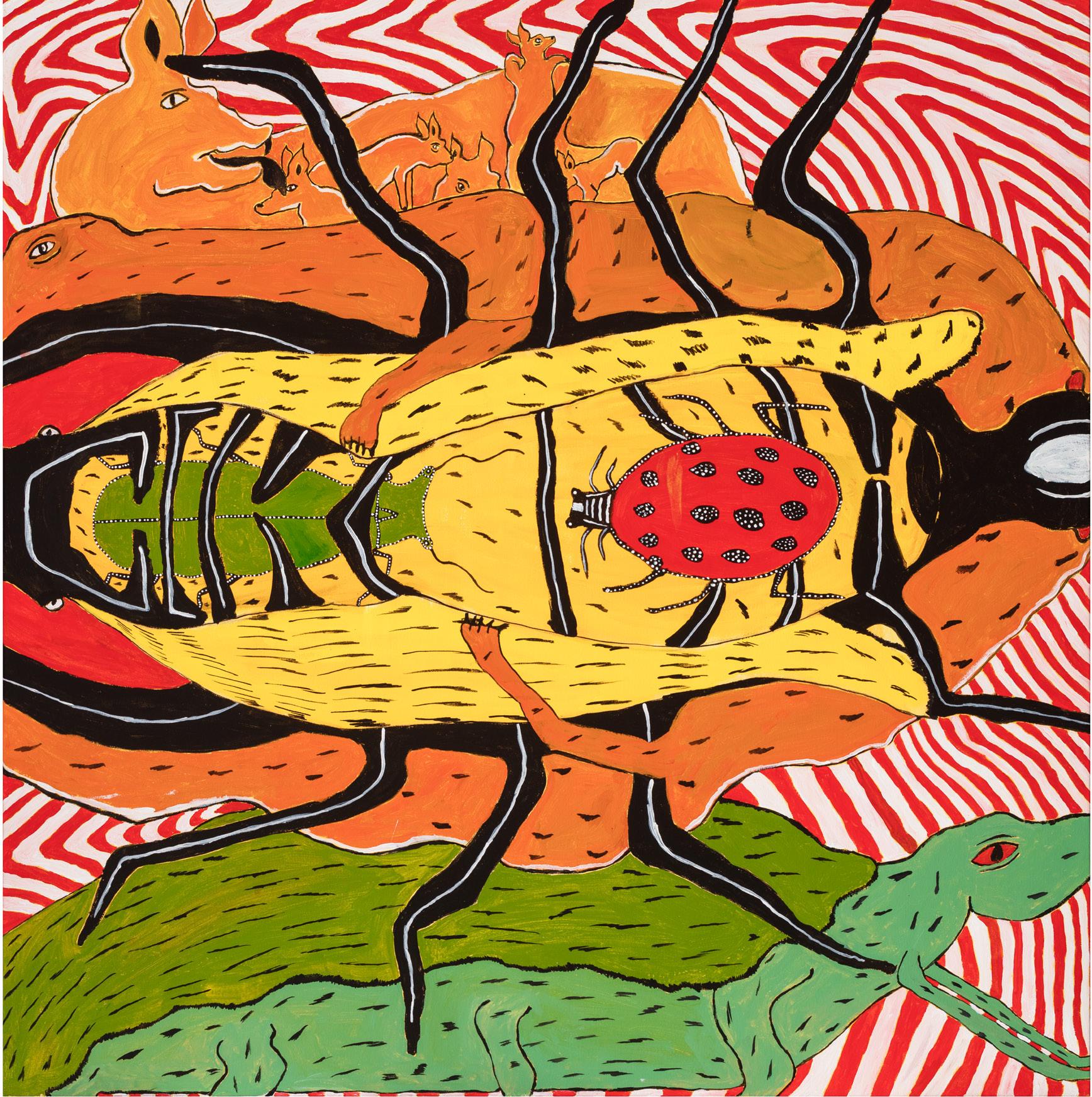
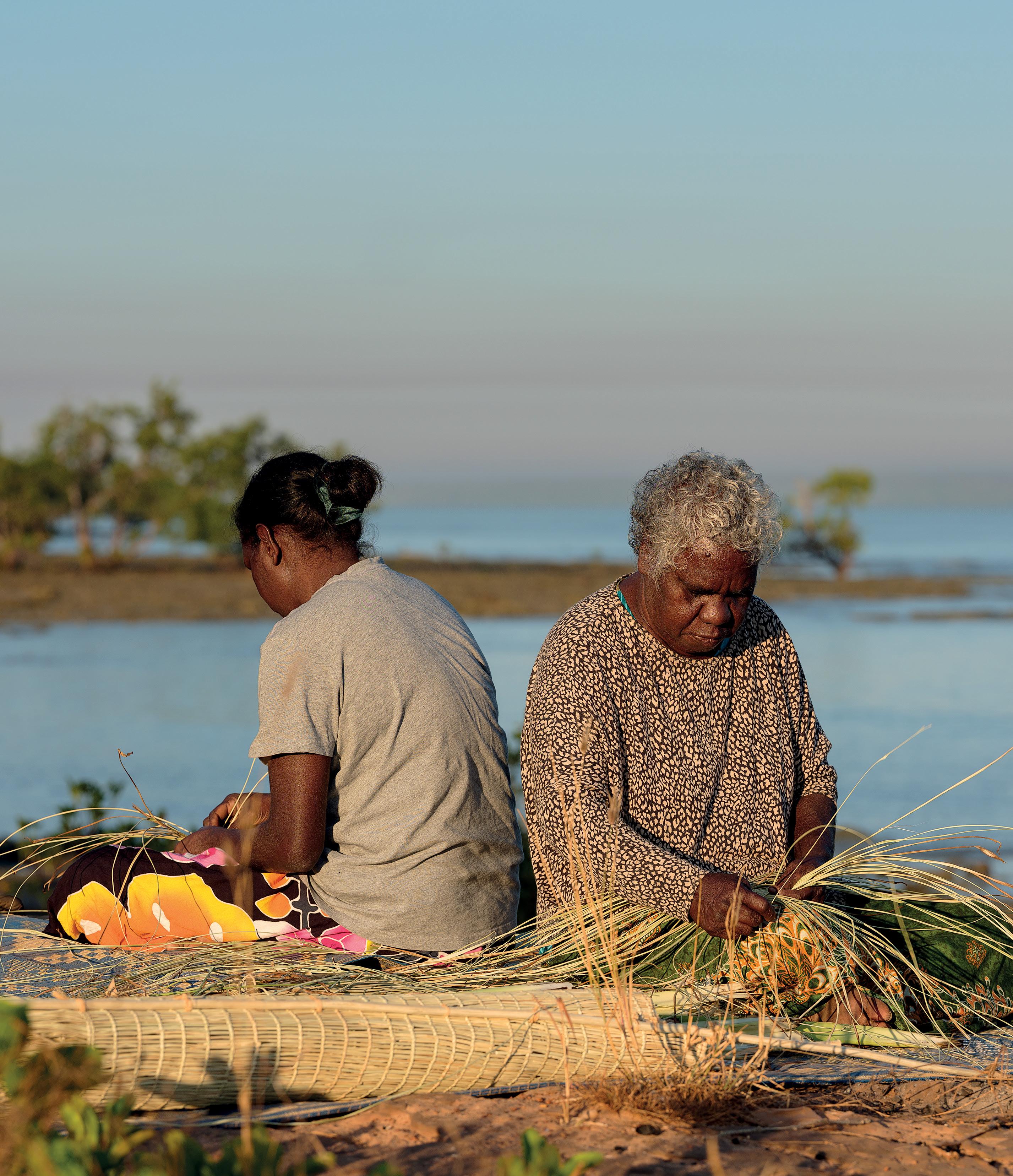




















Papunya is the birthplace of the Western Desert art movement. Between 1979 and 1990, a remarkable Aboriginal literary movement took hold seeing the Papunya Literature Production Centre produce hundreds of Pintupi-Luritja bilingual readers (illustrated books) guided by the community’s Elders.



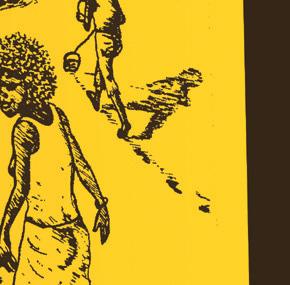
The landmark publication is available for pre-order now.
A major exhibition is also opening in April at the National Library of Australia, Canberra.
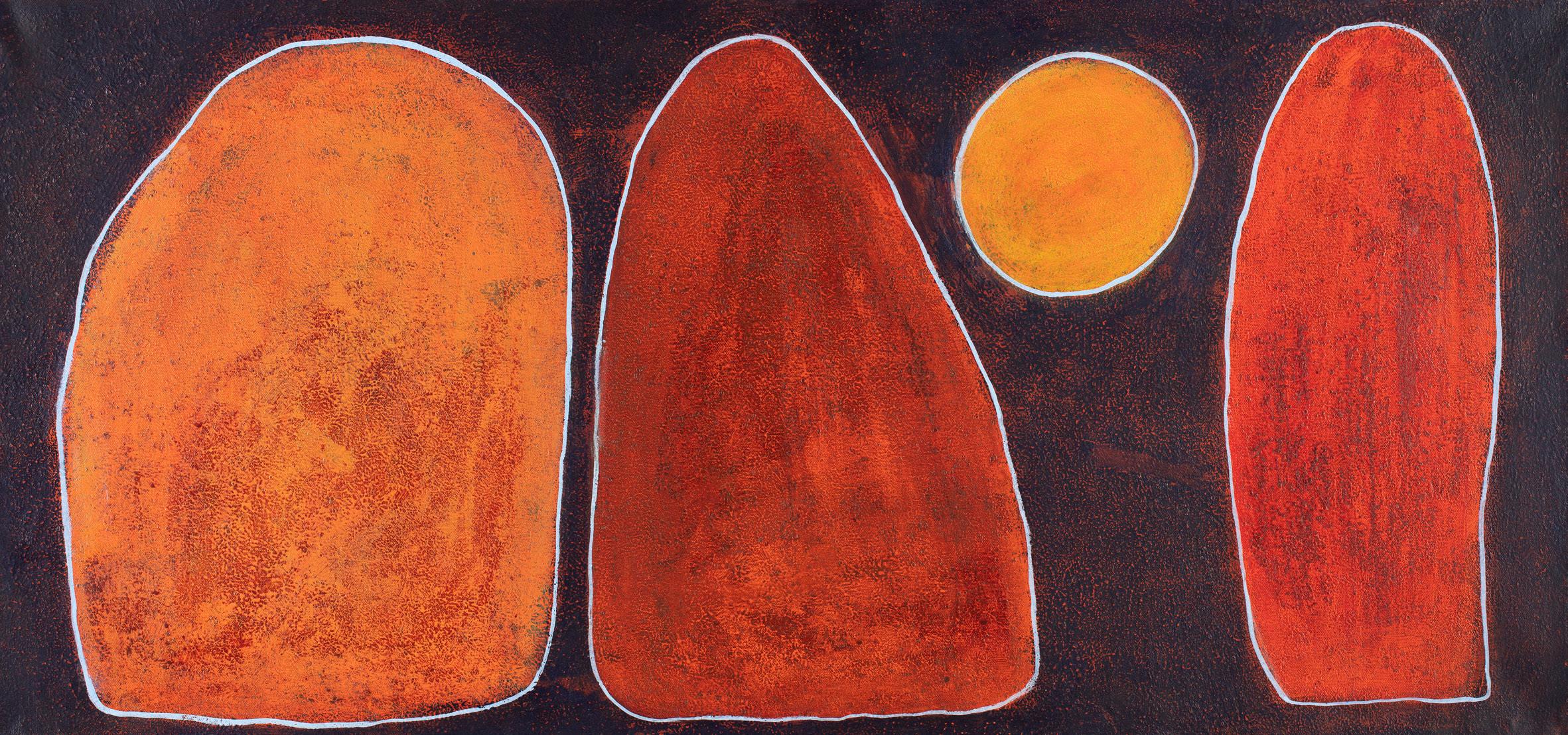

A major survey from one of Australia’s most exciting contemporary artists FREE exhibition until 24 May
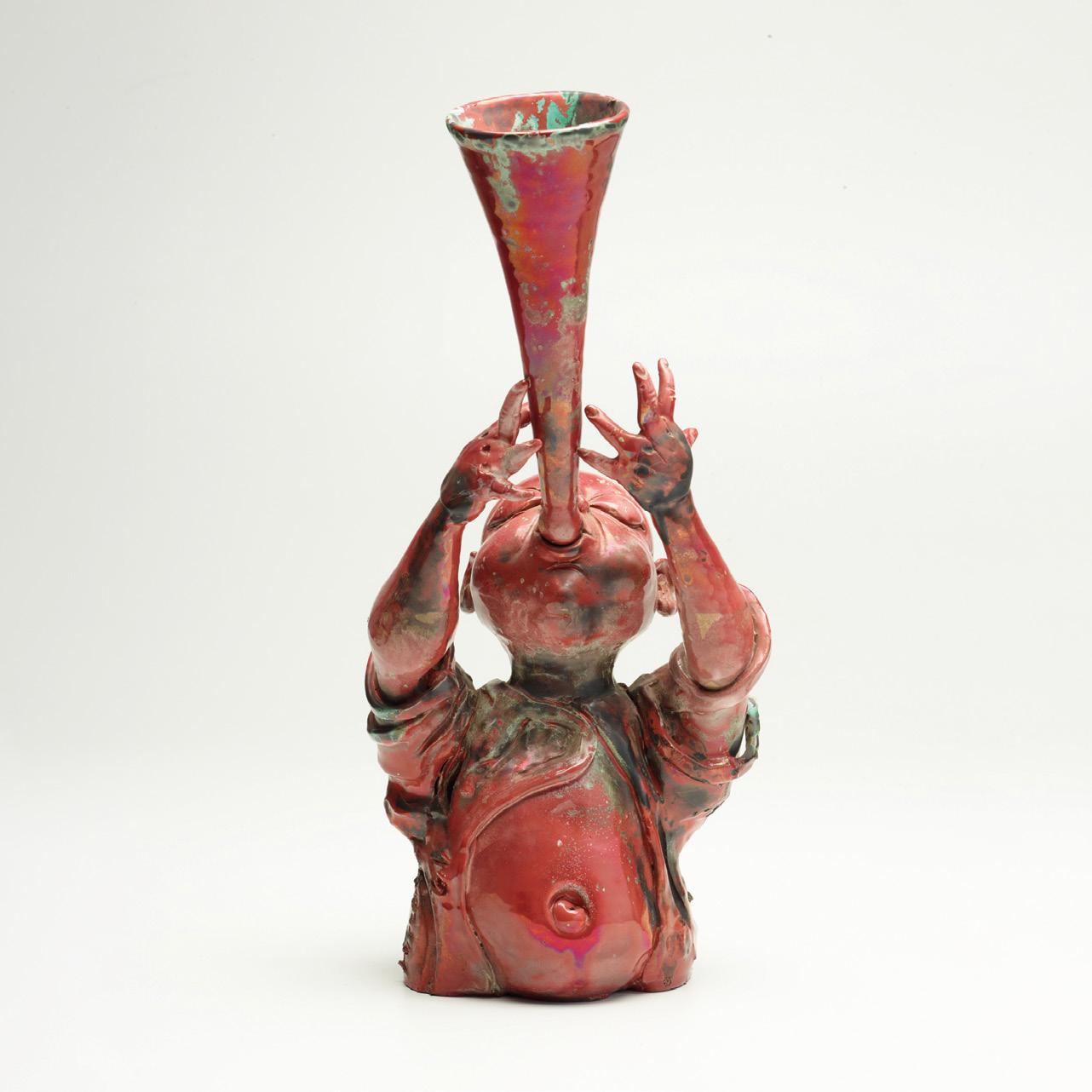



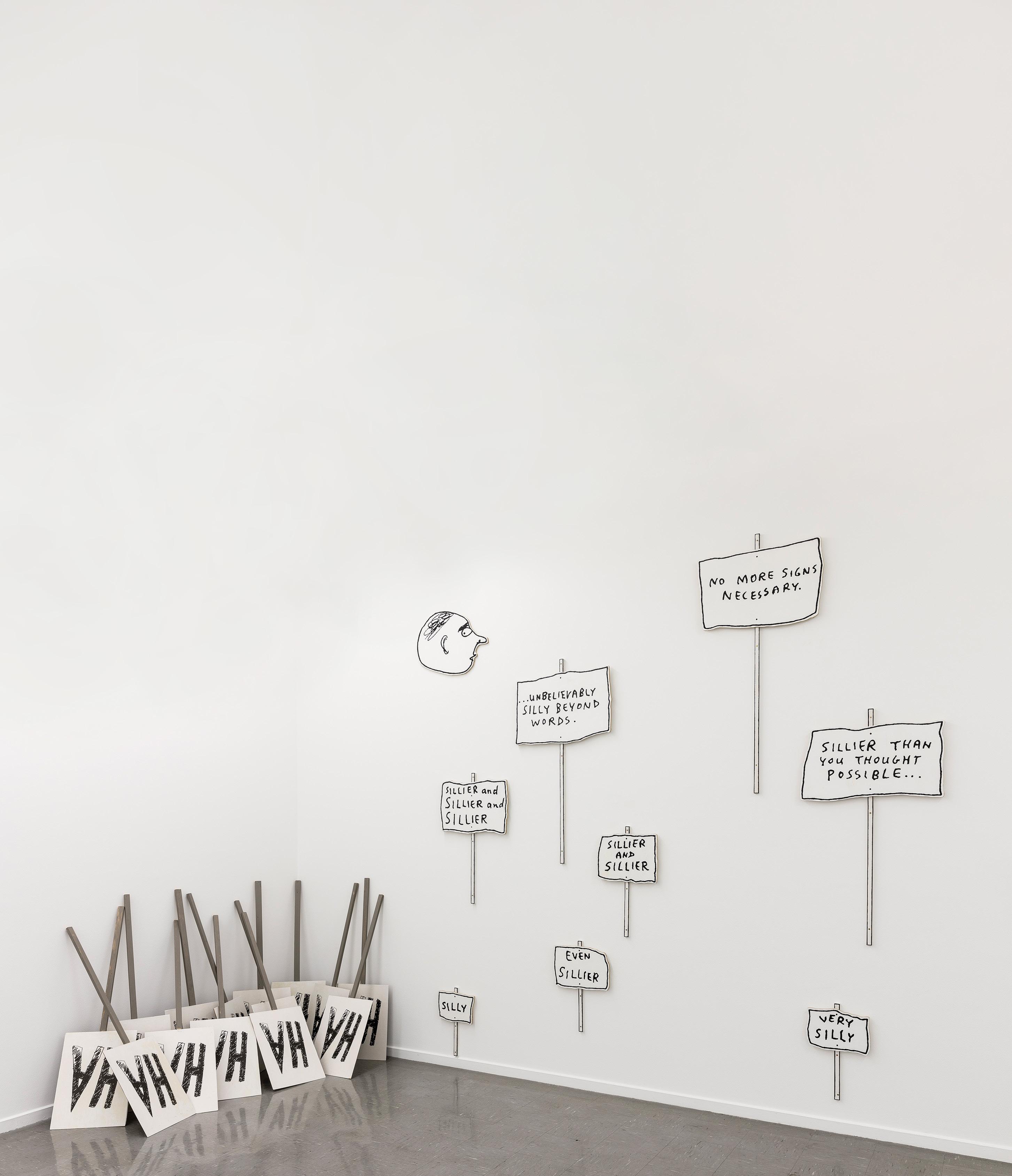
COPYRIGHT CREDITS
Lot 1 © Namatjira Legacy Trust/Copyright Agency 2026
Lot 2 © Namatjira Legacy Trust/Copyright Agency 2026
Lot 3 © Gunybi Ganambarr. Courtesy of Buku-Larrnggay Mulka Centre
Lot 4 © courtesy of the artist and Buku Larrŋgay Mulka Centre
Lot 5 © Estate of Sally Gabori/Copyright Agency 2026
Lot 6 © Estate of Sally Gabori/Copyright Agency 2026
Lot 7 © The Estate of Ginger Riley / Copyright Agency 2026
Lot 8 © Makinti Napanangka/Copyright Agency 2026
Lot 9 © Emily Kam Kngwarreye/Copyright Agency 2026
Lot 10 © Emily Kam Kngwarreye/Copyright Agency 2026
Lot 11 © Rover Thomas/Copyright Agency 2026
Lot 12 © courtesy of The Estate of Paddy Bedford
Lot 13 © Timo Hogan / Copyright Agency 2026
Lot 14 © Freddie Timms/Copyright Agency 2026
Lot 15 © Daniel Walbidi/Copyright Agency 2026
Lot 16 © courtesy of the artist's estate and Roslyn Oxley9 Gallery, Sydney
Lot 17 © Mawalan Marika/Copyright Agency 2026
Lot 18 © Balang Nakurulk (Mr Mawurndjul/ Copyright Agency 2026
Lot 19 © Balang Nakurulk (Mr Mawurndjul/ Copyright Agency 2026
Lot 20 © Emily Kam Kngwarreye/Copyright Agency 2026
Lot 21 © Emily Kam Kngwarreye/Copyright Agency 2026
LOTS CONSIGNED BY GST REGISTERED ENTITIES
Lot 8 Makinti Napanangka
Lot 22 © Emily Kam Kngwarreye/Copyright Agency 2026
Lot 23 © Emily Kam Kngwarreye/Copyright Agency 2026
Lot 24 © Emily Kam Kngwarreye/Copyright Agency 2026
Lot 25 © Emily Kam Kngwarreye/Copyright Agency 2026
Lot 26 © Emily Kam Kngwarreye/Copyright Agency 2026
Lot 27 © Angelina Pwerle (Ngale)/Copyright Agency 2026
Lot 28 © Rover Thomas/Copyright Agency 2026
Lot 29 © courtesy of The Estate of Paddy Bedford
Lot 30 © Paddy Jaminji/Copyright Agency 2026
Lot 31 © courtesy of The Estate of Paddy Bedford
Lot 32 © Estate of Prince of Wales and Karen Brown Gallery, Darwin
Lot 33 © Estate of Prince of Wales and Karen Brown Gallery, Darwin
Lot 34 © Clifford Possum Tjapaltjarri/Copyright Agency 2026
Lot 35 © Dini Campbell Tjampitjinpa/Copyright Agency 2026
Lot 36 © Ronnie Tjampitjinpa/Copyright Agency 2026
Lot 44 © courtesy of the artist
Lot 45 © Estate of Sally Gabori/Copyright Agency 2026
Lot 46 © Estate of Sally Gabori/Copyright Agency 2026
Lot 47 © Warlimpirrnga Tjapaltjarri/Copyright Agency 2026
Lot 48 © Ningura Napurrula/Copyright Agency 2026
Lot 49 © Makinti Napanangka/Copyright Agency 2026
Lot 50 © Ningura Napurrula/Copyright Agency 2026
Lot 51 © The Estate of the Artist, courtesy Buku-Larrŋgay Mulka Art Centre
Some lots consigned for this sale may be subject to the Resale Royalty Right for Visual Artists Act 2009 (Cth). Any payments due under the obligations of the Act will be paid by the vendor.
Lot 52 © Gunybi Ganambarr. Courtesy of Buku-Larrnggay Mulka Centre
Lot 53 © Namatjira Legacy Trust/Copyright Agency 2026
Lot 54 © Namatjira Legacy Trust/Copyright Agency 2026
Lot 55 © Namatjira Legacy Trust/Copyright Agency 2026
Lot 56 © Namatjira Legacy Trust/Copyright Agency 2026
Lot 57 © Namatjira Legacy Trust/Copyright Agency 2026
Lot 58 © Pepai Jangala Carroll / Copyright Agency 2026
Lot 59 © Rammey Ramsey/Copyright Agency 2026
Lot 60 © Wattie Karrawara/Copyright Agency 2026
Lot 62 © Jan Billycan/Copyright Agency 2026
Lot 63 © Wingu Tingima/Copyright Agency 2026
Lot 64 © Tommy Mitchell/Copyright Agency 2026
Lot 65 © Maringka Baker/Copyright Agency 2026
Lot 66 © Sylvia Kanytjupai Ken/Copyright Agency 2026
Lot 67 © Tjungkara Ken/Copyright Agency 2026
Lot 68 © Sylvia Kanytjupai Ken/Copyright Agency 2026
Lot 69 © Eubena Nampitjin/Copyright Agency 2026
Lot 70 © Eubena Nampitjin/Copyright Agency 2026
Lot 71 © Boxer Milner Tjampitjin/Copyright Agency 2026
Lot 72 © Dinny Nolan Tjampitjinpa/Copyright Agency 2026
Lot 73 © Long Jack Phillipus Tjakamarra/ Copyright Agency 2026
Lot 74 © Tim Leura Tjapaltjarri/Copyright Agency 2026
Lot 75 © Crusoe Kurddal/Copyright Agency 2026
Lot 76 © Owen Yalandja/Copyright Agency 2026
Under the provisions of the Protection of Movable Cultural Heritage Act, 1986, buyers may be required to obtain an export permit for certain categories of items in this sale from the Cultural Property Section:
Department of Infrastructure, Transport, Regional Development, Communications and the Arts GPO Box 2154 Canberra ACT 2601
Email: movable.heritage@arts.gov.au
Phone: 1800 819 461
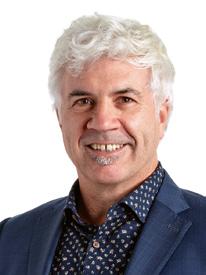
Design and Photography: Danny Kneebone
Danny Kneebone
Design and Photography Manager
With over 25 years in the art auction industry as both photographer and designer. Danny was Art Director at Christie’s from 2000–2007, Bonham’s and Sotheby’s 2007–2009 and then Sotheby’s Australia from 2009–2020. Specialist in design, photography, colour management and print production from fine art to fine jewellery. Danny has won over 50 national and international awards for his photography work and art practice.
© Published by Deutscher and Hackett Pty. Ltd. 2026
ISBN: 978-1-7643578-1-4
B
Baimunungbi, Jacky 40, 41, 42
Baker, Maringka 65
Bedford, Paddy Nyunkuny 12, 29, 31
Billycan (Djan Namundie), Jan 62
C
Carroll, Pepai Jangala 58
Cook, Michael 44
D
Diidja 39, 43
G
Gabori, Sally 5, 6, 45, 46
Ganambarr, Gunybi 3, 52
H
Hogan, Timo 13
J
Jaminji, Paddy 30
Jomeri, George 61 K
Karrawara, Wattie 60 Ken, Sylvia Kanytjupai 66, 68 Ken, Tjungkara 67
Kngwarreye, Emily Kam 9, 10, 20, 21, 22, 23, 24, 25, 26
Kurddal, Crusoe 75 L
Lanyirrda (Billy) 37, 38
Marawili, Noŋgirrŋa 51 Marika, Mawalan 17 Mitchell, Tommy 64 N
Nakurulk (Mr Mawurndjul), Balang 18, 19 Namatjira, Albert 1, 2, 53, 54, 55, 56, 57 Nampitjin, Eubena 69, 70 Napanangka, Makinti 8, 49 Napurrula, Ningura 48, 50 P
Prince of Wales (Midpul) 32, 33 Pwerle (Ngale), Angelina 27 R
Ramsey, Rammey 59 Riley Munduwalawala, Ginger 7 T
Thomas (Joolama), Rover 11, 28 Timms, Freddie 14
Tingima, Wingu 63
Tjakamarra, Long Jack Phillipus 73
Tjampitjin, Boxer Milner 71
Tim Leura 74
Warlimpirrnga 47
Clifford Possum 34
Walbidi, Daniel 15 Wanambi, Wukun 4
Yalandja, Owen 76 Yunupiŋu, Nyapanyapa 16
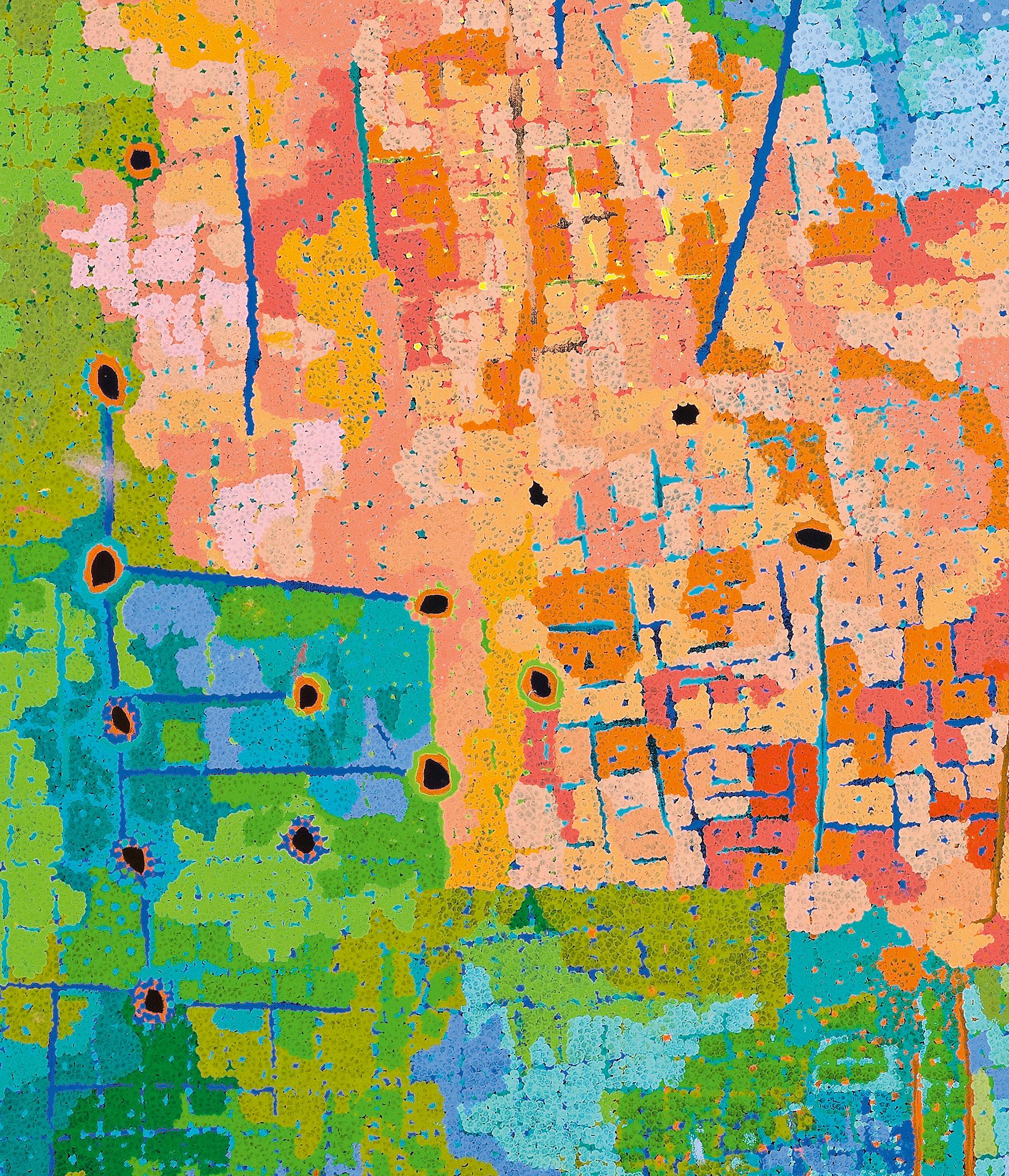
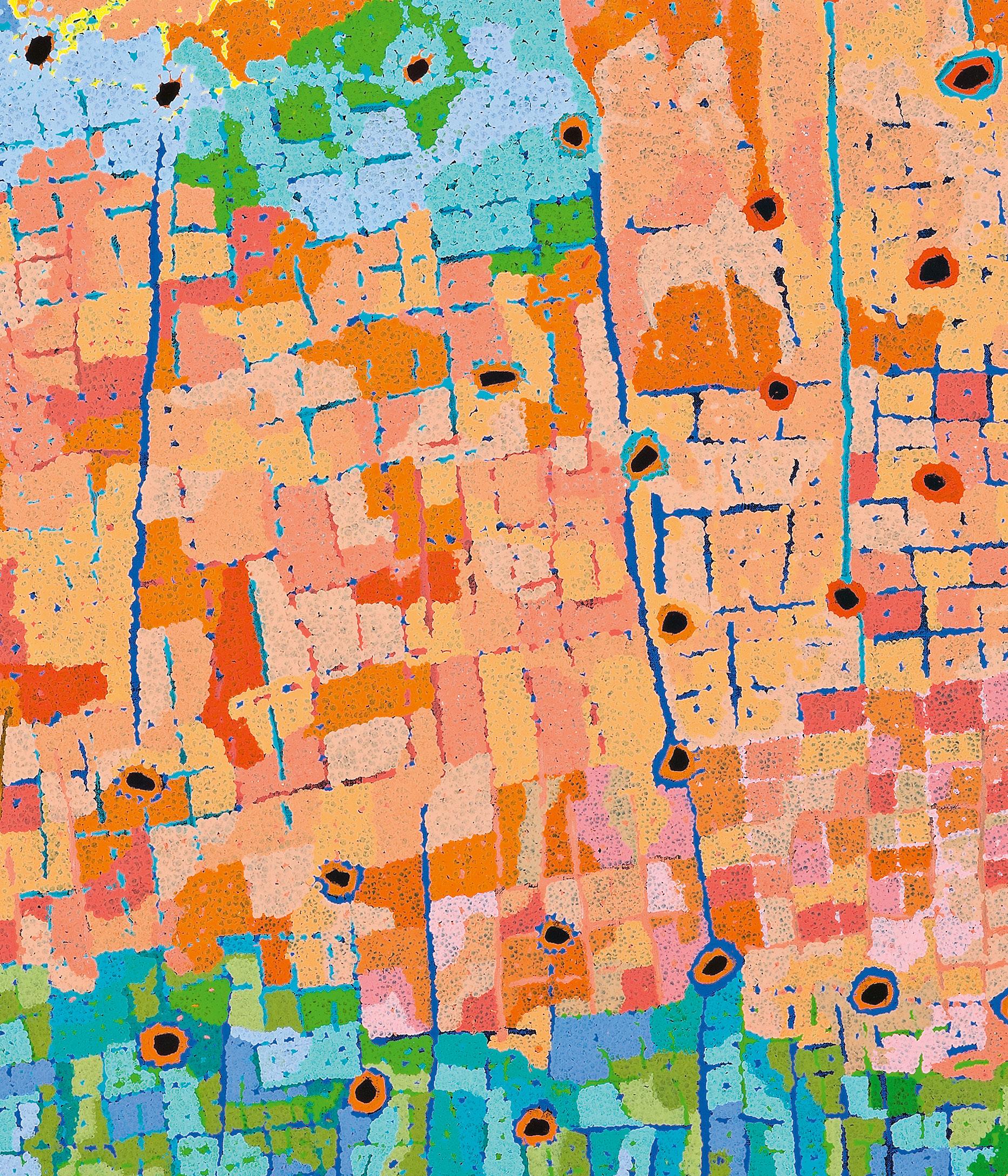
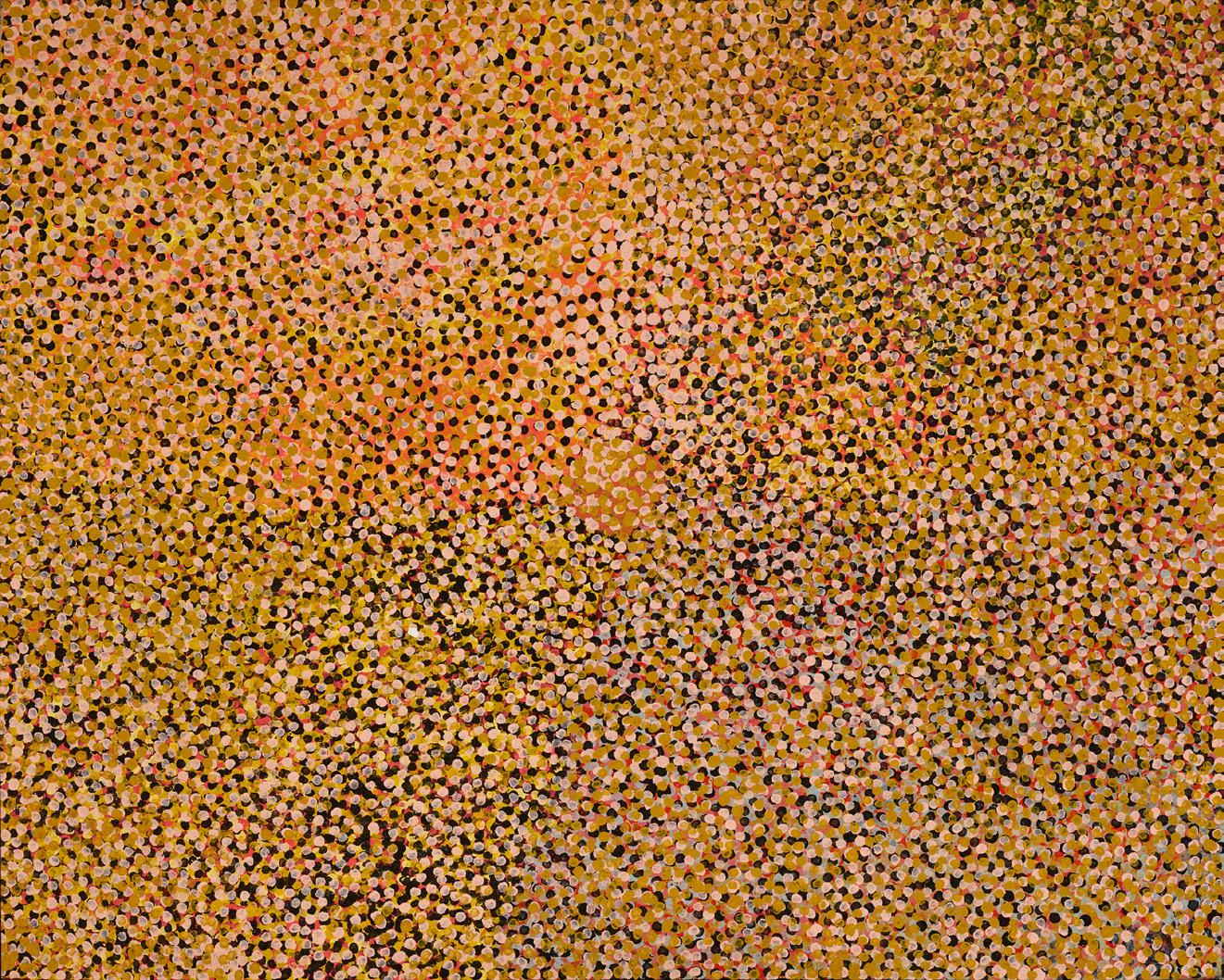
specialist fine art auction house and private gallery