Expert Insights: Incorporating 101 POWERED BY WARNER NORCROSS+JUDD
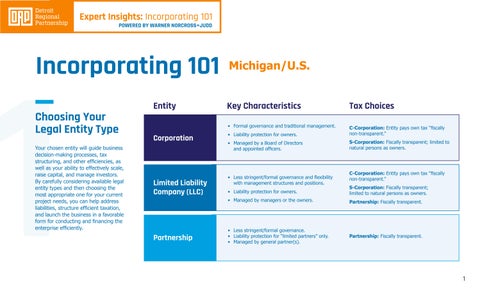
Incorporating 101 Michigan/U.S. Choosing Your Legal Entity Type Your chosen entity will guide business decision-making processes, tax structuring, and other efficiencies, as well as your ability to effectively scale, raise capital, and manage investors. By carefully considering available legal entity types and then choosing the most appropriate one for your current project needs, you can help address liabilities, structure efficient taxation, and launch the business in a favorable form for conducting and financing the enterprise efficiently.
Entity Corporation
Limited Liability Company (LLC)
Partnership
Key Characteristics
Tax Choices
• Formal governance and traditional management. • Liability protection for owners.
C-Corporation: Entity pays own tax “fiscally non-transparent.”
• Managed by a Board of Directors and appointed officers.
S-Corporation: Fiscally transparent; limited to natural persons as owners.
• Less stringent/formal governance and flexibility with management structures and positions.
C-Corporation: Entity pays own tax “fiscally non-transparent.”
• Liability protection for owners.
S-Corporation: Fiscally transparent; limited to natural persons as owners.
• Managed by managers or the owners.
Partnership: Fiscally transparent.
• Less stringent/formal governance. • Liability protection for “limited partners” only. • Managed by general partner(s).
Partnership: Fiscally transparent.
1