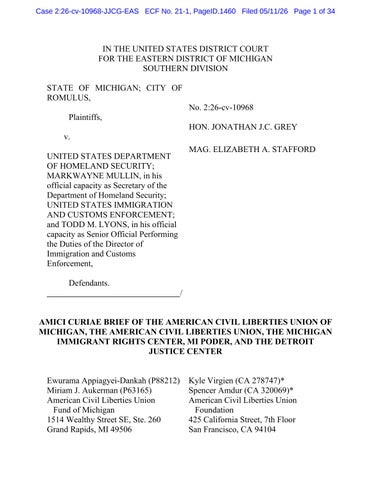
IN THE UNITED STATES DISTRICT COURT FOR THE EASTERN DISTRICT OF MICHIGAN SOUTHERN DIVISION
STATE OF MICHIGAN; CITY OF ROMULUS, Plaintiffs, v.
UNITED STATES DEPARTMENT OF HOMELAND SECURITY; MARKWAYNE MULLIN, in his official capacity as Secretary of the Department of Homeland Security; UNITED STATES IMMIGRATION AND CUSTOMS ENFORCEMENT; and TODD M. LYONS, in his official capacity as Senior Official Performing the Duties of the Director of Immigration and Customs Enforcement, Defendants. /
No. 2:26-cv-10968
HON. JONATHAN J.C. GREY
MAG. ELIZABETH A. STAFFORD
AMICI CURIAE BRIEF OF THE AMERICAN CIVIL LIBERTIES UNION OF MICHIGAN, THE AMERICAN CIVIL LIBERTIES UNION, THE MICHIGAN IMMIGRANT RIGHTS CENTER, MI PODER, AND THE DETROIT JUSTICE CENTER
Ewurama Appiagyei-Dankah (P88212) Miriam J. Aukerman (P63165)
American Civil Liberties Union Fund of Michigan
1514 Wealthy Street SE, Ste. 260 Grand Rapids, MI 49506
Kyle Virgien (CA 278747)* Spencer Amdur (CA 320069)*
American Civil Liberties Union Foundation
425 California Street, 7th Floor San Francisco, CA 94104
(616) 301-0930 eadankah@aclumich.org maukerman@aclumich.org
Bonsitu Kitaba-Gaviglio (P78822) American Civil Liberties Union Fund of Michigan 2966 Woodward Ave. Detroit, MI 48201 (313) 578-6800 bkitaba@aclumich.org
Ruby Robinson (P75244)
Michigan Immigrant Rights Center 3030 S. 9th St. Suite 1B Kalamazoo, MI 49009 (269) 492-7196, ext. 535 rubyr@michiganimmigrant.org
Nancy A. Parker (P84325)
Eric C. Williams (P75688)
Detroit Justice Center 4731 Grand River, Ste. 200 Detroit, MI 48208 313-736-5957 nparker@detroitjustice.org ewilliams@detroitjustice.org
(415) 343-0770 kvirgien@aclu.org samdur@aclu.org
Carmen Iguina Gonzalez (CA 277369; DC 1644730) * Lucia Goin (DC 1739389) * American Civil Liberties Union Foundation 915 15th Street, NW, 7th Floor Washington, DC 20005 (202) 393-4930 ciguinagonzalez@aclu.org lgoin@aclu.org
Anand Balakrishnan (CA 330418) * American Civil Liberties Union Foundation 125 Broad Street, 18th Floor New York, NY 10004 (212) 549-2600 abalakrishnan@aclu.org
Attorneys for Proposed Amici Curiae
* Attorney not admitted in this District, co-signing pursuant to L.R. 83.20(i)(l)(D)(i).
I. Detention at the Warehouse Will Cause Irreparable Harm to Immigrant Communities in Michigan. .................................................................................6
II. 8 U.S.C. § 1252(f) Does Not Bar Relief in this Case. ......................................14
A. Section 1252(f) Does Not Bar Injunctions with Only Collateral Effects on Immigration Detention. .............................................................................14
B. Section 1252(f) Does Not Bar APA Remedies, Even If They Directly Affect Detention. ............................................................................................19
III. 8 U.S.C. § 1252(a)(2)(B)(ii) Does Not Bar Relief in this Case. .......................21
TABLE OF AUTHORITIES
Cases
8 U.S.C. § 1421 ........................................................................................................16
8 U.S.C. § 1225 ........................................................................................................15
Advocate Health Care Network v. Stapleton, 581 U.S. 468 (2017) .........................18
Afr. Communities Together v. Noem, F. Supp. 3d , No. CV 26-10278, 2026 WL 948591 (D. Mass. Apr. 8, 2026) ...........................................................21
Aguilar v. U.S. Immigr. & Customs Enf’t, 510 F.3d 1 (1st Cir. 2007) .....................24
Al Otro Lado v. EOIR, 138 F.4th 1102 (9th Cir. 2025) ............................................16
Barco Mercado v. Noem, 800 F. Supp. 3d 526 (S.D.N.Y. 2025) .........................8, 12
Biden v. Texas, 597 U.S. 785 (2022) ........................................................................21
Castañon-Nava v. DHS, F.4th , 2026 WL 1223250 (7th Cir. May 5, 2026) .....................................................................................................................17
CHIRLA v. Noem, 805 F. Supp. 3d 48 (D.D.C. 2025) .............................................20
Corley v. United States, 556 U.S. 303 (2009) ..........................................................18
D.N.N. v. Liggins, No. 1:25-CV-01613-JRR, 2026 WL 632371 (D. Md. Mar. 6, 2026) ..........................................................................................................8
Doe v. Noem, F. Supp. 3d , No. 26 CIV. 2103, 2026 WL 1192079 (S.D.N.Y. May 1, 2026) ........................................................................................21
Florida v. United States, No. CV 21-1066, 2023 WL 2399883 (N.D. Fla. Mar. 8, 2023) ........................................................................................................20
Friends of the Everglades, Inc. v. Dep’t of Homeland Security, F.4th , No. 25-12873, 2026 WL 1077624 (11th Cir. Apr. 21, 2026) ..................... 5, 11, 19
Friends of the Everglades, Inc. v. Sec. of U.S. Dept. of Homeland Sec., --F.4th , 2026 WL 1077624 (11th Cir. Apr. 21, 2026) ...................................7, 19
Garland v. Aleman Gonzalez, 596 U.S. 543 (2022) 16
Garro Pinchi v. Noem, 813 F. Supp. 3d 973 (N.D. Cal. 2025) ................................20
Gayle v. Meade, 614 F. Supp. 3d 1175, 1203-06 (S.D. Fla. 2020) ............................7
Gomez Ruiz, et al. v. U.S. Immigr. and Customs Enf’t, No. 3:25-CV-09757MMC, 2026 WL 851980 (N.D. Cal. Mar. 27, 2026) ..............................................7
Gonzales v. Dep’t of Homeland Security, 508 F.3d 1227 (9th Cir. 2007) ................17
Immigr. Defenders Law Center v. Noem, 145 F.4th 972 (9th Cir. 2025) .......... 20, 21
Kucana v. Holder, 558 U.S. 233 (2010) ........................................................... 23, 24
Luna Gutierrez v. Noem, 811 F. Supp. 3d 133 (D.D.C. 2025) ...................................8
Make the Rd. New York v. Noem, No. 25-5320, 2025 WL 3563313 (D.C. Cir. Nov. 22, 2025) ...............................................................................................20
Nken v. Holder, 556 U.S. 418 (2009) .......................................................................21
Procunier v. Martinez, 416 U.S. 396 (1974) 9
RAICES v. Mullin, --- F.4th ----, 2026 WL 1110616 (D.C. Cir. Apr. 24, 2026) ........................................................................................................ 16, 20, 21
Reno v. Am.-Arab Anti-Discrimination Comm., 525 U.S. 471 (1999).....................21
Reyna ex rel. J.F.G. v. Hott, 921 F.3d 204 (4th Cir. 2019) .......................................24
Texas v. DHS, 123 F.4th 186, 209-11 (5th Cir. 2024) ..............................................17
Texas v. United States, 40 F.4th 205 (5th Cir. 2022) 20, 21
U.H.A. v. Bondi, --- F.Supp.3d. ----, No. 26-417, 2026 WL 558824 (D. Minn. Feb. 27, 2026) ............................................................................................17
v
8
8
Other Authorities
Allison McCann, Helmuth Rosales & Eric Rabinowitz, How ICE Plans to Put 8,500 Immigrants in This Warehouse, N.Y. Times (Mar. 9, 2026) ................13
Am. Immigr. Council & Mich. Global Talent Initiative, Contributions of New Americans in Michigan (2023 data) .............................................................13
Am. Immigr. Council, U.S. Citizen Children Impacted by Immigration Enforcement (June 24, 2021) ................................................................................14
Annalise Frank, Reported Hunger Strike Renewed at Michigan ICE Detention Center, Axios (Apr. 27, 2026) .............................................................10
Ben Warren, Michigan ICE Facility’s Medical Care Strained by Surge in Detainees, The Detroit News (April 14, 2026) ......................................................9
Caitlin Patler, Altaf Saadi & Paola Langer, The Health-Related Experiences of Detained Immigrants with and Without Mental Illness, 11 J. Migration & Health no. 100302 (2025) ...................................................................................7
Camilo Montoya-Galvez, ICE Reports 18th Detainee Death in 4 Months, Putting Agency on Track for New Record, CBS News (May 1, 2026) ..................7
Chanelle Diaz et al., Harmful by Design A Qualitative Study of the Health Impacts of Immigration Detention, 38 J. Gen. Intern. Med. 2030 (2023) .............8
Douglas MacMillan, Giant Tent Rises in Florida to House Hundreds of Detained Immigrants, Washington Post (Apr. 24, 2025) .....................................12
Douglass MacMillan, 60 Violations in 50 Days: Inside ICE’s Giant Tent Facility at Ft. Bliss, Washington Post (Sept. 16, 2025) 11, 12
Erin Sullivan, West Michigan man details medical neglect in Baldwin ICE detention center, WZZM 13 (Feb. 6, 2026) ......................................................... 11
Garrett Shanley and Churchill Ndonwie, Beatings and Pepper Bombs: Conditions Worsen at Alligator Alcatraz, Detainees Say, Miami Herald (Apr. 20, 2026)...................................................................................................... 11
Graeme Blair & David Hausman, Deportation Data Project, One Year of Immigration Enforcement Under the Second Trump Administration (Apr. 7, 2026) ...................................................................................................................8
Lauren Gibbons, As ICE Detention Center Opens, ‘Dangerous Times to Be an Immigrant In Michigan’, Bridge Mich. (June 24, 2025) ...................................9
Letter from Congresswoman Hillary Scholten and Congresswoman Haley Stevens to the Honorable Kristi Noem, Secretary, U.S. Dep’t of Homeland Sec. and Todd Lyons, Acting Director, U.S. Immigr. and Customs Enf’t. (Feb. 20, 2026)......................................................................................................10
Lindsey Smith & Adam Yaha Rayes, Here’s What Some Of The 911 Calls Out of North Lake Immigration Detention Center Sound Like, Michigan Public (Mar. 17, 2026) 10
Lori Rozsa, David Ovalley & Rachel Hatzipanagos, Inside ‘Alligator Alcatraz,’ Detainees Report Relentless Mosquitoes, Limited Water, Washington Post (July 17, 2025) ..........................................................................12
Luis Ferre-Sadurni, ICE Must Improve Conditions in N.Y.C. Migrant Holding Cells, Judge Rules, N.Y. Times (Aug. 15, 2025) 12
Marina Dunbar, ICE Director Wants to Run Deportations Like ‘Amazon Prime for Human Beings’, The Guardian (April 9, 2025) .....................................6
Mark Rivera, Barb Markoff, Christine Tressel, and Tom Jones, Bulgarian Chicago Business Owner Dies in ICE Custody, Sparking Calls for ‘Immediate Investigation’, ABC 7 Eyewitness News (Dec. 19, 2025) 10
Matthew Lisiecki & Gerard Apruzzese, Ctr. for Migration Stud., Proposed 2024 Mass Deportation Program Would Socially and Economically Devastate American Families, at 3 (Oct. 9, 2024) ...............................................13
viii
Niraj Warikoo, Immigrant Inmate Dies at ICE Prison in Michigan, Detroit Free Press (Dec. 19, 2025) ...................................................................................10
Rose White, 911 Calls Document Health Emergencies, Suicide Attempts at Michigan’s Largest ICE Detention Center, MLive (Mar. 4, 2026) ........................9
Violet Ikonomova Dave Boucher, & Beki San Martin, Many Michigan ICE Detainees Had Deep U.S. Roots, Clean Records, Detroit Free Press (Mar. 28, 2026) ........................................................................................................ 13, 14
INTERESTS OF AMICI
The American Civil Liberties Union is a nationwide, nonprofit, nonpartisan organization dedicated to the principles embodied in the United States Constitution and our nation’s civil rights laws. The American Civil Liberties Union of Michigan is the state affiliate of the ACLU. The ACLU and ACLU of Michigan have extensive experience litigating cases related to immigration detention and federal jurisdiction, both in Michigan and across the United States, including issues under 8 U.S.C. § 1252(f). See, e.g., Preap v. Nielson, 586 U.S. 392 (2019) (challenge to immigration detention policy); DHS v. Thuraissigiam, 591 U.S. 103 (2020) (addressing numerous immigration jurisdictional issues); RAICES v. Mullin, F.4th , No. 25-5243, 2026 WL 1110616, *24-26 (D.C. Cir. Apr. 24, 2026) (addressing multiple 8 U.S.C. § 1252(f)(1) issues); Hamama v. Adducci, 912 F.3d 869 (6th Cir. 2018) (class action challenging deportation and detention of Iraqi nationals, and addressing 8 U.S.C. § 1252(f)(1)); Lopez-Campos v. Raycraft, No. 25-1965 (6th Cir. May 11, 2026) (rejecting ICE’s attempt to invoke mandatory detention provision of the Immigration and Nationality Act to detain longtime U.S. residents); Hernandez v. Sessions, 872 F.3d 976 (9th Cir. 2017) (holding policy of setting immigration bond amounts without considering detained persons’ financial circumstances likely violated due process).
The Michigan Immigrant Rights Center (“MIRC”) is a nonprofit legal resource center with five offices across the state that serve Michigan’s immigrant communities. MIRC is the only Michigan-based free legal services provider accepting free calls from immigration detention centers in Michigan. Each week MIRC handles dozens of calls from detainees in Michigan seeking legal assistance, providing legal advice and, when resources allow, full representation to detainees in removal proceedings or seeking judicial review.
MI Poder a statewide civic engagement and advocacy organization dedicated to strengthening the leadership, civic participation, and collective power of Latino communities across Michigan. MI Poder regularly works alongside individuals and families directly impacted by policies related to immigration detention. Through its on-the-ground work, MI Poder has direct knowledge of how immigration enforcement infrastructure particularly detention facilities impacts community safety, family stability, and civic participation.
The Detroit Justice Center (“DJC”) is a non-profit law firm that provides legal services, engages in policy advocacy, and supports community-led efforts addressing the harms caused by incarceration, detention, surveillance, and overpolicing. DJC has a substantial interest in this litigation as the proposed warehouse conversion threatens to inflict significant and irreparable harms on immigrant communities, neighboring residents, and the broader Southeast Michigan region.
DJC is committed to protecting the legal rights of those impacted by the legal system, and along with our partners, have seen first-hand the destabilizing effects detention facilities have on families, economic security, mental health, and community trust in public institutions.
INTRODUCTION
Warehouses are built to house goods, not human beings. Yet on February 4, 2026, the U.S. Department of Homeland Security (“DHS”) purchased a warehouse in Romulus, Michigan, intending to convert the warehouse to an immigration detention facility with the capacity to detain anywhere from 500 to 2,000 people. Opp. to Pls.’ Mot. for Preliminary Injunction, ECF No. 13, PageID.214 (“PI Opp.”).
In its zeal to expand its immigration detention capacity, DHS completed the warehouse purchase without complying with applicable statutory mandates under the National Environmental Policy Act (“NEPA”), the Intergovernmental Cooperation Act (“ICA”), or the Immigration and Nationality Act (“INA”). Pls.’ Mot. for Preliminary Injunction, ECF No. 9, PageID.105-106 (“PI Br.”). Plaintiffs have asked the Court to pause Defendants’ ill-conceived plan to convert the warehouse into a detention facility. Amici write to highlight the severe harms that will come to thousands of people if they are detained in a space that was never meant to accommodate them. In addition, because several amici have extensive experience
litigating the jurisdictional issues raised by the Defendants, this brief also explains why Defendants’ jurisdictional arguments are meritless.
Starting with the harm, immigrant communities in Michigan will suffer irreparable harm should the warehouse detention proceed as planned. The harms that flow from immigration detention are, at this point, well documented. Defendants subject the people detained in their custody to inhumane, unconstitutional, and dangerous conditions ranging from egregiously inadequate medical care to staff violence and abuse. That Defendants cannot safely detain people in their existing facilities, built for the express purpose of housing individuals, makes their proposed use of the Romulus Warehouse to detain immigrant communities in Michigan a scary proposition. The harms that would flow from that detention are truly irreparable, both to the people who would be housed like packages in that warehouse and to Michigan communities that would feel the impacts of that detention. Further, allowing such harm to occur is clearly not in the public interest.
Turning to jurisdiction, Defendants argue that this Court is powerless to grant Plaintiffs’ requested relief. But their arguments fail for three reasons. First and contrary to Defendants’ assertions, 8 U.S.C. § 1252(f)(1) does not bar this Court from granting injunctive relief here. Where a district court “enjoin[s] federal construction of a non-operational detention facility pending compliance with [NEPA], any impact on immigration enforcement would be collateral,” and so does
not trigger § 1252(f)(1). Friends of the Everglades, Inc. v. Dep’t of Homeland Security, F.4th , No. 25-12873, 2026 WL 1077624, *7 (11th Cir. Apr. 21, 2026).
Second, the remedies available under the Administrative Procedure Act (“APA”) do not implicate § 1252(f)(1) at all. 5 U.S.C. § 705 allows courts to grant preliminary relief pausing the challenged agency action, and 5 U.S.C. § 706(2) gives courts the authority to “set aside” and vacate unlawful agency action. Neither remedy constitutes injunctive relief that triggers § 1252(f)(1).
Third, 8 U.S.C. § 1252(a)(2)(B)(ii)’s bar on review of discretionary decisions does not apply here either. NEPA compliance and the other statutory duties that Plaintiffs are seeking to enforce are not discretionary and Defendants do not even claim otherwise. Courts have been clear that such challenges to DHS’s legal authority are not barred by § 1252(a)(2)(B)(ii). And while Plaintiffs’ motion does not raise any violations of § 1231(g)(1), even that statute does not explicitly vest the Secretary with discretionary decision-making authority, as is required for § 1252(a)(2)(B)(ii) to apply.
Whether through a preliminary injunction or relief under the APA, amici respectfully urge this Court to prohibit Defendants from taking any steps to convert the warehouse to a detention center.
ARGUMENT
I. Detention at the Warehouse Will Cause Irreparable Harm to Immigrant Communities in Michigan.
Defendant Lyons stated that immigration enforcement should run “like [Amazon] Prime, but with human beings.” 1 But human beings are not packages. When the government exercises its authority to detain them, people need food, water, sanitation, medical care, outdoor exercise, family visits, and access to counsel. And warehouses are built to store packages, not to detain human beings. Permitting the government to use the Romulus Warehouse as an immigration detention center would cause irreparable harm to noncitizens in Michigan, their families, and the broader state, and would not be in the public interest.
Across the country, numerous reports and lawsuits detail how ICE under Defendant Lyons’s watch subjects people in immigration detention to inhumane conditions of confinement. 2 2025 was the second-deadliest year on record for immigration detention 31 people died at ICE detention facilities, which is the
1 Marina Dunbar, ICE Director Wants to Run Deportations Like ‘Amazon Prime for Human Beings’, The Guardian (April 9, 2025), https://www.theguardian.com/usnews/2025/apr/09/ice-todd-lyons-deporation-amazon.
2 See, e.g., Gomez Ruiz, et al. v. U.S. Immigr. and Customs Enf’t, No. 3:25-CV09757-MMC, 2026 WL 851980 (N.D. Cal. Mar. 27, 2026); Gayle v. Meade, 614 F. Supp. 3d 1175, 1203-06 (S.D. Fla. 2020); Friends of the Everglades, Inc. v. Sec. of U.S. Dept. of Homeland Sec., F.4th , 2026 WL 1077624, at *12 (11th Cir. Apr. 21, 2026) (Abudu, J., dissenting) (noting that there are “documented instances of abuse in immigration facilities”)
highest number of deaths in over two decades. 3 Just five months into 2026, eighteen people across the country have already died in ICE detention, which means this year is on pace to have the most-ever deaths in immigration detention. 4 Immigration detention disrupts medical care, worsens preexisting conditions, and creates new health issues for those in custody. 5 Multiple courts have found that these dangerous conditions are no accident: “Statements from senior officials suggest that harsh conditions of confinement are a deliberate feature of the enforcement program intended to induce self-deportation and to deter illegal immigration.” 6 A recent study
3 Camilo Montoya-Galvez, ICE Reports 18th Detainee Death in 4 Months, Putting Agency on Track for New Record, CBS News (May 1, 2026), https://www.cbsnews.com/news/ice-detainee-deaths-2026/.
4 Id.
5 Caitlin Patler, Altaf Saadi & Paola Langer, The Health-Related Experiences of Detained Immigrants with and Without Mental Illness, 11 J. Migration & Health no. 100302, at 4 (2025) (“Structural features of the US immigration detention system can also cause and/or worsen [mental illness] through various mechanisms including severing of social and family connections and health-harming conditions of confinement such as overcrowding, unsanitary conditions, sleep deprivation, verbal and/or physical abuse, lack of recreation time, and exposure to extreme temperatures or weather conditions.”); Chanelle Diaz et al., Harmful by Design A Qualitative Study of the Health Impacts of Immigration Detention, 38 J. Gen. Intern. Med. 2030, 2034 (2023).
6 Barco Mercado v. Noem, 800 F. Supp. 3d 526, 575 (S.D.N.Y. 2025); accord D.N.N. v. Liggins, No. 1:25-CV-01613-JRR, 2026 WL 632371, at *33 (D. Md. Mar. 6, 2026) (“Defendants’ own press releases and statements suggest the complainedof conditions are intended to be punitive . . . .”); Luna Gutierrez v. Noem, 811 F. Supp. 3d 133, 172 (D.D.C. 2025) (“[T]he Court sees unusually strong direct evidence that the Defendants chose to detain some noncitizens at Guantanamo for the express purpose of retaliating against them and deterring others’ conduct.”).
showed that this plan is working: people in immigration detention view the poor conditions of confinement as a way for the government to pressure them into giving up, forego their immigration court proceedings, and leave the United States. 7 Since the beginning of 2025, voluntary departures have increased by 2,800%. 8
Additionally, there are widely-documented issues with access to counsel in immigration detention facilities across the country. 9 That people in ICE detention face barriers to preparing for and participating in court hearings is especially problematic, given that individuals in custody must be given a “reasonable opportunity to seek and receive the assistance of attorneys,” Procunier v. Martinez, 416 U.S. 396, 419 (1974), and that securing participation in immigration proceedings is, ostensibly, the very purpose of immigration detention, see Zadvydas v. Davis, 533 U.S. 678, 690 (2001).
Michigan is already intimately familiar with the harms of mass immigration detention. On June 16, 2025, the North Lake Processing Center (“North Lake”), an 1,800-bed ICE detention facility, opened in Baldwin, Michigan on the site of a
7 Chanelle Diaz et al., supra note 6, at 2035.
8 Graeme Blair & David Hausman, Deportation Data Project, One Year of Immigration Enforcement Under the Second Trump Administration, at 1, 9-11 (Apr. 7, 2026), https://deportationdata.org/analysis/immigration-enforcement-firstyear.pdf.
9 See, e.g., Barco Mercado, 800 F. Supp. 3d at 576-78; Gomez Ruiz, 2026 WL 851980, at *7; H.C.R. v. Mullin, No. 2:25-CV-747-SPC-DNF, 2026 WL 850555, at *17-23 (M.D. Fla. Mar. 27, 2026).
former prison. 10 The facility is the largest immigration detention in the Midwest. Though North Lake has not yet been open for a year nor reached capacity, there are already widespread reports of unsafe conditions. Many people at North Lake report that they receive inadequate medical care and access to mental health care. 11 Indeed, in December 2025, Nenko Gantchev, who had lived in the United States for 30 years, died at North Lake, reportedly due to untreated diabetes. 12 Worse, the issues at North
10 Lauren Gibbons, As ICE Detention Center Opens, ‘Dangerous Times to Be an Immigrant in Michigan’, Bridge Mich. (June 24, 2025), https://bridgemi.com/michigan-government/ice-detention-center-opensdangerous-times-be-immigrant-michigan/.
11 See, e.g., Ben Warren, Michigan ICE Facility’s Medical Care Strained by Surge in Detainees, The Detroit News (April 14, 2026), https://www.detroitnews.com/story/news/local/michigan/2026/04/13/michig an-north-lake-ice-facility-medical-care-strained-overwhelmed-detaineesurge/89124812007/; Rose White, 911 Calls Document Health Emergencies, Suicide Attempts at Michigan’s Largest ICE Detention Center, MLive (Mar. 4, 2026), https://www.mlive.com/news/2026/03/911-calls-document-healthemergencies-suicide-attempts-at-michigans-largest-ice-detentioncenter.html?utm_campaign=mlivedotcom_sf&utm_medium=social&utm_source=f acebook&fbclid=IwY2xjawQVR3pleHRuA2FlbQIxMQBzcnRjBmFwcF9pZA80 MDk5NjI2MjMwODU2MDkAAR7WaEGMTrfyDHC_PpPDoDxgD69cFc5gxgX45clHeqStahjCEJfZGiiXHjLmw_aem_ynEoM8YtxfqIQjYaiTKEcQ; Lindsey Smith & Adam Yaha Rayes, Here’s What Some Of The 911 Calls Out of North Lake Immigration Detention Center Sound Like, Michigan Public (Mar. 17, 2026), https://www.michiganpublic.org/politics-government/2026-03-17/hereswhat-some-of-the-911-calls-out-of-north-lake-immigration-detention-centersound-like.
12 Niraj Warikoo, Immigrant Inmate Dies at ICE Prison in Michigan, Detroit Free Press (Dec. 19, 2025), https://www.freep.com/story/news/local/michigan/2025/12/19/nenkogantchev-bulgarian-national-ice-prison-baldwin-michigan/87836268007/; Mark Rivera, Barb Markoff, Christine Tressel, and Tom Jones, Bulgarian Chicago
Lake are not cabined to health care. People detained there also report that they have received spoiled food, 13 are held in extreme temperatures, 14 and have their needs ignored by facility staff, especially if they have limited English proficiency. 15
That conditions at North Lake and facilities across the country are already this dire bodes ill for the proposed warehouse detention in Romulus. Warehouses are not built to house human beings. The fact that ICE has been unable to detain people safely and humanely in its existing facilities that were constructed for that purpose raises alarm bells about what conditions would be like if ICE holds human beings in warehouses that were built to hold containers and boxes.
Business Owner Dies in ICE Custody, Sparking Calls for ‘Immediate Investigation’, ABC 7 Eyewitness News (Dec. 19, 2025), https://abc7chicago.com/post/bulgarianchicago-business-owner-nenko-gantchev-dies-ice-custody-family-congresswomancall-immediate-investigation/18301520/
13 Annalise Frank, Reported Hunger Strike Renewed at Michigan ICE Detention Center, Axios (Apr. 27, 2026), https://www.axios.com/local/detroit/2026/04/27/reported-hunger-strike-renewedat-michigan-ice-detention-center.
14 Letter from Congresswoman Hillary Scholten and Congresswoman Haley Stevens to the Honorable Kristi Noem, Secretary, U.S. Dep’t of Homeland Sec. and Todd Lyons, Acting Director, U.S. Immigr. and Customs Enf ’t. (Feb. 20, 2026) https://stevens.house.gov/sites/evo-subsites/stevens.house.gov/files/evo-mediadocument/scholten-stevens-to-dhs-ice-2.20.pdf
15 Erin Sullivan, West Michigan man details medical neglect in Baldwin ICE detention center, WZZM 13 (Feb. 6, 2026), https://www.wzzm13.com/article/news/local/michigan/baldwin-ice-facilitymedical-neglect/69-6d81bb64-26c1-40e7-b391-8ecf4b9b82e6
The conditions at makeshift detention centers such as the ICE detention tent camps in the Everglades known as “Alligator Alcatraz” and in Fort Bliss in Texas which have proven to be especially dangerous are illustrative. 16 People detained at Alligator Alcatraz have reported that the tent camps are infested with swarms of mosquitoes and flood when it rains. 17 At another detention tent camp in Miami, Florida, people have reported going for weeks without showers, and having to wait for hours to see their attorneys or use bathrooms. 18 At a temporary ICE detention facility in New York, overcrowding was so severe that people had to sleep upright or on the floor near toilets. 19 And at the detention camps in Fort Bliss, one person
16 Friends of the Everglades, 2026 WL 1077624, at *12 (Abudu, J., dissenting); Garrett Shanley and Churchill Ndonwie, Beatings and Pepper Bombs: Conditions Worsen at Alligator Alcatraz, Detainees Say, Miami Herald (Apr. 20, 2026), https://www.miamiherald.com/news/politics-government/statepolitics/article315431745.html; Douglass MacMillan, 60 Violations in 50 Days: Inside ICE’s Giant Tent Facility at Ft. Bliss, Washington Post (Sept. 16, 2025), https://www.washingtonpost.com/business/2025/09/16/ice-detention-centerimmigration-violations/
17 Lori Rozsa, David Ovalley & Rachel Hatzipanagos, Inside ‘Alligator Alcatraz,’ Detainees Report Relentless Mosquitoes, Limited Water, Washington Post (July 17, 2025), https://www.washingtonpost.com/nation/2025/07/16/alligator-alcatrazconditions/
18 Douglas MacMillan, Giant Tent Rises in Florida to House Hundreds of Detained Immigrants, Washington Post (Apr. 24, 2025), https://www.washingtonpost.com/business/2025/04/24/immigrant-detention-tentkrome-florida/.
19 Barco Mercado v. Noem, 800 F. Supp. 3d at 546-47 & n.51; Luis Ferre-Sadurni, ICE Must Improve Conditions in N.Y.C. Migrant Holding Cells, Judge Rules, N.Y.
reported that because of the facility’s poor structure, water seeped into his cell when people took showers. 20 Expanding the use of crude facilities like warehouses will likely result in similarly inhumane conditions. Indeed, architects and construction experts who have reviewed the few publicly available warehouse detention site plans have expressed serious doubt that ICE will be able to safely detain people in warehouses, given the significant concerns about ventilation, sanitation, and the simple fact that warehouses are not designed for human occupancy. 21
Further, immigration detention does not only harm the people detained. It also harms their families and broader communities. Michigan is home to a large and vibrant immigrant population of over 700,000 people, including over 100,000 undocumented Michiganders. 22 Many undocumented Michiganders live in households with U.S. citizens, who are their children, spouses, and other family Times (Aug. 15, 2025), https://www.nytimes.com/2025/08/12/nyregion/immigrantdetention-conditions-court-order.html.
20 MacMillan, 60 Violations in 50 Days.
21 Allison McCann, Helmuth Rosales & Eric Rabinowitz, How ICE Plans to Put 8,500 Immigrants in This Warehouse, N.Y. Times (Mar. 9, 2026), https://www.nytimes.com/interactive/2026/03/09/us/politics/ice-georgiaimmigration-social-circle-warehouse.html.
22 Am. Immigr. Council & Mich. Global Talent Initiative, Contributions of New Americans in Michigan (2023 data), https://map.americanimmigrationcouncil.org/locations/michigan/#.
members. 23 Their experiences reflect the reality that across the United States, the majority of undocumented individuals share a household with at least one U.S. citizen. 24 When someone is taken into immigration detention, it causes devastation for that person’s family and can lead to housing insecurity, food insecurity, and broader economic instability for non-detained family members. 25 It also inflicts trauma on family members, especially on children who are separated from their parents. 26
In short, allowing Defendants to proceed with their plan to convert the Romulus Warehouse to an immigration detention center would result in significant and irreparable harm to individuals and communities across Michigan and would not serve the public interest.
23 Violet Ikonomova, Dave Boucher & Beki San Martin, Many Michigan ICE Detainees Had Deep U.S. Roots, Clean Records, Detroit Free Press (Mar. 28, 2026), https://www.freep.com/story/news/local/michigan/2026/03/27/michiganimmigrant-detentions-longtime-residents-no-criminal-records/89285303007/.
24 Matthew Lisiecki & Gerard Apruzzese, Ctr. for Migration Stud., Proposed 2024 Mass Deportation Program Would Socially and Economically Devastate American Families, at 3 (Oct. 9, 2024), https://cmsny.org/wpcontent/uploads/2024/10/CMS-REPORT-Proposed-2024-Mass-DeportationProgram-Would-Socially-and-Economically-Devastate-American-Families.pdf.
25 Ikonomova, Boucher & San Martin, Many Michigan ICE Detainees Had Deep U.S. Roots.
26 Id.; see also Am. Immigr. Council, U.S. Citizen Children Impacted by Immigration Enforcement (June 24, 2021), https://www.americanimmigrationcouncil.org/fact-sheet/us-citizen-childrenimpacted-immigration-enforcement/
II. 8 U.S.C. § 1252(f) Does Not Bar Relief in this Case.
Defendants claim that 8 U.S.C. § 1252(f)(1) bars this Court from granting injunctive relief. They are wrong. There are two independent reasons why relief is not barred by § 1252(f)(1): first, that provision does not apply to orders enforcing NEPA and other statutes that are not listed in § 1252(f)(1), even if the injunction would have downstream effects on covered provisions. Second, § 1252(f)(1) does not bar APA remedies like stays of agency action under 5 U.S.C. § 705 and vacatur under § 706. Either of these reasons is sufficient to grant relief in this case.
A. Section 1252(f) Does Not Bar Injunctions with Only Collateral Effects on Immigration Detention.
Defendants argue that under 8 U.S.C. § 1252(f)(1) a provision of the INA that prevents courts from “enjoin[ing] or restrain[ing] the operation” of delineated provisions in “part IV of this subchapter” they do not have to comply with other laws outside of part IV. PI Opp., ECF No. 13, PageID.223-224. Specifically, Defendants claim that the Court cannot order them to comply with NEPA or any other law that applies to construction and siting decisions, because even though those laws are not located within part IV doing so would have a downstream impact on DHS’s detention operations. Id.
No court in the country has endorsed such an extreme position. To the contrary, courts have widely held that they may enjoin violations of other statutes or other provisions of the INA, even if the injunction has collateral effects on detention
under the covered provisions of the INA. Section 1252(f)(1) therefore does not, as Defendants claim, provide a blanket exemption from any law that could apply to the construction and operation of a detention center.
Part IV includes the INA provisions in 8 U.S.C. §§ 1221-1232, which address border enforcement, detention, removal proceedings, and removal itself. See, e.g., 8 U.S.C. §§ 1225 (border processing), 1226 (detention), 1229a (removal proceedings), 1231 (removal and detention). Under § 1252(f)(1), courts generally may not directly enjoin “the Government’s efforts to enforce or implement” these covered provisions in part IV. Garland v. Aleman Gonzalez, 596 U.S. 543, 550 (2022). However, “a court may enjoin the unlawful operation of a provision that is not specified in § 1252(f)(1) even if that injunction has some collateral effect on the operation of a covered provision.” Id. at 553 n.4.
The INA contains many provisions outside of part IV, to which § 1252(f)(1) does not apply. These include non-covered provisions governing immigrant visas, 8 U.S.C. § 1153; asylum, id. § 1158; grounds of inadmissibility, id. § 1182; temporary admission, id. §§ 1184, 1187; adjustment of status, id. § 1255; naturalization, id. §§ 1421-1427; denaturalization, id. § 1481; and many other things. And a host of nonINA laws also govern DHS’s activities everything from NEPA to the Fair Labor Standards Act to state zoning laws.
These many laws outside of part IV regularly impact DHS’s detention and removal operations. For instance, an asylum rule can dictate whether a person is removable or not. A labor law may affect staffing decisions at a detention facility. An environmental rule might preclude construction at a particular site. But courts have been clear that such collateral effects on detention and removal are not enough to trigger § 1252(f)(1). See, e.g., RAICES v. Mullin, F.4th , 2026 WL 1110616, *24-26 (D.C. Cir. Apr. 24, 2026) (§ 1252(f)(1) did not prevent injunction of asylum policy, even though the injunction had an “indirect effect” of preventing detention and removal); Al Otro Lado v. EOIR, 138 F.4th 1102, 1124-26 (9th Cir. 2025) (similarly, § 1252(f)(1) did not apply to asylum statute even though the injunction barred enforcement of certain removal orders), cert. granted sub nom. Noem v. Al Otro Lado, 146 S. Ct. 604 (2025); Texas v. DHS, 123 F.4th 186, 209-11 (5th Cir. 2024) (holding that “collateral effects” do not trigger § 1252(f)(1) and rejecting DHS’s view that it “prohibits injunctions of uncovered statutes” where the injunction “impact[s] its ability to enforce the covered sections listed in § 1252(f)(1)”);
Castañon-Nava v. DHS, F.4th , 2026 WL 1223250, at *5 (7th Cir. May 5, 2026) (concluding that requiring the government to comply with 8 U.S.C. § 1357(a)(2), a non-covered provision, does not trigger § 1252(f)(1) even if that forces the government to rely on warrants issued under a covered provision, 8 U.S.C. § 1226(a), because the impact on covered activity is “indirect” and “collateral”);
U.H.A. v. Bondi, --- F.Supp.3d. ---, No. 26-417, 2026 WL 558824, at *25 & n.36 (D. Minn. Feb. 27, 2026) (non-covered statute’s “cross-reference[]” to a covered statute was insufficient to trigger § 1252(f)(1) where the core policy being enforced came from outside part IV); Gonzales v. Dep’t of Homeland Security, 508 F.3d 1227, 1233 (9th Cir. 2007) (holding that § 1252(f)(1) did not bar a court order to comply with adjustment-of-status statute, even though the injunction explicitly prevented detention and removal).
In sum, courts may enjoin violations of other laws and policies, like the environmental procedures here, that are not directly addressed by the covered provisions. That makes sense, because applying § 1252(f)(1) based on collateral, downstream effects on the covered provisions would write “part IV” out of the text.
See Advocate Health Care Network v. Stapleton, 581 U.S. 468, 477-78 (2017) (refusing to interpret statute “as if it were missing [] two words”). Nearly every immigration law has an impact on detention and removal, and countless nonimmigration laws do too. If Congress wanted to bar injunctions of all these provisions as well, it could have applied § 1252(f)(1) to the whole INA, or the “immigration system,” or any laws that affect detention and removal. Compare, e.g.,
8 U.S.C. § 1252(e)(3)(A)(ii) (sweeping in all of Title 8); 8 U.S.C. § 1201(f) (same); 8 U.S.C. § 1101(a)(16) (entire INA); 8 U.S.C. § 1256(a) (same). “The short answer is that Congress did not write the statute that way.” Corley v. United States, 556 U.S.
303, 315 (2009) (citation modified). Respecting Congress’s careful textual limits means rejecting the government’s limitless view of § 1252(f)(1).
Even the principal case on which Defendants rely recognized that § 1252(f)(1) should not apply in circumstances like those here. As the Eleventh Circuit explained in a NEPA case, if a district court “had enjoined federal construction of a nonoperational detention facility pending compliance with [NEPA], any impact on immigration enforcement would be collateral,” and thus would not trigger § 1252(f)(1). Friends of the Everglades, 2026 WL 1077624, *7. That perfectly describes the order that Plaintiffs seek here. 27
Defendants’ position would have staggering effects. A vast array of federal and state laws govern the siting, construction, and operation of detention facilities: environmental laws like NEPA, consultation laws like ICA, labor laws, laws governing detention conditions (including but not limited to the U.S. Constitution and Americans with Disabilities Act), contracting laws, zoning laws, food safety and sanitation laws, open records laws, laws that govern the hiring and training of ICE
27 In dicta, Friends of the Everglades also stated that § 1252(f)(1) would bar an injunction on NEPA grounds that enjoined the transportation of new detainees to an already-operational facility, a situation that is far afield from the circumstances here. Id. at *6-7. Amici disagree with that statement, which runs counter to the collateraleffects cases of other circuits and the Supreme Court. And for purposes of the present case, those dicta are irrelevant because there is no detention happening at the Romulus Warehouse. This case is about further construction, where even the Eleventh Circuit stated that § 1252(f)(1) would not apply. Id. at *7
officers, the list goes on. None of these are in “part IV.” But on Defendants’ theory, when it comes to immigration detention, courts cannot enforce any of these laws if doing so would “prevent[] immigration detention” in some respect. PI Opp., ECF No. 13, PageID.224. No court has endorsed such a radical position, because Congress did not grant DHS a blanket exemption from any law that could conceivably impact immigration detention. Such an expansive interpretation cannot be squared with the carefully limited language Congress chose in § 1252(f)(1). The Court should reject this defense.
B. Section 1252(f) Does Not Bar APA Remedies, Even If They Directly Affect Detention.
Defendants’ argument fails for a second, independent reason. Even if the relief did directly implicate a covered provision, § 1252(f)(1) does not bar courts from staying or vacating agency action under the APA.
The APA provides two remedies that are relevant here. It directs courts to “set aside” agency action that is unlawful. 5 U.S.C. § 706(2). And in a preliminary posture, the APA allows courts to “postpone the effective date of an agency action” in order to “prevent irreparable injury.” 5 U.S.C. § 705. Both of those remedies are available here, since Plaintiffs challenge the construction of the Romulus Warehouse under the APA. See PI Br., ECF No. 9, PageID.106, 114-115, 116-117, 123, 126-128
Courts have widely held that § 1252(f)(1) does not bar vacatur or stays of agency action under the APA. See, e.g., RAICES, 2026 WL 1110616, at *26-27;
Immigr. Defenders Law Center v. Noem, 145 F.4th 972, 989-90 (9th Cir. 2025); Texas v. United States, 40 F.4th 205, 219-20 (5th Cir. 2022); CHIRLA v. Noem, 805 F. Supp. 3d 48, 72 (D.D.C. 2025); Garro Pinchi v. Noem, 813 F. Supp. 3d 973, 1009-10 (N.D. Cal. 2025); Florida v. United States, No. CV 21-1066, 2023 WL 2399883, at *3435 (N.D. Fla. Mar. 8, 2023); Make the Rd. New York v. Noem, No. 25-5320, 2025
WL 3563313, at *16 (D.C. Cir. Nov. 22, 2025) (per curiam); Afr. Communities
Together v. Noem, --- F. Supp. 3d ---, No. CV 26-10278, 2026 WL 948591, at *15 (D. Mass. Apr. 8, 2026); Doe v. Noem, F. Supp. 3d , No. 26 CIV. 2103, 2026
WL 1192079, at *11 (S.D.N.Y. May 1, 2026).
As these courts have explained, the text of § 1252(f)(1) applies only to orders that “enjoin” or “restrain” certain statutes i.e., injunctions and TROs. The statute’s title “Limit on injunctive relief” similarly emphasizes the “narrowness of its scope.” Biden v. Texas, 597 U.S. 785, 798 (2022); see Reno v. Am.-Arab AntiDiscrimination Comm., 525 U.S. 471, 481 (1999). APA vacatur and stays are different from the injunctive relief to which § 1252(f)(1) applies. The APA provides “a less drastic remedy,” because vacatur and stays “neither compel[] nor restrain[] further agency decision-making.” Texas, 40 F.4th at 219-20 (citation modified) (discussing vacatur); see Immigr. Defenders Law Ctr., 145 F.4th at 990 (a stay simply “suspend[s] the source of authority to act,” but does not “direct[] an actor’s conduct” (quoting Nken v. Holder, 556 U.S. 418, 428-29 (2009)). By contrast, an injunction
is an “extraordinary remedy” that “directs the conduct of a party, and does so with the backing of [a court’s] full coercive powers.” RAICES, 2026 WL 1110616, *26 (quoting Nken, 556 U.S. at 428). Section 1252(f)(1)’s text thus precludes its application to APA remedies.
In sum, because Plaintiffs seek relief under the APA, this Court is free to stay or vacate Defendants’ actions regarding the Romulus Warehouse under § 705 or § 706(2). This is true regardless of whether a similar injunction or restraining order would implicate § 1252(f)(1).
III. 8 U.S.C. § 1252(a)(2)(B)(ii) Does Not Bar Relief in this Case.
Defendants’ invocation of 8 U.S.C. § 1252(a)(2)(B)(ii) to argue that this Court is without jurisdiction to adjudicate the instant action is likewise misguided. That section provides that “no court shall have jurisdiction to review … any … decision or action of the Attorney General or the Secretary of Homeland Security the authority for which is specified under this subchapter to be in the discretion of the Attorney General or the Secretary of Homeland Security ….” Defendants read that provision to preclude judicial review over any action by the Attorney General or Secretary of Homeland Security that in any way involves the exercise of discretion. See PI Opp., ECF No. 13, PageID.219-220. And Defendants argue that the discretionary decision or action at issue here is “specified” in 8 U.S.C. § 1231(g), which provides, “The Attorney General shall arrange for appropriate places of
detention for aliens detained pending removal or a decision on removal” and shall also “consider the availability” of existing facilities “suitable for such use.”
Defendants contend judicial review is barred because “appropriate” and “suitable” could connote discretion. PI Opp., ECF No. 13, PageID.219-220.
Defendants are doubly wrong. To start, § 1252(a)(2)(B)(ii) is inapplicable because, in the instant motion, the State and the City of Romulus “do not seek review of the Attorney General’s exercise of discretion.” See Zadvydas, 533 U.S. at 688.
Instead, the State and the City of Romulus raise nondiscretionary statutory claims, including the requirement to conduct an environmental review under NEPA and the requirement to consult with local authorities under ICA. See generally ECF No. 9.
Compliance with those statutory requirements “is not a matter of discretion,” and, thus, not subject to § 1252(a)(2)(B)(ii). See Zadvydas, 533 U.S. at 688 (finding jurisdiction over challenge to statute explicitly providing that the Attorney General “may” detain noncitizens after a final order of removal is entered).
That alone is enough to reject Defendants’ § 1252(a)(2)(B)(ii) defense, because even Defendants do not claim that the asserted duties are discretionary. And Plaintiffs’ motion does not assert any violation of § 1231(g)(1) the only statute where Defendants claim discretion.
Even if Plaintiffs were asserting § 1231(g)(1) violations, that statute does not confer unreviewable discretion. The Supreme Court has rejected Defendants’ broad
reading of § 1252(a)(2)(B)(ii). Kucana v. Holder, 558 U.S. 233, 247 (2010), held that § 1252(a)(2)(B)(ii) applies only to those decisions where Congress has “set out the Attorney General’s discretionary authority in the statute.” That conclusion was supported by “a familiar principle of statutory construction: the presumption favoring judicial review of administrative action,” which is overcome only if there is “clear and convincing evidence” that Congress meant to preclude review. Id. at 251 (citation modified). Thus, under Kucana, a statute must explicitly indicate that the authority vested in the Secretary of Homeland Security is discretionary in order to overcome the presumption favoring judicial review and trigger the jurisdictional bar under § 1252(a)(2)(B)(ii). The “discretionary authority may not be implied; it must be explicitly conferred in the statute.” Reyna ex rel. J.F.G. v. Hott, 921 F.3d 204, 209 (4th Cir. 2019); see also Aguilar v. U.S. Immigr. & Customs Enf’t, 510 F.3d 1, 20 (1st Cir. 2007) (“If a statute does not explicitly specify a particular authority as discretionary, section 1252(a)(2)(B)(ii) does not bar judicial review of an ensuing agency action.”).
Nowhere does § 1231(g) explicitly confer such discretionary authority, and nothing in the language of § 1231(g)(1) comes close to meeting the “clear and convincing evidence” standard necessary to overcome judicial review. Instead, Defendants rely on words in § 1231(g) that they believe connote discretion. But, as the Fourth Circuit reasoned in rejecting this very argument, Defendants’ reasoning
“gives away [their] position” by conceding that the discretion is implied, not explicit. Reyna, 921 F.3d at 209. For that reason, courts have held that 8 U.S.C. § 1231(g) does not clearly specify that the authority conferred on the government there is discretionary. See, e.g., id. at 209-10; Aguilar, 510 F.3d at 20 (noting “stark contrast” between § 1231(g) and other provisions of the INA that clearly specify a particular authority as discretionary).
CONCLUSION
For the foregoing reasons, amici respectfully urge this Court to prohibit the government from taking any steps to convert the warehouse to a detention center by granting either a preliminary injunction or by granting relief pursuant to Section 705 or 706(2) of the Administrative Procedure Act.
Dated: May 11, 2026
/s/Ewurama Appiagyei-Dankah Ewurama Appiagyei-Dankah (P88212)
Miriam J. Aukerman (P63165)
American Civil Liberties Union Fund of Michigan 1514 Wealthy Street SE, Ste. 260 Grand Rapids, MI 49506 (616) 301-0930 eadankah@aclumich.org maukerman@aclumich.org
Bonsitu Kitaba-Gaviglio (P78822)
American Civil Liberties Union Fund of Michigan 2966 Woodward Ave. Detroit, MI 48201
Respectfully submitted,
Kyle Virgien (CA 278747)* Spencer Amdur (CA 320069)*
American Civil Liberties Union Foundation 425 California Street, 7th Floor San Francisco, CA 94104 (415) 343-0770 kvirgien@aclu.org samdur@aclu.org
Carmen Iguina Gonzalez (CA 277369; DC 1644730) * Lucia Goin (DC 1739389) *
American Civil Liberties Union Foundation 915 15th Street, NW, 7th Floor
(313) 578-6800 bkitaba@aclumich.org
Ruby Robinson (P75244) Michigan Immigrant Rights Center 3030 S. 9th St. Suite 1B Kalamazoo, MI 49009 (269) 492-7196, ext. 535 rubyr@michiganimmigrant.org
Nancy A. Parker (P84325) Eric C. Williams (P75688) Detroit Justice Center 4731 Grand River, Ste. 200 Detroit, MI 48208 313-736-5957 nparker@detroitjustice.org ewilliams@detroitjustice.org
Washington, DC 20005 (202) 393-4930 ciguinagonzalez@aclu.org lgoin@aclu.org
Anand Balakrishnan (CA 330418) * American Civil Liberties Union Foundation 125 Broad Street, 18th Floor New York, NY 10004 (212) 549-2600 abalakrishnan@aclu.org
Attorneys for Proposed Amici Curiae
* Attorney not admitted in this District, co-signing pursuant to L.R. 83.20(i)(l)(D)(i).