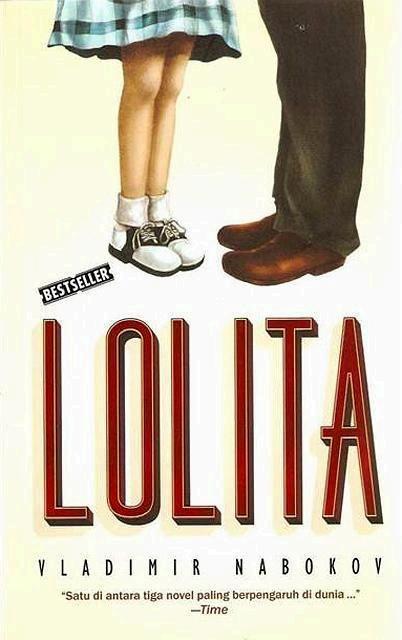
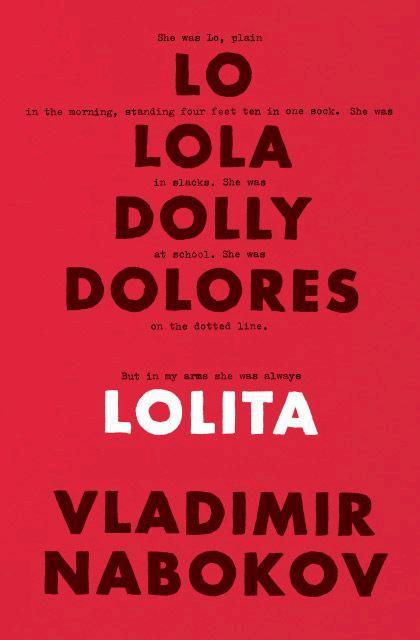
Lolita is one of the twentieth century’s most controversial novel. The book takes the reader through the love story between Humbert Humbert and his stepdaughter Dolores Haze (Lolita). Throughout the book you as the reader get into the mind of a pedophile and, through Humbert Humbert’s artful account of his relationship with Lolita, challenges assumptions about love and morality. Humbert Humbert has European roots and speaks French. Therefore he criticizes the vulgarity of American culture and portrates himself as an intellectual narrator with complicated wording which divert the readers’ attention from the horrors he describes. The first part of the book begins with Humbert's birth city Paris and his childhood on the Riviera. His father runs a luxurious hotel, and Humbert lives a healthy, happy childhood among the Riviera tourists. In the summer of 1923, Humbert meets a twelve-yearold girl named Annabel Leigh, who is traveling with her parents. Before meeting Lolita Humberts life goes on after Annabel's death and he
starts a career as a teacher of English literature and spends time in a mental institution. Despite his marriage to a polish woman, which eventually fails, Humbert remains obsessed with young girls. These nymphets, as he calls them, remind him of Annabel. Eventually, Humbert decides to move to the United States. Charlotte Haze lives in a sleepy suburban called New England Town with her twelve-year-old daughter. They have a room in their house they rent to Humbert. First he is just a guest minding his own business, while he in his mind becomes obsessed with Charlotte Haze’s daughter Dolores, also known as Lolita. In fact Humbert’s first sight of Lolita in the garden is love at first sight. He becomes instantly in love with her and his fascination and pedophiliac thoughts get written down in a journal. Humbert follows Lolita’s moves constantly, day dreaming about her. Charlotte sends Lolita off to summer camp, and therefore Humbert marries Charlotte in order to stay near to his true love.
In the relationship with Charlotte is Humbert playing with the thought of killing her. But the thought of Charlotte happens way easier than he thought. So easy that he didn’t get to kill her himself even though never really was going to do it. Charlotte finds his diary and learns that he hates her but loves her daughter. Charlotte confronts him. Humbert denies everything, but Charlotte tells him that she is leaving him and storms out of the house, but a short time after she leaves, a car hits her and she dies instantly. Lolita is still at the summer camp when her mother passes and before she even knows, the funeral is already being held. When Humbert finally decides to pick up Lolita, the car is all packed for a year of travelling. Only when they arrive at a motel, he tells her that Charlotte is dead. On the road Humbert is constantly becoming more and more controlling. His feelings for her are so strong, but Humbert still claims to Lolita that she is the one who seduces him, rather than the other way around. He never considers the morality of his actions, and he refuses to acknowledge that Lolita may not share his feelings. The travel goes on for nearly a year. They are sleeping in many different motels
He controls the money and Lolita’s freedom, and he often repeats that Lolita has nowhere to go, if she leaves him. On the road is a strange man starting to take an interest in their trips and appears to be following them in their travels. Somewhere in the Northeast is Humbert eventually getting a job at a college. Lolita gets a place in a school and starts to play tennis, but soon their travelling will go on. One day Lolita becomes very sick and has to go to the hospital. He is very obsessed to stay with her, but the nurses says that it will be better if he goes home. When Humbert returns to get her, the nurses tell him, that her uncle has already picked her up.
For the next two years, Humbert searches for Lolita, looking for clues about her kidnapper in order to exact his revenge. He gets a girlfriend and she is an adult woman and they are together until she disappears and later ends up in jail. One day he receives a note from Lolita. She is now seventeen, married, pregnant and asking for money. He is convinced that she is married to the man who stalked them while they were still together. He finds Lolita poor and married to the stalker. Humbert drives all the way to see Lolita and she admits that Clare Quilty, a play wrighter was her “savior.” Lolita loved Quilty, but got kicked out when she refused to participate in child pornography. Humbert begs her to return to him. Lolita gently refuses. Humbert gives her 4,000 dollars and then departs.
He tracks down Quilty at his house and shoots him multiple times, killing him. Humbert is arrested and put in jail, where he continues to write his memoirs. He writes that the memoirs can only be published upon Lolita’s death. Lolita dies in childbirth, Humbert dies of heart failure, and the manuscript is sent to John Ray, Jr., Ph.D.
Nabokov
Portrait of a complex figure
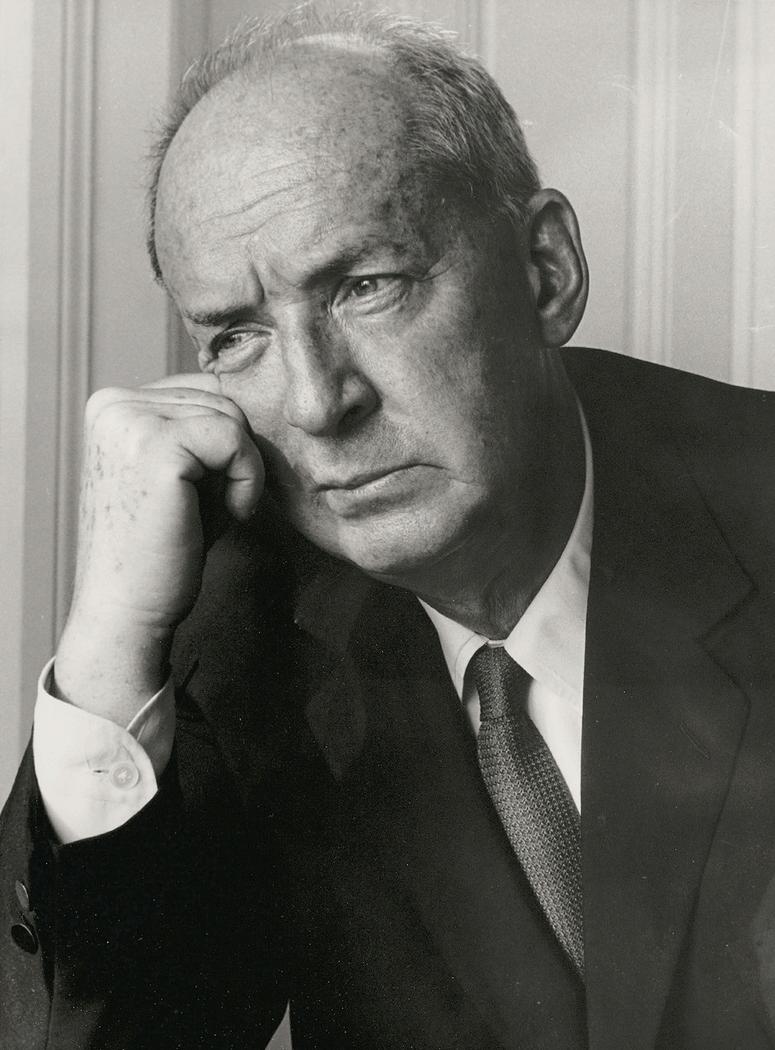
“One of the most strikingly original novelists to emerge since Proust and Joyce”. Those are the telling words in which a critic describes the Russian author, translator and impassioned entomologist Vladimir Nabokov. Regardless of one's opinion on the literary works of Nabokov, it is quite indisputable that his works are permeatedbyastrikingNabokovianoriginality.Withhis humoristic yet icy tone, reliably unreliable narrators and superbdescriptiveskills,Nabokovhas,sotosay,written himselfintothehistorybooksofthetwentiethcentury's mostprominentpersonas.
Bornin1899inSt.Petersburg,Nabokovgrewupasthe eldest son of an aristocratic, utmost wealthy and cultivated liberal family. Due to the October Revolution of 1917, where the Bolsheviks seized force, the family was obliged to repositioning themselves in first London andsincethenBerlin.
Uponcompletinghisstudiesoffirstzoology,laterSlavic and Romance languages at Trinity College, Cambridge, Nabokov rejoined his family in 1922 and soon after marriedtheJewishtranslatorandeditorVéraEvseyevna Slonim. In 1940 the couple, along with their little son Dmitri, left for a life in the States, where Nabokov positioned himself as a lecturer at Wellesley College, before enrolling as a Professor of Russian Literature at CornellUniversity. thenumerousrepositioningsandsucceedingadaptations that marked Nabokov's existence, became one of the very pillars of his authorship. In his debut novel “Mashen`ka”publishedin1926,Nabokovdelineatesthe life of a young Russian emigrant with an outstanding sympatheticinsightintotherealitiesofanexiled.
The renowned international bestseller “Lolita” from 1955likewisedisplaystheutterfeelingofrestlessness,as the narrator Humbert Humbert finds himself in a despairing state of both physical as well as psychological escape.
Paradoxically, it was the earnings upon publishing “Lolita”thatfinallyensuredNabokoveconomicstability, andenabledhimtosettledownandenjoyhisretirement atthehotelLeMontreuxPalace,Switzerland.
In the eyes of the public, Nabokov gained the reputation of being a somewhat imperious, unfaltering and aloof person. Never shy of declaring his earnest opinions and controversial stances, he had a talent of evoking both wrath, resentment and profound astonishment amongst his audience. On the subject of Freudianism, which he highly discarded and scorned in several of his works, he was to have stated thefollowing:
“One of the greatest pieces of charlatanic and satanic nonsense imposed on a gullible public is the Freudian interpretation of dreams…. I can not conceive how anybody in his right mind should go to a psychoanalyst, but of course if one’s mind is deranged one might try anything: after all, quacks and cranks, shamans and holy men, kingsandhypnotistshavecuredpeople.”
Nabokov's greatest show of critique was, however, turned inwards. His perfectionism imbued every aspect of his life, whether it came to contriving the next strategic chess move as an advanced chess player, or contemplating on humorous, candidly transparentpseudonymsforanewbook-in the act of writing “Lolita”, Nabokov spent months on composing the brilliant pseudonym“Mr.Taxovich”.Indeednothing was ever left to chance but consciously thought over, from the frequent use of stylistic devices such as aphorisms and allegories, to the characteristic intertextual referencesandliteraryparody.
Despite the common public perception Nabokovtoo,heldaconsiderablesoftnessto him. In domestic circles he was described as bothatenderson,affectionatesibling,loving husband and generous partner. This side of him is also to be found in his literary works, where it seems as if he has poured a tiny fraction of himself into each and every character.
According to the author himself, Nabokov was particularly fond of the characters “TimofeyPavlovichPnin”and“Dolores”alias “Lolita”, from his renowned novels “Pnin” and “Lolita”. Due to their existential truthfulness and authenticity, he strongly admiredthecharactersaspeople.
Four years prior to his demise in 1977, Nabokov received the honorable American National Medal for Literature. Regardless, writing was never viewed as a matter of renown nor income to Nabokov, who perceived good literature as an art form. To him, aesthetics was always held above ethics, whetheritwasinregardstoahighlyimmoral and unsettling topic, described in beautiful language, or his cherished hobby of incapturingandconservingLepidoptera. It can in summary be said that Vladimir Nabokov held an extraordinary gift - the gift of transforming even simple words into not onlyartworks,buttruemasterpieces.
P V
Kamma 2.a
Vladimir Nabokov was born April 22, 1899 in St. Petersburg into an aristocratic wealthy family. His father, Vladimir Dmitrijevitj Nabokov, was the author of many books and articlesoncriminallawsandpolitics.Afterthe familymovedtoBerlinin1922,thefatherwas murdered at a public meeting by a rightist. Nabokov claims that it did not have any influence in his work, but many of his novels reflect on the tragic event of losing one's father.
His most debated book was Lolita which was published in 1955. In the book you follow a French literature professor named Humbert, who moves to New England where he plans to work on a novel. But his plans take a turn when he meets the infamous Lolita who is a 12 year old girl and daughter to the woman who houses him on his trip to the US and whom he later on marries, before she gets intoatragicaccidentanddies.It'sawildstory about the narrator Humbert Humbert who seduces and kidnaps his motherless stepdaughter and falls obsessively in love with her.
The novel is a deeply controversial love story which later on was put on film in 1997. The novel raised many ethical questions and discussions. Many questioned how this “normal” healthy man could write so detailed and deeply on this psychopathic and paedophilistic narrator's mind, so well written in a beautiful sophisticated language where you really get under the skull of this twisted mam Humbert’smind.
Nabokov did have trouble publishing Lolita due to its controversial subject on pedophilia. Many publishing firms in the US rejected the novel, which led him to finding a publisher in Paris. But after it was published, countries includingtheUK,NewZealand,andAustralia, banned copies of the book, before it was acceptedintheUSin1958.
Today Lolita is seen as a literary work of art andthestoryisseenasapictureonlifeinthe USintheyearsafterWW2.
Review of Lolita by Vladimir Nabokov
Introductions
The book ‘Lolita’, written by the RussianAmerican author - Vladimir Nabokov, was written in 1953, and was first published in Great Britain in 1959. The classic has since been adapted into two films, first by Stanley Kubrick in 1962, then by Adrian Lyne in 1997. Ever since the novel was first published, it has faced copious amounts of criticism and was banned in several countries, and to this day is still seen as one of the most controversial books to have been written. It is often brought up in discussions of morality, or perhaps the lack of it, depending on your opinion. The book is a fictional tragicomedy, and follows the themes of obsession, mental illness, ethics, taboo desires and of course, pedophelia. The main conflict in this novel is the middle-aged man, Humbert Humbert, who corrupts the innocence of the 12-year old Dolores - mostly referred to as ‘Lolita’ or ‘Lo’.This book divulges into the mind of a predator, and forces us to see and ‘understand’ his point of view. One could think that this novel was meant to challenge the reader's morals, or perhaps to purposely provoke the reader.
Books that challenge ethics and morality, like this one, are important in literature, because it sparks discussion and forces a reader to reflect deeply on what they’ve just experienced. Moreover, it is no small feat to write convincingly from the perspective of a disturbed mind, and the author succeeds in capturing the unsettling essence of the antagonist's inner world.
‘Lolita’ tells the story of Humbert Humbert, a middle-aged European man, who fantasizes solely of the so-called ‘nymphets’. During his travels to the US, he finds himself infatuated by the 12-year old girl, Dolores. His infatuation consumes him, and every fiber of his being is drawn to her, so much that he even marries her mother, Charlotte, in order to stay close to her. As a result, he gains guardianship over Dolores, and they embark on a journey across the country. The novel, told through H.H’s perspective, presents an attempt to justify his crimes against the child, as he romanticizes their relationship.
Analysis
Vladimir Nabokov's novel Lolita isn’t merely a story of pedophelia and obsession, but a study in manipulation, an unreliable narrator and an unsettling collision of beauty, lust and morality. By writing the story through H.H’s perspective, the reader is set into a position of fascinating discomfort and confusing questions about the control a narrator has and the ethics of empathy.
Themes, style, and tone.
Lolita challenges the reader to confront the uncomfortable themes of pedophilia, abuse, manipulation and control, mentalillness, and the corruption of innocence. Despite the themes included in this novel, Nabokov manages to use the style of writing, language and an unreliable narrator to turn such obscure themes into something that resembles a beautiful love story. “Lolita, light of my light, fire of my loins” is the start of the first paragraph in the novel, and is poetically written, as to be misunderstood as the start of a romance novel. His use of an ornate language and sensual imagery manipulates the reader, just as H.H attempts to seduce the narrative through blurring the lines between beauty and horror.
H.H. is our narrator in this novel, although he isn’t your typical narrator. He is untrustworthy and sees this story through his own eyes and his unstable and deranged reality. He describes himself with an arrogant tone, such as his sharp jawline and tall handsome figure. He believes himself to be incredibly smart and uses greek and french phrases and references to Fyodor Dostoevsky (a Russian novelist), which shows his pretentious vision of himself. As he reminisces about his relationship with Dolores, he mostly writes it as if Dolly herself was in love with him, as if it were a consensual and loving relationship. He shifts between villainizing and victiming himself, between adoring Dolores and criticizing her adolescent and rebellious behavior. Factoring in the fact that H.H himself admitted to having to be institutionalized twice because of his erratic insanity, and often wondering to himself if he was going crazy through the story. This adds to the point that he is in fact not a reliable narrator.
The use of an unreliable narrator in this sense affects the entire book and everything behind it. The reader will not know whether or not to trust H.H and the things he says, which really puts the book up to interpretation. A common misconception about ‘unreliable’ narrators is that it was written that way by accident, or are even signs of bad writing. This is presumably the result of the negative connotations that the word ‘unreliable’ carries, but in the case of ‘Lolita’, I assure you that the narrative was completely intentional. I believe that Nabokov's use of an unreliable narrator is one of the reasons Lolita turned into such a success and a classic. By using an unreliable narrator he blurred the lines and caused the reader to reflect harder, question their own perception, and draw their own conclusions.
I believe that Nabokov's use of an unreliable narrator is one of the reasons Lolita turned into such a success and a classic. By using an unreliable narrator he blurred the lines and caused the reader to reflect harder, question their own perception, and draw their own conclusions. While this book offers you the rewarding opportunity to draw your own conclusions, it is also the reason why this book has led to a considerable amount of interpretations and opinions, and amongst reasons for the excessive controversy.
Language, pacing, structure
The book isn't written linearly, but instead we follow H.H through random flashbacks and memories through the entire book. In fact, it can be difficult to follow his thought process and depict what exact situation he is referring to, especially when he blurs between Annabel and Lolita. ‘Lolita’ is an incredibly descriptive book, and Nabokov fills copious pages and chapters with distinct descriptions of his surroundings. The tone shifts between witty, confessional and chilling detachment, and darkness. The tone is similar to H.H as a character, who is simultaneously witty, eerie, arrogant yet cultured and educated, and whose intelligence and supposed charm makes it difficult for the reader to evaluate him with certainty.
Dolores
Through her mothers eyes, Dolores is an unruly and defiant child. This view on Dolores angered H.H to begin with, but as the story unfolds and the responsibility of Dolly falls into H.H’s hands, he himself is agitated by Dolly's disobedience. Even though we read this novel through an unreliable narrator, the reader is (hopefully) able to form their own opinion on Dolores. Through my eyes, she was your average prepubescent girl, who was going through the natural stages of rebellion, as a girl who was coming of age.
While in the hands of H.H, her intelligence is shown through her survival skills and how she sometimes manipulates H.H by doing and saying what she thinks he wants to hear. In the beginning, she is only 12 years old - a monumental time period for an evolving girl - so the torment and abuse H.H put her through has undeniably affected her. An effect that is seen by others in Dolly’s life later on in the novel.Who is this book aimed at?
In order to truly understand this novel, one must have literary literacy to understand the manipulated narration. You must also read the book more than once, as to not oversee the small, yet crucial details. ‘Lolita’ is a dense book to read with Nabokov’s writing style and language. The french and greek passages, niche references and out-dated phrases ensure that this book is understood to be aimed at a more mature and
critically engaged audience, who actually appreciatecomplexliteratureanddecode the sophisticated language and labyrinthinepacing.
Evaluation Strengths,whatworkedwell?
In my experience, I really appreciated the psychologicalwhirlwindIwaspulledintoasa reader. I found myself constantly trying to decode H.H, judging his every thought and mood. In a way, I felt like I came to know him and somehow understand parts of his mind, which made the reading experience far more compelling. Nabokov’s writing in this book drew me in completely - very few books have made me feel and react as intensely as this one. I was truly emotionally investedinthenovel.
Weaknesses and critique
While I do believe that every sentence and paragraph was carefully crafted, I found myself disagreeing with some of Nabokov’s techniques in this novel. At times I often found myself wishing he was more direct. It was frustrating when I didn't know whether he was referringto Dolores or Annabel, or whether I was reading an old memory or a present event. Although it didn’t bother me personally, I know others have complained about long passages in foreign languages.
Conclusion
Reading ‘Lolita’ was an unsettling yet unforgettable experience. I now fully understand why it has become a classic - it is unlike any other novel. Nabokov’s ability to craft literary beauty out of such dark and unsettling themes is truly admirable, and I would recommend this book to anyone who has the nerve to read it.
Her name was Dolores Haze. She lived 17 summers on this earth, and was a light in a worldthatknewnomercy.
She was everything but the dangerous nymphet that her abuser portrayed her as. Shewasachildwhodidn'tgetthechanceto experience the world, before she got caught in an adult nightmare. She could have been playing, she could have dreamt the days away, she could have been building pillow forts and talking to imaginary friends, but instead the tragic story of her childhood became a warning of human greediness and destruction.
Her name was Dolores Haze, but in the years of her childhood she was only either Lolita,Lola,LoorDolly-versionsofherthat were constructed, that did not reflect who she was and who she would have been. She was portrayed as an idea or a muse, but she wasnoneofthese.
Now that Dolores is dead we must remember her for the things she was- as herself,asDolores.
Because of her short life we know very little of what Dolores would have developed as interestasanadult.Butwedoknowsomeof thethingsthatmadeherwhoshewas.
Like many other teenagers she liked spendingtimereadingcomicbooks,listening to music, if possible way too loud and she loved sodas and dressing up. She was stubborn and loud and messy and rude. She was smiling, and funny, full of life and absolutelynotboringcompany.Butaboveall she was alive. These things made her feel aliveandtheymadeherfeellikeDolores.
Dolores was strong, she was a survivor. She was psychically and emotionally so strong thatwordscouldn'tdescribeit.
Shelaughedwhenevershecould.Shetriedto find normality and joy wherever it was possible; in the joy of a sparkling soda, in a pop song on the radio, in superficial comic books that could make her forget about the serious and unfortunate world she was living in.
She fought for those little moments, she foughtforthefutureofDolores.
But even the strong ones get scars on the soul.In the very few years that Dolores escaped her density, she attempted to establish the safe normalities that she missed inherchildhood.
Inthebrighthoursoftheday,shecouldeven for a moment forget the memories she carried, but in the darkness of the night, the memorieswouldtoreherscarsopen. And that is precisely why we can not close our eyes and forget about Dolores. Because Dolores’ story is unfortunately not only hers, itistherealityofhundredsofgirls'lives.It'sa terriblepatternthatwemustbreak,bydaring tolookatit.
Todaythename“Lolita”nolongerbelongsto Dolores. Lolita was a constructed fantasy created by a man who hurt her in the most tragic way. It will follow her as a shadow in the grave if we remember her as Lolita. Let us therefore bury Lolita and let Dolores live on.
Dolores Haze died giving birth to the child sheneverhadthechancetobeherself.
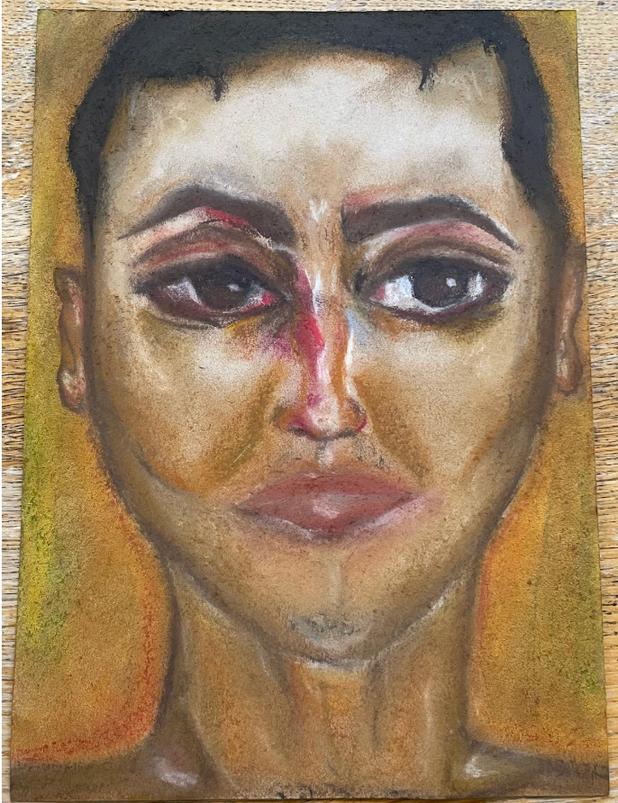
H.H describes himself as a "lanky, bigboned, woolly-chested man”, with "thick black eyebrows" and "a face that might twitch with neuralgia.”
I worked with the described features in my portrait, but felt I wanted to reflect his inner characteristics outwardly.
H.H is a man of many desires, as well as hidden paranoia.
His bold facial features reflect not what he says aloud, but his inner thoughts.
He is a man who charms women through his appearance and wellworded speech. He is an academic achiever, cultivated, and seemingly genuine on the surface.
He never lets people close to his heart, as he hides his emotions well.
I wanted to work with that especially, the bold almost abstract face that doesn't give off much other than a slightly unsettling vibe. His emotionless face is the result of decades of mastering the concealment of hidden desires.
He gets a thrill in being a man of many mysteries, but the thought of his own desires leaves him in a constant state of worry of being suspected, or worse being caught, and having to see himself as deeply flawed.
Throughout the book, we see H.H. self-justify his actions and define right and wrong on his own self-made spectrum, as if laws and morals were only invented concepts.
He uses young girls repeatedly to confirm that his obsession is not a delusion.
Later in the book, as an authority figure, H.H. finds himself placed on a pedestal for being the devoted father who stepped up for Dolores after his wife’s death. This gives him the confidence to pursue his own justice system, believing himself loved by many, so much so that he becomes irritated when Dolores or the police discover his wrongs, since his beliefs lie only within himself.When H.H. reflects, he knows he is deeply troubled, yet he continues to manipulate himself and others into believing the image he has carefully embodied, even as his inner conflicts explode with no escape.
“a face that might twitch with neuralgia” is the only sign of misery that H.H cannot control, it’s his body's reaction to being in a constant mental battle between running away or sticking and fulfilling his built up desire. In my portrait I chose it to be shown through details of magenta on his skin where it’s thinnest and closest to the brain.
Magenta is the color of obsession in psychology which in this situation could mean many things. I see it as his obsession with nymphets, and in a twisted way his obsession with himselfor at last the version of H.H he wants to be presented as.
He is European with a high contrast level, between his dark hair and his light skin, with his eyes besides the neuralgia i made him have eyebags deep enough to have a soul sucking feeling- kind of refers to his effect on people where at first glance he is the man they needed all along, but as time passes on they grow more into the same insanity H.H has.
Yellow or more a mustard color in color psychology is for greed, his skintone becomes sickening through having greed written all over which adds more onto the emotionless factor rather than making him have a rosy loving face.
I wanted his skin to be claustrophobic, like a constant form of suffering. It looks like there isn’t enough skin to wrap around his bones, so every emotion or facial expression hurts deeply in a botoxy or plastic way as a facade for his paranoia and constant suffering caused by no other but himself.
By challenging H.H self-consciousness the final product is a man of unease, not the perfectly intact self-portrayal the reader gets presented. As a reader we struggle throughout the book with H.H self-justification and polished way of wording. By making him quiet, we get the space to be opinionated instead of having his self-portrayal be a shared reality.
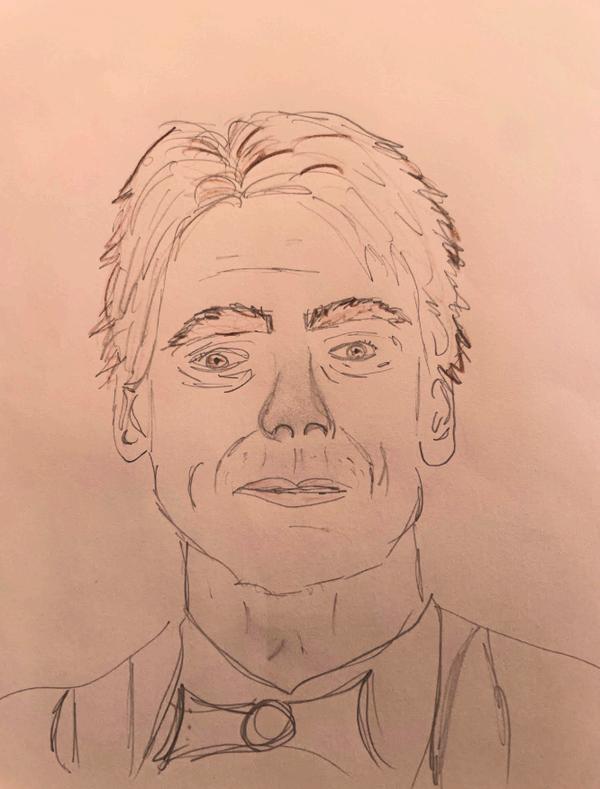
Portrait of Humbert in Adrian Lynes movie Lolita Marie -
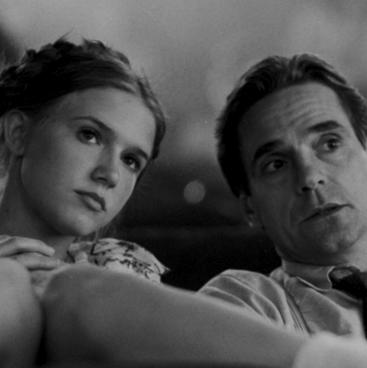
In the movie Lolita, instructed by Adrian Lyne, we meet Humbert, who is the movie's main character and the narrator. He is a middle-aged, European man who visits a small town in America, while he works as a teacher at a school.
Already in the first scenes, Humbert appearsasapolitie,welldressedandquiet man. He is wearing nice clothes, often a suit, and he has elegant radiation. His hair is dark and slicked back, and he carries himself with a certain dignity and seems intelligent.
But behind the calm exterior, a darker side hides within. Humbert lives with a landlady named Charlotte. Humbert quickly becomes fascinated by Charlotte's young daughter, Delores, as he calls Lolita. He becomes almost obsessed with her, and his behavior gradually changes. Although he continues to act polite and controlled on the outside. Meanwhile the audience can feel and see that he is constantly trying to get closer to Lolita.
Humbert appears as a very complex character. On the surface, he seems kind, caring and loving towards Lolita. He buys her gifts and takes her on trips. But underneath the surface lies manipulation and control. He uses guilt, pressure and power to make her stay with him. In the movie we see how he does not respect her limits, and how he tries to control her life and emotions. He imagines that he loves her, but what he does is more selfish than loving.
The movie shows that Humbert is not a hero, but a tragic and terrifying person. At the end he is losing everything. He is losing Lolita, his inner peace and his life. He is trying to explain his love in the film, but the audience can clearly see that he has crossed a line that cannot be justified.
Through Humbert's relationship with Lolita, the movie shows how politeness and love can cover up manipulation and abuse of power, painting a terrifying portrait of a man who loses himself in search of love.
Marie and VeraThe illustrations combined give us a face and a deeper understanding of H.H, through knowing his inner thoughts and his history we get a whole person, that for once isn't a narrator of his own reality but a person that can be seen by more than his appearance or his own imagination.
Charlotte Haze is one of the most important characters in Vladimir Nabokov’s novel Lolita, even though she is not the main character. She is the mother of Dolores Haze, who is called Lolita, and for a short time she is also Humbert Humbert’s wife. At first she might seem like just a side figure, but if we look closer, she is actually one of the reasons why the whole story develops the way it does. Without Charlotte, Humbert would never have gotten close to Lolita, so in that way she is almost like the key to the novel.
Charlotte is introduced as a middle-aged widow who lives in a big house in Ramsdale. Humbert describes her house in very negative terms. He calls it a “hideous mansion” and makes fun of the garden and the furniture. This already shows that Charlotte is a woman who wants to appear elegant and sophisticated, but to Humbert (and maybe also to us readers) she just comes across as a bit fake. She reads magazines, talks about art, and pretends to be very cultured, but it does not really feel authentic. It feels like she is trying too hard. Nabokov makes us see her as someone who cares a lot about how she looks in the eyes of other people, but who is also lonely and insecure inside. One of the most striking things about Charlotte is how quickly she falls in love with Humbert. She becomes very dramatic and emotional around him, almost like a teenager who has a crush.he writes him long letters where she says she cannot live without him, and she even admits that she has always been afraid of being alone.
This shows us how desperate she is for love. But the sad thing is that Humbert does not love her at all. In fact, he dislikes her and often describes her in very mean ways, for example by calling her vulgar and overweight. This makes Charlotte’s love story tragic, because she believes in something that is not real. At the same time it is also a little bit comic, because she is so blind that she does not notice Humbert’s true feelings. Charlotte’s role as a mother is also very interesting. She tries to control Lolita and raise her properly, but she is not very warm or loving. For example, she sends Lolita to summer camp, because she thinks it is good for her, but also because she wants to have more time with Humbert. She yells at Lolita and tries to discipline her, but it feels like their relationship is full of tension instead of being close. Sometimes Charlotte even seems jealous of her daughter, because Lolita is young and pretty, while Charlotte is getting older. This creates a distance between them. The irony here is that Charlotte is so focused on controlling Lolita that she does not see the much bigger danger: Humbert’s obsession with her daughter. Charlotte is both sympathetic and unsympathetic at the same time. On one hand she is irritating, fake, and blind to what's happening around her. She forces her feelings onto Humbert and ignores what he really thinks. She does not notice what is going on in her own house, and she is more focused on appearances than on truth. On the other hand, she is also sad and lonely.
She just wants love and respect, but she looks for it in the wrong place. This makes her a tragic figure. The way Humbert treats her is cruel, because he laughs at her behind her back and only stays with her because of Lolita. Even though Charlotte sometimes comes across as ridiculous, Nabokov also makes the reader feel sorry for her.
The most dramatic part of Charlotte’s story comes when she finds Humbert’s diary. In the diary he has written openly about his obsession with Lolita and about how much he dislikes Charlotte. For the first time Charlotte sees the truth, and all her illusions about Humbert fall apart. But in a big twist, she never gets the chance to act on what she has discovered. As she runs out of the house in shock, she is hit by a car and dies. This is very ironic, because she finally understands Humbert’s true nature, but she dies before she can protect Lolita or confront him. For Humbert her death is liberating, because now he is free to take Lolita with him. For the reader it is both shocking and sad, because
In conclusion, Charlotte Haze is not a very likable character, but she is essential for understanding Lolita. She is funny because of her false sophistication and blind passion, but she is also tragic because she only wants love and never really gets it. Her relationship with Lolita is distant and complicated, and her love for Humbert is based on something that isn't true. Charlotte is a mixture of comedy and sadness, and Nabokov shows us how fragile she really is beneath her mask of culture and class. She may not be the main character of the novel, but without her the story would never have happened in the same way. Charlotte is therefore not just a side figure, but the one who makes it possible for Humbert to get close to Lolita. In the end she is both ridiculous and pitiable, and her sudden death reminds us of how quickly life can change from false appearances to tragic reality.
The Nymphet: a madman’s fantasy turned cultural phenomenon
““Between the age limits of nine and fourteenthereoccurmaidenswho,tocertain bewitched travelers, twice or many times older than they, reveal their true nature which is not human, but nymph (that is, demoniac); and these chosen creatures I proposetodesignateas“nymphets””
This is Humbert Humbert’s infamous theory which spins a disturbing thread through Vladimir Nabokov’s Lolita: the nymphet theory. The theory categorizes young girls into two groups: normal human girls and “nymphets” The nymphets are defined unclearly, through the subjective lens of the perpetrator, oftentimes focusing on what they are not. Humbert views “nymphets” as the girls who have not yet gone through puberty and still have child-like features. They cannot be too chubby, or too ugly, nor too pretty in a mature sense Humbert says theycanbefoundthrough“theslightlyfeline outline of a cheekbone, the slenderness of a downylimb”andhavetobeatleastadecade youngerthantheperpetrator.
Nymphets derive from the classic mythical creature of the nymph With its origins in Greek mythology, the nymphs were gentle spiritswhowatchedovernature,mortalsand gods alike. They were portrayed as beautiful young women and were given mother-like loving and protected qualities, as well as being tightly-knit with productivity, fertility, childbirth, childcare, and healing Furthermore the nymph of mythology achieved what Humbert Humbert’s fantasy never could: a long, almost eternal lifespan. They had an everlasting beauty and youth, filling the roles of mother, lover and helper formanyGreekheroes.
In Lolita however, the nymphs are not human-like deities, but demons in disguise; a cursecastoverHumbert.Thecaringmotherqualities are infantilized, yet the position of theperfectloverremainsinthefantasy.
Nabokov frames this theory as the desperate explanation of a madman, stating with the famousquote:“Anormalmangivenagroup photographofschoolgirlsorGirlScoutswill not necessarily choose the nymphet among them.
You have to be an artist and a madman, a creature of infinite melancholy…”, that the “nymphet” exists only in the mind of the perpetrator,thattheissueconsistswithinthe malegazeandisconstructedwithinthemind of a psychopath. Yet despite the author’s intention to keep the focus of the theory off of the girls it discusses, a lot of young girls have internalized the “nymphets” as yet anotherbeautystandard.
In a podcast episode from Weekendavisen, Linea Maja Ernst describes that the first time she read the novel, at the age of 14, she felt she wasn’t a “nymphet” and thereby felt as if she were less than. She’s not alone, as many young girls have been drawn to the Lolita aesthetic, and often seen it as something desirableratherthanrepulsive.Intheirminds the soft, Americana of Lolita blends seamlesslywiththenaturalbeautyandcaring protectiveness of the nymphs - qualities girls aretaughttowant.Betweentheagesof9and 14, all girls stop being children and become girls. Along with puberty, their perception of themselves changes, and along with the world’s increasingly overwhelming beauty standards, they start thinking and overthinkinghowtheyareseenbytheworld
Nabokov’s fictional theory, intended to highlight the depraved minds of pedophiles, and create an understanding of the illness, hasnowspreadtoaworldwidephenomenon of young girls wishing to be Lolita, to be a nymphet A theory used to dehumanize the girls is now being sought after, same as the fantasyoftheeternallybeautiful,goddess-like nymphs. Thereby Nabokov’s critique of the male gaze, often placed upon the nymphs, has evolved to a debate of the dangerous interpretationsofLolita.
We have forgotten the whole purpose of Lolita
One of the most striking images to come out of 20th-century culture, is the portrayed of a young girl, looking out from a pair of heart-shaped sunglasses, with her lips plucked around a glistening lollipop. I´m of course talking about Lolita.
She became known as a seductive young girl and hernameevenenteredthelanguageasacommon noun, meaning “a precociously seductive girl,” accordingtotheMerriam-Websterdictionary.
References to this very image of Lolita have been popping up in pop-culture numerous times, but wherediditallstart?
The original image of Lolita comes from Vladimir Nabokov's novel titled ‘Lolita’. The novel centres the sexually abusive relationship between the narrator, Humbert Humbert, and his 12-year-old stepdaughter, Lolita. Throughout the novel we follow the disturbing yet intriguing pedophilic thoughts of Humbert Humbert, describing his attractiontoLolita.
Thenovelwaslater,in1962,adaptedintoamovie by Stanley Kubrick, which plays a significant role behind the reason for the sexualization there is of Lolitatoday.
InthemovieKubrickaddedanunnecessarysexual subtext, by making Lolita into a 1950s pin-up model. In the introductory shot he, for instance, has her dressed in a bikini, propped up on one arm, with the lighting carefully coordinated to accentuate her hips and her smooth long legs, while she looks up to meet our gaze. The novel’s Lolitaisfarfromthisimage.Sheistomboyishand a pain in the ass. Humbert comments on her “monkey nimbleness” and notes every time she pickshernoseandadjustsherwedgie.Thismakes it clear that Nabokov’s Humbert is attracted to Lolita because of her childishness, not because of her beauty. Moreover the novel never lets us forget that there is something monstrous about Humbert’s desire for Lolita, where Kubrick's lens assumes that you are the monster. This would be fineifhehadnotalsoagedLolitaandsuppliedher with a womanly charm, creating a safe space for oureroticimaginationandconsumption.
Through the movie the world got a new image of Lolita, as a seductive young woman and the textual version of Lolita was forever lost.
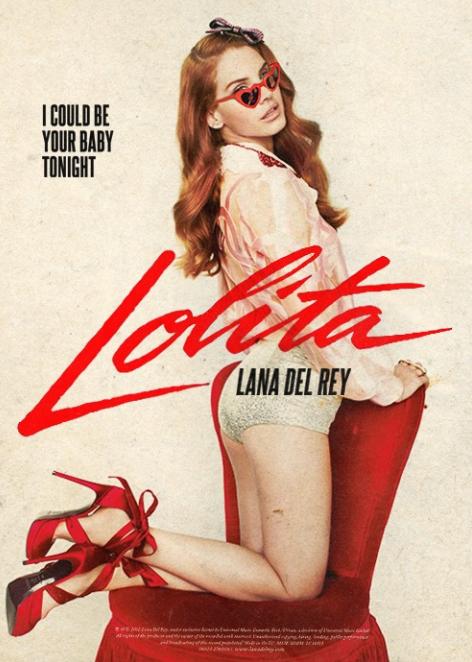
Even though it is several decades since this version of Lolita was introduced, many influential people are still making references to her in pop-culture. An example of this is Lana del Rey’s album ‘Born To Die’, that has many direct references to the movie and book, through album covers and song lyrics. Many Lana del Rey fans got dedicated to the nymphet culture wearing Lolita inspired outfits, consisting of high waisted shorts and dardot tops, calling it a ‘coquette aesthetic’. This created a cult following on Tumblr in the 2010s, where you could see GIFs of Lolita eating a banana or the famous quote “light of my life fire if my loins”, which is also featured in Lana del Rey’s song ‘Off to the Races’ and feed into Kubrick's image of Lolita.
It is when people of large influence like Lana del Rey, Katy Perry or Sabrina Carpenter make these references to Lolita that the skewed and unnecessarily sexualized image of Lolita is maintained. But even though the image Lolita has gotten in pop-culture can’t be unremembered and despite the fact that celebrities still reference Lolita in a sexual context, many people now see the sexualization that is of Lolita in album covers and on social media as an issue.
It however most likely won’t be the last time Lolita is brought up in pop-culture
“Biologically, love is a powerful neurological condition like hunger or thirst, only more permanent.Wetalkaboutlovebeingblindor unconditional, in the sense that we have no control over it. But then, that is not so surprising since love is basically chemistry.” saysthephysicistJimAl-Khalili.
When you search up the term love it's described as a complex emotion encompassing a range of strong, positive feelings like attraction, affection and emotionalattachment. Loveis seenasadeepfeelingofconnectionandcare betweenpeople.
For years philosophers, doctors, poets, scientists, etc. have tried to define it, but the thingis,loveisn'tjustafeeling,butsomething that takes shape through actions, words and thechoiceswemake anditisexperienced differentlybyeveryindividual.
Most people associate love with either a friend, boy/girlfriend or a family member, but love extends far beyond that. It can be found in the small gestures, either a smile from a stranger or someone's passion towardsmusic,artortheirwork.Lovecanbe unconditional as the bond between a child andaparent,oritcanbefragileasinashort romanceorcrush.
Yet, love is not always easy or positive. It sometimes brings pain, heartbreak, jealousy, or loss. To love someone deeply also means making yourself vulnerable, and that vulnerability often leads to grief or disappointment. When love becomes unbalanced it creates pressure, expectations and even obsession anddelusion.
Perhaps the reason why love continues to fascinate us is because it can't be pinned down to a single definition. What matters most is not how we define it but how we choosetopracticeit.
LoveasathemeinthenovelLolita
SomeelementsofVladimirNabokov’snovel “Lolita” can be viewed through a romantic lens, but the novel ultimately subverts traditionalideasoflove.
The novel is told from the perspective of Humbert Humbert, an unreliable narrator, whose obsession with the twelve year old DoloresHaze,whomhereferstoasLolita,is presented as “love”. However the alleged “love” in reality is a disturbing mix of lust, possessionandmanipulation.
In part one, from the very first line of the novel, Lolita is mentioned. “Lolita, light of my life, fire of my loins. My sin, my soul” Already in this sentence, the reader is thrown into Humbert’s idealized and hyper sexualized view of the young girl. It follows no description of who she is as a person, rather how her name sounds and how it makes him feel, both emotionally and physically. This immediately shows us that his “love” is about his own desires and obsession.
Throughout the novel Humbert often tries tojustifyhisactions,byexcusingitasactsof love.
Nabokov's enchanting form of literature seduceshisreaders.Humbertinsiststhathis relationship with Lolita is marked by deep passion, though the narrative reveals a twisted inversion of love, where desire becomes domination. Humbert distracts, confuses and masks his abuse, rape and pedophilia with a poetic language, and with that makes the reader forget the reality of the situation: that Dolores is a young girl who is being manipulated and exploited by anadultman.
Loveisoneoftheoldestandmostpervasive themes in literature, and there are several reasons for that. Love is something we all have in common and experience in some form or another. Therefore it makes the thememorerecognizableandrelevanttothe reader.
As I expressed earlier, love can both lead to happiness but also grief and jealousy, which adds drama, excitement and depth to a story. Love also has the power to change people's choices, life paths and destinieswhich makes it an obvious driving force in novelsandstories.
Literature often presents love as a powerful emotionthatcanbothhealandhurt,change and complicate. It reveals our inner battles and hopes, showing up in many different waysandforms.
BydenyingDoloresherownnarrativevoice, in the novel, Humbert becomes Dolores’s only voice, the reader's only storyteller, and with that Nabokov reminds the reader that love, when unbalanced by voice as a power, canbecomeadangerousforce.
The imbalance is not just between Humbert and Dolores, but between narrator and reader. While reading Lolita, Nabokov makeshisaudiencecomplicitwithHumbert, as we need to fight between sympathy and discomfort.
Seeing Humbert as he truly is, his feelings for Lolita aren't about caring for her wellbeing or a passionate love between the two of them, but about controlling and possessing her to his own advantage. HumbertHumbertevenadmitsatonepoint thatheismoreinlovewiththeideaofLolita, the nymphet, that he has created in his mind, than the individual, Dolores Haze. Revealing the profound disconnect between hisperceptionandthehorrificreality. ForlovetotrulybeacentralthemeinLolita, shouldn't that “love” be mutual? And how wouldwe,asreaders,determineifthe“love” inquestionwasmutualwhenourperception of Lolita is blurred by Humbert's distorted lens,andNabokov'sartistryanddazzlinguse oflanguage?
Vladimir Nabokov's novel Lolita occupies a unique and treacherous space in literary history.Thiswell-knownnovelhasprovoked global discussions for not only its subject, the methodical manipulation and sexual abuse of a child, but for the sublime artistry with which this repulsive tale is told. The book plunges the reader into the psyche of its narrator, the well-read and monstrous Humbert Humbert, a man whose paedophilia is written in a way that is so beautiful and detailed that it almost feels romantic. This clash between the beauty of thelanguageandthehorrorofitsconsentis not just a flaw, but the novel’s central, definingfeature.
Thenovelforcesanethicalquestionuponits audience: To what extent can a book be judged on its aesthetic qualities, unconnected to the moral consequences of itscontent?
“Lolita, light of my life, fire of my loins. My sin, my soul. Lo-lee-ta: the tip of the tongue taking a trip of three steps down the palate totap,atthree,ontheteeth.Lo.Lee.Ta.”
The passage is lyrical, spell-like and seductive. The reader is immediately drawn into Humbert’s obsessive passion through the sheer musicality of his words. We are charmed by the grace of his voice, potentially lulled into momentary, horrid sympathy. Nabokov bestows upon his monster the gift of rhetoric, forcing us to experiencefirsthandhoweloquentlanguage can be a tool of manipulation, capable of making evil seem almost palatable. As Humbert himself sardonically notes, "You can always count on a murderer for a fancy prosestyle."
Theseductionofstyle
From a purely aesthetic standpoint, Lolita is a complete masterwork.. Nabokov, writing in his third language, crafts a narrative voice of sophistication and poetic elegance. Humbert Humbert, apuretalentwhenitcomestowordplay andtheartoflanguage.Hisconfessionisfilledwith intricateliteraryallusionsandusesavastvocabulary that both dazzles and disorients. His descriptions transform the casual American landscape into something mythical yet this aesthetic excellence is what makes the novel so ethically unsettling. Consideringhisinfamousopeninglines:
TheVoicelessVictim
Ethically, Lolita is a deeply disturbing novel excavation of abuse. Beneath the shimmering surface of Humbert’s prose lies a story of a child, Dolores Haze, who is systematically robbed of her freedom and childhood. Nabokov deliberately silencesDoloresformuchofthenovel.Hervoiceis almost entirely filtered through Humbert’s perspective, a narrative choice that underscores his totaldominationandtwistingofthetruth.Whatwe knowofheriswhathechoosestotellus.
The silencing is a crucial element of the novel’s ethical challenge. The absence of Dolores’s unmediated voice highlights the profound injustice ofhersituation.Humbertreduceshertoamythical creature of his own invention, a “nymphet”. He defines this term with a chilling precise and pseudo-scientificprecision:
"Between the age limits of nine and fourteen there occur maidens who, to certain bewitched travelers, twice or many times older than they, reveal their true nature which is not human, but nymphic (that is,demoniac)..."
By fixating on this imaginary ideal, Humbert denies Dolores her humanity. She is not a real person to him, but an object, a symbol of his desire rooted in a lost childhood love. Her real name, Dolores, means “sorrows”, a tragic irony lostonhercaptorbutnotthereader.Sheis"Lo, plainLo,inthemorning...Lolainslacks...Dollyat school...Dolores on the dotted line. But in my arms she was always Lolita." In his arms, she is hiscreation,strippedofherownidentity.
LadiesandGentlemenoftheJury
The Novel’s structure is integral to this ethical confrontation. By framing the book as Humbert’s confession, addressed directly to the “Ladies and Gentlemen of the jury”, Nabokov caststhereaderinajudicialrole.Wearenotthe passive consumers of a story; we are meant to judge the case of Humbert Humbert, to weigh hiselegant“evidence”andpassamoralverdict.
This role forces us to confront our own susceptibilitytomanipulation.Humbert'scharm is a weapon, and his narrative is a calculated defense.Heattemptstoproveheisnota"brutal scoundrel" but a man of poetic sensibilities, driven by a love that transcends conventional morality. This courtroom drama makes the reader an active participant in the ethical struggle, questioning our own judgment as we navigatethetreacherouscurrentsofamanwho isbothwell-spokenandamonster. TheShatteringoftheSpectacle
The seductive power of Humbert’s aesthetic project cannot last. The novel’s ending is crucial to its ethical resolution, for it is here that Humbert’s carefully constructed fantasy finally shatters.Yearsafterherescape,hefindsDolores Haze. She is not an ethereal “Nymphet” of his memory, but pregnant and married to a simple man.
This encounter is a brutal confrontation with reality. The “Lolita” he obsessed over never truly existed outside of his solipsistic imagination. In seeing the real Dolores, he is forced to acknowledge the chasm betweenhisartisticillusionandthehuman beingwhoselifehedestroyed.Hebelatedly recognizes the depth of his crime, noting that unless it can be proven "that in the infinite run it does not matter a jot that a North American girl child named Dolores Haze had been deprived of her childhood by a maniac...I see nothing for the treatmentofmymiserybutthemelancholy andverylocalpalliativeofarticulateart." In this moment of devastating clarity, he can finally love her not as an object, but as aperson:"Shewasonlythedead-leafecho ofthenymphetfromlongago-butIloved her, this Lolita, pale and polluted and big withanotherman'schild."
Lolitafilmvsnovel
Themakingofthemovie
Thenovel“Lolita”byVladimirNabokovfrom 1955 is a story based on a diary belonging to the main character of the story named Humbert Humbert also called HH. The reader follows Humbert Humbert’s thoughts through his diary as he fantasises about young girls, mainly nymphets and the other main character Dolores Haze whom he calls Lolita. But as the story grows it turns more into his desire for her and their relation to eachother.
Publicreaction
Thetopicofthenovelwasseenassomething extremelytaboothatalreadycrossedabunch of boundaries, so it was almost blacklisted by the public. It took some time for Vladimir Nabokovtogethisbookpublished,butwhen it finally came out the public reaction was huge.Lolitaquicklybecameasensationinthe literary world. It was praised by readers all around the world. This massive reaction caused the making of two different movies basedonthebookbyNabokov.
lolitaonscreen
The novel has been made into a movie two times since it came out in 1955.Thefirstfilmizationwasin1962 in black and white, but that is not the film we are gonna be focusing on. The latest filmization of lolita is from 1997 and is also the most famous out ofthetwoofthem.
Differencesintheplot
In this text we are (as mentioned before) going to be focusing on the film “lolita” from 1997. The film is based on the book “Lolita” from 1955 by the narrator Vladimir Nabokov which means that the movie mostly leans on the information, timeline and descriptions that the book gives us, but that doesn't mean that the movieonlyusesinformationfromthebook.To makeafilmin2hoursorlesssomedetailsneed tobecutoffandsomeofthestorylinegetslost in the process, which means that a lot of the plotfromthebookisnotincludedinthemovie. The main plot points of the book are of course present in the movie, but they are not as thoroughlydescribedandshownasinthebook. We start with Humbert Humbert as he is swerving on the road away from the consequences of his own actions, but in the book it simply starts with Humbert Humbert writing about Lolita from his own perspective. InthebookwegetalotofHumbertHumbert’s thoughts, as the book is his diary, versus in the movie where we only hear his thoughts a coupleoftimesandisthereforenotasbasedon HumbertHumbert’sthoughtasitisinthebook which is a big difference between the two since thebookinpurelyhisownthoughts.
Differencesinthemaincharacters
This makes it hard to get a read on Humbert Humbert’s character. The reader/viewer only gets to hear the story from Humbert Humbert’s perspective,soitisalreadyhardtogetareadonthe different characters as we only know about them from Humbert Humbert’s perspective. But the characters are still portrayed very differently in the movie and book. Humbert Humbert sees himself as a very handsome fella who is clever, understanding and an amazing role model and father figure for Lolita. He does check some of these boxes in a way. He is described as a fairly handsome man and he is also a college professor, so some of it has some truth. But under all of the confidence he has, is a very fragile man. He has to remind himself of how beautiful and handsome he isthroughoutthewholebook,whilebringingevery other character down. This part of his character is hardly seen in the movie. The Humbert Humbert we get in the movie is very different from the Humbert Humbert we get in the book. It is way harder to get a read on what kind of person HumbertHumbertis,ashebarelyshowsemotions in the movie. The main emotions we get from HumbertHumbertinthemovieishappinesswhen he is with Lolita, looking at Lolita and doing sexual actionswithLolita.Theotheremotionwegetfrom HumbertHumbertissadnessandanger.Heshows theseemotionswhenhethinksheislosingLolita.
One of the biggest differences from book to film when it comes to characters, is the way Lolita is portrayed in the film versus the book. In the book Lolita is a more innocent girl who doesn't necessarily enjoy or want the inappropriate attention from her step father Humbert Humbert. We do not get that much information about Lolita leading up to one of these assaults by Humbert Humbert,sotheLolitaweknowinthebookisway different from the Lolita we know in the movie. Lolita makes small advances at Humbert Humbert inthebookandmovie.Youasareadercantellthat the advances Lolita makes towards Humbert Humbertarefromachildinthebook.Youcantell thatLolitaisa12yearoldgirlwhohas
gotten a silly little crush in the book. You can't tell that in the movie. The movie makes Lolita seem really mature for a 12 year old. This is partially because the actor Dominique Swain was 15 years old when filming the movie and does not look like a 12 year old at all. But Lolita's maturity is mostlyseenthroughherbehavior.Sheacts very childish while still being extremely sexual. No 12 year old child acts like this, not even Lolita in the book. Yes Lolita is more sexual than some of her peers, but the sexual stuff from Lolita is only seen in thestartofthebook.Weasareaderbarely get any sexual comments or action from Lolita throughout the whole book. The moviegivesawholebunchofsexualscenes betweenherandHumbertHumbert,many morethanthebookgave.ThismakesLolita seem way more mature than she is. The movie portrayed Lolita as if she wants Humbert Humbert and is asking for it, almostlikeit'sherownfaultithappens.
Conclusion
It'shardtomakeabookintoamovie.Even though we are very sceptical in this article, the makers of the movie still did a nice job when it comes to taking the most important plot points and making a good and smooth connection in the composition of the movie. But if you want a better understanding of the story in general you need to read the book. Because even though the movie has some of the most important details, it still can't fit all the details. As a lot of information gets lost in theprocessofmakingthemovieandfitting it in about two hours while still making the movie make sense. Overall it's a good moviebutit'sstillimportanttobesceptical.
TheMaleGazeinLolita
Lolita is a novel written by Vladimir Nabokov in 1955. The book is about Humbert Humbert, a middle-aged man who becomes eroticallyobsessedwithayounggirl,whomhe calls Lolita. The novel is narrated only from Humbert’s perspective, making him a very unreliable narrator, with the goal of making the reader sympathize with him by justifying his own actions. Because the whole story is narratedbyHumbert,wearebystanderstohis extremelydistortedandobjectifyinggaze.The story explores many themes such as obsession,desire,andexploitation.Topicsthat all lead back to the male gaze seen in the book.
The way Humbert describes Lolita is extremely telling when looking at the male gaze in both the book and the movie. Lolita is many times through the book described by Humbert in fragmented ways, focusing on specific body parts like her legs and lips. This reducesherintosensualizedbodypartsrather than a human being, both sexualizing and objectifying her. An example of this is when sheplayswithotherchildrenintheswimming pool. Here he takes an innocent act and turns itintoaneroticsceneforhisowngratification. This also shows in the way he describes Lolita’s clothing, like her socks, fetishizing children's clothes. The way the movie is directed is also through the eyes of Humbert, with a well thought out way of framing her body, showing the way, Humbert looks at Lolita in a sexual and erotic way arousing himself with the look of her prepubescent body. A more common sign of the male gaze coming to life in the book version of Lolita, is how silenced she is. When she speaks, we neverhearherdirectfeelingsorthoughts.His narration itself represents the male gaze, not lettingherexpressherselfbysilencingher.
This we see a lot in the movie and is connected to Scopophilia which means “the loveoflooking.”Thetermreferstothemale gaze of Hollywood cinema, which enjoys objectifying women, rather than subjects withtheirownvoiceandsubjectivity. Also, in the Movie Lolita’s perspective is mostly absent focusing on her body. This causes distance to Lolita which makes it easier to engage with Humbert. “Nymphet” is the word Humbert invents to describe a type of young girl he finds erotically. A nymphet is between 9 and 14 years old, beforepubertyiscomplete.Butit’snotevery girl in this age group who is a nymphet. This word could allude to his first love Annabel Leigh. This was an intense romance between HumbertandAnnabelattheageofthirteen, which Humbert never recovered from causedbyhersuddendeathfromtypus.This stopstheirrelationshipandhisromantic development. This makes him desperate to findAnnabelinothergirlsandthereforlooks at children the same way he looked at her. The event later frames as the origin of his lifelong obsession with “nymphets”. The word nymphet could also be his way of distancing him from the fact that their childrenandcouldbeawayforhimtoaccept hisfateofbeingapedophile.
Lolita’s mother Charlotte creates a lot of contrast by showing how women differs from girls. As a mother charlotte is very bothered and irritated towards Dolores. Humbert often portrays charlotte as neurotic, vain, and physically unappealing comparedtoherdaughter.Doloresislacking alotofemotionalmaturity,whichincontrast to her mother comes out as being carefree whichbecomeseasiertolove.Italsomakesit easier to accept Humbert’s fixation, caused bypaintingCharlotteasthethingthatstands inthewayofhislightandhappiness.
When you look at the male gaze in the contemporary society, it seems as if there are some pedophilic aspects that could be transferred to how women should be like. It’s for example a big norm for women to be shaved, which is a childlike feature. Purityisalsoabigtopicwithinwomenand girls, where they can easily be shamed for not remaining pure and clean. This alludes to Humbert’s frustration over Lolita’s relations with other boys and men, where itseemsthatHumbertislosingcontroland power over her. The male gaze in Lolita is not just exposing Humbert’s pedophilia, it also exposes some parts of the general normsandfixationsofthemalegaze.
The novel Lolita, written by Vladimir Nabokov, has created debate and controversy since its release in 1955. The themes and language of the book, surrounding a grown man's obsession with agirlchild,areequalpartswildlydisturbing and poetic. The use of an unreliable narrator in the novel calls for a much deeperanalysisaswellasreflection. Throughout the book, only two girls truly intrigue Humbert Humbert, the girls being Annabel and Dolores. Although the two girls are totally different and exist at differentpointsintime,withAnnabeldying as a child, the similarities between Humbert's‘Lolita’andAnnabelareobvious. Annabel is a nymphet, a close friend of Humbert’s and his first love. But when she dies of Typhus at a young age, Humbert beginssearchingforareplacingnymphetto take her place. This is where Dolores then, Lolitanow,entersthepicture.
Upon their first encounter, Humbert is immediatelyinfatuatedwiththe12-year-old Dolores Haze, strewn across the lawn in a bathing suit. She reminds him of Annabel and he feels a pull towards her. This infatuation grows into obsession, and not long after Charlotte's death, the two begin what he views as a romantic relationship. During this time, Dolores has been exchanged with Lolita, a far more playful and childlike nickname. This exchange is very important, as it reveals Humbert's manipulationandemphasizesthedifference between reality and fantasy, as well as personhoodvs.objectification.
‘Lolita’ is a fantasy projection. She is a seductress, despite being 12. She is mysterious, enchanting and conscious of it all. Lolita is not a real reflection of Dolores Haze, but merely a fantasy shaped by Humbert's obsession and desire. That is also why whenever she acts differently from his idealised nymphet, Humbert feels frustrated and angry that she is breaking the image he has constructed. The gap between Lolita and Dolores allows Humbert to remain detached from the reality of his abuse and gives him control of her identity, and the distinction between the two is crucial. Therefore, Humbert doesn’t love Dolores the personheloves“Lolita”theidea.
The “real” Dolores is a plain, average, American 12-year-old. She is rebellious, vulnerable and infinitely complex. There is nothing unordinary about her and she is in no way a passive victim, often acting out and throwing tantrums. This vulnerability and childish naivety are exploited and manipulated by Humbert until it is completely worn down, leaving a damaged, traumatised shell of a girl. She has wants, dreams and needs that exceed the idea of LolitaandherrelationshipwithHumbert,but whenever she seeks them out, she is quickly reprimandedandHumbert'scontrolgrowsas aresponse.
An example of this is when the two are staying at the Enchanted Hunters hotel. Dolores has been acting out, being uncooperative and resisting his advances. He proceedstogoonamanipulative,threatening rant about how he would end up in prison, but more importantly she would end up an orphan staying in some dirty institution forever,boredoutofhermind.
He does this to re-establish his dominance and scare her back into submission. Still, Dolores longs for normalcy like any other child would but finds herself trapped with Humbert. Dolores represents the distinction between fantasy and reality. Although Humbert reduces her to the idea of Lolita, Dolores still remains a complex, whole human and the contrast is key to understandingthenovel.
The novel Lolita exposes the horrible consequences when personhood is erasedandobjectificationreplacesit.Asa result, Dolores is forced to exist within Humbert's fantasy narrative, through dehumanisation and manipulation. Humbert's obsessive renaming of Dolores, creating ‘Lolita’ and completely stripping her of her real identity, is an example of this. When reading ‘Lolita’, the distinction between Lolita and Dolores is key to understanding Nabokov's writing as well as the use of the unreliable narrator. Not only is Humbert manipulating Dolores by forcing a different identity onto her, he is manipulatingthereaderaswell.Nabokov alsochallengesthereaderandsocietyasa whole, to recognise the dangers of reducing people to objects of desire and the importance of autonomy and identity.