
Destino Magazine | Spring 2026

Page 1


LETTER FROM THE EDITOR

Spring in Baja moves in layers. Desert trails hold their last stretch of green before the heat settles in. Offshore, striped marlin remain within reach even as the water warms and currents shift. The season clarifies gradually, and the same recalibration is visible beyond the landscape. Real estate markets are sorting. Buyers are moving with more intention. Projects are being measured against the ground they occupy, not just the timing of their launch.

This issue covers a lot of that ground. Sportfishing in Cabo and Loreto. Surf breaks along the Pacific. Markets reconfiguring themselves from San Jose to Cerritos to Loreto. An art scene in Los Cabos finding its footing. A dining guide, a calendar, a map of places worth supporting. What connects them is less a theme than a feeling: that people engaging with Baja right now are doing it with more care. More patience. A clearer sense of what they're actually looking for.
What stayed with us this season is how often the most interesting stories were about people slowing down. A captain who has fished the same waters for thirty years and still finds new reads in the current. An architect working within limits that most developers would resist. A buyer who looked at Cabo, looked at Loreto, and chose the quieter place on purpose. Baja has always attracted people chasing something. What's shifting is what they're chasing.

Baja California Sur is still one of those rare places where the landscape does most of the talking. The desert, the sea, the light at certain hours; none of that needs explaining. What takes longer to understand is the human layer on top. The towns, the markets, the communities that have built something here over time. That's what this issue is really about. Not just the place, but how people are choosing to live in it.

We hope this issue gives you some of that. A better read on the water, the towns, the people building things here worth paying attention to. There's no better time to be in Baja.

Welcome to the Spring 2026 edition, Alejandro Ehrenberg

La Fortuna, East Cape. Two surfers beneath a breaking swell
Photo: Lia Hernández
Instagram: @liaframe

MASTHEAD

PUBLISHER

Owen Perry

EDITOR IN CHIEF

Alejandro Ehrenberg INVESTMENT MANAGER

Lance Niederhaus COMMERCIAL LEAD

Frida Ludwika Rodríguez GRAPHIC DESIGNER

Rebeca Beltrán CONTRIBUTORS

Andrés Navarro Islas Dr. Kirk Sanford

Victor Suárez DIGITAL TEAM

Erika Coatzin – Social Media Manager

Victor Suárez – Content Strategist WEBMASTER

Edgar Valdez DISTRIBUTION

Christian Jiménez SALES EXECUTIVES

Christian Jiménez

Yoselin Hideroa

EDITOR’S CONTACT alejandro@destinoloscabos.com COVER PHOTO

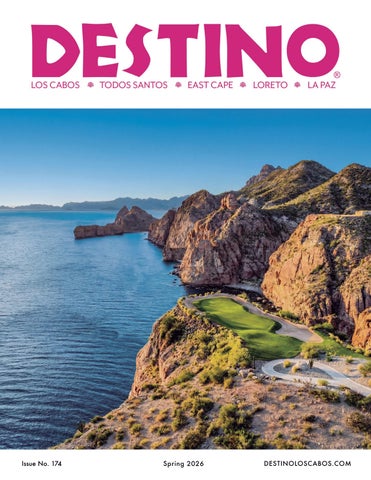
View of TPC Danzante Bay Photo: Noah Duethman

Follow us: @destinomagazine

DESTINOLOSCABOS.COM

La Paz, near Isla Espiritu Santo. Frigatebirds circling above the cliffs

Photo: Lia Hernandez Instagram: @liaframe

+52 (624) 105-9700 Contact us: frida@destinoloscabos.com INTERESTED IN ADVERTISING?

THE BAJA GUIDE: SPRING 2026 EDITION

Food, activities, and events this season. The best places to eat, explore, and experience Baja California Sur this spring.

Beachfront Dining Guide

Beach-level restaurants and clubs where tables sit directly on the sand.

What’s Happening This Spring

A seasonal calendar of festivals, tournaments, and major events across South Baja.

Spring, Lived Outdoors

Seasonal activities shaped by calmer seas, longer days, and warming desert trails.

Surf Breaks of Baja California Sur

A regional breakdown of spring swell patterns across the Pacific and Sea of Cortez.

Built History, Living Culture

Historic missions, museums, and cultural sites preserving Baja’s layered past.

Give Back: Ways to Support Baja Sur

Local nonprofits strengthening healthcare, education, and environmental conservation.

REAL ESTATE & DEVELOPMENT

How Loreto Grows Without Losing Itself

Density limits and marine protections shaping Loreto’s long-term evolution.

Danzante Bay: Where the Golf Justifies the Journey

A Rees Jones course set within a protected Sea of Cortez ecosystem.

Lia Hernández @ liaframe

Building the Future of Todos Santos, on Its Own Terms

La Huerta San Sebastián and the architectural choices shaping high-end growth.

Cerritos and the End of One-Size-Fits-All Luxury

How infrastructure and land constraints redefine the upper end in Cerritos.

San Jose’s Last Beachfront

How structural scarcity reshapes beachfront ownership in San Jose’s original hotel zone.

When Cabo Real Estate Stops Behaving Like Home

Why Cabo’s property market demands nuance beyond surface familiarity.

LIFESTYLE & CULTURE

Surf and Photography: On Waves, Light, and Presence

A photographer reflects on surfing, light, and the discipline of presence.

A Patient’s Guide to Regenerative Medicine: What You Should Know, and Why It Should Matter

A physician-led approach to diagnostics, longevity, and responsible regenerative care.

Building an Art Scene in Los Cabos

From seasonal exposure to sustained cultural infrastructure in Los Cabos.

Sportfishing in Cabo and Loreto

How geography shapes offshore culture from Cabo to Loreto.

San Francisco 49ers Launch Flag Football Program in Los Cabos Schools

A school-based initiative introduces flag football to Los Cabos classrooms through the NFL’s growing youth program.

PHOTOGRAPHY

Andrés Navarro @el.navass

Noah Duethman @gringoncontentco

BEACHFRONT DINING GUIDE

Restaurants and beach clubs across Baja with tables set directly on the sand.

Mango Deck

The centerpiece of Medano Beach, Mango Deck is known for its high-energy atmosphere. It delivers a classic beachfront experience with a full kitchen serving Mexican and international dishes throughout the day, overlooking the bay and the Arch.

The Office on the Beach

Set just steps from the water, The Office pairs colorful table settings with deep-inthe-sand seating. It is especially known for its breakfast service and seafood platters, maintaining a reputation as one of Medano’s most consistent beachfront operations.

SUR Beach House

SUR offers a more refined alternative along Medano Beach, with a shaded deck that transitions into individual tables on the sand. The menu leans Mediterranean, and the overall atmosphere is relaxed and polished, notably calmer than that of its immediate neighbors.

Billygan’s Island

A long-standing Medano Beach fixture, Billygan’s Island places its seating right at the shoreline. It caters to a casual crowd looking for beers, simple snacks, and the freedom to move easily between the water and the table.

Tabasco Beach

With tables and umbrellas set up daily on the sand, Tabasco Beach is a dependable option for families and groups. The menu sticks to familiar Mexican classics, set in a fully integrated beach environment.

The Sand Bar

Known as much for its beachside massages as its food, The Sand Bar offers tacos and tropical cocktails in a laid-back setting. It’s a favored stop for low-key afternoons spent directly on the sand.

Cascadas Beach Grill

Located on the quieter southern end of Medano, Cascadas Beach Grill provides a calmer beachfront alternative. Tables sit on the sand, often accompanied by live music in the evenings and unobstructed views of the bay.

SAN JOSE DEL CABO AND THE CORRIDOR

Zipper’s Bar & Grill

Built directly onto the sand at Playa Costa Azul, Zipper’s is a landmark for the surfing community. Diners can watch surfers at the Zippers break while eating burgers, ribs, and casual beach fare.

7 Seas Grille & Seafood

Part of the Cabo Surf Hotel, 7 Seas sits just above the high-tide line with direct access to the beach. Its proximity to the water and relaxed seafood-focused menu make it one of the closest dining experiences to the surf in San Jose.

Veleros Beach Club, Puerto Los Cabos

Located on one of the area’s few swimmable beaches, Veleros offers sand-level dining with views over the Sea of Cortez. The menu centers on fresh seafood, ceviches, and Bajastyle dishes, complemented by cocktails and daybeds ideal for lingering afternoons.

Sea Grill, Rosewood Las Ventanas al Paraiso

A luxury beachfront option with tables positioned at the edge of the sand. The menu centers on wood-fired cooking and fresh ceviche, offering a private, serene dining experience aligned with the resort’s understated elegance.

Tortugas, Hacienda del Mar, Cabo del Sol Tortugas offers beachfront dining in a more secluded setting than downtown beaches. Known for fresh fish and relaxed service, it is accessible to both resort guests and outside visitors.

EAST CAPE

Lateral, La Fortuna

Set steps from the sand, Lateral pairs casual beachfront seating with a menu of approachable plates and seafood-forward offerings. Guests often pair a meal with views of the Sea of Cortez or a nearby surf session, and the outdoor atmosphere, lively music, and relaxed service make it a social stop for lunch or an easy beachside dinner.

Zai Sushi, La Fortuna

Zai Sushi features tables set (almost) directly on the sand along the Sea of Cortez. The menu focuses on contemporary sushi and Japanese-inspired dishes, making it a popular choice for sunset and evening dining.

Liebre Matrera, La Fortuna

Located at the La Fortuna surf break, Liebre Matrera operates as a relaxed beach club integrated into the De La Costa property. Seating is arranged around a central bar and fire pit in a rustic, open-air setting.

La Playa Restaurant & Bar, Los Barriles

A gathering point for the windsurfing and kiteboarding community, La Playa opens directly onto the beach. Its wood-fired pizzas and easy transition from water to table define its appeal.

Estiatorio Milos, Costa Palmas

Representing the luxury side of the East Cape, Milos features an open-air design leading to a calm, private beach. The experience centers on premium seafood selected directly from the restaurant’s fish market.

Casa de Brasa, Costa Palmas

With tables positioned directly on the sand, Casa de Brasa focuses on wood-fired cooking, grilled meats, and seafood. The experience is polished yet relaxed, reflecting the slower pace of the East Cape.

La Tuna BCS, El Sargento

A favorite among local kiteboarders, La Tuna offers a sand-floor dining area and social atmosphere. Craft beer and fresh seafood anchor the menu after long days on the water.

TODOS SANTOS · PESCADERO · CERRITOS

The Green Room, Todos Santos

Set at Playa La Pastora, The Green Room is widely considered one of the region’s best sunset spots. The restaurant features a full sand floor and serves elevated tostadas and local oysters in a remote Pacific setting.

Cerritos Surf Town, Cerritos

Cerritos Surf Town is a relaxed, surforiented beach club just off the shoreline. It offers an affordable day pass that includes access to loungers and on-site facilities, making it an easy, accessible option for spending the day at Cerritos.

La Tuna Cerritos

Offering a similarly casual, sand-level experience, La Tuna Cerritos pairs simple food with live music and a barefootfriendly atmosphere directly on the beach.

Barracuda Cantina, Cerritos

A straightforward beachfront option serving Baja-style classics like fish tacos and burritos. Its proximity to the water and relaxed setup make it an easy stop for surfers and beachgoers.

Kahal Restaurant, El Pescadero

Kahal is the beachfront restaurant at Mas Olas, overlooking the Pacific. The menu focuses on fresh seafood, a raw bar, and craft cocktails, with an open-air setting designed for long, sunset-facing meals by the ocean.

LA

PAZ

Playa Pichilingue Restaurant

A local favorite with tables under palapas set directly on the sand. Known for whole fried fish and chocolate clams, it overlooks the calm turquoise waters of Pichilingue Bay.

El Caimancito Restaurant & Beach Club

Located along the road to Pichilingue, El Caimancito combines beach club energy with coastal dining. Breakfast, lunch, and dinner are served with panoramic Sea of Cortez views.

El Tecolote Beach Restaurants

A collection of independent palapashaded restaurants positioned as close to the water as permitted. The experience is rugged, local, and distinctly Paceño, with views toward Espíritu Santo Island.

LORETO

La Picazón

Located north of the town center, La Picazón sits on a quiet stretch of beach with tables near the water’s edge. The menu highlights the Sea of Cortez’s seasonal bounty.

Be Loft, Loreto Bay, Nopolo

A refined beachfront venue offering views of both mountains and islands. Direct paths connect the dining area to the calm shoreline, reinforcing its relaxed, resortlevel appeal.

WHAT’S HAPPENING THIS SPRING

A look at events across South Baja, from large-scale festivals to seasonal tournaments and local programming.

LOS CABOS

ABC Art Baja | Mar 18–Apr 5 | San Jose, La Paz, Todos Santos

A state-wide celebration of visual art, performance, and design connecting Baja California Sur’s main creative hubs. San Jose del Cabo remains especially active through early April with gallery openings, studio tours, and satellite programming.

Los Cabos Cortes Open | May 2 | San Jose

An international open-water swimming competition held in the Sea of Cortez, with distances ranging from 1.3K to 7K. The event draws both competitive and recreational swimmers.

Viva El Gonzo | May 7–9 | San Jose

A three-day destination music and arts festival hosted at Hotel El Ganzo and its sculpture garden. The program blends live performances, immersive art installations, and wellness activities.

Chrysalis Festival | Dates TBA, Spring 2026 | San Jose

An announced destination festival combining electronic music, visual art, and wellness programming. As of publication, final dates and programming have not been publicly confirmed by organizers.

Oyster Fest | Anticipated in April | San Jose

A chef-driven oyster and seafood festival bringing together guest chefs, raw bars, wine and cocktail pairings, and live music. The focus is on technique, presentation, and pairing, with programming shaped by the town’s restaurant and hotel scene.

Sunset Fest Cabo | May 22–24 | Cabo San Lucas

A Memorial Day weekend music festival centered on beachfront stages and large-scale concert production, signaling the transition from high season into summer.

Stars and Stripes Tournament | June 25–28 | Cabo San Lucas

A long-running charity fundraiser based at the Hilton Los Cabos, combining deep-sea fishing and golf tournaments with evening dinners and benefit concerts supporting youth-focused nonprofits.

LA PAZ

Festival del Ostion | Anticipated in May

A spring culinary event celebrating Baja California Sur’s oyster culture and sustainable aquaculture. Traditionally held in mid-May at Puerta Cortes, the festival brings together oyster producers, guest chefs, live music, and tastings. Dates are typically confirmed closer to the season.

La Pazión por el Sabor | May 30

A major culinary gathering featuring more than 100 regional restaurants alongside live music. Hosted at Paraiso del Mar, the event serves as both a charity fundraiser and a showcase of traditional and contemporary Baja cuisine.

Baja WonderGrass Festival | June 19–21 | El Sargento

A three-day festival dedicated to bluegrass, folk, and roots music, bringing together regional and international acts in a relaxed, communityoriented setting.

TODOS SANTOS · PESCADERO · CERRITOS

ABC Art Baja | Mar 18–Apr 5 | Todos Santos

As part of the broader ABC Art Baja program, Todos Santos hosts exhibitions, open studios, and music programming through the first week of April, with local venues acting as informal cultural hubs.

Workshops at the Modern Elder Academy | El Pescadero

Part retreat, part classroom, MEA's programs focus on life transitions and leadership grounded in purpose. The beachfront campus, located just south of Pescadero, hosts multi-day workshops that blend conversation, wellness, and community in an atmosphere of calm intention.

Seasonal Programming Note (April–June)

Late spring is a quieter period in this corridor, with activity centered on restaurants, breweries, hotels, and beach clubs rather than formal festivals. Live music nights, chef collaborations, and small gatherings surface organically, often announced close to the date.

EAST CAPE

La Fortuna · Los Barriles · La Ribera

Seasonal Programming Note (April–June)

Spring programming on the East Cape follows wind, water, and community more than a fixed calendar. Live music, social gatherings, and popup dinners tend to cluster around weekends in surf- and kite-driven hubs, reflecting the area’s informal, outdoor rhythm.

LORETO

Classic Yellowtail Tournament | Apr 24–26

A premier sportfishing event held in Loreto Bay, marking its 10th anniversary in 2026. The tournament highlights the seasonal abundance of yellowtail in waters surrounding the Sierra de la Giganta.

Marina Puerto Escondido Fishing Tournament | May 22–24, 2026

A competitive tournament targeting yellowtail and dorado, hosted at Marina Puerto Escondido and anchored by community weigh-ins and marinacentered gatherings.

Seasonal Programming Note (April–June)

Outside of fishing weekends, Loreto’s latespring calendar remains intentionally low-key. Programming takes the form of marina gatherings, hotel-hosted music nights, and restaurant-led dinners aligned with the town’s quiet pace.

SPRING, LIVED OUTDOORS

How the season reshapes the peninsula.

LOS CABOS

Snorkeling at Chileno and Santa Maria Bays

Spring brings some of the clearest water of the year along the Corridor. Protected coves and mild swell make snorkeling easy and relaxed, with reef fish and rock formations visible from the surface. Early mornings remain the calmest.

Striped Marlin Sportfishing

Spring in Los Cabos continues to offer good availability of striped marlin offshore, with consistent action through April and May as waters warm and baitfish gather. Full-day charters remain productive in calmer seas, and early departures still matter for smoother crossings and stronger bite windows.

Sunset Sailing in Cabo San Lucas Bay

Longer days and steady breezes shape ideal evening conditions. Boats move past the Arch as light softens and the coastline shifts color, with warm air and little humidity.

Hiking the Sierra de la Laguna Foothills

Spring marks one of the last comfortable hiking windows before summer heat. Trails cut through desert still green from winter rains, with occasional blooms and wide views. Early starts are best.

Golf in Peak Spring Conditions

Courses settle into prime shape after winter overseeding. Mild mornings and dry air keep

rounds comfortable, while ocean breezes take the edge off the afternoon.

EAST CAPE

Kitesurfing and Windsurfing in Los Barriles and La Ventana

Winter remains the core wind season in these East Cape hubs, but early spring can still produce workable winds. April, in particular, may offer sessions suitable for intermediate riders, though the wind tends to taper as the season progresses. Lessons and rentals are readily available from established local operations.

Kayaking and Paddleboarding Remote Bays

Stable spring weather opens access to quiet coves along the coast. Clear water and relatively light boat traffic make this a strong season for slow exploration.

Cascada Sol de Mayo and Canyon Trails

Spring temperatures allow comfortable hikes into the Sierra de la Laguna canyons. Palm groves, shaded pools, and lingering water flows offer contrast to the surrounding desert.

Beach Camping and Stargazing

Mild nights and generally clear skies create favorable camping conditions. With little light pollution, stargazing becomes a defining part of the experience.

LA PAZ

Kayaking and Paddleboarding at Balandra and Espiritu Santo

Spring combines calm seas with warm sunshine across La Paz’s protected bays. Mangroves, sandbars, and volcanic cliffs shape sheltered routes, with early mornings offering the quietest conditions.

Island Sailing Excursions

Gentle seasonal winds favor full-day sailing trips across the Sea of Cortez. Routes often include sheltered anchorages and swimming stops.

Cycling and Sunset Walks on the Malecon

Long daylight hours pull activity outdoors. The waterfront fills with cyclists, walkers, and food carts as the sun drops and temperatures ease.

Mangrove and Coastal Wildlife Tours

Spring brings clear conditions and increased bird activity. Small boats move through shallow channels where herons, rays, and fish gather.

TODOS SANTOS · PESCADERO · CERRITOS

Surfing at Cerritos Beach

Spring swells remain steady but approachable. Mornings are often clean and forgiving, while afternoons bring a more social, active beach scene.

Farm Visits and Seasonal Harvests

Spring marks the start of local harvest cycles in the Pescadero area. Visits focus on fresh produce and regional farming, often ending with simple tastings or outdoor meals.

Art Walks and Studio Visits

Gallery hours remain extended through spring. Evenings stay active with rotating exhibitions, open studios, and small cultural events.

Yoga and Outdoor Wellness Sessions

Comfortable temperatures allow classes to move outside. Many sessions take place in gardens or near the ocean before summer heat sets in.

LORETO

Kayaking and Snorkeling in Loreto Bay National Park

Calm spring seas make the marine park ideal for paddling and reef exploration. Volcanic islands and protected coves offer clear water and quiet anchorages.

Sailing and Coastal Boat Trips

Stable spring weather supports longer day trips across the bay. Routes often include island stops and sheltered swimming.

Desert Hiking in the Sierra de la Giganta

Spring is one of the final comfortable seasons for extended hikes. Trails move through cactus forests and canyons with broad views over the Sea of Cortez.

Historic Town Walks and Mission Visits

Mild temperatures suit slow exploration. Loreto’s stone streets, shaded plazas, and nearby mission sites set an easy spring pace.

Hiking Trail in San Dionisio
Photo: Peace Vans Instagram: @peacevans

SURF BREAKS OF BAJA SUR

The beaches of Baja California Sur define much of its rhythm and character. Each one offers something distinct: places to swim, surf, explore, or pause and take in the changing light.

PACIFIC COAST

Punta Abreojos

A long right-hand point that comes alive with early south swell. Spring marks the start of more regular surf, typically waist- to headhigh, with clean lines and long walls. Strong current and positioning demands make it best for intermediate and advanced surfers.

La Bocana (Abreojos)

A shifting river-mouth and sandbar break that begins to show potential in late spring. When the south swell aligns, it can deliver short but workable rides. Variable sand and changing takeoff zones favor intermediate surfers comfortable reading conditions.

San Juanico (Scorpion Bay)

A multi-point right-hand system driven by southern hemisphere swell. Spring brings the first consistent south pulses, producing clean, mid-sized waves with fewer crowds than summer. Long rides and paddling are suited to intermediate and advanced surfers.

Magdalena Bay

An exposed stretch of Pacific coastline with sand spits and points that respond to sustained south swell. Spring is inconsistent, with long flat spells punctuated by clean surf days. Remote access and uncertainty place it firmly in the advanced category.

Punto Conejo

A quieter Pacific beach break north of La Paz with shifting sandbars and playful lefts and rights. Spring offers consistent surf, with April favoring shortboards and June delivering softer peaks for intermediates and longboarders.

TODOS SANTOS · CERRITOS · PESCADERO

Cerritos Beach

A wide, user-friendly beach break with multiple peaks and easy access. Spring remains reliable as winter swell fades and early south energy appears, typically waistto shoulder-high. Suitable for beginners, intermediates, and longboarders, with playful sections on smaller days.

San Pedrito

A defined right-hand point and reef that produces faster, more technical waves than nearby beach breaks. Spring sees fewer active days, but mixed swell can light it up on select sessions. Best for intermediate to advanced surfers.

Punta Lobos

An exposed point near the Todos Santos harbor that holds strong Pacific energy. Spring delivers fewer surfable days than winter, but conditions are often cleaner when swell aligns. Wave speed and power keep it in the intermediate-to-advanced range.

La Pastora

A shallow reef break that magnifies Pacific swell. Spring brings fewer days but cleaner conditions and lighter crowds. Despite reduced size, the reef and wave mechanics demand advanced skill and experience.

CABO SAN LUCAS

El Tule

A powerful peak breaking over a rocky bottom between San Jose del Cabo and Cabo San Lucas. Spring offers a reliable

transition window, with April still influenced by northwest swell and June increasingly shaped by south swell. Best for intermediate and advanced surfers.

Monuments

A heavy left-hand reef break that amplifies Pacific energy. Spring surf is inconsistent but more manageable than peak summer conditions. Still a demanding wave, reserved for advanced surfers only.

SAN JOSE DEL CABO

Old Man’s (Acapulquito)

A mellow right-hand point with long, forgiving walls. Spring brings small but steady waves driven by early south swell. It remains the most reliable beginner and longboard wave in the region.

The Rock

A faster, more aggressive right-hand wave located near Old Man’s. It requires more swell to function and begins to show potential in late spring. Best suited to intermediate surfers.

Zippers

A high-performance reef break favoring speed and precision. Spring south swells are intermittent but can produce quality sessions. Reef proximity, wave speed, and crowds make it appropriate only for experienced surfers.

EAST CAPE

La Fortuna

A powerful right-hand break marks the start of the East Cape. April is typically too early, but May and June introduce the first real

south swell. Steep takeoffs and fast sections make it a wave for experienced surfers only.

Shipwrecks

A reef and point break that responds almost exclusively to south swell. Spring acts as a pre-season window, occasionally producing clean, chest-high waves. Reef entry and wave shape suit intermediate surfers with reef experience.

Nine Palms

A more exposed East Cape break with multiple peaks and stronger swell reception than nearby spots. Spring surf is inconsistent but can deliver clean, moderate waves during early south pulses. Currents and power place it in the intermediate-toadvanced range.

BUILT HISTORY, LIVING

CULTURE

Historic missions, artistic centers, and places where Baja’s past remains visible.

MULEGE

& NORTH-CENTRAL BAJA SUR

Mission Santa Rosalia de Mulege

Founded in 1705 and relocated to its current hilltop site in 1720, the mission overlooks the Mulege River oasis and surrounding palm groves. It reflects one of the peninsula’s most stable early settlements and remains a central marker of Mulege’s historical identity.

Rock Paintings of the Sierra de San Francisco

Located within the El Vizcaino Biosphere Reserve west of Mulege, this UNESCO World Heritage Site preserves monumental cave paintings created between roughly 100 BC and 1300 AD. The works depict human figures, animals, and ritual scenes at a striking scale. Access is regulated and requires certified local guides, typically arranged from San Ignacio.

LORETO

Mission of Our Lady of Loreto

Founded in 1697, this site marks the first permanent Spanish settlement in the Californias and the starting point of the Jesuit mission system. Facing Loreto’s main plaza, the church remains active, while the adjacent Museum of the Baja California Missions houses religious art, maps, and artifacts from the Jesuit, Franciscan, and Dominican periods.

Mission San Francisco Javier de Vigge-Biaundo

Located 35 kilometers southwest of Loreto in the Sierra de la Giganta, this is the best-

preserved mission in Baja California Sur. Completed in 1758, it is known for its ornate gold-leaf altar and historic olive groves that still produce fruit. The site is reached via a scenic paved road and remains an active parish.

LA

PAZ

Regional Museum of Anthropology and History

Situated near the Malecón, this museum offers a chronological overview of the peninsula’s past, from prehistoric marine fossils and reproductions of cave paintings to colonial life and the Mexican Revolution.

Museum of Art of Baja California Sur

Housed in the restored former Government Palace, this is the state’s first institution dedicated to modern and contemporary art. Its galleries host rotating exhibitions by local, national, and international artists.

Museo Comunitario de la Ballena

A small educational museum focused on whales and marine conservation in the Gulf of California. Exhibits address migration patterns, scientific research, and the cultural importance of marine life to coastal communities.

EL TRIUNFO

El Triunfo Mining Sites

South of La Paz, El Triunfo preserves the remains of Baja California Sur’s 19th-century silver and gold mining boom. Landmarks include the Museo de la Ruta de Plata and La Ramona chimney, a 47-meter structure associated with engineering firms linked to Gustave Eiffel.

Museo de Musica

This museum highlights El Triunfo’s unexpected musical heritage. During the mining era, residents imported grand pianos from Europe, turning the town into a regional cultural center. The collection includes antique pianos, sheet music, instruments, and archival photographs.

TODOS SANTOS · PESCADERO · CERRITOS

Mission of Our Lady of Pilar

Founded in 1723, this Jesuit mission stands beside Todos Santos’ main plaza. After periods of abandonment and reconstruction, it became the town’s principal parish church and remains a focal point for civic and cultural life.

Art District of Todos Santos

Spread throughout the historic center, the district includes more than a dozen galleries exhibiting painting, sculpture, photography, and mixed media. It developed organically from the 1980s onward as artists repurposed historic buildings.

Manuel Marquez de Leon Theater

An early 20th-century theater restored for cultural use. It serves as Todos Santos’ primary indoor performance venue and hosts film screenings, lectures, concerts, and programming tied to the Todos Santos International Film Festival.

SAN JOSE DEL CABO

Mission San Jose del Cabo Añuiti

Established in 1730 near the estuary, the original mission was destroyed during the 1734 Pericú rebellion and later rebuilt inland. The current structure anchors the historic center and remains an active parish church.

San Jose Art District

Located around the mission and main square, this district concentrates galleries, cultural institutions, and restored colonial buildings. Its weekly Art Walk has become one of the most established cultural traditions in Los Cabos.

CABO

SAN LUCAS

Natural History Museum of Cabo San Lucas

Near the marina, this municipal museum documents the environmental and human history of the Cape, with exhibits on Pericú culture, fossils, navigation, and regional marine life.

Cabo San Lucas Old Lighthouse

Built in 1905 on the Pacific-side dunes west of town, this lighthouse guided ships approaching the cape before modern port infrastructure. Though access is restricted, it remains preserved as an example of early maritime architecture.

Casa Altamira is a panoramic-view residence located within the exclusive four-home Altamira enclave at Pantheon Heights. This 3BR/3.5BA property offers unobstructed views of La Ventana Bay, Isla Cerralvo, the Cardonal Forest, and the Sierra Cacachilas mountains. The home includes private, resort-style amenities such as a pool, hot tub, BBQ area, outdoor fireplace, and fire pit. An open-concept layout is paired with high-end finishes, an oversized kitchen island, curated lighting, and expansive windows. Fully furnished and turnkey, the property is well suited as either a private retreat or a high-demand winter rental.

$985,000 USD

$16,976,672 MXN

Property ID: #25-5865

Casa Vista Infinita is a 1,888 m² beachfront estate defined by privacy and open views across La Ventana Bay. The two-level, two-bedroom residence with garage is set within a landscaped desert garden, enclosed by a perimeter wall. Positioned on a cliff above the shoreline, the home offers expansive ocean views along with a private beach terrace and bodega directly on the sand below, well suited to windsport enthusiasts. Built in rock and cement, the property emphasizes durability and long-term confidence in a coastal setting.

$1,750,000 USD $30,161,600 MXN

Property ID: #25-5167

Casa Altamira

GIVE BACK: WAYS TO SUPPORT BAJA SUR

Nonprofits across Baja Sur strengthen community health, education, and conservation through direct, local impact.

Amigos de los Niños – Los Cabos

Provides specialized medical care for children in vulnerable situations, including cardiology, dental surgery, audiology, and vision support. The program connects families with medical teams that deliver treatment without financial barriers.

How to get involved: Donate, participate in fundraising events, or offer professional support.

Casa Ramé – Los Cabos

Dedicated to improving the lives of individuals with neurodevelopmental disabilities through therapeutic programs, education, and family support.

How to get involved: Contribute to program growth or volunteer at community activities.

Cero Basura BCS – Todos Santos, Pescadero, Cerritos

An initiative focused on diverting hazardous waste from landfills and converting it into productive uses, this organization empowers the peninsula’s communities through education, recycling programs, and local stewardship.

How to get involved: Donate to wastereduction programs, volunteer at compost or recycling initiatives, or adopt sustainable habits in your home or business.

Corazón de Niño – La Paz

Supports children with congenital heart conditions by coordinating diagnosis, surgery logistics, and long-term recovery assistance for families across Baja Sur

How to get involved: Sponsor medical care, attend benefit events, or assist families during treatment.

Eco-Alianza Loreto – Loreto

Protects the marine ecosystem of Loreto Bay through community education, scientific research, and conservation initiatives focused on long-term ocean health.

How to get involved: Join educational programs, support research, or donate to preservation efforts.

Environmental Defense Fund – La Paz

Advances sustainable fisheries and ocean policy across the peninsula, collaborating with coastal communities, researchers, and environmental leaders.

How to get involved: Support initiatives, engage with advocacy efforts, or adopt sustainable travel practices.

Fundación Sarahuaro – Los Cabos

Promotes community development, education, and resource management programs designed to strengthen families and expand economic opportunity.

How to get involved: Volunteer, collaborate on sustainability initiatives, or offer financial support.

International Community Foundation –La Paz & Loreto

A grant-making organization connecting donors with environmental and social programs, amplifying local impact through long-term partnerships.

How to get involved: Donate to targeted initiatives or partner through philanthropic strategy.

Padrino Children’s Foundation – Todos Santos

Provides access to medical care, mental health services, and holistic support for children and families in the Todos Santos corridor.

How to get involved: Sponsor care programs or volunteer specialized expertise.

Instagram: @gringoncontentco

Sunset over northern Baja California Sur
Photo: Noah Duethman

PET Los Cabos – Los Cabos

An animal-welfare nonprofit focused on responsible pet ownership, accessible spay/neuter campaigns, adoptions, and fostering in the Los Cabos region.

How to get involved: Adopt a pet, volunteer for campaigns or runs, donate to support care and transport programs.

Red Autismo – Los Cabos

Supports children with Autism Spectrum Disorder through individualized therapies focused on communication, social development, and inclusive education.

How to get involved: Donate to therapy programs or volunteer with academic or clinical skills.

Shriners San José del Cabo – Los Cabos

Helps children requiring specialized surgery or advanced medical treatment by coordinating transportation, lodging, and family care.

How to get involved: Support travel funding, contribute lodging or services, or assist with logistics.

Sinades A.C. – El Pescadero

Environmental education with a hands-on approach. Programs teach recycling, gardening, and sustainable habits that cultivate responsible young citizens.

How to get involved: Volunteer in school workshops or provide materials and resources.

VIFAC Los Cabos – Los Cabos

Offers shelter and support to pregnant women in vulnerable circumstances, helping mothers and children build stable futures.

How to get involved: Donate supplies, volunteer time, or support vocational training.

HOW LORETO GROWS WITHOUT LOSING ITSELF

Loreto’s growth follows visible limits. Geography, regulation, and daily life shape how the town evolves.

rom Loreto, Los Cabos feels like a vacation. Not in the way it does for visitors arriving from abroad, but from within Baja itself. It’s where you go for energy, for restaurants and activity, for a few days of movement before returning home.

Loreto, by contrast, is organized around everyday life. The distinction is not about scale or sophistication, but about intensity: how activity, movement, and attention are concentrated.

That difference, between a place shaped by constant motion and one structured around understated continuity, explains far more about Loreto’s real estate market than price charts or inventory counts ever could.

Why Loreto Feels Different

Loreto’s pace and scale are the result of deliberate constraints that shape how the town grows and how it is used. Density is limited. Building heights are capped. In the historic center, construction cannot rise above the seventeenth-century mission church, preserving a sense of proportion that resists vertical buildup.

Beyond town, geography does some of the work as well. Loreto is held between the Sea of Cortez and the Sierra de la Giganta, with large areas of surrounding land designated as protected parkland.

Tracy Collingridge, broker at Coldwell Banker Momentum Real Estate, who lives in Loreto full time, sees these limits not as obstacles but as the framework of the market itself. They affect what gets built, how development unfolds, and how people move through town day to day.

Being part of a marine park, for example, restricts certain activities common elsewhere. The absence of jet skis, parasailing, and beach vending isn’t a regulatory footnote; it shapes daily experience and helps explain why Loreto remains oriented toward living rather than display.

Marina Puerto Escondido with Sierra de la Giganta background
Photo: loretobcstourism.com

Who Is Buying in Loreto

Those conditions shape who ends up buying in Loreto, and why. Much of the demand comes not from first-time buyers chasing novelty, but from people already familiar with Baja who are making a longer-term decision. Many own property elsewhere in the peninsula and are now prioritizing daily use over occasional visits. They are looking for space, proximity to the water, and a setting that supports routine.

Pricing plays a role here as well, though rarely in isolation. Compared with other markets in southern Baja, Loreto remains more accessible. Beachfront properties, in particular, often trade at a fraction of comparable offerings in

Los Cabos, sometimes at even half the price. For owners coming from Cabo, the move is less about downsizing than about rebalancing: selling in a more saturated market and buying into a place with similar fundamentals, leaving capital over.

Another trend has been the growing presence of Mexican buyers, particularly professionals from Mexico City and Monterrey. Doctors, lawyers, business owners, and developers are not only purchasing homes, but building them and settling in. Their arrival has added depth to the market and reinforced the sense that Loreto is no longer defined solely by external demand, but by a community that continues to renew itself from within.

Development That Responds to Its Setting

New developments in Loreto respond to and adapt to these conditions. Alta Baja is a case in point. Planned more than two decades ago and paused after the 2008 financial crisis, the project reemerged with a different premise. Instead of pursuing a hotel-driven model, the developers shifted toward a gated residential community designed around lower density and longterm use.

The project’s current configuration reflects the same constraints that shape the town as a whole. Building heights are limited. Density was reduced during the planning process. Rather than selling empty lots, homes are delivered under a single architectural vision, enabling customization without compromising quality. Amenities are included, but they are scaled to residents rather than to volume. Beachfront homes are expected to start at US$2.5 million.

Alta Baja’s role in the market is less about introducing something new than about formalizing an existing pattern. It offers a controlled environment for buyers who want shared services and infrastructure, while remaining aligned with the limits that govern Loreto as a whole. In that sense, it illustrates how growth in Loreto tends to proceed: incrementally, within boundaries, and in conversation with how the town already functions.

What Loreto Is, and What It Depends On

Taken together, these dynamics point to a clear definition of what Loreto is, and what it is not. It is not a place organized around constant expansion or spectacle. It is a town shaped by limits that remain visible in daily life, in how space is used, and in how growth is negotiated. That is what allows Loreto to function as a place to live, not just to visit.

Whether that continues will depend less on market demand than on restraint. The rules that govern scale, density, and use are not abstract planning ideals; they are the conditions that make the town workable. As long as those limits are respected by developers, authorities, and buyers alike, Loreto can continue to evolve without losing the qualities that give it coherence.

DANZANTE BAY: WHERE THE GOLF JUSTIFIES THE JOURNEY

A Rees Jones course set along a pristine area of the Sea of Cortez has turned Loreto into one of Baja California Sur’s most distinctive golf destinations

ust south of Loreto town, on a protected stretch of the Sea of Cortez, sits a development that captures what makes this part of Baja genuinely different. Danzante Bay is built within a UNESCO World Heritage site, part of a coastline that shelters nearly 800 animal species, from manta rays to whales. That's not a footnote. It shapes everything about the place: the density, the design, the relationship between what's built and what's left alone. You feel it the moment you arrive.

A Golf Course That Earns Its Setting

The anchor is TPC Danzante Bay, designed by Rees Jones. Jones has said he doesn't know of another course with so many different environments in a single layout: desert, cliffs, dunes, arroyos, canyons, all at the edge of the sea. The Sierra de la Giganta comes down close here, closer than almost anywhere else Jones has worked. The result is a course that doesn't feel like a resort amenity. It feels like a reason to be here. The 17th hole makes the case on its own: a 178-yard par-3, diagonal green, guarded by sand, cacti and canyon, with the Sea of Cortez sitting behind it. Jones has called it the most spectacular hole he's ever built

Built Into the Landscape, Not On Top of It

But the course is one part of a wider ecosystem. Villa del Palmar's resort services are woven into the community without overwhelming it. Additional beach and wellness facilities are in the works, designed to deepen what's already here rather than chase something new. The homes themselves, limited to 140 in total across two distinct neighborhoods, range from 2,400 to over 4,300 square feet. Cardon sits closer to the bay and the course. Canyon goes deeper into the terrain, with the mountains as the dominant view. Both are built with local stone and wood, open to the outside, and look toward the landscape rather than away from it.

Contained by Design

Danzante Bay is intentionally contained. There's no restaurant strip outside the gate, no nightlife, no bustle bleeding in from town. Loreto is close enough for its history, its airport, its small-city texture, but kept at a respectful distance. For some buyers, that's a dealbreaker. For others, it's exactly the point.

Who Ends Up Here, and Why

The buyers who end up here tend to know Baja well, or have looked at enough of it to know what they don't want. They're not chasing the next new thing. They want a place that holds up — where the golf rewards the tenth round as much as the first, where the Sea of Cortez is a constant rather than a backdrop, where quiet is a feature rather than an absence.

These are people who have done the Cabo thing, or looked at it carefully and decided it wasn't the version of Baja they were after. What they find at Danzante Bay is something rarer: a community still small enough to feel like one, in a landscape that genuinely can't be replicated anywhere else on the peninsula.

The Case for Less

Most developments in this region compete on scale and amenity count. Danzante Bay takes a different position — that a Rees Jones course, a UNESCO coastline, and a protected sea teeming with wildlife don't need anything added to them. For the right buyer, that's not a limitation. It's the draw.

Set within the desert landscape just 10 minutes north of downtown Todos Santos, this refined estate offers four luxury bedroom suites, generous indoor outdoor living, expansive terraces, and sweeping Pacific views, combining privacy, craftsmanship, and long term comfort in a serene setting.

Casa Cumpleaños

Contemporary beach home

Striking contemporary home in the southern end of Cerritos, designed for seamless indoor outdoor living, with sweeping Pacific views, expansive terraces, and a refined great room centered on an island bar. A private suite, guest studio, rooftop lounge, and plunge pool complete a relaxed, beach-focused lifestyle.

BUILDING THE FUTURE OF TODOS SANTOS, ON ITS OWN TERMS

Growth

is arriving on the Pacific side of Baja California Sur.

What's at stake is how it unfolds without losing the character that made the place worth discovering.

odos Santos has always resisted easy definition. Small, understated, and deliberately paced, it developed its identity without spectacle or urgency. Generations of local families shaped its rhythms, and over time it drew people from elsewhere — Mexicans and foreigners alike — who arrived intentionally, drawn by a way of life that valued human scale, quiet, and daily continuity.

That balance is now under pressure. Interest has become more focused, capital more present. Todos Santos has entered a phase where growth is no longer hypothetical. The question is not whether the town will change, but whether it can do so without becoming a version of somewhere else.

That question becomes most visible at the scale of individual projects. La Huerta San Sebastián, an upcoming residential enclave of 10 homes priced in the low- to mid-US$2 million range, is one of them. Before plans were drawn, the land it occupies functioned as a working orchard tied to one of the town’s longstanding culinary landmarks. It was productive land with a recent, lived history: part of Todos Santos before it was part of its next chapter.

As the town absorbs higher property prices and wider attention, development stops being neutral. Architecture becomes a decision about identity. What gets built now will shape not just how Todos Santos looks, but how it is lived.

Restraint as a Structural Choice

At first glance, La Huerta’s decisions can seem understated. Ten homes on a large parcel. No repeated designs. Five Mexican architects, each responsible for two houses. A development timeline measured in years rather than seasons. Baja California Sur is a market where scale and speed often signal ambition, so these choices stand out because they move in the opposite direction.

They are not aesthetic gestures. They are structural. Limiting the number of homes was less about exclusivity than about preserving the spatial logic that defines Todos Santos. This is a town shaped by distance, between buildings, between neighbors, between moments in the day. Compressing that space would have altered the place's experience before it altered the skyline.

The same thinking guided the architectural approach. Instead of imposing a single style, the project invited multiple voices to work within shared limits: scale, materiality, climate, and rhythm. Each house is distinct, but none is designed to dominate. The result is not a collection of objects, but something closer to a gradual formation; it’s an architecture that feels as if it grew into place rather than arrived fully formed.

Toward a New Vernacular, Shaped by Lived Reality Building in Todos Santos does not mean working without precedent. Long before contemporary projects arrived, local families developed ways of inhabiting the land shaped by climate, labor, and necessity. Thick walls, shaded patios, courtyards, and incremental construction were practical responses to heat, wind, and daily life. Baja’s vernacular exists less as a fixed image than as a way of living.

What projects like La Huerta are negotiating is the emergence of a new vernacular. As Todos Santos changes, so does the way people inhabit it. Architecture becomes an attempt to give form to that present reality, and to express how people who love the town choose to live there now, under different conditions, with different resources, but with the same attention to rhythm, space, and restraint.

In markets like Todos Santos, patience is

not

an abstract virtue. It is simply how things work

What emerges does not resemble a master-planned image. It is more like a careful response to context, treating restraint as a condition for belonging.

A Market That Rewards Patience, Not Speed

At its price point, La Huerta inevitably tests more than demand. Homes above US$2 million remain rare in Todos Santos. Buyers at this level are not browsing casually. Choosing to spend that kind of money in a small, rural town at the end of the Baja peninsula is, by definition, an intentional act.

That intentionality shapes how the market functions. Absorption here, at the high end, is episodic rather than continuous. Buyers do not arrive in waves, and decisions are rarely rushed. People watch, return, compare, and wait. In that context, speed is less a competitive advantage than a misunderstanding of how conviction actually forms.

La Huerta was conceived to operate within that rhythm. The project does not depend on volume or urgency to justify itself. It assumes that the right buyer exists, but may take time to arrive. When alignment happens, timing becomes secondary. In markets like Todos Santos, patience is not an abstract virtue. It is simply how things work.

Seen this way, La Huerta is not trying to replicate the past or overwrite it. It is testing whether contemporary architecture can speak the same language as the town itself. With multiple architects working within shared constraints, the project allows variation without rupture. The houses are different, but they are shaped by the same question: how to belong to Todos Santos as it exists today.

What Is at Stake as Todos Santos Moves Forward

What La Huerta ultimately makes visible is the scale at which Todos Santos is now being shaped. The town is still small enough that restraint registers. Still intimate enough that patience can be felt. Still early enough that architecture goes beyond just filling land and instead signals intent.

The real risk is not growth itself, but drift: the slow accumulation of decisions that optimize for convenience, speed, or outside expectation rather than the way life here actually unfolds. Once that happens, the character of a place starts to thin out irreversibly.

La Huerta suggests that development at the highest end of the market can still move deliberately, respond to lived patterns, and accept time as part of the process. Whether that approach endures will depend not only on this project, but also on whether future decisions continue to treat architecture as an expression of how Todos Santos is actually lived by the people who love it.

info@lahuertasansebastian.com +52 624 317 0541 lahuertasansebastian.com

Hacienda Cerritos hotel, closed to the public since 2020
Photo: Noah Duethman Instagram: @gringoncontentco

Along the Pacific side of Baja California Sur, Cerritos has been changing in ways that show up most clearly in what is selling and what is not. Smaller condo projects continue to come online, but many are moving more slowly than before, lingering on the market as prices rise.

At the same time, demand has concentrated elsewhere. The properties that sell are larger, lower-density homes, often built for longer-term use. Buyers arriving in Cerritos are asking different questions than they did a few years ago, focused less on finishes and more on land, exposure, infrastructure, and how a home fits into its surroundings. What’s emerging is not just a more expensive market, but one beginning to define the higher end on its own terms.

Why the High End Doesn’t Translate Cleanly

As prices rise in areas that were not originally built for luxury, assumptions begin to break down. The idea that the higher end will take the same shape everywhere carries over from larger resort markets, where scale, staffing, and infrastructure make certain forms of development possible. Outside of those environments, the logic changes.

Luxury does not arrive as a finished template. It takes shape through limits. Land availability, exposure, access to water and power, and the way people actually use their homes begin to matter more than surface polish. In smaller markets like Cerritos, those conditions do not soften as demand increases. They sharpen. And as buyers move upmarket, what they value starts to reflect that reality.

The Physical Limits That Redefine Value

In Cerritos, those limits are easy to see. The landscape is exposed and undeveloped. Infrastructure exists, but it is not scaled for density. Beachfront is finite, and much of it has already been absorbed. What remains are not blank canvases, but parcels shaped by wind, salt, access, and long stretches of isolation.

Cerritos is no longer just a weekend surf break. It is beginning to function as a place people can live year-round

As demand has moved upmarket, buyers have not been asking for more services layered on top of these conditions. They have been asking how to live within them. Homes are expected to stand on their own, function without constant support, and remain usable over decades of wear. Scale matters, but density does too. Fewer neighbors, fewer shared systems, and a clearer relationship between house and land have become part of what defines the upper end here.

A Buyer Profile Comes Into Focus

The shift is not only structural. It is also human. Cerritos has begun to attract a narrower, more defined kind of buyer, one whose expectations are shaped as much by values as by budget. Many arrive with experience in other markets and a clear sense of what they do not want. They are less interested in managed environments and more focused on how a place will be used over time.

Karina Christensen, a real estate professional who works across the Pacific side of Baja California Sur, has watched that change take hold. In her experience, buyers looking at Cerritos today tend to plan further ahead. They prioritize space for extended family, privacy without isolation, and homes that can function independently in a demanding environment. Their questions focus on longevity, exposure, and self-sufficiency rather than on finishes or services.

Development as Interpretation

As developers respond to that audience, highend projects here begin to take on a specific character. Lower density replaces amenity layering. Design decisions favor durability and restraint. The result is not a diluted version of luxury imported from elsewhere, but a form shaped by the people who choose this place and the reasons they choose it.

One response to this shift is Contigo Cerritos, a small beachfront project located between Cerritos Beach and Pescadero. The development consists of paired villas rather than condos, with a deliberately limited

number of units. Homes are priced at roughly US$3 million, reflecting both their scale and the site's constraints.

The design choices are less about signaling than about use. Density was reduced to preserve views and limit the use of shared systems. Infrastructure was treated as a core design problem, with on-site water generation, gray-water reuse, and solar power incorporated to reduce reliance on local networks. Materials and massing were selected to withstand long-term exposure rather than chase short-term appeal.

Karina is developing the project with her husband, Ron Sprengeler, positioning it as a long-term residential environment rather than a short-stay product. The goal, as she has described it, is to build homes intended to be lived in fully and passed through families over time. In that sense, the project reflects less an ambition to redefine the market than an attempt to respond precisely to what this one now demands.

Other projects, such as The Cove Residences, a limited collection of oceanfront homes with private outdoor amenities, point to a parallel interpretation of the same upper-tier demand.

Where Definitions Begin to Set

As development along this stretch continues, the definition of the upper end is hardening subtly.

Beachfront parcels are no longer interchangeable. Infrastructure decisions made now will shape the decades ahead. Once set, density choices cannot be undone.

In places like Cerritos, the high end reflects the limits of the land, the demands of long use, and the expectations of people who have chosen this place precisely because it is not something else. What remains is not a formula, but a set of decisions that, once made, define the terms of what comes next.

Hacienda del Pacifico, Pescadero

Hacienda del Pacífico is a four-suite oceanfront estate within the gated community of Tequila Ranch in Pescadero, set on a rare, undeveloped stretch of San Pedrito Beach. Designed in classic Mexican hacienda style, it offers sweeping Pacific views, resort-scale outdoor living, full infrastructure, and enduring privacy, while remaining easily accessible to the conveniences of Los Cabos.

$3,750,000 USD $64,466,250 MXN

Property ID: 26-820

CERRITOS BEACH, PESCADERO & TODOS SANTOS SPECIALISTS

Whether you’re chasing the perfect surf break, a serene retreat, or a high-performing investment, we know where to find the properties that deliver the lifestyle — and returns — you’ve been dreaming of.

Contigo Cerritos

Contigo Cerritos TM redefines coastal living in Baja — set on a breathtaking stretch of oceanfront in the exclusive Gavilan area, between Cerritos Beach and Pescadero. Here, luxury begins with sustainability. From on-site water generation and municipal-grade waste water treatment to solar-powered common areas, every element is designed for resilience, longevity, and responsible living. For those ready to step away from the congestion of Los Cabos and return to a more authentic Pacific experience, this is a rare opportunity. Only eight homes remain.

Starting at:

$2,950,000 USD

$50,799,000 MXN

Property ID: 26-853

SAN JOSE’S LAST BEACHFRONT

n San Jose del Cabo’s original hotel zone, the beachfront market has closed in on itself. This area was planned decades ago under a master plan laid out by FONATUR, Mexico’s federal tourism development authority, which defined land use, density, and long-term urban structure for this stretch of coast. What emerged was a hotel-oriented zone with a fixed layout and limited parcels, not a canvas for continuous residential expansion.

Unlike the Corridor to the west, or Puerto Los Cabos and the East Cape to the east, where development continues outward, this part of San Jose operates within a predetermined framework. Scarcity here is structural, not cyclical.

This conversation is with Marco Klein, a broker and owner of Klein Real Estate, who has worked in Los Cabos for more than two decades and is directly involved in the sales and positioning of three projects in the area developed by Grupo UNE: Albaluz, Aura, and Noláh.

THE MICRO-MARKET AND SCARCITY

How would you define the traditional hotel zone of San Jose as a real estate micromarket today?

It’s a very specific strip with its own rules. This area was planned for hotels, not residential condominiums, and the parcels here are much smaller than the large hotel lots found elsewhere in Los Cabos. As a result, there was never room for large-scale residential expansion. Most of the beachfront has already been built, and what remains is either fully developed or reserved for hotel use. From a residential perspective, this is essentially a closed market. Buyers here aren’t choosing from a wide menu of options; they’re responding to scarcity, location, and the reality that very few new beachfront opportunities will ever come online in this zone.

With almost no beachfront lots left in this area, how does that scarcity actually show up in buyer behavior?

It changes both pace and mindset. Decisions tend to be more deliberate, but once buyers understand the market reality, hesitation often disappears. People recognize they’re not waiting for a better option, because there may

not be another one. That leads to longer hold horizons and less speculative behavior. Buyers here are thinking about permanence and longterm use, not short-term timing. Scarcity isn’t abstract in this zone; it’s visible, and it shapes how people commit.

WHY ALBALUZ WORKED, AND WHAT AURA INHERITS

Albaluz is essentially sold out. From your perspective, what made it work?

Execution mattered more than timing. From the beginning, the developer took a conservative approach, focusing on delivery rather than momentum. Buyers responded to that. The project closely followed local requirements, used escrow properly, and paid attention to the details that matter in this market, from construction standards to hurricane protection. That experience reinforced buyers' confidence and validated the project beyond the initial sales phase.

What concrete lessons from Albaluz are being carried into Aura?

The main lesson was that discipline pays off. Albaluz confirmed that buyers in this zone care deeply about execution, not just concept. That influenced decisions around unit mix, finishes, and construction standards for Aura. There’s also a stronger emphasis on clarity and transparency throughout the process, because trust compounds once delivery has been proven. Aura isn’t starting from zero; it’s building on a project the market has already seen completed.

PRICING LOGIC AND REAL ALTERNATIVES

At US$2M+ for Albaluz and Aura, what are buyers comparing these residences against in Los Cabos?

Buyers at that level are usually weighing a small set of very different options. In San Jose, the comparison is often with older beachfront condos built twenty or thirty years ago, where prices may be similar, but layouts, infrastructure, and building systems reflect a different era. In those cases, buyers factor in long-term relevance and future maintenance costs, not just the purchase price.

Outside San Jose, the same budget may buy into the Corridor or Cabo San Lucas, typically within resort-style developments that offer more amenities but also higher density and a more transient environment. The trade-off is newer beachfront construction in an established, walkable part of San Jose versus a larger, amenitydriven setting that feels less rooted.

Noláh comes in around US$650K. How should buyers understand its place within this beachfront ecosystem?

Noláh isn’t trying to replicate the beachfront experience at a lower price. It offers access to the same zone, similar construction standards, and the same development philosophy, but with a different relationship to the water. For

many buyers, that trade-off makes sense. They want to be in this part of San Jose, close to the beach and existing services, without committing to a multi-million-dollar purchase.

A MARKET DEFINED BY LIMITS

The original hotel zone of San Jose del Cabo is a mature market. Its value rests on what is already in place: a fixed planning framework, limited parcels, and the effective absence of new beachfront residential supply. Within those constraints, projects succeed by aligning with the site itself, not by scale or novelty.

Grupo UNE’s work along this strip reflects that logic. Albaluz, Aura, and Noláh respond to a finite geography with measured density, proven delivery, and an emphasis on long-term use. For buyers, the appeal is durability. These are assets selected to be lived in, returned to, and held through cycles in a part of Los Cabos where scarcity is structural and enduring.

WHEN CABO REAL ESTATE STOPS BEHAVING LIKE HOME

At first glance, Cabo feels easy to understand. English is spoken everywhere, prices show up in dollars, and there's a functioning MLS with international brands and a large North American community. That familiarity is real and earned. But it can subtly slide into overconfidence, which is where buyers sometimes get into trouble.

This isn't a market where one property is much like another. Neighborhoods move at different speeds, build quality can shift from one block to the next, and the legal and financial logic here is its own thing, shaped by Mexican law, local relationships, and money that doesn't always move the way Canadian and U.S. buyers expect. The ones who do well treat that seriously, rather than assuming the surface comfort goes all the way down.

Pre-construction is where that gap shows up most clearly. Developer margins have tightened as construction costs rise and the peso swings, and the distance between what gets marketed and what actually gets built has grown. Timing matters too. Cabo's process is structured so that serious due diligence happens before real money moves, but that sequence often gets pressured. Buyers who rush it usually find out why it exists.

The other mistake is reading the whole market off a single headline. "Buyer's market" doesn't tell you much here. Two-bedroom condos are oversupplied and sitting. At the upper end, good inventory is scarce, and the right homes are still selling. Those two realities are happening at the same time, in the same city. Treat them as one market and you'll misread both the risk and the opportunity. Cabo rewards the people who look closely enough to see nuance.

For a closer look at how these dynamics play out in practice, Joe Taylor is available to guide buyers through the Cabo market.

joesellscabo.com

joe@oceansideloscabos.com

+1 (916) 756-9145

+1 (416) 554-0052

SURF AND PHOTOGRAPHY ON WAVES, LIGHT, AND PRESENCE

Photography and words by Andrés

Surfing did not enter my life only as a sport. It arrived as a language. A way of seeing, feeling, and understanding the world. Before photographing waves, I first lived them. Before freezing moments, I was part of them.

Surfing taught me to observe.

It taught me that every wave is unrepeatable. That light never touches the sea in the same way twice. That perfect timing is not controlled; it is felt. And it was there, in the water, surrounded by silence, movement, and force, that the need to capture that experience was born.

I do not photograph surf only for aesthetics. I photograph it for what it means.

Surfing changed me because it forced me to be present. To listen to the ocean, to respect natural rhythms, to accept that not everything can be controlled. It taught me patience, resilience, and humility. It taught me to fall, to wait, to paddle again… and to trust.

Over time, the camera became an extension of that experience.

Photographing surf is an attempt to translate something that cannot be explained with words: the energy of the sea, the human connection with nature, solitude within immensity, absolute freedom.

Each photograph is a fragment of that dialogue between the ocean and those who dare to enter it. From that search, Sur-f, a forthcoming book, was born not only as a publication but also as a way to document the relationship between the ocean, light, and the human presence within it. An attempt to capture not only waves, but what surfing transforms inside us.

Surfing not only changed what I do. It changed how I see, feel, and live.

And through photography, I try to share that sensation, that suspended instant where everything flows, everything is calm, and time disappears.

Because for me, photographing surf is not about capturing action. It is about capturing presence. It is about capturing life. It is about capturing the sea, as it has transformed me.

Shipwrecks, morning shine
Old Man’s, in between storms
Secret spot, Pacific mornings
Zippers, red code

A PATIENT’S GUIDE TO REGENERATIVE MEDICINE WHAT YOU SHOULD KNOW, AND WHY IT SHOULD MATTER

Many patients begin exploring regenerative medicine for a straightforward reason. They are looking for a safe, effective way to reduce pain, restore function, and improve longterm health and vitality without being forced into a lifetime of prescriptions or surgery.

But regenerative medicine, when practiced correctly, has very little to do with hype.

This article is not about biohacks or influencer medicine. It is about “medical longevity” and why regenerative medicine should be understood as a serious, physician-led medical discipline. When done properly, it can help address the underlying drivers of pain, inflammation, and decline rather than simply managing symptoms.

Why Regenerative Medicine Matters

Most chronic conditions do not appear suddenly. They develop quietly over the years, driven by inflammation, metabolic dysfunction, vascular changes, immune imbalance, and tissue degeneration. As senescent (“aging”) cells accumulate, they stop functioning

normally, resist healthy turnover, and can release inflammatory signals that disrupt surrounding tissue, accelerating breakdown across multiple systems. Pain, stiffness, fatigue, and loss of function are often early warning signs, not isolated problems.

Regenerative medicine matters because it shifts the focus upstream. Instead of waiting for the disease to declare itself, it aims to reduce the inflammatory burden, support tissue repair, and restore biological balance while change is still possible.

Inflammation: The Common Thread

Inflammation is not just swelling or pain. It is a biological process that, when chronic, contributes to nearly every major category of age-related disease. Joint degeneration, cardiovascular disease, insulin resistance, autoimmune conditions, cognitive decline, and accelerated aging all share inflammatory pathways.

Reducing inflammation is often the key to reducing pain, improving mobility, restoring

energy, and slowing decline. But inflammation does not exist in isolation. Its causes differ from person to person, which is why regenerative medicine cannot be practiced responsibly without proper evaluation.

Why Diagnostics Come First

One of the biggest mistakes patients make is assuming that regenerative medicine begins with a treatment. In reality, it should begin with information.

Advanced diagnostics allow physicians to identify risk patterns, sources of inflammation, metabolic dysfunction, vascular changes, hormonal imbalance, and tissue degeneration before they become irreversible.

At Longevity Medical Institute, care begins with a structured diagnostic foundation that can include comprehensive laboratory testing, fullbody MRI imaging, and focused cardiovascular evaluation. For heart and vascular risk, this may include tools such as CADScor, an ECG, and echocardiography. We also use the

InBody 970 for advanced body composition analysis, including metrics that help assess metabolic health, lean mass, fat distribution, hydration status, and biological patterns that often correlate with accelerated aging. When warranted, targeted imaging, such as ultrasound or X-rays, helps clarify joint integrity, soft-tissue injury, and structural contributors to pain or mobility loss.

At Longevity Medical Institute, regenerative medicine is never approached as a standalone procedure. It is integrated into a broader medical strategy that starts with understanding the patient’s biology, not just their symptoms.

Regenerative Medicine Is More Than Stem Cells

Stem cell therapy has become one of the most visible aspects of regenerative medicine, but it is only one tool. When used appropriately, regenerative therapies such as mesenchymal stem cells can help modulate inflammation, support tissue repair, and improve recovery. However,

they are not a substitute for proper medical evaluation.

For some patients, the primary issue is structural. For others, it is systemic inflammation, metabolic dysfunction, or vascular risk. In many cases, addressing those factors first determines whether regenerative therapy will be effective at all.

Why Safety and Oversight Matter

Regenerative medicine is medical care. It involves biologic therapies, injections, infusions, and protocols that require proper licensing, physician oversight, and quality standards.

In Mexico, legitimate regenerative medicine is regulated by COFEPRIS, the federal health authority responsible for medical clinics and biologic therapies. Patients should ensure that

any clinic they consider operates under proper federal authorization and medical oversight.

When Regenerative Medicine Is Done Right

Regenerative medicine should matter to patients because it represents a shift in how we think about health. It looks earlier, focuses on causes rather than symptoms, and emphasizes long-term function over short-term relief.

But not all regenerative medicine is the same. True medical longevity requires diagnostics, physician leadership, clinical structure, and long-term thinking. When care is built on that foundation, regenerative medicine becomes not a trend, but a meaningful path forward.

Interested in personalized care?

Scan to connect

BUILDING AN ART SCENE IN LOS CABOS

Art has moved through the region without settling. The structures that allow it to take root are beginning to appear.

Art has moved through Los Cabos for years, but it never quite settled. The region has money, visibility, and a steady flow of international visitors. In other places, those things usually speed up the growth of culture.

Here, those ingredients led to something lighter. Exhibitions came and went with the tourist season. Sales covered rent for a month, then disappeared. Shows faded as quickly as they arrived. Art passed through, but little stayed behind.

distinction matters. Visibility kept art present in Los Cabos, but it did little to support the long arc of artistic practice.

What Was Missing

Los Cabos has never lacked for talent. Painters, photographers, sculptors, and designers have come here, drawn by the setting and the space away from bigger markets. Some artists grew up here, part of local families.

“Exposure doesn’t necessarily help you build anything. It might help you survive.”

That cycle set the tone. Art was made for the moment, not for the long run. Artists came and went. Many were talented, but few stayed. What was missing was time, structure, and a reason to remain beyond the obvious beauty of Baja.

Francois Paris arrived in Los Cabos early enough to see that imbalance clearly. “There was almost nothing,” he says of the scene he encountered. Two decades later, his work raises a question now facing the region more broadly: what does it take for art to function as a constant, settled practice in a place built on impermanence?

Tourism’s First Role

Tourism set the stage for art in Los Cabos. It brought opportunity, but also limits. Galleries relied on seasonal crowds, Art Walks, and being close to hotels and restaurants. Openings matched the flow of visitors. Sales did too. For a while, this kept art moving and brought in some income, but options were few.

Francois saw the consequences early. “Exposure doesn’t necessarily help you build anything. It might help you survive.” The

But the system to let work build over time was missing. Without enough resources, storage, or financial room to breathe, most artists lived sale to sale. Each sale helped for a while, but lasting progress was rare.

That pressure shaped the art itself. Artists made work that could sell fast, often smaller or simpler to fit what buyers wanted. Few built collections or took on longer projects. The quality was there, but the depth was missing.

A Shift Underway in San Jose

San Jose del Cabo is where these changes are starting to take shape. The shift is uneven, but you can see it in how art now fills both space and time. Art is not just about one-night openings anymore. It lives in studios, workshops, and programs that expect people to come back again and again.

Initiatives such as Ballena, an arts center focused on production and process, reflect this change in emphasis. So do longerstanding collaborations between artists, educators, and cultural institutions rooted in the San Jose area.

Meet the Artist François Paris

Art director, curator, founder Minch Gallery

Based in Los Cabos since 2009 Instagram: @parisfrancois

Together, they signal a move toward continuity: supporting work that develops over time, with an audience that includes residents and visitors.

What stands out now is intent. These efforts start from the idea that culture needs structure and a certain density. San Jose is starting to act as a center for art, a place where creative work can last beyond the busy season.

When Private Capital Starts Supporting Culture

The next step will need help from outside the art world. In Los Cabos, private money is starting to play a bigger part in keeping culture alive. Hotels, developers, and airlines have the size and stability that artists and small groups do not. When that support lines up with the needs of art, new things can happen.

Artist residencies offer one example. Early programs, such as those hosted at El Ganzo, treated creative work as part of a longer exchange rather than a single event. International partnerships have since expanded that logic, including a residency initiative involving German artists, supported by a cultural agency and facilitated by Condor’s direct Frankfurt–Los Cabos flight.

Platforms such as the Los Cabos International Film Festival and ABC Art Baja California further extend visibility without reducing work to décor.

Minch Gallery is part of this new layer. It sits in the marina area of Cabo San Lucas, inside a once-abandoned building locals call the Grey Ghost. Private funding has turned it into more than just a gallery. It is a print lab, a place for limited editions, and a production space that helps artists make a living. The approach comes from years of building the scene in San Jose, now brought into a different part of town.

What Still Needs to Hold

None of this is certain. Places like Los Cabos still face the same old pressures: high costs, short-term plans, and people coming and going. Better infrastructure helps, but it does not erase the risk.

What is here now was not here before. Artists have more than just visibility. They have ways to stay, to build their work step by step, and to take part in a shared cultural life. That change matters. Culture does not grow just because a place is attractive. It grows when people can stay long enough for effort and trust to add up. Los Cabos is still finding out if it can give that kind of time.

SPORTFISHING IN CABO AND LORETO

At the tip of Baja, geography compresses opportunity. Farther north, time and continuity shape the craft.

The captain is scanning the water before the lines go in. There is no hurry, but there is no wasted motion. The run offshore is short, the conditions readable. Decisions come quickly. Stay on a temperature break a little longer. Slide a mile west. Give it ten more minutes before moving again. Nothing about the morning suggests drama, yet everything depends on timing.

This is sportfishing in Cabo, seen from the deck. Judgment builds with every trip. When the best water is just offshore, the line between a good day and a great one gets thin. The job isn’t about searching anymore. It’s about making the right call. Plenty of fish doesn’t make it easier. It just changes where skill shows up.

From Compression to Judgment

Everything starts with geography. At the tip of Baja, the Pacific and the Sea of Cortez meet. Currents, temperatures, and underwater structure all come together here. Deep water presses up against the land. Submarine canyons climb fast from the bottom. Nutrients move in tight circles. Boats reach the fishing grounds in minutes. There’s no need for long runs offshore.

As veteran local angler Toby Nunn has noted, few destinations offer such immediate access to deep, productive water. That proximity reshapes the offshore day. Time is spent reading conditions rather than chasing them. Currents, bait movement, temperature breaks, and surface activity become immediate inputs rather than distant objectives.

Over time, those conditions shape culture. In Cabo, crews return to the same waters day after day, season after season, refining judgment through repetition rather than theory. Many captains begin as mates, learning by watching and doing long before they are responsible for outcomes. That apprenticeship often runs through families. A grandfather who fished commercially. A father who captained charter boats. A son who starts on deck and eventually moves into the chair. Judgment, in this context, is accumulated.

Because the fishery is productive often enough, outcomes can be compared. Decisions leave a trail. As Jim Korszynski, founder of a highly regarded local sportfishing company, has observed, once conditions are understood, offshore success depends little on luck. What separates crews is how they interpret situations, manage time, and adjust when assumptions

break down. The learning curve shortens through proximity, repetition, and lineage.

What looks effortless from the deck is usually the product of thousands of small decisions, refined under similar conditions, over many years.

When a Place Becomes the Benchmark

Cabo did not become a reference point by accident. The same conditions that compress opportunity offshore also compress visibility onshore. Short runs, consistent action, and a dense calendar of competition make the fishery easy to observe, measure, and compare.

Over time, local practice set into a benchmark. Major tournaments formalized the process. Events like the Bisbee’s Black & Blue Tournament pulled crews, sponsors, and attention into the same narrow window. Performance became public. Results circulated. Reputations formed. Claims could be tested repeatedly, under similar conditions, in full view.

Accessibility reinforced that status. Anglers did not need expert knowledge to reach productive water. Visiting crews could quickly experience

the fishery, then observe how local captains operated within it. Skill revealed itself through consistency.

This combination of reliability and exposure reshaped perception. Cabo came to stand in for Baja sportfishing as a whole, even though it represents only one expression of it.

Beyond the Cabo Frame

That dominance narrows how the rest of Baja California Sur is understood. When one place becomes synonymous with performance and visibility, other fisheries are frequently framed in relation to it.

The question surfaces casually, usually from visitors. Is the fishing anywhere else as good?

The premise assumes a single metric of excellence and that what works in Cabo should apply everywhere along the peninsula.

That idea falls apart fast. Each fishery in Baja has its own history, its own pace. Some are shaped by tight geography and routine. Others by tradition and the slow passing of knowledge. To see that, you have to look north, beyond the reach of tournaments.

Loreto and the Logic of Continuity

In Loreto, the rhythm is different. The town’s connection to the sea goes back before tourism. Fishing here grew out of daily life, shaped by the seasons and what people knew, not by competition.

That history still frames how the fishery is practiced. Loreto’s waters produce dorado, billfish, and inshore species along the Sea of Cortez, with conditions that change noticeably across the year. Fly-fishing holds a visible place, notably during peak seasonal runs. Local tournaments exist, functioning as communal markers rather than proving grounds.

As Badrolilia Lucero Orozco, a local public official, has noted, fishing in Loreto remains closely tied to the town’s identity and seasonal rhythms, with many families preserving a direct relationship to the sea across the generations.

Most captains here grow into the job. Knowledge passes from one generation to the next, learned by doing, not by titles. Familiarity comes from years on the same coves and currents, watching the seasons turn. Choices are made based on what feels right, not on pressure.

Loreto stands apart from the spotlight. Here, patience matters more than speed. The real value is in the way fishing weaves through the town’s memory, not its image.

Photo: Noah Duethman Instagram: @gringoncontentco

SAN FRANCISCO 49ERS LAUNCH FLAG FOOTBALL PROGRAM IN LOS CABOS SCHOOLS

The San Francisco 49ers have launched a schoolbased flag football program in Los Cabos, bringing the sport into physical education classes at local public and private schools.

The program, called 49ers Flag México, was announced in partnership with the 49ers Foundation, Banorte, and NFL México. It will begin this academic year with up to 15 schools in Los Cabos, integrating flag football into existing PE curricula at no cost to students.

Just the Beginning

The 49ers have set a goal of reaching up to 75 schools across Mexico in the program's first year, with plans to expand beyond Baja California Sur over time. The initiative connects with NFL México Flag, the league's national grassroots effort projected to reach more than 7,000 schools and approximately 3.1 million students across the country this year.

PARAISO RESIDENCES

What Students and Teachers Can Expect

Participating schools will receive equipment and a full Spanish-language curriculum aligned with existing PE programs. Teachers will receive in-person and virtual training led by figures from Mexico's flag football community, including Alfredo Gutiérrez, a former 49ers offensive lineman and the first Mexican player to join the team through the NFL's International Player Pathway Program.

Two Los Cabos-based coaches will also lead the rollout: Arely Monserrat Pérez García, known as Coach Kelly, and Odín Gracia García, known as Coach Odín. Each school year will end with inter-school tournaments.

How It Kicked Off

The launch event included a coaching clinic for local PE teachers. The program also incorporates 49ers EDU, the 49ers Foundation's STEAM education platform, which hosted a Spanish-language session for students during the event. 49ers EDU operates classroom facilities inside Levi's Stadium in Santa Clara.

In Their Own Words

Justin Prettyman, Vice President of Philanthropy for the 49ers and Executive Director of the 49ers Foundation, said the launch fulfilled a long-standing goal. "Bringing our globally recognized flag football program permanently to Mexico has been a goal for a long time," he said. "This program strengthens our commitment to the global growth of flag football while ensuring that students across Mexico have free access to the sport."

The 49ers' Growing Ties to Mexico

Mexico has been a growing priority for the 49ers since 2022, when the franchise obtained international marketing rights in the country through the NFL's Global Markets Program. The team says it has since built one of the largest NFL fan bases in Mexico.

A Sport on the Rise

The 49ers have pursued similar efforts elsewhere, including a youth flag football program in the United Arab Emirates. The franchise also played a role in securing recognition of girls' flag football as an officially sanctioned high school sport in California in 2023. Flag football is set to make its Olympic debut at the 2028 Games in Los Angeles, which organizers say adds momentum to grassroots programs like 49ers Flag México.

We specialize in providing comprehensive support throughout every stage of the property buying and selling process. Our personalized service is designed to meet each client’s unique needs, whether purchasing a new home, selling their current one, or exploring vacation and investment properties.

Serenity at Cerritos serenityatcerritos.com

Serenity at Cerritos is an exclusive development of 15 luxury units, designed for those seeking privacy, comfort, and a closer connection to nature. Located in Cerritos Beach, Baja California Sur, and with units starting at US$645,000, the project offers a balanced approach to coastal living, combining modern, spacious, and functional architecture with high quality finishes. Set within a private community, residents enjoy shared amenities that include a heated pool, firepit, jacuzzi, and terrace, creating an environment defined by tranquility, understated elegance, and a privileged location near the beach.

Mza B, Carr. Transpeninsular Lote 2-Interior 2, Tourist Corridor, 23455 Cabo Bello, B.C.S

Turn static files into dynamic content formats.

Create a flipbook