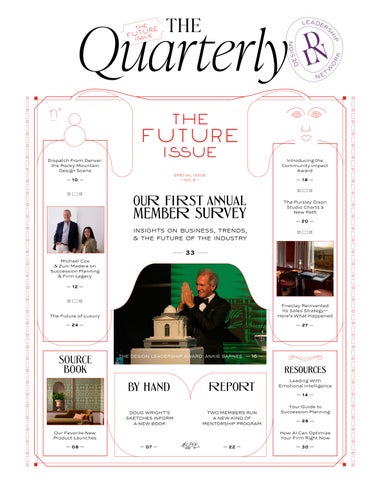
The Quarterly, Issue 8

Page 1


issue eight – the Future Issue

EAR COMMUNITY,

There are times when the future does not seem so daunting— when the horizon before us does not loom in magnitude and mystery, when it is easy to ask our children what they want to be when they grow up, and when retirement planning feels routine, not like writing science fiction.

We do not live in times like that.

Our lives have already spanned a great historical watershed: the advent of the internet. The transition from The Golden Girls to The Kardashians , from blueprints to digital files, and from word of mouth to TikTok probably amounted to more than enough change for a single lifetime. Technological advancement accelerates exponentially, however, and in 2025 generative AI put a rocket booster on a societal ship already moving faster than any before it.

ED UCATION

Alongside rapid shifts in how we live, work, and experience the human condition, climate change and sweeping geopolitical realignment deepen the uncertainty we invoke every time we discuss “the future.” I will not mince words: It is a daunting time to be alive. One response is to bury our heads in the sand and proceed as usual. Another is to acknowledge change but attempt to slow-walk it. There were periods in the past when that was possible.

We do not live in times like that.

The DLN exists to help you meet the moment in your creative practice, your business, and your leadership. In 2026, that means facing the future with awareness, intention, and a concrete plan to tackle what comes next. If you are reading this, you are responsible for the livelihoods and well­being of others— not only your family, but your employees and, in a different way, your clients. Some like to say there are no design emergencies. You know that is not entirely true. Our work carries stakes.

So let us meet the moment—and the future—before it overtakes us. As I write, we have just hosted a highly useful virtual tutorial on AI tools with member Shannon Wollack, and our upcoming Design Leadership Workshop (Ojai, CA, May 31– June 2), with returning facilitator Jon Picoult, is focused on understanding the “why” of your business— a question that is more urgent than ever. I hope you will join us to clarify your purpose and engage deeply with 30 of your peers. At The Leadership Summit (New York City, May 7–8) and The Design Summit (Los Angeles, week of November 2), we will confront consequential topics ranging from climate resiliency and artificial intelligence to tariffs, design integrity in a digital age, and leading through uncertainty. No heads in the sand at the DLN.

In this issue of The Quarterly , you will also find practical, applied insights about what lies ahead, including the results of our inaugural annual Member Survey. These findings offer clues about where we are heading, what we value, and how we might move forward. As daunting as the future may feel, it remains in our hands.

What could be more important for a community dedicated to imagining—and literally building—what comes next? It is easy to focus on parties, images, and lists. Those are not the things that matter.

This is. Join us.

Warmly,

COLL ABORATION
No one can know for sure what the future holds.

But if you’re the ones creating it, you’ll have a pretty good sense of what it might look like. That’s the idea of the first ever Future Issue of The Quarterly , an edition dedicated to documenting how the DLN community is planning for, anticipating, and shaping the future. From insights on succession planning and legacy building to stories on mentorship and leadership strategy, our community delivers powerful tools for looking ahead.

The bulk of this issue comprises the results of our first annual Member Survey, a community-wide poll that reveals fascinating insights about how leading firms are working, sourcing, purchasing, and strategizing right now. These results will help our partner brands better serve their clients and our architect and designer members understand the market they are serving. They’ve also already given the DLN team insight into how better to serve you, our community, through our program and content offerings.

I couldn’t be more excited that, after 18 months of behind ­ the ­ scenes work, this issue is making its debut on our brand-new DLN website. As our new virtual calling card, the much-improved designleadershipnetwork.org spotlights our talented community to the world while also providing a personalized dashboard where our members can engage with each other, search for and share resources, register for events, and more. It’s inspiring, informative, and useful—and what could be more future ­ proof than that?

Happy reading,

Hadley Keller Lloyd Director of Editorial and Community Engagement

HOUSE LOVE

Chris Baker, Photography by DLN member Jessica Klewicki Glynn | Vendome Press

Illustrated with Jessica Klewicki Glynn’s limpid photographs, House Love allows readers to step into the airy, light-filled, exquisitely detailed homes of the Florida-based firm Moor Baker Architects in this first book on their work.

THE REFINED HOME: SHELDON HARTE

Sheldon Harte | Vendome Press

The first book on California-based interior designer Sheldon Harte, whose work demonstrates that true luxury lies in an exquisitely calibrated mix of form, function, artisanship, and the finest works of art.

NEW LUXURY: INDIVIDUALITY,

AND SUSTAINABILITY IN INTERIOR DESIGN

Dean Keyworth | RIBA Publishing

Dean Keyworth redefines luxury as something quieter and more enduring— rooted in quality, crafts manship, and sustainability rather than trends or price. Notably, Anna Booth and Peter Block appear both on the cover and within the book’s pages, alongside work by Ben Pentreath OBE.

THIS MUST BE THE PLACE

Chloe Redmond Warner | Abrams Books

In This Must Be the Place , interior designer Chloe Redmond Warner explains how to design a home with real personality, layered with color, pattern, and unexpected touches that feel unmistakably personal.

THE

From authentic, traditional log cabins and expansive ranches to modern slopeside homes, William Peace is known for his rustic luxury style that celebrates life in the American West.

AND COMFORT OF HOME

The Elegance and Comfort of Home by Dana Wolter is an interior design book that showcases her philosophy of creating beautiful, functional, and livable spaces that support well-being through timeless furnishings, classic elements, and a connection to nature.

PEACE IN
WEST: THE RUSTIC LUXURY INTERIORS OF WILLIAM PEACE
William Peace | Gibbs Smith
THE ELEGANCE
Dana Wolter | Gibbs Smith
QUALITY

Doug Wright Uses Watercolors to Capture the Ephemeral

It’s a familiar argument in architecture and design circles—should designers know how to hand-draw? In celebration of those in the “yes!” camp, we spotlight a hand-drawn rendering from our Membership.

IN MY PRACTICE, EVERY PROJECT starts with site sketches and watercolors by hand, and then the drawings become more refined. The hand drawings and watercolors study everything from the ephemeral aspects, like the feel of the house, inspirations, interiors, and the meaning of the place, to technical elements, such as how the parts come together and work. And then we turn to the construction drawings in CAD. CAD is great for production, proportions, and exact locations, but it falls far short on expressing feelings and perceptions. I don’t think a CAD drawing can express any of the ephemeral aspects of a project. It’s always fun to have drawings and watercolors as part of a process that results in a house built for a family. I love painting landscapes and architectural scenes, but there’s something really special about hand drawings becoming built forms. This is a beach house for a family with three sons and a daughter. They loved traditional design but wanted something very open and modern so we used a combination of cedar solar shades and stucco—two very traditional materials. The cedar has weathered beautifully, just like a shingle-style house.

Doug’s recent book, From Hand to Home (Rizzoli), charts his design process beginning with a hand sketch.

WHAT’S NEW IS OLD

At a time of rapid technological advancement, the design world’s latest product launches pay unapologetic homage to art, history, and romanticism.

SAMUEL & SONS has collaborated with And Objects cofounders Martin Brudnizki and Nicholas Jeanes on Romaunt, a richly textured collection inspired by the aesthetic of the Pre-Raphaelites.

In its Saint-Germain flagship, RALPH LAUREN HOME presented the Meadow Lane collection, whose tickings, plaids, florals, and batiks evoke charming, old-world coastal living.

Texture is the key for WEITZNER , whose newest fabrics comprise chunky chenille, cut velvet, and thick embroidery with motifs representing memories of travel. Lunette, a printed velvet shown, is designed to mimic the faceted forms of Venetian blown glass.

ZINC TEXTILE tapped Antwerp-based architect Dieter Vander Velpen for an exclusive collaboration that merges the texture of fabric with the spatial sense of architecture. Through a mix of velvets, chenilles, linens, leathers, and outdoor performance weaves, the line translates materials like wood, travertine, and marble to fabric form.

Fitting for a Paris launch, ARTE’S Allures collection honors the craftsmanship of 19th-century France through timeless materials including velvet, leather, and exquisite embroidery.

La Reverie by CLARENCE HOUSE translates memory and daydreams into textiles and wallcoverings, with romantic botanicals and fantastical landscapes, like the mountains of Niseko, Japan, rendered in sumi-e ink wash painting.

ROSEMARY HALLGARTEN’S Country Manor line gives classic English style Rosemary’s clean, organic touch. The line’s silk, alpaca, mohair, and shearling shine against the backdrop of England’s storied Ashby Manor.

POLLACK looked to musical inspiration for Vibrato, a line whose geometric patterns are informed by the rhythm of the musical vibration from which it takes its name.

SOURCEBOOK

KENDALL WILKINSON previewed her forthcoming line of lighting with Iatesta Studio. The 22-piece line comprises chandeliers, pendants, and lanterns, all handcrafted by artisans in Maryland.

RUBELLI takes light as its muse for the new Luce collection, whose textures and patterns are a play on brightness, reflection, and shadow across fabric, wallcoverings, and outdoor fabrics.

KIT KEMP’S latest for GP&J BAKER presents exuberant takes on classic motifs like botanicals, cross-stitch, and stripes across 11 statement prints and embroideries, five woven stripes, and seven wallpapers in 38 colors.

MANUEL CANOVAS nods to the inspiration of travel in the cheekily named Hotel Canovas line, which comprises decorative prints, velvets, performance textiles, and embroideries inspired by historic Chinese paintings and Provençal landscapes alike.

In its Jardin à la Française collection, PIERRE FREY conjures images of geometric parterres, lush vegetation, and wild bouquets in a palette informed by nature. The collection spans fabrics, wallcoverings, and carpets.

ANDREA SCHUMACHER joined forces with MELINDA MARQUARDT’S The Vale London on Liesl Lattice, a painterly motif that began as an intaglio print by Andrea’s grandmother Liesl Monath. Andrea and Melinda translated the artwork into a repeating lattice pattern that is available in four colorways.

TAI PING continues its collaboration with French artist Sam Baron in a new collection that nods to French decorative arts through a contemporary lens.

Meanwhile, in California, FIRECLAY TILE gives the ageold art of mosaic a fresh spin with its new collection of four ready-made tile patterns, including Sparkle, shown here, in rich colors.

Want to submit a product or collection to this column? Email hadley@designleadershipnetwork.org

LocalColoradoInsight:

Welcome to Local Insight, a new Quarterly column where we take the temperature of the design scene in areas the DLN visits for our Community Gatherings. Here, the latest from the Rocky Mountain region.

“Across Colorado’s Front Range and mountain communities, a bold design renaissance is taking shape. Clients seeking a truly creative outlet are drawn to Colorado’s rugged canvas—whether it’s the sweeping embrace of the Flatirons or the solitary strength of a 14,000foot peak. In both urban neighborhoods and remote alpine settings, a new generation of designers—working shoulder to shoulder with the long-established pillars of the field—is elevating creativity to unprecedented heights.

“Ready for this moment, Taconic Builders has reinforced its foundation, sharpened its tools, and strengthened its craft. This powerful movement has only deepened our resolve, empowering us to deliver construction excellence with the highest level of sophistication, even in the most weatherdependent and logistically demanding environments.”

Tim Glick Taconic Builders

“Denver has a vibrant new energy in architecture and interior design. We are seeing a revived passion for classic designs that are pushing the boundaries of Denver’s landscape. Not only are we seeing a resurgence in authentic traditional design, our client base is seeking more curated, design-driven homes in a way we haven’t seen before.”

Emily Lindemann Ruggles Lindemann Bell

“Internally, we’ve been tracing the origins of our materials and furnishings, prioritizing closer relationships with artisans, makers, and ethically aligned partners. By bringing clients into that process, rather than editing it out, we’re empowering more informed decisions and creating a deeper emotional and cultural attachment to the pieces they choose, one that only comes from understanding the story behind them.”

Donna Mondi Donna Mondi Interior Design

“Design in Aspen is alive and thriving. With a focus on quality and craftsmanship, our Aspen projects remain rooted in quiet luxury.

“A keen interest in health and wellness are consistent qualities of many of our clients, and we are seeing an increased desire to incorporate these elements into their homes. Active days in the mountains call for restorative homes that recharge the soul. From custom saunas and spa facilities to integrated water filtration and carbonation systems in kitchens and the increasingly popular game table, our clients want to live well and feel well. Pairing natural materials, elevated textiles, and quiet technology, our interiors work hard to support the play hard lifestyle of our clients.”

“Aspen in particular is going strong and the designers we’re talking to are all busy. A lot of those conversations are around our leather rug line, including using those rugs in some unexpected ways—as headboard upholstery, for example, and, in one case, as a custom pool table cover. I think it points to the fact that the same interest we’ve been seeing in urban areas and places farther east in terms of layering interiors with global handcrafts and stories from other cultures has made its way to the Mountain West. We’re definitely sensing new energy around the ways designers are incorporating those things into their work.”

“The most interesting work happening in Denver and Aspen is defined by restraint and authorship rather than spectacle.

“In Denver, design has moved beyond trend adoption into a more assured, architectural language. There’s a growing emphasis on proportion, material integrity, and spaces that feel considered rather than styled. The best projects aren’t chasing what’s next—they’re investing in what lasts.

“In Aspen, the conversation has shifted decisively away from overt mountain motifs toward a more refined layer and collected over time interior. Natural materials are still central, but they’re handled with greater discipline and clarity. Luxury is quieter, more intellectual, and less performative.

“Across both markets, what stands out is a collective return to discernment. Design is being treated as a long­term cultural investment, not a visual trend cycle, and that shift is elevating the work in meaningful ways.”

A New Era

Foley + Cox rebrands as MC Interiors with new partner Zuni Madera leading alongside Michael Cox.

IN 2002, AFTER 10 YEARS at Ralph Lauren Home, Michael Cox opened the doors to his boutique design firm alongside partner Mary Foley, where the two built a reputation for excellent service and personal, comfortable interiors. Now, over two decades later, the firm has rebranded as MC Interiors in recognition of Zuni Madera’s promotion to partner after working there since her graduation from FIT. Here, the two DLN members talk about growth, transition, and what’s next.

Zuni began in our entry ­ level position of assistant project manager. Her hard work and commitment led from one promotion to another: project manager to senior project manager and eventually we created the new role of design director to acknowledge her ongoing development and contributions to the team, the clients, and the firm’s work.

After Mary Foley’s retirement in 2017, Zuni continued to manage more responsibilities and began to truly develop the design team as a role model and leader. She was promoted to vice president in 2021, where she cultivated incredible relationships as a leader in our industry, garnering the trust and admiration of architectural partners, vendor collaborators, and deepening her bonds with the firm’s legacy clients. She truly embodied the spirit of a partner before officially becoming one in the summer of 2025.

The luxury of 19 years of shared professional experiences made the transition quite smooth. Some colleagues even described it as inevitable! But the transition from employee to owner can never be underestimated, and I’m sure Zuni has felt many moments of intense responsibility in her first six months in her new position as partner.

It was my first real job after graduating, and I remember when the firm contacted me for an interview. I saw their website, and I just thought the work was incredible. I felt that it was just what I was looking for: a boutique-size firm that does residential design. The work that we do is so personal, and I think that’s what has kept me passionate about it for all these years.

We’ve always been fairly small, and I think that really enables us to think smarter in terms of assessing our current business needs and where we need to expand as the world keeps evolving and changing. Plus, from a culture standpoint, I’ve always appreciated working with a smaller firm because you get to be fully immersed with the team.

The partnership discussions started when we were having conversations about promoting me to design director. At that moment, I felt that I was at the peak of my career, and this trajectory really made me open my mind to the possibilities of working within a firm like this.

Because I got to work with Mary and Michael so closely on projects, I was able to really understand what’s important to them in terms of client expectations, relationships, collaboration with contractors and architects. That really groomed me to take my own role seriously.

Michael Cox DLN Member
Zuni Madera DLN Member

We have cultivated shared core values that are truly the foundation of the firm: clients that are heard and taken care of, work that is personal, invested, and authentic, and partners that are both good people and generous and creative collaborators.

The name change was thoughtfully considered over the course of a few years. We had many conversations with clients, architects, and industry partners and respectfully incorporated so much generous feedback into our rebrand. Tom and Austen at Dyad were also integral—they have helped develop and evolve our firm identity for 10-plus years.

As I face 57 in April and acknowledge the age gap between Zuni and me, I’ve done some serious self-evaluation. The best advice I can offer is to truly do an inventory of personal strengths and weaknesses and then cultivate plans to supplement those weaknesses. For many years I’ve called myself a technology dinosaur, and yet with Zuni’s help, support, and encouragement we have adapted so many new platforms and practices to run the business in an evolving industry landscape. New IT support team, outsourced procurement, flexible and remote support are just three examples of how Zuni has helped our firm adapt in the past few years.

Our firm values are really aligned with how we work with our clients. We’re fortunate to be working with them on second and third projects and internally cultivating a relationship where we work really well together. We are aligned when the goals of the firm and the project go hand in hand with that continuity, and I believe that’s what’s made us pretty successful.

The biggest change was that I was very acclimated to working in smaller, intimate groups, and now I’m supporting Michael and running our team on every project. That pushed me to use a muscle that I knew I had but hadn’t really been flexing. I think the reason that evolution was successful is that I genuinely love training and developing a team. Early on, I was always the one to train and mentor our interns and that prepared me for this leadership role. Now, we’ve continued this mission of supporting the next generation with our endowed scholarship at NYSID, which I am really proud of—that came out of these succession conversations.

There’s always the phase where you think, I could do this more quickly myself. But that’s something Michael instilled in me and I always tell my team: “If you take the time to train and develop someone, you’re making it easier going forward, not just for yourself, but for the company. You’re building a stronger foundation.”

I am a pretty humble person, but something about the name change was significant because it really made it feel real.

Part of the way we are tapping into the future now is with our new “work from anywhere” model. That’s part of our effort to be consistently open­minded to better navigate the ever­changing landscape of the industry.

As uncomfortable as change can be, once you submit yourself to it anything’s possible. For a person like me, who started from the bottom, I think recognizing that you’re in the right organization is important. But then you really have to share what your goals are with those partners, perhaps can even nudge the partners and help them recognize there’s something more beyond what we’re doing. How we can continue the legacy of the firm?

FORGET AI: THE FUTURE OF BUSINESS DEPENDS ON EI

Margaret C. Andrews unpacks the importance of emotional intelligence in leadership today.

DURING THE THIRD-ANNUAL Design Leadership Workshop , Harvard instructor

Margaret C. Andrews outlined the power of leading with—and effectively cultivating— emotional intelligence. Here, she dives deeper into the subject.

“Think about your best boss,” I ask the people in front of me. “Get one person in mind and now think of all the reasons why you chose this person as your best boss. The big reasons and the small reasons.” This is how I begin many of my executive programs.

And what happens after this demonstrates an important point about leadership.

After thinking through all the reasons for choosing that person as their best boss and then narrowing that list down to their top three reasons, we begin to classify these reasons. Were their top three reasons related to how smart this boss was? Or how good they were at whatever “hard” skills they used on the job? These skills could be anything from architectural design, data science, search engine optimization, or surgery. Or was it something else? It turns out that most of the answers fall under this “something else” and relate to that boss’s “soft” skills, relationship skills, their interpersonal skills—also known as emotional intelligence (EI).

I’ve run this exercise with thousands of people from all over the world, in different industries, and at different levels in the organizational hierarchy and the results are always the same. In each audience, the reasons for why someone was our best boss relates more to their EI than their intelligence or their technical or functional skills. By a wide margin.

Several years ago, I started keeping track of responses to this exercise and found that about 85 percent of the reasons people give for why someone was their best boss have to do with EI. The remaining 15 percent is split relatively evenly between intelligence and “hard skills.”

This doesn’t mean that intelligence or technical or functional skills are not important in a boss or to making them successful in their career, and, in fact, it’s often those factors that helped them in school and their early career and likely got them promoted. However, what makes the difference between a good boss and a great boss or leader has more to do with emotional intelligence than it does with high intelligence or excellent technical or functional skills. Intelligence and strong technical or functional skills are the table stakes, and it’s emotional intelligence that makes the difference between a good boss and a great boss.

The most common reasons people give for someone being their best boss? Across the thousands of people who I’ve done this exercise with, a few key behaviors emerged as most frequently mentioned for a best boss, including that the person:

Margaret C. Andrews is a speaker, author, and educator with over 30 years of experience at the highest echelons of business and higher education. Margaret has taught on four continents and held multiple key leadership roles at Harvard and MIT. She is also the founder of The MYLO Center, a leadership education and professional development firm.

01 Gave autonomy and independence in how to do the work

02 Cared about them or their career

03 Challenged them to be better—and supported them in doing so

04 Engaged in clear, open communication

05 Coached or mentored them

06 Found or brought out the best in them

07 Were good listeners

All of these behaviors would be classified under EI skills, and all of them are learnable behaviors.

EMOTIONS

EI is about being intelligent about our emotions. So, what are emotions? They are a response to a specific situation or stimulus. While some emotions may be more pleasant, and others more challenging, no emotion is either “good” or “bad,” or “positive” or “negative.” All of our emotions give us data and are there to help us. For example, anger helps us take action when our path to a goal has been blocked, a boundary has been violated, or we (or others) have been wronged. Fear alerts us to potential danger so we can take action to avoid that danger. Sadness helps us slow down to feel our losses, connect with others, and show them that we need support. And happiness helps us notice and move toward who and what provides us pleasure and gives us a sense of well-being.

WHAT DO WE MEAN WHEN WE SAY “EMOTIONAL INTELLIGENCE”?

Emotional intelligence was first introduced by Peter Salovey and John Mayer in a 1990 academic paper and later popularized by Daniel Goleman. Although the concept has been around for many years, there is often a lot of confusion about what we really mean by the term emotional intelligence. Is it just being nice? No. Is it something innate and fixed, so that you either have emotional intelligence or you don’t? No. So what is it, then?

Emotional intelligence is the ability to recognize, understand, and use your emotions effectively, including the ability to pick up on others’ emotional state and use this awareness to respond to them successfully. There’s a lot packed into this definition, and each component is important. First, being emotionally intelligent means that we can recognize our own emotions in the moment and then be able to regulate these emotions and channel them effectively. It also means that we are able to understand the emotional state of others, picking up on their body language, facial expressions, or tone of voice, and then use this awareness to successfully interact with them. It’s all of these components taken together that lead us to say that someone has emotional intelligence.

While many of us strive to have high EI, it turns out that many of us are low on the emotional intelligence scale. And how would you know if you’re one of these people? There are several signs, or “tells,” including that people with low EI tend to:

• Be easily angered—it doesn’t take much for them to “spark”

• Strive to prove that they are right, often focusing on winning an argument, even at the expense of the relationship

• Have difficulty admitting and owning their mistakes; they are likely to blame circumstances or other people or to hide the mistake from others

• Be highly opinionated and its close cousin, judgmental

• Blame others for how they make them feel

• Have difficulty controlling their own emotions

• Have poor listening skills—they may interrupt, listen half-heartedly (or distractedly), listen only for how to respond rather than understand, or refuse to listen to other points of view

• Often feel misunderstood

This last one, feeling misunderstood, is perhaps the saddest of them all because these people often have very good intentions, but their lack of self­understanding and self­management means that their behaviors don’t match their intentions. When we lack EI, it’s hard to understand how we come across to others and interpret their behaviors toward us, which can lead to us feeling misunderstood.

A lot of high­achieving people can relate to these signs because they quite often have very good intentions for being a great teammate, boss, or leader, but their behaviors get in the way. And what they may not understand is that we judge ourselves by our intentions, but others judge us by our behaviors.

So, if you are one of those high achievers who can relate to these signs, I say, Congratulations! Now you know where you’re starting from. Because awareness is the first step.

THE COMPONENTS OF EMOTIONAL INTELLIGENCE

Emotional intelligence has four components: self­awareness, self­management, social awareness, and social skill.

Self-awareness is the ability to recognize and understand our own emotions, as well as know our values, have a realistic sense of our strengths and weaknesses, and understand how our behaviors impact others.

Self-management involves regulating our thoughts, emotions, and behaviors so that we can respond to people and situations intentionally, rather than simply reacting. The ability to self ­ manage helps us work toward personal and professional goals, be more adaptable to changing circumstances, and overcome obstacles and setbacks.

Social awareness is about understanding the perspectives, emotions, and needs of other people.

Social skill relates to our ability to effectively interact with others and includes the ability to manage relationships and navigate social situations. Social skills involve the ability to cooperate with others, build teams, influence people, develop others, take charge and lead effectively, and manage conflict.

HOW TO IMPROVE YOUR EMOTIONAL INTELLIGENCE

• If you would like to enhance your self­awareness:

° Pay attention to your emotions; learn to label (and accept) your emotions

° Journal about how you feel

° Understand your values

° Observe others to better understand your impact on them

° Ask for feedback

° Practice mindfulness, which can help you become more aware of the emotions you are having in the moment

• If you would like to enhance your self­management:

° Engage in the foundations of self ­ care: eating well, getting enough sleep, and exercising—all on a regular basis

° Be clear on your goals and the behaviors that will help you reach these goals

° Practice mindfulness, which can help you be more aware of your intended behaviors—those that will bring you closer to your goals

° Identify a range of behavioral choices (and consequences) for how you might respond in difficult situations

° Learn to relax

• If you would like to enhance your social awareness:

° Read good literature, which helps you better understand, and even “inhabit,” someone else’s perspective

° When in conversation with others, pay attention to the feelings behind the words

° When in conflict with others, work to understand their perspective

• If you would like to improve your social skills:

° Show genuine interest and curiosity in others and their perspectives

° Actively listen

° When disagreeing with someone, hold that person in high regard and assume positive intent

° Remember that you are one half of any relationship

Emotional intelligence is a set of important life skills that helps us to live and work with people more effectively, build and maintain long­term relationships, and even recover from setbacks more effectively. EI makes us more effective human beings and more effective leaders. It also, generally, makes us happier, more productive people.

Award-Worthy

Ankie Barnes wins the 2025 Design Leadership Award.

THERE’S A COMMON REACTION WHEN you say the name “Ankie Barnes” to any member of the DLN. Invariably, faces light up, a smile breaks out, and some version of “he’s just the nicest guy” is exclaimed. So, as Michael Diaz-Griffith emphasized in the presentation of the award at Madrid’s Palacio Liria last November, it was one of the easiest decisions ever to award Ankie the 2025 Design Leadership Award.

Ankie’s congeniality is a frequent introduction to our community: He joins nearly every new member onboarding call, serving as one of the first to greet incoming members, effusing the camaraderie of our organization—and he truly means it. At events and gatherings he’ll greet decades­long and brand­new friends with the same warmth. He was one of the first and most ardent supporters of the Design Leadership Foundation, enthusiastically sharing his knowledge with hundreds of design students.

Ankie’s frank unpretentiousness and unfailing kindness are noticed by everyone he encounters. “Humility—he has it in spades,” says Ankie’s longtime friend Tom Kligerman, who first met him studying architecture at Yale and reconnected decades later through the DLN. “He is not one to toot his own horn. He’s very modest. If things come out about his achievements, it’s by accident, but when I finally get the little glimmerings of the kinds of jobs he does and the range that he works in, it’s amazing.”

Ankie’s friends and colleagues credit that

to a lifelong love of learning and an insatiable curiosity, fed by frequent travel, constant mentorship, and passionate involvement in organizations like the Lutyens Trust America, Institute for Classical Architecture and Art, and, of course, the DLN.

“His intellect is unstoppable,” says Richard Zantzinger, founder of Zantzinger Built and a frequent collaborator of Ankie’s in the Washington, DC, area. “When he shows up to a meeting, he’s done his research; he knows everything there is to know about the site. And then he leads everybody through his vision and brings the client along in the creative process as he goes, so they’re invested from day one in a really special way, and then there’s no doubt that he takes that vision all the way through to the last meeting.”

Vision is exactly what Ankie gave longtime clients Katherine and David Bradley, who have trusted him with six homes over the past three decades. “We had a project where I wasn’t able to put my thoughts to paper, but I described it to Ankie, and he said, ‘Well, why don’t we do it right now,’ ” recalls David. “And he took out a piece of paper and I watched him create the house I had in mind.”

“He’s clearly very accomplished, very brilliant, very capable, but I think that he is approachable, and I think that helps people to let their guard down,” says Marmi founder Magd Riad, a frequent travel companion.

“Whether they’re titans of industry, or they’re building their 10th home with him, they’re very comfortable with him.”

“When they’re choosing an architect, I tell potential clients, ‘In the end, everything being equal, pick the person you like,’ ” says Kligerman. “And I’m just glad I don’t come up against Ankie when I’m trying to get a job very often; he is a gentle but fierce competitor, almost in spite of himself.”

During last year’s DLN Community Gathering in our shared home city, Ankie, unsurprisingly, became our unspoken ringleader. The first to volunteer tours of his office and an exceptional job site, he proudly stood back while his partners explained their work and took an engaged interest in that of his peers.

As we drove through the streets of Georgetown between tours, Ankie issued a steady stream of anecdotes on the architecture and history of the buildings passing by, originally meant only for his seatmate. Despite his humility, the entire group was soon craning necks to hear the official Ankie tour. While we explored John Russell Pope’s Meridian House, Ankie could be found bouncing between old friends and younger members, pointing out details only his eye would catch, sharing a bit of his genius with those lucky enough to be in his orbit.

Ever curious, ever generous, ever interested: That is Ankie Barnes. What better example of the DLN is there?

A Monument in Miniature

The Design Leadership Award Takes the Form of a Lutyens Model by Timothy Richards.

AT THE 2025 DESIGN LEADERSHIP SUMMIT in Madrid, the Design Leadership Network gathered at Palacio de Liria to present its annual Design Leadership Award to Ankie Barnes. The evening was a warm celebration of a figure whose leadership, generosity, and influence have shaped the DLN for two decades, and the award created in his honor carried a story of its own.

When it came time to conceive the object, Michael Diaz-Griffith, executive director and CEO of the Design Leadership Network, immediately thought of the British architectural model maker Timothy Richards. Working from his Bath studio, Richards has spent his career producing exquisitely detailed plaster models of historic buildings, admired by architects and collectors alike. Among the many figures whose work he has studied closely is Sir Edwin Lutyens—an architect Barnes has long admired. The idea felt fitting in more ways than one, not least because of a quiet Lutyens connection to the palace where the award would ultimately be presented.

Michael reached out to Timothy, and together they discussed whether one of his models might become an award worthy of the occasion. From the start, Timothy had a particularly beautiful one in mind: a model of the temple at Tyringham Park, one of Lutyens’s most elegant garden buildings.

The temple has the presence of a monument in miniature. Its body is cast in plaster, the geometry crisp and exacting. Inside the dome

lies a quiet flourish: The interior is finished in gold foil, catching the light with a subtle glow when opened. The flat roof and base are clad in patinated white metal foil, while the windows are rendered in finely etched brass. Each material contributes to the overall effect—an object at once scholarly, sculptural, and beautifully made.

Richards embraced the project immediately and added an extraordinary final touch. Through his own connections, he arranged for the piece to be signed by Martin Lutyens, the architect’s grandson, linking the award directly to the family legacy behind the architecture it celebrates.

From there the effort became a feat of teamwork. The award was completed with remarkable speed and transported safely to Madrid with the help of the art-handling firm Cadogan Tate.

By the time the evening arrived at Palacio de Liria, the architectural thread felt especially resonant. Lutyens himself designed the palace’s chapel and maintained a friendship with the Alba family, the evening’s hosts, making the lineage behind the award feel perfectly at home in its setting. In fact, it was all a matter of planning.

During the dinner, the temple rested on a plinth, concealed beneath a white cloth. When the moment came, the covering was lifted to reveal the architectural jewel. In a room filled with colleagues and friends, the model of Lutyens’s temple became the centerpiece of a joyful tribute—a tangible link between a beloved architect, a respected leader, and the community gathered to honor him.

Community in Action

The DLN presents its inaugural Community Impact Award.

EVERY MEMBER OF THE DLN KNOWS that our community is about much more than design excellence, though our members have it in spades. The true magic of the DLN is in the connection, collaboration, and mentorship that goes on between members every day. In order to better recognize those members of our group who are especially committed to serving the design community, the DLN inaugurated a new honor at the 20th annual Design Leadership Summit in Madrid last year.

The Community Impact Award is designed to celebrate an individual who has demonstrated the highest dedication to community­based service, giving their time, money, or expertise—often all three—to advocate for and strengthen community ties through design. There could be no better first recipients of this award than those who championed the Design Leadership Foundation in its first years in action.

Between them, Caren Rideau, Shea Soucie, and Mark Williams have impacted hundreds of students through their work on the DLF Advisory Board, through on-campus workshops at MSU, and in expanding the DLF’s activities to Santa Monica, Chicago, and Atlanta, respectively.

Caren led the first expansion of our pilot program past our first academic partner, introducing Santa Monica College to our on-campus workshop, which brings together DLN professionals and students for a day of talks, panels, and roundtables. With the third-annual workshop on April 1, we are set to double our reach from years past and incorporate even more DLN members than in years before.

Shea’s relationship with Chicago-area nonprofits enabled the DLF’s partnership with One Million Degrees, a group supporting students at the City Colleges of Chicago. With four years of mentorships, panels, lunch and learns, and studio visits, we are looking forward to introducing the pilot program for our internship model to students in Chicago through OMD in summer 2026.

Mark’s strong knowledge of academic institutions in the Southeast provided the insight necessary to create our first Atlanta Area Workshop, coming this fall. It will bring together three key Georgia institutions representing students in landscape architecture, interior design, and architecture.

The presentation concluded with a toast from DLF Director Ruth Mauldin: Caren, Shea, and Mark: Your passion and commitment for bringing opportunities to students and expanding access to the design industry is inspirational. The dedication and knowledge you have each brought to the DLF has enabled us to have the impact the DLF has today and has changed the lives of countless students. Thank you for everything you have done, and congratulations on this very much deserved award.

Set in Stone

Behind the making of the debut DLN Community Impact Award, a symbolic sculpture created by ABC Stone.

THE DEBUT COMMUNITY IMPACT AWARD, presented at the Design Leadership Award dinner on the last night of the Summit, was crafted by DLN partner ABC Stone using Fantastico Danby, a rare Vermont marble distinguished by its luminous white ground and bold, painterly veining in deep charcoal tones. Sustainably quarried from the Danby mountains in Vermont, it marries American heritage with contemporary drama. Prized for both its strength and elegance, it is timeless yet unmistakably statement-making.

The stone’s unique beauty and innately American heritage felt fitting when honoring contemporary American designers. When considering the form, we were inspired by the sculptural works of Anish Kapoor. We hoped to dissolve the boundary between object and experience while giving the material a moment to shine. At once geometric and organic, Kapoor’s works embody a rare synthesis of material mastery and poetic ambiguity, turning solid matter into an exploration.

We wanted our take on the award to reflect that ethos.

For the fabrication process, we looked to our friends at Precision Stone, known for their unwavering dedication to craft. They milled down the stone and rough-shaped it on the 7-axis CNC robot. From there, the awards were cut using a waterjet and hand-finished by their team of artisans. The top and left edges were left oversize to be “split-face” finished, while the profiled edge and the two dimples were polished. The main face on the front and back will be honed and sandblasted with the recipients’ names engraved on it.

ABC Stone was deeply honored to craft this award for the Design Leadership Network. We see this recognition as a celebration of excellence, vision, and influence in our field. To shape an object that embodies the prestige and contributions of these design luminaries is both a privilege and a reflection of our shared commitment to design leadership at the highest level.

REINVENTING THE WHEEL

Bronwyn Ford discusses the evolution of The Pursley Dixon Studio—and its models for leadership, collaboration, and professional growth.

FIFTEEN YEARS AGO, BRONWYN FORD WAS renting an empty desk in the Pursley Dixon Architecture offices while she began her interior design practice. Now, she’s a partner in a creative studio that encompasses architecture, interior design, product design, and will soon branch into retail. This path wasn’t the result of a carefully plotted plan; rather, it’s the latest development in a creative evolution made possible by leaders encouraging employee strengths, being open to change, and adapting to demand. As the newly named Pursley Dixon Studio celebrates 20 years in business, Bronwyn breaks down its transformation—and offers a model for a less common professional trajectory.

PHASE 1: JOINING FORCES

Ken Pursley founded his architecture firm in Charlotte, NC, in 2005; when the recession slowed business, he rented out desk space in the firm’s offices to other local creatives, including Bronwyn Ford.

While Bronwyn was renting a desk in the Pursley Dixon offices, the firm’s interior designer left on maternity leave. Having already developed a close rapport with the team while sharing an office, she began collaborating on interiors work. “It was all kind of organic,” says Bronwyn. “They were working with other designers, and their clients were asking for them to do it all, so I would step in and pick up that part.” Soon, this turned into a more permanent arrangement.

“I was a one-man show,” she recalls. “I was starting to grow. I was doing it all, and I was kind of overwhelmed. I was just trying to figure out which basket to put my eggs in—my own firm or working with these other people—and because I liked the work they were doing so much, I decided to set aside ‘my’ business.”

For mid-career designers eager to hang their own name on the door, the decision might seem questionable. But for Bronwyn, it was the best decision she could have made: “I’m perhaps at the same place I would have been had I been on my own, but I’m running an interiors business and I have these partners to collaborate with and bounce ideas off of.”

PHASE 2: EVOLVING DEPARTMENTS

For a good decade, Bronwyn worked on design under the Pursley Dixon umbrella, collaborating with Ken, Craig Dixon (who became partner in 2012), and their teams. In 2020, she, too, became partner, and the firm’s interior design business was renamed Pursley Dixon Ford. (Pursley Dixon Architecture continued its architecture work.)

“We used the same administrative resources and shared space but had separate books of business and separate management,” says Bronwyn. But, as the firm began to gain business and, especially, press, the branding became clouded.

“A real turning point for us was when we did Kips Bay,” says Bronwyn of the room in the 2023 Dallas showhouse for which both the architecture and design studios did work. “It was credited to Pursley Dixon Ford and Pursley Dixon Architecture, and people were tripping over that.”

So, the partners reached out to fellow DLN member Katie Brockman and sought her advice to solve their branding dilemma. Katie’s advice? Fully unite.

Bronwyn Ford DLN Member

PHASE 3: REORGANIZATION AND REBRAND

Enter: The Pursley Dixon Studio, the newest iteration of the brand, which sees architecture, interiors, product, and a forthcoming retail concept under one umbrella, with interior designers reporting to Bronwyn and architects to Ken and Craig.

“Before, there were people on the team who did architectural selections and then there were people who were considered decorative interiors; what we did was pull all of those interiors people into one team,” she says. Not only did the reorganization streamline administrative and business processes, it improved the caliber of the studio’s work.

“It’s incredible how much more integrated our work has become,” says Bronwyn. “If you’re collaborating with a designer or architect in different firms, they have different processes, different expectations; they might not communicate as often as we do, but because we’re all under the same roof, we all speak the same language. We’ve really been able to capitalize on that strength of having two very strong teams under one roof.”

That’s not to say the firm doesn’t frequently collaborate with other designers, but establishing their own language and processes in have helped those relationships too.

“It’s so important to have good partners, both external and internal,” says Bronwyn. “We’ve done a lot of work within our leadership team at the firm to build a really special culture and to make it very clear what we’re all about.”

PHASE 4: A NEW RETAIL CONCEPT

CONTINUED LEARNING AND CREATIVITY

At the heart of all these changes is a commitment to nurturing the team’s learning and creativity. One unexpected benefit of the merger was the opportunity for new education on topics previously outside their purview.

“When we joined the teams, we realized we needed to train them on, as I call it, ‘their second language,’ ” says Bronwyn, referring to the discipline that’s not their expertise.

The firm developed what it calls “PDUs” (Pursley Dixon University), sessions in which designers teach architects interior lessons and architects educate interior designers on structural ones. The design team gave a course on window treatments, while the architects presented on windows.

“It was really crazy to realize, even though we’re all under the same roof, how little our designers knew about window selection, just because architects would always do that, or how foreign drapery was to architects,” says Bronwyn. “Now, our whole team can speak to clients about all of it, which makes us feel like a very cohesive team.”

On a more creative level, the studio hosts quarterly “Creative Days,” when the entire team spends the day working on “whatever creative endeavor they want,” offering a reprieve from normal work (or sometimes an occasion to dive deeper into it) that invariably enriches their design work.

“Some people will do interior design or architecture work, but then we have people making clothing or handbags, doing collages,” says Bronwyn. The day concludes with a presentation of everyone’s creative work. To Bronwyn, it exemplifies the spirit she hopes embodies the studio.

“I think, whether I was acting as a sole practitioner or leader of my own organization, I would always love this kind of creative collaboration. Now, that’s what our whole studio concept is about.”

This streamlined workflow has also made room for the studio to explore another creative avenue: retail. “There’s a big lack of places in Charlotte for designers to find unique product, and I really want to fill that,” says Bronwyn. “I envision it as a place to showcase both found objects and our designed product and a kind of laboratory for our designs.”

The result is ITO, an online, soon­to­be physical retail concept that Bronwyn will oversee. Its moniker is her maiden name, a nod to her leadership role in the firm even while its new name dropped Ford.

Together, each of these new arms of the studio comprise a creative campus that serves as an HQ, hub, and physical manifestation of the brand.

TOP RIGHT IMAGE BY Emily Followill Photography
BOTTOM LEFT IMAGE BY Photography
BOTTOM RIGHT IMAGE BY Roger Davies Photography

PASSING IT ON

Two DLN members join forces with a builder colleague to develop a cross-disciplinary mentorship program.

FOR YEARS, DLN MEMBERS Tham

Kannalikham and Liz Graziolo and their frequent collaborator Dana Sandberg Raines found support in discussing their professional ambitions, hurdles, and progress. Their friendship—and frequent collaborations—continued as their careers grew and expanded, from Liz’s role at Peter Pennoyer to founding Yellow House Architects, Tham working for a private client, then venturing out on her own, and Dana working in PR and construction management before taking a role at Highline Construction Group. Mentorship had long been important to all three of them, so a few years ago, the trio decided to formalize their support for on­the­rise creatives—and pay their own mutual support forward—with the establishment of a three­part mentorship program. Dubbed the TED Mentorship (after its founders’ names), the program spans three summers, each of which entails two weeks with Tham’s interior design firm, two weeks with Yellow House Architects, and two weeks with Dana at Highline. The result, the founders hope, is a more holistic understanding of the design business and a respect for the collaboration it involves. Here, Tham and Liz discuss the program and their goals for its future.

Can you tell us a bit about how the program started?

THAM Liz, Dana, and I have been friends for a very long time. Twenty years ago, Liz was already an important architect in the Peter Pennoyer firm, I was starting out with a private client—

LIZ Oh, you were important as well, Tham.

THAM When we were first starting out, we’d get together and we would always just have one drink and we would share an appetizer. Those days built our foundation of friendship, but also we were able to educate each other about process and issues we were facing.

LIZ Especially as a young professional, having peers going through similar experiences was so important at the time. And specifically peers not necessarily in the same field but elsewhere in the industry. It brings up a different point of view. I realized, oh my gosh, not only does this person support me, I’m gaining knowledge from them, and at the end of the day, we all want to support each other, but also it makes you stronger in your profession to understand all sides of the process.

How does that multidisciplinary approach translate to collaboration?

LIZ It’s so important. As our friendship grew and I understood their approach, it was natural to collaborate professionally. And then it was Tham who said, “How funny would it be to try to pass forward what the three of us have experienced?”

THAM Also, we were seeing that a lot of the younger talent hadn’t necessarily developed some of the technical skills we had. They didn’t always understand the role of scale and proportion and architecture; they thought design was about picking finishes. I was lucky to have a mentor who made me understand all aspects of architecture, from building to developing an electrical plan, and it made me a stronger designer. So I thought, How can we work together to create a better outcome for the next generation?

LIZ Interestingly enough, I’m on a trip in New Orleans right now with a group of students, because I think it’s so important for them to understand history and context in architecture. But that context comes from collaborating with designers too; even something as simple as knowing that a designer will need space for a curtain stack around your window.

THAM Too often, the architects and designers don’t speak to each other, and then you have a situation where, say, I have this empty box, and I have a wallpaper that’s a certain size, but it doesn’t account for the crown, and then the plan is unresolved.

What do you each try to most emphasize in your portion of the mentorship program?

THAM So the mentees are with us each for two weeks. I try to lean into the academic side, to understand scale and proportion and practicality. People will say “Design is whatever you feel”— that’s not true. If you’re making a sofa, you have to understand the fabric, the repeat, how you’re arranging it, the right application of trim, the difference in, say, a curve scroll or a straight detail and how it will lay. I take them to workrooms so that they can see this in person and also understand how important human touch is.

LIZ I try to give them as much range as possible, to show some design process but also get them out in the field. I’ll try to expose them to a meeting with a client, go to a job site, and, of course, meet with collaborators. For me, it’s about having a real immersion in what it’s like to be an architect.

I love that you’re not strict about the program’s participants needing to be design students per se. Why is that?

THAM Well, we believe in the importance of our field in so many areas. One of the students we mentored now works in real estate, and he recently said to me, “After doing your mentorship program, I look at everything in a building. I appreciate the crown because we went to Foster Reeve and saw what goes into it. I know what kind of tile this is or how this wood detail was carved.” And so he’s able to talk about it and make it meaningful to his clients.

As you look ahead, what are your hopes for this program?

LIZ We’d love to take it nationwide. It takes a lot of time and there are only so many mentees we can take on per year.

THAM The goal eventually is to become a 501(c)(3) and be able to reach more people.

LIZ The program started because we are minorities in this industry and we were trying to forge our way. We were both lucky to have great mentors early on, and it has always been so important to give back. That’s why I go back to my alma mater, Cooper Union. That’s why I began teaching at Yale this year.

THAM The DLN provides so much opportunity for incredible collaboration too, and that allows us to pass that knowledge and those resources down to our students. It’s basically creating a bigger village.

TED’S FIRST GRADUATE

Abby initially planned to pursue a career in interior design. Following the program, she enrolled at the University of Pennsylvania to study urban planning. “Her experience in the mentorship gave her a deeper understanding of the built environment and its broader context, allowing her to make a more informed decision about her future direction,” says Tham.

Liz Graziolo
Tham Kannalikham

THE FUTURE OF LUXURY

“Luxury brands are transforming from storytellers into storylivers,” predict trend forecasters at The Future Laboratory. Here’s what that means for your business.

The following is an excerpt from The Future Laboratory’s 2026 Future Forecast. See the full forecast HERE

IN 2026, THE LUXURY SECTOR WILL balance heritage with experimentation as it evolves from static storytelling to immersive storyliving. As consumers seek connection over aspiration, brands are moving beyond visual spectacle to create experiences that can be felt, heard, and lived. Sound, scent, and texture are becoming the new materials of luxury, extending craftsmanship into emotional and multisensory realms. From private clubhouses that foster intimacy and belonging to live-stream retail that merges access with immediacy, luxury brands are expanding the sector’s ecosystem. The resale market is also gaining cultural significance as provenance becomes both a creative and an ethical marker of value. Together, these shifts reveal a sector redefining exclusivity through participation—where the essence of luxury lies not in possession, but in presence.

While storytelling is about communicating a narrative, storyliving is about immersing people inside that narrative, allowing them to live the brand story through designed experiences, environments, and interactions.

STORYLIVING STAYS

As discerning travelers seek enrichment through experiences that feel personal, cultural, and creatively charged, hotels are forming alliances with high-end brands, curating offerings that merge retail access, aesthetic coherence, and emotional connection. The relationship between fashion and hospitality is deepening—hotels are becoming sought ­ after partners, serving as cultural laboratories for brand experimentation and long-term affinity building. These collaborations signal a new era of hospitality defined by storytelling, lifestyle, and sensorial identity.

In June 2025, British luxury brand Burberry transformed The Newt hotel in Somerset, UK, into a living tableau of British craftsmanship, complete with equestrian ­ inspired décor, sculptural check motifs, and curated experiences that brought the house’s heritage to life. In February 2024, French luxury brand Louis Vuitton marked the first anniversary of Atlantis The Royal hotel in Dubai with a playful collaboration that included art installations, bespoke menus, and fashion­forward event programming. In July 2025, U.S. apparel brand Sporty & Rich partnered with The Pridwin Hotel & Cottages, on Shelter Island, near the Hamptons, offering a range of wellness programming such as tennis clinics and Pilates sessions.

Looking ahead, these signature stays foreshadow how luxury will increasingly operate as an ecosystem merging hospitality, retail, and culture. They represent a move from storytelling to storyliving—a concept that builds on the idea of storytelling and takes it into the experiential realm. While storytelling is about communicating a narrative, storyliving is about immersing people inside that narrative, allowing them to live the brand story through designed experiences, environments, and interactions.

CLUBHOUSE COMMERCE

Luxury retailers are enhancing loyalty by merging private club culture with high-end retail. These hybrid spaces trade in intimacy, access, and affiliation, developing the act of shopping into a social and cultural experience. In our Luxury’s New Clubhouse Model report, we explore how membership-only spaces are appealing to affluent residents seeking exclusive environments that blend business, leisure, and culture. As flexible working continues to blur the boundaries between professional and personal spheres, these VICs (very important clients) are seeking intimate settings that cater to both. According to The Business of Fashion, this elite segment represents 2 percent of luxury consumers but drives 40 percent of global sales—spending at record levels.

In the U.S. and Europe, luxury maisons such as Gucci and Bottega Veneta have already established private cultural hubs for high­value clients, while in Shanghai, menswear brand Zegna has created Villa Zegna, a hybrid retail-residence concept that offers curated hospitality and bespoke experiences. At UK department store Selfridges in London, the 40 Duke members’ club, which is due to open in spring 2026, will transform part of its Oxford Street flagship into a private shopping and social destination. The space will offer personalized services and curated access for the store’s top-tier clientele—positioning Selfridges as a host of cultural and community life. Together, these initiatives reveal how luxury is embracing community capital. As access becomes the new aspiration, the most coveted spaces act as sanctuaries of shared taste, connection, and identity.

THE INVISIBLE LAYER

Luxury brands are increasingly designing for feeling—creating sensorial experiences that linger beyond the visual. Our Luxury Listening Rooms report underlines how sound is emerging as a new frontier in luxury activations, operating as an invisible layer that can be felt as much as heard, while offering emotional resonance and atmosphere. Unlike visual spectacle, sound is ephemeral and immersive, unfolding in time rather than space. In London, in June 2025, British fashion house Alexander McQueen launched McQueen Reverb, an immersive installation exploring the brand’s heritage through sound and movement. The previous month, Italian luxury brand Valentino created L’Atelier Sonore in New York, reimagining its Madison Avenue flagship as a sanctuary for sound, where curated compositions guided visitors through the space, blending acoustics with architecture.

“Luxury products and services have long been emotionally evocative, but as the concept of luxury becomes more experiential, emotion becomes a core driver behind the connective and cultural expansion of this sector.”
—Fiona Harkin, Foresight Editor at The Future Laboratory

Hospitality brands are also elevating listening into an art form. International hospitality company Rocco Forte Hotels introduced Musical Room Service, partnering with local theaters, opera houses, and musicians to deliver private, in-suite performances. Paired with bespoke dining, these intimate sound experiences fuse culture, cuisine, and emotion into a single, multisensory encounter.

These innovations signal how sound is becoming central to luxury’s evolving lexicon—a medium for storytelling, immersion, and identity. As the industry moves further into experiential realms, sonic design offers a way to transform retail and hospitality environments into emotional landscapes, crafting feeling through resonance.

LIVE-STREAM LUXURY

To connect with high­net­worth individuals and a new generation of luxury consumers seeking participatory, emotionally resonant shopping journeys, brands are hosting live-streamed retail experiences that blend entertainment, storytelling, and direct engagement.

During London Fashion Week spring/summer 2026, British luxury brand Stella McCartney’s Shop With Stella event exemplified this shift. Hosted in collaboration with Swedish video commerce platform Bambuser, the interactive show streamed from a fictional HQ dubbed Stella Corp, blending live product demonstrations, real-time Q&A sessions, and instant shopping.

This will continue to be driven by demand for greater transparency and immediacy, redefining how luxury brands engage with their audiences. According to Bain & Company’s Luxury Goods Worldwide Market Study, published in January 2025, experiences remain the sector’s key growth driver.

The Future Laboratory is the world’s most renowned futures consultancy. It helps global brands, agencies, and organizations anticipate change and turn future insights into profitable opportunities. With a unique blend of trend forecasting, consumer insight, and strategic foresight, powered by its trends intelligence and consumer foresight platform, it equips businesses with the tools to navigate uncertainty and stay ahead.

With a track record of collaboration spanning 1,000-plus businesses across 50 countries, its strategic foresight specialists draw on expertise from over 20 sectors, delivering insights that are not only best in category but also best in planet. Get in touch to learn more.

Begin Again

Fireclay Tile completely reinvented its sales process. Here’s how—and why it worked.

I’VE SPENT MOST OF MY CAREER believing that if you do the work, make something exceptional, and treat people well, sales will follow. That belief carried us for nearly four decades—until we acquired a Bay Area installation business led by master installer Martin Brooks and I quickly learned there was more to the story.

On a Saturday morning in January 2025, I watched a recorded discovery call (with permission) of Martin with one of our clients. What I saw was both shocking and illuminating. Despite Martin’s incredible experience and knowledge, he wasn’t asking open­ended questions, wasn’t creating emotional clarity, and wasn’t guiding next steps with confidence. So I started watching and listening to calls, and it became clear we didn’t just have a mild cold, we had a full-blown infection. The talent was obvious; the consistency wasn’t.

Despite having a lot of pride in the talent on our team, the technology platform and systems we use, and our product, we lacked a selling framework that ensured a consistent experience for all of our clients, residential and commercial.

Here’s how we set about to change that.

GIVE EXCELLENCE A NAME (AND A SCORECARD)

After surveying SPIN, Challenger, MEDDIC and others, our VP of sales, Caitlin Child, helped us codify our GANAS Selling Framework—a values-rooted framework that gives everyone the same map. Ganas , the Spanish word for desire or effort, is the basis of our five core values:

• Gather the vision

• Anchor the value

• Navigate the decision

• Align the plan

• Show gratitude

Leveraging industry and sales methodologies best practices, we created a training guide, role-plays, scorecards, and coaching tools. We invested over $100,000 in flying all 50 sales reps to a multiday in­person training to reestablish who we are at Fireclay and how we sell.

When we first introduced GANAS, I’ll never forget the mix of excitement and nerves in the room. Some longtime team members were skeptical, others were instantly energized, but everyone leaned in once they saw how this framework could make selling feel more natural and connected.

WATCH THE TAPE TOGETHER

One of the most effective ways we did this was we began recording initial client discovery calls on Google Meet (with client permission), then scoring them against a simple rubric. We built a feedback loop: Google Meet then AI­reviewed scorecard then simple Slack message to rep and manager, so managers could coach while the conversation was still fresh. Role­plays moved from awkward to energizing because reps could practice the exact moments they wanted to improve, using segmentspecific scenarios (residential, trade, commercial). In seven weeks we went from our team averaging C’s and D’s to A’s.

THE RESULT

We replaced “heroic, individual styles” with a coachable standard—same moves, personal voice. Calls now feel warmer and more directed. Handoffs across teams feel like one company. We have a common framework to ensure we are moving forward consistently and collaboratively, with the client and their experience and success at the center.

We now share a common language (GANAS) across our online, showroom, and commercial teams, and managers regularly observe calls to keep everyone learning from the same playbook. Practice is becoming part of our culture. Role­plays and short skills sessions use real client scenarios and constructive feedback so improvement feels natural and safe. We’re already seeing encouraging signs: clearer discovery conversations, stronger guidance on next steps, and a noticeable lift in confidence across the team.

What remained constant was our craft. The artisan, domestic story still matters, but now it’s supported by discovery, visuals, and clear next steps instead of carried by them.

A FIELD GUIDE FOR PEERS: HOW TO START (AND KEEP GOING)

These steps aren’t just internal tricks— they speak to a larger design­industry challenge of building consistent, trust­centered sales culture in creative businesses.

01 WATCH THREE CALLS

Get permission, record, and sit with your salespeople for 60 minutes. How did it go? Is it what you expected? Name the moments that matter (opening, discovery, next step, close). Decide what “good” is together.

02 PICK ONE FRAMEWORK AND PUBLISH IT

There are many out there, and frankly they are all great. Spend a weekend reading up on a few—SPIN, Challenger, MEDDIC—and see what resonates.

We took a very culture-specific approach, but you may be able to get meaningful value from a template that already exists and is proven effective.

03 TURN PRACTICE INTO A RITUAL

Try some role-playing. It will feel awkward at first, but over time you and the team will get better. Rotate from seller to client to observer, pull scenarios from live deals, score them. Keep it safe and specific.

04 USE AI

We gained tremendous leverage using OpenAI’s ChatGPT and Google Gemini to do the heavy lifting, including helping us create a framework, training plans, roleplays, and scorecards. We also use AI to score calls, saving us time while maintaining consistency across calls and managers.

05 MAKE IT FUN!

Celebrate progress, not perfection. This is all about making the client experience better and helping you and the team get better. The best teams in the world practice all day every day, and practice should be both difficult but extremely rewarding by measuring progress.

RECOMMENDED READING

WHAT SHOULD WE DO? BY JOE CRISARA HELPED ERIC IDENTIFY HIS SALES PROBLEM AND DEAL WITH IT EFFECTIVELY

OFFICE HOURS: STRATEGIC SUCCESSION PLANNING TO PROTECT YOUR LEGACY

INTRODUCTION

Succession planning is one of the most sensitive and essential conversations for design firms— balancing legacy, leadership, and longevity. In this DLN Roundtable, design principals and business leaders shared real-world insights into ownership transitions, internal buy-ins, and long-term continuity. The discussion brought together Margie Lavender (partner at Kligerman Architecture & Design), Melissa Reavis (partner at Hollander Design Landscape Architects), and Ken Roberts (principal at Interior Talent) with a prerecorded opening by Tom Kligerman. Together, they explored the human and financial dimensions of passing the baton—how to start early, structure transitions wisely, and maintain firm culture through change.

KEY INSIGHTS AND STRATEGIES

3. COMMUNICATE INTERNALLY AND TRANSPARENTLY

1. START EARLY—AND PLAN FOR THE LONG GAME

“You almost can’t start too early.”

Tom Kligerman emphasized the long runway needed for succession, noting that aligning values and aesthetics is as critical as legal logistics. Identifying potential successors should begin years in advance—ideally a decade before a transition is needed.

• Look for younger leaders who share core principles but bring fresh energy.

• Allow time for the complex stages of valuation, contract drafting, and partner alignment.

• Above all, test for cultural fit: Do you trust and genuinely enjoy the people who may lead your firm?

2. STRUCTURE CREATES STABILITY

Both Kligerman Architecture & Design and Hollander Design found success through structured, multiyear transitions supported by external consultants.

• DEFINE ROLES BEFORE TITLES

At Kligerman, future partners had already taken on leadership roles in finance, legal, operations, and marketing before ownership shifted.

• USE BUSINESS CONSULTANTS

To facilitate valuation and contract work

• ALLOW FLEXIBILITY

Every firm’s buy-in structure is different, but the principles— clarity, fairness, and feasibility—remain consistent.

• KEY TAKEAWAY

The process often takes 12 to 24 months even with alignment and goodwill.

A major challenge for Kligerman’s team was perception: what felt like an organic evolution to insiders appeared sudden to staff who weren’t privy to behind-the-scenes work.

• EASE PEOPLE IN

Share the narrative before the announcement to avoid shock.

• REASSURE CONTINUITY

Employees want to know that firm culture, leadership style, and opportunity will endure.

• VISIBILITY MATTERS

Regular internal updates build trust and minimize speculation.

At Hollander, where the transition took nearly five years, open dialogue was credited with improving retention. Staff could see a long-term career path within the firm.

4. THE HUMAN SIDE OF SUCCESSION

Both Margie and Melissa stressed that new leadership is as much about interpersonal dynamics as financial strategy.

• Founders must let go gracefully, allowing new leaders to find their own styles.

• Successors must balance respect for legacy with new ideas and systems.

• As Margie put it, “People adapt, but how you roll out change determines how easily they do.”

At Hollander, founder Ed Hollander’s greatest strength was empowerment: giving partners freedom to lead without replicating his voice.

“He never asked us to be him,” Melissa noted. “That made it possible for us to lead authentically.”

5. INSIDE VERSUS OUTSIDE SUCCESSION PATHS

Internal succession—selling to existing employees—often ensures cultural continuity and smoother client transitions.

• Internal sales usually occur at a 20 to 30 percent discounted valuation to make buy-ins feasible.

• External buyers or private equity may pay more up front but can reshape or dissolve the firm’s culture.

• Founders who sell internally retain influence and legacy over time, rather than experiencing an abrupt handoff.

External transitions, while rare in boutique design firms, can bring operational resources but risk losing identity and client trust.

6. VALUATION REALITIES

Firm valuation is not a formula—it’s a process.

• Engage a valuation firm experienced in AEC practices (architecture, engineering, construction).

• Expect assessment based on annual revenue, leadership structure, and comparable market data.

• Leadership bench strength increases value: the more autonomous your senior team, the higher your firm’s worth.

• For internal transitions, valuations are typically discounted for marketability and liquidity constraints.

Melissa noted, “Our senior leadership made us more valuable. A company is worth more when it can operate without one person at the top.”

7. DESIGNING THE BUY-IN

At Kligerman, partners purchased shares over a 10­year schedule, funded through profit distributions.

• Payments are only made from profits, protecting liquidity during slow years.

• All partners share equal salaries, with profit shares determined by ownership percentage.

• Founding partners retain bonuses tied to future work they bring in—ensuring mutual benefit during the transition.

This structure, while “socialist” in Tom’s joking words, ensures accessibility and fairness.

As Margie reflected, “There’s no one right model—every firm we talked to did it differently.”

8. DEVELOPING FUTURE LEADERS

Succession planning and retention are intertwined.

• Firms need road maps showing how designers progress from junior roles to leadership.

• Leadership potential does not equal design skill alone. Identify those with people management and client diplomacy strengths.

• Offer multiple growth tracks—not everyone should be a partner.

• Recognize that ownership often means less design, more leadership a shift not everyone wants.

As Ken noted, “The road map isn’t just about replacement—it’s about retention. If people can’t see the path, they’ll find one somewhere else.”

9. SELLING A FIRM: LEGACY OR LIQUIDITY?

External sales remain challenging for small and midsized design firms.

• Firms built around a founder’s name often lose value when that person departs.

• Private equity or corporate buyers may impose structural changes, mergers, or staff cuts.

• Internal continuity, though slower and less lucrative up front, tends to preserve culture and quality.

As one participant summarized: “You can sell the company, but you can’t sell the culture.”

10. SUCCESSION AS A CONTINUOUS CYCLE

The final insight: Succession is never truly “finished.” Once leadership shifts, the next generation’s development begins.

• Schedule annual reviews of partnership structures and buy-in progress.

• Keep talent scouting and mentorship active.

• Build a sustainable legacy by embedding succession thinking into firm culture.

• START EARLY

Begin identifying and developing successors years in advance.

• VALUE ALIGNMENT OVER SKILL

Shared ethics and aesthetics matter more than résumé lines.

• DOCUMENT EVERYTHING

From roles to valuations, clarity prevents conflict.

• COMMUNICATE WITH STAFF Transparency builds confidence and eases transitions.

• HIRE EXPERTS

Bring in consultants, attorneys, and valuation specialists who understand design firms.

• DIVERSIFY LEADERSHIP

Encourage a culture where multiple leaders can thrive.

• PLAN FINANCIALLY

Structure buy-ins around profits, not fixed payments.

• THINK LONG TERM

Succession is a cycle, not a single event.

OFFICE HOURS: HOW TO OPTIMIZE YOUR BUSINESS WITH AI RIGHT NOW

Artificial intelligence is moving from novelty to necessity in design and architecture practices. Used well, it does not replace taste, judgment, or experience—it amplifies them. In a DLN Office Hours session, Stark Carpet CEO Chad Stark and designer Shannon Wollack of STUDIO LIFE/STYLE provided two case studies for creative businesses using AI now. The session covered:

1. FROM CURIOSITY TO STRATEGY: ADOPTING AN AI-NATIVE MINDSET

• What an “AI-native” design practice looks like

• Practical, current use cases for interiors and architecture

• Limitations and risks designers must keep in mind

• A simple road map for implementation, training, and culture change

• How AI supports stronger value­based pricing rather than fee compression

Both Chad and Shannon framed AI not as a niche add-on, but as a strategic capability.

• AI IS “WORST” TODAY

Tools will only improve from here. The gap between adopters and resistors will widen.

• PRACTICE BEATS PERFECTION

At first, AI can feel slower than manual methods. As with any new software, competency and speed come with use.

• AI-NATIVE VERSUS AI-OPTIONAL

AI-native firms begin by asking “How can AI do this?” before asking “Who should do this?”

• THINK OF AI AS AN UNTRAINED EMPLOYEE

It requires context—about your brand, clients, vendors, and standards— to be truly useful.

For design leaders, this is a leadership question: The people who use AI effectively will outperform those who don’t. The challenge is to move AI from isolated experiments to an integrated part of how the studio thinks and works.

2. WHERE AI IS STRONG—AND WHERE HUMAN EXPERTISE REMAINS ESSENTIAL

Today’s AI tools excel in conceptual and operational support, not in replacing technical documentation or construction expertise. Strong fits for design and architecture:

• EARLY-STAGE VISUALIZATION AND CONCEPT DEVELOPMENT

° Mood boards and conceptual imagery

° Photorealistic perspectives from floor plans and SketchUp models

° Quick iterations on furnishings, finishes, and layouts

• COMMUNICATION AND DOCUMENTATION

° Meeting summaries, decisions, and action items

° Drafting and editing emails, proposals, and scopes of work

° Organizing notes and follow ­ ups across a busy studio

• OPERATIONAL ORGANIZATION

° Email triage and daily “what needs my response” summaries

° Creating finish schedules and vendor spreadsheets

° Pulling information from calendars, drives, and project folders

The core message: AI is a leadership and design tool. Firms that integrate it intentionally— across visualization, operations, and client communication—are expanding creative capacity, improving service, and strengthening profitability.

Where caution and human oversight are critical:

• SCALED DRAWINGS AND TECHNICAL ACCURACY

AI­generated plans and elevations often lack reliable scale and constructability. They should not be handed to contractors as is.

• PRODUCT REALISM

Tools can “hallucinate” products or misrepresent proportions and materials. Visuals are conceptual, not specifications.

• MATERIAL BEHAVIOR

Wallpaper repeats, seam locations, exact color rendering, and installation details still require professional verification.

The through line: AI is a powerful idea accelerator and operations assistant. Designers remain responsible for judgment, constructability, and client protection.

3. THE CURRENT AI TOOL SET FOR DESIGN PRACTICES

The session highlighted a practical ecosystem of tools with distinct strengths.

CHATGPT (and similar large language models)

• Best for: writing, editing, brainstorming, summarizing, and connecting to business systems (email, calendar, contacts)

• Firm applications:

° Drafting proposals, fee letters, and client emails in your brand voice

° Turning bullet points or voice recordings into polished documents

° Creating organized task lists or project overviews

• Recommendation: Use paid and enterprise accounts when working with sensitive client or project data for better security and control

• Tip: Create custom versions trained on your brand voice, vendor lists, typical scopes, and standard responses

MID-JOURNEY

• Best for: conceptual image generation and mood boards

• Firm applications:

° Generating multiple conceptual directions for a space

° Exploring aesthetics that align with your studio’s style language

° Quickly visualizing “what if” ideas before committing to full rendering

• Caveat: limited direct editing; treat it as an ideation engine, not a technical renderer

NANO BANANA (Google-based visualization)

• Best for: realistic, client­facing renderings from photos, plans, or models

• Firm applications:

° Upload a room photo, furniture image, and fabric swatch and get a three ­ second visualization of that piece in the room

° Test variations (darker wood, different metal finishes, alternative layouts)

° Convert floor plans and mood boards into photorealistic rooms

° Enhance SketchUp or technical models into warm, styled imagery with accessories and lighting

GRANOLA AND SIMILAR NOTE-TAKING TOOLS

• Best for: meeting intelligence and documentation

• Firm applications:

° Automatic capture of client meetings and internal reviews

° Organized summaries with action items and who said what

° Ability to catch up quickly on a meeting you joined late or missed

VOICE-TO-TEXT TOOLS (e.g., Whisper Flow)

• Best for: speed and lowering friction

• Firm applications:

° Dictating prompts, design notes, or site observations

° Drafting emails and memos verbally

° Capturing ideas in real time instead of after the fact

These tools work best together—designers move fluidly from language to images to operations, selecting the right tool for each stage.

4. HIGH-IMPACT USE CASES FOR INTERIOR DESIGNERS AND ARCHITECTS

A. CONCEPT DESIGN AND VISUALIZATION

AI is reshaping how quickly and vividly designers can explore and communicate ideas.

• FURNITURE AND FINISH VISUALIZATION

° Upload a room photo and a product image or wallpaper spec; test how it looks in context

° Swap fabrics, finishes, or wood tones in seconds to compare options

• FROM PLANS TO ROOMS

° Combine floor plans with mood imagery to generate photorealistic concepts

° Use AI to add styling, accessories, and lighting atmosphere to technical renderings

• EXTERIOR AND ARCHITECTURAL STUDIES

° Turn preliminary architectural sketches into external views that capture massing, materials, and even site orientation and views

° Explore different window, door, and grid configurations visually, compressing what used to be months of client indecision

Result: faster, richer early­phase exploration; clients understand concepts better and commit sooner

B. PROJECT MANAGEMENT AND COMMUNICATION

Shannon’s studio illustrates how AI can relieve operational fatigue and protect creative bandwidth:

• AUTOMATED MEETING NOTES AND DECISION TRACKING

° Every client or consultant meeting becomes a searchable summary with decisions and action items

° Reduces missed details and frees designers to stay fully present

• EMAIL AND FOLLOW-UP MANAGEMENT

° Automatic daily summaries of:

• Messages waiting for your response

• Threads where you are waiting on others

° Significantly reduces dropped balls and hidden risk in communication

• FINISH SCHEDULES AND SPEC ORGANIZATION

° From vendor collections or internal product libraries, AI can draft spreadsheets with descriptions, hyperlinks, and pricing structure that teams can refine

Result: fewer manual tasks, stronger accountability, and more time for design

C. FIRM OPERATIONS AND BRAND CONSISTENCY

AI can be trained to reflect how your firm thinks, sources, and speaks.

• SYSTEM CONNECTORS

° Link AI tools with Gmail, Dropbox, calendars, and contact databases so information isn’t trapped in silos

• BRAND TRAINING

° Upload brand voice guidelines, standard proposal language, vendor and showroom lists, and aesthetic preferences

° Ensure client communications, internal docs, and even visual references stay on brand

• HIRING AND CULTURE

° Ask candidates about their comfort with AI tools

° Build a culture where experimentation is encouraged and shared

5. IMPLEMENTATION: FROM SKEPTICISM TO STUDIO-WIDE ADOPTION

Most resistance is cultural, not technical. Shannon’s experience suggests a simple road map:

01 Set the tone: AI enhances, not replaces

° Make it clear AI will off-load low-value work, not creative roles

02 Start small but visible

° Pick one operational pain point (e.g., meeting notes) and one creative use (e.g., quick room visualizations)

° Demonstrate quick wins to the team

03 Normalize experimentation (“FAFO”)

° Encourage constant testing

° Use incentives—coffee, smoothies, or shout ­ outs—for team members who share new AI discoveries

04 Share what works—and what doesn’t

° Create internal boards (e.g., Pinterest or shared drives) where the team posts AI images, prompts, and workflows, successful or not

05 Train regularly, not once

° Short workshops and recorded screen-share tutorials

° Weekly or biweekly check-ins where each team member shares one new AI learning

06 Upgrade accounts as you scale

° Move to enterprise ­ level or paid tiers as soon as you are working with sensitive client, project, or financial data

Prompting tip: Ask AI to interview you. Instead of guessing how to phrase a prompt, start with: “Ask me 10 questions about this project and my client, then create the best prompt for [visualization/email/scope] based on my answers.”

6. BUSINESS MODEL IMPACT: PRICING FOR VALUE, NOT HOURS

A key concern is whether increased efficiency will pressure firms to lower fees. Chad and Shannon’s perspective:

• AI EXPANDS CAPACITY; IT DOESN’T CHEAPEN EXPERTISE

° Time saved on administration and basic visualization is reinvested in deeper design thinking, client strategy, and quality control

• CLIENT VALUE INCREASES

° Better visualization

° Faster, more confident decision-making

° Clearer communication and fewer mistakes

• SHIFT TOWARD VALUE-BASED PRICING

° As AI compresses production time, strict hourly billing becomes less aligned with actual value delivered

° Outcome- and deliverable-based pricing allows firms to charge for expertise, taste, and leadership, not just hours logged

Firms can position AI as a competitive differentiator in proposals— demonstrating enhanced capabilities, not discounted services.

7. PRACTICAL GUARDRAILS AND BEST PRACTICES

To protect clients and your firm while you adopt AI:

• BE TRANSPARENT WITH CLIENTS

° Explain where AI is used (e.g., concept visualization, note-taking) and where human expertise remains central

• LABEL CONCEPTUAL IMAGERY CLEARLY

° Distinguish between AI ­ generated concept visuals and final renderings or construction documents

• MAINTAIN CONTROL OVER IP AND DATA

° Use secure, paid platforms when sharing project files, client names, or proprietary processes

• ALWAYS VERIFY

° Double ­ check dimensions, product details, and installation implications

° Treat AI output as a starting point, not a finished product

CONCLUSION

For interior designers and architects, AI is already a practical tool, not a distant technology. It can:

• Free up time for the work that truly differentiates your firm

• Deepen client understanding and trust through better visuals and communication

• Strengthen profitability and support a move toward value-based pricing

The firms that benefit most are not the ones waiting for perfect tools—they are the ones experimenting now, integrating AI thoughtfully, and continually refining how human creativity and machine support work together.

This Is the Future of the Design Industry

The first annual DLN member survey reveals the issues, trends, and perspectives driving today’s leading creative businesses.

FIGURE 1.1

BUSINESS

FIRMS TYPICALLY SMALL, EXPERIENCED, AND FOUNDER-LED

IMPLICATIONS

Capacity and single-point-of-failure risks are high, especially as nurturing senior sta is challenging.

CLIMATE

TECH IS A TAILWIND

IMPLICATIONS

Members want workflows that speed decisions and defend their fees.

NB: 20 percent not yet using AI in their workflow.

CONCERN ABOUT FUTURE REVENUE FOR CORE BASE OF SMALLER FIRMS

IMPLICATIONS

Project demand feels uncertain for and largely family-driven across regions—generational wealth transfer and AI “gold rush” noted by some.

VENDOR RELATIONSHIPS

CLARITY AND SPEED BEAT DISCOUNTS

IMPLICATIONS

The best vendors pair great product with predictable, transparent operations.

INTEREST IN CUSTOMIZATION AND CURATED FINDS

IMPLICATIONS

High-touch categories like art, lighting, and furniture—also education and access to antiques.

GEOPOLICY AND PAPERWORK ARE A HEADWIND

IMPLICATIONS

Tari s, permi ing, and coordination add delay and risk. Proactive, organized vendors can meaningfully help manage this reality.

FIGURE 1.2

EXPECTED REVENUE CHANGE—YEAR AHEAD

FIGURE 1.3

ANTICIPATED IMPACT OF MACRO TRENDS OVER THE NEXT 2 YEARS

AI is changing how we work. It is also changing the information at our fingertips.

Tari s and trades are giving people pause about moving forward with projects. 61% TECHNOLOGY (E.G., AI, VISUALIZATION)

GEOPOLITICAL INSTABILITY 5% SUSTAINABILITY REGULATIONS

GENERATIONAL WEALTH TRANSFER 6% INTERNATIONAL RELOCATION 11% DOMESTIC RELOCATION

GLOBAL SHIPPING AND LOGISTICS

207 CLIENT REFERALS

167 REFERALS FROM OTHER PROFESSIONALS (E.G., CONTRACTORS, ARCHITECTS, ETC.)

123 SOCIAL MEDIA (E.G., INSTAGRAM)

37 COMMUNITY INVOLVEMENT

23 SHOW HOUSES

13 INFLUENCER RELATIONSHIPS/ DESIGNER COLLABORATIONS

81 PUBLICATIONS (E.G., MAGAZINES, MONOGAPHS)

33 ONLINE PLATFORMS

22 OTHER

FIGURE 2.1

IN WHICH MARKETS DOES YOUR FIRM PRIMARILY WORK? (MULTI-SELECT)

FIGURE 2.2

WHAT IS THE AVERAGE BUDGET FOR PROJECTS IN U.S. DOLLARS?

FIGURE 2.3

HOW FAR OUT ARE YOU BOOKING NEW WORK?

FIGURE 2.4 DO YOU CURRENTLY HAVE A PROJECT BACKLOG OR CLIENT WAITLIST?

FIGURE 2.5

HOW OFTEN DO YOU TURN DOWN PROJECTS?

FIGURE 2.6

FIGURE 2.7

HOW MANY PROJECTS DID YOUR FIRM COMPLETE IN THE PAST 12 MONTHS?

4–6 PROJECTS

I want to figure out how to diversify o erings. Explore partnerships or product development, having a store, branching into commercial design, etc.

4–6 PROJECTS

7–10 PROJECTS

11–20 PROJECTS

21+ PROJECTS

FIGURE 2.8

COMPARED TO LAST YEAR, HOW HAS YOUR PROJECT VOLUME CHANGED?

1–5 EMPLOYEES
6–10 EMPLOYEES

FIGURE 3.1

WHAT IS THE AVERAGE STAFF TENURE AT YOUR FIRM?

3.2

TYPICAL SALARY FOR JUNIOR DESIGNERS

FIGURE

FIGURE 3.3

DESIGNERS

FIGURE 3.4 TYPICAL SALARY FOR PRINCIPALS

FIGURE 3.5

FIGURE 3.6

Our documentation is outdated or tribal. New hires rely on one person for answers instead of having a playbook.

FIGURE 4.2

WHICH EMERGING TECHNOLOGIES IS YOUR FIRM CURRENTLY USING?

Technology is going to make our team more e icient and presentations easier to create and more fulfilling for our clients.

FIGURE 4.3

WHICH EMERGING TECHNOLOGIES DO YOU PLAN TO ADOPT IN THE NEXT 12 MONTHS?

Tools and tech keep changing, and we don’t have an internal enablement owner to keep everyone current.

FIGURE 4.4

CURRENT AI ADOPTION BY FIRM SIZE

FIGURE 4.5 PLANNED AI ADOPTION BY FIRM SIZE

FIGURE 4.6 CURRENT

FIGURE 4.7

FIGURE

5.1

WHAT ARE YOUR CLIENTS MOST FOCUSED ON WHEN MAKING DESIGN DECISIONS?

FIGURE 5.2

WHERE ARE CLIENTS MOST WILLING OR HESITANT TO SPEND?

BATHROOMS

FIGURE 5.3

COMPARED TO LAST YEAR, HOW WOULD YOU DESCRIBE CLIENTS’ BUDGETS?

The geopolitical atmosphere is very unpredictable, and while this hasn’t deterred our clientele yet, it could very easily if there is larger economic fallout.

FIGURE 5.4

BIGGEST CHANGES SEEN IN CLIENT BUDGETS

People either have the money or don’t—less in between. Clients either do everything or nothing at all.

There is more awareness to pricing and more price resistance, but budgets themselves stay about the same.

They are scared to spend due to the current economic climate and higher costs. There’s just general fear around spending.

The budgets have stayed the same, but what they get for their money has not. Inflation has limited the purchasing power of their money.

NO.4 INFLATION PRESSURE

NO.3 ECONOMIC AND POLITICAL UNEASE

NO.2

PRICE AWARENESS AND SCRUTINY

NO.1 POLARIZATION OF WEALTH

FIGURE 5.5

WHAT ARE YOUR CLIENTS’ BIGGEST PRICING CONCERNS?

12% WHAT DRIVES COST DIFFERENCES BETWEEN VENDORS/CONTRACTORS? 6% OTHER

49% WHAT IS INCLUDED (AND NOT INCLUDED) IN THE DESIGN FEE?

27 % HOW ARE PAYMENTS SCHEDULED (UPFRONT, INSTALLMENTS, MILESTONES)?

20% CAN I GET ACCESS TO TRADE DISCOUNTS?

51% WILL TARIFFS, SHIPPING COSTS, OR CURRENCY FLUCTUATIONS AFFECT MY PROJECT?

16% HOW MUCH FLEXIBILITY IS THERE ON BUDGET ONCE THE PROJECTS STARTS?

24% HOW ACCURATE ARE YOUR ESTIMATES VERSUS FINAL BILLS?

34% WHY ARE YOUR FEES STRUCTURED THE WAY THEY ARE?

NUMBERS REPRESENT PERCENT OF END-CLIENTS (CLAIMED)

21% HOW WILL CHANGES OR SCOPE CREEP BE PRICED?

42% HOW DO PROCUREMENT MARK-UPS WORK?

FIGURE 5.6

CLIENT RELATIONSHIP HEADACHES

My team needs a break, and they can become frustrated with projects.

No boundaries—clients text at 6 AM and expect weekend replies.

Clients don’t realize that changes mean add-ons outside the original scope.

We spend time re-explaining past decisions; it o en becomes a trust issue.

Construction delays wreak havoc on schedules— several installs can stack up at once.

Clients underestimate construction and design costs, forge ing to factor in fees, freight, and delivery.

24%

FIGURE

6.2

WHAT IS YOUR TARGET TIMEFRAME FOR A TRANSITION?

58 MORE THAN 10 YEARS

41 6-10 YEARS

6

PREFER NOT TO SAY

28 4-5 YEARS

27 NOT SURE

NUMBERS REPRESENT NO. OF FIRMS

18 2-3 YEARS

8 WITHIN 2 YEARS

FIGURE 6.3

WHICH TRANSITION PATHS, IF ANY, ARE YOU CONSIDERING OR PURSUING?

NUMBERS REPRESENT PERCENT OF FIRMS

We are now planning the next generation of ownership. Training them to lead the brand is my bigger goal.

FIGURE 6.4

FIGURE 6.5

A TRANSITION?

FIGURE 6.6

WHICH TRAINING OR SUPPORT FROM DLN WOULD BE MOST VALUABLE AS YOU PLAN YOUR TRANSITION?

FIGURE 6.7

WOULD YOU BE INTERESTED IN A CONFIDENTIAL SMALL-GROUP COHORT ON SUCCESSION/EXIT PLANNING?

WHEN AND HOW TO START SUCCESSION PLANNING

We are 7/8 the way through the succession plan in motion, and it is working...not without some pain. Happy to share some of this journey and lessons learned with others...

A “where to begin” guide for owners 5–15 years out—what milestones to set, who to involve, and how early conversations shape be er outcomes. 01

STRUCTURING INTERNAL BUY-INS AND FINANCING TRANSFERS

Real-world models for helping employees or partners buy in without destabilizing cash flow— loan structures, profit-share paths, phased ownership, etc. 02

VALUATION AND TAX PLANNING FOR CREATIVE FIRMS

How to realistically value design businesses, manage taxes, and avoid common pitfalls around goodwill, brand value, and deferred payments. 03

BUILDING AND MENTORING THE NEXT GENERATION OF LEADERS

Practical frameworks for identifying, developing, and retaining future principals— including mentoring programs and leadership pipelines.

MAINTAINING BRAND AND CULTURE THROUGH TRANSITION

Case studies on how firms preserved their creative DNA and client trust when founders stepped back or merged.

SUCCESSION PATHS FOR SMALL OR FOUNDER-LED STUDIOS

Options for sole proprietors or small firms that can’t easily sell—e.g., wind-downs, licensing arrangements, or partial mergers.

HANDLING PARTNER CHANGES, CONFLICT, AND “FALSE STARTS”

Lessons from firms that had partner dropouts, buyout disputes, or underperforming successors— how they reset and rebuilt.

COMMUNICATION AND CHANGE MANAGEMENT DURING TRANSITIONS

How to keep sta confident and clients informed through uncertainty—internal messaging, client le ers, and morale management.

FINANCIAL AND LEGAL ESSENTIALS TOOLKIT

Templates and peer examples for buy–sell agreements, partnership contracts, and governance structures that protect both founders and successors.

ALTERNATIVE MODELS AND EMERGING OPTIONS

Exploring ESOPs, private-equity partnerships, partial mergers, and other less traditional paths to succession.

FIGURE 7.1

WHICH TYPES OF VENDORS DOES YOUR FIRM REGULARLY WORK WITH?

LIGHTING

FIGURE 7.2

WHICH VENDOR CATEGORIES WOULD YOU LIKE TO ENGAGE WITH MORE OVER THE NEXT 12 MONTHS? ART

FIGURE 7.3

HOW DO YOU PREFER VENDOR MEETINGS TO TAKE PLACE?

FIGURE 7.4

HOW DO YOU PREFER TO LEARN ABOUT

TRADE SHOWS OR DESIGN FAIRS

FIGURE 7.5

WHAT IS THE SINGLE MOST VALUABLE SERVICE A VENDOR COULD OFFER TO IMPROVE YOUR WORKFLOW?

15% ENHANCED TRADE SUPPORT REP

SUSTAINABILITY/MATERIAL TRNASPARENCY (E.G., EPDS) 9%

FASTER SAMPLE TURNAROUNDS 2%

11% DIGITAL SPEC PACKAGES AND CAD/BIM ASSETS 4% STREAMLINED RETURNS/CLAIMS

1% INSTALL/WHITE-GLOVE COORDINATION 28% LIVE INVENTORY AND LEAD-TIME VISIBILITY

DEDICATED TRADE SUPPORT REP

2%

CONSOLIDATED INVOICING/ SIMPLIFIED BILLING

Louis Taylor, SCHAFER BUCCELLATO, New York

Col i n K i n g, C OLIN KI N G S T U DI O , N e w Yo rk @ C OLINKI N G

Carolina Gentr y, PULP DESIGN STUDIOS, Dallas @PULPDESIGNS

H e i d i Ta t e, TATE INT E R IO R S , W h i

Ro isin L a f f er t y, ROISIN LAFF E R T Y, D u b l i n @ROISIN L A FF E R T Y

Aurélie Laure, ANDREE PUTMAN, Paris @ANDREEPUTMAN

Dee Elms, ELMS INTERIOR DESIGN, Boston @DEEELMS

Blaze Makoid, BMA ARCHITECTS, Bridgehampton, NY @BMA ARCHITECTS

Luba Libarikian, LIBARIKIAN INTERIORS, New York @LIBARIKIAN.INTERIORS

Je s s i c a Ja e g g e r, JESSI C A J A EGGER DESIGN , M i a m i @JESSIC A J AEGGERDESI G N

Kia Weather spoon, DETERMINED BY DESIGN, Washington, DC @DETERMINEDBYDESIGN

Ashton Taylor Oberhauser, ASHTON TAYLOR INTERIORS, Houston @ASHTONTAYLORINTERIORS

Suzanna Hamilton, HAMILTON HOUSE MEDIA AND ART SMART STRATEGIES, Atlanta @SUZANNACHAMILTON

I

Tim Barber, TIM BARBER ARCHITECTS, Beverly Hills, CA @TIMBARBERARCHITECTS

M i c h ael M i t c h el l , M I C HAEL MI T C HEL L , Charleston, SC @MICHAELMITCHELLDESIGNER

K el l y B e c k e r, TIM B A R B ER A R C HITECT S , B e v

Kev i e M u r p hy, K.A. MURPHY INTERI O RS , K a r e n A

Christopher Stark, CHRISTOPHER STARK STUDIO, San Francisco @CHRISTOPHERSTARK Lisa Kooistra, LISA KOOISTRA DESIGNS INC ,

Melissa Bodie, MELISSA & MILLER INTERIORS, Gl a d wy n e , PA @MELISSAMILLERINTERI O R S

N e w Y o r k @ K A M U R P H Y INT E R I O R S

Carola Pimentel, ASSURE INTERIORS, C

R eb e k a h Z a v e l o f f , I M PA R F A I T, Chicago @IMPARFAITDESIGNSTUDIO

Joeph Richardson, RICHARDSON & ASSOCIATES LANDSCAPE ARCHITECTURE, Arlington, VA @JRICHARDSONLA

PAMELAH

Marguerite Wincek, CARRIER AND COMPANY INTERIORS, New York @CARRIERANDCO Pa m e la H a r vey, PAMEL A HARVE Y INTE RIORS LL C , St. Pet e r

Alyssa Mondi, DONNA MONDI INTERIOR DESIGN, Denver @DONNAMONDIINTERIORDESIGN

Allison Garcy, ALLISON GARCY INTERIORS, New York, M adrid @ALLISONGARCYINTERIORS

Alice Ar nn, MICHAEL G. IMBER ARCHITECTS, San Antonio @MICHAELIMBERARCHITECT

Mark Simmons, MARK SIMMONS INTERIORS, Nashville, TN @MARKSIMMONSINTERIORS

Lesly Maxwell, LESLY MAXWELL INTERIORS INC., Juno Beach, FL @LESLYMAXWELL

Ell e n E il e r s, LU C

EILERS DESIGN ASSOC

Ja d a S ch u m a ch e r, DESI GNORANGE, I N C. AND F I T, N e w Yo rk @DESIGN_ O RAN G E

Kathryn Hunt, KATHRYN HUNT STUDIO, Mattituck, NY @KATHRYNHUNTSTUDIO

Scott For mby, SCOTT FORMBY DESIGN, Los Angeles @SCOTTFORMBY DESIGN

Katherine Sutton, CULLMAN & KRAVIS, New York @CULLMANKRAVIS

Braden Sterling, S|H ARCHITECTURE, Montecito, CA @SH ARCHITECTS

Giselle Loor Sugeer man, B+G DESIGN INC, Miami @BANDGDESIGN

Beth Dotolo, PULP DESIGN STUDIOS, Seattle @PULPDESIGNS

DESIGN LEADERSHIP NETWORK the quarterly – issue eight

PETER SALLICK Founder

MICHAEL DIAZ-GRIFFITH Executive Director and CEO

HADLEY KELLER LLOYD Director of Editorial and Community Engagement

MEGHAN BUONOCORE Director of Events

BETH FUCHS BRENNER Director of Partnerships

RUTH MAULDIN Director of the Design Leadership Foundation

AMANDA OPPENHEIMER Director of Membership

ELLIE BROWN Digital Media Manager

MICHAEL DIAZ-GRIFFITH HADLEY KELLER LLOYD Creative Direction

STUDIO SAMUEL Art Direction and Graphic Design

XAVIER SALLUSTRAU Graphic Design

OKTAY SÖNMEZ Graphic Design and Infographics Design

MARIE COGNACQ Illustration creative team

The Design Leadership Network is a membership organization serving principals of architecture, interior design, and landscape architecture firms, as well as leaders of related creative fields.

Through a slate of educational programming, digital resources, tailored experiences, and targeted discussion-based networking, the DLN champions community, collaboration, growth, and best practices in the high-end design industry.

We are supported by dedicated partners who represent top brands both within and outside of the interior design industry with a shared passion for supporting creative business.

11 East 44th Street, Suite 1206

New York, NY 10017

2026 CORE EVENTS THE LEADERSHIP SUMMIT New York City May 7–8

DESIGN LEADERSHIP WORKSHOP   Ojai, California May 31 – June 2

THE DESIGN SUMMIT   Los Angeles Week of November 2

BECOME A MEMBER

To learn more about DLN membership and begin your application, visit us online.

questions?

membership@designleadershipnetwork.org

Turn static files into dynamic content formats.

Create a flipbook