IDENTITY NETWORKS Linda and Duran Duda Travel Fellowship Proposal
2026
Micky Hanlon + Emma Woo
Bachelor’s of Architecture
May 2026
Analyzing shifting layers of identity in the streets of Silk Road cities
“How we define public space is intimately connected with ideas about what it means to be human, the nature of society, and the kind of political community we want.” - ROSALYN DEUTSCHE
In a region where urban space has been contested for millennia, we seek to explore the layers of history that have built up intricate evolving urban identities in Central Asia. Through our travels we will investigate how these layers continue to evolve and shape the modern-day life of public space in cities along the former Silk Route through studying the cities’ streetscapes as records of history and culture.
INTRODUCTION
METHODOLOGY
As stated by Rosalyn Deutsche in her book Evictions Art and Spatial Politics, “How we define public space is intimately connected with ideas about what it means to be human, the nature of society, and the kind of political community we want.” Urban spaces hold a record of the historical forces that shaped them, making the built environment a tangible living document of the rises and falls of societal powers and ways of living.
We will take a holistic approach by selecting several major streets from each city, using them as a living record of the intersections of histories and cultures, and analyzing their formal and social identities. In addition, we will observe how these identities are shifting in the face of globalization. Before our travels, we will develop a timeline of major cultural influences for each city and a catalogue of historical typologies left by each influence. We have identified several streets within each city that collectively tell the story of how each city evolved over time through the spatial typologies strung along them. During our travels, we will analyze present-day use, adaptations, and access to the streets to develop a picture of how these typologies are preserved or shaped to create the modern-day identities of former Central Asian Silk Road cities. We have several research questions to guide our analysis:
Central Asia is a massive and varied region, with landscapes ranging from expansive steppes and deserts to towering mountain ranges. The steppes, being comparatively easy to navigate, were a characterizing force of the region’s culture and lifestyle for thousands of years as they allowed for extensive human migration through and around Central Asia. Small towns and cities developed along major migration routes. They eventually grew into key trading checkpoints between East and West, forming the Central Asian leg of the Silk Road Network beginning around 150 CE and tapering off around 1500 CE. As the fulcrum of a vibrant and active trade route, these cities became the melting point for numerous empires, religions, cultures, and migrations and thus were the heart of one of the first waves of globalization. The cities evolved into a layered conglomeration, manifesting exchanges of economy, culture, and political power in the form of imported spatial typologies. Benjamin Bross states, “Spatial typologies are synchronous with spatial production: their emergence, evolution and extinction exemplify a society’s material culture at specific places and times.” The present-day networks of streets and public spaces in Central Asian cities hold histories of conflict, revolution, peaceful exchange, and incessant adaptation. Collectively, these stories make up complex, layered urban identities. Although influential in shaping global geopolitical climates across thousands of years, these histories are largely understudied in much of the world. After two hundred years occupied under Russian and Soviet colonization that massively reshaped urban fabrics and limited contact with the rest of the world, Central Asia is emerging with new and shifting social and political climates. Central Asian countries are once again stepping onto the world stage as a transnational region, with oil and liquid natural gas as a powerful export. The United States and European Union are actively engaging with Kazakhstan and Turkmenistan in conversations over international oil and gas exports. With an outdated infrastructure system, logistical challenges pose a barrier to large-scale exportation. In response, China has begun to re-open and expand the former Silk Route infrastructure with initiatives such as the Belt and Road Program and Free Trade Zones. Once again, the street fabric will become the spatial manifestation of this new emergence.
How have different major powers such as the Silk Road Empires, Islam, and the Soviet Union defined and redefined public space in the Central Asian contest? How does the street create the identity of urban life? What are the formal and social conditions at the edges of different spatial typologies? How is public space adapted and changed to suit the sociopolitical climate of modern-day? How are modern-day geopolitics shaping the direction of life and urban development along the Silk Route? IMPACT AND DOCUMENTATION Thanks to the guidance of our professors (Professor Jeremy Leonard, Professor Burak Erdim, and Professor Donghwan Moon), we have developed a deeper understanding of the intricate relationship between public space, history, and identity. Their mentorship has been incredibly valuable in shaping the direction of our research. Through meetings and conversations with them, we came to better understand the power that space holds, the influence that sociopolitical climates have on shaping built environments, and the making of cultural identity through space. This research will advance our understanding of urban space design and the intricate relationship between history and identity creation. We are both interested in pursuing urban design in our careers post-graduation, and this research will introduce us to a critical method of thinking that will enhance our architecture and design work throughout our careers. In addition, this research will introduce us to a multitude of spatial development strategies that are historically understudied in Western academic spheres.
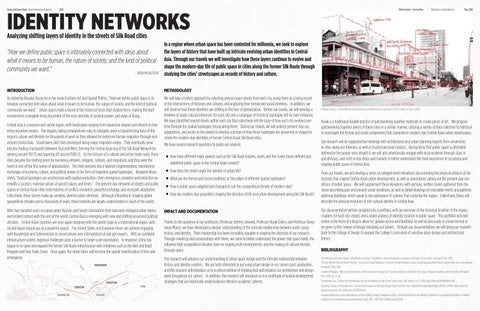
Image Source: UrbanWorks (https://www.urbanworks.co.za/copy-of-00-state-of-our-cities)
Kurak is a traditional Kazakh practice of patchworking together materials to create pieces of art. We propose patchworking together pieces of these cities in a similar manner, utilizing a variety of data collection to holistically investigate the formal and social components that characterize modern-day Central Asian urban streetscapes. Our research will be supported by meetings with architectural and urban planning experts from universities in cities along our itinerary, as well as trusted personal contacts. Recognizing that public space is ultimately defined by the people who inhabit it, we will also intentionally engage with local residents through stays in guesthouses, and visits to tea shops and markets to better understand the lived experience of occupying and shaping public space in Central Asia. From our travels, we will develop a series of collaged street elevations documenting the physical artifacts of the histories that shaped Central Asian urban development, as well as annotations calling out the present-day conditions of public space. We will supplement these elevations with sections, written stories gathered from the street describing past and present social conditions, as well as detail drawings of noticeable motifs and patterns adorning buildings which speak to the palimpsest of cultures that comprise the region. Collectively, these will describe the physical evolution of rich cultural identity in Central Asia. Our documentation will be compiled into a portfolio, with an overview of the historical timeline of the region, chapters for each city visited, and a wider analysis of identity creation in public space. This portfolio will exist online in the form of a blog to allow for greater access and flexibility, as well as physically in a book format to be given to the College of Design following our travels. Through our documentation, we will bring our research back to the College of Design to expand the College’s curriculum of sensitive place design and architectural theory. BIBLIOGRAPHY “Architecture and Urban Design: UrbanWorks: Gauteng.” UrbanWorks, www.urbanworks.co.za/copy-of-00-state-of-our-cities. Accessed 27 Mar. 2026. “China’s Massive Belt and Road Initiative.” Council on Foreign Relations, Council on Foreign Relations, www.cfr.org/backgrounders/chinas-massive-belt-and-road-initiative. Accessed 27 Mar. 2026. Crawford, Margaret. “Blurring the Boundaries: Public Space and Private Life.” Everyday Urbanism, edited by John Chase, Margaret Crawford, and John Kaliski, Monacelli Press, 1995, pp. 22–35. Demchenko, Igor. “Critical Post-Functionalism in the Architecture of Late Soviet Central Asia.” ABE Journal, no. 13, 2018. https://doi.org/10.4000/abe.4509 Eshanova, Zamira, and Azattyq Asia. “Central Asia Emerges as Strategic Energy Player amid Oil Crisis.” RadioFreeEurope/RadioLiberty, RFE/RL, 24 Mar. 2026, www.rferl. org/a/iran-hormuz-oil-central-asia-/33713691.html. Gulnara Abdrassilova, Elvira Danibekova, Gulmira Adilbay, Ainagul Tuyakayeva (2025). Soviet Architecture in Kazakhstan: Problems of Sustainable Adaptation to Modern Conditions. Civil Engineering and Architecture, 13(3A), 2314 - 2331. DOI: 10.13189/cea.2025.131311.
Linda and Duran Duda Travel Fellowship Proposal
2026
Micky Hanlon + Emma Woo
Bachelor’s of Architecture
May 2026
Travel Budget ITINERARY Khiva Bukhara Samarkand Tashkent Taraz Bishkek Karakol Almaty
# DAYS 4 4 5 6 2 4 4 6 35
TRANSIT Train: $23 x 2 Train: $12 x 2 Train: $17 x 2 Train: $23 x 2 Bus: $20 x 2 Train: $30 x 2 Train+Bus: $11 x 2 Bus: $12 x 2 $296
ACCOMODATION $40 x 4 $40 x 4 $40 x 5 $40 x 6 $40 x 2 $40 x 4 $90 x 4 $40 x 6 $1600
Transit Accomodation Additional Expenses
$296 $1600 $6300 $8196
Travel Plan PRESERVED HERITAGE
Proposed Budget 15% Contingency Fund
$8196 $1229
Total
$9425 SOVIET OCCUPIED STATES
KHIVA, UZBEKISTAN DAY 1-4
Khiva is architecturally significant for its well-preserved historic public spaces, where dense networks of streets, courtyards, and plazas integrate social, religious, and commercial life. Its urban form reflects Persian, Timurid, and Khorezmian influences shaped by Silk Road exchange, while responding to climate and movement, making it a rare, cohesive example of pre-modern Central Asian urbanism. Visit Aral Sea Silk Road Cemetery Of Ships + Museum Polvon Qori Street: The principal processional route through Itchan Kala, linking gates while anchoring landmarks such as Kalta Minor Minaret and Kunya Ark. It articulates political authority under the Khiva Khanate within Khwarazm, where urban form follows Islamic spatial order and trade movement. Palvan Darvoza Axis: Organized around Palvan Darvoza, this route operates as a commercial threshold where trade spaces such as Tim Allakuli Khan concentrate activity. It defines the economic interface of the city, structured by Silk Road exchange. Islam Khoja Street: A secondary route oriented around the visual prominence of Islam Khoja Minaret, guiding movement through mixed residential and civic areas. It highlights later development under the Khiva Khanate. Juma Mosque Area: A compact network centered on Juma Mosque, defined by inward-facing spatial organization. It prioritizes communal experience.
ANCIENT NETWORK
ADDITIONAL EXPENSES US - Central Asia Flights $1350 x 2 Food (for 2/day) $60 x 35 Admissions + Tickets $500 Travel Insurance $300 International Cell Plan $300 Local Transit $200 Materials $200 $6300
BUKHARA, UZBEKISTAN
DAY 5-8
PLACED AUTHORITY
SAMARKAND, UZBEKISTAN
DAY 9-13
Samarkand centers public life around monumental, symbolic spaces shaped by imperial ambition and Silk Road exchange. Anchored by grand plazas and axial routes, its form reflects Persian and Timurid influences, with spaces designed to project power and frame civic and religious life. Emphasizing scale and ceremony, it shows how public space expresses cultural identity and political authority. Visit Shahrisabz: birthplace of Amir Timur, reflects the monumental ambition of the Timurid era through projects like the Ak-Saray Palace Registan Street: This axis establishes a highly ordered civic space defined by symmetry and framed views. It embodies Timurid imperial ambition within Transoxiana, drawing from artistic traditions associated with Khorasan. Toshkent Yoli Street: A major route structuring movement across urban and regional scales. It reflects circulation patterns established through Silk Road networks within Transoxiana, later formalized under imperial infrastructure. Shah-i-Zinda Street: A narrow ceremonial path leading to Shah-i-Zinda, composed as a sequence of sacred thresholds. It reflects cultural ties to Khorasan. Bibi-Khanym Street: A transitional corridor linking Bibi-Khanym Mosque to surrounding commercial areas. It negotiates between imperial scale and everyday activity, illustrating the coexistence of authority and commerce.
INJECTED MODERNITY
TASHKENT, UZBEKISTAN
DAY 14-19
LAYERED EXCHANGE
TARAZ, KAZAKHSTAN
DAY 20-21
LOCAL FABRICS
KARAKOL, KYRGYZSTAN
DAY 26-29
Taraz organizes public life through layered spaces shaped by its Silk Road history and later Soviet planning. Blending organic street networks with civic nodes and market areas, it reflects Turkic and Islamic influences while prioritizing everyday use over monumentality. The city demonstrates how public space evolves through overlapping histories, remaining grounded in daily life and local patterns of exchange.
Karakol is defined by a modest, human-scale network of public spaces shaped by its Russian colonial origins and later Soviet influence. Its grid, small parks, and markets emphasize everyday social and commercial life over monumentality, blending Central Asian and Slavic traditions. More local and informal than larger capitals, it shows how public space adapts to cultural diversity and mountainous context.
Tole Bi Street: A major east–west corridor structuring movement across the city. It reflects Soviet-era planning layered onto earlier Silk Road routes shaped under Turkic and Karakhanid influence, connecting key sites such as Dostyk Square and major commercial zones. Central Bazaar Streets: Rooted in Silk Road commerce under Karakhanid rule and later framed by Soviet-era development, the Streets surrounding the Central Bazaar emphasize pedestrian activity and social interaction. Pushkin Street: A residential street shaped by Soviet housing patterns, lined with low-rise blocks and local services. It reflects Soviet planning ideals of organized neighborhood life while continuing patterns of localized community interaction. Tekturmas Paths: Circulation routes near the Tekturmas Architectural Complex connect historical landmarks with contemporary public space. Centered around a site with origins in the Karakhanid period, these paths layer spatial organization.
Visit Dungan Mosque Community: Religious hub for Chinese Muslim minorities Abdrakhmanov Street: A primary north–south axis structuring the city’s layout and movement. Its linear clarity reflects Russian Imperial planning, later reinforced in the Soviet era Toktogul Street: An east–west corridor linking key cultural and religious sites, including the Dungan Mosque. It demonstrates how layered cultural influences are integrated within a planned urban framework. Karakol Park Edges: Streets enclosing Karakol Park define it as a central public space, shaping pedestrian flow and social interaction while balancing openness with the surrounding grid. Jusaev Street + Lenin Street + Local Lanes: A network around the Karakol Animal Market where formal planning transitions into more flexible, informal pathways, reflecting the adaptability of trade-based urban space.
SCALED FRAMEWORKS
BISHKEK, KYRGYZSTAN DAY 22-25
ADAPTIVE URBANISM
ALMATY, KAZAKHSTAN
DAY 30-35
Bukhara features layered, evolving public spaces where interconnected streets, courtyards, and trading domes organize social, religious, and commercial life. Shaped by Silk Road exchange, its form reflects Persian, Timurid, and Shaybanid influences, with space structured around nodes of gathering rather than a single plan, creating a rich, adaptive urban fabric over time.
Tashkent features hybrid public spaces where historic Central Asian patterns intersect with Soviet planning. Rebuilt after the 1966 earthquake, its broad avenues, plazas, and green spaces contrast with older, more intimate neighborhoods. Shaped by modernism and Persian-Turkic influences, it reflects a shift toward monumentality and state-driven design, illustrating how reconstruction reshaped urban living.
Bishkek is shaped by an ordered network of public spaces rooted in Soviet planning, where boulevards, green corridors, and plazas structure daily life. Its grid emphasizes accessibility and collective use, while parks respond to climate and social needs. Influenced by Soviet modernism and Kyrgyz identity, it balances monumentality with informality, supporting flexible, community networks.
Almaty is defined by layered public spaces shaped by Soviet planning and its mountain setting, where avenues, parks, and plazas connect with green corridors and mountain views. Reflecting Soviet modernism and Kazakh identity, it balances monumentality with livability. More adaptive and landscape-driven than rigid capitals, it highlights the link between environment and urban life.
Lyabi Hauz Street Edges: Streets surrounding Lyabi Hauz form a shared public focus rather than a linear axis. This space supports social interaction shaped by the Bukhara Khanate, where water, shade, and gathering structure civic life. Mekhtar Anbar Street + Toki Zargaron Route: An interconnected system of market corridors defined by domed торговые structures such as Toki Zargaron and Toki Telpak Furushon. It demonstrates Bukhara’s role within Transoxiana, where commerce organizes spatial hierarchy and specialization. Khakikat Street: A controlled approach toward the ensemble of Poi Kalyan Complex, anchored by the Kalyan Minaret. It expresses religious and intellectual authority rooted in Transoxiana, shaped by successive Islamic dynasties. Registan Street: A formal route connecting to the Ark of Bukhara and its forecourt. It frames governance and ceremony, reinforcing centralized power through spatial alignment.
Meet with Anzirat Nigmadjanova, Professor of Architecture at Tashkent University of Architecture and Civil Engineering Amir Timur Avenue: A wide boulevard structured around Amir Timur Square, organizing major civic and institutional functions. It reflects Russian Imperial foundations and post-Soviet symbolic restructuring. Mustaqillik Avenue: A monumental corridor linking Independence Square with state institutions. It expresses national identity through scale, openness, and controlled spatial composition. Navoi Street: A route connecting key institutions such as Alisher Navoi Theatre. It integrates cultural infrastructure into the urban framework. Chorsu–Mahalla Street Network: A dense, organic system centered on Chorsu Bazaar and extending into traditional neighborhoods. It reflects pre-Russian Central Asian urbanism shaped by climate, social structure, and trade.
Meet Professor Kadyrkulov Duishenbek Abibullaevich: Senior Lecturer at Kyrgyz State University of Construction, Transportation and Architecture Chuy Avenue: A primary east–west boulevard around Ala-Too Square, forming a central axis. Its scale and alignment reflect Russian imperial grid planning, reinforced by Soviet monumentalism emphasizing visibility and state presence. Manas Avenue: A major north–south route organizing movement across the grid. It reflects Soviet rational planning, functional zoning and clarity applied over a Tsarist colonial framework. Erkindik Boulevard: A pedestrian-oriented axis linking green and civic spaces like Oak Park. It draws from European boulevard traditions and Soviet landscape urbanism focused on public recreation. Osh Bazaar Street Network: A dense, irregular commercial network centered on Osh Bazaar. It reflects pre-Soviet Central Asian trade patterns, shaped by nomadic exchange and Silk Road market traditions, persisting within the Soviet grid.
Meet with Khasenov Manas Igenovich: Dean of the School of Architecture at KazGASA and member of national Union of Architects Stay with Komissarov family Abai Avenue: A major east–west boulevard linking landmarks such as Abai Opera House. It structures cultural identity through institutional placement and scale. Dostyk Avenue: A north–south route connecting the urban core to mountainous terrain. It integrates natural landscape into the city structure. Panfilov Street: A walkable route connecting sites such as Zenkov Cathedral. It prioritizes human-scale movement and public interaction. Zhibek Zholy Street + Market Lanes: A network centered on Green Bazaar combining primary streets with smaller lanes. It reflects enduring trade patterns within a planned framework.
TRAVEL NOTES We recognize that the geographic focus of this proposal may raise concerns. However, current U.S. Travel Advisories rate all three of countries in our itinerary at Level 1, while destinations such as France, Spain, Germany, and Italy are rated at Level 2. On February 19, 2026, Donald Trump met with Central Asian leaders, signaling active diplomatic engagement and strengthening international ties. This reflects the region’s growing stability and connectivity, reinforcing its viability as a safe and accessible context for travel and research. In addition, we have established connections with universities and faculty in the region, as well as trusted friends’ contacts, and will build on these networks to support informed and secure travel. In addition, the area is relatively inexpensive to travel in, giving us the ability to maximize the scholarship fund and cover a wider range of ground in our studies.
BIBLIOGRAPHY, cont. Name. “The Rise of Central Asia in Great Power Politics: Central Asia Geopolitics: Strategic Blind Spot or Opportunity?” Consilium Institute, 31 July 2025, consiliuminstitute.org/ central-asia-geopolitics-great-power-opportunity/. Pronina, Anna. Soviet Architecture and Its National Faces: Soviet Architecture in Central Asia, 1920s–1930s. 2020. Central European University, Master’s thesis. Upton, Dell. “The Master Street of the World: The Levee.” Streets: Critical Perspectives on Public Space, edited by Zeynep Çelik, Diane Favro, and Richard Ingersoll, University of California Press, 1994, pp. 277–288. van der Straeten, J., & Petrova, M. (2022). The Soviet city as a landscape in the making: planning, building and appropriating Samarkand, c.1960s–80s. Central Asian Survey, 41(2), 297–321. https://doi.org/10.1080/02634937.2022.2060937 Vileikis, O., & Feyzulayev, A. (2025). The Silk Roads vernacular architecture. In Architecture, monuments and urbanism, Part I: Architectural influences along the Silk Roads (pp. 177–253). UNESCO.