sarah hefner - m. arch track iii | august 2019
2019 linda & turan duda travel fellowship proposal
unveiled:
the creative identity of six pioneer female architects in modernist europe “The active incorporation of professional women into society is perhaps the most important parameter of modernity in the last century. The female gender is no longer confined to artisanship and domesticity, in short, to the interior world and the world of interiors. The passage of women from being objects of the industry to being actors has been an exponent of modernity.” -from Women Architects in the Modern Movement by Carmen Espegel
introduction In 1985, the International Archive of Women in Architecture (IAWA) was established at Virginia Tech by a Bulgarian architect named Milka Bliznakov. This collection of books, biographical information, and documents first focused on the work of pioneering women in the field of architecture and has since expanded to a wider scope including women currently practicing in the field. Bliznakov recognized the absence of material documenting the designs and achievements from the first generations of women designers, architects, and planners. Sketches, plans, prototypes, and buildings slowly slipped into the background during the later half of the century and much documentation has been permanently lost because of a lack of conservation. Who’s to blame? We could point fingers at libraries, museums, and archives for not providing a home for these materials but the issue is far more complex. According to Despina Stratigakos, author of Where are the Female Architects?, the way that architecture history has been written for years and continues to be written today contributes to the disappearing legacies of women architects. She writes, “The monograph format which has long dominated the field, lends itself to the celebration of the heroic ‘genius’ typically a male figure defined by qualities such as boldness, independence, toughness, and vigor- all of which has been coded in Western culture as masculine traits. Moreover, the monograph is usually conceived as a sort of genealogy, which places the architect in a lineage of ‘great men’ laying out both the ‘masters’ from where he descended and the impressive followers in his wake.” Internationally coveted awards like the Pritzker Prize have further reinforced this idea of heroic individualism in the field over the years. Undoubtedly, as long as the monograph remains the dominant format of documentation in architecture history and singular awards dominate the industry, we lose sight of an underlying narrative: the great breadth of creative partnerships and collaborations between male and female designers.
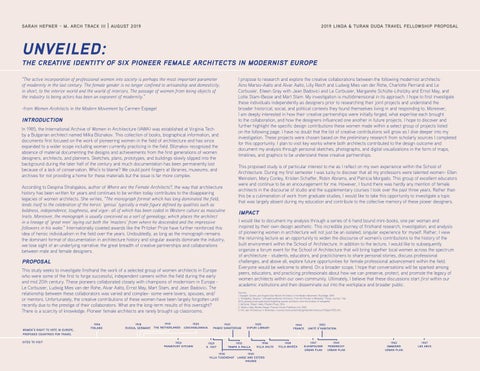
proposal This study seeks to investigate firsthand the work of a selected group of women architects in Europe who were some of the first to forge successful, independent careers within the field during the early and mid 20th century. These pioneers collaborated closely with champions of modernism in Europe Le Corbusier, Ludwig Mies van der Rohe, Alvar Aalto, Ernst May, Mart Stam, and Jean Badovici. The relationship between these collaborators was varied and complex- some were lovers, spouses, and/ or mentors. Unfortunately, the creative contributions of these women have been largely forgotten until recently due to the prestige of their collaborators. What are the long-term results of this oversight? There is a scarcity of knowledge. Pioneer female architects are rarely brought up classrooms.
women’s right to vote in europe, proposed countries for travel sites to visit
1906 finland
1919 1920 1918 russia, germany the netherlands czechoslovakia
1926 frankfurt kitchen
I propose to research and explore the creative collaborations between the following modernist architects: Aino Marsio-Aalto and Alvar Aalto, Lilly Reich and Ludwig Mies van der Rohe, Charlotte Perriand and Le Corbusier, Eileen Gray with Jean Badovici and Le Corbusier, Margarete Schütte-Lihotzky and Ernst May, and Lotte Stam-Besse and Mart Stam. My investigation is multidimensional in its approach. I hope to first investigate these individuals independently as designers prior to researching their joint projects and understand the broader historical, social, and political contexts they found themselves living in and responding to. Moreover, I am deeply interested in how their creative partnerships were initially forged, what expertise each brought to the collaboration, and how the designers influenced one another in future projects. I hope to discover and further highlight the specific design contributions these women made within a select group of projects listed on the following page. I have no doubt that the list of creative contributions will grow as I dive deeper into my investigation. These projects were chosen based on the preliminary research from scholarly sources I completed for this opportunity. I plan to visit key works where both architects contributed to the design outcome and document my analysis through personal sketches, photographs, and digital visualizations in the form of maps, timelines, and graphics to be understand these creative partnerships. This proposed study is of particular interest to me as I reflect on my own experience within the School of Architecture. During my first semester I was lucky to discover that all my professors were talented women- Ellen Weinstein, Mary Conley, Kristen Schaffer, Robin Abrams, and Patricia Morgado. This group of excellent educators were and continue to be an encouragement for me. However, I found there was hardly any mention of female architects in the discourse of studio and the supplementary courses I took over the past three years. Rather than this be a culimanation of work from graduate studies, I would like to take this opportunity to investigate a topic that was largely absent during my education and contribute to the collective memory of these pioeer designers.
impact I would like to document my analysis through a series of 6 hand bound mini-books, one per woman and inspired by their own design aesthetic. This incredible journey of firsthand research, investigation, and analysis of pioneering women in architecture will not just be an isolated, singular experience for myself. Rather, I view the returning lecture as an opportunity to widen the discourse of women’s contributions to the history of the built environment within the School of Architecture. In addition to the lecture, I would like to subsequently organize a forum event for the School of Architecture that will bring together local women across the spectrum of architecture - students, educators, and practictioners to share personal stories, discuss professional challenges, and above all, explore future opportunities for female professional advancement within the field. Everyone would be welcome to attend. On a broader scope, I hope that conversations will be sparked among peers, educators, and practicing professionals about how we can preserve, protect, and promote the legacy of women architects within our own community. Ultimately, I believe that these discussions start first within our academic institutions and then disseminate out into the workplace and broader public. Sources: 1. Espegel, Carmen, and Angela Giral. Women Architects in the Modern Movement. Routledge, 2018. 2. Stratigakos, Despina. “Unforgetting Women Architects: From the Pritzker to Wikipedia.” Places Journal, 1 Apr. 2016, placesjournal.org/article/unforgetting-women-architects-from-the-pritzker-to-wikipedia/. 3. McCarter, Robert. Aalto. Phaidon Press, 2014. 4. Sellers, Libby. Women Design. Frances Lincoln Publishers Ltd, 2018. 5. 100 Jaar Architectuur in Rotterdam, couvreur.home.xs4all.nl/engl/rdam/Architectuur/100jaar/1955.htm.
1933 paimio sanatorium
1929 e. 1027
1935 viipuri library
1932 tempe a pailla
1936 villa aalto
1930 1930 villa tugendhat lange and esters houses
1944 france
1939 villa mairea
1950 unité d’habitation
1947 kleinpolder urban plan
1949 pendrecht urban plan
1962 ommoord urban plan
1967 les arcs
sarah hefner - m. arch track iii | august 2019
preliminary budget transportation
estimates
estimates Round Trip Airfare Railfare Gasoline
Visas Admissions/Tickets Drawing Supplies Health Insurance International Data
$1500 $600 $250
$2,350
$50 $200 $25 $150 $85
daily expenses
$510
city
lodging
food, transport, etc.
days
total
Blacksburg Boston Helsinki Turku Noormarkku Vyborg Brno Frankfurt Düsseldorf Rotterdam Bourg-Saint-Maurice Roquebrune-Cap-Martin Menton Marsielles
$45 $60 $35 $25 $25 $35 $30 $40 $40 $45 $50 $65 $65 $65
$20 $40 $50 $40 $40 $25 $35 $40 $40 $35 $45 $45 $45 $45
2 2 6 3 3 2 3 2 2 5 3 3 3 3
$130 $200 $510 $195 $195 $120 $195 $160 $160 $400 $285 $330 $330 $330
42
$3,540
contingency (15%)
total minimum expenditure
$960
$7,360
proposed travel plan 1
virginia (2 days)
2
massachusetts (2 days)
3
start
additional costs
Stop 1: Blacksburg International Archives of Women in Architecture at Virginia Tech to view documents and resources on each architect/ designer prior to visiting works/sites.
Stop 2: Boston MIT Baker House Dormitory (1948): Aino suggested placing the rooms in the wedge shaped western end of the building’s plan to accomodate for more dorm rooms.3 Furniture was designed collaboratively by Alvar and Aino.
lilly reich #5-6
Stop 4: Turku Paimio Sanatorium (1933): Key project for the couple, received international acclaim for the functionalist architectural language displayed. Furniture pieces from this project were showcase pieces for their future comany, Artek, founded in 1935. Stop 5: Noormarkku Villa Mairea (1939): Private residence for Maire and Harry Gullichsen. The Aaltos partnered with Maire to establish Artek with Nils-Gustav Hahl. The interiors here exhibit both functionality and comfort, uncommon during modernism.
lotte stam-besse #7
aino marsio-aalto #2-4
margarete schütte-lihotzky #6
4
russia (2 days)
7
5
czech republic (3 days)
finland (12 days) Stop 3: Helsinki Villa Aalto (1936): Alvar and Aino Aalto’s home and early studio preceded the design for Villa Mairea. Their residence served as his studio from 1936-1955.
end
6
Stop 6: Vyborg Viipuri Library (1935): At the opening ceremony of the library, Alvar proclaimed that Aino had designed “the most beautiful staircase in the world.”4 The library’s design is a seminal work Finnish architecture and is a study of complex circulation and a
Ommoord (1962-1977): last major post-war mid to high rise development in Rotterdam, shared green space in between high rise buildings and establishment of view corridors. One of the last remaining districts where the modernist model of city living within green space still exists.5
germany (4 days)
Stop 9: Düsseldorf Lange and Esters Houses (1930): the interior design and furnishings were a collaboration between Mies van der Rohe and Reich. Furnishings are integrated into the walls to create a harmonious interior space.
Stop 10: Rotterdam Kleinpolder (1947-1955): Stam-Besse led the urban design for the first residential district to be built in Rotterdam after the Second World War - low and medium rise development based on the philosophy of bringing community into cities.5 Pendrecht (1949-1953): larger scale application of Kleinpolder district. Organization of over 6000 units using organizational units of: “dwelling, cluster, neighborhood, district, and town.”5 The clusters are a mix of buildings that respond to the needs of a wide range of residents. 4 districts are connected by a public square that is traffic-free.
Stop 7: Brno Villa Tugendhat (1930): The interior design and furnishings were a collaboration between Mies van der Rohe and Reich. A year before the completion of Tugendhat was their design for the German portion of the 1929 World Exhibition in Barcelona.
Stop 8: Frankfurt Ernst May Haus/IM Burgfeld 136 (1926): Schütte-Lihotzky’s famous design, Frankfurt Kitchen, was part of Ernst May’s social housing development - “The New Frankfurt”. The design was installed in over 10,000 units at a low cost. Based on efficiency, hygeine, and workflow, this design the transformed working class home.
the netherlands (5 days)
8
france (12 days) Stop 11: Bourg-Saint-Maurice Les Arcs - ARC 1600, 1800, 2000 (1967-1982): Town was planned by Perriand. Perriand designed prefabricated units to comprise a series of the resort builings in the French Alps. Parts of the buildings were prefabricated and assembled on site. In particular, the choice to use prefabricated polyester bathroom units was based on the challenge of the remote location and short construction time based on the seasons.
charlotte perriand #8 eileen gray #8 Stop 12: Roquebrune-Cap-Martin E.1027 (1928): This pioneering project of modernism is Eileen Gray’s principle work, a seaside villa for her and Jean Badovici. Attribution for the project was originally given to Badovici and lack of acknowledgement outraged Gray. She had control of the design and construction of the residence. Gray designed the residence with the values of minimum space and maximum comfort in mind.4 She had no formal architectural training but learned through her association with Le Corbusier. Many features of the building are operable to allow for the permeability of light and air into the interior spaces. Stop 13: Tempe à Pailla (1932-1934): After she constructed E.1027, Gray built this residence in an adjacent town. She continued with the idea of movement by using screens, turns, and layers to reveal views and destinations over time. Gray is noted for saying, “The poverty of modern architecture stems from the atrophy of sensuality.”4 Stop 14: Marsielles Unite d’Habitation (1950): First large scale, multi-family residential housing project for Le Corbusier. Charlotte Perriand with Le Corbusier designed the kitchen module. Perriand designed storage units to create space within the residential units. Her ideas included: sliding doors and kitchen-bar integrated with the living room so that communication between residents and guests could be facilitated. These ideas were implemented into the final built concept from Corbusier’s studio.