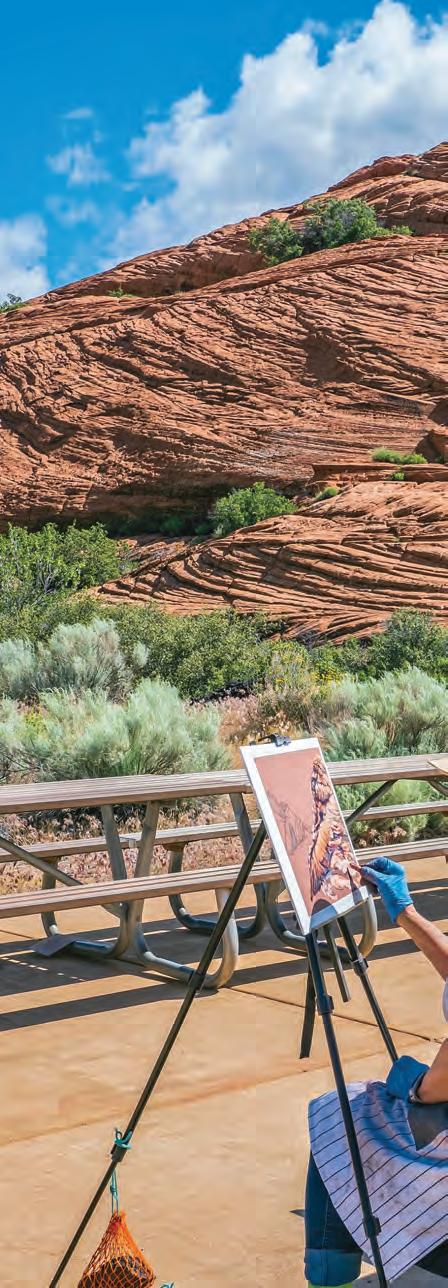
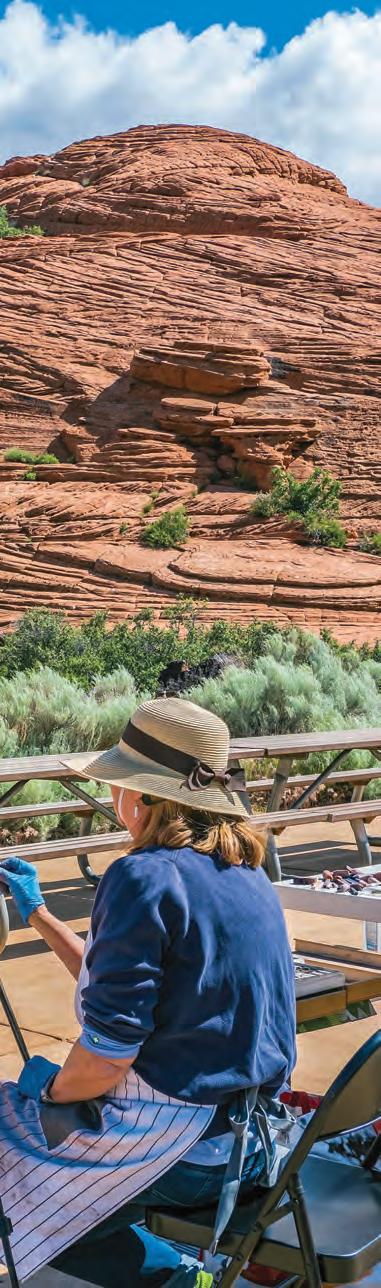
Snow Canyon reveals lava flows, wildlife and trails
FOLLOW THE FLAG
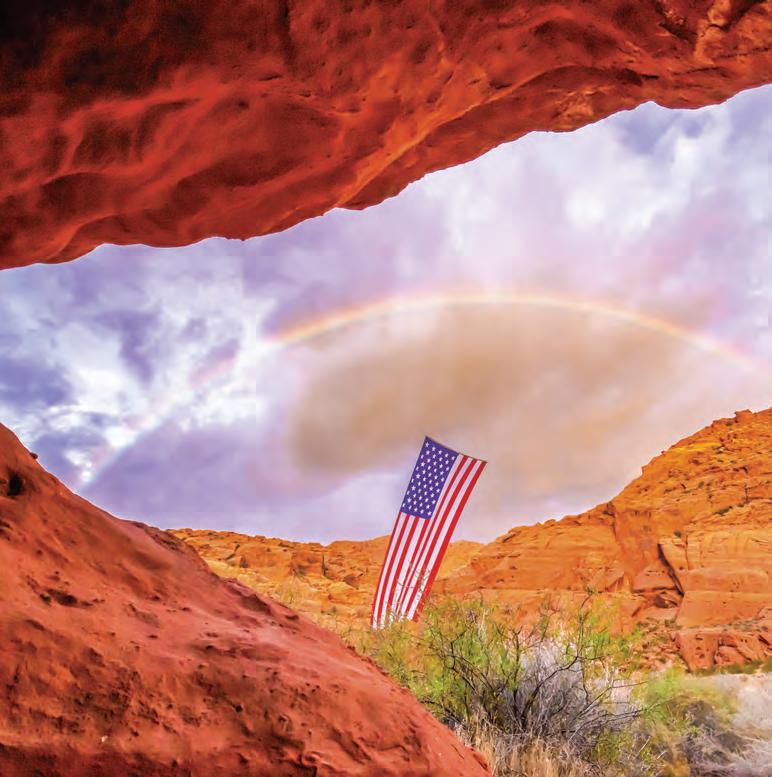
A soaring tribute honors service and sacrifice
Fresh garden flavors brighten three summer dishes +
Recipes
Wendover, pg. 42
Salt Lake City, pg. 6, 8
Pleasant Grove, pg. 18
Ivins, pg. 24
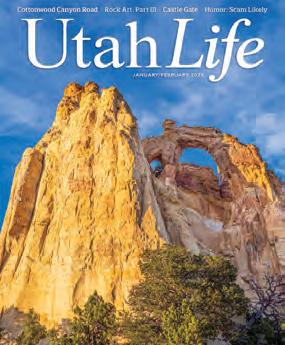
ON THE COVER
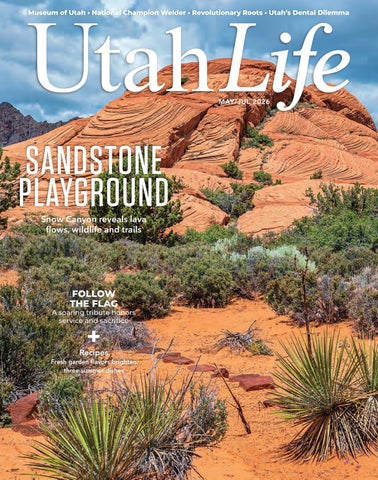
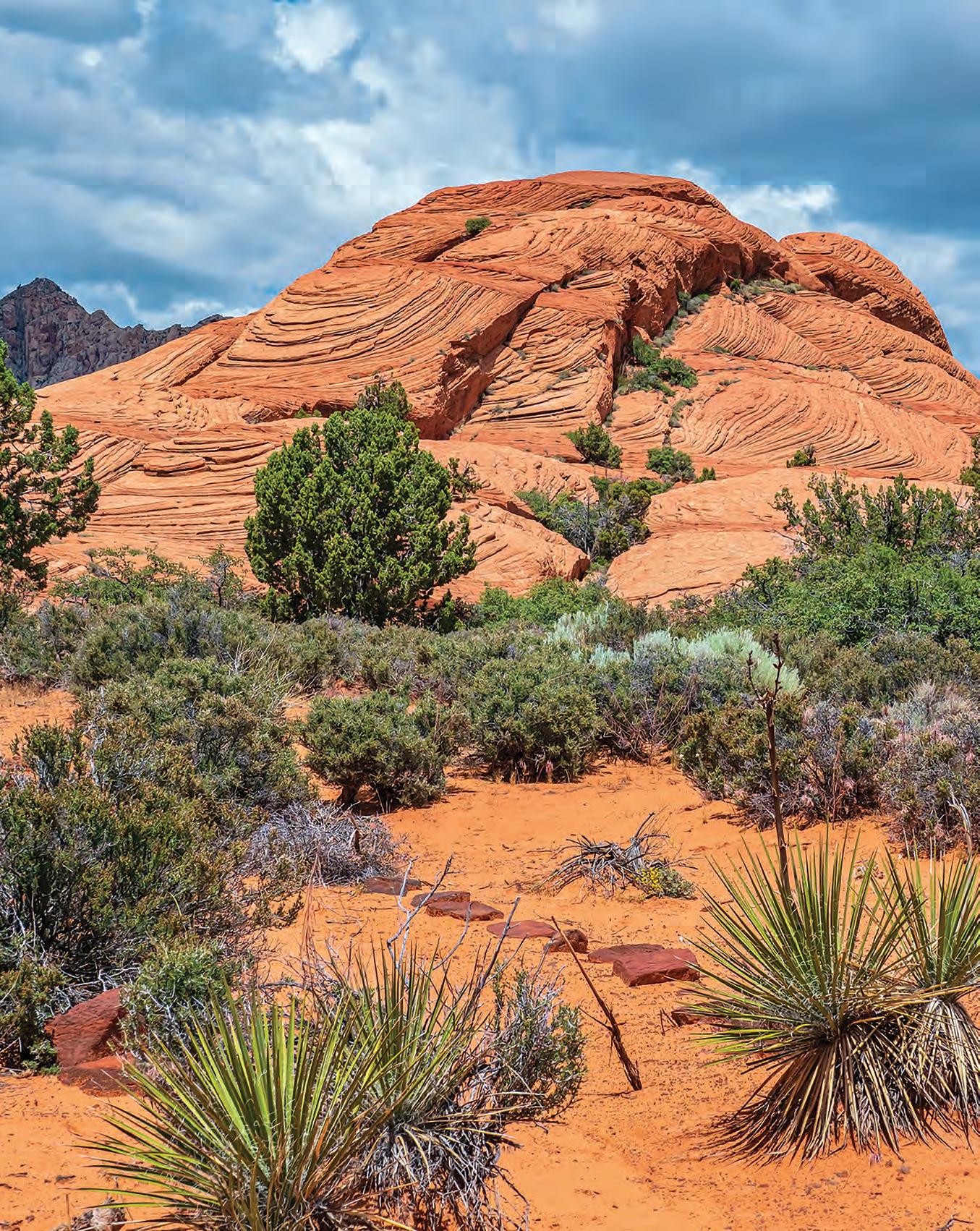
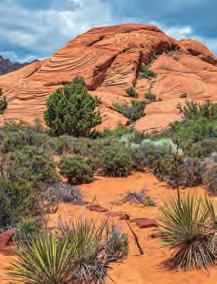
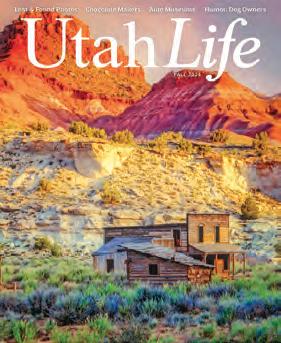
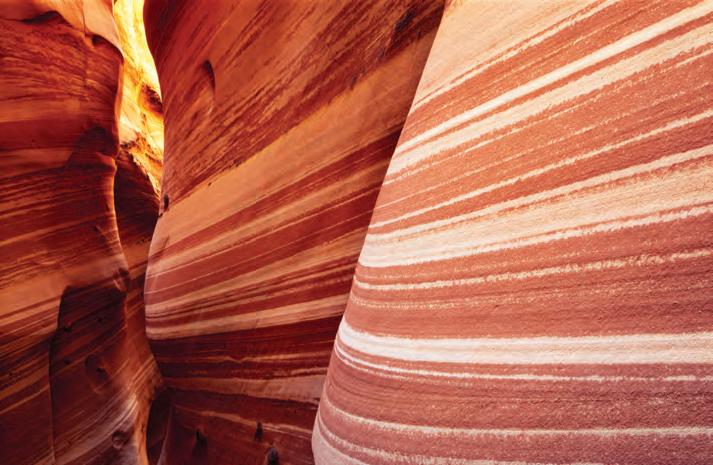
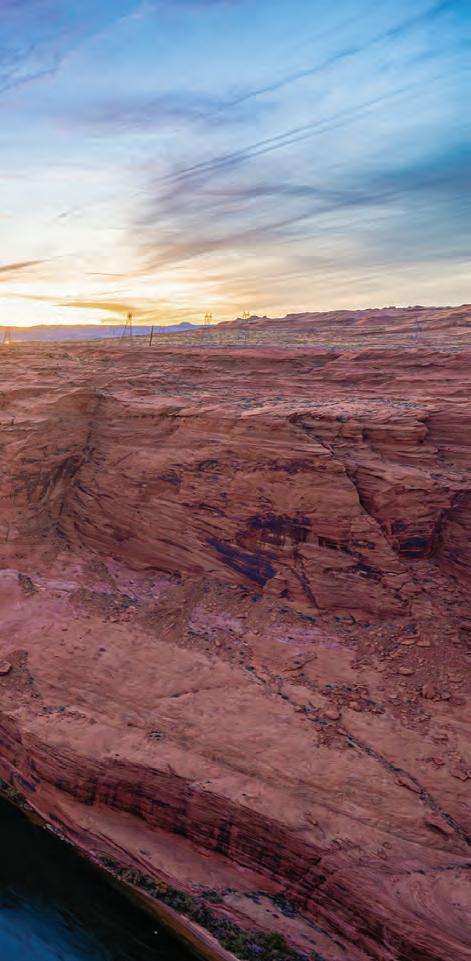
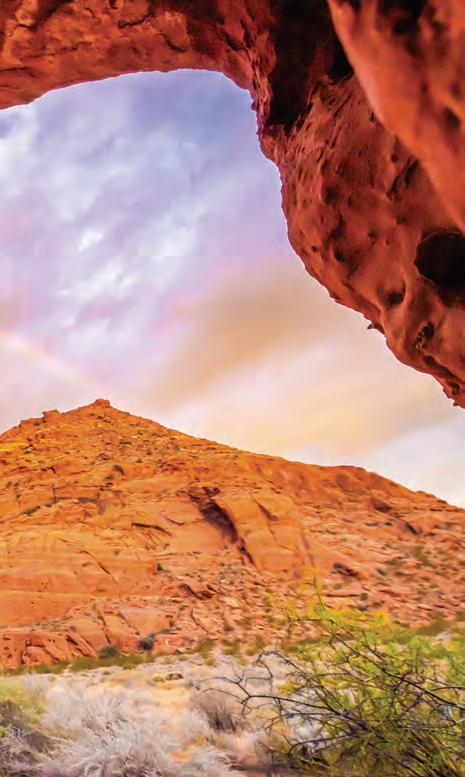
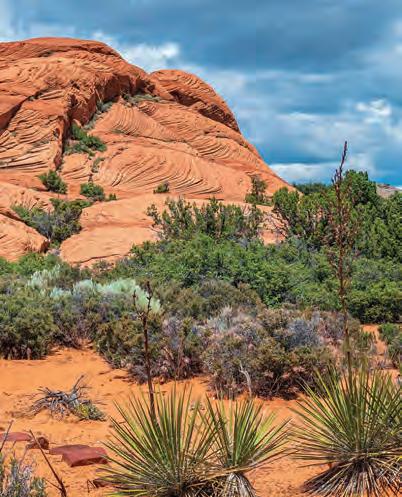
Swirls form in sandstone layers along the Butterfly Trail in Snow Canyon State Park near St. George. Story begins on page 24. Photo by Dan Leeth
Park City, pg. 43 Price, pg. 38
MAY/JUL 2026
Moab, pg. 12
DEPARTMENTS
5 Editor’s Letter Observations from Chris Amundson.
6 Honeycomb State history museum; anthology of Great Salt Lake; artist paints with sand.
10 Trivia
Do you know how deep canyon country runs? Answers on page 45.
32 Kitchens
Fresh picks steal the summer spotlight.
36 Poetry Creekside verses follow water’s path.
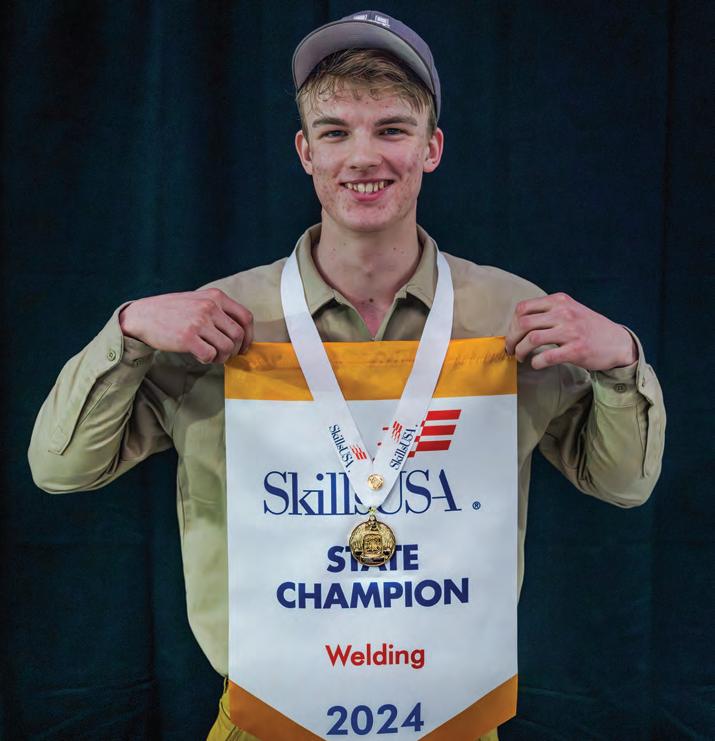
38 Uncommon Champions Meet welding champion, Ben Cornaby.
42 Explore Utah Bonneville Speed Week, Deer Valley Mountain Beer Fest and 16 other events.
46 Last Laugh Chew on this: Utah’s dental dilemma.
FEATURES
12
Desert Legacy
Back of Beyond, a Moab establishment, keeps Edward Abbey’s spirit alive through books, talks and conservation of the West. by Ariella Nardizzi
18
Following the Flag
The country’s largest free-flying American flag takes flight in canyons and atop mountains, paying tribute to veterans. by Ariella Nardizzi 24
Sandstone Playground
Snow Canyon State Park reveals lava flows, wildlife and sandstone trail systems just beyond the edge of St. George. story and photographs by Dan Leeth 40 A Lineage of Liber ty
Through ceremony and service, Sons and Daughters of the American Revolution keep founding ideals alive in the Beehive State. by Ariella Nardizzi
Jason Robison
From mining to skiing, discover more of this town’s unique history at the Park City Museum ••• Open Seven Days, 10 AM - 5 PM •••
parkcityhistory.org or call 435-649-7457 for more information
4-6 PM: The Music Never Stopped
Host John Florence shares true stories behind the music that defined the culture. With the Grateful Dead as a jumping off point, the show celebrates music made in the moment by the legends, plus artists of today, and influences of the past.
6-10 PM: Jazz Time
From ragtime to bop, from Havana to Paris to SLC, from Billie Holiday to Joe Lovano, host Steve Williams is your guide through the many varieties of jazz music – past and present.
10 PM-Midnight: The Edge of Jazz
Explore what jazz is with host John Northup – the high peaks and low valleys, the glossy and the gritty.
Editor’s Letter
A Little Out of Hand
I’VE ALWAYS LIKED people who know too much about one thing. Ask a casual question and they will give you the name, the year, the tool, the reason and probably a story about the time it all went wrong. Five minutes can become an afternoon. As a magazine editor, I consider that a good problem to have.
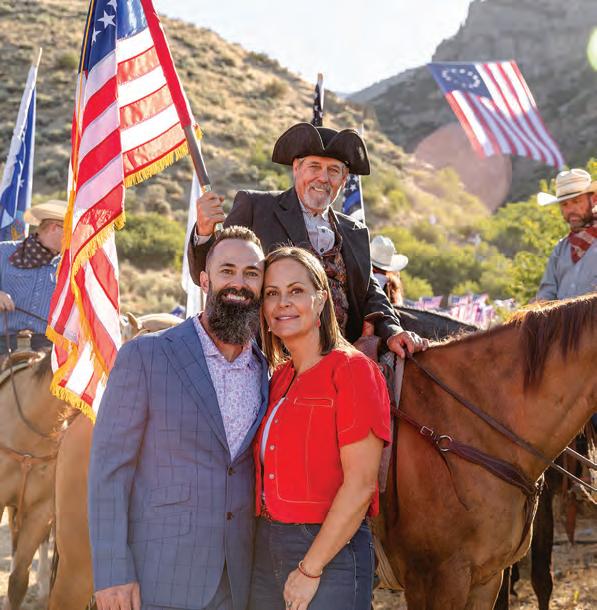
Kyle Fox is one of those people. Before he helped suspend a 400-pound American flag across Grove Creek Canyon, he and his wife, Carrie, spent years growing giant pumpkins and hosting events around them.
In 2015, Fox and Ron Nix strung a large flag across the canyon as a one-time surprise for Pleasant Grove. The response kept the idea alive. In 2017, Follow the Flag became a nonprofit that now stages giant displays across Utah, forms flag lines for military funerals and restores vehicles for veterans through the Soldier Car Project.
Fifty volunteers haul the fabric, rope and hardware up the canyon the day before each display. A drone carries fishing line across the span, and the crew uses it to pull heavier rope into place. They pack the flag inside a cover they call a poncho. After the cannon fires, 11,800 square feet of red, white and blue fall open between the cliffs.
I enjoy seeing whom writer Bianca Dumas finds next for “Uncommon Champions.” She started the series, and her knack for finding these people has led to some of my favorite profiles in Utah Life. This time, she found Ben Cornaby, a three-time national welding champion at Utah State University Eastern in Price.
Cornaby learned the basics in his father’s shop, started competing at Maple Mountain High School and now spends 50-60 hours a week practicing. Judges X-ray his welds and break them apart to inspect what he has done inside the metal. That is a long way from trying a new elective in high school.
Back of Beyond Books in Moab made its first sale before the doors opened. José Knighton placed an ad for Hayduke Lives! and told impatient readers to call him at home. Arches ranger Andy Nettell did and became the store’s first customer. That first sale happened over Knighton’s home phone; today, the shop’s off-site collection holds an additional 10,000 books, periodicals, collectibles and pieces of ephemera.
What I like about Fox, Cornaby and the booksellers at Back of Beyond is that none of them knows just enough. Fox can explain the rigging order, Cornaby can talk metallurgy and electrical theory, and one question about Edward Abbey can occupy the rest of an afternoon in Moab.
Most of us have a subject that makes us lose track of time. Mine is magazines, which may be why I’m so fond of people who keep asking one more question long after everyone else is ready to leave.
Many Utah Life stories begin with a short note from a reader: a name, a town and a sentence that says, “You should call this person.” Please keep sending those notes. A name and a town are usually enough to get us started.
And when you finish this issue, pass it to someone with the same habit. Better yet, give them a subscription. It may be the only way to get your copy back.
CHRIS AMUNDSON Publisher & Editor editor@utahlifemag.com
May/July 2026
Volume 9, Number 3
Publisher & Editor
Chris Amundson
Associate Publisher Angela Amundson
Editorial Assistant Savannah Dagupion
Design Rasa Velicka
Photo Coordinator Erik Makić
Staff Writer Ariella Nardizzi
Advertising Sales Robert Schonlau
Subscriptions
Shiela Camay
Utah Life Magazine
c/o Subscriptions Dept. PO Box 270130
Fort Collins, CO 80527 (801) 921-4585
UtahLifeMag.com
SUBSCRIBE
Subscriptions are $30 for 6 issues and $56 for 12 issues. To subscribe and renew, visit UtahLifeMag.com or call (801) 921-4585. For group subscription rates, call or email publisher@utahlifemag.com.
CONTRIBUTE
Send us your letters to the editor, story and photo submissions, story tips, recipes and poems to editor@utahlifemag.com, or visit UtahLifeMag.com/contribute.
ADVERTISE
For rates, deadlines and position availability, call or email advertising@utahlifemag.com.
COPYRIGHT
All text, photography and artwork is copyright 2026 by Flagship Publishing, Inc. For reprint permission, please call or email publisher@utahlifemag.com.
THE BUZZ AROUND UTAH
Utah on Display
Rodeo buckles, medicine bags and a bicentennial paper plate add unexpected chapters to the state’s history
by SAVANNAH DAGUPION
Inside the Museum of Utah, Cambodian ceremonial jewelry, rodeo queen buckles from Beaver Dam, a Navajo blanket and a paper plate saved from the 1976 bicentennial help answer one expansive question: “Who is a Utahn?”
The answer unfolds through “The Past is Personal,” the museum’s first temporary exhibition, part of Utah’s commemoration of America’s 250th anniversary. Rather than treating the national anniversary as distant from Utah, the exhibit asks how founding ideals, national commemoration, community memory and personal history meet in a state outside the original 13 colonies.
The exhibit grew from The Peoples of Utah Revisited, a Utah Historical Society
project that revisits the state’s bicentennial effort, The Peoples of Utah. Edited by historian Helen Zeese Papanikolas, the anthology is credited as Utah’s first ethnic studies anthology and remains important in Utah history.
Fifty years later, the Historical Society returned with broader questions: Who was missing, who has arrived since and how can Utah’s communities tell their own stories?
Historical Society staff worked with groups across the state to document objects, photographs and memories meaningful to them. One section explores commemoration itself – whom we remember, why anniversaries matter and what people save to preserve public memory. A commemorative copper plate, coins and mate-
rials from the original The Peoples of Utah project help frame those questions.
Another section turns to Peoples of Utah Revisited and the living communities it reflects. A commissioned series of medicine bags by Northern Ute and Hopi artist Alan Groves connects contemporary Native art, culture and history. Near the back of the exhibit, “Stitched Together” draws visitors toward a colorful wall of portraits and responses from Utahns answering, “What does being a Utahn mean to you?”
“We are breaking up myths about Utah,” said Utah Historical Society Director Jennifer Ortiz. “We’re not homogenous; we’re incredibly diverse, and surprisingly so. I think even people who grew up here and have had generations of family here are surprised to learn that.”
Azelan Amundson (both)
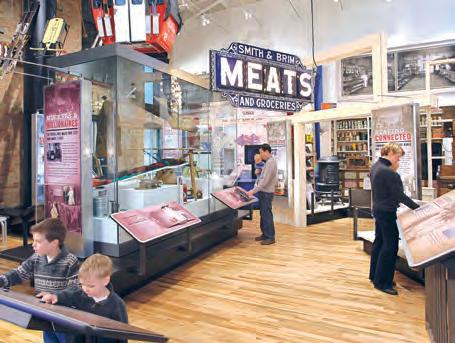
Beyond the temporary gallery, the 17,000-square-foot museum includes four permanent galleries. “Becoming Utah” offers a traditional history experience, with Native history, civic engagement, suffrage and Utah’s path to statehood. “Connecting Utah” explores shared values, experiences and faith, while “Building Utah” traces labor history through the workers who built the state.
“Inspiring Utah,” a pop culture gallery, features stories carrying Utah beyond its borders, from the film industry and the Olympics to the Mormon Meteor III landspeed racer.
“We had the opportunity to explore the galleries, and my mind shifted from editing text and cleaning glass cases to letting the wonder of it happen,” said exhibit curator Jami Van Huss. “The interactives are very unique, but better than that, engaging and smart.”
Utah was the second-to-last state to establish a history museum, Ortiz said, allowing staff to learn from museums elsewhere. The exhibits are organized thematically rather than chronologically, reflecting how people learn today.
The result fills a long-standing gap without duplicating the work of Utah’s local museums. Staff describe the museum as a hub – a place where visitors get a broad picture of Utah’s history, then find the communities, archives and museums where those stories continue.
“The museum makes me so proud to be from Utah,” Van Huss said. “There’s a friendliness and welcomingness to the state that I haven’t experienced in other places. The museum does a great job basing all of that in history and helping you be thoughtful about things that matter.”
The Museum of Utah is free, with parking available underground. “The Past is Personal” runs through spring 2027. Gallery hours are 11 a.m. to 8 p.m. Monday, 9 a.m. to 8 p.m. Tuesday through Thursday and 9 a.m. to 6 p.m. Friday through Sunday.
America’s (almost) Dead Sea
New anthology gathers 46 voices to celebrate Great Salt Lake and confront its uncertain future
by LISA TRUESDALE
Great Salt Lake is shrinking toward catastrophe. Its loss would be a blow to Utah residents who rely on the lake for recreation, tourism, industry and agriculture. It could prove deadly for the millions of birds and small animals that depend on its food web and habitat. And it would devastate the Indigenous peoples who have called the lake home for thousands of years and for whom it holds deep cultural and spiritual importance.
The Once and Future Lake: Stories for Great Salt Lake gathers essays, short fiction and poems that explain the lake’s importance, trace its history, celebrate its strangeness and confront its uncertain future. Edited by Michael McLane, the anthology brings together 46 contributors from a wide range of backgrounds and disciplines. Some pieces are lyric, uplifting or even funny; others are scientific, historical or plainspoken. Together, they deepen the reader’s understanding of why Great Salt Lake is more than just a lake.
The book also carries a warning. As humans continue to divert the lake’s waters for agriculture and mine its marshlands for industry, Great Salt Lake has shrunk dramatically and could vanish entirely within five years. Gov. Spencer Cox has pledged to restore the lake to healthy levels in time for the 2034 Winter Olympics, though critics have called the goal bold and audacious.
McLane also contributes an essay on Carnival of Souls, the 1962 low-budget horror film that used Saltair Amusement Park on the lake’s southern shore as a backdrop.
From Eli McCann’s “The Great Sassy, Salty Lake” to Rachel White’s “Water to Survive, Not Thrive,” from “The Parable of the Pelicans” by Terry Tempest Williams to “A Morning at the Inlet” by Teri Harman, the selections make the case for seeing the lake firsthand.
“If you live in the vicinity, it’s a no-brainer, and if you don’t live nearby, it’s worth a trip,” McLane writes in the introduction.
“Spend an afternoon at Great Salt Lake Marina State Park, Black Rock, and the Gilmore Sanctuary. Spend the day birding at Farmington Bay or Bear River Migratory Bird Refuge. Visit Rosel Point to see the tar seeps and Robert Smithson’s iconic earthwork, ‘Spiral Jetty.’ Build your own relationship with the lake,” he said.
The Once and Future Lake: Stories for Great Salt Lake Edited by Michael McLane Torrey House Press 260 pages, paperback, $24
Painting with Earth
Artist explores place and memory through salt, sand and soil
Tyson Westley-Scharnhorst
by ARIELLA NARDIZZI
Salt crust curls at the edges of a drying canvas. Iron-rich dirt settles into wet plaster. Under the hard glare of Utah sun, the painted surface begins to crack – not all at once, but slowly, like mud pulling apart in a dry riverbed.
In her Salt Lake City studio, Samantha da Silva works with the elements, using salt, sand and sawdust – her “three S’s” –to make abstract paintings shaped by the land itself.
Her paintings draw from the textures of topographic maps, canyon walls and riverbeds, incorporating foraged materials such as salt from the Bonneville Salt Flats. Da Silva presses the land into the canvas, building fissures, cracks and weathered layers in works such as “An Oasis of the Spirit” and “Ladyfinger Point.”
“My work has the life force, the blood of the mountain in it,” she said.
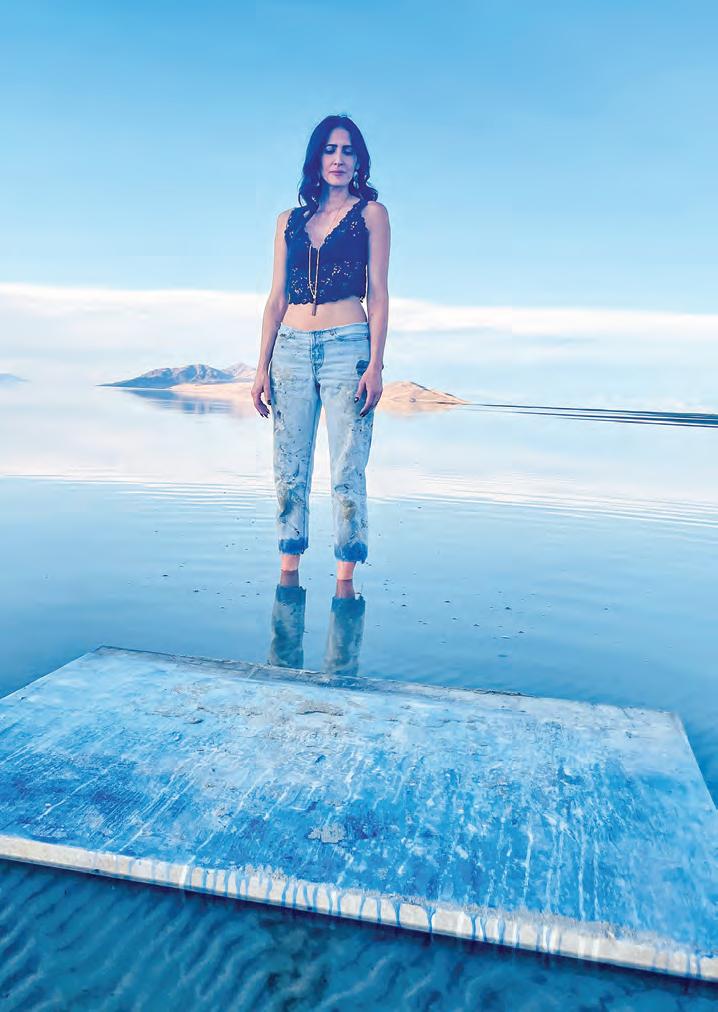
Natural elements help determine what happens next. When da Silva floats a canvas in the waters of Great Salt Lake, white mineral flakes settle into the medium. In summer, sun bakes wet paint into crackled texture, echoing the way mud dries and separates in a riverbed.
“The land is my co-creator,” she said. “I paint in collaboration with my environment, exposing the canvas to rain, wind and the hot sun. It invites a relinquishing of control ... curiosity and autonomy for the elements to have their way with a painting.”
For da Silva, painting helps make sense of a life spent moving. The Brazilian-born artist moved 40 times because of natural disasters and other circumstances. After the 2018 Kīlauea eruption on Hawai‘i Island upended her life, she and her hus-
Samantha da Silva, left, in the Great Salt Lake with “Between Heaven and Earth,” 36 x 48 inches. Above, “Blooming from Within,” 48 x 30 inches.
band returned to Utah and settled in Salt Lake City.
Surrounded by what she calls “healing red rock,” da Silva gathered charcoal, rocks and dirt, learning the desert through her hands. “Like touching grass, literally,” she said. “It made me feel like I belong here.”
Themes of place, home and belonging run through da Silva’s abstract work, which can be found at Gallery Mar in Park City, Urban Hill Restaurant and the HELIX building in Salt Lake City, the Children’s Justice Center in Ogden and other public locations around Utah. She also leads community workshops from her studio, helping others experiment with natural materials. Her book, Fearless Artistry: A Journey from Doubt to Creative Liberation, invites artists to move past hesitation and into practice.
In a life shaped by upheaval, painting gives da Silva something to return to. Salt blooms. Dirt settles. Sun cracks the surface. The canvas holds what the land leaves behind.
DESERT BISTRO
by BEN JENKINS
1Aron Ralston spent 127 hours trapped by a boulder in Bluejohn Canyon in Wayne County. Before setting out alone, he skipped what basic backcountry precaution that might have sped a rescue?
2
Lake Powell began filling behind Glen Canyon Dam in 1963. How many years passed before the reservoir first reached full pool?
3 The Salt Lake Temple’s walls came from Little Cottonwood Canyon. Though commonly called granite, the stone is what granite-like rock?
4
Entrada at Snow Canyon near St. George became the fictional Lava Springs Country Club in what 2007 Disney Channel movie?
No peeking, answers on page 45.
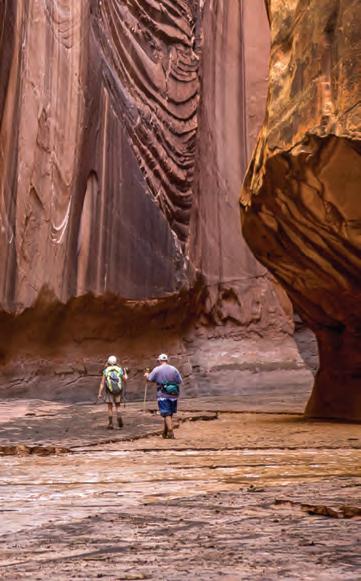
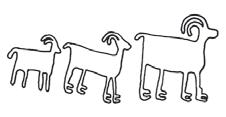
5 In Buckskin Gulch near the UtahArizona line, the steep Middle Route is marked near the bottom by petroglyphs of what sure-footed canyon animal?
Tom Till
Jim Shoemaker
MULTIPLE CHOICE
6
At Natural Bridges National Monument in San Juan County, Sipapu Bridge carries a Hopi name for an opening tied to what origin story?
a. Ancestors emerging into this world
b. Water carving a path through stone
c. Travelers crossing a canyon
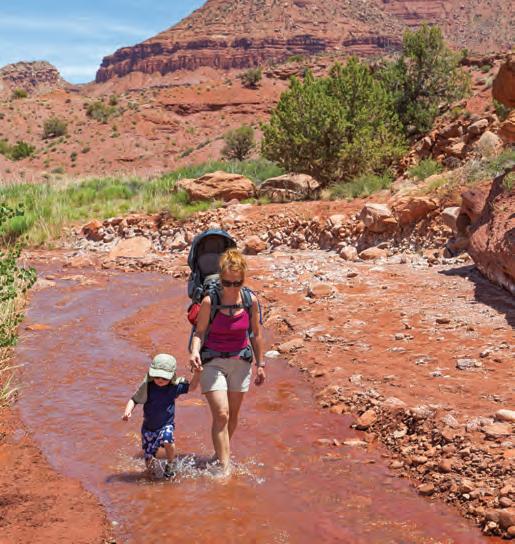
7 Canyonlands’ remote Horseshoe Canyon, west of Green River, allows horses in its backcountry but not dogs. Which of these pack animals is also allowed there?
a. Burros
b. Alpacas
c. Camels
8
Bingham Canyon in the Oquirrh Mountains once had thousands of residents before an expanding operation swallowed the town. Which kind of mine drove its demise?
a. Silver mine
b. Copper mine
c. Uranium mine
9 At Donut Falls in Big Cottonwood Canyon, the creek earns the pastry name by doing what near the end of the hike?
a. Drops through a circular opening in the rock
b. Splits around a ring of boulders
c. Lands in a perfectly round pool
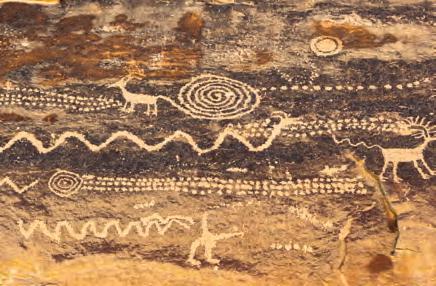
10 Newspaper Rock in southeastern Utah’s Indian Creek Canyon holds carvings made across many centuries. Which image must date from after horses reached the region?
a. Hunter on horseback
b. Mountain lion
c. Six-toed foot
11
Nine Mile Canyon near Price runs about 46 miles, but its name came from a nine-mile wagon road through the canyon.
12
Rancher Ebenezer Bryce built a timber road into the pink cliffs, and neighbors started calling the amphitheater “Bryce’s Canyon” – even though the namesake landform is not a true canyon.
13
Long before the Virgin River cut Zion Canyon, its sandstone cliffs began as dunes in a Jurassic sand sea larger than the dune fields of the modern Sahara.
14 Zebra Slot Canyon in Grand Staircase-Escalante got its name after a circus train lost a zebra near Escalante in 1904, sending riders into the narrows to catch it.
15
Singing Canyon off Burr Trail near Boulder earns its name from sand that hums in the wind, not from voices echoing off its walls.
Legacy DESERT
Moab bookstore keeps Edward Abbey’s literary mission alive by
ARIELLA NARDIZZI
ON MOAB’S BUSTLING Main Street, an ochre-toned stucco bookstore sits beneath a tin roof, crowned by a book-shaped sign that reads Back of Beyond. The name pays homage to Seldom Seen Smith’s fictional outfitting company and hideout in environmental writer Edward Abbey’s most notorious novel, The Monkey Wrench Gang.
A self-proclaimed misfit, Abbey was a controversial author whose writing helped shape the environmental movement of the American Southwest in the 20th century. Known for his sharp wit, he denounced the destruction of public lands in writing that was radical and anti-authoritarian.
The Monkey Wrench Gang introduced readers to a group of anarchist environ-
mentalists who used sabotage to resist industrial development in the desert. Desert Solitaire recounts Abbey’s two seasons as a ranger in 1956 and 1957 at what was then Arches National Monument, where he fell in love with Moab’s red cliffs. His brazen defense of the environment became a rallying cry for future generations to protect America’s wild and free landscapes.
Abbey died at “Fort Llatikcuf,” his Arizona home, on March 14, 1989, at age 62. About 500 admirers gathered on May 20 for a three-hour ceremony just outside Arches National Park.
Among them were environmental writer Terry Tempest Williams and writer and activist Doug Peacock, who inspired the character Hayduke in The Monkey Wrench Gang. Peacock, who
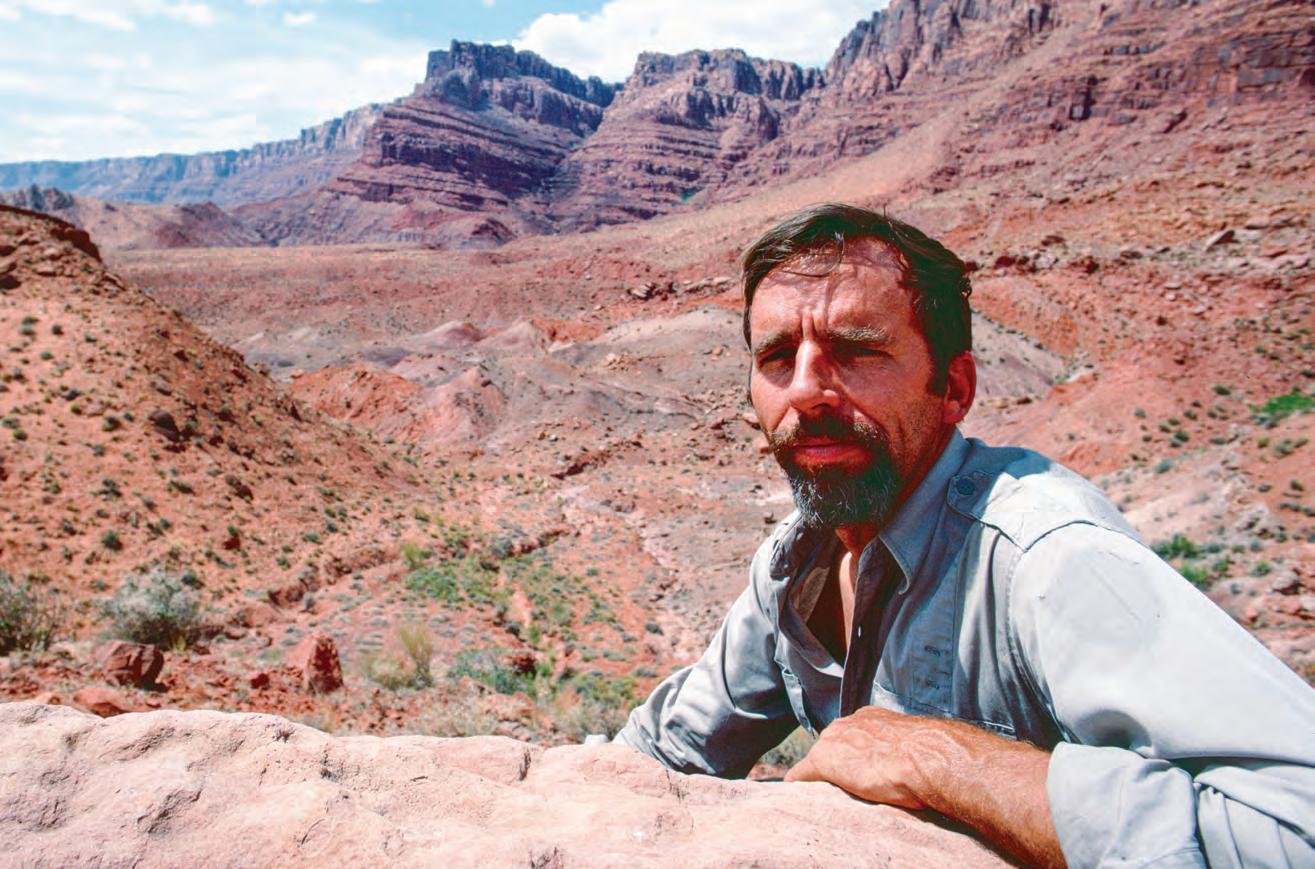
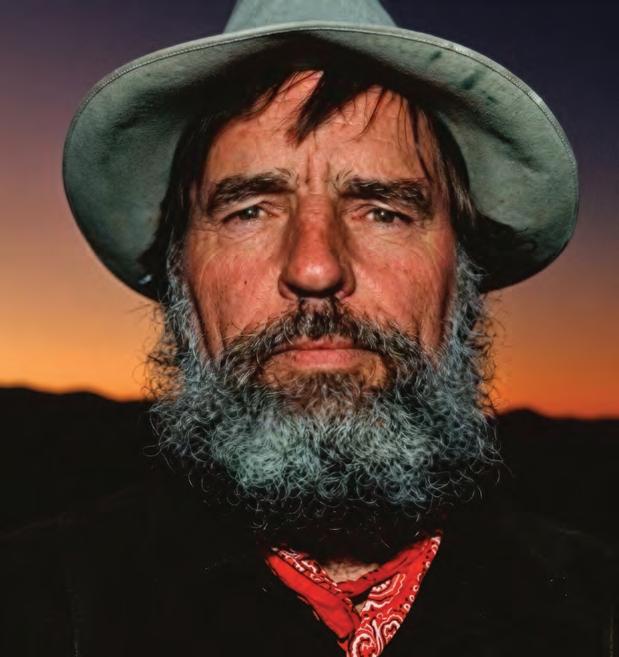
Back of Beyond Books has preserved Edward Abbey’s legacy through regional literature, rare collections and open dialogues since 1990. Abbey is pictured in Moab in 1969, following his stint as a ranger in Arches National Park.
helped bury Abbey without authorization in Arizona’s Cabeza Prieta Desert, said he was “kind of on the lam” because of it.
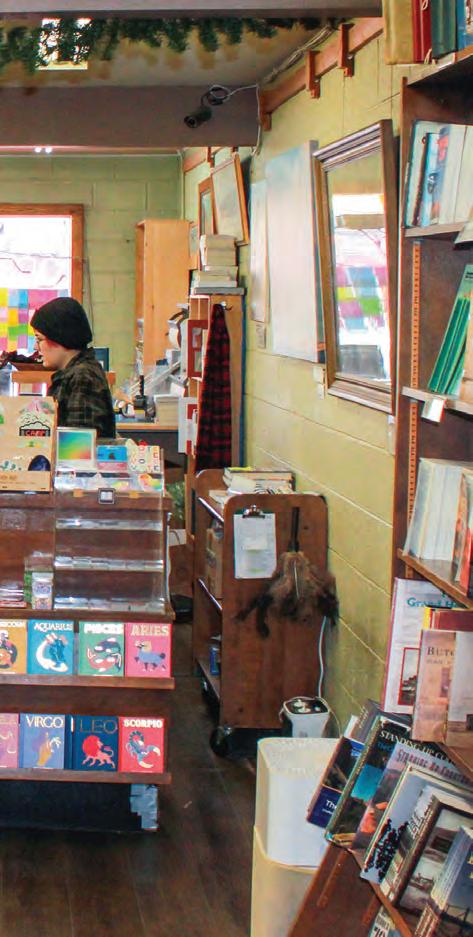
Back of Beyond reflects decades of careful curation from former owner Andy Nettell and current owner David Everitt. Shelves display thousands of titles, from regional guidebooks to rare volumes not found in most bookstores.
From the Entrada Sandstone dust of Abbey’s memorial came a desire to protect his legacy as an iconoclastic voice of the Southwest conservation movement. The group decided a bookstore would be a fitting tribute and a place for his ideas to live on.
Bookseller José Knighton helped open Back of Beyond Books in 1990, nine months after Abbey’s sunrise memorial ceremony. The Moab shop occupied a compact 30-foot-by-30-foot space. Knighton had known Ed, as he called his old friend, for years. He took Abbey’s writing class at the University of Utah, then helped the author promote his books.
As the store’s first manager, Knighton ordered Hayduke Lives!, Abbey’s posthumously published sequel to The
Monkey Wrench Gang, for the grand opening. When the books arrived before the launch, Knighton placed an ad in the Moab Times-Independent stating, “If you can’t wait for Back of Beyond to open to get your first edition, call me at home.”
His first caller, and the store’s first customer, was Arches National Park ranger Andy Nettell, who later supplemented his park service job with parttime work at Back of Beyond. In 2001, Nettell opened Arches Book Company, a now-closed bookshop across Main Street from Back of Beyond. He later assembled investors to purchase both the Back of Beyond business and the property that housed it in 2004. By 2008, he had consolidated the stores and focused solely on Back of Beyond.
UNDER NETTELL’S LEADERSHIP, Back of Beyond’s shelves overflowed with books on natural history, hiking and river-running guidebooks, indie bestsellers
Amber Overman
and regional titles about the Colorado Plateau. His dedication to niche curation helped the independent store compete with big-box chains. He searched tirelessly for regional titles and rare volumes, offering a collection few other stores had.
A glass case in the bookshop’s far-left corner holds one of its treasures: an $800 first-edition copy of The Monkey Wrench Gang, signed by Abbey. A 1984 Earth First! poster recalls the radical environmental group Abbey helped inspire. It reads, “No compromise in defense of Mother Earth!”
Nettell began building the store’s rare-book collection from scratch in the early 2010s. The collection is now a pillar of the shop’s legacy. But the titles displayed in the store are only a fraction of the 10,000 books, collectibles, periodicals and pieces of ephemera housed in a separate warehouse.
In 2021, Nettell set his sights on his next adventure: selling Back of Beyond.
Amber Overman Whit Richardson
Abbey’s experiences as a lone ranger in Arches National Park became the foundation for Desert Solitaire, his landmark memoir of the desert. His original writing desk now welcomes readers into the store, along with an impressive collection of his works.
Literary discussions and community gatherings have turned the store into a cultural hub. Abbey himself was outspoken about protecting Glen Canyon and the greater American Southwest before his death in 1989, at age 62.
Although that year was the store’s best for sales, he wanted to focus exclusively on dealing in American historical materials. He and his wife, Marcee, launched Stellar Books & Ephemera from their Moab home in 2022, specializing in manuscripts, diaries, maps and historical documents.
He would not sell to just anyone, however. Nettell turned down several inquiries before finding the right successor in David Everitt, who could preserve the institution’s legacy and the character Moab had come to love.
Desert Solitaire inspired current owner David Everitt’s journey West. Raised in Florida, Everitt knew the desert landscape only through Abbey’s writing before coming west.
By the time he arrived at Arches in 1995, Everitt had read all but one of Abbey’s published books: Jonathan Troy, the author’s first novel, of which only 5,000
copies were printed. The novel was ilegally reprinted in 2022; Back of Beyond carries a copy.
Everitt worked for a year as a volunteer interpretive ranger under Nettell at Arches. Given their shared history with Abbey and the park, Everitt sees more than happenstance in the fact that both owners followed Abbey’s dusty footsteps as rangers.
“We did it in our own way, though. Abbey, back in the day, was the lone ranger. Andy, in the early ’90s, was on a career path. I was the classic vagabond seasonal worker,” Everitt said.
Everitt and Nettell’s paths continued to cross through work and friendship over the years. Everitt was a devoted customer until May 2022, when he became the owner.
INSIDE THE STORE are geological layers of literature. Start just below the
crust with current affairs and the colorful cover of Kevin Fedarko’s bestseller A Walk in the Park. Continue through layers of Western Americana, past Abbey’s old writing desk. Tunnel deep to the store’s core – rare and collectible works that helped form Western literature.
That’s how Everitt, a former geology student, describes this eccentric Moab institution.
According to Everitt, Back of Beyond follows an “Abbey Plus Plus approach.”
Although the store was born from Abbey’s literary legacy, it rounds out its collection with Indigenous writers, women and other voices underrepresented in Abbey’s work and the environmental movement of his era.
Amy Irvine’s Desert Cabal perches beside Desert Solitaire on a table in the store. Back of Beyond co-published the book with Torrey House Press after Nettell asked Irvine, a sixth-generation
Utahn, to write a short essay about Abbey’s legacy. She replied, “I didn’t have time to write a short letter, so I wrote a very long one.”
The 30,000-word manuscript became her book, a direct retort to Desert Solitaire that critiques Abbey’s view of who belongs in wilderness. “We recognize there are aspects of Abbey’s writing that don’t hold up today,” Everitt said. “Our guiding basis for what we curate is people who are interested in the welfare of the land from all perspectives.”
Back of Beyond is also a gathering place for local authors and bibliophiles. Its events extend beyond regular readings, fostering nuanced conversations about preserving the American Southwest for more than 30 years.
In October 2024, journalist and environmental advocate Kevin Fedarko spoke with 100 readers about his arduous 750-mile hike through the Grand
Canyon – an epic adventure that underscored the need to preserve this natural treasure.
Such exchanges further Abbey’s mission to preserve public lands. Back of Beyond provides the space – and the books – to turn conservation ideas into action.
“Bookstores should play a role in creating discourse – to host authors, create conversations, publish material that would never have been published otherwise and work with disenfranchised voices,” Nettell said.
Like Abbey’s prose, the bookstore tells provocative stories about the land and encourages tangible efforts to protect it. That, perhaps, is the truest tribute to Abbey’s lifelong work.
After all, Abbey wrote in the preface to Beyond the Wall, “One brave deed is worth a thousand books. Sentiment without action is the ruin of the soul.”
Tobiasjo/iStock (left); Edward Abbey (above)
FollowingFlag the
Volunteers, veterans and families make a massive flag display a Utah tradition of gratitude and service
by ARIELLA NARDIZZI
Drew Armstrong
AT THE MOUTH of Grove Creek Canyon in Pleasant Grove, a crowd spills into the shade of scrub oak and canyon walls. People of all ages stand shoulder to shoulder. Their eyes turn skyward, where a thin line stretches from one side of the canyon to the other.
A cannon cracks. Then the fabric drops.
Red and white stripes catch the air, pulling wide across the sky. The blue field appears last, settling into the open space between cliffs. Hands go to hearts. Tears stream down faces.
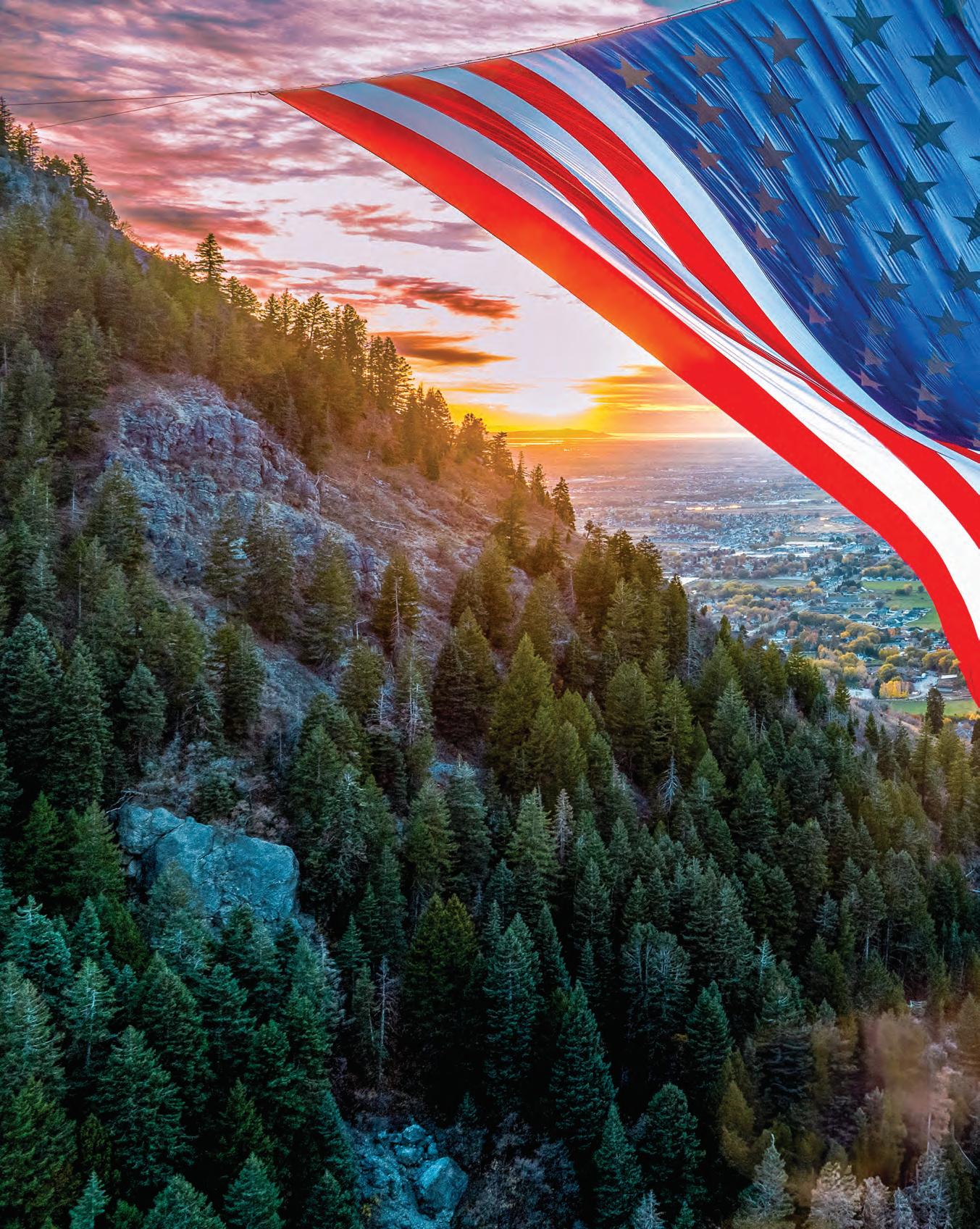
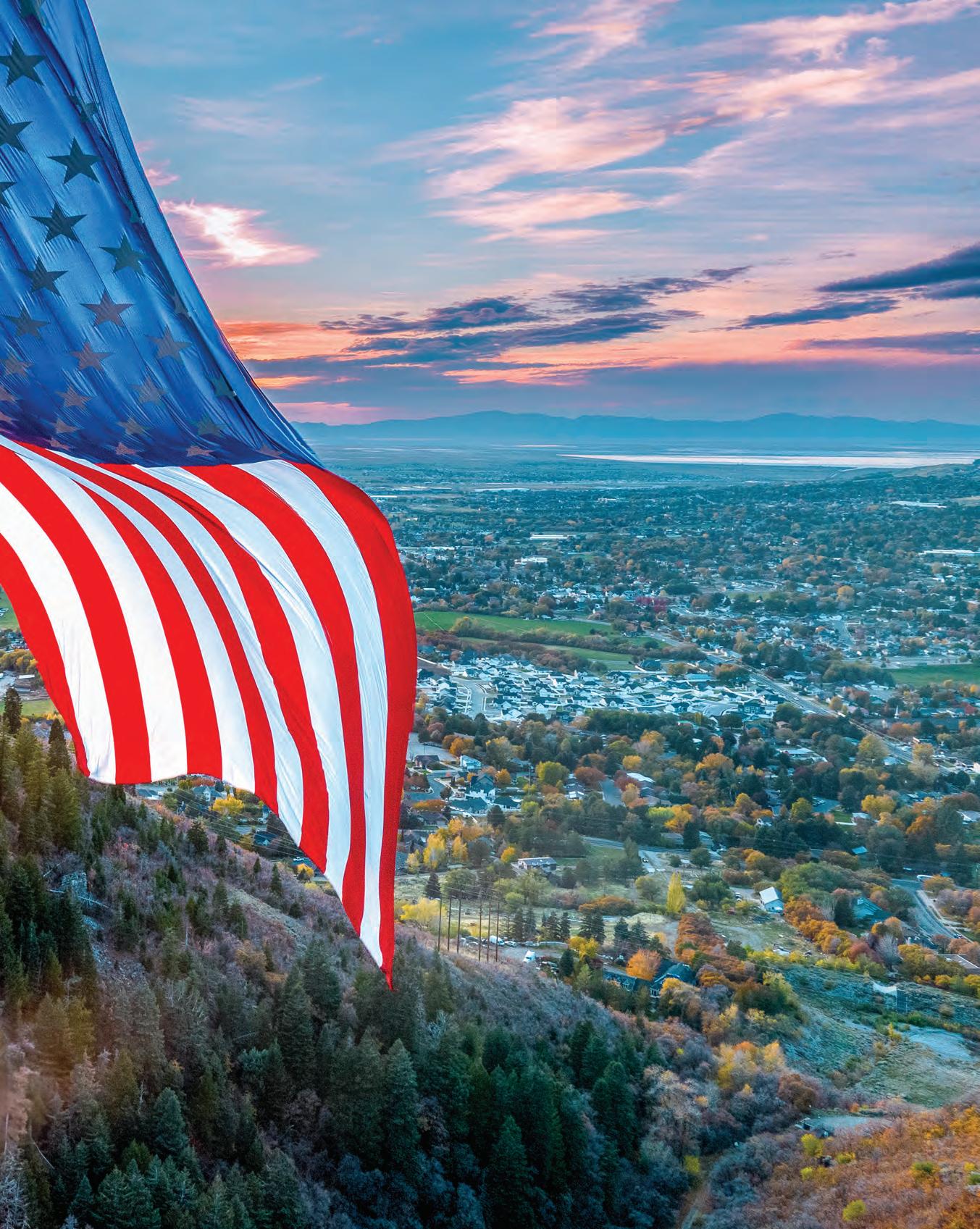
Follow the Flag has become a Utah tradition, turning canyon walls into gathering places for patriotism and remembrance. Each giant flag measures 150 feet long and 78 feet tall and weighs about 400 pounds. The spectacle draws thousands. But what keeps people coming back is the reverence that gathers beneath it.
In 2015, Kyle Fox and Ron Nix first strung a large flag across the canyon as a one-time surprise for the community. A self-described Pleasant Grove lifer, Fox
had spent years growing giant pumpkins with his wife, Carrie, and hosting playful events around them. He wanted to create something that would stop people in their tracks. The response to the flag changed their plans.
A 90-year-old veteran stood in the parking lot below the canyon with a hand over his heart and tears in his eyes. He told Fox it was the greatest thank-you he had ever received. That same day, a mother grieving the loss of her 18-year-old son in basic training said the display felt like an embrace when she needed one.
That first flight also picked up the thread of a Pleasant Grove Fourth of July tradition. For about 30 years, a local resident had hosted a pancake breakfast, fired a morning cannon and put on a short program. After he died, the tradition ended. Follow the Flag became a new gathering place for many of the same families.
Follow the Flag became a nonprofit in 2017, with a mission to honor, heal and inspire. Its flags grew, too. Each year, one
returns to Grove Creek Canyon for about a week. But the public unfurling is only a fraction of the work.
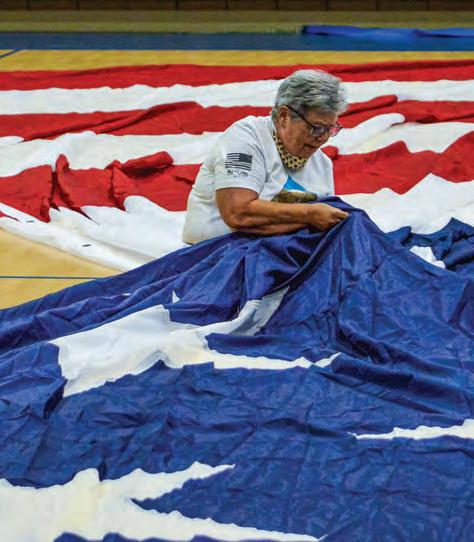
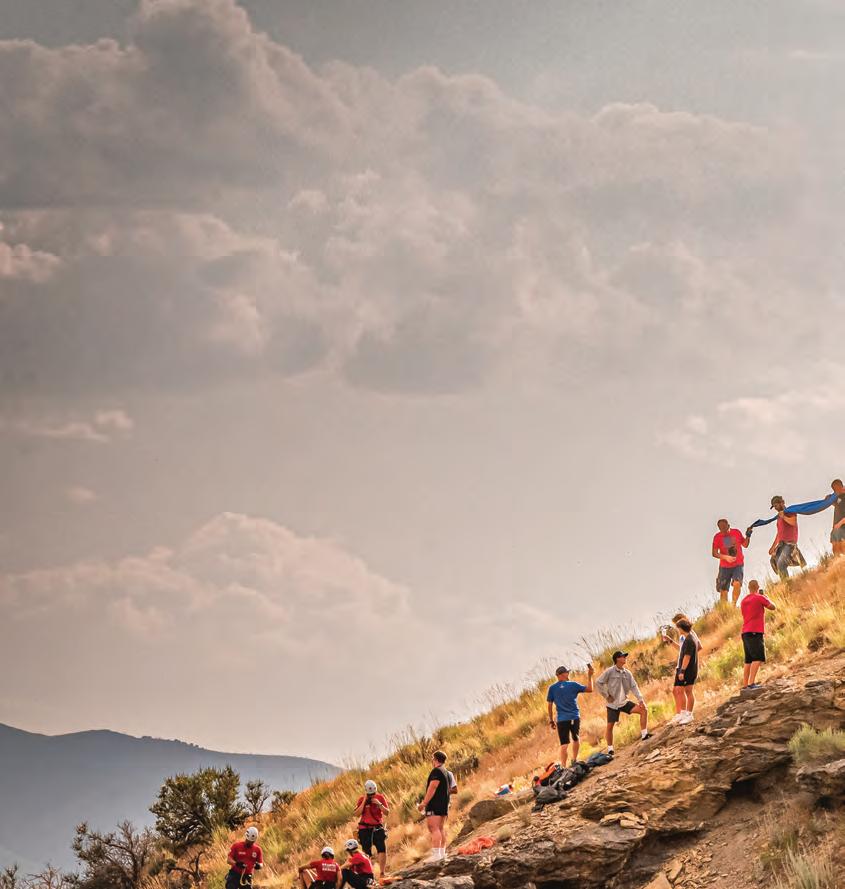
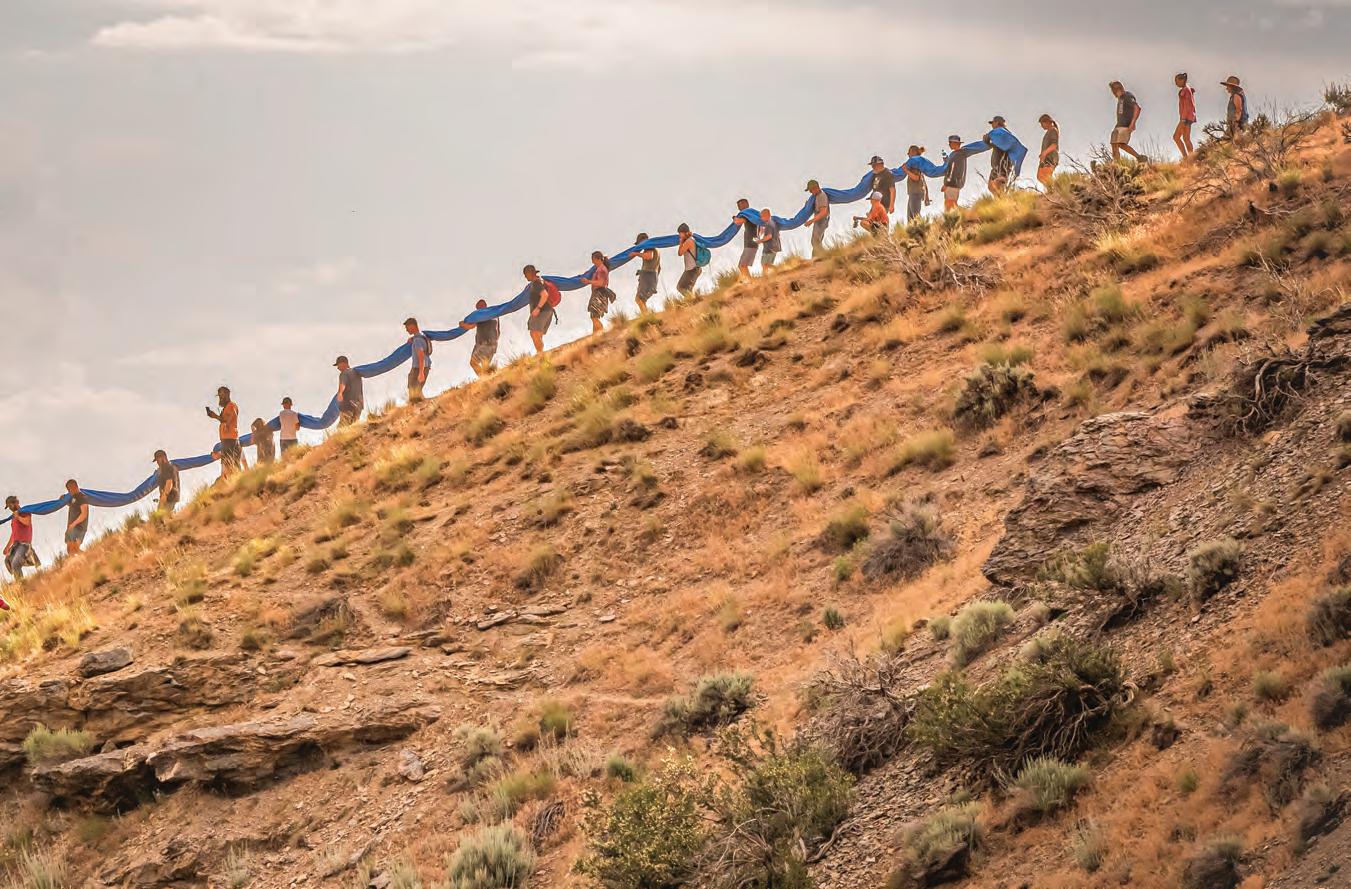
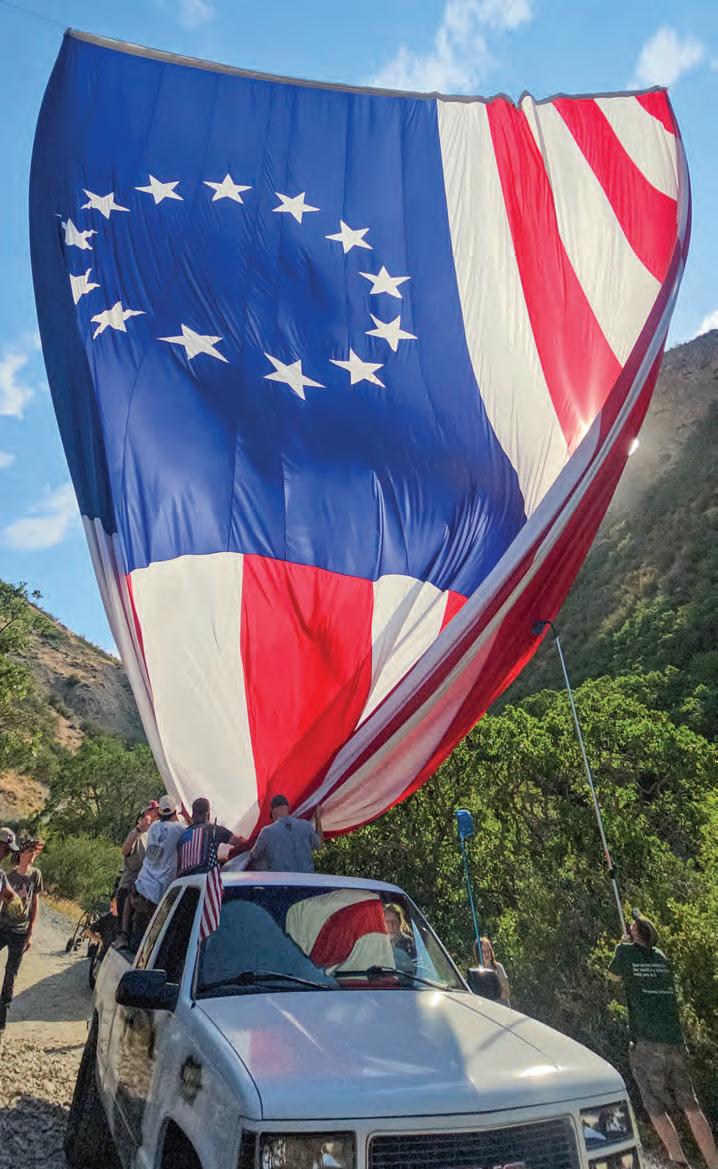
The day before an event, 50 volunteers hike up the canyon carrying fabric, rope and hardware. Made by Colonial Flag in Sandy, the 11,800-square-foot flag weighs about 400 pounds. Standard grommets cannot bear that load, so the flag is built like a sail, reinforced with webbing and rigged with rope and carabiners to spread its weight across the span.
A drone carries the initial fishing line across the canyon’s span. From there, a rope team hauls the rigging into place, then adjusts and secures each connection point. The flag is packed into what volunteers call a “poncho,” so it can peel open in one continuous motion.
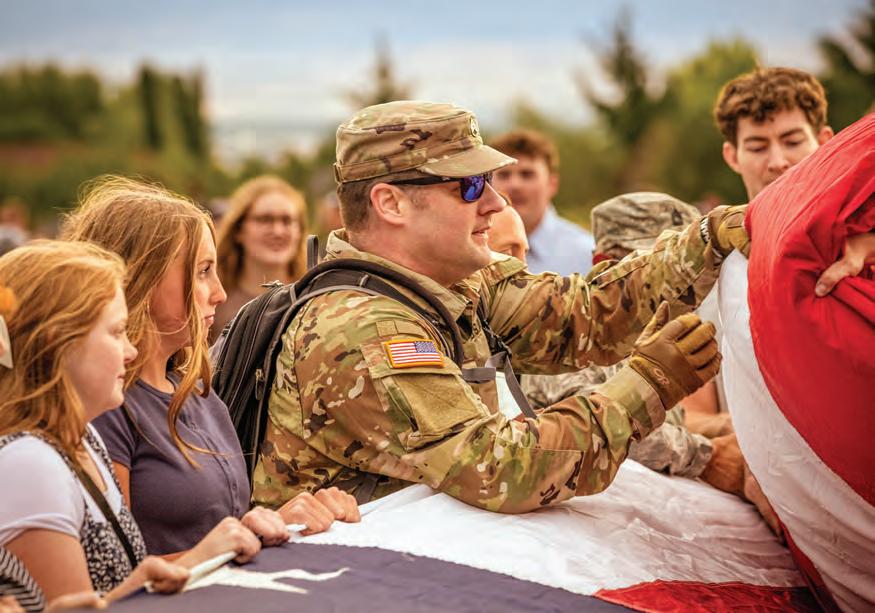
Engineers and climbers work alongside veterans, families and first-time volunteers. Some come for the challenge; others come to honor people they have lost or served alongside.
“What drives us is how we can serve,
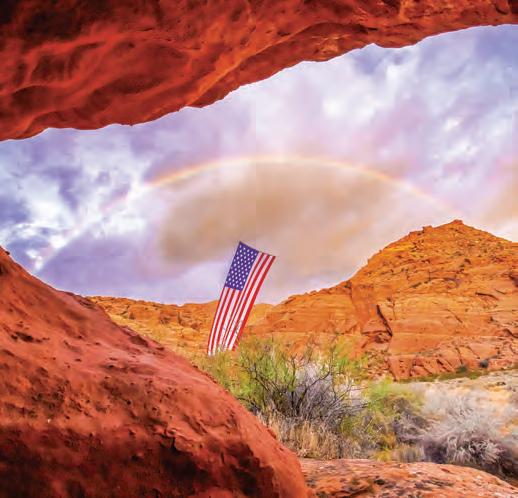
Follow the Flag unfurls one of the largest free-flying flags annually in Pleasant Grove. It takes a team of 50 volunteers to hike into Grove Creek Canyon with the 400-pound, 11,800-square-foot fabric.
Jason Robison (all)
even without wearing the uniform, and make those people that do wear the uniform proud of us at home,” Fox said.
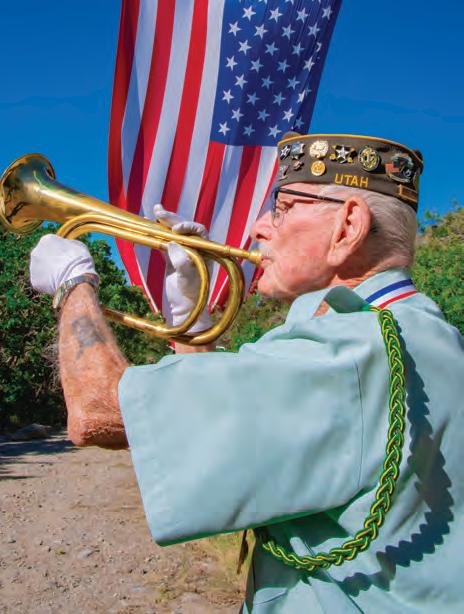
“BY THE DAWN’S Early Light,” the organization’s signature event, gathers thousands at the base of Grove Creek Canyon each July Fourth. A prayer opens the ceremony, followed by cannon fire and a rush of stripes and stars. Afterward, the national anthem echoes off the canyon walls. Cowboys thunder past on horseback and aircraft roar overhead. “There’s a palpable spirit when that flag unfurls,” Fox said. “It’s an avalanche coming down the mountain. The canyon becomes a hallowed place.”
In 2017, retired U.S. Air Force pilot Gail Halvorsen, a Utah native known as the “Candy Bomber,” was honored at the ceremony. During the 1948-49 Berlin Airlift, Halvorsen dropped candy to children on tiny parachutes. Before the event, Fox heard from a German woman who, as a girl, had received a stick of gum from one of those drops. Decades later, she stood onstage in Pleasant Grove and thanked Halvorsen in person.
In 2018, after North Ogden Mayor Brent Taylor, a major in the Utah Army National Guard, was killed in Afghanistan, Follow the Flag brought Big Betsy north for the organization’s first “healing flight.” Afterward, North Ogden residents raised money for a giant flag of their own. “The Major,” dedicated to Taylor, first flew in 2019. Later that year, a microburst damaged Big Betsy so badly that it would never fly again. The Major came to Pleasant Grove to finish the week’s events.
Follow the Flag has flown giant flags across Utah, from the red-rock country of the south to northern Wasatch ridgelines and small-town gathering spaces. For the nation’s 250th anniversary in 2026, the organization added a giant 13-star Betsy Ross flag to its fleet. Its 2026 calendar also includes displays in southern Utah on Sept. 11, North Ogden beginning Nov. 1 and Snow Canyon beginning Nov. 11.
Beyond the large-scale displays, Fox and his crew form flag lines for military funerals and homecomings, place rows of American flags at cemeteries and community events and restore vehicles for veterans in need through the Soldier Car Project. The work continues long after the giant flag comes down from Grove Creek Canyon.
“Service doesn’t require a uniform,” Fox said.
Learn more about Follow the Flag and upcoming events at followtheflag.org.
Jess Bishop
Flags fly in Pleasant Grove, southern Utah, North Ogden and Snow Canyon. This summer, they honored America’s 250th with a 13-star Betsy Ross rendition, “General Washington.”
Kyle Fox
Jason Robison
Jason Robison
PLAYGROUND SANDSTONE
Snow Canyon State Park offers climbing, hiking, maybe even slo-mo glimpses of the desert tortoise
Editor’s note: This story first appeared in the May/June 2020 issue of Utah Life. A reader favorite, we’re pleased to share it again.
story
and photographs by DAN LEETH
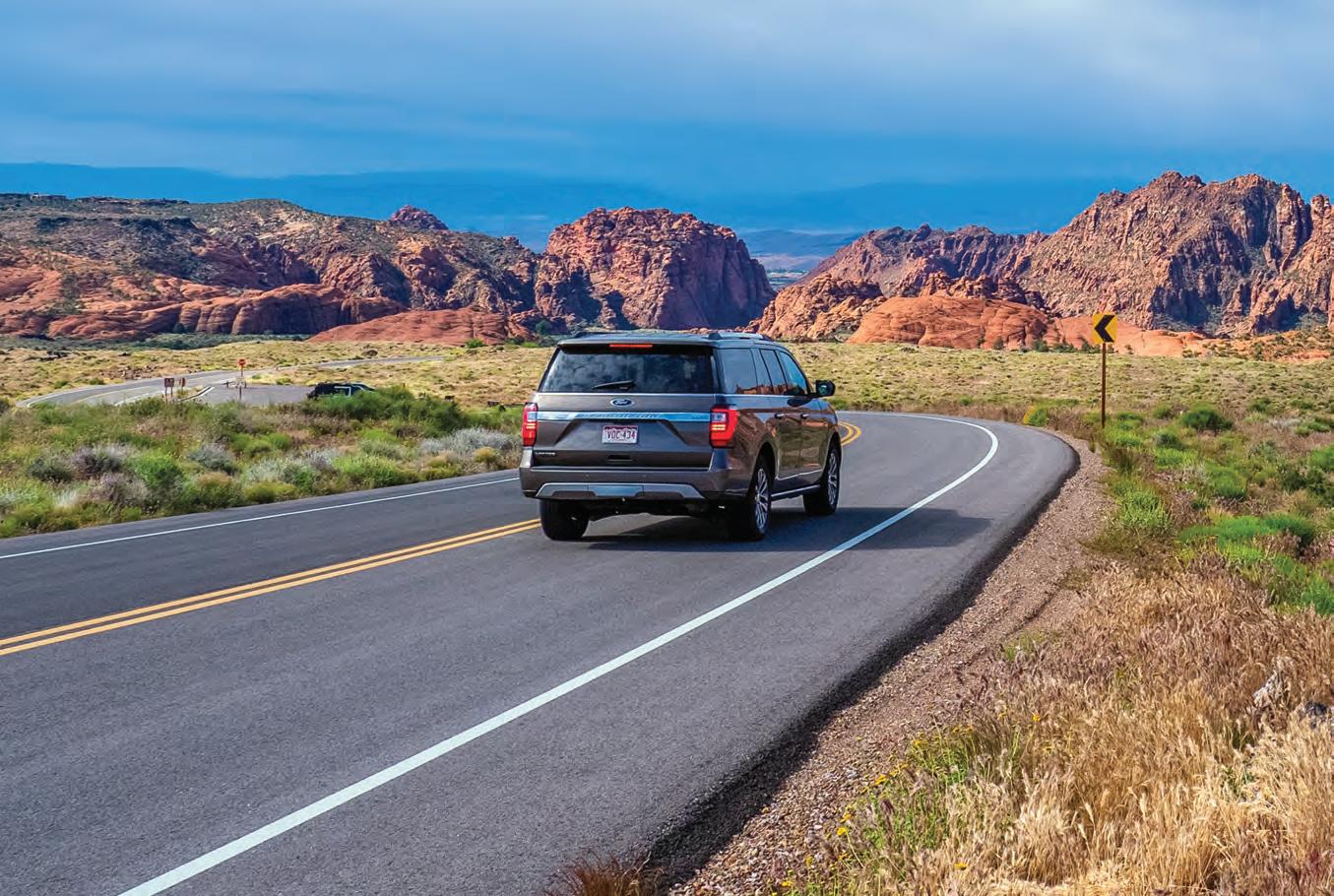
THE CAR’S GPS navigation screen insisted we were on the correct route, but as I drove up the divided parkway, all I saw were stucco-plastered homes and a luxurious country club golf course. It looked as if my wife and I were motoring to a desert spa resort, not a back-to-nature campground.
As we passed the last backyard swimming pool, exurbia finally ended, and we escaped into the stark grandeur of Snow Canyon State Park.
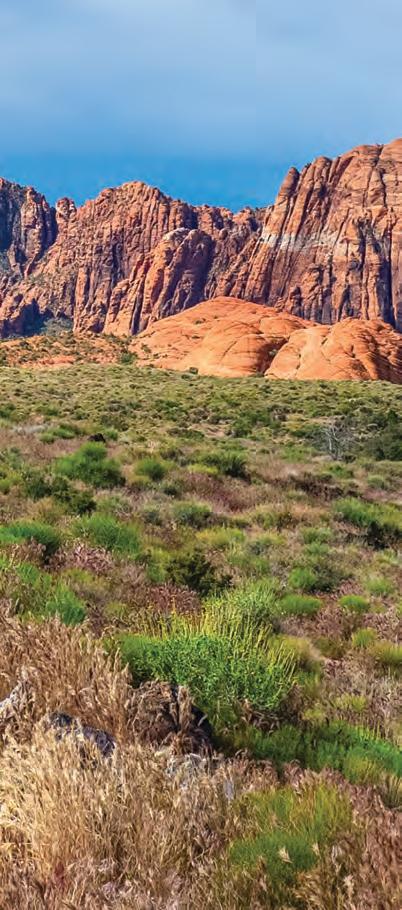
Naked and natural, this cliff-hemmed enclave of barren desert and blushing sandstone has served as a wilderness-worthy backdrop for films such as The Electric Horseman, Jeremiah Johnson and Butch Cassidy and the Sundance Kid. The 7,400-acre park sits just north of St. George.
Snow Canyon’s name has nothing to do with the white stuff that blankets Park City in the wintertime. The appellation honors a pair of local pioneers – Lorenzo Snow, who served as the fifth president of The Church of Jesus Christ of Latter-day Saints, and his cousin Erastus Snow, a member of the church’s Quorum of the Twelve Apostles.
The Snow clan and other pioneering families were frequent visitors to this canyon, often venturing to shady side canyons on heat-escaping
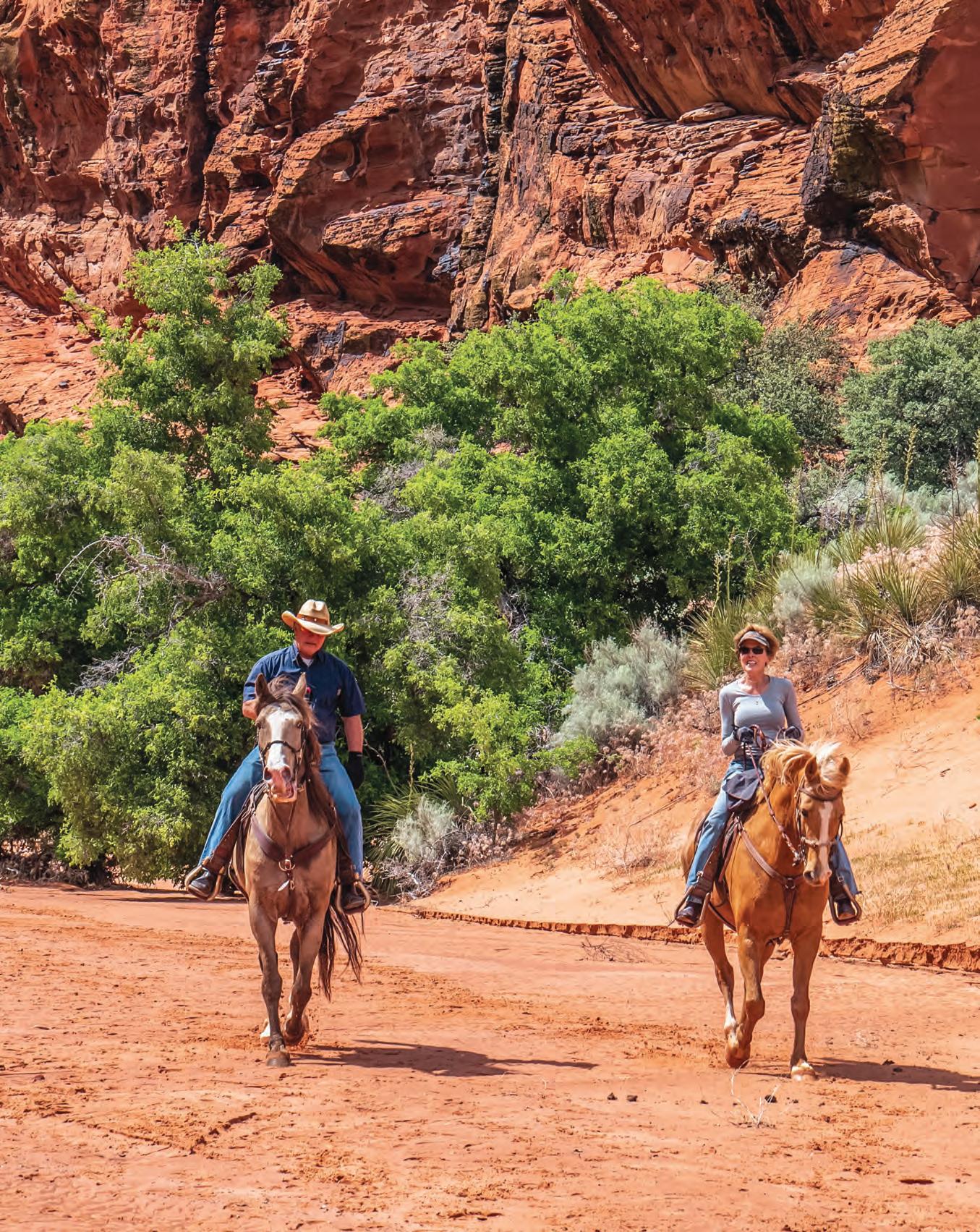
Horseback riders negotiate the Red Sands Trail amidst the red Navajo sandstone of Snow Canyon State Park.
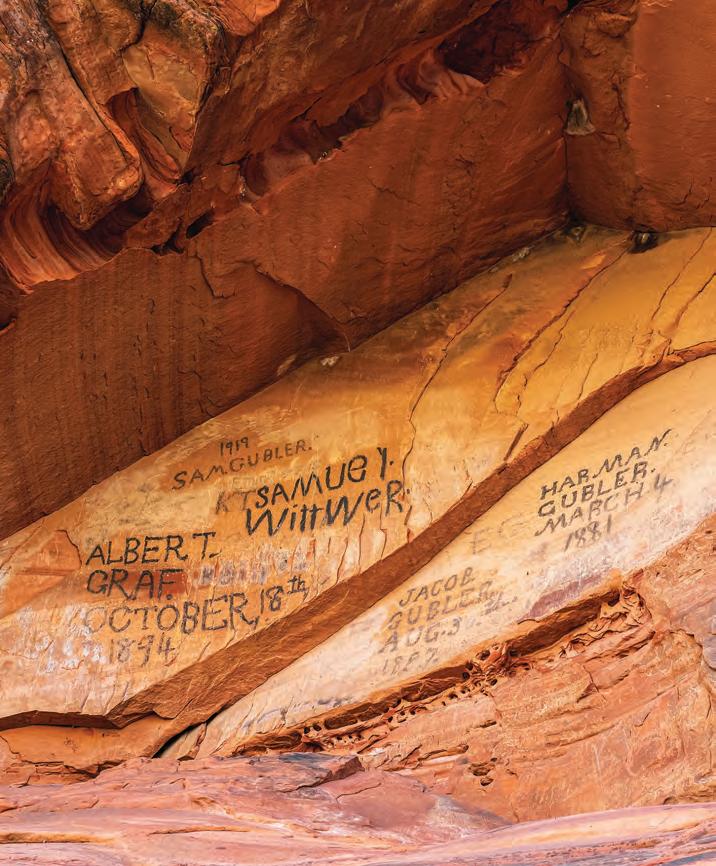
picnics. As was the custom in early Utah, they etched their names into rock walls and used axle grease to paint them into a cliffside alcove, with the Snow name always done with a backward “N.” Those names can still be found decorating the cliffs.
WE CHECKED INTO our reserved site at the park’s cliff-edge campground (stateparks.utah.gov/parks/snow-canyon).
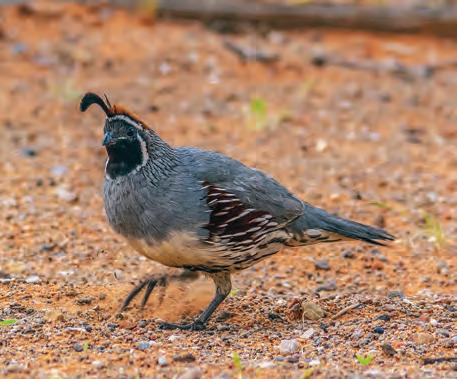
Gambel’s quail strutted across the adjacent turf while lizards did pushups atop nearby rocks. Ravens screeched from the cliffs above, their raspy squawks contrasting with the melodic, flute-like notes of neighboring canyon wrens.
Like Zion National Park, an hour’s drive away, the predominant rock in Snow Canyon is Navajo sandstone. Erosion has freed some of that longlocked sand, and near the southern end of the park, wind currents have transformed those liberated grains into a family-friendly playground of small dunes. We caught parents catching rays while their offspring constructed sandcastles in the springtime sun.
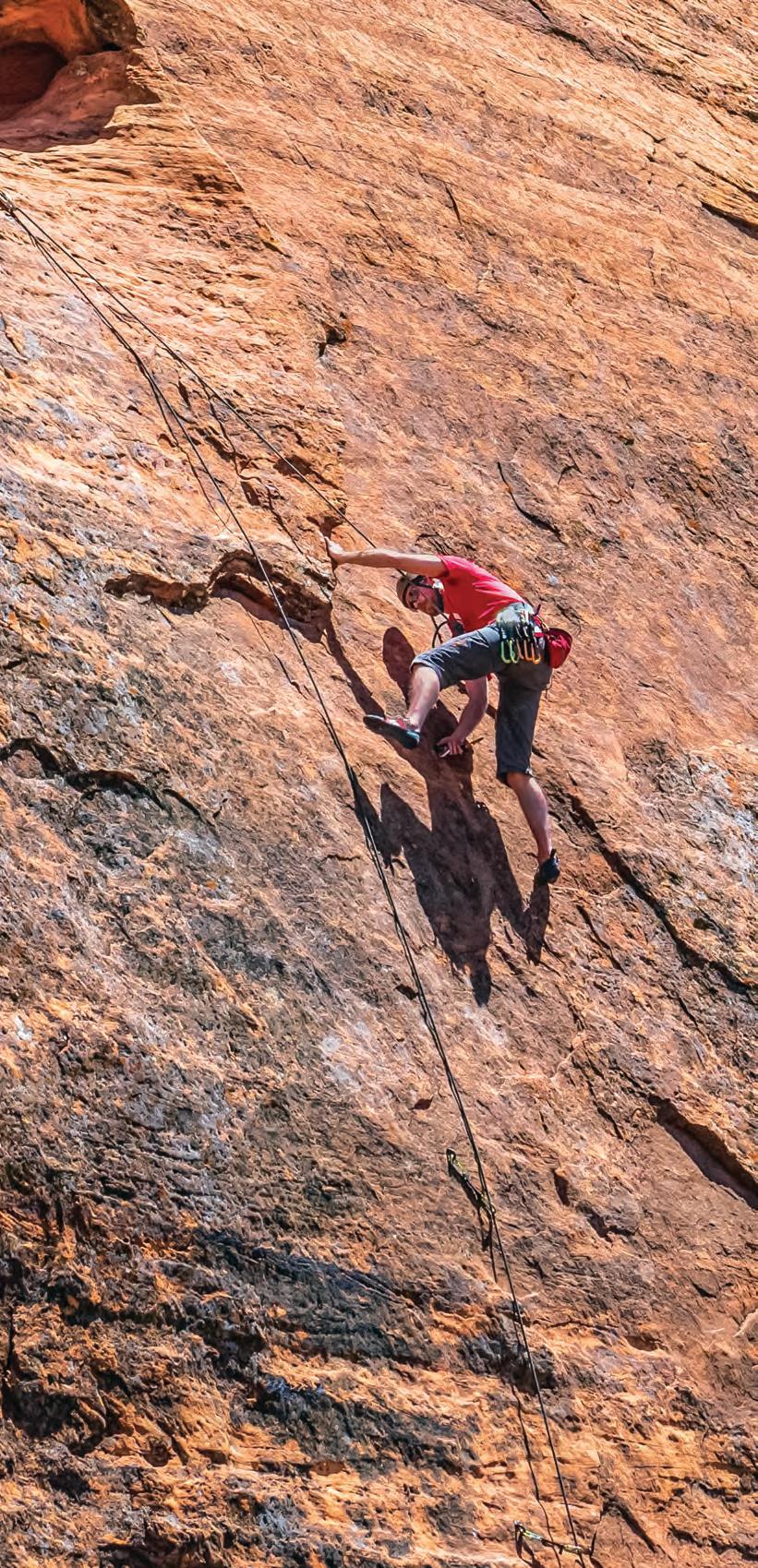
Across the street, a roped-up couple scaled a vertical cliff on one of the park’s 170-plus designated climbing routes. At one of the park’s picnic areas, we met an out-of-town artist busy at her easel, capturing the ruddy scene in watercolors. A picnicking group next door worked off their caloric intake by clambering to the top of a sandstone knob.
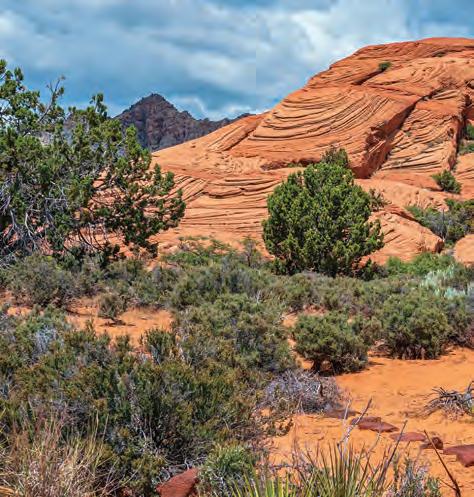
Around 183 million years ago, a vast desert stretched from Idaho to New Mexico. Winds blowing from the northwest swept sand into the area, forming a Sahara-like landscape of shifting dunes. Over time, nature cemented the grains into solid stone, with wind-blown ripples forming the ridges in the rock known as crossbedding. Iron oxide has stained much of the sandstone in shades of rusty red.
A climber tackles a cliff face in Snow Canyon State Park, which was originally called Dixie State Park.
Gambel’s quail patrol the park campground, keeping the grounds clean of quail-worthy snacks. Early pioneers used their wagons’ axle grease to record their names and dates of their visits on the sandstone cliffs.
A sprawling expanse of these ruddy “petrified dunes” remains open to unfettered exploration.
SNOW
CANYON SITS at the edge of the Colorado Plateau where the Mojave Desert ecosystem of southern California meets the Great Basin Desert of Nevada and west-central Utah.
In the park’s lower reaches, we were treated to vivid May displays of Mojave wildflowers, including indigo bush, Mojave marigold and Engelmann’s hedgehog, locally known as purple torch cactus. At the northern end of the park, which sits a thousand feet higher, we encountered fewer wildflowers. Great Basin sagebrush largely covered the landscape.
One of the park’s premier hikes is into Johnson Canyon, on one of the 38 miles of hiking paths in the park, which also offers 15 miles of horseback trails and a paved 3-mile walking/biking route. This short, narrow gorge near the park’s southern end contains Snow Canyon’s only permanent spring, making it a prime water source for local wildlife. To allow the animals unmolested use during breeding months, rangers limit human access to only guided hikes from mid-March to mid-September. The free tours are typically offered twice weekly.
We were treated to a pounding thunderstorm the night before our morning tour. Come daybreak, streams flowed down formerly dry creek beds and topped off pothole pools in the Petrified Dunes. With sand soaking up the rain, a wet trail was not an issue on the relatively flat, 1.8-mile round-trip hike into Johnson Canyon.
After crossing a patch of black basalt, deposited by volcanic eruptions as recently as 27,000 years ago, we turned into the cottonwood-lined canyon. A previous group, we learned, had been buzzed near here by an irate Cooper’s hawk who thought the hikers were getting too close to her nest.
We soon heard spring water gurgling from a rocky embankment cloaked in ferns. A rusty pipe remains from when settlers tried to tap the spring to serve the community of Ivins below. Beyond stretched Johnson Canyon Arch, a 200foot span located up a side draw. A short
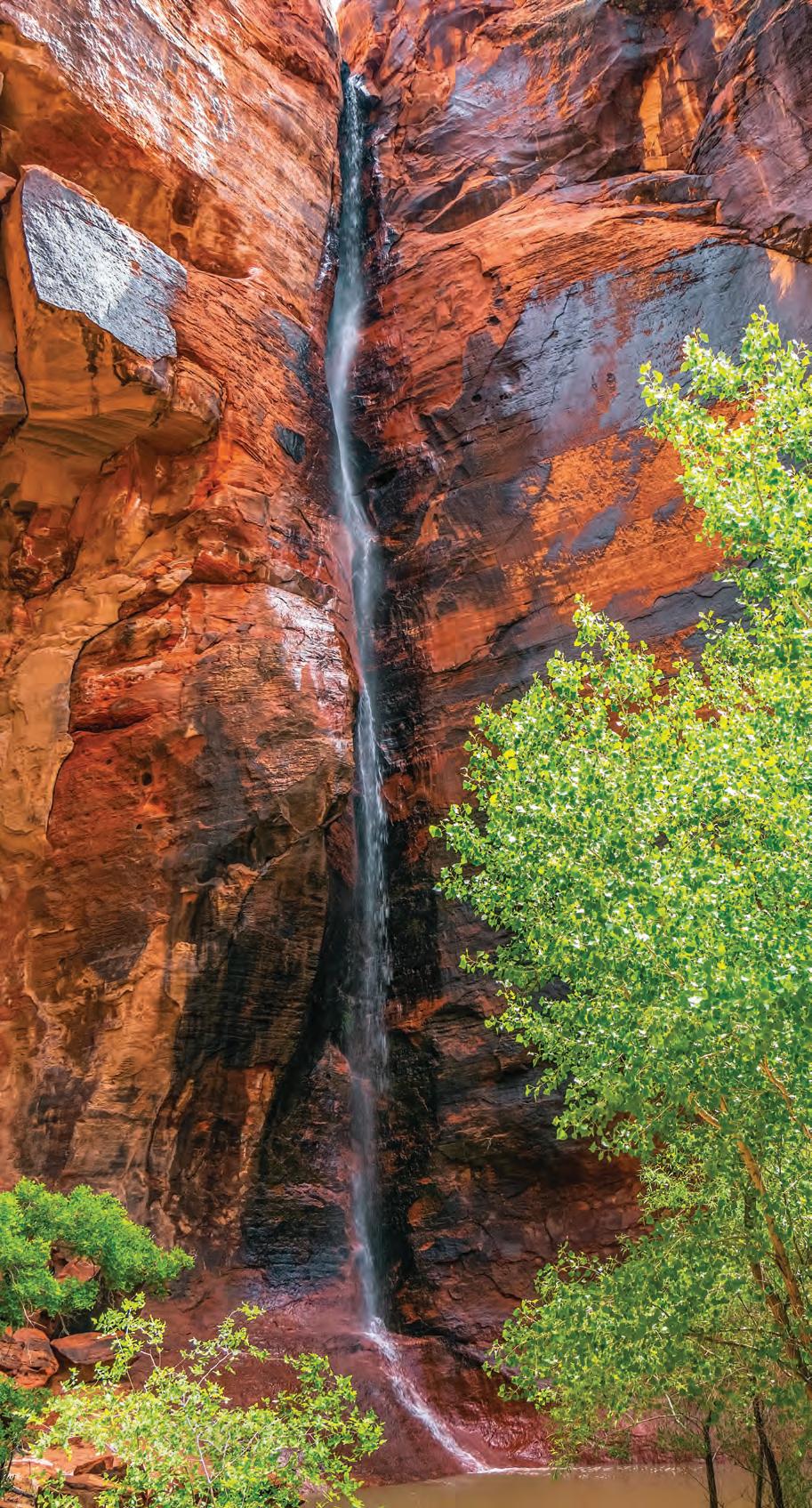
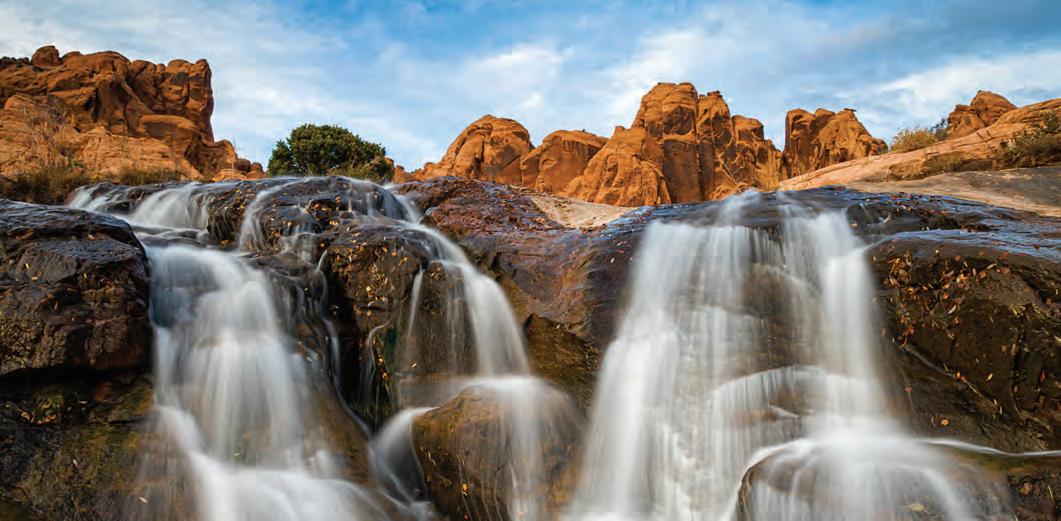
distance later, we reached the box canyon at trail’s end. From a notch high in a corner of the cliffs plunged an Evian-clear stream, its surface shimmering like a thin, silvery cathedral veil trailing down the somber sandstone walls.
“I’ve been coming here for years,” our guide told us, “but I have never seen water pouring down before.”
FOR OUR FINAL romp, we followed the suggestion of the campground hosts and set off for the Padre Canyon Trail on the park’s west side. To get from the campground to the trailhead, we followed the Whiptail Trail past the back side of the sand dunes. We had been told this was a good area to catch sight of the park’s desert tortoises.
Desert tortoises are native to the Sonoran and Mojave deserts, with southwestern Utah being their only habitat in the state. These plant-munching reptiles range between 10 and 14 inches in length, stand 4 to 6 inches in height, and can weigh between 25 and 50 pounds. Natural predation and human encroachment have made these slow-moving creatures a threatened species under the Endangered Species Act. Park rangers will sometimes stop traffic to allow them to lumber across the pavement.
Being cold-blooded, desert tortoises spend about 95 percent of their time sheltered underground, so it’s no wonder we didn’t spy any of the shelled reptiles. We did, however, catch sight of a bulky Gila monster, the sumo wrestler of lizards and Utah’s official state reptile. It is the only lizard species in the United States that’s venomous.
“That’s a young one,” the lady manning the park entrance station told us. “It hasn’t fully grown yet.”
At the park’s southern edge, we turned into Padre Canyon and turned up the val-
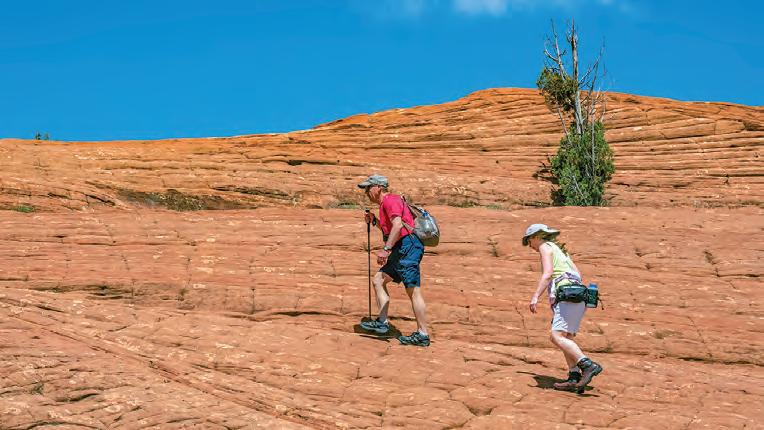
Johnson Canyon Trail displays a rare waterfall. Right: Hikers climb Petrified Dunes, and an artist works in the Lower Galoot area.
ley. After a relatively easy start, the terrain steepened, and we began a laborious, nearly 600-foot ascent toward a highpoint saddle. Here, we met a local woman who was training for an upcoming rim-to-rim hike in the Grand Canyon.
Topping the pass, we began a switchbacking descent to where trail and streambed merge into one. Detouring around pools filled by the rain required crossing slabs of angled slickrock with only the friction of our boot soles on the gritty sandstone keeping us from sliding off.
Our route eventually merged with the aptly named Red Sands Trail, a veritable sandbox of a trail, which we wearily slogged through back to camp.
“I’m not cooking tonight,” my exhausted wife announced as we trudged into camp from our eight-hour adventure.
Instead of a camp-cooked dinner, we
would take advantage of having a city virtually at our doorstep. We telephoned a local couple we had met earlier at Goblin Valley and arranged to join them for a meal of fettuccine and lasagna at one of the fine restaurants in town.
No slaving over the camp stove and no washbasin full of dishes to clean up.
Bunking in the wild is nice, but sometimes having civilization mere minutes away can be even nicer.
Snow Canyon Drive introduces motorists to Snow Canyon’s scenery. At right, a sandstone knob reveals swirls of crossbedding along Butterfly Trail.
TAKE A HIKE
The best way to appreciate Snow Canyon is to take to the trails
JENNY’S CANYON TRAIL
(0.5 miles, easy) – This relatively flat trail leads to a short slot canyon. Rangers suggest this as a great trail for children.
PIONEER NAMES TRAIL
(0.5 miles, easy) – The crescent-shaped trail passes a cliff-side alcove where early settlers painted their names with axle grease. The trail continues past a small sandstone window in a cliffside rib.
PETRIFIED DUNES TRAIL
(1.2 miles, moderate) – The trail, punctuated by arrows on small domes attached to the rock, traverses the cross-bedded sandstone in the Petrified Dunes portion of the park.
HIDDEN PIÑON NATURE TRAIL
(1.5 miles, moderate) – Across from the campground and visitor center, hikers can pick up a brochure at the trailhead that tells about the plants and geology found at 19 numbered stops along the route.
CINDER CONE TRAIL
(1.5 miles, difficult) – Located off Utah Highway 18 north of Snow Canyon Drive’s northern entrance, this steep trail ascends more than 500 feet to the panoramic summit of an extinct volcanic cone.
JOHNSON CANYON TRAIL
(1.8 miles, easy) – Only available on guided hikes from March 15 through Sept. 14, this trail leads into a shady side canyon with a gushing spring and a 200-foot natural arch.
BUTTERFLY TRAIL
(2.0 miles, moderate) – This scenic trail features a few rocky ups and downs as it winds
toward its namesake rock formation, which features two small rock slabs meeting in a vee.
LAVA FLOW TRAIL
(2.5 miles, moderate) – Crossing patches of black basalt volcanic rock, this popular trail passes entrances to three lava-tube caverns where hikers can scramble into a realm of shady coolness.
RED
SANDS TRAIL
(3.5 miles, difficult) – The last half of this aptly named route follows a sandy wash bed to a trio of waterhole ponds in a box canyon grotto with towering pour-offs – waterfalls without water. The trail is also known as the Three Ponds Trail.
WHITEROCKS TRAIL
(4 miles, moderate) – The trailhead lies off Utah Highway 18, just past the park’s Snow Canyon Drive northern entrance. A side trail leads to a natural amphitheater in the pale Navajo sandstone at the upper end of the park.
PADRE
CANYON TRAIL
(6.0 miles, difficult) – The trail jumps between Snow Canyon State Park and the BLM’s Red Mountain Wilderness Area as it traverses up one canyon and down another on the west side of the park.
WHIPTAIL TRAIL
(6.0 miles, easy) – This paved trail parallels the highway through much of the canyon bottom. The trail is open to bicyclists and is accessible to visitors with disabilities.
WEST CANYON ROAD
(8.0 miles, easy) – Used as a maintenance road through the heart of the park, the route’s gravel and sand surface offers a wide, mostly flat trail that’s popular with bicyclists.
PASS THE
VEGGIES
GARDEN FARE PROMISES WELCOME ALTERNATIVES ON THE TABLE
recipes and photographs by DANELLE McCOLLUM
Summer is garden season, when the vegetable possibilities expand beyond iceberg lettuce and bags of baby carrots. Change up the family meal routine with these fresh takes on fresh veggies.
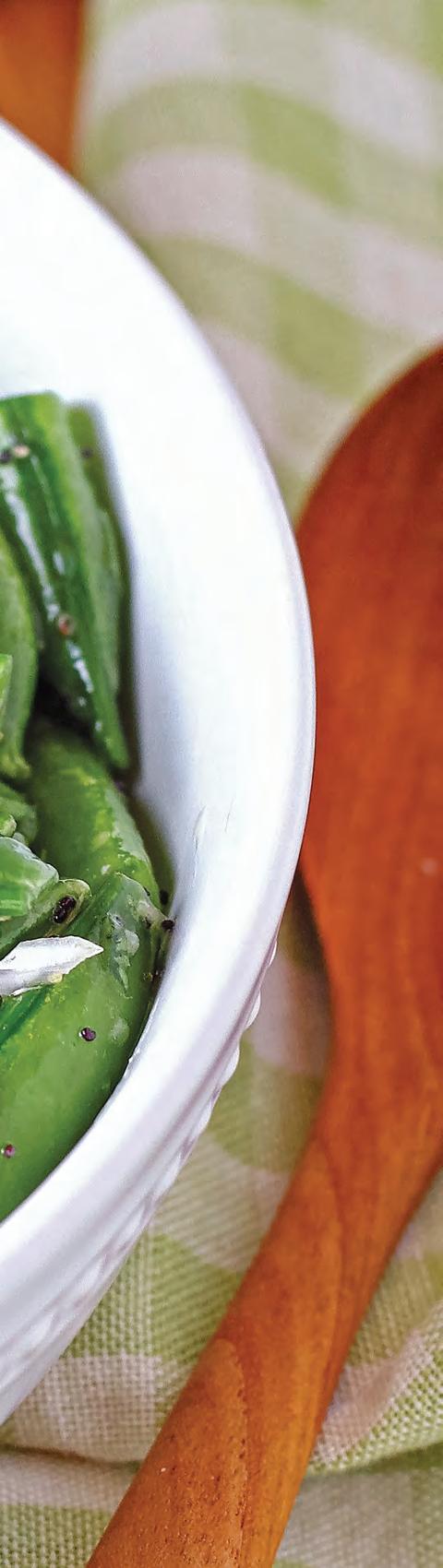
Snap Pea and Poppy Seed Salad
Danelle McCollum says her children like this salad so much that they consistently return for seconds. It’s gratifying when the kids are eating vegetables that aren’t carrots smothered in Ranch dressing, she noted.
In a medium bowl whisk together the first eight ingredients until smooth. Add peas and toss to coat. Add parsley and toss again. Refrigerate at least 30 minutes before serving.
2 Tbsp olive oil
2 Tbsp white wine vinegar
1 Tbsp honey
1/4 tsp salt
1/4 tsp pepper
1/4 tsp dried thyme
1 small shallot, minced
1 tsp poppy seeds
1 lb fresh sugar snap peas, trimmed and halved
1-2 Tbsp fresh chopped parsley
Ser ves 6
Maple Balsamic Roasted Asparagus
Simple and quick to prepare, asparagus also can be elegant, such as in this dish, complemented by the sweetness of maple, the chewiness of dried cranberries and the crunch of pumpkin seeds.
Preheat oven to 450°. Line a baking sheet with parchment paper or foil, and spray with nonstick cooking spray. Arrange asparagus on prepared pan in a single layer. Season with salt and pepper, to taste.
In a small bowl, whisk together oil, vinegar and maple syrup. Drizzle asparagus with that mixture, and toss lightly to coat. Roast until crisp-tender, 7-10 minutes.
Meanwhile, toss feta, cranberries and pumpkin seeds together in a small bowl. Remove asparagus from oven and toss again to coat with balsamic mixture. Arrange on a platter and sprinkle with feta and cranberry mixture. Serve immediately.
1½ lb fresh asparagus, trimmed Salt and pepper, to taste
1 tsp olive oil
1 Tbsp balsamic vinegar
2 Tbsp maple syrup
1/4 cup crumbled feta cheese
2 Tbsp dried cranberries
2 Tbsp roasted pumpkin seeds
Ser ves 4-6
Creamy Quinoa Primavera
Danelle McCollum prefers onion, broccoli, cauliflower, bell peppers and carrots as her assorted vegetables, but anything goes. This recipe is a handy way to use up what’s in the fridge. Even a bag of frozen veggies suffices in a pinch.
Rinse quinoa thoroughly; drain. Bring quinoa and broth to boil in a 2-quart saucepan; reduce heat. Cover and simmer 10-15 minutes, or until broth is absorbed. While quinoa is cooking, melt butter in a large skillet over medium-high heat. Cook garlic in butter for about one minute, stirring frequently, until golden. Stir in vegetables. Cook about 3-5 minutes, stirring frequently, until vegetables are crisp-tender. Stir cream cheese and basil into cooked quinoa. Toss vegetables with quinoa mixture and sprinkle with cheese.
1½ cups uncooked quinoa
3 cups chicken or vegetable broth
1 Tbsp butter
2 cloves garlic, finely chopped
5 cups thinly sliced or bite-sized assorted uncooked vegetables
4 oz cream cheese
1 Tbsp chopped fresh basil (or 1 tsp dried)
3 Tbsp grated Romano or Parmesan cheese
Ser ves 6-8
UTAH THROUGH OUR POETS
Creekside, the world seems to slow and soften. Across canyon streams and mountain waters, these poems trace the steady movement and winding paths of creeks that nourish the land, quiet the mind and draw people and nature to the same current.
Creek Peace
Monte Hanks, Holladay
I love to hear the creek speak as it rolls on down the canyon, delivering peace from the nervous city. I walk and listen to nothing. Everything.
The water asks, ‘Why do you not visit often? We are as close as a tranquil thought.’ The trees nod their approval as they whisper in harmony with the water’s lullaby.
‘It’s a blessing to hear your voices,’ I reply. The city’s sirens and smog-bound valley held me captive for too long, but my heart hears your call. Always.
The pulse within joins life rushing onward, enchants the rhythm we share. I am amazed and grateful of nature’s presence and how she continues to stitch my soul together again.
Evening on Water
Dixie L. Partridge, Provo
Where the creek widens and slows, water turns soft copper among reeds, fades to lavender, then in one long moment darkens, sable blue.
A moonsliver roves near an inlet where faint trickling meets the undercurrent – an echo of buoyancy that allows us grace, readies us
for somber shapes that may form downshore, or in our living, before they deepen … then recede
amid faint lappings, like the sound of a cradle.
Bret Edge
Creek
Larry Bond, Farmington
When I was born, no one can know, Though Nature was my Mother. Siblings sprang from melting snow, My source was from another.
A name can tell you many things And so it is with mine. Throughout the years they called me Spring, A fountainhead divine.
I am Spring Creek, and I still wander Near a dam they call Pineview. Huntsville, Utah, way up yonder Where skies are still deep blue.
I’ve coursed through meadows green and lush And dodged a road or two.
I’ve fed a pond and nourished fish But always remained true.
True to my nature to give all I can, To nurture the ground that I meet, To recognize that I am part of a plan That makes earth’s creation so sweet.
Creekside
Jim Garman, Richfield
In late Spring, and early Summer too, here’s something I just love to do. Head for the nearest creekside, with a new fishing pole being tried.
In South Central Utah, Clear Creek my favorite spot, I’ve found out the fishing there can get really hot. I’ve pulled some great brown trout out of there, along with numerous rainbows, my fair share. Following this creek winding beside the mountain, and there are many others, in case you’re countin’ Whatever creek is your favorite one to go to, just have a great time creekside, all of you.
Forgetting Dirt and Earth
Michael Shoemaker, Magna
Shoes by a stream socks tossed ashore
A boy’s feet sunken while fast moving waters winnow a forgetfulness of clay and earth gravity and dirt. He glides from aquatic stone to boulder to grey granite slab no slip and slide game in synch with the timing of his quick-beating heart and the smooth serenade of wet-lapping luxuriousness.
Send your poems on the theme “Small Wonders” for the November/December 2026 issue, deadline September 1 and “Frost and Fog” for the January/February 2027 issue, deadline November 1. Email your poems to poetry@utahlifemag.com or mail to the address at the front of this magazine.
A smile grows into a grin big, bright, beauteous – as gracious as healing itself beams brilliance back through briars, branches, and the evergreens’ needles to the sky, clouds and twinkling stars caught in a moment’s still life washed in dripping faded indigo watercolors by the morning’s daylight moonrise.
Bret Edge
Ben Cornaby National Champion Welder
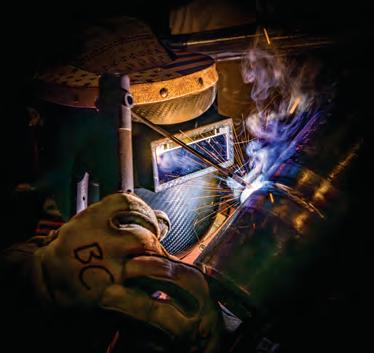
BEN CORNABY PUTS on a sticker-studded red, white and blue welding helmet and gets to work. A student at Utah State University Eastern (USU Eastern) in Price, Cornaby spends 50-60 hours a week developing his welding skills and chasing glory.
Three-time national champion Ben Cornaby has turned a high school welding class into a career – and a shot at representing the United States on the world stage.
Cornaby is a three-time national welding champion. He earned his most recent title in June 2025, representing USU Eastern at the SkillsUSA National Leadership & Skills Conference in Atlanta, Georgia. SkillsUSA is a national workforce development organization serving nearly 450,000 students and instructors. Its annual national championships test high school and postsecondary students against industry standards in more than 100 skill and leadership events.
After winning at SkillsUSA, Cornaby entered the American Welding Society’s USA Weld Trials, a multistage competition to select one U.S. welder to represent Team USA at WorldSkills Shanghai 2026, often
story by BIANCA DUMAS
photographs by JAKE CLEMENT
called the Olympics of skilled trades.
Over eight months, Cornaby completed assigned projects and mailed them to a judging committee. Each submission required detailed documentation and had to demonstrate artistry, technical skill and strategy. Welds were subjected to destructive testing and X-rays to gauge their quality. The top contenders then met in person for an 18-hour final contest that challenged their abilities in five welding processes.
Cornaby finished second, only a few points behind Mikala Sposito of Washtenaw Community College in Michigan. Sposito will represent the U.S. at WorldSkills in Shanghai in September.
Cornaby began competing at Maple Mountain High School in Spanish Fork. The son of a welder, he had learned a few basics in his dad’s shop but did not consider welding as a career until enrolling in the school’s program. “I’d say I fell in love with
it when we started competing. That was really fun,” he said. He credits his high school welding instructor, Jared Massic, with fueling his enthusiasm and getting him involved in SkillsUSA. Cornaby placed 10th in the state his first year, then became Massic’s first individual state champion as a junior.
USU Eastern was a natural choice for Cornaby’s welding degree. The program’s instructors are former SkillsUSA or WorldSkills contestants who built notable welding careers before turning to teaching. Over the past 20 years, USU Eastern has produced numerous national and international competitors, including Wyatt Hansen of Altamont and Chandler Vincent of Roosevelt, both SkillsUSA national champions.
Austin Welch, USU Eastern’s welding program director, credits Utah’s broader culture of strong welding programs. Utah
Three-time national champion Ben Cornaby showcases his welding skills at competitions across the country, representing Utah State University Eastern in Price. He grew up learning the basics from his father, but it wasn’t until high school that he considered it as a career.
State University in Logan got the ball rolling, he said. Two graduates of its welding engineering program later rebuilt the program at USU Eastern. Today, USU Eastern’s associate degree curriculum includes metallurgy, print reading and electrical theory, giving students a deeper technical education than certificate programs typically provide.
Welding is a highly marketable skill. “If you have the ability to pass performance qualifications, you’re employable anywhere in the world,” Welch said. His three most recent graduates went on to earn bachelor’s degrees at Weber State University, then received job offers with salaries of $80,000 or more. Cornaby already works at Alloyed Solutions, a Price company that hired him based on his competition success.
Cornaby hopes to pursue a bachelor’s degree in welding engineering after finishing at USU Eastern.
Competing has taught Cornaby to manage time and stress and tune out distractions. “It’s a certain pressure you’re put under that you don’t really find anywhere else – just being able to focus on the task at hand and not letting anything else get in the way,” he said.
A Lineage Liberty of
FROM BRIGHAM YOUNG’S FATHER TO TODAY’S COLOR GUARD,
by ARIELLA NARDIZZI
A
STEADY DRUMBEAT
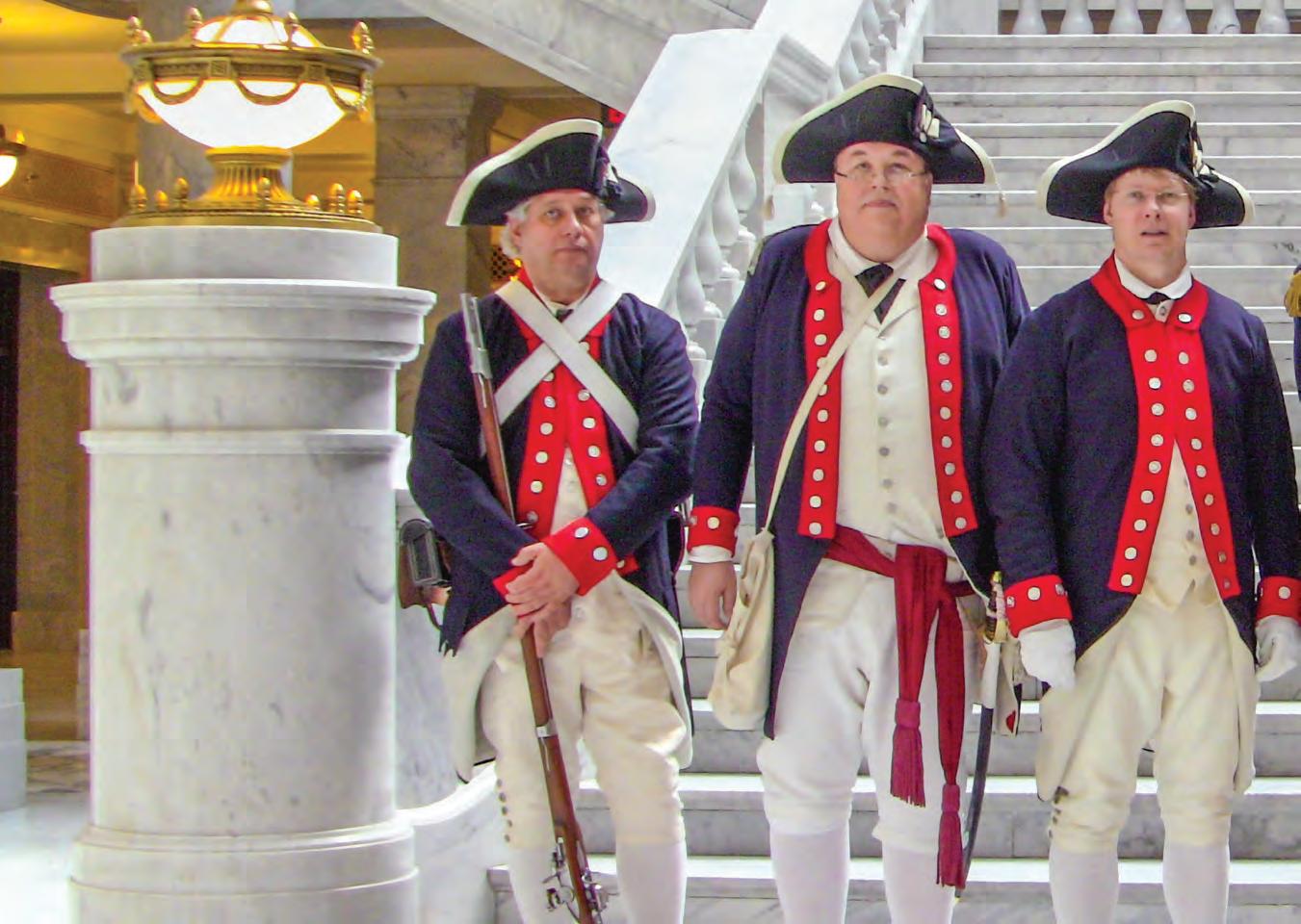
sets the pace as men march in line, dressed in tricorn hats, wool coats, linen waistcoats, breeches and buckled shoes. The 13-star Betsy Ross flag moves with them, carried between two musket bearers.
Doug McGregor knows the Color Guard’s routine by heart: the commands, an enthusiastic “huzzah” and toss of a hat, the anthem and the synchronized turns. Still, it moves him every time. “These very men embody what we were given – freedom,” he said.
McGregor, secretary and treasurer of the Utah Society Sons of the American Revolution, is one of about 170 members statewide who trace lineage to a patriot of the American Revolution. The society has two chapters – Red Cliffs of Zion, based in St. George and serving southern Utah, and
Point of the Mountain, serving Utah County and southern Salt Lake County. The Utah SAR was founded in 1895, less than 50 years after Latter-day Saint pioneers arrived in the Salt Lake Valley. It is part of a national organization whose tens of thousands of members preserve the memory of the Revolution and carry its ideals forward.
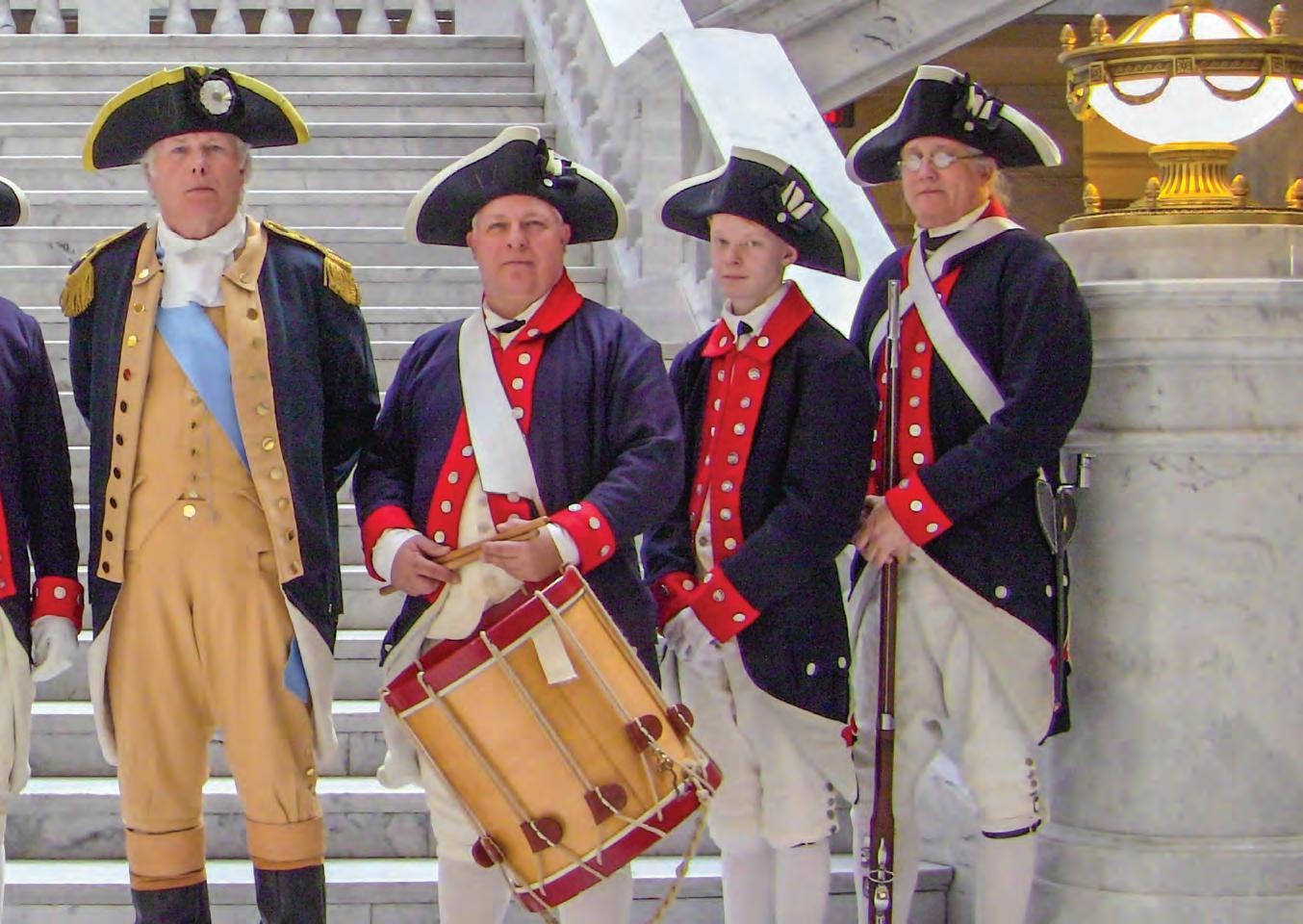
The State and Chapter Color Guards are some of the most visible programs, established in 2011. McGregor is one of its founding members, appearing at civic events and commemorations across the state. Its uniforms are carefully made reproductions of Revolutionary War-era clothing, complete with pewter buttons, neck stocks and wool coats. Ranks have included fifers, drummers, flintlock musket bearers and flag bearers.
McGregor’s connection to a patriot is
deeply personal. He is a direct descendant of John Young, Brigham Young’s father, who served during the American Revolution. McGregor says that connection has strengthened his devotion to the “doctrines of the revolutionists.” It ties Utah’s pioneer story to the founding of the country itself. Notable Utah SAR members have included Gordon B. Hinckley, former president of The Church of Jesus Christ of Latter-day Saints; George Sutherland, a former U.S. senator and U.S. Supreme Court justice; and James C. Fletcher, a former president of the University of Utah and NASA administrator.
Early Latter-day Saint leaders expressed respect for founding figures such as George Washington. Pioneers carried that patriotic tradition west. When settlers first celebrated what is now Pioneer Day on July 24, 1849, they included patriotic speeches
UTAH’S TIES TO THE REVOLUTION COME DRESSED FOR THE PART
and a reading of the Declaration of Independence. “It’s important for us Utahns to understand the roots of our liberties and freedoms,” McGregor said. “How can we protect and preserve them if we don’t understand them?”
Those ideals shape the Utah SAR’s work. Each February, the group holds a banquet celebrating George Washington’s birthday. Members support educational programs such as Utah Patriot Camps and Freedom’s Light, participate in Wreaths Across America, serve at naturalization ceremonies and recognize JROTC cadets. For the nation’s 250th anniversary, its commemorations include Color Guard ceremonies, parades and appearances by reenactors portraying George Washington and Benjamin Franklin.
The Utah State Society Daughters of
the American Revolution carries forward a similar mission. Founded nationally in 1890, the DAR has more than 700 members in chapters across Utah. Like the SAR, the DAR bases membership on lineage and centers its work on historic preservation, education and patriotism. Projects range from assembling backpacks filled with school supplies for students in the Navajo Nation to preparing “Buddy Bags” for homeless veterans and making Quilts of Valor for service members and veterans.
Together, the SAR and DAR connect family history with public service. Their members look to the country’s founding era while finding new ways to carry its ideals forward.
At the close of each Color Guard ceremony, McGregor lingers a little longer. Marching feet echo like a heartbeat. The
flag holds its shape as it moves. “There are no greater words in the American lexicon than the words, ‘We hold these truths to be self-evident...’” he said. “They’re the principles that define us, our lives and our country. We must strive to ensure the freedom that was won in the American Revolution will always be.”
The drumbeat fades and the tricorn hats fly into the air. The uniforms will be packed away until the next ceremony. Yet the march for freedom never ends.
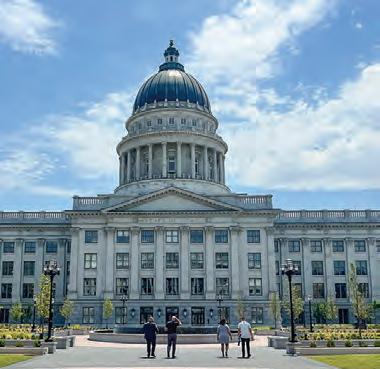
Utah SAR Color Guard members stand on the State Capitol steps in tricorn hats, wool coats and buckled shoes. The group, founded in 2011, brings flags, muskets and a marching drum to a ceremony for the Utah Senate.
Bill Simpson
CULTURE. ADVENTURE. HISTORY.
by ARIELLA NARDIZZI
MOTORSPORT
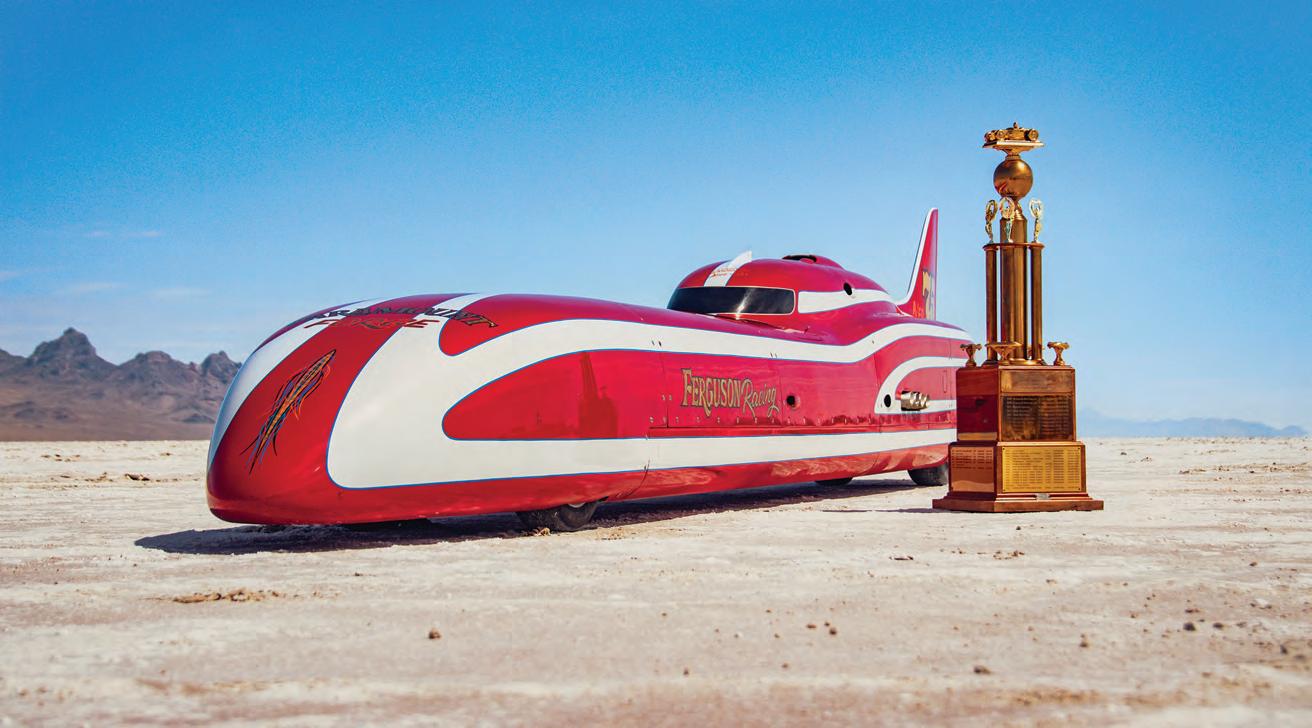
BONNEVILLE SPEEDWEEK
AUG. 1-7 • WENDOVER
Heat shimmers on the horizon. Sky and salt meld, until a machine zooms through the mirage, moving at speeds quicker than eyes can track. Each August, SpeedWeek returns to the Bonneville Salt Flats, where a 30,000-acre salt crust forms one of the flattest natural racing surfaces on earth.
Since 1949, the Southern California Timing Association and Bonneville Nationals have drawn drivers from around the world to Wendover. The goal of the week is simple: set a record. Many drivers are chasing speeds of 300 miles per hour and beyond.
For six days, hot rods, lakesters, motorcycles, streamliners and diesel trucks line up on a long, straight course built for
speed. Some machines look vintage, others an aerodynamic spaceship from the future. All tune for the same pursuit of achieving a number in the record books.
Spectators can walk the pits, study the engineering up close, and talk with drivers and crews. Then, they step back – at least a quarter mile – and watch as the vehicles accelerate across the white expanse. Binoculars are encouraged. Race is weather and conditions dependent. Admission for visitors is $25 for the day or $60 for the week.
The environment itself is as much the draw as the racing. Among regulars, it has a name – that “Salt Fever” brings racers and spectators back, year after year. scta-bni.org, (559) 528-6279.
WHERE TO EAT SALT FLATS CAFE
For a no-frills, homestyle experience, this diner blends Mexican and American cooking. Chile can be found throughout the menu, in the chile verde omelette, chimichanga sauce and Murgia special smothered in spicy red chile. Cash only. 85 Skyhawk Dr., (435) 665-7550.
WHERE TO GO HISTORIC WENDOVER AIRFIELD MUSEUM
The airfield is one of the most authentically preserved World War II Army Air Force bases in the country. Guided tours take visitors through exhibits preserving uniforms and a replica of the Little Boy bomb. Admission $10. 352 Airport Way, (435) 665-7724.
Drivers set world records during SpeedWeek at the Bonneville Salt Flats.
Nick Aboud
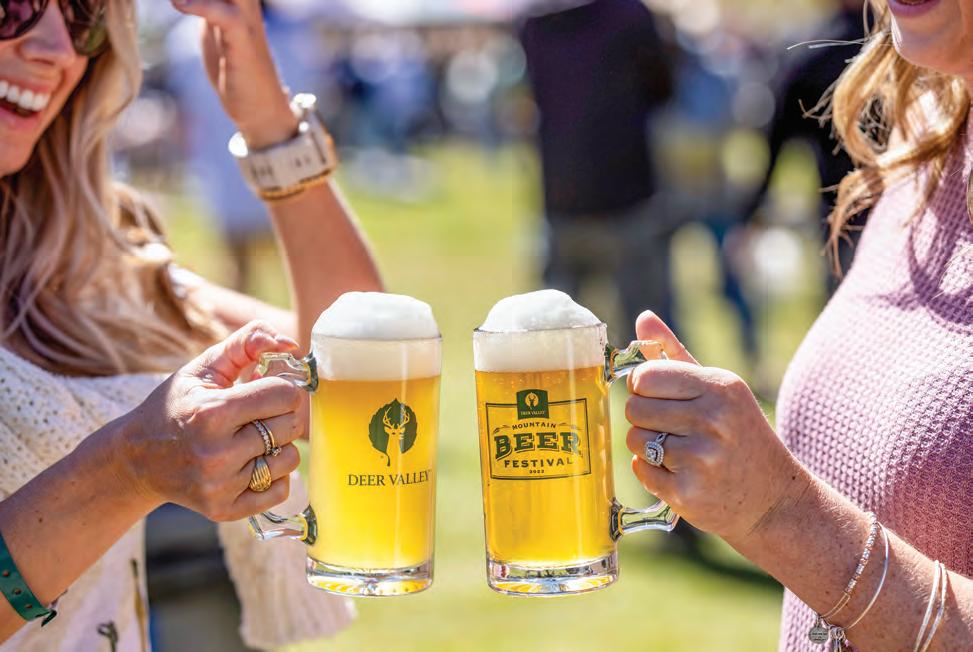
More than 20 brewers gather at Deer Valley for the fifth annual festival celebrating Utah’s growing craft beer scene. Weekend highlights consist of a Brewmaster Dinner, live music, beer tastings, food and family-friendly activities.
FESTIVAL
DEER VALLEY MOUNTAIN BEER FESTIVAL
SEPT. 18-20 • PARK CITY
Amber pours catch the mountain light and glasses clink as Utah’s growing craft beer scene gathers at Deer Valley Resort in Park City for the fifth annual Mountain Beer Festival. The weekend is built around small-batch pours, brewers’ stories and high-altitude tastings.
Festivities begin on Friday, Sept. 18 with a Brewmaster Dinner at Silver Lake Lodge. The evening unfolds over five courses prepared by Deer Valley’s star culinary team. Each plate is paired with beers from five top breweries as voted by last year’s attendees. Acoustic music carries through the lodge while courses arrive.
Saturday and Sunday shift the focus outdoors. More than 20 local and regional
breweries pour from noon to 5 p.m., including favorites such as Heber Valley Brewing, Talisman Brewing, Moab Brewing and Second Summit Cider. Live music accompanies each afternoon. Dylan Catrone holds down Saturday’s performance, while G. Love & Special Sauce take the stage Sunday. Food and family-friendly activities fill mid-mountain.
Getting there is part of the experience. Event access comes by chairlift from the Snow Park Lodge, rising high above Park City. Cool air and sweeping views of the Wasatch are complementary. Ticket packages start at $20, with options to build a full weekend around food, music and more pours. deervalley.com, (435) 649-1000.
WHERE TO EAT FIVE5EEDS
Nourishment, flavor and color round out the menu of this health-infused spot. Warm wood and plants decorate the interior, while food standouts include the acai bowl, banana bread with espresso cream and ahi poke bowl. 1600 Snow Creek Dr., Ste. #EF, (435) 901-8242.
WHERE TO STAY
WASHINGTON SCHOOL HOUSE HOTEL
Twelve rooms transform an 1889 schoolhouse into a luxurious living space. A heated pool nestles into a terraced hillside, while curated fine art, antiques and furniture create a homey atmosphere. 543 Park Ave., (435) 649-3800.
Deer Valley Resort
Other events you may enjoy
AUGUST
The Crystal Festival
Aug. 1-2 • Vernal
Rock hounds and crystal lovers can explore rare minerals, fossils, museum-quality stones and educational workshops at the Uintah Conference Center. Free. 313 E. 200 South. (801) 989-6926.
Bear Lake Raspberry Days
Aug. 6-8 • Garden City
The weekend celebrates Bear Lake’s raspberry harvest with a parade and fair at Heritage Park, crafts, rides, food, a 5K, bingo, golf scramble and live music. A lighted boat parade travels from Blue Water Beach to Bear Lake State Park Marina before fireworks close the evening. 579 Buttercup Blvd. (435) 946-2901.
Millard County Fair
Aug. 21-22 • Millard
The annual county fair brings gel blasters, magicians, live music, local food vendors and carnival rides to the Millard County Fairgrounds. Visitors can work up a sweat, cool off with food and drinks, then get a bird’s-eye view from the Ferris wheel. 187 Manzanita Ave.
Helper Arts, Music and Film Festival
Aug. 21-23 • Helper
This free festival features musicians including Runaway Fire, winner of Southern Utah University’s 2023 Battle of the Bands. The Carbon Shortcuts Film Project marks 100 years of film in Utah with 10 short films, each 10 minutes long. Screenings are Friday at the Rio Theatre, with winners announced Saturday. (801) 712-7622.
Art on the Trails
Aug. 22 • Park City
Walk among local and regional art along the McLeod Creek Trail. Guides leave Copper Moose Farm every 20 minutes from 2-4 p.m. Past tours have included tap
dance, Indigenous cultural presentations, welding and opera performances. 1285 Old Ranch Road. (435) 200-5220.
Antelope Island SpiderFest
Aug. 22 • Syracuse
Spiders get top billing at Antelope Island State Park. From 3-9 p.m., visitors can join spider walks, make crafts, get their faces painted and grab dinner from food trucks while learning about the island’s eightlegged residents. 4528 W. 1700 South. (801) 773-2941.
Sanpete County Fair
Aug. 24-29 • Manti
A Dutch Oven Cook-Off, 4-H projects and a junior livestock show and sale are among the traditions that keep county fairs going. The week gives visitors a look at agricultural life in Manti, population 3,700 and the first Utah town founded outside the Wasatch Front. (801) 310-3293.
Dinah “SOAR” Days
Aug. 28-30 • Vernal
Balloons launch from Vernal Middle School at 6:30 each morning, with night glows beginning at 8 p.m. at 200 E. Main St. During Friday’s Dino Dash, contestants race down Main Street in dinosaur costumes. (435) 781-6769.
SEPTEMBER
Daggett Heritage PRCA Rodeo
Sept. 4-5 • Manila
Rodeo traditions run deep in Daggett County, where cowboys have ridden horses and bulls for more than a century. PRCA competition continues that heritage. Heritage Day begins at 5 p.m. Sept. 5, followed by a lighted parade and fireworks. (435) 823-8224.
Utah Wine Festival
Sept. 4-6 • Cedar City
In its eighth year, the festival offers tastings and meals. The Wasatch Academy of Wine traces Utah wines’ beginnings, I/G Winery serves 1920s-style cocktails at a speakeasy and Red Acre Farm hosts a family-style dinner. (435) 867-9463.
Timpanogos Storytelling Festival
Sept. 10-12 • Lehi
Storytellers, musicians and magicians gather at Thanksgiving Point for live tales. The lineup includes Adam Booth, Amy Bruton Bluemel, Antonio Sacre, Bil Lepp and Dom Flemons, plus family Bedtime Stories and evening programs. timpfest.org.
Utah State Fair
Sept. 10-20 • Salt Lake City
Utahns’ traditions return to Utah State Fairpark. Enjoy rodeos and demolition derbies at Days of ’47 Arena, entertainment, an 80-foot-high dive, hog races, agricultural exhibits, carnival rides, concessions and the Butter Cow, sculpted from 700-800 pounds of butter. 155 N. 1000 West. (801) 538-8400.
Old Capitol Arts & History Fest.
Sept. 11-12 • Fillmore
“Pioneering Spirit” marks 20 years at Territorial Statehouse State Park. Fifty-plus artisans join reenactors, art displays, quilts, wagon rides and children’s activities. Two stages host music and dance. 50 W. Capitol St. (435) 743-5316.
Canyon Jams Concert Series
Thru Sept. 12 • Providence
Guitar and banjo fill Von Baer Park during this outdoor roots-music series. Bring a blanket or lawn chair for returning audience favorites. Shows begin at 7 p.m. 350 E. Center St. (435) 755-3239.
Red Rock Arts Festival
Sept. 25-27 • Moab
The three-day festival takes over downtown at the Moab Arts facility and nearby parks with free workshops from local artists, a street festival, chalk competition, kid-friendly activities, food and music. 111 E. 100 North, (435) 259-6272
Stephen Wilkes: America at 250
Sept. 30 • Provo
Fine art photographer Stephen Wilkes presents a talk and photographs spanning five decades of American history in recognition of the nation’s 250th anniversary. The program begins at 7:30 p.m. at BYU’s Mainstage Theatre in the Arts Building. 1100 900 East. (801) 422-2981.
TRIVIA ANSWERS
Questions on pp. 10-11
1 Leaving an itinerary with someone
2 17 years
3 Quartz monzonite
4 High School Musical 2
5 Bighorn sheep
6 a. Ancestors emerging into this world
7 a. Burros
8 b. Copper mine
9 a. Drops through a circular opening in the rock
10 a. Hunter on horseback
11 False – The name’s origin remains disputed.
12 True – It is a series of amphitheaters.
13 True – Those dunes became Navajo Sandstone.
14 False – Its striped walls inspired the name.
15 False – The slot amplifies voices and music.
Trivia Photographs
Page 10 Top Zebra Slot Canyon
Page 10 Bottom Nine Mile Canyon
Page 11 Buckskin Gulch
story by KERRY SOPER illustration by JOSH TALBOT
The Big Business of Teeth in Utah
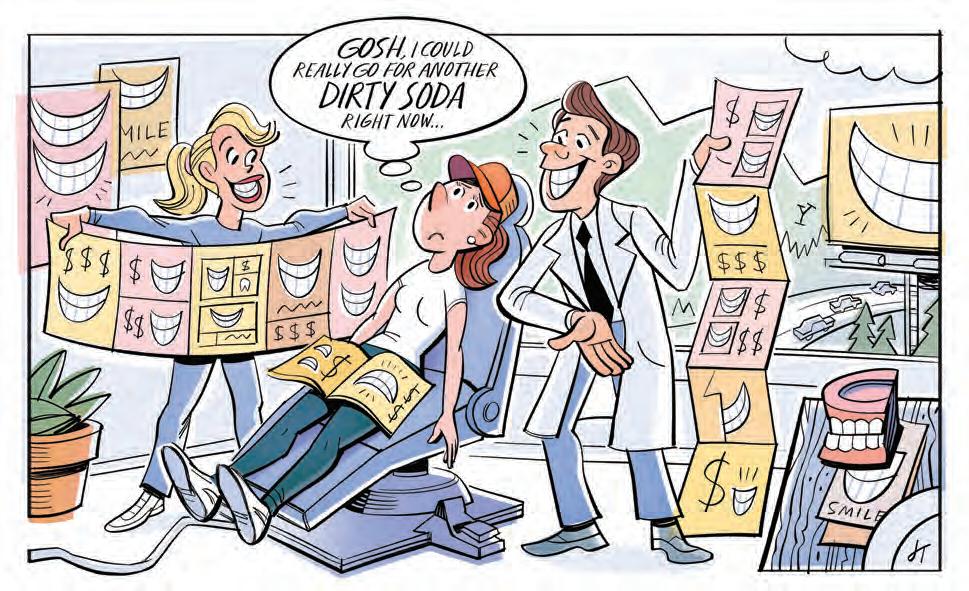
IT’S NO SURPRISE that teeth are big business in Utah, given our culture’s emphasis on good health and physical appearance. The amount spent per capita on braces, veneers and teeth whitening is probably exceeded only by how much we blow on dirty sodas, ice cream and oversized cookies.
My own children have benefited from Utah’s elevated dental standards, but as a kid in the 1970s, I missed out. Low expectations, no fluoride in the water and large families – in which kids policed themselves, hygiene-wise – resulted in some dystopian dental conditions. My parents did their best, but after raising five feral offspring, all they could muster was a vague reminder: “Remember to brush your teeth.” Taking this as a friendly suggestion, I would give my four front-facing chompers a performative five-second polish.
We were also tapped into a steady stream of tooth-eroding drinks: Tang (the fake orange juice for astronauts), sugary Kool-Aid
and an array of canned sodas purchased with coins pilfered from Mom’s purse or couch cushions.
As a result of these poor habits, my parents dreaded taking me to the dentist, knowing the question would be “How many cavities?” – not whether I had any. The dentist, in turn, must have cringed at my arrival because it meant lots of agonized squirming on my part and aggressive drilling on his – and thus a likely relapse of his carpal tunnel syndrome. Thank heavens, for both our sakes, they were liberal with the nitrous oxide back then.
With a lower-middle-class budget, my parents were intimidated by the emerging orthodonto-industrial complex in Utah. They caved to social pressure with my two older siblings, spending thousands on braces. With me, they made sure no teeth were missing or dead and then said, “You’re good.” They did buy me an expensive retainer – the poor cousin of braces – when I was in seventh grade, but after I accidental-
ly threw it away in the junior high cafeteria garbage for the fifth time, they were done pouring money into my mediocre mouth.
A childhood of poor dental care results, of course, in an adulthood of tight-lipped grins and humiliating trips to the dentist. A couple of years ago, I went in for a routine procedure – replacing a crown – but when the dentist took a close look, he decided my tooth was “no longer viable.” Seeing my confusion, he explained that it wasn’t infected or dead, just “resorbing into my head.” Sounded made up to me, too.
Perhaps to punish my skepticism, he subjected me to a three-hour extraction that felt primitive despite his high-tech office. He offered no nitrous oxide, my favorite part. He used one tool – household pliers, I think – and kept muttering, “Wow, you have really hard head bones,” as he readjusted his grip on stubborn roots.
I tried to dissociate from the violence and pain, but I could have sworn he braced a knee against my chest, then stepped on
my groin. With a bite blocker in my mouth, all I could do when asked if I was OK was whimper and drool.
MY KIDS HAVE experienced less trauma thanks to dental hygiene and good insurance. Their poor mom still dreads appointments because of consultations with managers and dental designers. Beyond getting healthy, straight teeth, she must decide on flair, hue, symmetry and degree of slenderization. Then come meetings about financing, future procedures and complications – impaction, malocclusion, collapsed arches and lip incompetence. I swear I didn’t make up that last one.
low point when our 10-year-old daughter chipped a front tooth while playing Power Rangers with rambunctious friends. In one afternoon, she faced an array of paralyzing choices: Which dentist? Whose methods? What materials? The final meeting with the specialist about the tooth became a scene from Conclave, the movie about cardinals choosing a pope.
landed on the front page. The saddest detail is my exhausted wife in the background –wearing a baseball cap as if trying to remain incognito and clearly falling asleep, her head tilted back and jaw slack, as if resigned to becoming the next patient.
My wife agonizes over aesthetic choices – whether involving home décor or our children’s teeth – which made these discussions especially stressful. She hit a
My wife’s stress continued to build through subsequent office visits and hefty charges arriving in the mail. Her fatigue peaked the day they installed the final masterpiece in our daughter’s mouth. By darkly karmic coincidence, a photographer from the Daily Herald was in the office, taking photos for an article about Utah’s booming dentistry business.
A large photo of our daughter, mouth gaping beside our fancy-pants dentist,
Now that our kids are all out of the house, I thought we were done with the cosmetic side of the industry. My wife, however, recently signed us up with a new dentist. At my first appointment, my insecurities came rushing back when the young hygienist – with vocal fry and eerily perfect teeth –launched into a pitch for expensive optional upgrades to my middle-aged mouth.
There’s no doubt my teeth are lame, but do I want to subject my wife to another round of consultations about the mouth of her largest child, who will never leave the house? I’m also worried that, with my luck, we’ll spend thousands of dollars and I’ll end up with a lisp and oversized, artificially white Chiclets for chompers.
Wiff me luck.
AUTHOR Kerry Soper writes and teaches satire, humor and history from Provo.