White Desert: Snow and fog transform Moab’s red rock into a quiet, rare landscape

NOVEMBER/DECEMBER 2025
SKIING
FREELEY
University of Utah partnership carving new paths for athletes

White Desert: Snow and fog transform Moab’s red rock into a quiet, rare landscape
NOVEMBER/DECEMBER 2025
SKIING
FREELEY
University of Utah partnership carving new paths for athletes
Three flavor-forward bowls built to chase off the cold
Utah Fast Food Homegrown chains that shaped the state
Ogden, pg. 9
Salt Lake City, pg. 28, 41
Midvale, pg. 28
Draper, pg. 40
Orem, pg. 28
Bountiful, pg. 28
Park City, pg. 41
Alta, pg. 20
Snowbird, pg. 6, 38
Provo, pg. 8
St. George, pg. 28
Moab, pg. 12

A Southwest-inspired vegetarian tortilla soup brings the heat with hot sauce and green chiles, topped with crunchy tortilla strips. Story begins on page 32.
Photo by Danelle McCollum.
5 Editor’s Letter
Observations from Chris Amundson.
6 Honeycomb
Snowbird’s underground ski tunnel; The Great Carp Hunt; Ogden’s Hof Germanfest.
10 Trivia
Play for gold with questions about Utah’s wins. Answers on page 43.
32 Kitchens
When winter bites, these spicy soups bite back.
36 Poetry
Our poets listen closely at winter’s waiting edge.
38 Uncommon Champions
Legendary 100-year-old Junior Bounous is still skiing and setting records.
40 Explore Utah
The Aquarium Lantern Festival and Sundance.
46 Last Laugh
Miscommunicated texts lead to digital chaos.
A veteran photographer captures Moab’s quiet magic as snow, fog and winter light transform Utah’s red-rock country into something rare and radiant. story and photographs by Tom Till
Through a groundbreaking program, the University of Utah explores pathways for athletes with disabilities to ski independently with the TetraSki. by Bianca Dumas
Appreciating Utah’s homegrown food chains – from fry-sauce pioneers to plate lunches and dirty sodas – and the community spirit that built them. by Jacque Garcia and Chris Amundson


UTAH HAS NEVER been much for doing things the usual way. We’re a state built on reinvention – beginning with the pioneers of The Church of Jesus Christ of Latter-day Saints who crossed the plains, looked at this unlikely desert basin and thought, let’s try something different. More often than not, that boldness becomes tradition.
The late Robert Redford understood that instinctive mix of risk and imagination. Forty years ago, hosting the nation’s most influential independent film festival in a small mountain town seemed audacious. But Sundance broke from Hollywood’s mold and made it its own. The festival thrived because Utahns, in their reliably untraditional fashion, embraced the experiment and let it grow.
This winter marks Sundance’s final year in Park City before the festival relocates to Colorado, and we’re taking a moment to honor the legacy built here – the premiere screenings, the snowy streets, the lively panels and the creative risk-taking that shaped four decades of storytelling. Utah didn’t just host a festival; we helped define what independent film could become.
You’ll find that spirit of reinvention throughout these pages, beginning in a place even more unlikely than a mountain-town movie mecca: the desert in winter. In “When the Desert Turns White,” photographer Tom Till captures Moab under a rare blanket of snow. Red cliffs glow through fog, frost settles on rock fins and canyon country suddenly goes quiet. Even our landscapes understand reinvention – and often reward us when we’re willing to see the familiar with new eyes.
Innovation takes a different form with the University of Utah’s groundbreaking TetraSki. In “Skiing Freely,” writer Bianca Dumas shows how engineers, athletes and instructors are reshaping adaptive recreation. Using sip-and-puff turns and joystick controls, athletes with disabilities can steer their own path down the mountain. Each turn is revolutionary, proof that Utah’s snowbound traditions expand when we ask ourselves, Who else deserves a place on the mountain? (Answer: It’s everyone).
We also celebrate homegrown creativity in “The Utah Way to Eat Fast,” a feature by Jacque Garcia exploring the rise of Utah’s food chains. Before they became beloved family staples, Mo’ Bettahs, Arctic Circle, Swig, Crown Burger, Kneaders and Cafe Rio were scrappy startups built on thrift, heart and the nerve to try something new – a Hawaiian plate lunch in a landlocked state or a “dirty soda” that turned into a cultural phenomenon. Their stories remind us that community is built through shared meals and someone brave enough to say, Why not here?
And no issue of Utah originals would be complete without Junior Bounous, the centenarian skiing phenom still carving turns and redefining what’s possible at 100. His story in “Uncommon Champions,” like so many in these pages, reminds us that limits – age, terrain or tradition – are often invitations, rather than boundaries.
As our state changes and grows, we’ll keep celebrating the people and places that choose to do things their own way. After all, around here, breaking from the mold is tradition.
CHRIS AMUNDSON Publisher & Editor editor@utahlifemag.com
November/December 2025
Volume 8, Number 6
Publisher & Editor Chris Amundson
Associate Publisher Angela Amundson
Editorial Assistant Savannah Dagupion
Design
Mark Del Rosario
Photo Coordinator Erik Makić
Staff Writer Ariella Nardizzi
Advertising Sales Sarah Smith
Subscriptions
Shiela Camay
Utah Life Magazine
c/o Subscriptions Dept. PO Box 270130
Fort Collins, CO 80527 (801) 921-4585
UtahLifeMag.com
SUBSCRIBE
Subscriptions are $30 for 6 issues and $52 for 12 issues. To subscribe and renew, visit UtahLifeMag.com or call (801) 921-4585. For group subscription rates, call or email publisher@utahlifemag.com.
CONTRIBUTE
Send us your letters to the editor, story and photo submissions, story tips, recipes and poems to editor@utahlifemag.com, or visit UtahLifeMag.com/contribute.
ADVERTISE
For rates, deadlines and position availability, call or email advertising@utahlifemag.com.
COPYRIGHT
All text, photography and artwork is copyright 2025 by Flagship Publishing, Inc. For reprint permission, please call or email publisher@utahlifemag.com.
by ARIELLA NARDIZZI
A skier’s shortcut in Little Cottonwood Canyon reveals 150 years of mountain history
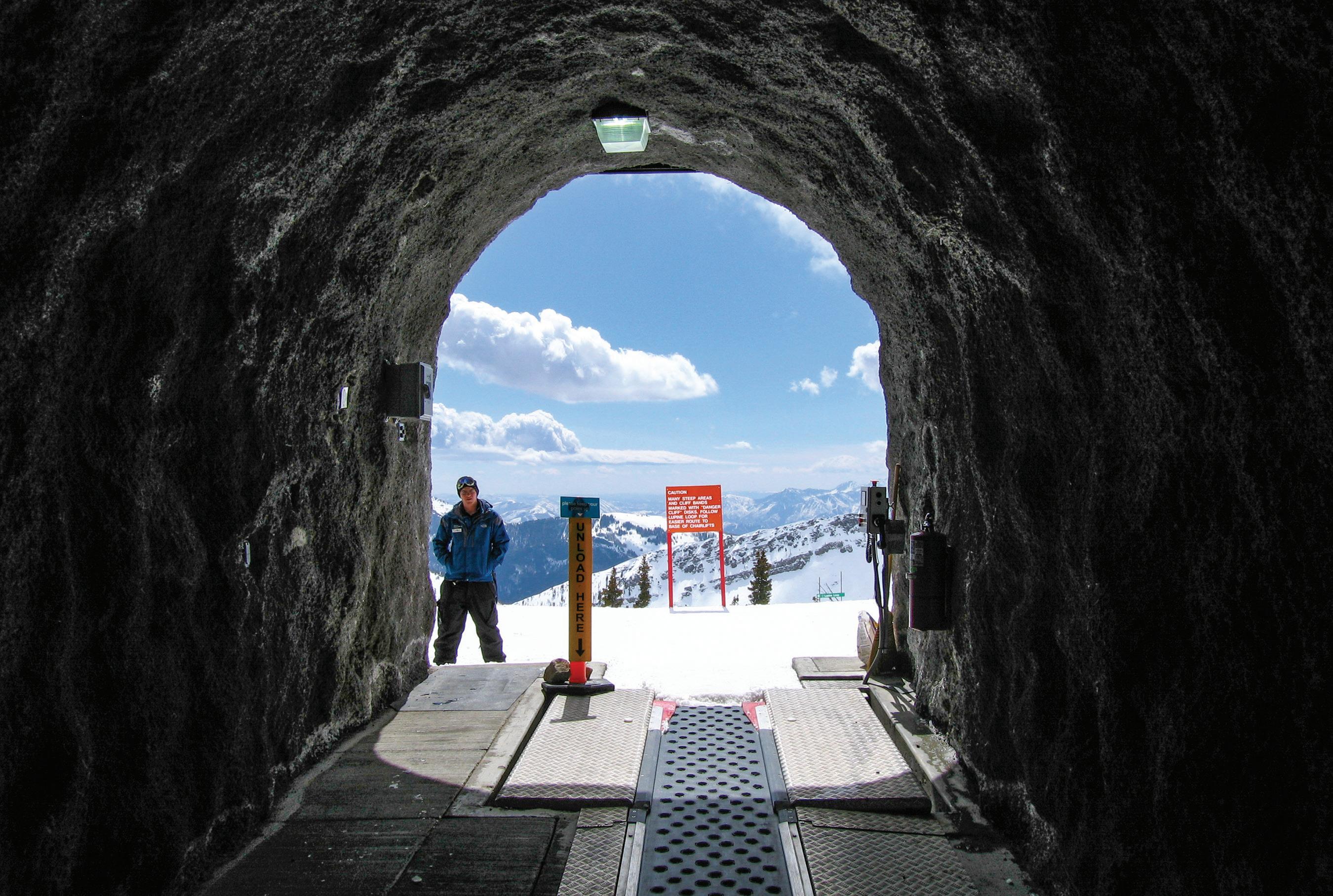
The entrance drops from snow glare into warm amber light, and the hum of a conveyor replaces the scrape of ski edges. Each winter day, a slow-moving line of riders steps onto the Magic Carpet inside Snowbird’s Peruvian Tunnel, a 595-foot passage carved beneath 200 feet of limestone and dolomite toward the open bowl of Mineral Basin. The belt moves at the pace of a casual walk – 160 feet a minute – through a corridor 10 feet wide and 12 feet tall. The space feels utilitarian at first, but a closer look reveals a quiet museum threaded through the mountain.
Peruvian Gulch – the slope above the tunnel – once held some of the canyon’s busiest 19th-century claims. During the boom years, ore carts loaded with silver crossed many of the same ridges that skiers traverse today, showing how the canyon’s economies have shifted over time. Miners followed veins of galena and silver through this same rock, and at its peak, more than 8,000 miners lived and worked in the canyon’s drainages.
Their tools, wagons and domestic scraps are now arranged along the tunnel’s length. Many of the artifacts came from dig sites or were recovered from crumbling structures in Albion Basin. Wagon wheels lean
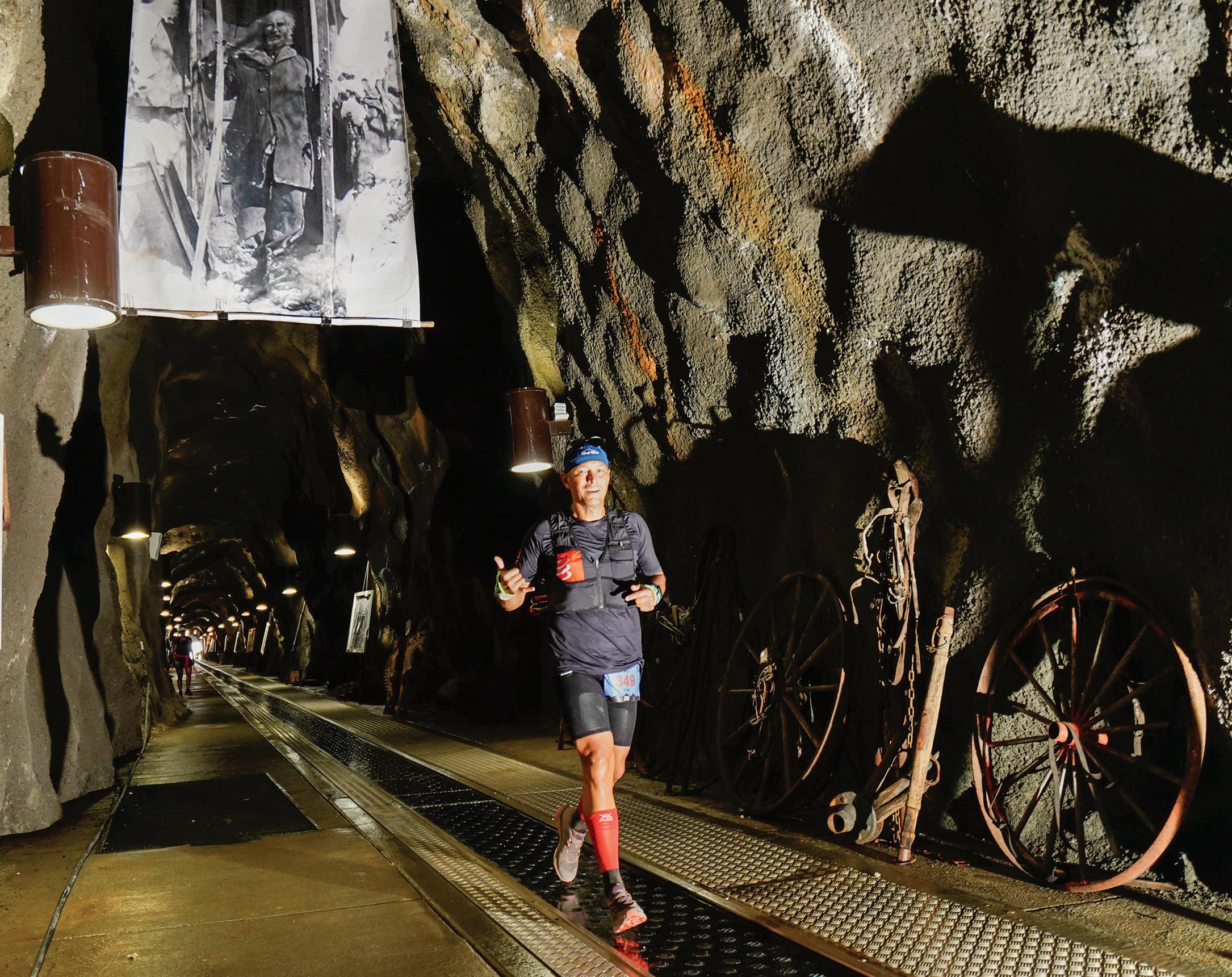
beside ore buckets stamped with Bay City, Flagstaff and Sell mines. At the midpoint, domestic relics like a rusted stove, bedframe, lanterns and Prince Albert tobacco tins hint at the human lives once lived in these mountains.
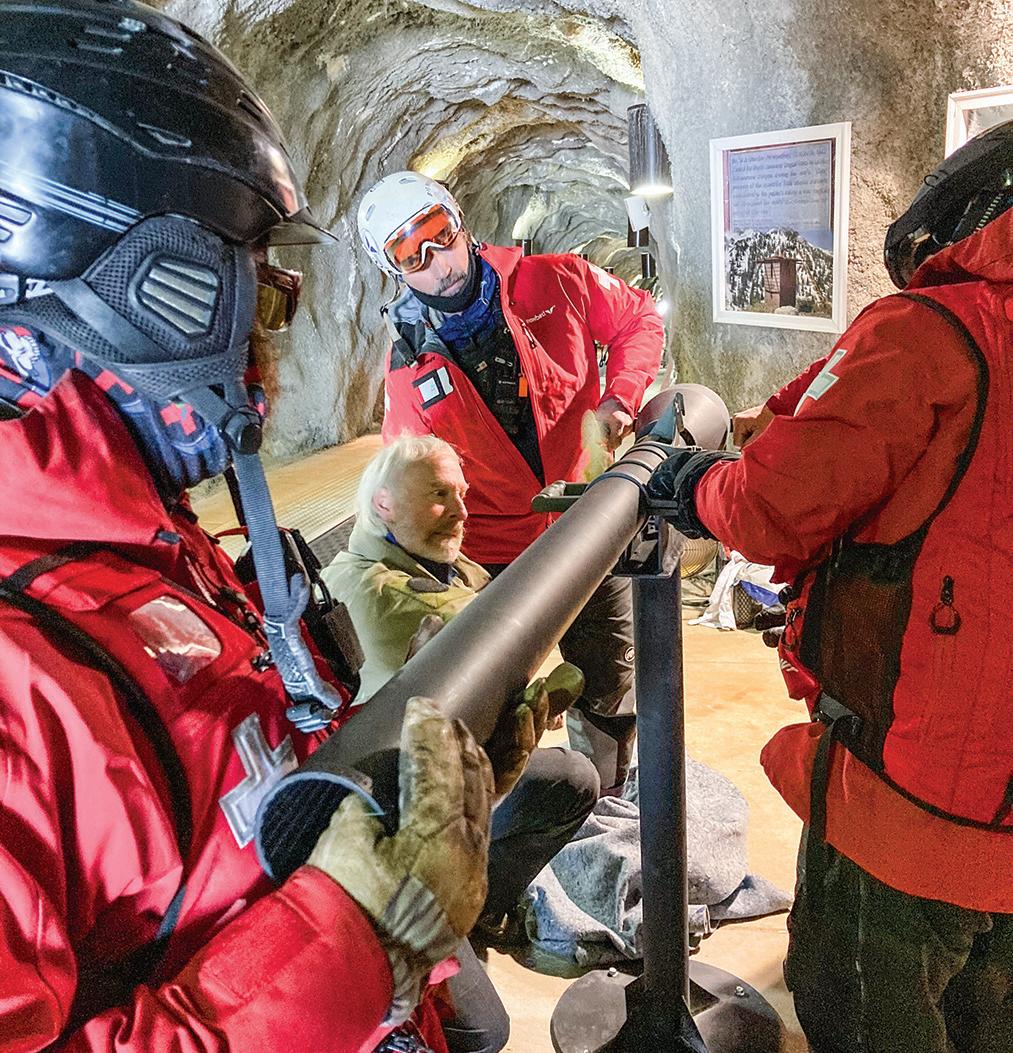
Near the south entrance rests a decommissioned U.S. Marine Corps M-20 recoilless rifle, used by ski patrollers for avalanche control until the 1990s – a reminder that the canyon’s more recent history left its own marks. In the tunnel’s muted light, each object feels lifted from a specific moment in Little Cottonwood’s past.
Much of the tunnel’s current look comes from the quiet, persistent work of volun-
teer curator Dan Schilling of Alta. Long before he became involved, an overwhelming amount of donated artifacts cluttered the tunnel. Over time, Schilling and others have helped organize that collection, hauling out what he estimates as two snow-cat dumpsters of objects to let the most meaningful pieces stand out. He has spent hours tracing the origins of items – and in one case, years tracking down the M-20 rifle.
For Schilling, the displays aren’t nostalgic decoration. They’re a record of people who lived hard, seasonal lives in terrain that still shapes every storm and avalanche path today.
The tunnel opened in 2006, built by
crews who bored through the mountain at 24 feet per day. The conveyor climbs at a subtle grade, carrying riders toward the ridgeline once lined with bunkhouses and ore trams. When high winds close the Aerial Tram, the tunnel becomes the surest link between Snowbird’s two worlds – a steady four-minute glide that carries 150 years of canyon history through a single underground crossing.
By the time the Magic Carpet eases riders toward the tunnel’s south exit, the dim corridor has done its quiet work. What begins in shadow opens again to sun and snow, carrying a faint, steady presence of the people who once shaped this canyon.
by TIM GURRISTER
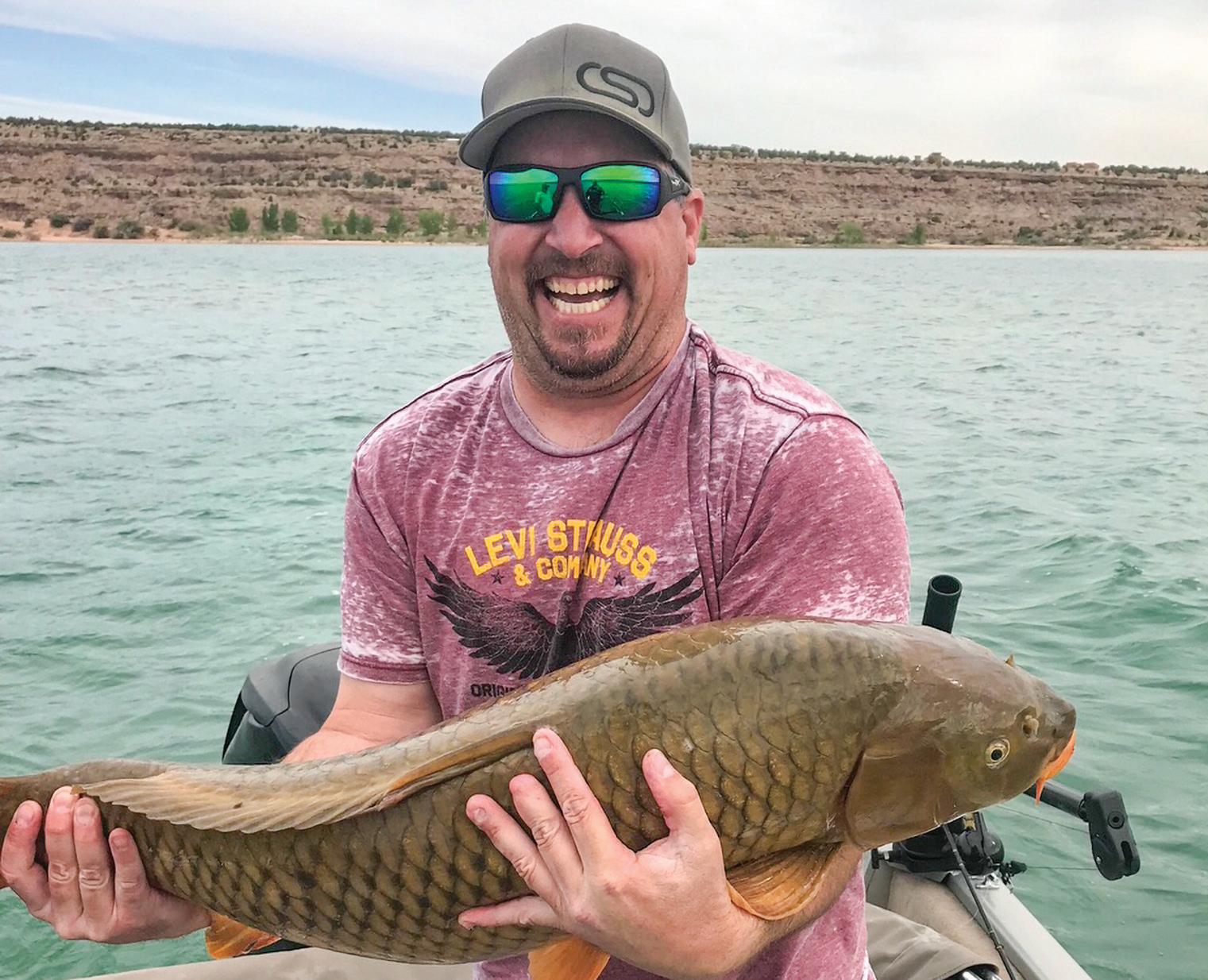
If you think saving a fish requires a Ph.D. and a government grant, you haven’t met the crews in “The Great Carp Hunt 2025.” Fifty-seven teams strong, they’ve turned Utah Lake into an arena for one of the strangest and most satisfying environmental battles around.
With names like Carp Slayers, Carp Kings, Carpe Diem and the gloriously unintimidating Knockles, the competition rewards anyone willing to rid the lake of its most reviled resident. Don’t knock it –pun unavoidable – Knockles sits in second place with 911 carp landed. And out front is Team BPS, bowfishing hotshots from the Utah Bowfishing Association, whose tally of 1,406 fish has left the rest floundering.
It’s a showdown of opposites: the lumbering, muddy-faced troublemaker versus the lightweight hometown hero that once fed Utah’s pioneers.
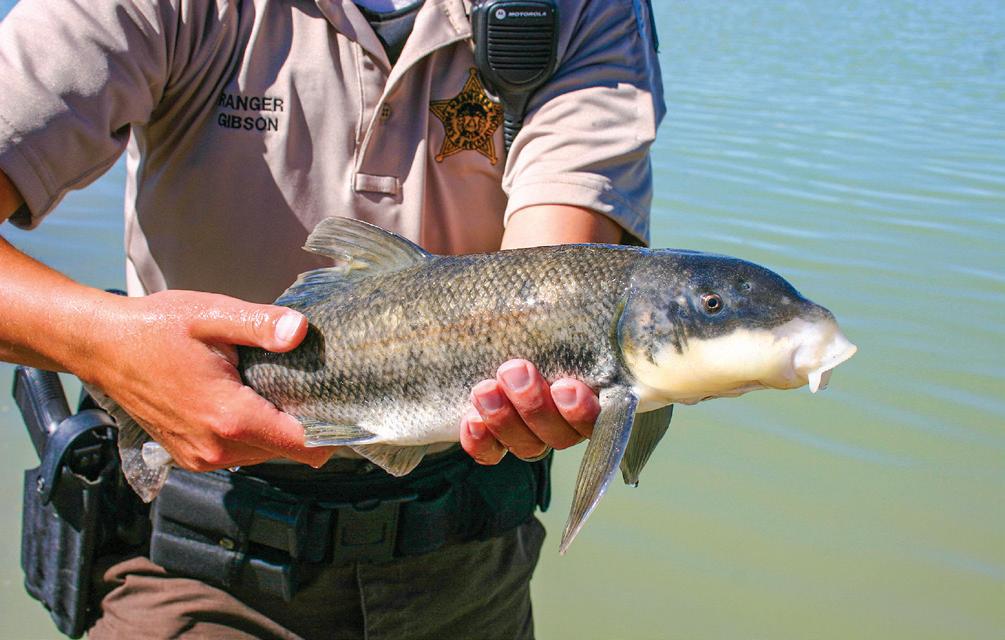
The tournament is the latest twist in a decades-long effort to save Utah Lake’s most famous native, the June sucker, a silvery five-pound fish once so abundant
that early settlers joked you could catch dinner with a rake.
Those days are long gone. By the mid1980s, the June sucker’s numbers had fallen to just a few hundred. Carp, hulking bottom-feeders that churn up the lakebed and uproot plants, didn’t help.
To save the native fish, a coalition of state and federal agencies formed the June Sucker Recovery Implementation Program 25 years ago. The plan has helped create new spawning grounds, restore 250 acres of critical habitat along the Provo River and lift the species from endangered to threatened. But as Kelly Cannon-O’Day of the Utah Lake Authority admits, “We’ll never be done with the carp. They’re like dandelions in your lawn. We’ll never get them all.”
Still, that hasn’t stopped the anglers. Their efforts join a larger, long-running push on the lake, where seasonal netting crews with the Division of Wildlife Resources remove tens of thousands of carp each summer. The contest gives the public a way to help.
Monthly heats since February have pulled thousands of carp from the 24-mile-long lake, and the hunt continues through No-
vember with stops in Saratoga Springs, Lindon and Utah Lake State Park. Each month’s victors share $1,000 in prizes, and the grand champion in December will pocket up to $10,000 and eternal bragging rights.
All methods are welcome. Some competitors bowfish, firing arrows trailed by fishing line and sometimes spearing two or three carp at once. Others stick with straightforward tackle – anything that pulls a carp from the lake counts. Longtime sailor Louise Frye of the Bonneville School of Sailing says she doesn’t hate carp. “They just want to get rid of them.” She laughs at the spectacle: boats circling, arrows flying, fish flashing in the sun as crowds cheer from the docks.
For the June sucker, it’s poetic justice. Nearly two centuries ago, Utah pioneers depended on the native fish to survive crop failures and harsh winters. According to early accounts, settlers could scoop suckers straight from the shallows with their hands or drag unbaited hooks through the water and haul in dinner by the dozen.
Now a new generation returns the favor – one cast, one arrow, one netful and one carp at a time.
by RON J. JACKSON, JR.
President Dwight D. Eisenhower once envisioned a “People-to-People Program,” where American cities would bond with “Sister Cities” around the world to foster peace through citizen diplomacy. The spirit of that vision is not only alive but thriving in Ogden.
For the 40th consecutive year, Utahns will celebrate the Hof Germanfest on Jan. 16-17, 2026, at the Eccles Conference Center in downtown Ogden. The twoday festival honors Ogden’s relationship with its Sister City in Hof, Germany – a relationship dating back to 1954. It even predates the formal establishment of the Eisenhower-inspired, non-governmental organization Sister Cities International by two years.
Longtime festival volunteer Bill Bennett proudly calls the Hof Germanfest “the best Germanfest in the West,” citing its steadfast commitment to authentic German music and freshly prepared dishes such as schnitzels, bratwurst, spätzle, Old-World pastries and crusty breads.
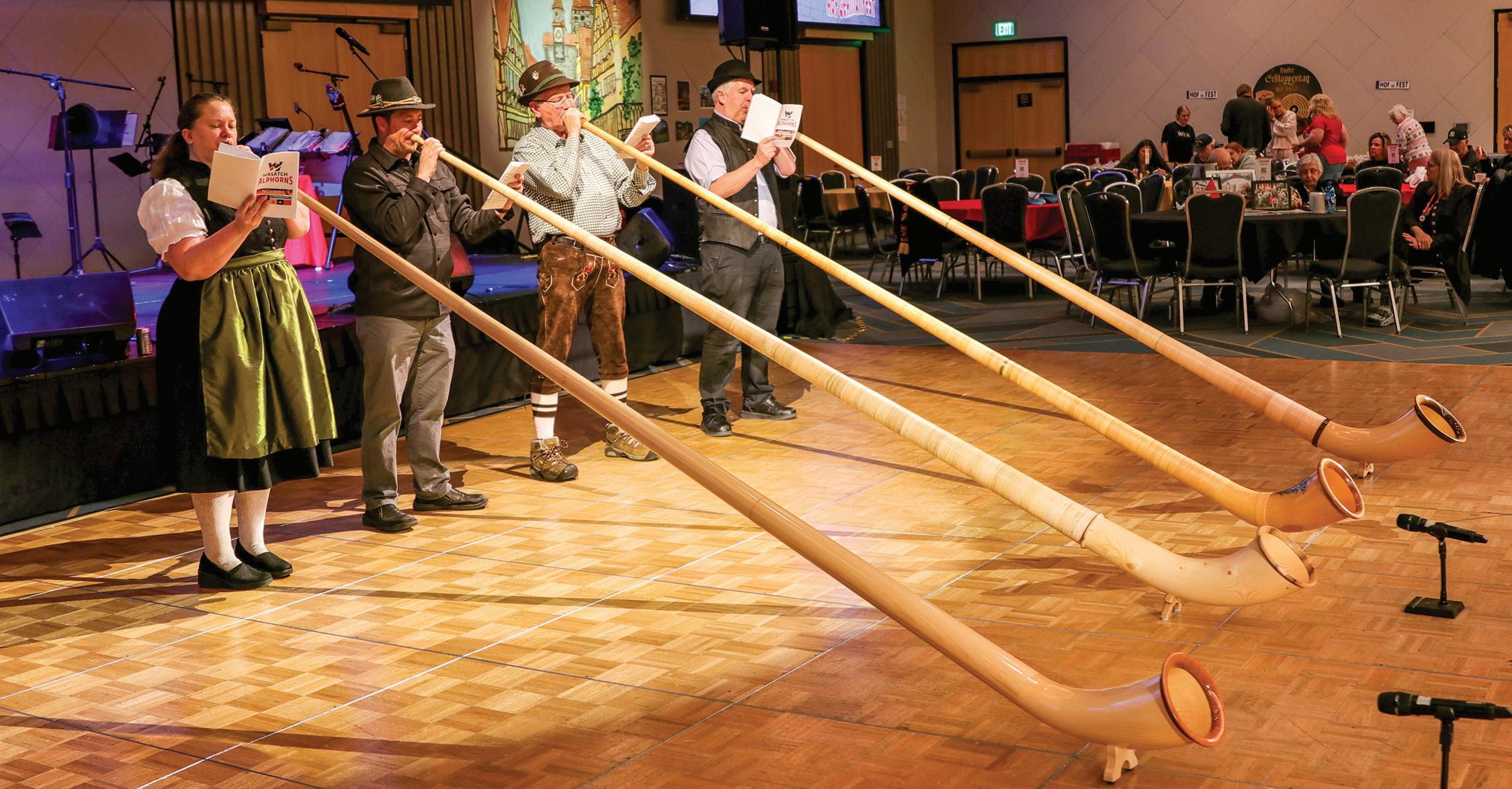
Three noted groups – the Hammerstein Band, Salzburger Echo and the Wasatch Alphorns – perform traditional German music and folk songs. The latter is a co-op of Utah musicians dedicated to the art and history of the Swiss alphorn, a long, narrow wind instrument traditionally carved from a pine trunk.
More than 25 vendors line the festival floor with homemade treats and traditional hand-carved wooden toys. Yet at the core of the festivities is something far less tangible – the cherished, 70-year relationship with the people of Hof.
“When you really get down to it, this celebration is about having an open mind and seeing people for who they really are – people,” said Bennett, who has served as an unofficial liaison between Ogden and Hof for more than three decades. “It’s about seeing people beyond history or beyond the news. It’s about making friends and building relationships while under-
standing that we really have a lot more in common with other people than we might think. We have done that with our friends in Hof.”
No one believed more in the deeply human side of Ogden’s Sister City relationship than its late mayor, Scott Sneddon. He was instrumental in establishing the first festival in 1986 – then called the Ogden Hof Winter Carnival – and remained a driving force behind the event until his death from cancer in 2005. Since then, more than 2,500 residents of Hof have visited Ogden for cultural and educational experiences.
Prior to his death, Sneddon summoned friends Jim Harvey and Bennett to his home. Knowing his time was short, he asked both of them to help keep the festival alive.
“For him, it was like asking if I would adopt his child,” recalled Harvey, a Weber County commissioner. “Of course, I said, ‘Yes.’ And look at us now – we’re still going strong, beyond anyone’s wildest dreams.”
The Hof Germanfest runs 11 a.m.-9 p.m. Jan.16-17, 2026. Tickets can be purchased at ogdenpet.com or at the door.

From battlefields to ballfields, the Beehive State plays for keeps.
by BEN JENKINS

1 In 1848, the United States gained the land that would later become the state of Utah upon signing the Treaty of Guadalupe-Hidalgo, which ended what war?
2
Provo’s own BYU Cougars won the NCAA Division I national football title after winning the Holiday Bowl against what Big Ten team, led by their then-quarterback Jim Harbaugh?
3 In 1935, Malcolm Campbell’s Rolls-Royce-powered Blue Bird became the first land vehicle to surpass 300 miles per hour when it sped across what level region of western Utah?
4
Orson Scott Card, who went to BYU and is the great-greatgrandson of Brigham Young himself, twice won the Hugo and Nebula Awards for science fiction for what novel and its sequel Speaker for the Dead?
5 What goalkeeper was named the man of the match in the 2009 MLS Cup final, where Real Salt Lake won its first and only championship 5-4 in a penalty shootout after a 1-1 draw in regular time?
6
Throughout its 33 seasons (and counting!), which of these famous Utahns remains the oldest winning celebrity on “Dancing With the Stars”?
a.Jewel
b. Donny Osmond
c. Steve Young
7 On Feb. 14, 1870, Seraph Young walked into Salt Lake City’s Council Hall and became the first woman in the history of the United States to do what?
a. Get a driver’s license
b. Join the Army
c. Vote
8
What NHL team did the Utah Mammoth (then the Utah Hockey Club) beat for their first ever regular season franchise win on Oct. 8, 2024, at home in Salt Lake City’s Delta Center?
a. Chicago Blackhawks
b.Florida Panthers
c. Colorado Avalanche
9
Throughout its 178-year history, Salt Lake City’s Mormon Tabernacle Choir has won just one Grammy Award – the 1959 trophy for Performance by a Vocal Group or Chorus – which it won for what patriotic song?
a. “Battle Hymn of the Republic”
b. “America the Beautiful”
c.“My Country, ‘Tis of Thee”
10 In 2017, Logan native and former University of Utah professor Kip Thorne was jointly awarded the Nobel Prize in Physics. He won it for his work observing what?
a.Exoplanets
b. Quantum decoherence
c. Gravitational waves
11 In 1982, the University of Utah was the site of the first successful human implant of an artificial heart, which was invented by U of U Medical School graduate Robert Jarvik.
12
Salt Lake City won the International Olympic Committee’s bidding process to be named host of the 2034 Winter Olympics. When that happens, it will become the first city ever to host the Winter Games twice.
13 In 2018, the NCAA retroactively awarded the undefeated 2008 Utah Utes football team a share of that year’s national championship, which was otherwise won by Florida in the BCS Championship game.
14 During his original 74-game run on “Jeopardy!,” BYU graduate and former Utah resident Ken Jennings only missed one Final Jeopardy question, during the game he finally lost.
15 Karl Malone is the only member of the Utah Jazz ever to win the NBA MVP Award.

No peeking, answers on page 43.

TILL
MOST VISITORS COME to Moab for heat and light – red stone under blue sky, sunlight bouncing off canyon walls, trails warm enough for sandals. But for those of us who live here, the true magic comes when the weather turns. A cold front rolls across the desert, clouds sink into the canyons and the red rock glows deeper than it ever does in summer.
I’ve spent more than 50 years watching that transformation, chasing the moments when snow, ice or fog change the familiar into something fleeting and strange. Bad weather, as I like to call it, is what makes this place come alive.
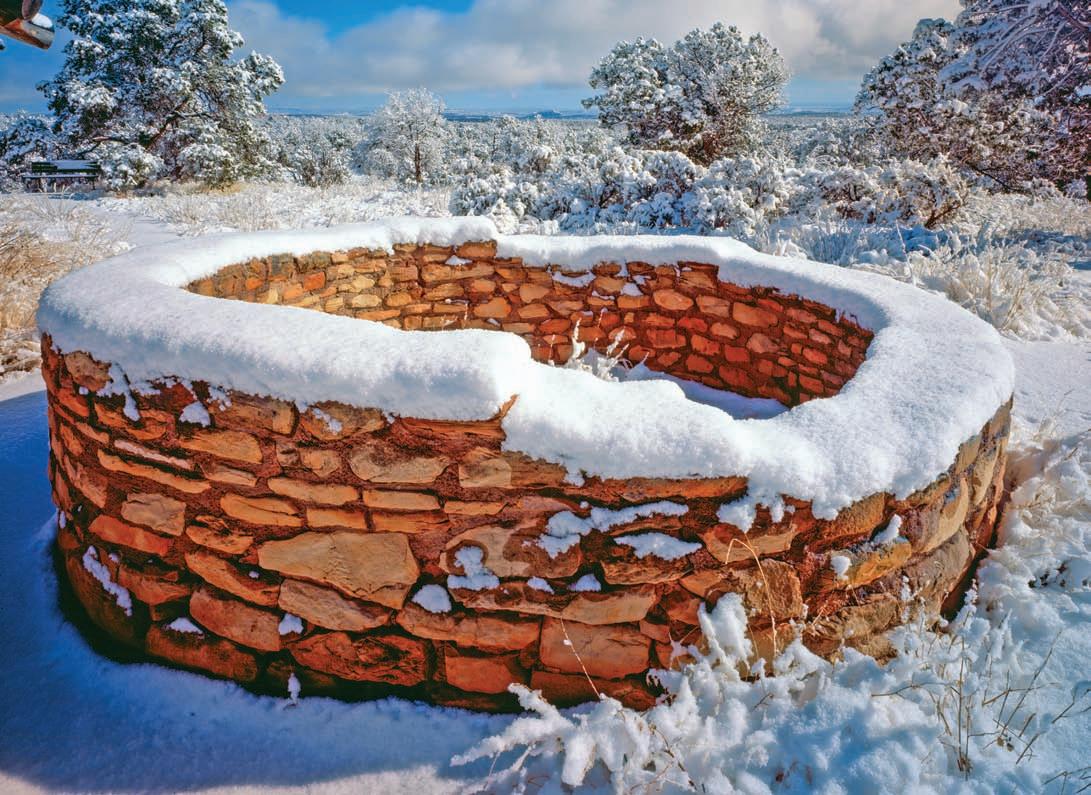
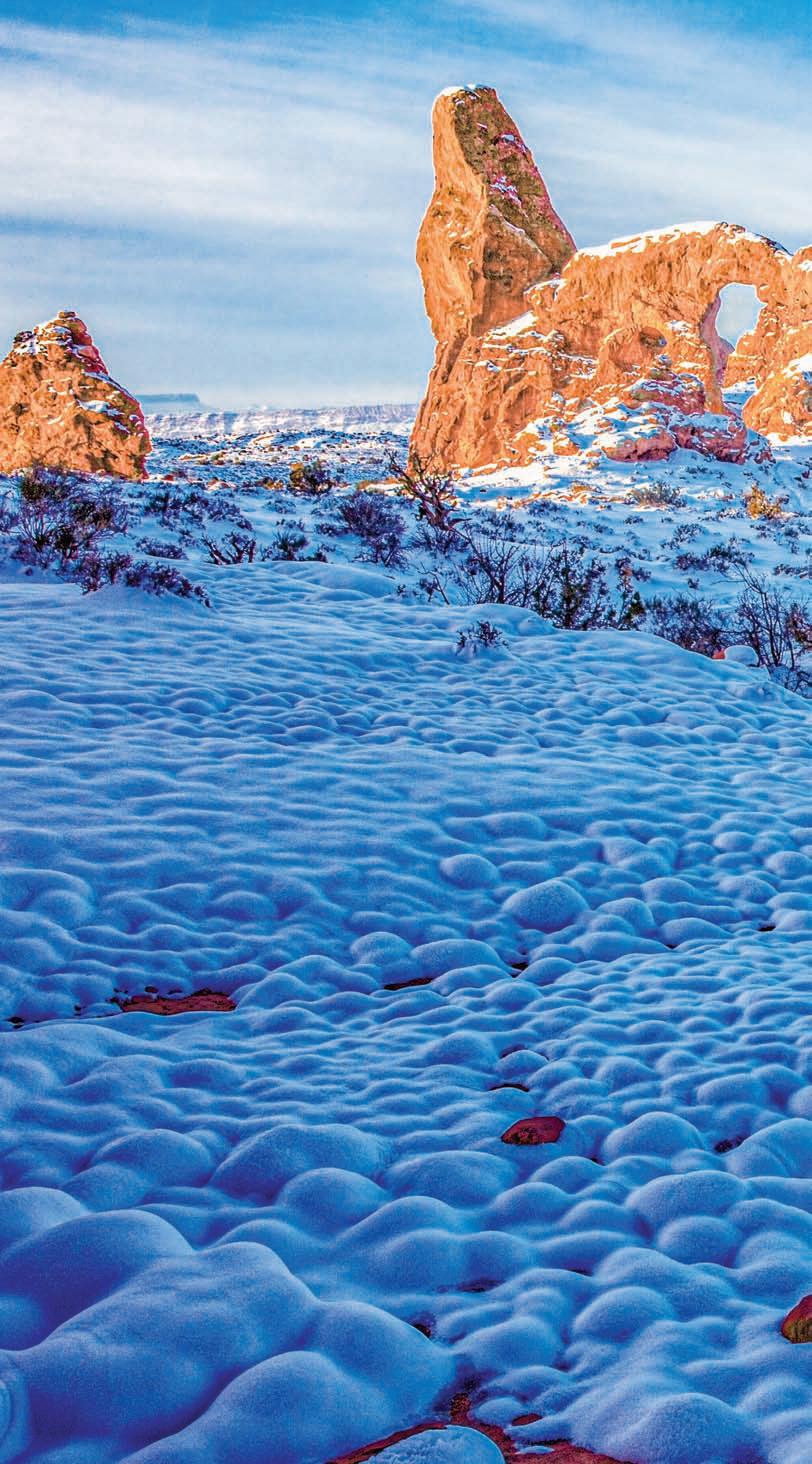
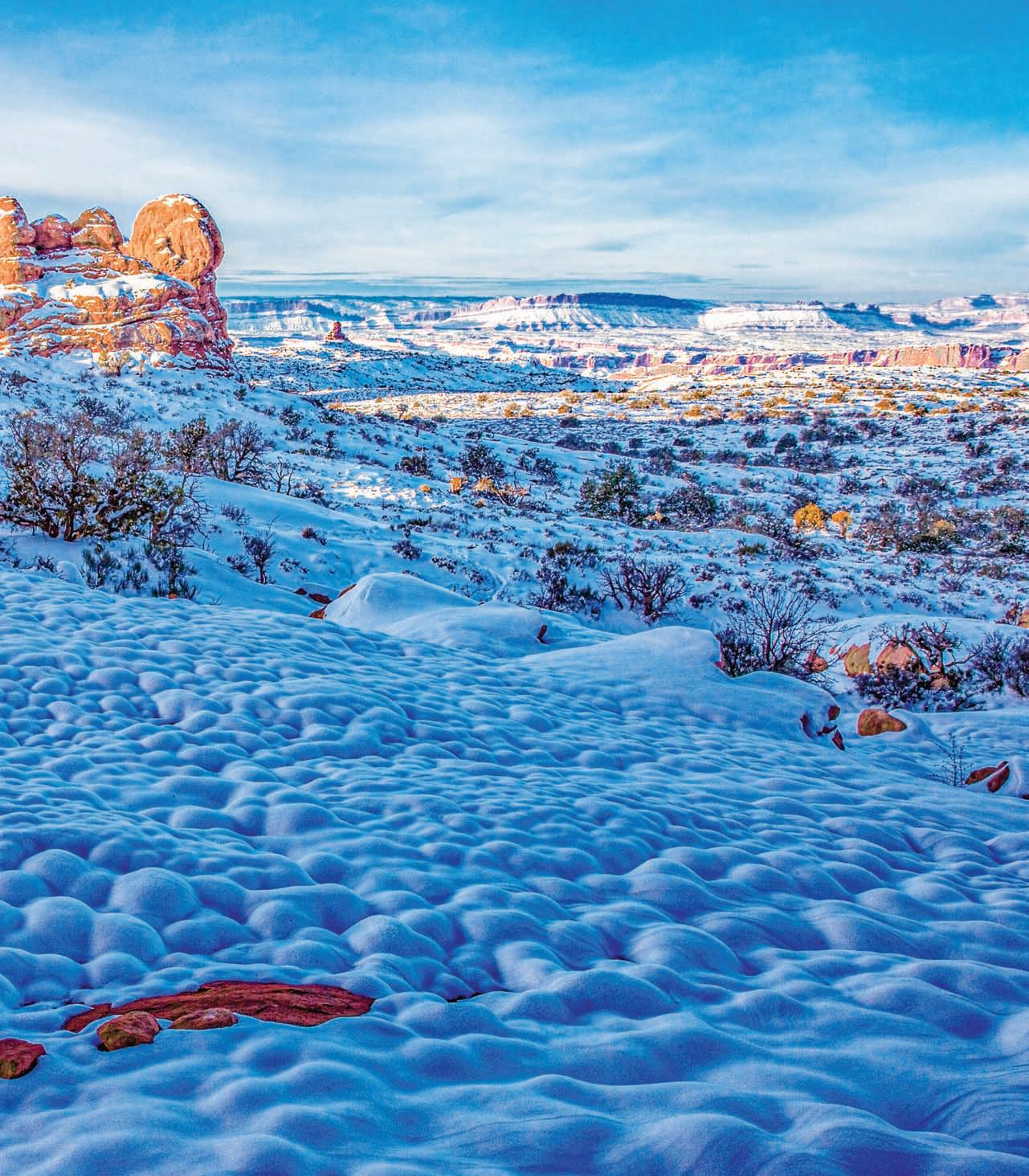
By late fall, Moab exhales. The crowds thin, traffic fades and locals take a deep breath. Afternoon light turns soft and golden. After a snowstorm, the whole valley hushes – tire tracks muted, cliffs dusted in white, the air rich with stillness. Winter, for us, is a season of calm and rediscovery.
For photographers, that quiet is an invitation. Snow and sun together make the red rock even redder. I can’t explain physics, but it happens every time: a luminous, impossible color that feels like the desert’s reward for patience.
Winter weather in canyon country is unpredictable. You can’t plan a trip around it; you have to wait and be ready. Some years the storms come one after another; others, barely a flurry. But when the forecast hints at moisture or fog, I load the truck and head out.
Where I live in Moab, at 4,700 feet beneath a north-facing cliff, I often get more snow than Arches itself. Dead Horse Point and Island in the Sky, 2,000 feet higher, usually see the best events. I’ve been to Dead Horse hundreds of times after storms and never once grown tired of it. The cliffs there hold snow like frosting, and when fog rises through the canyons, it feels like watching the Earth breathe.
These days, park gates sometimes close for plowing after big storms, a newer policy that slows photographers down but keeps the roads safe. When they reopen, I’m usually one of the first through. December and January also bring a rare treat: the only months drones are allowed in Utah state parks with a permit, a gift for anyone trying to capture the scope of this winter world.
Higher up, the La Sal Mountains gather deep snow that lingers well into summer, feeding waterfalls and streams across the valley. Faux Falls near Ken’s Lake is one of my favorite places when it freezes, its curtain of ice glowing blue in the morning light.
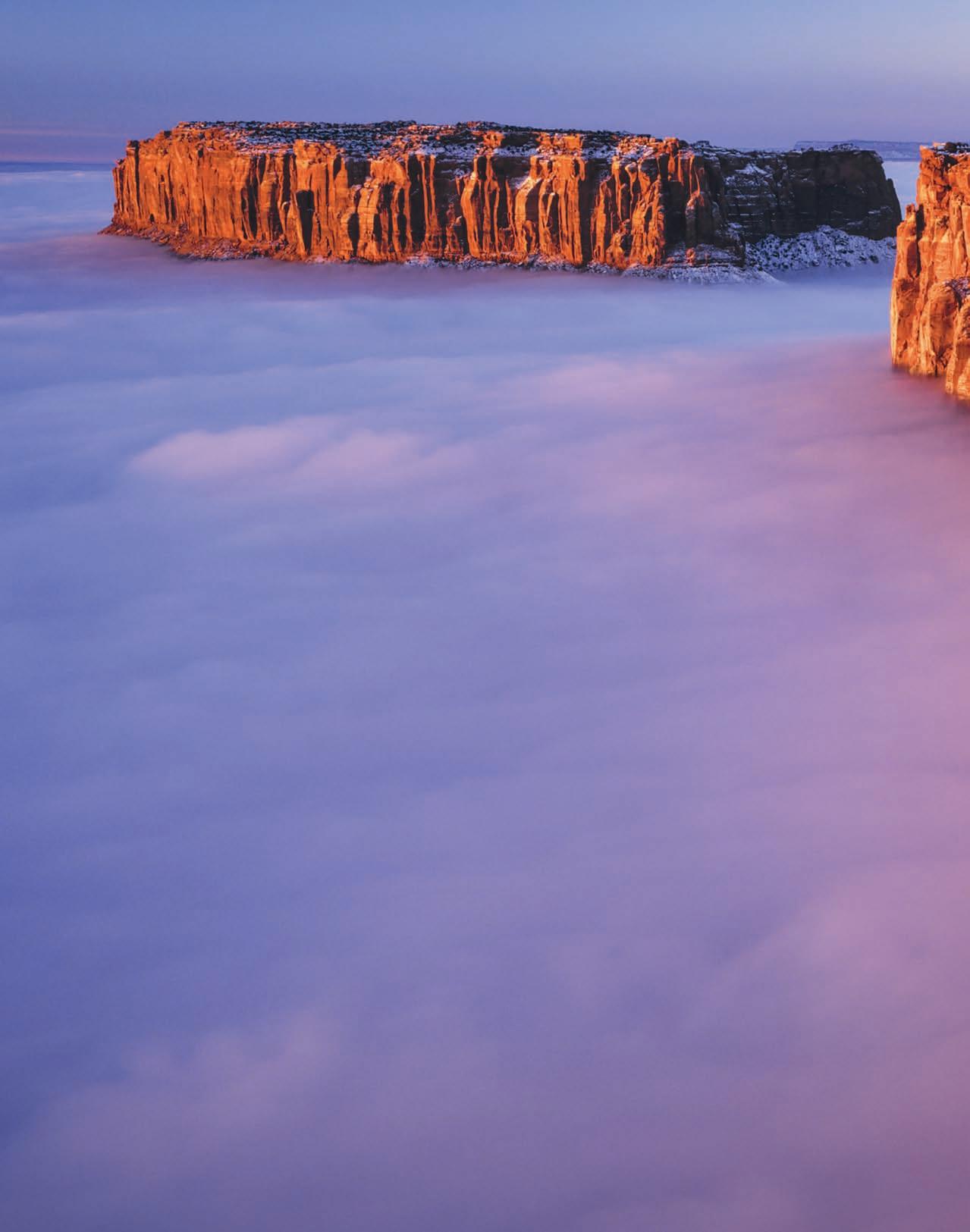
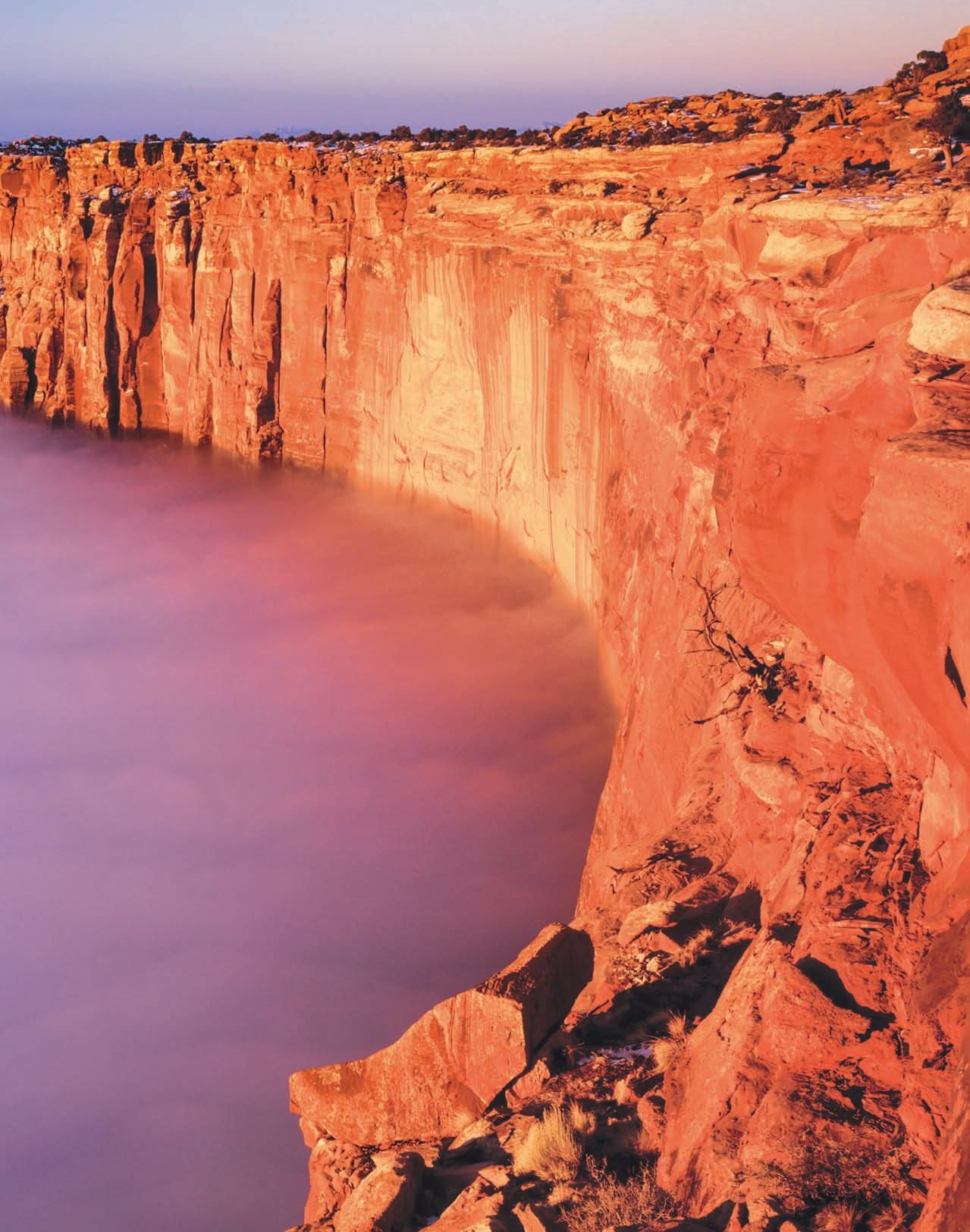
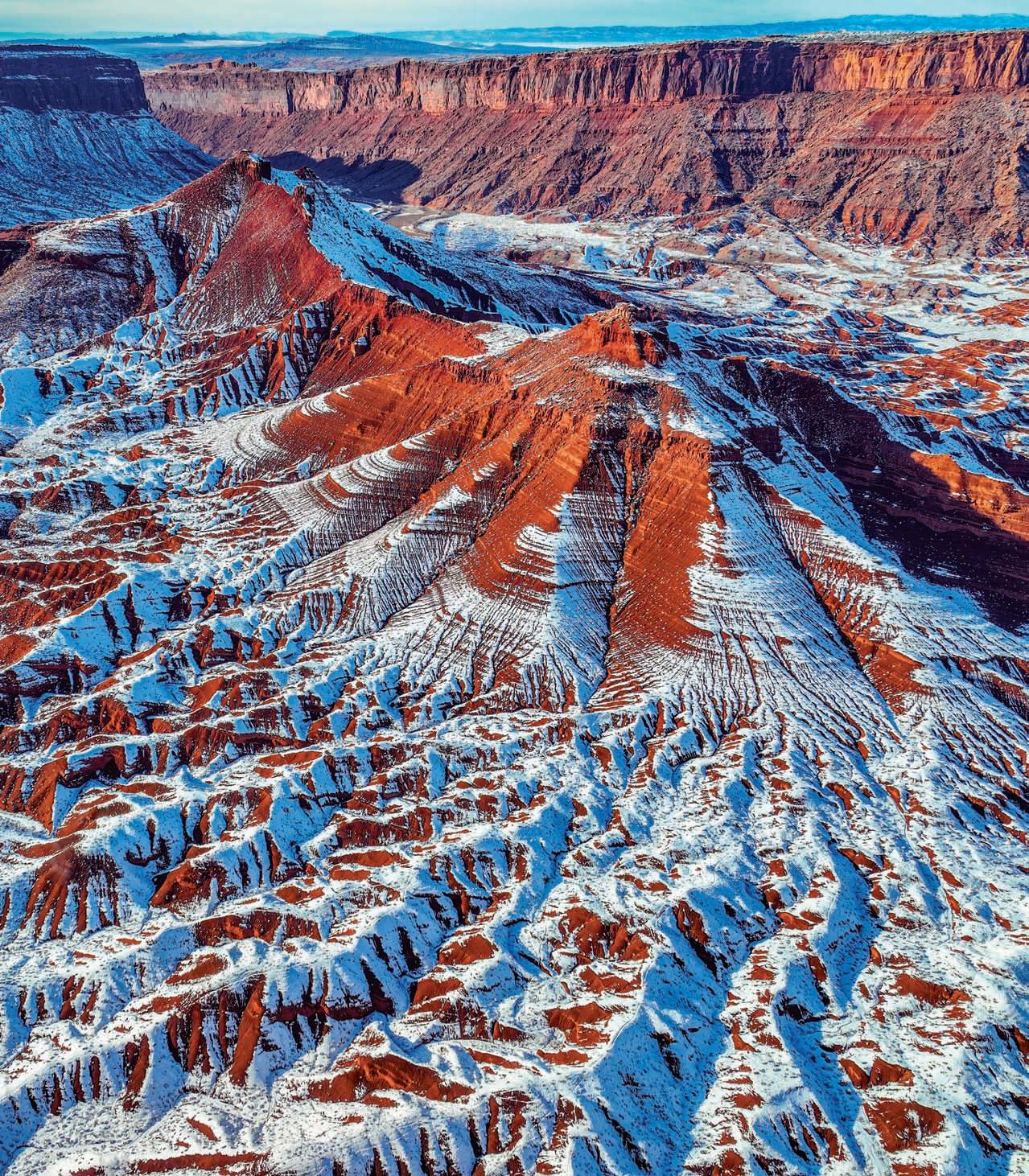
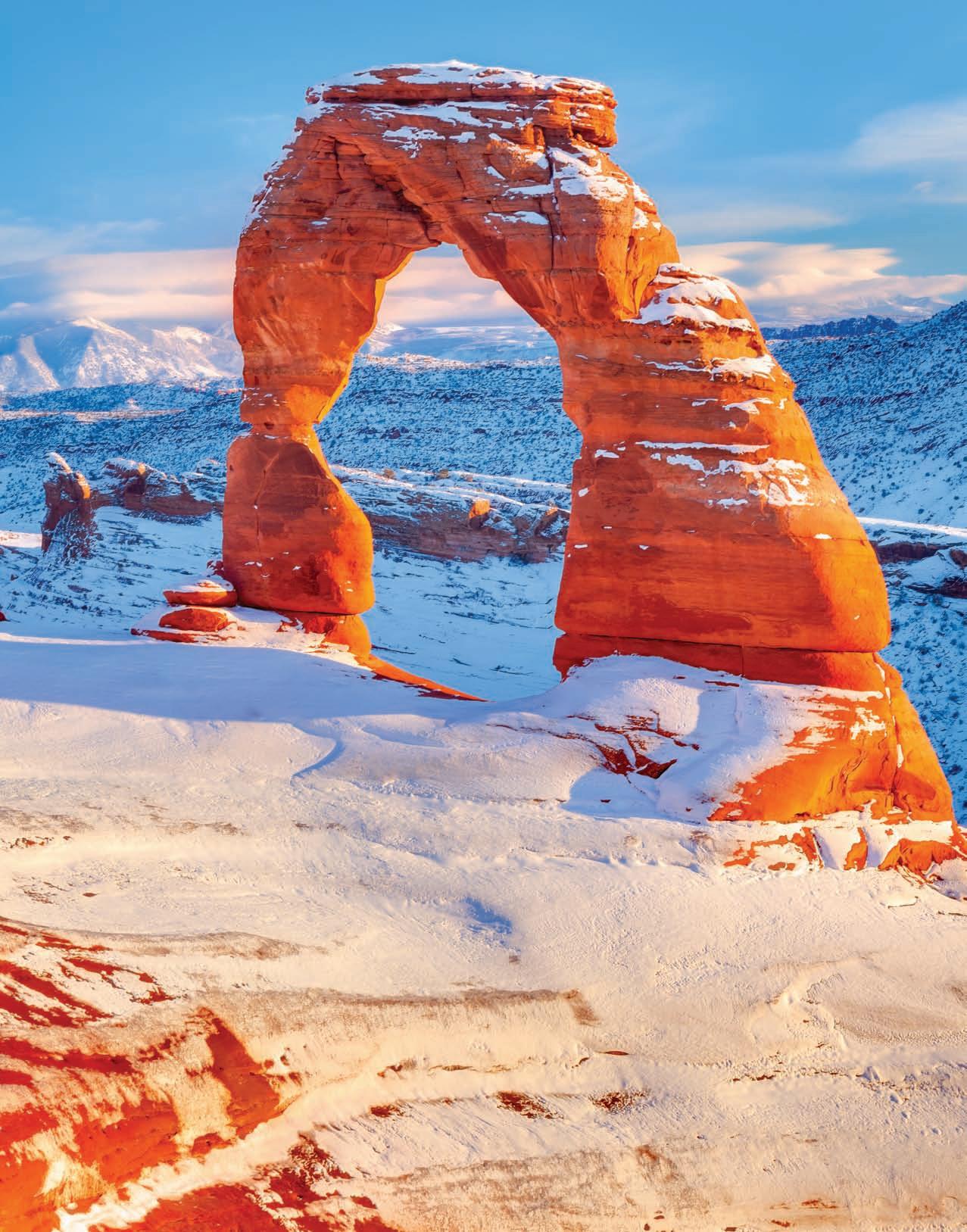
Winter settles over the desert in a reverent blanket. From Grandview Point in Canyonlands National Park (front), a rare fog “sea” smothers the landscape. Snow speckles the Colorado River in Castle Valley (right).

Another winter drive leads up Geyser Pass, where a four-wheel-drive road climbs into the spruce and aspen. After days of low clouds, the trees there can turn white with rime ice, every branch crystallized and the forest glittering like glass. It’s a quiet world of its own and one of the best winter scenes near Moab.
Down below, the Colorado River tells its own story. Along Highway 128, ice “cow pies” spin in the current during cold snaps, little white discs colliding and reforming. I’ve seen the river freeze nearly solid, though that’s rare now. Once, after a storm in February 2019, I drove the unplowed highway at 10 miles per hour, 2½ feet of snow on the ground. The sun broke through that afternoon, and the river ran dark through fields of blinding white. It
was the most spectacular scene I’ve ever witnessed here.
Moab’s fogs used to last for weeks, turning the valley into a gray dreamland. That doesn’t happen as often anymore, but when it does, it’s worth the wait. The Green River side of Canyonlands, near Grandview Point, is famous for it. Once, my friend Steve and I arrived before dawn to find a sea of fog stretching to every horizon. Candlestick Tower poked through the mist like a ship’s mast. As the sun rose, the sandstone cliffs reflected red light onto the fog below, painting the clouds crimson. We barely remembered to press the shutter; it was that overwhelming.
The next morning, the fog was gone, and it never came back. Moments like that are what keep me chasing the storms.
Snow in Arches National Park is rare enough that when it happens, you drop everything and go. Delicate Arch under fresh snow is as close as Utah gets to a pilgrimage. You want to be there as soon as the storm ends, before the sun melts it away. The approach can be slick, and that sloping ledge feels steeper when icy, but the reward is worth the caution.
Mesa Arch, on the other hand, is made for winter. The arch faces south, catching the low sun directly. In summer, the sun rises behind the La Sals, but in winter it clears the mountains, lighting the underside of the arch with deep, fiery red. The snow underfoot can be treacherous; I’ve slipped more than once. The cliff edge nearby drops hundreds of feet. There’s never been a fatal fall there, and I hope it stays that way.
Other arches – Skyline and Landscape near the end of the park road – stand higher and hold snow longer. Their trails are easy enough even in cold weather, but it’s wise to leave time for the hike back before dark. Once, I stumbled upon six lost visitors wandering near Landscape Arch as night fell and temperatures plunged. We found the trail together, and they made it back safely.
Some winters bring deep snow; others only a dusting. In 2023, the La Sals saw their biggest snowfall in years, feeding rivers and keeping the peaks white through August. In 2011, Moab itself got more snow than Salt Lake City Airport. I came home from an assignment in Australia to find 20-foot piles in parking lots. I’d missed the storm, but I still smile thinking about it.
Weather teaches patience. You can’t summon a blizzard or a sea of fog, but if you stay long enough, something wonderful always happens.
Winter doesn’t have to be extreme to be beautiful. On calm days, when the sun hangs low and the La Sals glow white on the horizon, hiking and photography are pure joy. Roads are quiet, lodging is cheaper and locals smile more. The holidays pass peacefully, and every afternoon feels like a gift.
For me, this season is a reminder that the desert’s power isn’t only in heat or light. It’s in stillness. Snow, ice and rain reveal another kind of beauty, one that softens the edges and deepens the colors. I’ve photographed deserts around the world – even a rocky corner of Kazakhstan that looked a bit like Utah under snow – but none hold the mystery of a red canyon blanketed in white.
Winter in Moab is the desert dreaming. And for those willing to wait for the storm, it’s the most beautiful dream of all.
A University of Utah program opens new paths to independence for athletes with disabilities
by bIANCA DUMAS
THE SNOW IS coming down in a “wintry mix,” big flakes and tiny snowballs of graupel collecting in our laps as we ride the chairlift at Alta. No matter how many times you’ve done it, riding the lift is always a bit of a thrill. Maybe it’s more exciting for our companion, Krishna Khushalani, who sits on a TetraSki elevated a few inches higher than the lift seat, the snowy world far below.
It looks like Khushalani is sitting precariously, but he’s anchored in and doing great. His ski instructor, Cullen Robinson, sits on one side while volunteer Rob Jones sits on the other, each gripping the TetraSki’s handle. The Khushalani family came from Georgia to ski at Alta, alerted to the opportunity by their physical therapist.
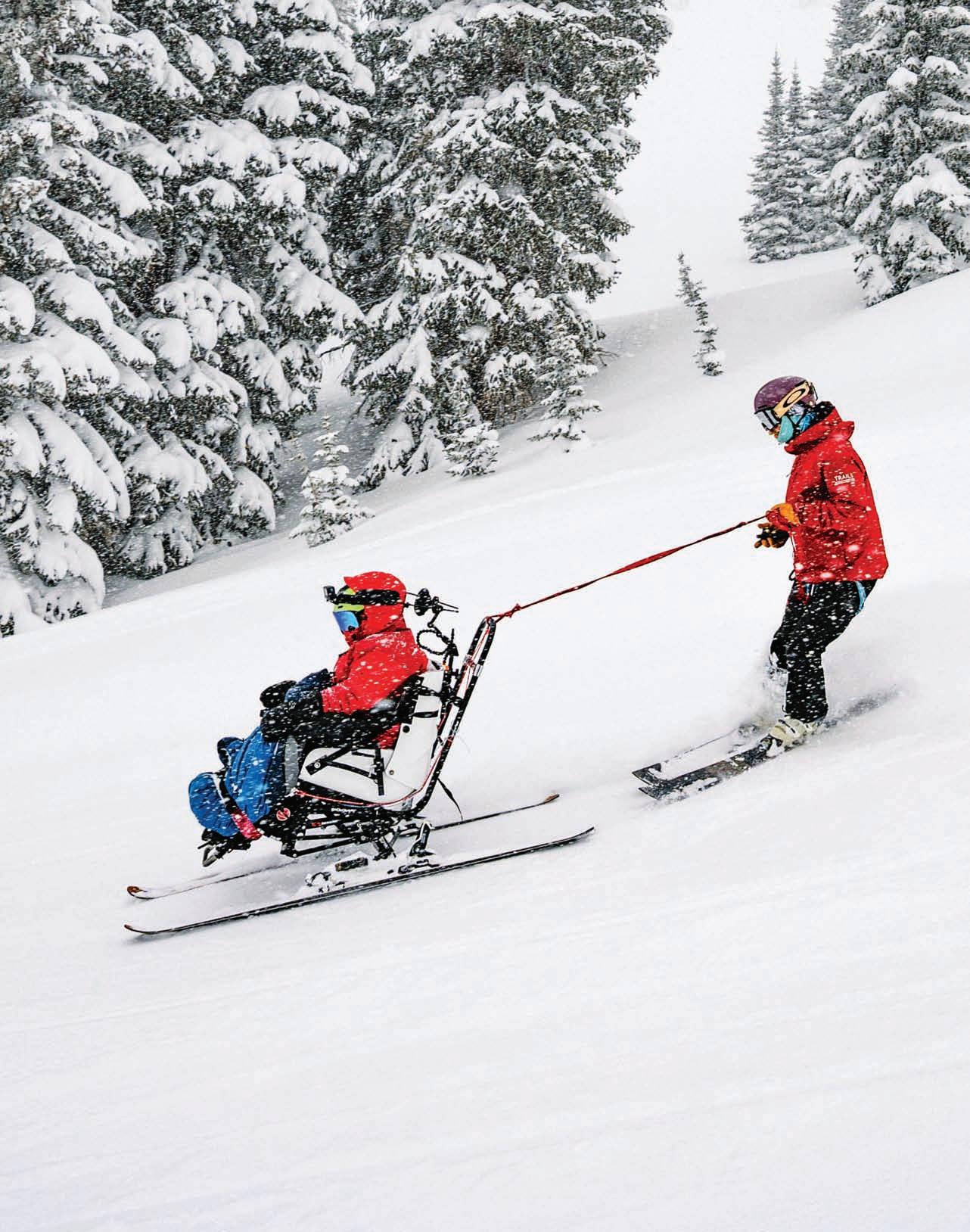
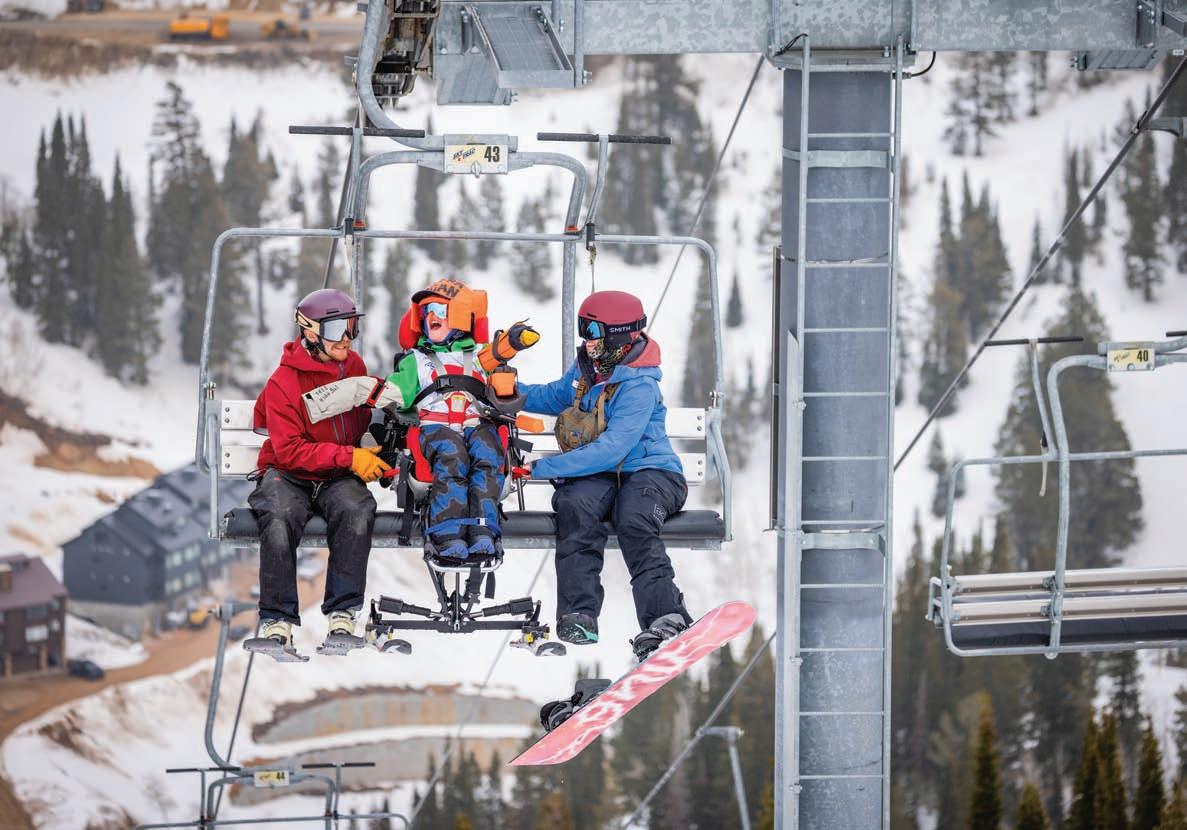
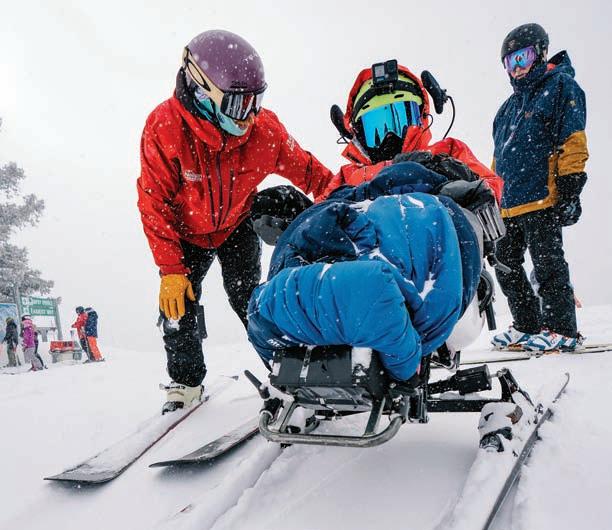
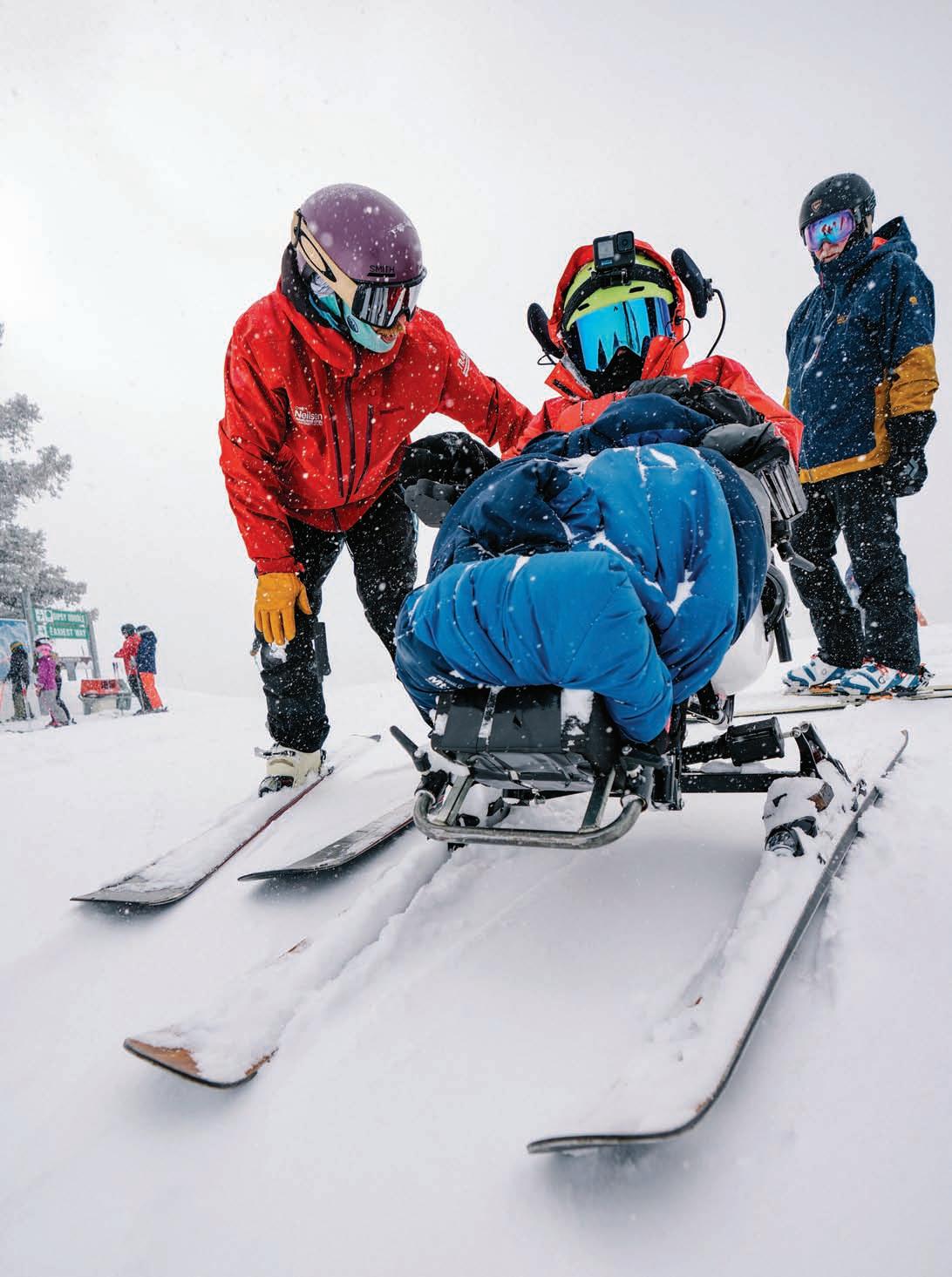
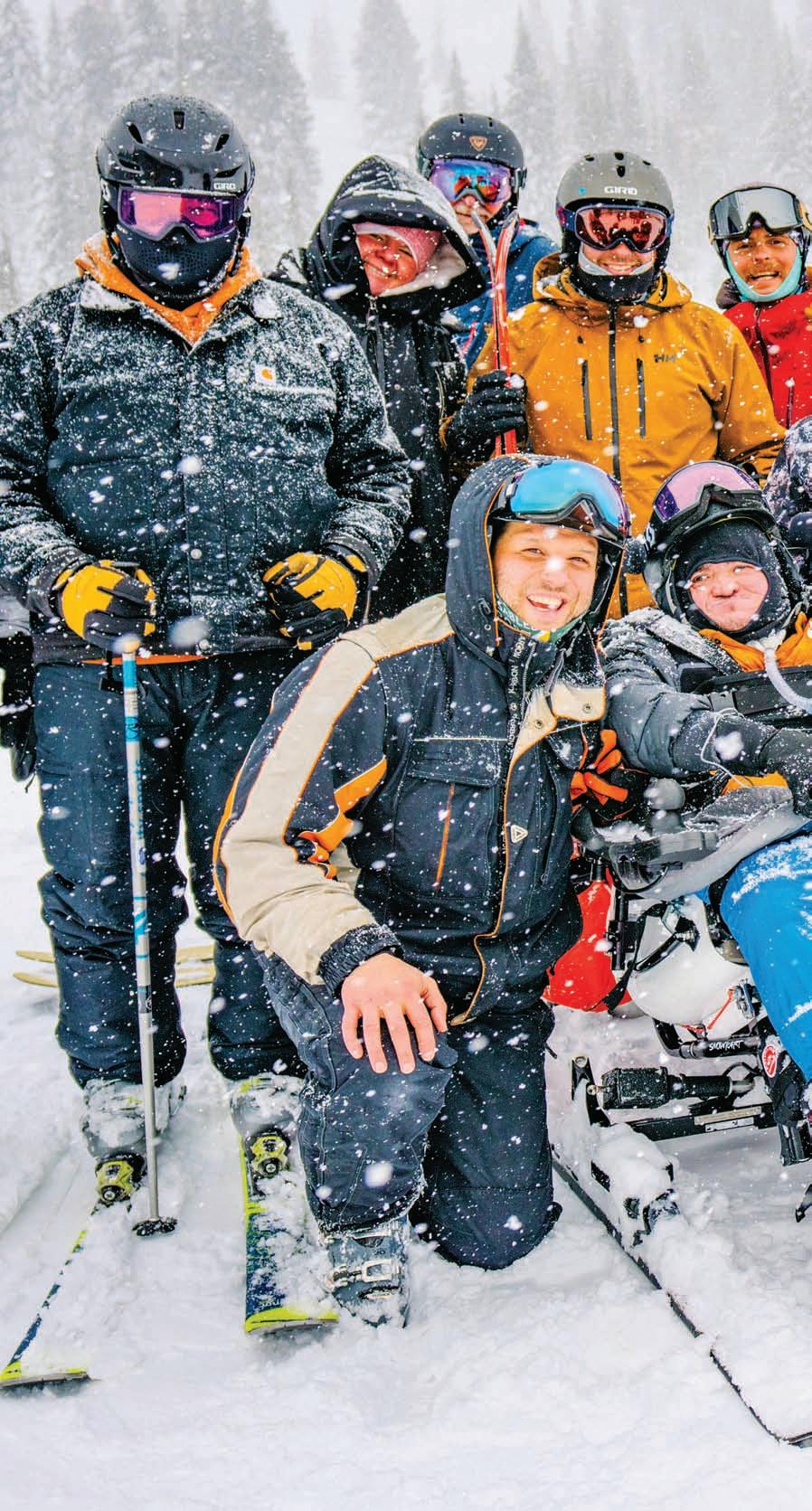
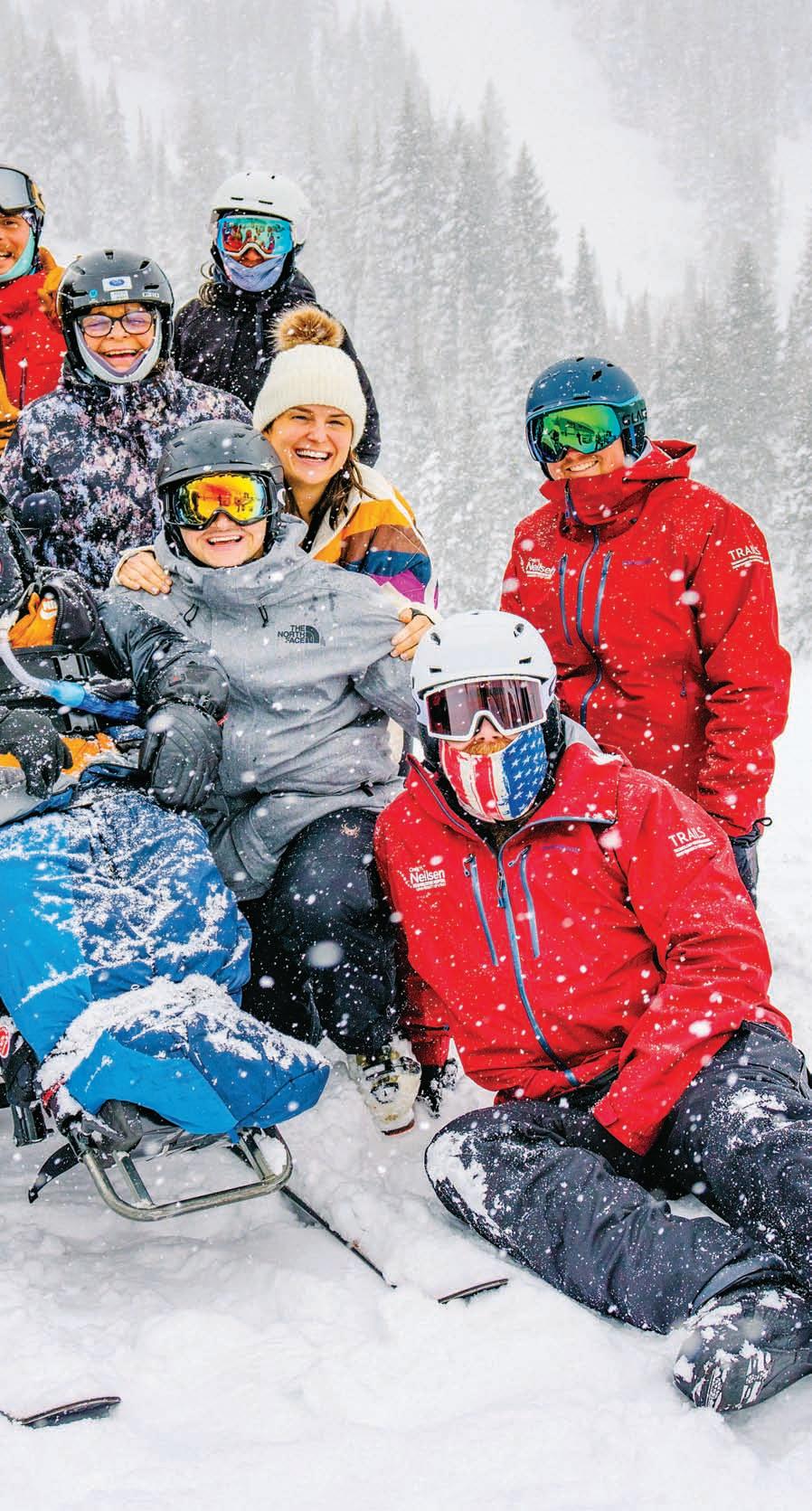
Co-riders steady a TetraSki on a lift (top), supporting a skier to the summit. TRAILS instructor Cullen Robinson (opposite) checks in with Krishna Kushalani after a snowy run down the mountain. Making sure TetraSkiers stay warm is a critical piece to the puzzle.
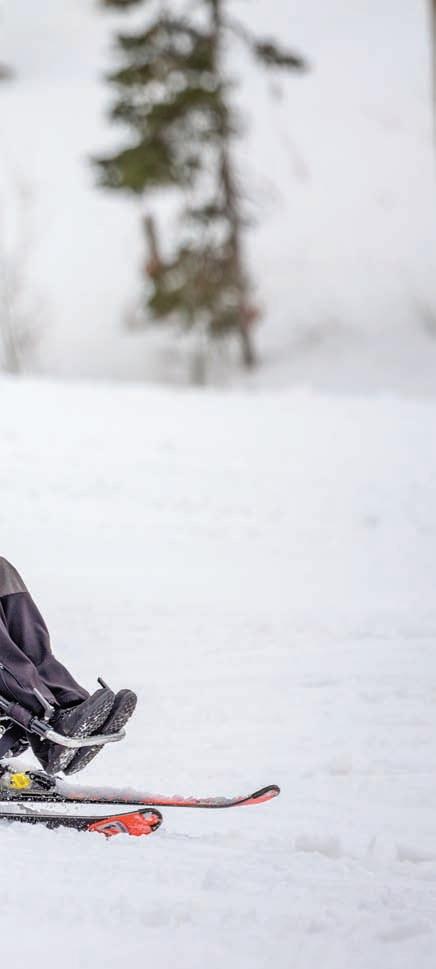
TETRASKI IS A SIT-SKI developed by TRAILS Adaptive, a community program at the University of Utah’s Craig H. Neilsen Rehabilitation Hospital. Its advanced electrical and mechanical engineering allows people with complex physical disabilities to ski alongside the able-bodied – having a truly self-directed experience. Until now, ski participants with extremely limited mobility may have ridden on a sit-ski, but the TetraSki makes them the drivers.
At the top of the lift, the instructors hoist the handle and the TetraSki seat rises to allow the skier off the lift, then lowers down and locks in place over its attached skis. Khushalani, who has Duchenne muscular dystrophy, controls the TetraSki by hand.
“I’m really focusing on the joystick and trying to get the movements right,” Khushalani said. While the controls are like the motorized wheelchair he uses when playing soccer, there’s a new element to master. “When I go forward on a normal joystick it just goes forward, but on this it changes the shape of the wedge,” he said. Wedgeshaped skis slow a skier down; making
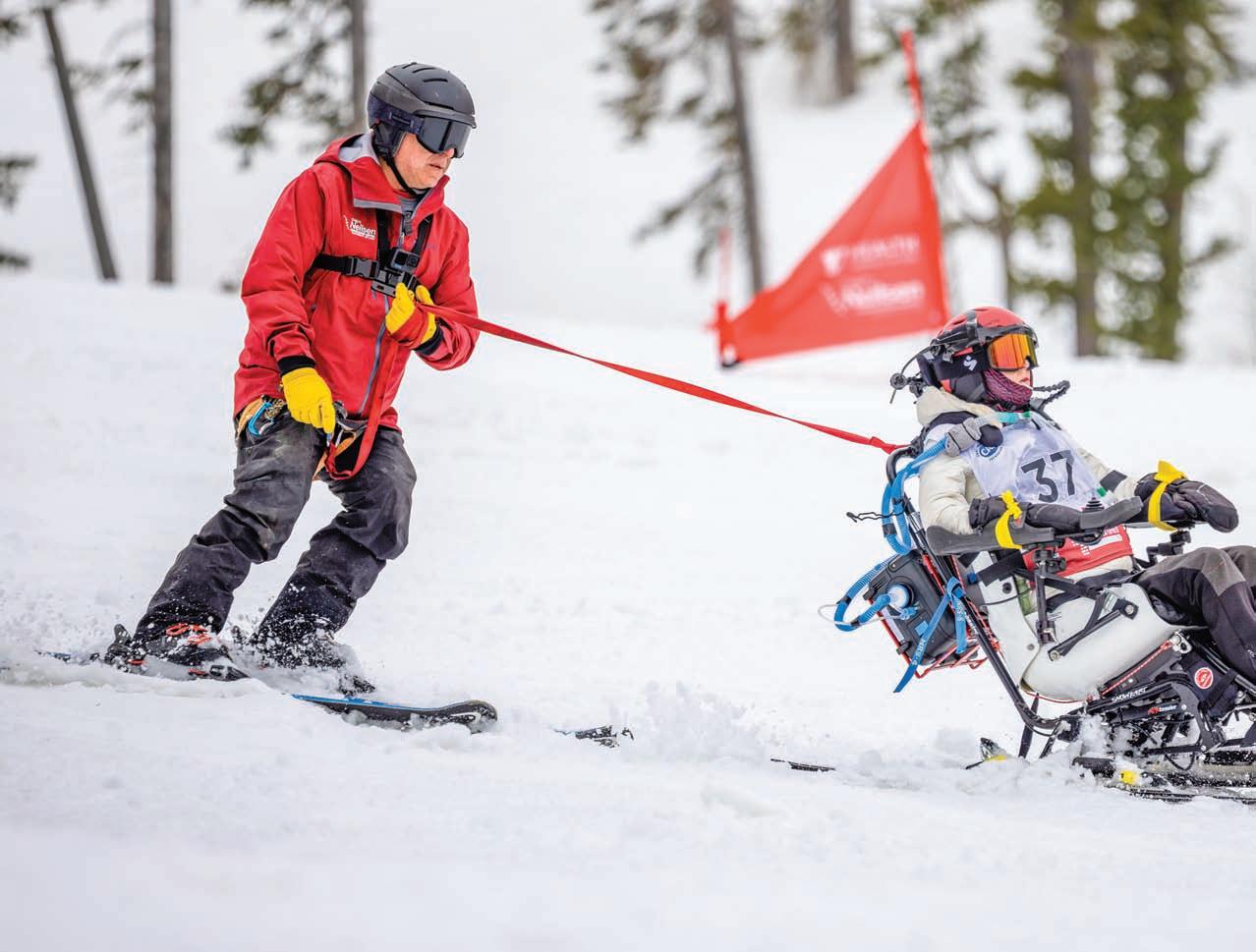
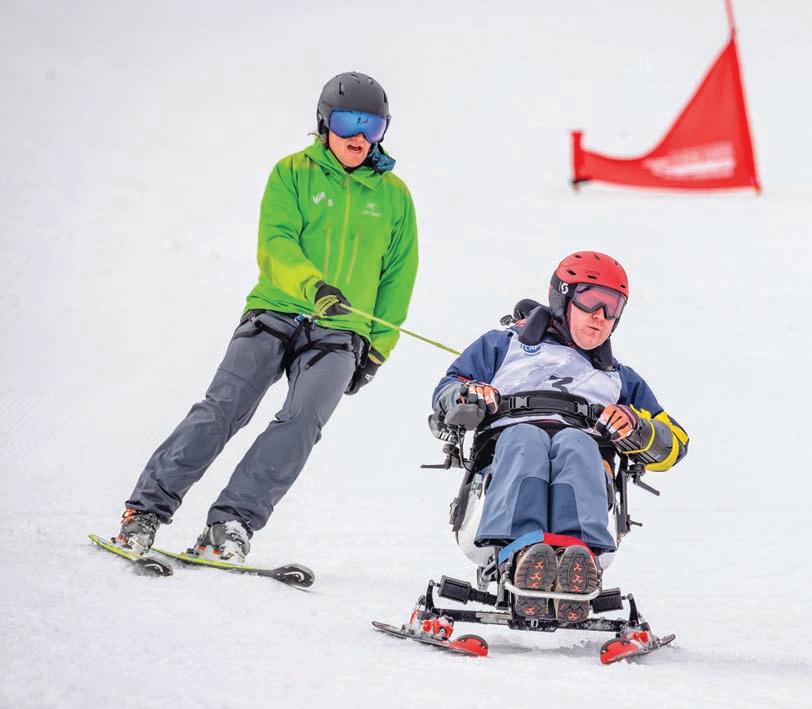
them parallel lets a skier glide and turn. Robinson, TRAILS program coordinator and instructor, skis behind his student with two methods of emergency override –a remote control and a 10-foot tether. Jones keeps an eye out for wayward beginners who might cut into the TetraSki’s path.
“With today’s technology … for heaven’s sake! … if we have the tools to do this, why not?” exclaimed Tanja Kari during a break inside the Albion Grill. As the head of TRAILS, Kari oversees the TetraSki training program and promotes TetraSkiing as a sport.
A two-time Paralympic cross-country skier, Kari champions the power of athletic participation for all. She notes that the impairment she was born with – a below-elbow amputation – was overcome by her willingness to play and compete with other kids.
“I feel what I was able to get out of sports should be more available,” she said. “Some participants are telling me, ‘For the first time in my life I feel like I’m not a piece of luggage. It’s me making the choices. I can push myself as an athlete.’”
AS IT GOES with sports, the TetraSki was made possible by a team. Dr. Jeffrey Rosenbluth, medical director of the Spinal Cord Injury Acute Rehabilitation Program at University of Utah Health, conceived the idea. A frequent skier with one of the first adaptive programs in Southern California, he recalled, “That’s where I met people with spinal cord injuries, where I saw some of the new equipment and skis that were coming out. The energy and excitement – and the rehabilitation people were experiencing through adaptive sports – was really incredible to me.”
Inspired by that experience, Rosenbluth set out to develop a sit-ski based on existing wheelchair technology that would allow steering by joystick or “sip and puff,” enabling skiers with even more limited mobility to control turns by drawing air in and out of a tube. He was thrilled when an opportu-
nity arose to do this work in Utah.
That’s when engineer Ross Imburgia dropped in. Imburgia spent two decades as a sponsored skier, helping create the popular ski video series Line Traveling Circus. His senior project in mechanical engineering at the University of Utah was a gas-powered winch used by trick skiers to gain speed when there’s no natural hill nearby. Dr. Rosenbluth saw a bigger application.
“It incorporated a lot of things he’d drafted up for adaptive ski equipment,” Imburgia said – including the right combination of software and electrical hardware to let a seated skievr with limited muscle control move the skis from wedge position to parallel for carving.
Rosenbluth made the young engineer a humorous offer: a low-paying job that left him time to ski. “I don’t think either of us expected it would be a long-term gig, but we
made a lot of progress right off the bat,” Imburgia said. “After a year and a half, Jeff and I both could see this project had potential to go out into the world and change lives.”
They built a prototype based on a Snow’Kart, a manually controlled adaptive ski by French company Tessier, which later collaborated with the TetraSki team on frame design. The first prototype was tested during the 2015-16 ski season at Alta and Powder Mountain, where most TetraSki lessons take place today. Imburgia was the first test pilot – his trick-skiing background giving him the ability to bail out when things went wrong.
Brian McKenna, an avid skier who had recently sustained a severe spinal injury, gave essential feedback on the TetraSki’s sip-and-puff steering. “He was pushing the ski and his body much harder than they probably should have been, out of his
pure enthusiasm,” Imburgia said.
This is the height of Kari’s passion. She has placed TetraSkis and instructors in seven countries; a minimum of eight are required before the sport can be considered for the Paralympics. She hopes to see TetraSkiing in the 2034 Games in Salt Lake City.
Two Utahns, Becca Farewell of Sandy and Travis Berenyi of West Haven, are regular TetraSkiers and participants in the annual race.
Farewell, who was paralyzed in a 2021 professional skydiving accident, steers by sip-and-puff. When asked if she’d like to try qualifying for the Paralympics, she gave a resounding yes.
“If it’s possible, I’m gonna do it,” she said. “Because where else in the world do we have opportunities like this?”
Farewell met Dr. Rosenbluth in spinal rehab, where he introduced her to the
TRAILS program right away. “I very distinctly remember thinking life doesn’t have to be over. That was such a game changer for me because I’ve been an extreme athlete my whole adult life.”
Berenyi, who has Duchenne muscular dystrophy, enjoys ski racing as a change from the ordinary. He has steered by joystick and straw and said steering with just your breath is “kind of a shocker to the mind.”
TRAILS now hopes to “tetra-fy” everything – developing more self-directed sports and daily activities. So far, they’ve built a watercraft and have a working prototype for a mountain bike.
“I am so excited about the idea of the bike,” said Farewell, who sails but gravitates toward more aggressive sports. “The serotonin is awesome,” she said, describing a pleasant tiredness after a challenging session, “like I did something good today.”
Athletes steer their own turns using sip-and-puff or joystick controls, while instructors utilize a backup tether. On the left, Becca Farewell controls her TetraSki. To the right, co-skiers participate in a Powder Mountain race.
IT’S HARD TO understand what it’s like to head down the slopes as a TetraSkier until you’ve joined them for a run. Nick Ca pano, who was born with spina bifida and breathes with a ventilator, came to Utah from Boston with his brothers, parents and extended family. They’d skied together at Loon Mountain in New Hampshire with New England Disabled Sports (NEDS), but since the passing of a beloved doctor, the NEDS team can no longer take a skier with a ventilator down the mountain.
But the Capanos had a connection. They’d met Robinson when he worked with NEDS, and he later enticed, cajoled and encouraged them to come to Utah.
“Cullen had such excitement, and I had such reservation,” said Patti Capano, Nick’s mother. “Who possibly could take care of [Nick’s] vent, tracheotomy, his ox ygen requirements up at the mountain?”
The TRAILS team convinced the Capanos they were prepared to handle Nick’s re spiratory needs. “They were talking about what Nicholas needs as if it were a cup of coffee,” Patti said. “I decided that we’re going to take the leap and make that our family vacation.”
Skiing started indoors with training on a simulator. Then the family met Robinson at Alta, where he was waiting with an en tire team of experts – including two respi ratory therapists – to give the Capanos a ski vacation to remember.
Robinson tries to ski imperceptibly, tak ing his cues from the TetraSkier’s subtle body language and the sounds the actu ators make as they move the skis. “When you get to this point, it’s like dancing,” he said. “We’re skiing together and in tune.”
“I’ve never experienced anything like it,” Nick said. “Cullen tethered me, but I still felt like I was on my own.”
After skiing down the Crooked Mile with family all around and Mount Superior in the distance, Capano summed up his ex perience: “I’ve never felt so free.”
Nick Capano was born with spina bifida and breathes through a ventilator. Through TRAILS, Capano and family skied together for the first time in 10 years.
For Tetra athletes, the watercraft offers a calm counterpoint to the adrenaline of the slopes
WHILE THE TETRASKI is seen as intense and rigorous, participants say the Tetra watercraft offers the exact opposite experience. “It’s very relaxing, especially if you’re stressed out,” said Januel Gomez. “It’s a nice escape from reality.”
Gomez, who is studying finance at the University of Utah, says he needs a way to chill. On a sunny summer day, he and his family might be found picnicking along the shores of East Canyon Reservoir, where four people at a time can go out on the Tetra watercraft, built on the frame of a Hobie Mirage Tandem Island sailing kayak. There are six Tetra watercraft in the U.S., all leased to adaptive programs by TRAILS.
The sailor uses joystick and sip-andpuff technology together to control four motorized applications on the boat: a winch for the sail, a roller furling, the rudder, and a propulsion motor. As an electric wheelchair user with spinal muscular atrophy, Gomez is used to the joystick, but the two sip-and-puff straws are more challenging.
The right straw controls power; the left one turns the sail. “Since sailing is very calming, you can easily make a correction,” Gomez said. On a windless day, he can still cruise the lake under power with the sails furled.
Like the TetraSki, the Tetra watercraft includes a remote-control override, allowing an instructor to follow on a jet ski so participants can enjoy a private or family cruise. Instructors also provide sailing lessons.
Gomez may enjoy calm days on the water, but he’s got an intense side. He’s a member of the Beehive Honor Society at the U., has testified before the Utah Legislature in support of a disability bill, and he’s the 2024 TetraSki champion.
by JACQUE GARCIA and CHRIS AMUNDSON
ON A SUMMER evening in Midvale, the familiar Arctic Circle sign flickers against the evening light. Families file in from minivans, kids clutching cups of fry sauce, grandparents remembering when the first one opened downtown more than 70 years ago. The menu hasn’t changed much – burgers, shakes, fries – but the feeling still tastes like Utah: friendly, unhurried, quietly proud of something it never set out to advertise.
In a state built on co-ops and canneries, where self-reliance once meant feeding your neighbors first, it’s no surprise that modern enterprise still tastes homemade. Utah doesn’t shout about its inventions, yet its drive-thru ideas and family cafes have slipped into the nation’s bloodstream. From the red-rock south to the Wasatch Front, a handful of homegrown chains
have redefined what Americans expect from “fast food.”
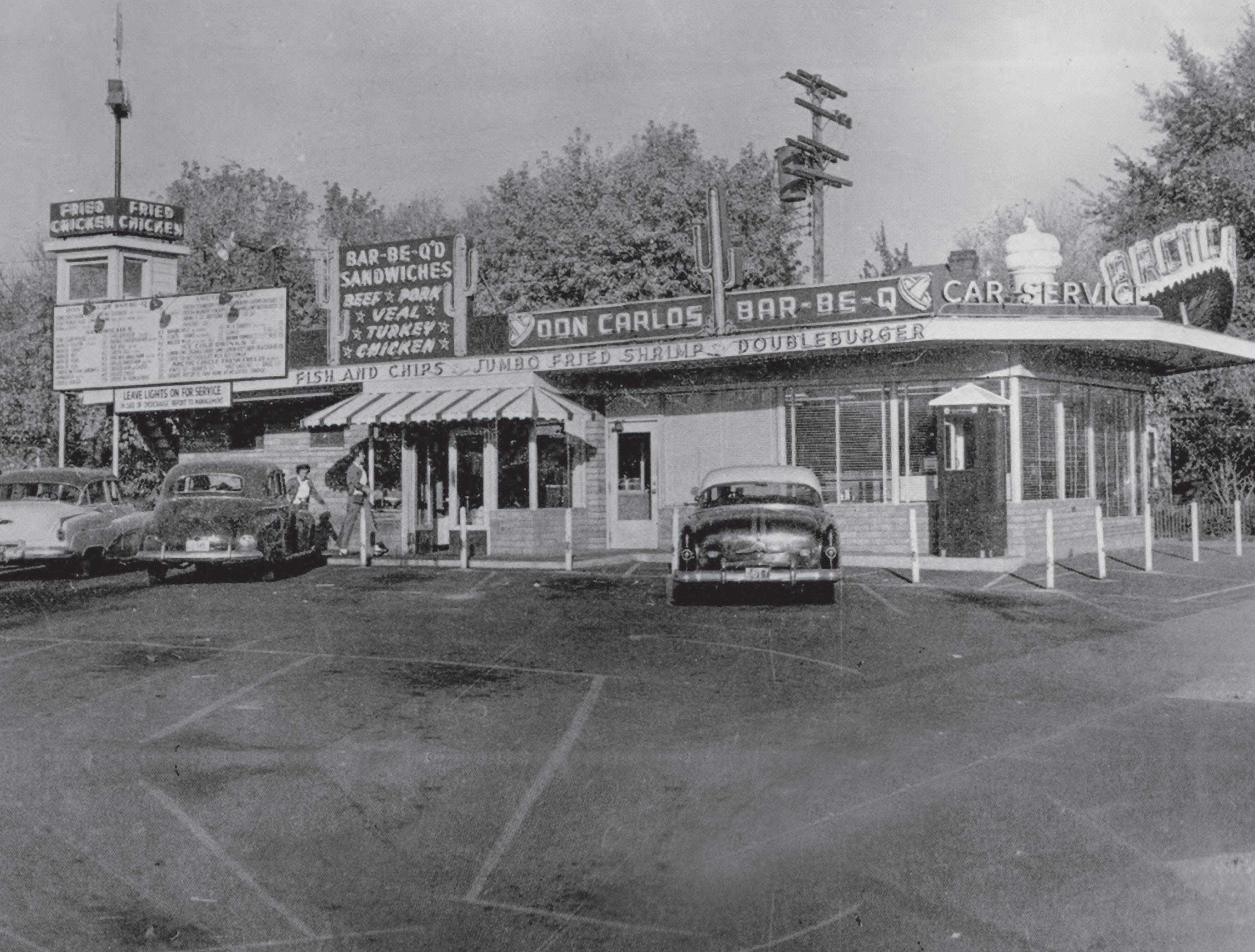
It began with Arctic Circle, when Salt Lake City entrepreneur Don Carlos Edwards turned a Pioneer Day refreshment stand into a post-war drive-in that served burgers with a side of invention. He flipped hamburgers for crowds in the July heat, unknowingly launching what would become one of the West’s oldest surviving restaurant brands.
Out of his mixing bowl came fry sauce, equal parts ketchup and mayonnaise with a secret tang, a condiment so inseparable from Utah identity that local brands sell it by the gallon in grocery stores today. Debate still circles like a seagull over the Great Salt Lake: was it Edwards who first mixed it, or a cook in Provo? Either way, the taste stuck.
Arctic Circle marks its 75th anniversary
in 2025, older than Disneyland and nearly as nostalgic. On summer nights its redand-blue signs still buzz above two-lane highways from St. George to Smithfield. Inside, the counters hum with shake machines turning out any flavor guests can dream up, from real fruit to candy blends, while the kitchen crew works through baskets of golden-flesh fries and crisp Alaskan halibut. The company still operates from its West Jordan headquarters, led by Kasey Christensen, who grew up cutting potatoes for his parents’ franchise in Soda Springs.
Within five years, Arctic Circle’s bright roadside name was glowing across Idaho –Utah’s first fast-food idea to cross a border. Seeing that sign on a long drive still feels, to many Utahns, like pulling into home.
That mix of thrift and warmth – doing small things well, and doing it for neighbors – became Utah’s culinary signature.
“We’re excited to continue sharing great food and memorable moments for generations to come.”
– Kasey Christensen of Arctic Circle
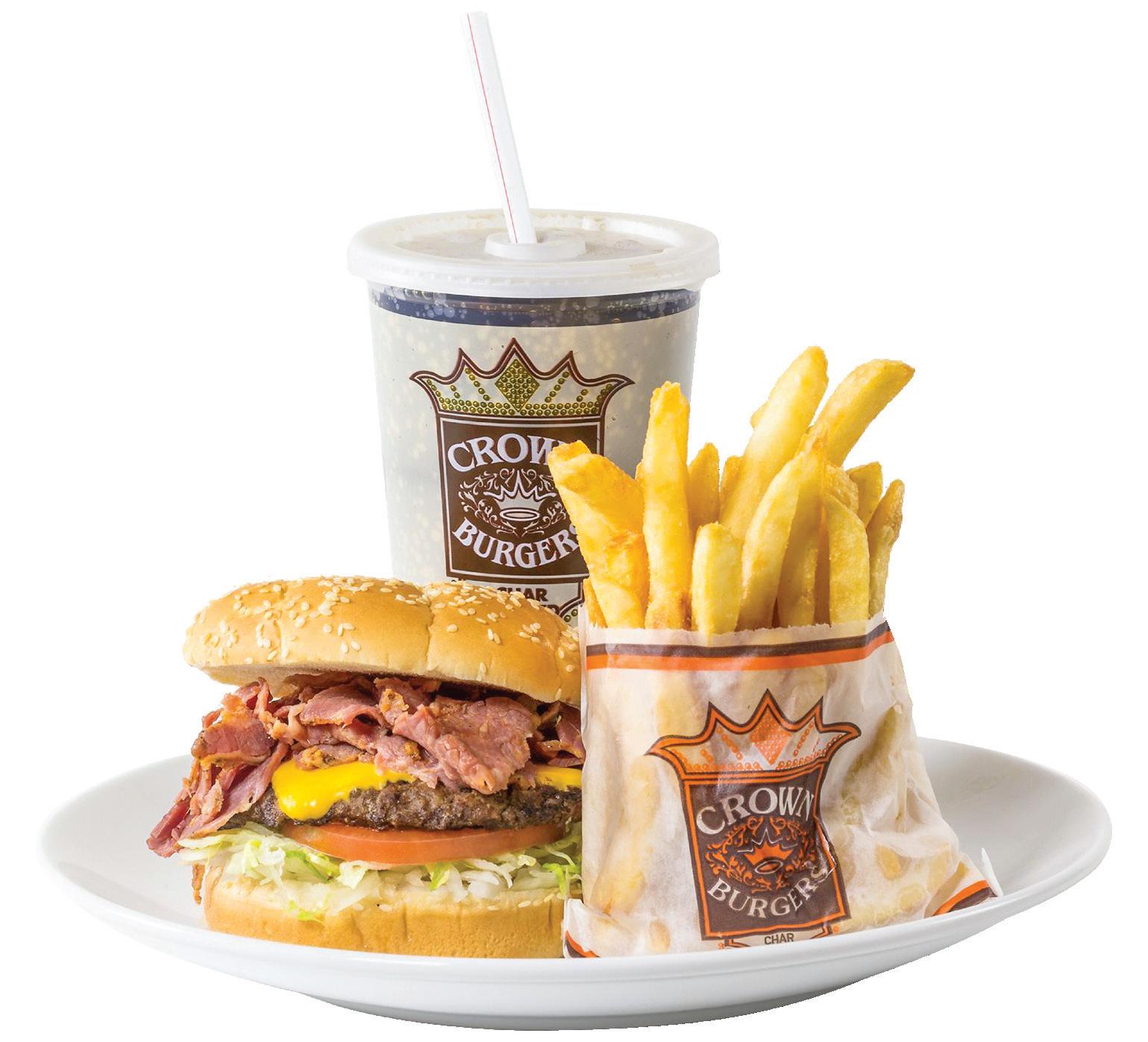
In 1978, John and Rula Katzourakis and Nick Katsanevas opened Crown Burger in a squat brick building at 377 E. 200 South in Salt Lake City. As descendants of Greek immigrants who’d labored in mines and on the rails, they built a counter where cooks mixed Old World flavors with Utah beef. At lunchtime the narrow space filled with the scent of peppered pastrami and sizzling meat, English and Greek voices rising over the hiss of the grill and clatter of trays.
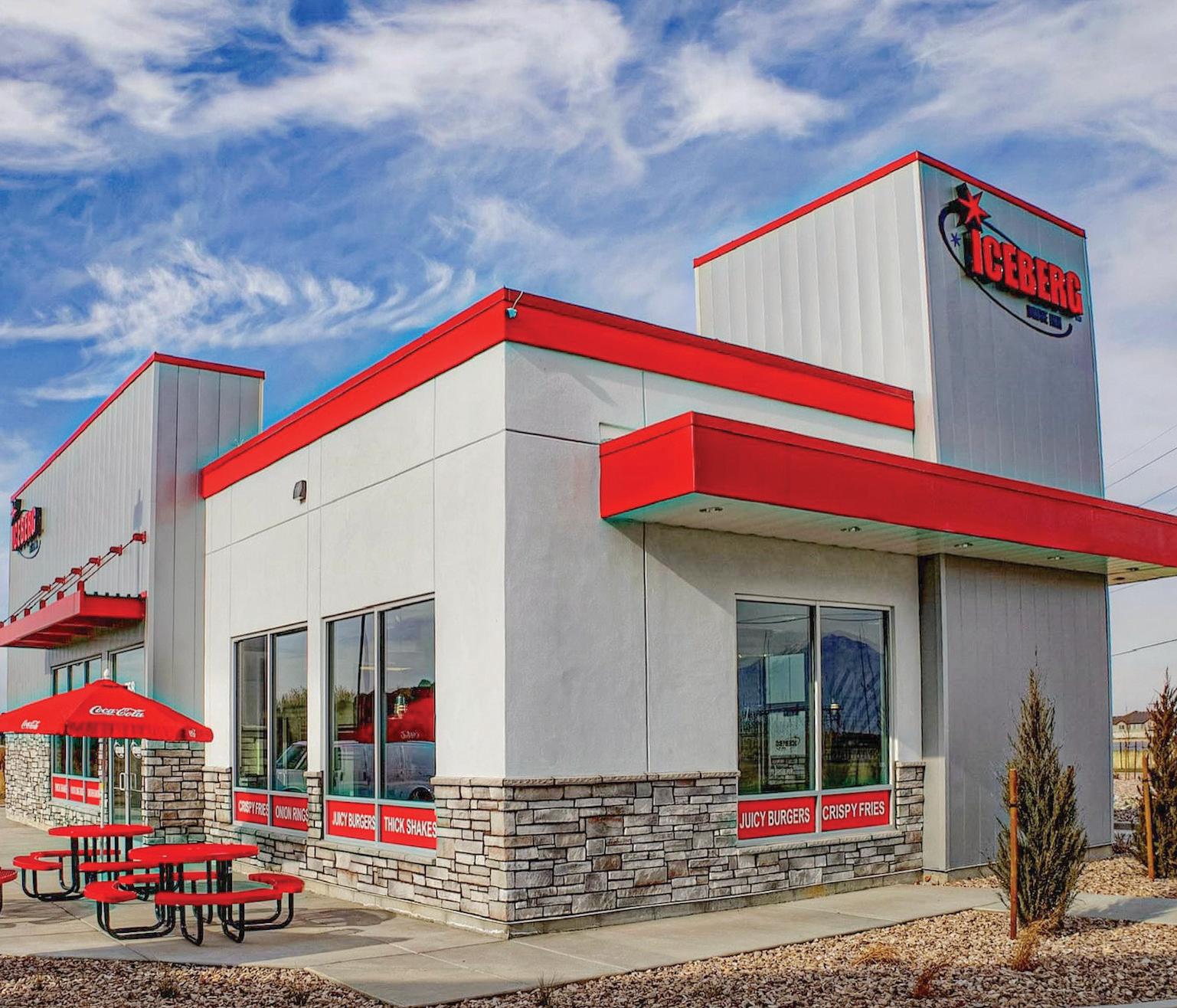
At first, they sold only a few pastrami burgers a day. But soon the line told the story. The blend of salty beef, melted cheese and thousand-island sauce hit a flavor chord Utah hadn’t known it was missing. Crown Burger’s founders came from the same Greek Town families that once fed rail workers and smelter crews; today their children and cousins run the registers, proof that Utah’s immigrant story never stopped cooking. The neon crown now casts its light above eight family-run stores across the valley, the scent of pepper brine spilling into the night. While newer brands have spread across state lines, Crown Burger has stayed rooted – a steadfast reminder that not every success needs to leave home.
Farther south in Orem, the smell of fresh bread rolling out of a hearth oven at dawn has become part of the air itself. Gary and Colleen Worthington opened Kneaders Bakery & Cafe in 1997 after running Subway franchises and dreaming of something slower: hand-kneaded dough, flour, water and salt baked in imported Italian ovens. Trained at the American Institute of Baking and the San Francisco Baking Institute, they built their recipes with flour milled up the road at Lehi Roller Mills. Gary liked to say good bread “feeds both body and spirit,” and he meant it.
“Mahalo, Utah, for supporting us for the last 17 years!”
– Kimo Mack of Mo’ Bettahs
ON EARLY MORNINGS in Utah County, when frost gathers on car hoods and mountains burn pink with sunrise, the light from a Kneaders window feels like a hearth. Students from BYU huddle over cinnamon French toast, mothers drop by after carpool, retirees linger over thick-cut bread and jam. Four generations of Worthingtons now work under the same roof, their Orem headquarters humming like a family kitchen scaled for a region.
Day-old loaves go each evening to local shelters and hospitals, an extension of the same ethic that built them. By the late 2000s the scent of those loaves drifted south into Arizona and east into Colorado as the Worthingtons’ formula quietly spread through the West.
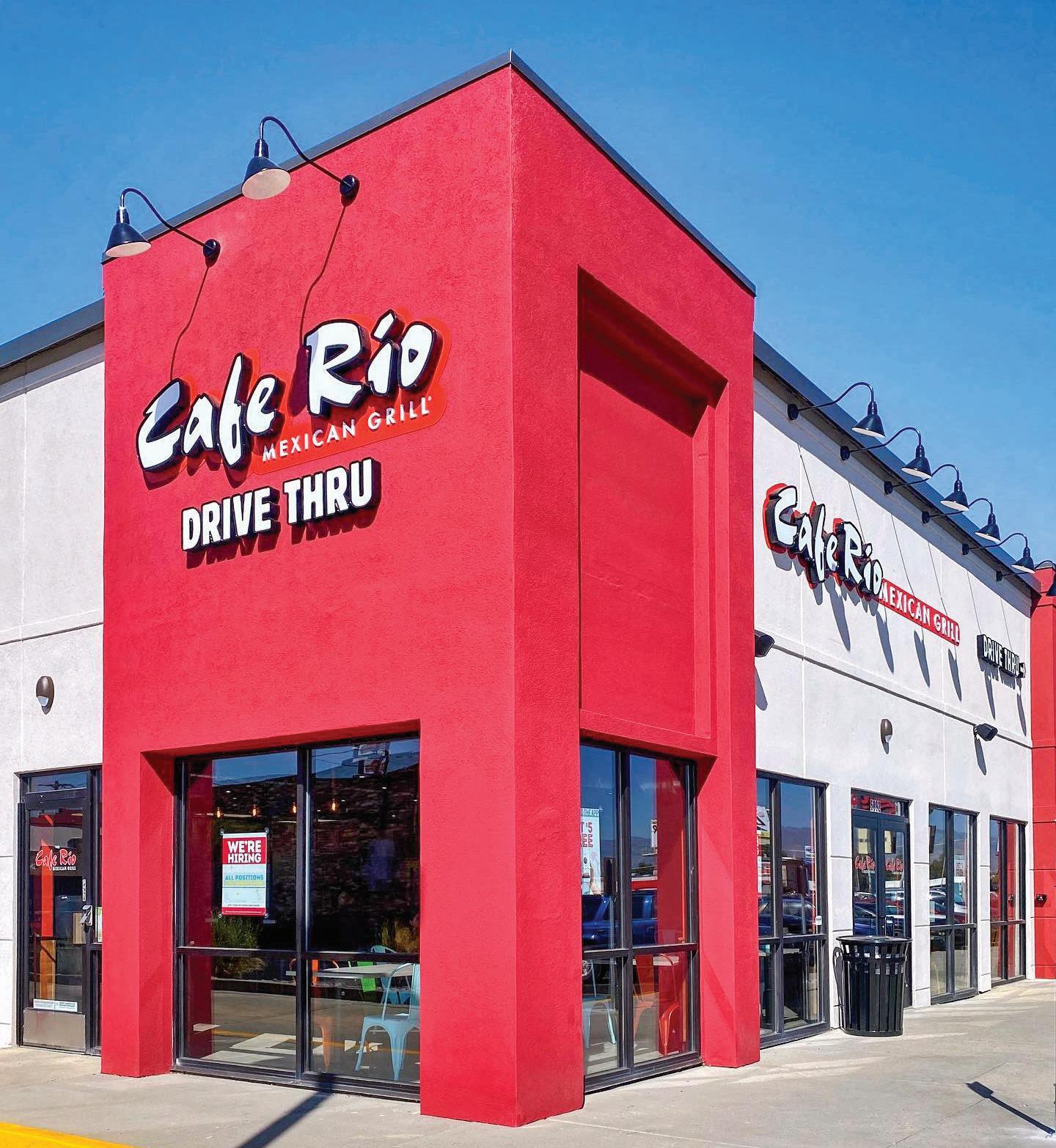
Around the same time down in St. George, Steve and Patricia Stanley opened Cafe Rio less than a mile from the sandstone ridges of the desert. With help from chef Antuan Morales, who had grown up on a ranch in Torreón, Mexico, they dreamed of bringing the freshness of the Rio Grande to a tiny strip-mall kitchen. Every morning dough slapped the griddle, cilantro and lime scented the air, and tour-
ists returning from Zion queued up with locals for sweet-pork barbacoa.
The Stanleys refused to install freezers or microwaves; they wanted food cooked with real heat, fresh produce, real time. Chef Steve Stanley liked to say he never planned one, just a place that cooked right. But Cafe Rio’s fresh-made ethos caught national attention; in 2011 it was named America’s best quick-service restaurant, proof that the desert could teach the industry about freshness. Within a few years the concept leapt state lines – first to Las Vegas, then Phoenix – and by 2024 counted more than 160 locations nationwide. Even now, in far-off suburbs, the open kitchen still echoes its first St. George morning: sunlight, lime and the sound of tortillas hitting hot steel.
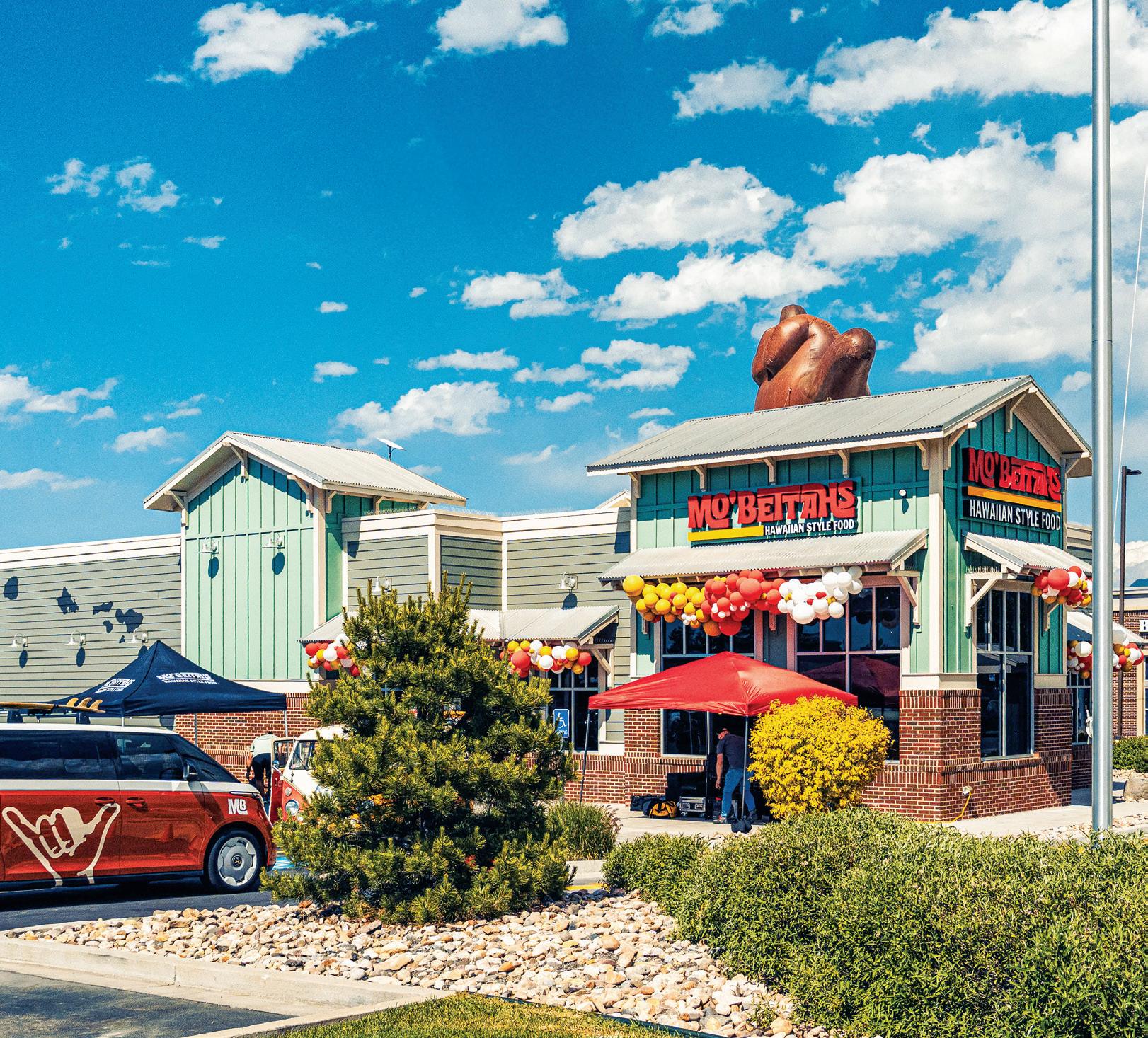
Along the Wasatch Front, brothers Kimo and Kalani Mack were missing home – and the food they grew up with. After years of working in public transit on O‘ahu, they moved to Utah, part of a growing Pacific Islander community that found opportunity and snow under the same mountains Brigham Young once crossed. In 2008 they opened Mo’ Bettahs in Bountiful, making the plate lunches they missed: grilled
teriyaki chicken, sticky rice, mac salad, a splash of soy and sunshine.
The first months were quiet. Soon the news rippled through Latter-day Saints who’d served missions in Hawai’i, Tonga and Samoa. Facebook posts filled with talk of “the place that tastes like the islands.” Soon the small dining room filled with the smell of caramelizing soy sauce and laughter loud enough to drown the vent fans. Surfboards on the wall and plantation-style roofs recalled the brothers’ grandparents’ home on Kauai.
“Share the aloha,” they told customers, and people did. The brothers guard that authenticity fiercely.
Mo’ Bettahs now has more than 65 locations across seven states. It became majority-owned by Blue Marlin Partners and Trive Capital in 2024, but the Mack brothers remain active stewards of the brand. Today their plate lunches are being served from Boise to Dallas, island flavors carried along the same missionary and family networks that once filled their Bountiful dining room.
While teriyaki smoke drifted over Bountiful, another St. George idea began
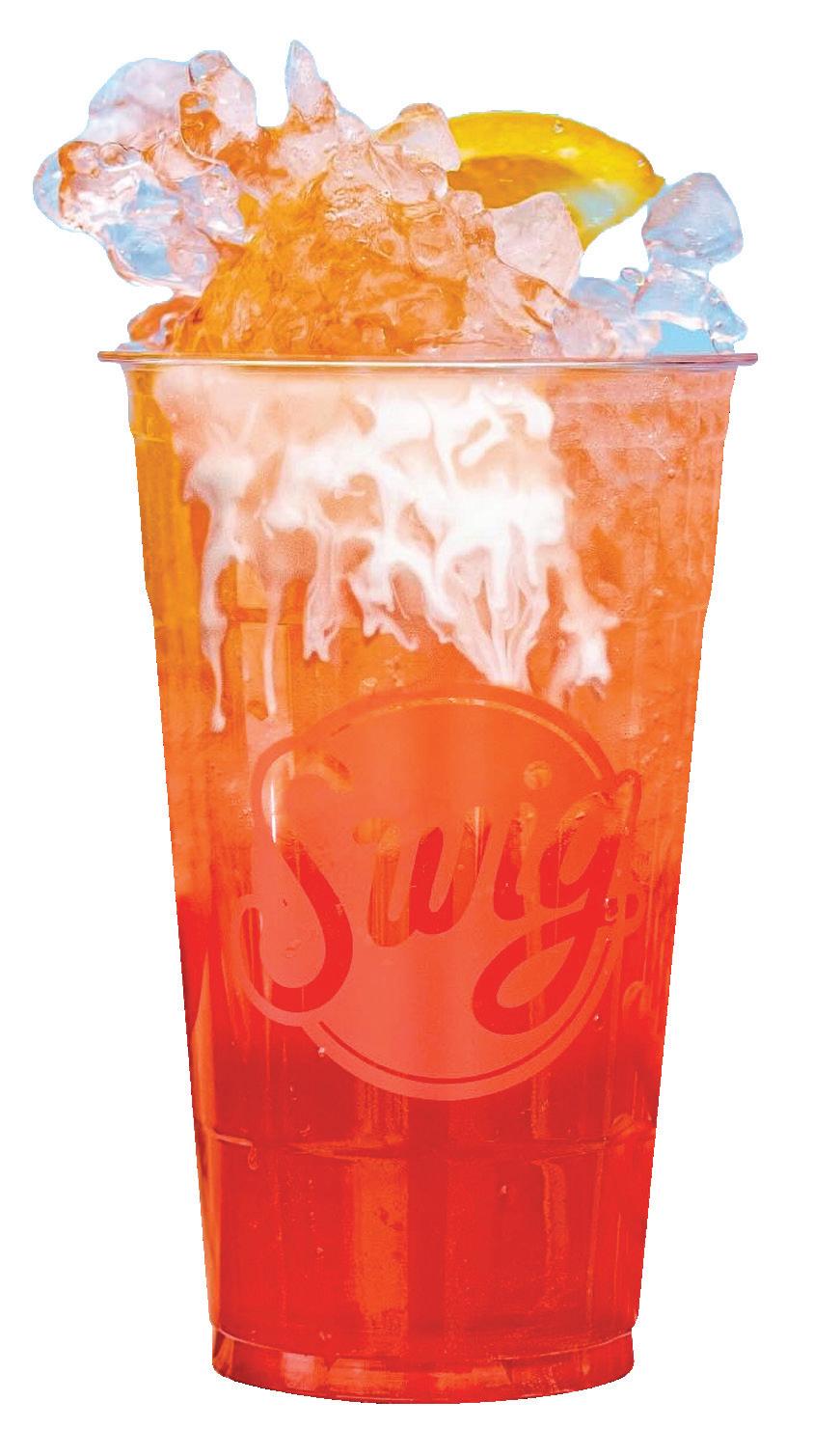
to fizz. Nicole Robison, a mother of five recovering from breast cancer, wanted a drive-thru where she could grab a soda and a smile. In 2010 she opened the first Swig in a small cinder-block building painted bright pink.
Robison had worked the drive-thru at McDonald’s and Sizzler; she knew how impersonal a headset could sound. She built Swig around one simple idea: every person should feel seen.
When she poured coconut syrup into a Dr. Pepper and called it “dirty,” the idea clicked. In a state where many residents skip coffee and alcohol, this became a new ritual: cheerful indulgence without guilt. Soon the evening line snaked into the street, teenagers in team hoodies, parents in SUVs, everyone balancing ice-filled Styrofoam cups with pastel straws. The sound was its own Utah music: the squeak of straw against lid, the rhythm of laughter between orders.
Swig’s “Save the Cups” campaign began as a way to help women pay medical bills during cancer treatment, and each October pink cups flood the stores. “If Swig can be the best part of someone’s day,”
she said, “that’s enough.” With majority ownership by the Larry H. Miller Company since 2022, Swig has now surpassed 130 stores, its red-and-white logo jumping state lines across 16 states from Idaho to Florida, turning Utah’s clean-living indulgence into a national craze.
Look closely and an invisible thread connects them all. Arctic Circle’s pioneers, Crown Burger’s immigrants, Kneaders’ bakers, Cafe Rio’s desert dreamers, the Mack brothers from Kauai and Robison with her pink straw – each began with a table-sized vision and grew because community showed up.
Utah’s long, narrow shape strings communities like beads along I-15, helping a good idea to travel from St. George to Logan. College towns hungry for quick meals, mountain tourists chasing comfort food, families loyal to the familiar – all helped these brands take root. Yet what sustains them isn’t just convenience; it’s the culture that built them.
Utah’s geography and faith make it a natural incubator: low costs, loyal families and a network of returned missionaries who carry flavors as easily as testimony.
“Swig is about daymaking. You’ll leave our line feeling happier than when you entered it.”
– Nicole Robison of Swig
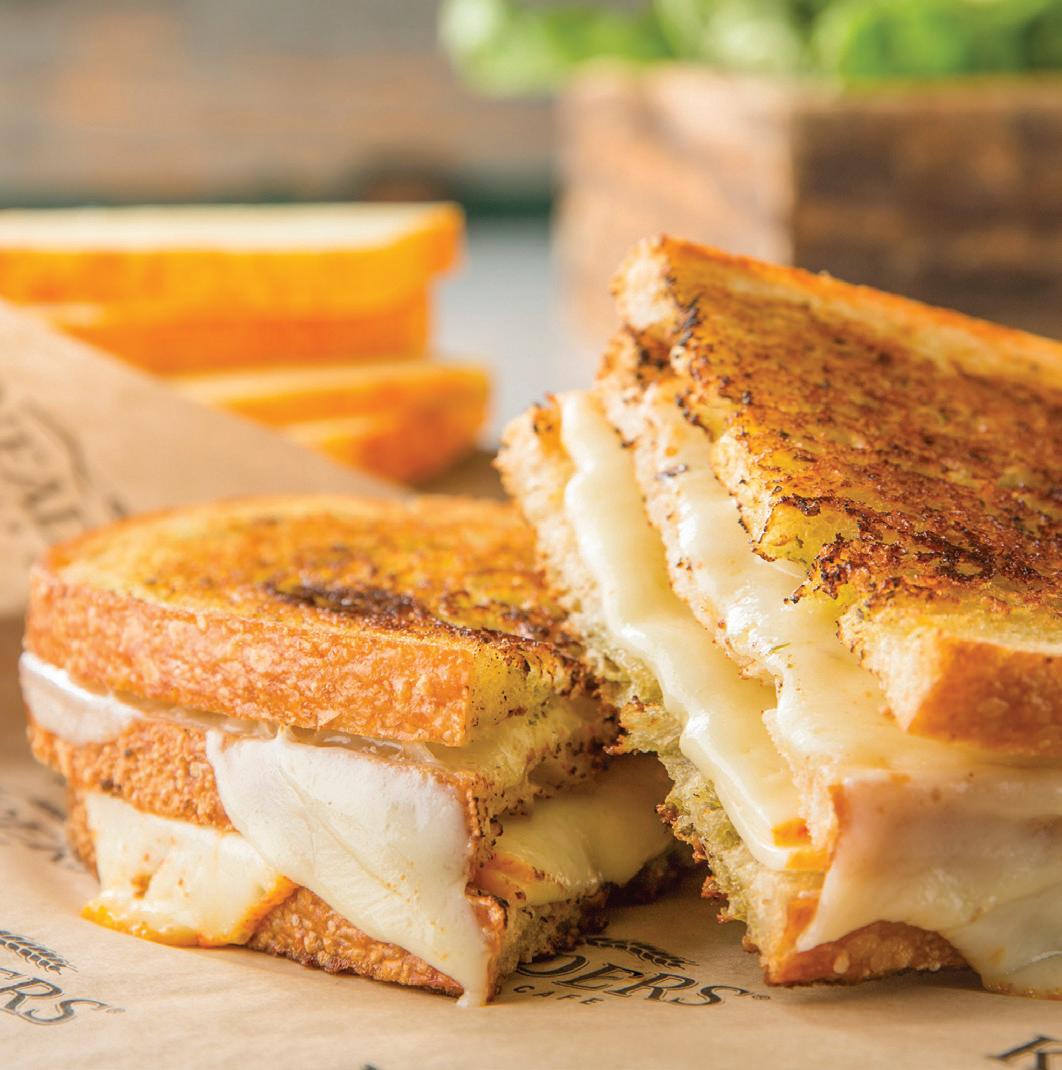
Crown Burger’s pastrami burger, created by Greek immigrants in Salt Lake City in 1978, has stayed rooted in Utah ever since. Along the Wasatch Front, Mo’ Bettahs’ founders served their Pacific Islander community to “share the aloha,” while Kneaders’ hearth-baked breads (inset) have spread across the West.
Each generation leaves its mark – Arctic Circle’s fry sauce, Crown Burger’s pastrami, Kneaders’ bread, Cafe Rio’s tortillas, Mo’ Bettahs’ plate lunch, Swig’s fizz – and together they map the state’s evolving appetite. What binds them is consistency, neighborliness and the quiet pride of doing a thing right every day.
Other Western states exported steak houses or microbreweries; Utah exported friendliness, served hot, sweet or fizzy, but always with a smile. You taste it in a spoonful of fry sauce, in the crust of Kneaders bread, in the fizz of a Swig drink on crushed ice. Even chains that have outgrown their ZIP codes keep that humble center, the sense that food is first about caring for people.
Drive almost any Utah highway at dusk and you’ll see that lineage shining against the dark – the crown, the cup, the brush script on a fresh-Mex awning. Food here is rarely just about appetite. It’s about belonging and about small acts done well. Somewhere between the smell of fry sauce on warm paper and the hiss of a tortilla hitting steel, Utah reminds the world that good food and good will travel best together.

recipes and photographs by DANELLE
McCOLLUM
When the bone-deep chill of late autumn and early winter nights descends upon Utah households, home chefs jump-start dinner with soup and audacious ingredients – cayenne pepper, chili oil and their favorite hot sauce.
Serving a big crowd on game day requires a playbook, and this dish offers flexibility, like calling an audible at the line. Danelle McCollum loves her chili loaded with meat and beans. Her family? Not so much, but when she added the smoky flavor of barbeque sauce, it won them over. Touchdown!
In lightly greased slow cooker, combine all ingredients except cheese and green onions. Stir well. Cook on low 6-8 hours. Serve with shredded cheese and green onion. Those who prefer a little less heat will appreciate a serving of rice on the side.
215-oz cans black beans, drained
2 15-oz cans pinto beans, drained
1 15-oz can kidney beans, drained
1 medium onion, diced
2 cloves garlic, minced
1 small jalapeno, seeded and diced
1 cup barbecue sauce
1 15-oz can tomato sauce
1 cup beef broth
1 Tbsp chili powder
1/8 tsp cayenne pepper
2 Tbsp brown sugar
6 slices bacon, cooked and crumbled
2 14-oz smoked sausages, sliced Salt and pepper, to taste
Cheddar cheese, shredded Green onions, chopped
Serves 4

Utah families that order Chinese takeout might wonder how to make some of their favorite dishes at home. Danelle tested a hot and sour recipe that immediately became a family favorite. One key ingredient, Chinese black vinegar, is typically only found in Asian markets or online, but is worth the effort to locate it to make this savory dish.
In large pot or Dutch oven, bring chicken broth to a boil. Add the mushrooms, carrots and bamboo shoots. Continue boiling for about 5 minutes.
In a small bowl, stir together soy sauce, black vinegar, rice vinegar, pepper, cornstarch and water. Reduce broth to a simmer and whisk vinegar mixture into the soup. Simmer for a few minutes more, until soup thickens slightly. Season with salt, to taste.
Turn off heat and swirl beaten egg into the soup using chopsticks or fork. Stir in the green onions and add chili oil, to taste. Garnish with additional green onion, if desired. Serve immediately.
3 ½ cups chicken broth
3 oz shiitake mushrooms, sliced thin
3/4 cup matchstick carrots
3 oz canned bamboo shoots, cut into thin strips
1 Tbsp soy sauce
1 Tbsp Chinese black vinegar
2 tsp rice vinegar
1/2 tsp pepper
2 Tbsp cornstarch
1 Tbsp water
Salt, to taste
1 large egg, lightly beaten
2 green onions, sliced thin
3 tsp chili oil
Serves 4
Throw everything into the pot, the Hail Mary of late-season heroics. Don’t overlook the tortilla chips – soft or crispy. They’ll elevate your cooking game beyond just another spicy vegetable soup.
In large stock pot, heat oil over medium heat. Add onions, garlic and green pepper and sauté until vegetables are soft, about 5 minutes. Stir in broth, crushed tomatoes, diced tomatoes with green chiles, chili powder, cumin, hot sauce, and salt and pepper, to taste. Bring to a boil, stirring occasionally. Add black beans and corn and stir to combine. Simmer for an additional 15-20 minutes. Stir in lime juice just before serving. Ladle into bowls and top with a generous amount of tortilla strips. Add optional toppings as desired.
2 Tbsp olive oil
1 small onion, chopped
2 cloves garlic, minced
1 green pepper, chopped
6 cups vegetable or chicken broth
1 28-oz can crushed tomatoes
1 10-oz can diced tomatoes and green chiles
2 tsp chili powder
2 tsp cumin
3 Tbsp hot sauce
Salt and pepper, to taste
2 15-oz cans black beans, rinsed and drained
2 cups frozen corn, thawed
3 Tbsp lime juice
Tortilla strips
Mozzarella cheese, shredded (optional)
Avocado, chopped (optional)
Fresh cilantro, chopped (optional)
Serves 4-6

What’s in Your Recipe Box? The editors are interested in featuring your favorite family recipes. Send your recipes (and memories inspired by your recipes) to editor@utahlifemag.com.

At winter’s edge, the land pauses between seasons, caught between the last colors of fall and the first hush of snow. Rivers slow, fields rest and the air turns sharp with change. In these poems, we find beauty in the stillness – a quiet promise that rest and renewal are never far apart.
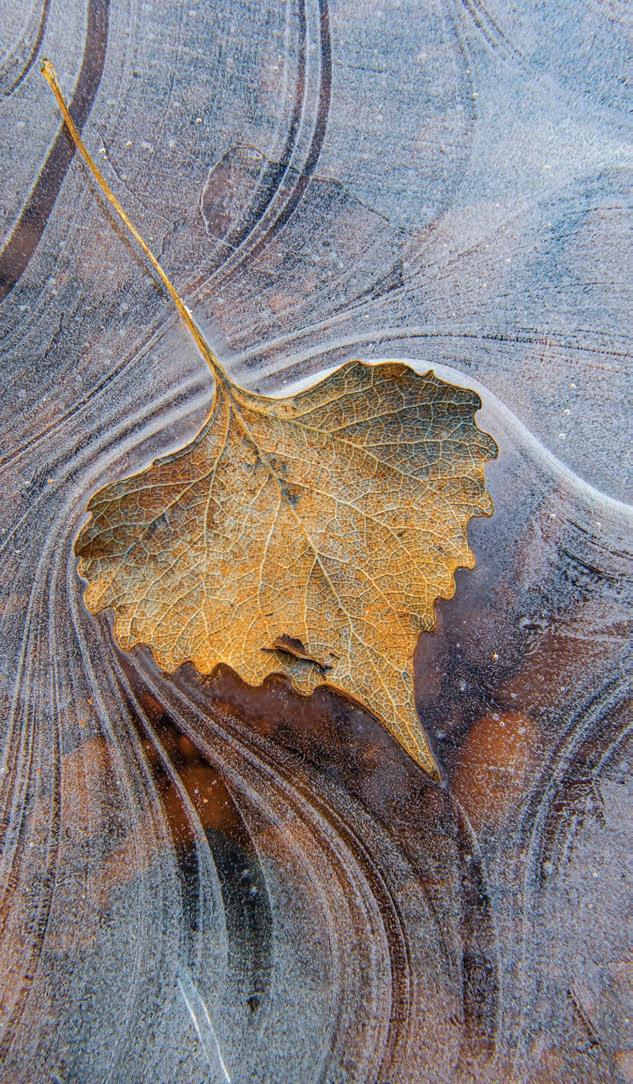
L.J. Christensen, Bountiful
As the shoulder season falls into winter Most living things understand the coming impact.
Earth tilts on its axis, as designed. Daylight wanes, while shadows grow longer. Heated temperatures surrender their reign, Allowing moisture to once again find its way.
Trees in the forests and lowlands seal their exposure And in so doing, create a palette of colors that dazzle. Leaves begin to blanket the undergrowth to protect The flora that prepares for a season of rest.
Animals instinctively follow the annual order. Some prepare dens or nests for hibernation, Or busily storehouse food for the duration. Others migrate southward over continents.
Frontiersmen once heeded the telltale signs of nature. Early or late winter, long or short, bitter or mild? Life depended upon the correct read of the signs. Still, we could too, if only we open our eyes and listen.
Nature has cycled this course since the dawn of time. Let us not lose or ignore what she tells us.
Ellen Liebelt, South Jordan
Gray clouds gather and darken the skies, Geese fly over with a trumpeting surprise. Cooling air brings the subtle scent of snow, Frosted mountains stand o’er valleys below. Golden leaves cling to branches once alive, Following the river along the canyon drive, A deer stops to watch, as up the road climbs. Then, marshmallow puffs cap dark-green pines And snow flurries drift and begin to deepen. Suddenly winter edges out the autumn season.


Garry Glidden, Saint George
At the edge of winter, the land draws inward –not asleep, but listening with the deep ears of stone.
Wind fingers the sagebrush, remembering fire. Cottonwood leaves spin, then settle –the color of still breath.
Snow gathers first in the low places, draping deer tracks, cradling bent grass, settling like a hand across the earth’s slow pulse.
Rivers whisper. Ice sings when touched. A fox drinks with wide eyes, its tail brushing frost from stone.
Above, clouds drift like silver animals. The sun hangs distant –a memory you still believe.
Ravens spiral, calling dry as broken branches.
Even trees lean not from the wind, but toward it –shaped by what they must bear.
In the shadow of junipers, a patch of earth stays bare, warmed by rootfire or memory.
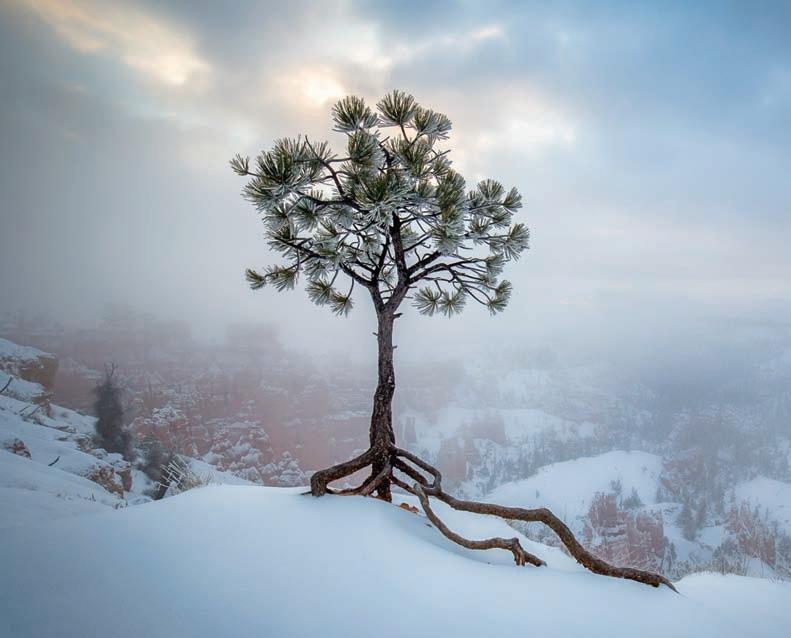
This season does not ask for joy. It asks for stillness. For waiting. For a faith without words –the kind stored in marrow, in the seed’s quiet tightening against the freeze.
At winter’s edge, the world does not bloom. It braces. It remembers. It listens.
And the celebration, if it comes, will be quiet –light returning to hilltops, thaw cracking under snow, the wind easing, just once, before it moves on.
Send your poems on the theme “The Thaw” for the March/April 2026 issue, deadline Jan. 1 and “Creekside” for the May/June 2026 issue, deadline Mar. 1. Email your poems to poetry@utahlifemag.com or mail to the address at the front of this magazine.
Kimberly Maxfield, Provo
Walking through the wooded path Seeking solace from worldly wrath
A fresh coat of powder on her back Being around her keeps you on track
Footprints mark the path you took Along her lively babbling brook
Nature crystalizes our pain Then erases it with sun or rain
Renewal similar to the frost What once were burdens now is lost
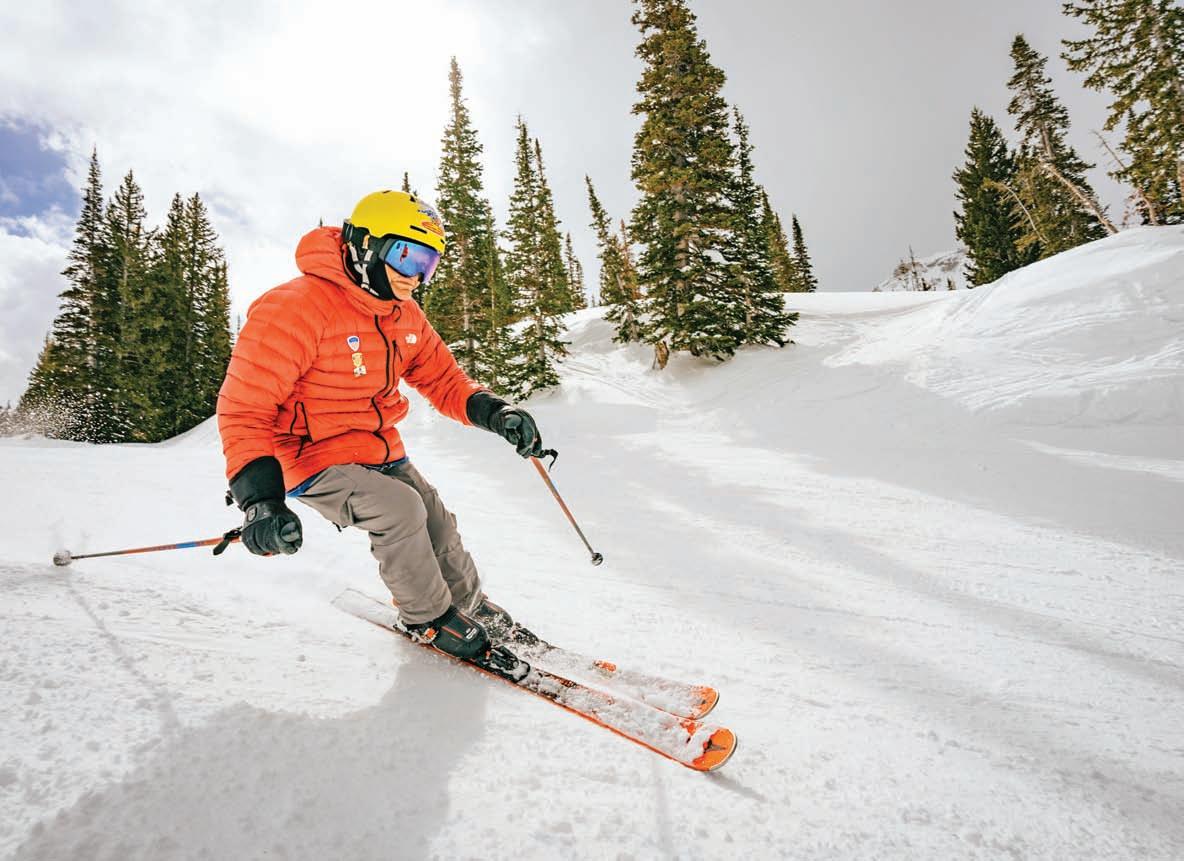
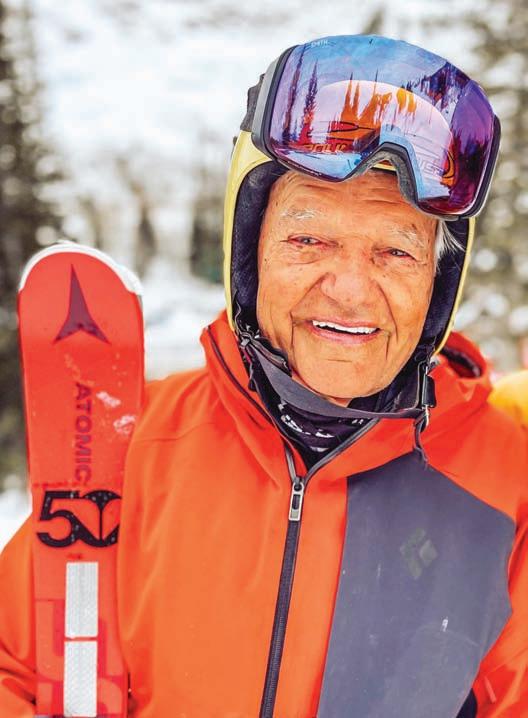
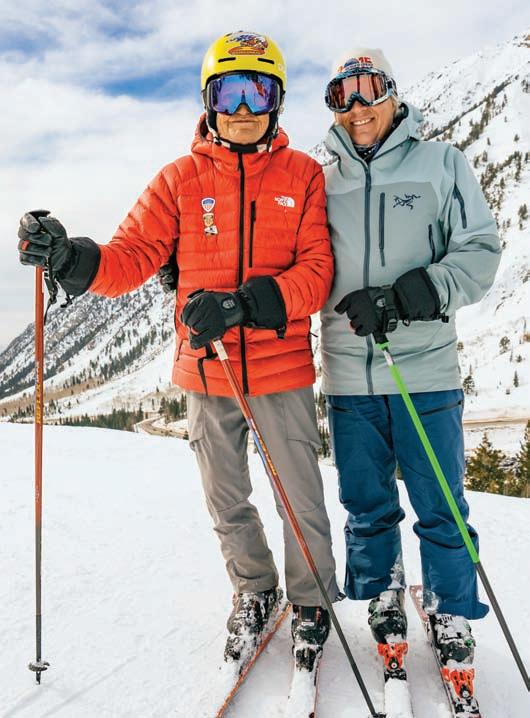
At 100 years old, Junior Bounous is always the most senior skier on the slopes. He’s also among the most acclaimed, with a Hall of Fame membership and a world record title.
by BIANCA DUMAS
Bounous earned the Guinness World Records title of World’s Oldest Heli-Skier at 95 years and 224 days old. The achievement grew from heartbreak: his wife of 67 years, Maxine, had passed away, leaving him ready to quit skiing for good. To lift his spirits, his son Steve arranged a heli-skiing adventure that the family soon realized would make Junior a record holder. On April 5, 2021, the Bounous family skied four laps in the Snowbird backcountry, assisted by Powderbird Helicopter Skiing. The following winter, rejuvenated, Junior skied 101 days of the season.
Born in Provo in 1925, the sixth child of an Italian farm family, Bounous’s birth certificate was left blank – his parents simply called him Junior. He thought that was his given name until his 20s, by which time every other official document listed him as Junior Bounous.
It’s a name that has since become legendary in the ski world. Bounous developed ski schools and programs at Alta, Sundance and California’s Sugar Bowl. He also designed the original layout of ski runs for the opening of Snowbird, later becoming its director of skiing. One of the nation’s first professional ski instructors, he was a founding member of the Professional Ski Instructors of America in 1961.
Bounous first learned to ski on homemade barrel-stave skis at his family’s Provo farm, at risk of crash-landing into a
snow-covered manure pile when he went too fast. He later took lessons from the famed Alf Engen at Alta and skied competitively for a time before discovering his true love: teaching. Utah’s deep powder demanded new methods, and Bounous helped pioneer them – his “bumpty-bump” technique was published in Ski Magazine. Maxine, one of the nation’s top powder skiers, always skied and taught alongside him.
For fun, Bounous was known for big air – one famous photo shows him leaping off the roof of his Alta home as Maxine looks on. He caught the eye of filmmaker Warren Miller and appeared in nearly every Miller ski film of the 1950s.
The Bounouses joined Utah’s first heli-ski tour on Nov. 6, 1961, with Elfriede Shane and Jim McConkey, skiing down Provo
Cirque on Mount Timpanogos for Ski Magazine – and landing on the cover.
Bounous and McConkey, who taught under him at Sugar Bowl, were also the first to ski Snowbird’s 700-vertical-foot Pipeline chute, arriving by helicopter on Snowbird’s opening day. Junior skied the Pipeline 15 times, including twice by helicopter – on that first run and again for his 80th birthday.
A member of the U.S. Ski and Snowboard Hall of Fame, Class of 1996, Bounous has spent a lifetime sharing the joy of skiing.
“This year, I hope to ski my age,” he said. That’s one day on the mountain for each year of his life. The goal seems within reach: he spends winters at Snowbird and typically skis for a couple of hours daily with family and friends. “That gives me a good workout.”
from

by ARIELLA NARDIZZI
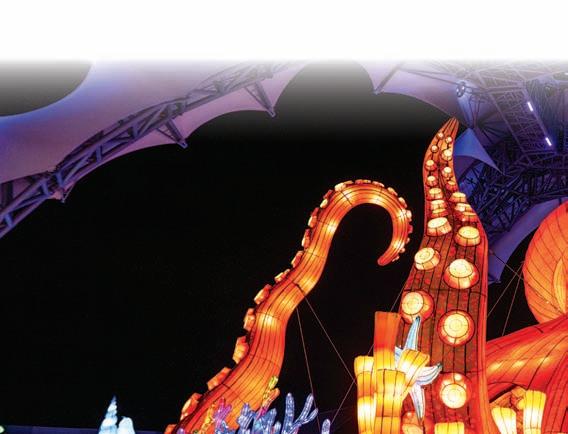
Under a canopy of glowing color, the Loveland Living Planet Aquarium Lantern Festival transforms the Rio Tinto Kennecott Plaza into a vibrant wonderland of light. Walk among towering, animal-shaped lanterns crafted from vivid parachute fabric and illuminated from within. More than 1,000 handcrafted lanterns, created by artisans from Zigong, China, fill the plaza with glowing sculptures that celebrate sea life and imagination through Jan. 10
New displays join returning favorites this year. Families wander beneath arching tunnels as twinkling jellyfish and sea creatures drift overhead, then meander past a menagerie of larger-than-life, illuminated creatures. A giant octopus waves its luminous arms, a puffer fish inflates in slow motion
and a crab clicks its glowing pincers.
Between installations, guests can hop across light-up stepping stones, swing through the air on twinkling seats or pose for photos inside whimsical animal frames. Steaming cocoa and light concessions are available around the plaza.
The festival runs nightly from 5:30-10 p.m.; allow two hours to experience the full display. Tickets include indoor aquarium access until 9 p.m., when the animals turn in for the night. Members receive 15% off admission. Prices start at $18.95 for adults, $15.95 for teens and $13.95 for children.
By evening’s end, the plaza glows like another world – one where light itself swims, crawls and soars. livingplanetaquarium.org, (801) 355-3474
At the Loveland Living Planet Aquarium, more than 1,000 handcrafted lanterns celebrate sea life.
CULTIVATE
Both the menu and interior pay homage to Draper’s farming history and small-town spirit. Standouts include butternut squash gnocchi, beef carpaccio and Nueske’s-infused meatloaf. 12234 Draper Gate Dr., Ste. 105, (801) 274-4230.
THE
This modernized log cabin sits at the mouth of Big Cottonwood Canyon 20 minutes north of Draper. Rooms draws inspiration from the landscape –Wasatch Wildflowers, Jordan Pines and Beehive. 2275 E. 6200 South, Holladay, (336) 793-7000.




Sundance, the country’s largest independent film festival, takes its final bow after more than 40 years in
packed schedule will premiere more than 90 feature and 50 short films, alongside director panels and
The snow-dusted streets of Park City once again glow with camera flashes and cinema dreams as the country’s largest independent film festival prepares for its final bow in Utah after 40 years. Before Sundance makes its move to Colorado in 2027, the festival goes out with a bang – more than 90 features and 50 shorts fill a calendar of premieres, panels and tributes.
This year’s festival honors the late Robert Redford, whose recent passing marks the end of an era – but not the end of his vision. Many festival events pay homage to the Sundance Institute founder’s lasting influence, including the Director’s Brunch at Sundance Mountain Resort, the marquee fundraiser and a commemorative screening of Redford’s 1969 breakout film
Downhill Racer, which helped inspire the festival’s very creation.
From Jan. 27-30, the Park City Legacy program revisits beloved past festival films and welcomes returning directors for a nostalgic walk down memory lane on Park City’s Main Street, open only to foot traffic. Passes and packages for in-person and online viewing are available on the festival’s website.
Screenings fill venues from Eccles Theatre and Redstone Cinemas in Park City to Broadway Centre Cinemas and Rose Wagner Performing Arts Centre in Salt Lake City, ensuring Utah’s cinematic spirit burns bright before the credits roll on an unforgettable run. festival.sundance.org, (435) 658-3456
This award-winning spot serves upscale comfort dishes such as scallion pork gyoza, cheddar biscuits with honey butter and a roasted chicken sandwich with bacon-onion jam. 1153 Center Dr., (435) 200-8840.
This renovated 19th-century schoolhouse, named for George Washington, offers 12 luxurious rooms and suites, a chic ski lounge, a terraced pool and a roaring fireplace. 543 Park Ave., (435) 649-3800.
Kanab’s Polar Express
Dec. 1-13 Kanab
Take a festive ride to Santa on the Polar Express, a converted school bus decorated to resemble a holiday train. Rides depart from the Levi Stewart Memorial beginning at 6 p.m. The route includes narration highlighting Kanab’s early frontier history. 288 W. Center St., (435) 644-4333.
Holiday Craft Fair
Dec. 5-6 Moab
The free fair features goods from local and regional artisans, bakers, crafters and photographers at the Moab Arts and Recreation Center. Hours are Friday 4-9 p.m. and Saturday 10 a.m.-4 p.m. 111 E. 100 North, (435) 259-6272.
Gingerbread Festival
Dec. 6 Bountiful
Artisans craft cozy cottages, pirate ships and sweet architectural designs made from gingerbread. Admission is $6. Hosted at the Bountiful Davis Art Center, visitors can enjoy the exhibition, story time, treats and a Winter Art Market. 90 N. Main St., (801) 295-3618.
Diwali Celebration
Dec. 6 Salt Lake City
The City Library hosts music, dance, food and a ceremonial lighting of diyas – lamps meant to ward off darkness – in celebration of the South Asian Festival of Lights. Event runs 2-5 p.m. Attendees may join a brief workshop on traditional rangoli patterns. 210 E. 400 South, (801) 524-8200.
Pioneer Christmas at the Village
Dec. 12, 13 & 15 Provo
Celebrate Christmas as the pioneers did in the 1800s with a holiday program at the Carriage House at 5:30, 6:15 and 7 p.m.
Visit Father Christmas and enjoy campfire treats, fiber craft demonstrations and the working blacksmith. Admission is free. 500 W. 600 North.
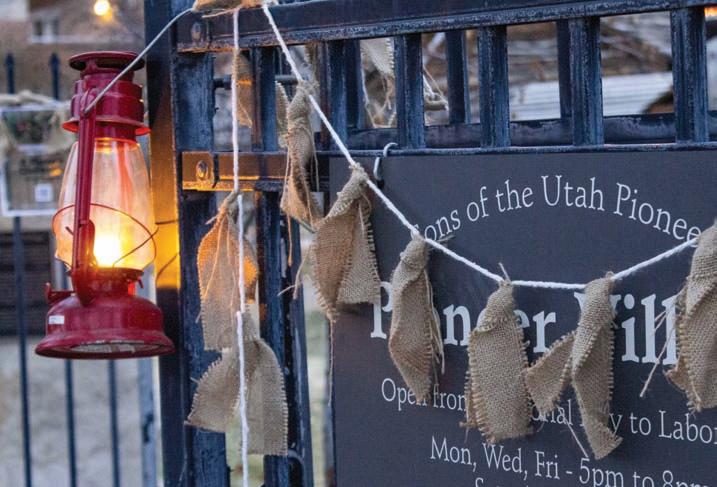
At Provo Pioneer Village, visitors celebrate Christmas from the 1800s. Visit Father Christmas and a working blacksmith, partake in fiber crafts and roast treats over the campfire.
Messiah ‘Glory Revealed’
Dec. 14-15 Cedar City
For the 85th year, the Orchestra of Southern Utah performs Handel’s Messiah. Orchestra and choir fill the Festival Hall and Heritage Theatre in a reverent program beginning at 7:30 p.m. 105 N. 100 East, (435) 233-8185.
Run Run Reindeer Fun Run
Dec. 20 Ivins
Dash, dance and prance your way through the 14th annual 5k at Ivins City Park. Along the course, enjoy reindeer selfie stations, booths and post-race sweet treats. Race begins at 9 a.m. 100 N. 100 West.
Snow and Flow
Jan. 3 Salt Lake City
Trek through Solitude’s powdery trails on snowshoes, followed by a one-hour yoga practice and meditation at the Nordic and Snowshoe Center. Event starts at 3:45 p.m.
Tickets $99. 8073 Big Cottonwood Canyon Rd., (385) 282-7155.
Spiritual & Religious Art of Utah
Thru Jan. 7 Springville
The Springville Museum of Art hosts its 39th annual exhibit celebrating diverse spiritual traditions through works such as “Eve and the Tree of Knowledge,” “Grace Into My Skin,” “He Cometh Unto His
Own” and “Journey.” 126 E. 400 South, (801) 489-2727.
Choir of Man
Jan. 7 Logan
This 80-minute performance stars nine actors in a lively mix of singalongs, harmonies and tap dancing set to pub tunes, Broadway songs and classic rock. 43 Main St., (435) 752-0026.
Eccles Organ Festival
Jan. 11 Salt Lake City
Renowned organist Richard Fitzgerald performs a resonant recital at the Cathedral of the Madeleine as stained-glass windows glow with kaleidoscopic colors. Concert begins at 8 p.m. Free admission. 331 E. South Temple, (801) 328-8941.
Navajo Winter Storytelling
Jan. 14 Blanding
Kigalia Fine Arts hosts traditional Navajo winter storytelling, sharing creation tales and oral histories suited to the long cold nights. Free admission. Event begins at 6 p.m. Utah State University Blanding Hogan, 576 W. 200 South, (435) 485-8499.
‘Steel Magnolias’
Jan. 16-22 Vernal
Vernal Theatre presents this classic comedy-drama following six women as they navigate life’s challenges in a small Louisiana town. Show begins at 7 p.m. Tickets $10. 40 E. Main St., (435) 219-2987.
Questions on p 10-11
1 Mexican-American War
2 Michigan
3 Bonneville Salt Flats
4 Ender’s Game
5 Nick Rimando
6 b. Donny Osmond
7 c. Vote
8 a. Chicago Blackhawks
9 a. “Battle Hymn of the Republic”
10 c. Gravitational waves
11 True, the Jarvik-7.
12 False, also St. Moritz, Lake Placid, Innsbruck and Cortina d’Ampezzo
13 True, one of the NCAA’s major polling selectors named Utah the national champion after their final win over #4 Alabama in the Sugar Bowl.
14 False, he only got 68% of his Final Jeopardys right – still pretty good!
15 True, and he did it twice!
Trivia Photographs
Page 10 Nick Rimando Page 11 Gravitational waves






story by KERRY SOPER illustration by JOSH TALBOT
ISOMETIMES WONDER IF Utah is the epicenter of digital miscommunication. Between big extended families, sprawling social networks and an aging, tech-averse population, we may lead the nation in texts sent to the wrong person, unintentional autocorrect jokes and naïve social-media gaffes. I’ve witnessed plenty in my own family, and committed more than a few myself.
When my wife had a church calling that required texting dozens of young adult women, she made the mistake of entering their contact information with just first names. This created an impressive archive of one-named enigmas, ideal conditions for misfires.
One evening, she texted our teenage daughter, Emma, who was napping in her room:
Hey, you awake?
Wanna watch Survivor with us?
The reply came quickly:
Yeah, I’m awake, but are you sure you’re texting the right Emma?
My wife chalked it up to sarcasm and doubled down:
Yeah right – good one!
We’re gonna eat some yummy bread pudding …
C’mon cutie – nap time is over!!
Only after several increasingly desperate replies did the young woman on the other end finally convince her she was not our napping child. My wife let out a scream of embarrassment and laughed and cried at the same time for a solid 10 minutes.
I can’t tease her, though. I once tried to send her a lovey-dovey text that ended up with a male colleague:
Have fun at IKEA today honey! I love you!! – followed by three kissy-face emojis.
I realized my mistake only after he responded:
Sorry – too busy for IKEA today, but right back at ya sweetie pie.
I still avoid eye contact with him.
My brother-in-law learned the perils of giant Utah family text chains. One of his sisters revived a decade-old group thread to give updates on a hospitalized uncle, sending messages to about 50 middle-aged relatives, cousins and grandparents. Unfortunately, one long-abandoned number in the chain (a number my brother-in-law once had while living in New York) now belonged to a stranger. And that stranger decided it would be hilarious to send inappropriate photos to 50 unsuspecting Utahns.
You can imagine my brother-in-law’s shock when these images appeared in the thread, looking as though he had sent them himself. He and my sister scrambled into damage-control mode, calling the parents of multiple families: DON’T LOOK AT YOUR PHONES!! (Which, naturally, made everyone look at their phones.)
The biggest concern was warning two tender-hearted grandparents. But they were at
Chuck-A-Rama, proudly showing friends photos of grandchildren on their phones. For months afterward, my brother-in-law found himself repeatedly assuring several appalled relatives that he was not in the habit of sending out awkward photos.
Autocorrect is another hazard, especially for older folks whose thumbs and eyesight are no match for mischievous predictive text.
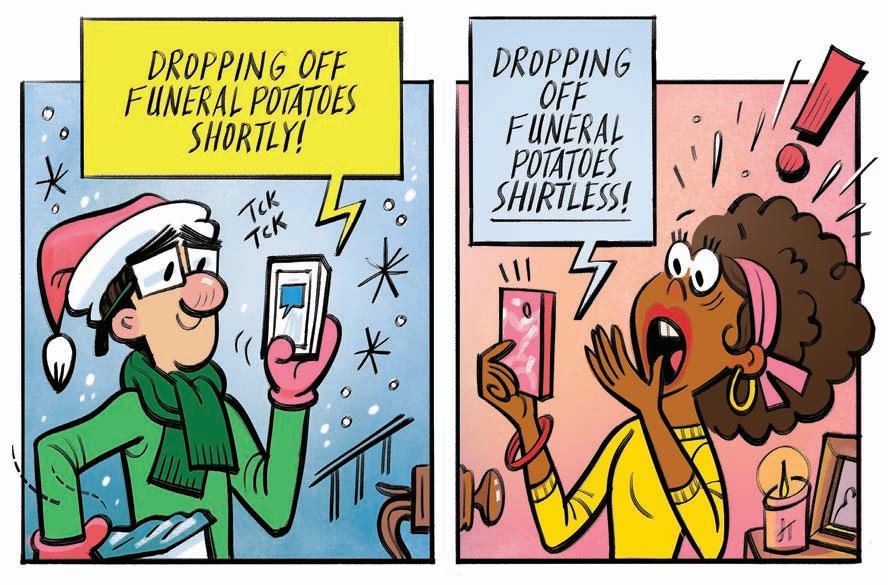
One sweet older woman in our neighborhood has unknowingly produced classics. About a neighbor’s health, she texted my wife: I hope she dies soon instead of I hope she does soon. Her ETA once arrived as I’ll be there shirtless instead of shortly. And her inquiry about my wife’s arrival came through as Are you going to be a little b-----? instead of a little bit.
AUTHOR
Kerry Soper
correct poetry. Trying to ask her kids for help buying medicines and supplements –while still hazy from painkillers after a surgery – she somehow sent: I was needy Jello R erotic, innuendo, eggs macrame, adhesive gander and melancholy Doris.
As if that weren’t enough, she accidentally hit the iMessage effect where the words fade like a shy ghost. A follow-up attempt at false alarm autocorrected to farts alarm, which, admittedly, is a type of alarm many of us could use.
writes and teaches satire, humor and history from Provo.
My 84-year-old mom once produced a masterpiece of incomprehensible auto-
My wise but tech-challenged dad has also made memorable blunders. After joining Facebook, he saw the prompt at the top that says What’s on your mind? and assumed it was asking for technical help. His single, eternal post reads: how to set up profile? No one ever answered, and so it remains, a humble cry for help in an indifferent digital universe.
My mom, at least, figured out how to
comment, or so we thought. We discovered she was online when our adult children reported receiving sweet, emoji-filled messages from an aunt who had passed away the previous year. Comments from beyond included: I’m so proud of you!!!Please come visit soon!!! and strings of kissy emojis.
As intriguing as it would be to have a social-media feature for communicating with the recently departed, the truth was less paranormal: my mom had somehow fused her Facebook login with her late sister’s account, likely during some joint attempt to navigate the app years earlier.
None of us have been able to untangle their accounts since, so our aunt continues to cheer us on from the afterlife, liking photo albums, congratulating graduates and sending digital love to the grandkids.
But in a world full of contentious, scam-ridden and inappropriate digital interactions with strangers, I’ll take awkward, confusing messages from beloved family members –living or dead – any day.