Railbiking Adventures • Denver Tinsmiths • Cussler Museum • Jackson Lake Camping
MAY/JUNE 2026
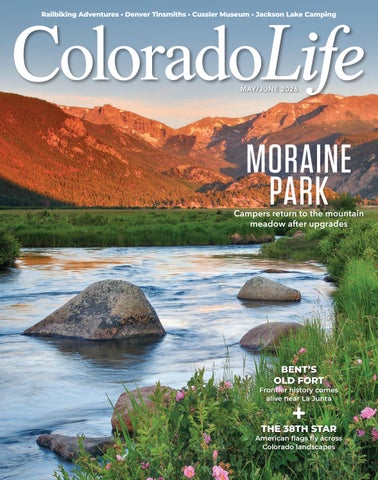
MORAINE PARK
Campers return to the mountain meadow after upgrades
BENT’S OLD FORT
Frontier history comes alive near La Junta
THE 38TH STAR
American flags fly across Colorado landscapes
Stylish Senior Living EXPLORE OUR RESIDENCES
Wind Crest® in Highlands Ranch offers maintenance-free floor plans to fit your style and budget. • Enjoy contemporary fixtures and finishes. • Choose from a range of custom upgrades. • Retire from the hassle of house repairs. Call 1-888-964-0047 for your free brochure.
Wind Crest, Inc., a nonprofit organization, is solely responsible for fulfilling financial responsibilities to residents under the contract. Wind Crest is within the network of communities developed and managed by Erickson Senior Living.®
2 COLORADO LIFE
1785750
Highlands Ranch WindCrest.com
CONTENTS ISSUE NO. 84 | MAY/JUNE 2026
FEATURES 14 Moraine Park Campground
After years of closure, visitors can once again experience an overnight stay among elk, moose and alpine landscapes in Rocky Mountain National Park. by Peter Moore
Bent’s Old Fort, p 20
20 Bent’s Old Fort
A historic site near La Junta brings early trading days to life, where cultures met and commerce shaped the frontier. by Matt Masich
26 The 38th Star
Colorado gave the American flag its 38th star. A century and a half later, it still flies from summits, storefronts, rodeo arenas and ranch gates. by Chris Amundson
38 Denver Tinsmiths
A father-son duo in Denver uses traditional retinning techniques to preserve heirloom copper. story by Ariella Nardizzi photographs by Erik Makić
The 38th Star, p 26
IN EVERY ISSUE 7 8
12
Editor’s Letter
Chris Amundson reflects on life in Colorado.
Sluice Box
Railbiking combines pedals and train tracks; Colorado landscapes woven into tapestry; an impressive private automobile collection at Arvada’s Cussler Museum; and pika, tiny tenants of the tundra.
Trivia
How well do you know Colorado’s Native roots? Answers on page 45.
Denver Tinsmiths, p 38
COLORADO LIFE MAGAZINE, ISSN 2166-3823, is published bimonthly for $30 per year by Flagship Publishing, Inc., 4300 Ardglass Lane, Timnath, CO 80547. Periodical postage paid at Timnath, CO, and at additional mailing offices. POSTMASTER: Send address changes to Colorado Life, PO Box 270130, Fort Collins, CO 80527.
CONTENTS 3
Logan County Fair & Rodeo July 23 - August 2 2026
4 COLORADO LIFE
Stories in this issue come from
Estes Park p 14
Orchard p 48
Erie p 8 Arvada p 10 Denver p 38 Breckenridge p 43
ON THE COVER
Alpenglow lights the peaks of Rocky Mountain National Park above the Big Thompson River at Moraine Park. Story begins on page 14. PHOTOGRAPH BY JOSHUA HARDIN
La Junta p 20 South Fork p 8, 42 Cortez p 50 Mancos p 11 Map by Raven Maps & Images
IN EVERY ISSUE 32 Kitchens
Hot summers call for cool treats. Try three no-bake desserts.
36 Poetry
Poems trace unfolding change through nature and human experience.
42 Go.See.Do.
42
Logger Days roots competition in South Fork’s timber past, multi-sensory works on display at the Breckenridge International Festival of Arts and 13 more events around the state.
48 Camping
An escape to the Eastern Plains brings lakeside camping and water-based activities at Jackson Lake State Park.
50 Peak Pixels
Joshua Hardin captures Mesa Verde’s quieter side through stone, shadow and light.
50 Above: Breck Create, Joshua Hardin Page 3: National Park Service, Peter Scott Barta/DIA, Erik Makić CONTENTS 5
6 COLORADO LIFE
From the Editor
MAY/JUNE 2026 Volume 15, Number 3
Publisher & Editor Chris Amundson
Associate Publisher Angela Amundson
Editorial Assistant
Savannah Dagupion
Design
Rasa Velicka
Photo Coordinator Erik Maki
Staff Writer
Ariella Nardizzi
Advertising Sales
Robert Schonlau, Sean Thomas
Subscriptions Shiela Camay
Colorado Life Magazine c/o Subscriptions Dept. PO Box 270130 Fort Collins, CO 80527 970-480-0148
ColoradoLifeMag.com
SUBSCRIBE
Subscriptions are 1-yr (6 issues) for $30 or 2-yrs (12 issues) for $56. Please call, visit ColoradoLifeMag.com or return a subscription card from this issue. For fundraising and group subscription rates, call or email subscriptions@coloradolifemag.com.
ADVERTISE
Advertising deadlines are three months prior to publication dates. For rates and position availability, please call or email advertising@coloradolifemag.com.
CONTRIBUTE
Send us your letters, stories, photos and story tips by writing to us, emailing editor@coloradolifemag.com or visiting ColoradoLifeMagazine.com/contribute.
COPYRIGHT
All text, photography and artwork are copyright 2026 by Flagship Publishing, Inc. For reprint permission, please call or email publisher@coloradolifemag.com.
Still Running
E
VERY CAR IN the Cussler Museum runs.
That was Clive Cussler’s rule. It’s still the rule in Arvada. Curator Keith Lowden keeps more than 100 vehicles ready: batteries charged, fluids checked, engines exercised. They sit under museum lights beside Cussler novels that put them on the page; they’re not furniture. Even the most elegant machine has to turn over now and then. This issue has plenty of old things still in use: rails, copper pots, adobe rooms, flags, campgrounds, cars. Old Denver & Rio Grande rails carry railbikes near South Fork. Copper pots arrive at Rocky Mountain Retinning in Denver dented, darkened and worn through; they leave ready for someone’s stove. At Bent’s Old Fort, adobe rooms fill with blacksmith tools, trade goods and schoolchildren imagining Colorado before Denver. In “The 38th Star,” the flag flies from summits, through rodeo dirt, past parade curbs and beside cemetery rows. Wind frays the cloth. Rope runs through pulleys. Someone clips on the next flag and raises it again. When Colorado Life was still new, our family lived in a cabin near the Beaver Meadows entrance. A small rise stood between us and Moraine Park. I was away on a magazine trip with Azelan when Angela called in the middle of the night. The Fern Lake Fire had pushed through the park; she was getting the other two kids out. She was calm, but she was packing bags. If you’ve heard that tone from a spouse, you know the difference. Azelan and I drove home the next morning. By then, danger had eased. Angela and the kids were safe; so were the cabin and Moraine Park. I read Peter Moore’s story about Moraine Park Campground with that call in the background. After two seasons, campers are back among high meadows and the Big Thompson River. The park upgraded water, sewer and electric systems, improved food storage and reopened the campground. Visitors can wake to elk bugling and, with luck, a moose in the meadow. A campground looks simple: site number, fire ring, picnic table, one missing tent pole discovered after dark. Behind that are pipes, wiring, road work, food storage and rangers answering the same questions all summer. Rebecca Mezoff dyes wool before color becomes canyon or sky. Erik Undiks wipes tin in circles and sends cookware back to the stove. At Mesa Verde, Joshua Hardin waits for stone, shadow and light. A car starts in Arvada; a railbike rolls near South Fork; a copper pot catches shop light. Campers pull into Moraine Park with coolers, sleeping bags and, one hopes, all the poles. Someone kept all of it ready. Then the rest of us get to turn the key, light the stove, pitch the tent and watch the colors rise. Chris Amundson Publisher & Editor editor@coloradolifemag.com
COLORADOLIFEMAG.COM 7
NUGGETS AND OBSERVATIONS ABOUT LIFE IN COLORADO
Human-Powered Railroad Historic Colorado rails become pedal-powered adventures in South Fork and Erie
Revolution Rail Co.
Revolution Rail Co. riders pedal along historic Denver and Rio Grande tracks near South Fork, giving an old rail line new life as a scenic, leg-powered adventure.
by WENDY UNDERHILL Colorado has scenic trains. Colorado has rail-trails. Combine the two and what have you got? Railbiking. This rail-based option, where legs replace steam cylinders, runs in South Fork and Erie. Railbikes look like land versions of paddle boats: two to four people pedaling each rig along unused track. No steering is required – railbikes are on rails, after all. Splashing is not a thing, either. Is railbiking a sport? A lark? An entry point to Colorado’s wilds? Yes, yes and yes. Mostly, it is just plain fun at a speed that leaves time for cottonwoods, canyon walls, coal country, birds and the occasional child asking why the train has no train.
8 COLORADO LIFE
In South Fork, Revolution Rail Co. began running tours in 2021 on historic Denver & Rio Grande rails leading up-valley toward Creede. Its Rio Grande Run follows the river for a 6-mile round trip through mountain terrain, leaving from the town’s historic depot. In Erie, Colorado Railbike Adventures follows the Boulder Valley Mine route, a 4.2-mile round trip that crosses Coal Creek and rolls toward Old Town Erie with Front Range views. Owner Jeff Rummer and his father, Bob, an engineer by trade, worked up a head of creative steam during the pandemic. It took three years to get a lease from the Regional Transportation District to use the tracks, and they have been rolling full tilt ever since. Railbiking looks more strenuous than
it usually is. Katie Harrison, the general manager in South Fork, has been workin’ on the railroad for three seasons. One caller asked it plainly: “You say this is for all ages. I’m 91 ... did you mean me?” Her answer: Yup, provided the group includes a couple of people willing to pedal. Babies in front carriers can ride, too. April Bushman’s Midland, Texas-based family booked Revolution Rail Co. for back-to-back reunions, with riders from babies to grandparents. “It worked for everybody,” she said. “It was a super-awesome side adventure.” At both operations, passengers group up at the depot and wait for the signal to pedal. It is not a race. Railbikes can only go as fast as the lead car, so riders built for sprinting must take up birding for the hour. At the end of the line, guides prepare the railbikes for the return trip by turning them on a small turntable. While that operation is going on, passenger-pedalers alight to refuel and learn how these tracks once worked. In Erie, coal was king. In South Fork, silver and gold mining came first, followed by the lumber industry. In South Fork, passengers can go off the rails for even more fun. “Pedals to Paddles” excursions combine railbiking up the canyon with rafting back down the Rio Grande. Twilight rides are summer highlights. Erie’s operation includes its own special events, including a Rails and Ales tour that stops at a local cidery. Both places are on track for growth, either by extending rides or opening routes on other unused Colorado rail lines. “You get bitten by the bug,” Rummer said. “I want to find another place and tell its story, too.” Then the whistle blows, riders settle their feet on the pedals, and the old rails carry another crew home at the speed of legs.
Tiny Tenants of the Tundra by ARIELLA NARDIZZI You hear them before you see them. “Eep!” A high-pitched call cuts the thin air near treeline, where talus slopes border alpine meadows. Then a potato-sized animal scampers across the rocks, carrying a mouthful of greenery before disappearing between the stones. The American pika (Ochotona princeps) is a small mammal of Colorado’s high country. Though often mistaken for a rodent, it belongs to the same order as rabbits and hares. With round ears and no visible tail, its compact body measures 6 to 8 inches long and weighs about 7 ounces. A gray-brown coat blends with the rocks where pikas live, mostly in cool talus fields of Colorado’s alpine and subalpine country. Sharp, curved claws and padded toes help them scramble across broken stone. For such a tiny animal, the pika’s “eep” is easy to hear, warning nearby pikas of coyotes, martens, weasels and hawks. These alpine haymakers do not hibernate. Instead, they spend the short summer gathering grasses, sedges, lichens, conifer twigs and flowers, drying them in piles tucked among the talus. Pikas stuff their mouths with vegetation and hurry between meadow and home, making thousands of foraging trips in a season. The haystacks become their winter pantry. Pikas survive cold with thick fur and a high resting body temperature, but heat is harder on them. In summer, they retreat into cool rock crevices and are most active during cooler parts of the day. Researchers track them closely because extended exposure to temperatures in the high 70s can be fatal, and warming summers threaten parts of their alpine habitat. Near treeline, pikas call from the rocks, their squeaks bouncing across the talus. A hiker may only catch a flash of fur or a mouthful of grass before the animal vanishes again. Then another “eep” comes from somewhere under the stones.
Jeff Foott (both)
During summer in Colorado’s alpine and subalpine country, American pikas gather plants for winter and retreat into cool rocks as warming temperatures threaten their habitat. SLUICE BOX 9
Cussler Museum
Dirk Pitt’s Garage An Arvada museum houses cars driven by Clive Cussler’s adventure hero by BRANDON WILE Every car in the Cussler Museum runs. Clive Cussler insisted on it. Curator Keith Lowden still keeps more than 100 vehicles ready to start, with batteries charged, fluids checked and engines exercised, from brass-era automobiles to postwar convertibles. Museum lights catch the polished fenders in Arvada, where many cars are paired with the Cussler novels that made them famous. The collection began with a 1946 Ford club coupe. Cussler’s wife, Barbara, spotted it in Colorado, and Cussler bought it for $400. He and his son restored it curbside. After Raise the Titanic! made Cussler a bestselling author in the 1970s, the collection expanded to Duesenbergs, Bentleys, Bugattis, Packards, Talbot-Lagos and other cars built between 1906 and 1965. Cussler wrote thrillers, searched for shipwrecks and hunted for old cars. He started buying collector cars in the mid1970s, traveled to auctions with Lowden and eventually filled a warehouse. His daughter opened the collection to the public as a museum in 2005, turning the
10 COLORADO LIFE
private warehouse into a public attraction. Cussler died in 2020. Many of the cars appeared in Cussler’s novels. The museum displays books beside the vehicles, so readers can stand in front of the machines Dirk Pitt drove on the page. Coachbuilt prewar cars make up much of the collection, built by hand to individual customer specifications. A 1929 Duesenberg Model J in orange and brown, once owned by the founder of United Airlines and featured in Flood Tide, draws the eye in the classic room. Nearby, a powder-blue 1948 Talbot-Lago T26 Grand Sport Fastback, the French car featured in Deep Six, was reportedly rescued from a farm where it had been used as a chicken coop. A 1931 Stutz Boattail DV-32 Speedster, one of only six thought to still exist, appears in Celtic Empire. Cussler prized one car above all others. The 1929 4½-Litre Blower Bentley was built for Le Mans racing, with a leather body to cut weight and a supercharger mounted ahead of the radiator. Lowden said Cussler gravitated toward it when he visited. Staff would get him settled, and Cussler would take it out with no destination in mind.
“I think it was probably the car he tended to favor,” Lowden said. Cars from the Cussler Museum have been shown at Pebble Beach and Amelia Island, alongside some of the country’s best-known collections. Visitors come from England, Australia, New Zealand and Germany, drawn by the novels and the knowledge that Dirk Pitt’s cars were real. Lowden describes the museum as closer to a gallery than a working garage. Paint, chrome and leather are kept sharp, but the placards carry more than makes and model years. They tell where the cars came from, who owned them, how Cussler found and restored them and which novel featured them. The collection rotates, so returning visitors may find different cars on display from one season to the next. Cussler’s old rule remains: The cars have to run. Cussler Museum 14959 W. 69th Ave., Arvada Open seasonally, May-September cusslermuseum.com
Woven West Mancos loom turns desert color, mountain horizons into tapestry heirlooms by ARIELLA NARDIZZI Rebecca Mezoff makes color before she makes a tapestry. In her Mancos studio, skeins of wool shift from sandstone red to violet, cobalt and indigo – colors she dyes by hand for work shaped by canyon walls, high desert sky and the slow record of rock. Her studio sits in Montezuma County, near the La Plata Mountains and the open country where much of her palette begins. Horizons, rock layers and blocks of sky appear in bands of wool, each pass of weft placed by hand on her grandfather’s old Harrisville rug loom. Mezoff grew up in Gallup, New Mexico, in a family where making things was ordinary. Her mother sewed, her father ran a printing press and her grandparents wove fabric. As a child, she watched her grandfather at the loom, weaving yards of doubleweave cloth – fabric made in two layers at once. Years later, that same loom became part of her own tapestry work. After graduate school in occupational therapy, Mezoff moved to Nevada and began weaving on an old barn loom. Doubleweave interested her first. Then she found herself wanting to make images in cloth. In 2004, she returned to New Mexico and took traditional Hispanic weaving classes at Northern New Mexico College in El Rito, working in a 400-year-old adobe house. Soon after, she began studying with contemporary tapestry artist James Koehler and later became his apprentice. Two decades in, Mezoff ’s tapestries draw from landscape, horizon and the layered rock beds of the West. “The way landscape marks time is fascinating to me,” she said. “My work explores who we are as humans in a massive time scape
Rebecca Mezoff, “Unconformity Series: Clarity,” 24 x 45 inches, hand-dyed wool
and how I document that in a soft medium like yarn.” The pieces begin with dye. Mezoff works in small batches to get the color shifts she wants. A single tapestry may use 50-90 colors, a palette that can take weeks to prepare. In “Emergence V: The Center Place,” a 44-by-44-inch hand-dyed wool tapestry, violet, cobalt and indigo run through bands of sandstone color. Mezoff often takes a small loom outside. “I go outside on an adventure and weave something about what I see. I weave as a journal, like a marker of that experience,” she said. While backpacking along the Colorado Trail near Silverton, she carried a miniature loom and wove during water breaks and evenings at camp. Another project came from the long drives she took while looking for a new home in Colorado. The piece includes Mount Princeton near Buena Vista, Longs Peak outside Estes Park and Taos Mountain in New Mexico – each mountain marking part of the search. She eventually landed in Mancos. “I felt like I’d come home when I moved to Mancos,” she said. “It’s a mix of the things I grew up loving, with the La Plata Mountains, the desert, and quiet, open places with dark skies and stars at night. Everything breathes a little more.” Mezoff teaches online and from her Mancos studio. Her book, The Art of Tap-
Rebecca Mezoff
estry Weaving, offers instruction for students learning to make images with yarn. “My job is to guide people toward realizing they are an artist, to express themselves and explore their inner creativity,” she said. At the loom, Mezoff passes dyed wool through the warp. A line of color becomes rock. Another becomes sky. She presses the weft into place and reaches for the next shade. SLUICE BOX 11
INDIGENOUS PLACE NAMES
Test your knowledge of Colorado’s Native roots by BEN JENKINS
Celebrating
149th Annual
Arkansas Valley Fair AUGUST 19-22, 2026
Join the fun in Rocky Ford and save the date for the 148th Arkansas Valley Fair, the oldest continuous fair in the state of Colorado! Youth Rodeo • Barrel Race • Silver Day Kid’s Day • Parade Day • Watermelon Day CPRA Rodeo • Figure 8 Jump Race • Horse Racing Demolition Derby • Carnival • Car Show
arkvalleyfair.com 719 -254 -7723
John Morrison/iStock
GENERAL
1
Colorado has two federally recognized tribal nations: one headquartered in Towaoc and the other in Ignacio, both in southwest Colorado. They belong to what Native people?
2
Before it took the name of a U.S. Army officer and explorer, what Colorado landmark, towering above the southern Front Range, was known to Indigenous peoples by names translated as “Sun Mountain,” “Long Mountain” and “Where the Heavens Touch the Earth?”
3 6
In 2023, Colorado’s 12th -highest peak received a new name that echoes both the Arapaho people, known as the Blue Sky People, and an annual Cheyenne ceremony. What is the peak now called?
4
Littleton extends into three counties, including one named for the Arapaho people. What extra
12 COLORADO LIFE
letter appears at the end of that county’s name?
5
An Algonquian word often translated as “great spirit” gave its name to what mineral-springs town, where healing waters still bubble at the foot of Pikes Peak? ivanastar/iStock
MULTIPLE CHOICE
6
STEP BACK IN TIME TO
The Arapaho name for Owl Canyon in Larimer County points not to owls, but to a seasonal insect. It translates to “Where There Are Many” of what Colorado creatures? a. Beavers b. Miller moths c. Red foxes
The grandeur of a bygone era awaits you at Rosemount in Pueblo! Built in 1893, this 37-room, 24,000 square-foot mansion was the family home of prominent businessman John A. Tatcher and his family. Take a guided tour of the mansion, and step back in time.
7
Ouray County calls itself the “Switzerland of America,” but its name points to a Colorado leader known more for diplomacy than mountain scenery. Chief Ouray led what Native people? a. Comanche b. Apache c. Ute
8
With a Ute-derived name often translated as “healing waters,” what area is also associated with a Diné emergence story, as the place where the People came from the underground world into this one? a. Pagosa Springs b. Radium Hot Springs c. Iron Mountain
9
The Uncompahgre River, Uncompahgre Peak and Fort Uncompahgre all carry a Ute -derived name tied to western Colorado water. The original term is often translated as water of what color? a. Green b. Blue c. Red
10
El Paso County is Colorado’s most populous county, and Las Animas County is the largest by area. Which of these Colorado counties is NOT named for an Indigenous people? a. Huerfano County b. Cheyenne County c. Kiowa County
Open February-December
Josh Hardin
Tuesday-Saturday • 10 am–2:30 pm
TRUE OR FALSE
11
Denver sounds like it could be a rugged place-name, but the city’s name came from politics, not geography. True or false: Denver comes from Comanche words meaning “rocky place.”
12
In 2022, 28 Colorado places were renamed as part of a federal effort to remove a derogatory term for Native women, including the newly named Petite Tetons, Sego Point and Mestaa’ėhehe Pass.
419 West 14th St • Pueblo • 719-545-5290
Visit Summit County’s Enchanting B&B
13
Arapaho speakers had a name for the mineral-spring area around present-day Colorado Springs and Manitou Springs. The phrase is often translated as “Medicine Fountain.”
14
Before it became Grand Junction, today’s most populous city in western Colorado was briefly known as Ute, a name drawn from the region’s first residents.
15
Niwot, the Boulder County town once home to Crocs headquarters, is named for an Arapaho chief. True or false: Niwot’s name means “soft-footed.”
No peeking, answers on page 45.
Experience historic charm at Frisco Lodge. Our exceptional hospitality, afternoon wine and cheese, award winning courtyard, outdoor hot tub and romantic fireplace are just a few reasons our guests rated us the #1 bed & breakfast in Frisco and all of Summit County! See why our guests think we are the best
www.friscolodge.com fri l d fri 1-970-668-0195 321 Main St | Frisco, CO
TRIVIA 13
R o c ky M o u n t a i n N a t i o n a l Pa r k ’s Best Nightspot is Back 14 COLORADO LIFE
Erik Stensland
After two seasons of construction, Moraine Park Campground once again welcomes campers to sleep where elk and moose roam. by PETER MOORE
I
F THE GREAT outdoors is Colorado’s backyard, then
Moraine Park Campground is its hammock – a cozy spot for rest, relaxation and Rocky Mountain National Park. Moraine Park is a glaciated flatland surrounded by high peaks, with Longs Peak to the south, the Continental Divide to the west and the Mummy Range rising in the east. It’s a broad mountain bowl – a box canyon of beauty, if you’re feeling poetic before coffee. The first riffles of the Big Thompson River flow there, watering a fertile landscape that makes it a prime place to see everything from weird mushrooms to charismatic megafauna. In September, it’s also the Love Shack of the elk rut, where several hundred large ungulates bugle, posture and generally make poor romantic decisions. And moose have lately found their way into the east side of the park, so you may spot them lumbering around as well. For a ringside seat to all that, Moraine Park Campground is the place to be. The largest campground in Colorado’s busiest national park recently underwent the equivalent of elective surgery. The aging bits included antiquated water, sewage and electric systems, plus overdue upgrades for high-tech recreational vehicles that hadn’t been imagined when the campground infrastructure was installed. So in 2023, park administrators closed the campground for a year to fix all that. Then they tacked on another year, because as homeowners know, one reconstruction project often leads to another, and then another one starts looking at you from across the room. Finally, in July 2025, would-be campers hopped on Recreation. gov to sign up for a soft reopening. The campground passed that stress test, and summer camping now runs from May – wildflowers – through the night of October 18 – elk bugling included. Book a night on Recreation.gov and you’ll enjoy the sixth most visited national park in the United States after the daytime crowds depart. A Moraine Park reservation includes timed entry plus access to Bear Lake Road beginning at 1 p.m. on check-in day. You’ll still need a valid park entrance pass. For everyone MORAINE PARK 15
else, Bear Lake Road requires timed entry from 5 a.m. to 6 p.m., while timed entry for the rest of the park is required from 9 a.m. to 2 p.m. More than 4 million people visit Rocky each year, and a lucky 30,000 of them stay in Moraine Park. If you miss out on a campsite, visit Moraine Park anyway. This park-within-a-park provides access to the Cub Lake Trail, which leads to a mountain lake and back down to The Pool, one of the best foot-soaking places in Colorado. The lung-proud among us can head up the Ute Trail toward timberline and the high country beyond. Deer Mountain, with broad views over Estes Park, is nearby as well. If you haven’t visited Moraine Park recently, or ever, a warning is in order. The view is now a mixed bag of beauty and burn scar. The remnants of the East Troublesome Fire form a shadow on the landscape, cascading down from the Continental Divide. Pine beetle damage is evident in the remaining forests, a reminder that had snow not arrived and wind not shifted, Moraine Park and Estes Park itself might have been torched, including the Stanley Hotel. There but for the grace of an October storm – and every weather app in Estes Park – go we. The burn scar, the fenced willows and the restless river all make sense to Ellen Wohl, a fluvial geomorphologist at Colorado State University. “It just means that I study how rivers change landscapes,” she says. For decades, she has studied the plants, animals, rivers and rocks that form Moraine Park’s foundation. A “park,” in the parlance of settlers who barged onto this landscape 200 years ago, referred to a wide expanse of flatland ringed by mountains. South Park, west of Colorado Springs, is the most famous one in our state because of the rude children in a televised cartoon. North Park surrounds Walden. But Moraine Park carries its own cast of characters: elk, moose, beavers and campers hoping to wake up in the middle of it. Wohl takes us back in time to the mak-
16 COLORADO LIFE
ing of this meadow. “During the Pleistocene” – between 2.6 million and 12,000 years ago – “a long tongue of ice deposited walls of sediment to the west and east of Moraine Park, and sealed it off to the south,” she says. So as you stand at your campsite, you’ll see the rough hills left by those glaciers, right up to the steep slopes that shed the ancient ice sheets. In her book Rhythms of Change in Rocky Mountain National Park, Wohl evokes a time when a 500-foot-tall ice wall carved the U-shaped valley west of Moraine Park. Raging rivers cascaded down from the ice face and supported woolly mammoths, mastodons, giant bison and giant beavers. The beavers – whether the giant kind or their smaller modern kin – are what Wohl really misses. Moraine Park used to be filled with them. “After the Lewis and Clark expedition,” Wohl says, “commercial fur trappers flocked to this area, and nearly exterminated the beavers who lived there.” The problem was beaver-skin hats, once all the rage among the stylish set. By the turn of the century, beavers were gone from Moraine Park and scarce elsewhere, and people started wearing silk hats instead. Gone, too, were grizzly bears and wolves, predators that helped keep elk and deer populations in check. Not so much anymore. There’s a problem with how elk, moose and deer browse, Wohl points out. They target the tender buds on the ends of branches, which essentially stops new growth. Beavers, on the other hand, tend to nibble stalks close to the ground, which causes willow to send up new shoots and can promote growth. Remove major predators, and heavy browsing can hit willows hard, leaving less food and building material for beavers. That’s why you’ll see stands of willows behind fences in Moraine Park. Right now, they need protection from the large creatures you enjoy seeing in the park. Meanwhile, Wohl is a leader of the pro-beaver movement, which means she’s also pro-carnivore. There are only so
Erik Stensland (all)
Rocky Mountain National Park is home to over 900 wildflower species, like the mountain iris, and 66 mammal species, many of which can be found in the grassy meadows of Moraine Park off Bear Lake Road. Elk, coyotes, mule deer and other fauna frequent the area.
MORAINE PARK 17
many ruminants the landscape can take, and wolves can help with that problem. Another large mammal has changed the landscape as well. Homo sapiens. For instance, we opened a nine-hole golf course in Moraine Park in 1900 and operated it for 50 years. There were also tourist lodges, cabins and rodeo grounds on the flatlands, dotting a tourist haven known as Stead’s Ranch. Lured by such attractions, people and their automobiles arrived. So many people. So many automobiles. The rise of humans and their contraptions had worldwide ramifications, of course, which fall under the category of “climate change.” The park website notes that if your own body temperature rose 3.4 degrees, you would head for the doctor. Apply that fever to Rocky, as the climate has, and you get earlier snowmelt, longer and hotter summers, longer droughts and more conifer-snarfing pine beetles, among other climate demons. On the west side of Rocky Mountain National Park, green forest turned to ash during the East Troublesome Fire. That’s when a human-caused fire north of Kremmling caught a freshening west wind and burned nearly 200,000 acres. The eastern expanses of that fire swept into Rocky and up over the Continental Divide, threatening Estes Park. A freak October snowstorm saved our bacon, rather than frying it, so only about 9 percent of the park was blackened, mostly on the west side. Happily, Moraine Park Campground is on the east side. If you score a campsite, you’ll be welcomed by rangers happy to see campers again. They can help with questions like “Where is site D218?,” hand over a map and explain the upgrades –
newly improved utilities, more electrical hookups, better food storage and bringyour-own-shower enclosures where stinky campers can hang solar-shower bags heated by sunshine. Those are a thing, evidently. In the campground, you’ll witness a migrating herd of huge RVs, luxury Sprinter vans, teardrops, tow-behinds and pop-up campers. There are plenty of simple tent sites as well, and an amphitheater for ranger-led programs. On a recent evening, Ranger Nikki put the fun in fungi for an audience of camper families. Her most startling mycology fact was that about 95 percent of mushrooms are not poisonous. But, she added, scientists have identified only about 5 percent of all fungi, so who knows? The fly agaric mushroom – the fairy-tale red-capped mushroom with white spots – is plentiful in Rocky and can ruin more than dinner for foragers who fry it up. Which is one more reason not to freelance a mushroom supper. If you camp there, you’ll have a head start on the Rocky Mountain National Park-bound masses because you’ll already be inside the gates. While they wait in line at the entrance, you can head up Old Fall River Road and Trail Ridge Road, then down to Grand Lake, where you’ll find Miyauchi’s Snack Bar. Ice cream by the lake might help compensate for the psychic tax of driving through blackened East Troublesome territory. But five years after the fire, there is hope: The black poles of burned forest are no longer the only thing to see. From a campsite in Moraine Park, you can sit at your picnic table and watch green undergrowth rise around the blackened trunks.
From its headwaters in Rocky Mountain National Park, the Big Thompson River meanders 78 miles through – and beyond – the park. The upper section through Moraine Park is highly regarded by anglers for its wild trout hanging in pools and along cut banks.
18 COLORADO LIFE
Erik Stensland
National Park Service
MORAINE PARK 19
Joshua Hardin
Bending back history at
BENT’S OLD FORT by MATT MASICH
20 COLORADO LIFE
Editor’s note: This story first appeared in the May/June 2012 issue of Colorado Life. A reader favorite, we’re pleased to share it again as the nation marks its 250th anniversary.
I
MAGINE A ROAD map of Colorado.
A little north of center of our beloved rectangle is Denver, with major highways radiating like spokes from a hub. Bigger cities hug the foothills of the Front Range up and down I-25: Fort Collins, Colorado Springs, Pueblo. Follow I-70 west and you’ll hit Grand Junction, and there’s a town in nearly every mountain valley. Take the highways across the eastern Plains and you’ll find town names emblazoned on the water towers serving a host of farming communities. Can you picture it? Good. Now erase it all. That’s what a map of Colorado’s cities looked like in the early 1800s – blank, except for Bent’s Old Fort, an adobe castle on the Plains next to the Arkansas River near modern-day La Junta in southeast Colorado. The fur-trading post along the Santa Fe Trail was the only building for hundreds of miles in any direction. Native people had lived in Colorado centuries before the first Europeans set foot here. Nomadic tribes like the Utes in the mountains and Cheyenne on the plains had long made this their home as they followed the game herds. With its opening in 1833, Bent’s Fort became one of the first signs of the Anglo-American expansion that transformed this region. While the world around it has changed, the reconstructed fort today looks exactly as it did in 1846. Standing in the wide courtyard behind high adobe ramparts, it’s easy to forget what century you’re in, marvels Alexa Roberts, National Park Service superintendent of Bent’s Fort. “Unless you hear a train, you wouldn’t know you’re in 2012 right now,” she said. “You experience the sights, the smells, the sounds of the day.” Rebuilt in 1976 on the foundations of the original structure, the fort is a formidable presence, boasting walls 14 feet tall and 30 inches thick with two rounded bastions on the corners resembling the turrets of a medieval fortress. Though fortified, its purpose wasn’t military; the fort was part of a commercial enterprise called Bent, St. Vrain & Co. Its founders, the Bent brothers, Charles and William, and partner Ceran St. Vrain came from Missouri to make money buying beaver pelts and especially buffalo robes to sell in the east, and by selling manufactured goods to the diverse mix of customers on the Plains. It may seem odd that Colorado’s first business started in what might seem to be the middle of nowhere. On the contrary, it was in the middle of everywhere.
Matthew Inden/Colorado Tourism Office
BENT’S OLD FORT 21
“BENT’S FORT was an incredibly im-
portant economic and political center,” said the National Park Service’s Bill Gwaltney, an expert on the fur trade. Bent’s Fort was Colorado’s power center long before the rise of Denver and the Front Range. The outpost was a key stop on the Santa Fe Trail, the commercial link between Missouri and Santa Fe, the capital of the Mexican province of New Mexico. The Arkansas River, just a few hundred yards to the fort’s south, was until 1848 the international border between Mexico and the United States. From here, you can just make out peaks of the Rocky Mountains on the western horizon, where French-Canadian and American mountain men trapped beaver. In Europe, beaver fur hats became wildly popular in the first decades of the 1800s, which fueled this early Colorado commerce. To the east of Bent’s, Plains Indians hunted the vast roaming bison herds. Everyone came to Bent’s Fort, which became the base of operations for the compa-
22 COLORADO LIFE
ny’s expansive trading empire. There were 40 to 60 employees on average, plus travelers and customers of all descriptions. It was a towering Babel of tongues, with seven or eight languages spoken daily: Spanish (the most common), English, French, Cheyenne and Arapaho, among others. In a time when most Americans used products from no farther than 30 miles from where they were born, Bent’s Fort stood as the modern version of international trade. There were glass beads from Venice, blankets from England, guns from Belgium, trade silver from Germany, ginger and tea from China, and sugar from Havana. The fort even boasted a fullsize billiard table and a bar, as well as a well-appointed kitchen and dining room. There were wild parties called fandangos where people from all backgrounds would dance the night away together. From Missouri, it took travelers 50-60 days to arrive. After a weary journey, to finally arrive was a “big deal,” said Rick Wallner, chief of interpretation at the fort.
Presiding over the operation was William Bent, who first came to Colorado as a teenager on trapping expeditions with his brothers. William was just 24 when he and his partners established Bent’s Fort, also known as Fort William, with older brother Charles and St. Vrain. St. Vrain already had many connections with traders in Taos, New Mexico, and Charles, too, established close trading ties with Mexican allies in Taos. William quickly earned a reputation as an honest broker among the Cheyenne and Arapaho tribes. The relationship became so friendly that just a few years after the fort’s construction, William married Owl Woman, daughter of a prominent Cheyenne leader. The couple moved easily between the white and Indian worlds – when Owl Woman stayed with him in the fort, William covered the floor of his room with many buffalo robes and hung up blankets on the walls; when he stayed in her village (where the hardy if ever diminutive
National Park Service (both)
William was dubbed “Little White Man”), he kept a writing desk in the buffalohide lodge. A spirit of cooperation permeated the culture of the fort. William was instrumental in negotiating a peace between the Cheyenne and Arapahoe on one side and the Apache, Comanche and Kiowa on the other. “Bent’s Fort was the one spot on the Santa Fe Trail where exchanges with Indians were welcomed and encouraged, and the effects of those conversations on both sides were far-reaching,” writes historian Anne Hyde in Empires, Nations and Families: A History of the North American West. Buffalo robes were the lifeblood of the fort. The hides with thick winter fur were in demand across America and Europe, where they served as carriage blankets and bedding. Indians would trade buffalo robes for about 25 cents worth of goods like food, beads and gunpowder. Bent, St. Vrain & Co. compressed the robes into bundles of eight to 10, load-
ed them onto wagons on the Santa Fe Trail bound for Independence, Mo., then shipped them to St. Louis, where they would fetch $3 to $6 each. The number of buffalo robes sent east from Bent’s Fort was mind-boggling – as many as 15,000 a year. The buffalo trade signaled a change in the way of life of tribes in the area. “It changed the buffalo from being something they lived off of into currency, the way they buy other things,” Wallner said. This change caused a jump in the killing of buffalo and a dwindling of the herds. In modern parlance, it was not sustainable. Bent’s Fort entered its last phase in 1846, when Gen. Stephen Watts Kearny used it as a staging area for the U.S. Army of the West’s invasion of Mexico during the Mexican-American War. Among the 1,700 soldiers was topographical engineer Lt. James Abert. He became seriously ill during the march from Kansas and spent weeks recuperating at the fort. It is thanks to the detailed sketches he made then that we have a good idea what the place looked like.
A covered wagon greets visitors at Bent’s Old Fort near La Junta. From early expeditions led by John Fremont and Kit Carson to routines now recalled by reenactors, the site traces frontier life in detail.
BENT’S OLD FORT 23
National Park Service
The fort has shifted with the decades, including stagecoach-era arrivals to a period of decline in the late 1800s. Visitors today encounter the revived living history of Zebulon Pike’s time still present on the plains.
24 COLORADO LIFE
National Park Service
KEARNY APPOINTED Charles Bent as the first American territorial governor in freshly conquered New Mexico, but that distinction would prove short-lived. Local Pueblo Indians rebelled against American rule. A group of rebels surrounded the adobe house where Charles was staying, shooting him in the chin and stomach, then filling him with arrows. He was scalped alive, then killed, his mutilated body dragged through the streets. The attackers spared his wife and other women, who had attempted to escape the siege by digging an egress through the adobe walls with an iron spoon. With his brother dead and St. Vrain wanting out of the enterprise, the beaver trade all but over and the buffalo becoming scarcer, the final straw for William was a cholera epidemic that decimated the tribes in the area and left the fort deserted. The abandoned post burned down in mysterious circumstances; some accounts have William himself lighting his fort’s black powder stores to keep the Army from using it. A few years, later he built Bent’s New Fort on the Arkansas River some 40
miles downstream, though it never had the same level of importance as the old one. What was left of Bent’s Old Fort fell into ruin. When it was designated a National Historic Landmark in 1960, all that was left were the foundations. But the fort rose from the ashes in 1976, when it was rebuilt to the precise specifications found in Lt. Abert’s and other contemporary accounts. Just as in 1833, laborers were brought in from Taos to make the tens of thousands of sun-baked adobe bricks that were needed. Every room in the fort is full of faithfully reproduced period items. There’s the room where Lt. Abert was nursed back to health, his hat and coat hanging as if he’ll shortly return; a fully functional blacksmith’s and carpenter’s workshops; and storerooms brimming with trade goods. Visitors are free to walk just about anywhere. It’s not just physical fort that has been resurrected – the spirit lives on through its people. Enter the fort today, and you’ll likely be greeted by a man in fringed buckskin breeches and a coat fashioned from an old Hudson’s Bay blanket. That’s John Carson,
History Colorado
a park service staff member whose 9-to-5 job is to work in the fort just as its employees did 175 years ago. It’s a living history park, where the staff answers questions without breaking character. Carson acts the role of a Bent, St. Vrain & Co. hunter. It’s a part he was born to play. Carson is the great-grandson of legendary frontiersman Kit Carson, a frequent visitor to Bent’s Fort who was employed there as a hunter in 1841. John Carson has kept alive the expertise in trapping and hunting, and inquisitive guests can spend an afternoon mining his knowledge. There’s also Greg Holt, who has reenacted the role of craftsman at the fort for 25 years. He is a master of 19th century blacksmithing and woodworking who built many of the reproductions seen in the fort. The torch of antiquated trade skills is kept burning much as it is at Colonial Williamsburg, a more famous living history destination in Virginia. Besides the staff, there is a dedicated cadre of 100 or so volunteers who populate the fort as traders, trappers, soldiers and Indians for special events like the
National Park Service
annual Christmas celebration or the Fur Trade Encampment. Children can learn to make adobe and other old-time skills in the Kids’ Quarters program, and adults interested in learning more advanced crafts – blacksmithing, for instance – can go to the Living History Encampment. “Our mission is to bring the fort to life and to provoke listeners into wanting to learn more,” Holt said. “It’s to tell the story of a forgotten past.” Bent’s Old Fort operated in a gray area of history. “You can go to sites and see the War of 1812, you can go to sites and see a lot about the Civil War, but we’re right in between,” he said. Carson continued that thought. “If you look most college textbooks, you might get a paragraph on the fur trade, a couple sentences on the Santa Fe Trail,” Carson said. “With us being at the fort, people can be introduced to this place, this era, this area in the development of the country.” One of his favorite parts of the job is when he can “hook somebody” with a living history demonstration.
“They’re going to come back, but when they do, they’re not just going to be in tourist mode,” he said. “They’re actually going to get down and dirty with the rest of us, doing the skills and so forth.” About 25,000 people visit Bent’s Old Fort every year, including day-trippers from Denver, busloads of area school kids and people who happen to be traveling on nearby U.S. Route 50. But the place deserves attendance an order of magnitude greater. The fort used to be a center of life in Colorado. These days, the nearest center of activity is La Junta, population 7,000. It is treasured by the people who live there, but it’s off the radar screen of many Coloradans who live in big cities more than 100 miles away. If it were in the Denver metro area, you can be sure it would be a “must-go” destination for anyone looking to get the genuine Colorado experience. But Bent’s Old Fort is a must-go. It’s not that far. In Holt’s quarter century at the place, he has seldom, if ever, heard anyone say it wasn’t worth the visit. BENT’S OLD FORT 25
Randy Langstraat
26 COLORADO LIFE
38 STAR
The
th
by CHRIS AMUNDSON
COLORADO GAVE THE NATIONAL FLAG ITS 38TH STAR. A CENTURY AND A HALF LATER, ITS COLORS STILL RISE THROUGH WEATHER, CEREMONY AND HANDS.
THE 38TH STAR 27
Peter Scott Barta/DIA
From mountain summits to airport terminals, the American flag flies through Colorado’s daily landscape. Atop Fairview Peak near Pitkin, strong winds pull at the flag beside the highest fire lookout in North America. At Denver International Airport, the flag hangs above travelers in Concourse B.
28 COLORADO LIFE
O
N FAIRVIEW PEAK north of Pitkin, an American flag flies beside a oneroom stone lookout at 13,214 feet. Built in 1912 from stone gathered near the summit, the lookout was staffed at least into 1916 before lightning damage limited its use. There is little at that height to break the weather before it reaches the flag. Wind pulls at the seams. Snow twists the flag around the pole. Grommets loosen. When the fabric gives out, another flag has to come up the trail. In 2026, the United States marks 250 years since the Declaration of Independence. Colorado marks 150 years since statehood. President Ulysses S. Grant admitted Colorado to the Union
on Aug. 1, 1876, during the country’s centennial. The official U.S. flag still carried 37 stars, set after Nebraska’s admission nine years earlier. The 38-star flag became official on July 4, 1877 and remained until July 3, 1890. Long before statehood, the land now called Colorado was home to Indigenous peoples. Ute people lived across the mountains and western valleys; Cheyenne, Arapaho and other Native people lived and traveled across the plains. Southern Colorado also held Spanish and Mexican histories before U.S. territory and statehood. U.S. flags came later with territorial government, then with forts, mining camps, railroads, ranches and towns.
H. Mark Weidman
At the Chaffee County Fair & Rodeo, a rodeo queen carries the flag on horseback as the national anthem begins. In Silverton, flags hang from a mountain-town storefront, bringing red, white and blue to a main street rooted in mining history and summer visitors.
Colorado’s average elevation is about 6,800 feet, and the weather is hard on cloth. High-altitude sun bleaches it. Wind tears fabric. Snow freezes cloth around poles. At schools, ranger stations, ranch gates and public buildings, someone has to raise, lower, fold and replace each flag. At Colorado National Monument on the Western Slope, Independence Monument rises 450 feet from Monument Canyon. John Otto, the monument’s first caretaker, climbed the sandstone tower on July 4, 1911, and raised a flag from the summit. From the canyon floor, the flag looks like a small patch of color against the sandstone. More than a century later, the Fourth of July flag
still reaches the summit the hard way: by rope, hands and boots. At Pikes Peak above Colorado Springs, a flag flies from the summit where teacher Katharine Lee Bates found the opening lines of “America the Beautiful” in 1893. From the top, the plains open east and the mountains rise west. In Silverton, a flag hangs beneath the Brown Bear Cafe sign on Greene Street. Flags like it line main streets across Colorado. They fly through morning sun, wet snow, spring wind and summer dust. For town parades, flags are rounded up the night before. Early in the morning, volunteers set barricades, line up vehicles and check straps before the
Beth Schneider
THE 38TH STAR 29
30 COLORADO LIFE
H. Mark Weidman
first siren sounds. Later, veterans carry flags by hand past children leaning from the curb for candy. Fire trucks, horses, marching bands and flatbeds follow. A man dressed as Abraham Lincoln shakes hands along the route. At the Chaffee County Fair & Rodeo, the rodeo queen carries the American flag into the arena during the national anthem. People stand. Hats come off. Hands go over hearts as the anthem reaches “the bombs bursting in air.” The horse keeps trotting while the flag moves through the arena dirt. When it ends, the crowd sits back down, and the arena returns to stock gates, ropes, riders and dirt. Along the Front Range, flags rise over Fort Carson, military bases and academy grounds. At the U.S. Air Force Academy north of Colorado Springs, cadets march into Falcon Stadium before football games. On some game days, the Wings of Blue parachute team drops in above the field. At commencement, families scan the rows until hats rise and new officers step forward beneath the flag. Before Memorial Day at Fort Logan National Cemetery in Denver, small U.S. flags are placed beside every grave. They sit low, close to names and dates, row after row across hallowed ground. At Pikes Peak National Cemetery in Colorado Springs, a larger flag flies above burial grounds for veterans, spouses and eligible family members. Under it, service and sacrifice have names, dates and families who come to remember. The 30-by-60-foot Weber Ranch flag has become a local landmark against ranchland and the San Juan Mountains beyond. Wind fills that much fabric like a sail. The Webers have installed a roadside donation box for replacement flags. When the fabric wears out, people chip in for the next one. By evening, light drops into the valleys. Flags beside roads, storefronts, arenas, headstones and ranch gates tighten in the wind, then slacken. Edges fray. Ropes run through pulleys. Colorado became the 38th state in 1876. A century and a half later, Coloradans still fold the worn cloth, fasten the next flag and raise the colors again.
Ray Bahner/U.S. Air Force Academy
Natalie Heller
In Salida’s Fourth of July parade, Abraham Lincoln returns to the street in a stovepipe hat and black coat, flag in hand. At the U.S. Air Force Academy, a field-sized American flag is presented during halftime against Bucknell University, while near Ridgway, the 30-by-60foot Weber Ranch flag has become a landmark of its own.
THE 38TH STAR 31
32 COLORADO LIFE
Delicious Treats N O H EAT
recipes and photographs by DANELLE McCOLLUM
C
OLORADO’S LONG SUMMER days are back, and with them come trail miles, river
dips and weekends outside. After hours hiking, biking or casting a line, the last thing anyone wants is a hot kitchen. But what about dessert when the day winds down back at basecamp? Here are three easy no-bake treats to the rescue. From a citrusy mousse to black forest cookies, they’ll be sure to end the day on a sweet note.
Oreo Cheesecake Stuffed Waffle Cones 2 1/2 1 2 1½ 12 1½ 12
8-oz pkg cream cheese, softened cup butter, softened tsp vanilla cups powdered sugar cups heavy cream oz chopped chocolate or chocolate chips cups crushed Oreo cookie crumbs waffle cones
Serves 12
Thinking of throwing a package of Oreos at the kids and calling it good? With a little extra effort, it’s possible to use these beloved cookies to create a sublime dessert with layers of creamy and crunchy complexity. This fun dessert gets extra points for being handheld. With electric mixer, beat cream cheese and butter until light and fluffy. Stir in vanilla. Gradually beat in powdered sugar until smooth. In separate bowl, beat heavy cream until stiff peaks form. Fold whipped cream into cream cheese mixture. In microwave safe bowl, melt chocolate at 50 percent power until smooth. Dip the top of each waffle cone into the chocolate, then into the cookie crumbs to create a rim. With spoon spread thin layer of chocolate inside waffle cone. Place cones on parchment lined baking sheet to set. Fold remaining Oreo cookie crumbs into cheesecake mixture. Spoon or pipe cheesecake filling into each cone, then top with desired garnishes. Refrigerate until cheesecake is set, about 2 hours.
KITCHENS 33
Key Lime Pie Mousse This light and refreshing citrus dessert comes together in a snap. Serving it in elegant dessert ware – or even sparkly jelly jars – adds extra polish, as does a fresh lime garnish. Tart and tasty, it’s particularly well-suited to balance the palate after barbecue or a spicy meal. In small bowl, mix together graham cracker crumbs, sugar and butter. Divide crumb mixture evenly between 8-12 small dessert glasses. With electric mixer, beat cream until stiff peaks form. In separate bowl, whisk together sweetened condensed milk and lime juice until smooth. Fold lime mixture into whipped cream until well blended. Pipe or spoon mixture over graham cracker crumbs. Refrigerate until serving. Garnish with fresh lime wedges, if desired.
34 COLORADO LIFE
2/3 cup graham cracker crumbs 2 tsp sugar 2 Tbsp butter, melted 2 cups heavy cream 1 14-oz can sweetened condensed milk 1/2 cup key lime juice Serves 10-12
No Bake Black Forest Cookies 4 1 1/4 1 1 1/2 1/4
oz cream cheese, softened Tbsp powdered sugar tsp almond extract 9-oz pkg chocolate wafer cookies cup cherry pie filling cup semisweet chocolate chips cup heavy whipping cream
Serves 16
Guests will thrill at this clever concoction. Store-bought chocolate wafer cookies take on new depths of flavor when stuffed with sweetened cream cheese and cherry pie filling. A drizzle of chocolate ganache on top provides a rich polish. This flavor blast tastes like a combination of ice cream sandwiches, cherry cheesecake and chocolate-covered cherries. With electric mixer, beat cream cheese, powdered sugar and almond extract until smooth. Spread 1 tsp cream cheese mixture onto a chocolate wafer cookie. Top with 2 tsp cherry pie filling, followed by another cookie, to form a sandwich. Place on parchment lined baking sheet. Repeat with remaining cookies and filling. Place chocolate chips in small bowl. Heat cream in microwave, or small saucepan, until just boiling around edges. Pour over chocolate chips, and whisk until smooth and shiny. Drizzle chocolate over cookies. Refrigerate at least 2 hours before serving.
What’s in Your Recipe Box?
The editors are interested in featuring your favorite family recipes. Send your recipes (and memories inspired by your recipes) to editor@coloradolifemag.com or mail to the address at the front of this magazine. KITCHENS 35
OUR STATE THROUGH THE WORDS OF OUR POETS
Fledging Maria Weber, Buena Vista When I was twelve, my mom became the surrogate mother to a baby sparrow. The fact that she knew exactly what to do (even with a cat in the house) was mysterious. Mom fed it with surgical forceps: milk-soaked bread – down the throat. The little sparrow grew quickly and soon was allowed to leave its cage and fly free through the house with the cat safely behind closed doors.
SondraP/iStock
W
hite sheets billow above bluebells and buttercups, a sparrow pauses on a mother’s head and a cracked chrysalis gives way to wet wings – these poems explore unfolding in small releases, sudden departures and the quiet signs of something new.
Untitled Cher L. Tom, Palisade White sheets clothes-pinned between flowered pillowcases Flapping like soft clouds in the spring winds Unfolding a canopy above the bluebells and buttercups Sprinkled like jewels in the morning dew below. Kinzley’s tiny bare feet spin in a dirt-dance, Sending clouds of dust upward While bubbles of laughter touch the sky. Chubby fingers reach toward the sun-bleached sheets Before hesitation shadows her smile. At my nod, she stretches on tiptoes, filling the basket below. Growing, unfolding, in a matchless race with the flowers Softly scrunched beneath her bare feet.
36 COLORADO LIFE
In only two weeks, the bird was ready to fledge. On its final evening with us, it flew around our dining room, while the three of us sat in front of our loaded dinner plates. We became very still. My father had opened a window. The bird flew to my mother’s head and sat there a moment. Then it flew to my head and sat a moment. And then, to my father’s head. The three of us sat like statues in total awe. Then the bird zoomed out of the open dining room window ... and was gone. It never made itself known to us again.
Spring Tanka Charles Ray, Evergreen open the windows and let that old winter air escape into spring first leaves have started to sprout new flowers are unfolding
Valentina Gatewood/iStock
The Unfolding of An Aphrodite Fritillary
Blue Sage Awakening
Laura Hilkemann, Firth, Nebraska
Dan Guenther, Morrison
The cracked chrysalis slowly spills An Aphrodite fritillary butterfly With wet wings crumpled Like a poem jotted on scrap paper Whose rhythm refused to work Rather than crisply creased Like an angular origami crane.
You visit your grandparents’ farmhouse to find the collapsed roof now shelters a nest of owls.
When they unfurl backwards As a closely-wrapped riding cloak Is suddenly flung and flowing behind From the force of a horse’s gallop, The wings reveal a sublime design Resembling white seashells Arranged on a sandy-red beach.
Down the hill, where the creek seethes with snowmelt, the horses still know you, and wait to be fed.
Lastly, the delicate creature Whose diet had consisted of wild violets Fills its wings with an absinthe-hued fluid Which eliminates each little wrinkle Like an air mattress inflating During a summer camping trip To a blossoming meadow in the Rockies.
There all the awakening tributaries come together as a new season of blue sage blooms across an unfolding expanse.
But next to the neglected hayfield bent stalks of goldenrod once again emerge to regain their elegance.
They follow you by flowing waters carrying away remnants of the past to places on the plains where a broad river awaits.
Send Your Poems on the theme “Rust and Gold” for the
September/October 2026 issue, deadline Aug. 1, and “Gifts” for the November/December 2026 issue, deadline Sept. 1. Email your poems to poetry@coloradolifemagazine.com or mail to the address at the front of this magazine. COLORADO POETRY 37
ALCHEMISTS
The
of West 52nd Avenue
At Rocky Mountain Retinning, a father and son keep heirloom copper pots in use
story by ARIELLA NARDIZZI
| photographs by ERIK MAKIĆ
E
RIK UNDIKS TURNS a copper pot over a propane flame until the tin inside melts into a silvery pool. He folds a cotton cloth in one hand and wipes the metal in circles, leaving the faint swirl pattern of traditional hand-wiped tinning. Rocky Mountain Retinning, the fatherand-son shop off West 52nd Avenue in Denver, is filled with pots in every stage of repair. Rock music bounces across the concrete floor. Machinery screeches nearby. Shelves hold darkened pots waiting their turn. On a nearby table sits a pot halfway through the process. Its copper exterior is scratched and faded. Its interior tin lining has darkened from years of cooking. Soon it will gleam again, polished bright enough to catch the shop lights overhead. Since 1975, Rocky Mountain Retinning has restored thousands of copper pieces in this industrial pocket of north Denver. Clear Creek runs behind the building, and startups, breweries and small manufacturers fill nearby blocks. Inside, the shop runs on flame, flux and hand pressure. Rocky Mountain Retinning was founded by Erik’s father, Peter Undiks, more than 50 years ago. Born in Latvia, Peter moved to Chile during World War II and grew up in South America. He eventually moved to Col-
38 COLORADO LIFE
Ariella Nardizzi
DENVER TINSMITHS 39
Erik and Peter Undiks give copper heirlooms a second chance at life in a Denver warehouse. Erik heats the copper cookware to 500°F, then wipes melted tin in swirling circles.
orado, where he learned tinsmithing from a retiring craftsman. In the early years, Peter served local restaurants and food businesses, restoring heavy commercial kitchen equipment. As the internet expanded the shop’s reach in the 1990s, customers began finding him from far beyond Colorado. Copper pots started arriving from kitchens around the country and overseas. Now 84, Peter still arrives each morning to make small repairs around the shop. Erik didn’t set out to take over the business. Raised in Arvada, he studied chemistry at Colorado State University in Fort Collins. When Peter considered selling the shop, Erik stepped in. He joined the family business in 2001, trading laboratory routines for polishing wheels, propane flame and dented pots arriving by mail. His chemistry training helps him read heat, bonding and flow. “A lot of my learning was trial and error,” he said. “I was always observing, watching my father.” Even after decades in the trade, hard cases still arrive in the shipping boxes. Some pieces are too heavy for a two-person crew, with most of the lifting falling to Erik and his brother-in-law. But the cookware rarely intimidate him. “I haven’t met a pot that I can’t restore,” he said. Rocky Mountain Retinning is among a small number of U.S. shops still doing tra-
40 COLORADO LIFE
ditional hand-wiped retinning. Erik says it is the only shop he knows of that can restore copper tea kettles. He uses roughly 300 pounds of pure tin each year, sourced from Nathan Trotter & Co., a metals supplier founded in 1789. Boxes arrive regularly from across the United States and around the world. Erik has seen shipments from France, Italy and Canada, with half a dozen boxes arriving on some days. Inside are pots, pans and kettles carrying decades, sometimes centuries, of use. Their longevity begins with the metal itself. Copper vessels date back thousands of years, to roughly 3500 B.C. Cooking safely with copper, however, depended on tin lining. Tin creates a nonreactive cooking surface that protects food, while copper conducts heat about 25 times more efficiently than stainless steel. That combination made copper cookware prized in professional kitchens and royal households in 18th- and 19th-century Europe. Properly cared for, a copper pot can last generations. With regular use, it may need retinning every 10 to 15 years. Inside the Denver shop, each piece moves through the same sequence. When a piece arrives, Undiks inspects it for dents, warping or structural damage. The interior lining is then cleaned in two baths. First, it soaks in a hot alkaline solution to remove
grease and residue, then in an acidic pickling bath that prepares the copper for bonding. After drying, the cookware is heated over an open flame. He heats the copper to 500 degrees Fahrenheit, watching until the surface is ready for the molten tin to spread and bond. Flux, which Erik describes as “the glue that sticks to the copper,” is applied just before tin is melted into a silvery pool inside the vessel. He wipes with a cotton cloth in smooth, practiced circles. The swirl left behind is the mark of traditional hand-wiped tinning, which Erik says is thicker and more durable than many factory coatings. Once the tin is set, the piece is quenched, buffed, polished and inspected again. Polishing takes the longest and demands the most muscle. Each finished piece is packed with care instructions, a small primer on how to make the new tin lining last. “It’s an art form,” Erik said. “It takes 10,000 hours to become an expert and I’ve put in many more than that. I’ve learned how to do this efficiently and well.” Many pieces that arrive at the shop are family heirlooms, passed down through generations. Tin naturally darkens as it oxidizes. That patina is harmless, but when pink copper begins to show through, it is time for restoration. A couple in their 90s once brought in a frying pan purchased in Paris for their an-
niversary. They hoped to pass the pan, and the memories attached to it, to their granddaughter. When the restoration was complete, they were moved to tears. The pan looked much as it had when they bought it 50 years earlier. “We treat every piece like it’s our own family heirloom,” Erik said. Some items carry traces of American industrial history, like a B&O Railroad stockpot whose stamped lettering became visible again only after decades of tarnish were removed. Others come from Colorado restaurants. The Left Bank Restaurant in Vail sends its copper cookware to the shop because daily kitchen use wears through tin faster than home cooking. The stories arrive with the pans. “It’s fulfilling to hear stories like that, to know you had a hand in restoring someone’s happy memories,” Erik said. Outside, trucks pass along West 52nd Avenue and Clear Creek flows behind the building. Inside, 84-year-old Peter putters at a bench, adjusting the spout of a tea kettle. Erik wipes another tin spiral into place. In the storeroom, finished pots wait in rows, ready for the trip back to kitchens in Colorado and beyond. At the forge, Erik watches the copper. When the surface is ready, the tin goes in, the cloth circles once more, and a dark pan catches the light.
DENVER TINSMITHS 41
COLORADO’S CALENDAR OF EVENTS by ARIELLA NARDIZZI
HERITAGE LOGGER DAYS
JULY 17-19 • SOUTH FORK
Logger Days turns the San Luis Valley timber past into a weekend of ax throws, crosscut saw events, pole climbing, rodeo, food vendors and kids’ activities. Logging in southwestern Colorado reaches back to the 1870s, when crews cut Douglas fir and ponderosa pine for railroad ties, bridges and framing lumber. South Fork’s mill was once the largest in Colorado, and five small mills still operate in the San Luis Valley. The contests put logging skills to the test in timed events in front of an audience of spectators. Friday opens with kids’ ax throwing from 9 a.m.-noon and kids’ birling, or log rolling, from noon-3 p.m. College events run from 3 p.m. to dark, followed by a pie-eating contest at 6 p.m. Saturday morning brings professional
axe throwing before the college finals take over after lunch. At 6:30 p.m. Saturday, the Rockin’ the Rio Grande Rodeo shifts the action to the arena. Sunday runs 9 a.m.-4 p.m. with professional logging events, including medium and large speed cuts, horizontal and vertical chops, and a relay that pulls teammates from the audience. Between contests, visitors can watch the sawdust fly, learn the names of old logging skills and see why a 60-foot pole climb earns a crowd’s full attention from below. Vendors, food trucks, a beer garden and kids’ activities fill the grounds around the South Fork Community Building all weekend. The festival is free and open to the public. southfork.org/logger-days-festival. (719) 873-5512.
WHERE TO GO
RIO GRANDE FISHING
Nearly 20 miles of the Rio Grande near South Fork are Gold Medal Waters. Cast for trout in one of the valley’s signature summer settings.
WHERE TO STAY ARBOR HOUSE INN
Five rooms face cliffs, wildlife and Rio Grande National Forest. A deck adds a hot tub, fire pits and riverside overlooks. 31358 Hwy. 160. (719) 873-5012.
WHERE TO EAT SOFO PIZZA CO.
Brick-oven pies come out hot at 8,000 feet, with self-pour taps offering 20 local brews. Try the Alpineapple, Powderbird, Mountain Dan or La Garita signature pizzas. 30483 Hwy. 160. (719) 657-1172.
At Logger Days in South Fork, competitors turn timber skills into contests, from chainsaw and crosscut saws to pole climbing and ax throws.
South Fork Visitor Center
42 COLORADO LIFE
Breck Create
Artist Laurie Shapiro creates a hand-painted installation for the Breckenridge International Festival of Arts, where music, performance and public art fill downtown Aug. 20-23.
THE ARTS WHERE TO GO
WHITEWATER RAFTING
Book a local guide for an exciting summer run through Colorado rapids. Browns Canyon offers Class III-IV water and a cold way to beat the heat.
WHERE TO STAY HOTEL ALPENROCK
Steps from the Peak 9 lift, this luxury hotel makes a polished base camp. Rooms feature airy spaces, curated art and mountain views. 550 Village Road. (970) 547-5550.
WHERE TO EAT RADICATO
Chef Matt Vawter brings Italian cooking to Main Street with fresh pasta, cocktails and pistachio, pea and ricotta tortellini. 137 S. Main St. (970) 453-0989.
BRECKENRIDGE FESTIVAL OF ARTS AUG. 20-23 • BRECKENRIDGE
The Breckenridge International Festival of Arts turns the Arts District Campus and downtown into a four-day route through music, theater, film and hands-on art. Two free outdoor stages anchor Friday and Saturday: the AirStage in Blue River Plaza and a bike-powered stage on the Riverwalk Center Lawn, where musicians get help from pedal power. The lineup ranges from indie folk and roots music to cosmic Americana. This year’s “Other Worlds” theme invites audiences to step through the looking glass into a celebration of adventure, creativity, nature, and play. Each morning begins with Acoustic Flow, a 60-minute yoga class along the Blue River. By late morning, the Trail Mix Series brings small acoustic sets to the Al-
pine Garden. Ticketed headliners include Pattie Gonia on Aug. 21 and Beats Antique on Aug. 22 at the Riverwalk Center. On opening night, “Blue Birds” by CloseAct Theatre sends large roaming bird figures through Ridge Street Arts Square. Bill Orisich’s “Undercurrents” places sound along the Blue River, while Laurie Shapiro’s hand-painted tunnel and dome structures change with daylight. Visitors may also find wearable art activities and outdoor installations among downtown paths and plazas. Most programming is free, while some events require registration or tickets. Leave room between performances for riverside yoga, music in the garden, a concert, a film or a bird figure crossing the square. breckcreate.org/bifa. (970) 453-3187. GO. SEE. DO. 43
Living History Days A Aug. 8-9 • Fairplay
Palisade Peach Festival Aug. 21-22
Geoff Crumbaugh Photography (both)
OTHER EVENTS YOU MAY ENJOY A America250 Events
JULY Ski-Hi Stampede A July 9-12 • Monte Vista
Founded in 1919, Ski-Hi Stampede brings rodeo, concerts and arena dust to the San Luis Valley. This year’s lineup includes country singer Chase Rice with special guest Joe Nichols. (719) 852-2055.
Rumble at Rosemount July 11 • Pueblo
Antique cars, classics, muscle cars, hot rods and motorcycles line up outside Pueblo’s Rosemount Museum for the free 12th annual show. At noon, every engine fires at once. Proceeds support Pueblo veterans. Food trucks, free sno-cones, kids’ activities and prizes round out the day. 9 a.m.-2 p.m. 419 W. 14th St. (719) 545-5290.
Woodcarvers Rendezvous July 11-15 • Creede
In the mountain town of Creede, more than 30 instructors gather for five days of woodcarving classes, from beginner whittling to advanced caricatures. Non-carving classes offer rope bowls, pastel padlocks and mug rug coasters. 503 W. Willow Creek Road. creedewoodcarvers.com.
Gold Rush Days July 17-19 • Victor
Victor’s mining past comes back with blacksmithing, hand steel drilling and mucking demonstrations in the shadow of old gold country. Ballplayers re-create an 1800s game with period uniforms and old-school rules, while runners and pack burros tackle a steep 7-mile course for a commemorative bolo tie. victorgoldrushdays.com.
44 COLORADO LIFE
South Park City Museum turns its 40 historic buildings and more than 50,000 artifacts into an 1880s mountain mining town. Demonstrations and activities include parlor games, horse rides, gold panning, cooking and laundry. Admission is $12. 100 4th St. (719) 836-2387.
Chamber Glow Golf Tournament
Salute to Veterans Rally A
After dark on Colorado’s southeast plains, the Lamar Chamber of Commerce lights up the fairway for its annual glow ball golf tournament, a summer night fundraiser built around neon golf and small-town competition. (719) 336-4379.
Veterans ride into Cripple Creek on motorcycles as Bennett Avenue opens a free rally honoring America250 and Colorado’s 150th anniversary. Live performances set the evening in motion, and a patriotic drone show closes the night above the historic mining town. 337 E. Bennett Ave. (719) 689-2502.
July 18 • Lamar
Logan Fair & Rodeo A July 23-Aug. 2 • Sterling
The Logan County Fairgrounds fills with eastern Colorado fair staples: a demolition derby, mutton bustin’, PRCA and youth rodeo, carnival, cowboy breakfast and concerts. 1120 Pawnee Ave. (970) 522-0888.
AUGUST Delta County Fair A Aug. 4-9 • Hotchkiss
At the Delta County Fairgrounds, livestock and county pride take the ring beneath western Colorado’s summer heat. Nationally known livestock judge Ryan Rash joins the 4-H and FFA competitions, while the week also brings rodeos, the Junior Market Livestock Sale and exhibits at Heritage Hall. 403 S. 4th St. (970) 874-2199.
Pino Nuche Art Market Aug. 7-9 • Ignacio
Native artists bring beadwork, weaving and handmade pieces to Sky Ute Casino Resort for a juried show of traditional and contemporary work. Demonstrations give visitors a closer look at the materials, skill and handwork behind the art. 10 a.m.-6 p.m. 14324 Hwy. 172 North. (970) 563-2972.
Aug. 21 • Cripple Creek
Palisade Peach Festival Aug. 21-22 • Palisade
Palisade celebrates its famous fruit with two days at Riverbend Park, where peaches meet live music and summer crowds near the Colorado River. The festival includes a peach-eating contest, peach-inspired food, paddleboarding, a drone show and more. Friday 3-9 p.m., Saturday 10 a.m.-8 p.m. Advance registration required. 451 Pendleton St. (970) 464-7458.
Colorado-Texas Tomato War Aug. 29 • Buena Vista
Coloradans and Texans settle the score with one ton of overripe tomatoes at this messy fundraiser for the Buena Vista Optimists Club. The battle runs 3-6 p.m. at The Meadows, with splatter doing most of the talking. 14998 County Road 350. tomatowar.org.
Oil Painters National Exhibition Thru Aug. 29 • Steamboat Springs
Steamboat Art Museum displays Oil Painters of America’s 35th National Exhibition, bringing landscapes, figures and scenes from around the world to Lincoln Avenue. Paintings are on view and available for purchase. 807 Lincoln Ave. (970) 870-1755.
DRIVE. RELAX. ENJOY. TRIVIA ANSWERS Questions on pages 12-13 1 Ute 2 Pikes Peak 3 Mount Blue Sky – Honors Arapaho and Cheyenne traditions. 4 The letter “e” 5 Manitou Springs 6 b. Miller Moths 7 c. Ute 8 a. Pagosa Springs 9 c. Red 10 a. Huerfano County – Spanish for “orphan,” after
Huerfano Butte. 11 False – Denver was named for James W. Denver, governor of the Kansas Territory. 12 True - Their former names included the offensive term “squaw.” 13 True 14 True 15 False - Niwot means “left hand” or “left-handed.”
Trivia Photographs Page 12, Top Pikes Peak Page 12, Bottom Manitou Springs Page 13 Pagosa Springs
experience
WORLD-CLASS
natural WONDERS Annual spring crane migration Nebraska National Forest Nebraska Sandhills Wetlands and wildlife
308-546-0636 | SandhillsJourney.com
We have stories to tell and adventures to share.
Discover Conejos County ConejosVacation.com
CCT_CO-Life_3.5x4.75.indd 1
GO. SEE. DO. 45
2/6/23 3:42 PM
THE DISH ROOM 218 S. LINCOLN ST. | BURLINGTON, CO
SUMMER MENU OUT NOW WWW.THEDISHROOMBURLINGTON.COM
719-346-8790 MONDAY–THURSDAY 11 AM–8:30 PM FRIDAY–SATURDAY 11 AM–9:30 PM CLOSED SUNDAYS
46 COLORADO LIFE
6
GO. SEE. DO. 47
LAUNCHING POINTS FOR OUTDOOR EXPLORATION
JACKSON LAKE CAMPING story and photographs by DAN LEETH
Boating, birding and beaches on Colorado’s Plains
WHEN IT COMES LOCATION Orchard
TENT/RV SITES Both
ACTIVITIES
Biking, boating, fishing, hiking, jet skiing, sailboarding, swimming, volleyball, water skiing, wildlife viewing 48 COLORADO LIFE
to Colorado camping, most of us think of nights spent in a forest-hemmed campground high in the Rocky Mountains or perhaps a slickrock campsite nestled beside a red-rock canyon out on the Western Slope. So I was surprised when some of our former camping companions invited my wife and me to join them for a rendezvous out in the flat farmlands of Colorado’s eastern plains. Their destination was Jackson Lake State Park, which lies north of Wiggins, about 75 miles up I-76 from Denver. The park offers more than 230 campsites beside a 2,500-acre reservoir fed by the South
Platte River. Most sites have electric hookups, and an abundance of water spigots sit conveniently nearby for filling fresh-water tanks. A handful of walk-in sites offer more secluded options for tent campers. The sprawling reservoir offers opportunities for motorboating, water skiing, jet skiing, windsurfing, kayaking, canoeing, paddleboarding and, of course, fishing. Anglers here, the park promises, can hook trout, walleye, saugeye, catfish, crappie, wipers, perch and bluegill. Being a relatively shallow lake, the water stays reasonably warm, offering tepid temperatures for windsurfers blown off their boards and sunbathers choosing to take a dip from one of the park’s sandy swim beaches. Located on the Central Flyway, bird-watchers at Jackson Lake can observe a plethora of species flocking around the neighborhood, with campers enjoying an awakening chorus of avian chirping every morning. The park’s bird brochure
On the Eastern Plains, Jackson Lake State Park centers around wide-open skies and waterside camping. A 2,500-acre reservoir, marina, swim beaches, visitor center displays and dark-sky designation shape summer days of boating and birding, and nights under the Milky Way.
lists 282 species, but I’m not an avid birder, and my Birds of Colorado field guide and I were able to identify only about a dozen. They included common grackles and red-winged blackbirds perched in the trees, killdeer strutting along the shoreline and white pelicans flying above or floating down on the water. One evening, our group watched a wild turkey stroll into empty campsites and roll like a dog in the ash of long-extinguished campfires. Apparently, this “dust bathing” helps suffocate and repel parasites in the bird’s plumage. Jackson Lake State Park is not the greatest camping spot for those of us who like to hike. It does offer one two-mile trail that begins at the visitor center, which, like most visitor centers, features a few interpretive displays and vends a MasterCard-maxing array of books, maps, mugs and T-shirts, none of which my wife would allow me to buy. The hiking trail ends at Northview Campground. Along the way, it passes Shoreline Marina, which vends everything from live bait and camp chairs to chips, beans and beverages. While the marina may offer paddleboards, there are no motorized vessels available for rent, making Jackson Lake a bring-your-own-boat en-
deavor. The put-in lies at the end of a long jetty jutting into the lake. The reservoir can be brim-full in springtime, but the surface level may drop significantly during the summer months as water is drawn off to irrigate crops. Come nightfall, campers can enjoy more than just a night of roasting s’mores by the campfire. Jackson Lake was the first Colorado state park to be certified as a dark-sky park by DarkSky International. After the fiery glow of sunset passes, the overhead sky dims into a cloak of black velvet sequined with seemingly millions of diamond-studded stars. For many city dwellers, this may be the first time they have seen the Milky Way spilling across an inky sky. The lake sometimes serves as a practice ground for helicopter-flying firefighters. During training time, campers can watch a chopper fly to the far side of the lake, drop a wide hose to the surface and suck a load of water into a tank beneath the helicopter’s fuselage. The pilot then hovers over a predetermined practice target along the shoreline and drops the liquid load in one massive shower of white. While boating, birding, fishing and stargazing provide ample reasons to camp here, the real draw of Jackson Lake may be
the chance to escape the urbanized world, spend a few nights surrounded by nature and enjoy the sensation of being out in the middle of nowhere. This park’s campgrounds may not feature towering peaks or sandstone cliffs, but they do offer a closeto-home place for city folks to recreate, refresh and recharge.
Jackson Lake State Park lies off Colorado Highway 39 north of Wiggins. High season runs from Memorial Day through Labor Day, when the park can be packed. Mandatory campsite reservations may be made through Colorado Parks and Wildlife (800-244-5613, cpwshop.com) up to six months in advance. Fees range from $38 for an electric-hookup site to $28 for a tent-only site. The park also assesses an entry fee of $10-15 per day for those lacking a Keep Colorado Wild Pass or other valid state park pass. Most sites have electric hookups, and for motorhome and trailer campers, there’s a dump station. COLORADO CAMPING 49
Mesa Verde’s Mellow Side by JOSHUA HARDIN
O
N DEC. 18, 1888, Richard Wetherill and his brother-in-law Charles Mason rode across Mesa Verde with Ute guide Acowitz while searching for stray cattle. From near modern-day Sun Point, they looked across the canyon and saw something unbelievable: a massive ancient settlement set into a sandstone alcove. Wetherill later named it Cliff Palace. Built by Ancestral Pueblo people and empty for centuries, Cliff Palace drew Wetherill back repeatedly to explore, dig and gather artifacts. Other diggers and artifact collectors followed across the region, and archaeologists and preservationists pushed for federal protection. In 1906, Mesa Verde became the first national park of its kind, preserving cliff dwellings and the mesa country around them. Most visitors still aim cameras toward Cliff Palace and busy Chapin Mesa overlooks. Photographers driving west to Wetherill Mesa get a slower, quieter stretch of Mesa Verde: fewer people in the frame, longer looks at masonry and more time to wait for shadow, texture and canyon light. The Wetherills visited the mesa that bears their name today, and visitors now reach other spectacular archaeological sites there. Photographers with half a day can work deliberately. A full day is better, especially for those waiting on changing light rather than collecting overlooks. Photographers heading to Wetherill Mesa should check current access before the trip. The road is seasonal, tours fill and the mesa takes more planning than the park’s main overlooks. From the intersection near Far View Lodge, drivers pass stands of spindly, needleless piñon and juniper. Photographers can use these charred trunks, remnants of lightning-sparked wildfires, for silhouettes and stark compositions. Mule deer, wild turkeys, jackrabbits and golden eagles sometimes appear in the shadeless country.
50 COLORADO LIFE
Private vehicles stop at the Wetherill Mesa parking area, and from there visitors explore by foot or bike. Near Step House, a self-guided visit shows two eras of habitation within one alcove. Pithouses of the earlier Basketmaker culture share the space with later Puebloan masonry. At Step House, a flexible schedule lets photographers work the light instead of rushing through it. Direct morning sun floods the east-facing dwelling. By afternoon, the stonework sits in shade, where texture replaces glare. From the Wetherill Mesa parking area, photographers can follow the Badger House Trail to four mesa-top sites, plus overlooks of Kodak House and Long House. Telephoto lenses of at least 200mm help reach across the canyons, compressing layers of alcove, cliff and shadow. Long House is the park’s second-largest cliff dwelling and Wetherill Mesa’s centerpiece. Stretching nearly 300 feet across its alcove and containing more than 150 rooms, it gives photographers layers of masonry, shadow and scale. Ranger-led tours are required, and photographers move with the group. Guides pause for shooters to frame staggered stone walls, wooden ladders and luminous windows. Long House faces southwest, so photographers can work usable light through much of the day. Mid-to-late afternoon sun reaches deeper into the alcove and reveals architectural detail with added contrast.
Overcast conditions common during summer monsoon season soften shadows and bring out closeup textures. Black-and-white can work well in high-contrast situations, while color often records the subtle tonal shifts of cloudy days more faithfully. On cliff-dwelling tours and backcountry hikes, secure camera gear before stepping onto ladders or uneven trail. Shoulder straps, chest harnesses or a photo backpack leave both hands free for ladders, ledges and rails. I was fortunate to join a workshop that toured Long House after normal hours during the park’s 2006 centennial celebration. For this issue’s featured image, I used a tripod to steady my exposure in late-afternoon light. On scheduled guided tours, photographers are usually better off relying on image stabilization, higher ISOs and fast shutter speeds, since tripod use may not be feasible. Wide-angle lenses in the 14-35mm range help capture the full sweep of an alcove or the relationship between dwellings and landscape. Deep shade beneath the overhangs often sits beside bright canyon walls and mesa tops. Bracketing shots and combining images later in post-processing can bridge that exposure gap. On Wetherill Mesa, photographers have time to wait for the cliff dwellings to change by inches: a ladder catching light, a doorway dropping into shade, canyon walls turning from tan to rose. The builders are gone from these alcoves, but their descendants carry those histories today in Pueblo communities across the Southwest. The best images come from patience with stone, shadow and canyon light.
Joshua shot this photo at Long
House with a Nikon D100 camera and Sigma 17-35mm lens, exposed at f/16, 1/20 second, ISO 200.
$8.95
PINO NUCHE
INDIGENOUS
ARTIST MARKET & JURIED SHOW
CONTEMPORARY & TRADITIONAL NATIVE ARTWORK • JURIED SHOW • CRAFTS • DEMONSTRATIONS
AUGUST 7 • 8 • 9 2026 at the Sky Ute Casino Resort
REGULAR DEADLINE AUGUST 6TH
SOUTHERN UTE
CULTURAL CENTER & MUSEUM 503 Ouray Drive • PO Box 737 Ignacio, CO 81137 • 970.563.9583 EMAIL | museum@southernute-nsn.gov IG | southern ute museum_sum WEB | southernutemuseum.org