MARCH/APRIL 2026
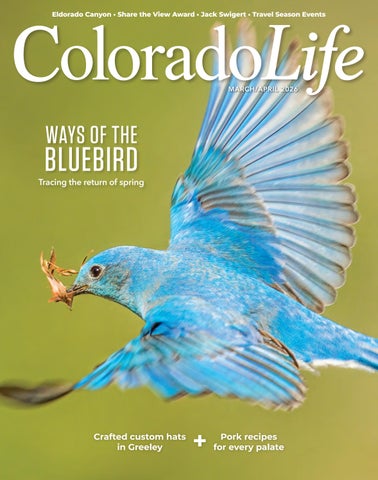
WAYS OF THE BLUEBIRD
Tracing the return of spring
Crafted custom hats in Greeley Pork recipes for every palate


ISSUE NO. 83 | MARCH/APRIL 2026
14
Colorado’s Yosemite: Eldorado Canyon State Park
Eldorado Canyon rises in gold, where climbing lore, geology and Front Range history converge in Colorado’s own miniature Yosemite. story and photographs by Joshua Hardin
20 Still Western
Greeley Hat Works shoulders the time-honored tradition of hat making through a century of Western grit and identity in every brim. story by Ariella Nardizzi photographs by David Sands
26 Ways of the Bluebird
A look at Colorado’s mountain bluebird and how it moves through open country, marking the slow return of spring across the state’s fields, foothills and high plains. by
Chris Amundson
38 Jack Swigert
FEATURES IN EVERY ISSUE
The story of Colorado’s own Apollo 13 astronaut who became a hometown hero, displaying courage in space that defined America’s legacy. by Lisa Truesdale
7 Editor’s Letter
Chris Amundson shares stories from life in Colorado.
8 Sluice Box
Westminster’s century-old mushroom water tower; The Colorado poets laureate anthology; a Pueblo artist’s work in faith; Share the View Photo Contest winner.
12 Trivia
Think you know Colorado’s colorful lore and history? Answers on page 46.
Colorado’s Yosemite: Eldorado Canyon State Park, p 14
Jack Swigert, p 38
Still Western, p 20

ON THE COVER
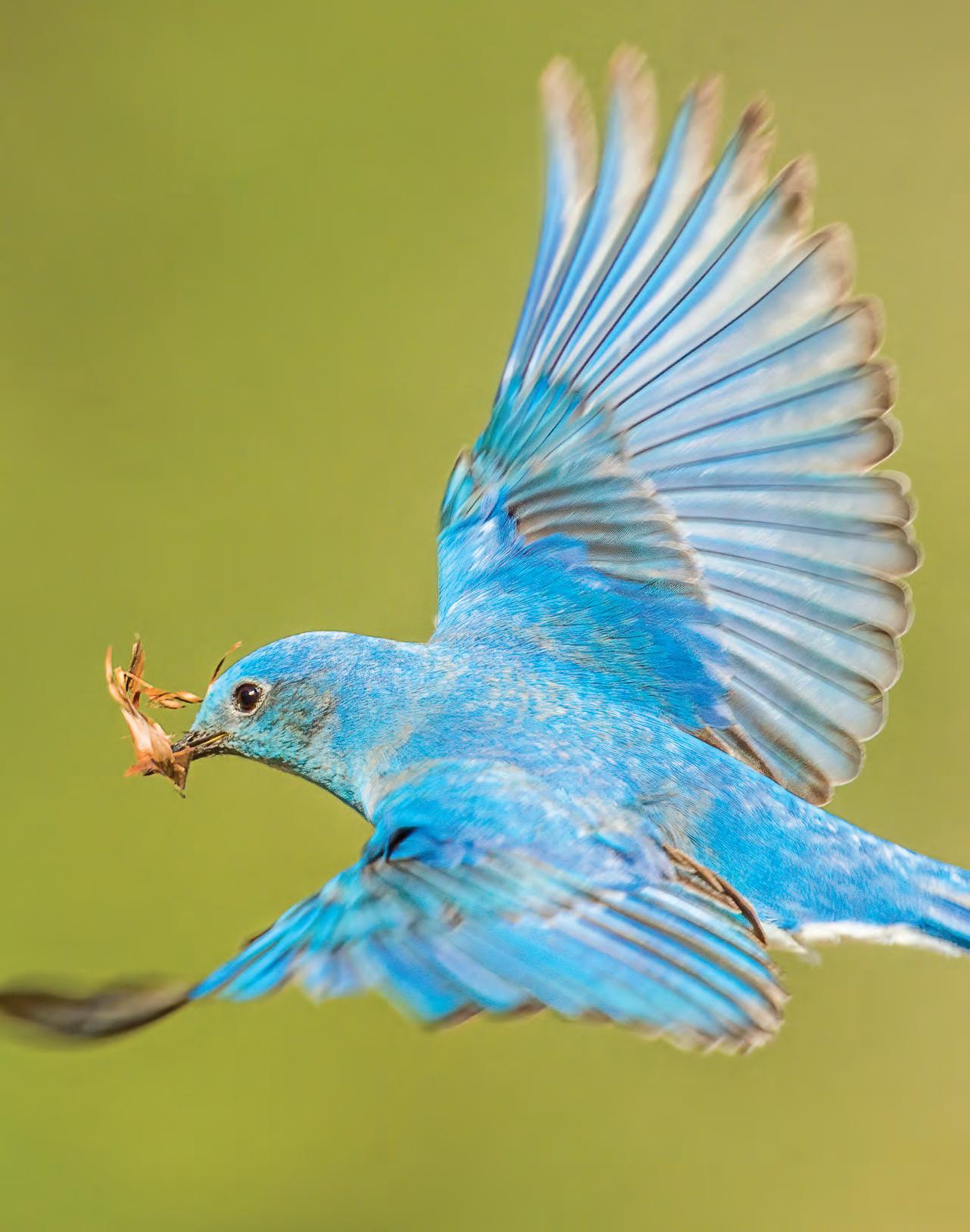
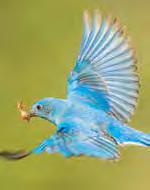
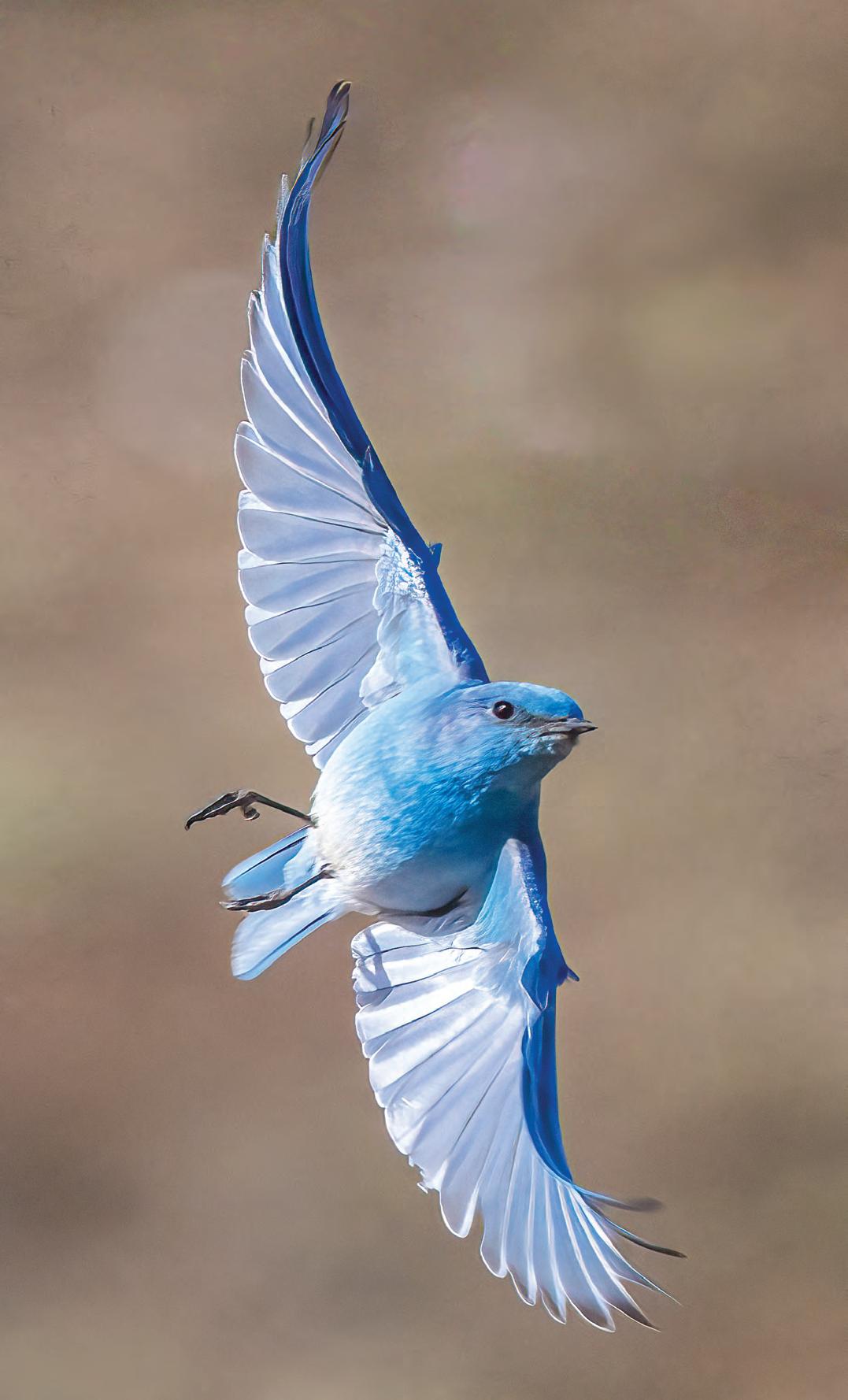
A radiant mountain bluebird (Sialia currucoides) soars through the air in Estes Park, bringing foraged material back to the nest as spring begins to bloom. Story begins on page 26.
PHOTOGRAPH BY DAWN WILSON
IN EVERY ISSUE
32 Poetry
First thunder breaks spring open across wide open landscapes.
34 Kitchens
Swine dining reimagines pork dishes beyond tradition.
44 Go.See.Do.
Quilts on display at the Mesas to Monuments Quilt Show in Grand Junction, Red Bull’s Soapbox Race returns to Denver, plus 12 other events across the state.
48 Camping
At Sylvan Lake State Park near Eagle, campers find lakeside camping and historic homesteads in Brush Creek Valley.
50 Peak Pixels
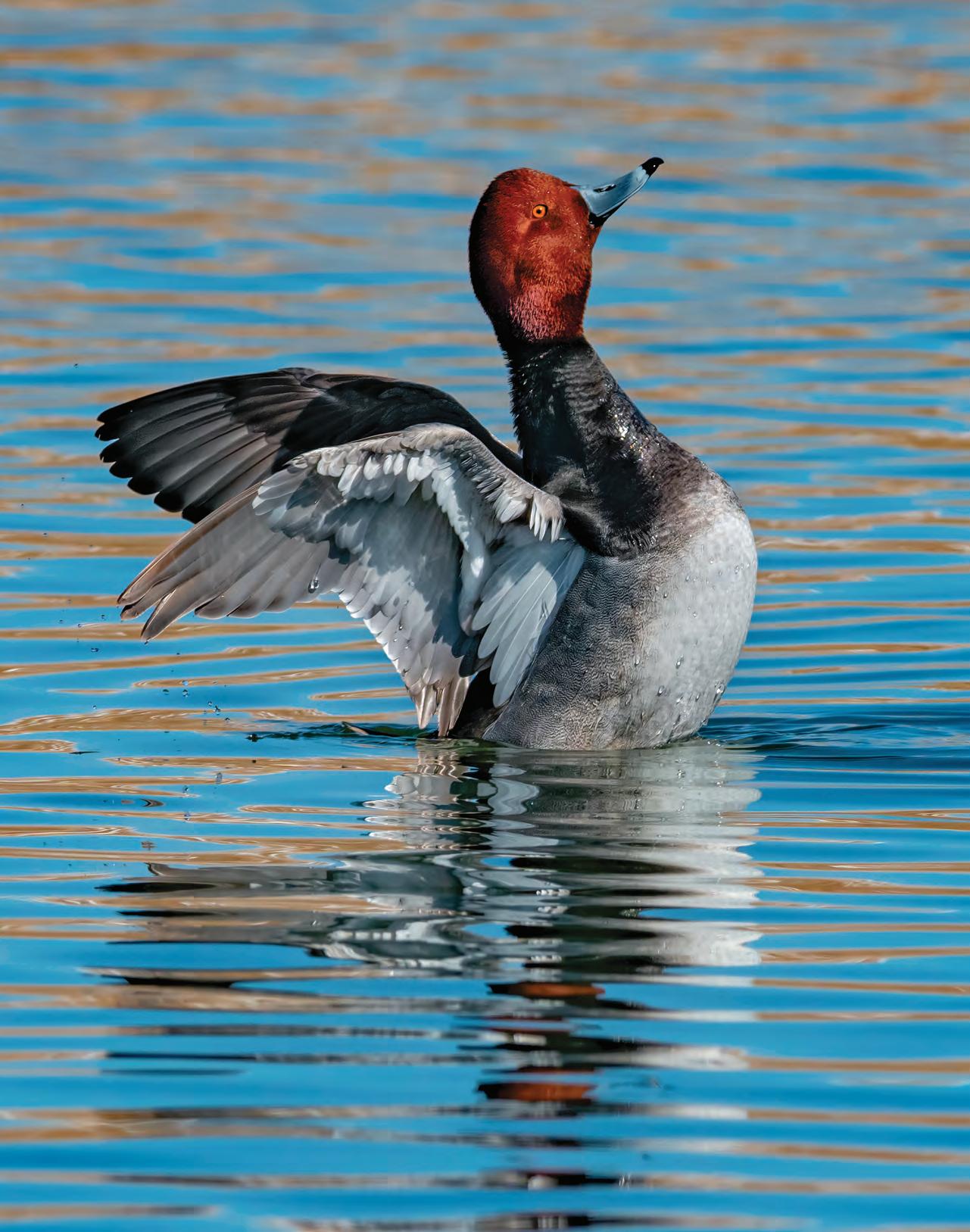
Josh Hardin photographs ducks in motion across seasonal migratory waters statewide
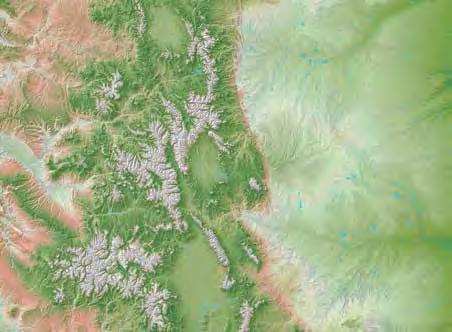
Map by Raven Maps & Images
Above: Peter Scott Barta/DIA, Dan Leeth Page 3: Joshua Hardin, David Sands, U.S. Air Force
Grand Junction p 44
Pueblo p 10
Greeley p 20
p 8
p 38, 45 Crested Butte p 11
p 48 Silverthorne p 26
Fort Collins p 50 Boulder p 14


Another Look
MARCH/APRIL 2026
Volume 15, Number 2
Publisher & Editor
Chris Amundson
Associate Publisher
Angela Amundson
Editorial Assistant
Savannah Dagupion
Design
Mark Del Rosario
Photo Coordinator
Erik Maki
Staff Writer
Ariella Nardizzi
Advertising Sales
Sarah Smith
Subscriptions
Shiela Camay
Colorado Life Magazine
c/o Subscriptions Dept. PO Box 270130 Fort Collins, CO 80527 970-480-0148 ColoradoLifeMag.com
SUBSCRIBE
Subscriptions are 1-yr (6 issues) for $30 or 2-yrs (12 issues) for $52. Please call, visit ColoradoLifeMag.com or return a subscription card from this issue. For fundraising and group subscription rates, call or email subscriptions@coloradolifemag.com.
ADVERTISE
Advertising deadlines are three months prior to publication dates. For rates and position availability, please call or email advertising@coloradolifemag.com.
CONTRIBUTE
Send us your letters, stories, photos and story tips by writing to us, emailing editor@coloradolifemag.com or visiting ColoradoLifeMagazine.com/contribute.
COPYRIGHT
All text, photography and artwork are copyright 2026 by Flagship Publishing, Inc. For reprint permission, please call or email publisher@coloradolifemag.com.
STEVEN AND SYLVIA Oboler had already packed up at Kebler Pass. Their tripods were stowed, their cameras put away, dinner in Crested Butte still ahead. Rain had moved across the mountainside in waves that day, flattening some views and sharpening others, and it would have been easy enough to call it done and keep driving. Then, before getting in the car, they looked back.
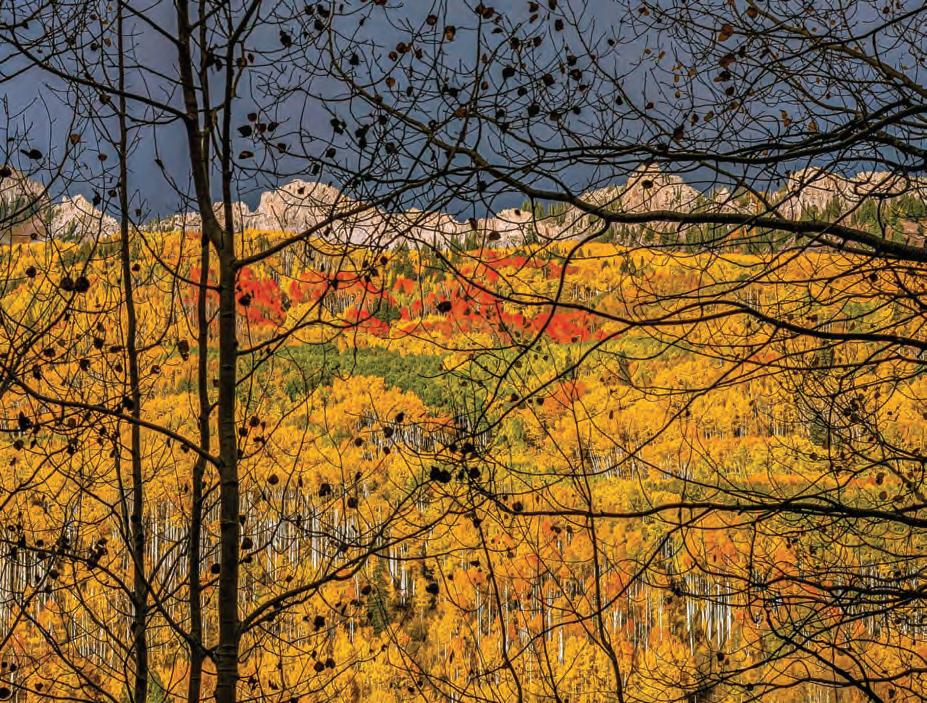
Through branches beside the road, they noticed a stand of red aspens against the dark slope beyond. With their gear already packed, they reached for their phones, took one more picture and captured the Colorado Nature award winner featured in this issue. Dinner could wait.
Colorado is easy to fall for at first glance. The sandstone walls above South Boulder Creek. A sweep of aspens turning on a mountain pass. Snow still hanging on high country slopes. A mountain bluebird flashing over open ground.
But a place is more than its scenery.
In Eldorado Canyon, the cliffs are the first thing you see. Stay longer and more comes into view, as Joshua Hardin tells us in this issue –traces of Ute history, warm springs, old resorts, climbing culture and the fight that kept the canyon from becoming a quarry.
A mountain bluebird catches your eye with color first. Watch it a little longer and the pattern begins to show – perch, drop, return, feed, repeat – the small steady work that marks spring across open country.
At Greeley Hat Works, most people see the finished hat. Trent Johnson starts earlier than that – with head shape, proportion, steam, felt, blocks and the patience to let the hat take its final form.
And at DIA, millions pass Jack Swigert on the B Terminal train platform and see the astronaut. Behind the statue is a Denver kid paying for flying lessons with paper-route money, studying engineering at CU, flying for the Air Force and getting turned away by NASA twice before getting in on the third try.
Colorado changes fast. New neighborhoods go up, old roads carry more traffic and whole stretches of the state are introduced every day to people seeing them for the first time. That makes memory easy to lose. One of the quieter jobs of a magazine like this is to help keep some of that memory in circulation.
If you’ve been with us for years, thank you for welcomeing Colorado Life in your home. If you’re new to these pages, welcome. And if there’s someone in your life who loves this state – or someone just beginning to know it – a gift subscription is a good way to share the magazine.
Fourteen years ago, we started Colorado Life to make room for more than the postcard version of the state. The views are part of it. So are the people, the work, the history and the ways of life that give Colorado its shape. Sometimes it takes another glance to see it.
The Obolers had already packed up.
Then they looked back.
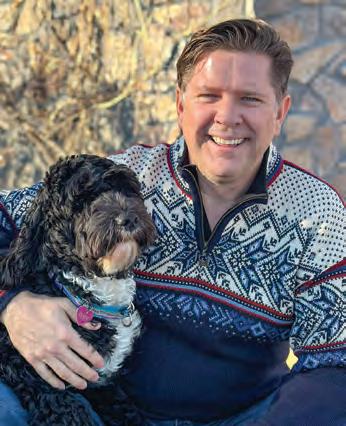
Chris Amundson Publisher & Editor editor@coloradolifemag.com
NUGGETS AND OBSERVATIONS ABOUT LIFE IN COLORADO
Westminster’s Mushroom Tower
by ARIELLA NARDIZZI
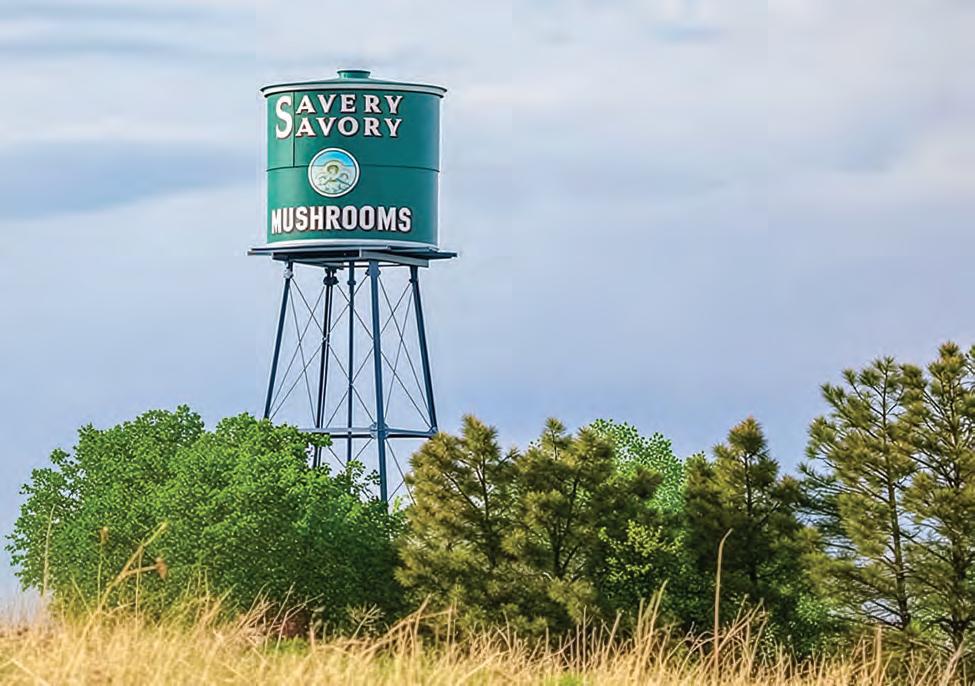
A green-and-yellow water tower shaped like a giant mushroom can still rises above Westminster – the last billboard of Charles W. Savery’s mushroom business.
That business began in a far less picturesque spot. In 1922, Savery tried growing mushrooms under Denver’s 20th Street viaduct. The operation was soon shut down after complaints about the smell of horse manure, the compost that fed the crop. Instead of quitting, Savery moved north to his 80-acre farm in Adams County and tried again.
The idea sounded improbable from the
start. Mushrooms had become a delicacy in the United States by the 1920s, and Savery knew the trade from his upbringing in Chester County, Pennsylvania, where much of the country’s crop was grown. But Colorado’s dry climate was all wrong for mushrooms, and experts warned him the venture would fail.
For three years it did.
So Savery and his son Robert went back to Chester County to study the business, then returned determined to make mushrooms grow in an unlikely place. Savery rigged damp strips of canvas through dark growing rooms and used fans to blow cool, wet air across them. As the operation ex-
panded, he added pumps, sprayers and larger fans to keep the buildings humid enough for the crop.
The workaround paid off. By 1930, Savery’s farm had become a company town with 32 mushroom “caves,” 15 employee residences, 25 adobe laborers’ dwellings, a schoolhouse, general store, boarding house, baseball field and tennis court. Eighty-four men, women and children lived on the site. Adults and children worked in the mushroom houses, canning plant and nearby asparagus fields. In the long, dark buildings, laborers moved through damp corridors wearing carbide lamps on their hats.
City of Westminster
A 50-foot water tower overlooks Westminster, resembling an iconic Savery Savory Mushrooms can. The tank is a remnant from 1925, when Charles Savery built a booming business and company town.
Colorado in Verse
New book gathers state poets laureate in one anthology
by COLORADO LIFE STAFF
The 50-foot water tower was both utility and advertisement. Water from an artesian aquifer was pumped into the elevated tank, then fed by gravity to the mushroom houses, canning buildings and homes. Savery painted the tank like one of his green-and-yellow mushroom cans, turning it into a landmark visible from the road. Later, the lettering and mushroom logo were outlined in neon so the tower glowed at night.
By the 1930s, Savery Savory was the only mushroom operation between Kansas City and the West Coast. Branch plants in Los Angeles and San Francisco helped the company produce 10,000 pounds of mushrooms a day. The farm also sold canned goods, including mushroom sauce and soup, honey, pickles and candied fruit.
A series of setbacks brought the enterprise to an end. Fires in the 1940s, diseased crops, drought and Savery’s advancing age closed the operation in 1953. Most of the buildings were later demolished, but the tower remained.
In 2005, the tower was placed on the Colorado State Register of Historic Properties. The following year, the City of Westminster commissioned a historically accurate repainting that restored the Savery Savory advertising to the tank.
Today the tower stands in a public park owned and maintained by the City of Westminster, a giant can left behind by an operation that turned an unlikely crop into one of the area’s strangest landmarks.
For more than a century, Colorado has named poets to a public role. Alice Polk Hill was the first in 1919. Begin Where You Are: The Colorado Poets Laureate Anthology gathers work from all 10 of the state’s poets laureate in one volume, from Hill to Andrea Gibson.
The book is rooted in Colorado place names, public life and regional history. In the introduction, Khadijah Queen names Estes Park, Barr Lake, Chatfield State Park, Cherry Creek State Park, Fruita, Fort Collins, Leadville, Littleton, Boulder, Basalt, Durango, Denver, Manitou Springs and Colorado Springs. The anthology includes poets from different eras, backgrounds and traditions.
The book opens with earlier laureates, including Miller, Robertson, Shields and Ferril. Nellie Burget Miller writes of home, faith and ordinary domestic life. Margaret Clyde Robertson writes from Leadville and mining life. Milford E. Shields writes of the San Juan Basin. Thomas Hornsby Ferril brings war, history and short lyric poems.
The later laureates bring different subjects and a different diction. Bobby LeFebre writes of grandparents, chile, tamales, labor, faith and Chicano inheritance. In “Fields,” “Chile,” “Tamales” and “Magic,” LeFebre writes about family history, labor, migration and ritual. Andrea Gibson’s section places poetry in Boulder open mics, Denver slams, public readings, workshops and events around the state. Gibson writes that “most of what

Begin Where You Are: The Colorado Poets Laureate Anthology Compiled by Turner Wyatt Center for Literary Publishing at Colorado State University 192 pages, hardcover $45, paperback $20, ebook $17
I know about poetry I learned from the poets of Colorado.”
The anthology also treats the laureateship as public work, not just an honorary title. In the preface, Turner Wyatt describes the poet laureate’s work in practical terms: readings, workshops, interviews, school visits and classroom outreach. He writes that the project grew in part from an effort to widen access to poetry in Colorado, especially in rural communities and communities of color.
A portion of sales, he says, will support poetry programming in parts of the state where the laureate has rarely visited because of funding limits.
Taken together, the selections form a record of Colorado writing across more than 100 years. The anthology does not present a single Colorado voice. It gathers many of them in one place.

Drawn in Pueblo
Rick Espinoza creates portraits with layered color and faith
by SAVANNAH DAGUPION
Before Rick Espinoza begins a drawing, he prays.
In his Pueblo workspace, with colored pencils laid out and paper waiting, he asks God to enter his right arm and guide his hand. Only then does he begin.
Once he starts, hours can pass without interruption. Espinoza works in layers, building from light tones to dark until a portrait emerges. He taught himself the method without art school or formal training and says his art is a gift God lent him for his time on Earth.
His work includes Indigenous figures, cowboys and cowgirls. In pieces such as “Amber Creek,” “Flor De Las Flores” and “Winter Watch,” he uses layered color to sharpen expression, clothing and stance. When a piece is finished, it is framed locally at The Classic Corner and sent to collectors in Pueblo and beyond. Espinoza grew up in the city in the 1970s,
drawing chalk art on sidewalks. When he ran out of chalk, he broke old bricks and used the shards. To make money for art supplies, he shined shoes for 50 cents on Union Avenue. Bar patrons sometimes asked the boy to sketch their likenesses on napkins.
“I always wanted to be an artist, so I would do whatever it was to make money to fund my drawing,” he said. “My sister Kathy, who was like my second mom, used to take me to get art supplies and enter contests.”
He drew King Kong, Godzilla, the Incredible Hulk and other characters that embodied the strength he did not think he had.
“Drawing took me away from all the stuff that was going on around me,” Espinoza said. “It was my safe place away from trauma. It was the only thing I could do right. It gave me a sense of peace and belonging within myself.”
As he grew older, people from his own world began to enter the work. One of his childhood friends, Jay Roy of the Comanche Nation, left an impression, as did Roy’s grandmother, Becky.
“She had that face and exuded a powerful aura,” he said. “The strength of the Indigenous people gives me that spark. To me, they convey power, resilience and humility.”
In high school, his Chicano studies teacher, Dave Marquez, helped give him
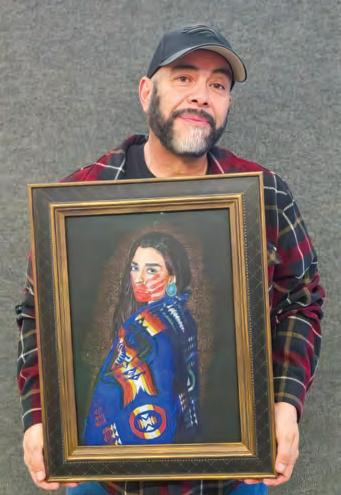
Artist Rick Espinoza renders detailed colored pencil portraits, many depicting Indigenous and Southwestern culture, like “Flor De Las Flores” (left) and “No One Is Saying Anything” (right).
a sense of identity and purpose. Learning about his Chicano roots gave Espinoza pride in both his culture and his artwork.
After two artist friends died, drawing no longer felt like a side pursuit. Before he died in 2006, Paul Koroshetz, known as Colorado’s dinosaur artist, told Espinoza he was an inspiration. Before his death in 2021, Lawrence Vega urged him to keep reaching for the heights he had always imagined.
“I feel like they gave me their mojo,” Espinoza said.
Espinoza continues to draw in Pueblo, no longer alone. His daughter, Illeana, remains central in his life, giving him strength through the darkest times, and his friend Lezlie keeps him grounded and focused. He also finds fulfillment in knowing his parents are proudly watching over him.
“Pueblo is a beautiful melting pot,” he said. “The steel mill brought in so many different people, creating neighborhoods that feel like the boroughs in New York City. It’s a prideful town and an awesome place to grow up in.”
It is still the city where he draws, prays and starts again.
Find Espinoza’s work at Pueblo’s Rawlings Library and on Facebook at Rick Espinoza. Contact him by phone at (719) 994-6940 or by email at richardesp58@gmail.com.
Olivia George, Catie Blickhahn-Waldrep (right)
A Last Look
Kebler Pass photo wins award in Share the View Photo Contest
photograph by STEVEN and SYLVIA OBOLER story by SAVANNAH DAGUPION
For more than 35 years, Steven and Sylvia Oboler have returned to the overlook above Horse Ranch Park along Kebler Pass, watching the same mountainside change with the season. Some years the aspens lean mostly gold. In others, more green hangs on. Almost always, a streak of red runs through the slope.
“We have learned to have no expectations at Kebler – or, for that matter, almost anyplace we wander to photograph,” Sylvia said. “It is what it is, and at our age, we enjoy it all – just being there, together.”
On Oct. 3, 2025, the couple was driving from Paonia to Crested Butte for din-
ner when they made their usual stop at Horse Ranch Park. The weather did not look promising. Clouds flattened the view of Purple Mountain and Dike, and rain moved in and out across the pass.
Still, they stayed.
For more than two hours, they worked through changing conditions – brief sun, dappled light, steady rain and darkening storm clouds. When the rain intensified, they headed back to the car and packed away their tripods and Nikon D850s.
Then, before leaving, they looked back once more.
Through branches and seed pods beside the car, they saw a distant stand of red aspens brighten against the stormy mountainside. With their camera gear stowed, they grabbed their Google Pixel 8 phones and began composing the scene through the foreground tangle, adjusting

the exposure as oversized raindrops fell around them.
That final image won Colorado Life’s Colorado Nature award in the 2025 Share the View International Nature Photography Contest.
Instead of opening onto a wide, unobstructed landscape, the photograph asks the viewer to look through the branches to the color beyond. The layered composition turned a familiar Kebler Pass view into something more intimate and unexpected.
The Obolers never made it to their dinner reservation.
This photo was shot with a Google Pixel 8 Pro at 18mm at f/2.8 for 1/440 sec, ISO 16.



COLORFUL COLORADO
JENKINS
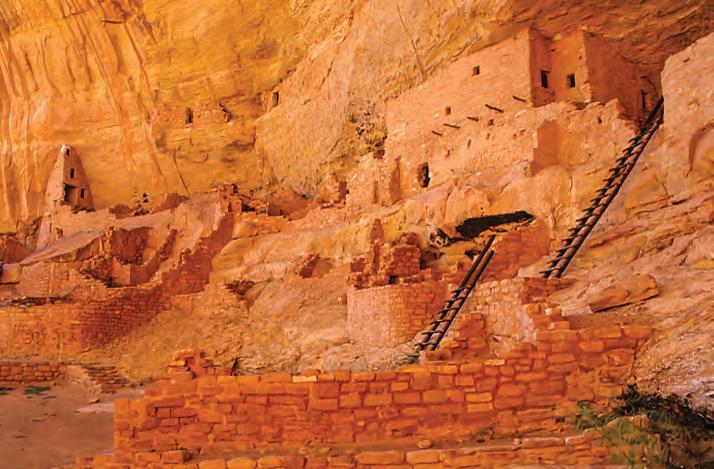
1 Ship Rock and Creation Rock rise on either side of the main stage at what venue, which is set to host Weird Al, Zac Brown Band and Evanescence
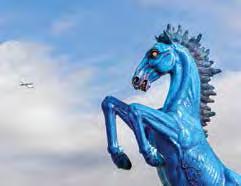
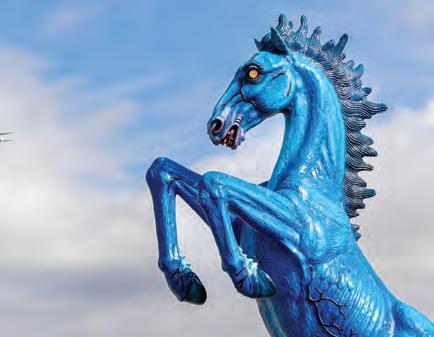
2 It stands 32 feet tall and its eyes glow red, but what other colorful name is given to the giant horse sculpture found on the main access road to Denver International Airport?
3 Before Denver became the capital of the Colorado Territory in 1867, the capital was what seat of Jefferson County, which dropped “City” from its name in 1872?
4 Located in Montezuma County near the Four Corners, which of Colorado’s four national parks has a name that comes from the Spanish words for “green table”?
5 A Queen Anne-style house in Denver is now a museum dedicated to what former “unsinkable” owner of the building, who survived the wreck of the Titanic in 1912?
Joshua Hardin
Peter Scott Barta/DIA
MULTIPLE CHOICE
6
Among the most photographed mountains in the United States are the Bells, found southwest of Aspen, which are named after what color?
a. Cerulean
b. Maroon
c. Vermilion
7
First discovered on Pikes Peak in 1862 and found growing across the central Rocky Mountains, what colorful conifer is the official state tree of Colorado?
a. Colorado Red Maple
b. Colorado White Oak
c. Colorado Blue Spruce
8
Colorado has waterways called Blue River and Yellow Creek, but which one of these colorfully named waterways is not found here?
a. White River
b. Green River
c. Red River
9 According to the 2020 census, what colorful Colorado municipality is the least populous city – but not town – in the state, with just 127 residents?
a. Greenwood Village
b. Silverthorne
c. Black Hawk
10 Stretching between the communities of Buena Vista and Salida in Chaffee County, what 21,000-acre canyon did President Barack Obama designate as an official National Monument in 2015?
a. Indigo Canyon
b. Browns Canyon
c. Crimson Canyon
TRUE OR FALSE
11 In 2023, the U.S. Board on Geographic Names officially redesignated Colorado’s Mount Evans as Mount Blue Sky.
12
Located at the west end of Manitou Springs, the graffiti-covered Rainbow Falls is the tallest waterfall in Colorado.
13
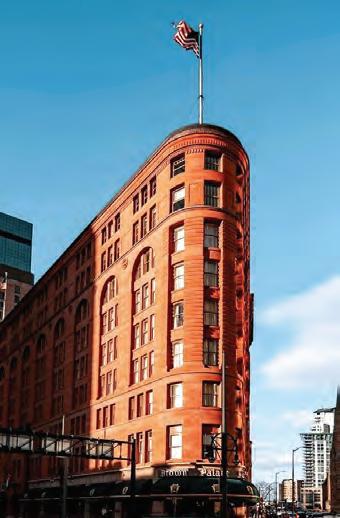
Denver’s Brown Palace Hotel has hosted many famous guests, including Shirley Temple, Emperor Akihito of Japan and the Beatles.
14
One of Colorado’s colorful national parks, the Black Canyon of the Gunnison, gets its name because most of its rock is volcanic basalt.
15
Blue Mesa Reservoir is Colorado’s largest body of water – and the nation’s largest stocked kokanee salmon fishery.
No peeking, answers on page 46.





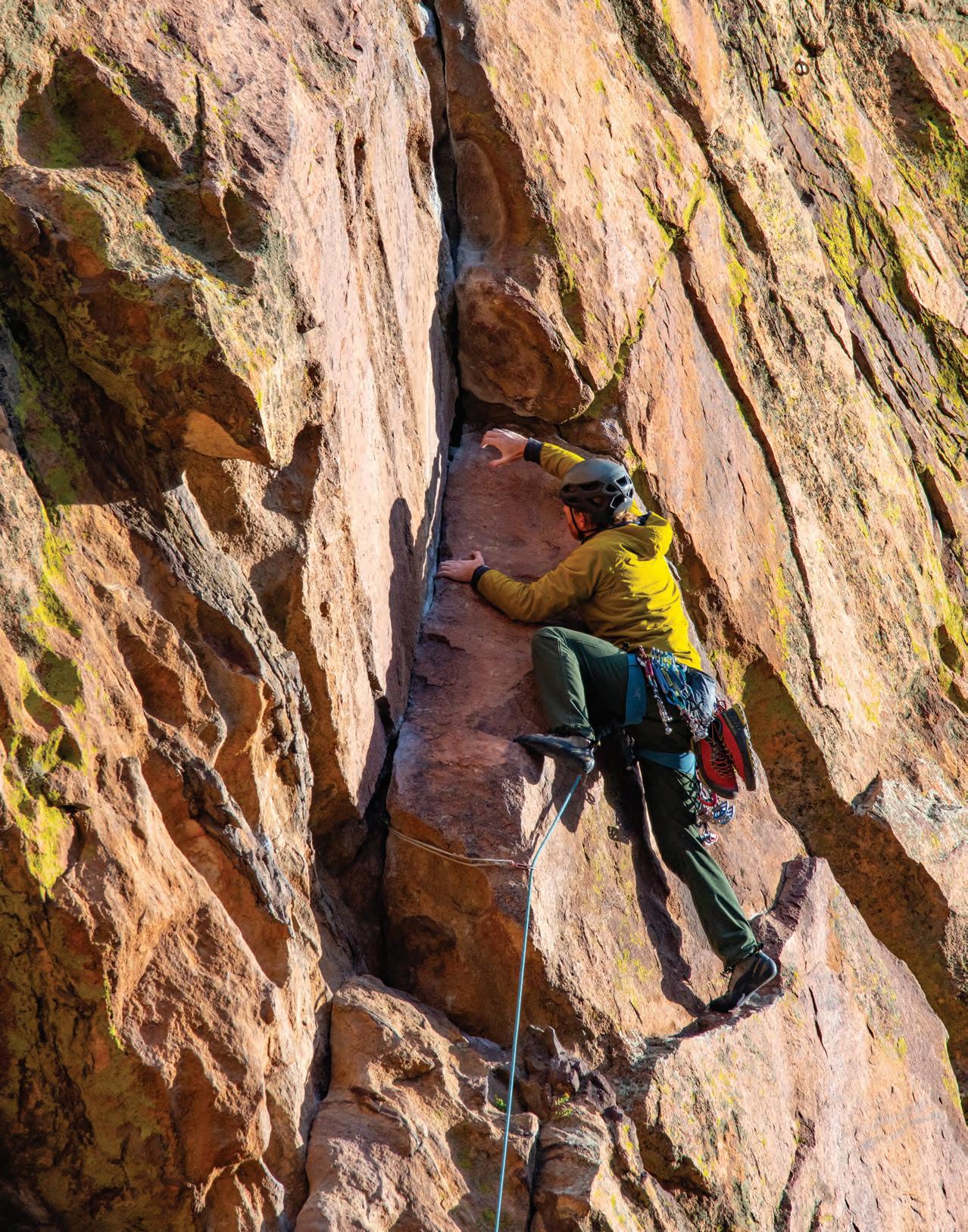
Gold-colored moss and lichen wash
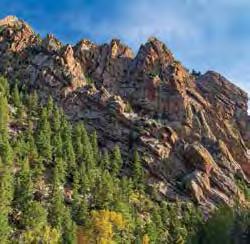
Eldorado Canyon’s sandstone cliffs near Boulder, where the Front Range offers quick access to outdoor pursuits.
COLORADO’S YOSEMITE
Eldorado Canyon State Park
story
and photographs
by JOSHUA HARDIN
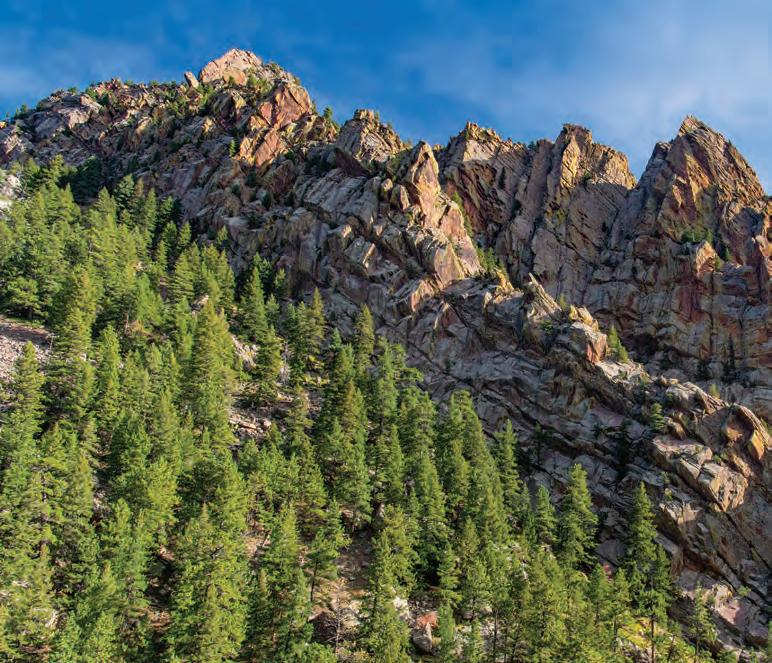
WHEN DAWN BREAKS over Eldorado Canyon State Park in the Front Range foothills, the sun’s first rays wash its towering walls in a warm gold. South Boulder Creek flows beneath rock monoliths such as the Bastille and Wind Tower.
The views in this canyon can recall a miniature Yosemite Valley, with scenes that echo California’s Merced River winding below El Capitan and Half Dome. Like its famous Golden State counterpart, Eldorado Canyon has long drawn climbers, outdoor recreationists and history buffs.
Nestled near Boulder and bordering Roosevelt National Forest, the 885-acre park includes two areas: the developed Inner Canyon and undeveloped Crescent Meadows. Elevations range from 5,800
to 8,800 feet, spanning plains grasslands, riparian corridors and forested foothills. The entrance lies just west of Eldorado Springs on State Highway 170.
“One of the great things about the park is it’s so close to the metro area. You’re immediately in the mountains, an oasis in Boulder’s backyard,” said Stephanie Sisnroy, visitor services manager. “Even folks who are familiar with Colorado are surprised it’s in this location, they never knew it’s here. You’re always looking up in the canyon.”
The narrow canyon walls historically sheltered the Ute people from harsh winters, and the nearby warm springs were valued for health and spiritual renewal. By the mid-19th century, Anglo settlers followed Native Americans into the canyon in search of gold, but found far less
than at richer sites such as Gold Hill to the north.
Tourism, rather than mining, became one of Eldorado Canyon’s dominant industries. Homesteaders such as Frank Fowler, namesake of the park’s Fowler Trail, helped establish resorts at Eldorado Springs and unusual attractions such as the Crazy Stairs, two zigzagging wooden flights that climbed nearly 600 feet to a canyon waterfall.
In Spanish, “El Dorado” means gilded or gold-covered. The golden color of moss and lichen on Eldorado Canyon’s cliffs may have inspired the park’s name more than precious metal did. Its most visible cliffs consist of Lyons and Fountain sandstone, while other formations contain Coal Creek Quartzite that geologists estimate is more than 1.6 billion years old.
THOSE ROCKS DREW generations of climbers and helped preserve the canyon as a state park. The first climbers arrived in the 1950s and were called “marmots,” after the rock-dwelling mammals. Land access shifted several times between public use and private club control, but public outcry followed when the canyon’s final owners sought to sell it as a rock quarry. The state of Colorado stepped in and purchased the canyon in 1978.
The park’s creation opened the way for more than 500 technical climbing routes. Climbers from around the world come for those challenges, scaling cliffs where golden eagles sometimes roost. The sight of climbers suspended against the canyon walls showcases one of the state’s most demanding sports.
Redgarden Wall dominates the skyline near the park’s east entrance. One of its most distinctive features is a sharp arête known as the Naked Edge. Climbing it requires thin gear, creative route-finding and precise movement on loose rock, with more than 600 feet of exposure. Climbing pioneers Jim Erickson and Duncan Ferguson made the first free ascent in 1971. Free climbing means using only hands and feet while relying on ropes or other gear for protection. Within six years, Beth Bennett recorded the first female free ascent and later was immortalized, along with partner Lynn Hill, in Bob Carmichael’s 1981 short film First Ascent
In an interview with the Boulder Carnegie Library for Local History, Bennett recalled seeing the route and thinking, “I want to climb that someday.” Another climber told her “no woman is ever going to climb that,” which only sharpened the challenge.
Today, the Naked Edge’s fame has sparked a speed race to the top, with ascents coming in at less than half an hour. In 2022, current record holders Stefan Griebel and Joe Kennedy climbed the route in 22 minutes, 44 seconds.
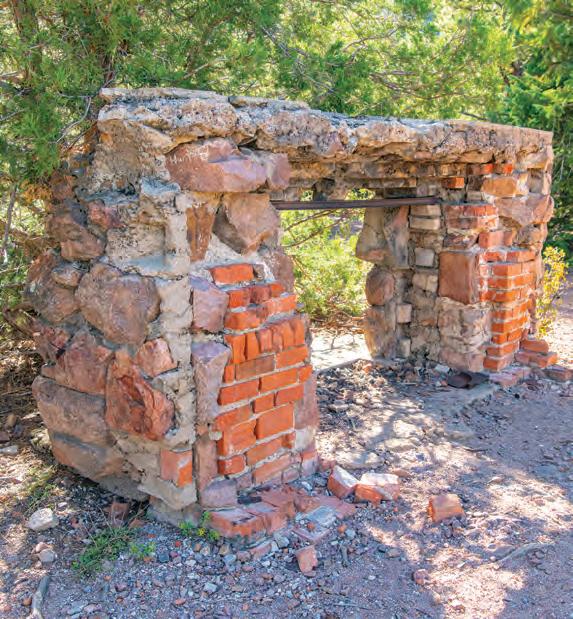
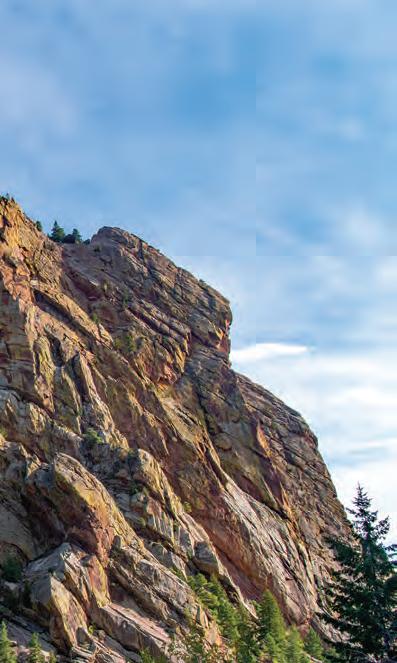
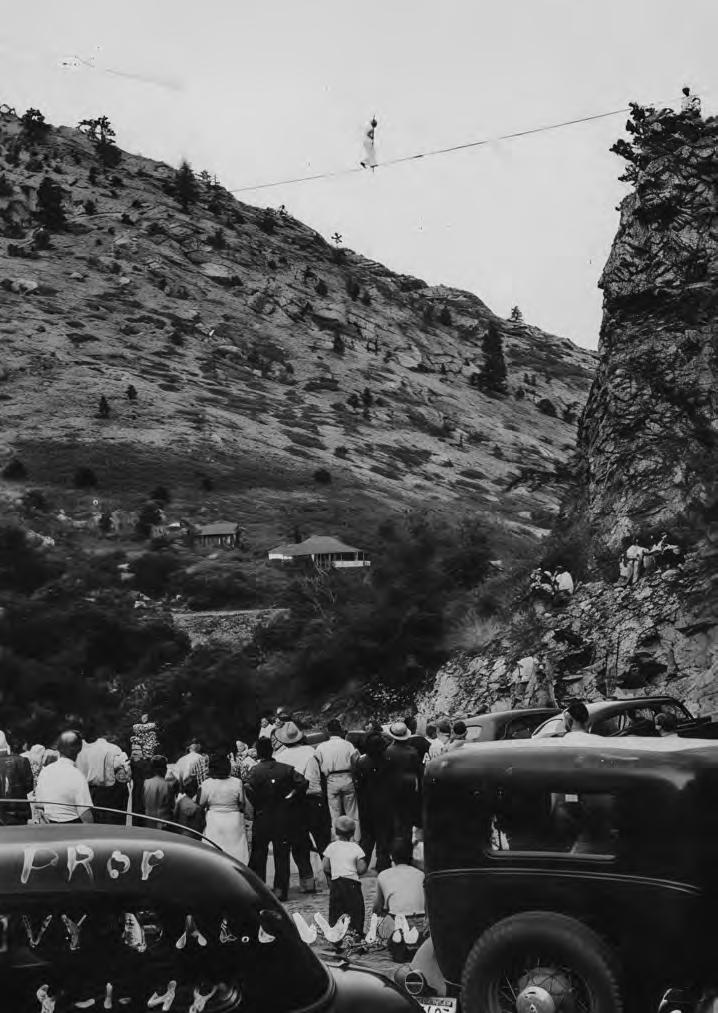
After plans to quarry the canyon prompted public outcry, the state of Colorado purchased Eldorado Canyon in 1978, preserving its cliffs for public access and recreation. Today, those walls host more than 500 climbing routes. Long before speed ascents and free climbs defined the canyon, daredevil Ivy Baldwin repeatedly crossed a steel cable between Bastille and Wind Tower, high above South Boulder Creek, performing without a safety net.
Eldorado Springs Historical Society/Boulder Carnegie Library
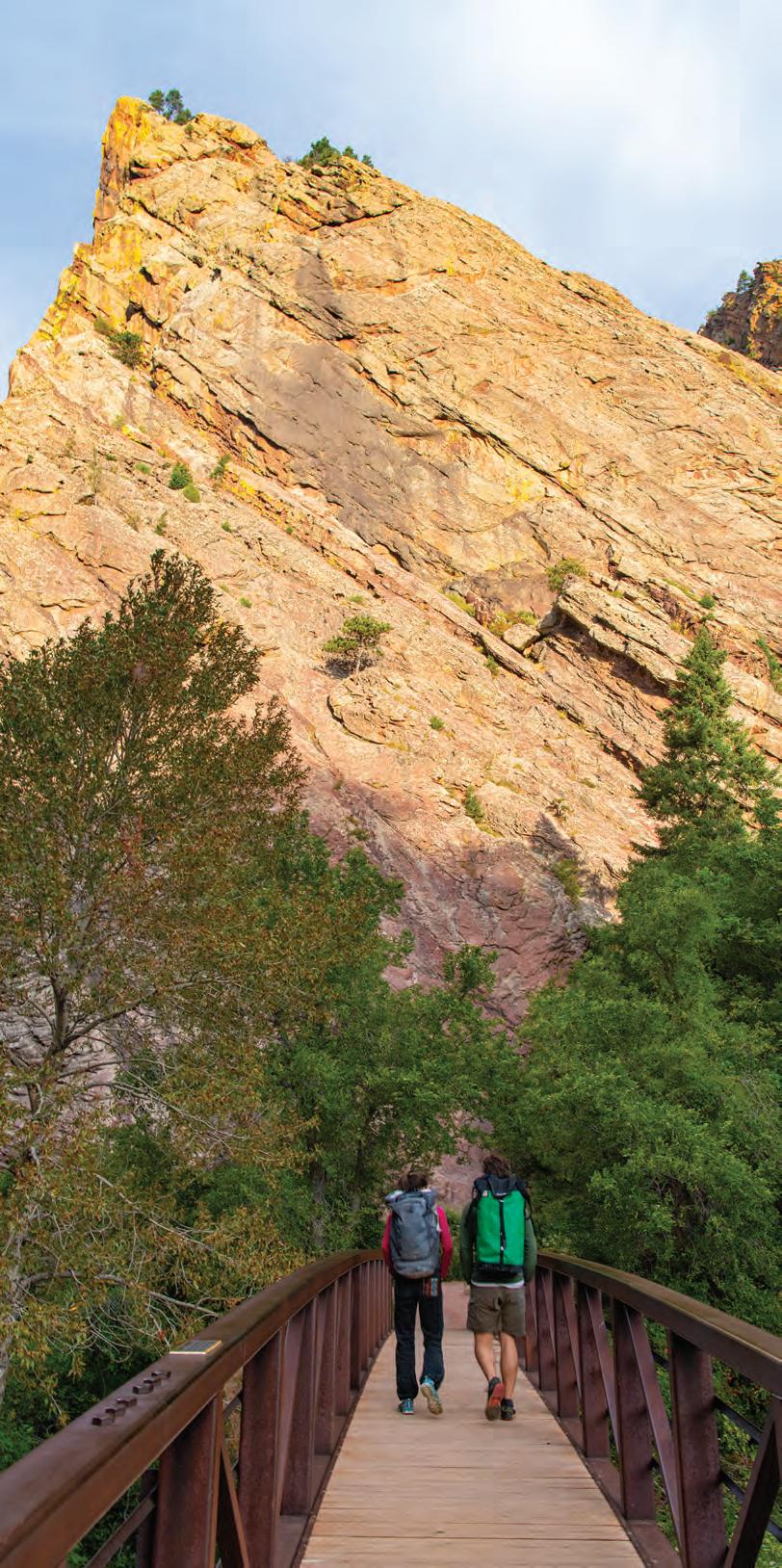
Their effort included crossing a bridge over South Boulder Creek, hiking to the base, completing three approach pitches, climbing the route, scrambling down and sprinting the trail back across the bridge.
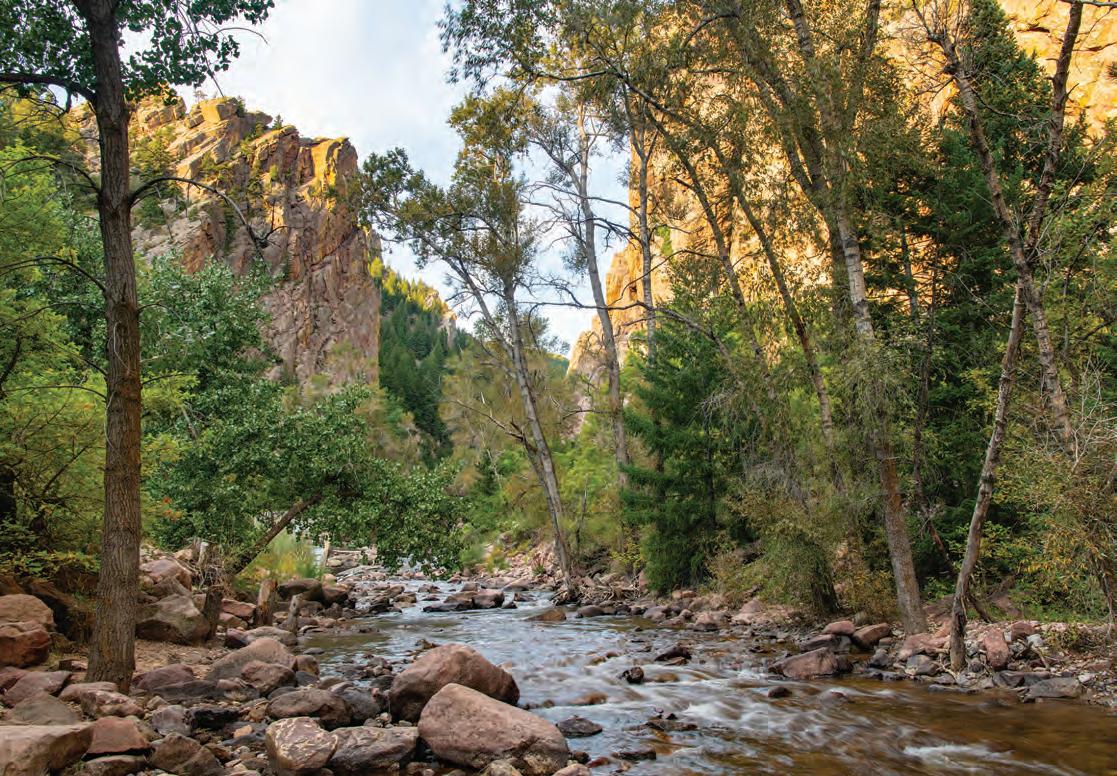
South Boulder Creek winds through the canyon beneath sheer rock walls, forming one of its most accessible corridors. Its banks draw visitors for picnicking and fishing, alongside hiking, climbing and watching wildlife across the park.
In an interview with Climbing magazine, Griebel said, “There was no way we could have done it that fast.” He initially wondered whether his watch had stopped on the descent. Yet the record stood, and many climbers believe a time under 20 minutes is possible.
History-making feats of grit are nothing new in Eldorado Canyon. Early 20th-century daredevil Ivy Baldwin’s tightrope acts were as astounding as modern climbing spectacles. Thousands gathered to watch Baldwin, a circus acrobat and balloonist who also performed at Denver’s Elitch Gardens, walk a 7/8-inch-thick steel ca-
ble stretched from the top of the Bastille to Wind Tower, 672 feet across and more than 400 feet above South Boulder Creek. He took six and a half minutes to reach the middle, bow and stand on his head before continuing to the other side without a safety net. Baldwin made the crossing more than 80 times in 40 years and marked his final walk in 1948 on his 82nd birthday.
Visitors don’t need to tightrope walk or rock climb to enjoy the park from above. More than 11 miles of hiking and mountain biking trails, ranging from easy to difficult, cross the park and connect with adjoining public lands. One of the most popular is the Rattlesnake Gulch Trail, a moderate 3.6-mile loop leading to the remains of the Crags Hotel site and the Continental Divide Overlook, with sweeping
views of the canyon and distant peaks that hold snow much of the year.
The Crags Hotel operated for only four years before a fire destroyed it in 1912. Foundations and bricks at the site offer a glimpse of the area’s heyday as the “Coney Island of the West.” By 1908, Union Pacific’s Moffat Road rail line made nine trips a day from Marshall to Eldorado Springs for a $1.25 round-trip fare. Auto roads also brought visitors to Eldorado Springs’ three swimming pools warmed by artesian waters, along with dance ballrooms, rollerand ice-skating rinks, cabins and stables. Resorts such as the Crags, Grand View and the elegant 40-room Georgian-style New Eldorado sprang up, drawing Denver residents and other notable visitors. Future President Dwight Eisenhower and his wife, Mamie, honeymooned in an Eldorado Springs cabin in 1916.
There’s more to do here than hike. Picnicking and fishing for rainbow, brook and brown trout along South Boulder Creek are popular. Leaf peeping draws visitors when willows, cottonwoods and maples turn from September into November. Cross-country skiing and snowshoeing are available in winter. Wildlife watchers may spot mule deer, elk, black bear, bobcat, red fox, coyote or mountain lion year-round.
Eldorado Canyon’s rugged beauty, climbing routes, warm springs and colorful past invite comparisons to larger, better-known parks such as Yosemite. Gold, it seems, really is in these hills.
Eldorado Canyon State Park has approximately 200 parking spots. Timed-entry reservations are required on weekends and federal holidays from 5:30 a.m. to 5:30 p.m. from May 1 to Oct. 1. A shuttle runs from Memorial Day to Labor Day, 8 a.m. to 7 p.m. Reservations can be made at EldoShuttle.com.
WESTERN STILL
At Greeley Hat Works, custom hats begin with head shape, steam and a brim cut by hand
story by ARIELLA NARDIZZI photographs by DAVID SANDS
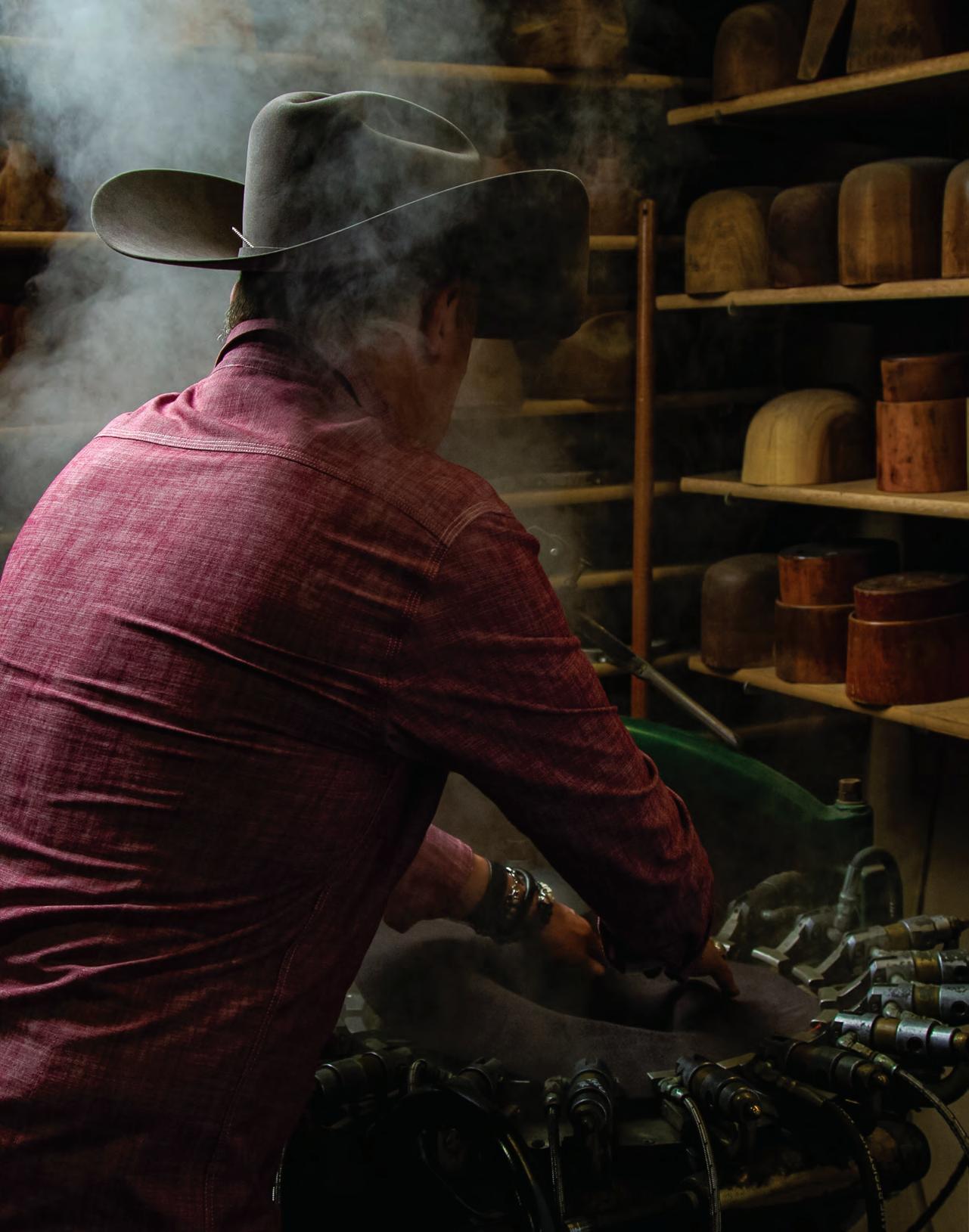
INSIDE A WORKSHOP of stone and corrugated metal in Garden City on Greeley’s south edge, hats rise in soft stacks toward the rafters. Felt bodies lie flat on workbenches waiting for steam. Others rest over wooden blocks. Crown shapes line the shelves in neat rows: cattleman, pinch-front, Fort Worth, telescope. Brims curl, dip and flare in every direction.
At Greeley Hat Works, the smell of wet felt hangs in the air. Steam hisses. Old Parisienne tools sit within arm’s reach.
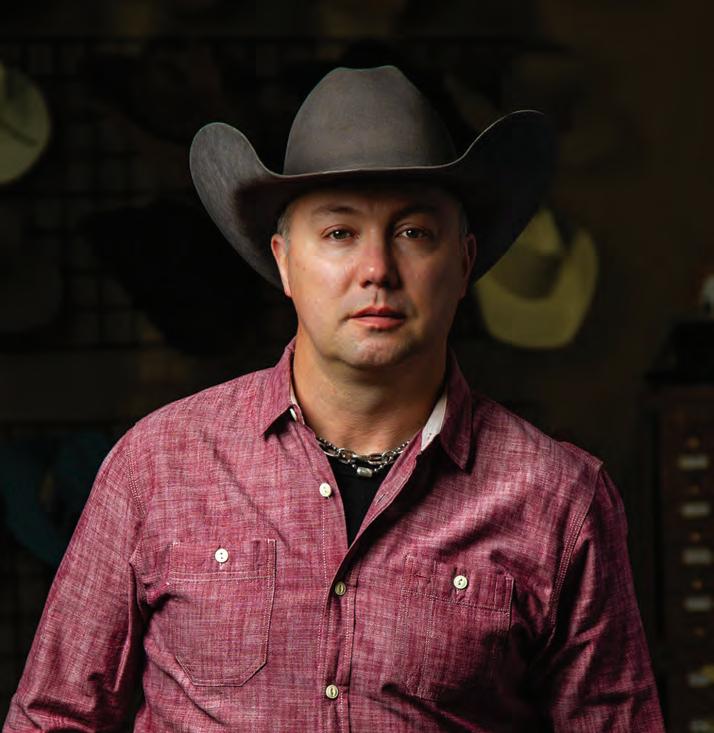
Trent Johnson has run Greeley Hat Works since 1996, the fourth owner in a line that goes back to 1909. He jokes he’s been accused of “setting the industry back 100 years.” He takes it as a compliment. Johnson has been collecting hats since
he was a boy. While other kids traded baseball cards, he paid attention to caps and brims, interested in what they said about the people who wore them. In 1982, he saved his money and bought hats from different countries at Disney’s newly opened Epcot: a fez from Morocco, a beret from France. “I didn’t choose the hat life,” he said. “The hat life chose me.”
While studying business at the University of Northern Colorado, Johnson worked on the family ranch of Susie Orr, then owner of Greeley Hat Works. When the chores were done, he would wander into her workshop, studying hat blocks and steamers the way others study fine art. By 1993, he was Orr’s apprentice. Three years later, at 25, he bought the shop.
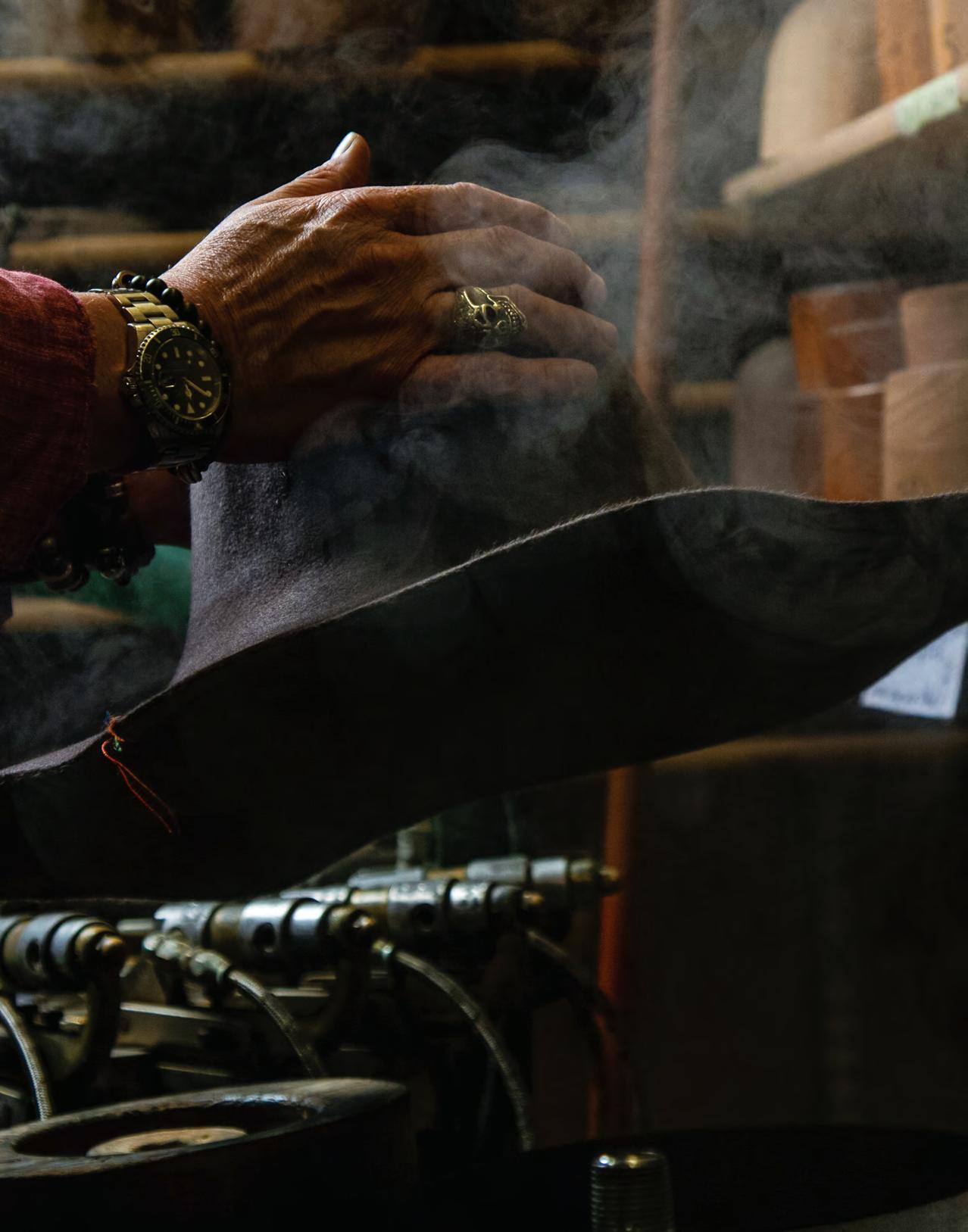
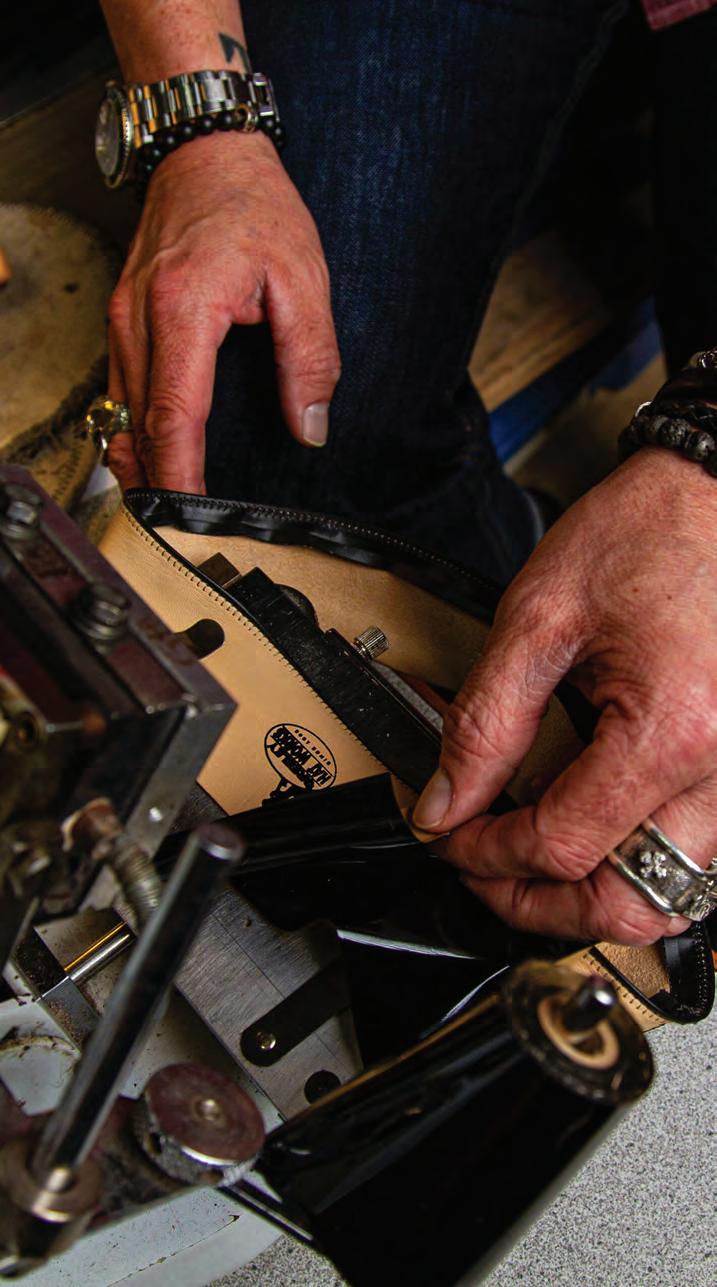
Trent Johnson, the fourth owner of Greeley Hat Works, shapes hats among steamers, wooden blocks and century-old Parisienne tools in a shop that dates to 1909. After apprenticing under the previous owner, he took over the business in 1996 and continues the hands-on approach using time-tested methods focused on quality, fit and tradition.
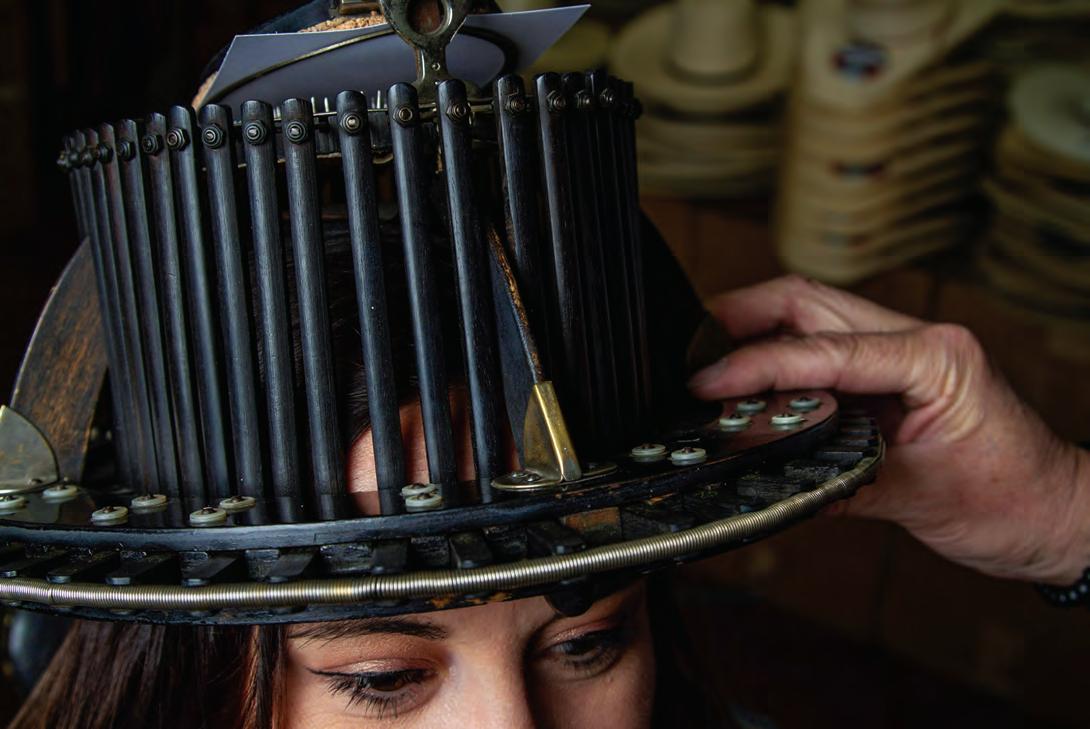
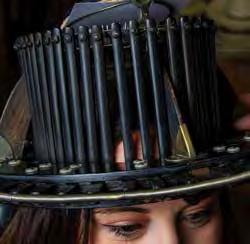
Each custom hat begins with mapping a client’s head using a vintage conformateur to capture measurements. Felt is then steamed and shaped over time, with each piece requiring 10 to 12 hours of work. Johnson works with a team of 20 to produce hats each year.
The business had already lived several lives. Founded in 1909 as The Shining Parlor, it grew into a hat shop and shining parlor in the 1920s, weathered shifts in Western fashion and was revived under Orr in the 1980s. When Johnson took over, he became the fourth keeper of a century-old tradition rooted in Greeley.
VERY LITTLE HAS changed about how the hats are made – other than how many leave the shop. As an apprentice, Johnson built 60 hats in a year. Today, with a team of 20, Greeley Hat Works produces thousands annually, along with wholesale orders for stores across the country and overseas. But Johnson still refuses to grow so fast that the work slips.
The tools, methods and philosophy remain old-school. Johnson proudly calls himself “retro-tech,” relying on traditional Parisienne hat-making tools built between 1850-1940. During a custom fitting, the client settles into a black, leather-backed
barber chair. Johnson maps the exact contours of the customer’s head using a French conformateur, a device that looks like a top hat fitted with folding metal fingers. A formillion translates that pattern into the shape of a block. The shop keeps files and head patterns for clients dating back years.
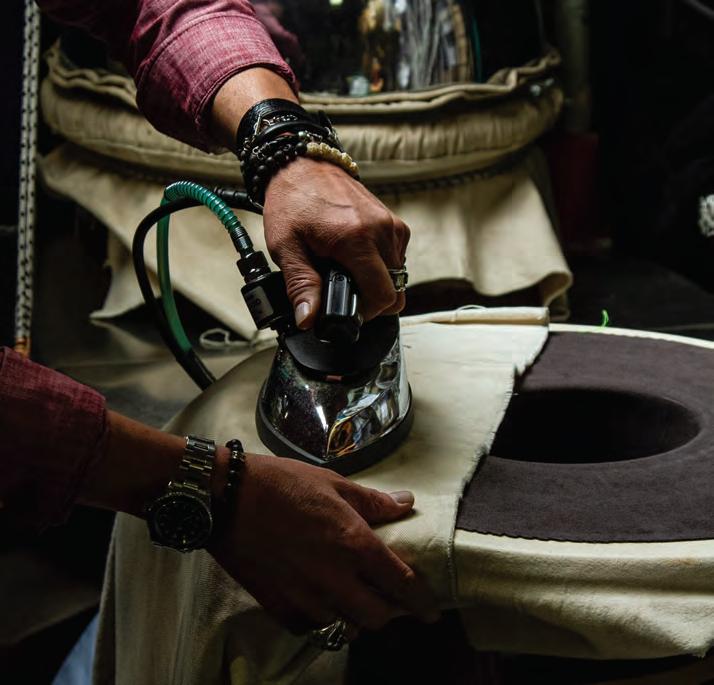
Then begins the real work: wetting, steaming, shaping and letting the felt rest. A custom hat may take 10-12 hours of labor spread across time. Some are made from European fur blends. Others use 100% pure beaver belly hair, the gold standard of hat making. Whether a customer buys a fully custom hat or one off the shelf, Johnson takes care in the same details: the color, the hatband, the liner and the sweatband.
Johnson’s craft lies not just in making hats but in helping people find the right one, balancing a customer’s vision with the candid honesty of his 30 years at the bench. “It’s all about getting to know the client,”
I didn’t choose the hat life. The hat life chose me.
– Trent Johnson
he said. “The most important part of designing a hat is listening.” Will it be used for ranch work, rodeo or a music festival? Does the client want a fedora-style-pencil roll or a wide buckaroo brim? Understated dignity or full-on swagger? From there, he tweaks the hat until it fits both the head and the life that comes with it.
The hands-on approach helped propel Greeley Hat Works. In 1998, the National Cattlemen’s Beef Association ordered 100 all-beaver hats for its 100th anniversary, a job that brought the shop national attention. Since 2002, Johnson has made hats for President George W. Bush. His work has also appeared on Jeremy Renner in Wind River and on members of the Yellowstone cast. Johnson spent weeks with cast members and getting to know them so each hat matched the character.
DESPITE THE CELEBRITY clients, the core of Greeley Hat Works has never shifted. “They’re salt of the earth, real people who appreciate craftsmanship,” Johnson said. “I don’t care if you’re a feedlot cowboy, a hand surgeon or a secretary. You get the same experience from me.”
His clientele includes farmers, ranchers, cattlemen, horsewomen and ag workers, along with newer customers discovering the West in their own way. He doesn’t build “costumes,” as he puts it. He builds hats that fit a life, not a stereotype.
Some customer files go back decades. Rodney Chapman is a feedlot cowboy
whose daily hat, made from pure beaver hair, lasted 13 years of sun, dirt and sweat before he needed another. “Fortunately, or unfortunately, depending on how you look at it, I don’t build him a lot of hats,” Johnson said with a laugh.
For someone who makes thousands of hats a year, Johnson keeps his own collection modest. He rotates just four: a traditional wide-brim Western, a Johnson County style, a fedora and a well-worn work hat. More than once, he has sold the hat straight off his head when a customer falls in love with it.
Johnson is quick with hat lore and trivia. He tells about John B. Stetson, who came to Colorado in 1853 for the dry air. As the story goes, Stetson trapped and skinned a beaver near the base of Pikes Peak, fashioned a rough felt shell and sold it on the spot to a passing cowboy for $10 – anchoring Colorado as the birthplace of the first true cowboy hat. Indigenous practices of stacking, which inspired ribbons and beads wrapped around hats in the 1800s, are also part of that history.
His shop slogan, “Still Western. Since 1909,” fits the way he talks about his work: integrity, dedication and honoring your word.
“It all comes back to the American West and wanting to do the best you can – for the land, for the customer,” Johnson said. “We’re okay if that takes more time.”
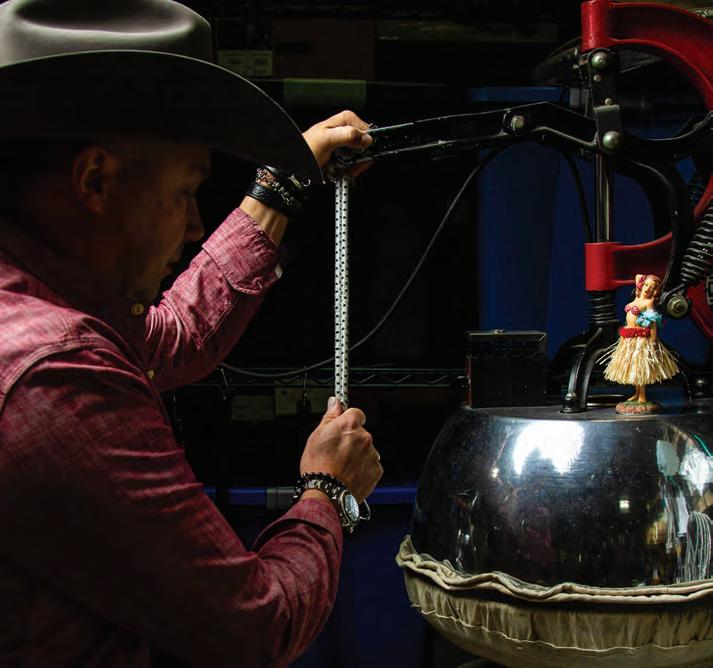
On any given day, Johnson works between stacks of felt bodies and shelves of blocks, taking one unfinished hat after another back to the bench. He stretches felt over the block, leans into the steam and works the brim by hand, the way Greeley hatters have since 1909.
Johnson’s hats are worn by ranchers, cowboys and customers across the country, like President George W. Bush and actors in Yellowstone Despite that reach, the shop continues to serve everyday customers as it has for years.
bluebird ways of the
by CHRIS AMUNDSON
Erik Makić
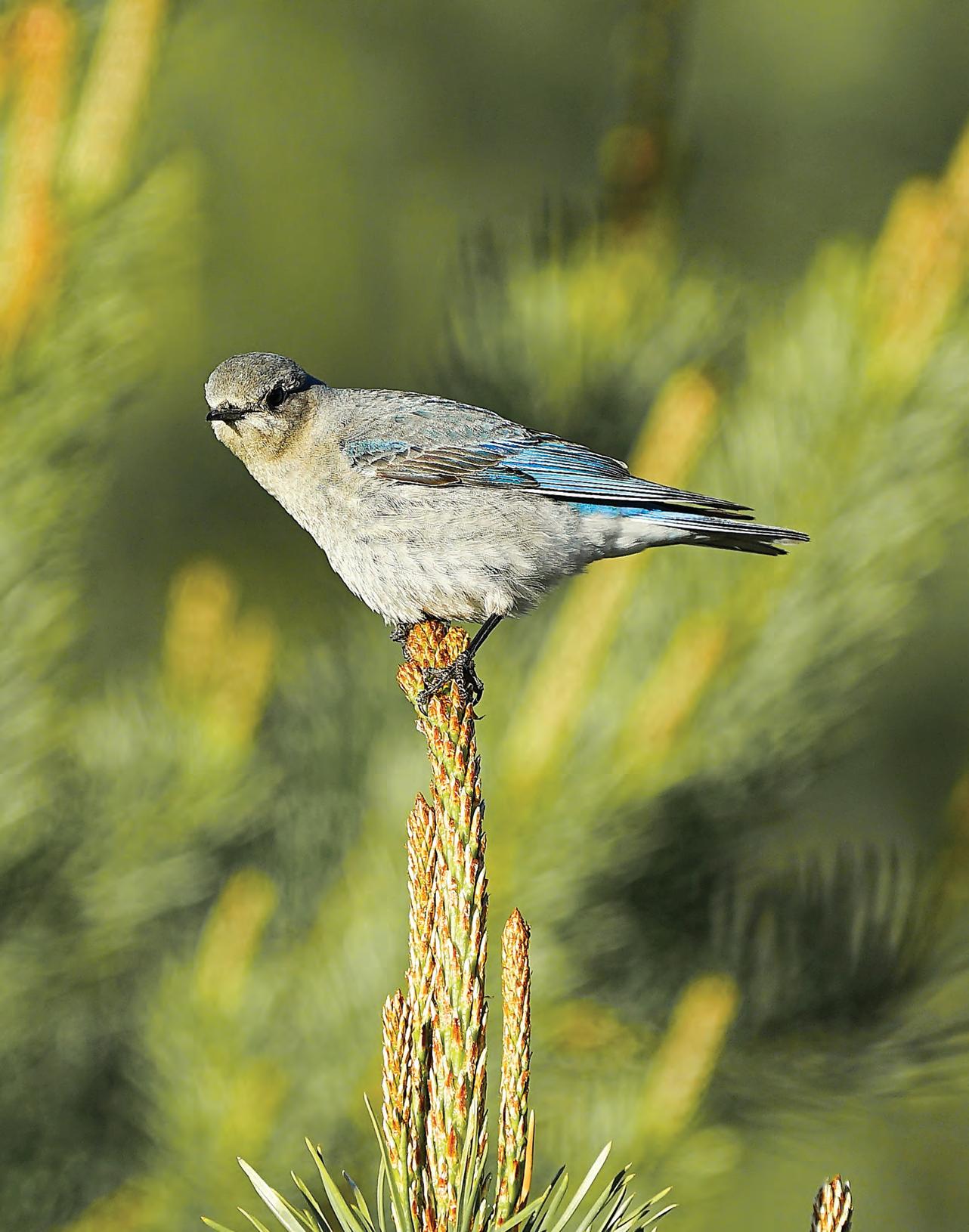
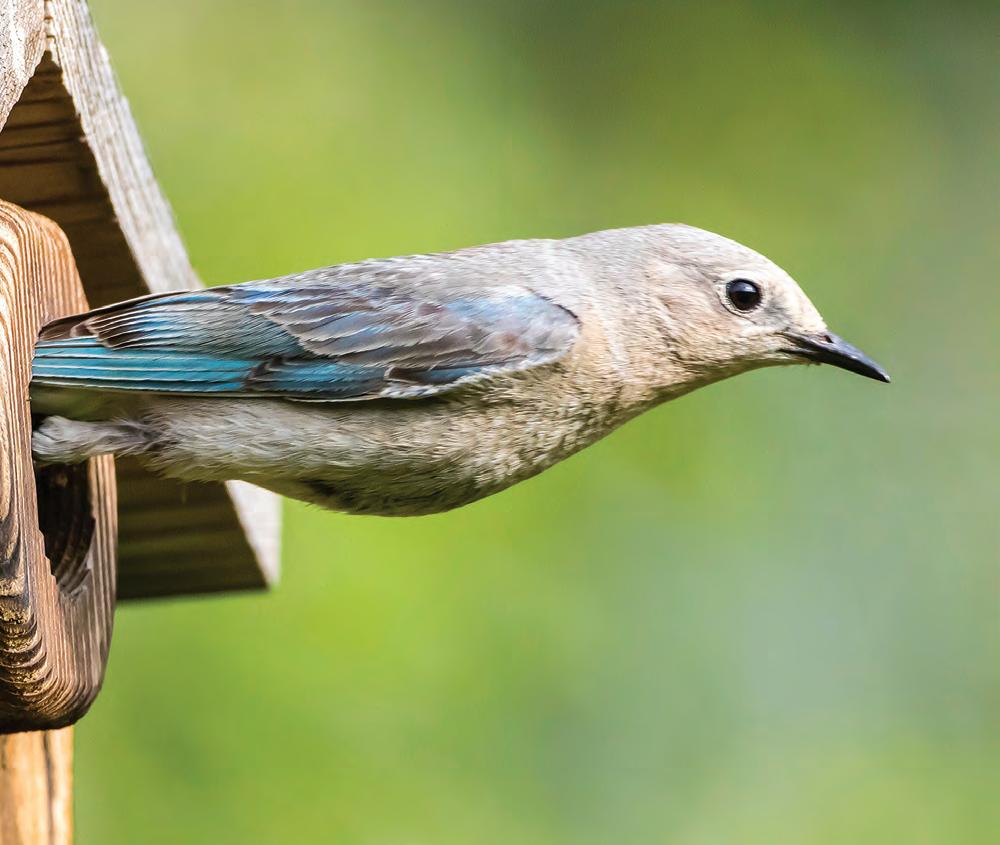
Across the state, spring arrives in flashes as mountain bluebirds return to open country. In Silverthorne, a gray female takes flight from a nest box. Breeding season begins at the cavity, where females build their nest and watchful bright blue males stand guard.
IN COLORADO, SPRING does not arrive all at once. It comes in pieces: a warmer afternoon, a longer evening, water where ice used to be. Snow still lingers in the shade of fence lines and north slopes, while exposed ground turns soft and dun under the first mild light. Then a mountain bluebird lands on a fence post or a bare branch above last year’s grass. For a moment it can seem almost too bright for the season, a clean piece of sky set down in the field.
The mountain bluebird, Sialia currucoides, is a small thrush, a little more than 7 inches long. The male is bright blue almost all over, vivid in full sun and powdery in colder light. The female is grayer, with blue in the wings and tail, her color
easy to miss until she turns.
It nearly became the state bird in 1931 and, for a time, led the field. The male’s cerulean color fit Colorado’s image of itself: blue sky, clean light, open country. It lost to the striking black lark bunting.
Colorado has three bluebirds – mountain, western and eastern. The mountain bluebird is the one most closely tied to the state’s open country: meadows, foothills, mountain parks, pasture, sage flats, aspen openings and ranchland. It avoids thick cover and does best where the ground stays visible. From a fence post, snag or bare branch, it watches the grass below, then drops and returns to the same perch.
In warm months, mountain bluebirds
Richard Seeley; Dawn Wilson (right)
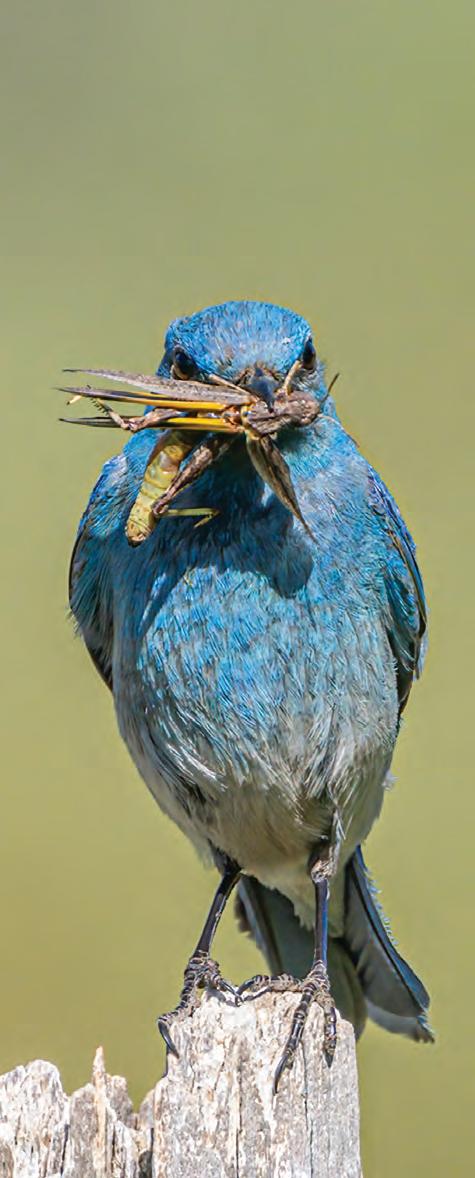
feed mostly on grasshoppers, caterpillars, beetles and other small prey taken from the ground or caught in short flights. In winter they turn more to berries, especially where fruit hangs on through cold weather.
That pattern is easy to watch. A bluebird sits upright, studies the ground, drops fast, then rises back to the same perch. At times it hovers and dives after prey so neatly that it can look, for a moment, like a tiny kestrel.
Bluebirds are cavity nesters, using holes they did not excavate themselves: old woodpecker hobbits, natural cavities, crevices and nest boxes. In later seasons, bluebirds may return to a cavity or box they used before. In Colorado, nest-box trails and volunteer monitors now shape bluebird nesting from park edges to subdivisions and long stretches of pasture. The birds readily take a box if the surrounding habitat is open.
Bluebirds pair for the breeding season, and it begins at the cavity. The male claims a hole or box and returns to it again and again, singing nearby, pausing at the entrance, then flying back toward the female as if to draw her attention to that single spot. She approaches, studies the opening, goes in, comes out and looks once more. Sometimes she lingers at the lip before slipping inside again, while the male waits nearby, bright against weathered wood or gray wire, then drops to the ground and rises back to the same perch. If she accepts him, the pair is set.
Once she accepts her new home, the season begins in earnest. The female builds the nest, and a clutch of four to eight eggs follows. She incubates while the male stays close. After about two weeks, the eggs hatch, and the traffic starts – insects carried in, waste carried out, both adults working the grass around the nest hole. From a fence wire or weathered post, an
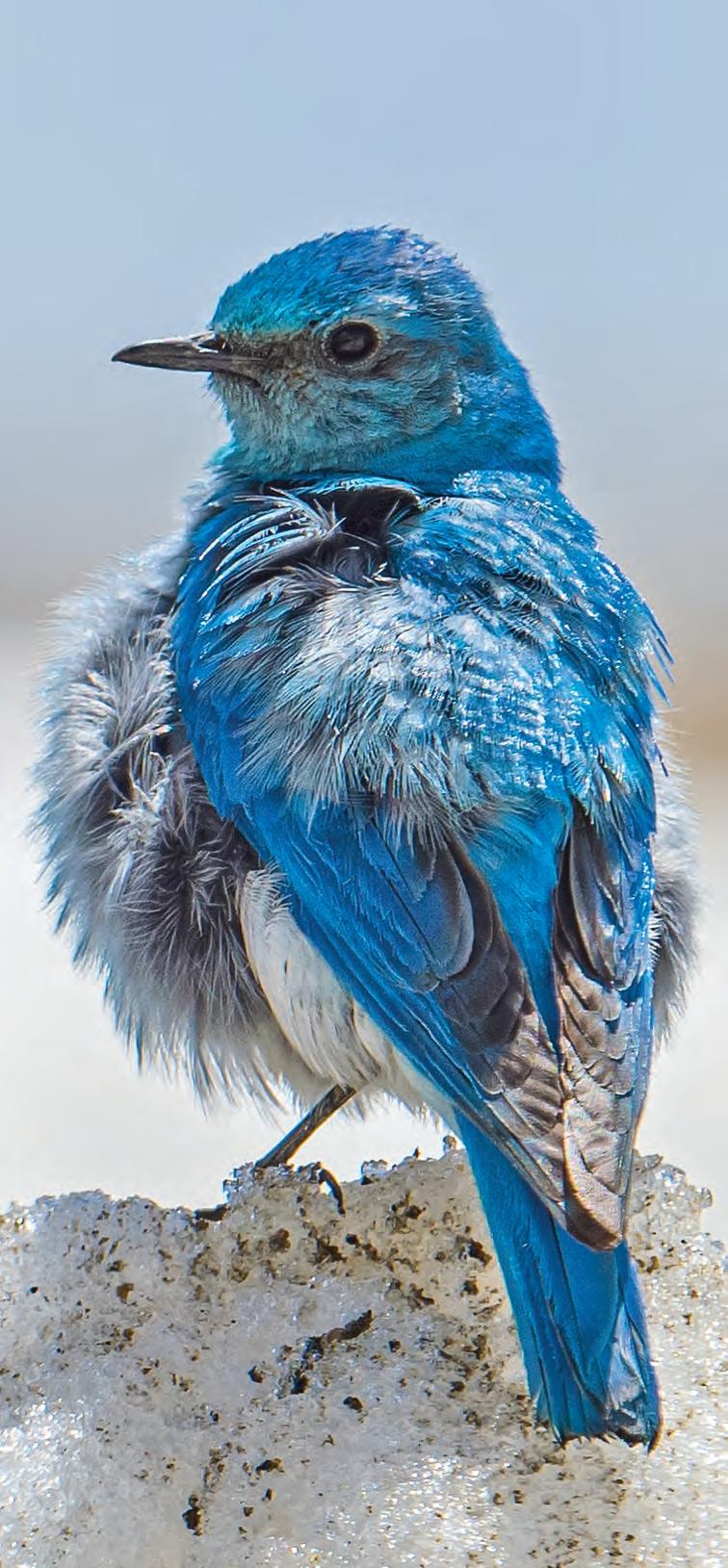
A bluebird comes tenderly up to alight.
– Robert Frost
adult drops into the grass and comes back with something pale and soft in its beak, then disappears into the dark opening and is gone again. At the entrance, the young bunch shoulder-to-shoulder, heads lifting at every approach. But a cold snap, hard rain or a run of poor insect hunting can turn that busy nest quiet for the season.
Two to three weeks after hatching, the young leave the cavity, though the feeding doesn’t stop. Their first flights are short and uncertain.
For weeks, the fledglings cling to fence wires, posts and low branches, still calling for food, their wings not quite steady yet. They sidestep along the wire with their mouths open, waiting for one more delivery. If weather holds and insects stay plentiful, the pair may start again.
As summer goes on, those small family groups begin to spread out along fence lines and meadow edges. One bird perches, watches the grass, drops, then rises back to the wire while another follows a few yards off. A young bird misses its footing, regains the strand and tries again.
Another lands in the grass and pops back up to a lower branch, already falling into the pattern. By then, across much of Colorado’s open country, they are part of the landscape – busy, bright and exactly where they belong.
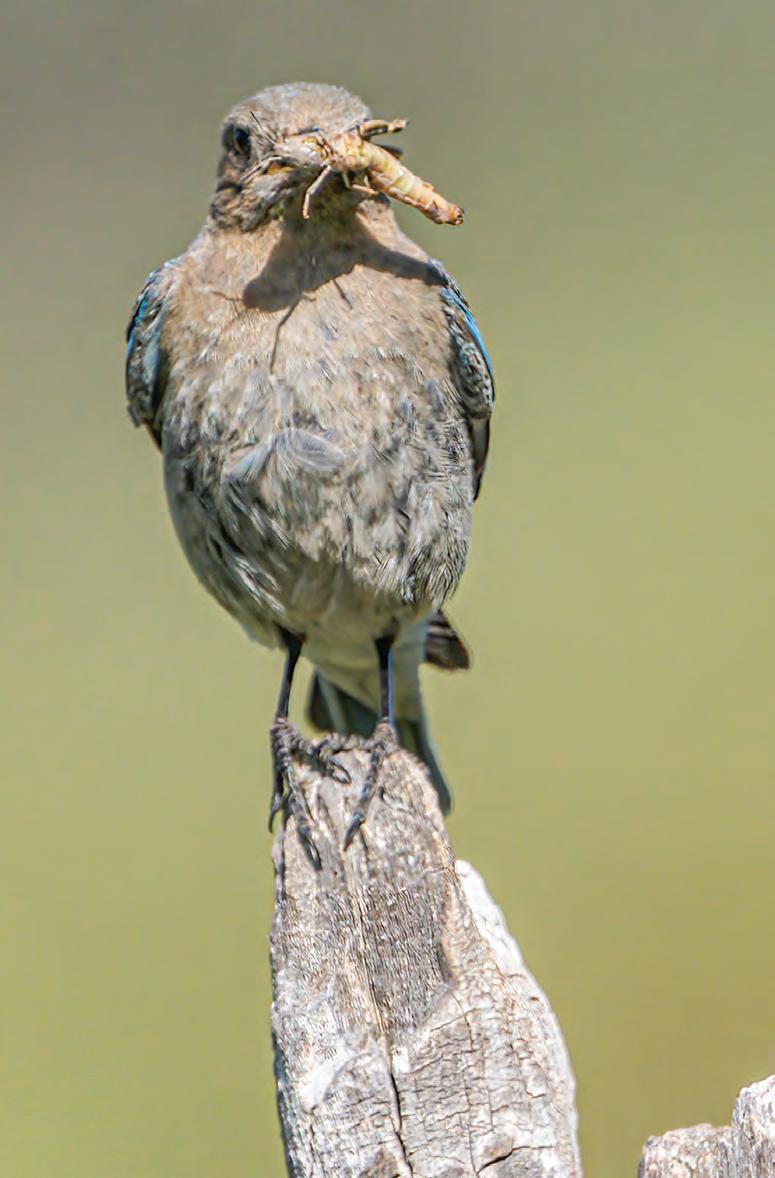
Mountain bluebirds rely on insect-rich diets to raise their young until fledglings can hunt for themselves. Near Lake Dillon, two adults forage for grasshoppers. A male swoops through the air in Silverthorne, scouting for food: caterpillars, beetles, small prey and, in the winter, berries.
Richard Seeley (both)
OUR STATE THROUGH THE WORDS OF OUR POETS
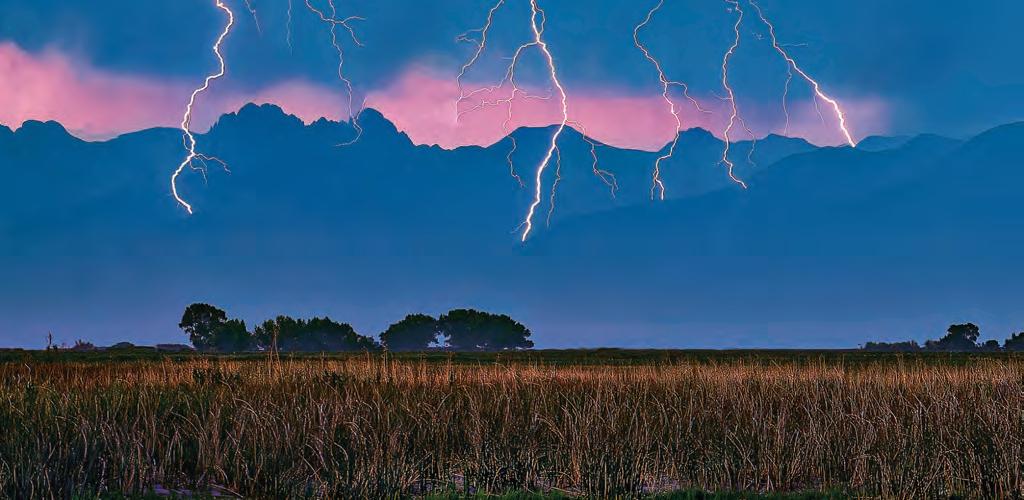
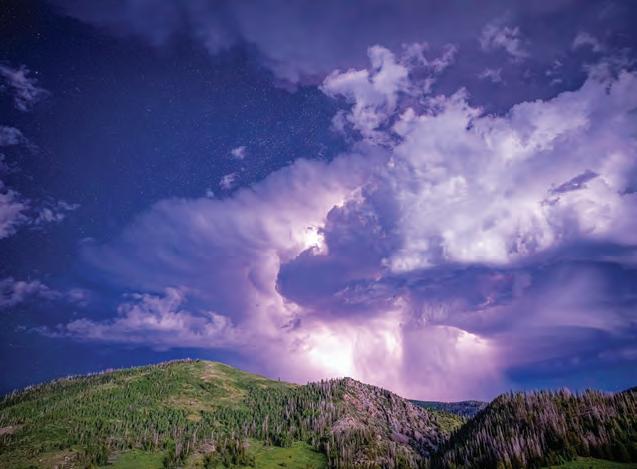
First thunder echoes through canyons and across the high country, a drumbeat announcing spring. Dark clouds gather, rain sweeps in and the landscape begins to stir. These poems follow the energy and renewal that come with those first rolling storms.
Mother Nature’s Thunder Band
Marina
J. Ashworth, Denver
Nature boasts a fine set of drums
Proud as a conductor can be.
Her band tunes up, storm time is nigh.
Waits God’s nod to let it rip free.
Nod is cast! Time to begin the show!
KICK Drums boom with fire and gust
Napping critters are starting to stir
FLOOR Drum adds his rowdy thrust
TIMPANI pounds and adds to the mix
Critters below now enjoying the pomp
TOMTOM lets fly and keeps the beat
Handsome SNARE completes the Band Romp.
Delightful, loud and booming with lust
Ma Nature has no time for her bow
Just getting started and fired with joy
Ears up, hear the skies go kapow
Apple Blossom Special
Robert Basinger, Rifle
I listen to the thunder roll
Green is soothing for the soul
All the leaves have found a home
I can’t believe how much they’ve grown.
A hummingbird just streaked on by
Quicker than a blinking eye
It’s so good to be alive
On this planet born to thrive.
There’s an apple tree down by the creek
It’s going to flower in a week
Honeybees will earn their pay
A soft caress then fly away.
The tree of life will soon bear fruit
A miracle I’ve seen the proof
Sweet fragrance lifted on the air
And a bounty that we all must share.
Grant Collier
Midnight Railroad
Henry Lewis, Nathrop
I thought I heard a train last night. It’s been so long, I got up to look. When I got outside there was only a soft west wind moving through the tall grass.
Orion was out looking too, hunting for the Denver and Rio Grande. We both saw only the rusty old rails and heard only the sound of the slow, endless flow of the river.
Flora some call weeds rose high above the old rails, making them hard to see in the dark. Orion and I went for a walk along the roadbed. Cross-ties laid 90 years ago still doing their job even though no one sees or cares.
We talked about changes. It was the time of a new moon. The old one gone, a new one coming. Even the night sky was moving like a slow midnight train in the sky.
Orion said he missed seeing the trains but still enjoyed looking down at the old tracks. Colorado never disappoints at any station. Walking back, the weeds had turned to wildflowers. Sadness without tears, change without fears.
Thunder and Light
Cher L. Tom, Palisade
Hollow noises reverberate along the canyon walls
Transforming Clouds of Trail Ridge Road
Richard F. Fleck, Denver
As we drive along high on Trail Ridge Road under a dark gray sky, a twisting white cloud drops upon the tundra green of Terra Tomah Mountain leaving lingering puffs on its lower slopes above the Ink Well Lakes, and entering deep into our minds Nature’s constant transformation.
First Thunder
J. Craig Hill, Grand Junction
After First Thunder The Utes perform their Bear Dance And I plant Fresnos
Like a tsunami sliding over beaches and smashing shells. Instead, rocks and boulders come crashing down Bowing before the voice of thunder.
Spring storms scrape the landscape clean Painting mud around tree trunks and tufts of green moss. The drenching rains that follow lift buttercups and lacy ferns Toward the ocean-blue sky that smiles down at me.
Send Your Poems the themes “The Longest Light” for the July/August 2026 issue by June 1 and “Rust and Gold” for the September/October 2026 issue by July 1. Email poetry@coloradolifemagazine.com or mail them to the address at the front of the magazine.

Megan Feeney
Dining wine
THE SUNDAY DINNER table spotlights ham, often cooked simply to beef up – er, pork up –its natural flavor. Other home chefs prefer to dress their hams with fruits and glazes. But there’s another, less traditional way to dine on swine this holiday. Ham-based fried rice and porky meatballs offer fresh approaches in this season of new beginnings. Or forgo the ham entirely and throw a pork shoulder in the oven or slow cooker to create crowd-pleasing sandwiches or tacos. Guests will go hog wild.
Shredded Savory Pork
With its high fat content, pork shoulder is perfect for cooking low and slow to achieve moist, tender mouthfuls. To elevate this dish to the next level, rub the pork shoulder with garlic and spices before cooking to infuse the meat with a subtle uplifting bouquet that balances its richness.
Mix garlic and all spices together in bowl. Rub evenly across entire shoulder. Place in a roasting pan with cover. Pour beef broth on roast. Cover and cook at 250° for 4 hours 15 minutes or cook in slow cooker on low heat 8-10 hours or high 4-5 hours. Turn off heat and let sit in oven at least one hour to finish cooking and cool for handling.
Trim excess fat, pull out the bones and trim away gristle. Shred pork by hand or with forks. Mix with liquid. Stack in a bun, throw in a tortilla or serve on its own with or without sauce of your choosing.
4 lb shoulder roast 8 cloves minced garlic 2 tsp ground coriander
tsp ground cumin
2 tsp dried & crushed oregano 1 tsp onion powder
1/2 tsp kosher salt
1/2 tsp ground white pepper
1/2 tsp ground red pepper
1 14.5-oz can beef broth
Ser ves 8-10

Ham Balls
For a unique twist, try some spherical scrumptiousness in this ham balls recipe. Brown sugar sweetens the savory meat mixture, while apple cider vinegar, mustard powder and tomato add a subtle zing.
In large bowl, combine ham, ground pork and sausage. Stir in milk, eggs and graham cracker crumbs and mix well. Form into large balls about 2-inches diameter and place in 9 x 13-inch baking dish.
In a separate bowl, combine the soup, vinegar, brown sugar and mustard powder. Mix well and pour over meatballs. Bake at 350° for one hour.
1 lb ground ham
1 lb ground pork
1 lb pork sausage
1 cup milk
2 eggs
1 ½ cups graham cracker crumbs
1 10.75 oz-can tomato soup
1/4 cup apple cider vinegar
1 cup packed brown sugar
1 tsp mustard powder
Ser ves 8-10
Megan Feeney
Ham Fried Rice
Friend and food blogger Danelle McCollum at LetsDishRecipes.com makes this dish to use up leftover ham – or any pork, chicken or beef. A stick-to-your-ribs comfort, it’s a fun way to pack in veggies while eating a dish that feels decadent.
Heat small non-stick skillet over medium-high heat. In small bowl, whisk eggs. Add eggs to skillet and cook, stirring frequently, for 2 minutes. Remove scrambled eggs from skillet; chop and set aside.
Heat vegetable and sesame oil in a skillet or wok over medium-high heat. Add chili flakes and garlic and sauté for 2 minutes. Add ham. Stir-fry 1-2 minutes or until golden.
Add bell pepper and onion; stir-fry another 5 minutes. Stir in peas, rice and soy sauce.
Cook additional 3-4 minutes or until thoroughly heated. Stir in reserved egg. Sprinkle with green onions.
3 Tbsp vegetable oil
1 tsp sesame oil
3 cloves garlic, minced
1/2 tsp red chili flakes
2 large eggs
1 cup diced cooked ham
1/2 large red or green bell pepper, diced
1/2 onion, diced
1 cup frozen peas
4 cups cooked rice
1/4 cup soy sauce
1 bunch green onions, sliced
Ser ves 6-8

What’s in Your Recipe Box?
The editors are interested in featuring your favorite family recipes. Send your recipes (and memories inspired by your recipes) to editor@coloradolifemag.com or mail to the address at the front of this magazine.
Danelle McCollum
Apollo 13 astronaut beat the odds in orbit and on Earth JACK SWIGERT
BY LISA TRUESDALE
ON APRIL 12, 1970, Jack Swigert was having quite a busy day at work when it dawned on him that he hadn’t yet filed his income taxes.
“Guys, I’m in deep trouble,” he said to his two co-workers. They chuckled as Swigert radioed his bosses, requesting an extension from the IRS since he was on a business trip. The guys holding down the fort back home reassured Swigert not to worry and sent him a message directly from the big boss: “It’s okay. You’re out of the country.”
Swigert and his co-workers were NASA astronauts aboard the Apollo 13 spacecraft. The boss was President Richard Nixon, and their business trip was a mission to the moon.
Born in Denver in 1931, John “Jack” Leonard Swigert, Jr., was fascinated by aviation from an early age. After paying
for flying lessons at Combs Field with earnings from his paper route, Swigert was a licensed pilot by age 16.
Soaring over the majestic Rockies surely whet his appetite for exploring well beyond his home state, but those yearnings would have to wait. He graduated from East High School, studied mechanical engineering at the University of Colorado-Boulder and played football for the Buffs, where his coach and teammates called him “Big Swig.”
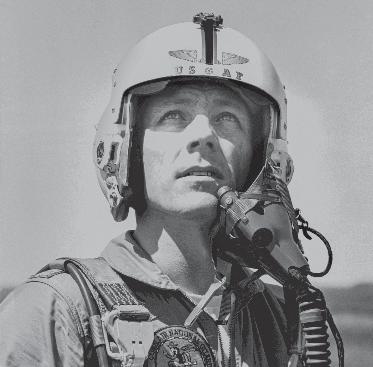
Although he excelled on the gridiron, lettering three times and earning All-Big Seven honorable mention twice, football wasn’t his destiny; flying was. After college he joined the U.S. Air Force, and upon completing training was shipped off to be a fighter pilot in Korea and Japan during the Korean War.
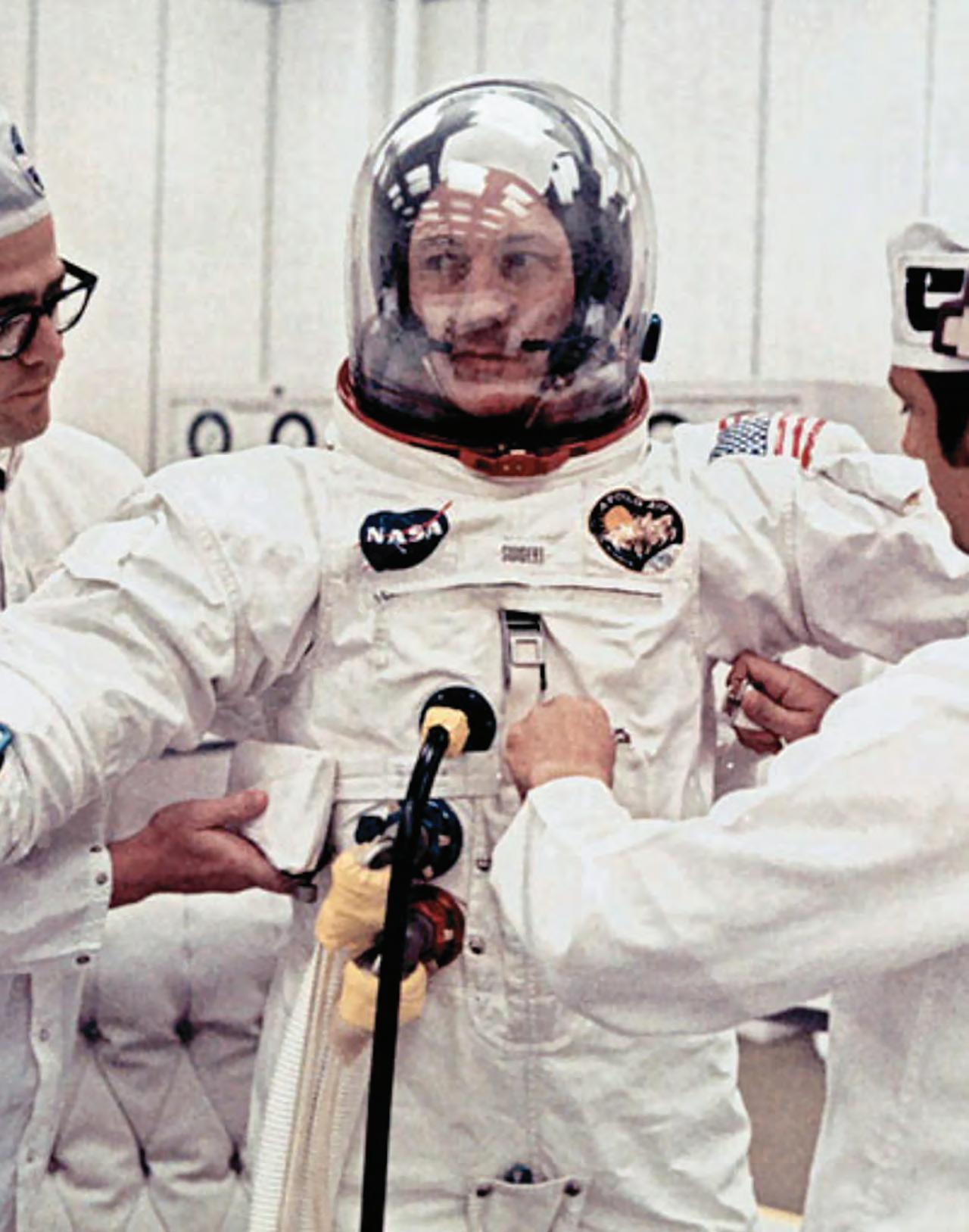
Command module pilot Jack Swigert was not supposed to be on a voyage to the moon. He was actually part of the backup crew. Just three days before liftoff, when NASA discovered that Apollo 13’s command module pilot, Ken Mattingly, had been exposed to the German measles, they proposed replacing him with Swigert.
Mission commander James Lovell wasn’t a fan of the plan initially. The three first-teamers had trained together extensively for more than a year, and Lovell wasn’t confident that a replacement could step right in and do the same work. In fact, he later admitted complaining to Mission Control that “normally the backup crew at that stage are just the gofers.”
Yet, faced with delaying the mission or welcoming Swigert on board, he chose the
NASA (both)
latter option knowing that Swigert was more than qualified for the job. “Jack knew the command module pretty good,” he said, not knowing how that would turn out to be the understatement of the decade.
Being an astronaut was Swigert’s lifelong dream – “he just didn’t want to be a doctor” like his father, his mother, Virginia recalled. “He was interested in mechanical things and would rather tinker with an old car than anything else.”
Swigert earned two master’s degrees after his Air Force service. Then he applied to NASA in 1962 and 1963 and was rejected both times. The third time was the charm. Swigert was accepted into NASA’s Astronaut Group 5 in 1966.
When asked about it years later, Swigert put a positive spin on his quest: “I’m a fighter, not a quitter,” he said. “Look what I did to get into the space program.”
Swigert’s attitude came in handy when he crash-landed on a Korean airstrip in 1953, escaping unscathed while his plane was bursting into flames, and it was definitely crucial for exactly 142 hours, 54 minutes and 41 seconds in April 1970.
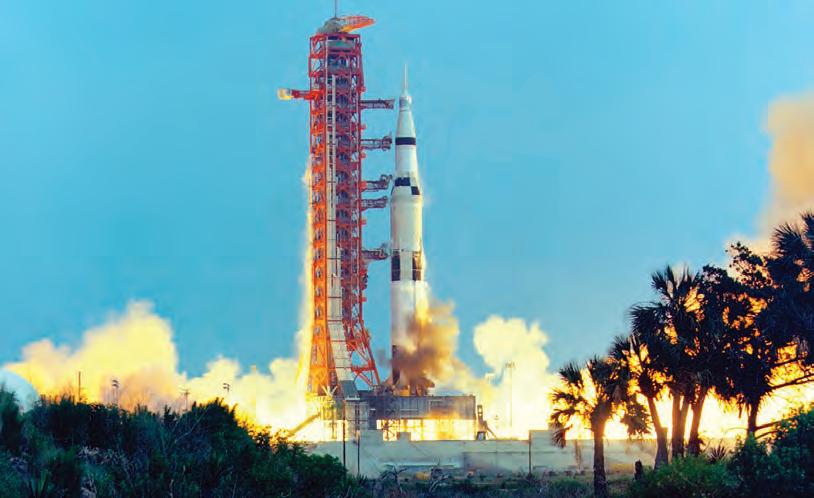
SWIGERT WAS THE first bachelor and the first CU Buff to depart Earth for space. On April 11, he, Lovell and lunar module pilot Fred Haise lifted off in Apollo 13 precisely at 13:13 military time. When prompted repeatedly over the years, Lovell would insist that they weren’t feeling at all superstitious about all of those 13s.
About 56 hours into the flight, Mission Control in Houston directed Swigert to perform a “cryo-stir,” a routine procedure to agitate the module’s tanks of cryogenic oxygen so they wouldn’t solidify. As soon as he flipped the switch, the three men felt jarring vibrations, followed by a loud bang. Swigert then uttered what would become one of the most famously misquoted quotes in NASA and Hollywood movie history: “Okay, Houston, we’ve had a problem here.”
One of the oxygen tanks had exploded,
taking part of the service module with it – though they didn’t know that until much later. Landing on the moon was no longer an option; the space mission was now one of escaping to Earth. The entire nation watched as Mission Control worked around the clock to figure out how to get the astronauts safely home. The technicians knew – but never said aloud – that the tiniest wrong move or misguided decision over the following 80-some hours could send the men deep into space where they would drift endlessly to their deaths.
Riding in the command module –the only component of the spacecraft equipped with a heat shield – was the only way to safely re-enter the Earth’s atmosphere. Unfortunately, it didn’t have enough power or oxygen to last the nearly four days it would take to swing around the far side of the moon and begin the journey home again. So, they huddled inside the lunar module, which was designed to support two astronauts for two days. The emergency necessitated using it to support three men for four days until they could move back into the command module just before a fiery Earth re-entry.
Despite the seriousness of the situation, Swigert and Haise were transfixed when they saw the moon’s surface out the craft’s small window, and they spent several minutes taking photos – or “sightseeing,” quipped Haise. Lovell, who had already seen Earth’s nearest neighbor on a previous spaceflight, grew impatient with their inattention to the tasks at hand, saying, “Look, if we don’t get back, you’re not gonna get those pictures developed.”
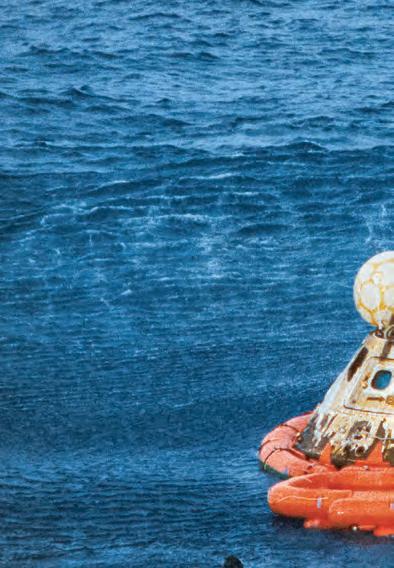
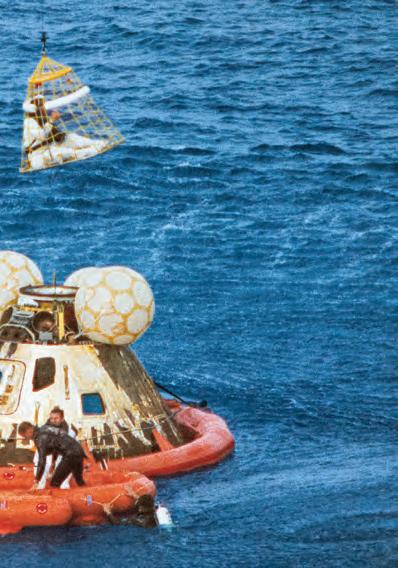
They did get back. All of Mission Control’s calculations turned out to be accurate, and after nearly four frigid, sleepless days of being cramped inside the lunar module, the command module safely splashed down into the South Pacific on April 17.
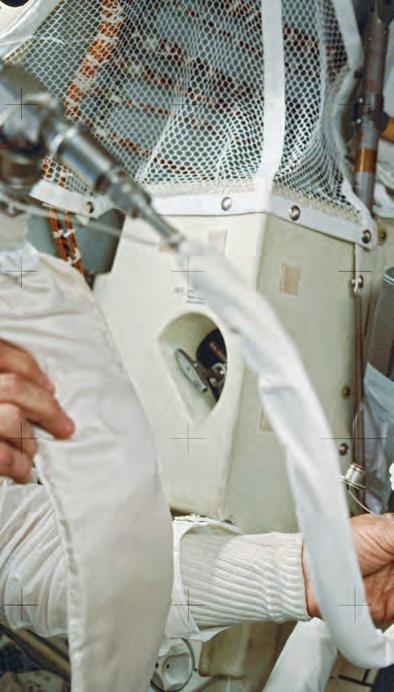
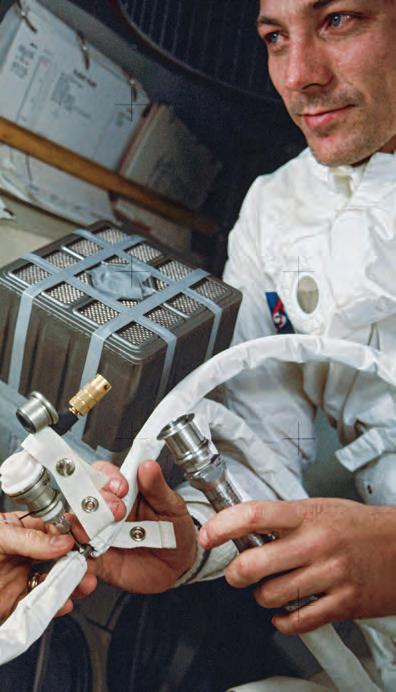
Swigert connects an improvised carbon dioxide scrubber during the Apollo 13 mission. He was lifted into a helicopter after piloting the Apollo 13 command module “Odyssey” to a successful splashdown in the Pacific Ocean.
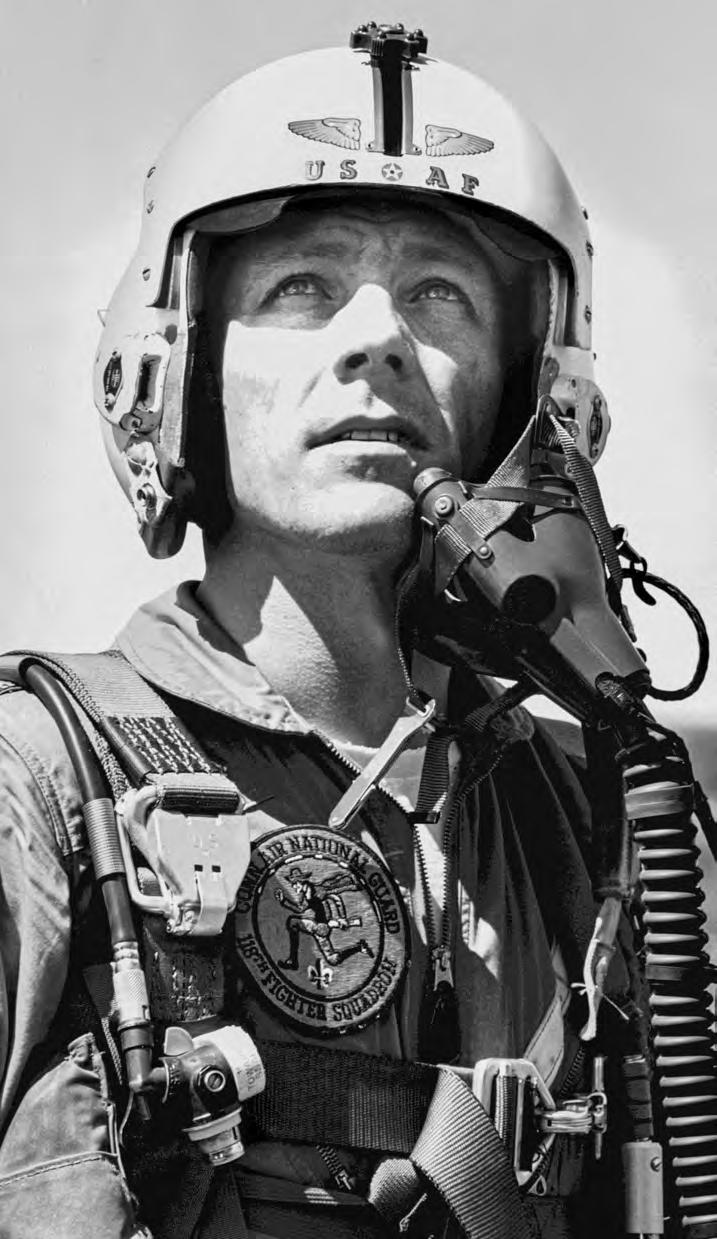
Jack Swigert suits up for NASA’s Apollo 13 mission, which launched from Cape Canaveral in April 1970. Swigert was a U.S. Air Force test pilot prior to being an astronaut.
U.S. Air Force
NASA (both)
AT THE POST-MISSION press conference, Lovell was asked about the decision to add Swigert to the mission just days before the launch. He didn’t regret it one bit, he said with a little chuckle. “Jack did help a bit during our ensuing odyssey.” Another Lovell understatement.
Lovell, Swigert and Haise were awarded the Presidential Medal of Freedom by Nixon, who said, “The three astronauts did not reach the moon, but they reached the hearts of millions of people in America and in the world. They reminded us in these days when we have this magnificent technocracy, that men do count, the individual does count. They reminded us that in these days machines can go wrong and that when machines go wrong, then the man or the woman, as the case may be, really counts.”
Actor Kevin Bacon portrayed Swigert on the big screen in 1995’s Apollo 13, but Swigert never got to see the film.
One longtime friend of Swigert’s thought he might not have liked it much anyway, as “the one-dimensional por-
trayal” didn’t capture how Swigert was “shy, brilliant, good-humored, optimistic and intense,” instead making him seem like “a cocky, skirt-chasing bachelor.” Had Swigert still been around, he wouldn’t have been shy about setting the record straight.
After leaving NASA and then working in private industry, Swigert returned home to Colorado, forging ahead with a new challenging frontier – politics. He ran unsuccessfully for U.S. Senate in 1978, but this fighter-not-quitter didn’t give up. In 1982, he ran for Congress to represent the state’s newly created 6th District.
During the campaign, he was diagnosed with bone marrow cancer, but was informed by doctors that it was an easily treatable lymphoma. He held a press conference to announce his illness, saying, “I was privileged to be one of the few who viewed our Earth from the moon, and that vision taught me that technology and commitment can overcome any challenge … There are thousands of peo-
ple out there that believe in me, and we’re just going to go ahead and win this campaign. That’s all there is to it.”
He did win, with a decisive 64 percent of the vote. Just days later, Swigert’s doctors determined that his cancer had already spread to his lungs. Swigert died at the age of 51 on Dec. 28, 1982, days before he was to be sworn in. He is buried in his family’s plot at Mount Olivet Cemetery in Wheat Ridge.
AT THE U.S. Capitol in Washington, D.C., National Statuary Hall features 100 statues, two from each state honoring “persons notable in their history.” Colorado had just one statue in the collection until 1997, when a life-sized bronze of Swigert in his NASA spacesuit, by Loveland brothers and sculptors Mark and George Lundeen, was installed in the collection.
Enduring tributes to Swigert in his home state are most inspiring to generations of Coloradans who breathlessly watched the days-long Apollo 13 rescue
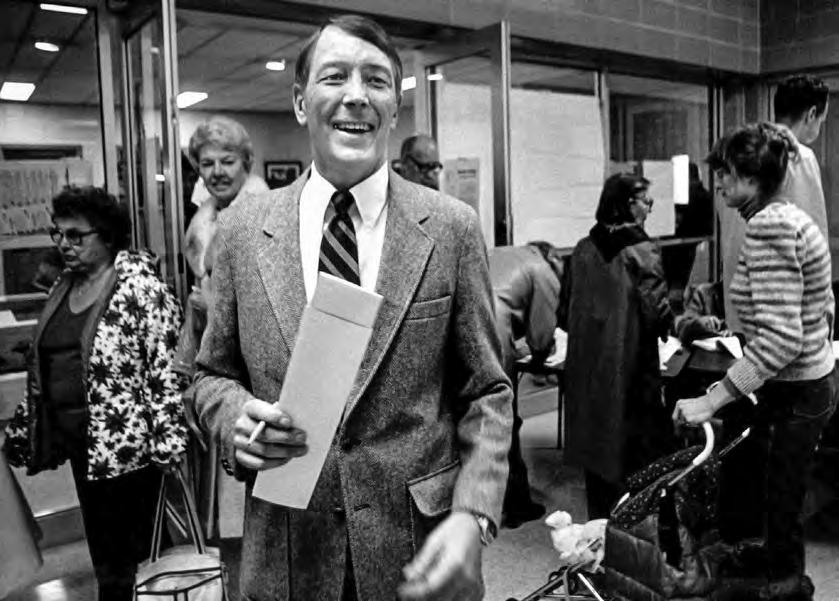
Congressional candidate Jack Swigert casts his vote with a smile in the November 1982 election.
The Denver Post/Getty Images
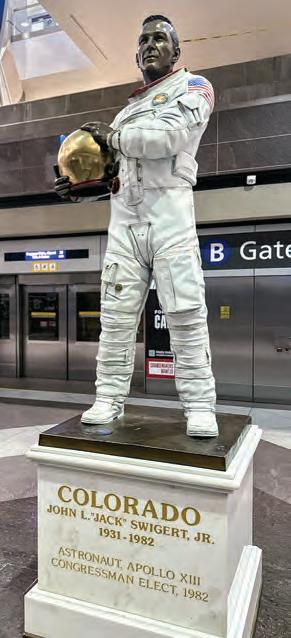
operation 50 years ago. His legacy inspires the thousands of students who’ve attended Swigert International School in Denver and Jack Swigert Aerospace Academy in Colorado Springs. Part of Swigert’s Apollo 13 flight suit, donated by his sisters, is on display at History Colorado Center, and a replica of the U.S. Capitol statue greets travelers at Denver International Airport.
In April 2020, 92-year-old Lovell and 86-year-old Haise were celebrated at big celebrations in their home states to commemorate the 50th anniversary of the “successful failure” that was Apollo 13. One can only imagine how Coloradans would have honored their native son.
Perhaps the speeches would have sounded something like what then-Governor Richard Lamm said in 1982, upon learning of Swigert’s passing: “Jack Swigert provided a genuine home-grown hero for a whole generation of Colorado kids. He was meeting the challenges of Congress and of his illness with the same gallantry that took him to the moon.”
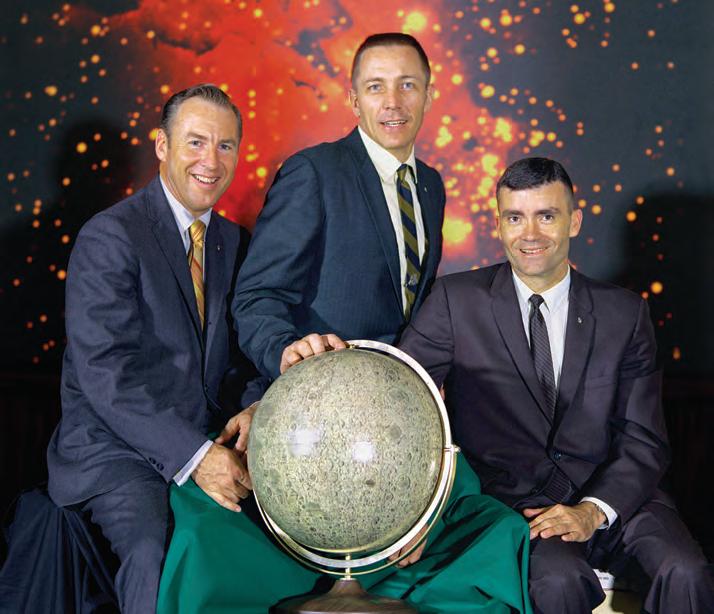
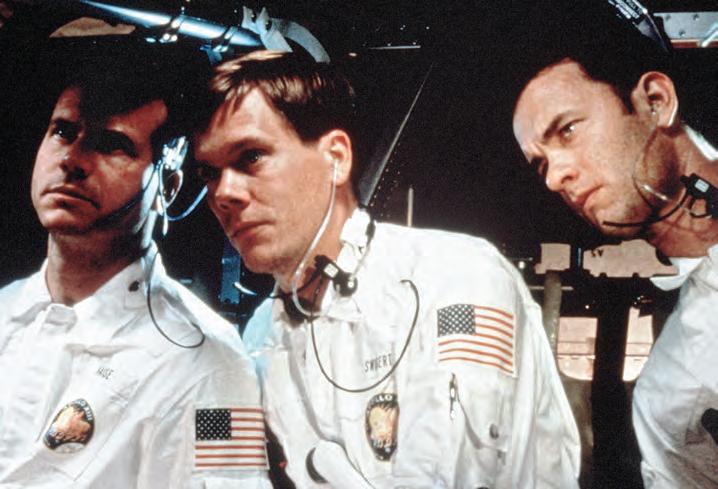
Apollo 13 astronauts Lovell, Swigert and Haise pose with a moon model. Kevin Bacon played Swigert in the 1995 film Apollo 13 (pictured with Bill Paxton and Tom Hanks). A bronze replica sculpture of Swigert by Loveland artists George and Mark Lundeen is displayed at Denver International Airport. The original can be found in the U.S. Capitol Building’s National Statuary Hall Collection. Allstar Picture Library NASA
Chris Amundson
COLORADO’S CALENDAR OF EVENTS
by ARIELLA NARDIZZI
QUILTING
MESAS TO MONUMENTS QUILT SHOW
MAY 1-2 • GRAND JUNCTION
Traditional medallions and boldly colored panel quilts fill the Grand Junction Convention Center during the sixth Mesas to Monuments Quilt Show, where more than 300 quilts turn the biennial gathering into a celebration of stitched storytelling.
Patterns range from precise geometric blocks to richly textured heirloom pieces, giving visitors plenty to study from display to display.
The show is hosted by Sunset Slope Quilters, which marks its 40th anniversary this year. Since 1986, the guild has grown from four women to about 200 members on the Western Slope.
Quilters from across Colorado come to Grand Junction to exhibit their quilts.
Because the show is non-juried, attendees vote for their top three favorites. Fifteen to 20 vendors sell quilting goods, appraisals are available from “Quilting Cowgirl” Heather Stadelman, and Sharon Braunagel presents a daily trunk show.
An antique quilt bed turning also takes place daily on the ballroom stage. During the traditional presentation, quilts are stacked on a bed and flipped to reveal their history, technique and stories.
Sandwiches and salads are available for purchase throughout the day. Admission is $8 at the door, and kids 12 and under get in free. Hours are 10 a.m.-5 p.m. Friday and 10 a.m.-4 p.m. Saturday. sunsetslopequilters.com.

WHERE TO EAT STELLA’S FRIED PORK TENDERLOINS
The hand-breaded fried pork tenderloin sandwich is the signature order, but the menu also includes fried cheese curds and patty melts. Expect onion rings and other comfort-food sides. 811 S. 7th St., (970) 852-6900.

WHERE TO GO MUSEUM OF THE WEST
Exhibits on Indigenous cultures, early settlers and life on the Western Slope fill this four-story tower overlooking downtown Grand Junction. Experience passes are also available for Dinosaur Journey Museum in Fruita and Cross Orchards Historic Site. 462 Ute Ave., (970) 242-0971.
In its 6th iteration, Mesas to Monuments Quilt Show hosts more than 300 quilts on display, in addition to vendors, appraisals, a silent auction, trunk show and bed turning.
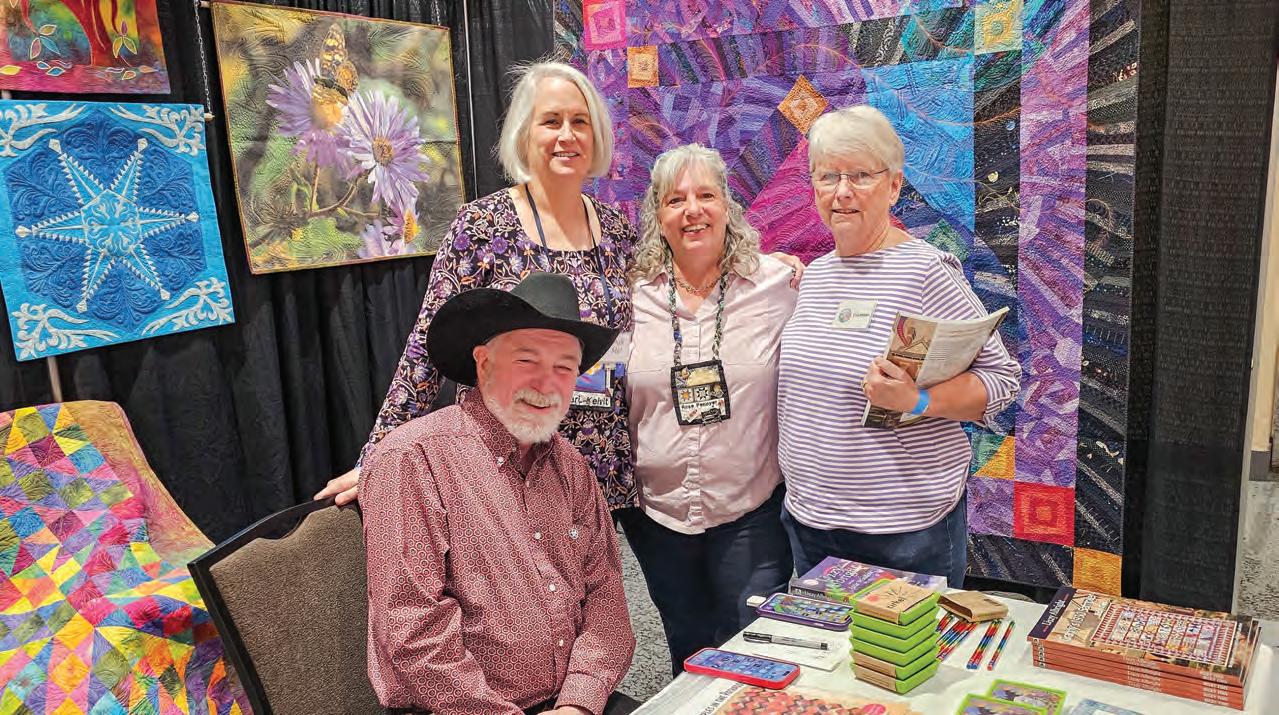
Sunset Slope Quilters
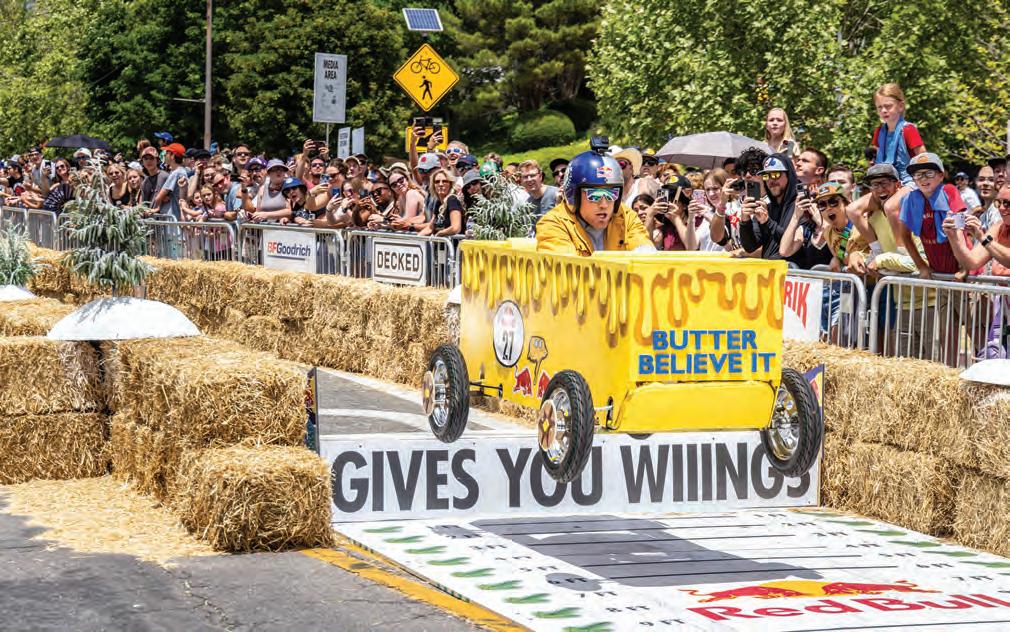
Forty daring teams will build and race homemade soapboaxes through the parking lots of Empower Field at Mile High, where a course poses obstacles, turns and jumps. Costumes, crashes and speed get the loudest cheers at this gravity-powered event.
SPORTS
RED BULL SOAPBOX RACE
JUNE 13 • DENVER
Red Bull gives you wings, but here, it’s gravity that sends homemade soapboxes flying to the finish line at Empower Field at Mile High. The Red Bull Soapbox Race returns to Denver for the first time in 18 years.
About 40 teams will race homemade, nonmotorized carts down a course of twists, turns and jumps across the stadium parking lots. Teams of up to five members must first win over the crowd with a costumed skit before the driver dodges obstacles and careens toward the finish. Between the pageantry, wipeouts and clever engineering, the ambiance shares from both a county fair and downhill dare.
Judges award teams on design, pre-race performance and showmanship, but in the end, speed still rules the day.
Each cart must include brakes and steering, stay within six feet wide by 12 feet long and 176 pounds, and rely solely on gravity to get moving. Costumes, crashes and clever engineering all get cheers.
Gates open at 11 a.m. for viewers to meet the competing teams and vote for the People’s Choice winner. Racing kicks off at 12:15 p.m., with awards following at 3:30 p.m. after the final cart crosses the line. Vendors onsite provide food and drink. Cheering squads are encouraged. Free. redbull.com/soapboxracedenver.
WHERE TO EAT STOUT STREET SOCIAL
Known as a happy hour destination, diners start with a selection of beers brewed at the Boulder location, then move to freshly shucked oysters, prime rib sliders and poke tacos. The lively room keeps downtown energy rolling. 1400 Stout St., (720) 214-9100.
WHERE TO GO CONFLUENCE PARK
Walk the paved Cherry Creek Regional Trail where Cherry Creek meets the South Platte River. Downtown bridges rise overhead. Kayakers take on the man-made rapids, and fishing, tubing and hand-launched watercraft are also permitted. 2250 15th St., (720) 913-1311.
Chris Tedesco / Red Bull Content Pool
OTHER EVENTS YOU MAY ENJOY
MAY
Cañon City Music & Blossom Festival
Apr. 29-May 3 • Cañon City
Cañon City’s Music & Blossom Festival fills town with a parade, school music competitions, more than 100 vendors in Blossoms in the Park and the RunBlossom 5K along the Arkansas Riverwalk Trail. A drone show is planned. ccblossomfestival.com.
Bugs and Brew: Insect Derby
May 1 • Westminster Derby Day traditions meet the Butterfly Pavilion with a hat contest, cockroach races and two hours of exhibit access. The 21-and-over event also includes bug talks and two drinks. 6-8 p.m. Members $40, non-members $45. 6252 W. 104th Ave., (303) 469-5441.
Hestival
May 1-3 • Hotchkiss
Big B’s Delicious Orchards hosts this three-day festival with camping, live music, hiking and biking excursions, cider tastings and happy hours beneath blooming apple trees. 39126 Hwy. 133. hest.com.
MeadowGrass Music Festival
May 22-24 • Black Forest
Live music fills La Foret Conference & Retreat Center throughout Memorial Day weekend, with national, regional and local acts plus workshops, guided hikes, yoga and late-night shows. 6145 Shoup Rd. rockymountainhighway.org.
Territory Days
May 23-25 • Colorado Springs
The 50th annual Territory Days takes over Colorado Avenue in Old Colorado City with gold panning, a mechanical bull, a cowboy church service, live music, food and one of the state’s largest craft vendor fairs. Free. Saturday-Sunday 10 a.m.-7 p.m., Monday 10 a.m.-6 p.m. shopoldcoloradocity.com.
Taste of Creede
May 23-25 • Creede Downtown Creede hosts this 38th annual festival on Main Street with artists, chef
competition treats, the National Small Print Show and musical pop-ups around town. (719) 658-2374.
Curtis to Colorado
May 31 • Buena Vista
The Walden Chamber Music Society presents an evening concert in a private residence north of Buena Vista with pianist Kārlis Bukovskis and cellist Vincent Garcia-Hettinger. waldenchambermusic.org.
JUNE
Mountainside Music Festival
June 11-13 • Snowmass Village
Snowmass launches this new threeday festival on the Fanny Hill stage with headliners including American Authors, Pecos & The Rooftops, The Talbott Brothers and Richy Mitch & The Coal Miners. An 18-minute drone show is scheduled for Friday night. Free. (866) 352-1763.
Hot Sulphur Days
June 12-14 • Hot Sulphur Springs
Hot Sulphur Springs marks the 61st annual festival with a pie contest, 7K trail run, live music, fireworks, barbecues and other events around town. (970) 531-7588.
Wool Market
June 13-14 • Estes Park
Natural fibers take center stage at the Estes Park Wool Market, where vendors, livestock, fleece competitions and demonstrations draw knitters, ranchers and fiber artists. Workshops precede the free public market weekend. eventsinestes.com, (970) 577-3902.
Food & Wine Classic
June 19-21 • Aspen
More than 70 culinary stars gather in Aspen for the 43rd annual weekend of cooking demos, seminars, wine and spirits tastings and panel discussions. Events take place at hotels and parks around town, including the Grand Tasting Pavilion in Wagner Park. classic.foodandwine.com.
Gem & Mineral Show
June 19-21 • Victor Downtown Victor fills with gems, minerals, slabs, geodes and jewelry. The Victor Lowell Thomas Museum offers gold panning, and live music in the plaza Saturday night. Friday-Saturday 9 a.m.-5 p.m., Sunday 9 a.m.-4 p.m. Free. stcfg.com.
Greeley Stampede
June 24-July 5 • Greeley
The 104th annual Greeley Stampede brings one of the nation’s largest Independence Day parades, plus rodeos, a demolition derby, western art show, roller derby, live country music, a carnival and fireworks. 600 N. 14th Ave., (970) 356-7787.
Breckenridge Agave Festival
June 26-28 • Breckenridge
This three-day festival pours tequila, mezcal and margaritas alongside live music and artisan vendors at Sauce on the Maggie, The Village Plaza and Main Street Station Stage. (877) 930-3378.
Castle Rock Ducky Derby
June 28 • Castle Rock
Ten thousand rubber ducks race down Plum Creek. Duck adoptions through the Rotary Club of Castle Rock benefit local nonprofits, and Festival Park fills with face painting and balloon animals. 9 a.m.3 p.m. 300 2nd St., (303) 919-2108.


LAUNCHING POINTS FOR OUTDOOR EXPLORATION
BUNKING ALONG BRUSH CREEK

LEETH
LOCATION
10 miles south of Eagle
TENT/RV SITES
Both
ACTIVITIES
Fishing, hiking, biking, paddling, wildlife viewing
A stay at Sylvan Lake State Park south of Eagle includes lakeside campsites, old homesteads and a trace of history
THE ABANDONED LOG structure standing near Sylvan Lake State Park’s visitor center has seen better days. Windows remain boarded over, and the building’s roof is a shingle-less montage of rotting slats and yawning gaps. Known as Halfway House, it once served as a stage stop midway between mountain mining camps and the riverside rail line down in Eagle.
Nearby, Brush Creek flows perennially through a valley lined with wide expanses of fertile bottomland. Homesteaders here built cabins, barns and families, and like Halfway House, many of their long-aban-
doned structures remain standing, accessible today via short walks down deserted roads and trails. For those of us willing to look, these abandoned buildings tell visual tales about the rigors of pioneer life.
The pole of a long-abandoned clothesline still stands near one log home. While husbands spent days mending fences, herding livestock, plowing fields and irrigating crops, their wives cooked, cleaned, canned and hung hand-washed laundry out to dry. Their offspring would have attended the 1915-vintage schoolhouse, which still stands near the main road. The only historic school on state park land, the Upper Brush Creek Schoolhouse, is now listed on the National Register of Historic Places.
The 42-acre reservoir for which Sylvan Lake State Park is named lies about five miles farther up a graded road. It was formed in the 1940s behind an earthen dam on West Brush Creek, which was upgraded in 2020 to meet current safety standards.
story and photographs by DAN
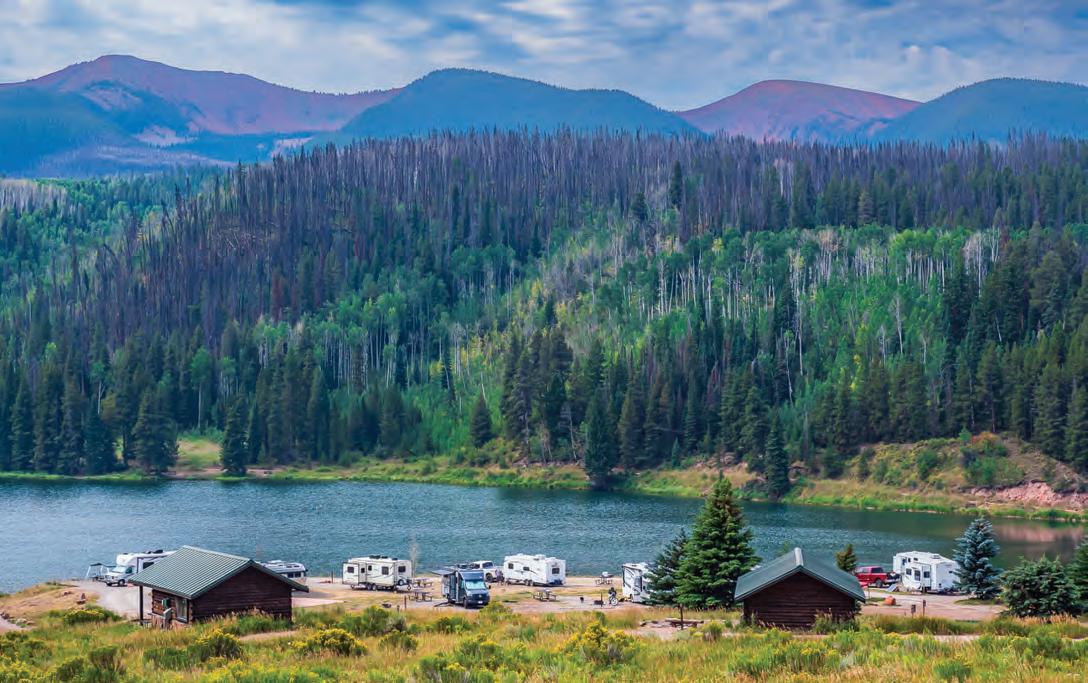
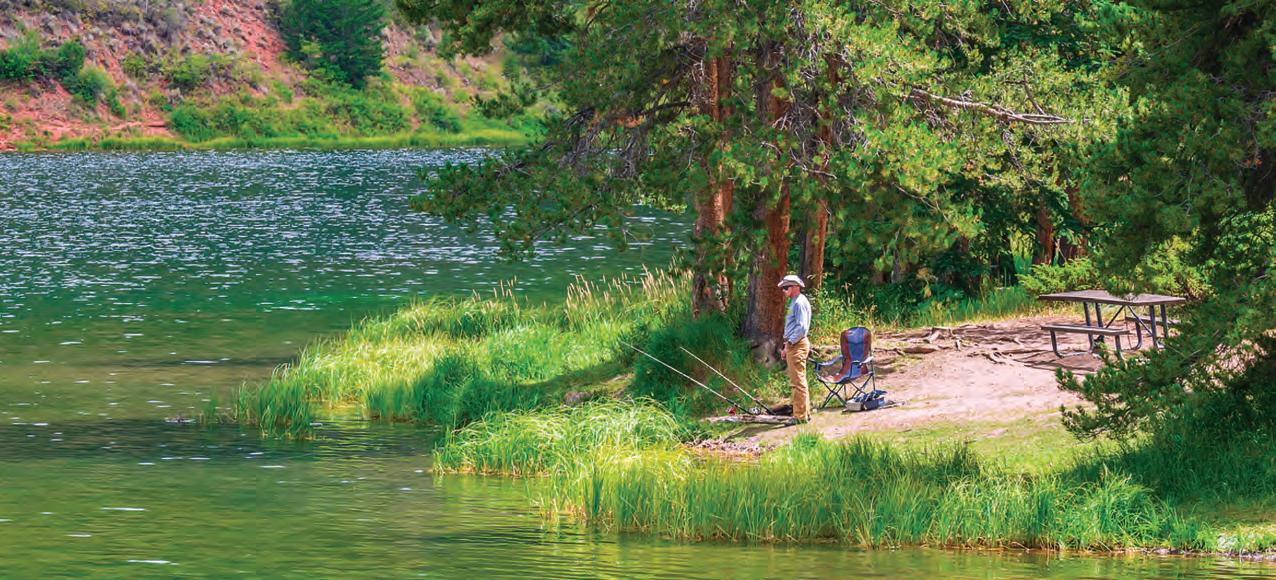
At Sylvan Lake State Park, 44 campsites and nine cabins nestle against the shores of a 42-acre reservoir. Motor-free waters invite paddlers and anglers, and traces of historic homesteads linger across the Brush Creek valley 10 miles south of Eagle.
Here, 44 designated campsites and nine rentable cabins flank the shoreline. Sites feature picnic tables and fire rings but lack electric, water or sewer hookups. Mostly open and unshaded, they’re ideal for those of us charging batteries with solar panels, and scattered spigots dispense tasty water from a nearby spring.
A camper services building, open during summer months, holds flush toilets and coin-op showers, with year-round pit toilets scattered around the campground. We RV campers appreciate that there is a dump station for draining holding tanks. Overnighters willing to forego the waterfront setting can rent one of the park’s three yurts located in the woods up East Brush Creek Road.
Signs warn campers that a large black bear resides in the neighborhood, and we spotted the brawny bruin peacefully ambling up a nearby hillside one afternoon. Park employees said the bear had been naughty, and if it misbehaves again, it may need to be relocated. As with any Colorado mountain campsite, folks can help prevent bruin delinquency by keeping a clean camp and safely securing all food items. We made sure we had our bear spray handy in case Yogi’s brethren decided to make a house call at our campsite.
With cell coverage nonexistent, Sylvan Lake is an ideal spot for an electronics-free family getaway. Instead of staring at TikTok, Facebook and Instagram, spouses and offspring can enjoy family time in nature. Motorboats, with the exception of anglers using battery-powered trolling motors, are banned. Instead, folks here paddle kayaks, canoes and stand-up paddleboards on wake-free water, many floating by with the family pooch onboard.
Lake and stream anglers can fish for rainbow, cutthroat, brook and brown trout. Bicyclists can pedal up nearby graded gravel and 4x4 roads. Folks wanting an excuse to lace up their hiking boots will find trails circling the reservoir or ascending into the hills. More trails can be found in the surrounding national forest.
For campers wanting to explore the surrounding mountains, the graded gravel access road continues up and over Crooked Creek Pass, offering towering views of 14ers in the distance. It continues down to Thomasville and Ruedi Reservoir on the Fryingpan River near Aspen.
A volunteer at the visitor center tells about the time she and her husband towed their boat from Eagle to Ruedi Reservoir at night. It was not a smart move, she admitted, but they made it.
The park’s handout brochure boasts Sylvan Lake as Colorado’s most beautiful state park, and it is hard to argue with that assessment.
Returning to the campsite after a day spent paddling, biking, hiking or driving, it’s enjoyable to just don a pair of flip-flops, pour a glass of the park’s spring water and sit back and admire the Colorado-worthy setting. Those pioneers who chose to homestead this valley certainly picked a comely place to plow fields, irrigate crops and hang hand-washed laundry out to dry.
Sylvan Lake State Park lies about 10 miles south of Eagle on Brush Creek Road. Mandatory campsite, cabin and yurt reservations may be made through Colorado Parks and Wildlife (800-244-5613, cpwshop. com) up to six months in advance. Campsite fees run $28 per night, with yurts and small cabins going for $90. The park also assesses a daily vehicle entrance fee of $10 per day for those lacking a Keep Colorado Wild or other valid state park pass.
Lights, Camera, Quack-tion
by JOSHUA HARDIN
THE LIGHT OF dawn cuts through the chill of a spring morning as fog lingers above statewide waterways. Sunrise is a daily cue for ducks to stir, feed and show off the subtle patterns most people never notice, except for photographers attuned to the drama playing out on the glassy water.
Colorado offers a rich diversity of more than 20 duck species and no shortage of duck-favored wetlands. Location and season determine what species are present. Some are year-round residents, while others spend months here breeding or pass through on the Central Flyway, the migration route waterfowl travel north and south.
Eastern Plains hotspots include Jackson Lake near Fort Morgan and John Martin Reservoir near Lamar. In the Denver area, Rocky Mountain Arsenal, Barr Lake State Park and Chatfield State Park are reliable places to start. Farther afield, Arapaho near Walden and Monte Vista in the San Luis Valley can put ducks in the frame with migrating sandhill cranes, broad wetlands and mountain backgrounds.
Knowing how ducks behave helps photographers identify species and anticipate movement. Ducks are divided into two groups – dabbling and diving – based on feeding habits.
Dabblers feed by tipping forward, sticking their heads underwater while their tails point skyward as they graze on greens and invertebrates. The northern shoveler, with its shiny green head and spoon-shaped bill, is a quintessential dabbler.
They can take flight with surprising speed, so continuous autofocus, burst shooting and shutter speeds of 1/2000 second or faster help freeze the sudden launch from the water. Diving ducks completely submerge themselves to grab aquatic
vegetation from the bottom or chase fish and invertebrates.
Divers such as common and Barrow’s goldeneyes often run along the surface to build enough speed for takeoff. For swimming birds, shutter speeds around 1/1000 second are often enough, while image stabilization, monopods and tripods can help keep long-lens shots sharp along shorelines and blinds.
Mallards are among the easiest dabblers to find and a good place to hone photography skills. These adaptable ducks are common across Colorado and comfortable around people, so normal lenses in the 24-70mm range can sometimes do the job. On frigid days, weather sealing helps, and extra batteries are a must.
Other dabblers can be more challenging. American wigeons often prefer quiet ponds and marshes away from people, so a 70-300mm may be needed. Wood ducks are favorites for many photographers. A polarizing filter can accentuate their colorful feathers while cutting reflections from the water.
Diving ducks can be more difficult to photograph because they often stay in the middle of lakes and are skittish near shore. Buffleheads disappear often, so keep scanning the water for where they resurface. Slight underexposure can preserve highlight detail for later.
Redheads are among the most sociable divers, commonly gathering in large flocks. This issue’s image is a redhead I watched at Fossil Creek Park’s Portner Reservoir in Fort Collins as it rose from the water and shook droplets from its feathers. The ducks that day were actively head-bobbing, a comical mating display.
Keeping an eye on behavioral quacktion helps set images apart from the more common depiction of ducks serenely floating on the water. Telephoto lenses above 300mm are often needed to frame them closely. In this case, I used a 400mm with a teleconverter for extra reach.
Observant photographers can predict patterns in courtship rituals, quarrels, feeding, preening and other behavior. Shooting from low angles adds intimacy and helps separate birds from busy backgrounds.
Ethical birdwatchers respect spring closures of nesting areas and never chase ducks for a photo. These birds are alert and will change behavior if people approach too closely. Patient, slow-moving photographers will often find ducks drifting or paddling toward them on their own.
Cornell University’s eBird website and app can help identify species, but duck photography isn’t only about checking birds off a list. It’s about returning to local waterways to watch seasonal changes, a shifting cast of avian characters and the dramatic duck tales that result. Over time, ducks stop being only photo subjects and start feeling like friendly feathered neighbors.
Josh shot this photo with a Nikon D800e camera and Nikon 400mm lens with a 1.4x teleconverter, exposed at f/6.3, 1/2500, ISO 250 at Fossil Creek Park at Fort Collins.