Daily Echo Monday, 7th September, 2050
£4.80
The
Design Economy Edition
How Design Hubs Helped Put Our Region Back on the Map Civic & Public Services Correspondent | 7 September 2050
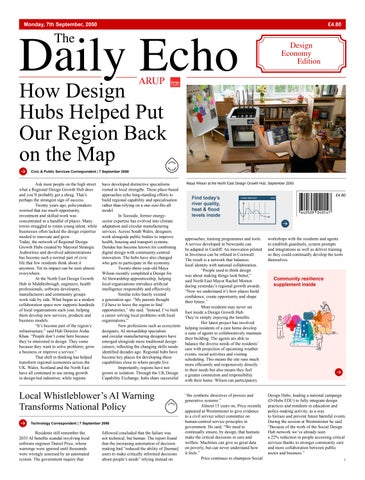
Ask most people on the high street what a Regional Design Growth Hub does and you’ll probably get a shrug. That’s perhaps the strongest sign of success. Twenty years ago, policymakers worried that too much opportunity, investment and skilled work was concentrated in a handful of places. Many towns struggled to retain young talent, while businesses often lacked the design expertise needed to innovate and grow. Today, the network of Regional Design Growth Hubs created by Mayoral Strategic Authorities and devolved administrations has become such a normal part of civic life that few residents think about it anymore. Yet its impact can be seen almost everywhere. At the North East Design Growth Hub in Middlesbrough, engineers, health professionals, software developers, manufacturers and community groups work side by side. What began as a modest collaboration space now supports hundreds of local organisations each year, helping them develop new services, products and business models. “It’s become part of the region’s infrastructure,” said Hub Director Aisha Khan. “People don’t come here because they’re interested in design. They come because they want to solve problems, grow a business or improve a service.” That shift in thinking has helped transform regional economies across the UK. Wales, Scotland and the North East have all continued to see strong growth in design-led industries, while regions
have developed distinctive specialisms rooted in local strengths. These place-based approaches echo long-standing efforts to build regional capability and specialisation rather than relying on a one-size-fits-all model. In Teesside, former energysector expertise has evolved into climate adaptation and circular manufacturing services. Across South Wales, designers work alongside public bodies to improve health, housing and transport systems. Dundee has become known for combining digital design with community-centred innovation. The hubs have also changed who gets to participate in the economy. Twenty-three-year-old Maya Wilson recently completed a Design for AI Stewardship apprenticeship, helping local organisations introduce artificial intelligence responsibly and effectively. Similar roles barely existed a generation ago. “My parents thought I’d have to leave the region to find opportunities,” she said. “Instead, I’ve built a career solving local problems with local organisations.” New professions such as ecosystem designers, AI stewardship specialists and circular manufacturing designers have emerged alongside more traditional design careers, reflecting the changing skills needs identified decades ago. Regional hubs have become key places for developing these capabilities close to where people live. Importantly, regions have not grown in isolation. Through the UK Design Capability Exchange, hubs share successful
Local Whistleblower’s AI Warning Transforms National Policy Technology Correspondent | 7 September 2050
Residents still remember the 2035 AI benefits scandal involving local software engineer Daniel Price, whose warnings were ignored until thousands were wrongly assessed by an automated system. The government inquiry that
followed concluded that the failure was not technical, but human. The report found that the increasing automation of decision making had “reduced the ability of [human] users to make critically informed decisions about people’s needs” relying instead on
Maya Wilson at the North East Design Growth Hub, September 2050
Find today’s river quality, heat & flood levels inside
FLOOD FORECAST
LIVE
£4.80
approaches, training programmes and tools. A service developed in Newcastle can be adapted in Cardiff. An innovation piloted in Inverness can be refined in Cornwall. The result is a network that balances local identity with national collaboration. “People used to think design was about making things look better,” said North East Mayor Rachel Morton during yesterday’s regional growth awards. “Now we understand it’s how places build confidence, create opportunity and shape their future.” Most residents may never set foot inside a Design Growth Hub. They’re simply enjoying the benefits. Her latest project has involved helping residents of a care home develop a suite of agents to collaboratively maintain their building. The agents are able to balance the diverse needs of the residents’ care with projection of upcoming weather events, social activities and visiting scheduling. This means the site runs much more efficiently and responsively directly to their needs but also means they feel a greater connection and responsibility with their home. Wilson ran participatory
workshops with the residents and agents to establish guardrails, system prompts and integrations as well as deliver training so they could continually develop the tools themselves.
“the synthetic directives of proxies and generative systems.” Almost 15 years on, Price recently appeared at Westminister to give evidence to a civil service select committee on human-centred service principles in government. He said; “We need to continually ensure, by design, that humans make the critical decisions in care and welfare. Machines can give us great data on poverty, but can never understand how it feels.” Price continues to champion Social
Design Hubs, leading a national campaign (D-Hubs EDU) to fully integrate design practices and mindsets in education and policy-making activity, as a way to foresee and prevent future harmful events. During the session at Westminister he said “Because of the work of the Social Design Hub network we’ve already seen a 22% reduction in people accessing critical services thanks to stronger community care and more collaboration between public sector and business.”
Community resilience supplement inside
1
2
The Daily Echo
NEWS
25% The UK’s design workforce has grown by 25% since 2040.
900,000 Adding almost 900,000 jobs.
422,000 Systemic design roles alone account for more than 422,000 of those positions. “Designers now shape ecosystems, economies and relationships. Education had to evolve accordingly.” — Misha Farrow,
Learning Lab Director
Skills for Planet Learning Labs Help Design Workforce Reach Record High Education Correspondant | 7 September 2050
The Maker Space at Cardiff’s Skills for Planet Learning Lab
A generation ago, employers across “We realised design was the UK’s design sector were sounding the no longer a profession that simply shaped alarm. Businesses reported skills shortages, products,” said Learning Lab Director Misha graduates struggled to transition into work, Farrow. “Designers now shape ecosystems, and many young people simply did not economies and relationships. Education had to evolve accordingly.” see design as a viable career. Today, those The shift reflects profound concerns feel increasingly distant. changes across society and industry. New figures released this week show that the UK’s design workforce has As businesses increasingly measure grown by 25% since 2040, adding almost success through environmental, social and 900,000 jobs. Digital design roles alone economic value, demand has grown for account for more than 422,000 of those new types of designers capable of working positions, making design one of the country’s across disciplines. Today’s workforce fastest-growing professions. includes biodesigners, regeneration Much of the growth is being strategists, circularity architects, digital credited to the UK-wide Design Talent twin cartographers and more-than-human Pipeline, a long-term programme launched facilitators, many of whom train through in 2030 that connected schools, employers, employer-led programmes supported by the Learning Lab. universities, local design organisations The rise of AI has also transformed and the Design Council’s Skills for Planet the profession. While routine production Learning Lab. work is largely automated, demand has What began as a response to workforce shortages has evolved into surged for designers who can combine technological fluency with ethics, systems a national skills ecosystem. Children now thinking and community engagement. encounter design thinking in primary At the Learning Lab’s Cardiff school, often through local environmental campus, apprentices collaborate with and community projects. By secondary ecological scientists, software engineers education, learners can explore specialist pathways ranging from regenerative design and local councils on real-world challenges. and synthetic biology to systems modelling One recent project involved training future catchment designers to help manage river and AI-assisted creativity.
Robot ‘Beavers’ Cut Flooding in Riverford by 84%
Crucially, the robots mimic a process nature already understood. For centuries, beavers slowed rivers using exactly the same principle. Designers simply combined that ecological insight with Systems Correspondent | 7 September 2050 real-time data, swarm robotics and a deep understanding of how the catchment For as long as anyone can where water will surge. When heavy rain functioned as a connected whole. remember, Riverford flooded. is coming, they gather fallen branches, leaf Early results have surprised even Sitting at the bottom of a steep litter and deadwood to build temporary leaky the team. Independent monitoring shows river catchment, the town spent decades dams across upland streams, slowing the peak flooding in Riverford has fallen by battling rising water. Sandbags became flow long before it reaches Riverford. 84%. Water quality has improved, wildlife a familiar autumn sight. Homes flooded Once the danger passes, the has returned to the uplands, and soil erosion repeatedly. Insurance became almost structures are designed to break down has slowed. impossible to obtain. Generations of naturally, returning material to the forest The system is monitored through engineers tried, floor. a regional digital twin, allowing residents and largely failed, The project was developed by to see live catchment conditions and to solve it. a team of systems designers, regenerative This winter, for the third year designers and ecological engineers working understand how decisions upstream protect running, the water stayed away. with the Design Council’s Regional Design homes downstream. For lifelong resident Arthur Bell, The reason lies several miles upstream, Growth Hub in Riverford. 79, the change is profound. where a fleet of small autonomous robots “We stopped trying to fight the “I’ve moved furniture upstairs more quietly works through the forested slopes water,” explained lead designer Priya Nair. times than I can count,” he said. “This is the above the town. “We studied how the whole catchment first winter in years I haven’t watched the Nicknamed “the beavers” by locals, behaved as a living system, then designed river and worried. My grandchildren just the machines use live flooding data, weather something that worked with it rather than think it’s normal now.”And perhaps that forecasts and satellite observations to predict against it.”
health through live digital twins (a virtual, data-driven copy of a real-world physical object, process, or system) connected to regional environmental monitoring networks. Employers say the approach has created a workforce better prepared for the realities of modern practice. “We no longer recruit for a fixed job,” explained design studio owner Rachel Davies. “We’re recruiting people who can learn continuously, work across sectors and create value for both communities and ecosystems.” Perhaps most significant has been the programme’s effort to widen participation. Diverse role models, neighbourhood design clubs and earlier engagement with schools have opened pathways for young people who previously might never have considered a design career. On a busy afternoon at a community learning hub in Bath Spa, a group of teenagers gathered around an immersive regional digital twin, testing ideas to improve biodiversity, housing and transport in their local area. For them, design is no longer a specialist profession. It is simply another way of improving the places they call home.
is the point. The most powerful design, it seems, is the kind that quietly solves a problem, then disappears into the landscape as though it had always belonged there.
Riverford ‘Beaver’ drone in action
3
The Daily Echo
WORLD
Excess heat processing centre on the outskirts of Edinburgh’s manufacturing district
Edinburgh’s ‘Firth Framework’ Powers China’s New Circular Energy Networks Scotland Correspondent | 7 September 2050
It is not often that a methodology developed in a converted warehouse overlooking the Firth of Forth ends up shaping national infrastructure strategies on the other side of the world. Yet this week, delegates from China, India, Kenya and Brazil arrived in Edinburgh to study what many now regard as one of Scotland’s most successful exports: design intelligence. The Edinburgh Systems Design Framework, developed over the past decade by a consortium of designers, universities, local authorities and energy providers, has become internationally recognised for helping governments tackle complex challenges that cross environmental, economic and social boundaries. Originally developed to support Scotland’s transition to netzero, the framework combines artificial intelligence, systems thinking, digital twins and regenerative design principles to understand how entire regions function as interconnected systems.Today, it is being used far beyond Scotland. Officials in China recently announced plans to adapt elements of the framework as part of a major regional energy transformation programme connecting renewable generation, storage, housing, transport and industrial demand through AI-assisted planning systems. The framework’s origins, however, are remarkably local. In the late 2030s, Edinburgh faced mounting pressure from rising energy costs, ageing infrastructure and increasingly complex environmental targets. Traditional approaches tended to optimise individual assets or services in isolation. Designers argued that the real challenge was understanding how everything connected together. A team of systems designers,
transition designers, regenerative designers and AI specialists began building a living digital twin of Scotland’s energy system. Progress was not straightforward. Stakeholders wrestled with fragmented ownership, ageing infrastructure and competing regulations. Sharing heat across boundaries raised thorny questions of liability, data governance and trust. New forms of integrated value accounting were needed before ecological and social benefits could be recognised, while communities initially feared disruption, higher bills and losing local control. But, instead of asking how to make individual power stations more efficient, the framework considered how energy, communities and ecosystems interacted as a whole. The model pulled together realtime information from buildings, transport networks, weather systems, biodiversity monitoring and energy infrastructure. The results were significant. Across Scotland, excess heat from industries like manufacturing, infrastructure and utilities is now shared through regional energy networks. Community energy schemes are linked through intelligent balancing systems. Renewable generation is matched to local needs more effectively. Biodiversity recovery and ecological health are measured alongside financial performance through integrated value accounting. “What made the difference was that we didn’t treat energy as a technology challenge,” explained Professor Rob Stewart, one of the framework’s early contributors. “We treated it as a human, environmental and economic system.” That philosophy reflects wider changes in how design is understood across neighbouring countries like England. Back in 2034, the government established a dedicated design export support
programme, recognising that Britain’s growing expertise in digital design, service design and systems innovation represented a major international opportunity. At the same time, partnerships with emerging design economies helped strengthen design capability worldwide while creating new markets for Scottish expertise. What followed surprised many economists. Design became one of the country’s most valuable exports. Digital design, systems modelling, AI implementation and strategic design services increasingly helped organisations solve problems that technology alone could not address. The Ministry for Design’s international programmes also highlighted a growing reality: the biggest barriers to transformation were rarely technical. Whether implementing artificial intelligence, redesigning public services or responding to environmental pressures, success often depended on trust, behaviour, governance and organisational change. Design provided the bridge. In Edinburgh, that approach is now visible in everyday life. The city’s energy system quietly adjusts to weather conditions. Infrastructure investments are assessed against ecological, social and economic outcomes. Neighbourhoods generate, share and store energy locally. The system continually learns and adapts through AIenabled modelling. Perhaps most importantly, the framework was developed with planetary boundaries in mind. Rather than focusing solely on economic growth, it seeks to ensure that human activity operates within environmental limits while creating value for communities and ecosystems alike. For local resident David Armstrong, the global attention remains slightly surreal. “It’s funny really,” he said while looking across the waterfront towards
“What made the difference was that we didn’t treat energy as a technology challenge, we treated it as a human, environmental and economic system.” — Professor Rob Stewart one of the city’s energy hubs. “All these international visitors come here to learn about systems thinking, but most of us just notice that the bills are lower, the energy’s cleaner and things seem to work better.” As the world searches for new ways to navigate climate pressures, technological change and economic uncertainty, one of Britain’s most influential exports may turn out not to be a product at all.
4
The Daily Echo
ECONOMY
The Humber’s Waste Water Cycle Becomes Britain’s Most Valuable Local Asset Economics Correspondent | 7 September 2050
were transformed into vast ecological infrastructures. Constructed wetlands now clean water while providing habitat for migratory birds. Nutrients once discharged into waterways are recovered and sold back to regional farms. Water moves through interconnected biological systems that mimic natural wetlands, reedbeds and estuarine processes. Local industries contribute treated greywater into shared recovery networks. Agricultural runoff is intercepted before reaching rivers. Flood storage landscapes double as biodiversity reserves. The result is a water system that behaves more like an ecosystem than a piece of infrastructure. “We stopped asking how to minimise harm and started asking how the water cycle could help the Humber thrive,” said Arup’s lead bio-designer. The economic implications have been considerable. Under previous accounting systems, benefits such as cleaner rivers, healthier fisheries and reduced flood risk were difficult to quantify. Now they are measured continuously through ecological performance indicators. Among the figures monitored are species abundance, soil health, phosphorus recovery, carbon sequestration, aquatic biodiversity, recreational access and ecosystem resilience. These metrics sit alongside traditional measures such as operating costs and productivity. In effect, the Humber no longer produces only financial value. It produces ecological value too. The shift reflects a wider transformation in economic thinking. Businesses across Britain are increasingly evaluated according to their contribution to natural, social and economic capital simultaneously, rather than solely on financial returns. “Our most valuable asset isn’t a building anymore,” said one regional infrastructure manager. “It’s a functioning ecosystem.” That change has been enabled by one of the most ambitious technological programmes ever attempted: the Whole Earth Digital Twin. The platform combines Earth observation satellites, environmental sensor networks and artificial intelligence systems to maintain a live model of planetary activity. Every litre of water moving through the Humber Catchment is now digitally tracked. Every nutrient pathway can be observed. Every ecological benefit can be verified.Every ecological cost can be disclosed. The information is publicly available. Residents can see water quality conditions in real time. Policymakers can
The Humber Catchment
monitor restoration outcomes. Investors can evaluate ecological performance alongside financial performance. According to HMRC Ecological Auditor Daniel Reeves, transparency has transformed behaviour. “Ecological debt now appears on a balance sheet exactly where financial debt once sat alone,” he said. Critics initially warned that the system would create excessive bureaucracy. Industry groups argued that measuring ecological outcomes would be impossible at scale. Instead, many businesses discovered something unexpected. Restoring ecosystems frequently proved cheaper than repairing damaged ones. In the Humber’s case, cleaner water reduced treatment costs. Healthier wetlands lowered flood damage. Biodiversity improvements strengthened fisheries. Nutrient recovery reduced fertiliser imports. Public access to restored landscapes
improved physical and mental wellbeing. The gains accumulated across multiple forms of value simultaneously. Economists now refer to this as regenerative return. Unlike conventional return on investment, regenerative return measures a project’s ability to increase the resilience and vitality of the systems that support it. The concept would have sounded radical in the early 2020s. Today it is normal accounting practice. What may be most remarkable, however, is how ordinary the change now feels. On a sunny afternoon near a former treatment works outside Hull, local resident Alan Peters watched children exploring one of the restored wetland parks that now forms part of the catchment system. A heron stood motionless in the reeds. Dragonflies skimmed over shallow pools built where concrete settling tanks once dominated the landscape.
Regenerative ROI: Humber water cycle, 2050 Estimated annual value created by local wastewater utilisation and system design. 100
Annual value created or cost avoided (£ millions)
For most of the last century, wastewater was treated as a cost. Today, it is treated as an asset. According to figures published this week on HMRC’s National Regenerative Accounts Platform, the Humber Catchment generated more ecological value in the past twelve months than many regional investment portfolios generated financial value. The catchment’s integrated water system recorded improvements in biodiversity, flood resilience, water quality, nutrient recovery and public health, all of which now contribute to its recognised balance sheet. Twenty years ago, companies reported profits once a year. Today, they report ecological performance every fifteen seconds. Since the criminalisation of ecocide in the late 2030s, every major infrastructure project operating in the UK has been required to disclose its ecological operating costs through mandatory Nature Financial Disclosures (NFDs) and Nature Cost Declarations (NCDs). The data is streamed continuously into a national HMRC platform, where it is combined with satellite observations, environmental sensors and regional accounting systems. Supporters say the reforms finally ended centuries of businesses extracting value from nature while treating ecological damage as someone else’s problem. One unexpected beneficiary has been the Humber. Five years ago, the Humber Catchment and its Inhabitant Species became one of the first legally recognised ecological clients to commission its own infrastructure redesign. Rather than hiring a traditional engineering consultancy, the catchment assembly appointed an Arup biodesigner to reimagine the region’s entire water cycle. The client brief was unusual. Representatives included local authorities, residents, fisheries, farmers, ecological guardians and trustees appointed to represent species living throughout the Humber Estuary and its tributaries. For the first time, the river itself effectively had a seat at the table. “The design brief changed completely,” explained Humber Catchment Guardian Maya Choudhury. “When nature became a recognised stakeholder, the design brief changed completely.” The resulting project tackled what accountants now describe as the catchment’s Scope 1, 2 and 3 water impacts. Instead of treating wastewater as a disposal problem, designers approached it as a living system. Traditional treatment facilities
80
£70m
60
40
£56m
£55m £24m
£10m
£7m
£6m
£9m
£8m
£45m £8m
£32m £22m
£18m
£20m
20
£10m £18m
£20m
Cleaner water
Flood risk reduced
£35m
£12m £14m
0 Nutrients recovered
Habitats restored
Local health &r ecreation
Outcome people can see locally
Colour key
What is RROI?
Local economy valu e
Regenerative return on investment
Ecological recovery valu e
measures value created for:
Community health valu e Costs avoided
• local economies • living systems • avoided future costs
• communities
Local wastewater is no longer shown as a single operating cost. Under regenerative accounting, benefits and costs are disclosed together as the system operates .
Source note: imagined 2050 newspaper graphic for exhibition use. Figures are illustrative, not measured data.
5
The Daily Echo
Free government funded scheme Funded by Ministry of Design
The National Design Service's mission is to help provide a stream of newly skilled and qualified workers to meet current demand across the UK.
Care & Repair Skills Bootcamp in Middlesbrough National Design Service
Learn regenerative design and build practices, saving high quality materials from going to waste. Then, use your skills via government time banking to earn money, whilst creating beautiful public spaces for and with local people. Make a circular economy Middlesborough work today!
Free 12-week programme in regenerative retrofit and community maintenance
Find out more & apply today!
You will leave with... Circular Economy NVQ L2 Employability & presentation skills Roles and responsibilities of a site supervisor
Intermediate place-based repair skills Regenerative Retrofit HND module (30 credits) Health & safety skills
When
Where
Who can apply?
Sept 12th — 5th Dec 2050
MyPlace Hub, North St, Middlesbrough TS2 1JP
School leavers & people mid-career
Supported by
Ministry of Design
North North
6
The Daily Echo
TECH
City’s Heat Grid Turns Every Building into Part of the Energy System
Technology Correspondant | 7 September 2050
When plans were first announced for a new city-wide heat network, many residents had concerns. Would it be expensive? Would it be reliable? And why would anyone want homes, schools, hospitals and businesses connected to the same energy system? Twenty years later, the network has become one of the most cited examples of how design can help cities meet growing energy demands while supporting communities and operating within environmental limits. The project was developed through the Ministry for Design’s National Design for AI Adoption Challenge, a programme that helped organisations use design methods to deploy emerging technologies ethically, sustainably and effectively. Rather than treating the challenge as purely technical, the team began with a different question: what would it mean for an energy system to behave more like a living ecosystem? The resulting design brought together Regenerative Designers, Systems Designers, Transition Designers and Community Experience Designers alongside engineers, ecologists, policymakers and AI specialists. Today, the modular grid connects thousands of buildings through an intelligent city-scale heat network. Heat from factories, transport infrastructure, commercial buildings and neighbourhood energy hubs is
continuously captured, redistributed and reused where it is needed most. What was once considered waste is now treated as a valuable community resource. A digital twin of the city continuously models energy flows, weather conditions, building performance and environmental impacts. AI systems help balance supply and demand in real time, while residents can view performance data through public dashboards, helping build trust and accountability. “We discovered that the biggest barriers weren’t the technology,” explained project lead Amina Rahman. “They were governance, public confidence, organisational change and understanding what communities actually needed.” The project also created new employment opportunities. Digital twin stewards, energy systems designers, community data coordinators and local infrastructure maintainers now work alongside traditional utility and engineering roles. Experts say the approach reflects a wider shift in how the UK thinks about AI and infrastructure. Through the 2030s, many organisations struggled to translate investment in artificial intelligence into meaningful outcomes. Success often depended less on technical capability and more on identifying the right problems, redesigning services and ensuring people
A local infrastructure maintainer working on a new central heat grid facility in East London
could participate in new systems confidently. The National Design for AI Adoption Challenge helped address that gap, positioning design as the bridge between technological potential and realworld impact. The city’s annual infrastructure accounts now report not only energy efficiency and economic performance but also biodiversity impacts, community wellbeing, carbon reductions and resilience outcomes. These measures sit alongside financial performance through integrated value accounting systems that recognise environmental and social value alongside economic returns. For local resident Peter Lawson, who lives near one of the neighbourhood
energy hubs, the difference is simple. “People used to think infrastructure was something hidden away behind fences,” he said. “Now it’s part of everyday life. It keeps homes warm, makes better use of resources and helps the city run more smoothly.” As growing urban populations place new demands on energy systems, many see networks like this as a model for the future: infrastructure designed not simply to deliver power, but to strengthen the relationship between people, technology and the places they call home.
Local repair shop increases elderly independence Community Correspondant | 7 September 2050
When Margaret Wilson’s walking frame cracked last winter, the 82-yearold assumed she would need to replace it. Instead, she took it to the community repair shop in the old bakery. “It’s better than when I bought it,” she laughed, running a hand along its smooth, newly fitted grip. “I thought they’d patch it up. They actually improved it.” Margaret is one of hundreds of local residents using a growing network of neighbourhood repair shops supported by the Design Council’s Regional Design Growth Hubs, which were established to strengthen local skills, innovation and economic growth. Unlike traditional repair services, these workshops bring together a new generation of design professionals. The Maintainer focuses on repair, restoration and extending the life of everyday objects. The transition designer looks at how repairs contribute to wider changes
in community resilience and resource use. The Regenerative Designer considers the needs of local ecosystems alongside those of residents, while The Biodesigner works directly with living materials such as mycelium insulation, bacterial dyes and self-healing bioconcrete. The shop’s owner is a selfemployed biofabricator who grows many products to order rather than manufacturing them conventionally. Shelves are lined with replacement handles, insulation panels and mobility aids made from locally sourced biological materials. One recent project involved creating custom-grown grips for walking aids, inspired by the poster currently displayed in the workshop promoting “Grown Grips, Living Supports, Beautiful Everyday Aids.” The products are designed to be repaired when needed rather than discarded. The poster emphasises “grown to order”, “made to last” and “repaired when needed”.
For Margaret, the benefits are practical. “My hands aren’t what they used to be,” she said. “The new grip is softer, easier to hold and if it wears down they can grow another bit and fit it.” Supporters say the model helps address two of Britain’s biggest challenges: staying within planetary boundaries while supporting an ageing population. Rather than extracting new materials and replacing products, communities are maintaining, adapting and regenerating what already exists. “It’s not really about repairs,” Margaret reflected. “It’s about keeping things going. The frame. The materials. And, if I’m honest, people like me as well.” In 2050, it seems, some of the most important innovations are taking place not in laboratories, but here on the local high street. Local repair shop poster
PUZZLES
7
The Daily Echo
Crossword No. 2849
Monday 7th September, 2050
The Design Economy Edition Quiz question of the day!
Which sector creates more £s than retail, employs millions of people across regions and is growing faster than the UK economy as a whole?
Across answers 1. More-than-human 8. Regenerative 10. Heat 11. Place-based 12. Rivers 15. Custodial 16. Circular 20. BNG 21. Biomimicry 22. Digital Twin 24. Biodiversity
Down answers 2. HMRC 3. Nature 4. NFD 5. Regenerative Economy 6. Reciprocal 7. Synthetic Biology 8. Restoration 9. Participatory 13. Ecocide 14. Multicapital 17. Energy 19. Sensors 23. IOT
Crossword Answers Design
Quiz question answer Across 1. Designing for humans and non-humans alike (12) 8. Living systems that continually renew themselves (11) 10. Urban planners add trees to reduce this in cities (4) 11. Design approach rooted in local contexts and ecosystems (10) 12. Flowing waters around the UK (6) 15. Leadership style based on stewardship and care (9) 16. Recovery and reuse of materials in a closed loop (8) 18. These animals were banned from going outside in 2041 to protect birds (4) 20. Nature-based credits system. Abbr. (3) 21. Building systems inspired by nature’s patterns (10) 22. AI-generated model of the Earth’s systems (12) 24. Metric increasingly tracked alongside profit in 2050 (13)
Our AI Policy
Across all our publications we always indicate the extent of collaboration between our writers and artificially intelligent machines. Find our five primary icons to the right.
Down 2. The system that tracks environmental impacts alongside tax records (4) 3. River, forest or ecosystem recognised as a legal stakeholder (6) 4. Environmental disclosure required of businesses in 2050 (3) 5. Economic model inspired by living systems (12) 6. Business principle centred on mutual benefit (10) 7. Engineering of bio materials and organisms (13) 8. Process of restoring degraded ecosystems (11) 9. Governance model that distributes decision-making (13) 13. Legal crime involving severe environmental destruction (7) 14. Accounting system that measures more than money (11) 17. Power (6) 19. Networks of sensors measuring environmental performance (7) 23. Monitoring of ecological conditions using sensors (3)
Our 25 solar and battery projects now generate enough clean electricity to power 240,000 homes a year
Community Energy Network
Join your local energy coop today! https://communityenergyengland.org/sign-up
How Bath’s Maintainers Are Keeping a Local Legend Alive Community Correspondant | 7 September 2050
For centuries, the Bath Bun was simply something you ate. Today, it is something the city trains people to protect. At a converted bakery near the city centre, a group of apprentices gathers each morning to learn a craft now recognised as part of Bath’s regional heritage. Their teacher is a Maintainer, a new kind of design professional dedicated to preserving skills, knowledge and local traditions. “We’re not just making buns,” she explains. “We’re keeping generations of knowledge alive.” The programme is part of a wider effort to grow the design workforce through entry-level recruitment, employer-led training and the Design Council Learning Labs. Alongside AI and green design, these schemes increasingly value craft, care and cultural continuity. The results are striking. Protected regional status has turned the Bath Bun into a celebrated export, much like Champagne or Port. Visitors travel from across the world, and local producers report booming international demand. Yet the shift brings trade-offs. Some worry that rising prices risk making local specialities unaffordable for residents. Others fear that heritage protection could limit innovation or exclude newcomers. Supporters argue the benefits outweigh the concerns, pointing to new jobs, stronger communities and renewed local pride. For apprentice Thomas Reed, the appeal is simple. “I always thought design meant screens and technology,” he said. “Now I know it can also mean keeping something real alive, right here where I grew up.”
Regional specialties traded across UK from one county to another
News of the future was brought to you by...
Arup University drives the technical excellence, future capabilities and collective intelligence that enable Arup to tackle society’s greatest challenges. By connecting global talent through one integrated capability, we see further, design better and create lasting impact.
We are the UK’s national champion for design, uniquely dedicated to all design disciplines, showcasing brilliance, leading on new thinking, evidencing value and influencing policy to create an environment for design to thrive.
Want to learn more? Head to.. https://www.arup.com/about-us/ arup-university/
Want to learn more? Head to.. https://www.designcouncil.org.uk/
*Disclaimer: this newspaper is a speculation and not Arup or the Design Council’s actual positon or proposals
Visit the Good Growth Design Lab, 2026 Design Economy Exhibit 133-135 Bethnal Green Rd London E2 7DG
15 Sept 10:00 – 17:00 16 Sept 10:00 – 17:00 17 Sept 10:00 – 17:00 In Person FREE, no ticket required
Want to learn more? Head to.. https://londondesignfestival.com/ activities/good-growth-design-lab