Sydney becomes a river of colour, music and protest. Now in its 48th year, the Sydney Gay and Lesbian Mardi Gras continues to draw thousands from across Australia and the world. This year, the NSW Government backed the celebrations with round the clock metro services and extended trading hours, a signal of how deeply Mardi Gras is woven into the city’s cultural fabric.
For queer South Asians, Mardi Gras has always meant more than spectacle It is not just a parade. It is a declaration. Being brown and queer is not a contradiction. It is simply who we
A Legacy of South Asian Pride
Since 2007, Trikone Australia has carried South Asian representation into Mardi Gras. Their floats have pulsed with Bollywood beats and bhangra rhythms, with traditional garments reimagined in pride colours, a celebration that refuses to choose between heritage and identity
In 2018, as Australia celebrated marriage equality, Trikone staged a symbolic gay Indian wedding on their float. There were pheras and pride flags, ritual and pride woven together. It was a powerful reminder that love is love, even when it circles the sacred fire.
The following year brought another historic moment. After India’s Supreme Court struck down Section 377, decriminalising
homosexuality, Trikone members marched unmasked for the first time For many, it was deeply personal. Rahul Patil, who had previously marched undercover, walked proudly without hiding, saying he was no longer afraid.
This year, Trikone did not have a float. As a volunteer run organisation, participation depends on available resources. Yet South Asian pride was unmistakable, visible across other floats, in record numbers among the crowd, and in the expanding programming of the Mardi Gras Film Festival, which continues to spotlight queer South Asian stories. The Setback That Still Stings Progress is rarely linear In 2018, India decriminalised homos
exuality. But in 2023, the Supreme Court declined to legalise same sex marriage, leaving the decision to Parliament, currently dominated by a government opposed to marriage equality petitions. The ruling was a painful reminder that decriminalisation does not equal full acceptance
Same sex couples in India still lack rights such as joint adoption and spousal benefits. For many in the diaspora, the decision felt deeply personal. The India we cherish culturally rich, resilient and proud still does not fully recognise our love
Asia Is Moving Unevenly
Change is happening across Asia, though not at the same pace
In 2025, Thailand became the first Southeast Asian country to legalise same sex marriage, joining Taiwan and Nepal. Within months, more than 26000 couples had registered. Thailand’s example challenges the persistent narrative that marriage equality is a purely Western concept. It shows that Asian societies can define inclusion on their own terms.
Yet legal reform does not erase prejudice overnight. Cultural transformation takes longer than legislative change.
Living Between Two Worlds
For queer South Asians in Australia, belonging can feel complex. Many navigate
two cultural realities at once. When arriving in Australia, some find Australian friends puzzled by the concept
of arranged marriage, while South Asian peers struggle to understand participation in pride parades. It can feel like existing in the in between.
That is precisely why spaces like Trikone matter. Founded to support LGBTQIA plus South Asians, the organisation creates both celebration and sanctuary. There is Bar Bombay, a high energy queer Bollywood party that has sold more than 500 tickets in a single night, and there are quieter Gupshup chai sessions, where members talk through coming out, family expectations and cultural pressures.
Trikone also supports immigration applications for those facing risk in their home countries, blending activism with care.
Representation as a Quiet Revolution
Representation remains uneven.
Mainstream queer narratives often centre white experiences, while South Asian storytelling can omit queerness entirely or frame it solely through trauma.
But change is emerging. The Mardi Gras Film Festival increasingly features queer South Asian narratives. Community podcasts amplify lived experiences. Visibility is expanding in ways that feel authentic rather than tokenistic.
Weddings, central to South Asian culture, carry particular symbolic weight. As Trikone’s Sanjay Alapakkam has observed, pursuing marriage equality is not merely about legal status. It is about claiming full participation in culture. It signals that queer South Asians are not outsiders looking in. They are equal inheritors of tradition.
The Road Ahead
The path forward remains uneven.
In India, marriage equality is stalled in Parliament. In Australia, cultural acceptance within segments of the South Asian community continues to evolve. Across parts of Southeast Asia, same sex relationships remain criminalised despite Thailand’s landmark reform.
For the diaspora, the struggle is both political and personal. It is about showing up when possible in parades and protests. It is about building spaces where a young queer person can feel understood. It is about having difficult conversations at family dinner tables.
Most of all, it is about refusing to accept that identity must be split in two
The rangoli and the rainbow belong together. The masks have come off and they are not going back on.
Sydney Applauds a Magical Night of Woh Kagaz Ki Kashti
For many across the South Asian diaspora, Easter is not only a deeply spiritual occasion but also a vibrant expression of cultural identity, community, and togetherness. While traditionally rooted in Christian faith, marking the resurrection of Jesus Christ, Easter has taken on unique and colou ul forms within South Asian communities around the world, including here in Australia.
In countries like India, Pakistan, Sri Lanka, and Bangladesh, Easter is celebrated with great devotion by Christian communities. Churches are beautifully decorated, and special se ices are held, often beginning with solemn Good Friday obse ances followed by joyful Easter Sunday celebrations. In diaspora communities, these traditions are prese ed while also blending with local customs, creating a rich and diverse cultural experience.
In Australia, South Asian Christians gather in churches across major cities like Sydney and Melbourne for early morning prayers, choir pe ormances, and community feasts. The day often begins with sunrise se ices, symbolising hope and renewal, followed by family gatherings filled with laughter, food, and shared memories.
Food plays an impo ant role in Easter celebrations. Traditional dishes va depending on cultural backgrounds, ranging from rich curries and bi anis to festive sweets like cakes and pastries. Many families also incorporate Western Easter traditions, such as chocolate eggs and Easter egg hunts for children, blending heritage with contempora Australian culture.
Beyond religious obse ances, Easter has become a time for broader community connection. Multicultural
events, charity drives, and social gatherings bring people together, reflecting the inclusive spirit of the South Asian community. It is also a time when many extend generosity and suppo to those in need, reinforcing values of compassion and kindness.
What makes Easter within the South Asian community pa icularly special is this beautiful fusion—where faith meets culture, and tradition meets modern life. It is a reminder that while celebrations may differ in form, the underlying message of hope, renewal, and unity resonates across all communities.
As South Asians continue to build their lives in Australia and beyond, festivals like Easter se e as an impo ant bridge connecting generations, prese ing cultural roots, and celebrating shared humanity.
Hindu Organisations Across Australia Unite at HOTA 2026 Meet in Sydney
ADesi
Australia
major gathering of Hindu
community leadership took place in Sydney as over 70 organisations, temples and associations came together for the HOTA Annual Meet 2026. Hosted by the Association of Haryanvis in Australia (AHA), the event reflected a growing sense of unity and collaboration within Australia’s Hindu community
Held under the theme “Ek Drishti • Ek Disha” (One Vision • One Direction), the meet focused on building stronger connections between organisations while aligning efforts towards shared community goals. The HOTA platform continues to serve as an important space for dialogue, cooperation and long-term community planning
The event was attended by key public representatives, including Premier
Chris Minns, along with Members of Parliament and councillors from across New South Wales. Their presence highlighted the increasing engagement between multicultural communities and government leadership
In his address, Premier Minns acknowledged the significant contributions of the Hindu community to the social, cultural and economic fabric of the state. He commended the collective effort of organisations coming together under a shared vision, emphasising the importance of unity in strengthening community outcomes
The gathering featured participation from prominent organisations such as BAPS, Shrimad Rajchandra Mission and major temples including Helensburgh Temple and Sri Mandir, reflecting the diversity and strength of the Hindu community across Australia.
Two key panel discussions formed the core of the program. The Youth Engagement Panel focused on empowering the next generation through leadership opportunities and
COMMUNITY
modern engagement strategies, while the Community Contribution Panel explored ways organisations can enhance their social impact through service, collaboration and civic participation.
Speakers emphasised the importance of moving beyond individual efforts towards a more coordinated, collective approach. The discussions reinforced that long-term community growth depends on strong partnerships, inclusive leadership and active youth involvement.
Adding a cultural touch to the event, attendees were served traditional satvik food prepared by volunteers, including Haryanvi specialties such as churma and lassi. This element reflected the spirit of seva and hospitality that remains central to community gatherings
The HOTA Annual Meet 2026 concluded with a renewed commitment to collaboration, cultural preservation and community service. The event reinforced a clear message — while organisations may be diverse, a shared vision can drive a stronger, more united future for the Hindu community in Australia.
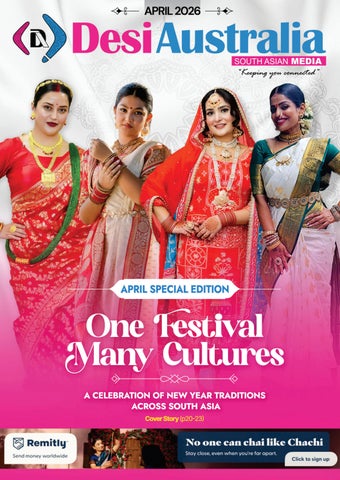
AONE MANY CULTURES
Festiv A CELEBRATION OF NEW YEAR TRADITIONS ACROSS SOUTH ASIA
pril is one of the most culturally vibrant months across South Asia, marking the beginning of new years, harvest cycles,
and spiritual renewal for millions. Though celebrated by different communities—Sikh, Bengali, Tamil, Sinhalese, Malayali, Nepalese, and Assamese—these festivals are united by a shared philosophy: letting go of the old, embracing new beginnings, and celebrating life with gratitude, family, and community.
In Australia, these traditions take on a new dimension, bringing together diaspora communities while also inviting multicultural audiences to experience the richness of South Asian heritage.
Vaisakhi: Harvest, Heritage, and the Spirit of the Khalsa Faith, Identity, and Community Strength
Vaisakhi is one of the most significant festivals in Sikhism, commemorating the historic formation of the Khalsa in 1699 by Guru Gobind Singh Ji. On this day, the Guru established a collective identity rooted in equality, courage, and service, which continues to define Sikh values today
Beyond its religious importance, Vaisakhi is also a harvest festival in Punjab, celebrating the ripening of crops and the rewards of hard work.
The day begins with prayers at gurdwaras, including the reading of the Guru Granth Sahib, followed by Nagar Kirtan processions where hymns are sung through the streets
A key highlight is langar, the community kitchen, where free meals are served to all regardless of background, embodying the Sikh principles of humility and inclusivity. In Australia, cities like Sydney and Melbourne host large-scale Vaisakhi parades, attracting people from all communities
“Vaisakhi is not just a festival it is a living expression of equality, सेवा (service), and unity.”
Pohela Boishakh: Colors, Culture, and New Beginnings
Culture, Commerce, and Celebration
Pohela Boishakh marks the first day of the Bengali calendar and is celebrated with immense enthusiasm in both Bangladesh and the Indian state of West Bengal.
Historically, the festival has roots in Mughal-era tax collection systems, where farmers would settle dues and begin a new financial year
Today, it is a vibrant cultural celebration. Streets come alive with processions such as Mangal Shobhajatra, recognised by UNESCO for its cultural significance
People wear traditional attire, white and red sarees for women, panjabis for men, and enjoy classic dishes like panta bhat (fermented rice), hilsa fish, and sweets
Businesses also open new account books, symbolising prosperity. Within the diaspora, Pohela Boishakh events often include music, dance, art exhibitions, and food festivals, creating a strong sense of identity and belonging.
“It’s a day to begin again with music in the air, colour in our hearts, and hope for the year ahead.”
Puthandu: Life in All Its Flavours
Rituals, Reection, and Renewal
Puthandu, the Tamil New Year, is deeply rooted in both astronomy and tradition. It marks the first day of the Tamil month Chithirai and is considered an auspicious time for new beginnings
One of the most symbolic rituals is the preparation of mango pachadi, a dish that combines sweet, sour, bitter, and spicy flavours, representing the varied experiences of life. Another important custom is viewing the kanni, an arrangement of auspicious items like fruits, flowers, gold, and mirrors, first thing in the morning
Homes are decorated with intricate kolam designs at the entrance, and temples host special prayers. In Australia, Tamil communities organise cultural programs, temple visits, and family gatherings that
preserve these traditions across generations
“Puthandu reminds us that every emotion has its place and every experience shapes our journey.”
Aluth Avurudda: Stars, Tradition, and Togetherness
Astrology, Tradition, and Togetherness
The Sinhalese New Year, shared with Tamil communities in Sri Lanka, is
AdritaAkash Photographer: Photolia
uniquely guided by astrological timings Unlike midnight celebrations, rituals begin at specific times determined by planetary movements
Families participate in a series of customs, lighting the hearth at an auspicious hour, preparing milk rice (kiribath), and engaging in traditional games such as pillow fighting and tug-ofwar. The exchange of gifts and respect for elders is central to the celebration.
A defining aspect of Aluth Avurudda is the emphasis on nonagathaya, a neutral period dedicated to religious observance and reflection rather than material activity. In Australia, Sri Lankan communities recreate these traditions through large community festivals and cultural showcases.
“In a fast-moving world, Avurudda invites us to pause, reflect, and reconnect with family, tradition, and self.”
Vishu: Seeing Prosperity, Welcoming Hope
Symbolism, Prosperity, and Auspicious Beginnings
Vishu, celebrated in Kerala, is centred around the concept of auspicious sight. The highlight is the Vishukkani, an elaborate arrangement of items such as rice, fruits, gold, flowers (especially the golden kani konna), and a mirror, placed before a deity
Family members wake up early to view the Vishukkani as their first sight of the year, believed to bring prosperity and good fortune. Elders then distribute
Vishu Kaineettam, small monetary gifts, especially to children.
Fireworks, new clothes, and a grand feast called Sadya are also part of the celebrations. For Malayali families in Australia, Vishu is an intimate yet meaningful way to stay connected to cultural roots.
“What we see first shapes what we believe and Vishu begins with abundance.”
Bikram Sambat & Navavarsha: A New Year of Hope and Heritage
Heritage, Spirituality, and New Beginnings
The Nepalese New Year follows the Bikram Sambat calendar, one of the world’s oldest running calendars. Celebrations often include temple visits, cultural performances, and community gatherings. In Kathmandu and other regions, people participate in parades and rituals that honour tradition while welcoming the future. The festival is also a time for setting intentions and reconnecting with family
Navavarsha, celebrated across various parts of India under different names, aligns with the lunar calendar and carries deep spiritual meaning. It is often marked by prayers, fasting, and rituals that symbolise purification and renewal.
In Australia, Nepalese communities host vibrant events featuring music, dance, and
Anusha Haran Photographer: Ram Kota
“A new year is not just about time it’s about intention, renewal, and spiritual growth.”
Rongali Bihu: Dancing into Spring
Rhythm, Agriculture, and Joy
Rongali Bihu, also known as Bohag Bihu, is Assam’s most important festival, celebrating the Assamese New Year and the arrival of spring. It is closely tied to agriculture, marking the beginning of the sowing season.
The festival is best known for its energetic Bihu dance and music, characterised by rhythmic drumming (dhol), flutes, and traditional attire. Young men and women perform dances that symbolise vitality, romance, and joy
F like pitha (rice cakes) and lar balls) pre strengthens social bonds
friends and relatives, exchange gifts, and celebrate together. In Australia, Assamese communities are increasingly organising Bihu nights, keeping the spirit alive through performance and cultural pride
“Bihu is not just celebrated it is felt in every beat, every step, every smile.”
UNITY IN DIVERSITY
Many Traditions, One Shared Spirit
What makes these festivals truly remarkable is not just their diversity, but their shared essence. Across languages, religions, and regions, they all celebrate life’s cyclical nature, reminding us that every ending brings a new beginning
For the South Asian diaspora in Australia, these festivals are more than traditions They are a bridge between generations, a celebration of identity, and an invitation for others to experience the beauty of cultural diversity
“Different cultures, different calendars, but the same hope: a fresh start and a brighter tomorrow.”
Punam Thapaliya Photographer: Sydney vibes (Rajab Shrestha)
All a endees were encouraged to become the members of the Forum as this collabora ve approach will ensure alignment with broader India–Australia economic priori es while crea ng structured opportuni es for women entrepreneurs to par cipate in sectoral and cross-border ini a ves. We “Lead, Connect, Grow, and Prosper” together.
Harmony Week were brought to life at NSW Parliament House this week, as Holi in the House welcomed a diverse cross section of leaders and community voices for a morning celebration centred on culture, connection, and inclusivity
Ramadan, Resilience and The Promise OfMulticultural Australia
Shafaq Jaffery
As a busy Muslim migrant
woman living in Australia, I carry two identities close to my heart, my faith and my adopted homeland. When my family and I first decided to migrate, we carried countless dreams with us. We imagined a peaceful life in a safe and clean environment, quality education for our children, reliable healthcare, and opportunities to grow and succeed.
Like many migrants, we carefully researched Australia before making the move. What we discovered gave us confidence and hope. Australia is widely known as a multicultural society where diversity is not only accepted but celebrated. People from different cultures, religions and backgrounds live side by side
Communities are generally open minded, willing to understand and respect one
another’s traditions and celebrations. For this reason, we felt certain that Australia would be the right place to call home
Australia’s multicultural fabric remains one of its greatest strengths. Festivals from across the world are celebrated openly. Cultural events bring neighbours together. Schools teach children about respect, inclusion and diversity. As Muslims, we felt welcomed into this vibrant society.
In recent years, however, many of us have sensed a shift. Islamophobia and hate speech have become more visible Negative narratives and isolated incidents have created anxiety within parts of our community These
Australia’s multicultural fabric remains one of its greatest strengths. Festivals from across the world are celebrated openly
Cultural events bring neighbours together. Schools teach children about respect, inclusion and diversity. As Muslims, we felt welcomed into this vibrant society
In recent years, however, many of us have sensed a shift. Islamophobia and hate speech have become more visible. Negative narratives and isolated incidents have created anxiety within parts of our community. These experiences are painful because they threaten the peaceful coexistence that Australia is known for. As migrants, we did not come here seeking division. We came for peace, unity and opportunity. We want Australia to remain
the safe and harmonious country that inspired us to move here
Ramadan in Australia is a unique and beautiful experience. Markets and shopping centres often decorate their spaces with crescent moons and warm lights. In many large malls, Ramadan Kareem and Ramadan Mubarak signs are displayed proudly. These gestures may seem small, but for Muslim families they carry deep meaning. They represent recognition, belonging and inclusion.
In previous years, Ramadan nights felt vibrant and joyful. Mosques were filled with worshippers. Families gathered for iftar. Children ran excitedly through mosque courtyards as the community came together in prayer and reflection. The atmosphere was rich with spirituality and connection.
This year, fear entered that space. A recent violent incident in the Maryland area left families shaken, with injuries reported and a tragic loss of life. News like this spreads quickly through tight knit communities. Many Muslim mothers began to feel anxious about sending their children to the mosque A place that should feel sacred and safe suddenly felt uncertain. It was heartbreaking
Yet even in that moment of worry, there were reminders of hope. Walking through a shopping centre and seeing Ramadan decorations shining brightly, reading inclusive public messages, I felt relief. It reminded me that while hate exists, it does not define the majority. Many Australians stand for unity, respect and coexistence.
Ramadan is not only a month of fasting. It is a time of self improvement, compassion, patience and generosity. It encourages us to purify our hearts and strengthen our connection with both God and humanity. As Australian Muslims, we have a responsibility to respond to fear not with isolation, but with positive action.
We can engage with our neighbours, invite friends to iftar, participate in community events and share the true values of Islam, mercy, kindness and justice. In doing so, we strengthen Australia’s social fabric rather than allowing division to weaken it. We are proud to be Aussie Muslims. We contribute to society as professionals, mothers, students, volunteers and community leaders. Our faith teaches us to be productive citizens and to stand for peace and fairness
Australia gave my family the opportunity to dream again. It gave us safety, education and hope for our
children’s future. Despite challenges, I still believe deeply in the core values of this country, fairness, diversity and resilience. Ramadan reminds us that after hardship comes ease, and after darkness comes light.
Let us work together, Muslims and non Muslims alike, to ensure that Australia remains a place where every person feels safe, valued and respected. Let us protect the multicultural harmony that makes this country so special. Long live Australia’s spirit of unity
Threads of Strength: Women, Empowerment and the Power of Lifting Each Other
Leadership, courage and community spirit celebrated at NSW Women of the Year Awards 2026
LDesiAustralia
eadership, resilience and community service took centre stage as the NSW Women of the Year Awards 2026 honoured remarkable women and a womenled organisation whose work continues to shape communities across New South Wales. The annual awards recognise individuals who demonstrate exceptional commitment, compassion and leadership while making a meaningful difference in the lives of others.
Among this year’s top honours, Professor Tracey O’Brien AM was named the NSW Premier’s Woman of Excellence. A leading cancer clinician, researcher and advocate, Professor O’Brien has dedicated her career to improving outcomes for people living with cancer. Now serving as the NSW Chief Cancer Officer, she continues to work across healthcare, government and communities to ensure equitable and culturally safe cancer care for all Australians.
Adjunct Professor Nicole Turner, a proud Kamilaroi woman, received the NSW Aboriginal Woman of the Year award. With
more than three decades of experience in Aboriginal health, Turner currently leads the Aboriginal Health and Medical Research Council as CEO, collaborating closely with Aboriginal Community Controlled Health Organisations across the state to strengthen culturally appropriate healthcare services.
The NSW Community Hero recognition went to the Founders of Gidget Foundation Australia, a group of seven women who have spent more than two decades championing mental health support for parents. Since its establishment, the foundation has grown into a vital support network, operating 39 Gidget Houses and delivering over 108,000 appointments, helping more than 12,700 families dealing with perinatal depression and anxiety.
In regional New South Wales, Jo Marshall was recognised as the NSW Regional Woman of the Year for her work empowering rural communities. Through initiatives such as the Australian Agricultural Centre and the Women
The NSW Young Woman of the Year honour went to Milli Weaver, founder and CEO of the Australian Endometriosis Foundation. Weaver launched the organisation at just 24 years old to address the lack of peer-led support and advocacy for young Australians living with endometriosis. What began as a small online initiative has grown into a national platform helping thousands navigate menstrual health and chronic illness challenges.
The awards also celebrated the achievements of 10 inspiring girls aged between 7 and 15, recognised in the Ones to Watch category for their acts of courage, kindness and leadership in supporting their communities. In addition, Members of Parliament acknowledged Local Women of the Year across different electorates for their contributions to community life.
Held at the International Convention Centre Sydney, the ceremony is the flagship event of NSW Women’s Week 2026, running from 2 March to 8 March, culminating in International Women’s Day. Since its launch in 2012, the NSW Women of the Year Awards have continued to highlight the determination, leadership and advocacy of women and girls whose efforts are helping build a stronger and more inclusive New South Wales.
Harman Foundation Marks 13th Annual “Light & Hope” Gala and Launches 5 for HER Campaign
Around 400 supporters gathered at
Bowman Hall, Blacktown on Saturday, 28 February 2026, as the Harman Foundation family came together for its 13th Annual Fundraising Gala, “Light & Hope: Creating Hope and Empowering Lives.” The evening was not only a celebration of impact but also the launch of a powerful new initiative, the 5 for HER campaign.
The Foundation was honored to welcome Michelle Rowland, Attorney General of Australia, as Guest of Honor. A longstanding supporter who has attended the Foundation’s gala dinners since 2014, she spoke passionately about the organization’s journey and the dedication of its founders, Harinder Kaur OAM and Maninder Singh. In her address, she underscored the urgency of the cause, noting that one woman is killed every 14
DesiAustralia
days in Australia by a current or former intimate partner. Her message reinforced the importance of sustained awareness, advocacy and accessible support services, particularly within multicultural communities.
A Year of Measurable Impact
Co founder and Chair Maninder Singh opened the evening with the unveiling of the Foundation’s FY25 Annual Impact Report. The figures reflected both the scale of need and the strength of community response.
Over the past year, more than 24,400 volunteer hours were dedicated across the 24 by 7 helpline, case management, food distribution and other essential services. HER House provided safety and care to 10 women and their children, while more than 500 women received domestic, family and sexual violence case management support. The helpline managed over 2,000 calls, more than 20,000 meals were served through food drives, and over 30,000 people were touched by acts of care. The Foundation also contributed 114 million dollars to the Australian economy through social value creation.
Community Leaders Stand in Support
The gala drew immense support from local leaders, sponsors and loyal community members. Among those in attendance were Talia Amituanai, Dr Moninder Singh, Stephen Bali, Warren Kirby, Susai Benjamin, Sameer Pandey, Rosemarie Boneham, Indu Balachandran, and Peter Gangemi. Their presence reflected broad civic backing for the Foundation’s mission.
Major service partners including Perera Foundation, the philanthropic arm of the Castle Group, Workers, Dooleys, CommBank Staff Foundation, The Calais Foundation and the Sachdev Foundation were acknowledged for their continued commitment. The Harman team expressed deep gratitude, recognizing that the impact achieved would not be possible without dedicated sponsors and volunteers.
Family at the Heart
The unifying theme of the evening was family. The Harman Foundation was started by the Singh family, and over time, that circle has expanded to include every volunteer, supporter and survivor who has walked through its doors.
Advertisement
Keeping this spirit central, the Foundation launched the 5 for HER campaign. The initiative calls on families to pledge five dollars per week, with the goal of helping to save five women by ensuring the 24 by 7 helpline remains open and every call for help is answered. The campaign is seeking “The Founding Fifty” families to commit to this pledge and become part of a movement that offers light and hope in moments of crisis.
Stories of Survival and Strength
The evening’s program included a moving reenactment of a survivor’s journey of rebuilding her life through HER House. Cultural performances, including traditional Punjabi folk dances, added colour and celebration, while sponsors and volunteers were formally recognised for their service.
The Harman Foundation was established in 2013 as a tribute to the founders’ late son, initially offering grief and loss support to the multicultural community in New South Wales. Over time, as deeper community needs emerged, the organization evolved into a trusted national support system for women and children seeking refuge from domestic, sexual and family violence, particularly within South Asian communities.
Today, the Foundation has uplifted more than 30,000 families, including 110 women and 22 children supported through HER House. Guided by its purpose to create hope and empower lives, the Harman Foundation continues to build a safer and more connected social system for women and their children across Australia.
ADHD in the Indian Community and What the New NSW ADHD Reforms Mean
organized by the Indian Australian Association of South Australia (IAASA), transformed Victoria Square in Adelaide into a spectacular celebration of culture, color, and community spirit.
Despite intermittent rain showers throughout the day, the energy of the crowd remained unstoppable Thousands gathered with umbrellas in hand, proving that neither grey skies nor drizzle could dampen the enthusiasm for one of Adelaide’s
most anticipated multicultural events
The stage came alive with a rich lineup of performances showcasing India’s incredible diversity Traditional classical dances such as Bharatanatyam and Kathak captivated the audience, while energetic Bollywood numbers had the crowd clapping and dancing along. Local cultural groups, talented children, and community artists delivered performances that reflected the vibrant heritage of India while celebrating multicultural Australia.
The colourful costumes, rhythmic music, and lively atmosphere created a festive environment that truly brought Victoria Square live
The aroma of Indian spices filled the air as food stalls served up beloved favorites from across India. From crispy samosas and spicy chaats to butter chicken, biryani, and sweet jalebis, there was something for every palate
The food court area became a hub of laughter, conversation, and shared meals as families and friends gathered to enjoy authentic Indian cuisine
Beyond the food, the mela featured an array of vibrant stalls offering traditional clothing, handcrafted jewellery, home décor, henna art, and cultural artefacts Local businesses and community organisations also participated, showcasing services and initiatives that support Adelaide’s growing Indian community.
South Australia. Their attendance underscored the importance of events like
Children enjoyed rides and activities, while visitors explored the colourful marketplace that added to the festive carnival-like atmosphere.
The mela also saw strong political representation. The Premier of South Australia, Hon Peter Malinauskas MP, attended the event and addressed the gathering. In his speech, he made an important announcement acknowledging the contribution of the Indian community and reinforcing the government’s commitment to multiculturalism and community engagement. Hon Zoe Bettison MP addressed the gathering .
Leaders and representatives from both the Australian Labor Party and the Liberal Party of Australia were present, reflecting bipartisan support and recognition of the significance of the Indian community in
the Indian Mela in strengthening cultural ties and fostering unity.
The turnout was remarkable, with a huge crowd filling Victoria Square from end to end. Families, students, seniors, and visitors from across South Australia gathered to be part of the celebration. Even when the rain briefly intensified, attendees stayed on – dancing under umbrellas and taking temporary shelter before returning to enjoy the performances and food.
The resilience of performers, stallholders, organisers, and visitors truly reflected the strength and unity of the community
The grand success of Indian Mela 2026 was made possible through the generous support of sponsors and community partners.
Kaya Disability Services Sets the Standard for Inclusive Community Engagement
Association of South Australia (PAASA) hosted a vibrant and heartwarming Eid celebration at The Palms Banquet Hall in Modbury, bringing together a diverse cross-section of the community to mark the joyous occasion.
The evening was honoured by the presence of Nadia Clancy MP, Minister for Multicultural Affairs, Mira El Dannawi MLC, and the Mayor of the City of Tea Tree Gully, Marijka Ryan, Director SA and community engagement officer from Department of Home Affairs,. alongside representatives from various multicultural and community organisations. Their presence highlighted the importance of cultural harmony and the strong spirit of inclusion that defines South Australia’s multicultural landscape
The event was led by the dedicated PAASA leadership, including Chairperson Abdullah Menon , supported by Kamran Mangi, Director Shaukat Khanum Australia and respected community member Yasmin Ji, whose collective efforts ensured the success of the celebration. Their commitment to fostering unity and preserving cultural traditions continues to strengthen the organisation’s impact within the community
The celebration featured a range of engaging activities that brought energy and joy to attendees of all ages. Guests enjoyed cultural performances, music, and entertainment, along with opportunities for community interaction and networking. The festive atmosphere was further enriched by traditional cuisine, creating a true sense of Eid celebration and togetherness.
The success of the event was also made possible through the generous support of sponsors, whose contributions ensured a memorable experience for all attendees. Their continued support plays a vital role in enabling community-driven initiatives like this to thrive.
Overall, the PAASA Eid celebration stood as a testament to unity, cultural pride, and the shared values that bring communities together in South Australia.
Global Fundraiser for Mission Shakthi SAT Launched in Hornsby by Minister James Wallace MP
The global fundraising campaign
for Mission ShakthiSAT, led by the AIMERS Foundation, was officially launched by the State Member for Hornsby, James Wallace MP, marking a significant milestone in Australia’s contribution to global space education.
On Saturday, 28 March 2026, the Hornsby Library hosted a vibrant community Meet & Greet event featuring a live satellite showcase, bringing together students, families, and local businesses for an engaging exploration of space technology
Founded in Hornsby by Sukruti Narayanan, the AIMERS Foundation is a technology-driven not-for-profit
with a bold vision – to position Australia as a global innovation hub by 2050. The Foundation serves as the Australian home for Mission ShakthiSAT, the world’s first allfemale-led lunar space education initiative
Speaking at the event, James Wallace
MP reaffirmed his support for the Foundation’s vision:
“I share and strongly believe in AIMERS’ central objective of making Australia a global innovation hub by 2050. Achieving this vision requires a collective effort from government, businesses, and the community
DesiAustralia
Young people in Hornsby will have greater opportunities if they harness the power of emerging technologies such as AI and space science. The principle that ‘talent is universal, but opportunities are not’ truly resonates. I encourage more young people and community members to engage with AIMERS Foundation’s initiatives and contribute to building a stronger future for our society and nation.”
Mission ShakthiSAT aims to empower 12,000 girls from 108 countries by providing 120 hours of free, hands-on training in satellite development. As part of this global mission, AIMERS Foundation has also been entrusted with leading the international fundraising campaign to support one student and one ambassador from each participating country to travel to India on 23 August 2026 for an immersive satellite-building experience
The Hornsby event attracted a diverse and enthusiastic audience – including school and university students, parents, grandparents, and community members – who gathered to understand the critical role satellites play in everyday life, from communication to navigation and emergency services
A standout highlight of the event was the opportunity for attendees –particularly young students and senior citizens – to witness the Waratah Seed satellite, an Australian-built satellite that has been orbiting Earth for over 18 months, continuously transmitting data.
The satellite was developed under the leadership of Professor Iver Cairns and his team. Professor Cairns also serves
as an advisor to the Space Technology pillar of AIMERS Foundation, strengthening the organisation’s commitment to real-world scientific engagement.
In a symbolic gesture of support, Mr Wallace officially inaugurated the global fundraising campaign by becoming the first contributor to Mission ShakthiSAT’s international fundraising effort.
The event marked not just the launch of a campaign, but the beginning of a global movement – one that places Australia at the forefront of empowering the next generation of women in space technology
If you would like to contribute to this global mission, you can make your donation here: https://www.givenow.com.au/kickstar t-aimers
Whether you are a student, parent, local business, or a supporter of meaningful change – your contribution can help shape the future. Every donation, no matter the size, creates a real and lasting impact.
Desi Australia proudly supports this initiative and extends its best wishes for its continued success
There are journeys we take by choice, and journeys that quietly shape us into who we become. Home Across The Horizon is a celebration of those journeys – of courage, longing, resilience, and belonging
Spearheaded by Rekha Rajvanshi, Founder and
President
of Indian Literary &
Art
Society of Australia Inc (ILASA), this remarkable anthology brings together thirty-two migrant stories that echo across continents and cultures. Edited with sensitivity and
vision by Anu Shivaram, the collection is a heartfelt tapestry of lived experiences. This is a literary tribute to Late Neena Badhwar
The collection explores migration not just as movement across borders, but as an emotional journey – carrying memories, language, traditions, and dreams into new lands. From the quiet ache of nostalgia to the hope of building a new future, these stories reflect the many layers of the migrant experience
Featuring voices representing 14 Indian states and speaking 16 languages, the anthology also celebrates Australia’s diversity, with
IndraHalder
stories connected to every Australian state and territory. The contributors span generations – from a 17-year-old writer to a 79-year-old storyteller –capturing the evolving identity of the Indian diaspora in Australia.
Published by the Indian Literary & Art Society of Australia (ILASA Inc), founded by Rekha Rajvanshi, this anthology continues ILASA’s mission of nurturing literary expression within the Indian-Australian community
Each writer has poured their heart into narratives that capture the layered realities of migration – the excitement of new beginnings, the ache of separation, the negotiation of identity, and the slow, tender act of building a home across distant horizons
Through these stories, the anthology amplifies the voices of the South Asian diaspora, strengthens Australian cultural diplomacy, and nurtures deeper understanding between India and Australia. It reminds us that migration is not merely movement across geography – it is a profound emotional and cultural transformation.
Film maker, SBS Hindi Radio
Producer Anita Barar was honoured with ILASA’s Lifetime Achievement Award for her creative contribution to Films, Art and Literature
Among the powerful contributions are:
• Avijit Sarkar’s Becoming A White Australian
• Pankaj Upadhyaya’s Mumbai Monsoon
• Dr Sharon Rundle’s A Flaw in Glass
• Rashida Murphy’s Himalayan Holidays
Each story invites readers into a different landscape – sometimes literal, often emotional – offering moments of reflection, recognition, and revelation.
I am deeply privileged to be one of the contributing authors in this extraordinary anthology. My story, A Jacket Pin, weaves a personal thread connecting Australia, India, and France – a symbolic journey across continents that reflects how identity can be stitched together through memory, heritage, and unexpected encounters. Being part of this literary project has been an enriching and humbling experience, one that affirms the power of storytelling to bridge worlds
Home Across The Horizon is more than an anthology; it is a shared space of belonging. It is an invitation to readers to discover, understand, and appreciate what it truly takes to make a home beyond familiar shores.